VOLUME XVI SLICE VI Lightfoot, Joseph to Liquidation (continued 6)
Reading edition

LILLO, GEORGE (1693-1739), English dramatist, son of a Dutch jeweller, was born in London on the 4th of February 1693. He was brought up to his father’s trade and was for many years a partner in the business. His first piece, Silvia, or the Country Burial, was a ballad opera produced at Lincoln’s Inn Fields in November 1730. On the 22nd of June 1731 his domestic tragedy, The Merchant, renamed later The London Merchant, or the History of George Barnwell, was produced by Theophilus Cibber and his company at Drury Lane. The piece is written in prose, which is not free from passages which are really blank verse, and is founded on “An excellent ballad of George Barnwell, an apprentice of London who ... thrice robbed his master, and murdered his uncle in Ludlow.” In breaking through the tradition that the characters of every tragedy must necessarily be drawn from people of high rank and fortune he went back to the Elizabethan domestic drama of passion of which the Yorkshire Tragedy is a type. The obtrusively moral purpose of this play places it in the same literary category as the novels of Richardson. Scoffing critics called it, with reason, a “Newgate tragedy,” but it proved extremely popular on the stage. It was regularly acted for many years at holiday seasons for the moral benefit of the apprentices. The last act contained a scene, generally omitted on the London stage, in which the gallows actually figured. In 1734 Lillo celebrated the marriage of the Princess Anne with William IV. of Orange in Britannia and Batavia, a masque. A second tragedy, The Christian Hero, was produced at Drury Lane on the 13th of January 1735. It is based on the story of Scanderbeg, the Albanian chieftain, a life of whom is printed with the play. Thomas Whincop (d. 1730) wrote a piece on the same subject, printed posthumously in 1747. Both Lillo and William Havard, who also wrote a dramatic version of the story, were accused of plagiarizing Whincop’s Scanderbeg. Another murder-drama, Fatal Curiosity, in which an old couple murder an unknown guest, who proves to be their own son, was based on a tragedy at Bohelland Farm near Penryn in 1618. It was produced by Henry Fielding at the Little Theatre in the Haymarket in 1736, but with small success. In the next year Fielding tacked it on to his own Historical Register for 1736, and it was received more kindly. It was revised by George Colman the elder in 1782, by Henry Mackenzie in 1784, &c. Lillo also wrote an adaptation of the Shakespearean play of Pericles, Prince of Tyre, with the title Marina (Covent Garden, August 1st, 1738); and a tragedy, Elmerick, or Justice Triumphant (produced posthumously, Drury Lane, February 23rd, 1740). The statement made in the prologue to this play that Lillo died in poverty seems unfounded. His death took place on the 3rd of September 1739. He left an unfinished version of Arden of Feversham, which was completed by Dr John Hoadly and produced in 1759. Lillo’s reputation proved short-lived. He has nevertheless a certain cosmopolitan importance, for the influence of George Barnwell can be traced in the sentimental drama of both France and Germany.
See Lillo’s Dramatic Works with Memoirs of the Author by Thomas Davies (reprint by Lowndes, 1810); Cibber’s Lives of the Poets, v.; Genest, Some Account of the English Stage; Alois Brandl, “Zu Lillo’s Kaufmann in London,” in Vierteljahrschrift für Literaturgeschichte (Weimar, 1890, vol. iii.); Leopold Hoffmann, George Lillo (Marburg, 1888); Paul von Hofmann-Wellenhof, Shakspere’s Pericles und George Lillo’s Marina (Vienna, 1885). There is a novel founded on Lillo’s play, Barnwell (1807), by T. S. Surr, and in “George de Barnwell” (Novels by Eminent Hands) Thackeray parodies Bulwer-Lytton’s Eugene Aram.
LILLY, WILLIAM (1602-1681), English astrologer, was born in 1602 at Diseworth in Leicestershire, his family having been settled as yeomen in the place for “many ages.” He received a tolerably good classical education at the school of Ashby-de-la-Zouche, but he naïvely tells us what may perhaps have some significance in reference to his after career, that his master “never taught logic.” In his eighteenth year, his father having fallen into great poverty, he went to London and was employed in attendance on an old citizen and his wife. His master, at his death in 1627, left him an annuity of £20; and, Lilly having soon afterwards married the widow, she, dying in 1633, left him property to the value of about £1000. He now began to dabble in astrology, reading all the books on the subject he could fall in with, and occasionally trying his hand at unravelling mysteries by means of his art. The years 1642 and 1643 were devoted to a careful revision of all his previous reading, and in particular having lighted on Valentine Naibod’s Commentary on Alchabitius, he “seriously studied him and found him to be the profoundest author he ever met with.” About the same time he tells us that he “did carefully take notice of every grand action betwixt king and parliament, and did first then incline to believe that as all sublunary affairs depend on superior causes, so there was a possibility of discovering them by the configurations of the superior bodies.” And, having thereupon “made some essays,” he “found encouragement to proceed further, and ultimately framed to himself that method which he ever afterwards followed.” He then began to issue his prophetical almanacs and other works, which met with serious attention from some of the most prominent members of the Long Parliament. If we may believe himself, Lilly lived on friendly and almost intimate terms with Bulstrode Whitlock, Lenthall the speaker, Sir Philip Stapleton, Elias Ashmole and others. Even Selden seems to have given him some countenance, and probably the chief difference between him and the mass of the community at the time was that, while others believed in the general truth of astrology, he ventured to specify the future events to which its calculations pointed. Even from his own account of himself, however, it is evident that he did not trust implicitly to the indications given by the aspects of the heavens, but like more vulgar fortune-tellers kept his eyes and ears open for any information which might make his predictions safe. It appears that he had correspondents both at home and in foreign parts to keep him conversant with the probable current of affairs. Not a few of his exploits indicate rather the quality of a clever police detective than of a profound astrologer. After the Restoration he very quickly fell into disrepute. His sympathy with the parliament, which his predictions had generally shown, was not calculated to bring him into royal favour. He came under the lash of Butler, who, making allowance for some satiric exaggeration, has given in the character of Sidrophel a probably not very incorrect picture of the man; and, having by this time amassed a tolerable fortune, he bought a small estate at Hersham in Surrey, to which he retired, and where he diverted the exercise of his peculiar talents to the practice of medicine. He died in 1681.
Lilly’s life of himself, published after his death, is still worth looking into as a remarkable record of credulity. So lately as 1852 a prominent London publisher put forth a new edition of Lilly’s Introduction to Astrology, “with numerous emendations adapted to the improved state of the science.”
LILOAN, a town of the province of Cebú, Philippine Islands, on the E. coast, 10 m. N.E. of Cebú, the capital of the province. Pop. (1903), after the annexation of Compostela, 15,626. There are seventeen villages or barrios in the town, and eight of them had in 1903 a population exceeding 1000. The language is Visayan. Fishing is the principal industry. Liloan has one of the principal coal beds on the island; and rice, Indian corn, sugar-cane and coffee are cultivated. Coconuts and other tropical fruits are important products.
LILY, Lilium, the typical genus of the botanical order Liliaceae, embracing nearly eighty species, all confined to the northern hemisphere, and widely distributed throughout the north temperate zone. The earliest in cultivation were described in 1597 by Gerard (Herball, p. 146), who figures eight kinds of true lilies, which include L. album (L. candidum) and a variety, bizantinum, two umbellate forms of the type L. bulbiferum, named L. aureum and L. cruentum latifolium, and three with pendulous flowers, apparently forms of the martagon lily. Parkinson, in his Paradisus (1629), described five varieties of martagon, six of umbellate kinds—two white ones, and L. pomponium, L. chalcedonicum, L. carniolicum and L. pyrenaicum—together with one American, L. canadense, which had been introduced in 1629. For the ancient and medieval history of the lily, see M. de Cannart d’Hamale’s Monographie historique et littéraire des lis (Malines, 1870). Since that period many new species have been added. The latest authorities for description and classification of the genus are J. G. Baker (“Revision of the Genera and Species of Tulipeae,” Journ. of Linn. Soc. xiv. p. 211, 1874), and J. H. Elwes (Monograph of the Genus Lilium, 1880), who first tested all the species under cultivation, and has published every one beautifully figured by W. H. Fitch, and some hybrids. With respect to the production of hybrids, the genus is remarkable for its power of resisting the influence of foreign pollen, for the seedlings of any species, when crossed, generally resemble that which bears them. A good account of the new species and principal varieties discovered since 1880, with much information on the cultivation of lilies and the diseases to which they are subject, will be found in the report of the Conference on Lilies, in the Journal of the Royal Horticultural Society, 1901. The new species include a number discovered in central and western China by Dr Augustine Henry and other collectors; also several from Japan and California.
The structure of the flower represents the simple type of monocotyledons, consisting of two whorls of petals, of three free parts each, six free stamens, and a consolidated pistil of three carpels, ripening into a three-valved capsule containing many winged seeds. In form, the flower assumes three types: trumpet-shaped, with a more or less elongated tube, e.g. L. longiflorum and L. candidum; an open form with spreading perianth leaves, e.g. L. auratum; or assuming a pendulous habit, with the tips strongly reflexed, e.g. the martagon type. All have scaly bulbs, which in three west American species, as L. Humboldti, are remarkable for being somewhat intermediate between a bulb and a creeping rhizome. L. bulbiferum and its allies produce aerial reproductive bulbils in the axils of the leaves. The bulbs of several species are eaten, such as of L. avenaceum in Kamchatka, of L. Martagon by the Cossacks, and of L. tigrinum, the “tiger lily,” in China and Japan. Medicinal uses were ascribed to the species, but none appear to have any marked properties in this respect.
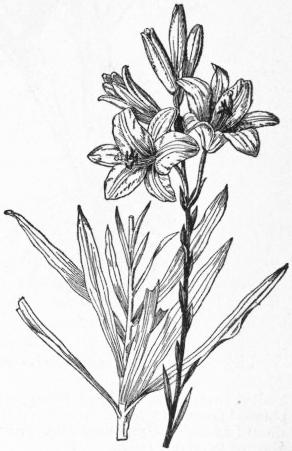
Madonna or White Lily (Lilium candidum). About ¼ nat. size.
The white lily, L. candidum, the λείριον of the Greeks, was one of the commonest garden flowers of antiquity, appearing in the poets from Homer downwards side by side with the rose and the violet. According to Hehn, roses and lilies entered Greece from the east by way of Phrygia, Thrace and Macedonia (Kulturpflanzen und Hausthiere, 3rd ed., p. 217). The word λείριον itself, from which lilium is derived by assimilation of consonants, appears to be Eranian (Ibid. p. 527), and according to ancient etymologists (Lagarde, Ges. Abh. p. 227) the town of Susa was connected with the Persian name of the lily sûsan (Gr. σοῦσον, Heb. shôshan). Mythologically the white lily, Rosa Junonis, was fabled to have sprung from the milk of Hera. As the plant of purity it was contrasted with the rose of Aphrodite. The word κρίνον, on the other hand, included red and purple lilies, Plin. H.N. xxi. 5 (11, 12), the red lily being best known in Syria and Judaea (Phaselis). This perhaps is the “red lily of Constantinople” of Gerard, L. chalcedonicum. The lily of the Old Testament (shôshan) may be conjectured to be a red lily from the simile in Cant. v. 13, unless the allusion is to the fragrance rather than the colour of the lips, in which case the white lily must be thought of. The “lilies of the field,” Matt. vi. 28, are κρίνα, and the comparison of their beauty with royal robes suggests their identification with the red Syrian lily of Pliny. Lilies, however, are not a conspicuous feature in the flora of Palestine, and the red anemone (Anemone coronaria), with which all the hill-sides of Galilee are dotted in the spring, is perhaps more likely to have suggested the figure. For the lily in the pharmacopoeia of the ancients see Adams’s Paul. Aegineta, iii. 196. It was used in unguents and against the bites of snakes, &c. In the middle ages the flower continued to be common and was taken as the symbol of heavenly purity. The three golden lilies of France are said to have been originally three lance-heads.
Lily of the valley, Convallaria majalis, belongs to a different tribe (Asparagoideae) of the same order. It grows wild in woods in some parts of England, and in Europe, northern Asia and the Alleghany Mountains of North America. The leaves and flower-scapes spring from an underground creeping stem. The small pendulous bell-shaped flowers contain no honey but are visited by bees for the pollen.
The word “lily” is loosely used in connexion with many plants which are not really liliums at all, but belong to genera which are quite distinct botanically. Thus, the Lent lily is Narcissus Pseudo-narcissus; the African lily is Agapanthus umbellatus; the Belladonna lily is Amaryllis Belladonna (q.v.); the Jacobaea lily is Sprekelia formosissima; the Mariposa lily is Calochortus; the lily of the Incas is Alstroemeria pelegrina; St Bernard’s lily is Anthericum Liliago; St Bruno’s lily is Anthericum (or Paradisia) Liliastrum; the water lily is Nymphaea alba; the Arum lily is Richardia africana; and there are many others.
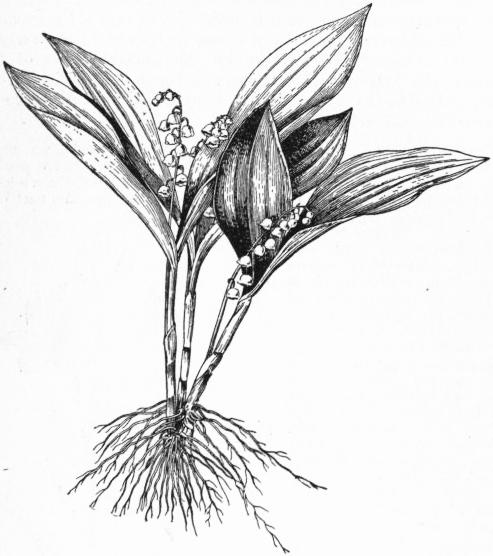
Lily of the Valley (Convallaria majalis). About ¼ nat. size.
The true lilies are so numerous and varied that no general cultural instructions will be alike suitable to all. Some species, as L. Martagon, candidum, chalcedonicum, Szovitzianum (or colchicum), bulbiferum, croceum, Henryi, pomponium—the “Turk’s cap lily,” and others, will grow in almost any good garden soil, and succeed admirably in loam of a rather heavy character, and dislike too much peat. But a compost of peat, loam and leaf-soil suits L. auratum, Brownii, concolor, elegans, giganteum, japonicum, longiflorum, monadelphum, pardalinum, speciosum, and the tiger lily (L. tigrinum) well, and a larger proportion of peat is indispensable for the beautiful American L. superbum and canadense. The margin of rhododendron beds, where there are sheltered recesses amongst the plants, suits many of the more delicate species well, partial shade and shelter of some kind being essential. The bulbs should be planted from 6 to 10 in. (according to size) below the surface, which should at once be mulched over with half-decayed leaves or coconut fibre to keep out frost.
The noble L. auratum, with its large white flowers, having a yellow band and numerous red or purple spots, is a magnificent plant when grown to perfection; and so are the varieties called rubro-vittatum and cruentum, which have the central band crimson instead of yellow; and the broad-petalled platyphyllum, and its almost pure white sub-variety called virginale. Of L. speciosum (well known to most gardeners as lancifolium), the true typical form and the red-spotted and white varieties are grand plants for late summer blooming in the conservatory. The tiger lily, L. tigrinum, and its varieties Fortunei, splendidum and flore-pleno, are amongst the best species for the flower garden; L. Thunbergianum and its many varieties being also good border flowers. The pretty L. Leichtlinii and L. colchicum (or Szovitsianum) with drooping yellow flowers and the scarlet drooping-flowered L. tenuifolium make up, with those already mentioned, a series of the finest hardy flowers of the summer garden. The Indian L. giganteum is perfectly distinct in character, having broad heart-shaped leaves, and a noble stem 10 to 14 ft. high, bearing a dozen or more large deflexed, funnel-shaped, white, purple-stained flowers; L. cordifolium (China and Japan) is similar in character, but dwarfer in habit.
For pot culture, the soil should consist of three parts turfy loam to one of leaf-mould and thoroughly rotted manure, adding enough pure grit to keep the compost porous. If leaf-mould is not at hand, turfy peat may be substituted for it. The plants should be potted in October. The pots should be plunged in a cold frame and protected from frost, and about May may be removed to a sheltered and moderately shady place out-doors to remain till they flower, when they may be removed to the greenhouse. This treatment suits the gorgeous L. auratum, the splendid varieties of L. speciosum (lancifolium) and also the chaste-flowering trumpet-tubed L. longiflorum and its varieties. Thousands of bulbs of such lilies as longiflorum and speciosum are now retarded in refrigerators and taken out in batches for greenhouse work as required.
Diseases.—Lilies are, under certain conditions favourable to the development of the disease, liable to the attacks of three parasitic fungi. The most destructive is Botrytis cinerea which forms orange-brown or buff specks on the stems, pedicels, leaves and flower-buds, which increase in size and become covered with a delicate grey mould, completely destroying or disfiguring the parts attacked. The spores formed on the delicate grey mould are carried during the summer from one plant to another, thus spreading the disease, and also germinate in the soil where the fungus may remain passive during the winter producing a new crop of spores next spring, or sometimes attacking the scales of the bulbs forming small black hard bodies embedded in the flesh. For prevention, the surface soil covering bulbs should be removed every autumn and replaced by soil mixed with kainit; manure for mulching should also be mixed with kainit, which acts as a steriliser. If the fungus appears on the foliage spray with potassium sulphide solution (2 oz. in 3 gallons of water). Uromyces Erythronii, a rust, sometimes causes considerable injury to the foliage of species of Lilium and other bulbous plants, forming large discoloured blotches on the leaves. The diseased stems should be removed and burned before the leaves fall; as the bulb is not attacked the plant will start growth next season free from disease. Rhizopus necans is sometimes the cause of extensive destruction of bulbs. The fungus attacks injured roots and afterwards passes into the bulb which becomes brown and finally rots. The fungus hibernates in the soil and enters through broken or injured roots, hence care should be taken when removing the bulbs that the roots are injured as little as possible. An excellent packing material for dormant buds is coarsely crushed wood-charcoal to which has been added a sprinkling of flowers of sulphur. This prevents infection from outside and also destroys any spores or fungus mycelium that may have been packed away along with the bulbs.
When cultivated in greenhouses liliums are subject to attack from aphides (green fly) in the early stages of growth. These pests can be kept in check by syringing with nicotine, soft-soap and quassia solutions, or by “vaporising” two or three evenings in succession, afterwards syringing the plants with clear tepid water.
LILYE, or Lily, WILLIAM (c. 1468-1522), English scholar, was born at Odiham in Hampshire. He entered the university of Oxford in 1486, and after graduating in arts went on a pilgrimage to Jerusalem. On his return he put in at Rhodes, which was still occupied by the knights of St John, under whose protection many Greeks had taken refuge after the capture of Constantinople by the Turks. He then went on to Italy, where he attended the lectures of Sulpitius Verulanus and Pomponius Laetus at Rome, and of Egnatius at Venice. After his return he settled in London (where he became intimate with Thomas More) as a private teacher of grammar, and is believed to have been the first who taught Greek in that city. In 1510 Colet, dean of St Paul’s, who was then founding the school which afterwards became famous, appointed Lilye the first high master. He died of the plague on the 25th of February 1522.
Lilye is famous not only as one of the pioneers of Greek learning, but as one of the joint-authors of a book, familiar to many generations of students during the 19th century, the old Eton Latin grammar. The Brevissima Institutio, a sketch by Colet, corrected by Erasmus and worked upon by Lilye, contains two portions, the author of which is indisputably Lilye. These are the lines on the genders of nouns, beginning Propria quae maribus, and those on the conjugation of verbs beginning As in praesenti. The Carmen de Moribus bears Lilye’s name in the early editions; but Hearne asserts that it was written by Leland, who was one of his scholars, and that Lilye only adapted it. Besides the Brevissima Institutio, Lilye wrote a variety of Latin pieces both in prose and Verse. Some of the latter are printed along with the Latin verses of Sir Thomas More in Progymnasmata Thomae Mori et Gulielmi Lylii Sodalium (1518). Another volume of Latin verse (Antibossicon ad Gulielmum Hormannum, 1521) is directed against a rival schoolmaster and grammarian, Robert Whittington, who had “under the feigned name of Bossus, much provoked Lilye with scoffs and biting verses.”
See the sketch of Lilye’s life by his son George, canon of St Paul’s, written for Paulus Jovius, who was collecting for his history the lives of the learned men of Great Britain; and the article by J. H. Lupton, formerly sur-master of St Paul’s School, in the Dictionary of National Biography.
LIMA, a city and the county-seat of Allen county, Ohio, U.S.A., on the Ottawa river, about 70 m. S.S.W. of Toledo, Pop. (1890) 15,981; (1900) 21,723, of whom 1457 were foreign-born and 731 were negroes; (1910 census) 30,508. It is served by the Pennsylvania (Pittsburgh, Ft. Wayne & Chicago division), the Erie, the Cincinnati, Hamilton & Dayton, the Lake Erie & Western, the Detroit, Toledo & Ironton railways, and by six interurban electric lines. Immediately N. of the city is a state asylum for the insane. Lima has a Carnegie library, a city hospital and a public park of 100 acres. Among the principal buildings are the county court house, a masonic temple, an Elks’ home and a soldiers’ and sailors’ memorial building. Lima College was conducted here from 1893 to 1908. Lima is situated in the centre of the great north-western oil-field (Trenton limestone of the Ordovician system) of Ohio, which was first developed in 1885; the product of the Lima district was 20,575,138 barrels in 1896, 15,877,730 barrels in 1902 and 6,748,676 barrels in 1908. The city is a headquarters of the Standard Oil Company, and the refining of petroleum is one of the principal industries. The total value of the factory product in 1905 was $8,155,586, an increase of 31.1% over that in 1900. Lima contains railway shops of the Cincinnati, Hamilton & Dayton and the Lake Erie & Western railways. The city has a large wholesale and jobbing trade. The municipality owns and operates the water-works. Lima was laid out in 1831, and was first organized as a city under a general state law in 1842.
LIMA, a coast department of central Peru, bounded N. by Ancachs, E. by Junin and Huancavelica, S. by Ica and W. by the Pacific Ocean. Pop. (1906 estimate) 250,000; area 13,314 sq. m. The eastern boundary follows the crests of the Western Cordillera, which gives to the department the western slopes of this chain with the drainage basins of the rivers Huaura, Chancay, Chillon, Rimac, Lurin, Mala and Cañete. Although the department forms part of the rainless region, these rivers, fed from the snows of the high Andes, provide water for the irrigation of large areas devoted to the raising of cotton, sugar, sorghum, Indian corn, alfalfa, potatoes, grapes and olives. The sugar estates of the Cañete are among the best in Peru and are served by a narrow gauge railway terminating at the small port of Cerro Azul. Indian corn is grown in Chancay and other northern valleys, and is chiefly used, together with alfalfa and barley, in fattening swine for lard. The mineral resources are not important, though gold washings in the Cañete valley have been worked since early colonial times. One of the most important industrial establishments in the republic is the smelting works at Casapalca, on the Oroya railway, in the Rimac valley, which receives ores from neighbouring mines of the district of Huarochiri. The department is crossed from S.W. to N.E. by the Oroya railway, and several short lines run from the city of Lima to neighbouring towns. Besides Lima (q.v.) the principal towns are Huacho, Cañete (port), Canta, Yauyos, Chorrillos, Miraflores and Barranco—the last three being summer resorts for the people of the capital, with variable populations of 15,000, 6000 and 5000 respectively. About 15 m. S. of Lima, near the mouth of the Lurin, are the celebrated ruins of Pachacamac, which are believed to antedate the occupation of this region by the Incas.
LIMA, the principal city and the capital of Peru and of the department and province of Lima, on the left bank of the river Rimac, 7½ m. above its mouth and the same distance E. by N. of its seaport Callao, in 12° 2′ 34″ S., 77° 7′ 36″ W. Pop. (1906 estimate) 140,000, of whom a large proportion is of negro descent, and a considerable number of foreign birth. The city is about 480 ft. above sea-level, and stands on an arid plain, which rises gently toward the S., and occupies an angle between the Cerros de San Jeronimo (2493 ft.) and San Cristobal (1411 ft.) on the N. and a short range of low hills, called the Cerros de San Bartolomé, on the E. The surrounding region is arid, like all this part of the Pacific coast, but through irrigation large areas have been brought under cultivation, especially along the watercourses. The Rimac has its source about 105 m. N.E. of Lima and is fed by the melting snows of the higher Andes. It is an insignificant stream in winter and a raging torrent in summer. Its tributaries are all of the same character, except the Rio Surco, which rises near Chorrillos and flowing northward joins the Rimac a few miles above the city. These, with the Rio Lurin, which enters the Pacific a short distance S. of Chorrillos, provide water for irrigating the districts near Lima. The climate varies somewhat from that of the arid coast in general, in having a winter of four months characterized by cloudy skies, dense fogs and sometimes a drizzling rain. The air in this season is raw and chilly. For the rest of the year the sky is clear and the air dry. The mean temperature for the year is 66° F., the winter minimum being 59° and the summer maximum 78°.
The older part of Lima was laid out and built with mathematical regularity, the streets crossing each other at right angles and enclosing square areas, called manzanas, of nearly uniform size. Later extensions, however, did not follow this plan strictly, and there is some variation from the straight line in the streets and also in the size and shape of the manzanas. The streets are roughly paved with cobble stones and lighted with gas or electricity. A broad boulevard of modern construction partly encircles the city, occupying the site of the old brick walls (18 to 20 ft. high, 10 to 12 ft. thick at the base and 9 ft. at the top) which were constructed in 1585 by a Fleming named Pedro Ramon, and were razed by Henry Meiggs during the administration of President Balta. The water-supply is derived from the Rimac and filtered, and the drainage, once carried on the surface, now passes into a system of subterranean sewers. The streets and suburbs of Lima are served by tramways, mostly worked by electric traction. The suburban lines include two to Callao, one to Magdalena, and one to Miraflores and Chorrillos. On the north side of the river is the suburb or district of San Lazaro, shut in by the encircling hills and occupied in great part by the poorer classes. The principal squares are the Plaza Mayor, Plaza Bolívar (formerly P. de la Inquisicion and P. de la Independencia), Plaza de la Exposicion, and Plaza del Acho, on the north side of the river, the site of the bull-ring. The public gardens, connected with the Exposition palace on the S. side of the city, and the Paseo Colon are popular among the Limeños as pleasure resorts. The long Paseo Colon, with its parallel drives and paths, is ornamented with trees, shrubbery and statues, notably the Columbus statue, a group in marble designed by the sculptor Salvatore Revelli. It is the favourite fashionable resort. A part of the old wagon road from Lima to Callao, which was paved and improved with walks and trees by viceroy O’Higgins, is also much frequented. The avenue (3 m. long) leading from the city to Magdalena was beautified by the planting of four rows of palms during the Pierola administration. Among other public resorts are the Botanical garden, the Grau and Bolognesi avenues (parts of the Boulevard), the Acho avenue on the right bank of the Rimac, and the celebrated avenue of the Descalzos, on the N. side of the river, bordered with statuary. The noteworthy monuments of the city are the bronze equestrian statue of Bolívar in the plaza of that name, the Columbus statue already mentioned, the Bolognesi statue in the small square of that name, and the San Martin statue in the Plaza de la Exposicion. The 22nd of May monument, a marble shaft crowned by a golden bronze figure of Victory, stands where the Callao road crosses the Boulevard. Most conspicuous among the public buildings of Lima is the cathedral, whose twin towers and broad façade look down upon the Plaza Mayor. Its foundation stone was laid in 1535 but the cathedral was not consecrated until 1625. The great earthquake of 1746 reduced it to a mass of ruins, but it was reconstructed by 1758, practically, as it now stands. It has double aisles and ten richly-decorated chapels, in one of which rest the remains of Francisco Pizarro, the conqueror of Peru. Also facing the same square are the archiepiscopal and government palaces; the latter formerly the palace of the viceroys. The interesting casa of the Inquisition, whose tribunals rivalled those of Madrid in cruelty, faces upon Plaza Bolívar, as also the old University of San Marcos, which dates from 1551 and has faculties of theology, law, medicine, philosophy and literature, mathematics, and administrative and political economy. The churches and convents of Lima are richly endowed as a rule, and some of the churches represent a very large expenditure of money. The convent of San Francisco, near the Plaza Mayor, is the largest monastic establishment in Lima and contains some very fine carvings. Its church is the finest in the city after the cathedral. Other noteworthy churches are those of the convents of Santo Domingo, La Merced and San Augustine. There are a number of conventual establishments (for both sexes), which, with their chapels, and with the smaller churches, retreats, sanctuaries, &c., make up a total of 66 institutions devoted to religious observances. An attractive, and perhaps the most popular public building in Lima is the Exposition palace on the plaza and in the public gardens of the same name, on the south side of the city. It dates from 1872; its halls are used for important public assemblies, and its upper floor is occupied by the National Historical Institute, its museum and the gallery of historical paintings. Other noteworthy edifices and institutions are the National Library, the Lima Geographical Society, founded in 1888; the Mint, which dates from 1565 and is considered to be one of the best in South America; the great bull-ring of the Plaza del Acho, which dates from 1768 and can seat 8000 spectators; the Concepcion market; a modern penitentiary; and various charitable institutions. In addition to the old university on the Plaza Bolívar, which has been modernized and greatly improved, Lima has a school of engineers and mines (founded 1876), the old college of San Carlos, a normal school (founded 1905), a school of agriculture (situated outside the city limits and founded in 1902), two schools for girls under the direction of religious sisters, an episcopal seminary called the Seminario Conciliar de Santo Toribio, and a school of arts and trades in which elementary technical instruction is given. Under the old régime, primary instruction was almost wholly neglected, but the 20th century brought about important changes in this respect. In addition to the primary schools, the government maintains free night schools for workmen.
The residences of the city are for the most part of one storey and have mud walls supported by a wooden framework which enclose open spaces, called patios, around which the living rooms are ranged. The better class of dwellings have two floors and are sometimes built of brick. A projecting, lattice-enclosed window for the use of women is a prominent feature of the larger houses and gives a picturesque effect to the streets.
Manufacturing has had some considerable development since the closing years of the 19th century; the most important manufactories are established outside the city limits; they produce cotton and woollen textiles, the products of the sugar estates, chocolate, cocaine, cigars and cigarettes, beer, artificial liquors, cotton-seed oil, hats, macaroni, matches, paper, soap and candles. The commercial interests of the city are important, a large part of the interior being supplied from this point. With its port Callao the city is connected by two steam railways, one of which was built as early as 1848; one railway runs northward to Ancon, and another, the famous Oroya line, runs inland 130 m., crossing the Western Cordillera at an elevation of 15,645 ft. above sea-level, with branches to Cerro de Pasco and Huari. The export trade properly belongs to Callao, though often credited to Lima. The Limeños are an intelligent, hospitable, pleasure-loving people, and the many attractive features of their city make it a favourite place of residence for foreigners.
Lima was founded on the 18th of January 1535 by Francisco Pizarro, who named it Ciudad de los Reyes (City of the Kings) in honour of the emperor Charles V. and Doña Juana his mother, or, according to some authorities, in commemoration of the Feast of the Epiphany (6th January) when its site is said to have been selected. The name soon after gave place to that of Lima, a Spanish corruption of the Quichua word Rimac. In 1541 Lima was made an episcopal see, which in 1545 was raised to a metropolitan see. Under Spanish rule, Lima was the principal city of South America, and for a time was the entrepôt for all the Pacific coast colonies south of Panama. It became very prosperous during this period, though often visited by destructive earthquakes, the most disastrous of which was that of the 28th of October 1746, when the cathedral and the greater part of the city were reduced to ruins, many lives were lost, and the port of Callao was destroyed. Lima was not materially affected by the military operations of the war of independence until 1821, when a small army of Argentines and Chileans under General San Martin invested the city, and took possession of it on the 12th of July upon the withdrawal of the Spanish forces. San Martin was proclaimed the protector of Peru as a free state on the 28th of July, but resigned that office on the 20th of September 1822 to avoid a fratricidal struggle with Bolívar. In March 1828 Lima was again visited by a destructive earthquake, and in 1854-1855 an epidemic of yellow fever carried off a great number of its inhabitants. In November 1864, when a hostile Spanish fleet was on the coast, a congress of South American plenipotentiaries was held here to concert measures of mutual defence. Lima has been the principal sufferer in the many revolutions and disorders which have convulsed Peru under the republic, and many of them originated in the city itself. During the earlier part of this period the capital twice fell into the hands of foreigners, once in 1836 when the Bolivian general Santa Cruz made himself the chief of a Bolivian-Peruvian confederation, and again in 1837 when an invading force of Chileans and Peruvian refugees landed at Ancon and defeated the Peruvian forces under President Orbegoso. The city prospered greatly under the two administrations of President Ramon Castilla, who gave Peru its first taste of peace and good government, and under those of Presidents Balta and Pardo, during which many important public improvements were made. The greatest calamity in the history of Lima was its occupation by a Chilean army under the command of General Baquedano after the bloody defeat of the Peruvians at Miraflores on the 15th of January 1881. Chorrillos and Miraflores with their handsome country residences had already been sacked and burned and their helpless residents murdered. Lima escaped this fate, thanks to the intervention of foreign powers, but during the two years and nine months of this occupation the Chileans systematically pillaged the public edifices, turned the old university of San Marcos into barracks, destroyed the public library, and carried away the valuable contents of the Exposition palace, the models and apparatus of the medical school and other educational institutions, and many of the monuments and art treasures with which the city had been enriched. A forced contribution of $1,000,000 a month was imposed upon the population in addition to the revenues of the custom house. When the Chilean garrison under Captain Lynch was withdrawn on the 22nd of October 1883, it took 3000 wagons to carry away the plunder which had not already been shipped. Of the government palace and other public buildings nothing remained but the bare walls. The buoyant character of the people, and the sympathy and assistance generously offered by many civilized nations, contributed to a remarkably speedy recovery from so great a misfortune. Under the direction of its keeper, Don Ricardo Palma, 8315 volumes of the public library were recovered, to which were added valuable contributions from other countries. The portraits of the Spanish viceroys were also recovered, except five, and are now in the portrait gallery of the Exposition palace. The poverty of the country after the war made recovery difficult, but years of peace have assisted it.
See Mariano F. Paz Soldan, Diccionario geográfico-estadistico del Perú (Lima, 1877); Mateo Paz Soldan and M. F. Paz Soldan, Geografia del Perú (Paris, 1862); Manuel A. Fuentes, Lima, or Sketches of the Capital of Peru (London, 1866); C. R. Markham, Cuzo and Lima (London, 1856), and History of Peru (Chicago, 1892); Alexandre Garland, Peru in 1906 (Lima, 1907); and C. R. Enock, Peru (London, 1908). For earlier descriptions see works referred to under Peru.
(A. J. L.)
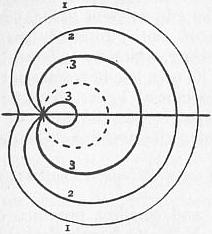
LIMAÇON (from the Lat. limax, a slug), a curve invented by Blaise Pascal and further investigated and named by Gilles Personne de Roberval. It is generated by the extremities of a rod which is constrained to move so that its middle point traces out a circle, the rod always passing through a fixed point on the circumference. The polar equation is r = a + b cos θ, where 2a = length of the rod, and b = diameter of the circle. The curve may be regarded as an epitrochoid (see Epicycloid) in which the rolling and fixed circles have equal radii. It is the inverse of a central conic for the focus, and the first positive pedal of a circle for any point. The form of the limaçon depends on the ratio of the two constants; if a be greater than b, the curve lies entirely outside the circle; if a equals b, it is known as a cardioid (q.v.); if a is less than b, the curve has a node within the circle; the particular case when b = 2a is known as the trisectrix (q.v.). In the figure (1) is a limaçon, (2) the cardioid, (3) the trisectrix.
Properties of the limaçon may be deduced from its mechanical construction; thus the length of a focal chord is constant and the normals at the extremities of a focal chord intersect on a fixed circle. The area is (b² + a²/2)π, and the length is expressible as an elliptic integral.
LIMASOL, a seaport of Cyprus, on Akrotiri Bay of the south coast. Pop. (1901) 8298. Excepting a fort attributed to the close of the 12th century the town is without antiquities of interest, but in the neighbourhood are the ancient sites of Amathus and Curium. Limasol has a considerable trade in wine and carobs. The town was the scene of the marriage of Richard I., king of England, with Berengaria, in 1191.
LIMB. (1) (In O. Eng. lim, cognate with the O. Nor. and Icel. limr, Swed. and Dan. lem; probably the word is to be referred to a root li- seen in an obsolete English word “lith,” a limb, and in the Ger. Glied), originally any portion or member of the body, but now restricted in meaning to the external members of the body of an animal apart from the head and trunk, the legs and arms, or, in a bird, the wings. It is sometimes used of the lower limbs only, and is synonymous with “leg.” The word is also used of the main branches of a tree, of the projecting spurs of a range of mountains, of the arms of a cross, &c. As a translation of the Lat. membrum, and with special reference to the church as the “body of Christ,” “limb” was frequently used by ecclesiastical writers of the 16th and 17th centuries of a person as being a component part of the church; cf. such expressions as “limb of Satan,” “limb of the law,” &c. From the use of membrum in medieval Latin for an estate dependent on another, the name “limb” is given to an outlying portion of another, or to the subordinate members of the Cinque Ports, attached to one of the principal towns; Pevensey was thus a “limb” of Hastings. (2) An edge or border, frequently used in scientific language for the boundary of a surface. It is thus used of the edge of the disk of the sun or moon, of the expanded part of a petal or sepal in botany, &c. This word is a shortened form of “limbo” or “limbus,” Lat. for an edge, for the theological use of which see Limbus.
LIMBACH, a town in the kingdom of Saxony, in the manufacturing district of Chemnitz, 6 m. N.W. of that city. Pop. (1905) 13,723. It has a public park and a monument to the composer Pache. Its industries include the making of worsteds, cloth, silk and sewing-machines, and dyeing and bleaching.
LIMBER, an homonymous word, having three meanings. (1) A two-wheeled carriage forming a detachable part of the equipment of all guns on travelling carriages and having on it a framework to contain ammunition boxes, and, in most cases, seats for two or three gunners. The French equivalent is avant-train, the Ger. Protz (see Artillery and Ordnance). (2) An adjective meaning pliant or flexible and so used with reference to a person’s mental or bodily qualities, quick, nimble, adroit. (3) A nautical term for the holes cut in the flooring in a ship above the keelson, to allow water to drain to the pumps.
The etymology of these words is obscure. According to the New English Dictionary the origin of (1) is to be found in the Fr. limonière, a derivative of limon, the shaft of a vehicle, a meaning which appears in English from the 15th century but is now obsolete, except apparently among the miners of the north of England. The earlier English forms of the word are lymor or limmer. Skeat suggests that (2) is connected with “limp,” which he refers to a Teutonic base lap-, meaning to hang down. The New English Dictionary points out that while “limp” does not occur till the beginning of the 18th century, “limber” in this sense is found as early as the 16th. In Thomas Cooper’s (1517?-1594) Thesaurus Linguae Romanae et Britannicae (1565), it appears as the English equivalent of the Latin lentus. A possible derivation connects it with “limb.”
LIMBORCH, PHILIPP VAN (1633-1712), Dutch Remonstrant theologian, was born on the 19th of June 1633, at Amsterdam, where his father was a lawyer. He received his education at Utrecht, at Leiden, in his native city, and finally at Utrecht University, which he entered in 1652. In 1657 he became a Remonstrant pastor at Gouda, and in 1667 he was transferred to Amsterdam, where, in the following year, the office of professor of theology in the Remonstrant seminary was added to his pastoral charge. He was a friend of John Locke. He died at Amsterdam on the 30th of April 1712.
His most important work, Institutiones theologiae christianae, ad praxin pietatis et promotionem pacis christianae unice directae (Amsterdam, 1686, 5th ed., 1735), is a full and clear exposition of the system of Simon Episcopius and Stephan Curcellaeus. The fourth edition (1715) included a posthumous “Relatio historica de origine et progressu controversiarum in foederato Belgio de praedestinatione.” Limborch also wrote De veritate religionis Christianae amica collatio cum erudito Judaeo (Gouda, 1687); Historia Inquisitionis (1692), in four books prefixed to the “Liber Sententiarum Inquisitionis Tolosanae” (1307-1323); and Commentarius in Acta Apostolorum et in Epistolas ad Romanos et ad Hebraeos (Rotterdam, 1711). His editorial labours included the publication of various works of his predecessors, and of Epistolae ecclesiasticae praestantium ac eruditorum virorum (Amsterdam, 1684), chiefly by Jakobus Arminius, Joannes Uytenbogardus, Konrad Vorstius (1569-1622), Gerhard Vossius (1577-1649), Hugo Grotius, Simon Episcopius (his grand-uncle) and Gaspar Barlaeus; they are of great value for the history of Arminianism. An English translation of the Theologia was published in 1702 by William Jones (A Complete System or Body of Divinity, both Speculative and Practical, founded on Scripture and Reason, London, 1702); and a translation of the Historia Inquisitionis, by Samuel Chandler, with “a large introduction concerning the rise and progress of persecution and the real and pretended causes of it” prefixed, appeared in 1731. See Herzog-Hauck, Realencyklopädie.
LIMBURG, one of the many small feudal states into which the duchy of Lower Lorraine was split up in the second half of the 11th century. The first count, Walram of Arlon, married Judith the daughter of Frederick of Luxemburg, duke of Lower Lorraine (d. 1065), who bestowed upon him a portion of his possessions lying upon both sides of the river Meuse. It received its name from the strong castle built by Count Walram on the river Vesdre, where the town of Limburg now stands. Henry, Walram’s son (d. 1119), was turbulent and ambitious. On the death of Godfrey of Bouillon (1089) he forced the emperor Henry IV. to recognize him as duke of Lower Lorraine. He was afterwards deposed and imprisoned by Count Godfrey of Louvain on whom the ducal title had been bestowed by the emperor Henry V. (1106). For three generations the possession of the ducal title was disputed between the rival houses of Limburg and Louvain. At length a reconciliation took place (1155); the name of duke of Lower Lorraine henceforth disappears, the rulers of the territory on the Meuse become dukes of Limburg, those of the larger territory to the west dukes of Brabant. With the death of Duke Walram IV. (1280) the succession passed to his daughter, Irmingardis, who was married to Reinald I., count of Guelders. Irmingardis died without issue (1282), and her cousin, Count Adolph of Berg, laid claim to the duchy. His rights were disputed by Reinald, who was in possession and was recognized by the emperor. Too weak to assert his claim by force of arms Adolph sold his rights (1283) to John, duke of Brabant (q.v.). This led to a long and desolating war for five years, at the end of which (1288), finding the power of Brabant superior to his own Reinald in his turn sold his rights to count Henry III. of Luxemburg. Henry and Reinald, supported by the archbishop of Cologne and other allies, now raised a great army. The rival forces met at Woeringen (5th of June 1288) and John of Brabant (q.v.) gained a complete victory. It proved decisive, the duchies of Limburg and Brabant passing under the rule of a common sovereign. The duchy comprised during this period the bailiwicks of Hervé, Montzen, Baelen, Sprimont and Wallhorn, and the counties of Rolduc, Daelhem and Falkenberg, to which was added in 1530 the town of Maastricht. The provisions and privileges of the famous Charter of Brabant, the Joyeuse Entrée (q.v.), were from the 15th century extended to Limburg and remained in force until the French Revolution. By the treaty of Westphalia (1648) the duchy was divided into two portions, the counties of Daelhem and Falkenberg with the town of Maastricht being ceded by Spain to the United Provinces, where they formed what was known as a “Generality-Land.” At the peace of Rastatt (1714) the southern portion passed under the dominion of the Austrian Habsburgs and formed part of the Austrian Netherlands until the French conquest in 1794. During the period of French rule (1794-1814) Limburg was included in the two French departments of Ourthe and Meuse Inférieure. In 1814 the old name of Limburg was restored to one of the provinces of the newly created kingdom of the Netherlands, but the new Limburg comprised besides the ancient duchy, a piece of Gelderland and the county of Looz. At the revolution of 1830 Limburg, with the exception of Maastricht, threw in its lot with the Belgians, and during the nine years that King William refused to recognize the existence of the kingdom of Belgium the Limburgers sent representatives to the legislature at Brussels and were treated as Belgians. When in 1839 the Dutch king suddenly announced his intention of accepting the terms of the settlement proposed by the treaty of London, as drawn up by representatives of the great powers in 1831, Belgium found herself compelled to relinquish portions of Limburg and Luxemburg. The part of Limburg that lay on the right bank of the Meuse, together with the town of Maastricht and a number of communes—Weert, Haelen, Kepel, Horst, &c.—on the left bank of the river, became a sovereign duchy under the rule of the king of Holland. In exchange for the cession of the rights of the Germanic confederation over the portion of Luxemburg, which was annexed by the treaty to Belgium, the duchy of Limburg (excepting the communes of Maastricht and Venloo) was declared to belong to the Germanic confederation. This somewhat unsatisfactory condition of affairs continued until 1866, when at a conference of the great powers, held in London to consider the Luxemburg question (see Luxemburg), it was agreed that Limburg should be freed from every political tie with Germany. Limburg became henceforth an integral part of Dutch territory.
See P. S. Ernst, Histoire du Limbourg (7 vols., Liége, 1837-1852); C. J. Luzac, De Landen van Overmuze in Zonderheid 1662 (Leiden, 1888); M. J. de Poully, Histoire de Maastricht et de ses environs (1850); Diplomaticke bescheiden betreffends de Limburg-Luxemburgsche aangelegenheden 1866-1867 (The Hague, 1868); and R. Fruin, Geschied. der Staats-Instellingen in Nederland (The Hague, 1901).
(G. E.)
LIMBURG, or Limbourg, the smallest of the nine provinces of Belgium, occupying the north-east corner of the kingdom. It represents only a portion of the ancient duchy of Limburg (see above). The part east of the Meuse was transferred to Holland by the London conference, and a further portion was attached to the province of Liége including the old capital now called Dolhain. Much of the province is represented by the wild heath district called the Campine, recently discovered to form an extensive coal-field. The operations for working it were only begun in 1906. North-west of Hasselt is Beverloo, where all the Belgian troops go through a course of instruction annually. Among the towns are Hasselt, the capital, St Trond and Looz. From the last named is derived the title of the family known as the dukes of Looz, whose antiquity equals that of the extinct reigning family of Limburg itself. The title of duc de Looz is one of the four existing ducal titles in the Netherlands, the other three being d’Arenberg, Croy and d’Ursel. Limburg contains 603,085 acres or 942 sq. m. In 1904 the population was 255,359, giving an average of 271 per sq. m.
LIMBURG, a town of Germany, in the Prussian province of Hesse-Nassau, on the Lahn, here crossed by a bridge dating from 1315, and on the main line of railway from Coblenz to Lollar and Cassel, with a branch to Frankfort-on-Main. Pop. (1905) 9917. It is the seat of a Roman Catholic bishop. The small seven-towered cathedral, dedicated to St George the martyr, is picturesquely situated on a rocky site overhanging the river. This was founded by Conrad Kurzbold, count of Niederlahngau, early in the 10th century, and was consecrated in 1235. It was restored in 1872-1878. Limburg has a castle, a new town hall and a seminary for the education of priests; its industries include the manufacture of cloth, tobacco, soap, machinery, pottery and leather. Limburg, which was a flourishing place during the middle ages, had its own line of counts until 1414, when it was purchased by the elector of Trier. It passed to Nassau in 1803. In September 1796 it was the scene of a victory gained by the Austrians under the archduke Charles over the French.
See Hillebrand, Limburg an der Lahn unter Pfandherrschaft 1344-1624 (Wiesbaden, 1899).
LIMBURG, the south-easternmost and smallest province of Holland, bounded N. by Gelderland, N.W. by North Brabant, S.W. by the Belgian province of Limburg, and S. by that of Liége, and E. by Germany. Its area is 850 sq. m., and its population in 1900 was 281,934. It is watered by the Meuse (Maas) which forms part of its south-western boundary (with Belgium) and then flows through its northern portion, and by such tributaries as the Geul and Roer (Ruhr). Its capital is Maastricht, which gives name to one of the two administrative districts into which it is divided, the other being Roermond.
LIMBURG CHRONICLE, or Festi Limpurgenses, the name of a German chronicle written most probably by Tileman Elhen von Wolfhagen after 1402. It is a source for the history of the Rhineland between 1336 and 1398, but is perhaps more valuable for the information about German manners and customs, and the old German folk-songs and stories which it contains. It has also a certain philological interest.
The chronicle was first published by J. F. Faust in 1617, and has been edited by A. Wyss for the Monumenta Germaniae historica. Deutsche Chroniken, Band iv. (Hanover, 1883). See A. Wyss, Die Limburger Chronik untersucht (Marburg, 1875).
LIMBURGITE, in petrology, a dark-coloured volcanic rock resembling basalt in appearance, but containing normally no felspar. The name is taken from Limburg (Germany), where they occur in the well-known rock of the Kaiserstuhl. They consist essentially of olivine and augite with a brownish glassy ground mass. The augite may be green, but more commonly is brown or violet; the olivine is usually pale green or colourless, but is sometimes yellow (hyalosiderite). In the ground mass a second generation of small eumorphic augites frequently occurs; more rarely olivine is present also as an ingredient of the matrix. The principal accessory minerals are titaniferous iron oxides and apatite. Felspar though sometimes present is never abundant, and nepheline also is unusual. In some limburgites large phenocysts of dark brown hornblende and biotite are found, mostly with irregular borders blackened by resorption; in others there are large crystals of soda orthoclase or anorthoclase. Hauyne is an ingredient of some of the limburgites of the Cape Verde Islands. Rocks of this group occur in considerable numbers in Germany (Rhine district) and in Bohemia, also in Scotland, Auvergne, Spain, Africa (Kilimanjaro), Brazil, &c. They are associated principally with basalts, nepheline and leucite basalts and monchiquites. From the last-named rocks the limburgites are not easily separated as the two classes bear a very close resemblance in structure and in mineral composition, though many authorities believe that the ground mass of the monchiquites is not a glass but crystalline analcite. Limburgites may occur as flows, as sills or dykes, and are sometimes highly vesicular. Closely allied to them are the augitites, which are distinguished only by the absence of olivine; examples are known from Bohemia, Auvergne, the Canary Islands, Ireland, &c.
LIMBUS (Lat. for “edge,” “fringe,” e.g. of a garment), a theological term denoting the border of hell, where dwell those who, while not condemned to torture, yet are deprived of the joy of heaven. The more common form in English is “limbo,” which is used both in the technical theological sense and derivatively in the sense of “prison,” or for the condition of being lost, deserted, obsolete. In theology there are (1) the Limbus Infantum, and (2) the Limbus Patrum.
1. The Limbus Infantum or Puerorum is the abode to which human beings dying without actual sin, but with their original sin unwashed away by baptism, were held to be consigned; the category included, not unbaptized infants merely, but also idiots, cretins and the like. The word “limbus,” in the theological application, occurs first in the Summa of Thomas Aquinas; for its extensive currency it is perhaps most indebted to the Commedia of Dante (Inf. c. 4). The question as to the destiny of infants dying unbaptized presented itself to theologians at a comparatively early period. Generally speaking it may be said that the Greek fathers inclined to a cheerful and the Latin fathers to a gloomy view. Thus Gregory of Nazianzus (Orat. 40) says “that such children as die unbaptized without their own fault shall neither be glorified nor punished by the righteous Judge, as having done no wickedness, though they die unbaptized, and as rather suffering loss than being the authors of it.” Similar opinions were expressed by Gregory of Nyssa, Severus of Antioch and others—opinions which it is almost impossible to distinguish from the Pelagian view that children dying unbaptized might be admitted to eternal life, though not to the kingdom of God. In his recoil from Pelagian heresy, Augustine was compelled to sharpen the antithesis between the state of the saved and that of the lost, and taught that there are only two alternatives—to be with Christ or with the devil, to be with Him or against Him. Following up, as he thought, his master’s teaching, Fulgentius declared that it is to be believed as an indubitable truth that, “not only men who have come to the use of reason, but infants dying, whether in their mother’s womb or after birth, without baptism in the name of the Father, Son and Holy Ghost, are punished with everlasting punishment in eternal fire.” Later theologians and schoolmen followed Augustine in rejecting the notion of any final position intermediate between heaven and hell, but otherwise inclined to take the mildest possible view of the destiny of the irresponsible and unbaptized. Thus the proposition of Innocent III. that “the punishment of original sin is deprivation of the vision of God” is practically repeated by Aquinas, Scotus, and all the other great theologians of the scholastic period, the only outstanding exception being that of Gregory of Rimini, who on this account was afterwards called “tortor infantum.” The first authoritative declaration of the Latin Church upon this subject was that made by the second council of Lyons (1274), and confirmed by the council of Florence (1439), with the concurrence of the representatives of the Greek Church, to the effect that “the souls of those who die in mortal sin or in original sin only forthwith descend into hell, but to be punished with unequal punishments.” Perrone remarks (Prael. Theol. pt. iii. chap. 6, art. 4) that the damnation of infants and also the comparative lightness of the punishment involved in this are thus de fide; but nothing is determined as to the place which they occupy in hell, as to what constitutes the disparity of their punishment, or as to their condition after the day of judgment. In the council of Trent there was considerable difference of opinion as to what was implied in deprivation of the vision of God, and no definition was attempted, the Dominicans maintaining the severer view that the “limbus infantum” was a dark subterranean fireless chamber, while the Franciscans placed it in a region of light above the earth. Some theologians continue to maintain with Bellarmine that the infants “in limbo” are affected with some degree of sadness on account of a felt privation; others, following the Nodus praedestinationis of Celestine Sfrondati (1649-1696), hold that they enjoy every kind of natural felicity, as regards their souls now, and as regards their bodies after the resurrection, just as if Adam had not sinned. In the condemnation (1794) of the synod of Pistoia (1786), the twenty-sixth article declares it to be false, rash and injurious to treat as Pelagian the doctrine that those dying in original sin are not punished with fire, as if that meant that there is an intermediate place, free from fault and punishment, between the kingdom of God and everlasting damnation.
2. The Limbus Patrum, Limbus Inferni or Sinus Abrahae (“Abraham’s Bosom”), is defined in Roman Catholic theology as the place in the underworld where the saints of the Old Testament were confined until liberated by Christ on his “descent into hell.” Regarding the locality and its pleasantness or painfulness nothing has been taught as de fide. It is sometimes regarded as having been closed and empty since Christ’s descent, but other authors do not think of it as separate in place from the limbus infantum. The whole idea, in the Latin Church, has been justly described as the mere caput mortuum of the old catholic doctrine of Hades, which was gradually superseded in the West by that of purgatory.
LIME (O. Eng. lim, Lat. limus, mud, from linere, to smear), the name given to a viscous exudation of the holly-tree, used for snaring birds and known as “bird-lime.” In chemistry, it is the popular name of calcium oxide, CaO, a substance employed in very early times as a component of mortars and cementing materials. It is prepared by the burning of limestone (a process described by Dioscorides and Pliny) in kilns similar to those described under Cement. The value and subsequent treatment of the product depend on the purity of the limestone; a pure stone yields a “fat” lime which readily slakes; an impure stone, especially if magnesia be present, yields an almost unslakable “poor” lime. See Cement, Concrete and Mortar, for details.
Pure calcium oxide “quick-lime,” obtained by heating the pure carbonate, is a white amorphous substance, which can be readily melted and boiled in the electric furnace, cubic and acicular crystals being deposited on cooling the vapour. It combines with water, evolving much heat and crumbling to pieces; this operation is termed “slaking” and the resulting product “slaked lime”; it is chemically equivalent to the conversion of the oxide into hydrate. A solution of the hydrate in water, known as lime-water, has a weakly alkaline reaction; it is employed in the detection of carbonic acid. “Milk of lime” consists of a cream of the hydrate and water. Dry lime has no action upon chlorine, carbon dioxide and sulphur dioxide, although in the presence of water combination ensues.
In medicine lime-water, applied externally, is an astringent and desiccative, and it enters into the preparation of linamentum calcis and carron oil which are employed to heal burns, eczema, &c. Applied internally, lime-water is an antacid; it prevents the curdling of milk in large lumps (hence its prescription for infants); it also acts as a gastric sedative. Calcium phosphate is much employed in treating rickets, and calcium chloride in haemoptysis and haemophylia. It is an antidote for mineral and oxalic acid poisoning.
LIME,1 or Linden. The lime trees, species of Tilia, are familiar timber trees with sweet-scented, honeyed flowers, which are borne on a common peduncle proceeding from the middle of a long bract. The genus, which gives the name to the natural order Tiliaceae, contains about ten species of trees, natives of the north temperate zone. The general name Tilia europaea, the name given by Linnaeus to the European lime, includes several well-marked sub-species, often regarded as distinct species. These are: (1) the small-leaved lime, T. parvifolia (or T. cordata), probably wild in woods in England and also wild throughout Europe, except in the extreme south-east, and Russian Asia. (2) T. intermedia, the common lime, which is widely planted in Britain but not wild there, has a less northerly distribution than T. cordata, from which it differs in its somewhat larger leaves and downy fruit. (3) The large-leaved lime, T. platyphyllos (or T. grandifolia), occurs only as an introduction in Britain, and is wild in Europe south of Denmark. It differs from the other two limes in its larger leaves, often 4 in. across, which are downy beneath, its downy twigs and its prominently ribbed fruit. The lime sometimes acquires a great size; one is recorded in Norfolk as being 16 yds. in circumference, and Ray mentions one of the same girth. The famous linden tree which gave the town of Neuenstadt in Württemberg the name of “Neuenstadt an der grossen Linden” was 9 ft. in diameter.
The lime is a very favourite tree. It is an object of beauty in the spring when the delicately transparent green leaves are bursting from the protection of the pink and white stipules, which have formed the bud-scales, and retains its fresh green during early summer. Later, the fragrance of its flowers, rich in honey, attracts innumerable bees; in the autumn the foliage becomes a clear yellow but soon falls. Among the many famous avenues of limes may be mentioned that which gave the name to one of the best-known ways in Berlin, “Unter den Linden,” and the avenue at Trinity College, Cambridge.
The economic value of the tree chiefly lies in the inner bark or liber (Lat. for bark), called bast, and the wood. The former was used for paper and mats and for tying garlands by the ancients (Od. i. 38; Pliny xvi. 14. 25, xxiv. 8. 33). Bast mats are now made chiefly in Russia, the bark being cut in long strips, when the liber is easily separable from the corky superficial layer. It is then plaited into mats about 2 yds. square; 14,000,000 come to Britain annually, chiefly from Archangel. The wood is used by carvers, being soft and light, and by architects in framing the models of buildings. Turners use it for light bowls, &c. T. americana (bass-wood) is one of the most common trees in the forests of Canada and extends into the eastern and southern United States. It is sawn into lumber and under the name of white-wood used in the manufacture of wooden ware, cheap furniture, &c., and also for paper pulp (C. S. Sargent, Silva of North America). It was cultivated by Philip Miller at Chelsea in 1752.
The common lime was well known to the ancients. Theophrastus says the leaves are sweet and used for fodder for most kinds of cattle. Pliny alludes to the use of the liber and wood, and describes the tree as growing in the mountain-valleys of Italy (xvi. 30). See also Virg. Geo. i. 173, &c.; Ov. Met. viii. 621, x. 92. Allusion to the lightness of the wood is made in Aristoph. Birds, 1378.
For the sweet lime (Citrus Limetta or Citrus acida) and lime-juice, see Lemon.
1 This is an altered form of O. Eng. and M. Eng. lind; cf. Ger. Linde, cognate with Gr. ἐλάτη, the silver fir. “Linden” in English means properly “made of lime—or lind—wood,” and the transference to the tree is due to the Ger. Lindenbaum.
LIMERICK, a western county of Ireland, in the province of Munster, bounded N. by the estuary of the Shannon and the counties of Clare and Tipperary, E. by Tipperary, S. by Cork and W. by Kerry. The area is 680,842 acres, or about 1064 sq. m. The greater part of the county is comparatively level, but in the south-east the picturesque Galtees, which extend into Tipperary, attain in Galtymore a height of 3015 ft., and on the west, stretching into Kerry, there is a circular amphitheatre of less elevated mountains. The Shannon is navigable for large vessels to Limerick, above which are the rapids of Doonas and Castleroy, and a canal. The Shannon is widely famous as a sporting river, and Castleconnell is a well-known centre. The Maigne, which rises in the Galtees and flows into the Shannon, is navigable as far as the town of Adare.
This is mainly a Carboniferous Limestone county, with fairly level land, broken by ridges of Old Red Sandstone. On the north-east, the latter rock rises on Slievefelim, round a Silurian core, to 1523 ft. In the south, Old Red Sandstone rises above an enclosed area of Silurian shales at Ballylanders, the opposite scarp of Old Red Sandstone forming the Ballyhoura Hills on the Cork border. Volcanic ashes, andesites, basalts and intrusive sheets of basic rock, mark an eruptive episode in the Carboniferous Limestone. These are well seen under Carrigogunnell Castle, and in a ring of hills round Ballybrood. At Ballybrood, Upper Carboniferous beds occur, as an outlier of a large area that links the west of the county with the north of Kerry. The coals in the west are not of commercial value. Lead-ore has been worked in places in the limestone.
Limerick includes the greater part of the Golden Vale, the most fertile district of Ireland, which stretches from Cashel in Tipperary nearly to the town of Limerick. Along the banks of the Shannon there are large tracts of flat meadow land formed of deposits of calcareous and peaty matter, exceedingly fertile. The soil in the mountainous districts is for the most part thin and poor, and incapable of improvement. The large farms occupy the low grounds, and are almost wholly devoted to grazing. The acreage under tillage decreases, the proportion to pasturage being as one to nearly three. All the crops (of which oats and potatoes are the principal) show a decrease, but there is a growing acreage of meadow land. The numbers of live stock, on the other hand, are on the whole well maintained, and cattle, sheep, pigs, goats and poultry are all extensively reared. The inhabitants are employed chiefly in agriculture, but coarse woollens are manufactured, and also paper, and there are many meal and flour mills. Formerly there were flax-spinning and weaving mills, but the industry is now practically extinct. Limerick is the headquarters of an important salmon-fishery on the Shannon. The railway communications are entirely included in the Great Southern and Western system, whose main line crosses the south-eastern corner of the county, with two branches to the city of Limerick from Limerick Junction and from Charleville, and lines from Limerick south-westward to Tralee in county Kerry, and to Foynes on the Shannon estuary. Limerick is also served by a line from the north through county Tipperary. The port of Limerick, at the head of the estuary, is the most important on the west coast.
The county includes 14 baronies. The number of members returned to the Irish parliament was eight, two being returned for each of the boroughs of Askeaton and Kilmallock, in addition to two returned for the county, and two for the county of the city of Limerick. The present county parliamentary divisions are the east and west, each returning one member. The population (158,912 in 1891, 146,098 in 1901) shows a decrease somewhat under the average of the Irish counties generally, emigration being, however, extensive; of the total about 94% are Roman Catholics, and about 73% are rural. The chief towns are Limerick (pop. 38,151), Rathkeale (1749) and Newcastle or Newcastle West (2599). The city of Limerick constitutes a county in itself. Assizes are held at Limerick, and quarter-sessions at Bruff, Limerick, Newcastle and Rathkeale. The county is divided between the Protestant dioceses of Cashel, Killaloe and Limerick; and between the Roman Catholic dioceses of the same names.
Limerick was included in the kingdom of Thomond. Afterwards it had a separate existence under the name of Aine-Cliach. From the 8th to the 11th century it was partly occupied by the Danes (see Limerick, City). As a county, Limerick is one of the twelve generally considered to owe their formation to King John. By Henry II. it was granted to Henry Fitzherbert, but his claim was afterwards resigned, and subsequently various Anglo-Norman settlements were made. About 100,000 acres of the estates of the earl of Desmond, which were forfeited in 1586, were situated in the county, and other extensive confiscations took place after the Cromwellian wars. In 1709 a German colony from the Palatinate was settled by Lord Southwell near Bruff, Rathkeale and Adare.
There are only slight remains of the round tower at Ardpatrick, but that at Dysert is much better preserved; another at Kilmallock is in great part a reconstruction. There are important remains of stone circles, pillar stones and altars at Loch Gur. In several places there are remains of old moats and tumuli. Besides the monasteries in the city of Limerick, the most important monastic ruins are those of Adare abbey, Askeaton abbey, Galbally friary, Kilflin monastery, Kilmallock and Monaster-Nenagh abbey.
LIMERICK, a city, county of a city, parliamentary borough, port and the chief town of Co. Limerick, Ireland, occupying both banks and an island (King’s Island) of the river Shannon, at the head of its estuary, 129 m. W.S.W. of Dublin by the Great Southern and Western railway. Pop. (1901) 38,151. The situation is striking, for the Shannon is here a broad and noble stream, and the immediately surrounding country consists of the rich lowlands of its valley, while beyond rise the hills of the counties Clare and Tipperary. The city is divided into English Town (on King’s Island), Irish Town and Newtown Pery, the first including the ancient nucleus of the city, and the last the principal modern streets. The main stream of the Shannon is crossed by Thomond Bridge and Sarsfield or Wellesley Bridge. The first is commanded by King John’s Castle, on King’s Island, a fine Norman fortress fronting the river, and used as barracks. At the west end of the bridge is preserved the Treaty Stone, on which the Treaty of Limerick was signed in 1691. The cathedral of St Mary, also on King’s Island, was originally built in 1142-1180, and exhibits some Early English work, though largely altered at dates subsequent to that period. The Roman Catholic cathedral of St John is a modern building (1860) in early pointed style. The churches of St Munchin (to whom is attributed the foundation of the see in the 6th century) and St John, Whitamore’s Castle and a Dominican priory, are other remains of antiquarian interest; while the principal city and county buildings are a chamber of commerce, a custom house commanding the river, and court house, town hall and barracks. A picturesque public park adjoins the railway station in Newtown Pery.
The port is the most important on the west coast, and accommodates vessels of 3000 tons in a floating dock; there is also a graving dock. Communication with the Atlantic is open and secure, while a vast network of inland navigation is opened up by a canal avoiding the rapids above the city. Quays extend for about 1600 yds. on each side of the river, and vessels of 600 tons can moor alongside at spring tides. The principal imports are grain, sugar, timber and coal. The exports consist mainly of agricultural produce. The principal industrial establishments include flour-mills (Limerick supplying most of the west of Ireland with flour), factories for bacon-curing and for condensed milk and creameries. Some brewing, distilling and tanning are carried on, and the manufacture of very beautiful lace is maintained at the Convent of the Good Shepherd; but a formerly important textile industry has lapsed. The salmon fisheries of the Shannon, for which Limerick is the headquarters of a district, are the most valuable in Ireland. The city is governed by a corporation, and the parliamentary borough returns one member.
Limerick is said to have been the Regia of Ptolemy and the Rosse-de-Nailleagh of the Annals of Multifernan. There is a tradition that it was visited by St Patrick in the 5th century, but it is first authentically known as a settlement of the Danes, who sacked it in 812 and afterwards made it the principal town of their kingdom of Limerick, but were expelled from it towards the close of the 10th century by Brian Boroimhe. From 1106 till its conquest by the English in 1174 it was the seat of the kings of Thomond or North Munster, and, although in 1179 the kingdom of Limerick was given by Henry II. to Herbert Fitzherbert, the city was frequently in the possession of the Irish chieftains till 1195. Richard I. granted it a charter in 1197. By King John it was committed to the care of William de Burgo, who founded English Town, and for its defence erected a strong castle. The city was frequently besieged in the 13th and 14th centuries. In the 15th century its fortifications were extended to include Irish Town, and until their demolition in 1760 it was one of the strongest fortresses of the kingdom. In 1651 it was taken by General Ireton, and after an unsuccessful siege by William III. in 1690 its resistance was terminated on the 3rd of October of the following year by the treaty of Limerick. The dismantling of its fortifications began in 1760, but fragments of the old walls remain. The original municipal rights of the city had been confirmed and extended by a succession of sovereigns, and in 1609 it received a charter constituting it a county of a city, and also incorporating a society of merchants of the staple, with the same privileges as the merchants of the staple of Dublin and Waterford. The powers of the corporation were remodelled by the Limerick Regulation Act of 1823. The prosperity of the city dates chiefly from the foundation of Newtown Pery in 1769 by Edmund Sexton Pery (d. 1806), speaker of the Irish House of Commons, whose family subsequently received the title of the earldom of Limerick. Under the Local Government Act of 1898 Limerick became one of the six county boroughs having a separate county council.
LIMERICK, a name which has been adopted to distinguish a certain form of verse which began to be cultivated in the middle of the 19th century. A limerick is a kind of burlesque epigram, written in five lines. In its earlier form it had two rhymes, the word which closed the first or second line being usually employed at the end of the fifth, but in later varieties different rhyming words are employed. There is much uncertainty as to the meaning of the name, and as to the time when it became attached to a particular species of nonsense verses. According to the New Eng. Dict. “a song has existed in Ireland for a very considerable time, the construction of the verse of which is identical with that of Lear’s” (see below), and in which the invitation is repeated, “Will you come up to Limerick?” Unfortunately, the specimen quoted in the New Eng. Dict. is not only not identical with, but does not resemble Lear’s. Whatever be the derivation of the name, however, it is now universally used to describe a set of verses formed on this model, with the variations in rhyme noted above:—
“There was an old man who said ‘Hush! I perceive a young bird in that bush!’ When they said, ‘Is it small?’ He replied, ‘Not at all! It is five times the size of the bush.’”
The invention, or at least the earliest general use of this form, is attributed to Edward Lear, who, when a tutor in the family of the earl of Derby at Knowsley, composed, about 1834, a large number of nonsense-limericks to amuse the little grandchildren of the house. Many of these he published, with illustrations, in 1846, and they enjoyed and still enjoy an extreme popularity. Lear preferred to give a geographical colour to his absurdities, as in:—
“There was an old person of Tartary Who cut through his jugular artery, When up came his wife, And exclaimed, ‘O my Life, How your loss will be felt through all Tartary!’”
but this is by no means essential. The neatness of the form has led to a very extensive use of the limerick for all sorts of mock-serious purposes, political, social and sarcastic, and a good many specimens have achieved a popularity which has been all the wider because they have, perforce, been confined to verbal transmission. In recent years competitions of the “missing word” type have had considerable vogue, the competitor, for instance, having to supply the last line of the limerick.
LIMES GERMANICUS. The Latin noun limes denoted generally a path, sometimes a boundary path (possibly its original sense) or boundary, and hence it was utilized by Latin writers occasionally to denote frontiers definitely delimited and marked in some distinct fashion. This latter sense has been adapted and extended by modern historians concerned with the frontiers of the Roman Empire. Thus the Wall of Hadrian in north England (see Britain: Roman) is now sometimes styled the Limes Britannicus, the frontier of the Roman province of Arabia facing the desert the Limes Arabicus and so forth. In particular the remarkable frontier lines which bounded the Roman provinces of Upper (southern) Germany and Raetia, and which at their greatest development stretched from near Bonn on the Rhine to near Regensburg on the Danube, are often called the Limes Germanicus. The history of these lines is the subject of the following paragraphs. They have in the last fifteen years become much better known through systematic excavations financed by the German empire and through other researches connected therewith, and though many important details are still doubtful, their general development can be traced.
From the death of Augustus (A.D. 14) till after A.D. 70 Rome accepted as her German frontier the water-boundary of the Rhine and upper Danube. Beyond these rivers she held only the fertile plain of Frankfort, opposite the Roman border fortress of Moguntiacum (Mainz), the southernmost slopes of the Black Forest and a few scattered têtes-du-pont. The northern section of this frontier, where the Rhine is deep and broad, remained the Roman boundary till the empire fell. The southern part was different. The upper Rhine and upper Danube are easily crossed. The frontier which they form is inconveniently long, enclosing an acute-angled wedge of foreign territory—the modern Baden and Württemberg. The German populations of these lands seem in Roman times to have been scanty, and Roman subjects from the modern Alsace and Lorraine had drifted across the river eastwards. The motives alike of geographical convenience and of the advantages to be gained by recognizing these movements of Roman subjects combined to urge a forward policy at Rome, and when the vigorous Vespasian had succeeded the fool-criminal Nero, a series of advances began which gradually closed up the acute angle, or at least rendered it obtuse.
The first advance came about 74, when what is now Baden was invaded and in part annexed and a road carried from the Roman base on the upper Rhine, Strassburg, to the Danube just above Ulm. The point of the angle was broken off. The second advance was made by Domitian about A.D. 83. He pushed out from Moguntiacum, extended the Roman territory east of it and enclosed the whole within a systematically delimited and defended frontier with numerous blockhouses along it and larger forts in the rear. Among the blockhouses was one which by various enlargements and refoundations grew into the well-known Saalburg fort on the Taunus near Homburg. This advance necessitated a third movement, the construction of a frontier connecting the annexations of A.D. 74 and 83. We know the line of this frontier which ran from the Main across the upland Odenwald to the upper waters of the Neckar and was defended by a chain of forts. We do not, however, know its date, save that, if not Domitian’s work, it was carried out soon after his death, and the whole frontier thus constituted was reorganized, probably by Hadrian, with a continuous wooden palisade reaching from Rhine to Danube. The angle between the rivers was now almost full. But there remained further advance and further fortification. Either Hadrian or, more probably, his successor Pius pushed out from the Odenwald and the Danube, and marked out a new frontier roughly parallel to but in advance of these two lines, though sometimes, as on the Taunus, coinciding with the older line. This is the frontier which is now visible and visited by the curious. It consists, as we see it to-day, of two distinct frontier works, one, known as the Pfahlgraben, is an earthen mound and ditch, best seen in the neighbourhood of the Saalburg but once extending from the Rhine southwards into southern Germany. The other, which begins where the earthwork stops, is a wall, though not a very formidable wall, of stone, the Teufelsmauer; it runs roughly east and west parallel to the Danube, which it finally joins at Heinheim near Regensburg. The Pfahlgraben is remarkable for the extraordinary directness of its southern part, which for over 50 m. runs mathematically straight and points almost absolutely true for the Polar star. It is a clear case of an ancient frontier laid out in American fashion. This frontier remained for about 100 years, and no doubt in that long period much was done to it to which we cannot affix precise dates. We cannot even be absolutely certain when the frontier laid out by Pius was equipped with the Pfahlgraben and Teufelsmauer. But we know that the pressure of the barbarians began to be felt seriously in the later part of the 2nd century, and after long struggles the whole or almost the whole district east of Rhine and north of Danube was lost—seemingly all within one short period—about A.D. 250.
The best English account will be found in H. F. Pelham’s essay in Trans. of the Royal Hist. Soc. vol. 20, reprinted in his Collected Papers, pp. 178-211 (Oxford, 1910), where the German authorities are fully cited.
(F. J. H.)
LIMESTONE, in petrography, a rock consisting essentially of carbonate of lime. The group includes many varieties, some of which are very distinct; but the whole group has certain properties in common, arising from the chemical composition and mineral character of its members. All limestones dissolve readily in cold dilute acids, giving off bubbles of carbonic acid. Citric or acetic acid will effect this change, though the mineral acids are more commonly employed. Limestones, when pure, are soft rocks readily scratched with a knife-blade or the edge of a coin, their hardness being 3; but unless they are earthy or incoherent, like chalk or sinter, they do not disintegrate by pressure with the fingers and cannot be scratched with the finger nail. When free from impurities limestones are white, but they generally contain small quantities of other minerals than calcite which affect their colour. Many limestones are yellowish or creamy, especially those which contain a little iron oxide, iron carbonate or clay. Others are bluish from the presence of iron sulphide, or pyrites or marcasite; or grey and black from admixture with carbonaceous or bituminous substances. Red limestones usually contain haematite; in green limestones there may be glauconite or chlorite. In crystalline limestones or marbles many silicates may occur producing varied colours, e.g. epidote, chlorite, augite (green); vesuvianite and garnet (brown and red); graphite, spinels (black and grey); epidote, chondrodite (yellow). The specific gravity of limestones ranges from 2.6 to 2.8 in typical examples.
When seen in the field, limestones are often recognizable by their method of weathering. If very pure, they may have smooth rounded surfaces, or may be covered with narrow runnels cut out by the rain. In such cases there is very little soil, and plants are found growing only in fissures or crevices where the insoluble impurities of the limestone have been deposited by the rain. The less pure rocks have often eroded or pitted surfaces, showing bands or patches rendered more resistant to the action of the weather by the presence of insoluble materials such as sand, clay or chert. These surfaces are often known from the crust of hydrous oxides of iron produced by the action of the atmosphere on any ferriferous ingredients of the rock; they are sometimes black when the limestone is carbonaceous; a thin layer of gritty sand grains may be left on the surface of limestones which are slightly arenaceous. Most limestones which contain fossils show these most clearly on weathered surfaces, and the appearance of fragments of corals, crinoids and shells on the exposed parts of a rock indicate a strong probability that that rock is a limestone. The interior usually shows the organic structures very imperfectly or not at all.
Another characteristic of pure limestones, where they occur in large masses occupying considerable areas, is the frequency with which they produce bare rocky ground, especially at high elevations, or yield only a thin scanty soil covered with short grass. In mountainous districts limestones are often recognizable by these peculiarities. The chalk downs are celebrated for the close green sward which they furnish. More impure limestones, like those of the Lias and Oolites, contain enough insoluble mineral matter to yield soils of great thickness and value, e.g. the Cornbrash. In limestone regions all waters tend to be hard, on account of the abundant carbonate of lime dissolved by percolating waters, and caves, swallow holes, sinks, pot-holes and underground rivers may occur in abundance. Some elevated tracts of limestone are very barren (e.g. the Causses), because the rain which falls in them sinks at once into the earth and passes underground. To a large extent this is true of the chalk downs, where surface waters are notably scarce, though at considerable depths the rocks hold large supplies of water.
The great majority of limestones are of organic formation, consisting of the debris of the skeletons of animals. Some are foraminiferal, others are crinoidal, shelly or coral limestones according to the nature of the creatures whose remains they contain. Of foraminiferal limestones chalk is probably the best known; it is fine, white and rather soft, and is very largely made up of the shells of globigerina and other foraminifera (see Chalk). Almost equally important are the nummulitic limestones so well developed in Mediterranean countries (Spain, France, the Alps, Greece, Algeria, Egypt, Asia Minor, &c.). The pyramids of Egypt are built mainly of nummulitic limestone. Nummulites are large cone-shaped foraminifera with many chambers arranged in spiral order. In Britain the small globular shells of Saccamina are important constituents of some Carboniferous limestones; but the upper portion of that formation in Russia, eastern Asia and North America is characterized by the occurrence of limestones filled with the spindle-shaped shells of Fusulina, a genus of foraminifera now extinct.
Coral limestones are being formed at the present day over a large extent of the tropical seas; many existing coral reefs must be of great thickness. The same process has been going on actively since a very early period of the earth’s history, for similar rocks are found in great abundance in many geological formations. Some Silurian limestones are rich in corals; in the Devonian there are deposits which have been described as coral reefs (Devonshire, Germany). The Carboniferous limestone, or mountain limestones of England and North America, is sometimes nearly entirely coralline, and the great dolomite masses of the Trias in the eastern Alps are believed by many to be merely altered coral reefs. A special feature of coral limestones is that, although they may be to a considerable extent dolomitized, they are generally very free from silt and mechanical impurities.
Crinoidal limestones, though abundant among the older rocks, are not in course of formation on any great scale at the present time, as crinoids, formerly abundant, are now rare. Many Carboniferous and Silurian limestones consist mainly of the little cylindrical joints of these animals. They are easily recognized by their shape, and by the fact that many of them show a tube along their axes, which is often filled up by carbonate of lime; under the microscope they have a punctate or fenestrate structure and each joint behaves as a simple crystalline plate with uniform optical properties in polarized light. Remains of other echinoderms (starfishes and sea urchins) are often found in plenty in Secondary and Tertiary limestones, but very seldom make up the greater part of the rock. Shelly limestones may consist of mollusca or of brachiopoda, the former being common in limestones of all ages while the latter attained their principal development in the Palaeozoic epoch. The shells are often broken and may have been reduced to shell sand before the rock consolidated. Many rocks of this class are impure and pass into marls and shelly sandstones which were deposited in shallow waters, where land-derived sediment mingled with remains of the creatures which inhabited the water. Fresh-water limestones are mostly of this class and contain shells of those varieties of mollusca which inhabit lakes. Brackish water limestones also are usually shelly. Corallines (bryozoa, polyzoa, &c.), cephalopods (e.g. ammonites, belemnites), crustaceans and sponges occur frequently in limestones. It should be understood that it is not usual for a rock to be built up entirely of one kind of organism though it is classified according to its most abundant or most conspicuous ingredients.
In the organic limestones there usually occurs much finely granular calcareous matter which has been described as limestone mud or limestone paste. It is the finely ground substance which results from the breaking down of shells, &c., by the waves and currents, and by the decay which takes place in the sea bottom before the fragments are compacted into hard rock. The skeletal parts of marine animals are not always converted into limestone in the place where they were formed. In shallow waters, such as are the favourite haunts of mollusca, corals, &c., the tides and storms are frequently sufficiently powerful to shift the loose material on the sea bottom. A large part of a coral reef consists of broken coral rock dislodged from the growing mass and carried upwards to the beach or into the lagoon. Large fragments also fall over the steep outward slopes of the reef and build up a talus at their base. Coral muds and coral sands produced by the waves acting in these detached blocks, are believed to cover two and a half millions of square miles of the ocean floor. Owing to the fragile nature of the shells of foraminifera they readily become disintegrated, especially at considerable depths, largely by the solvent action of carbonic acid in sea water as they sink to the bottom. The chalk in very great part consists not of entire shells but of debris of foraminifera, and mollusca (such as Inoceramus, &c.). The Globigerina ooze is the most widespread of modern calcareous formations. It occupies nearly fifty millions of square miles of the sea bottom, at an average depth of two thousand fathoms. Pteropod ooze, consisting mainly of the shells of pteropods (mollusca) also has a wide distribution, especially in northern latitudes.