VOLUME XVI SLICE VI Lightfoot, Joseph to Liquidation (continued 10)
Reading edition
1 As the name of the fish, “ling” is found in other Teut. languages; cf. Dutch and Ger. Leng, Norw. langa, &c. It is generally connected in origin with “long,” from the length of its body. As the name of the common heather, Calluna vulgaris (see Heath) the word is Scandinavian; cf. Dutch and Dan. lyng, Swed. ljung.

LINGARD, JOHN (1771-1851), English historian, was born on the 5th of February 1771 at Winchester, where his father, of an ancient Lincolnshire peasant stock, had established himself as a carpenter. The boy’s talents attracted attention, and in 1782 he was sent to the English college at Douai, where he continued until shortly after the declaration of war by England (1793). He then lived as tutor in the family of Lord Stourton, but in October 1794 he settled along with seven other former members of the old Douai college at Crook Hall near Durham, where on the completion of his theological course he became vice-president of the reorganized seminary. In 1795 he was ordained priest, and soon afterwards undertook the charge of the chairs of natural and moral philosophy. In 1808 he accompanied the community of Crook Hall to the new college at Ushaw, Durham, but in 1811, after declining the presidency of the college at Maynooth, he withdrew to the secluded mission at Hornby in Lancashire, where for the rest of his life he devoted himself to literary pursuits. In 1817 he visited Rome, where he made researches in the Vatican Library. In 1821 Pope Pius VII. created him doctor of divinity and of canon and civil law; and in 1825 Leo XII. is said to have made him cardinal in petto. He died at Hornby on the 17th of July 1851.
Lingard wrote The Antiquities of the Anglo-Saxon Church (1806), of which a third and greatly enlarged addition appeared in 1845 under the title The History and Antiquities of the Anglo-Saxon Church; containing an account of its origin, government, doctrines, worship, revenues, and clerical and monastic institutions; but the work with which his name is chiefly associated is A History of England, from the first invasion by the Romans to the commencement of the reign of William III., which appeared originally in 8 vols. at intervals between 1819 and 1830. Three successive subsequent editions had the benefit of extensive revision by the author; a fifth edition in 10 vols. 8vo appeared in 1849, and a sixth, with life of the author by Tierney prefixed to vol. x., in 1854-1855. Soon after its appearance it was translated into French, German and Italian. It is a work of ability and research; and, though Cardinal Wiseman’s claim for its author that he was “the only impartial historian of our country” may be disregarded, the book remains interesting as representing the view taken of certain events in English history by a devout, but able and learned, Roman Catholic in the earlier part of the 19th century.
LINGAYAT (from linga, the emblem of Siva), the name of a peculiar sect of Siva worshippers in southern India, who call themselves Vira-Saivas (see Hinduism). They carry on the person a stone linga (phallus) in a silver casket. The founder of the sect is said to have been Basava, a Brahman prime minister of a Jain king in the 12th century. The Lingayats are specially numerous in the Kanarese country, and to them the Kanarese language owes its cultivation as literature. Their priests are called Jangamas. In 1901 the total number of Lingayats in all India was returned as more than 2½ millions, mostly in Mysore and the adjoining districts of Bombay, Madras and Hyderabad.
LINGAYEN, a town and the capital of the province of Pangasinán, Luzon, Philippine Islands, about 110 m. N. by W. of Manila, on the S. shore of the Gulf of Lingayen, and on a low and fertile island in the delta of the Agno river. Pop. (1903) 21,529. It has good government buildings, a fine church and plaza, the provincial high school and a girls’ school conducted by Spanish Dominican friars. The climate is cool and healthy. The chief industries are the cultivation of rice (the most important crop of the surrounding country), fishing and the making of nipa-wine from the juice of the nipa palm, which grows abundantly in the neighbouring swamps. The principal language is Pangasinán; Ilocano is also spoken.
LINGEN, RALPH ROBERT WHEELER LINGEN, Baron (1819-1905), English civil servant, was born in February 1819 at Birmingham, where his father, who came of an old Hertfordshire family, with Royalist traditions, was in business. He became a scholar of Trinity College, Oxford, in 1837; won the Ireland (1838) and Hertford (1839) scholarships; and after taking a first-class in Literae Humaniores (1840), was elected a fellow of Balliol (1841). He subsequently won the Chancellor’s Latin Essay (1843) and the Eldon Law scholarship (1846). After taking his degree in 1840, he became a student of Lincoln’s Inn, and was called to the bar in 1847; but instead of practising as a barrister, he accepted an appointment in the Education Office, and after a short period was chosen in 1849 to succeed Sir J. Kay Shuttleworth as its secretary or chief permanent official. He retained this position till 1869. The Education Office of that day had to administer a somewhat chaotic system of government grants to local schools, and Lingen was conspicuous for his fearless discrimination and rigid economy, qualities which characterized his whole career. When Robert Lowe (Lord Sherbrooke) became, as vice-president of the council, his parliamentary chief, Lingen worked congenially with him in producing the Revised Code of 1862 which incorporated “payment by results”; but the education department encountered adverse criticism, and in 1864 the vote of censure in parliament which caused Lowe’s resignation, founded (but erroneously) on an alleged “editing” of the school inspectors’ reports, was inspired by a certain antagonism to Lingen’s as well as to Lowe’s methods. Shortly before the introduction of Forster’s Education Act of 1870, he was transferred to the post of permanent secretary of the treasury. In this office, which he held till 1885, he proved a most efficient guardian of the public purse, and he was a tower of strength to successive chancellors of the exchequer. It used to be said that the best recommendation for a secretary of the treasury was to be able to say “No” so disagreeably that nobody would court a repetition. Lingen was at all events a most successful resister of importunate claims, and his undoubted talents as a financier were most prominently displayed in the direction of parsimony. In 1885 he retired. He had been made a C.B. in 1869 and a K.C.B. in 1878, and on his retirement he was created Baron Lingen. In 1889 he was made one of the first aldermen of the new London County Council, but he resigned in 1892. He died on the 22nd of July 1905. He had married in 1852, but left no issue.
LINGEN, a town in the Prussian province of Hanover, on the Ems canal, 43 m. N.N.W. of Münster by rail. Pop. 7500. It has iron foundries, machinery factories, railway workshops and a considerable trade in cattle, and among its other industries are weaving and malting and the manufacture of cloth. Lingen was the seat of a university from 1685 to 1819.
The county of Lingen, of which this town was the capital, was united in the middle ages with the county of Treklenburg. In 1508, however, it was separated from this and was divided into an upper and a lower county, but the two were united in 1541. A little, later Lingen was sold to the emperor Charles V., from whom it passed to his son, Philip II. of Spain, who ceded it in 1507 to Maurice, prince of Orange. After the death of the English king, William III., in 1702, it passed to Frederick I., king of Prussia, and in 1815 the lower county was transferred to Hanover, only to be united again with Prussia in 1866.
See Möller, Geschichte der vormaligen Grafschaft Lingen (Lingen, 1874); Herrmann, Die Erwerbung der Stadt und Grafschaft Lingen durch die Krone Preussen (Lingen, 1902); and Schriever, Geschichte des Kreiges Lingen (Lingen, 1905).
LINGUET, SIMON NICHOLAS HENRI (1736-1794), French journalist and advocate, was born on the 14th of July 1736, at Reims, whither his father, the assistant principal in the Collège de Beauvais of Paris, had recently been exiled by lettre de cachet for engaging in the Jansenist controversy. He attended the Collège de Beauvais and won the three highest prizes there in 1751. He accompanied the count palatine of Zweibrücken to Poland, and on his return to Paris he devoted himself to writing. He published partial French translations of Calderon and Lope de Vega, and wrote parodies for the Opéra Comique and pamphlets in favour of the Jesuits. Received at first in the ranks of the philosophes, he soon went over to their opponents, possibly more from contempt than from conviction, the immediate occasion for his change being a quarrel with d’Alembert in 1762. Thenceforth he violently attacked whatever was considered modern and enlightened, and while he delighted society with his numerous sensational pamphlets, he aroused the fear and hatred of his opponents by his stinging wit. He was admitted to the bar in 1764, and soon became one of the most famous pleaders of his century. But in spite of his brilliant ability and his record of having lost but two cases, the bitter attacks which he directed against his fellow advocates, especially against Gerbier (1725-1788), caused his dismissal from the bar in 1775. He then turned to journalism and began the Journal de politique et de littérature, which he employed for two years in literary, philosophical and legal criticisms. But a sarcastic article on the French Academy compelled him to turn over the Journal to La Harpe and seek refuge abroad. Linguet, however, continued his career of free lance, now attacking and now supporting the government, in the Annales politiques, civiles et littéraires, published from 1777 to 1792, first at London, then at Brussels and finally at Paris. Attempting to return to France in 1780 he was arrested for a caustic attack on the duc de Duras (1715-1789), an academician and marshal of France, and imprisoned nearly two years in the Bastille. He then went to London, and thence to Brussels, where, for his support of the reforms of Joseph II., he was ennobled and granted an honorarium of one thousand ducats. In 1786 he was permitted by Vergennes to return to France as an Austrian counsellor of state, and to sue the duc d’Aiguillon (1730-1798), the former minister of Louis XV., for fees due him for legal services rendered some fifteen years earlier. He obtained judgment to the amount of 24,000 livres. Linguet received the support of Marie Antoinette; his fame at the time surpassed that of his rival Beaumarchais, and almost excelled that of Voltaire. Shortly afterwards he visited the emperor at Vienna to plead the case of Van der Noot and the rebels of Brabant. During the early years of the Revolution he issued several pamphlets against Mirabeau, who returned his ill-will with interest, calling him “the ignorant and bombastic M. Linguet, advocate of Neros, sultans and viziers.” On his return to Paris in 1791 he defended the rights of San Domingo before the National Assembly. His last work was a defence of Louis XVI. He retired to Marnes near Ville d’Avray to escape the Terror, but was sought out and summarily condemned to death “for having flattered the despots of Vienna and London.” He was guillotined at Paris on the 27th of June 1794.
Linguet was a prolific writer in many fields. Examples of his attempted historical writing are Histoire du siècle d’Alexandre le Grand (Amsterdam, 1762), and Histoire impartiale des Jésuites (Madrid, 1768), the latter condemned to be burned. His opposition to the philosophes had its strongest expressions in Fanatisme des philosophes (Geneva and Paris, 1764) and Histoire des révolutions de l’empire romain (Paris, 1766-1768). His Théorie des lois civiles (London, 1767) is a vigorous defence of absolutism and attack on the politics of Montesquieu. His best legal treatise is Mémoire pour le comte de Morangies (Paris, 1772); Linguet’s imprisonment in the Bastille afforded him the opportunity of writing his Mémoires sur la Bastille, first published in London in 1789; it has been translated into English (Dublin, 1783, and Edinburgh, 1884-1887), and is the best of his works though untrustworthy.
See A. Devérité, Notice pour servir à l’histoire de la vie et des écrits de S. N. H. Linguet (Liége, 1782); Gardoz, Essai historique sur la vie et les ouvrages de Linguet (Lyon, 1808); J. F. Barrière, Mémoire de Linguet et de Latude (Paris, 1884); Ch. Monselet, Les Oubliés et les dédaignés (Paris, 1885), pp. 1-41; H. Monin “Notice sur Linguet,” in the 1889 edition of Mémoires sur la Bastille; J. Cruppi, Un avocat journaliste au 18e siècle, Linguet (Paris, 1895); A. Philipp. Linguet, ein Nationalökonom des XVIII Jahrhunderts in seinen rechtlichen, socialen und volkswirtschaftlichen Anschauungen (Zürich, 1896); A. Lichtenberger, Le Socialisme utopique (1898), pp. 77-131.
LINK. (1) (Of Scandinavian origin; cf. Swed. länk, Dan. laenke; cognate with “flank,” and Ger. Gelenk, joint), one of the loops of which a chain is composed; used as a measure of length in surveying, being 1⁄100th part of a “chain.” In Gunter’s chain, a “link” = 7.92 in.; the chain used by American engineers consists of 100 links of a foot each in length (for “link work” and “link motions” see Mechanics: § Applied, and Steam Engine). The term is also applied to anything used for connecting or binding together, metaphorically or absolutely. (2) (O. Eng. hlinc, possibly from the root which appears in “to lean”), a bank or ridge of rising ground; in Scots dialect, in the plural, applied to the ground bordering on the sea-shore, characterized by sand and coarse grass; hence a course for playing golf. (3) A torch made of pitch or tow formerly carried in the streets to light passengers, by men or boys called “link-boys” who plied for hire with them. Iron link-stands supporting a ring in which the link might be placed may still be seen at the doorways of old London houses. The word is of doubtful origin. It has been referred to a Med. Lat. lichinus, which occurs in the form linchinus (see Du Cange, Glossarium); this, according to a 15th-century glossary, meant a wick or match. It is an adaptation of Gr. λύχνος, lamp. Another suggestion connects it with a supposed derivation of “linstock,” from “lint.” The New English Dictionary thinks the likeliest suggestion is to identify the word with the “link” of a chain. The tow and pitch may have been manufactured in lengths, and then cut into sections or “links.”
LINKÖPING, a city of Sweden, the seat of a bishop, and chief town of the district (län) of Östergötland. Pop. (1900) 14,552. It is situated in a fertile plain 142 m. by rail S.W. of Stockholm, and communicates with Lake Roxen (½ m. to the north) and the Göta and Kinda canals by means of the navigable Stångå. The cathedral (1150-1499), a Romanesque building with a beautiful south portal and a Gothic choir, is, next to the cathedral of Upsala, the largest church in Sweden. It contains an altarpiece by Martin Heemskerck (d. 1574), which is said to have been bought by John II. for twelve hundred measures of wheat. In the church of St Lars are some paintings by Per Horberg (1746-1816), the Swedish peasant artist. Other buildings of note are the massive episcopal palace (1470-1500), afterwards a royal palace, and the old gymnasium founded by Gustavus Adolphus in 1627, which contains the valuable library of old books and manuscripts belonging to the diocese and state college, and collection of coins and antiquities. There is also the Östergötland Museum, with an art collection. The town has manufactures of tobacco, cloth and hosiery. It is the headquarters of the second army division.
Linköping early became a place of mark, and was already a bishop’s see in 1082. It was at a council held in the town in 1153 that the payment of Peter’s pence was agreed to at the instigation of Nicholas Breakspeare, afterwards Adrian IV. The coronation of Birger Jarlsson Valdemar took place in the cathedral in 1251; and in the reign of Gustavus Vasa several important diets were held in the town. At Stångåbro (Stångå Bridge), close by, an obelisk (1898) commemorates the battle of Stångåbro (1598), when Duke Charles (Protestant) defeated the Roman Catholic Sigismund. A circle of stones in the Iron Market of Linköping marks the spot where Sigismund’s adherents were beheaded in 1600.
LINLEY, THOMAS (1732-1795), English musician, was born at Wells, Somerset, and studied music at Bath, where he settled as a singing-master and conductor of the concerts. From 1774 he was engaged in the management at Drury Lane theatre, London, composing or compiling the music of many of the pieces produced there, besides songs and madrigals, which rank high among English compositions. He died in London on the 19th of November 1795. His eldest son Thomas (1756-1778) was a remarkable violinist, and also a composer, who assisted his father; and he became a warm friend of Mozart. His works, with some of his father’s, were published in two volumes, and these contain some lovely madrigals and songs. Another son, William (1771-1835), who held a writership at Madras, was devoted to literature and music and composed glees and songs. Three daughters were similarly gifted, and were remarkable both for singing and beauty; the eldest of them Elizabeth Ann (1754-1792), married Richard Brinsley Sheridan in 1773, and thus linked the fortunes of her family with his career.
LINLITHGOW, JOHN ADRIAN LOUIS HOPE, 1st Marquess of (1860-1908), British administrator, was the son of the 6th earl of Hopetoun. The Hope family traced their descent to John de Hope, who accompanied James V.’s queen Madeleine of Valois from France to Scotland in 1537, and of whose great-grandchildren Sir Thomas Hope (d. 1646), lord advocate of Scotland, was ancestor of the earls of Hopetoun, while Henry Hope settled in Amsterdam, and was the ancestor of the famous Dutch bankers of that name, and of the later Hopes of Bedgebury, Kent. Sir Thomas’s son, Sir James Hope of Hopetoun (1614-1661), Scottish lord of session, was grandfather of Charles, 1st earl of Hopetoun in the Scots peerage (1681-1742), who was created earl in 1703; and his grandson, the 3rd earl, was in 1809 made a baron of the United Kingdom. John, the 4th earl (1765-1823), brother of the 3rd earl, was a distinguished soldier, who for his services in the Peninsular War was created Baron Niddry in 1814 before succeeding to the earldom. The marquessate of Linlithgow was bestowed on the 7th earl of Hopetoun in 1902, in recognition of his success as first governor (1900-1902) of the commonwealth of Australia; he died on the 1st of March 1908, being succeeded as 2nd marquess by his eldest son (b. 1887).
An earldom of Linlithgow was in existence from 1600 to 1716, this being held by the Livingstones, a Scottish family descended from Sir William Livingstone. Sir William obtained the barony of Callendar in 1346, and his descendant, Sir Alexander Livingstone (d. c. 1450), and other members of this family were specially prominent during the minority of King James II. Alexander Livingstone, 7th Lord Livingstone (d. 1623), the eldest son of William, the 6th lord (d. c. 1580), a supporter of Mary, queen of Scots, was a leading Scottish noble during the reign of James VI. and was created earl of Linlithgow in 1600. Alexander’s grandson, George, 3rd earl of Linlithgow (1616-1690), and the latter’s son, George, the 4th earl (c. 1652-1695), were both engaged against the Covenanters during the reign of Charles II. When the 4th earl died without sons in August 1695 the earldom passed to his nephew, James Livingstone, 4th earl of Callendar. James, who then became the 5th earl of Linlithgow, joined the Stuart rising in 1715; in 1716 he was attainted, being thus deprived of all his honours, and he died without sons in Rome in April 1723.
The earldom of Callendar, which was thus united with that of Linlithgow, was bestowed in 1641 upon James Livingstone, the third son of the 1st earl of Linlithgow. Having seen military service in Germany and the Netherlands, James was created Lord Livingstone of Almond in 1633 by Charles I., and eight years later the king wished to make him lord high treasurer of Scotland. Before this, however, Almond had acted with the Covenanters, and during the short war between England and Scotland in 1640 he served under General Alexander Leslie, afterwards earl of Leven. But the trust reposed in him by the Covenanters did not prevent him in 1640 from signing the “band of Cumbernauld,” an association for defence against Argyll, or from being in some way mixed up with the “Incident,” a plot for the seizure of the Covenanting leaders, Hamilton and Argyll. In 1641 Almond became an earl, and, having declined the offer of a high position in the army raised by Charles I., he led a division of the Scottish forces into England in 1644 and helped Leven to capture Newcastle. In 1645 Callendar, who often imagined himself slighted, left the army, and in 1647 he was one of the promoters of the “engagement” for the release of the king. In 1648, when the Scots marched into England, he served as lieutenant-general under the duke of Hamilton, but the duke found him as difficult to work with as Leven had done previously, and his advice was mainly responsible for the defeat at Preston. After this battle he escaped to Holland. In 1650 he was allowed to return to Scotland, but in 1654 his estates were seized and he was imprisoned; he came into prominence once more at the Restoration. Callendar died on March 1674, leaving no children, and, according to a special remainder, he was succeeded in the earldom by his nephew Alexander (d. 1685), the second son of the 2nd earl of Linlithgow; and he again was succeeded by his nephew Alexander (d. 1692), the second son of the 3rd earl of Linlithgow. The 3rd earl’s son, James, the 4th earl, then became 5th earl of Linlithgow (see supra).
LINLITHGOW, a royal, municipal and police burgh and county town of Linlithgowshire, Scotland. Pop. (1901) 4279. It lies in a valley on the south side of a loch, 17½ m. W. of Edinburgh by the North British railway. It long preserved an antique and picturesque appearance, with gardens running down to the lake, or climbing the lower slopes of the rising ground, but in the 19th century much of it was rebuilt. About 4 m. S. by W. lies the old village of Torphichen (pop. 540), where the Knights of St John of Jerusalem had their chief Scottish preceptory. The parish kirk is built on the site of the nave of the church of the establishment, but the ruins of the transept and of part of the choir still exist. Linlithgow belongs to the Falkirk district group of parliamentary burghs with Falkirk, Airdrie, Hamilton and Lanark. The industries include shoe-making, tanning and currying, manufactures of paper, glue and soap, and distilling. An old tower-like structure near the railway station is traditionally regarded as a mansion of the Knights Templar. Other public buildings are the first town house (erected in 1668 and restored in 1848 after a fire); the town hall, built in 1888; the county buildings and the burgh school, dating from the pre-Reformation period. There are some fine fountains. The Cross Well in front of the town house, a striking piece of grotesque work carved in stone, originally built in the reign of James V., was rebuilt in 1807. Another fountain is surmounted by the figure of St Michael, the patron-saint of the burgh. Linlithgow Palace is perhaps the finest ruin of its kind in Scotland. Heavy but effective, the sombre walls rise above the green knolls of the promontory which divides the lake into two nearly equal portions. In plan it is almost square (168 ft. by 174 ft.), enclosing a court (91 ft. by 88 ft.), in the centre of which stands the ruined fountain of which an exquisite copy was erected in front of Holyrood Palace by the Prince Consort. At each corner there is a tower with an internal spiral staircase, that of the north-west angle being crowned by a little octagonal turret known as “Queen Margaret’s Bower,” from the tradition that it was there that the consort of James IV. watched and waited for his return from Flodden. The west side, whose massive masonry, hardly broken by a single window, is supposed to date in part from the time of James III., who later took refuge in one of its vaults from his disloyal nobles; but the larger part of the south and east side belongs to the period of James V., about 1535; and the north side was rebuilt in 1619-1620 by James VI. Of James V.’s portion, architecturally the richest, the main apartments are the Lyon chamber or parliament hall and the chapel royal. The grand entrance, approached by a drawbridge, was on the east side; above the gateway are still some weather-worn remains of rich allegorical designs. The palace was reduced to ruins by General Hawley’s dragoons, who set fire to it in 1746. Government grants have stayed further dilapidation. A few yards to the south of the palace is the church of St Michael, a Gothic (Scottish Decorated) building (180 ft. long internally excluding the apse, by 62 ft. in breadth excluding the transepts), probably founded by David I. in 1242, but mainly built by George Crichton, bishop of Dunkeld (1528-1536). The central west front steeple was till 1821 topped by a crown like that of St Giles’, Edinburgh. The chief features of the church are the embattled and pinnacled tower, with the fine doorway below, the nave, the north porch and the flamboyant window in the south transept. The church contains some fine stained glass, including a window to the memory of Sir Charles Wyville Thomson (1830-1882), the naturalist, who was born in the parish.
Linlithgow (wrongly identified with the Roman Lindum) was made a royal burgh by David I. Edward I. encamped here the night before the battle of Falkirk (1298), wintered here in 1301, and next year built “a pele [castle] mekill and strong,” which in 1313 was captured by the Scots through the assistance of William Bunnock, or Binning, and his hay-cart. In 1369 the customs of Linlithgow yielded more than those of any other town in Scotland, except Edinburgh; and the burgh was taken with Lanark to supply the place of Berwick and Roxburgh in the court of the Four Burghs (1368). Robert II. granted it a charter of immunities in 1384. The palace became a favourite residence of the kings of Scotland, and often formed part of the marriage settlement of their consorts (Mary of Guelders, 1449; Margaret of Denmark, 1468; Margaret of England, 1503). James V. was born within its walls in 1512, and his daughter Mary on the 7th of December 1542. In 1570 the Regent Moray was assassinated in the High Street by James Hamilton of Bothwellhaugh. The university of Edinburgh took refuge at Linlithgow from the plague in 1645-1646; in the same year the national parliament, which had often sat in the palace, was held there for the last time. In 1661 the Covenant was publicly burned here, and in 1745 Prince Charles Edward passed through the town. In 1859 the burgh was deprived by the House of Lords of its claim to levy bridge toll and custom from the railway company.
LINLITHGOWSHIRE, or West Lothian, a south-eastern county of Scotland, bounded N. by the Firth of Forth, E. and S.E. by Edinburghshire, S.W. by Lanarkshire and N.W. by Stirlingshire. It has an area of 76,861 acres, or 120 sq. m., and a coast line of 17 m. The surface rises very gradually from the Firth to the hilly district in the south. A few miles from the Forth a valley stretches from east to west. Between the county town and Bathgate are several hills, the chief being Knock (1017 ft.), Cairnpapple, or Cairnnaple (1000), Cocklerue (said to be a corruption of Cuckold-le-Roi, 912), Riccarton Hills (832) terminating eastwards in Binny Craig, a striking eminence similar to those of Stirling and Edinburgh, Torphichen Hills (777) and Bowden (749). In the coast district a few bold rocks are found, such as Dalmeny, Dundas (well wooded and with a precipitous front), the Binns and a rounded eminence of 559 ft. named Glower-o’er-’em or Bonnytoun, bearing on its summit a monument to General Adrian Hope, who fell in the Indian Mutiny. The river Almond, rising in Lanarkshire and pursuing a north-easterly direction, enters the Firth at Cramond after a course of 24 m., during a great part of which it forms the boundary between West and Mid Lothian. Its right-hand tributary, Breich Water, constitutes another portion of the line dividing the same counties. The Avon, rising in the detached portion of Dumbartonshire, flows eastwards across south Stirlingshire and then, following in the main a northerly direction, passes the county town on the west and reaches the Firth about midway between Grangemouth and Bo’ness, having served as the boundary of Stirlingshire, during rather more than the latter half of its course. The only loch is Linlithgow Lake (102 acres), immediately adjoining the county town on the north, a favourite resort of curlers and skaters. It is 10 ft. deep at the east end and 48 ft. at the west. Eels, perch and braise (a species of roach) are abundant.
Geology.—The rocks of Linlithgowshire belong almost without exception to the Carboniferous system. At the base is the Calciferous Sandstone series, most of which lies between the Bathgate Hills and the eastern boundary of the county. In this series are the Queensferry limestone, the equivalent of the Burdiehouse limestone of Edinburgh, and the Binny sandstone group with shales and clays and the Houston coal bed. At more than one horizon in this series oil shales are found. The Bathgate Hills are formed of basaltic lavas and tuffs—an interbedded volcanic group possibly 2000 ft. thick in the Calciferous Sandstone and Carboniferous Limestone series. A peculiar serpentinous variety of the prevailing rock is quarried at Blackburn for oven floors; it is known as “lakestone.” Binns Hill is the site of one of the volcanic cones of the period. The Carboniferous Limestone series consists of an upper and lower limestone group—including the Petershill, Index, Dykeneuk and Craigenbuck limestones—and a middle group of shales, ironstones and coals; the Smithy, Easter Main, Foul, Red and Splint coals belong to this horizon. Above the Carboniferous Limestone the Millstone grit series crops in a belt which may be traced from the mouth of the Avon southwards to Whitburn. This is followed by the true coal-measures with the Boghead or Torbanehill coal, the Colinburn, Main, Ball, Mill and Upper Cannel or Shotts gas coals of Armadale, Torbanehill and Fauldhouse.
Climate and Agriculture.—The average rainfall for the year is 29.9 in., and the average temperature 47.5° F. (January 38° F.; July 59.5° F.). More than three-fourths of the county, the agriculture of which is highly developed, is under cultivation. The best land is found along the coast, as at Carriden and Dalmeny. The farming is mostly arable, permanent pasture being practically stationary (at about 22,000 acres). Oats is the principal grain crop, but barley and wheat are also cultivated. Farms between 100 and 300 acres are the most common. Turnips and potatoes are the leading green crops. Much land has been reclaimed; the parish of Livingston, for example, which in the beginning of the 18th century was covered with heath and juniper, is now under rotation. In Torphichen and Bathgate, however, patches of peat moss and swamp occur, and in the south there are extensive moors at Fauldhouse and Polkemmet. Live stock does not count for so much in West Lothian as in other Scottish counties, though a considerable number of cattle are fattened and dairy farming is followed successfully, the fresh butter and milk finding a market in Edinburgh. There is some sheep-farming, and horses and pigs are reared. The wooded land occurs principally in the parks and “policies” surrounding the many noblemen’s mansions and private estates.
Other Industries.—The shale-oil trade flourishes at Bathgate, Broxburn, Armadale, Uphall, Winchburgh, Philpstoun and Dalmeny. There are important iron-works with blast furnaces at Bo’ness, Kinneil, Whitburn and Bathgate, and coal is also largely mined at these places. Coal-mining is supposed to have been followed since Roman times, and the earliest document extant regarding coalpits in Scotland is a charter granted about the end of the 12th century to William Oldbridge of Carriden. Fire-clay is extensively worked in connexion with the coal, and ironstone employs many hands. Limestone, freestone and whinstone are all quarried. Binny freestone was used for the Royal Institution and the National Gallery in Edinburgh, and many important buildings in Glasgow. Some fishing is carried on from Queensferry, and Bo’ness is the principal port.
Communications.—The North British Railway Company’s line from Edinburgh to Glasgow runs across the north of the county, it controls the approaches to the Forth Bridge, and serves the rich mineral district around Airdrie and Coatbridge in Lanarkshire via Bathgate. The Caledonian Railway Company’s line from Glasgow to Edinburgh touches the extreme south of the shire. The Union Canal, constructed in 1818-1822 to connect Edinburgh with the Forth and Clyde Canal near Camelon in Stirlingshire, crosses the county, roughly following the N.B.R. line to Falkirk. The Union Canal, which is 31 m. long and belongs to the North British railway, is carried across the Almond and Avon on aqueducts designed by Thomas Telford, and near Falkirk is conveyed through a tunnel 2100 ft. long.
Population and Administration.—In 1891 the population amounted to 52,808, and in 1901 to 65,708, showing an increase of 24.43% in the decennial period, the highest of any Scottish county for that decade, and a density of 547 persons to the sq. m. In 1901 five persons spoke Gaelic only, and 575 Gaelic and English. The chief towns, with populations in 1901, are Bathgate (7549), Borrowstounness (9306), Broxburn (7099) and Linlithgow (4279). The shire returns one member to parliament. Linlithgowshire is part of the sheriffdom of the Lothians and Peebles, and a resident sheriff-substitute sits at Linlithgow and Bathgate. The county is under school-board jurisdiction, and there are academies at Linlithgow, Bathgate and Bo’ness. The local authorities entrust the bulk of the “residue” grant to the County Secondary Education Committee, which subsidizes elementary technical classes (cookery, laundry and dairy) and science and art and technological classes, including their equipment.
History.—Traces of the Pictish inhabitants still exist. Near Inveravon is an accumulation of shells—mostly oysters, which have long ceased to be found so far up the Forth—considered by geologists to be a natural bed, but pronounced by antiquaries to be a kitchen midden. Stone cists have been discovered at Carlowrie, Dalmeny, Newliston and elsewhere; on Cairnnaple is a circular structure of remote but unknown date; and at Kipps is a cromlech that was once surrounded by stones. The wall of Antoninus lies for several miles in the shire. The discovery of a fine legionary tablet at Bridgeness in 1868 is held by some to be conclusive evidence that the great rampart terminated at that point and not at Carriden. Roman camps can be distinguished at several spots. On the hill of Bowden is an earthwork, which J. Stuart Glennie and others connect with the struggle of the ancient Britons against the Saxons of Northumbria. The historical associations of the county mainly cluster round the town of Linlithgow (q.v.). Kingscavil (pop. 629) disputes with Stonehouse in Lanarkshire the honour of being the birthplace of Patrick Hamilton, the martyr (1504-1528).
See Sir R. Sibbald, History of the Sheriffdoms of Linlithgow and Stirlingshire (Edinburgh, 1710); G. Waldie, Walks along the Northern Roman Wall (Linlithgow, 1883); R. J. H. Cunningham, Geology of the Lothians (Edinburgh, 1838).
LINNAEUS, the name usually given to Carl von Linné (1707-1778), Swedish botanist, who was born on the 13th of May, O.S. (May 23, N.S.) 1707 at Råshult, in the province of Småland, Sweden, and was the eldest child of Nils Linnaeus the comminister, afterwards pastor, of the parish, and Christina Brodersonia, the daughter of the previous incumbent. In 1717 he was sent to the primary school at Wexiö, and in 1724 he passed to the gymnasium. His interests were centred on botany, and his progress in the studies considered necessary for admission to holy orders, for which he was intended, was so slight that in 1726 his father was recommended to apprentice him to a tailor or shoemaker. He was saved from this fate through Dr Rothman, a physician in the town, who expressed the belief that he would yet distinguish himself in medicine and natural history, and who further instructed him in physiology. In 1727 he entered the university of Lund, but removed in the following year to that of Upsala. There, through lack of means, he had a hard struggle until, in 1729, he made the acquaintance of Dr Olaf Celsius (1670-1756), professor of theology, at that time working at his Hierobotanicon, which saw the light nearly twenty years later. Celsius, impressed with Linnaeus’s knowledge and botanical collections, and finding him necessitous, offered him board and lodging.
During this period, he came upon a critique which ultimately led to the establishment of his artificial system of plant classification. This was a review of Sébastien Vaillant’s Sermo de Structura Florum (Leiden, 1718), a thin quarto in French and Latin; it set him upon examining the stamens and pistils of flowers, and, becoming convinced of the paramount importance of these organs, he formed the idea of basing a system of arrangement upon them. Another work by Wallin, Γάμος φύτων, sive Nuptiae Arborum Dissertatio (Upsala, 1729), having fallen into his hands, he drew up a short treatise on the sexes of plants, which was placed in the hands of the younger Olaf Rudbeck (1660-1740), the professor of botany in the university. In the following year Rudbeck, whose advanced age compelled him to lecture by deputy, appointed Linnaeus his adjunctus; in the spring of 1730, therefore, the latter began his lectures. The academic garden was entirely remodelled under his auspices, and furnished with many rare species. In the preceding year he had solicited appointment to the vacant post of gardener, which was refused him on the ground of his capacity for better things.
In 1732 he undertook to explore Lapland, at the cost of the Academy of Sciences of Upsala; he traversed upwards of 4600 m., and the cost of the journey is given at 530 copper dollars, or about £25 sterling. His own account was published in English by Sir J. E. Smith, under the title Lachesis Lapponica, in 1811; the scientific results were published in his Flora Lapponica (Amsterdam, 1737). In 1733 Linnaeus was engaged at Upsala in teaching the methods of assaying ores, but was prevented from delivering lectures on botany for academic reasons. At this juncture the governor of Dalecarlia invited him to travel through his province, as he had done through Lapland. Whilst on this journey, he lectured at Fahlun to large audiences; and J. Browallius (1707-1755), the chaplain there, afterwards bishop of Åbo, strongly urged him to go abroad and take his degree of M.D. at a foreign university, by which means he could afterwards settle where he pleased. Accordingly he left Sweden in 1735. Travelling by Lübeck and Hamburg, he proceeded to Harderwijk, where he went through the requisite examinations, and defended his thesis on the cause of intermittent fever. His scanty funds were now nearly spent, but he passed on through Haarlem to Leiden; there he called on Jan Fredrik Gronovius (1600-1762), who, returning the visit, was shown the Systema naturae in MS., and was so greatly astonished at it that he sent it to press at his own expense. This famous system, which, artificial as it was, substituted order for confusion, largely made its way on account of the lucid and admirable laws, and comments on them, which were issued almost at the same time (see Botany). H. Boerhaave, whom Linnaeus saw after waiting eight days for admission, recommended him to J. Burman (1707-1780), the professor of botany at Amsterdam, with whom he stayed a twelvemonth. While there he issued his Fundamenta Botanica, an unassuming small octavo, which exercised immense influence. For some time also he lived with the wealthy banker, G. Clifford (1685-1750), who had a magnificent garden at Hartecamp, near Haarlem.
In 1736 Linnaeus visited England. He was warmly recommended by Boerhaave to Sir Hans Sloane, who seems to have received him coldly. At Oxford Dr Thomas Shaw welcomed him cordially; J. J. Dillenius, the professor of botany, was cold at first, but afterwards changed completely, kept him a month, and even offered to share the emoluments of the chair with him. He saw Philip Miller (1691-1771), the Hortulanorum Princeps, at Chelsea Physic Garden, and took some plants thence to Clifford; but certain other stories which are current about his visit to England are of very doubtful authenticity.
On his return to the Netherlands he completed the printing of his Genera Plantarum, a volume which must be considered the starting-point of modern systematic botany. During the same year, 1737, he finished arranging Clifford’s collection of plants, living and dried, described in the Hortus Cliffortianus. During the compilation he used to “amuse” himself with drawing up the Critica Botanica, also printed in the Netherlands. But this strenuous and unremitting labour told upon him; the atmosphere of the Low Countries seemed to oppress him beyond endurance; and, resisting all Clifford’s entreaties to remain with him, he started homewards, yet on the way he remained a year at Leiden, and published his Classes Plantarum (1738). He then visited Paris, where he saw Antoine and Bernard de Jussieu, and finally sailed for Sweden from Rouen. In September 1738 he established himself as a physician in Stockholm, but, being unknown as a medical man, no one at first cared to consult him; by degrees, however, he found patients, was appointed naval physician at Stockholm, with minor appointments, and in June 1730 married Sara Moræa. In 1741 he was appointed to the chair of medicine at Upsala, but soon exchanged it for that of botany. In the same year, previous to this exchange, he travelled through Öland and Gothland, by command of the state, publishing his results in Oländska och Gothländska Resa (1745). The index to this volume shows the first employment of specific names in nomenclature.
Henceforward his time was taken up by teaching and the preparation of other works. In 1745 he issued his Flora Suecica and Fauna Suecica, the latter having occupied his attention during fifteen years; afterwards, two volumes of observations made during journeys in Sweden, Wästgöta Resa (Stockholm, 1747), and Skånska Resa (Stockholm, 1751). In 1748 he brought out his Hortus Upsaliensis, showing that he had added eleven hundred species to those formerly in cultivation in that garden. In 1750 his Philosophia Botanica was given to the world; it consists of a commentary on the various axioms he had published in 1735 in his Fundamenta Botanica, and was dictated to his pupil P. Löfling (1720-1756), while the professor was confined to his bed by an attack of gout. But the most important work of this period was his Species Plantarum (Stockholm, 1753), in which the specific names are fully set forth. In the same year he was created knight of the Polar Star, the first time a scientific man had been raised to that honour in Sweden. In 1755 he was invited by the king of Spain to settle in that country, with a liberal salary, and full liberty of conscience, but he declined on the ground that whatever merits he possessed should be devoted to his country’s service, and Löfling was sent instead. He was enabled now to purchase the estates of Säfja and Hammarby; at the latter he built his museum of stone, to guard against loss by fire. His lectures at the university drew men from all parts of the world; the normal number of students at Upsala was five hundred, but while he occupied the chair of botany there it rose to fifteen hundred. In 1761 he was granted a patent of nobility, antedated to 1757, from which time he was styled Carl von Linné. To his great delight the tea-plant was introduced alive into Europe in 1763; in the same year his surviving son Carl (1741-1783) was allowed to assist his father in his professorial duties, and to be trained as his successor. At the age of sixty his memory began to fail; an apoplectic attack in 1774 greatly weakened him; two years after he lost the use of his right side; and he died on the 10th of January 1778 at Upsala, in the cathedral of which he was buried.
With Linnaeus arrangement seems to have been a passion; he delighted in devising classifications, and not only did he systematize the three kingdoms of nature, but even drew up a treatise on the Genera Morborum. When he appeared upon the scene, new plants and animals were in course of daily discovery in increasing numbers, due to the increase of trading facilities; he devised schemes of arrangement by which these acquisitions might be sorted provisionally, until their natural affinities should have become clearer. He made many mistakes; but the honour due to him for having first enunciated the principles for defining genera and species, and his uniform use of specific names, is enduring. His style is terse and laconic; he methodically treated of each organ in its proper turn, and had a special term for each, the meaning of which did not vary. The reader cannot doubt the author’s intention; his sentences are business-like and to the point. The omission of the verb in his descriptions was an innovation, and gave an abruptness to his language which was foreign to the writing of his time; but it probably by its succinctness added to the popularity of his works.
No modern naturalist has impressed his own character with greater force upon his pupils than did Linnaeus. He imbued them with his own intense acquisitiveness, reared them in an atmosphere of enthusiasm, trained them to close and accurate observation, and then despatched them to various parts of the globe.
His published works amount to more than one hundred and eighty, including the Amoenitates Academicae, for which he provided the material, revising them also for press; corrections in his handwriting may be seen in the Banksian and Linnean Society’s libraries. Many of his works were not published during his lifetime; those which were are enumerated by Dr Richard Pulteney in his General View of the Writings of Linnaeus (1781). His widow sold his collections and books to Sir J. E. Smith, the first president of the Linnean Society of London. When Smith died in 1828, a subscription was raised to purchase the herbarium and library for the Society, whose property they became. The manuscripts of many of Linnaeus’s publications, and the letters he received from his contemporaries, also came into the possession of the Society.
(B. D. J.)
LINNELL, JOHN (1792-1882), English painter, was born in London on the 16th of June 1792. His father being a carver and gilder, Linnell was early brought into contact with artists, and when he was ten years old he was drawing and selling his portraits in chalk and pencil. His first artistic instruction was received from Benjamin West, and he spent a year in the house of John Varley the water-colour painter, where he had William Hunt and Mulready as fellow-pupils, and made the acquaintance of Shelley, Godwin and other men of mark. In 1805 he was admitted a student of the Royal Academy, where he obtained medals for drawing, modelling and sculpture. He was also trained as an engraver, and executed a transcript of Varley’s “Burial of Saul.” In after life he frequently occupied himself with the burin, publishing, in 1834, a series of outlines from Michelangelo’s frescoes in the Sistine chapel, and, in 1840, superintending the issue of a selection of plates from the pictures in Buckingham Palace, one of them, a Titian landscape, being mezzotinted by himself. At first he supported himself mainly by miniature painting, and by the execution of larger portraits, such as the likenesses of Mulready, Whately, Peel and Carlyle. Several of his portraits he engraved with his own hand in line and mezzotint. He also painted many subjects like the “St John Preaching,” the “Covenant of Abraham,” and the “Journey to Emmaus,” in which, while the landscape is usually prominent the figures are yet of sufficient importance to supply the title of the work. But it is mainly in connexion with his paintings of pure landscape that his name is known. His works commonly deal with some scene of typical uneventful English landscape, which is made impressive by a gorgeous effect of sunrise or sunset. They are full of true poetic feeling, and are rich and glowing in colour. Linnell was able to command very large prices for his pictures, and about 1850 he purchased a property at Redhill, Surrey, where he resided till his death on the 20th of January 1882, painting with unabated power till within the last few years of his life. His leisure was greatly occupied with a study of the Scriptures in the original, and he published several pamphlets and larger treatises of Biblical criticism. Linnell was one of the best friends and kindest patrons of William Blake. He gave him the two largest commissions he ever received for single series of designs—£150 for drawings and engravings of The Inventions to the Book of Job, and a like sum for those illustrative of Dante.
LINNET, O. Eng. Linete and Linet-wige, whence seems to have been corrupted the old Scottish “Lintquhit,” and the modern northern English “Lintwhite”—originally a somewhat generalized bird’s name, but latterly specialized for the Fringilla cannabina of Linnaeus, the Linota cannabina of recent ornithologists. This is a common song-bird, frequenting almost the whole of Europe south of lat. 64°, and in Asia extending to Turkestan. It is known as a winter visitant to Egypt and Abyssinia, and is abundant at all seasons in Barbary, as well as in the Canaries and Madeira. Though the fondness of this species for the seeds of flax (Linum) and hemp (Cannabis) has given it its common name in so many European languages,1 it feeds largely, if not chiefly in Britain on the seeds of plants of the order Compositae, especially those growing on heaths and commons. As these waste places have been gradually brought under the plough, in England and Scotland particularly, the haunts and means of subsistence of the linnet have been curtailed, and hence its numbers have undergone a very visible diminution throughout Great Britain. According to its sex, or the season of the year, it is known as the red, grey or brown linnet, and by the earlier English writers on birds, as well as in many localities at the present time, these names have been held to distinguish at least two species; but there is now no question among ornithologists on this point, though the conditions under which the bright crimson-red colouring of the breast and crown of the cock’s spring and summer plumage is donned and doffed may still be open to discussion. Its intensity seems due, however, in some degree at least, to the weathering of the brown fringes of the feathers which hide the more brilliant hue, and in the Atlantic islands examples are said to retain their gay tints all the year round, while throughout Europe there is scarcely a trace of them visible in autumn and winter; but, beginning to appear in spring, they reach their greatest brilliancy towards midsummer; they are never assumed by examples in confinement. The linnet begins to breed in April, the nest being generally placed in a bush at no great distance from the ground. It is nearly always a neat structure composed of fine twigs, roots or bents, and lined with wool or hair. The eggs, often six in number, are of a very pale blue marked with reddish or purplish brown. Two broods seem to be common in the course of the season, and towards the end of summer the birds—the young greatly preponderating in number—collect in large flocks and move to the sea-coast, whence a large proportion depart for more southern latitudes. Of these emigrants some return the following spring, and are recognizable by the more advanced state of their plumage, the effect presumably of having wintered in countries enjoying a brighter and hotter sun.
Nearly allied to the foregoing species is the twite, so named from its ordinary call-note, or mountain-linnet, the Linota flavirostris, or L. montium of ornithologists, which can be distinguished by its yellow bill, longer tail and reddish-tawny throat. This bird never assumes any crimson on the crown or breast, but the male has the rump at all times tinged more or less with that colour. In Great Britain in the breeding-season it seems to affect exclusively hilly and moorland districts from Herefordshire northward, in which it partly or wholly replaces the common linnet, but is very much more local in its distribution, and, except in the British Islands and some parts of Scandinavia, it only appears as an irregular visitant in winter. At that season it may, however, be found in large flocks in the low-lying countries, and as regards England even on the sea-shore. In Asia it seems to be represented by a kindred form L. brevirostris.
The redpolls form a little group placed by many authorities in the genus Linota, to which they are unquestionably closely allied, and, as stated elsewhere (see Finch), the linnets seem to be related to the birds of the genus Leucosticte, the species of which inhabit the northern parts of North-West America and of Asia. L. tephrocotis is generally of a chocolate colour, tinged on some parts with pale crimson or pink, and has the crown of the head silvery-grey. Another species, L. arctoa, was formerly said to have occurred in North America, but its proper home is in the Kurile Islands or Kamchatka. This has no red in its plumage. The birds of the genus Leucosticte seem to be more terrestrial in their habit than those of Linota, perhaps from their having been chiefly observed where trees are scarce; but it is possible that the mutual relationship of the two groups is more apparent than real. Allied to Leucosticte is Montifringilla, to which belongs the snow-finch of the Alps, M. nivalis, often mistaken by travellers for the snow-bunting, Plectrophanes nivalis.
(A. N.)
1 E.g. Fr. Linotte, Ger. Hänfling, Swed. Hämpling.
LINSANG, the native name of one of the members of the viverrine genus Linsanga. There are four species of the genus, from the Indo-Malay countries. Linsangs are civet-like creatures, with the body and tail greatly elongated; and the ground colour fulvous marked with bold black patches, which in one species (L. pardicolor) are oblong. In West Africa the group is represented by the smaller and spotted Poiana richardsoni which has a genet-like hind-foot. (See Carnivora.)
LINSEED, the seed of the common flax (q.v.) or lint, Linum usitatissimum. These seeds, the linseed of commerce, are of a lustrous brown colour externally, and a compressed and elongated oval form, with a slight beak or projection at one extremity. The brown testa contains, in the outer of the four coats into which it is microscopically distinguishable, an abundant secretion of mucilaginous matter; and it has within it a thin layer of albumen, enclosing a pair of large oily cotyledons. The seeds when placed in water for some time become coated with glutinous matter from the exudation of the mucilage in the external layer of the epidermis; and by boiling in sixteen parts of water they exude sufficient mucilage to form with the water a thick pasty decoction. The cotyledons contain the valuable linseed oil referred to below. Linseed grown in tropical countries is much larger and more plump than that obtained in temperate climes, but the seed from the colder countries yields a finer quality of oil.
Linseed formed an article of food among the Greeks and Romans, and it is said that the Abyssinians at the present day eat it roasted. The oil is to some extent used as food in Russia and in parts of Poland and Hungary. The still prevalent use of linseed in poultices for open wounds is entirely to be reprobated. It has now been abandoned by practitioners. The principal objections to this use of linseed is that it specially favours the growth of micro-organisms. There are numerous clean and efficient substitutes which have all its supposed advantages and none of its disadvantages. There are now no medicinal uses of this substance. Linseed cake, the marc left after the expression of the oil, is a most valuable feeding substance for cattle.
Linseed is subject to extensive and detrimental adulterations, resulting not only from careless harvesting and cleaning, whereby seeds of the flax dodder, and other weeds and grasses are mixed with it, but also from the direct admixture of cheaper and inferior oil-seeds, such as wild rape, mustard, sesame, poppy, &c., the latter adulterations being known in trade under the generic name of “buffum.” In 1864, owing to the serious aspect of the prevalent adulteration, a union of traders was formed under the name of the “Linseed Association.” This body samples all linseed oil arriving in England and reports on its value.
Linseed oil, the most valuable drying oil, is obtained by expression from the seeds, with or without the aid of heat. Preliminary to the operation of pressing, the seeds are crushed and ground to a fine meal. Cold pressing of the seeds yields a golden-yellow oil, which is often used as an edible oil. Larger quantities are obtained by heating the crushed seeds to 160° F. (71° C.), and then expressing the oil. So obtained, it is somewhat turbid and yellowish-brown in colour. On storing, moisture and mucilaginous matter gradually settle out. After storing several years it is known commercially as “tanked oil,” and has a high value in varnish-making. The delay attendant on this method of purification is avoided by treating the crude oil with 1 to 2% of a somewhat strong sulphuric acid, which chars and carries down the bulk of the impurities. For the preparation of “artist’s oil,” the finest form of linseed oil, the refined oil is placed in shallow trays covered with glass, and exposed to the action of the sun’s rays. Numerous other methods of purification, some based on the oxidizing action of ozone, have been suggested. The yield of oil from different classes of seed varies, but from 23 to 28% of the weight of the seed operated on should be obtained. A good average quality of seed weighing about 392 ℔ per quarter has been found in practice to give out 109 ℔ of oil.
Commercial linseed oil has a peculiar, rather disagreeable sharp taste and smell; its specific gravity is given as varying from 0.928 to 0.953, and it solidifies at about -27°. By saponification it yields a number of fatty acids—palmitic, myristic, oleic, linolic, linolenic and isolinolenic. Exposed to the air in thin films, linseed oil absorbs oxygen and forms “linoxyn,” a resinous semi-elastic, caoutchouc-like mass, of uncertain composition. The oil, when boiled with small proportions of litharge and minium, undergoes the process of resinification in the air with greatly increased rapidity.
Its most important use is in the preparation of oil paints and varnishes. By painters both raw and boiled oil are used, the latter forming the principal medium in oil painting, and also serving separately as the basis of all oil varnishes. Boiled oil is prepared in a variety of ways—that most common being by heating the raw oil in an iron or copper boiler, which, to allow for frothing, must only be about three-fourths filled. The boiler is heated by a furnace, and the oil is brought gradually to the point of ebullition, at which it is maintained for two hours, during which time moisture is driven off, and the scum and froth which accumulate on the surface are ladled out. Then by slow degrees a proportion of “dryers” is added—usually equal weights of litharge and minium being used to the extent of 3% of the charge of oil; and with these a small proportion of umber is generally thrown in. After the addition of the dryers the boiling is continued two or three hours; the fire is then suddenly withdrawn, and the oil is left covered up in the boiler for ten hours or more. Before sending out, it is usually stored in settling tanks for a few weeks, during which time the uncombined dryers settle at the bottom as “foots.” Besides the dryers already mentioned, lead acetate, manganese borate, manganese dioxide, zinc sulphate and other bodies are used.
Linseed oil is also the principal ingredient in printing and lithographic inks. The oil for ink-making is prepared by heating it in an iron pot up to the point where it either takes fire spontaneously or can be ignited with any flaming substance. After the oil has been allowed to burn for some time according to the consistence of the varnish desired, the pot is covered over, and the product when cooled forms a viscid tenacious substance which in its most concentrated form may be drawn into threads. By boiling this varnish with dilute nitric acid vapours of acrolein are given off, and the substance gradually becomes a solid non-adhesive mass the same as the ultimate oxidation product of both raw and boiled oil.
Linseed oil is subject to various falsifications, chiefly through the addition of cotton-seed, niger-seed and hemp-seed oils; and rosin oil and mineral oils also are not infrequently added. Except by smell, by change of specific gravity, and by deterioration of drying properties, these adulterations are difficult to detect.
LINSTOCK (adapted from the Dutch lontstok, i.e. “matchstick,” from lont, a match, stok, a stick; the word is sometimes erroneously spelled “lintstock” from a supposed derivation from “lint” in the sense of tinder), a kind of torch made of a stout stick a yard in length, with a fork at one end to hold a lighted match, and a point at the other to stick in the ground. “Linstocks” were used for discharging cannon in the early days of artillery.
LINT (in M. Eng. linnet, probably through Fr. linette, from lin, the flax-plant; cf. “line”), properly the flax-plant, now only in Scots dialect; hence the application of such expressions as “lint-haired,” “lint white locks” to flaxen hair. It is also the term applied to the flax when prepared for spinning, and to the waste material left over which was used for tinder. “Lint” is still the name given to a specially prepared material for dressing wounds, made soft and fluffy by scraping or ravelling linen cloth.
LINTEL (O. Fr. lintel, mod. linteau, from Late Lat. limitellum, limes, boundary, confused in sense with limen, threshold; the Latin name is supercilium, Ital. soprasogli, and Ger. Sturz), in architecture, a horizontal piece of stone or timber over a doorway or opening, provided to carry the superstructure. In order to relieve the lintel from too great a pressure a “discharging arch” is generally built over it.
LINTH, or Limmat, a river of Switzerland, one of the tributaries of the Aar. It rises in the glaciers of the Tödi range, and has cut out a deep bed which forms the Grossthal that comprises the greater portion of the canton of Glarus. A little below the town of Glarus the river, keeping its northerly direction, runs through the alluvial plain which it has formed, towards the Walensee and the Lake of Zürich. But between the Lake of Zürich and the Walensee the huge desolate alluvial plain grew ever in size, while great damage was done by the river, which overflowed its bed and the dykes built to protect the region near it. The Swiss diet decided in 1804 to undertake the “correction” of this turbulent stream. The necessary works were begun in 1807 under the supervision of Hans Conrad Escher of Zürich (1767-1823). The first portion of the undertaking was completed in 1811, and received the name of the “Escher canal,” the river being thus diverted into the Walensee. The second portion, known as the “Linth canal,” regulated the course of the river between the Walensee and the Lake of Zürich and was completed in 1816. Many improvements and extra protective works were carried out after 1816, and it was estimated that the total cost of this great engineering undertaking from 1807 to 1902 amounted to about £200,000, the date for the completion of the work being 1911. To commemorate the efforts of Escher, the Swiss diet in 1823 (after his death) decided that his male descendants should bear the name of “Escher von der Linth.” On issuing from the Lake of Zürich the Linth alters its name to that of “Limmat,” it does not appear wherefore, and, keeping the north-westerly direction it had taken from the Walensee, joins the Aar a little way below Brugg, and just below the junction of the Reuss with the Aar.
(W. A. B. C.)
LINTON, ELIZA LYNN (1822-1898), English novelist, daughter of the Rev. J. Lynn, vicar of Crosthwaite, in Cumberland, was born at Keswick on the 10th of February 1822. She early manifested great independence of character, and in great measure educated herself from the stores of her father’s library. Coming to London about 1845 with a large stock of miscellaneous erudition, she turned this to account in her first novels, Azeth the Egyptian (1846) and Amymone (1848), a romance of the days of Pericles. Her next story, Realities, a tale of modern life (1851), was not successful, and for several years she seemed to have abandoned fiction. When, in 1865, she reappeared with Grasp your Nettle, it was as an expert in a new style of novel-writing—stirring, fluent, ably-constructed stories, retaining the attention throughout, but affording little to reflect upon or to remember. Measured by their immediate success, they gave her an honourable position among the writers of her day, and secure of an audience, she continued to write with vigour nearly until her death. Lizzie Lorton of Greyrigg (1866), Patricia Kemball (1874), The Atonement of Leam Dundas (1877) are among the best examples of this more mechanical side of her talent, to which there were notable exceptions in Joshua Davidson (1872), a bold but not irreverent adaptation of the story of the Carpenter of Nazareth to that of the French Commune; and Christopher Kirkland, a veiled autobiography (1885). Mrs Linton was a practised and constant writer in the journals of the day; her articles on the “Girl of the Period” in the Saturday Review produced a great sensation, and she was a constant contributor to the St James’s Gazette, the Daily News and other leading newspapers. Many of her detached essays have been collected. In 1858 she married W. J. Linton, the engraver, but the union was soon terminated by mutual consent; she nevertheless brought up one of Mr Linton’s daughters by a former marriage. A few years before her death she retired to Malvern. She died in London on the 14th of July 1898.
Her reminiscences appeared after her death under the title of My Literary Life (1899) and her life has been written by G. S. Layard (1901).
LINTON, WILLIAM JAMES (1812-1897), English wood-engraver, republican and author, was born in London. He was educated at Stratford, and in his sixteenth year was apprenticed to the wood-engraver G. W. Bonner. His earliest known work is to be found in Martin and Westall’s Pictorial Illustrations of the Bible (1833). He rapidly rose to a place amongst the foremost wood-engravers of the time. After working as a journeyman engraver with two or three firms, losing his money over a cheap political library called the “National,” and writing a life of Thomas Paine, he went into partnership (1842) with John Orrin Smith. The firm was immediately employed on the Illustrated London News, just then projected. The following year Orrin Smith died, and Linton, who had married a sister of Thomas Wade, editor of Bell’s Weekly Messenger, found himself in sole charge of a business upon which two families were dependent. For years he had concerned himself with the social and European political problems of the time, and was now actively engaged in the republican propaganda. In 1844 he took a prominent part in exposing the violation by the English post-office of Mazzini’s correspondence. This led to a friendship with the Italian revolutionist, and Linton threw himself with ardour into European politics. He carried the first congratulatory address of English workmen to the French Provisional Government in 1848. He edited a twopenny weekly paper, The Cause of the People, published in the Isle of Man, and he wrote political verses for the Dublin Nation, signed “Spartacus.” He helped to found the “International League” of patriots, and, in 1850, with G. H. Lewes and Thornton Hunt, started The Leader, an organ which, however, did not satisfy his advanced republicanism, and from which he soon withdrew. The same year he wrote a series of articles propounding the views of Mazzini in The Red Republican. In 1852 he took up his residence at Brantwood, which he afterwards sold to John Ruskin, and from there issued The English Republic, first in the form of weekly tracts and afterwards as a monthly magazine—“a useful exponent of republican principles, a faithful record of republican progress throughout the world; an organ of propagandism and a medium of communication for the active republicans in England.” Most of the paper, which never paid its way and was abandoned in 1855, was written by himself. In 1852 he also printed for private circulation an anonymous volume of poems entitled The Plaint of Freedom. After the failure of his paper he returned to his proper work of wood-engraving. In 1857 his wife died, and in the following year he married Eliza Lynn (afterwards known as Mrs Lynn Linton) and returned to London. In 1864 he retired to Brantwood, his wife remaining in London. In 1867, pressed by financial difficulties, he determined to try his fortune in America, and finally separated from his wife, with whom, however, he always corresponded affectionately. With his children he settled at Appledore, New Haven, Connecticut, where he set up a printing-press. Here he wrote Practical Hints on Wood-Engraving (1879), James Watson, a Memoir of Chartist Times (1879), A History of Wood-Engraving in America (1882), Wood-Engraving, a Manual of Instruction (1884), The Masters of Wood-Engraving, for which he made two journeys to England (1890), The Life of Whittier (1893), and Memories, an autobiography (1895). He died at New Haven on the 29th of December 1897. Linton was a singularly gifted man, who, in the words of his wife, if he had not bitten the Dead Sea apple of impracticable politics, would have risen higher in the world of both art and letters. As an engraver on wood he reached the highest point of execution in his own line. He carried on the tradition of Bewick, fought for intelligent as against merely manipulative excellence in the use of the graver, and championed the use of the “white line” as well as of the black, believing with Ruskin that the former was the truer and more telling basis of aesthetic expression in the wood-block printed upon paper.
See W. J. Linton, Memories; F. G. Kitton, article on “Linton” in English Illustrated Magazine (April 1891); G. S. Layard, Life of Mrs Lynn Linton (1901).
(G. S. L.)
LINTOT, BARNABY BERNARD (1675-1736), English publisher, was born at Southwater, Sussex, on the 1st of December 1675, and started business as a publisher in London about 1698. He published for many of the leading writers of the day, notably Vanbrugh, Steele, Gay and Pope. The latter’s Rape of the Lock in its original form was first published in Lintot’s Miscellany, and Lintot subsequently issued Pope’s translation of the Iliad and the joint translation of the Odyssey by Pope, Fenton and Broome. Pope quarrelled with Lintot with regard to the supply of free copies of the latter translation to the author’s subscribers, and in 1728 satirized the publisher in the Dunciad, and in 1735 in the Prologue to the Satires, though he does not appear to have had any serious grievance. Lintot died on the 3rd of February 1736.
LINUS, one of the saints of the Gregorian canon, whose festival is celebrated on the 23rd of September. All that can be said with certainty about him is that his name appears at the head of all the lists of the bishops of Rome. Irenaeus (Adv. Haer. iii. 3. 3) identifies him with the Linus mentioned by St Paul in 2 Tim. iv. 21. According to the Liber Pontificalis, Linus suffered martyrdom, and was buried in the Vatican. In the 17th century an inscription was found near the confession of St Peter, which was believed to contain the name Linus; but it is not certain that this epitaph has been read correctly or completely. The apocryphal Latin account of the death of the apostles Peter and Paul is falsely attributed to Linus.
See Acta Sanctorum, Septembris, vi. 539-545; C. de Smedt, Dissertatione selectae in primam aetatem hist. eccl. pp. 300-312 (Ghent, 1876); L. Duchesne’s edition of the Liber Pontificalis, i. 121 (Paris, 1886); R. A. Lipsius, Die apokryphen Apostelgeschichten, ii. 85-96 (Brunswick, 1883-1890); J. B. de Rossi, Bullettino di archeologia cristiana, p. 50 (1864).
(H. De.)
LINUS, one of a numerous class of heroic figures in Greek legend, of which other examples are found in Hyacinthus and Adonis. The connected legend is always of the same character: a beautiful youth, fond of hunting and rural life, the favourite of some god or goddess, suddenly perishes by a terrible death. In many cases the religious background of the legend is preserved by the annual ceremonial that commemorated it. At Argos this religious character of the Linus myth was best preserved: the secret child of Psamathe by the god Apollo, Linus is exposed, nursed by sheep and torn in pieces by sheep-dogs. Every year at the festival Arnis or Cynophontis, the women of Argos mourned for Linus and propitiated Apollo, who in revenge for his child’s death had sent a female monster (Poinē), which tore the children from their mothers’ arms. Lambs were sacrificed, all dogs found running loose were killed, and women and children raised a lament for Linus and Psamathe (Pausanias i. 43. 7; Conon, Narrat. 19). In the Theban version, Linus, the son of Amphimarus and the muse Urania, was a famous musician, inventor of the Linus song, who was said to have been slain by Apollo, because he had challenged him to a contest (Pausanias ix. 29. 6). A later story makes him the teacher of Heracles, by whom he was killed because he had rebuked his pupil for stupidity (Apollodorus ii. 4. 9). On Mount Helicon there was a grotto containing his statue, to which sacrifice was offered every year before the sacrifices to the Muses. From being the inventor of musical methods, he was finally transformed by later writers into a composer of prophecies and legends. He was also said to have adapted the Phoenician letters introduced by Cadmus to the Greek language. It is generally agreed that Linus and Ailinus are of Semitic origin, derived from the words ai lanu (woe to us), which formed the burden of the Adonis and similar songs popular in the East. The Linus song is mentioned in Homer; the tragedians often use the word αἴλινος as the refrain in mournful songs, and Euripides calls the custom a Phrygian one. Linus, originally the personification of the song of lamentation, becomes, like Adonis, Maneros, Narcissus, the representative of the tender life of nature and of the vegetation destroyed by the fiery heat of the dog-star.
The chief work on the subject is H. Brugsch, Die Adonisklage und das Linoslied (1852); see also article in Roscher’s Lexikon der Mythologie; J. G. Frazer, Golden Bough (ii. 224, 253), where, the identity of Linus with Adonis (possibly a corn-spirit) being assumed, the lament is explained as the lamentation of the reapers over the dead corn-spirit; W. Mannhardt, Wald- und Feldculte, ii. 281.
LINZ, capital of the Austrian duchy and crownland of Upper Austria, and see of a bishop, 117 m. W. of Vienna by rail. Pop. (1900) 58,778. It lies on the right bank of the Danube and is connected by an iron bridge, 308 yds. long, with the market-town of Urfahr (pop. 12,827) on the opposite bank. Linz possesses two cathedrals, one built in 1669-1682 in rococo style, and another in early Gothic style, begun in 1862. In the Capuchin church is the tomb of Count Raimondo Montecucculi, who died at Linz in 1680. The museum Francisco-Carolinum, founded in 1833 and reconstructed in 1895, contains several important collections relating to the history of Upper Austria. In the Franz Josef-Platz stands a marble monument, known as Trinity Column, erected by the emperor Charles VI. in 1723, commemorating the triple deliverance of Linz from war, fire, and pestilence. The principal manufactories are of tobacco, boat-building, agricultural implements, foundries and cloth factories. Being an important railway junction and a port of the Danube, Linz has a very active transit trade.
Linz is believed to stand on the site of the Roman station Lentia. The name of Linz appears in documents for the first time in 799 and it received municipal rights in 1324. In 1490 it became the capital of the province above the Enns. It successfully resisted the attacks of the insurgent peasants under Stephen Fadinger on the 21st and 22nd of July 1626, but its suburbs were laid in ashes. During the siege of Vienna in 1683, the castle of Linz was the residence of Leopold I. In 1741, during the War of the Austrian Succession, Linz was taken by the Bavarians, but was recovered by the Austrians in the following year. The bishopric was established in 1784.
See F. Krackowitzer, Die Donaustadt Linz (Linz, 1901).
LION (Lat. leo, leonis; Gr. λέων). From the earliest historic times few animals have been better known to man than the lion. Its habitat made it familiar to all the races among whom human civilization took its origin. The literature of the ancient Hebrews abounds in allusions to the lion; and the almost incredible numbers stated to have been provided for exhibition and destruction in the Roman amphitheatres (as many as six hundred on a single occasion by Pompey, for example) show how abundant these animals must have been within accessible distance of Rome.
Even within the historic period the geographical range of the lion covered the whole of Africa, the south of Asia, including Syria, Arabia, Asia Minor, Persia and the greater part of northern and central India. Professor A. B. Meyer, director of the zoological museum at Dresden, has published an article on the alleged existence of the lion in historical times in Greece, a translation of which appears in the Report of the Smithsonian Institution for 1905. Meyer is of opinion that the writer of the Iliad was probably acquainted with the lion, but this does not prove its former existence in Greece. The accounts given by Herodotus and Aristotle merely go to show that about 500 B.C. lions existed in some part of eastern Europe. The Greek name for the lion is very ancient, and this suggests, although by no means demonstrates, that it refers to an animal indigenous to the country. Although the evidence is not decisive, it seems probable that lions did exist in Greece at the time of Herodotus; and it is quite possible that the representation of a lion-chase incised on a Mycenean dagger may have been taken from life. In prehistoric times the lion was spread over the greater part of Europe; and if, as is very probable, the so-called Felis atrox be inseparable, its range also included the greater part of North America.
At the present day the lion is found throughout Africa (save in places where it has been exterminated by man) and in Mesopotamia, Persia, and some parts of north-west India. According to Dr W. T. Blanford, lions are still numerous in the reedy swamps, bordering the Tigris and Euphrates, and also occur on the west flanks of the Zagros mountains and the oak-clad ranges near Shiraz, to which they are attracted by the herds of swine which feed on the acorns. The lion nowhere exists in the table-land of Persia, nor is it found in Balūchistān. In India it is confined to the province of Kathiawar in Gujerat, though within the 19th century it extended through the north-west parts of Hindustan, from Bahāwalpur and Sind to at least the Jumna (about Delhi) southward as far as Khāndesh, and in central India through the Sagur and Narbuda territories, Bundelkund, and as far east as Palamau. It was extirpated in Hariāna about 1824. One was killed at Rhyli, in the Dumaoh district, Sagur and Narbuda territories, so late as in the cold season of 1847-1848; and about the same time a few still remained in the valley of the Sind river in Kotah, central India.
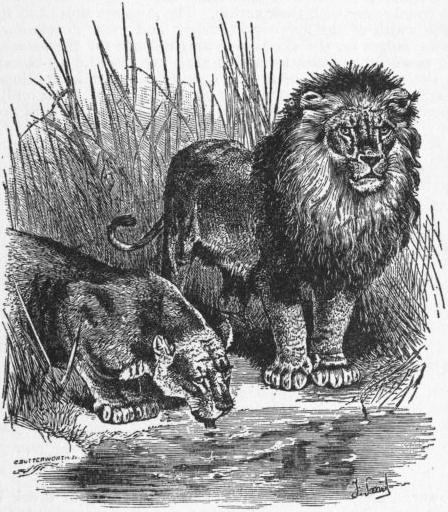
After a Drawing by Woll in Elliot’s Monograph of the Felidae.
Fig. 1.—Lion and Lioness (Felis leo).
The variations in external characters which lions present, especially in the colour and the amount of mane, as well as in the general colour of the fur, indicate local races, to which special names have been given; the Indian lion being F. leo gujratensis. It is noteworthy, however, that, according to Mr F. C. Selous, in South Africa the black-maned lion and others with yellow scanty manes are found, not only in the same locality, but even among individuals of the same parentage.
The lion belongs to the genus Felis of Linnaeus (for the characters and position of which see Carnivora), and differs from the tiger and leopard in its uniform colouring, and from all the other Felidae in the hair of the top of the head, chin and neck, as far back as the shoulder, being not only much longer, but also differently disposed from the hair elsewhere, being erect or directed forwards, and so constituting the characteristic ornament called the mane. There is also a tuft of elongated hairs at the end of the tail, one upon each elbow, and in most lions a copious fringe along the middle line of the under surface of the body, wanting, however, in some examples. These characters are, however, peculiar to the adults of the male sex; and even as regards coloration young lions show indications of the darker stripes and mottlings so characteristic of the greater number of the members of the genus. The usual colour of the adult is yellowish-brown, but it may vary from a deep red or chestnut brown to an almost silvery grey. The mane, as well as the long hair of the other parts of the body, sometimes scarcely differs from the general colour, but is usually darker and not unfrequently nearly black. The mane begins to grow when the animal is about three years old, and is fully developed at five or six.
In size the lion is only equalled or exceeded by the tiger among existing Felidae; and though both species present great variations, the largest specimens of the latter appear to surpass the largest lions. A full-sized South African lion, according to Selous, measures slightly less than 10 ft. from nose to tip of tail, following the curves of the body. Sir Cornwallis Harris gives 10 ft. 6 in., of which the tail occupies 3 ft. The lioness is about a foot less.
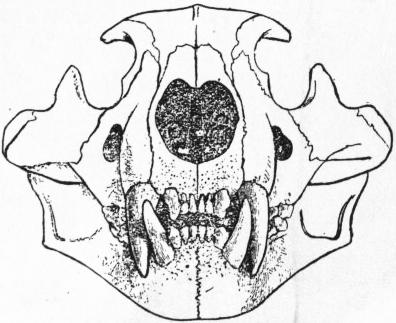
Fig. 2.—Front View of Skull of Lion.
The internal structure of the lion, except in slight details, resembles that of other Felidae, the whole organization being that of an animal adapted for an active, predaceous existence. The teeth especially exemplify the carnivorous type in its highest condition of development. The most important function they have to perform, that of seizing and holding firmly animals of considerable size and strength, violently struggling for life, is provided for by the great, sharp-pointed and sharp-edged canines, placed wide apart at the angles of the mouth, the incisors between them being greatly reduced in size and kept back nearly to the same level, so as not to interfere with their action. The jaws are short and strong, and the width of the zygomatic arches, and great development of the bony ridges on the skull, give ample space for the attachment of the powerful muscles by which they are closed. In the cheek-teeth the sectorial or scissor-like cutting function is developed at the expense of the tubercular or grinding, there being only one rudimentary tooth of the latter form in the upper jaw, and none in the lower. They are, however, sufficiently strong to break bones of large size. The tongue is long and flat, and remarkable for the development of the papillae of the anterior part of the dorsal surface, which (except near the edge) are modified so as to resemble long, compressed, recurved, horny spines or claws, which, near the middle line, attain the length of one-fifth of an inch. They give the part of the tongue on which they occur the appearance and feel of a coarse rasp. The feet are furnished with round soft pads or cushions covered with thick, naked skin, one on the under surface of each of the principal toes, and one larger one of trilobed form, behind these, under the lower ends of the metacarpal and metatarsal bones, which are placed nearly vertically in ordinary progression. The claws are large, strongly compressed, sharp, and exhibit the retractile condition in the highest degree, being drawn backwards and upwards into a sheath by the action of an elastic ligament so long as the foot is in a state of repose, but exerted by muscular action when the animal strikes its prey.
The lion lives chiefly in sandy plains and rocky places interspersed with dense thorn-thickets, or frequents the low bushes and tall rank grass and reeds that grow along the sides of streams and near the springs where it lies in wait for the larger herbivorous animals on which it feeds. Although occasionally seen abroad during the day, especially in wild and desolate regions, where it is subject to little molestation, the night is, as in the case of so many other predaceous animals, the period of its greatest activity. It is then that its characteristic roar is chiefly heard, as thus graphically described by Gordon-Cumming:—
“One of the most striking things connected with the lion is his voice, which is extremely grand and peculiarly striking. It consists at times of a low deep moaning, repeated five or six times, ending in faintly audible sighs; at other times he startles the forest with loud, deep-toned, solemn roars, repeated in quick succession, each increasing in loudness to the third or fourth, when his voice dies away in five or six low muffled sounds very much resembling distant thunder. At times, and not unfrequently, a troop may be heard, roaring in concert, one assuming the lead, and two, three or four more regularly taking up their parts, like persons singing a catch. Like our Scottish stags at the rutting season, they roar loudest in cold frosty nights; but on no occasions are their voices to be heard in such perfection, or so intensely powerful, as when two or three troops of strange lions approach a fountain to drink at the same time. When this occurs, every member of each troop sounds a bold roar of defiance at the opposite parties; and when one roars, all roar together, and each seems to vie with his comrades in the intensity and power of his voice. The power and grandeur of these nocturnal concerts is inconceivably striking and pleasing to the hunter’s ear.”
“The usual pace of a lion,” C. J. Andersson says, “is a walk, and, though apparently rather slow, yet, from the great length of his body, he is able to get over a good deal of ground in a short time. Occasionally he trots, when his speed is not inconsiderable. His gallop—or rather succession of bounds—is, for a short distance, very fast—nearly or quite equal to that of a horse.”
“The lion, as with other members of the feline family,” the same writer says, “seldom attacks his prey openly, unless compelled by extreme hunger. For the most part he steals upon it in the manner of a cat, or ambushes himself near to the water or a pathway frequented by game. At such times he lies crouched upon his belly in a thicket until the animal approaches sufficiently near, when, with one prodigious bound, he pounces upon it. In most cases he is successful, but should his intended victim escape, as at times happens, from his having miscalculated the distance, he may make a second or even a third bound, which, however, usually prove fruitless, or he returns disconcerted to his hiding-place, there to wait for another opportunity.” His food consists of all the larger herbivorous animals of the country in which he resides—buffaloes, antelopes, zebras, giraffes or even young elephants or rhinoceroses. In cultivated districts cattle, sheep, and even human inhabitants are never safe from his nocturnal ravages. He appears, however, as a general rule, only to kill when hungry or attacked, and not for the mere pleasure of killing, as with some other carnivorous animals. He, moreover, by no means limits himself to animals of his own killing, but, according to Selous, often prefers eating game that has been killed by man, even when not very fresh, to taking the trouble to catch an animal himself.
The lion appears to be monogamous, a single male and female continuing attached to each other irrespectively of the pairing season. At all events the lion remains with the lioness while the cubs are young and helpless, and assists in providing her and them with food, and in educating them in the art of providing for themselves. The number of cubs at a birth is from two to four, usually three. They are said to remain with their parents till they are about three years old.
Though not strictly gregarious, lions appear to be sociable towards their own species, and often are found in small troops sometimes consisting of a pair of old ones with their nearly full-grown cubs, but occasionally of adults of the same sex; and there seems to be evidence that several lions will associate for the purpose of hunting upon a preconcerted plan. Their natural ferocity and powerful armature are sometimes turned upon one another; combats, often mortal, occur among male lions under the influence of jealousy; and Andersson relates an instance of a quarrel between a hungry lion and lioness over the carcase of an antelope which they had just killed, and which did not seem sufficient for the appetite of both, ending in the lion not only killing, but devouring his mate. Old lions, whose teeth have become injured with constant wear, become “man-eaters,” finding their easiest means of obtaining a subsistence in lurking in the neighbourhood of villages, and dashing into the tents at night and carrying off one of the sleeping inmates. Lions never climb.
With regard to the character of the lion, those who have had opportunities of observing it in its native haunts differ greatly. The accounts of early writers as to its courage, nobility and magnanimity have led to a reaction, causing some modern authors to accuse it of cowardice and meanness. Livingstone goes so far as to say, “nothing that I ever learned of the lion could lead me to attribute to it either the ferocious or noble character ascribed to it elsewhere,” and he adds that its roar is not distinguishable from that of the ostrich. These different estimates depend to a great extent upon the particular standard of the writer, and also upon the circumstance that lions, like other animals, show considerable individual differences in character, and behave differently under varying circumstances.
(W. H. F.; R. L.*)
LIONNE, HUGUES DE (1611-1671), French statesman, was born at Grenoble on the 11th of October 1611, of an old family of Dauphiné. Early trained for diplomacy, his remarkable abilities attracted the notice of Cardinal Mazarin, who sent him as secretary of the French embassy to the congress of Münster, and, in 1642, on a mission to the pope. In 1646 he became secretary to the queen regent; in 1653 obtained high office in the king’s household; and in 1654 was ambassador extraordinary at the election of Pope Alexander VII. He was instrumental in forming the league of the Rhine, by which Austria was cut off from the Spanish Netherlands, and, as minister of state, was associated with Mazarin in the Peace of the Pyrenees (1659), which secured the marriage of Louis XIV. to the infanta Maria Theresa. At the cardinal’s dying request he was appointed his successor in foreign affairs, and, for the next ten years, continued to direct French foreign policy. Among his most important diplomatic successes were the treaty of Breda (1667), the treaty of Aix-la-Chapelle (1668) and the sale of Dunkirk. He died in Paris on the 1st of September 1671, leaving memoirs. He was a man of pleasure, but his natural indolence gave place to an unflagging energy when the occasion demanded it; and, in an age of great ministers, his consummate statesmanship placed him in the front rank.
See Ulysse Chevalier, Lettres inédites de Hugues de Lionne ... précédées d’une notice historique sur la famille de Lionne (Valence, 1879); J. Valfrey, La diplomatie française au XVIIIe siècle: Hugues de Lionne, ses ambassadeurs (2 vols., Paris, 1877-1881). For further works see Rochas, Biogr. du Dauphiné (Paris, 1860), tome ii. p. 87.
LIOTARD, JEAN ETIENNE (1702-1789), French painter, was born at Geneva. He began his studies under Professor Gardelle and Petitot, whose enamels and miniatures he copied with considerable skill. He went to Paris in 1725, studying under J. B. Massé and F. le Moyne, on whose recommendation he was taken to Naples by the Marquis Puysieux. In 1735 he was in Rome, painting the portraits of Pope Clement XII. and several cardinals. Three years later he accompanied Lord Duncannon to Constantinople, whence he went to Vienna in 1742 to paint the portraits of the imperial family. His eccentric adoption of oriental costume secured him the nickname of “the Turkish painter.” Still under distinguished patronage he returned to Paris in 1744, visited England, where he painted the princess of Wales in 1753, and went to Holland in 1756, where, in the following year, he married Marie Fargues. Another visit to England followed in 1772, and in the next two years his name figures among the Royal Academy exhibitors. He returned to his native town in 1776 and died at Geneva in 1789.
Liotard was an artist of great versatility, and though his fame depends largely on his graceful and delicate pastel drawings, of which “La Liseuse,” the “Chocolate Girl,” and “La Belle Lyonnaise” at the Dresden Gallery are delightful examples, he achieved distinction by his enamels, copper-plate engravings and glass painting. He also wrote a Treatise on the Art of Painting, and was an expert collector of paintings by the old masters. Many of the masterpieces he had acquired were sold by him at high prices on his second visit to England. The museums of Amsterdam, Berne, and Geneva are particularly rich in examples of his paintings and pastel drawings. A picture of a Turk seated is at the Victoria and Albert Museum, while the British Museum owns two of his drawings. The Louvre has, besides twenty-two drawings, a portrait of General Hérault and a portrait of the artist is to be found at the Sala dei pittori, in the Uffizi Gallery, Florence.