VOLUME XVI SLICE VI Lightfoot, Joseph to Liquidation (continued 5)
Reading edition
The Greeks and Romans, too, had their sacred fire and their ceremonial lights. In Greece the Lampadedromia or Lampadephoria (torch-race) had its origin in ceremonies connected with the relighting of the sacred fire. Pausanias Greece and Rome. (i. 26, § 6) mentions the golden lamp made by Callimachus which burned night and day in the sanctuary of Athena Polias on the Acropolis, and (vii. 22, §§ 2 and 3) tells of a statue of Hermes Agoraios, in the market-place of Pharae in Achaea, before which lamps were lighted. Among the Romans lighted candles and lamps formed part of the cult of the domestic tutelary deities; on all festivals doors were garlanded and lamps lighted (Juvenal, Sat. xii. 92; Tertullian, Apol. xxxv.). In the cult of Isis lamps were lighted by day. In the ordinary temples were candelabra, e.g. that in the temple of Apollo Palatinus at Rome, originally taken by Alexander from Thebes, which was in the form of a tree from the branches of which lights hung like fruit. In comparing pagan with Christian usage it is important to remember that the lamps in the pagan temples were not symbolical, but votive offerings to the gods. Torches and lamps were also carried in religious processions.
The pagan custom of burying lamps with the dead conveyed no such symbolical meaning as was implied in the late Christian custom of placing lights on and about the tombs of Funeral lamps. martyrs and saints. Its object was to provide the dead with the means of obtaining light in the next world, a wholly material conception; and the lamps were for the most part unlighted. It was of Asiatic origin, traces of it having been observed in Phoenicia and in the Punic colonies, but not in Egypt or Greece. In Europe it was confined to the countries under the domination of Rome.2
In Christianity, from the very first, fire and light are conceived as symbols, if not as visible manifestations, of the divine nature and the divine presence. Christ is “the true Light” (John i. 9), and at his transfiguration “the fashion Christian symbolism of light. of his countenance was altered, and his raiment was white and glistering” (Luke ix. 29); when the Holy Ghost descended upon the apostles, “there appeared unto them cloven tongues of fire, and it sat upon each of them” (Acts ii. 3); at the conversion of St Paul “there shined round him a great light from heaven” (Acts ix. 3); while the glorified Christ is represented as standing “in the midst of seven candlesticks ... his head and hairs white like wool, as white as snow; and his eyes as a flame of fire” (Rev. i. 14, 15). Christians are “children of Light” at perpetual war with “the powers of darkness.”
All this might very early, without the incentive of Jewish and pagan example, have affected the symbolic ritual of the primitive Church. There is, however, no evidence of The early Church. any ceremonial use of lights in Christian worship during the first two centuries. It is recorded, indeed (Acts xx. 7, 8), that on the occasion of St Paul’s preaching at Alexandria in Troas “there were many lights in the upper chamber”; but this was at night, and the most that can be hazarded is that a specially large number were lighted as a festive illumination, as in modern Church festivals (Martigny, Dict. des antiqu. Chrét.). As to a purely ceremonial use, such early evidence as exists is all the other way. A single sentence of Tertullian (Apol. xxxv.) sufficiently illuminates Christian practice during the 2nd century. “On days of rejoicing,” he says, Tertullian and Lactantius. “we do not shade our door-posts with laurels nor encroach upon the day-light with lamps” (die laeto non laureis postes obumbramus nec lucernis diem infringimus). Lactantius, writing early in the 4th century, is even more sarcastic in his references to the heathen practice. “They kindle lights,” he says, “as though to one who is in darkness. Can he be thought sane who offers the light of lamps and candles to the Author and Giver of all light?” (Div. Inst. vi. de vero cultu, cap. 2, in Migne, Patr. lat. vi. 637).3 This is primarily an attack on votive lights, and does not necessarily exclude their ceremonial use in other ways. There is, indeed, evidence that they were so used before Lactantius wrote. The 34th canon of the synod of Elvira (305), which was contemporary with him, forbade candles to be lighted in cemeteries during the day-time, which points to an established custom as well as to an objection to it; and in the Roman catacombs lamps have been found of the 2nd and 3rd centuries which seem to have been ceremonial or symbolical.4 Again, according to the Acta 2nd and 3rd centuries. of St Cyprian (d. 258), his body was borne to the grave praelucentibus cereis, and Prudentius, in his hymn on the martyrdom of St Lawrence (Peristeph. ii. 71, in Migne, Patr. lat. lx. 300), says that in the time of St Laurentius, i.e. the middle of the 3rd century, candles stood in the churches of Rome on golden candelabra. The gift, mentioned by Anastasius (in Sylv.), made by Constantine to the Vatican basilica, of a pharum of gold, garnished with 500 dolphins each holding a lamp, to burn before St Peter’s tomb, points also to a custom well established before Christianity became the state religion.
Whatever previous custom may have been—and for the earliest ages it is difficult to determine absolutely owing to the fact Jerome and Vigilantius. that the Christians held their services at night—by the close of the 4th century the ceremonial use of lights had become firmly and universally established in the Church. This is clear, to pass by much other evidence, from the controversy of St Jerome with Vigilantius.
Vigilantius, a presbyter of Barcelona, still occupied the position of Tertullian and Lactantius in this matter. “We see,” he wrote, “a rite peculiar to the pagans introduced into the churches on pretext of religion, and, while the sun is still shining, a mass of wax tapers lighted.... A great honour to the blessed martyrs, whom they think to illustrate with contemptible little candles (de vilissimis cereolis)!” Jerome, the most influential theologian of the day, took up the cudgels against Vigilantius (he “ought to be called Dormitantius”), who, in spite of his fatherly admonition, had dared again “to open his foul mouth and send forth a filthy stink against the relics of the holy martyrs” (Hier. Ep. cix. al. 53—ad Ripuarium Presbyt., in Migne, Patr. lat. p. 906). If candles are lit before their tombs, are these the ensigns of idolatry? In his treatise contra Vigilantium (Patr. lat. t. xxiii.) he answers the question with much common sense. There can be no harm if ignorant and simple people, or religious women, light candles in honour of the martyrs. “We are not born, but reborn, Christians,” and that which when done for idols was detestable is acceptable when done for the martyrs. As in the case of the woman with the precious box of ointment, it is not the gift that merits reward, but the faith that inspires it. As for lights in the churches, he adds that “in all the churches of the East, whenever the gospel is to be read, lights are lit, though the sun be rising (jam sole rutilante), not in order to disperse the darkness, but as a visible sign of gladness (ad signum laetitiae demonstrandum).” Taken in connexion with a statement which almost immediately precedes this—“Cereos autem non clara luce accendimus, sicut frustra calumniaris: sed ut noctis tenebras hoc solatio temperemus” (§ 7)—this seems to point to the fact that the ritual use of lights in the church services, so far as already established, arose from the same conservative habit as determined the development of liturgical vestments, i.e. the lights which had been necessary at the nocturnal meetings were retained, after the hours of service had been altered, and invested with a symbolical meaning.
Already they were used at most of the conspicuous functions of the Church. Paulinus, bishop of Nola (d. 431), describes the altar at the eucharist as “crowned with crowded lights,”5 and even mentions the “eternal lamp.”6 Practice in the 4th century. For their use at baptisms we have, among much other evidence, that of Zeno of Verona for the West,7 and that of Gregory of Nazianzus for the East.8 Their use at funerals is illustrated by Eusebius’s description of the burial of Constantine,9 and Jerome’s account of that of St Paula.10 At ordinations they were used, as is shown by the 6th canon of the council of Carthage (398), which decrees that the acolyte is to hand to the newly ordained deacon ceroferarium cum cereo. As to the blessing of candles, according to the Liber pontificalis Pope Zosimus in 417 ordered these to be blessed,11 and the Gallican and Mozarabic rituals also provided for this ceremony.12 The Feast of the Purification of the Virgin, known as Candlemas (q.v.), because on this day the candles for the whole year are blessed, was established—according to some authorities—by Pope Gelasius I. about 492. As to the question of “altar lights,” however, it must be borne in mind that these were not placed upon the altar, or on a retable behind it, until the 12th century. These were originally the candles carried by the deacons, according to the Ordo Romanus (i. 8; ii. 5; iii. 7) seven in number, which were set down either on the steps of the altar, or, later, Eastern Church. behind it. In the Eastern Church, to this day, there are no lights on the high altar; the lighted candles stand on a small altar beside it, and at various parts of the service are carried by the lectors or acolytes before the officiating priest or deacon. The “crowd of lights” described by Paulinus as crowning the altar were either grouped round it or suspended in front of it; they are represented by the sanctuary lamps of the Latin Church and by the crown of lights suspended in front of the altar in the Greek.
To trace the gradual elaboration of the symbolism and use of ceremonial lights in the Church, until its full development and systematization in the middle ages, would be impossible here. It must suffice to note a few stages in Development of the use. the process. The burning of lights before the tombs of martyrs led naturally to their being burned also before relics and lastly before images and pictures. This latter practice, hotly denounced as idolatry during the iconoclastic controversy (see Iconoclasm), was finally established as orthodox by the second general council of Nicaea (787), which restored the worship of images. A later development, however, by which certain lights themselves came to be regarded as objects of worship and to have other lights burned before them, was condemned as idolatrous by the synod of Noyon in 1344.13 The passion for symbolism extracted ever new meanings out of the candles and their use. Early in the 6th century Ennodius, bishop of Pavia, pointed out the three-fold elements of a wax-candle (Opusc. ix. and x.), each of which would make it an offering acceptable to God; the rush-wick is the product of pure water, the wax is the offspring of virgin bees,14 the flame is sent from heaven.15 Clearly, wax was a symbol of the Blessed Virgin and the holy humanity of Christ. The later middle ages developed the idea. Durandus, in his Rationale, interprets the wax as the body of Christ, the wick as his soul, the flame as his divine nature; and the consuming candle as symbolizing his passion and death.
In the completed ritual system of the medieval Church, as still preserved in the Roman Catholic communion, the use of ceremonial In the Roman Catholic Church. lights falls under three heads. (1) They may be symbolical of the light of God’s presence, of Christ as “Light of Light,” or of “the children of Light” in conflict with the powers of darkness; they may even be no more than expressions of joy on the occasion of great festivals. (2) They may be votive, i.e. offered as an act of worship (latria) to God. (3) They are, in virtue of their benediction by the Church, sacramentalia, i.e. efficacious for the good of men’s souls and bodies, and for the confusion of the powers of darkness.16 With one or Dedication of a church. At Mass and choir services. more of these implications, they are employed in all the public functions of the Church. At the consecration of a church twelve lights are placed round the walls at the twelve spots where these are anointed by the bishop with holy oil, and on every anniversary these are relighted; at the dedication of an altar tapers are lighted and censed at each place where the table is anointed (Pontificale Rom. p. ii. De eccl. dedicat. seu consecrat.). At every liturgical service, and especially at Mass and at choir services, there must be at least two lighted tapers on the altar,17 as symbols of the presence of God and tributes of adoration. For the Mass the rule is that there are six lights at High Mass, four at a missa cantata, and two at private masses. At a Pontifical High Mass (i.e. when the bishop celebrates) the lights are seven, because seven golden candlesticks surround the risen Saviour, the chief bishop of the Church (see Rev. i. 12). At most pontifical functions, moreover, the bishop—as the representative of Christ—is preceded by an acolyte with a burning candle (bugia) on a candlestick. The Ceremoniale Episcoporum (i. 12) further orders that a burning lamp is to hang at all times before each altar, three in front Sanctuary lamps. Symbol of the Real Presence. of the high altar, and five before the reserved Sacrament, as symbols of the eternal Presence. In practice, however, it is usual to have only one lamp lighted before the tabernacle in which the Host is reserved. The special symbol of the real presence of Christ is the Sanctus candle, which is lighted at the moment of consecration and kept burning until the communion. The same symbolism is intended by the lighted tapers which must accompany the Host whenever it is carried in procession, or to the sick and dying.
As symbols of light and joy a candle is held on each side of the deacon when reading the Gospel at Mass; and the same symbolism underlies the multiplication of lights on festivals, their number varying with the importance of the occasion. As to the number of these latter no rule is laid down. They differ from liturgical lights in that, whereas these must be tapers of pure beeswax or lamps fed with pure olive oil (except by special dispensation under certain circumstances), those used merely to add splendour to the celebration may be of any material; the only exception being, that in the decoration of the altar gas-lights are forbidden.
In general the ceremonial use of lights in the Roman Catholic Church is conceived as a dramatic representation in fire of the life of Christ and of the whole scheme of salvation. On Easter Eve the new fire, symbol of the light of the newly Tenebrae. risen Christ, is produced, and from this are kindled all the lights used throughout the Christian year until, in the gathering darkness (tenebrae) of the Passion, they are gradually extinguished. This quenching of the light of the world is symbolized at the service of Tenebrae in Holy Week by the placing on a stand before the altar of thirteen lighted tapers arranged pyramidally, the rest of the church being in darkness. The penitential psalms are sung, and at the end of each a candle is extinguished. When only the central one is left it is taken down and carried behind the altar, thus symbolizing the betrayal and the death and burial of Christ. This ceremony can be traced to the 8th century at Rome.
On Easter Eve new fire is made18 with a flint and steel, and blessed; from this three candles are lighted, the lumen Christi, The Paschal Candle. and from these again the Paschal Candle.19 This is the symbol of the risen and victorious Christ, and burns at every solemn service until Ascension Day, when it is extinguished and removed after the reading of the Gospel at High Mass. This, of course, symbolizes the Ascension; but meanwhile the other lamps in the church have received their light from the Paschal Candle, and so symbolize throughout the year the continued presence of the light of Christ.
At the consecration of the baptismal water the burning Paschal Candle is dipped into the font “so that the power of the Holy Ghost may descend into it and make it an effective Baptism. Ordination, etc. Funeral lights. instrument of regeneration.” This is the symbol of baptism as rebirth as children of Light. Lighted tapers are also placed in the hands of the newly-baptized, or of their god-parents, with the admonition “to preserve their baptism inviolate, so that they may go to meet the Lord when he comes to the wedding.” Thus, too, as “children of Light,” candidates for ordination and novices about to take the vows carry lights when they come before the bishop; and the same idea underlies the custom of carrying lights at weddings, at the first communion, and by priests going to their first mass, though none of these are liturgically prescribed. Finally, lights are placed round the bodies of the dead and carried beside them to the grave, partly as symbols that they still live in the light of Christ, partly to frighten away the powers of darkness.
Conversely, the extinction of lights is part of the ceremony of excommunication (Pontificale Rom. pars iii.). Regino, abbot of Prum, Excommunication. describes the ceremony as it was carried out in his day, when its terrors were yet unabated (De eccles. disciplina, ii. 409). “Twelve priests should stand about the bishop, holding in their hands lighted torches, which at the conclusion of the anathema or excommunication they should cast down and trample under foot.” When the excommunication is removed, the symbol of reconciliation is the handing to the penitent of a burning taper.
As a result of the Reformation the use of ceremonial lights was either greatly modified, or totally abolished in the Protestant Protestant Churches. Churches. In the Reformed (Calvinistic) Churches altar lights were, with the rest, done away with entirely as popish and superstitious. In the Lutheran Churches they were retained, and in Evangelical Germany have even survived most of the other medieval rites and ceremonies (e.g. the use of vestments) which were not abolished at the Reformation itself.
In the Church of England the practice has been less consistent. The first Prayer-book of Edward VI. directed two lights to be placed on the altar. This direction was omitted in the second Prayer-book; but the “Ornaments Rubric” Church of England. of Queen Elizabeth’s Prayer-book seemed again to make them obligatory. The question of how far this did so is a much-disputed one and is connected with the whole problem of the meaning and scope of the rubric (see Vestments). An equal uncertainty reigns with regard to the actual usage of the Church of England from the Reformation onwards. Lighted candles certainly continued to decorate the holy table in Queen Elizabeth’s chapel, to the scandal of Protestant zealots. They also seem to have been retained, at least for a while, in certain cathedral and collegiate churches. There is, however, no mention of ceremonial candles in the detailed account of the services of the Church of England given by William Harrison (Description of England, 1570); and the attitude of the Church towards their use, until the ritualistic movement of the 17th century, would seem to be authoritatively expressed in the Third Part of the Sermon against Peril of Idolatry, which quotes with approval the views of Lactantius and compares “our Candle Religion” with the “Gentiles Idolators.” This pronouncement, indeed, though it certainly condemns the use of ceremonial lights in most of its later developments, and especially the conception of them as votive offerings whether to God or to the saints, does not necessarily exclude, though it undoubtedly discourages, their purely symbolical use.20 In this connexion it is worth pointing out that the homily against idolatry was reprinted, without alteration and by the king’s authority, long after altar lights had been restored under the influence of the high church party supreme at court. Illegal under the Act of Uniformity they seem never to have been. The use of “wax lights and tapers” formed one of the indictments brought by P. Smart, a Puritan prebendary of Durham, against Dr Burgoyne, Cosin and others for setting up “superstitious ceremonies” in the cathedral “contrary to the Act of Uniformity.” The indictments were dismissed in 1628 by Sir James Whitelocke, chief justice of Chester and a judge of the King’s Bench, and in 1629 by Sir Henry Yelverton, a judge of Common Pleas and himself a strong Puritan (see Hierurgia Anglicana, ii pp. 230 seq.). The use of ceremonial lights was among the indictments in the impeachment of Laud and other bishops by the House of Commons, but these were not based on the Act of Uniformity. From the Restoration onwards the use of ceremonial lights, though far from universal, was not unusual in cathedrals and collegiate churches.21 It was not, however, till the ritual revival of the 19th century that their use was at all widely extended in parish churches. The growing custom met with fierce opposition; the law was appealed to, and in 1872 the Privy Council declared altar lights to be illegal (Martin v. Mackonochie). This judgment, founded as was afterwards admitted on insufficient knowledge, produced no effect; and, in the absence of any authoritative pronouncement, advantage was taken of the ambiguous language of the Ornaments Rubric to introduce into many churches practically the whole ceremonial use of lights as practised in the pre-Reformation Church. The matter was again raised in the case of Read and others v. the Bishop of Lincoln (see Lincoln Judgment), one of the counts of the indictment being that the bishop had, during the celebration of Holy Communion, allowed two candles to be alight on a shelf or retable behind the communion table when they were not The “Lincoln Judgment.” necessary for giving light. The archbishop of Canterbury, in whose court the case was heard (1889), decided that the mere presence of two candles on the table, burning during the service but lit before it began, was lawful under the first Prayer-Book of Edward VI. and had never been made unlawful. On the case being appealed to the Privy Council, this particular indictment was dismissed on the ground that the vicar, not the bishop, was responsible for the presence of the lights, the general question of the legality of altar lights being discreetly left open.
The custom of placing lighted candles round the bodies of the dead, especially when “lying in state,” has never wholly died out in Protestant countries, though their significance has long been lost sight of.22 In the 18th century, moreover, it was still customary in England to accompany a funeral with lighted tapers. Picart (op. cit. 1737) gives a plate representing a funeral cortège preceded and accompanied by boys, each carrying four lighted candles in a branched candlestick. There seems to be no record of candles having been carried in other processions in England since the Reformation. The usage in this respect in some “ritualistic” churches is a revival of pre-Reformation ceremonial.
See the article “Lucerna,” by J. Toutain in Daremberg and Saglio’s Dict. des antiquités grecques et romaines (Paris, 1904); J. Marquardt, “Römische Privatalterthümer” (vol. v. of Becker’s Röm. Alterthümer), ii. 238-301; article “Cièrges et lampes,” in the Abbé J. A. Martigny’s Dict. des Antiquités Chrétiennes (Paris, 1865); the articles “Lichter” and “Koimetarien” (pp. 834 seq.) in Herzog-Hauck’s Realencyklopädie (3rd ed., Leipzig. 1901); the article “Licht” in Wetzer and Welte’s Kirchenlexikon (Freiburg-i.-B., 1882-1901), an excellent exposition of the symbolism from the Catholic point of view, also “Kerze” and “Lichter”; W. Smith and S. Cheetham, Dict. of Chr. Antiquities (London, 1875-1880), i. 939 seq.; in all these numerous further references will be found. See also Mühlbauer, Gesch. u. Bedeutung der Wachslichter bei den kirchlichen Funktionen (Augsburg, 1874); V. Thalhofer, Handbuch der Katholischen Liturgik (Freiburg-i.-B., 1887), i. 666 seq.; and, for the post-Reformation use in the Church of England, Hierurgia Anglicana, new ed. by Vernon Staley (London, 1903).
(W. A. P.)
1 “O Fire, thou knowest all things!” See A. Bourquin, “Brahma-karma, ou rites sacrés des Brahmans,” in the Annales du Musée Guimet (Paris, 1884, t. vii.).
2 J. Toutain, in Daremberg and Saglio, Dictionnaire, s.v. “Lucerna.”
3 This is quoted with approval by Bishop Jewel in the homily Against Peril of Idolatry (see below).
4 This symbolism—whatever it was—was not pagan, i.e. the lamps were not placed in the graves as part of the furniture of the dead—in the Catacombs they are found only in the niches of the galleries and the arcosolia—nor can they have been votive in the sense popularized later.
5 “Clara coronantur densis altaria lychnis” (Poem. De S. Felice natalitium, xiv. 99, in Migne, Patr. lat. lxi. 467).
6 “Continuum scyphus est argenteus aptus ad usum.”
7 “Sal, ignis et oleum” (Lib. i. Tract. xiv. 4, in Migne, xi. 358).
8 In sanct. Pasch. c. 2; Migne, Patr. graeca, xxxvi. 624.
9 ϕῶτα τ᾽ ἐφάψαντες κύκλῳ ἐπὶ σκευῶν χρυσῶν, θαυμαστὸν θέαα τοῖς ὁρῶσι παρεῖχον (Vita Constantini, iv. 66).
10 “Cum alii Pontifices lampadàs cereosque proferrent, alii choras psallentium ducerent” (Ep. cviii. ad Eustochium virginem, in Migne).
11 This may be the paschal candle only. In some codices the text runs: “Per parochias concessit licentiam benedicendi Cereum Paschalem” (Du Cange, Glossarium, s.v. “Cereum Paschale”). In the three variants of the notice of Zosimus given in Duchesne’s edition of the Lib. pontif. (1886-1892) the word cera is, however, alone used. Nor does the text imply that he gave to the suburbican churches a privilege hitherto exercised by the metropolitan church. The passage runs: “Hic constituit ut diaconi leva tecta haberent de palleis linostimis per parrochias et ut cera benedicatur,” &c. Per parrochias here obviously refers to the head-gear of the deacons, not to the candles.
12 See also the Peregrinatio Sylviae (386), 86, &c., for the use of lights at Jerusalem, and Isidore of Seville (Etym. vii. 12; xx. 10) for the usage in the West. That even in the 7th century the blessing of candles was by no means universal is proved by the 9th canon of the council of Toledo (671), “De benedicendo cereo et lucerna in privilegiis Paschae.” This canon states that candles and lamps are not blessed in some churches, and that inquiries have been made why we do it. In reply, the council decides that it should be done to celebrate the mystery of Christ’s resurrection. See Isidore of Seville, Conc., in Migne, Pat. lat. lxxxiv. 369.
13 Du Cange, Glossarium, s.v. “Candela.”
14 Bees were believed, like fish, to be sexless.
15 “Venerandis compactam elementis facem tibi, Domine, mancipamus: in qua trium copula munerum primum de impari numero complacebit: quae quod gratis Deo veniat auctoribus, non habetur incertum: unum quod de fetibus fluminum accedunt nutrimenta flammarum: aliud quod apum tribuit intemerata fecunditas, in quarum partibus nulla partitur damna virginitas: ignis etiam coelo infusus adhibetur” (Opusc. x. in Migne, Patr. lat. t. lxiii.).
16 All three conceptions are brought out in the prayers for the blessing of candles on the Feast of the Purification of the B.V.M. (Candlemas, q.v.). (1) “O holy Lord, ... who ... by the command didst cause this liquid to come by the labour of bees to the perfection of wax, ... we beseech thee ... to bless and sanctify these candles for the use of men, and the health of bodies and souls....” (2) “... these candles, which we thy servants desire to carry lighted to magnify thy name; that by offering them to thee, being worthily inflamed with the holy fire of thy most sweet charity, we may deserve,” &c. (3) “O Lord Jesus Christ, the true light, ... mercifully grant, that as these lights enkindled with visible fire dispel nocturnal darkness, so our hearts illumined by invisible fire,” &c. (Missale Rom.). In the form for the blessing of candles extra diem Purificationis B. Mariae Virg. the virtue of the consecrated candles in discomfiting demons is specially brought out: “that in whatever places they may be lighted, or placed, the princes of darkness may depart, and tremble, and may fly terror-stricken with all their ministers from those habitations, nor presume further to disquiet and molest those who serve thee, Almighty God” (Rituale Rom.).
17 Altar candlesticks consist of five parts: the foot, stem, knob in the centre, bowl to catch the drippings, and pricket (a sharp point on which the candle is fixed). It is permissible to use a long tube, pointed to imitate a candle, in which is a small taper forced to the top by a spring (Cong. Rit., 11th May 1878).
18 This is common to the Eastern Church also. Pilgrims from all parts of the East flock to Jerusalem to obtain the “new fire” on Easter Eve at the Church of the Holy Sepulchre. Here the fire is supposed to be miraculously sent from heaven. The rush of the pilgrims to kindle their lights at it is so great, that order is maintained with difficulty by Mahommedan soldiers.
19 The origin of the Paschal Candle is lost in the mists of antiquity. According to the abbé Châtelain (quoted in Diderot’s Encyclopédie, s.v. “Cièrge”) the Paschal Candle was not originally a candle at all, but a wax column on which the dates of the movable feasts were inscribed. These were later written on paper and fixed to the Paschal Candle, a custom which in his day survived in the Cluniac churches.
20 This homily, written by Bishop Jewel, is largely founded on Bullinger’s De origine erroris in Divinorum et sacrorum cultu (1528, 1539).
21 A copper-plate in Bernard Picart’s Ceremonies and Religious Customs of the Various Nations (Eng. trans., London, 1737), vi. pt. 1, p. 78, illustrating an Anglican Communion service at St Paul’s, shows two lighted candles on the holy table.
22 In some parts of Scotland it is still customary to place two lighted candles on a table beside a corpse on the day of burial.

LIGNE, CHARLES JOSEPH, Prince de (1735-1814), soldier and writer, came of a princely family of Hainaut, and was born at Brussels in 1735. As an Austrian subject he entered the imperial army at an early age. He distinguished himself by his valour in the Seven Years’ War, notably at Breslau, Leuthen, Hochkirch and Maxen, and after the war rose rapidly to the rank of lieutenant field marshal. He became the intimate friend and counsellor of the emperor Joseph II., and, inheriting his father’s vast estates, lived in the greatest splendour and luxury till the War of the Bavarian Succession brought him again into active service. This war was short and uneventful, and the prince then travelled in England, Germany, Italy, Switzerland and France, devoting himself impartially to the courts, the camps, the salons and the learned assemblies of philosophers and scientists in each country. In 1784 he was again employed in military work, and was promoted to Feldzeugmeister. In 1787 he was with Catherine II. in Russia, accompanied her in her journey to the Crimea, and was made a Russian field marshal by the empress. In 1788 he was present at the siege of Belgrade. Shortly after this he was invited to place himself at the head of the Belgian revolutionary movement, in which one of his sons and many of his relatives were prominent, but declined with great courtesy, saying that “he never revolted in the winter.” Though suspected by Joseph of collusion with the rebels, the two friends were not long estranged, and after the death of the emperor the prince remained in Vienna. His Brabant estates were overrun by the French in 1792-1793, and his eldest son killed in action at La Croix-du-Bois in the Argonne (September 14, 1792). He was given the rank of field marshal (1809) and an honorary command at court, living in spite of the loss of his estates in comparative luxury and devoting himself to literary work. He lived long enough to characterize the proceedings of the congress of Vienna with the famous mot: “Le Congrès danse mais ne marche pas.” He died at Vienna on the 13th of December 1814. His grandson, Eugene Lamoral de Ligne (1804-1880), was a distinguished Belgian statesman.
His collected works appeared in thirty-four volumes at Vienna during the last years of his life (Mélanges militaires, littéraires, sentimentaires), and he bequeathed his manuscripts to the emperor’s Trabant Guard, of which he was captain (Œuvres posthumes, Dresden and Vienna, 1817). Selections were published in French and German (Œuvres choisies de M. le prince de Ligne (Paris, 1809); Lettres et pensées du Maréchal Prince de Ligne, ed. by Madame de Staël (1809); Œuvres historiques, littéraires ... correspondance et poésies diverses (Brussels, 1859); Des Prinzen Karl von Ligne militärische Werke, ed. Count Pappenheim (Sulzbach, 1814). The most important of his numerous works on all military subjects is the Fantaisies et préjugés militaires, which originally appeared in 1780. A modern edition is that published by J. Dumaine (Paris, 1879). A German version (Militärische Vorurtheile und Phantasien, &c.) appeared as early as 1783. This work, though it deals lightly and cavalierly with the most important subjects (the prince even proposes to found an international academy of the art of war, wherein the reputation of generals could be impartially weighed), is a military classic, and indispensable to the students of the post-Frederician period. On the whole, it may be said that the prince adhered to the school of Guibert (q.v.), and a full discussion will be found in Max Jähns’ Gesch. d. Kriegswissenschaften, iii. 2091 et seq. Another very celebrated work by the prince is the mock autobiography of Prince Eugene (1809).
See Revue de Bruxelles (October 1839); Reiffenberg, “Le Feldmaréchal Prince Charles Joseph de Ligne,” Mémoires de l’académie de Bruxelles, vol. xix.; Peetermans, Le Prince de Ligne, ou un écrivain grand seigneur (Liége, 1857), Études et notices historiques concernant l’histoire des Pays Bas, vol. iii. (Brussels, 1890); Mémoires et publications de la Société des Sciences, &c. du Hainault, vol. iii., 5th series; Dublet Le Prince de Ligne et ses contemporains (Paris, 1889), Wurzbach, Biogr. Lexikon d. Kaiserth. Österr. (Vienna, 1858); Hirtenfeld, Der Militär-Maria-Theresien-Orden, vol. i. (Vienna, 1857), Ritter von Rettersberg, Biogr. d. ausgezeichnetsten Feldherren (Prague, 1829); Schweigerd, Österr. Helden, vol. iii. (Vienna, 1854); Thürheim, F. M. Karl Joseph Fürst de Ligne (Vienna, 1877).
LIGNITE (Lat. lignum, wood), an imperfectly formed coal, usually brownish in colour, and always showing the structure of the wood from which it was derived (see Coal).
LIGONIER, JOHN (Jean Louis) LIGONIER, Earl (1680-1770), British Field Marshal, came of a Huguenot family of Castres in the south of France, members of which emigrated to England at the close of the 17th century. He entered the army as a volunteer under Marlborough. From 1702 to 1710 he was engaged, with distinction, in nearly every important battle and siege of the war. He was one of the first to mount the breach at the siege of Liége, commanded a company at the Schellenberg and at Blenheim, and was present at Menin (where he led the storming of the covered way), Ramillies, Oudenarde and Malplaquet (where he received twenty-three bullets through his clothing and remained unhurt). In 1712 he became governor of Fort St Philip, Minorca, and in 1718 was adjutant-general of the troops employed in the Vigo expedition, where he led the stormers of Fort Marin. Two years later he became colonel of the “Black Horse” (now 7th Dragoon Guards), a command which he retained for 29 years. His regiment soon attained an extraordinary degree of efficiency. He was made brigadier-general in 1735, major-general in 1739, and accompanied Lord Stair in the Rhine Campaign of 1742-1743. George II. made him a Knight of the Bath on the field of Dettingen. At Fontenoy Ligonier commanded the British foot, and acted throughout the battle as adviser to the duke of Cumberland. During the “Forty-Five” he was called home to command the British army in the Midlands, but in January 1746 was placed at the head of the British and British-paid contingents of the Allied army in the Low Countries. He was present at Roucoux (11th Oct. 1746), and, as general of horse, at Val (1st July 1747), where he led the last charge of the British cavalry. In this encounter his horse was killed, and he was taken prisoner, but was exchanged in a few days. With the close of the campaign ended Ligonier’s active career, but (with a brief interval in 1756-1757) he occupied various high civil and military posts to the close of his life. In 1757 he was made, in rapid succession, commander-in-chief, colonel of the 1st Foot Guards (now Grenadier Guards), and a peer of Ireland under the title of Viscount Ligonier of Enniskillen, a title changed in 1762 for that of Clonmell. From 1759 to 1762 he was master-general of the Ordnance, and in 1763 he became Baron, and in 1766 Earl, in the English peerage. In the latter year he became field marshal. He died in 1770. His younger brother, Francis, was also a distinguished soldier; and his son succeeded to the Irish peerage of Lord Ligonier.
See Combes, J. L. Ligonier, une étude (Castres, 1866), and the histories of the 7th Dragoon Guards and Grenadier Guards.
LIGUORI, ALFONSO MARIA DEI (1696-1787), saint and doctor of the Church of Rome, was born at Marianella, near Naples, on the 27th of September 1696, being the son of Giuseppe dei Liguori, a Neapolitan noble. He began life at the bar, where he obtained considerable practice; but the loss of an important suit, in which he was counsel for a Neapolitan noble against the grand duke of Tuscany, and in which he had entirely mistaken the force of a leading document, so mortified him that he withdrew from the legal world. In 1726 he entered the Congregation of Missions as a novice, and became a priest in 1726. In 1732 he founded the “Congregation of the Most Holy Redeemer” at Scala, near Salerno; the headquarters of the Order were afterwards transferred to Nocera dei Pagani. Its members, popularly called Liguorians or Redemptorists, devote themselves to the religious instruction of the poor, more especially in country districts; Liguori specially forbade them to undertake secular educational work. In 1750 appeared his celebrated devotional book on the Glories of Mary; three years later came his still more celebrated treatise on moral theology. In 1755 this was much enlarged and translated into Latin under the title of Homo Apostolicus. In 1762, at the express desire of the pope, he accepted the bishopric of Sant’ Agata dei Goti, a small town in the province of Benevent; though he had previously refused the archbishopric of Palermo. Here he worked diligently at practical reforms, being specially anxious to raise the standard of clerical life and work. In 1775 he resigned his bishopric on the plea of enfeebled health; he retired to his Redemptorists at Nocera, and died there in 1787. In 1796 Pius VI. declared him “venerable”; he was beatified by Pius VII. in 1816, canonized by Gregory XVI. in 1839, and finally declared one of the nineteen “Doctors of the Church” by Pius IX. in 1871.
Liguori is the chief representative of a school of casuistry and devotional theology still abundantly represented within the Roman Church. Not that he was in any sense its founder. He was simply a fair representative of the Italian piety of his day—amiable, ascetic in his personal habits, indefatigable in many forms of activity, and of more than respectable abilities; though the emotional side of his character had the predominance over his intellect. He was learned, as learning was understood among the Italian clergy of the 18th century; but he was destitute of critical faculty, and the inaccuracy of his quotations is proverbial. In his casuistical works he was a diligent compiler, whose avowed design was to take a middle course between the two current extremes of severity and laxity. In practice, he leant constantly towards laxity. Eighteenth-century Italy looked on religion with apathetic indifference, and Liguori convinced himself that only the gentlest and most lenient treatment could win back the alienated laity; hence he was always willing to excuse errors on the side of laxity as due to an excess of zeal in winning over penitents. Severity, on the other hand, seemed to him not only inexpedient, but positively wrong. By making religion hard it made it odious, and thus prepared the way for unbelief. Like all casuists, he took for granted that morality was a recondite science, beyond the reach of all but the learned. When a layman found himself in doubt, his duty was not to consult his conscience, but to take the advice of his confessor; while the confessor himself was bound to follow the rules laid down by the casuistical experts, who delivered themselves of a kind of “counsel’s opinion” on all knotty points of practical morality. But experts proverbially differ: what was to be done when they disagreed? Suppose, for instance, that some casuists held it wrong to dance on Sunday, while others held it perfectly lawful. In Liguori’s time there were four ways of answering the question. Strict moralists—called rigorists, or “tutiorists”—maintained that the austerer opinion ought always to be followed; dancing on Sundays was certainly wrong, if any good authorities had declared it to be so. Probabiliorists maintained that the more general opinion ought to prevail, irrespectively of whether it was the stricter or the laxer; dancing on Sunday was perfectly lawful, if the majority of casuists approved it. Probabilists argued that any opinion might be followed, if it could show good authority on its side, even if there was still better authority against it; dancing on Sunday must be innocent, if it could show a fair sprinkling of eminent names in its favour. The fourth and last school—the “laxists”—carried this principle a step farther, and held that a practice must be unobjectionable, if it could prove that any one “grave Doctor” had defended it; even if dancing on Sunday had hitherto lain under the ban of the church, a single casuist could legitimate it by one stroke of his pen. Liguori’s great achievement lay in steering a middle course between these various extremes. The gist of his system, which is known as “equi-probabilism,” is that the more indulgent opinion may always be followed, whenever the authorities in its favour are as good, or nearly as good, as those on the other side. In this way he claimed that he had secured liberty in its rights without allowing it to degenerate into licence. However much they might personally disapprove, zealous priests could not forbid their parishioners to dance on Sunday, if the practice had won widespread toleration; on the other hand, they could not relax the usual discipline of the church on the strength of a few unguarded opinions of too indulgent casuists. Thus the Liguorian system surpassed all its predecessors in securing uniformity in the confessional on a basis of established usage, two advantages amply sufficient to ensure its speedy general adoption within the Church of Rome.
Lives by A. M. Tannoja, a pupil of Liguori’s (3 vols., Naples, 1798-1802); new ed., Turin, 1857; French trans., Paris, 1842; P. v. A. Giattini (Rome, 1815: Ger. trans., Vienna, 1835); F. W. Faber (4 vols., London, 1848-1849); M. A. Hugues (Münster, 1857); O. Gisler (Einsiedeln, 1887); K. Dilgskron (2 vols., Regensburg, 1887), perhaps the best; A. Capecelatro (2 vols., Rome, 1893); A. des Retours (Paris, 1903); A. C. Berthe (St Louis, 1906).
Works (a) Collected editions. Italian: (Monza, 1819, 1828; Venice, 1830; Naples, 1840 ff.; Turin, 1887, ff.). French: (Tournai, 1855 ff., new ed., 1895 ff.) German: (Regensburg, 1842-1847). English: (22 vols., New York, 1887-1895). Editions of the Theologia Moralis and other separate works are very numerous. (b) Letters: (2 vols., Monza, 1831; 3 vols., Rome, 1887 ff.). See also Meyrick, Moral and Devotional Theology of the Church of Rome, according to the Teaching of S. Alfonso de Liguori (London, 1857), and art. Casuistry.
(St. C.)
LIGURES BAEBIANI, in ancient geography, a settlement of Ligurians in Samnium, Italy. The towns of Taurasia and Cisauna in Samnium had been captured in 298 B.C. by the consul L. Cornelius Scipio Barbatus, and the territory of the former remained Roman state domain. In 180 B.C. 47,000 Ligurians from the neighbourhood of Luna (Ligures Apuani), with women and children, were transferred to this district, and two settlements were formed taking their names from the consuls of 181 B.C., the Ligures Baebiani and the Ligures Corneliani. The site of the former town lies 15 m. N. of Beneventum, on the road to Saepinum and Aesernia. In its ruins several inscriptions have been found, notably a large bronze tablet discovered in a public building in the Forum bearing the date A.D. 101, and relating to the alimentary institution founded by Trajan here (see Veleia). A sum of money was lent to landed proprietors of the district (whose names and estates are specified in the inscription), and the interest which it produced formed the income of the institution, which, on the model of that of Veleia, would have served to support a little over one hundred children. The capital was 401,800 sesterces, and the annual interest probably at 5%, i.e. 20,090 sesterces (£4018 and £201 respectively). The site of the other settlement—that of the Ligures Corneliani—is unknown.
See T. Mommsen in Corp. Inscr. Lat. ix. (Berlin, 1883), 125 sqq.
(T. As.)
LIGURIA, a modern territorial division of Italy, lying between the Ligurian Alps and the Apennines on the N., and the Mediterranean on the S. and extending from the frontier of France on the W. to the Gulf of Spezia on the E. Its northern limits touch Piedmont and Lombardy, while Emilia and Tuscany fringe its eastern borders, the dividing line following as a rule the summits of the mountains. Its area is 2037 sq. m. The railway from Pisa skirts the entire coast of the territory, throwing off lines to Parma from Sarzana and Spezia, to Milan and Turin from Genoa, and to Turin from Savona, and there is a line from Ventimiglia to Cuneo and Turin by the Col di Tenda. Liguria embraces the two provinces of Genoa and Porto Maurizio (Imperia), which once formed the republic of Genoa. Its sparsely-peopled mountains slope gently northward towards the Po, descending, however, abruptly into the sea at several points; the narrow coast district, famous under the name of the Riviera (q.v.), is divided at Genoa into the Riviera di Ponente towards France, and the Riviera di Levante towards the east. Its principal products are wheat, maize, wine, oranges, lemons, fruits, olives and potatoes, though the olive groves are being rapidly supplanted by flower-gardens, which grow flowers for export. Copper and iron pyrites are mined. The principal industries are iron-works, foundries, iron shipbuilding, engineering, and boiler works (Genoa, Spezia, Sampierdarena, Sestri Ponente, &c.), the production of cocoons, and the manufacture of cottons and woollens. Owing to the sheltered situation and the mildness of their climate, many of the coast towns are chosen by thousands of foreigners for winter residence, while the Italians frequent them in summer for sea-bathing. The inhabitants have always been adventurous seamen—Columbus and Amerigo Vespucci were Genoese,—and the coast has several good harbours, Genoa, Spezia and Savona being the best. In educational and general development, Liguria stands high among the regions of Italy. The populations of the respective provinces and their chief towns are, according to the census of 1901 (popolazione residente or legale)—province of Genoa, pop. 931,156; number of communes 197; chief towns—Genoa (219,507), Spezia (66,263), Savona (38,648), Sampierdarena (34,084), Sestri Ponente (17,225). Province of Porto Maurizio, pop. 144,604, number of communes 106; chief towns—Porto Maurizio (7207), S. Remo (20,027), Ventimiglia (11,468), Oneglia (8252). Total for Liguria, 1,075,760.
The Ligurian coast became gradually subject to the Romans, and the road along it must have been correspondingly prolonged: up to the end of the Hannibalic war the regular starting-point for Spain by sea was Pisae, in 195 B.C. it was the harbour of Luna (Gulf of Spezia),1 though Genua must have become Roman a little before this time, while, in 137 B.C., C. Hostilius Mancinus marched as far as Portus Herculis (Villafranca), and in 121 B.C. the province of Gallia Narbonensis was formed and the coast-road prolonged to the Pyrenees. In 14 B.C. Augustus restored the whole road from Placentia to Dertona (Via Postumia), and thence to Vada Sabatia (Via Aemilia[2]) and the River Varus (Var), so that it thenceforth took the name of Via Julia Augusta (see Aemilia, Via[2]). The other chief roads of Liguria were the portion of the Via Postumia from Dertona to Genua, a road from above Vada through Augusta Bagiennorum and Pollentia to Augusta Taurinorum, and another from Augusta Taurinorum to Hasta and Valentia. The names of the villages—Quarto, Quinto, &c.—on the south-east side and Pontedecimo on the north of Genoa allude to their distance along the Roman roads. The Roman Liguria, forming the ninth region of Augustus, was thus far more extensive than the modern, including the country on the north slopes of the Apennines and Maritime Alps between the Trebia and the Po, and extending a little beyond Albintimilium. On the west Augustus formed the provinces of the Alpes Maritimae and the Alpes Cottiae. Towns of importance were few, owing to the nature of the country. Dertona was the only colony, and Alba Pompeia, Augusta Bagiennorum, Pollentia, Hasta, Aquae Statiellae, and Genua may also be mentioned; but the Ligurians dwelt entirely in villages, and were organized as tribes. The mountainous character of Liguria made the spread of culture difficult; it remained a forest district, producing timber, cattle, ponies, mules, sheep, &c. Oil and wine had to be imported, and when the cultivation of the olive began is not known.
The arrangement made by Augustus lasted until the time of Diocletian, when the two Alpine provinces were abolished, and the watershed became the boundary between Italy and Gaul. At this time we find the name Liguria extended as far as Milan, while in the 6th century the old Liguria was separated from it, and under the Lombards formed the fifth Italian province under the name of Alpes Cottiae. In the middle ages the ancient Liguria north of the Apennines fell to Piedmont and Lombardy, while that to the south, with the coast strip, belonged to the republic of Genoa.
(T. As.)
Archaeology and Philology.—It is clear that in earlier times the Ligurians occupied a much more extensive area than the Augustan region; for instance Strabo (i. 2, 92; iv. 1, 7) gives earlier authorities for their possession of the land on which the Greek colony of Massalia (Marseilles) was founded; and Thucydides (vi. 2) speaks of a settlement of Ligurians in Spain who expelled the Sicani thence. Southward their domain extended as far as Pisa on the coast of Etruria and Arretium inland in the time of Polybius (ii. 6), and a somewhat vague reference in Lycophron (line 1351) to the Ligurians as enemies of the founders of Agylla (i.e. Caere) suggests that they once occupied even a larger tract to the south. Seneca (Cons. ad Helv. vii. 9), states that the population of Corsica was partly Ligurian. By combining traditions recorded by Dionysius (i. 22; xiv. 37) and others (e.g. Serv. ad. Aen. xi. 317) as having been held by Cato the Censor and by Philistus of Syracuse (385 B.C.) respectively, Professor Ridgeway (Who were the Romans? London, 1908, p. 3) decides in favour of identifying the Ligurians with a tribe called the Aborigines who occupy a large place in the early traditions of Italy (see Dionysius i. cc. 10 ff.); and who may at all events be regarded with reasonable certainty as constituting an early pre-Roman and pre-Tuscan stratum in the population of Central Italy (see Latium). For a discussion of this question see Volsci. Ridgeway holds that the language of the Ligurians, as well as their antiquities, was identical with that of the early Latins, and with that of the Plebeians of Rome (as contrasted with that of the Patrician or Sabine element), see Rome: History (ad. init.). The archaeological side of this important question is difficult. Although great progress has been made with the study of the different strata of remains in prehistoric Italy and of those of Liguria itself (see for instance the excellent Introduction à l’histoire romaine by Basile Modestov (Paris, 1907, p. 122 ff.) and W. Ridgeway’s Early Age of Greece, p. 240 ff.) no general agreement has been reached among archaeologists as to the particular races who are to be identified as the authors of the early strata, earlier, that is, than that stratum which represents the Etruscans.
On the linguistic side some fairly certain conclusions have been reached. D’Arbois de Jubainville (Les Premiers habitants de l’Europe, ed. 2, Paris, 1880-1894) pointed out the great frequency of the suffix -asco- (and -usco-) both in ancient and in modern Ligurian districts, and as far north as Caranusca near Metz, and also in the eastern Alps and in Spain. He pointed out also, what can scarcely be doubted, that the great mass of the Ligurian proper names (e.g. the streams Vinelasca, Porcobera, Comberanea; mons Tuledo; Venascum), have a definite Indo-European character. Farther Karl Müllenhof in vol. iii. of his Deutsche Alterthumskunde (Berlin, 1898) made a careful collection of the proper names reserved in Latin inscriptions of the Ligurian districts, such as the Tabula Genuatium (C.I.L. i. 99) of 117 B.C. A complete collection of all Ligurian place and personal names known has been made by S. Elizabeth Jackson, B.A., and the collection is to be combined with the inscriptional remains of the district in The Pre-Italic Dialects, edited by R. S. Conway (see The Proceedings of the British Academy). Following Kretschmer Kuhn’s Zeitschrift (xxxviii. 97), who discussed several inscriptions found near Ornavasso (Lago Maggiore) and concluded that they showed an Indo-European language, Conway, though holding that the inscriptions are more Celtic than Ligurian, pointed out strong evidence in the ancient place names of Liguria that the language spoken there in the period which preceded the Roman conquest was Indo-European, and belonged to a definite group, namely, languages which preserved the original q as Latin did, and did not convert it into p as did the Umbro-Safine tribes. The same is probably true of Venetia (see Veneti), and of an Indo-European language preserved on inscriptions found at Coligny and commonly referred to the Sequani (see Comptes Rendus de l’Ac. d’Insc., Paris, 1897, 703; E. B. Nicholson, Sequanian, London, 1898; Thurneysen, Zeitschr. f. Kelt. Phil., 1899, 523). Typically Ligurian names are Quiamelius, which contains the characteristic Ligurian word melo- “stone” as in mons Blustiemelus (C.I.L. v. 7749), Intimelium and the modern Vintimiglia. The tribal names Soliceli, Stoniceli, clearly contain the same element as Lat. aequi-coli (dwellers on the plain), sati-cola, &c., namely quel-, cf. Lat. in-quil-inus, colo, Gr. πολεῖν, τέλλεσθαι. And it should be added that the Ligurian ethnica show the prevailing use of the two suffixes -co- and -ati-, which there is reason to refer to the pre-Roman stratum of population in Italy (see Volsci).
Besides the authorities already cited the student may be referred to C. Pauli, Altitalische Studien, vol. i., especially for the alphabet of the insc.; W. Ridgeway, Who were the Romans? (followed by the abstract of a paper by the present writer) in The Proceedings of the British Academy, vol. iii. p. 42; and to W. H. Hall’s, The Romans on the Riviera and the Rhône (London, 1898); Issel’s La Liguria geologica e preistorica (Genoa, 1892). A further batch of Celto-Ligurian inscriptions from Giubiasco near Bellinzona (Canton Ticino) is published by G. Herbig, in the Anzeiger f. Schweizer. Altertumskunde, vii. (1905-1906), p. 187; and one of the same class by Elia Lattes, Di un’ Iscriz. ante-Romana trovata a Carcegna sul Lago d’ Orta (Atti d. r. Accad. d. Scienze di Torino, xxxix., Feb. 1904).
(R. S. C.)
1 The dividing line between Liguria and Etruria was the lower course of the river Macra (Magra), so that, while the harbour of Luna was in the former, Luna itself was in the latter.
LI HUNG CHANG (1823-1901), Chinese statesman, was born on the 16th of February 1823 at Hofei, in Ngan-hui. From his earliest youth he showed marked ability, and when quite young he took his bachelor degree. In 1847 he became a Tsin-shi, or graduate of the highest order, and two years later was admitted into the imperial Hanlin college. Shortly after this the central provinces of the empire were invaded by the Taiping rebels, and in defence of his native district he raised a regiment of militia, with which he did such good service to the imperial cause that he attracted the attention of Tsêng Kuo-fan, the generalissimo in command. In 1859 he was transferred to the province of Fu-kien, where he was given the rank of taotai, or intendant of circuit. But Tsêng had not forgotten him, and at his request Li was recalled to take part against the rebels. He found his cause supported by the “Ever Victorious Army,” which, after having been raised by an American named Ward, was finally placed under the command of Charles George Gordon. With this support Li gained numerous victories leading to the surrender of Suchow and the capture of Nanking. For these exploits he was made governor of Kiangsu, was decorated with a yellow jacket, and was created an earl. An incident connected with the surrender of Suchow, however, left a lasting stain upon his character. By an arrangement with Gordon the rebel wangs, or princes, yielded Nanking on condition that their lives should be spared. In spite of the assurance given them by Gordon, Li ordered their instant execution. This breach of faith so aroused Gordon’s indignation that he seized a rifle, intending to shoot the falsifier of his word, and would have done so had not Li saved himself by flight. On the suppression of the rebellion (1864) Li took up his duties as governor, but was not long allowed to remain in civil life. On the outbreak of the rebellion of the Nienfei, a remnant of the Taipings, in Ho-nan and Shan-tung (1866) he was ordered again to take the field, and after some misadventures he succeeded in suppressing the movement. A year later he was appointed viceroy of Hukwang, where he remained until 1870, when the Tientsin massacre necessitated his transfer to the scene of the outrage. He was, as a natural consequence, appointed to the viceroyalty of the metropolitan province of Chihli, and justified his appointment by the energy with which he suppressed all attempts to keep alive the anti-foreign sentiment among the people. For his services he was made imperial tutor and member of the grand council of the empire, and was decorated with many-eyed peacocks’ feathers.
To his duties as viceroy were added those of the superintendent of trade, and from that time until his death, with a few intervals of retirement, he practically conducted the foreign policy of China. He concluded the Chifu convention with Sir Thomas Wade (1876), and thus ended the difficulty caused by the murder of Mr Margary in Yunnan; he arranged treaties with Peru and Japan, and he actively directed the Chinese policy in Korea. On the death of the emperor T’ungchi in 1875 he, by suddenly introducing a large armed force into the capital, effected a coup d’état by which the emperor Kwang Sü was put on the throne under the tutelage of the two dowager empresses; and in 1886, on the conclusion of the Franco-Chinese war, he arranged a treaty with France. Li was always strongly impressed with the necessity of strengthening the empire, and when viceroy of Chihli he raised a large well-drilled and well-armed force, and spent vast sums both in fortifying Port Arthur and the Taku forts and in increasing the navy. For years he had watched the successful reforms effected in Japan and had a well-founded dread of coming into conflict with that empire. But in 1894 events forced his hand, and in consequence of a dispute as to the relative influence of China and Japan in Korea, war broke out. The result proved the wisdom of Li’s fears. Both on land and at sea the Chinese forces were ignominiously routed, and in 1895, on the fall of Wei-hai-wei, the emperor sued for peace. With characteristic subterfuge his advisers suggested as peace envoys persons whom the mikado very properly and promptly refused to accept, and finally Li was sent to represent his imperial master at the council assembled at Shimonoseki. With great diplomatic skill Li pleaded the cause of his country, but finally had to agree to the cession of Formosa, the Pescadores, and the Liaotung peninsula to the conquerors, and to the payment of an indemnity of 200,000,000 taels. By a subsequent arrangement the Liaotung peninsula was restored to China, in exchange for an increased indemnity. During the peace discussions at Shimonoseki, as Li was being borne through the narrow streets of the town, a would-be assassin fired a pistol point-blank in his face. The wound inflicted was not serious, and after a few days’ rest Li was able to take up again the suspended negotiations. In 1896 he represented the emperor at the coronation of the tsar, and visited Germany, Belgium, France, England, and the United States of America. For some time after his return to China his services were demanded at Peking, where he was virtually constituted minister for foreign affairs; but in 1900 he was transferred to Canton as viceroy of the two Kwangs. The Boxer movement, however, induced the emperor to recall him to the capital, and it was mainly owing to his exertions that, at the conclusion of the outbreak, a protocol of peace was signed in September 1901. For many months his health had been failing, and he died on the 7th of November 1901. He left three sons and one daughter.
(R. K. D.)
LILAC,1 or Pipe Tree (Syringa vulgaris), a tree of the olive family, Oleaceae. The genus contains about ten species of ornamental hardy deciduous shrubs native in eastern Europe and temperate Asia. They have opposite, generally entire leaves and large panicles of small regular flowers, with a bell-shaped calyx and a 4-lobed cylindrical corolla, with the two stamens characteristic of the order attached at the mouth of the tube. The common lilac is said to have come from Persia in the 16th century, but is doubtfully indigenous in Hungary, the borders of Moldavia, &c. Two kinds of Syringa, viz. alba and caerulea, are figured and described by Gerard (Herball, 1597), which he calls the white and the blue pipe privets. The former is the common privet, Ligustrum vulgare, which, and the ash tree, Fraxinus excelsior, are the only members of the family native in Great Britain. The latter is the lilac, as both figure and description agree accurately with it. It was carried by the European colonists to north-east America, and is still grown in gardens of the northern and middle states.
There are many fine varieties of lilac, both with single and double flowers; they are among the commonest and most beautiful of spring-flowering shrubs. The so-called Persian lilac of gardens (S. dubia, S. chinensis var. Rothomagensis), also known as the Chinese or Rouen lilac, a small shrub 4 to 6 ft. high with intense violet flowers appearing in May and June, is considered to be a hybrid between S. vulgaris and S. persica—the true Persian lilac, a native of Persia and Afghanistan, a shrub 4 to 7 ft. high with bluish-purple or white flowers. Of other species, S. Josikaea, from Transylvania, has scentless bluish-purple flowers; S. Emodi, a native of the Himalayas, is a handsome shrub with large ovate leaves and dense panicles of purple or white strongly scented flowers. Lilacs grow freely and flower profusely in almost any soil and situation, but when neglected are apt to become choked with suckers which shoot up in great numbers from the base. They are readily propagated by means of these suckers.
Syringa is also a common name for the mock-orange Philadelphus coronarius (nat. ord. Saxifragaceae), a handsome shrub 2 to 10 ft. high, with smooth ovate leaves and clusters of white flowers which have a strong orange-like scent. It is a native of western Asia, and perhaps some parts of southern Europe.
1 The Span. lilac, Fr. lilac, mod. lilas, are adapted from Arab. lilak, Pers. līlak, variant of milak, of a blue color, mil, blue, the indigo-plant.
LILBURNE, JOHN (c. 1614-1657), English political agitator, was the younger son of a gentleman of good family in the county of Durham. At the age of twelve he was apprenticed to a clothier in London, but he appears to have early addicted himself to the “contention, novelties, opposition of government, and violent and bitter expressions” for which he afterwards became so conspicuous as to provoke the saying of Harry Marten (the regicide) that, “if the world was emptied of all but John Lilburn, Lilburn would quarrel with John, and John with Lilburn.” He appears at one time to have been law-clerk to William Prynne. In February 1638, for the part he had taken in importing and circulating The Litany and other publications of John Bastwick and Prynne, offensive to the bishops, he was sentenced by the Star Chamber to be publicly whipped from the Fleet prison to Palace Yard, Westminster, there to stand for two hours in the pillory, and afterwards to be kept in gaol until a fine of £500 had been paid. He devoted his enforced leisure to his favourite form of literary activity, and did not regain his liberty until November 1640, one of the earliest recorded speeches of Oliver Cromwell being made in support of his petition to the House of Commons (Nov. 9, 1640). In 1641 he received an indemnity of £3000. He now entered the army, and in 1642 was taken prisoner at Brentford and tried for his life; sentence would no doubt have been executed had not the parliament by threatening reprisals forced his exchange. He soon rose to the rank of lieutenant-colonel, but in April 1645, having become dissatisfied with the predominance of Presbyterianism, and refusing to take the covenant, he resigned his commission, presenting at the same time to the Commons a petition for considerable arrears of pay. His violent language in Westminster Hall about the speaker and other public men led in the following July to his arrest and committal to Newgate, whence he was discharged, however, without trial, by order of the House, in October. In January 1647 he was committed to the Tower for accusations against Cromwell, but was again set at liberty in time to become a disappointed spectator of the failure of the “Levellers” or ultrademocratic party in the army at the Ware rendezvous in the following November. The scene produced a deep impression on his mind, and in February 1649 he along with other petitioners presented to the House of Commons a paper entitled The Serious Apprehensions of a part of the People on behalf of the Commonwealth, which he followed up with a pamphlet, England’s New Chains Discovered, criticizing Ireton, and another exposing the conduct of Cromwell, Ireton and other leaders of the army since June 1647 (The Hunting of the Foxes from Newmarket and Triploe Heath to Whitehall by Five Small Beagles, the “beagles” being Lilburne, Richard Overton, William Walwyn, Prince and another). Finally, the Second Part of England’s New Chains Discovered, a violent outburst against “the dominion of a council of state, and a constitution of a new and unexperienced nature,” became the subject of discussion in the House, and led anew to the imprisonment of its author in the Tower on the 11th of April. His trial in the following October, on a charge of seditious and scandalous practices against the state, resulted in his unanimous acquittal, followed by his release in November. In 1650 he was advocating the release of trade from the restrictions of chartered companies and monopolists.
In January 1652, for printing and publishing a petition against Sir Arthur Hesilrige and the Haberdashers’ Hall for what he conceived to have been an injury done to his uncle George Lilburne in 1649, he was sentenced to pay fines amounting to £7000, and to be banished the Commonwealth, with prohibition of return under the pain of death. In June 1653 he nevertheless came back from the Low Countries, where he had busied himself in pamphleteering and such other agitation as was possible, and was immediately arrested; the trial, which was protracted from the 13th of July to the 20th of August, issued in his acquittal, to the great joy of London, but it was nevertheless thought proper to keep him in captivity for “the peace of the nation.” He was detained successively in the Tower, in Jersey, in Guernsey and in Dover Castle. At Dover he came under Quaker influence, and signified his readiness at last to be done with “carnal sword fightings and fleshly bustlings and contests”; and in 1655, on giving security for his good behaviour, he was set free. He now settled at Eltham in Kent, frequently preaching at Quaker meetings in the neighbourhood during the brief remainder of his troubled life. He died on the 29th of August 1657.
His brother, Colonel Robert Lilburne, was among those who signed the death-warrant of Charles I. In 1656 he was M.P. for the East Riding of Yorkshire, and at the restoration was sentenced to lifelong imprisonment.
See D. Masson, Life of Milton (iv. 120); Clement Walker (History of Independency, ii. 247); W. Godwin (Commonwealth, iii. 163-177), and Robert Bisset (Omitted Chapters of the History of England, 191-251).
LILIACEAE, in botany, a natural order of Monocotyledons belonging to the series Liliiflorae, and generally regarded as representing the typical order of Monocotyledons. The plants are generally perennial herbs growing from a bulb or rhizome, sometimes shrubby as in butcher’s broom (Ruscus) or tree-like as in species of Dracaena, Yucca or Aloe. The flowers are with few exceptions hermaphrodite, and regular with parts in threes (fig. 5), the perianth which is generally petaloid occupying the two outer whorls, followed by two whorls of stamens, with a superior ovary of three carpels in the centre of the flower; the ovary is generally three-chambered and contains an indefinite number of anatropous ovules on axile placentas (see fig. 2). The fruit is a capsule splitting along the septa (septicidal) (fig. 1), or between them (loculicidal), or a berry (fig. 6, 3); the seeds contain a small embryo in a copious fleshy or cartilaginous endosperm. Liliaceae is one of the larger orders of flowering plants containing about 2500 species in 200 genera; it is of world-wide distribution. The plants show great diversity in vegetative structure, which together with the character and mode of dehiscence of the fruit afford a basis for the subdivision of the order into tribes, eleven of which are recognized. The following are the most important tribes.
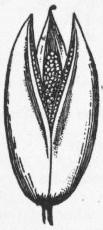
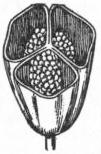
Fig. 1.—Fruit or Capsule of Meadow Saffron (Colchicum autumnale) dehiscing along the septa. Fig. 2.—Same cut across showing the three chambers with the seeds attached along the middle line—axile placentation.
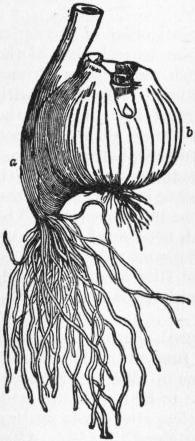
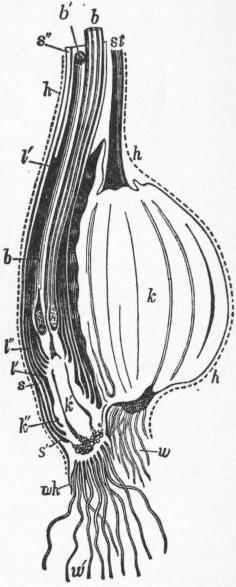
Fig. 3.—Corm of Meadow Saffron (Colchicum autumnale). a, Old corm shrivelling; b, young corm produced laterally from the old one. Fig. 4.—Corm of Colchicum autumnale in autumn when the plant is in flower.
k, Present corm. h, h, Brown scales covering it. w, Its roots. st, Its withered flowering stem. k′, Younger corm produced from k. wh, Roots from k′, which grows at expense of k. s, s′, s″, Sheathing leaves. l′, l″, Foliage leaves. b, b′, Flowers. k″, Young corm produced from k′, in autumn, which in succeeding autumn will produce flowers.
Melanthoideae.—The plants have a rhizome or corm, and the fruit is a capsule. It contains 36 genera, many of which are north temperate and three are represented in Britain, viz. Tofieldia, an arctic and alpine genus of small herbs with a slender scape springing from a tuft of narrow ensiform leaves and bearing a raceme of small green flowers; Narthecium (bog-asphodel), herbs with a habit similar to Tofieldia, but with larger golden-yellow flowers; and Colchicum, a genus with about 30 species including the meadow saffron or autumn crocus (C. autumnale). Colchicum illustrates the corm-development which is rare in Liliaceae though common in the allied order Iridaceae; a corm is formed by swelling at the base of the axis (figs. 3, 4) and persists after the flowers and leaves, bearing next season’s plant as a lateral shoot in the axil of a scale-leaf at its base. Gloriosa, well known in cultivation, climbs by means of its tendril-like leaf-tips; it has handsome flowers with decurved orange-red or yellow petals; it is a native of tropical Asia and Africa. Veratrum is an alpine genus of the north temperate zone.
Asphodeloideae.—The plants generally have a rhizome bearing radical leaves, as in asphodel, rarely a stem with a tuft of leaves as in Aloe, very rarely a tuber (Eriospermum) or bulb (Bowiea). The flowers are borne in a terminal raceme, the anthers open introrsely and the fruit is a capsule, very rarely, as in Dianella, a berry. It contains 64 genera. Asphodelus (asphodel) is a Mediterranean genus; Simethis, a slender herb with grassy radical leaves, is a native of west and southern Europe extending into south Ireland. Anthericum and Chlorophytum, herbs with radical often grass-like leaves and scapes bearing a more or less branched inflorescence of small generally white flowers, are widely spread in the tropics. Other genera are Funkia, native of China and Japan, cultivated in the open air in Britain; Hemerocallis, a small genus of central Europe and temperate Asia—H. flava is known in gardens as the day lily; Phormium, a New Zealand genus to which belongs New Zealand flax, P. tenax, a useful fibre-plant; Kniphofia, South and East Africa, several species of which are cultivated; and Aloe. A small group of Australian genera closely approach the order Juncaceae in having small crowded flowers with a scarious or membranous perianth; they include Xanthorrhoea (grass-tree or black-boy) and Kingia, arborescent plants with an erect woody stem crowned with a tuft of long stiff narrow leaves, from the centre of which rises a tall dense flower-spike or a number of stalked flower-heads; this group has been included in Juncaceae, from which it is doubtfully distinguished only by the absence of the long twisted stigmas which characterize the true rushes.
Allioideae.—The plants grow from a bulb or short rhizome; the inflorescence is an apparent umbel formed of several shortened monochasial cymes and subtended by a pair of large bracts. It contains 22 genera, the largest of which Allium has about 250 species—7 are British; Agapanthus or African lily is a well-known garden plant; in Gagea, a genus of small bulbous herbs found in most parts of Europe, the inflorescence is reduced to a few flowers or a single flower; G. lutea is a local and rare British plant.
Lilioideae.—Bulbous plants with a terminal racemose inflorescence; the anthers open introrsely and the capsule is loculicidal. It contains 28 genera, several being represented in Britain. The typical genus Lilium and Fritillaria are widely distributed in the temperate regions of the northern hemisphere; F. meleagris, snake’s head, is found in moist meadows in some of the southern and central English counties; Tulipa contains more than 50 species in Europe and temperate Asia, and is specially abundant in the dry districts of central Asia; Lloydia, a small slender alpine plant, widely distributed in the northern hemisphere, occurs on Snowdon in Wales; Scilla (squill) is a large genus, chiefly in Europe and Asia—S. nutans is the bluebell or wild hyacinth; Ornithogalum (Europe, Africa and west Asia) is closely allied to Scilla—O. umbellatum, star of Bethlehem, is naturalized in Britain; Hyacinthus and Muscari are chiefly Mediterranean; M. racemosum, grape hyacinth, occurs in sandy pastures in the eastern counties of England. To this group belong a number of tropical and especially South African genera such as Albuca, Urginea, Drimia, Lachenalia and others.
Dracaenoideae.—The plants generally have an erect stem with a crown of leaves which are often leathery; the anthers open introrsely and the fruit is a berry or capsule. It contains 9 genera, several of which, such as Yucca (fig. 5), Dracaena and Cordyline include arborescent species in which the stem increases in thickness continually by a centrifugal formation of new tissue; an extreme case is afforded by Dracaena Draco, the dragon-tree of Teneriffe. Yucca and several allied genera are natives of the dry country of the southern and western United States and of Central America. Dracaena and the allied genus Cordyline occur in the warmer regions of the Old World. There is a close relation between the pollination of many yuccas and the life of a moth (Pronuba yuccasella); the flowers are open and scented at night when the female moth becomes active, first collecting a load of pollen and then depositing her eggs, generally in a different flower from that which has supplied the pollen. The eggs are deposited in the ovary-wall, usually just below an ovule; after each deposition the moth runs to the top of the pistil and thrusts some pollen into the opening of the stigma. Development of larva and seed go on together, a few of the seeds serving as food for the insect, which when mature eats through the pericarp and drops to the ground, remaining dormant in its cocoon until the next season of flowering when it emerges as a moth.
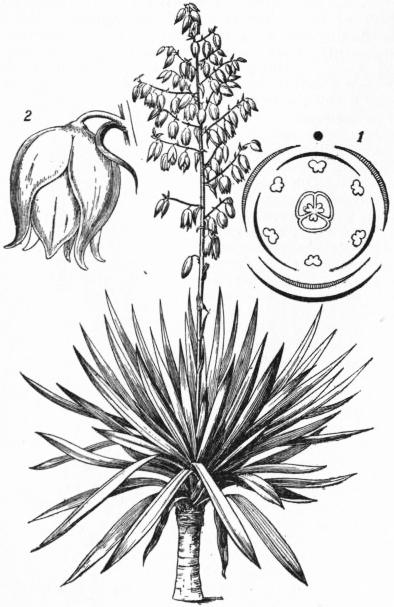
Fig. 5.—Yucca gloriosa. Plant much reduced. 1, Floral diagram. 2, Flower.
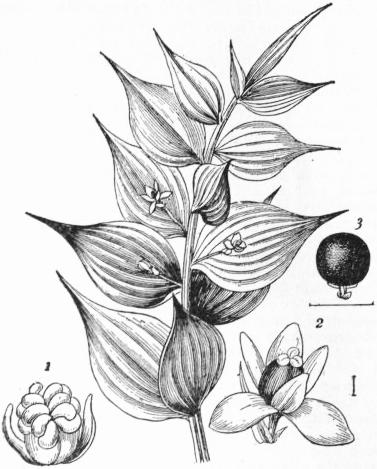
Fig. 6.—Twig of Butcher’s Broom, Ruscus aculeatus, slightly enlarged. 1, Male flower, 2, female flower, both enlarged; 3, berry, slightly reduced.
From Strasburger’s Lehrbuch der Botanik, by permission of Gustav Fischer.
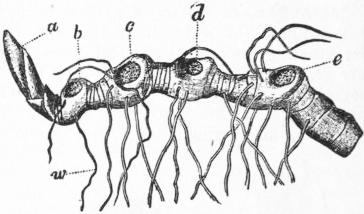
Fig. 7.—Rhizome of Polygonatum multiflorum.
a, Bud of next year’s aerial shoot. b, Scar of this year’s, and c, d, e, scars of three preceding years’ aerial shoots. w, Roots.
Asparagoideae.—Plants growing from a rhizome; fruit a berry. Asparagus contains about 100 species in the dryer warmer parts of the Old World; it has a short creeping rhizome, from which springs a slender, herbaceous or woody, often very much branched, erect or climbing stem, the ultimate branches of which are flattened or needle-like leaf-like structures (cladodes), the true leaves being reduced to scales or, in the climbers, forming short, hard more or less recurved spines. Ruscus aculeatus (fig. 6) is butcher’s broom, an evergreen shrub with flattened leaf-like cladodes, native in the southerly portion of England and Wales; the small flowers are unisexual and borne on the face of the cladode; the male contains three stamens, the filaments of which are united to form a short stout column on which are seated the diverging cells of the anthers; in the female the ovary is enveloped by a fleshy staminal tube on which are borne three barren anthers. Polygonatum and Maianthemum are allied genera with a herbaceous leafy stem and, in the former axillary flowers, in the latter flowers in a terminal raceme; both occur rarely in woods in Britain; P. multiflorum is the well-known Solomon’s seal of gardens (fig. 7), so called from the seal-like scars on the rhizome of stems of previous seasons, the hanging flowers of which contain no honey, but are visited by bees for the pollen. Convallaria is lily of the valley; Aspidistra, native of the Himalayas, China and Japan, is a well-known pot plant; its flowers depart from the normal arrangement of the order in having the parts in fours (tetramerous). Paris, including the British Herb Paris (P. quadrifolia), has solitary tetra- to poly-merous flowers terminating the short annual shoot which bears a whorl of four or more leaves below the flower; in this and in some species of the nearly allied genus Trillium (chiefly temperate North America) the flowers have a fetid smell, which together with the dark purple of the ovary and stigmas and frequently also of the stamens and petals, attracts carrion-loving flies, which alight on the stigma and then climb the anthers and become dusted with pollen; the pollen is then carried to the stigmas of another flower.
Luzuriagoideae are shrubs or undershrubs with erect or climbing branches and fruit a berry. Lapageria, a native of Chile, is a favourite greenhouse climber with fine bell-shaped flowers.
Smilacoideae are climbing shrubs with broad net-veined leaves and small dioecious flowers in umbels springing from the leaf-axils; the fruit is a berry. They climb by means of tendrils, which are stipular structures arising from the leaf-sheath. Smilax is a characteristic tropical genus containing about 200 species; the dried roots of some species are the drug sarsaparilla.
The two tribes Ophiopogonoideae and Aletroideae are often included in a distinct order, Haemodoraceae. The plants have a short rhizome and narrow or lanceolate basal leaves; and they are characterized by the ovary being often half-inferior. They contain a few genera chiefly old world tropical and subtropical. The leaves of species of Sansevieria yield a valuable fibre.
Liliaceae may be regarded as the typical order of the series Liliiflorae. It resembles Juncaceae in the general plan of the flower, which, however, has become much more elaborate and varied in the form and colour of its perianth in association with transmission of pollen by insect agency; a link between the two orders is found in the group of Australian genera referred to above under Asphodeloideae. The tribe Ophiopogonoideae, with its tendency to an inferior ovary, suggests an affinity with the Amaryllidaceae which resemble Liliaceae in habit and in the horizontal plan of the flower, but have an inferior ovary. The tribe Smilacoideae, shrubby climbers with net-veined leaves and small unisexual flowers, bears much the same relationship to the order as a whole as does the order Dioscoreaceae, which have a similar habit, but flowers with an inferior ovary, to the Amaryllidaceae.
LILIENCRON, DETLEV VON (1844-1909), German poet and novelist, was born at Kiel on the 3rd of June 1844. He entered the army and took part in the campaigns of 1866 and 1870-71, in both of which he was wounded. He retired with the rank of captain and spent some time in America, afterwards settling at Kellinghusen in Holstein, where he remained till 1887. After some time at Munich, he settled in Altona and then at Altrahistedt, near Hamburg. He died in July 1909. He first attracted attention by the volume of poems, Adjutantenritte und andere Gedichte (1883), which was followed by several unsuccessful dramas, a volume of short stories, Eine Sommerschlacht (1886), and a novel Breide Hummelsbüttel (1887). Other collections of short stories appeared under the titles Unter flatternden Fahnen (1888). Der Mäcen (1889), Krieg und Frieden (1891); of lyric poetry in 1889, 1890 (Der Heidegänger und andere Gedichte), 1893, and 1903 (Bunte Beute). Interesting, too, is the humorous epic Poggfred (1896; 2nd ed. 1904). Liliencron is one of the most eminent of recent German lyric poets; his Adjutantenritte, with its fresh original note, broke with the well-worn literary conventions which had been handed down from the middle of the century. Liliencron’s work is, however, somewhat unequal, and he lacks the sustained power which makes the successful prose writer.
Liliencron’s Sämtliche Werke have been published in 14 vols. (1904-1905); his Gedichte having been previously collected in four volumes under the titles Kampf und Spiele, Kämpfe und Ziele, Nebel und Sonne and Bunte Beute (1897-1903). See O. J. Bierbaum, D. von Liliencron (1892); H. Greinz, Liliencron, eine literarhistorische Würdigung (1896); F. Oppenheimer, D. von Liliencron (1898).
LILITH (Heb. lilâtu, “night”; hence “night-monster”), a female demon of Jewish folk-lore, equivalent to the English vampire. The personality and name are derived from a Babylonian-Assyrian demon Lilit or Lilu. Lilith was believed to have a special power for evil over children. The superstition was extended to a cult surviving among some Jews even as late as the 7th century A.D. In the Rabbinical literature Lilith becomes the first wife of Adam, but flies away from him and becomes a demon.
LILLE, a city of northern France, capital of the department of Nord, 154 m. N. by E. of Paris on the Northern railway. Pop. (1906) 196,624. Lille is situated in a low fertile plain on the right bank of the Deûle in a rich agricultural and industrial region of which it is the centre. It is a first-class fortress and headquarters of the I. army corps, and has an enceinte and a pentagonal citadel, one of Vauban’s finest works, situated to the west of the town, from which it is divided by the Deûle. The modern fortifications comprise over twenty detached forts and batteries, the perimeter of the defences being about 20 m. Before 1858 the town, fortified by Vauban about 1668, occupied an elliptical area of about 2500 yds. by 1300, with the church of Notre-Dame de la Treille in the centre, but the ramparts on the south side have been demolished and the ditches filled up, their place being now occupied by the great Boulevard de la Liberté, which extends in a straight line from the goods station of the railway to the citadel. At the S.E. end of this boulevard are grouped the majority of the numerous educational establishments of the city. The new enceinte encloses the old communes of Esquermes, Wazemmes and Moulins-Lille, the area of the town being thus more than doubled. In the new quarters fine boulevards and handsome squares, such as the Place de la République, have been laid out in pleasant contrast with the sombre aspect of the old town. The district of St André to the north, the only elegant part of the old town, is the residence of the aristocracy. Outside the enceinte populous suburbs surround the city on every side. The demolition of the fortifications on the north and east of the city, which is continued in those directions by the great suburbs of La Madeleine, St Maurice and Fives, must accelerate its expansion towards Roubaix and Tourcoing. At the demolition of the southern fortifications, the Paris gate, a triumphal arch erected in 1682 in honour of Louis XIV., after the conquest of Flanders, was preserved. On the east the Ghent and Roubaix gates, built in the Renaissance style, with bricks of different colours, date from 1617 and 1622, the time of the Spanish domination. On the same side the Noble-Tour is a relic of the medieval ramparts. The present enceinte is pierced by numerous gates, including water gates for the canal of the Deûle and for the Arbonnoise, which extends into a marsh in the south-west corner of the town. The citadel, which contains the barracks and arsenal, is surrounded by public gardens. The more interesting buildings are in the old town, where, in the Grande Place and Rue Faidherbe, its animation is concentrated. St Maurice, a church in the late Gothic style, dates in its oldest portions from the 15th century, and was restored in 1872; Ste Cathérine belongs to the 15th, 16th and 18th centuries, St André to the first years of the 18th century, and Ste Madeleine to the last half of the 17th century; all possess valuable pictures, but St Maurice alone, with nave and double aisles, and elegant modern spire, is architecturally notable. Notre-Dame de la Treille, begun in 1855, in the style of the 15th century, possesses an ancient statue of the Virgin which is the object of a well-known pilgrimage. Of the civil buildings the Bourse (17th century) built round a courtyard in which stands a bronze statue of Napoleon I., the Hôtel d’Aigremont, the Hôtel Gentil and other houses are in the Flemish style; the Hôtel de Ville, dating in the main from the middle of the 19th century, preserves a portion of a palace built by Philip the Good, duke of Burgundy, in the 15th century. The prefecture, the Palais des Beaux-Arts, the law-courts, the school of arts and crafts, and the Lycée Faidherbe are imposing modern buildings. In the middle of the Grande Place stands a column, erected in 1848, commemorating the defence of the town in 1792 (see below), and there are also statues to Generals L. L. C. Faidherbe and F. O. de Négrier, and busts of Louis Pasteur and the popular poet and singer A. Desrousseaux. The Palais des Beaux-Arts contains a museum and picture galleries, among the richest in France, as well as a unique collection of original designs of the great masters bequeathed to Lille by J. B. Wicar, and including a celebrated wax model of a girl’s head usually attributed to some Italian artist of the 16th century. The city also possesses a commercial and colonial museum, an industrial museum, a fine collection of departmental and municipal archives, the museum of the Institute of Natural Sciences and a library containing many valuable manuscripts, housed at the Hôtel de Ville. The large military hospital, once a Jesuit college, is one of several similar institutions.
Lille is the seat of a prefect and has tribunals of first instance and of commerce, a board of trade arbitrators, a chamber of commerce and a branch of the Bank of France. It is the centre of an académie (educational division) and has a university with faculties of laws, letters, science and medicine and pharmacy, together with a Catholic institute comprising faculties of theology, law, medicine and pharmacy, letters, science, a technical school, and a department of social and political science. Secondary education is given at the Lycée Faidherbe, and the Lycée Fénelon (for girls), a higher school of commerce, a national technical school and other establishments; to these must be added schools of music and fine arts, and the Industrial and Pasteur Institutes.
The industries, which are carried on in the new quarters of the town and in the suburbs, are of great variety and importance. In the first rank comes the spinning of flax and the weaving of cloth, table-linen, damask, ticking and flax velvet. The spinning of flax thread for sewing and lace-making is specially connected with Lille. The manufacture of woollen fabrics and cotton-spinning and the making of cotton-twist of fine quality are also carried on. There are important printing establishments, state factories for the manufacture of tobacco and the refining of saltpetre and very numerous breweries, while chemical, oil, white lead and sugar-works, distilleries, bleaching-grounds, dye-works, machinery and boiler works and cabinet-making occupy many thousands of workmen. Plant for sugar-works and distilleries, military stores, steam-engines, locomotives, and bridges of all kinds are produced by the company of Fives-Lille. Lille is one of the most important junctions of the Northern railway, and the Deûle canal affords communication with neighbouring ports and with Belgium. Trade is chiefly in the raw material and machinery for its industries, in the products thereof, and in the wheat and other agricultural products of the surrounding district.
Lille (l’Île) is said to date its origin from the time of Count Baldwin IV. of Flanders, who in 1030 surrounded with walls a little town which had arisen around the castle of Buc. In the first half of the 13th century, the town, which had developed rapidly, obtained communal privileges. Destroyed by Philip Augustus in 1213, it was rebuilt by Joanna of Constantinople, countess of Flanders, but besieged and retaken by Philip the Fair in 1297. After having taken part with the Flemings against the king of France, it was ceded to the latter in 1312. In 1369 Charles V., king of France, gave it to Louis de Male, who transmitted his rights to his daughter Margaret, wife of Philip the Bold, duke of Burgundy. Under the Burgundian rule Lille enjoyed great prosperity; its merchants were at the head of the London Hansa. Philip the Good made it his residence, and within its walls held the first chapters of the order of the Golden Fleece. With the rest of Flanders it passed from the dukes of Burgundy to Austria and then to Spain. After the death of Philip IV. of Spain, Louis XIV. reclaimed the territory and besieged Lille in 1667. He forced it to capitulate, but preserved all its laws, customs, privileges and liberties. In 1708, after an heroic resistance, it surrendered to Prince Eugène and the duke of Marlborough. The treaty of Utrecht restored it to France. In 1792 the Austrians bombarded it for nine days and nights without intermission, but had ultimately to raise the siege.
See É. Vanhende, Lille et ses institutions communales de 620 à 1804 (Lille, 1888).
LILLEBONNE, a town of France in the department of Seine-Inférieure, 3½ m. N. of the Seine and 24 m. E. of Havre by the Western railway. Pop. (1906) 5370. It lies in the valley of the Bolbec at the foot of wooded hills. The church of Notre-Dame, partly modern, preserves a Gothic portal of the 16th century and a graceful tower of the same period. The park contains a fine cylindrical donjon and other remains of a castle founded by William the Conqueror and rebuilt in the 13th century. The principal industries are cotton-spinning and the manufacture of calico and candles.
Lillebonne under the Romans, Juliobona, was the capital of the Caletes, or inhabitants of the Pays de Caux, in the time of Caesar, by whom it was destroyed. It was afterwards rebuilt by Augustus, and before it was again ruined by the barbarian invasions it had become an important centre whence Roman roads branched out in all directions. The remains of ancient baths and of a theatre capable of holding 3000 persons have been brought to light. Many Roman and Gallic relics, notably a bronze statue of a woman and two fine mosaics, have been found and transported to the museum at Rouen. In the middle ages the fortifications of the town were constructed out of materials supplied by the theatre. The town recovered some of its old importance under William the Conqueror.
LILLIBULLERO, or Lilliburlero, the name of a song popular at the end of the 17th century, especially among the army and supporters of William III. in the war in Ireland during the revolution of 1688. The tune appears to have been much older, and was sung to an Irish nursery song at the beginning of the 17th century, and the attribution of Henry Purcell is based on the very slight ground that it was published in Music’s Handmaid, 1689, as “A new Irish Tune” by Henry Purcell. It was also a marching tune familiar to soldiers. The doggerel verses have generally been assigned to Thomas Wharton, and deal with the administration of Talbot, earl of Tyrconnel, appointed by James as his lieutenant in Ireland in 1687. The refrain of the song lilliburllero bullen a la gave the title of the song. Macaulay says of the song “The verses and the tune caught the fancy of the nation. From one end of England to the other all classes were singing this idle rhyme.” Though Wharton claimed he had “sung a king out of three kingdoms” and Burnet says “perhaps never had so slight a thing so great an effect” the success of the song was “the effect, and not the cause of that excited state of public feeling which produced the revolution” (Macaulay, Hist. of Eng. chap. ix.).