VOLUME XVI SLICE III Latin Language to Lefebvre, François-Joseph (continued 8)
Reading edition
Water when absolutely pure has no action on lead, but in the presence of air the lead is quickly attacked, with formation of the hydrate, Pb(OH)2, which is appreciably soluble in water forming an alkaline liquid. When carbonic acid is present the dissolved oxide is soon precipitated as basic carbonate, so that the corrosion of the lead becomes continuous. Since all soluble lead compounds are strong cumulative poisons, danger is involved in using lead cisterns or pipes in the distribution of pure waters. The word “pure” is emphasized because experience shows that the presence in a water of even small proportions of calcium bicarbonate or sulphate prevents its action on lead. All impurities do not act in a similar way. Ammonium nitrate and nitrite, for instance, intensify the action of a water on lead. Even pure waters, however, such as that of Loch Katrine (which forms the Glasgow supply), act so slowly, at least on such lead pipes as have already been in use for some time, that there is no danger in using short lead service pipes even for them, if the taps are being constantly used. Lead cisterns must be unhesitatingly condemned.
The presence of carbonic acid in a water does not affect its action on lead. Aqueous non-oxidizing acids generally have little or no action on lead in the absence of air. Dilute sulphuric acid (say an acid of 20% H2SO4 or less) has no action on lead even when air is present, nor on boiling. Strong acid does act, the more so the greater its concentration and the higher its temperature. Pure lead is far more readily corroded than a metal contaminated with 1% or even less of antimony or copper. Boiling concentrated sulphuric acid converts lead into sulphate, with evolution of sulphur dioxide. Dilute nitric acid readily dissolves the metal, with formation of nitrate Pb(NO3)2.
Lead Alloys.—Lead, unites readily with almost all other metals; hence, and on account of its being used for the extraction of (for instance) silver, its alchemistic name of saturnus. Of the alloys the following may be named:—
With Antimony.—Lead contaminated with small proportions of antimony is more highly proof against sulphuric acid than the pure metal. An alloy of 83 parts of lead and 17 of antimony is used as type metal; other proportions are used, however, and other metals added besides antimony (e.g. tin, bismuth) to give the alloy certain properties.
Arsenic renders lead harder. An alloy made by addition of about 1⁄56th of arsenic has been used for making shot.
Bismuth and Antimony.—An alloy consisting of 9 parts of lead, 2 of antimony and 2 of bismuth is used for stereotype plates.
Bismuth and Tin.—These triple alloys are noted for their low fusing points. An alloy of 5 of lead, 8 of bismuth and 3 of tin fuses at 94.4°C, i.e. below the boiling-point of water (Rose’s metal). An alloy of 15 parts of bismuth, 8 of lead, 4 of tin and 3 of cadmium (Wood’s alloy) melts below 70°C.
Tin unites with lead in any proportion with slight expansion, the alloy fusing at a lower temperature than either component. It is used largely for soldering.
“Pewter” (q.v.) may be said to be substantially an alloy of the same two metals, but small quantities of copper, antimony and zinc are frequently added.
Compounds of Lead.
Lead generally functions as a divalent element of distinctly metallic character, yielding a definite series of salts derived from the oxide PbO. At the same time, however, it forms a number of compounds in which it is most decidedly tetravalent; and thus it shows relations to carbon, silicon, germanium and tin.
Oxides.—Lead combines with oxygen to form five oxides, viz. Pb2O, PbO, PbO2, Pb2O3 and Pb3O4. The suboxide, Pb2O, is the first product of the oxidation of lead, and is also obtained as a black powder by heating lead oxalate to 300° out of contact with air. It ignites when heated in air with the formation of the monoxide; dilute acids convert it into metallic lead and lead monoxide, the latter dissolving in the acid. The monoxide, PbO, occurs in nature as the mineral lead ochre. This oxide is produced by heating lead in contact with air and removing the film of oxide as formed. It is manufactured in two forms, known as “massicot” and “litharge.” The former is produced at temperatures below, the latter at temperatures above the fusing-point of the oxide. The liquid litharge when allowed to cool solidifies into a hard stone-like mass, which, however, when left to itself, soon crumbles up into a heap of resplendent dark yellow scales known as “flake litharge.” “Buff” or “levigated litharge” is prepared by grinding the larger pieces under water. Litharge is much used for the preparation of lead salts, for the manufacture of oil varnishes, of certain cements, and of lead plaster, and for other purposes. Massicot is the raw material for the manufacture of “red lead” or “minium.”
Lead monoxide is dimorphous, occurring as cubical dodecahedra and as rhombic octahedra. Its specific gravity is about 9; it is sparingly soluble in water, but readily dissolves in acids and molten alkalis. A yellow and red modification have been described (Zeit. anorg. Chem., 1906, 50, p. 265). The corresponding hydrate, Pb(OH)2, is obtained as a white crystalline precipitate by adding ammonia to a solution of lead nitrate or acetate. It dissolves in an excess of alkali to form plumbites of the general formula Pb(OM)2. It absorbs carbon dioxide from the air when moist. A hydrated oxide, 2PbO·H2O, is obtained when a solution of the monoxide in potash is treated with carbon dioxide.
Lead dioxide, PbO2, also known as “puce oxide,” occurs in nature as the mineral plattnerite, and may be most conveniently prepared by heating mixed solutions of lead acetate and bleaching powder until the original precipitate blackens. The solution is filtered, the precipitate well washed, and, generally, is put up in the form of a paste in well-closed vessels. It is also obtained by passing chlorine into a suspension of lead oxide or carbonate, or of magnesia and lead sulphate, in water; or by treating the sesquioxide or red oxide with nitric acid. The formation of lead dioxide by the electrolysis of a lead solution, the anode being a lead plate coated with lead oxide or sulphate and the cathode a lead plate, is the fundamental principle of the storage cell (see Accumulator). Heating or exposure to sunlight reduces it to the red oxide; it fires when ground with sulphur, and oxidizes ammonia to nitric acid, with the simultaneous formation of ammonium nitrate. It oxidizes a manganese salt (free from chlorine) in the presence of nitric acid to a permanganate; this is a very delicate test for manganese. It forms crystallizable salts with potassium and calcium hydrates, and functions as a weak acid forming salts named plumbates. The Kassner process for the manufacture of oxygen depends upon the formation of calcium plumbate, Ca2PbO4, by heating a mixture of lime and litharge in a current of air, decomposing this substance into calcium carbonate and lead dioxide by heating in a current of carbon dioxide, and then decomposing these compounds with the evolution of carbon dioxide and oxygen by raising the temperature. Plumbic acid, PbO(OH)2, is obtained as a bluish-black, lustrous body of electrolysing an alkaline solution of lead sodium tartrate.
Tetravalent Lead.—If a suspension of lead dichloride in hydrochloric acid be treated with chlorine gas, a solution of lead tetrachloride is obtained; by adding ammonium chloride ammonium plumbichloride, (NH4)2PbCl6, is precipitated, which on treatment with strong sulphuric acid yields lead tetrachloride, PbCl4, as a translucent, yellow, highly refractive liquid. It freezes at -15° to a yellowish crystalline mass; on heating it loses chlorine and forms lead dichloride. With water it forms a hydrate, and ultimately decomposes into lead dioxide and hydrochloric acid. It combines with alkaline chlorides—potassium, rubidium and caesium—to form crystalline plumbichlorides; it also forms a crystalline compound with quinoline. By dissolving red lead, Pb3O4, in glacial acetic acid and crystallizing the filtrate, colourless monoclinic prisms of lead tetracetate, Pb(C2H3O2)4, are obtained. This salt gives the corresponding chloride and fluoride with hydrochloric and hydrofluoric acids, and the phosphate, Pb(HPO4)2, with phosphoric acid.
These salts are like those of tin; and the resemblance to this metal is clearly enhanced by the study of the alkyl compounds. Here compounds of divalent lead have not yet been obtained; by acting with zinc ethide on lead chloride, lead tetraethide, Pb(C2H3)4, is obtained, with the separation of metallic lead.
Lead sesquioxide, Pb2O3, is obtained as a reddish-yellow amorphous powder by carefully adding sodium hypochlorite to a cold potash solution of lead oxide, or by adding very dilute ammonia to a solution of red lead in acetic acid. It is decomposed by acids into a mixture of lead monoxide and dioxide, and may thus be regarded as lead metaplumbate, PbPbO3. Red lead or triplumbic tetroxide, Pb3O4, is a scarlet crystalline powder of specific gravity 8.6-9.1, obtained by roasting very finely divided pure massicot or lead carbonate; the brightness of the colour depends in a great measure on the roasting. Pliny mentions it under the name of minium, but it was confused with cinnabar and the red arsenic sulphide; Dioscorides mentions its preparation from white lead or lead carbonate. On heating it assumes a finer colour, but then turns violet and finally black; regaining, however, its original colour on cooling. On ignition, it loses oxygen and forms litharge. Commercial red lead is frequently contaminated with this oxide, which may, however, be removed by repeated digestion with lead acetate. Its common adulterants are iron oxides, powdered barytes and brick dust. Acids decompose it into lead dioxide and monoxide, and the latter may or may not dissolve to form a salt; red lead may, therefore, be regarded as lead orthoplumbate, Pb2PbO4. It is chiefly used as a pigment and in the manufacture of flint glass.
Lead chloride, PbCl2, occurs in nature as the mineral cotunnite, which crystallizes in the rhombic system, and is found in the neighbourhood of volcanic craters. It is artificially obtained by adding hydrochloric acid to a solution of lead salt, as a white precipitate, little soluble in cold water, less so in dilute hydrochloric acid, more so in the strong acid, and readily soluble in hot water, from which on cooling, the excess of dissolved salt separates out in silky rhombic needles. It melts at 485° and solidifies on cooling to a translucent, horn-like mass; an early name for it was plumbum corneum, horn lead. A basic chloride, Pb(OH)Cl, was introduced in 1849 by Pattinson as a substitute for white lead. Powdered galena is dissolved in hot hydrochloric acid, the solution allowed to cool and the deposit of impure lead chloride washed with cold water to remove iron and copper. The residue is then dissolved in hot water, filtered, and the clear solution is mixed with very thin milk of lime so adjusted that it takes out one-half of the chlorine of the PbCl2. The oxychloride comes down as an amorphous white precipitate. Another oxychloride, PbCl2·7PbO, known as “Cassel yellow,” was prepared by Vauquelin by fusing pure oxide, PbO, with one-tenth of its weight of sal ammoniac. “Turner’s yellow” or “patent yellow” is another artificially prepared oxychloride, used as a pigment. Mendipite and matlockite are mineral oxychlorides.
Lead, fluoride, PbF2, is a white powder obtained by precipitating a lead salt with a soluble fluoride; it is sparingly soluble in water but readily dissolves in hydrochloric and nitric acids. A chloro-fluoride, PbClF, is obtained by adding sodium fluoride to a solution of lead chloride. Lead bromide, PbBr2, a white solid, and lead iodide, PbI2, a yellow solid, are prepared by precipitating a lead salt with a soluble bromide or iodide; they resemble the chloride in solubility.
Lead carbonate, PbCO3, occurs in nature as the mineral cerussite (q.v.). It is produced by the addition of a solution of lead salt to an excess of ammonium carbonate, as an almost insoluble white precipitate. Of greater practical importance is a basic carbonate, substantially 2PbCO3·Pb(OH)2, largely used as a white pigment under the name of “white lead.” This pigment is of great antiquity; Theophrastus called it ψιμύθιον, and prepared it by acting on lead with vinegar, and Pliny, who called it cerussa, obtained it by dissolving lead in vinegar and evaporating to dryness. It thus appears that white lead and sugar of lead were undifferentiated. Geber gave the preparation in a correct form, and T. O. Bergman proved its composition. This pigment is manufactured by several methods. In the old Dutch method, pieces of sheet lead are suspended in stoneware pots so as to occupy the upper two-thirds of the vessels. A little vinegar is poured into each pot; they are then covered with plates of sheet lead, buried in horse-dung or spent tanner’s bark, and left to themselves for a considerable time. By the action of the acetic acid and atmospheric oxygen, the lead is converted superficially into a basic acetate, which is at once decomposed by the carbon dioxide, with formation of white lead and acetic acid, which latter then acts de novo. After a month or so the plates are converted to a more or less considerable depth into crusts of white lead. These are knocked off, ground up with water, freed from metal-particles by elutriation, and the paste of white lead is allowed to set and dry in small conical forms. The German method differs from the Dutch inasmuch as the lead is suspended in a large chamber heated by ordinary means, and there exposed to the simultaneous action of vapour of aqueous acetic acid and of carbon dioxide. Another process depends upon the formation of lead chloride by grinding together litharge with salt and water, and then treating the alkaline fluid with carbon dioxide until it is neutral. White lead is an earthy, amorphous powder. The inferior varieties of commercial “white lead” are produced by mixing the genuine article with more or less of finely powdered heavy spar or occasionally zinc-white (ZnO). Venetian white, Hamburg white and Dutch white are mixtures of one part of white lead with one, two and three parts of barium sulphate respectively.
Lead sulphide, PbS, occurs in nature as the mineral galena (q.v.), and constitutes the most valuable ore of lead. It may be artificially prepared by leading sulphur vapour over lead, by fusing litharge with sulphur, or, as a black precipitate, by passing sulphuretted hydrogen into a solution of a lead salt. It dissolves in strong nitric acid with the formation of the nitrate and sulphate, and also in hot concentrated hydrochloric acid.
Lead sulphate, PbSO4, occurs in nature as the mineral anglesite (q.v.), and may be prepared by the addition of sulphuric acid to solutions of lead salts, as a white precipitate almost insoluble in water (1 in 21,739), less soluble still in dilute sulphuric acid (1 in 36,504) and insoluble in alcohol. Ammonium sulphide blackens it, and it is coluble in solution of ammonium acetate, which distinguishes it from barium sulphate. Strong sulphuric acid dissolves it, forming an acid salt, Pb(HSO4)2, which is hydrolysed by adding water, the normal sulphate being precipitated; hence the milkiness exhibited by samples of oil of vitriol on dilution.
Lead nitrate, Pb(NO3)2, is obtained by dissolving the metal or oxide in aqueous nitric acid; it forms white crystals, difficultly soluble in cold water, readily in hot water and almost insoluble in strong nitric acid. It was mentioned by Libavius, who named it calx plumb dulcis. It is decomposed by heat into oxide, nitrogen peroxide and oxygen; and is used for the manufacture of fusees and other deflagrating compounds, and also for preparing mordants in the dyeing and calico-printing industries. Basic nitrates, e.g. Pb(NO3)OH, Pb3O(OH)2(NO3)2, Pb3O2(OH)NO3, &c., have been described.
Lead Phosphates.—The normal ortho-phosphate, Pb3(PO4)2, is a white precipitate obtained by adding sodium phosphate to lead acetate; the acid phosphate, PbHPO4, is produced by precipitating a boiling solution of lead nitrate with phosphoric acid; the pyrophosphate and meta-phosphate are similar white precipitates.
Lead Borates.—By fusing litharge with boron trioxide, glasses of a composition varying with the proportions of the mixture are obtained; some of these are used in the manufacture of glass. The borate, Pb2B6O11·4H2O, is obtained as a white precipitate by adding borax to a lead salt; this on heating with strong ammonia gives PbB2O4·H2·O, which, in turn, when boiled with a solution of boric acid, gives PbB4O7·4H2O.
Lead silicates are obtained as glasses by fusing litharge with silica; they play a considerable part in the manufacture of the lead glasses (see Glass).
Lead chromate, PbCrO4, is prepared industrially as a yellow pigment, chrome yellow, by precipitating sugar of lead solution with potassium bichromate. The beautiful yellow precipitate is little soluble in dilute nitric acid, but soluble in caustic potash. The vermilion-like pigment which occurs in commerce as “chrome-red” is a basic chromate, Pb2CrO5, prepared by treating recently precipitated normal chromate with a properly adjusted proportion of caustic soda, or by boiling it with normal (yellow) potassium chromate.
Lead acetate, Pb(C2H3O2)2·3H2O (called “sugar” of lead, on account of its sweetish taste), is manufactured by dissolving massicot in aqueous acetic acid. It forms colourless transparent crystals, soluble in one and a half parts of cold water and in eight parts of alcohol, which on exposure to ordinary air become opaque through absorption of carbonic acid, which forms a crust of basic carbonate. An aqueous solution readily dissolves lead oxide, with formation of a strongly alkaline solution containing basic acetates (Acetum Plumbi or Saturni). When carbon dioxide is passed into this solution the whole of the added oxide, and even part of the oxide of the normal salt, is precipitated as a basic carbonate chemically similar, but not quite equivalent as a pigment, to white lead.
Analysis.—When mixed with sodium carbonate and heated on charcoal in the reducing flame lead salts yield malleable globules of metal and a yellow oxide-ring. Solutions of lead salts (colourless in the absence of coloured acids) are characterized by their behaviour to hydrochloric acid, sulphuric acid and potassium chromate. But the most delicate precipitant for lead is sulphuretted hydrogen, which produces a black precipitate of lead sulphide, insoluble in cold dilute nitric acid, less so in cold hydrochloric, and easily decomposed by hot hydrochloric acid with formation of the characteristic chloride. The atomic weight, determined by G. P. Baxter and J. H. Wilson (J. Amer. Chem. Soc., 1908, 30, p. 187) by analysing the chloride, is 270.190 (O = 16).
Pharmacology and Therapeutics.
The metal itself is not used in medicine. The chief pharmacopoeial salts are: (1) Plumbi oxidum (lead oxide), litharge. It is not used internally, but from it is made Emplastrum Plumbi (diachylon plaster), which is an oleate of lead and is contained in emplastrum hydrargeri, emplastrum plumbi iodidi, emplastrum resinae, emplastrum saponis. (2) Plumbi Acetas (sugar of lead), dose 1 to 5 grains. From this salt are made the following preparations: (a) Pilula Plumbi cum Opio, the strength of the opium in it being 1 in 8, dose 2 to 4 grains; (b) Suppositoria Plumbi composita, containing lead acetate, opium and oil of theobroma, there being one grain of opium in each suppository; (c) Unguentum Plumbi Acetatis; (d) Liquor Plumbi Subacetatis Fortior, Goulard’s extract, strength 24% of the subacetate; this again has a sub-preparation, the Liquor Plumbi Subacetatis Dilutis, called Goulard’s water or Goulard’s lotion, containing 1 part in 80 of the strong extract; (e) Glycerinum Plumbi Subacetatis, from which is made the Unguentum Glycerini Plumbi Subacetatis. (3) Plumbi Carbonas, white lead, a mixture of the carbonate and the hydrate, a heavy white powder insoluble in water; it is not used internally, but from it is made Unguentum Plumbi Carbonatis, strength 1 in 10 parts of paraffin ointment. (4) Plumbi Iodidium, a heavy bright yellow powder not used internally. From it are made (a) Emplastrum Plumbi Iodidi, and (b) Unguentum Plumbi Iodidi. The strength of each is 1 in 10.
Applied externally lead salts have practically no action upon the unbroken skin, but applied to sores, ulcers or any exposed mucous membranes they coagulate the albumen in the tissues themselves and contract the small vessels. They are very astringent, haemostatic and sedative; the strong solution of the subacetate is powerfully caustic and is rarely used undiluted. Lead salts are applied as lotions in conditions where a sedative astringent effect is desired, as in weeping eczema; in many varieties of chronic ulceration; and as an injection for various inflammatory discharges from the vagina, ear and urethra, the Liquor Plumbi Subacetatis Dilutum being the one employed. The sedative effect of lead lotion in pruritus is well known. Internally lead has an astringent action on the mucous membranes, causing a sensation of dryness; the dilute solution of the subacetate forms an effective gargle in tonsillitis. The chief use of the preparations of lead, however, is as an astringent in acute diarrhoea, particularly if ulceration be present, when it is usefully given in combination with opium in the form of the Pilula Plumbi cum Opio. It is useful in haemorrhage from a gastric ulcer or in haemorrhage from the intestine. Lead salts usually produce constipation, and lead is an active ecbolic. Lead is said to enter the blood as an albuminate in which form it is deposited in the tissues. As a rule the soluble salts if taken in sufficient quantities produce acute poisoning, and the insoluble salts chronic plumbism. The symptoms of acute poisoning are pain and diarrhoea, owing to the setting up of an active gastro-enteritis, the foeces being black (due to the formation of a sulphide of lead), thirst, cramps in the legs and muscular twitchings, with torpor, collapse, convulsions and coma. The treatment is the prompt use of emetics, or the stomach should be washed out, and large doses of sodium or magnesium sulphate given in order to form an insoluble sulphate. Stimulants, warmth and opium may be required. For an account of chronic plumbism see Lead Poisoning.
Authorities.—For the history of lead see W. H. Pulsifer, Notes for a History of Lead (1888); B. Neumann, Die Metalle (1904); A. Rossing, Geschichte der Metalle (1901). For the chemistry see H. Roscoe and C. Schorlemmer, Treatise on Inorganic Chemistry, vol. ii. (1897); H. Moissan, Traité de chimie minerale; O. Dammer, Handbuch der anorganischen Chemie. For the metallurgy see J. Percy, The Metallurgy of Lead (London, 1870); H. F. Collins, The Metallurgy of Lead and Silver (London, 1899), part i. “Lead”; H. O. Hofmann, The Metallurgy of Lead (6th ed., New York, 1901); W. R. Ingalls, Lead Smelting and Refining (1906); A. G. Betts, Lead Refining by Electrolysis (1908); M. Eissler, The Metallurgy of Argentiferous Silver. The Mineral Industry, begun in 1892, annually records the progress made in lead smelting.

LEADER, BENJAMIN WILLIAMS (1831- ), English painter, the son of E. Leader Williams, an engineer, received his art education first at the Worcester School of Design and later in the schools of the Royal Academy. He began to exhibit at the Academy in 1854, was elected A.R.A. in 1883 and R.A. in 1898, and became exceedingly popular as a painter of landscape. His subjects are attractive and skilfully composed. He was awarded a gold medal at the Paris Exhibition in 1889, and was made a knight of the Legion of Honour. One of his pictures, “The Valley of the Llugwy,” is in the National Gallery of British Art.
See The Life and Work of B. W. Leader, R.A., by Lewis Lusk, Art Journal Office (1901).
LEADHILLITE, a rare mineral consisting of basic lead sulphato-carbonate, Pb4SO4(CO3)2(OH)2. Crystals have usually the form of six-sided plates (fig. 1) or sometimes of acute rhombohedra (fig. 2); they have a perfect basal cleavage (parallel to P in fig. 1) on which the lustre is strongly pearly; they are usually white and translucent. The hardness is 2.5 and the sp. gr. 6.26-6.44. The crystallographic and optical characters point to the existence of three distinct kinds of leadhillite, which are, however, identical in external appearance and may even occur intergrown together in the same crystal: (a) monoclinic with an optic axial angle of 20°; (b) rhombohedral (fig. 2) and optically uniaxial; (c) orthorhombic (fig. 1) with an optic axial angle of 72¾°. The first of these is the more common kind, and the second has long been known under the name susannite. The fact that the published analyses of leadhillite vary somewhat from the formula given above suggests that these three kinds may also be chemically distinct.
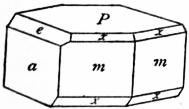
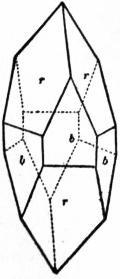
Fig. 1. Fig. 2.
Leadhillite is a mineral of secondary origin, occurring with cerussite, anglesite, &c., in the oxidized portions of lead-bearing lodes; it has also been found in weathered lead slags left by the Romans. It has been found most abundantly in the Susanna mine at Leadhills in Scotland (hence the names leadhillite and susannite). Good crystals have also been found at Red Gill in Cumberland and at Granby in Missouri. Crystals from Sardinia have been called maxite.
(L. J. S.)
LEADHILLS, a village of Lanarkshire, Scotland, 5¾ m. W.S.W. of Elvanfoot station on the Caledonian Railway Company’s main line from Glasgow to the south. Pop. (1901) 835. It is the highest village in Scotland, lying 1301 ft. above sea-level, near the source of Glengonner Water, an affluent of the Clyde. It is served by a light railway. Lead and silver have been mined here and at Wanlockhead, 1½ m. S.W., for many centuries—according to some authorities even in Roman days. Gold was discovered in the reign of James IV., but though it is said then to have provided employment for 300 persons, its mining has long ceased to be profitable. The village is neat and well built, and contains a masonic hall and library, the latter founded by the miners about the middle of the 18th century. Allan Ramsay, the poet, and William Symington (1763-1831), one of the earliest adaptors of the steam engine to the purposes of navigation, were born at Leadhills.
LEAD POISONING, or Plumbism, a “disease of occupations,” which is itself the cause of organic disease, particularly of the nervous and urinary systems. The workpeople affected are principally those engaged in potteries where lead-glaze is used; but other industries in which health is similarly affected are file-making, house-painting and glazing, glass-making, copper-working, coach-making, plumbing and gasfitting, printing, cutlery, and generally those occupations in which lead is concerned.
The symptoms of chronic lead poisoning vary within very wide limits, from colic and constipation up to total blindness, paralysis, convulsions and death. They are thus described by Dr J. T. Arlidge (Diseases of Occupations):—
The poison finds its way gradually into the whole mass of the circulating blood, and exerts its effects mainly on the nervous system, paralysing nerve-force and with it muscular power. Its victims become of a sallow-waxy hue; the functions of the stomach and bowels are deranged, appetite fails and painful colic with constipation supervenes. The loss of power is generally shown first in the fingers, hands and wrists, and the condition known as “wrist-drop” soon follows, rendering the victim useless for work. The palsy will extend to the shoulders, and after no long time to the legs also. Other organs frequently involved are the kidneys, the tissue of which becomes permanently damaged; whilst the sight is weakened or even lost.
Dr M‘Aldowie, senior physician to the North Staffordshire Infirmary, has stated that “in the pottery trade lead is very slow in producing serious effects compared with certain other industries.” In his experience the average period of working in lead before serious lesions manifest themselves is 18 years for females and 22½ years for males. But some individuals fall victims to the worst forms of plumbism after a few months’ or even weeks’ exposure to the danger. Young persons are more readily affected than those of mature age, and women more than men. In addition, there seems to be an element of personal susceptibility, the nature of which is not understood. Some persons “work in the lead” for twenty, forty or fifty years without the slightest ill effects; others have attacks whenever they are brought into contact with it. Possibly the difference is due to the general state of health; robust persons resist the poison successfully, those with impoverished blood and feeble constitution are mastered by it. Lead enters the body chiefly through the nose and mouth, being inspired in the form of dust or swallowed with food eaten with unwashed hands. It is very apt to get under the nails, and is possibly absorbed in this way through the skin. Personal care and cleanliness are therefore of the greatest importance. A factory surgeon of great experience in the English Potteries has stated that seventeen out of twenty cases of lead-poisoning in the china and earthenware industry are due to carelessness (The Times, 8th October 1898).
The Home Office in England has from time to time made special rules for workshops and workpeople, with the object of minimizing or preventing the occurrence of lead-poisoning; and in 1895 notification of cases was made compulsory. The health of workpeople in the Potteries was the subject of a special inquiry by a scientific committee in 1893. The committee stated that “the general truth that the potteries occupation is one fraught with injury to health and life is beyond dispute,” and that “the ill effects of the trade are referable to two chief causes—namely, dust and the poison of lead.” Of these the inhalation of clay and flint dust was the more important. It led to bronchitis, pulmonary tuberculosis and pneumonia, which were the most prevalent disorders among potters, and responsible for 70% of the mortality. That from lead the committee did not attempt to estimate, but they found that plumbism was less prevalent than in past times, and expressed the opinion “that a large part of the mortality from lead poisoning is avoidable; although it must always be borne in mind that no arrangements or rules, with regard to the work itself, can entirely obviate the effects of the poison to which workers are exposed, because so much depends upon the individual and the observance of personal care and cleanliness.” They recommended the adoption of certain special rules in the workshops, with the objects of protecting young persons from the lead, of minimizing the evils of dust, and of promoting cleanliness, particularly in regard to meals. Some of these recommendations were adopted and applied with good results. With regard to the suggestion that “only leadless glazes should be used on earthenware,” they did not “see any immediate prospect of such glazes becoming universally applicable to pottery manufacture,” and therefore turned their attention to the question of “fritting” the lead.
It may be explained that lead is used in china and earthenware to give the external glaze which renders the naturally porous ware watertight. Both “white” and “red” lead are used. The lead is added to other ingredients, which have been “fritted” or fused together and then ground very fine in water, making a thick creamy liquid into which the articles are dipped. After dipping the glaze dries quickly, and on being “fired” in the kiln it becomes fused by the heat into the familiar glassy surface. In the manufacture of ware with enamelled colours, glaze is mixed with the pigment to form a flux, and such colours are used either moist or in the form of a dry powder. “Fritting” the lead means mixing it with the other ingredients of the glaze beforehand and fusing them all together under great heat into a kind of rough glass, which is then ground to make the glaze. Treated in this way the lead combines with the other ingredients and becomes less soluble, and therefore less dangerous, than when added afterwards in the raw state. The committee (1893) thought it “reasonable to suppose that the fritting of lead might ultimately be found universally practicable,” but declared that though fritting “no doubt diminishes the danger of lead-poisoning,” they “could not regard all fritts as equally innocuous.”
In the annual report of the chief inspector of factories for 1897, it was stated that there had been “material improvement in dust conditions” in the potting industry, but “of lead-poisoning unfortunately the same could not be said, the number of grave cases reported, and particularly cases of blindness, having ominously increased of late.” This appears to have been largely due to the erroneous inclusion among potting processes of “litho-transfer making,” a colour industry in which girls are employed. New special rules were imposed in 1899 prohibiting the employment of persons under fifteen in the dangerous processes, ordering a monthly examination of all women and young persons working in lead by the certifying surgeon, with power to suspend those showing symptoms of poisoning, and providing for the more effectual removal of dust and the better enforcement of cleanliness. At the same time a scientific inquiry was ordered into the practicability of dispensing with lead in glazes or of substituting fritted compounds for the raw carbonate. The scientific experts reported in 1899, recommending that the use of raw lead should be absolutely prohibited, and expressing the opinion that the greater amount of earthenware could be successfully glazed without any lead. These views were in advance of the opinions held by practical potters, and met with a good deal of opposition. By certain manufacturers considerable progress had been made in diminishing the use of raw lead and towards the discovery of satisfactory leadless glazes; but it is a long step from individual experiments to the wholesale compulsory revolution of the processes of manufacture in so large and varied an industry, and in the face of foreign competitors hampered by no such regulations. The materials used by each manufacturer have been arrived at by a long process of experience, and they are such as to suit the particular goods he supplies for his particular market. It is therefore difficult to apply a uniform rule without jeopardizing the prosperity of the industry, which supports a population of 250,000 in the Potteries alone. However, the bulk of the manufacturers agreed to give up the use of raw lead, and to fritt all their glazes in future, time being allowed to effect the change of process; but they declined to be bound to any particular composition of glaze for the reasons indicated.
In 1901 the Home Office brought forward a new set of special rules. Most of these were framed to strengthen the provisions for securing cleanliness, removing dust, &c., and were accepted with a few modifications. But the question of making even more stringent regulations, even to the extent of making the use of lead-glaze illegal altogether, was still agitated; and in 1906 the Home Office again appointed an expert committee to reinvestigate the subject. They reported in 1910, and made various recommendations in detail for strengthening the existing regulations; but while encouraging the use of leadless glaze in certain sorts of common ceramic ware, they pointed out that, without the use of lead, certain other sorts could either not be made at all or only at a cost or sacrifice of quality which would entail the loss of important markets.
In 1908 Dr Collis made an inquiry into the increase of plumbism in connexion with the smelting of metals, and he considered the increase in the cases of poisoning reported to be due to the third schedule of the Workmen’s Compensation Act, (1) by causing the prevalence of pre-existing plumbism to come to light, (2) by the tendency this fostered to replace men suspected of lead impregnation by new hands amongst whom the incidence is necessarily greater.
LEADVILLE, a city and the county seat of Lake county, Colorado, U.S.A., one of the highest (mean elevation c. 10,150 ft.) and most celebrated mining “camps” of the world. Pop. (1900) 12,455, of whom 3802 were foreign-born; (1910 census) 7508. It is served by the Denver & Rio Grande, the Colorado & Southern and the Colorado Midland railways. It lies amid towering mountains on a terrace of the western flank of the Mosquito Range at the head of the valley of the Arkansas river, where the river cuts the valley between the Mosquito and the Sawatch (Saguache) ranges. Among the peaks in the immediate environs are Mt. Massive (14,424 ft., the highest in the state) and Elbert Peak (14,421 ft.). There is a United States fish hatchery at the foot of Mt. Massive. In the spring of 1860 placer gold was discovered in California Gulch, and by July 1860 Oro City had probably 10,000 inhabitants. In five years the total yield was more than $5,000,000; then it diminished, and Oro City shrank to a few hundred inhabitants. This settlement was within the present limits of Leadville. In 1876 the output of the mines was about $20,000. During sixteen years “heavy sands” and great boulders that obstructed the placer fields had been moved thoughtlessly to one side. These boulders were from enormous lead carbonate deposits extremely rich in silver. The discovery of these deposits was made on the hills at the edge of Leadville. The first building was erected in June 1877; in December there were several hundred miners, in January the town was organized and named; at the end of 1879 there were, it is said, 35,000 inhabitants. Leadville was already a chartered city, with the usual organization and all public facilities. In 1880 it was reached by the Denver & Rio Grande railway. In early years Leadville was one of the most turbulent, picturesque and in all ways extraordinary, of the mining camps of the West. The value of the output from 1879 to 1889 totalled $147,834,186, including one-fifth of the silver production and a third of the lead consumption of the country. The decline in the price of silver, culminating with the closing of the India mints and the repeal of the Sherman Law in 1893, threatened Leadville’s future. But the source of the gold of the old placers was found in 1892. From that year to 1899 the gold product rose from $262,692 to $2,183,332. From 1879 to 1900 the camp yielded $250,000,000 (as compared with $48,000,000 of gold and silver in five years from the Comstock, Nevada, lode; and $60,000,000 and 225,000 tons of lead, in fourteen years, from the Eureka, Nevada, mines). Before 1898 the production of zinc was unimportant, but in 1906 it was more valuable than that of silver and gold combined. This increased output is a result of the establishment of concentrating mills, in which the zinc content is raised from 18 or 20% in the raw ores to 25 or 45% in the concentrates. In 1904, per ton of Lake county ore, zinc was valued at $6.93, silver at $4.16, lead at $3.85, gold at $1.77 and copper at $.66. The copper mined at Leadville amounted to about one-third the total mined in the state in 1906. Iron and manganese have been produced here, and in 1906 Leadville was the only place in the United States known to have produced bismuth. There were two famous labour strikes in the “diggings” in 1879 and 1896. The latter attracted national attention; it lasted from the 19th of June 1896 to the 9th of March 1897, when the miners, being practically starved out, declared the strike off. There had been a riot on the 21st of September 1896 and militia guarded the mines for months afterwards. In January 1897 the mines on Carbonate Hill were flooded after the removal of their pumps. This strike closed many mines, which were not opened for several years. Leadville stocks are never on the exchange, and “flotation” and “promotion” have been almost unknown.
The ores of the Leadville District occur in a blue limestone formation overlaid by porphyry, and are in the form of heavy sulphides, containing copper, gold, silver, lead and zinc; oxides containing iron, manganese and small amounts of silver and lead; and siliceous ores, containing much silver and a little lead and gold. The best grade of ores usually consists of a mixture of sulphides, with some native gold. Nowhere have more wonderful advances in mining been apparent—in the size and character of furnaces and pumps; the development of local smelter supplies; the fall in the cost of coal, of explosives and other mine supplies; the development of railways and diminution of freight expenses; and the general improvement of economic and scientific methods—than at Leadville since 1880. The increase of output more than doubled from 1890 to 1900, and many ores once far too low in grade for working now yield sure profits. The Leadville smelters in 1900 had a capacity of 35,000 tons monthly; about as much more local ore being treated at Denver, Pueblo and other places.
See S. F. Emmons, Geology and Mining Industry of Leadville, Colorado, monograph United States Geological Survey, vol. 12 (1886), and with J. D. Irving, The Downtown District of Leadville, Colorado, Bulletin 320, United States Geological Survey (1907), particularly for the discussion of the origin of the ores of the region.
LEAF (O. Eng. léaf, cf. Dutch loof, Ger. Laub, Swed. löf, &c.; possibly to be referred to the root seen in Gr. λέπειν, to peel, strip), the name given in popular language to all the green expanded organs borne upon an axis, and so applied to similar objects, such as a thin sheet of metal, a hinged flap of a table, the page of a book, &c. Investigation has shown that many other parts of a plant which externally appear very different from ordinary leaves are, in their essential particulars, very similar to them, and are in fact their morphological equivalents. Such are the scales of a bulb, and the various parts of the flower, and assuming that the structure ordinarily termed a leaf is the typical form, these other structures were designated changed or metamorphosed leaves, a somewhat misleading interpretation. All structures morphologically equivalent with the leaf are now included under the general term phyllome (leaf-structure).
From Strasburger’s Lehrbuch der Botanik by permission of Gustav Fischer.
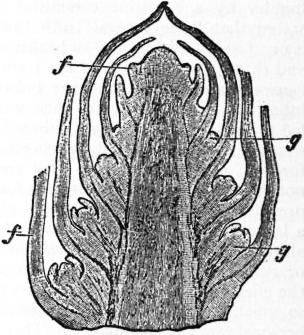
Fig. 1.—Apex of a shoot showing origin of leaves: f, leaf rudiment; g, rudiment of an axillary bud.
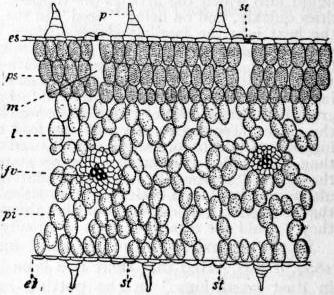
Fig. 2.—Section of a Melon leaf, perpendicular to the surface.
es, Upper epidermis. ei, Lower epidermis. p, Hairs. st, Stomata. ps, Upper (palisade) layers of parenchymatous cells. pi, Lower (spongy) layers of parenchymatous cells. m, Air-spaces connected with stomata. l, Air-spaces between the loose cells in the spongy parenchyma. fv, Bundles of fibro-vascular tissue.
Leaves are produced as lateral outgrowths of the stem in definite succession below the apex. This character, common to all leaves, distinguishes them from other organs. In the higher plants we can easily recognize the distinction between stem and leaf. Amongst the lower plants, however, it is found that a demarcation into stem and leaf is impossible, but that there is a structure which partakes of the characters of both—such is a thallus. The leaves always arise from the outer portion of the primary meristem of the plant, and the tissues of the leaf are continuous with those of the stem. Every leaf originates as a simple cellular papilla (fig. 1), which consists of a development from the cortical layers covered by epidermis; and as growth proceeds, the fibro-vascular bundles of the stem are continued outwards, and finally expand and terminate in the leaf. The increase in length of the leaf by growth at the apex is usually of a limited nature. In some ferns, however, there seems to be a provision for indefinite terminal growth, while in others this growth is periodically interrupted. It not unfrequently happens, especially amongst Monocotyledons, that after growth at the apex has ceased, it is continued at the base of the leaf, and in this way the length may be much increased. Amongst Dicotyledons this is very rare. In all cases the dimensions of the leaf are enlarged by interstitial growth of its parts.
The simplest leaf is found in some mosses, where it consists of a single layer of cells. The typical Structure of leaves. foliage leaf consists of several layers, and amongst vascular plants is distinguishable into an outer layer (epidermis) and a central tissue (parenchyma) with fibro-vascular bundles distributed through it.
The epidermis (fig. 2, es, ei), composed of cells more or less compressed, has usually a different structure and aspect on the two surfaces of the leaf. The cells of the epidermis are very closely united laterally and contain no green colouring matter (chlorophyll) except in the pair of cells—guard-cells—which bound the stomata. The outer wall, especially of the upper epidermis, has a tough outer layer or cuticle which renders it impervious to water. The epidermis is continuous except where stomata or spaces bounded by specialized cells communicate with intercellular spaces in the interior of the leaf. It is chiefly on the epidermis of the lower surface (fig. 2, ei) that stomata, st, are produced, and it is there also that hairs, p, usually occur. The lower epidermis is often of a dull or pale-green colour, soft and easily detached. The upper epidermis is frequently smooth and shining, and sometimes becomes very hard and dense. Many tropical plants present on the upper surface of their leaves several layers of compressed cells beneath the epidermis which serve for storage of water and are known as aqueous tissue. In leaves which float upon the surface of the water, as those of the water-lily, the upper epidermis alone possesses stomata.
The parenchyma of the leaf is the cellular tissue enclosed within the epidermis and surrounding the vessels (fig. 2, ps, pi). It is known as mesophyll, and is formed of two distinct series of cells, each containing the green chlorophyll-granules, but differing in form and arrangement. Below the epidermis of the upper side of the leaf there are one or two layers of cells, elongated at right angles to the leaf surface (fig. 2, ps), and applied so closely to each other as to leave only small intercellular spaces, except where stomata happen to be present (fig. 2, m); they form the palisade tissue. On the other side of the leaf the cells are irregular, often branched, and are arranged more or less horizontally (fig. 2, pi), leaving air-spaces between them, l, which communicate with stomata; on this account the tissue has received the name of spongy. In leaves having a very firm texture, as those of Coniferae and Cycadaceae, the cells of the parenchyma immediately beneath the epidermis are very much thickened and elongated in a direction parallel to the surface of the leaf, so as to be fibre-like. These constitute a hypodermal layer, beneath which the chlorophyll cells of the parenchyma are densely packed together, and are elongated in a direction vertical to the surface of the leaf, forming the palisade tissue. The form and arrangement of the cells, however, depend much on the nature of the plant, and its exposure to light and air. Sometimes the arrangement of the cells on both sides of the leaf is similar, as occurs in leaves which have their edges presented to the sky. In very succulent plants the cells form a compact mass, and those in the centre are often colourless. In some cases the cellular tissue is deficient at certain points, giving rise to distinct holes in the leaf, as in Monstera Adansonii. The fibro-vascular system in the leaf constitutes the venation. The fibro-vascular bundles from the stem bend out into the leaf, and are there arranged in a definite manner. In skeleton leaves, or leaves in which the parenchyma is removed, this arrangement is well seen. In some leaves, as in the barberry, the veins are hardened, producing spines without any parenchyma. The hardening of the extremities of the fibro-vascular tissue is the cause of the spiny margin of many leaves, such as the holly, of the sharp-pointed leaves of madder, and of mucronate leaves, or those having a blunt end with a hard projection in the centre.
The form and arrangement of the parts of a typical foliage leaf are intimately associated with the part played by the leaf in the life of the plant. The flat surface is spread to allow the maximum amount of sunlight to fall upon it, as it is by the absorption of energy from the sun’s rays by means of the chlorophyll contained in the cells of the leaf that the building up of plant food is rendered possible; this process is known as photo-synthesis; the first stage is the combination of carbon dioxide, absorbed from the air taken in through the stomata into the living cells of the leaf, with water which is brought into the leaf by the wood-vessels. The wood-vessels form part of the fibro-vascular bundles or veins of the leaf and are continuous throughout the leaf-stalk and stem with the root by which water is absorbed from the soil. The palisade layers of the mesophyll contain the larger number of chlorophyll grains (or corpuscles) while the absorption of carbon dioxide is carried on chiefly through the lower epidermis which is generally much richer in stomata. The water taken up by the root from the soil contains nitrogenous and mineral salts which combine with the first product of photo-synthesis—a carbohydrate—to form more complicated nitrogen-containing food substances of a proteid nature; these are then distributed by other elements of the vascular bundles (the phloem) through the leaf to the stem and so throughout the plant to wherever growth or development is going on. A large proportion of the water which ascends to the leaf acts merely as a carrier for the other raw food materials and is got rid of from the leaf in the form of water vapour through the stomata—this process is known as transpiration. Hence the extended surface of the leaf exposing a large area to light and air is eminently adapted for the carrying out of the process of photo-synthesis and transpiration. The arrangement of the leaves on the stem and branches (see Phyllotaxy, below) is such as to prevent the upper leaves shading the lower, and the shape of the leaf serves towards the same end—the disposition of leaves on a branch or stem is often seen to form a “mosaic,” each leaf fitting into the space between neighbouring leaves and the branch on which they are borne without overlapping.
Submerged leaves, or leaves which are developed under water, differ in structure from aerial leaves. They have usually no fibro-vascular system, but consist of a congeries of cells, which sometimes become elongated and compressed so as to resemble veins. They have a layer of compact cells on their surface, but no true epidermis, and no stomata. Their internal structure consists of cells, disposed irregularly, and sometimes leaving spaces which are filled with air for the purpose of floating the leaf. When exposed to the air these leaves easily part with their moisture, and become shrivelled and dry. In some cases there is only a network of filament-like cells, the spaces between which are not filled with parenchyma, giving a skeleton appearance to the leaf, as in Ouvirandra fenestralis (Lattice plant).
A leaf, whether aerial or submerged, generally consists of a flat expanded portion, called the blade, or lamina, of a narrower portion called the petiole or stalk, and sometimes of a portion at the base of the petiole, which forms a sheath or vagina (fig. 5, s), or is developed in the form of outgrowths, called stipules (fig. 24, s). All these portions are not always present. The sheathing or stipulary portion is frequently wanting. When a leaf has a distinct stalk it is petiolate; when it has none, it is sessile, and if in this case it embraces the stem it is said to be amplexicaul. The part of the leaf next the petiole or the axis is the base, while the opposite extremity is the apex. The leaf is usually flattened and expanded horizontally, i.e. at right angles to the longitudinal axis of the shoot, so that the upper face is directed towards the heavens, and the lower towards the earth. In some cases leaves, as in Iris, or leaf-like petioles, as in Australian acacias and eucalypti, have their plane of expansion parallel to the axis of the shoot, there is then no distinction into an upper and a lower face, but the two sides are developed alike; or the leaf may have a cylindrical or polyhedral form, as in mesembryanthemum. The upper angle formed between the leaf and the stem is called its axil; it is there that leaf-buds are normally developed. The leaf is sometimes articulated with the stem, and when it falls off a scar remains; at other times it is continuous with it, and then decays, while still attached to the axis. In their early state all leaves are continuous with the stem, and it is only in their after growth that articulations are formed. When leaves fall off annually they are called deciduous; when they remain for two or more years they are persistent, and the plant is evergreen. The laminar portion of a leaf is occasionally articulated with the petiole, as in the orange, and a joint at times exists between the vaginal or stipulary portion and the petiole.
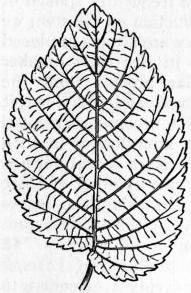
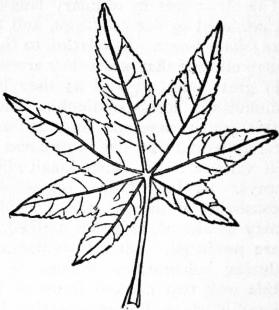
Fig. 3.—Leaf of Elm (Ulmus). Reticulated venation; primary veins going to the margin, which is serrated. Leaf unequal at the base. Fig. 4.—Multicostate leaf of Castor-oil plant (Ricinus communis). It is palmately-cleft, and exhibits seven lobes at the margin. The petiole is inserted a little above the base, and hence the leaf is called peltate or shield-like.
The arrangement of the fibro-vascular system in the lamina constitutes the venation or nervation. In an ordinary leaf, as that of the elm, there is observed a large central vein running from the base to the apex of the leaf, this is the midrib Venation. (fig. 3); it gives off veins laterally (primary veins). A leaf with only a single midrib is said to be unicostate and the venation is described as pinnate or feather-veined. In some cases, as sycamore or castor oil (fig. 4), in place of there being only a single midrib there are several large veins (ribs) of nearly equal size, which diverge from the point where the blade joins the petiole or stem, giving off lateral veins. The leaf in this case is multicostate and the venation palmate. The primary veins give off secondary veins, and these in their turn give off tertiary veins, and so on until a complete network of vessels is produced, and those veins usually project on the under surface of the leaf. To a distribution of veins such as this the name of reticulated or netted venation has been applied. In the leaves of some plants there exists a midrib with large veins running nearly parallel to it from the base to the apex of the lamina, as in grasses (fig. 5); or with veins diverging from the base of the lamina in more or less parallel lines, as in fan palms (fig. 6), or with veins coming off from it throughout its whole course, and running parallel to each other in a straight or curved direction towards the margin of the leaf, as in plantain and banana. In these cases the veins are often united by cross veinlets, which do not, however, form an angular network. Such leaves are said to be parallel-veined. The leaves of Monocotyledons have generally this kind of venation, while reticulated venation most usually occurs amongst Dicotyledons. Some plants, which in most points of their structure are monocotyledonous, yet have reticulated venation; as in Smilax and Dioscorea. In vascular acotyledonous plants there is frequently a tendency to fork exhibited by the fibro-vascular bundles in the leaf; and when this is the case we have fork-veined leaves. This is well seen in many ferns. The distribution of the system of vessels in the leaf is usually easily traced, but in the case of succulent plants, as Hoya, agave, stonecrop and mesembryanthemum, the veins are obscure. The function of the veins which consist of vessels and fibres is to form a rigid framework for the leaf and to conduct liquids.
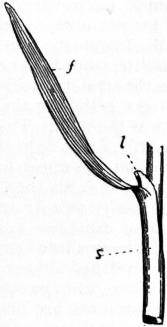
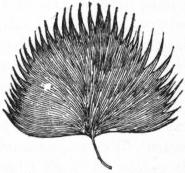
Fig. 5.—Stem of a Grass (Poa) with leaf. The sheaths ending in a process l, called a ligule; the blade of the leaf, f. Fig. 6.—Leaf of a Fan Palm (Chamaerops), showing the veins running from the base to the margin, and not forming an angular network.
In all plants, except Thallophytes, leaves are present at some period of their existence. In Cuscuta (Dodder) (q.v.), however, we have an exception. The forms assumed by leaves vary much, not only in different plants, but in the same plant. It is only amongst the lower classes of plants—Mosses, Characeae, &c.—that all the leaves on a plant are similar. As we pass up the scale of plant life we find them becoming more and more variable. The structures in ordinary language designated as leaves are considered so par excellence, and they are frequently spoken of as foliage leaves. In relation to their production on the stem we may observe that when they are small they are always produced in great number, and as they increase in size their number diminishes correspondingly. The cellular process from the axis which develops into a leaf is simple and undivided; it rarely remains so, but in progress of growth becomes segmented in various ways, either longitudinally or laterally, or in both ways. By longitudinal segmentation we have a leaf formed consisting of sheath, stalk and blade; or one or other of these may be absent, and thus stalked, sessile, sheathing, &c., leaves are produced. Lateral segmentation affects the lamina, producing indentations, lobings or fissuring of its margins. In this way two marked forms of leaf are produced—(1) Simple form, in which the segmentation, however deeply it extends into the lamina, does not separate portions of the lamina which become articulated with the midrib or petiole; and (2) Compound form, where portions of the lamina are separated as detached leaflets, which become articulated with the midrib or petiole. In both simple and compound leaves, according to the amount of segmentation and the mode of development of the parenchyma and direction of the fibro-vascular bundles, many forms are produced.
Simple Leaves.—When the parenchyma is developed symmetrically on each side of the midrib or stalk, the leaf is equal; if otherwise, the leaf is unequal or oblique (fig. 3). If the margins are even and present no divisions, the leaf is entire (fig. 7); Simple leaves. if there are slight projections which are more or less pointed, the leaf is dentate or toothed; when the projections lie regularly over each other, like the teeth of a saw, the leaf is serrate (fig. 3); when they are rounded the leaf is crenate. If the divisions extend more deeply into the lamina than the margin, the leaf receives different names according to the nature of the segments; thus, when the divisions extend about half-way down (fig. 8), it is cleft; when the divisions extend nearly to the base or to the midrib the leaf is partite.
If these divisions take place in a simple feather-veined leaf it becomes either pinnatifid (fig. 9), when the segments extend to about the middle, or pinnatipartite, when the divisions extend nearly to the midrib. These primary divisions may be again subdivided in a similar manner, and thus a feather-veined leaf will become bipinnatifid or bipinnatipartite; still further subdivisions give origin to tripinnatifid and laciniated leaves. The same kinds of divisions taking place in a simple leaf with palmate or radiating venation, give origin to lobed, cleft and partite forms. The name palmate or palmatifid (fig. 4) is the general term applied to leaves with radiating venation, in which there are several lobes united by a broad expansion of parenchyma, like the palm of the hand, as in the sycamore, castor-oil plant, &c. The divisions of leaves with radiating venation may extend to near the base of the leaf, and the names bipartite, tripartite, quinquepartite, &c., are given according as the partitions are two, three, five or more. The term dissected is applied to leaves with radiating venation, having numerous narrow divisions, as in Geranium dissectum.
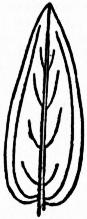
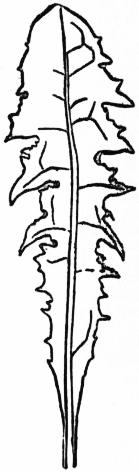
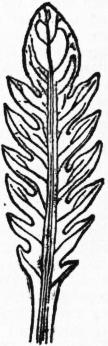
Fig. 7. Fig. 8. Fig. 9.
Fig. 7.—Ovate acute leaf of Coriara myrtifolia. Besides the midrib there are two intra-marginal ribs which converge to the apex. The leaf is therefore tricostate.
Fig. 8.—Runcinate leaf of Dandelion. It is a pinnatifid leaf, with the divisions pointing towards the petiole and a large triangular apex.
Fig. 9.—Pinnatifid leaf of Valeriana dioica.
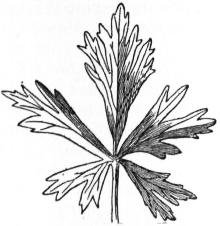
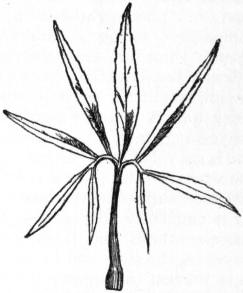
Fig. 10.—Five-partite leaf of Aconite. Fig. 11.—Pedate leaf of Stinking Hellebore (Helleborus foetidus). The venation is radiating. It is a palmately-partite leaf, in which the lateral lobes are deeply divided. When the leaf hangs down it resembles the foot of a bird, and hence the name.
When in a radiating leaf there are three primary partitions, and the two lateral lobes are again cleft, as in hellebore (fig. 11), the leaf is called pedate or pedatifid, from a fancied resemblance to the claw of a bird. In all the instances already alluded to the leaves have been considered as flat expansions, in which the ribs or veins spread out on the same plane with the stalk. In some cases, however, the veins spread at right angles to the stalk, forming a peltate leaf as in Indian cress (fig. 12).
The form of the leaf shows a very great variety ranging from the narrow linear form with parallel sides, as in grasses or the needle-like leaves of pines and firs to more or less rounded or orbicular—descriptions of these will be found in works on descriptive botany—a few examples are illustrated here (figs. 7, 13, 14, 15). The apex also varies considerably, being rounded, or obtuse, sharp or acute (fig. 7), notched (fig. 15), &c. Similarly the shape of the base may vary, when rounded lobes are formed, as in dog-violet, the leaf is cordate or heart-shaped; or kidney-shaped or reniform (fig. 16), when the apex is rounded as in ground ivy. When the lobes are prolonged downwards and are acute, the leaf is sagittate (fig. 17); when they proceed at right angles, as in Rumex Acetosella, the leaf is hastate or halbert-shaped. When a simple leaf is divided at the base into two leaf-like appendages, it is called auriculate. When the development of parenchyma is such that it more than fills up the spaces between the veins, the margins become wavy, crisp or undulated, as in Rumex crispus and Rheum undulatum. By cultivation the cellular tissue is often much increased, giving rise to the curled leaves of greens, savoys, cresses, lettuce, &c.
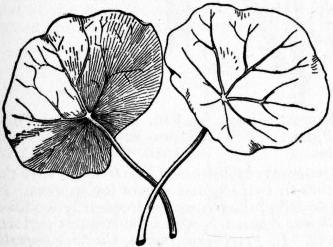
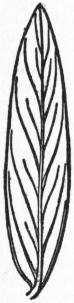
Fig. 12.—Peltate leaves of Indian Cress (Tropaeolum majus). Fig. 13.—Lanceolate leaf of a species of Senna.
Compound leaves are those in which the divisions extend to the midrib or petiole, and the separated portions become each articulated with it, and receive the name of leaflets. The midrib, or petiole, has thus the appearance of a branch with separate leaves attached to it, but it is considered properly as one Compound leaves. leaf, because in its earliest state it arises from the axis as a single piece, and its subsequent divisions in the form of leaflets are all in one plane. The leaflets are either sessile (fig. 18) or have stalks, called petiolules (fig. 19). Compound leaves are pinnate (fig. 19) or palmate (fig. 18) according to the arrangement of leaflets. When a pinnate leaf ends in a pair of pinnae it is equally or abruptly pinnate (paripinnate); when there is a single terminal leaflet (fig. 19), the leaf is unequally pinnate (imparipinnate); when the leaflets or pinnae are placed alternately on either side of the midrib, and not directly opposite to each other, the leaf is alternately pinnate; and when the pinnae are of different sizes, the leaf is interruptedly pinnate. When the division is carried into the second degree, and the pinnae of a compound leaf are themselves pinnately compound, a bipinnate leaf is formed.
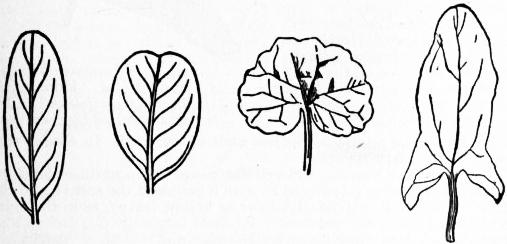
Fig. 14. Fig. 15. Fig. 16. Fig. 17.
Fig. 14.—Oblong leaf of a species of Senna.
Fig. 15.—Emarginate leaf of a species of Senna. The leaf in its contour is somewhat obovate, or inversely egg-shaped, and its base is oblique.
Fig. 16.—Reniform leaf of Nepeta Glechoma, margin crenate.
Fig. 17.—Sagittate leaf of Convolvulus.
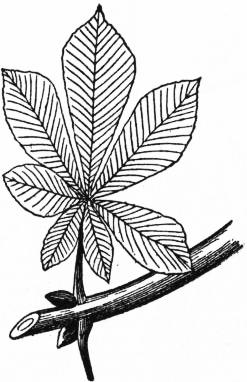
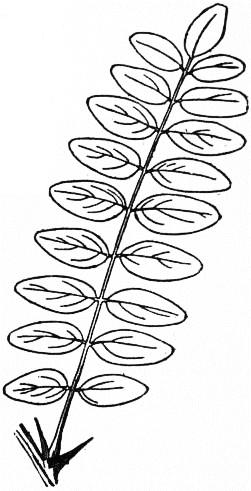
Fig. 18.—Palmately compound leaf of the Horse-chestnut (Aesculus Hippocastanum). Fig. 19.—Imparipinnate (unequal pinnate) leaf of Robinia. There are nine pairs of shortly-stalked leaflets (foliola, pinnae), and an odd one at the extremity. At the base of the leaf the spiny stipules are seen.
The petiole or leaf-stalk is the part which unites the limb or blade of the leaf to the stem. It is absent in sessile leaves, and this is also frequently the case when a sheath is present, as in grasses (fig. 5). It consists of the fibro-vascular bundles with a Petiole. varying amount of cellular tissue. When the vascular bundles reach the base of the lamina they separate and spread out in various ways, as already described under venation. The lower part of the petiole is often swollen (fig. 20, p), forming the pulvinus, formed of cellular tissue, the cells of which exhibit the phenomenon of irritability. In Mimosa pudica (fig. 20) a sensitiveness is located in the pulvinus which upon irritation induces a depression of the whole bipinnate leaf, a similar property exists in the pulvini at the base of the leaflets which fold upwards. The petiole varies in length, being usually shorter than the lamina, but sometimes much longer. In some palms it is 15 or 20 ft. long, and is so firm as to be used for poles or walking-sticks. In general, the petiole is more or less rounded in its form, the upper surface being flattened or grooved. Sometimes it is compressed laterally, as in the aspen, and to this peculiarity the trembling of the leaves of this tree is due. In aquatic plants the leaf-stalk is sometimes distended with air, as in Pontederia and Trapa, so as to float the leaf. At other times it is winged, and is either leafy, as in the orange (fig. 21, p), lemon and Dionaea, or pitcher-like, as in Sarracenia (fig. 22). In some Australian acacias, and in some species of Oxalis and Bupleurum, the petiole is flattened in a vertical direction, the vascular bundles separating immediately after quitting the stem and running nearly parallel from base to apex. This kind of petiole (fig. 23, p) has been called a phyllode. In these plants the laminae or blades of the leaves are pinnate or bipinnate, and are produced at the extremities of the phyllodes in a horizontal direction; but in many instances they are not developed, and the phyllode serves the purpose of a leaf. These phyllodes, by their vertical position and their peculiar form, give a remarkable aspect to vegetation. On the same acacia there occur leaves with the petiole and lamina perfect; others having the petiole slightly expanded or winged, and the lamina imperfectly developed; and others in which there is no lamina, and the petiole becomes large and broad. Some petioles are long, slender and sensitive to contact, and function as tendrils by means of which the plant climbs; as in the nasturtiums (Tropaeolum), clematis and others; and in compound leaves the midrib and some of the leaflets may similarly be transformed into tendrils, as in the pea and vetch.
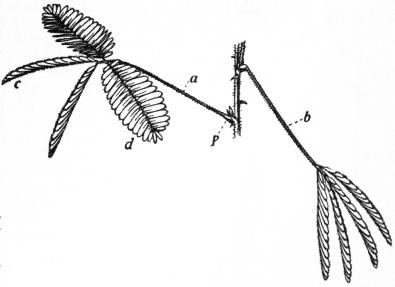
Fig. 20.—Branch and leaves of the Sensitive plant (Mimosa pudica), showing the petiole in its erect state, a, and in its depressed state, b; also the leaflets closed, c, and the leaflets expanded, d. Irritability resides in the pulvinus, p.
The leaf base is often developed as a sheath (vagina), which embraces the whole or part of the circumference of the stem (fig. 5). This sheath is comparatively rare in dicotyledons, but is seen in umbelliferous plants. It is much more common amongst monocotyledons. In sedges the Leaf base. sheath forms a complete investment of the stem, whilst in grasses it is split on one side. In the latter plants there is also a membranous outgrowth, the ligule, at right angles to the median plane of the leaf from the point where the sheath passes into the lamina, there being no petiole (fig. 5, l).
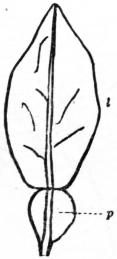
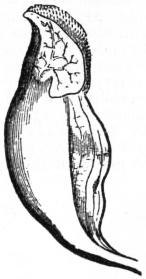
Fig. 21.—Leaf of Orange (Citrus Aurantium), showing a winged leafy petiole p, which is articulated to the lamina l. Fig. 22.—Pitcher (ascidium) of a species of Side-saddle plant (Sarracenia purpurea). The pitcher is formed from the petiole, which is prolonged.
In leaves in which no sheath is produced we not infrequently find small foliar organs, stipules, at the base of the petiole (fig. 24, s). The stipules are generally two in number, and they are important as supplying characters in certain natural orders. Thus they occur in the pea and bean family, in rosaceous plants and the family Rubiaceae. They are not common in dicotyledons with opposite leaves. Plants having stipules are called stipulate; those having none are exstipulate. Stipules may be large or small, entire or divided, deciduous or persistent. They are not usually of the same form as the ordinary foliage leaves of the plant, from which they are distinguished by their lateral position at the base of the petiole. In the pansy (fig. 24) the true leaves are stalked and crenate, while the stipules s are large, sessile and pinnatifid. In Lathyrus Aphaca and some other plants the true pinnate leaves are abortive, the petiole forms a tendril, and the stipules alone are developed, performing the office of leaves. When stipulate leaves are opposite to each other, at the same height on the stem, it occasionally happens that the stipules on the two sides unite wholly or partially, so as to form an interpetiolary or interfoliar stipule, as in members of the family Rubiaceae. In the case of alternate leaves, the stipules at the base of each leaf are sometimes united to the petiole and to each other, so as to form an adnate, adherent or petiolary stipule, as in the rose, or an axillary stipule, as in Houttuynia cordata. In other instances the stipules unite together on the side of the stem opposite the leaf forming an ocrea, as in the dock family (fig. 25).
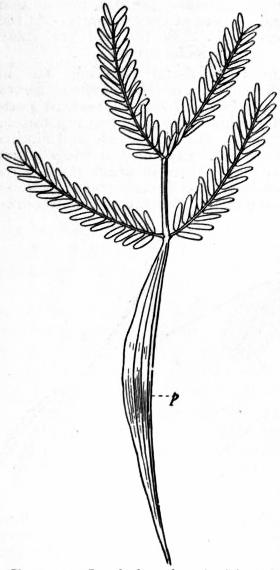
Fig. 23.—Leaf of an Acacia (Acacia heterophylla), showing a flattened leaf-like petiole p, called a phyllode, with straight venation, and a bipinnate lamina.
In the development of the leaf the stipules frequently play a most important part. They begin to be formed after the origin of the leaves, but grow much more rapidly than the leaves, and in this way they arch over the young leaves and form protective chambers wherein the parts of the leaf may develop. In the figs, magnolia and pondweeds they are very large and completely envelop the young leaf-bud. The stipules are sometimes so minute as to be scarcely distinguishable without the aid of a lens, and so fugacious as to be visible only in the very young state of the leaf. They may assume a hard and spiny character, as in Robinia Pseudacacia (fig. 19), or may be cirrose, as in Smilax, where each stipule is represented by a tendril. At the base of the leaflets of a compound leaf, small stipules (stipels) are occasionally produced.
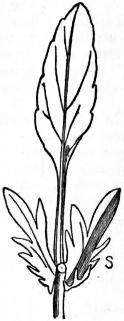
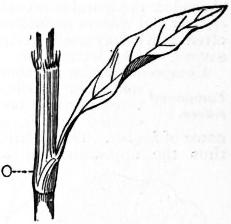
Fig. 24.—Leaf of Pansy. s, Stipules. Fig. 25.—Leaf of Polygonum, with part of stem. o, Ocrea.
Variations in the structure and forms of leaves and leafstalks are produced by the increased development of cellular tissue, by the abortion or degeneration of parts, by the multiplication or repetition of parts and by adhesion. When cellular tissue is developed to a great extent, leaves become succulent and occasionally Modifications. assume a crisp or curled appearance. Such changes take place naturally, but they are often increased by the art of the gardener, and the object of many horticultural operations is to increase the bulk and succulence of leaves. It is in this way that cabbages and savoys are rendered more delicate and nutritious. By a deficiency in development of parenchyma and an increase in the mechanical tissue, leaves are liable to become hardened and spinescent. The leaves of barberry and of some species of Astragalus, and the stipules of the false acacia (Robinia) are spiny. To the same cause is due the spiny margin of the holly-leaf. When two lobes at the base of a leaf are prolonged beyond the stem and unite (fig. 26), the leaf is perfoliate, the stem appearing to pass through it, as in Bupleurum perfoliatum and Chlora perfoliata; when two leaves unite by their bases they become connate (fig. 27), as in Lonicera Caprifolium; and when leaves adhere to the stem, forming a sort of winged or leafy appendage, they are decurrent, as in thistles. The formation of peltate leaves has been traced to the union of the lobes of a cleft leaf. In the leaf of the Victoria regia the transformation may be traced during germination. The first leaves produced by the young plant are linear, the second are sagittate and hastate, the third are rounded-cordate and the next are orbicular. The cleft indicating the union of the lobes remains in the large leaves. The parts of the leaf are frequently transformed into tendrils, with the view of enabling the plants to twine round others for support. In Leguminous plants (the pea tribe) the pinnae are frequently modified to form tendrils, as in Lathyrus Aphaca, in which the stipules perform the function of true leaves. In Flagellaria indica, Gloriosa superba and others, the midrib of the leaf ends in a tendril. In Smilax there are two stipulary tendrils.
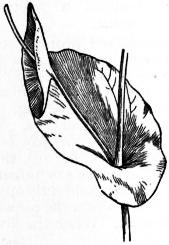
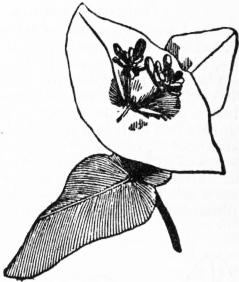
Fig. 26.—Perfoliate leaf of a species of Hare’s-ear (Bupleurum rotundifolium). The two lobes at the base of the leaf are united, so that the stalk appears to come through the leaf. Fig. 27.—Connate leaves of a species of Honeysuckle (Lonicera Caprifolium). Two leaves are united by their bases.
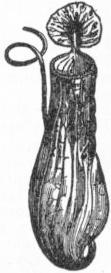
Fig. 28.—Pitcher of a species of pitcher-plant (Nepenthes distillatoria).
The vascular bundles and cellular tissue are sometimes developed in such a way as to form a circle, with a hollow in the centre, and thus give rise to what are called fistular or hollow leaves, as in the onion, and to ascidia or pitchers. Pitchers are formed either by petioles or by laminae, and they are composed of one or more leaves. In Sarracenia (fig. 22) and Heliamphora the pitcher is composed of the petiole of the leaf. In the pitcher plant, Nepenthes, the pitcher is a modification of the lamina, the petiole often plays the part of a tendril, while the leaf base is flat and leaf-like (fig. 28).
In Utricularia bladder-like sacs are formed by a modification of leaflets on the submerged leaves.
In some cases the leaves are reduced to mere scales—cataphyllary leaves; they are produced abundantly upon underground shoots. In parasites (Lathraea, Orobanche) and in plants growing on decaying vegetable matter (saprophytes), in which no chlorophyll is formed, these scales are the only leaves produced. In Pinus the only leaves produced on the main stem and the lateral shoots are scales, the acicular leaves of the tree growing from axillary shoots. In Cycas whorls of scales alternate with large pinnate leaves. In many plants, as already noticed, phyllodia or stipules perform the function of leaves. The production of leaf-buds from leaves sometimes occurs as in Bryophyllum, and many plants of the order Gesneraceae. The leaf of Venus’s fly-trap (Dionaea muscipula) when cut off and placed in damp moss, with a pan of water underneath and a bell-glass for a cover, has produced buds from which young plants were obtained. Some species of saxifrage and of ferns also produce buds on their leaves and fronds. In Nymphaea micrantha buds appear at the upper part of the petiole.
Leaves occupy various positions on the stem and branches, Phyllotaxis. and have received different names according to their situation. Thus leaves arising from the crown of the root, as in the primrose, are called radical; those on the stem are cauline; on flower-stalks, floral leaves (see Flower). The first leaves developed are known as seed leaves or cotyledons. The arrangement of the leaves on the axis and its appendages is called phyllotaxis.
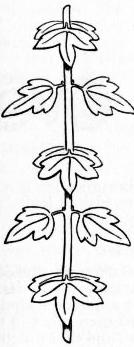
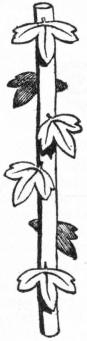
Fig. 29.—A stem with opposite leaves. The pairs are placed at right angles alternately, or in what is called a decussate manner. In the lowest pair one leaf is in front and the other at the back; in the second pair the leaves are placed laterally, and so on. Fig. 30.—A stem with alternate leaves, arranged in a pentastichous or quincuncial manner. The sixth leaf is directly above the first, and commences the second cycle. The fraction of the circumference of the stem expressing the divergence of the leaves is two-fifths.
In their arrangement leaves follow a definite order. The points on the stem at which leaves appear are called nodes; the part of the stem between the nodes is the internode. When two leaves are produced at the same node, one on each side of the stem or axis, and at the same level, they are opposite (fig. 29); when more than two are produced they are verticillate, and the circle of leaves is then called a verticil or whorl. When leaves are opposite, each successive pair may be placed at right angles to the pair immediately preceding. They are then said to decussate, following thus a law of alternation (fig. 29). The same occurs in the verticillate arrangement, the leaves of each whorl rarely being superposed on those of the whorl next it, but usually alternating so that each leaf in a whorl occupies the space between two leaves of the whorl next to it. There are considerable irregularities, however, in this respect, and the number of leaves in different whorls is not always uniform, as may be seen in Lysimachia vulgaris. When a single leaf is produced at a node, and the nodes are separated so that each leaf is placed at a different height on the stem, the leaves are alternate (fig. 30). A plane passing through the point of insertion of the leaf in the node, dividing the leaf into similar halves, is the median plane of the leaf; and when the leaves are arranged alternately on an axis so that their median planes coincide they form a straight row or orthostichy. On every axis there are usually two or more orthostichies. In fig. 31, leaf 1 arises from a node n; leaf 2 is separated from it by an internode m, and is placed to the right or left; while leaf 3 is situated directly above leaf 1. In this case, then, there are two orthostichies, and the arrangement is said to be distichous. When the fourth leaf is directly above the first, the arrangement is tristichous. The same arrangement continues throughout the branch, so that in the latter case the 7th leaf is above the 4th, the 10th above the 7th; also the 5th above the 2nd, the 6th above the 3rd and so on. The size of the angle between the median planes of two consecutive leaves in an alternate arrangement is their divergence; and it is expressed in fractions of the circumference of the axis which is supposed to be a circle. In a regularly-formed straight branch covered with leaves, if a thread is passed from one to the other, turning always in the same direction, a spiral is described, and a certain number of leaves and of complete turns occur before reaching the leaf directly above that from which the enumeration commenced. If this arrangement is expressed by a fraction, the numerator of which indicates the number of turns, and the denominator the number of internodes in the spiral cycle, the fraction will be found to represent the angle of divergence of the consecutive leaves on the axis. Thus, in fig. 32, a, b, the cycle consists of five leaves, the 6th leaf being placed vertically over the 1st, the 7th over the 2nd and so on; while the number of turns between the 1st and 6th leaf is two; hence this arrangement is indicated by the fraction 2⁄5. In other words, the distance or divergence between the first and second leaf, expressed in parts of a circle, is 2⁄5 of a circle or 360° × 2⁄5 = 144°. In fig. 31, a, b, the spiral is ½, i.e. one turn and two leaves; the third leaf being placed vertically over the first, and the divergence between the first and second leaf being one-half the circumference of a circle, 360° × ½ = 180°. Again, in a tristichous arrangement the number is 1⁄3, or one turn and three leaves, the angular divergence being 120°.
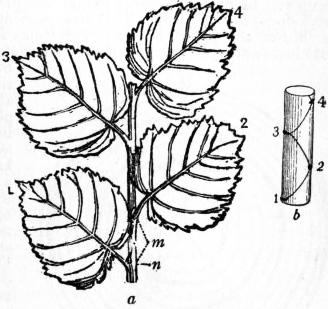
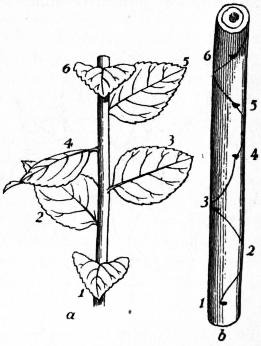
Fig. 31.—Portion of a branch of a Lime tree, with four leaves arranged in a distichous manner, or in two rows. a, The branch with the leaves numbered in their order, n being the node and m the internode; b is a magnified representation of the branch, showing the points of insertion of the leaves and their spiral arrangement, which is expressed by the fraction ½, or one turn of the spiral for two internodes. Fig. 32.—Part of a branch of a Cherry with six leaves, the sixth being placed vertically over the first, after two turns of the spiral. This is expressed by two-fifths. a, The branch, with the leaves numbered in order; b, a magnified representation of the branch, showing the points of insertion of the leaves and their spiral arrangement.
By this means we have a convenient mode of expressing on paper the exact position of the leaves upon an axis. And in many cases such a mode of expression is of excellent service in enabling us readily to understand the relations of the leaves. The divergences may also be represented diagrammatically on a horizontal projection of the vertical axis, as in fig. 33. Here the outermost circle represents a section of that portion of the axis bearing the lowest leaf, the innermost represents the highest. The broad dark lines represent the leaves, and they are numbered according to their age and position. It will be seen at once that the leaves are arranged in orthostichies marked I.-V., and that these divide the circumference into five equal portions. But the divergence between leaf 1 and leaf 2 is equal to 2⁄5ths of the circumference, and the same is the case between 2 and 3, 3 and 4, &c. The divergence, then, is 2⁄5, and from this we learn that, starting from any leaf on the axis, we must pass twice round the stem in a spiral through five leaves before reaching one directly over that with which we started. The line which, winding round an axis either to the right or to the left, passes through the points of insertion of all the leaves on the axis is termed the genetic or generating spiral; and that margin of each leaf which is towards the direction from which the spiral proceeds is the kathodic side, the other margin facing the point whither the spiral passes being the anodic side.
In cases where the internodes are very short and the leaves are closely applied to each other, as in the house-leek, it is difficult to trace the generating spiral. Thus, in fig. 34 there are thirteen leaves which are numbered in their order, and five turns of the spiral marked by circles in the centre (5⁄13 indicating the arrangement); but this could not be detected at once. So also in fir cones (fig. 35), which are composed of scales or modified leaves, the generating spiral cannot be determined easily. But in such cases a series of secondary spirals or parastichies are seen running parallel with each other both right and left, which to a certain extent conceal the genetic spiral.
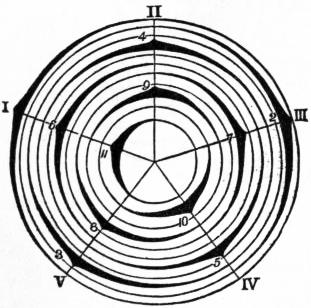
Fig. 33.—Diagram of a phyllotaxis represented by the fraction 2⁄5.
The spiral is not always constant throughout the whole length of an axis. The angle of divergence may alter either abruptly or gradually, and the phyllotaxis thus becomes very complicated. This change may be brought about by arrest of development, by increased development of parts or by a torsion of the axis. The former are exemplified in many Crassulaceae and aloes. The latter is seen well in the screw-pine (Pandanus). In the bud of the screw-pine the leaves are arranged in three orthostichies with the phyllotaxis 1⁄3, but by torsion the developed leaves become arranged in three strong spiral rows running round the stem. These causes of change in phyllotaxis are also well exemplified in the alteration of an opposite or verticillate arrangement to an alternate, and vice versa; thus the effect of interruption of growth, in causing alternate leaves to become opposite and verticillate, can be distinctly shown in Rhododendron ponticum. The primitive or generating spiral may pass either from right to left or from left to right. It sometimes follows a different direction in the branches from that pursued in the stem. When it follows the same course in the stem and branches, they are homodromous; when the direction differs, they are heterodromous. In different species of the same genus the phyllotaxis frequently varies.
All modifications of leaves follow the same laws of arrangement as true leaves—a fact which is of importance in a morphological point of view. In dicotyledonous plants the first leaves produced (the cotyledons) are opposite. This arrangement often continues during the life of the plant, but at other times it changes, passing into distichous and spiral forms. Some tribes of plants are distinguished by their opposite or verticillate, others by their alternate, leaves. Labiate plants have decussate leaves, while Boraginaceae have alternate leaves, and Tiliaceae usually have distichous leaves; Rubiaceae have opposite leaves. Such arrangements as 2⁄5, 3⁄8, 5⁄13 and 8⁄21 are common in Dicotyledons. The first of these, called a quincunx, is met with in the apple, pear and cherry (fig. 32); the second, in the bay, holly, Plantago media; the third, in the cones of Picea alba (fig. 35); and the fourth in those of the silver fir. In monocotyledonous plants there is only one seed-leaf or cotyledon, and hence the arrangement is at first alternate; and it generally continues so more or less, rarely being verticillate. Such arrangements as 1⁄2, 1⁄3 and 2⁄3 are common in Monocotyledons, as in grasses, sedges and lilies. It has been found in general that, while the number 5 occurs in the phyllotaxis of Dicotyledons, 3 is common in that of Monocotyledons.
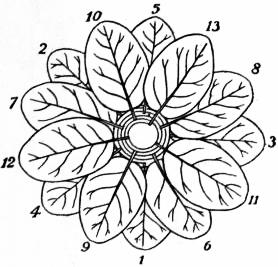
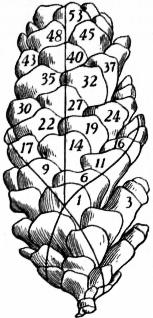
Fig. 34.—Cycle of thirteen leaves placed closely together so as to form a rosette, as in Sempervivum. A is the very short axis to which the leaves are attached. The leaves are numbered in their order, from below upwards. The circles in the centre indicate the five turns of the spiral, and show the insertion of each of the leaves. The divergence is expressed by the fraction 5⁄13ths. Fig. 35.—Cone of Picea alba with the scales or modified leaves numbered in the order of their arrangement on the axis of the cone. The lines indicate a rectilinear series of scales and two lateral secondary spirals, one turning from left to right, the other from right to left.
In the axil of previously formed leaves leaf-buds arise. These leaf-buds contain the rudiments of a shoot, and consist of leaves covering a growing point. The buds of trees of temperate climates, which lie dormant during the winter, are protected by scale leaves. These scales or protective appendages of the bud consist either of the altered laminae or of the enlarged petiolary sheath, or of stipules, as in the fig and magnolia, or of one or two of these parts combined. These are often of a coarse nature, serving a temporary purpose, and then falling off when the leaf is expanded. They are frequently covered with a resinous matter, as in balsam-poplar and horse-chestnut, or by a thick downy covering as in the willow. In plants of warm climates the buds have often no protective appendages, and are then said to be naked.
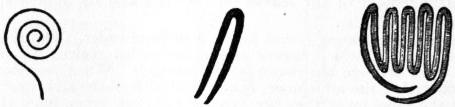
Fig. 36. Fig. 37. Fig. 38.
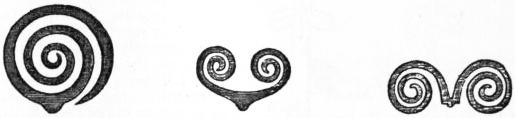
Fig. 39. Fig. 40. Fig. 41.
Fig. 36.—Circinate vernation. Fig. 37.—Transverse section of a conduplicate leaf. Fig. 38.—Transverse section of a plicate or plaited leaf. Fig. 39.—Transverse section of a convolute leaf. Fig. 40.—Transverse section of an involute leaf. Fig. 41.—Transverse section of a revolute leaf.
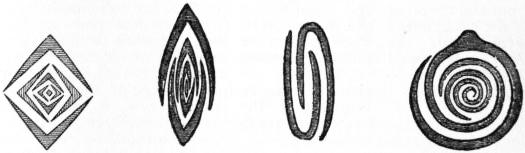
Fig. 42. Fig. 43. Fig. 44. Fig. 45.
Fig. 42.—Transverse section of a bud, in which the leaves are arranged in an accumbent manner.
Fig. 43.—Transverse section of a bud, in which the leaves are arranged in an equitant manner.
Fig. 44.—Transverse section of a bud, showing two leaves folded in an obvolute manner. Each is conduplicate, and one embraces the edge of the other.
Fig. 45.—Transverse section of a bud, showing two leaves arranged in a supervolute manner.
The arrangement of the leaves in the bud is termed vernation or prefoliation. In considering vernation we must take into account both the manner in which each individual leaf is folded and also the arrangement of the leaves in relation to each other. These vary in different plants, but in each species they follow a regular law. The leaves in the bud are either placed simply in apposition, as in the mistletoe, or they are folded or rolled up longitudinally or laterally, giving rise to different kinds of vernation, as delineated in figs. 36 to 45, where the folded or curved lines represent the leaves, the thickened part being the midrib. The leaf taken individually is either folded longitudinally from apex to base, as in the tulip-tree, and called reclinate or replicate; or rolled up in a circular manner from apex to base, as in ferns (fig. 36), and called circinate; or folded laterally, conduplicate (fig. 37), as in oak; or it has several folds like a fan, plicate or plaited (fig. 38), as in vine and sycamore, and in leaves with radiating vernation, where the ribs mark the foldings; or it is rolled upon itself, convolute (fig. 39), as in banana and apricot; or its edges are rolled inwards, involute (fig. 40), as in violet; or outwards, revolute (fig. 41), as in rosemary. The different divisions of a cut leaf may be folded or rolled up separately, as in ferns, while the entire leaf may have either the same or a different kind of vernation. The leaves have a definite relation to each other in the bud, being either opposite, alternate or verticillate; and thus different kinds of vernation are produced. Sometimes they are nearly in a circle at the same level, remaining flat or only slightly convex externally, and placed so as to touch each other by their edges, thus giving rise to valvate vernation. At other times they are at different levels, and are applied over each other, so as to be imbricated, as in lilac, and in the outer scales of sycamore; and occasionally the margin of one leaf overlaps that of another, while it in its turn is overlapped by a third, so as to be twisted, spiral or contortive. When leaves are applied to each other face to face, without being folded or rolled together, they are appressed. When the leaves are more completely folded they either touch at their extremities and are accumbent or opposite (fig. 42), or are folded inwards by their margin and become induplicate; or a conduplicate leaf covers another similarly folded, which in turn covers a third, and thus the vernation is equitant (fig. 43), as in privet; or conduplicate leaves are placed so that the half of the one covers the half of another, and thus they become half-equitant or obvolute (fig. 44), as in sage. When in the case of convolute leaves one leaf is rolled up within the other, it is supervolute (fig. 45). The scales of a bud sometimes exhibit one kind of vernation and the leaves another. The same modes of arrangement occur in the flower-buds.
Leaves, after performing their functions for a certain time, wither and die. In doing so they frequently change colour, and hence arise the beautiful and varied tints of the autumnal foliage. This change of colour is chiefly occasioned by the diminished circulation in the leaves, and the higher degree of oxidation to which their chlorophyll has been submitted.
Leaves which are articulated with the stem, as in the walnut and horse-chestnut, fall and leave a scar, while those which are continuous with it remain attached for some time after they have lost their vitality. Most of the trees of Great Britain have deciduous leaves, their duration not extending over more than a few months, while in trees of warm climates the leaves often remain for two or more years. In tropical countries, however, many trees lose their leaves in the dry season. The period of defoliation varies in different countries according to the nature of their climate. Trees which are called evergreen, as pines and evergreen-oak, are always deprived of a certain number of leaves at intervals, sufficient being left, however, to preserve their green appearance. The cause of the fall of the leaf in cold climates seems to be deficiency of light and heat in winter, which causes a cessation in the functions of the cells of the leaf. The fall is directly caused by the formation of a layer of tissue across the base of the leaf-stalk; the cells of this layer separate from one another and the leaf remains attached only by the fibres of the veins until it becomes finally detached by the wind or frost. Before its fall the leaf has become dry owing to loss of water and the removal of the protoplasm and food substances to the stem for use next season; the red and yellow colouring matters are products of decomposition of the chlorophyll. Inorganic and other waste matters are stored in the leaf-tissue and thus got rid of by the plant. The leaf scar is protected by a corky change (suberization) in the walls of the exposed cells.
(A. B. R.)
LEAF-INSECT, the name given to orthopterous insects of the family Phasmidae, referred to the single genus Phyllium and characterized by the presence of lateral laminae upon the legs and abdomen, which, in association with an abundance of green colouring-matter, impart a broad and leaf-like appearance to the whole insect. In the female this deceptive resemblance is enhanced by the large size and foliaceous form of the front wings which, when at rest edge to edge on the abdomen, forcibly suggest in their neuration the midrib and costae of an ordinary leaf. In this sex the posterior wings are reduced and functionless so far as flight is concerned; in the male they are ample, membranous and functional, while the anterior wings are small and not leaf-like. The freshly hatched young are reddish in colour; but turn green after feeding for a short time upon leaves. Before death a specimen has been observed to pass through the various hues of a decaying leaf, and the spectrum of the green colouring matter does not differ from that of the chlorophyll of living leaves. Since leaf-insects are purely vegetable feeders and not predaceous like mantids, it is probable that their resemblance to leaves is solely for purposes of concealment from enemies. Their egg capsules are similarly protected by their likeness to various seeds. Leaf-insects range from India to the Seychelles on the one side, and to the Fiji Islands on the other.
(R. I. P.)
LEAGUE. 1. (Through Fr. ligue, Ital. liga, from Lat. ligare, to bind), an agreement entered into by two or more parties for mutual protection or joint attack, or for the furtherance of some common object, also the body thus joined or “leagued” together. The name has been given to numerous confederations, such as the Achaean League (q.v.), the confederation of the ancient cities of Achaia, and especially to the various holy leagues (ligues saintes), of which the better known are those formed by Pope Julius II. against Venice in 1508, often known as the League of Cambrai, and against France in 1511. “The League,” in French history, is that of the Catholics headed by the Guises to preserve the Catholic religion against the Huguenots and prevent the accession of Henry of Navarre to the throne (see France: History). “The Solemn League and Covenant” was the agreement for the establishment of Presbyterianism in both countries entered into by England and Scotland in 1643 (see Covenanters). Of commercial leagues the most famous is that of the Hanse towns, known as the Hanseatic League (q.v.). The word has been adopted by political associations, such as the Anti-Corn Law League, the Irish Land League, the Primrose League and the United Irish League, and by numerous social organizations. “League” has also been applied to a special form of competition in athletics, especially in Association football. In this system clubs “league” together in a competition, each playing every other member of the association twice, and the order of merit is decided by the points gained during the season, a win counting two and a draw one.