VOLUME XVI SLICE III Latin Language to Lefebvre, François-Joseph (continued 5)
Reading edition
He maintained his reputation and was uniformly successful in his battles at sea, but they were not always fought for the defence of Sicily. The death of Peter III. in 1286 and of his eldest son Alphonso in the following year caused a division among the members of the house of Aragon. The new king, James, would have given up Sicily to the Angevine line with which he made peace and alliance, but his younger brother Fadrique accepted the crown offered him by the Sicilians, and fought for his own hand against both the Angevines and his senior. King James tried to force him to submission without success. Roger de Lauria adhered for a time to Fadrique, but his arrogant temper made him an intolerable supporter, and he appears, moreover, to have thought that he was bound to obey the king of Aragon. His large estates in Valencia gave him a strong reason for not offending that sovereign. He therefore left Fadrique, who confiscated his estates in Sicily and put one of his nephews to death as a traitor. For this Roger de Lauria took a ferocious revenge in two successive victories at sea over the Sicilians. When the war, which had become a ravening of wild beasts, was at last ended by the peace of Calatabellota, Roger de Lauria retired to Valencia, where he died on the 2nd of January 1305, and was buried, by his express orders, in the church of Santas Creus, a now deserted monastery of the Cistercians, at the feet of his old master Peter III. In his ferocity, and his combination of loyalty to his feudal lord with utter want of scruple to all other men, Roger belonged to his age. As a captain he was far above his contemporaries and his successors for many generations.
Signor Amari’s Guerra del Vespro Siciliano gives a general picture of these wars, but the portrait of Roger de Lauria must be sought in the Chronicle of the Catalan Ramon de Muntaner who knew him and was formed in his school. There is a very fair and well “documented” account of the masterly campaign of 1285 in Charles de la Roncière’s Histoire de la marine française, i. 189-217.
(D. H.)

LAURIA, or Loria, a city of Basilicata, Italy, in the province of Potenza, situated near the borders of Calabria, 7½ m. by road S. of Lagonegro. Pop. (1901) 10,470. It is a walled town on the steep side of a hill with another portion in the plain below, 1821 ft. above sea-level. The castle was the birthplace of Ruggiero di Loria, the great Italian admiral of the 13th century. It was destroyed by the French under Masséna in 1806.
LAURIER, SIR WILFRID (1841- ), Canadian statesman, was born on the 20th of November 1841, at St Lin in the province of Quebec. The child of French Roman Catholic parents, he attended the elementary school of his native parish and for eight or nine months was a pupil of the Protestant elementary school at New Glasgow in order to learn English; his association with the Presbyterian family with whom he lived during this period had a permanent influence on his mind. At twelve years of age he entered L’Assomption college, and was there for seven years. The college, like all the secondary schools in Quebec then available for Roman Catholics, was under direct ecclesiastical control. On leaving it he entered a law office at Montreal and took the law course at McGill University. At graduation he delivered the valedictory address for his class. This, like so many of his later utterances, closed with an appeal for sympathy and union between the French and English races as the secret of the future of Canada. He began to practise law in Montreal, but owing to ill-health soon removed to Athabaska, where he opened a law office and undertook also to edit Le Défricheur, a newspaper then on the eve of collapse. At Athabaska, the seat of one of the superior courts of Quebec, the population of the district was fairly divided between French- and English-speaking people, and Laurier’s career was undoubtedly influenced by his constant association with English-speaking people and his intimate acquaintance with their views and aspirations.
While at Montreal he had joined the Institut Canadien, a literary and scientific society which, owing to its liberal discussions and the fact that certain books upon its shelves were on the Index expurgatorius, was finally condemned by the Roman Catholic authorities. Le Défricheur was an organ of extreme French sentiment, opposed to confederation, and also under ecclesiastical censure. One of its few surviving copies contains an article by Laurier opposing confederation as a scheme designed in the interest of the English colonies in North America, and certain to prove the tomb of the French race and the ruin of Lower Canada. The Liberals of Quebec under the leadership of Sir Antoine Dorion were hostile to confederation, or at least to the terms of union agreed upon at the Quebec conference, and Laurier in editorials and speeches maintained the position of Dorion and his allies. He was elected to the Quebec legislature in 1871, and his first speech in the provincial assembly excited great interest, on account of its literary qualities and the attractive manner and logical method of the speaker. He was not less successful in the Dominion House of Commons, to which he was elected in 1874. During his first two years in the federal parliament his chief speeches were made in defence of Riel and the French halfbreeds who were concerned in the Red River rebellion, and on fiscal questions. Sir John Macdonald, then in opposition, had committed his party to a protectionist policy, and Laurier, notwithstanding that the Liberal party stood for a low tariff, avowed himself to be “a moderate protectionist.” He declared that if he were in Great Britain he would be a free trader, but that free trade or protection must be applied according to the necessities of a country, and that which protection necessarily involved taxation it was the price a young and vigorous nation must pay for its development. But the Liberal government, to which Laurier was admitted as minister of inland revenue in 1877, made only a slight increase in duties, raising the general tariff from 15% to 17½%; and against the political judgment of Alexander Mackenzie, Sir Richard Cartwright, George Brown, Laurier and other of the more influential leaders of the party, it adhered to a low tariff platform. In the bye-election which followed Laurier’s admission to the cabinet he was defeated—the only personal defeat he ever sustained; but a few weeks later he was returned for Quebec East, a constituency which he held thenceforth by enormous majorities. In 1878 his party went out of office and Sir John Macdonald entered upon a long term of power, with protection as the chief feature of his policy, to which was afterwards added the construction of the Canadian Pacific railway.
After the defeat of the Mackenzie government, Laurier sat in Parliament as the leader of the Quebec Liberals and first lieutenant to the Hon. Edward Blake, who succeeded Mackenzie in the leadership of the party. He was associated with Blake in his sustained opposition to high tariff, and to the Conservative plan for the construction of the Canadian Pacific railway, and was a conspicuous figure in the long struggle between Sir John Macdonald and the leaders of the Liberal party to settle the territorial limits of the province of Ontario and the legislative rights of the provinces under the constitution. He was forced also to maintain a long conflict with the ultramontane element of the Roman Catholic church in Quebec, which for many years had a close working alliance with the Conservative politicians of the province and even employed spiritual coercion in order to detach votes from the Liberal party. Notwithstanding that Quebec was almost solidly Roman Catholic the Rouges sternly resisted clerical pressure; they appealed to the courts and had certain elections voided on the ground of undue clerical influence, and at length persuaded the pope to send out a delegate to Canada, through whose inquiry into the circumstances the abuses were checked and the zeal of the ultramontanes restrained.
In 1887, upon the resignation of Blake on the ground of ill-health, Laurier became leader of the Liberal party, although he and many of the more influential men in the party doubted the wisdom of the proceeding. He was the first French Canadian to lead a federal party in Canada since confederation. Apart from the natural fear that he would arouse prejudice in the English-speaking provinces, the second Riel rebellion was then still fresh in the public mind, and the fierce nationalist agitation which Riel’s execution had excited in Quebec had hardly subsided. Laurier could hardly have come to the leadership at a more inopportune moment, and probably he would not have accepted the office at all if he had not believed that Blake could be persuaded to resume the leadership when his health was restored. But from the first he won great popularity even in the English-speaking provinces, and showed unusual capacity for leadership. His party was beaten in the first general election held after he became leader (1891), but even with its policy of unrestricted reciprocity with the United States, and with Sir John Macdonald still at the head of the Conservative party, it was beaten by only a small majority. Five years later, with unrestricted reciprocity relegated to the background, and with a platform which demanded tariff revision so adjusted as not to endanger established interests, and which opposed the federal measure designed to restore in Manitoba the separate or Roman Catholic schools which the provincial government had abolished, Laurier carried the country, and in July 1896 he was called by Lord Aberdeen, then governor-general, to form a government.
He was the first French-Canadian to occupy the office of premier; and his personal supremacy was shown by his long continuance in power. During the years from 1896 to 1910, he came to hold a position within the British Empire which was in its way unique, and in this period he had seen Canadian prosperity advance progressively by leaps and bounds. The chief features of his administration were the fiscal preference of 331⁄3% in favour of goods imported into Canada from Great Britain, the despatch of Canadian contingents to South Africa during the Boer war, the contract with the Grand Trunk railway for the construction of a second transcontinental road from ocean to ocean, the assumption by Canada of the imperial fortresses at Halifax and Esquimault, the appointment of a federal railway commission with power to regulate freight charges, express rates and telephone rates, and the relations between competing companies, the reduction of the postal rate to Great Britain from 5 cents to 2 cents and of the domestic rate from 3 cents to 2 cents, a substantial contribution to the Pacific cable, a practical and courageous policy of settlement and development in the Western territories, the division of the North-West territories into the provinces of Alberta and Saskatchewan and the enactment of the legislation necessary to give them provincial status, and finally (1910), a tariff arrangement with the United States, which, if not all that Canada might claim in the way of reciprocity, showed how entirely the course of events had changed the balance of commercial interests in North America.
Laurier made his first visit to Great Britain on the occasion of Queen Victoria’s diamond jubilee (1897), when he received the grand cross of the Bath; he then secured the denunciation of the Belgian and German treaties and thus obtained for the colonies the right to make preferential trade arrangements with the mother country. His personality made a powerful impression in Great Britain and also in France, which he visited before his return to Canada. His strong facial resemblance both to Lord Beaconsfield and to Sir John Macdonald marked him out in the public eye, and he captured attention by his charm of manner, fine command of scholarly English and genuine eloquence. Some of his speeches in Great Britain, coming as they did from a French-Canadian, and revealing delicate appreciation of British sentiment and thorough comprehension of the genius of British institutions, excited great interest and enthusiasm, while one or two impassioned speeches in the Canadian parliament during the Boer war profoundly influenced opinion in Canada and had a pronounced effect throughout the empire.
A skilful party-leader, Laurier kept from the first not only the affection of his political friends but the respect of his opponents; while enforcing the orderly conduct of public business, he was careful as first minister to maintain the dignity of parliament. In office he proved more of an opportunist than his career in opposition would have indicated, but his political courage and personal integrity remained beyond suspicion. His jealousy for the political autonomy of Canada was noticeable in his attitude at the Colonial conference held at the time of King Edward’s coronation, and marked all his diplomatic dealings with the mother country. But he strove for sympathetic relations between Canadian and imperial authorities, and favoured general legislative and fiscal co-operation between the two countries. He strove also for good relations between the two races in Canada, and between Canada and the United States. Although he was classed in Canada as a Liberal, his tendencies would in England have been considered strongly conservative; an individualist rather than a collectivist, he opposed the intrusion of the state into the sphere of private enterprise, and showed no sympathy with the movement for state operation of railways, telegraphs and telephones, or with any kindred proposal looking to the extension of the obligations of the central government.
Bibliography.—J. S. Willison, Sir Wilfrid Laurier and the Liberal Party; a Political History (Toronto, 1903); L. O. David, Laurier et son temps (Montreal, 1905); see also Henri Moreau, Sir Wilfrid Laurier, Premier Ministre du Canada (Paris, 1902); and the collection of Laurier’s speeches from 1871 to 1890, compiled by Ulric Barthe (Quebec, 1890).
(J. S. W.)
LAURISTON, JACQUES ALEXANDRE BERNARD LAW, Marquis de (1768-1828), French soldier and diplomatist, was the son of Jacques François Law de Lauriston (1724-1785), a general officer in the French army, and was born at Pondicherry on the 1st of February 1768. He obtained his first commission about 1786, served with the artillery and on the staff in the earlier Revolutionary campaigns, and became brigadier of artillery in 1795. Resigning in 1796, he was brought back into the service in 1800 as aide-de-camp to Napoleon, with whom as a cadet Lauriston had been on friendly terms. In the years immediately preceding the first empire Lauriston was successively director of the Le Fère artillery school and special envoy to Denmark, and he was selected to convey to England the ratification of the peace of Amiens (1802). In 1805, having risen to the rank of general of division, he took part in the war against Austria. He occupied Venice and Ragusa in 1806, was made governor-general of Venice in 1807, took part in the Erfurt negotiations of 1808, was made a count, served with the emperor in Spain in 1808-1809 and held commands under the viceroy Eugène Beauharnais in the Italian campaign and the advance to Vienna in the same year. At the battle of Wagram he commanded the guard artillery in the famous “artillery preparation” which decided the battle. In 1811 he was made ambassador to Russia; in 1812 he held a command in the Grande Armée and won distinction by his firmness in covering the retreat from Moscow. He commanded the V. army corps at Lützen and Bautzen and the V. and XI. in the autumn campaign, falling into the hands of the enemy in the disastrous retreat from Leipzig. He was held a prisoner of war until the fall of the empire, and then joined Louis XVIII., to whom he remained faithful in the Hundred Days. His reward was a seat in the house of peers and a command in the royal guard. In 1817 he was created marquis and in 1823 marshal of France. During the Spanish War he commanded the corps which besieged and took Pamplona. He died at Paris on the 12th of June 1828.
LAURIUM (Λαύριον, mod. Ergastiri), a mining town in Attica, Greece, famous for the silver mines which were one of the chief sources of revenue of the Athenian state, and were employed for coinage. After the battle of Marathon, Themistocles persuaded the Athenians to devote the revenue derived from the mines to shipbuilding, and thus laid the foundation of the Athenian naval power, and made possible the victory of Salamis. The mines, which were the property of the state, were usually farmed out for a certain fixed sum and a percentage on the working; slave labour was exclusively employed. Towards the end of the 5th century the output was diminished, partly owing to the Spartan occupation of Decelea. But the mines continued to be worked, though Strabo records that in his time the tailings were being worked over, and Pausanias speaks of the mines as a thing of the past. The ancient workings, consisting of shafts and galleries for excavating the ore, and pans and other arrangements for extracting the metal, may still be seen. The mines are still worked at the present day by French and Greek companies, but mainly for lead, manganese and cadmium. The population of the modern town was 10,007 in 1907.
See E. Ardaillon, “Les Mines du Laurion dans l’antiquité,” No. lxxvii. of the Bibliothèque des écoles françaises d’Athènes et de Rome.
LAURIUM, a village of Houghton county, Michigan, U.S.A., near the centre of Keweenaw peninsula, the northern extremity of the state. Pop. (1890) 1159; (1900) 5643, of whom 2286 were foreign-born; (1904) 7653; (1910) 8537. It is served by the Mineral Range and the Mohawk and Copper Range railways. It is in one of the most productive copper districts in the United States, and copper mining is its chief industry. Immediately W. of Laurium is the famous Calumet and Hecla mine. The village was formerly named Calumet, and was incorporated under that name in 1889, but in 1895 its name was changed by the legislature to Laurium, in allusion to the mineral wealth of Laurium in Greece. The name Calumet is now applied to the post office in the village of Red Jacket (incorporated 1875; pop. 1900, 4668; 1904, 3784; 1910, 4211), W. of the Calumet and Hecla mine; and Laurium, the mining property and Red Jacket are all in the township of Calumet (pop. 1904, state census, 28,587).
LAURUSTINUS, in botany, the popular name of a common hardy evergreen garden shrub known botanically as Viburnum Tinus, with rather dark-green ovate leaves in pairs and flat-topped clusters (or corymbs) of white flowers, which are rose-coloured before expansion, and appear very early in the year. It is a native of the Mediterranean region, and was in cultivation in Britain at the end of the 16th century. Viburnum belongs to the natural order Caprifoliaceae and includes the common wayfaring tree (V. Lantana) and the guelder rose (V. Opulus).
LAURVIK, Larvik or Laurvig, a seaport of Norway, in Jarlsberg and Laurvik amt (county), at the head of a short fjord near the mouth of the Laagen river, 98 m. S.S.W. of Christiania by the Skien railway. Pop. (1900) 10,664. It has various industries, including saw and planing mills, shipbuilding, glassworks and factories for wood-pulp, barrels and potato flour; and an active trade in exporting timber, ice, wood-pulp and granite, chiefly to Great Britain, and in importing from the same country coal and salt. The port has a depth of 18 to 24 ft. beside the quays. Four miles south is Fredriksvaern, formerly a station of the Norwegian fleet and the seat of a naval academy. Laurviks Bad is a favourite spa, with mineral and sulphur springs and mud-baths.
LAUSANNE, the capital of the Swiss canton of Vaud. It is the junction of the railway lines from Geneva, from Brieg and the Simplon, from Fribourg and Bern, and from Vallorbe (for Paris). A funicular railway connects the upper town with the central railway station and with Ouchy, the port of Lausanne on the lake of Geneva. Lausanne takes its name from the Flon stream flowing through it, which was formerly called Laus (water). The older or upper portion of the town is built on the crest and slopes of five hillocks and in the hollows between them, all forming part of the Jorat range. It has a picturesque appearance from the surface of the lake, above which the cathedral rises some 500 ft., while from the town there is a fine view across the lake towards the mountains of Savoy and of the Valais. The quaint characteristics of the hilly site of the old town have largely been destroyed by modern improvements, which began in 1836 and were not quite completed in 1910. The Grand Pont, designed by the cantonal engineer, Adrien Pichard (1790-1841), was built 1839-1844, while the Barre tunnel was pierced 1851-1855 and the bridge of Chauderon was built in 1905. The valleys and lower portions of the town were gradually filled up so as to form a series of squares, of which those of Riponne and of St François are the finest, the latter now being the real centre of the town. The railways were built between 1856 and 1862, while the opening of the Simplon tunnel (1906) greatly increased the commercial importance of Lausanne, which is now on the great international highway from Paris to Milan. From 1896 onwards a well-planned set of tramways within the town was constructed. The town is still rapidly extending, especially towards the south and west. Since the days of Gibbon (resident here for three periods, 1753-1758, 1763-1764 and 1783-1793), whose praises of the town have been often repeated, Lausanne has become a favourite place of residence for foreigners (including many English), who are especially attracted by the excellent establishments for secondary and higher education. Hence in 1900 there were 9501 foreign residents (of whom 628 were British subjects) out of a total population of 46,732 inhabitants; in 1905 it was reckoned that these numbers had risen respectively to 10,625, 818 and 53,577. In 1709 it is said that the inhabitants numbered but 7432 and 9965 in 1803, while the numbers were 20,515 in 1860 and 33,340 in 1888. Of the population in 1900 the great majority was French-speaking (only 6627 German-speaking and 3146 Italian-speaking) and Protestant (9364 Romanists and 473 Jews).
The principal building is the cathedral church (now Protestant) of Notre Dame, which with the castle occupies the highest position. It is the finest medieval ecclesiastical building in Switzerland. Earlier buildings were more or less completely destroyed by fire, but the present edifice was consecrated in 1275 by Pope Gregory X. in the presence of the emperor Rudolf of Habsburg. It was sacked after the Bernese conquest (1536) and the introduction of Protestantism, but many ancient tapestries and other precious objects are still preserved in the Historical Museum at Bern. The church was well restored at great cost from 1873 onwards, as it is the great pride of the citizens. Close by is the castle, built in the early 15th century by the bishops, later the residence of the Bernese bailiffs and now the seat of the various branches of the administration of the canton of Vaud. Near both is the splendid Palais de Rumine (on the Place de la Riponne), opened in 1906 and now housing the university as well as the cantonal library, the cantonal picture gallery (or Musée Arlaud, founded 1841) and the cantonal collections of archaeology, natural history, &c. The university was raised to that rank in 1890, but, as an academy, dates from 1537. Among its former teachers may be mentioned Theodore Beza, Conrad Gesner, J. P. de Crousaz, Charles Monnard, Alexandre Vinet, Eugène Rambert, Juste Olivier and several members of the Secretan family. On the Montbenon heights to the south-west of the cathedral group is the federal palace of justice, the seat (since 1886) of the federal court of justice, which, erected by the federal constitution of 29th May 1874, was fixed at Lausanne by a federal resolution of 26th June 1874. The house, La Grotte, which Gibbon inhabited 1783-1793, and on the terrace of which he completed (1787) his famous history, was demolished in 1896 to make room for the new post office that stands on the Place St François. The asylum for the blind was mainly founded (1845) by the generosity of W. Haldimand, an Englishman of Swiss descent. The first book printed in Lausanne was the missal of the cathedral church (1493), while the Gazette de Lausanne (founded 1798) took that name in 1804. Lausanne has been the birthplace of many distinguished men, such as Benjamin Constant, the Secretans, Vinet and Rambert. It is the seat of many benevolent, scientific and literary societies and establishments.
The original town (mentioned in the Antonine Itinerary) was on the shore of the lake, near Vidy, south-west of the present city. It was burnt in the 4th century by the Alamanni. Some of the inhabitants took refuge in the hills above and there founded a new town, which acquired more importance when Bishop Marius about 590 chose it as his see city (perhaps transferring it from Avenches). Here rose the cathedral church, the bishop’s palace, &c. Across the Flon was a Burgundian settlement, later known as the Bourg, while to the west was a third colony around the church of St Laurent. These three elements joined together to form the present city. The bishops obtained little by little great temporal powers (the diocese extended to the left bank of the Aar) and riches, becoming in 1125 princes of the empire, while their chapter was recruited only from the noblest families. But in 1368 the bishop was forced to recognize various liberties and customs that had been gradually won by the citizens, the Plaid Général of that year showing that there was already some kind of municipal government, save for the cité, which was not united with the ville inférieure or the other four quartiers (Bourg, St Laurent, La Palud and Le Pont) in 1481. In 1525 the city made an alliance with Bern and Fribourg. But in 1536 the territory of the bishop (as well as the Savoyard barony of Vaud) was forcibly conquered by the Bernese, who at once introduced Protestantism. The Bernese occupation lasted till 1798, though in 1723 an attempt was made to put an end to it by Major Davel, who lost his life in consequence. In 1798 Lausanne became a simple prefecture of the canton Léman of the Helvetic republic. But in 1803, on the creation of the canton of Vaud by the Act of Mediation, it became its capital. The bishop of Lausanne resided after 1663 at Fribourg, while from 1821 onwards he added “and of Geneva” to his title.
Besides the general works dealing with the canton of Vaud (q.v.), the following books refer specially to Lausanne: A. Bernus, L’Imprimerie à Lausanne et à Morges jusqu’à la fin du 16ième siècle (Lausanne, 1904); M. Besson, Récherches sur les origines des évêchés de Genève, Lausanne, Sion (Fribourg, 1906); A. Bonnard, “Lausanne au 18ième siècle,” in the work entitled Chez nos aïeux (Lausanne, 1902); E. Dupraz, La Cathédrale de Lausanne ... étude historique (Lausanne, 1906); E. Gibbon, Autobiography and Letters (3 vols., 1896); F. Gingins and F. Forel, Documents concernant l’ancien évêché de Lausanne, 2 parts (Lausanne, 1846-1847); J. H. Lewis and F. Gribble, Lausanne (1909); E. van Muyden and others, Lausanne à travers les âges (Lausanne, 1906); Meredith Read, Historic Studies in Vaud, Berne and Savoy (2 vols., 1897); M. Schmitt, Mémoires hist. sur le diocèse de Lausanne (2 vols., Fribourg, 1859); J. Stammler (afterwards bishop of Lausanne), Le Trésor de la cathédrale de Lausanne (Lausanne, 1902; trans. of a German book of 1894).
(W. A. B. C.)
LAUTREC, ODET DE FOIX, Vicomte de (1488-1528), French soldier. The branch of the viscounts of Lautrec originated with Pierre, the grandson of Archambaud de Grailly, captal de Buch, who came into possession of the county of Foix in 1401. Odet de Foix and his two brothers, the seigneur de Lescun and the seigneur de l’Esparre or Asparros, served Francis I. as captains; and the influence of their sister, Françoise de Châteaubriant, who became the king’ mistress, gained them high offices. In 1515 Lautrec took part in the campaign of Marignano. In 1516 he received the government of the Milanese, and by his severity made the French domination insupportable. In 1521 he succeeded in defending the duchy against the Spanish army, but in 1522 he was completely defeated at the battle of the Bicocca, and was forced to evacuate the Milanese. The mutiny of his Swiss troops had compelled him, against his wish, to engage in the battle. Created marshal of France, he received again, in 1527, the command of the army of Italy, occupied the Milanese, and was then sent to undertake the conquest of the kingdom of Naples. The defection of Andrea Doria and the plague which broke out in the French camp brought on a fresh disaster. Lautrec himself caught the infection, and died on the 15th of August 1528. He had the reputation of a gallant and able soldier, but this reputation scarcely seems to be justified by the facts; though he was always badly used by fortune.
There is abundant MS. correspondence in the Bibliothèque Nationale, Paris. See the Works of Brantôme (Coll. Société d’Histoire de France, vol. iii., 1867); Memoirs of Martin du Bellay (Coll. Michaud and Poujoulat, vol. v., 1838).
LAUZUN, ANTONIN NOMPAR DE CAUMONT, Marquis de Puyguilhem, Duc de (1632-1723), French courtier and soldier, was the son of Gabriel, comte de Lauzun, and his wife Charlotte, daughter of the duc de La Force. He was brought up with the children of his kinsman, the maréchal de Gramont, of whom the comte de Guiche became the lover of Henrietta of England, duchess of Orleans, while Catherine Charlotte, afterwards princess of Monaco, was the object of the one passion of Lauzun’s life. He entered the army, and served under Turenne, also his kinsman, and in 1655 succeeded his father as commander of the cent gentilshommes de la maison du roi. Puyguilhem (or Péguilin, as contemporaries simplified his name) rapidly rose in Louis XIV.’s favour, became colonel of the royal regiment of dragoons, and was gazetted maréchal de camp. He and Mme de Monaco belonged to the coterie of the young duchess of Orleans. His rough wit and skill in practical jokes pleased Louis XIV., but his jealousy and violence were the causes of his undoing. He prevented a meeting between Louis XIV. and Mme de Monaco, and it was jealousy in this matter, rather than hostility to Louise de la Vallière, which led him to promote Mme de Montespan’s intrigues with the king. He asked this lady to secure for him the post of grand-master of the artillery, and on Louis’s refusal to give him the appointment he turned his back on the king, broke his sword, and swore that never again would he serve a monarch who had broken his word. The result was a short sojourn in the Bastille, but he soon returned to his functions of court buffoon. Meanwhile, the duchess of Montpensier (La Grande Mademoiselle) had fallen in love with the little man, whose ugliness seems to have exercised a certain fascination over many women. He naturally encouraged one of the greatest heiresses in Europe, and the wedding was fixed for the 20th of December 1670, when on the 18th Louis sent for his cousin and forbade the marriage. Mme de Montespan had never forgiven his fury when she failed to procure the grand-mastership of the artillery, and now, with Louvois, secured his arrest. He was removed in November 1671 from the Bastille to Pignerol, where excessive precautions were taken to ensure his safety. He was eventually allowed free intercourse with Fouquet, but before that time he managed to find a way through the chimney into Fouquet’s room, and on another occasion succeeded in reaching the courtyard in safety. Another fellow-prisoner, from communication with whom he was supposed to be rigorously excluded, was Eustache Dauger (see Iron Mask).
It was now intimated to Mademoiselle that Lauzun’s restoration to liberty depended on her immediate settlement of the principality of Dombes, the county of Eu and the duchy of Aumale—three properties assigned by her to Lauzun—on the little duc de Maine, eldest son of Louis XIV. and Mme de Montespan. She gave way, but Lauzun, even after ten years of imprisonment, refused to sign the documents, when he was brought to Bourbon for the purpose. A short term of imprisonment at Chalon-sur-Sâone made him change his mind, but when he was set free Louis XIV. was still set against the marriage, which is supposed to have taken place secretly (see Montpensier). Married or not, Lauzun was openly courting Fouquet’s daughter, whom he had seen at Pignerol. He was to be restored to his place at court, and to marry Mlle Fouquet, who, however, became Mme d’Uzès in 1683. In 1685 Lauzun went to England to seek his fortune under James II., whom he had served as duke of York in Flanders. He rapidly gained great influence at the English court. In 1688 he was again in England, and arranged the flight of Mary of Modena and the infant prince, whom he accompanied to Calais, where he received strict instructions from Louis to bring them “on any pretext” to Vincennes. In the late autumn of 1689 he was put in command of the expedition fitted out at Brest for service in Ireland, and he sailed in the following year. Lauzun was honest, a quality not too common in James II.’s officials in Ireland, but had no experience of the field, and he blindly followed Richard Talbot, earl of Tyrconnel. After the battle of the Boyne they fled to Limerick, and thence to the west, leaving Patrick Sarsfield to show a brave front. In September they sailed for France, and on their arrival at Versailles Lauzun found that his failure had destroyed any prospect of a return of Louis XIV.’s favour. Mademoiselle died in 1693, and two years later Lauzun married Geneviève de Durfort, a child of fourteen, daughter of the maréchal de Lorges. Mary of Modena, through whose interest Lauzun secured his dukedom, retained her faith in him, and it was he who in 1715, more than a quarter of a century after the flight from Whitehall, brought her the news of the disaster of Sheriffmuir. Lauzun died on the 19th of November 1723. The duchy fell to his nephew, Armand de Gontaut, comte de Biron.
See the letters of Mme de Sévigné, the memoirs of Saint-Simon, who was Lauzun’s wife’s brother-in-law; also J. Lair, Nicolas Fouquet, vol. ii. (1890); Martin Hailes, Mary of Modena (1905), and M. F. Sandars, Lauzun, Courtier and Adventurer (1908).
LAVA, an Italian word (from Lat. lavare, to wash) applied to the liquid products of volcanic activity. Streams of rain-water, formed by condensation of exhaled steam often mingled with volcanic ashes so as to produce mud, are known as lava d’acqua, whilst the streams of molten matter are called lava di fuoco. The term lava is applied by geologists to all matter of volcanic origin, which is, or has been, in a molten state. The magma, or molten lava in the interior of the earth, may be regarded as a mutual solution of various mineral silicates, charged with highly-heated vapour, sometimes to the extent of super-saturation. According to the proportion of silica, the lava is distinguished as “acid” or “basic.” The basic lavas are usually darker and denser than lavas of acid type, and when fused they tend to flow to great distances, and may thus form far-spreading sheets, whilst the acid lavas, being more viscous, rapidly consolidate after extrusion. The lava is emitted from the volcanic vent at a high temperature, but on exposure to the air it rapidly consolidates superficially, forming a crust which in many cases is soon broken up by the continued flow of the subjacent liquid lava, so that the surface becomes rugged with clinkers. J. D. Dana introduced the term “aa” for this rough kind of lava-stream, whilst he applied the term “pahoehoe” to those flows which have a smooth surface, or are simply wrinkled and ropy; these terms being used in this sense in Hawaii, in relation to the local lavas. The different kinds of lava are more fully described in the article Volcano.
LAVABO (Lat. “I will wash”; the Fr. equivalent is lavoir), in ecclesiastical usage, the term for the washing of the priests’ hands, at the celebration of the Mass, at the offertory. The words of Psalm xxvi. 6, Lavabo inter innocentes manus meas, are said during the rite. The word is also used for the basin employed in the ritual washing, and also for the lavatories, generally erected in the cloisters of monasteries. Those at Gloucester, Norwich and Lincoln are best known. A very curious example at Fontenay, surrounding a pillar, is given by Viollet-le-Duc. In general the lavabo is a sort of trough; in some places it has an almery for towels, &c.
LAVAGNA, a seaport of Liguria, Italy, in the province of Genoa, from which it is 25½ m. S.E. by rail. Pop. (1901) 7005. It has a small shipbuilding trade, and exports great quantities of slate (lavagna, taking its name from the town). It also has a large cotton-mill. It was the seat of the Fieschi family, independent counts, who, at the end of the 12th century, were obliged to recognize the supremacy of Genoa. Sinibaldo Fieschi became Pope Innocent IV. (1243-1254), and Hadrian V. (1276) was also a Fieschi.
LAVAL, ANDRÉ DE, SEIGNEUR DE LOHÉAC (c. 1408-1485), French soldier. In 1423 he served in the French army against England, and in 1428 was taken prisoner by John Talbot, 1st earl of Shrewsbury, after the capitulation of Laval, which he was defending. After paying his ransom he was present with Joan of Arc at the siege of Orleans, at the battle of Patay, and at the coronation of Charles VII. He was made admiral of France in 1437 and marshal in 1439. He served Charles VII. faithfully in all his wars, even against the dauphin (1456), and when the latter became king as Louis XI., Laval was dismissed from the marshal’s office. After the War of the Public Weal he was restored to favour, and recovered the marshal’s bâton, the king also granting him the offices of lieutenant-general to the government of Paris and governor of Picardy, and conferring upon him the collar of the order of St Michael. In 1472 Laval was successful in resisting the attacks of Charles the Bold, duke of Burgundy, on Beauvais.
LAVAL, a town of north-western France, capital of the department of Mayenne, on the Mayenne river, 188 m. W.S.W. of Paris by rail. Pop. (1906) 24,874. On the right bank of the river stands the old feudal city, with its ancient castle and its irregularly built houses whose slate roofs and pointed gables peep from the groves of trees which clothe the hill. On the left bank the regularly built new town extends far into the plain. The river, here 80 yds. broad, is crossed by the handsome railway viaduct, a beautiful stone bridge called Pont Neuf, and the Pont Vieux with three pointed arches, built in the 16th century. There is communication by steamer as far as Angers. Laval may justly claim to be one of the loveliest of French towns. Its most curious and interesting monument is the sombre old castle of the counts (now a prison) with a donjon of the 12th century, the roof of which presents a fine example of the timberwork superseded afterwards by stone machicolation. The “new castle,” dating partly from the Renaissance, serves as court-house. Laval possesses several churches of different periods: in that of the Trinity, which serves as the cathedral, the transept and nave are of the 12th century while the choir is of the 16th; St Vénérand (15th century) has good stained glass; Notre-Dame des Cordeliers, which dates from the end of the 14th century or the beginning of the 15th, has some fine marble altars. Half-a-mile below the Pont Vieux is the beautiful 12th-century church of Avenières, with an ornamental spire of 1534. The finest remaining relic of the ancient fortifications is the Beucheresse gate near the cathedral. The narrow streets around the castle are bordered by many old houses of the 15th and 16th century, chief among which is that known as the “Maison du Grand Veneur.” There are an art-museum, a museum of natural history and archaeology and a library. The town is embellished by fine promenades, at the entrance of one of which, facing the mairie, stands the statue of the celebrated surgeon Ambroise Paré (1517-1590). Laval is the seat of a prefect, a bishopric created in 1855, and a court of assizes, and has tribunals of first instance and of commerce, a chamber of commerce, a board of trade-arbitrators, training colleges, an ecclesiastical seminary and a lycée for boys. The principal industry of the town is the cloth manufacture, introduced from Flanders in the 14th century. The production of fabrics of linen, of cotton or of mixtures of both, occupies some 10,000 hands in the town and suburbs. Among the numerous other industries are metal-founding, flour-milling, tanning, dyeing, the making of boots and shoes, and the sawing of the marble quarried in the vicinity. There is trade in grain.
Laval is not known to have existed before the 9th century. It was taken by John Talbot, earl of Shrewsbury, in 1428, changed hands several times during the wars of the League, and played an important part at the end of the 18th century in the war of La Vendée.
Seigneurs and Counts of Laval. The castle of Laval was founded at the beginning of the 11th century by a lord of the name of Guy, and remained in the possession of his male descendants until the 13th century. In 1218 the lordship passed to the house of Montmorency by the marriage of Emma, daughter of Guy VI. of Laval, to Mathieu de Montmorency, the hero of the battle of Bouvines. Of this union was born Guy VII. seigneur of Laval, the ancestor of the second house of Laval. Anne of Laval (d. 1466), the heiress of the second family, married John de Montfort, who took the name of Guy (XIII.) of Laval. At Charles VII.’s coronation (1429) Guy XIV., who was afterwards son-in-law of John V., duke of Brittany, and father-in-law of King René of Anjou, was created count of Laval, and the countship remained in the possession of Guy’s male descendants until 1547. After the Montforts, the countship of Laval passed by inheritance to the families of Rieux and Sainte Maure, to the Colignys, and finally to the La Trémoilles, who held it until the Revolution.
See Bertrand de Broussillon, La Maison de Laval (3 vols., 1895-1900).
LA VALLIÈRE, LOUISE FRANÇOISE DE (1644-1710), mistress of Louis XIV., was born at Tours on the 6th of August 1644, the daughter of an officer, Laurent de la Baume le Blanc, who took the name of La Vallière from a small property near Amboise. Laurent de la Vallière died in 1651; his widow, who soon married again, joined the court of Gaston d’Orléans at Blois. Louise was brought up with the younger princesses, the step-sisters of La Grande Mademoiselle. After Gaston’s death his widow moved with her daughters to the palace of the Luxembourg in Paris, and with them went Louise, who was now a girl of sixteen. Through the influence of a distant kinswoman, Mme de Choisy, she was named maid of honour to Henrietta of England, who was about her own age and had just married Philip of Orleans, the king’s brother. Henrietta joined the court at Fontainebleau, and was soon on the friendliest terms with her brother-in-law, so friendly indeed that there was some scandal, to avoid which it was determined that Louis should pay marked attentions elsewhere. The person selected was Madame’s maid of honour, Louise. She had been only two months in Fontainebleau before she became the king’s mistress. The affair, begun on Louis’s part as a blind, immediately developed into real passion on both sides. It was Louis’s first serious attachment, and Louise was an innocent, religious-minded girl, who brought neither coquetry nor self-interest to their relation, which was sedulously concealed. Nicolas Fouquet’s curiosity in the matter was one of the causes of his disgrace. In February 1662 there was a storm when Louise refused to tell her lover the relations between Madame (Henrietta) and the comte de Guiche. She fled to an obscure convent at Chaillot, where Louis rapidly followed her. Her enemies, chief of whom was Olympe Mancini, comtesse de Soissons, Mazarin’s niece, sought her downfall by bringing her liaison to the ears of Queen Maria Theresa. She was presently removed from the service of Madame, and established in a small building in the Palais Royal, where in December 1663 she gave birth to a son Charles, who was given in charge to two faithful servants of Colbert. Concealment was practically abandoned after her return to court, and within a week of Anne of Austria’s death in January 1666, La Vallière appeared at mass side by side with Maria Theresa. But her favour was already waning. She had given birth to a second child in January 1665, but both children were dead before the autumn of 1666. A daughter born at Vincennes in October 1666, who received the name of Marie Anne and was known as Mlle de Blois, was publicly recognized by Louis as his daughter in letters-patent making the mother a duchess in May 1667 and conferring on her the estate of Vaujours. In October of that year she bore a son, but by this time her place in Louis’s affections was definitely usurped by Athénaïs de Montespan (q.v.), who had long been plotting against her. She was compelled to remain at court as the king’s official mistress, and even to share Mme de Montespan’s apartments at the Tuileries. She made an attempt at escape in 1671, when she fled to the convent of Ste Marie de Chaillot, only to be compelled to return. In 1674 she was finally permitted to enter the Carmelite convent in the Rue d’Enfer. She took the final vows a year later, when Bossuet pronounced the allocution.
Her daughter married Armand de Bourbon, prince of Conti, in 1680. The count of Vermandois, her youngest born, died on his first campaign at Courtrai in 1683.
La Vallière’s Réflexions sur la miséricorde de Dieu, written after her retreat, were printed by Lequeux in 1767, and in 1860 Réflexions, lettres et sermons, by M. P. Clement (2 vols.). Some apocryphal Mémoires appeared in 1829, and the Lettres de Mme la duchesse de la Vallière (1767) are a corrupt version of her correspondence with the maréchal de Bellefonds. Of modern works on the subject see Arsène Houssaye, Mlle de la Vallière et Mme de Montespan (1860); Jules Lair, Louise de la Vallière (3rd ed., 1902, Eng. trans., 1908); and C. Bonnet, Documents inédits sur Mme de la Vallière (1904).
LAVATER, JOHANN KASPAR (1741-1801), German poet and physiognomist, was born at Zürich on the 15th of November 1741. He was educated at the gymnasium of his native town, where J. J. Bodmer and J. J. Breitinger were among his teachers. When barely one-and-twenty he greatly distinguished himself by denouncing, in conjunction with his friend, the painter H. Fuseli, an iniquitous magistrate, who was compelled to make restitution of his ill-gotten gains. In 1769 Lavater took orders, and officiated till his death as deacon or pastor in various churches in his native city. His oratorical fervour and genuine depth of conviction gave him great personal influence; he was extensively consulted as a casuist, and was welcomed with demonstrative enthusiasm in his numerous journeys through Germany. His mystical writings were also widely popular. Scarcely a trace of this influence has remained, and Lavater’s name would be forgotten but for his work on physiognomy, Physiognomische Fragmente zur Beförderung der Menschenkenntnis und Menschenliebe (1775-1778). The fame even of this book, which found enthusiastic admirers in France and England, as well as in Germany, rests to a great extent upon the handsome style of publication and the accompanying illustrations. It left, however, the study of physiognomy (q.v.), as desultory and unscientific as it found it. As a poet, Lavater published Christliche Lieder (1776-1780) and two epics, Jesus Messias (1780) and Joseph von Arimathia (1794), in the style of Klopstock. More important and characteristic of the religious temperament of Lavater’s age are his introspective Aussichten in die Ewigkeit (4 vols., 1768-1778); Geheimes Tagebuch von einem Beobachter seiner selbst (2 vols., 1772-1773) and Pontius Pilatus, oder der Mensch in allen Gestalten (4 vols., 1782-1785). From 1774 on, Goethe was intimately acquainted with Lavater, but at a later period he became estranged from him, somewhat abruptly accusing him of superstition and hypocrisy. Lavater had a mystic’s indifference to historical Christianity, and, although esteemed by himself and others a champion of orthodoxy, was in fact only an antagonist of rationalism. During the later years of his life his influence waned, and he incurred ridicule by some exhibitions of vanity. He redeemed himself by his patriotic conduct during the French occupation of Switzerland, which brought about his tragical death. On the taking of Zürich by the French in 1799, Lavater, while endeavouring to appease the soldiery, was shot through the body by an infuriated grenadier; he died after long sufferings borne with great fortitude, on the 2nd of January 1801.
Lavater himself published two collections of his writings, Vermischte Schriften (2 vols., 1774-1781), and Kleinere prosaische Schriften (3 vols., 1784-1785). His Nachgelassene Schriften were edited by G. Gessner (5 vols., 1801-1802); Sämtliche Werke (but only poems) (6 vols., 1836-1838); Ausgewählte Schriften (8 vols., 1841-1844). See G. Gessner, Lavaters Lebensbeschreibung (3 vols., 1802-1803); U. Hegner, Beiträge zur Kenntnis Lavaters (1836); F. W. Bodemann, Lavater nach seinem Leben, Lehren und Wirken (1856; 2nd ed., 1877); F. Muncker, J. K. Lavater (1883); H. Waser, J. K. Lavater nach Hegners Aufzeichnungen (1894); J. K. Lavater, Denkschrift zum 100. Todestag (1902).
LAVAUR, a town of south-western France, capital of an arrondissement in the department of Tarn, 37 m. S.E. of Montauban by rail. Pop. (1906), town 4069; commune 6388. Lavaur stands on the left bank of the Agout, which is here crossed by a railway-bridge and a fine stone bridge of the late 18th century. From 1317 till the Revolution Lavaur was the seat of a bishopric, and there is a cathedral dating from the 13th, 14th and 15th centuries, with an octagonal bell-tower; a second smaller square tower contains a jaquemart (a statue which strikes the hours with a hammer) of the 16th century. In the bishop’s garden is the statue of Emmanuel Augustin, marquis de Las Cases, one of the companions of Napoleon at St Helena. The town carries on distilling and flour-milling and the manufacture of brushes, plaster and wooden shoes. There are a subprefecture and tribunal of first instance. Lavaur was taken in 1211 by Simon de Montfort during the wars of the Albigenses, and several times during the religious wars of the 16th century.
LAVEDAN, HENRI LÉON ÉMILE (1859- ), French dramatist and man of letters, was born at Orleans, the son of Hubert Léon Lavedan, a well-known Catholic and liberal journalist. He contributed to various Parisian papers a series of witty tales and dialogues of Parisian life, many of which were collected in volume form. In 1891 he produced at the Théâtre Français Une Famille, followed at the Vaudeville in 1894 by Le Prince d’Aurec, a satire on the nobility, afterwards re-named Les Descendants. Later brilliant and witty pieces were Les Deux noblesses (1897), Catherine (1897), Le Nouveau jeu (1898), Le Vieux marcheur (1899), Le Marquis de Priola (1902), and Varennes (1904), written in collaboration with G. Lenôtre. He had a great success with Le Duel (Comédie Française, 1905), a powerful psychological study of the relations of two brothers. Lavedan was admitted to the French Academy in 1898.
LAVELEYE, ÉMILE LOUIS VICTOR DE (1822-1892), Belgian economist, was born at Bruges on the 5th of April 1822, and educated there and at the Collège Stanislas in Paris, a celebrated establishment in the hands of the Oratorians. He continued his studies at the Catholic university of Louvain and afterwards at Ghent, where he came under the influence of François Huet, the philosopher and Christian Socialist. In 1844 he won a prize with an essay on the language and literature of Provence. In 1847 he published L’Histoire des rois francs, and in 1861 a French version of the Nibelungen, but though he never lost his interest in literature and history, his most important work was in the domain of economics. He was one of a group of young lawyers, doctors and critics, all old pupils of Huet, who met once a week to discuss social and economic questions, and was thus led to publish his views on these subjects. In 1859 some articles by him in the Revue des deux mondes laid the foundation of his reputation as an economist. In 1864 he was elected to the chair of political economy at the state university of Liége. Here he wrote his most important works: La Russie et l’Autriche depuis Sadowa (1870), Essai sur les formes de gouvernement dans les sociétés modernes (1872), Des Causes actuelles de guerre en Europe et de l’arbitrage and De la propriété et de ses formes primitives (1874), dedicated to the memory of John Stuart Mill and François Huet. He died at Doyon, near Liége, on the 3rd of January 1892. Laveleye’s name is particularly connected with bimetallism and primitive property, and he took a special interest in the revival and preservation of small nationalities. But his activity included the whole realm of political science, political economy, monetary questions, international law, foreign and Belgian politics, questions of education, religion and morality, travel and literature. He had the art of popularizing even the most technical subjects, owing to the clearness of his view and his firm grasp of the matter in hand. He was especially attracted to England, where he thought he saw many of his ideals of social, political and religious progress realized. He was a frequent contributor to the English newspapers and leading reviews. The most widely circulated of his works was a pamphlet on Le Parti clérical en Belgique, of which 2,000,000 copies were circulated in ten languages.
LAVENDER, botanically Lavandula, a genus of the natural order Labiatae distinguished by an ovate tubular calyx, a two-lipped corolla, of which the upper lip has two and the lower three lobes, and four stamens bent downwards.
The plant to which the name of lavender is commonly applied, Lavandula vera, is a native of the mountainous districts of the countries bordering on the western half of the Mediterranean, extending from the eastern coast of Spain to Calabria and northern Africa, growing in some places at a height of 4500 ft. above the sea-level, and preferring stony declivities in open sunny situations. It is cultivated in the open air as far north as Norway and Livonia. Lavender forms an evergreen under-shrub about 2 ft. high, with greyish-green hoary linear leaves, rolled under at the edges when young; the branches are erect and give a bushy appearance to the plant. The flowers are borne on a terminal spike at the summit of a long naked stalk, the spike being composed of 6-10 dense clusters in the axils of small, brownish, rhomboidal, tapering, opposite bracts, the clusters being more widely separated towards the base of the spike. The calyx is tubular, contracted towards the mouth, marked with 13 ribs and 5-toothed, the posterior tooth being the largest. The corolla is of a pale violet colour, but darker on its inner surface, tubular, two-lipped, the upper lip with two and the lower with three lobes. Both corolla and calyx are covered with stellate hairs, amongst which are imbedded shining oil glands to which the fragrance of the plant is due. The leaves and flowers of lavender are said to have been used by the ancients to perfume their baths; hence the Med. Lat. name Lavandula or Lavendula is supposed to have been derived from lavare, to wash. This derivation is considered doubtful and a connexion has been suggested with Lat. livere, to be of a bluish, pale or livid colour.
Although L. Stoechas was well known to the ancients, no allusion unquestionably referring to L. vera has been found in the writings of classical authors, the earliest mention of the latter plant being in the 12th century by the abbess Hildegard, who lived near Bingen on the Rhine. Under the name of llafant or llafantly it was known to the Welsh physicians as a medicine in the 13th century. The dried flowers have long been used in England, the United States and other countries for perfuming linen, and the characteristic cry of “Lavender! sweet lavender!” was still to be heard in London streets at the beginning of the 20th century. In England lavender is cultivated chiefly for the distillation of its essential oil, of which it yields on an average 1½% when freed from the stalks, but in the south of Europe the flowers form an object of trade, being exported to the Barbary states, Turkey and America.
In Great Britain lavender is grown in the parishes of Mitcham, Carshalton and Beddington in Surrey, and in Hertfordshire in the parish of Hitchin. The most suitable soil seems to be a sandy loam with a calcareous substratum, and the most favourable position a sunny slope in localities elevated above the level of fogs, where the plant is not in danger of early frost and is freely exposed to air and light. At Hitchin lavender is said to have been grown as early as 1568, but as a commercial speculation its cultivation dates back only to 1823. The plants at present in cultivation do not produce seed, and the propagation is always made by slips or by dividing the roots. The latter plan has only been followed since 1860, when a large number of lavender plants were killed by a severe frost. Since that date the plants have been subject to the attack of a fungus, in consequence of which the price of the oil has been considerably enhanced.
The flowers are collected in the beginning of August, and taken direct to the still. The yield of oil depends in great measure upon the weather. After a wet and dull June and July the yield is sometimes only half as much as when the weather has been bright and sunshiny. From 12 to 30 ℔ of oil per acre is the average amount obtained. The oil contained in the stem has a more rank odour and is less volatile than that of the flowers; consequently the portion that distils over after the first hour and a half is collected separately.
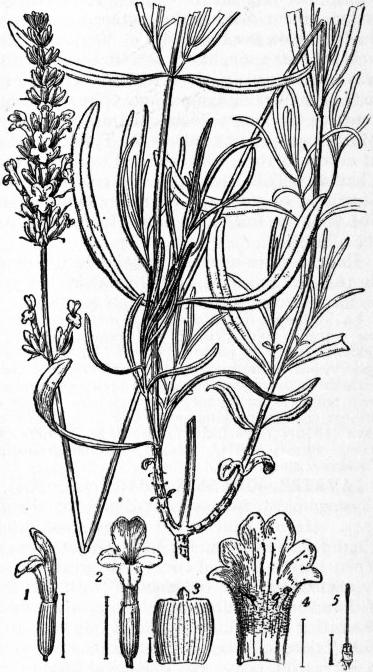
Lavender (Lavandula vera).
1. Flower, side view. 2. Flower, front view. 3. Calyx opened and spread flat. 4. Corolla opened and spread flat. 5. Pistil.
The finest oil is obtained by the distillation of the flowers, without the stalks, but the labour spent upon this adds about 10s. per ℔ to the expense of the oil, and the same end is practically attained by fractional distillation. The oil mellows by keeping three years, after which it deteriorates unless mixed with alcohol; it is also improved by redistillation. Oil of lavender is distilled from the wild plants in Piedmont and the South of France, especially in the villages about Mont Ventoux near Avignon, and in those some leagues west of Montpellier. The best French oil realizes scarcely one-sixth of the price of the English oil. Cheaper varieties are made by distilling the entire plant.
Oil of lavender is a mobile liquid having a specific gravity from 0.85 to 0.89. Its chief constituents are linalool acetate, which also occurs in oil of bergamot, and linalool, C10H17OH, an alcohol derived by oxidation from myrcene, C10H16, which is one of the terpenes. The dose is ½-3 minims. The British pharmacopeia contains a spiritus lavandulae, dose 5-20 minims: and a compound tincture, dose ½-1 drachm. This is contained in liquor arsenicalis, and its characteristic odour may thus be of great practical importance, medico-legally and otherwise. The pharmacology of oil of lavender is simply that of an exceptionally pleasant and mild volatile oil. It is largely used as a carminative and as a colouring and flavouring agent. Its adulteration with alcohol may be detected by chloride of calcium dissolving in it and forming a separate layer of liquid at the bottom of the vessel. Glycerine acts in the same way. If it contain turpentine it will not dissolve in three volumes of alcohol, in which quantity the pure oil is perfectly soluble.
Lavender flowers were formerly considered good for “all disorders of the head and nerves”; a spirit prepared with them was known under the name of palsy drops.
Lavender water consists of a solution of the volatile oil in spirit of wine with the addition of the essences of musk, rose, bergamot and ambergris, but is very rarely prepared by distillation of the flowers with spirit.
In the climate of New York lavender is scarcely hardy, but in the vicinity of Philadelphia considerable quantities are grown for the market. In American gardens sweet basil (Ocimum basilicum) is frequently called lavender.
Lavandula Spica, a species which differs from L. vera chiefly in its smaller size, more crowded leaves and linear bracts, is also used for the distillation of an essential oil, which is known in England as oil of spike and in France under the name of essence d’aspic. It is used in painting on porcelain and in veterinary medicine. The oil as met with in commerce is less fragrant than that of L. vera—probably because the whole plant is distilled, for the flowers of the two species are scarcely distinguishable in fragrance. L. Spica does not extend so far north, nor ascend the mountains beyond 2000 ft. It cannot be cultivated in Britain except in sheltered situations. A nearly allied species, L. lanata, a native of Spain, with broader leaves, is also very fragrant, but does not appear to be distilled for oil.
Lavandula Stoechas, a species extending from the Canaries to Asia Minor, is distinguished from the above plants by its blackish purple flowers, and shortly stalked spikes crowned by conspicuous purplish sterile bracts. The flowers were official in the London pharmacopoeia as late as 1746. They are still used by the Arabs as an expectorant and antispasmodic. The Stoechades (now called the isles of Hyères near Toulon) owed their name to the abundance of the plant growing there.
Other species of lavender are known, some of which extend as far east as to India. A few which differ from the above in having divided leaves, as L. dentata, L. abrotanoides, L. multifolia, L. pinnata and L. viridis, have been cultivated in greenhouses, &c., in England.
Sea lavender is a name applied in England to several species of Statice, a genus of littoral plants belonging to the order Plumba gineae. Lavender cotton is a species of the genus Santolina, small, yellow-flowered, evergreen undershrubs of the Composite order.
LAVERDY, CLÉMENT CHARLES FRANÇOIS DE (1723-1793), French statesman, was a member of the parlement of Paris when the case against the Jesuits came before that body in August 1761. He demanded the suppression of the order and thus acquired popularity. Louis XV. named him controller-general of the finances in December 1763, but the burden was great and Laverdy knew nothing of finance. Three months after his nomination he forbade anything of any kind whatever to be printed concerning his administration, thus refusing advice as well as censure. He used all sorts of expedients, sometimes dishonest, to replenish the treasury, and was even accused of having himself profited from the commerce in wheat. A court intrigue led to his sudden dismissal on the 1st of October 1768. Henceforward he lived in retirement until, during the Revolution, he was involved in the charges against the financiers of the old régime. The Revolutionary tribunal condemned him to death, and he was guillotined on the 24th of November 1793.
See A. Jobez, La France sous Louis XV (1869).
LAVERNA, an old Italian divinity, originally one of the spirits of the underworld. A cup found in an Etruscan tomb bears the inscription “Lavernai Pocolom,” and in a fragment of Septimius Serenus Laverna is expressly mentioned in connexion with the di inferi. By an easy transition, she came to be regarded as the protectress of thieves, whose operations were associated with darkness. She had an altar on the Aventine hill, near the gate called after her Lavernalis, and a grove on the Via Salaria. Her aid was invoked by thieves to enable them to carry out their plans successfully without forfeiting their reputation for piety and honesty (Horace, Ep. i. 16, 60). Many explanations have been given of the name: (1) from latere (Schol. on Horace, who gives laternio as another form of lavernio or robber); (2) from lavare (Acron on Horace, according to whom thieves were called lavatores, perhaps referring to bath thieves); (3) from levare (cf. shop-lifters). Modern etymologists connect it with lu-crum, and explain it as meaning the goddess of gain.
LAVERY, JOHN (1857- ), British painter, was born in Belfast, and received his art training in Glasgow, London and Paris. He was elected associate of the Royal Scottish Academy in 1892 and academician in 1896, having won a considerable reputation as a painter of portraits and figure subjects, and as a facile and vigorous executant. He became also vice-president of the International Society of sculptors, painters and gravers. Many of his paintings have been acquired for public collections, and he is represented in the National Galleries at Brussels, Berlin and Edinburgh, in the Carnegie Institute at Pittsburg, the Philadelphia Gallery, the New South Wales Gallery, the Modern Gallery, Venice, the Pinakothek, Munich, the Glasgow Corporation Gallery, and the Luxembourg.
LAVIGERIE, CHARLES MARTIAL ALLEMAND (1825-1892), French divine, cardinal archbishop of Carthage and Algiers and primate of Africa, was born at Bayonne on the 31st of October 1825, and was educated at St Sulpice, Paris. He was ordained priest in 1849, and was professor of ecclesiastical history at the Sorbonne from 1854 to 1856. In 1856 he accepted the direction of the schools of the East, and was thus for the first time brought into contact with the Mahommedan world. “C’est là,” he wrote, “que j’ai connu enfin ma vocation.” Activity in missionary work, especially in alleviating the distresses of the victims of the Druses, soon brought him prominently into notice; he was made a chevalier of the Legion of Honour, and in October 1861, shortly after his return to Europe, was appointed French auditor at Rome. Two years later he was raised to the see of Nancy, where he remained for four years, during which the diocese became one of the best administered in France. While bishop of Nancy he met Marshal MacMahon, then governor-general of Algeria, who in 1866 offered him the see of Algiers, just raised to an archbishopric. Lavigerie landed in Africa on the 11th of May 1868, when the great famine was already making itself felt, and he began in November to collect the orphans into villages. This action, however, did not meet with the approval of MacMahon, who feared that the Arabs would resent it as an infraction of the religious peace, and thought that the Mahommedan church, being a state institution in Algeria, ought to be protected from proselytism; so it was intimated to the prelate that his sole duty was to minister to the colonists. Lavigerie, however, continued his self-imposed task, refused the archbishopric of Lyons, which was offered to him by the emperor, and won his point. Contact with the natives during the famine caused Lavigerie to entertain exaggerated hopes for their general conversion, and his enthusiasm was such that he offered to resign his archbishopric in order to devote himself entirely to the missions. Pius IX. refused this, but granted him a coadjutor, and placed the whole of equatorial Africa under his charge. In 1870 Lavigerie warmly supported papal infallibility. In 1871 he was twice a candidate for the National Assembly, but was defeated. In 1874 he founded the Sahara and Sudan mission, and sent missionaries to Tunis, Tripoli, East Africa and the Congo. The order of African missionaries thus founded, for which Lavigerie himself drew up the rule, has since become famous as the Pères Blancs. From 1881 to 1884 his activity in Tunisia so raised the prestige of France that it drew from Gambetta the celebrated declaration, L’Anticléricalisme n’est pas un article d’exportation, and led to the exemption of Algeria from the application of the decrees concerning the religious orders. On the 27th of March 1882 the dignity of cardinal was conferred upon Lavigerie, but the great object of his ambition was to restore the see of St Cyprian; and in that also he was successful, for by a bull of 10th November 1884 the metropolitan see of Carthage was re-erected, and Lavigerie received the pallium on the 25th of January 1885. The later years of his life were spent in ardent anti-slavery propaganda, and his eloquence moved large audiences in London, as well as in Paris, Brussels and other parts of the continent. He hoped, by organizing a fraternity of armed laymen as pioneers, to restore fertility to the Sahara; but this community did not succeed, and was dissolved before his death. In 1890 Lavigerie appeared in the new character of a politician, and arranged with Pope Leo XIII. to make an attempt to reconcile the church with the republic. He invited the officers of the Mediterranean squadron to lunch at Algiers, and, practically renouncing his monarchical sympathies, to which he clung as long as the comte de Chambord was alive, expressed his support of the republic. and emphasized it by having the Marseillaise played by a band of his Pères Blancs. The further steps in this evolution emanated from the pope, and Lavigerie, whose health now began to fail, receded comparatively into the background. He died at Algiers on the 26th of November 1892.
(G. F. B.)
LA VILLEMARQUÉ, THÉODORE CLAUDE HENRI, Vicomte Hersart de (1815-1895), French philologist and man of letters, was born at Keransker, near Quimperlé, on the 6th of July 1815. He was descended from an old Breton family, which counted among its members a Hersart who had followed Saint Louis to the Crusade, and another who was a companion in arms of Du Guesclin. La Villemarqué devoted himself to the elucidation of the monuments of Breton literature. Introduced in 1851 by Jacob Grimm as correspondent to the Academy of Berlin, he became in 1858 a member of the Academy of Inscriptions. His works include: Contes populaires des anciens Bretons (1842), to which was prefixed an essay on the origin of the romances of the Round Table; Essai sur l’histoire de la langue bretonne (1837); Poèmes des bardes bretons du sixième siècle (1850); La Légende celtique en Irelande, en Cambrie et en Bretagne (1859). The popular Breton songs published by him in 1839 as Barzaz Breiz were considerably retouched. La Villemarqué’s work has been superseded by the work of later scholars, but he has the merit of having done much to arouse popular interest in his subject. He died at Keransker on the 8th of December 1895.
On the subject of the doubtful authenticity of Barzaz Breiz, see Luzel’s Preface to his Chansons populaires de la Basse-Bretagne, and, for a list of works on the subject, the Revue Celtique (vol. v.).
LAVINIUM, an ancient town of Latium, on the so-called Via Lavinatis (see Laurentina, Via), 19 m. S. of Rome, the modern Pratica, situated 300 ft. above sea-level and 2½ m. N.E. from the sea-coast. Its foundation is attributed to Aeneas (whereas Laurentum was the primitive city of King Latinus), who named it after his wife Lavinia. It is rarely mentioned in Roman history and often confused with Lanuvium or Lanivium in the text both of authors and of inscriptions. The custom by which the consuls and praetors or dictators sacrificed on the Alban Mount and at Lavinium to the Penates and to Vesta, before they entered upon office or departed for their province, seems to have been one of great antiquity. There is no trace of its having continued into imperial times, but the cults of Lavinium were kept up, largely by the imperial appointment of honorary non-resident citizens to hold the priesthoods. The citizens of Lavinium were known under the empire as Laurentes Lavinates, and the place itself at a late period as Laurolavinium. It was deserted or forgotten not long after the time of Theodosius.
Lavinium was preceded by a more ancient town, Laurentum, the city of Latinus (Verg. Aen. viii.); of this the site is uncertain, but it is probably to be sought at the modern Tor Paterno, close to the sea-coast and 5 m. N. by W. of Lavinium. Here the name of Laurentum is preserved by the modern name Pantan di Lauro. Even in ancient times it was famous for its groves of bay-trees (laurus) from which its name was perhaps derived, and which in imperial times gave the villas of its territory a name for salubrity, so that both Vitellius and Commodus resorted there. The exact date of the abandonment of the town itself and the incorporation of its territory with that of Lavinium is uncertain, but it may be placed in the latter part of the republic. Under the empire a portion of it must have been imperial domain and forest. We hear of an imperial, procurator in charge of the elephants at Laurentum; and the imperial villa may perhaps be identified with the extensive ruins at Tor Paterno itself. The remains of numerous other villas lie along the ancient coast-line (which was half a mile inland of the modern, being now marked by a row of sand-hills, and was followed by the Via Severiana), both north-west and south-east of Tor Paterno: they extended as a fact in an almost unbroken line along the low sandy coast—now entirely deserted and largely occupied by the low scrub which serves as cover for the wild boars of the king of Italy’s preserves—from the mouth of the Tiber to Antium, and thence again to Astura; but there are no traces of any buildings previous to the imperial period. In one of these villas, excavated by the king of Italy in 1906, was found a fine replica of the famous discobolus of Myron. The plan of the building is interesting, as it diverges entirely from the normal type and adapts itself to the site. Some way to the N.W. was situated the village of Vicus Augustanus Laurentium, taking its name probably from Augustus himself, and probably identical with the village mentioned by Pliny the younger as separated by only one villa from his own. This village was brought to light by excavation in 1874, and its forum and curia are still visible. The remains of the villa of Pliny, too, were excavated in 1713 and in 1802-1819, and it is noteworthy that the place bears the name Villa di Pino (sic) on the staff map; how old the name is, is uncertain. It is impossible without further excavation to reconcile the remains—mainly of substructions—with the elaborate description of his villa given by Pliny (cf. H. Winnefeld in Jahrbuch des Instituts, 1891, 200 seq.).
The site of the ancient Lavinium, no less than 300 ft. above sea-level and 2½ m. inland, is far healthier than the low-lying Laurentum, where, except in the immediate vicinity of the coast, malaria must have been a dreadful scourge. It possesses considerable natural strength, and consists of a small hill, the original acropolis, occupied by the modern castle and the village surrounding it, and a larger one, now given over to cultivation, where the city stood. On the former there are now no traces of antiquity, but on the latter are scanty remains of the city walls, in small blocks of the grey-green tufa (cappellaccio) which is used in the earliest buildings of Rome, and traces of the streets. The necropolis, too, has been discovered, but not systematically excavated; but objects of the first Iron age, including a sword of Aegean type (thus confirming the tradition), have been found; also remains of a building with Doric columns of an archaistic type, remains of later buildings in brick, and inscriptions, some of them of considerable interest.
See R. Lanciani in Monumenti dei Lincei, xiii. (1903), 133 seq.; xvi. (1906), 241 seq.
(T. As.)
LAVISSE, ERNEST (1842- ), French historian, was born at Nouvion-en-Thiérache, Aisne, on the 17th of December 1842. In 1865 he obtained a fellowship in history, and in 1875 became a doctor of letters; he was appointed maître de conférence (1876) at the école normale supérieure, succeeding Fustel de Coulanges, and then professor of modern history at the Sorbonne (1888), in the place of Henri Wallon. He was an eloquent professor and very fond of young people, and played an important part in the revival of higher studies in France after 1871. His knowledge of pedagogy was displayed in his public lectures and his addresses, in his private lessons, where he taught a small number of pupils the historical method, and in his books, where he wrote ad probandum at least as much as ad narrandum: class-books, collections of articles, intermingled with personal reminiscences (Questions d’enseignement national, 1885; Études et étudiants, 1890; À propos de nos écoles, 1895), rough historical sketches (Vue générale de l’histoire politique de l’Europe, 1890), &c. Even his works of learning, written without a trace of pedantry, are remarkable for their lucidity and vividness.
After the Franco-Prussian War Lavisse studied the development of Prussia and wrote Étude sur l’une des origines de la monarchie prussienne, ou la Marche de Brandebourg sous la dynastie ascanienne, which was his thesis for his doctor’s degree in 1875, and Études sur l’histoire de la Prusse (1879). In connexion with his study of the Holy Roman Empire, and the cause of its decline, he wrote a number of articles which were published in the Revue des Deux Mondes; and he wrote Trois empereurs d’Allemagne (1888), La Jeunesse du grand Frédéric (1891) and Frédéric II. avant son avènement (1893) when studying the modern German empire and the grounds for its strength. With his friend Alfred Rambaud he conceived the plan of L’Histoire générale du IVe siècle jusqu’à nos jours, to which, however, he contributed nothing. He edited the Histoire de France depuis les origines jusqu’à la Révolution (1901- ), in which he carefully revised the work of his numerous assistants, reserving the greatest part of the reign of Louis XIV. for himself. This section occupies the whole of volume vii. It is a remarkable piece of work, and the sketch of absolute government in France during this period has never before been traced with an equal amount of insight and brilliance. Lavisse was admitted to the Académie Française on the death of Admiral Jurien de la Gravière in 1892, and after the death of James Darmesteter became editor of the Revue de Paris. He is, however, chiefly a master of pedagogy. When the école normale was joined to the university of Paris, Lavisse was appointed director of the new organization, which he had helped more than any one to bring about.
LAVOISIER, ANTOINE LAURENT (1743-1794), French chemist, was born in Paris on the 26th of August 1743. His father, an avocat au parlement, gave him an excellent education at the collège Mazarin, and encouraged his taste for natural science; and he studied mathematics and astronomy with N. L. de Lacaille, chemistry with the elder Rouelle and botany with Bernard de Jussieu. In 1766 he received a gold medal from the Academy of Sciences for an essay on the best means of lighting a large town; and among his early work were papers on the analysis of gypsum, on thunder, on the aurora and on congelation, and a refutation of the prevalent belief that water by repeated distillation is converted into earth. He also assisted J. E. Guettard (1715-1786) in preparing his mineralogical atlas of France. In 1768, recognized as a man who had both the ability and the means for a scientific career, he was nominated adjoint chimiste to the Academy, and in that capacity made numerous reports on the most diverse subjects, from the theory of colours to water-supply and from invalid chairs to mesmerism and the divining rod. The same year he obtained the position of adjoint to Baudon, one of the farmers-general of the revenue, subsequently becoming a full titular member of the body. This was the first of a series of posts in which his administrative abilities found full scope. Appointed régisseur des poudres in 1775, he not only abolished the vexatious search for saltpetre in the cellars of private houses, but increased the production of the salt and improved the manufacture of gunpowder. In 1785 he was nominated to the committee on agriculture, and as its secretary drew up reports and instructions on the cultivation of various crops, and promulgated schemes for the establishment of experimental agricultural stations, the distribution of agricultural implements and the adjustment of rights of pasturage. Seven years before he had started a model farm at Fréchine, where he demonstrated the advantages of scientific methods of cultivation and of the introduction of good breeds of cattle and sheep. Chosen a member of the provincial assembly of Orleans in 1787, he busied himself with plans for the improvement of the social and economic conditions of the community by means of savings banks, insurance societies, canals, workhouses, &c.; and he showed the sincerity of his philanthropical work by advancing money out of his own pocket, without interest, to the towns of Blois and Romorantin, for the purchase of barley during the famine of 1788. Attached in this same year to the caisse d’escompte, he presented the report of its operations to the national assembly in 1789, and as commissary of the treasury in 1791 he established a system of accounts of unexampled punctuality. He was also asked by the national assembly to draw up a new scheme of taxation in connexion with which he produced a report De la richesse territoriale de la France, and he was further associated with committees on hygiene, coinage, the casting of cannon, &c., and was secretary and treasurer of the commission appointed in 1790 to secure uniformity of weights and measures.
In 1791, when Lavoisier was in the middle of all this official activity, the suppression of the farmers-general marked the beginning of troubles which brought about his death. His membership of that body was alone sufficient to make him an object of suspicion; his administration at the régie des poudres was attacked; and Marat accused him in the Ami du Peuple of putting Paris in prison and of stopping the circulation of air in the city by the mur d’octroi erected at his suggestion in 1787. The Academy, of which as treasurer at the time he was a conspicuous member, was regarded by the convention with no friendly eyes as being tainted with “incivism,” and in the spring of 1792 A. F. Fourcroy endeavoured to persuade it to purge itself of suspected members. The attempt was unsuccessful, but in August of the same year Lavoisier had to leave his house and laboratory at the Arsenal, and in November the Academy was forbidden until further orders to fill up the vacancies in its numbers. Next year, on the 1st of August, the convention passed a decree for the uniformity of weights and measures, and requested the Academy to take measures for carrying it out, but a week later Fourcroy persuaded the same convention to suppress the Academy together with other literary societies patentées et dotées by the nation. In November it ordered the arrest of the ex-farmers-general, and on the advice of the committee of public instruction, of which Guyton de Morveau and Fourcroy were members, the names of Lavoisier and others were struck off from the commission of weights and measures. The fate of the ex-farmers-general was sealed on the 2nd of May 1794, when, on the proposal of Antoine Dupin, one of their former officials, the convention sent them for trial by the Revolutionary tribunal. Within a week Lavoisier and 27 others were condemned to death. A petition in his favour addressed to Coffinhal, the president of the tribunal, is said to have been met with the reply La République n’a pas besoin de savants, and on the 8th of the month Lavoisier and his companions were guillotined at the Place de la Révolution. He died fourth, and was preceded by his colleague Jacques Paulze, whose daughter he had married in 1771. “Il ne leur a fallu,” Lagrange remarked, “qu’un moment pour faire tomber cette tête, et cent années peut-être ne suffiront pas pour en reproduire une semblable.”
Lavoisier’s name is indissolubly associated with the overthrow of the phlogistic doctrine that had dominated the development of chemistry for over a century, and with the establishment of the foundations upon which the modern science reposes. “He discovered,” says Justus von Liebig (Letters on Chemistry, No. 3), “no new body, no new property, no natural phenomenon previously unknown; but all the facts established by him were the necessary consequences of the labours of those who preceded him. His merit, his immortal glory, consists in this—that he infused into the body of the science a new spirit; but all the members of that body were already in existence, and rightly joined together.” Realizing that the total weight of all the products of a chemical reaction must be exactly equal to the total weight of the reacting substances, he made the balance the ultima ratio of the laboratory, and he was able to draw correct inferences from his weighings because, unlike many of the phlogistonists, he looked upon heat as imponderable. It was by weighing that in 1770 he proved that water is not converted into earth by distillation, for he showed that the total weight of a sealed glass vessel and the water it contained remained constant, however long the water was boiled, but that the glass vessel lost weight to an extent equal to the weight of earth produced, his inference being that the earth came from the glass, not from the water. On the 1st of November 1772 he deposited with the Academy a sealed note which stated that sulphur and phosphorus when burnt increased in weight because they absorbed “air,” while the metallic lead formed from litharge by reduction with charcoal weighed less than the original litharge because it had lost “air.” The exact nature of the airs concerned in the processes he did not explain until after the preparation of “dephlogisticated air” (oxygen) by Priestley in 1774. Then, perceiving that in combustion and the calcination of metals only a portion of a given volume of common air was used up, he concluded that Priestley’s new air, air éminemment pur, was what was absorbed by burning phosphorus, &c., “non-vital air,” azote, or nitrogen remaining behind. The gas given off in the reduction of metallic calces by charcoal he at first supposed to be merely that contained in the calx, but he soon came to understand that it was a product formed by the union of the charcoal with the “dephlogisticated air” in the calx. In a memoir presented to the Academy in 1777, but not published till 1782, he assigned to dephlogisticated air the name oxygen, or “acid-producer,” on the supposition that all acids were formed by its union with a simple, usually non-metallic, body; and having verified this notion for phosphorus, sulphur, charcoal, &c., and even extended it to the vegetable acids, he naturally asked himself what was formed by the combustion of “inflammable air” (hydrogen). This problem he had attacked in 1774, and in subsequent years he made various attempts to discover the acid which, under the influence of his oxygen theory, he expected would be formed. It was not till the 25th of June 1783 that in conjunction with Laplace he announced to the Academy that water was the product formed by the combination of hydrogen and oxygen, but by that time he had been anticipated by Cavendish, to whose prior work, however, as to that of several other investigators in other matters, it is to be regretted that he did not render due acknowledgment. But a knowledge of the composition of water enabled him to storm the last defences of the phlogistonists. Hydrogen they held to be the phlogiston of metals, and they supported this view by pointing out that it was liberated when metals were dissolved in acids. Considerations of weight had long prevented Lavoisier from accepting this doctrine, but he was now able to explain the process fully, showing that the hydrogen evolved did not come from the metal itself, but was one product of the decomposition of the water of the dilute acid, the other product, oxygen, combining with the metal to form an oxide which in turn united with the acid. A little later this same knowledge led him to the beginnings of quantitative organic analysis. Knowing that the water produced by the combustion of alcohol was not pre-existent in that substance but was formed by the combination of its hydrogen with the oxygen of the air, he burnt alcohol and other combustible organic substances, such as wax and oil, in a known volume of oxygen, and, from the weight of the water and carbon dioxide produced and his knowledge of their composition, was able to calculate the amounts of carbon, hydrogen and oxygen present in the substance.
Up to about this time Lavoisier’s work, mainly quantitative in character, had appealed most strongly to physicists, but it now began to win conviction from chemists also. C. L. Berthollet, L. B. Guyton de Morveau and A. F. Fourcroy, his collaborators in the reformed system of chemical terminology set forth in 1787 in the Méthode de nomenclature chimique, were among the earliest French converts, and they were followed by M. H. Klaproth and the German Academy, and by most English chemists except Cavendish, who rather suspended his judgment, and Priestley, who stubbornly clung to the opposite view. Indeed, though the partisans of phlogiston did not surrender without a struggle, the history of science scarcely presents a second instance of a change so fundamental accomplished with such ease. The spread of Lavoisier’s doctrines was greatly facilitated by the defined and logical form in which he presented them in his Traité élémentaire de chimie (présenté dans un ordre nouveau et d’après les découvertes modernes) (1789). The list of simple substances contained in the first volume of this work includes light and caloric with oxygen, azote and hydrogen. Under the head of “oxidable or acidifiable” substances, the combination of which with oxygen yielded acids, were placed sulphur, phosphorus, carbon, and the muriatic, fluoric and boracic radicals. The metals, which by combination with oxygen became oxides, were antimony, silver, arsenic, bismuth, cobalt, copper, tin, iron, manganese, mercury, molybdenum, nickel, gold, platinum, lead, tungsten and zinc; and the “simple earthy salifiable substances” were lime, baryta, magnesia, alumina and silica. The simple nature of the alkalies Lavoisier considered so doubtful that he did not class them as elements, which he conceived as substances which could not be further decomposed by any known process of analysis—les molécules simples et indivisibles qui composent les corps. The union of any two of the elements gave rise to binary compounds, such as oxides, acids, sulphides, &c. A substance containing three elements was a binary compound of the second order; thus salts, the most important compounds of this class, were formed by the union of acids and oxides, iron sulphate, for instance, being a compound of iron oxide with sulphuric acid.
In addition to his purely chemical work, Lavoisier, mostly in conjunction with Laplace, devoted considerable attention to physical problems, especially those connected with heat. The two carried out some of the earliest thermochemical investigations, devised apparatus for measuring linear and cubical expansions, and employed a modification of Joseph Black’s ice calorimeter in a series of determinations of specific heats. Regarding heat (matière de feu or fluide igné) as a peculiar kind of imponderable matter, Lavoisier held that the three states of aggregation—solid, liquid and gas—were modes of matter, each depending on the amount of matière de feu with which the ponderable substances concerned were interpenetrated and combined; and this view enabled him correctly to anticipate that gases would be reduced to liquids and solids by the influence of cold and pressure. He also worked at fermentation, respiration and animal heat, looking upon the processes concerned as essentially chemical in nature. A paper discovered many years after his death showed that he had anticipated later thinkers in explaining the cyclical process of animal and vegetable life, for he pointed out that plants derive their food from the air, from water, and in general from the mineral kingdom, and animals in turn feed on plants or on other animals fed by plants, while the materials thus taken up by plants and animals are restored to the mineral kingdom by the breaking-down processes of fermentation, putrefaction and combustion.
A complete edition of the writings of Lavoisier, Œuvres de Lavoisier, publiées par les soins du ministre de l’instruction publique, was issued at Paris in six volumes from 1864-1893. This publication comprises his Opuscules physiques et chimiques (1774), many memoirs from the Academy volumes, and numerous letters, notes and reports relating to the various matters on which he was engaged. At the time of his death he was preparing an edition of his collected works, and the portions ready for the press were published in two volumes as Mémoires de chimie in 1805 by his widow (in that year married to Count Rumford), who had drawn and engraved the plates in his Traité élémentaire de chimie (1789).
Sec E. Grimaux, Lavoisier 1743-1794, d’après sa correspondance, ses manuscripts, &c. (1888), which gives a list of his works; P. E. M. Berthelot, La Révolution chimique: Lavoisier (1890), which contains an analysis of and extracts from his laboratory notebooks.
LA VOISIN. Catherine Monvoisin, known as “La Voisin” (d. 1680), French sorceress, whose maiden name was Catherine Deshayes, was one of the chief personages in the famous affaire des poisons, which disgraced the reign of Louis XIV. Her husband, Monvoisin, was an unsuccessful jeweller, and she practised chiromancy and face-reading to retrieve their fortunes. She gradually added the practice of witchcraft, in which she had the help of a renegade priest, Étienne Guibourg, whose part was the celebration of the “black mass,” an abominable parody in which the host was compounded of the blood of a little child mixed with horrible ingredients. She practised medicine, especially midwifery, procured abortion and provided love powders and poisons. Her chief accomplice was one of her lovers, the magician Lesage, whose real name was Adam Cœuret. The great ladies of Paris flocked to La Voisin, who accumulated enormous wealth. Among her clients were Olympe Mancini, comtesse de Soissons, who sought the death of the king’s mistress, Louise de la Vallière; Mme de Montespan, Mme de Gramont (la belle Hamilton) and others. The bones of toads, the teeth of moles, cantharides, iron filings, human blood and human dust were among the ingredients of the love powders concocted by La Voisin. Her knowledge of poisons was not apparently so thorough as that of less well-known sorcerers, or it would be difficult to account for La Vallière’s immunity. The art of poisoning had become a regular science. The death of Henrietta, duchess of Orleans, was attributed, falsely it is true, to poison, and the crimes of Marie Madeleine de Brinvilliers (executed in 1676) and her accomplices were still fresh in the public mind. In April 1679 a commission appointed to inquire into the subject and to prosecute the offenders met for the first time. Its proceedings, including some suppressed in the official records, are preserved in the notes of one of the official rapporteurs, Gabriel Nicolas de la Reynie. The revelation of the treacherous intention of Mme de Montespan to poison Louis XIV. and of other crimes, planned by personages who could not be attacked without scandal which touched the throne, caused Louis XIV. to close the chambre ardente, as the court was called, on the 1st of October 1680. It was reopened on the 19th of May 1681 and sat until the 21st of July 1682. Many of the culprits escaped through private influence. Among these were Marie Anne Mancini, duchesse de Bouillon, who had sought to get rid of her husband in order to marry the duke of Vendôme, though Louis XIV. banished her to Nérac. Mme de Montespan was not openly disgraced, because the preservation of Louis’s own dignity was essential, and some hundred prisoners, among them the infamous Guibourg and Lesage, escaped the scaffold through the suppression of evidence insisted on by Louis XIV. and Louvois. Some of these were imprisoned in various fortresses, with instructions from Louvois to the respective commandants to flog them if they sought to impart what they knew. Some innocent persons were imprisoned for life because they had knowledge of the facts. La Voisin herself was executed at an early stage of the proceedings, on the 20th of February 1680, after a perfunctory application of torture. The authorities had every reason to avoid further revelations. Thirty-five other prisoners were executed; five were sent to the galleys and twenty-three were banished. Their crimes had furnished one of the most extraordinary trials known to history.