VOLUME XVI SLICE III Latin Language to Lefebvre, François-Joseph (continued 6)
Reading edition
See F. Ravaisson, Archives de la Bastille, vols. iv.-vii. (1870-1874); the notes of La Reynie, preserved in the Bibliothèque Nationale; F. Funck-Brentano, Le Drame des poisons (1899); A. Masson, La Sorcellerie et la science des poisons au XVIIe siècle (1904). Sardou made the affair a background for his Affaire des poisons (1907). There is a portrait of La Voisin by Antoine Coypel, which has been often reproduced.

LAW, JOHN (1671-1729), Scots economist, best known as the originator of the “Mississippi scheme,” was born at Edinburgh in April 1671. His father, a goldsmith and banker, bought shortly before his death, which took place in his son’s youth, the lands of Lauriston near Edinburgh. John lived at home till he was twenty, and then went to London. He had already studied mathematics, and the theory of commerce and political economy, with much interest; but he was known rather as fop than scholar. In London he gambled, drank and flirted till in April 1694 a love intrigue resulted in a duel with Beau Wilson in Bloomsbury Square. Law killed his antagonist, and was condemned to death. His life was spared, but he was detained in prison. He found means to escape to Holland, then the greatest commercial country in Europe. Here he observed with close attention the practical working of banking and financial business, and conceived the first ideas of his celebrated “system.” After a few years spent in foreign travel, he returned to Scotland, then exhausted and enraged by the failure of the Darien expedition (1695-1701). He propounded plans for the relief of his country in a work1 entitled Money and Trade Considered, with a Proposal for supplying the Nation with Money (1705). This attracted some notice, but had no practical effect, and Law again betook himself to travel. He visited Brussels, Paris, Vienna, Genoa, Rome, making large sums by gambling and speculation, and spending them lavishly. He was in Paris in 1708, and made some proposals to the government as to their financial difficulties, but Louis XIV. declined to treat with a “Huguenot,” and d’Argenson, chief of the police, had Law expelled as a suspicious character. He had, however, become intimately acquainted with the duke of Orleans, and when in 1715 that prince became regent, Law at once returned to Paris.
The extravagant expenditure of the late monarch had plunged the kingdom into apparently inextricable financial confusion. The debt was 3000 million livres, the estimated annual expenditure, exclusive of interest payments, 148 million livres, and the income about the same. The advisability of declaring a national bankruptcy was seriously discussed, and though this plan was rejected, measures hardly less violent were carried. By a visa, or examination of the state liabilities by a committee with full powers of quashing claims, the debt was reduced nearly a half, the coin in circulation was ordered to be called in and reissued at the rate of 120 for 100—a measure by which foreign coiners profited greatly, and a chamber of justice was established to punish speculators, to whom the difficulties of the state were ascribed. These measures had so little success that the billets d’état which were issued as part security for the new debt at once sank 75% below their nominal value. At this crisis Law unfolded a vast scheme to the perplexed regent. A royal bank was to manage the trade and currency of the kingdom, to collect the taxes, and to free the country from debt. The council of finance, then under the duc de Noailles, opposed the plan, but the regent allowed Law to take some tentative steps. By an edict of 2nd May 1716, a private institution called La Banque générale, and managed by Law, was founded. The capital was 6 million livres, divided into 1200 shares of 5000 livres, payable in four instalments, one-fourth in cash, three-fourths in billets d’état. It was to perform the ordinary functions of a bank, and had power to issue notes payable at sight in the weight and value of the money mentioned at day of issue. The bank was a great and immediate success. By providing for the absorption of part of the state paper it raised the credit of the government. The notes were a most desirable medium of exchange, for they had the element of fixity of value, which, owing to the arbitrary mint decrees of the government, was wanting in the coin of the realm. They proved the most convenient instruments of remittance between the capital and the provinces, and they thus developed the industries of the latter. The rate of interest, previously enormous and uncertain, fell first to 6 and then to 4%; and when another decree (10th April 1717) ordered collectors of taxes to receive notes as payments, and to change them for coin at request, the bank so rose in favour that it soon had a note-issue of 60 million livres. Law now gained the full confidence of the regent, and was allowed to proceed with the development of the “system.”
The trade of the region about the Mississippi had been granted to a speculator named Crozat. He found the undertaking too large, and was glad to give it up. By a decree of August 1717 Law was allowed to establish the Compagnie de la Louisiane ou d’Occident, and to endow it with privileges practically amounting to sovereignty over the most fertile region of North America. The capital was 100 million livres divided into 200,000 shares of 500 livres. The payments were to be one-fourth in coin and three-fourths in billets d’état. On these last the government was to pay 3 million livres interest yearly to the company. As the state paper was depreciated the shares fell much below par. The rapid rise of Law had made him many enemies, and they took advantage of this to attack the system. D’Argenson, now head of the council of finance, with the brothers Paris of Grenoble, famous tax farmers of the day, formed what was called the “anti-system.” The farming of the taxes was let to them, under an assumed name, for 48½ million livres yearly. A company was formed, the exact counterpart of the Mississippi company. The capital was the same, divided in the same manner, but the payments were to be entirely in money. The returns from the public revenue were sure; those from the Mississippi scheme were not. Hence the shares of the latter were for some time out of favour. Law proceeded unmoved with the development of his plans. On the 4th of December 1718 the bank became a government institution under the name of La Banque royale. Law was director, and the king guaranteed the notes. The shareholders were repaid in coin, and, to widen the influence of the new institution, the transport of money between towns where it had branches was forbidden. The paper-issue now reached 110 millions. Law had such confidence in the success of his plans that he agreed to take over shares in the Mississippi company at par at a near date. The shares began rapidly to rise. The next move was to unite the companies Des Indes Orientales and De Chine, founded in 1664 and 1713 respectively, but now dwindled away to a shadow, to his company. The united association, La Compagnie des Indes, had a practical monopoly of the foreign trade of France. These proceedings necessitated the creation of new capital to the nominal amount of 25 million livres. The payment was spread over 20 months. Every holder of four original shares (mères) could purchase one of the new shares (filles) at a premium of 50 livres. All these 500-livre shares rapidly rose to 750, or 50% above par. Law now turned his attention to obtaining additional powers within France itself. On the 25th of July 1719 an edict was issued granting the company for nine years the management of the mint and the coin-issue. For this privilege the company paid 5 million livres, and the money was raised by a new issue of shares of the nominal value of 500 livres, but with a premium of other 500. The list was only open for twenty days, and it was necessary to present four mères and one fille in order to obtain one of the new shares (petites filles). At the same time two dividends per annum of 6% each were promised. Again there was an attempt to ruin the bank by the commonplace expedient of making a run on it for coin; but the conspirators had to meet absolute power managed with fearlessness and skill. An edict appeared reducing, at a given date, the value of money, and those who had withdrawn coin from the bank hastened again to exchange it for the more stable notes. Public confidence in Law was increased, and he was enabled rapidly to proceed with the completion of the system. A decree of 27th August 1719 deprived the rival company of the farming of the revenue, and gave it to the Compagnie des Indes for nine years in return for an annual payment of 52 million livres. Thus at one blow the “anti-system” was crushed. One thing yet remained; Law proposed to take over the national debt, and manage it on terms advantageous to the state. The mode of transfer was this. The debt was over 1500 million livres. Notes were to be issued to that amount, and with these the state creditors must be paid in a certain order. Shares were to be issued at intervals corresponding to the payments, and it was expected that the notes would be used in buying them. The government was to pay 3% for the loan. It had formerly been bound to pay 80 millions, it would now pay under 50, a clear gain of over 30. As the shares of the company were almost the only medium for investment, the transfer would be surely effected. The creditors would now look to the government payments and the commercial gains of the company for their annual returns. Indeed the creditors were often not able to procure the shares, for each succeeding issue was immediately seized upon, though the 500-livre share was now issued at a premium of 4500 livres. After the third issue, on the 2nd of October, the shares immediately resold at 8000 livres in the Rue Quincampoix, then used as a bourse. They went on rapidly rising as new privileges were still granted to the company. Law had now more than regal power. The exiled Stuarts paid him court; the proudest aristocracy in Europe humbled themselves before him; and his liberality made him the idol of the populace. After, as a necessary preliminary, becoming a Catholic, he was made controller-general of the finances in place of d’Argenson. Finally, in February 1720, the bank was in name as well as in reality united to the company.
The system was now complete; but it had already begun to decay. In December 1719 it was at its height. The shares had then amounted to 20,000 livres, forty times their nominal price. A sort of madness possessed the nation. Men sold their all and hastened to Paris to speculate. The population of the capital was increased by an enormous influx of provincials and foreigners. Trade received a vast though unnatural impulse. Everybody seemed to be getting richer, no one poorer. Those who could still reflect saw that this prosperity was not real. The whole issue of shares at the extreme market-price valued 12,000 million livres. It would require 600 million annual revenue to give a 5% dividend on this. Now, the whole income of the company as yet was hardly sufficient to pay 5% on the original capital of 1677 million livres. The receipts from the taxes, &c., could be precisely calculated, and it would be many years before the commercial undertakings of the company—with which only some trifling beginning had been made—would yield any considerable return. People began to sell their shares, and to buy coin, houses, land—anything that had a stable element of value in it. There was a rapid fall in the shares, a rapid rise in all kinds of property, and consequently a rapid depreciation of the paper money. Law met these new tendencies by a succession of the most violent edicts. The notes were to bear a premium over specie. Coin was only to be used in small payments, and only a small amount was to be kept in the possession of private parties. The use of diamonds, the fabrication of gold and silver plate, was forbidden. A dividend of 40% on the original capital was promised. By several ingenious but fallaciously reasoned pamphlets Law endeavoured to restore public confidence. The shares still fell. At last, on the 5th of March 1720, an edict appeared fixing their price at 9000 livres, and ordering the bank to buy and sell them at that price. The fall now was transferred to the notes, of which there were soon over 2500 million livres in circulation. A large proportion of the coined money was removed from the kingdom. Prices rose enormously. There was everywhere distress and complete financial confusion. Law became an object of popular hatred. He lost his court influence, and was obliged to consent to a decree (21st May 1720) by which the notes and consequently the shares were reduced to half their nominal value. This created such a commotion that its promoters were forced to recall it, but the mischief was done. What confidence could there be in the depreciated paper after such a measure? Law was removed from his office, and his enemies proceeded to demolish the “system.” A vast number of shares had been deposited in the bank. These were destroyed. The notes were reconverted into government debt, but there was first a visa which reduced that debt to the same size as before it was taken over by the company. The rate of interest was lowered, and the government now only pledged itself to pay 37 instead of 80 millions annually. Finally the bank was abolished, and the company reduced to a mere trading association. By November the “system” had disappeared. With these last measures Law, it may well be believed, had nothing to do. He left France secretly in December 1720, resumed his wandering life, and died at Venice, poor and forgotten, on the 21st of March 1729.
Of Law’s writings the most important for the comprehension of the “system” is his Money and Trade Considered. In this work he says that national power and wealth consist in numbers of people, and magazines of home and foreign goods. These depend on trade, and that on money, of which a greater quantity employs more people; but credit, if the credit have a circulation, has all the beneficial effects of money. To create and increase instruments of credit is the function of a bank. Let such be created then, and let its notes be only given in return for land sold or pledged. Such a currency would supply the nation with abundance of money; and it would have many advantages, which Law points out in detail, over silver. The bank or commission was to be a government institution, and its profits were to be spent in encouraging the export and manufacture of the nation. A very evident error lies at the root of the “system.” Money is not the result but the cause of wealth, he thought. To increase it then must be beneficial, and the best way is by a properly secured paper currency. This is the motive force; but it is to be applied in a particular way. Law had a profound belief in the omnipotence of government. He saw the evils of minor monopolies, and of private farming of taxes. He proposed to centre foreign trade and internal finance in one huge monopoly managed by the state for the people, and carrying on business through a plentiful supply of paper money. He did not see that trade and commerce are best left to private enterprise, and that such a scheme would simply result in the profits of speculators and favourites. The “system” was never so far developed as to exhibit its inherent faults. The madness of speculators ruined the plan when only its foundations were laid. One part indeed might have been saved. The bank was not necessarily bound to the company, and had its note-issue been retrenched it might have become a permanent institution. As Thiers points out, the edict of the 5th of March 1720, which made the shares convertible into notes, ruined the bank without saving the company. The shares had risen to an unnatural height, and they should have been allowed to fall to their natural level. Perhaps Law felt this to be impossible. He had friends at court whose interests were involved in the shares, and he had enemies eager for his overthrow. It was necessary to succeed completely or not at all; so Law, a gambler to the core, risked and lost everything. Notwithstanding the faults of the “system,” its author was a financial genius of the first order. He had the errors of his time; but he propounded many truths as to the nature of currency and banking then unknown to his contemporaries. The marvellous skill which he displayed in adapting the theory of the “system” to the actual condition of things in France, and in carrying out the various financial transactions rendered necessary by its development, is absolutely without parallel. His profound self-confidence and belief in the truth of his own theories were the reasons alike of his success and his ruin. He never hesitated to employ the whole force of a despotic government for the definite ends which he saw before him. He left France poorer than he entered it, yet he was not perceptibly changed by his sudden transitions of fortune. Montesquieu visited him at Venice after his fall, and has left a description of him touched with a certain pathos. Law, he tells us, was still the same in character, perpetually planning and scheming, and, though in poverty, revolving vast projects to restore himself to power, and France to commercial prosperity.
The fullest account of the Mississippi scheme is that of Thiers, Law et son système des finances (1826, American trans. 1859). See also Heymann, Law und sein System (1853); Pierre Bonnassieux, Les Grandes Compagnies de commerce (1892); S. Alexi, John Law und sein System (1885); E. Levasseur, Récherches historiques sur le système de Law (1854); and Jobez, Une Préface au socialisme, ou le système de Law et la chasse aux capitalistes (1848). Full biographical details are given in Wood’s Life of Law (Edinburgh, 1824). All Law’s later writings are to be found in Daire, Collection des principaux économistes, vol. i. (1843). Other works on Law are: A. W. Wiston-Glynn, John Law of Lauriston (1908); P. A. Cachut, The Financier Law, his Scheme and Times (1856); A. Macf. Davis, An Historical Study of Law’s System (Boston, 1887); A. Beljame, La Pronunciation du nom de Jean Law le financier (1891). See also E. A. Benians in Camb. Mod. Hist. vi. 6 (1909). For minor notices see Poole’s Index to Periodicals. There is a portrait of Law by A. S. Belle in the National Portrait Gallery, London.
(F. Wa.)
1 A work entitled Proposals and Reasons for constituting a Council of Trade in Scotland was published anonymously at Edinburgh in 1701. It was republished at Glasgow in 1751 with Law’s name attached; but several references in the state papers of the time mention William Paterson (1658-1719), founder of the Bank of England, as the author of the plan therein propounded. Even if Law had nothing to do with the composition of the work, he must have read it and been influenced by it. This may explain how it contains the germs of many of the developments of the “system.” Certainly the suggestion of a central board, to manage great commercial undertakings, to furnish occupation for the poor, to encourage mining, fishing and manufactures, and to bring about a reduction in the rate of interest, was largely realized in the Mississippi scheme. See Bannister’s Life of William Paterson (ed. 1858), and Writings of William Paterson (2nd ed., 3 vols., 1859).
LAW, WILLIAM (1686-1761), English divine, was born at King’s Cliffe, Northamptonshire. In 1705 he entered as a sizar at Emmanuel College, Cambridge; in 1711 he was elected fellow of his college and was ordained. He resided at Cambridge, teaching and taking occasional duty until the accession of George I., when his conscience forbade him to take the oaths of allegiance to the new government and of abjuration of the Stuarts. His Jacobitism had already been betrayed in a tripos speech which brought him into trouble; and he was now deprived of his fellowship and became a non-juror. For the next few years he is said to have been a curate in London. By 1727 he was domiciled with Edward Gibbon (1666-1736) at Putney as tutor to his son Edward, father of the historian, who says that Law became “the much honoured friend and spiritual director of the whole family.” In the same year he accompanied his pupil to Cambridge, and resided with him as governor, in term time, for the next four years. His pupil then went abroad, but Law was left at Putney, where he remained in Gibbon’s house for more than ten years, acting as a religious guide not only to the family but to a number of earnest-minded folk who came to consult him. The most eminent of these were the two brothers John and Charles Wesley, John Byrom the poet, George Cheyne the physician and Archibald Hutcheson, M.P. for Hastings. The household was dispersed in 1737. Law was parted from his friends, and in 1740 retired to King’s Cliffe, where he had inherited from his father a house and a small property. There he was presently joined by two ladies: Mrs Hutcheson, the rich widow of his old friend, who recommended her on his death-bed to place herself under Law’s spiritual guidance, and Miss Hester Gibbon, sister to his late pupil. This curious trio lived for twenty-one years a life wholly given to devotion, study and charity, until the death of Law on the 9th of April 1761.
Law was a busy writer under three heads:—
1. Controversy.—In this field he had no contemporary peer save perhaps Richard Bentley. The first of his controversial works was Three Letters to the Bishop of Bangor (1717), which were considered by friend and foe alike as one of the most powerful contributions to the Bangorian controversy on the high church side. Thomas Sherlock declared that “Mr Law was a writer so considerable that he knew but one good reason why his lordship did not answer him.” Law’s next controversial work was Remarks on Mandeville’s Fable of the Bees (1723), in which he vindicates morality on the highest grounds; for pure style, caustic wit and lucid argument this work is remarkable; it was enthusiastically praised by John Sterling, and republished by F. D. Maurice. Law’s Case of Reason (1732), in answer to Tindal’s Christianity as old as the Creation is to a great extent an anticipation of Bishop Butler’s famous argument in the Analogy. In this work Law shows himself at least the equal of the ablest champion of Deism. His Letters to a Lady inclined to enter the Church of Rome are excellent specimens of the attitude of a high Anglican towards Romanism. His controversial writings have not received due recognition, partly because they were opposed to the drift of his times, partly because of his success in other fields.
2. Practical Divinity.—The Serious Call to a Devout and Holy Life (1728), together with its predecessor, A Treatise of Christian Perfection (1726), deeply influenced the chief actors in the great Evangelical revival. The Wesleys, George Whitefield, Henry Venn, Thomas Scott and Thomas Adam all express their deep obligation to the author. The Serious Call affected others quite as deeply. Samuel Johnson, Gibbon, Lord Lyttelton and Bishop Horne all spoke enthusiastically of its merits; and it is still the only work by which its author is popularly known. It has high merits of style, being lucid and pointed to a degree. In a tract entitled The Absolute Unlawfulness of Stage Entertainments (1726) Law was tempted by the corruptions of the stage of the period to use unreasonable language, and incurred some effective criticism from John Dennis in The Stage Defended.
3. Mysticism.—Though the least popular, by far the most interesting, original and suggestive of all Law’s works are those which he wrote in his later years, after he had become an enthusiastic admirer (not a disciple) of Jacob Boehme, the Teutonic theosophist. From his earliest years he had been deeply impressed with the piety, beauty and thoughtfulness of the writings of the Christian mystics, but it was not till after his accidental meeting with the works of Boehme, about 1734, that pronounced mysticism appeared in his works. Law’s mystic tendencies divorced him from the practical-minded Wesley, but in spite of occasional wild fancies the books are worth reading. They are A Demonstration of the Gross and Fundamental Errors of a late Book called a “Plain Account, &c., of the Lord’s Supper” (1737); The Grounds and Reasons of the Christian Regeneration (1739); An Appeal to all that Doubt and Disbelieve the Truths of Revelation (1740); An Earnest and Serious Answer to Dr Trapp’s Sermon on being Righteous Overmuch (1740); The Spirit of Prayer (1749, 1752); The Way to Divine Knowledge (1752); The Spirit of Love (1752, 1754); A Short but Sufficient Confutation of Dr Warburton’s Projected Defence (as he calls it) of Christianity in his “Divine Legation of Moses” (1757); A Series of Letters (1760); a Dialogue between a Methodist and a Churchman (1760); and An Humble, Earnest and Affectionate Address to the Clergy (1761).
Richard Tighe wrote a short account of Law’s life in 1813. See also Christopher Walton, Notes and Materials for a Complete Biography of W. Law (1848); Sir Leslie Stephen, English Thought in the 18th century, and in the Dict. Nat. Biog. (xxxii. 236); W. H. Lecky, History of England in the 18th Century; C. J. Abbey, The English Church in the 18th Century; and J. H. Overton, William Law, Nonjuror and Mystic (1881).
LAW (O. Eng. lagu, M. Eng. lawe; from an old Teutonic root lag, “lie,” what lies fixed or evenly; cf. Lat. lex, Fr. loi), a word used in English in two main senses—(1) as a rule prescribed by authority for human action, and (2) in scientific and philosophic phraseology, as a uniform order of sequence (e.g. “laws” of motion). In the first sense the word is used either in the abstract, for jurisprudence generally or for a state of things in which the laws of a country are duly observed (“law and order”), or in the concrete for some particular rule or body of rules. It is usual to distinguish further between “law” and “equity” (q.v.). The scientific and philosophic usage has grown out of an early conception of jurisprudence, and is really metaphorical, derived from the phrase “natural law” or “law of nature,” which presumed that commands were laid on matter by God (see T. E. Holland, Elements of Jurisprudence, ch. ii.). The adjective “legal” is only used in the first sense, never in the second. In the case of the “moral law” (see Ethics) the term is employed somewhat ambiguously because of its connexion with both meanings. There is also an Old English use of the word “law” in a more or less sporting sense (“to give law” or “allow so much law”), meaning a start or fair allowance in time or distance. Presumably this originated simply in the liberty-loving Briton’s respect for proper legal procedure; instead of the brute exercise of tyrannous force he demanded “law,” or a fair opportunity and trial. But it may simply be an extension of the meaning of “right,” or of the sense of “leave” which is found in early uses of the French loi.
In this work the laws or uniformities of the physical universe are dealt with in the articles on the various sciences. The general principles of law in the legal sense are discussed under Jurisprudence. What may be described as “national systems” of law are dealt with historically and generally under English Law, American Law, Roman Law, Greek Law, Mahommedan Law, Indian Law, &c. Certain broad divisions of law are treated under Constitution and Constitutional Law, Canon Law, Civil Law, Common Law, Criminal Law, Ecclesiastical Law, Equity, International Law, Military Law, &c. And the particular laws of different countries on special subjects are stated under the headings for those subjects (Bankruptcy, &c.). For courts (q.v.) of law, and procedure, see Jurisprudence, Appeal, Trial, King’s Bench, &c.
Authorities.—The various legal articles have bibliographies attached, but it may be convenient here to mention such general works on law, apart from the science of jurisprudence, as (for English law) Lord Halsbury’s Laws of England (vol. i., 1907), The Encyclopaedia of the Laws of England, ed. Wood Renton (1907), Stephen’s Commentaries on the Laws of England (1908), Brett’s Commentaries on the present Laws of England (1896), Broom’s Commentaries on the Common Law (1896) and Brodie-Innes’s Comparative Principles of the Laws of England and Scotland (vol. i., 1903); and, for America, Bouvier’s Law Dictionary, and Kent’s Commentaries on American Law.
LAWES, HENRY (1595-1662), English musician, was born at Dinton in Wiltshire in December 1595, and received his musical education from John Cooper, better known under his Italian pseudonym Giovanni Coperario (d. 1627), a famous composer of the day. In 1626 he was received as one of the gentlemen of the chapel royal, which place he held till the Commonwealth put a stop to church music. But even during that songless time Lawes continued his work as a composer, and the famous collection of his vocal pieces, Ayres and Dialogues for One, Two and Three Voyces, was published in 1653, being followed by two other books under the same title in 1655 and 1658 respectively. When in 1660 the king returned, Lawes once more entered the royal chapel, and composed an anthem for the coronation of Charles II. He died on the 21st of October 1662, and was buried in Westminster Abbey. Lawes’s name has become known beyond musical circles by his friendship with Milton, whose Comus he supplied with incidental music for the performance of the masque in 1634. The poet in return immortalized his friend in the famous sonnet in which Milton, with a musical perception not common amongst poets, exactly indicates the great merit of Lawes. His careful attention to the words of the poet, the manner in which his music seems to grow from those words, the perfect coincidence of the musical with the metrical accent, all put Lawes’s songs on a level with those of Schumann or Liszt or any modern composer. At the same time he is by no means wanting in genuine melodic invention, and his concerted music shows the learned contrapuntist.
LAWES, SIR JOHN BENNET, Bart. (1814-1900), English agriculturist, was born at Rothamsted on the 28th of December 1814. Even before leaving Oxford, where he matriculated in 1832, he had begun to interest himself in growing various medicinal plants on the Rothamsted estates, which he inherited on his father’s death in 1822. About 1837 he began to experiment on the effects of various manures on plants growing in pots, and a year or two later the experiments were extended to crops in the field. One immediate consequence was that in 1842 he patented a manure formed by treating phosphates with sulphuric acid, and thus initiated the artificial manure industry. In the succeeding year he enlisted the services of Sir J. H. Gilbert, with whom he carried on for more than half a century those experiments in raising crops and feeding animals which have rendered Rothamsted famous in the eyes of scientific agriculturists all over the world (see Agriculture). In 1854 he was elected a Fellow of the Royal Society, which in 1867 bestowed a Royal medal on Lawes and Gilbert jointly, and in 1882 he was created a baronet. In the year before his death, which happened on the 31st of August 1900, he took measures to ensure the continued existence of the Rothamsted experimental farm by setting aside £100,000 for that purpose and constituting the Lawes Agricultural Trust, composed of four members from the Royal Society, two from the Royal Agricultural Society, one each from the Chemical and Linnaean Societies, and the owner of Rothamsted mansion-house for the time being.
LAW MERCHANT or Lex mercatoria, originally a body of rules and principles relating to merchants and mercantile transactions, laid down by merchants themselves for the purpose of regulating their dealings. It was composed of such usages and customs as were common to merchants and traders in all parts of Europe, varied slightly in different localities by special peculiarities. The law merchant owed its origin to the fact that the civil law was not sufficiently responsive to the growing demands of commerce, as well as to the fact that trade in pre-medieval times was practically in the hands of those who might be termed cosmopolitan merchants, who wanted a prompt and effective jurisdiction. It was administered for the most part in special courts, such as those of the gilds in Italy, or the fair courts of Germany and France, or as in England, in courts of the staple or piepowder (see also Sea Laws). The history of the law merchant in England is divided into three stages: the first prior to the time of Coke, when it was a special kind of law—as distinct from the common law—administered in special courts for a special class of the community (i.e. the mercantile); the second stage was one of transition, the law merchant being administered in the common law courts, but as a body of customs, to be proved as a fact in each individual case of doubt; the third stage, which has continued to the present day, dates from the presidency over the king’s bench of Lord Mansfield (q.v.), under whom it was moulded into the mercantile law of to-day. To the law merchant modern English law owes the fundamental principles in the law of partnership, negotiable instruments and trade marks.
See G. Malynes, Consuetudo vel lex mercatoria (London, 1622); W. Mitchell, The Early History of the Law Merchant (Cambridge, 1904); J. W. Smith, Mercantile Law (ed. Hart and Simey, 1905).
LAWN, a very thin fabric made from level linen or cotton yarns. It is used for light dresses and trimmings, also for handkerchiefs. The terms lawn and cambric (q.v.) are often intended to indicate the same fabric. The word “lawn” was formerly derived from the French name for the fabric linon, from lin, flax, linen, but Skeat (Etym. Dict., 1898, Addenda) and A. Thomas (Romania, xxix. 182, 1900) have shown that the real source of the word is to be found in the name of the French town Laon. Skeat quotes from Palsgrave, Les claircissement de la langue Françoÿse (1530), showing that the early name of the fabric was Laune lynen. An early form of the word was “laund,” probably due to an adaptation to “laund,” lawn, glade or clearing in a forest, now used of a closely-mown expanse of grass in a garden, park, &c. (see Grass and Horticulture). This word comes from O. Fr. launde, mod. lande, wild, heathy or sandy ground, covered with scrub or brushwood, a word of Celtic origin; cf. Irish and Breton lann, heathy ground, also enclosure, land; Welsh llan, enclosure. It is cognate with “land,” common to Teutonic languages. In the original sense of clearing in a forest, glade, Lat. saltus, “lawn,” still survives in the New Forest, where it is used of the feeding-places of cattle.
LAWN-TENNIS, a game played with racquet and ball on a court traversed by a net, but without enclosing walls. It is a modern adaptation of the ancient game of tennis (q.v.), with which it is identical as regards the scoring of the game and “set.” Lawn-tennis is essentially a summer game, played in the open air, either on courts marked with whitewash on close-cut grass like a cricket pitch, or on asphalt, cinders, gravel, wood, earth or other substance which can be so prepared as to afford a firm, level and smooth surface. In winter, however, the game is often played on the floor of gymnasiums, drill sheds or other buildings, when it is called “covered-court lawn-tennis”; but there is no difference in the game itself corresponding to these varieties of court.
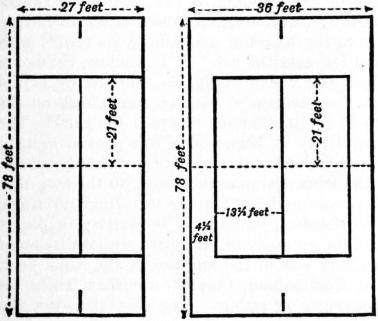
Fig. 1. Fig. 2.
The lawn-tennis court for the single-handed game, one player against one (“singles”), is shown in fig. 1, and that for the four-handed game (“doubles”) in fig. 2. The net stretched across the middle of the court is attached to the tops of two posts which stand 3 ft. outside the court on each side. The height of the net is 3 ft. 6 in. at the posts and 3 ft. at the centre. The court is bisected longitudinally by the half-court-line, which, however, is marked only between the two service-lines and at the points of junction with the base-lines. The divisions of the court on each side of the half-court-line are called respectively the right-hand and left-hand courts; and the portion of these divisions between the service-lines and the net are the right-hand service-court and left-hand service-court respectively. The balls, which are made of hollow india-rubber, tightly covered with white flannel, are 2½ in. in diameter, and from 17⁄8 to 2 oz. in weight. The racquets (fig. 3), for which there are no regulation dimensions, are broader and lighter than those used in tennis.
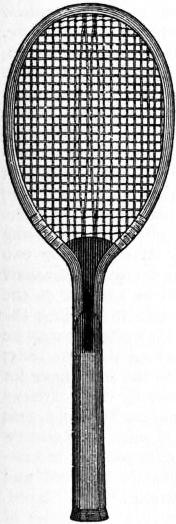
Fig. 3.
Before play begins, a racquet is spun as in tennis, and the winner of the spin elects either to take first service or to take choice of courts. If he takes choice of courts, he and his partner (if the game be doubles) take their position on the selected side of the net, one stationing himself in the right-hand court and the other in the left, which positions are retained throughout the set. If the winner of the spin takes choice of courts, his opponent has first service; and vice versa. The players change sides of the net at the end of the first, third and every subsequent alternate game, and at the end of each set; but they may agree not to change during any set except the last. Service is delivered by each player in turn, who retains it for one game irrespective of the winning or losing of points. In doubles the partner of the server in the first game serves in the third, and the partner of the server in the second game serves in the fourth; the same order being preserved till the end of the set; but each pair of partners decide for themselves before their first turn of service which of the two shall serve first. The server delivers the service from the right- and left-hand courts alternately, beginning in each of his service games from the right-hand court, even though odds be given or owed; he must stand behind (i.e. farther from the net than) the base-line, and must serve the ball so that it drops in the opponent’s service-court diagonally opposite to the court served from, or upon one of the lines enclosing that service-court. If in a serve, otherwise good, the ball touches the net, it is a “let” whether the serve be “taken” or not by striker-out; a “let” does not annul a previous “fault.” (For the meaning of “let,” “rest,” “striker-out” and other technical terms used in the game, see Tennis and Racquets.) The serve is a fault (1) if it be not delivered by the server from the proper court, and from behind the base-line; (2) if the ball drops into the net or out-of-court, or into any part of the court other than the proper service-court. The striker-out cannot, as in racquets, “take,” and thereby condone, a fault. When a fault has been served, the server must serve again from the same court, unless it was a fault because served from the wrong court, in which case the server crosses to the proper court before serving again. Two consecutive faults score a point against the side of the server. Lawn-tennis differs from tennis and racquets in that the service may not be taken on the volley by striker-out. After the serve has been returned the play proceeds until the “rest” (or “rally”) ends by one side or the other failing to make a “good return”; a good return in lawn-tennis meaning a stroke by which the ball, having been hit with the racquet before its second bound, is sent over the net, even if it touches the net, so as to fall within the limits of the court on the opposite side. A point is scored by the player, or side, whose opponent fails to return the serve or to make a good return in the rest. A player also loses a point if the ball when in play touches him or his partner, or their clothes; or if he or his racquet touches the net or any of its supports while the ball is in play; or if he leaps over the net to avoid touching it; or if he volley the ball before it has passed the net.
For him who would excel in lawn-tennis a strong fast service is hardly less necessary than a heavily “cut” service to the tennis player and the racquet player. High overhand service, by which alone any great pace can be obtained, was first perfected by the brothers Renshaw between 1880 and 1890, and is now universal even among players far below the first rank. The service in vogue among the best players in America, and from this circumstance known as the “American service,” has less pace than the English but is “cut” in such a way that it swerves in the air and “drags” off the ground, the advantage being that it gives the server more time to “run in” after his serve, so as to volley his opponent’s return from a position within a yard or two of the net. Both in singles and doubles the best players often make it their aim to get up comparatively near the net as soon as possible, whether they are serving or receiving the serve, the object being to volley the ball whenever possible before it begins to fall. The server’s partner, in doubles, stands about a yard and a half from the net, and rather nearer the side-line than the half-court-line; the receiver of the service, not being allowed to volley the serve, must take his stand according to the nature of the service, which, if very fast, will require him to stand outside the base-line; the receiver’s partner usually stands between the net and the service-line. All four players, if the rest lasts beyond a stroke or two, are generally found nearer to the net than the service-lines; and the game, assuming the players to be of the championship class, consists chiefly of rapid low volleying, varied by attempts on one side or the other to place the ball out of the opponents’ reach by “lobbing” it over their heads into the back part of the court. Good “lobbing” demands great skill, to avoid on the one hand sending the ball out of court beyond the base-line, and on the other allowing it to drop short enough for the adversary to kill it with a “smashing” volley. Of “lobbing” it has been laid down by the brothers Doherty that “the higher it is the better, so long as the length is good”; and as regards returning lobs the same authorities say, “you must get them if you can before they drop, for it is usually fatal to let them drop when playing against a good pair.” The reason for this is that if the lob be allowed to drop before being returned, so much time is given to the striker of it to gain position that he is almost certain to be able to kill the return, unless the lob be returned by an equally good and very high lob, dropping within a foot or so of the base-line in the opposite court, a stroke that requires the utmost accuracy of strength to accomplish safely. The game in the hands of first-class players consists largely in manœuvring for favourable position in the court while driving the opponent into a less favourable position on his side of the net; the player who gains the advantage of position in this way being generally able to finish the rest by a smashing volley impossible to return. Ability to play this “smash” stroke is essential to strong lawn-tennis. “To be good overhead,” say the Dohertys, “is the sign of a first-class player, even if a few have managed to get on without it.” The smash stroke is played very much in the same way as the overhand service, except that it is not from a defined position of known distance from the net; and therefore when making it the player must realize almost instinctively what his precise position is in relation to the net and the side-lines, for it is of the last importance that he should not take his eye off the ball “even for the hundredth part of a second.” By drawing the racquet across the ball at the moment of impact spin may be imparted to it as in tennis, or as “side” is imparted to a billiard ball, and the direction of this spin and the consequent behaviour of the ball after the stroke may be greatly varied by a skilful player. Perhaps the most generally useful form of spin, though by no means the only one commonly used, is that known as “top” or “lift,” a vertical rotatory motion of the ball in the same direction as its flight, which is imparted to it by an upward draw of the racquet at the moment of making the stroke, and the effect of which is to make it drop more suddenly than it would ordinarily do, and in an unexpected curve. A drive made with plenty of “top” can be hit much harder than would otherwise be possible without sending the ball out of court, and it is therefore extensively employed by the best players. While the volleying game is almost universally the practice of first-class players—A. W. Gore, M. J. G. Ritchie and S. H. Smith being almost alone among those of championship rank in modern days to use the volley comparatively little—its difficulty places it beyond the reach of the less skilful. In lawn-tennis as played at the ordinary country house or local club the real “smash” of a Renshaw or a Doherty is seldom to be seen, and the high lob is almost equally rare. Players of moderate calibre are content to take the ball on the bound and to return it with some pace along the side-lines or across the court, with the aim of placing it as artfully as possible beyond the reach of the adversary; and if now and again they venture to imitate a stroke employed with killing effect at Wimbledon, they think themselves fortunate if they occasionally succeed in making it without disaster to themselves.
Before 1890 the method of handicapping at lawn-tennis was the same as in tennis so far as it was applicable to a game played in an open court. In 1890 bisques were abolished, and in 1894 an elaborate system was introduced by which fractional parts of “fifteen” could be conceded by way of handicap, in accordance with tables inserted in the laws of the game. The system is a development of the tennis handicapping by which a finer graduation of odds may be given. “One-sixth of fifteen” is one stroke given in every six games of a set; and similarly two-sixths, three-sixths, four-sixths and five-sixths of fifteen, are respectively two, three, four and five strokes given in every six games of a set; the particular game in the set in which the stroke in each case must be given being specified in the tables.
History.—Lawn-tennis cannot be said to have existed prior to the year 1874. It is, indeed, true that outdoor games based on tennis were from time to time improvised by lovers of that game who found themselves out of reach of a tennis-court. Lord Arthur Hervey, sometime bishop of Bath and Wells, had thus devised a game which he and his friends played on the lawn of his rectory in Suffolk; and even so early as the end of the 18th century “field tennis” was mentioned by the Sporting Magazine as a game that rivalled the popularity of cricket. But, however much or little this game may have resembled lawn-tennis, it had long ceased to exist; and even to be remembered, when in 1874 Major Wingfield took out a patent for a game called Sphairistike, which the specification described as “a new and improved portable court for playing the ancient game of tennis.” The court for this game was wider at the base-lines than at the net, giving the whole court the shape of an hour-glass; one side of the net only was divided into service-courts, service being always delivered from a fixed mark in the centre of the opposite court; and from the net-posts side-nets were fixed which tapered down to the ground at about the middle of the side-lines, thus enclosing nearly half the courts on each side of the net. The possibilities of Sphairistike were quickly perceived; and under the new name of lawn-tennis its popularity grew so quickly that in 1875 a meeting of those interested in the game was held at Lord’s cricket-ground, where a committee of the Marylebone Club (M.C.C.) was appointed to draw up a code of rules. The hour-glass shape of the court was retained by this code (issued in May 1875), and the scoring of the game followed in the main the racquets instead of the tennis model. It was at the suggestion of J. M. Heathcote, the amateur tennis champion, that balls covered with white flannel were substituted for the uncovered balls used at first. In 1875, through the influence of Henry Jones (“Cavendish”), lawn-tennis was included in the programme of the All England Croquet Club, which in 1877 became the All England Croquet and Lawn-Tennis Club, on whose ground at Wimbledon the All England championships have been annually played since that date. In the same year, in anticipation of the first championship meeting, the club appointed a committee consisting of Henry Jones, Julian Marshall and C. G. Heathcote to revise the M.C.C. code of rules; the result of their labours being the introduction of the tennis in place of the racquets scoring, the substitution of a rectangular for the “hour-glass” court, and the enactment of the modern rule as regards the “fault.” The height of the net, which under the M.C.C. rules had been 4 ft. in the centre, was reduced to 3 ft. 3 in.; and regulations as to the size and weight of the ball were also made. Some controversy had already taken place in the columns of the Field as to whether volleying the ball, at all events within a certain distance of the net, should not be prohibited. Spencer Gore, the first to win the championship in 1877, used the volley with great skill and judgment, and in principle anticipated the tactics afterwards brought to perfection by the Renshaws, which aimed at forcing the adversary back to the base-line and killing his return with a volley from a position near the net. P. F. Hadow, champion in 1878, showed how the volley might be defeated by skilful use of the lob; but the question of placing some check on the volley continued to be agitated among lovers of the game. The rapidly growing popularity of lawn-tennis was proved in 1879 by the inauguration at Oxford of the four-handed championship, and at Dublin of the Irish championship, and by the fact that there were forty-five competitors for the All England single championship at Wimbledon, won by J. T. Hartley, a player who chiefly relied on the accuracy of his return without frequent resort to the volley. It was in the autumn of the same year, in a tournament at Cheltenham, that W. Renshaw made his first successful appearance in public. The year 1880 saw the foundation of the Northern Lawn-Tennis Association, whose tournaments have long been regarded as inferior in importance only to the championship meetings at Wimbledon and Dublin, and a revision of the rules which substantially made them what they have ever since remained. This year is also memorable for the first championship doubles won by the twin brothers William and Ernest Renshaw, a success which the former followed up by winning the Irish championship, beating among others H. F. Lawford for the first time.
The Renshaws had already developed the volleying game at the net, and had shown what could be done with the “smash” stroke (which became known by their name as the “Renshaw smash”), but their service had not as yet become very severe. In 1881 the distinctive features of their style were more marked, and the brothers first established firmly the supremacy which they maintained almost without interruption for the next eight years. In the doubles they discarded the older tactics of one partner standing back and the other near the net; the two Renshaws stood about the same level, just inside the service-line, and from there volleyed with relentless severity and with an accuracy never before equalled, and seldom if ever since; while their service also acquired an immense increase of pace. Their chief rival, and the leading exponent of the non-volleying game for several years, was H. F. Lawford. After a year or two it became evident that neither the volleying tactics of Renshaw nor the strong back play of Lawford would be adopted to the exclusion of the other, and both players began to combine the two styles. Thus the permanent features of lawn-tennis may be said to have been firmly established by about the year 1885; and the players who have since then come to the front have for the most part followed the principles laid down by the Renshaws and Lawford. One of the greatest performances at lawn-tennis was in the championship competition in 1886 when W. Renshaw beat Lawford a love set in 9½ minutes. The longest rest in first-class lawn-tennis occurred in a match between Lawford and E. Lubbock in 1880, when eighty-one strokes were played. Among players in the first class who were contemporaries of the Renshaws, mention should be made of E. de S. Browne, a powerful imitator of the Renshaw style; C. W. Grinstead, R. T. Richardson, V. Goold (who played under the nom de plume “St Leger”), J. T. Hartley, E. W. Lewis, E. L. Williams, H. Grove and W. J. Hamilton; while among the most prominent lady players of the period were Miss M. Langrishe, Miss Bradley, Miss Maud Watson, Miss L. Dod, Miss Martin and Miss Bingley (afterwards Mrs Hillyard). In 1888 the Lawn-Tennis Association was established; and the All England Mixed Doubles Championship (four-handed matches for ladies and gentlemen in partnership) was added to the existing annual competitions. Since 1881 lawn-tennis matches between Oxford and Cambridge universities have been played annually; and almost every county in England, besides Scotland, Wales and districts such as “Midland Counties,” “South of England,” &c., have their own championship meetings. Tournaments are also played in winter at Nice, Monte Carlo and other Mediterranean resorts where most of the competitors are English visitors.
The results of the All England championships have been as follows:—
Year. Gentlemen’s Singles. Year. Gentlemen’s Singles.
1877 S. W. Gore 1894 J. Pim
1878 P. F. Hadow 1895 W. Baddeley
1879 J. T. Hartley 1896 H. S. Mahony
1880 J. T. Hartley 1897 R. F. Doherty
1881 W. Renshaw 1898 R. F. Doherty
1882 W. Renshaw 1899 R. F. Doherty
1883 W. Renshaw 1900 R. F. Doherty
1884 W. Renshaw 1901 A. W. Gore
1885 W. Renshaw 1902 H. L. Doherty
1886 W. Renshaw 1903 H. L. Doherty
1887 H. F. Lawford 1904 H. L. Doherty
1888 E. Renshaw 1905 H. L. Doherty
1889 W. Renshaw 1906 H. L. Doherty
1890 W. J. Hamilton 1907 N. E. Brookes
1891 W. Baddeley 1908 A. W. Gore
1892 W. Baddeley 1909 A. W. Gore
1893 J. Pim 1910 A. F. Wilding
Year. Gentlemen’s Doubles.
1879 L. R. Erskine and H. F. Lawford
1880 W. Renshaw ” E. Renshaw
1881 W. Renshaw ” E. Renshaw
1882 J. T. Hartley ” R. T. Richardson
1883 C. W. Grinstead ” C. E. Welldon
1884 W. Renshaw ” E. Renshaw
1885 W. Renshaw ” E. Renshaw
1886 W. Renshaw ” E. Renshaw
1887 P. B. Lyon ” H. W. W. Wilberforce
1888 W. Renshaw ” E. Renshaw
1889 W. Renshaw ” E. Renshaw
1890 J. Pim ” F. O. Stoker
1891 W. Baddeley ” H. Baddeley
1892 H. S. Barlow ” E. W. Lewis
1893 J. Pim ” F. O. Stoker
1894 W. Baddeley ” H. Baddeley
1895 W. Baddeley ” H. Baddeley
1896 W. Baddeley ” H. Baddeley
1897 R. F. Doherty ” H. L. Doherty
1898 R. F. Doherty ” H. L. Doherty
1899 R. F. Doherty ” H. L. Doherty
1900 R. F. Doherty ” H. L. Doherty
1901 R. F. Doherty ” H. L. Doherty
1902 S. H. Smith ” F. L. Riseley
1903 R. F. Doherty ” H. L. Doherty
1904 R. F. Doherty ” H. L. Doherty
1905 R. F. Doherty ” H. L. Doherty
1906 S. H. Smith ” F. L. Riseley
1907 N. E. Brookes ” A. F. Wilding
1908 M. J. G. Ritchie ” A. F. Wilding
1909 A. W. Gore ” H. Roper Barrett
1910 M. J. G. Ritchie ” A. F. Wilding
Year. Ladies’ Singles. Year. Ladies’ Singles.
1884 Miss M. Watson 1898 Miss C. Cooper
1885 Miss M. Watson 1899 Mrs Hillyard
1886 Miss Bingley 1900 Mrs Hillyard
1887 Miss Dod 1901 Mrs Sterry (Miss C. Cooper)
1888 Miss Dod 1902 Miss M. E. Robb
1889 Mrs Hillyard (Miss Bingley) 1903 Miss D. K. Douglass
1890 Miss Rice 1904 Miss D. K. Douglass
1891 Miss Dod 1905 Miss M. Sutton
1892 Miss Dod 1906 Miss D. K. Douglass
1893 Miss Dod 1907 Miss M. Sutton
1894 Mrs Hillyard 1908 Mrs Sterry
1895 Miss C. Cooper 1909 Miss D. Boothby
1896 Miss C. Cooper 1910 Mrs Lambert Chambers (Miss Douglass)
1897 Mrs Hillyard
Year. Ladies’ and Gentlemen’s Doubles.
1888 E. Renshaw and Mrs Hillyard
1889 J. C. Kay ” Miss Dod
1890 J. Baldwin ” Miss K. Hill
1891 J. C. Kay ” Miss Jackson
1892 A. Dod ” Miss Dod
1893 W. Baddeley ” Mrs Hillyard.
1894 H. S. Mahony ” Miss C. Cooper
1895 H. S. Mahony ” Miss C. Cooper
1896 H. S. Mahony ” Miss C. Cooper
1897 H. S. Mahony ” Miss C. Cooper
1898 H. S. Mahony ” Miss C. Cooper
1899 C. H. L. Cazelet ” Miss Robb
1900 H. L. Doherty ” Miss C. Cooper
1901 S. H. Smith ” Miss Martin
1902 S. H. Smith ” Miss Martin
1903 F. L. Riseley ” Miss D. K. Douglass
1904 S. H. Smith ” Miss E. W. Thompson
1905 S. H. Smith ” Miss E. W. Thompson
1906 F. L. Riseley ” Miss D. K. Douglass
1907 N. E. Brookes ” Mrs Hillyard
1908 A. F. Wilding ” Mrs Lambert Chambers (Miss D. K. Douglass)
1909 H. Roper Barrett ” Miss Morton
1910 S. N. Doust ” Mrs Lambert Chambers
In the United States lawn-tennis was played at Nahant, near Boston, within a year of its invention in England, Dr James Dwight and the brothers F. R. and R. D. Sears being mainly instrumental in making it known to their countrymen. In 1881 at a meeting in New York of representatives of thirty-three clubs the United States National Lawn-Tennis Association was formed; and the adoption of the English rules put an end to the absence of uniformity in the size of the ball and height of the net which had hindered the progress of the game. The association decided to hold matches for championship of the United States at Newport, Rhode Island; and, by a curious coincidence, in the same year in which W. Renshaw first won the English championship, R. D. Sears won the first American championship by playing a volleying game at the net which entirely disconcerted his opponents, and he successfully defended his title for the next six years, winning the doubles throughout the same period in partnership with Dwight. In 1887, Sears being unable to play through ill-health, the championship went to H. W. Slocum. Other prominent players of the period were the brothers C. M. and J. S. Clark, who in 1883 came to England and were decisively beaten at Wimbledon by the two Renshaws. To a later generation belong the strongest single players, M. D. Whitman, Holcombe Ward, W. A. Larned and Karl Behr. Holcombe Ward and Dwight Davis, who have the credit of introducing the peculiar “American twist service,” were an exceedingly strong pair in doubles; but after winning the American doubles championship for three years in succession, they were defeated in 1902 by the English brothers R. F. and H. L. Doherty. The championship singles in 1904 and 1905 was won by H. Ward and B. C. Wright, the latter being one of the finest players America has produced; and these two in partnership won the doubles for three years in succession, until they were displaced by F. B. Alexander and H. H. Hackett, who in their turn held the doubles championship for a like period. In 1909 two young Californians, Long and McLoughlin, unexpectedly came to the front, and, although beaten in the final round for the championship doubles, they represented the United States in the contest for the Davis cup (see below) in Australia in that year; McLoughlin having acquired a service of extraordinary power and a smashing stroke with a reverse spin which was sufficient by itself to place him in the highest rank of lawn-tennis players.
Winners of United States Championships.
Year. Gentlemen’s Singles. Year. Gentlemen’s Singles.
1881 R. D. Sears 1896 R. D. Wrenn
1882 R. D. Sears 1897 R. D. Wrenn
1883 R. D. Sears 1898 M. D. Whitman
1884 R. D. Sears 1899 M. D. Whitman
1885 R. D. Sears 1900 M. D. Whitman
1886 R. D. Sears 1901 W. A. Larned
1887 R. D. Sears 1902 W. A. Larned
1888 H. W. Slocum 1903 H. L. Doherty
1889 H. W. Slocum 1904 H. Ward
1890 O. S. Campbell 1905 B. C. Wright
1891 O. S. Campbell 1906 W. J. Clothier
1892 O. S. Campbell 1907 W. A. Larned
1893 R. D. Wrenn 1908 W. A. Larned
1894 R. D. Wrenn 1909 W. A. Larned
1895 F. H. Hovey 1910 W. A. Larned
Year. Gentlemen’s Doubles.
1882 J. Dwight and R. D. Sears
1883 J. Dwight ” R. D. Sears
1884 J. Dwight ” R. D. Sears
1885 J. S. Clark ” R. D. Sears
1886 J. Dwight ” R. D. Sears
1887 J. Dwight ” R. D. Sears
1888 V. G. Hall ” O. S. Campbell
1889 H. W. Slocum ” H. A. Taylor
1890 V. G. Hall ” C. Hobart
1891 O. S. Campbell ” R. P. Huntingdon
1892 O. S. Campbell ” R. P. Huntingdon
1893 C. Hobart ” F. H. Hovey
1894 C. Hobart ” F. H. Hovey
1895 R. D. Wrenn ” M. G. Chase
1896 C. B. Neel ” S. R. Neel
1897 L. E. Ware ” G. P. Sheldon
1898 L. E. Ware ” G. P. Sheldon
1899 D. F. Davis ” H. Ward
1900 D. F. Davis ” H. Ward
1901 D. F. Davis ” H. Ward
1902 R. F. Doherty ” H. L. Doherty
1903 R. F. Doherty ” H. L. Doherty
1904 H. Ward ” B. C. Wright
1905 H. Ward ” B. C. Wright
1906 H. Ward ” B. C. Wright
1907 F. B. Alexander ” H. H. Hackett
1908 F. B. Alexander ” H. H. Hackett
1909 F. B. Alexander ” H. H Hackett
1910 F. B. Alexander ” H. H. Hackett
Year. Ladies’ Singles. Year. Ladies’ Singles.
1890 Miss E. C. Roosevelt 1901 Miss Elizabeth H. Moore
1891 Miss Mabel E. Cahill 1902 Miss Marion Jones
1892 Miss Mabel E. Cahill 1903 Miss Elizabeth H. Moore
1893 Miss Aline M. Terry 1904 Miss May Sutton
1894 Miss Helen R. Helwig 1905 Miss Elizabeth H. Moore
1895 Miss J. P. Atkinson 1906 Miss Helen H. Homans
1896 Miss Elizabeth H. Moore 1907 Miss Evelyn Sears
1897 Miss J. P. Atkinson 1908 Mrs Barger Wallach
1898 Miss J. P. Atkinson 1909 Miss Hazel Hotchkiss
1899 Miss Marion Jones 1910 Miss Hazel Hotchkiss
1900 Miss Myrtle McAteer
Year. Ladies’ and Gentlemen’s Doubles.
1894 E. P. Fischer and Miss J. P. Atkinson
1895 E. P. Fischer ” Miss J. P. Atkinson
1896 E. P. Fischer ” Miss J. P. Atkinson
1897 D. L. Magruder ” Miss Laura Henson
1898 E. P. Fischer ” Miss Carrie Neely
1899 A. L. Hoskins ” Miss Edith Rastall
1900 Alfred Codman ” Miss M. Hunnewell
1901 R. D. Little ” Miss Marion Jones
1902 W. C. Grant ” Miss E. H. Moore
1903 Harry Allen ” Miss Chapman
1904 W. C. Grant ” Miss E. H. Moore
1905 Clarence Hobart ” Mrs Clarence Hobart
1906 E. B. Dewhurst ” Miss Coffin
1907 W. F. Johnson ” Miss Sayres
1908 N. W. Niles ” Miss E. Rotch
1909 W. F. Johnson ” Miss H. Hotchkiss
1910 J. R. Carpenter ” Miss H. Hotchkiss
In 1900 an international challenge cup was presented by the American D. F. Davis, to be competed for in the country of the holders. In the summer of that year a British team, consisting of A. W. Gore, E. D. Black and H. R. Barrett, challenged for the cup but were defeated by the Americans, Whitman, Larned, Davis and Ward. In 1902 a more representative British team, the two Dohertys and Pim, were again defeated by the same representatives of the United States; but in the following year the Dohertys brought the Davis cup to England by beating Larned and the brothers Wrenn at Longwood. In 1904 the cup was played for at Wimbledon, when representatives of Belgium, Austria and France entered, but failed to defeat the Dohertys and F. L. Riseley, who represented Great Britain. In 1905 the entries included France, Austria, Australasia, Belgium and the United States; in 1906 the same countries, except Belgium, competed; but in both years the British players withstood the attack. In 1907, however, when the contest was confined to England, the United States and Australasia, the latter was successful in winning the cup, which was then for the first time taken to the colonies, where it was retained in the following year when the Australians N. E. Brookes and A. F. Wilding defeated the representatives of the United States, who had previously beaten the English challengers in America. In 1909 England was not represented in the competition, and the Australians again retained the cup, beating the Americans McLoughlin and Long both in singles and doubles.
See “The Badminton Library,” Tennis: Lawn-Tennis: Racquets: Fives, new and revised edition (1903); R. F. and H. L. Doherty, On Lawn-Tennis (1903); E. H. Miles, Lessons in Lawn-Tennis (1899); E. de Nanteuil, La Paume et le lawn-tennis (1898); J. Dwight, “Form in Lawn-Tennis,” in Scribner’s Magazine, vol. vi.; A. Wallis Myers, The Complete Lawn-Tennis Player (1908).
(R. J. M.)
LAWRENCE (Laurentius, Lorenzo), ST, Christian martyr, whose name appears in the canon of the mass, and whose festival is on the 10th of August. The basilica reared over his tomb at Rome is still visited by pilgrims. His legend is very popular. Deacon of the pope (St) Sixtus (Xystus) II., he was called upon by the judge to bring forth the treasures of the church which had been committed to his keeping. He thereupon produced the church’s poor people. Seeing his bishop, Sixtus, being led to punishment, he cried: “Father! whither goest thou without thy son? Holy priest! whither goest thou without thy deacon?” Sixtus prophesied that Lawrence would follow him in three days. The prophecy was fulfilled, and Lawrence was sentenced to be burnt alive on a gridiron. In the midst of his torments he addressed the judge ironically with the words: Assum est, versa et manduca (“I am roasted enough on this side; turn me round, and eat”). All these details of the well-known legend are already related by St Ambrose (De Offic. i. 41, ii. 28). The punishment of the gridiron and the speech of the martyr are probably a reminiscence of the Phrygian martyrs, as related by Socrates (iii. 15) and Sozomen (v. 11). But the fact of the martyrdom is unquestionable. The date is usually put at the persecution of Valerian in 258.
The cult of St Lawrence has spread throughout Christendom, and there are numerous churches dedicated to him, especially in England, where 228 have been counted. The Escurial was built in honour of St Lawrence by Philip II. of Spain, in memory of the battle of St Quentin, which was won in 1557 on the day of the martyr’s festival. The meteorites which appear annually on or about the 10th of August are popularly known as “the tears of St Lawrence.”
See Acta sanctorum, Augusti ii. 485-532; P. Franchi de’ Cavalieri, S. Lorenzo e il supplicio della graticola (Rome, 1900); Analecta Bollandiana, xix. 452 and 453; Fr. Arnold-Forster, Studies in Church Dedications or England’s Patron Saints, i. 508-515, iii. 18, 389-390 (1899).
(H. De.)
LAWRENCE, AMOS (1786-1852), American merchant and philanthropist, was born in Groton, Massachusetts, U.S.A., on the 22nd of April 1786, a descendant of John Lawrence of Wisset, Suffolk, England, who was one of the first settlers of Groton. Leaving Groton academy (founded by his father, Samuel Lawrence, and others) in 1799, he became a clerk in a country store in Groton, whence after his apprenticeship he went, with $20 in his pocket, to Boston and there set up in business for himself in December 1807. In the next year he took into his employ his brother, Abbott (see below), whom he made his partner in 1814, the firm name being at first A. & A. Lawrence, and afterwards A. & A. Lawrence & Co. In 1831 when his health failed, Amos Lawrence retired from active business, and Abbott Lawrence was thereafter the head of the firm. The firm became the greatest American mercantile house of the day, was successful even in the hard times of 1812-1815, afterwards engaged particularly in selling woollen and cotton goods on commission, and did much for the establishment of the cotton textile industry in New England: in 1830 by coming to the aid of the financially distressed mills of Lowell, Massachusetts, where in that year the Suffolk, Tremont and Lawrence companies were established, and where Luther Lawrence, the eldest brother, represented the firm’s interests; and in 1845-1847 by establishing and building up Lawrence, Massachusetts, named in honour of Abbott Lawrence, who was a director of the Essex company, which controlled the water power of Lawrence, and afterwards was president of the Atlantic Cotton Mills and Pacific Mills there. In 1842 Amos Lawrence decided not to allow his property to increase any further, and in the last eleven years of his life he spent in charity at least $525,000, a large sum in those days. He gave to Williams college, to Bowdoin college, to the Bangor theological seminary, to Wabash college, to Kenyon college and to Groton academy, which was re-named Lawrence academy in honour of the family, and especially in recognition of the gifts of William Lawrence, Amos’s brother; to the Boston children’s infirmary, which he established, and ($10,000) to the Bunker Hill monument fund; and, besides, he gave to many good causes on a smaller scale, taking especial delight in giving books, occasionally from a bundle of books in his sleigh or carriage as he drove. He died in Boston on the 31st of December 1852.
See Extracts from the Diary and Correspondence of the late Amos Lawrence, with a Brief Account of Some Incidents in his Life (Boston, 1856), edited by his son William R. Lawrence.
His brother, Abbott Lawrence (1792-1855), was born in Groton, Massachusetts, on the 16th of December 1792. Besides being a partner in the firm established by his brother, and long its head, he promoted various New England railways, notably the Boston & Albany. He was a Whig representative in Congress in 1835-1837 and in 1839-1840 (resigning in September 1840 because of ill-health); and in 1842 was one of the commissioners for Massachusetts, who with commissioners from Maine and with Daniel Webster, secretary of state and plenipotentiary of the United States, settled with Lord Ashburton, the British plenipotentiary, the question of the north-eastern boundary. In 1842 he was presiding officer in the Massachusetts Whig convention; he broke with President Tyler, tacitly rebuked Daniel Webster for remaining in Tyler’s cabinet after his colleagues had resigned, and recommended Henry Clay and John Davis as the nominees of the Whig party in 1844—an action that aroused Webster to make his famous Faneuil Hall address. In 1848 Lawrence was a prominent candidate for the Whig nomination for the vice-presidency, but was defeated by Webster’s followers. He refused the portfolios of the navy and of the interior in President Taylor’s cabinet, and in 1849-1852 was United States minister to Great Britain, where he was greatly aided by his wealth and his generous hospitality. He was an ardent protectionist, and represented Massachusetts at the Harrisburg convention in 1827. He died in Boston on the 18th of August 1855, leaving as his greatest memorial the Lawrence scientific school of Harvard university, which he had established by a gift of $50,000 in 1847 and to which he bequeathed another $50,000; in 1907-1908 this school was practically abolished as a distinct department of the university. He made large gifts to the Boston public library, and he left $50,000 for the erection of model lodging-houses, thus carrying on the work of an Association for building model lodging-houses for the poor, organized in Boston in 1857.
See Hamilton A. Hill, Memoir of Abbott Lawrence (Boston, 1884). Randolph Anders’ Der Weg zum Glück, oder die Kunst Millionär zu werden (Berlin, 1856) is a pretended translation of moral maxims from a supposititious manuscript bequeathed to Abbott Lawrence by a rich uncle.
LAWRENCE, AMOS ADAMS (1814-1886), American philanthropist, son of Amos Lawrence, was born in Groton, Massachusetts, U.S.A., on the 31st of July 1814. He graduated at Harvard in 1835, went into business in Lowell, and in 1837 established in Boston his own counting-house, which from 1843 to 1858 was the firm of Lawrence & Mason, and which was a selling agent for the Cocheco mills of Dover, New Hampshire, and for other textile factories. Lawrence established a hosiery and knitting mill at Ipswich—the first of importance in the country—and was a director in many large corporations. He was greatly interested in the claims of Eleazer Williams of Green Bay, Wisconsin, and through loans to this “lost dauphin” came into possession of much land in Wisconsin; in 1849 he founded at Appleton, Wisconsin, a school named in his honour Lawrence university (now Lawrence college). He also contributed to funds for the colonization of free negroes in Liberia. In 1854 he became treasurer of the Massachusetts Emigrant Aid Company (reorganized in 1855 as the New England Emigrant Aid Company), which sent 1300 settlers to Kansas, where the city of Lawrence was named in his honour. He contributed personally for the famous Sharp rifles, which, packed as “books” and “primers,” were shipped to Kansas and afterwards came into the hands of John Brown, who had been a protégé of Lawrence. During the contest in Kansas, Lawrence wrote frequently to President Pierce (his mother’s nephew) in behalf of the free-state settlers; and when John Brown was arrested he appealed to the governor of Virginia to secure for him a lawful trial. On Robinson and others in Kansas he repeatedly urged the necessity of offering no armed resistance to the Federal government; and he deplored Brown’s fanaticism. In 1858 and in 1860 he was the Whig candidate for governor of Massachusetts. Till the very outbreak of the Civil War he was a “law and order” man, and he did his best to secure the adoption of the Crittenden compromise; but he took an active part in drilling troops, and in 1862 he raised a battalion of cavalry which became the 2nd Massachusetts Regiment of Cavalry, of which Charles Russell Lowell was colonel. Lawrence was a member of the Protestant Episcopal Church and built (1873-1880) Lawrence hall, Cambridge, for the Episcopal theological school, of which he was treasurer. In 1857-1862 he was treasurer of Harvard college, and in 1879-1885 was an overseer. He died in Nahant, Mass., on the 22nd of August 1886.
See William Lawrence, Life of Amos A. Lawrence, with Extracts from his Diary and Correspondence (Boston, 1888).
His son, William Lawrence (1850- ), graduated in 1871 at Harvard, and in 1875 at the Episcopal theological school, where, after being rector of Grace Church, Lawrence, Mass., in 1876-1884, he was professor of homiletics and natural theology in 1884-1893 and dean in 1888-1893. In 1893 he succeeded Phillips Brooks as Protestant Episcopal bishop of Massachusetts. He wrote A Life of Roger Wolcott, Governor of Massachusetts (1902).
LAWRENCE, GEORGE ALFRED (1827-1876), English novelist, was born at Braxted, Essex, on the 25th of March 1827, and was educated at Rugby and at Balliol college, Oxford. He was called to the bar at the Inner Temple in 1852, but soon abandoned the law for literature. In 1857 he published, anonymously, his first novel, Guy Livingstone, or Thorough. The book achieved a very large sale, and had nine or ten successors of a similar type, the best perhaps being Sword and Gown (1859). Lawrence may be regarded as the originator in English fiction of the beau sabreur type of hero, great in sport and love and war. He died at Edinburgh on the 23rd of September 1876.
LAWRENCE, SIR HENRY MONTGOMERY (1806-1857), British soldier and statesman in India, brother of the 1st Lord Lawrence (q.v.), was born at Matara, Ceylon, on the 28th of June 1806. He inherited his father’s stern devotion to duty and Celtic impulsiveness, tempered by his mother’s gentleness and power of organization. Early in 1823 he joined the Bengal Artillery at the Calcutta suburb of Dum Dum, where also Henry Havelock was stationed about the same time. The two officers pursued a very similar career, and developed the same Puritan character up to the time that both died at Lucknow in 1857. In the first Burmese War Henry Lawrence and his battery formed part of the Chittagong column which General Morrison led over the jungle-covered hills of Arakan, till fever decimated the officers and men, and Lawrence found himself at home again, wasted by a disease which never left him. On his return to India with his younger brother John in 1829 he was appointed revenue surveyor by Lord William Bentinck. At Gorakhpur the wonderful personal influence which radiated from the young officer formed a school of attached friends and subordinates who were always eager to serve under him. After some years spent in camp, during which he had married his cousin Honoria Marshall, and had surveyed every village in four districts, each larger than Yorkshire, he was recalled to a brigade by the outbreak of the first Afghan War towards the close of 1838. As assistant to Sir George Clerk, he now added to his knowledge of the people political experience in the management of the district of Ferozepore; and when disaster came he was sent to Peshawar in order to push up supports for the relief of Sale and the garrison of Jalalabad. The war had been begun under the tripartite treaty signed at Lahore on the 20th of June 1838. But the Sikhs were slow to play their part after the calamities in Afghanistan. No one but Henry Lawrence could manage the disorderly contingent which they reluctantly supplied to Pollock’s avenging army in 1842. He helped to force the Khyber Pass on the 5th of April, playing his guns from the heights, for 8 and 20 m. In recognition of his services Lord Ellenborough appointed him to the charge of the valley of Dehra Dun and its hill stations, Mussoorie and Landour, where he first formed the idea of asylums for the children of European soldiers. After a month’s experience there it was discovered that the appointment, was the legal right of the civil service, and he was transferred, as assistant to the envoy at Lahore, to Umballa, where he reduced to order the lapsed territory of Kaithal. Soon he received the office of resident at the protected court of Nepal, where, assisted by his wife, he began a series of contributions to the Calcutta Review, a selected volume of which forms an Anglo-Indian classic. There, too, he elaborated his plans which resulted in the erection and endowment of the noblest philanthropic establishments in the East—the Lawrence military asylums at Sanawar (on the road to Simla), at Murree in the Punjab, at Mount Abu in Rajputana, and at Lovedale on the Madras Nilgiris. From 1844 to his death he devoted all his income, above a modest pittance for his children, to this and other forms of charity.
The Review articles led the new governor-general, Lord Hardinge, to summon Lawrence to his side during the first Sikh War; and not these articles only. He had published the results of his experience of Sikh rule and soldiering in a vivid work, the Adventures of an Officer in the Service of Ranjit Singh (1845), in which he vainly attempted to disguise his own personality and exploits. After the doubtful triumphs of Moodkee and Ferozshah Lawrence was summoned from Nepal to take the place of Major George Broadfoot, who had fallen. Aliwal came; then the guns of Sobraon chased the demoralized Sikhs across the Sutlej. All through the smoke Lawrence was at the side of the governor-general. He gave his voice, not for the rescue of the people from anarchy by annexation, but for the reconstruction of the Sikh government, and was himself appointed resident at Lahore, with power “over every department and to any extent” as president of the council of regency till the maharaja Dhuleep Singh should come of age. Soon disgusted by the “venal and selfish durbar” who formed his Sikh colleagues, he summoned to his side assistants like Nicholson, James Abbott and Edwardes, till they all did too much for the people, as he regretfully confessed. But “my chief confidence was in my brother John, ... who gave me always such help as only a brother could.” Wearied out he went home with Lord Hardinge, and was made K.C.B., when the second Sikh War summoned him back at the end of 1848 to see the whole edifice of Sikh “reconstruction” collapse. It fell to Lord Dalhousie to proclaim the Punjab up to the Khyber British territory on the 29th of March 1849. But still another compromise was tried. As the best man to reconcile the Sikh chiefs to the inevitable, Henry Lawrence was made president of the new board of administration with charge of the political duties, and his brother John was entrusted with the finances. John could not find the revenue necessary for the rapid civilization of the new province so long as Henry would, for political reasons, insist on granting life pensions and alienating large estates to the needy remnants of Ranjit Singh’s court. Lord Dalhousie delicately but firmly removed Sir Henry Lawrence to the charge of the great nobles of Rajputana, and installed John as chief commissioner. If resentment burned in Henry’s heart, it was not against his younger brother, who would fain have retired. To him he said, “If you preserve the peace of the country and make the people high and low happy, I shall have no regrets that I vacated the field for you.”
In the comparative rest of Rajputana he once more took up the pen as an army reformer. In March and September 1856 he published two articles, called forth by conversations with Lord Dalhousie at Calcutta, whither he had gone as the hero of a public banquet. The governor-general had vainly warned the home authorities against reducing below 40,000 the British garrison of India even for the Crimean War, and had sought to improve the position of the sepoys. Lawrence pointed out the latent causes of mutiny, and uttered warnings to be too soon justified. In March 1857 he yielded to Lord Canning’s request that he should then take the helm at Lucknow, but it was too late. In ten days his magic rule put down administrative difficulties indeed, as he had done at Lahore. But what could even he effect with only 700 European soldiers, when the epidemic spread after the Meerut outbreak of mutiny on the 10th of May? In one week he had completed those preparations which made the defence of the Lucknow residency for ever memorable. Amid the deepening gloom Lord Canning ever wrote home of him as “a tower of strength,” and he was appointed provisional governor-general. On the 30th of May mutiny burst forth in Oudh, and he was ready. On the 29th of June, pressed by fretful colleagues, and wasted by unceasing toil, he led 336 British soldiers with 11 guns and 220 natives out of Chinhat to reconnoitre the insurgents, when the natives joined the enemy and the residency was besieged. On the 2nd of July, as he lay exhausted by the day’s work and the terrific heat in an exposed room, a shell struck him, and in forty-eight hours he was no more. A baronetcy was conferred on his son. A marble statue was placed in St Paul’s as the national memorial of one who has been declared to be the noblest man that has lived and died for the good of India.
His biography was begun by Sir Herbert Edwardes, and completed (2 vols. 1872) by Herman Merivale. See also J. J. McLeod Innes, Sir Henry Lawrence (“Rulers of India” series), 1898.
LAWRENCE, JOHN LAIRD MAIR LAWRENCE, 1st Baron (1811-1879), viceroy and governor-general of India, was born at Richmond, Yorkshire, on the 24th of March 1811. His father, Colonel Alexander Lawrence, volunteered for the forlorn hope at Seringapatam in presence of Baird and of Wellington, whose friend he became. His mother, Letitia Knox, was a collateral descendant of John Knox. To this couple were born twelve children, of whom three became famous in India, Sir George St Patrick, Sir Henry (q.v.) and Lord Lawrence. Irish Protestants, the boys were trained at Foyle college, Derry, and at Clifton, and received Indian appointments from their mother’s cousin, John Hudleston, who had been the friend of Schwartz in Tanjore. In 1829, when only seventeen, John Lawrence landed at Calcutta as a civilian; he mastered the Persian language at the college of Fort William, and was sent to Delhi, on his own application, as assistant to the collector. The position was the most dangerous and difficult to which a Bengal civilian could be appointed at that time. The titular court of the pensioner who represented the Great Mogul was the centre of that disaffection and sensuality which found their opportunity in 1857. A Mussulman rabble filled the city. The district around, stretching from the desert of Rajputana to the Jumna, was slowly recovering from the anarchy to which Lord Lake had given the first blow. When not administering justice in the city courts or under the village tree, John Lawrence was scouring the country after the marauding Meos and Mahommedan freebooters. His keen insight and sleepless energy at once detected the murderer of his official superior, William Fraser, in 1835, in the person of Shams-uddin Khan, the nawab of Loharu, whose father had been raised to the principality by Lake, and the assassin was executed. The first twenty years, from 1829 to 1849, during which John Lawrence acted as the magistrate and land revenue collector of the most turbulent and backward portion of the Indian empire as it then was, formed the period of the reforms of Lord William Bentinck. To what became the lieutenant-governorship of the North-Western (now part of the United) Provinces Lord Wellesley had promised the same permanent settlement of the land-tax which Lord Cornwallis had made with the large landholders or zemindars of Bengal. The court of directors, going to the opposite extreme, had sanctioned leases for only five years, so that agricultural progress was arrested. In 1833 Merttins Bird and James Thomason introduced the system of thirty years’ leases based on a careful survey of every estate by trained civilians, and on the mapping of every village holding by native subordinates. These two revenue officers created a school of enthusiastic economists who rapidly registered and assessed an area as large as that of Great Britain, with a rural population of twenty-three millions. Of that school John Lawrence proved the most ardent and the most renowned. Intermitting his work at Delhi, he became land revenue settlement officer in the district of Etawah, and there began, by buying out or getting rid of the talukdars, to realize the ideal which he did much to create throughout the rest of his career—a country “thickly cultivated by a fat contented yeomanry, each man riding his own horse, sitting under his own fig-tree, and enjoying his rude family comforts.” This and a quiet persistent hostility to the oppression of the people by their chiefs formed the two features of his administrative policy throughout life.
It was fortunate for the British power that, when the first Sikh War broke out, John Lawrence was still collector of Delhi. The critical engagements at Ferozeshah, following Moodkee, and hardly redeemed by Aliwal, left the British army somewhat exhausted at the gate of the Punjab, in front of the Sikh entrenchments on the Sutlej. For the first seven weeks of 1846 there poured into camp, day by day, the supplies and munitions of war which this one man raised and pushed forward, with all the influence acquired during fifteen years of an iron yet sympathetic rule in the land between the Jumna and the Sutlej. The crowning victory of Sobraon was the result, and at thirty-five Lawrence became commissioner of the Jullundur Doab, the fertile belt of hill and dale stretching from the Sutlej north to the Indus. The still youthful civilian did for the newly annexed territory what he had long before accomplished in and around Delhi. He restored it to order, without one regular soldier. By the fascination of his personal influence he organized levies of the Sikhs who had just been defeated, led them now against a chief in the upper hills and now to storm the fort of a raja in the lower, till he so welded the people into a loyal mass that he was ready to repeat the service of 1846 when, three years after, the second Sikh War ended in the conversion of the Punjab up to Peshawar into a British province.
Lord Dalhousie had to devise a government for a warlike population now numbering twenty-three millions, and covering an area little less than that of the United Kingdom. The first results were not hopeful; and it was not till John Lawrence became chief commissioner, and stood alone face to face with the chiefs and people and ring fence of still untamed border tribes, that there became possible the most successful experiment in the art of civilizing turbulent millions which history presents. The province was mapped out into districts, now numbering thirty-two, in addition to thirty-six tributary states, small and great. To each the thirty years’ leases of the north-west settlement were applied, after a patient survey and assessment by skilled officials ever in the saddle or the tent. The revenue was raised on principles so fair to the peasantry that Ranjit Singh’s exactions were reduced by a fourth, while agricultural improvements were encouraged. For the first time in its history since the earliest Aryan settlers had been overwhelmed by successive waves of invaders, the soil of the Punjab came to have a marketable value, which every year of British rule has increased. A stalwart police was organized; roads were cut through every district, and canals were constructed. Commerce followed on increasing cultivation and communications, courts brought justice to every man’s door, and crime hid its head. The adventurous and warlike spirits, Sikh and Mahommedan, found a career in the new force of irregulars directed by the chief commissioner himself, while the Afghan, Dost Mahommed, kept within his own fastnesses, and the long extent of frontier at the foot of the passes was patrolled.
Seven years of such work prepared the lately hostile and always anarchic Punjab under such a pilot as John Lawrence not only to weather the storm of 1857 but to lead the older provinces into port. On the 12th of May the news of the tragedies at Meerut and Delhi reached him at Rawalpindi. The position was critical in the last degree, for of 50,000 native soldiers 38,000 were Hindustanis of the very class that had mutinied elsewhere, and the British troops were few and scattered. For five days the fate of the Punjab hung upon a thread, for the question was, “Could the 12,000 Punjabis be trusted and the 38,000 Hindustanis be disarmed?” Not an hour was lost in beginning the disarming at Lahore; and, as one by one the Hindustani corps succumbed to the epidemic of mutiny, the sepoys were deported or disappeared, or swelled the military rabble in and around the city of Delhi. The remembrance of the ten years’ war which had closed only in 1849, a bountiful harvest, the old love of battle, the offer of good pay, but, above all, the personality of Lawrence and his officers, raised the Punjabi force into a new army of 59,000 men, and induced the non-combatant classes to subscribe to a 6% loan. Delhi was invested, but for three months the rebel city did not fall. Under John Nicholson, Lawrence sent on still more men to the siege, till every available European and faithful native soldier was there, while a movable column swept the country, and the border was kept by an improvised militia. At length, when even in the Punjab confidence became doubt, and doubt distrust, and that was passing into disaffection, John Lawrence was ready to consider whether we should not give up the Peshawar valley to the Afghans as a last resource, and send its garrison to recruit the force around Delhi. Another week and that alternative must have been faced. But on the 20th of September the city and palace of Delhi were again in British hands, and the chief commissioner and his officers united in ascribing “to the Lord our God all the praise due for nerving the hearts of our statesmen and the arms of our soldiers.” As Sir John Lawrence, Bart., G.C.B., with the thanks of parliament, the gratitude of his country, and a life pension of £2000 a year in addition to his ordinary pension of £1000, the “saviour of India” returned home in 1859. After guarding the interests of India and its people as a member of the secretary of state’s council, he was sent out again in 1864 as viceroy and governor-general on the death of Lord Elgin. If no great crisis enabled Lawrence to increase his reputation, his five years’ administration of the whole Indian empire was worthy of the ruler of the Punjab. His foreign policy has become a subject of imperial interest, his name being associated with the “close border” as opposed to the “forward” policy; while his internal administration was remarkable for financial prudence, a jealous regard for the good of the masses of the people and of the British soldiers, and a generous interest in education, especially in its Christian aspects.