VOLUME XVI SLICE III Latin Language to Lefebvre, François-Joseph (continued 3)
Reading edition
The influences which had inspired republican and Augustan literature were the artistic impulse derived from a familiarity with the great works of Greek genius, becoming more intimate with every new generation, the spell of Rome over the imagination of the kindred Italian races, the charm of Italy, and the vivid sensibility of the Italian temperament. These influences were certainly much less operative in the first century of the empire. The imitative impulse, which had much of the character of a creative impulse, and had resulted in the appropriation of the forms of poetry suited to the Roman and Italian character and of the metres suited to the genius of the Latin language, no longer stimulated to artistic effort. The great sources of Greek poetry were no longer regarded, as they were by Lucretius and Virgil, as sacred, untasted springs, to be approached in a spirit of enthusiasm tempered with reverence. We have the testimony of two men of shrewd common sense and masculine understanding—Martial and Juvenal—to the stale and lifeless character of the art of the Silver Age, which sought to reproduce in the form of epics, tragedies and elegies the bright fancies of the Greek mythology.
The idea of Rome, owing to the antagonism between the policy of the government and the sympathies of the class by which literature was favoured and cultivated, could no longer be an inspiring motive, as it had been in the literature of the republic and of the Augustan age. The spirit of Rome appears only as animating the protest of Lucan, the satire of Persius and Juvenal, the sombre picture which Tacitus paints of the annals of the empire. Oratory is no longer an independent voice appealing to sentiments of Roman dignity, but the weapon of the “informers” (delatores), wielded for their own advancement and the destruction of that class which, even in their degeneracy, retained most sympathy with the national traditions. Roman history was no longer a record of national glory, stimulating the patriotism and flattering the pride of all Roman citizens, but a personal eulogy or a personal invective, according as servility to a present or hatred of a recent ruler was the motive which animated it.
The charm of Italian scenes still remained the same, but the fresh and inspiring feeling cf nature gave place to the mere sensuous gratification derived from the luxurious and artificial beauty of the country villa. The idealizing poetry of passion, which found a genuine voice in Catullus and the elegiac poets, could not prolong itself through the exhausting licence of successive generations. The vigorous vitality which gives interest to the personality of Catullus, Propertius and Ovid no longer characterizes their successors. The pathos of natural affection is occasionally recognized in Statius and more rarely in Martial, but it has not the depth of tenderness found in Lucretius and Virgil. The wealth and luxury of successive generations, the monotonous routine of life, the separation of the educated class from the higher work of the world, have produced their enervating and paralysing effect on the mainsprings of poetic and imaginative feeling.
New elements, however, appear in the literature of this period. As the result of the severance from the active interests of life, a new interest is awakened in the inner life of the individual. The immorality of Roman society not New literary elements. only affords abundant material to the satirist, but deepens the consciousness of moral evil in purer and more thoughtful minds. To these causes we attribute the pathological observation of Seneca and Tacitus, the new sense of purity in Persius called out by contrast with the impurity around him, the glowing if somewhat sensational exaggeration of Juvenal, the vivid characterization of Martial. The literature of no time presents so powerfully the contrast between moral good and evil. In this respect it is truly representative of the life of the age. Another new element is the influence of a new race. In the two preceding periods the rapid diffusion of literary culture following the Social War and the first Civil War was seen to awaken into new life the elements of original genius in Italy and Cisalpine Gaul. In the first century of the empire a similar result was produced by the diffusion of that culture in the Latinized districts of Spain. The fervid temperament of a fresh and vigorous race, which received the Latin discipline just as Latium had two or three centuries previously received the Greek discipline, revealed itself in the writings of the Senecas, Lucan, Quintilian, Martial and others, who in their own time added literary distinction to the Spanish towns from which they came. The new extraneous element introduced into Roman literature draws into greater prominence the characteristics of the last great representatives of the genuine Roman and Italian spirit—the historian Tacitus and the satirist Juvenal.
On the whole this century shows, in form, language and substance, the signs of literary decay. But it is still capable of producing men of original force; it still maintains the traditions of a happier time; it is still alive to the value of literary culture, and endeavours by minute attention to style to produce new effects. Though it was not one of the great eras in the annals of literature, yet the century which produced Martial, Juvenal and Tacitus cannot be pronounced barren in literary originality, nor that which produced Seneca and Quintilian devoid of culture and literary taste.
This fourth period is itself subdivided into three divisions: (1) from the accession of Tiberius to the death of Nero, 68—the most important part of it being the Neronian age, 54 to 68; (2) the Flavian era, from the death of Nero to the death of Domitian, 96; (3) the reigns of Nerva and Trajan and part of the reign of Hadrian.
1. For a generation after the death of Augustus no new original literary force appeared. The later poetry of the Augustan age had ended in trifling dilettantism, for the continuance of which the atmosphere of the court Period from Tiberius to Nero. was no longer favourable. The class by which literature was encouraged had become both enervated and terrorized. The most remarkable poetical product of the time is the long-neglected astrological poem of Manilius which was written at the beginning of Tiberius’s reign. Its vigour and originality have had scanty justice done to them owing to the difficulty of the subject-matter and the style, and the corruptions which still disfigure its text. Very different has been the fate of the Fables of Phaedrus. This slight work of a Macedonian freedman, destitute of national significance and representative in its morality only of the spirit of cosmopolitan individualism, owes its vogue to its easy Latinity and popular subject-matter. Of the prose writers C. Velleius Paterculus, the historian, and Valerius Maximus, the collector of anecdotes, are the most important. A. Cornelius Celsus composed a series of technical handbooks, one of which, upon medicine, has survived. Its purity of style and the fact that it was long a standard work entitle it to a mention here. The traditional culture was still, however, maintained, and the age was rich in grammarians and rhetoricians. The new profession of the delator must have given a stimulus to oratory. A high ideal of culture, literary as well as practical, was realized in Germanicus, which seems to have been transmitted to his daughter Agrippina, whose patronage of Seneca had important results in the next generation. The reign of Claudius was a time in which antiquarian learning, grammatical studies, and jurisprudence were cultivated, but no important additions were made to literature. A fresh impulse was given to letters on the accession of Nero, and this was partly due to the theatrical and artistic tastes of the young emperor. Four writers of the Neronian age still possess considerable interest,—L. Annaeus Seneca, M. Annaeus Lucanus, A. Persius Flaccus and Petronius Arbiter. The first three represent the spirit of their age by exhibiting the power of the Stoic philosophy as a moral, political and religious force; the last is the most cynical exponent of the depravity of the time. Seneca (c. 5 B.C.-A.D. 65) is less than Persius a pure Stoic, and more of a moralist and pathological observer of man’s inner life. He makes the commonplaces of a cosmopolitan philosophy interesting by his abundant illustration drawn from the private and social life of his contemporaries. He has knowledge of the world, the suppleness of a courtier, Spanish vivacity, and the ingenium amoenum attributed to him by Tacitus, the fruit of which is sometimes seen in the “honeyed phrases” mentioned by Petronius—pure aspirations combined with inconsistency of purpose—the inconsistency of one who tries to make the best of two worlds, the ideal inner life and the successful real life in the atmosphere of a most corrupt court. The Pharsalia of Lucan (39-65), with Cato as its hero, is essentially a Stoic manifesto of the opposition. It is written with the force and fervour of extreme youth and with the literary ambition of a race as yet new to the discipline of intellectual culture, and is characterized by rhetorical rather than poetical imagination. The six short Satires of Persius (34-62) are the purest product of Stoicism—a Stoicism that had found in a contemporary, Thrasea, a more rational and practical hero than Cato. But no important writer of antiquity has less literary charm than Persius. In avoiding the literary conceits and fopperies which he satirizes he has recourse to the most unnatural contortions of expression. Of hardly greater length are the seven eclogues of T. Calpurnius Siculus, written at the beginning of the reign of Nero, which are not without grace and facility of diction. Of the works of the time that which from a human point of view is perhaps the most detestable in ancient literature has the most genuine literary quality, the fragment of a prose novel—the Satyricon—of Petronius (d. 66). It is most sincere in its representation, least artificial in diction, most penetrating in its satire, most just in its criticism of art and style.
2. A greater sobriety of tone was introduced both into life and literature with the accession of Vespasian. The time was, however, characterized rather by good sense and industry than by original genius. Under Vespasian Age of Domitian. C. Plinius Secundus, or Pliny the elder (compiler of the Natural History, an encyclopaedic treatise, 23-79), is the most important prose writer, and C. Valerius Flaccus Setinus Balbus, author of the Argonautica (d. c. 90), the most important among the writers of poetry. The reign of Domitian, although it silenced the more independent spirits of the time, Tacitus and Juvenal, witnessed more important contributions to Roman literature than any age since the Augustan,—among them the Institutes of Quintilian, the Punic War of Silius Italicus, the epics and the Silvae of Statius, and the Epigrams of Martial. M. Fabius Quintilianus, or Quintilian (c. 35-95), is brought forward by Juvenal as a unique instance of a thoroughly successful man of letters, of one not belonging by birth to the rich or official class, who had risen to wealth and honours through literature. He was well adapted to his time by his good sense and sobriety of judgment. His criticism is just and true rather than subtle or ingenious, and has thus stood the test of the judgment of after-times. The poem of Ti. Catius Silius Italicus (25-101) is a proof of the industry and literary ambition of members of the rich official class. Of the epic poets of the Silver Age P. Papinius Statius (c. 45-96) shows the greatest technical skill and the richest pictorial fancy in the execution of detail; but his epics have no true inspiring motive, and, although the recitation of the Thebaid could attract and charm an audience in the days of Juvenal, it really belongs to the class of poems so unsparingly condemned both by him and Martial. In the Silvae, though many of them have little root in the deeper feelings of human nature, we find occasionally more than in any poetry after the Augustan age something of the purer charm and pathos of life. But it is not in the Silvae, nor in the epics and tragedies of the time, nor in the cultivated criticism of Quintilian that the age of Domitian lives for us. It is in the Epigrams of M. Valerius Martialis or Martial (c. 41-104) that we have a true image of the average sensual frivolous life of Rome at the end of the 1st century, seen through a medium of wit and humour, but undistorted by the exaggeration which moral indignation and the love of effect add to the representation of Juvenal. Martial represents his age in his Epigrams, as Horace does his in his Satires and Odes, with more variety and incisive force in his sketches, though with much less poetic charm and serious meaning. We know the daily life, the familiar personages, the outward aspect of Rome in the age of Domitian better than at any other period of Roman history, and this knowledge we owe to Martial.
3. But it was under Nerva and Trajan that the greatest and most truly representative works of the empire were written. The Annals and Histories of Cornelius Tacitus (54-119), with the supplementary Life of Agricola and the Period of Nerva, Trajan and Hadrian. Germania, and the Satires of D. Iunius Iuvenalis or Juvenal (c. 47-130), sum up for posterity the moral experience of the Roman world from the accession of Tiberius to the death of Domitian. The generous scorn and pathos of the historian acting on extraordinary gifts of imaginative insight and characterization, and the fierce indignation of the satirist finding its vent in exaggerating realism, doubtless to some extent warped their impressions; nevertheless their works are the last voices expressive of the freedom and manly virtue of the ancient world. In them alone among the writers of the empire the spirit of the Roman republic seems to revive. The Letters of C. Plinius Caecilius Secundus or Pliny the Younger (61-c. 115), though they do not contradict the representation of Tacitus and Juvenal regarded as an exposure of the political degradation and moral corruption of prominent individuals and classes, do much to modify the pervadingly tragic and sombre character of their representation.
With the death of Juvenal, the most important part of whose activity falls in the reign of Trajan, Latin literature as an original and national expression of the experience, character, and sentiment of the Roman state and empire, and as one of the great literatures of the world, may be considered closed.
Later Writers.
What remains to describe is little but death and decay. Poetry died first; the paucity of writings in verse is matched by their insignificance. For two centuries after Juvenal there are no names but those of Q. Serenus Sammonicus, with his pharmacopoeia in verse (c. 225), and M. Aurelius Olympius Nemesianus, who wrote a few feeble eclogues and (283) a dull piece on the training of dogs for the chase. Towards the middle of the 4th century we have Decimus Magnus Ausonius, a professor of Bordeaux and afterwards consul (379), whose style is as little like that of classical poetry as is his prosody. His Mosella, a detailed description of the river Moselle, is the least unattractive of his works. A little better is his contemporary, Rufius Festus Avienus, who made some free translations of astronomical and geographical poems in Greek. A generation later, in what might be called the expiring effort of Latin poetry, appeared two writers of much greater merit. The first is Claudius Claudianus (c. 400), a native of Alexandria and the court poet of the emperor Honorius and his minister Stilicho. Claudian Claudian. may be properly styled the last of the poets of Rome. He breathes the old national spirit, and his mastery of classical idiom and versification is for his age extraordinary. Something of the same may be seen in Rutilius Namatianus, a Gaul by birth, who wrote in 416 a description of his voyage from the capital to his native land, which contains the most glowing eulogy of Rome ever penned by an ancient hand. Of the Christian “poets” only Aurelius Prudentius Clemens (c. 348-410) need be mentioned. He was well read in the ancient literature; but the task of embodying the Christian spirit in the classical form was one far beyond his powers.
The vitality of the prose literature was not much greater though its complete extinction was from the nature of the case impossible. The most important writer in the age succeeding Juvenal was the biographer C. Suetonius Tranquillus Suetonius. (c. 75-160), whose work is more valuable for its matter than its manner. His style is simple and direct, but has hardly any other merit. A little later the rise of M. Cornelius Fronto (c. 100-175), a native of Cirta, marks the beginning of an African influence. Fronto, a distinguished orator and intimate friend of the emperor M. Aurelius, broke away from the traditional Latin of the Silver and Golden ages, and took as his models the pre-classical authors. The reaction was short-lived; but the same affectation of antiquity is seen in the writings of Apuleius, also an African, who lived a little later than Fronto and was a man of much greater natural parts. In his Metamorphoses, Apuleius. which were based upon a Greek original, he takes the wonderful story of the adventures of Lucius of Madaura, and interweaves the famous legend of Cupid and Psyche. His bizarre and mystical style has a strange fascination for the reader; but there is nothing Roman or Italian about it. Two epitomists of previous histories may be mentioned: Justinus (of uncertain date) who abridged the history of Pompeius Trogus, an Augustan writer; and P. Annius Florus, who wrote in the reign of Hadrian a rhetorical sketch based upon Livy. The Historia Augusta, which includes the lives of the emperors from Hadrian to Numerianus (117-284), is the work of six writers, four of whom wrote under Diocletian and two under Constantine. It is a collection of personal memoirs of little historical importance, and marked by puerility and poverty of style. Ammianus Marcellinus (c. 330-400) had a higher conception of the historian’s function. His narrative of the years 353-378 (all that now remains) is honest and straightforward, but his diction is awkward and obscure. The last pagan prose writer who need be mentioned is Q. Aurelius Symmachus (c. 350-410), the author of some speeches and a collection of letters. All the art of his ornate and courtly periods cannot disguise the fact that there was nothing now for paganism to say.
It is in Christian writers alone that we find the vigour of life. The earliest work of Christian apologetics is the Octavius or Minucius Felix, a contemporary of Fronto. It is written in pure Latin and is strongly tinged by classical Christian writers. influences. Quite different is the work of “the fierce Tertullian,” Q. Septimius Florens Tertullianus (c. 150-230), a native of Carthage, the most vigorous of the Latin champions of the new faith. His style shows the African revolt of which we have already spoken, and in its medley of archaisms, Graecisms and Hebraisms reveals the strength of the disintegrating forces at work upon the Latin language. A more commanding figure is that of Aurelius Augustinus or St Augustine (354-430), bishop of Hippo, who for comprehensiveness and dialectical power stands out in the same way as Hieronymus or St Jerome (c. 331 or 340-420), a native of Stridon in Dalmatia, does for many-sided learning and scholarship.
The decline of literature proper was attended by an increased output of grammatical and critical studies. From the time of L. Aelius Stilo Praeconinus, who was the teacher of Varro and Cicero, much interest had been taken in Grammarians. literary and linguistic problems at Rome. Varro under the republic, and M. Verrius Flaccus in the Augustan age, had busied themselves with lexicography and etymology. The grammarian M. Valerius Probus (c. A.D. 60) was the first critical editor of Latin texts. In the next century we have Velius Longus’s treatise De Orthographia, and then a much more important work, the Noctes Atticae of Aulus Gellius, and (c. 200) a treatise in verse by Terentianus, an African, upon Latin pronunciation, prosody and metre. Somewhat later are the commentators on Terence and Horace, Helenius Acro and Pomponius Porphyrio. The tradition was continued in the 4th century by Nonius Marcellus and C. Marius Victorinus, both Africans; Aelius Donatus, the grammarian and commentator on Terence and Virgil, Flavius Sosipater Charisius and Diomedes, and Servius, the author of a valuable commentary on Virgil. Ambrosius Macrobius Theodosius (c. 400) wrote a treatise on Cicero’s Somnium Scipionis and seven books of miscellanies (Saturnalia); and Martianus Capella (c. 430), a native of Africa, published a compendium of the seven liberal arts, written in a mixture of prose and verse, with some literary pretensions. The last grammarian who need be named is the most widely known of all, the celebrated Priscianus, who published his text-book at Constantinople probably in the middle of the 5th century.
In jurisprudence, which may be regarded as one of the outlying regions of literature, Roman genius had had some of its greatest triumphs, and, if we take account of the “codes,” was active to the end. The most distinguished of the early jurists (whose Jurists. works are lost) were Q. Mucius Scaevola, who died in 82 B.C., and following him Ser. Sulpicius Rufus, who died in 43 B.C. In the Augustan age M. Antistius Labeo and C. Ateius Capito headed two opposing schools in jurisprudence, Labeo being an advocate of method and reform, and Capito being a conservative and empiricist. The strife, which reflects the controversy between the “analogists” and the “anomalists” in philology, continued long after their death. Salvius Julianus was entrusted by Hadrian with the task of reducing into shape the immense mass of law which had grown up in the edicts of successive praetors—thus taking the first step towards a code. Sex. Pomponius, a contemporary, wrote an important legal manual of which fragments are preserved. The most celebrated handbook, however, is the Institutiones of Gaius, who lived under Antonius Pius—a model of what such treatises should be. The most eminent of all the Roman jurists was Aemilius Papinianus, the intimate friend of Septimius Severus; of his works only fragments remain. Other considerable writers were the prolific Domitius Ulpianus (c. 215) and Julius Paulus, his contemporary. The last juristical writer of note was Herennius Modestinus (c. 240). But though the line of great lawyers had ceased, the effects of their work remained and are clearly visible long after in the “codes”—the code of Theodosius (438) and the still more famous code of Justinian (529 and 533), with which is associated the name of Tribonianus.
Bibliography.—The most full and satisfactory modern account of Latin literature is M. Schanz’s Geschichte der römischen Litteratur. The best in English is the translation by C. C. Warr of W. S. Teuffel and L. Schwabe’s History of Roman Literature. J. W. Mackail’s short History of Latin Literature is full of excellent literary and aesthetic criticisms on the writers. C. Lamarre’s Histoire de la littérature latine (1901, with specimens) only deals with the writers of the republic. W. Y. Sellar’s Roman Poets of the Republic and Poets of the Augustan Age, and R. Y. Tyrrell’s Lectures on Latin Poetry, will also be found of service. A concise account of the various Latin writers and their works, together with bibliographies, is given in J. E. B. Mayor’s Bibliographical Clue to Latin Literature (1879), which is based on a German work by E. Hübner. See also the separate bibliographies to the articles on individual writers.
(W. Y. S.; J. P. P.)
1 Latine loqui elegantissime.

LATINUS, in Roman legend, king of the aborigines in Latium, and eponymous hero of the Latin race. In Hesiod (Theogony, 1013) he is the son of Odysseus and Circe, and ruler of the Tyrsenians; in Virgil, the son of Faunus and the nymph Marica, a national genealogy being substituted for the Hesiodic, which probably originated from a Greek source. Latinus was a shadowy personality, invented to explain the origin of Rome and its relations with Latium, and only obtained importance in later times through his legendary connexion with Aeneas and the foundation of Rome. According to Virgil (Aeneid, vii.-xii.), Aeneas, on landing at the mouth of the Tiber, was welcomed by Latinus, the peaceful ruler whose seat of government was Laurentum, and ultimately married his daughter Lavinia.
Other accounts of Latinus, differing considerably in detail, are to be found in the fragments of Cato’s Origines (in Servius’s commentary on Virgil) and in Dionysius of Halicarnassus; see further authorities in the article by J. A. Hild, in Daremberg and Saglio, Dictionnaire des antiquités.
LATITUDE (Lat. latitudo, latus, broad), a word meaning breadth or width, hence, figuratively, freedom from restriction, but more generally used in the geographical and astronomical sense here treated. The latitude of a point on the earth’s surface is its angular distance from the equator, measured on the curved surface of the earth. The direct measure of this distance being impracticable, it has to be determined by astronomical observations. As thus determined it is the angle between the direction of the plumb-line at the place and the plane of the equator. This is identical with the angle between the horizontal planes at the place and at the equator, and also with the elevation of the celestial pole above the horizon (see Astronomy). Latitude thus determined by the plumb-line is termed astronomical. The geocentric latitude of a place is the angle which the line from the earth’s centre to the place makes with the plane of the equator. Geographical latitude, which is used in mapping, is based on the supposition that the earth is an elliptic spheroid of known compression, and is the angle which the normal to this spheroid makes with the equator. It differs from the astronomical latitude only in being corrected for local deviation of the plumb-line.
The latitude of a celestial object is the angle which the line drawn from some fixed point of reference to the object makes with the plane of the ecliptic.
Variability of Terrestrial Latitudes.—The latitude of a point on the earth’s surface, as above defined, is measured from the equator. The latter is defined by the condition that its plane makes a right angle with the earth’s axis of rotation. It follows that if the points in which this axis intersects the earth’s surface, i.e. the poles of the earth, change their positions on the earth’s surface, the position of the equator will also change, and therefore the latitudes of places will change also. About the end of the 19th century research showed that there actually was a very minute but measurable periodic change of this kind. The north and south poles, instead of being fixed points on the earth’s surface, wander round within a circle about 50 ft. in diameter. The result is a variability of terrestrial latitudes generally.
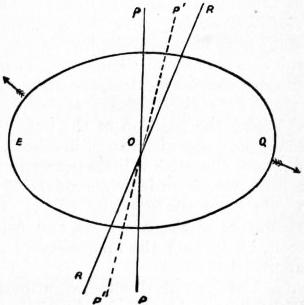
To show the cause of this motion, let BQ represent a section of an oblate spheroid through its shortest axis, PP. We may consider this spheroid to be that of the earth, the ellipticity being greatly exaggerated. If set in rotation around its axis of figure PP, it will continue to rotate around that axis for an indefinite time. But if, instead of rotating around PP, it rotates around some other axis, RR, making a small angle, POR, with the axis of figure PP; then it has been known since the time of Euler that the axis of rotation RR, if referred to the spheroid regarded as fixed, will gradually rotate round the axis of figure PP in a period defined in the following way:—If we put C = the moment of momentum of the spheroid around the axis of figure, and A = the corresponding moment around an axis passing through the equator EQ, then, calling one day the period of rotation of the spheroid, the axis RR will make a revolution around PP in a number of days represented by the fraction C/(C − A). In the case of the earth, this ratio is 1/0.0032813 or 305. It follows that the period in question is 305 days.
Up to 1890 the most careful observations and researches failed to establish the periodicity of such a rotation, though there was strong evidence of a variation of latitude. Then S. C. Chandler, from an elaborate discussion of a great number of observations, showed that there was really a variation of the latitude of the points of observation; but, instead of the period being 305 days, it was about 428 days. At first sight this period seemed to be inconsistent with dynamical theory. But a defect was soon found in the latter, the correction of which reconciled the divergence. In deriving a period of 305 days the earth is regarded as an absolutely rigid body, and no account is taken either of its elasticity or of the mobility of the ocean. A study of the figure will show that the centrifugal force round the axis RR will act on the equatorial protuberance of the rotating earth so as to make it tend in the direction of the arrows. A slight deformation of the earth will thus result; and the axis of figure of the distorted spheroid will no longer be PP, but a line P′P′ between PP and RR. As the latter moves round, P′P′ will continually follow it through the incessant change of figure produced by the change in the direction of the centrifugal force. Now the rate of motion of RR is determined by the actual figure at the moment. It is therefore less than the motion in an absolutely rigid spheroid in the proportion RP′ : RP. It is found that, even though the earth were no more elastic than steel, its yielding combined with the mobility of the ocean would make this ratio about 2 : 3, resulting in an increase of the period by one-half, making it about 457 days. Thus this small flexibility is even greater than that necessary to the reconciliation of observation with theory, and the earth is shown to be more rigid than steel—a conclusion long since announced by Kelvin for other reasons.
Chandler afterwards made an important addition to the subject by showing that the motion was represented by the superposition of two harmonic terms, the first having a period of about 430 days, the other of one year. The result of this superposition is a seven-year period, which makes 6 periods of the 428-day term (428d × 6 = 2568d = 7 years, nearly), and 7 periods of the annual term. Near one phase of this combined period the two component motions nearly annul each other, so that the variation is then small, while at the opposite phase, 3 to 4 years later, the two motions are in the same direction and the range of variation is at its maximum. The coefficient of the 428-day term seems to be between 0.12″ and 0.16″; that of the annual term between 0.06″ and 0.11″. Recent observations give smaller values of both than those made between 1890 and 1900, and there is no reason to suppose either to be constant.
The present state of the theory may be summed up as follows:—
1. The fourteen-month term is an immediate result of the fact that the axes of rotation and figure of the earth do not strictly coincide, but make with each other a small angle of which the mean value is about 0.15″. If the earth remained invariable, without any motion of matter on its surface, the result of this non-coincidence would be the revolution of the one pole round the other in a circle of radius 0.15″, or about 15 ft., in a period of about 429 days. This revolution is called the Eulerian motion, after the mathematician who discovered it. But owing to meteorological causes the motion in question is subject to annual changes. These changes arise from two causes—the one statical, the other dynamical.
2. The statical causes are deposits of snow or ice slowly changing the position of the pole of figure of the earth. For example, a deposit of snow in Siberia would bring the equator of figure of the earth a little nearer to Siberia and throw the pole a little way from it, while a deposit on the American continent would have the opposite effect. Owing to the approximate symmetry of the American and Asiatic continents it does not seem likely that the inequality of snowfall would produce an appreciable effect.
3. The dynamical causes are atmospheric and oceanic currents. Were these currents invariable their only effect would be that the Eulerian motion would not take place exactly round the mean pole of figure, but round a point slightly separated from it. But, as a matter of fact, they are subject to an annual variation. Hence the motion of the pole of rotation is also subject to a similar variation. The annual term in the latitude is thus accounted for.
Besides Chandler, Albrecht of Berlin has investigated the motion of the pole P. The methods of the two astronomers are in some points different. Chandler has constructed empirical formulae representing the motion, with the results already given, while Albrecht has determined the motion of the pole from observation simply, without trying to represent it either by a formula or by theory. It is noteworthy that the difference between Albrecht’s numerical results and Chandler’s formulae is generally less than 0.05″.
When the fluctuation in the position of the pole was fully confirmed, its importance in astronomy and geodesy led the International Geodetic Association to establish a series of stations round the globe, as nearly as possible on the same parallel of latitude, for the purpose of observing the fluctuation with a greater degree of precision than could be attained by the miscellaneous observations before available. The same stars were to be observed from month to month at each station with zenith-telescopes of similar approved construction. This secures a double observation of each component of the polar motion, from which most of the systematic errors are eliminated. The principal stations are: Carloforte, Italy; Mizusawa, Japan; Gaithersburg, Maryland; and Ukiah, California, all nearly on the same parallel of latitude, 39° 8′.
The fluctuations derived from this international work during the last seven years deviate but slightly from Chandler’s formulae though they show a markedly smaller value of the annual term. In consequence, the change in the amplitude of the fluctuation through the seven-year period is not so well marked as before 1900.
Chandler’s investigations are found in a series of papers published in the Astronomical Journal, vols. xi. to xv. and xviii. Newcomb’s explanation of the lengthening of the Eulerian period is found in the Monthly Notices of the Royal Astronomical Society for March 1892. Later volumes of the Astronomical Journal contain discussions of the causes which may produce the annual fluctuation. An elaborate mathematical discussion of the theory is by Vito Volterra: “Sulla teoria dei movimenti del Polo terrestre” in the Astronomische Nachrichten, vol. 138; also, more fully in his memoir “Sur la théorie des variations des latitudes,” Acta Mathematica, vol. xxii. The results of the international observations are discussed from time to time by Albrecht in the publications of the International Geodetic Association, and in the Astronomische Nachrichten (see also Earth, Figure of).
(S. N.)
LATIUM,1 in ancient geography, the name given to the portion of central Italy which was bounded on the N.W. by Etruria, on the S.W. by the Tyrrhenian Sea, on the S.E. by Campania, on the E. by Samnium and on the N.E. by the mountainous district inhabited by the Sabini, Aequi and Marsi. The name was, however, applied very differently at different times. Latium originally means the land of the Latini, and in this sense, which alone is in use historically, it was a tract of limited extent; but after the overthrow of the Latin confederacy, when the neighbouring tribes of the Rutuli, Hernici, Volsci and Aurunci, as well as the Latini properly so called, were reduced to the condition of subjects and citizens of Rome, the name of Latium was extended to comprise them all. It thus denoted the whole country from the Tiber to the mouth of the Savo, and just included the Mons Massicus, though the boundary was not very precisely fixed (see below). The change thus introduced, though already manifest in the composition of the Latin league (see below) was not formally established till the reign of Augustus, who formed of this larger Latium and Campania taken together the first region of Italy; but it is already recognized by Strabo (v. 3. 2. p. 228), as well as by Pliny, who terms the additional territory thus incorporated Latium Adjectum, while he designates the original Latium, extending from the Tiber to Circeii, as Latium Antiquum.
1. Latium Antiquum consisted principally of an extensive plain, now known as the Campagna di Roma, bounded towards the interior by the Apennines, which rise very abruptly from the plains to a height of between 4000 and 5000 ft. Several of the Latin cities, including Tibur and Praeneste, were situated on the terrace-like underfalls of these mountains,2 while Cora, Norba and Setia were placed in like manner on the slopes of the Volscian mountains (Monti Lepini), a rugged and lofty limestone range, which runs parallel to the main mass of the Apennines, being separated from them, however, by the valley of the Trerus (Sacco), and forms a continuous barrier from there to Terracina. No volcanic eruptions are known to have taken place in these mountains within the historic period, though Livy sometimes speaks of it “raining stones in the Alban hills” (i. 31, xxxv. 9—on the latter occasion it even did so on the Aventine). It is asserted, too, that some of the earliest tombs of the necropolis of Alba Longa (q.v.) were found beneath a stratum of peperino. Earthquakes (not of a violent character within recent centuries, though the ruin of the Colosseum is probably to be ascribed to this cause) are not unknown even at the present day in Rome and in the Alban Hills, and a seismograph has been established at Rocca di Papa. The surface is by no means a uniform plain, but is a broad undulating tract, furrowed throughout by numerous depressions, with precipitous banks, serving as water-courses, though rarely traversed by any considerable stream. As the general level of the plain rises gradually, though almost imperceptibly, to the foot of the Apennines, these channels by degrees assume the character of ravines of a formidable description.
Four main periods may be distinguished in the geological history of Rome and the surrounding district. The hills on the right bank of the Tiber culminating in Monte Mario (455 ft.) belong to the first of these, being of the Pliocene formation; they Geology. consist of a lower bluish-grey clay and an upper group of yellow sands and gravels. This clay since Roman times has supplied the material for brick-making, and the valleys which now separate the different summits (Janiculum, Vatican, Monte Mario) are in considerable measure artificial. On the left bank this clay has been reached at a lower level, at the foot of the Pincian Hill, while in the Campagna it has been found to extend below the later volcanic formations. The latter may be divided into two groups, corresponding to the second and third periods. In the second period volcanic activity occurred at the bottom of the Pliocene sea, and the tufa, which extends over the whole Campagna to a thickness of 300 ft. or more, was formed. At the same time, hot springs, containing abundant carbonate of lime in solution, produced deposits of travertine at various points. In the third, after the Campagna, by a great general uplift, had become a land surface, volcanic energy found an outlet in comparatively few large craters, which emitted streams of hard lava as well as fragmentary materials, the latter forming sperone (lapis Gabinus) and peperino (lapis Albanus), while upon one of the former, which runs from the Alban Hills to within 2 m. of Rome, the Via Appia was carried. The two main areas near Rome are formed by the group of craters on the north (Bracciano, Bolsena, &c.) and the Alban Hills on the south, the latter consisting of one great crater with a base about 12 m. in diameter, in the centre of which a smaller crater was later on built up (the basin is now known as the Campo di Annibale) with several lateral vents (the Lake of Albano, the Lake of Nemi, &c.). The Alban Mount (Monte Cavo) is almost the highest point on the rim of the inner crater, while Mount Algidus and Tusculum are on the outer ring wall of the larger (earlier) crater.
The fourth period is that in which the various subaërial agencies of abrasion, and especially the streams which drain the mountain chain of the Apennines, have produced the present features of the Campagna, a plain furrowed by gullies and ravines. The communities which inhabited the detached hills and projecting ridges which later on formed the city of Rome were in a specially favourable position. These hills (especially the Palatine, the site of the original settlement) with their naturally steep sides, partly surrounded at the base by marshes and situated not far from the confluence of the Anio with the Tiber, possessed natural advantages not shared by the other primitive settlements of the district; and their proximity to one another rendered it easy to bring them into a larger whole. The volcanic materials available in Rome and its neighbourhood were especially useful in building. The tufa, sperone and peperino were easy to quarry, and could be employed by those who possessed comparatively elementary tools, while travertine, which came into use later, was an excellent building stone, and the lava (selce) served for paving stones and as material for concrete. The strength of the renowned Roman concrete is largely due to the use of pozzolana (see Puteoli), which also is found in plenty in the Campagna.
Between the volcanic tract of the Campagna and the sea there is a broad strip of sandy plain, evidently formed merely by the accumulation of sand from the sea, and constituting a barren tract, still covered almost entirely with wood as it was in ancient times, except for the almost uninterrupted line of villas along the ancient coast-line, which is now marked by a line of sand-hills, some ½ m. or more inland (see Lavinium, Tiber). This long belt of sandy shore extends without a break for a distance of above 30 m. from the mouth of the Tiber to the promontory of Antium (Porto d’Anzio); a low rocky headland, projecting out into the sea, and forming the only considerable angle in this line of coast. Thence again a low sandy shore of similar character, but with extensive shore lagoons which served in Roman times and serve still for fish-breeding, extends for about 24 m. to the foot of the Monte Circeo (Circeius Mons, q.v.). The region of the Pomptine Marshes (q.v.) occupies almost the whole tract between the sandy belt on the seashore and the Volscian mountains, extending from the southern foot of the Alban Hills below Velletri to the sea near Terracina.
The district sloping down from Velletri to the dead level of the Pontine (Pomptine) Marshes has not, like the western and northern slopes of the Alban Hills, drainage towards the Tiber. The subsoil too is differently formed: the surface consists Drainage. of very absorbent materials, then comes a stratum of less permeable tufa or peperino (sometimes clay is present), and below that again more permeable materials. In ancient, and probably pre-Roman, times this district was drained by an elaborate system of cuniculi, small drainage tunnels, about 5 ft. high and 2 ft. wide, which ran, not at the bottom of the valleys, where there were sometimes streams already, and where, in any case, erosion would have broken through their roofs, but along their slopes, through the less permeable tufa, their object being to drain the hills on each side of the valleys. They had probably much to do with the relative healthiness of this district in early times. Some of them have been observed to be earlier in date than the Via Appia (312 B.C.). They were studied in detail by R. de la Blanchère. When they fell into desuetude, malaria gained the upper hand, the lack of drainage providing breeding-places for the malarial mosquito. Remains of similar drainage channels exist in many parts of the Campagna Romana and of southern Etruria at points where the natural drainage was not sufficient, and especially in cultivated or inhabited hills (though it was not necessary here, as in the neighbourhood of Velletri, to create a drainage system, as streams and rivers were already present as natural collectors) and streams very frequently pass through them at the present day. The drainage channels which were dug for the various crater lakes in the neighbourhood of Rome are also interesting in this regard. That of the Alban Lake is the most famous; but all the other crater lakes are similarly provided. As the drainage by cuniculi removed the moisture in the subsoil, so the drainage of the lakes by emissaria, outlet channels at a low level, prevented the permeable strata below the tufa from becoming impregnated with moisture which they would otherwise have derived from the lakes of the Alban Hills. The slopes below Velletri, on the other hand, derive much of their moisture from the space between the inner and outer ring of the Alban volcano, which it was impossible to drain: and this in turn receives much moisture from the basin of the extinct inner crater.3
Numerous isolated palaeolithic objects of the Mousterian type have been found in the neighbourhood of Rome in the quaternary gravels of the Tiber and Anio; but no certain traces of the neolithic period have come to light, as the many Pre-historic remains. flint implements found sporadically round Rome probably belong to the period which succeeded neolithic (called by Italian archaeologists the eneolithic period) inasmuch as both stone and metal (not, however, bronze, but copper) were in use.4 At Sgurgola, in the valley of the Sacco, a skeleton was found in a rock-cut tomb of this period which still bears traces of painting with cinnabar. A similar rock-cut tomb was found at Mandela, in the Anio valley. Both are outside the limits of the Campagna in the narrower sense; but similar tombs were found (though less accurately observed) in travertine quarries between Rome and Tivoli. Objects of the Bronze age too have only been found sporadically. The earliest cemeteries and hut foundations of the Alban Hills belong to the Iron age, and cemeteries and objects of a similar character have been found in Rome itself and in southern Etruria, especially the characteristic hut-urns. The objects found in these cemeteries show close affinity with those found in the terremare of Emilia, these last being of earlier date, and hence Pigorini and Helbig consider that the Latini were close descendants of the inhabitants of the terremare. On the other hand, the ossuaries of the Villanova type, while they occur as far south as Veii and Caere, have never so far been found on the left bank of the Tiber, in Latium proper (see L. Pigorini in Rendiconti dei Lincei, ser. v. vol. xvi., 1907, p. 676, and xviii., 1909). We thus have at the beginning of the Iron age two distinct currents of civilization in central Italy, the Latin and that of Villanova. As to the dates to which these are to be attributed, there is not as yet complete accord, e.g. some archaeologists assign to the 11th, others (and with far better reasons) to the 8th century B.C., the earliest tombs of the Alban necropolis and the coeval tombs of the necropolis recently discovered in the Forum at Rome. In this last necropolis cremation seems slightly to precede inhumation in date.
For the prehistoric period see Bullettino di paleontologia Italiana, passim, B. Modestov, Introduction à l’histoire romaine (Paris, 1907), and T. E. Peet, The Stone and Bronze Ages in Italy (Oxford, 1909).
It is uncertain to what extent reliance can be placed upon the traditional accounts of the gradual spread of the supremacy of Rome in Latium, and the question cannot be discussed here.5 The list of the thirty communities belonging Latin League. to the Latin league, given by Dionysius of Halicarnassus (v. 61), is, however, of great importance. It is considered by Th. Mommsen (Roman History, i. 448) that it dates from about the year 370 B.C., to which period belong the closing of the confederacy, no fresh communities being afterwards admitted to it, and the consequent fixing of the boundaries of Latium. The list is as follows: Ardeates, Aricini, Bovillani,6 Bubentani, Cabani, Carventani, Circeiates, Coriolani, Corbintes, Corni (probably Corani), Fortinei (?), Gabini, Laurentini, Lavinates, Labicani, Lanuvini, Nomentani, Norbani, Praenestini, Pedani, Querquetulani, Satricani, Scaptini, Setini, Tellenii, Tiburtini, Tolerini, Tusculani, Veliterni.
These communities may be briefly described according to their geographical arrangement. Laurentum and Lavinium, names so conspicuous in the legendary history of Aeneas, were situated in the sandy strip near the sea-coast—the former only 8 m. S.E. of Ostia, which was from the first merely the port of Rome, and never figured as an independent city. Farther S.E. again lay Ardea, the ancient capital of the Rutuli, and some distance beyond that Antium, situated on the sea-coast, which does not occur in the list of Dionysius, and is, in the early annals of Rome, called a Volscian town—even their chief city. On the southern underfalls of the Alban mountains, commanding the plain at the foot, stood Lanuvium and Velitrae; Aricia rose on a neighbouring hill, and Corioli was probably situated on the lower slopes. The village of the Cabani (probably identical with the Cabenses) is possibly to be sought on the site of the modern Rocca di Papa, N. of Monte Cavo. The more important city of Tusculum occupied one of the northern summits of the same group; while opposite to it, in a commanding situation on a lofty offshoot of the Apennines, rose Praeneste, now Palestrina. Bola and Pedum were probably in the same neighbourhood, Labici on an outlying summit (Monte Compatri) of the Alban Hills below Tusculum, and Corbio (probably at Rocca Priora) on a rocky summit east of the same city. Tibur (Tivoli) occupied a height commanding the outlet of the river Anio. Corniculum, farther west, stood on the summit of one of three conical hills that rise abruptly out of the plain at the distance of a few miles from Monte Gennaro, the nearest of the Apennines, and which were thence known as the Montes Corniculani. Nomentum was a few miles farther north, between the Apennines and the Tiber, and close to the Sabine frontier. The boundary between the two nations was indeed in this part very fluctuating. Nearly in the centre of the plain of the Campagna stood Gabii; Bovillae was also in the plain, but close to the Appian Way, where it begins to ascend the Alban Hills. Several other cities—Tellenae, Scaptia and Querquetulum—mentioned in the list of Dionysius were probably situated in the Campagna, but the site cannot be determined. Satricum, on the other hand, was certainly south of the Alban Hills, between Velitrae and Antium; while Cora, Norba and Setia (all of which retain their ancient names with little modification) crowned the rocky heights which form advanced posts from the Volscian mountains towards the Pontine Marshes. Carventum possibly occupied the site of Rocca Massima N. of Cori, and Tolerium was very likely at Valmontone in the valley of the Sacco (anc. Trerus or Tolerus). The cities of the Bubentani and Fortinei are quite unknown.
A considerable number of the Latin cities had before 370 B.C. either been utterly destroyed or reduced to subjection by Rome, and had thus lost their independent existence. Such were Antemnae and Caenina, both of them situated within a few miles of Rome to the N., the conquest of which was ascribed to Romulus; Fidenae, about 5 m. N. of the city, and close to the Tiber; and Crustumerium, in the hilly tract farther north towards the Sabine frontier. Suessa Pometia also, on the borders of the Pontine Marshes, to which it was said to have given name, was a city of importance, the destruction of which was ascribed to Tarquinius Superbus. In any case it had disappeared before 370 B.C., as it does not occur in the list of the Latin league attributable to that date. It is probably to be sought between Velletri and Cisterna. But by far the most important of these extinct cities was Alba, on the lake to which it gave its name, which was, according to universally received tradition, the parent of Rome, as well as of numerous other cities within the limits of Latium, including Gabii, Fidenae, Collatia, Nomentum and other well-known towns. Whether or not this tradition deserves to rank as historical, it appears certain that at a still earlier period there existed a confederacy of thirty towns, of which Alba was the supreme head. A list of those who were wont to participate in the sacrifices on the Alban Mount is given us by Pliny (N.H. iii. 5. 69) under the name of populi albenses, which includes only six or at most eight of those found in the list of Dionysius;7 and these for the most part among the more obscure and least known of the names given by him. Many of the rest are unknown; while the more powerful cities of Aricia, Lanuvium and Tusculum, though situated immediately on the Alban Hills, are not included, and appear to have maintained a wholly independent position. This earlier league was doubtless broken up by the fall of Alba; it was probably the increasing power of the Volsci and Aequi that led to the formation of the later league, including all the more powerful cities of Latium, as well as to the alliance concluded by them with the Romans in the consulship of Spurius Cassius (493 B.C.). Other cities of the Latin league had already (according to the traditional dates) received Latin colonies—Velitrae (494 B.C.), Norba (492), Ardea (442), Labici (418), Circei (393), Satricum (385), Setia (382).
The cities of the Latin league continued to hold general meetings or assemblies from time to time at the grove of the Aqua Ferentina, a sanctuary at the foot of the Alban Hills, perhaps in a valley below Marino, while they had also a common place of worship on the summit of the Alban Mount (Monte Cavo), where stood the celebrated temple of Jupiter Latiaris. The participation in the annual sacrifices at this sanctuary was regarded as typical of a Latin city (hence the name “prisci Latini” given to the participating peoples); and they continued to be celebrated long after the Latins had lost their independence and been incorporated in the Roman state.8
We are on firmer ground in dealing with the spread of the supremacy of Rome in Latium when we take account of the foundation of new colonies and of the formation of new tribes, processes which as a rule go together. The Roman supremacy. information that we have as to the districts in which the sixteen earliest clans (tribus rusticae)9 were settled shows us that, except along the Tiber, Rome’s dominion extended hardly more than 5 m. beyond the city gates (Mommsen, History of Rome, i. 58). Thus, towards the N. and E. we find the towns of Antemnae, Fidenae, Caenina and Gabii;10 on the S.E., towards Alba, the boundary of Roman territory was at the Fossae Cluiliae, 5 m. from Rome, where Coriolanus encamped (Livy ii. 39), and, on the S., towards Laurentum at the 6th mile, where sacrifice to Terminus was made (Ovid, Fasti, ii. 681): the Ambarvalia too were celebrated even in Strabo’s day (v. 3. 3. p. 230) at a place called Φῆστοι between the 5th and 6th mile. The identification (cf. Hülsen in Pauly-Wissowa, Realencyclopädie, vi. 2223) of this locality with the grove of the Arval brothers at the 5th mile of the Via Portuensis, to the W. of Rome, and of the Ambarvalia with the festival celebrated by this brotherhood in May of each year, is now generally accepted. But Roman sway must either from the first, or very soon, have extended to Ostia, the port of Rome at the mouth of the Tiber: and it was as the emporium of Latium that Rome acquired her first importance.11
The boundary of the Ager Romanus antiquus towards the north-west is similarly fixed by the festival of the Robigalia at the 5th milestone of the Via Clodia. Within this area fall the districts inhabited by the earliest tribes, The primitive tribes. so far as these are known to us. The tribus Romilia was settled on the right bank of the Tiber near the sanctuary of the Arvales, the Galeria perhaps a little farther west on the lower course of the stream now known as Galera, and the Fabia perhaps on the Cremera towards Veii. We know that the pagus Lemonius was on the Via Latina, and that the tribus Pupinia dwelt between Tusculum and the city, while the territory of the Papiria possibly lay nearer Tusculum, as it was to this tribe that the Roman citizens in Tusculum belonged in later days. It is possible that the Camilia was situated in the direction of Tibur, inasmuch as this town was afterwards enrolled in this tribe. The tribus Claudia, probably the last of the 16 older tribus rusticae, was according to tradition founded in 504 B.C. Its territory lay beyond the Anio, between Fidenae and Ficulea (Liv. ii. 16; Dion. Hal. v. 40). The locality of the pagi round which the other tribes were grouped is not known to us.
With the earliest extensions of the Roman territory coincided the first beginnings of the Roman road system. The road to Ostia may have existed from the first: but after the Latin communities on the lower Anio had fallen under the dominion Road system. of Rome, we may well believe that the first portion of the Via Salaria, leading to Antemnae, Fidenae (the fall of which is placed by tradition in 428 B.C.) and Crustumerium, came into existence. The formation (according to the traditional dating in 495 or 471 B.C.) of the tribus Clustumina (the only one of the earlier twenty-one tribes which bears a local name) is both a consequence of an extension of territory and of the establishment of the assembly of the plebs by tribes, for which an inequality of the total number of divisions was desirable (Mommsen, History of Rome, i. 360). The correlative of the Via Salaria was the Via Campana, so called because it led past the grove of the Arvales along the right bank of the Tiber to the Campus Salinarum Romanarum,12 the salt marshes, from which the Via Salaria took its name, inasmuch as it was the route by which Sabine traders came from the interior to fetch the salt. To this period would also belong the Via Ficulensis, leading to Ficulea, and afterwards prolonged to Nomentum, and the Via Collatina, which led to Collatia. Gabii became Roman in fairly early times, though at what period is uncertain, and with its subjugation must have originated the Via Gabina, afterwards prolonged to Praeneste. The Via Latina too must be of very early origin; and tradition places the foundation of the Latin colony at Signia (to which it led) as early as 495 B.C. Not long after the capture of Fidenae, the main outpost of Veii, the chief city itself fell (396 B.C.) and a road (still traceable) was probably made thither. There was also probably a road to Caere in early times, inasmuch as we hear of the flight of the Vestals thither in 389 B.C. The origin of the rest of the roads is no doubt to be connected with the gradual establishment of the Latin league. We find that while the later (long distance) roads bear as a rule the name of their constructor, all the short distance roads on the left bank of the Tiber bear the names of towns which belonged to the league—Nomentum, Tibur, Praeneste, Labici, Ardea, Laurentum—while Ficulea and Collatia do not appear. The Via Pedana, leading to Pedum, is known to us only from an inscription (Bull. Soc. Antiquaires de France, 1905, p. 177) discovered in Tunisia in 1905, and may be of much later origin; it was a branch of the Via Praenestina.
There must too have been a road, along the line of the later Via Appia, to Bovillae, Aricia, Lanuvium and Velitrae, going thence to Cora, Norba and Setia along the foot of the Volscian Mountains; while nameless roads, which can still be traced, led direct from Rome to Satricum and to Lavinium.
We can trace the advance of the Roman supremacy with greater ease after 387 B.C., inasmuch as from this year (adopting the traditional dating for what it is worth) until 299 B.C. every accession of territory is marked by the foundation of a group of new tribes; the limit of 35 in all was reached in the latter year. In 387, after the departure of the Gauls, southern Etruria was conquered, and four new tribes were formed: Arnensis (probably derived from Aro, mod. Arrone—though the ancient name does not occur in literature—the stream which forms the outlet to the lake of Bracciano, anc. Lacus Sabatinus),13 Sabatina (called after this lake), Stellatina (named from the Campus Stellatinus, near Capena; cf. Festus p. 343 Müll.) and Tromentina (which, Festus tells us, was so called from the Campus Tromentus, the situation of which we do not know). Four years later were founded the Latin colonies of Sutrium and Nepet. In 358 B.C. Roman preponderance in the Pomptine territory was shown by the formation of the tribus Pomptina and Publilia, while in 338 and 329 respectively Antium and Tarracina became colonies of Roman citizens, the former having been founded as a Latin colony in 494 B.C.
After the dissolution of the Latin league which followed upon the defeat of the united forces of the Samnites and of those Latin and Volscian cities which had revolted against Rome, two new tribes, Maecia and Scaptia,14 were created in 332 B.C. in connexion with the distribution of the newly acquired lands (Mommsen, History, i. 462). A further advance in the same direction ending in the capture of Privernum in 329 B.C. is marked by the establishment in 318 B.C. of the tribus Oufentina (from the river Ufens which runs below Setia, mod. Sezze, and Privernum, mod. Piperno, and the tribus Falerna (in the Ager Falernus), while the foundation of the colonies of Cales (334) and Fregellae (328) secured the newly won south Volscian and Campanian territories and led no doubt to a prolongation of the Via Latina. The moment had now come for the pushing forward of another line of communication, which had no doubt reached Tarracina in 329 B.C. but was now definitely constructed (munita) as a permanent military highway as far as Capua in 312 B.C. by Appius Claudius, after whom it was named. To him no doubt is due the direct line of road through the Pontine Marshes from Velitrae to Terracina. Its construction may fairly be taken to mark the period at which the roads of which we have spoken, hitherto probably mere tracks, began to be transformed into real highways. In the same year (312) the colony of Interamna Lirenas was founded, while Luceria, Suessa (Aurunca) and Saticula had been established a year or two previously. Sora followed nine years later. In 299 B.C. further successes led to the establishment of two new tribes—the Teretina in the upper valley of the Trerus (Sacco) and the Aniensis, in the upper valley of the Anio—while to about the same time we must attribute the construction of two new military roads, both secured by fortresses. The southern road, the Via Valeria led to Carsioli and Alba Fucens (founded as Latin colonies respectively in 298 and 303 B.C.), and the northern (afterwards the Via Flaminia15) to Narnia (founded as a Latin colony in 299 B.C.). There is little doubt that the formation of the tribus Quirina (deriving its name possibly from the town of Cures) and the tribus Velina (from the river Velinus, which forms the well-known waterfalls near Terni) is to be connected with the construction of the latter high road, though its date is not certainly known. The further history of Roman supremacy in Italy will be found in the article Rome: History. We notice, however, that the continual warfare in which the Roman state was engaged led to the decadence of the free population of Latium, and that the extension of the empire of Rome was fatal to the prosperity of the territory which immediately surrounded the city.16
What had previously, it seems, been a well-peopled region, with peasant proprietors, kept healthy by careful drainage, became in the 4th and 3rd centuries B.C. a district consisting in large measure of huge estates (latifundia) Causes of depopulation. owned by the Roman aristocracy, cultivated by gangs of slaves. This led to the disappearance of the agricultural population, to a decline in public safety, and to the spread of malaria in many parts; indeed, it is quite possible that it was not introduced into Latium before the 4th century B.C. The evil increased in the later period of the Republic, and many of the old towns of Latium sank into a very decayed condition; with this the continual competition of the provinces as sources of food-supply no doubt had a good deal to do. Cicero speaks of Gabii, Labici and Bovillae as places that had fallen into abject poverty, while Horace refers to Gabii and Fidenae as mere “deserted villages,” and Strabo as “once fortified towns, but now villages, belonging to private individuals.” Many of the smaller places mentioned in the list of Dionysius, or the early wars of the Romans, had altogether ceased to exist, but the statement of Pliny that fifty-three communities (populi) had thus perished within the boundaries of Old Latium is perhaps exaggerated. By the end of the Republic a good many parts of Latium were infected, and Rome itself was highly malarious in the warm months (see W. H. S. Jones in Annals of Archaeology and Anthropology, ii. 97, Liverpool, 1909). The emperors Claudius, Nerva and Trajan turned their attention to the district, and under their example and exhortation the Roman aristocracy erected numerous villas within its boundaries, and used them at least for summer residences. During the 2nd century the Campagna seems to have entered on a new era of prosperity. The system of roads radiating in all directions from Rome (see Italy: History, § B) belonged to a much earlier period; but they were connected by a network of crossroads (now mostly abandoned, while the main lines are still almost all in use) leading to the very numerous villas with which the Campagna was strewn (even in districts which till recently were devastated by malaria), and which seem in large measure to belong to this period. Some of these are of enormous extent, e.g. the villa of the Quintilii on the Via Appia, that known as Setta Bassi on the Via Latina, and that of Hadrian near Tibur, the largest of all.
When the land tax was introduced into Italy in 292, the first region of Augustus obtained the name of provincia Campania. Later on the name Latium entirely disappeared, and the name Campania extended as far as Veii and the Via Aurelia, whence the medieval and modern name Campagna di Roma. The donation made by Constantine to various churches of Rome of numerous estates belonging to the patrimonium Caesaris in the neighbourhood of Rome was of great historical importance, as being the origin of the territorial dominion of the papacy. His example was followed by others, so that the church property in the Campagna soon became considerable; and, owing to the immunities and privileges which it enjoyed, a certain revival of prosperity ensued. The invasions of the barbarian hordes did great harm, but the formation of centres (domuscultae) in the 8th and 9th centuries was a fact of great importance: the inhabitants, indeed, formed the medieval militia of the papacy. Smaller centres (the colonia—often formed in the remains of an ancient villa—the curtis or curia, the castrum, the casale) grew up later. We may note that, owing to the growth of the temporal power of the popes, there was never a dux Romae dependent on the exarchate of Ravenna, similar to those established by Narses in the other districts of Italy.
The papal influence was also retained by means of the suburban bishoprics, which took their rise as early as the 4th and 5th centuries. The rise of the democratic commune of Rome17 about 1143 and of the various trade corporations Under the commune. which we already find in the early 11th century led to struggles with the papacy; the commune of Rome made various attempts to exercise supremacy in the Campagna and levied various taxes from the 12th century until the 15th. The commune also tried to restrict the power of the barons, who, in the 13th century especially, though we find them feudatories of the holy see from the 10th century onwards, threatened to become masters of the whole territory, which is still dotted over with the baronial castles and lofty solitary towers of the rival families of Rome—Orsini, Colonna, Savelli, Conti, Caetani—who ruthlessly destroyed the remains of earlier edifices to obtain materials for their own, and whose castles, often placed upon the high roads, thus following a strategic line to a stronghold in the country, did not contribute to the undisturbed security of traffic upon them, but rather led to their abandonment. On a list of the inhabited centres of the Campagna of the 14th century with the amount of salt (which was a monopoly of the commune of Rome) consumed by each, Tomassetti bases an estimate of the population: this was about equal to that of our own times, but differently distributed, some of the smaller centres having disappeared at the expense of the towns. Several of the popes, as Sixtus IV. and Julius III., made unsuccessful attempts to improve the condition of the Campagna, the former making a serious attempt to revive agriculture as against pasture, while in the latter part of the 16th century a line of watch-towers was erected along the coast. In the Renaissance, it is true, falls the erection of many fine villas in the neighbourhood of Rome—not only in the hills round the Campagna, but even in certain places in the lower ground, e.g. those of Julius II. at La Magliana and of Cardinal Trivulzio at Salone,—and these continued to be frequented until the end of the 18th century, when the French Revolution dealt a fatal blow to the prosperity of the Roman nobility. The 17th and 18th centuries, however, mark the worst period of depopulation in the more malarious parts of the Campagna, which seems to have begun in the 15th century, though we hear of malaria throughout the middle ages. The most healthy portions of the territory are in the north and east, embracing the slopes of the Apennines which are watered by the Teverone and Sacco; and the most pestilential is the stretch between the Monti Lepini and the sea. The Pontine Marshes (q.v.) included in the latter division, were drained, according to the plan of Bolognini, by Pius VI., who restored the ancient Via Appia to Modern conditions] traffic; but though they have returned to pasture and cultivation, their insalubrity is still notorious. The soil in many parts is very fertile and springs are plentiful and abundant: the water is in some cases sulphureous or ferruginous. In summer, indeed, the vast expanse is little better than an arid steppe; but in the winter it furnishes abundant pasture to flocks of sheep from the Apennines and herds of silver-grey oxen and shaggy black horses, and sheep passing in the summer to the mountain pastures. A certain amount of horse-breeding is done, and the government has, as elsewhere in Italy, a certain number of stallions. Efforts have been made since 1882 to cure the waterlogged condition of the marshy grounds. The methods employed have been three—(i.) the cutting of drainage channels and clearing the marshes by pumping, the method principally employed; (ii.) the system of warping, i.e. directing a river so that it may deposit its sedimentary matter in the lower-lying parts, thus levelling them up and consolidating them, and then leading the water away again by drainage; (iii.) the planting of firs and eucalyptus trees, e.g. at Tre Fontane and elsewhere. These efforts have not been without success, though it cannot be affirmed that the malarial Campagna is anything like healthy yet. The regulation of the rivers, more especially of the Tiber, is probably the most efficient method for coping with the problem. Since 1884 the Italian Government have been systematically enclosing, pumping dry and generally draining the marshes of the Agro Romano, that is, the tracts around Ostia; the Isola Sacra, at the mouth of the Tiber; and Maccarese. Of the whole of the Campagna less than one-tenth comes annually under the plough. In its picturesque desolation, contrasting so strongly with its prosperity in Roman times, immediately surrounding a city of over half a million inhabitants, and with lofty mountains in view from all parts of it, it is one of the most interesting districts in the world, and has a peculiar and indefinable charm. The modern province of Rome (forming the compartimento of Lazio) includes also considerable mountain districts, extending as far N.W. as the Lake of Bolsena, and being divided on the N.E. from Umbria by the Tiber, while on the E. it includes a considerable part of the Sabine mountains and Apennines. The ancient district of the Hernicans, of which Alatri is regarded as the centre, is known as the Ciociaria, from a kind of sandals (cioce) worn by the peasants. On the S.E. too a considerable proportion of the group of the Lepini belongs to the province. The land is for the most part let by the proprietors to mercanti di Campagna, who employ a subordinate class of factors (fattori) to manage their affairs on the spot.
The recent discovery that the malaria which has hitherto rendered parts of the Campagna almost uninhabitable during the summer is propagated by the mosquito (Anopheles claviger) marks a new epoch; the most diverse theories Malaria. as to its origin had hitherto been propounded, but it is now possible to combat it on a definite plan, by draining the marshes, protecting the houses by fine mosquito-proof wire netting (for Anopheles is not active by day), improving the water supply, &c., while for those who have fever, quinine (now sold cheaply by the state) is a great specific. A great improvement is already apparent; and a law carried in 1903 for the Bonifica dell’ Agro Romano compels the proprietors within a radius of some 6 m. of Rome to cultivate their lands in a more productive way than has often hitherto been the case, exemption from taxes for ten years and loans at 2-1/2% from the government being granted to those who carry on improvements, and those who refuse being expropriated compulsorily. The government further resolved to open roads and schools and provide twelve additional doctors. Much is done in contending against malaria by the Italian Red Cross Society. In 1900 31% of the inhabitants of the Agro Romano had been fever-stricken; since then the figure has rapidly decreased (5.1% in 1905).
The wheat crop in 1906 in the Agro Romano was 8,108,500 bushels, the Indian corn 3,314,000 bushels, the wine 12,100,000 gallons and the olive oil 1,980,000 gallons,—these last two from the hill districts. The wine production Produce. had declined by one-half from the previous year, exportation having fallen off in the whole country. 1907, however, was a year of great overproduction all over Italy. The wine of the Alban hills is famous in modern as in ancient times, but will not as a rule bear exportation. The forests of the Alban hills and near the coast produce much charcoal and light timber, while the Sabine and Volscian hills have been largely deforested and are now bare limestone rocks. Much of the labour in the winter and spring is furnished by peasants who come down from the Volscian and Hernican mountains, and from Abruzzi, and occupy sometimes caves, but more often the straw or wicker huts which are so characteristic a feature of the Campagna. The fixed population of the Campagna in the narrower sense (as distinct from the hills) is less than 1000. Emigration to America, especially from the Volscian and Hernican towns, is now considerable.
2. Latium Novum Or Adjectum, as it is termed by Pliny, comprised the territories occupied in earlier times by the Volsci and Hernici. It was for the most part a rugged and mountainous country, extending at the back of Latium proper, from the frontier of the Sabines to the sea-coast between Terracina and Sinuessa. But it was not separated from the adjacent territories by any natural frontier or physical boundaries, and it is only by the enumeration of the towns in Pliny according to the division of Italy by Augustus that we can determine its limits. It included the Hernican cities of Anagnia, Ferentinum, Alatrium and Verulae—a group of mountain strongholds on the north side of the valley of the Trerus (Sacco); together with the Volscian cities on the south of the same valley, and in that of the Liris, the whole of which, with the exception of its extreme upper end, was included in the Volscian territory. Here were situated Signia, Frusino, Fabrateria, Fregellae, Sora, Arpinum, Atina, Aquinum, Casinum and Interamna; Anxur (Terracina) was the only seaport that properly belonged to the Volscians, the coast from thence to the mouth of the Liris being included in the territory of the Aurunci, or Ausones as they were termed by Greek writers, who possessed the maritime towns of Fundi, Formiae, Caieta and Minturnae, together with Suessa in the interior, which had replaced their more ancient capital of Aurunca. Sinuessa, on the sea-coast between the Liris (Garigliano) and the Vulturnus, at the foot of the Monte Massico, was the last town in Latium according to the official use of the term and was sometimes assigned to Campania, while Suessa was more assigned to Latium. On the other hand, as Nissen points out (Italische Landeskunde, ii. 554), the Pons Campanus, by which the Via Appia crossed the Savo some 9 m. S.E. of Sinuessa, indicates by its name the position of the old Campanian frontier. In the interior the boundary fell between Casinum and Teanum Sidicinum, at about the 100th milestone of the Via Latina—a fact which led later to the jurisdiction of the Roman courts being extended on every side to the 100th mile from the city, and to this being the limit beyond which banishment from Rome was considered to begin.
Though the Apennines comprised within the boundaries of Latium do not rise to a height approaching that of the loftiest summits of the central range, they attain to a considerable altitude, and form steep and rugged mountain masses from 4000 to 5000 ft. high. They are traversed by three principal valleys: (1) that of the Anio, now called Teverone, which descends from above Subiaco to Tivoli, where it enters the plain of the Campagna; (2) that of the Trerus (Sacco), which has its source below Palestrina (Praeneste), and flows through a comparatively broad valley that separates the main mass of the Apennines from the Volscian mountains or Monti Lepini, till it joins the Liris below Ceprano; (3) that of the Liris (Garigliano), which enters the confines of New Latium about 20 m. from its source, flows past the town of Sora, and has a very tortuous course from thence to the sea at Minturnae; its lower valley is for the most part of considerable width, and forms a fertile tract of considerable extent, bordered on both sides by hills covered with vines, olives and fruit trees, and thickly studded with towns and villages.
It may be observed that, long after the Latins had ceased to exist as a separate people we meet in Roman writers with the phrase of nomen Latinum, used not in an ethnical but a purely political sense, to designate the inhabitants of all those cities on which the Romans had conferred “Latin rights” (jus Latinum)—an inferior form of the Roman franchise, which had been granted in the first instance to certain cities of the Latins, when they became subjects of Rome, and was afterwards bestowed upon many other cities of Italy, especially the so-called Latin colonies. At a later period the same privileges were extended to places in other countries also—as for instance to most of the cities in Sicily and Spain. All persons enjoying these rights were termed in legal phraseology Latini or Latinae conditionis.
Authorities.—For the topography of Latium, and the local history of its more important cities, the reader may consult Sir W. Gell’s Topography of Rome and its Vicinity (2nd ed., 1 vol., London, 1846); A. Nibby, Analisi storico-topografico-antiquaria della carta dei dintorni di Roma (3 vols., 2nd ed., 1848); J. Westphal, Die römische Kampagne (Berlin, 1829); A. Bormann, Alt-lateinische Chorographie und Städte-Geschichte (Halle, 1852); M. Zoeller, Latium und Rom (Leipzig, 1878); R. Burn’s Rome and the Campagna (London, 1871); H. Dessau, Corp. Inscr. Lat. v. xiv. (Berlin, 1887) (Latium); Th. Mommsen, Corp. Inscr. Lat. vol. x. pp. 498-675 (Berlin, 1883); G. Tomassetti, “Della Campagna Romana nel medio evo,” published in the Archivio della Società Romana di Storia Patria (Rome, 1874-1907), and separately (a work dealing with the medieval history and topography of the Campagna in great detail, containing also valuable notices of the classical period); by the same author, La Campagna romana (Rome, 1910 foll.); R. A. Lanciani, “I Comentari di Frontino intorno agli acquedotti,” Memorie dei Lincei (Rome, 1880), serie iii. vol. v. p. 215 sqq. (and separately), also many articles, and Wanderings in the Roman Campagna (London, 1909); E. Abbate, Guida della provincia di Roma (Rome, 1894, 2 vols.); H. Nissen, Italische Landeskunde, ii. (Berlin, 1902), 557 sqq.; T. Ashby, “The Classical Topography of the Roman Campagna,” in Papers of the British School at Rome, i. iii.-v. (London, 1902 foll.).
(T. As.)
1 Latium, from the same root as lătus, side; later, brick; πλατύς, flat; Sans. prath: not connected with lātus, wide.
2 In the time of Augustus the boundary of Latium extended as far E. as Treba (Trevi), 12 m. S.E. of Sublaqueum (Subiaco).
3 See R. de la Blanchère in Daremberg and Saglio, Dictionnaire des antiquités, s.vv. Cuniculus, Emissarium, and the same author’s Chapitre d’histoire pontine (Paris, 1889).
4 See G. A. Colini in Bullettino di paletnologia Italiana, xxxi. (1905).
5 The most important results will be found stated at the outset of the articles Rome: History (the chief being that the Plebeians of Rome probably consisted of Latins and the Patricians of Sabines), Liguria, Siculi and Aricia. For the Etruscan dominion in the Latin plain see Etruria. Special mention may here be made of one or two points of importance. The legends represent the Latins of the historical period as a fusion of different races, Ligures, Veneti and Siculi among them; the story of the alliance of the Trojan settler Aeneas with the daughter of Latinus, king of the aborigines, and the consequent enmity of the Rutulian prince Turnus, well known to readers of Virgil, is thoroughly typical of the reflection of these distant ethnical phenomena in the surviving traditions. In view of the historical significance of the NO- ethnicon (see Sabini) it is important to observe that the original form of the ethnic adjective no doubt appears in the title of Juppiter Latiaris (not Latinus); and that Virgil’s description of the descent of the noble Drances at Latinus’s court (Aen. xi. 340)—genus huic materna superbum Nobilitas dabat, incertum de patre ferebat—indicates a very different system of family ties from the famous patria potestas and agnation of the Patrician and Sabine clans.
(R. S. C.)
6 The MSS. read βοϊλλανῶν or βοϊλανῶν: the Latin translation has Bolanorum. It is difficult to say which is to be preferred. The list gives only twenty-nine names, and Mommsen proposes to insert Signini.
7 Albani, Aesolani (probably E. of Tibur), Accienses, Abolani, Bubetani, Bolani, Cusuetani (Carventani?), Coriolani, Fidenates, Foreti (Fortinei?), Hortenses (near Corbio), Latinienses (near Rome itself), Longani, Manates, Macrales, Munienses (Castrimoenienses?), Numinienses, Olliculani, Octulani, Pedani, Poletaurini, Querquetulani, Sicani, Sisolenses, Tolerienses, Tutienses (not, one would think, connected with the small stream called Tutia at the 6th mile of the Via Salaria; Liv. xxvi. 11), Vimitellari, Velienses, Venetulani, Vitellenses (not far from Corbio).
8 To an earlier stage of the Latin league, perhaps to about 430 B.C. (Mommsen, op. cit. 445 n. 2) belongs the dedication of the grove of Diana by a dictator Latinus, in the name of the people of Tusculum, Aricia, Lanuvium, Laurentum, Cora, Tibur, Suessa Pometia and Ardea.
9 Of the gentes from which these tribes took their names, six entirely disappeared in later days, while the other ten can be traced as patrician—a proof that the patricians were not noble families in origin (Mommsen, Römische Forschungen, i. 106). For the tribes see W. Kubitschek, De Romanarum tribuum origine (Vienna, 1882).
10 We have various traces of the early antagonism to Gabii, e.g. the opposition between ager Romanus and ager Gabinus in the augural law.
11 For the early extension of Roman territory towards the sea, cf. Festus, p. 213, Müll., s.v. “Pectuscum:” Pectuscum Palati dicta est ea regio urbis, quam Romulus obversam posuit, ea parte, in qua plurimum erat agri Romani ad mare versus et qua mollissime adibatur Urbo, cum Etruscorum agrum a Romano Tiberis discluderet, ceterae vicinae civitates colles aliquos haberent oppositos.
12 The ancient name is known from an inscription discovered in 1888.
13 So Kubitschek in Pauly-Wissowa, Realencyclopädie, ii. 1204.
14 Festus tells us (p. 136 Müll.) that the Maecia derived its name “a quodam castro.” Scaptia was the only member of the Latin league that gave its name to a tribe.
15 See Flaminia, Via and Valeria, Via.
16 L. Caetani indeed (Nineteenth Century and After, 1908) attributes the economic decadence of the Roman Campagna to the existence of free trade throughout the Roman empire.
17 The commune of Rome as such seems to have been in existence in 999 at least.
LATONA (Lat. form of Gr. Λητώ, Leto), daughter of Coeus and Phoebe, mother of Apollo and Artemis. The chief seats of her legend are Delos and Delphi, and the generally accepted tradition is a union of the legends of these two places. Leto, pregnant by Zeus, seeks for a place of refuge to be delivered. After long wandering she reaches the barren isle of Delos, which, according to Pindar (Frag. 87, 88), was a wandering rock borne about by the waves till it was fixed to the bottom of the sea for the birth of Apollo and Artemis. In the oldest forms of the legend Hera is not mentioned; but afterwards the wanderings of Leto are ascribed to the jealousy of that goddess, enraged at her amour with Zeus. The foundation of Delphi follows immediately on the birth of the god; and on the sacred way between Tempe and Delphi the giant Tityus offers violence to Leto, and is immediately slain by the arrows of Apollo and Artemis (Odyssey, xi. 576-581; Apollodorus i. 4). Such are the main facts of the Leto legend in its common literary form, which is due especially to the two Homeric hymns to Apollo. But Leto is a real goddess, not a mere mythological figure. The honour paid to her in Delphi and Delos might be explained as part of the cult of her son Apollo; but temples to her existed in Argos, in Mantineia and in Xanthus in Lycia; her sacred grove was on the coast of Crete. In Lycia graves are frequently placed under her protection, and she is also known as a goddess of fertility and as κουροτρόφος. It is to be observed that she appears far more conspicuously in the Apolline myths than in those which grew round the great centres of Artemis worship, the reason being that the idea of Apollo and Artemis as twins is one of later growth on Greek soil. Lycia, one of the chief seats of the cult of Apollo, where most frequent traces are found of the worship of Leto as the great goddess, was probably the earlier home of her religion.
In Greek art Leto usually appears carrying her children in her arms, pursued by the dragon sent by the jealous Hera, which is slain by the infant Apollo; in vase paintings especially she is often represented with Apollo and Artemis. The statue of Leto in the Letoön at Argos was the work of Praxiteles.
LATOUCHE, HYACINTHE JOSEPH ALEXANDRE THABAUD DE [known as Henri] (1785-1851), French poet and novelist, was born at La Châtre (Indre) on the 2nd of February 1785. Among his works may be distinguished his comedies: Projets de sagesse (1811), and, in collaboration with Émile Deschamps, Selmours de Florian (1818), which ran for a hundred nights; also La Reine d’Espagne (1831), which proved too indecent for the public taste; a novel, Fragoletta: Naples et Paris en 1799 (1829), which attained a success of notoriety; La Vallée aux coups (1833), a volume of prose essays and verse; and two volumes of poems, Les Adieux (1843) and Les Agrestes (1844). Latouche’s chief claim to remembrance is that he revealed to the world the genius of André Chénier, then only known to a limited few. The remains of the poet’s work had passed from the hands of Daunou to Latouche, who had sufficient critical insight instantly to recognize their value. In editing the first selection of Chénier’s poems (1819) he made some trifling emendations, but did not, as Béranger afterwards asserted, make radical and unnecessary changes. Latouche was guilty of more than one literary fraud. He caused a licentious story of his own to be attributed to the duchesse de Duras, the irreproachable author of Ourika. He made many enemies by malicious attacks on his contemporaries. The Constitutionnel was suppressed in 1817 by the government for an obscure political allusion in an article by Latouche. He then undertook the management of the Mercure du XIXe siècle, and began a bitter warfare against the monarchy. After 1830 he edited the Figaro, and spared neither the liberal politicians nor the romanticists who triumphed under the monarchy of July. In his turn he was violently attacked by Gustave Planche in the Revue des deux mondes for November 1831. But it must be remembered to the credit of Latouche that he did much to encourage George Sand at the beginning of her career. The last twenty years of his life were spent in retirement at Aulnay, where he died on the 9th of March 1851.
Sainte-Beuve, in the Causeries du lundi, vol. 3, gives a not too sympathetic portrait of Latouche. See also George Sand in the Siècle for the 18th, 19th and 20th of July 1851.
LA TOUR, MAURICE QUENTIN DE (1704-1788), French pastellist, was born at St Quentin on the 5th of September 1704. After leaving Picardy for Paris in 1727 he entered the studio of Spoède—an upright man, but a poor master, rector of the academy of St Luke, who still continued, in the teeth of the Royal Academy, the traditions of the old gild of the master painters of Paris. This possibly contributed to the adoption by La Tour of a line of work foreign to that imposed by an academical training; for pastels, though occasionally used, were not a principal and distinct branch of work until 1720, when Rosalba Carriera brought them into fashion with the Parisian world. In 1737 La Tour exhibited the first of that splendid series of a hundred and fifty portraits which formed the glory of the Salon for the succeeding thirty-seven years. In 1746 he was received into the academy; and in 1751, the following year to that in which he received the title of painter to the king, he was promoted by that body to the grade of councillor. His work had the rare merit of satisfying at once both the taste of his fashionable models and the judgment of his brother artists. His art, consummate of its kind, achieved the task of flattering his sitters, whilst hiding that flattery behind the just and striking likeness which, says Pierre Jean Mariette, he hardly ever missed. His portraits of Rousseau, of Voltaire, of Louis XV., of his queen, of the dauphin and dauphiness, are at once documents and masterpieces unsurpassed except by his life-size portrait of Madame de Pompadour, which, exhibited at the Salon of 1755, became the chief ornament of the cabinet of pastels in the Louvre. The museum of St Quentin also possesses a magnificent collection of works which at his death were in his own hands. La Tour retired to St Quentin at the age of 80, and there he died on the 18th of February 1788. The riches amassed during his long life were freely bestowed by him in great part before his death; he founded prizes at the school of fine arts in Paris and for the town of Amiens, and endowed St Quentin with a great number of useful and charitable institutions. He never married, but lived on terms of warm affection with his brother (who survived him, and left to the town the drawings now in the museum); and his relations to Mlle Marie Fel (1713-1789), the celebrated singer, were distinguished by a strength and depth of feeling not common to the loves of the 18th century.
See, in addition to the general works on French art, C. Desmeze, M. Q. de La Tour, peintre du roi (1854); Champfleury, Les Peintres de Laon et de St Quentin (1855); and “La Tour” in the Collection des artistes célèbres (1886); E. and J. de Goncourt, La Tour (1867); Guiffrey and M. Tourneux, Correspondance inédite de M. G. de la Tour (1885); Tourneux, La Tour, biographie critique (1904); and Patoux, L’Œuvre de M. Quentin de la Tour au musée de St Quentin (St Quentin, 1882).
LA TOUR D’AUVERGNE, THÉOPHILE MALO (1743-1800), French soldier, was born at Carhaix in Brittany on the 23rd of December 1743, the son of an advocate named Corret. His desire for a military career being strongly marked, he was enabled, by the not uncommon device of producing a certificate of nobility signed by his friends, first to be nominally enlisted in the Maison du Roi, and soon afterwards to receive a commission in the line, under the name of Corret de Kerbaufret. Four years after joining, in 1771, he assumed by leave of the duke of Bouillon the surname of La Tour d’Auvergne, being in fact descended from an illegitimate half-brother of the great Turenne. Many years of routine service with his regiment were broken only by his participation as a volunteer in the duc de Crillon’s Franco-Spanish expedition to Minorca in 1781. This led to an offer of promotion into the Spanish army, but he refused to change his allegiance. In 1784 he was promoted captain, and in 1791 he received the cross of St Louis. In the early part of the Revolution his patriotism was still more conspicuously displayed in his resolute opposition to the proposals of many of his brother officers in the Angoumois regiment to emigrate rather than to swear to the constitution. In 1792 his lifelong interest in numismatics and questions of language was shown by a work which he published on the Bretons. At this time he was serving under Montesquiou in the Alps, and although there was only outpost fighting he distinguished himself by his courage and audacity, qualities which were displayed in more serious fighting in the Pyrenees the next year. He declined well-earned promotion to colonel, and, being broken in health and compelled, owing to the loss of his teeth, to live on milk, he left the army in 1795. On his return by sea to Brittany he was captured by the English and held prisoner for two years. When released, he settled at Passy and published Origines gauloises, but in 1797, on the appeal of an old friend whose son had been taken as a conscript, he volunteered as the youth’s substitute, and served on the Rhine (1797) and in Switzerland (1798-1799) as a captain. In recognition of his singular bravery and modesty Carnot obtained a decree from the first consul naming La Tour d’Auvergne “first grenadier of France” (27th of April 1800). This led him to volunteer again, and he was killed in action at Oberhausen, near Donauwörth, on the 27th of June 1800.