VOLUME XVI SLICE III Latin Language to Lefebvre, François-Joseph (continued 10)
Reading edition
Light Leathers.—So far only the heavier leathers have been dealt with; we will now proceed to discuss lighter calf, goat, sheep, seal, &c.
In tanning light leathers everything must tend towards suppleness and pliability in the finished leather, in contrast to the firmness and solidity required in heavy leathers. Consequently, the liming is longer and mellower; puering, bating or some bacterial substitute always follows; the tannage is much shorter; and mellow materials are used. A deposition of bloom in the goods is not often required, so that very soon after they are struck through they are removed as tanned. The materials largely used are sumach, oak bark, gambier, myrobalans, mimosa bark, willow, birch and larch barks.
As with heavy leathers, so also with light leathers, there are various ways of tanning; and quality has much to do with the elaboration or modification of the methods employed. The tanning of all leathers will be dealt with first, dyeing and finishing operations being treated later.
The vegetable-tanned leather de luxe is a bottle-tanned skin. It is superior to every other class of vegetable-tanned leather in every way, but owing to competition not a great deal is now produced, as it is perhaps the most expensive leather ever put on the market. The method of preparation is as follows.
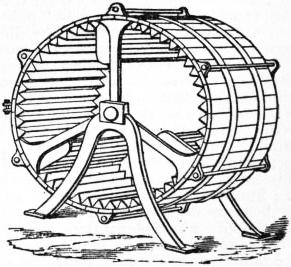
Fig. 10.—Dash Wheel.
The skins are usually hard and dry when received, so they are at once soaked down, and when sufficiently soft are either milled in the stocks, drummed in a lattice drum (American dash wheel, fig. 10), or “broken down” over the beam by working on the flesh with a blunt unhairing knife. They are next mellow limed (about 3 weeks), sulphide being used if convenient, unhaired and fleshed as described under heavy leathers, and are then ready for puering. This process is carried through at about 80° F., when the goods are worked on the beam, rinsed, drenched in a bran drench, scudded, and are ready for tanning. The skins are now folded down the centre of the back from neck to butt (tail end), flesh outwards, and the edges are tightly stitched all round to form bags, leaving an aperture at one of the shanks for filling; they are now turned grain outwards and filled with strong sumach liquor and some quantity of solid sumach to fill up the interstices and prevent leakage, after which the open shank is tied up, and they are thrown into warm sumach liquor, where they float about like so many pigs, being continually pushed under the surface with a dole. When struck through they are piled on a shelf above the vat, and by their own weight the liquor is forced through the skins. The tannage takes about 24 hours, and when finished the stitching is ripped up, the skins are slicked out, “strained” on frames and dried. “Straining” consists of nailing the skins out on boards in a stretched condition, or the stretching in frames by means of strings laced in the edge of the frame and attached to the edge of the skin.
The commoner sumach-tanned skins (but still of very good quality) are tanned in paddle wheels, a series of three being most conveniently used in the same manner as the three-pit system of liming, each wheel having three packs of skins through it before being thrown away. This paddling tends to make a bolder grain, as the skins are kept in continual motion, and work over one another. Some manufacturers finish the tannage with a mixture of sumach and oak bark; this treatment yields a less porous product. Others, when the skins are strained and in a semi-dry condition, apply neatsfoot or other oil, or a mixture of glycerine and oil, to the grain to lubricate it and make it more supple; the glycerine mixture is generally used for “chrome” leather, and will be discussed later under that head.
The skins tanned as above are largely dressed as morocco. Originally “morocco” was produced by the Moors in southern Spain and Morocco, whence the industry spread to the Levant, Turkey and the Mediterranean coast of Africa generally, where the leather was made from a species of sumach. Peculiarly enough, the dyeing was carried out before the tanning, with Roman alum as “mordant” and kermes, which with the alum produced a fine red colour. Such leather was peculiarly clear in colour, elastic and soft, yet firm and fine in grain and texture, and has long been much prized for bindings, being the material in which most of the artistic work of the 16th-century binders was executed. Now, in addition to the genuine morocco made from goat skins, we have imitation or French moroccos, for which split calf and especially sheep skins are employed, and as the appearance of morocco is the result of the style of graining and finish, which can now be imitated by printing or embossing machines, morocco can be made from all varieties of thin leather.
Great quantities of “Persian” (East India tanned) sheep and goat are now dressed as moroccos and for innumerable other purposes, the method being as follows: The goods are tanned with turwar bark and cassia bark, besides being impregnated with sesame oil, even to the extent of 30%. The first operation is to “strip” them of the oil and original tannage as far as possible, by drumming in a solution of soda; the soap thus formed is got rid of by thoroughly washing the goods, when they are “soured” in a weak bath of sulphuric acid to brighten the colour and remove iron stains, after which they are washed up and re-tanned by drumming in warm sumach, allowing about 4 oz. per skin. They are then slicked out, dried and are ready for dyeing.
The tanning of sheep and lamb skins differs very essentially from the tanning of goat and other leathers, mainly in the preparatory processes. As the wool is completely destroyed by lime, other methods have to be resorted to. The process usually practised is known as “sweating”; this consists of hanging the moist skins up in a warm, badly-ventilated chamber and allowing incipient putrefaction to set in. The chamber is always kept warm and saturated with moisture, either by means of a steam jet or water sprinklers. During the process large quantities of ammoniacal vapours are given off, and after two or three days the skins become slimy to the touch, and the wool slips easily; at this stage the goods are removed, for if the putrefaction goes too far the grain of the skin is irretrievably ruined. The wool is now “pulled” by pullers, who throw it into bins arranged to receive the different qualities; for one pelt may have three different grades of wool on it.
Other methods of dewooling are to paint the flesh with a solution of sodium sulphide, or cream of lime made with a solution of sodium sulphide; in either case the goods are piled flesh to flesh for an hour or so, and care is taken that the dewooling agent does not touch the wool. The pelt is then pulled and rapidly swilled in a stream of running water. The goods are now, in some yards, lightly limed to plump them superficially, by paddling in a milk of lime, and at this stage, or when the goods have been “struck through” with tan liquor, they are “degreased” either by hydraulic pressure or by benzene degreasing. This is to expel the oleaginous or fatty matter with which sheep skins are richly impregnated; the average yield is about 4 oz. per skin. The tannage is carried out in much the same way as for goat skins, the goods being started in old acid bark liquors; the general tannage consists of sumach and bark.
Basils are sheep skins tanned in various ways. English basils are tanned with oak bark, although, as in all other leathers, inferior tannages are now common; Scotch basils are tanned with larch bark, Australian and New Zealand basils with mimosa bark and Turkish basils with galls. The last are the commonest kind of skins imported into Great Britain, and are usually only semi-tanned. Roans are sumach-tanned sheep skins.
Skivers are the grain splits of sheep skins, the fleshes of which are finished for chamois leather. The goods are split in the limed state, just as the grains are ready for tanning, and are subsequently treated much as sumach-tanned goat skins, or in any other convenient way; the fleshes, on the other hand, go back into the limes, as it is necessary to get a large quantity of lime into leather which is to be finished as chamois.
Russia Leather was originally a speciality of Russia, where it was made from the hides of young cattle, and dressed either a brownish red or black colour for upper leather, bookbinding, dressing-cases, purses, &c. It is now made throughout Europe and America, the best qualities being obtained from Austria. The empyreumatic odour of the old genuine “Russia” leather was derived from a long-continued contact with willow and the bark of the white birch, which contains the odorous betulin oil. Horse hides, calf, goat, sheep skins and even splits are now dressed as “Russia leather,” but most of these are of a decidedly inferior quality, and as they are merely treated with birch bark oil to give them something of the odour by which Russia leather is ordinarily recognized, they scarcely deserve the name under which they pass. The present-day genuine Russia leather is tanned like other light leathers, but properly in willow bark, although poplar and spruce fir barks are used. After tanning and setting out the goods are treated with the empyreumatic oil obtained by the dry distillation of birch bark. The red colour commonly seen in Russia leather is now produced by aniline colours, but was originally gained by the application of an infusion of Brazil wood, which was rubbed over the grain with a brush or sponge. Some time ago Russia leather got into disrepute because of its rapid decay; this was owing to its being dyed with a very acid solution of tin salts and cochineal, the acid completely destroying the leather in a year or two. The black leather is obtained by staining with logwood infusion and iron acetate. The leather, if genuine quality, is very watertight and strong, and owing to its impregnation with the empyreumatic oil, it wards off the attacks of insects.
Seal Leathers, &c.—The tannage of seal skins is now an important department of the leather industry of the United Kingdom. The skins form one of the items of the whaling industry which principally centres in Dundee, and at that port, as well as at Hull and Peterhead, they are received in large quantities from the Arctic regions. This skin is that of the white hair seal, and must not be confused with the expensive seal fur obtained from Russian and Japanese waters. These white hair seal skins are light but exceedingly close in texture, yielding a very strong tough leather of large area and fine bold grain, known as Levant morocco. The area of the skins renders them suitable for upholstery work, and the flesh splits are dressed in considerable quantity for “japanned” (“patent”) leather and “bolsters,” which are used to grain other skins on, the raised buff affording a grip on the skin being grained and thus preventing slipping. When the skins arrive in the tanyard (generally lightly salted) they are drummed in old drench liquors until soft, dipped into warm water and “blubbered” with a sharp knife; they are then alternately dipped in warm water and drummed several times to remove fat, after which they are heavily limed, as they are still very greasy, and after unhairing and fleshing they are heavily puered for the same reason. The tannage takes about a month, and is much the same as for other leathers, the skins being split when “struck through.”
Alligator leather is now produced to some extent both in the United States and India. The belly and flanks alone are useful. There are no special tanneries or processes for dressing the skins. Layers are not given. The leather is used mostly for small fancy goods, and is much imitated on sheepskin by embossing.
Snake and frog skins are also dressed to some extent, the latter having formed a considerable item in the exports of Japan; they are dressed mostly for cigar cases and pocket books. The general procedure is first to lime the goods and then to remove any scales (in the case of snake skins) by scraping with an unhairing knife on a small beam, after which the skins are bated and tanned in sumach by paddling.
A considerable amount of leather is now produced in Australia from the skins of kangaroo, wallaby and other marsupials. These skins are both tanned and “tawed,” the principal tanning agents being mimosa bark, mallet bark and sugar bush, which abound in Australia. The leather produced is of excellent quality, strong and pliable, and rivals in texture and appearance the kid of Europe; but the circumstance that the animals exist only in the wild state renders them a limited and insecure source of leather.
Japan and Enamel Leathers.—Japanning is usually done on flesh splits, whereas enamelling is done on the grain, and if splits are used they are printed and boarded. The leather should be mellow, soft, free from grease, with a firm grain and no inclination to stretch. It is first shaved very smooth, thoroughly scoured with a stone, sumached, washed, slicked out tight and dried; when “sammied,” the grain is buffed to remove scratches and oiled, the goods are then whitened or fluffed, and if too hard, bruised by boarding; enamel goods are now grained. The skins are now tightly nailed on boards and any holes patched up with brown paper, so that the japan shall not touch the flesh when the first thick coat of japan or the “daub” is put on. This is applied so thickly that it cannot soak in, with fine-toothed slicker, and then placed in a hot stove for twenty-four hours until quite dry; the coating is then pumiced smooth and the second thinner coat, termed “blanback,” is applied. This is dried and pumiced, and a fine coating of japan or copal varnish is finally given. This is dried and cooled, and if the goods are for enamel they are boarded.
English japans sometimes contain light petroleum, but no turps. The secret of successful japanning lies in the age of the oil used; the older the linseed oil is, the better the result. To prepare the ground coat, boil 10 gallons linseed oil for one hour with 2 ℔ litharge at 600° F. to jellify the oil, and then add 2 ℔ prussian blue and boil the whole for half an hour longer. Before application the mixture is thinned with 10 gallons light petroleum. For the second coat, boil 10 gallons linseed oil for 2 hours with 2 ℔ prussian blue and 2 ℔ lampblack; when of a thin jelly consistency thin with 5 gallons of benzine or light petroleum. For the finishing coat, boil 5 gallons of linseed oil for 1 hour, then add 1 ℔ prussian blue, and boil for another hour; thin with 10 gallons petroleum and apply with a brush in a warm room. After drying, the goods are mellowed by exposure to the sun for at least three days.
Tawing.—Wool rugs are, after the preliminary processes, sometimes tanned in oak bark liquors by paddling, but are generally “tawed,” that is, dressed with alum and salt, and are therefore more suitably dealt with under that head. Tawing implies that the conversion of skins into leather is carried out by means of a mixture of which the more important constituents are mineral salts, such as alum, chrome and iron, which may or may not be supplemented with fatty and albuminous matter, both animal and vegetable.
As an example of alum tawing, calf kid may be taken as characteristic of the process; glove kid is also treated on similar lines. The goods are prepared for tawing in a manner similar to the preparation of tanned leathers, arsenical limes being used to ensure a fine grain. After being well drenched and washed the goods are ready for the tawing process. On the continent of Europe it is usual for the goods to be thrown into a tub with the tawing paste and trodden with the bare feet, although this old-fashioned method is gradually being driven out, and the drum or tumbler is being used.
The tawing paste consists of a mixture of alum, salt, flour, egg yolk and water; the quantities of each constituent diverge widely, every dresser having his own recipe. The following has been used, but cannot well be classed as typical: For 100 ℔ skin take 9 ℔ alum, 5 ℔ salt, dissolve in water, and mix to a thin paste with from 5 to 13 ℔ flour, using 4 to 6 egg yolks for every pound of flour used. Olive oil is also mixed in sometimes. The skins are drummed or trodden, at intervals, in the warm paste for some hours, removed, allowed to drain, and dried rapidly, damped down or “sammied” and “staked” by drawing them to and fro over a blunt knife fixed in the top of a post, and known as a knee stake; this process softens them very considerably. After staking, the goods are wet back and shaved smooth, either with a moon knife, i.e. a circular concave convex knife, the centre of which has been cut out, a piece of wood bridging the cavity forming the grip, or with an ordinary currier’s shaving knife; the skins are now ready for dyeing and finishing.
Wool Rug Dressing.—Wool rugs are first thoroughly soaked, well washed and clean-fleshed, scoured well by rubbing into the wool a solution of soft soap and soda, and then leathered by rubbing into the flesh of the wet skins a mixture consisting of three parts of alum and two parts of salt until they are practically dry; they are now piled up over-night, and the mixture is again applied. After the second or third application the goods should be quite leathered. Other methods consist of stretching the skins in frames and painting the flesh with a solution of alum and salt, or, better, with a solution of basic alum and salt, the alum being made basic by the gradual addition of soda until a permanent precipitate is produced.
The goods are now bleached, for even the most vigorous scouring will not remove the yellow tint of the wool, especially at the tips. There are several methods of bleaching, viz. by hydrogen peroxide, following up with a weak vitriol bath; by potassium permanganate, following up with a bath of sulphurous acid; or by fumigating in an air-tight chamber with burning sulphur. The last-named method is the more general; the wet skins are hung in the chamber, an iron pot containing burning sulphur is introduced, and the exposure is continued for several hours.
If the goods are to be finished white, they are now given a vitriol sour, scoured, washed, retanned, dried, and when dry softened by working with a moon knife. If they are to be dyed, they must be prepared for the dye solution by “chloring,” which consists of immersion in a cold solution of bleaching powder for some hours, and then souring in vitriol.
The next step is dyeing. If basic dyes are to be used, it is necessary to neutralize the acidity of the skins by careful addition of soda, and to prevent the tips from being dyed a darker colour than the roots. Glauber salts and acetic acid are added to the dye-bath. The tendency of basic colours to rub off may be overcome by passing the goods through a solution of tannin in the form of cutch, sumach, quebracho, &c.; in fact, some of the darker-coloured materials may be used as a ground colour, thus economizing dyestuff and serving two purposes. If acid colours are used, it is necessary to add sulphuric acid to the dye bath, and in either case colours which will strike below 50° C. must be used, as at that temperature alum leather perishes.
After being dyed, the goods are washed up, drained, and if necessary retanned, the glossing finish is then produced by passing them through a weak emulsion or “fat liquor” of oil, soap and water, after which they are dried, softened by working with a moon knife and beating, when they are combed out, and are ready for the market.
Blacks are dyed by immersing the goods alternately in solutions of logwood and iron, or a one-solution method is used, consisting of a mixture of these two, with, in either case, varying additions of lactic acid and sumach, copper salts, potassium bichromate, &c.; the time of immersion varies from hours to days. After striking, the goods are exposed to the air for some hours in order to oxidize to a good black; they are then well scoured, washed, drained, retanned, dried, softened and combed.
Chrome Tanning.—The first chrome tanning process was described by Professor Knapp in 1858 in a paper on “Die Natur und Wesen der Gerberie,” but was first brought into commercial prominence by Dr Heinzerling about 1878, and was worked in a most persevering way by the Eglinton Chemical Company, who owned the English patents, though all their efforts failed to produce any lasting effects. Now chrome tanning is almost the most important method of light leather dressing, and has also taken a prominent place in the heavy department, more especially in curried leathers and cases where greater tensile strength is needed. The leather produced is much stronger than any other leather, and will also stand boiling water, whereas vegetable-tanned leather is completely destroyed at 70° C. and alum leather at 50° C.
The theory of chrome tanning is not perfectly understood, but in general terms it consists of a partial chemical combination between the hide fibre and the chrome salts, and a partial mechanical deposition of chromium oxide in and on the fibre. The wet work, or preparation for tanning, may be taken as much the same as for any other leather.
There are two distinct methods of chrome tanning, and several different methods of making the solutions. The “two bath process” consists of treating the skins with a bichromate in which the chromium is in the acidic state, and afterwards reducing it to the basic state by some reducing agent. The exact process is as follows: To prevent wrinkled or “drawn” grain the goods are first paddled for half an hour in a solution of vitriol and salt, when they are piled or “horsed” up over night, and then, without washing, placed in a solution consisting of 7 ℔ of potassium bichromate, 3½ ℔ of hydrochloric acid to each 100 ℔ of pelts, with sufficient water to conveniently paddle in; it is recommended that 5% of salt be added to this mixture. The goods are run in this for about 3 hours, or until struck through, when they are horsed up for some hours, care being taken to cover them up, and are then ready for the reducing bath. This consists of a 14% solution of plain “hypo,” or hyposulphite of soda, to which, during the process of reduction, frequent additions of hydrochloric acid are made to free the sulphurous and thiosulphuric acids, which are the active reducing agents. After about 3 hours’ immersion, during which time the goods will have changed in colour from bright yellow to bright green, one or two skins are cut in the thickest part, and if the green has struck right through, the pack is removed as tanned, washed up, and allowed to drain.
The “single-bath process” consists of paddling, drumming, or otherwise introducing into the skins a solution of a chrome salt, usually chrome alum, which is already in the basic condition, and therefore does not require reducing. The basic solutions are made as follows: For 100 ℔ of pelts 9 ℔ of chrome alum are dissolved in 9 gallons of water, and 2½ ℔ of washing soda already dissolved in 1 gallon of water are gradually added, with constant stirring. One-third of the solution is added to 80 gallons of water, to which is added 7 ℔ of salt, and the skins are introduced; the other two-thirds are introduced at intervals in two successive portions. Another liquor, used in the same way, is made by dissolving 3 ℔ of potassium bichromate in hot water, adding ½ gallon strong hydrochloric acid and then, gradually, about 1½ ℔ of glucose or grape sugar; this reduces the acidic chrome salt, vigorous effervescence ensuing. The whole is made up to 2 gallons and 5% to 15% of salt is added. In yet another method a chrome alum solution is rendered basic by boiling with “hypo,” and after the reaction has ceased the solution is allowed to settle and the clear portion used.
After tanning, which takes from 8 hours to as many, and even more, days, depending upon the method used and the class of skin being dressed, the skins tanned by both methods are treated in a similar manner, and are neutralized by drumming in borax solution, when they are washed free from borax by drumming in warm water, and are ready for dyeing, a process which will be dealt with further on. The goods are sometimes tanned by suspension, but this method is generally reserved for the tanning of the heavier leathers, which are treated in much the same way, the several processes taking longer.
Iron Tannage.—Before leaving mineral tanning, mention may be made of iron tannage, although this has gained no prominent position in commerce. Ferric salts possess powerful tanning properties, and were thoroughly investigated by Professor Knapp, who took out several patents, but the tendency to produce a brittle leather has never been entirely overcome, although it has been greatly modified by the incorporation of organic matter, such as blood, rosin, paraffin, urine, &c. Knapp’s basic tanning liquor is made as follows: A strong solution of ferrous sulphate is boiled and then oxidized to the ferric state by the careful addition of nitric acid. Next, to destroy excess of nitric acid, ferrous sulphate is added until effervescence ceases and the resulting clear orange-coloured solution is concentrated to a varnish-like consistency. It does not crystallize or decompose on concentration. The hides or skins are prepared for tanning in the usual way, and then handled or otherwise worked in solutions of the above iron salt, the solutions, which are at first weak, being gradually strengthened.
The tannage occupies from 2 to 8 days, and the goods are then stuffed in a ventilated drum with greases or soap. If the latter is used, an insoluble iron soap is precipitated on the fibres of the leather, which may then be finally impregnated with stearin and paraffin, and finished in the usual manner as described under Curried Leathers. A very fair leather may also be manufactured by using iron alum and salt in the same manner as described under ordinary alum and salt.
Combination Tannages.—Leathers tanned by mixtures or separate baths of both mineral and vegetable tanning agents have now taken an important position in commerce. Such leathers are the Swedish and Danish glove leathers, the United States “dongola leather,” and French glazed kid. The usefulness of such a combination will be evident, for while vegetable tanning produces fullness, plumpness and resistance to water, the mineral dressing produces a softness unnatural to vegetable tannages without the use of large quantities of oils and fats. It may also be noted that once a leather has been thoroughly tanned with either mineral or vegetable materials, although it will absorb large quantities of the material which has not been first used, it will retain in the main the characteristics of the tannage first applied. The principle had long been used in the manufacture of such tough and flexible leathers as “green leather,” “combing leather” and “picker bands,” but was first applied to the manufacture of imitation glazed kid by Kent in America, who, about 1878, discovered the principle of “fatliquoring,” and named his product “dongola leather.” The discovery of this process revolutionized the manufacture of combination leathers.
The Swedish and Danish glove leathers were first given a dressing of alum and salt, with or without the addition of flour and egg, and were then finished and coloured with vegetable materials, generally with willow bark, although, in cases of scarcity, sumach, oak bark, madder and larch were resorted to. The “green leathers” manufactured in England generally receive about a week’s tannage in gambier liquors, and are finished off in hot alum and salt liquors, after which they are dried, have the crystallized salts slicked off, are damped back, and heavily stuffed with moellon, degras or sod oil. Kent, in the manufacture of his dongola leather, used mixed liquors of gambier alum and salt, and when tanned, washed the goods in warm water to remove excess of tanning agent, piled up to samm, and fatliquored. In making alum combinations it must be borne in mind that alum leather will not glaze, and if a glazed finish is required, a fairly heavy vegetable tannage should be first applied. For dull finishes the mineral tannage may advantageously precede the vegetable.
Very excellent chrome combination leather is also manufactured by the application of the above principles, gambier always being in great favour as the vegetable agent. The use of other materials deprives the leather of its stretch, although they may be advantageously used where the latter property is objectionable.
Oil Tanning.—Under the head of oil tanning is included “buff leather,” “buck leather,” “piano leather,” “chamois leather,” and to a greater or lesser extent, “Preller’s crown or helvetia leather.” The process of oil tanning dates back to antiquity, and was known as “shamoying,” now spelt “chamoising.” Chamoising yields an exceedingly tough, strong and durable leather, and forms an important branch of the leather industry. The theory of the process is the same as the theory of currying, which is nothing more or less than chamoising, viz. the lubrication of the fibres by the oil itself and the aldehyde tanning which takes place, due to the oxidation and decomposition of the esters of the fatty acids contained in the oil. The fact that an aldehyde tannage takes place seems to have been first discovered by Payne and Pullman, who took out a patent in 1898, covering formaldehyde and other aldehydes used in alkaline solutions. Their product, “Kaspine” leather, found considerable application in the way of military accoutrements. Chamois, buff, buck and piano leathers are all manufactured by the same process slightly modified to suit the class of hide used, the last three being heavy leathers, the first light.
As regards the process used for chamois leather, the reader will remember, from the account of the vegetable tannage of sheep skins, that after splitting from the limes, the fleshes were thrown back into the pits for another three weeks’ liming (six weeks in all) preparatory to being dressed as chamois leather. It is necessary to lime the goods for oil dressing very thoroughly, and if the grain has not been removed by splitting, as in the case of sheep skins, it is “frized” off with a sharp knife over the beam. The goods are now rinsed, scudded and drenched, dried out until stiff, and stocked in the faller stocks with plenty of cod oil for 2 to 3 hours until they show signs of heating, when they are hung up in a cool shed. This process is repeated several times during a period of from 4 to 6 days, the heat driving the water out of the skins and the oil replacing it. At the end of this time the goods, which will have changed to a brown colour, are hung up and allowed to become as dry as possible, when they are hung in a warm stove for some hours, after which they are piled to heat off, thrown into tepid water and put through a wringing machine. The grease which is recovered from the wringing machine is known commercially as “degras” or “moellon,” and fetches a good price, as it is unrivalled for fatliquoring and related processes, such as stuffing, producing a very soft product. They next receive a warm soda lye bath, and are again wrung; this removes more grease, which forms soap with the lye, and is recovered by treatment with vitriol, which decomposes the soap. The grease which floats on top of the liquor is sold under the name of “sod oil.” This also is a valuable material for fatliquoring, &c., but not so good as degras.
After being wrung out, the goods are bleached by one of the processes mentioned in the section on wool rug dressing, the permanganate method being in general use in England. In countries where a fine climate prevails the soap bleach or “sun bleach” is adopted; this consists of dipping the goods in soap solution and exposing them to the sun’s rays, the process being repeated three or more times as necessary.
The next step is fatliquoring to induce softness, after which they are dried out slowly, staked or “perched” with a moon knife, fluffed on a revolving wheel covered with fine emery to produce the fine “nap” or surface, brushed over with french chalk, fuller’s earth or china clay, and finally finished on a very fine emery wheel.
Preller’s Helvetia or Crown Leather.—This process of leather manufacture was discovered in 1850 by Theodor Klemm, a cabinetmaker of Württemberg, who being then in poor circumstances, sold his patent to an Englishman named Preller, who manufactured it in Southwark, and adopted a crown as his trade mark. Hence the name “crown” leather. The manufacture then spread through Switzerland and Germany, the product being used in the main for picker straps, belting and purposes where waterproof goods were required, such as hose pipes and military water bags. No taste is imparted to the water by this leather.
The process of manufacture is as follows: The hides are unhaired by short liming, painting with lime and sulphide, or sweating, and cleansed by scudding and washing, after which they are coloured in bark liquors, washed up through clean water, and hung up to dry partially. When in a sammied condition the goods are placed on a table and a thick layer of the tanning paste spread on the flesh side. The tanning paste varies with each manufacturer, but the following is the mixture originally used by Preller: 100 parts flour, 100 parts soft fat or horse tallow, 35 parts butter, 88 parts ox brains, 50 parts milk, 15 parts salt or saltpetre.
The hides are now rolled in bundles, placed in a warm drum and worked for 8 to 10 hours, after which they are removed and hung up until half dry, when the process is repeated. Thus they are tumbled 3 to 4 times, set out flesh and grain, rinsed through tepid water, set out, sammied, and curried by coating with glycerin, oil, tallow and degras. The table grease is now slicked off, and the goods are set out in grease, grained and dried.
Transparent Leather.—Transparent leather is a rather horny product, somewhat like raw hide, and has been used for stitching belts and picker bands. The goods to be dressed are limed, unhaired, very thoroughly delimed with acids, washed in water, scudded and clean-fleshed right to the veins; they are now stretched in frames, clean-fleshed with a moon knife, and brushed with warm water, when several coats of glycerin, to which has been added some antiseptic such as salicylic or picric acid, are applied; the goods are then dried out, and another coat is applied, and when semi-dry they are drummed in a mixture of glycerin, boracic acid, alum and salt, with the addition of a little bichromate of potash to stain them a yellow colour. After drumming for 2 to 3 hours they are removed, washed up, lightly set out, and stretched in frames to dry, when they are ready for cutting into convenient lengths for use.
Parchment.—A certain class of sheep skin known as Hampshires is generally used in the manufacture of this speciality. The skins as received are first very carefully washed to remove all dirt, dewooled, limed for 3 to 4 weeks, they are then cleanly fleshed, unhaired, rinsed up in water, and thickly split, the poorer hides being utilized for chamois; they are now re-split at the fatty strata so that all fat may be easily removed, and while the grains are dressed as skivers, the fleshes are tied in frames, watered with hot water, scraped and coated on both sides with a cream consisting of whiting, soda and water, after which they are dried out in a hot stove. In the drying the whiting mixture absorbs the grease from the skins; in fact, this method of degreasing is often employed in the manufacture of wool rugs. When dry, both sides of the skins are flooded to remove the whiting, and are then well rubbed over with a flat piece of pumice-stone, swilled, dried, re-pumiced, again swilled, and when sammied are rolled off with a wooden roller and dried out.
Tar and Peat Tanning.—Tar tanning was discovered by a French chemist named Philippi, who started with the idea that, if coal was a decomposition product of forests, it must still necessarily possess the tanning properties originally present in the trees. However far-fetched such an argument may seem, Philippi succeeded in producing a leather from wood and coal tar at a fairly cheap rate, the product being of excellent texture and strength, but rather below the average in the finish, which was inclined to be patchy, showing oily spots. His method consisted of impregnating the goods with refined tar and some organic acid, but the product does not seem to have taken any hold upon the market, and is not much heard of now.
Peat tanning was discovered by Payne, an English chemist, who was also the co-discoverer of the Payne-Pullman formaldehyde tanning process. His peat or humic acid tannage was patented by him about 1905, and is now worked on a commercial scale. The humic acid is first extracted from the peat by means of alkalis, and the hides are treated with this solution, the humic acid being afterwards precipitated in the hides by treatment with some stronger organic or mineral acid.
Dyeing, Staining and Finishing.—These operations are practised almost exclusively on the lighter leathers. Heavy leathers, except coloured and black harness and split hides for bag work, are not often dyed, and their finishing is generally considered to be part of the tannage. In light leathers a great business is done in buying up “crust” stock, i.e. rough tanned stock, and then dyeing and finishing to suit the needs and demands of the various markets. The carrying out of these operations is a distinct and separate business from tanning, although where possible the two businesses are carried on in the same works.
Whatever the goods are and whatever their ultimate finish, the first operation, upon receipt by the dyer of the crust stock, is sorting, an operation requiring much skill. The sorter must be familiar with the why and wherefore of all subsequent processes through which the leather must go, so as to judge of the suitability of the various qualities of leather for these processes, and to know where any flaws that may exist will be sufficiently suppressed or hidden to produce a saleable product, or will be rendered entirely unnoticeable. The points to be considered in the sorting are coarseness or fineness of texture, boldness or fineness of grain, colour, flaws including stains and scratches, substance, &c. Light-coloured and flawless goods are parcelled out for fine and delicate shades, those of darker hue and few flaws are parcelled out for the darker shades, such as maroons, greens (sage and olive), dark blues, &c., and those which are so badly stained as to be unsuitable for colours go for blacks. After sorting, the goods are soaked back to a limp condition by immersion in warm water, and are then horsed up to drip, having been given, perhaps, a preliminary slicking out.
Up to this point all goods are treated alike, but the subsequent processes now diverge according to the class of leather being treated and the finish required.
Persian goods for glacés, moroccos, &c., require special preparation for dyeing, being first re-tanned. As received, they are sorted and soaked as above, piled to samm, and shaved. Shaving consists of rendering the flesh side of the skins smooth by shaving off irregularities, the skin, which is supported on a rubber roller actuated by a foot lever, being pressed against a series of spiral blades set on a steel roller, which is caused to revolve rapidly. When shaved, the goods are stripped, washed up, soured, sweetened and re-tanned in sumach, washed up, and slicked out, and are then ready for dyeing.
There are three distinct methods of dyeing, with several minor modifications. Tray dyeing consists of immersing the goods, from 2 to 4 dozen at a time, in two separate piles, in the dye solution at 60° C, contained in a flat wooden tray about 5 ft. × 4 ft. × 1 ft., and keeping them constantly moving by continually turning them from one pile to the other. The disadvantages of this method are that the bath rapidly cools, thus dyeing rapidly at the beginning and slowly at the termination of the operation; hence a large excess of dye is wasted, much labour is required, and the shades obtained are not so level as those obtained by the other methods. But the goods are under observation the whole time, a very distinct advantage when matching shades, and a white flesh may be preserved. The paddle method of dyeing consists of paddling the goods in a large volume of liquor contained in a semi-circular wooden paddle for from half to three-quarters of an hour. The disadvantages are that the liquor cools fairly rapidly, more dye is wasted than in the tray method, and a white flesh cannot be preserved. But larger packs can be dyed at the one operation, the goods are under observation the whole time, and little labour is required.
The drum method of dyeing is perhaps best, a drum somewhat similar to that used by curriers being preferable. The goods are placed on the shelves inside the dry drum, the lid of which is then fastened on, and the machinery is started; when the drum is revolving at full speed, which should be about 12 to 15 revolutions per minute, the dye solution is added through the hollow axle, and the dyeing continued for half an hour, when, without stopping the drum, if desired, the goods may be fatliquored by running in the fatliquor through the hollow axle. The disadvantages are that the flesh is dyed and the goods cannot be seen. The advantages are that little labour is required, a large pack of skins may be treated, level shades are produced, heat is retained, almost complete exhaustion of the dye-bath is effected, and subsequent processes, such as fatliquoring, may be carried out without stopping the drum.
Of the great number of coal-tar dyes on the market comparatively few can be used in leather manufacture. The four chief classes are: (1) acid dyes; (2) basic or tannin dyes; (3) direct or cotton dyes; (4) mordant (alizarine) dyes.
Acid dyes are not so termed because they have acid characteristics; the name simply denotes that for the development of the full shade of colour it is necessary to add acid to the dye-bath. These dyes are generally sodium salts of sulphonic acids, and need the addition of an acid to free the dye, which is the sulphonic acid. Although theoretically any acid (stronger than the sulphonic acid present) will do for this purpose, it is found in practice that only sulphuric and formic acids may be employed, because others, such as acetic, lactic, &c., do not develop the full shade of colour. Acid sodium sulphate may also be successfully used.
Acid colours produce a full level shade without bronzing, and do not accentuate any defects in the leather, such as bad grain, &c. They are also moderately fast to light and rubbing. They are generally applied to leather at a temperature between 50° and 60° C., with an equal weight of sulphuric acid. The quantity of dye used varies, but generally, for goat, persians, &c., from 25 to 30 oz. are used per ten dozen skins, and for calf half as much again, dissolved in such an amount of water as is most convenient according to the method being used. If sodium bisulphate is substituted for sulphuric acid twice as much must be used, and if formic acid three times as much (by weight).
Basic dyes are salts of organic colour bases with hydrochloric or some other suitable acid. Basic colours precipitate the tannins, and thus, because of their affinity for them, dye very rapidly, tending to produce uneven shades, especially if the tannin on the skin is unevenly distributed. They are much more intense in colour than the acid dyes, have a strong tendency to bronze, and accentuate weak and defective grain. They are also precipitated by hard waters, so that the hardness should be first neutralized by the addition of acetic acid, else the precipitated colour lake may produce streakily dyed leather. To prevent rapid dyeing, acetic acid or sodium bisulphate should always be added in small quantity to the dye-bath, preferably the latter, as it prevents bronzing. The most important point about the application of basic dyes to leather is the previous fixation of the tannin on the surface of the leather to prevent its bleeding into the dye-bath and precipitating the dye. All soluble salts of the heavy metals will fix the tannin, but few are applicable, as they form colour lakes, which are generally undesirable. Antimony and titanium salts are generally used, the forms being tartar emetic (antimony potassium tartrate), antimonine (antimony lactate), potassium titanium oxalate, and titanium lactate. The titanium salts are economically used when dyeing browns, as they produce a yellowish-brown shade; it is therefore not necessary to use so much dye. About 2 oz. of tartar emetic and 8 oz. of salt is a convenient quantity for 1 dozen goat skins. The bath is used at 30° to 40° C., and the goods are immersed for about 15 minutes, having been thoroughly washed before being dyed. Iron salts are sometimes used by leather-stainers for saddening (dulling) the shade of colour produced, iron tannate, a black salt, being formed. It is often found economical to “bottom” goods with acid, direct, or other colours, and then finish with basic colours; this procedure forms a colour lake, and colour lakes are always faster to light and rubbing than the colours themselves.
Direct cotton dyes produce shades of great delicacy, and are used for the dyeing of pale and “art” shades. They are applied in neutral or very slightly acid baths, formic and acetic acids being most suitable with the addition of a quantity of sodium chloride or sulphate. After dyeing, the goods are well washed to free from excess of salt. The eosine colours, including erythrosine, phloxine, rose Bengal, &c., are applied in a similar manner, and are specially used for the beautiful fluorescent pink shades they produce; acid and basic colours and mineral acids precipitate them.
The mordant colours, which include the alizarine and anthracene colours, are extremely fast to light, and require a mordant to develop the colour. They are specially applicable to chamois leather, although a few may be used for chrome and alum leathers, and one or two are successfully applied to vegetable-tanned leather without a mordant.
Sulphur or sulphide colours, the first of which to appear were the famous Vidal colours, are applied in sodium sulphide solution, and are most successfully used on chrome leather, as they produce a colour lake with chrome salts, the resulting colour being very fast to light and rubbing. A very serious disadvantage in connexion with them is that they must necessarily be applied in alkaline solution, and the alkali has a disintegrating effect upon the fibre of the leather, which cannot be satisfactorily overcome, although formaldehyde and glycerin mixtures have been patented for the purpose.
The Janus colours are perhaps worth mentioning as possessing both acid and basic characteristics; they precipitate tannin, and are best regarded as basic dyes from a leather-dyer’s standpoint.
The goods after dyeing are washed up, slicked out on an inclined glass table, nailed on boards, or hung up by the hind shanks to dry out.
Coal-tar dyes are not much used for the production of blacks, as they do not give such a satisfactory result as logwood with an iron mordant. In the dyeing of blacks the preliminary operation of souring is always omitted and that of sumaching sometimes, but if much tan has been removed it will be found necessary to use sumach, although cutch may be advantageously and cheaply substituted. After shaving, the goods, if to be dressed for “blue backs” (blue-coloured flesh), are dyed as already described, with methyl violet or some other suitable dye; they are then folded down the back and drawn through a hot solution of logwood and fustic extracts, and then rapidly through a weak, cold iron sulphate and copper acetate solution. Immediately afterwards they are rinsed up and either drummed in a little neatsfoot oil or oiled over with a pad, flesh and grain, and dried. When dry the goods are damped back and staked, dried out and re-staked.
After dry-staking, the goods are “seasoned,” i.e. some suitable mixture is applied to the grain to enable it to take the glaze. The following is typical: 3 quarts logwood liquor, ½ pint bullock’s blood, ½ pint milk, ½ gill ammonia, ½ gill orchil and 3 quarts water. This season is brushed well into the grain, and the goods are dried in a warm stove and glazed by machine. The skins are glazed under considerable pressure, a polished glass slab or roller being forced over the surface of the leather in a series of rapid strokes, after which the goods are re-seasoned, re-staked, fluffed, re-glazed, oiled over with a pad, dipped in linseed oil and dried. They are now ready for market. If the goods are to be finished dull they are seasoned with linseed mucilage, casein or milk (many other materials are also used), and rolled, glassed with a polished slab by hand, or ironed with a warm iron.
Coloured glacés are finished in a similar manner to black glacés, dye (instead of logwood and iron) being added to the season, which usually consists of a simple mixture of dye, albumen and milk.
Moroccos and grain leathers are boarded on the flesh side before and after glazing, often being “tooth rolled” between the several operations. Tooth rolling consists of forcing, under pressure, a toothed roller over the grain; this cuts into the leather and helps to produce many grains, which could not be produced naturally by boarding, besides fixing them.
Many artificial grains and patterns are also given to leather by printing and embossing, these processes being carried out by passing the leather between two rollers, the top one upon which the pattern is engraved being generally steam heated. This impresses the pattern upon the grain of the leather.
The above methods will give a very general idea of the processes in vogue for the dressing of goods for fancy work. The dressing of chrome leathers for uppers is different in important particulars.
Chrome Box and Willow Calf.—Willow calf is coloured calf, box calf is dressed black and grained with a “box” grain. A large quantity of kips is now dressed as box calf; these goods are the hides of yearling Indian cattle, and are dressed in an exactly similar manner as calf. After tanning and boraxing to neutralize the acidity of the chrome liquor, the goods are washed up, sammied, shaved, and are ready for mordanting previous to dyeing. Very few dyes will dye chrome leather direct, i.e. without mordanting. Sulphide colours are not yet in great demand, nor are the alizarines used as much as they might be. The ordinary acid and basic dyes are more generally employed, and the goods consequently require to be first mordanted. The mordanting is carried out by drumming the goods in a solution containing tannin, and, except for pale shades, some dyewood extract is used; for reds peachwood extract, for browns fustic or gambier, and for dark browns a little logwood is added. For all pale shades sumach is exclusively used. After drumming in the warm tannin infusion for half an hour, if the goods are to be dyed with basic colours the tannin is first fixed by drumming in tartar emetic and salt, or titanium, as previously described; the dyeing is also carried out as described for persians, except that a slightly higher temperature may be maintained. If the goods are to be dyed black they are passed through logwood and iron solutions.
After dyeing and washing up, &c., the goods are fatliquored by placing them in a previously heated drum and drumming them with a mixture known as a “fatliquor,” of which the following recipe is typical: Dissolve 3 ℔ of soft soap by boiling with 3 gallons of water, then add 9 ℔ of neatsfoot oil and boil for some minutes; now place the mixture in an emulsifier and emulsify until cooled to 35° C., then add the yolks of 5 fresh eggs and emulsify for a further half hour. The fatliquor is added to the drum at 55° C., and the goods are drummed for half an hour, when all the fatliquor should be absorbed; they are then slicked out and dried. After drying, they are damped back, staked, dried, re-staked and seasoned with materials similar to those used for persians; when dry they are glazed, boarded on the flesh (“grained”) from neck to butt and belly to belly to give them the box grain, fluffed, reseasoned, reglazed and regrained.
Finishing of Bag Hides.—The goods are first soaked back, piled to samm, split or shaved, scoured by machine, finished off by hand, washed up and retanned by drumming in warm sumach and extract, after which they are washed up, struck out, hung up to samm, and “set.” “Setting” consists of laying the grain flat and smooth by striking out with a steel or sharp brass slicker. They are then dried out, topped with linseed mucilage, and again dried. This brushing over with linseed mucilage prevents the dye from sinking too far into the leather; gelatine, Irish moss, starch and gums are also used for the same purpose. These materials are also added to the staining solution to thicken it and further prevent its sinking in.
When dry, the goods are stained by applying a ½% (usually) solution of a suitable basic dye, thickened with linseed, with a brush. Two men are usually employed on this work; one starts at the right-hand flank and the other at the left-hand shank, and they work towards each other, staining in sections; much skill is needed to obviate markings where the sections overlap. The goods may advantageously be bottomed with an acid dye or a dye-wood extract, and then finished with basic dyes. Whichever method is used, two to three coats are given, drying between each. After the last coat of stain, and while the goods are still in a sammied condition, a mixture of linseed mucilage and French chalk is applied to the flesh and glassed off wet, to give it a white appearance, and then the goods are printed with any of the usual bag grains by machine or hand, and dried out. For a bright finish the season may consist of a solution of 15 parts carnauba wax, 10 parts curd soap and 100 parts water boiled together; this is sponged into the grain, dried and the hides are finished by either glassing or brushing. For a duller finish the grain is simply rubbed over with buck tallow and brushed. Hide bellies for small work are treated in much the same manner.
Glove Leathers.—As these goods were tanned in alum, salt, flour and egg, any undue immersion in water removes the tannage; for this reason they are generally stained like bag hides, one man only being employed on the same skin. The skins are first thoroughly soaked in warm water and then drummed for some minutes in a fresh supply, when they are re-egged to replace that which has been lost. This is best done by drumming them for about 1½ hours in 40 to 50 egg yolks and 5 ℔ of salt for every hundred skins; they are then allowed to be in pile for 24 hours, and are set out on the table ready for mordanting. The mordants universally used are ammonia or alkaline soft soap; 1 in 1000 of the former or a 1% solution of the latter. When the goods have partially dried in, bottoming follows, and usually the natural wood dyestuffs are used for this operation, such as fustic, Brazil wood, peachwood, logwood and turmeric. After application of these colours the goods are sammied and topped with a 1% solution of an acid dye, to which has been added 20% of methylated spirit to prevent frothing with the egg yolk; they are then dried out slowly, staked, pulled in shape, fluffed and brushed by machine. The season, which is sponged on, may consist of 1 part dye, 1 part albumen, 2 parts dextrine and ¼ part glycerine, made up to 100 parts with water; when it has been applied, the goods are sammied, brushed and ironed with a warm flat iron such as is used in laundry work.
Bookbinding Leathers.—A committee of the Society of Arts (London) has investigated the question of leather for bookbinding, attention having been drawn to this subject by the rotten and decayed condition often observed in bindings less than fifty years old. This committee engaged in research work extending over several years, and the report in which its results were given was edited for the Society of Arts and the Leathersellers’ Company (which also did much important work in connexion with it) by Lord Cobham, chairman of the committee, and Sir Henry Trueman Wood, secretary of the society. The essence of the report, so far as leather manufacture is concerned, is as follows: The goods should be soaked and limed in fresh liquors, and bating and puering should be avoided, weak organic acids or erodine being used; they should also be tanned with pyrogallol tanning materials, and preferably with sumach. In shaving, they should only be necked and backed, i.e. only irregularities should be removed, as further shaving has a considerable weakening effect on the fibre. The striking out should not be heavy enough to lay the fibre. In dyeing, acid dyes and a few direct colours only are permissible, and in connexion with the former the use of sulphuric acid is strongly condemned, as it absolutely disintegrates the fibre; the use of formic, acetic and lactic acids is permitted. The use of salts of mineral acids is to be avoided, and in finishing, tight setting out and damp glazing is not to be recommended; oil may be advantageously used.
Bibliography.—H. G. Bennett, The Manufacture of Leather (1909); S. R. Trotman, Leather Trades Chemistry (1908); M. C. Lamb, Leather Dressing (1907); A. Watt, Leather Manufacture (1906); H. R. Procter, Principles of Leather Manufacture (1903), and Leather Industries Laboratory Book (1908); L. A. Flemming, Practical Tanning (1910); A. M. Villon, Practical Treatise on the Leather Industry (1901); C. T. Davis, Manufacture of Leather (1897). German works include J. Borgman, Die Rotlederfabrikation (Berlin, 1904-1905), and Feinlederfabrikation (1901); J. Jettmar, Handbuch der Chromgerbung (Leipzig, 1900); J. von Schroeder, Gerbereichemie (Berlin, 1898).
(J. G. P.*)
1 See Lye.

LEATHER, ARTIFICIAL. Under the name of artificial leather, or of American leather cloth, large quantities of a material having, more or less, a leather-like surface are used, principally for upholstery purposes, such as the covering of chairs, lining the tops of writing desks and tables, &c. There is considerable diversity in the preparation of such materials. A common variety consists of a web of calico coated with boiled linseed oil mixed with dryers and lampblack or other pigment. Several coats of this mixture are uniformly spread, smoothed and compressed on the cotton surface by passing it between metal rollers, and when the surface is required to possess a glossy enamel-like appearance, it receives a finishing coat of copal varnish. A grained morocco surface is given to the material by passing it between suitably embossed rollers. Preparations of this kind have a close affinity to cloth waterproofed with indiarubber, and to such manufactures as ordinary waxcloth. An artificial leather which has been patented and proposed for use as soles for boots, &c., is composed of powdered scraps and cuttings of leather mixed with solution of guttapercha dried and compressed. In place of the guttapercha solution, oxidized linseed oil or dissolved resin may be used as the binding medium for the leather powder.
LEATHERHEAD, an urban district in the Epsom parliamentary division of Surrey, England, 18 m. S.S.W. of London, on the London, Brighton & South Coast and the London & South-Western railways. Pop. (1901) 4694. It lies at the foot of the North Downs in the pleasant valley of the river Mole. The church of St Mary and St Nicholas dates from the 14th century. St John’s Foundation School, opened in London in 1852, is devoted to the education of sons of poor clergymen. Leatherhead has brick-making and brewing industries, and the district is largely residential.
LEATHES, STANLEY (1830-1900), English divine and Orientalist, was born at Ellesborough, Bucks, on the 21st of March 1830, and was educated at Jesus College, Cambridge, where he graduated B.A. in 1852, M.A. 1853. In 1853 he was the first Tyrwhitt’s Hebrew scholar. He was ordained priest in 1857, and after serving several curacies was appointed professor of Hebrew at King’s College, London, in 1863. In 1868-1870 he was Boyle lecturer (The Witness of the Old Testament to Christ), in 1873 Hulsean lecturer (The Gospel its Own Witness), in 1874 Bampton Lecturer (The Religion of the Christ) and from 1876 to 1880 Warburtonian lecturer. He was a member of the Old Testament revision committee from 1870 to 1885. In 1876 he was elected prebendary of St Paul’s Cathedral, and he was rector of Cliffe-at-Hoo near Gravesend (1880-1889) and of Much Hadham, Hertfordshire (1889-1900). The university of Edinburgh gave him the honorary degree of D.D. in 1878, and his own college made him an honorary fellow in 1885. Besides the lectures noted he published Studies in Genesis (1880), The Foundations of Morality (1882) and some volumes of sermons. He died in May 1900.
His son, Stanley Mordaunt Leathes (b. 1861), became a fellow of Trinity, Cambridge, and lecturer on history, and was one of the editors of the Cambridge Modern History; he was secretary to the Civil Service Commission from 1903 to 1907, when he was appointed a Civil Service Commissioner.
LEAVEN (in Mid. Eng. levain, adapted from Fr. levain, in same sense, from Lat. levamen, which is only found in the sense of alleviation, comfort, levare, to lift up), a substance which produces fermentation, particularly in the making of bread, properly a portion of already fermented dough added to other dough for this purpose (see Bread). The word is used figuratively of any element, influence or agency which effects a subtle or secret change. These figurative usages are mainly due to the comparison of the kingdom of Heaven to leaven in Matt. xiii. 33, and to the warning against the leaven of the Pharisees in Matt. xvi. 6. In the first example the word is used of a good influence, but the more usual significance is that of an evil agency. There was among the Hebrews an association of the idea of fermentation and corruption, which may have been one source of the prohibition of the use of leavened bread in sacrificial offerings. For the usage of unleavened bread at the feasts of the Passover and of Massôth, and the connexion of the two, see Passover.
LEAVENWORTH, a city and the county-seat of Leavenworth county, Kansas, U.S.A., on the W. bank of the Missouri river. Pop. (1900) 20,738, of whom 3402 were foreign-born and 2925 were negroes; (1910 census) 19,363. It is one of the most important railway centres west of the Missouri river, being served by the Atchison, Topeka & Santa Fé, the Chicago, Burlington & Quincy, the Chicago, Rock Island & Pacific, the Chicago Great Western, the Missouri Pacific, the Union Pacific and the Leavenworth & Topeka railways. The city is laid out regularly in the bottom-lands of the river, and its streets are named after Indian tribes. Rolling hills surround it on three sides. The city has many handsome public buildings, and contains the Cathedral of the Immaculate Conception, Leavenworth being the see of a Roman Catholic bishop. The public institutions include the Kansas State Protective Home (1889) for negroes, an Old Ladies’ Rest (1892), St Vincent’s Orphans’ Asylum (1886, open to all sects) and a Guardian Angels’ Home (1889), for negroes—all private charities aided by the state; also St John’s Hospital (1879), Cushing Hospital (1893) and Leavenworth Hospital (1900), which are training schools for nurses. There is also a branch of the National Home for Disabled Volunteer Soldiers. In the suburbs there are state and United States penitentiaries. Leavenworth is a trading centre and has various manufactures, the most important being foundry and machine shop and flouring and grist-mill products, and furniture. The city’s factory products increased in value from $3,251,460 in 1900 to $4,151,767 in 1905, or 27.7%. There are valuable coal mines in Leavenworth and the immediate vicinity. About 3 m. N. of the city, on a reservation of about 6000 acres, is Fort Leavenworth, an important United States military post, associated with which are a National Cemetery and Service Schools of the U.S. Army (founded in 1881 as the U.S. Infantry and Cavalry School and in 1901 developed into a General Service and Staff College). In 1907 there were three general divisions of these schools: the Army School of the Line, for officers (not below the grade of captain) of the regular army and for militia officers recommended by the governors of their respective states or territories, offering courses in military art, engineering, law and languages; the Army Signal School, also open to regular and militia officers, and having departments of field signalling, signal engineering, topography and languages; and the Army Staff College, in which the students are the highest graduates from the Army School of the Line, and the courses of instruction are included in the departments of military art, engineering, law, languages and care of troops. The course is one year in each school. At Fort Leavenworth there is a colossal bronze statue of General U. S. Grant erected in 1889. A military prison was established at Fort Leavenworth in 1875; it was used as a civil prison from 1895 to 1906, when it was re-established as a military prison. Its inmates were formerly taught various trades, but owing to the opposition of labour organizations this system was discontinued, and the prisoners are now employed in work on the military reservation.
The fort, from which the city took its name, was built in 1827, in the Indian country, by Colonel Henry Leavenworth (1783-1834) of the 3rd Infantry, for the protection of traders plying between the Missouri river and Santa Fé. The town site was claimed by Missourians from Weston in June 1854, Leavenworth thus being the oldest permanent settlement in Kansas; and during the contest in Kansas between the anti-slavery and pro-slavery settlers, it was known as a pro-slavery town. It was first incorporated by the Territorial legislature in 1855; a new charter was obtained in 1881; and in 1908 the city adopted the commission plan of government. On the 3rd of April 1858 a free-state convention adopted the Leavenworth Constitution here; this constitution, which was as radically anti-slavery as the Lecompton Constitution was pro-slavery, was nominally approved by popular vote in May 1858, and was later submitted to Congress, but never came into effect. During the Civil War Leavenworth enjoyed great prosperity, at the expense of more inland towns, partly owing to the proximity of the fort, which gave it immunity from border raids from Missouri and was an important depôt of supplies and a place for mustering troops into and out of the service. Leavenworth was, in Territorial days and until after 1880, the largest and most thriving commercial city of the state, and rivalled Kansas City, Missouri, which, however, finally got the better of it in the struggle for railway facilities.
LEBANON (from Semitic laban, “to be white,” or “whitish,” probably referring not to snow, but to the bare white walls of chalk or limestone which form the characteristic feature of the whole range), in its widest sense is the central mountain mass of Syria, extending for about 100 m. from N.N.E. to S.S.W. It is bounded W. by the sea, N. by the plain Jun Akkar, beyond which rise the mountains of the Ansarieh, and E. by the inland plateau of Syria, mainly steppe-land. To the south Lebanon ends about the point where the river Litany bends westward, and at Banias. A valley narrowing towards its southern end, and now called the Buka’a, divides the mountainous mass into two great parts. That lying to the west is still called Jebel Libnan; the greater part of the eastern mass now bears the name of the Eastern Mountain (Jebel el-Sharḳi). In Greek the western range was called Libanos, the eastern Antilibanos. The southern extension of the latter, Mount Hermon (q.v.), may in many respects be treated as a separate mountain.
Lebanon and Anti-Lebanon have many features in common; in both the southern portion is less arid and barren than the northern, the western valleys better wooded and more fertile than the eastern. In general the main elevations of the two ranges form pairs lying opposite one another; the forms of both ranges are monotonous, but the colouring is splendid, especially when viewed from a distance; when seen close at hand only a few valleys with perennial streams offer pictures of landscape beauty, their rich green contrasting pleasantly with the bare brown and yellow mountain sides. The finest scenery is found in N. Lebanon, in the Maronite districts of Kesrawan and Bsherreh, where the gorges are veritable canyons, and the villages are often very picturesquely situated. The south of the chain is more open and undulating. Anti-Lebanon is the barest and most inhospitable part of the system.
The district west of Lebanon, averaging about 20 m. in breadth, slopes in an intricate series of plateaus and terraces to the Mediterranean. The coast is for the most part abrupt and rocky, often leaving room for only a narrow path along the shore, and when viewed from the sea it does not suggest the extent of country lying between its cliffs and the lofty summits behind. Most of the mountain spurs run from east to west, but in northern Lebanon the prevailing direction of the valleys is north-westerly, and in the south some ridges run parallel with the principal chain. The valleys have for the most part been deeply excavated by mountain streams; the apparently inaccessible heights are crowned by numerous villages, castles or cloisters embosomed among trees. The chief perennial streams, beginning from the north, are the Nahr Akkar, N. Arka, N. el-Barid, N. Kadisha, “the holy river” (the valley of which begins in the immediate neighbourhood of the highest summits, and rapidly descends in a series of great bends till the river reaches the sea at Tripoli), Wadi el-Joz (falling into the sea at Batrun), Wadi Fidar, Nahr Ibrahim (the ancient Adonis, having its source in a recess of the great mountain amphitheatre where the famous sanctuary Apheca, the modern Afka, lay), Nahr el-Kelb (the ancient Lycus), Nahr Beirut (the ancient Magoras, entering the sea at Beirut), Nahr Damur (ancient Tamyras), Nahr el-’Auwali (the ancient Bostrenus, which in the upper part of its course is joined by the Nahr el-Baruk). The ‘Auwali and the Nahr el-Zaherani, the only other considerable streams before we reach the Litany, flow north-east to south-west, in consequence of the interposition of a ridge subordinate and parallel to the central chain. On the north, where the mountain bears the special name of Jebel Akkar, the main ridge of Lebanon rises gradually from the plain. A number of valleys run to the north and north-east, among them that of the Nahr el-Kebir, the Eleutherus of the ancients, which rises in the Jebel el-Abiad on the eastern slope of Lebanon, and afterwards, skirting the district, flows westward to the sea. South of Jebel el-Abiaḍ, beneath the main ridge, which as a rule falls away suddenly towards the east, occur several small elevated terraces having a southward slope; among these are the Wadi en-Nusur (“vale of eagles”), and the basin of the lake Yammuna, with its intermittent spring Neb’a el-Arba’in. Of the streams which descend into the Buka’a, the Berdani rises in Jebel Sunnin, and enters the plain by a deep and picturesque mountain cleft at Zaḥleh.
The most elevated summits occur in the north, but even these are of very gentle gradient. The “Cedar block” consists of a double line of four and three summits respectively, ranged from north to south, with a deviation of about 35°. Those to the east are ‘Uyun Urghush, Makmal, Muskiyya (or Naba’ esh-Shemaila) and Ras Zahr el-Kazib; fronting the sea are Kam Sauda or Timarun, Fumm el-Mizab and Zahr el-Kandil. The height of Zahr el-Kazib, by barometric measurement, is 10,018 ft.; that of the others does not reach 10,000 ft. South from them is the pass (8351 ft.) which leads from Baalbek to Tripoli; the great mountain amphitheatre on the west side of its summit is remarkable. Farther south is a second group of lofty summits—the snow-capped Sunnin, visible from Beirut; its height is 8482 ft. Between this group and the more southerly Jebel Keniseh (about 6700 ft.) lies the pass (4700 ft.) traversed by the French post road between Beirut and Damascus. Among the bare summits still farther south are the long ridge of Jebel el-Baruk (about 7000 ft.), the Jebel Niha, with the Tau’amat Niha (about 6100 ft.), near which is a pass to Sidon, and the Jebel Rihan (about 5400 ft.).
The Buka’a, the broad valley which separates Lebanon from Anti-Lebanon, is watered by two rivers having their watershed near Baalbek, at an elevation of about 3600 ft., and separated only by a short mile at their sources. That flowing northwards, El-’Asi, is the ancient Orontes (q.v.); the other is the Litany. In the lower part of its course the latter has scooped out a deep and narrow rocky bed; at Burghuz it is spanned by a great natural bridge. Not far from the point where it suddenly trends to the west lie, immediately above the romantic valley, at an elevation of 1500 ft., the imposing ruins of the old castle Kal’at esh-Shakif, near one of the passes to Sidon. In its lower part the Litany bears the name of Nahr el-Kasimiya. Neither the Orontes nor the Litany has any important affluent.
The Buka’a used to be known as Coelesyria (Strabo. xvi. 2, 21); but that word as employed by the ancients had a much more extensive application. At present its full name is Buka’a el-’Aziz (the dear Buka’a), and its northern portion is known as Sahlet Ba’albek (the plain of Baalbek). The valley is from 4 to 6 m. broad, with an undulating surface.
The Anti-Lebanon chain has been less fully explored than that of Lebanon. Apart from its southern offshoots it is 67 m. long, while its width varies from 16 to 13½ m. It rises from the plain of Hasya-Homs, and in its northern portion is very arid. The range has not so many offshoots as occur on the west side of Lebanon; under its precipitous slopes stretch table-lands and broad plateaus, which, especially on the east side looking towards the steppe, steadily increase in width. Along the western side of northern Anti-Lebanon stretches the Khasha’a, a rough red region lined with juniper trees, a succession of the hardest limestone crests and ridges, bristling with bare rock and crag that shelter tufts of vegetation, and are divided by a succession of grassy ravines. On the eastern side the parallel valley of ‘Asal el-Ward deserves special mention; the descent towards the plain eastwards, as seen for example at Ma’lula, is singular—first a spacious amphitheatre and then two deep very narrow gorges. Few perennial streams take their rise in Anti-Lebanon; one of the finest and best watered valleys is that of Helbun, the ancient Chalybon, the Helbon of Ezek. xxvii. 18. The highest points of the range, reckoning from the north, are Halimat el-Kabu (8257 ft.), which has a splendid view; the Fatli block, including Tal’at Musa (8721 ft.) and the adjoining Jebel Nebi Baruh (7900 ft.); and a third group near Bludan, in which the most prominent names are Shakif, Akhyar and Abu‘l-Hin (8330 ft.); Of the valleys descending westward the first to claim mention is the Wadi Yafufa; a little farther south, lying north and south, is the rich upland valley of Zebedani, where the Barada has its highest sources. Pursuing an easterly course, this stream receives the waters of the romantic ‘Ain Fije (which doubles its volume), and bursts out by a rocky gateway upon the plain of Damascus, in the irrigation of which it is the chief agent. It is the Abana of 2 Kings v. 12; the portion of Anti-Lebanon traversed by it was also called by the same name (Canticles iv. 8). From the point where the southerly continuation of Anti-Lebanon begins to take a more westerly direction, a low ridge shoots out towards the south-west, trending farther and farther away from the eastern chain and narrowing the Buka’a; upon the eastern side of this ridge lies the elevated valley or hilly stretch known as Wadi et-Teim. In the north, beside ‘Ain Faluj, it is connected by a low watershed with the Buka’a; from the gorge of the Litany it is separated by the ridge of Jebel eḍ-Ḍahr. At its southern end it contracts and merges into the plain of Baṇias, thus enclosing Mount Hermon on its north-west and west sides; eastward from the Hasbany branch of the Jordan lies the meadow-land Merj ‘Iyun, the ancient Ijon (1 Kings xv. 20).
Vegetation.—The western slope of Lebanon has the common characteristics of the flora of the Mediterranean coast, but the Anti-Lebanon belongs to the poorer region of the steppes, and the Mediterranean species are met with only sporadically along the water-courses. Forest and pasture land do not properly exist: the place of the first is for the most part taken by a low brushwood; grass is not plentiful, and the higher ridges maintain alpine plants only so long as patches of snow continue to lie. The rock walls harbour some rock plants, but many absolutely barren wildernesses of stone occur. (1) On the western slope, to a height of 1600 ft., is the coast region, similar to that of Syria in general and of the south of Asia Minor. Characteristic trees are the locust tree and the stone pine; in Melia Azedarach and Ficus Sycomorus (Beirut) is an admixture of foreign and partially subtropical elements. The great mass of the vegetation, however is of the low-growing type (maquis or garrigue of the western Mediterranean), with small and stiff leaves, and frequently thorny and aromatic, as for example the ilex (Quercus coccifera), Smilax, Cistus, Lentiscus, Calycotome, &c. (2) Next comes, from 1600 to 6500 ft., the mountain region, which may also be called the forest region, still exhibiting sparse woods and isolated trees wherever shelter, moisture and the inhabitants have permitted their growth. From 1600 to 3200 ft. is a zone of dwarf hard-leaved oaks, amongst which occur the Oriental forms Fontanesia phillyraeoides, Acer syriacum and the beautiful red-stemmed Arbutus Andrachne. Higher up, between 3700 and 4200 ft., a tall pine, Pinus Brutia, is characteristic. Between 4200 and 6200 ft. is the region of the two most interesting forest trees of Lebanon, the cypress and the cedar. The former still grows thickly, especially in the valley of the Kadisha; the horizontal is the prevailing variety. In the upper Kadisha valley there is a cedar grove of about three hundred trees, amongst which five are of gigantic size. (See also Cedar.) The cypress and cedar zone exhibits a variety of other leaf-bearing and coniferous trees; of the first may be mentioned several oaks—Quercus subalpina (Kotschy), Q. Cerris and the hop-hornbeam (Ostrya); of the second class the rare Cilician silver fir (Abies cilicica) may be noticed. Next come the junipers, sometimes attaining the size of trees (Juniperus excelsa, J. rufescens and, with fruit as large as plums, J. drupacea). But the chief ornament of Lebanon is the Rhododendron ponticum, with its brilliant purple flower clusters; a peculiar evergreen, Vinca libanotica, also adds beauty to this zone. (3) Into the alpine region (6200 to 10,400 ft.) penetrate a few very stunted oaks (Quercus subalpina), the junipers already mentioned and a barberry (Berberis cretica), which sometimes spreads into close thickets. Then follow the low, dense, prone, pillow-like dwarf bushes, thorny and grey, common to the Oriental highlands—Astragalus and the peculiar Acantholimon. They are found to within 300 ft. of the highest summits.
Upon the exposed mountain slopes a species of rhubarb (Rheum Ribes) is noticeable, and also a vetch (Vicia canescens) excellent for sheep. The spring vegetation, which lasts until July, appears to be rich, especially as regards showy plants, such as Corydalis, Gagea, Colchicum, Puschkinia, Geranium, Ornithogalum, &c. The flora of the highest ridges, along the edges of the snow patches, exhibits no forms related to the northern alpine flora, but suggestions of it are found in a Draba, an Androsace, an Alsine and a violet, occurring, however, only in local species. Upon the highest summits are found Saponaria Pumilio (resembling our Silene acaulis) and varieties of Galium, Euphorbia, Astragalus, Veronica, Jurinea, Festuca, Scrophularia, Geranium, Asphodeline, Allium, Asperula; and, on the margins of the snow fields, a Taraxacum and Ranunculus demissus. The alpine flora of Lebanon thus connects itself directly with the Oriental flora of lower altitudes, and is unrelated to the glacial flora of Europe and northern Asia.
Zoology.—There is nothing of special interest about the fauna of Lebanon. Bears are no longer numerous; the panther and the ounce are met with; the wild hog, hyaena, wolf and fox are by no means rare; jackals and gazelles are very common. The polecat and hedgehog also occur. As a rule there are not many birds, but the eagle and the vulture may occasionally be seen; of eatable kinds partridges and wild pigeons are the most abundant.
Population.—In the following sections the Lebanon proper will alone be considered, without reference to Anti-Lebanon, because the peculiar political status of the former range since 1864 has effectually differentiated it; whereas the Anti-Lebanon still forms an integral part of the Ottoman province of Syria (q.v.), and neither its population nor its history is readily distinguishable from those of the surrounding districts.
The total population in the Lebanon proper is about 400,000, and is increasing faster than the development of the province will admit. There is consequently much emigration, the Christian surplus going mainly to Egypt, and to America, the Druses to the latter country and to the Hauran. The emigrants to America, however, usually return after making money, build new houses and settle down. The singularly complex population is composed of Christians, Maronites, and Orthodox Eastern and Uniate; of Moslems, both Sunni and Shiah (Metawali); and of Druses.
(a) Maronites (q.v.) form about three-fifths of the whole and have the north of the Mountain almost to themselves, while even in the south, the old Druse stronghold, they are now numerous. Feudalism is practically extinct among them and with the decline of the Druses, and the great stake they have acquired in agriculture, they have laid aside much of their warlike habit together with their arms. Even their instinct of nationality is being sensibly impaired by their gradual assimilation to the Papal Church, whose agents exercise from Beirut an increasing influence on their ecclesiastical elections and church government. They are strong also in the Buka’a, and have colonies in most of the Syrian cities.
(b) Orthodox Eastern form a little more than one-eighth of the whole, and are strongest in S. Lebanon (Metn and Kurah districts). Syrians by race and Arab-speaking, they are descendants of those “Melkites” who took the side of the Byzantine church in the time of Justinian II. against the Moslems and eventually the Maronites. They are among the most progressive of the Lebanon elements.
(c) Greek Uniate are less numerous, forming little more than one-twelfth, but are equally progressive. Their headquarters is Zahleh; but they are found also in strength in Metn and Jezzin, where they help to counterbalance Druses. They sympathize with the Maronites against the Orthodox Eastern, and, like both, are of Syrian race, and Arab speech.
(d) Sunnite Moslems are a weak element, strongest in Shuf and Kurah, and composed largely of Druse renegades and “Druse” families, which, like the Shehab, were of Arab extraction and never conformed to the creed of Hamza.
(e) Shiite Moslems outnumber the Sunni, and make about one twenty-fifth of the whole. They are called Metawali and are strongest in North Lebanon (Kesrawan and Batrun), but found also in the south, in Buka’a and in the coast-towns from Beirut to Acre. They are said to be descendants of Persian tribes; but the fact is very doubtful, and they may be at least as aboriginal as the Maronites, and a remnant of an old Incarnationist population which did not accept Christianity, and kept its heretical Islam free from those influences which modified Druse creed. They own a chief sheikh, resident at Jeba’a, and have the reputation, like most heretical communities in the Sunni part of the Moslem world, of being exceedingly fanatical and inhospitable. It is undoubtedly the case that they are suspicious of strangers and defiant of interference. Another small body of Shiites, the Ismailites (Assassins (q.v.) of the crusading chronicles), also said to be of Persian origin, live about Kadmus at the extreme N. of Lebanon, but outside the limits of the privileged province. They are about 9000 strong.
(f) Druses (q.v.), now barely an eighth of the whole and confined to Shuf and Metn in S. Lebanon, are tending to emigrate or conform to Sunni Islam. Since the establishment of the privileged province they have lost the Ottoman support which used to compensate for their numerical inferiority as compared with the Christians; and they are fast losing also their old habits and distinctiveness. No longer armed or wearing their former singular dress, the remnant of them in Lebanon seems likely ere long to be assimilated to the “Osmanli” Moslems. Their feud with the Maronites, whose accentuation in the middle of the 19th century was largely due to the tergiversations of the ruling Shehab family, now reduced to low estate, is dying away, but they retain something of their old clan feeling and feudal organization, especially in Shuf.
The mixed population, as a whole, displays the usual characteristics of mountaineers, fine physique and vigorous independent spirit; but its ancient truculence has given way before strong government action since the middle 19th century, and the great increase of agricultural pursuits, to which the purely pastoral are now quite secondary. The culture of the mulberry and silk, of tobacco, of the olive and vine, of many kinds of fruits and cereals, has expanded enormously, and the Lebanon is now probably the most productive region in Asiatic Turkey in proportion to its area. It exports largely through Beirut and Saida, using both the French railway which crosses S. Lebanon on its way to Damascus, and the excellent roads and mule-paths made since 1883. Lebanon has thick deposits of lignite coal, but of inferior quality owing to the presence of iron pyrites. The abundant iron is little worked. Manufactures are of small account, the raw material going mostly to the coast; but olive-oil is made, together with various wines, of which the most famous is the vino d’oro, a sweet liqueur-like beverage. This wine is not exported in any quantity, as it will not bear a voyage well and is not made to keep. Bee-keeping is general, and there is an export of eggs to Egypt.
History.—The inhabitants of Lebanon have at no time played a conspicuous part in history. There are remains of prehistoric occupation, but we do not even know what races dwelt there in the historical period of antiquity. Probably they belonged chiefly to the Aramaean group of nationalities; the Bible mentions Hivites (Judges iii. 3) and Giblites (Joshua xiii. 5). Lebanon was included within the ideal boundaries of the land of Israel, and the whole region was well known to the Hebrews, by whose poets its many excellences are often praised. How far the Phoenicians had any effective control over it is unknown; the absence of their monuments does not argue much real jurisdiction. Nor apparently did the Greek Seleucid kingdom have much to do with the Mountain. In the Roman period the district of Phoenice extended to Lebanon. In the 2nd century, with the inland districts, it constituted a subdivision of the province of Syria, having Emesa (Homs) for its capital. From the time of Diocletian there was a Phoenice ad Libanum, with Emesa as capital, as well as a Phoenice Maritima of which Tyre was the chief city. Remains of the Roman period occur throughout Lebanon. By the 6th century it was evidently virtually independent again; its Christianization had begun with the immigration of Monothelite sectaries, flying from persecution in the Antioch district and Orontes valley. At all times Lebanon has been a place of refuge for unpopular creeds. Large part of the mountaineers took up Monothelism and initiated the national distinction of the Maronites, which begins to emerge in the history of the 7th century. The sectaries, after helping Justinian II. against the caliph Abdalmalik, turned on the emperor and his Orthodox allies, and were named Mardaites (rebels). Islam now began to penetrate S. Lebanon, chiefly by the immigration of various more or less heretical elements, Kurd, Turkoman, Persian and especially Arab, the latter largely after the break-up of the kingdom of Hira; and early in the 11th century these coalesced into a nationality (see Druses) under the congenial influence of the Incarnationist creed brought from Cairo by Ismael Darazi and other emissaries of the caliph Hakim and his vizier Hamza. The subsequent history of Lebanon to the middle of the 19th century will be found under Druses and Maronites, and it need only be stated here that Latin influence began to be felt in N. Lebanon during the Frank period of Antioch and Palestine, the Maronites being inclined to take the part of the crusading princes against the Druses and Moslems; but they were still regarded as heretic Monothelites by Abulfaragius (Bar-Hebraeus) at the end of the 13th century; nor is their effectual reconciliation to Rome much older than 1736, the date of the mission sent by the pope Clement XII., which fixed the actual status of their church. An informal French protection had, however, been exercised over them for some time previously, and with it began the feud of Maronites and Druses, the latter incited and spasmodically supported by Ottoman pashas. The feudal organization of both, the one under the house of Khazin, the other under those of Maan and Shehab successively, was in full force during the 17th and 18th centuries; and it was the break-up of this in the first part of the 19th century which produced the anarchy that culminated after 1840 in the civil war. The Druses renounced their Shehab amirs when Beshir al-Kassim openly joined the Maronites in 1841, and the Maronites definitely revolted from the Khazin in 1858. The events of 1860 led to the formation of the privileged Lebanon province, finally constituted in 1864. It should be added, however, that among the Druses of Shuf, feudalism has tended to re-establish itself, and the power is now divided between the Jumblat and Yezbeki families, a leading member of one of which is almost always Ottoman kaimakam of the Druses, and locally called amir.
The Lebanon has now been constituted a sanjak or mutessariflik, dependent directly on the Porte, which acts in this case in consultation with the six great powers. This province extends about 93 m. from N. to S. (from the boundary of the sanjak of Tripoli to that of the caza of Saida), and has a mean breadth of about 28 m. from one foot of the chain to the other, beginning at the edge of the littoral plain behind Beirut and ending at the W. edge of the Buka’a; but the boundaries are ill-defined, especially on the E. where the original line drawn along the crest of the ridge has not been adhered to, and the mountaineers have encroached on the Buka’a. The Lebanon is under a military governor (mushir) who must be a Christian in the service of the sultan, approved by the powers, and has, so far, been chosen from the Roman Catholics owing to the great preponderance of Latin Christians in the province. He resides at Deir al-Kamar, an old seat of the Druse amirs. At first appointed for three years, then for ten, his term has been fixed since 1892 at five years, the longer term having aroused the fear of the Porte, lest a personal domination should become established. Under the governor are seven kaimakams, all Christians except a Druse in Shuf, and forty-seven mudirs, who all depend on the kaimakams except one in the home district of Deir al-Kamar. A central mejliss or Council of twelve members is composed of four Maronites, three Druses, one Turk, two Greeks (Orthodox), one Greek Uniate and one Metawali. This was the original proportion, and it has not been altered in spite of the decline of the Druses and increase of the Maronites. The members are elected by the seven cazas. In each mudirieh there is also a local mejliss. The old feudal and mukataji (see Druses) jurisdictions are abolished, i.e. they often persist under Ottoman forms, and three courts of First Instance, under the mejliss, and superior to the petty courts of the mudirs and the village sheikhs, administer justice. Judges are appointed by the governor, but sheikhs by the villages. Commercial cases, and litigation in which strangers are concerned, are carried to Beirut. The police is recruited locally, and no regular troops appear in the province except on special requisition. The taxes are collected directly, and must meet the needs of the province, before any sum is remitted to the Imperial Treasury. The latter has to make deficits good. Ecclesiastical jurisdiction is exercised only over the clergy, and all rights of asylum are abolished.
This constitution has worked well on the whole, the only serious hitches having been due to the tendency of governors-general and kaimakams to attempt to supersede the mejliss by autocratic action, and to impair the freedom of elections. The attention of the porte was called to these tendencies in 1892 and again in 1902, on the appointments of new governors. Since the last date there has been no complaint. Nothing now remains of the former French predominance in the Lebanon, except a certain influence exerted by the fact that the railway is French, and by the precedence in ecclesiastical functions still accorded by the Maronites to official representatives of France. In the Lebanon, as in N. Albania, the traditional claim of France to protect Roman Catholics in the Ottoman Empire has been greatly impaired by the non-religious character of the Republic. Like Italy, she is now regarded by Eastern Catholics with distrust as an enemy of the Holy Father.