VOLUME XV SLICE VIII Kite-Flying to Kyshtym
Reading edition
Articles in This Slice
KITE-FLYING KOSTER, LAURENS
KIT-FOX KOSTROMA (government of Russia)
KITTO, JOHN KOSTROMA (town of Russia)
KITTUR KÖSZEG
KITZINGEN KOTAH
KIU-KIANG FU KOTAS
KIUSTENDIL KOTKA
KIVU KOTRI
KIWI KOTZEBUE, AUGUST FRIEDRICH FERDINAND VON
KIZILBASHES KOTZEBUE, OTTO VON
KIZIL IRMAK KOUMISS
KIZLYAR KOUMOUNDOUROS, ALEXANDROS
KIZYL-KUM KOUSSO
KJERULF, HALFDAN KOVALEVSKY, SOPHIE
KJERULF, THEODOR KOVNO (government of Russia)
KLADNO KOVNO (town of Russia)
KLAFSKY, KATHARINA KOVROV
KLAGENFURT KOWTOW
KLAJ, JOHANN KOZLOV
KLAMATH KRAAL
KLAPKA, GEORG KRAFFT, ADAM
KLAPROTH, HEINRICH JULIUS KRAGUYEVATS
KLAPROTH, MARTIN HEINRICH KRAKATOA
KLÉBER, JEAN BAPTISTE KRAKEN
KLEIN, JULIUS LEOPOLD KRALYEVO
KLEIST, BERND HEINRICH WILHELM VON KRANTZ, ALBERT
KLEIST, EWALD CHRISTIAN VON KRASNOVODSK
KLERKSDORP KRASNOYARSK
KLESL, MELCHIOR KRASZEWSKI, JOSEPH IGNATIUS
KLINGER, FRIEDRICH MAXIMILIAN VON KRAUSE, KARL CHRISTIAN FRIEDRICH
KLINGER, MAX KRAWANG
KLIPSPRINGER KRAY VON KRAJOVA, PAUL
KLONDIKE KREMENCHUG
KLOPP, ONNO KREMENETS
KLOPSTOCK, GOTTLIEB FRIEDRICH KREMS
KLOSTERNEUBURG KREMSIER
KLOTZ, REINHOLD KREUTZER, KONRADIN
KNARESBOROUGH KREUTZER, RUDOLPH
KNAVE KREUZBURG
KNEBEL, KARL LUDWIG VON KREUZNACH
KNEE KRIEGSPIEL
KNELLER, SIR GODFREY KRIEMHILD
KNICKERBOCKER, HARMEN JANSEN KRILOFF, IVAN ANDREEVICH
KNIFE KRISHNA
KNIGGE, ADOLF FRANZ FRIEDRICH KRISHNAGAR
KNIGHT, CHARLES KRISTIANSTAD
KNIGHT, DANIEL RIDGWAY KRIVOY ROG
KNIGHT, JOHN BUXTON KROCHMAL, NAḤMAN
KNIGHTHOOD and CHIVALRY KRONENBERG
KNIGHT-SERVICE KRONSTADT
KNIGHTS OF THE GOLDEN CIRCLE KROONSTAD
KNIPPERDOLLINCK, BERNT KROPOTKIN, PETER ALEXEIVICH
KNITTING KROTOSCHIN
KNOBKERRIE KRÜDENER, BARBARA JULIANA
KNOLLES, RICHARD KRUG, WILHELM TRAUGOTT
KNOLLES, SIR ROBERT KRUGER, STEPHANUS JOHANNES PAULUS
KNOLLYS KRUGERSDORP
KNOT (bird) KRUMAU
KNOT (loop of rope) KRUMBACHER, CARL
KNOUT KRUMEN
KNOWLES, SIR JAMES KRUMMACHER, FRIEDRICH ADOLF
KNOWLES, JAMES SHERIDAN KRUPP, ALFRED
KNOW NOTHING PARTY KRUSENSTERN, ADAM IVAN
KNOX, HENRY KRUSHEVATS
KNOX, JOHN KSHATTRIYA
KNOX, PHILANDER CHASE KUBAN (river of Russia)
KNOXVILLE KUBAÑ (province of Russia)
KNUCKLE KUBELIK, JAN
KNUCKLEBONES KUBERA
KNUTSFORD KUBLAI KHAN
KOALA KUBUS
KOBDO KUCHĀN
KOBELL, WOLFGANG XAVER FRANZ KUCH BEHAR
KOCH, ROBERT KUDU
KOCH (tribe) KUENEN, ABRAHAM
KOCK, CHARLES PAUL DE KUEN-LUN
KODAIKANAL KUFA
KODAMA, GENTARO KUHN, FRANZ FELIX ADALBERT
KODUNGALUR KÜHNE, WILLY
KOENIG, KARL DIETRICH EBERHARD KUKA
KOESFELD KU KLUX KLAN
KOHAT KUKU KHOTO
KOHAT PASS KULJA
KOHISTAN KULM
KOHL KULMBACH
KOHLHASE, HANS KULMSEE
KOKOMO KULP
KOKO-NOR KULU
KOKSHAROV, NĪKOLAÍ ĪVANOVICH VON KUM
KOKSTAD KUMAIT IBN ZAID
KOLA KUMAON
KOLABA KUMASI
KOLAR KUMISHAH
KOLBE, ADOLPHE WILHELM HERMANN KUMQUAT
KOLBERG KUMTA
KÖLCSEY, FERENCZ KUMYKS
KOLDING KUNAR
KOLGUEV KUNBIS
KOLHAPUR KUNDT, AUGUST ADOLPH EDUARD EBERHARD
KOLIN KUNDUZ
KOLIS KUNENE
KÖLLIKER, RUDOLPH ALBERT VON KUNERSDORF
KOLLONTAJ, HUGO KUNGRAD
KOLOMEA KUNGUR
KOLOMNA KUNKEL VON LOWENSTJERN, JOHANN
KOLOZSVÁR KUNLONG
KOLPINO KUNZITE
KOLS KUOPIO (province of Finland)
KOLYVAÑ KUOPIO (city of Finland)
KOMÁROM KUPRILI
KOMATI KURAKIN, BORIS IVANOVICH
KOMOTAU KURBASH
KOMURA, JUTARO KŪRDISTĀN (country)
KONARAK KŪRDISTĀN (province of Persia)
KONG KURGAN
KONGSBERG KURIA MURIA ISLANDS
KONIA KURILES
KONIECPOLSKI, STANISLAUS KURISCHES HAFF
KÖNIG, KARL RUDOLPH KURNOOL
KÖNIGGRÄTZ KUROKI, ITEI
KÖNIGINHOF KUROPATKIN, ALEXEI NIKOLAIEVICH
KÖNIGSBERG KURO SIWO
KÖNIGSBORN KURRAM
KÖNIGSHÜTTE KURSEONG
KÖNIGSLUTTER KURSK (government of Russia)
KÖNIGSMARK, MARIA AURORA KURSK (town of Russia)
KÖNIGSMARK, PHILIPP CHRISTOPH KURTZ, JOHANN HEINRICH
KÖNIGSSEE KURUMAN
KÖNIGSTEIN KURUMBAS and KURUBAS
KÖNIGSWINTER KURUNEGALA
KONINCK, LAURENT GUILLAUME DE KURUNTWAD
KONINCK, PHILIP DE KURZ, HERMANN
KONITZ KUSAN
KONKAN KUSHALGARH
KONTAGORA KUSHK
KOORINGA KUSTANAISK
KÖPENICK KÜSTENLAND
KOPISCH, AUGUST KUTAIAH
KOPP, HERMANN FRANZ MORITZ KUTAIS (government of Russia)
KOPRÜLÜ KUTAIS (town of Russia)
KORA KUT-EL-AMARA
KORAN KUTENAI
KORAT KUTTALAM
KORDOFAN KUTTENBERG
KOREA (country) KUTUSOV, MIKHAIL LARIONOVICH
KOREA (tributary state of India) KUWĒT
KORESHAN ECCLESIA, THE KUZNETSK
KŌRIN, OGATA KVASS
KORKUS KWAKIUTL
KÖRMÖCZBÁNYA KWANGCHOW BAY
KÖRNER, KARL THEODOR KWANG-SI
KORNEUBURG KWANG-TUNG
KOROCHA KWANZA
KORSÖR KWEI-CHOW
KORTCHA KYAUKPYU
KORYAKS KYAUKSĒ
KOSCIUSCO KYD, THOMAS
KOSCIUSZKO, TADEUSZ ANDRZEJ BONAWENTURA KYFFHÄUSER
KÖSEN KYNASTON, EDWARD
KOSHER KYNETON
KÖSLIN KYŌSAI, SHO-FU
KOSSOVO KYRIE
KOSSUTH, FERENCZ LAJOS AKOS KYRLE, JOHN
KOSSUTH, LAJOS KYSHTYM

KITE-FLYING, the art of sending up into the air, by means of the wind, light frames of varying shapes covered with paper or cloth (called kites, after the bird—in German Drache, dragon), which are attached to long cords or wires held in the hand or wound on a drum. When made in the common diamond form, or triangular with a semicircular head, kites usually have a pendulous tail appended for balancing purposes. The tradition is that kites were invented by Archytas of Tarentum four centuries before the Christian era, but they have been in use among Asiatic peoples and savage tribes like the Maoris of New Zealand from time immemorial. Kite-flying has always been a national pastime of the Koreans, Chinese, Japanese, Tonkinese, Annamese, Malays and East Indians. It is less popular among the peoples of Europe. The origin of the sport, although obscure, is usually ascribed to religion. With the Maoris it still retains a distinctly religious character, and the ascent of the kite is accompanied by a chant called the kite-song. The Koreans attribute its origin to a general, who, hundreds of years ago, inspirited his troops by sending up a kite with a lantern attached, which was mistaken by his army for a new star and a token of divine succour. Another Korean general is said to have been the first to put the kite to mechanical uses by employing one to span a stream with a cord, which was then fastened to a cable and formed the nucleus of a bridge. In Korea, Japan and China, and indeed throughout Eastern Asia, even the tradespeople may be seen indulging in kite-flying while waiting for customers. Chinese and Japanese kites are of many shapes, such as birds, dragons, beasts and fishes. They vary in size, but are often as much as 7 ft. in height or breadth, and are constructed of bamboo strips covered with rice paper or very thin silk. In China the ninth day of the ninth month is “Kites’ Day,” when men and boys of all classes betake themselves to neighbouring eminences and fly their kites. Kite-fighting is a feature of the pastime in Eastern Asia. The cord near the kite is usually stiffened with a mixture of glue and crushed glass or porcelain. The kite-flyer manœuvres to get his kite to windward of that of his adversary, then allows his cord to drift against his enemy’s, and by a sudden jerk to cut it through and bring its kite to grief. The Malays possess a large variety of kites, mostly without tails. The Sultan of Johor sent to the Columbian Exposition at Chicago in 1893 a collection of fifteen different kinds. Asiatic musical kites bear one or more perforated reeds or bamboos which emit a plaintive sound that can be heard for great distances. The ignorant, believing that these kites frighten away evil spirits, often keep them flying all night over their houses.
There are various metaphorical uses of the term “kite-flying,” such as in commercial slang, when “flying a kite” means raising money on credit (cf. “raising the wind”), or in political slang for seeing “how the wind blows.” And “flying-kites,” in nautical language, are the topmost sails.
Kite-flying for scientific purposes began in the middle of the 18th century. In 1752 Benjamin Franklin made his memorable kite experiment, by which he attracted electricity from the air and demonstrated the electrical nature of lightning. A more systematic use of kites for scientific purposes may, however, be said to date from the experiments made in the last quarter of the 19th century.
(E. B.)
Meteorological Use.—Many European and American meteorological services employ kites regularly, and obtain information not only of the temperature, but also of the humidity and velocity of the air above. The kites used are mostly modifications of the so-called box-kites, invented by L. Hargrave. Roughly these kites may be said to resemble an ordinary box with the two ends removed, and also the middle part of each of the four sides. The original Hargrave kite, the form generally used, has a rectangular section; in Russia a semicircular section with the curved part facing the wind is most in favour; in England the diamond-shaped section is preferred for meteorological purposes owing to its simplicity of construction. Stability depends on a multitude of small details of construction, and long practice and experience are required to make a really good kite. The sizes most in use have from 30 to 80 sq. ft. of sail area. There is no difficulty about raising a kite to a vertical height of one or even two miles on suitable days, but heights exceeding three miles are seldom reached. On the 29th of November 1905 at Lindenberg, the Prussian Aeronautical Observatory, the upper one of a train of six kites attained an altitude of just four miles. The total lifting surface of these six kites was nearly 300 sq. ft., and the length of wire a little over nine miles. The kites are invariably flown on a steel wire line, for the hindrance to obtaining great heights is not due so much to the weight of the line as to the wind pressure upon it, and thus it becomes of great importance to use a material that possesses the greatest possible strength, combined with the smallest possible size. Steel piano wire meets this requirement, for a wire of 1⁄32 in. diameter will weigh about 16 ℔ to the mile, and stand a strain of some 250-280 ℔ before it breaks. Some stations prefer to use one long piece of wire of the same gauge throughout without a join, others prefer to start with a thin wire and join on thicker and thicker wire as more kites are added. The process of kite-flying is as follows. The first kite is started either with the self-recording instruments secured in it, or hanging from the wire a short distance below it. Wire is then paid out, whether quickly or slowly depends on the strength of the wind, but the usual rate is from two to three miles per hour. The quantity that one kite will take depends on the kite and on the wind, but roughly speaking it may be said that each 10 sq. ft. of lifting surface on the kite should carry 1000 ft. of 1⁄32 in. wire without difficulty. When as much wire as can be carried comfortably has run out another kite is attached to the line, and the paying out is continued; after a time a third is added, and so on. Each kite increases the strain upon the wire, and moreover adds to the height and makes it more uncertain what kind of wind the upper kites will encounter; it also adds to the time that is necessary to haul in the kites. In each way the risk of their breaking away is increased, for the wind is very uncertain and is liable to alter in strength. Since to attain an exceptional height the wire must be strained nearly to its breaking point, and under such conditions a small increase in the strength of the wind will break the wire, it follows that great heights can only be attained by those who are willing to risk the trouble and expense of frequently having their wire and train of kites break away. The weather is the essential factor in kite-flying. In the S.E. of England in winter it is possible on about two days out of three, and in summer on about one day out of three. The usual cause of failure is want of wind, but there are a few days when the wind is too strong. (For meteorological results, &c., see Meteorology.)
(W. H. Di.)
Military Use.—A kite forms so extremely simple a method of lifting anything to a height in the air that it has naturally been suggested as being suitable for various military purposes, such as signalling to a long distance, carrying up flags, or lamps, or semaphores. Kites have been used both in the army and in the navy for floating torpedoes on hostile positions. As much as two miles of line have been paid out. For purposes of photography a small kite carrying a camera to a considerable height may be caused to float over a fort or other place of which a bird’s-eye view is required, the shutter being operated by electric wire, or slow match, or clockwork. Many successful photographs have been thus obtained in England and America.
The problem of lifting a man by means of kites instead of by a captive balloon is a still more important one. The chief military advantages to be gained are: (1) less transport is required; (2) they can be used in a strong wind; (3) they are not so liable to damage, either from the enemy’s fire or from trees, &c., and are easier to mend; (4) they can be brought into use more quickly; (5) they are very much cheaper, both in construction and in maintenance, not requiring any costly gas.
Captain B. F. S. Baden-Powell, of the Scots Guards, in June 1894 constructed, at Pirbright Camp, a huge kite 36 ft. high, with which he successfully lifted a man on different occasions. He afterwards improved the contrivance, using five or six smaller kites attached together in preference to one large one. With this arrangement he frequently ascended as high as 100 ft. The kites were hexagonal, being 12 ft. high and 12 ft. across. The apparatus, which could be packed in a few minutes into a simple roll, weighed in all about 1 cwt. This appliance was proved to be capable of raising a man even during a dead calm, the retaining line being fixed to a wagon and towed along. Lieut. H. D. Wise made some trials in America in 1897 with some large kites of the Hargrave pattern (Hargrave having previously himself ascended in Australia), and succeeded in lifting a man 40 ft. above the ground. In the Russian army a military kite apparatus has also been tried, and was in evidence at the manœuvres in 1898. Experiments have also been carried out by most of the European powers.
(B. F. S. B.-P.)
KIT-FOX (Canis [Vulpes] velox), a small fox, from north-western America, measuring less than a yard in length, with a tail of nearly a third this length. There is a good deal of variation in the colour of the fur, the prevailing tint being grey. A specimen in the Zoological Gardens of London had the back and tail dark grey, the tail tipped with black, and a rufous wash on the cheeks, shoulders, flanks and outer surface of the limbs, with the under surface white. The specific name was given on account of the extraordinary swiftness of the animal. (See Carnivora.)
KITTO, JOHN (1804-1854), English biblical scholar, was the son of a mason at Plymouth, where he was born on the 4th of December 1804. An accident brought on deafness, and in November 1819 he was sent to the workhouse, where he was employed in making list shoes. In 1823 a fund was raised on his behalf, and he was sent to board with the clerk of the guardians, having his time at his own disposal, and the privilege of making use of a public library. After preparing a small volume of miscellanies, which was published by subscription, he studied dentistry with Anthony Norris Groves in Exeter. In 1825 he obtained congenial employment in the printing office of the Church Missionary Society at Islington, and in 1827 was transferred to the same society’s establishment at Malta. There he remained for eighteen months, but shortly after his return to England he accompanied Groves and other friends on a private missionary enterprise to Bagdad, where he obtained personal knowledge of Oriental life and habits which he afterwards applied with tact and skill in the illustration of biblical scenes and incidents. Plague broke out, the missionary establishment was broken up, and in 1832 Kitto returned to England. On arriving in London he was engaged in the preparation of various serial publications of the Society for the Diffusion of Useful Knowledge, the most important of which were the Pictorial History of Palestine and the Pictorial Bible. The Cyclopaedia of Biblical Literature, edited under his superintendence, appeared in two volumes in 1843-1845 and passed through three editions. His Daily Bible Illustrations (8 vols. 1849-1853) received an appreciation which is not yet extinct. In 1850 he received an annuity of £100 from the civil list. In August 1854 he went to Germany for the waters of Cannstatt on the Neckar, where on the 25th of November he died.
See Kitto’s own work, The Lost Senses (1845); J. E. Ryland’s Memoirs of Kitto (1856); and John Eadie’s Life of Kitto (1857).
KITTUR, a village of British India, in the Belgaum district of Bombay; pop. (1901), 4922. It contains a ruined fort, formerly the residence of a Mahratta chief. In connexion with a disputed succession to this chiefship in 1824, St John Thackeray, an uncle of the novelist, was killed when approaching the fort under a flag of truce; and a nephew of Sir Thomas Munro, governor of Madras, fell subsequently when the fort was stormed.
KITZINGEN, a town of Germany, in the kingdom of Bavaria on the Main, 95 m. S.E. of Frankfort-on-Main by rail, at the junction of the main-lines to Passau, Würzburg and Schweinfurt. Pop. (1900), 8489. A bridge, 300 yards long, connects it with its suburb Etwashausen on the left bank of the river. A railway bridge also spans the Main at this point. Kitzingen is still surrounded by its old walls and towers, and has an Evangelical and two Roman Catholic churches, two municipal museums, a town-hall, a grammar school, a richly endowed hospital and two old convents. Its chief industries are brewing, cask-making and the manufacture of cement and colours. Considerable trade in wine, fruit, grain and timber is carried on by boats on the Main. Kitzingen possessed a Benedictine abbey in the 8th century, and later belonged to the bishopric of Würzburg.
See F. Bernbeck, Kitzinger Chronik 745-1565 (Kitzingen, 1899).
KIU-KIANG FU, a prefecture and prefectural city in the province of Kiang-si, China. The city, which is situated on the south bank of the Yangtsze-kiang, 15 m. above the point where the Kan Kiang flows into that river from the Po-yang lake, stands in 29° 42´ N. and 116° 8´ E. The north face of the city is separated from the river by only the width of a roadway, and two large lakes lie on its west and south fronts. The walls are from 5 to 6 m. in circumference, and are more than usually strong and broad. As is generally the case with old cities in China, Kiu-Kiang has repeatedly changed its name. Under the Tsin dynasty (A.D. 265-420), it was known as Sin-Yang, under the Liang dynasty (502-557) as Kiang Chow, under the Suy dynasty (589-618) as Kiu-Kiang, under the Sung dynasty (960-1127) as Ting-Kiang, and under the Ming dynasty (1368-1644) it assumed the name it at present bears. Kiu-Kiang has played its part in the history of the empire, and has been repeatedly besieged and sometimes taken, the last time being in February 1853, when the T’ai-p’ing rebels gained possession of the city. After their manner they looted and utterly destroyed it, leaving only the remains of a single street to represent the once flourishing town. The position of Kiu-Kiang on the Yangtsze-kiang and its proximity to the channels of internal communication through the Po-yang lake, more especially to those leading to the green-tea-producing districts of the provinces of Kiang-si and Ngan-hui, induced Lord Elgin to choose it as one of the treaty ports to be opened under the terms of his treaty (1861). Unfortunately, however, it stands above instead of below the outlet of the Po-yang lake, and this has proved to be a decided drawback to its success as a commercial port. The immediate effect of opening the town to foreign trade was to raise the population in one year from 10,000 to 40,000. The population in 1908, exclusive of foreigners, was officially estimated at 36,000. The foreign settlement extends westward from the city, along the bank of the Yangtsze-kiang, and is bounded on its extreme west by the P’un river, which there runs into the Yangtsze. The bund, which is 500 yards long, was erected by the foreign community. The climate is good, and though hot in the summer months is invariably cold and bracing in the winter. According to the customs returns the value of the trade of the port amounted in 1902 to £2,854,704, and in 1904 to £3,489,816, of which £1,726,506 were imports and £1,763,310 exports. In 1904 322,266 ℔. of opium were imported.
KIUSTENDIL, the chief town of a department in Bulgaria, situated in a mountainous country, on a small affluent of the Struma, 43 m. S.W. of Sofia by rail. Pop. (1906), 12,353. The streets are narrow and uneven, and the majority of the houses are of clay or wood. The town is chiefly notable for its hot mineral springs, in connexion with which there are nine bathing establishments. Small quantities of gold and silver are obtained from mines near Kiustendil, and vines, tobacco and fruit are largely cultivated. Some remains survive of the Roman period, when the town was known as Pautalia, Ulpia Pautalia, and Pautalia Aurelii. In the 10th century it became the seat of a bishopric, being then and during the later middle ages known by the Slavonic name of Velbuzhd. After the overthrow of the Servian kingdom it came into the possession of Constantine, brother of the despot Yovan Dragash, who ruled over northern Macedonia. Constantine was expelled and killed by the Turks in 1394. In the 15th century Kiustendil was known as Velbushka Banya, and more commonly as Konstantinova Banya (Constantine’s Bath), from which has developed the Turkish name Kiustendil.
KIVU, a considerable lake lying in the Central African (or Albertine) rift-valley, about 60 m. N. of Tanganyika, into which it discharges its waters by the Rusizi River. On the north it is separated from the basin of the Nile by a line of volcanic peaks. The length of the lake is about 55 m., and its greatest breadth over 30, giving an area, including islands, of about 1100 sq. m. It is about 4830 ft. above sea-level and is roughly triangular in outline, the longest side lying to the west. The coast-line is much broken, especially on the south-east, where the indentations present a fjord-like character. The lake is deep, and the shores are everywhere high, rising in places in bold precipitous cliffs of volcanic rock. A large island, Kwijwi or Kwichwi, oblong in shape and traversed by a hilly ridge, runs in the direction of the major axis of the lake, south-west of the centre, and there are many smaller islands. The lake has many fish, but no crocodiles or hippopotami. South of Kivu the rift-valley is blocked by huge ridges, through which the Rusizi now breaks its way in a succession of steep gorges, emerging from the lake in a foaming torrent, and descending 2000 ft. to the lacustrine plain at the head of Tanganyika. The lake fauna is a typically fresh-water one, presenting no affinities with the marine or “halolimnic” fauna of Tanganyika and other Central African lakes, but is similar to that shown by fossils to have once existed in the more northern parts of the rift-valley. The former outlet or extension in this direction seems to have been blocked in recent geological times by the elevation of the volcanic peaks which dammed back the water, causing it finally to overflow to the south. This volcanic region is of great interest and has various names, that most used being Mfumbiro (q.v.), though this name is sometimes restricted to a single peak. Kivu and Mfumbiro were first heard of by J. H. Speke in 1861, but not visited by a European until 1894, when Count von Götzen passed through the country on his journey across the continent. The lake and its vicinity were subsequently explored by Dr R. Kandt, Captain Bethe, E. S. Grogan, J. E. S. Moore, and Major St Hill Gibbons. The ownership of Kivu and its neighbourhood was claimed by the Congo Free State and by Germany, the dispute being settled in 1910, after Belgium had taken over the Congo State. The frontier agreed upon was the west bank of the Rusizi, and the west shore of the lake. The island of Kwijwi also fell to Belgium.
See R. Kandt, Caput Nili (Berlin, 1904), and Karte des Kivusees, 1: 285,000, with text by A. v. Bockelmann (Berlin, 1902); E. S. Grogan and A. H. Sharpe, From the Cape to Cairo (London, 1900); J. E. S. Moore, To the Mountains of the Moon (London, 1901); A. St H. Gibbons, Africa from South to North, ii. (London, 1904).
KIWI, or Kiwi-Kiwi, the Maori name—first apparently introduced to zoological literature by Lesson in 1828 (Man. d’Ornithologie, ii. 210, or Voy. de la “Coquille,” zoologie, p. 418), and now very generally adopted in English—of one of the most characteristic forms of New Zealand birds, the Apteryx of scientific writers. This remarkable bird was unknown till George Shaw described and figured it in 1813 (Nat. Miscellany, pls. 1057, 1058) from a specimen brought to him from the southern coast of that country by Captain Barcley of the ship “Providence.” At Shaw’s death, in the same year, it passed into the possession of Lord Stanley, afterwards 13th earl of Derby, and president of the Zoological Society, and it is now with the rest of his collection in the Liverpool Museum. Considering the state of systematic ornithology at the time, Shaw’s assignment of a position to this new and strange bird, of which he had but the skin, does him great credit, for he said it seemed “to approach more nearly to the Struthious and Gallinaceous tribes than to any other.” And his credit is still greater when we find the venerable John Latham, who is said to have examined the specimen with Shaw, placing it some years later among the penguins (Gen. Hist. Birds, x. 394), being apparently led to that conclusion through its functionless wings and the backward situation of its legs. In this false allocation, James Francis Stephens also in 1826 acquiesced (Gen. Zoology, xiii. 70). Meanwhile in 1820 K. J. Temminck, who had never seen a specimen, had assorted it with the dodo in an order to which he applied the name of Inertes (Man. d’Ornithologie, i. cxiv.). In 1831 R. P. Lesson, who had previously (loc. cit.) made some blunders about it, placed it (Traité d’Ornithologie, p. 12), though only, as he says, “par analogie et a priori,” in his first division of birds, “Oiseaux Anomaux,” which is equivalent to what we now call Ratitae, making of it a separate family “Nullipennes.” At that time no second example was known, and some doubt was felt, especially on the Continent, as to the very existence of such a bird 1—though Lesson had himself when in the Bay of Islands in April 1824 (Voy. “Coquille,” ut supra) heard of it; and a few years later J. S. C. Dumont d’Urville had seen its skin, which the naturalists of his expedition procured, worn as a tippet by a Maori chief at Tolaga Bay (Houa-houa),2 and in 1830 gave what proves to be on the whole very accurate information concerning it (Voy. “Astrolabe,” ii. 107). To put all suspicion at rest, Lord Derby sent his unique specimen for exhibition at a meeting of the Zoological Society, on the 12th of February 1833 (Proc. Zool. Society, 1833, p. 24), and a few months later (tom. cit., p. 80) William Yarrell communicated to that body a complete description of it, which was afterwards published in full with an excellent portrait (Trans. Zool. Society, vol. i. p. 71, pl. 10). Herein the systematic place of the species, as akin to the Struthious birds, was placed beyond cavil, and the author called upon all interested in zoology to aid in further research as to this singular form. In consequence of this appeal a legless skin was within two years sent to the society (Proceedings, 1835, p. 61) obtained by W. Yate of Waimate, who said it was the second he had seen, and that he had kept the bird alive for nearly a fortnight, while in less than another couple of years additional information (op. cit., 1837, p. 24) came from T. K. Short to the effect that he had seen two living, and that all Yarrell had said was substantially correct, except underrating its progressive powers. Not long afterwards Lord Derby received and in March 1838 transmitted to the same society the trunk and viscera of an Apteryx, which, being entrusted to Sir R. Owen, furnished that eminent anatomist, in conjunction with other specimens of the same kind received from Drs Lyon and George Bennett, with the materials of the masterly monograph laid before the society in instalments, and ultimately printed in its Transactions (ii. 257; iii. 277). From this time the whole structure of the kiwi has certainly been far better known than that of nearly any other bird, and by degrees other examples found their way to England, some of which were distributed to the various museums of the Continent and of America.3
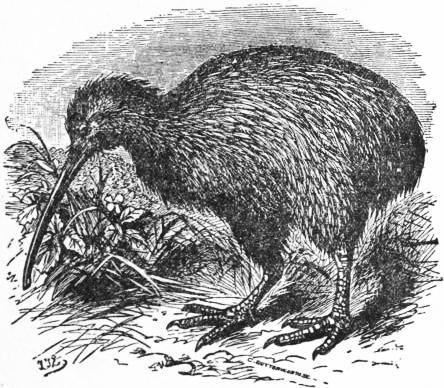
Kiwi.
In 1847 much interest was excited by the reported discovery of another species of the genus (Proceedings, 1847, p. 51); and though the story was not confirmed, a second species was really soon after made known by John Gould (tom. cit., p. 93; Transactions, vol. iii, p. 379, pl. 57) under the name of Apteryx oweni—a just tribute to the great master who had so minutely explained the anatomy of the group. Three years later A. D. Bartlett drew attention to the manifest difference existing among certain examples, all of which had hitherto been regarded as specimens of A. australis, and the examination of a large series led him to conclude that under that name two distinct species were confounded. To the second of these, the third of the genus (according to his views), he gave the name of A. mantelli (Proceedings, 1850, p. 274), and it soon turned out that to this new form the majority of the specimens already obtained belonged. In 1851 the first kiwi known to have reached England alive was presented to the Zoological Society by Eyre, then lieutenant-governor of New Zealand. This was found to belong to the newly described A. mantelli, and some careful observations on its habits in captivity were published by John Wolley and another (Zoologist, pp. 3409, 3605).4 Subsequently the society has received several other live examples of this form, besides one of the real A. australis (Proceedings, 1872, p. 861), some of A. oweni, and one of a supposed fourth species, A. haasti, characterized in 1871 by Potts (Ibis, 1872, p. 35; Trans. N. Zeal. Institute, iv. 204; v. 195).5
The kiwis form a group of the subclass Ratitae to which the rank of an order may fitly be assigned, as they differ in many important particulars from any of the other existing forms of Ratite birds. The most obvious feature the Apteryges afford is the presence of a back toe, while the extremely aborted condition of the wings, the position of the nostrils—almost at the tip of the maxilla—and the absence of an after-shaft in the feathers, are characters nearly as manifest, and others not less determinative, though more recondite, will be found on examination. The kiwis are peculiar to New Zealand, and it is believed that A. mantelli is the representative in the North Island of the southern A. australis, both being of a dark reddish-brown, longitudinally striped with light yellowish-brown, while A. oweni, of a light greyish-brown transversely barred with black, is said to occur in both islands. About the size of a large domestic fowl, they are birds of nocturnal habit, sleeping, or at least inactive, by day, feeding mostly on earth-worms, but occasionally swallowing berries, though in captivity they will eat flesh suitably minced. Sir Walter Buller writes (B. of New Zealand, p. 362):—
“The kiwi is in some measure compensated for the absence of wings by its swiftness of foot. When running it makes wide strides and carries the body in an oblique position, with the neck stretched to its full extent and inclined forwards. In the twilight it moves about cautiously and as noiselessly as a rat, to which, indeed, at this time it bears some outward resemblance. In a quiescent posture, the body generally assumes a perfectly rotund appearance; and it sometimes, but only rarely, supports itself by resting the point of its bill on the ground. It often yawns when disturbed in the daytime, gaping its mandibles in a very grotesque manner. When provoked it erects the body, and, raising the foot to the breast, strikes downwards with considerable force and rapidity, thus using its sharp and powerful claws as weapons of defence.... While hunting for its food the bird makes a continual sniffing sound through the nostrils, which are placed at the extremity of the upper mandible. Whether it is guided as much by touch as by smell I cannot safely say; but it appears to me that both senses are used in the action. That the sense of touch is highly developed seems quite certain, because the bird, although it may not be audibly sniffing, will always first touch an object with the point of its bill, whether in the act of feeding or of surveying the ground; and when shut up in a cage or confined in a room it may be heard, all through the night, tapping softly at the walls.... It is interesting to watch the bird, in a state of freedom, foraging for worms, which constitute its principal food: it moves about with a slow action of the body; and the long, flexible bill is driven into the soft ground, generally home to the very root, and is either immediately withdrawn with a worm held at the extreme tip of the mandibles, or it is gently moved to and fro, by an action of the head and neck, the body of the bird being perfectly steady. It is amusing to observe the extreme care and deliberation with which the bird draws the worm from its hiding-place, coaxing it out as it were by degrees, instead of pulling roughly or breaking it. On getting the worm fairly out of the ground, it throws up its head with a jerk, and swallows it whole.”
The foregoing extract refers to A. mantelli, but there is little doubt of the remarks being equally applicable to A. australis, and probably also to A. oweni, though the different proportion of the bill in the last points to some diversity in the mode of feeding.
(A. N.)
1 Cuvier in the second edition of his Règne Animal only referred to it in a footnote (i. 498).
2 Cruise in 1822 (Journ. Residence in New Zealand, p. 313) had spoken of an “emeu” found in that island, which must of course have been an Apteryx.
3 In 1842, according to Broderip (Penny Cyclopaedia, xxiii. 146), two had been presented to the Zoological Society by the New Zealand Company, and two more obtained by Lord Derby, one of which he had given to Gould. In 1844 the British Museum possessed three, and the sale catalogue of the Rivoli Collection, which passed in 1846 to the Academy of Natural Sciences at Philadelphia, includes a single specimen—probably the first taken to America.
4 This bird in 1859 laid an egg, and afterwards continued to lay one or two more every year. In 1865 a male of the same species was introduced, but though a strong disposition to breed was shown on the part of both, and the eggs, after the custom of the Ratitae, were incubated by him, no progeny was hatched (Proceedings, 1868, p. 329).
5 A fine series of figures of all these supposed species is given by Rowley (Orn. Miscellany, vol. i. pls. 1-6). Some others, as A. maxima, A. mollis, and A. fusca have also been indicated, but proof of their validity has yet to be adduced.
KIZILBASHES (Turkish, “Red-Heads”), the nickname given by the Orthodox Turks to the Shiitic Turkish immigrants from Persia, who are found chiefly in the plains from Kara-Hissar along Tokat and Amasia to Angora. During the wars with Persia the Turkish sultans settled them in these districts. They are strictly speaking persianized Turks, and speak pure Persian. There are many Kizilbashes in Afghanistan. Their immigration dates only from the time of Nadir Shah (1737). They are an industrious honest folk, chiefly engaged in trade and as physicians, scribes, and so on. They form the bulk of the amir’s cavalry. Their name seems to have been first used in Persia of the Shiites in allusion to their red caps.
See Ernest Chantre, Recherches anthropologiques dans l’Asie occidentale (Lyons, 1895).
KIZIL IRMAK, i.e. “Red River” (anc. Halys), the largest river in Asia Minor, rising in the Kizil Dagh at an altitude of 6500 ft., and running south-west past Zara to Sivas. Below Sivas it flows south to the latitude of Kaisarieh, and then curves gradually round to the north. Finally, after a course of about 600 m., it discharges its waters into the Black Sea between Sinope and Samsun, where it forms a large delta. The only important tributaries are the Delije Irmak on the right and the Geuk Irmak on the left bank.
KIZLYAR (Kizliar, or Kizlar), a town of Russia, in Caucasia, in the province of Terek, 120 m. N.E. of Vladikavkaz, in the low-lying delta of the river Terek, about 35 m. from the Caspian. The population decreased from 8309 in 1861 to 7353 in 1897. The town lies to the left of the main stream between two of the larger secondary branches, and is subject to flooding. The town proper, which spreads out round the citadel, has Tatar, Georgian and Armenian quarters. The public buildings include the Greek cathedral, dating from 1786; a Greek nunnery, founded by the Georgian chief Daniel in 1736; the Armenian church of SS Peter and Paul, remarkable for its size and wealth. The population is mainly supported by the gardens and vineyards irrigated by canals from the river. A government vineyard and school of viticulture are situated 3½ m. from the town. About 1,200,000 gallons of Kizlyar wine are sold annually at the fair of Nizhniy-Novgorod. Silk and cotton are woven. Kizlyar is mentioned as early as 1616, but the most notable accession of inhabitants (Armenians, Georgians and Persians) took place in 1715. Its importance as a fortress dates from 1736, but the fortress is no longer kept in repair.
KIZYL-KUM, a desert of Western Asia, stretching S.E. of the Aral Lake between the river Syr-darya on the N.E. and the river Amu-darya on the S.W. It measures some 370 by 220 m., and is in part covered with drift-sand or dunes, many of which are advancing slowly but steadily towards the S.W. In character they resemble those of the neighbouring Kara-kum desert (see Kara-kum). On the whole the Kizyl-kum slopes S.W. towards the Aral Lake, where its altitude is only about 160 ft. as compared with 2000 in the S.E. In the vicinity of that lake the surface is covered with Aralo-Caspian deposits; but in the S.E., as it ascends towards the foothills of the Tian-shan system, it is braided with deep accumulations of fertile loess.
KJERULF, HALFDAN (1815-1868), Norwegian musical composer, the son of a high government official, was born at Christiania on the 15th of September 1815. His early education was at Christiania University, for a legal career, and not till he was nearly 26—on the death of his father—was he able to devote himself entirely to music. As a fact, he actually started on his career as a music teacher and composer of songs before ever having seriously studied music at all, and not for ten years did he attract any particular notice. Then, however, his Government paid for a year’s instruction for him at Leipzig. For many years after his return to Norway Kjerulf tried in vain to establish serial classical concerts, while he himself was working with Björnson and other writers at the composition of lyrical songs. His fame rests almost entirely on his beautiful and manly national part-songs and solos; but his pianoforte music is equally charming and simple. Kjerulf died at Grefsen, on the 11th of August 1868.
KJERULF, THEODOR (1825-1888), Norwegian geologist, was born at Christiania on the 30th of March 1825. He was educated in the university at Christiania, and subsequently studied at Heidelberg, working in Bunsen’s laboratory. In 1858 he became professor of geology in the university of his native city, and he was afterwards placed in charge of the geological survey of the country, then established mainly through his influence. His contributions to the geology of Norway were numerous and important, especially in reference to the southern portion of the country, and to the structure and relations of the Archaean and Palaeozoic rocks, and the glacial phenomena. His principal results were embodied in his work Udsigt over det sydlige Norges Geologi (1879). He was author also of some poetical works. He died at Christiania on the 25th of October 1888.
KLADNO, a mining town of Bohemia, Austria, 18 m. W.N.W. of Prague by rail. Pop. (1900), 18,600, mostly Czech. It is situated in a region very rich in iron-mines and coal-fields and possesses some of the largest iron and steel works in Bohemia. Near it is the mining town of Buschtĕhrad (pop. 3510), situated in the centre of very extensive coal-fields. Buschtĕhrad was originally the name of the castle only. This was from the 15th century to 1630 the property of the lords of Kolovrat, and came by devious inheritance through the grand-dukes of Tuscany, to the emperor Francis Joseph. The name Buschtĕhrad was first given to the railway, and then to the town, which had been called Buckow since its foundation in 1700. There is another castle of Buschtĕhrad near Hořic. Kladno, which for centuries had been a village of no importance, was sold in 1705 by the grand-duchess Anna Maria of Tuscany to the cloister in Břewnow, to which it still belongs. The mining industry began in 1842.
KLAFSKY, KATHARINA (1855-1896), Hungarian operatic singer, was born at Szt János, Wieselburg, of humble parents. Being employed at Vienna as a nurserymaid, her fine soprano voice led to her being engaged as a chorus singer, and she was given good lessons in music. By 1882 she became well-known in Wagnerian rôles at the Leipzig theatre, and she increased her reputation at other German musical centres. In 1892 she appeared in London, and had a great success in Wagner’s operas, notably as Brünnhilde and as Isolde, her dramatic as well as vocal gifts being of an exceptional order. She sang in America in 1895, but died of brain disease in 1896.
A Life, by L. Ordemann, was published in 1903 (Leipzig).
KLAGENFURT (Slovene, Celovec), the capital of the Austrian duchy of Carinthia, 212 m. S.W. of Vienna by rail. Pop. (1900), 24,314. It is picturesquely situated on the river Glan, which is in communication with the Wörther-see by the 3 m. long Lend canal. Among the more noteworthy buildings are the parish church of St Ægidius (1709), with a tower 298 ft. in height; the cathedral of SS Peter and Paul (1582-1593, burnt 1723, restored 1725); the churches of the Benedictines (1613), of the Capuchins (1646), and of the order of St Elizabeth (1710). To these must be added the palace of the prince-bishop of Gurk, the burg or castle, existing in its present form since 1777; and the Landhaus or house of assembly, dating from the end of the 14th century, and containing a museum of natural history, and collection of minerals, antiquities, seals, paintings and sculptures. The most interesting public monument is the great Lindwurm or Dragon, standing in the principal square (1590). The industrial establishments comprise white lead factories, machine and iron foundries, and commerce is active, especially in the mineral products of the region.
Upon the Zollfeld to the north of the city once stood the ancient Roman town of Virunum. During the Middle Ages Klagenfurt became the property of the crown, but by a patent of Maximilian I. of the 24th of April 1518, it was conceded to the Carinthian estates, and has since then taken the place of St Veit as capital of Carinthia. In 1535, 1636, 1723 and 1796 Klagenfurt suffered from destructive fires, and in 1690 from the effects of an earthquake. On the 29th of March 1797 the French took the city, and upon the following day it was occupied by Napoleon as his headquarters.
KLAJ (latinized Clajus), JOHANN (1616-1656), German poet, was born at Meissen in Saxony. After studying theology at Wittenberg he went to Nuremberg as a “candidate for holy orders,” and there, in conjunction with Georg Philipp Harsdörffer, founded in 1644 the literary society known as the Pegnitz order. In 1647 he received an appointment as master in the Sebaldus school in Nuremberg, and in 1650 became preacher at Kitzingen, where he died in 1656. Klaj’s poems consist of dramas, written in stilted language and redundant with adventures, among which are Höllen- und Himmelfahrt Christi (Nuremberg, 1644), and Herodes, der Kindermörder (Nuremberg, 1645), and a poem, written jointly with Harsdörffer, Pegnesische Schäfergedicht (1644), which gives in allegorical form the story of his settlement in Nuremberg.
See Tittmann, Die Nürnberger Dichterschule (Göttingen, 1847).
KLAMATH, a small tribe of North American Indians of Lutuamian stock. They ranged around the Klamath river and lakes, and are now on the Klamath reservation, southern Oregon.
See A. S. Gatschet, “Klamath Indians of Oregon,” Contributions to North American Ethnology, vol. ii. (Washington, 1890).
KLAPKA, GEORG (1820-1892), Hungarian soldier, was born at Temesvár on the 7th of April 1820, and entered the Austrian army in 1838. He was still a subaltern when the Hungarian revolution of 1848 broke out, and he offered his services to the patriot party. He served in important staff appointments during the earlier part of the war which followed; then, early in 1849, he was ordered to replace General Mészáros, who had been defeated at Kaschau, and as general commanding an army corps he had a conspicuous share in the victories of Kapólna, Isaszeg, Waitzen, Nagy Sarlo and Komárom. Then, as the fortune of war turned against the Hungarians, Klapka, after serving for a short time as minister of war, took command at Komárom, from which fortress he conducted a number of successful expeditions until the capitulation of Világos in August put an end to the war in the open field. He then brilliantly defended Komárom for two months, and finally surrendered on honourable terms. Klapka left the country at once, and lived thenceforward for many years in exile, at first in England and afterwards chiefly in Switzerland. He continued by every means in his power to work for the independence of Hungary, especially at moments of European war, such as 1854, 1859 and 1866, at which an appeal to arms seemed to him to promise success. After the war of 1866 (in which as a Prussian major-general he organized a Hungarian corps in Silesia) Klapka was permitted by the Austrian government to return to his native country, and in 1867 was elected a member of the Hungarian Chamber of Deputies, in which he belonged to the Deák party. In 1877 he made an attempt to reorganize the Turkish army in view of the war with Russia. General Klapka died at Budapest on the 17th of May 1892. A memorial was erected to his memory at Komárom in 1896.
He wrote Memoiren (Leipzig, 1850); Der Nationalkrieg in Ungarn, &c. (Leipzig, 1851); a history of the Crimean War, Der Krieg im Orient ... bis Ende Juli 1855 (Geneva, 1855); and Aus meinen Erinnerungen (translated from the Hungarian, Zürich, 1887).
KLAPROTH, HEINRICH JULIUS (1783-1835), German Orientalist and traveller, was born in Berlin on the 11th of October 1783, the son of the chemist Martin Heinrich Klaproth (q.v.). He devoted his energies in quite early life to the study of Asiatic languages, and published in 1802 his Asiatisches Magazin (Weimar, 1802-1803). He was in consequence called to St Petersburg and given an appointment in the academy there. In 1805 he was a member of Count Golovkin’s embassy to China. On his return he was despatched by the academy to the Caucasus on an ethnographical and linguistic exploration (1807-1808), and was afterwards employed for several years in connexion with the academy’s Oriental publications. In 1812 he moved to Berlin; but in 1815 he settled in Paris, and in 1816 Humboldt procured him from the king of Prussia the title and salary of professor of Asiatic languages and literature, with permission to remain in Paris as long as was requisite for the publication of his works. He died in that city on the 28th of August 1835.
The principal feature of Klaproth’s erudition was the vastness of the field which it embraced. His great work Asia polyglotta (Paris, 1823 and 1831, with Sprachatlas) not only served as a résumé of all that was known on the subject, but formed a new departure for the classification of the Eastern languages, more especially those of the Russian Empire. To a great extent, however, his work is now superseded. The Itinerary of a Chinese Traveller (1821), a series of documents in the military archives of St Petersburg purporting to be the travels of George Ludwig von ——, and a similar series obtained from him in the London foreign office, are all regarded as spurious.
Klaproth’s other works include: Reise in den Kaukasus und Georgien in den Jahren 1807 und 1808 (Halle, 1812-1814; French translation, Paris, 1823); Geographisch-historische Beschreibung des östlichen Kaukasus (Weimar, 1814); Tableaux historiques de l’Asie (Paris, 1826); Mémoires relatifs à l’Asie (Paris, 1824-1828); Tableau historique, geographique, ethnographique et politique de Caucase (Paris, 1827); and Vocabulaire et grammaire de la langue géorgienne (Paris, 1827).
KLAPROTH, MARTIN HEINRICH (1743-1817), German chemist, was born at Wernigerode on the 1st of December 1743. During a large portion of his life he followed the profession of an apothecary. After acting as assistant in pharmacies at Quedlinburg, Hanover, Berlin and Danzig successively he came to Berlin on the death of Valentin Rose the elder in 1771 as manager of his business, and in 1780 he started an establishment on his own account in the same city, where from 1782 he was pharmaceutical assessor of the Ober-Collegium Medicum. In 1787 he was appointed lecturer in chemistry to the Royal Artillery, and when the university was founded in 1810 he was selected to be the professor of chemistry. He died in Berlin on the 1st of January 1817. Klaproth was the leading chemist of his time in Germany. An exact and conscientious worker, he did much to improve and systematize the processes of analytical chemistry and mineralogy, and his appreciation of the value of quantitative methods led him to become one of the earliest adherents of the Lavoisierian doctrines outside France. He was the first to discover uranium, zirconium and titanium, and to characterize them as distinct elements, though he did not obtain any of them in the pure metallic state; and he elucidated the composition of numerous substances till then imperfectly known, including compounds of the then newly recognized elements: tellurium, strontium, cerium and chromium.
His papers, over 200 in number, were collected by himself in Beiträge zur chemischen Kenntniss der Mineralkörper (5 vols., 1795-1810) and Chemische Abhandlungen gemischten Inhalts (1815). He also published a Chemisches Wörterbuch (1807-1810), and edited a revised edition of F. A. C. Gren’s Handbuch der Chemie (1806).
KLÉBER, JEAN BAPTISTE (1753-1800), French general, was born on the 9th of March 1753, at Strassburg, where his father was a builder. He was trained, partly at Paris, for the profession of architect, but his opportune assistance to two German nobles in a tavern brawl obtained for him a nomination to the military school of Munich. Thence he obtained a commission in the Austrian army, but resigned it in 1783 on finding his humble birth in the way of his promotion. On returning to France he was appointed inspector of public buildings at Belfort, where he studied fortification and military science. In 1792 he enlisted in the Haut-Rhin volunteers, and was from his military knowledge at once elected adjutant and soon afterwards lieutenant-colonel. At the defence of Mainz he so distinguished himself that though disgraced along with the rest of the garrison and imprisoned, he was promptly reinstated, and in August 1793 promoted general of brigade. He won considerable distinction in the Vendéan war, and two months later was made a general of division. In these operations began his intimacy with Marceau, with whom he defeated the Royalists at Le Mans and Savenay. For openly expressing his opinion that lenient measures ought to be pursued towards the Vendéans he was recalled; but in April 1794 he was once more reinstated and sent to the Army of the Sambre-and-Meuse. He displayed his skill and bravery in the numerous actions around Charleroi, and especially in the crowning victory of Fleurus, after which in the winter of 1794-95 he besieged Mainz. In 1795 and again in 1796 he held the chief command of an army temporarily, but declined a permanent appointment as commander-in-chief. On the 13th of October 1795 he fought a brilliant rearguard action at the bridge of Neuwied, and in the offensive campaign of 1796 he was Jourdan’s most active and successful lieutenant. Having, after the retreat to the Rhine (see French Revolutionary Wars), declined the chief command, he withdrew into private life early in 1798. He accepted a division in the expedition to Egypt under Bonaparte, but was wounded in the head at Alexandria in the first engagement, which prevented his taking any further part in the campaign of the Pyramids, and caused him to be appointed governor of Alexandria. In the Syrian campaign of 1799, however, he commanded the vanguard, took El-Arish, Gaza and Jaffa, and won the great victory of Mount Tabor on the 15th of April 1799. When Napoleon returned to France towards the end of 1799 he left Kléber in command of the French forces. In this capacity, seeing no hope of bringing his army back to France or of consolidating his conquests, he made the convention of El-Arish. But when Lord Keith, the British admiral, refused to ratify the terms, he attacked the Turks at Heliopolis, though with but 10,000 men against 60,000, and utterly defeated them on the 20th of March 1800. He then retook Cairo, which had revolted from the French. Shortly after these victories he was assassinated at Cairo by a fanatic on the 14th of June 1800, the same day on which his friend and comrade Desaix fell at Marengo. Kléber was undoubtedly one of the greatest generals of the French revolutionary epoch. Though he distrusted his powers and declined the responsibility of supreme command, there is nothing in his career to show that he would have been unequal to it. As a second in command he was not excelled by any general of his time. His conduct of affairs in Egypt at a time when the treasury was empty and the troops were discontented for want of pay, shows that his powers as an administrator were little—if at all—inferior to those he possessed as a general.
Ernouf, the grandson of Jourdan’s chief of staff, published in 1867 a valuable biography of Kléber. See also Reynaud, Life of Merlin de Thionville; Ney, Memoirs; Dumas, Souvenirs; Las Casas, Memorial de Ste Hélène; J. Charavaray, Les Généraux morts pour la patrie; General Pajol, Kléber; lives of Marceau and Desaix; M. F. Rousseau, Kléber et Menou en Egypte (Paris, 1900).
KLEIN, JULIUS LEOPOLD (1810-1876), German writer of Jewish origin, was born at Miskolcz, in Hungary. He was educated at the gymnasium in Pest, and studied medicine in Vienna and Berlin. After travelling in Italy and Greece, he settled as a man of letters in Berlin, where he remained until his death on the 2nd of August 1876. He was the author of many dramatic works, among others the historical tragedies Maria von Medici (1841); Luines (1842); Zenobia (1847); Moreto (1859); Maria (1860); Strafford (1862) and Heliodora (1867); and the comedies Die Herzogin (1848); Ein Schützling (1850); and Voltaire (1862). The tendency of Klein as a dramatist was to become bombastic and obscure, but many of his characters are vigorously conceived, and in nearly all his tragedies there are passages of brilliant rhetoric. He is chiefly known as the author of the elaborate though uncompleted Geschichte des Dramas (1865-1876), in which he undertook to record the history of the drama from the earliest times. He died when about to enter upon the Elizabethan period, to the treatment of which he had looked forward as the chief part of his task. The work, which is in thirteen bulky volumes, gives proof of immense learning, but is marred by eccentricities of style and judgment.
Klein’s Dramatische Werke were collected in 7 vols. (1871-1872).
KLEIST, BERND HEINRICH WILHELM VON (1777-1811), German poet, dramatist and novelist, was born at Frankfort-on-Oder on the 18th of October 1777. After a scanty education, he entered the Prussian army in 1792, served in the Rhine campaign of 1796 and retired from the service in 1799 with the rank of lieutenant. He next studied law and philosophy at the university of Frankfort-on-Oder, and in 1800 received a subordinate post in the ministry of finance at Berlin. In the following year his roving, restless spirit got the better of him, and procuring a lengthened leave of absence he visited Paris and then settled in Switzerland. Here he found congenial friends in Heinrich Zschokke (q.v.) and Ludwig Friedrich August Wieland (1777-1819), son of the poet; and to them he read his first drama, a gloomy tragedy, Die Familie Schroffenstein (1803), originally entitled Die Familie Ghonorez. In the autumn of 1802 Kleist returned to Germany; he visited Goethe, Schiller and Wieland in Weimar, stayed for a while in Leipzig and Dresden, again proceeded to Paris, and returning in 1804 to his post in Berlin was transferred to the Domänenkammer (department for the administration of crown lands) at Königsberg. On a journey to Dresden in 1807 Kleist was arrested by the French as a spy, and being sent to France was kept for six months a close prisoner at Châlons-sur-Marne. On regaining his liberty he proceeded to Dresden, where in conjunction with Adam Heinrich Müller (1779-1829) he published in 1808 the journal Phöbus. In 1809 he went to Prague, and ultimately settled in Berlin, where he edited (1810-1811) the Berliner Abendblätter. Captivated by the intellectual and musical accomplishments of a certain Frau Henriette Vogel, Kleist, who was himself more disheartened and embittered than ever, agreed to do her bidding and die with her, carrying out this resolution by first shooting the lady and then himself on the shore of the Wannsee near Potsdam, on the 21st of November 1811. Kleist’s whole life was filled by a restless striving after ideal and illusory happiness, and this is largely reflected in his work. He was by far the most important North German dramatist of the Romantic movement, and no other of the Romanticists approaches him in the energy with which he expresses patriotic indignation.
His first tragedy, Die Familie Schroffenstein, has been already referred to; the material for the second, Penthesilea (1808), queen of the Amazons, is taken from a Greek source and presents a picture of wild passion. More successful than either of these was his romantic play, Das Käthchen von Heilbronn, oder Die Feuerprobe (1808), a poetic drama full of medieval bustle and mystery, which has retained its popularity. In comedy, Kleist made a name with Der zerbrochene Krug (1811), while Amphitryon (1808), an adaptation of Molière’s comedy, is of less importance. Of Kleist’s other dramas, Die Hermannschlacht (1809) is a dramatic treatment of an historical subject and is full of references to the political conditions of his own times. In it he gives vent to his hatred of his country’s oppressors. This, together with the drama Prinz Friedrich von Homburg, the latter accounted Kleist’s best work, was first published by Ludwig Tieck in Kleists hinterlassene Schriften (1821). Robert Guiskard, a drama conceived on a grand plan, was left a fragment. Kleist was also a master in the art of narrative, and of his Gesammelte Erzählungen (1810-1811), Michael Kohlhaas, in which the famous Brandenburg horse dealer in Luther’s day (see Kohlhase) is immortalized, is one of the best German stories of its time. He also wrote some patriotic lyrics. His Gesammelte Schriften were published by Ludwig Tieck (3 vols. 1826) and by Julian Schmidt (new ed. 1874); also by F. Muncker (4 vols. 1882); by T. Zolling (4 vols. 1885); by K. Siegen, (4 vols. 1895); and in a critical edition by E. Schmidt (5 vols. 1904-1905). His Ausgewählte Dramen were published by K. Siegen (Leipzig, 1877); and his letters were first published by E. von Bülow, Heinrich von Kleists Leben und Briefe (1848).
See further A. Wilbrandt, Heinrich von Kleist (1863); O. Brahm, Heinrich von Kleist (1884); R. Bonafous, Henri de Kleist, sa vie et ses œuvres (1894); H. Conrad, Heinrich von Kleist als Mensch und Dichter (1896); G. Minde-Pouet, Heinrich von Kleist, seine Sprache und sein Stil (1897); R. Steig, Heinrich von Kleists Berliner Kämpfe (1901); F. Servaes, Heinrich von Kleist (1902); S. Wukadinowic, Kleist-Studien (1904); S. Rahmer, H. von Kleist als Mensch und Dichter (1909).
KLEIST, EWALD CHRISTIAN VON (1715-1759), German poet, was born at Zeblin, near Köslin in Pomerania, on the 7th of March 1715. After attending the Jesuit school in Deutschkrona and the gymnasium in Danzig, he proceeded in 1731 to the university of Königsberg, where he studied law and mathematics. On the completion of his studies, he entered the Danish army, in which he became an officer in 1736. Recalled to Prussia by Frederick II. in 1740, he was appointed lieutenant in a regiment stationed at Potsdam, where he became acquainted with J. W. L. Gleim (q.v.), who interested him in poetry. After distinguishing himself at the battle of Mollwitz (April 10, 1741) and the siege of Neisse (1741), he was promoted captain in 1749 and major in 1756. Quartered during the winter of 1757-1758 in Leipzig, he found relief from his irksome military duties in the society of Gotthold Ephraim Lessing (q.v.). Shortly afterwards in the battle of Kunersdorf, on the 12th of August 1759, he was mortally wounded while leading the attack, and died at Frankfort-on-Oder on the 24th of August following.
Kleist’s chief work is a poem in hexameters, Der Frühling (1749), for which Thomson’s Seasons largely supplied ideas. In his description of the beauties of nature Kleist shows real poetical genius, an almost modern sentiment and fine taste. He also wrote some charming odes, idylls and elegies, and a small epic poem Cissides und Paches (1759), the subject being two Thessalian friends who die an heroic death for their country in a battle against the Athenians.
Kleist published in 1756 the first collection of his Gedichte, which was followed by a second in 1758. After his death his friend Karl Wilhelm Ramler (q.v.) published an edition of Kleists sämtliche Werke in 2 vols. (1760). A critical edition was published by A. Sauer, in 3 vols. (1880-1882). Cf. further, A. Chuquet, De Ewaldi Kleistii vita et scriptis (Paris, 1887), and H. Pröhle, Friedrich der Grosse und die deutsche Literatur (1872).
KLERKSDORP, a town of the Transvaal, 118 m. S.W. of Johannesburg and 192 m. N.E. of Kimberley by rail. Pop. (1904), 4276 of whom 2203 were whites. The town, built on the banks of the Schoonspruit 10 m. above its junction with the Vaal, possesses several fine public buildings. In the neighbourhood are gold-mines, the reef appearing to form the western boundary of the Witwatersrand basin. Diamonds (green in colour) and coal are also found in the district. Klerksdorp was one of the villages founded by the first Boers who crossed the Vaal, dating from 1838. The modern town, which is on the side of the spruit opposite the old village, was founded in 1888.
KLESL (or Khlesl), MELCHIOR (1552-1630), Austrian statesman and ecclesiastic, was the son of a Protestant baker, and was born in Vienna. Under the influence of the Jesuits he was converted to Roman Catholicism, and having finished his education at the universities of Vienna and Ingolstadt, he was made chancellor of the university of Vienna; and as official and vicar-general of the bishop of Passau he exhibited the zeal of a convert in forwarding the progress of the counter-reformation in Austria. He became bishop of Vienna in 1598; but more important was his association with the archduke Matthias which began about the same time. Both before and after 1612, when Matthias succeeded his brother Rudolph II. as emperor, Klesl was the originator and director of his policy, although he stoutly opposed the concessions to the Hungarian Protestants in 1606. He assisted to secure the election of Matthias to the imperial throne, and sought, but without success, to strengthen the new emperor’s position by making peace between the Catholics and the Protestants. When during the short reign of Matthias the question of the imperial succession demanded prompt attention, the bishop, although quite as anxious as his opponents to retain the empire in the house of Habsburg and to preserve the dominance of the Roman Catholic Church, advised that this question should be shelved until some arrangement with the Protestant princes had been reached. This counsel was displeasing to the archduke Maximilian and to Ferdinand, afterwards the emperor Ferdinand II. who believed that Klesl was hostile to the candidature of the latter prince. It was, however, impossible to shake his influence with the emperor; and in June 1618, a few months before the death of Matthias, he was seized by order of the archdukes and imprisoned at Ambras in Tirol. In 1622 Klesl, who had been a cardinal since 1615, was transferred to Rome by order of Pope Gregory XV., and was released from imprisonment. In 1627 Ferdinand II. allowed him to return to his episcopal duties in Vienna, where he died on the 18th of September 1630.
See J. Freiherr von Hammer-Purgstall, Khlesls Leben (Vienna, 1847-1851); A. Kerschbaumer, Kardinal Klesl (Vienna, 1865); and Klesls Briefe an Rudolfs II. Obersthofmeister A. Freiherr von Dietrichstein, edited by V. Bibl. (Vienna, 1900).
KLINGER, FRIEDRICH MAXIMILIAN VON (1752-1831), German dramatist and novelist, was born of humble parentage at Frankfort-on-Main, on the 17th of February 1752. His father died when he was a child, and his early years were a hard struggle. He was enabled, however, in 1774 to enter the university of Giessen, where he studied law; and Goethe, with whom he had been acquainted since childhood, helped him in many ways. In 1775 Klinger gained with his tragedy Die Zwillinge a prize offered by the Hamburg theatre, under the auspices of the actress Sophie Charlotte Ackermann (1714-1792) and her son the famous actor and playwright, Friedrich Ludwig Schröder (1744-1816). In 1776 Klinger was appointed Theaterdichter to the “Seylersche Schauspiel-Gesellschaft” and held this post for two years. In 1778 he entered the Austrian military service and took part in the Bavarian war of succession. In 1780 he went to St Petersburg, became an officer in the Russian army, was ennobled and attached to the Grand Duke Paul, whom he accompanied on a journey to Italy and France. In 1785 he was appointed director of the corps of cadets, and having married a natural daughter of the empress Catharine, was made praeses of the Academy of Knights in 1799. In 1803 Klinger was nominated by the emperor Alexander curator of the university of Dorpat, an office he held until 1817; in 1811 he became lieutenant-general. He then gradually gave up his official posts, and after living for many years in honourable retirement, died at Dorpat on the 25th of February 1831.
Klinger was a man of vigorous moral character and full of fine feeling, though the bitter experiences and deprivations of his youth are largely reflected in his dramas. It was one of his earliest works, Sturm und Drang (1776), which gave its name to this literary epoch. In addition to this tragedy and Die Zwillinge (1776), the chief plays of his early period of passionate fervour and restless “storm and stress” are Die neue Arria (1776), Simsone Grisaldo (1776) and Stilpo und seine Kinder (1780). To a later period belongs the fine double tragedy of Medea in Korinth and Medea auf dem Kaukasos (1791). In Russia he devoted himself mainly to the writing of philosophical romances, of which the best known are Fausts Leben, Taten und Höllenfahrt (1791), Geschichte Giafars des Barmeciden (1792) and Geschichte Raphaels de Aquillas (1793). This series was closed in 1803 with Betrachtungen und Gedanken über verschiedene Gegenstände der Welt und der Literatur. In these works Klinger gives calm and dignified expression to the leading ideas which the period of Sturm und Drang had bequeathed to German classical literature.
Klinger’s works were published in twelve volumes (1809-1815), also 1832-1833 and 1842. The most recent edition is in eight volumes (1878-1880); but none of these is complete. A selection will be found in A. Sauer, Stürmer und Dränger, vol. i. (1883). See E. Schmidt, Lenz und Klinger (1878); M. Rieger, Klinger in der Sturm- und Drangperiode (1880); and Klinger in seiner Reife (1896).
KLINGER, MAX (1857- ), German painter, etcher and sculptor, was born at Plagwitz near Leipzig. He attended the classes at the Carlsruhe art school in 1874, and went in the following year to Berlin, where in 1878 he created a sensation at the Academy exhibition with two series of pen-and-ink drawings—the “Series upon the Theme of Christ” and “Fantasies upon the Finding of a Glove.” The daring originality of these imaginative and eccentric works caused an outburst of indignation, and the artist was voted insane; nevertheless the “Glove” series was bought by the Berlin National Gallery. His painting of “The Judgment of Paris” caused a similar storm of indignant protest in 1887, owing to its rejection of all conventional attributes and the naïve directness of the conception. His vivid and somewhat morbid imagination, with its leaning towards the gruesome and disagreeable, and the Goyaesque turn of his mind, found their best expression in his “cycles” of etchings: “Deliverances of Sacrificial Victims told in Ovid,” “A Brahms Phantasy,” “Eve and the Future,” “A Life,” and “Of Death”; but in his use of the needle he does not aim at the technical excellence of the great masters; it supplies him merely with means of expressing his ideas. After 1886 Klinger devoted himself more exclusively to painting and sculpture. In his painting he aims neither at classic beauty nor modern truth, but at grim impressiveness not without a touch of mysticism. His “Pietà” at the Dresden Gallery, the frescoes at the Leipzig University, and the “Christ in Olympus,” at the Modern Gallery in Vienna, are characteristic examples of his art. The Leipzig Museum contains his sculptured “Salome” and “Cassandra.” In sculpture he favours the use of varicoloured materials in the manner of the Greek chryselephantine sculpture. His “Beethoven” is a notable instance of his work in this direction.
KLIPSPRINGER, the Boer name of a small African mountain-antelope (Oreotragus saltator), ranging from the Cape through East Africa to Somaliland and Abyssinia, and characterized by its blunt rounded hoofs, thick pithy hair and gold-spangled colouring. The klipspringer represents a genus by itself, the various local forms not being worthy of more than racial distinction. The activity of these antelopes is marvellous.
KLONDIKE, a district in Yukon Territory, north-western Canada, approximately in 64° N. and 140° W. The limits are rather indefinite, but the district includes the country to the south of the Klondike River, which comes into the Yukon from the east and has several tributaries, as well as Indian River, a second branch of the Yukon, flowing into it some distance above the Klondike. The richer gold-bearing gravels are found along the creeks tributary to these two rivers within an area of about 800 sq. m. The Klondike district is a dissected peneplain with low ridges of rounded forms rising to 4250 ft. above the sea at the Dome which forms its centre. All of the gold-bearing creeks rise not far from the Dome and radiate in various directions toward the Klondike and Indian rivers, the most productive being Bonanza with its tributary Eldorado, Hunker, Dominion and Gold Run. Of these, Eldorado, for the two or three miles in which it was gold-bearing, was much the richest, and for its length probably surpassed any other known placer deposit. Rich gravel was discovered on Bonanza Creek in 1896, and a wild rush to this almost inaccessible region followed, a population of 30,000 coming in within the next three or four years with a rapidly increasing output of gold, reaching in 1900 the climax of $22,000,000. Since then the production has steadily declined, until in 1906 it fell to $5,600,000. The richest gravels were worked out before 1910, and most of the population had left the Klondike for Alaska and other regions; so that Dawson, which for a time was a bustling city of more than 10,000, dwindled to about 3000 inhabitants. As the ground was almost all frozen, the mines were worked by a thawing process, first by setting fires, afterwards by using steam, new methods being introduced to meet the unusual conditions. Later dredges and hydraulic mining were resorted to with success.
The Klondike, in spite of its isolated position, brought together miners and adventurers from all parts of the world, and it is greatly to the credit of the Canadian government and of the mounted police, who were entrusted with the keeping of order, that life and property were as safe as elsewhere and that no lawless methods were adopted by the miners as in placer mining camps in the western United States. The region was at first difficult of access, but can now be reached with perfect comfort in summer, travelling by well-appointed steamers on the Pacific and the Yukon River. Owing to its perpetually frozen soil, summer roads were excessively bad in earlier days, but good wagon roads have since been constructed to all the important mining centres. Dawson itself has all the resources of a civilized city in spite of being founded on a frozen peat-bog; and is supplied with ordinary market vegetables from farms just across the river. During the winter, when for some time the sun does not appear above the hills, the cold is intense, though usually without wind, but the well-chinked log houses can be kept comfortably warm. When winter travel is necessary dog teams and sledges are generally made use of, except on the stage route south to White Horse, where horses are used. A telegraph line connects Dawson with British Columbia, but the difficulties in keeping it in order are so great over the long intervening wilderness that communication is often broken. Gold is practically the only economic product of the Klondike, though small amounts of tin ore occur, and lignite coal has been mined lower down on the Yukon. The source of the gold seems to have been small stringers of quartz in the siliceous and sericitic schists which form the bed rock of much of the region, and no important quartz veins have been discovered; so that unlike most other placer regions the Klondike has not developed lode mines to continue the production of gold when the gravels are exhausted.
KLOPP, ONNO (1822-1903), German historian, was born at Leer on the 9th of October 1822, and was educated at the universities of Bonn, Berlin and Göttingen. For a few years he was a teacher at Leer and at Osnabrück; but in 1858 he settled at Hanover, where he became intimate with King George V., who made him his Archivrat. Thoroughly disliking Prussia, he was in hearty accord with George in resisting her aggressive policy; and after the annexation of Hanover in 1866 he accompanied the exiled king to Hietzing. He became a Roman Catholic in 1874. He died at Penzing, near Vienna, on the 9th of August 1903. Klopp is best known as the author of Der Fall des Hauses Stuart (Vienna, 1875-1888), the fullest existing account of the later Stuarts.
His Der König Friedrich II. und seine Politik (Schaffhausen, 1867) and Geschichte Ostfrieslands (Hanover, 1854-1858) show his dislike of Prussia. His other works include Der dreissigjährige Krieg bis zum Tode Gustav Adolfs (Paderborn, 1891-1896); a revised edition of his Tilly im dreissigjährigen Kriege (Stuttgart, 1861); a life of George V., König Georg V. (Hanover, 1878); Phillipp Melanchthon (Berlin, 1897). He edited Corrispondenza epistolare tra Leopoldo I. imperatore ed il P. Marco l’Aviano capuccino (Gratz, 1888). Klopp also wrote much in defence of George V. and his claim to Hanover, including the Offizieller Bericht über die Kriegsereignisse zwischen Hannover und Preussen im Juni 1866 (Vienna, 1867), and he edited the works of Leibnitz in eleven volumes (1861-1884).
See W. Klopp, Onno Klopp: ein Lebenslauf (Wehberg, 1907).
KLOPSTOCK, GOTTLIEB FRIEDRICH (1724-1803), German poet, was born at Quedlinburg, on the 2nd of July 1724, the eldest son of a lawyer, a man of sterling character and of a deeply religious mind. Both in his birthplace and on the estate of Friedeburg on the Saale, which his father later rented, young Klopstock passed a happy childhood; and more attention having been given to his physical than to his mental development he grew up a strong healthy boy and was an excellent horseman and skater. In his thirteenth year Klopstock returned to Quedlinburg where he attended the gymnasium, and in 1739 proceeded to the famous classical school of Schulpforta. Here he soon became an adept in Greek and Latin versification, and wrote some meritorious idylls and odes in German. His original intention of making the emperor Henry I. (“The Fowler”) the hero of an epic, was, under the influence of Milton’s Paradise Lost, with which he became acquainted through Bodmer’s translation, abandoned in favour of the religious epic. While yet at school, he had already drafted the plan of Der Messias, upon which his fame mainly rests. On the 21st of September 1745 he delivered on quitting school a remarkable “leaving oration” on epic poetry—Abschiedsrede über die epische Poesie, kultur- und literargeschichtlich erläutert—and next proceeded to Jena as a student of theology, where he elaborated the first three cantos of the Messias in prose. The life at this university being uncongenial to him, he removed in the spring of 1746 to Leipzig, and here joined the circle of young men of letters who contributed to the Bremer Beiträge. In this periodical the first three cantos of the Messias in hexameters were anonymously published in 1748. A new era in German literature had commenced, and the name of the author soon became known. In Leipzig he also wrote a number of odes, the best known of which is An meine Freunde (1747), afterwards recast as Wingolf (1767). He left the university in 1748 and became a private tutor in the family of a relative at Langensalza. Here unrequited love for a cousin (the “Fanny” of his odes) disturbed his peace of mind. Gladly therefore he accepted in 1750 an invitation from Jakob Bodmer (q.v.), the translator of Paradise Lost, to visit him in Zürich. Here Klopstock was at first treated with every kindness and respect and rapidly recovered his spirits. Bodmer, however, was disappointed to find in the young poet of the Messias a man of strong worldly interests, and a coolness sprang up between the two friends.
At this juncture Klopstock received from Frederick V. of Denmark, on the recommendation of his minister Count von Bernstorff (1712-1772), an invitation to settle at Copenhagen, with an annuity of 400 talers, with a view to the completion of the Messias. The offer was accepted; on his way to the Danish capital Klopstock met at Hamburg the lady who in 1754 became his wife, Margareta (Meta) Moller, (the “Cidli” of his odes), an enthusiastic admirer of his poetry. His happiness was short; she died in 1758, leaving him almost broken-hearted. His grief at her loss finds pathetic expression in the 15th canto of the Messias. The poet subsequently published his wife’s writings, Hinterlassene Werke von Margareta Klopstock (1759), which give evidence of a tender, sensitive and deeply religious spirit. Klopstock now relapsed into melancholy; new ideas failed him, and his poetry became more and more vague and unintelligible. He still continued to live and work at Copenhagen, and next, following Heinrich Wilhelm von Gerstenberg (q.v.), turned his attention to northern mythology, which he conceived should replace classical subjects in a new school of German poetry. In 1770, on the dismissal by King Christian VII. of Count Bernstorff from office, he retired with the latter to Hamburg, but retained his pension together with the rank of councillor of legation. Here, in 1773, he issued the last five cantos of the Messias. In the following year he published his strange scheme for the regeneration of German letters, Die Gelehrtenrepublik (1774). In 1775 he travelled south, and making the acquaintance of Goethe on the way, spent a year at the court of the margrave of Baden at Karlsruhe. Thence, in 1776, with the title of Hofrat and a pension from the margrave, which he retained together with that from the king of Denmark, he returned to Hamburg where he spent the remainder of his life. His latter years he passed, as had always been his inclination, in retirement, only occasionally relieved by association with his most intimate friends, busied with philological studies, and hardly interesting himself in the new developments of German literature. The American War of Independence and the Revolution in France aroused him, however, to enthusiasm. The French Republic sent him the diploma of honorary citizenship; but, horrified at the terrible scenes the Revolution had enacted in the place of liberty, he returned it. When 67 years of age he contracted a second marriage with Johanna Elisabeth von Winthem, a widow and a niece of his late wife, who for many years had been one of his most intimate friends. He died at Hamburg on the 14th of March 1803, mourned by all Germany, and was buried with great pomp and ceremony by the side of his first wife in the churchyard of the village of Ottensen.
Klopstock’s nature was best attuned to lyrical poetry, and in it his deep, noble character found its truest expression. He was less suited for epic and dramatic representation; for, wrapt up in himself, a stranger to the outer world, without historical culture, and without even any interest in the events of his time, he was lacking in the art of plastic representation such as a great epic requires. Thus the Messias, despite the magnificent passages which especially the earlier cantos contain, cannot satisfy the demands such a theme must necessarily make. The subject matter, the Redemption, presented serious difficulties to adequate epic treatment. The Gospel story was too scanty, and what might have been imported from without and interwoven with it was rejected by the author as profane. He had accordingly to resort to Christian mythology; and here again, circumscribed by the dogmas of the Church, he was in danger of trespassing on the fundamental truths of the Christian faith. The personality of Christ could scarcely be treated in an individual form, still less could angels and devils—and in the case of God Himself it was impossible. The result was that, despite the groundwork—the Gospels, the Acts of the Apostles, the Revelation of St John, and the model ready to hand in Milton’s Paradise Lost—material elements are largely wanting and the actors in the poem, Divine and human, lack plastic form. That the poem took twenty-five years to complete could not but be detrimental to its unity of design; the original enthusiasm was not sustained until the end, and the earlier cantos are far superior to the later. Thus the intense public interest the work aroused in its commencement had almost vanished before its completion. It was translated into seventeen languages and led to numerous imitations. In his odes Klopstock had more scope for his peculiar talent. Among the best are An Fanny; Der Zürchersee; Die tote Klarissa; An Cidli; Die beiden Musen; Der Rheinwein; Die frühen Gräber; Mein Vaterland. His religious odes mostly take the form of hymns, of which the most beautiful is Die Frühlingsfeier. His dramas, in some of which, notably Hermanns Schlacht (1769) and Hermann und die Fürsten (1784), he celebrated the deeds of the ancient German hero Arminius, and in others, Der Tod Adams (1757) and Salomo (1764), took his materials from the Old Testament, are essentially lyrical in character and deficient in action. In addition to Die Gelehrtenrepublik, he was also the author of Fragmente über Sprache und Dichtkunst (1779) and Grammatische Gespräche (1794), works in which he made important contributions to philology and to the history of German poetry.
Klopstock’s Werke first appeared in seven quarto volumes (1798-1809). At the same time a more complete edition in twelve octavo volumes was published (1798-1817), to which six additional volumes were added in 1830. More recent editions were published in 1844-1845, 1854-1855, 1879 (ed. by R. Boxberger), 1884 (ed. by R. Hamel) and 1893 (a selection edited by F. Muncker). A critical edition of the Odes was published by F. Muncker and J. Pawel in 1889; a commentary on these by H. Düntzer (1860; 2nd ed., 1878). For Klopstock’s correspondence see K. Schmidt, Klopstock und seine Freunde (1810); C. A. H. Clodius, Klopstocks Nachlass (1821); J. M. Lappenberg, Briefe von und an Klopstock (1867). Cf. further K. F. Cramer, Klopstock, er und über ihn (1780-1792); J. G. Gruber, Klopstocks Leben (1832); R. Hamel, Klopstock-Studien (1879-1880); F. Muncker, F. G. Klopstock, the most authoritative biography, (1888); E. Bailly, Étude sur la vie et les œuvres de Klopstock (Paris, 1888).
KLOSTERNEUBURG, a town of Austria, in Lower Austria, 5½ m. N.W. of Vienna by rail. Pop. (1900), 11,595. It is situated on the right bank of the Danube, at the foot of the Kahlenberg, and is divided by a small stream into an upper and a lower town. As an important pioneer station Klosterneuburg has various military buildings and stores, and among the schools it possesses an academy of wine and fruit cultivation.
On a hill rising directly from the banks of the Danube stand the magnificent buildings (erected 1730-1834) of the Augustine canonry, founded in 1106 by Margrave Leopold the Holy. This foundation is the oldest and richest of the kind in Austria; it owns much of the land upon which the north-western suburbs of Vienna stand. Among the points of interest within it are the old chapel of 1318, with Leopold’s tomb and the altar of Verdun, dating from the 12th century, the treasury and relic-chamber, the library with 30,000 volumes and many MSS., the picture gallery, the collection of coins, the theological hall, and the wine-cellar, containing an immense tun like that at Heidelberg. The inhabitants of Klosterneuburg are mainly occupied in making wine, of excellent quality. There is a large cement factory outside the town. In Roman times the castle of Citium stood in the region of Klosterneuburg. The town was founded by Charlemagne, and received its charter as a town in 1298.
KLOTZ, REINHOLD (1807-1870), German classical scholar, was born near Chemnitz in Saxony on the 13th of March 1807. In 1849 he was appointed professor in the university of Leipzig in succession to Gottfried Hermann, and held this post till his death on the 10th of August 1870. Klotz was a man of unwearied industry, and devoted special attention to Latin literature.
He was the author of editions of several classical authors, of which the most important were: the complete works of Cicero (2nd ed., 1869-1874); Clement of Alexandria (1831-1834); Euripides (1841-1867), in continuation of Pflugk’s edition, but unfinished; Terence (1838-1840), with the commentaries of Donatus and Eugraphius. Mention should also be made of: Handwörterbuch der lateinischen Sprache (5th ed., 1874); Römische Litteraturgeschichte (1847), of which only the introductory volume appeared; an edition of the treatise De Graecae linguae particulis (1835-1842) of Matthaeus Deverius (Devares), a learned Corfiote (c. 1500-1570), and corrector of the Greek MSS. in the Vatican; the posthumous Index Ciceronianus (1872) and Handbuch der lateinischen Stilistik (1874). From 1831-1855 Klotz was editor of the Neue Jahrbücher für Philologie (Leipzig). During the troubled times of 1848 and the following years he showed himself a strong conservative.
A memoir by his son Richard will be found in the Jahrbücher for 1871, pp. 154-163.
KNARESBOROUGH, a market town in the Ripon parliamentary division of the West Riding of Yorkshire, England, 16½ m. W. by N. from York by a branch of the North Eastern railway. Pop. of urban district (1901), 4979. Its situation is most picturesque, on the steep left bank of the river Nidd, which here follows a well-wooded valley, hemmed in by limestone cliffs. The church of St John the Baptist is Early English, but has numerous Decorated and Perpendicular additions; it is a cruciform building containing several interesting monuments. Knaresborough Castle was probably founded in 1070 by Serlo de Burgh. Its remains, however, are of the 14th century, and include a massive keep rising finely from a cliff above the Nidd. After the battle of Marston Moor it was taken by Fairfax, and in 1648 it was ordered to be dismantled. To the south of the castle is St Robert’s chapel, an excavation in the rock constructed into an ecclesiastical edifice in the reign of Richard I. Several of the excavations in the limestone, which is extensively quarried, are incorporated in dwelling-houses. A little farther down the river is St Robert’s cave, which is supposed to have been the residence of the hermit, and in 1744 was the scene of the murder of Daniel Clarke by Eugene Aram, whose story is told in Lytton’s well-known novel. Opposite the castle is the Dropping Well, the waters of which are impregnated with lime and have petrifying power, this action causing the curious and beautiful incrustations formed where the water falls over a slight cliff. The Knaresborough free grammar school was founded in 1616. There is a large agricultural trade, and linen and leather manufactures and the quarries also employ a considerable number of persons.
Knaresborough (Canardesburg, Cnarreburc, Cknareburg), which belonged to the Crown before the Conquest, formed part of William the Conqueror’s grant to his follower Serlo de Burgh. Being forfeited by his grandson Eustace FitzJohn in the reign of Stephen, Knaresborough was granted to Robert de Stuteville, from whose descendants it passed through marriage to Hugh de Morville, one of the murderers of Thomas Becket, who with his three accomplices remained in hiding in the castle for a whole year. During the 13th and 14th centuries the castle and lordship changed hands very frequently; they were granted successively to Hubert de Burgh, whose son forfeited them after the battle of Evesham, to Richard, earl of Cornwall, whose son Edmund died without issue; to Piers Gaveston, and lastly to John of Gaunt, duke of Lancaster, and so to the Crown as parcel of the duchy of Lancaster. In 1317 John de Lilleburn, who was holding the castle of Knaresborough for Thomas duke of Lancaster against the king, surrendered under conditions to William de Ros of Hamelak, but before leaving the castle managed to destroy all the records of the liberties and privileges of the town which were kept in the castle. In 1368 an inquisition was taken to ascertain these privileges, and the jurors found that the burgesses held “all the soil of their borough yielding 7s. 4d. yearly and doing suit at the king’s court.” In the reign of Henry VIII. Knaresborough is said by Leland to be “no great thing and meanely builded but the market there is quik.” During the civil wars Knaresborough was held for some time by the Royalists, but they were obliged to surrender, and the castle was among those ordered to be destroyed by parliament in 1646. A market on Wednesday and a fortnightly fair on the same day from the Feast of St Mark to that of St Andrew are claimed under a charter of Charles II. confirming earlier charters. Lead ore was found and worked on Knaresborough Common in the 16th century. From 1555 to 1867 the town returned two members to parliament, but in the latter year the number was reduced to one, and in 1885 the representation was merged in that of the West Riding.
KNAVE (O.E. cnafa, cognate with Ger. Knabe, boy), originally a male child, a boy (Chaucer, Canterbury Tales: “Clerk’s Tale,” I. 388). Like Lat. puer, the word was early used as a name for any boy or lad employed as a servant, and so of male servants in general (Chaucer: “Pardoner’s Tale,” 1. 204). The current use of the word for a man who is dishonest and crafty, a rogue, was however an early usage, and is found in Layamon (c. 1205). In playing-cards the lowest court card of each suit, the “jack,” representing a medieval servant, is called the “knave.” (See also Valet.)
KNEBEL, KARL LUDWIG VON (1744-1834), German poet and translator, was born at the castle of Wallerstein in Franconia on the 30th of November 1744. After having studied law for a short while at Halle, he entered the regiment of the crown prince of Prussia in Potsdam and was attached to it as officer for ten years. Disappointed in his military career, owing to the slowness of promotion, he retired in 1774, and accepting the post of tutor to Prince Konstantin of Weimar, accompanied him and his elder brother, the hereditary prince, on a tour to Paris. On this journey he visited Goethe in Frankfort-on-Main, and introduced him to the hereditary prince, Charles Augustus. This meeting is memorable as being the immediate cause of Goethe’s later intimate connexion with the Weimar court. After Knebel’s return and the premature death of his pupil he was pensioned, receiving the rank of major. In 1798 he married the singer Luise von Rudorf, and retired to Ilmenau; but in 1805 he removed to Jena, where he lived until his death on the 23rd of February 1834. Knebel’s Sammlung kleiner Gedichte (1815), issued anonymously, and Distichen (1827) contain many graceful sonnets, but it is as a translator that he is best known. His translation of the elegies of Propertius, Elegien des Properz (1798), and that of Lucretius’ De rerum natura (2 vols., 1831) are deservedly praised. Since their first acquaintance Knebel and Goethe were intimate friends, and not the least interesting of Knebel’s writings is his correspondence with the eminent poet, Briefwechsel mit Goethe (ed. G. E. Guhrauer, 2 vols., 1851).
Knebel’s Literarischer Nachlass und Briefwechsel was edited by K. A. Varnhagen von Ense and T. Mundt in 3 vols. (1835; 2nd ed., 1840). See Hugo von Knebel-Döberitz, Karl Ludwig von Knebel (1890).
KNEE (O.E. cnéow, a word common to Indo-European languages, cf. Ger. Knie, Fr. genou, Span, hinojo, Lat. genu, Gr. γόνυ, Sansk. janu), in human anatomy, the articulation of the upper and lower parts of the leg, the joint between the femur and the tibia (see Joints). The word is also used of articulation resembling the knee-joint in shape or position in other animals; it thus is applied to the carpal articulation of the fore leg of a horse, answering to the ankle in man, or to the tarsal articulation or heel of a bird’s foot.
KNELLER, SIR GODFREY (1648-1723), a portrait painter whose celebrity belongs chiefly to England, was born in Lübeck in the duchy of Holstein, of an ancient family, on the 8th of August 1648. He was at first intended for the army, and was sent to Leyden to learn mathematics and fortification. Showing, however, a marked preference for the fine arts, he studied in the school of Rembrandt, and under Ferdinand Bol in Amsterdam. In 1672 he removed to Italy, directing his chief attention to Titian and the Caracci; Carlo Maratta gave him some guidance and encouragement. In Rome, and more especially in Venice, Kneller earned considerable reputation by historical paintings as well as portraits. He next went to Hamburg, painting with still increasing success. In 1674 he came to England at the invitation of the duke of Monmouth, was introduced to Charles II., and painted that sovereign, much to his satisfaction, several times. Charles also sent him to Paris, to take the portrait of Louis XIV. When Sir Peter Lely died in 1680, Kneller, who produced in England little or nothing in the historical department, remained without a rival in the ranks of portrait painting; there was no native-born competition worth speaking of. Charles appointed him court painter; and he continued to hold the same post into the days of George I. Under William III. (1692) he was made a knight, under George I. (1715) a baronet, and by order of the emperor Leopold I. a knight of the Roman Empire. Not only his court favour but his general fame likewise was large: he was lauded by Dryden, Addison, Steele, Prior, Tickell and Pope. Kneller’s gains also were very considerable; aided by habits of frugality which approached stinginess, he left property yielding an annual income of £2000. His industry was maintained till the last. His studio had at first been in Covent Garden, but in his closing years he lived in Kneller Hall, Twickenham. He died of fever, the date being generally given as the 7th of November 1723, though some accounts say 1726. He was buried in Twickenham church, and has a monument in Westminster Abbey. An elder brother, John Zachary Kneller, an ornamental painter, had accompanied Godfrey to England, and had died in 1702. The style of Sir Godfrey Kneller as a portrait painter represented the decline of that art as practised by Vandyck; Lely marks the first grade of descent, and Kneller the second. His works have much freedom, and are well drawn and coloured; but they are mostly slight in manner, and to a great extent monotonous, this arising partly from the habit which he had of lengthening the oval of all his heads. The colouring may be called brilliant rather than true. He indulged much in the common-places of allegory; and, though he had a quality of dignified elegance not unallied with simplicity, genuine simple nature is seldom to be traced in his works. His fame has greatly declined, and could not but do so after the advent of Reynolds. Among Kneller’s principal paintings are the “Forty-three Celebrities of the Kit-Cat Club,” and the “Ten Beauties of the Court of William III.,” now at Hampton Court; these were painted by order of the queen; they match, but match unequally, the “Beauties of the Court of Charles II.,” painted by Lely. He executed altogether the likenesses of ten sovereigns, and fourteen of his works appear in the National Portrait Gallery. It is said that Kneller’s own favourite performance was the portrait of the “Converted Chinese” in Windsor Castle. His later works are confined almost entirely to England, not more than two or three specimens having gone abroad after he had settled here.