VOLUME XV SLICE VIII Kite-Flying to Kyshtym (continued 3)
Reading edition
The chief history of the order is Baron de Reiffenberg’s Histoire de l’Ordre de la Toison d’Or (1830); see also an article by Sir J. Balfour Paul, Lyon King of Arms, in the Scottish Historical Review (July 1908).
Austria-Hungary.—The following are the principal orders other than that of the Golden Fleece (supra). The Order of St Stephen of Hungary, the royal Hungarian order, founded in 1764 by the empress Maria Theresa, consists of the grand master (the sovereign), 20 knights grand cross, 30 knights commanders and 50 knights. The badge is a green enamelled cross with gold borders, suspended from the Hungarian crown; the red enamelled medallion in the centre of the cross bears a white patriarchal cross issuing from a coroneted green mound; on either side of the cross are the letters M.T. in gold, and the whole is surrounded by a white fillet with the legend Publicum Meritorum Praemium. The ribbon is green with a crimson central stripe. The collar, only worn by the knights grand cross, is of gold, and consists of Hungarian crowns linked together alternately by the monograms of St Stephen, S.S., and the foundress, M.T.; the centre of the collar is formed by a flying lark encircled by the motto Stringit amore. An illustration of the star of the grand cross is given on Plate V. fig. 4. The Order of Leopold, for civil and military service, was founded in 1808 by the emperor Francis I. in memory of his father Leopold II. The three classes take precedence next after the corresponding classes of the order of St Stephen. The badge is a red enamelled cross bordered with white and gold and surmounted by the imperial crown; the red medallion in the centre bears the letters F.I.A., and on the encircling white fillet is the inscription Integritati et Merito. When conferred for service in war the cross rests on a green laurel wreath. The ribbon is scarlet with two white stripes. The collar consists of imperial crowns, the initials F. and L. and oak wreaths. The Order of the Iron Crown, i.e. of Lombardy, was founded by Napoleon as king of Italy in 1809, and refounded as an Austrian order of civil and military merit in 1816 by the emperor Francis I.; the number of knights is limited to 100—20 grand cross, 30 commanders, 50 knights. The badge consists of the double-headed imperial eagle with sword and orb; below it is the jewelled iron crown of Lombardy, and above the imperial crown; on the breast of the eagle is a gold-bordered blue shield with the letter F. in gold. The military decoration for war service also bears two green laurel branches. The ribbon is yellow edged with narrow blue stripes. The collar is formed of Lombard crowns, oak wreaths and the monogram F. P. (Franciscus Primus). The Order of Francis Joseph, for personal merit of every kind, was founded in 1849 by the emperor Francis Joseph I. It is of the three usual classes and is unlimited in numbers. The badge is a black and gold imperial eagle surmounted by the imperial crown. The eagle bears a red cross with a white medallion, containing the letters F. J., and to the beaks of the two heads of the eagle is attached a chain on which is the legend Viribus Unitis. The ribbon is deep red. The Order of Maria Theresa was founded by the empress Maria Theresa in 1757. It is a purely military order and is given to officers for personal distinguished conduct in the field. There are three classes. There were originally only two, grand cross and knights. The emperor Joseph II. added a commanders’ class in 1765. The badge is a white cross with gold edge, in the centre a red medallion with a white gold-edged fesse, surrounded by a fillet with the inscription Fortitudini. The ribbon is red with a white central stripe. The Order of Elizabeth Theresa, also a military order for officers, was founded in 1750 by the will of Elizabeth Christina, widow of the emperor Charles VI. It was renovated in 1771 by her daughter, the empress Maria Theresa. The order is limited to 21 knights in three divisions. The badge is an oval star with eight points, enamelled half red and white, dependent from a gold imperial crown. The central medallion bears the initials of the founders, with the encircling inscription M. Theresa parentis gratiam perennem voluit. The ribbon is black. The Order of the Starry Cross, for high-born ladies of the Roman Catholic faith who devote themselves to good works, spiritual and temporal, was founded in 1668 by the empress Eleanor, widow of the emperor Ferdinand III. and mother of Leopold I., to commemorate the recovery of a relic of the true cross from a dangerous fire in the imperial palace at Vienna. The relic was supposed to have been peculiarly treasured by the emperor Maximilian I. and the emperor Frederick III. The patroness of the order must be a princess of the imperial Austrian house. The badge is the black double-headed eagle surrounded by a blue-enamelled ornamented border, with the inscription Salus et Gloria on a white fillet; the eagle bears a red Greek cross with gold and blue borders. The Order of Elizabeth, also for ladies, was founded in 1898.
Plate III.
INSIGNIA OF SOME OF THE PRINCIPAL ORDERS OF KNIGHTHOOD, DRAWN BY GRACIOUS PERMISSION FROM THOSE IN THE POSSESSION OF HIS LATE MAJESTY KING EDWARD VII AND ARRANGED IN ACCORDANCE WITH HIS MAJESTY’S WISHES AND COMMAND.
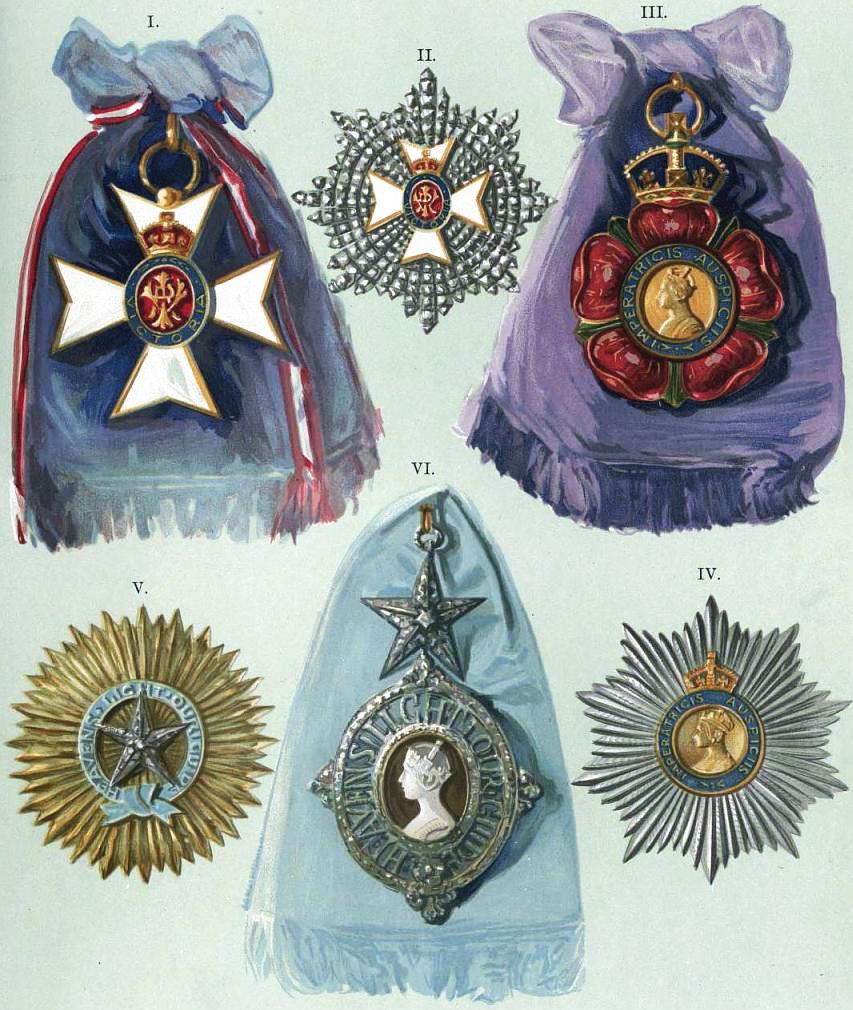
ROYAL VICTORIAN ORDER. (i.) Grand Cross; (ii.) Star. ORDER OF THE INDIAN EMPIRE. (iii.) Badge Of Knight Grand Commander; (iv.) Star. THE STAR OF INDIA. (v.) Star; (vi.) Badge of Knight Grand Commander.
Drawn by William Gibb. Niagara Litho. Co., Buffalo, N. Y.
Belgium.—The Order of Leopold, for civil and military merit, was founded in 1832 by Leopold I., with four classes, a fifth being added in 1838. The badge is a white enamelled cross, with gold borders and balls, suspended from a royal crown and resting on a green laurel and oak wreath. In the centre a medallion, surrounded by a red fillet with the motto of the order, L’union fait la force, bears a golden Belgian lion on a black field. The ribbon is watered red. The Order of the Iron Cross, the badge of which is a black cross with gold borders, with a gold centre bearing a lion, was instituted by Leopold II. in 1867 as an order of civil merit. The military cross was instituted in 1885. There are also the following orders instituted by Leopold II. for service in the Congo State: the Order of the African Star (1888), the Royal Order of the Lion (1891) and the Congo Star (1889).
Bulgaria.—The Order of SS Cyril and Methodius was instituted in 1909 by King Ferdinand to commemorate the elevation of the principality to the position of an independent kingdom. It now takes precedence of the Order of St Alexander, which was founded by Prince Alexander in 1881, and reconstituted by Prince Ferdinand in 1888. There are six classes. The plain white cross, suspended from the Bulgarian crown, bears the name of the patron saint in old Cyrillic letters in the centre.
Denmark.—The Order of the Elephant, one of the chief European orders of knighthood, was, it is said, founded by Christian I. in 1462; a still earlier origin has been assigned to it, but its regular institution was that of Christian V. in 1693. The order, exclusive of the sovereign and his sons, is limited to 30 knights, who must be of the Protestant religion. The badge of the order is illustrated on Plate IV. fig. 5. The ribbon is light watered blue, the collar of alternate gold elephants with blue housings and towers, the star of silver with a purple medallion bearing a silver or brilliant cross surrounded by a silver laurel wreath. The motto is Magnanime pretium. The Order of the Dannebrog is, according to Danish tradition, of miraculous origin, and was founded by Valdemar II. in 1219 as a memorial of a victory over the Esthonians, won by the appearance in the sky of a red banner bearing a white cross. Historically the order dates from the foundation in 1671 by Christian V. at the birth of his son Frederick, the statutes being published in 1693. Originally restricted to 50 knights and granted as a family or court decoration, it was reconstituted as an unlimited order of merit in 1808 by Frederick VI.; alterations have been made in 1811 and 1864. It now consists of three classes—grand cross, commander (two grades), knight, and of one rank of ordinary members (Dannebrogs maender). The badge of the order is, with variations for the different classes, a white enamelled Danish cross with red and gold borders, bearing in the centre the letter W (V) and on the four arms the inscription Gud og Kongen (For God and King). The ribbon is white with red edging.
France.—The Legion of Honour, the only order of France, and one which in its higher grades ranks in estimation with the highest European orders, was instituted by Napoleon Bonaparte on the 19th of May 1802 (29 Floreal of the year X.) as a general military and civil order of merit. All soldiers on whom “swords of honour” had been already conferred were declared legionaries ipso facto, and all citizens after 25 years’ service were declared eligible, whatever their birth, rank or religion. On admission all were to swear to co-operate so far as in them lay for the assertion of the principles of liberty and equality. The organization as laid down by Napoleon in 1804 was as follows: Napoleon was grand master; a grand council of 7 grand officers administered the order; the order was divided into 15 “cohorts” of 7 grand officers, 20 commanders, 30 officers and 350 legionaries, and at the headquarters of the cohorts, for which the territory of France was separated into 15 divisions, were maintained hospitals for the support of the sick and infirm legionaries. Salaries (traitements) varying in each rank were attached to the order. In 1805 the rank of “Grand Eagle” (now Grand Cross, or Grand Cordon) was instituted, taking precedence of the grand officers. At the Restoration many changes were made, the old military and religious orders were restored, and the Legion of Honour, now Ordre Royale de la Légion d’Honneur, took the lowest rank. The revolution of July 1830 restored the order to its unique place. The constitution of the order now rests on the decrees of the 16th of March and 24th of November 1852, the law of the 25th of July 1873, the decree of the 29th of December 1892, and the laws of the 16th of April 1895 and the 28th of January 1897, and a decree of the 26th of June 1900. The president of the republic is the grand master of the order; the administration is in the hands of a grand chancellor, who has a council of the order nominated by the grand master. The chancellery is housed in the Palais de la Légion de l’Honneur, which, burnt during the Commune, was rebuilt in 1878. The order consists of the five classes of grand cross (limited to 80), grand officer (200), commander (1000), officers (4000), and chevalier or knight, in which the number is unlimited. These limitations in number do not affect the foreign recipients of the order. Salaries (traitements) are attached to the military and naval recipients of the order when on the active list, viz. 3000 francs for grand cross, 2000 francs for grand officers, 1000 francs for commanders, 250 francs for chevaliers. The numbers of the recipients of the order sans traitement are limited through all classes. In ordinary circumstances twenty years of military, naval or civil service must have been performed before a candidate can be eligible for the rank of chevalier, and promotions can only be made after definite service in the lower rank. Extraordinary service in time of war and extraordinary services in civil life admit to any rank. Women have been decorated, notably Rosa Bonheur, Madame Curie and Madame Bartet. The Napoleonic form of the grand cross and ribbon is illustrated on Plate IV, fig. 6; the cross from which the drawing was made was given to King Edward VII. when prince of Wales in 1863. In the present order of the French Republic the symbolical head of the Republic appears in the centre, and a laurel wreath replaces the imperial crown; the inscription round the medallion is République française. Since 1805 there has existed an institution, Maison d’éducation de la Legion d’Honneur, for the education of the daughters, granddaughters, sisters and nieces of members of the Legion of Honour. There are three houses, at Saint Denis, at Écouen and Les Loges (see Dictionnaire de l’administration française, by M. Block and E. Magnéro, 1905, s.v. “Decorations”).
Among the orders swept away at the French Revolution, restored in part at the Restoration, and finally abolished at the revolution of July 1830 were the following: The Order of St Michael was founded by Louis XI. in 1469 for a limited number of knights of noble birth. Later the numbers were so much increased under Charles IX. that it became known as Le Collier à toutes bêtes. In 1816 the order was granted for services in art and science. In view of the low esteem into which the Order of St Michael had fallen, Henry III. founded in 1578 the Order of the Holy Ghost (St Esprit). The badge of the order was a white Maltese cross decorated in gold, with the gold lilies of France at the angles, in the centre a white dove with wings outstretched, the ribbon was sky blue (cordon bleu). The motto of the order was Duce et auspice. The Order of St Louis was founded by Louis XIV. in 1693 for military merit, and the Order of Military Merit by Louis XV. in 1759, originally for Protestant officers.
Germany.—i. Anhalt. The Order of Albert the Bear, a family order or Hausorden, was founded in 1836 by the dukes Henry of Anhalt-Köthen, Leopold Frederick of Anhalt-Dessau and Alexander Charles of Anhalt-Bernburg. Changes in the constitution have been made at various dates. It now consists of five classes, grand cross, commander (2 classes) and knights (2 classes). The badge is a gold oval bearing in gold a crowned and collared bear on a crenellated wall; below the ring by which the badge is attached to the ribbon is a shield with the arms of the house of Anhalt, on the reverse those of the house of Ascania. Round the oval is the motto Fürchte Gott und folge seine Befehle. The ribbon is green with two red stripes. The grand master alone wears a collar.
ii. Baden. The Order of Fidelity or Loyalty (Hausorden der Treue) was instituted by William, margrave of Baden-Durlach in 1715, and reconstituted in 1803 by the elector Charles Frederick. There is now only one class, for princes of the reigning house, foreign sovereigns and eminent men of the state. The badge is a red enamelled cross with gold borders and double C’s interlaced in the angles; in the centre a white medallion with red monogram over a green mound surmounted by the word Fidelitas in black; the cross is suspended from a ducal crown. The ribbon is orange with silver edging. The military Order of Charles Frederick was founded in 1807. There are three classes. The badge is a white cross resting on a green laurel wreath, the ribbon is red with a yellow stripe bordered with white. The order is conferred for long and meritorious military service. The Order of the Zähringen Lion was founded in 1812 in commemoration of the descent of the reigning house of Baden from the dukes of Zähringen. It has been reconstituted in 1840 and 1877. It now consists of five classes. The badge is a green enamel cross with gold clasps in the angles; in the central medallion an enamelled representation of the ruined castle of Zähringen. The ribbon is green with two orange stripes. Since 1896 the Order of Berthold I. has been a distinct order; it was founded in 1877 as a higher class of the Zähringen Lion.
iii. Bavaria. The Order of St Hubert, one of the oldest and most distinguished knightly orders, was founded in 1444 by duke Gerhard V. of Jülich-Berg in honour of a victory over Count Arnold of Egmont at Ravensberg on the 3rd of November, St Hubert’s day. The knights wore a collar of golden hunting horns, whence the order was also known as the Order of the Horn. Statutes were granted in 1476, but the order fell into abeyance at the extinction of the dynasty in 1609. It was revived in 1708 by the elector palatine, John William of Neuberg, and its constitution was altered at various times, its final form being given by the elector Maximilian Joseph, first king of Bavaria, in 1808. Exclusive of the sovereign and princes of the blood, and foreign sovereigns and princes, it consists of twelve capitular knights of the rank of count or Freiherr. The badge of the order and the ribbon are illustrated in Plate V. fig. 3. The central medallion represents the conversion of St Hubert. The collar is composed of gold and blue enamel figures of the conversion linked by the Gothic monogram I.T.V., In Trau Vast, the motto of the order, alternately red and green. The Order of St George, said to have been founded in the 12th century as a crusading order and revived by the emperor Maximilian I. in 1494, dates historically from its institution in 1729 by the elector Charles Albert, afterwards the emperor Charles VII. It was confirmed by the elector Charles Theodore in 1778 and by the elector Maximilian Joseph IV. as the second Bavarian order. Various new statutes have been granted from 1827 to 1875. The order is divided into two branches, “of German and foreign languages,” and it also has a “spiritual class.” The members of the order must be Roman Catholics. The badge is a blue enamelled cross with white and gold edging suspended from the mouth of a gold lion’s head; in the angles of the cross are blue lozenges containing the letters V.I.B.I., Virgini Immaculatae Bavaria Immaculata. The central medallion contains a figure of the Immaculate Conception. The medallion on the reverse contains a figure of St George and the Dragon and the corresponding initials J.U.P.F., Justus ut Palma Florebit, the motto of the order. Besides the above Bavaria possesses the Military Order of Maximilian Joseph, 1806, and the Civil Orders of Merit of St Michael, 1693, and of the Bavarian Crown, 1808, and other minor orders and decorations, civil and military. There are also the two illustrious orders for ladies, the Order of Elizabeth, founded in 1766, and the Order of Theresa, in 1827. The foundations of St Anne of Munich and of St Anne of Würzburg for ladies are not properly orders.
iv. Brunswick. The Order of Henry the Lion, for military and civil merit, was founded by Duke William in 1834. There are five classes, and a cross of merit of two classes. The badge is a blue enamelled cross dependent from a lion surmounted by the ducal crown; the angles of the cross are filled by crowned W’s and the centre bears the arms of Brunswick, a crowned pillar and a white horse, between two sickles. The ribbon is deep red bordered with yellow.
v. Hanover. The Order of St George (one class only) was instituted by King Ernest Augustus I. in 1839 as the family order of the house of Hanover; the Royal Guelphic Order (three classes) by George, prince regent, afterwards George IV. of Great Britain, in 1815; and the Order of Ernest Augustus by George V. of Hanover in 1865. These orders have not been conferred since 1866, when Hanover ceased to be a kingdom, and the Royal Guelphic Order, which from its institution was more British than Hanoverian, not since the death of William IV. in 1837. The last British grand cross was the late duke of Cambridge.
vi. Hesse. Of the various orders founded by the houses of Hesse-Cassel and Hesse-Darmstadt the following are still bestowed in the grand duchy of Hesse. The Order of Louis, founded by the grand duke Louis I. of Hesse-Darmstadt in 1807; there are five classes; the black, red and gold bordered cross bears the initial L. in the centre, the ribbon is black with red borders; the Order of Philip the Magnanimous, founded by the grand duke Louis II. in 1840 has five classes; the white cross of the badge bears the effigy of Philip surrounded by the motto Si Deus vobiscum quis contra nos. The Order of the Golden Lion was founded in 1770 by the landgrave Frederick II. of Hesse-Cassel, the knights are 41 in number and take precedence of the members of the two former orders. The badge is an open oval of gold with the Hessian lion in the centre. The ribbon is crimson.
vii. Mecklenburg. The grand duchies of Mecklenburg-Schwerin and Mecklenburg-Strelitz possess jointly the Order of the Wendish Crown, founded in 1864 by the grand dukes Frederick Francis II. of Schwerin and Frederick William of Strelitz; there are four classes, with two divisions of the grand cross, and also an affiliated cross of merit; the grand cross can be granted to ladies. The badge is a white cross bearing on a blue centre the Wendish crown, surrounded by the motto, for the Schwerin knights, Per aspera ad astra, for the Strelitz knights, Avito viret honore. The Order of the Griffin, founded in 1884 by Frederick Francis III. of Schwerin, was made common to the duchies in 1904.
viii. Oldenberg. The Order of Duke Peter Frederick Louis, a family order and order of merit, was founded by the grand duke Paul Frederick Augustus in memory of his father in 1838. It has two divisions, each of five classes, of capitular knights and honorary members. The badge is a white gold bordered cross suspended from a crown, in the centre the crowned monogram P.F.L. surrounded by the motto Ein Gott, Ein Recht, Eine Wahrheit; the ribbon is dark blue bordered with red.
ix. Prussia. The Order of the Black Eagle, one of the most distinguished of European orders, was founded in 1701 by the elector of Brandenburg, Frederick I., in memory of his coronation as king of Prussia. The order consists of one class only and the original statutes limited the number, exclusive of the princes of the royal house and foreign members, to 30. But the number has been exceeded. It is only conferred on those of royal lineage and upon high officers of state. It confers the nobiliary particle von. Only those who have received the Order of the Red Eagle are eligible. An illustration of the badge of the order with ribbon is given on Plate IV. fig. 3. The star of silver bears the black eagle on an orange ground surrounded by a silver fillet on which is the motto of the order Suum Cuique. The collar is formed of alternate black eagles and a circular medallion with the motto on a white centre surrounded by the initials F.R. repeated in green, the whole in a circle of blue with four gold crowns on the exterior rim. The Order of the Red Eagle, the second of the Prussian orders, was founded originally as the Order of Sincerity (L’Ordre de la Sincerité) in 1705 by George William, hereditary prince of Brandenburg-Bayreuth. The original constitution and insignia are now entirely changed, with the exception of the red eagle which formed the centre of the cross of the badge. The order had almost fallen into oblivion when it was revived in 1734 by the margrave George Frederick Charles as the Order of the Brandenburg Red Eagle. It consisted of 30 nobly born knights. The numbers were increased and a grand cross class added in 1759. On the cession of the principality to Prussia in 1791 the order was transferred and King Frederick William raised it to that place in Prussian orders which it has since maintained. The order was divided into four classes in 1810 and there are now five classes with numerous subdivisions. It is an order of civil and military merit. The grand cross resembles the badge of the Black Eagle, but is white and the eagles in the corners red, the central medallion bearing the initials W.R. (those of William I.) surrounded by a blue fillet with the motto Sincere et Constanter. The numerous classes and subdivisions have exceedingly complicated distinguishing marks, some bearing crossed swords, a crown, or an oak-leaf surmounting the cross. The ribbon is white with two orange stripes.
The Order for Merit (Ordre pour le Mérite), one of the most highly prized of European orders of merit, has now two divisions, military and for science and art. It was originally founded by the electoral prince Frederick, afterwards Frederick I. of Prussia, in 1667 as the Order of Generosity; it was given its present name and granted for civil and military distinction by Frederick the Great, 1740. In 1810 the order was made one for military merit against the enemy in the field exclusively. In 1840 the class for distinction for science and art, or peace class (Friedensklasse) was founded by Frederick William IV., for those “who have gained an illustrious name by wide recognition in the spheres of science and art.” The number is limited to 30 German and 30 foreign members. The Academy of Sciences and Arts on a vacancy nominates three candidates, from which one is selected by the king. It is interesting to note that this was the only distinction which Thomas Carlyle would accept. The badge of the military order is a blue cross with gold uncrowned eagles in the angles; on the topmost arm is the initial F., with a crown; on the other arms the inscription Pour le Mérite. The ribbon is black with a silver stripe at the edges. In 1866 a special grand cross was instituted for the crown prince (afterwards Frederick III.) and Prince Frederick Charles. It was in 1879 granted to Count von Moltke as a special distinction. The badge of the class for science or art is a circular medallion of white, with a gold eagle in the centre surrounded by a blue border with the inscription Pour le Mérite; on the white field the letters F. II. four times repeated, and four crowns in gold projecting from the rim. The ribbon is the same as for the military class. The Order of the Crown, founded by William I. in 1861, ranks with the Red Eagle. There are four classes, with many subdivisions. Other Prussian orders are the Order of William, instituted by William II. in 1896; a Prussian branch of the knights of St John of Jerusalem, Johanniter Orden, in its present form dating from 1893; and the family Order of the House of Hohenzollern, founded in 1851 by Frederick William IV. There are two divisions, military and civil, divided into four classes. The military badge is a white cross with black and gold edging, resting on a green oak and laurel wreath; the central medallion bears the Prussian Eagle with the arms of Hohenzollern, and is surrounded by a blue fillet with the motto Vom Fels zum Meer; the civil badge is a black eagle, with the head encircled with a blue fillet with the motto. There are also for ladies the Order of Service, founded in 1814 by Frederick William III., in one class, but enlarged in 1850 and in 1865. The decoration of merit for ladies (Verdienst-kreuz), founded in 1870, was raised to an order in 1907. For the famous military decoration, the Iron Cross, see Medals.

x. Saxony.—The Order of the Crown of Rue (Rauten Krone) was founded as a family order by Frederick Augustus I. in 1807. It is of one class only, and the sons and nephews of the sovereign are born knights of the order. It is granted to foreign ruling princes and subjects of high rank. The badge is a pale green enamelled cross resting on a gold crown with eight rue leaves, the centre is white with the crowned monogram of the founder surrounded by a green circlet of rue; the star bears in its centre the motto Providentiae Memor. The ribbon is green. Other Saxon orders are the military Order of St Henry, for distinguished service in the field, founded in 1736 in one class; since 1829 it has had four classes; the ribbon is sky blue with two yellow stripes, the gold cross bears in the centre the effigy of the emperor Henry II.; the Order of Albert, for civil and military merit, founded in 1850 by Frederick Augustus II. in memory of Duke Albert the Bold, the founder of the Albertine line of Saxony, has six classes; the Order of Civil Merit, was founded in 1815. For ladies there are the Order of Sidonia, 1870, in memory of the wife of Albert the Bold, the mother (Stamm-Mutter) of the Albertine line; and the Maria Anna Order, 1906.
Plate IV.
INSIGNIA OF SOME OF THE PRINCIPAL ORDERS OF KNIGHTHOOD, DRAWN BY GRACIOUS PERMISSION FROM THOSE IN THE POSSESSION OF HIS LATE MAJESTY KING EDWARD VII AND ARRANGED IN ACCORDANCE WITH HIS MAJESTY’S WISHES AND COMMAND.
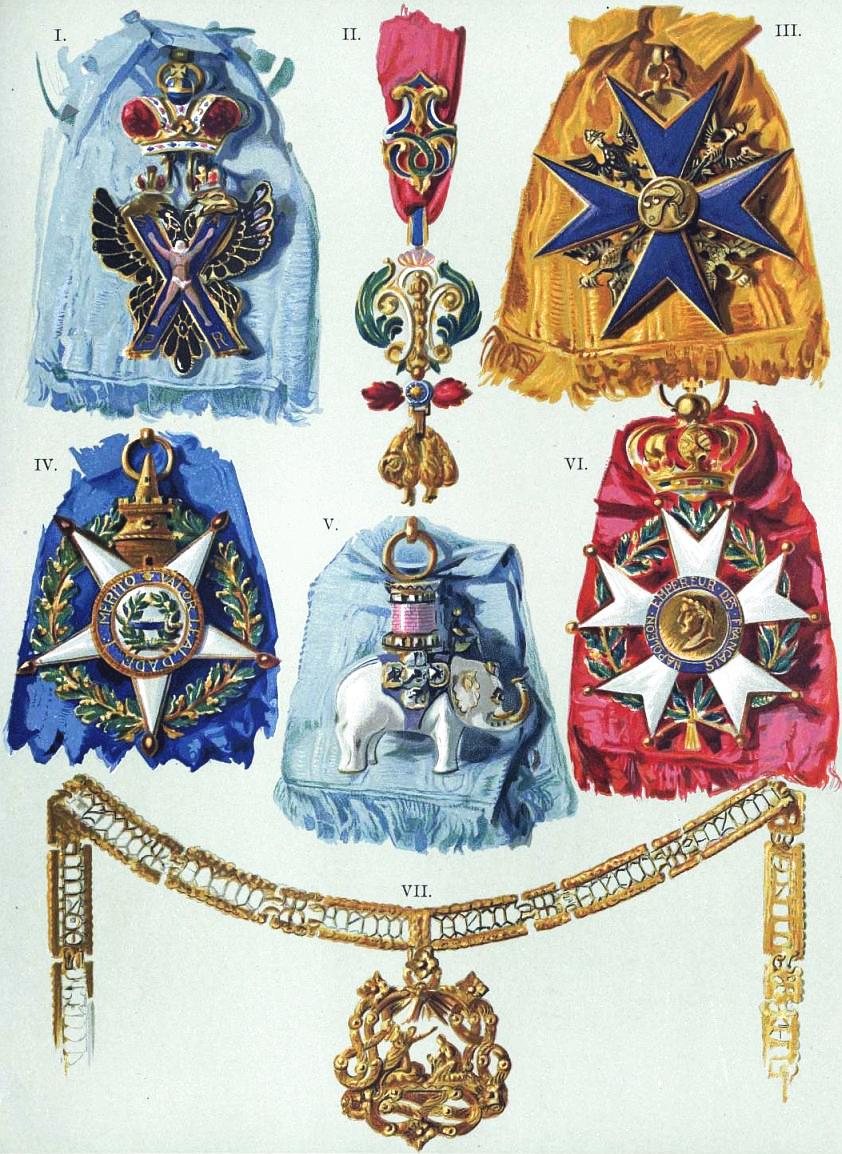
(i.) The St. Andrew (Russia). (ii.) The Golden Fleece (Spain). (iii.) The Black Eagle (Prussia). (iv.) The Tower and Sword (Portugal). (v.) The Elephant (Denmark). (vi.) The Legion of Honour (France-Napoleonic). (vii.) The Annunziata (Italy).
Drawn by William Gibb. Niagara Litho. Co., Buffalo, N. Y.
xi. The duchies of Saxe Altenburg, Saxe Coburg Gotha and Saxe Meiningen have in common the family Order of Ernest, founded in 1833 in memory of Duke Ernest the Pious of Saxe Gotha and as a revival of the Order of German Integrity (Orden der deutschen Redlichkeit) founded in 1690. Saxe Coburg Gotha and Saxe Meiningen have also separate crosses of merit in science and art.
xii. Saxe Weimar.—The Order of the White Falcon or of Vigilance was founded in 1732 and renewed in 1815.
xiii. Württemberg.—The Order of the Crown of Württemberg was founded in 1818, uniting the former Order of the Golden Eagle and an order of civil merit. It has five classes. The badge is a white cross surmounted by the royal crown, in the centre the initial F surrounded by a crimson fillet on which is the motto Furchtlos und Treu; in the angles of the cross are four golden leopards; the ribbon is crimson with two black stripes. Besides the military Order of Merit founded in 1759, and the silver cross of merit, 1900, Württemberg has also the Order of Frederick, 1830, and the Order of Olga, 1871, which is granted to ladies as well as men.
Greece.—The Order of the Redeemer was founded as such in 1833 by King Otto, being a conversion of a decoration of honour instituted in 1829 by the National Assembly at Argos. There are five classes, the numbers being regulated for each. An illustration of the badge and ribbon of the grand cross is given on Plate V. fig. 1.
Holland.—The Order of William, for military merit, was founded in 1815 by William I.; there are four classes; the badge is a white cross resting on a green laurel Burgundian cross, in the centre the Burgundian flint-steel, as in the order of the Golden Fleece. The motto Voer Moed, Belied, Trouw (For Valour, Devotion, Loyalty), appears on the arms of the cross. The cross is surmounted by a jewelled crown; the ribbon is orange with dark blue edging. The Order of the Netherlands Lion, for civil merit, was founded in 1818; there are four classes. The family Order of the Golden Lion of Nassau passed in 1890 to the grand duchy of Luxembourg (see under Luxemburg). In 1892 Queen Wilhelmina instituted the Order of Orange-Nassau with five classes. The Teutonic Order (q.v.), surviving in the Ballarde (Bailiwick) of Utrecht, was officially established in the Netherlands by the States General in 1580. It was abolished by Napoleon in 1811 and was restored in 1815.
Italy.—The Order of the Annunziata, the highest order of knighthood of the Italian kingdom, was instituted in 1362 by Amadeus VI., count of Savoy, as the Order of the Collare or Collar, from the silver collar made up of love-knots and roses, which was its badge, in honour of the fifteen joys of the Virgin; hence the number of the knights was restricted to fifteen, the fifteen chaplains recited fifteen masses each day, and the clauses of the original statute of the order were fifteen (Amadeus VIII. added five others in 1434). Charles III. decreed that the order should be called the Annunziata, and made some other alterations in 1518. His son and successor, Emmanuel Philibert, made further modifications in the statute and the costume. The church of the order was originally the Carthusian monastery of Pierre-châtel in the district of Bugey, but after Charles Emmanuel I. had given Bugey and Bresse to France in 1601 the church of the order was transferred to the Camaldolese monastery near Turin. That religious order having been suppressed at the time of the French Revolution, King Charles Albert decreed in 1840 that the Carthusian church of Collegno should be the chapel of the order. The knights of the Annunziata have the title of “cousins of the king,” and enjoy precedence over all the other officials of the state. The costume of the order is of white satin embroidered in silk, with a purple velvet cloak adorned with roses and gold embroidery, but it is now never worn; in the collar the motto Fert is inserted, on the meaning of which there is great uncertainty,65 and from it hangs a pendant enclosing a medallion representing the Annunciation (see Plate IV. fig. 7). An account of the order is given in Count Luigi Cibrario’s Ordini Cavallereschi (Turin, 1846) with coloured plates of the costume and badges.
The Order of St Maurice and St Lazarus (SS Maurizio e Lazzaro), is a combination of two ancient orders. The Order of St Maurice was originally founded by Amadeus VIII., duke of Savoy, in 1434, when he retired to the hermitage of Ripaille, and consisted of a group of half-a-dozen councillors who were to advise him on such affairs of state as he continued to control. When he became pope as Felix V. the order practically ceased to exist. It was re-established at the instance of Emmanuel Philibert by Pope Pius V. in 1572 as a military and religious order, and the following year it was united to that of St Lazarus by Gregory XIII. The latter order had been founded as a military and religious community at the time of the Latin kingdom of Jerusalem with the object of assisting lepers, many of whom were among its members. Popes, princes and nobles endowed it with estates and privileges, including that of administering and succeeding to the property of lepers, which eventually led to grave abuses. With the advance of the Saracens the knights of St Lazarus, when driven from the Holy Land and Egypt, migrated to France (1291) and Naples (1311), where they founded leper hospitals. The order in Naples, which alone was afterwards recognized as the legitimate descendant of the Jerusalem community, was empowered to seize and confine anyone suspected of leprosy, a permission which led to the establishment of a regular inquisitorial system of blackmail. In the 15th and 16th centuries dissensions broke out among the knights, and the order declined in credit and wealth, until finally the grand master, Giannotto Castiglioni, resigned his position in favour of Emmanuel Philibert, duke of Savoy, in 1571. Two years later the orders of St Lazarus and St Maurice were incorporated into one community, the members of which were to devote themselves to the defence of the Holy See and to fight its enemies as well as to continue assisting lepers. The galleys of the order subsequently took part in various expeditions against the Turks and the Barbary pirates. Leprosy, which had almost disappeared in the 17th century, broke out once more in the 18th, and in 1773 a hospital was established by the order at Aosta, made famous by Xavier de Maistre’s tale, Le Lépreux de la cité d’Aoste. The statutes were published in 1816, by which date the order had lost its military character; it was reformed first by Charles Albert (1831), and later by Victor Emmanuel II., king of Italy (1868). The knighthood of St Maurice and St Lazarus is now a dignity conferred by the king of Italy (the grand master) on persons distinguished in the public service, science, art and letters, trade, and above all in charitable works, to which its income is devoted. There are five classes. The badge of the combined order is composed of the white cross with trefoil termination of St Lazarus resting on the green cross of St Maurice; both crosses are bordered gold. The first four classes wear the badge suspended from a royal crown. The ribbon is dark green.
See L. Cibrario, Descrizione storica degli Ordini Cavallereschi, vol. i. (Turin, 1846); Calendario Reale, an annual publication issued in Rome.
The military Order of Savoy was founded in 1815 by Victor Emmanuel of Sardinia; badge modified 1855 and 1857. It has now five classes. The badge is a white cross, the arms of which expand and terminate in an obtuse angle; round the cross is a green laurel and oak wreath; the central medallion is red, bearing in gold two crossed swords, the initials of the founder and the date 1855. The ribbon is red with a central stripe of blue. The Civil Order of Savoy, founded in 1831 by Charles Albert of Sardinia, is of one class, and in statutes of 1868 is limited to 60 members. The badge is the plain Savoy cross in blue, with silver medallion, the ribbon is blue with white borders. The Order of the Crown of Italy was founded in 1868 by Victor Emmanuel II. in commemoration of the union of Italy into a kingdom. There are five classes.
Luxemburg.—The Order of the Golden Lion was founded as a family order of the house of Nassau by William III. of the Netherlands and Adolphus of Nassau jointly. On the death of William in 1890 it passed to the grand duke of Luxemburg; it has only one class. The Order of Adolphus of Nassau, for civil and military merit, in four classes, was founded in 1858, and the Order of the Oak Crown as a general order of merit, in five classes, in 1841, modified 1858.
Monaco.—The Order of St Charles, five classes, was founded in 1858 by Prince Charles III. and remodelled in 1863. It is a general order of merit.
Montenegro.—The Order of St Peter, founded in 1852, is a family order, in one class, and only given to members of the princely family; the Order of Danilo, or of the Independence of Montenegro, is a general order of merit, in four classes, with subdivisions, also founded in 1852.
Norway.—The Order of St Olaf was founded in 1847 by Oscar I. in honour of St Olaf, the founder of Christianity in Norway, as a general order of merit, military and civil. There are three classes, the last two being, in 1873 and 1890, subdivided into two grades each. The badge and ribbon is illustrated on Plate V, fig. 5. The reverse bears the motto Ret og Sandhed (Right and Truth). The Order of the Norwegian Lion, founded in 1904 by Oscar II., has only one class; foreigners on whom the order is conferred must be sovereigns or heads of states or members of reigning houses.
Papal.—The arrangement and constitution of the papal orders was remodelled by a brief of Pius X. in 1905. The Order of Christ, the supreme pontifical order, is of one class only; for the history of this ancient order see Portugal (infra). The badge and ribbon is the same as the older Portuguese form. The Order of Pius was founded in 1847 by Pius IX.; there are now three classes; the badge is an eight-pointed blue star with golden flames between the rays, a white centre bears the founder’s name; the ribbon is blue with two red stripes at each border. The Order of St Gregory the Great, founded in 1831, is in two divisions, civil and military, each having three classes. The Order of St Sylvester was originally founded as the Order of the Golden Spur by Paul IV. in 1559 as a military body, though tradition assigns it to Constantine the Great and Pope Sylvester. It was reorganized as an order of merit by Gregory XVI. in 1841. In 1905 the order was divided into three classes, and a separate order, that of the Golden Spur or Golden Legion (Militia Aurata) was established, in one class, with the numbers limited to a hundred. The cross Pro Ecclesia et Pontifice, instituted by Leo XIII. in 1888 is a decoration, not an order. There remains the venerable Order of the Holy Sepulchre, of which tradition assigns the foundation to Godfrey de Bouillon. It was, however, probably founded as a military order for the protection of the Holy Sepulchre by Alexander VI. in 1496. The right to nominate to the order was shared with the pope as grand master by the guardian of the Patres Minores in Jerusalem, later by the Franciscans, and then by the Latin patriarch in Jerusalem. In 1905 the latter was nominated grand master, but the pope reserves the joint right of nomination. The badge of the order is a red Jerusalem cross with red Latin crosses in the angles.
Portugal.—The Order of Christ was founded on the abolition of the Templars by Dionysius or Diniz of Portugal and in 1318 in conjunction with Pope John XXII., both having the right to nominate to the order. The papal branch survives as a distinct order. In 1522 it was formed as a distinct Portuguese order and the grand mastership vested in the crown of Portugal. In 1789 its original religious aspect was abandoned, and with the exception that its members must be of the Roman Catholic faith, it is entirely secularized. There are three classes. The original badge of the order was a long red cross with expanded flat ends bearing a small cross in white; the ribbon is red. The modern badge is a blue enamelled cross resting on a green laurel wreath; the central medallion, in white, contains the old red and white cross. The older form is worn with the collar by the grand-crosses. The Order of the Tower and Sword was founded in 1808 in Brazil by the regent, afterwards king John VI. of Portugal, as a revival of the old Order of the Sword, said to have been founded by Alfonso V. in 1459. It was remodelled in 1832 under its present name and constitution as a general order of military and civil merit. There are five classes. The badge of the order and ribbon is illustrated on Plate IV. fig 4. The Order of St Benedict of Aviz (earlier of Evora), founded in 1162 as a religious military order, was secularized in 1789 as an order of military merit, in four classes. The badge is a green cross fleury; the ribbon is green. The Order of St James of the Sword, or James of Compostella, is a branch of the Spanish order of that name (see under Spain). It also was secularized in 1789, and in 1862 was constituted an order of merit for science, literature and art, in five classes. The badge is the lily-hilted sword of St James, enamelled red with gold borders; the ribbon is violet. In 1789 these three orders were granted a common badge uniting the three separate crosses in a gold medallion; the joint ribbon is red, green and violet, and to the separate crosses was added a red sacred heart and small white cross. There are also the Order of Our Lady of Villa Viçosa (1819), for both sexes, and the Order of St Isabella, 1801, for ladies.
Rumania.—The Order of the Star of Rumania was founded in 1877, and the Order of the Crown of Rumania in 1881, both in five classes, for civil and military merit; the ribbon of the first is red with blue borders, of the second light blue with two silver stripes.
Russia.—The Order of St Andrew was founded in 1698 by Peter the Great. It is the chief order of the empire, and admission carries with it according to the statutes of 1720 the orders of St Anne, Alexander Nevsky, and the White Eagle; there is only one class. The badge and ribbon is illustrated in Plate IV. fig 5. The collar is composed of three members alternately, the imperial eagle bearing on a red medallion a figure of St George slaying the Dragon, the badge of the grand duchy of Moskow, the cipher of the emperor Paul I. in gold on a blue ground, surmounted by the imperial crown, and surrounded by a trophy of weapons and green and white flags, and a circular red and gold star with a blue St Andrew’s cross. The Order of St Catherine, for ladies, ranks next to the St Andrew. It was founded under the name of the Order of Rescue by Peter the Great in 1714 in honour of the empress Catherine and the part she had taken in rescuing him at the battle of the Pruth in 1711. There are two classes. The grand cross is only for members of the imperial house and ladies of the highest nobility. The second class was added in 1797. The badge of the order is a cross of diamonds bearing in a medallion the effigy of St Catherine. The ribbon is red with the motto For Love and Fatherland in silver letters. The Order of St Alexander Nevsky was founded in 1725 by the empress Catherine I. There is only one class. The badge is a red enamelled cross with gold eagles in the angles, bearing in a medallion the mounted effigy of St Alexander Nevsky. The ribbon is red. The Order of the White Eagle was founded in 1713 by Augustus II. of Poland and was adopted as a Russian order in 1831; there is one class. The Order of St Anne was founded by Charles Frederick, duke of Holstein-Gottorp in 1735 in honour of his wife, Anna Petrovna, daughter of Peter the Great. It was adopted as a Russian order in 1797 by their grandson, the emperor Paul. There are four classes. Other orders are those of St Vladimir, founded by Catherine II., 1782, four classes, and of St Stanislaus, founded originally as a Polish order by Stanislaus Augustus Poniatowski in 1765, and adopted as a Russian order in 1831.
The military Order of St George was founded by the empress Catherine II. in 1769 for military service on land and sea, with four classes; a fifth class for non-commissioned officers and men, the St George’s Cross, was added in 1807. The badge is a white cross with gold borders, with a red central medallion on which is the figure of St George slaying the dragon. The ribbon is orange with three black stripes.
Servia.—The Order of the White Eagle, the principal order, was founded by Milan I. in 1882, statutes 1883, in five classes; the ribbon is blue and red; the Order of St Sava, founded 1883, also in five classes, is an order of merit for science and art; the Order of the Star of Karageorgevitch, four classes, was founded by Peter I. in 1904. The orders of Milosch the Great, founded by Alexander I. in 1898 and of Takovo, founded originally by Michael Obrenovitch in 1863, reconstituted in 1883, are since the dynastic revolution of 1903 no longer bestowed. The Order of St Lazarus is not a general order, the cross and collar being only worn by the king.
Spain.—The Spanish branch of the Order of the Golden Fleece has been treated above. The three most ancient orders of Spain—of St James of Compostella, or St James of the Sword, of Alcantara and of Calatrava—still exist as orders of merit, the first in three classes, the last two as orders of military merit in one class. They were all originally founded as military religious orders, like the crusading Templars and the Hospitallers, but to fight for the true faith against the Moors in Spain. The present badges of the orders represent the crosses that the knights wore on their mantles. That of St James of Compostella is the red lily-hilted sword of St James; the ribbon is also red. The other two orders wear the cross fleury—Alcantara red, Calatrava green, with corresponding ribbons. A short history of these orders may be here given. Tradition gives the foundation of the Order of Knights of St James of Compostella to Ramiro II., king of Leon, in the 10th century, to commemorate a victory over the Moors, but, historically the order dates from the confirmation in 1175 by Pope Alexander III. It gained great reputation in the wars against the Moors and became very wealthy. In 1493 the grand-mastership was annexed by Ferdinand the Catholic, and was vested permanently in the crown of Spain by Pope Adrian VI. in 1522.
The Order of Knights of Alcantara, instituted about 1156 by the brothers Don Suarez and Don Gomez de Barrientos for protection against the Moors. In 1177 they were confirmed as a religious order of knighthood under Benedictine rule by Pope Alexander III. Until about 1213 they were known as the Knights of San Julian del Pereyro; but when the defence of Alcantara, newly wrested from the Moors by Alphonso IX. of Castile, was entrusted to them they took their name from that city. For a considerable time they were in some degree subject to the grand master of the kindred order of Calatrava. Ultimately, however, they asserted their independence by electing a grand master of their own, the first holder of the office being Don Diego Sanche. During the rule of thirty-seven successive grand masters, similarly chosen, the influence and wealth of the order gradually increased until the Knights of Alcantara were almost as powerful as the sovereign. In 1494-1495 Juan de Zuñiga was prevailed upon to resign the grand-mastership to Ferdinand, who thereupon vested it in his own person as king; and this arrangement was ratified by a bull of Pope Alexander VI., and was declared permanent by Pope Adrian VI. in 1523. The yearly income of Zuñiga at the time of his resignation amounted to 150,000 ducats. In 1540 Pope Paul III. released the knights from the strictness of Benedictine rule by giving them permission to marry, though second marriage was forbidden. The three vows were henceforth obedientia, castitas conjugalis and conversio morum. In modern times the history of the order has been somewhat chequered. When Joseph Bonaparte became king of Spain in 1808, he deprived the knights of their revenues, which were only partially recovered on the restoration of Ferdinand VII. in 1814. The order ceased to exist as a spiritual body in 1835.
The Order of Knights of Calatrava was founded in 1158 by Don Sancho III. of Castile, who presented the town of Calatrava, newly wrested from the Moors, to them to guard. In 1164 Pope Alexander III. granted confirmation as a religious military order under Cistercian rule. In 1197 Calatrava fell into the hands of the Moors and the order removed to the castle of Salvatierra, but recovered their town in 1212. In 1489 Ferdinand seized the grand-mastership, and it was finally vested in the crown of Spain in 1523. The order became a military order of merit in 1808 and was reorganized in 1874. The Royal and Illustrious Order of Charles III. was founded in 1771 by Charles III., in two classes; altered in 1804, it was abolished by Joseph Bonaparte in 1809, together with all the Spanish orders except the Golden Fleece, and the Royal Order of the Knights of Spain was established. In 1814 Ferdinand VII. revived the order, and in 1847 it received its present constitution, viz. of three classes (the commanders in two divisions). The badge of the order is a blue and white cross suspended from a green laurel wreath, in the angles are golden lilies, and the oval centre bears a figure of the Virgin in a golden glory. The ribbon is blue and white. The Order of Isabella the Catholic was founded in 1815 under the patronage of St Isabella, wife of Diniz of Portugal; originally instituted to reward loyalty in defence of the Spanish possessions in America, it is now a general order of merit, in three classes. The badge is a red rayed cross with gold rays in the angles, in the centre a representation of the pillars of Hercules; the cross is attached to the yellow and white ribbon by a green laurel wreath. Other Spanish orders are the Maria Louisa, 1792, for noble ladies; the military and naval orders of merit of St Ferdinand, founded by the Cortes in 1811, five classes; of St Ermenegild (Hermenegildo), 1814, three classes, of Military Merit and Naval Merit, 1866, and of Maria Christina, 1890; the Order of Beneficencia for civil merit, 1856; that of Alfonso XII. for merit in science, literature and art, 1902, and the Civil Order of Alfonso XII., 1902.
Plate V.
INSIGNIA OF SOME OF THE PRINCIPAL ORDERS OF KNIGHTHOOD, DRAWN BY GRACIOUS PERMISSION FROM THOSE IN THE POSSESSION OF HIS LATE MAJESTY KING EDWARD VII AND ARRANGED IN ACCORDANCE WITH HIS MAJESTY’S WISHES AND COMMAND.
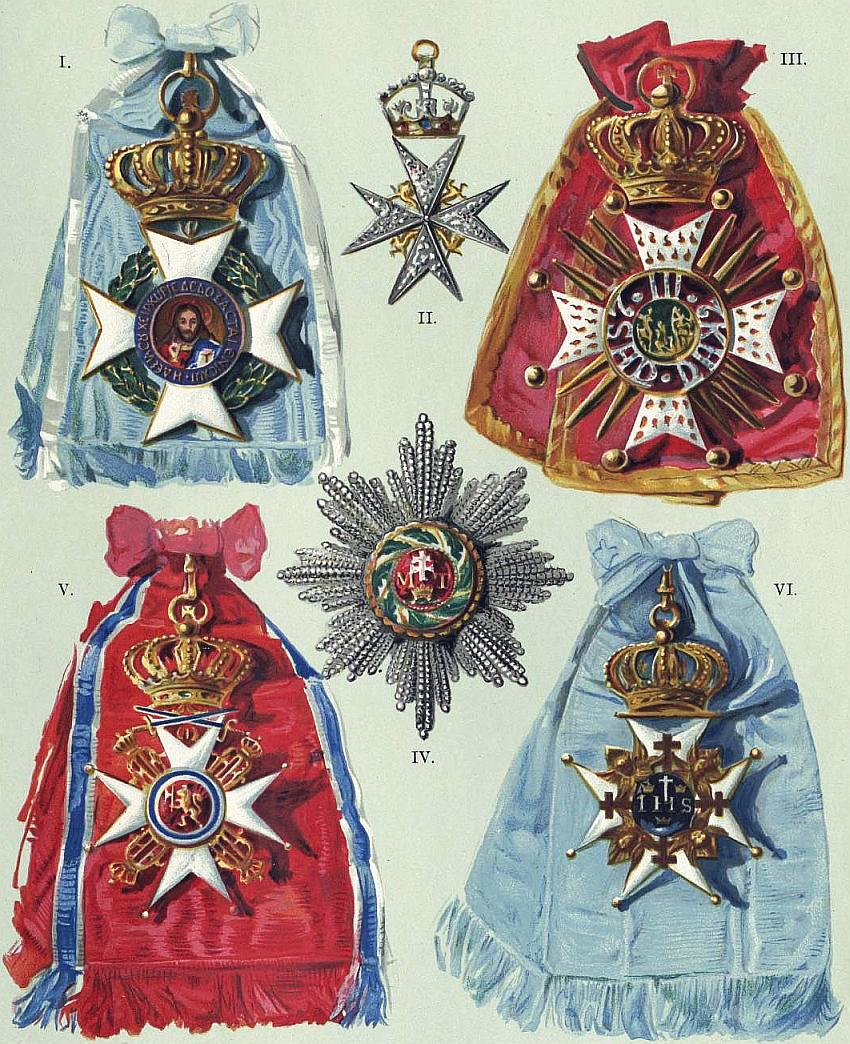
(i) The Redeemer (Greece). (ii) The Order of the Knights of St. John of Jerusalem (English Branch, Badge of the Sovereign and Patron). (iii) The St. Hubert (Bavaria). (iv) The St. Stephen (Hungary). (v). The St. Olaf (Norway). (vi). The Seraphim (Sweden).
Drawn by William Gibb. Niagara Litho. Co., Buffalo, N. Y.
Sweden.—The Order of the Seraphim (the “Blue Ribbon”). Tradition attributes the foundation of this most illustrious order of knighthood to Magnus I. in 1280, more certainty attaches to the fact that the order was in existence in 1336. In its modern form the order dates from its reconstitution in 1748 by Frederick I., modified by statutes of 1798 and 1814. Exclusive of the sovereign and the princes of the blood, the order is limited to 23 Swedish and 8 foreign members. The native members must be already members of the Order of the Sword or the Pole Star. There is a prelate of the order which is administered by a chapter; the chapel of the knights is in the Riddar Holmskyrka at Stockholm. The badge and ribbon of the grand cross is illustrated on Plate V. fig. 6. The collar is formed of alternate gold seraphim and blue enamelled patriarchal crosses. The motto is Iesus Hominum Salvator. The Order of the Sword (the “Yellow Ribbon”), the principal Swedish military order, was founded, it is said, by Gustavus I. Vasa in 1522, and was re-established by Frederick I., with the Seraphim and the Pole Star in 1748; modifications have been made in 1798, 1814 and 1889. There are five classes, with subdivisions. The badge is a white cross, in the angles gold crowns, the points of the cross joined by gold swords entwined with gold and blue belts, in the blue centre an upright sword with the three crowns in gold, the whole surmounted by the royal crown. The ribbon is yellow with blue edging. The Order of the Pole Star (Polar Star, North Star, the “Black Ribbon”), founded in 1748 for civil merit, has since 1844 three classes. The white cross bears a five-pointed silver star on a blue medallion. The ribbon is black. The Order of Vasa (the “Green Ribbon”), founded by Gustavus III. in 1772 as an order of merit for services rendered to the national industries and manufactures, has three classes, with subdivisions. The white cross badge bears on a blue centre the charge of the house of Vasa, a gold sheaf shaped like a vase with two handles. The ribbon is green. The Order of Charles XIII., founded in 1811, is granted to Freemasons of high degree. It is thus quite unique.
Turkey.—The Nischan-i-Imtiaz, or Order of Privilege, was founded by Abdul Hamid II. in 1879 as a general order of merit in one class; the Nischan-el-Iftikhar, or Order of Glory, also one class, founded 1831 by Mahmoud II.; the Nischan-i-Mejidi, the Mejidieh, was founded as a civil and military order of merit in 1851 by Abdul Medjid. There are five classes; the badge is a silver sun of seven clustered rays, with crescent and star between each cluster; on a gold centre is the sultan’s name in black Turkish lettering, surrounded by a red fillet inscribed with the words Zeal, Devotion, Loyalty; it is suspended from a red crescent and star; the ribbon is red with green borders. The khedive of Egypt has authority, delegated by the sultan, to grant this order. The Nischan-i-Osmanie, the Osmanieh, for civil and military merit, was founded by Abdul Aziz in 1862; it has four classes. The badge is a gold sun with seven gold-bordered green rays; the red centre bears the crescent, and it is also suspended from a gold crescent and star; the ribbon is green bordered with red. The Nischan-i-Schefakat of Compassion or Benevolence, was instituted for ladies, in three classes, in 1878 by the sultan in honour of the work done for the non-combatant victims of the Russo-Turkish war of 1877 in connexion with the Turkish Compassionate Fund started by the late Baroness Burdett-Coutts. She was one of the first to receive the order. There are also the family order, for Turkish princes, the Hanédani-Ali-Osman, founded in 1893, and the Ertogroul, in 1903.
Non-European Orders.—Of the various states of Central and South America, Nicaragua has the American Order of San Juan or Grey Town, founded in 1857, in three classes; and Venezuela that of the Bust of Bolivar, 1854, five classes; the ribbon is yellow, blue and red. Mexico has abolished its former orders, the Mexican Eagle, 1865, and Our Lady of Guadalupe, 1853; as has Brazil those of the Southern Cross, 1822, Dom Pedro I., 1826, the Rose, 1829, and the Brazilian branches of the Portuguese orders of Christ, St Benedict of Aviz and St James. The republican Order of Columbus, founded in 1890, was abolished in 1891.
China.—There are no orders for natives, and such distinctions as are conferred by the different coloured buttons of the mandarins, the grades indicated by the number of peacocks’ feathers, the gift of the yellow jacket and the like, are rather insignia of rank or personal marks of honour than orders, whether of knighthood or merit, in the European sense. For foreigners, however, the emperor in 1882 established the sole order, that of the Imperial Double Dragon, in five classes, the first three of which are further divided into three grades each, making eleven grades in all. The recipients eligible for the various classes are graded, from the first grade of the first class for reigning sovereigns down to the fifth class for merchants and manufacturers. The insignia of the order are unique in shape and decoration. Of the three grades of the first class the badge is a rectangular gold and yellow enamel plaque, decorated with two upright blue dragons, with details in green and white, between the heads for the first grade a pearl, for the second a ruby, for the third a coral, set in green, white and gold circles. The size of the plaque varies for the different classes. The badges of the other four classes are round plaques, the first three with indented edges, the last plain; in the second class the dragons are in silver on a yellow and gold ground, the jewel is a cut coral; the grades differ in the colour, shape, &c., of the borders and indentations; in the third class the dragons are gold, the ground green, the jewel a sapphire; in the fourth the silver dragons are on a blue ground, the jewel a lapis lazuli; in the fifth green dragons on a silver ground, the jewel a pearl. The ribbons, decorated with embroidered dragons, differ for the various grades and classes.
Japan.—The Japanese orders have all been instituted by the emperor Mutsu Hito. In design and workmanship the insignia of the orders are beautiful examples of the art of the native enamellers. The Order of the Chrysanthemum (Kikkwa Daijasho), founded in 1877, has only one class. It is but rarely conferred on others than members of the royal house or foreign rulers or princes. The badge of the order may be described as follows: From a centre of red enamel representing the sun issue 32 white gold-bordered rays in four sharply projecting groups, between the angles of which are four yellow conventional chrysanthemum flowers with green leaves forming a circle on which the rays rest; the whole is suspended from a larger yellow chrysanthemum. The ribbon is deep red bordered with purple. The collar, which may be granted with the order or later, is composed of four members repeated, two gold chrysanthemums, one with green leaves, the other surrounded by a wreath of palm, and two elaborate arabesque designs. The Order of the Paulownia Sun (Tokwa Daijasho), founded in 1888, in one class, may be in a sense regarded as the highest class of the Rising Sun (Kiokujitsasho) founded in eight classes, in 1875. The badge of both orders is essentially the same, viz. the red sun with white and gold rays; in the former the lilac flowers of the Paulownia tree, the flower of the Tycoon’s arms, take a prominent part. The ribbon of the first order is deep red with white edging, of the second scarlet with white central stripe. The last two classes of the Rising Sun wear a decoration formed of the Paulownia flower and leaves. The Order of the Mirror or Happy Sacred Treasure (Zaihosho) was founded in 1888, with eight classes. The cross of white and gold clustered rays bears in a blue centre a silver star-shaped mirror. The ribbon is pale blue with orange stripes. There is also an order for ladies, that of the Crown, founded in five classes in 1888. The military order of Japan is the Order of the Golden Kite, founded in 1890, in seven classes. The badge has an elaborate design; it consists of a star of purple, red, yellow, gold and silver rays, on which are displayed old Japanese weapons, banners and shields in various coloured enamels, the whole surmounted by a golden kite with outstretched wings. The ribbon is green with white stripes.
Persia.—The Order of the Sun and Lion, founded by Fath ‘Ali Shāh in 1808, has five classes. There is also the Nischan-i-Aftab, for ladies, founded in 1873.
Siam.—The Sacred Order, or the Nine Precious Stones, was founded in 1869, in one class only, for the Buddhist princes of the royal house. The Order of the White Elephant, founded in 1861, is in five classes. This is the principal general order. The badge is a striking example of Oriental design adapted to a European conventional form. The circular plaque is formed of a triple circle of lotus leaves in gold, red and green, within a blue circlet with pearls a richly caparisoned white elephant on a gold ground, the whole surmounted by the jewelled gold pagoda crown of Siam; the collar is formed of alternate white elephants, red, blue and white royal monograms and gold pagoda crowns. The ribbon is red with green borders and small blue and white stripes. Other orders are the Siamese Crown (Mongkut Siam), five classes, founded 1869; the family Order of Chulah-Chon-Clao, three classes, 1873; and the Maha Charkrkri, 1884, only for princes and princesses of the reigning family.
(C. We.)
1 Feudal England, pp. 225 sqq.
2 Du Cange, Gloss., s.v. “Miles.”
3 History of England, iii. 12.
4 Stubbs, Constitutional History, i. 156.
5 Ibid. i. 156, 366; Turner, iii. 125-129.
6 Ingram’s edition, p. 290.
7 Comparative Politics, p. 74.
8 Baluze, Capitularia Regum Francorum, ii. 794, 1069.
9 Du Cange, Gloss., s.v. “Arma.”
10 Freeman, Comparative Politics, p. 73.
11 Hallam, Middle Ages, iii. 392.
12 Stubbs, Const. Hist. ii. 278; also compare Grosse, Military Antiquities, i. 65 seq.
13 There has been a general tendency to ignore the extent to which the armies of Edward III. were raised by compulsory levies even after the system of raising troops by free contract had begun. Luce (ch. vi.) points out how much England relied at this time on what would now be called conscription: and his remarks are entirely borne out by the Norwich documents published by Mr W. Hudson (Norf, and Norwich Archaeological Soc. xiv. 263 sqq.), by a Lynn corporation document of 18th Edw. III. (Hist. MSS. Commission Report XI. Appendix pt. iii. p. 189), and by Smyth’s Lives of the Berkeleys, i. 312, 319, 320.
14 J. B. de Lacurne de Sainte Palaye, Mémoires sur l’Ancienne Chevalerie, i. 363, 364 (ed. 1781).
15 Du Cange, Dissertation sur Joinville, xxi.; Sainte Palaye, Mémoires, i. 272; G. F. Beltz, Memorials of the Order of the Garter (1841,) p. xxvii.
16 Du Cange, Dissertation, xxi., and Lancelot du Lac, among other romances.
17 Anstis, Register of the Order of the Garter, i. 63.
18 Grose, Military Antiq. i. 207 seq.; Stubbs, Const. Hist. ii. 276 seq., and iii. 278 seq.
19 Grose’s Military Antiquities, ii. 256.
20 Sainte Palaye, Mémoires, i. 36; Froissart, bk. iii. ch. 9.
21 Sainte Palaye, Mémoires, pt. i. and Mills, History of Chivalry, vol. i. ch. 2.
22 See the long sermon in the romance of Petit Jehan de Saintré, pt. i. ch. v., and compare the theory there set forth with the actual behaviour of the chief personages. Even Gautier, while he contends that chivalry did much to refine morality, is compelled to admit the prevailing immorality to which medieval romances testify, and the extraordinary free behaviour of the unmarried ladies. No doubt these romances, taken alone, might give as unfair an idea as modern French novels give of Parisian morals, but we have abundant other evidence for placing the moral standard of the age of chivalry definitely below that of educated society in the present day.
23 Sainte Palaye, Mémoires, i. 11 seq.: “C’est peut-être à cette cérémonie et non à celles de la chevalerie qu’on doit rapporter ce qui se lit dans nos historiens de la première et de la seconde race au sujet des premières armes que les Rois et les Princes remettoient avec solemnité au ieunes Princes leurs enfans.”
24 There are several obscure points as to the relation of the longer and shorter ceremonies, as well as the origin and original relation of their several parts. There is nothing to show whence came “dubbing” or the “accolade.” It seems certain that the word “dub” means to strike, and the usage is as old as the knighting of Henry by William the Conqueror (supra, pp. 851, 852). So, too, in the Empire a dubbed knight is “ritter geschlagen.” The “accolade” may etymologically refer to the embrace, accompanied by a blow with the hand, characteristic of the longer form of knighting. The derivation of “adouber,” corresponding to “dub,” from “adoptare,” which is given by Du Cange, and would connect the ceremony with “adoptio per arma,” is certainly inaccurate. The investiture with arms, which formed a part of the longer form of knighting, and which we have seen to rest on very ancient usage, may originally have had a distinct meaning. We have observed that Lanfranc invested Henry I. with arms, while William “dubbed him to rider.” If there was a difference in the meaning of the two ceremonies, the difficulty as to the knighting of Earl Harold (supra, p. 852) is at least partly removed.
25 Selden, Titles of Honor, 639.
26 Daniel, Histoire de la Milice Françoise, i. 99-104; Byshe’s Upton, De Studio Militari, pp. 21-24; Dugdale, Warwickshire, ii. 708-710; Segar, Honor Civil and Military, pp. 69 seq. and Nicolas, Orders of Knighthood, vol. ii. (Order of the Bath) pp. 19 seq.... It is given as “the order and manner of creating Knights of the Bath in time of peace according to the custom of England,” and consequently dates from a period when the full ceremony of creating knights bachelors generally had gone out of fashion. But as Ashmole, speaking of Knights of the Bath, says, “if the ceremonies and circumstances of their creation be well considered, it will appear that this king [Henry IV.] did not institute but rather restore the ancient manner of making knights, and consequently that the Knights of the Bath are in truth no other than knights bachelors, that is to say, such as are created with those ceremonies wherewith knights bachelors were formerly created.” (Ashmole, Order of the Garter, p. 15). See also Selden, Titles of Honor, p. 678, and the Archæological Journal, v. 258 seq.
27 As may be gathered from Selden, Favyn, La Colombiers, Menestrier and Sainte Palaye, there were several differences of detail in the ceremony at different times and in different places. But in the main it was everywhere the same both in its military and its ecclesiastical elements. In the Pontificale Romanum, the old Ordo Romanus and the manual or Common Prayer Book in use in England before the Reformation forms for the blessing or consecration of new knights are included, and of these the first and the last are quoted by Selden.
28 Selden, Titles of Honor, p. 678; Ashmole, Order of the Garter, p. 15; Favyn, Théâtre d’Honneur, ii. 1035.
29 “If we sum up the principal ensigns of knighthood, ancient and modern, we shall find they have been or are a horse, gold ring, shield and lance, a belt and sword, gilt spurs and a gold chain or collar.”—Ashmole, Order of the Garter, pp. 12, 13.
30 On the banner see Grose, Military Antiquities, ii. 257; and Nicolas, British Orders of Knighthood, vol. i. p. xxxvii.
31 Titles of Honor, pp. 356 and 608. See also Hallam, Middle Ages, iii. 126 seq. and Stubbs, Const. Hist. iii. 440 seq.
32 Riddell’s Law and Practice in Scottish Peerages, p. 578; also Nisbet’s System of Heraldry, ii. 49 and Selden’s Titles of Honor, p. 702.
33 Selden, Titles of Honor, pp. 608 and 657.
34 See “Project concerninge the conferinge of the title of vidom,” wherein it is said that “the title of vidom (vicedominus) was an ancient title used in this kingdom of England both before and since the Norman Conquest” (State Papers, James I. Domestic Series, lxiii. 150 B, probable date April 1611).
35 Selden, Titles of Honor, pp. 452 seq.
36 Ibid. pp. 449 seq.
37 Du Cange, Dissertation, ix.; Selden, Titles of Honor, p. 452; Daniel, Milice Françoise, i. 86 (Paris, 1721).
38 Selden, Titles of Honor, p. 656; Grose, Military Antiquities, ii. 206.
39 Froissart, Bk. I. ch. 241 and Bk. II. ch. 53. The recipients were Sir John Chandos and Sir Thos. Trivet.
40 Commonwealth of England (ed. 1640), p. 48.
41 State Papers, Domestic Series, James the First, lxvii. 119.
42 “Thursday, June 24th: His Majesty was pleased to confer the honour of knights banneret on the following flag officers and commanders under the royal standard, who kneeling kissed hands on the occasion: Admirals Pye and Sprye; Captains Knight, Bickerton and Vernon,” Gentleman’s Magazine (1773) xliii. 299. Sir Harris Nicolas remarks on these and the other cases (British Orders of Knighthood, vol. xliii.) and Sir William Fitzherbert published anonymously a pamphlet on the subject, A Short Inquiry into the Nature of the Titles conferred at Portsmouth, &c., which is very scarce, but is to be found under the name of “Fitzherbert” in the catalogue of the British Museum Library.
43 “Sir Henry Ferrers, Baronet, was indicted by the name of Sir Henry Ferrers, Knight, for the murther of one Stone whom one Nightingale feloniously murthered, and that the said Sir Henry was present aiding and abetting, &c. Upon this indictment Sir Henry Ferrers being arraigned said he never was knighted, which being confessed, the indictment was held not to be sufficient, wherefore he was indicted de novo by the name of Sir Henry Ferrers, Baronet.” Brydall, Jus Imaginis apud Anglos, or the Law of England relating to the Nobility and Gentry (London, 1675), p. 20. Cf. Patent Rolls, 10 Jac. I., pt. x. No. 18; Selden, Titles of Honor, p. 687.
44 Louis XIV. introduced the practice of dividing the members of military orders into several degrees when he established the order of St Louis in 1693.
45 G. F. Beltz, Memorials of the Most Noble Order of the Garter (1841), p. 385.
46 Heylyn, Cosmographie and History of the Whole World, bk. i. p. 286.
47 Beltz, Memorials, p. xlvi.
48 Orders of Knighthood, vol. i. p. lxxxiii.
49 Mémoires, i. 67, i. 22; History of Chivalry; Gibbon, Decline and Fall, vii. 200.
50 Orders of Knighthood, vol. i. p. xi.
51 Selden, Titles of Honor, p. 638.
52 Harleian MS. 6063; Hargrave MS. 325.
53 Patent Rolls, 35th Hen. VIII., pt. xvi., No. 24; Burnet, Hist. of Reformation, i. 15.
54 Spelman, “De milite dissertatio,” Posthumous Works, p. 181.
55 London Gazette, December 6, 1823, and May 15, 1855.
56 On the Continent very elaborate ceremonies, partly heraldic and partly religious, were observed in the degradation of a knight, which are described by Sainte Palaye, Mémoires, i. 316 seq., and after him by Mills, History of Chivalry, i. 60 seq. Cf. Titles of Honor, p. 653.
57 Dallaway’s Heraldry, p. 303.
58 Even in 13th century England more than half the population were serfs, and as such had no claim to the privileges of Magna Carta; disputes between a serf and his lord were decided in the latter’s court, although the king’s courts attempted to protect the serf’s life and limb and necessary implements of work. By French feudal law, the villein had no appeal from his lord save to God (Pierre de Fontaines, Conseil, ch. xxi. art. 8); and, though common sense and natural good feeling set bounds in most cases to the tyranny of the nobles, yet there was scarcely any injustice too gross to be possible. “How mad are they who exult when sons are born to their lords!” wrote Cardinal Jacques de Vitry early in the 13th century (Exempla, p. 64, Folk Lore Soc. 1890).
59 Sainte Palaye, ii. 90.
60 Medley, English Constitutional History (2nd ed., pp. 291, 466), suggests that Edward might have deliberately calculated this degradation of the older feudal ideal.
61 Being made to “ride the barriers” was the penalty for anybody who attempted to take part in a tournament without the qualification of name and arms. Guillim (Display of Heraldry, p. 66) and Nisbet (System of Heraldry, ii. 147) speak of this subject as concerning England and Scotland. See also Ashmole’s Order of the Garter, p. 284. But in England knighthood has always been conferred to a great extent independently of these considerations. At almost every period there have been men of obscure and illegitimate birth who have been knighted. Ashmole cites authorities for the contention that knighthood ennobles, insomuch that whosoever is a knight it necessarily follows that he is also a gentleman; “for, when a king gives the dignity to an ignoble person whose merit he would thereby recompense, he is understood to have conferred whatsoever is requisite for the completing of that which he bestows.” By the common law, if a villein were made a knight he was thereby enfranchised and accounted a gentleman, and if a person under age and in wardship were knighted both his minority and wardship terminated. (Order of the Garter, p. 43; Nicolas, British Orders of Knighthood, i. 5.)
62 Gautier, pp. 21, 249.
63 Du Cange, s.v. miles (ed. Didot, t. iv. p. 402); Sacchetti, Novella, cliii. All the medieval orders of knighthood, however, insisted in their statutes on the noble birth of the candidate.
64 Lecoy de la Marche (Chaire française au moyen âge, 2nd ed., p. 387) gives many instances to prove that “al chevalerie, au xiiie siècle, est déjà sur son déclin.” But already about 1160 Peter of Blois had written, “The so-called order of knighthood is nowadays mere disorder” (ordo militum nunc est, ordinem non tenere. Ep. xciv.: the whole letter should be read); and, half a century earlier still, Guibert of Nogent gives an equally unflattering picture of contemporary chivalry in his De vita sua (Migne, Pat. Lat., tom. clvi.).
65 It has been taken as the Latin word meaning “he bears” or as representing the initials of the legend Fortitudo Ejus Rhodum Tenuit, with an allusion to a defence of the island of Rhodes by an ancient count of Savoy.

KNIGHT-SERVICE, the dominant and distinctive tenure of land under the feudal system. It is associated in its origin with that development in warfare which made the mailed horseman, armed with lance and sword, the most important factor in battle. Till within recent years it was believed that knight-service was developed out of the liability, under the English system, of every five hides to provide one soldier in war. It is now held that, on the contrary, it was a novel system which was introduced after the Conquest by the Normans, who relied essentially on their mounted knights, while the English fought on foot. They were already familiar with the principle of knight-service, the knight’s fee, as it came to be termed in England, being represented in Normandy by the fief du haubert, so termed from the hauberk or coat of mail (lorica) which was worn by the knight. Allusion is made to this in the coronation charter of Henry I. (1100), which speaks of those holding by knight-service as milites qui per loricam terras suas deserviunt.
The Conqueror, it is now held, divided the lay lands of England among his followers, to be held by the service of a fixed number of knights in his host, and imposed the same service on most of the great ecclesiastical bodies which retained their landed endowments. No record evidence exists of this action on his part, and the quota of knight-service exacted was not determined by the area or value of the lands granted (or retained), but was based upon the unit of the feudal host, the constabularia of ten knights. Of the tenants-in-chief or barons (i.e. those who held directly of the crown), the principal were called on to find one or more of these units, while of the lesser ones some were called on for five knights, that is, half a constabularia. The same system was adopted in Ireland when that country was conquered under Henry II. The baron who had been enfeoffed by his sovereign on these terms could provide the knights required either by hiring them for pay or, more conveniently when wealth was mainly represented by land, by a process of subenfeoffment, analogous to that by which he himself had been enfeoffed. That is to say, he could assign to an under-tenant a certain portion of his fief to be held by the service of finding one or more knights. The land so held would then be described as consisting of one or more knights’ fees, but the knight’s fee had not, as was formerly supposed, any fixed area. This process could be carried farther till there was a chain of mesne lords between the tenant-in-chief and the actual holder of the land; but the liability for performance of the knight-service was always carefully defined.
The primary obligation incumbent on every knight was service in the field, when called upon, for forty days a year, with specified armour and arms. There was, however, a standing dispute as to whether he could be called upon to perform this service outside the realm, nor was the question of his expenses free from difficulty. In addition to this primary duty he had, in numerous cases at least, to perform that of “castle ward” at his lord’s chief castle for a fixed number of days in the year. On certain baronies also was incumbent the duty of providing knights for the guard of royal castles, such as Windsor, Rockingham and Dover. Under the feudal system the tenant by knight-service had also the same pecuniary obligations to his lord as had his lord to the king. These consisted of (1) “relief,” which he paid on succeeding to his lands; (2) “wardship,” that is, the profits from his lands during a minority; (3) “marriage,” that is, the right of giving in marriage, unless bought off, his heiress, his heir (if a minor) and his widow; and also of the three “aids” (see Aids).
The chief sources of information for the extent and development of knight-service are the returns (cartae) of the barons (i.e. the tenants-in-chief) in 1166, informing the king, at his request, of the names of their tenants by knight-service with the number of fees they held, supplemented by the payments for “scutage” (see Scutage) recorded on the pipe rolls, by the later returns printed in the Testa de Nevill, and by the still later ones collected in Feudal Aids. In the returns made in 1166 some of the barons appear as having enfeoffed more and some less than the number of knights they had to find. In the latter case they described the balance as being chargeable on their “demesne,” that is, on the portion of their fief which remained in their own hands. These returns further prove that lands had already been granted for the service of a fraction of a knight, such service being in practice already commuted for a proportionate money payment; and they show that the total number of knights with which land held by military service was charged was not, as was formerly supposed, sixty thousand, but, probably, somewhere between five and six thousand. Similar returns were made for Normandy, and are valuable for the light they throw on its system of knight-service.
The principle of commuting for money the obligation of military service struck at the root of the whole system, and so complete was the change of conception that “tenure by knight-service of a mesne lord becomes, first in fact and then in law, tenure by escuage (i.e. scutage).” By the time of Henry III., as Bracton states, the test of tenure was scutage; liability, however small, to scutage payment made the tenure military.
The disintegration of the system was carried farther in the latter half of the 13th century as a consequence of changes in warfare, which were increasing the importance of foot soldiers and making the service of a knight for forty days of less value to the king. The barons, instead of paying scutage, compounded for their service by the payment of lump sums, and, by a process which is still obscure, the nominal quotas of knight-service due from each had, by the time of Edward I., been largely reduced. The knight’s fee, however, remained a knight’s fee, and the pecuniary incidents of military tenure, especially wardship, marriage, and fines on alienation, long continued to be a source of revenue to the crown. But at the Restoration (1660) tenure by knight-service was abolished by law (12 Car. II. c. 24), and with it these vexatious exactions were abolished.
Bibliography.—The returns of 1166 are preserved in the Liber Niger (13th cent.), edited by Hearne, and the Liber Rubeus or Red Book of the Exchequer (13 cent.), edited by H. Hall for the Rolls Series in 1896. The later returns are in Testa de Nevill (Record Commission, 1807) and in the Record Office volumes of Feudal Aids, arranged under counties. For the financial side of knight-service the early pipe rolls have been printed by the Record Commission and the Pipe Roll Society, and abstracts of later ones will be found in The Red Book of the Exchequer, which may be studied on the whole question; but the editor’s view must be received with caution and checked by J. H. Round’s Studies on the Red Book of the Exchequer (for private circulation). The Baronia Anglica of Madox may also be consulted. The existing theory on knight-service was enunciated by Mr Round in English Historical Review, vi., vii., and reissued by him in his Feudal England (1895). It is accepted by Pollock and Maitland (History of English Law), who discuss the question at length; by Mr J. F. Baldwin in his Scutage and Knight-service in England (University of Chicago Press, 1897), a valuable monograph with bibliography; and by Petit-Dutaillis, in his Studies supplementary to Stubbs’ Constitutional History (Manchester University Series, 1908).
(J. H. R.)
KNIGHTS OF THE GOLDEN CIRCLE, a semi-military secret society in the United States in the Middle West, 1861-1864, the purpose of which was to bring the Civil War to a close and restore the “Union as it was.” There is some evidence that before the Civil War there was a Democratic secret organization of the same name, with its principal membership in the Southern States. After the outbreak of the Civil War many of the Democrats of the Middle West, who were opposed to the war policy of the Republicans, organized the Knights of the Golden Circle, pledging themselves to exert their influence to bring about peace. In 1863, owing to the disclosure of some of its secrets, the organization took the name of Order of American Knights, and in 1864 this became the Sons of Liberty. The total membership of this order probably reached 250,000 to 300,000, principally in Ohio, Indiana, Illinois, Iowa, Wisconsin, Kentucky and south-western Pennsylvania. Fernando Wood of New York seems to have been the chief officer and in 1864 Clement L. Vallandigham became the second in command. The great importance of the Knights of the Golden Circle and its successors was due to its opposition to the war policy of the Republican administration. The plan was to overthrow the Lincoln government in the elections and give to the Democrats the control of the state and Federal governments, which would then make peace and invite the Southern States to come back into the Union on the old footing. In order to obstruct and embarrass the Republican administration the members of the order held peace meetings to influence public opinion against the continuance of the war; purchased arms to be used in uprisings, which were to place the peace party in control of the Federal government, or failing in that to establish a north-western confederacy; and took measures to set free the Confederate prisoners in the north and bring the war to a forced close. All these plans failed at the critical moment, and the most effective work done by the order was in encouraging desertion from the Federal armies, preventing enlistments, and resisting the draft. Wholesale arrests of leaders and numerous seizures of arms by the United States authorities resulted in a general collapse of the order late in 1864. Three of the leaders were sentenced to death by military commissions, but sentence was suspended until 1866, when they were released under the decision of the United States Supreme Court in the famous case Ex parte Milligan.
Authorities.—An Authentic Exposition of the Knights of the Golden Circle (Indianapolis, 1863); J. F. Rhodes, History of the United States from the Compromise of 1850 (New York, 1905) vol. v.; E. McPherson, Political History of the Rebellion (Washington, 1876); and W. D. Foulke, Life of O. P. Morton (2 vols., New York, 1899).
(W. L. F.)
KNIPPERDOLLINCK (or Knipperdolling), BERNT (Berend or Bernhardt) (c. 1490-1536), German divine, was a prosperous cloth-merchant at Münster when in 1524 he joined Melchior Rinck and Melchior Hofman in a business journey to Stockholm, which developed into an abortive religious errand. Knipperdollinck, a man of fine presence and glib tongue, noted from his youth for eccentricity, had the ear of the Münster populace when in 1527 he helped to break the prison of Tonies Kruse, in the teeth of the bishop and the civic authorities. For this he made his peace with the latter; but, venturing on another business journey, he was arrested, imprisoned for a year, and released on payment of a high fine—in regard of which treatment he began an action before the Imperial Chamber. Though his aims were political rather than religious, he attached himself to the reforming movement of Bernhardt Rothmann, once (1529) chaplain of St Mauritz, outside Münster, now (1532) pastor of the city church of St Lamberti. A new bishop directed a mandate (April 17, 1532) against Rothmann, which had the effect of alienating the moderates in Münster from the democrats. Knipperdollinck was a leader of the latter in the surprise (December 26, 1532) which made prisoners of the negotiating nobles at Telgte, in the territory of Münster. In the end, Münster was by charter from Philip of Hesse (February 14, 1533) constituted an evangelical city. Knipperdollinck was made a burgomaster in February 1534. Anabaptism had already (September 8, 1533) been proclaimed at Münster by a journeyman smith; and, before this, Heinrich Roll, a refugee, had brought Rothmann (May 1533) to a rejection of infant baptism. From the 1st of January 1534 Roll preached Anabaptist doctrines in a city pulpit; a few days later, two Dutch emissaries of Jan Matthysz, or Matthyssen, the master-baker and Anabaptist prophet of Haarlem, came on a mission to Münster. They were followed (January 13) by Jan Beukelsz (or Bockelszoon, or Buchholdt), better known as John of Leiden. It was his second visit to Münster; he came now as an apostle of Matthysz. He was twenty-five, with a winning personality, great gifts as an organizer, and plenty of ambition. Knipperdollinck, whose daughter Clara was ultimately enrolled among the wives of John of Leiden, came under his influence. Matthysz himself came to Münster (1534) and lived in Knipperdollinck’s house, which became the centre of the new movement to substitute Münster for Strassburg (Melchior Hofmann’s choice) as the New Jerusalem. On the death of Matthysz, in a foolish raid (April 5, 1534), John became supreme. Knipperdollinck, with one attempt at revolt, when he claimed the kingship for himself, was his subservient henchman, wheedling the Münster democracy into subjection to the fantastic rule of the “king of the earth.” He was made second in command, and executioner of the refractory. He fell in with the polygamy innovation, the protest of his wife being visited with a penance. In the military measures for resisting the siege of Münster he took no leading part. On the fall of the city (June 25, 1535) he hid in a dwelling in the city wall, but was betrayed by his landlady. After six months’ incarceration, his trial, along with his comrades, took place on the 19th of January, and his execution, with fearful tortures, on the 22nd of January 1536. Knipperdollinck attempted to strangle himself, but was forced to endure the worst. His body, like those of the others, was hung in a cage on the tower of St Lamberti, where the cages are still to be seen. An alleged portrait, from an engraving of 1607, is reproduced in the appendix to A. Ross’s Pansebeia, 1655.
See L. Keller, Geschichte der Wiedertäufer und ihres Reichs zu Münster (1880); C. A. Cornelius, Historische Arbeiten (1899); E. Belfort Bax, Rise and Fall of the Anabaptists (1903).
(A. Go.*)
KNITTING (from O.E. cnyttan, to knit; cf. Ger. Knütten; the root is seen in “knot”), the art of forming a single thread or strand of yarn into a texture or fabric of a loop structure, by employing needles or wires. “Crochet” work is an analogous art in its simplest form. It consists of forming a single thread into a single chain of loops. All warp knit fabrics are built on this structure. Knitting may be said to be divided into two principles, viz. (1) hand knitting and (2) frame-work knitting (see Hosiery). In hand knitting, the wires, pins or needles used are of different lengths or gauges, according to the class of work wanted to be produced. They are made of steel, bone, wood or ivory. Some are headed to prevent the loops from slipping over the ends. Flat or selvedged work can only be produced on them. Others are pointed at both ends, and by employing three or more a circular or circular-shaped fabric can be made. In hand knitting each loop is formed and thrown off individually and in rotation and is left hanging on the new loop formed. The cotton, wool and silk fibres are the principal materials from which knitting yarns are manufactured, wool being the most important and most largely used. “Lamb’s-wool,” “wheeling,” “fingering” and worsted yarns are all produced from the wool fibre, but may differ in size or fineness and quality. Those yarns are largely used in the production of knitted underwear. Hand knitting is to-day principally practised as a domestic art, but in some of the remote parts of Scotland and Ireland it is prosecuted as an industry to some extent. In the Shetland Islands the wool of the native sheep is spun, and used in its natural colour, being manufactured into shawls, scarfs, ladies’ jackets, &c. The principal trade of other districts is hose and half-hose, made from the wool of the sheep native to the district. The formation of the stitches in knitting may be varied in a great many ways, by “purling” (knitting or throwing loops to back and front in rib form), “slipping” loops, taking up and casting off and working in various coloured yarns to form stripes, patterns, &c. The articles may be shaped according to the manner in which the wires and yarns are manipulated.
KNOBKERRIE (from the Taal or South African Dutch, knopkirie, derived from Du. knop, a knob or button, and kerrie, a Bushman or Hottentot word for stick), a strong, short stick with a rounded knob or head used by the natives of South Africa in warfare and the chase. It is employed at close quarters, or as a missile, and in time of peace serves as a walking-stick. The name has been extended to similar weapons used by the natives of Australia, the Pacific islands, and other places.
KNOLLES, RICHARD (c. 1545-1610), English historian, was a native of Northamptonshire, and was educated at Lincoln College, Oxford. He became a fellow of his college, and at some date subsequent to 1571 left Oxford to become master of a school at Sandwich, Kent, where he died in 1610. In 1603 Knolles published his Generall Historie of the Turkes, of which several editions subsequently appeared, among them a good one edited by Sir Paul Rycaut (1700), who brought the history down to 1699. It was dedicated to King James I., and Knolles availed himself largely of Jean Jacques Boissard’s Vitae et Icones Sultanorum Turcicorum (Frankfort, 1596). Although now entirely superseded, it has considerable merits as regards style and arrangement. Knolles published a translation of J. Bodin’s De Republica in 1606, but the Grammatica Latina, Graeca et Hebraica, attributed to him by Anthony Wood and others, is the work of the Rev. Hanserd Knollys (c. 1599-1691), a Baptist minister.
See the Athenaeum, August 6, 1881.
KNOLLES (or Knollys), SIR ROBERT (c. 1325-1407), English soldier, belonged to a Cheshire family. In early life he served in Brittany, and he was one of the English survivors who were taken prisoners by the French after the famous “combat of the thirty” in March 1351. He was, however, quickly released and was among the soldiers of fortune who took advantage of the distracted state of Brittany, at this time the scene of a savage civil war, to win fame and wealth at the expense of the wretched inhabitants. After a time he transferred his operations to Normandy, when he served under the allied standards of England and of Charles II. of Navarre. He led the “great company” in their work of devastation along the valley of the Loire, fighting at this time for his own hand and for booty, and winning a terrible reputation by his ravages. After the conclusion of the treaty of Brétigny in 1360 Knolles returned to Brittany and took part in the struggle for the possession of the duchy between John of Montfort (Duke John IV.) and Charles of Blois, gaining great fame by his conduct in the fight at Auray (September 1364), where Du Guesclin was captured and Charles of Blois was slain. In 1367 he marched with the Black Prince into Spain and fought at the battle of Nájera; in 1369 he was with the prince in Aquitaine. In 1370 he was placed by Edward III. at the head of an expedition which invaded France and marched on Paris, but after exacting large sums of money as ransom a mutiny broke up the army, and its leader was forced to take refuge in his Breton castle of Derval and to appease the disappointed English king with a large monetary gift. Emerging from his retreat Knolles again assisted John of Montfort in Brittany, where he acted as John’s representative; later he led a force into Aquitaine, and he was one of the leaders of the fleet sent against the Spaniards in 1377. In 1380 he served in France under Thomas of Woodstock, afterwards duke of Gloucester, distinguishing himself by his valour at the siege of Nantes; and in 1381 he went with Richard II. to meet Wat Tyler at Smithfield. He died at Sculthorpe in Norfolk on the 15th of August 1407. Sir Robert devoted much of his great wealth to charitable objects. He built a college and an almshouse at Pontefract, his wife’s birthplace, where the almshouse still exists; he restored the churches of Sculthorpe and Harpley; and he helped to found an English hospital in Rome. Knolles won an immense reputation by his skill and valour in the field, and ranks as one of the foremost captains of his age. French writers call him Canolles, or Canole.