VOLUME XV SLICE VIII Kite-Flying to Kyshtym (continued 4)
Reading edition

KNOLLYS, the name of an English family descended from Sir Thomas Knollys (d. 1435), lord mayor of London. The first distinguished member of the family was Sir Francis Knollys (c. 1514-1596), English statesman, son of Robert Knollys, or Knolles (d. 1521), a courtier in the service and favour of Henry VII. and Henry VIII. Robert had also a younger son, Henry, who took part in public life during the reign of Elizabeth and who died in 1583.
Francis Knollys, who entered the service of Henry VIII. before 1540, became a member of parliament in 1542 and was knighted in 1547 while serving with the English army in Scotland. A strong and somewhat aggressive supporter of the reformed doctrines, he retired to Germany soon after Mary became queen, returning to England to become a privy councillor, vice-chamberlain of the royal household and a member of parliament under Queen Elizabeth, whose cousin Catherine (d. 1569), daughter of William Carey and niece of Anne Boleyn, was his wife. After serving as governor of Plymouth, Knollys was sent in 1566 to Ireland, his mission being to obtain for the queen confidential reports about the conduct of the lord-deputy Sir Henry Sidney. Approving of Sidney’s actions he came back to England, and in 1568 was sent to Carlisle to take charge of Mary Queen of Scots, who had just fled from Scotland; afterwards he was in charge of the queen at Bolton Castle and then at Tutbury Castle. He discussed religious questions with his prisoner, although the extreme Protestant views which he put before her did not meet with Elizabeth’s approval, and he gave up the position of guardian just after his wife’s death in January 1569. In 1584 he introduced into the House of Commons, where since 1572 he had represented Oxfordshire, the bill legalizing the national association for Elizabeth’s defence, and he was treasurer of the royal household from 1572 until his death on the 19th of July 1596. His monument may still be seen in the church of Rotherfield Grays, Oxfordshire. Knollys was repeatedly free and frank in his objections to Elizabeth’s tortuous foreign policy; but, possibly owing to his relationship to the queen, he did not lose her favour, and he was one of her commissioners on such important occasions as the trials of Mary Queen of Scots, of Philip Howard earl of Arundel, and of Anthony Babington. An active and lifelong Puritan, his attacks on the bishops were not lacking in vigour, and he was also very hostile to heretics. He received many grants of land from the queen, and was chief steward of the city of Oxford and a knight of the garter.
Sir Francis’s eldest son Henry (d. 1583), and his sons Edward (d. c. 1580), Robert (d. 1625), Richard (d. 1596), Francis (d. c. 1648), and Thomas, were all courtiers and served the queen in parliament or in the field. His daughter Lettice (1540-1634) married Walter Devereux, earl of Essex, and then Robert Dudley, earl of Leicester; she was the mother of Elizabeth’s favourite, the 2nd earl of Essex.
Some of Knollys’s letters are in T. Wright’s Queen Elizabeth and her Times (1838) and the Burghley Papers, edited by S. Haynes (1740); and a few of his manuscripts are still in existence. A speech which Knollys delivered in parliament against some claims made by the bishops was printed in 1608 and again in W. Stoughton’s Assertion for True and Christian Church Policie (London, 1642).
Sir Francis Knollys’s second son William (c. 1547-1632) served as a member of parliament and a soldier during the reign of Queen Elizabeth, being knighted in 1586. His eldest brother Henry, having died without sons in 1583, William inherited his father’s estates in Oxfordshire, becoming in 1596 a privy councillor and comptroller of the royal household; in 1602 he was made treasurer of the household. Sir William enjoyed the favour of the new king James I., whom he had visited in Scotland in 1585, and was made Baron Knollys in 1603 and Viscount Wallingford in 1616. But in this latter year his fortunes suffered a temporary reverse. Through his second wife Elizabeth (1586-1658), daughter of Thomas Howard, earl of Suffolk, Knollys was related to Frances, countess of Somerset, and when this lady was tried for the murder of Sir Thomas Overbury her relatives were regarded with suspicion; consequently Lord Wallingford resigned the treasurership of the household and two years later the mastership of the court of wards, an office which he had held since 1614. However, he regained the royal favour, and was created earl of Banbury in 1626. He died in London on the 25th of May 1632.
His wife, who was nearly forty years her husband’s junior, was the mother of two sons, Edward (1627-1645) and Nicholas (1631-1674), whose paternity has given rise to much dispute. Neither is mentioned in the earl’s will, but in 1641 the law courts decided that Edward was earl of Banbury, and when he was killed in June 1645 his brother Nicholas took the title. In the Convention Parliament of 1660 some objection was taken to the earl sitting in the House of Lords, and in 1661 he was not summoned to parliament; he had not succeeded in obtaining his writ of summons when he died on the 14th of March 1674.
Nicholas’s son Charles (1662-1740), the 4th earl, had not been summoned to parliament when in 1692 he killed Captain Philip Lawson in a duel. This raised the question of his rank in a new form. Was he, or was he not, entitled to trial by the peers? The House of Lords declared that he was not a peer and therefore not so entitled, but the court of king’s bench released him from his imprisonment on the ground that he was the earl of Banbury and not Charles Knollys a commoner. Nevertheless the House of Lords refused to move from its position, and Knollys had not received a writ of summons when he died in April 1740. His son Charles (1703-1771), vicar of Burford, Oxfordshire, and his grandsons, William (1726-1776) and Thomas Woods (1727-1793), were successively titular earls of Banbury, but they took no steps to prove their title. However, in 1806 Thomas Woods’s son William (1763-1824), who attained the rank of general in the British army, asked for a writ of summons as earl of Banbury, but in 1813 the House of Lords decided against the claim. Several peers, including the great Lord Erskine, protested against this decision, but General Knollys himself accepted it and ceased to call himself earl of Banbury. He died in Paris on the 20th of March 1834. His eldest son, Sir William Thomas Knollys (1797-1883), entered the army and served with the Guards during the Peninsular War. Remaining in the army after the conclusion of the peace of 1815 he won a good reputation and rose high in his profession. From 1855 to 1860 he was in charge of the military camp at Aldershot, then in its infancy, and in 1861 he was made president of the council of military education. From 1862 to 1877 he was comptroller of the household of the prince of Wales, afterwards King Edward VII. From 1877 until his death on the 23rd of June 1883 he was gentleman usher of the black rod; he was also a privy councillor and colonel of the Scots Guards. His son Francis (b. 1837), private secretary to Edward VII. and George V., was created Baron Knollys in 1902; another son, Sir Henry Knollys (b. 1840), became private secretary to King Edward’s daughter Maud, queen of Norway.
See Sir N. H. Nicolas, Treatise on the Law of Adulterine Bastardy 1833); and G. E. C(okayne), Complete Peerage (1887), vol. i.
KNOT, a Limicoline bird very abundant at certain seasons on the shores of Britain and many countries of the northern hemisphere. Camden in the edition of his Britannia published in 1607 (p. 408) inserted a passage not found in the earlier issues of that work, connecting the name with that of King Canute, and this account of its origin has been usually received. But no other evidence in its favour is forthcoming, and Camden’s statement is merely the expression of an opinion,1 so that there is perhaps ground for believing him to have been mistaken, and that the clue afforded by Sir Thomas Browne, who (c. 1672) wrote the name “Gnatts or Knots,” may be the true one.2 Still the statement was so determinedly repeated by successive authors that Linnaeus followed them in calling the species Tringa canutus, and so it remains with nearly all modern ornithologists.3 Rather larger than a snipe, but with a shorter bill and legs, the knot visits the coasts of some parts of Europe, Asia and North America at times in vast flocks; and, though in temperate climates a good many remain throughout the winter, these are nothing in proportion to those that arrive towards the end of spring, in England generally about the 15th of May, and after staying a few days pass northward to their summer quarters, while early in autumn the young of the year throng to the same places in still greater numbers, being followed a little later by their parents. In winter the plumage is ashy-grey above (save the rump, which is white) and white beneath. In summer the feathers of the back are black, broadly margined with light orange-red, mixed with white, those of the rump white, more or less tinged with red, and the lower parts are of a nearly uniform deep bay or chestnut. The birds which winter in temperate climates seldom attain the brilliancy of colour exhibited by those which arrive from the south; the luxuriance generated by the heat of a tropical sun seems needed to develop the full richness of hue. The young when they come from their birthplace are clothed in ashy-grey above, each feather banded with dull black and ochreous, while the breast is more or less deeply tinged with warm buff. Much curiosity has long existed among zoologists as to the egg of the knot, of which not a single identified or authenticated specimen is known to exist in collections. The species was found breeding abundantly on the North Georgian (now commonly called the Parry) Islands by Parry’s Arctic expedition, as well as soon after on Melville Peninsula by Captain Lyons, and again during the voyage of Sir George Nares on the northern coast of Grinnell Land and the shores of Smith Sound, where Major Feilden obtained examples of the newly hatched young (Ibis, 1877, p. 407), and observed that the parents fed largely on the buds of Saxifraga oppositifolia. These are the only localities in which this species is known to breed, for on none of the arctic lands lying to the north of Europe or Asia has it been unquestionably observed.4 In winter its wanderings are very extensive, as it is recorded from Surinam, Brazil, Walfisch Bay in South Africa, China, Queensland and New Zealand. Formerly this species was extensively netted in England, and the birds fattened for the table, where they were esteemed a great delicacy, as witness the entries in the Northumberland and Le Strange Household Books; and the British Museum contains an old treatise on the subject: “The maner of kepyng of knotts, after Sir William Askew and my Lady, given to my Lord Darcy, 25 Hen. VIII.” (MSS. Sloane, 1592, 8 cat. 663).
(A. N.)
1 His words are simply “Knotts, i. Canuti aues, vt opinor e Dania enim aduolare creduntur.” In the margin the name is spelt “Cnotts,” and he possibly thought it had to do with a well-known story of that king. Knots undoubtedly frequent the sea-shore, where Canute is said on one occasion to have taken up his station, but they generally retreat, and that nimbly, before the advancing surf, which he is said in the story not to have done.
2 In this connexion we may compare the French maringouin, ordinarily a gnat or mosquito, but also, among the French Creoles of America, a small shore-bird, either a Tringa or an Aegialitis, according to Descourtilz (Voyage, ii. 249). See also Littré’s Dictionnaire, s.v.
3 There are few of the Limicolae, to which group the knot belongs, that present greater changes of plumage according to age or season, and hence before these phases were understood the species became encumbered with many synonyms, as Tringa cinerea, ferruginea, grisea, islandica, naevia and so forth. The confusion thus caused was mainly cleared away by Montagu and Temminck.
4 The Tringa canutus of Payer’s expedition seems more likely to have been T. maritima, which species is not named among the birds of Franz Josef Land, though it can hardly fail to occur there.
KNOT (O.E. cnotta, from a Teutonic stem knutt; cf. “knit,” and Ger. knoten), an intertwined loop of rope, cord, string or other flexible material, used to fasten two such ropes, &c., to one another, or to another object. (For the various forms which such “knots” may take see below.) The word is also used for the distance-marks on a log-line, and hence as the equivalent of a nautical mile (see Log), and for any hard mass, resembling a knot drawn tight, especially one formed in the trunk of a tree at the place of insertion of a branch. Knots in wood are the remains of dead branches which have become buried in the wood of the trunk or branch on which they were borne. When a branch dies down or is broken off, the dead stump becomes grown over by a healing tissue, and, as the stem which bears it increases in thickness, gradually buried in the newer wood. When a section is made of the stem the dead stump appears in the section as a knot; thus in a board it forms a circular piece of wood, liable to fall out and leave a “knot-hole.” “Knot” or “knob” is an architectural term for a bunch of flowers, leaves or other ornamentation carved on a corbel or on a boss. The word is also applied figuratively to any intricate problem, hard to disentangle, a use stereotyped in the proverbial “Gordian knot,” which, according to the tradition, was cut by Alexander the Great (see Gordium).
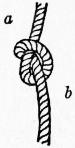
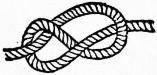
Fig 1. Fig 2.
Knots, Bends, Hitches, Splices and Seizings are all ways of fastening cords or ropes, either to some other object such as a spar, or a ring, or to one another. The “knot” is formed to make a knob on a rope, generally at the extremity, and by untwisting the strands at the end and weaving them together. But it may be made by turning the rope on itself through a loop, as for instance, the “overhand knot” (fig. 1). A “bend” (from the same root as “bind”), and a “hitch” (an O.E. word), are ways of fastening or tying ropes together, as in the “Carrick bend” (fig. 21), or round spars as the Studding Sail Halyard Bend (fig. 19), and the Timber Hitch (fig. 20). A “splice” (from the same root as “split”) is made by untwisting two rope ends and weaving them together. A “seizing” (Fr. saisir) is made by fastening two spars to one another by a rope, or two ropes by a third, or by using one rope to make a loop on another—as for example the Racking Seizing (fig. 41), the Round Seizing (fig. 40), and the Midshipman’s Hitch (fig. 29). The use of the words is often arbitrary. There is, for instance, no difference in principle between the Fisherman’s Bend (fig. 18) and the Timber Hitch (fig. 20). Speaking generally, the Knot and the Seizing are meant to be permanent, and must be unwoven in order to be unfastened, while the Bend and Hitch can be undone at once by pulling the ropes in the reverse direction from that in which they are meant to hold. Yet the Reef Knot (figs. 3 and 4) can be cast loose with ease, and is wholly different in principle, for instance, from the Diamond Knot (figs. 42 and 43). These various forms of fastening are employed in many kinds of industry, as for example in scaffolding, as well as in seamanship. The governing principle is that the strain which pulls against them shall draw them tighter. The ordinary “knots and splices” are described in every book on seamanship.
Overhand Knot (fig. 1).—Used at the end of ropes to prevent their unreeving and as the commencement of other knots. Take the end a round the end b.
Figure-of-Eight Knot (fig. 2).—Used only to prevent ropes from unreeving; it forms a large knob.
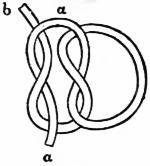
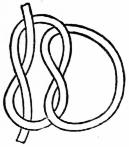
Fig. 3. Fig. 4.
Reef Knot (figs. 3, 4).—Form an overhand knot as above. Then take the end a over the end b and through the bight. If the end a were taken under the end b, a granny would be formed. This knot is so named from being used in tying the reef-points of a sail.
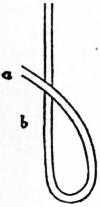
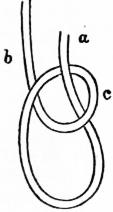
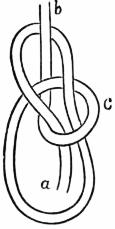
Fig. 5. Fig. 6. Fig. 7.
Bowline (figs. 5-7).—Lay the end a of a rope over the standing part b. Form with b a bight c over a. Take a round behind b and down through the bight c. This is a most useful knot employed to form a loop which will not slip. Running bowlines are formed by making a bowline round its own standing part above b. It is the most common and convenient temporary running noose.
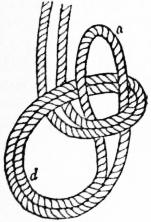
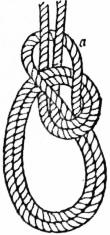
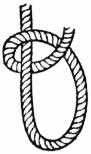
Fig. 8. Fig. 9. Fig. 10.
Bowline on a Bight (figs. 8, 9).—The first part is made similar to the above with the double part of the rope; then the bight a is pulled through sufficiently to allow it to be bent over past d and come up in the position shown in fig. 9. It makes a more comfortable sling for a man than a single bight.
Half-Hitch (fig. 10).—Pass the end a of the rope round the standing part b and through the bight.
Two Half-Hitches (fig. 11).—The half-hitch repeated; this is commonly used, and is capable of resisting to the full strength of the rope. A stop from a to the standing part will prevent it jamming.
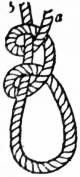
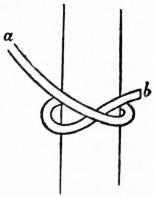
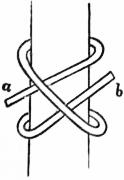
Fig. 11. Fig. 12. Fig. 13.
Clove Hitch (figs. 12, 13).—Pass the end a round a spar and cross it over b. Pass it round the spar again and put the end a through the second bight.
Blackwall Hitch (fig. 14).—Form a bight at the end of a rope, and put the hook of a tackle through the bight so that the end of the rope may be jammed between the standing part and the back of the hook.
Double Blackwall Hitch (fig. 15).—Pass the end a twice round the hook and under the standing part b at the last cross.
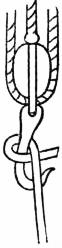
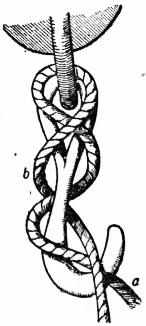
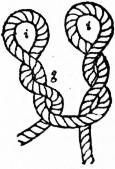
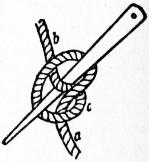
Fig. 14. Fig. 15. Fig. 16. Fig. 17.
Cat’s-paw (fig. 16).—Twist up two parts of a lanyard in opposite directions and hook the tackle in the eyes i, i. A piece of wood should be placed between the parts at g. A large lanyard should be clove-hitched round a large toggle and a strap passed round it below the toggle.
Marling-spike Hitch (fig. 17).—Lay the end a over c; fold the loop over on the standing part b; then pass the marline-spike through, over both parts of the bight and under the part b. Used for tightening each turn of a seizing.
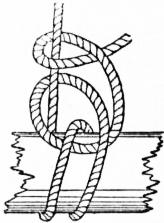
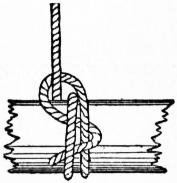
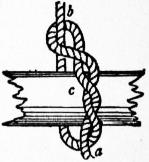
Fig. 18. Fig. 19. Fig. 20.
Fisherman’s Bend (fig. 18).—Take two turns round a spar, then a half-hitch round the standing part and between the spar and the turns, lastly a half-hitch round the standing part.
Studding-sail Halyard Bend (fig. 19).—Similar to the above, except that the end is tucked under the first round turn; this is more snug. A magnus hitch has two round turns and one on the other side of the standing part with the end through the bight.
Timber Hitch (fig. 20).—Take the end a of a rope round a spar, then round the standing part b, then several times round its own part c, against the lay of the rope.
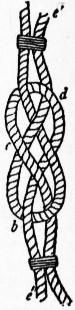
Fig. 21.
Carrick Bend (fig. 21).—Lay the end of one hawser over its own part to form a bight as e´, b; pass the end of another hawser up through that bight near b, going out over the first end at c, crossing under the first long part and over its end at d, then under both long parts, forming the loops, and above the first short part at b, terminating at the end e´´, in the opposite direction vertically and horizontally to the other end. The ends should be securely stopped to their respective standing parts, and also a stop put on the becket or extreme end to prevent it catching a pipe or chock; in that form this is the best quick means of uniting two large hawsers, since they cannot jam. When large hawsers have to work through small pipes, good security may be obtained either by passing ten or twelve taut racking turns with a suitable strand and securing each end to a standing part of the hawser, or by taking half as many round turns taut, crossing the ends between the hawsers over the seizing and reef-knotting the ends. This should be repeated in three places and the extreme ends well stopped. Connecting hawsers by bowline knots is very objectionable, as the bend is large and the knots jam.
Sheet Bend (fig. 22).—Pass the end of one rope through the bight of another, round both parts of the other, and under its own standing part. Used for bending small sheets to the clews of sails, which present bights ready for the hitch. An ordinary net is composed of a series of sheet bends. A weaver’s knot is made like a sheet bend.
Single Wall Knot (fig. 23).—Unlay the end of a rope, and with the strand a form a bight. Take the next strand b round the end of a. Take the last strand c round the end of b and through the bight made by a. Haul the ends taut.
Single Wall Crowned (fig. 24).—Form a single wall, and lay one of the ends, a, over the knot. Lay b over a, and c over b and through the bight of a. Haul the ends taut.
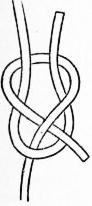
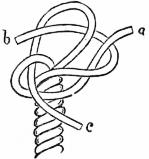
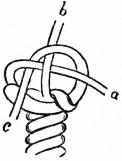
Fig. 22. Fig. 23. Fig. 24.
Double Wall and Double Crown (fig. 25).—Form a single wall crowned; then let the ends follow their own parts round until all the parts appear double. Put the ends down through the knot.
Matthew Walker (figs. 26, 27).—Unlay the end of a rope. Take the first strand round the rope and through its own bight; the second strand round the rope, through the bight of the first, and through its own bight; the third through all three bights. Haul the ends taut.
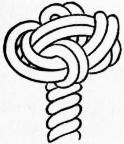
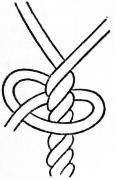
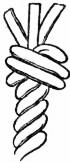
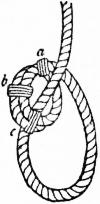
Fig. 25. Fig. 26. Fig. 27. Fig. 28.
Inside Clinch (fig. 28).—The end is bent close round the standing part till it forms a circle and a half, when it is securely seized at a, b and c, thus making a running eye; when taut round anything it jams the end. It is used for securing hemp cables to anchors, the standing parts of topsail sheets, and for many other purposes. If the eye were formed outside the bight an outside clinch would be made, depending entirely on the seizings, but more ready for slipping.
Midshipman’s Hitch (fig. 29).—Take two round turns inside the bight, the same as a half-hitch repeated; stop up the end or let another half-hitch be taken or held by hand. Used for hooking a tackle for a temporary purpose.
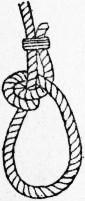
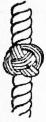
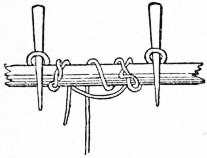
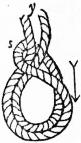
Fig. 29. Fig. 30. Fig. 31. Fig. 32.
Turk’s Head (fig. 30).—With fine line (very dry) make a clove hitch round the rope; cross the bights twice, passing an end the reverse way (up or down) each time; then keeping the whole spread flat, let each end follow its own part round and round till it is too tight to receive any more. Used as an ornament variously on side-ropes and foot-ropes of jibbooms. It may also be made with three ends, two formed by the same piece of line secured through the rope and one single piece. Form with them a diamond knot; then each end crossed over its neighbour follows its own part as above.
Spanish Windlass (fig. 31).—An iron bar and two marling-spikes are taken; two parts of a seizing are twisted like a cat’s-paw (fig. 16), passed round the bar, and hove round till sufficiently taut. In heaving shrouds together to form an eye two round turns are taken with a strand and the two ends hove upon. When a lever is placed between the parts of a long lashing or frapping and hove round, we have what is also called a Spanish windlass.
Slings (fig. 32).—This is simply the bight of a rope turned up over its own part; it is frequently made of chain, when a shackle (bow up) takes the place of the bight at s and another at y, connecting the two ends with the part which goes round the mast-head. Used to sling lower yards. For boat’s yards it should be a grummet with a thimble seized in at y. As the tendency of all yards is to cant forward with the weight of the sail, the part marked by an arrow should be the fore-side—easily illustrated by a round ruler and a piece of twine.
Sprit-Sail Sheet Knot (fig. 33).—This knot consists of a double wall and double crown made by the two ends, consequently with six strands, with the ends turned down. Used formerly in the clews of sails, now as an excellent stopper, a lashing or shackle being placed at s and a lanyard round the head at l.
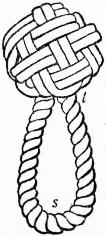
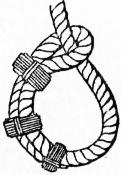
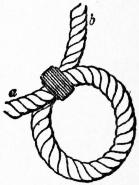
Fig. 33. Fig. 34. Fig. 35.
Turning in a Dead-Eye Cutter-Stay fashion (fig. 34).—A bend is made in the stay or shroud round its own part and hove together with a bar and strand; two or three seizings diminishing in size (one round and one or two either round or flat) are hove on taut and snug, the end being at the side of the fellow part. The dead-eye is put in and the eye driven down with a commander.
Turning in a Dead-Eye end up (fig. 35).—The shroud is measured round the dead-eye and marked where a throat-seizing is hove on; the dead-eye is then forced into its place, or it may be put in first. The end beyond a is taken up taut and secured with a round seizing; higher still the end is secured by another seizing. As it is important that the lay should always be kept in the rope as much as possible, these eyes should be formed conformably, either right-handed or left-handed. It is easily seen which way a rope would naturally kink by putting a little extra twist into it. A shroud whose dead-eye is turned in end up will bear a fairer strain, but is more dependent on the seizings; the under turns of the throat are the first to break and the others the first to slip. With the cutter-stay fashion the standing part of the shroud gives way under the nip of the eye. A rope will afford the greatest resistance to strain when secured round large thimbles with a straight end and a sufficient number of flat or racking seizings. To splice shrouds round dead-eyes is objectionable on account of opening the strands and admitting water, thus hastening decay. In small vessels, especially yachts, it is admissible on the score of neatness; in that case a round seizing is placed between the dead-eye and the splice. The dead-eyes should be in diameter 1½ times the circumference of a hemp shroud and thrice that of wire; the lanyard should be half the nominal size of hemp and the same size as wire: thus, hemp-shroud 12 in., wire 6 in., dead-eye 18 in., lanyard 6 in.
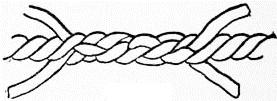
Fig. 36.
Short Splice (fig. 36).—The most common description of splice is when a rope is lengthened by another of the same size, or nearly so. Fig. 36 represents a splice of this kind: the strands have been unlaid, married and passed through with the assistance of a marling-spike, over one strand and under the next, twice each way. The ends are then cut off close. To render the splice neater the strands should have been halved before turning them in a second time, the upper half of each strand only being turned in; then all are cut off smooth. Eye Splice.—Unlay the strands and place them upon the same rope spread at such a distance as to give the size of the eye; enter the centre strand (unlaid) under a strand of the rope (as above), and the other two in a similar manner on their respective sides of the first; taper each end and pass them through again. If neatness is desired, reduce the ends and pass them through once more; cut off smooth and serve the part disturbed tightly with suitable hard line. Uses too numerous to mention. Cut Splice.—Made in a similar manner to an eye splice, but of two pieces of rope, therefore with two splices. Used for mast-head pendants, jib-guys, breast backstays, and even odd shrouds, to keep the eyes of the rigging lower by one part. It is not so strong as two separate eyes. Horseshoe Splice.—Made similar to the above, but one part much shorter than the other, or another piece of rope is spliced across an eye, forming a horseshoe with two long legs. Used for back-ropes on dolphin striker, back stays (one on each side) and cutter’s runner pendants. Long Splice.—The strands must be unlaid about three times as much as for a short splice and married—care being taken to preserve the lay or shape of each. Unlay one of the strands still further and follow up the vacant space with the corresponding strand of the other part, fitting it firmly into the rope till only a few inches remain. Treat the other side in a similar manner. There will then appear two long strands in the centre and a long and a short one on each side. The splice is practically divided into three distinct parts; at each the strands are divided and the corresponding halves knotted (as shown on the top of fig. 38) and turned in twice. The half strand may, if desired, be still further reduced before the halves are turned in for the second time. This and all other splices should be well stretched and hammered into shape before the ends are cut off. The long splice alone is adapted to running ropes.
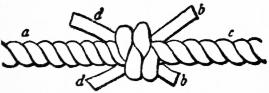
Fig. 37.
Shroud Knot (fig. 37).—Pass a stop at such distance from each end of the broken shroud as to afford sufficient length of strands, when it is unlaid, to form a single wall knot on each side after the parts have been married; it will then appear as represented in the figure, the strands having been well tarred and hove taut separately. The part a provides the knot on the opposite side and the ends b, b; the part c provides the knot and the ends d, d. After the knot has been well stretched the ends are tapered, laid smoothly between the strands of the shroud, and firmly served over. This knot is used when shrouds or stays are broken. French Shroud Knot.—Marry the parts with a similar amount of and as before; stop one set of strands taut up on the shroud (to keep the parts together), and turn the ends back on their own part, forming bights. Make a single wall knot with the other three strands round the said bights and shroud; haul the knot taut first and stretch the whole; then heave down the bights close: it will look like the ordinary shroud knot. It is very liable to slip. If the ends by which the wall knot is made after being hove were passed through the bights, it would make the knot stronger. The ends would be tapered and served.
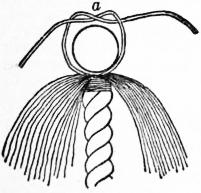
Fig. 38.
Flemish Eye (fig. 38).—Secure a spar or toggle twice the circumference of the rope intended to be rove through the eye; unlay the rope which is to form the eye about three times its circumference, at which part place a strong whipping. Point the rope vertically under the eye, and bind it taut up by the core if it is four-stranded rope, otherwise by a few yarns. While doing so arrange six or twelve pieces of spun-yarn at equal distances on the wood and exactly halve the number of yarns that have been unlaid. If it is a small rope, select two or three yarns from each side near the centre; cross them over the top at a, and half-knot them tightly. So continue till all are expended and drawn down tightly on the opposite side to that from which they came, being thoroughly intermixed. Tie the pieces of spun-yarn which were placed under the eye tightly round various parts, to keep the eye in shape when taken off the spar, till they are replaced by turns of marline hove on as taut as possible, the hitches forming a central line outside the eye. Heave on a good seizing of spun-yarn close below the spar, and another between six and twelve inches below the first; it may then be parcelled and served; the eye is served over twice, and well tarred each time. As large ropes are composed of so many yarns, a greater number must be knotted over the toggle each time; a 4-in. rope has 132 yarns, which would require 22 knottings of six each time; a 10-in. rope has 834 yarns, therefore, if ten are taken from each side every time, about twice that number of hitches will be required; sometimes only half the yarns are hitched, the others being merely passed over. The chief use of these eyes has been to form the collars of stays, the whole stay in each case having to be rove through it—a very inconvenient device. It is almost superseded for that purpose by a leg spliced in the stay and lashing eyes abaft the mast, for which it is commonly used at present. This eye is not always called by the same name, but the weight of evidence is in favour of calling it a Flemish eye. Ropemaker’s Eye, which also has alternative names, is formed by taking out of a rope one strand longer by 6 in. or a foot than the required eye, then placing the ends of the two strands a similar distance below the disturbance of the one strand, that is, at the size of the eye; the single strand is led back through the vacant space it left till it arrives at the neck of the eye, with a similar length of spare end to the other two strands. They are all seized together, scraped, tapered, marled and served. The principal merit is neatness. Mouse on a Stay.—Formed by turns of coarse spun-yarn hove taut round the stay, over parcelling at the requisite distance from the eye to form the collar; assistance is given by a padding of short yarns distributed equally round the rope, which, after being firmly secured, especially at what is to be the under part, are turned back over the first layer and seized down again, thus making a shoulder; sometimes it is formed with parcelling only. In either case it is finished by marling, followed by serving or grafting. The use is to prevent the Flemish eye in the end of the stay from slipping up any farther.
Rolling Hitch (fig. 39).—Two round turns are taken round a spar or large rope in the direction in which it is to be hauled and one half-hitch on the other side of the hauling part. This is very useful, as it can be put on and off quickly.
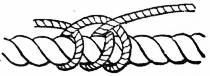
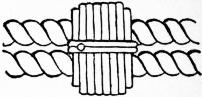
Fig. 39. Fig. 40.
Round Seizing (fig. 40).—So named when the rope it secures does not cross another and there are three sets of turns. The size of the seizing line is about one-sixth (nominal) that of the ropes to be secured, but varies according to the number of turns to be taken. An eye is spliced in the line and the end rove through it, embracing both parts. If either part is to be spread open, commence farthest from that part; place tarred canvas under the seizing; pass the line round as many times (with much slack) as it is intended to have under-turns; and pass the end back through them all and through the eye. Secure the eye from rendering round by the ends of its splice; heave the turns on with a marling-spike (see fig. 17), perhaps seven or nine; haul the end through taut, and commence again the riding turns in the hollows of the first. If the end is not taken back through the eye, but pushed up between the last two turns (as is sometimes recommended), the riders must be passed the opposite way in order to follow the direction of the under-turns, which are always one more in number than the riders. When the riders are complete, the end is forced between the last lower turns and two cross turns are taken, the end coming up where it went down, when a wall knot is made with the strands and the ends cut close; or the end may be taken once round the shroud. Throat Seizing.—Two ropes or parts of ropes are laid on each other parallel and receive a seizing similar to that shown in figure 35—that is with upper and riding but no cross turns. As the two parts of rope are intended to turn up at right angles to the direction in which they were secured, the seizing should be of stouter line and short, not exceeding seven lower and six riding turns. The end is better secured with a turn round the standing part. Used for turning in dead-eyes and variously. Flat Seizing.—Commenced similarly to the above, but it has neither riding nor cross turns.
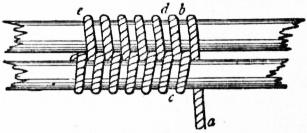
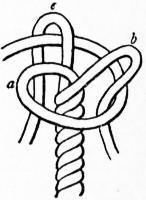
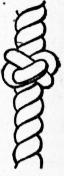
Fig. 41. Fig. 42. Fig. 43.
Racking Seizing (fig. 41).—A running eye having been spliced round one part of the rope, the line is passed entirely round the other part, crossed back round the first part, and so on for ten to twenty turns, according to the expected strain, every turn being hove as tight as possible; after which round turns are passed to fill the spaces at the back of each rope, by taking the end a over both parts into the hollow at b, returning at c, and going over to d. When it reaches e a turn may be taken round that rope only, the end rove under it, and a half-hitch taken, which will form a clove-hitch; knot the end and cut it close. When the shrouds are wire (which is half the size of hemp) and the end turned up round a dead-eye of any kind, wire seizings are preferable. It appears very undesirable to have wire rigging combined with plates or screws for setting it up, as in case of accident—such as that of the mast going over the side, a shot or collision breaking the ironwork—the seamen are powerless.
Diamond Knot (figs. 42, 43).—The rope must be unlaid as far as the centre if the knot is required there, and the strands handled with great care to keep the lay in them. Three bights are turned up as in fig. 42, and the end of a is taken over b and up the bight c. The end of b is taken over c and up through a. The end c is taken over a and through b. When hauled taut and the strands are laid up again it will appear as in fig. 43. Any number of knots may be made on the same rope. They were used on man-ropes, the foot-ropes on the jibboom, and similar places, where it was necessary to give a good hold for the hands or feet. Turk’s heads are now generally used. Double Diamond.—Made by the ends of a single diamond following their own part till the knot is repeated. Used at the upper end of a side rope as an ornamental stopper-knot.
Stropping-Blocks.—There are various modes of securing blocks to ropes; the most simple is to splice an eye at the end of the rope a little longer than the block and pass a round seizing to keep it in place; such is the case with jib-pendants. As a general rule, the parts of a strop combined should possess greater strength than the parts of the fall which act against it. The shell of an ordinary block should be about three times the circumference of the rope which is to reeve through it, as a 9-in. block for a 3-in. rope; but small ropes require larger blocks in proportion, as a 4-in. block for a 1-in. rope. When the work to be done is very important the blocks are much larger: brace-blocks are more than five times the nominal size of the brace. Leading-blocks and sheaves in racks are generally smaller than the blocks through which the ropes pass farther away, which appears to be a mistake, as more power is lost by friction. A clump-block should be double the nominal size of the rope. A single strop may be made by joining the ends of a rope of sufficient length to go round the block and thimble by a common short splice, which rests on the crown of the block (the opposite end to the thimble) and is stretched into place by a jigger; a strand is then passed twice round the space between the block and the thimble and hove taut by a Spanish windlass to cramp the parts together ready for the reception of a small round seizing. The cramping or pinching into shape is sometimes done by machinery invented by a rigger in Portsmouth dockyard. The strop may be made the required length by a long splice, but it would not possess any advantage.
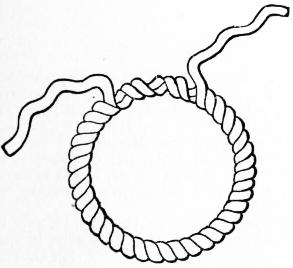
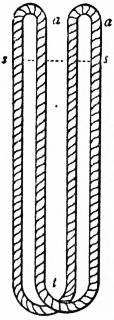
Fig. 44. Fig. 45.
Grummet-Strop (fig. 44).—Made by unlaying a piece of rope of the desired size about a foot more than three times the length required for the strop. Place the centre of the rope round the block and thimble; mark with chalk where the parts cross; take one strand out of the rope; bring the two chalk marks together; and cross the strand in the lay on both sides, continuing round and round till the two ends meet the third time; they are then halved, and the upper halves half-knotted and passed over and under the next strands, exactly as one part of a long splice. A piece of worn or well-stretched rope will better retain its shape, upon which success entirely depends. The object is neatness, and if three or multiples of three strops are to be made it is economical.
Double Strop (fig. 45).—Made with one piece of rope, the splice being brought as usual to the crown of the block t, the bights fitting into scores some inches apart, converging to the upper part, above which the thimble receives the bights a, a; and the four parts of the strop are secured at s, s by a round seizing doubly crossed. If the block be not then on the right slew (the shell horizontal or vertical) a union thimble is used with another strop, which produces the desired effect; thus the fore and main brace-blocks, being very large and thin, are required (for appearance) to lie horizontally; a single strop round the yard vertically has a union thimble between it and the double strop round the block. The double strop is used for large blocks; it gives more support to the shell than the single strop and admits of smaller rope being used. Wire rope is much used for block-strops; the fitting is similar. Metal blocks are also used in fixed positions; durability is their chief recommendation. Great care should be taken that they do not chafe the ropes which pass by them as well as those which reeve through.
Selvagee Strop.—Twine, rope-yarn or rope is warped round two or more pegs placed at the desired distance apart, till it assumes the requisite size and strength; the two ends are then knotted or spliced. Temporary firm seizings are applied in several places to bind the parts together before the rope or twine is removed from the pegs, after which it is marled with suitable material. A large strop should be warped round four or six pegs in order to give it the shape in which it is to be used. This description of strop is much stronger and more supple than rope of similar size. Twine strops (covered with duck) are used for boats’ blocks and in similar places requiring neatness. Rope-yarn and spun-yarn strops are used for attaching luff-tackles to shrouds and for many similar purposes. To bring to a shroud or hawser, the centre of the strop is passed round the rope and each part crossed three or four times before hooking the “luff”; a spun-yarn stop above the centre will prevent slipping and is very necessary with wire rope. As an instance of a large selvagee block-strop being used—when the “Melville” was hove down at Chusan (China), the main-purchase-block was double stropped with a selvagee containing 28 parts of 3-in. rope; that would produce 112 parts in the neck, equal to a breaking strain of 280 tons, which is more than four parts of a 19-in cable. The estimated strain it bore was 80 tons.
Stoppers for ordinary running ropes are made by splicing a piece of rope to a bolt or to a hook and thimble, unlaying 3 or 4 ft., tapering it by cutting away some of the yarns, and marling it down securely, with a good whipping also on the end. It is used by taking a half-hitch round the rope which is to be hauled upon, dogging the end up in the lay and holding it by hand. The rope can come through it when hauled, but cannot go back.
Whipping and Pointing.—The end of every working rope should at least be whipped to prevent it fagging out; in ships of war and yachts they are invariably pointed. Whipping is done by placing the end of a piece of twine or knittle-stuff on a rope about an inch from the end, taking three or four turns taut over it (working towards the end); the twine is then laid on the rope again lengthways contrary to the first, leaving a slack bight of twine; and taut turns are repeatedly passed round the rope, over the first end and over the bight, till there are in all six to ten turns; then haul the bight taut through between the turns and cut it close. To point a rope, place a good whipping a few inches from the end, according to size; open out the end entirely; select all the outer yarns and twist them into knittles either singly or two or three together; scrape down and taper the central part, marling it firmly. Turn every alternate knittle and secure the remainder down by a turn of twine or a smooth yarn hitched close up, which acts as the weft in weaving. The knittles are then reversed and another turn of the weft taken, and this is continued till far enough to look well. At the last turn the ends of the knittles which are laid back are led forward over and under the weft and hauled through tightly, making it present a circle of small bights, level with which the core is cut off smoothly. Hawsers and large ropes have a becket formed in their ends during the process of pointing. A piece of 1 to 1½ in. rope about 1½ to 2 ft. long is spliced into the core by each end while it is open: from four to seven yarns (equal to a strand) are taken at a time and twisted up; open the ends of the becket only sufficient to marry them close in; turn in the twisted yarns between the strands (as splicing) three times, and stop it above and below. Both ends are treated alike; when the pointing is completed a loop a few inches in length will protrude from the end of the rope, which is very useful for reeving it. A hauling line or reeving line should only be rove through the becket as a fair lead. Grafting is very similar to pointing, and frequently done the whole length of a rope, as a side-rope. Pieces of white line more than double the length of the rope, sufficient in number to encircle it, are made up in hanks called foxes; the centre of each is made fast by twine and the weaving process continued as in pointing. Block-strops are sometimes so covered; but, as it causes decay, a small wove mat which can be taken off occasionally is preferable.

Fig. 46.
Sheep-Shank (fig. 46).—Formed by making a long bight in a topgallant back-stay, or any rope which it is desirable to shorten, and taking a half-hitch near each bend, as at a, a. Rope-yarn stops at b, b are desirable to keep it in place till the strain is brought on it. Wire rope cannot be so treated, and it is injurious to hemp rope that is large and stiff.
Knotting Yarns (fig. 47).—This operation becomes necessary when, a comparatively short piece of junk is to be made into spun-yarn, or large rope into small, which is called twice laid. The end of each yarn is divided, rubbed smooth and married (as for splicing). Two of the divided parts, as c, c and d, d, are passed in opposite directions round all the other parts and knotted. The ends e and f remain passive. The figure is drawn open, but the forks of A and B should be pressed close together, the knot hauled taut and the ends cut off.
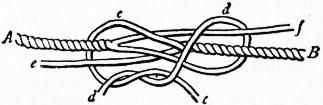
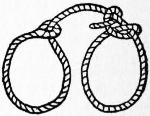
Fig. 47. Fig. 48.
Butt Slings (fig. 48).—Made of 4-in. rope, each pair being 26 ft. in length, with an eye spliced in one end, through which the other is rove before being placed over one end of the cask; the rope is then passed round the opposite side of the cask and two half-hitches made with the end, forming another running eye, both of which are beaten down taut as the tackle receives the weight. Slings for smaller casks requiring care should be of this description, though of smaller rope, as the cask cannot possibly slip out. Bale Slings are made by splicing the ends of about 3 fathoms of 3-in. rope together, which then looks like a long strop, similar to the double strop represented in fig. 45—the bights t being placed under the cask or bale and one of the bights a, a rove through the other and attached to the whip or tackle.
For a complete treatise on the subject the reader may be referred to The Book of Knots, being a Complete Treatise on the Art of Cordage, illustrated by 172 Diagrams, showing the Manner of making every Knot, Tie and Splice, by Tom Bowling (London, 1890).
Mathematical Theory of Knots.
In the scientific sense a knot is an endless physical line which cannot be deformed into a circle. A physical line is flexible and inextensible, and cannot be cut—so that no lap of it can be drawn through another.
The founder of the theory of knots is undoubtedly Johann Benedict Listing (1808-1882). In his “Vorstudien zur Topologie” (Göttinger Studien, 1847), a work in many respects of startling originality, a few pages only are devoted to the subject.1 He treats knots from the elementary notion of twisting one physical line (or thread) round another, and shows that from the projection of a knot on a surface we can thus obtain a notion of the relative situation of its coils. He distinguishes “reduced” from “reducible” forms, the number of crossings in the reduced knot being the smallest possible. The simplest form of reduced knot is of two species, as in figs. 49 and 50. Listing points out that these are formed, the first by right-handed the second by left-handed twisting. In fact, if three half-twists be given to a long strip of paper, and the ends be then pasted together, the two edges become one line, which is the knot in question. We may free it by slitting the paper along its middle line; and then we have the juggler’s trick of putting a knot on an endless unknotted band. One of the above forms cannot be deformed into the other. The one is, in Listing’s language, the “perversion” of the other, i.e. its image in a plane mirror. He gives a method of symbolizing reduced knots, but shows that in this method the same knot may, in certain cases, be represented by different symbols. It is clear that the brief notice he published contains a mere sketch of his investigations.
The most extensive dissertation on the properties of knots is that of Peter Guthrie Tait (Trans. Roy. Soc. Edin., xxviii. 145, where the substance of a number of papers in the Proceedings of the same society is reproduced). It was for the most part written in ignorance of the work of Listing, and was suggested by an inquiry concerning vortex atoms.
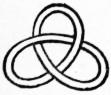
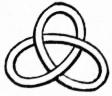
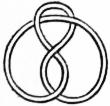
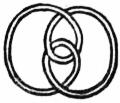
Fig. 49. Fig. 50. Fig. 51. Fig. 52.
Tait starts with the almost self-evident proposition that, if any plane closed curve have double points only, in passing continuously along the curve from one of these to the same again an even number of double points has been passed through. Hence the crossings may be taken alternately over and under. On this he bases a scheme for the representation of knots of every kind, and employs it to find all the distinct forms of knots which have, in their simplest projections, 3, 4, 5, 6 and 7 crossings only. Their numbers are shown to be 1, 1, 2, 4 and 8. The unique knot of three crossings has been already given as drawn by Listing. The unique knot of four crossings merits a few words, because its properties lead to a very singular conclusion. It can be deformed into any of the four forms—figs. 51 and 52 and their perversions. Knots which can be deformed into their own perversion Tait calls “amphicheiral” (from the Greek ἀμφί, on both sides, around, χείρ, hand), and he has shown that there is at least one knot of this kind for every even number of crossings. He shows also that “links” (in which two endless physical lines are linked together) possess a similar property; and he then points out that there is a third mode of making a complex figure of endless physical lines, without either knotting or linking. This may be called “lacing” or “locking.” Its nature is obvious from fig. 53, in which it will be seen that no one of the three lines is knotted, no two are linked, and yet the three are inseparably fastened together.
The rest of Tait’s paper deals chiefly with numerical characteristics of knots, such as their “knottiness,” “beknottedness” and “knotfulness.” He also shows that any knot, however complex, can be fully represented by three closed plane curves, none of which has double points and no two of which intersect. It may be stated here that the notion of beknottedness is founded on a remark of Gauss, who in 1833 considered the problem of the number of inter-linkings of two closed circuits, and expressed it by the electro-dynamic measure of the work required to carry a unit magnetic pole round one of the interlinked curves, while a unit electric current is kept circulating in the other. This original suggestion has been developed at considerable length by Otto Boeddicker (Erweiterung der Gauss’schen Theorie der Verschlingungen (Stuttgart, 1876). This author treats also of the connexion of knots with Riemann’s surfaces.
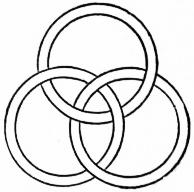
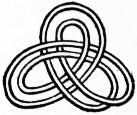
Fig. 53. Fig. 54.
It is to be noticed that, although every knot in which the crossings are alternately over and under is irreducible, the converse is not generally true. This is obvious at once from fig. 54, which is merely the three-crossing knot with a doubled string—what Listing calls “paradromic.”
Christian Felix Klein, in the Mathematische Annalen, ix. 478, has proved the remarkable proposition that knots cannot exist in space of four dimensions.
(P. G. T.)
1 See P. G. Tait “On Listing’s Topologie,” Phil. Mag., xvii. 30.
KNOUT (from the French transliteration of a Russian word of Scandinavian origin; cf. A.-S. cnotta, Eng. knot), the whip used in Russia for flogging criminals and political offenders. It is said to have been introduced under Ivan III. (1462-1505). The knout had different forms. One was a lash of raw hide, 16 in. long, attached to a wooden handle, 9 in. long. The lash ended in a metal ring, to which was attached a second lash as long, ending also in a ring, to which in turn was attached a few inches of hard leather ending in a beak-like hook. Another kind consisted of many thongs of skin plaited and interwoven with wire, ending in loose wired ends, like the cat-o’-nine tails. The victim was tied to a post or on a triangle of wood and stripped, receiving the specified number of strokes on the back. A sentence of 100 or 120 lashes was equivalent to a death sentence; but few lived to receive so many. The executioner was usually a criminal who had to pass through a probation and regular training; being let off his own penalties in return for his services. Peter the Great is traditionally accused of knouting his son Alexis to death, and there is little doubt that the boy was actually beaten till he died, whoever was the executioner. The emperor Nicholas I. abolished the earlier forms of knout and substituted the pleti, a three-thonged lash. Ostensibly the knout has been abolished throughout Russia and reserved for the penal settlements.
KNOWLES, SIR JAMES (1831-1908), English architect and editor, was born in London in 1831, and was educated, with a view to following his father’s profession, as an architect at University College and in Italy. His literary tastes also brought him at an early age into the field of authorship. In 1860 he published The Story of King Arthur. In 1867 he was introduced to Tennyson, whose house, Aldworth, on Blackdown, he designed; this led to a close friendship, Knowles assisting Tennyson in business matters, and among other things helping to design scenery for The Cup, when Irving produced that play in 1880. Knowles became intimate with a number of the most interesting men of the day, and in 1869, with Tennyson’s co-operation, he started the Metaphysical Society, the object of which was to attempt some intellectual rapprochement between religion and science by getting the leading representatives of faith and unfaith to meet and exchange views.
The members from first to last were as follows: Dean Stanley, Seeley, Roden Noel, Martineau, W. B. Carpenter, Hinton, Huxley, Pritchard, Hutton, Ward, Bagehot, Froude, Tennyson, Tyndall, Alfred Barry, Lord Arthur Russell, Gladstone, Manning, Knowles, Lord Avebury, Dean Alford, Alex. Grant, Bishop Thirlwall, F. Harrison, Father Dalgairns, Sir G. Grove, Shadworth Hodgson, H. Sidgwick, E. Lushington, Bishop Ellicott, Mark Pattison, duke of Argyll, Ruskin, Robert Lowe, Grant Duff, Greg, A. C. Fraser, Henry Acland, Maurice, Archbishop Thomson, Mozley, Dean Church, Bishop Magee, Croom Robertson, FitzJames Stephen, Sylvester, J. C. Bucknill, Andrew Clark, W. K. Clifford, St George Mivart, M. Boulton, Lord Selborne, John Morley, Leslie Stephen, F. Pollock, Gasquet, C. B. Upton, William Gull, Robert Clarke, A. J. Balfour, James Sully and A. Barratt.
Papers were read and discussed at the various meetings on such subjects as the ultimate grounds of belief in the objective and moral sciences, the immortality of the soul, &c. An interesting description of one of the meetings was given by Magee (then bishop of Peterborough) in a letter of 13th of February 1873:—
“Archbishop Manning in the chair was flanked by two Protestant bishops right and left; on my right was Hutton, editor of the Spectator, an Arian; then came Father Dalgairns, a very able Roman Catholic priest; opposite him Lord A. Russell, a Deist; then two Scotch metaphysical writers, Freethinkers; then Knowles, the very broad editor of the Contemporary; then, dressed as a layman and looking like a country squire, was Ward, formerly Rev. Ward, and earliest of the perverts to Rome; then Greg, author of The Creed of Christendom, a Deist; then Froude, the historian, once a deacon in our Church, now a Deist; then Roden Noel, an actual Atheist and red republican, and looking very like one! Lastly Ruskin, who read a paper on miracles, which we discussed for an hour and a half! Nothing could be calmer, fairer, or even, on the whole, more reverent then the discussion. In my opinion, we, the Christians, had much the best of it. Dalgairns, the priest, was very masterly; Manning, clever and precise and weighty; Froude, very acute, and so was Greg. We only wanted a Jew and a Mahommedan to make our Religious Museum complete” (Life, i. 284).
The last meeting of the society was held on 16th May 1880. Huxley said that it died “of too much love”; Tennyson, “because after ten years of strenuous effort no one had succeeded in even defining metaphysics.” According to Dean Stanley, “We all meant the same thing if we only knew it.” The society formed the nucleus of the distinguished list of contributors who supported Knowles in his capacity as an editor. In 1870 he became editor of the Contemporary Review, but left it in 1877 and founded the Nineteenth Century (to the title of which, in 1901, were added the words And After). Both periodicals became very influential under him, and formed the type of the new sort of monthly review which came to occupy the place formerly held by the quarterlies. In 1904 he received the honour of knighthood. He died at Brighton on the 13th of February 1908.
KNOWLES, JAMES SHERIDAN (1784-1862), Irish dramatist and actor, was born in Cork, on the 12th of May 1784. His father was the lexicographer, James Knowles (1759-1840), cousin-german of Richard Brinsley Sheridan. The family removed to London in 1793, and at the age of fourteen Knowles published a ballad entitled The Welsh Harper, which, set to music, was very popular. The boy’s talents secured him the friendship of Hazlitt, who introduced him to Lamb and Coleridge. He served for some time in the Wiltshire and afterwards in the Tower Hamlets militia, leaving the service to become pupil of Dr Robert Willan (1757-1812). He obtained the degree of M.D., and was appointed vaccinator to the Jennerian Society. Although, however, Dr Willan generously offered him a share in his practice, he resolved to forsake medicine for the stage, making his first appearance probably at Bath, and playing Hamlet at the Crow Theatre, Dublin. At Wexford he married, in October 1809, Maria Charteris, an actress from the Edinburgh Theatre. In 1810 he wrote Leo, in which Edmund Kean acted with great success; another play, Brian Boroihme, written for the Belfast Theatre in the next year, also drew crowded houses, but his earnings were so small that he was obliged to become assistant to his father at the Belfast Academical Institution. In 1817 he removed from Belfast to Glasgow, where, besides conducting a flourishing school, he continued to write for the stage. His first important success was Caius Gracchus, produced at Belfast in 1815; and his Virginius, written for Edmund Kean, was first performed in 1820 at Covent Garden. In William Tell (1825) Macready found one of his favourite parts. His best-known play, The Hunchback, was produced at Covent Garden in 1832; The Wife was brought out at the same theatre in 1833; and The Love Chase in 1837. In his later years he forsook the stage for the pulpit, and as a Baptist preacher attracted large audiences at Exeter Hall and elsewhere. He published two polemical works—the Rock of Rome and the Idol Demolished by its own Priests—in both of which he combated the special doctrines of the Roman Catholic Church. Knowles was for some years in the receipt of an annual pension of £200, bestowed by Sir Robert Peel. He died at Torquay on the 30th of November 1862.
A full list of the works of Knowles and of the various notices of him will be found in the Life (1872), privately printed by his son, Richard Brinsley Knowles (1820-1882), who was well known as a journalist.
KNOW NOTHING (or American) PARTY, in United States history, a political party of great importance in the decade before 1860. Its principle was political proscription of naturalized citizens and of Roman Catholics. Distrust of alien immigrants, because of presumptive attachment to European institutions, has always been more or less widely diffused, and race antagonisms have been recurrently of political moment; while anti-Catholic sentiment went back to colonial sectarianism. These were the elements of the political “nativism”—i.e. hostility to foreign influence in politics—of 1830-1860. In these years Irish immigration became increasingly preponderant; and that of Catholics was even more so. The geographical segregation and the clannishness of foreign voters in the cities gave them a power that Whigs and Democrats alike (the latter more successfully) strove to control, to the great aggravation of naturalization and election frauds. “No one can deny that ignorant foreign suffrage had grown to be an evil of immense proportions” (J. F. Rhodes). In labour disputes, political feuds and social clannishness, the alien elements—especially the Irish and German—displayed their power, and at times gave offence by their hostile criticism of American institutions.1 In immigration centres like Boston, Philadelphia and New York, the Catholic Church, very largely foreign in membership and proclaiming a foreign allegiance of disputed extent, was really “the symbol and strength of foreign influence” (Scisco); many regarded it as a transplanted foreign institution, un-American in organization and ideas.2 Thus it became involved in politics. The decade 1830-1840 was marked by anti-Catholic (anti-Irish) riots in various cities and by party organization of nativists in many places in local elections. Thus arose the American-Republican (later the Native-American) Party, whose national career begun practically in 1845, and which in Louisiana in 1841 first received a state organization. New York City in 1844 and Boston in 1845 were carried by the nativists, but their success was due to Whig support, which was not continued,3 and the national organization was by 1847—in which year it endorsed the Whig nominee for the presidency—practically dead. Though some Whig leaders had strong nativist leanings, and though the party secured a few representatives in Congress, it accomplished little at this time in national politics. In the early ’fifties nativism was revivified by an unparalleled inflow of aliens. Catholics, moreover, had combated the Native-Americans defiantly. In 1852 both Whigs and Democrats were forced to defend their presidential nominees against charges of anti-Catholic sentiment. In 1853-1854 there was a wide-spread “anti-popery” propaganda and riots against Catholics in various cities. Meanwhile the Know Nothing Party had sprung from nativist secret societies, whose relations remain obscure.4 Its organization was secret; and hence its name—for a member, when interrogated, always answered that he knew nothing about it. Selecting candidates secretly from among those nominated by the other parties, and giving them no public endorsement, the Know Nothings, as soon as they gained the balance of power, could shatter at will Whig and Democratic calculations. Their power was evident by 1852—from which time, accordingly, “Know Nothingism” is most properly dated. The charges they brought against naturalization abuses were only too well founded; and those against election frauds not less so—though, unfortunately, the Know Nothings themselves followed scandalous election methods in some cities. The proposed proscription of the foreign-born knew no exceptions: many wished never to concede to them all the rights of natives, nor to their children unless educated in the public schools. As for Catholics, the real animus of Know Nothingism was against political Romanism; therefore, secondarily, against papal allegiance and episcopal church administration (in place of administration by lay trustees, as was earlier common practice in the United States); and, primarily, against public aid to Catholic schools, and the alleged greed (i.e. the power and success) of the Irish in politics. The times were propitious for the success of an aggressive third party; for the Whigs were broken by the death of Clay and Webster and the crushing defeat of 1852, and both the Whig and Democratic parties were disintegrating on the slavery issue. But the Know Nothings lacked aggression. In entering national politics the party abandoned its mysteries, without making compensatory gains; when it was compelled to publish a platform of principles, factions arose in its ranks; moreover, to draw recruits the faster from Whigs and Democrats, it “straddled” the slavery question, and this, although a temporary success, ultimately meant ruin. In 1854, however, Know Nothing gains were remarkable.5 Thereafter the organization spread like wildfire in the South, in which section there were almost no aliens, and the Whig dissolution was far advanced. The Virginia election of May 1855 proved conclusively, however, that Know Nothingism was no stronger against the Democrats than was the Whig party it had absorbed; it was the same organization under a new name. In the North it was even clearer that slavery must be faced. Know Nothing evasion probably helped the South,6 but neither Republicans nor Democrats would endure the evasion; Douglas and Seward, and later (1855-1856) their parties, denounced it. In the North-West the Know Nothings were swept into the anti-slavery movement in 1854 without retaining their organization. In the state campaigns of 1855 professions were measured to the latitude. The national platform of 1856 (adopted by a secret grand council), besides including anti-alien and anti-Catholic planks, offered sops to the North, the South and the “doughfaces” on the slavery issue. Millard Fillmore was nominated for the presidency. The anti-slavery delegates of eight Northern states bolted the convention, and eight months later the Republican wave swept the Know Nothings out of the North.7 The national field being thus lost, the state councils became supreme, and local opportunism fostered variation and weakness. By 1859 the party was confined almost entirely to the border states. The Constitutional Union—the “Do Nothing”—Party of 1860 was mainly composed of Know Nothing remnants.8 The year 1860 practically marked, also, the disappearance of the party as a local power.9
Except in city politics nativism had no vitality; in state and national politics it really had no excuse. Race antipathies gave it local cohesive power in the North; various causes, already mentioned, advanced it in the South; and as a device to win offices it was of wide-spread attraction. Its only real contribution to government was the proof that nativism is not Americanism. Public opinion has never accepted its estimate of the alien nor of Catholic citizens. Some of its anti-Church principles, however—as the non-support of denominational schools—have been generally accepted; others—as the refusal to exclude the (Protestant) Bible from public schools—have been generally rejected; others—as the taxation of all Church property—remain disputed.
See L. D. Scisco, Political Nativism in New York State (doctoral thesis, Columbia University, New York, 1901); L. F. Schmeckebier, Know Nothing Party in Maryland (Johns Hopkins University, Baltimore, 1899); G. H. Haynes, “A Know Nothing Legislature” (Mass., 1855), in American Historical Assoc. Report, pt. 1 (1896); J. B. McMaster, With the Fathers, including “The Riotous Career of the Know Nothings” (New York, 1896); H. F. Desmond, The Know Nothing Party (Washington, 1905).
1 E.g. for some extraordinary “reform” programmes among German immigrants see Schmeckebier (as below), pp. 48-50.
2 “The actual offence of the Catholic Church was its non-conformity to American methods of church administration and popular education” (Scisco).
3 The Whigs bargained aid in New York city for “American” support in the state, and charged that the latter was not given. Millard Fillmore attributed the Whig loss of the state (see Liberty Party) to the disaffection of Catholic Whigs angered by the alliance with the nativists.
4 The Order of United Americans and the Order of the Star Spangled Banner, established in New York respectively in 1845 and 1850, were the most important sources of its membership.
5 This year “American Party” became the official name. Its strength in Congress was almost thirty-fold that of 1852. It elected governors, legislatures, or both, in four New England states, and in Maryland, Kentucky and California; minor officers elsewhere; and almost won six Southern states.
6 For it delayed anti-slavery organization in the North, and presumably discouraged immigration, which was a source of strength to the North rather than to the South.
7 They carried only Maryland. The popular vote in the North was under one-seventh, in the South above three-sevenths, of the total vote cast.
8 Note the presidential vote. Seward’s loss of the Republican nomination was partly due to Know Nothing hostility.
9 Its firmest hold was in Maryland. Its rule in Baltimore (1854-1860) was marked by disgraceful riots and abuses.
KNOX, HENRY (1750-1806), American general, was born in Boston, Massachusetts, of Scottish-Irish parentage, on the 25th of July 1750. He was prominent in the colonial militia and tried to keep the Boston crowd and the British soldiers from the clash known as the Boston massacre (1770). In 1771 he opened the “London Book-Store” in Boston. He had read much of tactics and strategy, joined the American army at the outbreak of the War of Independence, and fought at Bunker Hill, planned the defences of the camps of the army before Boston, and brought from Lake George and border forts much-needed artillery. At Trenton he crossed the river before the main body, and in the attack rendered such good service that he was made brigadier-general and chief of artillery in the Continental army on the following day. He was present at Princeton; was chiefly responsible for the mistake in attacking the “Chew House” at Germantown; urged New York as the objective of the campaign of 1778; served with efficiency at Monmouth and at Yorktown; and after the surrender of Cornwallis was promoted major-general, and served as a commissioner on the exchange of prisoners. His services throughout the war were of great value to the American cause; he was one of General Washington’s most trusted advisers, and he brought the artillery to a high degree of efficiency. From December 1783 until June 1784 he was the senior officer of the United States army. In April 1783 he had drafted a scheme of a society to be formed by the American officers and the French officers who had served in America during the war, and to be called the “Cincinnati”; of this society he was the first secretary-general (1783-1799) and in 1805 became vice-president-general. In 1785-1794 Knox was secretary of war, being the first man to hold this position after the organization of the Federal government in 1789. He urged ineffectually a national militia system, to enroll all citizens over 18 and under 60 in the “advanced corps,” the “main corps” or the “reserve,” and for this and his close friendship with Washington was bitterly assailed by the Republicans. In 1793 he had begun to build his house, Montpelier, at Thomaston, Maine, where he speculated unsuccessfully in the holdings of the Eastern Land Association; and he lived there until his death on the 25th of October 1806.
See F. S. Drake, Memoir of General Henry Knox (Boston, 1873); and Noah Brooks, Henry Knox (New York, 1900) in the “American Men of Energy” series.
KNOX, JOHN (c. 1505-1572), Scottish reformer and historian. Of his early life very little is certainly known, in spite of the fact that his History of the Reformation and his private letters, especially the latter, are often vividly autobiographical. Even the year of his birth, usually given as 1505, is matter of dispute. Beza, in his Icones, published in 1580, makes it 1515; Sir Peter Young (tutor to James VI. of Scotland), writing to Beza from Edinburgh in 1579, says 1513; and a strong case has been made out for holding that the generally accepted date is due to an error in transcription (see Dr Hay Fleming in the Bookman, Sept. 1905). But Knox seems to have been reticent about his early life, even to his contemporaries. What is known is that he was a son of William Knox, who lived in or near the town of Haddington, that his mother’s name was Sinclair, and that his forefathers on both sides had fought under the banner of the Bothwells. William Knox was “simple,” not “gentle”—perhaps a prosperous East Lothian peasant. But he sent his son John to school (no doubt the well-known grammar school of Haddington), and thereafter to the university, where, like his contemporary George Buchanan, he sat “at the feet” of John Major. Major was a native of Haddington, who had recently returned to Scotland from Paris with a great academical reputation. He retained to the last, as his History of Greater Britain shows, the repugnance characteristic of the university of Paris to the tyranny of kings and nobles; but like it, he was now alarmed by the revolt of Luther, and ceased to urge its ancient protest against the supremacy of the pope. He exchanged his “regency” or professorship in Glasgow University for one in that of St Andrews in 1523. If Knox’s college time was later than that date (as it must have been, if he was born near 1515), it was no doubt spent, as Beza narrates, at St Andrews, and probably exclusively there. But in Major’s last Glasgow session a “Joannes Knox” (not an uncommon name, however, at that time in the west of Scotland) matriculated there; and if this were the future reformer, he may thereafter either have followed his master to St Andrews or returned from Glasgow straight to Haddington. But till twenty years after that date his career has not been again traced. Then he reappears in his native district as a priest without a university degree (Sir John Knox) and a notary of the diocese of St Andrews. In 1543 he certainly signed himself “minister of the sacred altar” under the archbishop of St Andrews. But in 1546 he was carrying a two-handed sword in defence of the reformer George Wishart, on the day when the latter was arrested by the archbishop’s order. Knox would have resisted, though the arrest was by his feudal superior, Lord Bothwell; but Wishart himself commanded his submission, with the words “One is sufficient for a sacrifice,” and was handed over for trial at St Andrews. And next year the archbishop himself had been murdered, and Knox was preaching in St Andrews a fully developed Protestantism.
Knox gives us no information as to how this startling change in himself was brought about. During those twenty years Scotland had been slowly tending to freedom in religious profession, and to friendship with England rather than with France. The Scottish hierarchy, by this time corrupt and even profligate, saw the twofold danger and met it firmly. James V., the “Commons’ King” had put himself into the hands of the Beatons, who in 1528 burned Patrick Hamilton. On James’s death there was a slight reaction, but the cardinal-archbishop took possession of the weak regent Arran, and in 1546 burned George Wishart. England had by this time rejected the pope’s supremacy. In Scotland by a recent statute it was death even to argue against it; and Knox after Wishart’s execution was fleeing from place to place, when, hearing that certain gentlemen of Fife had slain the cardinal and were in possession of his castle of St Andrews, he gladly joined himself to them. In St Andrews he taught “John’s Gospel” and a certain catechism—probably that which Wishart had got from “Helvetia” and translated; but his teaching was supposed to be private and tutorial and for the benefit of his friends’ “bairns.” The men about him however—among them Sir David Lindsay of the Mount, “Lyon King” and poet—saw his capacity for greater things, and, on his at first refusing “to run where God had not called him,” planned a solemn appeal to Knox from the pulpit to accept “the public office and charge of preaching.” At the close of it the speaker (in Knox’s own narrative) “said to those that were present, ‘Was not this your charge to me? And do ye not approve this vocation?’ They answered, ‘It was, and we approve it.’ Whereat the said Johnne, abashed, burst forth in most abundant tears and withdrew himself to his chamber,” remaining there in “heaviness” for days, until he came forth resolved and prepared. Knox is probably not wrong in regarding this strange incident as the spring of his own public life. The St Andrews invitation was really one to danger and death; John Rough, who spoke it, died a few years after in the flames at Smithfield. But it was a call which many in that ardent dawn were ready to accept, and it had now at length found, or made, a statesman and leader of men. For what to the others was chiefly a promise of personal salvation became for the indomitable will of Knox an assurance also of victory, even in this world, over embattled forces of ancient wrong. It is certain at least that from this date he never changed and scarcely even varied his public course. And looking back upon that course afterwards, he records with much complacency how his earliest St Andrews sermon built up a whole fabric of aggressive Protestantism upon Puritan theory, so that his startled hearers muttered, “Others sned (snipped) the branches; this man strikes at the root.”
Meantime the system attacked was safe for other thirteen years. In June 1547 St Andrews yielded to the French fleet, and the prisoners, including Knox, were thrown into the galleys on the Loire, to remain in irons and under the lash for at least nineteen months. Released at last (apparently through the influence of the young English king, Edward VI.), Knox was appointed one of the licensed preachers of the new faith for England, and stationed in the great garrison of Berwick, and afterwards at Newcastle. In 1551 he seems to have been made a royal chaplain; in 1552 he was certainly offered an English bishopric, which he declined; and during most of this year he used his influence, as preacher at court and in London, to make the new English settlement more Protestant. To him at least is due the Prayer-book rubric which explains that, when kneeling at the sacrament is ordered, “no adoration is intended or ought to be done.” While in Northumberland Knox had been betrothed to Margaret Bowes, one of the fifteen children of Richard Bowes, the captain of Norham Castle. Her mother, Elizabeth, co-heiress of Aske in Yorkshire, was the earliest of that little band of women-friends whose correspondence with Knox on religious matters throws an unexpected light on his discriminating tenderness of heart. But now Mary Tudor succeeded her brother, and Knox in March 1554 escaped into five years’ exile abroad, leaving Mrs. Bowes a fine treatise on “Affliction,” and sending back to England two editions of a more acrid “Faithful Admonition” on the crisis there. He first drifted to Frankfort, where the English congregation divided as English Protestants have always done, and the party opposed to Knox got rid of him at last by a complaint to the authorities of treason against the emperor Charles V. as well as Philip and Mary. At Geneva he found a more congenial pastorate. Christopher Goodman (c. 1520-1603) and he, with other exiles, began there the Puritan tradition, and prepared the earlier English version of the Bible, “the household book of the English-speaking nations” during the great age of Elizabeth. Here, and afterwards at Dieppe (where he preached in French), Knox kept in communication with the other Reformers, studied Greek and Hebrew in the interest of theology, and having brought his wife and her mother from England in 1555 lived for years a peaceful life.
But even here Knox was preparing for Scotland, and facing the difficulties of the future, theoretical as well as practical. In his first year abroad he consulted Calvin and Bullinger as to the right of the civil “authority” to prescribe religion to his subjects—in particular, whether the godly should obey “a magistrate who enforces idolatry and condemns true religion,” and whom should they join “in the case of a religious nobility resisting an idolatrous sovereign.” In August 1555 be visited his native country and found the queen-mother, Mary of Lorraine, acting as regent in place of the real “sovereign,” the youthful and better-known Mary, now being brought up at the court of France. Scripture-reading and the new views had spread widely, and the regent was disposed to wink at this in the case of the “religious nobility.” Knox was accordingly allowed to preach privately for six months throughout the south of Scotland, and was listened to with an enthusiasm which made him break out, “O sweet were the death which should follow such forty days in Edinburgh as here I have had three!” Before leaving he even addressed a letter to the regent, urging her to favour the Evangel. She accepted it jocularly as a “pasquil,” and Knox on his departure was condemned and burned in effigy. But he left behind him a “Wholesome Counsel” to Scottish heads of families, reminding them that within their own houses they were “bishop and kings,” and recommending the institution of something like the early apostolic worship in private congregations. Of the Protestant barons Knox, though in exile, seems to have been henceforward the chief adviser; and before the end of 1557 they, under the name of the “Lords of the Congregation,” had entered into the first of the religious “bands” or “covenants” afterwards famous in Scotland. In 1558 he published his “Appellation” to the nobles, estates and commonalty against the sentence of death recently pronounced upon him, and along with it a stirring appeal “To his beloved brethren, the Commonalty of Scotland,” urging that the care of religion fell to them also as being “God’s creatures, created and formed in His own image,” and having a right to defend their conscience against persecution. About this time, indeed, there was in Scotland a remarkable approximation to that solution of the toleration difficulty which later ages have approved; for the regent was understood to favour the demand of the “congregation” that at least the penal statutes against heretics “be suspended and abrogated,” and “that it be lawful to us to use ourselves in matters of religion and conscience as we must answer to God.” It was a consummation too ideal for that early date; and next year the regent, whose daughter was now queen of France and there mixed up with the persecuting policy of the Guises, forbade the reformed preaching in Scotland. A rupture ensued at once, and Knox appeared in Edinburgh on the 2nd of May 1559 “even in the brunt of the battle.” He was promptly “blown to the horn” at the Cross there as an outlaw, but escaped to Dundee, and commenced public preaching in the chief towns of central Scotland. At Perth and at St Andrews his sermons were followed by the destruction of the monasteries, institutions disliked in that age in Scotland alike by the devout and the profane. But while he notes that in Perth the act was that of “the rascal multitude,” he was glad to claim in St Andrews the support of the civic “authority”; and indeed the burghs, which were throughout Europe generally in favour of freedom, soon became in Scotland a main support of the Reformation. Edinburgh was still doubtful, and the queen regent held the castle; but a truce between her and the lords for six months to the 1st of January 1560 was arranged on the footing that every man there “may have freedom to use his own conscience to the day foresaid”—a freedom interpreted to let Knox and his brethren preach publicly and incessantly.
Scotland, like its capital, was divided. Both parties lapsed from the freedom-of-conscience solution to which each when unsuccessful appealed; both betook themselves to arms; and the immediate future of the little kingdom was to be decided by its external alliances. Knox now took a leading part in the great transaction by which the friendship of France was exchanged for that of England. He had one serious difficulty. Before Elizabeth’s accession to the English crown, and after the queen mother in Scotland had disappointed his hopes, he had published a treatise against what he called “The Monstrous Regiment (regimen or government) of Women”; though the despotism of that despotic age was scarcely appreciably worse when it happened to be in female hands. Elizabeth never forgave him; but Cecil corresponded with the Scottish lords, and their answer in July 1559, in Knox’s handwriting, assures England not only of their own constancy, but of “a charge and commandment to our posterity, that the amity and league between you and us, contracted and begun in Christ Jesus, may by them be kept inviolated for ever.” The league was promised by England; but the army of France was first in the field, and towards the end of the year drove the forces of the “congregation” from Leith into Edinburgh, and then out of it in a midnight rout to Stirling—“that dark and dolorous night,” as Knox long afterwards said, “wherein all ye, my lords, with shame and fear left this town,” and from which only a memorable sermon by their great preacher roused the despairing multitude into new hope. Their leaders renounced allegiance to the regent; she ended her not unkindly, but as Knox calls it “unhappy,” life in the castle of Edinburgh; the English troops, after the usual Elizabethan delays and evasions, joined their Scots allies; and the French embarked from Leith. On the 6th of July 1560 a treaty was at last made, nominally between Elizabeth and the queen of France and Scotland; while Cecil instructed his mistress’s plenipotentiaries to agree “that the government of Scotland be granted to the nation of the land.” The revolution was in the meantime complete; and Knox, who takes credit for having done much to end the enmity with England which was so long thought necessary for Scotland’s independence, was strangely enough destined, beyond all other men, to leave the stamp of a more inward independence upon his country and its history.
At the first meeting of the Estates, in August 1560, the Protestants were invited to present a confession of their faith. Knox and three others drafted it, and were present when it was offered and read to the parliament. The statute-book says it was “by the estates of Scotland ratified and approved, as wholesome and sound doctrine grounded upon the infallible truth of God’s word.” The Scots confession, though of course drawn up independently, is in substantial accord with the others then springing up in the countries of the Reformation, but is Calvinist rather than Lutheran. It remained for two centuries the authorized Scottish creed, though in the first instance the faith of only a fragment of the people. Yet its approval became the basis for three acts passed a week later; the first of which, abolishing the pope’s authority and jurisdiction in Scotland, may perhaps have been consistent with toleration, as the second, rescinding old statutes which had established and enforced that and other catholic tenets, undoubtedly was. But the third, inflicting heavy penalties, with death on a third conviction, on those who should celebrate mass or even be present at it, showed that the reformer and his friends had crossed the line, and that their position could no longer be described as, in Knox’s words, “requiring nothing but the liberty of conscience, and our religion and fact to be tried by the word of God.” He was prepared indeed to fall back upon that, in the event of the Estates at any time refusing sanction to either church or creed, as their sovereign in Paris promptly refused it. But the parliament of 1560 gave no express sanction to the Reformed Church, and Knox did not wait until it should do so. Already “in our towns and places reformed,” as the Confession puts it, there were local or “particular kirks,” and these grew and spread and were provincially united, till, in the last month of this memorable year, the first General Assembly of their representatives met, and became the “universal kirk,” or “the whole church convened.” It had before it the plan for church government and maintenance, drafted in August at the same time with the Confession, under the name of The Book of Discipline, and by the same framers. Knox was even more clearly in this case the chief author, and he had by this time come to desire a much more rigid Presbyterianism than he had sketched in his “Wholesome Counsel” of 1555. In planning it he seems to have used his acquaintance with the “Ordonnances” of the Genevan Church under Calvin, and with the “Forma” of the German Church in London under John Laski (or A. Lasco). Starting with “truth” contained in Scripture as the church’s foundation, and the Word and Sacraments as means of building it up, it provides ministers and elders to be elected by the congregations, with a subordinate class of “readers,” and by their means sermons and prayers each “Sunday” in every parish. In large towns these were to be also on other days, with a weekly meeting for conference or “prophesying.” The “plantation” of new churches is to go on everywhere under the guidance of higher church officers called superintendents. All are to help their brethren, “for no man may be permitted to live as best pleaseth him within the Church of God.” And above all things the young and the ignorant are to be instructed, the former by a regular gradation or ladder of parish or elementary schools, secondary schools and universities. Even the poor were to be fed by the Church’s hands; and behind its moral influence, and a discipline over both poor and rich, was to be not only the coercive authority of the civil power but its money. Knox had from the first proclaimed that “the teinds (tithes of yearly fruits) by God’s law do not appertain of necessity to the kirkmen.” And this book now demands that out of them “must not only the ministers be sustained, but also the poor and schools.” But Knox broadens his plan so as to claim also the property which had been really gifted to the Church by princes and nobles—given by them indeed, as he held, without any moral right and to the injury of the people, yet so as to be Church patrimony. From all such property, whether land or the sheaves and fruits of land, and also from the personal property of burghers in the towns, Knox now held that the state should authorize the kirk to claim the salaries of the ministers, and the salaries of teachers in the schools and universities, but above all, the relief of the poor—not only of the absolutely “indigent” but of “your poor brethren, the labourers and handworkers of the ground.” For the danger now was that some gentlemen were already cruel in exactions of their tenants, “requiring of them whatever before they paid to the Church, so that the papistical tyranny shall only be changed into the tyranny of the lords or of the laird.” The danger foreseen alike to the new Church, and to the commonalty and poor, began to be fulfilled a month later, when the lords, some of whom had already acquired, as others were about to acquire, much of the Church property, declined to make any of it over for Knox’s magnificent scheme. It was, they said, “a devout imagination.” Seven years afterwards, however, when the contest with the Crown was ended, the kirk was expressly acknowledged as the only Church in Scotland, and jurisdiction given it over all who should attempt to be outsiders; while the preaching of the Evangel and the planting of congregations went on in all the accessible parts of Scotland. Gradually too stipends for most Scottish parishes were assigned to the ministers out of the yearly teinds; and the Church received—what it retained even down to recent times—the administration both of the public schools and of the Poor Law of Scotland. But the victorious rush of 1560 was already somewhat stayed, and the very next year raised the question whether the transfer of intolerance to the side of the new faith was as wise as it had at first seemed to be successful.