VOLUME XV SLICE I Italy to Jacobite Church
Reading edition
Articles in This Slice
ITALY JABLONSKI, DANIEL ERNST
ITEM JABORANDI
ITHACA (Greece) JACA
ITHACA (New York, U.S.A.) JACAMAR
ITINERARIUM JAÇANÁ
ITIUS PORTUS JACINI, STEFANO
ITO, HIROBUMI JACK
ITRI JACKAL
ITURBIDE, AUGUSTIN DE JACKDAW
ITZA JACKSON, ANDREW
ITZEHOE JACKSON, CYRIL
IUKA JACKSON, FREDERICK GEORGE
IULUS JACKSON, HELEN MARIA
IVAN JACKSON, MASON
IVANGOROD JACKSON, THOMAS
IVANOVO-VOZNESENSK JACKSON, THOMAS JONATHAN
IVARR, BEINLAUSI JACKSON, WILLIAM
IVIZA JACKSON (Michigan, U.S.A.)
IVORY, SIR JAMES JACKSON (Mississippi, U.S.A.)
IVORY JACKSON (Tennessee, U.S.A.)
IVORY COAST JACKSONVILLE (Florida, U.S.A.)
IVREA JACKSONVILLE (Illinois, U.S.A.)
IVRY-SUR-SEINE JACOB
IVY JACOB, JOHN
IWAKURA, TOMOMI JACOB BEN ASHER
IXION JACOB OF EDESSA
IXTACCIHUATL JACOB OF JÜTERBOGK
IYRCAE JACOB OF SĔRŪGH
IZBARTA JACOBA
IZHEVSK JACOBABAD
IZMAIL JACOBEAN STYLE
IZU-NO-SHICHI-TŌ JACOBI, FRIEDRICH HEINRICH
J JACOBI, JOHANN GEORG
JA’ALIN JACOBI, KARL GUSTAV JACOB
JABIRU JACOBINS, THE
JABLOCHKOV, PAUL JACOBITE CHURCH
INITIALS USED IN VOLUME XV. TO IDENTIFY INDIVIDUAL CONTRIBUTORS,1 WITH THE HEADINGS OF THE ARTICLES IN THIS VOLUME SO SIGNED.
A. A. M. Arthur Anthony Macdonell, M.A., Ph.D. Boden Professor of Sanskrit in the University of Oxford. Keeper of the Indian Institute. Fellow of Balliol College; Fellow of the British Academy. Author of A Vedic Grammar; A History of Sanskrit Literature; Vedic Mythology; &c. Kālidāsa.
A. B. D. Rev. Andrew B. Davidson, D.D. See the biographical article: Davidson, A. B. Job (in part).
A. C. S. Algernon Charles Swinburne. See the biographical article: Swinburne, A. C. Keats (in part).
A. D. Henry Austin Dobson, LL.D. See the biographical article: Dobson, H. Austin. Kauffmann, Angelica.
A. E. S. Arthur Everett Shipley, M.A., F.R.S., D.Sc. Master of Christ’s College, Cambridge. Reader in Zoology, Cambridge University. Joint-editor of the Cambridge Natural History. Kinorhyncha.
A. F. P. Albert Frederick Polìard, M.A., F.R.Hist.Soc. Professor of English History in the University of London. Fellow of All Souls’ College, Oxford. Assistant Editor of the Dictionary of National Biography, 1893-1901. Lothian Prizeman (Oxford), 1892; Arnold prizeman, 1898. Author of England under the Protector Somerset; Henry VIII.; Life of Thomas Cranmer; &c. Jewel, John.
A. G. Major Arthur George Frederick Griffiths (d. 1908). H.M. Inspector of Prisons, 1878-1896. Author of The Chronicles of Newgate; Secrets of the Prison House; &c. Juvenile Offenders (in part).
A. Go.* Rev. Alexander Gordon, M.A. Lecturer on Church History in the University of Manchester. Joris; Knipperdollinck.
A. G. D. Arthur George Doughty, C.M.G., M.A., Litt.D., F.R.S.(Canada), F.R.Hist.S. Dominion Archivist of Canada. Member of the Geographical Board of Canada. Author of The Cradle of New France; &c. Joint-editor of Documents relating to the Constitutional History of Canada. Joly de Lotbinière.
A. H. S. Rev. Archibald Henry Sayce, Litt.D., LL.D. See the biographical article: Sayce, A. H. Kassites.
A. H.-S. Sir A. Houtum-Schindler. C.I.E. General in the Persian Army. Author of Eastern Persian Irak. Karun; Kerman; Khorasan; Kishm.
A. H. Sm. Arthur Hamilton Smith, M.A., F.S.A. Keeper of the Department of Greek and Roman Antiquities in the British Museum. Member of the Imperial German Archaeological Institute. Author of Catalogue of Greek Sculpture in the British Museum; &c. Jewelry.
A. M. C. Agnes Mary Clerke. See the biographical article: Clerke, A. M. Kepler.
A. Ml. Alfred Ogle Maskell, F.S.A. Superintendent of the Picture Galleries, Indian and Colonial Exhibition, 1887. Cantor Lecturer, 1906. Founder and first editor of the Downside Review. Author of Ivories; &c. Ivory.
A. N. Alfred Newton, F.R.S. See the biographical article: Newton, Alfred. Jabiru; Jacamar; Jaçanā; Jackdaw; Jay; Kakapo; Kestrel; Killdeer; King-Bird; Kingfisher; Kinglet; Kite; Kiwi; Knot.
A. T. I. Alexander Taylor Innés, M.A., LL.D. Scotch advocate. Author of John Knox; Law of Creeds in Scotland; Studies in Scottish History; &c. Knox, John.
A. W. H.* Arthur William Holland. Formerly Scholar of St John’s College, Oxford. Bacon Scholar of Gray’s Inn, 1900. Jacobites.
A. W. W. Adolphus William Ward, LL.D., D.Litt. See the biographical article: Ward, A. W. Jonson, Ben.
B. F. S. B.-P. Major Baden F. S. Baden-Powell, F.R.A.S., F.R.Met.S. Inventor of man-lifting kites. Formerly President of Aeronautical Society. Author of Ballooning as a Sport; War in Practice; &c. Kite-flying (in part).
B. W. B. Rev. Benjamin Wisner Bacon, A.M., D.D., Litt.D., LL.D. Professor of New Testament Criticism and Exegesis in Yale University. Formerly Director of American School of Archaeology, Jerusalem. Author of The Fourth Gospel in Research and Debate; The Founding of the Church; &c. James, Epistle of; Jude, The General Epistle of.
C. D. G. Rev. Christian David Ginsburg, LL.D. See the biographical article: Ginsburg, C. D. Kabbalah (in part).
C. El. Sir Charles Norton Edgcumbe Eliot, K.C.M.G., C.B., M.A., LL.D., D.C.L. Vice-Chancellor of Sheffield University. Formerly Fellow of Trinity College, Oxford. H.M.’s Commissioner and Commander-in-Chief for the British East Africa Protectorate; Agent and Consul-General at Zanzibar; Consul-General for German East Africa, 1900-1904. Kashgar (in part); Khazars (in part); Khiva (in part).
C. E. D. B. C. E. D. Black. Formerly Clerk for Geographical Records, India Office, London. Kashgar (in part).
C. H. Ha. Carlton Huntley Hayes, A.M., Ph.D. Assistant Professor of History in Columbia University, New York City. Member of the American Historical Association. John XXI.; Julius II.
C. H. T.* Crawford Howell Toy. See the biographical article: Toy, Crawford Howell. Job (in part).
C. J. J. Charles Jasper Joly, F.R.S., F.R.A.S. (1864-1906). Royal Astronomer of Ireland, and Andrews Professor of Astronomy in the University of Dublin, 1897-1906. Fellow of Trinity College, Dublin. Secretary of the Royal Irish Academy. Kaleidoscope.
C. J. L. Sir Charles James Lyall, K.C.S.I., C.I.E., LL.D. (Edin.). Secretary, Judicial and Public Department, India Office. Fellow of King’s College, London. Secretary to Government of India in Home Department, 1889-1894. Chief Commissioner, Central Provinces, India, 1895-1898. Author of Translations of Ancient Arabic Poetry; &c. Kabir.
C. L. K. Charles Lethbridge Kingsford, M.A., F.R.Hist.Soc., F.S.A. Assistant Secretary to the Board of Education. Author of Life of Henry V. Editor of Chronicles of London, and Stow’s Survev of London. Kempe.
C. Mi. Chedomille Mijatovich. Senator of the Kingdom of Servia. Envoy Extraordinary and Minister Plenipotentiary of the King of Servia to the Court of St James’s, 1895-1900, and 1902-1903. Karageorge; Karajich.
C. M. W. Sir Charles Moore Watson, K.C.M.G., C.B. Colonel, Royal Engineers. Deputy-Inspector-General of Fortifications, 1896-1902. Served under General Gordon in the Sudan, 1874-1875. Jerusalem (in part).
C. R. B. Charles Raymond Beazley, M.A., D.Litt., F.R.G.S., F.R.Hist.S. Professor of Modern History in the University of Birmingham. Formerly Fellow of Merton College, Oxford, and University Lecturer in the History of Geography. Lothian Prizeman, Oxford, 1889. Lowell Lecturer, Boston, 1908. Author of Henry the Navigator; The Dawn of Modern Geography, &c. Jordanus.
C. S. C. Caspar Stanley Clark. Assistant in Indian Section, Victoria and Albert Museum, South Kensington. Kashi (in part).
C. We. Cecil Weatherly. Formerly Scholar of Queen’s College, Oxford. Barrister-at-Law, Inner Temple. Knighthood: Orders of.
C. W. W. Sir Charles William Wilson, K.C.B., K.C.M.G., F.R.S. (1836-1907). Major-General, Royal Engineers. Secretary to the North American Boundary Commission, 1858-1862. British Commissioner on the Servian Boundary Commission. Director-General of the Ordnance Survey, 1886-1894. Director-General of Military Education, 1895-1898. Author of From Korti to Khartoum; Life of Lord Clive; &c. Jerusalem (in part); Jordan (in part); Kurdistan (in part).
D. G. H. David George Hogarth, M.A. Keeper of the Ashmolean Museum, Oxford. Fellow of Magdalen College, Oxford. Fellow of the British Academy. Excavated at Paphos, 1888; Naucratis, 1899 and 1903; Ephesus, 1904-1905; Assiut, 1906-1907. Director, British School at Athens, 1897-1900. Director, Cretan Exploration Fund, 1899. Jebell; Jordan (in part); Karamania; Kharput; Konia.
D. H. David Hannay. Formerly British Vice-Consul at Barcelona. Author of Short History of the Royal Navy, 1217-1688; Life of Emilio Castelar; &c. Junius; Kanaris; Keith, Viscount; Keppel, Viscount.
E. B. Edward Breck, M.A., Ph.D. Formerly Foreign Correspondent of the New York Herald and the New York Times. Author of Fencing; Wilderness Pets; Sporting in Nova Scotia; &c. Kite-flying (in part).
E. Br. Ernest Barker, M.A. Fellow and Lecturer in Modern History, St John’s College, Oxford. Formerly Fellow and Tutor of Merton College. Craven Scholar, 1895. Jordanes (in part).
E. F. S. Edward Fairbrother Strange. Assistant Keeper, Victoria and Albert Museum, South Kensington. Member of Council, Japan Society. Author of numerous works on art subjects; Joint-editor of Bell’s “Cathedral” Series. Japan: Art (in part); Korin, Ogata; Kyosai, Sho-Fu.
E. G. Edmund Gosse, LL.D. See the biographical article: Gosse, Edmund. Jacobsen, Jens Peter; Kalewala; Kyd, Thomas.
E. Gr. Ernest Arthur Gardner, M.A. See the biographical article: Gardner, Percy. Ithaca.
E. He. Edward Heawood, M.A. Gonville and Caius College, Cambridge. Librarian of the Royal Geographical Society, London. Kenya; Kilimanjaro.
E. H. B. Sir Edward Herbert Bunbury, Bart., M.A., F.R.G.S. (d. 1895). M.P. for Bury St Edmunds, 1847-1852. Author of A History of Ancient Geography; &c. Italy: Geography (in part).
E. H. M. Ellis Hovell Minns, M.A. University Lecturer in Palaeography, Cambridge. Lecturer and Assistant Librarian at Pembroke College, Cambridge. Formerly Fellow of Pembroke College. Iyrcae; Kashubes.
Ed. M. Eduard Meyer, Ph.D., D.Litt. (Oxon.), LL.D. Professor of Ancient History in the University of Berlin. Author of Geschichte des Alterthums; Geschichte des alten Aegyptens; Die Israeliten und ihre Nachbarstämme. Kavadh.
E. O.* Edmund Owen, M.B., F.R.C.S., LL.D., D.Sc. Consulting Surgeon to St Mary’s Hospital, London, and to the Children’s Hospital, Great Ormond Street; late Examiner in Surgery in the Universities of Cambridge, Durham and London. Author of A Manual of Anatomy for Senior Students. Joints: Diseases and Injuries; Kidney Diseases (in part).
E. Tn. Rev. Ethelred Luke Taunton (d. 1907). Author of The English Black Monks of St Benedict; History of the Jesuits in England. Jesuits (in part).
F. By. Captain Frank Brinkley, R.N. Foreign Adviser to Nippon Yusen Kaisha, Tokyo. Correspondent of The Times in Japan. Editor of the Japan Mail. Formerly Professor of Mathematics at Imperial Engineering College, Tokyo. Author of Japan; &c. Japan.
F. C. C. Frederick Cornwallis Conybeare, M.A., D.Th. (Giessen). Fellow of the British Academy. Formerly Fellow of University College, Oxford. Author of The Ancient Armenian Texts of Aristotle; Myth, Magic and Morals; &c. Jacobite Church.
F. G. M. B. Frederick George Meeson Beck, M.A. Fellow and Lecturer in Classics, Clare College, Cambridge. Kent, Kingdom of.
F. G. P. Frederick Gymer Parsons, F.R.C.S., F.Z.S., F.R.Anthrop.Inst. Vice-President, Anatomical Society of Great Britain and Ireland. Lecturer on Anatomy at St Thomas’s Hospital and the London School of Medicine for Women. Formerly Hunterian Professor at the Royal College of Surgeons. Joints: Anatomy.
F. L. L. Lady Lugard. See the biographical article: Lugard, Sir F. J. D. Kano; Katagum.
F. LI. G. Francis Llewellyn Griffith, M.A., Ph.D. (Leipzig), F.S.A. Reader in Egyptology, Oxford University. Editor of the Archaeological Survey and Archaeological Reports of the Egypt Exploration Fund. Fellow of Imperial German Archaeological Institute. Karnak.
F. R. C. Frank R. Cana. Author of South Africa from the Great Trek to the Union. Kharga.
Fr. Sy. Friedrich Sciiwally. Professor of Semitic Philology in the University of Giessen. Koran (in part).
F. S. P, Francis Samuel Philbrick, A.M., Ph.D. Formerly Teaching Fellow of Nebraska State University, and Scholar and Fellow of Harvard University. Member of American Historical Association. Jefferson, Thomas.
F. v. H. Baron Friedrich von Hügel. Member of Cambridge Philological Society; Member of Hellenic Society. Author of The Mystical Element of Religion; &c. John: The Apostle; John, Gospel of St.
F. W. R.* Frederick William Rudler, I.S.O., F.G.S. Curator and Librarian of the Museum of Practical Geology, London, 1879-1902. President of the Geologists’ Association, 1887-1889. Jade; Jargoon; Jasper; Kaolin.
G. A. Gr. George Abraham Grierson, C.I.E., Ph.D., D.Litt. Member of the Indian Civil Service, 1873-1903. In charge of the Linguistic Survey of India, 1898-1902. Gold Medallist, Royal Asiatic Society, 1909. Vice-President of the Royal Asiatic Society. Formerly Fellow of Calcutta University. Author of The Languages of India; &c. Kashmiri.
G. E. Rev. George Edmundson, M.A., F.R.Hist.S. Formerly Fellow and Tutor of Brasenose College, Oxford. Ford’s Lecturer, 1909. Hon. Member, Dutch Historical Society, and Foreign Member, Netherlands Association of Literature. Jacoba.
G. F. Mo. Rev. George Foot Moore. See the biographical article: Moore, George Foot. Jehovah.
G. G. Co. George Gordon Coulton, M.A. Birkbeck Lecturer in Ecclesiastical History, Trinity College, Cambridge. Author of Medieval Studies; Chaucer and his England; From St Francis to Dante; &c. Knighthood and Chivalry.
G. H. Bo. Rev. George Herbert Box, M.A. Rector of Sutton Sandy, Beds. Formerly Hebrew Master, Merchant Taylors’ School, London. Lecturer in Faculty of Theology, University of Oxford, 1908-1909. Author of Translation of Book of Isaiah; &c. John the Baptist; Joseph (New Testament); Jubilee, Year of (in part).
G. K. Gustav Krüger. Professor of Church History in the University of Giessen. Author of Das Papsttum; &c. Justin Martyr.
G. Mi. Rev. George Milligan, D.D. Professor of Divinity and Biblical Criticism in the University of Glasgow. Author of The Theology of the Epistle to the Hebrews; Lectures from the Greek Papyri; &c. James (New Testament); Judas Iscariot.
G. Sa. George Saintsbury, LL.D., D.C.L. See the biographical article: Saintsbury, G. E. B. Joinville.
G. S. L. George Somes Layard. Barrister-at-Law, Inner Temple. Author of Charles Keene; Shirley Brooks; &c. Keene, Charles S.
G. S. R. Sir George Scott Robertson, K.C.S.I., D.C.L., M.P. Formerly British Agent in Gilgit. Author of The Kafirs of the Hindu Kush; Chitral: the Story of a Minor Siege. M.P. Central Division, Bradford. Kafiristan.
G. W. T. Rev. Griffithes Wheeler Thatcher, M.A., B.D. Warden of Camden College, Sydney, N.S.W. Formerly Tutor in Hebrew and Old Testament History at Mansfield College, Oxford. Jāḥiẓ; Jarir Ibn ‘Atiyya ul-Khatfl; Jauhari; Jawāliqì; Jurjāni; Khalil Ibn Ahmad; Khansā; Kindi; Kumait Ibn Zaid.
H. A. W. Hugh Alexander Webster. Formerly Librarian of University of Edinburgh. Editor of the Scottish Geographical Magazine. Java (in part).
H. Ch. Hugh Chisholm, M.A. Formerly Scholar of Corpus Christi College, Oxford. Editor of the 11th edition of the Encyclopaedia Britannica; Co-editor of the 10th edition. Joan of Arc (in part).
H. Cl. Sir Hugh Charles Clifford, K.C.M.G. Colonial Secretary, Ceylon. Fellow of the Royal Colonial Institute. Formerly Resident, Pahang. Colonial Secretary, Trinidad and Tobago, 1903-1907. Author of Studies in Brown Humanity; Further India; &c. Joint-author of A Dictionary of the Malay Language. Johor.
H. C. H. Horace Carter Hovey, A.M., D.D. Fellow of the American Association for the Advancement of Science, Geological Society of America, National Geographic Society and Société de Spéléologie (France). Author of Celebrated American Caverns; Handbook of Mammoth Cave of Kentucky, &c. Jacobs Cavern.
H. C. R. Sir Henry Creswicke Rawlinson, Bart. See the biographical article: Rawlinson, Sir H. C. Kūrdistān (in part).
H. De. Hippolyte Delehaye, S.J. Assistant in the compilation of the Bollandist publications: Analecta Bollandiana and Acta sanctorum. Januarius, St; Kilian, St.
H. M. C. Hector Munro Chadwick, M.A. Librarian and Fellow of Clare College, Cambridge. Reader in Scandinavian, Cambridge University. Author of Studies on Anglo-Saxon Institutions. Jutes.
H. M. R. Hugh Munro Ross. Formerly Exhibitioner of Lincoln College, Oxford. Editor of The Times Engineering Supplement. Author of British Railways. Kelvin, Lord (in part).
H. M. V. Herbert M. Vaughan, F.S.A. Keble College, Oxford. Author of The Last of the Royal Stuarts; The Medici Popes; The Last Stuart Queen. James: the Pretender; King’s Evil.
H. W. C. D. Henry William Carless Davis, M.A. Fellow and Tutor of Balliol College, Oxford. Fellow of All Souls’ College, Oxford, 1895-1902. Author of England under the Normans and Angevins; Charlemagne. John, King of England; John of Hexham.
H. W. S. H. Wickham Steed. Correspondent of The Times at Vienna. Correspondent of The Times at Rome, 1897-1902. Italy: History (F.).
H. Y. Sir Henry Yule, K.C.S.I., C.B. See the biographical article: Yule, Sir Henry. Kublai Khan.
I. A. Israel Abrahams, M.A. Reader in Talmudic and Rabbinic Literature in the University of Cambridge Formerly President, Jewish Historical Society of England. Author of A Short History of Jewish Literature; Jewish Life in the Middle Ages; Judaism; &c. Jacob ben Asher; Jellinek; Jews: Dispersion to Modern Times; Joel; Johanan Ben Zaceia; Josippon; Kalisch, Marcus; Krochmal.
I. L. B. Isabella L. Bishop. See the biographical article: Bishop, Isabella. Korea (in part).
J. A. H John Allen Howe. Curator and Librarian of the Museum of Practical Geology, London. Author of The Geology of Building Stones. Joints (Geology); Jurassic; Keuper; Kimeridgian.
J. A. R. Very Rev. Joseph Armitage Robinson, D.D. Dean of Westminster. Fellow of the British Academy. Hon. Fellow of Christ’s College, Cambridge, and Norrisian Professor of Divinity in the University. Author of Some Thoughts on the Incarnation; &c. Jesus Christ.
J. A. S. John Addington Symonds, LL.D. See the biographical article, Symonds, John Addington. Italy: History (C.).
J. Br. Right Hon. James Bryce, D.C.L., D.Litt. See the biographical article: Bryce, James. Justinian I.
J. Bt. James Bartlett. Lecturer on Construction, Architecture, Sanitation, Quantities, &c., at King’s College, London. Member of Society of Architects. Member of Institute of Junior Engineers. Joinery.
J. B. A. Joseph Beavington Atkinson. Formerly art-critic of the Saturday Review. Author of An Art Tour in the Northern Capitals of Europe; Schools of Modern Art in Germany. Kaulbach.
J. F.-K. James Fitzmaurice-Kelly, Litt.D., F.R.Hist.S. Gilmour Professor of Spanish Language and Literature, Liverpool University. Norman McColl Lecturer, Cambridge University. Fellow of the British Academy. Member of the Royal Spanish Academy. Knight Commander of the Order of Alphonso XII. Author of A History of Spanish Literature; &c. Juan Manuel, Don.
J. G. C. A. John George Clark Anderson, M.A. Censor and Tutor of Christ Church, Oxford. Formerly Fellow of Lincoln College; Craven Fellow, Oxford, 1896. Conington Prizeman, 1893. Kastamuni.
J. G. Sc. Sir James George Scott, K.C.I.E. Superintendent and Political Officer, Southern Shan States. Author of Burma; The Upper Burma Gazetteer. Karen; Karen-Ni; Keng Tūng.
J. Hn. Justus Hashagen, Ph.D. Privatdozent in Medieval and Modern History, University of Bonn. Author of Das Rheinland unter die französische Herrschaft. John, King of Saxony.
J. H. A. H. John Henry Arthur Hart, M.A. Fellow, Theological Lecturer and Librarian, St John’s College, Cambridge. Jews: Greek Domination; Josephus.
J. H. F. John Henry Freese, M.A. Formerly Fellow of St John’s College, Cambridge. Janus; Julian (in part).
J. H. R. John Horace Round, M.A., LL.D. (Edin.). Author of Feudal England; Studies in Peerage and Family History, Peerage and Pedigree. Knight-Service.
J. Hl. R. John Holland Rose, M.A., Litt.D. Lecturer on Modern History to the Cambridge University Local Lectures Syndicate. Author of Life of Napoleon I.; Napoleonic Studies; The Development of the European Nations; The Life of Pitt; &c. Italy: History (D.); Josephine; Junot.
J. Ja. Joseph Jacobs, Litt.D. Professor of English Literature in the Jewish Theological Seminary, New York. Formerly President of the Jewish Historical Society of England. Corresponding Member of the Royal Academy of History, Madrid. Author of Jews of Angevin England; Studies in Biblical Archaeology, &c. Jew, The Wandering.
J. J. L,* Rev. John James Lias, M.A. Chancellor of Llandaff Cathedral. Formerly Hulsean Lecturer in Divinity and Lady Margaret Preacher, University of Cambridge. Ketteler, Baron von.
J. Mt. James Moffatt, M.A., D.D. Jowett Lecturer, London, 1907. Author of Historical New Testament; &c. John, Epistles of.
J. N. K. John Neville Keynes, M.A., D.Sc. Registrary of the University of Cambridge. University Lecturer in Moral Science. Secretary to the Local Examinations and Lectures Syndicate. Formerly Fellow of Pembroke College. Author of Studies and Exercises in Formal Logic; &c. Jevons, William Stanley.
J. P. P. John Percival Postgate, M.A., Litt.D. Professor of Latin in the University of Liverpool. Fellow of Trinity College, Cambridge. Fellow of the British Academy. Editor of the Classical Quarterly. Editor-in-Chief of the Corpus Poetarum Latinorum; &c. Juvenal (in part).
J. P. Pe. Rev. John Punnett Peters, Ph.D., D.D. Canon Residentiary, P.E. Cathedral of New York. Formerly Professor of Hebrew in the University of Pennsylvania. Director of the University Expedition to Babylonia, 1888-1895. Author of Nippur, or Explorations and Adventures on the Euphrates. Kerbela; Kerkuk; Khorsabad.
J. R. B. John Rose Bradford, M.D., D.Sc., F.R.C.P., F.R.S. Physician to University College Hospital. Professor of Materia Medica and Therapeutics, University College, London. Secretary of the Royal Society. Formerly Member of Senate, University of London. Kidney Diseases (in part).
J. T. Be. John Thomas Bealby. Joint-author of Stanford’s Europe. Formerly Editor of the Scottish Geographical Magazine. Translator of Sven Hedin’s Through Asia, Central Asia and Tibet; &c. Kalmuck; Kaluga; Kamchatka; Kara-Kum; Kars; Kazañ; Kerch; Khingan; Khiva; Khokand; Khotan; Kiev; Kronstadt; Kubañ; Kuen-Lun; Kursk; Kutais.
J. T. S.* James Thomson Shotwell, Ph.D. Professor of History in Columbia University, New York City. Joan of Arc (in part).
J. V.* Jules Viard. Archivist at the National Archives, Paris. Officer of Public Instruction. Author of La France sous Philippe VI. de Valois; &c. Jacquerie, The.
J. W. He. James Wycliffe Headlam, M.A. Staff Inspector of Secondary Schools under the Board of Education. Formerly Fellow of King’s College, Cambridge. Professor of Greek and Ancient History at Queen’s College, London. Author of Bismarck and the Foundation of the German Empire; &c. Kossuth.
K. Baron Dairoku Kikuchi, M.A., D.Sc., LL.D. President of the Imperial University of Kyoto. President of Imperial Academy of Japan. Emeritus Professor, Imperial University, Tokio. Author of Japanese Education; &c. Japan: The Claim of Japan.
K. S. Kathleen Schlesinger. Editor of the Portfolio of Musical Archaeology. Author of The Instruments of the Orchestra; &c. Jew’s Harp; Kettledrum; Keyboard.
L. Count Lützow, Litt.D. (Oxon.), D.Ph. (Prague), F.R.G.S. Chamberlain of H.M. the Emperor of Austria, King of Bohemia. Hon. Member of the Royal Society of Literature. Member of the Bohemian Academy, &c. Author of Bohemia, a Historical Sketch; The Historians of Bohemia (Ilchester Lecture, Oxford, 1904); The Life and Times of John Hus; &c. Jerome of Prague.
L. F. V.-H. Leveson Francis Vernon-Harcourt, M.A., M.Inst.C.E. (1839-1907). Formerly Professor of Civil Engineering at University College, London. Author of Rivers and Canals; Harbours and Docks; Civil Engineering as applied in Construction; &c. Jetty.
L. J. S. Leonard James Spencer, M.A. Assistant in the Department of Mineralogy, British Museum. Formerly Scholar of Sidney Sussex College, Cambridge, and Harkness Scholar. Editor of the Mineralogical Magazine. Jarosite.
L. C. Rev. Lewis Campbell, D.C.L., LL.D. See the biographical article: Campbell, Lewis. Jowett.
L. D.* Louis Duchesne. See the biographical article: Duchesne, L. M. O. John XIX.; Julius I.
L. V.* Luigi Villari. Italian Foreign Office (Emigration Department). Formerly Newspaper Correspondent in east of Europe. Italian Vice-Consul in New Orleans, 1906; Philadelphia, 1907; Boston, U.S.A., 1907-1910. Author of Italian Life in Town and Country; Fire and Sword in the Caucasus; &c. Italy: History (E. and G.).
M. Lord Macaulay. See the biographical article: Macaulay, Baron. Johnson, Samuel.
M. Br. Margaret Bryant. Keats (in part).
M. F. Sir Michael Foster, K.C.B., D.C.L., D.Sc., LL.D., F.R.S. See the biographical article: Foster, Sir M. Kölliker.
M. M. Bh. Sir Mancherjee Merwanjee Bhownaggree. Fellow of Bombay University. M.P. for N.E. Bethnal Green, 1895-1906. Author of History of the Constitution of the East India Company; &c. Jeejeebhoy.
M. O. B. C. Maximilian Otto Bismarck Caspari, M.A. Reader in Ancient History at London University. Lecturer in Greek at Birmingham University, 1905-1908. Justin II.
M. P.* Leon Jacques Maxime Prinet. Formerly Archivist to the French National Archives. Auxiliary of the Institute of France (Academy of Moral and Political Sciences). Joinville (Family); Joyeuse; Juge, Boffille de.
N. M. Norman McLean, M.A. Lecturer in Aramaic, Cambridge University. Fellow and Hebrew Lecturer, Christ’s College, Cambridge. Joint-editor of the larger Cambridge Septuagint. Jacob of Edessa; Jacob of Sērūgh; Joshua the Stylite.
N. V. Joseph Marie Noel Valois. Member of Académie des Inscriptions et Belles-Lettres, Paris. Honorary Archivist at the Archives Nationales. Formerly President of the Société de l’Histoire de France and the Société de l’École de Chartes. Author of La France et le grand schisme d’Occident; &c. John XXIII.
O. H.* Otto Hehner, F.I.C., F.C.S. Public Analyst. Formerly President of Society of Public Analysts. Vice-President of Institute of Chemistry of Great Britain and Ireland. Author of works on butter analysis; Alcohol Tables; &c. Jams and Jellies.
O. J. R. H. Osbert John Radcliffe Howarth, M.A. Christ Church, Oxford. Geographical Scholar, 1901. Assistant Secretary of the British Association. Java (in part); Korea (in part).
P. A. Paul Daniel Alphandéry. Professor of the History of Dogma, École pratique des Hautes Études, Sorbonne, Paris. Author of Les Idées morales chez les hétérodoxes latines au début du XIIIe siècle. Joachim of Floris; John XXII.
P. A. A. Philip A. Ashworth, M.A., Doc.Juris. New College, Oxford. Barrister-at-Law. Translator of H. R. von Gneist’s History of the English Constitution. Jhering.
P. A. K. Prince Peter Alexeivitch Kropotkin. See the biographical article: Kropotkin, P. A. Kalmuck; Kaluga; Kamchatka; Kara-Kum; Kazañ; Kerch; Khingan; Khokand; Kiev; Kronstadt; Kubañ; Kuen-Lun; Kursk; Kutais.
P. Gi. Peter Giles, M.A., LL.D., Litt.D. Fellow and Classical Lecturer of Emmanuel College, Cambridge, and University Reader in Comparative Philology. Formerly Secretary of the Cambridge Philological Society. Author of Manual of Comparative Philology. J. K.
P. G. T. Peter Guthrie Tait. See the biographical article: Tait, Peter Guthrie. Knot.
P. La. Philip Lake, M.A., F.G.S. Lecturer on Physical and Regional Geography in Cambridge University. Formerly of the Geological Survey of India. Author of Monograph of British Cambrian Trilobites. Translator and Editor of Kayser’s Comparative Geology. Japan: Geology.
P. L. G. Philip Lyttelton Gell, M.A. Sometime Scholar of Balliol College, Oxford. Secretary to the Clarendon Press, Oxford, 1884-1897. Fellow of King’s College, London. Khazars (in part).
P. Vi. Paul Vinogradoff, D.C.L., LL.D. See the biographical article: Vlnogradoff, Paul. Jurisprudence, Comparative.
R. A.* Robert Anchel. Archivist to the Département de l’Eure. Kersaint.
R. Ad. Robert Adamson, LL.D. See the biographical article: Adamson, Robert. Kant (in part).
R. A. S. M. Robert Alexander Stewart Macalister, M.A., F.S.A. St John’s College, Cambridge. Director of Excavations for the Palestine Exploration Fund. Joppa; Kerak.
R. A. W. Robert Alexander Wahab, C.B., C.M.G., C.I.E. Colonel, Royal Engineers. Formerly H.M. Commissioner, Aden Boundary Delimitation, and Superintendent, Survey of India. Served with Tirah Expeditionary Force, 1897-1898; Anglo-Russian Boundary Commission, Pamirs, 1895; &c. Kuwĕt.
R. F. L. Rev. Richard Frederick Littledale, M.A., LL.D., D.C.L. (1833-1890). Author of Religious Communities of Women in the Early Church; Catholic Ritual in the Church of England; Why Ritualists do not become Roman Catholics. Jesuits (in part).
R. G. Richard Garnett, LL.D. See the biographical article: Garnett, Richard. Krazewski.
R. H. C. Rev. Robert Henry Charles, M.A., D.D., D.Litt. (Oxon.). Grinfield Lecturer and Lecturer in Biblical Studies, Oxford and Fellow of Merton College. Fellow of the British Academy. Formerly Senior Moderator of Trinity College, Dublin. Author and Editor of Book of Enoch; Book of Jubilees; Assumption of Moses; Ascension of Isaiah; Testaments of the XII. Patriarchs; &c. Jeremy, Epistle of; Jubilees, Book of; Judith, The Book of.
R. I. P. Reginald Innes Pocock, F.Z.S. Superintendent of the Zoological Gardens, London. King-Crab.
R. J. M. Ronald John McNeill, M.A. Christ Church, Oxford. Barrister-at-Law. Formerly Editor of the St James’s Gazette, London. Jeffreys, 1st Baron; Keith: Family.
R. K. D. Sir Robert Kennaway Douglas. Formerly Keeper of Oriental Printed Books and MSS. at the British Museum, and Professor of Chinese, King’s College, London. Author of The Language and Literature of China; &c. Jenghiz Khan; Julien.
R. L.* Richard Lydekker, F.R.S., F.G.S., F.Z.S. Member of the Staff of the Geological Survey of India, 1874-1882. Author of Catalogue of Fossil Mammals, Reptiles and Birds in the British Museum; The Deer of all Lands; The Game Animals of Africa; &c. Jerboa; Kangaroo (in part).
R. N. B. Robert Nisbet Bain (d. 1909). Assistant Librarian, British Museum, 1883-1909. Author of Scandinavia, the Political History of Denmark, Norway and Sweden, 1513-1900; The First Romanovs, 1613-1725; Slavonic Europe, the Political History of Poland and Russia from 1469 to 1796; &c. Ivan I.-VI.; Jellaehieh; John III.: Sobieski; Juel, Jens; Juel, Neils; Kármán; Kemeny, Baron; Kisfaludy; Kollontaj; Koniecpolski; Kosciuszko; Kurakin, Prince.
R. Po. René Poupardin, D. Ès L. Secretary of the École des Chartes. Honorary Librarian at the Bibliothèque Nationale, Paris. Author of Le Royaume de Provence sous les Carolingiens; Recueil des chartes de Saint-Germain; &c. John, Duke of Burgundy.
R. P. S. R. Phené Spiers, F.S.A., F.R.I.B.A. Formerly Master of the Architectural School, Royal Academy, London. Past President of Architectural Association. Associate and Fellow of King’s College, London. Corresponding Member of the Institute of France. Editor of Fergusson’s History of Architecture. Author of Architecture: East and West; &c. Jacobean Style.
R. S. C. Robert Seymour Conway, M.A., D.Litt. (Cantab.). Professor of Latin and Indo-European Philology in the University of Manchester. Formerly Professor of Latin in University College, Cardiff; and Fellow of Gonville and Caius College, Cambridge. Author of The Italic Dialects. Italy: History (A.).
S. A. C. Stanley Arthur Cook, M.A. Lecturer in Hebrew and Syriac, and formerly Fellow, Gonville and Caius College, Cambridge. Editor for Palestine Exploration Fund. Examiner in Hebrew and Aramaic, London University, 1904-1908. Author of Glossary of Aramaic Inscriptions; The Laws of Moses and the Code of Hammurabi; Critical Notes on Old Testament History; Religion of Ancient Palestine; &c. Jacob; Jehoiakim; Jehoram; Jehoshaphat; Jehu; Jephthah; Jerahmeel; Jeroboam; Jews: Old Testament History; Jezebel; Joab; Joash; Joseph: Old Testament; Joshua; Josiah; Judah; Judges, Book of; Kabbalah (in part); Kenites; Kings, Books of.
St. C. Viscount St Cyres. See the biographical article: Iddesleigh, 1st Earl of. Jansen; Jansenism.
S. N. Simon Newcomb, D.Sc., D.C.L. See the biographical article: Newcomb, Simon. Jupiter: Satellites.
T. As. Thomas Ashby, M.A., D.Litt. (Oxon.). Director of British School of Archaeology at Rome. Formerly Scholar of Christ Church, Oxford. Craven Fellow, 1897. Conington Prizeman, 1906. Member of the Imperial German Archaeological Institute. Italy: Geography and Statistics; History (B.); Ivrea.
T. A. I. Thomas Allan Ingram, M.A., LL.D. Trinity College, Dublin. Juvenile Offenders (in part).
T. A. J. Thomas Athol Joyce, M.A. Assistant in Department of Ethnography, British Museum. Hon. Sec., Royal Anthropological Institute. Kavirondo.
T. F. C. Theodore Freylinghuysen Collier, Ph.D. Assistant Professor of History, Williams College, Williamstown, Mass., U.S.A. Julius III.
T. H. Thomas Hodgkin, D.C.L., LL.D. See the biographical article: Hodgkin, T. Jordanes (in part).
T. H. H.* Sir Thomas Hungerford Holdich, K.C.M.G., K.C.I.E., D.Sc., F.R.G.S. Colonel in the Royal Engineers. Superintendent Frontier Surveys, India, 1892-1898. Gold Medallist, R.G.S. (London), 1887. H.M. Commissioner for the Perso-Beluc Boundary, 1896. Author of The Indian Borderland; The Gates of India; &c. Kabul; Kalat; Kandahar; Kashmir; Khyber Pass; Kunar; Kushk.
T. K. Thomas Kirkup, M.A., LL.D. Author of An Inquiry into Socialism; Primer of Socialism; &c. Julian (in part).
T. K. C. Rev. Thomas Kelly Cheyne, D.D. See the biographical article: Cheyne, T. K. Jeremiah; Joel (in part); Jonah.
Th. N. Theodor Nöldeke, Ph.D. See the biographical article: Nöldeke, Theodor. Koran (in part).
T. Se. Thomas Seccombe, M.A. Balliol College, Oxford. Lecturer in History, East London and Birkbeck Colleges, University of London. Stanhope Prizeman, Oxford, 1887. Assistant Editor of Dictionary of National Biography, 1891-1901. Author of The Age of Johnson. Joint-author of Bookman History of English Literature; &c. Johnson, Samuel.
T. Wo. Thomas Woodhouse. Head of the Weaving and Textile Designing Department, Technical College, Dundee. Jute.
T. W. R. D. Thomas William Rhys Davids, LL.D., Ph.D. Professor of Comparative Religion, Manchester. Professor of Pali and Buddhist Literature, University College, London, 1882-1904. President of the Pali Text Society. Fellow of the British Academy. Secretary and Librarian of Royal Asiatic Society, 1885-1902. Author of Buddhism; Sacred Books of the Buddhists; Early Buddhism; Buddhist India; Dialogues of the Buddha; &c. Jains; Jātaka; Kanishka.
W. An. William Anderson, F.R.C.S Formerly Chairman of Council of the Japan Society. Author of The Pictorial Arts of Japan; Japanese Wood Engravings; Catalogue of Chinese and Japanese Pictures in the British Museum; &c. Japan: Art (in part).
W. A. B. C. Rev. William Augustus Brevoort Coolidge, M.A., F.R.G.S., Ph.D. (Bern). Fellow of Magdalen College, Oxford. Professor of English History, St David’s. College, Lampeter, 1880-1881. Author of Guide to Switzerland; The Alps in Nature and in History, &c. Editor of The Alpine Journal, 1880-1889. Jenatsch, Georg; Jungfrau; Jura.
W. A. P. Walter Alison Phillips, M.A. Formerly Exhibitioner of Merton College and Senior Scholar of St John’s College, Oxford. Author of Modern Europe; &c. Jacobins; King; Kriemhild; Krüdener, Baroness von.
W. B.* William Burton, M.A., F.C.S. Chairman, Joint Committee of Pottery Manufacturers of Great Britain. Author of English Stoneware and Earthenware; &c. Kashi (in part).
W. Ba. William Bacher, Ph.D. Professor of Biblical Studies at the Rabbinical Seminary, Buda-Pest. Jonah, Rabbi; Ḳimḥi.
W. Be. Sir Walter Besant. See the biographical article: Besant, Sir Walter. Jefferies.
W. F. C. William Feilden Craies, M.A. Barrister-at-Law, Inner Temple. Lecturer on Criminal Law at King’s College, London. Editor of Archbold’s Criminal Pleading, 23rd ed. Jury.
W. F. D. William Frederick Denning, F.R.A.S. Gold Medal, R.A.S. President, Liverpool Astronomical Society, 1877-1878. Corresponding Fellow of Royal Astronomical Society of Canada; &c. Author of Telescopic Work for Starlight Evenings; The Great Meteoric Shower; &c. Jupiter.
W. G. William Garnett, M.A., D.C.L. Educational Adviser to the London County Council. Formerly Fellow and Lecturer of St John’s College, Cambridge. Principal and Professor of Mathematics, Durham College of Science, Newcastle-on-Tyne. Author of Elementary Dynamics; &c. Kelvin, Lord.
W. G. S. William Graham Sumner. See the biographical article: Sumner, William Graham. Jackson, Andrew.
W. H. Be. William Henry Bennett, M.A., D.D., D.Litt.(Cantab.). Professor of Old Testament Exegesis in New and Hackney Colleges, London. Formerly Fellow of St John’s College, Cambridge. Lecturer in Hebrew at Firth College, Sheffield. Author of Religion of the Post-Exilic Prophets; &c. Japheth.
W. H. Di. William Henry Dines, F.R.S. Director of Upper Air Investigation for the English Meteorological Office. Kite-flying (in part).
W. H. F. Sir William H. Flower, LL.D. See the biographical article: Flower, Sir W. H. Kangaroo (in part).
W. L. F. Walter Lynwood Fleming, A.M., Ph.D. Professor of History in Louisiana State University. Author of Documentary History of Reconstruction; &c. Knights of the Golden Circle; Ku Klux Klan.
W. L.-W. Sir William Lee-Warner, M.A., K.C.S.I. Member of Council of India. Formerly Secretary in the Political and Secret Department of the India Office. Author of Life of the Marquis of Dalhousie; Memoirs of Field-Marshal Sir Henry Wylie Norman; &c. Jung Bahadur, Sir.
W. M. R. William Michael Rossetti. See the biographical article: Rossetti, Dante G. Kneller.
W. M. Ra. Sir William Mitchell Ramsay, LL.D., D.C.L. See the biographical article, Ramsay, Sir W. M. Jupiter (in part).
W. P. J. William Price James. Barrister-at-Law, Inner Temple. High Bailiff, Cardiff County Court. Author of Romantic Professions; &c. Kipling, Rudyard.
W. R. S. William Robertson Smith, LL.D. See the biographical article: Smith, William Robertson. Joel (in part); Jubilee, Year of (in part).
W. W. F.* William Warde Fowler, M.A. Fellow of Lincoln College, Oxford. Sub-rector, 1881-1904. Gifford Lecturer, Edinburgh University, 1908. Author of The City-State of the Greeks and Romans; The Roman Festivals of the Republican Period; &c. Juno; Jupiter (in part).
W. W. R.* William Walker Rockwell, Lic.Theol. Assistant Professor of Church History, Union Theological Seminary, New York. Jerusalem, Synod of.
W. Y. S. William Young Sellar, LL.D. See the biographical article: Sellar, W. Y. Juvenal (in part).
1 A complete list, showing all individual contributors, appears in the final volume.
PRINCIPAL UNSIGNED ARTICLES
Ivy. Jamaica. Janissaries. Jaundice. Ju-Jutsu. Jumping. Juniper. Jurisprudence. Kaffirs. Kansas. Kent. Kentucky. Kerry. Ketones. Kildare. Kilkenny. Know Nothing Party.

ITALY (Italia), the name1 applied both in ancient and in modern times to the great peninsula that projects from the mass of central Europe far to the south into the Mediterranean Sea, where the island of Sicily may be considered as a continuation of the continental promontory. The portion of the Mediterranean commonly termed the Tyrrhenian Sea forms its limit on the W. and S., and the Adriatic on the E.; while to the N., where it joins the main continent of Europe, it is separated from the adjacent regions by the mighty barrier of the Alps, which sweeps round in a vast semicircle from the head of the Adriatic to the shores of Nice and Monaco.
Topography.—The land thus circumscribed extends between the parallels of 46° 40′ and 36° 38′ N., and between 6° 30′ and 18° 30′ E. Its greatest length in a straight line along the mainland is from N.W. to S.E., in which direction it measures 708 m. in a direct line from the frontier near Courmayeur to Cape Sta Maria di Leuca, south of Otranto, but the great mountain peninsula of Calabria extends about two degrees farther south to Cape Spartivento in lat. 37° 55′. Its breadth is, owing to its configuration, very irregular. The northern portion, measured from the Alps at the Monte Viso to the mouth of the Po, has a breadth of about 270 m., while the maximum breadth, from the Rocca Chiardonnet near Susa to a peak in the valley of the Isonzo, is 354 m. But the peninsula of Italy, which forms the largest portion of the country, nowhere exceeds 150 m. in breadth, while it does not generally measure more than 100 m. across. Its southern extremity, Calabria, forms a complete peninsula, being united to the mass of Lucania or the Basilicata by an isthmus only 35 m. in width, while that between the gulfs of Sta Eufemia and Squillace, which connects the two portions of the province, does not exceed 20 m. The area of the kingdom of Italy, exclusive of the large islands, is computed at 91,277 sq. m. Though Boundaries. the Alps form throughout the northern boundary of Italy, the exact limits at the extremities of the Alpine chain are not clearly marked. Ancient geographers appear to have generally regarded the remarkable headland which descends from the Maritime Alps to the sea between Nice and Monaco as the limit of Italy in that direction, and in a purely geographical point of view it is probably the best point that could be selected. But Augustus, who was the first to give to Italy a definite political organization, carried the frontier to the river Varus or Var, a few miles west of Nice, and this river continued in modern times to be generally recognized as the boundary between France and Italy. But in 1860 the annexation of Nice and the adjoining territory to France brought the political frontier farther east, to a point between Mentone and Ventimiglia which constitutes no natural limit.
Towards the north-east, the point where the Julian Alps approach close to the seashore (just at the sources of the little stream known in ancient times as the Timavus) would seem to constitute the best natural limit. But by Augustus the frontier was carried farther east so as to include Tergeste (Trieste), and the little river Formio (Risano) was in the first instance chosen as the limit, but this was subsequently transferred to the river Arsia (the Arsa), which flows into the Gulf of Quarnero, so as to include almost all Istria; and the circumstance that the coast of Istria was throughout the middle ages held by the republic of Venice tended to perpetuate this arrangement, so that Istria was generally regarded as belonging to Italy, though certainly not forming any natural portion of that country. Present Italian aspirations are similarly directed.
The only other part of the northern frontier of Italy where the boundary is not clearly marked by nature is Tirol or the valley of the Adige. Here the main chain of the Alps (as marked by the watershed) recedes so far to the north that it has never constituted the frontier. In ancient times the upper valleys of the Adige and its tributaries were inhabited by Raetian tribes and included in the province of Raetia; and the line of demarcation between that province and Italy was purely arbitrary, as it remains to this day. Tridentum or Trent was in the time of Pliny included in the tenth region of Italy or Venetia, but he tells us that the inhabitants were a Raetian tribe. At the present day the frontier between Austria and the kingdom of Italy crosses the Adige about 30 m. below Trent—that city and its territory, which previous to the treaty of Lunéville in 1801 was governed by sovereign archbishops, subject only to the German emperors, being now included in the Austrian empire.
While the Alps thus constitute the northern boundary of Italy, its configuration and internal geography are determined almost entirely by the great chain of the Apennines, which branches off from the Maritime Alps between Nice and Genoa, and, after stretching in an unbroken line from the Gulf of Genoa to the Adriatic, turns more to the south, and is continued throughout Central and Southern Italy, of which it forms as it were the backbone, until it ends in the southernmost extremity of Calabria at Cape Spartivento. The great spur or promontory projecting towards the east to Brindisi and Otranto has no direct connexion with the central chain.
One chief result of the manner in which the Apennines traverse Italy from the Mediterranean to the Adriatic is the marked division between Northern Italy, including the region north of the Apennines and extending thence to the foot of the Alps, and the central and more southerly portions of the peninsula. No such line of separation exists farther south, and the terms Central and Southern Italy, though in general use among geographers and convenient for descriptive purposes, do not correspond to any natural divisions.
1. Northern Italy.—By far the larger portion of Northern Italy is occupied by the basin of the Po, which comprises the whole of the broad plain extending from the foot of the Apennines to that of the Alps, together with the valleys and slopes on both sides of it. From its source in Monte Viso to its outflow into the Adriatic—a distance of more than 220 m. in a direct line—the Po receives all the waters that flow from the Apennines northwards, and all those that descend from the Alps towards the south, Mincio (the outlet of the Lake of Garda) inclusive. The next river to the E. is the Adige, which, after pursuing a parallel course with the Po for a considerable distance, enters the Adriatic by a separate mouth. Farther to the N. and N.E. the various rivers of Venetia fall directly into the Gulf of Venice.
There is no other instance in Europe of a basin of similar extent equally clearly characterized—the perfectly level character of the plain being as striking as the boldness with which the lower slopes of the mountain ranges begin to rise on each side of it. This is most clearly marked on the side of the Apennines, where the great Aemilian Way, which has been the high road from the time of the Romans to our own, preserves an unbroken straight line from Rimini to Piacenza, a distance of more than 150 m., during which the underfalls of the mountains continually approach it on the left, without once crossing the line of road.
The geography of Northern Italy will be best described by following the course of the Po. That river has its origin as a mountain torrent descending from two little dark lakes on the north flank of Monte Viso, at a height of more than 6000 ft. above the sea; and after a course of less than 20 m. it enters the plain at Saluzzo, between which and Turin, a distance of only 30 m., it receives three considerable tributaries—the Chisone on its left bank, bringing down the waters from the valley of Fenestrelle, and the Varaita and Maira on the south, contributing those of two valleys of the Alps immediately south of that of the Po itself. A few miles below Valenza it is joined by the Tanaro, a large stream, which brings with it the united waters of the Stura, the Bormida and several minor rivers.
More important are the rivers that descend from the main chain of the Graian and Pennine Alps and join the Po on its left bank. Of these the Dora (called for distinction’s sake Dora Riparia), which unites with the greater river just below Turin, has its source in the Mont Genèvre, and flows past Susa at the foot of the Mont Cenis. Next comes the Stura, which rises in the glaciers of the Roche Melon; then the Orca, flowing through the Val di Locana; and then the Dora Baltea, one of the greatest of all the Alpine tributaries of the Po, which has its source in the glaciers of Mont Blanc, above Courmayeur, and thence descends through the Val d’Aosta for about 70 m. till it enters the plain at Ivrea, and, after flowing about 20 m. more, joins the Po a few miles below Chivasso. This great valley—one of the most considerable on the southern side of the Alps—has attracted special attention, in ancient as well as modern times, from its leading to two of the most frequented passes across the great mountain chain—the Great and the Little St Bernard—the former diverging at Aosta, and crossing the main ridges to the north into the valley of the Rhone, the other following a more westerly direction into Savoy. Below Aosta also the Dora Baltea receives several considerable tributaries, which descend from the glaciers between Mont Blanc and Monte Rosa.
About 25 m. below its confluence with the Dora, the Po receives the Sesia, also a large river, which has its source above Alagna at the southern foot of Monte Rosa, and after flowing by Varallo and Vercelli falls into the Po about 14 m. below the latter city. About 30 m. east of this confluence—in the course of which the Po makes a great bend south to Valenza, and then returns again to the northward—it is joined by the Ticino, a large and rapid river, which brings with it the outflow of Lago Maggiore and all the waters that flow into it. Of these the Ticino itself has its source about 10 m. above Airolo at the foot of the St Gotthard, and after flowing above 36 m. through the Val Leventina to Bellinzona (where it is joined by the Moësa bringing down the waters of the Val Misocco) enters the lake through a marshy plain at Magadino, about 10 m. distant. On the west side of the lake the Toccia or Tosa descends from the pass of the Gries nearly due south to Domodossola, where it receives the waters of the Doveria from the Simplon, and a few miles lower down those of the Val d’Anzasca from the foot of Monte Rosa, and 12 m. farther has its outlet into the lake between Baveno and Pallanza. The Lago Maggiore is also the receptacle of the waters of the Lago di Lugano on the east and the Lago d’Orta on the west.
The next great affluent of the Po, the Adda, forms the outflow of the Lake of Como, and has also its sources in the Alps, above Bormio, whence it flows through the broad and fertile valley of the Valtellina for more than 65 m. till it enters the lake near Colico. The Adda in this part of its course has a direction almost due east to west; but at the point where it reaches the lake, the Liro descends the valley of S. Giacomo, which runs nearly north and south from the pass of the Splügen, thus affording one of the most direct lines of communication across the Alps. The Adda flows out of the lake at its south-eastern extremity at Lecco, and has thence a course through the plain of above 70 m. till it enters the Po between Piacenza and Cremona. It flows by Lodi and Pizzighettone, and receives the waters of the Brembo, descending from the Val Brembana, and the Serio from the Val Seriana above Bergamo. The Oglio, a more considerable stream than either of the last two, rises in the Monte Tonale above Edolo, and descends through the Val Camonica to Lovere, where it expands into a large lake, called Iseo from the town of that name on its southern shore. Issuing thence at its south-west extremity, the Oglio has a long and winding course through the plain before it finally reaches the Po a few miles above Borgoforte. In this lower part it receives the smaller streams of the Mella, which flows by Brescia, and the Chiese, which proceeds from the small Lago d’Idro, between the Lago d’Iseo and that of Garda.
The last of the great tributaries of the Po is the Mincio, which flows from the Lago di Garda, and has a course of about 40 m. from Peschiera, where it issues from the lake at its south-eastern angle, till it joins the Po. About 12 m. above the confluence it passes under the walls of Mantua, and expands into a broad lake-like reach so as entirely to encircle that city. Notwithstanding its extent, the Lago di Garda is not fed by the snows of the high Alps, nor is the stream which enters it at its northern extremity (at Riva) commonly known as the Mincio, though forming the main source of that river, but is termed the Sarca; it rises at the foot of Monte Tonale.
The Adige, formed by the junction of two streams—the Etsch or Adige proper and the Eisak, both of which belong to Tirol rather than to Italy—descends as far as Verona, where it enters the great plain, with a course from north to south nearly parallel to the rivers last described, and would seem likely to discharge its waters into those of the Po, but below Legnago it turns eastward and runs parallel to the Po for about 40 m., entering the Adriatic by an independent mouth about 8 m. from the northern outlet of the greater stream. The waters of the two rivers have, however, been made to communicate by artificial cuts and canals in more than one place.
The Po itself, which is here a very large stream, with an average width of 400 to 600 yds., continues to flow with an undivided mass of waters as far as Sta Maria di Ariano, where it parts into two arms, known as the Po di Maestra and Po di Goro, and these again are subdivided into several other branches, forming a delta above 20 m. in width from north to south. The point of bifurcation, at present about 25 m. from the sea, was formerly much farther inland, more than 10 m. west of Ferrara, where a small arm of the river, still called the Po di Ferrara, branches from the main stream. Previous to the year 1154 this channel was the main stream, and the two small branches into which it subdivides, called the Po di Volano and Po di Primaro, were in early times the two main outlets of the river. The southernmost of these, the Po di Primaro, enters the Adriatic about 12 m. north of Ravenna, so that if these two arms be included, the delta of the Po extends about 36 m. from south to north. The whole course of the river, including its windings, is estimated at about 450 m.
Besides the delta of the Po and the large marshy tracts which it forms, there exist on both sides of it extensive lagoons of salt water, generally separated from the Adriatic by narrow strips of sand or embankments, partly natural and partly artificial, but having openings which admit the influx and efflux of the sea-water, and serve as ports for communication with the mainland. The best known and the most extensive of these lagoons is that in which Venice is situated, which extends from Torcello in the north to Chioggia and Brondolo in the south, a distance of above 40 m.; but they were formerly much more extensive, and afforded a continuous means of internal navigation, by what were called “the Seven Seas” (Septem Maria), from Ravenna to Altinum, a few miles north of Torcello. That city, like Ravenna, originally stood in the midst of a lagoon; and the coast east of it to near Monfalcone, where it meets the mountains, is occupied by similar expanses of water, which are, however, becoming gradually converted into dry land.
The tract adjoining this long line of lagoons is, like the basin of the Po, a broad expanse of perfectly level alluvial plain, extending from the Adige eastwards to the Carnic Alps, where they approach close to the Adriatic between Aquileia and Trieste, and northwards to the foot of the great chain, which here sweeps round in a semicircle from the neighbourhood of Vicenza to that of Aquileia. The space thus included was known in ancient times as Venetia, a name applied in the middle ages to the well-known city; the eastern portion of it became known in the middle ages as the Frioul or Friuli.
Returning to the south of the Po, the tributaries of that river on its right bank below the Tanaro are very inferior in volume and importance to those from the north. Flowing from the Ligurian Apennines, which never attain the limit of perpetual snow, they generally dwindle in summer into insignificant streams. Beginning from the Tanaro, the principal of them are—(1) the Scrivia, a small but rapid stream flowing from the Apennines at the back of Genoa; (2) the Trebbia, a much larger river, though of the same torrent-like character, which rises near Torriglia within 20 m. of Genoa, flows by Bobbio, and joins the Po a few miles above Piacenza; (3) the Nure, a few miles east of the preceding; (4) the Taro, a more considerable stream; (5) the Parma, flowing by the city of the same name; (6) the Enza; (7) the Secchia, which flows by Modena; (8) the Panaro, a few miles to the east of that city; (9) the Reno, which flows by Bologna, but instead of holding its course till it discharges its waters into the Po, as it did in Roman times, is turned aside by an artificial channel into the Po di Primaro. The other small streams east of this—of which the most considerable are the Solaro, the Santerno, flowing by Imola, the Lamone by Faenza, the Montone by Forlì, all in Roman times tributaries of the Po—have their outlet in like manner into the Po di Primaro, or by artificial mouths into the Adriatic between Ravenna and Rimini. The river Marecchia, which enters the sea immediately north of Rimini, may be considered as the natural limit of Northern Italy. It was adopted by Augustus as the boundary of Gallia Cispadana; the far-famed Rubicon was a trifling stream a few miles farther north, now called Fiumicino. The Savio is the only other stream of any importance which has always flowed directly into the Adriatic from this side of the Tuscan Apennines.
The narrow strip of coast-land between the Maritime Alps, the Apennines and the sea—called in ancient times Liguria, and now known as the Riviera of Genoa—is throughout its extent, from Nice to Genoa on the one side, and from Genoa to Spezia on the other, almost wholly mountainous. It is occupied by the branches and offshoots of the mountain ranges which separate it from the great plain to the north, and send down their lateral ridges close to the water’s edge, leaving only in places a few square miles of level plains at the mouths of the rivers and openings of the valleys. The district is by no means devoid of fertility, the steep slopes facing the south enjoying so fine a climate as to render them very favourable for the | growth of fruit trees, especially the olive, which is cultivated in terraces to a considerable height up the face of the mountains, while the openings of the valleys are generally occupied by towns or villages, some of which have become favourite winter resorts.
From the proximity of the mountains to the sea none of the rivers in this part of Italy has a long course, and they are generally mere mountain torrents, rapid and swollen in winter and spring, and almost dry in summer. The largest and most important are those which descend from the Maritime Alps between Nice and Albenga. The most considerable of them are—the Roja, which rises in the Col di Tenda and descends to Ventimiglia; the Taggia, between San Remo and Oneglia; and the Centa, which enters the sea at Albenga. The Lavagna, which enters the sea at Chiavari, is the only stream of any importance between Genoa and the Gulf of Spezia. But immediately east of that inlet (a remarkable instance of a deep landlocked gulf with no river flowing into it) the Magra, which descends from Pontremoli down the valley known as the Lunigiana, is a large stream, and brings with it the waters of another considerable stream, the Vara. The Magra (Macra), in ancient times the boundary between Liguria and Etruria, may be considered as constituting on this side the limit of Northern Italy.
The Apennines (q.v.), as has been already mentioned, here traverse the whole breadth of Italy, cutting off the peninsula properly so termed from the broader mass of Northern Italy by a continuous barrier of considerable breadth, though of far inferior elevation to that of the Alps. The Ligurian Apennines may be considered as taking their rise in the neighbourhood of Savona, where a pass of very moderate elevation connects them with the Maritime Alps, of which they are in fact only a continuation. From the neighbourhood of Savona to that of Genoa they do not rise to more than 3000 to 4000 ft., and are traversed by passes of less than 2000 ft. As they extend towards the east they increase in elevation; the Monte Bue rises to 5915 ft., while the Monte Cimone, a little farther east, attains 7103 ft. This is the highest point in the northern Apennines, and belongs to a group of summits of nearly equal altitude; the range which is continued thence between Tuscany and what are now known as the Emilian provinces presents a continuous ridge from the mountains at the head of the Val di Mugello (due north of Florence) to the point where they are traversed by the celebrated Furlo Pass. The highest point in this part of the range is the Monte Falterona, above the sources of the Arno, which attains 5410 ft. Throughout this tract the Apennines are generally covered with extensive forests of chestnut, oak and beech; while their upper slopes afford admirable pasturage. Few towns of any importance are found either on their northern or southern declivity, and the former region especially, though occupying a tract of from 30 to 40 m. in width, between the crest of the Apennines and the plain of the Po, is one of the least known and at the same time least interesting portions of Italy.
2. Central Italy.—The geography of Central Italy is almost wholly determined by the Apennines, which traverse it in a direction from about north-north-east to south-south-west, almost precisely parallel to that of the coast of the Adriatic from Rimini to Pescara. The line of the highest summits and of the watershed ranges is about 30 to 40 m. from the Adriatic, while about double that distance separates it from the Tyrrhenian Sea on the west. In this part of the range almost all the highest points of the Apennines are found. Beginning from the group called the Alpi della Luna near the sources of the Tiber, which attain 4435 ft., they are continued by the Monte Nerone (5010 ft.), Monte Catria (5590), and Monte Maggio to the Monte Pennino near Nocera (5169 ft.), and thence to the Monte della Sibilla, at the source of the Nar or Nera, which attains 7663 ft. Proceeding thence southwards, we find in succession the Monte Vettore (8128 ft.), the Pizzo di Sevo (7945 ft.), and the two great mountain masses of the Monte Corno, commonly called the Gran Sasso d’Italia, the most lofty of all the Apennines, attaining to a height of 9560 ft., and the Monte della Maiella, its highest summit measuring 9170 ft. Farther south no very lofty summits are found till we come to the group of Monti del Matese, in Samnium (6660 ft.), which according to the division here adopted belongs to Southern Italy. Besides the lofty central masses enumerated there are two other lofty peaks, outliers from the main range, and separated from it by valleys of considerable extent. These are the Monte Terminillo, near Leonessa (7278 ft.), and the Monte Velino near the Lake Fucino, rising to 8192 ft., both of which are covered with snow from November till May. But the Apennines of Central Italy, instead of presenting, like the Alps and the northern Apennines, a definite central ridge, with transverse valleys leading down from it on both sides, in reality constitute a mountain mass of very considerable breadth, composed of a number of minor ranges and groups of mountains, which preserve a generally parallel direction, and are separated by upland valleys, some of them of considerable extent as well as considerable elevation above the sea. Such is the basin of Lake Fucino, situated in the centre of the mass, almost exactly midway between the two seas, at an elevation of 2180 ft. above them; while the upper valley of the Aterno, in which Aquila is situated, is 2380 ft. above the sea. Still more elevated is the valley of the Gizio (a tributary of the Aterno), of which Sulmona is the chief town. This communicates with the upper valley of the Sangro by a level plain called the Piano di Cinque Miglia, at an elevation of 4298 ft., regarded as the most wintry spot in Italy. Nor do the highest summits form a continuous ridge of great altitude for any considerable distance; they are rather a series of groups separated by tracts of very inferior elevation forming natural passes across the range, and broken in some places (as is the case in almost all limestone countries) by the waters from the upland valleys turning suddenly at right angles, and breaking through the mountain ranges which bound them. Thus the Gran Sasso and the Maiella are separated by the deep valley of the Aterno, while the Tronto breaks through the range between Monte Vettore and the Pizzo di Sevo. This constitution of the great mass of the central Apennines has in all ages exercised an important influence upon the character of this portion of Italy, which may be considered as divided by nature into two great regions, a cold and barren upland country, bordered on both sides by rich and fertile tracts, enjoying a warm but temperate climate.
The district west of the Apennines, a region of great beauty and fertility, though inferior in productiveness to Northern Italy, coincides in a general way with the countries familiar to all students of ancient history as Etruria and Latium. Until the union of Italy they were comprised in Tuscany and the southern Papal States. The northern part of Tuscany is indeed occupied to a considerable extent by the underfalls and offshoots of the Apennines, which, besides the slopes and spurs of the main range that constitutes its northern frontier towards the plain of the Po, throw off several outlying ranges or groups. Of these the most remarkable is the group between the valleys of the Serchio and the Magra, commonly known as the mountains of Carrara, from the celebrated marble quarries in the vicinity of that city. Two of the summits of this group, the Pizzo d’Uccello and the Pania della Croce, attain 6155 and 6100 ft. Another lateral range, the Prato Magno, which branches off from the central chain at the Monte Falterona, and separates the upper valley of the Arno from its second basin, rises to 5188 ft.; while a similar branch, called the Alpe di Catenaja, of inferior elevation, divides the upper course of the Arno from that of the Tiber.
The rest of this tract is for the most part a hilly, broken country, of moderate elevation, but Monte Amiata, near Radicofani, an isolated mass of volcanic origin, attains a height of 5650 ft. South of this the country between the frontier of Tuscany and the Tiber is in great part of volcanic origin, forming hills with distinct crater-shaped basins, in several instances occupied by small lakes (the Lake of Bolsena, Lake of Vico and Lake of Bracciano). This volcanic tract extends across the Campagna of Rome, till it rises again in the lofty group of the Alban hills, the highest summit of which, the Monte Cavo, is 3160 ft. above the sea. In this part the Apennines are separated from the sea, distant about 30 m. by the undulating volcanic plain of the Roman Campagna, from which the mountains rise in a wall-like barrier, of which the highest point, the Monte Gennaro, attains 4165 ft. South of Palestrina again, the main mass of the Apennines throws off another lateral mass, known in ancient times as the Volscian mountains (now called the Monti Lepini), separated from the central ranges by the broad valley of the Sacco, a tributary of the Liri (Liris) or Garigliano, and forming a large and rugged mountain mass, nearly 5000 ft. in height, which descends to the sea at Terracina, and between that point and the mouth of the Liri throws out several rugged mountain headlands, which may be considered as constituting the natural boundary between Latium and Campania, and consequently the natural limit of Central Italy. Besides these offshoots of the Apennines there are in this part of Central Italy several detached mountains, rising almost like islands on the seashore, of which the two most remarkable are the Monte Argentaro on the coast of Tuscany near Orbetello (2087 ft.) and the Monte Circello (1771 ft.) at the angle of the Pontine Marshes, by the whole breadth of which it is separated from the Volscian Apennines.
The two valleys of the Arno and the Tiber (Ital. Tevere) may be considered as furnishing the key to the geography of all this portion of Italy west of the Apennines. The Arno, which has its source in the Monte Falterona, one of the most elevated summits of the main chain of the Tuscan Apennines, flows nearly south till in the neighbourhood of Arezzo it turns abruptly north-west, and pursues that course as far as Pontassieve, where it again makes a sudden bend to the west, and pursues a westerly course thence to the sea, passing through Florence and Pisa. Its principal tributary is the Sieve, which joins it at Pontassieve, bringing down the waters of the Val di Mugello. The Elsa and the Era, which join it on its left bank, descending from the hills near Siena and Volterra, are inconsiderable streams; and the Serchio, which flows from the territory of Lucca and the Alpi Apuani, and formerly joined the Arno a few miles from its mouth, now enters the sea by a separate channel. The most considerable rivers of Tuscany south of the Arno are the Cecina, which flows through the plain below Volterra, and the Ombrone, which rises in the hills near Siena, and enters the sea about 12 m. below Grosseto.
The Tiber, a much more important river than the Arno, and the largest in Italy with the exception of the Po, rises in the Apennines, about 20 m. east of the source of the Arno, and flows nearly south by Borgo S. Sepolcro and Città di Castello, then between Perugia and Todi to Orte, just below which it receives the Nera. The Nera, which rises in the lofty group of the Monte della Sibilla, is a considerable stream, and brings with it the waters of the Velino (with its tributaries the Turano and the Salto), which joins it a few miles below its celebrated waterfall at Terni. The Teverone or Anio, which enters the Tiber a few miles above Rome, is an inferior stream to the Nera, but brings down a considerable body of water from the mountains above Subiaco. It is a singular fact in the geography of Central Italy that the valleys of the Tiber and Arno are in some measure connected by that of the Chiana, a level and marshy tract, the waters from which flow partly into the Arno and partly into the Tiber.
The eastern declivity of the central Apennines towards the Adriatic is far less interesting and varied than the western. The central range here approaches much nearer to the sea, and hence, with few exceptions, the rivers that flow from it have short courses and are of comparatively little importance. They may be enumerated, proceeding from Rimini southwards: (1) the Foglia; (2) the Metauro, of historical celebrity, and affording access to one of the most frequented passes of the Apennines; (3) the Esino; (4) the Potenza; (5) the Chienti; (6) the Aso; (7) the Tronto; (8) the Vomano; (9) the Aterno; (10) the Sangro; (11) the Trigno, which forms the boundary of the southernmost province of the Abruzzi, and may therefore be taken as the limit of Central Italy.
The whole of this portion of Central Italy is a hilly country, much broken and cut up by the torrents from the mountains, but fertile, especially in fruit-trees, olives and vines; and it has been, both in ancient and modern times, a populous district, containing many small towns though no great cities. Its chief disadvantage is the absence of ports, the coast preserving an almost unbroken straight line, with the single exception of Ancona, the only port worthy of the name on the eastern coast of Central Italy.
3. Southern Italy.—The great central mass of the Apennines, which has held its course throughout Central Italy, with a general direction from north-west to south-east, may be considered as continued in the same direction for about 100 m. farther, from the basin-shaped group of the Monti del Matese (which rises to 6660 ft.) to the neighbourhood of Potenza, in the heart of the province of Basilicata, corresponding nearly to the ancient Lucania. The whole of the district known in ancient times as Samnium (a part of which retains the name of Sannio, though officially designated the province of Campobasso) is occupied by an irregular mass of mountains, of much inferior height to those of Central Italy, and broken up into a number of groups, intersected by rivers, which have for the most part a very tortuous course. This mountainous tract, which has an average breadth of from 50 to 60 m., is bounded west by the plain of Campania, now called the Terra di Lavoro, and east by the much broader and more extensive tract of Apulia or Puglia, composed partly of level plains, but for the most part of undulating downs, contrasting strongly with the mountain ranges of the Apennines, which rise abruptly above them. The central mass of the mountains, however, throws out two outlying ranges, the one to the west, which separates the Bay of Naples from that of Salerno, and culminates in the Monte S. Angelo above Castellammare (4720 ft.), while the detached volcanic cone of Vesuvius (nearly 4000 ft.) is isolated from the neighbouring mountains by an intervening strip of plain. On the east side in like manner the Monte Gargano (3465 ft.), a detached limestone mass which projects in a bold spur-like promontory into the Adriatic, forming the only break in the otherwise uniform coast-line of Italy on that sea, though separated from the great body of the Apennines by a considerable interval of low country, may be considered as merely an outlier from the central mass.
From the neighbourhood of Potenza, the main ridge of the Apennines is continued by the Monti della Maddalena in a direction nearly due south, so that it approaches within a short distance of the Gulf of Policastro, whence it is carried on as far as the Monte Pollino, the last of the lofty summits of the Apennine chain, which exceeds 7000 ft. in height. The range is, however, continued through the province now called Calabria, to the southern extremity or “toe” of Italy, but presents in this part a very much altered character, the broken limestone range which is the true continuation of the chain as far as the neighbourhood of Nicastro and Catanzaro, and keeps close to the west coast, being flanked on the east by a great mass of granitic mountains, rising to about 6000 ft., and covered with vast forests, from which it derives the name of La Sila. A similar mass, separated from the preceding by a low neck of Tertiary hills, fills up the whole of the peninsular extremity of Italy from Squillace to Reggio. Its highest point is called Aspromonte (6420 ft.).
While the rugged and mountainous district of Calabria, extending nearly due south for a distance of more than 150 m., thus derives its character and configuration almost wholly from the range of the Apennines, the long spur-like promontory which projects towards the east to Brindisi and Otranto is merely a continuation of the low tract of Apulia, with a dry calcareous soil of Tertiary origin. The Monte Volture, which rises in the neighbourhood of Melfi and Venosa to 4357 ft., is of volcanic origin, and in great measure detached from the adjoining mass of the Apennines. Eastward from this the ranges of low bare hills called the Murgie of Gravina and Altamura gradually sink into the still more moderate level of those which constitute the peninsular tract between Brindisi and Taranto as far as the Cape of Sta Maria di Leuca, the south-east extremity of Italy. This projecting tract, which may be termed the “heel” or “spur” of Southern Italy, in conjunction with the great promontory of Calabria, forms the deep Gulf of Taranto, about 70 m. in width, and somewhat greater depth, which receives a number of streams from the central mass of the Apennines.
None of the rivers of Southern Italy is of any great importance. The Liri (Liris) or Garigliano, which has its source in the central Apennines above Sora, not far from Lake Fucino, and enters the Gulf of Gaeta about 10 m. east of the city of that name, brings down a considerable body of water; as does also the Volturno, which rises in the mountains between Castel di Sangro and Agnone, flows past Isernia, Venafro and Capua, and enters the sea about 15 m. from the mouth of the Garigliano. About 16 m. above Capua it receives the Calore, which flows by Benevento. The Silarus or Sele enters the Gulf of Salerno a few miles below the ruins of Paestum. Below this the watershed of the Apennines is too near to the sea on that side to allow the formation of any large streams. Hence the rivers that flow in the opposite direction into the Adriatic and the Gulf of Taranto have much longer courses, though all partake of the character of mountain torrents, rushing down with great violence in winter and after storms, but dwindling in the summer into scanty streams, which hold a winding and sluggish course through the great plains of Apulia. Proceeding south from the Trigno, already mentioned as constituting the limit of Central Italy, there are (1) the Biferno and (2) the Fortore, both rising in the mountains of Samnium, and flowing into the Adriatic west of Monte Gargano; (3) the Cervaro, south of the great promontory; and (4) the Ofanto, the Aufidus of Horace, whose description of it is characteristic of almost all the rivers of Southern Italy, of which it may be taken as the typical representative. It rises about 15 m. west of Conza, and only about 25 m. from the Gulf of Salerno, so that it is frequently (though erroneously) described as traversing the whole range of the Apennines. In its lower course it flows near Canosa and traverses the celebrated battlefield of Cannae. (5) The Bradano, which rises near Venosa, almost at the foot of Monte Volture, flows towards the south-east into the Gulf of Taranto, as do the Basento, the Agri and the Sinni, all of which descend from the central chain of the Apennines south of Potenza. The Crati, which flows from Cosenza northwards, and then turns abruptly eastward to enter the same gulf, is the only stream worthy of notice in the rugged peninsula of Calabria; while the arid limestone hills projecting eastwards to Capo di Leuca do not give rise to anything more than a mere streamlet, from the mouth of the Ofanto to the south-eastern extremity of Italy.
The only important lakes are those on or near the north frontier, formed by the expansion of the tributaries of the Po. They have been already noticed in connexion with the rivers by which they are formed, but may be again enumerated in order of Lakes. succession. They are, proceeding from west to east, (1) the Lago d’Orta, (2) the Lago Maggiore, (3) the Lago di Lugano, (4) the Lago di Como, (5) the Lago d’Iseo, (6) the Lago d’Idro, and (7) the Lago di Garda. Of these the last named is considerably the largest, covering an area of 143 sq. m. It is 32¼ m. long by 10 broad; while the Lago Maggiore, notwithstanding its name, though considerably exceeding it in length (37 m.), falls materially below it in superficial extent. They are all of great depth—the Lago Maggiore having an extreme depth of 1198 ft., while that of Como attains to 1365 ft. Of a wholly different character is the Lago di Varese, between the Lago Maggiore and that of Lugano, which is a mere shallow expanse of water, surrounded by hills of very moderate elevation. Two other small lakes in the same neighbourhood, as well as those of Erba and Pusiano, between Como and Lecco, are of a similar character.
The lakes of Central Italy, which are comparatively of trifling dimensions, belong to a wholly different class. The most important of these, the Lacus Fucinus of the ancients, now called the Lago di Celano, situated almost exactly in the centre of the peninsula, occupies a basin of considerable extent, surrounded by mountains and without any natural outlet, at an elevation of more than 2000 ft. Its waters have been in great part carried off by an artificial channel, and more than half its surface laid bare. Next in size is the Lago Trasimeno, a broad expanse of shallow waters, about 30 m. in circumference, surrounded by low hills. The neighbouring lake of Chiusi is of similar character, but much smaller dimensions. All the other lakes of Central Italy, which are scattered through the volcanic districts west of the Apennines, are of an entirely different formation, and occupy deep cup-shaped hollows, which have undoubtedly at one time formed the craters of extinct volcanoes. Such is the Lago di Bolsena, near the city of the same name, which is an extensive sheet of water, as well as the much smaller Lago di Vico (the Ciminian lake of ancient writers) and the Lago di Bracciano, nearer Rome, while to the south of Rome the well known lakes of Albano and Nemi have a similar origin.
The only lake properly so called in southern Italy is the Lago del Matese, in the heart of the mountain group of the same name, of small extent. The so-called lakes on the coast of the Adriatic north and south of the promontory of Gargano are brackish lagoons communicating with the sea.
The three great islands of Sicily, Sardinia and Corsica are closely connected with Italy, both by geographical position and community of language, but they are considered at length in separate articles. Of the smaller islands that lie near the coasts Islands. of Italy, the most considerable is that of Elba, off the west coast of central Italy, about 50 m. S. of Leghorn, and separated from the mainland at Piombino by a strait of only about 6 m. in width. North of this, and about midway between Corsica and Tuscany, is the small island of Capraia, steep and rocky, and only 4½ m. long, but with a secure port; Gorgona, about 25 m. farther north, is still smaller, and is a mere rock, inhabited by a few fishermen. South of Elba are the equally insignificant islets of Pianosa and Montecristo, while the more considerable island of Giglio lies much nearer the mainland, immediately opposite the mountain promontory of Monte Argentano, itself almost an island. The islands farther south in the Tyrrhenian Sea are of an entirely different character. Of these Ischia and Procida, close to the northern headland of the Bay of Naples, are of volcanic origin, as is the case also with the more distant group of the Ponza Islands. These are three in number—Ponza, Palmarola and Zannone; while Ventotene (also of volcanic formation) is about midway between Ponza and Ischia. The island of Capri, on the other hand, opposite the southern promontory of the Bay of Naples, is a precipitous limestone rock. The Aeolian or Lipari Islands, a remarkable volcanic group, belong rather to Sicily than to Italy, though Stromboli, the most easterly of them, is about equidistant from Sicily and from the mainland.
The Italian coast of the Adriatic presents a great contrast to its opposite shores, for while the coast of Dalmatia is bordered by a succession of islands, great and small, the long and uniform coast-line of Italy from Otranto to Rimini presents not a single adjacent island; and the small outlying group of the Tremiti Islands (north of the Monte Gargano and about 15 m. from the mainland) alone breaks the monotony of this part of the Adriatic.
Geology.—The geology of Italy is mainly dependent upon that of the Apennines (q.v.). On each side of that great chain are found extensive Tertiary deposits, sometimes, as in Tuscany, the district of Monferrat, &c., forming a broken, hilly country, at others spreading into broad plains or undulating downs, such as the Tavoliere of Puglia, and the tract that forms the spur of Italy from Bari to Otranto.
Besides these, and leaving out of account the islands, the Italian peninsula presents four distinct volcanic districts. In three of them the volcanoes are entirely extinct, while the fourth is still in great activity.
1. The Euganean hills form a small group extending for about 10 m. from the neighbourhood of Padua to Este, and separated from the lower offshoots of the Alps by a portion of the wide plain of Padua. Monte Venda, their highest peak, is 1890 ft. high.
2. The Roman district, the largest of the four, extends from the hills of Albano to the frontier of Tuscany, and from the lower slopes of the Apennines to the Tyrrhenian Sea. It may be divided into three groups: the Monti Albani, the second highest2 of which, Monte Cavo (3115 ft.), is the ancient Mons Albanus, on the summit of which stood the temple of Jupiter Latialis, where the assemblies of the cities forming the Latin confederation were held; the Monti Cimini, which extend from the valley of the Tiber to the neighbourhood of Civita Vecchia, and attain at their culminating point an elevation of 3454 ft.; and the mountains of Radicofani and Monte Amiata, the latter of which is 5688 ft. high. The lakes of Bolsena (Vulsiniensis), of Bracciano (Sabatinus), of Vico (Ciminus), of Albano (Albanus), of Nemi (Nemorensis), and other smaller lakes belong to this district; while between its south-west extremity and Monte Circello the Pontine Marshes form a broad strip of alluvial soil infested by malaria.
3. The volcanic region of the Terra di Lavoro is separated by the Volscian mountains from the Roman district. It may be also divided into three groups. Of Roccamonfina, at the N.N.W. end of the Campanian Plain, the highest cone, called Montagna di Santa Croce, is 3291 ft. The Phlegraean Fields embrace all the country round Baiae and Pozzuoli and the adjoining islands. Monte Barbaro (Gaurus), north-east of the site of Cumae, Monte San Nicola (Epomeus), 2589 ft. in Ischia, and Camaldoli, 1488 ft., west of Naples, are the highest cones. The lakes Averno (Avernus), Lucrino (Lucrinus), Fusaro (Palus Acherusia), and Agnano are within this group, which has shown activity in historical times. A stream of lava issued in 1198 from the crater of the Solfatara, which still continues to exhale steam and noxious gases; the Lava dell’ Arso came out of the N.E. flank of Monte Epomeo in 1302; and Monte Nuovo, north-west of Pozzuoli (455 ft.), was thrown up in three days in September 1538. Since its first historical eruption in A.D. 79, Vesuvius or Somma, which forms the third group, has been in constant activity. The Punta del Nasone, the highest point of Somma, is 3714 ft. high, while the Punta del Palo, the highest point of the brim of the crater of Vesuvius, varies materially with successive eruptions from 3856 to 4275 ft.
4. The Apulian volcanic formation consists of the great mass of Monte Volture, which rises at the west end of the plains of Apulia, on the frontier of Basilicata, and is surrounded by the Apennines on its south-west and north-west sides. Its highest peak, the Pizzuto di Melfi, attains an elevation of 4365 ft. Within the widest crater there are the two small lakes of Monticchio and San Michele. In connexion with the volcanic districts we may mention Le Mofete, the pools of Ampsanctus, in a wooded valley S.E. of Frigento, in the province of Avellino, Campania (Virgil, Aeneid, vii. 563-571), The largest is not more than 160 ft. in circumference, and 7 ft. deep.
The whole of the great plain of Lombardy is covered by Pleistocene and recent deposits. It is a great depression—the continuation of the Adriatic Sea—filled up by deposits brought down by the rivers from the mountains. The depression was probably formed during the later stages of the growth of the Alps.
Climate and Vegetation.—The geographical position of Italy, extending from about 46° to 38° N., renders it one of the hottest countries in Europe. But the effect of its southern latitude is tempered by its peninsular character, bounded as it is on both sides by seas of considerable extent, as well as by the great range of the Alps with its snows and glaciers to the north. There are thus irregular variations of climate. Great differences also exist with regard to climate between northern and southern Italy, due in great part to other circumstances as well as to differences of latitude. Thus the great plain of northern Italy is chilled by the cold winds from the Alps, while the damp warm winds from the Mediterranean are to a great extent intercepted by the Ligurian Apennines. Hence this part of the country has a cold winter climate, so that while the mean summer temperature of Milan is higher than that of Sassari, and equal to that of Naples, and the extremes reached at Milan and Bologna are a good deal higher than those of Naples, the mean winter temperature of Turin is actually lower than that of Copenhagen. The lowest recorded winter temperature at Turin is 5° Fahr. Throughout the region north of the Apennines no plants will thrive which cannot stand occasional severe frosts in winter, so that not only oranges and lemons but even the olive tree cannot be grown, except in specially favoured situations. But the strip of coast between the Apennines and the sea, known as the Riviera of Genoa, is not only extremely favourable to the growth of olives, but produces oranges and lemons in abundance, while even the aloe, the cactus and the palm flourish in many places.
Central Italy also presents striking differences of climate and temperature according to the greater or less proximity to the mountains. Thus the greater part of Tuscany, and the provinces thence to Rome, enjoy a mild winter climate, and are well adapted to the growth of mulberries and olives as well as vines, but it is not till after passing Terracina, in proceeding along the western coast towards the south, that the vegetation of southern Italy develops in its full luxuriance. Even in the central parts of Tuscany, however, the climate is very much affected by the neighbouring mountains, and the increasing elevation of the Apennines as they proceed south produces a corresponding effect upon the temperature. But it is when we reach the central range of the Apennines that we find the coldest districts of Italy. In all the upland valleys of the Abruzzi snow begins to fall early in November, and heavy storms occur often as late as May; whole communities are shut out for months from any intercourse with their neighbours, and some villages are so long buried in snow that regular passages are made between the different houses for the sake of communication among the inhabitants. The district from the south-east of Lake Fucino to the Piano di Cinque Miglia, enclosing the upper basin of the Sangro and the small lake of Scanno, is the coldest and most bleak part of Italy south of the Alps. Heavy falls of snow in June are not uncommon, and only for a short time towards the end of July are the nights totally exempt from light frosts. Yet less than 40 m. E. of this district, and even more to the north, the olive, the fig-tree and the orange thrive luxuriantly on the shores of the Adriatic from Ortona to Vasto. In the same way, whilst in the plains and hills round Naples snow is rarely seen, and never remains long, and the thermometer seldom descends to the freezing-point, 20 m. E. from it in the fertile valley of Avellino, of no great elevation, but encircled by high mountains, light frosts are not uncommon as late as June; and 18 m. farther east, in the elevated region of San Angelo dei Lombardi and Bisaccia, the inhabitants are always warmly clad, and vines grow with difficulty and only in sheltered places. Still farther south-east, Potenza has almost the coldest climate in Italy, and certainly the lowest summer temperatures. But nowhere are these contrasts so striking as in Calabria. The shores, especially on the Tyrrhenian Sea, present almost a continued grove of olive, orange, lemon and citron trees, which attain a size unknown in the north of Italy. The sugar-cane flourishes, the cotton-plant ripens to perfection, date-trees are seen in the gardens, the rocks are clothed with the prickly-pear or Indian fig, the enclosures of the fields are formed by aloes and sometimes pomegranates, the liquorice-root grows wild, and the mastic, the myrtle and many varieties of oleander and cistus form the underwood of the natural forests of arbutus and evergreen oak. If we turn inland but 5 or 6 m. from the shore, and often even less, the scene changes. High districts covered with oaks and chestnuts succeed to this almost tropical vegetation; a little higher up and we reach the elevated regions of the Pollino and the Sila, covered with firs and pines, and affording rich pastures even in the midst of summer, when heavy dews and light frosts succeed each other in July and August, and snow begins to appear at the end of September or early in October. Along the shores of the Adriatic, which are exposed to the north-east winds, blowing coldly from over the Albanian mountains, delicate plants do not thrive so well in general as under the same latitude along the shores of the Tyrrhenian Sea.
Southern Italy indeed has in general a very different climate from the northern portion of the kingdom; and, though large tracts are still occupied by rugged mountains of sufficient elevation to retain the snow for a considerable part of the year, the districts adjoining the sea enjoy a climate similar to that of Greece and the southern provinces of Spain. Unfortunately several of these fertile tracts suffer severely from malaria (q.v.), and especially the great plain adjoining the Gulf of Tarentum, which in the early ages of history was surrounded by a girdle of Greek cities—some of which attained to almost unexampled prosperity—has for centuries past been given up to almost complete desolation.3
It is remarkable that, of the vegetable productions of Italy, many which are at the present day among the first to attract the attention of the visitor are of comparatively late introduction, and were unknown in ancient times. The olive indeed in all ages clothed the hills of a large part of the country; but the orange and lemon, are a late importation from the East, while the cactus or Indian fig and the aloe, both of them so conspicuous on the shores of southern Italy, as well as of the Riviera of Genoa, are of Mexican origin, and consequently could not have been introduced earlier than the 16th century. The same remark applies to the maize or Indian corn. Many botanists are even of opinion that the sweet chestnut, which now constitutes so large a part of the forests that clothe the sides both of the Alps and the Apennines, and in some districts supplies the chief food of the inhabitants, is not originally of Italian growth; it is certain that it had not attained in ancient times to anything like the extension and importance which it now possesses. The eucalyptus is of quite modern introduction; it has been extensively planted in malarious districts. The characteristic cypress, ilex and stone-pine, however, are native trees, the last-named flourishing especially near the coast. The proportion of evergreens is large, and has a marked effect on the landscape in winter.
Fauna.—The chamois, bouquetin and marmot are found only in the Alps, not at all in the Apennines. In the latter the bear was found in Roman times, and there are said to be still a few remaining. Wolves are more numerous, though only in the mountainous districts; the flocks are protected against them by large white sheepdogs, who have some wolf blood in them. Wild boars are also found in mountainous and forest districts. Foxes are common in the neighbourhood of Rome. The sea mammals include the common dolphin (Delphinus delphis). The birds are similar to those of central Europe; in the mountains vultures, eagles, buzzards, kites, falcons and hawks are found. Partridges, woodcock, snipe, &c., are among the game birds; but all kinds of small birds are also shot for food, and their number is thus kept down, while many members of the migratory species are caught by traps in the foothills on the south side of the Alps, especially near the Lake of Como, on their passage. Large numbers of quails are shot in the spring. Among reptiles, the various kinds of lizard are noticeable. There are several varieties of snakes, of which three species (all vipers) are poisonous. Of sea-fish there are many varieties, the tunny, the sardine and the anchovy being commercially the most important. Some of the other edible fish, such as the palombo, are not found in northern waters. Small cuttlefish are in common use as an article of diet. Tortoiseshell, an important article of commerce, is derived from the Thalassochelys caretta, a sea turtle. Of freshwater fish the trout of the mountain streams and the eels of the coast lagoons may be mentioned. The tarantula spider and the scorpion are found in the south of Italy. The aquarium of the zoological station at Naples contains the finest collection in the world of marine animals, showing the wonderful variety of the different species of fish, molluscs, crustacea, &c., found in the Mediterranean.
(E. H. B.; T. As.)
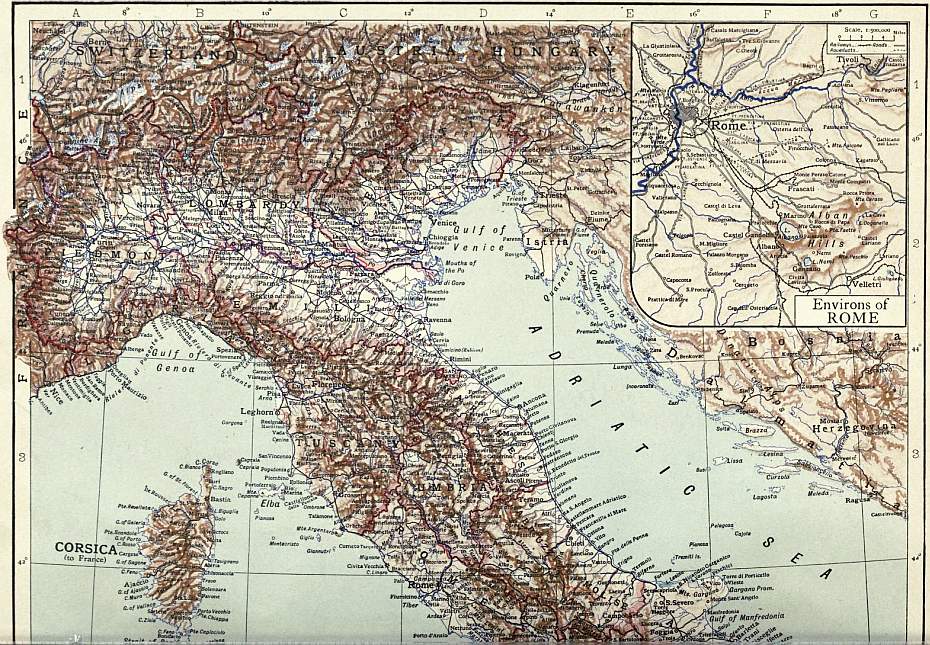
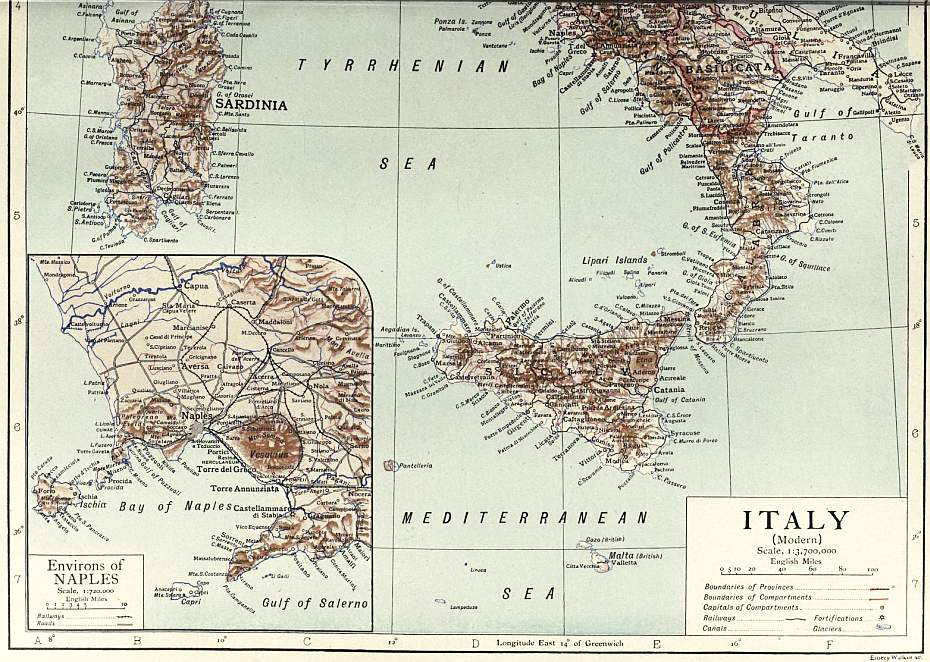
(Click to enlarge top section.)
(Click to enlarge bottom section.)
Population.—The following table indicates the areas of the several provinces (sixty-nine in number), and the population of each according to the censuses of the 31st of December 1881 and the 9th of February 1901. (The larger divisions or compartments in which the provinces are grouped are not officially recognized.)
Provinces and Compartments. Area in sq. m. Population.
1881. 1901.
Alessandria 1950 729,710 825,745
Cuneo 2882 635,400 670,504
Novara 2553 675,926 763,830
Turin 3955 1,029,214 1,147,414
Piedmont 11,340 3,070,250 3,407,493
Genoa 1582 760,122 931,156
Porto Maurizio 455 132,251 144,604
Liguria 2037 892,373 1,075,760
Bergamo 1098 390,775 467,549
Brescia 1845 471,568 541,765
Como 1091 515,050 594,304
Cremona 695 302,097 329,471
Mantua 912 295,728 315,448
Milan 1223 1,114,991 1,450,214
Pavia 1290 469,831 504,382
Sondrio 1232 120,534 130,966
Lombardy 9386 3,680,574 4,334,099
Belluno 1293 174,140 214,803