VOLUME XV SLICE I Italy to Jacobite Church (continued 5)
Reading edition
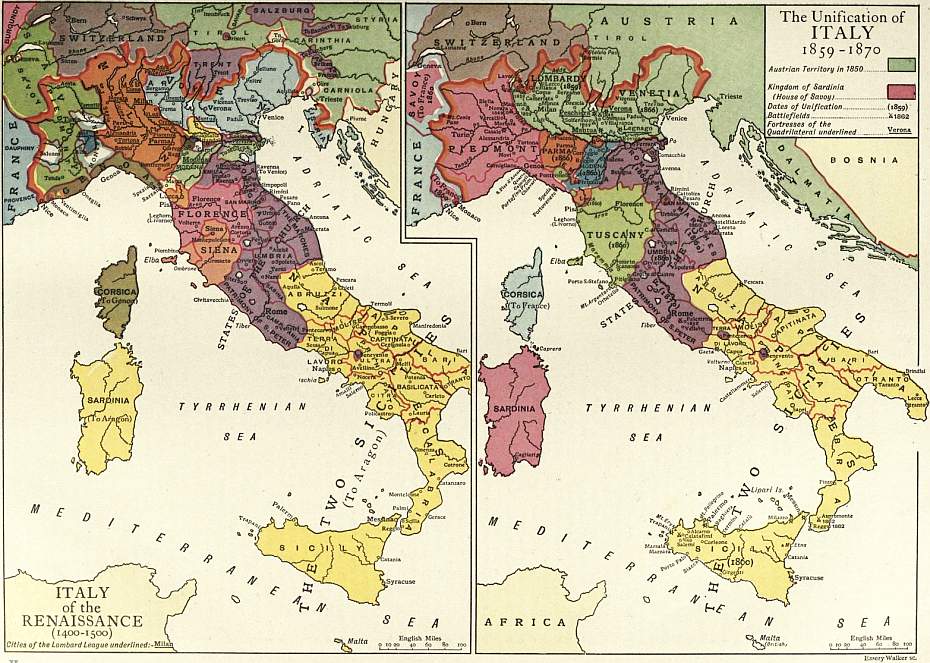
(Click to enlarge.)
This balance could not have been established without the concurrent aid of Florence. After the expulsion of the duke of Athens in 1343, and the great plague of 1348, the Florentine proletariate rose up against the merchant princes. This insurgence of the artisans, in a republic which had been remodelled upon economical principles by Giano della Bella’s constitution of 1292, reached a climax in 1378, when the Ciompi rebellion placed the city for a few years in the hands of the Lesser Arts. The revolution was but temporary, and was rather a symptom of democratic tendencies in the state than the sign of any capacity for government on the part of the working classes. The necessities of war and foreign affairs soon placed Florence in the power of an oligarchy headed by the great Albizzi family. They fought the battles of the republic with success against the Visconti, and widely extended the Florentine domain over the Tuscan cities. During their season of ascendancy Pisa was enslaved, and Florence gained the access to the sea. But throughout this period a powerful opposition was gathering strength. It was led by the Medici, who sided with the common people, and increased their political importance by the accumulation and wise employment of vast commercial wealth. In 1433 the Albizzi and the Medici came to open strife. Cosimo de’ Medici, the chief of the opposition, was exiled to Venice. In the next year he returned, assumed the presidency of the democratic party, and by a system of corruption and popularity-hunting, combined with the patronage of arts and letters, established himself as the real but unacknowledged dictator of the commonwealth. Cosimo abandoned the policy of his predecessors. Instead of opposing Francesco Sforza in Milan, he lent him his prestige and influence, foreseeing that the dynastic future of his own family and the pacification of Italy might be secured by a balance of power in which Florence should rank on equal terms with Milan and Naples.
The republic of Venice differed essentially from any other state in Italy; and her history was so separate that, up to this point, it would have been needless to interrupt the narrative by tracing it. Venice, however, in the 14th Venice. century took her place at last as an Italian power on an equality at least with the very greatest. The constitution of the commonwealth had slowly matured itself through a series of revolutions, which confirmed and defined a type of singular stability. During the earlier days of the republic the doge had been a prince elected by the people, and answerable only to the popular assemblies. In 1032 he was obliged to act in concert with a senate, called pregadi; and in 1172 the grand council, which became the real sovereign of the state, was formed. The several steps whereby the members of the grand council succeeded in eliminating the people from a share in the government, and reducing the doge to the position of their ornamental representative, cannot here be described. It must suffice to say that these changes culminated in 1297, when an act was passed for closing the grand council, or in other words for confining it to a fixed number of privileged families, in whom the government was henceforth vested by hereditary right. This ratification of the oligarchical principle, together with the establishment in 1311 of the Council of Ten, completed that famous constitution which endured till the extinction of the republic in 1797. Meanwhile, throughout the middle ages, it had been the policy of Venice to refrain from conquests on the Italian mainland, and to confine her energies to commerce in the East. The first entry of any moment made by the Venetians into strictly Italian affairs was in 1336, when the republics of Florence and St Mark allied themselves against Mastino della Scala, and the latter took possession of Treviso. After this, for thirty years, between 1352 and 1381, Venice and Genoa contested the supremacy of the Mediterranean. Pisa’s maritime power having been extinguished in the battle of Meloria (1284), the two surviving republics had no rivals. They fought their duel out upon the Bosporus, off Sardinia, and in the Morea, with various success. From the first great encounter, in 1355, Venice retired well-nigh exhausted, and Genoa was so crippled that she placed herself under the protection of the Visconti. The second and decisive battle was fought upon the Adriatic. The Genoese fleet under Luciano Doria defeated the Venetians off Pola in 1379, and sailed without opposition to Chioggia, which was stormed and taken. Thus the Venetians found themselves blockaded in their own lagoons. Meanwhile a fleet was raised for their relief by Carlo Zeno in the Levant, and the admiral Vittore Pisani, who had been imprisoned after the defeat at Pola, was released to lead their forlorn hope from the city side. The Genoese in their turn were now blockaded in Chioggia, and forced by famine to surrender. The losses of men and money which the war of Chioggia, as it was called, entailed, though they did not immediately depress the spirit of the Genoese republic, signed her naval ruin. During this second struggle to the death with Genoa, the Venetians had been also at strife with the Carraresi of Padua and the Scaligers of Verona. In 1406, after the extinction of these princely houses they added Verona, Vicenza and Padua to the territories they claimed on terra firma. Their career of conquest, and their new policy of forming Italian alliances and entering into the management of Italian affairs were confirmed by the long dogeship of Francesco Foscari (1423-1457), who must rank with Alfonso, Cosimo de’ Medici, Francesco Sforza and Nicholas V., as a joint-founder of confederated Italy. When Constantinople fell in 1453, the old ties between Venice and the Eastern empire were broken, and she now entered on a wholly new phase of her history. Ranking as one of the five Italian powers, she was also destined to defend Western Christendom against the encroachments of the Turk in Europe. (See Venice: History.)
By their settlement in Avignon, the popes relinquished their protectorate of Italian liberties, and lost their position as Italian potentates. Rienzi’s revolution in Rome (1347-1354), and his establishment of a republic upon a fantastic basis, half classical, The Papacy. half feudal, proved the temper of the times; while the rise of dynastic families in the cities of the church, claiming the title of papal vicars, but acting in their own interests, weakened the authority of the Holy See. The predatory expeditions of Bertrand du Poiet and Robert of Geneva were as ineffective as the descents of the emperors; and, though the cardinal Albornoz conquered Romagna and the March in 1364, the legates who resided in those districts were not long able to hold them against their despots. At last Gregory XI. returned to Rome; and Urban VI., elected in 1378, put a final end to the Avignonian exile. Still the Great Schism, which now distracted Western Christendom, so enfeebled the papacy, and kept the Roman pontiffs so engaged in ecclesiastical disputes, that they had neither power nor leisure to occupy themselves seriously with their temporal affairs. The threatening presence of the two princely houses of Orsini and Colonna, alike dangerous as friends or foes, rendered Rome an unsafe residence. Even when the schism was nominally terminated in 1415 by the council of Constance, the next two popes held but a precarious grasp upon their Italian domains. Martin V. (1417-1431) resided principally at Florence. Eugenius IV. (1431-1447) followed his example. And what Martin managed to regain Eugenius lost. At the same time, the change which had now come over Italian politics, the desire on all sides for a settlement, and the growing conviction that a federation was necessary, proved advantageous to the popes as sovereigns. They gradually entered into the spirit of their age, assumed the style of despots and made use of the humanistic movement, then at its height, to place themselves in a new relation to Italy. The election of Nicholas V. in 1447 determined this revolution in the papacy, and opened a period of temporal splendour, which ended with the establishment of the popes as sovereigns. Thomas of Sarzana was a distinguished humanist. Humbly born, he had been tutor in the house of the Albizzi, and afterwards librarian of the Medici at Florence, where he imbibed the politics together with the culture of the Renaissance. Soon after assuming the tiara, he found himself without a rival in the church; for the schism ended by Felix V.’s resignation in 1449. Nicholas fixed his residence in Rome, which he began to rebuild and to fortify, determining to render the Eternal City once more a capital worthy of its high place in Europe. The Romans were flattered; and, though his reign was disturbed by republican conspiracy, Nicholas V. was able before his death in 1455 to secure the modern status of the pontiff as a splendid patron and a wealthy temporal potentate.
Italy was now for a brief space independent. The humanistic movement had created a common culture, a common language and sense of common nationality. The five great powers, with their satellites—dukes of Savoy and Confederated Italy. Urbino, marquesses of Ferrara and Mantua, republics of Bologna, Perugia, Siena—were constituted. All political institutions tended toward despotism. The Medici became yearly more indispensable to Florence, the Bentivogli more autocratic in Bologna, the Baglioni in Perugia; and even Siena was ruled by the Petrucci. But this despotism was of a mild type. The princes were Italians; they shared the common enthusiasms of the nation for art, learning, literature and science; they studied how to mask their tyranny with arts agreeable to the multitude. When Italy had reached this point, Constantinople was taken by the Turks. On all sides it was felt that the Italian alliance must be tightened; and one of the last, best acts of Nicholas V.’s pontificate was the appeal in 1453 to the five great powers in federation. As regards their common opposition to the Turk, this appeal led to nothing; but it marked the growth of a new Italian consciousness.
Between 1453 and 1492 Italy continued to be prosperous and tranquil. Nearly all wars during this period were undertaken either to check the growing power of Venice or to further the ambition of the papacy. Having become despots, the popes sought to establish their relatives in principalities. The word nepotism acquired new significance in the reigns of Sixtus IV. and Innocent VIII. Though the country was convulsed by no great struggle, these forty years witnessed a truly appalling increase of political crime. To be a prince was tantamount to being the mark of secret conspiracy and assassination. Among the most noteworthy examples of such attempts may be mentioned the revolt of the barons against Ferdinand I. of Naples (1464), the murder of Galeazzo Maria Sforza at Milan (1476) and the plot of the Pazzi to destroy the Medici (1478). After Cosimo de’ Medici’s death in 1464, the presidency of the Florentine republic passed to his son Piero, who left it in 1469 to his sons Lorenzo and Giuliano. These youths assumed the style of princes, and it was against their lives that the Pazzi, with the sanction of Sixtus IV., aimed their blow. Giuliano was murdered, Lorenzo escaped, to tighten his grasp upon the city, which now loved him and was proud of him. During the following fourteen years of his brilliant career he made himself absolute master of Florence, and so modified her institutions that the Medici were henceforth necessary to the state. Apprehending the importance of Italian federation, Lorenzo, by his personal tact and prudent leadership of the republic, secured peace and a common intelligence between the five powers. His own family was fortified by the marriage of his daughter to a son of Innocent VIII., which procured his son Giovanni’s elevation to the cardinalate, and involved two Medicean papacies and the future dependence of Florence upon Rome.
VI. Age of Invasions.—The year 1492 opened a new age for Italy. In this year Lorenzo died, and was succeeded by his son, the vain and weak Piero; France passed beneath the personal control of the inexperienced Charles Invasion of Charles VIII. VIII.; the fall of Granada freed Spain from her embarrassments; Columbus discovered America, destroying the commercial supremacy of Venice; last, but not least, Roderigo Borgia assumed the tiara with the famous title of Alexander VI. In this year the short-lived federation of the five powers was shaken, and Italy was once more drawn into the vortex of European affairs. The events which led to this disaster may be briefly told. After Galeazzo Maria’s assassination, his crown passed to a boy, Gian Galeazzo, who was in due course married to a grand-daughter of Ferdinand I. of Naples. But the government of Milan remained in the hands of this youth’s uncle, Lodovico, surnamed Il Moro. Lodovico resolved to become duke of Milan. The king of Naples was his natural enemy, and he had cause to suspect that Piero de’ Medici might abandon his alliance. Feeling himself alone, with no right to the title he was bent on seizing, he had recourse to Charles VIII. of France, whom he urged to make good his claim to the kingdom of Naples. This claim, it may be said in passing, rested on the will of King René of Anjou. After some hesitation, Charles agreed to invade Italy. He crossed the Alps in 1495, passed through Lombardy, entered Tuscany, freed Pisa from the yoke of Florence, witnessed the expulsion of the Medici, marched to Naples and was crowned there—all this without striking a blow. Meanwhile Lodovico procured his nephew’s death, and raised a league against the French in Lombardy. Charles hurried back from Naples, and narrowly escaped destruction at Fornovo in the passes of the Apennines. He made good his retreat, however, and returned to France in 1495. Little remained to him of his light acquisitions; but he had convulsed Italy by this invasion, destroyed her equilibrium, exposed her military weakness and political disunion, and revealed her wealth to greedy and more powerful nations.
The princes of the house of Aragon, now represented by Frederick, a son of Ferdinand I., returned to Naples. Florence made herself a republic, adopting a form of constitution analogous to that of Venice. At this crisis she Louis XII. was ruled by the monk Girolamo Savonarola, who inspired the people with a thirst for freedom, preached the necessity of reformation, and placed himself in direct antagonism to Rome. After a short but eventful career, the influence of which was long effective, he lost his hold upon the citizens. Alexander VI. procured a mock trial, and his enemies burned him upon the Piazza in 1498. In this year Louis XII. succeeded Charles VIII. upon the throne of France. As duke of Orleans he had certain claims to Milan through his grandmother Valentina, daughter of Gian Galeazzo, the first duke. They were not valid, for the investiture of the duchy had been granted only to male heirs. But they served as a sufficient pretext, and in 1499 Louis entered and subdued the Milanese. Lodovico escaped to Germany, returned the next year, was betrayed by his Swiss mercenaries and sent to die at Loches in France. In 1500 Louis made the blunder of calling Ferdinand the Catholic to help him in the conquest of Naples. By a treaty signed at Granada, the French and Spanish kings were to divide the spoil. The conquest was easy; but, when it came to a partition, Ferdinand played his ally false. He made himself supreme over the Two Sicilies, which he now reunited under a single crown. Three years later, unlessoned by this experience, Louis signed the treaty of Blois (1504), whereby he invited the emperor Maximilian to aid him in the subjugation of Venice. No policy could have been less far-sighted; for Charles V., joint heir to Austria, Burgundy, Castile and Aragon, the future overwhelming rival of France, was already born.
The stage was now prepared, and all the actors who were destined to accomplish the ruin of Italy trod it with their armies. Spain, France, Germany, with their Swiss auxiliaries, had been summoned upon various pretexts to partake her provinces. Then, too late, patriots like Machiavelli perceived the suicidal self-indulgence of the past, which, by substituting mercenary troops for national militias, left the Italians at the absolute discretion of their neighbours. Whatever parts the Italians themselves played in the succeeding quarter of a century, the game was in the hands of French, Spanish and German invaders. Meanwhile, no scheme for combination against common foes arose in the peninsula. Each petty potentate strove for his own private advantage in the confusion; and at this epoch the chief gains accrued to the papacy. Aided by his terrible son, Cesare Borgia, Alexander VI. chastised the Roman nobles, subdued Romagna and the March, threatened Tuscany, and seemed to be upon the point of creating a Central Italian state in favour of his progeny, when he died suddenly in 1503. His conquests reverted to the Holy See. Julius II., his bitterest enemy and powerful successor, continued Alexander’s policy, but no longer in the interest of his own relatives. It became the nobler ambition of Julius to aggrandize the church, and to reassume the protectorate of the Italian people. With this object, he secured Emilia, carried his victorious arms against Ferrara, and curbed the tyranny of the Baglioni in Perugia. Julius II. played a perilous game; but the stakes were high, and he fancied himself strong enough to guide the tempest he evoked. Quarrelling with the Venetians in 1508, he combined the forces of all Europe by the league of Cambray against them; and, when he had succeeded in his first purpose of humbling them even to the dust, he turned round in 1510, uttered his famous resolve to expel the barbarians from Italy, and pitted the Spaniards against the French. It was with the Swiss that he hoped to effect this revolution; but the Swiss, now interfering for the first time as principals in Italian affairs, were incapable of more than adding to the already maddening distractions of the people. Formed for mercenary warfare, they proved a perilous instrument in the hands of those who used them, and were hardly less injurious to their friends than to their foes. In 1512 the battle of Ravenna between the French troops and the allies of Julius—Spaniards, Venetians and Swiss—was fought. Gaston de Foix bought a doubtful victory dearly with his death; and the allies, though beaten on the banks of the Ronco, immediately afterwards expelled the French from Lombardy. Yet Julius II. had failed, as might have been foreseen. He only exchanged one set of foreign masters for another, and taught a new barbarian race how pleasant were the plains of Italy. As a consequence of the battle of Ravenna, the Medici returned in 1512 to Florence.
When Leo X. was elected in 1513, Rome and Florence rejoiced; but Italy had no repose. Louis XII. had lost the game, and the Spaniards were triumphant. But new actors appeared upon the scene, and the same old struggle was resumed with fiercer energy. By the victory of Marignano in 1515 Francis I., having now succeeded to the throne of France, regained the Milanese, and broke the power of the Swiss, who held it for Massimiliano Sforza, the titular duke. Leo for a while relied on Francis; for the vast power of Charles V., who succeeded to the empire in 1519, as in 1516 he had succeeded to the crowns of Spain and Lower Italy, threatened the whole of Europe. It was Leo’s nature, however, to be inconstant. In 1521 he changed sides, allied himself to Charles, and died after hearing that the imperial troops had again expelled the French from Milan. During the next four years the Franco-Spanish war dragged on in Lombardy until the decisive battle of Pavia in 1525, when Francis was taken prisoner, and Italy lay open to the Spanish armies. Meanwhile Leo X. had been followed by Adrian VI., and Adrian by Clement VII., of the house of Medici, who had long ruled Florence. In the reign of this pope Francis was released from his prison in Madrid (1526), and Clement hoped that he might still be used in the Italian interest as a counterpoise to Charles. It is impossible in this place to follow the tangled intrigues of that period. The year 1527 was signalized by the famous sack of Rome. An army of mixed German and Spanish troops, pretending to act for the emperor, but which may rather be regarded as a vast marauding party, entered Italy under their leader Frundsberg. After his death, the Constable de Bourbon took command of them; they marched slowly down, aided by the marquis of Ferrara, and unopposed by the duke of Urbino, reached Rome, and took it by assault. The constable was killed in the first onslaught; Clement was imprisoned in the castle of St Angelo; Rome was abandoned to the rage of 30,000 ruffians. As an immediate result of this catastrophe, Florence shook off the Medici, and established a republic. But Clement, having made peace with the emperor, turned the remnants of the army which had sacked Rome against his native city. After a desperate resistance, Florence fell in 1530. Alessandro de’ Medici was placed there with the title of duke of Cività di Penna; and, on his murder in 1537, Cosimo de’ Medici, of the younger branch of the ruling house, was made duke. Acting as lieutenant for the Spaniards, he subsequently (1555) subdued Siena, and bequeathed to his descendants the grand-duchy of Tuscany.
VII. Spanish-Austrian Ascendancy.—It was high time, after the sack of Rome in 1527, that Charles V. should undertake Italian affairs. The country was exposed to anarchy, of which this had been the last and most disgraceful Settlement of Italy by Spain. example. The Turks were threatening western Europe, and Luther was inflaming Germany. By the treaty of Barcelona in 1529 the pope and emperor made terms. By that of Cambray in the same year France relinquished Italy to Spain. Charles then entered the port of Genoa, and on the 5th of November met Clement VII. at Bologna. He there received the imperial crown, and summoned the Italian princes for a settlement of all disputed claims. Francesco Sforza, the last and childless heir of the ducal house, was left in Milan till his death, which happened in 1535. The republic of Venice was respected in her liberties and Lombard territories. The Este family received a confirmation of their duchy of Modena and Reggio, and were invested in their fief of Ferrara by the pope. The marquessate of Mantua was made a duchy; and Florence was secured, as we have seen, to the Medici. The great gainer by this settlement was the papacy, which held the most substantial Italian province, together with a prestige that raised it far above all rivalry. The rest of Italy, however parcelled, henceforth became but a dependence upon Spain. Charles V., it must be remembered, achieved his conquest and confirmed his authority far less as emperor than as the heir of Castile and Aragon. A Spanish viceroy in Milan and another in Naples, supported by Rome and by the minor princes who followed the policy dictated to them from Madrid, were sufficient to preserve the whole peninsula in a state of somnolent inglorious servitude.
From 1530 until 1796, that is, for a period of nearly three centuries, the Italians had no history of their own. Their annals are filled with records of dynastic changes and redistributions of territory, consequent upon treaties signed by foreign powers, in the settlement of quarrels which no wise concerned the people. Italy only too often became the theatre of desolating and distracting wars. But these wars were fought for the most part by alien armies; the points at issue were decided beyond the Alps; the gains accrued to royal families whose names were unpronounceable by southern tongues. The affairs of Europe during the years when Habsburg and Bourbon fought their domestic battles with the blood of noble races may teach grave lessons to all thoughtful men of our days, but none bitterer, none fraught with more insulting recollections, than to the Italian people, who were haggled over like dumb driven cattle in the mart of chaffering kings. We cannot wholly acquit the Italians of their share of blame. When they might have won national independence, after their warfare with the Swabian emperors, they let the golden opportunity slip. Pampered with commercial prosperity, eaten to the core with inter-urban rivalries, they submitted to despots, renounced the use of arms, and offered themselves in the hour of need, defenceless and disunited to the shock of puissant nations. That they had created modern civilization for Europe availed them nothing. Italy, intellectually first among the peoples, was now politically and practically last; and nothing to her historian is more heart-rending than to watch the gradual extinction of her spirit in this age of slavery.
In 1534 Alessandro Farnese, who owed his elevation to his sister Giulia, one of Alexander VI.’s mistresses, took the tiara with the title of Paul III. It was his ambition to create a duchy for his family; and with this object he Pontificate of Paul III. gave Parma and Piacenza to his son Pier Luigi. After much wrangling between the French and Spanish parties, the duchy was confirmed in 1586 to Ottaviano Farnese and his son Alessandro, better known as Philip II.’s general, the prince of Parma. Alessandro’s descendants reigned in Parma and Piacenza till the year 1731. Paul III.’s pontificate was further marked by important changes in the church, all of which confirmed the spiritual autocracy of Rome. In 1540 this pope approved of Loyola’s foundation, and secured the powerful militia of the Jesuit order. The Inquisition was established with almost unlimited powers in Italy, and the press was placed under its jurisdiction. Thus free thought received a check, by which not only ecclesiastical but political tyrants knew how to profit. Henceforth it was impossible to publish or to utter a word which might offend the despots of church or state; and the Italians had to amuse their leisure with the polite triflings of academics. In 1545 a council was opened at Trent for the reformation of church discipline and the promulgation of orthodox doctrine. The decrees of this council defined Roman Catholicism against the Reformation; and, while failing to regenerate morality, they enforced a hypocritical observance of public decency. Italy to outer view put forth blossoms of hectic and hysterical piety, though at the core her clergy and her aristocracy were more corrupt than ever.
In 1556 Philip II., by the abdication of his father Charles V., became king of Spain. He already wore the crown of the Two Sicilies, and ruled the duchy of Milan. In the next year Ferdinand, brother of Charles, was elected emperor. Reign of Philip II. The French, meanwhile, had not entirely abandoned their claims on Italy. Gian Pietro Caraffa, who was made pope in 1555 with the name of Paul IV., endeavoured to revive the ancient papal policy of leaning upon France. He encouraged the duke of Guise to undertake the conquest of Naples, as Charles of Anjou had been summoned by his predecessors. But such schemes were now obsolete and anachronistic. They led to a languid lingering Italian campaign, which was settled far beyond the Alps by Philip’s victories over the French at St Quentin and Gravelines. The peace of Câteau Cambresis, signed in 1559, left the Spanish monarch undisputed lord of Italy. Of free commonwealths there now survived only Venice, which, together with Spain, achieved for Europe the victory of Lepanto in 1573; Genoa, which, after the ineffectual Fieschi revolution in 1547, abode beneath the rule of the great Doria family, and held a feeble sway in Corsica; and the two insignificant republics of Lucca and San Marino.
The future hope of Italy, however, was growing in a remote and hitherto neglected corner. Emmanuel Philibert, duke of Savoy, represented the oldest and not the least illustrious reigning house in Europe, and his descendants were destined to achieve for Italy the independence which no other power or prince had given her since the fall of ancient Rome. (See Savoy, House of.)
When Emmanuel Philibert succeeded to his father Charles III. in 1553, he was a duke without a duchy. But the princes of the house of Savoy were a race of warriors; and what Emmanuel Philibert lost as sovereign he regained as captain of adventure in the service of his cousin Philip II. The treaty of Câteau Cambresis in 1559, and the evacuation of the Piedmontese cities held by French and Spanish troops in 1574, restored his state. By removing the capital from Chambéry to Turin, he completed the transformation of the dukes of Savoy from Burgundian into Italian sovereigns. They still owned Savoy beyond the Alps, the plains of Bresse, and the maritime province of Nice.
Emmanuel Philibert was succeeded by his son Charles Emmanuel I., who married Catherine, a daughter of Philip II. He seized the first opportunity of annexing Saluzzo, which had been lost to Savoy in the last two reigns, and renewed the disastrous policy of his grandfather Charles III. by invading Geneva and threatening Provence. Henry IV. of France forced him in 1601 to relinquish Bresse and his Burgundian possessions. In return he was allowed to keep Saluzzo. All hopes of conquest on the transalpine side were now quenched; but the keys of Italy had been given to the dukes of Savoy; and their attention was still further concentrated upon Lombard conquests. Charles Emmanuel now attempted the acquisition of Montferrat, which was soon to become vacant by the death of Francesco Gonzaga, who held it together with Mantua. In order to secure this territory, he went to war with Philip III. of Spain, and allied himself with Venice and the Grisons to expel the Spaniards from the Valtelline. When the male line of the Gonzaga family expired in 1627, Charles, duke of Nevers, claimed Mantua and Montferrat in right of his wife, the only daughter of the last duke. Charles Emmanuel was now checkmated by France, as he had formerly been by Spain. The total gains of all his strenuous endeavours amounted to the acquisition of a few places on the borders of Montferrat.
Not only the Gonzagas, but several other ancient ducal families, died out about the date which we have reached. The legitimate line of the Estensi ended in 1597 by the death of Alfonso II., the last duke of Ferrara. He Extinction of old ducal families. left his domains to a natural relative, Cesare d’Este, who would in earlier days have inherited without dispute, for bastardy had been no bar on more than one occasion in the Este pedigree. Urban VIII., however, put in a claim to Ferrara, which, it will be remembered, had been recognized a papal fief in 1530. Cesare d’Este had to content himself with Modena and Reggio, where his descendants reigned as dukes till 1794. Under the same pontiff, the Holy See absorbed the duchy of Urbino on the death of Francesco Maria II., the last representative of Montefeltro and Della Rovere. The popes were now masters of a fine and compact territory, embracing no inconsiderable portion of Countess Matilda’s legacy, in addition to Pippin’s donation, and the patrimony of St Peter. Meanwhile Spanish fanaticism, the suppression of the Huguenots in France and the Catholic policy of Austria combined to strengthen their authority as pontiffs. Urban’s predecessor, Paul V., advanced so far as to extend his spiritual jurisdiction over Venice, which, up to the date of his election (1605), had resisted all encroachments of the Holy See. Venice offered the single instance in Italy of a national church. The republic managed the tithes, and the clergy acknowledged no chief above their own patriarch. Paul V. now forced the Venetians to admit his ecclesiastical supremacy; but they refused to readmit the Jesuits, who had been expelled in 1606. This, if we do not count the proclamation of James I. of England (1604), was the earliest instance of the order’s banishment from a state where it had proved disloyal to the commonwealth.
Venice rapidly declined throughout the 17th century. The loss of trade consequent upon the closing of Egypt and the Levant, together with the discovery of America and the sea-route to the Indies, had dried up her chief Decline of Venice and Spain. source of wealth. Prolonged warfare with the Ottomans, who forced her to abandon Candia in 1669, as they had robbed her of Cyprus in 1570, still further crippled her resources. Yet she kept the Adriatic free of pirates, notably by suppressing the sea-robbers called Uscocchi (1601-1617), maintained herself in the Ionian Islands, and in 1684 added one more to the series of victorious episodes which render her annals so romantic. In that year Francesco Morosini, upon whose tomb we still may read the title Peloponnesiacus, wrested the whole of the Morea from the Turks. But after his death in 1715 the republic relaxed her hold upon his conquests. The Venetian nobles abandoned themselves to indolence and vice. Many of them fell into the slough of pauperism, and were saved from starvation by public doles. Though the signory still made a brave show upon occasions of parade, it was clear that the state was rotten to the core, and sinking into the decrepitude of dotage. The Spanish monarchy at the same epoch dwindled with apparently less reason. Philip’s Austrian successors reduced it to the rank of a secondary European power. This decline of vigour was felt, with the customary effects of discord and bad government, in Lower Italy. The revolt of Masaniello in Naples (1647), followed by rebellions at Palermo and Messina, which placed Sicily for a while in the hands of Louis XIV. (1676-1678) were symptoms of progressive anarchy. The population, ground down by preposterous taxes, ill-used as only the subjects of Spaniards, Turks or Bourbons are handled, rose in blind exasperation against their oppressors. It is impossible to attach political importance to these revolutions; nor did they bring the people any appreciable good. The destinies of Italy were decided in the cabinets and on the battlefields of northern Europe. A Bourbon at Versailles, a Habsburg at Vienna, or a thick-lipped Lorrainer, with a stroke of his pen, wrote off province against province, regarding not the populations who had bled for him or thrown themselves upon his mercy.
This inglorious and passive chapter of Italian history is continued to the date of the French Revolution with the records of three dynastic wars, the war of the Spanish succession, the war of the Polish succession, the war of the Austrian Wars of Succession. succession, followed by three European treaties, which brought them respectively to diplomatic terminations. Italy, handled and rehandled, settled and resettled, upon each of these occasions, changed masters without caring or knowing what befell the principals in any one of the disputes. Humiliating to human nature in general as are the annals of the 18th-century campaigns in Europe, there is no point of view from which they appear in a light so tragi-comic as from that afforded by Italian history. The system of setting nations by the ears with the view of settling the quarrels of a few reigning houses was reduced to absurdity when the people, as in these cases, came to be partitioned and exchanged without the assertion or negation of a single principle affecting their interests or rousing their emotions.
In 1700 Charles II. died, and with him ended the Austrian family in Spain. Louis XIV. claimed the throne for Philip, duke of Anjou. Charles, archduke of Austria, opposed him. The dispute was fought out in Flanders; but Spanish Succession. Lombardy felt the shock, as usual, of the French and Austrian dynasties. The French armies were more than once defeated by Prince Eugene of Savoy, who drove them out of Italy in 1707. Therefore, in the peace of Utrecht (1713), the services of the house of Savoy had to be duly recognized. Victor Amadeus II. received Sicily with the title of king. Montferrat and Alessandria were added to his northern provinces, and his state was recognized as independent. Charles of Austria, now emperor, took Milan, Mantua, Naples and Sardinia for his portion of the Italian spoil. Philip founded the Bourbon line of Spanish kings, renouncing in Italy all that his Habsburg predecessors had gained. Discontented with this diminution of the Spanish heritage, Philip V. married Elisabetta Farnese, heiress to the last duke of Parma, in 1714. He hoped to secure this duchy for his son, Don Carlos; and Elisabetta further brought with her a claim to the grand-duchy of Tuscany, which would soon become vacant by the death of Gian Gastone de’ Medici. After this marriage Philip broke the peace of Europe by invading Sardinia. The Quadruple Alliance was formed, and the new king of Sicily was punished for his supposed adherence to Philip V. by the forced exchange of Sicily for the island of Sardinia. It was thus that in 1720 the house of Savoy assumed the regal title which it bore until the declaration of the Italian kingdom in the last century. Victor Amadeus II.’s reign was of great importance in the history of his state. Though a despot, as all monarchs were obliged to be at that date, he reigned with prudence, probity and zeal for the welfare of his subjects. He took public education out of the hands of the Jesuits, which, for the future development of manliness in his dominions, was a measure of incalculable value. The duchy of Savoy in his days became a kingdom, and Sardinia, though it seemed a poor exchange for Sicily, was a far less perilous possession than the larger and wealthier island would have been. In 1730 Victor Amadeus abdicated in favour of his son Charles Emmanuel III. Repenting of this step, he subsequently attempted to regain Turin, but was imprisoned in the castle of Rivoli, where he ended his days in 1732.
The War of the Polish Succession which now disturbed Europe is only important in Italian history because the treaty of Vienna in 1738 settled the disputed affairs of the duchies of Parma and Tuscany. The duke Antonio Farnese Polish Succession. died in 1731; the grand-duke Gian Gastone de’ Medici died in 1737. In the duchy of Parma Don Carlos had already been proclaimed. But he was now transferred to the Two Sicilies, while Francis of Lorraine, the husband of Maria Theresa, took Tuscany and Parma. Milan and Mantua remained in the hands of the Austrians. On this occasion Charles Emmanuel acquired Tortona and Novara.
Worse complications ensued for the Italians when the emperor Charles VI., father of Maria Theresa, died in 1740. The three branches of the Bourbon house, ruling in France, Spain and the Sicilies, joined with Prussia, Bavaria Austrian Succession. and the kingdom of Sardinia to despoil Maria Theresa of her heritage. Lombardy was made the seat of war; and here the king of Sardinia acted as in some sense the arbiter of the situation. After war broke out, he changed sides and supported the Habsburg-Lorraine party. At first, in 1745, the Sardinians were defeated by the French and Spanish troops. But Francis of Lorraine, elected emperor in that year, sent an army to the king’s support, which in 1746 obtained a signal victory over the Bourbons at Piacenza. Charles Emmanuel now threatened Genoa. The Austrian soldiers already held the town. But the citizens expelled them, and the republic kept her independence. In 1748 the treaty of Aix-la-Chapelle, which put an end to the War of the Austrian Succession, once more redivided Italy. Parma, Piacenza and Guastalla were formed into a duchy for Don Philip, brother of Charles III. of the Two Sicilies, and son of Philip V. of Spain. Charles III. was confirmed in his kingdom of the Two Sicilies. The Austrians kept Milan and Tuscany. The duchy of Modena was placed under the protection of the French. So was Genoa, which in 1755, after Paoli’s insurrection against the misgovernment of the republic, ceded her old domain of Corsica to France.
From the date of this settlement until 1792, Italy enjoyed a period of repose and internal amelioration under her numerous paternal despots. It became the fashion during these forty-four years of peace to encourage the industrial Forty-four years’ peace. population and to experimentalize in economical reforms. The Austrian government in Lombardy under Maria Theresa was characterized by improved agriculture, regular administration, order, reformed taxation and increased education. A considerable amount of local autonomy was allowed, and dependence on Vienna was very slight and not irksome. The nobles and the clergy were rich and influential, but kept in order by the civil power. There was no feeling of nationality, but the people were prosperous, enjoyed profound peace and were placidly content with the existing order of things. On the death of Maria Theresa in 1780, the emperor Joseph II. instituted much wider reforms. Feudal privileges were done away with, clerical influence diminished and many monasteries and convents suppressed, the criminal law rendered more humane and torture abolished largely as a result of G. Beccaria’s famous pamphlet Dei delitti e delle pene. At the same time Joseph’s administration was more arbitrary, and local autonomy was to some extent curtailed. His anti-clerical laws produced some ill-feeling among the more devout part of the population. On the whole the Austrian rule in pre-revolutionary days was beneficial and far from oppressive, and helped Lombardy to recover from the ill-effects of the Spanish domination. It did little for the moral education of the people, but the same criticism applies more or less to all the European governments of the day. The emperor Francis I. ruled the grand-duchy of Tuscany by lieutenants until his death in 1765, when it was given, as an independent state, to his second son, Peter Leopold. The reign of this duke was long remembered as a period of internal prosperity, wise legislation and important public enterprise. Leopold, among other useful works, drained the Val di Chiana, and restored those fertile upland plains to agriculture. In 1790 he succeeded to the empire, and left Tuscany to his son Ferdinand. The kingdom of Sardinia was administered upon similar principles, but with less of geniality. Charles Emmanuel made his will law, and erased the remnants of free institutions from his state. At the same time he wisely followed his father’s policy with regard to education and the church. This is perhaps the best that can be said of a king who incarnated the stolid absolutism of the period. From this date, however, we are able to trace the revival of independent thought among the Italians. The European ferment of ideas which preceded the French Revolution expressed itself in men like Alfieri, the fierce denouncer of tyrants, Beccaria, the philosopher of criminal jurisprudence, Volta, the physicist, and numerous political economists of Tuscany. Moved partly by external influences and partly by a slow internal reawakening, the people was preparing for the efforts of the 19th century. The papacy, during this period, had to reconsider the question of the Jesuits, who made themselves universally odious, not only in Italy, but also in France and Spain. In the pontificate of Clement XIII. they ruled the Vatican, and almost succeeded in embroiling the pope with the concerted Bourbon potentates of Europe. His successor, Clement XIV. suppressed the order altogether by a brief of 1773.
(J. A. S.)
D. Italy in the Napoleonic Period, 1796-1814
The campaign of 1796 which led to the awakening of the Italian people to a new consciousness of unity and strength is detailed in the article Napoleonic Campaigns. Here we can attempt only a general survey of the events, political, civic and social, which heralded the Risorgimento in its first phase. It is desirable in the first place to realize the condition of Italy at the time when the irruption of the French and the expulsion of the Austrians opened up a new political vista for that oppressed and divided people.
For many generations Italy had been bandied to and fro between the Habsburgs and the Bourbons. The decline of French influence at the close of the reign of Louis XIV. left the Habsburgs and the Spanish Bourbons without Influence of the French Revolution. serious rivals. The former possessed the rich duchies of Milan (including Mantua) and Tuscany; while through a marriage alliance with the house of Este of Modena (the Archduke Ferdinand had married the heiress of Modena) its influence over that duchy was supreme. It also had a few fiefs in Piedmont and in Genoese territory. By marrying her daughter, Maria Amelia, to the young duke of Parma, and another daughter, Maria Carolina, to Ferdinand of Naples, Maria Theresa consolidated Habsburg influence in the north and south of the peninsula. The Spanish Bourbons held Naples and Sicily, as well as the duchy of Parma. Of the nominally independent states the chief were the kingdom of Sardinia, ruled over by the house of Savoy, and comprising Piedmont, the isle of Sardinia and nominally Savoy and Nice, though the two provinces last named had virtually been lost to the monarchy since the campaign of 1793. Equally extensive, but less important in the political sphere, were the Papal States and Venetia, the former torpid under the obscurantist rule of pope and cardinals, the latter enervated by luxury and the policy of unmanly complaisance long pursued by doge and council. The ancient rival of Venice, Genoa, was likewise far gone in decline. The small states, Lucca and San Marino, completed the map of Italy. The worst governed part of the peninsula was the south, where feudalism lay heavily on the cultivators and corruption pervaded all ranks. Milan and Piedmont were comparatively well governed; but repugnance to Austrian rule in the former case, and the contagion of French Jacobinical opinions in the latter, brought those populations into increasing hostility to the rulers. The democratic propaganda, which was permeating all the large towns of the peninsula, then led to the formation of numerous and powerful clubs and secret societies; and the throne of Victor Amadeus III., of the house of Savoy, soon began to totter under the blows delivered by the French troops at the mountain barriers of his kingdom and under the insidious assaults of the friends of liberty at Turin. Plotting was rife at Milan, as also at Bologna, where the memory of old liberties predisposed men to cast off clerical rule and led to the first rising on behalf of Italian liberty in the year 1794. At Palermo the Sicilians struggled hard to establish a republic Bonaparte in Italy. in place of the odious government of an alien dynasty. The anathemas of the pope, the bravery of Piedmontese and Austrians, and the subsidies of Great Britain failed to keep the league of Italian princes against France intact. The grand-duke of Tuscany was the first of the European sovereigns who made peace with, and recognized the French republic, early in 1795. The first fortnight of Napoleon’s campaign of 1796 detached Sardinia from alliance with Austria and England. The enthusiasm of the Italians for the young Corsican “liberator” greatly helped his progress. Two months later Ferdinand of Naples sought for an armistice, the central duchies were easily overrun, and, early in 1797, Pope Pius VI. was fain to sign terms of peace with Bonaparte at Tolentino, practically ceding the northern part of his states, known as the Legations. The surrender of the last Habsburg stronghold, Mantua, on the 2nd of February 1797 left the field clear for the erection of new political institutions.
Already the men of Reggio, Modena and Bologna had declared for a democratic policy, in which feudalism and clerical rule should have no place, and in which manhood suffrage, together with other rights promised by Bonaparte The Cispadane Republic. to the men of Milan in May 1796, should form the basis of a new order of things. In taking this step the Modenese and Romagnols had the encouragement of Bonaparte, despite the orders which the French directory sent to him in a contrary sense. The result was the formation of an assembly at Modena which abolished feudal dues and customs, declared for manhood suffrage and established the Cispadane Republic (October 1796).
The close of Bonaparte’s victorious campaign against the Archduke Charles in 1797 enabled him to mature those designs respecting Venice which are detailed in the article Napoleon. On a far higher level was his conduct towards the Milanese. While the French directory saw in that province little more than a district which might be plundered and bargained for, Bonaparte, though by no means remiss in the exaction of gold and of artistic treasures, was laying the foundation of a friendly republic. During his sojourn at the castle of Montebello or Mombello, near Milan, he commissioned several of the leading men of northern Italy to draw up a project of constitution and list of reforms for that province. Meanwhile he took care to curb the excesses of the Italian Jacobins and to encourage the Moderates, who were favourable to the French connexion as promising a guarantee against Austrian domination and internal anarchy. He summed up his conduct in the letter of the 8th of May 1797 to the French directory, “I cool the hot The Cisalpine Republic. heads here and warm the cool ones.” The Transpadane Republic, or, as it was soon called, the Cisalpine Republic, began its organized life on the 9th of July 1797, with a brilliant festival at Milan. The constitution was modelled on that of the French directory, and, lest there should be a majority of clerical or Jacobinical deputies, the French Republic through its general, Bonaparte, nominated and appointed the first deputies and administrators of the new government. In the same month it was joined by the Cispadane Republic; and the terms of the treaty of Campo Formio (October 17, 1797), while fatal to the political life of Venice, awarded to this now considerable state the Venetian territories west of the river Adige. A month later, under the pretence of stilling the civil strifes in the Valtelline, Bonaparte absorbed that Swiss district in the Cisalpine Republic, which thus included all the lands between Como and Verona on the north, and Rimini on the south.
Early in the year 1798 the Austrians, in pursuance of the scheme of partition agreed on at Campo Formio, entered Venice and brought to an end its era of independence which had lasted some 1100 years. Venice with its mainland End of the Venetian Republic. territories east of the Adige, inclusive of Istria and Dalmatia, went to the Habsburgs, while the Venetian isles of the Adriatic (the Ionian Isles) and the Venetian fleet went to strengthen France for that eastern expedition on which Bonaparte had already set his heart. Venice not only paid the costs of the war to the two chief belligerents, but her naval resources also helped to launch the young general on his career of eastern adventure. Her former rival, Genoa, had also been compelled, in June 1797, to bow before the young conqueror, and had undergone at his hands a remodelling on the lines already followed at Milan. The new Genoese republic, French in all but name, was renamed the Ligurian Republic.
Before he set sail for Egypt, the French had taken possession of Rome. Already masters of the papal fortress of Ancona, they began openly to challenge the pope’s authority at the Eternal City itself. Joseph Bonaparte, then French occupation of Rome. French envoy to the Vatican, encouraged democratic manifestations; and one of them, at the close of 1797, led to a scuffle in which a French general, Duphot, was killed. The French directory at once ordered its general, Berthier, to march to Rome: the Roman democrats proclaimed a republic on the 15th of February 1798, and on their invitation Berthier and his troops marched in. The pope, Pius VI., was forthwith haled away to Siena and a year later to Valence in the south of France, where he died. Thus fell the temporal power. The “liberators” of Rome thereupon proceeded to plunder the city in a way which brought shame on their cause and disgrace (perhaps not wholly deserved) on the general left in command, Masséna.
These events brought revolution to the gates of the kingdom of Naples, the worst-governed part of Italy, where the boorish king, Ferdinand IV. (il rè lazzarone, he was termed), and his whimsical consort, Maria Carolina, scarcely Naples. held in check the discontent of their own subjects. A British fleet under Nelson, sent into the Mediterranean in May 1798 primarily for their defence, checkmated the designs of Bonaparte in Egypt, and then, returning to Naples, encouraged that court to adopt a spirited policy. It is now known that the influence of Nelson and of the British ambassador, Sir William Hamilton, and Lady Hamilton precipitated the rupture between Naples and France. The results were disastrous. The Neapolitan troops at first occupied Rome, but, being badly handled by their leader, the Austrian general, Mack, they were soon scattered in flight; and the Republican troops under General The Parthenopaean Republic. Championnet, after crushing the stubborn resistance of the lazzaroni, made their way into Naples and proclaimed the Parthenopaean Republic (January 23, 1799). The Neapolitan Democrats chose five of their leading men to be directors, and tithes and feudal dues and customs were abolished. Much good work was done by the Republicans during their brief tenure of power, but it soon came to an end owing to the course of events which favoured a reaction against France. The directors of Paris, not content with overrunning and plundering Switzerland, had outraged German sentiment in many ways. Further, at the close of 1798 they virtually compelled the young king of Sardinia, Charles Emmanuel IV., to abdicate at Turin. He retired to the island of Sardinia, while the French despoiled Piedmont, thereby adding fuel to the resentment rapidly growing against them in every part of Europe.
The outcome of it all was the War of the Second Coalition, in which Russia, Austria, Great Britain, Naples and some secondary states of Germany took part. The incursion of an Austro-Russian army, led by that strange but Suvarov in Italy. magnetic being, Suvarov, decided the campaign in northern Italy. The French, poorly handled by Schérer and Sérurier, were everywhere beaten, especially at Magnano (April 5) and Cassano (April 27). Milan and Turin fell before the allies, and Moreau, who took over the command, had much difficulty in making his way to the Genoese coast-line. There he awaited the arrival of Macdonald with the army of Naples. That general, Championnet’s successor, had been compelled by these reverses and by the threatening pressure of Nelson’s fleet to evacuate Naples and central Italy. In many parts the peasants and townsfolk, enraged by the licence of the French, hung on his flank and rear. The republics set up by the French at Naples, Rome and Milan collapsed as soon as the French troops retired; and a reaction in favour of clerical and Austrian influence set in with great violence. For the events which then occurred at Naples, so compromising to the reputation of Nelson, see Nelson and Naples. Sir William Hamilton was subsequently recalled in a manner closely resembling a disgrace, and his place was taken by Paget, who behaved with more dignity and tact.
Meanwhile Macdonald, after struggling through central Italy, had defeated an Austrian force at Modena (June 12, 1799), but Suvarov was able by swift movements utterly to overthrow him at the Trebbia (June 17-19). The wreck of his force drifted away helplessly towards Genoa. A month later the ambitious young general, Joubert, who took over Moreau’s command and rallied part of Macdonald’s following, was utterly routed by the Austro-Russian army at Novi (August 15) with the loss of 12,000 men. Joubert perished in the battle. The growing friction between Austria and Russia led to the transference of Suvarov and his Russians to Switzerland, with results which were to be fatal to the allies in that quarter. But in Italy the Austrian successes continued. Melas defeated Championnet near Coni on the 4th of November; and a little later the French garrisons at Ancona and Coni surrendered. The tricolour, which floated triumphantly over all the strongholds of Italy early in the year, at its close waved only over Genoa, where Masséna prepared for a stubborn defence. Nice and Savoy also seemed at the mercy of the invaders. Everywhere the old order of things was restored. The death of the aged Pope Pius VI. at Valence (August 29, 1799) deprived the French of whatever advantage they had hoped to gain by dragging him into exile; on the 24th of March 1800 the conclave, assembled for greater security on the island of San Giorgio at Venice, elected a new pontiff, Pius VII.
Such was the position of affairs when Bonaparte returned from Egypt and landed at Fréjus. The contrast presented by his triumphs, whether real or imaginary, to the reverses sustained by the armies of the French directory, was Campaign of Marengo. fatal to that body and to popular institutions in France. After the coup d’état of Brumaire (November 1799) he, as First Consul, began to organize an expedition against the Austrians (Russia having now retired from the coalition), in northern Italy. The campaign culminating at Marengo was the result. By that triumph (due to Desaix and Kellermann rather than directly to him), Bonaparte consolidated his own position in France and again laid Italy at his feet. The Austrian general, Melas, signed an armistice whereby he was to retire with his army beyond the river Mincio. Ten days earlier, namely on the 4th of June, Masséna had been compelled by hunger to capitulate at Genoa; but the success at Marengo, followed up by that of Macdonald in north Italy, and Moreau at Hohenlinden (December 2, 1800), brought the emperor Treaty of Lunéville. Francis to sue for peace which was finally concluded at Lunéville on the 9th of February 1801. The Cisalpine and Ligurian Republics (reconstituted soon after Marengo) were recognized by Austria on condition that they were independent of France. The rule of Pius VII. over the Papal States was admitted; and Italian affairs were arranged much as they were at Campo Formio: Modena and Tuscany now reverted to French control, their former rulers being promised compensation in Germany. Naples, easily worsted by the French, under Miollis, left the British alliance, and made peace by the treaty of Florence (March 1801), agreeing to withdraw her troops from the Papal States, to cede Piombino and the Presidii (in Tuscany) to France and to close her ports to British ships and commerce. King Ferdinand also had to accept a French garrison at Taranto, and other points in the south.
Other changes took place in that year, all of them in favour of France. By complex and secret bargaining with the court of Madrid, Bonaparte procured the cession to France of Louisiana, in North America, and Parma; while Napoleon’s reorganization of Italy. the duke of Parma (husband of an infanta of Spain) was promoted by him to the duchy of Tuscany, now renamed the kingdom of Etruria. Piedmont was declared to be a military division at the disposal of France (April 21, 1801); and on the 21st of September 1802, Bonaparte, then First Consul for life, issued a decree for its definitive incorporation in the French Republic. About that time, too, Elba fell into the hands of Napoleon. Piedmont was organized in six departments on the model of those of France, and a number of French veterans were settled by Napoleon in and near the fortress of Alessandria. Besides copying the Roman habit of planting military colonies, the First Consul imitated the old conquerors of the world by extending and completing the road-system of his outlying districts, especially at those important passes, the Mont Cenis and Simplon. He greatly improved the rough track over the Simplon Pass, so that, when finished in 1807, it was practicable for artillery. Milan was the terminus of the road, and the construction of the Foro Buonaparte and the completion of the cathedral added dignity to the Lombard capital. The Corniche road was improved; and public works in various parts of Piedmont, and the Cisalpine and Ligurian Republics attested the foresight and wisdom of the great organizer of industry and quickener of human energies. The universities of Pavia and Bologna were reopened and made great progress in this time of peace and growing prosperity. Somewhat later the Pavia canal was begun in order to connect Lake Como with the Adriatic for barge-traffic.
The personal nature of the tie binding Italy to France was illustrated by a curious incident of the winter of 1802-1803. Bonaparte, now First Consul for life, felt strong enough to impose his will on the Cisalpine Republic and to set at defiance one of the stipulations of the treaty of Lunéville. On the pretext of consolidating that republic, he invited 450 of its leading men to come to Lyons to a consulta. In reality he and his agents had already provided for the passing of proposals which were agreeable to him. The deputies having been dazzled by fêtes and reviews, Talleyrand and Marescalchi, ministers of foreign affairs at Paris and Milan, plied them with hints as to the course to be followed by the consulta; and, despite the rage of the more democratic of their number, everything corresponded to the wishes of the First Consul. It remained to find a chief. Very many were in favour of Count Melzi, a Lombard noble, who had been chief of the executive at Milan; but again Talleyrand and French agents set to work on behalf of their master, with the result that he was elected president for ten years. He accepted that office because, as he frankly informed the deputies, he had found no one who “for his services rendered to his country, his authority with the people and his separation from party has deserved such an office.” Melzi was elected vice-president with merely honorary functions. The constitution comprised a consulta charged with executive duties, a legislative body of 150 members and a court charged with the maintenance of the fundamental laws. These three bodies were to be chosen by three electoral colleges consisting of (a) landed proprietors, (b) learned men and clerics, (c) merchants and traders, holding their sessions biennially at Milan, Bologna and Brescia respectively. In practice the consulta could override the legislature; and, as the consulta was little more than the organ of the president, the whole constitution may be pronounced as autocratic as that of France after the changes brought about by Bonaparte in August 1802. Finally we must note that the Cisalpine now took the name of the Italian Republic, and that by a concordat with the pope, Bonaparte regulated its relations to the Holy See in a manner analogous to that adopted in the famous French concordat promulgated at Easter 1802 (see Concordat). It remains to add that the Ligurian Republic and that of Lucca remodelled their constitutions in a way somewhat similar to that of the Cisalpine.
Bonaparte’s ascendancy did not pass unchallenged. Many of the Italians retained their enthusiasm for democracy and national independence. In 1803 movements in these directions took place at Rimini, Brescia and Bologna; but they Kingdom of Italy. were sharply repressed, and most Italians came to acquiesce in the Napoleonic supremacy as inevitable and indeed beneficial. The complete disregard shown by Napoleon for one of the chief conditions of the treaty of Lunéville (February 1801)—that stipulating for the independence of the Ligurian and Cisalpine Republics—became more and more apparent every year. Alike in political and commercial affairs they were for all practical purposes dependencies of France. Finally, after the proclamation of the French empire (May 18, 1804) Napoleon proposed to place his brother Joseph over the Italian state, which now took the title of kingdom of Italy. On Joseph declining, Napoleon finally decided to accept the crown which Melzi, Marescalchi, Serbelloni and others begged him to assume. Accordingly, on the 26th of May 1805, in the cathedral at Milan, he crowned himself with the iron crown of the old Lombard kings, using the traditional formula, “God gave it me: let him beware who touches it.” On the 7th of June he appointed his step-son, Eugène Beauharnais, to be viceroy. Eugène soon found that his chief duty was to enforce the will of Napoleon. The legislature at Milan having ventured to alter some details of taxation, Eugène received the following rule of conduct from his step-father: “Your system of government is simple: the emperor wills it to be thus.” Republicanism was now everywhere discouraged. The little republic of Lucca, along with Piombino, was now awarded as a principality by the emperor to Elisa Bonaparte and her husband, Bacciocchi.
In June 1805 there came a last and intolerable affront to the emperors of Austria and Russia, who at that very time were seeking to put bounds to Napoleon’s ambition and to redress the balance of power. The French emperor, at the supposed request of the doge of Genoa, declared the Ligurian Republic to be an integral part of the French empire. This defiance to the sovereigns of Russia and Austria rekindled the flames of war. The third coalition was formed between Great Britain, Russia and Austria, Naples soon joining its ranks.
For the chief events of the ensuing campaigns see Napoleonic Campaigns. While Masséna pursued the Austrians into their own lands at the close of 1805, Italian forces under Eugène and Gouvion St Cyr (q.v.) held their ground against allied forces landed at Naples. After Austerlitz (December 2, 1805) Austria made peace by the treaty of Pressburg, ceding to the kingdom of Italy her part of Venetia along with the provinces of Istria and Dalmatia. Napoleon then turned fiercely against Maria Carolina of Naples upbraiding her with her “perfidy.” He sent Joseph Bonaparte and Masséna southwards with a strong column, compelled the Anglo-Russian forces to evacuate Naples, and occupied the south of the peninsula with little opposition except at the fortress of Gaeta. The Bourbon court sailed away to Palermo, where it remained for eight years under the protection afforded by the British fleet and a Joseph Bonaparte in Naples. British army of occupation. On the 15th of February 1806 Joseph Bonaparte entered Naples in triumph, his troops capturing there two hundred pieces of cannon. Gaeta, however, held out stoutly against the French. Sir Sidney Smith with a British squadron captured Capri (February 1806), and the peasants of the Abruzzi and Calabria soon began to give trouble. Worst of all was the arrival of a small British force in Calabria under Sir John Stuart, which beat off with heavy loss an attack imprudently delivered by General Réynier on level ground near the village of Maida (July 4). The steady volleys of Kempt’s light infantry were fatal to the French, who fell back in disorder under a bayonet charge of the victors, with the loss of some 2700 men. Calabria now rose in revolt against King Joseph, and the peasants dealt out savage reprisals to the French troops. On the 18th of July, however, Gaeta surrendered to Masséna, and that marshal, now moving rapidly southwards, extricated Réynier, crushed the Bourbon rising in Calabria with great barbarity, and compelled the British force to re-embark for Sicily. At Palermo Queen Maria Carolina continued to make vehement but futile efforts for the overthrow of King Joseph.
It is more important to observe that under Joseph and his ministers or advisers, including the Frenchmen Roederer, Dumas, Miot de Melito and the Corsican Saliceti, great progress was made in abolishing feudal laws and customs, in reforming the judicial procedure and criminal laws on the model of the Code Napoléon, and in attempting the beginnings of elementary education. More questionable was Joseph’s policy in closing and confiscating the property of 213 of the richer monasteries of the land. The monks were pensioned off, but though the confiscated property helped to fill the empty coffers of the state, the measure aroused widespread alarm and resentment among that superstitious people.
The peace of Tilsit (July 7, 1807) enabled Napoleon to press on his projects for securing the command of the Mediterranean, thenceforth a fundamental axiom of his policy. Consequently, in the autumn of 1807 he urged on Joseph the adoption of vigorous measures for the capture of Sicily. Already, in the negotiations with England during the summer of 1806, the emperor had shown his sense of the extreme importance of gaining possession of that island, which indeed caused the breakdown of the peace proposals then being considered; and now he ordered French squadrons into the Mediterranean in order to secure Corfu and Sicily. His plans respecting Corfu succeeded. That island and some of the adjacent isles fell into the hands of the French (some of them were captured by British troops in 1809-10); but Sicily remained unassailable. Capri, however, fell to the French on the 18th of October 1808, shortly after the arrival at Naples of the new king, Murat.
This ambitious marshal, brother-in-law of Napoleon, foiled in his hope of gaining the crown of Spain, received that of Naples in the summer of 1808, Joseph Bonaparte being moved from Naples to Madrid. This arrangement pleased Murat, King of Naples. neither of the relatives of the emperor; but his will now was law on the continent. Joseph left Naples on the 23rd of May 1808; but it was not until the 6th of September that Joachim Murat made his entry. A fortnight later his consort Caroline arrived, and soon showed a vigour and restlessness of spirit which frequently clashed with the dictates of her brother, the emperor and the showy, unsteady policy of her consort. The Spanish national rising of 1808 and thereafter the Peninsular War diverted Napoleon’s attention from the affairs of south Italy. In June 1809, during his campaign against Austria, Sir John Stuart with an Anglo-Sicilian force sailed northwards, captured Ischia and threw Murat into great alarm; but on the news of the Austrian defeat at Wagram, Stuart sailed back again.
It is now time to turn to the affairs of central Italy. Early in 1808 Napoleon proceeded with plans which he had secretly concerted after the treaty of Tilsit for transferring the infanta of Spain who, after the death of her consort, reigned at Florence Central Italy. on behalf of her young son, Charles Louis, from her kingdom of Etruria to the little principality of Entre Douro e Minho which he proposed to carve out from the north of Portugal. Etruria reverted to the French empire, but the Spanish princess and her son did not receive the promised indemnity. Elisa Bonaparte and her husband, Bacciocchi, rulers of Lucca and Piombino, became the heads of the administration in Tuscany, Elisa showing decided governing capacity.
The last part of the peninsula to undergo the Gallicizing influence was the papal dominion. For some time past the relations between Napoleon and the pope, Pius VII., had been severely strained, chiefly because the emperor insisted Napoleon and the Papacy. on controlling the church, both in France and in the kingdom of Italy, in a way inconsistent with the traditions of the Vatican, but also because the pontiff refused to grant the divorce between Jerome Bonaparte and the former Miss Patterson on which Napoleon early in the year 1806 laid so much stress. These and other disputes led the emperor, as successor of Charlemagne, to treat the pope in a very highhanded way. “Your Holiness (he wrote) is sovereign of Rome, but I am its emperor”; and he threatened to annul the presumed “donation” of Rome by Charlemagne, unless the pope yielded implicit obedience to him in all temporal affairs. He further exploited the Charlemagne tradition for the benefit of the continental system, that great engine of commercial war by which he hoped to assure the ruin of England. This aim prompted the annexation of Tuscany, and his intervention in the affairs of the Papal States. To this the pope assented under pressure from Napoleon; but the latter soon found other pretexts for intervention, and in February 1808 a French column under Miollis occupied Rome, and deposed the papal authorities. Against this violence Pius VII. protested in vain. Napoleon sought to push matters to an extreme, and on the 2nd of April Annexation of the Papal States. he adopted the rigorous measure of annexing to the kingdom of Italy the papal provinces of Ancona, Urbino, Macerata and Camerina. This measure, which seemed to the pious an act of sacrilege, and to Italian patriots an outrage on the only independent sovereign of the peninsula, sufficed for the present. The outbreak of war in Spain, followed by the rupture with Austria in the spring of 1809, distracted the attention of the emperor. But after the occupation of Vienna the conqueror dated from that capital on the 17th of May 1809 a decree virtually annexing Rome and the Patrimonium Petri to the French empire. Here again he cited the action of Charlemagne, his “august predecessor,” who had merely given “certain domains to the bishops of Rome as fiefs, though Rome did not thereby cease to be part of his empire.”
In reply the pope prepared a bull of excommunication against those who should infringe the prerogatives of the Holy See in this matter. Thereupon the French general, Miollis, who still occupied Rome, caused the pope to be arrested and carried him away northwards into Tuscany, thence to Savona; finally he was taken, at Napoleon’s orders, to Fontainebleau. Thus, a second time, fell the temporal power of the papacy. By an imperial decree of the 17th of February 1810, Rome and the neighbouring districts, including Spoleto, became part of the French empire. Rome thenceforth figured as its second city, and entered upon a new life under the administration of French officials. The Roman territory was divided into two departments—the Tiber and Trasimenus; the Code Napoléon was introduced, public works were set on foot and great advance was made in the material sphere. Nevertheless the harshness with which the emperor treated the Roman clergy and suppressed the monasteries caused deep resentment to the orthodox.
There is no need to detail the fortunes of the Napoleonic states in Italy. One and all they underwent the influences emanating from Paris; and in respect to civil administration, law, judicial procedure, education and public works, Character of Napoleon’s rule. they all experienced great benefits, the results of which never wholly disappeared. On the other hand, they suffered from the rigorous measures of the continental system, which seriously crippled trade at the ports and were not compensated by the increased facilities for trade with France which Napoleon opened up. The drain of men to supply his armies in Germany, Spain and Russia was also a serious loss. A powerful Italian corps marched under Eugène Beauharnais to Moscow, and distinguished itself at Malo-Jaroslavitz, as also during the horrors of the retreat in the closing weeks of 1812. It is said that out of 27,000 Italians who entered Russia with Eugène, only 333 saw their country again. That campaign marked the beginning of Collapse of Napoleon’s rule. the end for the Napoleonic domination in Italy as elsewhere. Murat, left in command of the Grand Army at Vilna, abandoned his charge and in the next year made overtures to the allies who coalesced against Napoleon. For his vacillations at this time and his final fate, see Murat. Here it must suffice to say that the uncertainty caused by his policy in 1813-1814 had no small share in embarrassing Napoleon and in precipitating the downfall of his power in Italy. Eugène Beauharnais, viceroy of the kingdom of Italy, showed both constancy and courage; but after the battle of Leipzig (October 16-19, 1813) his power crumbled away under the assaults of the now victorious Austrians. By an arrangement with Bavaria, they were able to march through Tirol and down the valley of the Adige in force, and overpowered the troops of Eugène whose position was fatally compromised by the defection of Murat and the dissensions among the Italians. Very many of them, distrusting both of these kings, sought to act independently in favour of an Italian republic. Lord William Bentinck with an Anglo-Sicilian force landed at Leghorn on the 8th of March 1814, and issued a proclamation to the Italians bidding them rise against Napoleon in the interests of their own freedom. A little later he gained possession of Genoa. Amidst these schisms the defence of Italy collapsed. On the 16th of April 1814 Eugène, on hearing of Napoleon’s overthrow at Paris, signed an armistice at Mantua by which he was enabled to send away the French troops beyond the Alps and entrust himself to the consideration of the allies. The Austrians, under General Bellegarde, entered Milan without resistance; and this event precluded the restoration of the old political order.
The arrangements made by the allies in accordance with the treaty of Paris (June 12, 1814) and the Final Act of the congress of Vienna (June 9, 1815), imposed on Italy boundaries which, roughly speaking, corresponded to those of the pre-Napoleonic era. To the kingdom of Sardinia, now reconstituted under Victor Emmanuel I., France ceded its old provinces, Savoy and Nice; and the allies, especially Great Britain and Austria, insisted on the addition to that monarchy of the territories of the former republic of Genoa, in respect of which the king took the title of duke of Genoa, in order to strengthen it for the duty of acting as a buffer state between France and the smaller states of central Italy. Austria recovered the Milanese, and all the possessions of the old Venetian Republic on the mainland, including Istria and Dalmatia. The Ionian Islands, formerly belonging to Venice, were, by a treaty signed at Paris on the 5th of November 1815, placed under the protection of Great Britain. By an instrument signed on the 24th of April 1815, the Austrian territories in north Italy were erected into the kingdom of Lombardo-Venetia, which, though an integral part of the Austrian empire, was to enjoy a separate administration, the symbol of its separate individuality being the coronation of the emperors with the ancient iron crown of Lombardy (“Proclamation de l’empereur d’Autriche, &c.,” April 7, 1815, State Papers, ii. 906). Francis IV., son of the archduke Ferdinand of Austria and Maria Beatrice, daughter of Ercole Rinaldo, the last of the Estensi, was reinstated as duke of Modena. Parma and Piacenza were assigned to Marie Louise, daughter of the Austrian emperor and wife of Napoleon, on behalf of her son, the little Napoleon, but by subsequent arrangements (1816-1817) the duchy was to revert at her death to the Bourbons of Parma, then reigning at Lucca. Tuscany was restored to the grand-duke Ferdinand III. of Habsburg-Lorraine. The duchy of Lucca was given to Marie Louise of Bourbon-Parma, who, at the death of Marie Louise of Austria, would return to Parma, when Lucca would be handed over to Tuscany. The pope, Pius VII., who had long been kept under restraint by Napoleon at Fontainebleau, returned to Rome in May 1814, and was recognized by the congress of Vienna (not without some demur on the part of Austria) as the sovereign of all the former possessions of the Holy See. Ferdinand IV. of Naples, not long after the death of his consort, Maria Carolina, in Austria, returned from Sicily to take possession of his dominions on the mainland. He received them back in their entirety at the hands of the powers, who recognized his new title of Ferdinand I. of the Two Sicilies. The rash attempt of Murat in the autumn of 1815, which led to his death at Pizzo in Calabria, enabled the Bourbon dynasty to crush malcontents with all the greater severity. The reaction, which was dull and heavy in the dominions of the pope and of Victor Emmanuel, systematically harsh in the Austrian states of the north, and comparatively mild in Parma and Tuscany, excited the greatest loathing in southern Italy and Sicily, because there it was directed by a dynasty which had aroused feelings of hatred mingled with contempt.
There were special reasons why Sicily should harbour these feelings against the Bourbons. During eight years (1806-1814) the chief places of the island had been garrisoned by British troops; and the commander of the force which upheld the tottering rule of Ferdinand at Palermo naturally had great authority. The British government, which awarded a large annual subsidy to the king and queen at Palermo, claimed to have some control over the administration. Lord William Bentinck finally took over large administrative powers, seeing that Ferdinand, owing to his dulness, and Maria Carolina, owing to her very suspicious intrigues with Napoleon, could never be trusted. The contest between the royal power and that of the Sicilian estates threatened to bring matters to a deadlock, until in 1812, under the impulse of Lord William Bentinck, a constitution modelled largely on that of England was passed by the estates. After the retirement of the British troops in 1814 the constitution lapsed, and the royal authority became once more absolute. But the memory of the benefits conferred by “the English constitution” remained fresh and green amidst the arid waste of repression which followed. It lived on as one of the impalpable but powerful influences which spurred on the Sicilians and the democrats of Naples to the efforts which they put forth in 1821, 1830, 1848 and 1860.
This result, accruing from British intervention, was in some respects similar to that exerted by Napoleon on the Italians of the mainland. The brutalities of Austria’s white coats in the north, the unintelligent repression then characteristic of the house of Savoy, the petty spite of the duke of Modena, the medieval obscurantism of pope and cardinals in the middle of the peninsula and the clownish excesses of Ferdinand in the south, could not blot out from the minds of the Italians the recollection of the benefits derived from the just laws, vigorous administration and enlightened aims of the great emperor. The hard but salutary training which they had undergone at his hands had taught them that they were the equals of the northern races both in the council chamber and on the field of battle. It had further revealed to them that truth, which once grasped can never be forgotten, that, despite differences of climate, character and speech, they were in all essentials a nation.
(J. Hl. R.)
E. The Risorgimento, 1815-1870
As the result of the Vienna treaties, Austria became the real mistress of Italy. Not only did she govern Lombardy and Venetia directly, but Austrian princes ruled in Modena, Parma and Tuscany; Piacenza, Ferrara and Comacchio had Austrian garrisons; Prince Metternich, the Austrian chancellor, believed that he could always secure the election of an Austrophil pope, and Ferdinand of Naples, reinstated by an Austrian army, had bound himself, by a secret article of the treaty of June 12, 1815, not to introduce methods of government incompatible with those adopted in Austria’s Italian possessions. Austria also concluded offensive and defensive alliances with Sardinia, Tuscany and Naples; and Metternich’s ambition was to make Austrian predominance over Italy still more absolute, by placing an Austrian archduke on the Sardinian throne.
Victor Emmanuel I., the king of Sardinia, was the only native ruler in the peninsula, and the Savoy dynasty was popular with all classes. But although welcomed with enthusiasm on his return to Turin, he introduced a system of Reaction in the Italian States. reaction which, if less brutal, was no less uncompromising than that of Austrian archdukes or Bourbon princes. His object was to restore his dominions to the conditions preceding the French occupation. The French system of taxation was maintained because it brought in ampler revenues; but feudalism, the antiquated legislation and bureaucracy were revived, and all the officers and officials still living who had served the state before the Revolution, many of them now in their dotage, were restored to their posts; only nobles were eligible for the higher government appointments; all who had served under the French administration were dismissed or reduced in rank, and in the army beardless scions of the aristocracy were placed over the heads of war-worn veterans who had commanded regiments in Spain and Russia. The influence of a bigoted priesthood was re-established, and “every form of intellectual and moral torment, everything save actual persecution and physical torture that could be inflicted on the ‘impure’ was inflicted” (Cesare Balbo’s Autobiography). All this soon provoked discontent among the educated classes. In Genoa the government was particularly unpopular, for the Genoese resented being handed over to their old enemy Piedmont like a flock of sheep. Nevertheless the king strongly disliked the Austrians, and would willingly have seen them driven from Italy.
In Lombardy French rule had ended by making itself unpopular, and even before the fall of Napoleon a national party, called the Italici puri, had begun to advocate the independence of Lombardy, or even its union with Austrian rule in Italy. Sardinia. At first a part of the population were content with Austrian rule, which provided an honest and efficient administration; but the rigid system of centralization which, while allowing the semblance of local autonomy, sent every minute question for settlement to Vienna; the severe police methods; the bureaucracy, in which the best appointments were usually conferred on Germans or Slavs wholly dependent on Vienna, proved galling to the people, and in view of the growing disaffection the country was turned into a vast armed camp. In Modena Duke Francis proved a cruel tyrant. In Parma, on the other hand, there was very little oppression, the French codes were retained, and the council of state was consulted on all legislative matters. Lucca too enjoyed good government, and the peasantry were well cared for and prosperous. In Tuscany the rule of Ferdinand and of his minister Fossombroni was mild and benevolent, but enervating and demoralizing. The Papal States were ruled by a unique system of theocracy, for not only the head of the state but all the more important officials were ecclesiastics, assisted by the Inquisition, the Index and all the paraphernalia Reaction in Rome. of medieval church government. The administration was inefficient and corrupt, the censorship uncompromising, the police ferocious and oppressive, although quite unable to cope with the prevalent anarchy and brigandage; the antiquated pontifical statutes took the place of the French laws, and every vestige of the vigorous old communal independence was swept away. In Naples King Ferdinand retained some of the laws and institutions of Murat’s régime, and many Naples. of the functionaries of the former government entered his service; but he revived the Bourbon tradition, the odious police system and the censorship; and a degrading religious bigotry, to which the masses were all too much inclined, became the basis of government and social life. The upper classes were still to a large extent inoculated with French ideas, but the common people were either devoted to the dynasty or indifferent. In Sicily, which for centuries had enjoyed a feudal constitution modernized and Anglicized under British auspices in 1812, and where anti-Neapolitan feeling was strong, autonomy was suppressed, the constitution abolished in 1816, and the island, as a reward for its fidelity to the dynasty, converted into a Neapolitan province governed by Neapolitan bureaucrats.
To the mass of the people the restoration of the old governments undoubtedly brought a sense of relief, for the terrible drain in men and money caused by Napoleon’s wars had caused much discontent, whereas now there was a prospect of peace and rest. But the restored governments in their terror of revolution would not realize that the late régime had wafted a breath of new life over the country and left ineffaceable traces in the way of improved laws, efficient administration, good roads and the sweeping away of old abuses; while the new-born idea of Italian unity, strengthened by a national pride revived on many a stricken field from Madrid to Moscow, was a force to be reckoned with. The oppression and follies of the restored governments made men forget the evils of French rule and remember only its good side. The masses were still more or less indifferent, but among the nobility and the educated middle Secret societies. The Carbonari. classes, cut off from all part in free political life, there was developed either the spirit of despair at Italy’s moral degradation, as expressed in the writings of Foscolo and Leopardi, or a passion of hatred and revolt, which found its manifestation, in spite of severe laws, in the development of secret societies. The most important of these were the Carbonari lodges, whose objects were the expulsion of the foreigner and the achievement of constitutional freedom (see Carbonari).
When Ferdinand returned to Naples in 1815 he found the kingdom, and especially the army, honeycombed with Carbonarism, to which many noblemen and officers were affiliated; and although the police instituted prosecutions Revolution in Naples, 1820. and organized the counter-movement of the Calderai, who may be compared to the “Black Hundreds” of modern Russia, the revolutionary spirit continued to grow, but it was not at first anti-dynastic. The granting of the Spanish constitution of 1820 proved the signal for the beginning of the Italian liberationist movement; a military mutiny led by two officers, Silvati and Morelli, and the priest Menichini, broke out at Monteforte, to the cry of “God, the King, and the Constitution!” The troops sent against them commanded by General Guglielmo Pepe, himself a Carbonaro, hesitated to act, and the king, finding that he could not count on the army, granted the constitution (July 13, 1820), and appointed his son Francis regent. The events that followed are described in the article on the history of Naples (q.v.). Not only did the constitution, which was modelled on the impossible Spanish constitution of 1812, prove unworkable, but the powers of the Grand Alliance, whose main object was to keep the peace of Europe, felt themselves bound to interfere to prevent the evil precedent of a successful military revolution. The diplomatic developments that led to the intervention of Austria are sketched elsewhere (see Europe: History); in general the result of the deliberations of the congresses of Troppau and Laibach was to establish, not the general right of intervention claimed in the Troppau Protocol, but the special right of Austria to safeguard her interests in Italy. The defeat of General Pepe by the Austrians at Rieti (March 7, 1821) and the re-establishment of King Ferdinand’s autocratic power under the protection of Austrian bayonets were the effective assertion of this principle.
The movement in Naples had been purely local, for the Neapolitan Carbonari had at that time no thought save of Naples; it was, moreover, a movement of the middle and upper classes in which the masses took little Military revolt in Piedmont. interest. Immediately after the battle of Rieti a Carbonarist mutiny broke out in Piedmont independently of events in the south. Both King Victor Emmanuel and his brother Charles Felix had no sons, and the heir presumptive to the throne was Prince Charles Albert, of the Carignano branch of the house of Savoy. Charles Albert felt a certain interest in Liberal ideas and was always surrounded by young nobles of Carbonarist and anti-Austrian tendencies, and was therefore regarded with suspicion by his royal relatives. Metternich, too, had an instinctive dislike for him, and proposed to exclude him from the succession by marrying one of the king’s daughters to Francis of Modena, and getting the Salic law abolished so that the succession would pass to the duke and Austria would thus dominate Piedmont. The Liberal movement had gained ground in Piedmont as in Naples among the younger nobles and officers, and the events of Spain and southern Italy aroused much excitement. In March 1821, Count Santorre di Santarosa and other conspirators informed Charles Albert of a constitutional and anti-Austrian plot, and asked for his help. After a momentary hesitation he informed the king; but at his request no arrests were made, and no precautions were taken. On the 10th of March the garrison of Alessandria mutinied, and its example was followed on the 12th by that of Turin, where the Spanish constitution was demanded, and the black, red and blue flag of the Carbonari paraded the streets. The next day the king abdicated after appointing Charles Albert regent. The latter immediately proclaimed the constitution, but the new king, Charles Felix, who was at Modena at the time, repudiated the regent’s acts and exiled him to Tuscany; and, with his consent, an Austrian army invaded Piedmont and crushed the constitutionalists at Novara. Many of the conspirators were condemned to death, but all succeeded in escaping. Charles Felix was most indignant with the ex-regent, but he resented, as an unwarrantable interference, Austria’s attempt to have him excluded from the succession at the congress of Verona (1822). Charles Albert’s somewhat equivocal conduct also roused the hatred of the Liberals, and for a long time the esecrato Carignano was regarded, most unjustly, as a traitor even by many who were not republicans.
Carbonarism had been introduced into Lombardy by two Romagnols, Count Laderchi and Pietro Maroncelli, but the leader of the movement was Count F. Confalonieri, who was in favour of an Italian federation composed Liberalism in Lombardy. of northern Italy under the house of Savoy, central Italy under the pope, and the kingdom of Naples. There had been some mild plotting against Austria in Milan, and an attempt was made to co-operate with the Piedmontese movement of 1821; already in 1820 Maroncelli and the poet Silvio Pellico had been arrested as Carbonari, and after the movement in Piedmont more arrests were made. The mission of Gaetano Castiglia and Marquis Giorgio Pallavicini to Turin, where they had interviewed Charles Albert, although without any definite result—for Confalonieri had warned the prince that Lombardy was not ready to rise—was accidentally discovered, and Confalonieri was himself arrested. The plot would never have been a menace to Austria but for her treatment of the conspirators. Pellico and Maroncelli were immured in the Spielberg; Confalonieri and two dozen others were condemned to death, their sentences being, however, commuted to imprisonment in that same terrible fortress. The heroism of the prisoners, and Silvio Pellico’s account of his imprisonment (Le mie Prigioni), did much to enlist the sympathy of Europe for the Italian cause.
During the next few years order reigned in Italy, save for a few unimportant outbreaks in the Papal States; there was, however, perpetual discontent and agitation, especially in Romagna, where misgovernment was extreme. The Papal States. Under Pius VII. and his minister Cardinal Consalvi oppression had not been very severe, and Metternich’s proposal to establish a central inquisitorial tribunal for political offences throughout Italy had been rejected by the papal government. But on the death of Pius in 1823, his successor Leo XII. (Cardinal Della Genga) proved a ferocious reactionary under whom barbarous laws were enacted and torture frequently applied. The secret societies, such as the Carbonari, the Adelfi and the Bersaglieri d’America, which flourished in Romagna, replied to these persecutions by assassinating the more brutal officials and spies. The events of 1820-1821 increased the agitation in Romagna, and in 1825 large numbers of persons were condemned to death, imprisonment or exile. The society of the Sanfedisti, formed of the dregs of the populace, whose object was to murder every Liberal, was openly protected and encouraged. Leo died in 1829, and the mild, religious Pius VIII. (Cardinal Castiglioni) only reigned until 1830, when Gregory XVI. (Cardinal Cappellari) was elected through Austrian influence, and proved another Revolutions of 1830. zelante. The July revolution in Paris and the declaration of the new king, Louis Philippe, that France, as a Liberal monarchy, would not only not intervene in the internal affairs of other countries, but would not permit other powers to do so, aroused great hopes among the oppressed peoples, and was the immediate cause of a revolution in Romagna and the Marches. In February 1831 these provinces rose, raised the red, white and green tricolor (which henceforth took the place of the Carbonarist colours as the Italian flag), and shook off the papal yoke with surprising ease.11 At Parma too there was an outbreak and a demand for the constitution; Marie Louise could not grant it because of her engagements with Austria, and, therefore, abandoned her dominions. In Modena Duke Francis, ambitious of enlarging his territories, coquetted with the Carbonari of Paris, and opened indirect negotiations with Menotti, the revolutionary leader in his state, believing that he might assist him in his plans. Menotti, for his part, conceived the idea of a united Italian state under the duke. A rising was organized for February 1831; but Francis got wind of it, and, repenting of his dangerous dallying with revolution, arrested Menotti and fled to Austrian territory with his prisoner. In his absence the insurrection took place, and Biagio Nardi, having been elected dictator, proclaimed that “Italy is one; the Italian nation one sole nation.” But the French king soon abandoned his principle of non-intervention on which the Italian revolutionists had built their hopes; the Austrians intervened unhindered; the old governments were re-established in Parma, Modena and Romagna; and Menotti and many other patriots were hanged. The Austrians evacuated Romagna in July, but another insurrection having broken out immediately afterwards which the papal troops were unable to quell, they returned. This second intervention gave umbrage to France, who by way of a counterpoise sent a force to occupy Ancona. These two foreign occupations, which were almost as displeasing to the pope as to the Liberals, lasted until 1838. The powers, immediately after the revolt, presented a memorandum to Gregory recommending certain moderate reforms, but no attention was paid to it. These various movements proved in the first place that the masses were by no means ripe for revolution, and that the idea of unity, although now advocated by a few revolutionary leaders, was far from being generally accepted even by the Liberals; and, secondly, that, in spite of the indifference of the masses, the despotic governments were unable to hold their own without the assistance of foreign bayonets.