VOLUME XV SLICE I Italy to Jacobite Church (continued 9)
Reading edition
(L. V.*)
1 On the derivation see below, History, section A, ad. init.
2 The actually highest point is the Maschio delle Faete (3137 ft.). (See Albanus Mons.)
3 On the influence of malaria on the population of Early Italy see W. H. S. Jones in Annals of Archaeology and Anthropology, ii. 97 sqq. (Liverpool, 1909).
4 The 2nd category of the 1875 law had practically ceased to exist.
5 This may be reduced, in consequence of the adoption of the new Q.F. gun, 1 to 6.
6 “Movement of capital” consists, as regards “income,” of the proceeds of the sale of buildings, Church or Crown lands, old prisons, barracks, &c., or of moneys derived from sale of consolidated stock. Thus “income” really signifies diminution of patrimony or increase of debt. In regard to “expenditure,” “movement of capital” refers to extinction of debt by amortization or otherwise, to purchases of buildings or to advances made by the state. Thus “expenditure” really represents a patrimonial improvement, a creation of credit or a decrease of indebtedness. The items referring to “railway construction” represent, on the one hand, repayments made to the exchequer by the communes and provinces of money disbursed on their account by the State Treasury; and, on the other, the cost of new railways incurred by the Treasury. The items of the “partite di giro” are inscribed both on the credit and debit sides of the budget, and have merely a figurative value.
7 Financial operations (mainly in connexion with railway purchase) figure on each side of the account for about £22,000,000.
8 For example, wheat, the price of which was in 1902 26 lire per cwt., pays a tax of 7½ lire; sugar pays four times its wholesale value in tax; coffee twice its wholesale value.
9 “Privileges” assure to creditors priority of claim in case of foreclosure for debt or mortgage. Prior to the law of the 23rd of January 1887 harvested produce and agricultural implements were legally exempt from “privilege.”
10 At the beginning of 1902 the Italian parliament sanctioned a bill providing for the abolition of municipal duties on bread and farinaceous products within three years of the promulgation of the bill on 1st July 1902.
11 Among the insurgents of Romagna was Louis Napoleon, afterwards emperor of the French.
12 In Rome itself a certain Angelo Brunetti, known as Ciceruacchio, a forage merchant of lowly birth and a Carbonaro, exercised great influence over the masses and kept the peace where the authorities would have failed.
13 The popular cry of “Viva Verdi!” did not merely express enthusiasm for Italy’s most eminent musician, but signified, in initials: “Viva Vittorio Emanuele Re d’ Italia!”
14 La Farina’s Epistolario, ii. 426.
15 In reality the emperor was contemplating an Etrurian kingdom with the prince at its head.
16 N. Bianchi, Cavour, p. 118.
17 He asked for the Neapolitan viceroyalty for life, which the king very wisely refused.
18 The counterblast of Pius IX. to this convention was the encyclical Quanta Cura of Dec. 8, 1864, followed by the famous Syllabus.

ITEM (a Latin adverb meaning “also,” “likewise”), originally used adverbially in English at the beginning of each separate head in a list of articles, or each detail in an account book or ledger or in a legal document. The word is thus applied, as a noun, to the various heads in any such enumeration and also to a piece of information or news.
ITHACA (Ἰθάκη), vulgarly Thiaki (Φιάκη), next to Paxo the smallest of the seven Ionian Islands, with an area of about 44 sq. m. It forms an eparchy of the nomos of Cephalonia in the kingdom of Greece, and its population, which was 9873 in 1870, is now about 13,000. The island consists of two mountain masses, connected by a narrow isthmus of hills, and separated by a wide inlet of the sea known as the Gulf of Molo. The northern and greater mass culminates in the heights of Anoi (2650 ft.), and the southern in Hagios Stephanos, or Mount Merovigli (2100 ft.). Vathy (Βαθύ = “deep”), the chief town and port of the island, lies at the northern foot of Mount Stephanos, its whitewashed houses stretching for about a mile round the deep bay in the Gulf of Molo, to which it owes its name. As there are only one or two small stretches of arable land in Ithaca, the inhabitants are dependent on commerce for their grain supply; and olive oil, wine and currants are the principal products obtained by the cultivation of the thin stratum of soil that covers the calcareous rocks. Goats are fed in considerable number on the brushwood pasture of the hills; and hares (in spite of Aristotle’s supposed assertion of their absence) are exceptionally abundant. The island is divided into four districts: Vathy, Aeto (or Eagle’s Cliff), Anoge (Anoi) or Upland, and Exoge (Exoi) or Outland.
The name has remained attached to the island from the earliest historical times with but little interruption of the tradition; though in Brompton’s travels (12th century) and in the old Venetian maps we find it called Fale or Val de Compar, and at a later date it not unfrequently appears as Little Cephalonia. This last name indicates the general character of Ithacan history (if history it can be called) in modern and indeed in ancient times; for the fame of the island is almost solely due to its position in the Homeric story of Odysseus. Ithaca, according to the Homeric epos, was the royal seat and residence of King Odysseus. The island is incidentally described with no small variety of detail, picturesque and topographical; the Homeric localities for which counterparts have been sought are Mount Neritos, Mount Neion, the harbour of Phorcys, the town and palace of Odysseus, the fountain of Arethusa, the cave of the Naiads, the stalls of the swineherd Eumaeus, the orchard of Laertes, the Korax or Raven Cliff and the island Asteris, where the suitors lay in ambush for Telemachus. Among the “identificationists” there are two schools, one placing the town at Polis on the west coast in the northern half of the island (Leake, Gladstone, &c.), and the other at Aeto on the isthmus. The latter site, which was advocated by Sir William Gell (Topography and Antiquities of Ithaca, London, 1807), was supported by Dr H. Schliemann, who carried on excavations in 1873 and 1878 (see H. Schliemann, Ithaque, le Péloponnèse, Troie, Paris, 1869, also published in German; his letter to The Times, 26th of September, 1878; and the author’s life prefixed to Ilios, London, 1880). But his results were mainly negative. The fact is that no amount of ingenuity can reconcile the descriptions given in the Odyssey with the actual topography of this island. Above all, the passage in which the position of Ithaca is described offers great difficulties. “Now Ithaca lies low, farthest up the sea line towards the darkness, but those others face the dawning and the sun” (Butcher and Lang). Such a passage fits very ill an island lying, as Ithaca does, just to the east of Cephalonia. Accordingly Professor W. Dörpfeld has suggested that the Homeric Ithaca is not the island which was called Ithaca by the later Greeks, but must be identified with Leucas (Santa Maura, q.v.). He succeeds in fitting the Homeric topography to this latter island, and suggests that the name may have been transferred in consequence of a migration of the inhabitants. There is no doubt that Leucas fits the Homeric descriptions much better than Ithaca; but, on the other hand, many scholars maintain that it is a mistake to treat the imaginary descriptions of a poet as if they were portions of a guide-book, or to look, in the author of the Odyssey, for a close familiarity with the geography of the Ionian islands.
See, besides the works already referred to, the separate works on Ithaca by Schreiber (Leipzig, 1829); Rühle von Lilienstern (Berlin, 1832); N. Karavias Grivas (Ἱστορία τῆς νήσου Ἰθάκης) (Athens, 1849); Bowen (London, 1851); and Gandar, (Paris, 1854); Hercher, in Hermes (1866); Leake’s Northern Greece; Mure’s Tour in Greece; Bursian’s Geogr. von Griechenland; Gladstone, “The Dominions of Ulysses,” in Macmillan’s Magazine (1877). A history of the discussions will be found in Buchholz, Die Homerischen Realien (Leipzig, 1871); Partsch, Kephallenia und Ithaka (1890); W. Dörpfeld in Mélanges Perrot, pp. 79-93 (1903); P. Goessler, Leukas-Ithaka (Stuttgart, 1904).
(E. Gr.)
ITHACA, a city and the county-seat of Tompkins county, New York, U.S.A., at the southern end of Cayuga Lake, 60 m. S.W. of Syracuse. Pop. (1890) 11,079, (1900) 13,136, of whom 1310 were foreign-born, (1910 census) 14,802. It is served by the Delaware, Lackawanna & Western and the Lehigh Valley railways and by inter-urban electric line; and steamboats ply on the lake. Most of the city is in the level valley, from which it spreads up the heights on the south, east and west. The finest residential district is East Hill, particularly Cornell and Cayuga Heights (across Fall Creek from the Cornell campus). Renwick Beach, at the head of the lake, is a pleasure resort. The neighbouring region is one of much beauty, and is frequented by summer tourists. Near the city are many waterfalls, the most notable being Taughannock Falls (9 m. N.), with a fall of 215 ft. Through the city from the east run Fall, Cascadilla and Six Mile Creeks, the first two of which have cut deep gorges and have a number of cascades and waterfalls, the largest, Ithaca Fall in Fall Creek, being 120 ft. high. Six Mile Creek crosses the south side of the city and empties into Cayuga Inlet, which crosses the western and lower districts, often inundated in the spring. The Inlet receives the waters of a number of small streams descending from the south-western hills. Among the attractions in this direction are Buttermilk Falls and ravine, on the outskirts of the city, Lick Brook Falls and glen and Enfield Falls and glen, the last 7 m. distant. Fall Creek furnishes good water-power. The city has various manufactures, including fire-arms, calendar clocks, traction engines, electrical appliances, patent chains, incubators, autophones, artesian well drills, salt, cement, window glass and wall-paper. The value of the factory product increased from $1,500,604 in 1900 to $2,080,002 in 1905, or 38.6%. Ithaca is also a farming centre and coal market, and much fruit is grown in the vicinity. The city is best known as the seat of Cornell University (q.v.). It has also the Ezra Cornell Free Library of about 28,000 volumes, the Ithaca Conservatory of Music, the Cascadilla School and the Ithaca High School. Ithaca was settled about 1789, the name being given to it by Simeon De Witt in 1806. It was incorporated as a village in 1821, and was chartered as a city in 1888. At Buttermilk Falls stood the principal village of the Tutelo Indians, Coreorgonel, settled in 1753 and destroyed in 1779 by a detachment of Sullivan’s force.
ITINERARIUM (i.e. road-book, from Lat. iter, road), a term applied to the extant descriptions of the ancient Roman roads and routes of traffic, with the stations and distances. It is usual to distinguish two classes of these, Itineraria adnotata or scripta and Itineraria picta—the former having the character of a book, and the latter being a kind of travelling map. Of the Itineraria Scripta the most important are: (1) It. Antonini (see Antonini Itinerarium), which consists of two parts, the one dealing with roads in Europe, Asia and Africa, and the other with familiar sea-routes—the distances usually being measured from Rome; (2) It. Hierosolymitanum or Burdigalense, which belongs to the 4th century, and contains the route of a pilgrimage from Bordeaux to Jerusalem and from Heraclea by Rome to Milan (ed. G. Parthey and M. Pinder, 1848, with the Itinerarium Antonini); (3) It. Alexandria containing a sketch of the march-route of Alexander the Great, mainly derived from Arrian and prepared for Constantius’s expedition in A.D. 340-345 against the Persians (ed. D. Volkmann, 1871). A collected edition of the ancient itineraria, with ten maps, was issued by Fortia d’Urban, Recueil des itinéraires anciens (1845). Of the Itineraria Picta only one great example has been preserved. This is the famous Tabula Peutingeriana, which, without attending to the shape or relative position of the countries, represents by straight lines and dots of various sizes the roads and towns of the whole Roman world (facsimile published by K. Miller, 1888; see also Map).
ITIUS PORTUS, the name given by Caesar to the chief harbour which he used when embarking for his second expedition to Britain in 54 B.C. (De bello Gallico, v. 2). It was certainly near the uplands round Cape Grisnez (Promuntorium Itium), but the exact site has been violently disputed ever since the renaissance of learning. Many critics have assumed that Caesar used the same port for his first expedition, but the name does not appear at all in that connexion (B. G. iv. 21-23). This fact, coupled with other considerations, makes it probable that the two expeditions started from different places. It is generally agreed that the first embarked at Boulogne. The same view was widely held about the second, but T. Rice Holmes in an article in the Classical Review (May 1909) gave strong reasons for preferring Wissant, 4 m. east of Grisnez. The chief reason is that Caesar, having found he could not set sail from the small harbour of Boulogne with even 80 ships simultaneously, decided that he must take another point for the sailing of the “more than 800” ships of the second expedition. Holmes argues that, allowing for change in the foreshore since Caesar’s time, 800 specially built ships could have been hauled above the highest spring-tide level, and afterwards launched simultaneously at Wissant, which would therefore have been “commodissimus” (v. 2) or opposed to “brevissimus traiectus” (iv. 21).
See T. R. Holmes in Classical Review (May 1909), in which he partially revises the conclusions at which he arrived in his Ancient Britain (1907), pp. 552-594; that the first expedition started from Boulogne is accepted, e.g. by H. Stuart Jones, in English Historical Review (1909), xxiv. 115; other authorities in Holmes’s article.
ITO, HIROBUMI, Prince (1841-1909), Japanese statesman, was born in 1841, being the son of Ito Jūzō, and (like his father) began life as a retainer of the lord of Choshu, one of the most powerful nobles of Japan. Choshu, in common with many of his fellow Daimyos, was bitterly opposed to the rule of the shôgun or tycoon, and when this rule resulted in the conclusion of the treaty with Commodore M. C. Perry in 1854, the smouldering discontent broke out into open hostility against both parties to the compact. In these views Ito cordially agreed with his chieftain, and was sent on a secret mission to Yedo to report to his lord on the doings of the government. This visit had the effect of causing Ito to turn his attention seriously to the study of the British and of other military systems. As a result he persuaded Choshu to remodel his army, and to exchange the bows and arrows of his men for guns and rifles. But Ito felt that his knowledge of foreigners, if it was to be thorough, should be sought for in Europe, and with the connivance of Choshu he, in company with Inouye and three other young men of the same rank as himself, determined to risk their lives by committing the then capital offence of visiting a foreign country. With great secrecy they made their way to Nagasaki, where they concluded an arrangement with the agent of Messrs Jardine, Matheson & Co. for passages on board a vessel which was about to sail for Shanghai (1863). At that port the adventurers separated, three of their number taking ship as passengers to London, while Ito and Inouye preferred to work their passages before the mast in the “Pegasus,” bound for the same destination. For a year these two friends remained in London studying English methods, but then events occurred in Japan which recalled them to their country. The treaties lately concluded by the shôgun with the foreign powers conceded the right to navigate the strait of Shimonoseki, leading to the Inland Sea. On the northern shores of this strait stretched the feudal state ruled over by Prince Choshu, who refused to recognize the clause opening the strait, and erected batteries on the shore, from which he opened fire on all ships which attempted to force the passage. The shôgun having declared himself unable in the circumstances to give effect to the provision, the treaty powers determined to take the matter into their own hands. Ito, who was better aware than his chief of the disproportion between the fighting powers of Europe and Japan, memorialized the cabinets, begging that hostilities should be suspended until he should have had time to use his influence with Choshu in the interests of peace. With this object Ito hurried back to Japan. But his efforts were futile. Choshu refused to give way, and suffered the consequences of his obstinacy in the destruction of his batteries and in the infliction of a heavy fine. The part played by Ito in these negotiations aroused the animosity of the more reactionary of his fellow-clansmen, who made repeated attempts to assassinate him. On one notable occasion he was pursued by his enemies into a tea-house, where he was concealed by a young lady beneath the floor of her room. Thus began a romantic acquaintance, which ended in the lady becoming the wife of the fugitive. Subsequently (1868) Ito was made governor of Hiogo, and in the course of the following year became vice-minister of finance. In 1871 he accompanied Iwakura on an important mission to Europe, which, though diplomatically a failure, resulted in the enlistment of the services of European authorities on military, naval and educational systems.
After his return to Japan Ito served in several cabinets as head of the bureau of engineering and mines, and in 1886 he accepted office as prime minister, a post which, when he resigned in 1901, he had held four times. In 1882 he was sent on a mission to Europe to study the various forms of constitutional government; on this occasion he attended the coronation of the tsar Alexander III. On his return to Japan he was entrusted with the arduous duty of drafting a constitution. In 1890 he reaped the fruits of his labours, and nine years later he was destined to witness the abrogation of the old treaties, and the substitution in their place of conventions which place Japan on terms of equality with the European states. In all the great reforms in the Land of the Rising Sun Ito played a leading part. It was mainly due to his active interest in military and naval affairs that he was able to meet Li Hung-chang at the end of the Chinese and Japanese War (1895) as the representative of the conquering state, and the conclusion of the Anglo-Japanese Alliance in 1902 testified to his triumphant success in raising Japan to the first rank among civilized powers. As a reward for his conspicuous services in connexion with the Chinese War Ito was made a marquis, and in 1897 he accompanied Prince Arisugawa as a joint representative of the Mikado at the Diamond Jubilee of Queen Victoria. At the close of 1901 he again, though in an unofficial capacity, visited Europe and the United States; and in England he was created a G.C.B. After the Russo-Japanese War (1905) he was appointed resident general in Korea, and in that capacity he was responsible for the steps taken to increase Japanese influence in that country. In September 1907 he was advanced to the rank of prince. He retired from his post in Korea in July 1909, and became president of the privy council in Japan. But on the 26th of October, when on a visit to Harbin, he was shot dead by a Korean assassin.
He is to be distinguished from Admiral Count Yuko Ito (b. 1843), the distinguished naval commander.
ITRI, a town of Campania, Italy, in the province of Caserta, 6 m. by road N.W. of Formia. Pop. (1901) 5797. The town is picturesquely situated 690 ft. above sea-level, in the mountains which the Via Appia traverses between Fondi and Formia. Interesting remains of the substruction wall supporting the ancient road are preserved in Itri itself; and there are many remains of ancient buildings near it. The brigand Fra Diavolo, the hero of Auber’s opera, was a native of Itri, and the place was once noted for brigandage.
ITURBIDE (or Yturbide), AUGUSTIN DE (1783-1824), emperor of Mexico from May 1822 to March 1823, was born on the 27th of September 1783, at Valladolid, now Morelia, in Mexico, where his father, an Old Spaniard from Pampeluna, had settled with his creole wife. After enjoying a better education than was then usual in Mexico, Iturbide entered the military service, and in 1810 held the post of lieutenant in the provincial regiment of his native city. In that year the insurrection under Hidalgo broke out, and Iturbide, more from policy, it would seem, than from principle, served in the royal army. Possessed of splendid courage and brilliant military talents, which fitted him especially for guerilla warfare, the young creole did signal service, and rapidly rose in military rank. In December 1813 Colonel Iturbide, along with General Llano, dealt a crushing blow to the revolt by defeating Morelos, the successor of Hidalgo, in the battle of Valladolid; and the former followed it up by another decisive victory at Puruaran in January 1814. Next year Don Augustin was appointed to the command of the army of the north and to the governorship of the provinces of Valladolid and Guanajuato, but in 1816 grave charges of extortion and violence were brought against him, which led to his recall. Although the general was acquitted, or at least although the inquiry was dropped, he did not resume his commands, but retired into private life for four years, which, we are told, he spent in a rigid course of penance for his former excesses. In 1820 Apodaca, viceroy of Mexico, received instructions from the Spanish cortes to proclaim the constitution promulgated in Spain in 1812, but although obliged at first to submit to an order by which his power was much curtailed, he secretly cherished the design of reviving the absolute power for Ferdinand VII. in Mexico. Under pretext of putting down the lingering remains of revolt, he levied troops, and, placing Iturbide at their head, instructed him to proclaim the absolute power of the king. Four years of reflection, however, had modified the general’s views, and now, led both by personal ambition and by patriotic regard for his country, Iturbide resolved to espouse the cause of national independence. His subsequent proceedings—how he issued the Plan of Iguala, on the 24th of February 1821, how by the refusal of the Spanish cortes to ratify the treaty of Cordova, which he had signed with O’Donoju, he was transformed from a mere champion of monarchy into a candidate for the crown, and how, hailed by the soldiers as Emperor Augustin I. on the 18th of May 1822, he was compelled within ten months, by his arrogant neglect of constitutional restraints, to tender his abdication to a congress which he had forcibly dissolved—will be found detailed under Mexico. Although the congress refused to accept his abdication on the ground that to do so would be to recognize the validity of his election, it permitted the ex-emperor to retire to Leghorn in Italy, while in consideration of his services in 1820 a yearly pension of £5000 was conferred upon him. But Iturbide resolved to make one more bid for power; and in 1824, passing from Leghorn to London, he published a Statement, and on the 11th of May set sail for Mexico. The congress immediately issued an act of outlawry against him, forbidding him to set foot on Mexican soil on pain of death. Ignorant of this, the ex-emperor landed in disguise at Soto la Marina on the 14th of July. He was almost immediately recognized and arrested, and on the 19th of July 1824 was shot at Padilla, by order of the state of Tamaulipas, without being permitted an appeal to the general congress. Don Augustin de Iturbide is described by his contemporaries as being of handsome figure and ingratiating manner. His brilliant courage and wonderful success made him the idol of his soldiers, though towards his prisoners he displayed the most cold-blooded cruelty, boasting in one of his despatches of having honoured Good Friday by shooting three hundred excommunicated wretches. Though described as amiable in his private life, he seems in his public career to have been ambitious and unscrupulous, and by his haughty Spanish temper, impatient of all resistance or control, to have forfeited the opportunity of founding a secure imperial dynasty. His grandson Augustin was chosen by the ill-fated emperor Maximilian as his successor.
See Statement of some of the principal events in the public life of Augustin de Iturbide, written by himself (Eng. trans., 1824).
ITZA, an American-Indian people of Mayan stock, inhabiting the country around Lake Peten in northern Guatemala. Chichen-Itza, among the most wonderful of the ruined cities of Yucatan, was the capital of the Itzas. Thence, according to their traditions they removed, on the breaking up of the Mayan kingdom in 1420, to an island in the lake where another city was built. Cortes met them in 1525, but they preserved their independence till 1697, when the Spaniards destroyed the city and temples, and a library of sacred books, written in hieroglyphics on bark fibre. The Itzas were one of the eighteen semi-independent Maya states, whose incessant internecine wars at length brought about the dismemberment of the empire of Xibalba and the destruction of Mayan civilization.
ITZEHOE, a town of Germany, in the Prussian province of Schleswig-Holstein, on the Stör, a navigable tributary of the Elbe, 32 m. north-west of Hamburg and 15 m. north of Glückstadt. Pop. (1900) 15,649. The church of St Lawrence, dating from the 12th century, and the building in which the Holstein estates formerly met, are noteworthy. The town has a convent founded in 1256, a high school, a hospital and other benevolent institutions. Itzehoe is a busy commercial place. Its sugar refineries are among the largest in Germany. Ironfounding, shipbuilding and wool-spinning are also carried on, and the manufactures include machinery, tobacco, fishing-nets, chicory, soap, cement and beer. Fishing employs some of the inhabitants, and the markets for cattle and horses are important. A considerable trade is carried on in agricultural products and wood, chiefly with Hamburg and Altona.
Itzehoe is the oldest town in Holstein. Its nucleus was a castle, built in 809 by Egbert, one of Charlemagne’s counts, against the Danes. The community which sprang up around it was diversely called Esseveldoburg, Eselsfleth and Ezeho. In 1201 the town was destroyed, but it was restored in 1224. To the new town the Lübeck rights were granted by Adolphus IV. in 1238, and to the old town in 1303. During the Thirty Years’ War Itzehoe was twice destroyed by the Swedes, in 1644 and 1657, but was rebuilt on each occasion. It passed to Prussia in 1867, with the duchy of Schleswig-Holstein.
IUKA, the county-seat of Tishomingo county, Mississippi, U.S.A., about 25 m. S.E. of Corinth in the N.E. corner of the state and 8 m. S. of the Tennessee river. Pop. (1900) 882; (1910) 1221. It is served by the Southern railway, and has a considerable trade in cotton and farm products. Its mineral springs make it a health resort. In the American Civil War, a Confederate force under General Sterling Price occupied the town on the 14th of September 1862, driving out a small Union garrison; and on the 19th of September a partial engagement took place between Price and a Federal column commanded by General Rosecrans, in which the Confederate losses were 700 and the Union 790. Price, whose line of retreat was threatened by superior forces under General Grant, withdrew from Iuka on the morning of the 20th of September.
IULUS, in Roman legend: (a) the eldest son of Ascanius and grandson of Aeneas, founder of the Julian gens (gens Iulia), deprived of his kingdom of Latium by his younger brother Silvius (Dion. Halic. i. 70); (b) another name for, or epithet of, Ascanius.
IVAN (John), the name of six grand dukes of Muscovy and tsars of Russia.
Ivan I., called Kalita, or Money-Bag (d. 1341), grand duke of Vladimir, was the first sobiratel, or “gatherer” of the scattered Russian lands, thereby laying the foundations of the future autocracy as a national institution. This he contrived to do by adopting a policy of complete subserviency to the khan of the Golden Horde, who, in return for a liberal and punctual tribute, permitted him to aggrandize himself at the expense of the lesser grand dukes. Moscow and Tver were the first to fall. The latter Ivan received from the hand of the khan, after devastating it with a host of 50,000 Tatars (1327). When Alexander of Tver fled to the powerful city of Pskov, Ivan, not strong enough to attack Pskov, procured the banishment of Alexander by the aid of the metropolitan, Theognost, who threatened Pskov with an interdict. In 1330 Ivan extended his influence over Rostov by the drastic methods of blackmail and hanging. But Great Novgorod was too strong for him, and twice he threatened that republic in vain. In 1340 Ivan assisted the khan to ravage the domains of Prince Ivan of Smolensk, who had refused to pay the customary tribute to the Horde. Ivan’s own domains, at any rate during his reign, remained free from Tatar incursions, and prospered correspondingly, thus attracting immigrants and their wealth from the other surrounding principalities. Ivan was a most careful, not to say niggardly economist, keeping an exact account of every village or piece of plate that his money-bags acquired, whence his nickname. The most important event of his reign was the transference of the metropolitan see from Vladimir to Moscow, which gave Muscovy the pre-eminence over all the other Russian states, and made the metropolitan the ecclesiastical police-superintendent of the grand duke. The Metropolitan Peter built the first stone cathedral of Moscow, and his successor, Theognost, followed suit with three more stone churches. Simultaneously Ivan substituted stone walls for the ancient wooden ones of the Kreml’, or citadel, which made Moscow a still safer place of refuge.
See S. M. Solov’ev, History of Russia (Rus.), vol. iii. (St Petersburg, 1895); Polezhaev, The Principality of Moscow in the first half of the 14th Century (Rus.) (St Petersburg, 1878).
Ivan II. (1326-1359), grand duke of Vladimir, a younger son of Ivan Kalita, was born in 1326. In 1353 he succeeded his elder brother Simeon as grand duke, despite the competition of Prince Constantine of Suzdal, the Khan Hanibek preferring to bestow the yarluik, or letter of investiture, upon Ivan rather than upon Constantine. At first the principalities of Suzdal, Ryazan and the republic of Novgorod refused to recognize him as grand duke, and waged war with him till 1354. The authority of the grand duchy sensibly diminished during the reign of Ivan II. The surrounding principalities paid but little attention to Moscow, and Ivan, “a meek, gentle and merciful prince,” was ruled to a great extent by the tuisyatsky, or chiliarch, Alexis Khvost, and, after his murder by the jealous boyars in 1357, by Bishop Alexis. He died in 1359. Like most of his predecessors, Ivan, by his last will, divided his dominions among his children.
See Dmitry Ilovaisky, History of Russia (Rus.), vol. ii. (Moscow, 1876-1894).
Ivan III. (1440-1505), grand duke of Muscovy, son of Vasily (Basil) Vasilievich the Blind, grand duke of Moscow, and Maria Yaroslavovna, was born in 1440. He was co-regent with his father during the latter years of his life and succeeded him in 1462. Ivan tenaciously pursued the unifying policy of his predecessors. Nevertheless, cautious to timidity, like most of the princes of the house of Rurik, he avoided as far as possible any violent collision with his neighbours until all the circumstances were exceptionally favourable, always preferring to attain his ends gradually, circuitously and subterraneously. Muscovy had by this time become a compact and powerful state, whilst her rivals had grown sensibly weaker, a condition of things very favourable to the speculative activity of a statesman of Ivan III.’s peculiar character. His first enterprise was a war with the republic of Novgorod, which, alarmed at the growing dominancy of Muscovy, had placed herself beneath the protection of Casimir IV., king of Poland, an alliance regarded at Moscow as an act of apostasy from orthodoxy. Ivan took the field against Novgorod in 1470, and after his generals had twice defeated the forces of the republic, at Shelona and on the Dvina, during the summer of 1471, the Novgorodians were forced to sue for peace, which they obtained on engaging to abandon for ever the Polish alliance, ceding a considerable portion of their northern colonies, and paying a war indemnity of 15,500 roubles. From henceforth Ivan sought continually a pretext for destroying Novgorod altogether; but though he frequently violated its ancient privileges in minor matters, the attitude of the republic was so wary that his looked-for opportunity did not come till 1477. In that year the ambassadors of Novgorod played into his hands by addressing him in public audience as “Gosudar” (sovereign) instead of “Gospodin” (“Sir”) as heretofore. Ivan at once seized upon this as a recognition of his sovereignty, and when the Novgorodians repudiated their ambassadors, he marched against them. Deserted by Casimir IV., and surrounded on every side by the Muscovite armies, which included a Tatar contingent, the republic recognized Ivan as autocrat, and surrendered (January 14, 1478) all her prerogatives and possessions (the latter including the whole of northern Russia from Lapland to the Urals) into his hands. Subsequent revolts (1479-1488) were punished by the removal en masse of the richest and most ancient families of Novgorod to Moscow, Vyatka and other central Russian cities. After this, Novgorod, as an independent state, ceased to exist. The rival republic of Pskov owed the continuance of its own political existence to the readiness with which it assisted Ivan against its ancient enemy. The other principalities were virtually absorbed, by conquest, purchase or marriage contract—Yaroslavl in 1463, Rostov in 1474, Tver in 1485.
Ivan’s refusal to share his conquests with his brothers, and his subsequent interference with the internal politics of their inherited principalities, involved him in several wars with them, from which, though the princes were assisted by Lithuania, he emerged victorious. Finally, Ivan’s new rule of government, formally set forth in his last will to the effect that the domains of all his kinsfolk, after their deaths, should pass directly to the reigning grand duke instead of reverting, as hitherto, to the princes’ heirs, put an end once for all to these semi-independent princelets. The further extension of the Muscovite dominion was facilitated by the death of Casimir IV. in 1492, when Poland and Lithuania once more parted company. The throne of Lithuania was now occupied by Casimir’s son Alexander, a weak and lethargic prince so incapable of defending his possessions against the persistent attacks of the Muscovites that he attempted to save them by a matrimonial compact, and wedded Helena, Ivan’s daughter. But the clear determination of Ivan to appropriate as much of Lithuania as possible at last compelled Alexander in 1499 to take up arms against his father-in-law. The Lithuanians were routed at Vedrosha (July 14, 1500), and in 1503 Alexander was glad to purchase peace by ceding to Ivan Chernigov, Starodub, Novgorod-Syeversk and sixteen other towns.
It was in the reign of Ivan III. that Muscovy rejected the Tatar yoke. In 1480 Ivan refused to pay the customary tribute to the grand Khan Ahmed. When, however, the grand khan marched against him, Ivan’s courage began to fail, and only the stern exhortations of the high-spirited bishop of Rostov, Vassian, could induce him to take the field. All through the autumn the Russian and Tatar hosts confronted each other on opposite sides of the Ugra, till the 11th of November, when Ahmed retired into the steppe. In the following year the grand khan, while preparing a second expedition against Moscow, was suddenly attacked, routed and slain by Ivak, the khan of the Nogai Tatars, whereupon the Golden Horde suddenly fell to pieces. In 1487 Ivan reduced the khanate of Kazan (one of the offshoots of the Horde) to the condition of a vassal-state, though in his later years it broke away from his suzerainty. With the other Mahommedan powers, the khan of the Crimea and the sultan of Turkey, Ivan’s relations were pacific and even amicable. The Crimean khan, Mengli Girai, helped him against Lithuania and facilitated the opening of diplomatic intercourse between Moscow and Constantinople, where the first Russian embassy appeared in 1495.
The character of the government of Muscovy under Ivan III. changed essentially and took on an autocratic form which it had never had before. This was due not merely to the natural consequence of the hegemony of Moscow over the other Russian lands, but even more to the simultaneous growth of new and exotic principles falling upon a soil already prepared for them. After the fall of Constantinople, orthodox canonists were inclined to regard the Muscovite grand dukes as the successors by the Byzantine emperors. This movement coincided with a change in the family circumstances of Ivan III. After the death of his first consort, Maria of Tver (1467), at the suggestion of Pope Paul II. (1469), who hoped thereby to bind Russia to the holy see, Ivan III. wedded the Catholic Zoe Palaeologa (better known by her orthodox name of Sophia), daughter of Thomas, despot of the Morea, who claimed the throne of Constantinople as the nearest relative of the last Greek emperor. The princess, however, clave to her family traditions, and awoke imperial ideas in the mind of her consort. It was through her influence that the ceremonious etiquette of Constantinople (along with the imperial double-headed eagle and all that it implied) was adopted by the court of Moscow. The grand duke henceforth held aloof from his boyars. The old patriarchal systems of government vanished. The boyars were no longer consulted on affairs of state. The sovereign became sacrosanct, while the boyars were reduced to the level of slaves absolutely dependent on the will of the sovereign. The boyars naturally resented so insulting a revolution, and struggled against it, at first with some success. But the clever Greek lady prevailed in the end, and it was her son Vasily, not Maria of Tver’s son, Demetrius, who was ultimately crowned co-regent with his father (April 14, 1502). It was in the reign of Ivan III. that the first Russian “Law Book,” or code, was compiled by the scribe Gusev. Ivan did his utmost to promote civilization in his realm, and with that object invited many foreign masters and artificers to settle in Muscovy, the most noted of whom was the Italian Ridolfo di Fioravante, nicknamed Aristotle because of his extraordinary knowledge, who built the cathedrals of the Assumption (Uspenski) and of Saint Michael or the Holy Archangels in the Kreml.
See P. Pierling, Mariage d’un tsar au Vatican, Ivan III. et Sophie Paléologue (Paris, 1891); E. I. Kashprovsky, The Struggle of Ivan III. with Sigismund I. (Rus.) (Nizhni, 1899); S. M. Solov’ev, History of Russia (Rus.), vol. v. (St Petersburg, 1895).
Ivan IV., called “the Terrible” (1530-1584), tsar of Muscovy, was the son of Vasily [Basil] III. Ivanovich, grand duke of Muscovy, by his second wife, Helena Glinska. Born on the 25th of August 1530, he was proclaimed grand duke on the death of his father (1533), and took the government into his own hands in 1544, being then fourteen years old. Ivan IV. was in every respect precocious; but from the first there was what we should now call a neurotic strain in his character. His father died when he was three, his mother when he was only seven, and he grew up in a brutal and degrading environment where he learnt to hold human life and human dignity in contempt. He was maltreated by the leading boyars whom successive revolutions placed at the head of affairs, and hence he conceived an inextinguishable hatred of their whole order and a corresponding fondness for the merchant class, their natural enemies. At a very early age he entertained an exalted idea of his own divine authority, and his studies were largely devoted to searching in the Scriptures and the Slavonic chronicles for sanctions and precedents for the exercise and development of his right divine. He first asserted his power by literally throwing to the dogs the last of his boyar tyrants, and shortly afterwards announced his intention of assuming the title of tsar, a title which his father and grandfather had coveted but never dared to assume publicly. On the 16th of January 1547, he was crowned the first Russian tsar by the metropolitan of Moscow; on the 3rd of February in the same year he selected as his wife from among the virgins gathered from all parts of Russia for his inspection, Anastasia Zakharina-Koshkina, the scion of an ancient and noble family better known by its later name of Romanov.
Hitherto, by his own showing, the private life of the young tsar had been unspeakably abominable, but his sensitive conscience (he was naturally religious) induced him, in 1550, to summon a Zemsky Sobor or national assembly, the first of its kind, to which he made a curious public confession of the sins of his youth, and at the same time promised that the realm of Russia (for whose dilapidation he blamed the boyar regents) should henceforth be governed justly and mercifully. In 1551 the tsar submitted to a synod of prelates a hundred questions as to the best mode of remedying existing evils, for which reason the decrees of this synod are generally called stoglav or centuria. The decennium extending from 1550 to 1560 was the good period of Ivan IV.’s reign, when he deliberately broke away from his disreputable past and surrounded himself with good men of lowly origin. It was not only that he hated and distrusted the boyars, but he was already statesman enough to discern that they could not be fitted into the new order of things which he aimed at introducing. Ivan meditated the regeneration of Muscovy, and the only men who could assist him in his task were men who could look steadily forward to the future because they had no past to look back upon, men who would unflinchingly obey their sovereign because they owed their whole political significance to him alone. The chief of these men of good-will were Alexis Adashev and the monk Sylvester, men of so obscure an origin that almost every detail of their lives is conjectural, but both of them, morally, the best Muscovites of their day. Their influence upon the young tsar was profoundly beneficial, and the period of their administration coincides with the most glorious period of Ivan’s reign—the period of the conquest of Kazan and Astrakhan.
In the course of 1551 one of the factions of Kazan offered the whole khanate to the young tsar, and on the 20th of August 1552 he stood before its walls with an army of 150,000 men and 50 guns. The siege was long and costly; the army suffered severely; and only the tenacity of the tsar kept it in camp for six weeks. But on the 2nd of October the fortress, which had been heroically defended, was taken by assault. The conquest of Kazan was an epoch-making event in the history of eastern Europe. It was not only the first territorial conquest from the Tatars, before whom Muscovy had humbled herself for generations; at Kazan Asia, in the name of Mahomet, had fought behind its last trench against Christian Europe marshalled beneath the banner of the tsar of Muscovy. For the first time the Volga became a Russian river. Nothing could now retard the natural advance of the young Russian state towards the east and the south-east. In 1554 Astrakhan fell almost without a blow. By 1560 all the Finnic and Tatar tribes between the Oka and the Kama had become Russian subjects. Ivan was also the first tsar who dared to attack the Crimea. In 1555 he sent Ivan Sheremetev against Perekop, and Sheremetev routed the Tatars in a great two days’ battle at Sudbishenska. Some of Ivan’s advisers, including both Sylvester and Adashev, now advised him to make an end of the Crimean khanate, as he had already made an end of the khanates of Kazan and Astrakhan. But Ivan, wiser in his generation, knew that the thing was impossible, in view of the immense distance to be traversed, and the predominance of the Grand Turk from whom it would have to be wrested. It was upon Livonia that his eyes were fixed, which was comparatively near at hand and promised him a seaboard and direct communication with western Europe. Ivan IV., like Peter I. after him, clearly recognized the necessity of raising Muscovy to the level of her neighbours. He proposed to do so by promoting a wholesale immigration into his tsardom of master-workmen and skilled artificers. But all his neighbours, apprehensive of the consequences of a civilized Muscovy, combined to thwart him. Charles V. even went so far as to disperse 123 skilled Germans whom Ivan’s agent had collected and brought to Lübeck for shipment to a Baltic port. After this, Ivan was obliged to help himself as best he could. His opportunity seemed to have come when, in the middle of the 16th century, the Order of the Sword broke up, and the possession of Livonia was fiercely contested between Sweden, Poland and Denmark. Ivan intervened in 1558 and quickly captured Narva, Dorpat and a dozen smaller fortresses; then, in 1560, Livonia placed herself beneath the protection of Poland, and King Sigismund II. warned Ivan off the premises.
By this time, Ivan had entered upon the second and evil portion of his reign. As early as 1553 he had ceased to trust Sylvester and Adashev, owing to their extraordinary backwardness in supporting the claims of his infant son to the throne while he himself lay at the point of death. The ambiguous and ungrateful conduct of the tsar’s intimate friends and protégés on this occasion has never been satisfactorily explained, and he had good reason to resent it. Nevertheless, on his recovery, much to his credit, he overlooked it, and they continued to direct affairs for six years longer. Then the dispute about the Crimea arose, and Ivan became convinced that they were mediocre politicians as well as untrustworthy friends. In 1560 both of them disappeared from the scene, Sylvester into a monastery at his own request, while Adashev died the same year, in honourable exile as a general in Livonia. The death of his deeply beloved consort Anastasia and his son Demetrius, and the desertion of his one bosom friend Prince Kurbsky, about the same time, seem to have infuriated Ivan against God and man. During the next ten years (1560-1570) terrible and horrible things happened in the realm of Muscovy. The tsar himself lived in an atmosphere of apprehension, imagining that every man’s hand was against him. On the 3rd of December 1564 he quitted Moscow with his whole family. On the 3rd of January 1565 he declared in an open letter addressed to the metropolitan his intention to abdicate. The common people, whom he had always favoured at the expense of the boyars, thereupon implored him to come back on his own terms. He consented to do so, but entrenched himself within a peculiar institution, the oprichina or “separate estate.” Certain towns and districts all over Russia were separated from the rest of the realm, and their revenues were assigned to the maintenance of the tsar’s new court and household, which was to consist of 1000 carefully selected boyars and lower dignitaries, with their families and suites, in the midst of whom Ivan henceforth lived exclusively. The oprichina was no constitutional innovation. The duma, or council, still attended to all the details of the administration; the old boyars still retained their ancient offices and dignities. The only difference was that the tsar had cut himself off from them, and they were not even to communicate with him except on extraordinary and exceptional occasions. The oprichniki, as being the exclusive favourites of the tsar, naturally, in their own interests, hardened the tsar’s heart against all outsiders, and trampled with impunity upon every one beyond the charmed circle. Their first and most notable victim was Philip, the saintly metropolitan of Moscow, who was strangled for condemning the oprichina as an unchristian institution, and refusing to bless the tsar (1569). Ivan had stopped at Tver, to murder St Philip, while on his way to destroy the second wealthiest city in his tsardom—Great Novgorod. A delator of infamous character, one Peter, had accused the authorities of the city to the tsar of conspiracy; Ivan, without even confronting the Novgorodians with their accuser, proceeded at the end of 1569 to punish them. After ravaging the land, his own land, like a wild beast, he entered the city on the 8th of January 1570, and for the next five weeks, systematically and deliberately, day after day, massacred batches of every class of the population. Every monastery, church, manor-house, warehouse and farm within a circuit of 100 m. was then wrecked, plundered and left roofless, all goods were pillaged, all cattle destroyed. Not till the 13th of February were the miserable remnants of the population permitted to rebuild their houses and cultivate their fields once more.
An intermittent and desultory war, with Sweden and Poland simultaneously, for the possession of Livonia and Esthonia, went on from 1560 to 1582. Ivan’s generals (he himself rarely took the field) were generally successful at first, and bore down their enemies by sheer numbers, capturing scores of fortresses and towns. But in the end the superior military efficiency of the Swedes and Poles invariably prevailed. Ivan was also unfortunate in having for his chief antagonist Stephen Báthory, one of the greatest captains of the age. Thus all his strenuous efforts, all his enormous sacrifices, came to nothing. The West was too strong for him. By the peace of Zapoli (January 15th, 1582) he surrendered Livonia with Polotsk to Báthory, and by the truce of Ilyusa he at the same time abandoned Ingria to the Swedes. The Baltic seaboard was lost to Muscovy for another century and a half. In his latter years Ivan cultivated friendly relations with England, in the hope of securing some share in the benefits of civilization from the friendship of Queen Elizabeth, one of whose ladies, Mary Hastings, he wished to marry, though his fifth wife, Martha Nagaya, was still alive. Towards the end of his life Ivan was partially consoled for his failure in the west by the unexpected acquisition of the kingdom of Siberia in the east, which was first subdued by the Cossack hetman Ermak or Yermak in 1581.
In November 1580 Ivan in a fit of ungovernable fury at some contradiction or reproach, struck his eldest surviving son Ivan, a prince of rare promise, whom he passionately loved, a blow which proved fatal. In an agony of remorse, he would now have abdicated “as being unworthy to reign longer”; but his trembling boyars, fearing some dark ruse, refused to obey any one but himself. Three years later, on the 18th of March 1584, while playing at chess, he suddenly fell backwards in his chair and was removed to his bed in a dying condition. At the last moment he assumed the hood of the strictest order of hermits, and died as the monk Jonah.
Ivan IV. was undoubtedly a man of great natural ability. His political foresight was extraordinary. He anticipated the ideals of Peter the Great, and only failed in realizing them because his material resources were inadequate. But admiration of his talents must not blind us to his moral worthlessness, nor is it right to cast the blame for his excesses on the brutal and vicious society in which he lived. The same society which produced his infamous favourites also produced St Philip of Moscow, and by refusing to listen to St Philip Ivan sank below even the not very lofty moral standard of his own age. He certainly left Muscovite society worse than he found it, and so prepared the way for the horrors of “the Great Anarchy.” Personally, Ivan was tall and well-made, with high shoulders and a broad chest. His eyes were small and restless, his nose hooked, he had a beard and moustaches of imposing length. His face had a sinister, troubled expression; but an enigmatical smile played perpetually around his lips. He was the best educated and the hardest worked man of his age. His memory was astonishing, his energy indefatigable. As far as possible he saw to everything personally, and never sent away a petitioner of the lower orders.
See S. M. Solov’ev, History of Russia (Rus.) vol. v. (St Petersburg, 1895); A. Brückner, Geschichte Russlands bis zum Ende des 18ten Jahrhunderts (Gotha, 1896); E. Tikhomirov, The first Tsar of Moscovy, Ivan IV. (Rus.) (Moscow, 1888); L. G. T. Tidander, Kriget mellan Sverige och Ryssland åren 1555-1557 (Vesterås, 1888); P. Pierling, Un Arbitrage pontifical au XVIe siècle entre la Pologne et la Russie (Bruxelles, 1890); V. V. Novodvorsky, The Struggle for Livonia, 1570-1582 (Rus.) (St Petersburg, 1904); K. Waliszewski, Ivan le terrible (Paris, 1904); R. N. Bain, Slavonic Europe, ch. 5 (Cambridge, 1907).
Ivan V.1 (1666-1696), tsar of Russia, was the son of Tsar Alexius Mikhailovich and his first consort Miloslavzkoya. Physically and mentally deficient, Ivan was the mere tool of the party in Muscovy who would have kept the children of the tsar Alexis, by his second consort Natalia Naruishkina, from the throne. In 1682 the party of progress, headed by Artamon Matvyeev and the tsaritsa Natalia, passed Ivan over and placed his half-brother, the vigorous and promising little tsarevich Peter, on the throne. On the 23rd of May, however, the Naruishkin faction was overthrown by the stryeltsi (musketeers), secretly worked upon by Ivan’s half-sister Sophia, and Ivan was associated as tsar with Peter. Three days later he was proclaimed “first tsar,” in order still further to depress the Naruishkins, and place the government in the hands of Sophia exclusively. In 1689 the name of Ivan was used as a pretext by Sophia in her attempt to oust Peter from the throne altogether. Ivan was made to distribute beakers of wine to his sister’s adherents with his own hands, but subsequently, beneath the influence of his uncle Prozorovsky, he openly declared that “even for his sister’s sake, he would quarrel no longer with his dear brother.” During the reign of his colleague Peter, Ivan V. took no part whatever in affairs, but devoted himself “to incessant prayer and rigorous fasting.” On the 9th of January 1684 he married Praskovia Saltuikova, who bore him five daughters, one of whom, Anne, ultimately ascended the Russian throne. In his last years Ivan was a paralytic. He died on the 29th of January 1696.
See R. Nisbet Bain, The First Romanovs (London, 1905); M. P. Pogodin, The First Seventeen Years of the Life of Peter the Great (Rus.) (Moscow, 1875).
Ivan VI. (1740-1764), emperor of Russia, was the son of Prince Antony Ulrich of Brunswick, and the princess Anna Leopoldovna of Mecklenburg, and great-nephew of the empress Anne, who adopted him and declared him her successor on the 5th of October 1740, when he was only eight weeks old. On the death of Anne (October 17th) he was proclaimed emperor, and on the following day Ernest Johann Biren, duke of Courland, was appointed regent. On the fall of Biren (November 8th), the regency passed to the baby tsar’s mother, though the government was in the hands of the capable vice-chancellor, Andrei Osterman. A little more than twelve months later, a coup d’état placed the tsesarevna Elizabeth on the throne (December 6, 1741), and Ivan and his family were imprisoned in the fortress of Dünamünde (Ust Dvinsk) (December 13, 1742) after a preliminary detention at Riga, from whence the new empress had at first decided to send them home to Brunswick. In June 1744 they were transferred to Kholmogory on the White Sea, where Ivan, isolated from his family, and seeing nobody but his gaoler, remained for the next twelve years. Rumours of his confinement at Kholmogory having leaked out, he was secretly transferred to the fortress of Schlüsselburg (1756), where he was still more rigorously guarded, the very commandant of the fortress not knowing who “a certain arrestant” committed to his care really was. On the accession of Peter III. the condition of the unfortunate prisoner seemed about to be ameliorated, for the kind-hearted emperor visited and sympathized with him; but Peter himself was overthrown a few weeks later. In the instructions sent to Ivan’s guardian, Prince Churmtyev, the latter was ordered to chain up his charge, and even scourge him should he become refractory. On the accession of Catherine still more stringent orders were sent to the officer in charge of “the nameless one.” If any attempt were made from outside to release him, the prisoner was to be put to death; in no circumstances was he to be delivered alive into any one’s hands, even if his deliverers produced the empress’s own sign-manual authorizing his release. By this time, twenty years of solitary confinement had disturbed Ivan’s mental equilibrium, though he does not seem to have been actually insane. Nevertheless, despite the mystery surrounding him, he was well aware of his imperial origin, and always called himself gosudar (sovereign). Though instructions had been given to keep him ignorant, he had been taught his letters and could read his Bible. Nor could his residence at Schlüsselburg remain concealed for ever, and its discovery was the cause of his ruin. A sub-lieutenant of the garrison, Vasily Mirovich, found out all about him, and formed a plan for freeing and proclaiming him emperor. At midnight on the 5th of July 1764, Mirovich won over some of the garrison, arrested the commandant, Berednikov, and demanded the delivery of Ivan, who there and then was murdered by his gaolers in obedience to the secret instructions already in their possession.
See R. Nisbet Bain, The Pupils of Peter the Great (London, 1897); M. Semevsky, Ivan VI. Antonovich (Rus.) (St Petersburg, 1866); A. Brückner, The Emperor Ivan VI. and his Family (Rus.) (Moscow, 1874); V. A. Bilbasov, Geschichte Catherine II. (vol. ii., Berlin, 1891-1893).
(R. N. B.)
1 Ivan V., if we count from the first grand duke of that name, as most Russian historians do; Ivan II., if, with the minority, we reckon from Ivan the Terrible as the first Russian tsar.
IVANGOROD, a fortified town of Russian Poland, in the government of Lublin, 64 m. by rail S.E. from Warsaw, at the confluence of the Wieprz with the Vistula. It is defended by nine forts on the right bank of the Vistula and by three on the left bank, and, with Warsaw, Novo-Georgievsk and Brest-Litovsk, forms the Polish “quadrilateral.”
IVANOVO-VOZNESENSK, a town of middle Russia, in the government of Vladimir, 86 m. by rail N. of the town of Vladimir. Pop. (1887) 22,000; (1900) 64,628. It consists of what were originally two villages—Ivanovo, dating from the 16th century, and Voznesensk, of much more recent date—united into a town in 1861. Of best note among the public buildings are the cathedral, and the church of the Intercession of the Virgin, formerly associated with an important monastery founded in 1579 and abandoned in 1754. One of the colleges of the town contains a public library. Linen-weaving was introduced in 1751, and in 1776 the manufacture of chintzes was brought from Schlüsselburg. The town has cotton factories, calico print-works, iron-works and chemical works.
IVARR, BEINLAUSI (d. 873), son of Ragnar Lothbrok, the great Viking chieftain, is known in English and Continental annals as Inuaer, Ingwar or Hingwar. He was one of the Danish leaders in the Sheppey expedition of 855 and was perhaps present at the siege of York in 867. The chief incident in his life was his share in the martyrdom of St Edmund in 870. He seems to have been the leader of the Danes on that occasion, and by this act he probably gained the epithet “crudelissimus” by which he is usually described. It is probable that he is to be identified with Imhar, king of the Norsemen of all Ireland and Britain, who was active in Ireland between the years 852 and 873, the year of his death.
IVIZA, Ibiza or Iviça, an island in the Mediterranean Sea, belonging to Spain, and forming part of the archipelago known as the Balearic Islands (q.v.). Pop. (1900) 23,524; area 228 sq. m. Iviza lies 50 m. S.W. of Majorca and about 60 m. from Cape San Martin on the coast of Spain. Its greatest length from north-east to south-west is about 25 m. and its greatest breadth about 13 m. The coast is indented by numerous small bays, the principal of which are those of San Antonio on the north-west, and of Iviza on the south-east. Of all the Balearic group, Iviza is the most varied in its scenery and the most fruitful. The hilly parts which culminate in the Pico de Atalayasa (1560 ft.), are richly wooded. The climate is for the most part mild and agreeable, though the hot winds from the African coast are sometimes troublesome. Oil, corn and fruits (of which the most important are the fig, prickly pear, almond and carob-bean) are the principal products; hemp and flax are also grown, but the inhabitants are rather indolent, and their modes of culture are very primitive. There are numerous salt-pans along the coast, which were formerly worked by the Spanish government. Fruit, salt, charcoal, lead and stockings of native manufacture are exported. The imports are rice, flour, sugar, woollen goods and cotton. The capital of the island, and, indeed, the only town of much importance—for the population is remarkably scattered—is Iviza or La Ciudad (6527), a fortified town on the south-east coast, consisting of a lower and upper portion, and possessing a good harbour, a 13th-century Gothic collegiate church and an ancient castle. Iviza was the see of a bishop from 1782 to 1851.
South of Iviza lies the smaller and more irregular island of Formentera (pop., 1900, 2243; area, 37 sq. m.), which is said to derive its name from the production of wheat. With Iviza it agrees both in general appearance and in the character of its products, but it is altogether destitute of streams. Goats and sheep are found in the mountains, and the coasts are greatly frequented by flamingoes. Iviza and Formentera are the principal islands of the lesser or western Balearic group, formerly known as the Pityusae or Pine Islands.
IVORY, SIR JAMES (1765-1842), Scottish mathematician, was born in Dundee in 1765. In 1779 he entered the university of St Andrews, distinguishing himself especially in mathematics. He then studied theology; but, after two sessions at St Andrews and one at Edinburgh, he abandoned all idea of the church, and in 1786 he became an assistant-teacher of mathematics and natural philosophy in a newly established academy at Dundee. Three years later he became partner in and manager of a flax-spinning company at Douglastown in Forfarshire, still, however, prosecuting in moments of leisure his favourite studies. He was essentially a self-trained mathematician, and was not only deeply versed in ancient and modern geometry, but also had a full knowledge of the analytical methods and discoveries of the continental mathematicians. His earliest memoir, dealing with an analytical expression for the rectification of the ellipse, is published in the Transactions of the Royal Society of Edinburgh (1796); and this and his later papers on “Cubic Equations” (1799) and “Kepler’s Problem” (1802) evince great facility in the handling of algebraic formulae. In 1804 after the dissolution of the flax-spinning company of which he was manager, he obtained one of the mathematical chairs in the Royal Military College at Marlow (afterwards removed to Sandhurst); and till the year 1816, when falling health obliged him to resign, he discharged his professional duties with remarkable success. During this period he published in the Philosophical Transactions several important memoirs, which earned for him the Copley medal in 1814 and ensured his election as a Fellow of the Royal Society in 1815. Of special importance in the history of attractions is the first of these earlier memoirs (Phil. Trans., 1809), in which the problem of the attraction of a homogeneous ellipsoid upon an external point is reduced to the simpler case of the attraction of another but related ellipsoid upon a corresponding point interior to it. This theorem is known as Ivory’s theorem. His later papers in the Philosophical Transactions treat of astronomical refractions, of planetary perturbations, of equilibrium of fluid masses, &c. For his investigations in the first named of these he received a royal medal in 1826 and again in 1839. In 1831, on the recommendation of Lord Brougham, King William IV. granted him a pension of £300 per annum, and conferred on him the Hanoverian Guelphic order of knighthood. Besides being directly connected with the chief scientific societies of his own country, the Royal Society of Edinburgh, the Royal Irish Academy, &c., he was corresponding member of the Royal Academy of Sciences both of Paris and Berlin, and of the Royal Society of Göttingen. He died at London on the 21st of September 1842.
A list of his works is given in the Catalogue of Scientific Papers of the Royal Society of London.
IVORY (Fr. ivoire, Lat. ebur), strictly speaking a term confined to the material represented by the tusk of the elephant, and for commercial purposes almost entirely to that of the male elephant. In Africa both the male and female elephant produce good-sized tusks; in the Indian variety the female is much less bountifully provided, and in Ceylon perhaps not more than 1% of either sex have any tusks at all. Ivory is in substance very dense, the pores close and compact and filled with a gelatinous solution which contributes to the beautiful polish which may be given to it and makes it easy to work. It may be placed between bone and horn; more fibrous than bone and therefore less easily torn or splintered. For a scientific definition it would be difficult to find a better one than that given by Sir Richard Owen. He says:1 “The name ivory is now restricted to that modification of dentine or tooth substance which in transverse sections or fractures shows lines of different colours, or striae, proceeding in the arc of a circle and forming by their decussations minute curvilinear lozenge-shaped spaces.” These spaces are formed by an immense number of exceedingly minute tubes placed very close together, radiating outwards in all directions. It is to this arrangement of structure that ivory owes its fine grain and almost perfect elasticity, and the peculiar marking resembling the engine-turning on the case of a watch, by which many people are guided in distinguishing it from celluloid or other imitations. Elephants’ tusks are the upper incisor teeth of the animal, which, starting in earliest youth from a semi-solid vascular pulp, grow during the whole of its existence, gathering phosphates and other earthy matters and becoming hardened as in the formation of teeth generally. The tusk is built up in layers, the inside layer being the last produced. A large proportion is embedded in the bone sockets of the skull, and is hollow for some distance up in a conical form, the hollow becoming less and less as it is prolonged into a narrow channel which runs along as a thread or as it is sometimes called, nerve, towards the point of the tooth. The outer layer, or bark, is enamel of similar density to the central part. Besides the elephant’s tooth or tusk we recognize as ivory, for commercial purposes, the teeth of the hippopotamus, walrus, narwhal, cachalot or sperm-whale and of some animals of the wild boar class, such as the warthog of South Africa. Practically, however, amongst these the hippo and walrus tusks are the only ones of importance for large work, though boars’ tusks come to the sale-rooms in considerable quantities from India and Africa.
Generally speaking, the supply of ivory imported into Europe comes from Africa; some is Asiatic, but much that is shipped from India is really African, coming by way of Zanzibar and Mozambique to Bombay. A certain amount is furnished by the vast stores of remains of prehistoric animals still existing throughout Russia, principally in Siberia in the neighbourhood of the Lena and other rivers discharging into the Arctic Ocean. The mammoth and mastodon seem at one time to have been common over the whole surface of the globe. In England tusks have been recently dug up—for instance at Dungeness—as long as 12 ft. and weighing 200 ℔. The Siberian deposits have been worked for now nearly two centuries. The store appears to be as inexhaustible as a coalfield. Some think that a day may come when the spread of civilization may cause the utter disappearance of the elephant in Africa, and that it will be to these deposits that we may have to turn as the only source of animal ivory. Of late years in England the use of mammoth ivory has shown signs of decline. Practically none passed through the London sale-rooms during 1903-1906. Before that, parcels of 10 to 20 tons were not uncommon. Not all of it is good; perhaps about half of what comes to England is so, the rest rotten; specimens, however, are found as perfect and in as fine condition as if recently killed, instead of having lain hidden and preserved for thousands of years in the icy ground. There is a considerable literature (see Shooting) on the subject of big-game hunting, which includes that of the elephant, hippopotamus and smaller tusk-bearing animals. Elephants until comparatively recent times roamed over the whole of Africa from the northern deserts to the Cape of Good Hope. They are still abundant in Central Africa and Uganda, but civilization has gradually driven them farther and farther into the wilds and impenetrable forests of the interior.
The quality of ivory varies according to the districts whence it is obtained, the soft variety of the eastern parts of the continent being the most esteemed. When in perfect condition African ivory should be if recently cut of a warm, transparent, mellow tint, with as little as possible appearance of grain or mottling. Asiatic ivory is of a denser white, more open in texture and softer to work. But it is apt to turn yellow sooner, and is not so easy to polish. Unlike bone, ivory requires no preparation, but is fit for immediate working. That from the neighbourhood of Cameroon is very good, then ranks the ivory from Loango, Congo, Gabun and Ambriz; next the Gold Coast, Sierra Leone and Cape Coast Castle. That of French Sudan is nearly always “ringy,” and some of the Ambriz variety also. We may call Zanzibar and Mozambique varieties soft; Angola and Ambriz all hard. Ambriz ivory was at one time much esteemed, but there is comparatively little now. Siam ivory is rarely if ever soft. Abyssinian has its soft side, but Egypt is practically the only place where both descriptions are largely distributed. A drawback to Abyssinian ivory is a prevalence of a rather thick bark. Egyptian is liable to be cracked, from the extreme variations of temperature; more so formerly than now, since better methods of packing and transit are used. Ivory is extremely sensitive to sudden extremes of temperature; for this reason billiard balls should be kept where the temperature is fairly equable.
The market terms by which descriptions of ivory are distinguished are liable to mislead. They refer to ports of shipment rather than to places of origin. For instance, “Malta” ivory is a well-understood term, yet there are no ivory producing animals in that island.
Tusks should be regular and tapering in shape, not very curved or twisted, for economy in cutting; the coat fine, thin, clear and transparent. The substance of ivory is so elastic and flexible that excellent riding-whips have been cut longitudinally from whole tusks. The size to which tusks grow and are brought to market depends on race rather than on size of elephants. The latter run largest in equatorial Africa. Asiatic bull elephant tusks seldom exceed 50 ℔ in weight, though lengths of 9 ft. and up to 150 ℔ weight are not entirely unknown. Record lengths for African tusks are the one presented to George V., when prince of Wales, on his marriage (1893), measuring 8 ft. 7½ in. and weighing 165 ℔, and the pair of tusks which were brought to the Zanzibar market by natives in 1898, weighing together over 450 ℔. One of the latter is new in the Natural History Museum at South Kensington; the other is in Messrs Rodgers & Co.’s collection at Sheffield. For length the longest known are those belonging to Messrs Rowland Ward, Piccadilly, which measure 11 ft. and 11 ft. 5 in. respectively, with a combined weight of 293 ℔. Osteodentine, resulting from the effects of injuries from spearheads or bullets, is sometimes found in tusks. This formation, resembling stalactites, grows with the tusk, the bullets or iron remaining embedded without trace of their entry.
The most important commercial distinction of the qualities of ivory is that of the hard and soft varieties. The terms are difficult to define exactly. Generally speaking, hard or bright ivory is distinctly harder to cut with the saw or other tools. It is, as it were, glassy and transparent. Soft contains more moisture, stands differences of climate and temperature better, and does not crack so easily. The expert is guided by the shape of the tooth, by the colour and quality of the bark or skin, and by the transparency when cut, or even before, as at the point of the tooth. Roughly, a line might be drawn almost centrally down the map of Africa, on the west of which the hard quality prevails, on the east the soft. In choosing ivory for example for knife-handles—people rather like to see a pretty grain, strongly marked; but the finest quality in the hard variety, which is generally used for them, is the closest and freest from grain. The curved or canine teeth of the hippopotamus are valuable and come in considerable quantities to the European markets. Owen describes this variety as “an extremely dense, compact kind of dentine, partially defended on the outside by a thin layer of enamel as hard as porcelain; so hard as to strike fire with steel.” By reason of this hardness it is not at all liked by the turner and ivory workers, and before being touched by them the enamel has to be removed by acid, or sometimes by heating and sudden cooling, when it can be scaled off. The texture is slightly curdled, mottled or damasked. Hippo ivory was at one time largely used for artificial teeth, but now mostly for umbrella and stick-handles; whole (in their natural form) for fancy door-handles and the like. In the trade the term is not “riverhorse” but “seahorse teeth.” Walrus ivory is less dense and coarser than hippo, but of fine quality—what there is of it, for the oval centre which has more the character of coarse bone unfortunately extends a long way up. At one time a large supply came to the market, but of late years there has been an increasing scarcity, the animals having been almost exterminated by the ruthless persecution to which they have been subjected in their principal haunts in the northern seas. It is little esteemed now, though our ancestors thought highly of it. Comparatively large slabs are to be found in medieval sculpture of the 11th and 12th centuries, and the grips of most oriental swords, ancient and modern, are made from it. The ivory from the single tusk or horn of the narwhal is not of much commercial value except as an ornament or curiosity. Some horns attain a length of 8 to 10 ft., 4 in. thick at the base. It is dense in substance and of a fair colour, but owing to the central cavity there is little of it fit for anything larger than napkin-rings.
Ivory in Commerce, and its Industrial Applications.—Almost the whole of the importation of ivory to Europe was until recent years confined to London, the principal distributing mart of the world. But the opening up of the Congo trade has placed the port of Antwerp in a position which has equalled and, for a time, may surpass that of London. Other important markets are Liverpool and Hamburg; and Germany, France and Portugal have colonial possessions in Africa, from which it is imported. America is a considerable importer for its own requirements. From the German Cameroon alone, according to Schilling, there were exported during the ten years ending 1905, 452,100 kilos of ivory. Mr Buxton estimates the amount of ivory imported into the United Kingdom at about 500 tons. If we give the same to Antwerp we have from these two ports alone no less than 1000 tons a year to be provided. Allowing a weight so high as 30 ℔ per pair of tusks (which is far too high, perhaps twice too high) we should have here alone between thirty and forty thousand elephants to account for. It is true that every pair of tusks that comes to the market represents a dead elephant, but not necessarily by any means a slain or even a recently killed one, as is popularly supposed and unfortunately too often repeated. By far the greater proportion is the result of stores accumulated by natives, a good part coming from animals which have died a natural death. Not 20% is live ivory or recently killed; the remainder is known in the trade as dead ivory.
In 1827 the principal London ivory importers imported 3000 cwt. in 1850, 8000 cwt. The highest price up to 1855 was £55 per cwt. At the July sales in 1905 a record price was reached for billiard-ball teeth of £167 per cwt. The total imports into the United Kingdom were, according to Board of Trade returns, in 1890, 14,349 cwt.; in 1895, 10,911 cwt.; in 1900, 9889 cwt.; in 1904, 9045 cwt.
From Messrs Hale & Son’s (ivory brokers, 10 Fenchurch Avenue) Ivory Report of the second quarterly sales in London, April 1906, it appears that the following were offered:—
Tons.
From Zanzibar, Bombay, Mozambique and Siam 17
Egyptian 19¼
West Coast African 11
Lisbon 1
Abyssinian 6¾
——
55
Sea horse (hippopotamus teeth) 1¾
Walrus ¼
Waste ivory 10¼
——
67¼
Hard ivory was scarce. West Coast African was principally of the Gabun description, and some of very fine quality. There was very little inquiry for walrus. The highest prices ranged as follows: Soft East Coast tusks (Zanzibar, Mozambique, Bombay and Siam), 102 to 143 ℔. each £66, 10s. to £75, 10s. per cwt. Billiard-ball scrivelloes, £104 per cwt. Cut points for billiard-balls (31⁄8 in. to 23⁄8 to 3 in.) £114 to £151 per cwt. Seahorse (for best), 3s. 6d. to 4s. 1d. per ℔. Boars’ tusks, 6d. to 7d. per ℔.
Quantities of ivory offered to Public auction (from Messrs Hale & Son’s Reports).
1903. 1904. 1905.
Tons. Tons. Tons.
Zanzibar, Bombay, Mozambique and Siam 81 75 76
Egyptian 49¾ 72¾ 81¾
Abyssinian 22¾ 9¾ 23¼
West Coast African 46¾ 39½ 41½
Lisbon 3 3 1¾
203¼ 200 224¼
Seahorse teeth and Boars’ tusks 7 9¾ 7
210¼ 209¾ 231½
Fluctuations in prices of ivory at the London Sale-Room (from Messrs Hale & Son’s Charts, which show the prices at each quarterly sale from 1870).
1870. 1880. 1890. 1900. 1905.
Billiard Ball pieces £55 £90 £112 £68 £167
Averages—
Hard Egyptian 36 to 50 ℔. 30 38 50 29 48
Soft East Indian 50 to 70 ℔. 67 55 88 57 72
West Coast African 50 to 70 ℔. 36 57 65 48 61
Hard East African 50 to 70 ℔. 37 49 64 48 61
In October 1889 soft East Indian fetched an average of £82 per cwt., but in several instances higher prices were realized, and one lot reached £88 per cwt. At the Liverpool April sales 1906 about 7¼ tons were offered from Gabun, Angola, and Cameroon (from the last 5¾ tons). To the port of Antwerp the imports were 6830 cwt. in 1904 and 6570 cwt. in 1905; of which 5310 cwt. and 4890 cwt. respectively were from the Congo State.
The leading London sales are held quarterly in Mincing Lane, a very interesting and wonderful display of tusks and ivory of all kinds being laid out previously for inspection in the great warehouses known as the “Ivory Floor” in the London docks. The quarterly Liverpool sales follow the London ones, with a short interval.
The important part which ivory plays in the industrial arts not only for decorative, but also for domestic applications is hardly sufficiently recognized. Nothing is wasted of this valuable product. Hundreds of sacks full of cuttings and shavings, and scraps returned by manufacturers after they have used what they require for their particular trade, come to the mart. The dust is used for polishing, and in the preparation of Indian ink, and even for food in the form of ivory jelly. The scraps come in for inlaying and for the numberless purposes in which ivory is used for small domestic and decorative objects. India, which has been called the backbone of the trade, takes enormous quantities of the rings left in the turning of billiard-balls, which serve as women’s bangles, or for making small toys and models, and in other characteristic Indian work. Without endeavouring to enumerate all the applications, a glance may be cast at the most important of those which consume the largest quantity. Chief among these is the manufacture of billiard-balls, of cutlery handles, of piano-keys and of brushware and toilet articles. Billiard-balls demand the highest quality of ivory; for the best balls the soft description is employed, though recently, through the competition of bonzoline and similar substitutes, the hard has been more used in order that the weight may be assimilated to that of the artificial kind. Therefore the most valuable tusks of all are those adapted for the billiard-ball trade. The term used is “scrivelloes,” and is applied to teeth proper for the purpose, weighing not over about 7 ℔. The division of the tusk into smaller pieces for subsequent manufacture, in order to avoid waste, is a matter of importance.
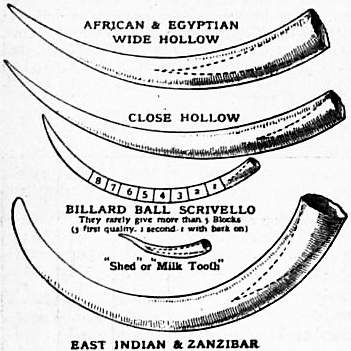
Fig. 1.
The accompanying diagrams (figs. 1 and 2) show the method; the cuts are made radiating from an imaginary centre of the curve of the tusk. In after processes the various trades have their own particular methods for making the most of the material. In making a billiard-ball of the English size the first thing to be done is to rough out, from the cylindrical section, a sphere about 2¼ in. in diameter, which will eventually be 21⁄16 or sometimes for professional players a little larger. One hemisphere—as shown in the diagrams (fig. 2)—is first turned, and the resulting ring detached with a parting tool. The diameter is accurately taken and the subsequent removals taken off in other directions. The ball is then fixed in a wooden chuck, the half cylinder reversed, and the operation repeated for the other hemisphere. It is now left five years to season and then turned dead true. The rounder and straighter the tusk selected for ball-making the better. Evidently, if the tusk is oval and the ball the size of the least diameter, its sides which come nearer to the bark or rind will be coarser and of a different density from those portions further removed from this outer skin. The matching of billiard-balls is important, for extreme accuracy in weight is essential. It is usual to bleach them, as the purchaser—or at any rate the distributing intermediary—likes to have them of a dead white. But this is a mistake, for bleaching with chemicals takes out the gelatine to some extent, alters the quality and affects the density; it also makes them more liable to crack, and they are not nearly so nice-looking. Billiard-balls should be bought in summer time when the temperature is most equable, and gently used till the winter season. On an average three balls of fine quality are got out of a tooth. The stock of more than one great manufacturer surpasses at times 30,000 in number. But although ball teeth rose in 1905 to £167 a cwt., the price of billiard-balls was the same in 1905 as it was in 1885. Roughly speaking, there are about twelve different qualities and prices of billiard-balls, and eight of pyramid- and pool-balls, the latter ranging from half a guinea to two guineas each.
The ivory for piano-keys is delivered to the trade in the shape of what are known as heads and tails, the former for the parts which come under the fingers, the latter for that running up between the black keys. The two are joined afterwards on the keyboard with extreme accuracy. Piano-keys are bleached, but organists for some reason or other prefer unbleached keys. The soft variety is mostly used for high-class work and preferably of the Egyptian type.
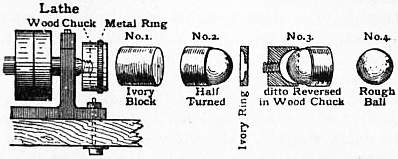
Fig. 2.
The great centres of the ivory industry for the ordinary objects of common domestic use are in England, for cutlery handles Sheffield, for billiard-balls and piano-keys London. For cutlery a large firm such as Rodgers & Sons uses an average of some twenty tons of ivory annually, mostly of the hard variety. But for billiard-balls and piano-keys America is now a large producer, and a considerable quantity is made in France and Germany. Brush backs are almost wholly in English hands. Dieppe has long been famous for the numberless little ornaments and useful articles such as statuettes, crucifixes, little bookcovers, paper-cutters, combs, serviette-rings and articles de Paris generally. And St Claude in the Jura, and Geislingen in Würtemberg, and Erbach in Hesse, Germany, are amongst the most important centres of the industry. India and China supply the multitude of toys, models, chess and draughtsmen, puzzles, workbox fittings and other curiosities.
Vegetable Ivory, &c.—Some allusion may be made to vegetable ivory and artificial substitutes. The plants yielding the vegetable ivory of commerce represent two or more species of an anomalous genus of palms, and are known to botanists as Phytelephas. They are natives of tropical South America, occurring chiefly on the banks of the river Magdalena, Colombia, always found in damp localities, not only, however, on the lower coast region as in Darien, but also at a considerable elevation above the sea. They are mostly found in separate groves, not mixed with other trees or shrubs. The plant is severally known as the “tagua” by the Indians on the banks of the Magdalena, as the “anta” on the coast of Darien, and as the “pulli-punta” and “homero” in Peru. It is stemless or short-stemmed, and crowned with from twelve to twenty very long pinnatifid leaves. The plants are dioecious, the males forming higher, more erect and robust trunks than the females. The male inflorescence is in the form of a simple fleshy cylindrical spadix covered with flowers; the female flowers are also in a single spadix, which, however, is shorter than in the male. The fruit consists of a conglomerated head composed of six or seven drupes, each containing from six to nine seeds, and the whole being enclosed in a walled woody covering forming altogether a globular head as large as that of a man. A single plant sometimes bears at the same time from six to eight of these large heads of fruit, each weighing from 20 to 25 ℔. In its very young state the seed contains a clear insipid fluid, which travellers take advantage of to allay thirst. As it gets older this fluid becomes milky and of a sweet taste, and it gradually continues to change both in taste and consistence until it becomes so hard as to make it valuable as a substitute for animal ivory. In their young and fresh state the fruits are eaten with avidity by bears, hogs and other animals. The seeds, or nuts as they are usually called when fully ripe and hard, are used by the American Indians for making small ornamental articles and toys. They are imported into Britain in considerable quantities, frequently under the name of “Cỏrozo” nuts, a name by which the fruits of some species of Attalea (another palm with hard ivory-like seeds) are known in Central America—their uses being chiefly for small articles of turnery. Of vegetable ivory Great Britain imported in 1904 1200 tons, of which about 400 tons were re-exported, principally to Germany. It is mainly and largely used for coat buttons.
Many artificial compounds have, from time to time, been tried as substitutes for ivory; amongst them potatoes treated with sulphuric acid. Celluloid is familiar to us nowadays. In the form of bonzoline, into which it is said to enter, it is used largely for billiard balls; and a new French substitute—a caseine made from milk, called gallalith—has begun to be much used for piano keys in the cheaper sorts of instrument. Odontolite is mammoth ivory, which through lapse of time and from surroundings becomes converted into a substance known as fossil or blue ivory, and is used occasionally in jewelry as turquoise, which it very much resembles. It results from the tusks of antediluvian mammoths buried in the earth for thousands of years, during which time under certain conditions the ivory becomes slowly penetrated with the metallic salts which give it the peculiar vivid blue colour of turquoise.
Ivory Sculpture and the Decorative Arts.—The use of ivory as a material peculiarly adapted for sculpture and decoration has been universal in the history of civilization. The earliest examples which have come down to us take us back to prehistoric times, when, so far as our knowledge goes, civilization as we understand it had attained no higher degree than that of the dwellers in caves, or of the most primitive races. Throughout succeeding ages there is continued evidence that no other substance—except perhaps wood, of which we have even fewer ancient examples—has been so consistently connected with man’s art-craftsmanship. It is hardly too much to say that to follow properly the history of ivory sculpture involves the study of the whole world’s art in all ages. It will take us back to the most remote antiquity, for we have examples of the earliest dynasties of Egypt and Assyria. Nor is there entire default when we come to the periods of the highest civilization of Greece and Rome. It has held an honoured place in all ages for the adornment of the palaces of the great, not only in sculpture proper but in the rich inlay of panelling, of furniture, chariots and other costly articles. The Bible teems with references to its beauty and value. And when, in the days of Pheidias, Greek sculpture had reached the highest perfection, we learn from ancient writers that colossal statues were constructed—notably the “Zeus of Olympia” and the “Athena of the Parthenon.” The faces, hands and other exposed portions of these figures were of ivory, and the question, therefore, of the method of production of such extremely large slabs as perhaps were used has been often debated. A similar difficulty arises with regard to other pieces of considerable size, found, for example, amongst consular diptychs. It has been conjectured that some means of softening and moulding ivory was known to the ancients, but as a matter of fact though it may be softened it cannot be again restored to its original condition. If up to the 4th century we are unable to point to a large number of examples of sculpture in ivory, from that date onwards the chain is unbroken, and during the five or six hundred years of unrest and strife from the decline of the Roman empire in the 5th century to the dawn of the Gothic revival of art in the 11th or 12th, ivory sculpture alone of the sculptural arts carries on the preservation of types and traditions of classic times in central Europe. Most important indeed is the rôle which existing examples of ivory carving play in the history of the last two centuries of the consulates of the Western and Eastern empires. Though the evidences of decadence in art may be marked, the close of that period brings us down to the end of the reign of Justinian (527-563). Two centuries later the iconoclastic persecutions in the Eastern empire drive westward and compel to settle there numerous colonies of monks and artificers. Throughout the Carlovingian period, the examples of ivory sculpture which we possess in not inconsiderable quantity are of extreme importance in the history of the early development of Byzantine art in Europe. And when the Western world of art arose from its torpor, freed itself from Byzantine shackles and traditions, and began to think for itself, it is to the sculptures in ivory of the Gothic art of the 13th and 14th centuries that we turn with admiration of their exquisite beauty of expression. Up to about the 14th century the influence of the church was everywhere predominant in all matters relating to art. In ivories, as in mosaics, enamels or miniature painting it would be difficult to find a dozen examples, from the age of Constantine onwards, other than sacred ones or of sacred symbolism. But as the period of the Renaissance approached, the influence of romantic literature began to assert itself, and a feeling and style similar to those which are characteristic of the charming series of religious art in ivory, so touchingly conceived and executed, meet us in many objects in ivory destined for ordinary domestic uses and ornament. Mirror cases, caskets for jewelry or toilet purposes, combs, the decoration of arms, or of saddlery or of weapons of the chase, are carved and chased with scenes of real life or illustrations of the romances, which bring home to us in a vivid manner details of the manners and customs, amusements, dresses and domestic life of the times. With the Renaissance and a return to classical ideas, joined with a love of display and of gorgeous magnificence, art in ivory takes a secondary place. There is a want of simplicity and of originality. It is the period of the commencement of decadence. Then comes the period nicknamed rococo, which persisted so long. Ivory carving follows the vulgar fashion, is content with copying or adapting, and until the revival in our own times is, except in rare instances, no longer to be classed as a fine art. It becomes a trade and is in the hands of the mechanic of the workshop. In this necessarily brief and condensed sketch we have been concerned mainly with ivory carving in Europe. It will be necessary to give also, presently, some indications enabling the inquirer to follow the history—or at least to put him on the track of it—not only in the different countries of the West but also in India, China and Japan.