VOLUME XV SLICE I Italy to Jacobite Church (continued 3)
Reading edition
1882. 1902. No. of Schools.
Ginnasi—
Government 13,875 24,081 192
On an equal footing with government schools 6,417 7,208 76
Not on such a footing 22,609 24,850* 442
Total 42,811 56,139 710
Technical schools—
Government 7,510 30,411 188
On an equal footing 8,653 12,055 101
Not on such a footing 8,670 3,623* 106*
Total 24,833 46,089 395
Licei—
Government 6,623 10,983 121
On an equal footing 1,167 1,955 33
Not on such a footing 4,600 4,962* 187
Total 12,390 17,900 341
Technical institutes—
Government 5,555 9,654 54
On an equal footing 1,684 1,898 18
Not on such a footing 619 378* 7
Total 7,858 11,930 79
Nautical institutes—
Government 758 1,878 18
On an equal footing 69 38 1
Not on such a footing 13 29* 1
Total 816 1,945 20
* 1896.
The schools which do not obtain equality with government schools are either some of those conducted by religious orders, or else those in which a sufficient standard is not reached. The total number of such schools was, in 1896, 742 with 33,813 pupils.
The pupils of the secondary schools reach a maximum of 6.60 per 1000 in Liguria and 5.92 in Latium, and a minimum of 2.30 in the Abruzzi, 2.27 in Calabria and 1.65 in Basilicata.
For the boarding schools, or convitti, there are only incomplete reports except for the institutions directly dependent on the ministry of public instruction, which are comparatively few. The rest are largely directed by religious institutions. In 1895-1896 there were 919 convitti for boys, with 59,066 pupils, of which 40, with 3814 pupils, were dependent on the ministry (in 1901-1902 there were 43 of these with 4036 pupils); and 1456 for girls, with 49,367 pupils, of which only 8, with about 600 pupils, were dependent on the ministry.
The scuole normali or training schools (117 in number, of which 75 were government institutions) for teachers had 1329 male students in 1901-1902, showing hardly any increase, while the female students increased from 8005 in 1882-1883 to 22,316 in 1895-1896, but decreased to 19,044 in 1901-1902, owing to the admission of women to telegraph and telephone work. The female secondary schools in 1881-1882 numbered 77, of which 7 were government institutions, with 3569 pupils; in 1901-1902 there were 233 schools (9 governmental) with 9347 pupils.
The total attendance of students in the various faculties at the different universities and higher institutes is as follows:—
1882. 1902.
Law 4,801 8,385
Philosophy and letters 419 1,703
Medicine and surgery 4,428 9,055
Professional diploma, pharmacy 798 3,290
Mathematics and natural science 1,364 3,500
Engineering 982 1,293
Agriculture 145 507
Commerce 128 167
Total 13,065 27,900
Thus a large all-round increase in secondary and higher education is shown—satisfactory in many respects, but showing that more young men devote themselves to the learned professions (especially to the law) than the economic condition of the country will justify. There are 21 universities—Bologna, Cagliari, Camerino, Catania, Ferrara, Genoa, Macerata, Messina, Modena, Naples, Padua, Palermo, Parma, Pavia, Perugia, Pisa, Rome, Sassari, Siena, Turin, Urbino, of which Camerino, Ferrara, Perugia and Urbino are not state institutions; university courses are also given at Aquila, Bari and Catanzaro. Of these the most frequented in 1904-1905 were: Naples (4745), Turin (3451), Rome (2630), Bologna (1711), Pavia (1559), Padua (1364), Genoa (1276), and the least frequented, Cagliari (254), Siena (235) and Sassari (200). The professors are ordinary and extraordinary, and free professors (liberi docenti), corresponding to the German Privatdozenten, are also allowed to be attached to the universities.
The institutions which co-operate with the universities are the special schools for engineers at Turin, Naples, Rome and Bologna (and others attached to some of the universities), the higher technical institute at Milan, the higher veterinary schools of Milan, Naples and Turin, the institute for higher studies at Florence (Istituto di studi superiori, pratici e di perfezionamento), the literary and scientific academy of Milan, the higher institutes for the training of female teachers at Florence and Rome, the Institute of Social Studies at Florence, the higher commercial schools at Venice, Bari and Genoa, the commercial university founded by L. Bocconi at Milan in 1902, the higher naval school at Genoa, the higher schools of agriculture at Milan and Portici, the experimental institute at Perugia, the school of forestry at Vallambrosa, the industrial museum at Turin. The special secondary institutions, distinct from those already reckoned under the universities and allied schools, include an Oriental institute at Naples with 243 pupils; 34 schools of agriculture with (1904-1905) 1925 students; 2 schools of mining (at Caltanisetta and Iglesias) with (1904-1905) 83 students; 308 industrial and commercial schools with (1903-1904) 46,411 students; 174 schools of design and moulding with (1898) 12,556 students; 13 government fine art institutes (1904-1905) with 2778 students and 13 non-government with 1662 students; 5 government institutes of music with 1026 students, and 51 non-government with 4109 pupils (1904-1905). Almost all of these show a considerable increase.
Libraries are numerous in Italy, those even of small cities being often rich in manuscripts and valuable works. Statistics collected in 1893-1894 and 1896 revealed the existence of 1831 libraries, either private (but open to the public) or completely public. The public libraries have been enormously increased since 1870 by the incorporation of the treasures of suppressed monastic institutions. The richest in manuscripts is that of the Vatican, especially since the purchase of the Barberini Library in 1902; it now contains over 34,000 MSS. The Vatican archives are also of great importance. Most large towns contain important state or communal archives, in which a considerable amount of research is being done by local investigators; the various societies for local history (Società di Storia Patria) do very good work and issue valuable publications; the treasures which the archives contain are by no means exhausted. Libraries and archives are under the superintendence of the Ministry of Public Instruction. A separate department of this ministry under a director-general has the charge of antiquities and fine arts, making archaeological excavations and supervising those undertaken by private persons (permission to foreigners, even to foreign schools, to excavate in Italy is rarely granted), and maintaining the numerous state museums and picture galleries. The exportation of works of art and antiquities from Italy without leave of the ministry is forbidden (though it has in the past been sometimes evaded). An inventory of those subjects, the exportation of which can in no case be permitted, has been prepared; and the ministry has at its disposal a fund of £200,000 for the purchase of important works of art of all kinds.
Charities.—In Italy there is no legal right in the poor to be supported by the parish or commune, nor any obligation on the commune to relieve the poor—except in the case of forsaken children and the sick poor. Public charity is exercised through the permanent charitable foundations (opere pie), which are, however, very unequally distributed in the different provinces. The districts of Italy which show between 1881 and 1903 the greatest increase of new institutions, or of gifts to old ones, are Lombardy, Piedmont, Liguria, while Sardinia, Calabria and Basilicata stand lowest, Latium standing comparatively low.
The patrimony of Italian charitable institutions is considerable and is constantly increasing. In 1880 the number of charitable institutions (exclusive of public pawnshops, or Monti di Pietà, and other institutions which combine operations of credit with charity) was approximately 22,000, with an aggregate patrimony of nearly £80,000,000. The revenue was about £3,600,000; after deduction of taxes, interest on debts, expenses of management, &c., £2,080,000. Adding to this £1,240,000 of communal and provincial subsidies, the product of the labour of inmates, temporary subscriptions, &c., the net revenue available for charity was, during 1880, £3,860,000. Of this sum £260,000 was spent for religious purposes. Between 1881 and 1905 the bequests to existing institutions and sums left for the endowment of new institutions amounted to about £16,604,600.
Charitable institutions take, as a rule, the two forms of outdoor and indoor relief and attendance. The indoor institutions are the more important in regard to endowment, and consist of hospitals for the infirm (a number of these are situated at the seaside); of hospitals for chronic and incurable diseases; of orphan asylums; of poorhouses and shelters for beggars; of infant asylums or institutes for the first education of children under six years of age; of lunatic asylums; of homes for the deaf and dumb; and of institutes for the blind. The outdoor charitable institutions include those which distribute help in money or food; those which supply medicine and medical help; those which aid mothers unable to rear their own children; those which subsidize orphans and foundlings; those which subsidize educational institutes; and those which supply marriage portions. Between 1881 and 1898 the chief increases took place in the endowments of hospitals; orphan asylums; infant asylums; poorhouses; almshouses; voluntary workhouses; and institutes for the blind. The least creditably administered of these are the asylums for abandoned infants; in 1887, of a total of 23,913, 53.77% died; while during the years 1893-1896 (no later statistics are available) of 117,970 51.72% died. The average mortality under one year for the whole of Italy in 1893-1896 was only 16.66%.
Italian charity legislation was reformed by the laws of 1862 and 1890, which attempted to provide efficacious protection for endowments, and to ensure the application of the income to the purposes for which it was intended. The law considers as “charitable institutions” (opere pie) all poorhouses, almshouses and institutes which partly or wholly give help to able-bodied or infirm paupers, or seek to improve their moral and economic condition; and also the Congregazioni di carità (municipal charity boards existing in every commune, and composed of members elected by the municipal council), which administer funds destined for the poor in general. All charitable institutions were under the protection of provincial administrative junta, existing in every province, and empowered to control the management of charitable endowments. The supreme control was vested in the minister of the Interior. The law of 1890 also empowers every citizen to appeal to the tribunals on behalf of the poor, for whose benefit a given charitable institution may have been intended. A more recent law provides for the formation of a central body, with provincial commissions under it. Its effect, however, has been comparatively small.
Public pawnshops or Monti di pietà numbered 555 in 1896, with a net patrimony of £2,879,625. In that year their income, including revenue from capital, was £416,385, and their expenditure £300,232. The amount lent on security was £4,153,229.
The Monti frumentarii or co-operative corn deposits, which lend seed corn to farmers, and are repaid after harvest with interest in kind, numbered 1615 in 1894, and possessed a patrimony of £240,000.
In addition to the regular charitable institutions, the communal and provincial authorities exercise charity, the former (in 1899) to the extent of £1,827,166 and the latter to the extent of £919,832 per annum. Part of these sums is given to hospitals, and part spent directly by the communal and provincial authorities. Of the sum spent by the communes, about ½ goes for the sanitary service (doctors, midwives, vaccination), 1⁄8 for the maintenance of foundlings, 1⁄10 for the support of the sick in hospitals, and 1⁄22 for sheltering the aged and needy. Of the sum spent by the provincial authorities, over half goes to lunatic asylums and over a quarter to the maintenance of foundling hospitals.
Religion.—The great majority of Italians—97.12%—are Roman Catholics. Besides the ordinary Latin rite, several others are recognized. The Armenians of Venice maintain their traditional characteristics. The Albanians of the southern provinces still employ the Greek rite and the Greek language in their public worship, and their priests, like those of the Greek Church, are allowed to marry. Certain peculiarities introduced by St Ambrose distinguish the ritual of Milan from that of the general church. Up to 1871 the island of Sicily was, according to the bull of Urban II., ecclesiastically dependent on the king, and exempt from the canonical power of the pope.
Though the territorial authority of the papal see was practically abolished in 1870, the fact that Rome is the seat of the administrative centre of the vast organization of the church is not without significance to the nation. In the same city in which the administrative functions of the body politic are centralized there still exists the court of the spiritual potentate which in 1879 consisted of 1821 persons. Protestants number some 65,000, of whom half are Italian and half foreign. Of the former 22,500 are Waldensians. The number of Jews was returned as 36,000, but is certainly higher. There are, besides, in Italy some 2500 members of the Greek Orthodox Church. There were in 1901 20,707 parishes in Italy, 68,444 secular clergy and 48,043 regulars (monks, lay brothers and nuns). The size of parishes varies from province to province, Sicily having larger parishes in virtue of the old Sicilian church laws, and Naples, and some parts of central Italy, having the smallest. The Italian parishes had in 1901 a total gross revenue, including assignments from the public worship endowment fund, of £1,280,000 or an average of £63 per parish; 51% of this gross sum consists of revenue from glebe lands.
The kingdom is divided into 264 sees and ten abbeys, or prelatures nullius dioceseos. The dioceses are as follows:—
A. 6 suburbicarian sees—Ostia and Velletri, Porto and Sta Rufina, Albano, Frascati, Palestrina, Sabina—all held by cardinal bishops.
B. 74 sees immediately subject to the Holy See, of which 12 are archiepiscopal and 61 episcopal.
C. 37 ecclesiastical provinces, each under a metropolitan, composed of 148 suffragan dioceses. Their position is indicated in the following table:—
Metropolitans. Suffragans.
Acerenza-Matera Anglona-Tursi, Tricarico, Venosa.
Bari Conversano, Ruvo-Bitonto.
Benevento S. Agata de’ Goti, Alife, Ariano, Ascoli Satriano Cerignola, Avellino, Bojano, Bovino, Larino, Lucera, S. Severo, Telese (Cerreto), Termoli.
Bologna Faenza, Imola.
Brindisi and Ostuni No suffragan.
Cagliari Galtelli-Nuoro, Iglesias, Ogliastra.
Capua Caiazzo, Calvi-Teano, Caserta, Isernia-Venafro, Sessa.
Chieti and Vasto No suffragan.
Conza and Campagna S. Angelo de’ Lombardi-Bisaccia, Lacedonia, Muro Lucano.
Fermo Macerata-Tolentino, Montalto, Ripatransone, S. Severino.
Florence Borgo S. Sepolcro, Colle di Val d’Elsa, Fiesole, S. Miniato, Modigliana, Pistoia-Prato.
Genoa Albenga, Bobbio, Chiavari, Savona-Noli, Tortona, Ventimiglia.
Lanciano and Ortona No suffragan.
Manfredonia and Viesti No suffragan.
Messina Lipari, Nicosia, Patti.
Milan Bergamo, Brescia, Como, Crema, Cremona, Lodi, Mantua, Pavia.
Modena Carpi, Guastalla, Massa-Carrara, Reggio.
Monreale Caltanisetta, Girgenti.
Naples Acerra, Ischia, Nola, Pozzuoli.
Oristano Ales-Terralba.
Otranto Gallipoli, Lecce, Ugento.
Palermo Cefalù, Mazzara, Trapani.
Pisa Leghorn, Pescia, Pontremoli, Volterra.
Ravenna Bertinoro, Cervia, Cesena, Comacchio, Forlì, Rimini, Sarsina.
Reggio Calabria Bova, Cassano, Catanzaro, Cotrone, Gerace, Nicastro, Oppido, Nicotera-Tropea, Squillace.
Salerno Acerno, Capaccio-Vallo, Diano, Marsico-Nuovo and Potenza, Nocera dei Pagani, Nusco, Policastro.
Sassari Alghero, Ampurias and Tempio, Bisarhio, Bosa.
S. Severino Cariati.
Siena Chiusi-Pienza, Grosseto, Massa Marittima, Sovana-Pitigliano.
Syracuse Caltagirone, Noto, Piazza-Armerina.
Sorrento Castellammare.
Taranto Castellaneta, Oria.
Trani-Nazareth-Barletta, Bisceglie Andria.
Turin Acqui, Alba, Aosta, Asti, Cuneo, Fossano, Ivrea, Mondovi, Pinerolo, Saluzzo, Susa.
Urbino S. Angelo in Vado-Urbania, Cagli-Pergola, Fossombrone, Montefeltro, Pesaro, Sinigaglia.
Venice (patriarch) Adria, Belluno-Feltre, Ceneda (Vittorio), Chioggia, Concordia-Portogruaro, Padua, Treviso, Verona, Vicenza.
Vercelli Alessandria della Paglia, Biella, Casale, Monferrato, Novara, Vigevano.
Twelve archbishops and sixty-one bishops are independent of all metropolitan supervision, and hold directly of the Holy See. The archbishops are those of Amalfi, Aquila, Camerino and Treia, Catania, Cosenza, Ferrara, Gaeta, Lucca, Perugia, Rossano, Spoleto, and Udine, and the bishops those of Acireale, Acquapendente, Alatri, Amelia, Anagni, Ancona-Umana, Aquino-Sora-Pontecorvo, Arezzo, Ascoli, Assisi, Aversa, Bagnorea, Borgo San Donnino, Cava-Sarno, Città di Castello, Città della Pieve, Cività Castellana-Orte-Gallese, Corneto-Civita Vecchia, Cortona, Fabriano-Matelica, Fano, Ferentino, Foggia, Foligno, Gravina-Montepeloso, Gubbio, Jesi, Luni-Sarzana and Bragnato, S. Marco-Bisignano, Marsi (Pescina), Melfi-Rapolla, Mileto, Molfetta-Terlizzi-Giovennazzo, Monopoli, Montalcino, Montefiascone, Montepulciano, Nardo, Narni, Nocera in Umbria, Norcia, Orvieto, Osimo-Cingoli, Parma, Penne-Atri, Piacenza, Poggio Mirteto, Recanati-Loreto, Rieti, Segni, Sutri-Nepi, Teramo, Terni, Terracina-Piperno-Sezze, Tivoli, Todi, Trivento, Troia, Valva-Sulmona, Veroli, Viterbo-Toscanella. Excluding the diocese of Rome and suburbicarian sees, each see has an average area of 430 sq. m. and a population of 121,285 souls. The largest sees exist in Venetia and Lombardy, and the smallest in the provinces of Naples, Leghorn, Forlì, Ancona, Pesaro, Urbino, Caserta, Avellino and Ascoli. The Italian sees (exclusive of Rome and of the suburbicarian sees) have a total annual revenue of £206,000 equal to an average of £800 per see. The richest is that of Girgenti, with £6304, and the poorest that of Porto Maurizio, with only £246. In each diocese is a seminary or diocesan school.
In 1855 an act was passed in the Sardinian states for the disestablishment of all houses of the religious orders not engaged in preaching, teaching or the care of the sick, of all chapters of collegiate churches not having a cure of souls or existing Religious Foundations. in towns of less than 20,000 inhabitants, and of all private benefices for which no service was paid by the holders. The property and money thus obtained were used to form an ecclesiastical fund (Cassa Ecclesiastica) distinct from the finances of the state. This act resulted in the suppression of 274 monasteries with 3733 friars, of 61 nunneries with 1756 nuns and of 2722 chapters and benefices. In 1860 and 1861 the royal commissioners (even before the constitution of the new kingdom of Italy had been formally declared) issued decrees by which there were abolished—(1) in Umbria, 197 monasteries and 102 convents with 1809 male and 2393 female associates, and 836 chapters or benefices; (2) in the Marches, 292 monasteries and 127 convents with 2950 male and 2728 female associates; (3) in the Neapolitan provinces, 747 monasteries and 275 convents with 8787 male and 7493 female associates. There were thus disestablished in seven or eight years 2075 houses of the regular clergy occupied by 31,649 persons; and the confiscated property yielded a revenue of £398,298. And at the same time there had been suppressed 11,889 chapters and benefices of the secular clergy, which yielded an annual income of £199,149. The value of the capital thus potentially freed was estimated at £12,000,000; though hitherto the ecclesiastical possessions in Lombardy, Emilia, Tuscany and Sicily had been untouched. As yet the Cassa Ecclesiastica had no right to dispose of the property thus entrusted to it; but in 1862 an act was passed by which it transferred all its real property to the national domain, and was credited with a corresponding amount by the exchequer. The property could now be disposed of like the other property of the domain; and except in Sicily, where the system of emphyteusis was adopted, the church lands began to be sold by auction. To encourage the poorer classes of the people to become landholders, it was decided that the lots offered for sale should be small, and that the purchaser should be allowed to pay by five or ten yearly instalments. By a new act in 1866 the process of secularization was extended to the whole kingdom. All the members of the suppressed communities received full exercise of all the ordinary political and civil rights of laymen; and annuities were granted to all those who had taken permanent religious vows prior to the 18th of January 1864. To priests and choristers, for example, of the proprietary or endowed orders were assigned £24 per annum if they were upwards of sixty years of age, £16 if upwards of 40, and £14, 8s. if younger. The Cassa Ecclesiastica was abolished, and in its stead was instituted a Fondo pel Culto, or public worship fund. From the general confiscation were exempted the buildings actually used for public worship, as episcopal residences or seminaries, &c., or which had been appropriated to the use of schools, poorhouses, hospitals, &c.; as well as the buildings, appurtenances, and movable property of the abbeys of Monte Casino, Della Cava dei Tirreni, San Martino della Scala, Monreale, Certosa near Pavia, and other establishments of the same kind of importance as architectural or historical monuments. An annuity equal to the ascertained revenue of the suppressed institutions was placed to the credit of the fund in the government 5% consols. A fourth of this sum was to be handed to the communes to be employed on works of beneficence or education as soon as a surplus was obtained from that part of the annuity assigned for the payment of monastic pensions; and in Sicily, 209 communes entered on their privileges as soon as the patrimony was liquidated. Another act in 1867 decreed the suppression of certain foundations which had escaped the action of previous measures, put an extraordinary tax of 30% on the whole of the patrimony of the church, and granted the government the right of issuing 5% bonds sufficient to bring into the treasury £16,000,000, which were to be accepted at their nominal value as purchase money for the alienated property. The public worship endowment fund has relieved the state exchequer of the cost of public worship; has gradually furnished to the poorer parish priests an addition to their stipends, raising them to £32 per annum, with the prospect of further raising them to £40; and has contributed to the outlay incurred by the communes for religious purposes. The monastic buildings required for public purposes have been made over to the communal and provincial authorities, while the same authorities have been entrusted with the administration of the ecclesiastical revenues previously set apart for charity and education, and objects of art and historical interest have been consigned to public libraries and museums. By these laws the reception of novices was forbidden in the existing conventual establishments the extinction of which had been decreed, and all new foundations were forbidden, except those engaged in instruction and the care of the sick. But the laws have not been rigorously enforced of late years; and the ecclesiastical possessions seized by the state were thrown on the market simultaneously, and so realized very low prices, being often bought up by wealthy religious institutions. The large number of these institutions was increased when these bodies were expelled from France.
On the 30th of June 1903 the patrimony of the endowment fund amounted to £17,339,040, of which only £264,289 were represented by buildings still occupied by monks or nuns. The rest was made up of capital and interest. The liabilities of the fund (capitalized) amounted to £10,668,105, of which monastic pensions represented a rapidly diminishing sum of £2,564,930. The chief items of annual expenditure drawn from the fund are the supplementary stipends to priests and the pensions to members of suppressed religious houses. The number of persons in receipt of monastic pensions on the 30th of June 1899 was 13,255; but while this item of expenditure will disappear by the deaths of those entitled to pensions, the supplementary stipends and contributions are gradually increasing. The following table shows the course of the two main categories of the fund from 1876 to 1902-1903:—
1876. 1885-1886. 1898-1899. 1902-1903.
Monastic pensions, liquidation of religious property and provision of shelter for nuns £749,172 £491,339 £220,479 £165,144
Supplementary stipends to bishops and parochial clergy, assignments to Sardinian clergy and expenditure for education and charitable purposes and charitable purposes 142,912 128,521 210,020 347,940
Roman Charitable and Religious Fund.—The law of the 19th of June 1873 contained special provisions, in conformity with the character of Rome as the seat of the papacy, and with the situation created by the Law of Guarantees. According to the census of 1871 there were in the city and province of Rome 474 monastic establishments (311 for monks, 163 for nuns), occupied by 4326 monks and 3825 nuns, and possessing a gross revenue of 4,780,891 lire. Of these, 126 monasteries and 90 convents were situated in the city, 51 monasteries and 22 convents in the “suburbicariates.” The law of 1873 created a special charitable and religious fund of the city, while it left untouched 23 monasteries and 49 convents which had either the character of private institutions or were supported by foreign funds. New parishes were created, old parishes were improved, the property of the suppressed religious corporations was assigned to charitable and educational institutions and to hospitals, while property having no special application was used to form a charitable and religious fund. On the 30th of June 1903 the balance-sheet of this fund showed a credit amounting to £1,796,120 and a debit of £460,819. Expenditure for the year 1902-1903 was £889,858 and revenue £818,674.
Constitution and Government.—The Vatican palace itself (with St Peter’s), the Lateran palace, and the papal villa at Castel Gandolfo have secured to them the privilege of extraterritoriality by the law of 1871. The small republic of San Marino is the only other enclave in Italian territory. Italy is a constitutional monarchy, in which the executive power belongs exclusively to the sovereign, while the legislative power is shared by him with the parliament. He holds supreme command by land and sea, appoints ministers and officials, promulgates the laws, coins money, bestows honours, has the right of pardoning, and summons and dissolves the parliament. Treaties with foreign powers, however, must have the consent of parliament. The sovereign is irresponsible, the ministers, the signature of one of whom is required to give validity to royal decrees, being responsible. Parliament consists of two chambers, the senate and the Chamber of Deputies, which are nominally on an equal footing, though practically the elective chamber is the more important. The senate consists of princes of the blood who have attained their majority, and of an unlimited number of senators above forty years of age, who are qualified under any one of twenty-one specified categories—by having either held high office, or attained celebrity in science, literature, &c. In 1908 there were 318 senators exclusive of five members of the royal family. Nomination is by the king for life. Besides its legislative functions, the senate is the highest court of justice in the case of political offences or the impeachment of ministers. The deputies to the lower house are 508 in number, i.e. one to every 64,893 of the population, and all the constituencies are single-member constituencies. The party system is not really strong. The suffrage is extended to all citizens over twenty-one years of age who can read and write and have either attained a certain standard of elementary education or are qualified by paying a rent which varies from £6 in communes of 2500 inhabitants to £16 in communes of 150,000 inhabitants, or, if peasant farmers, 16s. of rent; or by being sharers in the profits of farms on which not less than £3, 4s. of direct (including provincial) taxation is paid; or by paying not less than £16 in direct (including provincial) taxation. Others, e.g. members of the professional classes, are qualified to vote by their position. The number of electors (2,541,327) at the general election in 1904 was 29% of the male population over twenty-one years of age, and 7.6% of the total population—exclusive of those temporarily disfranchised on account of military service; and of these 62.7% voted. No candidate can be returned unless he obtains more than half the votes given and more than one-sixth of the total number on the register; otherwise a second ballot must be held. Nor can he be returned under the age of thirty, and he must be qualified as an elector. All salaried government officials (except ministers, under-secretaries of state and other high functionaries, and officers in the army or navy), and ecclesiastics, are disqualified for election. Senators and deputies receive no salary but have free passes on railways throughout Italy and on certain lines of steamers. Parliaments are quinquennial, but the king may dissolve the Chamber of Deputies at any time, being bound, however, to convoke a new chamber within four months. The executive must call parliament together annually. Each of the chambers has the right of introducing new bills, as has also the government; but all money bills must originate in the Chamber of Deputies. The consent of both chambers and the assent of the king is necessary to their being passed. Ministers may attend the debates of either house but can only vote in that of which they are members. The sittings of both houses are public, and an absolute majority of the members must be present to make a sitting valid. The ministers are eleven in number and have salaries of about £1000 each; the presidency of the council of ministers (created in 1889) may be held by itself or (as is usual) in conjunction with any other portfolio. The ministries are: interior (under whom are the prefects of the several provinces), foreign affairs, treasury (separated from finance in 1889), finance, public works, justice and ecclesiastical affairs, war, marine, public instruction, commerce, industry and agriculture, posts and telegraphs (separated from public works in 1889). Each minister is aided by an under-secretary of state at a salary of £500. There is a council of state with advisory functions, which can also decide certain questions of administration, especially applications from local authorities and conflicts between ministries, and a court of accounts, which has the right of examining all details of state expenditure. In every country the bureaucracy is abused, with more or less reason, for unprogressiveness, timidity and “red-tape,” and Italy is no exception to the rule. The officials are not well paid, and are certainly numerous; while the manifold checks and counterchecks have by no means always been sufficient to prevent dishonesty.
Titles of Honour.—The former existence of so many separate sovereignties and “fountains of honour” gave rise to a great many hereditary titles of nobility. Besides many hundreds of princes, dukes, marquesses, counts, barons and viscounts, there are a large number of persons of “patrician” rank, persons with a right to the designation nobile or signori, and certain hereditary knights or cavalieri. In the “Golden Book of the Capitol” (Libro d’Oro del Campidoglio) are inscribed 321 patrician families, and of these 28 have the title of prince and 8 that of duke, while the others are marquesses, counts or simply patricians. For the Italian orders of knighthood see Knighthood and Chivalry: Orders of Knighthood. The king’s uncle is duke of Aosta, his son is prince of Piedmont and his cousin is duke of Genoa.
Justice.—The judiciary system of Italy is mainly framed on the French model. Italy has courts of cassation at Rome, Naples, Palermo, Turin, Florence, 20 appeal court districts, 162 tribunal districts and 1535 mandamenti, each with its own magistracy (pretura). In 13 of the principal towns there are also pretori who have exclusively penal jurisdiction. For minor civil cases involving sums up to 100 lire (£4), giudici conciliatori have also jurisdiction, while they may act as arbitrators up to any amount by request. The Roman court of cassation is the highest, and in both penal and civil matters has a right to decide questions of law and disputes between the lower judicial authorities, and is the only one which has jurisdiction in penal cases, while sharing with the others the right to revise civil cases.
The pretori have penal jurisdiction concerning all misdemeanours (contravvenzioni) or offences (delitti) punishable by imprisonment not exceeding three months or by fine not exceeding 1000 lire (£40). The penal tribunals have jurisdiction in cases involving imprisonment up to ten years, or a fine exceeding £40, while the assize courts, with a jury, deal with offences involving imprisonment for life or over ten years, and have exclusive jurisdiction (except that the senate is on occasion a high court of justice) over all political offences. Appeal may be made from the sentences of the pretori to the tribunals, and from the tribunals to the courts of appeal; from the assize courts there is no appeal except on a point of form, which appeal goes to the court of cassation at Rome. This court has the supreme power in all questions of legality of a sentence, jurisdiction or competency.
The penal code was unified and reformed in 1890. A reform of late years is the condanna condizionale, equivalent to the English “being bound over to appear for judgment if called upon,” applied in 94,489 cases in 1907. In civil matters there is appeal from the giudice conciliatore to the pretore (who has jurisdiction up to a sum of 1500 lire = £60) from the pretore to the civil tribunal, from the civil tribunal to the court of appeal, and from the court of appeal to the court of cassation.
The judges of all kinds are very poorly paid. Even the first president of the Rome court of cassation only receives £600 a year.
The statistics of civil proceedings vary considerably from province to province. Lombardy, with 25 lawsuits per 1000 inhabitants, holds the lowest place; Emilia comes next with 31 per 1000; Tuscany has 39; Venetia, 42; Calabria, 144; Rome, 146; Apulia, 153; and Sardinia, 360 per 1000. The high average in Sardinia is chiefly due to cases within the competence of the conciliation offices. The number of penal proceedings, especially those within the competence of praetors, has also increased, chiefly on account of the frequency of minor contraventions of the law referred to in the section Crime. The ratio of criminal proceedings to population is, as a rule, much higher in the south than in the north.
A royal decree, dated February 1891, established three classes of prisons: judiciary prisons, for persons awaiting examination or persons sentenced to arrest, detention or seclusion for less than six months; penitentiaries of various kinds (ergastoli, case di reclusione, detenzione or custodia), for criminals condemned to long terms of imprisonment; and reformatories, for criminals under age and vagabonds. Capital punishment was abolished in 1877, penal servitude for life being substituted. This generally involves solitary confinement of the most rigorous nature, and, as little is done to occupy the mind, the criminal not infrequently becomes insane. Certain types of dangerous individuals are relegated after serving a sentence in the ordinary convict prisons, and by administrative, not by judicial process, to special penal colonies known as domicilii coatti or “forced residences.” These establishments are, however, unsatisfactory, being mostly situated on small islands, where it is often difficult to find work for the coatti, who are free by day, being only confined at night. They receive a small and hardly sufficient, allowance for food of 50 centesimi a day, which they are at liberty to supplement by work if they can find it or care to do it.
Notwithstanding the construction of new prisons and the transformation of old ones, the number of cells for solitary confinement is still insufficient for a complete application of the penal system established by the code of 1890, and the moral effect of the association of the prisoners is not good, though the system of solitary confinement as practised in Italy is little better. The total number of prisoners, including minors and inhabitants of enforced residences, which from 76,066 (2.84 per 1000 inhabitants) on the 31st of December 1871 rose to a maximum of 80,792 on the 31st of December 1879 (2.87 per 1000), decreased to a minimum of 60,621 in 1896 (1.94 per 1000), and on the 31st of December 1898 rose again to 75,470 (2.38 per 1000), of whom 7038, less than one-tenth, were women. The lowness of the figures regarding women is to be noticed throughout. On the 31st of December 1903 it had decreased to 65,819, of which 6044 were women. Of these, 31,219 were in lockups, 25,145 in penal establishments, 1837 minors in government, and 4547 in private reformatories, and 3071 (males) were inmates of forced residences.
Crime.—Statistics of offences, including contravvenzioni or breaches of by-laws and regulations, exhibit a considerable increase per 100,000 inhabitants since 1887, and only a slight diminution on the figures of 1897. The figure was 1783.45 per 100,000 in 1887, 2164.46 in 1892, 2546.49 in 1897, 2497.90 in 1902. The increase is partly covered by contravvenzioni, but almost every class of penal offence shows a rise except homicide, and even in that the diminution is slow, 5418 in 1880, 3966 in 1887, 4408 in 1892, 4005 in 1897, 3202 in 1902; and Italy remains, owing to the frequent use of the knife, the European country in which it is most frequent. Libels, insults, &c., resistance to public authority, offences against good customs, thefts and frauds, have increased; assaults are nearly stationary. There is also an increase in juvenile delinquency. From 1890 to 1900 the actual number rose by one-third (from 30,108 to 43,684), the proportion to the rest of those sentenced from one-fifth to one-fourth; while in 1905 the actual number rose to 67,944, being a considerable proportionate rise also. In Naples, the Camorra and in Sicily, the Mafia are secret societies whose power of resistance to authority is still not inconsiderable.
Procedure, both civil and criminal, is somewhat slow, and the preliminary proceedings before the juge d’instruction occupy much time; and recent murder trials, by the large number of witnesses called (including experts) and the lengthy speeches of counsel, have been dragged out to an unconscionable length. In this, as in the intervention of the presiding judge, the French system has been adopted; and it is said (e.g. by Nathan, Vent’ anni di vita italiana, p. 241) that the efforts of the juge d’instruction are, as a rule, in fact, though not in law, largely directed to prove that the accused is guilty. In 1902 of 884,612 persons accused of penal offences, 13.12% were acquitted during the period of the instruction, 30.31 by the courts, 46.32 condemned and the rest acquitted in some other way. This shows that charges, often involving preliminary imprisonment, are brought against an excessive proportion of persons who either are not or cannot be proved to be guilty. The courts of appeal and cassation, too, often have more than they can do; in the year 1907 the court of cassation at Rome decided 948 appeals on points of law in civil cases, while no fewer than 460 remained to be decided.
As in most civilized countries, the number of suicides in Italy has increased from year to year.
The Italian suicide rate of 63.6 per 1,000,000 is, however, lower than those of Denmark, Switzerland, Germany and France, while it approximates to that of England. The Italian rate is highest in the more enlightened and industrial north, and lowest in the south. Emilia gives a maximum rate of 10.48 per 100,000, while that of Liguria and Lazio is little lower. The minimum of 1.27 is found in the Basilicata, though Calabria gives only 2.13. About 20% of the total are women, and there is an increase of nearly 3% since 1882 in the proportion of suicides under twenty years of age.
Army.—The Italian army grew out of the old Piedmontese army with which in the main the unification of Italy was brought about. This unification meant for the army the absorption of contingents from all parts of Italy and presenting serious differences in physical and moral aptitudes, political opinions and education. Moreover the strategic geography of the country required the greater part of the army to be stationed permanently within reach of the north-eastern and north-western frontiers. These conditions made a territorial system of recruiting or organization, as understood in Germany, practically impossible. To secure fairly uniform efficiency in the various corps, and also as a means of unifying Italy, Piedmontese, Umbrians and Neapolitans are mixed in the same corps and sleep in the same barrack room. But on leaving the colours the men disperse to their homes, and thus a regiment has, on mobilization, to draw largely on the nearest reservists, irrespective of the corps to which they belong. The remedy for this condition of affairs is sought in a most elaborate and artificial system of transferring officers and men from one unit to another at stated intervals in peace-time, but this is no more than a palliative, and there are other difficulties of almost equal importance to be surmounted. Thus in Italy the universal service system, though probably the best organization both for the army and the nation, works with a maximum of friction. “Army Reform,” therefore, has been very much in the forefront of late years owing to the estrangement of Austria (which power can mobilize much more rapidly), but financial difficulties have hitherto stood in the way of any radical and far-reaching reforms, and even the proposals of the Commission of 1907, referred to below, have only been partially accepted.
The law of 1875 therefore still regulates the principles of military service in Italy, though an important modification was made in 1907-1908. By this law, every man liable and accepted for service served for eight or nine years on the Active Army and its Reserve (of which three to five were spent with the colours), four or five in the Mobile Militia, and the rest of the service period of nineteen years in the Territorial Militia. Under present regulations the term of liability is divided into nine years in the Active Army and Reserve (three or two years with the colours) four in the Mobile Militia and six in the Territorial Militia. But these figures do not represent the actual service of every able-bodied Italian. Like almost all “Universal Service” countries, Italy only drafts a small proportion of the available recruits into the army.
The following table shows the operation of the law of 1875, with the figures of 1871 for comparison:—
30th Sept. 30th June.
1871. 1881. 1891. 1901.
Officers* 14,070 22,482 36,739 36,718
Men 521,969 1,833,554 2,821,367 3,330,202
Acting Army & Reserve 536,039 731,149 843,160 734,401
Mobile Militia .. 294,714 445,315 320,170
Territorial Militia .. 823,970 1,553,784 2,275,631
* Including officers on special service or in the reserve.
Thus, on the 30th of September 1871 the various categories of the army included only 2% of the population, but on the 30th of June 1898 they included 10%. But in 1901 the strength of the active army and reserve shows a marked diminution, which became accentuated in the year following. The table below indicates that up to 1907 the army, though always below its nominal strength, never absorbed more than a quarter of the available contingent.
1902. 1903. 1904. 1906.
Liable 441,171 453,640 469,860 475,737
Physically unfit 91,176 98,065 119,070 122,559
Struck off 12,270 13,189 13,130 18,222
Failed to appear 33,634 34,711 39,219 0,226
Put back for re-examination 108,835 108,618 107,173 122,205
Assigned to Territorial Militia and excused peace service 92,952 96,916 94,136 87,032
Assigned to active army 102,204 102,141 97,132 87,493
|Joined active army 88,666 86,448 81,581 66,836
The serious condition of recruiting was quickly noticed, and the tabulation of each year’s results was followed by a new draft law, but no solution was achieved until a special commission assembled. The inquiries made by this body revealed an unsatisfactory condition in the national defences, traceable in the main to financial exigencies, and as regards recruiting a new law was brought into force in 1907-1908.
One specially difficult point concerned the effectives of the peace-strength army. Hitherto the actual time of training had been less than the nominal. The recruits due to join in November were not incorporated till the following March, and thus in the winter months Italy was defenceless. The army is always maintained at a low peace effective (about one-quarter of war establishment) and even this was reduced, by the absence of the recruits, until there were often only 15 rank and file with a company, whose war strength is about 230. Even in the summer and autumn a large proportion of the army consisted of men with but a few months’ service—a highly dangerous state of things considering the peculiar mobilization conditions of the country. Further—and this case no legislation can cover—the contingent, and (what is more serious) the reserves, are being steadily weakened by emigration. The increase in the numbers rejected as unfit is accounted for by the fact that if only a small proportion of the contingent can be taken for service, the medical standard of acceptance is high.
The new recruiting scheme of 1907 re-established three categories of recruits,4 the 2nd category corresponding practically to the German Ersatz-Reserve. The men classed in it have to train for six months, and they are called up in the late summer to bridge the gap above mentioned. The new terms of service for the other categories have been already stated. In consequence, in 1908, of 490,000 liable, some 110,000 actually joined for full training and 24,000 of the new 2nd category for short training, which contrasts very forcibly with the feeble embodiments of 1906 and 1907. These changes threw a considerable strain on the finances, but the imminence of the danger caused their acceptance.
The peace strength under the new scheme is nominally 300,000, but actually (average throughout the year) about 240,000. The army is organized in 12 army corps (each of 2 divisions), 6 of which are quartered on the plain of Lombardy and Venetia and on the frontiers, and 2 more in northern Central Italy. Their headquarters are: I. Turin, II. Alessandria, III. Milan, IV. Genoa, V. Verona, VI. Bologna, VII. Ancona, VIII. Florence, IX. Rome, X. Naples, XI. Bari, XII. Palermo, Sardinian division Cagliari. In addition there are 22 “Alpini” battalions and 15 mountain batteries stationed on the Alpine frontiers.
The war strength was estimated in 1901 as, Active Army (incl. Reserve) 750,000, Mobile Militia 320,000, Territorial Militia 2,300,000 (more than half of the last-named untrained). These figures are, with a fractional increase in the Regular Army, applicable to-day. When the 1907 scheme takes full effect, however, the Active Army and the Mobile Militia will each be augmented by about one-third. In 1915 the field army should, including officers and permanent cadres, be about 1,012,000 strong. The Mobile Militia will not, however, at that date have felt the effects of the scheme, and the Territorial Militia (setting the drain of emigration against the increased population) will probably remain at about the same figure as in 1901.
The army consists of 96 three-battalion regiments of infantry of the line and 12 of bersaglieri (riflemen), each of the latter having a cyclist company (Bersaglieri cyclist battalions are being (1909) provisionally formed); 26 regiments of cavalry, of which 10 are lancers, each of 6 squadrons; 24 regiments of artillery, each of 8 batteries;5 1 regiment of horse artillery of 6 batteries; 1 of mountain artillery of 12 batteries, and 3 independent mountain batteries. The armament of the infantry is the Männlicher-Carcano magazine rifle of 1891. The field and horse artillery was in 1909 in process of rearmament with a Krupp quick-firer. The garrison artillery consists of 3 coast and 3 fortress regiments, with a total of 72 companies. There are 4 regiments (11 battalions) of engineers. The carabinieri or gendarmerie, some 26,500 in number, are part of the standing army; they are recruited from selected volunteers from the army. In 1902 the special corps in Eritrea numbered about 4700 of all ranks, including nearly 4000 natives.
Ordinary and extraordinary military expenditure for the financial year 1898-1899 amounted to nearly £10,000,000, an increase of £4,000,000 as compared with 1871. The Italian Chamber decided that from the 1st of July 1901 until the 30th of June 1907 Italian military expenditure proper should not exceed the maximum of £9,560,000 per annum fixed by the Army Bill of May 1897, and that military pensions should not exceed £1,440,000. Italian military expenditure was thus until 1907 £11,000,000 per annum. In 1908 the ordinary and extraordinary expenditure was £10,000,000. The demands of the Commission were only partly complied with, but a large special grant was voted amounting to at least £1,000,000 per annum for the next seven years. The amount spent is slight compared with the military expenditure of other countries.
The Alpine frontier is fortified strongly, although the condition of the works was in many cases considered unsatisfactory by the 1907 Commission. The fortresses in the basin of the Po chiefly belong to the era of divided Italy and are now out of date; the chief coast fortresses are Vado, Genoa, Spezia, Monte Argentaro, Gaeta, Straits of Messina, Taranto, Maddalena. Rome is protected by a circle of forts from a coup de main from the sea, the coast, only 12 m. off, being flat and deserted.
Navy.—For purposes of naval organization the Italian coast is divided into three maritime departments, with headquarters at Spezia, Naples and Venice; and into two comandi militari, with headquarters at Taranto and at the island of Maddalena. The personnel of the navy consists of the following corps: (1) General staff; (2) naval engineers, chiefly employed in building and repairing war vessels; (3) sanitary corps; (4) commissariat corps, for supplies and account-keeping; (5) crews.
The matériel of the Italian navy has been completely transformed, especially in virtue of the bill of the 31st of March 1875. Old types of vessels have been sold or demolished, and replaced by newer types.
In March 1907 the Italian navy contained, excluding ships of no fighting value:—
Effective. Completing. Projected.
Modern battleships 4 4 3
Old battleships 10 .. ..
Armoured cruisers 6 2 ..
Protected cruisers 14 .. ..
Torpedo gunboats 13 .. ..
Destroyers 13 4 10
Modern torpedo boats 34 .. 15
Submarines 1 4 2
The four modern ships—the “Vittorio Emanuele” class, laid down in 1897—have a tonnage of 12,625, two 12-in. and twelve 8-in. guns, an I.H.P. of 19,000, and a designed speed of 22 knots, being intended to avoid any battleship and to carry enough guns to destroy any cruiser.
The personnel on active service consisted of 1799 officers and 25,000 men, the former being doubled and the latter trebled since 1882.
Naval expenditure has enormously increased since 1871, the total for 1871 having been about £900,000, and the total for 1905-1906 over £5,100,000. Violent fluctuations have, however, taken place from year to year, according to the state of Italian finances. To permit the steady execution of a normal programme of shipbuilding, the Italian Chamber, in May 1901, adopted a resolution limiting naval expenditure, inclusive of naval pensions and of premiums on mercantile shipbuilding, to the sum of £4,840,000 for the following six years, i.e. from 1st July 1901 until 30th June 1907. This sum consists of £4,240,000 of naval expenditure proper, £220,000 for naval pensions and £380,000 for premiums upon mercantile shipbuilding. During the financial year ending on the 30th of June 1901 these figures were slightly exceeded.
Finance.—The volume of the Italian budget has considerably increased as regards both income and expenditure. The income of £60,741,418 in 1881 rose in 1899-1900 to £69,917,126; while the expenditure increased from £58,705,929 in 1881 to £69,708,706 in 1899-1900, an increase of £9,175,708 in income and £11,002,777 in expenditure, while there has been a still further increase since, the figures for 1905-1906 showing (excluding items which figure on both sides of the account) an increase of £8,766,995 in income and £5,434,560 in expenditure over 1899-1900. These figures include not only the categories of “income and expenditure” proper, but also those known as “movement of capital,” “railway constructions” and “partite di giro” which do not constitute real income and expenditure.6 Considering only income and expenditure proper, the approximate totals are:—
Financial Year. Revenue. Expenditure. Surpluses or Deficits.
1882 £52,064,800 £51,904,800 £+ 160,000
1885-1886 56,364,000 57,304,400 − 940,000
1890-1891 61,600,000 64,601,600 −3,001,600
1895-1896 65,344,000 67,962,800 −2,618,800
1898-1899 66,352,800 65,046,400 +1,306,400
1899-1900 66,860,800 65,323,600 +1,537,200
1900-1901 68,829,200 66,094,400 +2,734,800
1905-1906 77,684,100 75,143,300 +2,540,900
The financial year 1862 closed with a deficit of more than £16,000,000, which increased in 1866 to £28,840,000 on account of the preparations for the war against Austria. Excepting the increases of deficit in 1868 and 1870, the annual deficits tended thenceforward to decrease, until in 1875 equilibrium between expenditure and revenue was attained, and was maintained until 1881. Advantage was taken of the equilibrium to abolish certain imposts, amongst them the grist tax, which prior to its gradual repeal produced more than £3,200,000 a year. From 1885-1886 onwards, outlay on public works, military and colonial expenditure, and especially the commercial and financial crises, contributed to produce annual deficits; but owing to drastic reforms introduced in 1894-1895 and to careful management the year 1898-1899 marked a return of surpluses (nearly £1,306,400).
The revenue in the Italian financial year 1905-1906 (July 1, 1905 to June 30, 1906) was £102,486,108, and the expenditure £99,945,253, or, subtracting the partite di giro, £99,684,121 and £97,143,266, leaving a surplus of £2,540,855.7 The surplus was made up by contributions from every branch of the effective revenue, except the “contributions and repayments from local authorities.” The railways showed an increase of £351,685; registration transfer and succession, £295,560; direct taxation, £42,136 (mainly from income tax, which more than made up for the remission of the house tax in the districts of Calabria visited by the earthquake of 1906); customs and excise, £1,036,742; government monopolies, £291,027; posts, £41,310; telegraphs, £23,364; telephones, £65,771. Of the surplus £1,000,000 was allocated to the improvement of posts, telegraphs and telephones; £1,000,000 to public works (£720,000 for harbour improvement and £280,000 for internal navigation); £200,000 to the navy (£132,000 for a second dry dock at Taranto and £68,000 for coal purchase); and £200,000 as a nucleus of a fund for the purchase of valuable works of art which are in danger of exportation.
The state therefore draws its principal revenues from the imposts, the taxes and the monopolies. According to the Italian tributary system, “imposts,” properly so called are those upon land, buildings and personal estate. The impost upon land is Taxation. based upon the cadastral survey independently of the vicissitudes of harvests. In 1869 the main quota to the impost was increased by one-tenth, in addition to the extra two-tenths previously imposed in 1866. Subsequently, it was decided to repeal these additional tenths, the first being abolished in 1886 and the rest in 1887. On account of the inequalities still existing in the cadastral survey, in spite of the law of 1886 (see Agriculture, above), great differences are found in the land tax assessments in various parts of Italy. Land is not so heavily burdened by the government quota as by the additional centimes imposed by the provincial and communal authorities. On an average Italian landowners pay nearly 25% of their revenues from land in government and local land tax. The buildings impost has been assessed since 1866 upon the basis of 12.50% of “taxable revenue.” Taxable revenue corresponds to two-thirds of actual income from factories and to three-fourths of actual income from houses; it is ascertained by the agents of the financial administration. In 1869, however, a third additional tenth was added to the previously existing additional two-tenths, and, unlike the tenths of the land tax, they have not been abolished. At present the main quota with the additional three-tenths amounts to 16.25% of taxable income. The imposts on incomes from personal estate (ricchezza mobile) were introduced in 1866; it applies to incomes derived from investments, industry or personal enterprise, but not to landed revenues. It is proportional, and is collected by deduction from salaries and pensions paid to servants of the state, where it is assessed on three-eighths of the income, and from interest on consolidated stock, where it is assessed on the whole amount; and by register in the cases of private individuals, who pay on three-fourths of their income, professional men, capitalists or manufacturers, who pay on one-half or nine-twentieths of their income. From 1871 to 1894 it was assessed at 13.20% of taxable income, this quota being formed of 12% main quota and 1.20% as an additional tenth. In 1894 the quota, including the additional tenth, was raised to the uniform level of 20%. One-tenth of the tax is paid to the communes as compensation for revenues made over to the state.
Taxes proper are divided into (a) taxes on business transactions and (b) taxes on articles of consumption. The former apply principally to successions, stamps, registrations, mortgages, &c.; the latter to distilleries, breweries, explosives, native sugar and matches, though the customs revenue and octrois upon articles of general consumption, such as corn, wine, spirits, meat, flour, petroleum, butter, tea, coffee and sugar, may be considered as belonging to this class. The monopolies are those of salt, tobacco and the lottery.
Since 1880, while income from the salt and lotto monopolies has remained almost stationary, and that from land tax and octroi has diminished, revenue derived from all other sources has notably increased, especially that from the income tax on personal estate, and the customs, the yield from which has been nearly doubled.
It will be seen that the revenue is swollen by a large number of taxes which can only be justified by necessity; the reduction and, still more, the readjustment of taxation (which now largely falls on articles of primary necessity) is urgently needed. The government in presenting the estimates for 1907-1908 proposed to set aside a sum of nearly £800,000 every year for this express purpose. It must be remembered that the sums realized by the octroi go in the main to the various communes. It is only in Rome and Naples that the octroi is collected directly by the government, which pays over a certain proportion to the respective communes.
The external taxation is not only strongly protectionist, but is applied to goods which cannot be made in Italy; hardly anything comes in duty free, even such articles as second-hand furniture paying duty, unless within six months of the date at which the importer has declared domicile in Italy. The application, too, is somewhat rigorous, e.g. the tax on electric light is applied to foreign ships generating their own electricity while lying in Italian ports.
The annual consumption per inhabitant of certain kinds of food and drink has considerably increased, e.g. grain from 270 ℔ per head in 1884-1885 to 321 ℔ in 1901-1902 (maize remains almost stationary at 158 ℔); wine from 73 to 125 litres per head; oil from 12 to 13 ℔ per head (sugar is almost stationary at 7¼ ℔ per head, and coffee at about 1 ℔); salt from 14 to 16 ℔ per head. Tobacco slightly diminished in weight at a little over 1 ℔ per head, while the gross receipts are considerably increased—by over 2¼ millions sterling since 1884-1885—showing that the quality consumed is much better. The annual expenditure on tobacco was 5s. per inhabitant in 1902-1903, and is increasing.
The annual surpluses are largely accounted for by the heavy taxation on almost everything imported into the country,8 and by the monopolies on tobacco and on salt; and are as a rule spent, and well spent, in other ways. Thus, that of 1907-1908 was devoted mainly to raising the salaries of government officials and university professors; even then the maximum for both (in the former class, for an under-secretary of state) was only £500 per annum. The case is frequent, too, in which a project is sanctioned by law, but is then not carried into execution, or only partly so, owing to the lack of funds. Additional stamp duties and taxes were imposed in 1909 to meet the expenditure necessitated by the disastrous earthquake at the end of 1908.
The way in which the taxes press on the poor may be shown by the number of small proprietors sold up owing to inability to pay the land and other taxes. In 1882 the number of landed proprietors was 14.52% of the population, in 1902 only 12.66, with an actual diminution of some 30,000. Had the percentage of 1882 been kept up there would have been in 1902 600,000 more proprietors than there were. Between 1884 and 1902 no fewer than 220,616 sales were effected for failure to pay taxes, while, from 1886 to 1902, 79,208 expropriations were effected for other debts not due to the state. In 1884 there were 20,422 sales, of which 35.28% were for debts of 4s. or less, and 51.95 for debts between 4s. and £2; in 1902 there were 4857 sales, but only 11.01% for debts under 4s. (the treasury having given up proceeding in cases where the property is a tiny piece of ground, sometimes hardly capable of cultivation), and 55.69% for debts between 4s. and £2. The expropriations deal as a rule with properties of higher value; of these there were 3217 in 1886, 5993 in 1892 (a period of agricultural depression), 3910 in 1902. About 22% of them are for debts under £40, about 49% from £40 to £200, about 26% from £200 to £2000.
Of the expenditure a large amount is absorbed by interest on debt. Expenditure. Debt has continually increased with the development of the state. The sum paid in interest on debt amounted to £17,640,000 in 1871, £19,440,000 in 1881, £25,600,000 in 1891-1892 and £27,560,000 in 1899-1900; but had been reduced to £23,100,409 by the 30th of June 1906. The public debt at that date was composed as follows:—
Part I.—Funded Debt.
Grand Livre— Amount.
Consolidated 5% £316,141,802
” 3% 6,404,335
” 4½% net 28,872,511
” 4% net 7,875,592
” 3½% net 37,689,880
—————
Total £396,984,120
Debts to be transferred to the Grand Livre 60,868
Perpetual annuity to the Holy See 2,580,000
Perpetual debts (Modena, Sicily, Naples) 2,591,807
Total £402,216,795
—————
Part II.—Unfunded Debt.
Debts separately inscribed in the Grand Livre 10,042,027
Various railway obligations, redeemable, &c. 56,375,351
Sicilian indemnities 195,348
Capital value of annual payment to South Austrian Company 37,102,908
Long date Treasury warrants, law of July 7, 1901 1,416,200
Railway certificates (3.65% net), Art. 6 of law, June 25, 1905, No. 261 14,220,000
—————
Total £119,351,834
Part I. £402,216,795
—————
Grand Total £521,568,629
The debt per head of population was, in 1905, £14, 16s. 3d., and the interest 13s. 5d.
In July 1906 the 5% gross (4% net), and 4% net rente were successfully converted into 3¾% stock (to be reduced to 3½% after five years), to a total amount of £324,017,393. The demands for reimbursement at par represented a sum of only £187,588 and the market value of the stock was hardly affected; while the saving to the Treasury was to be £800,000 per annum for the first five years and about double the amount afterwards.
Currency.—The lira (plural lire) of 100 centesimi (centimes) is equal in value to the French franc. The total coinage (exclusive of Eritrean currency) from the 1st of January 1862 to the end of 1907 was 1,104,667,116 lire (exclusive of recoinage), divided as follows: gold, 427,516,970 lire; silver, 570,097,025 lire; nickel, 23,417,000 lire; bronze, 83,636,121 lire. The forced paper currency, instituted in 1866, was abolished in 1881, in which year were dissolved the Union of Banks of Issue created in 1874 to furnish to the state treasury a milliard of lire in notes, guaranteed collectively by the banks. Part of the Union notes were redeemed, part replaced by 10 lire and 5 lire state notes, payable at sight in metallic legal tender by certain state banks. Nevertheless the law of 1881 did not succeed in maintaining the value of the state notes at a par with the metallic currency, and from 1885 onwards there reappeared a gold premium, which during 1899 and 1900 remained at about 7%, but subsequently fell to about 3% and has since 1902 practically disappeared. The paper circulation to the debit of the state and the paper currency issued by the authorized state banks is shown below:—
Date. Direct Liability of State. Notes issued by State Banks. Aggregate Paper Currency.
State Notes. Bons de Caisse.*
Lire. Lire. Lire. Lire.
31st December 1881 940,000,000 .. 735,579,197 1,675,579,197
” 1886 446,665,535 .. 1,031,869,712 1,478,535,247
” 1891 341,949,237 .. 1,121,601,079 1,463,550,316
” 1896 400,000,000 110,000,000 1,069,233,376 1,579,233,376
” 1899 451,431,780 42,138,152 1,180,110,330 1,673,680,262
” 1905 441,304,780 1,874,184 1,406,474,800 1,848,657,764
* These ceased to have legal currency at the end of 1901; they were notes of 1 and 2 lire.
Banks.—Until 1893 the juridical status of the Banks of Issue was regulated by the laws of the 30th of April 1874 on paper currency and of the 7th of April 1881 on the abolition of forced currency. At that time four limited companies were authorized to issue bank notes, namely, the National Bank, the National Bank of Tuscany, the Roman Bank and the Tuscan Credit Bank; and two banking corporations, the Bank of Naples and the Bank of Sicily. In 1893 the Roman Bank was put into liquidation, and the other three limited companies were fused, so as to create the Bank of Italy, the privilege of issuing bank notes being thenceforward confined to the Bank of Italy, the Bank of Naples and the Bank of Sicily. The gold reserve in the possession of the Banca d’Italia on September 30th 1907 amounted to £32,240,984, and the silver reserve to £4,767,861; the foreign treasury bonds, &c. amounted to £3,324,074, making the total reserve £40,332,919; while the circulation amounted to £54,612,234. The figures were on the 31st of December 1906:
Paper Circulation. Reserve.
Banca d’Italia £47,504,352 £36,979,235
Banca di Napoli 13,893,152 9,756,284
Banca di Sicilia 2,813,692 2,060,481
Total £64,211,196 £48,796,000
This is considerably in excess of the circulation, £40,404,000, fixed by royal decree of 1900; but the issue of additional notes was allowed, provided they were entirely covered by a metallic reserve, whereas up to the fixed limit a 40% reserve only was necessary. These notes are of 50, 100, 500 and 1000 lire; while the state issues notes for 5, 10 and 25 lire, the currency of these at the end of October 1906 being £17,546,967; with a total guarantee of £15,636,000 held against them. They were in January 1908 equal in value to the metallic currency of gold and silver.
The price of Italian consolidated 5% (gross, 4% net, allowing for the 20% income tax) stock, which is the security most largely negotiated abroad, and used in settling differences between large financial institutions, has steadily risen during recent years. After being depressed between 1885 and 1894, the prices in Italy and abroad reached, in 1899, on the Rome Stock Exchange, the average of 100.83 and of 94.8 on the Paris Bourse. By the end of 1901 the price of Italian stock on the Paris Bourse had, however, risen to par or thereabouts. The average price of Italian 4% in 1905 was 105.29; since the conversion to 3¾% net (to be further reduced to 3½ in five more years), the price has been about 103.5. Rates of exchange, or, in other words the gold premium, favoured Italy during the years immediately following the abolition of the forced currency in 1881. In 1885, however, rates tended to rise, and though they fell in 1886 they subsequently increased to such an extent as to reach 110% at the end of August 1894. For the next four years they continued low, but rose again in 1898 and 1899. In 1900 the maximum rate was 107.32, and the minimum 105.40, but in 1901 rates fell considerably, and were at par in 1902-1909.
There are in Italy six clearing houses, namely, the ancient one at Leghorn, and those of Genoa, Milan, Rome, Florence and Turin, founded since 1882.
The number of ordinary banks, which diminished between 1889 and 1894, increased in the following years, and was 158 in 1898. At the same time the capital employed in banking decreased by nearly one-half, namely, from about £12,360,000 in 1880 to about £6,520,000 in 1898. This decrease was due to the liquidation of a number of large and small banks, amongst others the Bank of Genoa, the General Bank, and the Società di Credito Mobiliare Italiano of Rome, and the Genoa Discount Bank—establishments which alone represented £4,840,000 of paid-up capital. Ordinary credit operations are also carried on by the co-operative credit societies, of which there are some 700.
Certain banks make a special business of lending money to owners of land or buildings (credito fondiario). Loans are repayable by instalments, and are guaranteed by first mortgages not greater in amount than half the value of the hypothecated Agrarian Credit Banks. property. The banks may buy up mortgages and advance money on current account on the security of land or buildings. The development of the large cities has induced these banks to turn their attention rather to building enterprise than to mortgages on rural property. The value of their land certificates or cartelle fondiarie (representing capital in circulation) rose from £10,420,000 in 1881 to £15,560,000 in 1886, and to £30,720,000 in 1891, but fell to £29,320,000 in 1896, to £27,360,000 in 1898, and to £24,360,000 in 1907; the amount of money lent increased from £10,440,000 in 1881 to £15,600,000 in 1886, and £30,800,000 in 1891, but fell to £29,320,000 in 1896, to £27,360,000 in 1899, and to £21,720,000 in 1907. The diminution was due to the law of the 10th of April 1893 upon the banks of issue, by which they were obliged to liquidate the loan and mortgage business they had previously carried on.
Various laws have been passed to facilitate agrarian credit. The law of the 23rd of January 1887 (still in force) extended the dispositions of the Civil Code with regard to “privileges,”9 and established special “privileges” in regard to harvested produce, produce stored in barns and farm buildings, and in regard to agricultural implements. Loans on mortgage may also be granted to landowners and agricultural unions, with a view to the introduction of agricultural improvements. These loans are regulated by special disposition, and are guaranteed by a share of the increased value of the land after the improvements have been carried out. Agrarian credit banks may, with the permission of the government, issue cartelle agrarie, or agrarian bonds, repayable by instalments and bearing interest.
Internal Administration.—It was not till 1865 that the administrative unity of Italy was realized. Up to that year some of the regions of the kingdom, such as Tuscany, continued to have a kind of autonomy; but by the laws of the 20th of March the whole country was divided into 69 provinces and 8545 communes. The extent to which communal independence had been maintained in Italy through all the centuries of its political disintegration was strongly in its favour. The syndic (sindaco) or chief magistrate of the commune was appointed by the king for three years, and he was assisted by a “municipal junta.”
Local government was modified by the law of the 10th of February 1889 and by posterior enactments. The syndics (or mayors) are now elected by a secret ballot of the communal council, though they are still government officials. In the provincial administrations the functions of the prefects have been curtailed. Each province has a prefect, responsible to and appointed by the Ministry of the Interior, while each of the regions (called variously circondarii and distretti) has its sub-prefect. Whereas the prefect was formerly ex-officio president of the provincial deputation or executive committee of the provincial council, his duties under the present law are reduced to mere participation in the management of provincial affairs, the president of the provincial deputation being chosen among and elected by the members of the deputation. The most important change introduced by the new law has been the creation in every province of a provincial administrative junta entrusted with the supervision of communal administrations, a function previously discharged by the provincial deputation. Each provincial administrative junta is composed, in part, of government nominees, and in larger part of elective elements, elected by the provincial council for four years, half of whom require to be elected every two years. The acts of communal administration requiring the sanction of the provincial administrative junta are chiefly financial. Both communal councils and prefects may appeal to the government against the decision of the provincial administrative juntas, the government being guided by the opinion of the Council of State. Besides possessing competence in regard to local government elections, which previously came within the jurisdiction of the provincial deputations, the provincial administrative juntas discharge magisterial functions in administrative affairs, and deal with appeals presented by private persons against acts of the communal and provincial administrations. The juntas are in this respect organs of the administrative jurisprudence created in Italy by the law of the 1st of May 1890, in order to provide juridical protection for those rights and interests outside the competence of the ordinary tribunals. The provincial council only meets once a year in ordinary session.
The former qualifications for electorship in local government elections have been modified, and it is now sufficient to pay five lire annually in direct taxes, five lire of certain communal taxes, or a certain rental (which varies according to the population of a commune), instead of being obliged to pay, as previously, at least five lire annually of direct taxes to the state. In consequence of this change the number of local electors increased by more than one-third between 1887-1889; it decreased, however, as a result of an extraordinary revision of the registers in 1894. The period for which both communal and provincial councils are elected is six years, one-half being renewed every three years.
The ratio of local electors to population is in Piedmont 79%, but in Sicily less than 45%. The ratio of voters to qualified electors tends to increase; it is highest in Campania, Basilicata and in the south generally; the lowest percentages are given by Emilia and Liguria.
Local finance is regulated by the communal and provincial law of May 1898, which instituted provincial administrative juntas, empowered to examine and sanction the acts of the communal financial administrations. The sanction of the Local finance. provincial administrative junta is necessary for sales or purchases of property, alterations of rates (although in case of increase the junta can only act upon request of ratepayers paying an aggregate of one-twentieth of the local direct taxation), and expenditure affecting the communal budget for more than five years. The provincial administrative junta is, moreover, empowered to order “obligatory” expenditure, such as the upkeep of roads, sanitary works, lighting, police (i.e. the so-called “guardie di pubblica sicurezza,” the “carabinieri” being really a military force; only the largest towns maintain a municipal police force), charities, education, &c., in case such expenditure is neglected by the communal authorities. The cost of fire brigades, infant asylums, evening and holiday schools, is classed as “optional” expenditure. Communal revenues are drawn from the proceeds of communal property, interest upon capital, taxes and local dues. The most important of the local dues is the gate tax, or dazio di consumo, which may be either a surtax upon commodities (such as alcoholic drinks or meat), having already paid customs duty at the frontier, in which case the local surtax may not exceed 50% of the frontier duty, or an exclusively communal duty limited to 10% on flour, bread and farinaceous products,10 and to 20% upon other commodities. The taxes thus vary considerably in different towns.
In addition, the communes have a right to levy a surtax not exceeding 50% of the quota levied by the state upon lands and buildings; a family tax, or fuocatico, upon the total incomes of families, which, for fiscal purposes, are divided into various categories; a tax based upon the rent-value of houses, and other taxes upon cattle, horses, dogs, carriages and servants; also on licences for shopkeepers, hotel and restaurant keepers, &c.; on the slaughter of animals, stamp duties, one-half of the tax on bicycles, &c. Occasional sources of interest are found in the sale of communal property, the realization of communal credits, and the contraction of debt.
The provincial administrations are entrusted with the management of the affairs of the provinces in general, as distinguished from those of the communes. Their expenditure is likewise classed as “obligatory” and “optional.” The former category comprises the maintenance of provincial roads, bridges and watercourse embankments; secondary education, whenever this is not provided for by private institutions or by the state (elementary education being maintained by the communes), and the maintenance of foundlings and pauper lunatics. “Optional” expenditure includes the cost of services of general public interest, though not strictly indispensable. Provincial revenues are drawn from provincial property, school taxes, tolls and surtaxes on land and buildings. The provincial surtaxes may not exceed 50% of the quotas levied by the state. In 1897 the total provincial revenue was £3,732,253, of which £3,460,000 was obtained from the surtax upon lands and buildings. Expenditure amounted to £3,768,888, of which the principal items were £760,000 for roads and bridges, £520,000 for lunatic asylums, £240,000 for foundling hospitals, £320,000 for interest on debt and £200,000 for police. Like communal revenue, provincial revenue has considerably increased since 1880, principally on account of the increase in the land and building surtax.
The Italian local authorities, communes and provinces alike, have considerably increased their indebtedness since 1882. The ratio of communal and provincial debt per inhabitant has grown from 30.79 lire (£1, 4s. 7½d.) to 43.70 lire (£1, 14s. 11d.), an increase due in great part to the need for improved buildings, hygienic reforms and education, but also attributable in part to the manner in which the finances of many communes are administered. The total was in 1900, £49,496,193 for the communes and £6,908,022 for the provinces. The former total is more than double and the latter more than treble the sum in 1873, while there is an increase of 62% in the former and 26% in the latter over the totals for 1882.
See Annuario statistico italiano (not, however, issued regularly each year) for general statistics; and other official publications; W. Deecke, Italy; a Popular Account of the Country, its People and its Institutions (translated by H. A. Nesbitt, London, 1904); B. King and T. Okey, Italy to-day (London, 1901); E. Nathan, Vent’ Anni di vita italiana attraverso all’ Annuario (Rome, 1906); G. Strafforello, Geografia dell’ Italia (Turin, 1890-1902).
(T. As.)
History
The difficulty of Italian history lies in the fact that until modern times the Italians have had no political unity, no independence, no organized existence as a nation. Split up into numerous and mutually hostile communities, they never, through the fourteen centuries which have elapsed since the end of the old Western empire, shook off the yoke of foreigners completely; they never until lately learned to merge their local and conflicting interests in the common good of undivided Italy. Their history is therefore not the history of a single people, centralizing and absorbing its constituent elements by a process of continued evolution, but of a group of cognate populations, exemplifying divers types of constitutional developments.
The early history of Italy will be found under Rome and allied headings. The following account is therefore mainly concerned with the periods succeeding A.D. 476, when Romulus Augustulus was deposed by Odoacer. Prefixed to this are two sections dealing respectively with (A) the ethnographical and philological divisions of ancient Italy, and (B) the unification of the country under Augustus, the growth of the road system and so forth. The subsequent history is divided into five periods: (C) From 476 to 1796; (D) From 1796 to 1814; (E) From 1815 to 1870; (F) From 1870 to 1902; (G) From 1902 to 1910.
A. Ancient Languages and Peoples
The ethnography of ancient Italy is a very complicated and difficult subject, and notwithstanding the researches of modern scholars is still involved in some obscurity. The great beauty and fertility of the country, as well as the charm of its climate, undoubtedly attracted, even in early ages, successive swarms of invaders from the north, who sometimes drove out the previous occupants of the most favoured districts, at others reduced them to a state of serfdom, or settled down in the midst of them, until the two races gradually coalesced. Ancient writers are agreed as to the composite character of the population of Italy, and the diversity of races that were found within the limits of the peninsula. But unfortunately the traditions they have transmitted to us are often various and conflicting, while the only safe test of the affinities of nations, derived from the comparison of their languages, is to a great extent inapplicable, from the fact that the idioms that prevailed in Italy in and before the 5th century B.C. are preserved, if at all, only in a few scanty and fragmentary inscriptions, though from that date onwards we have now a very fair record of many of them (see, e.g. Latin Language, Osca Lingua, Iguvium, Volsci, Etruria: section Language, and below). These materials, imperfect as they are, when combined with the notices derived from ancient writers and the evidence of archaeological excavations, may be considered as having furnished some results of reasonable certainty.
It must be observed that the name “Italians” was at one time confined to the Oenotrians; indeed, according to Antiochus of Syracuse (apud Dion. Hal. Ant. Rom. ii. 1), the name of Italy was first still more limited, being applied only to the southern portion of the Bruttium peninsula (now known as Calabria). But in the time of that historian, as well as of Thucydides, the names of Oenotria and Italia, which appear to have been at that period regarded as synonymous, had been extended to include the shore of the Tarentine Gulf as far as Metapontum and from thence across to the gulfs of Laus and Posidonia on the Tyrrhenian Sea. It thus still comprised only the two provinces subsequently known as Lucania and Bruttium (see references s.v. “Italia” in R. S. Conway’s Italic Dialects, p. 5). The name seems to be a Graecized form of an Italic Vitelia, from the stem vitlo-, “calf” (Lat. vitulus, Gr. ἰταλός), and perhaps to have meant “calf-land,” “grazing-land”; but the origin is more certain than the meaning; the calf may be one of the many animals connected with Italian tribes (see Hirpini, Samnites).
Taking the term Italy to comprise the whole peninsula with the northern region as far as the Alps, we must first distinguish the tribe or tribes which spoke Indo-European languages from those who did not. To the latter category it is now possible to refer with certainty only the Etruscans (for the chronology and limits of their occupation of Italian soil see Etruria: section Language). Of all the other tribes that inhabited Italy down to the classical period, of whose speech there is any record (whether explicit or in the form of names and glosses), it is impossible to maintain that any one does not belong to the Indo-European group. Putting aside the Etruscan, and also the different Greek dialects of the Greek colonies, like Cumae, Neapolis, Tarentum, and proceeding from the south to the north, the different languages or dialects, of whose separate existence at some time between, say, 600 and 200 B.C., we can be sure, may be enumerated as follows: (1) Sicel, (2) South Oscan and Oscan, (3) Messapian, (4) North Oscan, (5) Volscian, (6) East Italic or “Sabellic,” (7) Latinian, (8) Sabine, (9) Iguvine or “Umbrian,” (10) Gallic, (11) Ligurian and (12) Venetic.
Between several of these dialects it is probable that closer affinities exist. (1) It is probable, though not very clearly demonstrated, that Venetic, East Italic and Messapian are connected together and with the ancient dialects spoken in Illyria (q.v.), so that these might be provisionally entitled the Adriatic group, to which the language spoken by the Eteocretes of the city of Praesos in Crete down to the 4th century B.C. was perhaps akin. (2) Too little is known of the Sicel language to make clear more than its Indo-European character. But it must be reckoned among the languages of Italy because of the well-supported tradition of the early existence of the Sicels in Latium (see Siculi). Their possible place in the earlier stratum of Indo-European population is discussed under Sabini. How far also the language or languages spoken in Bruttium and at certain points of Lucania, such as Anxia, differed from the Oscan of Samnium and Campania there is not enough evidence to show (see Bruttii). (3) It is doubtful whether there are any actual inscriptions which can be referred with certainty to the language of the Ligures, but some other evidence seems to link them with the -CO- peoples, whose early distribution is discussed under Volsci and Liguria. (4) It is difficult to point to any definite evidence by which we may determine the dates of the earliest appearance of Gallic tribes in the north of Italy. No satisfactory collection has been made of the Celtic inscriptions of Cisalpine Gaul, though many are scattered about in different museums. For our present purpose it is important to note that the archaeological stratification in deposits like those of Bologna shows that the Gallic period supervened upon the Etruscan. Until a scientific collection of the local and personal names of this district has been made, and until the archaeological evidence is clearly interpreted, it is impossible to go beyond the region of conjecture as to the tribe or tribes occupying the valley of the Po before the two invasions. It is clear, however, that the Celtic and Etruscan elements together occupied the greater part of the district between the Apennines and the Alps down to its Romanization, which took place gradually in the course of the 2nd century B.C. Their linguistic neighbours were Ligurian in the south and south-west, and the Veneti on the east.
We know from the Roman historians that a large force of Gauls came as far south as Rome in the year 390 B.C., and that some part of this horde settled in what was henceforward known as the Ager Gallicus, the easternmost strip of coast in what was later known as Umbria, including the towns of Caesēna, Ravenna and Arīminum. A bilingual inscription (Gallic and Latin) of the 2nd century B.C. was found as far south as Tuder, the modern Todi (Italic Dialects, ii. 528; Stokes, Bezzenberger’s Beiträge, 11, p. 113).
(5) Turning now to the languages which constitute the Italic group in the narrower sense, (a) Oscan; (b) the dialect of Velitrae, commonly called Volscian; (c) Latinian (i.e. Latin and its nearest congeners, like Faliscan); and (d) Umbrian (or, as it may more safely be called, Iguvine), two principles of classification offer themselves, of which the first is purely linguistic, the second linguistic and topographical. Writers on the ethnology of Italy have been hitherto content with the first, namely, the broad distinction between the dialects which preserved the Indo-European velars (especially the breathed plosive q) as velars or back-palatals (gutturals), with or without the addition of a w-sound, and the dialects which converted the velars wholly into labials, for example, Latinian quis contrasted with Oscan, Volscian and Umbrian pis (see further Latin Language).
This distinction, however, takes us but a little way towards an historical grouping of the tribes, since the only Latinian dialects of which, besides Latin, we have inscriptions are Faliscan and Marsian (see Falisci, Marsi); although the place-names of the Aequi (q.v.) suggest that they belong to the same group in this respect. Except, therefore, for a very small and apparently isolated area in the north of Latium and south of Etruria, all the tribes of Italy, though their idioms differed in certain particulars, are left undiscriminated. This presents a strong contrast to the evidence of tradition, which asserts very strongly (1) the identity of the Sabines and Samnites; (2) the conquest of an earlier population by this tribe; and which affords (3) clear evidence of the identity of the Sabines with the ruling class, i.e. the patricians, at Rome itself (see Sabini; and Rome: Early History and Ethnology).
Some clue to this enigma may perhaps be found in the second principle of classification proposed by the present writer at the Congresso Internationale di Scienze Storiche at Rome (Atti del Congresso, ii) in 1903. It was on that occasion pointed out that the ethnica or tribal and oppidan names of communities belonging to the Sabine stock were marked by the use of the suffix -NO- as in Sabini; and that there was some linguistic evidence that this stratum of population overcame an earlier population, which used, generally, ethnica in -CO- or -TI- (as in Marruci, Ardeates, transformed later into Marrucini, Ardeatini).
The validity of this distinction and its results are discussed under Sabini and Volsci, but it is well to state here its chief consequences.
1. Latin will be counted the language of the earlier plebeian stratum of the population of Rome and Latium, probably once spread over a large area of the peninsula, and akin in some degree to the language or languages spoken in north Italy before either the Etruscan or the Gallic invasions began.
2. It would follow, on the other hand, that what is called Oscan represented the language of the invading Sabines (more correctly Safines), whose racial affinities would seem to be of a distinctly more northern cast, and to mark them, like the Dorians or Achaeans in Greece, as an early wave of the invaders who more than once in later history have vitally influenced the fortunes of the tempting southern land into which they forced their way.
3. What is called Volscian, known only from the important inscription of the town of Velitrae, and what is called Umbrian, known from the famous Iguvine Tables with a few other records, would be regarded as Safine dialects, spoken by Safine communities who had become more or less isolated in the midst of the earlier and possibly partly Etruscanized populations, the result being that as early as the 4th century B.C. their language had suffered corruptions which it escaped both in the Samnite mountains and in the independent and self-contained community of Rome.
For fuller details the reader must be referred to the separate articles already mentioned, and to Iguvium, Picenum, Osca Lingua, Marsi, Aequi, Siculi and Liguria. Such archaeological evidence as can be connected with the linguistic data will there be discussed.
(R. S. C.)
B. Consolidation of Italy
We have seen that the name of Italy was originally applied only to the southernmost part of the peninsula, and was only gradually extended so as to comprise the central regions, such as Latium and Campania, which were designated by writers as late as Thucydides and Aristotle as in Opicia. The progress of this change cannot be followed in detail, but there can be little doubt that the extension of the Roman arms, and the gradual union of the nations of the peninsula under one dominant power, would contribute to the introduction, or rather would make the necessity felt, for the use of one general appellation. At first, indeed, the term was apparently confined to the regions of the central and southern districts, exclusive of Cisalpine Gaul and the whole tract north of the Apennines, and this continued to be the official or definite signification of the name down to the end of the republic. But the natural limits of Italy are so clearly marked that the name came to be generally employed as a geographical term at a much earlier period. Thus we already find Polybius repeatedly applying it in this wider signification to the whole country, as far as the foot of the Alps; and it is evident from many passages in the Latin writers that this was the familiar use of the term in the days of Cicero and Caesar. The official distinction was, however, still retained. Cisalpine Gaul, including the whole of northern Italy, still constituted a “province,” an appellation never applied to Italy itself. As such it was assigned to Julius Caesar, together with Transalpine Gaul, and it was not till he crossed the Rubicon that he entered Italy in the strict sense of the term.
Augustus was the first who gave a definite administrative organization to Italy as a whole, and at the same time gave official sanction to that wider acceptation of the name which had already established itself in familiar usage, and which has continued to prevail ever since.
The division of Italy into eleven regions, instituted by Augustus for administrative purposes, which continued in official use till the reign of Constantine, was based mainly on the territorial divisions previously existing, and preserved with few exceptions the ancient limits.
The first region comprised Latium (in the more extended sense of the term, as including the land of the Volsci, Hernici and Aurunci), together with Campania and the district of the Picentini. It thus extended from the mouth of the Tiber to that of the Silarus (see Latium).
The second region included Apulia and Calabria (the name by which the Romans usually designated the district known to the Greeks as Messapia or Iapygia), together with the land of the Hirpini, which had usually been considered as a part of Samnium.
The third region contained Lucania and Bruttium; it was bounded on the west coast by the Silarus, on the east by the Bradanus.
The fourth region comprised all the Samnites (except the Hirpini), together with the Sabines and the cognate tribes of the Frentani, Marrucini, Marsi, Peligni, Vestini and Aequiculi. It was separated from Apulia on the south by the river Tifernus, and from Picenum on the north by the Matrinus.
The fifth region was composed solely of Picenum, extending along the coast of the Adriatic from the mouth of the Matrinus to that of the Aesis, beyond Ancona.
The sixth region was formed by Umbria, in the more extended sense of the term, as including the Ager Gallicus, along the coast of the Adriatic from the Aesis to the Ariminus, and separated from Etruria on the west by the Tiber.
The seventh region consisted of Etruria, which preserved its ancient limits, extending from the Tiber to the Tyrrhenian Sea, and separated from Liguria on the north by the river Macra.
The eighth region, termed Gallia Cispadana, comprised the southern portion of Cisalpine Gaul, and was bounded on the north (as its name implied) by the river Padus or Po, from above Placentia to its mouth. It was separated from Etruria and Umbria by the main chain of the Apennines; and the river Ariminus was substituted for the far-famed Rubicon as its limit on the Adriatic.
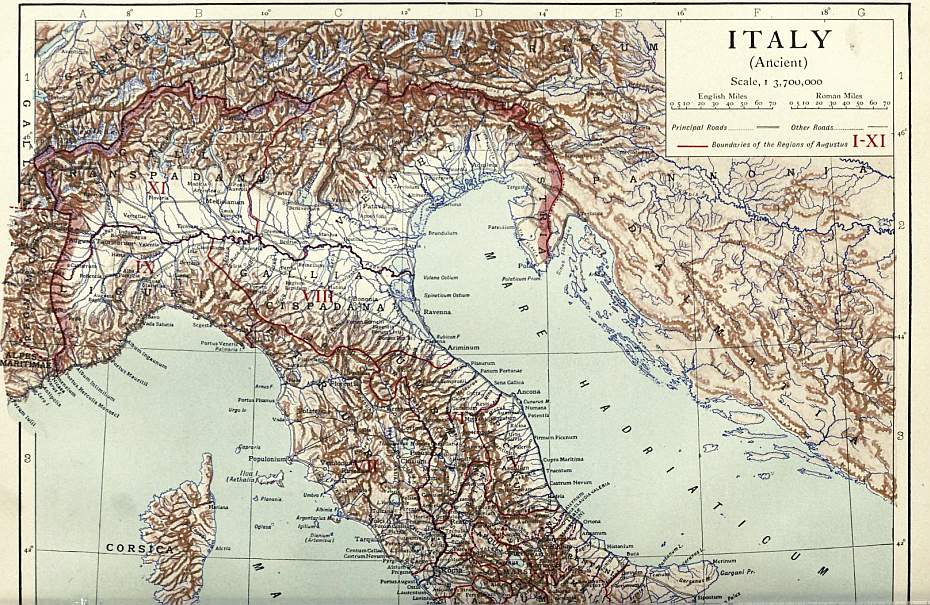
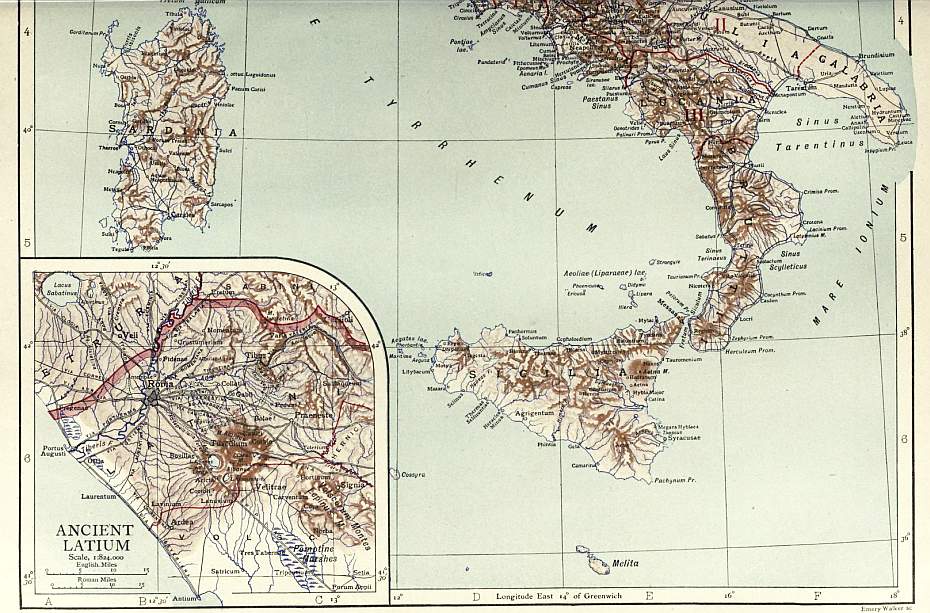
(Click to enlarge top section.)
(Click to enlarge bottom section.)
The ninth region comprised Liguria, extending along the sea-coast from the Varus to the Macra, and inland as far as the river Padus, which constituted its northern boundary from its source in Mount Vesulus to its confluence with the Trebia just above Placentia.
The tenth region included Venetia from the Padus and Adriatic to the Alps, to which was annexed the neighbouring peninsula of Istria, and to the west the territory of the Cenomani, a Gaulish tribe, extending from the Athesis to the Addua, which had previously been regarded as a part of Gallia Cisalpina.
The eleventh region, known as Gallia Transpadana, included all the rest of Cisalpine Gaul from the Padus on the south and the Addua on the east to the foot of the Alps.
The arrangements thus established by Augustus continued almost unchanged till the time of Constantine, and formed the basis of all subsequent administrative divisions until the fall of the Western empire.
The mainstay of the Roman military control of Italy first, and of the whole empire afterwards, was the splendid system of roads. As the supremacy of Rome extended itself over Italy, the Roman road system grew step by step, Roads. each fresh conquest being marked by the pushing forward of roads through the heart of the newly-won territory, and the establishment of fortresses in connexion with them. It was in Italy that the military value of a network of roads was first appreciated by the Romans, and the lesson stood them in good stead in the provinces. And it was for military reasons that from mere cart-tracks they were developed into permanent highways (T. Ashby, in Papers of the British School at Rome, i. 129). From Rome itself roads radiated in all directions. Communications with the south-east were mainly provided by the Via Appia (the “queen of Roman roads,” as Statius called it) and the Via Latina, which met close to Casilinum, at the crossing of the Volturnus, 3 m. N.W. of Capua, the second city in Italy in the 3rd century B.C., and the centre of the road system of Campania. Here the Via Appia turned eastward towards Beneventum, while the Via Popilia continued in a south-easterly direction through the Campanian plain and thence southwards through the mountains of Lucania and Bruttii as far as Rhegium. Coast roads of minor importance as means of through communication also existed on both sides of the “toe” of the boot. Other roads ran south from Capua to Cumae, Puteoli (the most important harbour of Campania), and Neapolis, which could also be reached by a coast road from Minturnae on the Via Appia. From Beneventum, another important road centre, the Via Appia itself ran south-east through the mountains past Venusia to Tarentum on the south-west coast of the “heel,” and thence across Calabria to Brundusium, while Trajan’s correction of it, following an older mule-track, ran north-east through the mountains and then through the lower ground of Apulia, reaching the coast at Barium. Both met at Brundusium, the principal port for the East. From Aequum Tuticum, on the Via Traiana, the Via Herculia ran to the south-east, crossing the older Via Appia, then south to Potentia and so on to join the Via Popilia in the centre of Lucania.