VOLUME XV SLICE I Italy to Jacobite Church (continued 10)
Reading edition
Prehistoric Ivory Carvings.—These are the result of investigations made about the middle of the 19th century in the cave dwellings of the Dordogne in France and also of the lake dwellings of Switzerland. As records they are unique in the history of art. Further than this our wonderment is excited at finding these engravings or sculptures in the round, these chiselled examples of the art of the uncultivated savage, conceived and executed with a feeling of delicacy and restraint which the most modern artist might envy. Who they were who executed them must be left to the palaeontologist and geologist to decide. We can only be certain that they were contemporary with the period when the mammoth and the reindeer still roved freely in southern France. The most important examples are the sketch of the mammoth (see Painting, Plate I.), on a slab of ivory now in the museum of the Jardin des Plantes, the head and shoulders of an ibex carved in the round on a piece of reindeer horn, and the figure of a woman (instances of representations of the human form are most rare) naked and wearing a necklace and bracelet. Many of the originals are in the museum at St Germain-en-Laye, and casts of a considerable number are in the British Museum.
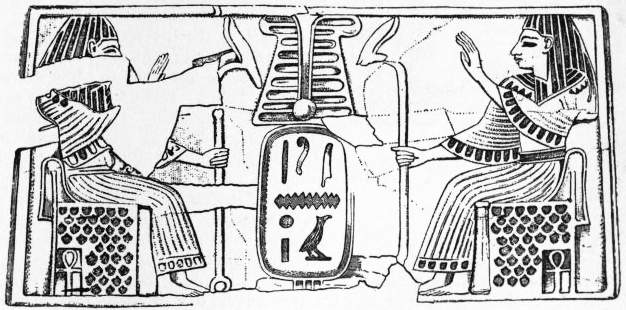
Fig. 3.—Panel with Cartouche, Nineveh.
Ancient Assyrian, Egyptian, Greek and Roman Ivories.—We know from ancient writers that the Egyptians were skilled in ivory carving and that they procured ivory in large quantities from Ethiopia. The Louvre possesses examples of a kind of flat castanets or clappers, in the form of the curve of the tusks themselves, engraved in outline, beautifully modelled hands forming the tapering points; and large quantities of small objects, including a box of plain form and simple decoration identified from the inscribed praenomen as the fifth dynasty, about 4000 B.C. The British Museum and the museum at Cairo are also comparatively rich. But no other collection in the world contains such an interesting collection of ancient Assyrian ivories as that in the British Museum. Those exhibited number some fifty important pieces, and many other fragments are, on account of their fragility or state of decay, stowed away. The collection is the result of the excavations by Layard about 1840 on the supposed site of Nineveh opposite the modern city of Mosul. When found they were so decomposed from the lapse of time as scarcely to bear touching or the contact of the external air. Layard hit upon the ingenious plan of boiling in a solution of gelatine and thus restoring to them the animal matter which had dried up in the course of centuries. Later, the explorations of Flinders Petrie and others at Abydos brought to light a considerable number of sculptured fragments which may be even two thousand years older than those of Nineveh. They have been exhibited in London and since distributed amongst various museums at home and abroad.
From photo by W. A. Mansell & Co.
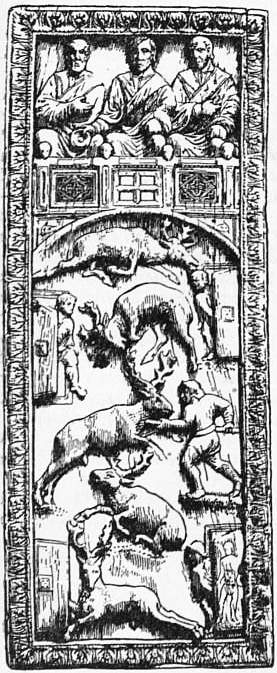
Fig. 4.—Leaf of diptych showing combats with stags; in the Liverpool Museum.
Consular and Official and Private Diptychs.—About fifty of the remarkable plaques called “consular diptychs,” of the time of the three last centuries of the consulates of the Roman and Greek empire have been preserved. They range in date from perhaps mid-fourth to mid-sixth centuries, and as with two or three exceptions the dates are certain it would be difficult to overestimate their historic or intrinsic value. The earliest of absolutely certain date is the diptych of Aosta (A.D. 408), the first after the recognition of Christianity; or, if the Monza diptych represents, as some think, the Consul Stilicon, then we may refer back six years earlier. At any rate the edict of Theodosius in A.D. 384, concerning the restriction of the use of ivory to the diptychs of the regular consuls, is evidence that the custom must have been long established. According to some authorities the beautiful leaf of diptych in the Liverpool Museum (fig. 4) is a consular one and to be ascribed to Marcus Julius Philippus (A.D. 248). Similarly the Gherardesca leaf in the British Museum may be accepted as of the Consul Marcus Aurelius (A.D. 308). But the whole question of the half dozen earliest examples is conjectural. With a few notable exceptions they show decadence in art. Amongst the finest may be cited the leaf with the combats with stags at Liverpool, the diptych of Probianus at Berlin and the two leaves, one of Anastasius, the other of Orestes, in the Victoria and Albert Museum. The literature concerning these diptychs is voluminous, from the time of the erudite treatise by Gori published in 1759 to the present day. The latest of certain date is that of Basilius, consul of the East in 541, the last of the consuls. The diptychs of private individuals or of officials number about sixteen, and in the case of the private ones have a far greater artistic value. Of these the Victoria and Albert Museum possesses the most beautiful leaf of perhaps the finest example of ancient ivory sculpture which has come down to us, diptychon Meleretense, representing a Bacchante (fig. 5). The other half, which is much injured, is in the Cluny Museum. Other important pieces are the Aesculapius and Hygeia at Liverpool, the Hippolytus and Phaedra at Brescia, the Barberini in the Bargello and at Vienna and the Rufius Probianus at Berlin. Besides the diptychs ancient Greek and Roman ivories before the recognition of Christianity are comparatively small in number and are mostly in the great museums of the Vatican, Naples, the British Museum, the Louvre and the Cluny Museum. Amongst them are the statuette of Penthea, perhaps of the 3rd century (Cluny), a large head of a woman (museum of Vienna) and the Bellerophon (British Museum), nor must those of the Roman occupation in England and other countries be forgotten. Notable instances are the plaque and ivory mask found at Caerleon. Others are now in the Guildhall and British Museums, and most continental European museums have examples connected with their own history.
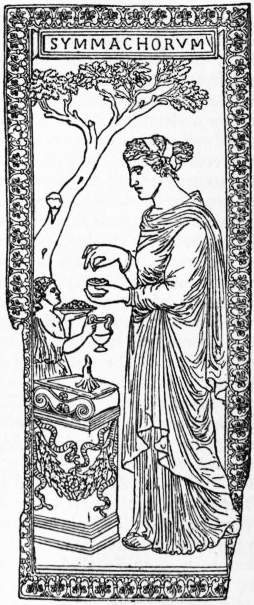
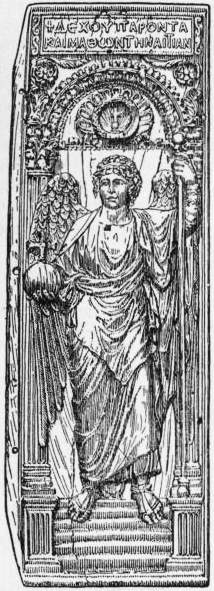
Fig. 5.—Leaf of Roman diptych, representing a Bacchante; in the Victoria and Albert Museum. From photo by W. A. Mansell & Co.
Fig. 6.—Leaf of Diptych, representing Archangel; in the British Museum.
Early Christian and Early Byzantine Ivories.—The few examples we possess of Christian ivories previous to the time of Constantine are not of great importance from the point of view of the history of art. But after that date the ivories which we may ascribe to the centuries from the end of the 4th to at least the end of the 9th become of considerable interest, on account of their connexion with the development of Byzantine art in western Europe. With regard to exact origins and dates opinions are largely divergent. In great part they are due to the carrying on of traditions and styles by which the makers of the sarcophagi were inspired, and the difficulties of ascription are increased when in addition to the primitive elements the influence of Byzantine systems introduced many new ideas derived from many extraneous sources. The questions involved are of no small archaeological, iconographical and artistic importance, but it must be admitted that we are reduced to conjecture in many cases, and compelled to theorize. And it would seem to be impossible to be more precise as to dates than within a margin of sometimes three centuries. Then, again, we are met by the question how far these ivories are connected with Byzantine art; whether they were made in the West by immigrant Greeks, or indigenous works, or purely imported productions. Some German critics have endeavoured to construct a system of schools, and to form definite groups, assigning them to Rome, Ravenna, Milan and Monza. Not only so, but they claim to be precise in dating even to a certain decade of a century. But it is certainly more than doubtful whether there is sufficient evidence on which to found such assumptions. It is at least probable that a considerable number of the ivories whose dates are given by such a number of critics so wide a range as from the 4th to the 10th century are nothing more than the work of the monks of the numerous monasteries founded throughout the Carlovingian empire, copying and adapting from whatever came into their hands. Many of them were Greek immigrants exiled at the time of the iconoclastic persecutions. To these must be added the Celtic and Anglo-Saxon missionaries, who brought with them and disseminated their own national feeling and technique. We have to take into account also the relations which existed not only with Constantinople but also with the great governing provinces of Syria and Egypt. Where all our information is so vague, and in the face of so much conflicting opinion amongst authorities, it is not unreasonable to hold with regard to very many of these ivories that instead of assigning them to the age of Justinian or even the preceding century we ought rather to postpone their dating from one to perhaps three centuries later and to admit that we cannot be precise even within these limits. It would be impossible to follow here the whole of the arguments relating to this most important period of the development of ivory sculpture or to mention a tithe of the examples which illustrate it. Amongst the most striking the earliest is the very celebrated leaf of a diptych in the British Museum representing an archangel (fig. 6). It is generally admitted that we have no ivory of the 5th or 6th centuries or in fact of any early medieval period which can compare with it in excellence of design and workmanship. There is no record (it is believed) from whence the museum obtained the ivory. There are at least plausible grounds for surmising that it is identical with the “Angelus longus eburneus” of a book-cover among the books brought to England by St Augustine which is mentioned in a list of things belonging to Christchurch, Canterbury (see Dart, App. p. xviii.). The dating of the four Passion plaques, also in the British Museum, varies from the 5th to the 7th century. But although most recent authorities accept the earlier date, the present writer holds strongly that they are not anterior to, at earliest, the 7th century. Even then they will remain, with the exception of the Monza oil flask and perhaps the St Sabina doors, the earliest known representation of the crucifixion. The ivory vase, with cover, in the British Museum, appears to possess defined elements of the farther East, due perhaps to the relations between Syria and Christian India or Ceylon. Other important early Christian ivories are the series of pyxes, the diptych in the treasury of St Ambrogio at Milan, the chair of Maximian at Ravenna (most important as a type piece), the panel with the “Ascension” in the Bavarian National Museum, the Brescia casket, the “Lorsch” bookcovers of the Vatican and Victoria and Albert Museum, the Bodleian and other bookcovers, the St Paul diptych in the Bargello at Florence and the “Annunciation” plaque in the Trivulzio collection. So far as unquestionably oriental specimens of Byzantine art are concerned they are few in number, but we have in the famous Harbaville triptych in the Louvre a super-excellent example.
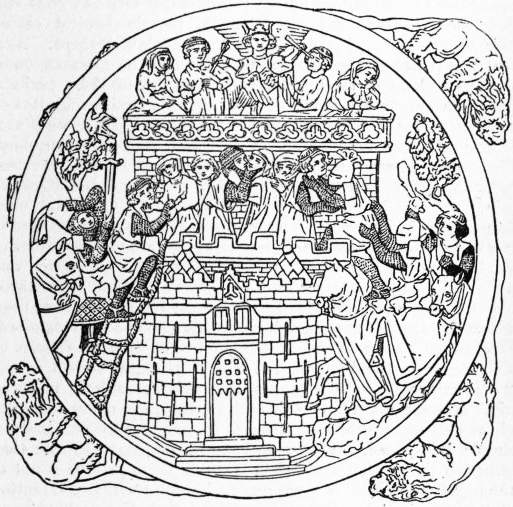
Fig. 7.—Mirror Case, illustrating the Storming of the Castle of Love; in the Victoria and Albert Museum.
Gothic Ivories.—The most generally charming period of ivory sculpture is unquestionably that which, coincident with the Gothic revival in art, marked the beginning of a great and lasting change. The formalism imposed by Byzantine traditions gave place to a brighter, more delicate and tenderer conception. This golden age of the ivory carver—at its best in the 13th century—was still in evidence during the 14th, and although there is the beginning of a transition in style in the 15th century, the period of neglect and decadence which set in about the beginning of the 16th hardly reached the acute stage until well on into the 17th. To review the various developments both of religious art which reigned almost alone until the 14th century, or of the secular side as exemplified in the delightful mirror cases and caskets carved with subjects from the romantic stories which were so popular, would be impossible here. Almost every great museum and famous private collection abounds in examples of the well-known diptychs and triptychs and little portable oratories of this period. Some, as in a famous panel in the British Museum, are marvels of minute workmanship, others of delicate openwork and tracery. Others, again, are remarkable for the wonderful way in which, in the compass of a few inches, whole histories and episodes of the scriptural narratives are expressed in the most vivid and telling manner. Charming above all are the statuettes of the Virgin and Child which French and Flemish art, especially, have handed down to us. Of these the Victoria and Albert Museum possesses a representative collection. Another series of interest is that of the croziers or pastoral staves, the development of which the student of ivories will be careful to study in connexion with the earlier ones and the tau-headed staves. In addition there are shrines, reliquaries, bookcovers, liturgical combs, portable altars, pyxes, holy water buckets and sprinklers, flabella or liturgical fans, rosaries, memento mori, paxes, small figures and groups, and almost every conceivable adjunct of the sanctuary or for private devotion. It is to French or Flemish art that the greater number and the most beautiful must be referred. At the same time, to take one example only—the diptych and triptych of Bishop Grandison in the British Museum—we have evidence that English ivory carvers were capable of rare excellence of design and workmanship. Nor can crucifixes be forgotten, though they are of extreme rarity before the 17th century. A most beautiful 13th-century figure for one—though only a fragment—is in the Victoria and Albert Museum. Amongst secular objects of this period, besides the mirror cases (fig. 7) and caskets, there are hunting horns (the earlier ones probably oriental, or more or less faithfully copied from oriental models), chess and draughtsmen (especially the curious set from the isle of Lewis), combs, marriage coffers (at one period remarkable Italian ones of bone), memorandum tablets, seals, the pommels and cantles of saddles and a unique harp now in the Louvre. The above enumeration will alone suffice to show that the inquirer must be referred for details to the numerous works which treat of medieval ivory sculpture.
Ivory Sculpture from the 16th to the 19th Century.—Compared with the wealth of ivory carving of the two preceding centuries, the 15th, and especially the 16th, centuries are singularly poor in really fine work. But before we arrive at the period of real decadence we shall come across such things as the knife of Diana of Poitiers in the Louvre, the sceptre of Louis XIII., the Rothschild hunting horn, many Italian powder horns, the German Psyche in the Louvre, or the “Young Girl and Death” in the Munich Museum, in which there is undoubtedly originality and talent of the first order. The practice of ivory carving became extremely popular throughout the 17th and 18th centuries, especially in the Netherlands and in Germany, and the amount of ivory consumed must have been very great. But, with rare exceptions, and these for the most part Flemish, it is art of an inferior kind, which seems to have been abandoned to second-rate sculptors and the artisans of the workshop. There is little originality, the rococo styles run riot, and we seem to be condemned to wade through an interminable series of gods and goddesses, bacchanalians and satyrs, pseudo-classical copies from the antique and imitations of the schools of Rubens. As a matter of fact few great museums, except the German ones, care to include in their collections examples of these periods. Some exceptions are made in the case of Flemish sculptors of such talent as François Duquesnoy (Fiammingo), Gerard van Obstal or Lucas Fayd’herbe. In a lesser degree, in Germany, Christoph Angermair, Leonhard Kern, Bernhard Strauss, Elhafen, Kruger and Rauchmiller; and, in France, Jean Guillermin, David le Marchand and Jean Cavalier. Crucifixes were turned out in enormous numbers, some of not inconsiderable merit, but, for the most part, they represent anatomical exercises varying but slightly from a pattern of which a celebrated one attributed to Faistenberger may be taken as a type. Tankards abound, and some, notably the one in the Jones collection, than which perhaps no finer example exists, are also of a high standard. Duquesnoy’s work is well illustrated by the charming series of six plaques in the Victoria and Albert Museum known as the “Fiammingo boys.” Amongst the crowd of objects in ivory of all descriptions of the early 18th century, the many examples of the curious implements known as rappoirs, or tobacco graters, should be noticed. It may perhaps be necessary to add that although the character of art in ivory in these periods is not of the highest, the subject is not one entirely unworthy of attention and study, and there are a certain number of remarkable and even admirable examples.
Ivory Sculpture of Spain, Portugal, India, China and Japan.—Generally speaking, with regard to Spain and Portugal, there is little reason to do otherwise than confine our attention to a certain class of important Moorish or Hispano-Moresque ivories of the time of the Arab occupation of the Peninsula, from the 8th to the 15th centuries. Some fine examples are in the Victoria and Albert Museum. Of Portuguese work there is little except the hybrid productions of Goa and the Portuguese settlements in the East. Some mention must be made also of the remarkable examples of mixed Portuguese and savage art from Benin, now in the British Museum. Of Indian ivory carving the India Museum at Kensington supplies a very large and varied collection which has no equal elsewhere. But there is little older than the 17th century, nor can it be said that Indian art in ivory can occupy a very high place in the history of the art. What we know of Chinese carving in ivory is confined to those examples which are turned out for the European market, and can hardly be considered as appealing very strongly to cultivated tastes. A brief reference to the well-known delightful netsukés and the characteristic inlaid work must suffice here for the ivories of Japan (see Japan: Art).
Ivory Sculpture in the 19th Century and of the Present Day.—Few people are aware of the extent to which modern ivory sculpture is practised by distinguished artists. Year by year, however, a certain amount is exhibited in the Royal Academy and in most foreign salons, but in England the works—necessarily not very numerous—are soon absorbed in private collections. On the European continent, on the contrary, in such galleries as the Belgian state collections or the Luxembourg, examples are frequently acquired and exhibited. In Belgium the acquisition of the Congo and the considerable import of ivory therefrom gave encouragement to a definite revival of the art. Important exhibitions have been held in Belgium, and a notable one in Paris in 1904. Though ivory carving is as expensive as marble sculpture, all sculptors delight in following it, and the material entails no special knowledge or training. Of 19th-century artists there were in France amongst the best known, besides numerous minor workers of Dieppe and St Claude, Augustin Moreau, Vautier, Soitoux, Belleteste, Meugniot, Pradier, Triqueti and Gerôme; and in the first decade of the 20th century, besides such distinguished names in the first rank as Jean Dampt and Théodore Rivière, there were Vever, Gardet, Caron, Barrias, Allouard, Ferrary and many others. Nor must the decorative work of René Lalique be omitted. No less than forty Belgian sculptors exhibited work in ivory at the Brussels exhibition of 1887. The list included artists of such distinction as J. Dillens, Constantin Meunier, van der Stappen, Khnopff, P. Wolfers, Samuel and Paul de Vigne, and amongst contemporary Belgian sculptors are also van Beurden, G. Devreese, Vincotte, de Tombay and Lagae. In England the most notable work includes the “Lamia” of George Frampton, the “St Elizabeth” of Alfred Gilbert, the “Mors Janua Vitae” of Harry Bates, the “Launcelot” of W. Reynolds-Stephens and the use of ivory in the applied arts by Lynn Jenkins, A. G. Walker, Alexander Fisher and others.
Authorities.—See generally A. Maskell, Ivories (1906), and the bibliography there given.
On Early Christian and Early Byzantine ivories, the following works may be mentioned: Abbé Cabrol, Dictionnaire de l’archéologie chrétienne (in progress); O. M. Dalton, Catalogue of Early Christian Antiquities in British Museum (1902); E. Dobbert, Zur Geschichte der Elfenbeinsculptur (1885); H. Graeven, Antike Schnitzereien (1903); R. Kanzler, Gli avori ... Vaticana (1903); Kondakov, L’Art byzantin; A. Maskell, Cantor Lectures, Soc. of Arts (1906) (lecture II., “Early Christian and Early Byzantine Ivories”); Strzygowski, Byzantinische Denkmäler (1891); V. Schulze, Archäologie der altchristlichen Kunst (1895); G. Stuhlfauth, Die altchristl. Elfenbeinplastik (1896).
On the consular diptychs, see H. F. Clinton, Fasti Romani (1845-1850); A. Gori, Thesaurus veterum diptychorum (1759); C. Lenormant, Trésor de numismatique et de glyptique (1834-1846); F. Pulszky, Catalogue of the Féjérváry Ivories (1856).
On the artistic interest generally, see also C. Alabaster, Catalogue of Chinese Objects in the South Kensington Museum; Sir R. Alcock, Art and Art Industries in Japan (1878); Barraud et Martin, Le Bâton pastoral (1856); Bouchot, Les Reliures d’art à la Bibliothèque Nationale; Bretagne, Sur les peignes liturgiques; H. Cole, Indian Art at Delhi (1904); R. Garrucci, Storia dell’ arte Christiana (1881); A. Jacquemart, Histoire du mobilier (1876); J. Labarte, Histoire des arts industriels (1864); C. Lind, Über den Krummstab (1863); Sir F. Madden, “Lewis Chessmen” (in Archaeologia, vol. xxiv. 1832); W. Maskell, Ivories, Ancient and Medieval in the South Kensington Museum (1872); A. Michel, Histoire de l’art; E. Molinier, Histoire générale des arts (1896); E. Oldfield, Catalogue of Fictile Ivories sold by the Arundel Society (1855); A. H. Pitt Rivers, Antique Works of Art from Benin (1900); A. C. Quatremère de Quincy, Le Jupiter Olympien (1815); Charles Scherer, Elfenbeinplastik seit der Renaissance (1903); E. du Sommerard, Les Arts au moyen âge (1838-1846); G. Stephens, Runic Caskets (1866-1868); A. Venturi, Storia dell’ arte Italiana (1901); Sir G. Watt, Indian Art at Delhi (1904); J. O. Westwood, Fictile Ivories in the South Kensington Museum (1876). Sir M. D. Wyatt, Notices of Sculpture in Ivory (1856).
(A. Ml.)
1 Lecture before the Society of Arts (1856).

IVORY COAST (Côte d’Ivoire), a French West African colony, bounded S. by the Gulf of Guinea, W. by Liberia and French Guinea, N. by the colony of Upper Senegal and Niger, E. by the Gold Coast. Its area is approximately 120,000 sq. m., and its population possibly 2,000,000, of whom some 600 are Europeans. Official estimates (1908) placed the native population as low as 980,000.
Physical Features.—The coast-line extends from 70° 30′ to 3° 7′ W. and has a length of 380 m. It forms an arc of a circle of which the convexity turns slightly to the north; neither bay nor promontory breaks the regularity of its outline. The shore is low, bordered in its eastern half with lagoons, and difficult of access on account of the submarine bar of sand which stretches along nearly the whole of the coast, and also because of the heavy surf caused by the great Atlantic billows. The principal lagoons, going W. to E. are those of Grand Lahou, Grand Bassam or Ebrié and Assini. The coast plains extend inland about 40 m. Beyond the ground rises in steep slopes to a general level of over 1000 ft., the plateau being traversed in several directions by hills rising 2000 ft. and over, and cut by valleys with a general south-eastern trend. In the north-east, in the district of Kong (q.v.), the country becomes mountainous, Mt. Kommono attaining a height of 4757 ft. In the north-west, by the Liberian frontier, the mountains in the Gon region rise over 6000 ft. Starting from the Liberian frontier, the chief rivers are the Cavalla (or Kavalli), the San Pedro, the Sassandra (240 m. long), the Bandama (225 m.), formed by the White and the Red Bandama, the Komoe (360 m.) and the Bia. All these streams are interrupted by rapids as they descend from the highlands to the plain and are unnavigable by steamers save for a few miles from their mouths. The rivers named all drain to the Gulf of Guinea; the rivers in the extreme north of the colony belong to the Niger system, being affluents of the Bani or Mahel Balevel branch of that river. The watershed runs roughly from 9° N. in the west to 10° N. in the east, and is marked by a line of hills rising about 650 ft. above the level of the plateau. The climate is in general very hot and unhealthy, the rainfall being very heavy. In some parts of the plateau healthier conditions prevail. The fauna and flora are similar to those of the Gold Coast and Liberia. Primeval forest extends from the coast plains to about 8° N., covering nearly 50,000 sq. m.
Inhabitants.—The coast districts are inhabited by Negro tribes allied on the one hand to the Krumen (q.v.) and on the other to the people of Ashanti (q.v.). The Assinis are of Ashanti origin, and chiefly of the Ochin and Agni tribes. Farther west are found the “Jack-Jacks” and the “Kwa-Kwas,” sobriquets given respectively to the Aradian and Avikom by the early European traders. The Kwa-Kwa are said to be so called because their salutation “resembles the cry of a duck.” In the interior the Negro strain predominates but with an admixture of Hamitic or Berber blood. The tribes represented include Jamans, Wongaras and Mandingos (q.v.), some of whom are Moslems. The Mandingos have intermarried largely with the Bambara or Sienuf, an agricultural people of more than average intelligence widely spread over the country, of which they are considered to be the indigenous race. The Bambara themselves are perhaps only a distinct branch of the original Mandingo stock. The Baulé, who occupy the central part of the colony, are of Agni-Ashanti origin. The bulk of the inhabitants are fetish worshippers. On the northern confines of the great forest belt live races of cannibals, whose existence was first made known by Captain d’Ollone in 1899. In general the coast tribes are peaceful. They have the reputation of being neither industrious nor intelligent. The traders are chiefly Fanti, Sierra Leonians, Senegalese and Mandingos.
Towns.—The chief towns on the coast are Grand and Little Bassam, Jackville and Assini in the east and Grand Lahou, Sassandra and Tabu in the west. Grand and Little Bassam are built on the strip of sand which separates the Grand Bassam or Ebrié lagoon from the sea. This lagoon forms a commodious harbour, once the bar has been crossed. Grand Bassam is situated at the point where the lagoon and the river Komoe enter the sea and there is a minimum depth of 12 ft. of water over the bar. The town (pop. 5000, including about 100 Europeans) is the seat of the customs administration and of the judicial department, and is the largest centre for the trade of the colony. A wharf equipped with cranes extends beyond the surf line and the town is served by a light railway. It is notoriously unhealthy; yellow fever is endemic. Little Bassam, renamed by the French Port Bouet, possesses an advantage over the other ports on the coast, as at this point there is no bar. The sea floor is here rent by a chasm, known as the “Bottomless Pit,” the waters having a depth of 65 ft. Abijean (Abidjan), on the north side of the lagoon opposite Port Bouet is the starting-point of a railway to the oil and rubber regions. The half-mile of foreshore separating the port from the lagoon was in 1904-1907 pierced by a canal, but the canal silted up as soon as cut, and in 1908 the French decided to make Grand Bassam the chief port of the colony. Assini is an important centre for the rubber trade of Ashanti. On the northern shore of the Bassam lagoon, and 19 m. from Grand Bassam, is the capital of the colony, the native name Adjame having been changed into Bingerville, in honour of Captain L. G. Binger (see below). The town is built on a hill and is fairly healthy.
In the interior are several towns, though none of any size numerically. The best known are Koroko, Kong and Bona, entrepôts for the trade of the middle Niger, and Bontuku, on the caravan route to Sokoto and the meeting-place of the merchants from Kong and Timbuktu engaged in the kola-nut trade with Ashanti and the Gold Coast. Bontuku is peopled largely by Wongara and Hausa, and most of the inhabitants, who number some 3000, are Moslems. The town, which was founded in the 15th century or earlier, is walled, contains various mosques and generally presents the appearance of an eastern city.
Agriculture and Trade.—The natives cultivate maize, plantains, bananas, pineapples, limes, pepper, cotton, &c., and live easily on the products of their gardens, with occasional help from fishing and hunting. They also weave cloth, make pottery and smelt iron. Europeans introduced the cultivation of coffee, which gives good results. The forests are rich in palm-tree products, rubber and mahogany, which constitute the chief articles of export. The rubber goes almost exclusively to England, as does also the mahogany. The palm-oil and palm kernels are sent almost entirely to France. The value of the external trade of the colony exceeded £1,000,000 for the first time in 1904. About 50% of the trade is with Great Britain. The export of ivory, for which the country was formerly famous, has almost ceased, the elephants being largely driven out of the colony. Cotton goods, by far the most important of the imports, come almost entirely from Great Britain. Gold exists and many native villages have small “placer” mines. In 1901 the government of the colony began the granting of mining concessions, in which British capital was largely invested. There are many ancient mines in the country, disused since the close of the 18th century, if not earlier.
Communications.—The railway from Little Bassam serves the east central part of the colony and runs to Katiola, in Kong, a total distance of 250 m. The line is of metre gauge. The cutting of two canals, whereby communication is effected by lagoon between Assini and Grand Lahou via Bassam, followed the construction of the railway. Grand and Little Bassam are in regular communication by steamer with Bordeaux, Marseilles, Liverpool, Antwerp and Hamburg. Grand Bassam is connected with Europe by submarine cable via Dakar. Telegraph lines connect the coast with all the principal stations in the interior, with the Gold Coast, and with the other French colonies in West Africa.
Administration, &c.—The colony is under the general superintendence of the government general of French West Africa. At the head of the local administration is a lieutenant-governor, who is assisted by a council on which nominated unofficial members have seats. To a large extent the native forms of government are maintained under European administrators responsible for the preservation of order, the colony for this purpose being divided into a number of “circles” each with its local government. The colony has a separate budget and is self-supporting. Revenue is derived chiefly from customs receipts and a capitation tax of frs. 2.50 (2s.), instituted in 1901 and levied on all persons over ten years old. The budget for 1906 balanced at £120,400.
History.—The Ivory Coast is stated to have been visited by Dieppe merchants in the 14th century, and was made known by the Portuguese discoveries towards the end of the 15th century. It was thereafter frequented by traders for ivory, slaves and other commodities. There was a French settlement at Assini, 1700-1704, and a French factory was maintained at Grand Bassam from 1700 to 1707. In the early part of the 19th century several French traders had established themselves along the coast. In 1830 Admiral (then Commandant) Bouët-Willaumez (1808-1871) began a series of surveys and expeditions which yielded valuable results. In 1842 he obtained from the native chiefs cessions of territory at Assini and Grand Bassam to France and the towns named were occupied in 1843. From that time French influence gradually extended along the coast, but no attempt was made to penetrate inland. As one result of the Franco-Prussian War, France in 1872 withdrew her garrisons, handing over the care of the establishments to a merchant named Verdier, to whom an annual subsidy of £800 was paid. This merchant sent an agent into the interior who made friendly treaties between France and some of the native chiefs. In 1883, in view of the claims of other European powers to territory in Africa, France again took over the actual administration of Assini and Bassam. Between 1887 and 1889 Captain Binger (an officer of marine infantry, and subsequently director of the African department at the colonial ministry) traversed the whole region between the coast and the Niger, visited Bontuku and the Kong country, and signed protectorate treaties with the chiefs. The kingdom of Jaman, it may be mentioned, was for a few months included in the Gold Coast hinterland. In January 1889 a British mission sent by the governor of the Gold Coast concluded a treaty with the king of Jaman at Bontuku, placing his dominions under British protection. The king had, however, previously concluded treaties of “commerce and friendship” with the French, and by the Anglo-French agreement of August 1889 Jaman, with Bontuku, was recognized as French territory. In 1892 Captain Binger made further explorations in the interior of the Ivory Coast, and in 1893 he was appointed the first governor of the colony on its erection into an administration distinct from that of Senegal. Among other famous explorers who helped to make known the hinterland was Colonel (then Captain) Marchand. It was to the zone between the Kong states and the hinterland of Liberia that Samory (see Senegal) fled for refuge before he was taken prisoner (1898), and for a short time he was master of Kong. The boundary of the colony on the west was settled by Franco-Liberian agreements of 1892 and subsequent dates; that on the east by the Anglo-French agreements of 1893 and 1898. The northern boundary was fixed in 1899 on the division of the middle Niger territories (up to that date officially called the French Sudan) among the other French West African colonies. The systematic development of the colony, the opening up of the hinterland and the exploitation of its economic resources date from the appointment of Captain Binger as governor, a post he held for over three years. The work he began has been carried on zealously and effectively by subsequent governors, who have succeeded in winning the co-operation of the natives.
In the older books of travel are often found the alternative names for this region, Tooth Coast (Côte des Dents) or Kwa-Kwa Coast, and, less frequently, the Coast of the Five and Six Stripes (alluding to a kind of cotton fabric in favour with the natives). The term Côte des Dents continued in general use in France until the closing years of the 19th century.
See Dix ans à la Côte d’Ivoire (Paris, 1906) by F. J. Clozel, governor of the colony, and Notre colonie de la Côte d’Ivoire (Paris, 1903) by R. Villamur and Richaud. These two volumes deal with the history, geography, zoology and economic condition of the Ivory Coast. La Côte d’Ivoire by Michellet and Clement describes the administrative and land systems, &c. Another volume also called La Côte d’Ivoire (Paris, 1908) is an official monograph on the colony. For ethnology consult Coutumes indigènes de la Côte d’Ivoire (Paris, 1902) by F. J. Clozel and R. Villamur, and Les Coutumes Agni, by R. Villamur and Delafosse. Of books of travel see Du Niger au Golfe de Guinée par Kong (Paris, 1892) by L. G. Binger, and Mission Hostains-d’Ollone 1890-1900 (Paris, 1901) by Captain d’Ollone. A Carte de la Côte d’Ivoire by A. Meunier, on the scale of 1:500,000 (6 sheets), was published in Paris, 1905. Annual reports on the colony are published by the French colonial and the British foreign offices.
IVREA (anc. Eporedia), a town and episcopal see of Piedmont, Italy, in the province of Turin, from which it is 38 m. N.N.E. by rail and 27 m. direct, situated 770 ft. above sea-level, on the Dora Baltea at the point where it leaves the mountains. Pop. (1901) 6047 (town), 11,696 (commune). The cathedral was built between 973 and 1005; the gallery round the back of the apse and the crypt have plain cubical capitals of this period. The two campanili flanking the apse at each end of the side aisle are the oldest example of this architectural arrangement. The isolated tower, which is all that remains of the ancient abbey of S. Stefano, is slightly later. The hill above the town is crowned by the imposing Castello delle Quattro Torri, built in 1358, and now a prison. One of the four towers was destroyed by lightning in 1676. A tramway runs to Santhià.
The ancient Eporedia, standing at the junction of the roads from Augusta Taurinorum and Vercellae, at the point where the road to Augusta Praetoria enters the narrow valley of the Duria (Dora Baltea), was a military position of considerable importance belonging to the Salassi who inhabited the whole upper valley of the Duria. The importance of the gold-mines of the district led to its seizure by the Romans in 143 B.C. The centre of the mining industry seems to have been Victumulae (see Ticinum), until in 100 B.C. a colony of Roman citizens was founded at Eporedia itself; but the prosperity of this was only assured when the Salassi were finally defeated in 25 B.C. and Augusta Praetoria founded. There are remains of a theatre of the time of the Antonines and the Ponte Vecchio rests on Roman foundations.
In the middle ages Ivrea was the capital of a Lombard duchy, and later of a marquisate; both Berengar II. (950) and Arduin (1002) became kings of Italy for a short period. Later it submitted to the marquises of Monferrato, and in the middle of the 14th century passed to the house of Savoy.
(T. As.)
IVRY-SUR-SEINE, a town of northern France, in the department of Seine, near the left bank of the Seine, less than 1 m. S.S.E. of the fortifications of Paris. Pop. (1906) 30,532. Ivry has a large hospital for incurables. It manufactures organs, earthenware, wall-paper and rubber, and has engineering works, breweries, and oil-works, its trade being facilitated by a port on the Seine. The town is dominated by a fort of the older line of defence of Paris.
IVY (A.S. ifig, Ger. Epheu, perhaps connected with apium, ἄπιον), the collective designation of certain species and varieties of Hedera, a member of the natural order Araliaceae. There are fifty species of ivy recorded in modern books, but they may be reduced to two, or at the most, three. The European ivy, Hedera Helix (fig. 1), is a plant subject to infinite variety in the forms and colours of its leaves, but the tendency of which is always to a three- to five-lobed form when climbing and a regular ovate form of leaf when producing flower and fruit. The African ivy, H. canariensis, often regarded as a variety of H. Helix and known as the Irish ivy, is a native of North Africa and the adjacent islands. It is the common large-leaved climbing ivy, and also varies, but in a less degree than H. Helix, from which its leaves differ in their larger size, rich deep green colour, and a prevailing tendency to a five-lobed outline. When in fruit the leaves are usually three-lobed, but they are sometimes entire and broadly ovate. The Asiatic ivy, H. colchica (fig. 2), now considered to be a form of H. Helix, has ovate, obscurely three-lobed leaves of a coriaceous texture and a deep green colour; in the tree or fruiting form the leaves are narrower than in the climbing form, and without any trace of lobes. Distinctive characters are also to be found in the appendages of the pedicels and calyx, H. Helix having six-rayed stellate hairs, H. canariensis fifteen-rayed hairs and H. colchica yellowish two-lobed scales.
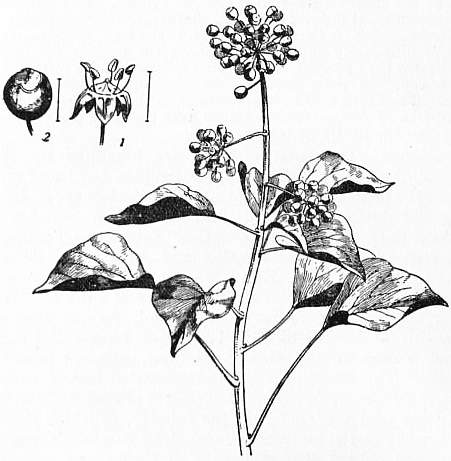
Fig. 1.—Ivy (Hedera Helix) fruiting branch. 1. Flower. 2. Fruit.
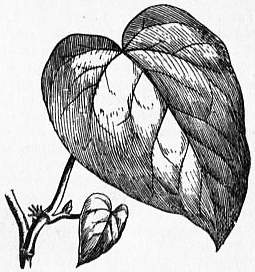
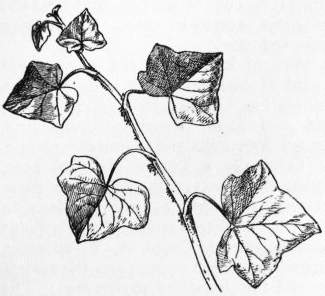
Fig. 2.—Hedera colchica. Fig. 3.—Climbing Shoot of Ivy.
The Australian ivy, H. australiana, is a small glabrous shrub with pinnate leaves. It is a native of Queensland, and is practically unknown in cultivation.
It is of the utmost importance to note the difference of characters of the same species of ivy in its two conditions of climbing and fruiting. The first stage of growth, which we will suppose to be from the seed, is essentially scandent, and the leaves are lobed more or less. This stage is accompanied with a plentiful production of the claspers or modified roots by means of which the plant becomes attached and obtains support. When it has reached the summit of the tree or tower, the stems, being no longer able to maintain a perpendicular attitude, fall over and become horizontal or pendent. Coincidently with this change they cease to produce claspers, and the leaves are strikingly modified in form, being now narrower and less lobed than on the ascending stems. In due time this tree-like growth produces terminal umbels of greenish flowers, which have the parts in fives, with the styles united into a very short one. These flowers are succeeded by smooth black or yellow berries, containing two to five seeds. The yellow-berried ivy is met with in northern India and in Italy, but in northern Europe it is known only as a curiosity of the garden, where, if sufficiently sheltered and nourished, it becomes an exceedingly beautiful and fruitful tree.
It is stated in books that some forms of sylvestral ivy never flower, but a negative declaration of this kind is valueless. Sylvestral ivies of great age may be found in woods on the western coasts of Britain that have apparently never flowered, but this is probably to be explained by their inability to surmount the trees supporting them, for until the plant can spread its branches horizontally in full daylight, the flowering or tree-like growth is never formed.
A question of great practical importance arises out of the relation of the plant to its means of support. A moderate growth of ivy is not injurious to trees; still the tendency is from the first inimical to the prosperity of the tree, and at a certain stage it becomes deadly. Therefore the growth of ivy on trees should be kept within reasonable bounds, more especially in the case of trees that are of special value for their beauty, history, or the quality of their timber. In regard to buildings clothed with ivy, there is nothing to be feared so long as the plant does not penetrate the substance of the wall by means of any fissure. Should it thrust its way in, the natural and continuous expansion of its several parts will necessarily hasten the decay of the edifice. But a fair growth of ivy on sound walls that afford no entrance beyond the superficial attachment of the claspers is, without any exception whatever, beneficial. It promotes dryness and warmth, reduces to a minimum the corrosive action of the atmosphere, and is altogether as conservative as it is beautiful.
The economical uses of the ivy are not of great importance. The leaves are eaten greedily by horses, deer, cattle and sheep, and in times of scarcity have proved useful. The flowers afford a good supply of honey to bees; and, as they appear in autumn, they occasionally make amends for the shortcomings of the season. The berries are eaten by wood pigeons, blackbirds and thrushes. From all parts of the plant a balsamic bitter may be obtained, and this in the form of hederic acid is the only preparation of ivy known to chemists.
In the garden the uses of the ivy are innumerable, and the least known though not the least valuable of them is the cultivation of the plant as a bush or tree, the fruiting growth being selected for this purpose. The variegated tree forms of H. Helix, with leaves of creamy white, golden green or rich deep orange yellow, soon prove handsome miniature trees, that thrive almost as well in smoky town gardens as in the pure air of the country, and that no ordinary winter will injure in the least. The tree-form of the Asiatic ivy (H. colchica) is scarcely to be equalled in beauty of leafage by any evergreen shrub known to English gardens, and, although in the course of a few years it will attain to a stature of 5 or 6 ft., it is but rarely we meet with it, or indeed with tree ivies of any kind, but little attention having been given to this subject until recent years. The scandent forms are more generally appreciated, and are now much employed in the formation of marginal lines, screens and trained pyramids, as well as for clothing walls. A very striking example of the capabilities of the commonest ivies, when treated artistically as garden plants, may be seen in the Zoological Gardens of Amsterdam, where several paddocks are enclosed with wreaths, garlands and bands of ivy in a most picturesque manner.
About sixty varieties known in gardens are figured and described in The Ivy, a Monograph, by Shirley Hibberd (1872). To cultivate these is an extremely simple matter, as they will thrive in a poor soil and endure a considerable depth of shade, so that they may with advantage be planted under trees. The common Irish ivy is often to be seen clothing the ground beneath large yew trees where grass would not live, and it is occasionally planted in graveyards in London to form an imitation of grass turf, for which purpose it is admirably suited.
The ivy, like the holly, is a scarce plant on the American continent. In the northern United States and British America the winters are not more severe than the ivy can endure, but the summers are too hot and dry, and the requirements of the plant have not often obtained attention. In districts where native ferns abound the ivy will be found to thrive, and the varieties of Hedera Helix should have the preference. But in the drier districts ivies might often be planted on the north side of buildings, and, if encouraged with water and careful training for three or four years, would then grow rapidly and train themselves. A strong light is detrimental to the growth of ivy, but this enhances its value, for we have no hardy plants that may be compared with it for variety and beauty that will endure shade with equal patience.
The North American poison ivy (poison oak), Rhus Toxicodendron (nat. order Anacardiaceae), is a climber with pinnately compound leaves, which are very attractive in their autumn colour but poisonous to the touch to some persons, while others can handle the plant without injury. The effects are redness and violent itching followed by fever and a vesicular eruption.
The ground ivy, Nepeta Glechoma (nat. order Labiatae), is a small creeping plant with rounded crenate leaves and small blue-purple flowers, occurring in hedges and thickets.
IWAKURA, TOMOMI, Prince (1835-1883), Japanese statesman, was born in Kiōto. He was one of the court nobles (kuge) of Japan, and he traced his descent to the emperor Murakami (A.D. 947-967). A man of profound ability and singular force of character, he acted a leading part in the complications preceding the fall of the Tokugawa shōgunate, and was obliged to fly from Kiōto accompanied by his coadjutor, Prince Sanjō. They took refuge with the Daimyō of Chōshū, and, while there, established relations which contributed greatly to the ultimate union of the two great fiefs, Satsuma and Chōshū, for the work of the Restoration. From 1867 until the day of his death Iwakura was one of the most prominent figures on the political stage. In 1871 he proceeded to America and Europe at the head of an imposing embassy of some fifty persons, the object being to explain to foreign governments the actual conditions existing in Japan, and to pave the way for negotiating new treaties consistent with her sovereign rights. Little success attended the mission. Returning to Japan in 1873, Iwakura found the cabinet divided as to the manner of dealing with Korea’s insulting attitude. He advocated peace, and his influence carried the day, thus removing a difficulty which, though apparently of minor dimensions, might have changed the whole course of Japan’s modern history.
IXION, in Greek legend, son of Phlegyas, king of the Lapithae in Thessaly (or of Ares), and husband of Dia. According to custom he promised his father-in-law, Deïoneus, a handsome bridal present, but treacherously murdered him when he claimed the fulfilment of the promise. As a punishment, Ixion was seized with madness, until Zeus purified him of his crime and admitted him as a guest to Olympus. Ixion abused his pardon by trying to seduce Hera; but the goddess substituted for herself a cloud, by which he became the father of the Centaurs. Zeus bound him on a fiery wheel, which rolls unceasingly through the air or (according to the later version) in the underworld (Pindar, Pythia, ii. 21; Ovid, Metam. iv. 461; Virgil, Aeneid, vi. 601). Ixion is generally taken to represent the eternally moving sun. Another explanation connects the story with the practice (among certain peoples of central Europe) of carrying a blazing, revolving wheel through fields which needed the heat of the sun, the legend being invented to explain the custom and subsequently adopted by the Greeks (see Mannhardt, Wald- und Feldkulte, ii. 1905, p. 83). In view of the fact that the oak was the sun-god’s tree and that the mistletoe grew upon it, it is suggested by A. B. Cook (Class. Rev. xvii. 420) that Ἰξίων is derived from ἰξός (mistletoe), the sun’s fire being regarded as an emanation from the mistletoe. Ixion himself is probably a by-form of Zeus (Usener in Rhein. Mus. liii. 345).
“The Myth of Ixion” (by C. Smith, in Classical Review, June 1895) deals with the subject of a red-figure cantharus in the British Museum.
IXTACCIHUATL, or Iztaccihuatl (“white woman”), a lofty mountain of volcanic origin, 10 m. N. of Popocatepetl and about 40 m. S.S.E of the city of Mexico, forming part of the short spur called the Sierra Nevada. According to Angelo Heilprin (1853-1907) its elevation is 16,960 ft.; other authorities make it much less. Its apparent height is dwarfed somewhat by its elongated summit and the large area covered. It has three summits of different heights standing on a north and south line, the central one being the largest and highest and all three rising above the permanent snow-line. As seen from the city of Mexico the three summits have the appearance of a shrouded human figure, hence the poetic Aztec appellation of “white woman” and the unsentimental Spanish designation “La mujer gorda.” The ascent is difficult and perilous, and is rarely accomplished.
Heilprin says that the mountain is largely composed of trachytic rocks and that it is older than Popocatepetl. It has no crater and no trace of lingering volcanic heat. It is surmised that its crater, if it ever had one, has been filled in and its cone worn away by erosion through long periods of time.
IYRCAE, an ancient nation on the north-east trade route described by Herodotus (iv. 22) beyond the Thyssagetae, somewhere about the upper basins of the Tobol and the Irtysh. They were distinguished by their mode of hunting, climbing a tree to survey their game, and then pursuing it with trained horses and dogs. They were almost certainly the ancestors of the modern Magyars, also called Jugra.
The reading Τῦρκαι is an anachronism, and when Pliny (N.H. vi. 19) and Mela (i. 116) speak of Tyrcae it is also probably due to a false correction.
(E. H. M.)
IZBARTA, or Sparta [anc. Baris], the chief town of the Hamid-abad sanjak of the Konia vilayet, in Asia Minor, well situated on the edge of a fertile plain at the foot of Aghlasun Dagh. It was once the capital of the Emirate of Hamid. It suffered severely from the earthquake of the 16th-17th of January 1889. It is a prosperous place with an enlightened Greek element in its population (hence the numerous families called “Spartali” in Levantine towns); and it is, in fact, the chief inland colony of Hellenism in Anatolia; Pop. 20,000 (Moslems 13,000, Christians 7000). The new Aidin railway extends from Dineir to Izbarta via Buldur.
IZHEVSK, a town of Russia, in the government of Vyatka, 140 m. S.W. of Perm and 22 m. W. from the Kama, on the Izh river. Pop. (1897) 21,500. It has one of the principal steel and rifle works of the Russian crown, started in 1807. The making of sporting guns is an active industry.
IZMAIL, or Ismail, a town of Russia, in the government of Bessarabia, on the left bank of the Kilia branch of the Danube, 35 m. below Reni railway station. Pop. (1866) 31,779, (1900) 33,607, comprising Great and Little Russians, Bulgarians, Jews and Gipsies. There are flour-mills and a trade in cereals, wool, tallow and hides. Originally a Turkish fortified post, Izmail had by the end of the 18th century grown into a place of 30,000 inhabitants. It was occupied by the Russians in 1770, and twenty years later its capture was one of the brilliant achievements of the Russian general, Count A. V. Suvarov. On that occasion the garrison was 40,000 strong, and the assault cost the assailants 10,000 and the defenders 30,000 men. The victory was the theme of one of the Russian poet G. R. Derzhavin’s odes. In 1809 the town was again captured by the Russians; and, when in 1812 it was assigned to them by the Bucharest peace, they chose it as the central station for their Danube fleet. It was about this time that the town of Tuchkov, with which it was later (1830) incorporated, grew up outside of the fortifications. These were dismantled in accordance with the treaty of Paris (1856), by which Izmail was made over to Rumania. The town was again transferred to Russia by the peace of Berlin (1878).
IZU-NO-SHICHI-TŌ, the seven (shichi) islands (to) of Izu, included in the empire of Japan. They stretch in a southerly direction from a point near the mouth of Tokyo Bay, and lie between 33° and 34° 48′ N. and between 139° and 140° E. Their names, beginning from the north, are Izu-no-Oshima, To-shima, Nii-shima, Kozu-shima, Miyake-shima and Hachijo-shima. There are some islets in their immediate vicinity. Izu-no-Oshima, an island 10 m. long and 5½ m. wide, is 15 m. from the nearest point of the Izu promontory. It is known to western cartographers as Vries Island, a name derived from that of Captain Martin Gerritsz de Vries, a Dutch navigator, who is supposed to have discovered the island in 1643. But the group was known to the Japanese from a remote period, and used as convict settlements certainly from the 12th century and probably from a still earlier era. Hachijo, the most southerly, is often erroneously written “Fatsisio” on English charts. Izu-no-Oshima is remarkable for its smoking volcano, Mihara-yama (2461 ft.), a conspicuous object to all ships bound for Yokohama. Three others of the islands—Nii-shima, Kozu-shima and Miyake-shima—have active volcanoes. Those on Nii-shima and Kozu-shima are of inconsiderable size, but that on Miyake-shima, namely, Oyama, rises to a height of 2707 ft. The most southerly island, Hachijo-shima, has a still higher peak, Dsubotake (2838 ft.), but it does not emit any smoke.
J A letter of the alphabet which, as far as form is concerned, is only a modification of the Latin I and dates back with a separate value only to the 15th century. It was first used as a special form of initial I, the ordinary form being kept for use in other positions. As, however, in many cases initial i had the consonantal value of the English y in iugum (yoke), &c., the symbol came to be used for the value of y, a value which it still retains in German: Ja! jung, &c. Initially it is pronounced in English as an affricate dzh. The great majority of English words beginning with j are (1) of foreign (mostly French) origin, as “jaundice,” “judge”; (2) imitative of sound, like “jar” (the verb); or (3) influenced by analogy, like “jaw” (influenced by chaw, according to Skeat). In early French g when palatalized by e or i sounds became confused with consonantal i (y), and both passed into the sound of j which is still preserved in English. A similar sound-change takes place in other languages, e.g. Lithuanian, where the resulting sound is spelt dž. Modern French and also Provençal and Portuguese have changed j = dzh into ž (zh). The sound initially is sometimes represented in English by g: gem, gaol as well as jail. At the end of modern English words the same sound is represented by -dge as in judge, French juge. In this position, however, the sound occurs also in genuine English words like bridge, sedge, singe, but this is true only for the southern dialects on which the literary language is founded. In the northern dialects the pronunciation as brig, seg, sing still survives.
(P. Gi.)
JA’ALIN (from Jā’al, to settle, i.e. “the squatters”), an African tribe of Semitic stock. They formerly occupied the country on both banks of the Nile from Khartum to Abu Hamed. They claim to be of the Koreish tribe and even trace descent from Abbas, uncle of the prophet. They are of Arab origin, but now of very mixed blood. According to their own tradition they emigrated to Nubia in the 12th century. They were at one time subject to the Funj kings, but their position was in a measure independent. At the Egyptian invasion in 1820 they were the most powerful of Arab tribes in the Nile valley. They submitted at first, but in 1822 rebelled and massacred the Egyptian garrison at Shendi. The revolt was mercilessly suppressed, and the Jā’alin were thenceforward looked on with suspicion. They were almost the first of the northern tribes to join the mahdi in 1884, and it was their position to the north of Khartum which made communication with General Gordon so difficult. The Jā’alin are now a semi-nomad agricultural people. Many are employed in Khartum as servants, scribes and watchmen. They are a proud religious people, formerly notorious as cruel slave dealers. J. L. Burckhardt says the true Jā’alin from the eastern desert is exactly like the Bedouin of eastern Arabia.
See The Anglo-Egyptian Sudan, edited by Count Gleichen (London, 1905).
JABIRU, according to Marcgrave the Brazilian name of a bird, subsequently called by Linnaeus Mycteria americana, one of the largest of the storks, Ciconiidae, which occurs from Mexico southwards to the territory of the Argentine Republic. It stands between 4 and 5 ft. in height, and is conspicuous for its massive bill, slightly upturned, and its entirely white plumage; but the head and neck are bare and black, except for about the lower third part of the latter, which is bright red in the living bird. Very nearly allied to Mycteria, and also commonly called jabirus, are the birds of the genera Xenorhynchus and Ephippiorhynchus—the former containing one or (in the opinion of some) two species, X. australis and X. indicus, and the latter one only, E. senegalensis. These belong to the countries indicated by their names, and differ chiefly by their feathered head and neck, while the last is sometimes termed the saddle-billed stork from the very singular shape of its beak. Somewhat more distantly related are the gigantic birds known to Europeans in India and elsewhere as adjutant birds, belonging to the genus Leptoptilus, distinguished by their sad-coloured plumage, their black scabrous head, and their enormous tawny pouch, which depends occasionally some 16 in. or more in length from the lower part of the neck, and seems to be connected with the respiratory and not, as commonly believed, with the digestive system. In many parts of India L. dubius, the largest of these birds, the hargila as Hindus call it, is a most efficient scavenger, sailing aloft at a vast height and descending on the discovery of offal, though frogs and fishes also form part of its diet. It familiarly enters the large towns, in many of which an account of its services it is strictly protected from injury, and, having satisfied its appetite, seeks the repose it has earned, sitting with its feet extended in front in a most grotesque attitude. A second and smaller species, L. javanicus, has a more southern and eastern range; while a third, L. crumenifer, of African origin, and often known as the marabou-stork, gives its name to the beautifully soft feathers so called, which are the under-tail-coverts; the “marabout” feathers of the plume-trade are mostly supplied by other birds, the term being apparently applied to any downy feathers.
(A. N.)
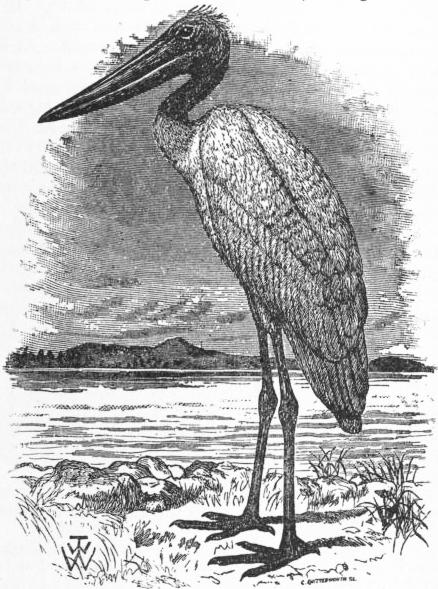
Jabiru.
JABLOCHKOV, PAUL (1847-1894), Russian electrical engineer and inventor, was born at Serdobsk, in the government of Saratov, on the 14th of September 1847, and educated at St Petersburg. In 1871 he was appointed director of the telegraph lines between Moscow and Kursk, but in 1875 he resigned his position in order to devote himself to his researches on electric lighting by arc lamps, which he had already taken up. In 1876 he settled in Paris, and towards the end of the year brought out his famous “candles,” known by his name, which consisted of two carbon parallel rods, separated by a non-conducting partition; alternating currents were employed, and the candle was operated by a high-resistance carbon match connecting the tips of the rods, a true arc forming between the parallel carbons when this burnt off, and the separators volatilizing as the carbons burnt away. For a few years his system of electric lighting was widely adopted, but it was gradually superseded (see Lighting: Electric) and is no longer in use. Jablochkov made various other electrical inventions, but he died in poverty, having returned to Russia on the 19th of March 1894.
JABLONSKI, DANIEL ERNST (1660-1741), German theologian, was born at Nassenhuben, near Danzig, on the 20th of November 1660. His father was a minister of the Moravian Church, who had taken the name of Peter Figulus on his baptism; the son, however, preferred the Bohemian family name of Jablonski. His maternal grandfather, Johann Amos Comenius (d. 1670), was a bishop of the Moravian Church. Having studied at Frankfort-on-the-Oder and at Oxford, Jablonski entered upon his career as a preacher at Magdeburg in 1683, and then from 1686 to 1691 he was the head of the Moravian college at Lissa, a position which had been filled by his grandfather. Still retaining his connexion with the Moravians, he was appointed court preacher at Königsberg in 1691 by the elector of Brandenburg, Frederick III., and here, entering upon a career of great activity, he soon became a person of influence in court circles. In 1693 he was transferred to Berlin as court preacher, and in 1699 he was consecrated a bishop of the Moravian Church. At Berlin Jablonski worked hard to bring about a union between the followers of Luther and those of Calvin; the courts of Berlin, Hanover, Brunswick and Gotha were interested in his scheme, and his principal helper was the philosopher Leibnitz. His idea appears to have been to form a general union between the German, the English and the Swiss Protestants, and thus to establish una eademque sancta catholica et apostolica eademque evangelica et reformata ecclesia. For some years negotiations were carried on with a view to attaining this end, but eventually it was found impossible to surmount the many difficulties in the way; Jablonski and Leibnitz, however, did not cease to believe in the possibility of accomplishing their purpose. Jablonski’s next plan was to reform the Church of Prussia by introducing into it the episcopate, and also the liturgy of the English Church, but here again he was unsuccessful. As a scholar Jablonski brought out a Hebrew edition of the Old Testament, and translated Bentley’s A Confutation of Atheism into Latin (1696). He had some share in founding the Berlin Academy of Sciences, of which he was president in 1733, and he received a degree from the university of Oxford. He died on the 25th of May 1741.
Jablonski’s son, Paul Ernst Jablonski (1693-1757), was professor of theology and philosophy at the university of Frankfort-on-the-Oder.
Editions of the letters which passed between Jablonski and Leibnitz, relative to the proposed union, were published at Leipzig in 1747 and at Dorpat in 1899.
JABORANDI, a name given in a generic manner in Brazil and South America generally to a number of different plants, all of which possess more or less marked sialogogue and sudorific properties. In the year 1875 a drug was introduced under the above name to the notice of medical men in France by Dr Coutinho of Pernambuco, its botanical source being then unknown. Pilocarpus pennatifolius, a member of the natural order Rutaceae, the plant from which it is obtained, is a slightly branched shrub about 10 ft. high, growing in Paraguay and the eastern provinces of Brazil. The leaves, which are placed alternately on the stem, are often 1½ ft. long, and consist of from two to five pairs of opposite leaflets, the terminal one having a longer pedicel than the others. The leaflets are oval, lanceolate, entire and obtuse, with the apex often slightly indented, from 3 to 4 in. long and 1 to 1½ in. broad in the middle. When held up to the light they may be observed to have scattered all over them numerous pellucid dots or receptacles of secretion immersed in the substance of the leaf. The leaves in size and texture bear some resemblance to those of the cherry-laurel (Prunus laurocerasus), but are less polished on the upper surface. The flowers, which are produced in spring and early summer, are borne on a raceme, 6 or 8 in. long, and the fruit consists of five carpels, of which not more than two or three usually arrive at maturity. The leaves are the part of the plant usually imported, although occasionally the stems and roots are attached to them. The active principle for which the name pilocarpine, suggested by Holmes, was ultimately adopted, was discovered almost simultaneously by Hardy in France and Gerrard in England, but was first obtained in a pure state by Petit of Paris. It is a liquid alkaloid, slightly soluble in water, and very soluble in alcohol, ether and chloroform. It strongly rotates the plane of polarization to the right, and forms crystalline salts of which the nitrate is that chiefly used in medicine. The nitrate and phosphate are insoluble in ether, chloroform and benzol, while the hydrochlorate and hydrobromate dissolve both in these menstrua and in water and alcohol; the sulphate and acetate being deliquescent are not employed medicinally. The formula of the alkaloid is C11H16N2O2.
Certain other alkaloids are present in the leaves. They have been named jaborine, jaboridine and pilocarpidine. The first of these is the most important and constant. It is possibly derived from pilocarpine, and has the formula C22H32N4O4. Jaborine resembles atropine pharmacologically, and is therefore antagonistic to pilocarpine. The various preparations of jaborandi leaves are therefore undesirable for therapeutic purposes, and only the nitrate of pilocarpine itself should be used. This is a white crystalline powder, soluble in the ratio of about one part in ten of cold water. The dose is 1⁄20-1⁄2 grain by the mouth, and up to one-third of a grain hypodermically, in which fashion it is usually given.
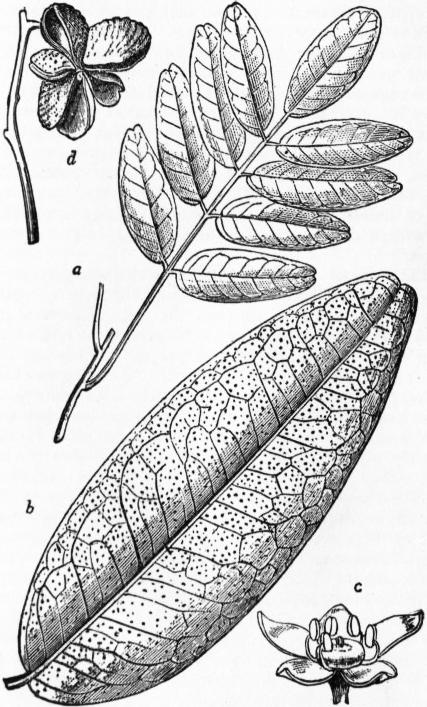
Jaborandi—a, leaf (reduced); b, leaflet (natural size); c, flower; d, fruit (natural size).
The action of this powerful alkaloid closely resembles that of physostigmine, but whereas the latter is specially active in influencing the heart, the eye and the spinal cord, pilocarpine exerts its greatest power on the secretions. It has no external action. When taken by the mouth the drug is rapidly absorbed and stimulates the secretions of the entire alimentary tract, though not of the liver. The action on the salivary glands is the most marked and the best understood. The great flow of saliva is due to an action of the drug, after absorption, on the terminations of the chorda tympani, sympathetic and other nerves of salivary secretion. The gland cells themselves are unaffected. The nerves are so violently excited that direct stimulation of them by electricity adds nothing to the rate of salivary flow. The action is antagonized by atropine, which paralyses the nerve terminals. About 1⁄100th of a grain of atropine antagonizes half a grain of pilocarpine. The circulation is depressed by the drug, the pulse being slowed and the blood pressure falling. The cardiac action is due to stimulation of the vagus, but the dilatation of the blood-vessels does not appear to be due to a specific action upon them. The drug does not kill by its action on the heart. Its dangerous action is upon the bronchial secretion, which is greatly increased. Pilocarpine is not only the most powerful sialogogue but also the most powerful diaphoretic known. One dose may cause the flow of nearly a pint of sweat in an hour. The action is due, as in the case of the salivation, to stimulation of the terminals of the sudorific nerves. According to K. Binz there is also in both cases an action on the medullary centres for these secretions. Just as the saliva is a true secretion containing a high proportion of ptyalin and salts, and is not a mere transudation of water, so the perspiration is found to contain a high ratio of urea and chlorides. The great diaphoresis and the depression of the circulation usually cause a fall in temperature of about 2° F. The drug is excreted unchanged in the urine. It is a mild diuretic. When given internally or applied locally to the eye it powerfully stimulates the terminals of the oculomotor nerves in the iris and ciliary muscle, causing extreme contraction of the pupil and spasm of accommodation. The tension of the eyeball is at first raised but afterwards lowered.
The chief therapeutic use of the drug is as a diaphoretic in chronic Bright’s disease. It is also used to aid the growth of the hair—in which it is sometimes successful; in cases of inordinate thirst, when one-tenth of a grain with a little bismuth held in the mouth may be of much value; in cases of lead and mercury poisoning, where it aids the elimination of the poison in the secretions; as a galactagogue; and in cases of atropine poisoning (though here it is of doubtful value).
JACA, a city of northern Spain, in the province of Huesca, 114 m. by rail N. by W. of Saragossa, on the left bank of the river Aragon, and among the southern slopes of the Pyrenees, 2380 ft. above the sea. Pop. (1900), 4934. Jaca is an episcopal see, and was formerly the capital of the Aragonese county of Sobrarbe. Its massive Gothic cathedral dates at least from the 11th century, and possibly from the 9th. The city derives some importance from its position on the ancient frontier road from Saragossa to Pau. In August 1904 the French and Spanish governments agreed to supplement this trade-route by building a railway from Oloron in the Basses Pyrénées to Jaca. Various frontier defence works were constructed in the neighbourhood at the close of the 19th century.
The origin of the city is unknown. The Jaccetani (Ἰάκκητανοί) are mentioned as one of the most celebrated of the numerous small tribes inhabiting the basin of the Ebro by Strabo, who adds that their territory was the theatre of the wars which took place in the 1st century B.C. between Sertorius and Pompey. They are probably identical with the Lacetani of Livy (xxi. 60, 61) and Caesar (B.C. i. 60). Early in the 8th century Jaca fell into the possession of the Moors, by whose writers it is referred to under the name of Dyaka as one of the chief places in the province of Sarkosta (Saragossa). The date of its reconquest is uncertain, but it must have been before the time of Ramiro I. of Aragon (1035-1063), who gave it the title of “city,” and in 1063 held within its walls a council, which, inasmuch as the people were called in to sanction its decrees, is regarded as of great importance in the history of the parliamentary institutions of the Peninsula. In 1705 Jaca supported King Philip V. from whom, in consequence, it received the title of muy noble, muy leal y vencedora, “most noble, most loyal and victorious.” During the Peninsular War it surrendered to the French in 1809, and was recaptured in 1814.
JACAMAR, a word formed by Brisson from Jacameri, the Brazilian name of a bird, as given by Marcgrave, and since adopted in most European tongues for the species to which it was first applied and others allied to it, forming the family Galbulidae1 of ornithologists, the precise position of which is uncertain, since the best authorities differ. All will agree that the jacamars belong to the great heterogeneous group called by Nitzsch Picariae, but further into detail it is hardly safe to go. The Galbulidae have zygodactylous or pair-toed feet, like the Cuculidae, Bucconidae and Picidae, they also resemble both the latter in laying glossy white eggs, but in this respect they bear the same resemblance to the Momotidae, Alcedinidae, Meropidae and some other groups, to which affinity has been claimed for them. In the opinion of Sclater (A Monograph of the Jacamars and Puff-birds) the jacamars form two groups—one consisting of the single genus and species Jacamerops aureus (J. grandis of most authors), and the other including all the rest, viz. Urogalba with two species, Galbula with nine, Brachygalba with five, and Jacamaralcyon and Galbalcyrhynchus with one each. They are all rather small birds, the largest known being little over 10 in. in length, with long and sharply pointed bills, and the plumage more or less resplendent with golden or bronze reflections, but at the same time comparatively soft. Jacamaralcyon tridactyla differs from all the rest in possessing but three toes (as its name indicates), on each foot, the hallux being deficient. With the exception of Galbula melanogenia, which is found also in Central America and southern Mexico, all the jacamars inhabit the tropical portions of South America eastward of the Andes, Galbula ruficauda, however, extending its range to the islands of Trinidad and Tobago.2 Very little is known of the habits of any of the species. They are seen sitting motionless on trees, sometimes solitarily, at other times in companies, whence they suddenly dart off at any passing insect, catch it on the wing, and return to their perch. Of their nidification almost nothing has been recorded, but the species occurring in Tobago is said by Kirk to make its nest in marl-banks, digging a hole about an inch and a half in diameter and some 18 in. deep.
(A. N.)
1 Galbula was first applied to Marcgrave’s bird by Moehring. It is another form of Galgulus, and seems to have been one of the many names of the golden oriole. See Icterus.
2 The singular appearance, recorded by Canon Tristram (Zoologist, p. 3906), of a bird of this species in Lincolnshire seems to require notice. No instance seems to be known of any jacamar having been kept in confinement or brought to this country alive; but expert aviculturists are often not communicative, and many importations of rare birds have doubtless passed unrecorded.
JAÇANÁ, the Brazilian name, according to Marcgrave, of certain birds, since found to have some allies in other parts of the world, which are also very generally called by the same appellation. They have been most frequently classed with the water-hens or rails (Rallidae), but are now recognized by many systematists as forming a separate family, Parridae,1 whose leaning seems to be rather towards the Limicolae, as apparently first suggested by Blyth, a view which is supported by the osteological observations of Parker (Proc. Zool. Society, 1863, p. 513), though denied by A. Milne-Edwards (Ois. foss. de la France, ii. p. 110). The most obvious characteristic of this group of birds is the extraordinary length of their toes and claws, whereby they are enabled to walk with ease over water-lilies and other aquatic plants growing in rivers and lakes. The family has been divided into four genera—of which Parra, as now restricted, inhabits South America; Metopidius, hardly differing from it, has representatives in Africa, Madagascar and the Indian region; Hydralector, also very nearly allied to Parra, belongs to the northern portion of the Australian region; and Hydrophasianus, the most extravagant form of the whole, is found in India, Ceylon and China. In habits the jaçanás have much in common with the water-hens, but that fact is insufficient to warrant the affinity asserted to exist between the two groups; for in their osteological structure there is much difference, and the resemblance seems to be only that of analogy. The Parridae lay very peculiar eggs of a rich olive-brown colour, in most cases closely marked with dark lines, thus presenting an appearance by which they may be readily known from those of any other birds, though an approach to it is occasionally to be noticed in those of certain Limicolae, and especially of certain Charadriidae.
(A. N.)
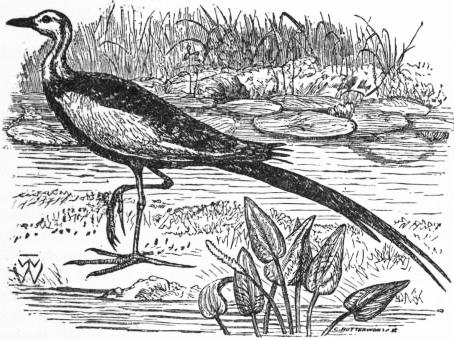
Pheasant-tailed Jaçaná.
1 The classic Parra is by some authors thought to have been the golden oriole (see Icterus), while others suppose it was a jay or pie. The word seems to have been imported into ornithology by Aldrovandus, but the reason which prompted Linnaeus to apply it, as he seems first to have done, to a bird of this group, cannot be satisfactorily stated.
JACINI, STEFANO, Count (1827-1891), Italian statesman and economist, was descended from an old and wealthy Lombard family. He studied in Switzerland, at Milan, and in German universities. During the period of the Austrian restoration in Lombardy (1849-1859) he devoted himself to literary and economic studies. For his work on La Proprietà fondiaria in Lombardia (Milan, 1856) he received a prize from the Milanese Società d’incoraggiamento di scienze e lettere and was made a member of the Istituto Lombardo. In another work, Sulle condizioni economiche della Valtellina (Milan, 1858, translated into English by W. E. Gladstone), he exposed the evils of Austrian rule, and he drew up a report on the general conditions of Lombardy and Venetia for Cavour. He was minister of Public Works under Cavour in 1860-1861, in 1864 under La Marmora, and down to 1867 under Ricasoli. In 1866 he presented a bill favouring Italy’s participation in the construction of the St Gotthard tunnel. He was instrumental in bringing about the alliance with Prussia for the war of 1866 against Austria, and in the organization of the Italian railways. From 1881 to 1886 he was president of the commission to inquire into the agricultural conditions of Italy, and edited the voluminous report on the subject. He was created senator in 1870, and given the title of count in 1880. He died in 1891.
L. Carpi’s Risorgimento italiano, vol. iv. (Milan, 1888), contains a short sketch of Jacini’s life.
JACK, a word with a great variety of meanings and applications, all traceable to the common use of the word as a by-name of a man. The question has been much discussed whether “Jack” as a name is an adaptation of Fr. Jacques, i.e. James, from Lat. Jacobus, Gr. Ἰάκωβος, or whether it is a direct pet formation from John, which is its earliest and universal use in English. In the History of the Monastery of St Augustine at Canterbury, 1414, Jack is given as a form of John—Mos est Saxonum ... verba et nomina transformare ... ut ... pro Johanne Jankin sive Jacke (see E. W. B. Nicholson, The Pedigree of Jack and other Allied Names, 1892). “Jack” was early used as a general term for any man of the common people, especially in combination with the woman’s name Jill or Gill, as in the nursery rhyme. The New English Dictionary quotes from the Coventry Mysteries, 1450: “And I wole kepe the feet this tyde Thow ther come both Iakke and Gylle.” Familiar examples of this generic application of the name are Jack or Jack Tar for a sailor, which seems to date from the 17th century, and such compound uses as cheap-jack and steeple-jack, or such expressions as “jack in office,” “jack of all trades,” &c. It is a further extension of this that gives the name to the knave in a pack of cards, and also to various animals, as jackdaw, jack-snipe, jack-rabbit (a species of large prairie-hare); it is also used as a general name for pike.
The many applications of the word “jack” to mechanical devices and other objects follow two lines of reference, one to objects somewhat smaller than the ordinary, the other to appliances which take the place of direct manual labour or assist or save it. Of the first class may be noticed the use of the term for the small object bowl in the game of bowls or for jack rafters, those rafters in a building shorter than the main rafters, especially the end rafters in a hipped roof. The use of jack as the name for a particular form of ship’s flag probably arose thus, for it is always a smaller flag than the ensign. The jack is flown on a staff on the bowsprit of a vessel. In the British navy the jack is a small Union flag. (The Union flag should not be styled a Union Jack except when it is flown as a jack.) The jack of other nations is usually the canton of the ensign, as in the German and the United States navies, or else is a smaller form of the national ensign, as in France. (See Flag.)
The more common use of “jack” is for various mechanical and other devices originally used as substitutes for men or boys. Thus the origin of the boot-jack and the meat-jack is explained in Isaac Watts’s Logic, 1724: “So foot boys, who had frequently the common name of Jack given them, were kept to turn the spit or pull off their masters’ boots, but when instruments were invented for both these services, they were both called jacks.” The New English Dictionary finds a transitional sense in the use of the name “jack” for mechanical figures which strike the hours on a bell of a clock. Such a figure in the clock of St Lawrence Church at Reading is called a jack in the parish accounts for 1498-1499. There are many different applications of “jack,” to certain levers and other parts of textile machinery, to metal plugs used for connecting lines in a telephone exchange, to wooden uprights connecting the levers of the keys with the strings in the harpsichord and virginal, to a framework forming a seat or staging which can be fixed outside a window for cleaning or painting purposes, and to many devices containing a roller or winch, as in a jack towel, a long towel hung on a roller. The principal mechanical application of the word, however, is to a machine for raising weights from below. A jack chain, so called from its use in meat-jacks, is one in which the links, formed each in a figure of eight, are set in planes at right angles to each other, so that they are seen alternately flat or edgeways.
In most European languages the word “jack” in various forms appears for a short upper outer garment, particularly in the shape of a sleeveless (quilted) leather jerkin, sometimes with plates or rings of iron sewn to it. It was the common coat of defence of the infantry of the middle ages. The word in this case is of French origin and was an adaptation of the common name Jacques, as being a garment worn by the common people. In French the word is jaque, and it appears in Italian as giaco, or giacco, in Dutch jak, Swedish jacka and German Jacke, still the ordinary name for a short coat, as is the English jacket, from the diminutive French jaquette. It was probably from some resemblance to the leather coat that the well-known leather vessels for holding liquor or for drinking were known as jacks or black jacks. These drinking vessels, which are often of great size, were not described as black jacks till the 16th century, though known as jacks much earlier. Among the important specimens that have survived to this day is one with the initials and crown of Charles I. and the date, 1646, which came from Kensington Palace and is now in the British Museum; one each at Queen’s College and New College, Oxford; two at Winchester College; one at Eton College; and six at the Chelsea Hospital. Many specimens are painted with shields of arms, initials and other devices; they are very seldom mounted in silver, though spurious specimens with silver medallions of Cromwell and other prominent personages exist. At the end of the 17th century a smaller jack of a different form, like an ordinary drinking mug with a tapering cylindrical body, often mounted in silver, came into vogue in a limited degree. The black jack is a distinct type of drinking vessel from the leather botel and the bombard. The jack-boot, the heavy riding boot with long flap covering the knee and part of the thigh, and worn by troopers first during the 17th century, was so called probably from association with the leather jack or jerkin. The jack-boot is still worn by the Household Cavalry, and the name is applied to a high riding boot reaching to the knee as distinguished from the riding boot with tops, used in full hunting-kit or by grooms or coachmen.
Jack, sometimes spelled jak, is the common name for the fruit of the tree Artiocarpus integrifolia, found in the East Indies. The word is an adaptation of the Portuguese jaca from the Malay name chakka. (See Bread Fruit.)
The word “jackanapes,” now used as an opprobrious term for a swaggering person with impertinent ways and affected airs and graces, has a disputed and curious history. According to the New English Dictionary it first appears in 1450 in reference to William de la Pole, duke of Suffolk (Political Poems, “Rolls Series,” II. 224), “Jack Napys with his clogge hath tiede Talbot oure gentille dogge.” Suffolk’s badge was a clog and chain, such as was often used for an ape kept in captivity, and he is alluded to (ibid. 222) as “Ape clogge.” Jack Napes, Jack o’ Napes, Jackanapes, was a common name for a tame ape from the 16th century, and it seems more likely that the word is a fanciful name for a monkey than that it is due to the nickname of Suffolk.
JACKAL (Turk, chakāl), a name properly restricted to Canis aureus, a wolf-like wild member of the dog family inhabiting eastern Europe and southern Asia, but extended to include a number of allied species. Jackals resemble wolves and dogs in their dentition, the round eye-pupils, the period of gestation, and to a large extent also in habits. The European species grows to a height of 15 in. at the shoulders, and to a length of about 2 ft., exclusive of its bushy tail. Typically the fur is greyish-yellow, darker on the back and lighter beneath. The range of the common jackal (C. aureus) extends from Dalmatia to India, the species being represented by several local races. In Senegal this species is replaced by C. anthus, while in Egypt occurs the much larger C. lupaster, commonly known as the Egyptian wolf. Nearly allied to the last is the so-called Indian wolf (C. pallipes). Other African species are the black-backed jackal (C. mesomelas), the variegated jackal (C. variegatus), and the dusky jackal (C. adustus). Jackals are nocturnal animals, concealing themselves until dusk in woody jungles and other natural lurking places, and then sallying forth in packs, which sometimes number two hundred individuals, and visiting farmyards, villages and towns in search of food. This consists for the most part of the smaller mammals and poultry; although the association in packs enables these marauders to hunt down antelopes and sheep. When unable to obtain living prey, they feed on carrion and refuse of all kinds, and are thus useful in removing putrescent matter from the streets. They are also fond of grapes and other fruits, and are thus the pests of the vineyard as well as the poultry-yard. The cry of the jackal is even more appalling than that of the hyena, a shriek from one member of a pack being the signal for a general chorus of screams, which is kept up during the greater part of the night. In India these animals are hunted with foxhounds or greyhounds, and from their cunning and pluck afford excellent sport. Jackals are readily tamed; and domesticated individuals are said, when called by their masters, to wag their tails, crouch and throw themselves on the ground, and otherwise behave in a dog-like fashion. The jackal, like the fox, has an offensive odour, due to the secretion of a gland at the base of the tail.
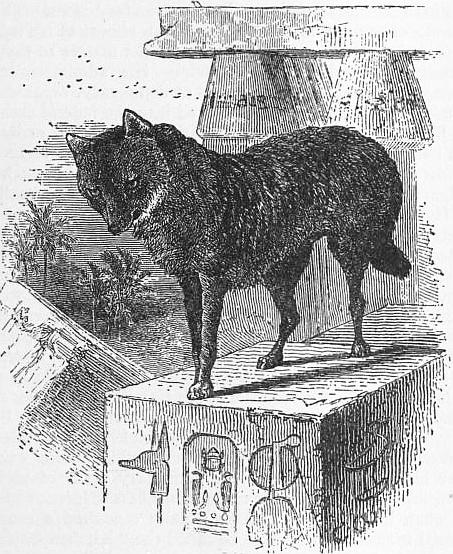
Egyptian Jackal (Canis lupaster).
JACKDAW, or simply Daw (Old Low German, Daha; Dutch, Kaauw), one of the smallest species of the genus Corvus (see Crow), and a very well known inhabitant of Europe, the C. monedula of ornithologists. In some of its habits it much resembles its congener the rook, with which it constantly associates during a great part of the year; but, while the rook only exceptionally places its nest elsewhere than on the boughs of trees and open to the sky, the daw almost invariably chooses holes, whether in rocks, hollow trees, rabbit-burrows or buildings. Nearly every church-tower and castle, ruined or not, is more or less numerously occupied by daws. Chimneys frequently give them the accommodation they desire, much to the annoyance of the householder, who finds the funnel choked by the quantity of sticks brought together by the birds, since their industry in collecting materials for their nests is as marvellous as it often is futile. In some cases the stack of loose sticks piled up by daws in a belfry or tower has been known to form a structure 10 or 12 ft. in height, and hence this species may be accounted one of the greatest nest-builders in the world. The style of architecture practised by the daw thus brings it more than the rook into contact with man, and its familiarity is increased by the boldness of its disposition which, though tempered by discreet cunning, is hardly surpassed among birds. Its small size, in comparison with most of its congeners, alone incapacitates it from inflicting the serious injuries of which some of them are often the authors, yet its pilferings are not to be denied, though on the whole its services to the agriculturist are great, for in the destruction of injurious insects it is hardly inferior to the rook, and it has the useful habit of ridding sheep, on whose backs it may be frequently seen perched, of some of their parasites.
The daw displays the glossy black plumage so characteristic of the true crows, varied only by the hoary grey of the ear-coverts, and of the nape and sides of the neck, which is the mark of the adult; but examples from the east of Europe and western Asia have these parts much lighter, passing into a silvery white, and hence have been deemed by some authorities to constitute a distinct species (C. collaris, Drumm.). Further to the eastward occurs the C. dauuricus of Pallas, which has not only the collar broader and of a pure white, but much of the lower parts of the body white also. Japan and northern China are inhabited also by a form resembling that of western Europe, but wanting the grey nape of the latter. This is the C. neglectus of Professor Schlegel, and is said by Dresser, on the authority of Swinhoe, to interbreed frequently with C. dauuricus. These are all the birds that seem entitled to be considered daws, though Dr Bowdler Sharpe (Cat. B. Brit. Museum, iii. 24) associates with them (under the little-deserved separate generic distinction Coloeus) the fish-crow of North America, which appears both in structure and in habits to be a true crow.
(A. N.)
JACKSON, ANDREW (1767-1845), seventh president of the United States, was born on the 15th of March 1767, at the Waxhaw or Warsaw settlement, in Union county, North Carolina, or in Lancaster county, South Carolina, whither his parents had immigrated from Carrickfergus, Ireland, in 1765. He played a slight part in the War of Independence, and was taken prisoner in 1781, his treatment resulting in a lifelong dislike of Great Britain. He studied law at Salisbury, North Carolina, was admitted to the bar there in 1787, and began to practise at McLeansville, Guilford county, North Carolina, where for a time he was a constable and deputy-sheriff. In 1788, having been appointed prosecuting attorney of the western district of North Carolina (now the state of Tennessee), he removed to Nashville, the seat of justice of the district. In 1791 he married Mrs Rachel Robards (née Donelson), having heard that her husband had obtained a divorce through the legislature of Virginia. The legislative act, however, had only authorized the courts to determine whether or not there were sufficient grounds for a divorce and to grant or withhold it accordingly. It was more than two years before the divorce was actually granted, and only on the basis of the fact that Jackson and Mrs Robards were then living together. On receiving this information, Jackson had the marriage ceremony performed a second time.
In 1796 Jackson assisted in framing the constitution of Tennessee. From December 1796 to March 1797 he represented that state in the Federal House of Representatives, where he distinguished himself as an irreconcilable opponent of President Washington, and was one of the twelve representatives who voted against the address to him by the House. In 1797 he was elected a United States senator; but he resigned in the following year. He was judge of the supreme court of Tennessee from 1798 to 1804. In 1804-1805 he contracted a friendship with Aaron Burr; and at the latter’s trial in 1807 Jackson was one of his conspicuous champions. Up to the time of his nomination for the presidency, the biographer of Jackson finds nothing to record but military exploits in which he displayed perseverance, energy and skill of a very high order, and a succession of personal acts in which he showed himself ignorant, violent, perverse, quarrelsome and astonishingly indiscreet. His combative disposition led him into numerous personal difficulties. In 1795 he fought a duel with Colonel Waitstill Avery (1745-1821), an opposing counsel, over some angry words uttered in a court room; but both, it appears, intentionally fired wild. In 1806 in another duel, after a long and bitter quarrel, he killed Charles Dickinson, and Jackson himself received a wound from which he never fully recovered. In 1813 he exchanged shots with Thomas Hart Benton and his brother Jesse in a Nashville tavern, and received a second wound. Jackson and Thomas Hart Benton were later reconciled.