VOLUME XIV SLICE V Indole to Insanity
Reading edition
Articles in This Slice
INDOLE INGEMANN, BERNHARD SEVERIN
INDONESIAN INGERSOLL, ROBERT GREEN
INDORE INGERSOLL
INDORSEMENT INGHAM, CHARLES CROMWELL
INDO-SCYTHIANS INGHIRAMI
INDRA INGLEBY, CLEMENT MANSFIELD
INDRE INGLEFIELD, SIR EDWARD AUGUSTUS
INDRE-ET-LOIRE INGLE-NOOK
INDRI INGLIS, SIR JOHN EARDLEY WILMOT
INDUCTION INGLIS, SIR WILLIAM
INDUCTION COIL INGOLSTADT
INDULGENCE INGOT
INDULINES INGRAM, JAMES
INDULT INGRAM, JOHN KELLS
INDUNA INGRES, JEAN AUGUSTE DOMINIQUE
INDUS INGRESS
INDUSTRIA INHAMBANE
INDUSTRIAL SCHOOL INHERITANCE
INDUSTRY INHIBITION
INE INISFAIL
INEBOLI INITIALS
INEBRIETY, LAW OF INITIATION
INFALLIBILITY INJECTOR
INFAMY INJUNCTION
INFANCY INK
INFANT INKERMAN, BATTLE OF
INFANTE INLAYING
INFANTICIDE INMAN, HENRY
INFANTRY INN (river of Europe)
INFANT SCHOOLS INN and INNKEEPER
INFINITE INNERLEITHEN
INFINITESIMAL CALCULUS INNESS, GEORGE
INFINITIVE INNOCENT
INFLEXION INNOCENTS’ DAY
INFLUENCE INNSBRUCK
INFLUENZA INNS OF COURT
IN FORMÂ PAUPERIS INNUENDO
INFORMATION INOUYE, KAORU, MARQUESS
INFORMER INOWRAZLAW
INFUSORIA INQUEST
INGEBORG INQUISITION, THE
INGELHEIM INSANITY
INGELOW, JEAN
INDOLE, or Beńzopyrrol, C8H7N, a substance first prepared by A. Baeyer in 1868. It may be synthetically obtained by distilling oxindole (C8H8NO) with zinc dust; by heating ortho-nitrocinnamic acid with potash and iron filings; by the reduction of indigo blue; by the action of sodium ethylate on ortho-aminochlorstyrene; by boiling aniline with dichloracetaldehyde; by the dry distillation of ortho-tolyloxamic acid; by heating aniline with dichloracetal; by distilling a mixture of calcium formate and calcium anilidoacetate; and by heating pyruvic acid phenyl hydrazone with anhydrous zinc chloride. It is also formed in the pancreatic fermentation of albumen, and, in small quantities, by passing the vapours of mono- and dialkyl-anilines through a red-hot tube. It crystallizes in shining leaflets, which melt at 52° C. and boil at 245° C. (with decomposition), and is volatile in a current of steam. It is a feeble base, and gives a cherry-red coloration with a pine shaving. Many derivatives of indole are known. B-methylindol or skatole occurs in human faeces.
INDONESIAN, a term invented by James Richardson Logan to describe the light-coloured non-Malay inhabitants of the Eastern Archipelago. It now denotes all those peoples of Malaysia and Polynesia who are not to be classified as Malays or Papuans, but are of Caucasic type. Among these are the Battaks of north Sumatra; many of the Bornean Dyaks and Philippine Islanders, and the large brown race of east Polynesia which includes Samoans, Maoris, Tongans, Tahitians, Marquesas Islanders and the Hawaiians.
See J. Richardson Logan, The Languages and Ethnology of the Indian Archipelago (1857).
INDORE, a native state of India in the central India agency, comprising the dominions of the Maharaja Holkar. Its area, exclusive of guaranteed holdings on which it has claims, is 9500 sq. m. and the population in 1901 was 850,690, showing a decrease of 23% in the decade, owing to the results of famine. As in the case of most states in central India the territory is not homogeneous, but distributed over several political charges. It has portions in four out of the seven charges of central India, and in one small portion in the Rajputana agency. The Vindhya range traverses the S. division of the state in a direction from east to west, a small part of the territory lying to the north of the mountains, but by much the larger part to the south. The latter is a portion of the valley of the Nerbudda, and is bounded on the south by the Satpura hills. Basalt and other volcanic formations predominate in both ranges, although there is also much sandstone. The Nerbudda flows through the state; and the valley at Mandlesar, in the central part, is between 600 and 700 ft. above the sea. The revenue is estimated at £350,000. The metre gauge railway from Khandwa to Mhow and Indore city, continued to Neemuch and Ajmere, was constructed in 1876.
The state had its origin in an assignment of lands made early in the 18th century to Malhar Rao Holkar, who held a command in the army of the Mahratta Peshwa. Of the Dhangar or shepherd caste, he was born in 1694 at the village of Hol near Poona, and from this circumstance the family derives its surname of Holkar. Before his death in 1766 Malhar Rao had added to his assignment large territorial possessions acquired by his armed power during the confusion of the period. By the end of that century the rulership had passed to another leader of the same clan, Tukoji Holkar, whose son, Jaswant Rao, took an important part in the contest for predominance in the Mahratta confederation. He did not, however, join the combined army of Sindha and the raja of Berar in their war against the British in 1803, though after its termination he provoked hostilities which led to his complete discomfiture. At first he defeated a British force that had marched against him under Colonel Monson; but when he made an inroad into British territory he was completely defeated by Lord Lake, and compelled to sign a treaty which deprived him of a large portion of his possessions. After his death his favourite mistress, Tulsi Bai, assumed the regency, until in 1817 she was murdered by the military commanders of the Indore troops, who declared for the peshwa on his rupture with the British government. After their defeat at Mehidpur in 1818, the state submitted by treaty to the loss of more territory, transferred to the British government its suzerainty over a number of minor tributary states, and acknowledged the British protectorate. For many years afterwards the administration of the Holkar princes was troubled by intestine quarrels, misrule and dynastic contentions, necessitating the frequent interposition of British authority; and in 1857 the army, breaking away from the chief’s control, besieged the British residency, and took advantage of the mutiny of the Bengal sepoys to spread disorder over that part of central India. The country was pacified after some fighting. In 1899 a British resident was appointed to Indore, which had formerly been directly under the agent to the governor-general in central India. At the same time a change was made in the system of administration, which was from that date carried on by a council. In 1903 the Maharaja, Shivaji Rao Holkar, G.C.S.I., abdicated in favour of his son Tukoji Rao, a boy of twelve, and died in 1908.
The City of Indore is situated 1738 ft. above the sea, on the river Saraswati, near its junction with the Khan. Pop. (1901) 86,686. These figures do not include the tract assigned to the resident, known as “the camp” (pop. 11,118), which is under British administration. The city is one of the most important trading centres in central India.
Indore Residency, a political charge in central India, is not co-extensive with the state, though it includes all of it except some outlying tracts. Area, 8960 sq. m.; pop. (1901) 833,410.
(J. S. Co.)
INDORSEMENT, or Endorsement (from Med. Lat. indorsare, to write upon the dorsum, or back), anything written or printed upon the back of a document. In its technical sense, it is the writing upon a bill of exchange, cheque or other negotiable instrument, by one who has a right to the instrument and who thereby transmits the right and incurs certain liabilities. See Bill of Exchange.
INDO-SCYTHIANS, a name commonly given to various tribes from central Asia, who invaded northern India and founded kingdoms there. They comprise the Sakas, the Yue-Chi or Kushans and the Ephthalites or Hūnas.
INDRA, in early Hindu mythology, god of the clear sky and greatest of the Vedic deities. The origin of the name is doubtful, but is by some connected with indu, drop. His importance is shown by the fact that about 250 hymns celebrate his greatness, nearly one-fourth of the total number in the Rig Veda. He is represented as specially lord of the elements, the thunder-god. But Indra was more than a great god in the ancient Vedic pantheon. He is the patron-deity of the invading Aryan race in India, the god of battle to whose help they look in their struggles with the dark aborigines. Indra is the child of Dyaus, the Heaven. In Indian art he is represented as a man with four arms and hands; in two he holds a lance and in the third a thunderbolt. He is often painted with eyes all over his body and then he is called Sahasraksha, “the thousand eyed.” He lost much of his supremacy when the triad Brahma, Siva and Vishnu became predominant. He gradually became identified merely with the headship of Swarga, a local vice-regent of the abode of the gods.
See A. A. Macdonell, Vedic Mythology (Strassburg, 1897).
INDRE, a department of central France, formed in 1790 from parts of the old provinces of Berry, Orléanais, Marche and Touraine. Pop. (1906) 290,216. Area 2666 sq. m. It is bounded N. by the department of Loir-et-Cher, E. by Cher, S. by Creuse and Haute-Vienne, S.W. by Vienne and N.W. by Indre-et-Loire. It takes its name from the river Indre, which flows through it. The surface forms a vast plateau divided into three districts, the Boischaut, Champagne and Brenne. The Boischaut is a large well-wooded plain comprising seven-tenths of the entire area and covering the south, east and centre of the department. The Champagne, a monotonous but fertile district in the north, produces abundant cereal crops, and affords excellent pasturage for large numbers of sheep, celebrated for the fineness of their wool. The Brenne, which occupies the west of the department, was formerly marshy and unhealthy, but draining and afforestation have brought about considerable improvement.
The department is divided into the arrondissements of Châteauroux, Le Blanc, La Châtre and Issoudun, with 23 cantons and 245 communes. At Neuvy-St-Sépulchre there is a circular church of the 11th century, to which a nave was added in the 12th century, and at Mézières-en-Brenne there is an interesting church of the 14th century. At Levroux there is a fine church of the 13th century and the remains of a feudal fortress, and there is a magnificent château in the Renaissance style at Valençay.
INDRE-ET-LOIRE, a department of central France, consisting of nearly the whole of the old province of Touraine and of small portions of Orléanais, Anjou and Poitou. Pop. (1906) 337,916. Area 2377 sq. m. It is bounded N. by the departments of Sarthe and Loir-et-Cher, E. by Loir-et-Cher and Indre, S. and S.W. by Vienne and W. by Maine-et-Loire. It takes its name from the Loire and its tributary the Indre, which enter it on its eastern border and unite not far from its western border. The other chief affluents of the Loire in the department are the Cher, which joins it below Tours, and the Vienne, which waters the department’s southern region. Indre-et-Loire is generally level and comprises the following districts: the Gâtine, a pebbly and sterile region to the north of the Loire, largely consisting of forests and heaths with numerous small lakes; the fertile Varenne or valley of the Loire; the Champeigne, a chain of vine-clad slopes, separating the valleys of the Cher and Indre; the Véron, a region of vines and orchards, in the angle formed by the Loire and Vienne; the plateau of Sainte-Maure, a hilly and unproductive district in the centre of which are found extensive deposits of shell-marl; and in the south the Brenne, traversed by the Claise and the Creuse and forming part of the marshy territory which extends under the same name into Indre.
Indre-et-Loire is divided into the arrondissements of Tours, Loches and Chinon, with 24 cantons and 282 communes. The chief town is Tours, which is the seat of an archbishopric; and Chinon, Loches, Amboise, Chenonceaux, Langeais and Azay-le-Rideau are also important places with châteaus. The Renaissance château of Ussé, and those of Luynes (15th and 16th centuries) and Pressigny-le-Grand (17th century) are also of note. Montbazon possesses the imposing ruins of a square donjon of the 11th and 12th centuries. Preuilly has the most beautiful Romanesque church in Touraine. The Sainte Chapelle (16th century) at Champigny is a survival of a château of the dukes of Bourbon-Montpensier. The church of Montrésor (1532) with its mausoleum of the family of Montrésor; that of St Denis-Hors (12th and 16th century) close to Amboise, with the curious mausoleum of Philibert Babou, minister of finance under Francis I. and Henry II.; and that of Ste Catherine de Fierbois, of the 15th century, are of architectural interest. The town of Richelieu, founded 1631 by the famous minister of Louis XIII., preserves the enceinte and many of the buildings of the 17th century. Megalithic monuments are numerous in the department.
INDRI, a Malagasy word believed to mean “there it goes,” but now accepted as the designation of the largest of the existing Malagasy (and indeed of all) lemurs. Belonging to the family Lemuridae (see Primates) it typifies the subfamily Indrisinae, which includes the avahi and the sifakas (q.v.). From both the latter it is distinguished by its rudimentary tail, measuring only a couple of inches in length, whence its name of Indris brevicaudatus. Measuring about 24 in. in length, exclusive of the tail, the indri varies considerably in colour, but is usually black, with a variable number of whitish patches, chiefly about the loins and on the fore-limbs. The forests of a comparatively small tract on the east coast of Madagascar form its home. Shoots, flowers and berries form the food of the indri, which was first discovered by the French traveller and naturalist Pierre Sonnerat in 1780.
(R. L.*)
INDUCTION (from Lat. inducere, to lead into; cf. Gr. ἐπαγωγή), in logic, the term applied to the process of discovering principles by the observation and combination of particular instances. Aristotle, who did so much to establish the laws of deductive reasoning, neglected induction, which he identified with a complete enumeration of facts; and the schoolmen were wholly concerned with syllogistic logic. A new era opens with Bacon, whose writings all preach the principle of investigating the laws of nature with the purpose of improving the conditions of human life. Unluckily his mind was still enslaved by the formulae of the quasi-mechanical scholastic logic. He supposed that natural laws would disclose themselves by the accumulation and due arrangement of instances without any need for original speculation on the part of the investigator. In his Novum Organum there are directions for drawing up the various kinds of lists of instances. For two hundred years after Bacon’s death little was done towards the theory of induction; the reason being, probably, that the practical scientists knew no logic, while the university logicians, with their conservative devotion to the syllogism, knew no science. Whewell’s Philosophy of the Inductive Sciences (1840), the work of a thoroughly equipped scientist, if not of a great philosopher, shows due appreciation of the cardinal point neglected by Bacon, the function of theorizing in inductive research. He saw that science advances only in so far as the mind of the inquirer is able to suggest organizing ideas whereby our observations and experiments are colligated into intelligible system. In this respect J. S. Mill is inferior to Whewell: throughout his System of Logic (1843) he ignores the constitutive work of the mind, and regards knowledge as the merely passive reception of sensuous impressions. His work was intended mainly to reduce the procedure of induction to a regular demonstrative system like that of the syllogism; and it was for this purpose that he formulated his famous Four Methods of Experimental Inquiry. His work has contributed greatly to the systematic treatment of induction. But it must be remarked that his Four Methods are not methods of formal proof, as their author supposed, but methods whereby hypotheses are suggested or tested. The actual proof of an hypothesis is never formal, but always lies in the tests of experiment or observation to which it is subjected.
The current theory of induction as set forth in the standard works is so far satisfactory that it combines the merit of Whewell’s treatment with that of Mill’s; and yet it is plain that there is much for the logician of the future to accomplish. The most important faculty in scientific inquiry is the faculty of suggesting new and valuable hypotheses. But no one has ever given any explanation how the hypotheses arise in the mind: we attribute it to “genius,” which, of course, is no explanation at all. The logic of discovery, in the higher sense of the term, simply has no existence. Another important but neglected province of the subject is the relation of scientific induction to the inductions of everyday life. There are some who think that a study of this relation would quite transform the accepted view of induction. Consider such a piece of reasoning as may be heard any day in a court of justice, a detective who explains how in his opinion a certain burglary was effected. If all reasoning is either deductive or inductive, this must be induction. And yet it does not answer to the accepted definition of induction, “the process of discovering a general principle by observation of particular instances”: what the detective does is to reconstruct a particular crime; he evolves no general principle. Such reasoning is used by every man in every hour of his life: by it we understand what people are doing around us, and what is the meaning of the sense-impressions which we receive. In the logic of the future it will probably be recognized that scientific induction is only one form of this universal constructive or reconstructive faculty. Another most important question closely akin to that just mentioned is the true relation between these reasoning processes and our general life as active intelligent beings. How is it that the detective is able to understand the burglar’s plan of action?—the military commander to forecast the enemy’s plan of campaign? Primarily, because he himself is capable of making such plans. Men as active creatures co-operating with their fellow-men are incessantly engaged in forming plans and in apprehending the plans of those around them. Every plan may be viewed as a form of induction; it is a scheme invented to meet a given situation, an hypothesis which is put to the test of events, and is verified or refuted by practical success or failure. Such considerations widen still farther our view of scientific induction and help us to understand its relation to ordinary human thought and activity. The scientific investigator in his inductive stage is endeavouring to make out the plan on which his material is constructed. The phenomena serve as indications to help him in framing his hypothesis, generally a guess at first, which he proceeds to verify by experiment and the collection of additional facts. In the deductive stage he assumes that he has made out the plan and can apply it to the discovery of further detail. He has the capacity of detecting plans in nature because he is wont to form plans for practical purposes.
There are good recent accounts of induction in Welton’s Manual of Logic, ii., in H. W. B. Joseph’s Introduction to Logic, and in W. R. Boyce Gibson’s Problem of Logic; see also Logic.
(H. St.)
INDUCTION COIL, an electrical instrument consisting of two coils of wire wound one over the other upon a core consisting of a bundle of iron wires. One of these circuits is called the primary circuit and the other the secondary circuit. If an alternating or intermittent continuous current is passed through the primary circuit, it creates an alternating or intermittent magnetization in the iron core, and this in turn creates in the secondary circuit a secondary current which is called the induced current. For most purposes an induction coil is required which is capable of giving in the secondary circuit intermittent currents of very high electromotive force, and to attain this result the secondary circuit must as a rule consist of a very large number of turns of wire. Induction coils are employed for physiological purposes and also in connexion with telephones, but their great use at the present time is in connexion with the production of high frequency electric currents, for Röntgen ray work and wireless telegraphy.
The instrument began to be developed soon after Faraday’s discovery of induced currents in 1831, and the subsequent researches of Joseph Henry, C. G. Page and W. Sturgeon on the induction of a current. N. J. Callan Early history. described in 1836 the construction of an electromagnet with two separate insulated wires, one thick and the other thin, wound on an iron core together. He provided the primary circuit of this instrument with an interrupter, and found that when the primary current was rapidly intermitted, a series of secondary currents was induced in the fine wire, of high electromotive force and considerable strength. Sturgeon in 1837 constructed a similar coil, and provided the primary circuit with a mercury interrupter operated by hand. Various other experimentalists took up the construction of the induction coil, and to G. H. Bachhoffner is due the suggestion of employing an iron core made of a bundle of fine iron wires. At a somewhat later date Callan constructed a very large induction coil containing a secondary circuit of very great length of wire. C. G. Page and J. H. Abbot in the United States, between 1838 and 1840, also constructed some large induction coils.1 In all these cases the primary circuit was interrupted by a mechanically worked interrupter. On the continent of Europe the invention of the automatic primary circuit interrupter is generally attributed to C. E. Neeff and to J. P. Wagner, but it is probable that J. W. M’Gauley, of Dublin, independently invented the form of hammer break now employed. In this break the magnetization of the iron core by the primary current is made to attract an iron block fixed to the end of a spring, in such a way that two platinum points are separated and the primary circuit thus interrupted. It was not until 1853 that H. L. Fizeau added to the break the condenser which greatly improved the operation of the coil. It 1851 H. D. Rühmkorff (1803-1877), an instrument-maker in Paris, profiting by all previous experience, addressed himself to the problem of increasing the electromotive force in the secondary circuit, and induction coils with a secondary circuit of long fine wire have generally, but unnecessarily, been called Rühmkorff coils. Rühmkorff, however, greatly lengthened the secondary circuit, employing in some coils 5 or 6 m. of wire. The secondary wire was insulated with silk and shellac varnish, and each layer of wire was separated from the next by means of varnished silk or shellac paper; the secondary circuit was also carefully insulated from the primary circuit by a glass tube. Rühmkorff, by providing with his coil an automatic break of the hammer type, and equipping it with a condenser as suggested by Fizeau, arrived at the modern form of induction coil. J. N. Hearder in England and E. S. Ritchie in the United States began the construction of large coils, the last named constructing a specially large one to the order of J. P. Gassiot in 1858. In the following decade A. Apps devoted great attention to the production of large induction coils, constructing some of the most powerful coils in existence, and introduced the important improvement of making the secondary circuit of numerous flat coils of wire insulated by varnished or paraffined paper. In 1869 he built for the old Polytechnic Institution in London a coil having a secondary circuit 150 m. in length. The diameter of the wire was 0.014 in., and the secondary bobbin when complete had an external diameter of 2 ft. and a length of 4 ft. 10 ins. The primary bobbin weighed 145 ℔, and consisted of 6000 turns of copper wire 3770 yds. in length, the wire being .095 of an inch in diameter. Excited by the current from 40 large Bunsen cells, this coil could give secondary sparks 30 in. in length. Subsequently, in 1876, Apps constructed a still larger coil for William Spottiswoode, which is now in the possession of the Royal Institution. The secondary circuit consisted of 280 m. of copper wire about 0.01 of an inch in diameter, forming a cylinder 37 in. long and 20 in. in external diameter; it was wound in flat disks in a large number of separate sections, the total number of turns being 341,850. Various primary circuits were employed with this coil, which when at its best could give a spark of 42 in. in length.
A general description of the mode of constructing a modern induction coil, such as is used for wireless telegraphy or Röntgen ray apparatus, is as follows: The iron core consists of a bundle of soft iron wires inserted in the Construction. interior of an ebonite tube. On the outside of this tube is wound the primary circuit, which generally consists of several distinct wires capable of being joined either in series or parallel as required. Over the primary circuit is placed another thick ebonite tube, the thickness of the walls of which is proportional to the spark-producing power of the secondary circuit. The primary coil must be wholly enclosed in ebonite, and the tube containing it is generally longer than the secondary bobbin. The second circuit consists of a number of flat coils wound up between paraffined or shellaced paper, much as a sailor coils a rope. It is essential that no joints in this wire shall occur in inaccessible places in the interior. A machine has been devised by Leslie Miller for winding secondary circuits in flat sections without any joints in the wire at all (British Patent, No. 5811, 1903). A coil intended to give a 10 or 12 in. spark is generally wound in this fashion in several hundred sections, the object of this mode of division being to prevent any two parts of the secondary circuit which are at great differences of potential from being near to one another, unless effectively insulated by a sufficient thickness of shellaced or paraffined paper. A 10-in. coil, a size very commonly used for Röntgen ray work or wireless telegraphy, has an iron core made of a bundle of soft iron wires No. 22 S.W.G., 2 in. in diameter and 18 in. in length. The primary coil wound over this core consists of No. 14 S.W.G. copper wire, insulated with white silk laid on in three layers and having a resistance of about half an ohm. The insulating ebonite tube for such a coil should not be less than ¼ in. in thickness, and should have two ebonite cheeks on it placed 14 in. apart. This tube is supported on two hollow pedestals down which the ends of the primary wire are brought. The secondary coil consists of No. 36 or No. 32 silk-covered copper wire, and each of the sections is prepared by winding, in a suitable winding machine, a flat coiled wire in such a way that the two ends of the coil are on the outside. The coil should not be wound in less than a hundred sections, and a larger number would be still better. The adjacent ends of consecutive sections are soldered together and insulated, and the whole secondary coil should be immersed in paraffin wax. The completed coil (fig. 1) is covered with a sheet of ebonite and mounted on a base board which, in some cases, contains the primary condenser within it and carries on its upper surface a hammer break. For many purposes, however, it is better to separate the condenser and the break from the coil. Assuming that a hammer break is employed, it is generally of the Apps form. The interruption of the primary circuit is made between two contact studs which ought to be of massive platinum, and across the break points is joined the primary condenser. This consists of a number of sheets of paraffined paper interposed between sheets of tin foil, alternate sheets of the tin foil being joined together (see Leyden Jar). This condenser serves to quench the break spark. If the primary condenser is not inserted, the arc or spark which takes place at the contact points prolongs the fall of magnetism in the core, and since the secondary electromotive force is proportional to the rate at which this magnetism changes, the secondary electromotive force is greatly reduced by the presence of an arc-spark at the contact points. The primary condenser therefore serves to increase the suddenness with which the primary current is interrupted, and so greatly increases the electromotive force in the secondary circuit. Lord Rayleigh showed (Phil. Mag., 1901, 581) that if the primary circuit is interrupted with sufficient suddenness, as for instance if it is severed by a bullet from a gun, then no condenser is needed. No current flows in the secondary circuit so long as a steady direct current is passing through the primary, but at the moments that the primary circuit is closed and opened two electromotive forces are set up in the secondary; these are opposite in direction, the one induced by the breaking of the primary circuit being by far the stronger. Hence the necessity for some form of circuit breaker, by the continuous action of which there results a series of discharges from one secondary terminal to the other in the form of sparks.
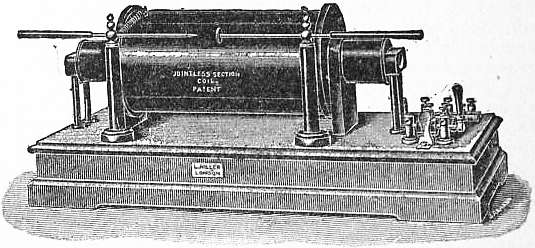
Fig. 1.
The hammer break is somewhat irregular in action and gives a good deal of trouble in prolonged use; hence many other forms of primary circuit interrupters have been devised. These may be classified as (1) hand- or motor-worked Interrupters or Breaks. dipping interrupters employing mercury or platinum contacts; (2) turbine mercury interrupters; (3) electrolytic interrupters. In the first class a steel or platinum point, operated by hand or by a motor, is periodically immersed in mercury and so serves to close the primary circuit. To prevent oxidation of the mercury by the spark and break it must be covered with oil or alcohol. In some cases the interruption is caused by the continuous rotation of a motor either working an eccentric which operates the plunger, or, as in the Mackenzie-Davidson break, rotating a slate disk having a metal stud on its surface, which is thus periodically immersed in mercury in a vessel. A better class of interrupter is the mercury turbine interrupter. In this some form of rotating turbine pump pumps mercury from a vessel and squirts it in a jet against a copper plate. Either the copper plate or the jet is made to revolve rapidly by a motor, so that the jet by turns impinges against the plate and escapes it; the mercury and plate are both covered with a deep layer of alcohol or paraffin oil, so that the jet is immersed in an insulating fluid. In a recent form the chamber in which the jet works is filled with coal gas. The current supplied to the primary circuit of the coil travels from the mercury in the vessel through the jet to the copper plate, and hence is periodically interrupted when the jet does not impinge against the plate. Mercury turbine breaks are much employed in connexion with large induction coils used for wireless telegraphy on account of their regular action and the fact that the number of interruptions per second can be controlled easily by regulating the speed of the motor which rotates the jet. But all mercury breaks employing paraffin or alcohol as an insulating medium are somewhat troublesome to use because of the necessity of periodically cleaning the mercury. Electrolytic interrupters were first brought to notice by Dr A. R. B. Wehnelt in 1898 (Elektrotechnische Zeitschrift, January 20th, 1899). He showed that if a large lead plate was placed in dilute sulphuric acid as a cathode, and a thick platinum wire protruding for a distance of about one millimetre beyond a glass or porcelain tube into which it tightly fitted was used as an anode, such an arrangement when inserted in the circuit of a primary coil gave rise to a rapid intermittency in the primary current. It is essential that the platinum wire should be the anode or positive pole. The frequency of the Wehnelt break can be adjusted by regulating the extent to which the platinum wire protrudes through the porcelain tube, and in modern electrolytic breaks several platinum anodes are employed. This break can be employed with any voltage between 30 and 250. The Caldwell interrupter, a modification of the Wehnelt break, consists of two electrodes immersed in dilute sulphuric acid, one of them being enclosed by a glass vessel which has a small hole in it capable of being more or less closed by a tapered glass plug. It differs from the Wehnelt break in that there is no platinum to wear away and it requires less current; hence finer regulation of the coil to the current can be obtained. It will also work with either direct or alternating currents. The hammer and mercury turbine breaks can be arranged to give interruptions from about 10 per second up to about 50 or 60. The electrolytic breaks are capable of working at a higher speed, and under some conditions will give interruptions up to a thousand per second. If the secondary terminals of the induction coils are connected to spark balls placed a short distance apart, then with an electrolytic break the discharge has a flame-like character resembling an alternating current arc. This type of break is therefore preferred for Röntgen ray work since it makes less flickering upon the screen, but its advantages in the case of wireless telegraphy are not so marked. In the Grisson interrupter the primary circuit of the induction coil is divided into two parts by a middle terminal, so that a current flowing in at this point and dividing equally between the two halves does not magnetize the iron. This terminal is connected to one pole of the battery, the other two terminals being connected alternately to the opposite pole by means of a revolving commutator which (1) passes a current through one half of the primary, thus magnetizing the core; (2) passes a current through both halves in opposite directions, thus annulling the magnetization; (3) passes a current through the second half of the primary, thus reversing the magnetization of the core; and (4) passes a current in both halves through opposite directions, thus again annulling the magnetization. As this series of operations can be performed without interrupting a large current through the inductive circuit there is not much spark at the commutator, and the speed of commutation can be regulated so as to obtain the best results due to a resonance between the primary and secondary circuits. Another device due to Grisson is the electrolytic condenser interrupter. If a plate of aluminium and one of carbon or iron is placed in an electrolyte yielding oxygen, this aluminium-carbon or aluminium-iron cell can pass current in one direction but not in the other. Much greater resistance is experienced by a current flowing from the aluminium to the iron than in the opposite direction, owing to the formation of a film of aluminic hydroxide on the aluminium. If then a cell consisting of a number of aluminium plates alternating with iron plates or carbon in alkaline solution is inserted in the primary circuit of an induction coil, the application of an electromotive force in the right direction will cause a transitory current to flow through the coil until the electrolytic condenser is charged. By the use of a proper commutator the position of the electrolytic cell in the circuit can be reversed and another transitory primary current created. This interrupted flow of electricity through the primary circuit provides the intermittent magnetization of the core necessary to produce the secondary electromotive force. This operation of commutation can be conducted without much spark at the commutator because the circuit is interrupted at the time when there is no current in it. In the case of the electrolytic condenser no supplementary paraffined paper condenser is necessary as in the case of the hammer or mercury interrupters.
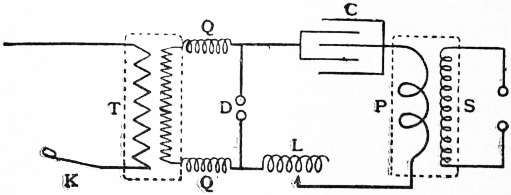
Fig. 2.—Arrangements for producing High Frequency Currents.
T, Transformer or induction coil. Q, Q, Choking coils. D, Spark balls. C, Condenser. L, Inductance. P, Primary circuit of high frequency coil. S, Secondary circuit.
An induction coil for the transformation of alternating current is called a transformer (q.v.). One type of high frequency current transformer is called an oscillation transformer or sometimes a Tesla coil. The construction of such High Frequency Coils. a coil is based on different principles from that of the coil just described. If the secondary terminals of an ordinary induction coil or transformer are connected to a pair of spark balls (fig. 2), and if these are also connected to a glass plate condenser or Leyden jar of ordinary type joined in series with a coil of wire of low resistance and few turns, then at each break of the primary circuit of the ordinary induction coil a secondary electromotive force is set up which charges the Leyden jar, and if the spark balls are set at the proper distance, this charge is succeeded by a discharge consisting of a movement of electricity backwards and forwards across the spark gap, constituting an oscillatory electric discharge (see Electrokinetics). Each charge of the jar may produce from a dozen to a hundred electric oscillations which are in fact brief electric currents of gradually decreasing strength. If the circuit of few turns and low resistance through which this discharge takes place is overlaid with another circuit well insulated from it consisting of a large number of turns of finer wire, the inductive action between the two circuits creates in the secondary a smaller series of electric oscillations of higher potential. Between the terminals of this last-named coil we can then produce a series of discharges each of which consists in an extremely rapid motion of electricity to and fro, the groups of oscillations being separated by intervals of time corresponding to the frequency of the break in the primary circuit of the ordinary induction coil charging the Leyden jar or condenser. These high frequency discharges differ altogether in character from the secondary discharges of the ordinary induction coil. Theory shows that to produce the best results the primary circuit of the oscillation transformer should consist of only one thick turn of wire or, at most, but of a few turns. It is also necessary that the two circuits, primary and secondary, should be well insulated from one another, and for this purpose the oscillation transformer is immersed in a box or vessel full of highly insulating oil. For full details N. Tesla’s original Papers must be consulted (see Journ. Inst. Elect. Eng. 21, 62).
In some cases the two circuits of the Tesla coil, the primary and secondary, are sections of one single coil. In this form the arrangement is called a resonator or auto transformer, and is much used for producing high frequency discharges for medical purposes. The construction of a resonator is as follows: A bare copper wire is wound upon an ebonite or wooden cylinder or frame, and one end of it is connected to the outside of a Leyden jar or battery of Leyden jars, the inner coating of which is connected to one spark ball of the ordinary induction coil. The other spark ball is connected to a point on the above-named copper wire not very far from the lower end. By adjusting this contact, which is movable, the electric oscillations created in the short section of the resonator coil produce by resonance oscillations in the longer free section, and a powerful high frequency electric brush or discharge is produced at the free end of the resonator spiral. An electrode or wire connected with this free end therefore furnishes a high frequency glow discharge which has been found to have valuable therapeutic powers.
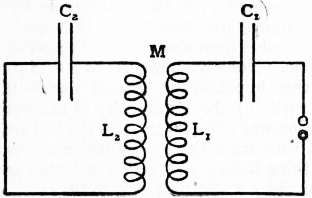
Fig. 3.
C1, Condenser in primary circuit. C2, Condenser in secondary circuit. L1, Inductance in primary circuit. L2, Inductance in secondary circuit.
The general theory of an oscillation transformer containing capacity and inductance in each circuit has been given by Oberbeck, Bjerknes and Drude.2 Suppose there are two circuits, each consisting of a coil of wire, the two being superimposed Theory of Oscillation Transformers. or adjacent, and let each circuit contain a condenser or Leyden jar in series with the circuit, and let one of these circuits contain a spark gap, the other being closed (fig. 3). If to the spark balls the secondary terminals of an ordinary induction coil are connected, and these spark balls are adjusted near one another, then when the ordinary coil is set in operation, sparks pass between the balls and oscillatory discharges take place in the circuit containing the spark gap. These oscillations induce other oscillations in the second circuit. The two circuits have a certain mutual inductance M, and each circuit has self inductance L1 and L2. If then the capacities in the two circuits are denoted by C1 and C2 the following simultaneous equations express the relation of the currents, i1 and i2, and potentials, v1, and v2, in the primary and secondary circuits respectively at any instant:—
L1 di1 + M di2 + R1i1 + v1 = 0,
dt dt
L2 di2 + M di1 + R2i2 + v2 = 0,
dt dt
R1 and R2 being the resistances of the two circuits. If for the moment we neglect the resistances of the two circuits, and consider that the oscillations in each circuit follow a simple harmonic law i = I sin pt we can transform the above equations into a biquadratic
p4 + p2 L1C1 + L2C2 + 1 = 0.
C1C2 (L1L2 − M2) C1C2(L1L2 − M2)
The capacity and inductance in each circuit can be so adjusted that their products are the same number, that is C1L1 = C2L2 = CL. The two circuits are then said to be in resonance or to be tuned together. In this particular and unique case the above biquadratic reduces to
p2 = 1 · 1 ± k ,
CL 1 − k2
where k is written for M √ (L1L2) and is called the coefficient of coupling. In this case of resonant circuits it can also be shown that the maximum potential differences at the primary and secondary condenser terminals are determined by the rule V1/V2 = 2√C2/√C1. Hence the transformation ratio is not determined by the relative number of turns on the primary and secondary circuits, as in the case of an ordinary alternating current transformer (see Transformers), but by the ratio of the capacity in the two oscillation circuits. For full proofs of the above the reader is referred to the original papers.
Each of the two circuits constituting the oscillation transformer taken separately has a natural time period of oscillation; that is to say, if the electric charge in it is disturbed, it oscillates to and fro in a certain constant period like a pendulum and therefore with a certain frequency. If the circuits have the same frequency when separated they are said to be isochronous. If n stands for the natural frequency of each circuit, where n = p/2π the above equations show that when the two circuits are coupled together, oscillations set up in one circuit create oscillations of two frequencies in the secondary circuit. A mechanical analogue to the above electrical effect can be obtained as follows: Let a string be strung loosely between two fixed points, and from it let two other strings of equal length hang down at a certain distance apart, each of them having a weight at the bottom and forming a simple pendulum. If one pendulum is set in oscillation it will gradually impart this motion to the second, but in so doing it will bring itself to rest; in like manner the second pendulum being set in oscillation gives back its motion to the first. The graphic representation, therefore, of the motion of each pendulum would be a line as in fig. 4. Such a curve represents the effect in music known as beats, and can easily be shown to be due to the combined effect of two simple harmonic motions or simple periodic curves of different frequency superimposed. Accordingly, the effect of inductively coupling together two electrical circuits, each having capacity and inductance, is that if oscillations are started in one circuit, oscillations of two frequencies are found in the secondary circuit, the frequencies differing from one another and differing from the natural frequency of each circuit taken alone. This matter is of importance in connexion with wireless telegraphy (see Telegraph), as in apparatus for conducting it, oscillation transformers as above described, having two circuits in resonance with one another, are employed.

Fig. 4.
References.—J. A. Fleming, The Alternate Current Transformer (2 vols., London, 1900), containing a full history of the induction coil; id., Electric Wave Telegraphy (London, 1906), dealing in chap. i., with the construction of the induction coil and various forms of interrupter as well as with the theory of oscillation transformers; A. T. Hare, The Construction of Large Induction Coils (London, 1900); J. Trowbridge, “On the Induction Coil,” Phil. Mag. (1902), 3, p. 393; Lord Rayleigh, “On the Induction Coil,” Phil. Mag. (1901), 2, p. 581; J. E. Ives, “Contributions to the Study of the Induction Coil,” Physical Review (1902), vols. 14 and 15.
(J. A. F.)
1 For a full history of the early development of the induction coil see J. A. Fleming, The Alternate Current Transformer, vol. ii., chap. i.
2 See A. Oberbeck, Wied. Ann. (1895), 55, p. 623; V. F. R. Bjerknes, d. (1895), 55, p. 121, and (1891), 44, p. 74; and P. K. L. Drude, Ann. Phys. (1904), 13, p. 512.
INDULGENCE (Lat. indulgentia, indulgere, to grant, concede), in theology, a term defined by the official catechism of the Roman Catholic Church in England as “the remission of the temporal punishment which often remains due to sin after its guilt has been forgiven.” This remission may be either total (plenary) or partial, according to the terms of the Indulgence. Such remission was popularly called a pardon in the middle ages—a term which still survives, e.g. in Brittany.
The theory of Indulgences is based by theologians on the following texts: 2 Samuel (Vulgate, 2 Kings) xii. 14; Matt. xvi. 19 and xviii. 17, 18; 1 Cor. v. 4, 5; 2 Cor. ii. 6-11; but the practice itself is confessedly of later growth. As Bishop Fisher says in his Confutation of Luther, “in the early church, faith in Purgatory and in Indulgences was less necessary than now.... But in our days a great part of the people would rather cast off Christianity than submit to the rigour of the [ancient] canons: wherefore it is a most wholesome dispensation of the Holy Ghost that, after so great a lapse of time, the belief in purgatory and the practice of Indulgences have become generally received among the orthodox” (Confutatio, cap. xviii.; cf. Cardinal Caietan, Tract. XV. de Indulg. cap. i.). The nearest equivalent in the ancient Church was the local and temporary African practice of restoring lapsed Christians to communion at the intercession of confessors and prospective martyrs in prison. But such reconciliations differed from later Indulgences in at least one essential particular, since they brought no remission of ecclesiastical penance save in very exceptional cases. However, as the primitive practice of public penance for sins died out in the Church, there grew up a system of equivalent, or nominally equivalent, private penances. Just as many of the punishments enjoined by the Roman criminal code were gradually commuted by medieval legislators for pecuniary fines, so the years or months of fasting enjoined by the earlier ecclesiastical codes were commuted for proportionate fines, the recitation of a certain number of psalms, and the like. “Historically speaking, it is indisputable that the practice of Indulgences in the medieval church arose out of the authoritative remission, in exceptional cases, of a certain proportion of this canonical penalty.” At the same time, according to Catholic teaching, such Indulgence was not a mere permission to omit or postpone payment, but was in fact a discharge from the debt of temporal punishment which the sinner owed. The authority to grant such discharge was conceived to be included in the power of binding and loosing committed by Christ to His Church; and when in the course of time the vaguer theological conceptions of the first ages of Christianity assumed scientific form and shape at the hands of the Schoolmen, the doctrine came to prevail that this discharge of the sinner’s debt was made through an application to the offender of what was called the “Treasure of the Church” (Thurston, p. 315). “What, then, is meant by the ‘Treasure of the Church’?... It consists primarily and completely of the merit and satisfaction of Christ our Saviour. It includes also the superfluous merit and satisfaction of the Blessed Virgin and the Saints. What do we mean by the word ‘superfluous’? In one way, as I need not say, a saint has no superfluous merit. Whatever he has, he wants it all for himself, because, the more he merits on earth (by Christ’s grace) the greater is his glory in heaven. But, speaking of mere satisfaction for punishment due, there cannot be a doubt that some of the Saints have done more than was needed in justice to expiate the punishment due to their own sins.... It is this ‘superfluous’ expiation that accumulates in the Treasure of the Church” (Bp. of Newport, p. 166). It must be noted that this theory of the “Treasure” was not formulated until some time after Indulgences in the modern sense had become established in practice. The doctrine first appeared with Alexander of Hales (c. 1230) and was at once adopted by the leading schoolmen. Clement VI. formally confirmed it in 1350, and Pius VI. still more definitely in 1794.
The first definite instance of a plenary Indulgence is that of Urban II. for the First Crusade (1095). A little earlier had begun the practice of partial Indulgences, which are always expressed in terms of days or years. However definite may have been the ideas originally conveyed by these notes of time, their first meaning has long since been lost. Eusebius Amort, in 1735, admits the gravest differences of opinion; and the Bishop of Newport writes (p. 163) “to receive an Indulgence of a year, for example, is to have remitted to one so much temporal punishment as was represented by a year’s canonical penance. If you ask me to define the amount more accurately, I say that it cannot be done. No one knows how severe or how long a Purgatory was, or is, implied in a hundred days of canonical penance.” The rapid extension of these time-Indulgences is one of the most remarkable facts in the history of the subject. Innocent II., dedicating the great church of Cluny in 1132, granted as a great favour a forty days’ Indulgence for the anniversary. A hundred years later, all churches of any importance had similar indulgences; yet Englishmen were glad even then to earn a pardon of forty days by the laborious journey to the nearest cathedral, and by making an offering there on one of a few privileged feast-days. A century later again, Wycliffe complains of Indulgences of two thousand years for a single prayer (ed. Arnold, i. 137). In 1456, the recitation of a few prayers before a church crucifix earned a Pardon of 20,000 years for every such repetition (Glassberger in Analecta Franciscana, ii. 368): “and at last Indulgences were so freely given that there is now scarcely a devotion or good work of any kind for which they cannot be obtained” (Arnold & Addis, Catholic Dictionary, s.v.). To quote again from Father Thurston (p. 318): “In imitation of the prodigality of her Divine Master, the Church has deliberately faced the risk of depreciation to which her treasure was exposed.... The growing effeminacy and corruption of mankind has found her censures unendurable ... and the Church, going out into the highways and the hedges, has tried to entice men with the offer of generous Indulgence.” But it must be noted that, according to the orthodox doctrine, not only can an Indulgence not remit future sins, but even for the past it cannot take full effect unless the subject be truly contrite and have confessed (or intend shortly to confess) his sins.
This salutary doctrine, however, has undoubtedly been obscured to some extent by the phrase a poena et a culpa, which, from the 13th century to the Reformation, was applied to Plenary Indulgences. The prima-facie meaning of the phrase is that the Indulgence itself frees the sinner not only from the temporal penalty (poena) but also from the guilt (culpa) of all his sins: and the fact that a phrase so misleading remained so long current shows the truth of Father Thurston’s remark: “The laity cared little about the analysis of it, but they knew that the a culpa et poena was the name for the biggest thing in the nature of an Indulgence which it was possible to get” (Dublin Review, Jan. 1900). The phrase, however, was far from being confined to the unlearned. Abbot Gilles li Muisis, for instance, records how, at the Jubilee of 1300, all the Papal Penitentiaries were in doubt about it, and appealed to the Pope. Boniface VIII. did indeed take the occasion of repeating (in the words of his Bull) that confession and contrition were necessary preliminaries; but he neither repudiated the misleading words nor vouchsafed any clear explanation of them. (Chron. Aegidii li Muisis ed. de Smet, p. 189.) His predecessor, Celestine V., had actually used them in a Bull.
The phrase exercised the minds of learned canonists all through the middle ages, but still held its ground. The most accepted modern theory is that it is merely a catchword surviving from a longer phrase which proclaimed how, during such Indulgences, ordinary confessors might absolve from sins usually “reserved” to the Bishop or the Pope. Nobody, however, has ventured exactly to reconstitute this hypothetical phrase; nor is the theory easy to reconcile with (i.) the uncertainty of canonists at the time when the locution was quite recent, (ii.) the fact that Clement V. and Cardinal Cusanus speak of absolution a poena et a culpa as a separate thing from (a) plenary absolution and (b) absolution from “reserved” sins (Clem. lib. v. tit. ix. c. 2, and Johann Busch (d. c. 1480) Chron. Windeshemense, cap. xxxvi.). But, however it originated, the phrase undoubtedly contributed to foster popular misconceptions as to the intrinsic value of Indulgences, apart from repentance and confession; though Dr Lea seems to press this point unduly (p. 54 ff.), and should be read in conjunction with Thurston (p. 324 ff.).
These misconceptions were certainly widespread from the 13th to the 16th century, and were often fostered by the “pardoners,” or professional collectors of contributions for Indulgences. This can best be shown by a few quotations from eminent and orthodox churchmen during those centuries. Berthold of Regensburg (c. 1270) says, “Fie, penny-preacher! ... thou dost promise so much remission of sins for a mere halfpenny or penny, that thousands now trust thereto, and fondly dream to have atoned for all their sins with the halfpenny or penny, and thus go to hell” (ed. Pfeiffer, i. 393).1 A century later, the author of Piers Plowman speaks of pardoners who “give pardon for pence poundmeal about” (i.e. wholesale; B. ii. 222); and his contemporary, Pope Boniface IX., complained of their absolving even impenitent sinners for ridiculously small sums (pro qualibet parva pecuniarum summula, Raynaldus, Ann. Ecc. 1390). In 1450 Thomas Gascoigne, the great Oxford Chancellor, wrote: “Sinners say nowadays ‘I care not how many or how great sins I commit before God, for I shall easily and quickly get plenary remission of any guilt and penalty whatsoever (cujusdam culpae et poenae) by absolution and indulgence granted to me from the Pope, whose writing and grant I have bought for 4d. or 6d. or for a game of tennis’”—or sometimes, he adds, by a still more disgraceful bargain (pro actu meretricio, Lib. Ver. p. 123, cf. 126). In 1523 the princes of Germany protested to the Pope in language almost equally strong (Browne, Fasciculus, i. 354). In 1562 the Council of Trent abolished the office of “pardoner.”
The greatest of all Plenary Indulgences is of course the Roman Jubilee. This was instituted in 1300 by Boniface VIII., who pleaded a popular tradition for its celebration every hundredth year, though no written evidence could be found. Clement VI. shortened the period to 50 years (1350): it was then further reduced to 33, and again in 1475 to 25 years.
See also the article on Luther. The latest and fullest authority on this subject is Dr H. C. Lea, Hist, of Auricular Confession and Indulgences in the Latin Church (Philadelphia, 1896); his standpoint is frankly non-Catholic, but he gives ample materials for judgment. The greatest orthodox authority is Eusebius Amort, De Origine, &c., indulgentiarum (1735). More popular and more easily accessible are Father Thurston’s The Holy Year of Jubilee (1900), and an article by the Bishop of Newport in the Nineteenth Century for January 1901, with a reply by Mr Herbert Paul in the next number.
(G. G. Co.)
1 Equally strong assertions were made by the provincial council of Mainz in 1261; and Lea (p. 287) quotes the complaints of 36 similar church councils before 1538.
INDULINES, a series of dyestuffs of blue, bluish-red or black shades, formed by the interaction of para-amino azo compounds with primary monamines in the presence of a small quantity of a mineral acid. They were first discovered in 1863 (English patent 3307) by J. Dale and H. Caro, and since then have been examined by many chemists (see O. N. Witt, Ber., 1884, 17, p. 74; O. Fischer and E. Hepp, Ann., 1890, 256, pp. 233 et seq.; F. Kehrmann, Ber., 1891, 24, pp. 584, 2167 et seq.). They are derivatives of the eurhodines (aminophenazines, aminonaphthophenazines), and by means of their diazo derivatives can be de-amidated, yielding in this way azonium salts; consequently they may be considered as amidated azonium salts. The first reaction giving a clue to their constitution was the isolation of the intermediate azophenin by O. Witt (Jour. Chem. Soc., 1883, 43, p. 115), which was proved by Fischer and Hepp to be dianilidoquinone dianil, a similar intermediate compound being found shortly afterwards in the naphthalene series. Azophenin, C30H24N4, is prepared by warming quinone dianil with aniline; by melting together quinone, aniline and aniline hydrochloride; or by the action of aniline on para-nitrosophenol or para-nitrosodiphenylamine. The indulines are prepared as mentioned above from aminoazo compounds:

or by condensing oxy- and amido-quinones with phenylated ortho-diamines (F. Kehrmann, Ber., 1895, 28, p. 1714):

The indulines may be subdivided into the following groups:— (1) benzindulines, derivatives of phenazine; (2) isorosindulines; and (3) rosindulines, both derived from naphthophenazine; and (4) naphthindulines, derived from naphthazine.
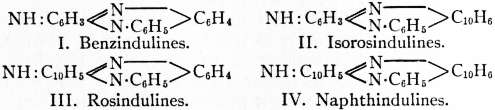
The rosindulines and naphthindulines have a strongly basic character, and their salts possess a marked red colour and fluorescence. Benzinduline (aposafranine), C18H13N3, is a strong base, but cannot be diazotized, unless it be dissolved in concentrated mineral acids. When warmed with aniline it yields anilido-aposafranine, which may also be obtained by the direct oxidation of ortho-aminodiphenylamine. Isorosinduline is obtained from quinone dichlorimide and phenyl-β-naphthylamine; rosinduline from benzene-azo-α-naphthylamine and aniline and naphthinduline from benzene-azo-α-naphthylamine and naphthylamine.
INDULT (Lat. indultum, from indulgere, grant, concede, allow), a, papal licence which authorizes the doing of something not sanctioned by the common law of the church; thus by an indult the pope authorizes a bishop to grant certain relaxations during the Lenten fast according to the necessities of the situation, climate, &c., of his diocese.
INDUNA, a Zulu-Bantu word for an officer or head of a regiment among the Kaffir (Zulu-Xosa) tribes of South Africa. It is formed from the inflexional prefix in and duna, a lord or master. Indunas originally obtained and retained their rank and authority by personal bravery and skill in war, and often proved a menace to their nominal lord. Where, under British influence, the purely military system of government among the Kaffir tribes has broken down or been modified, indunas are now administrators rather than warriors. They sit in a consultative gathering known as an indaba, and discuss the civil and military affairs of their tribe.
INDUS, one of the three greatest rivers of northern India.
A considerable accession of exact geographical knowledge has been gained of the upper reaches of the river Indus and its tributaries during those military and political movements which have been so constant on the northern In the Himalaya. frontiers of India of recent years. The sources of the Indus are to be traced to the glaciers of the great Kailas group of peaks in 32° 20′ N. and 81° E., which overlook the Mansarowar lake and the sources of the Brahmaputra, the Sutlej and the Gogra to the south-east. Three great affluents, flowing north-west, unite in about 80° E. to form the main stream, all of them, so far as we know at present, derived from the Kailas glaciers. Of these the northern tributary points the road from Ladakh to the Jhalung goldfields, and the southern, or Gar, forms a link in the great Janglam—the Tibetan trade route—which connects Ladakh with Lhasa and Lhasa with China. Gartok (about 50 m. from the source of this southern head of the Indus) is an important point on this trade route, and is now made accessible to Indian traders by treaty with Tibet and China. At Leh, the Ladakh capital, the river has already pursued an almost even north-westerly course for 300 m., except for a remarkable divergence to the south-west which carries it across, or through, the Ladakh range to follow the same course on the southern side that had been maintained on the north. This very remarkable instance of transverse drainage across a main mountain axis occurs in 79° E., about 100 m. above Leh. For another 230 m., in a north-westerly direction, the Indus pursues a comparatively gentle and placid course over its sandy bed between the giant chains of Ladakh to the north and Zaskar (the main “snowy range” of the Himalaya) to the south, amidst an array of mountain scenery which, for the majesty of sheer altitude, is unmatched by any in the world. Then the river takes up the waters of the Shyok from the north (a tributary nearly as great as itself), having already captured the Zasvar from the south, together with innumerable minor glacier-fed streams. The Shyok is an important feature in The Shyok affluent. Trans-Himalayan hydrography. Rising near the southern foot of the well-known Karakoram pass on the high road between Ladakh and Kashgar, it first drains the southern slopes of the Karakoram range, and then breaks across the axis of the Muztagh chain (of which the Karakoram is now recognized as a subsidiary extension northwards) ere bending north-westwards to run a parallel course to the Indus for 150 m. before its junction with that river. The combined streams still hold on their north-westerly trend for another 100 m., deep hidden under the shadow of a vast array of snow-crowned summits, until they arrive within sight of the Rakapushi peak which pierces the north-western sky midway between Gilgit and Hunza. Here the great change of direction to the south-west occurs, which is thereafter maintained till the Indus reaches the ocean. At this point it receives the Gilgit river from the north-west, having dropped The Gilgit affluent. from 15,000 to 4000 ft. (at the junction of the rivers) after about 500 m. of mountain descent through the independent provinces of northern Kashmir. (See Gilgit.) A few miles below the junction it passes Bunji, and from that point to a point beyond Chilas (50 m. below Bunji) it runs within the sphere of British interests. Then once again it resumes its “independent” course through the wild mountains of Kohistan and Hazara, receiving tribute from both sides (the Buner contribution being the most noteworthy) till it emerges into the plains of the Punjab below Darband, in 34° 10′ N. All this part of the river has been mapped in more or less detail of late years. The hidden strongholds of those Hindostani fanatics who had found a refuge on its banks since Mutiny days have been swept clean, and many ancient mysteries have been solved in the course of its surveying.
From its entrance into the plains of India to its disappearance in the Indian Ocean, the Indus of to-day is the Indus of the ’fifties—modified only in some interesting particulars. It has been bridged at several important points. There Indus of the plains. are bridges even in its upper mountain courses. There is a wooden pier bridge at Leh of two spans, and there are native suspension bridges of cane or twig-made rope swaying uneasily across the stream at many points intervening between Leh and Bunji; but the first English-made iron suspension bridge is a little above Bunji, linking up the highroad between Kashmir and Gilgit. Next occurs the iron girder railway bridge at Attock, connecting Rawalpindi with Peshawar, at which point the river narrows almost to a gorge, only 900 ft. above sea-level. Twenty miles below Attock the river has carved out a central trough which is believed to be 180 ft. deep. Forty miles below Attock another great bridge has been constructed at Kushalgarh, which carries the railway to Kohat and the Kurram valley. At Mari, beyond the series of gorges which continue from Kushalgarh to the borders of the Kohat district, on the Sind-Sagar line, a boat-bridge leads to Kalabagh (the Salt city) and northwards to Kohat. Another boat-bridge opposite Dera Ismail Khan connects that place with the railway; but there is nothing new in these southern sections of the Indus valley railway system except the extraordinary development of cultivation in their immediate neighbourhood. The Lansdowne bridge at Sukkur, whose huge cantilevers stand up as a monument of British enterprise visible over the flat plains for many miles around, is one of the greatest triumphs of Indian bridge-making. Kotri has recently been connected with Hyderabad in Sind, and the Indus is now one of the best-bridged rivers in India. The intermittent navigation which was maintained by the survivals of the Indus flotilla as far north as Dera Ismail Khan long after the establishment of the railway system has ceased to exist with the dissolution of the fleet, and the high-sterned flat Indus boats once again have the channels and sandbanks of the river all to themselves.
Within the limits of Sind the vagaries of the Indus channels have necessitated a fresh survey of the entire riverain. The results, however, indicate not so much a marked departure in the general course of the river as a great Lower Indus and delta. variation in the channel beds within what may be termed its outside banks. Collaterally much new information has been obtained about the ancient beds of the river, the sites of ancient cities and the extraordinary developments of the Indus delta. The changing channels of the main stream since those prehistoric days when a branch of it found its way to the Runn of Cutch, through successive stages of its gradual shift westwards—a process of displacement which marked the disappearance of many populous places which were more or less dependent on the river for their water supply—to the last and greatest change of all, when the stream burst its way through the limestone ridges of Sukkur and assumed a course which has been fairly constant for 150 years, have all been traced out with systematic care by modern surveyors till the medieval history of the great river has been fully gathered from the characters written on the delta surface. That such changes of river bed and channel should have occurred within a comparatively limited period of time is the less astonishing if we remember that the Indus, like many of the greatest rivers of the world, carries down sufficient detritus to raise its own bed above the general level of the surrounding plains in an appreciable and measurable degree. At the present time the bed of the Indus is stated to be 70 ft. above the plains of the Sind frontier, some 50 m. to the west of it.
The total length of the Indus, measured directly, is about 1500 m. With its many curves and windings it stretches to about 2000 m., the area of its basin being computed at 372,000 sq. m. Even at its lowest in winter it is 500 ft. wide at Iskardo (near Statistics. the Gilgit junction) and 9 or 10 ft. deep. The temperature of the surface water during the cold season in the plains is found to be 5° below that of the air (64° and 69° F.). At the beginning of the hot season, when the river is bringing down snow water, the difference is 14° (87° and 101° June). At greater depths the difference is still greater. At Attock, where the river narrows between rocky banks, a height of 50 ft. in the flood season above lowest level is common, with a velocity of 13 m. per hour. The record rise (since British occupation of the Punjab) is 80 ft. At its junction with the Panjnad (the combined rivers of the Punjab east of the Indus) the Panjnad is twice the width of the Indus, but its mean depth is less, and its velocity little more than one-third. This discharge of the Panjnad at low season is 69,000 cubic ft. per second, that of the Indus 92,000. Below the junction the united discharge in flood season is 380,000 cubic ft., rising to 460,000 (the record in August). The Indus after receiving the other rivers carries down into Sind, in the high flood season, turbid water containing silt to the amount of 1⁄229 part by weight, or 1⁄410 by volume—equal to 6480 millions of cubic ft. in the three months of flood. This is rather less than the Ganges carries. The silt is very fine sand and clay. Unusual floods, owing to landslips or other exceptional causes, are not infrequent. The most disastrous flood of this nature occurred in 1858. It was then that the river rose 80 ft. at Attock. The most striking result of the rise was the reversal of the current of the Kabul river, which flowed backwards at the rate of 10 m. per hour, flooding Nowshera and causing immense damage to property. The prosperity of the province of Sind depends almost entirely on the waters of the Indus, as its various systems of canals command over nine million acres out of a cultivable area of twelve and a half million acres.
See Maclagan, Proceedings R.G.S., vol. iii.; Haig, The Indus Delta Country (London, 1894); Godwin-Austen, Proceedings R.G.S. vol. vi.
(T. H. H.*)
INDUSTRIA (mod. Monteù da Po), an ancient town of Liguria, 20 m. N.E. of Augusta Taurinorum. Its original name was Bodincomagus, from the Ligurian name of the Padus (mod. Po), Bodincus, i.e. bottomless (Plin. Hist. Nat. iii. 122), and this still appears on inscriptions of the early imperial period. It stood on the right bank of the river, which has now changed its course over 1 m. to the north. It was a flourishing town, with municipal rights, as excavations (which have brought to light the forum, theatre, baths, &c.) have shown, but appears to have been deserted in the 4th century A.D.
See A. Fabietti in Atti della Società di Archeologia di Torino, iii, 17 seq.; Th. Mommsen in Corp. Inscrip. Lat. v. (Berlin, 1877), p. 845; E. Ferrero in Notizie degli Scavi (1903), p. 43.
INDUSTRIAL SCHOOL, in England a school, generally established by voluntary contributions, for the industrial training of children, in which children are lodged, clothed and fed, as well as taught. Industrial schools are chiefly for vagrant and neglected children and children not convicted of theft. Such schools are for children up to the age of fourteen, and the limit of detention is sixteen. They are regulated by the Children Act 1908, which repealed the Industrial Schools Act 1866, as amended by Acts of 1872, 1891 and 1901, and parallel legislation in the various Elementary Education Acts, besides some few local acts. The home secretary exercises powers of supervision, &c. See Juvenile Offenders.
INDUSTRY (Lat. industria, from indu-, a form of the preposition in, and either stare, to stand, or struere, to pile up), the quality of steady application to work, diligence; hence employment in some particular form of productive work, especially of manufacture; or a particular class of productive work itself, a trade or manufacture. See Labour Legislation, &c.
INE, king of the West Saxons, succeeded Ceadwalla in 688, his title to the crown being derived from Ceawlin. In the earlier part of his reign he was at war with Kent, but peace was made in 694, when the men of Kent gave compensation for the death of Mul, brother of Ceadwalla, whom they had burned in 687. In 710 Ine was fighting in alliance with his kinsman Nun, probably king of Sussex, against Gerent of West Wales and, according to Florence of Worcester, he was victorious. In 715 he fought a battle with Ceolred, king of Mercia, at Woodborough in Wiltshire, but the result is not recorded. Shortly after this time a quarrel seems to have arisen in the royal family. In 721 Ine slew Cynewulf, and in 722 his queen Aethelburg destroyed Taunton, which her husband had built earlier in his reign. In 722 the South Saxons, previously subject to Ine, rose against him under the exile Aldbryht, who may have been a member of the West Saxon royal house. In 725 Ine fought with the South Saxons and slew Aldbryht. In 726 he resigned the crown and went to Rome, being succeeded by Aethelheard in Wessex. Ine is said to have built the minster at Glastonbury. The date of his death is not recorded. He issued a written code of laws for Wessex, which is still preserved.
See Bede, Hist. Eccl. (Plummer), iv. 15, v. 7; Saxon Chronicle (Earle and Plummer), s.a. 688e, 694, 710, 715, 721, 722, 725, 728; Thorpe, Ancient Laws, i. 2-25; Sehmid, Gesetze der Angelsachsen (Leipzig, 1858); Liebermann, Gesetzeder Angelsachsen (Halle, 1898-99).
INEBOLI, a town on the north coast of Asia Minor, 70 m. W. of Sinūb (Sinope). It is the first place of importance touched at by mercantile vessels plying eastwards from Constantinople, being the port for the districts of Changra and Kastamuni, and connected with the latter town by a carriage road (see Kastamuni). The roadstead is exposed, having no protection for shipping except a jetty 300 ft. long, so that in rough weather landing is impracticable. The exports (chiefly wool and mohair) are about £248,000 annually and the imports £200,000. The population is about 9000 (Moslems 7000, Christians 2000). Ineboli represents the ancient Abonou-teichos, famous as the birthplace of the false prophet Alexander, who established there (2nd century A.D.) an oracle of the snake-God Glycon-Asclepius. This impostor, immortalized by Lucian, obtained leave from the emperor Marcus Aurelius to change the name of the town to Ionopolis, whence the modern name is derived (see Alexander the Paphlagonian).
INEBRIETY, LAW OF. The legal relations to which inebriety (Lat. in, intensive, and ebrietas, drunkenness) gives rise are partly civil and partly criminal.
I. Civil Capacity.—The law of England as to the civil capacity of the drunkard is practically identified with, and has passed through substantially the same stages of development as the law in regard to the civil capacity of a person suffering from mental disease (see Insanity). Unless (see III. inf.) a modification is effected in his condition by the fact that he has been brought under some form of legal control, a man may, in spite of intoxication, enter into a valid marriage or make a valid will, or bind himself by a contract, if he is sober enough to know what he is doing, and no improper advantage of his condition is taken (cf. Matthews v. Baxter, 1873, L.R. 8 Ex. 132; Imperial Loan Co. v. Stone, 1892, 1 Q.B. 599). The law is the same in Scotland and in Ireland; and the Sale of Goods Act 1893 (which applies to the whole United Kingdom) provides that where necessaries are sold and delivered to a person who by reason of drunkenness is incompetent to contract, he must pay a reasonable price for them; “necessaries” for the purposes of this provision mean goods suitable to the condition in life of such person and to his actual requirements at the time of the sale and delivery.
Under the Roman law, and under the Roman Dutch law as applied in South Africa, drunkenness, like insanity, appears to vitiate absolutely a contract made by a person under its influence (Molyneux v. Natal Land and Colonization Co., 1905, A.C. 555).
In the United States, as in England, intoxication does not vitiate contractual capacity unless it is of such a degree as to prevent the person labouring under it from understanding the nature of the transaction into which he is entering (Bouvier, Law Dict., s.v. “Drunkenness”; and cf. Waldron v. Angleman, 1004, 58 Atl. 568; Fowler v. Meadow Brook Water Co., 1904, 57 Atl. 959; 208 Penn., 473). The same rule is by implication adopted in the Indian Contract Act (Act ix. of 1872), which provides (s. 12) that “a person is ... of sound mind for the purpose of making a contract if, at the time when he makes it, he is capable of understanding it and of forming a rational judgment as to its effect upon his interests.” In some legal systems, however, habitual drunkenness is a ground for divorce or judicial separation (Sweden, Law of the 27th of April 1810; France, Code Civil, Art. 231, Hirt v. Hirt, Dalloz, 1898, pt. ii., p. 4, and n. 4).
II. Criminal Responsibility.—In English law, drunkenness, unlike insanity, was at one time regarded as in no way an excuse for crime. According to Coke (Co. Litt., 247) a drunkard, although he suffers from acquired insanity, dementia affectata, is voluntarius daemon, and therefore has no privilege in consequence of his state; “but what hurt or ill soever he doth, his drunkenness doth aggravate it.” Sir Matthew Hale (P.C. 32) took a more moderate view, viz. that a person under the influence of this voluntarily contracted madness “shall have the same judgment as if he were in his right senses”; and admitted the existence of two “allays” or qualifying circumstances: (1) temporary frenzy induced by the unskilfulness of physicians or by drugging; and (2) habitual or fixed frenzy. Those early authorities have, however, undergone considerable development and modification.
Although the general principle that drunkenness is not an excuse for crime is still steadily maintained (see Russell, Crimes, 6th ed., i. 144; Archbold, Cr. Pl., 23rd ed., p. 29), it is settled law that where a particular intent is one of the constituent elements of an offence, the fact that a prisoner was intoxicated at the time of its commission is relevant evidence to show that he had not the capacity to form that intent. Drunkenness is also a circumstance of which a jury may take account in considering whether an act was premeditated, or whether a prisoner acted in self-defence or under provocation, when the question is whether the danger apprehended or the provocation was sufficient to justify his conduct or to alter its legal character. Moreover, delirium tremens, if it produce such a degree of madness as to render a person incapable of distinguishing right from wrong, relieves him from criminal responsibility for any act committed by him while under its influence; and in one case at nisi prius (R. v. Baines, The Times, 25th Jan. 1886) this doctrine was extended by Mr Justice Day to temporary derangement occasioned by drink. The law of Scotland accepts, if it does not go somewhat beyond, the later developments of that of England in regard to criminal responsibility in drunkenness. Indian law on the point is similar to the English (Indian Penal Code, Act. xlv. of 1860, ss. 85, 86; Mayne, Crim. Law of India, ed. 1896, p. 391). In the United States the same view is the prevalent legal doctrine (see Bishop, Crim. Law, 8th ed., i, ss. 397-416). The Criminal Code of Queensland (No. 9 of 1899, Art. 28) provides that a person who becomes intoxicated intentionally is responsible for any crime that he commits while so intoxicated, whether his voluntary intoxication was induced so as to afford an excuse for the commission of an offence or not. As in England, however, when an intention to cause a specific result is an element of an offence, intoxication, whether complete or partial, and whether intentional or unintentional, may be regarded for the purpose of ascertaining whether such intention existed or not. There is a similar provision in the Penal Code of Ceylon (No. 2 of 1883, Art. 79). The Criminal Codes of Canada (1892, c. 29, ss. 7 et seq.) and New Zealand (No. 56 of 1893, ss. 21 et seq.) are silent on the subject of intoxication as an excuse for crime. The Criminal Code of Grenada (No. 2 of 1897, Art. 51) provides that “a person shall not, on the ground of intoxication, be deemed to have done any act involuntarily, or be exempt from any liability to punishment for any act: and a person who does an act while in a state of intoxication shall be deemed to have intended the natural and probable consequences of his act.” There is a similar provision in the Criminal Code of the Gold Coast Colony (No. 12 of 1892, s. 54). Under the French Penal Code (Art. 64), “il n’y a ni crime, ni délit, lorsque le prévenu était en état de démence au temps de l’action ou lorsqu’il aura été contraint par une force à laquelle il n’ a pu résister.” According to the balance of authority (Dalloz, Rép. tit., Peine, ss. 402 et seq.) intoxication is not assimilated to insanity, within the meaning of this article, but it may be and is taken account of by juries as an extenuating circumstance (Ortolan, Droit Pénal i. s. 323: Chauveau et Hélie i. s. 360). A provision in the German Penal Code (Art. 51) that an act is not punishable if its author, at the time of committing it, was in a condition of unconsciousness, or morbid disturbance of the activity of his mind which prevented the free exercise of his will, has been held not to extend to intoxication (Clunet, 1883, p. 311). But in Germany as in France, intoxication may apparently be an extenuating circumstance. Under the Italian Penal Code (Arts. 46-49) intoxication—unless voluntarily induced so as to afford an excuse for crime—may exclude or modify responsibility.
So far only the question whether drunkenness is an excuse for offences committed under its influence has been dealt with. There remains the question how far drunkenness itself is a crime. Mere private intoxication is not, either in England or in the United States (Bishop, Crim. Law, 8th ed., i. s. 399) indictable as an offence at common law; but in all civilized countries public drunkenness is punishable when it amounts to a breach of the peace (see Liquor Laws) or contravention of public order; and modern legislation in many countries provides for deprivation of personal liberty for long periods in case of a frequent repetition of the offence. Reference may be made in this connexion to the Inebriates Acts 1898, 1899 and 1900 (see iii. inf.), and also to similar legislation in the British colonies and in foreign legal systems (e.g. Cape of Good Hope, No. 32 of 1896; Ceylon, Licensing Ordinance 1891, ss. 23, 24, 29; New South Wales, Vagrants Punishment Act 1866; Massachusetts, Acts of 1891, c. 427, 1893, cc. 414, 44; France, Law of 23rd of Jan. 1873, Art. 6).
III. State Action in Regard to Inebriety.—This assumes a variety of forms. (a) Measures regulating the punishment of occasional or habitual drunkenness by fines or short terms of imprisonment. (b) Control in penal establishments for lengthened periods. (c) Laws prohibiting the sale of liquor to persons who are known inebriates: e.g. in England (Licensing Act 1902); Ontario (Rev. Stats. 1897, c. 245, ss. 124, 125); New South Wales (Liquor Act 1898, ss. 52, 53); Cape of Good Hope (No. 28 of 1883, s. 89); New York (Rev. Stats. 1889-1892, c. 20, Title iv.); California (Act to prevent sale of liquor to drunkards, 1889); Massachusetts (Pub. Stats., ed. 1902, c. 100, s. 9). (d) Laws regulating the appointment of some person or persons to act as guardian or guardians, or who may be endowed with legal powers over the person and estate of an inebriate. Thus in France (Code Civil, Arts. 489 et seq.), Germany (Civil Code, Art. 6 (39)) and Austria-Hungary (Bürgerliches Gesetz-Buch, ss. 21, 269, 270, 273), an inebriate may be judicially interdicted if he is squandering his property and thereby exposing his family to future destitution. Provision is also made for the interdiction of inebriates by the laws of Nova Scotia (Rev. Stats. 1900, c. 126, s. 2), Manitoba (Rev. Stat. 1902, c. 103, ss. 30 et seq.), British Columbia (Rev. Stat. 1897, c. 66), New South Wales (Inebriates Act 1900, s. 5), Tasmania (Inebriates Act 1885, No. 17, s. 23); Canton of Bâle (Trustee Law of the 23rd of Feb. 1880, s. 11), Orange River Colony (Code Laws, c. 108, s. 30), Maryland (Code General Laws, c. 474, s. 47). (e) Control for the purpose of reformation. Legislation of this character provides reformatory treatment: (1) for the inebriate who makes a voluntary application for admission; (2) by compulsory seclusion for the inebriate who refuses consent to treatment and yet manages to keep out of the reach of the law; (3) for the inebriate who is a police-court recidivist, or who has committed crime, caused or contributed to by drink. The legislation of the Cape of Good Hope (Inebriates Act 1896) and of North Dakota (Habitual Drunkards Act 1895) provides for the first of these methods of treatment alone. Compulsory detention for ordinary inebriates only is provided for by the laws of Delaware (Act of 1898), Massachusetts (Rev. Laws, c. 87), and of the Cantons of Berne (Law of the 24th of Nov. 1883) and Bâle (Law of the 21st of Feb. 1901). All three methods of treatment are in force in New South Wales (Inebriates Act 1900), Queensland (Inebriates Institutions Act 1896) and South Australia (Inebriates Act 1881). Provision is made only for voluntary application and compulsory detention of ordinary inebriates in Victoria (Inebriates Act 1890), Tasmania (Inebriates Act 1885; Inebriates Hospitals Act 1892) and New Zealand (Inebriates Institutions Act 1898). The legislation of the United Kingdom (Inebriates Acts 1879-1900) deals both with voluntary application and with the committal of criminal inebriates or of police-court recidivists. A brief sketch of the English system must suffice.
The Inebriates Acts of 1870-1900 deal in the first place with non-criminal, and in the second place with criminal, habitual drunkards.
For the purposes of the acts the term “habitual drunkard” means “a person who, not being amenable to any jurisdiction in lunacy, is notwithstanding, by reason of habitual intemperate drinking of intoxicating liquor, at times dangerous to himself or herself, or incapable of managing himself or herself and his or her affairs.” A person would become amenable to the lunacy jurisdiction not only where habitual drunkenness made him a “lunatic” in the legal sense of the term, but where it created, such a state of disease and consequential “mental infirmity” as to bring his case within section 116 of the Lunacy Act 1890, the effect of which is explained in the article Insanity. Any “habitual drunkard” within the above definition may obtain admission to a “licensed retreat” on a written application to the licensee, stating the time (the maximum period is two years) that he undertakes to remain in the retreat. The application must be accompanied by the statutory declaration of two persons that the applicant is an habitual drunkard, and its signature must be attested by a justice of the peace who has satisfied himself as to the fact, and who is required to state that the applicant understood the nature and effect of his application. Licences (each of which is subject to a duty and is impressed with a stamp of £5, and 10s. for every patient above ten in number) are granted for retreats by the borough council and the town clerk in boroughs, and elsewhere by the county council and the clerk of the county council. The maximum period for which a licence may be granted is two years, but licences may be renewed by the licensing authority on payment of a stamp duty of the same amount as on the original grant. When an habitual drunkard has once been committed to a retreat, he must remain in the retreat for the time that he has fixed in his application, subject to certain statutory provisions similar to those prescribed by the Lunacy Acts for asylums as to leave of absence and discharge; and he may be retaken and brought back to the retreat under a justice’s warrant. The term of detention may be extended on its expiry, or an inebriate may be readmitted, on a fresh application, without any statutory declaration, and without the attesting justice being required to satisfy himself that the applicant is an habitual drunkard. Licensed retreats are subject to inspection by an Inspector of Retreats appointed by the Home Secretary, to whom he makes an annual report. The Home Secretary is empowered to make rules and regulations for the management of retreats, and “regulations and orders,” not inconsistent with such rules, are to be prepared by the licensee within a month after the granting of his licence, and submitted to the inspector for approval. The rules now in force are dated as regards (a) England, 28th Feb. 1902; (b) Scotland, 14th April 1902; (c) Ireland, 3rd Feb. 1903. There are also statutory provisions, similar to those of the Lunacy Acts, as to offences—(i.) by licensees failing to comply with the requirements of the acts; (ii) by persons ill-treating patients, or helping them to escape, or unlawfully supplying them with intoxicating liquor; (iii.) by patients refusing to comply with the rules. The Home Secretary may (i.) authorize the establishment of “State Inebriate Reformatories,” to be paid for out of moneys provided by parliament; and (ii.) sanction “Certified Inebriates’ Reformatories” on the application of any borough or county council, or any person whatever, if satisfied concerning the reformatory and the persons proposing to maintain it. An Inspector of Certified Inebriate Reformatories has been appointed. Regulations for State Inebriate Reformatories and for Certified Inebriate Reformatories have been made, dated as follows: State Inebriate Reformatories:—England, 21st of June 1901, 29th of Dec. 1903, 29th of April 1904; Scotland, 9th of March 1900; Ireland, 16th of March 1899, 16th of April 1901, 10th of Feb. 1904. Certified Inebriate Reformatories:—England, Model Regulations, 17th of Dec. 1898; Scotland, Regulations, 14th of Feb. 1899; Ireland, Model Regulations, 29th of April 1899.
Any person convicted on indictment of an offence punishable with imprisonment or penal servitude (i.e. of any non-capital felony and of most misdemeanours), if the court is satisfied from the evidence that the offence was committed under the influence of drink, or that drink was a contributing cause of the offence, may, if he admits that he is, or is found by the jury to be, an habitual drunkard, in addition to or in substitution for any other sentence, be ordered to be detained in a state or certified inebriate reformatory, the managers of which are willing to receive him. Again, any habitual drunkard who is found drunk in any public place, or who commits any other of a series of similar offences under various statutes, after having within twelve months been convicted at least three times of a similar offence, may, on conviction on indictment, or, if he consent, on summary conviction, be sent for detention in any certified inebriate reformatory. The expenses of prosecuting habitual drunkards under the above provisions are payable out of the local rates upon an order to that effect by the judge of assize or chairman of quarter-sessions if the prosecution be on indictment, or by a court of summary jurisdiction if the offence is dealt with summarily.
Authorities.—As to the history of legislation on the subject see Parl. Paper No. 242 of 1872; 1893 C. 7008. See also Wyatt Paine, Inebriate Reformatories and Retreats (London, 1899); Blackwell, Inebriates Acts, 1879-1898 (London, 1899); Wood Renton, Lunacy (London and Edinburgh, 1896); Kerr, Inebriety (3rd ed., London, 1894). An excellent account of the systems in force in other countries for the treatment of inebriates will be found in Parl. Pap. (1902), cd. 1474.
(A. W. R.)
INFALLIBILITY (Fr. infaillibilité and infallibilité, the latter now obsolete, Med. Lat. infallibilitas, infallibilis, formed from fallor, to make a mistake), the fact or quality of not being liable to err or fail. The word has thus the general sense of “certainty”; we may, e.g., speak of a drug as an infallible specific, or of a man’s judgment as infallible. In these cases, however, the “infallibility” connotes certainty only in so far as anything human can be certain. In the language of the Christian Church the word “infallibility” is used in a more absolute sense, as the freedom from ail possibility of error guaranteed by the direct action of the Spirit of God. This belief in the infallibility of revelation is involved in the very belief in revelation itself, and is common to all sections of Christians, who differ mainly as to the kind and measure of infallibility residing in the human instruments by which this revelation is interpreted to the world. Some see the guarantee, or at least the indication, of infallibility in the consensus of the Church (quod semper, ubique, et ab omnibus) expressed from time to time in general councils; others see it in the special grace conferred upon St Peter and his successors, the bishops of Rome, as heads of the Church; others again see it in the inspired Scriptures, God’s Word. This last was the belief of the Protestant Reformers, for whom the Bible was in matters of doctrine the ultimate court of appeal. To the translation and interpretation of the Scriptures men might bring a fallible judgment, but this would be assisted by the direct action of the Spirit of God in proportion to their faith. As for infallibility, this was a direct grace of God, given only to the few. “What ever was perfect under the sun,” ask the translators of the Authorized Version (1611) in their preface, “where apostles and apostolick men, that is, men endued with an extraordinary measure of God’s Spirit, and privileged with the privilege of infallibility, had not their hand?” In modern Protestantism, on the other hand, the idea of an infallible authority whether in the Church or the Bible has tended to disappear, religious truths being conceived as valuable only as they are apprehended and made real to the individual mind and soul by the grace of God, not by reason of any submission to an external authority. (See also Inspiration.)
At the present time, then, the idea of infallibility in religious matters is most commonly associated with the claim of the Roman Catholic Church, and more especially of the pope personally as head of that Church, to possess the privilege of infallibility, and it is with the meaning and limits of this claim that the present article deals.