VOLUME XIV SLICE V Indole to Insanity (continued 7)
Reading edition
INGOT, originally a mould for the casting of metals, but now a mass of metal cast in a mould, and particularly the small bars of the precious metals, cast in the shape of an oblong brick or wedge with slightly sloping sides, in which form gold and silver are handled as bullion at the Bank of England and the Mint. Ingots of varying sizes and shapes are cast of other metals, and “ingot-steel” and “ingot-iron” are technical terms in the manufacture of iron and steel (see Iron and Steel). The word is obscure in origin. It occurs in Chaucer (“The Canon’s Yeoman’s Tale”) as a term of alchemy, in the original sense of a mould for casting metal, and, as the New English Dictionary points out, an English origin for such a term is unlikely. It may, however, be derived from in and the O. Eng. géotan to pour; cf. Ger. giessen and Einguss, a mould. The Fr. lingot, with the second English meaning only, has been taken as the origin of “ingot” and derived from the Lat. lingua, tongue—with a supposed reference to the shape. This derivation is wrong, and French etymologists have now accepted the English origin for the word, lingot having coalesced from l’ingot.
INGRAM, JAMES (1774-1850), English antiquarian and Anglo-Saxon scholar, was born near Salisbury on the 21st of December 1774. He was educated at Warminster and Winchester schools and at Trinity College, Oxford, of which he became a fellow in 1803. From 1803 to 1808 he was Rawlinsonian professor of Anglo-Saxon at Oxford, and in 1824 was made President of Trinity College and D.D. His time, however, was principally spent in antiquarian research, and especially in the study of Anglo-Saxon, in which field he was the pre-eminent scholar of his time. He published in 1823 an edition of the Saxon Chronicle. His other works include admirable Memorials of Oxford (1832-1837), and The Church in the Middle Centuries (1842). He died on the 5th of September 1850.
INGRAM, JOHN KELLS (1823-1907), Irish scholar and economist, was born in Co. Donegal, Ireland, on the 7th of July 1823. Educated at Newry School and Trinity College, Dublin, he was elected a fellow of his college in 1846. He held the professorship of Oratory and English Literature in Dublin University from 1852 to 1866, when he became regius professor of Greek. In 1879 he was appointed librarian. Ingram was remarkable for his versatility. In his undergraduate days he had written the well-known poem “Who fears to speak of Ninety-eight?” and his Sonnets and other Poems (1900) reveal the poetic sense. He contributed many important papers to mathematical societies on geometrical analysis, and did much useful work in advancing the science of classical etymology, notably in his Greek and Latin Etymology in England, The Etymology of Liddell and Scott. His philosophical works include Outlines of the History of Religion (1900), Human Nature and Morals according to A. Comte (1901), Practical Morals (1904), and the Final Transition (1905). He contributed to the 9th edition of the Encyclopaedia Britannica an historical and biographical article on political economy, which was translated into nearly every European language. His History of Slavery and Serfdom was also written for the 9th edition of the Encyclopaedia Britannica. He died in Dublin on the 18th of May 1907.
INGRES, JEAN AUGUSTE DOMINIQUE (1780-1867), French painter, was born at Montauban, on the 29th of August 1780. His father, for whom he entertained the most tender and respectful affection, has described himself as sculpteur en plâtre; he was, however, equally ready to execute every other kind of decorative work, and now and again eked out his living by taking portraits or obtained an engagement as a violin-player. He brought up his son to command the same varied resources, but in consequence of certain early successes—the lad’s performance of a concerto of Viotti’s was applauded at the theatre of Toulouse—his attention was directed chiefly to the study of music. At Toulouse, to which place his father had removed from Montauban in 1792, Ingres had, however, received lessons from Joseph Roques, a painter whom he quitted at the end of a few months to become a pupil of M. Vigan, professor at the academy of fine arts in the same town. From Vigan, Ingres, whose vocation became day by day more distinctly evident, passed to M. Briant, a landscape-painter who insisted that his pupil was specially gifted by nature to follow the same line as himself. For a while Ingres obeyed, but he had been thoroughly aroused and enlightened as to his own objects and desires by the sight of a copy of Raphael’s “Madonna della Sedia,” and, having ended his connexion with Briant, he started for Paris, where he arrived about the close of 1796. He was then admitted to the studio of David, for whose lofty standard and severe principles he always retained a profound appreciation. Ingres, after four years of devoted study, during which (1800) he obtained the second place in the yearly competition, finally carried off the Grand Prix (1801). The work thus rewarded—the “Ambassadors of Agamemnon in the Tent of Achilles” (École des Beaux Arts)—was admired by Flaxman so much as to give umbrage to David, and was succeeded in the following year (1802) by the execution of a “Girl after Bathing,” and a woman’s portrait; in 1804 Ingres exhibited “Portrait of the First Consul” (Musée de Liége), and portraits of his father and himself; these were followed in 1806 by “Portrait of the Emperor” (Invalides), and portraits of M, Mme, and Mlle Rivière (the first two now in the Louvre). These and various minor works were executed in Paris (for it was not until 1809 that the state of public affairs admitted of the re-establishment of the Academy of France at Rome), and they produced a disturbing impression on the public. It was clear that the artist was some one who must be counted with; his talent, the purity of his line, and his power of literal rendering were generally acknowledged; but he was reproached with a desire to be singular and extraordinary. “Ingres,” writes Frau v. Hastfer (Leben und Kunst in Paris, 1806) “wird nach Italien gehen, und dort wird er vielleicht vergessen dass er zu etwas Grossem geboren ist, und wird eben darum ein hohes Ziel erreichen.” In this spirit, also, Chaussard violently attacked his “Portrait of the Emperor” (Pausanias Français, 1806), nor did the portraits of the Rivière family escape. The points on which Chaussard justly lays stress are the strange discordances of colour—such as the blue of the cushion against which Mme Rivière leans, and the want of the relief and warmth of life, but he omits to touch on that grasp of his subject as a whole, shown in the portraits of both husband and wife, which already evidences the strength and sincerity of the passionless point of view which marks all Ingres’s best productions. The very year after his arrival in Rome (1808) Ingres produced “Oedipus and the Sphinx” (Louvre; lithographed by Sudre, engraved by Gaillard), a work which proved him in the full possession of his mature powers, and began the “Venus Anadyomene” (Collection Rieset; engraving by Pollet), completed forty years later, and exhibited in 1855. These works were followed by some of his best portraits, that of M. Bochet (Louvre), and that of Mme la Comtesse de Tournon, mother of the prefect of the department of the Tiber; in 1811 he finished “Jupiter and Thetis,” an immense canvas now in the Musée of Aix; in 1812 “Romulus and Acron” (École des Beaux Arts), and “Virgil reading the Aeneid”—a composition very different from the version of it which has become popular through the engraving executed by Pradier in 1832. The original work, executed for a bedchamber in the Villa Aldobrandini-Miollis, contained neither the figures of Maecenas and Agrippa nor the statue of Marcellus; and Ingres, who had obtained possession of it during his second stay in Rome, intended to complete it with the additions made for engraving. But he never got beyond the stage of preparation, and the picture left by him, together with various other studies and sketches, to the Musée of his native town, remains half destroyed by the process meant for its regeneration. The “Virgil” was followed by the “Betrothal of Raphael,” a small painting, now lost, executed for Queen Caroline of Naples; “Don Pedro of Toledo Kissing the Sword of Henry IV.” (Collection Deymié; Montauban), exhibited at the Salon of 1814, together with the “Chapelle Sistine” (Collection Legentil; lithographed by Sudre), and the “Grande Odalisque” (Collection Seillière; lithographed by Sudre). In 1815 Ingres executed “Raphael and the Fornarina” (Collection Mme N. de Rothschild; engraved by Pradier); in 1816 “Aretin” and the “Envoy of Charles V.” (Collection Schroth), and “Aretin and Tintoret” (Collection Schroth); in 1817 the “Death of Leonardo” (engraved by Richomme) and “Henry IV. Playing with his Children” (engraved by Richomme), both of which works were commissions from M. le Comte de Blacas, then ambassador of France at the Vatican. “Roger and Angelique” (Louvre; lithographed by Sudre), and “Francesca di Rimini” (Musée of Angers; lithographed by Aubry Lecomte), were completed in 1819, and followed in 1820 by “Christ giving the Keys to Peter” (Louvre). In 1815, also, Ingres had made many projects for treating a subject from the life of the celebrated duke of Alva, a commission from the family, but a loathing for “cet horrible homme” grew upon him, and finally he abandoned the task and entered in his diary—“J’étais forcé par la nécessité de peindre un pareil tableau; Dieu a voulu qu’il restât en ébauche.” During all these years Ingres’s reputation in France did not increase. The interest which his “Chapelle Sistine” had aroused at the Salon of 1814 soon died away; not only was the public indifferent, but amongst his brother artists Ingres found scant recognition. The strict classicists looked upon him as a renegade, and strangely enough Delacroix and other pupils of Guérin—the leaders of that romantic movement for which Ingres, throughout his long life, always expressed the deepest abhorrence—alone seem to have been sensible of his merits. The weight of poverty, too, was hard to bear. In 1813 Ingres had married; his marriage had been arranged for him with a young woman who came in a business-like way from Montauban, on the strength of the representations of her friends in Rome. Mme Ingres speedily acquired a faith in her husband which enabled her to combat with heroic courage and patience the difficulties which beset their common existence, and which were increased by their removal to Florence. There Bartolini, an old friend, had hoped that Ingres might have materially bettered his position, and that he might have aroused the Florentine school—a weak offshoot from that of David—to a sense of its own shortcomings. These expectations were disappointed. The good offices of Bartolini, and of one or two other persons, could only alleviate the miseries of this stay in a town where Ingres was all but deprived of the means of gaining daily bread by the making of those small portraits for the execution of which, in Rome, his pencil had been constantly in request. Before his departure he had, however, been commissioned to paint for M. de Pastoret the “Entry of Charles V. into Paris,” and M. de Pastoret now obtained an order for Ingres from the Administration of Fine Arts; he was directed to treat the “Vœu de Louis XIII.” for the cathedral of Montauban. This work, exhibited at the Salon of 1824, met with universal approbation: even those sworn to observe the unadulterated precepts of David found only admiration for the “Vœu de Louis XIII.” On his return Ingres was received at Montauban with enthusiastic homage, and found himself celebrated throughout France. In the following year (1825) he was elected to the Institute, and his fame was further extended in 1826 by the publication of Sudre’s lithograph of the “Grande Odalisque,” which, having been scorned by artists and critics alike in 1819, now became widely popular. A second commission from the government called forth the “Apotheosis of Homer,” which, replaced by a copy in the decoration of the ceiling for which it was designed, now hangs in the galleries of the second storey of the Louvre. From this date up till 1834 the studio of Ingres was thronged, as once had been thronged the studio of David, and he was a recognized chef d’école. Whilst he taught with despotic authority and admirable wisdom, he steadily worked; and when in 1834 he produced his great canvas of the “Martyrdom of Saint Symphorien” (cathedral of Autun; lithographed by Trichot-Garneri), it was with angry disgust and resentment that he found his work received with the same doubt and indifference, if not the same hostility, as had met his earlier ventures. The suffrages of his pupils, and of one or two men—like Decamps—of undoubted ability, could not soften the sense of injury. Ingres resolved to work no longer for the public, and gladly availed himself of the opportunity to return to Rome, as director of the École de France, in the room of Horace Vernet. There he executed “La Vierge à l’Hostie” (Imperial collections, St Petersburg), “Stratonice,” “Portrait of Cherubini” (Louvre), and the “Petite Odalisque” for M. Marcotte, the faithful admirer for whom, in 1814, Ingres had painted the “Chapelle Sistine.” The “Stratonice,” executed for the duke of Orleans, had been exhibited at the Palais Royal for several days after its arrival in France, and the beauty of the composition produced so favourable an impression that, on his return to Paris in 1841, Ingres found himself received with all the deference that he felt to be his due. A portrait of the purchaser of “Stratonice” was one of the first works executed after his return; and Ingres shortly afterwards began the decorations of the great hall in the Château de Dampierre, which, unfortunately for the reputation of the painter, were begun with an ardour which gradually slackened, until in 1849 Ingres, having been further discouraged by the loss of his faithful and courageous wife, abandoned all hope of their completion, and the contract with the duc de Luynes was finally cancelled. A minor work, “Jupiter and Antiope,” marks the year 1851, but Ingres’s next considerable undertaking (1853) was the “Apotheosis of Napoleon I.,” painted for the ceiling of a hall in the Hôtel de Ville; “Jeanne d’Arc” (Louvre) appeared in 1854; and in 1855 Ingres consented to rescind the resolution, more or less strictly kept since 1834, in favour of the International Exhibition, where a room was reserved for his works. Prince Napoleon, president of the jury, proposed an exceptional recompense for their author, and obtained from the emperor Ingres’s nomination as grand officer of the Legion of Honour. With renewed confidence Ingres now took up and completed one of his most charming productions—“La Source” (Louvre), a figure of which he had painted the torso in 1823, and which seen with other works in London (1862) there renewed the general sentiment of admiration, and procured him, from the imperial government, the dignity of senator. After the completion of “La Source,” the principal works produced by Ingres were with one or two exceptions (“Molière” and “Louis XIV.,” presented to the Théâtre Français, 1858; “Le Bain Turc,” 1859), of a religious character; “La Vierge de l’Adoption,” 1858 (painted for Mlle Roland-Gosselin), was followed by “La Vierge Couronnée” (painted for Mme la Baronne de Larinthie) and “La Vierge aux Enfans” (Collection Blanc); in 1859 these were followed by repetitions of “La Vierge à l’Hostie”; and in 1862 Ingres completed “Christ and the Doctors” (Musée Montauban), a work commissioned many years before by Queen Marie Amélie for the chapel of Bizy.
On the 17th of January 1867 Ingres died in his eighty-eighth year, having preserved his faculties in wonderful perfection to the last. For a moment only—at the time of the execution of the “Bain Turc,” which Prince Napoleon was fain to exchange for an early portrait of the master by himself—Ingres’s powers had seemed to fail, but he recovered, and showed in his last years the vigour which marked his early maturity. It is, however, to be noted that the “Saint Symphorien” exhibited in 1834 closes the list of the works on which his reputation will chiefly rest; for “La Source,” which at first sight seems to be an exception, was painted, all but the head and the extremities, in 1821; and from those who knew the work well in its incomplete state we learn that the after-painting, necessary to fuse new and old, lacked the vigour, the precision, and the something like touch which distinguished the original execution of the torso. Touch was not, indeed, at any time a means of expression on which Ingres seriously calculated; his constant employment of local tint, in mass but faintly modelled in light by half tones, forbade recourse to the shifting effects of colour and light on which the Romantic school depended in indicating those fleeting aspects of things which they rejoiced to put on canvas;—their methods would have disturbed the calculations of an art wholly based on form and line. Except in his “Sistine Chapel,” and one or two slighter pieces, Ingres kept himself free from any preoccupation as to depth and force of colour and tone; driven, probably by the excesses of the Romantic movement into an attitude of stricter protest, “ce que l’on sait” he would repeat, “il faut le savoir l’épée à la main.” Ingres left himself therefore, in dealing with crowded compositions, such as the “Apotheosis of Homer” and the “Martyrdom of Saint Symphorien,” without the means of producing the necessary unity of effect which had been employed in due measure—as the Stanze of the Vatican bear witness—by the very master whom he most deeply reverenced. Thus it came to pass that in subjects of one or two figures Ingres showed to the greatest advantage: in “Oedipus,” in the “Girl after Bathing,” the “Odalisque” and “La Source”—subjects only animated by the consciousness of perfect physical well-being—we find Ingres at his best. One hesitates to put “Roger and Angelique” upon this list, for though the female figure shows the finest qualities of Ingres’s work,—deep study of nature in her purest forms, perfect sincerity of intention and power of mastering an ideal conception—yet side by side with these the effigy of Roger on his hippogriff bears witness that from the passionless point of view, which was Ingres’s birthright, the weird creatures of the fancy cannot be seen.
A graphic account of “Ingres, sa vie et ses travaux,” and a complete catalogue of his works, were published by M. Delaborde in 1870, and dedicated to Mme Ingres, née Ramel, Ingres’s devoted second wife, whom he married in 1852. Allusions to the painter’s early days will be found in Delécluze’s Louis David; and amongst less important notices may be cited that by Théophile Silvestre in his series of living artists. Most of Ingres’s important works are engraved in the collection brought out by Magimel.
(E. F. S. D.)
INGRESS (Lat. ingressus, going in), entrance as opposed to exit or egress; in astronomy, the apparent entrance of a smaller body upon the disk of a larger one, as it passes between the latter and the observer; in this sense it is applied especially to the beginning of a transit of a satellite of Jupiter over the disk of the planet.
INHAMBANE, a seaport of Portuguese East Africa in 23° 50′ S., 35° 25′ E. The town, which enjoys a reputation for healthiness, is finely situated on the bank of a river of the same name which empties into a bay also called Inhambane. Next to Mozambique Inhambane, which dates from the middle of the 16th century, is architecturally the most important town in Portuguese East Africa. The chief buildings are the fort, churches and mosque. The principal church is built with stone and marble brought from Portugal. The population, about 4000 in 1909, is of a motley character: Portuguese and other Europeans, Arabs, Banyans, half-castes and negroes. Its commerce was formerly mostly in ivory and slaves. In 1834 Inhambane was taken and all its inhabitants save ten killed by a Zulu horde under Manikusa (see Gazaland). It was not until towards the close of the 19th century that the trade of the town revived. The value of exports and imports in 1907 was about £150,000. The chief exports are wax, rubber, mafureira and other nuts, mealies and sugar. Cotton goods and cheap wines (for consumption by natives) are the principal imports. The harbour, about 9 m. long by 5 wide, accommodates vessels drawing 10 to 12 ft. of water. The depth of water over the bar varies from 17 to 28 ft., and large vessels discharge into and load from lighters. Inhambane is the natural port for the extensive and fertile district between the Limpopo and Sabi rivers. This region is the best recruiting ground for labourers in the Rand gold mines. Mineral oils have been found within a short distance of the port.
INHERITANCE. In English law, inheritance, heir and other kindred words have a meaning very different from that of the Latin haeres, from which they are derived. In Roman law the heir or heirs represented the entire legal personality of the deceased—his universum jus. In English law the heir is simply the person on whom the real property of the deceased devolves by operation of law if he dies intestate. He has nothing to do as heir with the personal property; he is not appointed by will; and except in the case of coparceners he is a single individual. The Roman haeres takes the whole estate; his appointment may or may not be by testament; and more persons than one may be associated together as heirs.
The devolution of an inheritance in England is now regulated by the rules of descent, as altered by the Inheritance Act 1833, amended by the Law of Property Amendment Act 1859.
1. The first rule is that inheritance shall descend to the issue of the last “purchaser.” A purchaser in law means one who acquires an estate otherwise than by descent, e.g. by will, by gratuitous gift, or by purchase in the ordinary meaning of the word. This rule is one of the changes introduced by the Inheritance Act, which further provides that “the person last entitled to the land shall be considered the purchaser thereof unless it be proved that he inherited the same.” Under the earlier law descent was traced from the last person who had “seisin” or feudal possession, and it was occasionally a troublesome question whether the heir or person entitled had ever, in fact, acquired such possession. Now the only inquiry is into title, and each person entitled is presumed to be in by purchase unless he is proved to be in by descent, so that the stock of descent is the last person entitled who cannot be shown to have inherited. 2. The male is admitted before the female. 3. Among males of equal degree in consanguinity to the purchaser, the elder excludes the younger; but females of the same degree take together as “coparceners.” 4. Lineal descendants take the place of their ancestor. Thus an eldest son dying and leaving issue would be represented by such issue, who would exclude their father’s brothers and sisters. 5. If there are no lineal descendants of the purchaser, the next to inherit is his nearest lineal ancestor. This is a rule introduced by the Inheritance Act. Under the former law inheritance never went to an ancestor—collaterals, however remote of the person last seized being preferred even to his father. Various explanations have been given of this seemingly anomalous rule—Bracton and Blackstone being content to say that it rests on the law of nature, by which heavy bodies gravitate downwards. Another explanation is that estates were granted to be descendible in the same way as an ancient inheritance, which having passed from father to son ex necessitate went to collaterals on failure of issue of the person last seized. 6. The sixth rule is thus expressed by Joshua Williams in his treatise on The Law of Real Property:—
“The father and all the male paternal ancestors of the purchaser and their descendants shall be admitted before any of the female paternal ancestors or their heirs; all the female paternal ancestors and their heirs before the mother or any of the maternal ancestors or her or their descendants; and the mother and all the male maternal ancestors and her and their descendants before any of the female maternal ancestors or their heirs.”
7. Kinsmen of the half-blood may be heirs; such kinsmen shall inherit next after a kinsman in the same degree of the whole blood, and after the issue of such kinsman where the common ancestor is a male and next after the common ancestor where such ancestor is a female. The admission of kinsmen of the half-blood into the chain of descent is an alteration made by the Inheritance Act. Formerly a relative, however nearly connected in blood with the purchaser through one only and not both parents, could never inherit—a half-brother for example. 8. In the admission of female paternal ancestors, the mother of the more remote male paternal ancestor and her heirs shall be preferred to the mother of the less remote male paternal and her heirs; and, in the case of female maternal ancestors, the mother of the more remote male maternal ancestor shall be preferred to the mother of a less remote male maternal ancestor. This rule, following the opinion of Blackstone, settles a point much disputed by text-writers, although its importance was little more than theoretical. 9. When there shall be a total failure of heirs of the purchaser, or when any lands shall be descendible as if an ancestor had been the purchaser thereof, and there shall be a total failure of the heirs of such ancestor, then and in every such case the descent shall be traced from the person last entitled to the land as if he had been the purchaser thereof. This rule is enacted by the Law of Property Amendment Act 1859. It would apply to such a case as the following: Purchaser dies intestate, leaving a son and no other relations, and the son in turn dies intestate; the son’s relations through his mother are now admitted by this rule. If the purchaser is illegitimate, his only relations must necessarily be his own issue. Failing heirs of all kinds, the lands of an intestate purchaser, not alienated by him, would revert by “escheat” to the next immediate lord of the fee, who would generally be the crown. If an intermediate lordship could be proved to exist between the crown and the tenant in fee simple, such intermediate lord would have the escheat. But escheat is a matter of rare occurrence.
The above rules apply to all freehold land whether the estate therein of the intestate is legal or equitable. Before 1884, if a sole trustee had the legal estate in realty, and his cestui que trust died intestate and without heirs, the land escheated to the trustee. This distinction was abolished by the Intestate Estates Act 1884.
The descent of an estate in tail would be ascertained by such of the foregoing rules as are not inapplicable to it. By the form of the entail the estate descends to the “issue” of the person to whom the estate was given in tail—in other words, the last purchaser. The preceding rules after the fourth, being intended for the ascertainment of heirs other than those by lineal descent, would therefore not apply; and a special limitation in the entail, such as to heirs male or female only, would render unnecessary some of the others. When the entail has been barred, the estate descends according to these rules. In copyhold estates descent, like other incidents thereof, is regulated by the custom of each particular manor; e.g. the youngest son may exclude the elder sons. How far the Inheritance Act applies to such estates has been seriously disputed. It has been held in one case (Muggleton v. Barnett) that the Inheritance Act, which orders descent to be traced from the last purchaser, does not override a manorial custom to trace descent from the person last seized, but this position has been controverted on the ground that the act itself includes the case of customary holdings.
Husband and wife do not stand in the rank of heir to each other. Their interests in each other’s real property are secured by courtesy and dower.
The personal property of a person dying intestate devolves according to an entirely different set of rules (see Intestacy).
In Scotland the rules of descent differ from the above in several particulars. Descent is traced, as in England before the Inheritance Act, to the person last seized. The first to succeed are the lineal descendants of the deceased, and the rules of primogeniture, preference of males to females, equal succession of females (heirs-portioners), and representation of ancestors are generally the same as in English law. Next to the lineal descendants, and failing them, come the brothers and sisters, and their issue as collaterals. Failing collaterals, the inheritance ascends to the father and his relations, to the entire exclusion of the mother and her relations. Even when the estate has descended from mother to son, it can never revert to the maternal line. As to succession of brothers, a distinction must be taken between an estate of heritage and an estate of conquest. Conquest is where the deceased has acquired the land otherwise than as heir, and corresponds to the English term purchase in the technical sense explained. Heritage is land acquired by deceased as heir. The distinction is important only in the case when the heir of the deceased is to be sought among his brothers; when the descent is lineal, conquest and heritage go to the same person. And when the brothers are younger than the deceased, both conquest and heritage go to the brother (or his issue) next in order of age. But when the deceased leaves an elder and a younger brother (or their issues), the elder brother takes the conquest, the younger takes the heritage. Again, when there are several elder brothers, the one next in age to the deceased takes the conquest before the more remote, and when there are several younger brothers, the one next to the deceased takes the heritage before the more remote. When heritage of the deceased goes to an elder brother (as might happen in certain eventualities), the younger of the elder brothers is preferred. The position of the father, after the brothers and sisters of the deceased, will be noticed as an important point of difference from the English axioms; so also is the total exclusion of the mother and the maternal line. As between brothers and sisters the half-blood only succeeds after the full blood. Half-blood is either consanguinean, as between children by the same father, or uterine, as between children having the same mother. The half-blood uterine is excluded altogether. Half-blood consanguinean succeeds thus: if the issue is by a former marriage, the youngest brother (being nearest to the deceased of the consanguinean) succeeds first; if by a later marriage than that from which the deceased has sprung, the eldest succeeds first.
United States.—American law has borrowed its rules of descent considerably more from the civil law than the common law. “The 118 novel of Justinian has a striking resemblance to American law in giving the succession of estates to all legitimate children without distinction and disregarding all considerations of primogeniture. There is one particular in which the American law differs from that of Justinian, that while generally in this country lineal descendants if they stand in an equal degree from the common ancestor share equally per capita, under the Roman law regard was had to the right of representation, each lineal branch of descendants taking only the portion which their parent would have taken had he been living, the division being per stirpes and not per capita. But in some of the states the rule of the Roman law in this respect has been adopted and retained. Among these are Rhode Island, New Jersey, North and South Carolina, Alabama and Louisiana” (3 Washburn’s Real Property, pp. 408, 409; 4 Kent’s Comm. p. 375). When such lineal descendants stand in unequal degrees of consanguinity the inheritance is per stirpes and not per capita (In re Prote, 1907; 104, N.Y. Supplement 581). This is the rule in practically all the states. But as in no two states or territories are the rules of descent identical, the only safe guides are the statutes and decisions of the particular state in which the land to be inherited is situated. The law of primogeniture as understood in England is generally abolished throughout the United States, and male and female relatives inherit equally. In some states, as in Massachusetts, relatives of the half-blood inherit equally with chose of the whole-blood of the same degree; in others, like Maryland, they can inherit only in case none of whole-blood exist. In some of the states the English rule that natural children have no inheritable blood has been greatly modified. In Louisiana, if duly acknowledged, they may inherit from both father and mother in the absence of lawful issue. Degrees of kindred in the United States generally are computed according to the civil law, i.e. by adding together the number of degrees between each of the two persons whose relationship is to be ascertained and the common ancestor. Thus, relationship between two brothers is in the second degree; between uncle and nephew in the third degree; between cousins, in the fourth, &c.
In a few states such degrees are computed according to the common law, i.e. by counting from the common ancestor to the most remote descendant of the two from him—thus, brothers would be related in the first degree, uncle and nephew in the second, &c. In most states representation amongst collaterals is restricted—in some to the descendants of brothers and sisters, in others to their children only.
In some states, e.g. in California, Louisiana and Texas, the law of “community property” of husband and wife prevails. This is derived from the French and Spanish law existing in the territories out of which those states were formed, as the result of the conquest of Mexico by Spain and the colonizing of Louisiana by France. The foundation idea is an equal division at death of either party of all property acquired during their marriage except by gift, devise or descent. In general the husband has the control and management thereof during the marriage, and either survivor has the administration of the moiety of the one deceased. There is a conflict in the laws in such states as to the exact definition and as to whether or not the gains or profits of such property are to be deemed separate property or community property [Succession of Dielman (Louisiana, 1907), 43 Southern Rep. 972].
INHIBITION (from Lat. inhibere, to restrain, prevent), an act of restraint or prohibition, an English legal term, particularly used in ecclesiastical law, for a writ from a superior to an inferior court, suspending proceedings in a case under appeal, also for the suspension of a jurisdiction of a bishop’s court on the visitation of an archbishop, and for that of an archdeacon on the visitation of a bishop. It is more particularly applied to a form of ecclesiastical censure, suspending an offending clergyman from the performance of any service of the Church, or other spiritual duty, for the purpose of enforcing obedience to a monition or order of the bishop or judge. Such inhibitions are at the discretion of the ordinary if he considers that scandal might arise from the performance of spiritual duties by the offender (Church Discipline Act 1860, re-enacted by the Clergy Discipline Act 1892, sect. 10). By the Sequestration Act 1871, sect. 5, similar powers of inhibition are given where a sequestration remains in force for more than six months, and also, by the Benefices Act 1898, in cases where a commission reports that the ecclesiastical duties of a benefice are inadequately performed through the negligence of the incumbent.
INISFAIL, a poetical name for Ireland. It is derived from Faul or Lia-fail, the celebrated stone, identified in Irish legend with the stone on which the patriarch Jacob slept when he dreamed of the heavenly ladder. The Lia-fail was supposed to have been brought to Ireland by the Dedannans and set up at Tara as the “inauguration stone” of the Irish kings; it was subsequently removed to Scone where it became the coronation stone of the Scottish kings, until it was taken by James VI. of Scotland to Westminster and placed under the coronation chair in the Abbey, where it has since remained. Inisfail was thus the island of the Fail, the island whose monarchs were crowned at Tara on the sacred inauguration stone.
INITIALS (Lat. initialis, of or belonging to a beginning, initium), the first letters of names. In legal and formal documents it is usually the practice in appending a signature to write the name in full. But this is by no means necessary, even in cases where a signature is expressly required by statute. It has been held that it is sufficient if a person affixes to a document the usual form in which he signs his name, with the intent that it shall be treated as his signature. So, signature by initials is a good signature within the Statute of Frauds (Phillimore v. Barry, 1818, I Camp. 513), and also under the Wills Act 1837 (In re Blewitt, 1880, 5 P.D. 116).
INITIATION (Lat. initium, beginning, entrance, from inire, to go in), the process of formally entering, and especially the rite of admission into, some office, or religious or secret society, &c. Among nearly all primitive races initiatory rites of a bloody character were and are common. The savage pays homage to strength, and the purpose of his initiatory rites is to test physical vigour, self-control and the power of enduring pain. Initiation is sometimes religious, sometimes social, but in primitive society it has always the same character. Thus, in Whydah (West Africa) the young girls consecrated to the worship of the serpent, “the brides of the Serpent,” had figures of flowers and animals burnt into their skins with hot irons; while in the neighbouring Yorubaland the power of enduring a sound thrashing is the qualification for the throne. In no country was the practice of initiatory rites more general than in the Americas. The Colombian Indians compelled their would-be chief to submit to terrible tests. He had first to bear severe beatings without a murmur. Then, placed in a hammock with his hands tied, venomous ants were placed on his naked body. Finally a fire was lit beneath him. All this he had to bear without flinching. In ancient Mexico there were several orders of chivalry, entry into which was only permitted after brutal initiation. The nose of the candidate was pierced with an eagle’s talon or a pointed bone, and he was expected to dig knives into his body. In Peru the young Inca princes had to fast and live for weeks without sleep. Among the North American Indians initiatory rites were universal. The Mandans held a feast at which the young “braves” supported the weight of their bodies on pieces of wood skewered through the muscles of shoulders, breasts and arms. With the Sioux, to become a medicine-man, it was necessary to submit to the ordeal known as “looking at the sun.” The sufferer, nearly naked, was bound on the earth by cords passed through holes made in the pectoral muscles. With bow and arrow in hand, he lay in this position all day gazing at the sun. Around him his friends gathered to applaud his courage.
Religious brotherhoods of antiquity, too, were to be entered only after long and complicated initiation. But here the character of the ordeal is rather moral than physical. Such were the rites of admission to the Mysteries of Isis and Eleusis. Secret societies of all ages have been characterized by more or less elaborate initiation. That of the Femgerichte, the famous medieval German secret tribunal, took place at night in a cave, the neophyte kneeling and making oath of blind obedience. Imitations of such tests are perpetuated to-day in freemasonry; while the Mafia, the Camorra, the Clan-na-Gael, the Molly Maguires, the Ku-Klux Klan, are among more recent secret associations which have maintained the old idea of initiation.
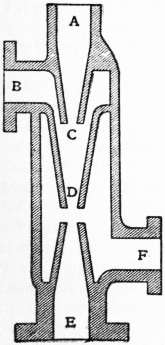
INJECTOR (from Lat. injicere, to throw in), an appliance for supplying steam-boilers with water, and especially used with locomotive boilers. It was invented by the French engineer H. V. Giffard in 1858, and presents the paradox that by the pressure of the steam in the boiler, or even, as in the case of the exhaust steam injector, by steam at a much lower pressure, water is forced into the boiler against that pressure. A diagrammatic section illustrating its construction is shown in figure. Steam enters at A and blows through the annular orifice C, the size of which can be regulated by a valve not shown in the figure. The feed water flows in at B and meeting the steam at C causes it to condense. Hence a vacuum is produced at C, and consequently the water rushes in with great velocity and streams down the combining cone D, its velocity being augmented by the impact of steam on the back of the column. In the lower part of the nozzle E the stream expands; it therefore loses velocity and, by a well-known hydrodynamic principle, gains pressure, until at the bottom the pressure is so great that it is able to enter the boiler through a check valve which opens only in the direction of the stream. An overflow pipe F, by providing a channel through which steam and water may escape before the stream has acquired sufficient energy to force its way into the boiler, allows the injector to start into action. Means are also provided for regulating the amount of water admitted between D and C. In the exhaust-steam injector, which works with steam from the exhaust of non-condensing engines, the steam orifice is larger in proportion to other parts than in injectors working with boiler steam, and the steam supply more liberal. In self-starting injectors an arrangement is provided which permits free overflow until the injector starts into action, when the openings are automatically adjusted to suit delivery into the boiler.
INJUNCTION (from Lat. injungere, to fasten, or attach to, to lay a burden or charge on, to enjoin), a term-meaning generally a command, and in English law the name for a judicial process whereby a party is required to refrain from doing a particular thing according to the exigency of the writ. Formerly it was a remedy peculiar to the court of chancery, and was one of the instruments by which the jurisdiction of that court was established in cases over which the courts of common law were entitled to exercise control. The court of chancery did not presume to interfere with the action of the courts, but, by directing an injunction to the person whom it wished to restrain from following a particular remedy at common law, it effected the same purpose indirectly. Under the present constitution of the judicature, the injunction is now equally available in all the divisions of the high court of justice, and it can no longer be used to prevent an action in any of them from proceeding in the ordinary course.
Although an injunction is properly a restraining order, there are instances in which, under the form of a prohibition, a positive order to do something is virtually expressed. Thus in a case of nuisance an injunction was obtained to restrain the defendant from preventing water from flowing in such regular quantities as it had ordinarily done before the day on which the nuisance commenced. But generally, if the relief prayed for is to compel something to be done, it cannot be obtained by injunction, although it may be expressed in the form of a prohibition—as in the case in which it was sought to prevent a person from discontinuing to keep a house as an inn. The injunction was used to stay proceedings in other courts “wherever a party by fraud, accident, mistake or otherwise had obtained an advantage in proceeding in a court of ordinary jurisdiction, which must necessarily make that court an instrument of injustice.” As the injunction operates personally on the defendant, it may be used to prevent applications to foreign judicatures; but it is not used to prevent applications to parliament, or to the legislature of any foreign country, unless such applications be in breach of some agreement, and relate to matters of private interest. In so far as an injunction is used to prohibit acts, it may be founded either on an alleged contract or on a right independent of contract. The jurisdiction of the court to prevent breaches of contract has been described as supplemental to its power of compelling specific performance; i.e. if the court has power to compel a person to perform a contract, it will interfere to prevent him from doing anything in violation of it. But even when it is not within the power of the court to compel specific performance, it may interfere by injunction; thus, e.g. in the case of an agreement of a singer to perform at the plaintiff’s theatre and at no other, the court, although it could not compel her to sing, could by injunction prevent her from singing elsewhere in breach of her agreement.
An injunction may as a general rule be obtained to prevent acts which are violations of legal rights, except when the same may be adequately remedied by an action for damages at law. Thus the court will interfere by injunction to prevent waste, or the destruction by a limited owner, such as a tenant for life, of things forming part of the inheritance. Injunctions may also be obtained to prevent the continuance of nuisances, public or private, the infringement of patents, copyrights and trade marks. Trespass might also in certain cases be prevented by injunction. Under the Common Law Procedure Act of 1854, and by other statutes in special cases, a limited power of injunction was conferred on the courts of common law. But the Judicature Act, by which all the superior courts of common law and chancery were consolidated, enacts that an injunction may be granted by an interlocutory order of the court in all cases in which it shall appear to be just or convenient; ... and, if an injunction is asked either before or at or after the hearing of any cause or matter, to prevent any threatened or apprehended waste or trespass, such injunction may be granted whether the person against whom it is sought is or is not in possession under any claim of title or otherwise, or if not in possession does or does not claim to do the act sought to be restrained under colour of any title, and whether the estates claimed are legal or equitable.
An injunction obtained on interlocutory application during the progress of an action is superseded by the trial. It may be continued either provisionally or permanently. In the latter case the injunction is said to be perpetual. The distinction between “special” and “common” injunctions—the latter being obtained as of course—is now abolished in English law.
In the courts of the United States the writ of injunction remains purely an equitable remedy. It may be issued at the instance of the president to prevent any organized obstruction to inter-state commerce or to the passage of the mails (in re Debs, 158 United States Reports, 564). Temporary restraining orders may be issued, ex parte, pending an application for a temporary injunction. In the state courts temporary injunctions are often issued, ex parte, subject to the defendant’s right to move immediately for their dissolution. Generally, however, notice of an application for a temporary injunction is required.
For the analogous practice in Scots law see Interdict.
INK (from Late Lat. encaustum, Gr. ἔγκαυστον, the purple ink used by Greek and Roman emperors, from ἐγκαίειν, to burn in), in its widest signification, a substance employed for producing graphic tracings, inscriptions, or impressions on paper or similar materials. The term includes two distinct conditions of pigment or colouring matter: the one fluid, and prepared for use with a pen or brush, as writing ink; the other a glutinous adhesive mass, printing ink, used for transferring to paper impressions from types, engraved plates and similar surfaces.
The ancient Egyptians prepared and used inks (Flinders Petrie discovered a papyrus bearing written characters as old as 2500 B.C.), and in China the invention of an ink is assigned to Tien-Tcheu, who lived between 2697 B.C. and 2597 B.C. These early inks were prepared from charcoal or soot mixed with gum, glue or varnish. Sepia (q.v.), the black pigment secreted by the cuttle-fish, was used as a writing fluid by the Romans. The iron-gall ink, i.e. an ink prepared from an iron salt and tannin, appears to have been first described by the monk Theophilus, who lived in the 11th century A.D., although Pliny, in the 1st century A.D., was acquainted with the blackening of paper containing green vitriol by immersion in an infusion of nut-galls. Iron-gall inks, prepared by mixing extracts of galls, barks, &c., with green vitriol, subsequently came into common use, and in the 16th century recipes for their preparation were given in domestic encyclopaedias. Their scientific investigation was first made by William Lewis in 1748. The earlier iron-inks were essentially a suspension of the pigment in water. In the early part of the 19th century the firm of Stephens introduced the first of the so-called blue-black inks under the name of “Stephens’ writing fluid.” Solutions of green vitriol and tannin, coloured by indigo and logwood, were prepared, which wrote with a blue tint and blackened on exposure, this change being due to the production of the pigment within the pores of the paper. The “alizarine” inks, patented by Leonhardi in 1856, are similar inks with the addition of a little madder. The application of aniline colours to ink manufacture in England dates from Croc’s patent of 1861.
Writing Inks.—Writing inks are fluid substances which contain colouring matter either in solution or in suspension, and commonly partly in both conditions. They may be prepared in all shades of colour, and contain almost every pigment which can be dissolved or suspended in a suitable medium. The most important of all varieties is black ink, after which red and blue are most commonly employed. Apart from colour there are special qualities which recommend certain inks for limited applications, such as marking inks, ineradicable ink, sympathetic ink, &c. A good writing ink for ordinary purposes should continue limpid, and flow freely and uniformly from the pen; it should not throw down a thick sludgy deposit on exposure to the air; nor should a coating of mould form on its surface. It should yield distinctly legible characters immediately on writing, not fading with age; and the fluid ought to penetrate into the paper without spreading, so that the characters will neither wash out nor be readily removed by erasure. Further, it is desirable that ink should be non-poisonous, that it should as little as possible corrode steel pens, that characters traced in it should dry readily on the application of blotting paper without smearing, and that the writing should not present a glossy, varnished appearance.
Tannin Inks.—These inks are prepared from galls, or other sources of tannin, and a salt of iron, with the addition of some agglutinant in the case of the so-called oxidized inks, or a colouring matter in the case of unoxidized inks. Such mixtures form the staple black inks of commerce; they are essentially an insoluble iron gallate in extremely fine division held in suspension in water or a soluble compound dissolved in water.
On long exposure to air, as in inkstands, or otherwise, tannin inks gradually become thick and ropy, depositing a slimy sediment. This change on exposure is inevitable, resulting from the gradual oxidation of the ferrous compound, and it can only be retarded by permitting access of air to as small surfaces as possible. The inks also have a tendency to become mouldy, an evil which may be obviated by the use of a minute proportion of carbolic acid; or salicylic acid may be used.
The essential ingredients of ordinary black ink are—first, tannin-yielding bodies, for which Aleppo or Chinese galls are the most eligible materials; second, a salt of iron, ferrous sulphate (green vitriol) being alone employed; and third, a gummy or mucilaginous agent to keep in suspension the insoluble tinctorial matter of the ink. For ink-making the tannin has first to be transformed into gallic acid. In the case of Aleppo galls this change takes place by fermentation when the solution of the galls is exposed to the air, the tannin splitting up into gallic acid and sugar. Chinese galls do not contain the ferment necessary for inducing this change; and to induce the process yeast must be added to their solution. To prepare a solution of Aleppo galls for ink-making, the galls are coarsely powdered, and intimately mixed with chopped straw. This mixture is thrown into a narrow deep oak vat, provided with a perforated false bottom, and having a tap at the bottom for drawing off liquid. Over the mixture is poured lukewarm water, which, percolating down, extracts and carries with it the tannin of the galls. The solution is drawn off and repeatedly run through the mixture to extract the whole of the tannin, the water used being in such proportion to the galls as will produce as nearly as possible a solution having 5% of tannin. The object of using straw in the extraction process is to maintain the porosity of the mixture, as powdered galls treated alone become so slimy with mucilaginous extract that liquid fails to percolate the mass. For each litre of the 5% solution about 45 grammes of the iron salt are used, or about 100 parts of tannin for 90 parts of crystallized green vitriol. These ingredients when first mixed form a clear solution, but on their exposure to the air oxidation occurs, and an insoluble blue-black ferrosoferric gallate in extremely fine division, suspended in a coloured solution of ferrous gallate, is formed. To keep the insoluble portion suspended, a mucilaginous agent is employed, and those most available are gum senegal and gum arabic. An ink so prepared develops its intensity of colour only after some exposure; and after it has partly sunk into the paper it becomes oxidized there, and so mordanted into the fibre. As the first faintness of the characters is a disadvantage, it is a common practice to add some adventitious colouring matter to give immediate distinctness, and for that purpose either extract of logwood or a solution of indigo is used. When logwood extract is employed, a smaller proportion of extract of galls is required, logwood itself containing a large percentage of tannin. For making an unoxidized or blue-black ink indigo is dissolved in strong sulphuric acid, and the ferrous sulphate, instead of being used direct, is prepared by placing in this indigo solution a proper quantity of scrap iron. To free the solution from excess of uncombined acid, chalk or powdered limestone is added, whereby the free acid is fixed and a deposit of sulphate of lime formed. A solution so prepared, mixed with a tannin solution, yields a very limpid sea-green writing fluid, and as all the constituents remain in solution, no gum or other suspending medium is necessary. In consequence the ink flows freely, is easily dried and is free from the glossy appearance which arises through the use of gum.
China ink or Indian ink is the form in which ink was earliest prepared, and in which it is still used in China and Japan for writing with small brushes instead of pens. It is extensively used by architects, engineers and artists generally, and for various special uses. China ink is prepared in the form of sticks and cakes, which are rubbed down in water for use. It consists essentially of lamp-black in very fine condition, baked up with a glutinous substance; and the finer Oriental kinds are delicately perfumed. The following description of the manufacture as conducted in Japan is from a native source:—
“The body of the ink is soot obtained from pine wood or rosin, and lamp-black from sesamum oil for the finest sort. This is mixed with liquid glue made of ox-skin. This operation is effected in a large round copper bowl, formed of two spherical vessels, placed 1 in. apart, so that the space between can be filled up with hot water to prevent the glue from hardening during the time it is being mixed by hand with the lamp-black. The cakes are formed in wooden moulds, and dried between paper and ashes. Camphor, or a peculiar mixture of scents which comes from China, and a small quantity of carthamine (the red colouring substance of safflower), are added to the best kinds for improving the colour as well as for scenting the ink. There is a great difference both in price and in quality of the various kinds of ink, the finest article being rather costly.”
It is said that the size used in Chinese kinds is of vegetable origin.
Logwood Ink.—Under the name of chrome ink a black ink was discovered by Runge, which held out the promise of cheapness combined with many excellent qualities. It is prepared by dissolving 15 parts of extract of logwood in 900 parts of water, to which 4 parts of crystallized sodium carbonate are added. A further solution of 1 part of potassium chromate (not bichromate) in 100 parts of water is prepared, and is added very gradually to the other solution with constant agitation. The ink so obtained possesses an intense blue-black colour, flows freely and dries readily, is neutral in reaction and hence does not corrode steel pens, and adheres to and sinks into paper so that manuscripts written with it may be freely washed with a sponge without danger of smearing or spreading. It forms a good copying ink, and it possesses all the qualities essential to the best ink; but on exposure to air it very readily undergoes decomposition, the colouring matter separating in broad flakes, which swim in a clear menstruum. It is affirmed by Viedt that this drawback may be overcome by the use of soda, a method first suggested by Böttger.
Logwood forms the principal ingredient in various other black inks used, especially as copying ink. A very strong decoction of logwood or a strong solution of the extract with ammonium-alum yields a violet ink which darkens slowly on exposure. Such an ink is costly, on account of the concentrated condition in which the logwood must be used. If, however, a metallic salt is introduced, a serviceable ink is obtained with the expenditure of much less logwood. Either sulphate of copper or sulphate of iron may be used, but the former, which produces a pleasing blue-black colour, is to be preferred. The following is the formula most highly recommended for this ink. A clear solution of 20 kilos of extract of logwood in 200 litres of water is obtained, to which is added, with agitation, 10 kilos of ammonium-alum dissolved in 20 litres of boiling water. The solution is acidified with 0.2 kilo of sulphuric acid, which has the effect of preventing any deposit, and finally there is added a solution of 1.5 kilos of sulphate of copper dissolved in 20 litres of water. This compound is exposed to the air for a few days to allow the colour to develop by oxidation, after which it is stored in well-corked bottles. The acid condition of this ink has a corrosive influence on steel pens; in all other respects it is a most valuable writing fluid.
Aniline Inks.—Solutions of aniline dye-stuffs in water are widely used as inks, especially coloured varieties. They are usually fugitive. Nigrosine is a black ink, which, although not producing a black so intense as common ink, possesses various advantages. Being perfectly neutral, it does not attack pens; it can easily be kept of a proper consistency by making up with water; and its colour is not injuriously affected by the action of acids. Its ready flow from stylographic pens led to the name “stylographic ink.” Other aniline inks are mentioned below.
Copying Ink.—Ink which yields by means of pressure an impression, on a sheet of damped tissue paper, of characters written in it is called copying ink. Any ink soluble in water, or which retains a certain degree of solubility, may be used as copying ink. Runge’s chrome ink, being a soluble compound, is, therefore, so available; and the other logwood inks as well as the ordinary ferrous gallate inks contain also soluble constituents, and are essentially soluble till they are oxidized in and on the paper after exposure to the air. To render these available as copying inks it is necessary to add to them a substance which will retard the oxidizing effect of the air for some time. For this purpose the bodies most serviceable are gum arabic or senegal, with glycerin, dextrin or sugar, which last, however, renders the ink sticky. These substances act by forming a kind of glaze or varnish over the surface of the ink which excludes the air. At the same time when the damp sheet of tissue paper is applied to the writing, they dissolve and allow a portion of the yet soluble ink to be absorbed by the moistened tissue. As copying ink has to yield two or more impressions, it is necessary that it should be made stronger, i.e. that it should contain more pigment or body than common ink. It, therefore, is prepared with from 30 to 40% less of water than non-copying kinds; but otherwise, except in the presence of the ingredients above mentioned, the inks are the same. Copying ink pencils consist of a base of graphite and kaolin impregnated with a very strong solution of an aniline colour, pressed into sticks and dried.
Red Ink.—The pigment most commonly employed as the basis of red ink is Brazil-wood. Such an ink is prepared by adding to a strong decoction of the wood a proportion of stannous chloride (tin spirits), and thickening the resulting fluid with gum arabic. In some instances alum and cream of tartar are used instead of the stannous chloride. Cochineal is also employed as the tinctorial basis of red ink; but, while the resulting fluid is much more brilliant than that obtained from Brazil-wood, it is not so permanent. A very brilliant red ink may be prepared by dissolving carmine in a solution of ammonia, but this preparation must be kept in closely stoppered bottles. A useful red ink may also be made by dissolving the rosein of Brook, Simpson and Spiller in water, in the proportion of 1 to from 150 to 200 parts.
Blue Ink.—For the production of blue ink the pigment principally used is Prussian blue. It is first digested for two or three days with either strong hydrochloric acid, sulphuric acid or nitric acid, the digested mass is next very largely diluted with water, and after settling the supernatant liquid is siphoned away from the sediment. This sediment is repeatedly washed, till all traces of iron and free acid disappear from the water used, after which it is dried and mixed with oxalic acid in the proportion of 8 parts of Prussian blue to 1 of the acid, and in this condition the material is ready for dissolving in water to the degree of colour intensity necessary. An aniline blue ink may be prepared by dissolving 1 part of bleu de Paris in from 200 to 250 parts of water.
Marking Ink.—The ink so called, used principally for marking linen, is composed of a salt of silver, usually the nitrate, dissolved in water and ammonia, with a little provisional colouring matter and gum for thickening. The colour resulting from the silver salt is developed by heat and light; and the stain it makes, although exceedingly obstinate, gradually becomes a faint brownish-yellow. The following yields a good marking ink. Equal parts of nitrate of silver and dry tartaric acid are triturated in a mortar, and treated with water, when a reaction takes place, resulting in the formation of tartrate of silver and the liberation of nitric acid. The acid is neutralized, and at the same time the silver tartrate is dissolved by the addition of ammonia, and this solution with colouring matter and gum forms the ink, which may be used with an ordinary steel pen.
Many vegetable juices, e.g. of Coriaria thymifolia, Semecarpus anacardium, Anacardium occidentale (Cashew), are inks of this type.
Gold and silver inks are writing fluids in which gold and silver, or imitations of these metals, are suspended in a state of fine division. In place of gold, Dutch leaf or mosaic gold is frequently substituted, and bronze powders are used for preparing a similar kind of ink. The metallic foil is first carefully triturated into a fine paste with honey, after which it is boiled in water containing a little alkali, and then repeatedly washed in hot water and dried at a gentle heat. A solution is prepared consisting of 1 part of pure gum arabic and 1 part of soluble potash glass in 4 parts of distilled water, into which the requisite quantity of the metallic powder prepared is introduced. Owing to the superior covering nature of pure gold, less of the metal is required than is necessary in the case of silver and other foils. In general 1 part of foil to 3 or 4 parts of solution is sufficient. The metallic lustre of writing done with this solution may be greatly heightened by gently polishing with a burnishing point. Another gold ink depends upon the formation of purple of Cassius; the linen is mordanted with stannous chloride, and the gold applied as a gummy solution of the chloride.
Indelible or incorrodible ink is the name given to various combinations of lamp-black or other carbonaceous material with resinous substances used for writing which is exposed to the weather or to the action of strong acids or alkaline solutions. An ink having great resisting powers may be conveniently prepared by rubbing down Indian ink in common ink till the mixture flows easily from the pen. Other combinations have more the character of coloured varnishes.
Sympathetic inks are preparations used for forming characters which only become visible on the application of heat or of some chemical reagent. Many chemicals which form in themselves colourless solutions, but which develop colour under the influence of reagents, may be used as sympathetic ink, but they are of little practical utility. Characters written in a weak solution of galls develop a dark colour on being treated with a solution of copperas; or, vice versa, the writing may be done in copperas and developed by the galls solution. Writing done in various preparations develops colour on heating which fades as the paper cools. Among such substances are solutions of the chlorides of cobalt and of nickel. Very dilute solutions of the mineral acids and of common salt and a solution of equal parts of sulphate of copper and sal-ammoniac act similarly. Writing with rice water and developing with iodine was a device much used during the Indian Mutiny.
Printing Inks.—Printing inks are essentially mixtures of a pigment and a varnish. The varnish is prepared from linseed oil, rosin and soap; the oil must be as old as possible; the rosin may be black or amber; and the soap, which is indispensable since it causes the ink to adhere uniformly to the type and also to leave the type clean after taking an impression, is yellow, or turpentine soap for dark inks, and curd soap for light inks. The varnish is prepared as follows: The oil is carefully heated until it “strings” properly, i.e. a drop removed from the vessel on a rod, when placed upon a plate and the rod drawn away, forms a thread about ½ in. long. The rosin is carefully and slowly added and the mixture well stirred. The soap is then stirred in. The ink is prepared by mixing the varnish with the pigment, and grinding the mass to impalpable fineness either in a levigating mill or by a stone and muller. For black ink, lamp-black mixed with a little indigo or Prussian blue is the pigment employed; for wood engravings it may be mixed with ivory black, and for copper plates with ivory or Frankfurt black; for lithographic reproductions Paris black is used. Red inks are made with carmine or cochineal; red lead is used in cheap inks, but it rapidly blackens. Blue inks are made with indigo or Prussian blue; yellow with lead chromate or yellow ochre; green is made by mixing yellow and blue; and purple by mixing red and blue.
See C. A. Mitchell and T. C. Hepworth, Inks, their Composition and Manufacture (1904); S. Lehner, Ink Manufacture (1902); A. F. Gouillon, Encres et cirages (1906); L. E. Andés, Schreib-, Kopier- und andere Tinten (1906).
INKERMAN, BATTLE OF, fought on the 5th of November 1854 between a portion of the Allied English and French army besieging Sevastopol and a Russian army under Prince Menshikov (see Crimean War). This battle derives its name from a ruin on the northern bank of the river Tchernaya near its mouth, but it was fought some distance away, on a nameless ridge (styled Mount Inkerman after the event) between the Tchernaya and the Careenage Ravine, which latter marked the right of the siege-works directed against Sevastopol itself. Part of this ridge, called Home Ridge and culminating in a knoll, was occupied by the British, while farther to the south, facing the battleground of Balaklava, a corps under General Bosquet was posted to cover the rear of the besiegers against attacks from the direction of Traktir Bridge. The Russians arranged for a combined attack on the ridge above-mentioned by part of Menshikov’s army (16,000) and a corps (19,000) that was to issue from Sevastopol. This attack was to have, beside its own field artillery, the support of fifty-four heavy guns, and the Russian left wing on the Balaklava battleground was to keep Bosquet occupied. If successful, the attack on the ridge was to be the signal for a general attack all along the line. It was apparently intended by Menshikov that the column from the field army should attack the position from the north, and that the Sevastopol column should advance along the west side of the Careenage Ravine. But he only appointed a commander to take charge of both columns at the last moment, and the want of a clear understanding as to what was to be done militated against success from the first. General Soimonov, with the Sevastopol column, after assembling his troops before dawn on the 5th, led them on to the upland east of Careenage Ravine, while the field army column, under General Pavlov, crossed the Tchernaya near its mouth, almost at right angles to Soimonov’s line of advance.
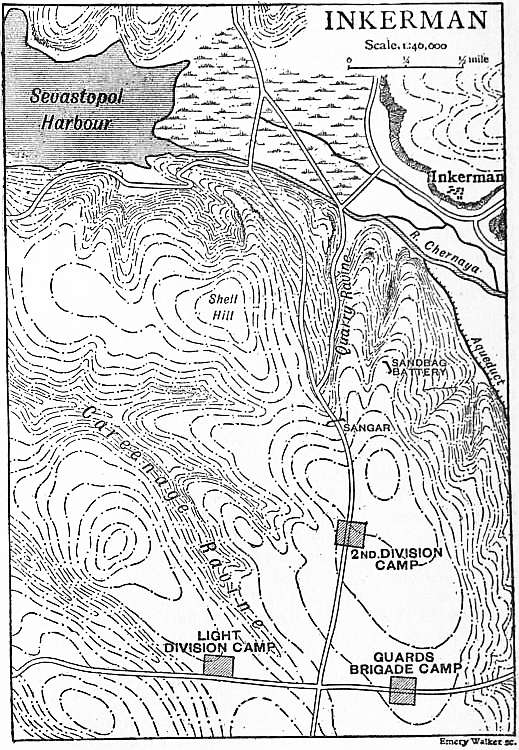
The British troops on or near the ground were the 2nd Division, 3000, encamped on the ridge; Codrington’s brigade of the Light Division, 1400, on the slopes west of the Careenage Ravine; and the Guards’ brigade, 1350, about ¾ m. in rear of the 2nd Division camp. No other forces, French or British, were within 2 m. except another part of Sir George Brown’s Light Division. A mist overhung the field and the hillsides were slippery with mud. Soimonov, with his whole force deployed in a normal attack formation (three lines of battalion columns covered by a few hundred skirmishers) pushed forward along the ridge (6 A.M.) without waiting for Pavlov or for Dannenberg, the officer appointed to command the whole force. Shell Hill, guarded only by a picquet, was seized at once. The heavy guns that had been brought from the fortress were placed in position on this hill, and opened fire (7 A.M.) on the knoll, 1400 yds. to the S., behind which the 2nd Division was encamped. The Russian infantry halted for the guns to prepare the way, and the heavy projectiles both swept the crest of the British knoll and destroyed the camp in rear. But already General Pennefather, commanding the division, had pushed forward one body of his infantry after another down the forward slope, near the foot of which they encountered the Russians in great force. On his side, Soimonov had been compelled to break up his regular lines of columns at the narrowest part of the ridge and to push his battalions forward a few at a time. This and the broken character of the ground made the battle even in the beginning a mêlée. The obscurity of the mist, which had at first allowed the big battalions to approach unobserved, now favoured the weaker side. Soimonov himself, however, formed up some 9000 men, who drove back the British left wing—for the whole of Pennefather’s force at the time was no more than 3600 men. But the right wing, not as yet attacked, either by Soimonov or by Pavlov, held on to its positions on the forward slope, and a column of Russian sailors and marines, who had been placed under Soimonov’s command and had moved up the Careenage Ravine to turn the British left, were caught, just as they emerged on to the plateau in rear of Pennefather’s line, between two bodies of British troops hurrying to the scene of action. On the front, too, the Russian attack came to a standstill and ebbed, for Soimonov’s overcrowded battalions jostled one another and dissolved on the narrow and broken plateau. Soimonov himself was killed, and the disciplined confidence and steady volleys of the defenders dominated the chaotic élan of the Russians. Thus 3300 defenders were able to repulse and even to “expunge from the battlefield” the whole of the Sevastopol column, except that portion of it which drifted away to its left and joined Pavlov. This stage of the battle had lasted about forty minutes. But, brilliant as was this overture, it is the second stage of the battle that gives it its epic interest.
The first attack made by Pavlov’s advanced guard, aided by parts of Soimonov’s corps, was relatively slight, but General Dannenberg now arrived on the field, and arranged for an assault on the British centre and right, to be delivered by 10,000 men (half his intact forces) chiefly by way of the Quarry Ravine, the attack to be prepared by the guns on Shell Hill. Pennefather had been reinforced by the Guards’ brigade and a few smaller units. Not the least extraordinary feature of the battle that followed is the part played by a sangar of stones at the head of Quarry Ravine and a small battery, called the Sandbag Battery, made as a temporary emplacement for two heavy guns a few days before. The guns had done their work and been sent back whence they came. Nevertheless these two insignificant works, as points to hold and lines to defend on an otherwise featureless battlefield, became the centres of gravity of the battle.
The sangar at first fell into the hands of the Russians, but they were soon ejected, and small British detachments reoccupied and held it, while the various Russian attacks flowed up and past it and ebbed back into the Quarry Ravine. Possession of the Sandbag Battery was far more fiercely contested. The right wing was defended by some 700 men of the 2nd Division, who were reinforced by 1300 of the Guards. The line of defence adjacent to the battery looked downhill for about 300 yds., giving a clear field of fire for the new Enfield rifle the English carried; but a sharp break in the slope beyond that range gave the assailants plenty of “dead ground” on which to form up. For a time, therefore, the battle was a series of attacks, delivered with great fierceness by the main body of Pavlov’s corps, the repulse of each being followed by the disappearance of the assailants. But the arrival of part of the British 4th Division under Sir George Cathcart gave the impulse for a counter-attack. Most of the division indeed had to be used to patch up the weaker parts of the line, but Cathcart himself with about 400 men worked his way along the lower and steeper part of the eastern slope so as to take the assailants of the battery in flank. He had not proceeded far, however, when a body of Russians moving higher up descended upon the small British corps and scattered it, Cathcart himself being killed. Other counterstrokes that his arrival had inspired were at the same time made from different parts of the defensive front, and had the effect of breaking up what was a solid line into a number of disconnected bands, each fighting for its life in the midst of the enemy. The crest of the position was laid open and parts of the Russian right wing seized it. But they were flung back to the lower slopes of the Quarry Ravine by the leading French regiment sent by Bosquet. This regiment was quickly followed by others. The last great assault was delivered with more precision, if with less fury than the others, and had Dannenberg chosen to employ the 9000 bayonets of his reserve, who stood idle throughout the day, to support the 6000 half-spent troops who made the attack, it would probably have been successful.
As it was, supported by the heavy guns on Shell Hill, the assailants, though no longer more than slightly superior in numbers, carried not only the sangar, but part of the crest line of the allied position. But they were driven back into the Quarry Ravine, and, relieving the exhausted British, the French took up the defence along the edge of the ravine, which, though still not without severe fighting, they maintained till the close of the battle. Inkerman, however, was not a drawn battle. The allied field artillery, reinforced by two long 18-pr. guns of the British siege train and assisted by the bold advance of two French horse-artillery batteries which galloped down the forward slope and engaged the Russians at close range, gained the upper hand. Last of all, the dominant guns on Shell Hill thus silenced, the resolute advance of a handful of British infantry decided the day, and the Russians retreated. The final shots were fired about 1.30 P.M.
The total British force engaged was 8500, of whom 2357 were killed and wounded. The French lost 939 out of about 7000 who came on to the field, though not all these were engaged. The Russians are said to have lost 11,000 out of about 42,000 present. The percentage (27.7) of loss sustained by the British is sufficient evidence of the intensity of the conflict, and provides a convincing answer to certain writers who have represented the battle as chiefly a French affair. On the other hand, the reproaches addressed by some British writers to General Bosquet for not promptly supporting the troops at Inkerman with his whole strength are equally unjustifiable, for apparently Sir George Brown and Sir George Cathcart both declined his first offers of support, and he had Prince Gorchakov with at least 20,000 Russians in his own immediate front. He would therefore have risked the failure of his own mission in order to take part in a battle where his intervention was not, so far as he could tell, of vital importance. When Lord Raglan definitely asked him for support, he gave it willingly and eagerly, sending his troops up at the double, and it must be remembered that several British divisions took no part in the action for the same reason that actuated Bosquet. But, in spite of the seemingly inevitable controversies attendant on an “allied” battle, it is now generally admitted that, as a “soldiers’ battle,” Inkerman is scarcely to be surpassed in modern history.
INLAYING, a method of ornamentation, by incrusting or otherwise inserting in one material a substance or substances differing therefrom in colour or nature. The art is practised in the fabrication of furniture and artistic objects in all varieties of wood, metal, shell, ivory and coloured, and hard stone, and in compound substances; and the combinations, styles and varieties of effect are exceedingly numerous. Several special classes of inlaying may be here enumerated and defined, details regarding most of which will be found under their separate headings. In the ornamental treatment of metal surfaces Niello decoration, applied to silver and gold, is an ancient and much-practised species of inlaying. It consists in filling up engraved designs with a composition of silver, copper, lead and sulphur incorporated by heat. The composition is black, and the finished work has the appearance of a drawing in black on a metallic plate. An art, analogous in effect, called bidri, from Bider in the Deccan, is practised in India. In bidri work the ground is an alloy of zinc, with small proportions of copper and lead, in which shallow patterns and devices are traced, and filled up with thin plates of silver. When the surface has been evened and smoothed, the bidri ground is stained a permanent black by a paste the chief ingredients of which are sal-ammoniac and nitre, leaving a pleasing contrast of bright metallic silver in a dead black ground. The inlaying of gold wire in iron or steel is known as Damascening (q.v.). It has been very largely practised in Persia and India for the ornamentation of arms and armour, being known in the latter country as Kuft work or Kuftgari. In Kashmir, vessels of copper and brass are very effectively inlaid with tin—an art which, like many other decorative arts, appears to have originated in Persia. In the ornamental inlaying of metal surfaces the Japanese display the most extraordinary skill and perfection of workmanship. In the inlaying of their fine bronzes they use principally gold and silver, but for large articles and also for common cast hollow ware commoner metals and alloys are employed. In inlaying bronzes they generally hollow out and somewhat undercut the design, into which the ornamenting metal, usually in the form of wire, is laid and hammered over. Frequently the lacquer work of the Japanese is inlaid with mother-of-pearl and other substances, in the same manner as is practised in ornamenting lacquered papier-mâché among Western communities. The Japanese also practise the various methods of inlaying referred to under Damascening. The term Mosaic (q.v.) is generally applied to inlaid work in hard stones, marble and glass, but the most important class of mosaics—those which consist of innumerable small separate pieces—do not properly come under the head of inlaying. Inlaid mosaics are those in which coloured designs are inserted in spaces cut in a solid ground or basis, such as the modern Florentine mosaic, which consists of thin veneers of precious coloured stones set in slabs of marble. The Taj Mahal at Agra is an example of inlaid mosaic in white marble, and the art, carried to that city by a French artist, is still practised by native workmen. Pietra dura is a fine variety of inlaid mosaic in which hard and expensive stones—agate, cornelian, amethyst and the like—are used in relief. Certain kinds of enamel might also be included among the varieties of inlaying. (See also Marquetry and Bombay Furniture.)
INMAN, HENRY (1801-1846), American artist, was born in Utica, New York, on the 20th of October 1801. Apprenticed to the painter John W. Jarvis at the age of fourteen, he left him after seven years and set up for himself, painting portraits, genre and landscape. He was one of the organizers of the National Academy of Design in New York and its first vice-president (from 1826 until 1832). As a portrait painter he was highly successful both in New York and Philadelphia, and going to England in 1844, he had for sitters the Lord Chancellor (Cottenham), the poet Wordsworth, Doctor Chalmers, Lord Macaulay and others. His American sitters included President Van Buren and Chief Justice Marshall. He died in New York City on the 17th of January 1846.
INN, a river of Europe, an important right bank tributary of the Danube. It rises at an elevation of 7800 ft., in a small lake under the Piz Longhino, in the Swiss canton of the Grisons. After flowing for a distance of 55 m., through the Engadine it leaves Swiss territory at Martinsbruck and enters Austria. It next plunges through the deep ravine of Finstermünz, and, continuing in the main a north-easterly direction, receives at Landeck the Rosanna. Hence its course becomes more rapid, until, after swirling through the narrow and romantic Oberinnthal, it enters the broader and pastoral Unterinnthal. It next passes Innsbruck and from Hall, a few miles lower down, begins to be navigable for barges. At Kufstein, down to which point it has still pursued a north-easterly direction, it breaks through the north Tirol limestone formation, and, now keeping a northerly course, enters at Rosenheim the Bavarian high plateau. Its bed is now broad, studded with islands and enclosed by high banks. Its chief tributaries on this last portion of its course are the Alz and the Salzach, and at Passau, 309 m. from its source, it joins the Danube, which river down to that point it equals in length and far exceeds in volume of water. Its rapid current does not permit of extensive navigation, but timber rafts are floated down from above Innsbruck.
See Greinz, Eine Wanderung durch das Unterinntal (Stuttgart, 1902).
INN and INNKEEPER. An inn is a house where travellers are fed and lodged for reward. A distinction has been drawn between tavern, inn and hotel, the tavern supplying food and drink, the hotel lodging, the inn both; but this is fanciful. “Hotel” now means “inn,” and “inn” is often applied to a mere public-house, whilst “tavern” is less used. “Inn,” still the legal and best, as it is the oldest, is a form of the word “in” or “within.” This sense is retained in the case of the English legal societies still known as Inns of Court (q.v.). In the Bible “inn” means “lodging-place for the night.” Hospitality has always been a sacred duty in the East. The pilgrim or the traveller claims it as a right. But some routes were crowded, as that from Bagdad to Babylon. On these, khans (in or near a town) and caravanserais (in waste places) were erected at the expense of the benevolent. They consisted of a square building surrounded by a high wall; on the roof there was a terrace and over the gateway a tower; inside, was a large court surrounded by compartments in which was some rude provision for the animals and baggage of the traveller as well as for himself. The latter purchased his own food where he chose, and had to “do for himself.” In some such place Jesus was born. Tavern is mentioned once in Scripture (Acts xxviii. 15) where it is said the brethren from Rome met Paul at “the Three Taverns.” This was a station on the Appian Way, referred to also in Cicero’s Letters (Ad Att. ii. 12). So, in modern London, stations are called “Elephant and Castle,” or “Bricklayers’ Arms,” from adjacent houses of entertainment. Among the Greeks inns and innkeepers were held in low repute. The houses were bad and those who kept them had a bad name. A self-respecting Greek entered them as seldom as possible; if he travelled he relied on the hospitality of friends. In Rome under the emperors something akin to the modern inn grew up. There is, however, scarcely any mention of such institutions in the capital as distinguished from mere wine-shops or eating-houses. Ambassadors were lodged in apartments at the expense of the state. But along the great roads that radiated from Rome there were inns. Horace’s account of his journey to Brundisium (Sat. i. 5), that brilliant picture of contemporary travel, tells us of their existence, and the very name of the Three Taverns shows that there was sufficient custom to support a knot of these institutions at one place. Under the Roman law, the innkeeper was answerable for the property of his guests unless the damage was due to damnum fatale or vis major, in modern language the act of God or the king’s enemies. He was also liable for damage done by his servant or his slave or other inhabitant of the house.
In the middle ages hospitality was still regarded as a duty, and provision for travellers was regularly made in the monasteries. People of rank were admitted to the house itself, others sought the guest-chamber, which sometimes stood (as at Battle Abbey) outside the precincts. It consisted of a hall, round which were sleeping-rooms, though the floor of the hall itself was often utilized. Again, hospitality was rarely denied at the castle or country house. The knight supped with his host at the daïs or upper part of the great hall, and retired with him into his own apartment. His followers, or the meaner strangers, sat lower down at meat, and after the tables had been removed stretched themselves to rest upon the floor. In desolate parts hospices were erected for the accommodation of pilgrims. Such existed in the Alps and on all the great roads to the Holy Land or to famous shrines, notably to that of Canterbury. The still impressive remains of the Travellers’ Hospital at Maidstone, founded by Archbishop Boniface in 1260, give an idea of the extent of such places. The mention of Canterbury recalls two inns celebrated by Chaucer. The pilgrims started from the “Tabard” at Southwark under the charge of Harry Baily the host, and they put up at the “Checquers of the Hope,” in Mercery Lane, Canterbury. It is easy to infer that, as time went on, the meagre hospitality of the monastery or the hospice was not sufficient for an increasing middle class, and that the want was met by the development of the mere ale-house into the inn. The “ale-house,” to give it the old English name, was always in evidence, and even in pre-Reformation days was a favourite subject for the satirist. In Langland’s Piers the Plowman and in Skelton’s Elynour Rummynge we have contemporary pictures of ale-houses of the 14th and 16th centuries, but the Tabard is quite a modern inn, with a table d’hôte supper, a sign, a landlord (“right a mery man”) and a reckoning!
It has been conjectured (Larwood and Hotten, History of Signboards, 1874) that the inn sign was taken or imitated from that displayed on the town houses or inns of noblemen and prelates. The innkeeper alone of tradesmen retains his individual sign. The inn shared with the tavern the long projecting pole garnished with branches. These poles had become of such inordinate length in London that in 1375 they were restricted to 7 ft. But the inn of those times was still a simple affair. In each room there were several beds, the price of which the prudent traveller inquired beforehand. Extortion was frequent, though it was forbidden by a statute of Edward III. The fare was simple; bread, meat and beer, with fish on Fridays. The tavern sentiment is strong in Elizabethan literature. The “Boar’s Head” in Eastcheap is inseparably connected with Sir John Falstaff and Dame Quickly. “Shall I not take mine ease in mine Inn?” (1 Henry IV., Act iii. sc. 3) is well-nigh the most famous word of the famous knight. A passage in Holinshed’s Chronicle (1587, i. 246) explains the inner meaning of this. He assures us that the inns of England are not as those of other lands. Abroad the guest is under the tyranny of the host, but in England your inn is as your own house; in your chamber you can do what you will, and the host is rather your servant than your master. The “Mermaid” in Bread Street is associated with the memory of many wits and poets—Raleigh, Shakespeare, Beaumont, Fletcher, Ben Jonson—who frequented it and praised it.
Shenstone’s lines as to “the warmest welcome at an inn” vent a common but rather cheap cynicism. Doctor Johnson was a great frequenter of inns and was outspoken in praise and blame. In the time immediately preceding railways the inn, which was also a post-house where the public coach as well as that of the private traveller changed horses, was a place of much importance. We have it presented over and over again in the pages of Dickens. The “Maypole” in Barnaby Rudge may be singled out for mention; it survives at Chigwell, Essex, as the “King’s Head.”
The effect of railways was to multiply hotels in great centres and gradually increase their size till we have the huge structures so plentiful to-day. The bicycle and later the motor car, through the enormous traffic they caused on the country roads, have restored the old wayside inns to more than their former prosperity.
In Scotland a statute (1424) of James I. ordained inns for man and beast, with food and drink at reasonable prices, in each borough, and a subsequent act prohibited lodging in private houses in places where there were inns, under a penalty of 40s. But for centuries the Scots inn was a poor affair. The Clachan of Aberfoyle in Rob Roy, kept by the widow MacAlpine, was probably typical. In St Ronan’s Well Scott gives the more pleasing picture of the Cleikum Inn, kept by the delightful Meg Dods, and mention should be made of St Mary’s Cottage, with its hostess Tibby Shiels, the scene of one of the Noctes Ambrosianae, with memories not merely of Scott but of Christopher North and the Ettrick Shepherd. Burns had much to do with inns and taverns. If Poosie Nancie’s, where the Jolly Beggars held wild revel, is long vanished, the Globe at Dumfries still exists, a fair sample of an inn of the period. As late as 1841 Dickens, writing to John Foster during his first visit to Scotland, describes the Highland inns as very poor affairs, “a mere knot of little outhouses” he says of one; and even in Queen Victoria’s Leaves from the Journal of Our Life in the Highlands the inn is described as invariably small and unassuming. Thus the development of hotels in Scotland did not begin much before the middle of the 19th century.
In America the first hotel mentioned in New York is “Kriger’s Tavern” about 1642, replaced in 1703 by the “King’s Arms.” When the town came to be English a proclamation was issued regulating the inns. Meals were not to cost more than 8d. or beer 2d. per quart.
Law Relating to Innkeepers.—Whether any special building is an inn is a question of fact. A temperance hotel is an inn, but a mere public-house is not. An innkeeper is bound to receive, lodge and feed travellers if he has accommodation, if they are able and willing to pay, and are not obviously objectionable. If he refuse he is liable at common law to indictment, or an action will lie against him at the suit of the would-be guest. Under the Army Act soldiers of all kinds may be billeted on the innkeeper, even beyond his power to provide in his own house; he must find accommodation for them elsewhere. An innkeeper must keep the goods and chattels of his guest in safety, unless they are destroyed by the act of God or the king’s enemies. Under this last the king’s rebellious subjects are not included. He is not liable for goods stolen or destroyed by the companion of the guest or through the guest’s own negligence. There are two theories as to the origin of this common law liability of the innkeeper: (1) it was a survival of the liability of the common trader, or (2) specially imposed from the nature of his calling. Old English law held him to some extent suspect. The traveller amongst strangers seemed forlorn and unprotected, and conspiracy with thieves was dreaded. In modern times the landlord’s responsibilities were cut down by the Innkeepers Liability Act 1863. He is not liable (save for horses and other live animals with their gear and carriages) to a greater extent than £30, unless the loss is caused by the default or neglect of himself or his servants, or the goods have been formally deposited with him. He must conspicuously exhibit a copy of the material parts of the act. The innkeeper may contract himself out of his common law obligation, and, apart from negligence, he is not liable for injury to the person or clothes of his guest. In return for these responsibilities the law gives him a lien over his guest’s goods till his bill be paid. This is a particular and not a general lien. It attaches only to the special goods brought by the guest to the inn, and housed by the innkeeper with him. When several guests go together, the lien extends to all their goods. The innkeeper is only bound to take ordinary care of goods thus held, but he cannot use them or charge for their house-room. By the custom of London and Exeter, “when a horse eats out the price of his head,” namely, when the cost of keep exceeds value, the host may have him as his own. By the Innkeepers Act 1878, if goods have been kept for six weeks they may be advertised and then sold after the interval of a month. Although an advertisement in a London paper is directed, this act (it would seem) applies to Scotland (J. A. Fleming, in Green’s Encyclopaedia of the Law of Scotland, vi. 363). In that country the law is generally the same as in England, though it has been held that the innkeeper is not responsible for loss by accidental fire. Nor is his refusal to receive a guest a criminal offence. In the United States the common law follows that of England, though laws of the various states have diminished the liability of the innkeeper in much the same fashion as in England. Innkeepers as retailers of intoxicating liquors are subject to the provisions of the Licensing Laws.