VOLUME XIII SLICE V Hinduism to Home, Earls of (continued 9)
Reading edition
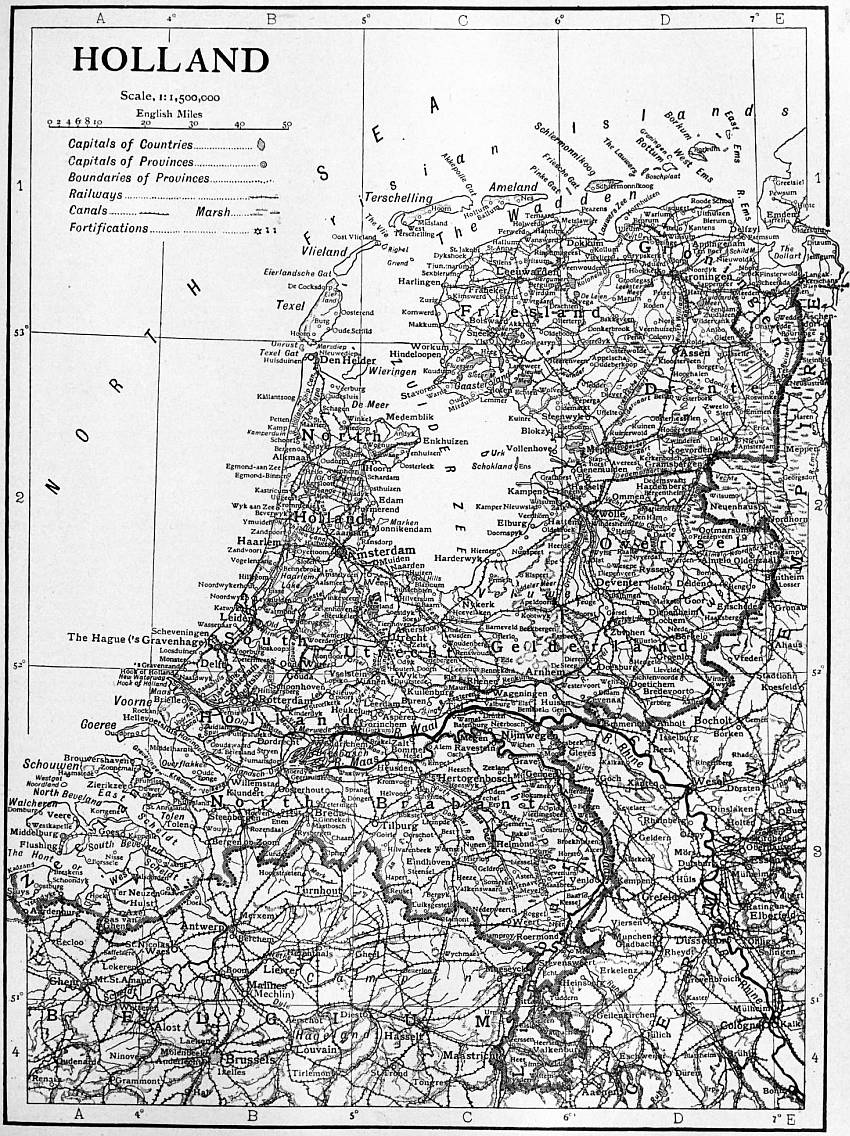
It is unnecessary to mention the names of the numerous marshy lakes which exist, especially in Friesland and Groningen, and are connected with rivers or streamlets. Those of Friesland are of note for the abundance of their fish and their beauty Lakes. of situation, on which last account the Uddelermeer in Gelderland is also celebrated. The Rockanje Lake near Brielle is remarkable for the strong salty solution which covers even the growing reeds with a hard crust. Many of the lakes are nothing more than deep pits or marshes from which the peat has been extracted.
(Click to enlarge.)
Dikes.—The circumstance that so much of Holland is below the sea-level necessarily exercises a very important influence on the drainage, the climate and the sanitary conditions of the country, as well as on its defence by means of inundation. The endiking of low lands against the sea which had been quietly proceeding during the first eleven centuries of the Christian era, received a fresh impetus in the 12th and 13th centuries from the fact that the level of the sea then became higher in relation to that of the land. This fact is illustrated by the broadening of river mouths and estuaries at this time, and the beginning of the formation of the Zuider Zee. A new feature in diking was the construction of dams or sluices across the mouths of rivers, sometimes with important consequences for the villages situated on the spot. Thus the dam on the Amstel (1257) was the origin of Amsterdam, and the dam on the Ye gave rise to Edam. But Holland’s chief protection against inundation is its long line of sand dunes, in which only two real breaches have been effected during the centuries of erosion. These are represented by the famous sea dikes called the Westkapelle dike and the Hondsbossche Zeewering, or sea-defence, which were begun respectively in the first and second halves of the 15th century. The first extends for a distance of over 4000 yds. between the villages of Westkapelle and Domburg in the island of Walcheren; the second is about 4900 yds. long, and extends from Kamperduin to near Petten, whence it is continued for another 1100 yds. by the Pettemer dike. These two sea dikes were reconstructed by the state at great expense between the year 1860 and 1884, having consisted before that time of little more than a protected sand dike. The earthen dikes are protected by stone-slopes and by piles, and at the more dangerous points also by zinkstukken (sinking pieces), artificial structures of brushwood laden with stones, and measuring some 400 yds. in circuit, by means of which the current is to some extent turned aside. The Westkapelle dike, 12,468 ft. long, has a seaward slope of 300 ft., and is protected by rows of piles and basalt blocks. On its ridge, 39 ft. broad, there is not only a roadway but a service railway. The cost of its upkeep is more than £6000 a year, and of the Hondsbossche Zeewering £2000 a year. When it is remembered that the woodwork is infested by the pile worm (Teredo navalis), the ravages of which were discovered in 1731, the labour and expense incurred in the construction and maintenance of the sea dikes now existing may be imagined. In other parts of the coast the dunes, though not pierced through, have become so wasted by erosion as to require artificial strengthening. This is afforded, either by means of a so-called sleeping dike (slaperdyk) behind the weak spot, as, for instance, between Kadzand and Breskens in Zeeland-Flanders, and again between ’s Gravenzande and Loosduinen; or by means of piers or breakwaters (hoofden, heads) projecting at intervals into the sea and composed of piles, or brushwood and stones. The first of such breakwaters was that constructed in 1857 at the north end of the island of Goeree, and extends over 100 yds. into the sea at low water. Similar constructions are to be found on the seaward side of the islands of Walcheren, Schouwen and Voorne, and between ’s Gravenzande and Scheveningen, and Katwijk and Noordwijk. Owing to the obstruction which they offer to drifting sands, artificial dunes are in course of time formed about them, and in this way they become at once more effective and less costly to maintain. The firm and regular dunes which now run from Petten to Kallantsoog (formerly an island), and thence northwards to Huisduinen, were thus formed about the Zyper (1617) and Koegras (1610) dikes respectively. From Huisduinen to Nieuwediep the dunes are replaced by the famous Helder sea-wall. The shores of the Zuider Zee and the Wadden, and the Frisian and Zuider Zee islands, are also partially protected by dikes. In more than one quarter the dikes have been repeatedly extended so as to enclose land conquered from the sea, the work of reclamation being aided by a natural process. Layer upon layer of clay is deposited by the sea in front of the dikes, until a new fringe has been added to the coast-line on which sea-grasses grasses begin to grow. Upon these clay-lands (kwelders) horses, cattle and sheep are at last able to pasture at low tide, and in course of time they are in turn endiked.
River dikes are as necessary as sea dikes, elevated banks being found only in a few places, as on the Lower Rhine. Owing to the unsuitability of the foundations, Dutch dikes are usually marked by a great width, which at the crown varies between 13 and 26 ft. The height of the dike ranges to 40 in. above high water-level. Between the dikes and the stream lie “forelands” (interwaarden), which are usually submerged in winter, and frequently lie 1 or 2 yds, higher than the country within the dikes. These forelands also offer in course of time an opportunity for endiking and reclamation. In this way the towns of Rotterdam, Schiedam, Vlaardingen and Maasluis have all gradually extended over the Maas dike in order to keep in touch with the river, and the small town of Delftshaven is built altogether on the outer side of the same dike.
Impoldering.—The first step in the reclamation of land is to “impolder” it, or convert it into a “polder” (i.e. a section of artificially drained land), by surrounding it with dikes or quays for the two-fold purpose of protecting it from all further inundation from outside and of controlling the amount of water inside. Impoldering for its own sake or on a large scale was impossible as long as the means of drainage were restricted. But in the beginning of the 15th century new possibilities were revealed by the adaptation of the windmill to the purpose of pumping water. It was gradually recognized that the masses of water which collected wherever peat-digging had been carried on were an unnecessary menace to the neighbouring lands, and also that a more enduring source of profit lay in the bed of the fertile sea-clay under the peat. It became usual, therefore, to make the subsequent drainage of the land a condition of the extraction of peat from it, this condition being established by proclamation in 1595.
Drainage.—It has been shown that the western provinces of Holland may be broadly defined as lying below sea-level. In fact the surface of the sea-clay in these provinces is from 11½ to 16½ ft. below the Amsterdam zero. The ground-water is, therefore, relatively very high and the capacity of the soil for further absorption proportionately low. To increase the reservoir capacity of the polder, as well as to conduct the water to the windmills or engines, it is intersected by a network of ditches cut at right angles to each other, the amount of ditching required being usually one-twelfth of the area to be drained. In modern times pumping engines have replaced windmills, and the typical old Dutch landscape with its countless hooded heads and swinging arms has been greatly transformed by the advent of the chimney stacks of the pumping-stations. The power of the pumping-engines is taken on the basis of 12 h.p. per 1000 hectares for every metre that the water has to be raised, or stated in another form, the engines must be capable of raising nearly 9 ℔ of water through 1 yd. per acre per minute. The main ditches, or canals, afterwards also serve as a means of navigation. The level at which it is desired to keep the water in these ditches constitutes the unit of water measurement for the polder, and is called the polder’s zomer peil (Z.P.) or summer water-level. In pasture-polders (koepolders) Z.P. is 1 to 1½ ft. below the level of the polder, and in agricultural polders 2½ to 3½ ft. below. Owing to the shrinkage of the soil in reclaimed lands, however, that is, lands which have been drained after fen or other reclamation, the sides of the polder are often higher than the middle, and it is necessary by means of small dams or sluices to make separate water-tight compartments (afpolderingen), each having its own unit of measurement. Some polders also have a winter peil as a precaution against the increased fall of water in that season. The summer water-level of the pasture polders south of the former Y is about 4 to 8 ft. below the Amsterdam zero, but in the Noorderkwartier to the north, it reaches 10½ ft. below A. P. in the Beschotel polder, and in reclaimed lands (droogmakerijen) may be still lower, thus in the Reeuwyk polder north of Gouda it is 21¼ ft. below.
The drainage of the country is effected by natural or artificial means, according to the slope of the ground. Nearly all the polders of Zeeland and South Holland are able to discharge naturally into the sea at average low water, self-regulating sluices being used. But in North Holland and Utrecht on the contrary the polder water has generally to be raised. In some deep polders and drained lands where the water cannot be brought to the required height at once, windmills are found at two or even three different levels. The final removal of polder water, however, is only truly effected upon its discharge into the “outer waters” of the country, that is, the sea itself or the large rivers freely communicating with it; and this happens with but a small proportion of Dutch polders, such as those of Zeeland, the Holland Ysel and the Noorderkwartier.
As the system of impoldering extended, the small sluggish rivers were gradually cut off by dikes from the marshy lands through which they flowed, and by sluices from the waters with which they communicated. Their level ranges from about 1½ to 4 ft. above that of the pasture polders. In addition, various kinds of canals and endiked or embanked lakes had come into existence, forming altogether a vast network of more or less stagnant waters. These waters are utilized as the temporary reservoirs of the superfluous polder water, each system of reservoirs being termed a boezem (bosom or basin), and all lands watering into the same boezem being considered as belonging to it. The largest boezem is that of Friesland, which embraces nearly the whole province. It sometimes happens that a polder is not in direct contact with the boezem to which it belongs, but first drains into an adjacent polder, from which the water is afterwards removed. In the same way, some boezems discharge first into others, which then discharge into the sea or rivers. This is usually the case where there is a great difference in height between the surface of the boezem and the outer waters, and may be illustrated by the Alblasserwaard and the Rotte boezems in the provinces of South and North Holland respectively. In time of drought the water in the canals and boezems is allowed to run back into the polders, and so serve a double purpose as water-reservoirs. Boezems, like polders, have a standard water-level which may hot be exceeded, and as in the polder this level may vary in the different parts of an extended boezem. The height of the boezem peil ranges between 11⁄3 ft. above to 15⁄6 ft. below the Amsterdam zero, though the average is about 1 to 12⁄3 ft. below. Some boezems, again, which are less easily controlled, have a “danger water-level” at which they refuse to receive any more water from the surrounding polders. The Schie or Delflands boezem of South Holland is of this kind, and such a boezem is termed besloten or “sequestered,” in contradistinction to a “free” boezem. A third kind of boezem is the reserve or berg-boezem, which in summer may be made dry and used for agriculture, while in winter it serves as a special reserve. The centuries of labour and self-sacrifice involved in the making of this complete and harmonious system of combined defence and reclamation are better imagined than described, and even at the present day the evidences of the struggle are far less apparent than real.
Geology.—Except in Limburg, where, in the neighbourhood of Maastricht, the upper layers of the chalk are exposed and followed by Oligocene and Miocene beds, the whole of Holland is covered by recent deposits of considerable thickness, beneath which deep borings have revealed the existence of Pliocene beds similar to the “Crags” of East Anglia. They are divided into the Diestien, corresponding in part with the English Coralline Crag, the Scaldisien and Poederlien corresponding with the Walton Crag, and the Amstelien corresponding with the Red Crag of Suffolk. In the south of Holland the total thickness of the Pliocene series is only about 200 ft., and they are covered by about 100 ft. of Quaternary deposits; but towards the north the beds sink down and at the same time increase considerably in thickness, so that at Utrecht a deep boring reached the top of the Pliocene at a depth of 513 ft. and at 1198 ft. it had not touched the bottom. At Amsterdam the top of the Pliocene lay 625 ft. below the surface, but the boring, 1098 ft. deep, did not reach the base of the uppermost division of the Pliocene, viz. the Amstelien. Eastward and westward of Amsterdam, as well as southward, the Pliocene beds rise slowly to the surface, and gradually decrease in thickness. They were laid down in a broad bay which covered the east of England and nearly the whole of the Netherlands, and was open to the North Sea. There is evidence that the sea gradually retreated northwards during the deposition of these beds, until at length the Rhine flowed over to England and entered the sea north of Cromer. The appearance of northern shells in the upper divisions of the Pliocene series indicates the approach of the Glacial period, and glacial drift containing Scandinavian boulders now covers much of the country east of the Zuider Zee. The more modern deposits of Holland consist of alluvium, wind-blown sands and peat.3
Climate.—Situated in the temperate zone between 50° and 53° N. the climate of Holland shows a difference in the lengths of day and night extending in the north to nine hours, and there is a correspondingly wide range of temperature; it also belongs to the region of variable winds. On an average of fifty years the mean annual temperature was 49.8° Fahr.; the maximum, 93.9° Fahr.; the minimum, -5.8° Fahr. The mean annual barometric height is 29.93 in.; the mean annual moisture, 81%; the mean annual rainfall, 27.99 in. The mean annual number of days with rain is 204, with snow 19, and with thunder-storms 18. The increased rainfall from July to December (the summer and autumn rains), and the increased evaporation in spring and summer (5.2 in. more than the rainfall), are of importance as regards “poldering” and draining operations. The prevalence of south-west winds during nine months of the year and of north-west during three (April-June) has a strong influence on the temperature and rainfall, tides, river mouths and outlets, and also, geologically, on dunes and sand drifts, and on fens and the accumulation of clay on the coast. The west winds of course increase the moisture, and moderate both the winter cold and the summer heat, while the east winds blowing over the continent have an opposite influence. It cannot be said that the climate is particularly good, owing to the changeableness of the weather, which may alter completely within a single day. The heavy atmosphere likewise, and the necessity of living within doors or in confined localities, cannot but exercise an influence on the character and temperament of the inhabitants. Only of certain districts, however, can it be said that they are positively unhealthy; to this category belong some parts of the Holland provinces, Zeeland, and Friesland, where the inhabitants are exposed to the exhalations from the marshy ground, and the atmosphere is often burdened with sea-fogs.
Fauna.—In the densely populated Netherlands, with no extensive forests, the fauna does not present any unusual varieties. The otter, martin and badger may be mentioned among the rarer wild animals, and the weasel, ermine and pole-cat among the more common. In the 18th century wolves still roamed the country in such large numbers that hunting parties were organized against them; now they are unknown. Roebuck and deer are found in a wild state in Gelderland and Overysel, foxes are plentiful in the dry wooded regions on the borders of the country, and hares and rabbits in the dunes and other sandy stretches. Among birds may be reckoned about two hundred and forty different kinds which are regular inhabitants, although nearly two hundred of these are migratory. The woodcock, partridge, hawk, water-ousel, magpie, jay, raven, various kinds of owls, wood-pigeon, golden-crested wren, tufted lark and titmouse are among the birds which breed here. Birds of passage include the buzzard, kite, quail, wild fowl of various kinds, golden thrush, wagtail, linnet, finch and nightingale. Storks are plentiful in summer and might almost be considered the most characteristic feature of the prevailing landscape.
Flora.—The flora may be most conveniently dealt with in the four physiographical divisions to which it belongs. These are, namely, the heath-lands, pasture-lands, dunes and coasts. Heath (Erica tetralix) and ling (Calluna vulgaris) cover all the waste sandy regions in the eastern division of the country. The vegetation of the meadow-lands is monotonous. In the more damp and marshy places the bottom is covered with marsh trefoil, carex, smooth equisetum, and rush. In the ditches and pools common yellow and white water-lilies are seen, as well as water-soldier (Stratiotes aloides), great and lesser reed-mace, sweet flag and bur-reed. The plant forms of the dunes are stunted and meagre as compared with the same forms elsewhere. The most common plant here is the stiff sand-reed (Arundo arenaria), called sand-oats in Drente and Overysel, where it is much used for making mats. Like the sand-reed, the dewberry bramble and the shrub of the buckthorn (Hippophae rhamnoides) perform a useful service in helping to bind the sand together. Furze and the common juniper are regular dune plants, and may also be found on the heaths of Drente, Overysel and Gelderland. Thyme and the small white dune-rose (Rosa pimpinellifolia) also grow in the dunes, and wall-pepper (Sedum acre), field fever-wort, reindeer moss, common asparagus, sheep’s fescue grass, the pretty Solomon-seal (Polygonatum officinale), and the broad-leaved or marsh orchis (Orchis latifolia). The sea-plants which flourish on the sand and mud-banks along the coasts greatly assist the process of littoral deposits and are specially cultivated in places. Sea-aster flourishes in the Wadden of Friesland and Groningen, the Dollart and the Zeeland estuaries, giving place nearer the shore to sandspurry (Spergularia), or sea-poa or floating meadow grass (Glyceria maritima), which grows up to the dikes, and affords pasture for cattle and sheep. Along the coast of Overysel and in the Biesbosch lake club-rush, or scirpus, is planted in considerable quantities for the hat-making industry, and common sea-wrack (Zostera marina) is found in large patches in the northern half of the Zuider Zee, where it is gathered for trade purposes during the months of June, July and August. Except for the willow-plots found along the rivers on the clay lands, nearly all the wood is confined to the sand and gravel soils, where copses of birch and alder are common.
Population.—The following table shows the area and population in the eleven provinces of the Netherlands:—
Province Area in sq. m. Population 1890. Population 1900. Density per sq. m. in 1900.
North Brabant 1,980 509,628 553,842 280
Gelderland 1,965 512,202 566,549 288
South Holland 1,166 949,641 1,144,448 981
North Holland 1,070 829,489 968,131 905
Zeeland 690 199,234 216,295 313
Utrecht 534 221,007 251,034 470
Friesland 1,282 335,558 340,262 265
Overysel 1,291 295,445 333,338 258
Groningen 790 272,786 299,602 379
Drente 1,030 130,704 148,544 144
Limburg 850 255,721 281,934 332
Total 12,648 4,511,415 5,104,137* 404
* This total includes 158 persons assigned to no province.
The extremes of density of population are found in the provinces of North Holland and South Holland on the one hand, and Drente on the other. This divergence is partly explained by the difference of soil—which in Drente comprises the maximum of waste lands, and in South Holland the minimum—and partly also by the greater facilities which the seaward provinces enjoy of earning a subsistence, and the greater variety of their industries. The largest towns are Amsterdam, Rotterdam, the Hague, Utrecht, Groningen, Haarlem, Arnhem, Leiden, Nijmwegen, Tilburg. Other considerable towns are Dordrecht, Maastricht, Leeuwarden, Zwolle, Delft, ’s Hertogenbosch, Schiedam, Deventer, Breda, Apeldoorn, Helder, Enschedé, Gouda, Zaandam, Kampen, Hilversum, Flushing, Amersfoort, Middelburg, Zutphen and Alkmaar. Many of the smaller towns, such as Assen, Enschedé, Helmond, Hengelo, Tiel, Venlo, Vlaardingen, Zaandam, Yerseke, show a great development, and it is a noteworthy fact that the rural districts, taken as a whole, have borne an equal share in the general increase of population. This, taken in conjunction with the advance in trade and shipping, the diminution in emigration, and the prosperity of the savings banks, points to a favourable state in the condition of the people.
Communications.—The roads are divided into national or royal roads, placed directly under the control of the water-staat and supported by the state; provincial roads, under the direct Roads. control of the states of the provinces, and almost all supported by the provincial treasuries; communal and polder roads, maintained by the communal authorities and the polder boards; and finally, private roads. The system of national roads, mainly constructed between 1821 and 1827, but still in process of extension, brings into connexion nearly all the towns.
The canal system of Holland is peculiarly complete and extends into every part of the country, giving to many inland towns almost a maritime appearance. The united length of the canals exceeds 1500 m. As a matter of course the smaller Canals. streams have been largely utilized in their formation, while the necessity for a comprehensive drainage system has also contributed in no small degree. During the years 1815-1830 a large part of the extensive scheme of construction inaugurated by King William I. was carried out, the following canals, among others, coming into existence in that period: the North Holland ship canal (depth, 16½ ft.) from Amsterdam to den Helder, the Grift canal between Apeldoorn and Hattem, the Willemsvaart connecting Zwolle with the Ysel, the Zuid Willemsvaart, or South William’s canal (6½ ft.), from ’s Hertogenbosch to Maastricht, and the Ternuzen-Ghent ship canal. After 1849 the canal programme was again taken up by the state, which alone or in conjunction with the provincial authorities constructed the Apeldoorn-Dieren canal (1859-1869), the drainage canals of the “Peel” marsh in North Brabant, and of the eastern provinces, namely, the Deurne canal (1876-1892) from the Maas to Helenaveen, the Almelo (1851-1858) and Overysel (1884-1888) canals from Zwolle, Deventer and Almelo to Koevorden, and the Stieltjes (1880-1884), and Orange (1853-1858 and 1881-1889) canals in Drente, the North Williams canal (1856-1862) between Assen and Groningen, the Ems (1866-1876) ship canal from Groningen to Delfzyl, and the New Merwede, and enlarged the canal from Harlingen by way of Leeuwarden to the Lauwars Zee. The large ship canals to Rotterdam and Amsterdam, called the New Waterway and the North Sea canal respectively, were constructed in 1866-1872 and 1865-1876 at a cost of 2½ and 3 million pounds sterling, the former by widening the channel of the Scheur north of Rozenburg, and cutting across the Hook of Holland, the latter by utilizing the bed of the Y and cutting through the dunes at Ymuiden. In 1876 an agreement was arrived at with Germany for connecting the important drainage canals in Overysel, Drente and Groningen with the Ems canal system, as a result of which the Almelo-Noordhorn (1884-1888) and other canals came into existence.
The canals differ in character in the different provinces. In Zeeland they connect the towns of the interior with the sea or the river mouths; for example, the one from Middelburg to Veere and Flushing (1866-1878), from Goes to the East Scheldt, and from Zierikzee also to the East Scheldt. The South Beveland (1862-1866) canal connects the East and West Scheldt; similarly in South Holland the Voorne canal unites the Haringvliet with the New Maas, which does not allow the passage of large vessels above Brielle; whilst owing lo the banks and shallows in front of Hellevoetsluis the New Waterway was cut to Rotterdam. Of another character is the Zederik canal, which unites the principal river of central Holland, the Lek, at Vianen by means of the Linge with the Merwede at Gorkum. Amsterdam is connected with the Lek and the Zederik canal via Utrecht by the Vecht and the Vaart Rhine (1881-1893; depth 10.2 ft.). Again, a totally different character belongs to the canals in North Brabant, and the east and north-east of Holland where, in the absence of great rivers, they form the only waterways which render possible the drainage of the fens and the export of peat; and unite the lesser streams with each other. Thus in Overysel, in addition to the canals already mentioned, the Dedemsvaart connects the Vecht with the Zwarte Water near Hasselt; in Drente the Smildervaart and Drentsche Hoofdvaart unites Assen with Meppel, and receives on the eastern side the drainage canals of the Drente fens, namely, the Orange canal and the Hoogeveen Vaart (1850-1860; 1880-1893). Groningen communicates with the Lauwers Zee by the Reitdiep (1873-1876), while the canal to Winschoten and the Stadskanaal, or State canal (1877-1880), bring it into connexion with the flourishing fen colonies in the east of the province and in Drente. In Friesland, finally, besides the ship canal from Harlingen to the Lauwers Zee there are canals from Leeuwarden to the Lemmer, whence there is a busy traffic with Amsterdam; and the Caspar Robles or Kolonels Diep, and the Hoendiep connect it with Groningen.
The construction of railways was long deferred and slowly accomplished. The first line was that between Amsterdam and Haarlem, opened in 1839 by the Holland railway company (Hollandsch Yzeren Spoorweg Maatschappij). In 1845 the state undertook Railways. to develop the railway system, and a company of private individuals was formed to administer it under the title of the Maatschappij tot Exploitatie van Staatspoorwegen. In 1860, however, the total length of railways was only 208 m., and in that year a parliamentary bill embodying a comprehensive scheme of construction was adopted. By 1872 this programme was nearly completed, and 542 m. of new railway had been added. In 1873 and 1875 a second and a third bill provided for the extension of the railway system at the cost of the state, and, in 1876, 1882 and 1890 laws were introduced readjusting the control of the various lines, some of which were transferred to the Holland railway. The state railway system was completed in 1892, and since that time the utmost that the state has done has been to subsidize new undertakings. These include various local lines such as the line Alkmaar-Hoorn (1898), Ede-Barneveld-Nykerk, Enschedé-Ahaus in Germany (1902), Leeuwarden to Franeker, Harlingen and Dokkum, and the line Zwolle-Almelo (junction at Marienberg) Koevorden-Stadskanal-Veendam-Delfzyl, connecting all the fen countries on the eastern borders. The electric railway Amsterdam-Zandvoort was opened in 1904. The frame upon which the whole network of the Dutch railways may be said to depend is formed of two main lines from north and south and four transverse lines from west to east. The two longitudinal lines are the railway den Helder via Haarlem (1862-1867),4 Rotterdam (1839-1847), and Zwaluwe (1869-1877) to Antwerp (1852-1855), belonging to the Holland railway company, and the State railway from Leeuwarden and Groningen (1870) (junction at Meppel, 1867) Zwolle (1866)—Arnhem (1865)—Nijmwegen (1879)—Venlo (1883)—Maastricht (1865). The four transverse lines belong to the State and Holland railways alternately and are, beginning with the State railway: (1) the line Flushing (1872)—Rozendaal (1860)—Tilburg (1863)—Bokstel (whence there is a branch line belonging to the North Brabant and Germany railway company via Vechel to Goch in Germany, opened in 1873)—Eindhoven—Venlo and across Prussian border (1866); (2) the line Hook of Holland—Rotterdam (1893)—Dordrecht (1872-1877)—Elst (1882-1885)—Nijmwegen (1879)—Cleves, Germany (1865); (3) the line Rotterdam—Utrecht (1866-1869) and Amsterdam—Utrecht—Arnhem (1843-1845) to Emmerich in Germany (1856): this line formerly belonged to the Netherlands-Rhine railway company, but was bought by the state in 1890; and finally (4) the line Amsterdam—Hilversum—Amersfoort—Apeldoorn (1875), whence it is continued (a) via Deventer, Almelo and Hengelo to Salzbergen, Germany (1865); (b) via Zutphen, Hengelo (1865), Enschedé (1866) to Gronau, Germany; (c) via Zutphen (1876) and Ruurlo to Winterswyk (1878). Of these (1) and (2) form the main transcontinental routes in connexion with the steamboat service to England (ports of Queenborough and Harwich respectively). Two other lines of railway, both belonging to the state, also traverse the country west to east, namely, the line Rozendaal—’s Hertogenbosch (1890)—Nijmwegen, and in the extreme north, the line from Harlingen through Leeuwarden (1863) and Groningen (1866) to the border at Nieuwe Schans (1869), whence it was connected with the German railways in 1876. The northern and southern provinces are further connected by the lines Amsterdam—Zaandam (1878)—Enkhuizen (1885), whence there is a steam ferry across the Zuider Zee to Stavoren, from where the railway is continued to Leeuwarden (1883-1885); the Netherlands Central railway, Utrecht—Amersfoort—Zwoole—Kampen (1863); and the line Utrecht—’s Hertogenbosch (1868-1869) which is continued southward into Belgium by the lines bought in 1898 from the Grand Central Beige railway, namely, via Tilburg to Turnhout (1867), and via Eindhoven (1866) to Hasselt. In 1892 Greenwich mean time was adopted on the railways and in the post-offices, making a difference of twenty minutes with mean Amsterdam time.
Since 1877 railway communication has been largely supplemented by steam-tramways, which either run along the main roads or across the country on special embankments, while one of them is carried across the river Ysel at Doesburg on a pontoon bridge. Tramways. The state first began to encourage the construction of these local light railways by means of subsidies in 1893, since when some of the most prominent lines have come into existence, such as Purmerend—Alkmaar (1898), Zutphen—Emmerich (1902), along the Dedemsvaart in Overysel (1902), from ’s Hertogenbosch via Utrecht and Eindhoven to Turnhout in Belgium (1898), and especially those connecting the South Holland and Zeeland islands with the railway, namely, between Rotterdam and Numansdorp on the Hollandsch Diep (1898), and from Breda or Bergen-op-Zoom, via Steenbergen to St Philipsland, Zierikzee and Brouwershaven (1900). An electric tramway connects Haarlem and Zandvoort. The number of passengers carried by the steam-tramways is relatively higher than that of the railways. The value of the goods traffic is not so high, owing, principally, to the want of intercommunication between the various lines on account of differences in the width of the gauge.
Agriculture.—Waste lands are chiefly composed of the barren stretches of heaths found in Drente, Overysel, Gelderland and North Brabant. They formerly served to support large flocks of sheep and some cattle, but are gradually transformed by the planting of woods, as well as by strenuous efforts at cultivation. Zeeland and Groningen are the two principal agricultural provinces, and after them follow Limburg, North Brabant, Gelderland and South Holland. The chief products of cultivation on the heavy clay soil are oats, barley and wheat, and on the sand-grounds rye, buckwheat and potatoes. Flax and beetroot are also cultivated on the clay lands. Tobacco, hemp, hops, colza and chicory form special cultures. With the possible exception of oats, the cereals do not suffice for home consumption, and maize is imported in large quantities for cattle-feeding, and barley for the distilleries and breweries. Horticulture and market-gardening are of a high order, and flourish especially on the low fen soil and geest grounds along the foot of the dunes in the provinces of North and South Holland. The principal market products are cauliflower, cabbage, onions, asparagus, gherkins, cucumbers, beans, peas, &c. The principal flowers are hyacinths, tulips, crocuses, narcissus and other bulbous plants, the total export of which is estimated at over £200,000. Fruit is everywhere grown, and there is a special cultivation of grapes and figs in the Westland of South Holland. The woods, or rather the plantations, covering 6%, consist of (1) the so-called forest timber (opgaandhout; Fr. arbres de haute futaie), including the beech, oak, elm, poplar, birch, ash, willow and coniferous trees; and (2) the copse wood (akkermaal or hakhout), embracing the elder, willow, beech, oak, &c. This forms no unimportant branch of the national wealth.
With nearly 35% of the total surface of the country under permanent pasture, cattle-breeding forms one of the most characteristic industries of the country. The provinces of Friesland, North and South Holland, and Utrecht take Livestock. the lead as regards both quality and numbers. A smaller, hardier kind of cattle and large numbers of sheep are kept upon the heath-lands in the eastern provinces, which also favour the rearing of pigs and bee-culture. Horse-breeding is most important in Friesland, which produces the well-known black breed of horse commonly used in funeral processions. Goats are most numerous in Gelderland and North Brabant. Poultry, especially fowls, are generally kept. Stock-breeding, like agriculture, has considerably improved under the care of the government (state and provincial), which grants subsidies for breeding, irrigation of pasture-lands, the importation of finer breeds of cattle and horses, the erection of factories for dairy produce, schools, &c.
Fisheries.—The fishing industry of the Netherlands may be said to have been in existence already in the 13th century, and in the following century received a considerable impetus from the discovery how to cure herring by William Beukelszoon, a Zeeland fisherman. It steadily declined during the 17th and 18th centuries, however, but again began to revive in the last half of the 19th century. The fisheries are commonly divided into four particular fishing areas, namely, the “deep-sea” fishery of the North Sea, and the “inner” (binnengaatsch) fisheries of the Wadden, the Zuider Zee, and the South Holland and Zeeland waters. The deep-sea fishery may be farther divided into the so-called “great” or “salt-herring” fishery, mainly carried on from Vlaardingen and Maasluis during the summer and autumn, and the “fresh-herring” fishery, chiefly pursued at Scheveningen, Katwijk and Noordwijk. The value of the herring fisheries is enhanced by the careful methods of smoking and salting, the export of salted fish being considerable. In the winter the largest boats are laid up and the remainder take to line-fishing. Middelharnis, Pernis and Zwartewaal are the centres of this branch of fishery, which yields halibut, cod, ling and haddock. The trawl fisheries of the coast yield sole, plaice, turbot, brill, skate, &c., of which a large part is brought alive to the market. In the Zuider Zee small herring, flat fish, anchovies and shrimps are caught, the chief fishing centres being the islands of Texel, Urk and Wieringen, and the coast towns of Helder, Bunschoten, Huizen, Enkhuizen, Vollendam, Kampen, Harderwyk, Vollenhove. The anchovy fishing which takes place in May, June and July sometimes yields very productive results. Oysters and mussels are obtained on the East Scheldt, and anchovies at Bergen-op-Zoom; while salmon, perch and pike are caught in the Maas, the Lek and the New Merwede. The oyster-beds and salmon fisheries are largely in the hands of the state, which lets them to the highest bidder. Large quantities of eels are caught in the Frisian lakes. The fisheries not only supply the great local demand, but allow of large exports.
Manufacturing Industries.—The mineral resources of Holland give no encouragement to industrial activity, with the exception of the coal-mining in Limburg, the smelting of iron ore in a few furnaces in Overysel and Gelderland, the use of stone and gravel in the making of dikes and roads, and of clay in brickworks and potteries, the quarrying of stone at St Pietersberg, &c. Nevertheless the industry of the country has developed in a remarkable manner since the separation from Belgium. The greatest activity is shown in the cotton industry, which flourishes especially in the Twente district of Overysel, where jute is also worked into sacks. In the manufacture of woollen and linen goods Tilburg ranks first, followed by Leiden, Utrecht and Eindhoven; that of half-woollens is best developed at Roermond and Helmond. Other branches of industry include carpet-weaving at Deventer, the distillation of brandy, gin and liqueurs at Schiedam, Rotterdam and Amsterdam, and beer-brewing in most of the principal towns; shoe-making and leather-tanning in the Langstraat district of North Brabant; paper-making at Apeldoorn, on the Zaan, and in Limburg; the manufacture of earthenware and faïence at Maastricht, the Hague and Delft, as well as at Utrecht, Purmerend and Makkum; clay pipes and stearine candles at Gouda; margarine at Osch; chocolate at Weesp and on the Zaan; mat-plaiting and broom-making at Genemuiden and Blokzyl; diamond-cutting and the manufacture of quinine at Amsterdam; and the making of cigars and snuff at Eindhoven, Amsterdam, Utrecht, Kampen, &c. Shipbuilding is of no small importance in Holland, not only in the greater, but also in the smaller towns along the rivers and canals. The principal shipbuilding yards are at Amsterdam, Kinderdijk, Rotterdam and at Flushing, where there is a government dockyard for building warships.
Trade and Shipping.—To obtain a correct idea of the trade of Holland, greater attention than would be requisite in the case of other countries must be paid to the inland traffic. It is impossible to state the value of this in definite figures, but an estimate may be formed of its extent from the number of ships which it employs in the rivers and canals, and from the quantity of produce brought to the public market. In connexion with this traffic there is a large fleet of tug boats; but steam- or petroleum-propelled barges are becoming more common. Some of the lighters used in the Rhine transport trade have a capacity of 3000 tons. A great part of the commercial business at Rotterdam belongs to the commission and transit trade. The other principal ports are Flushing, Terneuzen (for Belgium), Harlingen, Delfzyl, Dordrecht, Zaandam, Schiedam, Groningen, den Helder, Middelburg, Vlaardingen. Among the national mail steamship services are the lines to the East and West Indies, Africa and the United States. An examination of its lists of exports and imports will show that Holland receives from its colonies its spiceries, coffee, sugar, tobacco, indigo, cinnamon; from England and Belgium its manufactured goods and coals; petroleum, raw cotton and cereals from the United States; grain from the Baltic provinces, Archangel, and the ports of the Black Sea; timber from Norway and the basin of the Rhine, yarn from England, wine from France, hops from Bavaria and Alsace; iron-ore from Spain; while in its turn it sends its colonial wares to Germany, its agricultural produce to the London market, its fish to Belgium and Germany, and its cheese to France, Belgium and Hamburg, as well as England. The bulk of trade is carried on with Germany and England; then follow Java, Belgium, Russia, the United States, &c. In the last half of the 19th century the total value of the foreign commerce was more than trebled.
Constitution and Government.—The government of the Netherlands is regulated by the constitution of 1815, revised in 1848 and 1887, under which the sovereign’s person is inviolable and the ministers are responsible. The age of majority of the sovereign is eighteen. The crown is hereditary in both the male and the female line according to primogeniture; but it is only in default of male heirs that females can come to the throne. The crown prince or heir apparent is the first subject of the sovereign, and bears the title of the prince of Orange. The sovereign alone has executive authority. To him belong the ultimate direction of foreign affairs, the power to declare war and peace, to make treaties and alliances, and to dissolve one or both chambers of parliament, the supreme command of the army and navy, the supreme administration of the state finances and of the colonies and other possessions of the kingdom, and the prerogative of mercy. By the provisions of the same constitution he establishes the ministerial departments, and shares the legislative power with the first and second chambers of parliament, which constitute the states-general and sit at the Hague. The heads of the departments to whom the especial executive functions are entrusted are eight in number—ministers respectively of the interior, of “water-staat,” trade and industry (that is, of public works, including railways, post-office, &c.), of justice, of finance, of war, of marine, of the colonies and of foreign affairs. There is a department of agriculture, but without a minister at its head. The heads of departments are appointed and dismissed at the pleasure of the sovereign, usually determined, however, as in all constitutional states, by the will of the nation as indicated by its representatives.
The number of members in the first chamber is 50, South Holland sending 10, North Holland 9, North Brabant and Gelderland each 6, Friesland 4, Overysel, Limburg and Groningen each 3, Zeeland, Utrecht and Drente each 2. According to the fundamental law (Grondwet) of 1887, they are chosen by the provincial states, not only from amongst those who bear the greatest burden of direct taxation in each province, but also from amongst great functionaries and persons of high rank. Those deputies who are not resident in the Hague are entitled to receive 16s. 8d. a day during the session. The duration of parliament is nine years, a third of the members retiring every three years. The retiring members are eligible for re-election. The members of the second chamber are chosen in the electoral districts by all capable male citizens not under 23 years of age, who pay one or more direct taxes, ranging from a minimum of one guilder (1s. 8d.) towards the income tax. The number of members is 100, Amsterdam returning 9, Rotterdam 5, the Hague 3, Groningen and Utrecht 2 members each. Members must be at least thirty years old, and receive an annual allowance of £166, besides travelling expenses. They only, and the government, have the right of initiating business, and of proposing amendments. Their term is four years, but they are re-eligible. All communications from the sovereign to the states-general and from the states to the sovereign, as well as all measures relating to internal administration or to foreign possessions, are first submitted to the consideration of the council of state, which consists of 14 members appointed by the sovereign, who is the president. The state council also has the right of making suggestions to the sovereign in regard to subjects of legislation and administration.
The provincial administration is entrusted to the provincial states, which are returned by direct election by the same electors as vote for the second chamber. The term is for six years, but one-half of the members retire every three years subject to re-election or renewal. The president of the assembly is the royal commissioner for the province. As the provincial states only meet a few times in the year, they name a committee of deputy-states which manages current general business, and at the same time exercises the right of control over the affairs of the communes. At the head of every commune stands a communal council, whose members must be not under 23 years of age. They are elected for six years (one-third of the council retiring every two years) by the same voters as for the provincial states. Communal franchise is further restricted, however, to those electors who pay a certain sum to the communal rates. The number of councillors varies according to the population between 7 and 45. One of the special duties of the council is the supervision of education. The president of the communal council is the burgomaster, who is named by the sovereign in every instance for six years, and receives a salary varying from £40 to over £600. Provision is made for paying the councillors a certain fee—called “presence-money”—when required. The burgomaster has the power to suspend any of the council’s decrees for 30 days. The executive power is vested in a college formed by the burgomaster and two, three or four magistrates (wethouders) to be chosen by and from the members of the council. The provinces are eleven in number.
National Defence.—The home defence system of Holland is a militia with strong cadres based on universal service. Service in the “militia” or 1st line force is for 8 years, in the 2nd line for 7. Every year in the drill season contingents of militiamen are called up for long or short periods of training, and the maximum peace strength under arms in the summer is about 35,000, of whom half are permanent cadres and half militiamen. In 1908 12,300 of the year’s contingent were trained for eight months and more, and 5200 for four months. The war strength of the militia is 105,000, that of the second line or reserve 70,000. The defence of the country is based on the historic principle of concentrating the people and their resources in the heart of the country, covered by a wide belt of inundations. The chosen line of defence is marked by a series of forts which control the sluices, extending from Amsterdam, through Muiden, thence along the Vecht and through Utrecht to Gorinchem (Gorkum) on the Waal. The line continues thence by the Hollandsche Diep and Volkerak to the sea, and the coast also is fortified. The army in the colonies numbers in all about 26,000, all permanent troops and for the most part voluntarily enlisted European regulars. The military expenditure in 1908 was £2,331,255. The Dutch navy at home and in Indian waters consists (1909) of 9 small battleships, 6 small cruisers and 80 other vessels, manned by 8600 officers and men of the navy and about 2250 marines. Recruiting is by voluntary enlistment, with contingent powers of conscription amongst the maritime population.
Justice.—The administration of justice is entrusted (1) to the high council (hooge raad) at the Hague, the supreme court of the whole kingdom, and the tribunal for all high government officials and for the members of the states-general; (2) to the five courts of justice established at Amsterdam, the Hague, Arnhem, Leeuwarden and ’s Hertogenbosch; (3) to tribunals established in each arrondissement; (4) to cantonal judges appointed over a group of communes, whose jurisdiction is restricted to claims of small amount (under 200 guilders), and to breaches of police regulations, and who at the same time look after the interest of minors. The high council is composed of 12 to 14 councillors, a procureur-general and three advocates-general. Criminal and correctional procedure were formerly divided between the courts of justice and the arrondissement tribunals; but this distinction was suppressed by the penal code of 1886, thereby increasing the importance of the arrondissement courts, which also act as court of appeal of the cantonal courts.
Besides the prisons, which include one built on the cellular principle at Breda, the state supports three penal workhouses for drunkards and beggars. There are also the penal colonies at Veenhuizen in Drente, which were brought from the Society of Charity (Maatschappij van Weldadigkeid) in 1859. The inmates practise agriculture, as well as various industries for supplying all the requirements of the colony. The objection raised against these establishments is that the prisoners do not represent the real vagabondage of the country, but a class of more or less voluntary inmates. Children under 16 years of age are placed in the three state reformatories, and there is an institution for vagabond women at Rotterdam.
Charitable and other Institutions.—Private charities have always occupied a distinguished position in the Netherlands, and the principle of the law of 1854 concerning the relief of the poor is, that the state shall only interfere when private charity fails. All private and religious institutions have to be inscribed before they can collect public funds. In some cases these institutions are organized and administered conjointly with the civil authorities. At the head of the charitable institutions stand the agricultural colonies belonging to the Society of Charity (see Drente). Of the numerous institutions for the encouragement of the sciences and the fine arts, the following are strictly national—the Royal Academy of Sciences (1855), the Royal Netherlands Meteorological Institute (1854), the National Academy of the Plastic Arts, the Royal School of Music, the National Archives, besides various other national collections and museums. Provincial scientific societies exist at Middelburg, Utrecht, ’s Hertogenbosch and Leeuwarden, and there are private and municipal associations, institutions and collections in a large number of the smaller towns. Among societies of general utility are the Society for Public Welfare (Maatschappij tot nut van’t algemeen, 1785), whose efforts have been mainly in the direction of educational reform; the Geographical Society at Amsterdam (1873); Teyler’s Stichting or foundation at Haarlem (1778), and the societies for the promotion of industry (1777), and of sciences (1752) in the same town; the Institute of Languages, Geography and Ethnology of the Dutch Indies (1851), and the Indian Society at the Hague, the Royal Institute of Engineers at Delft (1848), the Association for the Encouragement of Music at Amsterdam, &c.
Religion.—Religious conviction is one of the most characteristic traits of the Dutch people, and finds expression in a large number of independent religious congregations. The bond between church and state which had been established by the synod of Dort (1618) and the organization of the Low-Dutch Reformed Church (Nederlandsche Hervormde Kerk) as the national Protestant church, practically came to an end in the revolution of 1795, and in the revision of the Constitution in 1848 the complete religious liberty and equality of all persons and congregations was guaranteed. The present organization of the Reformed Church dates from 1852. It is governed by a general assembly or “synod” of deputies from the principal judicatures, sitting once a year. The provinces are subdivided into “classes,” and the classes again into “circles” (ringen), each circle comprising from 5 to 25 congregations, and each congregation being governed by a “church council” or session. The provincial synods are composed of ministers and elders deputed by the classes; and these are composed of the ministers belonging to the particular class and an equal number of elders appointed by the local sessions. The meetings of the circles have no administrative character, but are mere brotherly conferences. The financial management in each congregation is entrusted to a special court (kerk-voogdij) composed of “notables” and church wardens. In every province there is besides, in the case of the Reformed Church, a provincial committee of supervision for the ecclesiastical administration. For the whole kingdom this supervision is entrusted to a common “collegium” or committee of supervision, which meets at the Hague, and consists of 11 members named by the provincial committee and 3 named by the synod. Some congregations have withdrawn from provincial supervision, and have thus free control of their own financial affairs. The oldest secession from the Orthodox Church is that of the Remonstrants, who still represent the most liberal thought in the country, and have their own training college at Leiden. Towards 1840 a new congregation calling itself the Christian Reformed Church (Christelijke Gereformeerde Kerk) arose as a protest against the government and the modern tendencies of the Reformed Church; and for the same reason those who had founded the Free University of Amsterdam (1880) formed themselves in 1886 into an independent body called the Nederlandsche Gereformeerde Kerk. In 1892 these two churches united under the name of the Reformed Churches (Gereformeerde Kerken) with the doctrine and discipline of Dort. They have a theological seminary at Kampen. Other Protestant bodies are the Walloons, who, though possessing an independent church government, are attached to the Low-Dutch Reformed Church; the Lutherans, divided into the main body of Evangelical Lutherans and a smaller division calling themselves the Re-established or Old Lutherans (Herstelde Lutherschen) who separated in 1791 in order to keep more strictly to the Augsburg confession; the Mennonites founded by Menno Simons of Friesland, about the beginning of the 16th century; the Baptists, whose only central authority is the General Baptist Society founded at Amsterdam in 1811; the Evangelical Brotherhood of Hernhutters or Moravians, who have churches and schools at Zeist and Haarlem; and a Catholic Apostolic Church (1867) at the Hague. There are congregations of English Episcopalians at the Hague, Amsterdam and Rotterdam, and German Evangelicals at the Hague (1857) and Rotterdam (1861). In 1853 the Roman Catholic Church, which before had been a mission in the hands of papal legates and vicars, was raised into an independent ecclesiastical province with five dioceses, namely, the archbishopric of Utrecht, and the suffragan bishoprics of Haarlem, Breda, ’s Hertogenbosch and Roermond, each with its own seminary. Side by side with the Roman Catholic hierarchy are the congregations of the Old Catholics or Old Episcopalian Church (Oud Bisschoppelijke Clerezie), and the Jansenists (see Jansenism). The Old Catholics, with whom the Jansenists are frequently confused, date from the 17th century. Besides an archbishop at Utrecht, the Old Catholics have bishops at Deventer and Haarlem, and a training college at Amersfoort. They numbered in 1905 about 9000 (see Utrecht). The large Jewish population in Holland had its origin in the wholesale influx of Portuguese Jews at the end of the 16th, and of German Jews in the beginning of the 17th century. In 1870 they were reorganized under the central authority of the Netherlands Israelite Church, and divided into head and “ring” synagogues and associated churches. The Roman Catholic element preponderates in the southern provinces of Limburg, and North Brabant, but in Friesland, Groningen and Drente the Baptists and Christian Reformed are most numerous.
Education.—Every grade of education in the Netherlands is under the control and supervision of the state, being administered by a special department under the ministry for the interior. In 1889 the state recognized private denominational schools, and in 1900 passed a law of compulsory attendance. Infant schools, which are generally in the hands of private societies or the municipal authorities, are not interfered with by the state. According to the law of 1889 primary education is carried on in the ordinary and in continuation schools for boys and girls (co-education having been long in vogue). These schools are established in every commune, the state contributing aid at the rate of 25% of the total expenditure. The age of admission is six; and the course is for six years, 7-13 being the legal age limits; the fee, from which poverty exempts, is almost nominal. Nature-study, continued in the secondary schools, is an essential part in the curriculum of these schools, and elementary general history, English, French and German are among the optional subjects. While the boys are instructed in woodwork, needlework is taught to the girls, its introduction in 1889 having been the first recognition of practical instruction in any form. Continuation schools (herhalingsscholen) must be organized wherever required, and are generally open for six months in winter, pupils of twelve to fourteen or sixteen attending. Secondary schools were established by the law of 1863 and must be provided by every commune of 10,000 inhabitants; they comprise the Burgher-Day-and-Evening schools and the Higher-Burgher schools. The first named schools being mainly intended for those engaged in industrial or agricultural pursuits, the day classes gradually fell into disuse. The length of the course as prescribed by law is two years, but it is usually extended to three or four years, and the instruction, though mainly theoretical, has regard to the special local industries; the fees, if any, may not exceed one pound sterling per annum. Special mention must be made in this connexion of the school of engineering in Amsterdam (1878) and the Academy of Plastic Arts at Rotterdam. The higher-burgher schools have either a three or a five years’ course, and the fees vary from £2, 10s. to £5 a year. The instruction given is essentially non-classical and scientific. In both schools certificates are awarded at the end of the course, that of the higher-burgher schools admitting to the natural science and medical branches of university education, a supplementary examination in Greek and Latin being required for other branches. The gymnasia, or classical schools, fall legally speaking under the head of higher education. By the law of 1876, every town of 20,000 inhabitants, unless specially exempted, must provide a gymnasium. A large proportion of these schools are subsidized by the state to the extent of half their net cost. The curriculum is classical and philological, but in the two upper classes there is a bifurcation in favour of scientific subjects for those who wish. The fees vary from £5 to £8 a year, but, owing to the absence of scholarships and bursaries, are sometimes remitted, as in the case of the higher-burgher schools. Among the schools which give specialized instruction, mention must be made of the admirable trade schools (ambachtsscholen) established in 1861, and the corresponding industrial schools for girls; the fishery schools and schools of navigation; the many private schools of domestic science, and of commerce and industry, among which the municipal school at Enschedé (1886) deserves special mention; and the school of social work, “Das Huis,” at Amsterdam (1900). For the education of medical practitioners, civil and military, the more important institutions are the National Obstetrical College at Amsterdam, the National Veterinary School at Utrecht, the National College for Military Physicians at Amsterdam and the establishment at Utrecht for the training of military apothecaries for the East and West Indies. The organization of agricultural education under the state is very complete, and includes a state professor of agriculture for every province (as well as professors of horticulture in several cases), “winter schools” of agriculture and horticulture, and a state agricultural college at Wageningen (1876) with courses in home and colonial agriculture. The total fees at this college, including board and lodging, are about £50 a year. According to the law of 1898, the state also maintains or subsidizes experimental or testing-stations. Other schools of the same class are the Gerard Adriaan van Swieten schools of agriculture, gardening and forestry in Drente, the school of instruction in butter and cheese making (zuivelbereiding) at Bolsward and the state veterinary college at Utrecht.
There are three state universities in Holland, namely, Leiden (1575), Groningen (1585) and Utrecht (1634). The ancient athenaeums of Franeker (1585) and Harderwyk (1603) were closed in 1811, but that of Amsterdam was converted into a municipal university in 1877. In each of these universities there are five faculties, namely, law, theology, medicine, science and mathematics, and literature and philosophy, the courses for which are respectively four, five, eight, and six or seven years for the two last named. The fees amount to 200 florins (£16, 13s. 4d.) per annum and are payable for four years. Two kinds of degrees are conferred, namely, the ordinary (candidaats) and the “doctor’s” degrees. Pupils from the higher-burgher schools are only eligible for the first. There is also a free (Calvinistic) university at Amsterdam founded in 1880 and enjoying, since 1905, the right of conferring degrees. It has, however, no faculties of law or science. The state polytechnic school at Delft (1864) for the study of engineering in all its branches, architecture and naval construction, has a nominal course of four years, and confers the degree of “engineer.” The fees are the same as those of the universities, and as at the universities there are bursaries. A national institution at Leiden for the study of languages, geography and ethnology of the Dutch Indies has given place to communal institutions of the same nature at Delft and at Leiden, founded in 1864 and 1877. The centre of Dutch university life, which is non-residential, is the students’ corps, at the head of which is a “senate,” elected annually from among the students of four years’ standing. Membership of the corps is gained after a somewhat trying novitiate, but is the only passport to the various social and sports societies.
All teachers in the Netherlands must qualify for their profession by examination. Under the act of 1898 they are trained either in the state training-colleges, or in state-aided municipal, and private denominational colleges; or else by means of state or private state-aided courses of instruction. The age of admission to this class of training is from 14 to 18, and the course is for four years. In the last year practice in teaching is obtained at the primary “practice” school attached to each college, and students are also taught to make models explanatory of the various subjects of instruction after the manner of the Swedish Sloyd (Slöjd) system. Assistant-teachers wishing to qualify as head-teachers must have had two years’ practical experience. Pupil-teachers can only give instruction under the supervision of a certificated teacher. The minimum salary of teachers is determined by law. The teaching, which follows the so-called “Heuristic” method, and the equipment of schools of every description, are admirable.
Finance.—The following statement shows the revenue and expenditure of the kingdom for the years 1889, 1900-1901 and 1905:—
Revenue.
Source. 1889. 1901. 1905.
£ £ £
Excise 3,678,075 4,042,500 4,514,998
Direct taxation 2,300,865 2,900,175 3,135,665
Indirect taxation 2,004,745 1,805,583 1,946,666
Post Office 539,405 865,750 1,103,333
Government telegraphs 106,970 187,375 211,333
Export and Import duties 440,247 801,500 930,912
State domains 213,186 147,000 139,000
Pilot dues 106,079 191,667 200,000
State lotteries 54,609 54,250 52,666
Game and Fisheries 11,660 11,000 11,750
Railways .. 361,512 349,011
Part paid by East Indies on account of
interest and redemption of public debt .. .. 321,916
Netherland Bank contribution .. .. 160,500
Total* 9,475,337 11,394,220 14,017,079
* Including various miscellaneous items not specified in detail.
Expenditure.
Object. 1889. 1901. 1905.
£ £ £
National Debt 2,727,591 2,906,214 2,899,770
Department of War 1,708,698 1,893,036 2,474,011
Department of Waterstaat 1,790,291 2,448,339 2,869,951
Department of Finance 1,537,404 2,092,343 2,297,180
Department of Marine 1,038,536 1,388,141 1,396,137
Department of Interior 815,188 1,330,563 1,613,134
Department of Justice 426,343 529,159 592,073
Department of Colonies 93,829 109,768 251,150
Dept. of Foreign Affairs 57,312 71,101 82,403
Royal Household 54,166 66,667 66,666
Superior Authorities of the State 52,476 56,792 58,251
Unforeseen Expenditure 1,745 4,166 4,166
Total* 10,393,579 12,896,289 14,907,781
* Including, besides the ordinary budget, the outlays in payment of annuities, in funding and discharging debt, in railway extension, &c.
The total debt in 1905 amounted to £96,764,266, the annual interest amounted to £3,396,590. During the years 1850-1905, £27,416,651 has been devoted to the redemption of the public debt. The total wealth of the kingdom is estimated at 900 millions sterling. The various provinces and communes have separate budgets. The following table gives a statement of the provincial and communal finances:—
Revenue.
1889. 1900. 1905.
£ £ £
Provincial 722,583 445,333 718,199
Communal 6,132,000 9,311,666 12,750,083
Expenditure.
1889. 1900. 1905.
£ £ £
Provincial 740,333 445,333 702,718
Communal 5,683,800 8,503,250 12,085,250
Colonies.—The Dutch colonies in the Malay Archipelago have an area of 600,000 sq. m., with a population of 23,000,000, among which are 35,000 Europeans, 319,000 Chinese, 15,000 Arabs, and 10,000 other immigrant Asiatics. The West Indian possessions of Holland include Dutch Guiana or the government of Surinam, and the Dutch Antilles or the government of Curaçoa and its dependencies (St Eustatius, Saba, the southern half of St Martin, Curaçoa, Bonaire and Aruba), a total area of 60,000 sq. m., with 90,000 inhabitants, of whom a small portion are Europeans, and the rest negroes and other people of colour, and Chinese.
Bibliography.—The chief place is due to the following geographical publications:—Dr H. Blink, Nederland en zijne Bewoners (Amsterdam, 1888-1892), containing a copious bibliography; Tegenwoordige Staat van Nederland (Amsterdam, 1897); R. Schuiling, Aardrijkskunde van Nederland (Zwolle, 1884); A. A. Beekman, De Strijd om het Bestaan (Zutphen, 1887), a manual on the characteristic hydrography of the Netherlands; and E. Reclus’ Nouvelle géographie universelle (1879; vol. iv.). The Gedenboek uitgeven ter gelegenheid van het fijftig-jarig bestaan van het Koninklijk Instituut van Ingenieurs, 1847-1897 (’s Gravenhage, 1898), is an excellent aid in studying technically the remarkable works on Dutch rivers, canals, sluices, railways and harbours, and drainage and irrigation works. The Aardrijkskundig Woordenboek van Nederland, by P. H. Witkamp (Arnhem, 1895), is a complete gazetteer with historical notes, and Nomina Geographica Neerlandica, published by the Netherlands Geographical Society (Amsterdam, 1885, &c.), contains a history of geographical names. Geschiedenis van den Boereastand en den landbouw in Nederland, H. Blink (Groningen, 1902), and the report on agriculture, published at the Hague by the Royal Commission appointed in 1896, furnish special information in connexion with this subject. Of more general interest are: Eene halve Eeuw, 1848-1898, edited by Dr P. H. Ritter (Amsterdam, 1898), containing a series of articles on all subjects connected with the kingdom during the second half of the 19th century, written by specialists; and Les Pays Bas (Leiden, 1899), and La Hollande géographique, ethnologique, politique, &c. (Paris, 1900), both works of the same class as the preceding.
Books of travel include some of considerable topographical as well as literary interest, from Lodovico Guicciardini (1567) down to Edmondo de Amicis (Holland, translated from the Italian, London, 1883); H. Havard, Dead Cities of the Zuider Zee, &c. (translated from the French, London 1876), and D. S. Meldrum, Holland and the Hollanders (London, 1899) in the 19th century. Mention may also be made of Old Dutch Towns and Villages of the Zuider Zee, by W. J. Tuyn (translated from the Dutch, London, 1901), Nieuwe Wandelingen door Nederland, by J. Craandijk and P. A. Schipperus (Haarlem, 1888); Friesland Meres and through the Netherlands, by H. M. Doughty (London, 1887); On Dutch Waterways, by G. C. Davis (London, 1887); Hollande et hollandais, by H. Durand (Paris, 1893); and Holland and Belgium by Professor N. G. van Kampen (translated from the Dutch, London, 1860), the last three being chiefly remarkable for their fine illustrations. Works of historical and antiquarian interest of a high order are Merkwaardige Kasteelen in Nederland, by J. van Lennep and W. J. Hofdyk (Leiden, 1881-1884); Noord-Hollandsche Oudheden, by G. van Arkel and A. W. Weisman, published by the Royal Antiquarian Society (Amsterdam, 1891); and Oud Holland, edited by A. D. de Vries and N. de Roever (Amsterdam, 1883-1886), containing miscellaneous contributions to the history of ancient Dutch art, crafts and letters. Natural history is covered by various periodical publications of the Royal Zoological Society “Natura Artis Magistra” at Amsterdam, and the Natuurlijke Historie van Nederland (Haarlem, 1856-1863) written by specialists, and including ethnology and flora. Military and naval defence may be studied in De vesting Holland, by A. L. W. Seijffardt (Utrecht, 1887), and the Handbook of the Dutch Army, by Major W. L. White, R.A. (London, 1896); ecclesiastical history in The Church in the Netherlands, by P. H. Ditchfield (London, 1893); and education in vol. viii. of the Special Reports on Educational Subjects issued by the Board of Education, London. Statistics are furnished by the annual publication of the Society for Statistics in the Netherlands, Amsterdam.
History from 1579 to Modern Times5
The political compact known as the Union of Utrecht differed from its immediate predecessors, the Pacification of Ghent, the Union of Brussels and the Perpetual Edict, in its permanence. The confederacy of the northern provinces Consequences of the Union of Utrecht. of the Netherlands which was effected (29th of January 1579) by the exertions of John of Nassau, was destined to be the beginning of a new national life. The foundation was laid on which the Republic of the United Netherlands was to be raised. Its immediate results were far from promising. The falling away of the Walloon provinces and the Catholic nobles from the patriot cause threatened it with ruin. Nothing but the strong personal influence and indefatigable labours of the prince of Orange stood in the way of a more general defection. Everywhere, save in staunch and steadfast Holland and Zeeland, a feeling of wavering and hesitation was spreading through the land. In Holland and Zeeland William was supreme, but elsewhere his aims and his principles were misrepresented and misunderstood. He saw that unaided the patriotic party could not hope to resist the power of Philip II., and he had therefore resolved to gain the support of France by the offer of the sovereignty Sovereignty offered to the Duke of Anjou. The Ban against William of Orange. The Act of Abjuration. The Apology. of the Netherlands to the duke of Anjou. But Anjou was a Catholic, and this fact aroused among the Protestants a feeling that they were being betrayed. But the prince persisted in the policy he felt to be a necessity, and (23rd of Jan. 1581) a treaty was concluded with the duke, by which he, under certain conditions, agreed to accept the sovereignty of the Netherlands provinces, except Holland and Zeeland. These two provinces were unwilling to have any sovereign but William himself, and after considerable hesitation he agreed to become their Count (24th of July 1581). He felt that he was justified in taking this step because of the Ban which Philip had published on the 15th of March 1581, in which Orange had been proclaimed a traitor and miscreant, and a reward offered to any one who would take his life. His practical answer to the king was the act of Abjuration, by which at his persuasion the representatives of the provinces of Brabant, Flanders, Holland, Zeeland, Gelderland and Utrecht, assembled at the Hague, declared that Philip had forfeited his sovereignty over them, and that they held themselves henceforth absolved from their allegiance to him. In a written defence, the famous Apology, published later in the year, William replied at great length to the charges that had been brought against him, and carrying the war into the enemy’s camp, endeavoured to prove that the course he had pursued was justified by the crimes and tyranny of the king.
The duke of Anjou was solemnly inaugurated as duke of Brabant (February 1582), and shortly afterwards as duke of Gelderland, count of Flanders and lord of Friesland. Attempt on the Life of Orange by Jean Jaureguy. William had taken up his residence at Antwerp in order to give the French prince his strongest personal support, and while there a serious attempt was made upon his life (March 18th) by a youth named Jean Jaureguy. He fired a pistol at the prince close to his head, and the ball passed under the right ear and out at the left jaw. It was a terrible wound, but fortunately not fatal. Meanwhile Anjou soon grew tired of his dependent position and of the limitations placed upon his sovereignty. He resolved by a secret and sudden attack (17th of January 1583) to make himself master of Antwerp and of the person of Orange. The French Fury. The assault was made, but it proved an utter failure. The citizens resisted stoutly behind barricades, and the French were routed with heavy loss. The “French Fury” as it was called, rendered the position of Anjou in the Netherlands impossible, and made William himself unpopular in Brabant. He accordingly withdrew to Delft. In the midst of his faithful Hollanders he felt that he could still organize resistance, and stem the progress made by Spanish arms and Spanish influence under the able leadership of Alexander of Parma. Antwerp, with St Aldegonde as its burgomaster, was still in the hands of the patriots and barred the way to the sea, and covered Zeeland from invasion. Never for one moment did William lose heart or relax his efforts and vigilance; he felt that with the two maritime provinces secure the national cause need not be despaired of. But his own days had now drawn to their end. The failure of Jaureguy did not deter a young Catholic zealot, by name Balthazar Gérard, from attempting to assassinate the man whom he looked upon as the arch-enemy of God and the king. Under the pretext of seeking a passport, Assassination of William the Silent. Gérard penetrated into the Prinsenhof at Delft, and firing point blank at William as he left the dining hall, mortally wounded him (10th of July 1584). Amidst general lamentations “the Father of his Country,” as he was called, was buried with great state in the Nieuwe Kerk at Delft at the public charge.
But though the great leader was dead, he had not striven or worked in vain. The situation was critical, but there was no panic. Throughout the revolted provinces there was a general determination to continue the struggle to the bitter end. To make head, however, against the victorious advance of Parma, before whose arms all the chief towns of Brabant and Flanders, Bruges, Ghent, Brussels and lastly—after a valiant defence—Antwerp itself had fallen, it was necessary to look for the protection of a foreign ruler. The government, now that the commanding personal influence of William was no more, was without any central authority which could claim obedience. The States-General were but the delegates of a number of sovereign provinces, Maurice of Nassau. and amongst these Holland by its size and wealth (after the occupation by the Spaniards of Brabant and Flanders) was predominant. Maurice of Nassau, William’s second son, had indeed on his father’s death been appointed captain and admiral-general of the Union, president of the Council of State, and stadholder of Holland and Zeeland, but he was as yet too young, only seventeen, to take a leading part in affairs. Count Hohenloo took the command of the troops with the title of lieutenant-general. Two devoted adherents of William of Orange, Paul Buys, advocate The Sovereignty offered to Henry III. and declined. of Holland, and Johan van Oldenbarneveldt, pensionary of Rotterdam, were the statesmen who at this difficult juncture took the foremost part in directing the policy of the confederacy. They turned first to France. The sovereignty of the provinces was offered to Henry III., but the king, harassed by civil discords in his own country, declined the dangerous honour (1585). Repelled in this direction, the States-General next turned themselves to England. Elizabeth was alarmed by the successes of the Spanish arms, and especially by the fall of Antwerp; and, though refusing the sovereignty, she agreed to send a force of 5000 foot and 1000 horse to the aid of the Provinces under the command of the earl of Leicester, her expenses being Leicester Governor-general. guaranteed by the handing over to her the towns of Flushing, Brill and Rammekens as pledges (10th of August 1585). Leicester, on landing in Holland, was in the presence of the States-General and of Maurice of Nassau invested with the title of governor-general and practically sovereign powers (February 1586).
The new governor had great difficulties to contend with. He knew nothing of the language or the character of the people he was called upon to govern; his own abilities both as general and statesman were mediocre; and he was Failure and withdrawal of Leicester. hampered constantly in his efforts by the niggardliness and changing whims of his royal mistress. In trying to consolidate the forces of the Provinces for united action and to centralize its government, he undoubtedly did his best, according to his lights, for the national cause. But he was too hasty and overbearing. His edict prohibiting all commercial intercourse with the enemy at once aroused against him the bitter hostility of the merchants of Holland and Zeeland, who thrived by such traffic. His attempts to pack the council of State, on which already two Englishmen had seats, with personal adherents and to override the opposition of the provincial states of Holland to his arbitrary acts, at last made his position impossible. The traitorous surrender of Deventer and Zutphen by their English governors, Stanley and York, both Catholics, rendered all Englishmen suspect. The States of Holland under the leadership of Johan van Oldenbarneveldt, took up an attitude of resolute hostility to him, and the States of Holland dominated the States-General. In the midst of these divided councils the important seaport of Sluis was taken by Parma. Utterly discredited, Leicester (6th of August 1587) abandoned the task, in which he had met with nothing but failure, and returned to England.
Nothing could have been worse than the position of the States at the beginning of 1588. Had Parma had a free hand, in all probability he would have crushed out the revolt and reconquered the northern Netherlands. But the Johan van Oldenbarneveldt. attention of the Spanish king was at this time concentrated upon the success of the Invincible Armada. The army of Parma was held in readiness for the invasion of England, and the United Provinces had a respite. They were fortunately able to avail themselves of it. The commanding abilities of Oldenbarneveldt, now advocate of Holland, gradually gathered into his hands the entire administration of the Republic. He became indispensable and, as his influence grew, more and more did the policy of the provinces acquire unity and consistency of purpose. At the same time Maurice of Maurice of Nassau. Nassau, now grown to man’s estate, began to display those military talents which were to gain for him the fame of being the first general of his time. But Maurice was no politician. He had implicit trust in the advocate, his father’s faithful friend and counsellor, and for many years to come the statesman and the soldier worked in harmony together for the best interests of their country (see Oldenbarneveldt, and Maurice, prince of Orange). At the side of Maurice, as a wise adviser, stood his cousin William Louis, stadholder of Friesland, a trained soldier and good commander in the field.
After the destruction of the Armada, Parma had been occupied with campaigns on the southern frontier against the French, and the Netherlanders had been content to stand on guard against attack. The surprise of Breda by a Campaign of 1591. stratagem (8th of March 1590) was the only military event of importance up to 1591. But the two stadholders had not wasted the time. The States’ forces had been reorganized and brought to a high state of military discipline and training. In 1591 the States-General, after considerable hesitation, were persuaded by Maurice to sanction an offensive campaign. It was attended by marvellous success. Zutphen was captured on the 20th of May, Deventer on the 20th of June. Parma, who was besieging the fort of Knodsenburg, was forced to retire with loss. Hulst fell after a three days’ investment, and finally Nymegen was taken on the 21st of October. The fame of Maurice, a consummate general at the early age of twenty-four, was on all men’s lips. The following campaign was signalized Death of Parma. New province of Stadt en Landen. by the capture of Steenwyk and Koevorden. On the 8th of December 1592 Parma died, and the States were delivered from their most redoubtable adversary. In 1593 the leaguer of Geertruidenburg put the seal on Maurice’s reputation as an invincible besieger. The town fell after an investment of three months. Groningen was the chief fruit of the campaign of 1594. With its dependent district it was formed into a new province under the name of Stadt en Landen. William Louis became the stadholder (see Groningen). The soil of the northern Netherlands was at last practically free from the presence of Spanish garrisons.
The growing importance of the new state was signalized by the conclusion, in 1596, of a triple alliance between England, France and the United Provinces. It was of short duration and purchased by hard conditions, but it Triple Alliance of France, England and the United Provinces. implied the recognition by Henry IV. and Elizabeth of the States-General, as a sovereign power, with whom treaties could be concluded. Such a recognition was justified by the brilliant successes of the campaign of 1597. It began with the complete rout of a Spanish force of 4500 men at Turnhout in January, with scarcely any loss to the victors. Then in a succession of sieges Rheinberg, Meurs, Groenlo, Bredevoort, Enschedé, Ootmarsum, Oldenzaal and Lingen fell into the hands of Maurice.
The relations of the Netherlands to Spain were in 1598 completely changed. Philip II. feeling death approaching, resolved to marry his elder daughter, the Infanta Isabel Clara Eugenia, to her cousin, the Cardinal Archduke Albert of Austria, who Albert and Isabel, Sovereigns of the Netherlands. had been governor-general of the Netherlands since 1596, and to erect the Provinces into an independent sovereignty under their joint rule. The instrument was executed in May; Philip died in September; the marriage took place in November. In case the marriage should have no issue, the sovereignty of the Netherlands was to revert to the king of Spain. The archdukes (such was their official title) did not make their joyeuse entrée into Brussels until the close of 1599. The step was taken too late to effect a reconciliation with the rebel provinces. Peace overtures were made, but the conditions were unacceptable. The States-General never seriously considered the question of giving in their submission to the new sovereigns. The traders of Holland and Zeeland had thriven mightily by the war. Their ships had penetrated to the East and West Indies, and were to be found in every sea. The year 1600 saw the foundation of the Chartered East India Company (see Dutch East India Company). The question of freedom of trade with the Indies had become no less vital to the Dutch people than freedom of religious worship. To both these concessions Spanish policy was irreconcilably opposed.
Dunkirk, as a nest of freebooters who preyed upon Dutch commerce, was made the objective of a daring offensive campaign in 1600 by the orders of the States-General under the influence of Oldenbarneveldt in the teeth of the opposition The Battle of Nieuport. of the stadholders Maurice and William Louis. By a bold march across Flanders, Maurice reached Nieuport on the 1st of July, and proceeded to invest it. The archduke Albert, however, followed hard on his steps with an army of seasoned troops, and Maurice, with his communications cut, was forced to fight for his existence. A desperate combat took place on the dunes between forces of equal strength and valour. Only by calling up his last reserves did victory declare for Maurice. The archduke had to fly for his life. Five thousand Spaniards were killed; seven hundred taken, and one hundred and five standards. To have thus worsted the dreaded Spanish infantry in open fight was a great triumph for the States troops and their general, but it was barren of results. Maurice refused to run further risks and led back his army to Holland. For the following three years all the energies alike of the archdukes and Siege of Ostend. the States-General were concentrated on the siege of Ostend (15th of July 1601-20th of Sept. 1604), the solitary possession of the Dutch in Flanders. The heroic obstinacy of the defence was equalled by the perseverance of the attack, and there was a vast expenditure, especially on the side of the Spaniards, of blood and treasure. At last when reduced to a heap of ruins, Ostend fell before the resolution of Ambrosio de Spinola, a Genoese banker, to whom the command of the besiegers had been entrusted (see Spinola). A month before the surrender, however, another and more commodious seaport, Sluis, had fallen into the possession of the States army under Maurice, and thus the loss of Ostend was discounted.
Spinola proved himself to be a general of a high order, and the campaigns of 1606 and 1607 resolved themselves into a duel of skill between him and Maurice without much advantage accruing to either side. But the archdukes’ Negotiations for Peace. treasury was now empty, and their credit exhausted; both sides were weary of fighting, and serious negotiations for peace were set on foot. The disposition of the Spaniards to make concessions was further quickened by the destruction of their fleet at Gibraltar by the Dutch admiral Heemskerk, (April 1607). But there were many difficulties in the way. The peace party in the United Provinces headed by Oldenbarneveldt was opposed by the stadholders Maurice and William Louis, the great majority of the military and naval officers, the Calvinist preachers and many leading merchants. The Spaniards on their side were obdurate on the subjects of freedom of trade in the Indies and of freedom of religious worship. At last, after the negotiations had been repeatedly on the point of breaking off, a compromise was effected by the mediation of the envoys of France and England. On the 9th of April 1609 a truce for twelve years was agreed upon. On all points the Dutch demands were granted. The treaty was concluded with The Twelve Years’ Truce. the Provinces, “in the quality of free States over whom the archdukes made no pretentions.” The uti possidetis as regards territorial possession was recognized. Neither the granting of freedom of worship to Roman Catholics nor the word “Indies” was mentioned, but in a secret treaty King Philip undertook to place no hindrance in the way of Dutch trade, wherever carried on.
One of the immediate results of this triumph of his policy was the increase of Oldenbarneveldt’s influence and authority in the government of the Republic. But though Maurice and his other opponents had reluctantly yielded to Theological strife in Holland. the advocate’s skilful diplomacy and persuasive arguments, a soreness remained between the statesman and the stadholder which was destined never to be healed. The country was no sooner relieved from the pressure of external war than it was torn by internal discords. After a brief interference in the affairs of Germany, where the intricate question of the Cleves-Jülich succession was already preparing the way for the Thirty Years’ War, the United Provinces became immersed in a hot and absorbing theological struggle with which were Arminius and Gomarus. mixed up important political issues. The province of Holland was the arena in which it was fought out. Two professors of theology at Leiden, Jacobus Arminius (see Arminius) and Franciscus Gomarus, became the leaders of two parties, who differed from one another upon certain tenets of the abstruse doctrine of predestination. Gomarus supported the orthodox Calvinist view; Arminius assailed it. The Arminians appealed to the States of Holland (1610) in a Remonstrance in which their theological position was defined. They were henceforth known as “Remonstrants”; Remonstrants and Contra-Remonstrants. their opponents were styled “Contra-Remonstrants.” The advocate and the States of Holland took sides with the Remonstrants, Maurice and the majority of the States-General (four provinces out of seven) supported the Contra-Remonstrants. It became a question of the extent of the rights of sovereign princes under the Union. The States-General wished to summon a national synod, the States of Holland refused their assent, and made levies of local militia (waard-gelders) for the maintenance of order. The States-General (9th of July 1618) took up the challenge, and the prince of Orange, as captain-general, was placed at the head of a commission to go in the first place to Utrecht, which supported Oldenbarneveldt, and then to the various cities of Waard-gelders. Holland to insist on the disbanding of the waard-gelders. On the side of Maurice, whom the army obeyed, was the power of the sword. The opposition collapsed; the recalcitrant provincial states were purged; and the leaders of the party of state rights—the advocate himself, Hugo de Groot (see Grotius), pensionary of Rotterdam, and Hoogerbeets, pensionary of Leiden, were arrested and thrown into prison. The whole proceedings were illegal, and the illegality was consummated by the prisoners being brought before a Oldenbarneveldt executed. special tribunal of 24 judges, nearly all of whom were personal enemies of the accused. The trial was merely a preliminary to condemnation. The advocate was sentenced to death, and executed (13th of May 1619) in the Binnenhof at the Hague. The sentences of Grotius and Hoogerbeets were commuted to perpetual imprisonment.
Meanwhile the National Synod had been summoned and had met at Dort on the 13th of November 1618. One hundred members, many of them foreign divines, composed Synod of Dort. this great assembly, who after 154 sittings gave their seal to the doctrines of the Netherlands Confession and the Heidelberg Catechism. The Arminians were condemned, their preachers deprived, and the Remonstrant party placed under a ban (6th of May 1619).
In 1621 the Twelve Years’ Truce came to an end, and war broke out once more with Spain. Maurice, after the death of Oldenbarneveldt, was supreme in the land, but he missed sorely the wise counsels of the old statesman whose tragic end Renewal of the war. Death of Maurice. he had been so largely instrumental in bringing about. He and Spinola found themselves once more at the head of the armies in the field, but the health of the stadholder was undermined, and his military genius was under a cloud. Deeply mortified by his failure to relieve Breda, which was blockaded by Spinola, Maurice fell seriously ill, and died on the 23rd of April 1625. He was succeeded in his dignities by his younger brother Frederick Henry (see Frederick Henry, prince of Orange), who was appointed stadholder of Holland, Zeeland, Utrecht, Overyssel and Gelderland, captain and adjutant-general of the Union and head of the Council of State. Frederick Henry was as a general scarcely inferior to Maurice, and a far more able statesman. The moderation of his views and his conciliatory temper did much to heal the wounds left by civil and religious strife, and during his time the power and influence of the stadholderate The period of Frederick Henry. attained their highest point. Such was his popularity and the confidence he inspired that in 1631 his great offices of state were declared hereditary, in favour of his five-year-old son, by the Acte de Survivance. He did much to justify the trust placed in him, for the period of Frederick Henry is the most brilliant in the history of the Dutch Republic. During his time the East India Company, which had founded the town of Batavia in Java as their administrative The East and West India Companies. capital, under a succession of able governor-generals almost monopolized the trade of the entire Orient, made many conquests and established a network of factories and trade posts stretching from the Cape of Good Hope to Japan (see Dutch East India Company). The West India Company, erected in 1621, though framed on the same model, aimed rather at waging war on the enemies’ commerce than in developing their own. Their fleets for some years brought vast booty into the company’s coffers. The Mexican treasure ships fell into the hands of Piet Heyn, the boldest of their admirals, in 1628; and they were able to send armies across the ocean, conquer a large part of Brazil, and set up a flourishing Dutch dominion in South America (see Dutch West India Company). The operations of these two great chartered companies occupy a place among memorable events of Frederick Henry’s stadholderate; they are therefore mentioned here, but for further details the special articles must be consulted.
When Frederick Henry stepped into his brother’s place, he found the United Provinces in a position of great danger and of critical importance. The Protestants of Germany were on the point of being crushed by the forces of the Policy of Frederick Henry. Austrian Habsburgs and the Catholic League. It lay with the Netherlands to create a diversion in the favour of their co-religionists by keeping the forces of the Spanish Habsburgs fully occupied. But to do so with their flank exposed to imperialist attack from the east, was a task involving grave risks and possible disaster. In these circumstances, Frederick Henry saw the necessity of securing French aid. It was secured by the skilful diplomacy of Francis van Aarssens (q.v.) but on hard conditions. Richelieu required the assistance of the Dutch fleet to enable him to overcome the resistance of the Huguenot stronghold of La Rochelle. The far-sighted stadholder, despite popular opposition, by his powerful personal influence induced the States-General to grant the naval aid, and thus obtain the French alliance on which the safety of the republic depended.
The first great military success of Frederick Henry was in 1629. His capture of Hertogenbosch (Bois-le-duc), hitherto supposed to be impregnable, after a siege of five months was a triumph of engineering skill. Wesel Sieges of Hertogenbosch and Maestricht. also was taken by surprise this same year. In 1631 a large Spanish fleet carrying a picked force of 6000 soldiers, for the invasion of Zeeland, was completely destroyed by the Dutch in the Slaak and the troops made prisoners. The campaign of the following year was made memorable by the siege of Maestricht. This important frontier town lying on both sides of the river Meuse was taken by the prince of Orange in the teeth of two relieving armies, Spanish and Imperialist, whose united forces were far larger than his own. This brilliant feat of arms was the prelude to peace negotiations, Death of the Infanta Isabel. which led to a lengthy exchange of diplomatic notes. No agreement, however, was reached. The death of the Infanta Isabel in November 1633, and the reversion of the Netherlands to the sovereignty of the king of Spain, rendered all efforts to end the war, for the time being, fruitless.
At this juncture a strengthening of the French alliance seemed to the prince not merely expedient, but necessary. He had to contend against a strong peace party in Holland headed by the pensionary Pauw, but with the aid of Alliance with France. the diplomatic skill of Aarssens all opposition was overcome. Pauw was replaced as pensionary by Jacob Cats, and the objections of Richelieu were met and satisfied. A defensive and offensive alliance with France was concluded early in 1635 against the king of Spain, and each party bound itself not to make a peace or truce without the assent of the other. A large French force was sent into the Netherlands and placed under the command of the prince of Orange. The military results of the alliance were during the first two campaigns inconsiderable. The Cardinal Infant Ferdinand had been appointed governor of the Netherlands, and he proved himself an excellent general, and there were dissensions in the councils of the allies. In 1637 the stadholder was able to add to his fame as an invincible besieger of cities. His failure to relieve Breda had hastened the death of Maurice. Capture of Breda. It fell in 1625 into the hands of Spinola after a blockade of eleven months; it was now retaken by Frederick Henry after a siege of eleven weeks, in the face of immense difficulties. The reluctance of the States of Holland, and of Amsterdam in particular, to grant adequate supplies caused the campaigns of 1638 and 1639 to be in the main defensive and dilatory. An attempted attack on Antwerp was foiled by the vigilance of the Cardinal Infant. A body of 6000 men under Count William of Nassau were surprised and utterly cut to pieces. The year 1639, which had begun with abortive negotiations, and in which the activity of the stadholder had been much hampered by ill-health, was not to end, however, without a signal triumph of the Dutch arms, but it was to be on sea and not on land. A magnificent Spanish armada consisting of 77 vessels, manned by 24,000 soldiers and sailors under the command of Admiral Oquendo, were sent to the Channel in September with orders to drive the Dutch from the narrow seas and land a large body of troops at Dunkirk. Attacked by Battle of the Downs. a small Dutch fleet under Admiral Marten Tromp, the Spaniards sheltered themselves under the English Downs by the side of an English squadron. Tromp kept watch over them until he had received large reinforcements, and then (21st of October) boldly attacked them as they lay in English waters. Oquendo himself with seven vessels escaped under cover of a fog; all the rest of the fleet was destroyed. This crushing victory assured to the Dutch the command of the sea during the rest of the war. The naval power of Spain never in fact recovered from the blow.