VOLUME XIII SLICE V Hinduism to Home, Earls of (continued 3)
Reading edition
The authorities of chief practical importance are H. Achelis, Texte u. Unters. vi. 4 (1891); Rahmani, Testamentum Domini (1899); Hauler, Didascaliae Apostolorum (1900); Riedel, Kirchenrechtsquellen des Patriarchats Alexandrien (1900).
(J. A. R.)
HIPPONAX, of Ephesus, Greek iambic poet. Expelled from Ephesus in 540 B.C. by the tyrant Athenagoras, he took refuge in Clazomenae, where he spent the rest of his life in poverty. His deformed figure and malicious disposition exposed him to the caricature of the Chian sculptors Bupalus and Athenis, upon whom he revenged himself by issuing against them a series of satires. They are said to have hanged themselves like Lycambes and his daughters when assailed by Archilochus, the model and predecessor of Hipponax. His coarseness of thought and feeling, his rude vocabulary, his want of grace and taste, and his numerous allusions to matters of merely local interest prevented his becoming a favourite in Attica. He was considered the inventor of parody and of a peculiar metre, the scazon or choliambus, which substitutes a spondee for the final iambus of an iambic senarius, and is an appropriate form for the burlesque character of his poems.
Fragments in Bergk, Poëtae lyrici Graeci; see also B. J. Peltzer, De parodica Graecorum poèsi (1855), containing an account of Hipponax and the fragments.
HIPPOPOTAMUS (“river-horse,” Gr. ἵππος, horse and ποταμός, river), the name of the largest representative of the non-ruminating artiodactyle ungulate mammals, and its living and extinct relatives. The common hippopotamus (Hippopotamus amphibius), which formerly inhabited all the great rivers of Africa but whose range has now been much restricted, is most likely the behemoth of Scripture, and may very probably in Biblical times have been found in the Jordan valley, since at a still earlier (Pleistocene) epoch it ranged over a large part of Europe. It typifies not only a genus, but likewise a family, Hippopotamidae, distinguished from its relatives the pigs and peccaries, or Suidae, by the following assemblage of characters: Muzzle very broad and rounded. Feet short and broad, with four subequal toes, bearing short rounded hoofs, and all reaching the ground in walking. Incisors not rooted but continuously growing; those of the upper jaw curved and directed downwards; those of the lower straight and procumbent. Canines very large, curved, continuously growing; upper ones directed downwards. Premolars 4⁄4; molars 3⁄3. Stomach complex. No caecum.
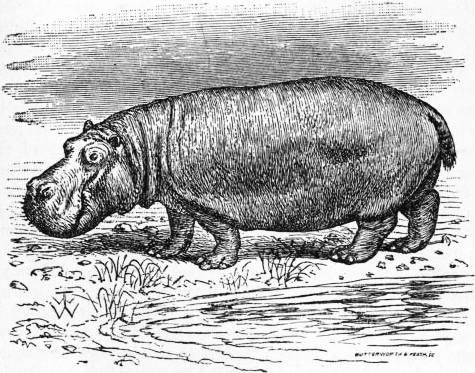
The Hippopotamus (Hippopotamus amphibius).
In form the hippopotamus is a huge, unwieldy creature, measuring in the largest specimens fully 14 ft. from the extremity of the upper lip to the tip of the tail, while it ordinarily attains a length of 12 ft., with a height of 5 ft. at the shoulders, and a girth round the thickest part of the body almost equal to its length. The small ears are exceedingly flexible, and kept in constant motion when the animal is seeking to catch a distant sound; the eyes are placed high up on the head, but little below the level of the ears; while the gape is wide, and the upper lip thick and bulging so as to cover over even its large tusks when the mouth is closed. The molars, which show trefoil-shaped grinding-surfaces are well adapted for masticating vegetable substances, while the formidable array of long spear-like incisors and curved chisel-edged canines or tusks root up rank grass like an agricultural implement. The legs are short, so that the body is but little elevated above the ground; and the feet, which are small in proportion to the size of the animal, terminate in four short toes each bearing a small hoof. With the exception of a few tufts of hair on the lips, on the sides of the head and neck, and at the extremity of the short robust tail, the skin of the hippopotamus, some portions of which are 2 in. in thickness, is destitute of covering. Hippopotamuses are gregarious animals, living in herds of from 20 to 40 individuals on the banks and in the beds of rivers, in the neighbourhood of which they most readily find appropriate food. This consists chiefly of grass and of aquatic plants, of which these animals consume enormous quantities, the stomach being capable of containing from 5 to 6 bushels. They feed principally by night, remaining in the water during the day, although in districts where they are little disturbed they are less exclusively aquatic. In such remote quarters, they put their heads boldly out of the water to blow, but when rendered suspicious they become exceedingly cautious in this respect, only exposing their nostrils above the water, and even this they prefer doing amid the shelter of water plants. In spite of their enormous size and uncouth form, they are expert swimmers and divers, and can remain easily under the water from five to eight minutes. They walk on the bottoms of rivers, beneath at least 1 ft. of water. At nightfall they come on land to feed; and when, as often happens on the banks of the Nile, they reach cultivated ground, they do immense damage to growing crops, destroying by their ponderous tread even more than they devour. To scare away these unwelcome visitors the natives in such districts are in the habit of kindling fires at night. Although hippopotamuses do not willingly go far from the water on which their existence depends, they occasionally travel long distances by night in search of food, and in spite of their clumsy appearance are able to climb steep banks and precipitous ravines with ease. Of a wounded hippopotamus which Sir S. Baker saw leaving the water and galloping inland, he writes: “I never could have imagined that so unwieldy an animal could have exhibited such speed. No man could have had a chance of escape.” The hippopotamus does not confine itself to rivers and lakes, but has been known to prefer the waters of the ocean as its home during the day. Of a mild and inoffensive disposition, it seeks to avoid collision with man; when wounded, however, or in defence of its young, it exhibits great ferocity, and native canoes are capsized and occasionally demolished by its infuriated attacks; the bellowing grunt then becoming loud enough to be heard a mile away. As among elephants, so also among hippopotamuses there are “rogues”—old bulls which have become soured in solitude, and are at all times dangerous. Assuming the offensive on every occasion, they attack all and sundry without shadow of provocation; and the natives avoid their haunts, which are usually well known.
The only other living species is the pygmy hippopotamus, H. (Choeropsis) liberiensis, of West Africa, an animal not larger than a clumsily made pig of full dimensions, and characterized by having generally one (in place of two) pair of incisors. It is much less aquatic than its giant relative, having, in fact, the habits of a pig.
A small extinct species (H. lemerlei) inhabited Madagascar at a comparatively recent date; while other dwarf kinds were natives of Crete (H. minutus) and Malta and Sicily (H. pentlandi) during the Pleistocene. A large form of the ordinary species (H. amphibius major) was distributed over Europe as far north as Yorkshire at the same epoch; while an allied species (H. palaeindicus) inhabited Pleistocene India. Contemporary with the latter was, however, a species (H. namadicus) with three pairs of incisors; and “hexaprotodont” hippopotamuses are also characteristic of the Pliocene of India and Burma (H. sivalensis and H. iravadicus), and of Algeria, Egypt and southern Europe (H. hipponensis).
For the ancestral genera of the hippopotamus line, see Artiodactyla.
(R. L.*)
HIPPURIC ACID (Gr. ἵππος, horse, οὖρον, urine), benzoyl glycocoll or benzoyl amidoacetic acid, C9H9NO3 or C6H5CO·NH·CH2·CO2H, an organic acid found in the urine of horses and other herbivorae. It is excreted when many aromatic compounds, such as benzoic acid and toluene, are taken internally. J. v. Liebig in 1829 showed that it differed from benzoic acid, and in 1839 determined its constitution, while in 1853 V. Dessaignes (Ann. 87, p. 325) synthesized it by acting with benzoyl chloride on zinc glycocollide. It is also formed by heating benzoic anhydride with glycocoll (Th. Curtius, Ber., 1884, 17, p. 1662), and by heating benzamide with monochloracetic acid. It crystallizes in rhombic prisms which are readily soluble in hot water, melt at 187° C. and decompose at about 240° C. It is readily hydrolysed by hot caustic alkalis to benzoic acid and glycocoll. Nitrous acid converts it into benzoyl glycollic acid, C6H5CO·O·CH2·CO2H. Its ethyl ester reacts with hydrazine to form hippuryl hydrazine, C6H5CO·NH·CH2·CO·NH·NH2, which was used by Curtius for the preparation of azoimide (q.v.).
HIPURNIAS, a tribe of South American Indians, 2000 or 3000 in number, living on the river Purus, western Brazil. Their houses are long, low and narrow: the side walls and roof are one, poles being fixed in the ground and then bent together so as to meet and form a pointed arch for the cross-sections. They use small bark canoes. Their chief weapons are poisoned arrows. They have a native god called Guintiniri.
HIRA, the capital of an Arabian kingdom, founded in the 2nd century A.D., on the western edge of Irak, was situated at 32° N., 44° 20′ E., about 4 m. S.E. of modern Nejef, by the Sa’ade canal, on the shore of the Bahr Nejef or Assyrium Stagnum. Its kings governed the western shore of the lower Euphrates and of the Persian Gulf, their kingdom extending inland to the confines of the Nejd. This Lakhmid kingdom was more or less dependent, during the four centuries of its existence, on the Sassanian empire, to which it formed a sort of buffer state towards Arabia. After the battle of Kadesiya and the founding of Kufa by the Arabs, Hira lost its importance and fell into decay. The ruin mounds covering the ancient site, while extensive, are insignificant in appearance and give no indications of the existence of important buildings.
HIRADO, an island belonging to Japan, 19½ m. long and 6 m. wide, lying off the west coast of the province of Hizen, Kiushiu, in 33° 15′ N. and 129° 25′ E. It is celebrated as the site of the original Dutch factory—often erroneously written Firando—and as the place where one of the finest blue-and-white porcelains of Japan (Hiradoyaki) was produced in the 17th and 18th centuries. The kilns are still active.
HIRE-PURCHASE AGREEMENT, in the law of contract, a form of bailment of goods, on credit, which has extended very considerably of late years. Originally applied to the sale of the more expensive kinds of goods, such as pianos and articles of furniture, the hire-purchase agreement has now been extended to almost every description. The agreement is usually in writing, with a stipulation that the payments to purchase shall be by weekly, monthly or other instalments. The agreement is virtually one to purchase, but in order that the vendor may be able to recover the goods at any time on non-payment of an instalment, it is treated as an agreement to let and hire, with a provision that when the last instalment has been paid the goods shall become the property of the hirer. A clause provides that in case of default of any instalment, or breach of any part of the agreement, all previous payments shall be forfeited to the lender, who can forcibly recover the goods. Such agreements, therefore, do not pass the property in the goods, which remains in the lender until all the instalments have been paid. But the terms of the agreement may sometimes purposely obscure the nature of the transaction between the parties, where, for example, the hire-purchase is merely to create a security for money. In such a case a judge will look to the true nature of the transaction. If it is not a real letting and hiring, the agreement will require registration under the Bills of Sale Acts. If the agreement contains words to the effect that a person has “bought or agreed to buy” goods, the transaction comes under the Factors Act 1889, and the person in possession of the goods may dispose of them and give a good title. The doctrine of reputed ownership, by which a bankrupt is deemed the reputed owner of goods in his apparent possession, has been somewhat modified by trade customs, in accordance with which property is frequently let out on the hire-purchase system (see Bankruptcy).
HIRING (from O. Eng. hýrian, a word common to many Teutonic languages cf. Ger. heuern, Dutch huren, &c.), in law, a contract by which one man grants the use of a thing to another in return for a certain price. It corresponds to the locatio-conductio of Roman law. That contract was either a letting of a thing (locatio-conductio rei) or of labour (locatio operarum). The distinguishing feature of the contract was the price. Thus the contracts of mutuum, commodatum, depositum and mandatum, which are all gratuitous contracts, become, if a price is fixed, cases of locatio-conductio. In modern English law the term can scarcely be said to be used in a strictly technical sense. The contracts which the Roman law grouped together under the head of locatio-conductio—such as those of landlord and tenant, master and servant, &c.—are not in English law treated as cases of hiring but as independent varieties of contract. Neither in law books nor in ordinary discourse could a tenant farmer be said to hire his land. Hiring would generally be applied to contracts in which the services of a man or the use of a thing are engaged for a short time.
Hiring Fairs, or Statute Fairs, still held in Wales and some parts of England, were formerly an annual fixture in every important country town. These fairs served to bring together masters and servants. The men and maids seeking work stood in rows, the males together and the females together, while masters and mistresses walked down the lines and selected those who suited them. Originally these hiring-fairs were always held on Martinmas Day (11th of November). Now they are held on different dates in different towns, usually in October or November. In Cumberland the men seeking work stood with straws in their mouths. In Lincolnshire the bargain between employer and employed was closed by the giving of the “fasten-penny,” the earnest money, usually a shilling, which “fastened” the contract for a twelvemonth. Some few days after the Statute Fair it was customary to hold a second called a Mop Fair or Runaway Mop. “Mop” (from Lat. mappa, napkin, or small cloth) meant in Old English a tuft or tassel, and the fair was so called, it is suggested, in allusion to tufts or badges worn by those seeking employment. Thus the carter wore whipcord on his hat, the cowherd a tuft of cow’s hair, and so on. Another possible explanation would be to take the word “mop” in its old provincial slang sense of “a fool,” mop fair being the fools’ fair, a sort of last chance offered to those who were too dull or slovenly-looking to be hired at the statute fair. Perhaps “runaway” suggests the idea of those absent through drunkenness, or those who simply feared to face the ordeal of the larger hiring and so ran away.
HIROSAKI, a town of Japan in the province of Michmoku or Rikuchiu, north Nippon, 22 m. S.W. of Aomori by rail. Pop. about 37,000. The fine isolated cone of Iwakisan, a mountain of pilgrimage, rises to the west. Hirosaki is a very old place, formerly residence of a great daimio (or daimyo) and capital of a vast principality, and still the seat of a high court with jurisdiction over the surrounding districts of Aomori and Akita. Like most places in north Nippon, it is built with continuous verandas extending from house to house, and affording a promenade completely sheltered from the snows of winter. Apples of fine flavour grow in the district, which also enjoys some reputation for its peculiar green lacquer-ware.
HIROSHIGE (1797-1858), Japanese artist, was one of the principal members of that branch of the Ukiyo-ye or Popular School of Painting in Japan, a school which chiefly made colour-prints. His family name was Andō Tokitarō; that under which he is known having been, in accordance with Japanese practice, adopted by him in recognition of the fact that he was a pupil of Toyohiro. The earliest reference to him is in the account given by an inhabitant of the Lu-chu islands of a visit to Japan; where a sketch of a procession drawn with great skill by Hiroshige at the age of ten years only is mentioned as one of the remarkable sights seen. At the age of fifteen he applied unsuccessfully to be admitted to the studio of the elder Toyokuni; but was eventually received by Toyohiro. On the death of the latter in 1828, he began to practise on his own account, but finding small encouragement at Yedo (Tōkyō) he removed to Kiōto, where he published a set of landscapes. He soon returned to Yedo, where his work soon became popular, and was imitated by other artists. He died in that city on the 6th day of the 9th month of the year, Ansei 5th, at the age of sixty-two, and was buried at Asakusa. One of his pupils, Hironobu, received from him the name of Hiroshige II. and another, Ando Tokubei, that of Hiroshige III. All three were closely associated with the work signed with the name of the master. Hiroshige II. some time after the year 1863 fell into disgrace and was compelled to leave Yedo for Nagasaki, where he died; Hiroshige III. then called himself Hiroshige II. He died in 1896. The earlier prints by these artists, whose work can hardly be separated, are of extraordinary merit. They applied the process of colour block printing to the purposes of depicting landscape, with a breadth, skill and suitability of convention that has been equalled only by Hokusai in Japan, and by no European. Most of their subjects were derived from the neighbourhood of Yedo, or were scenes on the old high road—the Tokaidō—that ran from that city to Kiōto. The two elder of the name were competent painters, and pictures and drawings by them are occasionally to be met with.
See E. F. Strange, “Japanese Colour-prints” (Victoria and Albert Museum Handbook, 1904).
(E. F. S.)
HIROSHIMA, a city and seaport of Japan, capital of the government of its name in central Nippon. Pop. (1903) 113,545. It is very beautifully situated on a small plain surrounded by hills, the bay being studded with islands. In its general aspect it resembles Osaka, from which it is 190 m. W. by rail, and next to that place and Hiogo it is the most important commercial centre on the Inland Sea. The government has an area of about 3000 sq. m., with a population of about 1,500,000. Hiroshima is famous all over Japan owing to its association with the neighbouring islet of Itaku-Shima, “Island of Light,” which is dedicated to the goddess Bentin and regarded as one of the three wonders of Japan. The chief temple dates from the year 587, and the island, which is inhabited largely by priests and their attendants, is annually visited by thousands of pilgrims. But the hallowed soil is never tilled, so that all provisions have to be brought from the surrounding districts.
HIRPINI (from an Oscan or Sabine stem hirpo-, “wolf”), an inland Samnite tribe in the south of Italy, whose territory was bounded by that of the Lucani on the S., the Campani on the S.W., the Appuli (Apuli) and Frentani on the E. and N.E. On the N. we find them, politically speaking, identified with the Pentri and Caracēni, and with them constituting the Samnite alliance in the wars of the 4th century B.C. (see Samnites). The Roman policy of separation cut them off from these allies by the foundation of Beneventum in 268 B.C., and henceforward they are a separate unit; they joined Hannibal in 216 B.C., and retained their independence until, after joining in the Social war, which in their part of Italy can hardly be said to have ceased till the final defeat of the Samnites by Sulla in 83 B.C., they received the Roman franchise. Of their Oscan speech, besides the evidence of their place-names, only a few fragments survive (R. S. Conway, The Italic Dialects, pp. 170 ff.; and for hirpo-, ib. p. 200). In the ethnology of Italy the Hirpini appear from one point of view as the purest type of Safine stock, namely, that in which the proportion of ethnica formed with the suffix -no- is highest, thirty-three out of thirty-six tribal or municipal epithets being formed thereby (e.g. Caudini, Compsani) and only one with the suffix -ti- (Abellinates), where it is clearly secondary. On the significance of this see Sabini.
(R. S. C.)
HIRSAU (formerly Hirschau), a village of Germany, in the kingdom of Württemberg, on the Nagold and the Pforzheim-Horb railway, 2 m. N. of Calw. Pop. 800. Hirsau has some small manufactures, but it owes its origin and historical interest to its former Benedictine monastery, Monasterium Hirsaugiense, at one period one of the most famous in Europe. Its picturesque ruins, of which only the chapel with the library hall are still in good preservation, testify to the pristine grandeur of the establishment. It was founded about 830 by Count Erlafried of Calw, at the instigation of his son, Bishop Notting of Vercelli, who enriched it with, among other treasures, the body of St Aurelius. Its first occupants (838) were a colony of fifteen monks from Fulda, disciples of Hrabanus Maurus and Walafrid Strabo, headed by the abbot Liudebert. During about a century and a half, under the fostering care of the counts of Calw, it enjoyed great prosperity, and became an important seat of learning; but towards the end of the 10th century the ravages of the pestilence combined with the rapacity of its patrons, and the selfishness and immorality of its inmates, to bring it to the lowest ebb. After it had been desolate and in ruins for upwards of sixty years it was rebuilt in 1059, and under Abbot William—Wilhelm von Hirsau—abbot from 1069 to 1091, it more than regained its former splendour. By his Constitutiones Hirsaugienses, a new religious order, the Ordo Hirsaugiensis, was formed, the rule of which was afterwards adopted by many monastic establishments throughout Germany, such as those of Blaubeuren, Erfurt and Schaffhausen. The friend and correspondent of Pope Gregory VII., and of Anselm of Canterbury, Abbot William took active part in the politico-ecclesiastical controversies of his time; while a treatise from his pen, De musica et tonis, as well as the Philosophicarum et astronomicarum institutionum libri iii., bears witness to his interest in science and philosophy. About the end of the 12th century the material and moral welfare of Hirsau was again very perceptibly on the decline; and it never afterwards again rose into importance. In consequence of the Reformation it was secularized in 1558; in 1692 it was laid in ruins by the French. The Chronicon Hirsaugiense, or, as in the later edition it is called, Annales Hirsaugienses of Abbot Trithemius (Basel, 1559; St Gall, 1690), is, although containing much that is merely legendary, an important source of information, not only on the affairs of this monastery, but also on the early history of Germany. The Codex Hirsaugiensis was edited by A. F. Gfrörer and printed at Stuttgart in 1843.
See Steck, Das Kloster Hirschau (1844); Helmsdörfer, Forschungen zur Geschichte des Abts Wilhelm von Hirschau (Göttingen, 1874); Weizsäcker, Führer durch die Geschichte des Klosters Hirschau (Stuttgart, 1898); Süssmann, Forschungen zur Geschichte des Klosters Hirschau (Halle, 1903); Giseke, Die Hirschauer während des Investiturstreits (Gotha, 1883); C. H. Klaiber, Das Kloster Hirschau (Tübingen, 1886); and Baer, Die Hirsauer Bauschule (Freiburg, 1897).
HIRSCH, MAURICE DE, Baron Hirsch auf Gereuth, in the baronage of Bavaria (1831-1896), capitalist and philanthropist (German by birth, Austro-Hungarian by domicile), was born at Munich, 9th December 1831. His grandfather, the first Jewish landowner in Bavaria, was ennobled with the prädikat “auf Gereuth” in 1818; his father, who was banker to the Bavarian king, was created a baron in 1869. The family for generations has occupied a prominent position in the German Jewish community. At the age of thirteen young Hirsch was sent to Brussels to school, but when seventeen years old he went into business. In 1855 he became associated with the banking house of Bischoffsheim & Goldschmidt, of Brussels, London and Paris. He amassed a large fortune, which he increased by purchasing and working railway concessions in Austria, Turkey and the Balkans, and by speculations in sugar and copper. While living in great splendour in Paris and London and on his estates in Hungary, he devoted much of his time to schemes for the relief of his Hebrew co-religionists in lands where they were persecuted and oppressed. He took a deep interest in the educational work of the Alliance Israélite Universelle, and on two occasions presented the society with gifts of a million francs. For some years he regularly paid the deficits in the accounts of the Alliance, amounting to several thousand pounds a year. In 1889 he capitalized his donations and presented the society with securities producing an annual income of £16,000. On the occasion of the fortieth anniversary of the emperor Francis Joseph’s accession to the Austrian throne he gave £500,000 for the establishment of primary and technical schools in Galicia and the Bukowina. The greatest charitable enterprise on which he embarked was in connexion with the persecution of the Jews in Russia (see Anti-Semitism). He gave £10,000 to the funds raised for the repatriation of the refugees in 1882, but, feeling that this was a very lame conclusion to the efforts made in western Europe for the relief of the Russian Jews, he offered the Russian Government £2,000,000 for the endowment of a system of secular education to be established in the Jewish pale of settlement. The Russian Government was willing to accept the money, but declined to allow any foreigner to be concerned in its control or administration. Thereupon Baron de Hirsch resolved to devote the money to an emigration and colonization scheme which should afford the persecuted Jews opportunities of establishing themselves in agricultural colonies outside Russia. He founded the Jewish Colonization Association as an English society, with a capital of £2,000,000, and in 1892 he presented to it a further sum of £7,000,000. On the death of his wife in 1899 the capital was increased to £11,000,000, of which £1,250,000 went to the Treasury, after some litigation, in death duties. This enormous fund, which is probably the greatest charitable trust in the world, is now managed by delegates of certain Jewish societies, chiefly the Anglo-Jewish Association of London and the Alliance Israélite Universelle of Paris, among whom the shares in the association have been divided. The association, which is prohibited from working for profit, possesses large colonies in South America, Canada and Asia Minor. In addition to its vast agricultural work it has a gigantic and complex machinery for dealing with the whole problem of Jewish persecution, including emigration and distributing agencies, technical schools, co-operative factories, savings and loan banks and model dwellings in the congested Russian jewries. It also subventions and assists a large number of societies all over the world whose work is connected with the relief and rehabilitation of Jewish refugees. Besides this great organization, Baron de Hirsch founded in 1891 a benevolent trust in the United States for the benefit of Jewish immigrants, which he endowed with £493,000. His minor charities were on a princely scale, and during his residence in London he distributed over £100,000 among the local hospitals. It was in this manner that he disposed of the whole gross proceeds derived from his successes on the English turf, of which he was a lavish patron. He raced, as he said himself, “for the London hospitals,” and in 1892, when his filly, La Flêche, won the Oaks, St Leger and One Thousand Guineas, his donations from this source amounted to about £40,000. Baron de Hirsch married on 28th June 1855 Clara, daughter of Senator Bischoffsheim of Brussels (b. 1833), by whom he had a son and daughter, both of whom predeceased him. He died at Ogyalla, near Komorn, in Hungary, 21st April 1896. The baroness, who seconded her husband’s charitable work with great munificence—their total benefactions have been estimated at £18,000,000,—died at Paris on the 1st of April 1899.
For details of Baron de Hirsch’s chief charities see the annual reports of the Alliance Israélite Universelle and of the “Administration Centrale” of the Jewish Colonization Association.
(L. W.)
HIRSCH, SAMSON RAPHAEL (1808-1888), Jewish theologian, was born in Hamburg in 1808 and died at Frankfort-on-the-Main in 1888. He opposed the reform tendency of Geiger (q.v.), and presented Jewish orthodoxy in a new and attractive light. His philosophical conception of tradition, associated as it was with conservatism in ritual practice, created what is often known as the Frankfort “Neo-Orthodoxy.” Hirsch exercised a profound influence on the Synagogue and undoubtedly stemmed the tide of liberalism. His famous Nineteen Letters (1836), with which the Neo-Orthodoxy began, were translated into English by Drachmann (New York, 1899). Other works by Hirsch were Horeb, and commentaries on the Pentateuch and Psalms. These are marked by much originality, but their exegesis is fanciful. Three volumes of his essays have been published (1902-1908); these were collected as Gesammelte Schriften from his periodical Jeschurun.
For Hirsch’s religious philosophy see S. A. Hirsch, A Book of Essays (London, 1905).
(I. A.)
HIRSCHBERG, a town of Germany, in the Prussian province of Silesia, beautifully situated at the confluence of the Bober and Zacken, 1120 ft. above the sea-level, 48 m. S.E. of Görlitz, on the railway to Glatz, with branches to Grünthal and Schmiedeberg. Pop. (1905) 19,317. It is surrounded by pleasant promenades occupying the site of its former fortifications. It possesses an Evangelical church, the church of the Holy Cross, one of the six Gnaden Kirchen for the Silesian Protestants stipulated for in the agreement at Altranstädt between Charles XII. of Sweden and the emperor Joseph I. in 1707, four Roman Catholic churches, one of which dates from the 14th century, a synagogue, several schools, an orphanage and an asylum. The town is the principal emporium of commerce in the Silesian mountains, and its industries include the carding and spinning of wool, and the manufacture of linen and cotton fabrics, yarn, artificial flowers, paper, cement, porcelain, sealing-wax, blacking, chemicals and cider. There is also a lively trade in corn, wine and agricultural produce. The town is celebrated for its romantic surroundings, including the Cavalierberg, from which there is a splendid view, the Hausberg, the Helicon, crowned by a small Doric temple, the Kreuzberg, with walks commanding beautiful views, and the Sattler ravine, over which there is a railway viaduct. Hirschberg was in existence in the 11th century, and obtained town rights in 1108 from Duke Boleslaus of Poland. It withstood a siege by the Hussites in 1427, and an attack of the imperial troops in 1640. The foundation of its prosperity was laid in the 16th century by the introduction of the manufacture of linen and veils.
Hirschberg is also the name of a town of Thuringia on the Saale with manufactures of leather and knives. Pop. 2000.
HIRSON, a town of northern France in the department of Aisne, 35 m. by rail N.E. of Laon, on the Oise. Pop. (1906) 8335. It occupies an important strategic position close to the point of intersection of several railway lines, and not far from the Belgian frontier. For its defence there are a permanent fort and two batteries, near the railway junction. The town carries on the manufacture of glass bottles, tiles, iron and tin goods, wool-spinning and brewing.
HIRTIUS, AULUS (c. 90-43 B.C.), Roman historian and statesman. He was with Julius Caesar as legate in Gaul, but after the civil war broke out in 49 he seems to have remained in Rome to protect Caesar’s interests. He was also a personal friend of Cicero. He was nominated with C. Vibius Pansa by Caesar for the consulship of 43; and after the dictator’s assassination in March 44, he and his colleague supported the senatorial party against M. Antonius, with whom Hirtius had at first sided. The consuls set out for Mutina, where Antonius was besieging Decimus Brutus. On the 15th of April, Pansa was attacked by Antonius at Forum Gallorum, about 8 m. from Mutina, and lost his life in the engagement. Hirtius, however, compelled Antonius to retire on Mutina, where another battle took place on the 25th (or 27th) of April, in which Hirtius was slain. Of the continuations of Caesar’s Commentaries—the eighth book of the Gallic war, the history of the Alexandrian, African and Spanish wars—the first is generally allowed to be by Hirtius; the Alexandrian war is perhaps by him (or Oppius); the last two are supposed to have been written at his request, by persons who had taken part in the events described, with a view to subsequent revision and incorporation in his proposed work on military commanders. The language of Hirtius is good, but his style is monotonous and lacks vigour.
Hirtius and the other continuators of Caesar are discussed in M. Schanz, Geschichte der römischen Literatur, i.; also R. Schneider, Bellum Africanum (1905). For the history of the period see under Antonius; Cicero’s Letters (ed. Tyrrell and Purser); G. Boissier, Cicero and his Friends (Eng. trans., 1897).
HISHĀM IBN AL-KALBĪ [Abū-l Mundhir Hishām ibn Maḥommed ibn us-Sā’b ul-Kalb] (d. c. 819), Arabic historian, was born in Kufa, but spent much of his life in Bagdad. Like his father, on whose authority he relied largely, he collected information about the genealogies and history of the ancient Arabs. According to the Fihrist (see Nadīm) he wrote 140 works. As independent works they have almost entirely ceased to exist, but his account of the genealogies of the Arabs is continually quoted in the Kitāb ul-Aghāni.
Large extracts from another of his works, the Kitāb ul-Asnām, are contained in the Khizānat ul-Adab (iii. 242-246) and in the geography of Yāqūt (q.v.). These latter have been translated with comments by J. Wellhausen in his Reste des arabischen Heidentums (2nd ed., Berlin, 1897).
(G. W. T.)
HISPELLUM (mod. Spello, q.v.), an ancient town of Umbria, Italy, 3 m. N. of Fulginiae, on the road between it and Perusia, 1030 ft. above sea-level. It does not appear to be mentioned before the time of Augustus, who founded a colony there (Colonia Iulia Hispellum) and extended its territory to the springs of the Clitumnus, which had originally belonged to the territory of Mevania. It received the name of Flavia Constans by a rescript of the emperor Constantine, a copy of which on a marble tablet is still preserved at Spello. The gate by which the town is entered is ancient and has three portrait statues above it; two other gates and a part of the city wall, built of rectangular blocks of local limestone, may still be seen, as also the ruins of what is possibly a triumphal arch (attributed to Augustus) and an amphitheatre, and perhaps of a theatre, close to the modern high-road, outside the town.
(T. As.)
HISSAR, a district in Central Asia, lying between 66° 30′ and 70° E. and 39° 15′ and 37° N. and dependent on the amir of Bokhara. It forms that part of the basin of the Amu-darya or Oxus which lies on the north side of the river, opposite the Afghan province of Balkh. The western prolongation of the Tian-shan, which divides the basin of the Zarafshan from that of the upper Amu, after rising to a height of 12,300 ft., bifurcates in 67° 45′ E. The main chain, the southern arm of this bifurcation, designated the Hissar range, but sometimes called also Koh-i-tau, forms the N. and N.W. boundaries of Hissar. On the W. it is wholly bounded by the desert; the Amu limits it on the S. and S.E.; and Karateghin and Darvaz complete the boundary on the E. Until 1875 it was one of the least known tracts of Central Asia. Hissar is traversed from north to south by four tributaries of the Amu, viz. the Surkhab or Vakhsh, Kafirnihan, Surkhan and Shirabad-darya, which descend from the snowy mountains to the north and form a series of fertile valleys, disposed in a fan-shape, within which lie the principal towns. In the N.W. boundary range between Khuzar and Derbent is situated the defile formerly called the Iron Gate (Caspian Gates, Bāb-al-Hadīd, Dar Ahanīn and in Chinese T’ie-mēn-kuan) but now styled Buzghol-khana or the Goat-house. It was also called Kohluga, said to be a Mongol word meaning barrier. This pass is described as a deep but narrow chasm in a transverse range, whose rocks overhang and threaten to choke the tortuous and gloomy corridor (in places but five paces wide) which affords the only exit from the valley. In ancient times it was a vantage point of much importance and commanded one of the chief routes between Turkestan and India. Hsüan Tsang, the Chinese traveller, who passed through it in the 7th century, states that there were then two folding doors or gates, cased with iron and hung with bells, placed across the pass. Clavijo, the Spanish ambassador to the court of Timur, heard of this when he passed through the defile nearly 800 years later, but the gates had then disappeared.
The Surkhan valley is highly cultivated, especially in its upper portion. It supplies Bokhara with corn and sheep, but its chief products are rice and flax. The town of Hissar (pop. 15,000) commands the entrance into the fertile valleys of the Surkhan and Kafirnihan, just as Kabadian at the southern end of the latter defends them from the south. Hissar was long famous for its damascened swords and its silk goods. Kulab produces wheat in abundance, and gold is brought thither from the surrounding districts. Kabadian is a large, silk-producing town, and is surrounded with rice-fields.
The population consists principally of Uzbegs and Tajiks, the former predominating and gradually pushing the Tajiks into the hills. On the banks of the Amu there are Turkomans who work the ferries, drive sheep and accompany caravans. Lyuli (gipsies), Jews, Hindus and Afghans are other elements of the population. The climate of the valleys of Hissar and Kulab is pleasant, as they are protected by mountains to the north and open towards the south. They produce all the cereals and garden plants indigenous to Central Asia. Cotton is grown in the district of Shirabad; and cotton, wheat, flax, sheep and rock-salt are all exported.
History.—This country was anciently part of the Persian empire of the Achaemenidae, and probably afterwards of the Graeco-Bactrian kingdom, and then subject to the invading Asiatic tribes who broke up that kingdom, e.g. the Yue-chi. It was afterwards conquered by the Ephthalites or White Huns, who were subdued by the Turks in the early part of the 7th century. It then became subject successively to the Mahommedan invaders from Persia, and after to the Mongol dynasty of Jenghiz Khan, and to Timur and his successors. It subsequently became a cluster of Uzbeg states and was annexed by the amir of Bokhara (q.v.) in 1869-1870, soon after the Russian occupation of Samarkand.
(J. T. Be.; C. El.)
HISSAR, a town and district of British India, in the Delhi division of the Punjab. The town is situated on the Rajputana railway and the Western Jumna canal, 102 m. W.N.W. of Delhi. Pop. (1901) 17,647. It was founded in 1356 by the emperor Feroz Shah, who constructed the canal to supply it with water; but this fell into decay during the 18th century, owing to the constant inroads of marauders. Hissar was almost completely depopulated during the famine of 1783, but was afterwards occupied by the famous Irish adventurer George Thomas, who built a fort and collected inhabitants. It is now chiefly known for its cattle and horse fairs, and has a cotton factory.
The District comprises an area of 5217 sq. m. It forms the western border district of the great Bikanir desert, and consists for the most part of sandy plains dotted with shrub and brushwood, and broken by undulations towards the south, which rise into hills of rock like islands out of a sea of sand. The Ghaggar is its only river, whose supply is uncertain, depending much on the fall of rain in the lower Himalayas; its overflow in times of heavy rain is caught by jhils, which dry up in the hot season. The Western Jumna canal crosses the district from east to west, irrigating many villages. The soil is in places hard and clayey, and difficult to till; but when sufficiently irrigated it is highly productive. Old mosques and other buildings exist in parts of the district. Hissar produces a breed of large milk-white oxen, which are in great request for the carriages of natives. The district has always been subject to famine. The first calamity of this kind of which there is authentic record was in 1783; and Hissar has suffered severely in more recent famines. Its population in 1901 was 781,717, showing practically no increase in the decade, whereas in the previous decade there had been an increase of 15%. The climate is very dry, hot westerly winds blowing from the middle of March till July. Cotton weaving, ginning and pressing are carried on. The district is served by the Rajputana-Malwa, the Southern Punjab and the Jodhpur-Bikanir railways. The chief trading centres are Bhiwani, Hansi, Hissar and Sirsa.
Before the Mahommedan conquest, the semi-desert tract of which Hissar district now forms part was the retreat of Chauhan Rajputs. Towards the end of the 18th century the Bhattis of Bhattiana gained ascendancy after bloody struggles. To complete the ruin brought on by these conflicts, nature lent her aid in the great famine of 1783. Hissar passed nominally to the British in 1803, but they could not enforce order till 1810. Early in the mutiny of 1857 Hissar was wholly lost for a time to British rule, and all Europeans were either murdered or compelled to fly. The Bhattis rose under their hereditary chiefs, and the majority of the Mahommedan population followed their example. Before Delhi had been recovered, the rebels were utterly routed.
HISTIAEUS (d. 494 B.C.), tyrant of Miletus under the Persian king Darius Hystaspis. According to Herodotus he rendered great service to Darius while he was campaigning in Scythia by persuading his fellow-despots not to destroy the bridge over the Danube by which the Persians must return. Choosing his own reward for this service, he became possessor of territory near Myrcinus (afterwards Amphipolis), rich in timber and minerals. The success of his enterprise led to his being invited to Susa, where in the midst of every kind of honour he was virtually a prisoner of Darius, who had reason to dread his growing power in Ionia. During this period the Greek cities were left under native despots supported by Persia, Aristagoras, son-in-law of Histiaeus, being ruler of Miletus in his stead. This prince, having failed against Naxos in a joint expedition with the satrap Artaphernes, began to stir up the Ionians to revolt, and this result was brought to pass, according to Herodotus, by a secret message from Histiaeus. The revolt assumed a formidable character and Histiaeus persuaded Darius that he alone could quell it. He was allowed to leave Susa, but on his arrival at the coast found himself suspected by the satrap, and was ultimately driven to establish himself (Herodotus says as a pirate; more probably in charge of the Bosporus route) at Byzantium. After the total failure of the revolt at the battle of Lade, he made various attempts to re-establish himself, but was captured by the Persian Harpagus and crucified by Artaphernes at Sardis. His head was embalmed and sent to Darius, who gave it honourable burial. The theory of Herodotus that the Ionian revolt was caused by the single message of Histiaeus is incredible; there is evidence to show that the Ionians had been meditating since about 512 a patriotic revolt against the Persian domination and the “tyrants” on whom it rested (see Grote, Hist. of Greece, ed. 1907, especially p. 122 note; art. Ionia, and authorities; also S. Heinlein in Klio, 1909, pp. 341-351).
HISTOLOGY (Gr. ἱστός, web, tissue, properly the web-beam of the loom, from ἱστάναι, to make to stand), the science which deals with the structure of the tissues of plants and animals (see Cytology).
HISTORY. The word “history” is used in two senses. It may mean either the record of events, or events themselves. Originally (see below) limited to inquiry and statement, it was only in comparatively modern times that the meaning of the word was extended to include the phenomena which form or might form their subject. It was perhaps by a somewhat careless transference of ideas that this extension was brought about. Now indeed it is the commoner meaning. We speak of the “history of England” without reference to any literary narrative. We term kings and statesmen the “makers of history,” and sometimes say that the historian only records the history which they make. History in this connexion is obviously not the record, but the thing to be recorded. It is unfortunate that such a double meaning of the word should have grown up, for it is productive of not a little confusion of thought.
History in the wider sense is all that has happened, not merely all the phenomena of human life, but those of the natural world as well. It includes everything that undergoes change; and as modern science has shown that there is nothing absolutely static, therefore the whole universe, and every part of it, has its history. The discovery of ether brought with it a reconstruction of our ideas of the physical universe, transferring the emphasis from the mathematical expression of static relationships to a dynamic conception of a universe in constant transformation; matter in equipoise became energy in gradual readjustment. Solids are solids no longer. The universe is in motion in every particle of every part; rock and metal merely a transition stage between crystallization and dissolution. This idea of universal activity has in a sense made physics itself a branch of history. It is the same with the other sciences—especially the biological division, where the doctrine of evolution has induced an attitude of mind which is distinctly historical.
But the tendency to look at things historically is not merely the attitude of men of science. Our outlook upon life differs in just this particular from that of preceding ages. We recognize the unstable nature of our whole social fabric, and are therefore more and more capable of transforming it. Our institutions are no longer held to be inevitable and immutable creations. We do not attempt to fit them to absolute formulae, but continually adapt them to a changing environment. Even modern architecture, notably in America, reflects the consciousness of change. The permanent character of ancient or medieval buildings was fitted only to a society dominated by static ideals. Now the architect builds, not for all time, but for a set of conditions which will inevitably cease in the not distant future. Thus our whole society not only bears the marks of its evolution, but shows its growing consciousness of the fact in the most evident of its arts. In literature, philosophy and political science, there is the same historical trend. Criticism no longer judges by absolute standards; it applies the standards of the author’s own environment. We no longer condemn Shakespeare for having violated the ancient dramatic laws, nor Voltaire for having objected to the violations. Each age has its own expression, and in judging each we enter the field of history. In ethics, again, the revolt against absolute standards limits us to the relative, and morals are investigated on the basis of history, as largely conditioned by economic environment and the growth of intellectual freedom. Revelation no longer appeals to scientific minds as a source of knowledge. Experience on the other hand is history. As for political science, we do not regard the national state as that ultimate and final product which men once saw in the Roman Empire. It has hardly come into being before forces are evident which aim at its destruction. Internationalism has gained ground in Europe in recent years; and Socialism itself, which is based upon a distinct interpretation of history, is regarded by its followers as merely a stage in human progress, like those which have gone before it. It is evident that Freeman’s definition of history as “past politics” is miserably inadequate. Political events are mere externals. History enters into every phase of activity, and the economic forces which urge society along are as much its subject as the political result.
In short the historical spirit of the age has invaded every field. The world-picture presented in this encyclopaedia is that of a dynamic universe, of phenomena in process of ceaseless change. Owing to this insistent change all things which happen, or seem to happen, are history in the broader sense of the word. The encyclopaedia itself is a history of them in the stricter sense,—the description and record of this universal process. This narrower meaning is the subject of the rest of this article.
The word “history” comes from the Gr. ἱστορία, which was used by the Ionians in the 6th century B.C. for the search for knowledge in the widest sense. It meant inquiry, investigation, not narrative. It was not until two centuries later that the historikos, the reciter of stories, superseded the historeōn (ἱστορέων), the seeker after knowledge. Thus history began as a branch of scientific research,—much the same as what the Athenians later termed philosophy. Herodotus himself was as much a scientific explorer as a reciter of narrative, and his life-long investigation was historiē in his Ionian speech. Yet it was Herodotus himself who first hinted at the new use of the word, applied merely to the details accumulated during a long search for knowledge. It is not until Aristotle, however, that we have it definitely applied to the literary product instead of the inquiry which precedes it. From Aristotle to modern times, history (Lat. historia) has been a form of literature. It is only in the scientific environment of to-day that we recognize once more, with those earliest of the forerunners of Herodotus, that history involves two distinct operations, one of which, investigation, is in the field of science, while the other, the literary presentation, is in the field of art.
The history of history itself is therefore two-fold. History as art flourishes with the arts. It calls upon the imagination and the literary gifts of expression. Its history does not run parallel with the scientific side, but rather varies in inverse ratio with scientific activity. Those periods which have been dominated by the great masters of style have been less interested in the criticism of the historian’s methods of investigation than in the beauty of his rhetoric. The scientific historian, deeply interested in the search for truth, is generally but a poor artist, and his uncoloured picture of the past will never rank in literature beside the splendid distortions which glow in the pages of a Michelet or Macaulay. History the art, in so far as it is conditioned upon genius, has no single traceable line of development. Here the product of the age of Pericles remains unsurpassed still; the works of Herodotus and Thucydides standing along with those of Pheidias as models for all time. On the other hand, history the science has developed so that it has not only gained recognition among historians as a distinct subject, but it has raised with it a group of auxiliary sciences which serve either as tools for investigation or as a basis for testing the results. The advance in this branch of history in the 19th century was one of its greatest achievements. The vast gulf which lies between the history of Egypt by Herodotus and that by Flinders Petrie is the measure of its achievement. By the mechanism now at his disposal the scientific explorer can read more history from the dust-heaps of Ābydos than the greatest traveller of antiquity could gather from the priests of Saïs. In tracing the history of history we must therefore keep in mind the double aspect.
History itself, this double subject, the science and the art combined, begins with the dawn of memory and the invention of speech. It is wrong to term those ages pre-historic whose history has not come down to us, including in one category the pre-literary age and the literary whose traces have been lost. Even the pre-literary had its history, first in myth and then in saga. The saga, or epos, was a great advance upon the myth, for in it the deeds of men replace or tend to replace the deeds of the gods. But we are still largely in the realm of imagination. Poetry, as Thucydides complained, is a most imperfect medium for fact. The bard will exaggerate or distort his story. True history, as a record of what really has happened, first reached maturity in prose. Therefore, although much of the past has been handed down to us in epic, in ballad and in the legends of folk-lore, we must turn from them to what became history in the narrower sense.
The earliest prose origins of history are the inscriptions. Their inadequacy is evident from two standpoints. Their permanence depends not upon their importance, but upon the durability of the substance on which they are inscribed. A note for a wedding ring baked into the clay of Babylon has been preserved, while the history of the greatest events has perished. In the second place they are sealed to all but those who know how to read them, and so they lie forgotten for centuries while oral tradition flourishes,—being within the reach of every man. It is only recently that archaeology, turning from the field of art, has undertaken to interpret for us this first written history. The process by which the modern fits together all the obtainable remains of an antiquity, and reconstructs even that past which left no written record, lies outside the field of this article. But such enlargement of the field of history is a modern scientific product, and is to be distinguished from the imperfect beginnings of history-writing which the archaeologist is able to decipher.
Next to the inscriptions,—sometimes identical with them,—are the early chronicles. These are of various kinds. Family chronicles preserved the memory of heroic ancestors whose deeds in the earliest age would have passed into the keeping of the bards. Such family archives were perhaps the main source for Roman historians. But they are not confined to Rome or Greece. Genealogies also pass from the bald verse, which was the vehicle for oral transmission, to such elaborate tables as those in which Manetho has preserved the dynasties of Egyptian Pharaohs.
In this field the priest succeeds the poet. The temple itself became the chief repository of records. There were simple religious annals, votive tablets recording miracles accomplished at a shrine, lists of priests and priestesses, accounts of benefactions, of prodigies and portents. In some cases, as in Rome, the pontiffs kept a kind of register, not merely of religious history, but of important political events as well. Down to the time of the Gracchi (131 B.C.) the Pontifex Maximus inscribed the year’s events upon annual tablets of wood which were preserved in the Regia, the official residence of the pontiff in the Forum. These pontifical “annals” thus came to be a sort of civic history. Chronicles of the Greek cities were commonly ascribed to mythical authors, as for instance that of Miletus, the oldest, to Cadmus the inventor of letters. But they were continued and edited by men in whom the critical spirit was awakening, as when the chroniclers of Ionian towns began the criticism of Homer.
The first historians were the logographi of these Ionian cities; men who carried their inquiry (historiē) beyond both written record and oral tradition to a study of the world around them. Their “saying” (logos) was gathered mostly from contemporaries; and upon the basis of a widened experience they became critics of their traditions. The opening lines of Hecataeus of Miletus begin the history of the true historic spirit in words which read like a sentence from Voltaire. “Hecataeus of Miletus thus speaks: I write as I deem true, for the traditions of the Greeks seem to me manifold and laughable.” Those words mark an epoch in the history of thought. They are the introduction to historical criticism and scientific investigation. Whatever the actual achievement of Hecataeus may have been, from his time onward the scientific movement was set going. Herodotus of Heraclea struggled to rationalize mythology, and established chronology on a solid basis. And finally Herodotus, a professional story-teller, rose to the height of genuine scientific investigation. Herodotus’ inquiry was not simply that of an idle tourist. He was a critical observer, who tested his evidence. It is easy for the student now to show the inadequacy of his sources, and his failure here or there to discriminate between fact and fable. But given the imperfect medium for investigation and the absence of an archaeological basis for criticism, the work of Herodotus remains a scientific achievement, as remarkable for its approximation to truth as for the vastness of its scope. Yet it was Herodotus’ chief glory to have joined to this scientific spirit an artistic sense which enabled him to cast the material into the truest literary form. He gathered all his knowledge of the ancient world, not simply for itself, but to mass it around the story of the war between the east and west, the Greeks and the Persians. He is first and foremost a story-teller; his theme is like that of the bards, a heroic event. His story is a vast prose epos, in which science is to this extent subordinated to art. “This is the showing forth of the Inquiry of Herodotus of Halicarnassus, to the end that neither the deeds of men may be forgotten by lapse of time, nor the works, great and marvellous, which have been produced, some by Hellenes, some by Barbarians, may lose their renown, and especially that the causes may be remembered for which these waged war with one another” (i.e. the Persian war).
In Thucydides a higher art than that of Herodotus was combined with a higher science. He scorned the story-teller “who seeks to please the ear rather than to speak the truth,” and yet his rhetoric is the culmination of Greek historical prose. He withdrew from vulgar applause, conscious that his narrative would be considered “disappointing to the ear,” yet he recast the materials out of which he constructed it in order to lift that narrative into the realm of pure literature. Speeches, letters and documents are reworded to be in tone with the rest of the story. It was his art, in fact, which really created the Peloponnesian war out of its separate parts. And yet this art was merely the language of a scientist. The “laborious task” of which he speaks is that of consulting all possible evidence, and weighing conflicting accounts. It is this which makes his rhetoric worth while, “an everlasting possession, not a prize competition which is heard and forgotten.”
From the sublimity of Thucydides, and Xenophon’s straight-forward story, history passed with Theopompus and Ephorus into the field of rhetoric. A revival of the scientific instinct of investigation is discernable in Timaeus the Sicilian, at the end of the 4th century, but his attack upon his predecessors was the text of a more crushing attack upon himself by Polybius, who declares him lacking in critical insight and biased by passion. Polybius’ comments upon Timaeus reach the dignity of a treatise upon history. He protests against its use for controversial pamphlets which distort the truth. “Directly a man assumes the moral attitude of an historian he ought to forget all considerations, such as love of one’s friends, hatred of one’s enemies.... He must sometimes praise enemies and blame friends. For as a living creature is rendered useless if deprived of its eyes, so if you take truth from History, what is left but an improfitable tale” (bk. xii. 14). These are the words of a Ranke. Unfortunately Polybius, like most modern scientific historians, was no artist. His style is the very opposite of that of Isocrates and the rhetoricians. It is often only clear in the light of inscriptions, so closely does it keep to the sources. The style found no imitator; history passed from Greece to Rome in the guise of rhetoric. In Dionysius of Halicarnassus the rhetoric was combined with an extensive study of the sources; but the influence of the Greek rhetoricians upon Roman prose was deplorable from the standpoint of science. Cicero, although he said that the duty of the historian is to conceal nothing true, to say nothing false, would in practice have written the kind of history that Polybius denounced. He finds fault with those who are non exornatores rerum sed tantum narratores. History for him is the mine from which to draw argument in oratory and example in education. It is not the subject of a scientific curiosity.
It should be noted before we pass to Rome that with the expansion of Hellenism the subject of historians expanded as well. Universal history was begun by Ephorus, the rhetorician, and formed the theme of Polybius and Deodorus. Exiled Greeks were the first to write histories of Rome worthy of the name. The Alexandrian Eratosthenes placed chronology upon the scientific basis of astronomy, and Apollodorus drew up the most important chronica of antiquity.
History-writing in Rome,—except for the Greek writers resident there,—was until the first half of the 1st century B.C. in the form of annals. Then came rhetorical ornamentation,—and the Ciceronian era. The first Roman historian who rose to the conception of a science and art combined was Sallust, the student of Thucydides. The Augustan age produced in Livy a great popular historian and natural artist and a trained rhetorician (in the speeches),—but as uncritical and inaccurate as he was brilliant. From Livy to Tacitus the gulf is greater than from Herodotus to Thucydides. Tacitus is at least a consummate artist. His style ranges from the brilliancy of his youth to the sternness and sombre gravity of age, passing almost to poetic expression in its epigrammatic terseness. Yet in spite of his searching study of authorities, his keen judgment of men, and his perception of underlying principles of moral law, his view was warped by the heat of faction, which glows beneath his external objectivity. After him Roman history-writing speedily degenerated. Suetonius’ Lives of the Caesars is but a superior kind of journalism. But his gossip of the court became the model for historians, whose works, now lost, furnish the main source for the Historia Augusta. The importance to us of this uncritical collection of biographies is sufficient comment on the decline of history-writing in the latter empire. Finally, from the 4th century the epitomes of Eutropius and Festus served to satisfy the lessening curiosity in the past and became the handbooks for the middle ages. The single figure of Ammianus Marcellinus stands out of this age like a belated disciple of Tacitus. But the world was changing from antique to Christian ideals just as he was writing, and with him we leave this outline of ancient history.
The 4th and 5th centuries saw a great revolution in the history of history. The story of the pagan past slipped out of mind, and in its place was set, by the genius of Eusebius, the story of the world force which had superseded it, Christianity, and of that small fraction of antiquity from which it sprang,—the Jews. Christianity from the first had forced thinking men to reconstruct their philosophy of history, but it was only after the Church’s triumph that its point of view became dominant in historiography. Three centuries more passed before the pagan models were quite lost to sight. But from the 7th century to the 17th—from Isidore of Seville and the English Bede for a thousand years,—mankind was to look back along the line of Jewish priests and kings to the Creation. Egypt was of interest only as it came into Israelite history, Babylon and Nineveh were to illustrate the judgments of Yahweh, Tyre and Sidon to reflect the glory of Solomon. The process by which the “gentiles” have been robbed of their legitimate history was the inevitable result of a religion whose sacred books make them lay figures for the history of the Jews. Rejected by the Yahweh who became the Christian God, they have remained to the present day, in Sunday schools and in common opinion, not nations of living men, with the culture of arts and sciences, but outcasts who do not enter into the divine scheme of the world’s history. When a line was drawn between pagan and Christian back to the creation of the world, it left outside the pale of inquiry nearly all antiquity. But it must be remembered that that antiquity was one in which the German nations had no personal interest. Scipio and the Gracchi were essentially unreal to them. The one living organization with which they came into touch was the Church. So Cicero and Pompey paled before Joshua and Paul. Diocletian, the organizing genius, became a bloodthirsty monster, and Constantine, the murderer, a saint.
Christian history begins with the triumph of the Church. With Eusebius of Caesarea the apologetic pamphlets of the age of persecutions gave way to a calm review of three centuries of Christian progress. Eusebius’ biography of Constantine shows what distortion of fact the father of Church history permitted himself, but the Ecclesiastical History was fortunately written for those who wanted to know what really happened, and remains to-day an invaluable repository of Christian antiquities. With the continuations of Socrates, Sozomen and Theodoret, and the Latin manual which Cassiodorus had woven from them (the Historia tripartita), it formed the body of Church history during all the middle ages. An even greater influence, however, was exercised by Eusebius’ Chronica. Through Jerome’s translation and additions, this scheme of this world’s chronology became the basis for all medieval world chronicles. It settled until our own day the succession of years from the Creation to the birth of Christ,—fitting the Old Testament story into that of ancient history. Henceforth the Jewish past,—that one path back to the beginning of the world,—was marked out by the absolute laws of mathematics and revelation. Jerome had marked it out; Sulpicius Severus, the biographer of St Martin, in his Historia sacra, adorned it with the attractions of romance. Sulpicius was admirably fitted to interpret the miraculous Bible story to the middle ages. But there were few who could write like him, and Jerome’s Chronicle itself, or rather portions of it, became, in the age which followed, a sort of universal preface for the monastic chronicler. For a time there were even attempts to continue “imperial chronicles,” but they were insignificant compared with the influence of Eusebius and Jerome.
From the first, Christianity had a philosophy of history. Its earliest apologists sought to show how the world had followed a divine plan in its long preparation for the life of Christ. From this central fact of all history, mankind should continue through war and suffering until the divine plan was completed at the judgment day. The fate of nations is in God’s hands; history is the revelation of His wisdom and power. Whether He intervenes directly by miracle, or merely sets His laws in operation, He is master of men’s fate. This idea, which has underlain all Christian philosophy of history, from the first apologists who prophesied the fall of the Empire and the coming of the millennium, down to our own day, received its classic statement in St Augustine’s City of God. The terrestrial city, whose eternity had been the theme of pagan history, had just fallen before Alaric’s Goths. Augustine’s explanation of its fall passes in review not only the calamities of Roman history—combined with a pathetic perception of its greatness,—but carries the survey back to the origin of evil at the creation. Then over against this civitas terrena he sets the divine city which is to be realized in Christendom. The Roman Empire,—the last general form of the earthly city,—gives way slowly to the heavenly. This is the main thread of Augustine’s philosophy of history. The mathematical demonstration of its truth was left by Augustine for his disciple, Paulus Orosius.
Orosius’ Seven Books of Histories against the Pagans, written as a supplement to the City of God, is the first attempt at a Christian “World History.” This manual for the middle ages arranged the rise and fall of empires with convincing exactness. The history of antiquity, according to it, begins with Ninus. His realm was overthrown by the Medes in the same year in which the history of Rome began. From the first year of Ninus’ reign until the rebuilding of Babylon by Semiramis there were sixty-four years; the same between the first of Procas and the building of Rome. Eleven hundred and sixty-four years after each city was built, it was taken,—Babylon by Cyrus, Rome by Alaric, and Cyrus’ conquest took place just when Rome began the Republic. But before Rome becomes a world empire, Macedon and Carthage intervene, guardians of Rome’s youth (tutor curatorque). This scheme of the four world-monarchies, which was to prevail through all the middle ages, was developed through seven books filled with the story of war and suffering. As it was Orosius’ aim to show that the world had improved since the coming of Christ, he used Trogus Pompeius’ war history, written to exalt Roman triumphs, to show the reverse of victory,—disaster and ruin. Livy, Caesar, Tacitus and Suetonius were plundered for the story of horrors; until finally even the Goths in Spain shine by contrast with the pagan heroes; and through the confusion of the German invasions one may look forward to Christendom,—and its peace.
The commonest form of medieval historical writing was the chronicle, which reaches all the way from monastic annals, mere notes on Easter tables, to the dignity of national monuments. Utterly lacking in perspective, and dominated by the idea of the miraculous, they are for the most part a record of the trivial or the marvellous. Individual historians sometimes recount the story of their own times with sober judgment, but seldom know how to test their sources when dealing with the past. Contradictions are often copied down without the writer noticing them; and since the middle ages forged and falsified so many documents,—monasteries, towns and corporations gaining privileges or titles of possession by the bold use of them,—the narrative of medieval writers cannot be relied upon unless we can verify it by collateral evidence. Some historians, like Otto of Freising, Guibert of Nogent or Bernard Gui, would have been scientific if they had had our appliances for comparison. But even men like Roger Bacon, who deplored the inaccuracy of texts, had worked out no general method to apply in their restoration. Toward the close of the middle ages the vernacular literatures were adorned with Villani’s and Froissart’s chronicles. But the merit of both lies in their journalistic qualities of contemporary narrative. Neither was a history in the truest sense.
The Renaissance marked the first great gain in the historic sense, in the efforts of the humanists to realize the spirit of the antique world. They did not altogether succeed; antiquity to them meant largely Plato and Cicero. Their interests were literary, and the un-Ciceronian centuries were generally ignored. Those in which the foundations of modern Europe were laid, which produced parliaments, cathedrals, cities, Dante and Chaucer, were grouped alike on one dismal level and christened the middle ages. The perspective of the humanists was only one degree better than that of the middle ages. History became the servant to literature, an adjunct to the classics. Thus it passed into the schools, where text-books still in use devote 200 pages to the Peloponnesian war and two to the Athens of Pericles.
But if the literary side of humanism has been a barrier to the progress of scientific history, the discovery and elucidation of texts first made that progress possible. Historical criticism soon awoke. Laurentius Valla’s brilliant attack on the “Donation of Constantine” (1440), and Ulrich von Hutten’s rehabilitation of Henry IV. from monkish tales mark the rise of the new science. One sees at a glance what an engine of controversy it was to be; yet for a while it remained but a phase of humanism. It was north of the Alps that it parted company with the grammarians. Classical antiquity was an Italian past, the German scholars turned back to the sources of their national history. Aeneas Sylvius Piccolomini (Pius II.) had discovered Otto of Freising and Jordanes. Maximilian I. encouraged the search for manuscripts, and Vienna became a great humanistic centre. Conrad Celtes left his Germania illustrata unfinished, but he had found the works of Hroswitha. Conrad Peutinger gathered all sorts of Chronicles in his room in Vienna, and published several,—among them Gregory of Tours. This national movement of the 15th century was not paralleled in France or England, where the classical humanities reigned. The Reformation meanwhile gave another turn to the work of German scholars.
The Reformation, with its heated controversies, seems a strange starting-point for science, yet it, even more than the Renaissance, brought out scientific methods of historical investigation. It not only sobered the humanist tendency to sacrifice truth for aesthetic effect, it called for the documents of the Church and subjected them to the most hostile criticism. Luther himself challenged them. Then in the Magdeburg Centuries (1559-1574) Protestantism tried to make good its attack on the medieval Church by a great collection of sources accompanied with much destructive criticism. This gigantic work is the first monument of modern historical research. The reply of Cardinal Baronius (Annales ecclesiastici, 1588-1697) was a still greater collection, drawn from archives which till then had not been used for scientific history. Baronius’ criticism and texts are faulty, though far surpassing anything before his day, and his collection is the basis for most subsequent ones,—in spite of J. J. Scaliger’s refutation, which was to contain an equal number of volumes of the errors in Baronius.
The movement back to the sources in Germany until the Thirty Years’ War was a notable one. Collections were made by Simon Schard (1535-1573), Johannes Pistorius (1576-1608), Marquard Freher (1565-1614), Melchior Goldast (1576-1635) and others. After the war Leibnitz began a new epoch, both by his philosophy with its law of continuity in phenomena, and by his systematic attempt to collect sources through an association (1670). His plan to have documents printed as they were, instead of “correcting” them, was a notable advance. But from Leibnitz until the 19th century German national historiography made little progress,—although church historians like Mosheim and Neander stand out among the greatest historians of all time.
France had not paralleled the activity of Maximilian’s Renaissance historians. The father of modern French history, or at least of historical research, was André Duchesne (1584-1640), whose splendid collections of sources are still in use. Jean Bodin wrote the first treatise on scientific history (Methodus ad facilem historiarum cognitionem, 1566), but he did not apply his own principles of criticism; and it was left for the Benedictine monks of the Congregation of St Maur to establish definitely the new science. The place of this school in the history of history is absolutely without a parallel. Few of those in the audiences of Molière, returning home under the grey walls of St Germain-des-Près, knew that within that monastery the men whose midnight they disturbed were laying the basis for all scientific history; and few of the later historians of that age have been any wiser. But when Luc d’Achery turned from exegetics to patristics and the lives of the saints, as a sort of Christian humanist, he led the way to that vast work of collection and comparison of texts which developed through Mabillon, Montfaucon, Ruinart, Martène, Bouquet and their associates, into the indispensable implements of modern historians. Here, as in the Reformation, controversy called out the richest product. Jean Mabillon’s treatise, De re diplomatica (1681), was due to the criticisms of that group of Belgian Jesuits whose Acta Sanctorum quotquot toto orbe coluntur (1643, &c., see Bollandists) was destined to grow into the greatest repository of legend and biography the world has seen. In reply to D. Papebroch’s criticisms of the chronicle of St Denis, Mabillon prepared this manual for the testing of medieval documents. Its canons are the basis, indeed, almost the whole, of the science of diplomatic (q.v.), the touchstone of truth for medieval research. Henceforth even the mediocre scholar had a body of technical rules by which to sort out the vast mass of apocrypha in medieval documentary sources. Scientific history depends upon implements. Without manuals, dictionaries, and easy access to texts, we should go as far astray as any medieval chronicler. The France of the Maurists supplied the most essential of these instruments. The great “glossary” of Ducange is still in enlarged editions the indispensable encyclopaedia of the middle ages. Chronology and palaeography were placed on a new footing by Dom Bernard de Montfaucon’s Palaeographia graeca (1708), the monumental Art de vérifier les dates (3rd ed., 1818-1831, in 38 vols.), and the Nouveau Traité de diplomatique (1750-1765) of Dom Tassin and Dom Toustain. The collections of texts which the Maurists published are too many and too vast to be enumerated here (see C. Langlois, Manuel de bibliographie historique, pp. 293 ff.). Dom Bouquet’s Historiens de la Gaule et de la France—the national repertory for French historians—is but one of a dozen tasks of similar magnitude. During the 18th century this deep under-work of scientific history continued to advance, though for the most part unseen by the brilliant writers whose untrustworthy generalities passed for history in the salons of the old régime. Interrupted by the Revolution, it revived in the 19th century, and the roll of honour of the French École des Chartes has almost rivalled that of St Germain-des-Prés.
The father of critical history in Italy was L. A. Muratori (1672-1750), the Italian counterpart of Leibnitz. His vast collection of sources (Rerum Italicarum scriptores), prepared amid every discouragement, remains to-day the national monument of Italian history; and it is but one of his collections. His output is perhaps the greatest of any isolated worker in the whole history of historiography. The same haste, but much less care, marked the work of J. D. Mansi (d. 1769), the compiler of the fullest collection of the Councils. Spain, stifled by the Inquisition, produced no national collection of sources during the 17th and 18th centuries, although Nicolas Antonio (d. 1684) produced a national literary history of the first rank.
England in the 16th century kept pace with Continental historiography. Henry VIII.’s chaplain, John Leland, is the father of English antiquaries. Three of the most precious collections of medieval manuscripts still in existence were then begun by Thomas Bodley (the Bodleian at Oxford), Archbishop Matthew Parker (Corpus Christi at Cambridge), and Robert Cotton (the Cottonian collection of the British Museum). In Elizabeth’s reign a serious effort was made to arrange the national records, but until the end of the 18th century they were scattered in not less than fifteen repositories. In the 17th and 18th centuries English scholarship was enriched by such monuments of research as William Dugdale’s Monasticon, Thomas Madox’s History of the Exchequer, Wilkins’s Concilia, and Thomas Rymer’s Foedera. But these works, important as they were, gave but little idea of the wealth of historical sources which the 19th century was to reveal in England.
In the 19th century the science of history underwent a sort of industrial revolution. The machinery of research, invented by the genius of men like Mabillon, was perfected and set going in all the archives of Europe. Isolated workers or groups of workers grew into national or international associations, producing from archives vast collections of material to be worked up into the artistic form of history. The result of this movement has been to revolutionize the whole subject. These men of the factory—devoting their lives to the cataloguing of archives and libraries, to the publication of material, and then to the gigantic task of indexing what they have produced—have made it possible for the student in an American or Australian college to master in a few hours in his library sources of history which baffled the long years of research of a Martène or Rymer. The texts themselves have mostly become as correct as they can ever be, and manuals and bibliographies guide one to and through them, so that no one need go astray who takes the trouble to make use of the mechanism which is at his hand. For example, since the papal archives were opened, so many regesta have appeared that soon it will be possible to follow the letter-writing of the medieval popes day by day for century after century.
The apparatus for this research is too vast to be described here. Archives have been reformed, their contents catalogued or calendared; government commissions have rescued numberless documents from oblivion or destruction, and learned societies have supplemented and criticized this work and co-ordinated the results. Every state in Europe now has published the main sources for its history. The “Rolls” series, the Monumenta Germaniae historica, and the Documents inédits are but the more notable of such national products. A series of periodicals keeps watch over this enormous output. The files and indices of the English Historical Review, Historische Zeitschrift, Revue historique, or American Historical Review will alone reveal the strength and character of historical research in the later 19th century.
Every science which deals with human phenomena is in a way an implement in this great factory system, in which the past is welded together again. Psychology has been drawn upon to interpret the movements of revolutions or religions, anthropology and ethnology furnish a clue to problems to which the key of documents has been lost. Genealogy, heraldry and chronology run parallel with the wider subject. But the real auxiliary sciences to history are those which deal with those traces of the past that still exist, the science of language (philology), of writing (palaeography), of documents (diplomatic), of seals (sphragistics), of coins (numismatics), of weights and measures, and archaeology in the widest sense of the word. These sciences underlie the whole development of scientific history. Dictionaries and manuals are the instruments of this industrial revolution. Without them the literary remains of the race would still be as useless as Egyptian inscriptions to the fellaheen. Archaeology itself remained but a minor branch of art until the machinery was perfected which enabled it to classify and interpret the remains of the “pre-historic” age.
This is the most remarkable chapter in the whole history of history—the recovery of that past which had already been lost when our literary history began. The perspective stretches out as far the other side of Homer as we are this. The old “providential” scheme of history disintegrates before a new interest in the “gentile” nations to whose high culture Hebrew sources bore unwilling testimony. Biblical criticism is a part of the historic process. The Jewish texts, once the infallible basis of history, are now tested by the libraries of Babylon, from which they were partly drawn, and Hebrew history sinks into its proper place in the wide horizon of antiquity. The finding of the Rosetta stone left us no longer dependent upon Greek, Latin or Hebrew sources, and now fifty centuries of Egyptian history lie before us. The scientific historian of antiquity works on the hills of Crete, rather than in the quiet of a library with the classics spread out before him. There he can reconstruct the splendour of that Minoan age to which Homeric poems look back, as the Germanic epics looked back to Rome or Verona. His discoveries, co-ordinated and arranged in vast corpora inscriptionum, stand now alongside Herodotus or Livy, furnishing a basis for their criticism. Medieval archaeology has, since Quicherat, revealed how men were living while the monks wrote chronicles, and now cathedrals and castles are studied as genuine historic documents.
The immense increase in available sources, archaeological and literary, has remade historical criticism. Ranke’s application of the principles of “higher criticism” to works written since the invention of printing (Kritik neuerer Geschichtsschreiber) was an epoch-making challenge of narrative sources. Now they are everywhere checked by contemporary evidence, and a clearer sense of what constitutes a primary source has discredited much of what had been currently accepted as true. This is true not only of ancient history, where last year’s book may be a thousand years out of date, but of the whole field. Hardly an “old master” remains an authoritative book of reference. Gibbon, Grote, Giesebrecht, Guizot stand to-day by reason of other virtues than their truth. Old landmarks drop out of sight—e.g. the fall of the Western Empire in 476, the coming of the Greeks to Italy in 1450, dates which once enclosed the middle ages. The perspective changes—the Renaissance grows less and the middle ages more; the Protestant Revolution becomes a complex of economics and politics and religion; the French Revolution a vast social reform in which the Terror was an incident, &c., &c. The result has been a complete transformation of history since the middle of the 19th century.
In the 17th century the Augustinian scheme of world history received its last classic statement in Bossuet’s Histoire universelle. Voltaire’s reply to it in the 18th (Essai sur les mœurs) attacked its limitations on the basis of deism, and its miraculous procedure on that of science. But while there are foreshadowings of the evolutionary theory in this work, neither the philosophe historians nor Hume nor Gibbon arrived at a constructive principle in history which could take the place of the Providence they rejected. Religion, though false, might be a real historic force. History became the tragic spectacle of a game of dupes—the real movers being priests, kings or warriors. The pawns slowly acquired reason, and then would be able to regulate the moves themselves. But all this failed to give a satisfactory explanation of the laws which determine the direction of this evolution. Giovanni Battista Vico (1668-1744) was the first to ask why there is no science of human history. But his lonely life and unrecognized labours leave him apart from the main movement, until his works were discovered again in the 19th century. It was A. L. H. Heeren who, at the opening of the 19th century, first laid that emphasis upon the economic factors in history which is to-day slowly replacing the Augustinian explanation of its evolution. Heeren’s own influence, however, was slight. The first half of the century (apart from the scientific activity of Pertz, Guizot, &c.) was largely dominated by the romanticists, with their exaggeration of the individual. Carlyle’s “great man theory of history” is logically connected with the age of Scott. It was a philosophy of history which lent itself to magnificent dramatic creations; but it explained nothing. It substituted the work of the genius for the miraculous intervention of Providence, but, apart from certain abstract formulae such as Truth and Right, knew nothing of why or how. It is but dealing in words to say that the meaning of it all is God’s revelation of Himself. Granting that, what is the process? Why does it so slowly reveal the Right of the middle ages (as in slavery for instance) to be the Wrong to-day? Carlyle stands to Bossuet as the sage to the myth. Hegel got no closer to realities. His idealistic scheme of history, which makes religion the keynote of progress, and describes the function of each—Judaism to typify duty, Confucianism order, Mahommedanism justice, Buddhism patience, and Christianity love—does not account for the facts of the history enacted by the devotees. It characterizes, not the real process of evolution, but an ideal which history has not realized. Besides, it does not face the question how far religion itself is a product or a cause, or both combined.
In the middle of the century two men sought to incorporate in their philosophy the physical basis which Hegel had ignored in his spiritism—recognizing that life is conditioned by an environment and not an abstraction for metaphysics. H. T. Buckle, in his History of Civilization in England (1857), was the first to work out the influences of the material world upon history, developing through a wealth of illustration the importance of food, soil and the general aspect of nature upon the formation of society. Buckle did not, as is generally believed, make these three factors dominate all history. He distinctly stated that “the advance of European civilization is characterized by a diminishing influence of physical laws and an increasing influence of mental laws,” and “the measure of civilization is the triumph of mind over external agents.” Yet his challenge, not only to the theologian, but also to those “historians whose indolence of thought” or “natural incapacity” prevented them from attempting more than the annalistic record of events, called out a storm of protest from almost every side. Now that the controversy has cleared away, we see that in spite of Buckle’s too confident formulation of his laws, his pioneer work in a great field marks him out as the Augustine of the scientific age. Among historians, however, Buckle’s theory received but little favour for another generation. Meanwhile the economists had themselves taken up the problem, and it was from them that the historians of to-day have learned it. Ten years before Buckle published his history, Karl Marx had already formulated the “economic theory of history.” Accepting with reservation Feuerbach’s attack on the Hegelian “absolute idea,” based on materialistic grounds (Der Mensch ist, was er isst), Marx was led to the conclusion that the causes of that process of growth which constitutes the history of society are to be found in the economic conditions of existence. From this he went on to socialism, which bases its militant philosophy upon this interpretation of history. But the truth or falseness of socialism does not affect the theory of history. In 1845 Marx wrote of the Young-Hegelians that to separate history from natural science and industry was like separating the soul from the body, and “finding the birthplace of history, not in the gross material production on earth, but in the misty cloud formation of heaven” (Die heilige Familie, p. 238). In his Misère de la philosophie (1847) he lays down the principle that social relationships largely depend upon modes of production, and therefore the principles, ideas and categories which are thus evolved are no more eternal than the relations they express, but are historical and transitory products. In the famous Manifesto of the Communist Party (1848) the theory was applied to show how the industrial revolution had replaced feudal with modern conditions. But it had little vogue, except among Socialists, until the third volume of Das Kapital was published in 1894, when its importance was borne in upon continental scholars. Since then the controversy has been almost as heated as in the days of the Reformation. It is an exaggeration of the theory which makes it an explanation of all human life, but the whole science of dynamic sociology rests upon the postulate of Marx.
The content of history always reflects the interests of the age in which it is written. It was so in Herodotus and in medieval chronicles. Modern historians began with politics. But as the complex nature of society became more evident in the age of democracy, the economic or sociological history gained ground. Histories of commerce and cities now rank beside those on war and kings, although there are readers still who prefer to follow the pennants of robber barons rather than to watch the slow evolution of modern conditions. The drum-and-trumpet history has its place like that of art, jurisprudence, science or philosophy. Only now we know that no one of these is more than a single glimpse at a vast complex of phenomena, most of which lie for ever beyond our ken.
This expansion of interest has intensified specialization. Historians no longer attempt to write world histories; they form associations of specialists for the purpose. Each historian chooses his own epoch or century and his own subject, and spends his life mastering such traces of it as he can find. His work there enables him to judge of the methods of his fellows, but his own remains restricted by the very wealth of material which has been accumulated on the single subject before him. Thus the great enterprises of to-day are co-operative—the Cambridge Modern History, Lavisse and Rambaud’s Histoire générale, or Lavisse’s Histoire de France, like Hunt and Poole’s Political History of England, and Oncken’s Allgemeine Geschichte in Einzeldarstellungen. But even these vast sets cover but the merest fraction of their subjects. The Cambridge history passes for the most part along the political crust of society, and seldom glances at the social forces within. This limitation of the professed historian is made up for by the growingly historical treatment of all the sciences and arts—a tendency noted before, to which this edition of the Encyclopaedia Britannica is itself a notable witness. Indeed, for a definition of that limitless subject which includes all the phenomena that stand the warp and stress of change, one might adapt a famous epitaph—si historiam requiris, circumspice.
Bibliography.—See Ch. V. Langlois, Manuel de bibliographie historique (2 vols., 1904). This forms the logical bibliography of this article. It is a general survey of the whole apparatus of historical research, and is the indispensable guide to the subject. Similar bibliographies covering sections of history are noted with the articles where they properly belong, e.g. in English medieval history the manual of Chas. Gross, Sources and Literature of English History; in German history the Quellenkunde of Dahlmann-Waitz (7th ed.); for France the Bibliographie de l’histoire de France of G. Monod (antiquated, 1888), or the Sources de l’histoire de France so ably begun by A. Molinier’s volumes on the medieval period. Perhaps the sanest survey of the present scientific movement in history is the clear summary of Ch. V. Langlois and Ch. Seignobos, Introduction to the Study of History (trans. with preface by F. York Powell, London, 1898). Much more ambitious is E. Bernheim’s Lehrbuch der historischen Methode und der Geschichtsphilosophie mit Nachweis der wichtigsten Quellen und Hilfsmittel zum Studium der Geschichte (3rd and 4th ed., Leipzig, 1903).
(J. T. S.*)
HIT, a town of Asiatic Turkey, in the vilayet of Bagdad, on the west bank of the Euphrates, 70 m. W.N.W. of Bagdad, in 33° 38′ 8″ N., 42° 52′ 15″ E. It is picturesquely situated on a line of hills, partly natural, but in large part certainly artificial, the accumulation of centuries of former habitation, from 30 to 100 ft. in height, bordering the river. The houses are built of field stones and mud. A striking feature of the town is a lofty and well-proportioned minaret, which leans quite perceptibly. Behind and around Hit is an extensive but utterly barren plain, through which flow several streams of bitter water, coming from mineral springs. Directly behind the town are two bitumen springs, one cold and one hot, within 30 ft. of one another. The gypsum cliffs on the edge of the plain, and the rocks which crop out here and there in the plain, are full of seams of bitumen, and the whole place is redolent of sulphuretted hydrogen. Across the river there are naphtha springs. Indeed, the entire region is one possessing great potential wealth in mineral oils and the like. Hit, with its fringe of palms, is like an oasis in the desert occasioned by the outcrop of these deposits. From time immemorial it has been the chief source of supply of bitumen for Babylonia, the prosperity of the town depending always upon its bitumen fountains, which are still the property of the government, but are rented out to any one who wishes to use them. There is also a shipyard at Hit, where the characteristic Babylonian boats are still made, smeared within and without with bitumen. Hit is the head of navigation on the Euphrates. It is also the point from which the camel-post starts across the desert to Damascus. About 8 m. inland from Hit, on a bitter stream, lies the small town of Kubeitha. Hit is mentioned, under the name of Ist, in the Karnak inscription as paying tribute to Tethmosis (Thothmes) III. In the Bible (Ezra viii. 15) it is called Ahava; the original Babylonian name seems to have been Ihi, which becomes in the Talmud Ihidakira, in Ptolemy Ιδικάρα, and in Zosimus and Ammianus Δακίρα and Diacira.