VOLUME XIII SLICE V Hinduism to Home, Earls of (continued 7)
Reading edition
“His first employment” (i.e. after he set up for himself) “seems,” says John Nichols, in his Anecdotes, “to have been the engraving of arms and shop bills.” After this he was employed in designing “plates for booksellers.” Of these early and mostly insignificant works we may pass over “The Lottery, an Emblematic Print on the South Sea Scheme,” and some book illustrations, to pause at “Masquerades and Operas” (1724), the first plate he published on his own account. This is a clever little satire on contemporary follies, such as the masquerades of the Swiss adventurer Heidegger, the popular Italian opera-singers, Rich’s pantomimes at Lincoln’s Inn Fields, and last, but by no means least, the exaggerated popularity of Lord Burlington’s protégé, the architect painter William Kent, who is here represented on the summit of Burlington Gate, with Raphael and Michelangelo for supporters. This worthy, Hogarth had doubtless not learned to despise less in the school of his rival Sir James Thornhill. Indeed almost the next of Hogarth’s important prints was aimed at Kent alone, being that memorable burlesque of the unfortunate altarpiece designed by the latter for St Clement Danes, which, in deference to the ridicule of the parishioners, Bishop Gibson took down in 1725. Hogarth’s squib, which appeared subsequently, exhibits it as a very masterpiece of confusion and bad drawing. In 1726 he prepared twelve large engravings for Butler’s Hudibras. These he himself valued highly, and they are the best of his book illustrations. But he was far too individual to be the patient interpreter of other men’s thoughts, and it is not in this direction that his successes are to be sought.
To 1727-1728 belongs one of those rare occurrences which have survived as contributions to his biography. He was engaged by Joshua Morris, a tapestry worker, to prepare a design for the “Element of Earth.” Morris, however, having heard that he was “an engraver, and no painter,” declined the work when completed, and Hogarth accordingly sued him for the money in the Westminster Court, where, on the 28th of May 1728, the case was decided in his (Hogarth’s) favour. It may have been the aspersion thus early cast on his skill as a painter (coupled perhaps with the unsatisfactory state of print-selling, owing to the uncontrolled circulation of piratical copies) that induced him about this time to turn his attention to the production of “small conversation pieces” (i.e. groups in oil of full-length portraits from 12 to 15 in. high), many of which are still preserved in different collections. “This,” he says, “having novelty, succeeded for a few years.” Among his other efforts in oil between 1728 and 1732 were “The Wanstead Conversation,” “The House of Commons examining Bambridge,” an infamous warden of the Fleet, and several pictures of the chief actors in Gay’s popular Beggar’s Opera.
On the 23rd of March 1729 he was married at old Paddington church to Jane Thornhill, the only daughter of Kent’s rival above mentioned. The match was a clandestine one, although Lady Thornhill appears to have favoured it. We next hear of him in “lodgings at South Lambeth,” where he rendered some assistance to the then well-known Jonathan Tyers, who opened Vauxhall in 1732 with an entertainment styled a ridotto al fresco. For these gardens Hogarth painted a poor picture of Henry VIII. and Anne Boleyn, and he also permitted Hayman to make copies of the later series of the “Four Times of the Day.” In return, the grateful Tyers presented him with a gold pass ticket “In perpetuam Beneficii Memoriam.” It was long thought that Hogarth designed this himself. Mr Warwick Wroth (Numismatic Chronicle, vol. xviii.) doubts this, although he thinks it probable that Hogarth designed some of the silver Vauxhall passes which are figured in Wilkinson’s Londina illustrata. The only engravings between 1726 and 1732 which need be referred to are the “Large Masquerade Ticket” (1727), another satire on masquerades, and the print of “Burlington Gate” (1731), evoked by Pope’s Epistle to Lord Burlington, and defending Lord Chandos, who is therein satirized. This print gave great offence, and was, it is said, suppressed.
By 1731 Hogarth must have completed the earliest of the series of moral works which first gave him his position as a great and original genius. This was “A Harlot’s Progress,” the paintings for which, if we may trust the date in the last of the pictures, were finished in that year. Almost immediately afterwards he must have begun to engrave them—a task he had at first intended to leave to others. From an advertisement in the Country Journal; or, the Craftsman, 29th of January 1732, the pictures were then being engraved, and from later announcements it seems clear that they were delivered to the subscribers early in the following April, on the 21st of which month an unauthorized prose description of them was published. We have no record of the particular train of thought which prompted these story-pictures; but it may perhaps be fairly assumed that the necessity for creating some link of interest between the personages of the little “conversation pieces” above referred to, led to the further idea of connecting several groups or scenes so as to form a sequent narrative. “I wished,” says Hogarth, “to compose pictures on canvas, similar to representations on the stage.” “I have endeavoured,” he says again, “to treat my subject as a dramatic writer; my picture is my stage, and men and women my players, who by means of certain actions and gestures are to exhibit a dumb show.” There was never a more eloquent dumb show than this of the “Harlot’s Progress.” In six scenes the miserable career of a woman of the town is traced out remorselessly from its first facile beginning to its shameful and degraded end. Nothing of the detail is softened or abated; the whole is acted out coram populo, with the hard, uncompassionate morality of the age the painter lived in, while the introduction here and there of one or two well-known characters such as Colonel Charteris and Justice Gonson give a vivid reality to the satire. It had an immediate success. To say nothing of the fact that the talent of the paintings completely reconciled Sir James Thornhill to the son-in-law he had hitherto refused to acknowledge, more than twelve hundred names of subscribers to the engravings were entered in the artist’s book. On the appearance of plate iii. the lords of the treasury trooped to the print shop for Sir John Gonson’s portrait which it contained. The story was made into a pantomime by Theophilus Cibber, and by some one else into a ballad opera; and it gave rise to numerous pamphlets and poems. It was painted on fan-mounts and transferred to cups and saucers. Lastly, it was freely pirated. There could be no surer testimony to its popularity.
From the MSS. of George Vertue in the British Museum (Add. MSS. 23069-98) it seems that during the progress of the plates, Hogarth was domiciled with his father-in-law, Sir James Thornhill, in the Middle Piazza, Covent Garden (the “second house eastward from James Street”), and it must have been thence that set out the historical expedition from London to Sheerness of which the original record still exists at the British Museum. This is an oblong MS. volume entitled An Account of what seem’d most Remarkable in the Five Days’ Peregrination of the Five Following Persons, vizt., Messieurs Tothall, Scott, Hogarth, Thornhill and Forrest. Begun on Saturday May 27th 1732 and Finish’d On the 31st of the Same Month. Abi tu et fac similiter. Inscription on Dulwich College Porch. The journal, which is written by Ebenezer, the father of Garrick’s friend Theodosius Forrest, gives a good idea of what a “frisk”—as Johnson called it—was in those days, while the illustrations were by Hogarth and Samuel Scott the landscape painter. John Thornhill, Sir James’s son, made the map. This version (in prose) was subsequently run into rhyme by one of Hogarth’s friends, the Rev. Wm. Gostling of Canterbury, and after the artist’s death both versions were published. In the absence of other biographical detail, they are of considerable interest to the student of Hogarth. In 1733 Hogarth moved into the “Golden Head” in Leicester Fields, which, with occasional absences at Chiswick, he continued to occupy until his death. By December of this year he was already engaged upon the engravings of a second Progress, that of a Rake. It was not as successful as its predecessor. It was in eight plates in lieu of six. The story is unequal; but there is nothing finer than the figure of the desperate hero in the Covent Garden gaming-house, or the admirable scenes in the Fleet prison and Bedlam, where at last his headlong career comes to its tragic termination. The plates abound with allusive suggestion and covert humour; but it is impossible to attempt any detailed description of them here.
“A Rake’s Progress” was dated June 25, 1735, and the engravings bear the words “according to Act of Parliament.” This was an act (8 Geo. II. cap. 13) which Hogarth had been instrumental in obtaining from the legislature, being stirred thereto by the shameless piracies of rival printsellers. Although loosely drawn, it served its purpose; and the painter commemorated his success by a long inscription on the plate entitled “Crowns, Mitres, &c.,” afterwards used as a subscription ticket to the Election series. These subscription tickets to his engravings, let us add, are among the brightest and most vivacious of the artist’s productions. That to the “Harlot’s Progress” was entitled “Boys peeping at Nature,” while the Rake’s Progress was heralded by the delightful etching known as “A Pleased Audience at a Play, or The Laughing Audience.”
We must pass more briefly over the prints which followed the two Progresses, noting first “A Modern Midnight Conversation,” an admirable drinking scene which comes between them in 1733, and the bright little plate of “Southwark Fair,” which, although dated 1733, was published with “A Rake’s Progress” in 1735. Between these and “Marriage à la mode,” upon the pictures of which the painter must have been not long after at work, come the small prints of the “Consultation of Physicians” and “Sleeping Congregation” (1736), the “Scholars at a Lecture” (1737); the “Four Times of the Day” (1738), a series of pictures of 18th century life, the earlier designs for which have been already referred to; the “Strolling Actresses dressing in a Barn” (1738), which Walpole held to be, “for wit and imagination, without any other end, the best of all the painter’s works”; and finally the admirable plates of the Distrest Poet painfully composing a poem on “Riches” in a garret, and the Enraged Musician fulminating from his parlour window upon a discordant orchestra of knife-grinders, milk-girls, ballad-singers and the rest upon the pavement outside. These are dated respectively 1736 and 1741. To this period also (i.e. the period preceding the production of the plates of “Marriage à la mode”) belong two of those history pictures to which, in emulation of the Haymans and Thornhills, the artist was continually attracted. “The Pool of Bethesda” and the “Good Samaritan,” “with figures seven feet high,” were painted circa 1736, and presented by the artist to St Bartholomew’s Hospital, where they remain. They were not masterpieces; and it is pleasanter to think of his connexion with Captain Coram’s recently established Foundling Hospital (1739), which he aided with his money, his graver and his brush, and for which he painted that admirable portrait of the good old philanthropist which is still, and deservedly, one of its chief ornaments.
In “A Harlot’s Progress” Hogarth had not strayed much beyond the lower walks of society, and although, in “A Rake’s Progress,” his hero was taken from the middle classes, he can scarcely be said to have quitted those fields of observation which are common to every spectator. It is therefore more remarkable, looking to his education and antecedents, that his masterpiece, “Marriage à la mode,” should successfully depict, as the advertisement has it, “a variety of modern occurrences in high life.” Yet, as an accurate delineation of upper class 18th century society, his “Marriage à la mode” has never, we believe, been seriously assailed. The countess’s bedroom, the earl’s apartment with its lavish coronets and old masters, the grand saloon with its marble pillars and grotesque ornaments, are fully as true to nature as the frowsy chamber in the “Turk’s Head Bagnio,” the quack-doctor’s museum in St Martin’s Lane, or the mean opulence of the merchant’s house in the city. And what story could be more vividly, more perspicuously, more powerfully told than this godless alliance of sacs et parchemins—this miserable tragedy of an ill-assorted marriage? There is no defect of invention, no superfluity of detail, no purposeless stroke. It has the merit of a work by a great master of fiction, with the additional advantages which result from the pictorial fashion of the narrative; and it is matter for congratulation that it is still to be seen by all the world in the National Gallery in London, where it can tell its own tale better than pages of commentary. The engravings of “Marriage à la mode” were dated April 1745. Although by this time the painter found a ready market for his engravings, he does not appear to have been equally successful in selling his pictures. The people bought his prints; but the richer and not numerous connoisseurs who purchased pictures were wholly in the hands of the importers and manufacturers of “old masters.” In February 1745 the original oil paintings of the two Progresses, the “Four Times of the Day” and the “Strolling Actresses” were still unsold. On the last day of that month Hogarth disposed of them by an ill-devised kind of auction, the details of which may be read in Nichols’s Anecdotes, for the paltry sum of £427, 7s. No better fate attended “Marriage à la mode,” which six years later became the property of Mr Lane of Hillingdon for 120 guineas, being then in Carlo Maratti frames which had cost the artist four guineas a piece. Something of this was no doubt due to Hogarth’s impracticable arrangements, but the fact shows conclusively how completely blind his contemporaries were to his merits as a painter, and how hopelessly in bondage to the all-powerful picture-dealers. Of these latter the painter himself gave a graphic picture in a letter addressed by him under the pseudonym of “Britophil” to the St James’s Evening Post, in June 1737.
But if Hogarth was not successful with his dramas on canvas, he occasionally shared with his contemporaries in the popularity of portrait painting. For a picture, executed in 1746, of Garrick as Richard III. he was paid £200, “which was more,” says he, “than any English artist ever received for a single portrait.” In the same year a sketch of Simon Fraser, Lord Lovat, afterwards beheaded on Tower Hill, had an exceptional success.
We must content ourselves with a brief enumeration of the most important of his remaining works. These are “The Stage Coach or Country Inn Yard” (1747); the series of twelve plates entitled “Industry and Idleness” (1747), depicting the career of two London apprentices; the “Gate of Calais” (1749), which had its origin in a rather unfortunate visit paid to France by the painter after the peace of Aix-la-Chapelle; the “March to Finchley” (1750); “Beer Street,” “Gin Lane” and the “Four Stages of Cruelty” (1751); the admirable representations of election humours in the days of Sir Robert Walpole, entitled “Four Prints of an Election” (1755-1758); and the plate of “Credulity, Superstition and Fanaticism, a Medley” (1762), adapted from an earlier unpublished design called “Enthusiasm Delineated.” Besides these must be chronicled three more essays in the “great style of history painting,” viz. “Paul before Felix,” “Moses brought to Pharaoh’s Daughter” and the Altarpiece for St Mary Redcliffe at Bristol. The first two were engraved in 1751-1752, the last in 1794. A subscription ticket to the earlier pictures, entitled “Paul before Felix Burlesqued,” had a popularity far greater than that of the prints themselves.
In 1745 Hogarth painted that admirable portrait of himself with his dog Trump, which is now in the National Gallery. In a corner of this he had drawn on a palette a serpentine curve with the words “The Line of Beauty.” Much inquiry ensued as to the meaning of this hieroglyphic; and in an unpropitious hour the painter resolved to explain himself in writing. The result was the well-known Analysis of Beauty (1753), a treatise to fix “the fluctuating ideas of Taste,” otherwise a desultory essay having for pretext the precept attributed to Michelangelo that a figure should be always “Pyramidall, Serpent like and multiplied by one two and three.” The fate of the book was what might have been expected. By the painter’s adherents it was praised as a final deliverance upon aesthetics; by his enemies and professional rivals, its obscurities, and the minor errors which, notwithstanding the benevolent efforts of literary friends, the work had not escaped, were made the subject of endless ridicule and caricature. It added little to its author’s fame, and it is perhaps to be regretted that he ever undertook it. Moreover, there were further humiliations in store for him. In 1759 the success of a little picture called “The Lady’s Last Stake,” painted for Lord Charlemont, procured him a commission from Sir Richard Grosvenor to paint another picture “upon the same terms.” Unhappily on this occasion he deserted his own field of genre and social satire, to select the story from Boccaccio (or rather Dryden) of Sigismunda weeping over the heart of her murdered lover Guiscardo, being the subject of a picture in Sir Luke Schaub’s collection by Furini which had recently been sold for £400. The picture, over which he spent much time and patience, was not regarded as a success; and Sir Richard rather meanly shuffled out of his bargain upon the plea that “the constantly having it before one’s eyes, would be too often occasioning melancholy ideas to arise in one’s mind.” Sigismunda, therefore, much to the artist’s mortification, and the delight of the malicious, remained upon his hands. As, by her husband’s desire, his widow valued it at £500, it found no purchaser until after her death, when the Boydells bought it for 56 guineas. It was exhibited, with others of Hogarth’s pictures, at the Spring Gardens exhibition of 1761, for the catalogue of which Hogarth engraved a Head-piece and a Tail-piece which are still the delight of collectors; and finally, by the bequest of Mr J. H. Anderdon, it passed in 1879 to the National Gallery, where, in spite of theatrical treatment and a repulsive theme, it still commands admiration for its colour, drawing and expression.
In 1761 Hogarth was sixty-five years of age, and he had but three years more to live. These three years were embittered by an unhappy quarrel with his quondam friends, John Wilkes and Churchill the poet, over which most of his biographers are contented to pass rapidly. Having succeeded John Thornhill in 1757 as serjeant painter (to which post he was reappointed at the accession of George III.), an evil genius prompted him in 1762 to do some “timed” thing in the ministerial interest, and he accordingly published the indifferent satire of “The Times, plate i.” This at once brought him into collision with Wilkes and Churchill, and the immediate result was a violent attack upon him, both as a man and an artist, in the opposition North Briton, No. 17. The alleged decay of his powers, the miscarriage of Sigismunda, the cobbled composition of the Analysis, were all discussed with scurrilous malignity by those who had known his domestic life and learned his weaknesses. The old artist was deeply wounded, and his health was failing. Early in the next year, however, he replied by that portrait of Wilkes which will for ever carry his squinting features to posterity. Churchill retaliated in July by a savage Epistle to William Hogarth, to which the artist rejoined by a print of Churchill as a bear, in torn bands and ruffles, not the most successful of his works. “The pleasure, and pecuniary advantage,” writes Hogarth manfully, “which I derived from these two engravings” (of Wilkes and Churchill), “together with occasionally riding on horseback, restored me to as much health as can be expected at my time of life.” He produced but one more print, that of “Finis, or The Bathos,” March 1764, a strange jumble of “fag ends,” intended as a tail-piece to his collected prints; and on the 26th October of the same year he died of an aneurism at his house in Leicester Square. His wife, to whom he left his plates as a chief source of income, survived him until 1789. He was buried in Chiswick churchyard, where a tomb was erected to him by his friends in 1771, with an epitaph by Garrick. Not far off, on the road to Chiswick Gardens, still stands the little red-brick Georgian villa in which from September 1749 until his death he spent the summer seasons. After many vicissitudes and changes of ownership it was purchased in 1902 by Lieut.-Colonel Shipway of Chiswick, who turned it into a Hogarth museum and preserved it to the nation.
From such records of him as survive, Hogarth appears to have been much what from his portrait one might suppose him to have been—a blue-eyed, honest, combative little man, thoroughly insular in his prejudices and antipathies, fond of flattery, sensitive like most satirists, a good friend, an intractable enemy, ambitious, as he somewhere says, in all things to be singular, and not always accurately estimating the extent of his powers. With the art connoisseurship of his day he was wholly at war, because, as he believed, it favoured foreign mediocrity at the expense of native talent; and in the heat of argument he would probably, as he admits, often come “to utter blasphemous expressions against the divinity even of Raphael Urbino, Correggio and Michelangelo.” But it was rather against the third-rate copies of third-rate artists—the “ship-loads of dead Christs, Holy Families and Madonnas”—that his indignation was directed; and in speaking of his attitude with regard to the great masters of art, it is well to remember his words to Mrs Piozzi:—“The connoisseurs and I are at war, you know; and because I hate them, they think I hate Titian—and let them!”
But no doubt it was in a measure owing to this hostile attitude of his towards the all-powerful picture-brokers that his contemporaries failed to recognize adequately his merits as a painter, and persisted in regarding him as an ingenious humorist alone. Time has reversed that unjust sentence. He is now held to have been a splendid painter, pure and harmonious in his colouring, wonderfully dexterous and direct in his handling, and in his composition leaving little or nothing to be desired. As an engraver his work is more conspicuous for its vigour, spirit and intelligibility than for finish and beauty of line. He desired that it should tell its own tale plainly, and bear the distinct impress of his individuality, and in this he thoroughly succeeded. As a draughtsman his skill has sometimes been debated, and his work at times undoubtedly bears marks of haste, and even carelessness. If, however, he is judged by his best instead of his worst, he will not be found wanting in this respect. But it is not after all as a draughtsman, an engraver or a painter that he claims his unique position among English artists—it is as a humorist and a satirist upon canvas. Regarded in this light he has never been equalled, whether for his vigour of realism and dramatic power, his fancy and invention in the decoration of his story, or his merciless anatomy and exposure of folly and wickedness. If we regard him—as he loved to regard himself—as “author” rather than “artist,” his place is with the great masters of literature—with the Thackerays and Fieldings, the Cervantes and Molières.
Authorities.—The main body of Hogarth literature is to be found in the autobiographical Memoranda published by John Ireland in 1798, and in the successive Anecdotes of the antiquary John Nichols. Much minute information has also been collected in F. G. Stephens’s Catalogue of the Satirical Prints and Drawings in the British Museum. But a copious bibliography of books, pamphlets, &c., relating to Hogarth, together with detailed catalogues of his paintings and prints, will be found in the Memoir of Hogarth by Austin Dobson. First issued in 1879, this was reprinted and expanded in 1891, 1897, 1902 and finally in 1907. Pictures by Hogarth from private collections are constantly to be found at the annual exhibitions of the Old Masters at Burlington House; but most of the best-known works have permanent homes in public galleries. “Marriage à la mode.” “Sigismunda,” “Lavinia Fenton,” the “Shrimp Girl,” the “Gate of Calais,” the portraits of himself, his sister and his servants, are all in the National Gallery; the “Rake’s Progress” and the Election Series, in the Soane Museum; and the “March to Finchley” and “Captain Coram” in the Foundling. There are also notable pictures in the Fitzwilliam Museum at Cambridge and the National Portrait Gallery. At the Print Room in the British Museum there is also a very interesting set of sixteen designs for the series called “Industry and Idleness,” the majority of which formerly belonged to Horace Walpole.
(A. D.)
HOGG, JAMES (1770-1835), Scottish poet, known as the “Ettrick Shepherd,” was baptized at Ettrick in Selkirkshire on the 9th of December 1770. His ancestors had been shepherds for centuries. He received hardly any school training, and seems to have had difficulty in getting books to read. After spending his early years herding sheep for different masters, he was engaged as shepherd by Mr Laidlaw, tenant of Blackhouse, in the parish of Yarrow, from 1790 till 1799. He was treated with great kindness, and had access to a large collection of books. When this was exhausted he subscribed to a circulating library in Peebles. While attending to his flock, he spent a great deal of time in reading. He profited by the company of his master’s sons, of whom William Laidlaw is known as the friend of Scott and the author of Lucy’s Flittin’. Hogg’s first printed piece was “The Mistakes of a Night” in the Scots Magazine for October 1794, and in 1801 he published his Scottish Pastorals. In 1802 Hogg became acquainted with Sir Walter Scott, who was then collecting materials for his Border Minstrelsy. On Scott’s recommendation Constable published Hogg’s miscellaneous poems (The Mountain Bard) in 1807. By this work, and by The Shepherd’s Guide, being a Practical Treatise on the Diseases of Sheep, Hogg realized about £300. With this money he unfortunately embarked in farming in Dumfriesshire, and in three years was utterly ruined, having to abandon all his effects to his creditors. He returned to Ettrick, only to find that he could not even obtain employment as a shepherd; so he set off in February 1810 to push his fortune in Edinburgh as a literary adventurer. In the same year he published a collection of songs, The Forest Minstrel, to which he was the largest contributor. This book, being dedicated to the countess of Dalkeith (afterwards duchess of Buccleuch), and recommended to her notice by Scott, was rewarded with a present of 100 guineas. He then began a weekly periodical, The Spy, which he continued from September 1810 till August 1811. The appearance of The Queen’s Wake in 1813 established Hogg’s reputation as a poet; Byron recommended it to John Murray, who brought out an English edition. The scene of the poem is laid in 1561; the queen is Mary Stuart; and the “wake” provides a simple framework for seventeen poems sung by rival bards. It was followed by the Pilgrims of the Sun (1815), and Mador of the Moor (1816). The duchess of Buccleuch, on her death-bed (1814), had asked her husband to do something for the Ettrick bard; and the duke gave him a lease for life of the farm of Altrive in Yarrow, consisting of about 70 acres of moorland, on which the poet built a house and spent the last years of his life. In order to obtain money to stock his farm Hogg asked various poets to contribute to a volume of verse which should be a kind of poetic “benefit” for himself. Failing in his applications he wrote a volume of parodies, published in 1816, as The Poetic Mirror, or the Living Bards of Great Britain. He took possession of his farm in 1817; but his literary exertions were never relaxed. Before 1820 he had written the prose tales of The Brownie of Bodsbeck (1818) and two volumes of Winter Evening Tales (1820), besides collecting, editing and writing part of two volumes of The Jacobite Relics of Scotland (1819-1821), and contributing largely to Blackwood’s Magazine. “The Chaldee MS.,” which appeared in Blackwood’s Magazine (October 1817), and gave such offence that it was immediately withdrawn, was largely Hogg’s work.
In 1820 he married Margaret Phillips, a lady of a good Annandale family, and found himself possessed of about £1000, a good house and a well-stocked farm. Hogg’s connexion with Blackwood’s Magazine kept him continually before the public; his contributions, which include the best of his prose works, were collected in the Shepherd’s Calendar (1829). The wit and mischief of some of his literary friends made free with his name as the “Shepherd” of the Noctes Ambrosianae, and represented him in ludicrous and grotesque aspects; but the effect of the whole was favourable to his popularity. “Whatever may be the merits of the picture of the Shepherd [in the Noctes Ambrosianae]—and no one will deny its power and genius,” writes Professor Veitch—“it is true, all the same, that this Shepherd was not the Shepherd of Ettrick or the man James Hogg. He was neither a Socrates nor a Falstaff, neither to be credited with the wisdom and lofty idealizings of the one, nor with the characteristic humour and coarseness of the other.” The Three Perils of Woman (1820), and The Three Perils of Man (1822), were followed in 1825 by an epic poem, Queen Hynde, which was unfavourably received. He visited London in 1832, and was much lionized. On his return a public dinner was given to him in Peebles,—Professor Wilson in the chair,—and he acknowledged that he had at last “found fame.” His health, however, was seriously impaired. With his pen in his hand to the last, Hogg in 1834 published a volume of Lay Sermons, and The Domestic Manners and Private Life of Sir Walter Scott, a book which Lockhart regarded as an infringement on his rights. In 1835 appeared three volumes of Tales of the Wars of Montrose. Hogg died on the 21st of November 1835, and was buried in the churchyard of his native parish Ettrick. His fame had seemed to fill the whole district, and was brightest at its close; his presence was associated with all the border sports and festivities; and as a man James Hogg was ever frank, joyous and charitable. It is mainly as a great peasant poet that he lives in literature. Some of his lyrics and minor poems—his “Skylark,” “When the Kye comes Hame,” his verses on the “Comet” and “Evening Star,” and his “Address to Lady Ann Scott”—are exquisite. The Queen’s Wake unites his characteristic excellences—his command of the old romantic ballad style, his graceful fairy mythology and his aerial flights of imagination. In the fairy story of Kilmeny in this work Hogg seems completely transformed; he is absorbed in the ideal and supernatural, and writes under direct and immediate inspiration.
See Hogg’s “Memoir of the Author’s Life, written by himself,” prefixed to the 3rd edition (1821) of The Mountain Bard, also Memorials of James Hogg, the Ettrick Shepherd, edited by his daughter, Mrs M. G. Garden (enlarged edition with preface by Professor Veitch, 1903), and Sir G. B. S. Douglas, James Hogg (1899) in the “Famous Scots” series; also The Poems of James Hogg, selected by William Wallace (1903). John Wilson (“Christopher North”) had a real affection for Hogg, but for some reason or other made no use of the materials placed in his hands for a biography of the poet. The memoir mentioned on the title-page of the Works (1838-1840) never appeared, and the memoir prefixed to the edition of Hogg’s works published by Blackie & Co. (1865) was written by the Rev. Thomas Thompson. See also Wilson’s Noctes Ambrosianae; Mrs Oliphant’s Annals of a Publishing House, vol. i. chap. vii.; Gilfillan’s First Gallery of Literary Portraits; Cunningham’s Biog. and Crit. Hist. of Lit.; and the general index to Blackwood’s Magazine. A collected edition of Hogg’s Tales appeared in 1837 in 6 vols., and a second in 1851; his Poetical Works were published in 1822, 1838-1840 and 1865-1866. For an admirable account of the social entertainments Hogg used to give in Edinburgh, see Memoir of Robert Chambers (1874), by Dr William Chambers, pp. 263-270.
HOGG, THOMAS JEFFERSON (1792-1862), English man of letters, was born at Norton, Durham, on the 24th of May 1792. He was educated at Durham grammar school and at University College, Oxford. Here he became the intimate friend of the poet Shelley, with whom in 1811 he was expelled from the university for refusing to disclaim connexion with the authorship of the pamphlet The Necessity for Atheism. He was then sent to study law at York, where he remained for six months. Hogg’s behaviour to Harriet Shelley interrupted his relations with her husband for some time, but in 1813 the friendship was renewed in London. In 1817 Hogg was called to the bar, and became later a revising barrister. In 1844 he inherited £2000 under Shelley’s will, and in 1855, in accordance with the wishes of the poet’s family, began to write Shelley’s biography. The first two volumes of it were published in 1858, but they proved to be far more an autobiography than a biography, and Shelley’s representatives refused Hogg further access to the materials necessary for its completion. Hogg died on the 27th of August 1862.
HOGMANAY, the name in Scotland and some parts of the north of England for New Year’s Eve, as also for the cake then given to the children. On the morning of the 31st of December the children in small bands go from door to door singing:
“Hogmanay Trollolay Gie’s o’ your white bread and nane o’ your grey”;
and begging for small gifts or alms. These usually take the form of an oaten cake. The derivation of the term has been much disputed. Cotgrave (1611) says: “It is the voice of the country folks begging small presents or New Year’s gifts ... an ancient term of rejoicing derived from the Druids, who were wont the first of each January to go into the woods, where, having sacrificed and banquetted together, they gathered mistletoe, esteeming it excellent to make beasts fruitful and most soverayne against all poyson.” And he connects the word, through such Norman French forms as hoguinané, with the old French aguilanneuf, which he explains as au gui-l’an-neuf, “to the mistletoe! the New Year!”—this being (on his interpretation) the Druidical salutation to the coming year as the revellers issued from the woods armed with boughs of mistletoe. But though this explanation may be accepted as containing the truth in referring the word to a French original, Cotgrave’s detailed etymology is now repudiated by scientific philologists, and the identical French aguilanneuf remains, like it, in obscurity.
HOGSHEAD, a cask for holding liquor or other commodities, such as tobacco, sugar, molasses, &c.; also a liquid measure of capacity, varying with the contents. As a measure for beer, cider, &c., it equals 54 gallons. A statute of Richard III. (1483) fixed the hogshead of wine at 63 wine-gallons, i.e. 52½ imperial gallons. The etymology of the word has been much discussed. According to Skeat, the origin is to be found in the name for a cask or liquid measure appearing in various forms in several Teutonic languages, in Dutch oxhooft (modern okshoofd), Dan. oxehoved, O. Swed. oxhufvod, &c. The word should therefore be “oxhead,” and “hogshead” is a mere corruption. It has been suggested that the name arose from the branding of such a measure with the head of an ox (see Notes and Queries, series iv. 2, 46, note by H. Tiedeman). The New English Dictionary does not attempt any explanation of the term, and takes “hogshead” as the original form, from which the forms in other languages have been corrupted. The earlier Dutch forms hukeshovet and hoekshoot are nearer to the English form, and, further, the Dutch for “ox” is os.
HOHENASPERG, an ancient fortress of Germany, in the kingdom of Württemberg, 10 m. N. of Stuttgart, is situated on a conical hill, 1100 ft. high, overlooking the town of Asperg. It was formerly strongly fortified and was long the state prison of the kingdom of Württemberg. Among the many who have been interned here may be mentioned the notorious Jew financier, Joseph Süss-Oppenheimer (1692-1738) and the poet C. F. D. Schubart (1739-1791). It is now a reformatory. Hohenasperg originally belonged to the counts of Calw; it next passed to the counts palatine of Tübingen and from them was acquired in 1308 by Württemberg. In 1535 the fortifications were extended and strengthened, and in 1635 the town was taken by the Imperialists, who occupied it until 1649.
See Schön, Die Staatsgefangenen von Hohenasperg (Stuttgart, 1899); and Biffart, Geschichte der Württembergischen Feste Hohenasperg (Stuttgart, 1858).
HOHENFRIEDBERG, or Hohenfriedeberg, a village of Silesia, about 6 m. from the small town of Striegau. It gives its name to a battle (also called the battle of Striegau) in the War of the Austrian Succession, fought on the 3rd of June 1745 between the Prussians under Frederick the Great and the Austrians and Saxons commanded by Prince Charles of Lorraine. In May the king, whose army had occupied extended winter quarters in Silesia, had drawn it together into a position about Neisse whence he could manœuvre against the Austrians, whether they invaded Silesia by Troppau or Glatz, or joined their allies (who, under the duke of Weissenfels, were on the upper Elbe), and made their advance on Schweidnitz, Breslau or Liegnitz. On the Austrians concentrating towards the Elbe, Frederick gradually drew his army north-westward along the edge of the mountain country until on the 1st of June it was near Schweidnitz. At that date the Austro-Saxons were advancing (very slowly owing to the poorness of the roads and the dilatoriness of the Saxon artillery train) from Waldenburg and Landshut through the mountains, heading for Striegau. After a few minor skirmishes at the end of May, Frederick had made up his mind to offer no opposition to the passage of the Allies, but to fall upon them as they emerged, and the Prussian army was therefore kept concentrated out of sight, while only selected officers and patrols watched the debouches of the mountains. On the other hand the Allies had no intention of delivering battle, but meant only, on emerging from the mountains, to take up a suitable camping position and thence to interpose between Breslau and the king, believing that “the king was at his wits’ end, and, once the army really began its retreat on Breslau, there would be frightful consternation in its ranks.” But in fact, as even the coolest observers noticed, the Prussian army was in excellent spirits and eager for the “decisive affair” promised by the king. On the 3rd of June, watched by the invisible patrols, the Austrians and Saxons emerged from the hills at Hohenfriedberg with bands playing and colours flying. Their advanced guard of infantry and cavalry spread out into the plain, making for a line of hills spreading north-west from Striegau, where the army was to encamp. But the main body moved slowly, and at last Prince Charles and Weissenfels decided to put off the occupation of the line of hills till the morrow. The army bivouacked therefore in two separate wings, the Saxons (with a few Austrian regiments) between Günthersdorf and Pilgramshain, the Austrians near Hausdorf. They were about 70,000 strong, Frederick 65,000.
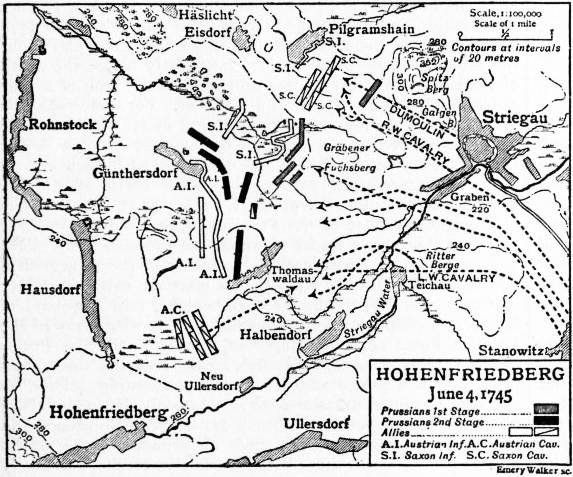
The king had made his arrangements in good time, aided by the enemy’s slowness, and in the evening he issued simple orders to move. About 9 P.M. the Prussians marched off from Alt-Jauernigk towards Striegau, the guns on the road, the infantry and cavalry, in long open columns of companies and squadrons, over the fields on either side—a night march well remembered by contrast with others as having been executed in perfect order. Meanwhile General Dumoulin, who commanded an advanced detachment between Striegau and Stanowitz, broke camp silently and moved into position below the hill north-west of Striegau, which was found to be occupied by Saxon light infantry outposts. The king’s orders were for Dumoulin and the right wing of the main army to deploy and advance towards Häslicht against the Saxons, and for the left wing infantry to prolong the line from the marsh to Günthersdorf, covered by the left-wing cavalry on the plain near Thomaswaldau. On the side of the Austrians, the outlying hussars are said to have noticed and reported the king’s movement, for the night was clear and starlit, but their report, if made, was ignored.
At 4 A.M. Dumoulin advanced on Pilgramshain, neglecting the fire of the Saxon outpost on the Spitzberg, whereupon this promptly retired in order to avoid being surrounded. Dumoulin then posted artillery on the slope of the hill and deployed his six grenadier battalions facing the village. The leading cavalry of the main army came up and deployed on Dumoulin’s left front in open rolling ground. Meantime the duke of Weissenfels had improvised a line of defence, posting his infantry in the marshy ground and about Pilgramshain, and his cavalry, partly in front of Pilgramshain and partly on the intervening space, opposite that of the Prussians. But before the marshy ground was effectively occupied by the duke’s infantry, his cavalry had been first shaken by the fire of Dumoulin’s guns on the Spitzberg and a heavy battery that was brought up on to the Gräbener Fuchsberg, and then charged by the Prussian right-wing cavalry, and in the mêlée the Allies were gradually driven in confusion off the battlefield. The cavalry battle was ended by 6.30 A.M., by which time Dumoulin’s grenadiers, stiffened by the line regiment Anhalt (the “Old Dessauer’s” own), were vigorously attacking the garden hedges and walls of Pilgramshain, and the Saxon and Austrian infantry in the marsh was being attacked by Prince Dietrich of Dessau with the right wing of the king’s infantry. The line infantry of those days, however, did not work easily in bad ground, and the Saxons were steady and well drilled. After an hour’s fight, well supported by the guns and continually reinforced as the rest of the army closed up, the prince expelled the enemy from the marsh, while Dumoulin drove the light troops out of Pilgramshain. By 7 A.M. the Saxons, forming the left wing of the allied army, were in full retreat.
While his allies were being defeated, Prince Charles of Lorraine had done nothing, believing that the cannonade was merely an outpost affair for the possession of the Spitzberg. His generals indeed had drawn out their respective commands in order of battle, the infantry south of Günthersdorf, the cavalry near Thomaswaldau, but they had no authority to advance without orders, and stood inactive, while, 1 m. away, the Prussian columns were defiling over the Striegau Water. This phase of the king’s advance was the most delicate of all, and the moment that he heard from Prince Dietrich that the marsh was captured he stopped the northward flow of his battalions and swung them westward, the left wing cavalry having to cover their deployment. But when one-third of this cavalry only had crossed at Teichau the bridge broke. For a time the advanced squadrons were in great danger. But they charged boldly, and a disjointed cavalry battle began, during which (Ziethen’s hussars having discovered a ford) the rest of the left-wing cavalry was able to cross. At last 25 intact squadrons under Lieut.-General von Nassau charged and drove the Austrians in disorder towards Hohenfriedberg. This action was the more creditable to the victors in that 45 squadrons in 3 separate fractions defeated a mass of 60 squadrons that stood already deployed to meet them.
Meanwhile the Prussian infantry columns of the centre and left had crossed Striegau Water and deployed to their left, and by 8.30 they were advancing on Günthersdorf and the Austrian infantry south of that place. Frederick’s purpose was to roll up the enemy from their inner flank, and while Prince Dietrich, with most of the troops that had forced the Saxons out of the marsh, pursued Weissenfels, two regiments of his and one of Dumoulin’s were brought over to the left wing and sent against the north side of Günthersdorf. In the course of the general forward movement, which was made in what was for those days a very irregular line, a wide gap opened up between the centre and left, behind which 10 squadrons of the Bayreuth dragoon regiment, with Lieut.-General von Gessler, took up their position. Thus the line advanced. The grenadiers on the extreme left cleared Thomaswaldau, and their fire galled the Austrian squadrons engaged in the cavalry battle to the south. Then Günthersdorf, attacked on three sides, was also evacuated by the enemy. But although Frederick rode back from the front saying “the battle is won,” the Prussian infantry, in spite of its superior fire discipline, failed for some time to master the defence, and suffered heavily from the eight close-range volleys they received, one or two regiments losing 40 and 50% of their strength. The Austrians, however, suffered still more; feeling themselves isolated in the midst of the victorious enemy, they began to waver, and at the psychological moment Gessler and the Bayreuth dragoons charged into their ranks and “broke the equilibrium.” These 1500 sabres scattered twenty battalions of the enemy and brought in 2500 prisoners and 66 Austrian colours, and in this astounding charge they themselves lost no more than 94 men. By nine o’clock the battle was over, and the wrecks of the Austro-Saxon army were retreating to the mountains. The Prussians, who had been marching all night, were too far spent to pursue.
The loss of the allies was in all 15,224, 7985 killed and wounded, and 7239 prisoners, as well as 72 guns and 83 standards and colours. The Prussians lost 4666 killed and wounded, 71 missing.
HOHENHEIM, a village of Germany, in the kingdom of Württemberg, 7 m. S. of Stuttgart by rail. Pop. 300. It came in 1768 from the counts of Hohenheim to the dukes of Württemberg, and in 1785 Duke Karl Eugen built a country house here. This house with grounds is now the seat of the most important agricultural college in Germany; it was founded in 1817, was raised to the position of a high school in 1865, and now ranks as a technical high school with university status.
See Fröhlich, Das Schloss und die Akademie Hohenheim (Stuttgart, 1870).
HOHENLIMBURG, a town of Germany, on the Lenne, in the Prussian prov. of Westphalia, 30 m. by rail S.E. of Dortmund. Pop. (1905) 12,790. It has two Evangelical churches, a Roman Catholic church and a synagogue. The town is the seat of various iron and metal industries, while dyeing, cloth-making and linen-weaving are also carried on here. It is the chief town of the county of Limburg, and formerly belonged to the counts of Limburg, a family which became extinct in 1508. Later it passed to the counts of Bentheim-Tecklenburg. The castle of Hohenlimburg, which overlooks the town, is now the residence of Prince Adolf of Bentheim-Tecklenburg.
HOHENLOHE, a German princely family which took its name from the district of Hohenlohe in Franconia. At first a countship, its two branches were raised to the rank of principalities of the Empire in 1744 and 1764 respectively; in 1806 they lost their independence and their lands now form part of the kingdoms of Bavaria and of Württemberg. At the time of the mediatization the area of Hohenlohe was 680 sq. m. and its estimated population was 108,000. The family is first mentioned in the 12th century as possessing the castle of Hohenloch, or Hohenlohe, near Uffenheim, and its influence was soon perceptible in several of the Franconian valleys, including those of the Kocher, the Jagst and the Tauber. Henry I. (d. 1183) was the first to take the title of count of Hohenlohe, and in 1230 his grandsons, Gottfried and Conrad, supporters of the emperor Frederick II., founded the lines of Hohenlohe-Hohenlohe and Hohenlohe-Brauneck, names taken from their respective castles. The latter became extinct in 1390, its lands passing later to Brandenburg, while the former was divided into several branches, only two of which, however, Hohenlohe-Weikersheim and Hohenlohe-Uffenheim-Speckfeld, need be mentioned here. Hohenlohe-Weikersheim, descended from Count Kraft I. (d. 1313), also underwent several divisions, that which took place after the deaths of Counts Albert and George in 1551 being specially important. At this time the lines of Hohenlohe-Neuenstein and Hohenlohe-Waldenburg were founded by the sons of Count George. Meanwhile, in 1412, the family of Hohenlohe-Uffenheim-Speckfeld had become extinct, and its lands had passed through the marriages of its heiresses into other families.
The existing branches of the Hohenlohe family are descended from the lines of Hohenlohe-Neuenstein and Hohenlohe-Waldenburg, established in 1551. The former of these became Protestant, while the latter remained Catholic. Of the family of Hohenlohe-Neuenstein, which underwent several partitions and inherited Gleichen in 1631, the senior line became extinct in 1805, while in 1701 the junior line divided itself into three branches, those of Langenburg, Ingelfingen and Kirchberg. Kirchberg died out in 1861, but members of the families of Hohenlohe-Langenburg and Hohenlohe-Ingelfingen are still alive, the latter being represented by the branches of Hohenlohe-Ingelfingen and Hohenlohe-Öhringen. The Roman Catholic family of Hohenlohe-Waldenburg was soon divided into three branches, but two of these had died out by 1729. The surviving branch, that of Schillingsfürst, was divided into the lines of Hohenlohe-Schillingsfürst and Hohenlohe-Bartenstein; other divisions followed, and the four existing lines of this branch of the family are those of Waldenburg, Schillingsfürst, Jagstberg and Bartenstein. The family of Hohenlohe-Schillingsfürst possesses the duchies of Ratibor and of Corbie inherited in 1824.
The principal members of the family are dealt with below.
I. Friedrich Ludwig, prince of Hohenlohe-Ingelfingen (1746-1818), Prussian general, was the eldest son of Prince Johann Friedrich (d. 1796) of Hohenlohe-Ingelfingen, and began his military career as a boy, serving against the Prussians in the last years of the Seven Years’ War. Entering the Prussian army after the peace (1768), he was on account of his rank at once made major, and in 1775 he became lieutenant-colonel; in 1778 he took part in the War of the Bavarian Succession and about the same time was made a colonel. Shortly before the death of Frederick the Great he was promoted to the rank of major-general and appointed chief of a regiment. For some years the prince did garrison duty at Breslau, until in 1791 he was made governor of Berlin. In 1794 he commanded a corps in the Prussian army on the Rhine and distinguished himself greatly in many engagements, particularly in the battle of Kaiserslautern on the 20th of September. He was at this time the most popular soldier in the Prussian army. Blücher wrote of him that “he was a leader of whom the Prussian army might well be proud.” He succeeded his father in the principality, and acquired additional lands by his marriage with a daughter of Count von Hoym. In 1806 Hohenlohe, now a general of infantry, was appointed to command the left-wing army of the Prussian forces opposing Napoleon, having under him Prince Louis Ferdinand of Prussia; but, feeling that his career had been that of a prince and not that of a scientific soldier, he allowed his quartermaster-general Massenbach to influence him unduly. Disputes soon broke out between Hohenlohe and the commander-in-chief, the duke of Brunswick, the armies marched hither and thither without effective results, and finally Hohenlohe’s army was almost destroyed by Napoleon at Jena (see Napoleonic Campaigns). The prince displayed his usual personal bravery in the battle, and managed to rally a portion of his corps near Erfurt, whence he retired into Prussia. But the pursuers followed him up closely, and, still acting under Massenbach’s advice, he surrendered the remnant of his army at Prenzlau on the 28th of October, a fortnight after Jena and three weeks after the beginning of hostilities. Hohenlohe’s former popularity and influence in the army had now the worst possible effect, for the commandants of garrisons everywhere lost heart and followed his example. After two years spent as a prisoner of war in France Hohenlohe retired to his estates, living in self-imposed obscurity until his death on the 15th of February 1818. He had, in August 1806, just before the outbreak of the French War, resigned the principality to his eldest son, not being willing to become a “mediatized” ruler under Württemberg suzerainty.
II. Ludwig Aloysius, prince of Hohenlohe-Waldenburg-Bartenstein (1765-1829), marshal and peer of France, was born on the 18th of August 1765. In 1784 he entered the service of the Palatinate, which he quitted in 1792 in order to take the command of a regiment raised by his father for the service of the emigrant princes of France. He greatly distinguished himself under Condé in the campaigns of 1792-1793, especially at the storming of the lines of Weissenburg. Subsequently he entered the service of Holland, and, when almost surrounded by the army of General Pichegru, conducted a masterly retreat from the island of Bommel. From 1794 to 1799 he served as colonel in the Austrian campaigns; in 1799 he was named major-general by the archduke Charles; and after obtaining the rank of lieutenant-general he was appointed by the emperor governor of the two Galicias. Napoleon offered to restore to him his principality on condition that he adhered to the confederation of the Rhine, but as he refused, it was united to Württemberg. After Napoleon’s fall in 1814 he entered the French service, and in 1815 he held the command of a regiment raised by himself, with which he took part in the Spanish campaign of 1823. In 1827 he was created marshal and peer of France. He died at Lunéville on the 30th of May 1829.
III. Alexander Leopold Franz Emmerich, prince of Hohenlohe-Waldenburg-Schillingsfürst (1794-1849), priest and reputed miracle-worker, was born at Kupferzell, near Waldenburg, on the 17th of August 1794. By his mother, the daughter of an Hungarian nobleman, he was from infancy destined for the church; and she entrusted his early education to the ex-Jesuit Riel. In 1804 he entered the “Theresianum” at Vienna, in 1808 the academy at Bern, in 1810 the archiepiscopal seminary at Vienna, and afterwards he studied at Tyrnau and Ellwangen. He was ordained priest in 1815, and in the following year he went to Rome, where he entered the society of the “Fathers of the Sacred Heart.” Subsequently, at Munich and Bamberg, he was blamed for Jesuit and obscurantist tendencies, but obtained considerable reputation as a preacher. His first co-called miraculous cure was effected, in conjunction with a peasant, Martin Michel, on a princess of Schwarzenberg who had been for some years paralytic. Immediately he acquired such fame as a performer of miraculous cures that multitudes from various countries flocked to partake of the beneficial influence of his supposed supernatural gifts. Ultimately, on account of the interference of the authorities with his operations, he went in 1821 to Vienna and then to Hungary, where he became canon at Grosswardein and in 1844 titular bishop of Sardica. He died at Vöslau near Vienna on the 17th of November 1849. He was the author of a number of ascetic and controversial writings, which were collected and published in one edition by S. Brunner in 1851.
IV. Kraft, prince of Hohenlohe-Ingelfingen (1827-1892), soldier and military writer, son of Prince Adolf of Hohenlohe-Ingelfingen (1797-1873), was born at Koschentin in Upper Silesia. He was a nephew of the Prince Hohenlohe noticed above, who commanded the Prussians at Jena. Educated with great rigour, owing to the impoverishment of the family estates during the Napoleonic wars, he was sent into the Prussian army, and commissioned to the artillery at the least expensive arm of the service. He joined the Prussian Guard artillery in 1845, and it was soon discovered that he had unusual aptitudes as an artillery officer. For a time his brother officers resented the presence of a prince, until it was found that he made no attempt to use his social position to secure advancement. After serving as a military attaché in Vienna and on the Transylvanian frontier during the Crimean War, he was made a captain on the general staff, and in 1856 personal aide-de-camp to the king, remaining, however, in close touch with the artillery. In 1864, having become in the meanwhile successively major and lieut.-colonel, he resigned the staff appointments to become commander of the new Guard Field Artillery regiment and in the following year he became colonel. In 1866 he saw his first real active service. In the bold advance of the Guard corps on the Austrian right wing at Königgratz (see Seven Weeks’ War), he led the Guard reserve artillery with the greatest dash and success, and after the short war ended he turned his energies, now fortified by experience, to the better tactical training of the Prussian artillery. In 1868 he was made a major-general and assigned to command the Guard artillery brigade. In this capacity he gained great distinction during the Franco-German war and especially at Gravelotte and Sedan; he was in control of the artillery attack on the fortifications of Paris. In 1873 he was placed in command of an infantry division, and three years later was promoted lieutenant-general. He retired in 1879, was made general of infantry in 1883 and general of artillery in 1889. His military writings were numerous, and amongst them several have become classics. These are Briefe über Artillerie (Eng. trans. Letters on Artillery, 1887); Briefe über Strategie (1877; Eng. trans. Letters on Strategy, 1898); and Gespräche über Reiterei (1887; Eng. trans. Conversations on Cavalry). The Briefe über Infanterie and Briefe über Kavallerie (translated into English, Letters on Infantry, Letters on Cavalry, 1889) are of less importance, though interesting as a reflection of prevailing German ideas. His memoirs (Aus meinem Leben) were prepared in retirement near Dresden, and the first volume (1897) created such a sensation that eight years were allowed to elapse before the publication was continued. Prince Kraft died near Dresden on the 16th of January 1892.
(C. F. A.)
V. Chlodwig Karl Victor, prince of Hohenlohe-Schillingsfürst (1819-1901), statesman, was born on the 31st of March 1819 at Schillingsfürst in Bavaria. His father, Prince Franz Joseph (1787-1841), was a Catholic, his mother, Princess Konstanze of Hohenlohe-Langenburg, a Protestant. In accordance with the compromise customary at the time, Prince Chlodwig and his brothers were brought up in the religion of their father, while his sisters followed that of their mother. In spite of the difference of creed the family was very united, and it was to the spirit that rendered this possible that the prince owed his liberal and tolerant point of view, which was to exercise an important influence on his political activity. As the younger son of a cadet line of his house it was necessary for Prince Chlodwig to follow a profession. For a while he thought of obtaining a commission in the British army through the influence of his aunt, Princess Feodora of Hohenlohe-Langenburg (née princess of Leiningen), Queen Victoria’s half-sister. He decided, however, to enter the Prussian diplomatic service. His application to be excused the preliminary steps, which involved several years’ work in subordinate positions in the Prussian civil service, was refused by Frederick William IV., and the prince, with great good sense, decided to sacrifice his pride of rank and to accept the king’s conditions. As auscultator in the courts at Coblenz he acquired a taste for jurisprudence, became a Referendar in September 1843, and after some months of travel in France, Switzerland and Italy went to Potsdam as a civil servant (May 13, 1844). These early years were invaluable, not only as giving him experience of practical affairs but as affording him an insight into the strength and weakness of the Prussian system. The immediate result was to confirm his Liberalism. The Prussian principle of “propagating enlightenment with a stick” did not appeal to him; he “recognized the confusion and want of clear ideas in the highest circles,” the tendency to make agreement with the views of the government the test of loyalty to the state; and he noted in his journal (June 25, 1844) four years before the revolution of ’48, “a slight cause and we shall have a rising.” “The free press,” he notes on another occasion, “is a necessity, progress the condition of the existence of a state.” If he was an ardent advocate of German unity, and saw in Prussia the instrument for its attainment, he was throughout opposed to the “Prussification” of Germany, and ultimately it was he who made the unification of Germany possible by insisting at once on the principle of union with the North German states and at the same time on the preservation of the individuality of the states of the South.
On the 12th of November 1834 the landgrave Viktor Amadeus of Hesse-Rotenburg died, leaving to his nephews, the princes Viktor and Chlodwig Hohenlohe, his allodial estates: the duchy of Ratibor in Silesia, the principality of Corvey in Westphalia, and the lordship of Treffurt in the Prussian governmental district of Erfurt. On the death of Prince Franz Joseph on the 14th of January 1841 it was decided that the principality of Schillingsfürst should pass to the third brother, Philipp Ernst, as the two elder sons, Viktor and Chlodwig, were provided for already under their uncle’s will, the one with the duchy of Ratibor, the other with Corvey and Treffurt. The youngest son, Gustav (b. February 28, 1823), the future cardinal, was destined for the Church. On the death of Prince Philipp Ernst (May 3, 1845) a new arrangement was made: Prince Chlodwig became prince of Schillingsfürst, while Corvey was assigned to the duke of Ratibor; Treffurt was subsequently sold by Prince Chlodwig, who purchased with the price large estates in Posen. This involved a complete change in Prince Chlodwig’s career. His new position as a “reigning” prince and hereditary member of the Bavarian Upper House was incompatible with that of a Prussian official. On the 18th of April 1846 he took his seat as a member of the Bavarian Reichsrath, and on the 26th of June received his formal discharge from the Prussian service.
Save for the interlude of 1848 the political life of Prince Hohenlohe was for the next eighteen years not eventful. During the revolutionary years his sympathies were with the Liberal idea of a united Germany, and he compromised his chances of favour from the king of Bavaria by accepting the task (November 1, 1848) of announcing to the courts of Rome, Florence and Athens the accession to office of the Archduke John of Austria as regent of Germany. But he was too shrewd an observer to hope much from a national parliament which “wasted time in idle babble,” or from a democratic victory which had stunned but not destroyed the German military powers. On the 16th of February 1847 he had married the Princess Marie of Sayn-Wittgenstein-Berleburg, the heiress to vast estates in Russia.1 This led to a prolonged visit to Werki in Lithuania (1851-1853) in connexion with the management of the property, a visit repeated in 1860. In general this period of Hohenlohe’s life was occupied in the management of his estates, in the sessions of the Bavarian Reichsrath and in travels. In 1856 he visited Rome, during which he noted the baneful influence of the Jesuits. In 1859 he was studying the political situation at Berlin, and in the same year he paid a visit to England. The marriage of his brother Konstantin in 1859 to another princess of Sayn-Wittgenstein-Berleburg led also to frequent visits to Vienna. Thus Prince Hohenlohe was brought into close touch with all the most notable people in Europe. At the same time, during this period (1850-1866) he was endeavouring to get into relations with the Bavarian government, with a view to taking a more active part in affairs. Towards the German question his attitude at this time was tentative. He had little hope of a practical realization of a united Germany, and inclined towards the tripartite divisions under Austria, Prussia and Bavaria—the so-called “Trias.” He attended the Fürstentag at Frankfort in 1863, and in the Schleswig-Holstein question was a supporter of the prince of Augustenburg. It was at this time that, at the request of Queen Victoria, he began to send her regular reports on the political condition of Germany.
Prince Hohenlohe’s importance in history, however, begins with the year 1866. In his opinion the war was a blessing. It had demonstrated the insignificance of the small and middle states, “a misfortune for the dynasties”—with whose feelings a mediatized prince could scarcely be expected to be over-sympathetic—but the best possible good fortune for the German nation. In the Bavarian Reichsrath Hohenlohe now began to make his voice heard in favour of a closer union with Prussia; clearly, if such a union were desirable, he was the man in every way best fitted to prepare the way for it. One of the main obstacles in the way was the temperament of Louis II. of Bavaria, whose ideas of kingship were very remote from those of the Hohenzollerns, whose pride revolted from any concession to Prussian superiority, and who—even during the crisis of 1866—was more absorbed in operas than in affairs of state. Fortunately Richard Wagner was a politician as well as a composer, and equally fortunately Hohenlohe was a man of culture capable of appreciating “the master’s” genius. It was Wagner, apparently, who persuaded the king to place Hohenlohe at the head of his government (Denkwürdigkeiten, i. 178, 211), and on the 31st of December 1866 the prince was duly appointed minister of the royal house and of foreign affairs and president of the council of ministers.
As head of the Bavarian government Hohenlohe’s principal task was to discover some basis for an effective union of the South German states with the North German Confederation, and during the three critical years of his tenure of office he was, next to Bismarck, the most important statesman in Germany. He carried out the reorganization of the Bavarian army on the Prussian model, brought about the military union of the southern states, and took a leading share in the creation of the customs parliament (Zollparlament), of which on the 28th of April 1868 he was elected a vice-president. During the agitation that arose in connexion with the summoning of the Vatican council Hohenlohe took up an attitude of strong opposition to the ultramontane position. In common with his brothers, the duke of Ratibor and the cardinal, he believed that the policy of Pius IX.—inspired by the Jesuits (that “devil’s society,” as he once called it)—of setting the Church in opposition to the modern State would prove ruinous to both, and that the definition of the dogma of papal infallibility, by raising the pronouncements of the Syllabus of 1864 into articles of faith, would commit the Church to this policy irrevocably. This view he embodied into a circular note to the Catholic powers (April 9, 1869), drawn up by Döllinger, inviting them to exercise the right of sending ambassadors to the council and to combine to prevent the definition of the dogma. The greater powers, however, were for one reason or another unwilling to intervene, and the only practical outcome of Hohenlohe’s action was that in Bavaria the powerful ultramontane party combined against him with the Bavarian “patriots” who accused him of bartering away Bavarian independence to Prussia. The combination was too strong for him; a bill which he brought in for curbing the influence of the Church over education was defeated, the elections of 1869 went against him, and in spite of the continued support of the king he was forced to resign (March 7, 1870).
Though out of office, his personal influence continued very great both at Munich and Berlin and had not a little to do with favourable terms of the treaty of the North German Confederation with Bavaria, which embodied his views, and with its acceptance by the Bavarian parliament.2 Elected a member of the German Reichstag, he was on the 23rd of March 1871 chosen one of its vice-presidents, and was instrumental in founding the new groups which took the name of the Liberal Imperial party (Liberale Reichspartei), the objects of which were to support the new empire, to secure its internal development on Liberal lines, and to oppose clerical aggression as represented by the Catholic Centre. Like the duke of Ratibor, Hohenlohe was from the first a strenuous supporter of Bismarck’s anti-papal policy, the main lines of which (prohibition of the Society of Jesus, &c.) he himself suggested. Though sympathizing with the motives of the Old Catholics, however, he realized that they were doomed to sink into a powerless sect, and did not join them, believing that the only hope for a reform of the Church lay in those who desired it remaining in her communion.3 In 1872 Bismarck proposed to appoint Cardinal Hohenlohe Prussian envoy at the Vatican, but his views were too much in harmony with those of his family, and the pope refused to receive him in this capacity.4
In 1873 Bismarck chose Prince Hohenlohe to succeed Count Harry Arnim as ambassador in Paris, where he remained for seven years. In 1878 he attended the congress of Berlin as third German representative, and in 1880, on the death of Bernhardt Ernst von Bülow (October 20), secretary of state for foreign affairs, he was called to Berlin as temporary head of the Foreign Office and representative of Bismarck during his absence through illness. In 1885 he was chosen to succeed Manteuffel as governor of Alsace-Lorraine. In this capacity he had to carry out the coercive measures introduced by the chancellor in 1887-1888, though he largely disapproved of them;5 his conciliatory disposition, however, did much to reconcile the Alsace-Lorrainers to German rule. He remained at Strassburg till October 1894, when, at the urgent request of the emperor, he consented, in spite of his advanced years, to accept the chancellorship in succession to Caprivi. The events of his chancellorship belong to the general history of Germany (q.v.); as regards the inner history of this time the editor of his memoirs has very properly suppressed the greater part of the detailed comments which the prince left behind him. In general, during his term of office, the personality of the chancellor was less conspicuous in public affairs than in the ease of either of his predecessors. His appearances in the Prussian and German parliaments were rare, and great independence was left to the secretaries of state. What influence the tact and experience of Hohenlohe exercised behind the scenes on the masterful will and impulsive character of the emperor cannot as yet be generally known.
Prince Hohenlohe resigned the chancellorship on the 17th of October 1900, and died at Ragaz on the 6th of July 1901. On the 16th of February 1897 he had celebrated his golden wedding; on the 21st of December of the same year the princess died. There were six children of the marriage: Elizabeth (b. 1847); Stephanie (b. 1851); Philipp Ernst, reigning prince of Hohenlohe-Schillingsfürst (b. 1853), who married Princess Charielée Ypsilanti; Albert (1857-1866); Moritz and Alexander, twins (b. 1862).
All other authorities for the life of Prince Hohenlohe have been superseded by the Denkwürdigkeiten (2 vols., Stuttgart and Leipzig, 1906). With the exception noted above these are singularly full and outspoken, the latter quality causing no little scandal in Germany and bringing down on Prince Alexander, who was responsible for their publication, the disfavour of the emperor. They form not only the record of a singularly full and varied life, but are invaluable to the historian for the wealth of material they contain and for appreciations of men and events by an observer who had the best opportunities for forming a judgment. The prince himself they reveal not only as a capable man of affairs, though falling short of greatness, but as a personality of singular charm, tenacious of his principles, tolerant, broad-minded, and possessed of a large measure of the saving grace of humour.
See generally A. F. Fischer, Geschichte des Hauses Hohenlohe (1866-1871); K. Weller, Hohenlohisches Urkundenbuch, 1153-1350 (Stuttgart, 1899-1901), and Geschichte des Hauses Hohenlohe (Stuttgart, 1904).
(W. A. P.; C. F. A.)
1 Through her mother, née Princess Stephanie Radziwill (d. 1832). Before Prince Wittgenstein’s death (1887) a new law had forbidden foreigners to hold land in Russia. Prince Hohenlohe appears, however, to have sold one of his wife’s estates and to have secured certain privileges from the Russian court for the rest.
2 Speech of December 30, 1870, in the Reichsrath. Denkwürdigkeiten, ii. 36.
3 “If I wished to leave the Church because of all the scandalous occurrences in the Catholic Church, I should have had to secede while studying Church history,” op. cit. ii. 92.
4 Dr Johann Friedrich (q.v.), afterwards one of the Old Catholic leaders, was his secretary at the time of the Vatican council, and supplied historical and theological material to the opposition bishops.
5 He protested against the passport system as likely to lead to a war with France, for which he preferred not to be responsible (Letter to Wilmowski, Denkw. ii. 433), but on the chancellor taking full responsibility consented to retain office.
HOHENSTAUFEN, the name of a village and ruined castle near Lorsch in Swabia, now in the kingdom of Württemberg, which gave its name to a celebrated Swabian family, members of which were emperors or German kings from 1138 to 1208, and again from 1214 to 1254. The earliest known ancestor was Frederick, count of Büren (d. 1094), whose son Frederick built a castle at Staufen, or Hohenstaufen, and called himself by this name. He was a firm supporter of the emperor Henry IV., who rewarded his fidelity by granting him the dukedom of Swabia in 1079, and giving him his daughter Agnes in marriage. In 1081 he remained in Germany as Henry’s representative, but only secured possession of Swabia after a struggle lasting twenty years. In 1105 Frederick was succeeded by his son Frederick II., called the One-eyed, who, together with his brother Conrad, afterwards the German king Conrad III., held south-west Germany for their uncle the emperor Henry V. Frederick inherited the estates of Henry V. in 1125, but failed to secure the throne, and took up an attitude of hostility towards the new emperor, Lothair the Saxon, who claimed some of the estates of the late emperor as crown property. A war broke out and ended in the complete submission of Frederick at Bamberg. He retained, however, his dukedom and estates. In 1138 Conrad of Hohenstaufen was elected German king, and was succeeded in 1152, not by his son but by his nephew Frederick Barbarossa, son of his brother Frederick (d. 1147). Conrad’s son Frederick inherited the duchy of Franconia which his father had received in 1115, and this was retained by the Hohenstaufen until the death of Duke Conrad II. in 1196. In 1152 Frederick received the duchy of Swabia from his cousin the German king Frederick I., and on his death in 1167 it passed successively to Frederick’s three sons Frederick, Conrad and Philip. The second Hohenstaufen emperor was Frederick Barbarossa’s son, Henry VI., after whose death a struggle for the throne took place between Henry’s brother Philip, duke of Swabia, and Otto of Brunswick, afterwards the emperor Otto IV. Regained for the Hohenstaufen by Henry’s son, Frederick II., in 1214, the German kingdom passed to his son, Conrad IV., and when Conrad’s son Conradin was beheaded in Italy in 1268, the male line of the Hohenstaufen became extinct. Daughters of Philip of Swabia married Ferdinand III., king of Castile and Leon, and Henry II., duke of Brabant, and a daughter of Conrad, brother of the emperor Frederick I., married into the family of Guelph. The castle of Hohenstaufen was destroyed in the 16th century during the Peasants’ War, and only a few fragments now remain.
See F. von Raumer, Geschichte der Hohenstaufen und ihrer Zeit (Leipzig, 1878); B. F. W. Zimmermann, Geschichte der Hohenstaufen (Stuttgart, 1st ed., 1838; 2nd ed., 1865); F. W. Schirrmacher, Die letzten Hohenstaufen (Göttingen, 1871).
HOHENSTEIN (Hohenstein-Ernstthal), a town of Germany, in the kingdom of Saxony, on the slopes of the Erzgebirge, and on the railway Reichenbach-Chemnitz, 12 m. N.E. of Zwickau. Pop. (1905) 13,903. Hohenstein possesses two fine Evangelical churches, a town hall, restored in 1876, and several monuments to famous men. The principal industries are the spinning and weaving of cotton, the manufacture of machines, stockings, gloves and woollen and silk fabrics, cotton printing and dyeing. Many of the inhabitants are also employed in the neighbouring copper and arsenic mines. Not far from Hohenstein there is a mineral spring, connected with which there are various kinds of baths. Hohenstein is the birthplace of the physicist G. H. von Schubert and of C. G. Schröter (1699-1782), one of the inventors of the pianoforte. Hohenstein consists of two towns, Hohenstein and Ernstthal, which were united in 1898.
Another place of the same name is a town in East Prussia. Pop. (1900) 2467. This Hohenstein, which was founded by the Teutonic Order in 1359, has a Roman Catholic and an Evangelical church, a synagogue and several educational establishments.
HOHENZOLLERN, the name of a castle which stood on the hill of Zollern about 1½ m. south of Hechingen, and gave its name to the family to which the present German emperor belongs. A vague tradition connects the house with the Colonna family of Rome, or the Colalto family of Lombardy; but one more definite unites the Hohenzollerns with the Burkhardingers, who were counts in Raetia during the early part of the 10th century, and two of whom became dukes of Swabia. Tassilo, a member of this family, is said to have built a castle at Zollern early in the 9th century; but the first historical mention of the name is in the Chronicon of a certain Berthold (d. 1088), who refers to Burkhard and Wezil, or Werner, of Zollern, or Zolorin. These men appear to have been counts of Zollern, and to have met their death in 1061. The family of Wezil died out in 1194, and the existing branches of the Hohenzollerns are descended from Burkhard and his son Frederick, whose eldest son, Frederick II., was in great favour with the German kings, Lothair the Saxon and Conrad III. Frederick II. died about 1145, and his son and successor, Frederick III., was a constant supporter of the Hohenstaufen. This count married Sophia, daughter and heiress of Conrad, burgrave of Nuremberg, and about 1192 he succeeded his father-in-law as burgrave, obtaining also some lands in Austria and Franconia. He died about 1200, and his sons, Conrad and Frederick, ruled their lands in common until 1227, when an important division took place. Conrad became burgrave of Nuremberg, and, receiving the lands which had come into the family through his mother, founded the Franconian branch of the family, which became the more important of the two; while Frederick, receiving the county of Zollern and the older possessions of the family, was the ancestor of the Swabian branch.
Early in the 12th century Burkhard, a younger son of Frederick I., secured the county of Hohenberg, and this district remained in the possession of the Hohenzollerns until the death of Count Sigismund in 1486. Its rulers, however, with the exception of Count Albert II. (d. 1298), played an unimportant part in German history. Albert, who was a Minnesinger, was loyal to the declining fortunes of the Hohenstaufen, and afterwards supported his brother-in-law, Rudolph of Habsburg, in his efforts to obtain the German throne. He shared in the campaigns of Rudolph and fell in battle in 1298, during the struggle between Adolph of Nassau and Albert of Habsburg (afterwards King Albert I.). When this family became extinct in 1486 Hohenberg passed to the Habsburgs.
The Franconian branch of the Hohenzollerns was represented in 1227 by Conrad, burgrave of Nuremberg, whom the emperor Frederick II. appointed guardian of his son Henry, and administrator of Austria. After a short apostasy, during which he supported Henry Raspe, landgrave of Thuringia, Conrad returned to the side of the Hohenstaufen and aided Conrad IV. He died in 1261, when his son and successor, the burgrave Frederick III., had already obtained Bayreuth through his marriage with Elizabeth, daughter of Otto of Meran (d. 1234). Frederick took a leading part in German affairs, and it is interesting to note that he had a considerable share in securing the election of his uncle, Rudolph of Habsburg, as German king in 1273. He died in 1297 and was succeeded by his son, Frederick IV. This burgrave fought for King Albert I. in Thuringia, and supported Henry VII. in his efforts to secure Bohemia for his son John; but in 1314, forsaking his father’s policy, he favoured Louis, afterwards the emperor Louis IV., in his struggle with Frederick, duke of Austria, and by his conduct at the battle of Mühldorf in 1322 and elsewhere earned the designation of “saviour of the empire.” Frederick, however, did not neglect his hereditary lands. He did something for the maintenance of peace and the security of traders, gave corporate privileges to villages, and took the Jews under his protection. His services to Louis were rewarded in various ways, and, using part of his wealth to increase the area of his possessions, he bought the town and district of Ansbach in 1331. Dying in 1332, Frederick was succeeded by his son, John II., who, after one of his brothers had died and two others had entered the church, ruled his lands in common with his brother Albert. About 1338 John bought Culmbach and Plassenburg, and on the strength of a privilege granted to him in 1347 he seized many robber-fortresses and held the surrounding lands as imperial fiefs. In general he continued his father’s policy, and when he died in 1357 was succeeded by his son, Frederick V., who, after the death of his uncle Albert in 1361, became sole ruler of Nuremberg, Ansbach and Bayreuth. Frederick lived in close friendship with the emperor Charles IV., who formally invested him with Ansbach and Bayreuth and made him a prince of the empire in 1363. In spite of the troubled times in which he lived, Frederick was a successful ruler, and introduced a regular system of public finance into his lands. In 1397 he divided his territories between his sons John and Frederick, and died in the following year. His elder son, John III., who had married Margaret, a daughter of the emperor Charles IV., was frequently in the company of his brothers-in-law, the German kings Wenceslaus and Sigismund. He died without sons in 1420.
Since 1397 the office of burgrave of Nuremberg had been held by John’s brother, Frederick, who in 1415 received Brandenburg from King Sigismund, and became margrave of Brandenburg as Frederick I. (q.v.). On his brother’s death in 1420 he reunited the lands of his branch of the family, but in 1427 he sold his rights as burgrave to the town of Nuremberg. The subsequent history of this branch of the Hohenzollerns is identified with that of Brandenburg from 1415 to 1701, and with that of Prussia since the latter date, as in this year the elector Frederick III. became king of Prussia. In 1871 William, the seventh king, took the title of German emperor. While the electorate of Brandenburg passed according to the rule of primogeniture, the Franconian possessions of the Hohenzollerns, Ansbach and Bayreuth, were given as appanages to younger sons, an arrangement which was confirmed by the dispositio Achillea of 1473. These principalities were ruled by the sons and descendants of the elector Albert Achilles from 1486 to 1603; and, after reverting to the elector of Brandenburg, by the descendants of the elector John George from 1603 to 1791. In 1791 Prince Charles Alexander (d. 1806), who had inherited both districts, sold his lands to Prussia.
The influence of the Swabian branch of the Hohenzollerns was weakened by several partitions of its lands; but early in the 16th century it rose to some eminence through Count Eitel Frederick II. (d. 1512), a friend and adviser of the emperor Maximilian I. Eitel received from this emperor the district of Haigerloch, and in 1534 his grandson Charles (d. 1576) was granted the counties of Sigmaringen and Vöhringen by the emperor Charles V. In 1576 the sons of Charles divided their lands, and founded three branches of the family, one of which is still flourishing. Eitel Frederick IV. took Hohenzollern with the title of Hohenzollern-Hechingen; Charles II. Sigmaringen and Vöhringen and the title of Hohenzollern-Sigmaringen; and Christopher took Haigerloch. Christopher’s family died out in 1634, but the remaining lines are of some importance. Count John George of Hohenzollern-Hechingen was made a prince in 1623, and John of Hohenzollern-Sigmaringen soon received the same honour. In 1695 these two branches of the family entered conjointly into an agreement with Brandenburg, which provided that, in case of the extinction of either of the Swabian branches, the remaining branch should inherit its lands; and if both branches became extinct the principalities should revert to Brandenburg. During the 17th and 18th centuries and during the period of the Napoleonic wars the history of these lands was very similar to that of the other small estates of Germany. In consequence of the political troubles of 1848 Princes Frederick William of Hohenzollern-Hechingen and Charles Anton of Hohenzollern-Sigmaringen resigned their principalities, and accordingly these fell to the king of Prussia, who took possession on the 12th of March 1850. By a royal decree of the 20th of May following the title of “highness,” with the prerogatives of younger sons of the royal house, was conferred on the two princes. The proposal to raise Prince Leopold of Hohenzollern-Sigmaringen (1835-1905) to the Spanish throne in 1870 was the immediate cause of the war between France and Germany. In 1908 the head of this branch of the Hohenzollerns, the only one existing besides the imperial house, was Leopold’s son William (b. 1864), who, owing to the extinction of the family of Hohenzollern-Hechingen in 1869, was called simply prince of Hohenzollern. In 1866 Prince Charles of Hohenzollern-Sigmaringen was chosen prince of Rumania, becoming king in 1881.
The modern Prussian province of Hohenzollern is a long, narrow strip of territory bounded on the S.W. by Baden and in other directions by Württemberg. It was divided into two principalities, Hohenzollern-Sigmaringen and Hohenzollern-Hechingen, until 1850, when these were united. They now form the government of Sigmaringen (q.v.).
The castle of Hohenzollern was destroyed in 1423, but it has been restored several times. Some remains of the old building may still be seen adjoining the present castle, which was built by King Frederick William IV.
See Monumenta Zollerana, edited by R. von Stillfried and T. Märker (Berlin, 1852-1890); Quellen und Untersuchungen zur Geschichte des Hauses Hohenzollern, edited by E. Berner (Berlin, 1901 fol.); R. von Stillfried, Altertümer und Kunstdenkmale des erlauchten Hauses von Hohenzollern (Berlin, 1852-1867) and Stammtafeln des Gesamthauses Hohenzollern (Berlin, 1869); L. Schmid, Die älteste Geschichte des erlauchten Gesamthauses der königlichen und fürstlichen Hohenzollern (Tübingen, 1884-1888); E. Schwartz, Stammtafel des preussischen Königshauses (Breslau 1898); Hohenzollernsche Forschungen, Jahrbuch für die Geschichte der Hohenzollern, edited by C. Meyer (Berlin, 1891-1902); Hohenzollern Jahrbuch, Forschungen und Abbildungen zur Geschichte der Hohenzollern in Brandenburg-Freussen, edited by Seidel (Leipzig, 1897-1903), and T. Carlyle, History of Frederick the Great (London, 1872-1873).
(A. W. H.*)
HOKKAIDO, the Japanese name for the northern division of the empire (Hoku = north, kai = sea, and do = road), including Yezo, the Kuriles and their adjacent islets.
HOKUSAI (1760-1849), the greatest of all the Japanese painters of the Popular School (Ukiyo-ye), was born at Yedo (Tōkyō) in the 9th month of the 10th year of the period Horeki, i.e. October-November 1760. He came of an artisan family, his father having been a mirror-maker, Nakajima Issai. After some practice as a wood-engraver he, at the age of eighteen, entered the studio of Katsugawa Shunshō, a painter and designer of colour-prints of considerable importance. His disregard for the artistic principles of his master caused his expulsion in 1785; and thereafter—although from time to time Hokusai studied various styles, including especially that of Shiba Gokan, from whom he gained some fragmentary knowledge of European methods—he kept his personal independence. For a time he lived in extreme poverty, and, although he must have gained sums for his work which might have secured him comfort, he remained poor, and to the end of his life proudly described himself as a peasant. He illustrated large numbers of books, of which the world-famous Mangwa, a pictorial encyclopaedia of Japanese life, appeared in fifteen volumes from 1812 to 1875. Of his colour-prints the “Thirty-six Views of Mount Fuji” (the whole set consisting of forty-six prints) were made between 1823 and 1829; “Views of Famous Bridges” (11), “Waterfalls” (8), and “Views of the Lu-chu Islands” (8), are the best known of those issued in series; but Hokusai also designed some superb broadsheets published separately, and his surimono (small prints made for special occasions and ceremonies) are unequalled for delicacy and beauty. The “Hundred Views of Mount Fuji” (1834-1835), 3 vols., in monochrome, are of extraordinary originality and variety. As a painter and draughtsman Hokusai is not held by Japanese critics to be of the first rank, but this verdict has never been accepted by Europeans, who place him among the greatest artists of the world. He possessed great powers of observation and characterization, a singular technical skill, an unfailing gift of good humour, and untiring industry. He was an eager student to the end of his long life, and on his death-bed said, “If Heaven had lent me but five years more, I should have become a great painter.” He died on the 10th of May 1849.
See E. de Goncourt, Hokousaï (1896); M. Revon, Étude sur Hokusaï (1896); E. F. Fenollosa, Catalogue of the Exhibition of Paintings by Hokusai at Tōkyō (1901); E. F. Strange, Hokusai (1906).
(E. F. S.)
HOLBACH, PAUL HEINRICH DIETRICH, Baron d’ (1723-1789), French philosopher and man of letters, of German origin, was born at Heidelsheim in the palatinate in 1723. Of his family little is known; according to J. J. Rousseau his father was a rich parvenu, who brought his son at an early age to Paris, where the latter spent most of his life. Much of Holbach’s fame is due to his intimate connexion with the brilliant coterie of bold thinkers and polished wits whose creed, the new philosophy, is concentrated in the famous Encyclopédie. Possessed of easy means and being of hospitable disposition, he kept open house for Helvétius, D’Alembert, Diderot, Condillac, Turgot, Buffon, Grimm, Hume, Garrick, Wilkes, Sterne, and for a time J. J. Rousseau, guests who, while enjoying the intellectual pleasure of their host’s conversation, were not insensible to his excellent cuisine and costly wines. For the Encyclopédie he compiled and translated a large number of articles on chemistry and mineralogy, chiefly from German sources. He attracted more attention, however, in the department of philosophy. In 1767 Christianisme dévoilé appeared, in which he attacked Christianity and religion as the source of all human evils. This was followed up by other works, and in 1770 by a still more open attack in his most famous book, Le Système de la nature, in which it is probable he was assisted by Diderot. Denying the existence of a deity, and refusing to admit as evidence all a priori arguments, Holbach saw in the universe nothing save matter in spontaneous movement. What men call their souls become extinct when the body dies. Happiness is the end of mankind. “It would be useless and almost unjust to insist upon a man’s being virtuous if he cannot be so without being unhappy. So long as vice renders him happy, he should love vice.” The restraints of religion were to be replaced by an education developing an enlightened self-interest. The study of science was to bring human desires into line with their natural surroundings. Not less direct and trenchant are his attacks on political government, which, interpreted by the light of after events, sound like the first distant mutterings of revolution. Holbach exposed the logical consequences of the theories of the Encyclopaedists. Voltaire hastily seized his pen to refute the philosophy of the Système in the article “Dieu” in his Dictionnaire philosophique, while Frederick the Great also drew up an answer to it. Though vigorous in thought and in some passages clear and eloquent, the style of the Système is diffuse and declamatory, and asserts rather than proves its statements. Its principles are summed up in a more popular form in Bon Sens, ou idées naturelles opposées aux idées surnaturelles (Amsterdam, 1772). In the Système social (1773), the Politique naturelle (1773-1774) and the Morale universelle (1776) Holbach attempts to rear a system of morality in place of the one he had so fiercely attacked, but these later writings had not a tithe of the popularity and influence of his earlier work. He published his books either anonymously or under borrowed names, and was forced to have them printed out of France. The uprightness and sincerity of his character won the friendship of many to whom his philosophy was repugnant. J. J. Rousseau is supposed to have drawn his portrait in the virtuous atheist Wolmar of the Nouvelle Héloïse. He died on the 21st of January 1789.
Holbach is also the author of the following and other works: Esprit du clergé (1767); De l’imposture sacerdotale (1767); Prêtres démasqués (1768); Examen critique de la vie et des ouvrages de St Paul (1770); Histoire critique de Jésus-Christ (1770), and Ethocratie (1776). For further particulars as to his life and doctrines see Grimm’s Correspondance littéraire, &c. (1813); Rousseau’s Confessions; Morellet’s Mémoires (1821); Madame de Genlis, Les Dîners du Baron Holbach; Madame d’Épinay’s Mémoires; Avezac-Lavigne, Diderot et la société du Baron d’Holbach (1875), and Morley’s Diderot (1878).
HOLBEACH, a market town in the Holland or Spalding parliamentary division of Lincolnshire, England, on the Midland and Great Northern joint railway, 23½ m. N.E. of Peterborough. Pop. of urban district (1901), 4755. All Saints’ Church, with a lofty spire, is a fine specimen of late Decorated work. The grammar school, founded in 1669, occupies a building erected in 1877. Other public buildings are the assembly rooms and a market house. Roman and Saxon remains have been found, and the market dates from the 13th century.
HOLBEIN, HANS, the elder (c. 1460-1524), belonged to a celebrated family of painters in practice at Augsburg and Basel from the close of the 15th to the middle of the 16th century. Though closely connected with Venice by her commercial relations, and geographically nearer to Italy than to Flanders, Augsburg at the time of Maximilian cultivated art after the fashion of the Flemings, and felt the influence of the schools of Bruges and Brussels, which had branches at Cologne and in many cities about the headwaters of the Rhine. It was not till after the opening of the 16th century, and between that and the era of the Reformation, that Italian example mitigated to some extent the asperity of South German painting. Flemish and German art was first tempered with Italian elements at Augsburg by Hans Holbein the elder. Hans first appears at Augsburg as partner to his brother Sigismund, who survived him and died in 1540 at Berne. Sigismund is described as a painter, but his works have not come down to us. Hans had the lead of the partnership at Augsburg, and signed all the pictures which it produced. In common with Herlen, Schöngauer, and other masters of South Germany, he first cultivated a style akin to that of Memlinc and other followers of the schools of Brussels and Bruges, but he probably modified the systems of those schools by studying the works of the masters of Cologne. As these early impressions waned, they were replaced by others less favourable to the expansion of the master’s fame; and as his custom increased between 1499 and 1506, we find him relying less upon the teaching of the schools than upon a mere observation and reproduction of the quaintnesses of local passion plays. Most of his early works indeed are taken from the Passion, and in these he obviously marshalled his figures with the shallow stage effect of the plays, copying their artificial system of grouping, careless to some extent of proportion in the human shape, heedless of any but the coarser forms of expression, and technically satisfied with the simplest methods of execution. If in any branch of his art he can be said to have had a conscience at this period, we should say that he showed it in his portrait drawings. It is seldom that we find a painted likeness worthy of the name. The drawings of which numbers are still preserved in the galleries of Basel, Berlin and Copenhagen show extraordinary quickness and delicacy of hand, and a wonderful facility for seizing character; and this happily is one of the features which Holbein bequeathed to his more famous son, Hans the younger. It is between 1512 and 1522 that Holbein tempered the German quality of his style with some North Italian elements. A purer taste and more pleasing realism mark his work, which in drapery, dress and tone is as much more agreeable to the eye as in respect of modelling and finish it is smoother and more carefully rounded. Costume, architecture, ornament and colour are applied with some knowledge of the higher canons of art. Here, too, advantage accrued to Hans the younger, whose independent career about this time began.