VOLUME XIII SLICE V Hinduism to Home, Earls of (continued 4)
Reading edition
See Geo. Rawlinson’s Herodotus, i. 179, and note by H. C. Rawlinson; J. P. Peters, Nippur (1897); H. V. Geere, By Nile and Euphrates (1904).
(J. P. Pe.)
HITA, GINÉS PEREZ DE (1544?-1605?), Spanish novelist and poet, was born at Mula (Murcia) about the middle of the 16th century. He served in the campaign of 1569-1571 against the Moriscos, and in 1572 wrote a rhymed history of the city of Lorca which remained unpublished till 1889. He owes his wide celebrity to the Historia de los bandos de Zegríes y Abencerrajes (1595-1604), better known as the Guerras civiles de Granada, which purports to be a chronicle based on an Arabic original ascribed to a certain Aben-Hamin. Aben-Hamin is a fictitious personage, and the Guerras de Granada is in reality a historical novel, perhaps the earliest example of its kind, and certainly the first historical novel that attained popularity. In the first part the events which led to the downfall of Granada are related with uncommon brilliancy, and Hita’s sympathetic transcription of life at the Emir’s court has clearly suggested the conventional presentation of the picturesque, chivalrous Moor in the pages of Mlle de Scudéry, Mme de Lafayette, Châteaubriand and Washington Irving. The second part is concerned with the author’s personal experiences, and the treatment is effective; yet, though Calderón’s play, Amar después de la muerte, is derived from it, the second part has never enjoyed the vogue or influence of the first. The exact date of Hita’s death is unknown. His blank verse rendering of the Crónica Troyana, written in 1596, exists in manuscript.
HITCHCOCK, EDWARD (1793-1864), American geologist, was born of poor parents at Deerfield, Massachusetts, on the 24th of May 1793. He owed his education chiefly to his own exertions, and was preparing himself to enter Harvard College when he was compelled to interrupt his studies from a weakness in his eyesight. In 1815 he became principal of the academy of his native town; but he resigned this office in 1818 in order to study for the ministry. Having been ordained in 1821 pastor of the Congregational church of Conway, Mass., he employed his leisure in making a scientific survey of the western counties of the state. From 1825 to 1845 he was professor of chemistry and natural history, from 1845 to 1864 was professor of natural theology and geology at Amherst College, and from 1845 to 1854 was president; the college owed its early success largely to his energetic efforts, especially during the period of his presidency. In 1830 he was appointed state geologist of Massachusetts, and in 1836 was made geologist of the first district of the state of New York. In 1840 he received the degree of LL.D. from Harvard, and in 1846 that of D.D. from Middlebury College, Vermont. Besides his constant labours in geology, zoology and botany, Hitchcock took an active interest in agriculture, and in 1850 he was sent by the Massachusetts legislature to examine into the methods of the agricultural schools of Europe. In geology he made a detailed examination and exposition of the fossil footprints from the Triassic sandstones of the Connecticut valley. His collection is preserved in the Hitchcock Ichnological Museum of Amherst College, and a description of it was published in 1858 in his report to the Massachusetts legislature on the ichnology of New England. The footprints were regarded as those of reptiles, amphibia and birds (?). In 1857 he undertook, with the aid of his two sons, the geological survey of Vermont, which was completed in 1861. As a writer on geological science, Hitchcock was largely concerned in determining the connexion between it and religion, and employing its results to explain and support what he regarded as the truths of revelation. He died at Amherst, on the 27th of February 1864.
His son, Charles Henry Hitchcock (1836- ), did good service in geology, in Vermont, New Hampshire (1868-1878), and other parts of America, and became professor of geology at Dartmouth in 1868.
The following are Edward Hitchcock’s principal works: Geology of the Connecticut Valley (1823); Catalogue of Plants growing without cultivation in the vicinity of Amherst (1829); Reports on the Geology of Massachusetts (1833-1841); Elementary Geology (1840; ed. 2, 1841; and later ed. with C. H. Hitchcock, 1862); Fossil Footmarks in the United States (1848); Outline of the Geology of the Globe and of the United States in particular (1853); Illustrations of Surface Geology (1856); Ichnology of New England (1858); The Religion of Geology and its Connected Sciences (1851; new ed., 1869); Reminiscences of Amherst College (1863); and various papers in the American Journal of Science, and other periodicals.
HITCHCOCK, GEORGE (1850- ), American artist, was born at Providence, Rhode Island, in 1850. He graduated from Brown University in 1872 and from the law school of Harvard University in 1874; then turned his attention to art and became a pupil of Boulanger and Lefebvre in Paris. He attracted notice in the Salon of 1885 with his “Tulip Growing,” a Dutch garden which he painted in Holland. He had for years a studio at Egmond, in the Netherlands. He became a Chevalier of the Legion of Honour, France; a member of the Vienna Academy of Arts, the Munich Secession Society, and other art bodies; and is represented in the Dresden gallery; the imperial collection, Vienna; the Chicago Art Institute, and the Detroit Museum of Fine Arts.
HITCHCOCK, ROSWELL DWIGHT (1817-1887), American divine, was born at East Machias, Maine, on the 15th of August 1817, graduated at Amherst College in 1836, and later studied at Andover Theological Seminary, Mass. After a visit to Germany he was a tutor at Amherst in 1839-1842, and was minister of the First (Congregational) Church, Exeter, New Hampshire, in 1845-1852. He became professor of natural and revealed religion in Bowdoin College, Brunswick, Maine, in 1852, and in 1855 professor of church history in the Union Theological Seminary in New York, of which he was president in 1880-1887. He died at Somerset, Mass., on the 16th of June 1887.
Among his works are: Life of Edward Robinson (1863); Socialism (1879); Carmina Sanctorum (with Z. Eddy and L. W. Mudge, 1885); and Eternal Atonement (1888).
HITCHIN, a market town in the Hitchin parliamentary division of Hertfordshire, England, on the small river Hiz, 32 m. N. from London by the Great Northern railway. Pop. of urban district (1901) 10,072. It is the junction of the main line with the Cambridge branch, and with a branch of the Midland railway to Bedford. The church of St Mary is Perpendicular, with a fine porch, a painting of the Adoration of the Magi, attributed to Rubens, a small crypt said to have been used by Cromwell as a prison for the Royalists, and many interesting monuments. Hitchin Priory is a mansion on the site of a Carmelite foundation of the early 14th century. A Gilbertine nunnery, founded later in the same century, stood adjacent to the church, and portions of the buildings appear in an existing block of almshouses. The grammar school (1632) was reconstituted in 1889 for boys and girls. Straw-plaiting, malting, brewing, and the cultivation and distillation of lavender and peppermint are carried on.
HITTITES, an ancient people, alluded to frequently in the earlier records of Israel, and also, under slightly variant names, in Egyptian records of the XVIIIth, XIXth and XXth Dynasties, and in Assyrian from about 1100 to 700 B.C. They appear also in the Vannic cuneiform texts, and are believed to be the authors of a class of monuments bearing inscriptions in a peculiar pictographic character, and widely distributed over Asia Minor and N. Syria, around which much controversy has raged during the past thirty years.
1. The Bible.—In the Old Testament the name of the race is written Heth (with initial aspirate), members of it being Hitti, Hittim, which the Septuagint renders χέτ, χετταῖος, χεττείν or χεττείμ, keeping, it will be noted, ε in the stem throughout. The race appears in two connexions, (a) In pre-Israelite Palestine, it is resident about Hebron (Gen. xxiii. 3), and in the central uplands (Num. xiii. 29). To Joshua (i. 4) is promised “from the wilderness and this Lebanon even unto the great river, the river Euphrates, all the land of the Hittites.” The term “wilderness” here is of geographical ambiguity; but the promise is usually taken to mean that Palestine itself was part of the Hittite land before the coming of Israel; and an apostrophe of Ezekiel (xvi. 3) to Jerusalem, “thy mother (was) an Hittite,” is quoted in confirmation. Under the monarchy we hear frequently of Hittites within the borders of Israel, but either as a small subject people, coupled with other petty tribes, or as individuals in the Jewish service (e.g. Uriah, in the time of David). It appears, therefore, that there survived in Palestine to late times a detached Hittite population, with which Hebrews sometimes intermarried (Judges iii. 5-6; Gen. xxvi. 34) and lived in relations now amicable, now tyrannical (e.g. Hittites were made tributary bondsmen by Solomon, 1 Kings ix. 20, 21; 2 Chron. viii. 7, 8). (b) An independent and powerful Hittite people was domiciled N. of Palestine proper, organized rather as a confederacy of tribes than a single monarchy (1 Kings x. 28; 2 Kings vii. 6). Presumably it was a daughter of these Hittites that Solomon took to wife. If the emendation of 2 Sam. xxiv. 64, “Tahtim-hodshi,” based on the Septuagint version γὴν χεττεὶμ καδής be accepted, we hear of them at Kadesh on Orontes; and some minor Hittite cities are mentioned, e.g. Luz; but no one capital city of the race is clearly indicated. Carchemish, on the Euphrates, though mentioned three times (2 Chron. xxxv. 20; Isa. x. 9; Jer. xlvi. 2), is not connected explicitly with Hittites, a fact which is not surprising, since that city was no longer under a Hatti dynasty at the epoch of the Old Testament references. So far as the Old Testament goes, therefore, we gather that the Hittites were a considerable people, widely spread in Syria, in part subdued and to some extent assimilated by Israel, but in part out of reach. The latter portion was not much known to the Hebrews, but was vaguely feared as a power in the early days of the monarchy, though not in the later pre-Captivity period. The identification of the northern and southern Hittites, however, presents certain difficulties not yet fully explained; and it seems that we must assume Heth to have been the name both of a country in the north and of a tribal population not confined to that country.
2. Egyptian Records.—The decipherment of the inscriptions of the XVIIIth Theban Dynasty led, before the middle of the 19th century, to the discovery of the important part played in the Syrian campaigns of Tethmosis (Thothmes) III. by the H-t8 (vulgarly transliterated Kheta, though the vocalization is uncertain). The coincidence of this name, beginning with an aspirate, led H. K. Brugsch to identify the Kheta with Heth. That identification stands, and no earlier Egyptian mention of the race has been found. Tethmosis III. found the Kheta (“Great” and “Little”) in N. Syria, not apparently at Kadesh, but at Carchemish, though they had not been in possession of the latter place long (not in the epoch of Tethmosis I.’s Syrian campaign). They were a power strong enough to give the Pharaoh cause to vaunt his success (see also Egypt: Ancient History, § “The New Empire”). Though he says he levied tribute upon them, his successors in the dynasty nearly all record fresh wars with the Kheta who appear as the northernmost of Pharaoh’s enemies, and Amenophis or Amenhotep III. saw fit to take to wife Gilukhipa, a Syrian princess, who may or may not have been a Hittite. This queen is by some supposed to have introduced into Egypt certain exotic ideas which blossomed in the reign of Amenophis IV. The first Pharaoh of the succeeding dynasty, Rameses I., came to terms with a Kheta king called Saplel or Saparura; but Seti I. again attacked the Kheta (1366 B.C.), who had apparently pushed southwards. Forced back by Seti, the Kheta returned and were found holding Kadesh by Rameses II., who, in his fifth year, there fought against them and a large body of allies, drawn probably in part from beyond Taurus, the battle which occasioned the monumental poem of Pentaur. After long struggles, a treaty was concluded in Rameses’s twenty-first year, between Pharaoh and “Khetasar” (i.e. Kheta-king), of which we possess an Egyptian copy. The discovery of a cuneiform tablet containing a copy of this same treaty, in the Babylonian language, was reported from Boghaz Keui in Cappadocia by H. Winckler in 1907. It argues the Kheta a people of considerable civilization. The Kheta king subsequently visited Pharaoh and gave him his daughter to wife. Rameses’ successor, Mineptah, remained on terms with the Kheta folk; but in the reign of Rameses III. (Dyn. XX.) the latter seem to have joined in the great raid of northern tribes on Egypt which was checked by the battle of Pelusium. From this point (c. 1150 B.C.)—the point at which (roughly) the monarchic history of Israel in Palestine opens—Egyptian records cease to mention Kheta; and as we know from other sources that the latter continued powerful in Carchemish for some centuries to come, we must presume that the rise of the Israelite state interposed an effective political barrier.
3. Assyrian Records.—In an inscription of Tiglath Pileser I. (about 1100 B.C.), first deciphered in 1857, a people called Khatti is mentioned as powerful in Girgamish on Euphrates (i.e. Carchemish); and in other records of the same monarch, subsequently read, much mention is made of this and of other N. Syrian names. These Khatti appear again in the inscriptions of Assur-nazir-pal (early 9th century B.C.), in whose time Carchemish was very wealthy, and the Khatti power extended far over N. Syria and even into Mesopotamia. Shalmaneser II. (d. 825 B.C.) raided the Khatti and their allies year after year; and at last Sargon III., in 717 B.C., relates that he captured Carchemish and its king, Pisiris, and put an end to its independence. We hear no more of it thenceforward. These Khatti, there is no reasonable doubt, are identical with Kheta. (For the chronology see further under Babylonia and Assyria.)
4. Other Cuneiform Records.—The name of the race appears in certain of the Tel-el-Amarna letters, tablets written in Babylonian script to Amenophis (Amenhotep) IV. and found in 1892 on the site of his capital. Some of his governors in Syrian districts (e.g. one Aziru of Phoenicia) report movements of the Hittites, who were then pursuing an aggressive policy (about 1400 B.C.). There are also other letters from rulers of principalities in N. Syria (Mitanni) and E. Asia Minor (Arzawa), who write in non-Semitic tongues and are supposed to have been Hittites.
Certain Khatē or Khati are mentioned in the Vannic inscriptions (deciphered partially by A. H. Sayce and others) as attacked by kings of Bianas (Van), and apparently domiciled on the middle Euphrates N. of Taurus in the 9th century B.C. This name again may safely be identified with Khatti-Kheta.
The Khatti also appear on a “prophecy-tablet,” referring ostensibly to the time of Sargon of Agadé (middle of 4th millennium B.C.); but the document is probably of very much later date. Lastly, a fragmentary chronicle of the 1st Babylonian Dynasty mentions an invasion of Akkad by them about 1800 B.C.
From all these various sources we should gather that the Hittites were among the more important racial elements in N. Syria and S.E. Asia Minor for at least a thousand years. The limits at each end, however, are very ill defined, the superior falling not later than 2000 B.C. and the inferior not earlier than 600 B.C. This people was militant, aggressive and unsettled in the earlier part of that time; commercial, wealthy and enervated in the latter. A memorial of its trading long remained in Asia in the shape of the weight-measure called in cuneiform records the maneh “of Carchemish.” These Hittites had close relations with other Asia Minor peoples, and at times headed a confederacy. During the later part of their history they were in continual contact with Assyria, and, as a Syrian power, and perhaps also as a Cappadocian one, they finally succumbed to Assyrian pressure.
The “Hittite” Monuments.—It remains to consider in the light of the foregoing evidence a class of monuments to which attention began to be called about 1870. In that year two Americans, Consul J. A. Johnson and the Rev. S. Jessup, rediscovered, at Hamah (Hamath) on Orontes, five basaltic blocks bearing pictographic inscriptions in relief, one of which had been reported by J. L. Burckhardt in 1812. In spite of their efforts and subsequent attempts made by Tyrwhitt Drake and Richard Burton, when consul at Damascus, proper copies could not be obtained; and it was not till the end of 1872 that, thanks to W. Wright of Beirut, casts were taken and the stones themselves sent to Constantinople by Subhi Pasha of Damascus. As usually happens when a new class of antiquities is announced, it was soon found that the “Hamathite” inscriptions did not stand alone. A monument in the same script had been seen in Aleppo by Tyrwhitt Drake and George Smith in 1872. It still exists, built into a mosque on the western wall of the city. Certain clay sealings, eight of which bore pictographic signs, found by A. H. Layard in the palace of Assur-bani-pal at Kuyunjik (Nineveh), as long ago as 1851 and noticed then as in a “doubtful character,” were compared by Hayes Ward and found to be of the Hamathite class. A new copy of the long known rock-sculpture at Ivriz1 in S.W. Cappadocia was published by E. J. Davis in 1876, and clearly showed Hamathite characters accompanying the figures. Davis also reported, but did not see, a similar inscription at Bulgar Maden, not far away. Sculptures seen by W. Skene and George Smith at Jerablus, on the middle Euphrates, led to excavations being undertaken there, in 1878, by the British Museum, and to the discovery of certain Hamathite inscriptions accompanying sculptures, a few of which were brought to London. The conduct of these excavations, owing to the death of George Smith, devolved on Consul Henderson of Aleppo, and was not satisfactorily carried out. Meanwhile Wright, Ward and Sayce had all suggested “Hittite” as a substitute for “Hamathite,” because no other N. Syrian people loomed so large in ancient records as did the Hittites, and the suggestion began to find acceptance. Jerablus was confidently identified with Carchemish (but without positive proof to this day), and the occurrence of Hamathite monuments there was held to confirm the Hittite theory.
In 1876 Sayce pointed out the resemblance between certain Hittite signs and characters in the lately deciphered Cypriote syllabary, and suggested that the comparison might lead to a beginning of decipherment; but the hope has proved vain. To this scholar, however, is owed the next great step ahead. In 1879 it first occurred to him to compare the rock-monuments at Boghaz Keui (see Pteria) and Euyuk in N. Cappadocia, discovered by Texier and Hamilton in 1835 and subsequently explored by G. Perrot and E. Guillaume. These, he now saw, bore Hittite pictographs. Other rock-sculptures at Giaur Kalessi, in Galatia, and in the Karabel pass near Smyrna, he suspected of belonging to the same class2; and visiting the last-named locality in the autumn, he found Hittite pictographs accompanying one of the two figures.3 He announced his discoveries in 1880, and proclaimed the fact that a great Hittite empire, extending from Kadesh to Smyrna, had risen from the dead. A month later he had the good fortune to recover copies of a silver boss, or hilt-top, offered to various museums about 1860, but rejected by them as a meaningless forgery and for a long time lost again to sight. Round the rim was a cuneiform legend, and in the field a Hittite figure with six Hittite symbols engraved twice over on either hand of it. Reading the cuneiform as Tarqu-dimme sar mat Erme (i.e. “T. king of the country E.”), Sayce distributed phonetic values, corresponding to the syllables of the two proper names, among four of the Hittite characters, reserving two as “ideograms” of “king” and “country,” and launched into the field of decipherment. But he subsequently recognized that this was a false start, and began afresh from another basis. Since then a number of other monuments have been found, some on new sites, others on sites already known to be Hittite, the distribution of which can be seen by reference to the accompanying map. It will be observed that, so far as at present known, they cluster most closely in Commagene, Cappadocia and S. Phrygia.
The following notes supplement the map:—
A. West Asia Minor.—“Niobe” (Suratlu Tash) and Karabel (two); rock-cut figures with much defaced hieroglyphs in relief. Remains of buildings, not yet explored, lie near the “Niobe” figure. Nothing purely Hittite has been found at Sardis or in any W. Asian excavation; but small Hittite objects have been sold in Smyrna and Aidin.
B. Phrygia.—Giaur-Kalessi; rock-cut figures and remains of a stronghold, but no inscriptions. Doghanlüdere and Beikeui in the Phrygian rock-monument country; at the first is a sculptured rock-panel with a few pictographs in relief; at the latter a fragment of an inscription in relief was disinterred from a mound. Kolitolu Yaila, near Ilghin; block inscribed in relief, disinterred from mounds apparently marking a camp or palace-enclosure. Eflatun Bunar (= Plato’s Spring), W. of Konia; megalithic building with rude and greatly defaced reliefs, not certainly Hittite: no inscription. Fassiler, W. of Konia; gigantic stela, or composite statue (figure on animals), not certainly Hittite; no inscription. Konia; relief of warrior, drawn by Texier in 1835 and since lost; of very doubtful Hittite character. A gold inscribed Hittite ring, now at Oxford, was bought there in 1903. Emirghazi (anc. Ardistama?); three inscriptions in relief (two on altars) and large mounds. Evidently an important Hittite site. Kara-Dagh; hill-sanctuary with incised carving of seated figure and inscriptions, found by Miss G. L. Bell and Sir W. M. Ramsay in 1907 (see their Thousand and One Churches, 1909).
C. North Cappadocia.—Boghaz Keui (see Pteria); large city with remains of palace, citadel, walls, &c. Long rock-cut inscription of ten lines in relief, two short relief inscriptions cut on blocks, and also cuneiform tablets in Babylonian and also in a native language, first found in situ in 1893, and showing the site to be the capital of Arzawa, whence came two of the Tell el-Amarna letters. Near the site are the rock reliefs of Yasili Kaya in two hypaethral galleries, showing, in the one, two processions composed of over sixty figures meeting at the head of the gallery; in the other, isolated groups of figures, fifteen in number (see for detailed description Murray’s Guide to Asia Minor, 1895, pp. 23 ff.). Pictographs accompany many of the figures. The whole makes the most extensive group of Hittite remains yet known. Boghaz Keui was never thoroughly explored until 1907, the survey of Perrot and Guillaume having been superficial only and the excavations of E. Chantre (1894) very slight. In 1906 a German expedition under Professor H. Winckler undertook the work, and great numbers of cuneiform tablets were found. These refer to the reigns of at least four kings from Subbiluliuma (= Saplel, see above) to Hattusil II. or Khartusil (= Khetasar, see above). The latter was an ally of Katashmanturgu of Babylon, and powerful enough to write to the Babylonian court as a sovereign of equal standing. His letter shows that he considered the rise of Assyria a menace to himself. Winckler claims to read Hatti as the name of the possessors of Boghaz Keui, and to find in this name the proof of the Hittite character of Syro-Cappadocian power and of the imperial predominance of the city. But it remains to be proved whether these tablets were written there, and not rather, being in a foreign script, abroad, like most of the Tell el-Amarna archives. O. Puchstein has cleared and studied important architectural remains. Euyuk; large mound with remains of palace entered between sphinxes. Sculptured wall-dados, but no Hittite inscriptions. Cuneiform tablets; some Babylonian, others in a native language. Also inscriptions in early Phrygian character and language, found in 1894. The most famous of Hittite reliefs is here—a double-headed eagle “displayed” on the flank of one of the gateway sphinxes. This is supposed to have suggested to the Seljuks of Konia their heraldic device adopted in the 13th century, which, brought to Europe by the Crusaders, became the emblem of Teutonic empire in 1345. This derivation must be taken, however, cum grano, proof of its successive steps being wanting. Kara-Euyuk; a mound near Dedik, partially excavated by E. Chantre in 1894. Cuneiform tablets and small objects possibly, but not certainly, Hittite. A colossal eagle was found on a deserted site near Yamuli on the middle Halys, in 1907 by W. Attmore Robinson.
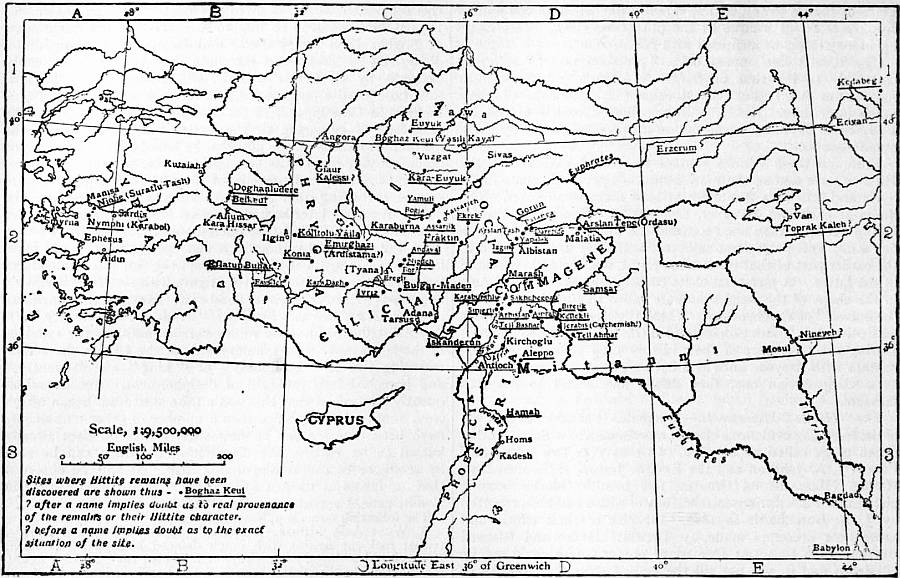
D. South Cappadocia.—Karaburna; long, incised rock-inscription. Bogja, eight hours west of Kaisariye; four-sided stela with incised inscription. Assarjik, on the side of Mt. Argaeus; incised rock-inscription. Ekrek; a fragmentary inscription in relief and an incised inscription on a stela of very late appearance. Fraktin or Farakdin (probably anc. Das-tarkon); sculptured rock-panel showing two groups of figures in act of cult, with hieroglyphs in relief. Arslan Tash, near Comana (Cappadocia), on the Soghan Dagh; two colossal lions, one with incised inscription. Tashji in the Zamanti valley; rock-relief with rudely incised inscription. Andaval and Bor; inscriptions incised on sculptured stelae of kings (?), probably from Tyana (Ekuzli Hissar). All are now in Constantinople. A silver seal with hieroglyphs, now at Oxford, came also from Bor. Nigdeh; basalt drum or altar with incised inscription. Ivriz; rock-sculpture of king adoring god, with three inscriptions in relief. A second sculpture, similar in subject but smaller and much defaced, was found hard by in 1906. Bulgar Maden; long incised rock inscription, near silver-mines. Gorun (Gurun); two rock-inscriptions in relief, much damaged. Arslan-Tepe, near Ordasu (two hours from Malatia); large mound whence two sculptured stelae or wall-blocks with inscriptions in relief have been unearthed (now in Constantinople and the Louvre). Four other reliefs, reported found near Malatia and published by J. Garstang in Annals Arch. and Anthrop., 1908, probably came also from Arslan Tepe. Palanga; lower aniconic half of draped statue with incised inscription, now in Constantinople. Also a small basalt lion. Arslan Tash, near Palanga; two rude gateway lions, uninscribed. Yapalak; defaced inscription, reported by J. S. Sterrett but never copied. Izgin; obelisk with long inscription in relief on all four faces, now in Constantinople. These last four places seem to lie on a main road leading from Cappadocia to Marash and the Syrian sites. The expedition sent out by Cornell University in 1907 found several Hittite inscriptions on rocks near Darende in the valley of the Tokhma Su.
E. North Syria.—Marash; several monuments (stelae, wall-blocks and two lions) with inscriptions, both in relief and incised (part are now at Constantinople, part in Berlin and America); evidently one of the most important of Hittite sites. Karaburshlu, Arbistan, Gerchin, Sinjerli; mounds about the head-waters of the Kara Su. The last-named mound, brought to O. Puchstein’s notice in 1882 by the chance discovery of sculptured wall-dados, now in Constantinople, was the scene of extensive German excavations in 1893-1894, directed by F. v. Luschan and K. Koldewey, and was found to cover a walled town with central fortified palace. Hittite, cuneiform and old Aramaean monuments were found with many small objects, most of which have been taken to Berlin; but no Hittite inscriptions came to light. Sakchegeuzu (Sakchegözu), a site with several mounds between Sinjerli and Aintab; series of reliefs, once wall-dados, now in Berlin and Constantinople. This site is in process of excavation by Professor J. Garstang of the University of Liverpool. A sculptured portico has come to light in the smallest of the five mounds, and much pottery, with incised and painted decoration, has been recovered. Aintab; fragment of relief inscription. Samsat (Samosata); sculptured stela with incised inscription much defaced. Jerablus; see above. Several Hittite objects sent from Birejik and Aintab to Europe probably came from Jerablus, others from Tell Bashar on the Sajur. Kellekli, near Jerablus; two stelae, one with relief inscription. Iskanderun (Alexandretta); source of a long inscription cut on both sides of a spheroidal object of unknown origin. Kirchoglu, a site on the Afrin, whence a fragmentary draped statue with incised inscription was sent to Berlin. Aleppo; inscription in relief (see above). Tell Ahmar (on left bank of Euphrates); large stela with sculpture and long relief inscription, found in 1908 with several sculptured slabs and two gateway lions, inscribed in cuneiform. Two hours south, a lion and a fragment of a relief inscription were found in 1909 by Miss G. L. Bell. Tell Halaf in Mid-Mesopotamia, near Ras el-Ain; sculptures on portico of a temple or palace; cuneiform inscriptions and large mounds, explored in 1902 by Oppenheim. Hamah; five blocks inscribed in relief (see above).
F. Outlying Sites.—Erzerum; source of an incised inscription, perhaps not originally found there. Kedabeg; metal boss or hilt-top with pictographs, found in a tomb and stated by F. Hommel to be Hittite, but doubtful. Toprak Kaleh; bronze fragments with two pictographs; doubtful if Hittite. Nineveh; sealings, see above. Babylon; a bowl and a stela of storm-god, both with incised inscriptions; doubtless spoil of war or tribute brought from Syria. The bowl is inscribed round the outside, the stela on the back.
(For a detailed description of the subjects of the reliefs, &c., with the necessary illustrations, see the works indicated in the bibliography.)
Structures.—The structural remains found as yet on Hittite sites are few, scanty and far between. They consist of: (a) Ground plans of a palatial building and three temples and fortifications with sculptured gate at Boghaz Keui. The palace was built round a central court, flanked by passages and entered by a doorway of three battants hung on two columns. The whole plan bears more than a superficial resemblance to those of Cretan palaces in the later Minoan period. Only the rough core of the walls is standing to a height of about 3 ft. The fortifications of the citadel have an elaborate double gate with flanking towers, (b) Fortifications, palace, &c., at Sinjerli. The gates here are more elaborate than at Boghaz Keui, but planned with the same idea—that of entrapping in an enclosed space, barred by a second door, an enemy who may have forced the first door, while flanking towers would add to his discomfiture. The palace plan is again rectangular, with a central pillared hall, and very similar in plan to that of Boghaz Keui. The massive walls are also of similar construction. Dados of relief-sculpture run round the inner walls; this feature seems to have been common to Hittite buildings of a sumptuous kind, and accounts for most of the sculptured blocks that have been found, e.g. at Jerablus, Sakhchegeuzu, Euyuk, Arslan Tepe, &c. Columns, probably of wood, rested on bases carved as winged lions, (c) Gate with sculptured approach at Euyuk. The ground plan of the gate is practically the same in idea as that at Sinjerli. Structures were found at Jerablus, but never properly uncovered or planned, (d) Sculptured porticoes of temples or palaces uncovered at Sakchegeuzu and Tell Halaf (see above). On other sites, e.g. Arslan Tepe (Ordasu), Arbistan, Marash (above the modern town and near the springs), Beikeui, mounds, doubtless covering structures, may be seen, and sculptured slabs have been recovered. The mounds, probably Hittite, in N. Syria alone are to be counted by hundreds. No tombs certainly Hittite have been found,4 though it is possible that some of the reliefs (e.g. at Fraktin) are of funerary character.
Sculptures and other Objects of Art.—The sculptures hitherto found consist of reliefs on rocks and on stelae, either honorific or funerary; reliefs on blocks forming parts of wall-dados; and a few figures more or less in the round, though most of these (e.g. the sphinxes of Euyuk and the lions of Arslan Tash and Marash) are not completely disengaged from the block. The most considerable sculptured rock-panels are at Boghaz Keui (see Pteria); the others (Ivriz, Fraktin, Karabel, Giaur Kalessi, Doghanlüdere), it should be observed, all lie N. of Taurus—a fact of some bearing on the problem of the origin and local domicile of the art, since rock-reliefs, at any rate, cannot be otherwise than in situ. Sculptured stelae, honorific or funerary, all with pyramidal or slightly rounded upper ends, and showing a single regal or divine figure or two figures, have come to light at Bor, Marash, Sinjerli, Jerablus, Babylon, &c. These, like most of the rock-panels, are all marked as Hittite by accompanying pictographic inscriptions. The wall-blocks are seldom inscribed, the exceptions (e.g. the Arslan Tepe lion-hunt and certain blocks from Marash and Jerablus) being not more certainly wall-dados than stelae. The only fairly complete anthropoid statue known is the much-defaced “Niobe” at Suratlu Tash, engaged in the rock behind. The aniconic lower part of an inscribed statue wholly in the round was found at Palanga, and parts of others at Kirchoglu and Marash. Despite considerable differences in execution and details, all these sculptures show one general type of art, a type which recalls now Babylonian, now Assyrian, now Egyptian, now archaic Ionian, style, but is always individual and easily distinguishable from the actual products of those peoples. The figures, whether of men or beasts, are of a squat, heavy order, with internal features (e.g. bones, muscles, &c.) shown as if external, as in some Mesopotamian sculptures. The human type is always very brachycephalic, with brow receding sharply and long nose making almost one line with the sloping forehead. In the sculptures of the Commagene and the Tyana districts, the nose has a long curving tip, of very Jewish appearance, but not unlike the outline given to Kheta warriors in Egyptian scenes. The lips are full and the chin short and shaven. The whole physiognomy is fleshy and markedly distinct from that of other Syrians. At Boghaz Keui, Euyuk and Jerablus, the facial type is very markedly non-Semitic. But not much stress can be laid on these differences owing to (1) great variety of execution in different sculptures, which argues artists of very unequal capacity; (2) doubt whether individual portraits are intended in some cases and not in others. The hair of males is sometimes, but not always, worn in pigtail. The fashions of head-covering and clothes are very various, but several of them—e.g. the horned cap of the Ivriz god; the conical hat at Boghaz Keui, Fraktin, &c; the “jockey-cap” on the Tarkudimme boss; the broad-bordered over-robe, and the upturned shoes—are not found on other Asiatic monuments, except where Hittites are portrayed. Animals in profile are represented more naturalistically than human beings, e.g. at Yasili Kaya, and especially in some pictographic symbols in relief (e.g. at Hamah). This, however, is a feature common to Mesopotamian and Egyptian, and perhaps to all primitive art.
The subjects depicted are processions of figures, human and divine (Yasili Kaya, Euyuk, Giaur Kalessi); scenes of sacrifice or adoration, or other cult-practice (Yasili Kaya, Euyuk, Fraktin, Ivriz, and perhaps the figures seated beside tables at Marash Sakchegeuzu, Sinjerli, &c.); of the chase (Arslan Tepe, Sakchegeuzu); but not, as known at present, of battle. Both at Euyuk and Yasili Kaya reliefs in one and the same series are widely separated in artistic conception and execution, some showing the utmost naïveté, others expressing both outline and motion with fair success. The fact warns us against drawing hasty inductions as to relative dates from style and execution.
Besides sculptures, well assured, Hittite art-products include a few small objects in metal (e.g. heavy, inscribed gold ring bought by Sir W. M. Ramsay at Konia; base silver seal, supported on three lions’ claws, bought by D. G. Hogarth at Bor; inscribed silver boss of “Tarkudimme,” mentioned above, &c. &c.); many intaglios in various stones (chiefly in steatite), mostly either spheroidal or gable-shaped, but a few scarabaeoid, conical or cylindrical, bearing sometimes pictographic symbols, sometimes divine, human or animal figures. The best collection is at Oxford. The majority are of very rude workmanship, bodies and limbs being represented by mere skeleton lines or unfilled outlines; a few vessels (e.g. inscribed basalt bowl found at Babylon) and fragments of ware painted with dark ornament on light body-clay, or in polychrome on a cream-white slip, or black burnished, found on N. Cappadocian sites, &c. The bronzes hitherto claimed as Hittite have been bought on the Syrian coast or come from not certainly Hittite sites in Cappadocia (see E. Chantre, Mission en Cappadocie). A great many small objects were found in the excavations at Sinjerli, including carved ivories, seals, toilet-instruments, implements, &c., but these have not been published. Nor, except provisionally, has the pottery, found at Sakchegeuzu.
Inscriptions.—These, now almost sixty in number (excluding seals), are all in a pictographic character which employed symbols somewhat elaborately depicted in relief, but reduced to conventional and “shorthand” representations in the incised texts. So far, the majority of our Hittite inscriptions, like those first found at Hamah, are in relief (cameo); but the incised characters, first observed in the Tyana district, have since been shown, by discoveries at Marash, Babylon, &c., to have had a wider range. It has usually been assumed that the incised inscriptions, being the more conventionalized, are all of later date than those in relief; but comparison of Egyptian inscriptions, wherein both incised and cameo characters coexisted back to very early times, suggests that this assumption is not necessarily correct. The Hittite symbols at present known show about two hundred varieties; but new inscriptions continually add to the list, and great uncertainty remains as to the distinction of many symbols (i.e. whether mere variants or not), and as to many others which are defaced or broken in our texts. The objects represented by these symbols have been certainly identified in only a few instances. A certain number are heads (human and animal) detached from bodies, in a manner not known in the Egyptian hieroglyphic system, with which some of the other symbols show obvious analogies. Articles of dress, weapons, tools, &c., also appear. The longer inscriptions are disposed in horizontal zones or panels, divided by lines, and, it seems, they were to be read boustrophedon, not only as regards the lines (which begin right to left) but also the words, which are written in columnar fashion, syllable below syllable, and read downwards and upwards alternately. The direction of reading is towards any faces which may be shown among the pictographs. The words are perhaps distinguished in some texts by punctuation marks.
Long and patient efforts have been made to decipher this script, ever since it was first restored to our knowledge; and among the would-be decipherers honourable mention must be made, for persistence and courage, of Professor A. H. Sayce and of Professor P. Jensen. Other interpretations have been put forward by F. E. Peiser (based on conjectures as to the names on the Nineveh sealings), C. R. Conder (based largely on Cypriote comparisons and phonetic values transferred from these) and C. J. Ball (based on Hittite names recorded on Egyptian and Assyrian monuments, and applied to word-groups on the Hittite monuments). These, however, as having arbitrary and inadequate foundations, and for other reasons, have not been accepted. F. Hommel, J. Halévy and J. Menant have done useful work in distinguishing word-groups, and have essayed partial interpretations. No other decipherers call for mention. A. H. Sayce and P. Jensen alone have enlisted any large body of adherents; and the former, who has worked upon his system for thirty years and published in the Proceedings of the Society for Biblical Archaeology for 1907 a summary of his method and results, has proceeded on the more scientific plan. His system, however, like all others, is built in the main upon hypotheses incapable at present of quite satisfactory verification, such, for example, as the conjectural reading “Gargamish” for a group of symbols which recurs in inscriptions from Jerablus and elsewhere. In this case, to add to the other obvious elements of uncertainty, it must be borne in mind that the location of Carchemish at Jerablus is not proved, though it is very probable. Other conjectural identifications of groups of symbols with the place-names Hamath, Marash, Tyana are bases of Sayce’s system. Jensen’s system may be said to have been effectually demolished by L. Messerschmidt in his Bemerkungen (1898); but Sayce’s system, which has been approved by Hommel and others, is probably in its main lines correct. Its frequent explanation, however, of incompatible symbols by the doctrines of phonetic variation and interchange, or by alternative values of the same symbol used as ideograph, determinative or phonetic complement, and the occasional use of circular argument in the process of “verification,” do not inspire confidence in other than its broader results. Sayce’s phonetic values and interpretations of determinatives are his best assured achievements. But the words thus arrived at represent a language on which other known tongues throw little or no light, and their meaning is usually to be guessed only. In some significant cases, however, the Boghaz Keui tablets appear to give striking confirmation of Sayce’s conjectures.
Writing in 1903 L. Messerschmidt, editor of the best collection of Hittite texts up to date, made a tabula rasa of all systems of decipherment, asserting that only one sign out of two hundred—the bisected oval, determinative of divinity—had been interpreted with any certainty; and in view of this opinion, coupled with the steady refusal of historians to apply the results of any Hittite decipherment, and the obvious lack of satisfactory verification, without which the piling of hypothesis on hypothesis may only lead further from probability, there is no choice but to suspend judgment for some time longer as to the inscriptions and all deductions drawn from them.
Are the Monuments Hittite?—It is time to ask this question, although a perfectly satisfactory answer can only be expected when the inscriptions themselves have been deciphered. Almost all “Hittitologues” assume a connexion between the monuments and the Kheta-Khatti-Hittites, but in various degrees; e.g. while Sayce has said roundly that common sense demands the acceptance of all as the work of the Hittites, who were the dominant caste throughout a loosely-knit empire extending at one time from the Orontes to the Aegean, Messerschmidt has stated with equal dogmatism that the Hittites proper were only one people out of many5 in N. Syria and Asia Minor who shared a common civilization, and that therefore they were authors of a part of the monuments only—presumably the N. Syrian, Commagenian and Cataonian groups. O. Puchstein6 has denied to the Hittites some of the N. Syrian monuments, holding these of too late a date (judged by their Assyrian analogies) for the flourishing period of the Kheta-Khatti, as known from Egyptian and Assyrian records. He would ascribe them to the Kummukh (Commagenians), who seem to have succeeded the Khatti as the strongest opponents of Assyria in these parts. He was possibly right as regards the Sinjerli and Sakchegeuzu sculptures, which are of provincial appearance. The following considerations, however, may be stated in favour of the ascription of the monuments to the Hittites:—
(1) The monuments in question are found frequently whereever, from other records, we know the Hittites to have been domiciled at some period, i.e. throughout N. Syria and in Cataonia. (2) It was under the Khatti that Carchemish was a flourishing commercial city; and if Jerablus be really Carchemish, it is significant that apparently the most numerous and most artistic of the monuments occur there. (3) Among all the early peoples of N. Syria and Asia Minor known to us from Egyptian and Assyrian records, the Kheta-Khatti alone appear frequently as leading to war peoples from far beyond Taurus. (4) The Kheta certainly had a system of writing and a glyptic art in the time of Rameses II., or else the Egyptian account of their copy of the treaty would be baseless. (5) The physiognomy given to Kheta warriors by Egyptian artists is fairly representative of the prevailing type shown in the Hittite sculptures.
Furthermore, the Boghaz Keui tablets, though only partially deciphered as yet, go far to settle the question. They show that whether Boghaz Keui was actually the capital of the Hatti or not, it was a great city of the Hatti, and that the latter were an important element in Cappadocia from very early times. Before the middle of the 16th century B.C. the Cappadocian Hatti were already in relations, generally more or less hostile, with a rival power in Syria, that of Mitanni; and Subbiluliuma (= Saplel or Saparura), king of these Hatti, a contemporary of Amenophis IV. and Rameses I., seems to have obtained lasting dominion in Syria by subduing Dushratta of Mitanni. Carchemish thenceforward became a Hatti city and the southern capital of Cappadocian power. Since all the Syrian monuments of the Hittite class, so far known, seem comparatively late (most show such strong Assyrian, influence that they must fall after 1100 B.C. and probably even considerably later), while the North Cappadocian monuments (as Sayce, Ramsay, Perrot and others saw long ago) are the earlier in style, we are bound to ascribe the origin of the civilization which they represent to the Cappadocian Hatti.
Whether the Mitanni had shared in that civilization while independent, and whether they were racially kin to the Hatti, cannot be determined at present. Winckler has adduced evidence from names of local gods to show that there was an Indo-European racial element in Mitanni; but none for a similar element in the Hatti, whose chief god was Teshub. The majority of scholars has always regarded the Hittites proper as, at any rate, non-Semitic, and some leading authorities have called them proto-Armenian, and believed that they have modern descendants in the Caucasus. This racial question can hardly be determined till those Hatti records, whether in cuneiform or pictographic script, which are couched in a native tongue, not in Babylonian, are read. In the meantime we have proper names to argue from; and these give us at least the significant indication that the Hittite nominative ended in s and the accusative in m. In any case the connexion of the Hatti with the peculiar class of monuments which we have been describing, can hardly be further questioned; and it has become more than probable that the Hatti of Cappadocia were responsible in the beginning for the art and script of those monuments and for the civilization of which they are memorials. Other peoples of north Syria and Asia Minor (e.g. the Kummukh or Commagenians and the Muski or Phrygians) came no doubt under the influence of this civilization and imitated its monuments, while subject to or federated with the Hatti. Through Phrygia and Lydia (q.v.) influences of this same Cappadocian civilization passed towards the west; and indeed, before the Greek colonization of Asia Minor, a loosely knit Hatti empire may have stretched even to the Aegean. The Nymphi (Kara Bel) and Niobe sculptures near Smyrna are probably memorials of that extension. Certainly some inland Anatolian power seems to have kept Aegean settlers and culture away from the Ionian coast during the Bronze Age, and that power was in all likelihood the Hatti kingdom of Cappadocia. Owing perhaps to Assyrian aggression, this power seems to have begun to suffer decay about 1000 B.C. and thereafter to have shrunk inwards, leaving the coasts open. The powers of Phrygia and Lydia rose successively out of its ruins, and continued to offer westward passage to influences of Mesopotamian culture till well into historic times. The Greeks came too late to Asia to have had any contact with Hatti power obscured from their view by the intermediate and secondary state of Phrygia. Their earliest writers regarded the latter as the seat of the oldest and most godlike of mankind. Only one Greek author, Herodotus, alludes to the pre-historic Cappadocian power and only at the latest moment of its long decline. At the same time, some of the Greek legends seem to show that peoples, with whom the Greeks came into early contact, had vivid memories of the Hatti. Such are the Amazon stories, whose local range was very extensive, and the myths of Memnon and Pelops. The real reference of these stories, however, was forgotten, and it has been reserved to our own generation to rediscover the records of a power and a civilization which once dominated Asia Minor and north Syria and occupied all the continental roads of communication between the East and the West of the ancient world. The credit of having been the first to divine this importance of the Hittites should always be ascribed to Sayce.
The history of the Hatti and their civilization, then, would appear to have been, very briefly, this. They belonged to an ethnic scattered widely over Eastern Asia Minor and Syria at an early period (Khatti invaded Akkad about 1800 B.C. in the reign of Samsuditana); but they first formed a strong state in Cappadocia late in the 16th century B.C. Subbiluliuma became their first great king, though he had at least one dynastic predecessor of the name of Hattusil. The Hatti now pushed southwards in force, overcame the kingdom of Mitanni and proceeded partly to occupy and partly to make tributary both north Syria and western Mesopotamia where some of their congeners were already settled. They came early into collision with Egypt, and at the height of their power under Hattusil II. fought the battle of Kadesh with Rameses II., on at least equal terms. Both now and previously the diplomatic correspondence of the Hatti monarchs shows that they treated on terms of practical equality with both the Babylonian and the Egyptian courts; and that they waged constant wars in Syria, mainly with the Amorite tribes. At this time the Hatti empire or confederacy probably included, on the west, both Phrygia and Lydia. The Boghaz Keui correspondence ceases to be important with the generation following Hattusil II., and in the Assyrian records, which begin about a couple of centuries later, we find Carchemish the chief Hatti city and N. Syria called the Hatti-land. It is possible therefore that a change of imperial centre took place after the Hatti had ceased to fear Egypt in north Syria. If so, the continuation of Hittite history will have to be sought among the remains at Jerablus and other middle Euphratean sites, rather than in those at Boghaz Keui. The establishment of the Hatti at Carchemish not only made them a commercial people and probably sapped their highland vigour, but also brought them into closer proximity to the rising North Semitic power of Assyria, whose advent had been regarded with apprehension by Hattusil II. (see above). One of his successors, Arnaunta (late 13th century?), was already feeling the effect of Assyrian pressure, and with the accession of Tiglath Pileser I., about a century later, a long but often interrupted series of Assyrian efforts to break up the Hatti power began. A succession of Ninevite armies raided north Syria and even south-east Asia Minor, and gradually reduced the Hatti. But the resistance of the latter was sturdy and prolonged. They remained the strongest power in Syria and eastern Asia Minor till well into the first millennium B.C., and their Syrian seat was not lost finally till after the great extension of Assyrian power which took place in the latter part of the 9th century. What had been happening to their Cappadocian province meanwhile we do not yet know; but the presence of Phrygian inscriptions at Euyuk and Tyana, ancient seats of their power, suggests that the client monarchy in the Sangarius valley shook itself free during the early part of the Hittite struggle with Assyria, and in the day of Hatti weakness extended its dominion over the home territory of its former suzerain. “White Syrians,” however, were still in Cappadocia even after the Cimmerians had destroyed the Phrygian monarchy, allowing Lydia to become independent under the Mermnad dynasty. Croesus found them centred at Pteria in the 6th century and dealt them a final blow. But much of their secular or religious custom lived on to be recorded by Greek writers, and regarded by modern scholars as typically “Anatolian.”
Bibliography.—General summaries: L. Messerschmidt, The Hittites (“Ancient East” series, vi., 1903); A. H. Sayce, The Hittites (“Bypaths of Biblical Knowledge” series, xii., 2nd ed. 1892); G. Perrot and C. Chipiez, History of Art in Sardinia, Judaea, Syria and Asia Minor (Eng. trans., vol. ii., 1890); L. Lantsheere, De la race et de la langue des Hétéens (1891); P. Jensen, Hittiter und Armenier (1898); M. Jastrow, final chapter in H. V. Hilprecht, Exploration in Bible Lands (1903); W. Wright, Empire of the Hittites (1884); F. Hommel, Hettiter und Skythen (1898); D. G. Hogarth, Ionia and the East (1909); W. Max Müller, Asien und Europa, chap. xxv. (1893). See also authorities for Egyptian and Assyrian history.
Inscriptions: L. Messerschmidt, “Corpus inscr. Hettiticarum,” Zeitsch. d. d. morgenländ. Gesellschaft (1900, 1902, 1906, &c.), and “Bemerkungen zu d. Heth. Inschriften,” Mitteil. d. vorderasiat. Gesellschaft (1898); P. Jensen, “Grundlagen für eine Entzifferung der (Hat. oder) Cilicischen Inschriften,” Zeitschr. d. d. morgenländ. Gesellschaft (1894); F. E. Peiser, Die Hettitischen Inschriften (1892); A. H. Sayce, “Decipherment of the Hittite Inscriptions,” Proc. Soc. of Bibl. Archaeology (1903), and “Hittite Inscriptions, translated and annotated,” ibid. (1905, 1907); J. Menant, “Études Hétéennes,” Recueil de travaux rel. à la philologie, &c., and Mém. de l’Acad. Inscr., vol. xxxiv. (1890); J. Halévy in Revue sémitique, vol. i. Also divers articles by A. H. Sayce, F. Hommel and others in Proc. and Trans. Soc. Bibl. Arch. since 1876, and in Recueil de travaux, &c., since its beginning.
Exploration: G. Perrot and E. Guillaume, Exploration arch. de la Galatie, &c. (1862-1872); E. Chantre, Mission en Cappadocie (1898); Sir W. M. Ramsay, “Syro-Cappadocian Monuments,” in Athen. Mitteilungen (1889), with D. G. Hogarth, “Pre-Hellenic Monuments of Cappadocia,” in Recueil de travaux, &c. (1892-1895); and with Miss Gertrude Bell, The Thousand and One Churches (1909); C. Humann and O. Puchstein, Reisen in Nord-Syrien, &c. (1890). J. Garstang in Annals of Archaeology and Anthropology, i. (1908) and following numbers. Reports on excavations at Sinjerli in Berl. Philol. Wochenschrift (1891), pp. 803, 951; and F. von Luschan, and others, “Ausgrabungen in Sendschirli” in Mitteil. Orient-Sammlungen (Berlin Museum, 1893 ff.); and on excavations at Boghaz-Keui, H. Winckler in Orient. Literaturzeitung (Berlin, 1907); Mitteil. Orient-Gesellschaft (Dec. 1907). See also s.v. Pteria.
(D. G. H.)
1 First described by the Turk, Hajji Khalifa, in the 17th century; first seen by the Swedish traveller Otter in 1736, and first published in 1840 in Ritter’s Erdkunde, iii., after a drawing by Major Fischer, made in 1837.
2 The “Niobe” statue near Manisa was not definitely known for “Hittite” till 1882, when G. Dennis detected pictographs near it.
3 The “pseudo-Sesostres” of Herodotus, already demonstrated non-Egyptian by Rosellini. The second figure was unknown, till found by Dr Beddoe in 1856.
4 Five intramural graves were explored at Sinjerli, but whether of the Hittite or of the Assyrian occupation is doubtful.
5 The Assyrian records, as well as the Egyptian, distinguish many peoples in both areas from the Kheta-Khatti; and the most we can infer from these records is that there was an occasional league formed under the Hittites, not any imperial subjection or even a continuous federation.
6 Pseudo-Hethitische Kunst (Berlin, 1890).
HITTORFF, JACQUES IGNACE (1792-1867), French architect, was born at Cologne on the 20th of August 1792. After serving an apprenticeship to a mason in his native town, he went in 1810 to Paris, and studied for some years at the Academy of Fine Arts, where he was a favourite pupil of Bélanger, the government architect, who in 1814 appointed him his principal inspector. Succeeding Bélanger as government architect in 1818, he designed many important public and private buildings in Paris and also in the south of France. From 1819 to 1830 in collaboration with le Cointe he directed the royal fêtes and ceremonials. After making architectural tours in Germany, England, Italy and Sicily, he published the result of his observations in the latter country in the work Architecture antique de la Sicile (3 vols., 1826-1830; new edition, 1866-1867), and also in Architecture moderne de la Sicile (1826-1835). One of his important discoveries was that colour had been made use of in ancient Greek architecture, a subject which he especially discussed in Architecture polychrome chez les Grecs (1830) and in Restitution du temple d’Empédocle à Sélinunte (1851); and in accordance with the doctrines enunciated in these works he was in the habit of making colour an important feature in most of his architectural designs. His principal building is the church of St Vincent de Paul in the basilica style, which was constructed between 1830 and 1844. He also designed the two fountains in the Place de la Concorde, the Circus of the Empress, the Rotunda of the panoramas, many cafés and restaurants of the Champs Elysées, the houses forming the circle round the Arc de Triomphe de l’Étoile, besides many embellishments of the Bois de Boulogne and other places. In 1833 he was elected a member of the Academy of Fine Arts. He died in Paris on the 25th of March 1867.
HITZACKER, a town of Germany, in the Prussian province of Hanover at the influx of the Jeetze into the Elbe, 33 m. N.E. of Lüneburg by the railway to Wittenberge. Pop. (1905) 1106. It has an Evangelical church and an old castle and numerous medieval remains. There are chalybeate springs and a hydropathic establishment in the town. The famous library now in Wolfenbüttel was originally founded here by Augustus, duke of Brunswick (d. 1666) and was removed to its present habitation in 1643.
HITZIG, FERDINAND (1807-1875), German biblical critic, was born at Hauingen, Baden, where his father was a pastor, on the 23rd of June 1807. He studied theology at Heidelberg under H. E. G. Paulus, at Halle under Wilhelm Gesenius and at Göttingen under Ewald. Returning to Heidelberg he became Privatdozent in theology in 1829, and in 1831 published his Begriff der Kritik am Alten Testamente praktisch erörtert, a study of Old Testament criticism in which he explained the critical principles of the grammatico-historical school, and his Des Propheten Jonas Orakel über Moab, an exposition of the 15th and 16th chapters of the book of Isaiah attributed by him to the prophet Jonah mentioned in 2 Kings xiv. 25. In 1833 he was called to the university of Zürich as professor ordinarius of theology. His next work was a commentary on Isaiah with a translation (Übersetzung u. Auslegung des Propheten Jesajas), which he dedicated to Heinrich Ewald, and which Hermann Hupfeld (1796-1866), well known as a commentator on the Psalms (1855-1861), pronounced to be his best exegetical work. At Zürich he laboured for a period of twenty-eight years, during which, besides commentaries on The Psalms (1835-1836; 2nd ed., 1863-1865), The Minor Prophets (1838; 3rd ed., 1863), Jeremiah (1841; 2nd ed., 1866), Ezekiel (1847), Daniel (1850), Ecclesiastes (1847), Canticles (1855), and Proverbs (1858), he published a monograph, Über Johannes Markus u. seine Schriften (1843), in which he maintained the chronological priority of the second gospel, and sought to prove that the Apocalypse was written by the same author. He also published various treatises of archaeological interest, of which the most important are Die Erfindung des Alphabets (1840), Urgeschichte u. Mythologie der Philistäer (1845), and Die Grabschrift des Eschmunezar(1855). After the death of Friedrich Umbreit (1795-1860), one of the founders of the well-known Studien und Kritiken, he was called in 1861 to succeed him as professor of theology at Heidelberg. Here he wrote his Geschichte des Volkes Israel (1869-1870), in two parts, extending respectively to the end of the Persian domination and to the fall of Masada, A.D. 72, as well as a work on the Pauline epistles, Zur Kritik Paulinischer Briefe (1870), on the Moabite Stone, Die Inschrift des Mescha (1870), and on Assyrian, Sprache u. Sprachen Assyriens (1871), besides revising the commentary on Job by Ludwig Hirzel (1801-1841), which was first published in 1839. He was also a contributor to the Monatsschrift des wissenschaftlichen Vereins in Zürich, the Zeitschrift der deutschen morgenländischen Gesellschaft, the Theologische Studien u. Kritiken, Eduard Zeller’s Theologische Jahrbücher, and Adolf Hilgenfeld’s Zeitschrift für wissenschaftliche Theologie. Hitzig died at Heidelberg on the 22nd of January 1875. As a Hebrew philologist he holds high rank; and as a constructive critic he is remarkable for acuteness and sagacity. As a historian, however, some of his speculations have been considered fanciful. “He places the cradle of the Israelites in the south of Arabia, and, like many other critics, makes the historical times begin only with Moses” (F. Lichtenberger, History of German Theology, p. 569).
His lectures on biblical theology (Vorlesungen über biblische Theologie u. messianische Weissagungen) were published in 1880 after his death, along with a portrait and biographical sketch by his pupil, J. J. Kneucker (b. 1840), professor of theology at Heidelberg. See Heinrich Steiner, Ferdinand Hitzig (1882); and Adolf Kamphausen’s article in Herzog-Hauck’s Realencyklopädie.
HIUNG-NU, Hiong-nu, Heung-nu, a people who about the end of the 3rd century B.C. formed, according to Chinese records, a powerful empire from the Great Wall of China to the Caspian. Their ethnical affinities have been much discussed; but it is most probable that they were of the Turki stock, as were the Huns, their later western representatives. They are the first Turkish people mentioned by the Chinese. A theory which seems plausible is that which assumes them to have been a heterogenous collection of Mongol, Tungus, Turki and perhaps even Finnish hordes under a Mongol military caste, though the Mongolo-Tungus element probably predominated. Towards the close of the 1st century of the Christian era the Hiung-nu empire broke up. Their subsequent history is obscure. Some of them seem to have gone westward and settled on the Ural river. These, de Guiques suggests, were the ancestors of the Huns, and many ethnologists hold that the Hiung-nu were the ancestors of the modern Turks.
See Journal Anthropological Institute for 1874; Sir H. H. Howorth, History of the Mongols (1876-1880); 6th Congress of Orientalists, Leiden, 1883 (Actes, part iv. pp. 177-195); de Guiques, Histoire générale des Huns, des Turcs, des Mongoles, et des autres Tartares occidentaux (1756-1758).
HIVITES, an ancient tribe of Palestine driven out by the invading Israelites. In Josh. ix. 7, xi. 19 they are connected with Gibeon. The meaning of the name is uncertain; Wellhausen derives it from חוה “Eve,” or “serpent,” in which case the Hivites were originally the snake clan; others explain it from the Arabic hayy, “family,” as meaning “dwellers in (Bedouin) encampments.” (See Palestine; Jews.)
HJÖRRING, an ancient town of Denmark, capital of the amt (county) of its name, in the northern insular part of the peninsula of Jutland. Pop. (1901) 7901. It lies 7 m. inland from the shore of Jammer Bay, a stretch of coast notoriously dangerous to shipping. On the coast is Lönstrup, a favoured seaside resort. In this neighbourhood as well as to the south-east of Hjörring, slight elevations are seen, deserving the name of hills in this low-lying district. Hjörring is on the northern railway of Jutland, which here turns eastward to the Cattegat part of Frederikshavn (23 m.), a harbour of refuge.
HKAMTI LÔNG (called Kantigyi by the Burmese, and Bor Hkampti by the peoples on the Assam side), a collection of seven Shan states subordinate to Burma, but at present beyond the administrative border. Estimated area, 900 sq. m.; estimated pop. 11,000. It lies between 27° and 28° N. and 97° and 98° E., and is bordered by the Mishmi country on the N., by the Patkai range on the W., by the Hukawng valley on the S. and E., and indeed all round by various Chingpaw or Kachin communities. The country is little known. It was visited by T. T. Cooper, the Chinese traveller and political agent at Bhamo, where he was murdered; by General Woodthorpe and Colonel Macgregor in 1884, by Mr Errol Grey in the following year, and by Prince Henry of Orleans in 1895. All of these, however, limited their explorations to the valley of the Mali-hka, the western branch of the Irrawaddy river. Hkamti has shrunk very much from its old size. It was no doubt the northernmost province of the Shan kingdom, founded at Mogaung by Sam Lōng-hpa, the brother of the ruler of Kambawsa, when that empire had reached its greatest extension. The irruption of Kachins or Chingpaw from the north has now completely hemmed the state in. Prince Henry of Orleans described it as “a splendid territory, fertile in soil and abundant in water, where tropical and temperate culture flourish side by side, and the inhabitants are protected on three fronts by mountains.” According to him the Kiutze, the people of the hills between the Irrawaddy and the Salween, call it the kingdom of Moam.
HLOTHHERE, king of Kent, succeeded his brother Ecgberht in 673, and appears for a time to have reigned jointly with his nephew Eadric, son of Ecgberht, as a code of laws still extant was issued under both names. Neither is mentioned in the account of the invasion of Æthelred in 676. In 685 Eadric, who seems to have quarrelled with Hlothhere, went into exile and led the South Saxons against him. Hlothhere was defeated and died of his wounds.
See Bede, Hist. eccl. (Plummer), iv. 5, 17, 26, v. 24; Saxon Chronicle (Earle and Plummer), s.a. 685; Schmid, Gesetze, pp. 10 sqq.; Thorpe, Ancient Laws, i. 26 sqq.
HOACTZIN, or Hoatzin, a bird of tropical South America, thought by Buffon to be that indicated by Hernandez or Fernandez under these names, the Opisthocomus hoazin or O. cristatus of modern ornithologists—a very curious and remarkable form, which has long exercised the ingenuity of classifiers. Placed by Buffon among his “Hoccos” (Curassows), and then by P. L. S. Müller and J. F. Gmelin in the Linnaean genus Phasianus, some of its many peculiarities were recognized by J. K. W. Illiger in 1811 as sufficient to establish it as a distinct genus, Opisthocomus; but various positions were assigned to it by subsequent systematic authors. L’Herminier was the first to give any account of its anatomy (Comptes rendus, 1837, v. 433), and from his time our knowledge of it has been successively increased by Johannes Müller (Ber. Akad. Wissensch. Berlin, 1841, p. 177), Deville (Rev. et mag. de zoologie, 1852, p. 217), Gervais (Castelnau, Expéd. Amérique du Sud, zoologie, anatomie, p. 66), Huxley (Proc. Zool. Society, 1868, p. 304), Perrin (Trans. Zool. Society, ix. p. 353), and A. H. Garrod (Proc. Zool. Society, 1879, p. 109). After a minute description of the skeleton of Opisthocomus, with the especial object of determining its affinities, Huxley declared that it “resembles the ordinary gallinaceous birds and pigeons more than it does any others, and that when it diverges from them it is either sui generis or approaches the Musophagidae.” He accordingly regarded it as the type and sole member of a group, named by him Heteromorphae, which sprang from the great Carinate stem later than the Tinamomorphae, Turnicomorphae, or Charadriomorphae, but before the Peristeromorphae, Pteroclomorphae or Alectoromorphae. This conclusion is substantially the same as that at which A. H. Garrod subsequently arrived after closely examining and dissecting specimens preserved in spirit; but the latter has gone further and endeavoured to trace more particularly the descent of this peculiar form and some others, remarking that the ancestor of Opisthocomus must have left the parent stem very shortly before the true Gallinae first appeared, and at about the same time as the independent pedigree of the Cuculidae and Musophagidae commenced—these two groups being, he believed, very closely related, and Opisthocomus serving to fill the gap between them.
The first thing that strikes the observer of its skeleton is the extraordinary structure of the sternal apparatus, which is wholly unlike that of any other bird known. The keel is only developed on the posterior part of the sternum—the fore part being, as it were, cut away, while the short furcula at its symphysis meets the manubrium, with which it is firmly consolidated by means of a prolonged and straight hypocleidium, and anteriorly ossifies with the coracoids. This unique arrangement seems to be correlated with the enormously capacious crop, which rests upon the furcula and fore part of the sternum, and is also received in a cavity formed on the surface of each of the great pectoral muscles. Furthermore this crop is extremely muscular, so as more to resemble a gizzard, and consists of two portions divided by a partial constriction, after a fashion of which no other example is known among birds. The true gizzard is greatly reduced.
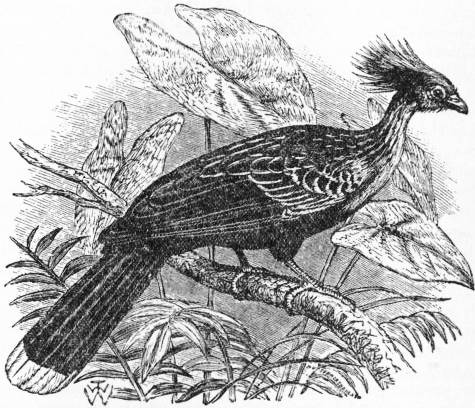
Hoactzin.
The hoactzin appears to be about the size of a small pheasant, but is really a much smaller bird. The beak is strong, curiously denticulated along the margin of the maxilla near the base, and is beset by diverging bristles. The eyes, placed in the middle of a patch of bare skin, are furnished with bristly lashes, resembling those of horn-bills and some few other birds. The head bears a long pendant crest of loose yellowish feathers. The body is olive-coloured, varied with white above, and beneath is of a dull bay. The wings are short and rounded. The tail is long and tipped with yellow. The legs are rather short, the feet stout, the tarsi reticulated, and the toes scutellated; the claws long and slightly curved. According to all who have observed the habits of this bird, it lives in bands on the lower trees and bushes bordering the streams and lagoons, feeding on leaves and various wild fruits, especially, says H. W. Bates (Naturalist on the River Amazons, i. 120), those of a species of Psidium, and it is also credited with eating those of an arum (Caladium arborescens), which grows plentifully in its haunts. “Its voice is a harsh, grating hiss,” continues the same traveller, and “it makes the noise when alarmed, all the individuals sibilating as they fly heavily away from tree to tree, when disturbed by passing canoes.” It exhales a very strong odour—wherefore it is known in British Guiana as the “stink-bird”—compared by Bates to “musk combined with wet hides,” and by Deville to that of a cow-house. The species is said to be polygamous; the nest is built on trees, of sticks placed above one another, and softer materials atop. Therein the hen lays her eggs to the number of three or four, of a dull-yellowish white, somewhat profusely marked with reddish blotches and spots, so as to resemble those of some of the Rallidae (Proc. Zool. Society, 1867, pl. xv. fig. 7. p. 164). The young are covered only with very scanty hair, like down, and have well-developed claws on the first and second fingers of the wing, which they use in clambering about the twigs in a quadrupedal manner; if placed in the water they swim and dive well, although the adults seem to be not at all aquatic.
(A. N.)
HOADLY, BENJAMIN (1676-1761), English divine, was born at Westerham, Kent, on the 14th of November 1676. In 1691 he entered Catharine Hall, Cambridge, where he graduated M.A. and was for two years tutor, after which he held from 1701 to 1711 the lectureship of St Mildred in the Poultry, and along with it from 1704 the rectory of St Peter-le-Poer, London. His first important appearance as a controversialist was against Edmund Calamy “the younger” in reference to conformity (1703-1707), and after this he came into conflict with Francis Atterbury, first on the interpretation of certain texts and then on the whole Anglican doctrine of non-resistance. His principal treatises on this subject were the Measures of Submission to the Civil Magistrate and The Origin and Institution of Civil Government discussed; and his part in the discussion was so much appreciated by the Commons that in 1709 they presented an address to the queen praying her to “bestow some dignity in the church on Mr Hoadly for his eminent services both to church and state.” The queen returned a favourable answer, but the dignity was not conferred. In 1710 he was presented by a private patron to the rectory of Streatham in Surrey. In 1715 he was appointed chaplain to the king, and the same year he obtained the bishopric of Bangor. He held the see for six years, but never visited the diocese. In 1716, in reply to George Hickes (q.v.), he published a Preservative against the Principles and Practices of Nonjurors in Church and State, and in the following year preached before the king his famous sermon on the Kingdom of Christ, which was immediately published by royal command. These works were attacks on the divine authority of kings and of the clergy, but as the sermon dealt more specifically and distinctly with the power of the church, its publication caused an ecclesiastical ferment which in certain aspects has no parallel in religious history. It was at once resolved to proceed against him in convocation, but this was prevented by the king proroguing the assembly, a step which had consequences of vital bearing on the history of the Church of England, since from that period the great Anglican council ceased to transact business of a more than formal nature. The restrained sentiments of the council in regard to Hoadly found expression in a war of pamphlets known as the Bangorian Controversy, which, partly from a want of clearness in the statements of Hoadly, partly from the disingenuousness of his opponents and the confusion resulting from exasperated feelings, developed into an intricate and bewildering maze of side discussions in which the main issues of the dispute were concealed almost beyond the possibility of discovery. But however vague and uncertain might be the meaning of Hoadly in regard to several of the important bearings of the questions around which he aroused discussion, he was explicit in denying the power of the Church over the conscience, and its right to determine the condition of men in relation to the favour of God. The most able of his opponents was William Law; others were Andrew Snape, provost of Eton, and Thomas Sherlock, dean of Chichester. So exercised was the mind of the religious world over the dispute that in July 1717 as many as seventy-four pamphlets made their appearance; and at one period the crisis became so serious that the business of London was for some days virtually at a stand-still. Hoadly, being not unskilled in the art of flattery, was translated in 1721 to the see of Hereford, in 1723 to Salisbury and in 1734 to Winchester. He died at his palace at Chelsea on the 17th of April 1761. His controversial writings are vigorous if prolix and his theological essays have little merit. He must have been a much hated man, for his latitudinarianism offended the high church party and his rationalism the other sections. He was an intimate friend of Dr Samuel Clarke, of whom he wrote a life.
Hoadly’s brother, John Hoadly (1678-1746), was archbishop of Dublin from 1730 to 1742 and archbishop of Armagh from the latter date until his death on the 19th of July 1746. In early life the archbishop was very intimate with Gilbert Burnet, then bishop of Salisbury, and in later life he was a prominent figure in Irish politics.
The works of Benjamin Hoadly were collected and published by his son John in 3 vols. (1773). To the first volume was prefixed the article “Hoadly” from the supplement to the Biographia Britannica. See also L. Stephen, English Thought in the 18th Century.
HOAR, SAMUEL (1778—1856), American lawyer, was born in Lincoln, Massachusetts, on the 18th of May 1778. He was the son of Samuel Hoar, an officer in the American army during the War of Independence, for many years a member of the Massachusetts General Court, and a member in 1820-1821 of the state Constitutional Convention. The son graduated at Harvard in 1802, was admitted to the Massachusetts bar in 1805 and began practice at Concord. His success in his profession was immediate, and for a half-century he was one of the leading lawyers of Massachusetts. He was in early life a Federalist and was later an ardent Whig in politics. He was a member of the state senate in 1825, 1832 and 1833, and of the national house of representatives in 1835-1837, during which time he made a notable speech in favour of the constitutional right of congress to abolish slavery in the District of Columbia. In November 1844, having retired from active legal practice some years before, he went to Charleston, S.C., at the request of Governor George Nixon Briggs (1796-1861), to test in the courts of South Carolina the constitutionality of the state law which provided that “it shall not be lawful for any free negro, or person of color, to come into this state on board any vessel, as a cook, steward or mariner, or in any other employment,” and that such free negroes should be seized and locked up until the vessels on which they had come were ready for sea, when they should be returned to such vessels. His visit aroused great excitment, he was threatened with personal injury, the state legislature passed resolutions calling for his expulsion, and he was compelled to leave early in December. In 1848 he was prominent in the Free Soil movement in Massachusetts, and subsequently assisted in the organization of the Republican Party. In 1850 he served in the Massachusetts house of representatives. He married a daughter of Roger Sherman of Connecticut. He died at Concord, Massachusetts, on the 2nd of November 1856.
See a memoir by his son G. F. Hoar in Memorial Biographies of the New England Historic Genealogical Society, vol. iii. (Boston, 1883); the estimate by R. W. Emerson in Lectures and Biographical Sketches (Boston, 1903); and “Samuel Hoar’s Expulsion from Charleston,” Old South Leaflets, vol. vi. No. 140.
His son, Ebenezer Rockwood Hoar (1816-1895), was born at Concord, Massachusetts, on the 21st of February 1816. He graduated at Harvard in 1835 and at the Harvard Law School in 1839, and was admitted to the Massachusetts bar in 1840. From 1849 to 1855 he was a judge of the Massachusetts court of common pleas, from 1859 to 1869 a judge of the state supreme court, and in 1869-1870 attorney-general of the United States in the cabinet of President Grant, and in that position fought unmerited “machine” appointments to offices in the civil service until at the pressure of the “machine” Grant asked for his resignation from the cabinet. The Senate had already shown its disapproval of Hoar’s policy of civil service reform by its failure in 1870 to confirm the President’s nomination of Hoar as associate-justice of the supreme court. In 1871 he was a member of the Joint High Commission which drew up the Treaty of Washington. In 1872 he was a presidential elector on the Republican ticket, and in 1873-1875 was a representative in Congress. He was a member of the Board of Overseers of Harvard University from 1868 to 1880 and from 1881 to 1887, and was president of the Board in 1878-1880 and in 1881-1887. He was also prominent in the affairs of the Unitarian church. He was a man of high character and brilliant wit. He died at Concord on the 31st of January 1895.
Another son, George Frisbie Hoar (1826-1904), was born in Concord, Massachusetts, on the 29th of August 1826. He graduated at Harvard in 1846 and at the Harvard Law School in 1849. He settled in the practice of law in Worcester, Massachusetts, where in 1852 he became a partner of Emory Washburn (1800-1877). In 1852 he was elected as a Free-Soiler to the Massachusetts House of Representatives, and during his single term of service became the leader of his party in that body. He was active in the organization of the Republican party in Massachusetts, and in 1857 was elected to the State senate, but declined a re-election. During 1856-1857 he was active in behalf of the Free-State cause in Kansas. He was a member of the National House of Representatives from 1869 until 1877, and in this body took high rank as a ready debater and a conscientious committee worker. He was prominent as a defender and supporter of the Freedman’s Bureau, took a leading part in the later reconstruction legislation and in the investigation of the Crédit Mobilier scandal, and in 1876 was one of the House managers of the impeachment of General W. W. Belknap, Grant’s secretary of war. In 1877 he was a member of the Electoral Commission which settled the disputed Hayes-Tilden election. From 1877 until his death he was a member of the United States senate. In the senate almost from the start he took rank as one of the most influential leaders of the Republican party; he was a member from 1882 until his death of the important Judiciary Committee, of which he was chairman in 1891-1893 and in 1895-1904. His most important piece of legislation was the Presidential Succession Act of 1886. He was a delegate to every Republican National Convention from 1876 to 1904, and presided over that at Chicago in 1880. He was a conservative by birth and training, and although he did not leave his party he disagreed with its policy in regard to the Philippines, and spoke and voted against the ratification of the Spanish Treaty. He was regent of the Smithsonian Institution in 1880-1881, and long served as an overseer of Harvard University (1896-1904) and as president of its alumni association. He was also president of the American Historical Association (1894-1895) and of the American Antiquarian Society (1884-1887). Like his brother, he was a leading Unitarian, and was president of its National Conference from 1894 to 1902. He died at Worcester, Massachusetts, on the 30th of September 1904. A memorial statue has been erected there.
See his Recollections of Seventy Years (New York, 1903).
HOARE, SIR RICHARD COLT, Bart. (1758-1838), English antiquary, was the eldest son of Richard Hoare, who was created a baronet in 1786, and was born on the 9th of December 1758. He was descended from Sir Richard Hoare (1648-1718), lord mayor of London, the founder of the family banking business. An ample allowance from his grandfather, Henry Hoare, enabled him to pursue the archaeological studies for which he had already shown an inclination. In 1783 he married Hester, daughter of William Henry, Lord Lyttelton, and after her death in 1785 he paid a prolonged visit to France, Italy and Switzerland. He succeeded to the baronetcy in 1787, and in 1788 made a second continental tour, the record of his travels appearing in 1819 under the title A Classical Tour through Italy and Sicily. A journey through Wales was followed by a translation of the Itinerarium Cambriae and of the Descriptio Cambriae of Giraldus Cambrensis, Hoare adding notes and a life of Giraldus to the translation. This was first published in 1804, and has been revised by T. Wright (London, 1863). Sir Richard died at Stourhead, Wiltshire, on the 19th of May 1838, being succeeded in the baronetcy by his half-brother, Henry Hugh Hoare. Hoare’s most important work was his Ancient History of North and South Wiltshire (1812-1819); he also did some work on the large History of Modern Wiltshire (1822-1844).
For notices of him and a list of his works, many of which were printed privately, see the Gentleman’s Magazine for July 1838, and the Dict. Nat. Biog. vol. xxvii. (1891). See also E. Hoare, History of the Hoare Family (1883).
HOBART, GARRET AUGUSTUS (1844-1899), Vice-President of the United States 1897-1899, was born at Long Branch, N.J., on the 3rd of June 1844. He graduated at Rutgers College in 1863, was admitted to the bar in 1869, practised law at Paterson, N.J., and rose to prominence in the State. He was long conspicuous in the State Republican organization, was chairman of the New Jersey State Republican Committee from 1880 to 1890, became a member in 1884 of the Republican National Committee, and was the delegate-at-large from New Jersey to five successive Republican national nominating conventions. He served in the New Jersey Assembly in 1873-1874, and in the New Jersey Senate in 1877-1882, and was speaker of the Assembly in 1874 and president of the Senate in 1881 and 1882. He was also prominent and successful in business and accumulated a large fortune. He accepted the nomination as Vice-President in 1896, on the ticket with President McKinley, and was elected; but while still in office he died at Paterson, N.J., on the 21st of November 1899.
See the Life (New York, 1910) by David Magie.
HOBART, JOHN HENRY (1775-1830), American Protestant Episcopal bishop, was born in Philadelphia, Pennsylvania, on the 14th of September 1775, being fifth in direct descent from Edmund Hobart, a founder of Hingham, Massachusetts. He was educated at the Philadelphia Latin School, the College of Philadelphia (now the University of Pennsylvania), and Princeton, where he graduated in 1793. After studying theology under Bishop William White at Philadelphia, he was ordained deacon in 1798, and priest two years later. He was elected assistant bishop of New York, with the right of succession, in 1811, and was acting diocesan from that date because of the ill-health of Bishop Benjamin Moore, whom he formally succeeded on the latter’s death in February 1816. He was one of the founders of the General Theological Seminary, became its professor of pastoral theology in 1821, and as bishop was its governor. In his zeal for the historic episcopacy he published in 1807 An Apology for Apostolic Order and its Advocates, a series of letters to Rev. John M. Mason, who, in The Christian’s Magazine, of which he was editor, had attacked the Episcopacy in general and in particular Hobart’s Collection of Essays on the Subject of Episcopacy (1806). Hobart’s zeal for the General Seminary and the General Convention led him to oppose the plan of Philander Chase, bishop of Ohio, for an Episcopal seminary in that diocese; but the Ohio seminary was made directly responsible to the House of Bishops, and Hobart approved the plan. His strong opposition to “dissenting churches” was nowhere so clearly shown as in a pamphlet published in 1816 to dissuade all Episcopalians from joining the American Bible Society, which he thought the Protestant Episcopal Church had not the numerical or the financial strength to control. In 1818, to counterbalance the influence of the Bible Society and especially of Scott’s Commentaries, he began to edit with selected notes the Family Bible of the Society for Promoting Christian Knowledge. He delivered episcopal charges to the clergy of Connecticut and New York entitled The Churchman (1819) and The High Churchman Vindicated (1826), in which he accepted the name “high churchman,” and stated and explained his principles “in distinction from the corruptions of the Church of Rome and from the Errors of Certain Protestant Sects.” He exerted himself greatly in building up his diocese, attempting to make an annual visit to every parish. His failing health led him to visit Europe in 1823-1825. Upon his return he preached a characteristic sermon entitled The United States of America compared with some European Countries, particularly England (published 1826), in which, although there was some praise for the English church, he so boldly criticized the establishment, state patronage, cabinet appointment of bishops, lax discipline, and the low requirements of theological education, as to rouse much hostility in England, where he had been highly praised for two volumes of Sermons on the Principal Events and Truths of Redemption (1824). He died at Auburn, New York, on the 12th of September 1830. He was able, impetuous, frank, perfectly fearless in controversy, a speaker and preacher of much eloquence, a supporter of missions to the Oneida Indians in his diocese, and the compiler of the following devotional works: A Companion for the Altar (1804), Festivals and Fasts (1804), A Companion to the Book of Common Prayer (1805), and A Clergyman’s Companion (1805).
See Memorial of Bishop Hobart, containing a Memoir (New York, 1831); John McVickar, The Early Life and Professional Years of Bishop Hobart (New York, 1834), and The Closing Years of Bishop Hobart (New York, 1836).
HOBART PASHA, Augustus Charles Hobart-Hampden (1822-1886), English naval captain and Turkish admiral, was born in Leicestershire on the 1st of April 1822, being the third son of the 6th Earl of Buckinghamshire. In 1835 he entered the Royal Navy and served as a midshipman on the coast of Brazil in the suppression of the slave trade, displaying much gallantry in the operations. In 1855 he took part, as captain of the “Driver,” in the Baltic Expedition, and was actively engaged at Bomarsund and Abo. In 1862 he retired from the navy with the rank of post-captain; but his love of adventure led him, during the American Civil War, to take the command of a blockade-runner. He had the good fortune to run the blockade eighteen times, conveying war material to Charleston and returning with a cargo of cotton. In 1867 Hobart entered the Turkish service, and was immediately nominated to the command of that fleet, with the rank of “Bahrie Limassi” (rear-admiral). In this capacity he performed splendid service in helping to suppress the insurrection in Crete, and was rewarded by the Sultan with the title of Pasha (1869). In 1874 Hobart, whose name had, on representations made by Greece, been removed from the British Navy List, was reinstated; his restoration did not, however, last long, for on the outbreak of the Russo-Turkish war he again entered Turkish service. In command of the Turkish squadron he completely dominated the Black Sea, blockading the ports of South Russia and the mouths of the Danube, and paralysing the action of the Russian fleet. On the conclusion of peace Hobart still remained in the Turkish service, and in 1881 was appointed Mushir, or marshal, being the first Christian to hold that high office. His achievements as a blockade-runner, his blockade of Crete, and his handling of the Turkish fleet against the torpedo-lined coasts of Russia, showed him to be a daring, resourceful, and skilful commander, worthy to be ranked among the illustrious names of British naval heroes. He died at Milan on the 19th of June 1886.
See his Sketches of My Life (1886), which must, however, be used with caution, since it contains many proved inaccuracies.
HOBART, the capital of Tasmania, in the county of Buckingham, on the southern coast of the island. It occupies a site of great beauty, standing on a series of low hills at the foot of Mount Wellington, a lofty peak (4166 ft.) which is snow-clad for many months in the year. The town fronts Sullivan’s Cove, a picturesque bay opening into the estuary of the river Derwent, and is nearly square in form, laid out with wide streets intersecting at right angles, the chief of which are served by electric tramways. It is the seat of the Anglican bishop of Tasmania, and of the Roman Catholic archbishop of Hobart. The Anglican cathedral of St David dates from 1873, though its foundations were laid as early as 1817. St Mary’s Roman Catholic cathedral is a beautiful building; but perhaps the most notable ecclesiastical building in Hobart is the great Baptist tabernacle in Upper Elizabeth Street. The most prominent public buildings are the Houses of Parliament, to which an excellent library is attached; the town hall, a beautiful building of brown and white Tasmanian freestone in Italian style; the museum and national art gallery, and the general post office (1904) with its lofty clock-tower. Government House, the residence of the governor of Tasmania, a handsome castellated building, stands in its domain on the banks of the Derwent, to the north of the town. The botanical gardens adjoin. Of the parks and public gardens, the most extensive is the Queen’s Domain, covering an area of about 700 acres, while the most central is Franklin Square, adorned with a statue of Sir John Franklin, the famous Arctic explorer, who was governor of Tasmania from 1837 to 1843. The university of Tasmania, established in 1890, and opened in 1893, has its headquarters at Hobart. The town is celebrated for its invigorating climate, and its annual regatta on the Derwent attracts numerous visitors. The harbour is easy of access, well sheltered and deep, with wharf accommodation for vessels of the largest tonnage. It is a regular port of call for several intercolonial lines from Sydney and Melbourne, and for lines from London to New Zealand. The exports, of an average value of £850,000 annually, consist mainly of fruit, hops, grain, timber and wool. The industries comprise brewing, saw-milling, iron-founding, flour-milling, tanning, and the manufacture of pottery and woollen goods. Hobart is the centre of a large fruit-growing district, the produce of which, for the most part, is exported to London and Sydney. The city was founded in 1804 and takes its name from Lord Hobart (see Buckinghamshire, Earls of), then secretary of state for the colonies. It was created a municipality in 1853, and a city in 1857; and in 1881 its name was changed from Hobart Town to the present form. The chief suburbs are Newton, Sandy Bay, Wellington, Risdon, Glenorchy, Bellerive and Beltana. The population of the city proper in 1901 was 24,652, or including suburbs, 34,182.
HOBBEMA, MEYNDERT (c. 1638-1709), the greatest landscape painter of the Dutch school after Ruysdael, lived at Amsterdam in the second half of the 17th century. The facts of his life are somewhat obscure. Nothing is more disappointing than to find that in Hobbema’s case chronology and signed pictures substantially contradict each other. According to the latter his practice lasted from 1650 to 1689; according to the former his birth occurred in 1638, his death as late as 1709. If the masterpiece formerly in the Bredel collection, called “A Wooded Stream,” honestly bears the date of 1650, or “The Cottages under Trees” of the Ford collection the date of 1652, the painter of these canvases cannot be Hobbema, whose birth took place in 1638, unless indeed we admit that Hobbema painted some of his finest works at the age of twelve or fourteen. For a considerable period it was profitable to pass Hobbemas as Ruysdaels, and the name of the lesser master was probably erased from several of his productions. When Hobbema’s talent was recognized, the contrary process was followed, and in this way the name, and perhaps fictitious dates, reappeared by fraud. An experienced eye will note the differences which occur in Hobbema’s signatures in such well-known examples as adorn the galleries of London and Rotterdam, or the Grosvenor and van der Hoop collections. Meanwhile, we must be content to know that, if the question of dates could be brought into accordance with records and chronology, the facts of Hobbema’s life would be as follows.
Meyndert Hobbema was married at the age of thirty to Eeltije Vinck of Gorcum, in the Oudekerk or old church at Amsterdam, on the 2nd of November 1668. Witnesses to the marriage were the bride’s brother Cornelius Vinck and Jacob Ruysdael. We might suppose from this that Hobbema and Ruysdael, the two great masters of landscape, were united at this time by ties of friendship, and accept the belief that the former was the pupil of the latter. Yet even this is denied to us, since records tell us that there were two Jacob Ruysdaels, cousins and contemporaries, at Amsterdam in the middle of the 17th century—one a framemaker, the son of Solomon, the other a painter, the son of Isaac Ruysdael. Of Hobbema’s marriage there came between 1668 and 1673 four children. In 1704 Eeltije died, and was buried in the pauper section of the Leiden cemetery at Amsterdam. Hobbema himself survived till December 1709, receiving burial on the 14th of that month in the pauper section of the Westerkerk cemetery at Amsterdam. Husband and wife had lived during their lifetime in the Rozengracht, at no great distance from Rembrandt, who also dwelt there in his later and impoverished days. Rembrandt, Hals, Jacob Ruysdael, and Hobbema were in one respect alike. They all died in misery, insufficiently rewarded perhaps for their toil, imprudent perhaps in the use of the means derived from their labours. Posterity has recognized that Hobbema and Ruysdael together represent the final development of landscape art in Holland. Their style is so related that we cannot suppose the first to have been unconnected with the second. Still their works differ in certain ways, and their character is generally so marked that we shall find little difficulty in distinguishing them, nor indeed shall we hesitate in separating those of Hobbema from the feebler productions of his imitators and predecessors—Isaac Ruysdael, Rontbouts, de Vries, Dekker, Looten, Verboom, du Bois, van Kessel, van der Hagen, even Philip de Koningk. In the exercise of his craft Hobbema was patient beyond all conception. It is doubtful whether any one ever so completely mastered as he did the still life of woods and hedges, or mills and pools. Nor can we believe that he obtained this mastery otherwise than by constantly dwelling in the same neighbourhood, say in Guelders or on the Dutch Westphalian border, where day after day he might study the branching and foliage of trees and underwood embowering cottages and mills, under every variety of light, in every shade of transparency, in all changes produced by the seasons. Though his landscapes are severely and moderately toned, generally in an olive key, and often attuned to a puritanical grey or russet, they surprise us, not only by the variety of their leafage, but by the finish of their detail as well as the boldness of their touch. With astonishing subtlety light is shown penetrating cloud, and illuminating, sometimes transiently, sometimes steadily, different portions of the ground, shining through leaves upon other leaves, and multiplying in an endless way the transparency of the picture. If the chance be given him he mirrors all these things in the still pool near a cottage, the reaches of a sluggish river, or the swirl of the stream that feeds a busy mill. The same spot will furnish him with several pictures. One mill gives him repeated opportunities of charming our eye; and this wonderful artist, who is only second to Ruysdael because he had not Ruysdael’s versatility and did not extend his study equally to downs and rocky eminences, or torrents and estuaries—this is the man who lived penuriously, died poor, and left no trace in the artistic annals of his country! It has been said that Hobbema did not paint his own figures, but transferred that duty to Adrian van de Velde, Lingelbach, Barendt Gael, and Abraham Storck. As to this much is conjecture.