VOLUME XIII SLICE V Hinduism to Home, Earls of (continued 6)
Reading edition
The game is played by teams of eleven players on a ground 100 yds. long and 50 to 60 yds. wide. The goals are in the centre of each end-line, and consist of two uprights 7 ft. high surmounted by a horizontal bar, enclosing a space 12 ft. wide. In front of each goal is a space enclosed by a curved line, its greatest diameter from the goal-line being 15 ft., called the striking-circle. The positions of the players on each side may be seen on the accompanying diagram. Two umpires, one on each side of the centre-line, officiate.
The ball is an ordinary cricket-ball painted white. The stick has a hard-wood curved head, and a handle of cork or wrapped cane. It must not exceed 2 in. in diameter nor 28 oz. in weight. At the start of the game, which consists of two thirty or thirty-five minute periods, the two centre-forwards “bully off” the ball in the middle of the field. In “bullying off” each centre must strike the ground on his own side of the ball three times with his stick and strike his opponent’s stick three times alternately; after which either may strike the ball. Each side then endeavours, by means of striking, passing and dribbling, to drive the ball into its opponents’ goal. A player is “off side” if he is nearer the enemy’s goal than one of his own side who strikes the ball, and he may not strike the ball himself until it has been touched by one of the opposing side. The ball may be caught (but not held) or stopped by any part of the body, but may not be picked up, carried, kicked, thrown or knocked except with the stick. An opponent’s stick may be hooked, but not an opponent’s person, which may not be obstructed in any way. No left-handed play is allowed. Penalties for infringing rules are of two classes; “free hits” and “penalty bullies,” to be taken where the foul occurred. For flagrant fouls penalty goals may also be awarded. A “corner” occurs when the ball goes behind the goal-line, but not into goal. If it is hit by the attacking side, or unintentionally by the defenders, it must be brought out 25 yds., in a direction at right angles to the goal-line from the point where it crossed the line, and there “bullied.” But if the ball is driven from within the 25-yd. line unintentionally behind the goal-line by the defenders, a member of the attacking side is given a free hit from a point within 3 yds. of a corner flag, the members of the defending side remaining behind their goal-line. If the ball is hit intentionally behind the goal-line by the attacking side, the free hit is taken from the point where the ball went over. No goal can be scored from a free hit directly.
Ice Hockey (or Bandy, to give it its original name) is far more popular than ordinary Hockey in countries where there is much ice; in fact in America “Hockey” means Ice Hockey, while the land game is called Field Hockey. Ice Hockey in its simplest form of driving a ball across a given limit with a stick or club has been played for centuries in northern Europe, attaining its greatest popularity in the Low Countries, and there are many 16th- and 17th-century paintings extant which represent games of Bandy, the players using an implement formed much like a golf club.
In England Bandy is controlled by the “National Bandy Association.” A team consists of eleven players, wearing skates, and the proper space for play is 200 yds. by 100 yds. in extent. The ball is of solid india-rubber, between 2¼ and 2¾ in. in diameter. The bandies are 2 in. in diameter and about 4 ft. long. The goals, placed in the centre of each goal-line, consist of two upright posts 7 ft. high and 12 ft. apart, connected by a lath. A match is begun by the referee throwing up the ball in the centre of the field, after which it must not be touched other than with the bandy until a goal is scored or the ball passes the boundaries of the course, in which case it is hit into the field in any direction excepting forward from the point where it went out by the player who touched it last. If the ball is hit across the goal-line but not into a goal, it is hit out by one of the defenders from the point where it went over, the opponents not being allowed to approach nearer than 25 yds. from the goal-line while the hit is made.
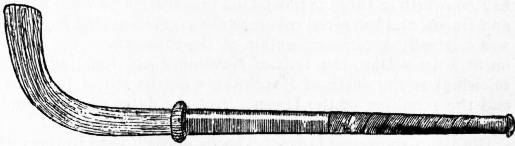
Hockey Stick.
In America the development of the modern game is due to the Victoria Hockey Club and McGill University (Montreal). About 1881 the secretary of the former club made the first efforts towards drawing up a recognized code of laws, and for some time afterwards playing rules were agreed upon from time to time whenever an important match was played, the chief teams being, besides those already mentioned, the Ottawa, Quebec, Crystal and Montreal Hockey Clubs, the first general tournament taking place in 1884. Three years later the “Amateur Hockey Association of Canada” was formed, and a definite code of rules drawn up. Soon afterwards, in consequence of exhibitions given by the best Canadian teams in some of the larger cities of the United States, the new game was taken up by American schools, colleges and athletic clubs, and became nearly as popular in the northern states as in the Dominion. The rules differ widely from those of English Bandy. The rink must be at least 112 ft. long by 58 ft. wide, and seven players form a side. The goals are 6 ft. wide and 4 ft. high and are provided with goal-nets. Instead of the English painted cricket-ball a puck is used, made of vulcanized rubber in the form of a draught-stone, 1 in. thick, and 3 in. in diameter. The sticks are made of one piece of hard wood, and may not be more than 3 in. wide at any part. The game is played for two half-hour or twenty-minute periods with an intermission of ten minutes. At the beginning of a match, and also when a goal has been made, the puck is faced, i.e. it is placed in the middle of the rink between the sticks of the two left-centres, and the referee calls “play.” Whichever side then secures the ball endeavours by means of passing and dribbling to get the puck into a position from which a goal may be shot. The puck may be stopped by any part of the person but not carried or knocked except with the stick. No stick may be raised above the shoulder except when actually striking the puck. When the puck is driven off the rink or behind the goal, or a foul has been made behind the goal, it is faced 5 yds. inside the rink. The goal-keeper must maintain a standing position.
There are a number of Hockey organizations in America, all under the jurisdiction of the “American Amateur Hockey League” in the United States and the “Canadian Amateur Athletic League” in Canada.
Ice Polo, a winter sport similar to Ice Hockey, is almost exclusively played in the New England states. A rubber-covered ball is used and the stick is heavier than that used in Ice Hockey. The radical difference between the two games is that, in Ice Polo, there is no strict off-side rule, so that passes and shots at goal may come from any and often the most unexpected direction. Five men constitute a team: a goal-tend, a half-back, a centre and two rushers. The rushers must be rapid skaters, adepts in dribbling and passing and good goal shots. The centre supports the rushers, passing the ball to them or trying for goal himself. The half-back is the first defence and the goal-tend the last. The rink is 150 ft. long.
Ring Hockey may be played on the floor of any gymnasium or large room by teams of six, comprising a goal-keeper, a quarter, three forwards and a centre. The goals consist of two uprights 3 ft. high and 4 ft. apart. The ring, which takes the place of the ball or puck, is made of flexible rubber, and is 5 in. in diameter with a 3-in. opening through the centre. It weighs between 12 and 16 oz. The stick is a wand of light but tough wood, between 36 and 40 in. long, about ¾ in. in diameter, provided with a 5-in. guard 20 in. from the lower end. The method of shooting is to insert the end of the stick in the hole of the ring and drive it towards the goal. A goal shot from the field counts one point, a goal from a foul ½ point. When a foul is called by the referee a player of the opposing side is allowed a free shot for goal from any point on the quarter line.
Roller Polo, played extensively during the winter months in the United States, is practically Ice Polo adapted to the floors of gymnasiums and halls, the players, five on a side, wearing roller-skates. The first professional league was organized in 1883.
HOCK-TIDE, an ancient general holiday in England, celebrated on the second Monday and Tuesday after Easter Sunday. Hock-Tuesday was an important term day, rents being then payable, for with Michaelmas it divided the rural year into its winter and summer halves. The derivation of the word is disputed: any analogy with Ger. hoch, “high,” being generally denied. No trace of the word is found in Old English, and “hock-day,” its earliest use in composition, appears first in the 12th century. The characteristic pastime of hock-tide was called binding. On Monday the women, on Tuesday the men, stopped all passers of the opposite sex and bound them with ropes till they bought their release with a small payment, or a rope was stretched across the highroads, and the passers were obliged to pay toll. The money thus collected seems to have gone towards parish expenses. Many entries are found in parish registers under “Hocktyde money.” The hock-tide celebration became obsolete in the beginning of the 18th century. At Coventry there was a play called “The Old Coventry Play of Hock Tuesday.” This, suppressed at the Reformation owing to the incidental disorder, and revived as part of the festivities on Queen Elizabeth’s visit to Kenilworth in July 1575, depicted the struggle between Saxons and Danes, and has given colour to the suggestion that hock-tide was originally a commemoration of the massacre of the Danes on St Brice’s Day, the 13th of November A.D. 1002, or of the rejoicings at the death of Hardicanute on the 8th of June 1042 and the expulsion of the Danes. But the dates of these anniversaries do not bear this out.
HOCUS, a shortened form of “hocus pocus,” used in the 17th century in the sense of “to play a trick on any one,” to “hoax,” which is generally taken to be a derivative. “Hocus pocus” appears to have been a mock Latin expression first used as the name of a juggler or conjurer. Thus in Ady’s Candle in the Dark (1655), quoted in the New English Dictionary, “I will speak of one man ... that went about in King James his time ... who called himself, The Kings Majesties most excellent Hocus Pocus, and so was called, because that at the playing of every Trick, he used to say, Hocus pocus, tontus talontus, vade celeriter jubeo, a dark composure of words, to blinde the eyes of the beholders, to make his Trick pass the more currantly without discovery.” Tillotson’s guess (Sermons, xxvi.) that the phrase was a corruption of hoc est corpus and alluded to the words of the Eucharist, “in ridiculous imitation of the priests of the Church of Rome in their trick of Transubstantiation,” has frequently been accepted as a serious derivation, but has no foundation. A connexion with a supposed demon of Scandinavian mythology, called “Ochus Bochus,” is equally unwarranted. “Hocus” is used as a verb, meaning to drug, stupefy with opium, &c., for a criminal purpose. This use dates from the beginning of the 19th century.
HODDEN (a word of unknown origin), a coarse kind of cloth made of undyed wool, formerly much worn by the peasantry of Scotland. It was usually made on small hand-looms by the peasants themselves. Grey hodden was made by mixing black and white fleeces together in the proportion of one to twelve when weaving.
HODDESDON, an urban district in the Hertford parliamentary division of Hertfordshire, England, near the river Lea, 17 m. N. from London by the Great Eastern railway (Broxbourne and Hoddesdon station on the Cambridge line). Pop. (1901), 4711. This is the northernmost of a series of populous townships extending from the suburbs of London along the Lea valley as far as its junction with the Stort, which is close to Hoddesdon. They are in the main residential. Hoddesdon was a famous coaching station on the Old North Road; and the Bull posting-house is mentioned in Matthew Prior’s “Down Hall.” The Lea has been a favourite resort of anglers (mainly for coarse fish in this part) from the time of Izaak Walton, in whose book Hoddesdon is specifically named. The church of St Augustine, Broxbourne, is a fine example of Perpendicular work, and contains interesting monuments, including an altar tomb with enamelled brasses of 1473. Hoddesdon probably covers the site of a Romano-British village.
HODEDA (Hodeida, Hadeda), a town in Arabia situated on the Red Sea coast 14° 48′ N. and 42° 57′ E. It lies on a beach of muddy sand exposed to the southerly and westerly winds. Steamers anchor more than a mile from shore, and merchandize has to be transhipped by means of sambuks or native boats. But Hodeda has become the chief centre of the maritime trade of Turkish Yemen, and has superseded Mokha as the great port of export of South Arabian coffee. The town is composed of stone-built houses of several storeys, and is surrounded, except on the sea face, by a fortified enceinte. The population is estimated at 33,000, and contains, besides the Arab inhabitants and the Turkish officials and garrison, a considerable foreign element, Greeks, Indians and African traders from the opposite coast. There are consulates of Great Britain, United States, France, Germany, Italy and Greece. The steam tonnage entering and clearing the port in 1904 amounted to 78,700 tons, the highest hitherto recorded. Regular services are maintained with Aden, and with Suez, Massowa and the other Red Sea ports. Large dhows bring dates from the Persian Gulf, and occasional steamers from Bombay call on their way to Jidda with cargoes of grain. The imports for 1904 amounted in value to £467,000, the chief items being piece goods, food grains and sugar; the exports amounted to £451,000, including coffee valued at £229,000.
HODENING, an ancient Christmas custom still surviving in Wales, Kent, Lancashire and elsewhere. A horse’s skull or a wooden imitation on a pole is carried round by a party of youths, one of whom conceals himself under a white cloth to simulate the horse’s body, holding a lighted candle in the skull. They make a house-to-house visitation, begging gratuities. The “Penitential” of Archbishop Theodore (d. 690) speaks of “any who, on the kalands of January, clothe themselves with the skins of cattle and carry heads of animals.” This, coupled with the fact that among the primitive Scandinavians the horse was often the sacrifice made at the winter solstice to Odin for success in battle, has been thought to justify the theory that hodening is a corruption of Odining.
HODGE, CHARLES (1797-1878), American theologian, was born in Philadelphia, Pennsylvania, on the 28th of December 1797. He graduated at the College of New Jersey (now Princeton) in 1815, and in 1819 at the Princeton Theological seminary, where he became an instructor in 1820, and the first professor of Oriental and Biblical literature in 1822. Meanwhile, in 1821, he had been ordained as a Presbyterian minister. From 1826 to 1828 he studied under de Sacy in Paris, under Gesenius and Tholuck in Halle, and under Hengstenberg, Neander and Humboldt in Berlin. In 1840 he was transferred to the chair of exegetical and didactic theology, to which subjects that of polemic theology was added in 1854, and this office he held until his death. In 1825 he established the quarterly Biblical Repertory, the title of which was changed to Biblical Repertory and Theological Review in 1830 and to Biblical Repertory and Princeton Review in 1837. With it, in 1840, was merged the Literary and Theological Review of New York, and in 1872 the American Presbyterian Review of New York, the title becoming Presbyterian Quarterly and Princeton Review in 1872 and Princeton Review in 1877. He secured for it the position of theological organ of the Old School division of the Presbyterian church, and continued its principal editor and contributor until 1868, when the Rev. Lyman H. Atwater became his colleague. His more important essays were republished under the titles Essays and Reviews (1857), Princeton Theological Essays, and Discussions in Church Polity (1878). He was moderator of the General Assembly (O.S.) in 1846, a member of the committee to revise the Book of Discipline of the Presbyterian church in 1858, and president of the Presbyterian Board of Foreign Missions in 1868-1870. The 24th of April 1872, the fiftieth anniversary of his election to his professorship, was observed in Princeton as his jubilee by between 400 and 500 representatives of his 2700 pupils, and $50,000 was raised for the endowment of his chair. He died at Princeton on the 19th of June 1878. Hodge was one of the greatest of American theologians.
Besides his articles in the Princeton Review, he published a Commentary on the Epistle to the Romans (1835, abridged 1836, rewritten and enlarged 1864, new ed. 1886), Constitutional History of the Presbyterian Church in the United States (2 vols., 1839-1840); The Way of Life (1841); Commentaries on Ephesians (1856); 1 Corinthians (1857); 2 Corinthians (1859); Systematic Theology (3 vols., 2200 pp., 1871-1873), probably the best of all modern expositions of Calvinistic dogmatic; and What is Darwinism? (1874), in which he opposed “Atheistic Evolutionism.” After his death a volume of Conference Papers (1879) was published. His life, by his son, was published in 1880.
His son, Archibald Alexander Hodge (1823-1886), also famous as a Presbyterian theologian, was born at Princeton on the 18th of July 1823. He graduated at the College of New Jersey in 1841, and at the Princeton Theological seminary in 1846, and was ordained in 1847. From 1847 to 1850 he was a missionary at Allahabad, India, and was then pastor of churches successively at Lower West Nottingham, Maryland (1851-1855); at Fredericksburg, Virginia (1855-1861), and at Wilkes-Barré, Pennsylvania (1861-1864). From 1864 to 1877 he was professor of didactic and polemical theology in the Allegheny Theological seminary at Allegheny, Pennsylvania, where he was also from 1866 to 1877 pastor of the North Church (Presbyterian). In 1878 he succeeded his father as professor of didactic theology at the Princeton seminary. He died on the 11th of November 1886. Besides writing the biography of his father, he was the author of Outlines of Theology (1860, new ed. 1875; enlarged, 1879); The Atonement (1867); Exposition of the Confession of Faith (1869); and Popular Lectures on Theological Themes (1887).
See C. A. Salmond’s Charles and A. A. Hodge (New York, 1888).
HODGKIN, THOMAS (1831- ), British historian, son of John Hodgkin (1800-1875), barrister, was born in London on the 29th of July 1831. Having been educated as a member of the Society of Friends and taken the degree of B.A. at London University, he became a partner in the banking house of Hodgkin, Barnett & Co., Newcastle-on-Tyne, a firm afterwards amalgamated with Lloyds’ Bank. While continuing in business as a banker, Hodgkin devoted a good deal of time to historical study, and soon became a leading authority on the history of the early middle ages, his books being indispensable to all students of this period. His chief works are, Italy and her Invaders (8 vols., Oxford, 1880-1899); The Dynasty of Theodosius (Oxford, 1889); Theodoric the Goth (London, 1891); and an introduction to the Letters of Cassiodorus (London, 1886). He also wrote a Life of Charles the Great (London, 1897); Life of George Fox (Boston, 1896); and the opening volume of Longman’s Political History of England (London, 1906).
HODGKINSON, EATON (1789-1861), English engineer, the son of a farmer, was born at Anderton near Northwich, Cheshire, on the 26th of February 1789. After attending school at Northwich, he began to help his widowed mother on the farm, but to escape from that uncongenial occupation he persuaded her in 1811 to remove to Manchester and start a pawnbroking business. There he made the acquaintance of John Dalton, and began those inquiries into the strength of materials which formed the work of his life. He was associated with Sir William Fairbairn in an important series of experiments on cast iron, and his help was sought by Robert Stephenson in regard to the forms and dimensions of the tubes for the Britannia bridge. A paper which he communicated to the Royal Society on “Experimental Researches on the Strength of Pillars of Cast Iron and other Materials,” in 1840 gained him a Royal medal in 1841, and he was also elected a fellow. In 1847 he was appointed professor of the mechanical principles of engineering in University College, London, and at the same time he was employed as a member of the Royal Commission appointed to inquire into the application of iron to railway structures. In 1848 he was chosen president of the Manchester Philosophical Society, of which he had been a member since 1826, and to which, both previously and subsequently, he contributed many of the more important results of his discoveries. For several years he took an active part in the discussions of the Institution of Civil Engineers, of which he was elected an honorary member in 1851. He died at Eaglesfield House, near Manchester, on the 18th of June 1861.
HODGSON, BRIAN HOUGHTON (1800-1894), English administrator, ethnologist and naturalist, was born at Lower Beech, Prestbury, Cheshire, on the 1st of February 1800. His father, Brian Hodgson, came of a family of country gentlemen, and his mother was a daughter of William Houghton of Manchester. In 1816 he obtained an East Indian writership. After passing through the usual course at Haileybury, he went out to India in 1818, and after a brief service at Kumaon as assistant-commissioner was in 1820 appointed assistant to the Resident at Katmandu, the capital of Nepal. In 1823 he obtained an under-secretaryship in the foreign department at Calcutta, but his health failed, and in 1824 he returned to Nepal, to which the whole of his life, whether in or out of India, may be said to have been thenceforth given. He devoted himself particularly to the collection of Sanskrit MSS. relating to Buddhism, and hardly less so to the natural history and antiquities of the country, and by 1839 had contributed eighty-nine papers to the Transactions of the Asiatic Society of Bengal. His investigations of the ethnology of the aboriginal tribes were especially important. In 1833 he became Resident in Nepal, and passed many stormy years in conflict with the cruel and faithless court to which he was accredited. He succeeded, nevertheless, in concluding a satisfactory treaty in 1839; but in 1842 his policy, which involved an imperious attitude towards the native government, was upset by the interference of Lord Ellenborough, but just arrived in India and not unnaturally anxious to avoid trouble in Nepal during the conflict in Afghanistan. Hodgson took upon himself to disobey his instructions, a breach of discipline justified to his own mind by his superior knowledge of the situation, but which the governor-general could hardly be expected to overlook. He was, nevertheless, continued in office for a time, but was recalled in 1843, and resigned the service. In 1845 he returned to India and settled at Darjeeling, where he devoted himself entirely to his favourite pursuits, becoming the greatest authority on the Buddhist religion and on the flora of the Himalayas. It was he who early suggested the recruiting of Gurkhas for the Indian army, and who influenced Sir Jung Bahadur to lend his assistance to the British during the mutiny in 1857. In 1858 he returned to England, and lived successively in Cheshire and Gloucestershire, occupied with his studies to the last. He died at his seat at Alderley Grange in the Cotswold Hills on the 23rd of May 1894. No man has done so much to throw light on Buddhism as it exists in Nepal, and his collections of Sanskrit manuscripts, presented to the East India Office, and of natural history, presented to the British Museum, are unique as gatherings from a single country. He wrote altogether 184 philological and ethnological and 127 scientific papers, as well as some valuable pamphlets on native education, in which he took great interest. His principal work, Illustrations of the Literature and Religion of Buddhists (1841), was republished with the most important of his other writings in 1872-1880.
His life was written by Sir W. W. Hunter in 1896.
HÓDMEZÖ-VÁSÁRHELY, a town of Hungary, in the county of Csongrád, 135 m. S.E. of Budapest by rail. Pop. (1900) 60,824 of which about two-thirds are Protestants. The town, situated on Lake Hód, not far from the right bank of the Tisza, has a modern aspect. The soil of the surrounding country, of which 383 sq. m. belong to the municipality, is exceedingly fertile, the chief products being wheat, mangcorn, barley, oats, millet, maize and various descriptions of fruit, especially melons. Extensive vineyards, yielding large quantities of both white and red grapes, skirt the town, and the horned cattle and horses of Hódmezö-Vásárhely have a good reputation; sheep and pigs are also extensively reared. The commune is protected from inundations of the Tisza by an enormous dike, but the town, nevertheless, sometimes suffers considerable damage during the spring floods.
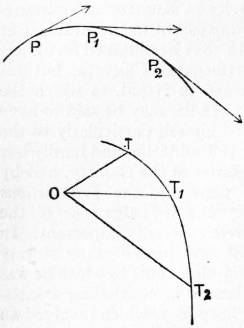
HODOGRAPH (Gr. ὁδός, a way, and γράφειν, to write), a curve of which the radius vector is proportional to the velocity of a moving particle. It appears to have been used by James Bradley, but for its practical development we are mainly indebted to Sir William Rowan Hamilton, who published an account of it in the Proceedings of the Royal Irish Academy, 1846. If a point be in motion in any orbit and with any velocity, and if, at each instant, a line be drawn from a fixed point parallel and equal to the velocity of the moving point at that instant, the extremities of these lines will lie on a curve called the hodograph. Let PP1P2 be the path of the moving point, and let OT, OT1, OT2, be drawn from the fixed point O parallel and equal to the velocities at P, P1, P2 respectively, then the locus of T is the hodograph of the orbits described by P (see figure). From this definition we have the following important fundamental property which belongs to all hodographs, viz. that at any point the tangent to the hodograph is parallel to the direction, and the velocity in the hodograph equal to the magnitude of the resultant acceleration at the corresponding point of the orbit. This will be evident if we consider that, since radii vectores of the hodograph represent velocities in the orbit, the elementary arc between two consecutive radii vectores of the hodograph represents the velocity which must be compounded with the velocity of the moving point at the beginning of any short interval of time to get the velocity at the end of that interval, that is to say, represents the change of velocity for that interval. Hence the elementary arc divided by the element of time is the rate of change of velocity of the moving-point, or in other words, the velocity in the hodograph is the acceleration in the orbit.
Analytically thus (Thomson and Tait, Nat. Phil.):—Let x, y, z be the coordinates of P in the orbit, ξ, η, ζ those of the corresponding point T in the hodograph, then
ξ = dx , η = dy , ζ = dz ;
dt dt dt
therefore
dξ = dη = dζ
d²x/dt² d²y/dt² d²z/dt²
(1).
Also, if s be the arc of the hodograph,
ds = v = √ [( dξ ) ² + ( dη ) ² + ( dζ ) ² ]
dt dt dt dt
= √ [( d²x ) ² + ( d²y ) ² + ( d²z ) ² ]
dt² dt² dt²
(2).
Equation (1) shows that the tangent to the hodograph is parallel to the line of resultant acceleration, and (2) that the velocity in the hodograph is equal to the acceleration.
Every orbit must clearly have a hodograph, and, conversely, every hodograph a corresponding orbit; and, theoretically speaking, it is possible to deduce the one from the other, having given the other circumstances of the motion.
For applications of the hodograph to the solution of kinematical problems see Mechanics.
HODSON, WILLIAM STEPHEN RAIKES (1821-1858), known as “Hodson of Hodson’s Horse,” British leader of light cavalry during the Indian Mutiny, third son of the Rev. George Hodson, afterwards archdeacon of Stafford and canon of Lichfield, was born on the 19th of March 1821 at Maisemore Court, near Gloucester. He was educated at Rugby and Cambridge, and accepted a cadetship in the Indian army at the advanced age for those days of twenty-three. Joining the 2nd Bengal Grenadiers he went through the first Sikh War, and was present at the battles of Moodkee, Ferozeshah and Sobraon. In one of his letters home at this period he calls the campaign a “tissue of mismanagement, blunders, errors, ignorance and arrogance”, and outspoken criticism such as this brought him many bitter enemies throughout his career, who made the most of undeniable faults of character. In 1847, through the influence of Sir Henry Lawrence, he was appointed adjutant of the corps of Guides, and in 1852 was promoted to the command of the Guides with the civil charge of Yusafzai. But his brusque and haughty demeanour to his equals made him many enemies. In 1855 two separate charges were brought against him. The first was that he had arbitrarily imprisoned a Pathan chief named Khadar Khan, on suspicion of being concerned in the murder of Colonel Mackeson. The man was acquitted, and Lord Dalhousie removed Hodson from his civil functions and remanded him to his regiment on account of his lack of judgment. The second charge was more serious, amounting to an accusation of malversation in the funds of his regiment. He was tried by a court of inquiry, who found that his conduct to natives had been “unjustifiable and oppressive,” that he had used abusive language to his native officers and personal violence to his men, and that his system of accounts was “calculated to screen peculation and fraud.” Subsequently another inquiry was carried out by Major Reynell Taylor, which dealt simply with Hodson’s accounts and found them to be “an honest and correct record ... irregularly kept.” At this time the Guides were split up into numerous detachments, and there was a system of advances which made the accounts very complicated. The verdicts of the two inquiries may be set against each other, and this particular charge declared “not proven.” It is possible that Hodson was careless and extravagant in money matters rather than actually dishonest; but there were several similar charges against him. During a tour through Kashmir with Sir Henry Lawrence he kept the purse and Sir Henry could never obtain an account from him; subsequently Sir George Lawrence accused him of embezzling the funds of the Lawrence Asylum at Kasauli; while Sir Neville Chamberlain in a published letter says of the third brother, Lord Lawrence, “I am bound to say that Lord Lawrence had no opinion of Hodson’s integrity in money matters. He has often discussed Hodson’s character in talking to me, and it was to him a regret that a man possessing so many fine gifts should have been wanting in a moral quality which made him untrustworthy.” Finally, on one occasion Hodson spent £500 of the pay due to Lieutenant Godby, and under threat of exposure was obliged to borrow the money from a native banker through one of his officers named Bisharat Ali.
It was just at the time when Hodson’s career seemed ruined that the Indian Mutiny broke out, and he obtained the opportunity of rehabilitating himself. At the very outset of the campaign he made his name by riding with despatches from General Anson at Karnal to Meerut and back again, a distance of 152 m. in all, in seventy-two hours, through a country swarming with the rebel cavalry. This feat so pleased the commander-in-chief that he empowered him to raise a regiment of 2000 irregular horse, which became known to fame as Hodson’s Horse, and placed him at the head of the Intelligence Department. In his double rôle of cavalry leader and intelligence officer, Hodson played a large part in the reduction of Delhi and consequently in saving India for the British empire. He was the finest swordsman in the army, and possessed that daring recklessness which is the most useful quality of leadership against Asiatics. In explanation of the fact that he never received the Victoria Cross it was said of him that it was because he earned it every day of his life. But he also had the defects of his qualities, and could display on occasion a certain cruelty and callousness of disposition. Reference has already been made to Bisharat Ali, who had lent Hodson money. During the siege of Delhi another native, said to be an enemy of Bisharat Ali’s, informed Hodson that he had turned rebel and had just reached Khurkhouda, a village near Delhi. Hodson thereupon took out a body of his sowars, attacked the village, and shot Bisharat Ali and several of his relatives. General Crawford Chamberlain states that this was Hodson’s way of wiping out the debt. Again, after the fall of Delhi, Hodson obtained from General Wilson permission to ride out with fifty horsemen to Humayun’s tomb, 6 m. out of Delhi, and bring in Bahadur Shah, the last of the Moguls. This he did with safety in the face of a large and threatening crowd, and thus dealt the mutineers a heavy blow. On the following day with 100 horsemen he went out to the same tomb and obtained the unconditional surrender of the three princes, who had been left behind on the previous occasion. A crowd of 6000 persons gathered, and Hodson with marvellous coolness ordered them to disarm, which they proceeded to do. He sent the princes on with an escort of ten men, while with the remaining ninety he collected the arms of the crowd. On galloping after the princes he found the crowd once more pressing on the escort and threatening an attack; and fearing that he would be unable to bring his prisoners into Delhi he shot them with his own hand. This is the most bitterly criticized action in his career, but no one but the man on the spot can judge how it is necessary to handle a crowd; and in addition one of the princes, Abu Bukt, heir-apparent to the throne, had made himself notorious for cutting off the arms and legs of English children and pouring the blood into their mothers’ mouths. Considering the circumstances of the moment, Hodson’s act at the worst was one of irregular justice. A more unpleasant side to the question is that he gave the king a safe conduct, which was afterwards seen by Sir Donald Stewart, before he left the palace, and presumably for a bribe; and he took an armlet and rings from the bodies of the princes. He was freely accused of looting at the time, and though this charge, like that of peculation, is matter for controversy, it is very strongly supported. General Pelham Burn said that he saw loot in Hodson’s boxes when he accompanied him from Fatehgarh to take part in the siege of Lucknow, and Sir Henry Daly said that he found “loads of loot” in Hodson’s boxes after his death, and also a file of documents relating to the Guides case, which had been stolen from him and of which Hodson denied all knowledge. On the other hand the Rev. G. Hodson states in his book that he obtained the inventory of his brother’s possessions made by the Committee of Adjustment and it contained no articles of loot, and Sir Charles Gough, president of the committee, confirmed this evidence. This statement is totally incompatible with Sir Henry Daly’s and is only one of many contradictions in the case. Sir Henry Norman stated that to his personal knowledge Hodson remitted several thousand pounds to Calcutta which could only have been obtained by looting. On the other hand, again, Hodson died a poor man, his effects were sold for £170, his widow was dependent on charity for her passage home, was given apartments by the queen at Hampton Court, and left only £400 at her death.
Hodson was killed on the 11th of March 1858 in the attack on the Begum Kotee at Lucknow. He had just arrived on the spot and met a man going to fetch powder to blow in a door; instead Hodson, with his usual recklessness, rushed into the doorway and was shot. On the whole, it can hardly be doubted that he was somewhat unscrupulous in his private character, but he was a splendid soldier, and rendered inestimable services to the empire.
The controversy relating to Hodson’s moral character is very complicated and unpleasant. Upon Hodson’s side see Rev. G. Hodson, Hodson of Hodson’s Horse (1883), and L. J. Trotter, A Leader of Light Horse (1901); against him, R. Bosworth Smith, Life of Lord Lawrence, appendix to the 6th edition of 1885; T. R. E. Holmes, History of the Indian Mutiny, appendix N to the 5th edition of 1898, and Four Famous Soldiers by the same author, 1889; and General Sir Crawford Chamberlain, Remarks on Captain Trotter’s Biography of Major W. S. R. Hodson (1901).
HODY, HUMPHREY (1659-1707), English divine, was born at Odcombe in Somersetshire in 1659. In 1676 he entered Wadham College, Oxford, of which he became fellow in 1685. In 1684 he published Contra historiam Aristeae de LXX. interpretibus dissertatio, in which he showed that the so-called letter of Aristeas, containing an account of the production of the Septuagint, was the late forgery of a Hellenist Jew originally circulated to lend authority to that version. The dissertation was generally regarded as conclusive, although Isaac Vossius published an angry and scurrilous reply to it in the appendix to his edition of Pomponius Mela. In 1689 Hody wrote the Prolegomena to the Greek chronicle of John Malalas, published at Oxford in 1691. The following year he became chaplain to Edward Stillingfleet, bishop of Worcester, and for his support of the ruling party in a controversy with Henry Dodwell regarding the non-juring bishops he was appointed chaplain to Archbishop Tillotson, an office which he continued to hold under Tenison. In 1698 he was appointed regius professor of Greek at Oxford, and in 1704 was made archdeacon of Oxford. In 1701 he published A History of English Councils and Convocations, and in 1703 in four volumes De Bibliorum textis originalibus, in which he included a revision of his work on the Septuagint, and published a reply to Vossius. He died on the 20th of January 1707.
A work, De Graecis Illustribus, which he left in manuscript, was published in 1742 by Samuel Jebb, who prefixed to it a Latin life of the author.
HOE, RICHARD MARCH (1812-1886), American inventor, was born in New York City on the 12th of September 1812. He was the son of Robert Hoe (1784-1833), an English-born American mechanic, who with his brothers-in-law, Peter and Matthew Smith, established in New York City a manufactory of printing presses, and used steam to run his machinery. Richard entered his father’s manufactory at the age of fifteen and became head of the firm (Robert Hoe & Company) on his father’s death. He had considerable inventive genius and set himself to secure greater speed for printing presses. He discarded the old flat-bed model and placed the type on a revolving cylinder, a model later developed into the well-known Hoe rotary or “lightning” press, patented in 1846, and further improved under the name of the Hoe web perfecting press (see Printing). He died in Florence, Italy, on the 7th of June 1886.
See A Short History of the Printing Press (New York, 1902) by his nephew Robert Hoe (1839-1909), who was responsible for further improvements in printing, and was an indefatigable worker in support of the New York Metropolitan Museum.
HOE (through Fr. houe from O.H.G. houwâ, mod. Ger. Haue; the root is seen in “hew,” to cut, cleave; the word must be distinguished from “hoe,” promontory, tongue of land, seen in place names, e.g. Morthoe, Luton Hoo, the Hoe at Plymouth, &c.; this is the same as Northern English “heugh” and is connected with “hang”), an agricultural and gardening implement used for extirpating weeds, for stirring the surface-soil in order to break the capillary channels and so prevent the evaporation of moisture, for singling out turnips and other root-crops and similar purposes. Among common forms of hoe are the ordinary garden-hoe (numbered 1 in fig. 1), which consists of a flat blade set transversely in a long wooden handle; the Dutch or thrust-hoe (2), which has the blade set into the handle after the fashion of a spade; and the swan-neck hoe (3), the best manual hoe for agricultural purposes, which has a long curved neck to attach the blade to the handle; the soil falls back over this, blocking is thus avoided and a longer stroke obtained. Several types of horse-drawn hoe capable of working one or more rows at a time are used among root and grain crops. The illustrations show two forms of the implement, the blades of which differ in shape from those of the garden-hoe. Fig. 2 is in ordinary use for hoeing between two lines of beans or turnips or other “roots.” Fig. 3 is adapted for the narrow rows of grain crops and is also convertible into a root-hoe. In the lever-hoe, which is largely used in grain crops, the blades may be raised and lowered by means of a lever. The horse-drawn hoe is steered by means of handles in the rear, but its successful working depends on accurate drilling of the seed, because unless the rows are parallel the roots of the plants are liable to be cut and the foliage injured. Thus Jethro Tull (17th century), with whose name the beginning of the practice of horse-hoeing is principally connected, used the drill which he invented as an essential adjunct in the so-called “Horse-hoeing Husbandry” (see Agriculture).
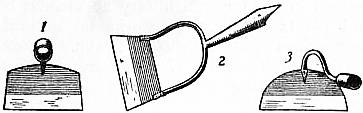
Fig. 1.—Three Forms of Manual Hoe.
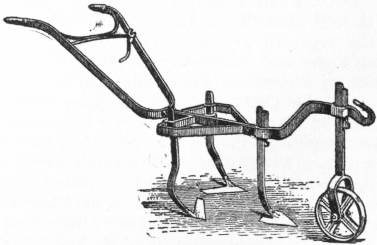
Fig. 2.—Martin’s One-Row Horse Hoe.
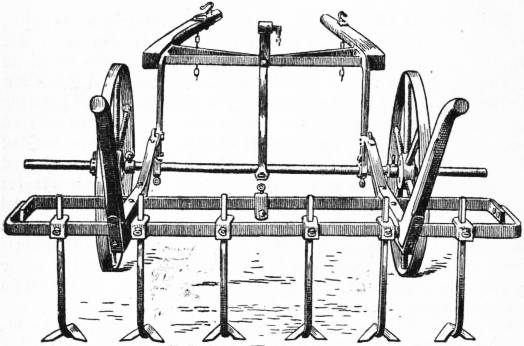
Fig. 3.—Martin’s General Purpose Steerage Horse Hoe.
HOEFNAGEL, JORIS (1545-1601), Dutch painter and engraver, the son of a diamond merchant, was born at Antwerp. He travelled abroad, making drawings from archaeological subjects, and was a pupil of Jan Bol at Mechlin. He was afterwards patronized by the elector of Bavaria at Munich, where he stayed eight years, and by the Emperor Rudolph at Prague. He died at Vienna in 1601. He is famous for his miniature work, especially on a missal in the imperial library at Vienna; he painted animals and plants to illustrate works on natural history; and his engravings (especially for Braun’s Civitates orbis terrarum, 1572, and Ortelius’s Theatrum orbis terrarum, 1570) give him an interesting place among early topographical draughtsmen.
HOF, a town of Germany, in the Bavarian province of Upper Franconia, beautifully situated on the Saale, on the north-eastern spurs of the Fichtelgebirge, 103 m. S.W. of Leipzig on the main line of railway to Regensburg and Munich. Pop. (1885) 22,257; (1905) 36,348. It has one Roman Catholic and three Protestant churches (among the latter that of St Michael, which was restored in 1884), a town hall of 1563, a gymnasium with an extensive library, a commercial school and a hospital founded in 1262. It is the seat of various flourishing industries, notably woollen, cotton and jute spinning, jute weaving, and the manufacture of cotton and half-woollen fabrics. It has also dye-works, flour-mills, saw-mills, breweries, iron-works, and manufactures of machinery, iron and tin wares, chemicals and sugar. In the neighbourhood there are large marble quarries and extensive iron mines. Hof, originally called Regnitzhof, was built about 1080. It was held for some time by the dukes of Meran, and was sold in 1373 to the burgraves of Nuremberg. The cloth manufacture introduced into it in the 15th century, and the manufacture of veils begun in the 16th century, greatly promoted its prosperity, but it suffered severely in the Albertine and Hussite wars as well as in the Thirty Years’ War. In 1792 it came into the possession of Prussia; in 1806 it fell to France; and in 1810 it was incorporated with Bavaria. In 1823 the greater part of the town was destroyed by fire.
See Ernst, Geschichte und Beschreibung des Bezirks und der Stadt Hof (1866); Tillmann, Die Stadt Hof und ihre Umgebung (Hof, 1899), and C. Meyer, Quellen zur Geschichte der Stadt Hof (1894-1896).
HOFER, ANDREAS (1767-1810), Tirolese patriot, was born on the 22nd of November 1767 at St Leonhard, in the Passeier valley. There his father kept an inn known as “am Sand,” which Hofer inherited, and on that account he was popularly known as the “Sandwirth.” In addition to this he carried on a trade in wine and horses with the north of Italy, acquiring a high reputation for intelligence and honesty. In the wars against the French from 1796 to 1805 he took part, first as a sharp-shooter and afterwards as a captain of militia. By the treaty of Pressburg (1805) Tirol was transferred from Austria to Bavaria, and Hofer, who was almost fanatically devoted to the Austrian house, became conspicuous as a leader of the agitation against Bavarian rule. In 1808 he formed one of a deputation who went to Vienna, at the invitation of the archduke John, to concert a rising; and when in April 1809 the Tirolese rose in arms, Hofer was chosen commander of the contingent from his native valley, and inflicted an overwhelming defeat on the Bavarians at Sterzing (April 11). This victory, which resulted in the temporary reoccupation of Innsbruck by the Austrians, made Hofer the most conspicuous of the insurgent leaders. The rapid advance of Napoleon, indeed, and the defeat of the main Austrian army under the archduke Charles, once more exposed Tirol to the French and Bavarians, who reoccupied Innsbruck. The withdrawal of the bulk of the troops, however, gave the Tirolese their chance again; after two battles fought on the Iselberg (May 25 and 29) the Bavarians were again forced to evacuate the country, and Hofer entered Innsbruck in triumph. An autograph letter of the emperor Francis (May 29) assured him that no peace would be concluded by which Tirol would again be separated from the Austrian monarchy, and Hofer, believing his work accomplished, returned to his home. Then came the news of the armistice of Znaim (July 12), by which Tirol and Vorarlberg were surrendered by Austria unconditionally and given up to the vengeance of the French. The country was now again invaded by 40,000 French and Bavarian troops, and Innsbruck fell; but the Tirolese once more organized resistance to the French “atheists and freemasons,” and, after a temporary hesitation, Hofer—on whose head a price had been placed—threw himself into the movement. On the 13th of August, in another battle on the Iselberg, the French under Marshal Lefebvre were routed by the Tirolese peasants, and Hofer once more entered Innsbruck, which he had some difficulty in saving from sack. Hofer was now elected Oberkommandant of Tirol, took up his quarters in the Hofburg at Innsbruck, and for two months ruled the country in the emperor’s name. He preserved the habits of a simple peasant, and his administration was characterized in part by the peasant’s shrewd common sense, but yet more by a pious solicitude for the minutest details of faith and morals. On the 29th of September Hofer received from the emperor a chain and medal of honour, which encouraged him in the belief that Austria did not intend again to desert him; the news of the conclusion of the treaty of Schönbrunn (October 14), by which Tirol was again ceded to Bavaria, came upon him as an overwhelming surprise. The French in overpowering force at once pushed into the country, and, an amnesty having been stipulated in the treaty, Hofer and his companions, after some hesitation, gave in their submission. On the 12th of November, however, urged on by the hotter heads among the peasant leaders and deceived by false reports of Austrian victories, Hofer again issued a proclamation calling the mountaineers to arms. The summons met with little response; the enemy advanced in irresistible force, and Hofer, a price once more set on his head, had to take refuge in the mountains. His hiding-place was betrayed by one of his neighbours, named Josef Raffl, and on the 27th of January 1810 he was captured by Italian troops and sent in chains to Mantua. There he was tried by court-martial, and on the 20th of February was shot, twenty-four hours after his condemnation. This crime, which was believed to be due to Napoleon’s direct orders, caused an immense sensation throughout Germany and did much to inflame popular sentiment against the French. At the court of Austria, too, which was accused of having cynically sacrificed the hero, it produced a painful impression, and Metternich, when he visited Paris on the occasion of the marriage of the archduchess Marie Louise to Napoleon, was charged to remonstrate with the emperor. Napoleon expressed his regret, stating that the execution had been carried out against his wishes, having been hurried on by the zeal of his generals. In 1823 Hofer’s remains were removed from Mantua to Innsbruck, where they were interred in the Franciscan church, and in 1834 a marble statue was erected over his tomb. In 1893 a bronze statue of him was also set up on the Iselberg. At Meran his patriotic deeds of heroism are the subject of a festival play celebrated annually in the open air. In 1818 the patent of nobility bestowed upon him by the Austrian emperor in 1809 was conferred upon his family.
See Leben und Thaten des ehemaligen Tyroler Insurgenten-Chefs Andr. Hofer (Berlin, 1810); Andr. Hofer und die Tyroler Insurrection im Jahre 1809 (Munich, 1811); Hormayr, Geschichte Andr. Hofer’s Sandwirths auf Passeyr (Leipzig, 1845); B. Weber, Das Thal Passeyr und seine Bewohner mit besonderer Rücksicht auf Andreas Hofer und das Jahr 1809 (Innsbruck, 1851); Rapp, Tirol im Jahr 1809 (Innsbruck, 1852); Weidinger, Andreas Hofer und seine Kampfgenossen (3rd ed., Leipzig, 1861); Heigel, Andreas Hofer (Munich, 1874); Stampfer, Sandwirt Andreas Hofer (Freiburg, 1874); Schmölze, Andreas Hofer und seine Kampfgenossen (Innsbruck, 1900). His history has supplied the materials for tragedies to B. Auerbach and Immermann, and for numerous ballads, of which some remain very popular in Germany (see Franke, Andreas Hofer im Liede, Innsbruck, 1884).
HÖFFDING, HARALD (1843- ), Danish philosopher, was born and educated in Copenhagen. He became a schoolmaster, and ultimately in 1883 professor in the university of Copenhagen. He was much influenced by Sören Kierkegaard in the early development of his thought, but later became a positivist, retaining, however, and combining with it the spirit and method of practical psychology and the critical school. His best-known work is perhaps his Den nyere Filosofis Historie (1894), translated into English from the German edition (1895) by B. E. Meyer as History of Modern Philosophy (2 vols., 1900), a work intended by him to supplement and correct that of Hans Bröchner, to whom it is dedicated. His Psychology, the Problems of Philosophy (1905) and Philosophy of Religion (1906) also have appeared in English.
Among Höffding’s other writings, practically all of which have been translated into German, are: Den engelske Filosofi i vor Tid (1874); Etik (1876; ed. 1879); Psychologi i Omrids paa Grundlag of Erfaring (ed. 1892); Psykologiske Undersogelser (1889); Charles Darwin (1889); Kontinuiteten i Kants filosofiske Udviklingsgang (1893); Det psykologiske Grundlag for logiske Domme (1899); Rousseau und seine Philosophie (1901); Mindre Arbejder (1899).
HOFFMANN, AUGUST HEINRICH (1798-1874), known as Hoffmann von Fallersleben, German poet, philologist and historian of literature, was born at Fallersleben in the duchy of Lüneburg, Hanover, on the 2nd of April 1798, the son of the mayor of the town. He was educated at the classical schools of Helmstedt and Brunswick, and afterwards at the universities of Göttingen and Bonn. His original intention was to study theology, but he soon devoted himself entirely to literature. In 1823 he was appointed custodian of the university library at Breslau, a post which he held till 1838. He was also made extraordinary professor of the German language and literature at that university in 1830, and ordinary professor in 1835; but he was deprived of his chair in 1842 in consequence of his Unpolitische Lieder (1840-1841), which gave much offence to the authorities in Prussia. He then travelled in Germany, Switzerland and Italy, and lived for two or three years in Mecklenburg, of which he became a naturalized citizen. After the revolution of 1848 he was enabled to return to Prussia, where he was restored to his rights, and received the Wartegeld—the salary attached to a promised office not yet vacant. He married in 1849, and during the next ten years lived first in Bingerbrück, afterwards in Neuwied, and then in Weimar, where together with Oskar Schade (1826-1906) he edited the Weimarische Jahrbuch (1854-1857). In 1860 he was appointed librarian to the Duke of Ratibor at the monasterial castle of Corvey near Höxter on the Weser, where he died on the 19th of January 1874. Fallersleben was one of the best popular poets of modern Germany. In politics he ardently sympathized with the progressive tendencies of his time, and he was among the earliest and most effective of the political poets who prepared the way for the outbreak of 1848. As a poet, however, he acquired distinction chiefly by the ease, simplicity and grace with which he gave expression to the passions and aspirations of daily life. Although he had not been scientifically trained in music, he composed melodies for many of his songs, and a considerable number of them are sung by all classes in every part of Germany. Among the best known is the patriotic Deutschland, Deutschland über Alles, composed in 1841 on the island of Heligoland, where a monument was erected in 1891 to his memory (subsequently destroyed).
The best of his poetical writings is his Gedichte (1827; 9th ed., Berlin, 1887); but there is great merit also in his Alemannische Lieder (1826; 5th ed., 1843), Soldatenlieder (1851), Soldatenleben (1852), Rheinleben (1865), and in his Fünfzig Kinderlieder, Fünfzig neue Kinderlieder, and Alte und neue Kinderlieder. His Unpolitische Lieder, Deutsche Lieder aus der Schweiz and Streiflichter are not without poetical value, but they are mainly interesting in relation to the movements of the age in which they were written. As a student of ancient Teutonic literature Hoffmann von Fallersleben ranks among the most persevering and cultivated of German scholars, some of the chief results of his labours being embodied in his Horae Belgicae, Fundgruben für Geschichte deutscher Sprache und Literatur, Altdeutsche Blätter, Spenden zur deutschen Literaturgeschichte and Findlinge. Among his editions of particular works may be named Reineke Vos, Monumenta Elnonensia and Theophilus. Die deutsche Philologie im Grundriss (1836) was at the time of its publication a valuable contribution to philological research, and historians of German literature still attach importance to his Geschichte des deutschen Kirchenliedes bis auf Luther (1832; 3rd ed., 1861), Unsere volkstümlichen Lieder (3rd ed., 1869) and Die deutschen Gesellschaftslieder des 16. und 17. Jahrh. (2nd ed., 1860). In 1868-1870 Hoffmann published in 6 vols. an autobiography, Mein Leben: Aufzeichnungen und Erinnerungen (an abbreviated ed. in 2 vols., 1894). His Gesammelte Werke were edited by H. Gerstenberg in 8 vols. (1891-1894); his Ausgewählte Werke by H. Benzmann (1905, 4 vols.). See also Briefe von Hoffmann von Fallersleben und Moritz Haupt an Ferdinand Wolf (1874); J. M. Wagner, Hoffmann von Fallersleben, 1818-1868 (1869-1870), and R. von Gottschall, Porträts und Studien (vol. v., 1876).
HOFFMANN, ERNST THEODOR WILHELM (1776-1822), German romance-writer, was born at Königsberg on the 24th of January 1776. For the name Wilhelm he himself substituted Amadeus in homage to Mozart. His parents lived unhappily together, and when the child was only three they separated. His bringing up was left to an uncle who had neither understanding nor sympathy for his dreamy and wayward temperament. Hoffmann showed more talent for music and drawing than for books. In 1792, when little over sixteen years old, he entered the university of Königsberg, with a view to preparing himself for a legal career. The chief features of interest in his student years were an intimate friendship for Theodor Gottlieb von Hippel (1775-1843), a nephew of the novelist Hippel, and an unhappy passion for a lady to whom he gave music lessons; the latter found its outlet, not merely in music, but also in two novels, neither of which he was able to have published. In the summer of 1795 he began his practical career as a jurist in Königsberg, but his mother’s death and the complications in which his love-affair threatened to involve him made him decide to leave his native town and continue his legal apprenticeship in Glogau. In the autumn of 1798 he was transferred to Berlin, where the beginnings of the new Romantic movement were in the air. Music, however, had still the first place in his heart, and the Berlin opera house was the chief centre of his interests.
In 1800 further promotion brought him to Posen, where he gave himself up entirely to the pleasures of the hour. Unfortunately, however, his brilliant powers of caricature brought him into ill odour, and instead of receiving the hoped-for preferment in Posen itself, he found himself virtually banished to the little town of Plozk on the Vistula. Before leaving Posen he married, and his domestic happiness alleviated to some extent the monotony of the two years’ exile. His leisure was spent in literary studies and musical composition. In 1804 he was transferred to Warsaw, where, through J. E. Hitzig (1780-1849), he was introduced to Zacharias Werner, and began to take an interest in the later Romantic literature; now, for the first time, he discovered how writers like Novalis, Tieck, and especially Wackenroder, had spoken out of his own heart. But in spite of this literary stimulus, his leisure in Warsaw was mainly occupied by composition; he wrote music to Brentano’s Lustige Musikanten and Werner’s Kreuz an der Ostsee, and also an opera Liebe und Eifersucht, based on Calderón’s drama La Banda y la Flor.
The arrival of the French in Warsaw and the consequent political changes put an end to Hoffmann’s congenial life there, and a time of tribulation followed. A position which he obtained in 1808 as musical director of a new theatre in Bamberg availed him little, as within a very short time the theatre was bankrupt and Hoffmann again reduced to destitution. But these misfortunes induced him to turn to literature in order to eke out the miserable livelihood he earned by composing and giving music lessons. The editor of the Allgemeine musikalische Zeitung expressed his willingness to accept contributions from Hoffmann, and here appeared for the first time some of the musical sketches which ultimately passed over into the Phantasiestücke in Callots Manier. This work appeared in four volumes in 1814 and laid the foundation of his fame as a writer. Meanwhile, Hoffmann had again been for some time attached, in the capacity of musical director, to a theatrical company, whose headquarters were at Dresden. In 1814 he gladly embraced the opportunity that was offered him of resuming his legal profession in Berlin, and two years later he was appointed councillor of the Court of Appeal (Kammergericht). Hoffmann had the reputation of being an excellent jurist and a conscientious official; he had leisure for literary pursuits and was on the best of terms with the circle of Romantic poets and novelists who gathered round Fouqué, Chamisso and his old friend Hitzig. Unfortunately, however, the habits of intemperance which, in earlier years, had thrown a shadow over his life, grew upon him, and his health was speedily undermined by the nights he spent in the wine-house, in company unworthy of him. He was struck down by locomotor ataxy, and died on the 24th of July 1822.
The Phantasiestücke, which had been published with a commendatory preface by Jean Paul, were followed in 1816 by the gruesome novel—to some extent inspired by Lewis’s Monk—Die Elixiere des Teufels, and the even more gruesome and grotesque stories which make up the Nachtstücke (1817, 2 vols.). The full range of Hoffmann’s powers is first clearly displayed in the collection of stories (4 vols., 1819-1821) Die Serapionsbrüder, this being the name of a small club of Hoffmann’s more intimate literary friends. Die Serapionsbrüder includes not merely stories in which Hoffmann’s love for the mysterious and the supernatural is to be seen, but novels in which he draws on his own early reminiscences (Rat Krespel, Fermate), finely outlined pictures of old German life (Der Artushof, Meister Martin der Küfner und seine Gesellen), and vivid and picturesque incidents from Italian and French history (Doge und Dogaressa, the story of Marino Faliero, and Das Fräulein von Scuderi). The last-mentioned story is usually regarded as Hoffmann’s masterpiece. Two longer works also belong to Hoffmann’s later years and display to advantage his powers as a humorist; these are Klein Zaches, genannt Zinnober (1819), and Lebensansichten des Katers Murr, nebst fragmentarischer Biographie des Kapellmeisters Johannes Kreisler (1821-1822).
Hoffmann is one of the master novelists of the Romantic movement in Germany. He combined with a humour that reminds us of Jean Paul the warm sympathy for the artist’s standpoint towards life, which was enunciated by early Romantic leaders like Tieck and Wackenroder; but he was superior to all in the almost clairvoyant powers of his imagination. His works abound in grotesque and gruesome scenes—in this respect they mark a descent from the high ideals of the Romantic school; but the gruesome was only one outlet for Hoffmann’s genius, and even here the secret of his power lay not in his choice of subjects, but in the wonderfully vivid and realistic presentation of them. Every line he wrote leaves the impression behind it that it expresses something felt or experienced; every scene, vision or character he described seems to have been real and living to him. It is this realism, in the best sense of the word, that made him the great artist he was, and gave him so extraordinary a power over his contemporaries.
The first collected edition of Hoffmann’s works appeared in ten volumes (Ausgewählte Schriften, 1827-1828); to these his widow added five volumes in 1839 (including the 3rd edition of J. E. Hitzig’s Aus Hoffmanns Leben und Nachlass, 1823). Other editions of his works appeared in 1844-1845, 1871-1873, 1879-1883, and, most complete of all, Sämtliche Werke, edited by E. Grisebach, in 15 vols. (1900). There are many editions of selections, as well as cheap reprints of the more popular stories. All Hoffmann’s important works—except Klein Zaches and Kater Murr—have been translated into English: The Devil’s Elixir (1824), The Golden Pot by Carlyle (in German Romance, 1827), The Serapion Brethren by A. Ewing (1886-1892), &c. In France Hoffmann was even more popular than in England. Cp. G. Thurau, Hoffmanns Erzählungen in Frankreich (1896). An edition of his Œuvres complètes appeared in 12 vols. in Paris in 1830. The best monograph on Hoffmann is by G. Ellinger, E. T. A. Hoffmann (1894); see also O. Klinke, Hoffmanns Leben und Werke vom Standpunkte eines Irrenarztes (1903); and the exhaustive bibliography in Goedeke’s Grundriss zur Geschichte der deutschen Dichtung, 2nd ed., vol. viii. pp. 468 ff. (1905).
(J. G. R.)
HOFFMANN, FRANÇOIS BENOÎT (1760-1828), French dramatist and critic, was born at Nancy on the 11th of July 1760. He studied law at the university of Strassburg, but a slight hesitation in his speech precluded success at the bar, and he entered a regiment on service in Corsica. He served, however, for a very short time, and, returning to Nancy, he wrote some poems which brought him into notice at the little court of Lunéville over which the marquise de Boufflers then presided. In 1784 he went to Paris, and two years later produced the opera Phèdre. His opera Adrien (1792) was objected to by the government on political grounds, and Hoffmann, who refused to make the changes proposed to him, ran considerable risk under the revolutionary government. His later operas, which were numerous, were produced at the Opéra Comique. In 1807 he was invited by Étienne to contribute to the Journal de l’Empire (afterwards the Journal des débats). Hoffmann’s wide reading qualified him to write on all sorts of subjects, and he turned, apparently with no difficulty, from reviewing books on medicine to violent attacks on the Jesuits. His severe criticism of Chateaubriand’s Martyrs led the author to make some changes in a later edition. He had the reputation of being an absolutely conscientious and incorruptible critic and thus exercised wide influence. Hoffmann died in Paris on the 25th of April 1828. Among his numerous plays should be mentioned an excellent one-act comedy, Le Roman d’une heure (1803), and an amusing one-act opera Les Rendez-vous bourgeois.
See Sainte-Beuve, “M. de Feletz et la critique littéraire sous l’Empire” in Causeries du lundi, vol. i.
HOFFMANN, FRIEDRICH (1660-1742), German physician, a member of a family that had been connected with medicine for 200 years before him, was born at Halle on the 19th of February 1660. At the gymnasium of his native town he acquired that taste for and skill in mathematics to which he attributed much of his after success. At the age of eighteen he went to study medicine at Jena, whence in 1680 he passed to Erfurt, in order to attend Kasper Cramer’s lectures on chemistry. Next year, returning to Jena, he received his doctor’s diploma, and, after publishing a thesis, was permitted to teach. Constant study then began to tell on his health, and in 1682, leaving his already numerous pupils, he proceeded to Minden in Westphalia to recruit himself, at the request of a relative who held a high position in that town. After practising at Minden for two years, Hoffmann made a journey to Holland and England, where he formed the acquaintance of many illustrious chemists and physicians. Towards the end of 1684 he returned to Minden, and during the next three years he received many flattering appointments. In 1688 he removed to the more promising sphere of Halberstadt, with the title of physician to the principality of Halberstadt; and on the founding of Halle university in 1693, his reputation, which had been steadily increasing, procured for him the primarius chair of medicine, while at the same time he was charged with the responsible duty of framing the statutes for the new medical faculty. He filled also the chair of natural philosophy. With the exception of four years (1708-1712), which he passed at Berlin in the capacity of royal physician, Hoffmann spent the rest of his life at Halle in instruction, practice and study, interrupted now and again by visits to different courts of Germany, where his services procured him honours and rewards. His fame became European. He was enrolled a member of many learned societies in different foreign countries, while in his own he became privy councillor. He died at Halle on the 12th of November 1742.
Of his numerous writings a catalogue is to be found in Haller’s Bibliotheca medicinae practicae. The chief is Medicina rationalis systematica, undertaken at the age of sixty, and published in 1730. It was translated into French in 1739, under the title of Médecine raisonnée d’Hoffmann. A complete edition of Hoffmann’s works, with a life of the author, was published at Geneva in 1740, to which supplements were added in 1753 and 1760. Editions appeared also at Venice in 1745 and at Naples in 1753 and 1793. (See also Medicine.)
HOFFMANN, JOHANN JOSEPH (1805-1878), German scholar, was born at Würzburg on the 16th of February 1805. After studying at Würzburg he went on the stage in 1825; but owing to an accidental meeting with the German traveller, Dr Philipp Franz von Siebold (1796-1866), in July 1830, his interest was diverted to Oriental philology. From Siebold he acquired the rudiments of Japanese, and in order to take advantage of the instructions of Ko-ching-chang, a Chinese teacher whom Siebold had brought home with him, he made himself acquainted with Malay, the only language except Chinese which the Chinaman could understand. In a few years he was able to supply the translations for Siebold’s Nippon; and the high character of his work soon attracted the attention of older scholars. Stanislas Julien invited him to Paris; and he would probably have accepted the invitation, as a disagreement had broken out between him and Siebold, had not M. Baud, the Dutch colonial minister, appointed him Japanese translator with a salary of 1800 florins (£150). The Dutch authorities were slow in giving him further recognition; and he was too modest a man successfully to urge his claims. It was not till after he had received the offer of the professorship of Chinese in King’s College, London, that the authorities made him professor at Leiden and the king allowed him a yearly pension. In 1875 he was decorated with the order of the Netherlands Lion, and in 1877 he was elected corresponding member of the Berlin Academy. He died at the Hague on the 23rd of January 1878.
Hoffmann’s chief work was his unfinished Japanese Dictionary, begun in 1839 and afterwards continued by L. Serrurier. Unable at first to procure the necessary type, he set himself to the cutting of punches, and even when the proper founts were obtained he had to act as his own compositor as far as Chinese and Japanese were concerned. His Japanese grammar (Japanische Sprachlehre) was published in Dutch and English in 1867, and in English and German in 1876. Of his miscellaneous productions it is enough to mention “Japans Bezüge mit der koraischen Halbinsel und mit Schina” in Nippon, vii.; Yo-San-fi-Rok, L’Art d’élever les vers à soie au Japon, par Ouckaki Mourikouni (Paris, 1848); “Die Heilkunde in Japan” in Mittheil. d. deutsch. Gesellsch. für Natur- und Völkerk. Ost-Asiens (1873-1874); and Japanische Studien (1878).
HOFMANN, AUGUST WILHELM VON (1818-1892), German chemist, was born at Giessen on the 8th of April 1818. Not intending originally to devote himself to physical science, he first took up the study of law and philology at Göttingen, and the general culture he thus gained stood him in good stead when he turned to chemistry, the study of which he began under Liebig. When, in 1845, a school of practical chemistry was started in London, under the style of the Royal College of Chemistry, Hofmann, largely through the influence of the Prince Consort, was appointed its first director. It was with some natural hesitation that he, then a Privatdozent at Bonn, accepted the position, which may well have seemed rather a precarious one; but the difficulty was removed by his appointment as extraordinary professor at Bonn, with leave of absence for two years, so that he could resume his career in Germany if his English one proved unsatisfactory. Fortunately the college was more or less successful, owing largely to his enthusiasm and energy, and many of the men who were trained there subsequently made their mark in chemical history. But in 1864 he returned to Bonn, and in the succeeding year he was selected to succeed E. Mitscherlich as professor of chemistry and director of the laboratory in Berlin University. In leaving England, of which he used to speak as his adopted country, Hofmann was probably influenced by a combination of causes. The public support extended to the college of chemistry had been dwindling for some years, and before he left it had ceased to have an independent existence and had been absorbed into the School of Mines. This event he must have looked upon as a curtailment of its possibilities of usefulness. But, in addition, there is only too much reason to suppose that he was disappointed at the general apathy with which his science was regarded in England. No man ever realized more fully than he how entirely dependent on the advance of scientific knowledge is the continuation of a country’s material prosperity, and no single chemist ever exercised a greater or more direct influence upon industrial development. In England, however, people cared for none of these things, and were blind to the commercial potentialities of scientific research. The college to which Hofmann devoted nearly twenty of the best years of his life was starved; the coal-tar industry, which was really brought into existence by his work and that of his pupils under his direction at that college, and which with a little intelligent forethought might have been retained in England, was allowed to slip into the hands of Germany, where it is now worth millions of pounds annually; and Hofmann himself was compelled to return to his native land to find due appreciation as one of the foremost chemists of his time. The rest of his life was spent in Berlin, and there he died on the 5th of May 1892. That city possesses a permanent memorial to his name in Hofmann House, the home of the German Chemical Society (of which he was the founder), which was formally opened in 1900, appropriately enough with an account of that great triumph of German chemical enterprise, the industrial manufacture of synthetical indigo.
Hofmann’s work covered a wide range of organic chemistry, though with inorganic bodies he did but little. His first research, carried out in Liebig’s laboratory at Giessen, was on coal-tar, and his investigation of the organic bases in coal-gas naphtha established the nature of aniline. This substance he used to refer to as his first love, and it was a love to which he remained faithful throughout his life. His perception of the analogy between it and ammonia led to his famous work on the amines and ammonium bases and the allied organic phosphorus compounds, while his researches on rosaniline, which he first prepared in 1858, formed the first of a series of investigations on colouring matters which only ended with quinoline red in 1887. But in addition to these and numberless other investigations for which he was responsible the influence he exercised through his pupils must also be taken into account. As a teacher, besides the power of accurately gauging the character and capabilities of those who studied under him, he had the faculty of infecting them with his own enthusiasm, and thus of stimulating them to put forward their best efforts. In the lecture-room he laid great stress on the importance of experimental demonstrations, paying particular attention to their selection and arrangement, though, since he himself was a somewhat clumsy manipulator, their actual exhibition was generally entrusted to his assistants. He was the possessor of a clear and graceful, if somewhat florid, style, which showed to special advantage in his numerous obituary notices or encomiums (collected and published in three volumes Zur Erinnerung an vorangegangene Freunde, 1888). He also excelled as a speaker, particularly at gatherings of an international character, for in addition to his native German he could speak English, French and Italian with fluency.
See Memorial Lectures delivered before the Chemical Society, 1893-1900 (London, 1901).
HOFMANN, JOHANN CHRISTIAN KONRAD VON (1810-1877), Lutheran theologian and historian, was born on the 21st of December 1810 at Nuremberg, and studied theology and history at the university of Erlangen. In 1829 he went to Berlin, where Schleiermacher, Hengstenberg, Neander, Ranke and Raumer were among his teachers. In 1833 he received an appointment to teach Hebrew and history in the gymnasium of Erlangen. In 1835 he became Repetent, in 1838 Privatdozent and in 1841 professor extraordinarius in the theological faculty at Erlangen. In 1842 he became professor ordinarius at Rostock, but in 1845 returned once more to Erlangen as the successor of Gottlieb Christoph Adolf von Harless (1806-1879), founder of the Zeitschrift für Protestantismus und Kirche, of which Hofmann became one of the editors in 1846, J. F. Höfling (1802-1853) and Gottfried Thomasius (1802-1875) being his collaborators. He was a conservative in theology, but an enthusiastic adherent of the progressive party in politics, and sat as member for Erlangen and Fürth in the Bavarian second chamber from 1863 to 1868. He died on the 20th of December 1877.
He wrote Die siebzig Jahre des Jeremias u. die siebzig Jahrwochen des Daniel (1836); Geschichte des Aufruhrs in den Cevennen (1837); Lehrbuch der Weltgeschichte für Gymnasien (1839), which became a text-book in the Protestant gymnasia of Bavaria; Weissagung u. Erfüllung im alten u. neuen Testamente (1841-1844; 2nd ed., 1857-1860); Der Schriftbeweis (1852-1856; 2nd ed., 1857-1860); Die heilige Schrift des neuen Testaments zusammenhängend untersucht (1862-1875); Schutzschriften (1856-1859), in which he defends himself against the charge of denying the Atonement; and Theologische Ethik (1878). His most important works are the five last named. In theology, as in ecclesiastical polity, Hofmann was a Lutheran of an extreme type, although the strongly marked individuality of some of his opinions laid him open to repeated accusations of heterodoxy. He was the head of what has been called the Erlangen School, and “in his day he was unquestionably the chief glory of the University of Erlangen” (Lichtenberger).
See the articles in Herzog-Hauck’s Realencyklopädie and the Allgemeine deutsche Biographie; and cf. F. Lichtenberger, History of German Theology in the Nineteenth Century (1889) pp. 446-458.
HOFMANN, MELCHIOR (c. 1498-1543-4), anabaptist, was born at Hall, in Swabia, before 1500 (Zur Linden suggests 1498). His biographers usually give his surname as above; in his printed works it is Hoffman, in his manuscripts Hoffmann. He was without scholarly training, and first appears as a furrier at Livland. Attracted by Luther’s doctrine, he came forward as a lay preacher, combining business travels with a religious mission. Accompanied by Melchior Rinck, also a skinner or furrier, and a religious enthusiast, he made his way to Sweden. Joined by Bernard Knipperdolling, the party reached Stockholm in the autumn of 1524. Their fervid attacks on image worship led to their expulsion. By way of Livonia, Hofmann arrived at Dorpat in November 1524, but was driven thence in the following January. Making his way to Riga, and thence to Wittenberg, he found favour with Luther; his letter of the 22nd of June 1525 appears in a tract by Luther of that year. He was again at Dorpat in May 1526; later at Magdeburg. Returning to Wittenberg, he was coldly received; he wrote there his exposition of Daniel xii. (1527). Repairing to Holstein, he got into the good graces of Frederick I. of Denmark, and was appointed by royal ordinance to preach the Gospel at Kiel. He was extravagant in denunciation, and developed a Zwinglian view of the Eucharist. Luther was alarmed. At a colloquy of preachers in Flensburg (8th April 1529) Hofmann, John Campanus and others were put on their defence. Hofmann maintained (against the “magic” of the Lutherans) that the function of the Eucharist, like that of preaching, is an appeal for spiritual union with Christ. Refusing to retract, he was banished. At Strassburg to which he now turned, he was well received (1529) till his anabaptist development became apparent. He was in relations with Schwenkfeld and with Carlstadt, but assumed a prophetic rôle of his own. Journeying to East Friesland, (1530) he founded a community at Emden (1532), securing a large following of artisans. Despite the warning of John Trypmaker, who prophesied for him “six months” in prison, he returned in the spring of 1533 to Strassburg, where we hear of his wife and child. He gathered from the Apocalypse a vision of “resurrections” of apostolic Christianity, first under John Hus, and now under himself. The year 1533 was to inaugurate the new era; Strassburg was to be the seat of the New Jerusalem. In May 1533 he and others were arrested. Under examination, he denied that he had made common cause with the anabaptists and claimed to be no prophet, a mere witness of the Most High, but refused the articles of faith proposed to him by the provincial synod. Hofmann and Claus Frey, an anabaptist, were detained in prison, a measure due to the terror excited by the Münster episode of 1533-1534. The synod, in 1539, made further effort to reclaim him. The last notice of his imprisonment is on the 19th of November 1543; he probably died soon after.
Two of his publications, with similar titles, in 1530, are noteworthy as having influenced Menno Simons and David Joris (Weissagung vsz heiliger götlicher geschrifft, and Prophecey oder Weissagung vsz warer heiliger götlicher schrifft). Bock treats him as an antitrinitarian, on grounds which Wallace rightly deems inconclusive. With better reason Trechsel includes him among pioneers of some of the positions of Servetus. His Christology was Valentinian. While all are elected to salvation, only the regenerate may receive baptism, and those who sin after regeneration sin against the Holy Ghost, and cannot be saved. His followers were known as Hofmannites or Melchiorites.
See G. Herrmann, Essai sur la vie et les écrits de M. Hofmann (1852); F. O. zur Linden, M. Hofmann, ein Prophet der Wiedertäufer (1885); H. Holtzmann, in Allgemeine deutsche Biographie (1880); Hegler in Hauck’s Realencyklopädie (1900); Bock, Hist. Antitrin. (1776), ii.; Wallace, Antitrin. Biography (1850) iii., app. iii.; Trechsel, Prot. Antitrin. vor F. Socin (1839) i.; Barclay, Inner Life of Rel. Societies (1876). An alleged portrait, from an engraving of 1608, is reproduced in the appendix to A. Ross, Pansebeia (1655).
(A. Go.*)
HOFMEISTER, WILHELM FRIEDRICH BENEDICT (1824-1877), German botanist, was born at Leipzig on the 18th of May 1824. He came of a family engaged in trade, and after being educated at the Realschule of Leipzig he entered business as a music-dealer. Much of his botanical work was done while he was so employed, till in 1863 he was nominated, without intermediate academic steps, to the chair in Heidelberg; thence he was transferred in 1872 to Tübingen, in succession to H. von Mohl. His first work was on the distribution of the Coniferae in the Himalaya, but his attention was very soon devoted to studying the sexuality and origin of the embryo of Phanerogams. His contributions on this subject extended from 1847 till 1860, and they finally settled the question of the origin of the embryo from an ovum, as against the prevalent pollen-tube theory of M. J. Schleiden, for he showed that the pollen-tube does not itself produce the embryo, but only stimulates the ovum already present in the ovule. He soon turned his attention to the embryology of Bryophytes and Pteridophytes, and gave continuous accounts of the germination of the spores and fertilization in Pilularia, Salvinia, Selaginella. Some of the main facts of the life of ferns and mosses were already known; these, together with his own wider observations, were worked into that great general pronouncement published in 1851 under the title, Vergleichende Untersuchungen der Keimung, Entfaltung und Fruchtbildung köherer Kryptogamen und der Samenbildung der Coniferen. This work will always stand in the first rank of botanical books. It antedated the Origin of Species by eight years, but contained facts and comparisons which could only become intelligible on some theory of descent. The plan of life-story common to them all, involving two alternating generations, was demonstrated for Liverworts, Mosses, Ferns, Equiseta, Rhizocarps, Lycopodiaceae, and even Gymnosperms, with a completeness and certainty which must still surprise those who know the botanical literature of the author’s time. The conclusions of Hofmeister remain in their broad outlines unshaken, but rather strengthened by later-acquired details. In the light of the theory of descent the common plan of life-history in plants apparently so diverse as those named acquires a special significance; but it is one of the remarkable features of this great work that the writer himself does not theorize—with an unerring insight he points out his comparisons and states his homologies, but does not indulge in explanatory surmises. It is the typical work of an heroic age of plant-morphology. From 1857 till 1862 Hofmeister wrote occasionally on physiological subjects, such as the ascent of sap, and curvatures of growing parts, but it was in morphology that he found his natural sphere. In 1861, in conjunction with other botanists, a plan was drawn up of a handbook of physiological botany, of which Hofmeister was to be editor. Though the original scheme was never completed, the editor himself contributed two notable parts, Die Lehre von der Pflanzenzelle (1867) and Allgemeine Morphologie der Gewächse (1868). The former gives an excellent summary of the structure and relations of the vegetable cell as then known, but it did not greatly modify current views. The latter was notable for its refutation of the spiral theory of leaf arrangement in plants, founded by C. F. Schimper and A. Braun. Hofmeister transferred the discussion from the mere study of mature form to the observation of the development of the parts, and substituted for the “spiral tendency” a mechanical theory based upon the observed fact that new branchings appear over the widest gaps which exist between next older branchings of like nature. With this important work Hofmeister’s period of active production closed; he fell into ill-health, and retired from his academic duties some time before his death at Lindenau, near Leipzig, on the 12th of January 1877.
(F. O. B.)
HOFMEYR, JAN HENDRIK (1845-1909), South African politician, was born at Cape Town on the 4th of July 1845. He was educated at the South African College, and at an early age turned his attention to politics, first as a journalist. He was editor of the Zuid Afrikaan till its incorporation with Ons Land, and of the Zuid Afrikaansche Tijdschrift. By birth, education and sympathies a typical Dutch Afrikander, he set himself to organize the political power of his fellow-countrymen. This he did very effectively, and when in 1879 he entered the Cape parliament as member for Stellenbosch, he became the real leader of the Dutch party. Yet he only held office for six months—as minister without portfolio in the Scanlen ministry from May to November 1881. He held no subsequent official post in the colony, though he shared with Sir Thomas Upington and Sir Charles Mills the honour of representing the Cape at the intercolonial conference of 1887. Here he supported the proposal for entrusting the defence of Simon’s Town to Cape Colony, leaving only the armament to be provided by the imperial government, opposed trans-oceanic penny postage, and moved a resolution in favour of an imperial customs union. At the colonial conference of 1894 at Ottawa he was again one of the Cape representatives. In 1888 and in 1889 he was a member of the South African customs conference.
His chief importance as a public man was, however, derived from his power over the Dutch in Cape Colony, and his control of the Afrikander Bond. In 1878 he had himself founded the “Farmers’ Association,” and as the Cape farmers were almost entirely Dutch the Association became a centre of Dutch influence. When the Bond was formed in 1882, with purely political aims, Hofmeyr made haste to obtain control of it, and in 1883 amalgamated the Farmers’ Association with it. Under his direction the constitution of the Bond was modified by the elimination of the provisions inconsistent with loyalty to the British crown. But it remained an organization for obtaining the political supremacy of the Cape Dutch. (See Cape Colony: History.) His control over the Bond enabled him for many years, while free from the responsibilities of office, to make and unmake ministers at his will, and earned for him the name of “Cabinet-maker of South Africa.” Although officially the term “Afrikander” was explained by Hofmeyr to include white men of whatever race, yet in practice the influence of the Bond was always exerted in favour of the Dutch, and its power was drawn from the Dutch districts of Cape Colony. The sympathies of the Bond were thus always strongly with the Transvaal, as the chief centre of Dutch influence in South Africa; and Hofmeyr’s position might in many respects be compared with that of Parnell at the head of the Irish Nationalist party in Great Britain. In the Bechuanaland difficulty of 1884 Hofmeyr threw all the influence of the Bond into the scale in favour of the Transvaal. But in the course of the next few years he began to drift away from President Kruger. He resented the reckless disregard of Cape interests involved in Kruger’s fiscal policy; he feared that the Transvaal, after its sudden leap into prosperity upon the gold discoveries of 1886, might overshadow all other Dutch influences in South Africa; above all he was convinced, as he showed by his action at the London conference, that the protection of the British navy was indispensable to South Africa, and he set his face against Kruger’s intrigues with Germany, and his avowed intention of acquiring an outlet to the sea in order to get into touch with foreign powers.
In 1890 Hofmeyr joined forces with Cecil Rhodes, who became premier of Cape Colony with the support of the Bond. Hofmeyr’s influence was a powerful factor in the conclusion of the Swaziland convention of 1890, as well as in stopping the “trek” to Banyailand (Rhodesia) in 1891—a notable reversal of the policy he had pursued seven years before. But the reactionary elements in the Bond grew alarmed at Rhodes’s imperialism, and in 1895 Hofmeyr resigned his seat in parliament and the presidency of the Bond. Then came the Jameson Raid, and in its wake there rolled over South Africa a wave of Dutch and anti-British feeling such as had not been known since the days of Majuba. (The proclamation issued by Sir Hercules Robinson disavowing Jameson was suggested by Hofmeyr, who helped to draw up its terms.) Once more Hofmeyr became president of the Bond. By an alteration of the provincial constitution, all power in the Cape branch of the Bond was vested in the hands of a vigilance committee of three, of whom Hofmeyr and his brother were two. As the recognized leader of the Cape Dutch, he protested against such abuses as the dynamite monopoly in the Transvaal, and urged Kruger even at the eleventh hour to grant reasonable concessions rather than plunge into a war that might involve Cape Afrikanderdom and the Transvaal in a common ruin. In July 1899 he journeyed to Pretoria, and vainly supported the proposal of a satisfactory franchise law, combined with a limited representation of the Uitlanders in the Volksraad, and in September urged the Transvaal to accede to the proposed joint inquiry. During the negotiations of 1899, and after the outbreak of war, the official organ of the Bond, Ons Land, was conspicuous for its anti-British attitude, and its violence forced Lord Roberts to suppress it in the Cape Colony district under martial law. Hofmeyr never associated himself publicly with the opinions expressed by Ons Land, but neither did he repudiate them. The tide of race sympathy among his Dutch supporters made his position one of great difficulty, and shortly after the outbreak of war he withdrew to Europe, and refused to act as a member of the “Conciliation Committee” which came to England in 1901 in the interests of the Boer republics.
Towards the close of the war Hofmeyr returned to South Africa and organized the Bond forces for the general election held in Cape Colony at the beginning of 1904, which resulted in the defeat of the Bond party. Hofmeyr retained his ascendancy over the Cape Dutch, but now began to find himself somewhat out of sympathy with the larger outlook on South African affairs taken by the younger leaders of the Boers in the Transvaal. During 1906 he gave offence to the extreme section of the Bond by some criticisms of the taal and his use of English in public speeches. At the general election in 1908 the Bond, still largely under his direction, gained a victory at the polls, but Hofmeyr himself was not a candidate. In the renewed movement for the closer union of the South African colonies he advocated federation as opposed to unification. When, however, the unification proposals were ratified by the Cape parliament, Hofmeyr procured his nomination as one of the Cape delegates to England in the summer of 1909 to submit the draft act of union to the imperial government. He attended the conferences with the officials of the Colonial Office for the preparation of the draft act, and after the bill had become law went to Germany for a “cure.” He returned to London in October 1909, where he died on the 16th of that month. His body was taken to Cape Town for burial.
HOFSTEDE DE GROOT, PETRUS (1802-1886), Dutch theologian, was born at Leer in East Friesland, Prussia, on the 8th of October 1802, and was educated at the Gymnasium and university of Groningen. For three years (1826-1829) he was pastor of the Reformed Church at Ulrum, and then entered upon his lifelong duties as professor of theology at Groningen. With his colleagues L. G. Pareau, J. F. van Vordt, and W. Muurling he edited from 1837 to 1872 the Waarheid in Liefde. In this review and in his numerous books he vigorously upheld the orthodox faith against the Dutch “modern theology” movement. Many of his works were written in Latin, including Disputatio, qua ep. ad Hebraeos cum Paulin. epistolis comparatur (1826), Institutiones historiae ecclesiae (1835), Institutio theologiae naturalis (1842), Encyclopaedia theologi christiani (1844). Others, in Dutch, were: The Divine Education of Humanity up to the Coming of Jesus Christ (3 vols., 1846), The Nature of the Gospel Ministry (1858), The “Modern Theology” of the Netherlands (1869), The Old Catholic Movement (1877). He became professor emeritus in 1872, and died at Groningen on the 5th of December 1886.
HOGARTH, WILLIAM (1697-1764), the great English painter and pictorial satirist, was born at Bartholomew Close in London on the 10th of November 1697, and baptized on the 28th in the church of St Bartholomew the Great. He had two younger sisters, Mary, born in 1699, and Ann, born in 1701. His father, Richard Hogarth, who died in 1718, was a schoolmaster and literary hack, who had come to the metropolis to seek that fortune which had been denied to him in his native Westmorland. The son seems to have been early distinguished by a talent for drawing and an active perceptive faculty rather than by any close attention to the learning which he was soon shrewd enough to see had not made his parent prosper. “Shows of all sorts gave me uncommon pleasure when an infant,” he says, “and mimicry, common to all children, was remarkable in me.... My exercises when at school were more remarkable for the ornaments which adorned them than for the exercise itself.” This being the case, it is no wonder that, by his own desire, he was apprenticed to a silver-plate engraver, Mr Ellis Gamble, at the sign of the “Golden Angel” in Cranbourne Street or Alley, Leicester Fields. For this master he engraved a shop-card which is still extant. When his apprenticeship began is not recorded; but it must have been concluded before the beginning of 1720, for in April of that year he appears to have set up as engraver on his own account. His desires, however, were not limited to silver-plate engraving. “Engraving on copper was, at twenty years of age, my utmost ambition.” For this he lacked the needful skill as a draughtsman; and his account of the means which he took to supply this want, without too much interfering with his pleasure, is thoroughly characteristic, though it can scarcely be recommended as an example. “Laying it down,” he says, “first as an axiom, that he who could by any means acquire and retain in his memory, perfect ideas of the subjects he meant to draw, would have as clear a knowledge of the figure as a man who can write freely hath of the twenty-four letters of the alphabet and their infinite combinations (each of these being composed of lines), and would consequently be an accurate designer, ... I therefore endeavoured to habituate myself to the exercise of a sort of technical memory, and by repeating in my own mind, the parts of which objects were composed, I could by degrees combine and put them down with my pencil.” This account, it is possible, has something of the complacency of the old age in which it was written; but there is little doubt that his marvellous power of seizing expression owed less to patient academical study than to his unexampled eye-memory and tenacity of minor detail. But he was not entirely without technical training, since, by his own showing, he occasionally “took the life” to correct his memories, and is known to have studied at Sir James Thornhill’s then recently opened art school.