VOLUME XII SLICE II Gloss to Gordon, Charles George (continued 5)
Reading edition
Eastern Gobi.—Here the surface is extremely diversified, although there are no great differences in vertical elevation. Between Urga (48° N. and 107° E.) and the little lake of Iren-dubasu-nor (111° 50′ E. and 43° 45′ N.) the surface is greatly eroded, and consists of broad flat depressions and basins separated by groups of flat-topped mountains of relatively low elevation (500 to 600 ft.), through which archaic rocks crop out as crags and isolated rugged masses. The floors of the depressions lie mostly between 2900 and 3200 ft. above sea-level. Farther south, between Iren-dubasu-nor and the Hwang-ho comes a region of broad tablelands alternating with flat plains, the latter ranging at altitudes of 3300 to 3600 ft. and the former at 3500 to 4000 ft. The slopes of the plateaus are more or less steep, and are sometimes penetrated by “bays” of the lowlands. As the border-range of the Khingan is approached the country steadily rises up to 4500 ft. and then to 5350 ft. Here small lakes frequently fill the depressions, though the water in them is generally salt or brackish. And both here, and for 200 m. south of Urga, streams are frequent, and grass grows more or less abundantly. There is, however, through all the central parts, until the bordering mountains are reached, an utter absence of trees and shrubs. Clay and sand are the predominant formations, the watercourses, especially in the north, being frequently excavated 6 to 8 ft. deep, and in many places in the flat, dry valleys or depressions farther south beds of loess, 15 to 20 ft. thick, are exposed. West of the route from Urga to Kalgan the country presents approximately the same general features, except that the mountains are not so irregularly scattered in groups but have more strongly defined strikes, mostly E. to W., W.N.W. to E.S.E., and W.S.W. to E.N.E. The altitudes too are higher, those of the lowlands ranging from 3300 to 5600 ft., and those of the ranges from 650 to 1650 ft. higher, though in a few cases they reach altitudes of 8000 ft. above sea-level. The elevations do not, however, as a rule form continuous chains, but make up a congeries of short ridges and groups rising from a common base and intersected by a labyrinth of ravines, gullies, glens and basins. But the tablelands, built up of the horizontal red deposits of the Han-hai (Obruchev’s Gobi formation) which are characteristic of the southern parts of eastern Mongolia, are absent here or occur only in one locality, near the Shara-muren river, and are then greatly intersected by gullies or dry watercourses.10 Here there is, however, a great dearth of water, no streams, no lakes, no wells, and precipitation falls but seldom. The prevailing winds blow from the W. and N.W. and the pall of dust overhangs the country as in the Takla-makan and the desert of Lop. Characteristic of the flora are wild garlic, Kalidium gracile, wormwood, saxaul, Nitraria Scoberi, Caragana, Ephedra, saltwort and dirisun (Lasiagrostis splendens).
This great desert country of Gobi is crossed by several trade routes, some of which have been in use for thousands of years. Among the most important are those from Kalgan on the frontier of China to Urga (600 m.), from Su-chow (in Kan-suh) to Hami (420 m.) from Hami to Peking (1300 m.), from Kwei-hwa-cheng (or Kuku-khoto) to Hami and Barkul, and from Lanchow (in Kan-suh) to Hami.
Climate.—The climate of the Gobi is one of great extremes, combined with rapid changes of temperature, not only at all seasons of the year but even within 24 hours (as much as 58° F.). For instance, at Urga (3770 ft.) the annual mean is 27.5° F., the January mean −15.7°, and the July mean 63.5°, the extremes being 100.5° and −44.5°; while at Sivantse (3905 ft.) the annual mean is 37°, the January mean 2.3°, and the July mean 66.3°, the range being from a recorded maximum of 93° to a recorded minimum of −53°. Even in southern Mongolia the thermometer goes down as low as −27°, and in Ala-shan it rises day after day in July as high as 99°. Although the south-east monsoons reach the S.E. parts of the Gobi, the air generally throughout this region is characterized by extreme dryness, especially during the winter. Hence the icy sandstorms and snowstorms of spring and early summer. The rainfall at Urga for the year amounts to only 9.7 in.
Sands of the Gobi Deserts.—With regard to the origin of the masses of sand out of which the dunes and chains of dunes (barkhans) are built up in the several deserts of the Gobi, opinions differ. While some explorers consider them to be the product of marine, or at any rate lacustrine, denudation (the Central Asian Mediterranean), others—and this is not only the more reasonable view, but it is the view which is gaining most ground—consider that they are the products of the aerial denudation of the border ranges (e.g. Nan-shan, Karlyk-tagh, &c.), and more especially of the terribly wasted ranges and chains of hills, which, like the gaunt fragments of montane skeletal remains, lie littered all over the swelling uplands and tablelands of the Gobi, and that they have been transported by the prevailing winds to the localities in which they are now accumulated, the winds obeying similar transportation laws to the rivers and streams which carry down sediment in moister parts of the world. Potanin points out11 that “there is a certain amount of regularity observable in the distribution of the sandy deserts over the vast uplands of central Asia. Two agencies are represented in the distribution of the sands, though what they really are is not quite clear; and of these two agencies one prevails in the north-west, the other in the south-east, so that the whole of Central Asia may be divided into two regions, the dividing line between them being drawn from north-east to south-west, from Urga via the eastern end of the Tian-shan to the city of Kashgar. North-west of this line the sandy masses are broken up into detached and disconnected areas, and are almost without exception heaped up around the lakes, and consequently in the lowest parts of the several districts in which they exist. Moreover, we find also that these sandy tracts always occur on the western or south-western shores of the lakes; this is the case with the lakes of Balkash, Ala-kul, Ebi-nor, Ayar-nor (or Telli-nor), Orku-nor, Zaisan-nor, Ulungur-nor, Ubsa-nor, Durga-nor and Kara-nor lying E. of Kirghiz-nor. South-east of the line the arrangement of the sand is quite different. In that part of Asia we have three gigantic but disconnected basins. The first, lying farthest east, is embraced on the one side by the ramifications of the Kentei and Khangai Mountains and on the other by the In-shan Mountains. The second or middle division is contained between the Altai of the Gobi and the Ala-shan. The third basin, in the west, lies between the Tian-shan and the border ranges of western Tibet.... The deepest parts of each of these three depressions occur near their northern borders; towards their southern boundaries they are all alike very much higher.... However, the sandy deserts are not found in the low-lying tracts but occur on the higher uplands which foot the southern mountain ranges, the In-shan and the Nan-shan. Our maps show an immense expanse of sand south of the Tarim in the western basin; beginning in the neighbourhood of the city of Yarkent (Yarkand), it extends eastwards past the towns of Khotan, Keriya and Cherchen to Sa-chow. Along this stretch there is only one locality which forms an exception to the rule we have indicated, namely, the region round the lake of Lop-nor. In the middle basin the widest expanse of sand occurs between the Edzin-gol and the range of Ala-shan. On the south it extends nearly as far as a line drawn through the towns of Lian-chow, Kan-chow and Kao-tai at the foot of the Nan-shan; but on the south it does not approach anything like so far as the latitude (42° N.) of the lake of Ghashiun-nor. Still farther east come the sandy deserts of Ordos, extending south-eastward as far as the mountain range which separates Ordos from the (Chinese) provinces of Shan-si and Shen-si. In the eastern basin drift-sand is encountered between the district of Ude in the north (44° 30′ N.) and the foot of the In-shan in the south.” In two regions, if not in three, the sands have overwhelmed large tracts of once cultivated country, and even buried the cities in which men formerly dwelt. These regions are the southern parts of the desert of Takla-makan (where Sven Hedin and M. A. Stein12 have discovered the ruins under the desert sands), along the N. foot of the Nan-shan, and probably in part (other agencies having helped) in the north of the desert of Lop, where Sven Hedin discovered the ruins of Loū-lan and of other towns or villages. For these vast accumulations of sand are constantly in movement; though the movement is slow, it has nevertheless been calculated that in the south of the Takla-makan the sand-dunes travel bodily at the rate of roughly something like 160 ft. in the course of a year. The shape and arrangement of the individual sand-dunes, and of the barkhans, generally indicate from which direction the predominant winds blow. On the windward side of the dune the slope is long and gentle, while the leeward side is steep and in outline concave like a horse-shoe. The dunes vary in height from 30 up to 300 ft., and in some places mount as it were upon one another’s shoulders, and in some localities it is even said that a third tier is sometimes superimposed.
Authorities.—See N. M. Przhevalsky, Mongolia, the Tangut Country, &c. (Eng. trans., ed. by Sir H. Yule, London, 1876), and From Kulja across the Tian Shan to Lob Nor (Eng. trans, by Delmar Morgan, London, 1879); G. N. Potanin, Tangutsko-Tibetskaya Okraina Kitaya i Centralnaya Mongoliya, 1884-1886 (1893, &c.); M. V. Pjevtsov, Sketch of a Journey to Mongolia (in Russian, Omsk, 1883); G. E. Grum-Grzhimailo, Opisanie Puteshestviya v Sapadniy Kitai (1898-1899); V. A. Obruchev, Centralnaya Asiya, Severniy Kitai i Nan-schan, 1892-1894 (1900-1901); V. I. Roborovsky and P. K. Kozlov, Trudy Ekspeditsiy Imp. Russ. Geog. Obshchestva Po Centralnoy Asiy, 1893-1895 (1900, &c.); Roborovsky, Trudy Tibetskoi Ekspeditsiy, 1889-1890; Sven Hedin, Scientific Results of a Journey in Central Asia, 1899-1902 (6 vols., 1905-1907); Futterer, Durch Asien (1901, &c.); K. Bogdanovich, Geologicheskiya Isledovaniya v Vostochnom Turkestane and Trudiy Tibetskoy Ekspeditsiy, 1889-1890; L. von Loczy, Die wissenschaftlichen Ergebnisse der Reise des Grafen Széchenyi in Ostasien, 1877-1880 (1883); Ney Elias, in Journ. Roy. Geog. Soc. (1873); C. W. Campbell’s “Journeys in Mongolia,” in Geographical Journal (Nov. 1903); Pozdnievym, Mongolia and the Mongols (in Russian, St Petersburg, 1897 &c.); Deniker’s summary of Kozlov’s latest journeys in La Géographie (1901, &c.); F. von Richthofen, China (1877).
(J. T. Be.)
1 Cf. G. E. Grum-Grzhimailo, Opisaniye Puteshestviya, i. 381-417.
2 Quoted in Sven Hedin, Scientific Results, ii. 499.
3 Op. cit. ii. 499-500.
4 Przhevalsky, Iz Zayana cherez Hami v Tibet na Vershovya Shaltoy Reki, pp. 84-91.
5 Futterer, Durch Asien, i. pp. 206-211.
6 G. E. Grum-Grzhimailo, Opisanie Puteshestviya v Sapadniy Kitai, ii. p. 127.
7 Its seeds are pounded by the Mongols to flour and mixed with their tea.
8 Przhevalsky, Mongolia (Eng. trans. ed. by Sir H. Yule).
9 Przhevalsky, op. cit. p. 183.
10 Obruchev. in Izvestia of Russ. Geogr. Soc. (1895).
11 In Tangutsko-Tibetskaya Okraina Kitaya i Centralnaya Mongoliya, i. pp. 96, &c.
12 See Sand-buried Cities of Khotan (London, 1902).
GOBLET, RENÉ (1828-1905), French politician, was born at Aire-sur-la-Lys, in the Pas de Calais, on the 26th of November 1828, and was educated for the law. Under the Second Empire, he helped to found a Liberal journal, Le Progrès de la Somme, and in July 1871 was sent by the department of the Somme to the National Assembly, where he took his place on the extreme left. He failed to secure election in 1876, but next year was returned for Amiens. He held a minor government office in 1879, and in 1882 became minister of the interior in the Freycinet cabinet. He was minister of education, fine arts and religion in Henri Brisson’s first cabinet in 1885, and again under Freycinet in 1886, when he greatly increased his reputation by an able defence of the government’s education proposals. Meanwhile his extreme independence and excessive candour had alienated him from many of his party, and all through his life he was frequently in conflict with his political associates, from Gambetta downwards. On the fall of the Freycinet cabinet in December he formed a cabinet in which he reserved for himself the portfolios of the interior and of religion. The Goblet cabinet was unpopular from the outset, and it was with difficulty that anybody could be found to accept the ministry of foreign affairs, which was finally given to M. Flourens. Then came what is known as the Schnaebele incident, the arrest on the German frontier of a French official named Schnaebele, which caused immense excitement in France. For some days Goblet took no definite decision, but left Flourens, who stood for peace, to fight it out with General Boulanger, then minister of war, who was for the despatch of an ultimatum. Although he finally intervened on the side of Flourens, and peace was preserved, his weakness in face of the Boulangist propaganda became a national danger. Defeated on the budget in May 1887, his government resigned; but he returned to office next year as foreign minister in the radical administration of Charles Floquet. He was defeated at the polls by a Boulangist candidate in 1889, and sat in the senate from 1891 to 1893, when he returned to the popular chamber. In association with MM. E. Lockroy, Ferdinand Sarrien and P. L. Peytral he drew up a republican programme which they put forward in the Petite République française. At the elections of 1898 he was defeated, and thenceforward took little part in public affairs. He died in Paris on the 13th of September 1905.
GOBLET, a large type of drinking-vessel, particularly one shaped like a cup, without handles, and mounted on a shank with a foot. The word is derived from the O. Fr. gobelet, diminutive of gobel, gobeau, which Skeat takes to be formed from Low Lat. cupellus, cup, diminutive of cupa, tub, cask (see Drinking-Vessels).
GOBY. The gobies (Gobius) are small fishes readily recognized by their ventrals (the fins on the lower surface of the chest) being united into one fin, forming a suctorial disk, by which these fishes are enabled to attach themselves in every possible position to a rock or other firm substances. They are essentially coast-fishes, inhabiting nearly all seas, but disappearing towards the Arctic and Antarctic Oceans. Many enter, or live exclusively in, such fresh waters as are at no great distance from the sea. Nearly 500 different kinds are known. The largest British species, Gobius capito, occurring in the rock-pools of Cornwall, measures 10 in. Gobius alcocki, from brackish and fresh waters of Lower Bengal, is one of the very smallest of fishes, not measuring over 16 millimetres (= 7 lines). The males are usually more brilliantly coloured than the females, and guard the eggs, which are often placed in a sort of nest made of the shell of some bivalve or of the carapace of a crab, with the convexity turned upwards and covered with sand, the eggs being stuck to the inner surface of this roof.
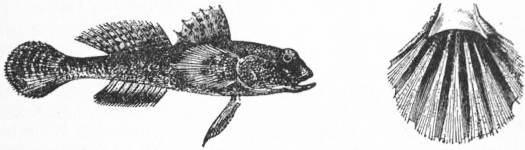
Fig. 1.—Gobius lentiginosus. Fig. 2.—United Ventrals of Goby.
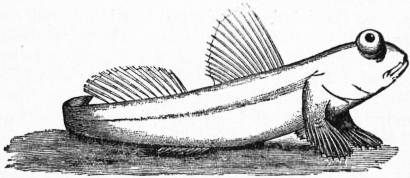
Fig. 3.—Periophthalmus koelreuteri.
Close allies of the gobies are the walking fish or jumping fish (Periophthalmus), of which various species are found in great numbers on the mud flats at the mouths of rivers in the tropics, skipping about by means of the muscular, scaly base of their pectoral fins, with the head raised and bearing a pair of strongly projecting versatile eyes close together.
GOCH, a town of Germany, in the Prussian Rhine province, on the Niers, 8 m. S. of Cleves at the junction of the railways Cologne-Zevenaar and Boxtel-Wesel. Pop. (1905) 10,232. It has a Protestant and a Roman Catholic church and manufactures of brushes, plush goods, cigars and margarine. In the middle ages it was the seat of a large trade in linen. Goch became a town in 1231 and belonged to the dukes of Gelderland and later to the dukes of Cleves.
GOD, the common Teutonic word for a personal object of religious worship. It is thus, like the Gr. θεός and Lat. deus, applied to all those superhuman beings of the heathen mythologies who exercise power over nature and man and are often identified with some particular sphere of activity; and also to the visible material objects, whether an image of the supernatural being or a tree, pillar, &c. used as a symbol, an idol. The word “god,” on the conversion of the Teutonic races to Christianity, was adopted as the name of the one Supreme Being, the Creator of the universe, and of the Persons of the Trinity. The New English Dictionary points out that whereas the old Teutonic type of the word is neuter, corresponding to the Latin numen, in the Christian applications it becomes masculine, and that even where the earlier neuter form is still kept, as in Gothic and Old Norwegian, the construction is masculine. Popular etymology has connected the word with “good”; this is exemplified by the corruption of “God be with you” into “good-bye.” “God” is a word common to all Teutonic languages. In Gothic it is Guth; Dutch has the same form as English; Danish and Swedish have Gud, German Gott. According to the New English Dictionary, the original may be found in two Aryan roots, both of the form gheu, one of which means “to invoke,” the other “to pour” (cf. Gr. χέειν); the last is used of sacrificial offerings. The word would thus mean the object either of religious invocation or of religious worship by sacrifice. It has been also suggested that the word might mean a “molten image” from the sense of “pour.”
See Religion; Hebrew Religion; Theism, &c.
GODALMING, a market-town and municipal borough in the Guildford parliamentary division of Surrey, England, 34 m. S.W. of London by the London & South-Western railway. Pop. (1901) 8748. It is beautifully situated on the right bank of the Wey, which is navigable thence to the Thames, and on the high road between London and Portsmouth. Steep hills, finely wooded, enclose the valley. The chief public buildings are the church of SS. Peter and Paul, a cruciform building of mixed architecture, but principally Early English and Perpendicular; the town-hall, Victoria hall, and market-house, and a technical institute and school of science and art. Charterhouse School, one of the principal English public schools, originally founded in 1611, was transferred from Charterhouse Square, London, to Godalming in 1872. It stands within grounds 92 acres in extent, half a mile north of Godalming, and consists of spacious buildings in Gothic style, with a chapel, library and hall, besides boarding-houses, masters’ houses and sanatoria. (See Charterhouse.) Godalming has manufactures of paper, leather, parchment and hosiery, and some trade in corn, malt, bark, hoops and timber; and the Bargate stone, of which the parish church is built, is still quarried. The borough is under a mayor, 6 aldermen and 18 councillors. Area, 812 acres.
Godalming (Godelminge) belonged to King Alfred, and was a royal manor at the time of Domesday. The manor belonged to the see of Salisbury in the middle ages, but reverted to the crown in the time of Henry VIII. Godalming was incorporated by Elizabeth in 1574, when the borough originated. The charter was confirmed by James I. in 1620, and a fresh charter was granted by Charles II. in 1666. The borough was never represented in parliament. The bishop of Salisbury in 1300 received the grant of a weekly market to be held on Mondays: the day was altered to Wednesday by Elizabeth’s charter. The bishop’s grant included a fair at the feast of St Peter and St Paul (29th of June). Another fair at Candlemas (2nd of February) was granted by Elizabeth. The market is still held. The making of cloth, particularly Hampshire kerseys, was the staple industry of Godalming in the middle ages, but it began to decay early in the 17th century and by 1850 was practically extinct. As in other cases, dyeing was subsidiary to the cloth industry. Tanning, introduced in the 15th century, survives. The present manufacture of fleecy hosiery dates from the end of the 18th century.
GODARD, BENJAMIN LOUIS PAUL (1849-1895); French composer, was born in Paris, on the 18th of August 1849. He studied at the Conservatoire, and competed for the Prix de Rome without success in 1866 and 1867. He began by publishing a number of songs, many of which are charming, such as “Je ne veux pas d’autres choses,” “Ninon,” “Chanson de Florian,” also a quantity of piano pieces, some chamber music, including several violin sonatas, a trio for piano and strings, a quartet for strings, a violin concerto and a second work of the same kind entitled “Concerto Romantique.” Godard’s chance arrived in the year 1878, when with his dramatic cantata, Le Tasse, he shared with M. Théodore Dubois the honour of winning the musical competition instituted by the city of Paris. From that time until his death Godard composed a surprisingly large number of works, including four operas, Pedro de Zalamea, produced at Antwerp in 1884; Jocelyn, given in Paris at the Théâtre du Château d’Eau, in 1888; Dante, played at the Opéra Comique two years later; and La Vivandière, left unfinished and partly scored by another hand. This last work was heard at the Opéra Comique in 1895, and has been played in England by the Carl Rosa Opera Company. His other works include the “Symphonie légendaire,” “Symphonie gothique,” “Diane” and various orchestral works. Godard’s productivity was enormous, and his compositions are, for this reason only, decidedly unequal. He was at his best in works of smaller dimensions, and has left many exquisite songs. Among his more ambitious works the “Symphonie légendaire” may be singled out as being one of the most distinctive. He had a decided individuality, and his premature death at Cannes on the 10th of January 1895 was a loss to French art.
GODAVARI, a river of central and western India. It flows across the Deccan from the Western to the Eastern Ghats; its total length is 900 m., the estimated area of its drainage basin, 112,200 sq. m. Its traditional source is on the side of a hill behind the village of Trimbak in Nasik district, Bombay, where the water runs into a reservoir from the lips of an image. But according to popular legend it proceeds from the same ultimate source as the Ganges, though underground. Its course is generally south-easterly. After passing through Nasik district, it crosses into the dominions of the nizam of Hyderabad. When it again strikes British territory it is joined by the Pranhita, with its tributaries the Wardha, the Penganga and Wainganga. For some distance it flows between the nizam’s dominions and the Upper Godavari district, and receives the Indravati, the Tal and the Sabari. The stream has here a channel varying from 1 to 2 m. in breadth, occasionally broken by alluvial islands. Parallel to the river stretch long ranges of hills. Below the junction of the Sabari the channel begins to contract. The flanking hills gradually close in on both sides, and the result is a magnificent gorge only 200 yds. wide through which the water flows into the plain of the delta, about 60 m. from the sea. The head of the delta is at the village of Dowlaishweram, where the main stream is crossed by the irrigation anicut. The river has seven mouths, the largest being the Gautami Godavari. The Godavari is regarded as peculiarly sacred, and once every twelve years the great bathing festival called Pushkaram is held on its banks at Rajahmundry.
The upper waters of the Godavari are scarcely utilized for irrigation, but the entire delta has been turned into a garden of perennial crops by means of the anicut at Dowlaishweram, constructed by Sir Arthur Cotton, from which three main canals are drawn off. The river channel here is 3½ m. wide. The anicut is a substantial mass of stone, bedded in lime cement, about 2¼ m. long, 130 ft. broad at the base, and 12 ft. high. The stream is thus pent back so as to supply a volume of 3000 cubic ft. of water per second during its low season, and 12,000 cubic ft. at time of flood. The main canals have a total length of 493 m., irrigating 662,000 acres, and all navigable; and there are 1929 m. of distributary channels. In 1864 water-communication was opened between the deltas of the Godavari and Kistna. Rocky barriers and rapids obstruct navigation in the upper portion of the Godavari. Attempts have been made to construct canals round these barriers with little success, and the undertaking has been abandoned.
GODAVARI, a district of British India, in the north-east of the Madras presidency. It was remodelled in 1907-1908, when part of it was transferred to Kistna district. Its present area is 5634 sq. m. Its territory now lies mainly east of the Godavari river, including the entire delta, with a long narrow strip extending up its valley. The apex of the delta is at Dowlaishweram, where a great dam renders the waters available for irrigation. Between this point and the coast there is a vast extent of rice fields. Farther inland, and enclosing the valley of the great river, are low hills, steep and forest-clad. The north-eastern part, known as the Agency tract, is occupied by spurs of the Eastern Ghats. The coast is low, sandy and swampy, the sea very shallow, so that vessels must lie nearly 5 m. from Cocanada, the chief port. The Sabari is the principal tributary of the Godavari within the district. The Godavari often rises in destructive floods. The population of the present area in 1901 was 1,445,961. In the old district the increase during the last decade was 11%. The chief towns are Cocanada and Rajahmundry. The forests are of great value; coal is known, and graphite is worked. The population is principally occupied in agriculture, the principal crops being rice, oil-seeds, tobacco and sugar. The cigars known in England as Lunkas are partly made from tobacco grown on lankas or islands in the river Godavari. Sugar (from the juice of the palmyra palm) and rum are made by European processes at Samalkot. The administrative headquarters are now at Cocanada, the chief seaport; but Rajahmundry, at the head of the delta, is the old capital. A large but decreasing trade is conducted at Cocanada, rice being shipped to Mauritius and Ceylon, and cotton and oil-seeds to Europe. Rice-cleaning mills have been established here and at other places. The district is traversed by the main line of the East Coast railway, with a branch to Cocanada; the iron girder bridge of forty-two spans over the Godavari river near Rajahmundry was opened in 1900. There is a government college at Rajahmundry, with a training college attached, and an aided college at Cocanada.
The Godavari district formed part of the Andhra division of Dravida, the north-west portion being subject to the Orissa kings, and the south-western belonging to the Vengi kingdom. For centuries it was the battlefield on which various chiefs fought for independence with varying success till the beginning of the 16th century, when the whole country may be said to have passed under Mahommedan power. At the conclusion of the struggle with the French in the Carnatic, Godavari with the Northern Circars was conquered by the English, and finally ceded by imperial sanad in 1765. The district was constituted in 1859, by the redistribution of the territory comprising the former districts of Guntur, Rajahmundry and Masulipatam, into what are now the Kistna and Godavari districts.
See H. Morris, District Manual (1878); District Gazetteer (1906).
GODEFROY (Gothofredus), a French noble family, which numbered among its members several distinguished jurists and historians. The family claimed descent from Symon Godefroy, who was born at Mons about 1320 and was lord of Sapigneulx near Berry-au-bac, now in the department of Aisne.
Denis Godefroy (Dionysius Gothofredus) (1549-1622), jurist, son of Léon Godefroy, lord of Guignecourt, was born in Paris on the 17th of October 1549. He was educated at the Collège de Navarre, and studied law at Louvain, Cologne and Heidelberg, returning to Paris in 1573. He embraced the reformed religion, and in 1579 left Paris, where his abilities and connexions promised a brilliant career, to establish himself at Geneva. He became professor of law there, received the freedom of the city in 1580; and in 1587 became a member of the Council of the Two Hundred. Henry IV. induced him to return to France by making him grand bailli of Gex, but no sooner had he installed himself than the town was sacked and his library burnt by the troops of the duke of Savoy. In 1591 he became professor of Roman law at Strassburg, where he remained until April 1600, when in response to an invitation from Frederick IV., elector palatine, he removed to Heidelberg. The difficulties of his position led to his return to Strassburg for a short time, but in November 1604 he definitely settled at Heidelberg. He was made head of the faculty of law in the university, and was from time to time employed on missions to the French court. His repeated refusal of offers of advancement in his own country was due to his Calvinism. He died at Strassburg on the 7th of September 1622, having left Heidelberg before the city was sacked by the imperial troops in 1621. His most important work was the Corpus juris civilis, originally published at Geneva in 1583, which went through some twenty editions, the most valuable of them being that printed by the Elzevirs at Amsterdam in 1633 and the Leipzig edition of 1740.
Lists of his other learned works may be found in Senebier’s Hist. litt. de Genève, vol. ii., and in Nicéron’s Mémoires, vol. xvii. Some of his correspondence with his learned friends, with his kinsman President de Thou, Isaac Casaubon, Jean Jacques Grynaeus and others, is preserved in the libraries of the British Museum, of Basel and Paris.
His eldest son, Theodore Godefroy (1580-1649), was born at Geneva on the 14th of July 1580. He abjured Calvinism, and was called to the bar in Paris. He became historiographer of France in 1613, and was employed from time to time on diplomatic missions. He was employed at the congress of Münster, where he remained after the signing of peace in 1648 as chargé d’affaires until his death on the 5th of October of the next year. His most important work is Le Cérémonial de France ... (1619), a work which became a classic on the subject of royal ceremonial, and was re-edited by his son in an enlarged edition in 1649.
Besides his printed works he made vast collections of historical material which remains in MS. and fills the greater part of the Godefroy collection of over five hundred portfolios in the Library of the Institute in Paris. These were catalogued by Ludovic Lalanne in the Annuaire Bulletin (1865-1866 and 1892) of the Société de l’histoire de France.
The second son of Denis, Jacques Godefroy (1587-1652), jurist, was born at Geneva on the 13th of September 1587. He was sent to France in 1611, and studied law and history at Bourges and Paris. He remained faithful to the Calvinist persuasion, and soon returned to Geneva, where he became active in public affairs. He was secretary of state from 1632 to 1636, and syndic or chief magistrate in 1637, 1641, 1645 and 1649. He died on the 23rd of June 1652. In addition to his civic and political work he lectured on law, and produced, after thirty years of labour, his edition of the Codex Theodosianus. This code formed the principal, though not the only, source of the legal systems of the countries formed from the Western Empire. Godefroy’s edition was enriched with a multitude of important notes and historical comments, and became a standard authority on the decadent period of the Western Empire. It was only printed thirteen years after his death under the care of his friend Antoine Marville at Lyons (4 vols. 1665), and was reprinted at Leipzig (6 vols.) in 1736-1745. Of his numerous other works the most important was the reconstruction of the twelve tables of early Roman law.
See also the dictionary of Moreri, Nicéron’s Mémoires (vol. 17) and a notice in the Bibliothèque universelle de Genève (Dec. 1837).
Denis Godefroy (1615-1681), eldest son of Théodore, succeeded his father as historiographer of France, and re-edited various chronicles which had been published by him. He was entrusted by Colbert with the care and investigation of the records concerning the Low Countries preserved at Lille, where great part of his life was spent. He was also the historian of the reigns of Charles VII. and Charles VIII.
Other members of the family who attained distinction in the same branch of learning were the two sons of Denis Godefroy—Denis (1653-1719), also an historian, and Jean, sieur d’Aumont (1656-1732), who edited the letters of Louis XII., the memoirs of Marguerite de Valois, of Castelnau and Pierre de l’Estoile, and left some useful material for the history of the Low Countries; Jean Baptiste Achille Godefroy, sieur de Maillart (1697-1759), and Denis Joseph Godefroy, sieur de Maillart (1740-1819), son and grandson of Jean Godefroy, who were both officials at Lille, and left valuable historical documents which have remained in MS.
For further details see Les Savants Godefroy (Paris, 1873) by the marquis de Godefroy-Ménilglaise, son of Denis Joseph Godefroy.
GODESBERG, a spa of Germany, in the Prussian Rhine province, on the left bank of the Rhine, almost opposite Königswinter, and 4 m. S. of Bonn, on the railway to Coblenz. It is a fashionable summer resort, and contains numerous pretty villas, the residences of merchants from Cologne, Elberfeld, Crefeld and other Rhenish manufacturing centres. It has an Evangelical and three Roman Catholic churches, a synagogue and several educational establishments. Its chalybeate springs annually attract a large number of visitors, and the pump-room, baths and public grounds are arranged on a sumptuous scale. On a conical basalt hill, close by, are the ruins, surmounted by a picturesque round tower, of Godesberg castle. Built by Archbishop Dietrich I. of Cologne in the 13th century, it was destroyed by the Bavarians in 1583.
See Dennert, Godesberg, eine Perle des Rheins (Godesberg, 1900).
GODET, FRÉDÉRIC LOUIS (1812-1900), Swiss Protestant theologian, was born at Neuchâtel on the 25th of October 1812. After studying theology at Neuchâtel, Bonn and Berlin, he was in 1850 appointed professor of theology at Neuchâtel. From 1851 to 1866 he also held a pastorate. In 1873 he became one of the founders of the free Evangelical Church of Neuchâtel, and professor in its theological faculty. He died there on the 29th of October 1900. A conservative scholar, Godet was the author of some of the most noteworthy French commentaries published in recent times.
His commentaries are on the Gospel of St John (2 vols., 1863-1865; 3rd ed., 1881-1888; Eng. trans. 1886, &c.); St Luke (2 vols., 1871; 3rd ed., 1888; Eng. trans. 1875, &c.); the Epistle to the Romans (2 vols., 1879-1880; 2nd ed., 1883-1890; Eng. trans., 1880, &c.); Corinthians (2 vols., 1886-1887; Eng. trans. 1886, &c.). His other works include Études bibliques (2 vols., 1873-1874; 4th ed., 1889; Eng. trans. 1875 f.), and Introduction au Nouveau Testament (1893 f.; Eng. trans., 1894, &c.); Lectures in Defence of the Christian Faith (Eng. trans. 4th ed., 1900).
GODFREY, SIR EDMUND BERRY (1621-1678), English magistrate and politician, younger son of Thomas Godfrey (1586-1664), a member of an old Kentish family, was born on the 23rd of December 1621. He was educated at Westminster school and at Christ Church, Oxford, and after entering Gray’s Inn became a dealer in wood. His business prospered. He was made a justice of the peace for the city of Westminster, and in September 1666 was knighted as a reward for his services as magistrate and citizen during the great plague in London; but in 1669 he was imprisoned for a few days for instituting the arrest of the king’s physician, Sir Alexander Fraizer (d. 1681), who owed him money. The tragic events in Godfrey’s life began in September 1678 when Titus Oates and two other men appeared before him with written information about the Popish Plot, and swore to the truth of their statements. During the intense excitement which followed the magistrate expressed a fear that his life was in danger, but took no extra precautions for safety. On the 12th of October he did not return home as usual, and on the 17th his body was found on Primrose Hill, Hampstead. Medical and other evidence made it certain that he had been murdered, and the excited populace regarded the deed as the work of the Roman Catholics. Two committees investigated the occurrence without definite result, but in December 1678 a certain Miles Prance, who had been arrested for conspiracy, confessed that he had shared in the murder. According to Prance the deed was instigated by some Roman Catholic priests, three of whom witnessed the murder, and was committed in the courtyard of Somerset House, where Godfrey was strangled by Robert Green, Lawrence Hill and Henry Berry, the body being afterwards taken to Hampstead. The three men were promptly arrested; the evidence of the informer William Bedloe, although contradictory, was similar on a few points to that of Prance, and in February 1679 they were hanged. Soon afterwards, however, some doubt was cast upon this story; a war of words ensued between Prance and others, and it was freely asserted that Godfrey had committed suicide. Later the falsehood of Prance’s confession was proved and Prance pleaded guilty to perjury; but the fact remains that Godfrey was murdered. Godfrey was an excellent magistrate, and was very charitable both in public and in private life. Mr John Pollock, in the Popish Plot (London, 1903), confirms the view that the three men, Green, Hill and Berry, were wrongfully executed, and thinks the murder was committed by some Jesuits aided by Prance. Godfrey was feared by the Jesuits because he knew, through Oates, that on the 24th of April 1678 a Jesuit congregation had met at the residence of the duke of York to concert plans for the king’s murder. He concludes thus: “The success of Godfrey’s murder as a political move is indubitable. The duke of York was the pivot of the Roman Catholic scheme in England, and Godfrey’s death saved both from utter ruin.” On the other hand Mr Alfred Marks in his Who killed Sir E. B. Godfrey? (1905) maintains that suicide was the cause of Godfrey’s death.
See the article Oates, Titus, also R. Tuke, Memoirs of the Life and Death of Sir Edmondbury Godfrey (London, 1682); and G. Burnet, History of my Own Time; The Reign of Charles II., edited by O. Airy (Oxford, 1900).
GODFREY OF BOUILLON (c. 1060-1100), a leader in the First Crusade, was the second son of Eustace II., count of Boulogne, by his marriage with Ida, daughter of Duke Godfrey II. of Lower Lorraine. He was designated by Duke Godfrey as his successor; but the emperor Henry IV. gave him only the mark of Antwerp, in which the lordship of Bouillon was included (1076). He fought for Henry, however, both on the Elster and in the siege of Rome; and he was invested in 1082 with the duchy of Lower Lorraine. Lorraine had been penetrated by Cluniac influences, and Godfrey would seem to have been a man of notable piety. Accordingly, though he had himself served as an imperialist, and though the Germans in general had little sympathy with the Crusaders (subsannabant ... quasi delirantes), Godfrey, nevertheless, when the call came “to follow Christ,” almost literally sold all that he had, and followed. Along with his brothers Eustace and Baldwin (the future Baldwin I. of Jerusalem) he led a German contingent, some 40,000 strong, along “Charlemagne’s road,” through Hungary to Constantinople, starting in August 1096, and arriving at Constantinople, after some difficulties in Hungary, in November. He was the first of the crusading princes to arrive, and on him fell the duty of deciding what the relations of the princes to the eastern emperor Alexius were to be. Eventually, after several disputes and some fighting, he did homage to Alexius in January 1097; and his example was followed by the other princes. From this time until the beginning of 1099 Godfrey appears as one of the minor princes, plodding onwards, and steadily fighting, while men like Bohemund and Raymund, Baldwin and Tancred were determining the course of events.
In 1099 he came once more to the front. The mass of the crusaders became weary of the political factions which divided some of their leaders; and Godfrey, who was more of a pilgrim than a politician, becomes the natural representative of this feeling. He was thus able to force the reluctant Raymund to march southward to Jerusalem; and he took a prominent part in the siege, his division being the first to enter when the city was captured. It was natural therefore that, when Raymund of Provence refused the offered dignity, Godfrey should be elected ruler of Jerusalem (July 22, 1099). He assumed the title not of king, but of “advocate”1 of the Holy Sepulchre. The new dignity proved still more onerous than honourable; and during his short reign of a year Godfrey had to combat the Arabs of Egypt, and the opposition of Raymund and the patriarch Dagobert. He was successful In repelling the Egyptian attack at the battle of Ascalon (August 1099); but he failed, owing to Raymund’s obstinacy and greed, to acquire the town of Ascalon after the battle. Left alone, at the end of the autumn, with an army of some 2000 men, Godfrey was yet able, in the spring of 1100, probably with the aid of new pilgrims, to exact tribute from towns like Acre, Ascalon, Arsuf and Caesarea. But already, at the end of 1099 Dagobert, archbishop of Pisa, had been substituted as patriarch for Arnulf (who had been acting as vicar) by the influence of Bohemund; and Dagobert, whose vassal Godfrey had at once piously acknowledged himself, seems to have forced him to an agreement in April 1100, by which he promised Jerusalem and Jaffa to the patriarch, in case he should acquire in their place Cairo or some other town, or should die without issue. Thus were the foundations of a theocracy laid in Jerusalem; and when Godfrey died (July 1100) he left the question to be decided, whether a theocracy or a monarchy should be the government of the Holy Land.
Because he had been the first ruler in Jerusalem Godfrey was idolized in later saga. He was depicted as the leader of the crusades, the king of Jerusalem, the legislator who laid down the assizes of Jerusalem. He was none of these things. Bohemund was the leader of the crusades; Baldwin was first king; the assizes were the result of a gradual development. In still other ways was the figure of Godfrey idealized by the grateful tradition of later days; but in reality he would seem to have been a quiet, pious, hard-fighting knight, who was chosen to rule in Jerusalem because he had no dangerous qualities, and no obvious defects.
Literature.—The narrative of Albert of Aix may be regarded as presenting the Lotharingian point of view, as the Gesta presents the Norman, and Raymund of Agiles the Provençal. The career of Godfrey has been discussed in modern times by R. Röhricht, Die Deutschen im heiligen Lande, Band ii., and Geschichte des ersten Kreuzzuges, passim (Innsbruck, 1901).
(E. Br.)
Romances.—Godfrey was the principal hero of two French chansons de geste dealing with the Crusade, the Chanson d’Antioche (ed. P. Paris, 2 vols., 1848) and the Chanson de Jérusalem (ed. C. Hippeau, 1868), and other poems, containing less historical material, were subsequently added. In addition the parentage and early exploits of Godfrey were made the subject of legend. His grandfather was said to be Helias, knight of the Swan, one of the brothers whose adventures are well known, though with some variation, in the familiar fairy tale of “The Seven Swans.” Helias, drawn by the swan, one day disembarked at Nijmwegen, and reconquered her territory for the duchess of Bouillon. Marrying her daughter he exacted a promise that his wife should not inquire into his origin. The tale, which is almost identical with the Lohengrin legend, belongs to the class of the Cupid and Psyche narratives. See Lohengrin.
See also C. Hippeau, Le Chevalier au cygne (Paris, 2 vols., 1874-1877); H. Pigeonneau, Le Cycle de la croisade et de la famille de Bouillon (1877); W. Golther, “Lohengrin,” in Roman. Forsch. (vol. v., 1889); Hist. litt. de la France, vol. xxii. pp. 350-402; the English romance of Helyas, Knyghte of the Swanne was printed by W. Copland about 1550.
1 An “advocate” was a layman who had been invested with part of an ecclesiastic estate, on condition that he defended the rest, and exercised the blood-ban in lieu of the ecclesiastical owner (see Advocate, sec. Advocatus ecclesiae).
GODFREY OF VITERBO (c. 1120-c. 1196), chronicler, was probably an Italian by birth, although some authorities assert that he was a Saxon. He evidently passed some of his early life at Viterbo, where also he spent his concluding days, but he was educated at Bamberg, gaining a good knowledge of Latin. About 1140 he became chaplain to the German king, Conrad III.; but the greater part of his life was spent as secretary (notarius) in the service of the emperor Frederick I., who appears to have thoroughly trusted him, and who employed him on many diplomatic errands. Incessantly occupied, he visited Sicily, France and Spain, in addition to many of the German cities, in the emperor’s interests, and was by his side during several of the Italian campaigns. Both before and after Frederick’s death in 1190 he enjoyed the favour of his son, the emperor Henry VI., for whom he wrote his Speculum regum, a work of very little value. Godfrey also wrote Memoria seculorum, or Liber memorialis, a chronicle dedicated to Henry VI., which professes to record the history of the world from the creation until 1185. It is written partly in prose and partly in verse. A revision of this work was drawn up by Godfrey himself as Pantheon, or Universitatis libri qui chronici appellantur. The author borrowed from Otto of Freising, but the earlier part of his chronicle is full of imaginary occurrences. Pantheon was first printed in 1559, and extracts from it are published by L. A. Muratori in the Rerum Italicarum scriptores, tome vii. (Milan, 1725). The only part of Godfrey’s work which is valuable is the Gesta Friderici I., verses relating events in the emperor’s career from 1155 to 1180. Concerned mainly with affairs in Italy, the poem tells of the sieges of Milan, of Frederick’s flight to Pavia in 1167, of the treaty with Pope Alexander III. at Venice, and of other stirring episodes with which the author was intimately acquainted, and many of which he had witnessed. Attached to the Gesta Friderici is the Gesta Heinrici VI., a shorter poem which is often attributed to Godfrey, although W. Wattenbach and other authorities think it was not written by him. The Memoria seculorum was very popular during the middle ages, and has been continued by several writers.
Godfrey’s works are found in the Monumenta Germaniae historica, Band xxii. (Hanover, 1872). The Gesta Friderici I. et Heinrici VI. is published separately with an introduction by G. Waitz (Hanover, 1872). See also H. Ulmann, Gotfried von Viterbo (Göttingen, 1863), and W. Wattenbach, Deutschlands Geschichtsquellen, Band ii. (Berlin, 1894).
(A. W. H.*)
GODHRA, a town of British India, administrative headquarters of the Panch Mahals district of Bombay, and also of the Rewa Kantha political agency; situated 52 m. N.E. of Baroda on the railway from Anand to Ratlam. Pop. (1901) 20,915. It has a trade in timber from the neighbouring forests.
GODIN, JEAN BAPTISTE ANDRÉ (1817-1888), French socialist, was born on the 26th of January 1817 at Esquehéries (Aisne). The son of an artisan, he entered an iron-works at an early age, and at seventeen made a tour of France as journeyman. Returning to Esquehéries in 1837, he started a small factory for the manufacture of castings for heating-stoves. The business increased rapidly, and for the purpose of railway facilities was transferred to Guise in 1846. At the time of Godin’s death in 1888 the annual output was over four millions of francs (£160,000), and in 1908 the employees numbered over 2000 and the output was over £280,000. An ardent disciple of Fourier, he advanced a considerable sum of money towards the disastrous Fourierist experiment of V. P. Considérant (q.v.) in Texas. He profited, however, by its failure, and in 1859 started the familistère or community settlement of Guise on more carefully laid plans. It comprises, in addition to the workshops, three large buildings, four storeys high, capable of housing all the work-people, each family having two or three rooms. Attached to each building is a vast central court, covered with a glass roof, under which the children can play in all weathers. There are also crèches, nurseries, hospital, refreshment rooms and recreation rooms of various kinds, stores for the purchase of groceries, drapery and every necessity, and a large theatre for concerts and dramatic entertainments. In 1880 the whole was turned into a co-operative society, with provision by which it eventually became the property of the workers. In 1871 Godin was elected deputy for Aisne, but retired in 1876 to devote himself to the management of the familistère. In 1882 he was created a knight of the legion of honour.
Godin was the author of Solutions sociales (1871); Les Socialistes et les droits du travail (1874); Mutualité sociale (1880); La République du travail et la réforme parlementaire (1889). See Bernardot, Le Familistère de Guise et son fondateur (Paris, 1887); Fischer, Die Familistère Godin’s (Berlin, 1890); Lestelle, Étude sur le familistère de Guise (Paris, 1904); D. F. P., Le Familistère illustré, résultats de vingt ans d’association, 1880-1900 (Eng. trans., Twenty-eight years of co-partnership at Guise, by A. Williams, 1908).
GODIVA, a Saxon lady, who, according to the legend, rode naked through the streets of Coventry to gain from her husband a remission of the oppressive toll imposed on his tenants. The story is that she was the beautiful wife of Leofric, earl of Mercia and lord of Coventry. The people of that city suffering grievously under the earl’s oppressive taxation, Lady Godiva appealed again and again to her husband, who obstinately refused to remit the tolls. At last, weary of her entreaties, he said he would grant her request if she would ride naked through the streets of the town. Lady Godiva took him at his word, and after issuing a proclamation that all persons should keep within doors or shut their windows, she rode through, clothed only in her long hair. One person disobeyed her proclamation, a tailor, ever afterwards known as Peeping Tom. He bored a hole in his shutters that he might see Godiva pass, and is said to have been struck blind. Her husband kept his word and abolished the obnoxious taxes.
The oldest form of the legend makes Godiva pass through Coventry market from one end to the other when the people were assembled, attended only by two soldiers, her long hair down so that none saw her, “apparentibus cruribus tamen candidissimis.” This version is given in Flores historiarum by Roger of Wendover, who quoted from an earlier writer. The later story, with its episode of Peeping Tom, has been evolved by later chroniclers. Whether the lady Godiva of this story is the Godiva or Godgifu of history is undecided. That a lady of this name existed in the early part of the 11th century is certain, as evidenced by several ancient documents, such as the Stow charter, the Spalding charter and the Domesday survey, though the spelling of the name varies considerably. It would appear from Liber Eliensis (end of 12th century) that she was a widow when Leofric married her in 1040. In or about that year she aided in the founding of a monastery at Stow, Lincolnshire. In 1043 she persuaded her husband to build and endow a Benedictine monastery at Coventry. Her mark, “ Ego Godiva Comitissa diu istud desideravi,” was found on the charter given by her brother, Thorold of Bucknall—sheriff of Lincolnshire—to the Benedictine monastery of Spalding in 1051; and she is commemorated as benefactress of other monasteries at Leominster, Chester, Wenlock, Worcester and Evesham. She probably died a few years before the Domesday survey (1085-1086), and was buried in one of the porches of the abbey church. Dugdale (1656) says that a window, with representations of Leofric and Godiva, was placed in Trinity Church, Coventry, about the time of Richard II. The Godiva procession, a commemoration of the legendary ride instituted on the 31st of May 1678 as part of Coventry fair, was celebrated at intervals until 1826. From 1848 to 1887 it was revived, and recently further attempts have been made to popularize the pageant. The wooden effigy of Peeping Tom which, since 1812, has looked out on the world from a house at the north-west corner of Hertford Street, Coventry, represents a man in armour, and was probably an image of St George. It was removed from another part of the town to its present position.

GODKIN, EDWIN LAWRENCE (1831-1902), American publicist, was born in Moyne, county Wicklow, Ireland, on the 2nd of October 1831. His father, James Godkin, was a Presbyterian minister and a journalist, and the son, after graduating in 1851 at Queen’s College, Belfast, and studying law in London, was in 1853-1855 war correspondent for the London Daily News in Turkey and Russia, being present at the capture of Sevastopol, and late in 1856 went to America and wrote letters to the same journal, giving his impressions of a tour of the southern states of the American Union. He studied law in New York City, was admitted to the bar in 1859, travelled in Europe in 1860-1862, wrote for the London News and the New York Times in 1862-1865, and in 1865 founded in New York City the Nation, a weekly projected by him long before, for which Charles Eliot Norton gained friends in Boston and James Miller McKim (1810-1874) in Philadelphia, and which Godkin edited until the end of the year 1899. In 1881 he sold the Nation to the New York Evening Post, and became an associate editor of the Post, of which he was editor-in-chief in 1883-1899, succeeding Carl Schurz. In the ’eighties he engaged in a controversy with Goldwin Smith over the Irish question. Under his leadership the Post broke with the Republican party in the presidential campaign of 1884, when Godkin’s opposition to Blaine did much to create the so-called Mugwump party (see Mugwump), and his organ became thoroughly independent, as was seen when it attacked the Venezuelan policy of President Cleveland, who had in so many ways approximated the ideal of the Post and Nation. He consistently advocated currency reform, the gold basis, a tariff for revenue only, and civil service reform, rendering the greatest aid to the last cause. His attacks on Tammany Hall were so frequent and so virulent that in 1894 he was sued for libel because of biographical sketches of certain leaders in that organization—cases which never came up for trial. His opposition to the war with Spain and to imperialism was able and forcible. He retired from his editorial duties on the 30th of December 1899, and sketched his career in the Evening Post of that date. Although he recovered from a severe apoplectic stroke early in 1900, his health was shattered, and he died in Greenway, Devonshire, England, on the 21st of May 1902. Godkin shaped the lofty and independent policy of the Post and the Nation, which had a small but influential and intellectual class of readers. But as editor he had none of the personal magnetism of Greeley, for instance, and his superiority to the influence of popular feeling made Charles Dudley Warner style the Nation the “weekly judgment day.” He was an economist of the school of Mill, urged the necessity of the abstraction called “economic man,” and insisted that socialism put in practice would not improve social and economic conditions in general. In politics he was an enemy of sentimentalism and loose theories in government. He published A History of Hungary, A.D. 300-1850 (1856), Government (1871, in the American Science Series), Reflections and Comments (1895), Problems of Modern Democracy (1896) and Unforeseen Tendencies of Democracy (1898).
See Life and Letters of E. L. Godkin, edited by Rollo Ogden (2 vols., New York, 1907).
GODMANCHESTER, a municipal borough in the southern, parliamentary division of Huntingdonshire, England, on the right bank of the Ouse, 1 m. S.S.E. of Huntingdon, on a branch of the Great Eastern railway. Pop. (1901) 2017. It has a beautiful Perpendicular church (St Mary’s) and an agricultural trade, with flour mills. The town is governed by a mayor, 4 aldermen and 12 councillors. Area, 4907 acres.
A Romano-British village occupied the site of Godmanchester. The town (Gumencestre, Gomecestre) belonged to the king before the Conquest and at the time of the Domesday survey. In 1213 King John granted the manor to the men of the town at a fee-farm of £120 yearly, and confirmation charters were granted by several succeeding kings, Richard II. in 1391-1392 adding exemption from toll, pannage, &c. James I. granted an incorporation charter in 1605 under the title of bailiffs, assistants and commonalty, but under the Municipal Reform Act of 1835 the corporation was changed to a mayor, 4 aldermen and 12 councillors. Godmanchester was formerly included for parliamentary purposes in the borough of Huntingdon, which has ceased to be separately represented since 1885. The incorporation charter of 1605 recites that the burgesses are chiefly engaged in agriculture, and grants them a fair, which still continues every year on Tuesday in Easter week.
See Victoria County History, Huntingdon; Robert Fox, The History of Godmanchester (1831).
GÖDÖLLÖ, a market town of Hungary, in the county of Pest-Pilis-Solt-Kiskun, 23 m. N.E. of Budapest by rail. Pop. (1900) 5875. Gödöllö is the summer residence of the Hungarian royal family, and the royal castle, built in the second half of the 18th century by Prince Anton Grassalkovich, was, with the beautiful domain, presented by the Hungarian nation to King Francis Joseph I. after the coronation in 1867. In its park there are a great number of stags and wild boars. Gödöllö is a favourite summer resort of the inhabitants of Budapest. In its vicinity is the famous place of pilgrimage Mária-Besnyö, with a fine Franciscan monastery, which contains the tombs of the Grassalkovich family.
GODOLPHIN, SIDNEY GODOLPHIN, Earl of (c. 1645-1712), was a cadet of an ancient family of Cornwall. At the Restoration he was introduced into the royal household by Charles II., with whom he had previously become a favourite, and he also at the same period entered the House of Commons as member for Helston. Although he very seldom addressed the House, and, when he did so, only in the briefest manner, he gradually acquired a reputation as its chief if not its only financial authority. In March 1679 he was appointed a member of the privy council, and in the September following he was promoted, along with Viscount Hyde (afterwards earl of Rochester) and the earl of Sunderland, to the chief management of affairs. Though he voted for the Exclusion Bill in 1680, he was continued in office after the dismissal of Sunderland, and in September 1684 he was created Baron Godolphin of Rialton, and succeeded Rochester as first lord of the treasury. After the accession of James II. he was made chamberlain to the queen, and, along with Rochester and Sunderland, enjoyed the king’s special confidence. In 1687 he was named commissioner of the treasury. He was one of the council of five appointed by King James to represent him in London, when he went to join the army after the landing of William, prince of Orange, in England, and, along with Halifax and Nottingham, he was afterwards appointed a commissioner to treat with the prince. On the accession of William, though he only obtained the third seat at the treasury board, he had virtually the chief control of affairs. He retired in March 1690, but was recalled on the November following and appointed first lord. While holding this office he for several years continued, in conjunction with Marlborough, a treacherous intercourse with James II., and is said even to have anticipated Marlborough in disclosing to James intelligence regarding the intended expedition against Brest. Godolphin was not only a Tory by inheritance, but had a romantic admiration for the wife of James II. He also wished to be safe whatever happened, and his treachery in this case was mostly due to caution. After Fenwick’s confession in 1696 regarding the attempted assassination of William III., Godolphin, who was compromised, was induced to tender his resignation; but when the Tories came into power in 1700, he was again appointed lord treasurer and retained office for about a year. Though not a favourite with Queen Anne, he was, after her accession, appointed to his old office, on the strong recommendation of Marlborough. He also in 1704 received the honour of knighthood, and in December 1706 he was created Viscount Rialton and earl of Godolphin. Though a Tory he had an active share in the intrigues which gradually led to the predominance of the Whigs in alliance with Marlborough. The influence of the Marlboroughs with the queen was, however, gradually supplanted by that of Mrs Masham and Harley, earl of Oxford, and with the fortunes of the Marlboroughs those of Godolphin were indissolubly united. The services of both were so appreciated by the nation that they were able for a time to regard the loss of the queen’s favour with indifference, and even in 1708 to procure the expulsion of Harley from office; but after the Tory reaction which followed the impeachment of Dr Sacheverel, who abused Godolphin under the name of Volpone, the queen made use of the opportunity to take the initiatory step towards delivering herself from the irksome thraldom of Marlborough by abruptly dismissing Godolphin from office on the 7th of August 1710. He died on the 15th of September 1712.
Godolphin owed his rise to power and his continuance in it under four sovereigns chiefly to his exceptional mastery of financial matters; for if latterly he was in some degree indebted for his promotion to the support of Marlborough, he received that support mainly because Marlborough recognized that for the prosecution of England’s foreign wars his financial abilities were an indispensable necessity. He was cool, reserved and cautious, but his prudence was less associated with high sagacity than traceable to the weakness of his personal antipathies and prejudices, and his freedom from political predilections. Perhaps it was his unlikeness to Marlborough in that moral characteristic which so tainted Marlborough’s greatness that rendered possible between them a friendship so intimate and undisturbed: he was, it would appear, exceptionally devoid of the passion of avarice; and so little advantage did he take of his opportunities of aggrandizement that, though his style of living was unostentatious,—and in connexion with his favourite pastimes of horse-racing, card-playing and cock-fighting he gained perhaps more than he lost,—all that he left behind him did not, according to the duchess of Marlborough, amount to more than £12,000.
Godolphin married Margaret Blagge, the pious lady whose life was written by Evelyn, on the 16th of May 1675, and married again after her death in 1678. His son and successor, Francis (1678-1766), held various offices at court, and was lord privy seal from 1735 to 1740. He married Henrietta Churchill (d. 1733), daughter of the duke of Marlborough, who in 1722 became in her own right duchess of Marlborough. He died without male issue in January 1766, when the earldom became extinct, and the estates passed to Thomas Osborne, 4th duke of Leeds, the husband of the earl’s daughter Mary, whose descendant is the present representative of the Godolphins.
A life of Godolphin was published in 1888 in London by the Hon. H. Elliot.
GODOY, ALVAREZ DE FARIA, RIOS SANCHEZ Y ZARZOSA, MANUEL DE (1767-1851), duke of El Alcudia and prince of the Peace, Spanish royal favourite and minister, was born at Badajoz on the 12th of May 1767. His father, Don José de Godoy, was the head of a very ancient but impoverished family of nobles in Estremadura. His mother, whose maiden name was Maria Antonia Alvarez de Faria, belonged to a Portuguese noble family. Manuel boasts in his memoirs that he had the best masters, but it is certain that he received only the very slight education usually given at that time to the sons of provincial nobles. In 1784 he entered the Guardia de Corps, a body of gentlemen who acted as the immediate body-guard of the king. His well-built and stalwart person, his handsome foolish face, together with a certain geniality of character which he must have possessed, earned him the favour of Maria Luisa of Parma, the princess of Asturias, a coarse, passionate woman who was much neglected by her husband, who on his part cared for nothing but hunting.
When King Charles III. died in 1788, Godoy’s fortune was soon made. The princess of Asturias, now queen, understood how to manage her husband Charles IV. Godoy says in his memoirs that the king, who had been carefully kept apart from affairs during his father’s life, and who disliked his father’s favourite minister Floridablanca, wished to have a creature of his own. This statement is no doubt true as far as it goes. But it requires to be completed by the further detail that the queen put her lover in her husband’s way, and that the king was guided by them, when he thought he was ruling for himself through a subservient minister. In some respects King Charles was obstinate, and Godoy is probably right in saying that he never was an absolute “viceroy,” and that he could not always secure the removal of colleagues whom he knew to be his enemies. He could only rule by obeying. Godoy adopted without scruple this method of pushing his fortunes. When the king was set on a particular course, he followed it; the execution was left to him and the queen. His pliability endeared him to his master, whose lasting affection he earned. In practice he commonly succeeded in inspiring the wishes which he then proceeded to gratify. From the very beginning of the new reign he was promoted in the army with scandalous rapidity, made duke of El Alcudia, and in 1792 minister under the premiership of Aranda, whom he succeeded in displacing by the close of the year.
His official life is fairly divided by himself into three periods. From 1792 to 1798 he was premier. In the latter year his unpopularity and the intrigues of the French government, which had taken a dislike to him, led to his temporary retirement, without, however, any diminution of the king’s personal favour. He asserts that he had no wish to return to office, but letters sent by him to the queen show that he begged for employment. They are written in a very unpleasant mixture of gush and vulgar familiarity. In 1801 he returned to office, and until 1807 he was the executant of the disastrous policy of the court. The third period of his public life is the last year, 1807-1808, when he was desperately striving for his place between the aggressive intervention of Napoleon on the one hand, and the growing hatred of the nation, organized behind, and about, the prince of Asturias, Ferdinand. On the 17th of March 1808 a popular outbreak at Aranjuez drove him into hiding. When driven out by hunger and thirst he was recognized and arrested. By Ferdinand’s order he was kept in prison, till Napoleon demanded that he should be sent to Bayonne. Here he rejoined his master and mistress. He remained with them till Charles IV. died at Rome in 1819, having survived his queen. The rest of Godoy’s life was spent in poverty and obscurity. After the death of Ferdinand VII., in 1833, he returned to Madrid, and endeavoured to secure the restoration of his property confiscated in 1808. Part of it was the estate of the Soto de Roma, granted by the cortes to the duke of Wellington. He failed, and during his last years lived on a small pension granted him by Louis Philippe. He died in Paris on the 4th of October 1851.
As a favourite Godoy is remarkable for the length of his hold on the affection of his sovereigns, and for its completeness. Latterly he was supported rather by the husband than by the wife. He got rid of Aranda by adopting, in order to please the king, a policy which tended to bring on war with France. When the war proved disastrous, he made the peace of Basel, and was created prince of the Peace for his services. Then he helped to make war with England, and the disasters which followed only made him dearer to the king. Indeed it became a main object with Charles IV. to protect “Manuelito” from popular hatred, and if possible secure him a principality. The queen endured his infidelities to her, which were flagrant. The king arranged a marriage for him with Doña Teresa de Bourbon, daughter of the infante Don Luis by a morganatic marriage, though he was probably already married to Doña Josefa Tudó, and certainly continued to live with her. Godoy, in his memoirs, lays claim to have done much for Spanish agriculture and industry, but he did little more than issue proclamations and appoint officers. His intentions may have been good, but the policy of his government was financially ruinous. In his private life he was not only profligate and profuse, but childishly ostentatious. The best that can be said for him is that he was good-natured, and did his best to restrain the Inquisition and the purely reactionary parties.
Authorities.—Godoy’s Memoirs were published in Spanish, English and French in 1836. A general account of his career will be found in the Mémoires sur la Révolution d’Espagne, by the Abbé de Pradt (1816).
GODROON, or Gadroon (Fr. godron, of unknown etymology), in architecture, a convex decoration (said to be derived from raised work on linen) applied in France to varieties of the bead and reel, in which the bead is often carved with ornament. In England the term is constantly used by auctioneers to describe the raised convex decorations under the bowl of stone or terra-cotta vases. The godroons radiate from the vertical support of the vase and rise half-way up the bowl.
GODWIN, FRANCIS (1562-1633), English divine, son of Thomas Godwin, bishop of Bath and Wells, was born at Hannington, Northamptonshire, in 1562. He was elected student of Christ Church, Oxford, in 1578, took his bachelor’s degree in 1580, and that of master in 1583. After holding two Somersetshire livings he was in 1587 appointed subdean of Exeter. In 1590 he accompanied William Camden on an antiquarian tour through Wales. He was created bachelor of divinity in 1593, and doctor in 1595. In 1601 he published his Catalogue of the Bishops of England since the first planting of the Christian Religion in this Island, a work which procured him in the same year the bishopric of Llandaff. A second edition appeared in 1615, and in 1616 he published an edition in Latin with a dedication to King James, who in the following year conferred upon him the bishopric of Hereford. The work was republished, with a continuation by William Richardson, in 1743. In 1616 Godwin published Rerum Anglicarum, Henrico VIII., Edwardo VI. et Maria regnantibus, Annales, which was afterwards translated and published by his son Morgan under the title Annales of England (1630). He is also the author of a somewhat remarkable story, published posthumously in 1638, and entitled The Man in the Moone, or a Discourse of a Voyage thither, by Domingo Gonsales, written apparently some time between the years 1599 and 1603. In this production Godwin not only declares himself a believer in the Copernican system, but adopts so far the principles of the law of gravitation as to suppose that the earth’s attraction diminishes with the distance. The work, which displays considerable fancy and wit, was translated into French, and was imitated in several important particulars by Cyrano de Bergerac, from whom (if not from Godwin direct) Swift obtained valuable hints in writing of Gulliver’s voyage to Laputa. Another work of Godwin’s, Nuncius inanimatus Utopiae, originally published in 1629 and again in 1657, seems to have been the prototype of John Wilkins’s Mercury, or the Secret and Swift Messenger, which appeared in 1641. He died, after a lingering illness, in April 1633.
GODWIN, MARY WOLLSTONECRAFT (1759-1797), English miscellaneous writer, was born at Hoxton, on the 27th of April 1759. Her family was of Irish extraction, and Mary’s grandfather, who was a respectable manufacturer in Spitalfields, realized the property which his son squandered. Her mother, Elizabeth Dixon, was Irish, and of good family. Her father, Edward John Wollstonecraft, after dissipating the greater part of his patrimony, tried to earn a living by farming, which only plunged him into deeper difficulties, and he led a wandering, shifty life. The family roamed from Hoxton to Edmonton, to Essex, to Beverley in Yorkshire, to Laugharne, Pembrokeshire, and back to London again.
After Mrs Wollstonecraft’s death in 1780, soon followed by her husband’s second marriage, the three daughters, Mary, Everina and Eliza, sought to earn their own livelihood. The sisters were all clever women—Mary and Eliza far above the average—but their opportunities of culture had been few. Mary, the eldest, went in the first instance to live with her friend Fanny Blood, a girl of her own age, whose father, like Wollstonecraft, was addicted to drink and dissipation. As long as she lived with the Bloods, Mary helped Mrs Blood to earn money by taking in needlework, while Fanny painted in watercolours. Everina went to live with her brother Edward, and Eliza made a hasty and, as it proved, unhappy marriage with a Mr Bishop. A legal separation was afterwards obtained, and the sisters, together with Fanny Blood, took a house, first at Islington, afterwards at Newington Green, and opened a school, which was carried on with indifferent success for nearly two years. During their residence at Newington Green, Mary was introduced to Dr Johnson, who, as Godwin tells us, “treated her with particular kindness and attention.”
In 1785 Fanny Blood married Hugh Skeys, a merchant, and went with him to Lisbon, where she died in childbed after sending for Mary to nurse her. “The loss of Fanny,” as she said in a letter to Mrs Skeys’s brother, George Blood, “was sufficient of itself to have cast a cloud over my brightest days.... I have lost all relish for pleasure, and life seems a burden almost too heavy to be endured.” Her first novel, Mary, a Fiction (1788), was intended to commemorate her friendship with Fanny. After closing the school at Newington Green, Mary became governess in the family of Lord Kingsborough, in Ireland. Her pupils were much attached to her, especially Margaret King, afterwards Lady Mountcashel; and indeed, Lady Kingsborough gave the reason for dismissing her after one year’s service that the children loved their governess better than their mother. Mary now resolved to devote herself to literary work, and she was encouraged by Johnson, the publisher in St Paul’s churchyard, for whom she acted as literary adviser. She also undertook translations, chiefly from the French. The Elements of Morality (1790) from the German of Salzmann, illustrated by Blake, an old-fashioned book for children, and Lavater’s Physiognomy were among her translations. Her Original Stories from Real Life were published in 1791, and, with illustrations by Blake, in 1796. In 1792 appeared A Vindication of the Rights of Woman, the work with which her name is always associated.
It is not among the least oddities of this book that it is dedicated to M. Talleyrand Périgord, late bishop of Autun. Mary Wollstonecraft still believed him to be sincere, and working in the same direction as herself. In the dedication she states the “main argument” of the work, “built on this simple principle that, if woman be not prepared by education to become the companion of man, she will stop the progress of knowledge, for truth must be common to all, or it will be inefficacious with respect to its influence or general practice.” In carrying out this argument she used great plainness of speech, and it was this that caused all, or nearly all, the outcry. For she did not attack the institution of marriage, nor assail orthodox religion; her book was really a plea for equality of education, passing into one for state education and for the joint education of the sexes. It was a protest against the assumption that woman was only the plaything of man, and she asserted that intellectual companionship was the chief, as it is the lasting, happiness of marriage. She thus directly opposed the teaching of Rousseau, of whom she was in other respects an ardent disciple.
Mrs Wollstonecraft, as she now styled herself, desired to watch the progress of the Revolution in France, and went to Paris in 1792. Godwin, in his memoir of his wife, considers that the change of residence may have been prompted by the discovery that she was becoming attached to Henry Fuseli, but there is little to confirm this surmise; indeed, it was first proposed that she should go to Paris in company with him and his wife, nor was there any subsequent breach in their friendship. She remained in Paris during the Reign of Terror, when communication with England was difficult or almost impossible. Some time in the spring or summer of 1793 Captain Gilbert Imlay, an American, became acquainted with Mary—an acquaintance which ended in a more intimate connexion. There was no legal ceremony of marriage, and it is doubtful whether such a marriage would have been valid at the time; but she passed as Imlay’s wife, and Imlay himself terms her in a legal document, “Mary Imlay, my best friend and wife.” In August 1793 Imlay was called to Havre on business, and was absent for some months, during which time most of the letters published after her death by Godwin were written. Towards the end of the year she joined Imlay at Havre, and there in the spring of 1794 she gave birth to a girl, who received the name of Fanny, in memory of the dear friend of her youth. In this year she published the first volume of a never completed Historical and Moral View of the French Revolution. Imlay became involved in a multitude of speculations, and his affection for Mary and their child was already waning. He left Mary for some months at Havre. In June 1795, after joining him in England, Mary left for Norway on business for Imlay. Her letters from Norway, divested of all personal details, were afterwards published. She returned to England late in 1795, and found letters awaiting her from Imlay, intimating his intention to separate from her, and offering to settle an annuity on her and her child. For herself she rejected this offer with scorn: “From you,” she wrote, “I will not receive anything more. I am not sufficiently humbled to depend on your beneficence.” They met again, and for a short time lived together, until the discovery that he was carrying on an intrigue under her own roof drove her to despair, and she attempted to drown herself by leaping from Putney bridge, but was rescued by watermen. Imlay now completely deserted her, although she continued to bear his name.
In 1796, when Mary Wollstonecraft was living in London, supporting herself and her child by working, as before, for Mr Johnson, she met William Godwin. A friendship sprang up between them,—a friendship, as he himself says, which “melted into love.” Godwin states that “ideas which he is now willing to denominate prejudices made him by no means willing to conform to the ceremony of marriage”; but these prejudices were overcome, and they were married at St Pancras church on the 29th of March 1797. And now Mary had a season of real calm in her stormy existence. Godwin, for once only in his life, was stirred by passion, and his admiration for his wife equalled his affection. But their happiness was of short duration. The birth of her daughter Mary, afterwards the wife of Percy Bysshe Shelley, on the 30th of August 1797, proved fatal, and Mrs Godwin died on the 10th of September following. She was buried in the churchyard of Old St Pancras, but her remains were afterwards removed by Sir Percy Shelley to the churchyard of St Peter’s, Bournemouth.
Her principal published works are as follows:—Thoughts on the Education of Daughters, ... (1787); The Female Reader (selections) (1789); Original Stories from Real Life (1791); An Historical and Moral View of the Origin and Progress of the French Revolution, and the effects it has produced in Europe, vol. i. (no more published) (1790); Vindication of the Rights of Woman (1792); Vindication of the Rights of Man (1793); Mary, a Fiction (1788); Letters written during a Short Residence in Sweden, Norway and Denmark (1796); Posthumous Works (4 vols., 1798). It is impossible to trace the many articles contributed by her to periodical literature.
A memoir of her life was published by Godwin in 1798. A large portion of C. Kegan Paul’s work, William Godwin, his Friends and Contemporaries, was devoted to her, and an edition of the Letters to Imlay (1879), of which the first edition was published by Godwin, is prefaced by a somewhat fuller memoir. See also E. Dowden, The French Revolution and English Literature (1897) pp. 82 et seq.; E. R. Pennell, Mary Wollstonecraft Godwin (1885), in the Eminent Women Series; E. R. Clough, A Study of Mary Wollstonecraft and the Rights of Woman (1898); an edition of her Original Stories (1906), with William Blake’s illustrations and an introduction by E. V. Lucas; and the Love Letters of Mary Wollstonecraft to Gilbert Imlay (1908), with an introduction by Roger Ingpen.
GODWIN, WILLIAM, (1756-1836), English political and miscellaneous writer, son of a Nonconformist minister, was born on the 3rd of March 1756, at Wisbeach in Cambridgeshire. His family came on both sides of middle-class people, and it was probably only as a joke that Godwin, a stern political reformer and philosophical radical, attempted to trace his pedigree to a time before the Norman conquest and the great earl Godwine. Both parents were strict Calvinists. The father died young, and never inspired love or much regret in his son; but in spite of wide differences of opinion, tender affection always subsisted between William Godwin and his mother, until her death at an advanced age.
William Godwin was educated for his father’s profession at Hoxton Academy, where he was under Andrew Kippis the biographer and Dr Abraham Rees of the Cyclopaedia, and was at first more Calvinistic than his teachers, becoming a Sandemanian, or follower of John Glas (q.v.), whom he describes as “a celebrated north-country apostle who, after Calvin had damned ninety-nine in a hundred of mankind, has contrived a scheme for damning ninety-nine in a hundred of the followers of Calvin.” He then acted as a minister at Ware, Stowmarket and Beaconsfield. At Stowmarket the teachings of the French philosophers were brought before him by a friend, Joseph Fawcet, who held strong republican opinions. He came to London in 1782, still nominally a minister, to regenerate society with his pen—a real enthusiast, who shrank theoretically from no conclusions from the premises which he laid down. He adopted the principles of the Encyclopaedists, and his own aim was the complete overthrow of all existing institutions, political, social and religious. He believed, however, that calm discussion was the only thing needful to carry every change, and from the beginning to the end of his career he deprecated every approach to violence. He was a philosophic radical in the strictest sense of the term.
His first published work was an anonymous Life of Lord Chatham (1783). Under the inappropriate title Sketches of History (1784) he published under his own name six sermons on the characters of Aaron, Hazael and Jesus, in which, though writing in the character of an orthodox Calvinist, he enunciates the proposition “God Himself has no right to be a tyrant.” Introduced by Andrew Kippis, he began to write in 1785 for the Annual Register and other periodicals, producing also three novels now forgotten. The “Sketches of English History” written for the Annual Register from 1785 onward still deserve study. He joined a club called the “Revolutionists,” and associated much with Lord Stanhope, Horne Tooke and Holcroft. His clerical character was now completely dropped.
In 1793 Godwin published his great work on political science, The Inquiry concerning Political Justice, and its Influence on General Virtue and Happiness. Although this work is little known and less read now, it marks a phase in English thought. Godwin could never have been himself a worker on the active stage of life. But he was none the less a power behind the workers, and for its political effect, Political Justice takes its place with Milton’s Areopagitica, with Locke’s Essay on Education and with Rousseau’s Émile. By the words “political justice” the author meant “the adoption of any principle of morality and truth into the practice of a community,” and the work was therefore an inquiry into the principles of society, of government and of morals. For many years Godwin had been “satisfied that monarchy was a species of government unavoidably corrupt,” and from desiring a government of the simplest construction, he gradually came to consider that “government by its very nature counteracts the improvement of original mind.” Believing in the perfectibility of the race, that there are no innate principles, and therefore no original propensity to evil, he considered that “our virtues and our vices may be traced to the incidents which make the history of our lives, and if these incidents could be divested of every improper tendency, vice would be extirpated from the world.” All control of man by man was more or less intolerable, and the day would come when each man, doing what seems right in his own eyes, would also be doing what is in fact best for the community, because all will be guided by principles of pure reason. But all was to be done by discussion, and matured change resulting from discussion. Hence, while Godwin thoroughly approved of the philosophic schemes of the precursors of the Revolution, he was as far removed as Burke himself from agreeing with the way in which they were carried out. So logical and uncompromising a thinker as Godwin could not go far in the discussion of abstract questions without exciting the most lively opposition in matters of detailed opinion. An affectionate son, and ever ready to give of his hard-earned income to more than one ne’er-do-well brother, he maintained that natural relationship had no claim on man, nor was gratitude to parents or benefactors any part of justice or virtue. In a day when the penal code was still extremely severe, he argued gravely against all punishments, not only that of death. Property was to belong to him who most wanted it; accumulated property was a monstrous injustice. Hence marriage, which is law, is the worst of all laws, and as property the worst of all properties. A man so passionless as Godwin could venture thus to argue without suspicion that he did so only to gratify his wayward desires. Portions of this treatise, and only portions, found ready acceptance in those minds which were prepared to receive them. Perhaps no one received the whole teaching of the book. But it gave cohesion and voice to philosophic radicalism; it was the manifesto of a school without which liberalism of the present day had not been. Godwin himself in after days modified his communistic views, but his strong feeling for individualism, his hatred of all restrictions on liberty, his trust in man, his faith in the power of reason remained; it was a manifesto which enunciated principles modifying action, even when not wholly ruling it.
In May 1794 Godwin published the novel of Caleb Williams, or Things as they are, a book of which the political object is overlooked by many readers in the strong interest of the story. The book was dramatized by the younger Colman as The Iron Chest. It is one of the few novels of that time which may be said still to live.1 A theorist who lived mainly in his study, Godwin yet came forward boldly to stand by prisoners arraigned of high treason in that same year—1794. The danger to persons so charged was then great, and he deliberately put himself into this same danger for his friends. But when his own trial was discussed in the privy council, Pitt sensibly held that Political Justice, the work on which the charge could best have been founded, was priced at three guineas, and could never do much harm among those who had not three shillings to spare.
From this time Godwin became a notable figure in London society, and there was scarcely an important person in politics, on the Liberal side, in literature, art or science, who does not appear familiarly in the pages of Godwin’s singular diary. For forty-eight years, beginning in 1788, and continuing to the very end of his life, Godwin kept a record of every day, of the work he did, the books he read, the friends he saw. Condensed in the highest degree, the diary is yet easy to read when the style is once mastered, and it is a great help to the understanding of his cold, methodical, unimpassioned character. He carried his method into every detail of life, and lived on his earnings with extreme frugality. Until he made a large sum by the publication of Political Justice, he lived on an average of £120 a year.
In 1797, the intervening years having been spent in strenuous literary labour, Godwin married Mary Wollstonecraft (see Godwin, Mary Wollstonecraft). Since both held the same views regarding the slavery of marriage, and since they only married at all for the sake of possible offspring, the marriage was concealed for some time, and the happiness of the avowed married life was very brief; his wife’s death on the 10th of September left Godwin prostrated by affliction, and with a charge for which he was wholly unfit—his infant daughter Mary, and her stepsister, Fanny Imlay, who from that time bore the name of Godwin. His unfitness for the cares of a family, far more than love, led him to contract a second marriage with Mary Jane Clairmont in 1801. She was a widow with two children, one of whom, Clara Mary Jane Clairmont, became the mistress of Lord Byron. The second Mrs Godwin was energetic and painstaking, but a harsh stepmother; and it may be doubted whether the children were not worse off under her care than they would have been under Godwin’s neglect.
The second novel which proceeded from Godwin’s pen was called St Leon, and published in 1799. It is chiefly remarkable for the beautiful portrait of Marguerite, the heroine, drawn from the character of his own wife. His opinions underwent a change in the direction of theism, influenced, he says, by his acquaintance with Coleridge. He also became known to Wordsworth and Lamb. Study of the Elizabethan dramatists led to the production in 1800 of the Tragedy of Antonio. Kemble brought it out at Drury Lane, but the failure of this attempt made him refuse Abbas, King of Persia, which Godwin offered him in the next year. He was more successful with his Life of Chaucer, for which he received £600.
The events of Godwin’s life were few. Under the advice of the second Mrs Godwin, and with her active co-operation, he carried on business as a bookseller under the pseudonym of Edward Baldwin, publishing several useful school books and books for children, among them Charles and Mary Lamb’s Tales from Shakespeare. But the speculation was unsuccessful, and for many years Godwin struggled with constant pecuniary difficulties, for which more than one subscription was raised by the leaders of the Liberal party and by literary men. He became bankrupt in 1822, but during the following years he accomplished one of his best pieces of work, The History of the Commonwealth, founded on pamphlets and original documents, which still retains considerable value. In 1833 the government of Earl Grey conferred upon him the office known as yeoman usher of the exchequer, to which were attached apartments in Palace Yard, where he died on the 7th of April 1836.
In his own time, by his writings and by his conversation, Godwin had a great power of influencing men, and especially young men. Though his character would seem, from much which is found in his writings, and from anecdotes told by those who still remember him, to have been unsympathetic, it was not so understood by enthusiastic young people, who hung on his words as those of a prophet. The most remarkable of these was Percy Bysshe Shelley, who in the glowing dawn of his genius turned to Godwin as his teacher and guide. The last of the long series of young men who sat at Godwin’s feet was Edward Lytton Bulwer, afterwards Lord Lytton, whose early romances were formed after those of Godwin, and who, in Eugene Aram, succeeded to the story as arranged, and the plan to a considerable extent sketched out, by Godwin, whose age and failing health prevented him from completing it. Godwin’s character appears in the worst light in connexion with Shelley. His early correspondence with Shelley, which began in 1811, is remarkable for its genuine good sense and kindness; but when Shelley carried out the principles of the author of Political Justice in eloping with Mary Godwin, Godwin assumed a hostile attitude that would have been unjustifiable in a man of ordinary views, and was ridiculous in the light of his professions. He was not, moreover, too proud to accept £1000 from his son-in-law, and after the reconciliation following on Shelley’s marriage in 1816, he continued to demand money until Shelley’s death. His character had no doubt suffered under his long embarrassments and his unhappy marriage.
Godwin’s more important works are—The Inquiry concerning Political Justice, and its Influence on General Virtue and Happiness (1793); Things as they are, or the Adventures of Caleb Williams (1794); The Inquirer, a series of Essays (1797); Memoirs of the Author of the Rights of Woman (1798); St Leon, a Tale of the Sixteenth Century (1799); Antonio, a Tragedy (1800); The Life of Chaucer (1803); Fleetwood, a Novel (1805); Faulkner, a Tragedy (1807); Essay on Sepulchres (1809); Lives of Edward and John Philips, the Nephews of Milton (1815); Mandeville, a Tale of the Times of Cromwell (1817); Of Population, an answer to Malthus (1820); History of the Commonwealth (1824-1828); Cloudesley, a Novel (1830); Thoughts on Man, a series of Essays (1831); Lives of the Necromancers (1834). A volume of essays was also collected from his papers and published in 1873, as left for publication by his daughter Mrs Shelley. Many other short and anonymous works proceeded from his ever busy pen, but many are irrecoverable, and all are forgotten. Godwin’s life was published in 1876 in two volumes, under the title William Godwin, his Friends and Contemporaries, by C. Kegan Paul. The best estimate of his literary position is that given by Sir Leslie Stephen in his English Thought in the 18th Century (ii. 264-281; ed., 1902). See also the article on William Godwin in W. Hazlitt’s The Spirit of the Age (1825), and “Godwin and Shelley” in Sir L. Stephen’s Hours in a Library (vol. iii., ed. 1892).