VOLUME XII SLICE II Gloss to Gordon, Charles George (continued 11)
Reading edition
(A. Sy.)
In his will Edmond de Goncourt left his estate for the endowment of an academy, the formation of which was entrusted to MM. Alphonse Daudet and Léon Hennique. The society was to consist of ten members, each of whom was to receive an annuity of 6000 francs, and a yearly prize of 5000 francs was to be awarded to the author of some work of fiction. Eight of the members of the new academy were nominated in the will. They were: Alphonse Daudet, J. K. Huysmans, Léon Hennique, Octave Mirbeau, the two brothers J. H. Rosny, Gustave Geffroy and Paul Margueritte. On the 19th of January 1903, after much litigation, the academy was constituted, with Elémir Bourges, Lucien Descaves and Léon Daudet as members in addition to those mentioned in de Goncourt’s will, the place of Alphonse Daudet having been left vacant by his death in 1897.
On the brothers de Goncourt see the Journal des Goncourt already cited; also M. A. Belloc (afterwards Lowndes) and M. L. Shedlock, Edmond and Jules de Goncourt, with Letters and Leaves from their Journals (1895); Alidor Delzant, Les Goncourt (1889) which contains a valuable bibliography; Lettres de Jules de Goncourt (1888), with preface by H. Céard; R. Doumic, Portraits d’écrivains (1892); Paul Bourget, Nouveaux Essais de psychologie contemporaine (1886); Émile Zola, Les Romanciers naturalistes (1881). &c.
GONDA, a town and district of British India, in the Fyzabad division of the United Provinces. The town is 28 m. N.W. of Fyzabad, and is an important junction on the Bengal & North-Western railway. The site on which it stands was originally a jungle, in the centre of which was a cattle-fold (Gontha or Gothah), where the cattle were enclosed at night as a protection against wild beasts, and from this the town derives its name. Pop. (1901) 15,811. The cantonments were abandoned in 1863.
The district of Gonda has an area of 2813 sq. m. It consists of a vast plain with very slight undulations, studded with groves of mango trees. The surface consists of a rich alluvial deposit which is naturally divided into three great belts known as the tarai or swampy tract, the uparhar or uplands, and the tarhar or wet lowlands, all three being marvellously fertile. Several rivers flow through the district, but only two, the Gogra and Rapti, are of any commercial importance, the first being navigable throughout the year, and the latter during the rainy season. The country is dotted with small lakes, the water of which is largely used for irrigation. On the outbreak of the Mutiny in 1857, the raja of Gonda, after honourably escorting the government treasure to Fyzabad, joined the rebels. His estates, along with those of the rani of Tulsipur, were confiscated, and conferred as rewards upon the maharajas of Balrampur and Ajodhya, who had remained loyal. In 1901 the population was 1,403,195, showing a decrease of 4% in one decade. The district is traversed by the main line and three branches of the Bengal & Northwestern railway.
GONDAL, a native state of India, in the Kathiawar political agency of Bombay, situated in the centre of the peninsula of Kathiawar. Its area is 1024 sq. m.; pop. (1901) 162,859. The estimated gross revenue is about £100,000, and the tribute £7000. Grain and cotton are the chief products. The chief, whose title is Thakur Sahib, is a Jadeja Rajput, of the same clan as the Rao of Cutch. The Thakur Sahib, Sir Bhagvat Sinhji (b. 1865), was educated at the Rajkot college, and afterwards graduated in arts and medicine at the university of Edinburgh. He published (in English) a Journal of a Visit to England and A Short History of Aryan Medical Science. In 1892 he received the honorary degree of D.C.L. of Oxford University. He was created K.C.I.E. in 1887 and G.C.I.E. in 1897. The state has long been conspicuous for its progressive administration. It is traversed by a railway connecting it with Bhaunagar, Rajkot and the sea-board. The town of Gondal is 23 m. by rail S. of Rajkot; pop. (1901) 19,592.
GONDAR, properly Guendar, a town of Abyssinia, formerly the capital of the Amharic kingdom, situated on a basaltic ridge some 7500 ft. above the sea, about 21 m. N.E. of Lake Tsana, a splendid view of which is obtained from the castle. Two streams, the Angreb on the east side and the Gaha or Kaha on the west, flow from the ridge, and meeting below the town, pass onwards to the lake. In the early years of the 20th century the town was much decayed, numerous ruins of castles, palaces and churches indicating its former importance. It was never a compact city, being divided into districts separated from each other by open spaces. The chief quarters were those of the Abun-Bed or bishop, the Etchege-Bed or chief of the monks, the Debra Berhan or Church of the Light, and the Gemp or castle. There was also a quarter for the Mahommedans. Gondar was a small village when at the beginning of the 16th century it was chosen by the Negus Sysenius (Seged I.) as the capital of his kingdom. His son Fasilidas, or A’lem-Seged (1633-1667), was the builder of the castle which bears his name. Later emperors built other castles and palaces, the latest in date being that of the Negus Yesu II. This was erected about 1736, at which time Gondar appears to have been at the height of its prosperity. Thereafter it suffered greatly from the civil wars which raged in Abyssinia, and was more than once sacked. In 1868 it was much injured by the emperor Theodore, who did not spare either the castle or the churches. After the defeat of the Abyssinians at Debra Sin in August 1887 Gondar was looted and fired by the dervishes under Abu Anga. Although they held the town but a short time they inflicted very great damage, destroying many churches, further damaging the castles and carrying off much treasure. The population, estimated by James Bruce in 1770 at 10,000 families, had dwindled in 1905 to about 7000. Since the pacification of the Sudan by the British (1886-1889) there has been some revival of trade between Gondar and the regions of the Blue Nile. Among the inhabitants are numbers of Mahommedans, and there is a settlement of Falashas. Cotton, cloth, gold and silver ornaments, copper wares, fancy articles in bone and ivory, excellent saddles and shoes are among the products of the local industry.
Unlike any other buildings in Abyssinia, the castles and palaces of Gondar resemble, with some modifications, the medieval fortresses of Europe, the style of architecture being the result of the presence in the country of numbers of Portuguese. The Portuguese were expelled by Fasilidas, but his castle was built, by Indian workmen, under the superintendence of Abyssinians who had learned something of architecture from the Portuguese adventurers, helped possibly by Portuguese still in the country. The castle has two storeys, is 90 ft. by 84 ft., has a square tower and circular domed towers at the corners. The most extensive ruins are a group of royal buildings enclosed in a wall. These ruins include the palace of Yesu II., which has several fine chambers. Christian Levantines were employed in its construction and it was decorated in part with Venetian mirrors, &c. In the same enclosure is a small castle attributed to Yesu I. The exterior walls of the castles and palaces named are little damaged and give to Gondar a unique character among African towns. Of the forty-four churches, all in the circular Abyssinian style, which are said to have formerly existed in Gondar or its immediate neighbourhood, Major Powell-Cotton found only one intact in 1900. This church contained some well-executed native paintings of St George and the Dragon, The Last Supper, &c. Among the religious observances of the Christians of Gondar is that of bathing in large crowds in the Gaha on the Feast of the Baptist, and again, though in more orderly fashion, on Christmas day.
See E. Rüppell, Reise in Abyssinien (Frankfort-on-the-Main, 1838-1840); T. von Heuglin, Reise nach Abessinien (Jena, 1868); G. Lejean, Voyage en Abyssinie (Paris, 1872); Achille Raffray, Afrique orientale; Abyssinie (Paris, 1876); P. H. G. Powell-Cotton, A Sporting Trip through Abyssinia, chaps. 27-30 (London, 1902); and Boll. Soc. Geog. Italiana for 1909. Views of the castle are given by Heuglin, Raffray and Powell-Cotton.
GONDOKORO, a government station and trading-place on the east bank of the upper Nile, in 4° 54′ N., 31° 43′ E. It is the headquarters of the Northern Province of the (British) Uganda protectorate, is 1070 m. by river S. of Khartum and 350 m. N.N.W. in a direct line of Entebbe on Victoria Nyanza. The station, which is very unhealthy, is at the top of a cliff 25 ft. above the river-level. Besides houses for the civil and military authorities and the lines for the troops, there are a few huts inhabited by Bari, the natives of this part of the Nile. The importance of Gondokoro lies in the fact that it is within a few miles of the limit of navigability of the Nile from Khartum up stream. From this point the journey to Uganda is continued overland.
Gondokoro was first visited by Europeans in 1841-1842, when expeditions sent out by Mehemet Ali, pasha of Egypt, ascended the Nile as far as the foot of the rapids above Gondokoro. It soon became an ivory and slave-trading centre. In 1851 an Austrian Roman Catholic mission was established here, but it was abandoned in 1859. It was at Gondokoro that J. H. Speke and J. A. Grant, descending the Nile after their discovery of its source, met, on the 15th of February 1863, Mr (afterwards Sir) Samuel Baker and his wife who were journeying up the river. In 1871 Baker, then governor-general of the equatorial provinces of Egypt, established a military post at Gondokoro which he named Ismailia, after the then khedive. Baker made this post his headquarters, but Colonel (afterwards General) C. G. Gordon, who succeeded him in 1874, abandoned the station on account of its unhealthy site, removing to Lado. Gondokoro, however, remained a trading-station. It fell into the hands of the Mahdists in 1885. After the destruction of the Mahdist power in 1898 Gondokoro was occupied by British troops and has since formed the northernmost post on the Nile of the Uganda protectorate (see Sudan; Nile; and Uganda).
GONDOMAR, DIEGO SARMIENTO DE ACUÑA, Count of (1567-1626), Spanish diplomatist, was the son of Garcia Sarmiento de Sotomayor, corregidor of Granada, and governor of the Canary Islands, by his marriage with Juana de Acuña, an heiress. Diego Sarmiento, their eldest son, was born in the parish of Gondomar, in the bishopric of Tuy, Galicia, Spain, on the 1st of November 1567. He inherited wide estates both in Galicia and in Old Castile. In 1583 he was appointed by Philip II. to the military command of the Portuguese frontier and sea coast of Galicia. He is said to have taken an active part in the repulse of an English coast-raid in 1585, and in the defence of the country during the unsuccessful English attack on Corunna in 1589. In 1593 he was named corregidor of Toro. In 1603 he was sent from court to Vigo to superintend the distribution of the treasure brought from America by two galleons which were driven to take refuge at Vigo, and on his return was named a member of the board of finance. In 1609 he was again employed on the coast of Galicia, this time to repel a naval attack made by the Dutch. Although he held military commands, and administrative posts, his habitual residence was at Valladolid, where he owned the Casa del Sol and was already collecting his fine library. He was known as a courtier, and apparently as a friend of the favourite, the duke of Lerma. In 1612 he was chosen as ambassador in England, but did not leave to take up his appointment till May 1613.
His reputation as a diplomatist is based on his two periods of service in England from 1613 to 1618 and from 1619 to 1622. The excellence of his latinity pleased the literary tastes of James I., whose character he judged with remarkable insight. He flattered the king’s love of books and of peace, and he made skilful use of his desire for a matrimonial alliance between the prince of Wales and a Spanish infanta. The ambassador’s task was to keep James from aiding the Protestant states against Spain and the house of Austria, and to avert English attacks on Spanish possessions in America. His success made him odious to the anti-Spanish and puritan parties. The active part he took in promoting the execution of Sir Walter Raleigh aroused particular animosity. He was attacked in pamphlets, and the dramatist Thomas Middleton made him a principal person in the strange political play A Game of Chess, which was suppressed by order of the council. In 1617 Sarmiento was created count of Gondomar. In 1618 he obtained leave to come home for his health, but was ordered to return by way of Flanders and France with a diplomatic mission. In 1619 he returned to London, and remained till 1622, when he was allowed to retire. On his return he was named a member of the royal council and governor of one of the king’s palaces, and was appointed to a complimentary mission to Vienna. Gondomar was in Madrid when the prince of Wales—afterwards Charles I.—made his journey there in search of a wife. He died at the house of the constable of Castile, near Haro in the Rioja, on the 2nd of October 1626.
Gondomar was twice married, first to his niece Beatrix Sarmiento, by whom he had no children, and then to his cousin Constanza de Acuña, by whom he had four sons and three daughters. The hatred he aroused in England, which was shown by constant jeers at the intestinal complaint from which he suffered for years, was the best tribute to the zeal with which he served his own master. Gondomar collected, both before he came to London and during his residence there, a very fine library of printed books and manuscripts. Orders for the arrangement, binding and storing of his books in his house at Valladolid take a prominent place in his voluminous correspondence. In 1785 the library was ceded by his descendant and representative the marquis of Malpica to King Charles III., and it is now in the Royal Library at Madrid. A portrait of Gondomar, attributed to Valazquez, was formerly at Stowe. It was mezzotinted by Robert Cooper.
Authorities.—Gondomar’s missions to England are largely dealt with in S. R. Gardiner’s History of England (London, 1883-1884). In Spanish, Don Pascual de Gayangos wrote a useful biographical introduction to a publication of a few of his letters—Cinco Cartas politico-literarias de Don Diego Sarmiento de Acuña, Conde de Gondomar, issued at Madrid 1869 by the Sociedad de Bibliófilos of the Spanish Academy; and there is a life in English by F. H. Lyon (1910).
(D. H.)
GONDOPHARES, or Gondophernes, an Indo-Parthian king who ruled over the Kabul valley and the Punjab. By means of his coins his accession may be dated with practical certainty at A.D. 21, and his reign lasted for some thirty years. He is notable for his association with St Thomas in early Christian tradition. The legend is that India fell to St Thomas, who showed unwillingness to start until Christ appeared in a vision and ordered him to serve King Gondophares and build him a palace. St Thomas accordingly went to India and suffered martyrdom there. This legend is not incompatible with what is known of the chronology of Gondophares’ reign.
GONDWANA, the historical name for a large tract of hilly country in India which roughly corresponds with the greater part of the present Central Provinces. It is derived from the aboriginal tribe of Gonds, who still form the largest element in the population and who were at one time the ruling power. From the 12th to as late as the 18th century three or four Gond dynasties reigned over this region with a degree of civilization that seems surprising when compared with the existing condition of the people. They built large walled cities, and accumulated immense treasures of gold and silver and jewels. On the whole, they maintained their independence fairly well against the Mahommedans, being subject only to a nominal submission and occasional payment of tribute. But when the Mahratta invaders appeared, soon after the beginning of the 18th century, the Gond kingdoms offered but a feeble resistance and the aboriginal population fled for safety to the hills. Gondwana was thus included in the dominions of the Bhonsla raja of Nagpur, from whom it finally passed to the British in 1853.
The Gonds, who call themselves Koitur or “highlanders,” are the most numerous tribe of Dravidian race in India. Their total number in 1901 was 2,286,913, of whom nearly two millions were enumerated in the Central Provinces, where they form 20% of the population. They have a language of their own, with many dialects, which is intermediate between the two great Dravidian languages, Tamil and Telugu. It is unwritten and has no literature, except a little provided by the missionaries. More than half the Gonds in the Central Provinces have now abandoned their own dialects, and have adopted Aryan forms of speech. This indicates the extent to which they have become Hinduized. The higher class among them, called Raj Gonds, have been definitely admitted into Hinduism as a pure cultivating caste; but the great majority still retain the animistic beliefs, ceremonial observances and impure customs of food which are common to most of the aboriginal tribes of India.
GONFALON (the late French and Italian form, also found in other Romanic languages, of gonfanon, which is derived from the O.H. Ger. gundfano, gund, war, and fano, flag, cf. Mod. Ger. Fahne, and English “vane”), a banner or standard of the middle ages. It took the form of a small pennon attached below the head of a knight’s lance, or when used in religious processions and ceremonies, or as the banner of a city or state or military order, it became a many-streamered rectangular ensign, frequently swinging from a cross-bar attached to a pole. This is the most frequent use of the word. The title of “gonfalonier,” the bearer of the gonfalon, was in the middle ages both military and civil. It was borne by the counts of Vexin, as leaders of the men of Saint Denis, and when the Vexin was incorporated in the kingdom of France the title of Gonfalonier de Sant Denis passed to the kings of France, who thus became the bearers of the “oriflamme,” as the banner of St Denis was called. “Gonfalonier” was the title of civic magistrates of various degrees of authority in many of the city republics of Italy, notably of Florence, Sienna and Lucca. At Florence the functions of the office varied. At first the gonfaloniers were the leaders of the various military divisions of the inhabitants. In 1293 was created the office of gonfalonier of justice, who carried out the orders of the signiory. By the end of the 14th century the gonfalonier was the chief of the signiory. At Lucca he was the chief magistrate of the republic. At Rome two gonfaloniers must be distinguished, that of the church and that of the Roman people; both offices were conferred by the pope. The first was usually granted to sovereigns, who were bound to defend the church and lead her armies. The second bore a standard with the letters S.P.Q.R. on any enterprise undertaken in the name of the church and the people of Rome, and also at ceremonies, processions, &c. This was granted by the pope to distinguished families. Thus the Cesarini held the office till the end of the 17th century. The Pamphili held it from 1686 till 1764.
GONG (Chinese, gong-gong or tam-tam), a sonorous or musical instrument of Chinese origin and manufacture, made in the form of a broad thin disk with a deep rim. Gongs vary in diameter from about 20 to 40 in., and they are made of bronze containing a maximum of 22 parts of tin to 78 of copper; but in many cases the proportion of tin is considerably less. Such an alloy, when cast and allowed to cool slowly, is excessively brittle, but it can be tempered and annealed in a peculiar manner. If suddenly cooled from a cherry-red heat, the alloy becomes so soft that it can be hammered and worked on the lathe, and afterwards it may be hardened by re-heating and cooling it slowly. In these properties it will be observed, the alloy behaves in a manner exactly opposite to steel, and the Chinese avail themselves of the known peculiarities for preparing the thin sheets of which gongs are made. They cool their castings of bronze in water, and after hammering out the alloy in the soft state, harden the finished gongs by heating them to a cherry-red and allowing them to cool slowly. These properties of the alloy long remained a secret, said to have been first discovered in Europe by Jean Pierre Joseph d’Arcet at the beginning of the 19th century. Riche and Champion are said to have succeeded in producing tam-tams having all the qualities and timbre of the Chinese instruments. The composition of the alloy of bronze used for making gongs is stated to be as follows:1 Copper, 76.52; Tin, 22.43; Lead, 0.62; Zinc, 0.23; Iron, 0.18. The gong is beaten with a round, hard, leather-covered pad, fitted on a short stick or handle. It emits a peculiarly sonorous sound, its complex vibrations bursting into a wave-like succession of tones, sometimes shrill, sometimes deep. In China and Japan it is used in religious ceremonies, state processions, marriages and other festivals; and it is said that the Chinese can modify its tone variously by particular ways of striking the disk.
The gong has been effectively used in the orchestra to intensify the impression of fear and horror in melodramatic scenes. The tam-tam was first introduced into a western orchestra by François Joseph Gossec in the funeral march composed at the death of Mirabeau in 1791. Gaspard Spontini used it in La Vestale (1807), in the finale of act II., an impressive scene in which the high pontiff pronounces the anathema on the faithless vestal. It was also used in the funeral music played when the remains of Napoleon the Great were brought back to France in 1840. Meyerbeer made use of the instrument in the scene of the resurrection of the three nuns in Robert le diable. Four tam-tams are now used at Bayreuth in Parsifal to reinforce the bell instruments, although there is no indication given in the score (see Parsifal). The tam-tam has been treated from its ethnographical side by Franz Heger.2
(K. S.)
1 See La grande Encyclopédie, vol. viii. (Paris), “Bronze,” p. 146a.
2 Alte Metalltrommeln aus Südost-Asien (Leipzig, 1902). Bd. i., Text; Bd. ii., Tafeln.
GÓNGORA Y ARGOTE, LUIS DE (1561-1627), Spanish lyric poet, was born at Cordova on the 11th of July 1561. His father, Francisco de Argote, was corregidor of that city; the poet early adopted the surname of his mother, Leonora de Góngora, who was descended from an ancient family. At the age of fifteen he entered as a student of civil and canon law at the university of Salamanca; but he obtained no academic distinctions and was content with an ordinary pass degree. He was already known as a poet in 1585 when Cervantes praised him in the Galatea; in this same year he took minor orders, and shortly afterwards was nominated to a canonry at Cordova. About 1605-1606 he was ordained priest, and thenceforth resided principally at Valladolid and Madrid, where, as a contemporary remarks, he “noted and stabbed at everything with his satirical pen.” His circle of admirers was now greatly enlarged; but the acknowledgment accorded to his singular genius was both slight and tardy. Ultimately indeed, through the influence of the duke of Sandoval, he obtained an appointment as honorary chaplain to Philip III., but even this slight honour he was not permitted long to enjoy. In 1626 a severe illness, which seriously impaired his memory, compelled his retirement to Cordova, where he died on the 24th of May 1627. An edition of his poems was published almost immediately after his death by Juan Lopez de Vicuña; the frequently reprinted edition by Hozes did not appear till 1633. The collection consists of numerous sonnets, odes, ballads, songs for the guitar, and of certain larger poems, such as the Soledades and the Polifemo. Too many of them exhibit that tortuous elaboration of style (estilo culto) with which the name of Góngora is inseparably associated; but though Góngora has been justly censured for affected Latinisms, unnatural transpositions, strained metaphors and frequent obscurity, it must be admitted that he was a man of rare genius,—a fact cordially acknowledged by those of his contemporaries who were most capable of judging. It was only in the hands of those who imitated Góngora’s style without inheriting his genius that culteranismo became absurd. Besides his lyrical poems Góngora is the author of a play entitled Las Firmezas de Isabel and of two incomplete dramas, the Comedia venatoria and El Doctor Carlino. The only satisfactory edition of his works is that published by R. Foulché-Delbose in the Bibliotheca Hispanica.
See Edward Churton, Góngora (London, 1862, 2 vols.); M. González y Francés, Góngora racionero (Córdoba, 1895); M. González y Francés, Don Luis de Góngora vindicando su fama ante el propio obispo (Córdoba, 1899); “Vingt-six Lettres de Góngora” in the Revue hispanique, vol. x. pp. 184-225 (Paris, 1903).
GONIOMETER (from Gr. γωνία, angle, and μέτρον, measure), an instrument for measuring the angles of crystals; there are two kinds—the contact goniometer and the reflecting goniometer. Nicolaus Stena in 1669 determined the interfacial angles of quartz crystals by cutting sections perpendicular to the edges, the plane angles of the sections being then the angles between the faces which are perpendicular to the sections. The earliest instrument was the contact goniometer devised by Carangeot in 1783.
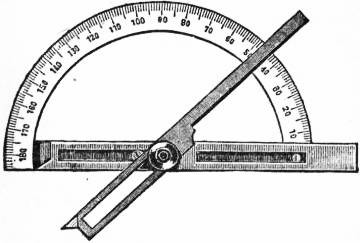
Fig. 1.—Contact Goniometer.
The Contact Goniometer (or Hand-Goniometer).—This consists of two metal rules pivoted together at the centre of a graduated semicircle (fig. 1). The instrument is placed with its plane perpendicular to an edge between two faces of the crystal to be measured, and the rules are brought into contact with the faces; this is best done by holding the crystal up against the light with the edge in the line of sight. The angle between the rules, as read on the graduated semicircle, then gives the angle between the two faces. The rules are slotted, so that they may be shortened and their tips applied to a crystal partly embedded in its matrix. The instrument represented in fig. 1 is practically the same in all its details as that made for Carangeot, and it is employed at the present day for the approximate measurement of large crystals with dull and rough faces. S. L. Penfield (1900) has devised some cheap and simple forms of contact goniometer, consisting of jointed arms and protractors made of cardboard or celluloid.
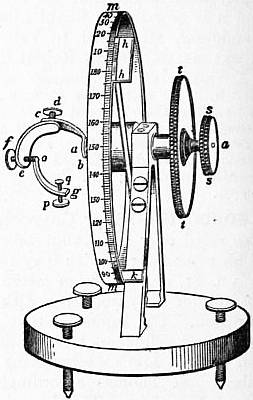
Fig. 2.—Vertical-Circle Goniometer.
The Reflecting Goniometer.—This is an instrument of far greater precision, and is always used for the accurate measurement of the angles when small crystals with bright faces are available. As a rule, the smaller the crystal the more even are its faces, and when these are smooth and bright they reflect sharply defined images of a bright object. By turning the crystal about an axis parallel to the edge between two faces, the image reflected from a second face may be brought into the same position as that formerly occupied by the image reflected from the first face; the angle through which the crystal has been rotated, as determined by a graduated circle to which the crystal is fixed, is the angle between the normals to the two faces.
Several forms of instruments depending on this principle have been devised, the earliest being the vertical-circle goniometer of W. H. Wollaston, made in 1809. This consists of a circle m (fig. 2), graduated to degrees of arc and reading with the vernier h to minutes, which turns with the milled head t about a horizontal axis. The crystal is attached with wax (a mixture of beeswax and pitch) to the holder q, and by means of the pivoted arcs it may be adjusted so that the edge between two faces (a zone-axis) is parallel to, and coincident with, the axis of the instrument. The crystal-holder and adjustment-arcs, together with the milled head s, are carried on an axis which passes through the hollow axis of the graduated circle, and may thus be rotated independently of the circle. In use, the goniometer is placed directly opposite to a window, with its axis parallel to the horizontal window-bars, and as far distant as possible. The eye is placed quite close to the crystal, and the image of an upper window-bar (or better still a slit in a dark screen) as seen in the crystal-face is made to coincide with a lower window-bar (or chalk mark on the floor) as seen directly: this is done by turning the milled head s, the reading of the graduated circle having previously been observed. Without moving the eye, the milled head t, together with the crystal, is then rotated until the image from a second face is brought into the same position; the difference between the first and second readings of the graduated circle will then give the angle between the normals of the two faces.
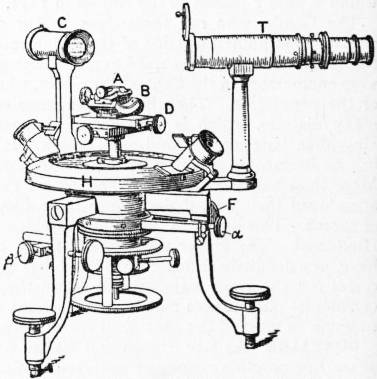
Fig. 3.—Horizontal-Circle Goniometer.
Several improvements have been made on Wollaston’s goniometer. The adjustment-arcs have been modified; a mirror of black glass fixed to the stand beneath the crystal gives a reflected image of the signal, with which the reflection from the crystal can be more conveniently made to coincide; a telescope provided with cross-wires gives greater precision to the direction of the reflected rays of light; and with the telescope a collimator has sometimes been used.
A still greater improvement was effected by placing the graduated circle in a horizontal position, as in the instruments of E. L. Malus (1810), F. C. von Riese (1829) and J. Babinet (1839). Many forms of the horizontal-circle goniometer have been constructed; they are provided with a telescope and collimator, and in construction are essentially the same as a spectrometer, with the addition of arrangements for adjusting and centring the crystal. The instrument shown in fig. 3 is made by R. Fuess of Berlin. It has four concentric axes, which enable the crystal-holder A, together with the adjustment-arcs B and centring-slides D, to be raised or lowered, or to be rotated independently of the circle H; further, either the crystal-holder or the telescope T may be rotated with the circle, while the other remains fixed. The crystal is placed on the holder and adjusted so that the edge (zone-axis) between two faces is coincident with the axis of the instrument. Light from an incandescent gas-burner passes through the slit of the collimator C, and the image of the slit (signal) reflected from the crystal face is viewed in the telescope. The clamp a and slow-motion screw F enable the image to be brought exactly on the cross-wires of the telescope, and the position of the circle with respect to the vernier is read through the lens. The crystal and the circle are then rotated together until the image from a second face is brought on the cross-wires of the telescope, and the angle through which they have been turned is the angle between the normals to the two faces. While measuring the angles between the faces of crystals the telescope remains fixed by the clamp β, but when this is released the instrument may be used as a spectrometer or refractometer for determining, by the method of minimum deviation, the indices of refraction of an artificially cut prism or of a transparent crystal when the faces are suitably inclined to one another.
With a one-circle goniometer, such as is described above, it is necessary to mount and re-adjust the crystal afresh for the measurement of each zone of faces (i.e. each set of faces intersecting in parallel edges); with very small crystals this operation takes a considerable time, and the minute faces are not readily identified again. Further, in certain cases, it is not possible to measure the angles between zones, nor to determine the position of small faces which do not lie in prominent zones on the crystal. These difficulties have been overcome by the use of a two-circle goniometer or theodolite-goniometer, which as a combination of a vertical-circle goniometer and one with a horizontal-circle was first employed by W. H. Miller in 1874. Special forms have been designed by E. S. Fedorov (1889), V. Goldschmidt (1893). S. Czapski (1893) and F. Stoeber (1898), which differ mainly in the arrangement of the optical parts. In these instruments the crystal is set up and adjusted once for all, with the axis of a prominent zone parallel to the axis of either the horizontal or the vertical circle. As a rule, only in this zone can the angles between the faces be measured directly; the positions of all the other faces, which need be observed only once, are fixed by the simultaneous readings of the two circles. These readings, corresponding to the polar distance and azimuth, or latitude and longitude readings of astronomical telescopes, must be plotted on a projection before the symmetry of the crystal is apparent; and laborious calculations are necessary in order to determine the indices of the faces and the angles between them, and the other constants of the crystal, or to test whether any three faces are accurately in a zone.
These disadvantages are overcome by adding still another graduated circle to the instrument, with its axis perpendicular to the axis of the vertical circle, thus forming a three-circle goniometer. With such an instrument measurements may be made in any zone or between any two faces without re-adjusting the crystal; further the troublesome calculations are avoided, and, indeed, the instrument may be used for solving spherical triangles. Different forms of three-circle goniometers have been designed by G. F. H. Smith (1899 and 1904), E. S. Fedorov (1900) and J. F. C. Klein (1900). Besides being used as a one-, two-, or three-circle goniometer for the measurement of the interfacial angles of crystals, and as a refractometer for determining refractive indices by the prismatic method or by total reflection, Klein’s instrument, which is called a polymeter, is fitted with accessory optical apparatus which enables it to be used for examining a crystal in parallel or convergent polarized light and for measuring the optic axial angle.
Goniometers of special construction have been devised for certain purposes; for instance, the inverted horizontal-circle goniometer of H. A. Miers (1903) for measuring crystals during their growth in the mother-liquid. A. E. Tutton (1894) has combined a goniometer with lapidaries’ appliances for cutting section-plates and prisms from crystals accurately in any desired direction. The instrument commonly employed for measuring the optic axial angle of biaxial crystals is really a combination of a goniometer with a polariscope. For the optical investigation of minute crystals under the microscope, various forms of stage-goniometer with one, two or three graduated circles have been constructed. An ordinary microscope fitted with cross-wires and a rotating graduated stage serves the purpose of a goniometer for measuring the plane angles of a crystal face or section, being the same in principle as the contact goniometer.
For fuller descriptions of goniometers reference may be made to the text-books of Crystallography and Mineralogy, especially to P. H. Groth, Physikalische Krystallographie (4th ed., Leipzig, 1905). See also C. Leiss, Die optischen Instrumente der Firma R. Fuess, deren Beschreibung, Justierung und Anwendung (Leipzig, 1899).
(L. J. S.)
GONTAUT, MARIE JOSÉPHINE LOUISE, Duchesse de (1773-1857). was born in Paris on the 3rd of August 1773, daughter of Augustin François, comte de Montaut-Navailles, who had been governor of Louis XVI. and his two brothers when children. The count of Provence (afterwards Louis XVIII.) and his wife stood sponsors to Joséphine de Montaut, and she shared the lessons given by Madame de Genlis to the Orleans family, with whom her mother broke off relations after the outbreak of the Revolution. Mother and daughter emigrated to Coblenz in 1792; thence they went to Rotterdam, and finally to England, where Joséphine married the marquis Charles Michel de Gontaut-Saint-Blacard. They returned to France at the Restoration, and resumed their place at court. Madame de Gontaut became lady-in-waiting to Caroline, duchess of Berry, and, on the birth of the princess Louise (Mlle d’Artois, afterwards duchess of Parma), governess to the children of France. Next year the birth of Henry, duke of Bordeaux (afterwards known as the comte de Chambord), added to her charge the heir of the Bourbons. She remained faithful to his cause all her life. Her husband died in 1822, and in 1827 she was created duchesse de Gontaut. She followed the exiled royal family in 1830 to Holyrood Palace, and then to Prague, but in 1834, owing to differences with Pierre Louis, duc de Blacas, who thought her comparatively liberal views dangerous for the prince and princess, she received a brusque congé from Charles X. Her twin daughters, Joséphine (1796-1844) and Charlotte (1796-1818), married respectively Ferdinand de Chabot, prince de Léon and afterwards duc de Rohan, and François, comte de Bourbon-Busset. She herself wrote in her old age some naïve memoirs, which throw an odd light on the pretensions of the “governess of the children of France.” She died in Paris in 1857.
See her Memoirs (Eng. ed., 2 vols., 1894), and Lettres inédites (1895).
GONVILE, EDMUND (d. 1351), founder of Gonville Hall, now Gonville and Caius College, at Cambridge, England, is thought to have been the son of William de Gonvile, and the brother of Sir Nicholas Gonvile. In 1320 he was rector of Thelnetham, Suffolk, and steward there for William, earl Warren and the earl of Lancaster. Six years later he was rector of Rushworth, and in 1342 rector of Terrington St John and commissioner for the marshlands of Norfolk. In this year he founded and endowed a collegiate church at Rushworth, suppressed in 1541. The foundation of Gonville Hall at Cambridge was effected by a charter granted by Edward III. in 1348. It was called, officially, the Hall of the Annunciation of the Blessed Virgin, but was usually known as Gunnell or Gonville Hall. Its original site was in Free-school Lane, where Corpus Christi College now stands. Gonvile apparently wished it to be devoted to training for theological study, but after his death the foundation was completed by William Bateman, bishop of Norwich and founder of Trinity Hall, on a different site and with considerably altered statutes. (See also Caius, John.)
GONZAGA, an Italian princely family named after the town where it probably had its origin. Its known history begins with the 13th century, when Luigi I. (1267-1360), after fierce struggles supplanted his brother-in-law Rinaldo (nicknamed Passerino) Bonacolsi as lord of Mantua in August 1328, with the title of captain-genera, and afterwards of vicar-general of the empire, adding the designation of count of Mirandola and Concordia, which fief the Gonzagas held from 1328 to 1354. In July 1335 his son Guido, with the help of Filippino and Feltrino Gonzaga, wrested Reggio from the Scaligeri and held it until 1371. Luigi was succeeded by Guido (d. 1369); the latter’s son Luigi II. came next in succession (d. 1382), and then Giovan Francesco I. (d. 1407), who, although at one time allied with the treacherous Gian Galeazzo Visconti, incurred the latter’s enmity and all but lost his estates and his life in consequence; eventually he joined the Florentines and Bolognese, enemies of Visconti. He promoted commerce and wisely developed the prosperity of his dominions. His son Giovan Francesco II. (d. 1444) succeeded him under the regency of his uncle Carlo Malatesta and the protection of the Venetians. He became a famous general, and was rewarded for his services to the emperor Sigismund with the title of marquess of Mantua for himself and his descendants (1432), an investiture which legitimatized the usurpations of the house of Gonzaga. His son Luigi III. “il Turco” (d. 1478) likewise became a celebrated soldier, and was also a learned and liberal prince, a patron of literature and the arts. His son Federigo I. (d. 1484) followed in his father’s footsteps, and served under various foreign sovereigns, including Bona of Savoy and Lorenzo de’ Medici; subsequently he upheld the rights of the house of Este against Pope Sixtus IV. and the Venetians, whose ambitious claims were a menace to his own dominions of Ferrara and Mantova. His son Giovan Francesco III. (d. 1519) continued the military traditions of the family, and commanded the allied Italian forces against Charles VIII. at the battle of Fornovo; he afterwards fought in the kingdom of Naples and in Tuscany, until captured by the Venetians in 1509. On his liberation he adopted a more peaceful and conciliatory policy, and with the help of his wife, the famous Isabella d’Este, he promoted the fine arts and letters, collecting pictures, statues and other works of art with intelligent discrimination. He was succeeded by his son Federigo II. (d. 1540), captain-general of the papal forces. After the peace of Cambrai (1529) his ally and protector, the emperor Charles V., raised his title to that of duke of Mantua in 1530; in 1536 the emperor decided the controversy for the succession of Monferrato between Federigo and the house of Savoy in favour of the former. His son Francesco I. succeeded him, and, being a minor, was placed under the regency of his uncle Cardinal Ercole; he was accidentally drowned in 1550, leaving his possessions to his brother Guglielmo. The latter was an extravagant spendthrift, but having subdued a revolt in Monferrato was presented with that territory by the emperor Maximilian II. At his death in 1587 he was succeeded by his son Vincenzo I. (d. 1612), who was more addicted to amusements than to warfare. Then followed in succession his sons Francesco II. (d. 1612), Ferdinando (d. 1626), and Vincenzo II. (d. 1627), all three incapable and dissolute princes. The last named appointed as his successor Charles, the son of Henriette, the heiress of the French family of Nevers-Rethel, who was only able to take possession of the ducal throne after a bloody struggle; his dominions were laid waste by foreign invasions and he himself was reduced to the sorest straits. He died in 1637, leaving his possessions to his grandson Charles (Carlo) II. under the regency of the latter’s mother Maria Gonzaga, which lasted until 1647. Charles died in consequence of his own profligacy and was succeeded by his son Ferdinand Charles (Ferdinando Carlo), who was likewise for some years under the regency of his mother Isabella of Austria. Ferdinand Charles, another extravagant and dissolute prince, acquired the county of Guastalla by marriage in 1678, but lost it soon afterwards; he involved his country in useless warfare, with the result that in 1708 Austria annexed the duchy. On the 5th of July of the same year he died in Venice, and with him the Gonzagas of Mantua came to an end.
Of the cadet branches of the house one received the lordship of Bozzolo, another the counties of Novellara and Bagnolo, a third, of which the founder was Ferrante I. (d. 1557), retained the county of Guastalla, raised to a duchy in 1621, and came to an end with the death of Giuseppe Maria on the 16th of August 1746.
Bibliography.—S. Maffei, Annali di Mantova (Tortona, 1675); G. Veronesi, Quadro storico della Mirandola (Modena, 1847); T. Affò, Storia di Guastalla (Guastalla, 1875, 4 vols.); Alessandro Luzio, I Precattori d’Isabella d’Este (Ancona, 1887); A. Luzio and R. Renier, “Francesco Gonzaga alla battaglia di Fornovo (1495). secondo i documenti Mantovani” (in Archivio storico italiano, ser. v. vol. vi., 205-246); id., Mantova e Urbino, Isabella d’Este e Elisabeth Gonzaga nette relazioni famigliari e nelle vicende politiche (Turin, 1893); L. G., Pélissier, “Les Relations de François de Gonzague, marquis de Mantoue, avec Ludovico Sforza et Louis XII” (in Annales de la faculté de Lettres de Bordeaux, 1893); Antonino Bertolotti, “Lettere del duca di Savoia Emanuele Filiberto a Guglielmo Gonzaga, duca di Mantova” (Arch. stor. it., ser. v., vol. ix. pp. 250-283); Edmondo Solari, Lettere inedite del card. Gasparo Contarini nel carteggio del card. Ercole Gonzaga (Venice, 1904); Arturo Segrè, Il Richiamo di Don Ferrante Gonzaga dal governo di Milano, e sue conseguenze (Turin, 1904).
GONZAGA, THOMAZ ANTONIO (1744-1809), Portuguese poet, was a native of Oporto and the son of a Brazilian-born judge. He spent a part of his boyhood at Bahia, where his father was disembargador of the appeal court, and returning to Portugal he went to the university of Coimbra and took his law degree at the age of twenty-four. He remained on there for some years and compiled a treatise of natural law on regalist lines, dedicating it to Pombal, but the fall of the marquis led him to leave Coimbra and become a candidate for a magistracy, and in 1782 he obtained the posts of ouvidor and provedor of the goods of deceased and absent persons at Villa Rica in the province of Minas Geraes in Brazil. In 1786 he was named disembargador of the appeal court at Bahia, and three years later, as he was about to marry a young lady of position, D. Maria de Seixas Brandão, the Marilia of his verses, he suddenly found himself arrested on the charge of being the principal author of a Republican conspiracy in Minas. Conducted to Rio, he was imprisoned in a fortress and interrogated, but constantly asserted his innocence. However, his friendship with the conspirators compromised him in the eyes of his absolutist judges, who, on the ground that he had known of the plot and not denounced it, sentenced him in April 1792 to perpetual exile in Angola, with the confiscation of his property. Later, this penalty was commuted into one of ten years of exile to Mozambique, with a death sentence if he should return to America. After having spent three years in prison, Gonzaga sailed in May 1792 for Mozambique and shortly after his arrival a violent fever almost ended his life. A wealthy Portuguese gentleman, married to a lady of colour, charitably received him into his house, and when the poet recovered, he married their young daughter who had nursed him through the attack. He lived in exile until his death, practising advocacy at intervals, but his last years were embittered by fits of melancholia, deepening into madness, which were brought on by the remembrance of his misfortunes. His reputation as a poet rests on a little volume of bucolics entitled Marilia, which includes all his published verses and is divided into two parts, corresponding with those of his life. The first extends to his imprisonment and breathes only love and pleasure, while the main theme of the second part, written in prison, is his saudade for Marilia and past happiness. Gonzaga borrowed his forms from the best models, Anacreon and Theocritus, but the matter, except for an occasional imitation of Petrarch, the natural, elegant style and the harmonious metrification, are all his own. The booklet comprises the most celebrated collection of erotic poetry dedicated to a single person in the Portuguese tongue; indeed its popularity is so great as to exceed its intrinsic merit.
Twenty-nine editions had appeared up to 1854, but the Paris edition of 1862 in 2 vols, is in every way the best, although the authenticity of the verses in its 3rd part, which do not relate to Marilia, is doubtful. A popular edition of the first two parts was published in 1888 (Lisbon, Corazzi). A French version of Marilia by Monglave and Chalas appeared in Paris in 1825, an Italian by Vegezzi Ruscalla at Turin in 1844, a Latin by Dr Castro Lopes at Rio in 1868, and there is a Spanish one by Vedia.
See Innocencio da Silva, Diccionario bibliographico portuguez, vol. vii. p. 320, also Dr T. Braga, Filinto Elysio e os Dissidentas da Arcadia (Oporto, 1901).
(E. Pr.)
GONZÁLEZ-CARVAJAL, TOMAS JOSÉ (1753-1834), Spanish, poet and statesman, was born at Seville in 1753. He studied at the university of Seville, and took the degree of LL.D. at Madrid. He obtained an office in the financial department of the government; and in 1795 was made intendant of the colonies which had just been founded in Sierra Morena and Andalusia. During 1809-1811 he held an intendancy in the patriot army. He became, in 1812, director of the university of San Isidro; but having offended the government by establishing a chair of international law, he was imprisoned for five years (1815-1820). The revolution of 1820 reinstated him, but the counter-revolution of three years later forced him into exile. After four years he was allowed to return, and he died, in 1834, a member of the supreme council of war. González-Carvajal enjoyed European fame as author of metrical translations of the poetical books of the Bible. To fit himself for this work he commenced the study of Hebrew at the age of fifty-four. He also wrote other works in verse and prose, avowedly taking Luis de Leon as his model.
See biographical notice in Biblioteca de Rivadeneyra, vol. lxvii., Poetas del siglo 18.
GONZALO DE BERCEO (c. 1180-c. 1246), the earliest Castilian poet whose name is known to us, was born at Berceo, a village in the neighbourhood of Calahorra in the province of Logroño. In 1221 he became a deacon and was attached, as a secular priest, to the Benedictine monastery of San Millan de la Cogolla, in the diocese of Calahorra. His name is to be met with in a number of documents between the years 1237 and 1246. He wrote upwards of 13,000 verses, all on devotional subjects. His best work is a life of St Oria; others treat of the life of St Millan, of St Dominic of Silos, of the Sacrifice of the Mass, the Martyrdom of St Laurence, the visible signs preceding the Last Judgment, the Praises of Our Lady, the Miracles of Our Lady and the Lamentations of the Virgin on the Passion of her Son. He writes in the common tongue, the roman paladino, and his claim to the name of poet rests on his use of the cuaderna via (single-rhymed quatrains, each verse being of fourteen syllables). Sometimes, however, he takes the more modest title of juglar (jongleur), when claiming payment for his poems. His literary attainments are not great, and he lacks imagination and animation of style, but he has a certain eloquence, and in speaking of the Virgin and the saints a certain charm, while his verse bears at times the imprint of a passionate devotion, recalling the lyrical style of the great Spanish mystics. There is, however, a very strong popular element in his writings, which explains his long vogue. The great majority of his legends of the Virgin are obviously borrowed from the collection of a Frenchman, Gautier de Coinci; but he has succeeded in making this material entirely his own by reason of a certain conciseness and a realism in detail which make his work far superior to the tedious and colourless narrative of his model.
His Poesías are in the Biblioteca de autores españoles of Rivadeneyra, vol. lvii. (1864); La Vida de San Domingo de Silos has been edited by J. D. FitzGerald (Paris, 1904; see the Bibliothèque de l’École des Hautes Études, part 149); see also F. Fernandez y Gonzalez in the Razón (vol. i., Madrid, 1860); N. Hergueta, “Documentos referentes a Gonzalo de Berceo,” in the Revista de archivos, (3rd series, Feb.-March, 1904, pp. 178-179).
(P. A.)
GOOCH, SIR DANIEL, Bart. (1816-1889), English mechanical engineer, was born at Bedlington, in Northumberland, on the 16th of August 1816. At the age of fifteen, having shown a taste for mechanics, he was put to work at the Tredegar Ironworks, Monmouthshire. In 1834 he went to Warrington, where, at the Vulcan foundry, under Robert Stephenson, he acquired the principles of locomotive design. Subsequently, after passing a year at Dundee, he was engaged by the Stephensons at their Gateshead works, where he seems to have conceived that predilection for the broad gauge for which he was afterwards distinguished, through having to design some engines for a 6-foot gauge in Russia and noticing the advantages it offered in allowing greater space for the machinery, &c., as compared with the standard gauge favoured by Stephenson. In 1837, on I. K. Brunel’s recommendation, he was appointed locomotive superintendent to the Great Western railway at a time when the engines possessed by the railway were very poor and inefficient. He soon improved this state of affairs, and gradually provided his employers with locomotives which were unsurpassed for general excellence and economy of working. One of the most famous, the “Lord of the Isles,” was awarded a gold medal at the Great Exhibition of 1851, and when, thirty years afterwards, it was withdrawn from active service it had run more than three-quarters of a million miles, all with its original boiler. In 1864 he left the Great Western and interested himself in the problem of laying a telegraph cable across the Atlantic. At this time the “Great Eastern” was in the hands of the bondholders, of whom he himself was one of the most important, and it occurred to him that she might advantageously be utilized in the enterprise. Accordingly, at his instance she was chartered by the Telegraph Construction Company, of which also he was a director, and in 1865 was employed in the attempt to lay a cable, Gooch himself superintending operations. The cable, however, broke in mid-ocean, and the attempt was a failure. Next year it was renewed with more success, for not only was a new cable safely put in place, but the older one was picked up and spliced, so that there were two complete lines between England and America. For this achievement Gooch was created a baronet. Meanwhile the Great Western railway had fallen on evil days, being indeed on the verge of bankruptcy, when in 1866 the directors appealed to him to accept the chairmanship of the board and undertake the rehabilitation of the company. He agreed to the proposal, and was so successful in restoring its prosperity that in 1889, at the last meeting over which he presided, a dividend was declared at the rate of 7½%. Under his administration the system was greatly enlarged and consolidated by the absorption of various smaller lines, such as the Bristol and Exeter and the Cornwall railways; and his appreciation of its strategic value caused him to be a strenuous supporter of the construction of the Severn Tunnel. His death occurred on the 15th of October 1889 at his residence, Clewer Park, near Windsor.
GOOD, JOHN MASON (1764-1827), English writer on medical, religious and classical subjects, was born on the 25th of May 1764 at Epping, Essex. After attending a school at Romsey kept by his father, the Rev. Peter Good, who was a Nonconformist minister, he was, at about the age of fifteen, apprenticed to a surgeon-apothecary at Gosport. In 1783 he went to London to prosecute his medical studies, and in the autumn of 1784 he began to practise as a surgeon at Sudbury in Suffolk. In 1793 he removed to London, where he entered into partnership with a surgeon and apothecary. But the partnership was soon dissolved, and to increase his income he began to devote attention to literary pursuits. Besides contributing both in prose and verse to the Analytical and Critical Reviews and the British and Monthly Magazines, and other periodicals, he wrote a large number of works relating chiefly to medical and religious subjects. In 1794 he became a member of the British Pharmaceutical Society, and in that connexion, and especially by the publication of his work, A History of Medicine (1795), he did much to effect a greatly needed reform in the profession of the apothecary. In 1820 he took the diploma of M.D. at Marischal College, Aberdeen. He died at Shepperton, Middlesex, on the 2nd of January 1827. Good was not only well versed in classical literature, but was acquainted with the principal European languages, and also with Persian, Arabic and Hebrew. His prose works display wide erudition; but their style is dull and tedious. His poetry never rises above pleasant and well-versified commonplace. His translation of Lucretius, The Nature of Things (1805-1807), contains elaborate philological and explanatory notes, together with parallel passages and quotations from European and Asiatic authors.
GOOD FRIDAY (probably “God’s Friday”), the English name for the Friday before Easter, kept as the anniversary of the Crucifixion. In the Greek Church it has been or is known as πάσχα [σταυρώσιμον], παρασκευή, παρασκευὴ μεγάλη or ἁγία, σωτηρία or τὰ σωτήρια, ἡμέρα τοῦ σταυροῦ, while among the Latins the names of most frequent occurrence are Pascha Crucis, Dies Dominicae Passionis, Parasceve, Feria Sexta Paschae, Feria Sexta Major in Hierusalem, Dies Absolutionis. It was called Long Friday by the Anglo-Saxons1 and Danes, possibly in allusion to the length of the services which marked the day. In Germany it is sometimes designated Stiller Freitag (compare Greek, ἑβδομὰς ἄπρακτος; Latin, hebdomas inofficiosa, non laboriosa), but more commonly Charfreitag. The etymology of this last name has been much disputed, but there seems now to be little doubt that it is derived from the Old High German chara, meaning suffering or mourning.
The origin of the custom of a yearly commemoration of the Crucifixion is somewhat obscure. It may be regarded as certain that among Jewish Christians it almost imperceptibly grew out of the old habit of annually celebrating the Passover on the 14th of Nisan, and of observing the “days of unleavened bread” from the 15th to the 21st of that month. In the Gentile churches, on the other hand, it seems to be well established that originally no yearly cycle of festivals was known at all. (See Easter.)
From its earliest observance, the day was marked by a specially rigorous fast, and also, on the whole, by a tendency to greater simplicity in the services of the church. Prior to the 4th century there is no evidence of non-celebration of the eucharist on Good Friday; but after that date the prohibition of communion became common. In Spain, indeed, it became customary to close the churches altogether as a sign of mourning; but this practice was condemned by the council of Toledo (633). In the Roman Catholic Church the Good Friday ritual at present observed is marked by many special features, most of which can be traced back to a date at least prior to the close of the 8th century (see the Ordo Romanus in Muratori’s Liturg. Rom. Vet.). The altar and officiating clergy are draped in black, this being the only day on which that colour is permitted. Instead of the epistle, sundry passages from Hosea, Habakkuk, Exodus and the Psalms are read. The gospel for the day consists of the history of the Passion as recorded by St John. This is often sung in plain-chaunt by three priests, one representing the “narrator,” the other two the various characters of the story. The singing of this is followed by bidding prayers for the peace and unity of the church, for the pope, the clergy, all ranks and conditions of men, the sovereign, for catechumens, the sick and afflicted, heretics and schismatics, Jews and heathen. Then follows the “adoration of the cross” (a ceremony derived from the church of Jerusalem and said to date back to near the time of Helena’s “invention of the cross”); the hymns Pange lingua and Vexilla regis are sung, and then follows the “Mass of the Presanctified.” The name is derived from the fact that it is celebrated with elements consecrated the day before, the liturgy being omitted on this day. The priest merely places the Sacrament on the altar, censes it, elevates and breaks the host, and communicates, the prayers and responses interspersed being peculiar to the day. This again is followed by vespers, with a special anthem; after which the altar is stripped in silence. In many Roman Catholic countries—in Spain, for example—it is usual for the faithful to spend much time in the churches in meditation on the “seven last words” of the Saviour; no carriages are driven through the streets; the bells and organs are silent; and in every possible way it is sought to deepen the impression of a profound and universal grief. In the Greek Church also the Good Friday fast is excessively strict; as in the Roman Church, the Passion history is read and the cross adored; towards evening a dramatic representation of the entombment takes place, amid open demonstrations of contempt for Judas and the Jews. In Lutheran churches the organ is silent on this day, and altar, font and pulpit are draped in black, as indeed throughout Holy Week. In the Church of England the history of the Passion from the gospel according to John is also read; the collects for the day are based upon the bidding prayers which are found in the Ordo Romanus. The “three hours” service, borrowed from Roman Catholic usage and consisting of prayers, addresses on the “seven last words from the cross” and intervals for meditation and silent prayer, has become very popular in the Anglican Church, and the observance of the day is more marked than formerly among Nonconformist bodies, even in Scotland.
1 See Johnson’s Collection of Ecclesiastical Laws (vol. i., anno 957): “Housel ought not to be hallowed on Long Friday, because Christ suffered for us on that day.”
GOODMAN, GODFREY (1583-1656), bishop of Gloucester, was born at Ruthin, Denbighshire, and educated at Westminster and Cambridge. He took orders in 1603, and in 1606 obtained the living of Stapleford Abbots, Essex, which he held together with several other livings. He was canon of Windsor from 1617 and dean of Rochester 1620-1621, and became bishop of Gloucester in 1625. From this time his tendencies towards Roman Catholicism constantly got him into trouble. He preached an unsatisfactory sermon at court in 1626, and in 1628 incurred charges of introducing popery at Windsor. In 1633 he secured the see of Hereford by bribery, but Archbishop Laud persuaded the king to refuse his consent. In 1638 he was said to be converted to Rome, and two years later he was imprisoned for refusing to sign the new canons denouncing popery and affirming the divine right of kings. He afterwards signed and was released on bail, but next year the bishops who had signed were all imprisoned in the Tower, by order of parliament, on the charge of treason. After eighteen weeks’ imprisonment Goodman was allowed to return to his diocese. About 1650 he settled in London, where he died a confessed Roman Catholic. His best known book is The Fall of Man (London, 1616).
GOODRICH, SAMUEL GRISWOLD (1793-1860), American author, better known under the pseudonym of “Peter Parley,” was born, the son of a Congregational minister, at Ridgefield, Connecticut, on the 19th of August 1793. He was largely self-educated, became an assistant in a country store at Danbury, Conn., in 1808, and at Hartford, Conn., in 1811, and from 1816 to 1822 was a bookseller and publisher at Hartford. He visited Europe in 1823-1824, and in 1826 removed to Boston, where he continued in the publishing business, and from 1828 to 1842 he published an illustrated annual, the Token, to which he was a frequent contributor both in prose and verse. A selection from these contributions was published in 1841 under the title Sketches from a Student’s Window. The Token also contained some of the earliest work of Nathaniel Hawthorne, N. P. Willis, Henry W. Longfellow and Lydia Maria Child. In 1841 he established Merry’s Museum, which he continued to edit till 1854. In 1827 he began, under the name of “Peter Parley,” his series of books for the young, which embraced geography, biography, history, science and miscellaneous tales. Of these he was the sole author of only a few, but in 1857 he wrote that he was “the author and editor of about 170 volumes,” and that about seven millions had been sold. In 1857 he published Recollections of a Lifetime, which contains a list both of the works of which he was the author or editor and of the spurious works published under his name. By his writings and publications he amassed a large fortune. He was chosen a member of the Massachusetts House of Representatives in 1836, and of the state Senate in 1837, his competitor in the last election being Alexander H. Everett, and in 1851-1853 he was consul at Paris, where he remained till 1855, taking advantage of his stay to have several of his works translated into French. After his return to America he published, in 1859, Illustrated History of the Animal Kingdom. He died, in New York, on the 9th of May 1860.
His brother, Charles Augustus Goodrich (1790-1862), a Congregational clergyman, published various ephemeral books, and helped to compile some of the “Peter Parley” series.
GOODRICH, or Goodricke, THOMAS (d. 1554), English ecclesiastic, was a son of Edward Goodrich of East Kirkby, Lincolnshire, and was educated at Corpus Christi College, Cambridge, afterwards becoming a fellow of Jesus College in the same university. He was among the divines consulted about the legality of Henry VIII.’s marriage with Catherine of Aragon, became one of the royal chaplains about 1530, and was consecrated bishop of Ely in 1534. He was favourable to the Reformation, helped in 1537 to draw up the Institution of a Christian Man (known as the Bishops’ Book), and translated the Gospel of St John for the revised New Testament. On the accession of Edward VI. in 1547 the bishop was made a privy councillor, and took a conspicuous part in public affairs during the reign. “A busy secular spirited man,” as Burnet calls him, he was equally opposed to the zealots of the “old” and the “new religion.” He assisted to compile the First Prayer Book of Edward VI., was one of the commissioners for the trial of Bishop Gardiner, and in January 1551-1552 succeeded Rich as lord high chancellor. This office he continued to hold during the nine days’ reign of “Queen Jane” (Lady Jane Grey); but he continued to make his peace with Queen Mary, conformed to the restored religion, and, though deprived of the chancellorship, was allowed to keep his bishopric until his death on the 10th of May 1554.
See the Dict. Nat. Biog., where further authorities are cited.
GOODSIR, JOHN (1814-1867), Scottish anatomist, born at Anstruther, Fife, on the 20th of March 1814, was the son of Dr John Goodsir, and grandson of Dr John Goodsir of Largo. He was educated at the burgh and grammar-schools of his native place and at the university of St Andrews. In 1830 he was apprenticed to a surgeon-dentist in Edinburgh, where he studied anatomy under Robert Knox, and in 1835 he joined his father in practice at Anstruther. Three years later he communicated to the British Association a paper on the pulps and sacs of the human teeth, his researches on the whole process of dentition being at this time distinguished by their completeness; and about the same date, on the nomination of Edward Forbes, he was elected to the famous coterie called the “Universal Brotherhood of the Friends of Truth,” which comprised artists, scholars, naturalists and others, whose relationship became a potent influence in science. With Forbes he worked at marine zoology, but human anatomy, pathology and morphology formed his chief study. In 1840 he moved to Edinburgh, where in the following year he was appointed conservator of the museum of the College of Surgeons, in succession to William Macgillivray. Much of his reputation rested on his knowledge of the anatomy of tissues. In his lectures in the theatre of the college in 1842-1843 he evidenced the largeness of his observation of cell-life, both physiologically and pathologically, insisting on the importance of the cell as a centre of nutrition, and pointing out that the organism is subdivided into a number of departments. R. Virchow recognized his indebtedness to these discoveries by dedicating his Cellular Pathologie to Goodsir, as “one of the earliest and most acute observers of cell-life.” In 1843 Goodsir obtained the post of curator in the university of Edinburgh; the following year he was appointed demonstrator of anatomy, and in 1845 curator of the entire museum. A year later he was elected to the chair of anatomy in the university, and devoted all his energies to anatomical research and teaching.
Human myology was his strong point; no one had laboured harder at the dissecting-table; and he strongly emphasized the necessity of practice as a means of research. He believed that anatomy, physiology and pathology could never be properly advanced without daily consideration and treatment of disease. In 1848 he became a fellow of the Royal College of Surgeons, and in the same year he joined the Highland and Agricultural Society, acting as chairman of the veterinary department, and advising on strictly agricultural matters. In 1847 he delivered a series of systematic lectures on the comparative anatomy of the invertebrata; and, about this period, as member of an aesthetic club, he wrote papers on the natural principles of beauty, the aesthetics of the ugly, of smell, the approbation or disapprobation of sounds, &c. Owing to the failing health of Professor Robert Jameson, Goodsir was induced to deliver the course of lectures on natural history during the summer of 1853.
The lectures were long remembered for their brilliancy, but the infinite amount of thought and exertion which they cost broke down the health of the lecturer. Goodsir, nevertheless, persevered in his labours, writing in 1855 on organic electricity, in 1856 on morphological subjects, and afterwards on the structure of organized forms. His speculations in the latter domain gave birth to his theory of a triangle as the mathematical figure upon which nature had built up both the organic and inorganic worlds, and he hoped to complete this triangle theory of formation and law as the greatest of his works. In his lectures on the skull and brain he held the doctrine that symmetry of brain had more to do with the higher faculties than bulk or form. He died at Wardie, near Edinburgh, on the 6th of March 1867, in the same cottage in which his friend Edward Forbes died. His anatomical lectures were remarkable for their solid basis of fact; and no one in Britain took so wide a field for survey or marshalled so many facts for anatomical tabulation and synthesis.
See Anatomical Memoirs of John Goodsir, F.R.S., edited by W. Turner, with Memoir by H. Lonsdale (2 vols., Edinburgh, 1868), in which Goodsir’s lectures, addresses and writings are epitomized; Proc. Roy. Soc. vol. iv. (1868); Trans. Bot. Soc. Edin. vol. ix. (1868).
GOODWILL, in the law of property, a term of somewhat vague significance. It has been defined as every advantage which has been acquired in carrying on a business, whether connected with the premises in which the business has been carried on, or with the name of the firm by whom it has been conducted (Churton v. Douglas, 1859, Johns, 174). Goodwill may be either professional or trade. Professional goodwill usually takes the form of the recommendation by a retiring professional man, doctor, solicitor, &c., to his clients of the successor or purchaser coupled generally with an undertaking not to compete with him. Trade goodwill varies with the nature of the business with which it is connected, but there are two rights which, whatever the nature of the business may be, are invariably associated with it, viz. the right of the purchaser to represent himself as the owner of the business, and the right to restrain competition. For the purposes of the Stamp Act, the goodwill of a business is property, and the proper duty must be paid on the conveyance of such. (See also Partnership; Patents.)
GOODWIN, JOHN (c. 1594-1665), English Nonconformist divine, was born in Norfolk and educated at Queens’ College, Cambridge, where he was elected fellow in 1617. He was vicar of St Stephen’s, Coleman Street, London, from 1633 to 1645, when he was ejected by parliament for his attacks on Presbyterianism, especially in his Θεομαχία(1644). He thereupon established an independent congregation, and put his literary gifts at Oliver Cromwell’s service. In 1648 he justified the proceedings of the army against the parliament (“Pride’s Purge”) in a pamphlet Might and Right Well Met, and in 1649 defended the proceedings against Charles I. (to whom he had offered spiritual advice) in Ὑβριστοδίκαι. At the Restoration this tract, with some that Milton had written to Monk in favour of a republic, was publicly burnt, and Goodwin was ordered into custody, though finally indemnified. He died in 1665. Among his other writings are Anti-Cavalierisme (1642), a translation of the Stratagemata Satanae of Giacomo Aconcio, the Elizabethan advocate of toleration, tracts against Fifth-Monarchy Men, Cromwell’s “Triers” and Baptists, and Redemption Redeemed, containing a thorough discussion of ... election, reprobation and the perseverance of the saints (1651, reprinted 1840). Goodwin’s strongly Arminian tendencies brought him into conflict with Robert Baillie, professor of divinity of Glasgow, George Kendall, the Calvinist prebendary of Exeter, and John Owen (q.v.), who replied to Redemption Redeemed in The Doctrine of the Saints’ Perseverance, paying a high tribute to his opponent’s learning and controversial skill. Goodwin answered all three in the Triumviri (1658). John Wesley in later days held him in much esteem and published an abridged edition of his Imputatio fidei, a work on justification that had originally appeared in 1642.
Life by T. Jackson (London, 1839).
GOODWIN, NATHANIEL CARL (1857- ), American actor, was born in Boston on the 25th of July 1857. While clerk in a large shop he studied for the stage, and made his first appearance in 1873 in Boston in Stuart Robson’s company as the newsboy in Joseph Bradford’s Law. He made an immediate success by his imitations of popular actors. A hit in the burlesque Black-eyed Susan led to his taking part in Rice and Goodwin’s Evangeline company. It was at this time that he married Eliza Weathersby (d. 1887), an English actress with whom he played in B. E. Woollf’s Hobbies. It was not until 1889, however, that Nat Goodwin’s talent as a comedian of the “legitimate” type began to be recognized. From that time he appeared in a number of plays designed to display his drily humorous method, such as Brander Matthews’ and George H. Jessop’s A Gold Mine, Henry Guy Carleton’s A Gilded Fool and Ambition, Clyde Fitch’s Nathan Hale, H. V. Esmond’s When we were Twenty-one, &c. Till 1903 he was associated in his performances with his third wife, the actress Maxine Elliott (b. 1873), whom he married in 1898; this marriage was dissolved in 1908.
GOODWIN, THOMAS (1600-1680), English Nonconformist divine, was born at Rollesby, Norfolk, on the 5th of October 1600, and was educated at Christ’s College, Cambridge, where in 1616 he graduated B.A. In 1619 he removed to Catharine Hall, where in 1620 he was elected fellow. In 1625 he was licensed a preacher of the university; and three years afterwards he became lecturer of Trinity Church, to the vicarage of which he was presented by the king in 1632. Worried by his bishop, who was a zealous adherent of Laud, he resigned all his preferments and left the university in 1634. He lived for some time in London, where in 1638 he married the daughter of an alderman; but in the following year he withdrew to Holland, and for some time was pastor of a small congregation of English merchants and refugees at Arnheim. Returning to London soon after Laud’s impeachment by the Long Parliament, he ministered for some years to the Independent congregation meeting at Paved Alley Church, Lime Street, in the parish of St Dunstan’s-in-the-East, and rapidly rose to considerable eminence as a preacher; in 1643 he was chosen a member of the Westminster Assembly, and at once identified himself with the Congregational party, generally referred to in contemporary documents as “the dissenting brethren.” He frequently preached by appointment before the Commons, and in January 1650 his talents and learning were rewarded by the House with the presidentship of Magdalen College, Oxford, a post which he held until the Restoration. He rose into high favour with the protector, and was one of his intimate advisers, attending him on his death-bed. He was also a commissioner for the inventory of the Westminster Assembly, 1650, and for the approbation of preachers, 1653, and together with John Owen (q.v.) drew up an amended Westminster Confession in 1658. From 1660 until his death on the 23rd of February 1680 he lived in London, and devoted himself exclusively to theological study and to the pastoral charge of the Fetter Lane Independent Church.
The works published by Goodwin during his lifetime consist chiefly of sermons printed by order of the House of Commons; but he was also associated with Philip Nye and others in the preparation of the Apologeticall Narration (1643). His collected writings, which include expositions of the Epistle to the Ephesians and of the Apocalypse, were published in five folio volumes between 1681 and 1704, and were reprinted in twelve 8vo volumes (Edin., 1861-1866). Characterized by abundant yet one-sided reading, remarkable at once for the depth and for the narrowness of their observation and spiritual experience, often admirably thorough in their workmanship, yet in style intolerably prolix—they fairly exemplify both the merits and the defects of the special school of religious thought to which they belong. Calamy’s estimate of Goodwin’s qualities may be quoted as both friendly and just. “He was a considerable scholar and an eminent divine, and had a very happy faculty in descanting upon Scripture so as to bring forth surprising remarks, which yet generally tended to illustration.” A memoir, derived from his own papers, by his son (Thomas Goodwin, “the younger,” 1650?-1716?, Independent minister at London and Pinner, and author of the History of the Reign of Henry V.) is prefixed to the fifth volume of his collected works; as a “patriarch and Atlas of Independency” he is also noticed by Anthony Wood in the Athenae Oxonienses. An amusing sketch, from Addison’s point of view, of the austere and somewhat fanatical president of Magdalen is preserved in No. 494 of the Spectator.
GOODWIN, WILLIAM WATSON (1831- ), American classical scholar, was born in Concord, Massachusetts, on the 9th of May 1831. He graduated at Harvard in 1851, studied in Germany, was tutor in Greek at Harvard in 1856-1860, and Eliot professor of Greek there from 1860 until his resignation in 1901. He became an overseer of Harvard in 1903. In 1882-1883 he was the first director of the American School for Classical Studies at Athens. Goodwin edited the Panegyricus of Isocrates (1864) and Demosthenes On The Crown (1901); and assisted in preparing the seventh edition of Liddell and Scott’s Greek-English Lexicon. He revised an English version by several writers of Plutarch’s Morals (5 vols., 1871; 6th ed., 1889), and published the Greek text with literal English version of Aeschylus’ Agamemnon (1906) for the Harvard production of that play in June 1906. As a teacher he did much to raise the tone of classical reading from that of a mechanical exercise to literary study. But his most important work was his Syntax of the Moods and Tenses of the Greek Verb (1860), of which the seventh revised edition appeared in 1877 and another (enlarged) in 1890. This was “based in part on Madvig and Krüger,” but, besides making accessible to American students the works of these continental grammarians, it presented original matter, including a “radical innovation in the classification of conditional sentences,” notably the “distinction between particular and general suppositions.” Goodwin’s Greek Grammar (elementary edition, 1870; enlarged 1879; revised and enlarged 1892) gradually superseded in most American schools the Grammar of Hadley and Allen. Both the Moods and Tenses and the Grammar in later editions are largely dependent on the theories of Gildersleeve for additions and changes. Goodwin also wrote a few elaborate syntactical studies, to be found in Harvard Studies in Classical Philology, the twelfth volume of which was dedicated to him upon the completion of fifty years as an alumnus of Harvard and forty-one years as Eliot professor.
GOODWIN SANDS, a dangerous line of shoals at the entrance to the Strait of Dover from the North Sea, about 6 m. from the Kent coast of England, from which they are separated by the anchorage of the Downs. For this they form a shelter. They are partly exposed at low water, but the sands are shifting, and in spite of lights and bell-buoys the Goodwins are frequently the scene of wrecks, while attempts to erect a lighthouse or beacon have failed. Tradition finds in the Goodwins the remnant of an island called Lomea, which belonged to Earl Godwine in the first half of the 11th century, and was afterwards submerged, when the funds devoted to its protection were diverted to build the church steeple at Tenterden (q.v.). Four lightships mark the limits of the sands, and also signal by rockets to the lifeboat stations on the coast when any vessel is in distress on the sands. Perhaps the most terrible catastrophe recorded here was the wreck of thirteen ships of war during a great storm in November 1703.
GOODWOOD, a mansion in the parish of Boxgrove, in the Chichester parliamentary division of Sussex, England, 4 m. N.E. of Chichester. It was built from designs of Sir William Chambers with additions by Wyatt, after the purchase of the property by the first duke of Richmond in 1720. The park is in a hilly district, and is enriched with magnificent trees of many varieties, including some huge cedars. In it is a building containing a Roman slab recording the construction of a temple to Minerva and Neptune at Chichester. There is mention of a British tributary prince named Cogidubnus, who perhaps served also as a Roman official. A reference to early Christianity in Britain has been erroneously read into this inscription. On the racecourse a famous annual meeting, dating from 1802, is held in July. The parish church of SS. Mary and Blaize, Boxgrove, is almost entirely a rich specimen of Early English work.
GOODYEAR, CHARLES (1800-1860), American inventor, was born at New Haven, Connecticut, on the 29th of December 1800, the son of Amasa Goodyear, an inventor (especially of farming implements) and a pioneer in the manufacture of hardware in America. The family removed to Naugatuck, Conn., when Charles was a boy; he worked in his father’s button factory and studied at home until 1816, when he apprenticed himself to a firm of hardware merchants in Philadelphia. In 1821 he returned to Connecticut and entered into a partnership with his father at Naugatuck, which continued till 1830, when it was terminated by business reverses. Already he was interested in an attempt to discover a method of treatment by which india-rubber could be made into merchandizable articles that would stand extremes of heat and cold. To the solution of this problem the next ten years of his life were devoted. With ceaseless energy and unwavering faith in the successful outcome of his labours, in the face of repeated failures and hampered by poverty, which several times led him to a debtor’s prison, he persevered in his endeavours. For a time he seemed to have succeeded with a treatment (or “cure”) of the rubber with aqua fortis. In 1836 he secured a contract for the manufacture by this process of mail bags for the U.S. government, but the rubber fabric was useless at high temperatures. In 1837 he met and worked with Nathaniel Hayward (1808-1865), who had been an employee of a rubber factory in Roxbury and had made experiments with sulphur mixed with rubber. Goodyear bought from Hayward the right to use this imperfect process. In 1839, by dropping on a hot stove some india-rubber mixed with sulphur, he discovered accidentally the process for the vulcanization of rubber. Two years more passed before he could find any one who had faith enough in his discovery to invest money in it. At last, in 1844, by which time he had perfected his process, his first patent was granted, and in the subsequent years more than sixty patents were granted to him for the application of his original process to various uses. Numerous infringements had to be fought in the courts, the decisive victory coming in 1852 in the case of Goodyear v. Day, in which his rights were defended by Daniel Webster and opposed by Rufus Choate. In 1852 he went to England, where articles made under his patents had been displayed at the International Exhibition of 1851, but he was unable to establish factories there. In France a company for the manufacture of vulcanized rubber by his process failed, and in December 1855 he was arrested and imprisoned for debt in Paris. Owing to the expense of the litigation in which he was engaged and to bad business management, he profited little from his inventions. He died in New York City on the 1st of July 1860. He wrote an account of his discovery entitled Gum-Elastic and its Varieties (2 vols., New Haven, 1853-1855).
See also B. K. Peirce, Trials of an Inventor, Life and Discoveries of Charles Goodyear (New York, 1866); James Parton, Famous Americans of Recent Times (Boston, 1867); and Herbert L. Terry, India Rubber and its Manufacture (New York, 1907).
GOOGE, BARNABE (1540-1594), English poet, son of Robert Googe, recorder of Lincoln, was born on the 11th of June 1540 at Alvingham, Lincolnshire. He studied at Christ’s College, Cambridge, and at New College, Oxford, but does not seem to have taken a degree at either university. He afterwards removed to Staple’s Inn, and was attached to the household of his kinsman, Sir William Cecil. In 1563 he became a gentleman pensioner to Queen Elizabeth. He was absent in Spain when his poems were sent to the printer by a friend, L. Blundeston. Googe then gave his consent, and they appeared in 1563 as Eglogs, Epytaphes, and Sonettes. There is extant a curious correspondence on the subject of his marriage with Mary Darrell, whose father refused Googe’s suit on the ground that she was bound by a previous contract. The matter was decided by the intervention of Sir William Cecil with Archbishop Parker, and the marriage took place in 1564 or 1565. Googe was provost-marshal of the court of Connaught, and some twenty letters of his in this capacity are preserved in the record office. He died in February 1594. He was an ardent Protestant, and his poetry is coloured by his religious and political views. In the third “Eglog,” for instance, he laments the decay of the old nobility and the rise of a new aristocracy of wealth, and he gives an indignant account of the sufferings of his co-religionists under Mary. The other eclogues deal with the sorrows of earthly love, leading up to a dialogue between Corydon and Cornix, in which the heavenly love is extolled. The volume includes epitaphs on Nicholas Grimald, John Bale and on Thomas Phaer, whose translation of Virgil Googe is uncritical enough to prefer to the versions of Surrey and of Gavin Douglas. A much more charming pastoral than any of those contained in this volume, “Phyllida was a fayer maid” (Tottel’s Miscellany) has been ascribed to Barnabe Googe. He was one of the earliest English pastoral poets, and the first who was inspired by Spanish romance, being considerably indebted to the Diana Enamorada of Montemayor.
His other works include a translation from Marcellus Palingenius (said to be an anagram for Pietro Angelo Manzolli) of a satirical Latin poem, Zodiacus vitae (Venice, 1531?), in twelve books, under the title of The Zodyake of Life (1560); The Popish Kingdome, or reign of Antichrist (1570), translated from Thomas Kirchmayer or Naogeorgus; The Spiritual Husbandrie from the same author, printed with the last; Foure Bookes of Husbandrie (1577), collected by Conradus Heresbachius; and The Proverbes of ... Lopes de Mendoza (1579).
GOOLE, a market town and port in the Osgoldcross parliamentary division of the West Riding of Yorkshire, England, at the confluence of the Don and the Ouse, 24 m. W. by S. from Hull, served by the North Eastern, Lancashire & Yorkshire, Great Central and Asholme joint railways. Pop. of urban district (1901) 16,576. The town owes its existence to the construction of the Knottingley canal in 1826 by the Aire and Calder Navigation Company, after which, in 1829, Goole was made a bonding port. Previously it had been an obscure hamlet. The port was administratively combined with that of Hull in 1885. It is 47 m. from the North Sea (mouth of the Humber), and a wide system of inland navigation opens from it. There are eight docks supplied with timber ponds, quays, warehouses and other accommodation. The depth of water is 21 or 22 ft. at high water, spring tides. Chief exports are coal, stone, woollen goods and machinery; imports, butter, fruit, indigo, logwood, timber and wool. Industries include the manufacture of alum, sugar, rope and agricultural instruments, and iron-founding. Ship-building is also carried on, and there is a large dry dock and a patent slip for repairing vessels. Passenger steamship services are worked in connexion with the Lancashire & Yorkshire railway to Amsterdam, Antwerp, Bruges, Copenhagen, Rotterdam and other north European ports. The handsome church of St John the Evangelist, with a lofty tower and spire, dates from 1844.
GOOSE (a common Teut. word, O. Eng. gós, pl. gés, Ger. Gans, O. Norse gás, from Aryan root, ghans, whence Sans. haṇsá, Lat. anser (for hanser), Gr. χήν, &c.), the general English name for a considerable number of birds, belonging to the family Anatidae of modern ornithologists, which are mostly larger than ducks and less than swans. Technically the word goose is reserved for the female, the male being called gander (A.-S. gandra).
The most important species of goose, and the type of the genus Anser, is undoubtedly that which is the origin of the well-known domestic race (see Poultry), the Anser ferus or A. cinereus of most naturalists, commonly called in English the grey or grey lag1 goose, a bird of exceedingly wide range in the Old World, apparently breeding where suitable localities are to be found in most European countries from Lapland to Spain and Bulgaria. Eastwards it extends to China, but does not seem to be known in Japan. It is the only species indigenous to the British Islands, and in former days bred abundantly in the English Fen-country, where the young were caught in large numbers and kept in a more or less reclaimed condition with the vast flocks of tame-bred geese that at one time formed so valuable a property to the dwellers in and around the Fens. It is impossible to determine when the wild grey lag goose ceased from breeding in England, but it certainly did so towards the end of the 18th century, for Daniell mentions (Rural Sports, iii. 242) his having obtained two broods in one season. In Scotland this goose continues to breed sparingly in several parts of the Highlands and in certain of the Hebrides, the nests being generally placed in long heather, and the eggs seldom exceeding five or six in number. It is most likely the birds reared here that are from time to time obtained in England, for at the present day the grey lag goose, though once so numerous, is, and for many years has been, the rarest species of those that habitually resort to the British Islands. The domestication of this species, as Darwin remarks (Animals and Plants under Domestication, i. 287), is of very ancient date, and yet scarcely any other animal that has been tamed for so long a period, and bred so largely in captivity, has varied so little. It has increased greatly in size and fecundity, but almost the only change in plumage is that tame geese commonly lose the browner and darker tints of the wild bird, and are more or less marked with white—being often indeed wholly of that colour.2 The most generally recognized breeds of domestic geese are those to which the distinctive names of Emden and Toulouse are applied; but a singular breed, said to have come from Sevastopol, was introduced into western Europe about the year 1856. In this the upper plumage is elongated, curled and spirally twisted, having their shaft transparent, and so thin that it often splits into fine filaments, which, remaining free for an inch or more, often coalesce again;3 while the quills are aborted, so that the birds cannot fly.
The other British species of typical geese are the bean-goose (A. segetum), the pink-footed (A. brachyrhynchus) and the white-fronted (A. albifrons). On the continent of Europe, but not yet recognized as occurring in Britain, is a small form of the last (A. erythropus) which is known to breed in Lapland. All these, for the sake of discrimination, may be divided into two groups—(1) those having the “nail” at the tip of the bill white, or of a very pale flesh colour, and (2) those in which this “nail” is black. To the former belong the grey lag goose, as well as A. albifrons and A. erythropus, and to the latter the other two. A. albifrons and A. erythropus, which differ little but in size,—the last being not much bigger than a mallard (Anas boschas),—may be readily distinguished from the grey lag goose by their bright orange legs and their mouse-coloured upper wing-coverts, to say nothing of their very conspicuous white face and the broad black bars which cross the belly, though the last two characters are occasionally observable to some extent in the grey lag goose, which has the bill and legs flesh-coloured, and the upper wing-coverts of a bluish-grey. Of the second group, with the black “nail,” A. segetum has the bill long, black at the base and orange in the middle; the feet are also orange, and the upper wing-coverts mouse-coloured, as in A. albifrons and A. erythropus, while A. brachyrhynchus has the bill short, bright pink in the middle, and the feet also pink, the upper wing-coverts being nearly of the same bluish-grey as in the grey lag goose. Eastern Asia possesses in A. grandis a third species of this group, which chiefly differs from A. segetum in its larger size. In North America there is only one species of typical goose, and that belongs to the white-“nailed” group. It very nearly resembles A. albifrons, but is larger, and has been described as distinct under the name of A. gambeli. Central Asia and India possess in the bar-headed goose (A. indicus) a bird easily distinguished from any of the foregoing by the character implied by its English name; but it is certainly somewhat abnormal, and, indeed, under the name of Eulabia, has been separated from the genus Anser, which has no other member indigenous to the Indian Region, nor any at all to the Ethiopian, Australian or Neotropical Regions.
America possesses by far the greatest wealth of Anserine forms. Beside others, presently to be mentioned, its northern portions are the home of all the species of snow-geese belonging to the genus Chen. The first of these is C. hyperboreus, the snow-goose proper, a bird of large size, and when adult of a pure white, except the primaries, which are black. This has long been deemed a visitor to the Old World, and sometimes in considerable numbers, but the later discovery of a smaller form, C. albatus, scarcely differing except in size, throws some doubt on the older records, especially since examples which have been obtained in the British Islands undoubtedly belong to this lesser bird, and it would be satisfactory to have the occurrence in the Old World of the true C. hyperboreus placed on a surer footing. So nearly allied to the species last named as to have been often confounded with it, is the blue-winged goose, C. coerulescens, which is said never to attain a snowy plumage. Then we have a very small species, long ago described as distinct by Samuel Hearne, the Arctic traveller, but until 1861 discredited by ornithologists. Its distinctness has now been fully recognized, and it has received, somewhat unjustly, the name of C. rossi. Its face is adorned with numerous papillae, whence it has been removed by Elliot to a separate genus, Exanthemops, and for the same reason it has long been known to the European residents in the fur countries as the “horned wavey”—the last word being a rendering of a native name, Wawa, which signifies goose. Finally, there appears to belong to this section, though it has been frequently referred to another (Chloephaga), and has also been made the type of a distinct genus (Philacte), the beautiful emperor goose, P. canagica, which is almost peculiar to the Aleutian Islands, though straying to the continent in winter, and may be recognized by the white edging of its remiges.