VOLUME XII SLICE II Gloss to Gordon, Charles George (continued 4)
Reading edition
VII. Thus the essential part of most of the conceptions of what we call Gnosticism was already in existence and fully developed before the rise of Christianity. But the fundamental ideas of Gnosticism and of early Christianity had a kind of magnetic attraction for each other. What drew these two forces together was the energy exerted by the universal idea of salvation in both systems. Christian Gnosticism actually introduced only one new figure into the already existing Gnostic theories, namely that of the historical Saviour Jesus Christ. This figure afforded, as it were, a new point of crystallization for the existing Gnostic ideas, which now grouped themselves round this point in all their manifold diversity. Thus there came into the fluctuating mass a strong movement and formative impulse, and the individual systems and sects sprang up like mushrooms from this soil.
It must now be our task to make plain the position of Gnosticism within the Christian religion, and its significance for the development of the latter. Above all the Gnostics represented and developed the distinctly anti-Jewish tendency in Christianity. Paul was the apostle whom they reverenced, and his spiritual influence on them is quite unmistakable. The Gnostic Marcion has been rightly characterized as a direct disciple of Paul. Paul’s battle against the law and the narrow national conception of Christianity found a willing following in a movement, the syncretic origin of which directed it towards a universal religion. St Paul’s ideas were here developed to their extremest consequences, and in an entirely one-sided fashion such as was far from being in his intention. In nearly all the Gnostic systems the doctrine of the seven world-creating spirits is given an anti-Jewish tendency, the god of the Jews and of the Old Testament appearing as the highest of the seven. The demiurge of the Valentinians always clearly bears the features of the Old Testament creator-God.
The Old Testament was absolutely rejected by most of the Gnostics. Even the so-called Judaeo-Christian Gnostics (Cerinthus), the Ebionite (Essenian) sect of the Pseudo-Clementine writings (the Elkesaites), take up an inconsistent attitude towards Jewish antiquity and the Old Testament. In this respect the opposition to Gnosticism led to a reactionary movement. If the growing Christian Church, in quite a different fashion from Paul, laid stress on the literal authority of the Old Testament, interpreted, it is true, allegorically; if it took up a much more friendly and definite attitude towards the Old Testament, and gave wider scope to the legal conception of religion, this must be in part ascribed to the involuntary reaction upon it of Gnosticism.
The attitude of Gnosticism to the Old Testament and to the creator-God proclaimed in it had its deeper roots, as we have already seen, in the dualism by which it was dominated. With this dualism and the recognition of the worthlessness and absolutely vicious nature of the material world is combined a decided spiritualism. The conception of a resurrection of the body, of a further existence for the body after death, was unattainable by almost all of the Gnostics, with the possible exception of a few Gnostic sects dominated by Judaeo-Christian tendencies. With the dualistic philosophy is further connected an attitude of absolute indifference towards this lower and material world, and the practice of asceticism. Marriage and sexual propagation are considered either as absolute Evil or as altogether worthless, and carnal pleasure is frequently looked upon as forbidden. Then again asceticism sometimes changes into wild libertinism. Here again Gnosticism has exercised an influence on the development of the Church by way of contrast and opposition. If here a return was made to the old material view of the resurrection (the apostolic ἀνάστασις τῆς σαρκός), entirely abandoning the more spiritual conception which had been arrived at as a compromise by Paul, this is probably the result of a reaction from the views of Gnosticism. It was just at this point, too, that Gnosticism started a development which was followed later by the Catholic Church. In spite of the rejection of the ascetic attitude of the Gnostics, as a blasphemy against the Creator, a part of this ascetic principle became at a later date dominant throughout all Christendom. And it is interesting to observe how, e.g., St Augustine, though desperately combating the dualism of the Manichaeans, yet afterwards introduced a number of dualistic ideas into Christianity, which are distinguishable from those of Manichaeism only by a very keen eye, and even then with difficulty.
The Gnostic religion also anticipated other tendencies. As we have seen, it is above all things a religion of sacraments and mysteries. Through its syncretic origin Gnosticism introduced for the first time into Christianity a whole mass of sacramental, mystical ideas, which had hitherto existed in it only in its earliest phases. But in the long run even genuine Christianity has been unable to free itself from the magic of the sacraments; and the Eastern Church especially has taken the same direction as Gnosticism. Gnosticism was also the pioneer of the Christian Church in the strong emphasis laid on the idea of salvation in religion. And since the Gnostics were compelled to draw the figure of the Saviour into a world of quite alien myths, their Christology became so complicated in character that it frequently recalls the Christology of the later dogmatic of the Greek Fathers.
Finally, it was Gnosticism which gave the most decided impulse to the consolidation of the Christian Church as a church. Gnosticism itself is a free, naturally-growing religion, the religion of isolated minds, of separate little circles and minute sects. The homogeneity of wide circles, the sense of responsibility engendered by it, and continuity with the past are almost entirely lacking in it. It is based upon revelation, which even at the present time is imparted to the individual, upon the more or less convincing force of the religious imagination and speculations of a few leaders, upon the voluntary and unstable grouping of the schools round the master. Its adherents feel themselves to be the isolated, the few, the free and the enlightened, as opposed to the sluggish and inert masses of mankind degraded into matter, or the initiated as opposed to the uninitiated, the Gnostics as opposed to the “Hylici” (ὑλικοί); at most in the later and more moderate schools a middle place was given to the adherents of the Church as Psychici (ψυχικοί).
This freely-growing Gnostic religiosity aroused in the Church an increasingly strong movement towards unity and a firm and inelastic organization, towards authority and tradition. An organized hierarchy, a definitive canon of the Holy Scriptures, a confession of faith and rule of faith, and unbending doctrinal discipline, these were the means employed. A part was also played in this movement by a free theology which arose within the Church, itself a kind of Gnosticism which aimed at holding fast whatever was good in the Gnostic movement, and obtaining its recognition within the limits of the Church (Clement of Alexandria, Origen). But the mightiest forces, to which in the end this theology too had absolutely to give way, were outward organization and tradition.
It must be considered as an unqualified advantage for the further development of Christianity, as a universal religion, that at its very outset it prevailed against the great movement of Gnosticism. In spite of the fact that in a few of its later representatives Gnosticism assumed a more refined and spiritual aspect, and even produced blossoms of a true and beautiful piety, it is fundamentally and essentially an unstable religious syncretism, a religion in which the determining forces were a fantastic oriental imagination and a sacramentalism which degenerated into the wildest superstitions, a weak dualism fluctuating unsteadily between asceticism and libertinism. Indirectly, however, Gnosticism was certainly one of the most powerful factors in the development of Christianity in the 1st century.
VIII. This sketch may be completed by a short review of the various separate sects and their probable connexion with each other. As a point of departure for the history of the development of Gnosticism may be taken the numerous little sects which were apparently first included under the name of “Gnostics” in the narrower sense. Among these probably belong the Ophites of Celsus (in Origen), the many little sects included by Epiphanius under the name of Nicolaitans and Gnostics (Haer. 25, 26); the Archontici (Epiphanius, Haer. xl.), Sethites (Cainites) should also here be mentioned, and finally the Carpocratians. Common to all these is the dominant position assumed by the “Seven” (headed by Ialdabaoth); the heavenly world lying above the spheres of the Seven is occupied by comparatively few figures, among which the most important part is played by the μήτηρ, who is sometimes enthroned as the supreme goddess in heaven, but in a few systems has already descended from there into matter, been taken prisoner, &c. Numerous little groups are distinguished from the mass, sometimes by one peculiarity, sometimes by another. On the one hand we have sects with a strongly ascetic tendency, on the other we find some characterized by unbridled libertinism; in some the most abandoned prostitution has come to be the most sacred mystery; in others again appears the worship of serpents, which here appears to be connected in various and often very loose ways with the other ideas of these Gnostics—hence the names of the “Ophites,” “Naasseni.” To this class also fundamentally belong the Simoniani, who have included the probably historical figure of Simon Magus in a system which seems to be closely connected with those we have mentioned, especially if we look upon the “Helena” of this system as a mythical figure. A particular branch of the “Gnostic” sects is represented by those systems in which the figure of Sophia sinking down into matter already appears. To these belong the Barbelognostics (in the description given by Irenaeus the figure of the Spirit takes the place of that of Sophia), and the Gnostics whom Irenaeus (i. 30) describes (cf. Epiphanius, Haer. xxvi.). And here may best be included Bardesanes, a famous leader of a Gnostic school of the end of the 2nd century. Most scholars, it is true, following an old tradition, reckon Bardesanes among the Valentinians. But from the little we know of Bardesanes, his system bears no trace of relationship with the complicated Valentinian system, but is rather completely derived from the ordinary Gnosticism, and is distinguished from it apparently only by its more strongly dualistic character. The systems of Valentinus and his disciples must be considered as a further development of what we have just characterized as the popular Gnosticism, and especially of that branch of it to which the figure of Sophia is already known. In them above all the world of the higher aeons is further extended and filled with a throng of varied figures. They also exhibit a variation from the characteristic dualism of Gnosticism into monism, in their conception of the fall of Sophia and their derivation of matter from the passions of the fallen Sophia. The figures of the Seven have here entirely disappeared, the remembrance of them being merely preserved in the name of the ἑβδομάς. In general, Valentinianism displays a particular resemblance to the dominant ideas of the Church, both in its complicated Christology, its triple division of mankind into πνευματικοί, ψυχικοί and ὑλικοί, and its far-fetched interpretation of texts.7 A quite different position from those mentioned above is taken by Basilides (q.v.). From what little we know of him he was an uncompromising dualist. Both the systems which are handed down under his name by Irenaeus and Hippolytus, that of emanations and the monistic-evolutionary system, represent further developments of his ideas with a tendency away from dualism towards monism. Characteristically, in these Basilidian systems the figure of the “Mother” or of Sophia does not appear. This peculiarity the Basilidian system shares with that of Satornil of Antioch, which has only come down to us in a very fragmentary state, and in other respects recalls in many ways the popular Gnosticism. By itself, on the other hand, stands the system preserved for us by Hippolytus in the Philosophumena under the name of the Naasseni, with its central figure of “the Man,” which, as we have seen, is very closely related with certain specifically pagan Gnostic speculations which have come down to us (in the Poimandres, in Zosimus and Plotinus, Ennead ii. 9). With the Naasseni, moreover, are related also the other sects of which Hippolytus alone gives us a notice in his Philosophumena (Docetae, Perates, Sethiani, the adherents of Justin, the Gnostic of Monoimos). Finally, apart from all other Gnostics stands Marcion. With him, as far as we are able to conclude from the scanty notices of him, the manifold Gnostic speculations are reduced essentially to the one problem of the good and the just God, the God of the Christians and the God of the Old Testament. Between these two powers Marcion affirms a sharp and, as it appears, originally irreconcilable dualism which with him rests moreover on a speculative basis. Thanks to the noble simplicity and specifically religious character of his ideas, Marcion was able to found not only schools, but a community, a church of his own, which gave trouble to the Church longer than any other Gnostic sect. Among his disciples the speculative and fantastic element of Gnosticism again became more apparent. As we have already intimated, Gnosticism had such a power of attraction that it now drew within its limits even Judaeo-Christian sects. Among these we must mention the Judaeo-Christian Gnostic Cerinthus, also the Gnostic Ebionites, of whom Epiphanius (Haer.) gives us an account, and whose writings are to be found in a recension in the collected works of the Pseudo-Clementine Recognitions and Homilies; to the same class belong the Elkesaites with their mystical scripture, the Elxai, extracts of which are given by Hippolytus in the Philos. (ix. 13). Later evidence of the decadence of Gnosticism occurs in the Pistis-Sophia and the Coptic Gnostic writings discovered and edited by Schmidt. In these confused records of human imagination gone mad, we possess a veritable herbarium of all possible Gnostic ideas, which were once active and now rest peacefully side by side. None the less, the stream of the Gnostic religion is not yet dried up, but continues on its way; and it is beyond a doubt that the later Mandaeanism and the great religious movement of Mani are most closely connected with Gnosticism. These manifestations are all the more characteristic since in them we meet with a Gnosticism which remained essentially more untouched by Christian influences than the Gnostic systems of the 2nd century A.D. Thus these systems throw an important light on the past, and a true perception of the nature and purpose of Gnosticism is not to be obtained without taking them into consideration.
Bibliography.—A. Neander, Genetische Entwicklung d. vornehmsten gnostischen Systeme (Berlin, 1818); F. Chr. Baur, Die christl. Gnosis in ihrer geschichtl. Entwicklung (Tübingen, 1835); E. W. Möller, Gesch. der Kosmologie in der griechischen Kirche bis Origenes (Halle, 1860); R. A. Lipsius, Der Gnosticismus (Leipzig, 1860; originally in Ersch and Gruber’s Encyclopädie); H. L. Mansel, The Gnostic Heresies of the 1st and 2nd Centuries (London, 1875); K. Kepler, Über Gnosis und altbabylonische Religion, a lecture delivered at the Congress of Orientalists (Berlin, 1881); A. Hilgenfeld, Ketzergeschichte des Urchristentums (Leipzig, 1884); and in Ztschr. für wissenschaftl. Theol. 1890, i. “Der Gnosticismus”; A. Harnack, Dogmengeschichte, i. 271 seq. (cf. the corresponding sections of the Dogmengeschichten of Loofs and Seeberg); W. Anz, “Zur Frage nach dem Ursprung des Gnosticismus,” Texte u. Untersuchungen, xv. 4 (Leipzig, 1897); R. Liechtenhahn, Die Offenbarung im Gnosticismus (Göttingen, 1901); C. Schmidt, “Plotins Stellung zum Gnosticismus u. kirchl. Christentum” Texte u. Untersuch. xx. 4 (1902); E. de Faye, Introduction à l’étude du Gnosticisme (Paris, 1903); R. Reitzenstein, Poimandres (Leipzig, 1904); G. Krüger, article “Gnosticismus” in Herzog-Hauck’s Realencyklopädie (3rd ed.) vi. 728 ff.; Bousset, “Hauptprobleme der Gnosis,” Forschungen z. Relig. u. Lit. d. alten u. neuen Testaments, 10 (1907); T. Wendland, Hellenistisch-römische Kultur in ihren Beziehungen zu Judentum und Christentum (1907), p. 161 seq. See further among important monographs on the individual Gnostic systems, R. A. Lipsius, “Die ophitischen Systeme,” Ztschr. f. wissensch. Theologie (1863); G. Heinrici, Die valentinianische Gnosis u. d. Heilige Schrift (Berlin, 1871); A. Merx, Bardesanes von Edessa (Halle, 1863); A. Hilgenfeld, Bardesanes, der letzte Gnostiker (Leipzig, 1864); A. Harnack, “Über das gnostische Buch Pistis-Sophia,” Texte u. Untersuch. vii. 2; C. Schmidt, “Gnostische Schriften,” Texte u. Untersuch. viii. 1, 2; and also the works mentioned under § II. of this article.
(W. Bo.)
1 See the list of their titles in A. Harnack, Geschichte der altchristlichen Literatur, Teil I. v. 171; ib. Teil II. Chronologie der altchristl. Literatur, i. 533 seq.; also Liechtenhahn, Die Offenbarung im Gnosticismus (1901).
2 For the text see A. Merx, Bardesanes von Edessa (1863), and A. Hilgenfeld, Bardesanes der letzte Gnostiker (1864).
3 Ed. Petermann-Schwartze; newly translated by C. Schmidt, Koptisch-gnostische Schriften, i. (1905), in the series Die griechischen christlichen Schriftsteller der ersten drei Jahrhunderte; see also A. Harnack, Texte und Untersuchungen, Bd. vii. Heft 2 (1891), and Chronologie der altchristlichen Literatur, ii. 193-195.
4 See R. A. Lipsius, Die Quellen der ältesten Ketzergeschichte (1875); A. Harnack, Zur Quellenkritik der Geschichte des Gnosticismus (1873); A. Hilgenfeld, Ketzergeschichte, pp. 1-83; Harnack, Geschichte der altchristlich. Literatur, i. 171 seq., ii. 533 seq., 712 seq.; J. Kunze, De historiae Gnostic. fontibus (1894). On the Philosophumena of Hippolytus see G. Salmon, the cross-references in the Philosophumena, Hermathena, vol. xi. (1885) p. 5389 seq.; H. Staehelin, Die gnostischen Quellen Hippolyts, Texte und Unters. Bd. vi. Hft. 3 (1890).
5 Cf. the same idea of the fall of mankind in the pagan Gnosticism of “Poimandres”; see Reitzenstein, Poimandres (1904); and the position of the Primal Man (Urmensch) among the Manichaeans is similar.
6 These ideas may possibly be traced still further back, and perhaps even underlie St Paul’s exposition in Col. ii. 15.
7 For the disciples of Valentinus, especially Marcus, after whom was named a separate sect, the Marcosians, with their Pythagorean theories of numbers and their strong tincture of the mystical, magic, and sacramental, see Valentinus and Valentinians.
GNU, the Hottentot name for the large white-tailed South African antelope (q.v.), now nearly extinct, know to the Boers as the black wildebeest, and to naturalists as Connochaetes (or Catoblepas) gnu. A second and larger species is the brindled gnu or blue wildebeest (C. taurinus or Catoblepas gorgon), also known by the Bechuana name kokon or kokoon; and there are several East African forms more or less closely related to the latter which have received distinct names.
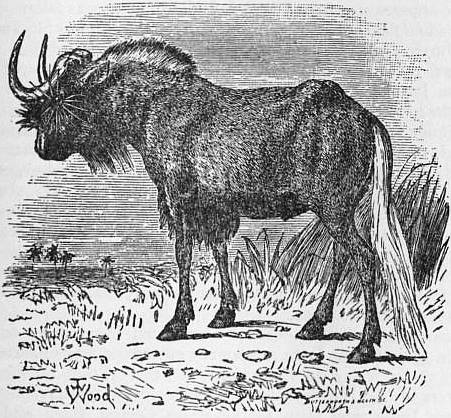
White-tailed Gnu, or Black Wildebeest (Connochaetes gnu).
GO, or Go-bang (Jap. Go-ban, board for playing Go), a popular table game. It is of great antiquity, having been invented in Japan, according to tradition, by the emperor Yao, 2350 B.C., but it is probably of Chinese origin. According to Falkener the first historical mention of it was made about the year 300 B.C., but there is abundant evidence that it was a popular game long before that period. The original Japanese Go is played on a board divided into squares by 19 horizontal and 19 vertical lines, making 361 intersections, upon which the flat round men, 181 white and 181 black, are placed one by one as the game proceeds. The men are placed by the two players on any intersections (me) that may seem advantageous, the object being to surround with one’s men as many unoccupied intersections as possible, the player enclosing the greater number of vacant points being the winner. Completely surrounded men are captured and removed from the board. This game is played in England upon a board divided into 361 squares, the men being placed upon these instead of upon the intersections.
A much simpler variety of Go, mostly played by foreigners, has for its object to get five men into line. This may have been the earliest form of the game, as the word go means five. Except in Japan it is often played on an ordinary draughts-board, and the winner is he who first gets five men into line, either vertically, horizontally or diagonally.
See Go-Bang, by A. Howard Cady, in Spalding’s Home Library (New York, 1896); Games Ancient and Oriental, by Edward Falkener (London, 1892); Das japan.-chinesische Spiel Go, by O. Korschelt (Yokohama, 1881); Das Nationalspiel der Japanesen, by G. Schurig (Leipzig, 1888).
GOA, the name of the past and present capitals of Portuguese India, and of the surrounding territory more exactly described as Goa settlement, which is situated on the western coast of India, between 15° 44’ and 14° 53′ N., and between 73° 45′ and 74° 26′ E. Pop. (1900) 475,513, area 1301 sq. m.
Goa Settlement.—With Damaun (q.v.) and Diu (q.v.) Goa settlement forms a single administrative province ruled by a governor-general, and a single ecclesiastical province subject to the archbishop of Goa; for judicial purposes the province includes Macao in China, and Timor in the Malay Archipelago. It is bounded on the N. by the river Terakhul or Araundem, which divides it from the Sawantwari state, E. by the Western Ghats, S. by Kanara district, and W. by the Arabian Sea. It comprises the three districts of Ilhas, Bardez and Salsette, conquered early in the 16th century and therefore known as the Velhas Conquistas (Old Conquests), seven districts acquired later and known as the Novas Conquistas, and the island of Anjidiv or Anjadiva. The settlement, which has a coast-line of 62 m., is a hilly region, especially the Novas Conquistas; its distinguishing features are the Western Ghats, though the highest summits nowhere reach an altitude of 4000 ft., and the island of Goa. Numerous short but navigable rivers water the lowlands skirting the coast. The two largest rivers are the Mandavi and the Juari, which together encircle the island of Goa (Ilhas), being connected on the landward side by a creek. The island (native name Tisvādī, Tissuvaddy, Tissuary) is a triangular territory, the apex of which, called the cabo or cape, is a rocky headland separating the harbour of Goa into two anchorages—Agoada or Aguada at the mouth of the Mandavi, on the north, and Mormugão or Marmagão at the mouth of the Juari, on the south. The northern haven is exposed to the full force of the south-west monsoon, and is liable to silt up during the rains. The southern, sheltered by the promontory of Salsette, is always open, but is less used, owing to its greater distance from the city of Goa, which is built on the island. A railway connects Mormagão, south of the Juari estuary, with Castle Rock on the Western Ghats. Goa imports textiles and foodstuffs, and exports coco-nuts, areca-nuts, spices, fish, poultry and timber. Its trade is carried on almost entirely with Bombay, Madras, Kathiawar and Portugal. Manganese is mined in large quantities, some iron is obtained, and other products are salt, palm-spirit, betel and bananas.
Cities of Goa.—1. The ancient Hindu city of Goa, of which hardly a fragment survives, was built at the southernmost point of the island, and was famous in early Hindu legend and history for its learning, wealth and beauty. In the Puranas and certain inscriptions its name appears as Gove, Govāpurī, Gomant, &c.; the medieval Arabian geographers knew it as Sindābur or Sandābur, and the Portuguese as Goa Velha. It was ruled by the Kadamba dynasty from the 2nd century A.D. to 1312, and by Mahommedan invaders of the Deccan from 1312 until about 1370, during which period it was visited and described by Ibn Batuta. It was then annexed to the Hindu kingdom of Vijayanagar, of which, according to Ferishta, it still formed part in 1469, when it was conquered by the Bahmani sultan of the Deccan; but two of the best Portuguese chroniclers state that it became independent in 1440, when the second city (Old Goa) was founded.
2. Old Goa is, for the most part, a city of ruins without inhabitants other than ecclesiastics and their dependents. The chief surviving buildings are the cathedral, founded by Albuquerque in 1511 to commemorate his entry into Goa on St Catherine’s day 1510, and rebuilt in 1623, and still used for public worship; the convent of St Francis (1517), a converted mosque rebuilt in 1661, with a portal of carved black stone, which is the only relic of Portuguese architecture in India dating from the first quarter of the 16th century; the chapel of St Catherine (1551); the church of Bom Jesus (1594-1603), a superb example of Renaissance architecture as developed by the Jesuits, containing the magnificent shrine and tomb of St Francis Xavier (see Xavier, Francisco de); and the 17th-century convents of St Monica and St Cajetan. The college of St Paul (see below) is in ruins.
3. Panjim, Pangim or New Goa, originally a suburb of Old Goa, is, like the parent city, built on the left bank of the Mandavi estuary, in 15° 30′ N. and 73° 33′ E. Pop. (1901) 9500. It is a modern port with few pretensions to architectural beauty. Ships of the largest size can anchor in the river, but only small vessels can load or discharge at the quay. Panjim became the residence of the viceroy in 1759 and the capital of Portuguese India in 1843. It possesses a lyceum, a school for teachers, a seminary, a technical school and an experimental agricultural station.
Political History.—With the subdivision of the Bahmani kingdom, after 1482, Goa passed into the power of Yusuf Adil Shah, king of Bijapur, who was its ruler when the Portuguese first reached India. At this time Goa was important as the starting-point of pilgrims from India to Mecca, as a mart with no rival except Calicut on the west coast, and especially as the centre of the import trade in horses (Gulf Arabs) from Hormuz, the control of which was a vital matter to the kingdoms warring in the Deccan. It was easily defensible by any power with command of the sea, as the encircling rivers could only be forded at one spot, and had been deliberately stocked with crocodiles. It was attacked on the 10th of February 1510 by the Portuguese under Albuquerque. As a Hindu ascetic had foretold its downfall and the garrison of Ottoman mercenaries was outnumbered, the city surrendered without a struggle, and Albuquerque entered it in triumph, while the Hindu townsfolk strewed filagree flowers of gold and silver before his feet. Three months later Yusuf Adil Shah returned with 60,000 troops, forced the passage of the ford, and blockaded the Portuguese in their ships from May to August, when the cessation of the monsoon enabled them to put to sea. In November Albuquerque returned with a larger force, and after overcoming a desperate resistance, recaptured the city, permitted his soldiers to plunder it for three days, and massacred the entire Mahommedan population.
Goa was the first territorial possession of the Portuguese in Asia. Albuquerque intended it to be a colony and a naval base, as distinct from the fortified factories which had been established in certain Indian seaports. He encouraged his men to marry native women, and to settle in Goa as farmers, retail traders or artisans. These married men soon became a privileged caste, and Goa acquired a large Eurasian population. Albuquerque and his successors left almost untouched the customs and constitutions of the 30 village communities on the island, only abolishing the rite of suttee. A register of these customs (Foral de usos e costumes) was published in 1526, and is an historical document of much value; an abstract of it is given in R. S. Whiteway’s Rise of the Portuguese Empire in India (London, 1898).
Goa became the capital of the whole Portuguese empire in the East. It was granted the same civic privileges as Lisbon. Its senate or municipal chamber maintained direct communications with the king and paid a special representative to attend to its interests at court. In 1563 the governor even proposed to make Goa the seat of a parliament, in which all parts of the Portuguese east were to be represented; this was vetoed by the king.
In 1542 St Francis Xavier mentions the architectural splendour of the city; but it reached the climax of its prosperity between 1575 and 1625. Goa Dourada, or Golden Goa, was then the wonder of all travellers, and there was a Portuguese proverb, “He who has seen Goa need not see Lisbon.” Merchandise from all parts of the East was displayed in its bazaar, and separate streets were set aside for the sale of different classes of goods—Bahrein pearls and coral, Chinese porcelain and silk, Portuguese velvet and piece-goods, drugs and spices from the Malay Archipelago. In the main street slaves were sold by auction. The houses of the rich were surrounded by gardens and palm groves; they were built of stone and painted red or white. Instead of glass, their balconied windows had thin polished oyster-shells set in lattice-work.
The social life of Goa was brilliant, as befitted the headquarters of the viceregal court, the army and navy, and the church; but the luxury and ostentation of all classes had become a byword before the end of the 16th century. Almost all manual labour was done by slaves; common soldiers assumed high-sounding titles, and it was even customary for the poor noblemen who congregated together in boarding-houses to subscribe for a few silken cloaks, a silken umbrella and a common man-servant, so that each could take his turn to promenade the streets, fashionably attired and with a proper escort. There were huge gambling saloons, licensed by the municipality, where determined players lodged for weeks together; and every form of vice, except drunkenness, was practised by both sexes, although European women were forced to lead a kind of zenana life, and never ventured unveiled into the streets; they even attended at church in their palanquins, so as to avoid observation.
The appearance of the Dutch in Indian waters was followed by the gradual ruin of Goa. In 1603 and 1639 the city was blockaded by Dutch fleets, though never captured, and in 1635 it was ravaged by an epidemic. Its trade was gradually monopolized by the Jesuits. Thevenot in 1666, Baldaeus in 1672, Fryer in 1675 describe its ever-increasing poverty and decay. In 1683 only the timely appearance of a Mogul army saved it from capture by a horde of Mahratta raiders, and in 1739 the whole territory was attacked by the same enemies, and only saved by the unexpected arrival of a new viceroy with a fleet. This peril was always imminent until 1759, when a peace with the Mahrattas was concluded. In the same year the proposal to remove the seat of government to Panjim was carried out; it had been discussed as early as 1684. Between 1695 and 1775 the population dwindled from 20,000 to 1600, and in 1835 Goa was only inhabited by a few priests, monks and nuns.
Ecclesiastical History.—Some Dominican friars came out to Goa in 1510, but no large missionary enterprise was undertaken before the arrival of the Franciscans in 1517. From their headquarters in Goa the Franciscan preachers visited many parts of western India, and even journeyed to Ceylon, Pegu and the Malay Archipelago. For nearly twenty-five years they carried on the work of evangelization almost alone, with such success that in 1534 Pope Paul III. made Goa a bishopric, with spiritual jurisdiction over all Portuguese possessions between China and the Cape of Good Hope, though itself suffragan to the archbishopric of Funchal in Madeira. A Franciscan friar, João de Albuquerque, came to Goa as its first bishop in 1538. In 1542 St Francis Xavier came to Goa, and took over the Franciscan college of Santa Fé, for the training of native missionaries; this was renamed the College of St Paul, and became the headquarters of all Jesuit missions in the East, where the Jesuits were commonly styled Paulistas. By a Bull dated the 4th of February 1557 Goa was made an archbishopric, with jurisdiction over the sees of Malacca and Cochin, to which were added Macao (1575), Japan (1588), Angamale or Cranganore (1600), Meliapur (Mylapur) (1606), Peking and Nanking (1610), together with the bishopric of Mozambique, which included the entire coast of East Africa. In 1606 the archbishop received the title of Primate of the East, and the king of Portugal was named Patron of the Catholic Missions in the East; his right of patronage was limited by the Concordat of 1857 to Goa, Malacca, Macao and certain parts of British India. The Inquisition was introduced into Goa in 1560: a vivid account of its proceedings is given by C. Dellon, Relation de l’inquisition de Goa (1688). Five ecclesiastical councils, which dealt with matters of discipline, were held at Goa—in 1567, 1575, 1585, 1592 and 1606; the archbishop of Goa also presided over the more important synod of Diamper (Udayamperur, about 12 m. S.E. of Cochin), which in 1599 condemned as heretical the tenets and liturgy of the Indian Nestorians, or Christians of St Thomas (q.v.). In 1675 Fryer described Goa as “a Rome in India, both for absoluteness and fabrics,” and Hamilton states that early in the 18th century the number of ecclesiastics in the settlement had reached the extraordinary total of 30,000. But the Jesuits were expelled in 1759, and by 1800 Goa had lost much even of its ecclesiastical importance. The Inquisition was abolished in 1814 and the religious orders were secularized in 1835.
Bibliography.—J. N. da Fonseca, An Historical and Archaeological Sketch of Goa (Bombay, 1878) is a minute study of the city from the earliest times, illustrated. For the early history of Portuguese rule the chief authorities are The Commentaries ... of Dalboquerque (Hakluyt Society’s translation, London, 1877), the Cartas of Albuquerque (Lisbon, 1884), the Historia ... da India of F. L. de Castanheda (Lisbon, 1833, written before 1552), the Lendas da India of G. Correa (Lisbon, 1860, written 1514-1566), and the Decadas da India of João de Barros and D. do Couto (Lisbon, 1778-1788, written about 1530-1616). Couto’s Soldado pratico (Lisbon, 1790) and S. Botelho’s Cartas and Tombo, written 1547-1554, published in “Subsidios” of the Lisbon Academy (1868), are valuable studies of military life and administration. The Archivo Portuguez oriental (6 parts, New Goa, 1857-1877) is a most useful collection of documents dating from 1515; part 2 contains the privileges, &c. of the city of Goa, and part 4 contains the minutes of the ecclesiastical councils and of the synod of Diamper. The social life of Goa has been graphically described by many writers; see especially the travels of Varthema (c. 1505), Linschoten (c. 1580), Pyrard (1608) in the Hakluyt Society’s translations; J. Mocquet, Voyages (Paris, 1830, written 1608-1610); P. Baldaeus, in Churchill’s Voyages, vol. 3 (London, 1732); J. Fryer, A New Account of East India and Persia (London, 1698); A. de Mandelslo, Voyages (London, 1669); Les Voyages de M. de Thevenot aux Indes Orientales (Amsterdam, 1779), and A. Hamilton, A New Account of the East Indies (London, 1774). For Goa in the 20th century see The Imperial Gazetteer of India.
(K. G. J.)
GOAL, originally an object set up as the place where a race ends, the winning-post, and so used figuratively of the end to which any effort is directed. It is thus used to translate the Lat. meta, the boundary pillar, set one at each end of the circus to mark the turning-point. The word was quite early used in various games for the two posts, with or without a cross-bar, through or over which the ball has to be driven to score a point towards winning the game. The New English Dictionary quotes the use in Richard Stanyhurst’s Description of Ireland (1577); but the word gōl in the sense of a boundary appears as early as the beginning of the 14th century in the religious poems of William de Shoreham (c. 1315). The origin of the word is obscure. It is usually taken to be derived from a French word gaule, meaning a pole or stick, but this meaning does not appear in the English usage, nor does the usual English meaning appear in the French. There is an O. Eng. gaélan, to hinder, which may point to a lost gál, barrier, but there is no evidence in other Teutonic languages for such a word.
GOALPARA, a town and district of British India, in the Brahmaputra valley division of eastern Bengal and Assam. The town (pop. 6287) overlooks the Brahmaputra. It was the frontier outpost of the Mahommedan power, and has long been a flourishing seat of river trade. The civil station is built on the summit of a small hill commanding a magnificent view of the valley of the Brahmaputra, bounded on the north by the snowy ranges of the Himalayas and on the south by the Garo hills. The native town is built on the western slope of the hill, and the lower portion is subject to inundation from the marshy land which extends in every direction. It has declined in importance since the district headquarters were removed to Dhubri in 1879, and it suffered severely from the earthquake of the 12th of June 1897.
The District comprises an area of 3961 sq. m. It is situated along the Brahmaputra, at the corner where the river takes its southerly course from Assam into Bengal. The scenery is striking. Along the banks of the river grow clumps of cane and reed; farther back stretch fields of rice cultivation, broken only by the fruit trees surrounding the villages, and in the background rise the forest-clad hills overtopped by the white peaks of the Himalayas. The soil of the hills is of a red ochreous earth, with blocks of granite and sandstone interspersed; that of the plains is of alluvial formation. Earthquakes are common and occasionally severe shocks have been experienced. The Brahmaputra annually inundates vast tracts of country. Numerous extensive forests yield valuable timber. Wild animals of all kinds are found. In 1901 the population was 462,083, showing an increase of 2% in the decade. Rice forms the staple crop. Mustard and jute are also largely grown. The manufactures consist of the making of brass and iron utensils and of gold and silver ornaments, weaving of silk cloth, basket-work and pottery. The cultivation of tea has been introduced but does not flourish anywhere in the district. Local trade is in the hands of Marwari merchants, and is carried on at the bazars, weekly hats or markets and periodical fairs. The chief exports are mustard-seed, jute, cotton, timber, lac, silk cloth, india-rubber and tea; the imports, Bengal rice, European piece goods, salt, hardware, oil and tobacco.
Dhubri (pop. 3737), the administrative headquarters of the district, stands on the Brahmaputra where that river takes its great bend south. It is the termination of the emigration road from North Bengal and of the river steamers that connect with the North Bengal railway. It is also served by the eastern Bengal State railway.
GOAT (a common Teut. word; O. Eng. gát, Goth. gaits, Mod. Ger. Geiss, cognate with Lat. haedus, a kid), properly the name of the well-known domesticated European ruminant (Capra hircus), which has for all time been regarded as the emblem of everything that is evil, in contradistinction to the sheep, which is the symbol of excellence and purity. Although the more typical goats are markedly distinct from sheep, there is, both as regards wild and domesticated forms, an almost complete gradation from goats to sheep, so that it is exceedingly difficult to define either group. The position of the genus Capra (to all the members of which, as well as some allied species, the name “goat” in its wider sense is applicable) in the family Bovidae is indicated in the article Bovidae, and some of the distinctions between goats and sheep are mentioned in the article Sheep. Here then it will suffice to mention that goats are characterized by the strong and offensive odour of the males, which are furnished with a beard on the chin; while as a general rule glands are present between the middle toes of the fore feet only.
Goats, in the wild state, are an exclusively old-world group, of which the more typical forms are confined to Europe and south-western and central Asia, although there are two outlying species in northern Africa. The wild goat, or pasang, is represented in Europe in the Cyclades and Crete by rather small races. more or less mingled with domesticated breeds, the Cretan animal being distinguished as Capra hircus creticus; but the large typical race C. h. aegagrus is met with in the mountains of Asia Minor and Persia, whence it extends to Sind, where it is represented by a somewhat different race known as C. h. blythi. The horns of the old bucks are of great length and beauty, and characterized by their bold scimitar-like backward sweep and sharp front edge, interrupted at irregular intervals by knots or bosses. Domesticated goats have run wild in many islands, such as the Hebrides, Shetland, Canaries, Azores, Ascension and Juan Fernandez. Some of these reverted breeds have developed horns of considerable size, although not showing that regularity of curve distinctive of the wild race. In the Azores the horns are remarkably upright and straight, whence the name of “antelope-goat” which has been given to these animals. The concretions known as bezoar-stones, formerly much used in medicine and as antidotes of poison, are obtained from the stomach of the wild goat.
Although there have in all probability been more or less important local crosses with other wild species, there can be no doubt that domesticated goats generally are descended from the wild goat. It is true that many tame goats show spirally twisted horns recalling those of the under-mentioned Asiatic markhor; but in nearly all such instances it will be found that the spiral twists in the opposite direction. Among the domesticated breeds the following are some of the more important.
Firstly, we have the common or European goats, of which there are several more or less well-marked breeds, differing from each other in length of hair, in colour and slightly in the configuration of the horns. The ears are more or less upright, sometimes horizontal, but never actually pendent, as in some Asiatic breeds. The horns are rather flat at the base and not unfrequently corrugated; they rise vertically from the head, curving to the rear, and are more or less laterally inclined. The colour varies from dirty white to dark-brown, but when pure-bred is never black, which indicates eastern blood. Most European countries possess more than one description of the common goat. In the British Isles there are two distinct types, one short and the other long haired. In the former the hair is thick and close, with frequently an under-coat resembling wool. The horns are large in the male, and of moderate size in the female, flat at the base and inclining outwards. The head is short and tapering, the forehead flat and wide, and the nose small; while the legs are strong, thick and well covered with hair. The colour varies from white or grey to black, but is frequently fawn, with a dark line down the spine and another across the shoulders. The other variety has a shaggy coat, generally reddish-black, though sometimes grey or pied and occasionally white. The head is long, heavy and ugly, the nose coarse and prominent, with the horns situated close together, often continuing parallel almost to the extremities, being also large, corrugated and pointed. The legs are long and the sides flat, the animal itself being generally gaunt and thin. This breed is peculiar to Ireland, the Welsh being of a similar type, but more often white. The short-haired goat is the English goat proper. Both British breeds, as well as those from abroad, are frequently ornamented with two tassel-like appendages, hanging near together under the throat. It has been supposed by many that these are traceable to foreign blood; but although there are foreign breeds that possess them, they appear to pertain quite as much to the English native breeds as to those of distant countries, the peculiarity being mentioned in very old works on the goats of the British Islands. The milk-produce in the common goat as well as other kinds varies greatly with individuals. Irish goats often yield a quantity of milk, but the quality is poor. The goats of France are similar to those of Britain, varying in length of hair, colour and character of horns. The Norway breed is frequently white with long hair; it is rather small in size, with small bones, a short rounded body, head small with a prominent forehead, and short, straight, corrugated horns. The facial line is concave. The horns of the males are very large, and curve round after the manner of the wild goat, with a tuft of hair between and in front.
The Maltese goat has the ears long, wide and hanging down below the jaw. The hair is long and cream-coloured. The breed is usually hornless.
The Syrian goat is met with in various parts of the East, in Lower Egypt, on the shores of the Indian Ocean and in Madagascar. The hair and ears are excessively long, the latter so much so that they are sometimes clipped to prevent their being torn by stones or thorny shrubs. The horns are somewhat erect and spiral, with an outward bend.
The Angora goat is often confounded with the Kashmir, but is in reality quite distinct. The principal feature of this breed, of which there are two or three varieties, is the length and quantity of the hair, which has a particularly soft and silky texture, covering the whole body and a great part of the legs with close matted ringlets. The horns of the male differ from those of the female, being directed vertically and in shape spiral, whilst in the female they have a horizontal tendency, somewhat like those of a ram. The coat is composed of two kinds of hair, the one short and coarse and of the character of hair, which lies close to the skin, the other long and curly and of the nature of wool, forming the outer covering. Both are used by the manufacturer, but the exterior portion, which makes up by far the greater bulk, is much the more valuable. The process of shearing takes place in early spring, the average amount of wool yielded by each animal being about 2½ ℔. The best quality comes from castrated males, females producing the next best.
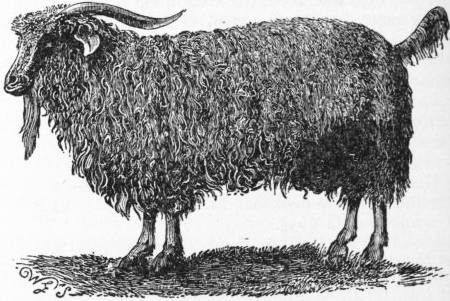
Fig. 1.—Male Angora Goat.
The breed was introduced at the Cape about 1864. The Angora is a bad milker and an indifferent mother, but its flesh is better than that of any other breed, and in its native country is preferred to mutton. The kids are born small, but grow fast, and arrive early at maturity. The Kashmir, or rather Tibet, goat has a delicate head, with semi-pendulous ears, which are both long and wide. The hair varies in length, and is coarse and of different colours according to the individual. The horns are very erect, and sometimes slightly spiral, inclining inwards and to such an extent in some cases as to cross. The coat is composed, as in the Angora, of two materials; but in this breed it is the under-coat that partakes of the nature of wool and is valued as an article of commerce. This under-coat, or pushm, which is of a uniform greyish-white tint, whatever the colour of the hair may be, is beautifully soft and silky, and of a fluffy description resembling down. It makes its appearance in the autumn, and continues to grow until the following spring, when, if not removed, it falls off naturally; its collection then commences, occupying from eight to ten days. The animal undergoes during that time a process of combing by which all the wool and a portion of the hair, which of necessity comes with it, is removed. The latter is afterwards carefully separated, when the fleece in a good specimen weighs about half a pound. This is the material of which the far-famed and costly shawls are made, which at one time had such a demand that, it is stated, 16,000 looms were kept in constant work at Kashmir in their manufacture. Those goats having a short, neat head, long, thin, ears, a delicate skin, small bones, and a long heavy coat, are for this purpose deemed the best. There are several varieties possessing this valuable quality, but those of Kashmir, Tibet and Mongolia are the most esteemed.
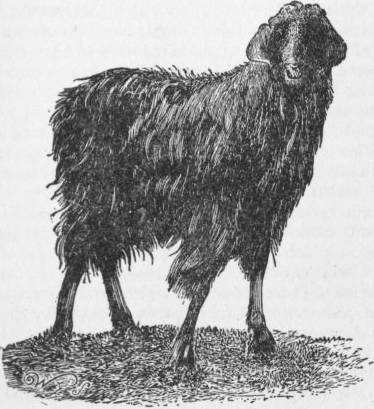
Fig. 2.—Nubian Goat.
The Nubian goat, which is met with in Nubia, Upper Egypt and Abyssinia, differs greatly in appearance from those previously described. The coat of the female is extremely short, almost like that of a race-horse, and the legs are long. This breed therefore stands considerably higher than the common goat. One of its peculiarities is the convex profile of the face, the forehead being prominent and the nostrils sunk in, the nose itself extremely small, and the lower lip projecting from the upper. The ears are long, broad and thin, and hang down by the side of the head like a lop-eared rabbit. The horns are black, slightly twisted and very short, flat at the base, pointed at the tips, and recumbent on the head. Among goats met with in England a good many show signs of a more or less remote cross with this breed, derived probably from specimens brought from the East on board ships for supplying milk during the voyage.
The Theban goat, of the Sudan, which is hornless, displays the characteristic features of the last in an exaggerated degree, and in the form of the head and skull is very sheep-like.
The Nepal goat appears to be a variety of the Nubian breed, having the same arched facial line, pendulous ears and long legs. The horns, however, are more spiral. The colour of the hair, which is longer than in the Nubian, is black, grey or white, with black blotches.
Lastly the Guinea goat is a dwarf breed originally from the coast whence its name is derived. There are three varieties. Besides the commonest Capra recurva, there is a rarer breed, Capra depressa, inhabiting the Mauritius and the islands of Bourbon and Madagascar. The other variety is met with along the White Nile, in Lower Egypt, and at various points on the African coast of the Mediterranean.
As regards wild goats other than the representatives of Capra hircus, the members of the ibex-group are noticed under Ibex, while another distinctive type receives mention under Markhor. The ibex are connected with the wild goat by means of Capra nubiana, in which the front edge of the horns is thinner than in either the European C. ibex or the Asiatic C. sibirica; while the Spanish C. pyrenaica shows how the ibex-type of horn may pass into the spirally twisted one distinctive of the markhor, C. falconeri. In the article Ibex mention is made of the Caucasus ibex, or tur, C. caucasica, as an aberrant member of that group, but beside this animal the Caucasus is the home of another very remarkable goat, or tur, known as C. pallasi. In this ruminant, which is of a dark-brown colour, the relatively smooth black horns diverge outwards in a manner resembling those of the bharal among the sheep rather than in goat-fashion; and, in fact, this tur, which has only a very short beard, is so bharal-like that it is commonly called by sportsmen the Caucasian bharal. It is one of the species which render it so difficult to give a precise definition of either sheep or goats.
The short-horned Asiatic goats of the genus Hemitragus receive mention in the article Tahr; but it may be added that fossil species of the same genus are known from the Lower Pliocene formations of India, which have also yielded remains of a goat allied to the markhor of the Himalayas. The Rocky Mountain goat (q.v.) of America has no claim to be regarded as a member of the goat-group.
For full descriptions of the various wild species, see R. Lydekker, Wild Oxen, Sheep, and Goats (London, 1898).
(R. L.*)
GOATSUCKER, a bird from very ancient times absurdly believed to have the habit implied by the common name it bears in many European tongues besides English—as testified by the Gr.αἰγοθήλας, the Lat. caprimulgus, Ital. succiacapre, Span. chotacabras, Fr. tettechèvre, and Ger. Ziegenmelker. The common goatsucker (Caprimulgus europaeus, Linn.), is admittedly the type of a very peculiar and distinct family, Caprimulgidae, a group remarkable for the flat head, enormously wide mouth, large eyes, and soft, pencilled plumage of its members, which vary in size from a lark to a crow. Its position has been variously assigned by systematists. Though now judiciously removed from the Passeres, in which Linnaeus placed all the species known to him, Huxley considered it to form, with two other families—the swifts (Cypselidae) and humming-birds (Trochilidae)—the division Cypselomorphae of his larger group Aegithognathae, which is equivalent in the main to the Linnaean Passeres. There are two ways of regarding the Caprimulgidae—one including the genus Podargus and its allies, the other recognizing them as a distinct family, Podargidae. As a matter of convenience we shall here comprehend these last in the Caprimulgidae, which will then contain two subfamilies, Caprimulginae and Podarginae; for what, according to older authors, constitutes a third, though represented only by Steatornis, the singular oil-bird, or guacharo, certainly seems to require separation as an independent family (see Guachero).
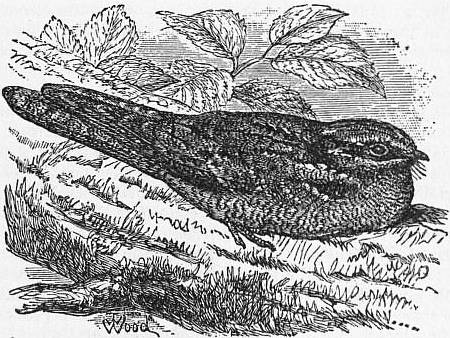
Common Goatsucker.
Some of the differences between the Caprimulginae and Podarginae have been pointed out by Sclater (Proc. Zool. Soc., 1866, p. 123), and are very obvious. In the former, the outer toes have four phalanges only, thus presenting a very uncommon character among birds, and the middle claws are pectinated; while in the latter the normal number of five phalanges is found, and the claws are smooth, and other distinctions more recondite have also been indicated by him (tom. cit. p. 582). The Caprimulginae may be further divided into those having the gape thickly beset by strong bristles, and those in which there are few such bristles or none—the former containing the genera Caprimulgus, Antrostomus, Nyctidromus and others, and the latter Podargus, Chordiles, Lyncornis and a few more.
The common goatsucker of Europe (C. europaeus) arrives late in spring from its winter-retreat in Africa, and its presence is soon made known by its habit of chasing its prey, consisting chiefly of moths and cockchafers, in the evening-twilight. As the season advances the song of the cock, from its singularity, attracts attention amid all rural sounds. This song seems to be always uttered when the bird is at rest, though the contrary has been asserted, and is the continuous repetition of a single burring note, as of a thin lath fixed at one end and in a state of vibration at the other, and loud enough to reach in still weather a distance of half-a-mile or more. On the wing, while toying with its mate, or performing its rapid evolutions round the trees where it finds its food, it has the habit of occasionally producing another and equally extraordinary sound, sudden and short, but somewhat resembling that made by swinging a thong in the air, though whether this noise proceeds from its mouth is not ascertained. In general its flight is silent, but at times when disturbed from its repose, its wings may be heard to smite together. The goatsucker, or, to use perhaps its commoner English name, nightjar,1 passes the day in slumber, crouching on the ground or perching on a tree—in the latter case sitting not across the branch but lengthways, with its head lower than its body. In hot weather, however, its song may sometimes be heard by day and even at noontide, but it is then uttered, as it were, drowsily, and without the vigour that characterizes its crepuscular or nocturnal performance. Towards evening the bird becomes active, and it seems to pursue its prey throughout the night uninterruptedly, or only occasionally pausing for a few seconds to alight on a bare spot—a pathway or road—and then resuming its career. It is one of the few birds that absolutely make no nest, but lays its pair of beautifully-marbled eggs on the ground, generally where the herbage is short, and often actually on the soil. So light is it that the act of brooding, even where there is some vegetable growth, produces no visible depression of the grass, moss or lichens on which the eggs rest, and the finest sand equally fails to exhibit a trace of the parental act. Yet scarcely any bird shows greater local attachment, and the precise site chosen one year is almost certain to be occupied the next. The young, covered when hatched with dark-spotted down, are not easily found, nor are they more easily discovered on becoming fledged, for their plumage almost entirely resembles that of the adults, being a mixture of reddish-brown, grey and black, blended and mottled in a manner that passes description. They soon attain their full size and power of flight, and then take to the same manner of life as their parents. In autumn all leave their summer haunts for the south, but the exact time of their departure has hardly been ascertained. The habits of the nightjar, as thus described, seem to be more or less essentially those of the whole subfamily—the differences observable being apparently less than are found in other groups of birds of similar extent.
A second species of goatsucker (C. ruficollis), which is somewhat larger, and has the neck distinctly marked with rufous, is a summer visitant to the south-western parts of Europe, and especially to Spain and Portugal. The occurrence of a single example of this bird at Killingworth, near Newcastle-on-Tyne, in October 1856, has been recorded by Mr Hancock (Ibis, 1862, p. 39); but the season of its appearance argues the probability of its being but a casual straggler from its proper home. Many other species of Caprimulgus inhabit Africa, Asia and their islands, while one (C. macrurus) is found in Australia. Very nearly allied to this genus is Antrostomus, an American group containing many species, of which the chuck-will’s-widow (A. carolinensis) and the whip-poor-will (A. vociferus) of the eastern United States (the latter also reaching Canada) are familiar examples. Both these birds take their common name from the cry they utter, and their habits seem to be almost identical, with those of the old world goatsuckers. Passing over some other forms which need not here be mentioned, the genus Nyctidromus, though consisting of only one species (N. albicollis) which inhabits Central and part of South America, requires remark, since it has tarsi of sufficient length to enable it to run swiftly on the ground, while the legs of most birds of the family are so short that they can make but a shuffling progress. Heleothreptes, with the unique form of wing possessed by the male, needs mention. Notice must also be taken of two African species, referred by some ornithologists to as many genera (Macrodipteryx and Cosmetornis), though probably one genus would suffice for both. The males of each of them are characterized by the wonderful development of the ninth primary in either wing, which reaches in fully adult specimens the extraordinary length of 17 in. or more. The former of these birds, the Caprimulgus macrodipterus of Adam Afzelius, is considered to belong to the west coast of Africa, and the shaft of the elongated remiges is bare for the greater part of its length, retaining the web, in a spatulate form, only near the tip. The latter, to which the specific name of vexillarius was given by John Gould, has been found on the east coast of that continent, and is reported to have occurred in Madagascar and Socotra. In this the remigial streamers do not lose their barbs, and as a few of the next quills are also to some extent elongated, the bird, when flying, is said to look as though it had four wings. Specimens of both are rare in collections, and no traveller seems to have had the opportunity of studying the habits of either so as to suggest a reason for this marvellous sexual development.
The second group of Caprimulginae, those which are but poorly or not at all furnished with rictal bristles, contains about five genera, of which we may particularize Lyncornis of the old world and Chordiles of the new. The species of the former are remarkable for the tuft of feathers which springs from each side of the head, above and behind the ears, so as to give the bird an appearance like some of the “horned” owls—those of the genus Scops, for example; and remarkable as it is to find certain forms of two families, so distinct as are the Strigidae and the Caprimulgidae, resembling each other in this singular external feature, it is yet more remarkable to note that in some groups of the latter, as in some of the former, a very curious kind of dimorphism takes place. In either case this has been frequently asserted to be sexual, but on that point doubt may fairly be entertained. Certain it is that in some groups of goatsuckers, as in some groups of owls, individuals of the same species are found in plumage of two entirely different hues—rufous and grey. The only explanation as yet offered of this fact is that the difference is sexual, but evidence to that effect is conflicting. It must not, however, be supposed that this common feature, any more than that of the existence of tufted forms in each group, indicates any close relationship between them. The resemblances may be due to the same causes, concerning which future observers may possibly enlighten us, but at present we must regard them as analogies, not homologies. The species of Lyncornis inhabit the Malay Archipelago, one, however, occurring also in China. Of Chordiles the best-known species is the night-hawk of North America (C. virginianus or C. popetue), which has a wide range from Canada to Brazil. Others are found in the Antilles and in South America. The general habits of all these birds agree with those of the typical goatsuckers.
We have next to consider the birds forming the genus Podargus and those allied to it, whether they be regarded as a distinct family, or as a subfamily of Caprimulgidae. As above stated, they have feet constructed as those of birds normally are, and their sternum seems to present the constant though comparatively trivial difference of having its posterior margin elongated into two pairs of processes, while only one pair is found in the true goatsuckers. Podargus includes the bird (P. cuvieri) known from its cry as morepork to the Tasmanians,2 and several other species, the number of which is doubtful, from Australia and New Guinea. They have comparatively powerful bills, and it would seem feed to some extent on fruits and berries, though they mainly subsist on insects, chiefly Cicadae and Phasmidae. They also differ from the true goatsuckers in having the outer toes partially reversible, and they build a flat nest on the horizontal branch of a tree for the reception of their eggs, which are of a spotless white. Apparently allied to Podargus, but differing among other respects in its mode of nidification, is Aegotheles, which belongs also to the Australian sub-region; and farther to the northward, extending throughout the Malay Archipelago and into India, comes Batrachostomus, wherein we again meet with species having aural tufts somewhat like Lyncornis. The Podarginae are thought by some to be represented in the new world by the genus Nyctibius, of which several species occur from the Antilles and Central America to Brazil. Finally, it may be stated that none of the Caprimulgidae seem to occur in Polynesia or in New Zealand, though there is scarcely any other part of the world suited to their habits in which members of the family are not found.
(A. N.)
1 Other English names of the bird are evejar, fern-owl, churn-owl and wheel-bird—the last from the bird’s song resembling the noise made by a spinning-wheel in motion.
2 In New Zealand, however, this name is given to an owl (Sceloglaux novae-zelandiae).
GOBAT, SAMUEL (1799-1879), bishop of Jerusalem, was born at Crémine, Bern, Switzerland, on the 26th of January 1799. After serving in the mission house at Basel from 1823 to 1826, he went to Paris and London, whence, having acquired some knowledge of Arabic and Ethiopic, he went out to Abyssinia under the auspices of the Church Missionary Society. The unsettled state of the country and his own ill health prevented his making much headway; he returned to Europe in 1835 and from 1839 to 1842 lived in Malta, where he supervised an Arabic translation of the Bible. In 1846 he was consecrated Protestant bishop of Jerusalem, under the agreement between the British and Prussian governments (1841) for the establishment of a joint bishopric for Lutherans and Anglicans in the Holy Land. He carried on a vigorous mission as bishop for over thirty years, his diocesan school and orphanage on Mount Zion being specially noteworthy. He died on the 11th of May 1879.
A record of his life, largely autobiographical, was published at Basel in 1884, and an English translation at London in the same year.
GOBEL, JEAN BAPTISTE JOSEPH (1727-1794), French ecclesiastic and politician, was born at Thann, in Alsace, on the 1st of September 1727. He studied theology in the German College at Rome, and then became successively a member of the chapter of Porrentruy, bishop in partibus of Lydda, and finally suffragan of Basel for that part of the diocese situated in French territory. His political life began when he was elected deputy to the states-general of 1789 by the clergy of the bailliage of Huningue. The turning-point of his life was his action in taking the oath of the civil constitution of the clergy (Jan. 3rd, 1791); in favour of which he had declared himself since the 5th of May 1790. The civil constitution of the clergy gave the appointment of priests to the electoral assemblies, and since taking the oath Gobel had become so popular that he was elected bishop in several dioceses. He chose Paris, and in spite of the difficulties which he had to encounter before he could enter into possession, was consecrated on the 27th of March 1791 by eight bishops, including Talleyrand. On the 8th of November 1792, Gobel was appointed administrator of Paris. He was careful to flatter the politicians by professing anti-clerical opinions, declaring himself, among other things, opposed to the celibacy of the clergy; and on the 17th Brumaire in the year II. (7th November 1793), he came before the bar of the Convention, and, in a famous scene, resigned his episcopal functions, proclaiming that he did so for love of the people, and through respect for their wishes. The followers of Hébert, who were then pursuing their anti-Christian policy, claimed Gobel as one of themselves; while, on the other hand, Robespierre looked upon him as an atheist, though apostasy cannot strictly speaking be laid to the charge of the ex-bishop, nor did he ever make any actual profession of atheism. Robespierre, however, found him an obstacle to his religious schemes, and involved him in the fate of the Hébertists. Gobel was condemned to death, with Chaumette, Hébert and Anacharsis Cloots, and was guillotined on the 12th of April 1794.
See E. Charavay, Assemblée électorale de Paris (Paris, 1890); H. Monin, La Chanson et l’Église sous la Révolution (Paris, 1892); A. Aulard, “La Culte de la raison” in the review, La Révolution Française (1891). For a bibliography of documents relating to his episcopate see “Épiscopat de Gobel” in vol. iii. (1900) of M. Tourneux’s Bibliographie de l’histoire de Paris pendant la Rév. Fr.
GOBELIN, the name of a family of dyers, who in all probability came originally from Reims, and who in the middle of the 15th century established themselves in the Faubourg Saint Marcel, Paris, on the banks of the Bièvre. The first head of the firm was named Jehan (d. 1476). He discovered a peculiar kind of scarlet dyestuff, and he expended so much money on his establishment that it was named by the common people la folie Gobelin. To the dye-works there was added in the 16th century a manufactory of tapestry (q.v.). So rapidly did the wealth of the family increase, that in the third or fourth generation some of them forsook their trade and purchased titles of nobility. More than one of their number held offices of state, among others Balthasar, who became successively treasurer general of artillery, treasurer extraordinary of war, councillor secretary of the king, chancellor of the exchequer, councillor of state and president of the chamber of accounts, and who in 1601 received from Henry IV. the lands and lordship of Briecomte-Robert. He died in 1603. The name of the Gobelins as dyers cannot be found later than the end of the 17th century. In 1662 the works in the Faubourg Saint Marcel, with the adjoining grounds, were purchased by Colbert on behalf of Louis XIV., and transformed into a general upholstery manufactory, in which designs both in tapestry and in all kinds of furniture were executed under the superintendence of the royal painter, Le Brun. On account of the pecuniary embarrassments of Louis XIV., the establishment was closed in 1694, but it was reopened in 1697 for the manufacture of tapestry, chiefly for royal use and for presentation. During the Revolution and the reign of Napoleon the manufacture was suspended, but it was revived by the Bourbons, and in 1826 the manufacture of carpets was added to that of tapestry. In 1871 the building was partly burned by the Communists. The manufacture is still carried on under the state.
See Lacordaire, Notice historique sur les manufactures impériales de tapisserie des Gobelin et de tapis de la Savonnerie, précédée du catalogue des tapisseries qui y sont exposés (Paris, 1853); Genspach, Répertoire détaillé des tapisseries exécutées aux Gobelins, 1662-1892 (Paris, 1893); Guiffrey, Histoire de la tapisserie en France (Paris, 1878-1885). The two last-named authors were directors of the manufactory.
GOBI (for which alternative Chinese names are Sha-mo, “sand desert,” and Han-hai, “dry sea”), a term which in its widest significance means the long stretch of desert country that extends from the foot of the Pamirs, in about 77° E., eastward to the Great Khingan Mountains, in 116°-118° E., on the border of Manchuria, and from the foothills of the Altai, the Sayan and the Yablonoi Mountains on the N. to the Astin-tagh or Altyn-tagh and the Nan-shan, the northernmost constituent ranges of the Kuen-lun Mountains, on the south. By conventional usage a relatively small area on the east side of the Great Khingan, between the upper waters of the Sungari and the upper waters of the Liao-ho, is also reckoned to belong to the Gobi. On the other hand, geographers and Asiatic explorers prefer to regard the W. extremity of the Gobi region (as defined above), namely, the basin of the Tarim in E. Turkestan, as forming a separate and independent desert, to which they have given the name of Takla-makan. The latter restriction governs the present article, which accordingly excludes the Takla-makan, leaving it for separate treatment. The desert of Gobi as a whole is only very imperfectly known, information being confined to the observations which individual travellers have made from their respective itineraries across the desert. Amongst the explorers to whom we owe such knowledge as we possess about the Gobi, the most important have been Marco Polo (1273-1275), Gerbillon (1688-1698), Ijsbrand Ides (1692-1694), Lange (1727-1728 and 1736), Fuss and Bunge (1830-1831), Fritsche (1868-1873), Pavlinov and Matusovski (1870), Ney Elias (1872-1873), N. M. Przhevalsky (1870-1872 and 1876-1877), Zosnovsky (1875), M. V. Pjevtsov (1878), G. N. Potanin (1877 and 1884-1886), Count Széchenyi and L. von Loczy (1879-1880), the brothers Grum-Grzhimailo (1889-1890), P. K. Kozlov (1893-1894 and 1899-1900), V. I. Roborovsky (1894), V. A. Obruchev (1894-1896), Futterer and Holderer (1896); C. E. Bonin (1896 and 1899), Sven Hedin (1897 and 1900-1901), K. Bogdanovich (1898), Ladyghin (1899-1900) and Katsnakov (1899-1900).
Geographically the Gobi (a Mongol word meaning “desert”) is the deeper part of the gigantic depression which fills the interior of the lower terrace of the vast Mongolian plateau, and measures over 1000 m. from S.W. to N.E. and 450 to 600 m. from N. to S., being widest in the west, along the line joining the Baghrash-kol and the Lop-nor (87°-89° E.). Owing to the immense area covered, and the piecemeal character of the information, no general description can be made applicable to the whole of the Gobi. It will be more convenient, therefore, to describe its principal distinctive sections seriatim, beginning in the west.
Ghashiun-Gobi and Kuruk-tagh.—The Yulduz valley or valley of the Khaïdyk-gol (83°-86° E., 43° N.) is enclosed by two prominent members of the Tian-shan system, namely the Chol-tagh and the Kuruk-tagh, running parallel and close to one another. As they proceed eastward they diverge, sweeping back on N. and S. respectively so as to leave room for the Baghrash-kol. These two ranges mark the northern and the southern edges respectively of a great swelling, which extends eastward for nearly twenty degrees of longitude. On its northern side the Chol-tagh descends steeply, and its foot is fringed by a string of deep depressions, ranging from Lukchun (425 ft. below the level of the sea) to Hami (2800 ft. above sea-level). To the south of the Kuruk-tagh lie the desert of Lop, the desert of Kum-tagh, and the valley of the Bulunzir-gol. To this great swelling, which arches up between the two border-ranges of the Chol-tagh and Kuruk-tagh, the Mongols give the name of Ghashiun-Gobi or Salt Desert. It is some 80 to 100 m. across from N. to S., and is traversed by a number of minor parallel ranges, ridges and chains of hills, and down its middle runs a broad stony valley, 25 to 50 m. wide, at an elevation of 3000 to 4500 ft. The Chol-tagh, which reaches an average altitude of 6000 ft., is absolutely sterile, and its northern foot rests upon a narrow belt of barren sand, which leads down to the depressions mentioned above.
The Kuruk-tagh is the greatly disintegrated, denuded and wasted relic of a mountain range which formerly was of incomparably greater magnitude. In the west, between Baghrash-kol and the Tarim, it consists of two, possibly of three, principal ranges, which, although broken in continuity, run generally parallel to one another, and embrace between them numerous minor chains of heights. These minor ranges, together with the principal ranges, divide the region into a series of long, narrow valleys, mostly parallel to one another and to the enclosing mountain chains, which descend like terraced steps, on the one side towards the depression of Lukchun and on the other towards the desert of Lop. In many cases these latitudinal valleys are barred transversely by ridges or spurs, generally elevations en masse of the bottom of the valley. Where such elevations exist, there is generally found, on the E. side of the transverse ridge, a cauldron-shaped depression, which some time or other has been the bottom of a former lake, but is now nearly a dry salt-basin. The surface configuration is in fact markedly similar to that which occurs in the inter-mont latitudinal valleys of the Kuen-lun. The hydrography of the Ghashiun-Gobi and the Kuruk-tagh is determined by these chequered arrangements of the latitudinal valleys. Most of the principal streams, instead of flowing straight down these valleys, cross them diagonally and only turn west after they have cut their way through one or more of the transverse barrier ranges.1 To the highest range on the great swelling Grum-Grzhimailo gives the name of Tuge-tau, its altitude being 9000 ft. above the level of the sea and some 4000 ft. above the crown of the swelling itself. This range he considers to belong to the Chol-tagh system, whereas Sven Hedin would assign it to the Kuruk-tagh. This last, which is pretty certainly identical with the range of Khara-teken-ula (also known as the Kyzyl-sanghir, Sinir, and Singher Mountains), that overlooks the southern shore of the Baghrash-kol, though parted from it by the drift-sand desert of Ak-bel-kum (White Pass Sands), has at first a W.N.W. to E.S.E. strike, but it gradually curves round like a scimitar towards the E.N.E. and at the same time gradually decreases in elevation. In 91° E., while the principal range of the Kuruk-tagh system wheels to the E.N.E., four of its subsidiary ranges terminate, or rather die away somewhat suddenly, on the brink of a long narrow depression (in which Sven Hedin sees a N.E. bay of the former great Central Asian lake of Lop-nor), having over against them the écheloned terminals of similar subordinate ranges of the Pe-shan (Bey-san) system (see below). The Kuruk-tagh is throughout a relatively low, but almost completely barren range, being entirely destitute of animal life, save for hares, antelopes and wild camels, which frequent its few small, widely scattered oases. The vegetation, which is confined to these same relatively favoured spots, is of the scantiest and is mainly confined to bushes of saxaul (Anabasis Ammodendron), reeds (kamish), tamarisks, poplars, Kalidium and Ephedra.
Desert of Lop.—This section of the Gobi extends south-eastward from the foot of the Kuruk-tagh as far as the present terminal basin of the Tarim, namely Kara-koshun (Przhevalsky’s Lop-nor), and is an almost perfectly horizontal expanse, for, while the Baghrash-kol in the N. lies at an altitude of 2940 ft., the Kara-koshun, over 200 m. to the S., is only 300 ft. lower. The characteristic features of this almost dead level or but slightly undulating region are: (i.) broad, unbroken expanses of clay intermingled with sand, the clay (shor) being indurated and saliferous and often arranged in terraces; (ii.) hard, level, clay expanses, more or less thickly sprinkled with fine gravel (say), the clay being mostly of a yellow or yellow-grey colour; (iii.) benches, flattened ridges and tabular masses of consolidated clay (jardangs), arranged in distinctly defined laminae, three stories being sometimes superimposed one upon the other, and their vertical faces being abraded, and often undercut, by the wind, while the formations themselves are separated by parallel gullies or wind-furrows, 6 to 20 ft. deep, all sculptured in the direction of the prevailing wind, that is, from N.E. to S.W.; and (iv.) the absence of drift-sand and sand-dunes, except in the south, towards the outlying foothills of the Astin-tagh. Perhaps the most striking characteristic, after the jardangs or clay terraces, is the fact that the whole of this region is not only swept bare of sand by the terrific sandstorms (burans) of the spring months, the particles of sand with which the wind is laden acting like a sand-blast, but the actual substantive materials of the desert itself are abraded, filed, eroded and carried bodily away into the network of lakes in which the Tarim loses itself, or are even blown across the lower, constantly shifting watercourses of that river and deposited on or among the gigantic dunes which choke the eastern end of the desert of Takla-makan. Numerous indications, such as salt-stained depressions of a lacustrine appearance, traces of former lacustrine shore-lines, more or less parallel and concentric, the presence in places of vast quantities of fresh-water mollusc shells (species of Limnaea and Planorbis), the existence of belts of dead poplars, patches of dead tamarisks and extensive beds of withered reeds, all these always on top of the jardangs, never in the wind-etched furrows, together with a few scrubby poplars and Elaeagnus, still struggling hard not to die, the presence of ripple marks of aqueous origin on the leeward sides of the clay terraces and in other wind-sheltered situations, all testify to the former existence in this region of more or less extensive freshwater lakes, now of course completely desiccated. During the prevalence of the spring storms the atmosphere that overhangs the immediate surface of the desert is so heavily charged with dust as to be a veritable pall of desolation. Except for the wild camel which frequents the reed oases on the N. edge of the desert, animal life is even less abundant than in the Ghashiun-Gobi, and the same is true as regards the vegetation.
Desert of Kum-tagh.—This section lies E.S.E. of the desert of Lop, on the other side of the Kara-koshun and its more or less temporary continuations, and reaches north-eastwards as far as the vicinity of the town of Sa-chow and the lake of Kara-nor or Kala-chi. Its southern rim is marked by a labyrinth of hills, dotted in groups and irregular clusters, but evidently survivals of two parallel ranges which are now worn down as it were to mere fragments of their former skeletal structure. Between these and the Astin-tagh intervenes a broad latitudinal valley, seamed with watercourses which come down from the foothills of the Astin-tagh and beside which scrubby desert plants of the usual character maintain a precarious existence, water reaching them in some instances at intervals of years only. This part of the desert has a general slope N.W. towards the relative depression of the Kara-koshun. A noticeable feature of the Kum-tagh is the presence of large accumulations of drift-sand, especially along the foot of the crumbling desert ranges, where it rises into dunes sometimes as much as 250 ft. in height and climbs half-way up the flanks of ranges themselves. The prevailing winds in this region would appear to blow from the W. and N.W. during the summer, winter and autumn, though in spring, when they certainly are more violent, they no doubt come from the N.E., as in the desert of Lop. Anyway, the arrangement of the sand here “agrees perfectly with the law laid down by Potanin, that in the basins of Central Asia the sand is heaped up in greater mass on the south, all along the bordering mountain ranges where the floor of the depressions lies at the highest level.”2 The country to the north of the desert ranges is thus summarily described by Sven Hedin:3 “The first zone of drift-sand is succeeded by a region which exhibits proofs of wind-modelling on an extraordinarily energetic and well developed scale, the results corresponding to the jardangs and the wind-eroded gullies of the desert of Lop. Both sets of phenomena lie parallel to one another; from this we may infer that the winds which prevail in the two deserts are the same. Next comes, sharply demarcated from the zone just described, a more or less thin kamish steppe growing on level ground; and this in turn is followed by another very narrow belt of sand, immediately south of Achik-kuduk.... Finally in the extreme north we have the characteristic and sharply defined belt of kamish steppe, stretching from E.N.E. to W.S.W. and bounded on N. and S. by high, sharp-cut clay terraces.... At the points where we measured them the northern terrace was 113 ft. high and the southern 85¼ ft.... Both terraces belong to the same level, and would appear to correspond to the shore lines of a big bay of the last surviving remnant of the Central Asian Mediterranean. At the point where I crossed it the depression was 6 to 7 m. wide, and thus resembled a flat valley or immense river-bed.”
Desert of Hami and the Pe-shan Mountains.—This section occupies the space between the Tian-shan system on the N. and the Nan-shan Mountains on the S., and is connected on the W. with the desert of Lop. The classic account is that of Przhevalsky, who crossed the desert from Hami (or Khami) to Su-chow (not Sa-chow) in the summer of 1879. In the middle this desert rises into a vast swelling, 80 m. across, which reaches an average elevation of 5000 ft. and a maximum elevation of 5500 ft. On its northern and southern borders it is overtopped by two divisions of the Bey-san (= Pe-shan) Mountains, neither of which attains any great relative altitude. Between the northern division and the Karlyk-tagh range or E. Tian-shan intervenes a somewhat undulating barren plain, 3900 ft. in altitude and 40 m. from N. to S., sloping downwards from both N. and S. towards the middle, where lies the oasis of Hami (2800 ft.). Similarly from the southern division of the Bey-san a second plain slopes down for 1000 ft. to the valley of the river Bulunzir or Su-lai-ho, which comes out of China, from the south side of the Great Wall, and finally empties itself into the lake of Kala-chi or Kara-nor. From the Bulunzir the same plain continues southwards at a level of 3700 ft. to the foot of the Nan-shan Mountains. The total breadth of the desert from N. to S. is here 200 m. Its general character is that of an undulating plain, dotted over with occasional elevations of clay, which present the appearance of walls, table-topped mounds and broken towers (jardangs), the surface of the plain being strewn with gravel and absolutely destitute of vegetation. Generally speaking, the Bey-san ranges consist of isolated hills or groups of hills, of low relative elevation (100 to 300 ft.), scattered without any regard to order over the arch of the swelling. They nowhere rise into well-defined peaks. Their axis runs from W.S.W. to E.N.E. But whereas Przhevalsky and Sven Hedin consider them to be a continuation of the Kuruk-tagh, though the latter regards them as separated from the Kuruk-tagh by a well-marked bay of the former Central Asian Mediterranean (Lop-nor), Futterer declares they are a continuation of the Chol-tagh. The swelling or undulating plain between these two ranges of the Bey-san measures about 70 m. across and is traversed by several stretches of high ground having generally an east-west direction.4 Futterer, who crossed the same desert twenty years after Przhevalsky, agrees generally in his description of it, but supplements the account of the latter explorer with several particulars. He observes that the ranges in this part of the Gobi are much worn down and wasted, like the Kuruk-tagh farther west and the tablelands of S.E. Mongolia farther east, through the effects of century-long insolation, wind erosion, great and sudden changes of temperature, chemical action and occasional water erosion. Vast areas towards the N. consist of expanses of gently sloping (at a mean slope of 3°) clay, intermingled with gravel. He points out also that the greatest accumulations of sand and other products of aerial denudation do not occur in the deepest parts of the depressions but at the outlets of the valleys and glens, and along the foot of the ranges which flank the depressions on the S. Wherever water has been, desert scrub is found, such as tamarisks, Dodartia orientalis, Agriophyllum gobicum, Calligonium sinnex, and Lycium ruthenicum, but all with their roots elevated on little mounds in the same way as the tamarisks grow in the Takla-makan and desert of Lop.
Farther east, towards central Mongolia, the relations, says Futterer, are the same as along the Hami-Su-chow route, except that the ranges have lower and broader crests, and the detached hills are more denuded and more disintegrated. Between the ranges occur broad, flat, cauldron-shaped valleys and basins, almost destitute of life except for a few hares and a few birds, such as the crow and the pheasant, and with scanty vegetation, but no great accumulations of drift-sand. The rocks are severely weathered on the surface, a thick layer of the coarser products of denudation covers the flat parts and climbs a good way up the flanks of the mountain ranges, but all the finer material, sand and clay has been blown away partly S.E. into Ordos, partly into the Chinese provinces of Shen-si and Shan-si, where it is deposited as loess, and partly W., where it chokes all the southern parts of the basin of the Tarim. In these central parts of the Gobi, as indeed in all other parts except the desert of Lop and Ordos, the prevailing winds blow from the W. and N.W. These winds are warm in summer, and it is they which in the desert of Hami bring the fierce sandstorms or burans. The wind does blow also from the N.E., but it is then cold and often brings snow, though it speedily clears the air of the everlasting dust haze. In summer great heat is encountered here on the relatively low (3000-4600 ft.), gravelly expanses (say) on the N. and on those of the S. (4000-5000 ft.); but on the higher swelling between, which in the Pe-shan ranges ascends to 7550 ft., there is great cold even in summer, and a wide daily range of temperature. Above the broad and deep accumulations of the products of denudation which have been brought down by the rivers from the Tian-shan ranges (e.g. the Karlyk-tagh) on the N. and from the Nan-shan on the S., and have filled up the cauldron-shaped valleys, there rises a broad swelling, built up of granitic rocks, crystalline schists and metamorphosed sedimentary rocks of both Archaic and Palaeozoic age, all greatly folded and tilted up, and shot through with numerous irruptions of volcanic rocks, predominantly porphyritic and dioritic. On this swelling rise four more or less parallel mountain ranges of the Pe-shan system, together with a fifth chain of hills farther S., all having a strike from W.N.W. to E.N.E. The range farthest N. rises to 1000 ft. above the desert and 7550 ft. above sea-level, the next two ranges reach 1300 ft. above the general level of the desert, and the range farthest south 1475 ft. or an absolute altitude of 7200 ft., while the fifth chain of hills does not exceed 650 ft. in relative elevation. All these ranges decrease in altitude from W. to E. In the depressions which border the Pe-shan swelling on N. and S. are found the sedimentary deposits of the Tertiary sea of the Han-hai; but no traces of those deposits have been found on the swelling itself at altitudes of 5600 to 5700 ft. Hence, Futterer infers, in recent geological times no large sea has occupied the central part of the Gobi. Beyond an occasional visit from a band of nomad Mongols, this region of the Pe-shan swelling is entirely uninhabited.5 And yet it was from this very region, avers G. E. Grum-Grzhimailo, that the Yue-chi, a nomad race akin to the Tibetans, proceeded when, towards the middle of the 2nd century B.C., they moved westwards and settled near Lake Issyk-kul; and from here proceeded also the Shanshani, or people who some two thousand years ago founded the state of Shanshan or Loû-lan, ruins of the chief town of which Sven Hedin discovered in the desert of Lop in 1901. Here, says the Russian explorer, the Huns gathered strength, as also did the Tukiu (Turks) in the 6th century, and the Uighur tribes and the rulers of the Tangut kingdom. But after Jenghiz Khan in the 12th century drew away the peoples of this region, and no others came to take their place, the country went out of cultivation and eventually became the barren desert it now is.6
Ala-shan.—This division of the great desert, known also as the Hsi-tau and the Little Gobi, fills the space between the great N. loop of the Hwang-ho or Yellow river on the E., the Edzin-gol on the W., and the Nan-shan Mountains on the S.W., where it is separated from the Chinese province of Kan-suh by the narrow rocky chain of Lung-shan (Ala-shan), 10,500 to 11,600 ft. in altitude. It belongs to the middle basin of the three great depressions into which Potanin divides the Gobi as a whole. “Topographically,” says Przhevalsky, “it is a perfectly level plain, which in all probability once formed the bed of a huge lake or inland sea.” The data upon which he bases this conclusion are the level area of the region as a whole, the hard saline clay and the sand-strewn surface, and lastly the salt lakes which occupy its lowest parts. For hundreds of miles there is nothing to be seen but bare sands; in some places they continue so far without a break that the Mongols call them Tyngheri (i.e. sky). These vast expanses are absolutely waterless, nor do any oases relieve the unbroken stretches of yellow sand which alternate with equally vast areas of saline clay or, nearer the foot of the mountains, with barren shingle. Although on the whole a level country with a general altitude of 3300 to 5000 ft., this section, like most other parts of the Gobi, is crowned by a chequered network of hills and broken ranges going up 1000 ft. higher. The vegetation is confined to a few varieties of bushes and a dozen kinds of grasses, the most conspicuous being saxaul and Agriophyllum gobicum7 (a grass). The others include prickly convolvulus, field wormwood, acacia, Inula ammophila, Sophora flavescens, Convolvulus Ammani, Peganum and Astragalus, but all dwarfed, deformed and starved. The fauna consists of little else except antelopes, the wolf, fox, hare, hedgehog, marten, numerous lizards and a few birds, e.g. the sand-grouse, lark, stonechat, sparrow, crane, Podoces Hendersoni, Otocorys albigula and Galerita cristata.8 The only human inhabitants of Ala-shan are the Torgod Mongols.
Ordos.—East of the desert of Ala-shan, and only separated from it by the Hwang-ho, is the desert of Ordos or Ho-tau, “a level steppe, partly bordered by low hills. The soil is altogether sandy or a mixture of clay and sand, ill adapted for agriculture. The absolute height of this country is between 3000 and 3500 ft., so that Ordos forms an intermediate step in the descent to China from the Gobi, separated from the latter by the mountain ranges lying on the N. and E. of the Hwang-ho or Yellow river.”9 Towards the south Ordos rises to an altitude of over 5000 ft., and in the W., along the right bank of the Hwang-ho, the Arbus or Arbiso Mountains, which overtop the steppe by some 3000 ft., serve to link the Ala-shan Mountains with the In-shan. The northern part of the great loop of the river is filled with the sands of Kuzupchi, a succession of dunes, 40 to 50 ft. high. Amongst them in scattered patches grow the shrub Hedysarum and the trees Calligonium Tragopyrum and Pugionium cornutum. In some places these sand-dunes approach close to the great river, in others they are parted from it by a belt of sand, intermingled with clay, which terminates in a steep escarpment, 50 ft. and in some localities 100 ft. above the river. This belt is studded with little mounds (7 to 10 ft. high), mostly overgrown with wormwood (Artemisia campestris) and the Siberian pea-tree (Caragana); and here too grows one of the most characteristic plants of Ordos, the liquorice root (Glycyrrhiza uralensis). Eventually the sand-dunes cross over to the left bank of the Hwang-ho, and are threaded by the beds of dry watercourses, while the level spaces amongst them are studded with little mounds (3 to 6 ft. high), on which grow stunted Nitraria Scoberi and Zygophyllum. Ordos, which was anciently known as Ho-nan (“the country south of the river”) and still farther back in time as Ho-tau, was occupied by the Hiong-nu in the 1st and 2nd centuries A.D., but was almost depopulated during and after the Dungan revolt of 1869. North of the big loop of the Hwang-ho Ordos is separated from the central Gobi by a succession of mountain chains, the Kara-naryn-ula, the Sheiten-ula, and the In-shan Mountains, which link on to the south end of the Great Khingan Mountains. The In-shan Mountains, which stretch from 108° to 112° E., have a wild Alpine character and are distinguished from other mountains in the S.E. of Mongolia by an abundance of both water and vegetation. In one of their constituent ranges, the bold Munni-ula, 70 m. long and nearly 20 m. wide, they attain elevations of 7500 to 8500 ft., and have steep flanks, slashed with rugged gorges and narrow glens. Forests begin on them at 5300 ft. and wild flowers grow in great profusion and variety in summer, though with a striking lack of brilliancy in colouring. In this same border range there is also a much greater abundance and variety of animal life, especially amongst the avifauna.