VOLUME XII SLICE II Gloss to Gordon, Charles George (continued 3)
Reading edition
(R. L.*)
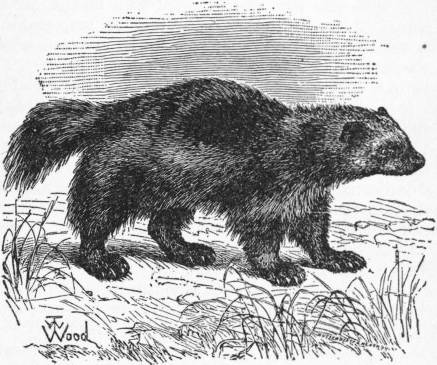
The Glutton, or Wolverine (Gulo luscus).
GLYCAS, MICHAEL, Byzantine historian (according to some a Sicilian, according to others a Corfiote), flourished during the 12th century A.D. His chief work is his Chronicle of events from the creation of the world to the death of Alexius I. Comnenus(1118). It is extremely brief and written in a popular style, but too much space is devoted to theological and scientific matters. Glycas was also the author of a theological treatise and a number of letters on theological questions. A poem of some 600 “political” verses, written during his imprisonment on a charge of slandering a neighbour and containing an appeal to the emperor Manuel, is still extant. The exact nature of his offence is not known, but the answer to his appeal was that he was deprived of his eyesight by the emperor’s orders.
Editions: “Chronicle and Letters,” in J. P. Migne, Patrologia Graeca, clviii.; poem in E. Legrand, Bibliothèque grecque vulgaire, i.; see also F. Hirsch, Byzantinische Studien (1876); C. Krumbacher in Sitzungsberichte bayer. Acad., 1894; C. F. Bähr in Ersch and Gruber’s Allgemeine Encyklopädie.
GLYCERIN, Glycerine or Glycerol (in pharmacy Glycerinum) (from Gr. γλυκύς, sweet), a trihydric alcohol, trihydroxypropane, C3H5(OH)3. It is obtainable from most natural fatty bodies by the action of alkalis and similar reagents, whereby the fats are decomposed, water being taken up, and glycerin being formed together with the alkaline salt of some particular acid (varying with the nature of the fat). Owing to their possession of this common property, these natural fatty bodies and various artificial derivatives of glycerin, which behave in the same way when treated with alkalis, are known as glycerides. In the ordinary process of soap-making the glycerin remains dissolved in the aqueous liquors from which the soap is separated.
Glycerin was discovered in 1779 by K. W. Scheele and named Ölsüss (principe doux des huiles—sweet principle of oils), and more fully investigated subsequently by M. E. Chevreul, who named it glycerin, M. P. E. Berthelot, and many other chemists, from whose researches it results that glycerin is a trihydric alcohol indicated by the formula C3H5(OH)3, the natural fats and oils, and the glycerides generally, being substances of the nature of compound esters formed from glycerin by the replacement of the hydrogen of the OH groups by the radicals of certain acids, called for that reason “fatty acids.” The relationship of these glycerides to glycerin is shown by the series of bodies formed from glycerin by replacement of hydrogen by “stearyl” (C18H35O), the radical of stearic acid (C18H35O·OH):—

The process of saponification may be viewed as the gradual progressive transformation of tristearin, or some analogously constituted substance, into distearin, monostearin and glycerin, or as the similar transformation of a substance analogous to distearin or to monostearin into glycerin. If the reaction is brought about in presence of an alkali, the acid set free becomes transformed into the corresponding alkaline salt; but if the decomposition is effected without the presence of an alkali (i.e. by means of water alone or by an acid), the acid set free and the glycerin are obtained together in a form which usually admits of their ready separation. It is noticeable that with few exceptions the fatty and oily matters occurring in nature are substances analogous to tristearin, i.e. they are trebly replaced glycerins. Amongst these glycerides may be mentioned the following:
Tristearin—C3H5(O·C18H35O)3. The chief constituent of hard animal fats, such as beef and mutton tallow, &c.; also contained in many vegetable fats in smaller quantity.
Triolein—C3H5(O·C18H33O)3. Largely present in olive oil and other saponifiable vegetable oils and soft fats; also present in animal fats, especially hog’s lard.
Tripalmitin—C3H5(O·C16H31O)3. The chief constituent of palm oil; also contained in greater or less quantities in human fat, olive oil, and other animal and vegetable fats.
Triricinolein—C3H5(O·C18H33O2)3. The main constituent of castor oil.
Other analogous glycerides are apparently contained in greater or smaller quantity in certain other oils. Thus in cows’ butter, tributyrin, C3H5(O·C4H7O)3, and the analogous glycerides of other readily volatile acids closely resembling butyric acid, are present in small quantity; the production of these acids on saponification and distillation with dilute sulphuric acid is utilized as a test of a purity of butter as sold. Triacetin, C3H5(O·C2H3O)3, is apparently contained in cod-liver oil. Some other glycerides isolated from natural sources are analogous in composition to tristearin, but with this difference, that the three radicals which replace hydrogen in glycerin are not all identical; thus kephalin, myelin and lecithin are glycerides in which two hydrogens are replaced by fatty acid radicals, and the third by a complex phosphoric acid derivative.
Glycerin is also a product of certain kinds of fermentation, especially of the alcoholic fermentation of sugar; consequently it is a constituent of many wines and other fermented liquors. According to Louis Pasteur, about 1⁄30th of the sugar transformed under ordinary conditions in the fermentation of grape juice and similar saccharine liquids into alcohol and other products become converted into glycerin. In certain natural fatty substances, e.g. palm oil, it exists in the free state, so that it can be separated by washing with boiling water, which dissolves the glycerin but not the fatty glycerides.
Properties.—Glycerin is a viscid, colourless liquid of sp. gr. 1.265 at 15° C., possessing a somewhat sweet taste; below 0° C. it solidifies to a white crystalline mass, which melts at 17° C. When heated alone it partially volatilizes, but the greater part decomposes; under a pressure of 12 mm. of mercury it boils at 170° C. In an atmosphere of steam it distils without decomposition under ordinary barometric pressure. It dissolves readily in water and alcohol in all proportions, but is insoluble in ether. It possesses considerable solvent powers, whence it is employed for numerous purposes in pharmacy and the arts. Its viscid character, and its non-liability to dry and harden by exposure to air, also fit it for various other uses, such as lubrication, &c., whilst its peculiar physical characters, enabling it to blend with either aqueous or oily matters under certain circumstances, render it a useful ingredient in a large number of products of varied kinds.
Manufacture.—The simplest modes of preparing pure glycerin are based on the saponification of fats, either by alkalis or by superheated steam, and on the circumstance that, although glycerin cannot be distilled by itself under the ordinary pressure without decomposition, it can be readily volatilized in a current of superheated steam. Commercial glycerin is mostly obtained from the “spent lyes” of the soap-maker. In the van Ruymbeke process the spent lyes are allowed to settle, and then treated with “persulphate of iron,” the exact composition of which is a trade secret, but it is possibly a mixture of ferric and ferrous sulphates. Ferric hydrate, iron soaps and all insoluble impurities are precipitated. The liquid is filter-pressed, and any excess of iron in the filtrate is precipitated by the careful addition of caustic soda and then removed. The liquid is then evaporated under a vacuum of 27 to 28 in. of mercury, and, when of specific gravity 1.295 (corresponding to about 80% of glycerin), it is distilled under a vacuum of 28 to 29 in. In the Glatz process the lye is treated with a little milk of lime, the liquid then neutralized with hydrochloric acid, and the liquid filtered. Evaporation and subsequent distillation under a high vacuum gives crude glycerin. The impure glycerin obtained as above is purified by redistillation in steam and evaporation in vacuum pans.
Technical Uses.—Besides its use as a starting-point in the production of “nitroglycerin” (q.v.) and other chemical products, glycerin is largely employed for a number of purposes in the arts, its application thereto being due to its peculiar physical properties. Thus its non-liability to freeze (when not absolutely anhydrous, which it practically never is when freely exposed to the air) and its non-volatility at ordinary temperatures, combined with its power of always keeping fluid and not drying up and hardening, render it valuable as a lubricating agent for clockwork, watches, &c., as a substitute for water in wet gas-meters, and as an ingredient in cataplasms, plasters, modelling clay, pasty colouring matters, dyeing materials, moist colours for artists, and numerous other analogous substances which are required to be kept in a permanently soft condition. Glycerin acts as a preservative against decomposition, owing to its antiseptic qualities, which also led to its being employed to preserve untanned leather (especially during transit when exported, the hides being, moreover, kept soft and supple); to make solutions of gelatin, albumen, gum, paste, cements, &c. which will keep without decomposition; to preserve meat and other edibles; to mount anatomical preparations; to preserve vaccine lymph unchanged; and for many similar purposes. Its solvent power is also utilized in the production of various colouring fluids, where the colouring matter would not dissolve in water alone; thus aniline violet, the tinctorial constituents of madder, and various allied colouring matters dissolve in glycerin, forming liquids which remain coloured even when diluted with water, the colouring matters being either retained in suspension or dissolved by the glycerin present in the diluted fluid. Glycerin is also employed in the manufacture of formic acid (q.v.). Certain kinds of copying inks are greatly improved by the substitution of glycerin, in part or entirely, for the sugar or honey usually added.
In its medicinal use glycerin is an excellent solvent for such substances as iodine, alkaloids, alkalis, &c., and is therefore used for applying them to diseased surfaces, especially as it aids in their absorption. It does not evaporate or turn rancid, whilst its marked hygroscopic action ensures the moistness and softness of any surface that it covers. Given by the mouth glycerin produces purging if large doses are administered, and has the same action if only a small quantity be introduced into the rectum. For this purpose it is very largely used either as a suppository or in the fluid form (one or two drachms). The result is prompt, safe and painless. Glycerin is useless as a food and is not in any sense a substitute for cod-liver oil. Very large doses in animals cause lethargy, collapse and death.
GLYCOLS, in organic chemistry, the generic name given to the aliphatic dihydric alcohols. These compounds may be obtained by heating the alkylen iodides or bromides (e.g. ethylene dibromide) with silver acetate or with potassium acetate and alcohol, the esters so produced being then hydrolysed with caustic alkalis, thus:
C2H4Br2 + 2 C2H3O2·Ag → C2H4(O·C2H3O)2 → C2H4(OH)2 + 2 K·C2H3O2;
by the direct union of water with the alkylen oxides; by oxidation of the olefines with cold potassium permanganate solution (G. Wagner, Ber., 1888, 21, p. 1231), or by the action of nitrous acid on the diamines.
Glycols may be classified as primary, containing two −CH2OH groups; primary-secondary, containing the grouping −CH(OH)·CH2OH; secondary, with the grouping −CH(OH)·CH(OH)−; and tertiary, with the grouping >C(OH)·(OH)C<. The secondary glycols are prepared by the action of alcoholic potash on aldehydes, thus:
3(CH3)2CH·CHO + KHO = (CH3)2CHCO2K + (CH3)2CH·CH(OH)·CH(OH)·CH(CH3)2.
The tertiary glycols are known as pinacones and are formed on the reduction of ketones with sodium amalgam.
The glycols are somewhat thick liquids, of high boiling point, the pinacones only being crystalline solids; they are readily soluble in water and alcohol, but are insoluble in ether. By the action of dehydrating agents they are converted into aldehydes or ketones. In their general behaviour towards oxidizing agents the primary glycols behave very similarly to the ordinary primary alcohols (q.v.), but the secondary and tertiary glycols break down, yielding compounds with a smaller carbon content.
Ethylene glycol, C2H4(OH)2, was first prepared by A. Wurtz (Ann. chim., 1859 [3], 55, p. 400) from ethylene dibromide and silver acetate. It is a somewhat pleasant smelling liquid, boiling at 197° to 197.5° C. and having a specific gravity of 1.125 (0°). On fusion with solid potash at 250° C. it completely decomposes, giving potassium oxalate and hydrogen,
C2H6O2 + 2KHO = K2C2O4 + 4H2.
Two propylene glycols, C3H8O2, are known, viz. α-propylene glycol, CH3·CH(OH)·CH2OH, a liquid boiling at 188° to 189°, and obtained by heating glycerin with sodium hydroxide and distilling the mixture; and trimethylene glycol, CH2OH·CH2·CH2OH, a liquid boiling at 214° C. and prepared by boiling trimethylene bromide with potash solution (A. Zander, Ann., 1882, 214, p. 178).
GLYCONIC (from Glycon, a Greek lyric poet), a form of verse, best known in Catullus and Horace (usually in the catalectic variety ), with three feet—a spondee and two dactyls; or four—three trochees and a dactyl, or a dactyl and three chorees. Sir R. Jebb pointed out that the last form might be varied by placing the dactyl second or third, and according to its place this verse was called a First, Second or Third Glyconic.

Cf. J. W. White, in Classical Quarterly (Oct. 1909).
GLYPH (from Gr. γλύφειν, to carve), in architecture, a vertical channel in a frieze (see Triglyph).
GLYPTODON (Greek for “fluted-tooth”), a name applied by Sir R. Owen to the typical representative of a group of gigantic, armadillo-like, South American, extinct Edentata, characterized by having the carapace composed of a solid piece (formed by the union of a multitude of bony dermal plates) without any movable rings. The facial portion of the skull is very short; a long process of the maxillary bone descends from the anterior part of the zygomatic arch; and the ascending ramus of the mandible is remarkably high. The teeth, 8⁄8 in the later species, are much alike, having two deep grooves or flutings on each side, so as to divide them into three distinct lobes (fig.). They are very tall and grew throughout life. The vertebral column is almost entirely welded into a solid tube, but there is a complex joint at the base of the neck, to allow the head being retracted within the carapace. The limbs are very strong, and the feet short and broad, resembling externally those of an elephant or tortoise.
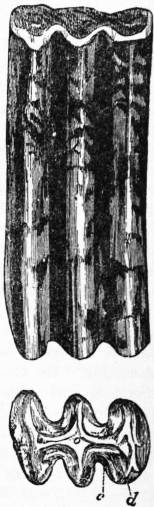
Two views of the tooth of a Glyptodon; the upper figure showing one side, and the lower the crown.
Glyptodonts constitute a family, the Glyptodontidae, whose position is next to the armadillos (Dasypodidae); the group being represented by a number of generic types. The Pleistocene forms, whose remains occur abundantly in the silt of the Buenos Aires pampas, are by far the largest, the skull and tail-sheath in some instances having a length of from 12 to 16 ft. In Glyptodon (with which Schistopleurum is identical) the tail-sheath consists of a series of coronet-like rings, gradually diminishing in diameter from base to tip. Daedicurus, in which the tail-sheath is in the form of a huge solid club, is the largest member of the family, in Panochthus and Sclerocalyptus (Hoplophorus) the tail-sheath consists basally of a small number of smooth rings, and terminally of a tube. In some specimens of these genera the horny shields covering the bony scutes of the carapace have been preserved, and since the foramina, which often pierce the latter, stop short of the former, it is evident that these were for the passage of blood-vessels and not receptacles for bristles. In the early Pleistocene epoch, when South America became connected with North America, some of the glyptodonts found their way into the latter continent. Among these northern forms some from Texas and Florida have been referred to Glyptodon. One large species from Texas has, however, been made the type of a separate genus, under the name of Glyptotherium texanum. In some respects it shows affinity with Panochthus, although in the simple structure of the tail-sheath it recalls the undermentioned Propalaeohoplophorus. All the above are of Pleistocene and perhaps Pliocene age, but in the Santa Cruz beds of Patagonia there occur the two curious genera Propalaeohoplophorus and Peltephilus, the former of which is a primitive and generalized type of glyptodont, while the latter seems to come nearer to the armadillos. Both are represented by species of comparatively small size. In Propalaeohoplophorus the scutes of the carapace, which are less deeply sculptured than in the larger glyptodonts, are arranged in distinct transverse rows, in three of which they partially overlap near the border of the carapace after the fashion of the armadillos. The skull and limb-bones exhibit several features met with in the latter, and the vertebrae of the back are not welded into a continuous tube. There are eight pairs of teeth, the first four of which are simpler than the rest, and may perhaps therefore be regarded as premolars. More remarkable is Peltephilus, on account of the fact that the teeth, which are simple, with a chevron-shaped section, form a continuous series from the front of the jaw backwards, the number of pairs being seven. Accordingly, a modification of the character, even of the true Edentata, as given in the earlier article, is rendered necessary. The head bears a pair of horn-like scutes, and the scutes of the carapace and tail, which are loosely opposed or slightly overlapping, form a number of transverse rows.
Literature.—R. Lydekker, “The Extinct Edentates of Argentina,” An. Mus. La Plata—Pal. Argent. vol. iii. p. 2 (1904); H. F. Osborn, “‘Glyptotherium texanum,’ a Glyptodont from the Lower Pleistocene of Texas,” Bull. Amer. Mus., vol. xvii. p. 491 (1903); W. B. Scott, “Mammalia of the Santa Cruz Beds—Edentata,” Rep. Princeton Exped. to Patagonia, vol. v. (1903-1904).
(R. L.*)
GLYPTOTHEK (from Gr. γλυπτός, carved, and θήκη, a place of storage), an architectural term given to a gallery for the exhibition of sculpture, and first employed at Munich, where it was built to exhibit the sculptures from the temple of Aegina.
GMELIN, the name of several distinguished German scientists, of a Tübingen family. Johann Georg Gmelin (1674-1728), an apothecary in Tübingen, and an accomplished chemist for the times in which he lived, had three sons. The first, Johann Conrad (1702-1759), was an apothecary and surgeon in Tübingen. The second, Johann Georg (1709-1755), was appointed professor of chemistry and natural history in St Petersburg in 1731, and from 1733 to 1743 was engaged in travelling through Siberia. The fruits of his journey were Flora Sibirica (4 vols., 1749-1750) and Reisen durch Sibirien (4 vols., 1753). He ended his days as professor of medicine at Tübingen, a post to which he was appointed in 1749. The third son, Philipp Friedrich (1721-1768), was extraordinary professor of medicine at Tübingen in 1750, and in 1755 became ordinary professor of botany and chemistry. In the second generation Samuel Gottlieb (1743-1774), the son of Johann Conrad, was appointed professor of natural history at St Petersburg in 1766, and in the following year started on a journey through south Russia and the regions round the Caspian Sea. On his way back he was captured by Usmey Khan, of the Kaitak tribe, and died from the ill-treatment he suffered, on the 27th of July 1774. One of his nephews, Ferdinand Gottlob von Gmelin (1782-1848), became professor of medicine and natural history at Tübingen in 1805, and another, Christian Gottlob (1792-1860), who in 1828 was one of the first to devise a process for the artificial manufacture of ultramarine, was professor of chemistry and pharmacy in the same university. In the youngest branch of the family, Philipp Friedrich had a son, Johann Friedrich (1748-1804), who was appointed professor of medicine in Tübingen in 1772, and in 1775 accepted the chair of medicine and chemistry at Göttingen. In 1788 he published the 13th edition of Linnaeus’ Systema Naturae with many additions and alterations. His son Leopold (1788-1853), was the best-known member of the family. He studied medicine and chemistry at Göttingen, Tübingen and Vienna, and in 1813 began to lecture on chemistry at Heidelberg, where in 1814 he was appointed extraordinary, and in 1817 ordinary, professor of chemistry and medicine. He was the discoverer of potassium ferricyanide (1822), and wrote the Handbuch der Chemie (1st ed. 1817-1819, 4th ed. 1843-1855), an important work in its day, which was translated into English for the Cavendish Society by H. Watts (1815-1884) in 1848-1859. He resigned his chair in 1852, and died on the 13th of April in the following year at Heidelberg.
GMÜND, a town of Germany, in the kingdom of Württemberg,1 in a charming and fruitful valley on the Rems, here spanned by a beautiful bridge, 31 m. E.N.E. of Stuttgart on the railway to Nördlingen. Pop. (1905) 18,699. It is surrounded by old walls, flanked with towers, and has a considerable number of ancient buildings, among which are the fine church of the Holy Cross; St John’s church, which dates from the time of the Hohenstaufen; and, situated on a height near the town, partly hewn out of the rock, the pilgrimage church of the Saviour. Among the modern buildings are the gymnasium, the drawing and trade schools, the Roman Catholic seminary, the town hall and the industrial art museum. Clocks and watches are manufactured here and also other articles of silver, while the town has a considerable trade in corn, hops and fruit. The scenery in the neighbourhood is very beautiful, near the town being the district called Little Switzerland.
Gmünd was surrounded by walls in the beginning of the 12th century by Duke Frederick of Swabia. It received town rights from Frederick Barbarossa, and after the extinction of the Hohenstaufen became a free imperial town. It retained its independence till 1803, when it came into the possession of Württemberg. Gmünd is the birth-place of the painter Hans Baldung (1475-1545) and of the architect Heinrich Arler or Parler (fl. 1350). In the middle ages the population was about 10,000.
See Kaiser, Gmünd und seine Umgebung (1888).
1 There are two places of this name in Austria. (1) Gmünd, a town in Lower Austria, containing a palace belonging to the imperial family, (2) a town in Carinthia, with a beautiful Gothic church and some interesting ruins.
GMUNDEN, a town and summer resort of Austria, in Upper Austria, 40 m. S.S.W. of Linz by rail. Pop. (1900) 7126. It is situated at the efflux of the Traun river from the lake of the same name and is surrounded by high mountains, as the Traunstein (5446 ft.), the Erlakogel (5150 ft.), the Wilde Kogel (6860 ft.) and the Höllen Gebirge. It is much frequented as a health and summer resort, and has a variety of lake, brine, vegetable and pine-cone baths, a hydropathic establishment, inhalation chambers, whey cure, &c. There are a great number of excursions and points of interest round Gmunden, specially worth mentioning being the Traun Fall, 10 m. N. of Gmunden. It is also an important centre of the salt industry in Salzkammergut. Gmunden was a town encircled with walls already in 1186. On the 14th of November 1626, Pappenheim completely defeated here the army of the rebellious peasants.
See F. Krackowizer, Geschichte der Stadt Gmunden in Oberösterreich (Gmunden, 1898-1901, 3 vols.).
GNAT (O. Eng. gnæt), the common English name for the smaller dipterous flies (see Diptera) of the family Culicidae, which are now included among “mosquitoes” (see Mosquito). The distinctive term has no zoological significance, but in England the “mosquito” has commonly been distinguished from the “gnat” as a variety of larger size and more poisonous bite.
GNATHOPODA, a term in zoological classification, suggested as an alternative name for the group Arthropoda (q.v.). The word, which means “jaw-footed,” refers to the fact that in the members of the group, some of the lateral appendages or “feet” in the region of the mouth act as jaws.
GNATIA (also Egnatia or Ignatia, mod. Anazzo, near Fasano), an ancient city of the Peucetii, and their frontier town towards the Sallentini (i.e. of Apulia towards Calabria), in Roman times of importance for its trade, lying as it did on the sea, at the point where the Via Traiana joined the coast road,1 38 m. S.E. of Barium. The ancient city walls have been almost entirely destroyed in recent times to provide building material,2 and the place is famous for the discoveries made in its tombs. A considerable collection of antiquities from Gnatia is preserved at Fasano, though the best are in the museum at Bari. Gnatia was the scene of the prodigy at which Horace mocks (Sat. i. 5. 97). Near Fasano are two small subterranean chapels with paintings of the 11th century A.D. (E. Bertaux, L’Art dans l’Italie méridionale, Paris, 1904, 135).
(T. As.)
1 There is no authority for calling the latter Via Egnatia.
2 H. Swinburne, Travels in the Two Sicilies (London, 1790), ii. 15, mentions the walls as being 8 yds. thick and 16 courses high.
GNEISENAU, AUGUST WILHELM ANTON, Count Neithardt von (1760-1831), Prussian field marshal, was the son of a Saxon officer named Neithardt. Born in 1760 at Schildau, near Torgau, he was brought up in great poverty there, and subsequently at Würzburg and Erfurt. In 1777 he entered Erfurt university; but two years later joined an Austrian regiment there quartered. In 1782 taking the additional name of Gneisenau from some lost estates of his family in Austria, he entered as an officer the service of the margrave of Baireuth-Anspach. With one of that prince’s mercenary regiments in English pay he saw active service and gained valuable experience in the War of American Independence, and returning in 1786, applied for Prussian service. Frederick the Great gave him a commission as first lieutenant in the infantry. Made Stabskapitän in 1790, Gneisenau served in Poland, 1793-1794, and, subsequently to this, ten years of quiet garrison life in Jauer enabled him to undertake a wide range of military studies. In 1796 he married Caroline von Kottwitz. In 1806 he was one of Hohenlohe’s staff-officers, fought at Jena, and a little later commanded a provisional infantry brigade which fought under Lestocq in the Lithuanian campaign. Early in 1807 Major von Gneisenau was sent as commandant to Colberg, which, small and ill-protected as it was, succeeded in holding out until the peace of Tilsit. The commandant received the much-prized order “pour le mérite,” and was promoted lieutenant-colonel.
A wider sphere of work was now opened to him. As chief of engineers, and a member of the reorganizing committee, he played a great part, along with Scharnhorst, in the work of reconstructing the Prussian army. A colonel in 1809, he soon drew upon himself, by his energy, the suspicion of the dominant French, and Stein’s fall was soon followed by Gneisenau’s retirement. But, after visiting Russia, Sweden and England, he returned to Berlin and resumed his place as a leader of the patriotic party. In open military work and secret machinations his energy and patriotism were equally tested, and with the outbreak of the War of Liberation, Major-General Gneisenau became Blücher’s quartermaster-general. Thus began the connexion between these two soldiers which has furnished military history with its best example of the harmonious co-operation between the general and his chief-of-staff. With Blücher, Gneisenau served to the capture of Paris; his military character was the exact complement of Blücher’s, and under this happy guidance the young troops of Prussia, often defeated but never discouraged, fought their way into the heart of France. The plan of the march on Paris, which led directly to the fall of Napoleon, was specifically the work of the chief-of-staff. In reward for his distinguished service he was in 1814, along with York, Kleist and Bülow, made count at the same time as Blücher became prince of Wahlstatt; an annuity was also assigned to him.
In 1815, once more chief of Blücher’s staff, Gneisenau played a very conspicuous part in the Waterloo campaign (q.v.). Senior generals, such as York and Kleist, had been set aside in order that the chief-of-staff should have the command in case of need, and when on the field of Ligny the old field marshal was disabled, Gneisenau at once assumed the control of the Prussian army. Even in the light of the evidence that many years’ research has collected, the precise part taken by Gneisenau in the events which followed is much debated. It is known that Gneisenau had the deepest distrust of the British commander, who, he considered, had left the Prussians in the lurch at Ligny, and that to the hour of victory he had grave doubts as to whether he ought not to fall back on the Rhine. Blücher, however, soon recovered from his injuries, and, with Grolmann, the quartermaster-general, he managed to convince Gneisenau. The relations of the two may be illustrated by Brigadier-General Hardinge’s report. Blücher burst into Hardinge’s room at Wavre, saying “Gneisenau has given way, and we are to march at once to your chief.”
On the field of Waterloo, however, Gneisenau was quick to realize the magnitude of the victory, and he carried out the pursuit with a relentless vigour which has few parallels in history. His reward was further promotion and the insignia of the “Black Eagle” which had been taken in Napoleon’s coach. In 1816 he was appointed to command the VIIIth Prussian Corps, but soon retired from the service, both because of ill-health and for political reasons. For two years he lived in retirement on his estate, Erdmannsdorf in Silesia, but in 1818 he was made governor of Berlin in succession to Kalkreuth, and member of the Staatsrath. In 1825 he became general field marshal. In 1831 he was appointed to the command of the Army of Observation on the Polish frontier, with Clausewitz as his chief-of-staff. At Posen he was struck down by cholera and died on the 24th of August 1831, soon followed by his chief-of staff, who fell a victim to the same disease in November.
As a soldier, Gneisenau was the greatest Prussian general since Frederick; as a man, his noble character and virtuous life secured him the affection and reverence, not only of his superiors and subordinates in the service, but of the whole Prussian nation. A statue by Rauch was erected in Berlin in 1855, and in memory of the siege of 1807 the Colberg grenadiers received his name in 1889. One of his sons led a brigade of the VIIIth Army Corps in the war of 1870.
See G. H. Pertz, Das Leben des Feldmarschalls Grafen Neithardt von Gneisenau, vols. 1-3 (Berlin, 1864-1869); vols. 4 and 5, G. Delbrück (ib. 1879, 1880), with numerous documents and letters; H. Delbrück, Das Leben des G. F. M. Grafen von Gneisenau (2 vols., 2nd ed., Berlin, 1894), based on Pertz’s work, but containing much new material; Frau von Beguelin, Denkwürdigkeiten (Berlin, 1892); Hormayr, Lebensbilder aus den Befreiungskriegen (Jena, 1841); Pick, Aus dem brieflichen Nachlass Gneisenaus; also the histories of the campaigns of 1807 and 1813-15.
GNEISS, a term long used by the miners of the Harz Mountains to designate the country rock in which the mineral veins occur; it is believed to be a word of Slavonic origin meaning “rotted” or “decomposed.” It has gradually passed into acceptance as a generic term signifying a large and varied series of metamorphic rocks, which mostly consist of quartz and felspar (orthoclase and plagioclase) with muscovite and biotite, hornblende or augite, iron oxides, zircon and apatite. There is also a long list of accessory minerals which are present in gneisses with more or less frequency, but not invariably, as garnet, sillimanite, cordierite, graphite and graphitoid, epidote, calcite, orthite, tourmaline and andalusite. The gneisses all possess a more or less marked parallel structure or foliation, which is the main feature by which many of them are separated from the granites, a group of rocks having nearly the same mineralogical composition and closely allied to many gneisses.
The felspars of the gneisses are predominantly orthoclase (often perthitic), but microcline is common in the more acid types and oligoclase occurs also very frequently, especially in certain sedimentary gneisses, while more basic varieties of plagioclase are rare. Quartz is very seldom absent and may be blue or milky and opalescent. Muscovite and biotite may both occur in the same rock; in other cases only one of them is present. The commonest and most important types of gneiss are the mica-gneisses. Hornblende is green, rarely brownish; augite pale green or nearly colourless; enstatite appears in some granulite-gneisses. Epidote, often with enclosures of orthite, is by no means rare in gneisses from many different parts of the world. Sillimanite and andalusite are not infrequent ingredients of gneiss, and their presence has been accounted for in more than one way. Cordierite-gneisses are a special group of great interest and possessing many peculiarities; they are partly, if not entirely, foliated contact-altered sedimentary rocks. Kyanite and staurolite may also be mentioned as occasionally occurring.
Many varieties of gneiss have received specific names according to the minerals they consist of and the structural peculiarities they exhibit. Muscovite-gneiss, biotite-gneiss and muscovite-biotite-gneiss, more common perhaps than all the others taken together, are grey or pinkish rocks according to the colour of their prevalent felspar, not unlike granites, but on the whole more often fine-grained (though coarse-grained types occur) and possessing a gneissose or foliated structure. The latter consists in the arrangement of the flakes of mica in such a way that their faces are parallel, and hence the rock has the property of splitting more readily in the direction in which the mica plates are disposed. This fissility, though usually marked, is not so great as in the schists or slates, and the split faces are not so smooth as in these latter rocks. The films of mica may be continuous and are usually not flat, but irregularly curved. In some gneisses the parallel flakes of mica are scattered through the quartz and felspar; in others these minerals form discrete bands, the quartz and felspar being grouped into lenticles separated by thin films of mica. When large felspars, of rounded or elliptical form, are visible in the gneiss, it is said to have augen structure (Ger. Augen = eyes). It should also be remarked that the essential component minerals of the rocks of this family are practically always determinable by naked eye inspection or with the aid of a simple lens. If the rock is too fine grained for this it is generally relegated to the schists. When the bands of folia are very fine and tortuous the structure is called helizitic.
In mica-gneisses sillimanite, kyanite, andalusite and garnet may occur. The significance of these minerals is variously interpreted; they may indicate that the gneiss consists wholly or in part of sedimentary material which has been contact-altered, but they have also been regarded as having been developed by metamorphic action out of biotite or other primary ingredients of the rock.
Hornblende-gneisses are usually darker in colour and less fissile than mica-gneisses; they contain more plagioclase, less orthoclase and microcline, and more sphene and epidote. Many of them are rich in hornblende and thus form transitions to amphibolites. Pyroxene-gneisses are less frequent but occur in many parts of both hemispheres. The “charnockite” series are very closely allied to the pyroxene-gneisses. Hypersthene and scapolite both may occur in these rocks and they are sometimes garnetiferous.
In every country where the lowest and oldest rocks have come to the surface and been exposed by the long continued action of denudation in stripping away the overlying formations, gneisses are found in great abundance and of many different kinds. They are in fact the typical rocks of the Archean (Lewisian, Laurentian, &c.) series. In the Alps, Harz, Scotland, Norway and Sweden, Canada, South America, Peninsular India, Himalayas (to mention only a few localities) they occupy wide areas and exhibit a rich diversity of types. From this it has been inferred that they are of great geological age, and in fact this can be definitely proved in many cases, for the oldest known fossiliferous formations may be seen to rest unconformably on these gneisses and are made up of their débris. It was for a long time believed that they represented the primitive crust of the earth, and while this is no longer generally taught there are still geologists who hold that these gneisses are necessarily of pre-Cambrian age. Others, while admitting the general truth of this hypothesis, consider that there are localities in which typical gneisses can be shown to penetrate into rocks which may be as recent as the Tertiary period, or to pass into these rocks so gradually and in such a way as to make it certain that the gneisses are merely altered states of comparatively recent sedimentary or igneous rocks. Much controversy has arisen on these points; but this is certain, that gneisses are far the most common among Archean rocks, and where their age is not known the presumption is strong that they are at least pre-Cambrian.
Many gneisses are undoubtedly sedimentary rocks that have been brought to their present state by such agents of metamorphism as heat, movement, crushing and recrystallization. This may be demonstrated partly by their mode of occurrence: they accompany limestones, graphitic schists, quartzites and other rocks of sedimentary type; some of them where least altered may even show remains of bedding or of original pebbly character (conglomerate gneisses). More conclusive, however, is the chemical composition of these rocks, which often is such as no igneous masses possess, but resembles that of many impure argillaceous sediments. These sedimentary gneisses (or paragneisses, as they are often called) are often rich in biotite and garnet and may contain kyanite and sillimanite, or less frequently calcite. Some of them, however, are rich in felspar and quartz, with muscovite and biotite; others may even contain hornblende and augite, and all these may bear so close a resemblance to gneisses of igneous origin that by no single character, chemical or mineralogical, can their original nature be definitely established. In these cases, however, a careful study of the relations of the rock in the field and of the different types which occur together will generally lead to some positive conclusion.
Other gneisses are igneous (orthogneisses). These have very much the same composition as acid igneous rocks such as granite, aplite, hornblende granite, or intermediate rocks such as syenite and quartz diorite. Many of these orthogneisses are not equally well foliated throughout, but are massive or granitoid in places. They are sometimes subdivided into granite gneiss, diorite gneiss, syenite gneiss and so on. The sedimentary schists into which these rocks have been intruded may show contact alteration by the development of such minerals as cordierite, andalusite and sillimanite. In many of these orthogneisses the foliation is primitive, being an original character of the rock which was produced either by fluxion movements in a highly viscous, semi-solid mass injected at great pressure into the surrounding strata, or by folding stresses acting immediately after consolidation. That the foliation in other orthogneisses is subsequent or superinduced, having been occasioned by pressure and deformation of the solid mass long after it had consolidated and cooled, admits of no doubt, but it is very difficult to establish criteria by which these types may be differentiated. Those gneisses in which the minerals have been crushed and broken by fluxion or injection movements have been called protoclastic, while those which have attained their gneissose state by crushing long after consolidation are distinguished as cataclastic. There are also many examples of gneisses of mixed or synthetic origin. They may be metamorphosed sediments (granulites and schists) into which tongues and thin veins of granitic character have been intruded, following the more or less parallel foliation planes already present in the country rock. These veinlets produce that alternation in mineral composition and banded structure which are essential in gneisses. This intermixture of igneous and sedimentary material may take place on the finest scale and in the most intricate manner. Often there has been resorption of the older rocks, whether sedimentary or igneous, by those which have invaded them, and movement has gone on both during injection and at a later period, so that the whole complex becomes amalgamated and its elements are so completely confused that the geologist can no longer disentangle them.
When we remember that in the earlier stages of the earth’s history, to which most gneisses belong, and in the relatively deep parts of the earth’s crust, where they usually occur, there has been most igneous injection and greatest frequency of earth movements, it is not difficult to understand the geological distribution of gneissose rocks. All the factors which are required for their production, heat, movement, plutonic intrusions, contact alteration, interstitial moisture at high temperatures, are found at great depths and have acted most frequently and with greatest power on the older rock masses. But locally, where the conditions were favourable, the same processes may have gone on in comparatively recent times. Hence, though most gneisses are Archean, all gneisses are not necessarily so.
(J. S. F.)
GNEIST, HEINRICH RUDOLF HERMANN FRIEDRICH VON (1816-1895), German jurist and politician, was born at Berlin on the 13th of August 1816, the son of a judge attached to the “Kammergericht” (court of appeal) in that city. After receiving his school education at the gymnasium at Eisleben in Prussian Saxony, he entered the university of Berlin in 1833 as a student of jurisprudence, and became a pupil of the famous Roman law teacher von Savigny. Proceeding to the degree of doctor juris in 1838, young Gneist immediately established himself as a Privatdozent in the faculty of law. He had, however, already chosen the judicial branch of the legal profession as a career, and having while yet a student acted as Auscultator, was admitted Assessor in 1841. He soon found leisure and opportunity to fulfil a much-cherished wish, and spent the next few years on a lengthened tour in Italy, France and England. He utilized his Wanderjahre for the purposes of comparative study, and on his return in 1844 was appointed extraordinary professor of Roman law in Berlin university, and thus began a professorial connexion which ended only with his death. The first-fruits of his activity as a teacher were seen in his brilliant work, Die formellen Verträge des heutigen römischen Obligationen-Rechtes (Berlin, 1845). Pari passu with his academic labours he continued his judicial career, and became in due course successively assistant judge of the superior court and of the supreme tribunal. But to a mind constituted such as his, the want of elasticity in the procedure of the courts was galling. “Brought up,” he tells, in the preface to his Englische Verfassungsgeschichte, “in the laborious and rigid school of Prussian judges, at a time when the duty of formulating the matter in litigation was entailed upon the judge who personally conducted the pleadings, I became acquainted both with the advantages possessed by the Prussian bureau system as also with its weak points.” Feeling the necessity for fundamental reforms in legal procedure, he published, in 1849, his Trial by Jury, in which, after pointing out that the origin of that institution was common to both Germany and England, and showing in a masterly way the benefits which had accrued to the latter country through its more extended application, he pleaded for its freer admission in the tribunals of his own country.
The period of “storm and stress” in 1848 afforded Gneist an opportunity for which he had yearned, and he threw himself with ardour into the constitutional struggles of Prussia. Although his candidature for election to the National Assembly of that year was unsuccessful, he felt that “the die was cast,” and deciding for a political career, retired in 1850 from his judicial position. Entering the ranks of the National Liberal party, he began both in writing and speeches actively to champion their cause, now busying himself pre-eminently with the study of constitutional law and history. In 1853 appeared his Adel und Ritterschaft in England, and in 1857 the Geschichte und heutige Gestalt der Ämter in England, a pamphlet primarily written to combat the Prussian abuses of administration, but for which the author also claimed that it had not been without its effect in modifying certain views that had until then ruled in England itself. In 1858 Gneist was appointed ordinary professor of Roman law, and in the same year commenced his parliamentary career by his election for Stettin to the Abgeordnetenhaus (House of Deputies) of the Prussian Landtag, in which assembly he sat thenceforward uninterruptedly until 1893. Joining the Left, he at once became one of its leading spokesmen. His chief oratorical triumphs are associated with the early period of his membership of the House; two noteworthy occasions being his violent attack (September 1862) upon the government budget in connexion with the reorganization of the Prussian army, and his defence (1864) of the Polish chiefs of the (then) grand-duchy of Posen, who were accused of high treason. In 1857-1863 was published Das heutige englische Verfassungsund Verwaltungsrecht, a work which, contrasting English and German constitutional law and administration, aimed at exercising political pressure upon the government of the day. In 1868 Gneist became a member of the North German parliament, and acted as a member of the commission for organizing the federal army, and also of that for the settlement of ecclesiastical controversial questions. On the establishment of German unity his mandate was renewed for the Reichstag, and in this he sat, an active and prominent member of the National Liberal party, until 1884. In the Kulturkampf he sided with the government against the attacks of the Clericals, whom he bitterly denounced, and whose implacable enemy he ever showed himself. In 1879, together with his colleague, von Hänel, he violently attacked the motion for the prosecution of certain Socialist members, which as a result of the vigour of his opposition was almost unanimously rejected. He was parliamentary reporter for the committees on all great financial and administrative questions, and his profound acquaintance with constitutional law caused his advice to be frequently sought, not only in his own but also in other countries. In Prussia he largely influenced legislation, the reform of the judicial and penal systems and the new constitution of the Evangelical Church being largely his work. He was also consulted by the Japanese government when a constitution was being introduced into that country. In 1875 he was appointed a member of the supreme administrative court (Oberverwaltungsgericht) of Prussia, but only held office for two years. In 1882 was published his Englische Verfassungsgeschichte (trans. History of the English Constitution, London, 1886), which may perhaps be described as his magnum opus. It placed the author at once on the level of such writers on English constitutional history as Hallam and Stubbs, and supplied English literature with a text-book almost unrivalled in point of historical research. In 1888 one of the first acts of the ill-fated emperor Frederick III., who had always, as crown prince, shown great admiration for him, was to ennoble Gneist, and attach him as instructor in constitutional law to his son, the emperor William II., a charge of which he worthily acquitted himself. The last years of his life were full of energy, and, in the possession of all his faculties, he continued his wonted academic labours until a short time before his death, which occurred at Berlin on the 22nd of July 1895.
As a politician, Gneist’s career cannot perhaps be said to have been entirely successful. In a country where parliamentary institutions are the living exponents of the popular will he might have risen to a foremost position in the state; as it was, the party to which he allied himself could never hope to become more than what it remained, a parliamentary faction, and the influence it for a time wielded in the counsels of the state waned as soon as the Social-Democratic party grew to be a force to be reckoned with. It is as a writer and a teacher that Gneist is best known to fame. He was a jurist of a special type. To him law was not mere theory, but living force; and this conception of its power animates all his schemes of practical reform. As a teacher he exercised a magnetic influence, not only by reason of the clearness and cogency of his exposition, but also because of the success with which he developed the talents and guided the aspirations of his pupils. He was a man of noble bearing, religious, and imbued with a stern sense of duty. He was proud of being a “Preussischer Junker” (a member of the Prussian squirearchy), and throughout his writings, despite their liberal tendencies, may be perceived the loyalty and affection with which he clung to monarchical institutions. A great admirer and a true friend of England, to which country he was attached by many personal ties, he surpassed all other Germans in his efforts to make her free institutions, in which he found his ideal, the common heritage of the two great nations of the Teutonic race.
Gneist was a prolific writer, especially on the subject he had made peculiarly his own, that of constitutional law and history, and among his works, other than those above named, may be mentioned the following: Budget und Gesetz nach dem constitutionellen Staatsrecht Englands (Berlin, 1867); Freie Advocatur (ib., 1867); Der Rechtsstaat (ib., 1872, and 2nd edition, 1879); Zur Verwaltungsreform in Preussen (Leipzig, 1880); Das englische Parlament (Berlin, 1886); in English translation, The English Parliament (London, 1886; 3rd edition, 1889); Die Militär-Vorlage von 1892 und der preussische Verfassungsconflikt von 1862 bis 1866 (Berlin, 1893); Die nationale Rechtsidee von den Ständen und das preussische Dreiklassenwahlsystem (ib., 1895); Die verfassungsmässige Stellung des preussischen Gesamtministeriums (ib., 1895). See O. Gierke, Rudolph von Gneist, Gedächtnisrede (Berlin, 1895), an In Memoriam address delivered in Berlin.
(P. A. A.)
GNESEN (Polish, Gniezno), a town of Germany, in the Prussian province of Posen, in an undulating and fertile country, on the Wrzesnia, 30 m. E.N.E. of Posen by the railway to Thorn. Pop. (1905) 23,727. Besides the cathedral, a handsome Gothic edifice with twin towers, which contains the remains of St Adalbert, there are eight Roman Catholic churches, a Protestant church, a synagogue, a clerical seminary and a convent of the Franciscan nuns. Among the industries are cloth and linen weaving, brewing and distilling. A great horse and cattle market is held here annually. Gnesen is one of the oldest towns in the former kingdom of Poland. Its name, Gniezno, signifies “nest,” and points to early Polish traditions. The cathedral is believed to have been founded towards the close of the 9th century, and, having received the bones of St Adalbert, it was visited in 1000 by the emperor Otto III., who made it the seat of an archbishop. Here, until 1320, the kings of Poland were crowned; and the archbishop, since 1416 primate of Poland, acted as protector pending the appointment of a new king. In 1821 the see of Posen was founded and the archbishop removed his residence thither, though its cathedral chapter still remains at Gnesen. After a long period of decay the town revived after 1815, when it came under the rule of Prussia.
See S. Karwowski, Gniezno (Posen, 1892).
GNOME, and GNOMIC POETRY. Sententious maxims, put into verse for the better aid of the memory, were known by the Greeks as gnomes, γνῶμαι, from γνώμη, an opinion. A gnome is defined by the Elizabethan critic Henry Peacham (1576?-1643?) as “a saying pertaining to the manners and common practices of men, which declareth, with an apt brevity, what in this our life ought to be done, or not done.” The Gnomic Poets of Greece, who flourished in the 6th century B.C., were those who arranged series of sententious maxims in verse. These were collected in the 4th century, by Lobon of Argos, an orator, but his collection has disappeared. The chief gnomic poets were Theognis, Solon, Phocylides, Simonides of Amorgos, Demodocus, Xenophanes and Euenus. With the exception of Theognis, whose gnomes were fortunately preserved by some schoolmaster about 300 B.C., only fragments of the Gnomic Poets have come down to us. The moral poem attributed to Phocylides, long supposed to be a masterpiece of the school, is now known to have been written by a Jew in Alexandria. Of the gnomic movement typified by the moral works of the poets named above, Prof. Gilbert Murray has remarked that it receives its special expression in the conception of the Seven Wise Men, to whom such proverbs as “Know thyself” and “Nothing too much” were popularly attributed, and whose names differed in different lists. These gnomes or maxims were extended and put into literary shape by the poets. Fragments of Solon, Euenus and Mimnermus have been preserved, in a very confused state, from having been written, for purposes of comparison, on the margins of the MSS. of Theognis, whence they have often slipped into the text of that poet. Theognis enshrines his moral precepts in his elegies, and this was probably the custom of the rest; it is improbable that there ever existed a species of poetry made up entirely of successive gnomes. But the title “gnomic” came to be given to all poetry which dealt in a sententious way with questions of ethics. It was, unquestionably, the source from which moral philosophy was directly developed, and theorists upon life and infinity, such as Pythagoras and Xenophanes, seem to have begun their career as gnomic poets. By the very nature of things, gnomes, in their literary sense, belong exclusively to the dawn of literature; their naïveté and their simplicity in moralizing betray it. But it has been observed that many of the ethical reflections of the great dramatists, and in particular of Sophocles and Euripides, are gnomic distiches expanded. It would be an error to suppose that the ancient Greek gnomes are all of a solemn character; some are voluptuous and some chivalrous; those of Demodocus of Leros had the reputation of being droll. In modern times, the gnomic spirit has occasionally been displayed by poets of a homely philosophy, such as Francis Quarles (1592-1644) in England and Gui de Pibrac (1529-1584) in France. The once-celebrated Quatrains of the latter, published in 1574, enjoyed an immense success throughout Europe; they were composed in deliberate imitation of the Greek gnomic writers of the 6th century B.C. These modern effusions are rarely literature and perhaps never poetry. With the gnomic writings of Pibrac it was long customary to bind up those of Antoine Favre (or Faber) (1557-1624) and of Pierre Mathieu (1563-1621). Gnomes are frequently to be found in the ancient literatures of Arabia, Persia and India, and in the Icelandic staves. The priamel, a brief, sententious kind of poem, which was in favour in Germany from the 12th to the 16th century, belonged to the true gnomic class, and was cultivated with particular success by Hans Rosenblut, the lyrical goldsmith of Nuremberg, in the 15th century.
(E. G.)
GNOMES (Fr. gnomes, Ger. Gnomen), in folk-lore, the name now commonly given to the earth and mountain spirits who are supposed to watch over veins of precious metals and other hidden treasures. They are usually pictured as bearded dwarfs clad in brown close-fitting garments with hoods. The word “gnome” as applied to these is of comparatively modern and somewhat uncertain origin. By some it is said to have been coined by Paracelsus (so Hatzfeld and Darmesteter, Dictionnaire), who uses Gnomi as a synonym of Pygmaei, from the Greek γνώμη, intelligence. The New English Dictionary, however, suggests a derivation from genomus, i.e. a Greek type γηνόμος, “earth-dweller,” on the analogy of θαλασσονόμος, “dwelling in the sea,” adding, however, that though there is no evidence that the term was not used before Paracelsus, it is possibly “a mere arbitrary invention, like so many others found in Paracelsus” (N.E.D. s.v.).
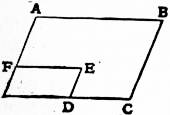
GNOMON, the Greek word for the style of a sundial, or any object, commonly a vertical column, the shadow of which was observed in former times in order to learn the altitude of the sun, especially when on the meridian. The art of constructing a sundial is sometimes termed gnomonics. In geometry, a gnomon is a plane figure formed by removing a parallelogram from a corner of a larger parallelogram; in the figure ABCDEFA is a gnomon. Gnomonic projection is a projection of a sphere in which the centre of sight is the centre of the sphere.
GNOSTICISM (Gr. γνῶσις, knowledge), the name generally applied to that spiritual movement existing side by side with genuine Christianity, as it gradually crystallized into the old Catholic Church, which may roughly be defined as a distinct religious syncretism bearing the strong impress of Christian influences.
I. The term “Gnosis” first appears in a technical sense in 1 Tim. vi. 20 (ἡ ψευδώνυμος γνῶσις). It seems to have at first been applied exclusively, or at any rate principally, to a particular tendency within the movement as a whole, i.e. to those sections of (the Syrian) Gnostics otherwise generally known as Ophites or Naasseni (see Hippolytus, Philosophumena, v. 2: Ναασσηνοὶ ... οἱ ἑαυτοὺς Γνωστικοὺς ἀποκαλοῦντες; Irenaeus i. 11. 1; Epiphanius, Haeres. xxvi. Cf. also the self-assumed name of the Carpocratiani, Iren. i. 25. 6). But in Irenaeus the term has already come to designate the whole movement. This first came into prominence in the opening decades of the 2nd century A.D., but is certainly older; it reached its height in the second third of the same century, and began to wane about the 3rd century, and from the second half of the 3rd century onwards was replaced by the closely-related and more powerful Manichaean movement. Offshoots of it, however, continued on into the 4th and 5th centuries. Epiphanius still had the opportunity of making personal acquaintance with Gnostic sects.
II. Of the actual writings of the Gnostics, which were extraordinarily numerous,1 very little has survived; they were sacrificed to the destructive zeal of their ecclesiastical opponents. Numerous fragments and extracts from Gnostic writings are to be found in the works of the Fathers who attacked Gnosticism. Most valuable of all are the long extracts in the 5th and 6th books of the Philosophumena of Hippolytus. The most accessible and best critical edition of the fragments which have been preserved word for word is to be found in Hilgenfeld’s Ketzergeschichte des Urchristentums. One of the most important of these fragments is the letter of Ptolemaeus to Flora, preserved in Epiphanius, Haeres. xxxiii. 3-7 (see on this point Harnack in the Sitzungsberichte der Berliner Akademie, 1902, pp. 507-545). Gnostic fragments are certainly also preserved for us in the Acts of Thomas. Here we should especially mention the beautiful and much-discussed Song of the Pearl, or Song of the Soul, which is generally, though without absolute clear proof, attributed to the Gnostic Bardesanes (till lately it was known only in the Syrian text; edited and translated by Bevan, Texts and Studies,2 v. 3, 1897; Hofmann, Zeitschrift für neutestamentliche Wissenschaft, iv.; for the newly-found Greek text see Acta apostolorum, ed. Bonnet, ii. 2, c. 108, p. 219). Generally also much Gnostic matter is contained in the apocryphal histories of the Apostles. To the school of Bardesanes belongs the “Book of the Laws of the Lands,” which does not, however, contribute much to our knowledge of Gnosticism. Finally, we should mention in this connexion the text on which are based the pseudo-Clementine Homilies and Recognitiones (beginning of the 3rd century). It is, of course, already permeated with the Catholic spirit, but has drawn so largely upon sources of a Judaeo-Christian Gnostic character that it comes to a great extent within the category of sources for Gnosticism. Complete original Gnostic works have unfortunately survived to us only from the period of the decadence of Gnosticism. Of these we should mention the comprehensive work called the Pistis-Sophia, probably belonging to the second half of the 3rd century.3 Further, the Coptic-Gnostic texts of the Codex Brucianus; both the books of Ieu, and an anonymous third work (edited and translated by C. Schmidt, Texte und Untersuchungen, vol. viii., 1892; and a new translation by the same in Koptische-gnostische Schriften, i.) which, contrary to the opinion of their editor and translator, the present writer believes to represent, in their existing form, a still later period and a still more advanced stage in the decadence of Gnosticism. For other and older Coptic-Gnostic texts, in one of which is contained the source of Irenaeus’s treatises on the Barbelognostics, but which have unfortunately not yet been made completely accessible, see C. Schmidt in Sitzungsberichte der Berl. Akad. (1896), p. 839 seq., and “Philotesia,” dedicated to Paul Kleinert (1907); p. 315 seq.
On the whole, then, for an exposition of Gnosticism we are thrown back upon the polemical writings of the Fathers in their controversy with heresy. The most ancient of these is Justin, who according to his Apol. i. 26 wrote a Syntagma against all heresies (c. A.D. 150), and also, probably, a special polemic against Marcion (fragment in Irenaeus iv. 6. 2). Both these writings are lost. He was followed by Irenaeus, who, especially in the first book of his treatise Adversus haereses (ἐλέγχου καὶ ἀνατροπῆς τῆς ψευδωνύμου γνώσεως βιβλία πέντε, c. A.D. 180), gives a detailed account of the Gnostic heresies. He founds his work upon that of his master Justin, but adds from his own knowledge among many other things, notably the detailed account of Valentinianism at the beginning of the book. On Irenaeus, and probably also on Justin, Hippolytus drew for his Syntagma (beginning of the 3rd century), a work which is also lost, but can, with great certainty, be reconstructed from three recensions of it: in the Panarion of Epiphanius (after 374), in Philaster of Brescia, Adversus haereses, and the Pseudo-Tertullian, Liber adversus omnes haereses. A second work of Hippolytus Κατὰ πασῶν αἱρέσεων ἔλεγχος is preserved in the so-called Philosophumena which survives under the name of Origen. Here Hippolytus gave a second exposition supplemented by fresh Gnostic original sources with which he had become acquainted in the meanwhile. These sources quoted in Hippolytus have lately met with very unfavourable criticisms. The opinion has been advanced that Hippolytus has here fallen a victim to the mystification of a forger. The truth of the matter must be that Hippolytus probably made use of a collection of Gnostic texts, put together by a Gnostic, in which were already represented various secondary developments of the genuine Gnostic schools. It is also possible that the compiler has himself attempted here and there to harmonize to a certain extent the various Gnostic doctrines, yet in no case is this collection of sources given by Hippolytus to be passed over; it should rather be considered as important evidence for the beginnings of the decay of Gnosticism. Very noteworthy references to Gnosticism are also to be found scattered up and down the Stromateis of Clement of Alexandria. Especially important are the Excerpta ex Theodoto, the author of which is certainly Clement, which are verbally extracted from Gnostic writings, and have almost the value of original sources. The writings of Origen also contain a wealth of material. In the first place should be mentioned the treatise Contra Celsum, in which the expositions of Gnosticism by both Origen and Celsus are of interest (see especially v. 61 seq. and vi. 25 seq.). Of Tertullian’s works should be mentioned: De praescriptione haereticorum, especially Adversus Marcionem, Adversus Hermogenem, and finally Adversus Valentinianos (entirely founded on Irenaeus). Here must also be mentioned the dialogue of Adamantius with the Gnostics, De recta in deum fide (beginning of 4th century). Among the followers of Hippolytus, Epiphanius in his Panarion gives much independent and valuable information from his own knowledge of contemporary Gnosticism. But Theodoret of Cyrus (d. 455) is already entirely dependent on previous works and has nothing new to add. With the 4th century both Gnosticism and the polemical literature directed against it die out.4
III. If we wish to grasp the peculiar character of the great Gnostic movement, we must take care not to be led astray by the catchword “Gnosis.” It is a mistake to regard the Gnostics as pre-eminently the representatives of intellect among Christians, and Gnosticism as an intellectual tendency chiefly concerned with philosophical speculation, the reconciliation of religion with philosophy and theology. It is true that when Gnosticism was at its height it numbered amongst its followers both theologians and men of science, but that is not its main characteristic. Among the majority of the followers of the movement “Gnosis” was understood not as meaning “knowledge” or “understanding,” in our sense of the word, but “revelation.” These little Gnostic sects and groups all lived in the conviction that they possessed a secret and mysterious knowledge, in no way accessible to those outside, which was not to be proved or propagated, but believed in by the initiated, and anxiously guarded as a secret. This knowledge of theirs was not based on reflection, on scientific inquiry and proof, but on revelation. It was derived directly from the times of primitive Christianity; from the Saviour himself and his disciples and friends, with whom they claimed to be connected by a secret tradition, or else from later prophets, of whom many sects boasted. It was laid down in wonderful mystic writings, which were in the possession of the various circles (Liechtenhahn, Die Offenbarung im Gnosticismus, 1901).
In short, Gnosticism, in all its various sections, its form and its character, falls under the great category of mystic religions, which were so characteristic of the religious life of decadent antiquity. In Gnosticism as in the other mystic religions we find the same contrast of the initiated and the uninitiated, the same loose organization, the same kind of petty sectarianism and mystery-mongering. All alike boast a mystic revelation and a deeply-veiled wisdom. As in many mystical religions, so in Gnosticism, the ultimate object is individual salvation, the assurance of a fortunate destiny for the soul after death. As in the others, so in this the central object of worship is a redeemer-deity who has already trodden the difficult way which the faithful have to follow. And finally, as in all mystical religions, so here too, holy rites and formulas, acts of initiation and consecration, all those things which we call sacraments, play a very prominent part. The Gnostic religion is full of such sacraments. In the accounts of the Fathers we find less about them; yet here Irenaeus’ account of the Marcosians is of the highest significance (i. 21 seq.). Much more material is to be found in the original Gnostic writings, especially in the Pistis-Sophia and the two books of Ieu, and again in the Excerpta ex Theodoto, the Acts of Thomas, and here and there also in the pseudo-Clementine writings. Above all we can see from the original sources of the Mandaean religion, which also represents a branch of Gnosticism, how great a part the sacraments played in the Gnostic sects (Brandt, Mandäische Religion, p. 96 seq.). Everywhere we are met with the most varied forms of holy rites—the various baptisms, by water, by fire, by the spirit, the baptism for protection against demons, anointing with oil, sealing and stigmatizing, piercing the ears, leading into the bridal chamber, partaking of holy food and drink. Finally, sacred formulas, names and symbols are of the highest importance among the Gnostic sects. We constantly meet with the idea that the soul, on leaving the body, finds its path to the highest heaven opposed by the deities and demons of the lower realms of heaven, and only when it is in possession of the names of these demons, and can repeat the proper holy formula, or is prepared with the right symbol, or has been anointed with the holy oil, finds its way unhindered to the heavenly home. Hence the Gnostic must above all things learn the names of the demons, and equip himself with the sacred formulas and symbols, in order to be certain of a good destiny after death. The exposition of the system of the Ophites given by Celsus (in Origen vi. 25 seq.), and, in connexion with Celsus, by Origen, is particularly instructive on this point. The two “Coptic Ieu” books unfold an immense system of names and symbols. This system again was simplified, and as the supreme secret was taught in a single name or a single formula, by means of which the happy possessor was able to penetrate through all the spaces of heaven (cf. the name “Caulacau” among the Basilidians; Irenaeus, Adv. haer. i. 24. 5, and among other sects). It was taught that even the redeemer-god, when he once descended on to this earth, to rise from it again, availed himself of these names and formulas on his descent and ascent through the world of demons. Traces of ideas of this kind are to be met with almost everywhere. They have been most carefully collected by Anz (Ursprung des Gnosticismus, Texte und Untersuchungen xv. 4 passim) who would see in them the central doctrine of Gnosticism.
IV. All these investigations point clearly to the fact that Gnosticism belongs to the group of mystical religions. We must now proceed to define more exactly the peculiar and distinctive character of the Gnostic system. The basis of the Gnostic religion and world-philosophy lies in a decided Oriental dualism. In sharp contrast are opposed the two worlds of the good and of the evil, the divine world and the material world ὔλη, the worlds of light and of darkness. In many systems there seems to be no attempt to derive the one world from the other. The true Basilides (q.v.), perhaps also Satornil, Marcion and a part of his disciples, Bardesanes and others, were frankly dualists. In the case of other systems, owing to the inexactness of our information, we are unable to decide; the later systems of Mandaeism and Manichaeanism, so closely related to Gnosticism, are also based upon a decided dualism. And even when there is an attempt at reconciliation, it is still quite clear how strong was the original dualism which has to be overcome. Thus the Gnostic systems make great use of the idea of a fall of the Deity himself; by the fall of the Godhead into the world of matter, this matter, previously insensible, is animated into life and activity, and then arise the powers, both partly and wholly hostile, who hold sway over this world. Such figures of fallen divinities, sinking down into the world of matter are those of Sophia (i.e. Ahamoth) among the Gnostics (Ophites) in the narrower sense of the word, the Simoniani (the figure of Helena), the Barbelognostics, and in the system of the Pistis-Sophia or the Primal Man, among the Naasseni and the sect, related to them, as described by Hippolytus.5 A further weakening of the dualism is indicated when, in the systems of the Valentinian school, the fall of Sophia takes place within the godhead, and Sophia, inflamed with love, plunges into the Bythos, the highest divinity, and when the attempt is thus made genetically to derive the lower world from the sufferings and passions of fallen divinity. Another attempt at reconciliation is set forth in the so-called “system of emanations” in which it is assumed that from the supreme divinity emanated a somewhat lesser world, from this world a second, and so on, until the divine element (of life) became so far weakened and attenuated, that the genesis of a partly, or even wholly, evil world appears both possible and comprehensible. A system of emanations of this kind, in its purest form, is set forth in the expositions coming from the school of Basilides, which are handed down by Irenaeus, while the propositions which are set forth in the Philosophumena of Hippolytus as being doctrines of Basilides represent a still closer approach to a monistic philosophy. Occasionally, too, there is an attempt to establish at any rate a threefold division of the world, and to assume between the worlds of light and darkness a middle world connecting the two; this is clearest among the Sethiani mentioned by Hippolytus (and cf. the Gnostics in Irenaeus i. 30. 1). Quite peculiar in this connexion are the accounts in Books xix. and xx. of the Clementine Homilies. After a preliminary examination of all possible different attempts at a solution of the problem of evil, the attempt is here made to represent the devil as an instrument of God. Christ and the devil are the two hands of God, Christ the right hand, and the devil the left, the devil having power over this world-epoch and Christ over the next. The devil here assumes very much the characteristics of the punishing and just God of the Old Testament, and the prospect is even held out of his ultimate pardon. All these efforts at reconciliation show how clearly the problem of evil was realized in these Gnostic and half-Gnostic sects, and how deeply they meditated on the subject; it was not altogether without reason that in the ranks of its opponents Gnosticism was judged to have arisen out of the question, πόθεν τὸ κακόν.
This dualism had not its origin in Hellenic soil, neither is it related to that dualism which to a certain extent existed also in late Greek religion. For the lower and imperfect world, which in that system too is conceived and assumed, is the nebulous world of the non-existent and the formless, which is the necessary accompaniment of that which exists, as shadow is of light.
In Gnosticism, on the contrary, the world of evil is full of active energy and hostile powers. It is an Oriental (Iranian) dualism which here finds expression, though in one point, it is true, the mark of Greek influence is quite clear. When Gnosticism recognizes in this corporeal and material world the true seat of evil, consistently treating the bodily existence of mankind as essentially evil and the separation of the spiritual from the corporeal being as the object of salvation, this is an outcome of the contrast in Greek dualism between spirit and matter, soul and body. For in Oriental (Persian) dualism it is within this material world that the good and evil powers are at war, and this world beneath the stars is by no means conceived as entirely subject to the influence of evil. Gnosticism has combined the two, the Greek opposition between spirit and matter, and the sharp Zoroastrian dualism, which, where the Greek mind conceived of a higher and a lower world, saw instead two hostile worlds, standing in contrast to each other like light and darkness. And out of the combination of these two dualisms arose the teaching of Gnosticism, with its thoroughgoing pessimism and fundamental asceticism.
Another characteristic feature of the Gnostic conception of the universe is the rôle played in almost all Gnostic systems by the seven world-creating powers. There are indeed certain exceptions; for instance, in the systems of the Valentinian schools there is the figure of the one Demiurge who takes the place of the Seven. But how widespread was the idea of seven powers, who created this lower material world and rule over it, has been clearly proved, especially by the systematic examination of the subject by Anz (Ursprung des Gnosticismus). These Seven, then, are in most systems half-evil, half-hostile powers; they are frequently characterized as “angels,” and are reckoned as the last and lowest emanations of the Godhead; below them—and frequently considered as derived from them—comes the world of the actually devilish powers. On the other hand, among the speculations of the Mandaeans, we find a different and perhaps more primitive conception of the Seven, according to which they, together with their mother Namrus (Rūhā) and their father (Ur), belong entirely to the world of darkness. They and their family are looked upon as captives of the god of light (Mandā-d’hayyē, Hibil-Zīvā), who pardons them, sets them on chariots of light, and appoints them as rulers of the world (cf. chiefly Genza, in Tractat. 6 and 8; W. Brandt, Mandäische Schriften, 125 seq. and 137 seq.; Mandäische Religion, 34 seq., &c.). In the Manichaean system it is related how the helper of the Primal Man, the spirit of life, captured the evil archontes, and fastened them to the firmament, or according to another account, flayed them, and formed the firmament from their skin (F. C. Baur, Das manichäische Religionssystem, v. 65), and this conception is closely related to the other, though in this tradition the number (seven) of the archontes is lost. Similarly, the last book of the Pistis-Sophia contains the myth of the capture of the rebellious archontes, whose leaders here appear as five in number (Schmidt, Koptisch-gnostische Schriften, p. 234 seq.).6 There can scarcely be any doubt as to the origin of these seven (five) powers; they are the seven planetary divinities, the sun, moon and five planets.
In the Mandaean speculations the Seven are introduced with the Babylonian names of the planets. The connexion of the Seven with the planets is also clearly established by the expositions of Celsus and Origen (Contra Celsum, vi. 22 seq.) and similarly by the above-quoted passage in the Pistis-Sophia, where the archontes, who are here mentioned as five, are identified with the five planets (excluding the sun and moon). This collective grouping of the seven (five) planetary divinities is derived from the late Babylonian religion, which can definitely be indicated as the home of these ideas (Zimmern, Keilinschriften in dem alten Testament, ii. p. 620 seq.; cf. particularly Diodorus ii. 30). And if in the old sources it is only the first beginnings of this development that can be traced, we must assume that at a later period the Babylonian religion centred in the adoration of the seven planetary deities. Very instructive in this connexion is the later (Arabian) account of the religion of the Mesopotamian Sabaeans. The religion of the Sabaeans, evidently a later offshoot from the stock of the old Babylonian religion, actually consists in the cult of the seven planets (cf. the great work of Daniel Chwolsohn, Die Ssabier u. der Ssabismus). But this reference to Babylonian religion does not solve the problem which is here in question. For in the Babylonian religion the planetary constellations are reckoned as the supreme deities. And here the question arises, how it came about that in the Gnostic systems the Seven appear as subordinate, half-daemonic powers, or even completely as powers of darkness. This can only be explained on the assumption that some religion hostile to, and stronger than the Babylonian, has superimposed itself upon this, and has degraded its principal deities into daemons. Which religion can this have been? We are at first inclined to think of Christianity itself, but it is certainly most improbable that at the time of the rise of Christianity the Babylonian teaching about the seven planet-deities governing the world should have played so great a part throughout all Syria, Asia Minor and Egypt, that the most varying sections of syncretic Christianity should over and over again adopt this doctrine and work it up into their system. It is far more probable that the combination which we meet with in Gnosticism is older than Christianity, and was found already in existence by Christianity and its sects. We must also reject the theory that this degradation of the planetary deities into daemons is due to the influence of Hebrew monotheism, for almost all the Gnostic sects take up a definitely hostile attitude towards the Jewish religion, and almost always the highest divinity among the Seven is actually the creator-God of the Old Testament. There remains, then, only one religion which can be used as an explanation, namely the Persian, which in fact fulfils all the necessary conditions. The Persian religion was at an early period brought into contact with the Babylonian, through the triumphant progress of Persian culture towards the West; at the time of Alexander the Great it was already the prevailing religion in the Babylonian plain (cf. F. Cumont, Textes et monuments rel. aux mystères de Mithra, i. 5, 8-10, 14, 223 seq., 233). It was characterized by a main belief, tending towards monotheism, in the Light-deity Ahuramazda and his satellites, who appeared in contrast with him as powers of the nature of angels.
A combination of the Babylonian with the Persian religion could only be effected by the degradation of the Babylonian deities into half-divine, half-daemonic beings, infinitely remote from the supreme God of light and of heaven, or even into powers of darkness. Even the characteristic dualism of Gnosticism has already proved to be in part of Iranian origin; and now it becomes clear how from that mingling of late Greek and Persian dualism the idea could arise that these seven half-daemonic powers are the creators or rulers of this material world, which is separated infinitely from the light-world of the good God. Definite confirmation of this conjecture is afforded us by later sources of the Iranian religion, in which we likewise meet with the characteristic fundamental doctrine of Gnosticism. Thus the Bundahish (iii. 25, v. 1) is able to inform us that in the primeval strife of Satan against the light-world, seven hostile powers were captured and set as constellations in the heavens, where they are guarded by good star-powers and prevented from doing harm. Five of the evil powers are the planets, while here the sun and moon are of course not reckoned among the evil powers—for the obvious reason that in the Persian official religion they invariably appear as good divinities (cf. similar ideas in the Arabic treatise on Persian religion Ulema-i-Islam, Vullers, Fragmente über die Religion Zoroasters, p. 49, and in other later sources for Persian religion, put together in Spiegel, Eranische Altertumskunde, Bd. ii. p. 180). These Persian fancies can hardly be borrowed from the Christian Gnostic systems, their definiteness and much more strongly dualistic character recalling the exposition of the Mandaean (and Manichaean) system, are proofs to the contrary. They are derived from the same period in which the underlying idea of the Gnostic systems also originated, namely, the time at which the ideas of the Persian and Babylonian religions came into contact, the remarkable results of which have thus partly found their way into the official documents of Parsiism.
With this fundamental doctrine of Gnosticism is connected, as Anz has shown in his book which we have so often quoted, a side of their religious practices to which we have already alluded. Gnosticism is to a great extent dominated by the idea that it is above all and in the highest degree important for the Gnostic’s soul to be enabled to find its way back through the lower worlds and spheres of heaven ruled by the Seven to the kingdom of light of the supreme deity of heaven. Hence, a principal item in their religious practice consisted in communications about the being, nature and names of the Seven (or of any other hostile daemons barring the way to heaven), the formulas with which they must be addressed, and the symbols which must be shown to them. But names, symbols and formulas are not efficacious by themselves: the Gnostic must lead a life having no part in the lower world ruled by these spirits, and by his knowledge he must raise himself above them to the God of the world of light. Throughout this mystic religious world it was above all the influence of the late Greek religion, derived from Plato, that also continued to operate; it is filled with the echo of the song, the first note of which was sounded by the Platonists, about the heavenly home of the soul and the homeward journey of the wise to the higher world of light.
But the form in which the whole is set forth is Oriental, and it must be carefully noted that the Mithras mysteries, so closely connected with the Persian religion, are acquainted with this doctrine of the ascent of the soul through the planetary spheres (Origen, Contra Celsum, vi. 22).
V. We cannot here undertake to set forth and explain in detail all the complex varieties of the Gnostic systems; but it will be useful to take a nearer view of certain principal figures which have had an influence upon at least one series of Gnostic systems, and to examine their origins in the history of religion. In almost all systems an important part is played by the Great Mother (μήτηρ) who appears under the most varied forms (cf. Great Mother of the Gods). At an early period, and notably in the older systems of the Ophites (a fairly exact account of which has been preserved for us by Epiphanius and Hippolytus), among the Gnostics in the narrower sense of the word, the Archontici, the Sethites (there are also traces among the Naasseni, cf. the Philosophumena of Hippolytus), the μήτηρ is the most prominent figure in the light-world, elevated above the ἑβδομάς, and the great mother of the faithful. The sect of the Barbelognostics takes its name from the female figure of the Barbelo (perhaps a corruption of Παρθένος; cf. the form Βαρθενώς for “virgin” in Epiphanius, Haer. xxvi. 1). But Gnostic speculation gives various accounts of the descent or fall of this goddess of heaven. Thus the “Helena” of the Simoniani descends to this world in order by means of her beauty to provoke to sensual passion and mutual strife the angels who rule the world, and thus again to deprive them of the powers of light, stolen from heaven, by means of which they rule over the world. She is then held captive by them in extreme degradation. Similar ideas are to be found among the “Gnostics” of Epiphanius. The kindred idea of the light-maiden, who, by exciting the sensual passions of the rulers (ἄρχοντες), takes from them those powers of light which still remain to them, has also a central place in the Manichaean scheme of salvation (F. C. Baur, Das manichäische Religionssystem, pp. 219, 315, 321). The light-maiden also plays a prominent part in the Pistis-Sophia (cf. the index to the translation by C. Schmidt). With this figure of the mother-goddess who descends into the lower world seems to be closely connected the idea of the fallen Sophia, which is so widespread among the Gnostic systems. This Sophia then is certainly no longer the dominating figure of the light-world, she is a lower aeon at the extreme limit of the world of light, who sinks down into matter (Barbelognostics, the anonymous Gnostic of Irenaeus, Bardesanes, Pistis-Sophia), or turns in presumptuous love towards the supreme God (Βυθός), and thus brings the Fall into the world of the aeons (Valentinians). This Sophia then appears as the mother of the “seven” gods (see above).
The origin of this figure is not far to seek. It is certainly not derived from the Persian religious system, to the spirit of which it is entirely opposed. Neither would it be correct to identify her entirely with the great goddess Ishtar of the old Babylonian religion. But there can hardly be any doubt that the figure of the great mother-goddess or goddess of heaven, who was worshipped throughout Asia under various forms and names (Astarte, Beltis, Atargatis, Cybele, the Syrian Aphrodite), was the prototype of the μήτηρ of the Gnostics (cf. Great Mother of the Gods). The character of the great goddess of heaven is still in many places fairly exactly preserved in the Gnostic speculations. Hence we are able to understand how the Gnostic μήτηρ, the Sophia, appears as the mother of the Hebdomas (ἑβδομάς). The great goddess of heaven is the mother of the stars. Particularly instructive in this connexion is the fact that in those very sects, in the systems of which the figure of the μήτηρ plays a special part, unbridled prostitution appears as a distinct and essential part of the cult (cf. the accounts of particular branches of the Gnostics, Nicolaitans, Philionites, Borborites, &c. in Epiphanius, Haer. xxv., xxvi.). The meaning of this cult is, of course, reinterpreted in the Gnostic sense: by this unbridled prostitution the Gnostic sects desired to prevent the sexual propagation of mankind, the origin of all evil. But the connexion is clear, and hence it also explained the curious Gnostic myth mentioned above, namely that the μήτηρ (the light-maiden) by appearing to the archontes (ἄρχοντες), the lower powers of this world, inflames them to sexual lusts, in order to take from them that share of light which they have stolen from the upper world. This is a Gnostic interpretation of the various myths of the great mother-goddess’s many loves and love-adventures with other gods and heroes. And when the pagan legend of the Syrian Astarte tells how she lived for ten years in Tyre as a prostitute, this directly recalls the Gnostic myth of how Simon found Helena in a brothel in Tyre (Epiphanius, Ancoratus, c. 104). From the same group of myths must be derived the idea of the goddess who descends to the under-world, and is there taken prisoner against her will by the lower powers; the direct prototype of this myth is to be found, e.g. in Ishtar’s journey to hell. And finally, just as the mother-goddess of south-western Asia stands in particularly intimate connexion with the youthful god of spring (Tammuz, Adonis, Attis), so we ought perhaps to compare here as a parallel the relation of Sophia with the Soter in certain Gnostic systems (see below).
Another characteristic figure of Gnosticism is that of the Primal Man (πρῶτος ἄνθρωπος). In many systems, certainly, it has already been forced quite into the background. But on closer examination we can clearly see that it has a wide influence on Gnosticism. Thus in the system of the Naasseni (see Hippolytus, Philosophumena), and in certain related sects there enumerated, the Primal Man has a central and predominant position. Again, in the text on which are based the pseudo-Clementine writings (Recognitions, i. 16, 32, 45-47, 52, ii. 47; and Homilies, iii. 17 seq. xviii. 14), as in the closely related system of the Ebionites in Epiphanius (Haer. xxx. 3-16; cf. liii. 1), we meet with the man who existed before the world, the prophet who goes through the world in various forms, and finally reveals himself in Christ. Among the Barbelognostics (Irenaeus i. 29. 3), the Primal Man (Adamas, homo perfectus et verus) and Gnosis appear as a pair of aeons, occupying a prominent place in the whole series. In the Valentinian systems the pair of aeons, Anthropos and Ekklesia, occupy the third or fourth place within the Oydoás, but incidentally we learn that with some representatives of this school the Anthropos took a still more prominent place (first or second; Hilgenfeld, Ketzergeschichte, p. 294 seq.). And even in the Pistis-Sophia the Primal Man “Ieu” is frequently alluded to as the King of the Luminaries (cf. index to C. Schmidt’s translation). We also meet with speculations of this kind about man in the circles of non-Christian Gnosis. Thus in the Poimandres of Hermes man is the most prominent figure in the speculation; numerous pagan and half-pagan parallels (the “Gnostics” of Plotinus, Zosimus, Bitys) have been collected by Reitzenstein in his work Poimandres (pp. 81-116). Reitzenstein has shown (p. 81 seq.) that very probably the system of the Naasseni described by Hippolytus was originally derived from purely pagan circles, which are probably connected in some way with the mysteries of the Attis cult. The figure in the Mandaean system most closely corresponding to the Primal Man, though this figure also actually occurs in another part of the system (cf. the figure of Adakas Mana; Brandt, Mandäische Religion, p. 36 seq.) is that of Mandā d’hayyē (γνῶσις τῆς ζωῆς; cf. the pair of aeons, Adamas and Gnosis, among the Barbelognostics, in Irenaeus i. 29. 3). Finally, in the Manichaean system, as is well known, the Primal Man again assumes the predominant place (Baur, Manich. Religionssystem, 49 seq.).
This figure of the Primal Man can particularly be compared with that of the Gnostic Sophia. Wherever this figure has not become quite obscure, it represents that divine power which, whether simply owing to a fall, or as the hero who makes war on, and is partly vanquished by darkness, descends into the darkness of the material world, and with whose descent begins the great drama of the world’s development. From this power are derived those portions of light existing and held prisoner in this lower world. And as he has raised himself again out of the material world, or has been set free by higher powers, so shall also the members of the Primal Man, the portions of light still imprisoned in matter, be set free.
The question of the derivation of the myth of the Primal Man is still one of the unsolved problems of religious history. It is worthy of notice that according to the old Persian myth also, the development of the world begins with the slaying of the primal man Gayomart by Angra-Mainyu (Ahriman); further, that the Primal Man (“son of man” = man) also plays a part in Jewish apocalyptic literature (Daniel, Enoch, iv. Ezra), whence this figure passes into the Gospels; and again, that the dogma of Christ’s descent into hell is directly connected with this myth. But these parallels do not carry us much further. Even the Persian myth is entirely obscure, and has hitherto defied interpretation. It is certainly true that in some way an essential part in the formation of the myth has been played by the sun-god, who daily descends into darkness, to rise from it again victoriously. But how to explain the combination of the figure of the sun-god with that of the Primal Man is an unsolved riddle. The meaning of this figure in the Gnostic speculations is, however, clear. It answers the question: how did the portions of light to be found in this lower world, among which certainly belong the souls of the Gnostics, enter into it?
A parallel myth to that of the Primal Man are the accounts to be found in most of the Gnostic systems of the creation of the first man. In all these accounts the idea is expressed that so far as his body is concerned man is the work of the angels who created the world. So e.g. Satornil relates (Irenaeus i. 24. 1) that a brilliant vision appeared from above to the world-creating angels; they were unable to hold it fast, but formed man after its image. And as the man thus formed was unable to move, but could only crawl like a worm, the supreme Power put into him a spark of life, and man came into existence. Imaginations of the same sort are also to be found, e.g. in the genuine fragments of Valentinus (Hilgenfeld, Ketzergeschichte, p. 293), the Gnostics of Irenaeus i. 30. 6, the Mandaeans (Brandt, Religion der Mandäer, p. 36), and the Manichaeans (Baur, Religionssystem, p. 118 seq.). The Naasseni (Hippolytus, Philosophumena, v. 7) expressly characterize the myth as Chaldean (cf. the passage from Zosimus, in Reitzenstein’s Poimandres, p. 104). Clearly then the question which the myth of the Primal Man is intended to answer in relation to the whole universe is answered in relation to the nature of man by this account of the coming into being of the first man, which may, moreover, have been influenced by the account in the Old Testament. That question is: how does it happen that in this inferior body of man, fallen a prey to corruption, there dwells a higher spark of the divine Being, or in other words, how are we to explain the double nature of man?
VI. Of all the fundamental ideas of Gnosticism of which we have so far treated, it can with some certainty be assumed that they were in existence before the rise of Christianity and the influence of Christian ideas on the development of Gnosticism. The main question with which we have now to deal is that of whether the dominant figure of the Saviour (Σωτήρ) in Gnosticism is of specifically Christian derivation, or whether this can also be explained apart from the assumption of Christian influence. And here it must be premised that, intimately as the conception of salvation is bound up with the Gnostic religion, the idea of salvation accomplished in a definite historical moment to a certain extent remained foreign to it. Indeed, nearly all the Christian Gnostic systems clearly exhibit the great difficulty with which they had to contend in order to reconcile the idea of an historical redeemer, actually occurring in the form of a definite person, with their conceptions of salvation. In Gnosticism salvation always lies at the root of all existence and all history. The fundamental conception varies greatly. At one time the Primal Man, who sank down into matter, has freed himself and risen out of it again, and like him his members will rise out of darkness into the light (Poimandres); at another time the Primal Man who was conquered by the powers of darkness has been saved by the powers of light, and thus too all his race will be saved (Manichaeism); at another time the fallen Sophia is purified by her passions and sorrows and has found her Syzygos, the Soter, and wedded him, and thus all the souls of the Gnostics who still languish in matter will become the brides of the angels of the Soter (Valentinus). In fact salvation, as conceived in Gnosticism, is always a myth, a history of bygone events, an allegory or figure, but not an historical event. And this decision is not affected by the fact that in certain Gnostic sects figured historical personages such as Simon Magus and Menander. The Gnostic ideas of salvation were in the later schools and sects transferred to these persons whom we must consider as rather obscure charlatans and miracle-mongers, just as in other cases they were transferred to the person of Christ. The “Helena” of the Simonian system was certainly not an historical but a mythical figure. This explains the laborious and artificial way in which the person of Jesus is connected in many Gnostic systems with the original Gnostic conception of redemption. In this patchwork the joins are everywhere still clearly to be recognized. Thus, e.g. in the Valentinian system, the myth of the fallen Sophia and the Soter, of their ultimate union, their marriage and their 70 sons (Irenaeus i. 4. 5; Hippolytus, Philos. vi. 34), has absolutely nothing to do with the Christian conceptions of salvation. The subject is here that of a high goddess of heaven (she has 70 sons) whose friend and lover finds her in the misery of deepest degradation, frees her, and bears her home as his bride. To this myth the idea of salvation through the earthly Christ can only be attached with difficulty. And it was openly maintained that the Soter only existed for the Gnostic, the Saviour Jesus who appeared on earth only for the “Psychicus” (Irenaeus i. 6. 1).