VOLUME XII SLICE II Gloss to Gordon, Charles George (continued 2)
Reading edition
History.—The English conquest of the Severn valley began in 577 with the victory of Ceawlin at Deorham, followed by the capture of Cirencester, Gloucester and Bath. The Hwiccas who occupied the district were a West Saxon tribe, but their territory had become a dependency of Mercia in the 7th century, and was not brought under West Saxon dominion until the 9th century. No important settlements were made by the Danes in the district. Gloucestershire probably originated as a shire in the 10th century, and is mentioned by name in the Anglo-Saxon Chronicle in 1016. Towards the close of the 11th century the boundaries were readjusted to include Winchcomb, hitherto a county by itself, and at the same time the forest district between the Wye and the Severn was added to Gloucestershire. The divisions of the county for a long time remained very unsettled, and the thirty-nine hundreds mentioned in the Domesday Survey and the thirty-one hundreds of the Hundred Rolls of 1274 differ very widely in name and extent both from each other and from the twenty-eight hundreds of the present day.
Gloucestershire formed part of Harold’s earldom at the time of the Norman invasion, but it offered slight resistance to the Conqueror. In the wars of Stephen’s reign the cause of the empress Maud was supported by Robert of Gloucester who had rebuilt the castle at Bristol, and the castles at Gloucester and Cirencester were also garrisoned on her behalf. In the barons’ war of the reign of Henry III. Gloucester was garrisoned for Simon de Montfort, but was captured by Prince Edward in 1265, in which year de Montfort was slain at Evesham. Bristol and Gloucester actively supported the Yorkist cause during the Wars of the Roses. In the religious struggles of the 16th century Gloucester showed strong Protestant sympathy, and in the reign of Mary Bishop Hooper was sent to Gloucester to be burnt as a warning to the county, while the same Puritan leanings induced the county to support the Parliamentary cause in the civil war of the 17th century. In 1643 Bristol and Cirencester were captured by the Royalists, but the latter was recovered in the same year and Bristol in 1645. Gloucester was garrisoned for the parliament throughout the struggle.
On the subdivision of the Mercian diocese in 680 the greater part of modern Gloucestershire was included in the diocese of Worcester, and shortly after the Conquest constituted the archdeaconry of Gloucester, which in 1290 comprised the deaneries of Campden, Stow, Cirencester, Fairford, Winchcombe, Stonehouse, Hawkesbury, Bitton, Bristol, Dursley and Gloucester. The district west of the Severn, with the exception of a few parishes in the deaneries of Ross and Staunton, constituted the deanery of the forest within the archdeaconry and diocese of Hereford. In 1535 the deanery of Bitton had been absorbed in that of Hawkesbury. In 1541 the diocese of Gloucester was created, its boundaries being identical with those of the county. On the erection of Bristol to a see in 1542 the deanery of Bristol was transferred from Gloucester to that diocese. In 1836 the sees of Gloucester and Bristol were united; the archdeaconry of Bristol was created out of the deaneries of Bristol, Cirencester, Fairford and Hawkesbury; and the deanery of the forest was transferred to the archdeaconry of Gloucester. In 1882 the archdeaconry of Cirencester was constituted to include the deaneries of Campden, Stow, Northleach north and south, Fairford and Cirencester. In 1897 the diocese of Bristol was recreated, and included the deaneries of Bristol, Stapleton and Bitton.
After the Conquest very extensive lands and privileges in the county were acquired by the church, the abbey of Cirencester alone holding seven hundreds at fee-farm, and the estates of the principal lay-tenants were for the most part outlying parcels of baronies having their “caput” in other counties. The large estates held by William Fitz Osbern, earl of Hereford, escheated to the crown on the rebellion of his son Earl Roger in 1074-1075. The Berkeleys have held lands in Gloucestershire from the time of the Domesday Survey, and the families of Basset, Tracy, Clifton, Dennis and Poyntz have figured prominently in the annals of the county. Gilbert de Clare, earl of Gloucester, and Richard of Cornwall claimed extensive lands and privileges in the shire in the 13th century, and Simon de Montfort owned Minsterworth and Rodley.
Bristol was made a county in 1425, and in 1483 Richard III. created Gloucester an independent county, adding to it the hundreds of Dudston and King’s Barton. The latter were reunited to Gloucestershire in 1673, but the cities of Bristol and Gloucester continued to rank as independent counties, with separate jurisdiction, county rate and assizes. The chief officer of the forest of Dean was the warden, who was generally also constable of St Briavel Castle. The first justice-seat for the forest was held at Gloucester Castle in 1282, the last in 1635. The hundred of the duchy of Lancaster is within the jurisdiction of the duchy of Lancaster for certain purposes.
The physical characteristics of the three natural divisions of Gloucestershire have given rise in each to a special industry, as already indicated. The forest district, until the development of the Sussex mines in the 16th century, was the chief iron-producing area of the kingdom, the mines having been worked in Roman times, while the abundance of timber gave rise to numerous tanneries and to an important ship-building trade. The hill district, besides fostering agricultural pursuits, gradually absorbed the woollen trade from the big towns, which now devoted themselves almost entirely to foreign commerce. Silk-weaving was introduced in the 17th century, and was especially prosperous in the Stroud valley. The abundance of clay and building-stone in the county gave rise to considerable manufactures of brick, tiles and pottery. Numerous minor industries sprang up in the 17th and 18th centuries, such as flax-growing and the manufacture of pins, buttons, lace, stockings, rope and sailcloth.
Gloucestershire was first represented in parliament in 1290, when it returned two members. Bristol and Gloucester acquired representation in 1295, Cirencester in 1572 and Tewkesbury in 1620. Under the Reform Act of 1832 the county returned four members in two divisions; Bristol, Gloucester, Cirencester, Stroud and Tewkesbury returned two members each, and Cheltenham returned one member. The act of 1868 reduced the representation of Cirencester and Tewkesbury to one member each.
Antiquities.—The cathedrals of Gloucester and Bristol, the magnificent abbey church of Tewkesbury, and the church of Cirencester with its great Perpendicular porch, are described under their separate headings. Of the abbey of Hayles near Winchcomb, founded by Richard, earl of Cornwall, in 1246, little more than the foundations are left, but these have been excavated with great care, and interesting fragments have been brought to light. Most of the old market towns have fine parish churches. At Deerhurst near Tewkesbury, and Cleeve near Cheltenham, there are churches of special interest on account of the pre-Norman work they retain. The Perpendicular church at Lechlade is unusually perfect; and that at Fairford was built (c. 1500), according to tradition, to contain the remarkable series of stained-glass windows which are said to have been brought from the Netherlands. These are, however, adjudged to be of English workmanship, and are one of the finest series in the country. The great Decorated Calcot Barn is an interesting relic of the monastery of Kingswood near Tetbury. The castle at Berkeley is a splendid example of a feudal stronghold. Thornbury Castle, in the same district, is a fine Tudor ruin, the pretensions of which evoked the jealousy of Cardinal Wolsey against its builder, Edward Stafford, duke of Buckingham, who was beheaded in 1521. Near Cheltenham is the fine 15th-century mansion of Southam de la Bere, of timber and stone. Memorials of the de la Bere family appear in the church at Cleeve. The mansion contains a tiled floor from Hayles Abbey. Near Winchcomb is Sudeley Castle, dating from the 15th century, but the inhabited portion is chiefly Elizabethan. The chapel is the burial place of Queen Catherine Parr. At Great Badminton is the mansion and vast domain of the Beauforts (formerly of the Botelers and others), on the south-eastern boundary of the county.
See Victoria County History, Gloucestershire; Sir R. Atkyns, The Ancient and Present State of Gloucestershire (London, 1712; 2nd ed., London, 1768); Samuel Rudder, A New History of Gloucestershire (Cirencester, 1779); Ralph Bigland, Historical, Monumental and Genealogical Collections relative to the County of Gloucester (2 vols., London, 1791); Thomas Rudge, The History of the County of Gloucester (2 vols., Gloucester, 1803); T. D. Fosbroke Abstract of Records and Manuscripts respecting the County of Gloucestershire formed into a History (2 vols., Gloucester, 1807); Legends, Tales and Songs in the Dialect of the Peasantry of Gloucestershire (London, 1876); J. D. Robertson, Glossary of Dialect and Archaic Words of Gloucester (London, 1890); W. Bazeley and F. A. Hyett, Bibliographers’ Manual of Gloucestershire (3 vols., London, 1895-1897); W. H. Hutton, By Thames and Cotswold (London, 1903). See also Transactions of the Bristol and Gloucestershire Archaeological Society.
GLOVE (O. Eng. glof, perhaps connected with Gothic lofa, the palm of the hand), a covering for the hand, commonly with a separate sheath for each finger.
The use of gloves is of high antiquity, and apparently was known even to the pre-historic cave dwellers. In Homer Laërtes is described as wearing gloves (χειρῖδας ἐπὶ χερσί) while walking in his garden (Od. xxiv. 230). Herodotus (vi. 72) tells how Leotychides filled a glove (χειρίς) with the money he received as a bribe, and Xenophon (Cyrop. viii. 8. 17) records that the Persians wore fur gloves having separate sheaths for the fingers (χειρῖδας δασείας καὶ δακτυλήθρας). Among the Romans also there are occasional references to the use of gloves. According to the younger Pliny (Ep. iii. 5. 15) the secretary whom his uncle had with him when ascending Vesuvius wore gloves (manicae) so that he might not be impeded in his work by the cold, and Varro (R.R. i. 55. 1) remarks that olives gathered with the bare fingers are better than those gathered with gloves (digitabula or digitalia). In the northern countries the general use of gloves would be more natural than in the south, and it is not without significance that the most common medieval Latin word for glove (guantus or wantus, Mod. Fr. gant) is of Teutonic origin (O. H. Ger. want). Thus in the life of Columbanus by Jonas, abbot of Bobbio (d. c. 665), gloves for protecting the hands in doing manual labour are spoken of as tegumenta manuum quae Galli wantos vocant. Among the Germans and Scandinavians, in the 8th and 9th centuries, the use of gloves, fingerless at first, would seem to have been all but universal; and in the case of kings, prelates and nobles they were often elaborately embroidered and bejewelled. This was more particularly the case with the gloves which formed part of the pontifical vestments (see below). In war and in the chase gloves of leather, or with the backs armoured with articulated iron plates, were early worn; yet in the Bayeux tapestry the warriors on either side fight ungloved. The fact that gloves are not represented by contemporary artists does not prove their non-existence, since this might easily be an omission due to lack of observation or of skill; but, so far as the records go, there is no evidence to prove that gloves were in general use in England until the 13th century. It was in this century that ladies began to wear gloves as ornaments; they were of linen and sometimes reached to the elbow. It was, however, not till the 16th century that they reached their greatest elaboration, when Queen Elizabeth set the fashion for wearing them richly embroidered and jewelled.
The symbolic sense of the middle ages early gave to the use of gloves a special significance. Their liturgical use by the Church is dealt with below (Pontifical gloves); this was imitated from the usage of civil life. Embroidered and jewelled gloves formed part of the insignia of the emperors, and also, and that quite early, of the kings of England. Thus Matthew of Paris, in recording the burial of Henry II. in 1189, mentions that he was buried in his coronation robes, with a golden crown on his head and gloves on his hands. Gloves were also found on the hands of King John when his tomb was opened in 1797, and on those of King Edward I. when his tomb was opened in 1774.
See W. B. Redfern, Royal and Historic Gloves and Shoes, with numerous examples.
Gages.—Of the symbolical uses of the glove one of the most widespread and important during the middle ages was the practice of tendering a folded glove as a gage for waging one’s law. The origin of this custom is probably not far to seek. The promise to fulfil a judgment of a court of law, a promise secured by the delivery of a wed or gage, is one of the oldest, if not the very oldest, of all enforceable contracts. This gage was originally a chattel of value, which had to be deposited at once by the defendant as security into his adversary’s hand; and that the glove became the formal symbol of such deposit is doubtless due to its being the most convenient loose object for the purpose. The custom survived after the contract with the vadium, wed or gage had been superseded by the contract with pledges (personal sureties). In the rules of procedure of a baronial court of the 14th century we find: “He shall wage his law with his folded glove (de son gaunt plyee) and shall deliver it into the hand of the other, and then take his glove back and find pledges for his law.” The delivery of the glove had, in fact, become a mere ceremony, because the defendant had his sureties close at hand.1
Associated with this custom was the use of the glove in the wager of battle (vadium in duello). The glove here was thrown down by the defendant in open court as security that he would defend his cause in arms; the accuser by picking it up accepted the challenge (see Wager). This form is still prescribed for the challenge of the king’s champion at the coronation of English sovereigns, and was actually followed at that of George IV. (see Champion). The phrase “to throw down the gauntlet” is still in common use of any challenge.
Pledges of Service.—The use of the glove as a pledge of fulfilment is exemplified also by the not infrequent practice of enfeoffing vassals by investing them with the glove; similarly the emperors symbolized by the bestowal of a glove the concession of the right to found a town or to establish markets, mints and the like; the “hands” in the armorial bearings of certain German towns are really gloves, reminiscent of this investiture. Conversely, fiefs were held by the render of presenting gloves to the sovereign. Thus the manor of Little Holland in Essex was held in Queen Elizabeth’s time by the service of one knight’s fee and the rent of a pair of gloves turned up with hare’s skin (Blount’s Tenures, ed. Beckwith, p. 130). The most notable instance in England, however, is the grand serjeanty of finding for the king a glove for his right hand on coronation day, and supporting his right arm as long as he holds the sceptre. The right to perform this “honourable service” was originally granted by William the Conqueror to Bertram de Verdun, together with the manor of Fernham (Farnham Royal) in Buckinghamshire. The male descendants of Bertram performed this serjeanty at the coronations until the death of Theobald de Verdun in 1316, when the right passed, with the manor of Farnham, to Thomas Lord Furnival by his marriage with the heiress Joan. His son William Lord Furnival performed the ceremony at the coronation of Richard II. He died in 1383, and his daughter and heiress Jean de Furnival having married Sir Thomas Nevill, Lord Furnival in her right, the latter performed the ceremony at the coronation of Henry IV. His heiress Maud married Sir John Talbot (1st earl of Shrewsbury) who, as Lord Furnival, presented the glove embroidered with the arms of Verdun at the coronation of Henry V. When in 1541 Francis earl of Shrewsbury exchanged the manor of Farnham with King Henry VIII. for the site and precincts of the priory of Worksop in Nottinghamshire he stipulated that the right to perform this serjeanty should be reserved to him, and the king accordingly transferred the obligation from Farnham to Worksop. On the 3rd of April 1838 the manor of Worksop was sold to the duke of Newcastle and with it the right to perform the service, which had hitherto always been carried out by a descendant of Bertram de Verdun. At the coronation of King Edward VII. the earl of Shrewsbury disputed the duke of Newcastle’s right, on the ground that the serjeanty was attached not to the manor but to the priory lands at Worksop, and that the latter had been subdivided by sale so that no single person was entitled to perform the ceremony and the right had therefore lapsed. His petition for a regrant to himself as lineal heir of Bertram de Verdun, however, was disallowed by the court of claims, and the serjeanty was declared to be attached to the manor of Worksop (G. Woods Wollaston, Coronation Claims, London, 1903, p. 133).
Presentations.—From the ceremonial and symbolic use of gloves the transition was easy to the custom which grew up of presenting them to persons of distinction on special occasions. When Queen Elizabeth visited Cambridge in 1578 the vice-chancellor offered her a “paire of gloves, perfumed and garnished with embroiderie and goldsmithe’s wourke, price 60s.,” and at the visit of James I. there in 1615 the mayor and corporation of the town “delivered His Majesty a fair pair of perfumed gloves with gold laces.” It was formerly the custom in England for bishops at their consecrations to make presents of gloves to those who came to their consecration dinners and others, but this gift became such a burden to them that by an order in council in 1678 It was commuted for the payment of a sum of £50 towards the rebuilding of St Paul’s. Serjeants at law, on their appointment, were given a pair of gloves containing a sum of money which was termed “regards”; this custom is recorded as early as 1495, when according to the Black Book of Lincoln’s Inn each of the new Serjeants received £6, 13s. 4d. and a pair of gloves costing 4d., and it persisted to a late period. At one time it was the practice for a prisoner who pleaded the king’s pardon on his discharge to present the judges with gloves by way of a fee. Glove-silver, according to Jacob’s Law Dictionary, was a name used of extraordinary rewards formerly given to officers of courts, &c., or of money given by the sheriff of a county in which no offenders were left for execution to the clerk of assize and judge’s officers; the explanation of the term is that the glove given as a perquisite or fee was in some cases lined with money to increase its value, and thus came to stand for money ostensibly given in lieu of gloves. It is still the custom in the United Kingdom to present a pair of white gloves to a judge or magistrate who when he takes his seat for criminal business at the appointed time finds no cases for trial. By ancient custom judges are not allowed to wear gloves while actually sitting on the bench, and a witness taking the oath must remove the glove from the hand that holds the book. (See J. W. Norton-Kyshe, The Law and Customs relating to Gloves, London, 1901.)
Pontifical gloves (Lat. chirothecae) are liturgical ornaments peculiar to the Western Church and proper only to the pope, the cardinals and bishops, though the right to wear them is often granted by the Holy See to abbots, cathedral dignitaries and other prelates, as in the case of the other episcopal insignia. According to the present use the gloves are of silk and of the liturgical colour of the day, the edge of the opening ornamented with a narrow band of embroidery or the like, and the middle of the back with a cross. They may be worn only at the celebration of mass (except masses for the dead). In vesting, the gloves are put on the bishop immediately after the dalmatic, the right hand one by the deacon, the other by the subdeacon. They are worn only until the ablution before the canon of the mass, after which they may not again be put on.
At the consecration of a bishop the consecrating prelate puts the gloves on the new bishop immediately after the mitre, with a prayer that his hands may be kept pure, so that the sacrifice he offers may be as acceptable as the gift of venison which Jacob, his hands wrapped in the skin of kids, brought to Isaac. This symbolism (as in the case of the other vestments) is, however, of late growth. The liturgical use of gloves itself cannot, according to Father Braun, be traced beyond the beginning of the 10th century, and their introduction was due, perhaps to the simple desire to keep the hands clean for the holy mysteries, but more probably merely as part of the increasing pomp with which the Carolingian bishops were surrounding themselves. From the Frankish kingdom the custom spread to Rome, where liturgical gloves are first heard of in the earlier half of the 11th century. The earliest authentic instance of the right to wear them being granted to a non-bishop is a bull of Alexander IV. in 1070, conceding this to the abbot of S. Pietro in Cielo d’ Oro.
During the middle ages the occasions on which pontifical gloves (often wanti, guanti, and sometimes manicae in the inventories) were worn were not so carefully defined as now, the use varying in different churches. Nor were the liturgical colours prescribed. The most characteristic feature of the medieval pontifical glove was the ornament (tasellus, fibula, monile, paratura) set in the middle of the back of the glove. This was usually a small plaque of metal, enamelled or jewelled, generally round, but sometimes square or irregular in shape. Sometimes embroidery was substituted; still more rarely the whole glove was covered, even to the fingers, with elaborate needlework designs.
Liturgical gloves have not been worn by Anglican bishops since the Reformation, though they are occasionally represented as wearing them on their effigies.
See J. Braun, S.J., Die liturgische Gewandung (Freiburg im Breisgau, 1907), pp. 359-382, where many beautiful examples are illustrated.
Manufacture of Gloves.—Three countries, according to an old proverb, contribute to the making of a good glove—Spain dressing the leather, France cutting it and England sewing it. But the manufacture of gloves was not introduced into Great Britain till the 10th or 11th century. The incorporation of glovers of Perth was chartered in 1165, and in 1190 a glove-makers’ gild was formed in France, with the object of regulating the trade and ensuring good workmanship. The glovers of London in 1349 framed their ordinances and had them approved by the corporation, the city regulations at that time fixing the price of a pair of common sheepskin gloves at 1d. In 1464, when the gild received armorial bearings, they do not seem to have been very strong, but apparently their position improved subsequently and in 1638 they were incorporated as a new company. In 1580 it is recorded that both French and Spanish gloves were on sale in London shops, and in 1661 a company of glovers was incorporated at Worcester, which still remains an important seat of the English glove Industry. In America the manufacture of gloves dates from about 1760, when Sir William Johnson brought over several families of glove makers from Perth; these settled in Fulton county, New York, which is now the largest seat of the glove trade in the United States.
Gloves may be divided into two distinct categories, according as these are made of leather or are woven or knitted from fibres such as silk, wool or cotton. The manufacture of the latter kinds is a branch of the hosiery industry. For leather gloves skins of various animals are employed—deer, calves, sheep and lambs, goats and kids, &c.—but kids have had nothing to do with the production of many of the “kid gloves” of commerce. The skins are prepared and dressed by special processes (see Leather) before going to the glove-maker to be cut. Owing to the elastic character of the material the cutting is a delicate operation, and long practice is required before a man becomes expert at it. Formerly it was done by shears, the workmen following an outline marked on the leather, but now steel dies are universally employed not only for the bodies of the gloves but also for the thumb-pieces and fourchettes or sides of the fingers. When hand sewing is employed the pieces to be sewn together are placed between a pair of jaws, the holding edges of which are serrated with fine saw-teeth, and the sewer by passing the needle forwards and backwards between each of these teeth secures neat uniform stitching. But sewing machines are now widely employed on the work. The labour of making a glove is much subdivided, different operators sewing different pieces, and others again embroidering the back, forming the button-holes, attaching the buttons, &c. After the gloves are completed, they undergo the process of “laying off,” in which they are drawn over metal forms, shaped like a hand and heated internally by steam; in this way they are finally smoothed and shaped before being wrapped in paper and packed in boxes.
Gloves made of thin india-rubber or of white cotton are worn by some surgeons while performing operations, on account of the ease with which they can be thoroughly sterilized.
1 F. W. Maitland and W. P. Baildon, The Court Baron (Selden Society, London, 1891), p. 17. Maitland wrongly translates gaunt plyee as “twisted” glove, adding “why it should be twisted I cannot say.” An earlier instance of the delivery of a folded glove as gage is quoted from the 13th-century Anglo-Norman poem known as The Song of Dermott and the Earl (ed. G. H. Orpen, Oxford, 1892) in J. H. Round’s Commune of London, p. 153.
GLOVER, SIR JOHN HAWLEY (1829-1885), captain in the British navy, entered the service in 1841 and passed his examination as lieutenant in 1849, but did not receive a commission till May 1851. He served on various stations, and was wounded severely in an action with the Burmese at Donabew (4th February 1853). But his reputation was not gained at sea and as a naval officer, but on shore and as an administrative official in the colonies. During his years of service as lieutenant in the navy he had had considerable experience of the coast of Africa, and had taken part in the expedition of Dr W. B. Baikie (1824-1864) up the Niger. On the 21st of April 1863 he was appointed administrator of the government of Lagos, and in that capacity, or as colonial secretary, he remained there till 1872. During this period he had been much employed in repelling the marauding incursions of the Ashantis. When the Ashanti war broke out in 1873, Captain Glover undertook the hazardous and doubtful task of organizing the native tribes, whom hatred of the Ashantis might be expected to make favourable to the British authorities—to the extent at least to which their fears would allow them to act. His services were accepted, and in September of 1873 he landed at Cape Coast, and, after forming a small trustworthy force of Hausa, marched to Accra. His influence sufficed to gather a numerous native force, but neither he nor anybody else could overcome their abject terror of the ferocious Ashantis to the extent of making them fight. In January 1874 Captain Glover was able to render some assistance in the taking of Kumasi, but it was at the head of a Hausa force. His services were acknowledged by the thanks of parliament and by his creation as G.C.M.G. In 1875 he was appointed governor of Newfoundland and held the post till 1881, when he was transferred to the Leeward Islands. He returned to Newfoundland in 1883, and died in London on the 30th September 1885.
Lady Glover’s Life of her husband appeared in 1897.
GLOVER, RICHARD (1712-1785), English poet, son of Richard Glover, a Hamburg merchant, was born in London in 1712. He was educated at Cheam in Surrey. While there he wrote in his sixteenth year a poem to the memory of Sir Isaac Newton, which was prefixed by Dr Pemberton to his View of Newton’s Philosophy, published in 1728. In 1737 he published an epic poem in praise of liberty, Leonidas, which was thought to have a special reference to the politics of the time; and being warmly commended by the prince of Wales and his court, it soon passed through several editions. In 1739 Glover published a poem entitled London, or the Progress of Commerce; and in the same year, with a view to exciting the nation against the Spaniards, he wrote a spirited ballad, Hosier’s Ghost, very popular in its day. He was also the author of two tragedies, Boadicea (1753) and Medea (1761), written in close imitation of Greek models. The success of Glover’s Leonidas led him to take considerable interest in politics, and in 1761 he entered parliament as member for Weymouth. He died on the 25th of November 1785. The Athenaid, an epic in thirty books, was published in 1787, and his diary, entitled Memoirs of a distinguished literary and political Character from 1742 to 1757, appeared in 1813. Glover was one of the reputed authors of Junius; but his claims—which were advocated in an Inquiry concerning the author of the Letters of Junius (1815), by R. Duppa—rest on very slight grounds.
GLOVERSVILLE, a city of Fulton county, New York, U.S.A., at the foot-hills of the Adirondacks, about 55 m. N.W. of Albany. Pop. (1890) 13,864; (1900) 18,349, of whom 2542 were foreign-born; (1910 census) 20,642. It is served by the Fonda, Johnstown & Gloversville railway (connecting at Fonda, about 9 m. distant, with the New York Central), and by electric lines connecting with Johnstown, Amsterdam and Schenectady. The city has a public library (26,000 volumes in 1908), the Nathan Littauer memorial hospital, a state armoury and a fine government building. Gloversville is the principal glove-manufacturing centre in the United States. In 1900 Fulton county produced more than 57%, and Gloversville 38.8%, of all the leather gloves and mittens made in the United States; in 1905 Gloversville produced 29.9% of the leather gloves and mittens made in the United States, its products being valued at $5,302,196. Gloversville has more than a score of tanneries and leather-finishing factories, and manufactures fur goods. In 1905 the city’s total factory product was valued at $9,340,763. The extraordinary localization of the glove-making industry in Gloversville, Johnstown and other parts of Fulton county, is an incident of much interest in the economic history of the United States. The industry seems to have had its origin among a colony of Perthshire families, including many glove-makers, who were settled in this region by Sir William Johnson about 1760. For many years the entire product seems to have been disposed of in the neighbourhood, but about 1809 the goods began to find more distant markets, and by 1825 the industry was firmly established on a prosperous basis, the trade being handed down from father to son. An interesting phase of the development is that, in addition to the factory work, a large amount of the industry is in the hands of “home workers” both in the town and country districts. Gloversville, settled originally about 1770, was known for some time as Stump City, its present name being adopted in 1832. It was incorporated as a village in 1851 and was chartered as a city in 1890.
GLOW-WORM, the popular name of the wingless female of the beetle Lampyris noctiluca, whose power of emitting light has been familiar for many centuries. The luminous organs of the glow-worm consist of cells similar to those of the fat-body, grouped into paired masses in the ventral region of the hinder abdominal segments. The light given out by the wingless female insect is believed to serve as an attraction to the flying male, whose luminous organs remain in a rudimentary condition. The common glow-worm is a widespread European and Siberian insect, generally distributed in England and ranging in Scotland northwards to the Tay, but unknown in Ireland. Exotic species of Lampyris are similarly luminous, and light-giving organs are present in many genera of the family Lampyridae from various parts of the world. Frequently—as in the south European Luciola italica—both sexes of the beetle are provided with wings, and both male and female emit light. These luminous, winged Lampyrids are generally known as “fire-flies.” In correspondence with their power of emitting light, the insects are nocturnal in habit.
Elongate centipedes of the family Geophilidae, certain species of which are luminous, are sometimes mistaken for the true glow-worm.
GLOXINIA, a charming decorative plant, botanically a species of Sinningia (S. speciosa), a member of the natural order Gesneraceae and a native of Brazil. The species has given rise under cultivation to numerous forms showing a wonderful variety of colour, and hybrid forms have also been obtained between these and other species of Sinningia. A good strain of seed will produce many superb and charmingly coloured varieties, and if sown early in spring, in a temperature of 65° at night, they may be shifted on into 6-in. pots, and in these may be flowered during the summer. The bulbs are kept at rest through the winter in dry sand, in a temperature of 50°, and to yield a succession should be started at intervals, say at the end of February and the beginning of April. To prolong the blooming season, use weak manure water when the flower-buds show themselves.
GLUCINUM, an alternative name for Beryllium (q.v.). When L. N. Vauquelin in 1798 published in the Annales de chimie an account of a new earth obtained by him from beryl he refrained from giving the substance a name, but in a note to his paper the editors suggested glucine, from γλυκύς, sweet, in reference to the taste of its salts, whence the name Glucinum or Glucinium (symbol Gl. or sometimes G). The name beryllium was given to the metal by German chemists and was generally used until recently, when the earlier name was adopted.
GLUCK,1 CHRISTOPH WILLIBALD (1714-1787), operatic composer, German by his nationality, French by his place in art, was born at Weidenwang, near Neumarkt, in the upper Palatinate, on the 2nd of July 1714. He belonged to the lower middle class, his father being gamekeeper to Prince Lobkowitz; but the boy’s education was not neglected on that account. From his twelfth to his eighteenth year he frequented the Jesuit school of Kommotau in the neighbourhood of Prince Lobkowitz’s estate in Bohemia, where he not only received a good general education, but also had lessons in music. At the age of eighteen Gluck went to Prague, where he continued his musical studies under Czernohorsky, and maintained himself by the exercise of his art, sometimes in the very humble capacity of fiddler at village fairs and dances. Through the introductions of Prince Lobkowitz, however, he soon gained access to the best families of the Austrian nobility; and when in 1736 he proceeded to Vienna he was hospitably received at his protector’s palace. Here he met Prince Melzi, an ardent lover of music, whom he accompanied to Milan, continuing his education under Giovanni Battista San Martini, a great musical historian and contrapuntist, who was also famous in his own day as a composer of church and chamber music. We soon find Gluck producing operas at the rapid rate necessitated by the omnivorous taste of the Italian public in those days. Nine of these works were produced at various Italian theatres between 1741 and 1745. Although their artistic value was small, they were so favourably received that in 1745 Gluck was invited to London to compose for the Haymarket. The first opera produced there was called La Caduta dei giganti; it was followed by a revised version of one of his earlier operas. Gluck also appeared in London as a performer on the musical glasses (see Harmonica).
The success of his two operas, as well as that of a pasticcio (i.e. a collection of favourite arias set to a new libretto) entitled Piramo e Tisbe, was anything but brilliant, and he accordingly left London. But his stay in England was not without important consequences for his subsequent career. Gluck at this time was rather less than an ordinary producer of Italian opera. Handel’s well-known saying that Gluck “knew no more counterpoint than his cook” must be taken in connexion with the less well-known fact that that cook was an excellent bass singer who performed in many of Handel’s own operas. But it indicates the musical reason of Gluck’s failure, while Gluck himself learnt the dramatic reason through his surprise at finding that arias which in their original setting had been much applauded lost all effect when adapted to new words in the pasticcio. Irrelevant as Handel’s criticism appears, it was not without bearing on Gluck’s difficulties. The use of counterpoint has very little necessary connexion with contrapuntal display; its real and final cause is a certain depth of harmonic expression which Gluck attained only in his most dramatic moments, and for want of which he, even in his finest works, sometimes moved very lamely. And in later years his own mature view of the importance of harmony, which he upheld in long arguments with Grétry, who believed only in melody, shows that he knew that the dramatic expression of music must strike below the surface. At this early period he was simply producing Handelian opera in an amateurish style, suggesting an unsuccessful imitation of Hasse; but the failure of his pasticcio is as significant to us as it was to him, since it shows that already the effect of his music depended upon its characteristic treatment of dramatic situations. This characterizing power was as yet not directly evident, and it needed all the influence of the new instrumental resources of the rising sonata-forms before music could pass out of what we may call its architectural and decorative period and enter into dramatic regions at all.
It is highly probable that the chamber music of his master, San Martini, had already indicated to Gluck a new direction which was more or less incompatible with the older art; and there is nothing discreditable either to Gluck or to his contemporaries in the failure of his earlier works. Had the young composer been successful in the ordinary opera seria, there is reason to fear that the great dramatic reform, initiated by him, might not have taken place. The critical temper of the London public fortunately averted this calamity. It may also be assumed that the musical atmosphere of the English capital, and especially the great works of Handel, were not without beneficial influence upon the young composer. But of still greater importance in this respect was a short trip to Paris, where Gluck became for the first time acquainted with the classic traditions and the declamatory style of the French opera—a sphere of music in which his own greatest triumphs were to be achieved. Of these great issues little trace, however, is to be found in the works produced by Gluck during the fifteen years after his return from England. In this period Gluck, in a long course of works by no means free from the futile old traditions, gained technical experience and important patronage, though his success was not uniform. His first opera written for Vienna, La Semiramide riconosciuta, is again an ordinary opera seria, and little more can be said of Telemacco, although thirty years later Gluck was able to use most of its overture and an energetic duet in one of his greatest works, Armide.
Gluck settled permanently at Vienna in 1756, having two years previously been appointed court chapel-master, with a salary of 2000 florins, by the empress Maria Theresa. He had already received the order of knighthood from the pope in consequence of the successful production of two of his works in Rome. During the long interval from 1756 to 1762 Gluck seems to have matured his plans for the reform of the opera; and, barring a ballet named Don Giovanni, and some airs nouveaux to French words with pianoforte accompaniment, no compositions of any importance have to be recorded. Several later pièces d’occasion, such as Il Trionfo di Clelia (1763), are still written in the old manner, though already in 1762 Orfeo ed Euridice shows that the composer had entered upon a new career. Gluck had for the first time deserted Metastasio for Raniero Calzabigi, who, as Vernon Lee suggests, was in all probability the immediate cause of the formation of Gluck’s new ideas, as he was a hot-headed dramatic theorist with a violent dislike for Metastasio, who had hitherto dominated the whole sphere of operatic libretto.
Quite apart from its significance in the history of dramatic music, Orpheus is a work which, by its intrinsic beauty, commands the highest admiration. Orpheus’s air, Che faro, is known to every one; but still finer is the great scena in which the poet’s song softens even the ombre sdegnose of Tartarus. The ascending passion of the entries of the solo (Deh! placatevi; Mille pene; Men tiranne), interrupted by the harsh but gradually softening exclamations of the Furies, is of the highest dramatic effect. These melodies, moreover, as well as every declamatory passage assigned to Orpheus, are made subservient to the purposes of dramatic characterization; that is, they could not possibly be assigned to any other person in the drama, any more than Hamlet’s monologue could be spoken by Polonius. It is in this power of musically realizing a character—a power all but unknown in the serious opera of his day—that Gluck’s genius as a dramatic composer is chiefly shown. After a short relapse into his earlier manner, Gluck followed up his Orpheus by a second classical music-drama (1767) named Alceste. In his dedication of the score to the grand-duke of Tuscany, he fully expressed his aims, as well as the reasons for his total breach with the old traditions. “I shall try,” he wrote, “to reduce music to its real function, that of seconding poetry by intensifying the expression of sentiments and the interest of situations without interrupting the action by needless ornament. I have accordingly taken care not to interrupt the singer in the heat of the dialogue, to wait for a tedious ritornel, nor do I allow him to stop on a sonorous vowel, in the middle of a phrase, in order to show the nimbleness of a beautiful voice in a long cadenza.” Such theories, and the stern consistency with which they were carried out, were little to the taste of the pleasure-loving Viennese; and the success of Alceste, as well as that of Paris and Helena, which followed two years later, was not such as Gluck had desired and expected. He therefore eagerly accepted the chance of finding a home for his art in the centre of intellectual and more especially dramatic life, Paris. Such a chance was opened to him through the bailli Le Blanc du Roullet, attaché of the French embassy at Vienna, and a musical amateur who entered into Gluck’s ideas with enthusiasm. A classic opera for the Paris stage was accordingly projected, and the friends fixed upon Racine’s Iphigénie en Aulide. After some difficulties, overcome chiefly by the intervention of Gluck’s former pupil the dauphiness Marie Antoinette, the opera was at last accepted and performed at the Académie de Musique, on the 19th of April 1774.
The great importance of the new work was at once perceived by the musical amateurs of the French capital, and a hot controversy on the merits of Iphigénie ensued, in which some of the leading literary men of France took part. Amongst the opponents of Gluck were not only the admirers of Italian vocalization and sweetness, but also the adherents of the earlier French school, who refused to see in the new composer the legitimate successor of Lulli and Rameau. Marmontel, Laharpe and D’Alembert were his opponents, the Abbé Arnaud and others his enthusiastic friends. Rousseau took a peculiar position in the struggle. In his early writings he is a violent partisan of Italian music, but when Gluck himself appeared as the French champion Rousseau acknowledged the great composer’s genius; although he did not always understand it, as for example when he suggested that in Alceste, “Divinités du Styx,” perhaps the most majestic of all Gluck’s arias, ought to have been set as a rondo. Nevertheless in a letter to Dr Burney, written shortly before his death, Rousseau gives a close and appreciative analysis of Alceste, the first Italian version of which Gluck had submitted to him for suggestions; and when, on the first performance of the piece not being received favourably by the Parisian audience, the composer exclaimed, “Alceste est tombée,” Rousseau is said to have comforted him with the flattering bonmot, “Oui, mais elle est tombée du ciel.” The contest received a still more personal character when Piccinni, a celebrated and by no means incapable composer, came to Paris as the champion of the Italian party at the invitation of Madame du Barry, who held a rival court to that of the young princess (see Opera). As a dramatic controversy it suggests a parallel with the Wagnerian and anti-Wagnerian warfare of a later age; but there is no such radical difference between Gluck’s and Piccinni’s musical methods as the comparison would suggest. Gluck was by far the better musician, but his deficiencies in musical technique were of a kind which contemporaries could perceive as easily as they could perceive Piccinni’s. Both composers were remarkable inventors of melody, and both had the gift of making incorrect music sound agreeable. Gluck’s indisputable dramatic power might be plausibly dismissed as irrelevant by upholders of music for music’s sake, even if Piccinni himself had not chosen, as he did, to assimilate every feature in Gluck’s style that he could understand. The rivalry between the two composers was soon developed into a quarrel by the skilful engineering of Gluck’s enemies. In 1777 Piccinni was given a libretto by Marmontel on the subject of Roland, to Gluck’s intense disgust, as he had already begun an opera on that subject himself. This, and the failure of an attempt to show his command of a lighter style by furbishing up some earlier works at the instigation of Marie Antoinette, inspired Gluck to produce his Armide, which appeared four months before Piccinni’s Roland was ready, and raised a storm of controversy, admiration and abuse. Gluck did not anticipate Wagner more clearly in his dramatic reforms than in his caustic temper; and, as in Gluck’s own estimation the difference between Armide and Alceste is that “l’un (Alceste) doit faire pleurer et l’autre faire éprouver une voluptueuse sensation,” it was extremely annoying for him to be told by Laharpe that he had made Armide a sorceress instead of an enchantress, and that her part was “une criaillerie monotone et fatiguante.” He replied to Laharpe in a long public letter worthy of Wagner in its venomous sarcasm and its tremendous value as an advertisement for its recipient.
Gluck’s next work was Iphigénie en Tauride, the success of which finally disposed of Piccinni, who produced a work on the same subject at the same time and who is said to have acknowledged Gluck’s superiority. Gluck’s next work was Écho et Narcisse, the comparative failure of which greatly disappointed him; and during the composition of another opera, Les Danaïdes, an attack of apoplexy compelled him to give up work. He left Paris for Vienna, where he lived for several years in dignified leisure, disturbed only by his declining health. He died on the 15th of November 1787.
(F. H.; D. F. T.)
The great interest of the dramatic aspect of Gluck’s reforms is apt to overshadow his merit as a musician, and yet in some ways to idealize it. One is tempted to regard him as condoning for technical musical deficiencies by sheer dramatic power, whereas unprejudiced study of his work shows that where his dramatic power asserts itself there is no lack of musical technique. Indeed only a great musician could so reform opera as to give it scope for dramatic power at all. Where Gluck differs from the greatest musicians is in his absolute dependence on literature for his inspiration. Where his librettist failed him (as in his last complete work, Écho et Narcisse), he could hardly write tolerably good music; and, even in the finest works of his French period, the less emotional situations are sometimes set to music which has little interest except as a document in the history of the art. This must not be taken to mean merely that Gluck could not, like Mozart and nearly all the great song-writers, set good music to a bad text. Such inability would prove Gluck’s superior literary taste without casting a slur on his musicianship. But it points to a certain weakness as a musician that Gluck could not be inspired except by the more thrilling portions of his libretti. When he was inspired there was no question that he was the first and greatest writer of dramatic music before Mozart. To begin with, he could invent sublime melodies; and his power of producing great musical effects by the simplest means was nothing short of Handelian. Moreover, in his peculiar sphere he deserves the title generally accorded to Haydn of “father of modern orchestration.” It is misleading to say that he was the first to use the timbre of instruments with a sense of emotional effect, for Bach and Handel well knew how to give a whole aria or whole chorus peculiar tone by means of a definite scheme of instrumentation. But Gluck did not treat instruments as part of a decorative design, any more than he so treated musical forms. Just as his sense of musical form is that of Philipp Emmanuel Bach and of Mozart, so is his treatment of instrumental tone-colour a thing that changes with every shade of feeling in the dramatic situation, and not in accordance with any purely decorative scheme. To accompany an aria with strings, oboes and flutes, was, for example, a perfectly ordinary procedure; nor was there anything unusual in making the wind instruments play in unison with the strings for the first part of the aria, and writing a passage for one or more of them in the middle section. But it was an unheard-of thing to make this passage consist of long appoggiaturas once every two bars in rising sequence on the first oboe, answered by deep pizzicato bass notes, while Agamemnon in despair cries: “J’entends retentir dans mon sein le cri plaintif de la nature.” Some of Gluck’s most forcible effects are of great subtlety, as, for instance, in Iphigénie en Tauride, where Orestes tries to reassure himself by saying: “Le calme rentre dans mon cœur,” while the intensely agitated accompaniment of the strings belies him. Again, the sense of orchestral climax shown in the oracle scene in Alceste was a thing inconceivable in older music, and unsurpassed in artistic and dramatic spirit by any modern composer. Its influence in Mozart’s Idomeneo is obvious at a first glance.
The capacity for broad melody always implies a true sense of form, whether that be developed by skill or not; and thus Gluck, in rejecting the convenient formalities of older styles of opera, was not, like some reformers, without something better to substitute for them. Moreover he, in consultation with his librettist, achieved great skill in holding together entire scenes, or even entire acts, by dramatically apposite repetitions of short arias and choruses. And thus in large portions of his finest works the music, in spite of frequent full closes, seems to move pari passu with the drama in a manner which for naturalness and continuity is surpassed only by the finales of Mozart and the entire operas of Wagner. This is perhaps most noticeable in the second act of Orfeo. In its original Italian version both scenes, that in Hades and that in Elysium, are indivisible wholes, and the division into single movements, though technically obvious, is aesthetically only a natural means of articulating the structure. The unity of the scene in Hades extends, in the original version, even to the key-system. This was damaged when Gluck had to transpose the part of Orpheus from an alto to a tenor in the French version. And here, we have one of many instances in which the improvements his French experience enabled him to make in his great Italian works were not altogether unmixed. Little harm, however, was done to Orfeo which has not been easily remedied by transposing Orpheus’s part back again; and in a suitable compromise between the two versions Orfeo remains Gluck’s most perfect and inspired work. The emotional power of the music is such that the inevitable spoiling of the story by a happy ending has not the aspect of mere conventionality which it had in cases where the music produced no more than the normal effect upon 18th-century audiences. Moreover Gluck’s genius was of too high an order for him to be less successful in portraying a sufficiently intense happiness than in portraying grief. He failed only in what may be called the business capacities of artistic technique; and there is less “business” in Orfeo than in almost any other music-drama. It was Gluck’s first great inspiration, and his theories had not had time to take action in paper warfare. Alceste contains his grandest music and is also very free from weak pages; but in its original Italian version the third act did not give Gluck scope for an adequate climax. This difficulty so accentuated itself in the French version that after continual retouchings a part for Hercules was, in Gluck’s absence, added by Gossec; and three pages of Gluck’s music, dealing with the supreme crisis where Alceste is rescued from Hades (either by Apollo or by Hercules) were no longer required in performance and have been lost. The Italian version is so different from the French that it cannot help us to restore this passage, in which Gluck’s music now stops short just at the point where we realize the full height of his power. The comparison between the Italian and French Alceste is one of the most interesting that can be made in the study of a musician’s development. It would have been far easier for Gluck to write a new opera if he had not been so justly attached to his second Italian masterpiece. So radical are the differences that in retranslating the French libretto into Italian for performance with the French music not one line of Calzabigi’s original text can be retained.
In Iphigénie en Aulide and Iphigénie en Tauride, Gluck shows signs that the controversies aroused by his methods began to interfere with his musical spontaneity. He had not, in Orfeo, gone out of his way to avoid rondos, or we should have had no “Che faro senza Euridice.” We read with a respectful smile Gluck’s assurance to the bailli Le Blanc du Roullet that “you would not believe Armide to be by the same composer” as Alceste. But there is no question that Armide is a very great work, full of melody, colour and dramatic point; and that Gluck has availed himself of every suggestion that his libretto afforded for orchestral and emotional effects of an entirely different type from any that he had attempted before. And it is hardly relevant to blame him for his inability to write erotic music. In the first place, the libretto is not erotic, though the subject would no doubt become so if treated by a modern poet. In the second place a conflict of passions (as, for instance, where Armide summons the demons of Hate to exorcise love from her heart, and her courage fails her as soon as they begin) has never, even in Alceste, been treated with more dramatic musical force. The work as a whole is unequal, partly because there is a little too much action in it to suit Gluck’s methods; but it shows, as does no other opera until Mozart’s Don Giovanni, a sense of the development of characters, as distinguished from the mere presentation of them as already fixed.
In Iphigénie en Aulide and Iphigénie en Tauride, the very subtlety of the finest features indicates a certain self-consciousness which, when inspiration is lacking, becomes mannerism. Moreover, in both cases the libretti, though skilfully managed, tell a rather more complicated story than those which Gluck had hitherto so successfully treated; and, where inspiration fails, the musical technique becomes curiously amateurish without any corresponding naïveté. Still these works are immortal, and their finest passages are equal to anything in Alceste and Orfeo. Écho et Narcisse we must, like Gluck’s contemporaries, regard as a failure. As in Orfeo, the pathetic story is ruined by a violent happy ending, but here this artistic disaster takes place before the pathos has had time to assert itself. Gluck had no opportunities in this work for any higher qualities, musical or dramatic, than prettiness; and with him beauty, without visible emotion, was indeed skin-deep. It is a pity that the plan of the great Pelletan-Damcke critical édition de luxe of Gluck’s French operas forbids the inclusion of his Italian Paride e Elena, his third opera to Calzabigi’s libretto, which was never given in a French version; for there can be no question that, whatever he owed to France, the period of his greatness began with his collaboration with Calzabigi.
(D. F. T.)
1 Not, as frequently spelt, Glück.
GLÜCKSBURG, a town of Germany, in the Prussian province of Schleswig-Holstein, romantically situated among pine woods on the Flensburg Fjord off the Baltic, 6 m. N.E. from Flensburg by rail. Pop. (1905) 1551. It has a Protestant church and some small manufactures and is a favourite sea-bathing resort. The castle, which occupies the site of a former Cistercian monastery, was, from 1622 to 1779, the residence of the dukes of Holstein-Sonderburg-Glücksburg, passing then to the king of Denmark and in 1866 to Prussia. King Frederick VII. of Denmark died here on the 15th of November 1863.
GLÜCKSTADT, a town of Germany, in the Prussian province of Schleswig-Holstein, on the right bank of the Elbe, at the confluence of the small river Rhin, and 28 m. N.W. of Altona, on the railway from Itzehoe to Elmshorn. Pop. (1905) 6586. It has a Protestant and a Roman Catholic church, a handsome town-hall (restored in 1873-1874), a gymnasium, a provincial prison and a penitentiary. The inhabitants are chiefly engaged in commerce and fishing; but the frequent losses from inundations have greatly retarded the prosperity of the town. Glückstadt was founded by Christian IV. of Denmark in 1617, and fortified in 1620. It soon became an important trading centre. In 1627-28 it was besieged for fifteen weeks by the imperialists under Tilly, without success. In 1814 it was blockaded by the allies and capitulated, whereupon its fortifications were demolished. In 1830 it was made a free port. It came into the possession of Prussia together with the rest of Schleswig-Holstein in 1866.
See Lucht, Glückstadt. Beiträge zur Geschichte dieser Stadt (Kiel, 1854).
GLUCOSE (from Gr. γλυκύς, sweet), a carbohydrate of the formula C6H12O6; it may be regarded as the aldehyde of sorbite. The name is applied in commerce to a complex mixture of carbohydrates obtained by boiling starch with dilute mineral acids; in chemistry, it denotes, with the prefixes d, l and d + l (or i), the dextro-rotatory, laevo-rotatory and inactive forms of the definite chemical compound defined above. The d modification is of the commonest occurrence, the other forms being only known as synthetic products; for this reason it is usually termed glucose, simply; alternative names are dextrose, grape sugar and diabetic sugar, in allusion to its right-handed optical rotation, its occurrence in large quantity in grapes, and in the urine of diabetic patients respectively. In the vegetable kingdom glucose occurs, always in admixture with fructose, in many fruits, especially grapes, cherries, bananas, &c.; and in combination, generally with phenols and aldehydes belonging to the aromatic series, it forms an extensive class of compounds termed glucosides. It appears to be synthesized in the plant tissues from carbon dioxide and water, formaldehyde being an intermediate product; or it may be a hydrolytic product of a glucoside or of a polysaccharose, such as cane sugar, starch, cellulose, &c. In the plant it is freely converted into more complex sugars, poly-saccharoses and also proteids. In the animal kingdom, also, it is very widely distributed, being sometimes a normal and sometimes a pathological constituent of the fluids and tissues; in particular, it is present in large amount in the urine of those suffering from diabetes, and may be present in nearly all the body fluids. It also occurs in honey, the white appearance of candied honey being due to its separation.
Pure d-glucose, which may be obtained synthetically (see Sugar) or by adding crystallized cane sugar to a mixture of 80% alcohol and 1⁄15 volume of fuming hydrochloric acid so long as it dissolves on shaking, crystallizes from water or alcohol at ordinary temperatures in nodular masses, composed of minute six-sided plates, and containing one molecule of water of crystallization. This product melts at 86° C., and becomes anhydrous when heated to 110° C. The anhydrous compound can also be prepared, as hard crusts melting at 146°, by crystallizing concentrated aqueous solutions at 30° to 35°. It is very soluble in water, but only slightly soluble in strong alcohol. Its taste is somewhat sweet, its sweetening power being estimated at from ½ to 3⁄5 that of cane sugar. When heated to above 200° it turns brown and produces caramel, a substance possessing a bitter taste, and used, in its aqueous solution or otherwise, under various trade names, for colouring confectionery, spirits, &c. The specific rotation of the plane of polarized light by glucose solutions is characteristic. The specific rotation of a freshly prepared solution is 105°, but this value gradually diminishes to 52.5°, 24 hours sufficing for the transition in the cold, and a few minutes when the solution is boiled. This phenomenon has been called mutarotation by T. M. Lowry. The specific rotation also varies with the concentration; this is due to the dissociation of complex molecules into simpler ones, a view confirmed by cryoscopic measurements.
Glucose may be estimated by means of the polarimeter, i.e. by determining the rotation of the plane of polarization of a solution, or, chemically, by taking advantage of its property of reducing alkaline copper solutions. If a glucose solution be added to copper sulphate and much alkali added, a yellowish-red precipitate of cuprous hydrate separates, slowly in the cold, but immediately when the liquid is heated; this precipitate rapidly turns red owing to the formation of cuprous oxide. In 1846 L. C. A. Barreswil found that a strongly alkaline solution of copper sulphate and potassium sodium tartrate (Rochelle salt) remained unchanged on boiling, but yielded an immediate precipitate of red cuprous oxide when a solution of glucose was added. He suggested that the method was applicable for quantitatively estimating glucose, but its acceptance only followed after H. von Fehling’s investigation. “Fehling’s solution” is prepared by dissolving separately 34.639 grammes of copper sulphate, 173 grammes of Rochelle salt, and 71 grammes of caustic soda in water, mixing and making up to 1000 ccs.; 10 ccs. of this solution is completely reduced by 0.05 grammes of hexose. Volumetric methods are used, but the uncertainty of the end of the reaction has led to the suggestion of special indicators, or of determining the amount of cuprous oxide gravimetrically.
Chemistry.—In its chemical properties glucose is a typical oxyaldehyde or aldose. The aldehyde group reacts with hydrocyanic acid to produce two stereo-isomeric cyanhydrins; this isomerism is due to the conversion of an originally non-asymmetric carbon atom into an asymmetric one. The cyanhydrin is hydrolysable to an acid, the lactone of which may be reduced by sodium amalgam to a glucoheptose, a non-fermentable sugar containing seven carbon atoms. By repeating the process a non-fermentable gluco-octose and a fermentable glucononose may be prepared. The aldehyde group also reacts with phenyl hydrazine to form two phenylhydrazones; under certain conditions a hydroxyl group adjacent to the aldehyde group is oxidized and glucosazone is produced; this glucosazone is decomposed by hydrochloric acid into phenyl hydrazine and the keto-aldehyde glucosone. These transformations are fully discussed in the article Sugar. On reduction glucose appears to yield the hexahydric alcohol d-sorbite, and on oxidation d-gluconic and d-saccharic acids. Alkalis partially convert it into d-mannose and d-fructose. Baryta and lime yield saccharates, e.g. C6H12O6·BaO, precipitable by alcohol.
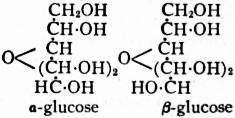
The constitution of glucose was established by H. Kiliani in 1885-1887, who showed it to be CH2OH·(CH·OH)4·CHO. The subject was taken up by Emil Fischer, who succeeded in synthesizing glucose, and also several of its stereo-isomers, there being 16 according to the Le Bel-van’t Hoff theory (see Stereo-Isomerism and Sugar). This open chain structure is challenged in the views put forward by T. M. Lowry and E. F. Armstrong. In 1895 C. Tanret showed that glucose existed in more than one form, and he isolated α, β and γ varieties with specific rotations of 105°, 52.5° and 22°. It is now agreed that the β variety is a mixture of the α and γ. This discovery explained the mutarotation of glucose. In a fresh solution α-glucose only exists, but on standing it is slowly transformed into γ-glucose, equilibrium being reached when the α and γ forms are present in the ratio 0.368 : 0.632 (Tanret, Zeit. physikal. Chem., 1905, 53, p. 692). It is convenient to refer to these two forms as α and β. Lowry and Armstrong represent these compounds by the following spatial formulae which postulate a γ-oxidic structure, and 5 asymmetric carbon atoms, i.e. one more than in the Fischer formulae. These formulae are supported by many considerations, especially by the selective action of enzymes, which follows similar lines with the α- and β-glucosides, i.e. the compounds formed by the interaction of glucose with substances generally containing hydroxyl groups (see Glucoside).
Fermentation of Glucose.—Glucose is readily fermentable. Of the greatest importance is the alcoholic fermentation brought about by yeast cells (Saccharomyces cerevisiae seu vini); this follows the equation C6H12O6 = 2C2H6O + 2CO2, Pasteur considering 94 to 95% of the sugar to be so changed. This character is the base of the plan of adding glucose to wine and beer wort before fermenting, the alcohol content of the liquid after fermentation being increased. Some fusel oil, glycerin and succinic acid appear to be formed simultaneously, but in small amount. Glucose also undergoes fermentation into lactic acid (q.v.) in the presence of the lactic acid bacillus, and into butyric acid if the action of the preceding ferment be continued, or by other bacilli. It also yields, by the so-called mucous fermentation, a mucous, gummy mass, mixed with mannitol and lactic acid.
We may here notice the frequent production of glucose by the action of enzymes upon other carbohydrates. Of especial note is the transformation of maltose by maltase into glucose, and of cane sugar by invertase into a mixture of glucose and fructose (invert sugar); other instances are: lactose by lactase into galactose and glucose; trehalose by trehalase into glucose; melibiose by melibiase into galactose and glucose; and of melizitose by melizitase into touranose and glucose, touranose yielding glucose also when acted upon by the enzyme touranase.
Commercial Glucose.—The glucose of commerce, which may be regarded as a mixture of grape sugar, maltose and dextrins, is prepared by hydrolysing starch by boiling with a dilute mineral acid. In Europe, potato starch is generally employed; in America, corn starch. The acid employed may be hydrochloric, which gives the best results, or sulphuric, which is used in Germany; sulphuric acid is more readily separated from the product than hydrochloric, since the addition of powdered chalk precipitates it as calcium sulphate, which may be removed by a filter press. The processes of manufacture have much in common, although varying in detail. The following is an outline of the process when hydrochloric acid is used: Starch (“green” starch in America) is made into a “milk” with water, and the milk pumped into boiling dilute acid contained in a closed “converter,” generally made of copper or cast iron; steam is led in at the same time, and the pressure is kept up to about 25 ℔ to the sq. in. When the converter is full the pressure is raised somewhat, and the heating continued until the conversion is complete. The liquid is now run into neutralizing tanks containing sodium carbonate, and, after settling, the supernatant liquid, termed “light liquor,” is run through bag filters and then on to bone-char filters, which have been previously used for the “heavy liquor.” The colourless or amber-coloured filtrate is concentrated to 27° to 28° B., when it forms the “heavy liquor,” just mentioned. This is filtered through fresh bone-char filters, from which it is discharged as a practically colourless liquid. This liquid is concentrated in vacuum pans to a specific gravity of 40° to 44° B., a small quantity of sodium bisulphite solution being added to bleach it, to prevent fermentation, and to inhibit browning. “Syrup glucose” is the commercial name of the product; by continuing the concentration further solid glucose or grape sugar is obtained.
Several brands are recognized: “Mixing glucose” is used by syrup and molasses manufacturers, “jelly glucose” by makers of jellies, “confectioners’ glucose” in confectionery, “brewers’ glucose” in brewing, &c.
GLUCOSIDE, in chemistry, the generic name of an extensive group of substances characterized by the property of yielding a sugar, more commonly glucose, when hydrolysed by purely chemical means, or decomposed by a ferment or enzyme. The name was originally given to vegetable products of this nature, in which the other part of the molecule was, in the greater number of cases, an aromatic aldehydic or phenolic compound (exceptions are sinigrin and jalapin or scammonin). It has now been extended to include synthetic ethers, such as those obtained by acting on alcoholic glucose solutions with hydrochloric acid, and also the polysaccharoses, e.g. cane sugar, which appear to be ethers also. Although glucose is the commonest sugar present in glucosides, many are known which yield rhamnose or iso-dulcite; these may be termed pentosides. Much attention has been given to the non-sugar parts of the molecules; the constitutions of many have been determined, and the compounds synthesized; and in some cases the preparation of the synthetic glucoside effected.
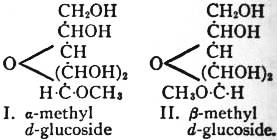
The simplest glucosides are the alkyl esters which E. Fischer (Ber., 28, pp. 1151, 3081) obtained by acting with hydrochloric acid on alcoholic glucose solutions. A better method of preparation is due to E. F. Armstrong and S. L. Courtauld (Proc. Phys. Soc., 1905, July 1), who dissolve solid anhydrous glucose in methyl alcohol containing hydrochloric acid. A mixture of α- and β-glucose result, which are then etherified, and if the solution be neutralized before the β-form isomerizes and the solvent removed, a mixture of the α- and β-methyl ethers is obtained. These may be separated by the action of suitable ferments. Fischer found that these ethers did not reduce Fehling’s solution, neither did they combine with phenyl hydrazine at 100°; they appear to be stereo-isomeric γ-oxidic compounds of the formulae I., II.: The difference between the α- and β-forms is best shown by the selective action of enzymes. Fischer found that maltase, an enzyme occurring in yeast cells, hydrolysed α-glucosides but not the β; while emulsin, an enzyme occurring in bitter almonds, hydrolyses the β but not the α. The ethers of non-fermentable sugars are themselves non-fermentable. By acting with these enzymes on the natural glucosides, it is found that the majority are of the β-form; e.g. emulsin hydrolyses salicin, helicin, aesculin, coniferin, syringin, &c.
Classification of the glucosides is a matter of some difficulty. One based on the chemical constitution of the non-glucose part of the molecules has been proposed by Umney, who framed four groups: (1) ethylene derivatives, (2) benzene derivatives, (3) styrolene derivatives, (4) anthracene derivatives. A group may also be made to include the cyanogenetic glucosides, i.e. those containing prussic acid. J. J. L. van Rijn (Die Glykoside, 1900) follows a botanical classification, which has several advantages; in particular, plants of allied genera contain similar compounds. In this article the chemical classification will be followed. Only the more important compounds will be noticed, the reader being referred to van Rijn (loc. cit.) and to Beilstein’s Handbuch der organischen Chemie for further details.
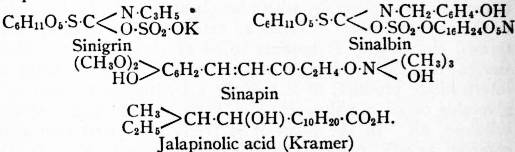
1. Ethylene Derivatives.—These are generally mustard oils, and are characterized by a burning taste; their principal occurrence is in mustard and Tropaeolum seeds. Sinigrin or the potassium salt of myronic acid, C10H16NS2KO9·H2O, occurs in black pepper and in horse-radish root. Hydrolysis with baryta, or decomposition by the ferment myrosin, gives glucose, allyl mustard oil and potassium bisulphate. Sinalbin, C30H42N2S2O15, occurs in white pepper; it decomposes to the mustard oil HO·C6H4·CH2·NCS, glucose and sinapin, a compound of choline and sinapinic acid. Jalapin or scammonin, C34H56O16, occurs in scammony; it hydrolyses to glucose and jalapinolic acid. The formulae of sinigrin, sinalbin, sinapin and jalapinolic acid are:—
2. Benzene Derivatives.—These are generally oxy and oxyaldehydic compounds. Arbutin, C12H16O7, which occurs in bearberry along with methyl arbutin, hydrolyses to hydroquinone and glucose. Pharmacologically it acts as a urinary antiseptic and diuretic; the benzoyl derivative, cellotropin, has been used for tuberculosis. Salicin, also termed “saligenin” and “glucose,” C13H18O7, occurs in the willow. The enzymes ptyalin and emulsin convert it into glucose and saligenin, ortho-oxybenzylalcohol, HO·C6H4·CH2OH. Oxidation gives the aldehyde helicin. Populin, C20H22O8, which occurs in the leaves and bark of Populus tremula, is benzoyl salicin.
3. Styrolene Derivatives.—This group contains a benzene and also an ethylene group, being derived from styrolene C6H5·CH:CH2. Coniferin, C16H22O8, occurs in the cambium of coniferous woods. Emulsin converts it into glucose and coniferyl alcohol, while oxidation gives glycovanillin, which yields with emulsin glucose and vanillin (see Eugenol and Vanilla). Syringin, which occurs in the bark of Syringa vulgaris, is methoxyconiferin. Phloridzin, C21H24O10, occurs in the root-bark of various fruit trees; it hydrolyses to glucose and phloretin, which is the phloroglucin ester of para-oxyhydratropic acid. It is related to the pentosides naringin, C21H26O11, which hydrolyses to rhamnose and naringenin, the phloroglucin ester of para-oxycinnamic acid, and hesperidin, C50H60O22(?), which hydrolyses to rhamnose and hesperetin, C16H14O6, the phloroglucin ester of meta-oxy-para-methoxycinnamic acid or isoferulic acid, C10H10O4. We may here include various coumarin and benzo-γ-pyrone derivatives. Aesculin, C15H16O9, occurring in horse-chestnut, and daphnin, occurring in Daphne alpina, are isomeric; the former hydrolyses to glucose and aesculetin (4·5-dioxycoumarin), the latter to glucose and daphnetin (3·4-dioxycoumarin). Fraxin, C16H18O10, occurring in Fraxinus excelsior, and with aesculin in horse-chestnut, hydrolyses to glucose and fraxetin, the monomethyl ester of a trioxycoumarin. Flavone or benzo-γ-pyrone derivatives are very numerous; in many cases they (or the non-sugar part of the molecule) are vegetable dyestuffs. Quercitrin, C21H22O12, is a yellow dyestuff found in Quercus tinctoria; it hydrolyses to rhamnose and quercetin, a dioxy-β-phenyl-trioxybenzo-γ-pyrone. Rhamnetin, a splitting product of the glucosides of Rhamnus, is monomethyl quercetin; fisetin, from Rhus cotinus, is monoxyquercetin; chrysin is phenyl-dioxybenzo-γ-pyrone. Saponarin, a glucoside found in Saponaria officinalis, is a related compound. Strophanthin is the name given to three different compounds, two obtained from Strophanthus Kombe and one from S. hispidus.
4. Anthracene Derivatives.—These are generally substituted anthraquinones; many have medicinal applications, being used as purgatives, while one, ruberythric acid, yields the valuable dyestuff madder, the base of which is alizarin (q.v.). Chrysophanic acid, a dioxymethylanthraquinone, occurs in rhubarb, which also contains emodin, a trioxymethylanthraquinone; this substance occurs in combination with rhamnose in frangula bark.
The most important cyanogenetic glucoside is amygdalin, which occurs in bitter almonds. The enzyme maltase decomposes it into glucose and mandelic nitrile glucoside; the latter is broken down by emulsin into glucose, benzaldehyde and prussic acid. Emulsin also decomposes amygdalin directly into these compounds without the intermediate formation of mandelic nitrile glucoside. Several other glucosides of this nature have been isolated. The saponins are a group of substances characterized by forming a lather with water; they occur in soap-bark (q.v.). Mention may also be made of indican, the glucoside of the indigo plant; this is hydrolysed by the indigo ferment, indimulsin, to indoxyl and indiglucin.
GLUE (from the O. Fr. glu, bird-lime, from the Late Lat. glutem, glus, glue), a valuable agglutinant, consisting of impure gelatin and widely used as an adhesive medium for wood, leather, paper and similar substances. Glues and gelatins merge into one another by imperceptible degrees. The difference is conditioned by the degree of purity: the more impure form is termed glue and is only used as an adhesive, the purer forms, termed gelatin, have other applications, especially in culinary operations and confectionery. Referring to the article Gelatin for a general account of this substance, it is only necessary to state here that gelatigenous or glue-forming tissues occur in the bones, skins and intestines of all animals, and that by extraction with hot water these agglutinating materials are removed, and the solution on evaporating and cooling yields a jelly-like substance—gelatin or glue.
Glues may be most conveniently classified according to their sources: bone glue, skin glue and fish glue; these may be regarded severally as impure forms of bone gelatin, skin gelatin and isinglass.
Bone Glue.—For the manufacture of glue the bones are supplied fresh or after having been used for making soups; Indian and South American bones are unsuitable, since, by reason of their previous treatment with steam, both their fatty and glue-forming constituents have been already removed (to a great extent). On the average, fresh bones contain about 50% of mineral matter, mainly calcium and magnesium phosphates, about 12% each of moisture and fat, the remainder being other organic matter. The mineral matter reappears in commerce chiefly as artificial manure; the fat is employed in the candle, soap and glycerin industries, while the other organic matter supplies glue.
The separation of the fat, or “de-greasing of the bones” is effected (1) by boiling the bones with water in open vessels; (2) by treatment with steam under pressure; or (3) by means of solvents. The last process is superseding the first two, which give a poor return of fat—a valuable consideration—and also involve the loss of a certain amount of glue. Many solvents have been proposed; the greatest commercial success appears to attend Scottish shale oil and natural petroleum (Russian or American) boiling at about 100° C. The vessels in which the extraction is carried out consist of upright cylindrical boilers, provided with manholes for charging, a false bottom on which the bones rest, and with two steam coils—one for heating only, the other for leading in “live” steam. There is a pipe from the top of the vessel leading to a condensing plant. The vessels are arranged in batteries. In the actual operation the boiler is charged with bones, solvent is run in, and the mixture gradually heated by means of the dry coil; the spirit distils over, carrying with it the water present in the bones; and after a time the extracted fat is run off from discharge cocks in the bottom of the extractor.1 A fresh charge of solvent is introduced, and the cycle repeated; this is repeated a third and fourth time, after which the bones contain only about 0.2% of fat, and a little of the solvent, which is removed by blowing in live steam under 70 to 80 ℔ pressure. The de-greased bones are now cleansed from all dirt and flesh by rotation in a horizontal cylindrical drum covered with stout wire gauze. The attrition accompanying this motion suffices to remove the loosely adherent matter, which falls through the meshes of the gauze; this meal contains a certain amount of glue-forming matter, and is generally passed through a finer mesh, the residuum being worked up in the glue-house, and the flour which passes through being sold as a bone-meal, or used as a manure.
The bones, which now contain 5 to 6% of glue-forming nitrogen and about 60% of calcium phosphate, are next treated for glue. The most economical process consists in steaming the bones under pressure (15 ℔ to start with, afterwards 5 ℔) in upright cylindrical boilers fitted with false bottoms. The glue-liquors collect beneath the false bottoms, and when of a strength equal to about 20% dry glue they are run off to the clarifiers. The first runnings contain about 65 to 70% of the total glue; a second steaming extracts another 25 to 30%. For clarifying the solutions, ordinary alum is used, one part being used for 200 parts of dry glue. The alum is added to the hot liquors, and the temperature raised to 100°; it is then allowed to settle, and the surface scum removed by filtering through coarse calico or fine wire filters.
The clear liquors are now concentrated to a strength of about 32% dry glue in winter and 35% in summer. This is invariably effected in vacuum pans—open boiling yields a dark-coloured and inferior product. Many types of vacuum plant are in use; the Yaryan form, invented by H. T. Yaryan, is perhaps the best, and the double effect system is the most efficient. After concentration the liquors are bleached by blowing in sulphur dioxide, manufactured by burning sulphur; by this means the colour can be lightened to any desired degree. The liquors are now run into galvanized sheet-iron troughs, 2 ft. long, 6 in. wide and 5 in. deep, where they congeal to a firm jelly, which is subsequently removed by cutting round the edges, or by warming with hot water, and turning the cake out. The cake is sliced to sheets of convenient thickness, generally by means of a wire knife, i.e. a piece of wire placed in a frame. Mechanical slicers acting on this principle are in use. Instead of allowing the solution to congeal in troughs, it may be “cast” on sheets of glass, the bottoms of which are cooled by running water. After congealing, the tremulous jelly is dried; this is an operation of great nicety: the desiccation must be slow and is generally effected by circulating a rapid current of air about the cakes supported on nets set in frames; it occupies from four to five days, and the cake contains on the average from 10 to 13% of water.
Skin Glue.—In the preparation of skin glue the materials used are the parings and cuttings of hides from tan-yards, the ears of oxen and sheep, the skins of rabbits, hares, cats, dogs and other animals, the parings of tawed leather, parchment and old gloves, and many other miscellaneous scraps of animal matter. Much experience is needed in order to prepare a good glue from such heterogeneous materials; one blending may be a success and another a failure. The raw material has been divided into three great divisions: (1) sheep pieces and fleshings (ears, &c.); (2) ox fleshings and trimmings; (3) ox hides and pieces; the best glue is obtained from a mixture of the hide, ear and face clippings of the ox and calf. The raw material or “stock” is first steeped for from two to ten weeks, according to its nature, in wooden vats or pits with lime water, and afterwards carefully dried and stored. The object of the lime steeping is to remove any blood and flesh which may be attached to the skin, and to form a lime soap with the fatty matter present. The “scrows” or glue pieces, which may be kept a long time without undergoing change, are washed with a dilute hydrochloric acid to remove all lime, and then very thoroughly with water; they are now allowed to drain and dry. The skins are then placed in hemp nets and introduced into an open boiler which has a false bottom, and a tap by which liquid may be run off. As the boiling proceeds test quantities of liquid are from time to time examined, and when a sample is found on cooling to form a stiff jelly, which happens when it contains about 32% dry glue, it is ready to draw off. The solution is then run to a clarifier, in which a temperature sufficient to keep it fluid is maintained, and in this way any impurity is permitted to subside. The glue solution is then run into wooden troughs or coolers in which it sets to a firm jelly. The cakes are removed as in the case of bone glue (see above), and, having been placed on nets, are, in the Scottish practice, dried by exposure to open air. This primitive method has many disadvantages: on a hot day the cake may become unshapely, or melt and slip through the net, or dry so rapidly as to crack; a frost may produce fissures, while a fog or mist may precipitate moisture on the surface and occasion a mouldy appearance. The surface of the cake, which is generally dull after drying, is polished by washing with water. The practice of boiling, clarification, cooling and drying, which has been already described in the case of bone glue, has been also applied to the separation of skin glue.
Fish Glue.—Whereas isinglass, a very pure gelatin, is yielded by the sounds of a limited number of fish, it is found that all fish offals yield a glue possessing considerable adhesive properties. The manufacture consists in thoroughly washing the offal with water, and then discharging it into extractors with live steam. After digestion, the liquid is run off, allowed to stand, the upper oily layer removed, and the lower gluey solution clarified with alum. The liquid is then filtered, concentrated in open vats, and bleached with sulphur dioxide.2 Fish glue is a light-brown viscous liquid which has a distinctly disagreeable odour and an acrid taste; these disadvantages to its use are avoided if it be boiled with a little water and 1% of sodium phosphate, and 0.025% of saccharine added.
Properties of Glue.—A good quality of glue should be free from all specks and grit, have a uniform, light brownish-yellow, transparent appearance, and should break with a glassy fracture. Steeped for some time in cold water it softens and swells up without dissolving, and when again dried it ought to resume its original properties. Under the influence of heat it entirely dissolves in water, forming a thin syrupy fluid with a not disagreeable smell. The adhesiveness of different qualities of glue varies considerably; the best adhesive is formed by steeping the glue, broken in small pieces, in water until they are quite soft, and then placing them with just sufficient water to effect solution in the glue-pot. The hotter the glue, the better the joint; remelted glue is not so strong as the freshly prepared; and newly manufactured glue is inferior to that which has been long in stock. It is therefore seen that many factors enter into the determination of the cohesive power of glue; a well-prepared joint may, under favourable conditions, withstand a pull of about 700 ℔ per sq. in. The following table, after Kilmarsch, shows the holding power of glued joints with various kinds of woods.
Wood. ℔ per sq. in.
With grain. Across grain.
Beech 852 434.5
Maple 484 346
Oak 704 302
Fir 605 132
Special Kinds of Glues, Cements, &c.—By virtue of the fact that the word “glue” is frequently used to denote many adhesives, which may or may not contain gelatin, there will now be given an account of some special preparations. These may be conveniently divided into: (1) liquid glues, mixtures containing gelatin which do not jelly at ordinary temperatures but still possess adhesive properties; (2) water-proof glues, including mixtures containing gelatin, and also the “marine glues,” which contain no glue; (3) glues or cements for special purposes, e.g. for cementing glass, pottery, leather, &c., for cementing dissimilar materials, such as paper or leather to iron.
Liquid Glues.—The demand for liquid glues is mainly due to the disadvantages—the necessity of dissolving and using while hot—of ordinary glue. They are generally prepared by adding to a warm glue solution some reagent which destroys the property of gelatinizing. The reagents in common use are acetic acid; magnesium chloride, used for a glue employed by printers; hydrochloric acid and zinc sulphate; nitric acid and lead sulphate; and phosphoric acid and ammonium carbonate.
Water-proof Glues.—Numerous recipes for water-proof glues have been published; glue, having been swollen by soaking in water, dissolved in four-fifths its weight of linseed oil, furnishes a good water-proof adhesive; linseed oil varnish and litharge, added to a glue solution, is also used; resin added to a hot glue solution in water, and afterwards diluted with turpentine, is another recipe; the best glue is said to be obtained by dissolving one part of glue in one and a half parts of water, and then adding one-fiftieth part of potassium bichromate. Alcoholic solutions of various gums, and also tannic acid, confer the same property on glue solutions. The “marine glues” are solutions of india-rubber, shellac or asphaltum, or mixtures of these substances, in benzene or naphtha. Jeffrey’s marine glue is formed by dissolving india-rubber in four parts of benzene and adding two parts of shellac; it is extensively used, being easily applied and drying rapidly and hard. Another water-proof glue which contains no gelatin is obtained by heating linseed oil with five parts of quicklime; when cold it forms a hard mass, which melts on heating like ordinary glue.
Special Glues.—There are innumerable recipes for adhesives specially applicable to certain substances and under certain conditions. For repairing glass, ivory, &c. isinglass (q.v.), which may be replaced by fine glue, yields valuable cements; bookbinders employ an elastic glue obtained from an ordinary glue solution and glycerin, the water being expelled by heating; an efficient cement for mounting photographs is obtained by dissolving glue in ten parts of alcohol and adding one part of glycerin; portable or mouth glue—so named because it melts in the mouth—is prepared by dissolving one part of sugar in a solution of four parts of glue. An india-rubber substitute is obtained by adding sodium tungstate and hydrochloric acid to a strong glue solution; this preparation may be rolled out when heated to 60°.
For further details see Thomas Lambert, Glue, Gelatine and their Allied Products (London, 1905); R. L. Fernbach, Glues and Gelatine (1907); H. C. Standage, Agglutinants of all Kinds for all Purposes (1907).
1 This fat contains a small quantity of solvent, which is removed by heating with steam, when the solvent distils off. Hot water is then run in to melt the fat, which rises to the surface of the water and is floated off. Another boiling with water, and again floating off, frees the fat from dirt and mineral matter, and the product is ready for casking.
2 The residue in the extractors is usually dried in steam-heated vessels, and mixed with potassium and magnesium salts; the product is then put on the market as fish-potash guano.
GLUTARIC ACID, or Normal Pyrotaric Acid, HO2C·CH2·CH2·CH2·CO2H, an organic acid prepared by the reduction of α-oxyglutaric acid with hydriodic acid, by reducing glutaconic acid, HO2C·CH2·CH:CH·CO2H, with sodium amalgam, by conversion of trimethylene bromide into the cyanide and hydrolysis of this compound, or from acetoacetic ester, which, in the form of its sodium derivative, condenses with β-iodopropionic ester to form acetoglutaric ester, CH3·CO·CH(CO2C2H5)·CH2·CH2·CO2C2H5, from which glutaric acid is obtained by hydrolysis. It is also obtained when sebacic, stearic and oleic acids are oxidized with nitric acid. It crystallizes in large monoclinic prisms which melt at 97.5° C., and distils between 302° and 304° C., practically without decomposition. It is soluble in water, alcohol and ether. By long heating the acid is converted into its anhydride, which, however, is obtained more readily by heating the silver salt of the acid with acetyl chloride. By distillation of the ammonium salt glutarimide, CH2(CH2·CO)2NH, is obtained; it forms small crystals melting at 151° to 152° C. and sublimes unchanged.
On the alkyl glutaric acids, see C. Hell (Ber., 1889, 22, pp. 48, 60), C. A. Bischoff (Ber., 1891, 24, p. 1041), K. Auwers (Ber., 1891, 24, p. 1923) and W. H. Perkin, junr. (Journ. Chem. Soc., 1896, 69, p. 268).
GLUTEN, a tough, tenacious, ductile, somewhat elastic, nearly tasteless and greyish-yellow albuminous substance, obtained from the flour of wheat by washing in water, in which it is insoluble. Gluten, when dried, loses about two-thirds of its weight, becoming brittle and semi-transparent; when strongly heated it crackles and swells, and burns like feather or horn. It is soluble in strong acetic acid, and in caustic alkalis, which latter may be used for the purification of starch in which it is present. When treated with .1 to .2% solution of hydrochloric acid it swells up, and at length forms a liquid resembling a solution of albumin, and laevorotatory as regards polarized light. Moistened with water and exposed to the air gluten putrefies, and evolves carbon dioxide, hydrogen and sulphuretted hydrogen, and in the end is almost entirely resolved into a liquid, which contains leucin and ammonium phosphate and acetate. On analysis gluten shows a composition of about 53% of carbon, 7% of hydrogen, and nitrogen 15 to 18%, besides oxygen, and about 1% of sulphur, and a small quantity of inorganic matter. According to H. Ritthausen it is a mixture of glutencasein (Liebig’s vegetable fibrin), glutenfibrin, gliadin (Pflanzenleim), glutin or vegetable gelatin, and mucedin, which are all closely allied to one another in chemical composition. It is the gliadin which confers upon gluten its capacity of cohering to form elastic masses, and of separating readily from associated starch. In the so-called gluten of the flour of barley, rye and maize, this body is absent (H. Ritthausen and U. Kreusler). The gluten yielded by wheat which has undergone fermentation or has begun to sprout is devoid of toughness and elasticity. These qualities can be restored to it by kneading with salt, lime-water or alum. Gluten is employed in the manufacture of gluten bread and biscuits for the diabetic, and of chocolate, and also in the adulteration of tea and coffee. For making bread it must be used fresh, as otherwise it decomposes, and does not knead well. Granulated gluten is a kind of vermicelli, made in some starch manufactories by mixing fresh gluten with twice its weight of flour, and granulating by means of a cylinder and contained stirrer, each armed with spikes, and revolving in opposite directions. The process is completed by the drying and sifting of the granules.
GLUTTON, or Wolverine (Gulo luscus), a carnivorous mammal belonging to the Mustelidae, or weasel family, and the sole representative of its genus. The legs are short and stout, with large feet, the toes of which terminate in strong, sharp claws considerably curved. The mode of progression is semi-plantigrade. In size and form the glutton is something like the badger, measuring from 2 to 3 ft. in length, exclusive of the thick bushy tail, which is about 8 in. long. The head is broad, the eyes are small and the back arched. The fur consists of an undergrowth of short woolly hair, mixed with long straight hairs, to the abundance and length of which on the sides and tail the creature owes its shaggy appearance. The colour of the fur is blackish-brown, with a broad band of chestnut stretching from the shoulders along each side of the body, the two meeting near the root of the tail. Unlike the majority of arctic animals, the fur of the glutton in winter grows darker. Like other Mustelidae, the glutton is provided with anal glands, which secrete a yellowish fluid possessing a highly foetid odour. It is a boreal animal, inhabiting the northern regions of both hemispheres, but most abundant in the circumpolar area of the New World, where it occurs throughout the British provinces and Alaska, being specially numerous in the neighbourhood of the Mackenzie river, and extending southwards as far as New York and the Rocky Mountains. The wolverine is a voracious animal, and also one with an inquisitive disposition. It feeds on grouse, the smaller rodents and foxes, which it digs from their burrows during the breeding-season; but want of activity renders it dependent for most of its food on dead carcases, which it frequently obtains by methods that have made it peculiarly obnoxious to the hunter and trapper. Should the hunter, after succeeding in killing his game, leave the carcase insufficiently protected for more than a single night, the glutton, whose fear of snares is sufficient to prevent him from touching it during the first night, will, if possible, get at and devour what he can on the second, hiding the remainder beneath the snow. It annoys the trapper by following up his lines of marten-traps, often extending to a length of 40 to 50 m., each of which it enters from behind, extracting the bait, pulling up the traps, and devouring or concealing the entrapped martens. So persistent is the glutton in this practice, when once it discovers a line of traps, that its extermination along the trapper’s route is a necessary preliminary to the success of his business. This is no easy task, as the glutton is too cunning to be caught by the methods successfully employed on the other members of the weasel family. The trap generally used for this purpose is made to resemble a cache, or hidden store of food, such as the Indians and hunters are in the habit of forming, the discovery and rifling of which is one of the glutton’s most congenial occupations—the bait, instead of being paraded as in most traps, being carefully concealed, to lull the knowing beast’s suspicions. One of the most prominent characteristics of the wolverine is its propensity to steal and hide things, not merely food which it might afterwards need, or traps which it regards as enemies, but articles which cannot possibly have any interest except that of curiosity. The following instance of this is quoted by Dr E. Coues in his work on the Fur-bearing Animals of North America: “A hunter and his family having left their lodge unguarded during their absence, on their return found it completely gutted—the walls were there, but nothing else. Blankets, guns, kettles, axes, cans, knives and all the other paraphernalia of a trapper’s tent had vanished, and the tracks left by the beast showed who had been the thief. The family set to work, and, by carefully following up all his paths, recovered, with some trifling exceptions, the whole of the lost property.” The cunning displayed by the glutton in unravelling the snares set for it forms at once the admiration and despair of every trapper, while its great strength and ferocity render it a dangerous antagonist to animals larger than itself, occasionally including man. The rutting-season occurs in March, and the female, secure in her burrow, produces her young—four or five at a birth—in June or July. In defence of these, she is exceedingly bold, and the Indians, according to Dr Coues, “have been heard to say that they would sooner encounter a she-bear with her cubs than a carcajou (the Indian name of the glutton) under the same circumstances.” On catching sight of its enemy, man, the wolverine before finally determining on flight, is said to sit on its haunches, and, in order to get a clearer view of the danger, shade its eyes with one of its fore-paws. When pressed for food it becomes fearless, and has been known to come on board an ice-bound vessel, and in presence of the crew seize a can of meat. The glutton is valuable for its fur, which, when several skins are sewn together, forms elegant hearth and carriage rugs.