VOLUME X SLICE VI Foraminifera to Fox, Edward
Reading edition
Articles in This Slice
FORAMINIFERA FORT LEE
FORBACH FORT MADISON
FORBES, ALEXANDER PENROSE FORTROSE
FORBES, ARCHIBALD FORT SCOTT
FORBES, DAVID FORT SMITH
FORBES, DUNCAN FORTUNA
FORBES, EDWARD FORTUNATIANUS, ATILIUS
FORBES, JAMES DAVID FORTUNATUS
FORBES, SIR JOHN FORTUNATUS, VENANTIUS HONORIUS CLEMENTIANUS
FORBES (town) FORTUNE, ROBERT
FORBES-ROBERTSON, JOHNSTON FORTUNY, MARIANO JOSE MARIA BERNARDO
FORBIN, CLAUDE DE FORT WAYNE
FORCELLINI, EGIDIO FORT WILLIAM (Ontario, Canada)
FORCHHAMMER, JOHANN GEORG FORT WILLIAM (Scotland)
FORCHHAMMER, PETER WILHELM FORT WORTH
FORCHHEIM FORTY
FORD, EDWARD ONSLOW FORUM
FORD, JOHN FORUM APPII
FORD, RICHARD FORUM CLODII
FORD, THOMAS FORUM TRAIANI
FORDE, FRANCIS FOSBROKE, THOMAS DUDLEY
FORDHAM FOSCARI, FRANCESCO
FORDUN, JOHN OF FOSCOLO, UGO
FORECLOSURE FOSS, EDWARD
FOREIGN OFFICE FOSSANO
FORELAND, NORTH and SOUTH FOSSANUOVA
FORESHORE FOSSE WAY
FORESTALLING FOSSICK
FOREST LAWS FOSSOMBRONE
FORESTS AND FORESTRY FOSSOMBRONI, VITTORIO
FOREY, ÉLIE FRÉDÉRIC FOSTER, SIR CLEMENT LE NEVE
FORFAR FOSTER, GEORGE EULAS
FORFARSHIRE FOSTER, JOHN
FORFEITURE FOSTER, SIR MICHAEL
FORGERY FOSTER, MYLES BIRKET
FORGET-ME-NOT FOSTER, STEPHEN COLLINS
FORGING FOSTORIA
FORK FOTHERGILL, JOHN
FORKEL, JOHANN NIKOLAUS FOTHERINGHAY
FORLÌ FOUCAULT, JEAN BERNARD LÉON
FORLIMPOPOLI FOUCHÉ, JOSEPH
FORLORN HOPE FOUCHER, SIMON
FORM FOUCQUET, JEAN
FORMALIN FOUGÈRES
FORMAN, ANDREW FOUILLÉE, ALFRED JULES EMILE
FORMAN, SIMON FOULD, ACHILLE
FORMERET FOULIS, ANDREW and ROBERT
FORMEY, JOHANN HEINRICH SAMUEL FOULLON, JOSEPH FRANÇOIS
FORMIA FOUNDATION
FORMIC ACID FOUNDATIONS
FORMOSA (territory of Argentine) FOUNDING
FORMOSA (Taiwan) FOUNDLING HOSPITALS
FORMOSUS FOUNTAIN
FORMULA FOUNTAINS ABBEY
FORNER, JUAN BAUTISTA PABLO FOUQUÉ, FERDINAND ANDRÉ
FORRES FOUQUÉ, FRIEDRICH HEINRICH KARL DE LA MOTTE
FORREST, EDWIN FOUQUET, NICOLAS
FORREST, SIR JOHN FOUQUIER-TINVILLE, ANTOINE QUENTIN
FORREST, NATHAN BEDFORD FOURCHAMBAULT
FORSKÅL, PETER FOURCROY, ANTOINE FRANÇOIS
FORSSELL, HANS LUDVIG FOURIER, FRANÇOIS CHARLES MARIE
FORST FOURIER, JEAN BAPTISTE JOSEPH
FORSTER, FRANÇOIS FOURIER'S SERIES
FÖRSTER, FRIEDRICH CHRISTOPH FOURMIES
FORSTER, JOHANN GEORG ADAM FOURMONT, ÉTIENNE
FORSTER, JOHN FOURNET, JOSEPH JEAN BAPTISTE XAVIER
FORSTER, JOHN COOPER FOURNIER, PIERRE SIMON
FORSTER, WILLIAM EDWARD FOURNIER L’HÉRITIER, CLAUDE
FORSYTH, PETER TAYLOR FOURTOU, MARIE FRANÇOIS OSCAR BARDY DE
FORTALEZA FOUSSA
FORT AUGUSTUS FOWEY
FORT DODGE FOWL
FORT EDWARD FOWLER, CHARLES
FORTESCUE, SIR JOHN (English lawyer) FOWLER, EDWARD
FORTESCUE, SIR JOHN (English statesman) FOWLER, JOHN
FORTEVIOT FOWLER, SIR JOHN
FORT GEORGE FOWLER, WILLIAM
FORTH FOX, CHARLES JAMES
FORTIFICATION AND SIEGECRAFT FOX, EDWARD
FORTLAGE, KARL
FORAMINIFERA, in zoology, a subdivision of Protozoa, the name selected for this enormous class being that given by A. D’Orbigny in 1826 to the shells characteristic of the majority of the species. He regarded them as minute Cephalopods, whose chambers communicated by pores (foramina). Later on their true nature was discovered by F. Dujardin, working on living forms, and he referred them to his Rhizopoda, characterized by pseudopodia given off from the sarcode (protoplasm) as organs of prehension and locomotion. W.B. Carpenter in 1862 differentiated the group nearly in its present limits as “Reticularia”; and since then it has been rendered more natural by the removal of a number of simple forms (mostly freshwater) with branching but not reticulate pseudopods, to Filosa, a distinct subclass, now united with Lobosa into the restricted class of Rhizopoda.
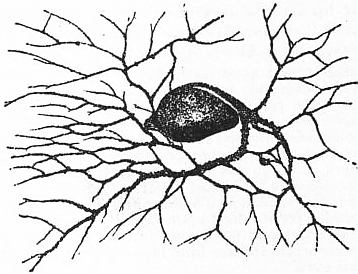
Fig. 1A.—Lieberkühnia, with reticulate pseudopodia.
Anatomy.—Protista Sarcodina, with simple protoplasmic bodies of granular surface, emitting processes which branch and anastomose freely, either from the whole surface or from one or more elongated processes (“stylopods”); nucleus one or more (not yet demonstrated in some little known simple forms), usually in genetic relation to granules or strands of matter of similar composition, the “chromidia” scattered through the protoplasm; body naked, or provided with a permanent investment (shell or test), membranous, gelatinous, arenaceous (of compacted or cemented granules), calcareous, or very rarely (in deep sea forms) siliceous, sometimes freely perforated, but never latticed; opening by one or more permanent apertures (“pylomes”) or crevices between compacted sand-granules, often very complex; reproduction by fission (only in simplest naked forms), or by brood formation; in the latter case one mode of brood formation (A) eventuates in amoebiform embryos, the other (B) in flagellate zoospores which are exogamous gametes, pairing but not with those of their own brood; the coupled cell (“zygote”) when mature in the shelled species gives rise to a very small primitive test-chamber or “microsphere.” The adult microspheric animal gives rise to the amoebiform brood which have a larger primitive test (“megalosphere”); and megalospheric forms appear to reproduce by the A type a series of similar forms before a B brood of gametes is finally borne, to pair and reproduce the microspheric type, which is consequently rare.
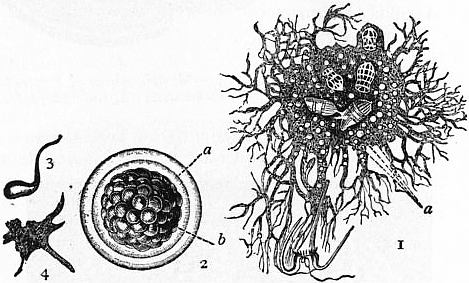
Fig. 1B.—Protomyxa aurantiaca, Haeck. (After Haeckel.)
1, Adult, containing two diatom frustules, and three Tintinnid ciliates, with a large Dinoflagellate just caught by the expanded reticulate pseudopodia. 2, Adult encysted and segmented. 3, Flagellate zoospore just freed from cyst. 4, Zoospore which has passed into the amoeboid state.
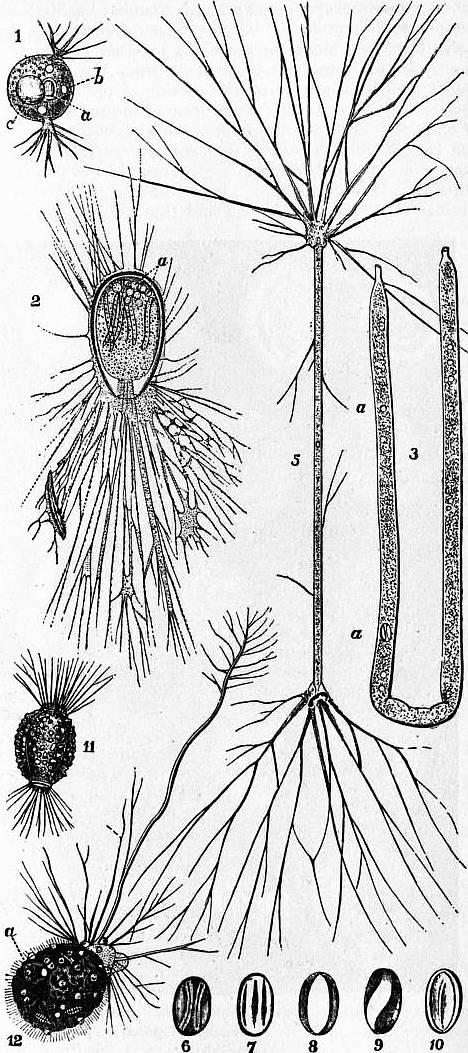
Fig. 2.—Allogromiidea.
1, Diplophrys archeri, Barker. a, Nucleus. b, Contractile vacuoles. c, The yellow oil-like body. Moor pools, Ireland. 2, Allogromia oviformis, Duj. a, The numerous nuclei; near these the elongated bodies represent ingested diatoms. Freshwater. Figs. 2, 3, 11, 12 belong to Rhizopoda Filosa, and are included here to show the characteristic filose pseudopodia in contrast with the reticulate spread of the others. 3, Shepheardella taeniiformis, Siddall (Quart. Jour. Micr. Sci., 1880). Marine. The protoplasm is retracted at both ends into the tubular case. a. Nucleus. 5, Shepheardella taeniiformis; with pseudopodia fully expanded. 6-10, Varying appearance of the nucleus as it is carried along in the streaming protoplasm within the tube. 11, Amphitrema wrightianum, Archer, showing membranous shell encrusted with foreign particles. Moor pools, Ireland. 12, Diaphorophodon mobile, Archer. a. Nucleus. Moor pools, Ireland.
The shells require special study. In the lowest forms they are membranous, sometimes encrusted with sand-grains, always very simple, the only complication being the doubling of the pylome in Diplophrys (fig. 2, 1), Shepheardella (fig. 2, 3-5), Amphitrema (fig. 2, 11), Diaphorophodon (fig. 2, 12). The marine shells are, as we have seen, of cemented particles, or calcareous, glassy, and regularly perforated, or again calcareous, but porcellanous and rarely perforate. These characters have been used as a guide to classification; but some sandy forms have so large a proportion of calcareous cement that they might well be called encrusted calcareous genera, and are also not very constant in respect of the character of perforation. The porcellanous genera, however, form a compact group, the replacement of the shell by silica in forms dwelling in the red clay of the ocean abysses, where calcium carbonate is soluble, not really making any difficulty. Moreover, the shells of this group show a deflected process or neck of the embryonic chamber (“camptopyle”) at least in the megalospheric forms, whereas when such a neck exists in other groups it is straight. The opening of the shell is called the pylome. This may be a mere hole where the lateral walls of the body end, or there may be a diaphragmatic ingrowth so as to narrow the entrance. It may be a simple rounded opening, oblong or tri-multi-radiate, or branching (fig. 4, 1); or replaced by a number of coarse pores (“ethmopyle”) (fig. 3, 5a). Again, it may lie at the end of a narrowed tube (“stylopyle”), which in Lagena (fig. 3, 9) may project outwards (“ectoselenial”), or inwards (“entoselenial”). In most groups the stylopyle is straight; but in the majority of the porcellanous shells it is bent down on the side of the shell, and constitutes the “flexopyle” of A. Kemna, which being a hybrid term should be replaced by “camptopyle.” The animal usually forms a simple shell only after it has attained a certain size, and this “embryonic chamber” cannot grow further. In Spirillina and Ammodiscus there is no pylomic end-wall, and the shell continues to grow as a spiral tube; in Cornuspira (fig. 3, 1) there is a slight constriction indicating the junction of a small embryonic chamber with a camptopyle, but the rest of the shell is a simple flat spiral of several turns. In the majority at least one chamber follows the first, with its own pylome at the distal end. This second chamber may rest on the first, so that the part on which it rests serves as a party-wall bounding the front of the newer chamber as well as the back of the older; and this state prevails for all added chambers in such cases. In the highest vitreous shells, however, each chamber has its complete “proper wall”; while a “supplementary skeleton,” a deposit of shelly matter, binds the chambers together into a compact whole. In all cases the protoplasm from the pylome may deposit additional matter on the outside of the shell, so as to produce very characteristic sculpturing of the surface.
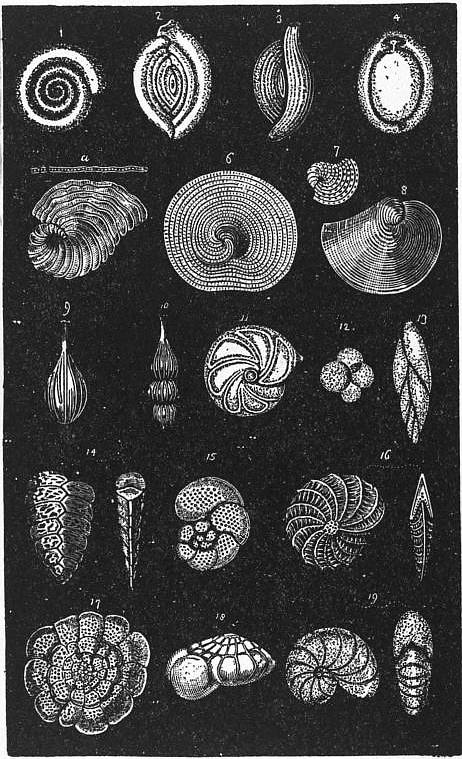
Fig. 3.—Various forms of Calcareous Foraminifera.
1, Cornuspira. 2, Spiroloculina. 3, Triloculina. 4, Biloculina. 5, Peneroplis. 6, Orbiculina (cyclical). 7, Orbiculina (young). 8, Orbiculina (spiral). 9, Lagena. 10, Nodosaria. 11, Cristellaria. 12, Globigerina. 13, Polymorphina. 14, Textularia. 15, Discorbina. 16, Polystomella. 17, Planorbulina. 18, Rotalia. 19, Nonionina.
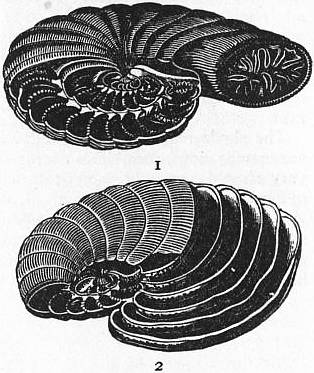
Fig. 4.—Modifications of Peneroplis. 1, Dendritina; 2, Eu-Peneroplis.
Compound or “polythalamic” shells derive their general form largely from the relations of successive chambers in size, shape and direction. This is well shown in the porcellanous Miliolidae. If we call the straight line uniting the two ends of a chamber the “polar axis,” we find that successive chambers have their pylomes at alternate poles; but they lie on different meridians. In Spiroloculina (fig. 3, 2) the divergence between the meridians is 180°, and the chambers are strongly incurved, so that the whole shell forms a flat spiral, of nearly circular outline. In the majority, however, the chambers are crescentic in section, their transverse prolongations being termed “alary” outgrowths, so that successive chambers overlap; when under this condition the angle of successive meridians is still 180° we have the form Biloculina (fig. 3, 4), or with the alary extensions completely enveloping, Uniloculina; when the angle is 120° we have Triloculina, or 144°, Quinqueloculina. Again in Peneroplis (figs. 3, 5, and 4) the shell begins as a flattened shell which tends to straighten out with further growth and additional chambers. In some forms (Spirolina, fig. 22, 3) the chambers have a nearly circular transverse section, and the adult shell is thus crozier-shaped. In others (which may have the same sculpture, and are scarcely distinguishable as species) the chambers are short and wide, drawn out at right angles to the axis, but in the plane of the spiral, and the growing shell becomes fan-shaped or “flabelliform” (figs. 3, 5, 4, 2). This widening may go on till the outer chambers form the greater part of a circle, as in Orbiculina (fig. 3, 6-8) where, moreover, each large chamber is subdivided by incomplete vertical bulkheads into a tier of chamberlets; each chamberlet has a distinct pylomic pore opening to the outside or to those of the next outer zone. In Orbitolites (figs. 5, 6) we have a centre on a somewhat Milioline type; and after a few chambers in spiral succession, complete circles of chambers are formed. In the larger forms the new zones are of greater height, and horizontal bulkheads divide the chamberlets into vertical tiers, each with its own pylomic pore.
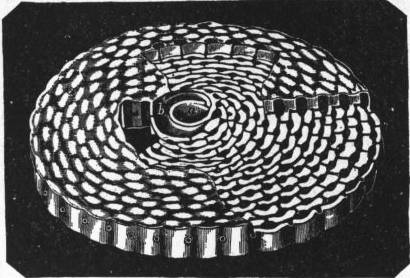
Fig. 5.—Shell of simple type of Orbitolites, showing primordial chamber a, and circumambient chamber b, surrounded by successive rings of chamberlets connected by circular galleries which open at the margin by pores.
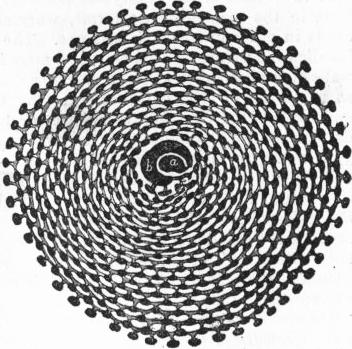
Fig. 6.—Animal of simple type of Orbitolites, showing primordial segment a, and circumambient segment b, surrounded by annuli of sub-segments connected by radial and circular stolon-processes.
The Cheilostomellidae (fig. 3, 13) reproduce among perforate vitreous genera what we have already seen in the Miliolida: Orbitoides (fig. 10, 2) and Cycloclypeus, among the Nummulite group, with a very finely perforate wall, recall the porcellanous Orbiculina and Orbitolites.
In flat spiral forms (figs. 22, 1, 7; 3, 2, 16, 19, &c.) all the chambers may be freely exposed; or the successive chambers be wider transversely than their predecessors and overlap by “alary extensions,” becoming “nautiloid”; in extreme cases only the last turn or whorl is seen (fig. 11). When the spiral axis is conical the shell may be “rotaloid,” the larger lower chambers partially concealing the upper smaller ones (fig. 3, 12, 15, 17, 18); or they may leave, as in Patellina, a wide central conical cavity—which, in this genus, is finally occupied by later formed “supplementary” chambers. When the successive chambers are disposed around a longitudinal central axis they may be said to “alternate” like the leaves of a plant. If the arrangement is distichous we get such forms as Polymorphina, Textularia and Frondicularia (fig. 3, 13, 14), if tristichous, Tritaxia. Such an arrangement may coexist with a spiral twist of the axis for at least part of its course, as in the crozier-shaped Spiroplecta.
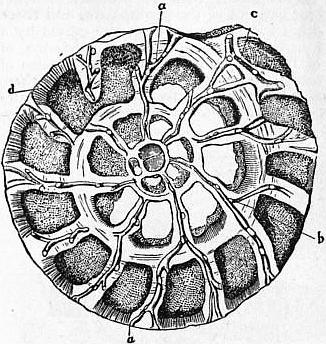
Fig. 7.—Section of Rotalia beccarii, showing the canal system, a, b, c, in the substance of the intermediate skeleton; d, tubulated chamber-wall.
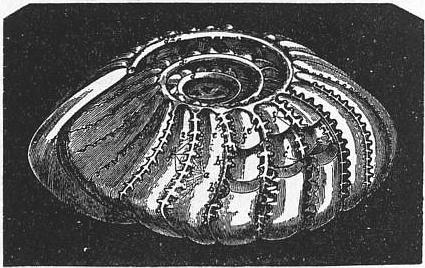
Fig. 8.—Internal cast of Polystomella craticulata.
a, Retral processes, proceeding from the posterior margin of one of the segments. b, b¹, Smooth anterior margin of the same segment. c, c¹, Stolons connecting successive segments and uniting themselves with the diverging branches of the meridional canals. d, d¹, d², Three turns of one of the spiral canals. e, e¹, e², Three of the meridional canals. f, f¹, f², Their diverging branches.
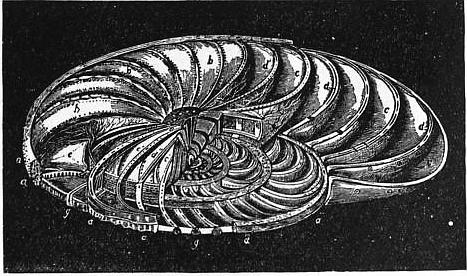
Fig. 9.—Operculina laid open, to show its internal structure.
a, Marginal cord seen in cross section at a’. b, b, External walls of the chambers. c, c, Cavities of the chambers. c′, c′, Their alar prolongations. d, d, Septa divided at d’, d’, and at d”, so as to lay open the interseptal canals, the general distribution of which is seen in the septa e, e; the lines radiating from e, e point to the secondary pores. g, g, Non-tubular columns.
Two phenomena interfere with the ready availability of the characters of form for classificatory ends—dimorphism and multiformity.
Dimorphism.—The majority of foraminiferal shells show two types, the rarer with a much smaller central chamber than that of the more frequent. The chambers are called microsphere and megalosphere, the forms in which they occur microsphaeric and megalosphaeric forms, respectively. We shall study below their relation to the reproductive cycle.
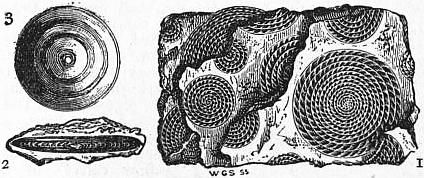
Fig. 10.—1, Piece of Nummulitic Limestone from the Pyrenees, showing Nummulites laid open by fracture through the median plane; 2, vertical section of Nummulite; 3, Orbitoides.
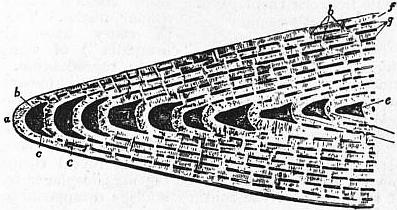
Fig. 11.—Vertical section of portion of Nummulites, showing the investment of the earlier whorls by the alar prolongations of the later.
a, Marginal cord. b, Chamber of outer whorl. c, c, Whorl invested by a. d, One of the chambers of the fourth whorl from the margin. e, e′, Marginal portions of the enclosed whorls. f, Investing portion of the outer whorl. g, g, Spaces left between the investing portions of successive whorls. h, h, Sections of the partitions dividing these.
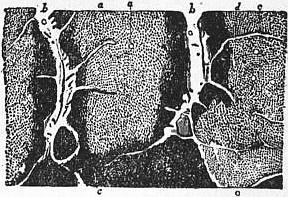
Fig. 12.—Internal surface of wall of two chambers, a, a, of Nummulites, showing the orifices of its minute tubuli.
b, b, The septa containing canals. c, c, Extensions of these canals in the intermediate skeleton. d, d, Larger pores.
Multiformity.—Many of the Polythalamia show different types of chamber-succession at different ages. We have noted this phenomenon in such crozier forms as Peneroplis, as well as in discoid forms; it is very frequent. Thus the microspheric Biloculina form the first few chambers in quinqueloculine succession. The microspheric forms attain to a greater size when adult than the megalospheric; and in Orbitolites the microsphere has a straight outlet, orthostyle, instead of the deflected camptostyle one, so general in porcellanous types; and the spiral succession is continued for more turns before reaching the fan-shaped and finally cyclic stage. Globigerina, whose chambers are nearly spherical, is sometimes seen to be enclosed in a spherical test, perforate, but without a pylome, and known as Orbulina; the chambered Globigerina-shell is attached at first inside the wall of the Orbulina, but ultimately disappears. The ultimate fate of the Orbulina shell is unknown; but it obviously marks a turning-point in the life-cycle.
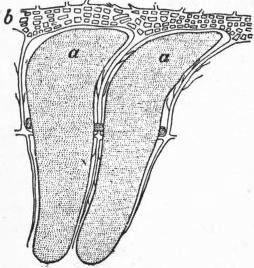
Fig. 13.—Internal cast of two chambers, a, a, of Nummulites, the radial canals between them passing into b, marginal plexus.
Protoplasmic Body and Reproduction.—The protoplasm is not differentiated into ecto- and endosarc, although it is often denser in the central part within the shell, and clearer in the pseudopodial ramifications and the layer (or stalk in the monothalamic forms) from which it is given off. In pelagic forms like Globigerina the external layer is almost if not quite identical in structure with the extracapsular protoplasm of Radiolaria (q.v.), being differentiated into granular strands traversing a clear jelly, rich in large vacuoles (alveoli), and uniting outside the jelly to form the basal layer of the pseudopods; these again are radiolarian in character. Hence E.R. Lankester justly enough compares the shell here to the central capsule of the Radiolarian, though the comparison must not be pushed too far. The cytoplasm contains granules of various kinds, and the internal protoplasm is sometimes pigmented. The Chrysomonad Flagellate, Zooxanthella, so abundant in its resting state—the so-called “yellow cells”—in the extracapsular protoplasm of Radiolaria (q.v.) also occurs in the outer protoplasm of many Foraminifera, not only pelagic but also bottom-dwellers, such as Orbitolites.
The nucleus is single in the Nuda and Allogromidia and in the megalospheric forms of higher Foraminifera; but microspheric forms when adult contain many simple similar nuclei. The nucleus in every case gives off granules and irregular masses (“chromidia”) of similar reactions, which play an important part in reproduction. During the maturation of the microsphere the nuclei disappear; and the cytoplasm breaks up into a large number of zoospores, each of which is soon provided with a single nucleus, whether entirely derived from the parent-nucleus or from the coalescence of chromidia, or from both these sources is still uncertain. These zoospores are amoeboid; they soon secrete a shell and reveal themselves as megalospheres, the original state of the megalospheric forms. In the adult megalosphere the solitary nucleus disappears and is replaced by hosts of minute vesicular nuclei, formed by the concentration of chromidia. Each nucleus aggregates around it a proper zone of dense protoplasm; by two successive mitotic divisions each mass becomes quadri-nucleate, and splits up into four biflagellate, uninucleate zoospores. These are pairing-cells or gametes, though they will not pair with members of the same brood. In the zygote resulting from pairing two nuclei soon fuse into one; but this again divides into two; an embryonic shell is secreted, and this is the microspheric type, which is multinuclear from the first. F. Schaudinn compares the nuclei of the adult Foraminifera with the (vegetative) meganucleus of Infusora (q.v.) and the chromidial mass with the micronucleus, whose chief function is reproductive.
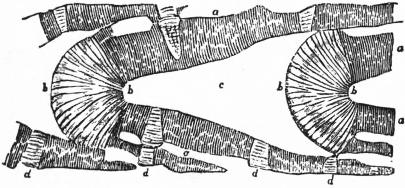
Fig. 14.—Vertical section of tubulated chamber-walls, a, a, of Nummulites. b, b, Marginal cord; c, cavity of chamber; d, d, non-tubulated columns.
Since megalospheric forms are by far the most abundant, it seems probable that under most conditions they also give rise to megalospheric young like themselves; and that the production of zoospores, pairing to pass into the microspheric form, is only occasional, and possibly seasonal. This life-history we owe to the researches of Schaudinn and J.J. Lister.
In several species (notably Patellina) plastogamy, the union of the cytoplasmic bodies without nuclear fusion, has been noted, as a prelude to the resolution of the conjoined protoplasm into uninucleate amoebulae.
Calcituba, a porcellanous type, which after forming the embryonic chamber with its deflected pylome grows into branching stems, may fall apart into sections, or the protoplasm may escape and break up into small amoebulae. Of the reproduction of the simplest forms we know little. In Mikrogromia the cell undergoes fission within the test, and on its completion the daughter-cells may emerge as biflagellate zoospores.
The sandy shells are a very interesting series. In Astrorhiza the sand grains are loosely agglutinated, without mineral cement; they leave numerous pores for the exit of the protoplasm, and there are no true pylomes. In other forms the union of the grains by a calcareous or ferruginous cement necessitates the existence of distinct pylomes. Many of the species reproduce the varieties of form found in calcareous tests; some are finely perforated, others not. Many of the larger ones have their walls thickened internally and traversed by complex passages; this structure is called labyrinthic (fig. 19, g, h). The shell of Endothyra, a form only known to us by its abundance in Carboniferous and Triassic strata, is largely composed of calcite and is sometimes perforated.
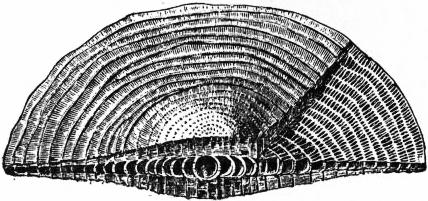
Fig. 15.—Cycloclypeus.
It is noteworthy that though of similar habitat each species selects its own size or sort of sand, some utilizing the siliceous spicules of sponges. Despite the roughness of the materials, they are often so laid as to yield a perfectly smooth inner wall; and sometimes the outer wall may be as simple. As we can find no record of a deflected stylopyle to the primitive chamber of the polythalamous Arenacea, it is safe to conclude that they have no close alliance with the Porcellanea.
Classification.
I. Nuda.—Protoplasmic body without any pellicle or shell save in the resting encysted condition, sometimes forming colonial aggregates by coalescence of pseudopods (Myxodictyum), or even plasmodia (Protomyxa). Brood cells at first uniflagellate or amoeboid from birth. Fresh-water and marine genera Protogenes (Haeckel), Biomyxa (Leidy), Myxodictyum (Haeckel), Protomyxa (Haeckel) (fig. 1B). This group of very simple forms includes many of Haeckel’s Monera, defined as “cytodes,” masses of protoplasm without a nucleus. A nucleus (or nuclei) has, however, been demonstrated by improved methods of staining in so many that it is probable that this distinction will fall to the ground.
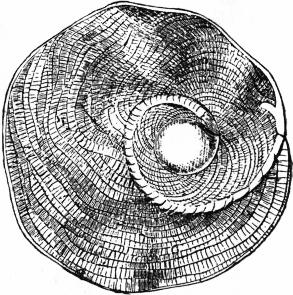
Fig. 16.—Heterostegina.
II. Allogromidiaceae (figs. 1A, 2).—Protoplasmic body protected in adult state by an imperforate test with one or two openings (pylomes) for the exit of the stylopod; test simple, gelatinous, membranous, sometimes incrusted with foreign bodies, never calcareous nor arenaceous; reproduction by fission alone known. Fresh-water or marine genera Allogromia (Rhumbl.), Myxotheca (Schaud.), Lieberkühnia (Cl. & L.) (fig. 1A), Shepheardella (Siddall) (fig. 2, 3-10), Diplophrys (Barker), Amphitrema (Arch.) (fig. 2, 11), Diaphorophodon (Arch.) (fig. 2, 12), are possibly Filosa. This group differs from the preceding in its simple test, but, like it, includes many fresh-water species, which possess contractile vacuoles.
III. Astrorhizidiaceae.—Simple forms, rarely polythalamous (some Rhabdamminidae), but often branching or radiate; test arenaceous, loosely compacted and traversed by chinks for pseudopodia (Astrorhizidae), or dense, and opening by one or more terminal pylomes at ends of branches. Marine, 4 Fam. The test of some Astrorhizidae is so loose that it falls to pieces when taken out of water. Haliphysema is remarkable for its history in relation to the “gastraea theory.” Pilulina has a neat globular shell of sponge-spicules and fine sand. Genera, Astrorhiza (Sandahl) (fig. 22), Pilulina (Carptr.) (fig. 19), Saccammina (Sars) (fig. 19), Rhabdammina (Sars), Botellina (Carptr.), Haliphysema (Bowerbank) (fig. 22).
IV. Lituolidaceae.—Shell arenaceous, usually fine-grained, definite and often polythalamic, recalling in structure calcareous forms. Lituola (Lamk.) (fig. 19), Endothyra (Phil.), Ammodiscus (Reuss), Loftusia (Brady), Haplophragmium (Reuss) (fig. 22), Thurammina (Brady) (fig. 22).
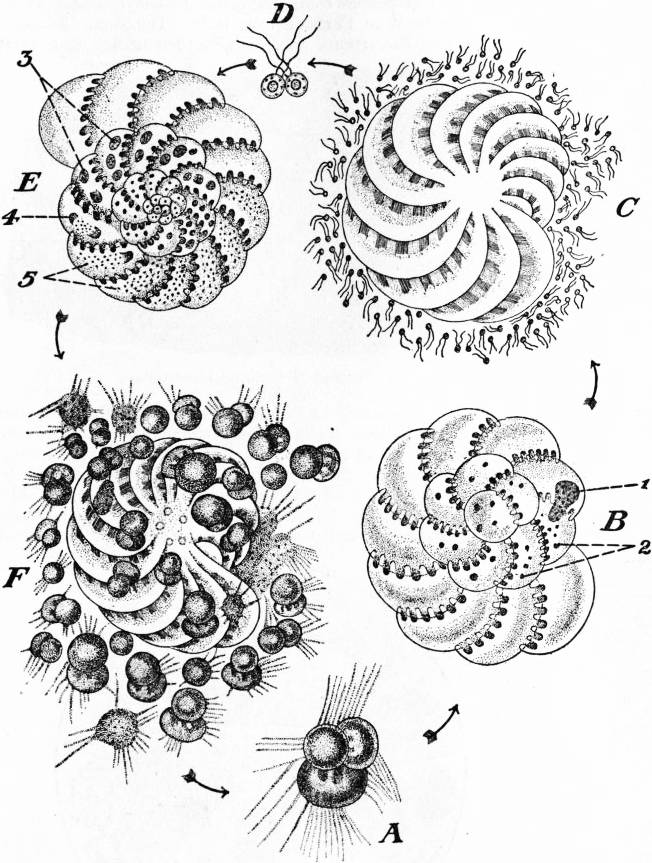
Modified from F. Schaudinn, in Lang’s Zoologie.
Fig. 17.—Life Cycle of Polystomella crispa.
A, Young megalospheric individual. B, Adult decalcified. C, Later stage, resolving itself into two flagellate gametes. D, Conjugation. E, Microspheric individual produced from zygote. F, The same resolved itself into pseudopodiospores which are growing into new megalospheric individuals. 1, Principal nucleus, and 2, subsidiary nuclei of megalospheric form. 3, Nuclei. 4, Nuclei in multiple division. 5, Chromidia derived from 4.
V. Miliolidaceae.—Shells porcellanous imperforate, almost invariably with a camptostyle leading from the embryonic chamber; Cornuspira (Schultze) (fig. 3); Miliola (Lamk.), including as subgenera Spiroloculina (d’Orb.) (figs. 3 and 22); Triloculina (d’Orb.) (fig. 3); Biloculina (d’Orb.) (fig. 3); Uniloculina (d’Orb.); Quinqueloculina (d’Orb.); Peneroplis (Montfort) (figs. 22, 3; 3), with form Dendritina (fig. 4, 1); Orbiculina (Lamk.) (fig. 3, 6-8); Orbitolites (Lamk.) (figs. 5, 6); Vertebralina (d’Orb.) (fig. 22); Squamulina (Sch.) (fig. 22); Calcituba (Schaudinn).
VI. Textulariadaceae.—Shells perforate, vitreous or (in the larger forms) arenaceous, in two or three alternating ranks (distichous or tristichous). Textularia (Defrance) (fig. 21).
VII. Cheilostomellaceae.—Shells vitreous, thin, the chambers doubling forwards and backwards as in Miliolidae. Cheilostomella (Reuss).
VIII. Lagenidaceae.—Shells vitreous, often sculptured, mono- or polythalamic, finely perforate; chambers flask-shaped, with a protruding or an inturned stylopyle; Lagena (Walker & Boys) (fig. 4, 9); Nodosaria (Lamk.) (figs. 23, 4; 4, 10); Polymorphina (d’Orb.) (fig. 4, 13); Cristellaria (Lamk.) (fig. 4, 11); Frondicularia (Def.) (fig. 23, 3).
IX. Globigerinidaceae.—Shells vitreous, coarsely perforated; chambers few spheroidal rapidly increasing in size; arranged in a trochoid or nautiloid spiral. Globigerina (Lamk.) (23, 6; 4, 12); Hastigerina (Wyville Thompson) (fig. 23, 5); Orbulina (d’Orb.) (fig. 23, 8).
X. Rotalidaceae.—Shells vitreous, finely perforate; walls thick, often double, but without an intermediate party-layer traversed by canals; form usually spiral or trochoid. Discorbina (Parker & Jones) (fig. 4, 15); Planorbulina (d’Orb.) (fig. 4, 17); Rotalia (Lamk.) (figs. 23, 1, 2; 7, 21); Calcarina (d’Orb.) (fig. 23, 10); Polytrema (Risso) (fig. 23, 9).
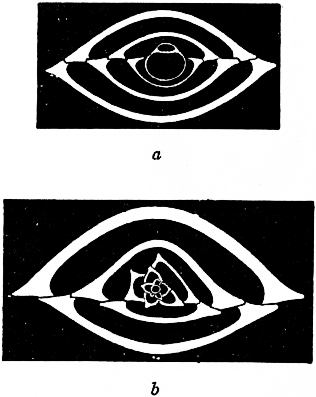
Fig. 18.—Biloculina depressa d’Orb., transverse sections showing dimorphism. (From Lister.)
a, Megalospheric shell × 50, showing uniform growth, biloculine throughout. b, Microspheric shell × 90, showing multiform growth, quinqueloculine at first, and then multiform.
XI. Nummulinidaceae.—As in Rotalidaceae, but with a thicker finely perforated shell, often well developed, and a supplementary skeleton traversed by branching canals as an additional party-wall between the proper chamber-walls. Nonionina (d’Orb.) (fig. 4, 19); Fusulina (Fischer) (fig. 20); Polystomella (Lamk.) (figs. 4, 16; 8); Operculina (d’Orb.) (fig. 9); Heterostegina (d’Orb.) (fig. 16); Cycloclypeus (Carptr.) (fig. 15); Nummulites (Lamk.) (figs. 10, 11, 12, 13, 14).
“Eozoon canadense,” described as a species of this order by J.W. Dawson and Carpenter, has been pronounced by a series of enquirers, most of whom started with a belief in its organic structure, to be merely a complex mineral concretion in ophicalcite, a rock composed of an admixture of silicates (mostly serpentine and pyroxene) and calcite.
Distribution in Vertical Space.—Owing to their lack of organs for active locomotion the Foraminifera are all crawling or attached, with the exception of a few genera (very rich in species, however) which float near the surface of the ocean, constituting part of the pelagic plankton (q.v.). Thus the majority are littoral or deep-sea, sometimes attached to other bodies or even burrowing in the tests of other Foraminifera; most of the fresh-water forms are sapropelic, inhabiting the layer of organic débris at the surface of the bottom mud ditches of pools, ponds and lakes. The deep-sea species below a certain depth cannot possess a calcareous shell, for this would be dissolved; and it is in these that we find limesalts sometimes replaced by silica.
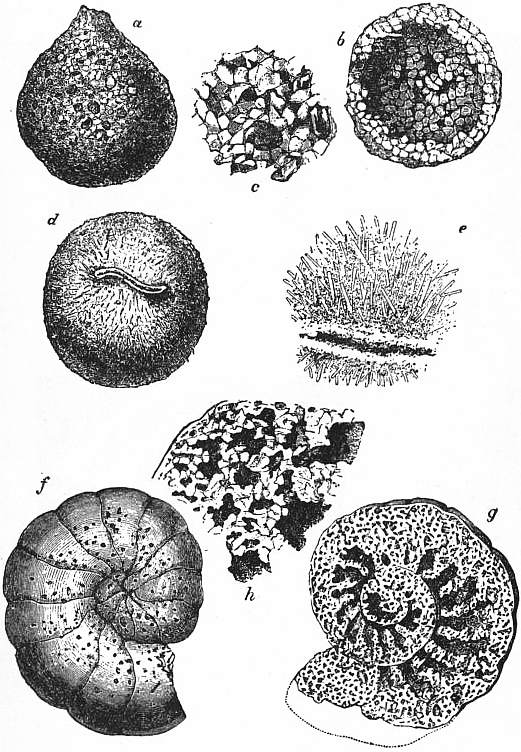
Fig. 19.—Arenaceous Foraminifera.
a, Exterior of Saccammina. b, The same laid open. c, Portion of test more highly magnified. d, Pilulina. e, Portion of test more highly magnified. f, Nautiloid Lituola, exterior. g, Chambered interior. h, Portion of labyrinthic chamber wall, showing component sand-grains.
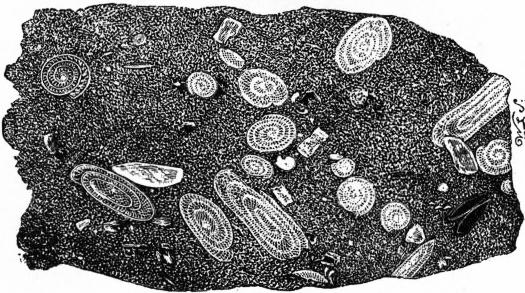
Fig. 20.—Section of Fusulina Limestone.
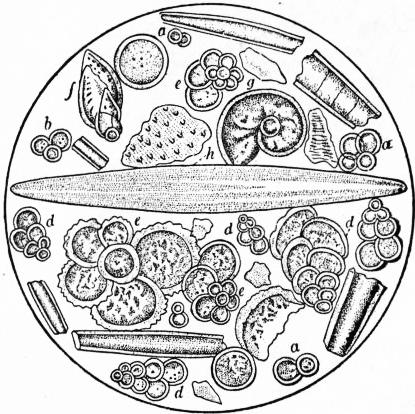
Fig. 21.—Microscopic Organisms in Chalk from Gravesend. a, b, c, d, Textularia globulosa; e, e, e, e, Rotalia aspera; f, Textularia aculeata; g, Planularia hexas; h, Navicula.
The pelagic floating genera are also specially modified. Their shell is either thin or extended many times by long slender tapering spines, and the protoplasm outside has the same character as that of the Radiolaria (q.v.), being differentiated into jelly containing enormous vacuoles and traversed by reticulate strands of granular protoplasm. These coalesce into a peripheral zone from which protrude the pseudopods, here rather radiate than reticulate. Most genera and most species are cosmopolitan; but local differences are often marked. Foraminifera abound in the shore sands and the crevices of coral reefs. The membranous shelled forms decay without leaving traces. The sandy or calcareous shells of dead Foraminifera constitute a large proportion of littoral sand, both below and above tide marks; and, as shown in the boring on Funafuti, enter largely into the constituents of coral rock. They may accumulate in the mud of the bottom to constitute Foraminiferal ooze. The source of these shells in the latter case is double: (1) shells of bottom-dwellers accumulate on the spot; (2) shells of dead plankton forms sink down in a continuous shower, to form a layer at the bottom of the ocean, during which process the spines are dissolved by the sea-water. Thus is formed an ooze known as “Globigerina-ooze,” being formed largely of that genus and its ally Hastigerina; below 3000 fathoms even the tests themselves are dissolved. Casts of their bodies in glauconite (a green ferrous silicate, whose composition has not yet been accurately determined) are, however, frequently left. Glauconitic casts of perforate shells, notably Globigerina, have been found in Lower Cambrian (e.g. Hollybush Sandstone), and the shells themselves in Siberian limestones of that age. It is only when we pass into the Silurian Wenlock limestone that sandy shells make their appearance. Above this horizon Foraminifera are more abundant as constituents, partial or principal of calcareous rocks, the genus Endothyra being indeed almost confined to Carboniferous beds. The genus Fusulina (fig. 20) and Saccammina (fig. 19) give their names (from their respective abundance) to two limestones of the Carboniferous series. Porcellanous shells become abundant only from the Lias upwards. The glauconitic grains of the Greensand formations are chiefly foraminiferal casts. Chalk is well known to consist largely of foraminiferal shells, mostly vitreous, like the north Atlantic globigerina ooze. In the Maestricht chalk more littoral conditions prevailed, and we find such large-sized species as Orbitoides (vitreous) and Orbitolites (porcellanous; figs. 5, 6), &c. In the Eocene Tertiaries the Calcaire Grossier of the Paris basin is mainly composed of Miliolid forms. Nummulites occur in English beds and in the Paris basin; but the great beds of these, forming reef-like masses of limestone, occur farther south, extending from the Pyrenees through the southern and eastern Alps to Egypt, Sinai, and on to north India. The peculiar structure occurring in the Lower Laurentian limestone, as well as other limestones of Archean age described as a Nummulitaceous genus, “Eozoon,” by Carpenter and Dawson, and abundantly illustrated in the 9th edition of his encyclopaedia, is now universally regarded as of inorganic origin. “Looking at the almost universal diffusion of existing Foraminifera and the continuous accumulation of their shells over vast areas of the ocean-bottom, they are certainly doing more than any other group of organisms to separate carbonate of lime from its solution in sea-water, so as to restore to the solid crust of the earth what is being continuously withdrawn from it by solution of the calcareous materials of the land above sea-level.” (E.R. Lankester, “Protozoa,” Ency. Brit. 9th ed.)
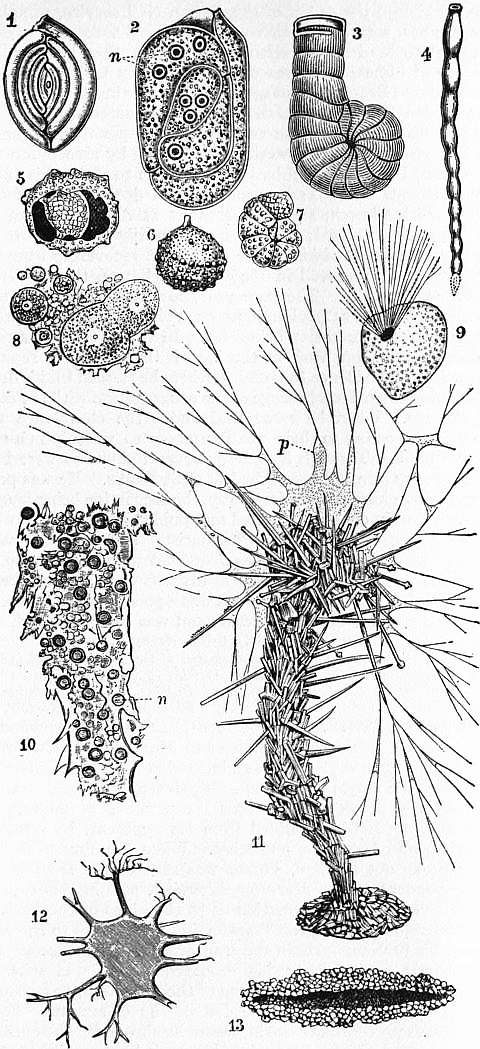
Fig. 22.—Imperforata.
1, Spiroloculina planulata, Lamarck, showing five “coils”; porcellanous. 2, Young ditto, with shell dissolved and protoplasm stained so as to show the seven nuclei n. 3, Spirolina (Peneroplis); a sculptured imperfectly coiled shell; porcellanous. 4, Vertebralina, a simple shell consisting of chambers succeeding one another in a straight line; porcellanous. 5, 6, Thurammina papillata, Brady, a sandy form. 5 is broken open so as to show an inner chamber; recent. × 25. 7, Haplophragmium canariensis, a sandy form; recent. 8, Nucleated reproductive bodies (bud-spores) of Haliphysema. 9, Squamulina laevis, M. Schultze; × 40; a simple porcellanous Miliolide. 10, Protoplasmic core removed after treatment with weak chromic acid from the shell of Haliphysema tumanovitzii, Bow. n, Vesicular nuclei, stained with haematoxylin. (After Lankester.) 11, Haliphysema tumanovitzii; × 25 diam.; living specimen, showing the wine-glass-shaped shell built up of sand-grains and sponge-spicules, and the abundant protoplasm p, issuing from the mouth of the shell and spreading partly over its projecting constituents. 12, Shell of Astrorhiza limicola, Sand.; × 3⁄2; showing the branching of the test on some of the rays usually broken away in preserved specimens (original). 13, Section of the shell of Marsipella, showing thick walls built of sand-grains.
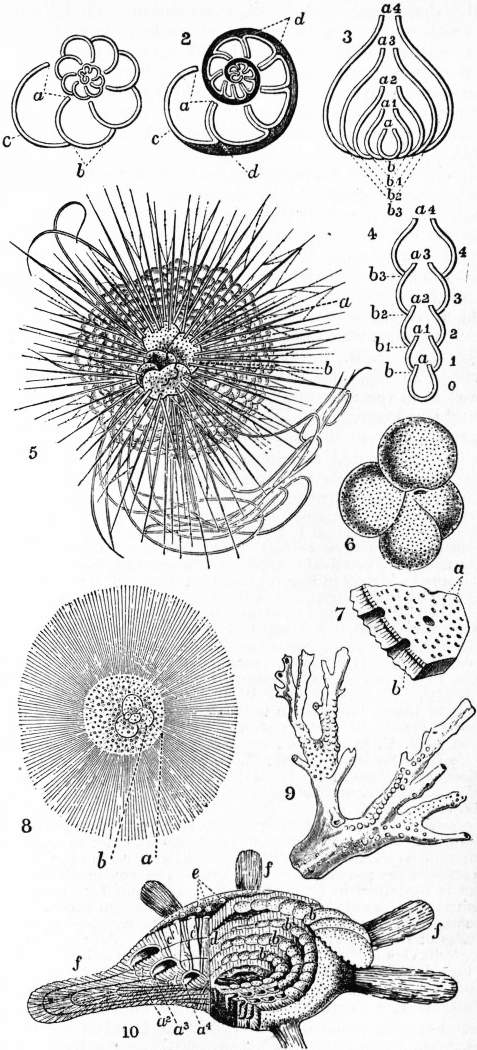
Fig. 23.—Perforata.
1, Spiral arrangement of simple chambers of a Reticularian shell, as in small Rotalia. 2, Ditto, with double septal walls, and supplemental shell-substance (shaded), as in large Rotalia. 3, Diagram to show the mode in which successively-formed chambers may completely embrace their predecessors, as in Frondicularia. 4, Diagram of a simple straight series of non-embracing chambers, as in Nodosaria. 5, Hastigerina murrayi, Wyv. Thomson, a, Bubbly (vacuolated) protoplasm, enclosing b, the perforated Globigerina-like shell (conf. central capsule of Radiolaria). From the peripheral protoplasm project, not only fine pseudopodia, but hollow spines of calcareous matter, which are set on the shell, and have an axis of active protoplasm. Pelagic; drawn in the living state. 6, Globigerina bulloides, d’Orb., showing the punctiform perforations of the shell and the main aperture. 7, Fragment of the shell of Globigerina, seen from within, and highly magnified, a, Fine perforations in the inner shell substances; b, outer (secondary) shell substance. Two coarser perforations are seen in section, and one lying among the smaller. 8, Orbulina universa, d’Orb. Pelagic example, with adherent radiating calcareous spines (hollow), and internally a small Globigerina shell. It is probably a developmental phase of Globigerina, a, Orbulina shell; b, Globigerina shell. 9, Polytrema miniaceum, Lin.; × 12. Mediterranean. Example of a branched adherent calcareous perforate Recticularian. 10, Calcarina spengleri, Gmel.; × 10. Tertiary, Sicily. Shell dissected so as to show the spiral arrangement of the chambers, and the copious secondary shell substance. a², a³, a4, Chambers of three successive coils in section, showing the thin primary wall (finely tubulate) of each; b, b, b, b, perforate surfaces of the primary wall of four tiers of chambers, from which the secondary shell substance has been cleared away; c′, c′, secondary or intermediate shell substance in section, showing coarse canals; d, section of secondary shell substance at right angles to c′; e, tubercles of secondary shell substance on the surface; f, f, club-like processes of secondary shell substance.
Historical.—The Foraminifera were discovered as we have seen by A. d’Orbigny. C.E. Ehrenberg added a large number of species, but it was to F. Dujardin in 1835 that we owe the recognition of their true zoological position and the characters of the living animal. W.B. Carpenter and W.C. Williamson in England contributed largely to the study of the shell, the latter being the first to call attention to its multiform character in the development of a single species, and to utilize the method of thin sections, which has proved so fertile in results. W.K. Parker and H.B. Brady, separately, and in collaboration, described an enormous number of forms in a series of papers, as well as in the monograph by the latter of the Foraminifera of the “Challenger” expedition. Munier-Chalmas and Schlumberger brought out the fact of dimorphism in the group, which was later elucidated and incorporated in the full cytological study of the life-cycle of Foraminifera by J.J. Lister and F. Schaudinn, independently, but with concurrent results.
Literature.—The chief recent books are: F. Chapman, The Foraminifera (1902), and J.J. Lister, “The Foraminifera,” in E.R. Lankester’s Treatise on Zoology (1903), in which full bibliographies will be found. For a final résumé of the long controversy on Eozoon, see George P. Merrill in Report of the U.S. National Museum (1906), p. 635. Other classifications of the Foraminifera will be found by G.H. Theodor Eimer and C. Fickert in Zeitschr. für wissenschaftliche Zoologie, lxv. (1899), p. 599, and L. Rhumbler in Archiv für Protistenkunde, iii. (1903-1904); the account of the reproduction is based on the researches of J.J. Lister, summarized in the above-cited work, and of F. Schaudinn, in Arbeiten des kaiserlichen Gesundheitsamts, xix. (1903). We must also cite W.B. Carpenter, W.K. Parker and T. Rymer Jones, Introduction to the Study of the Foraminifera (Ray Society) (1862); W.B. Carpenter, “Foraminifera,” in Ency. Brit., 9th ed.; W.C. Williamson, On the Recent Foraminifera of Great Britain (Ray Society), (1858); H.B. Brady, “The Foraminifera,” in Challenger Reports, ix. (1884); A. Kemna, in Ann. de la soc. royale zoologique et malacologique de Belgique, xxxvii. (1902), p. 60; xxxix. (1904), p. 7.
Appendix.—The Xenophyophoridae are a small group of bottom-dwelling Sarcodina which show a certain resemblance to arenaceous Foraminifera, though observations in the living state show that the character of the pseudopodia is lacking. The multinucleate protoplasm is contained in branching tubes, aggregated into masses of definite form, bounded by a common wall of foreign bodies (sponge spicules, &c.) cemented into a membrane. The cytoplasm contains granules of BaSO4 and pellets of faecal matter. All that is known of reproduction is the resolution of the pellets into uninucleate cells. (F.E. Schultze, Wissenschaftliche Ergebnisse der deutschen Tiefsee-Expedition, vol. xi., 1905, pt. i.)
(M. Ha.)
FORBACH, a town of Germany in the imperial province of Alsace-Lorraine, on an affluent of the Rossel, and on the railway from Metz to Saarbrücken, 5½ m. S.W. of the latter. Pop. (1905) 8193. It has a Protestant and a Roman Catholic (Gothic) church, a synagogue and a Progymnasium. Its industries include the manufacture of tiles, pasteboard wares and gardening implements, while there are coal mines in the vicinity. After the battle on the neighbouring heights of Spicheren (6th of August 1870), in which the French under General Frossard were defeated by the Germans under General von Glümer, the town was occupied by the German troops, and at the conclusion of the war annexed to Germany. On the Schlossberg near the town are the ruins of the castle of the counts of Forbach, a branch of the counts of Saarbrücken.
See Besler, Geschichte des Schlosses, der Herrschaft und der Stadt Forbach (1895).
FORBES, ALEXANDER PENROSE (1817-1875), Scottish divine, was born at Edinburgh on the 6th of June 1817. He was the second son of John Henry Forbes, Lord Medwyn, a judge of the court of session, and grandson of Sir William Forbes of Pitsligo. He studied first at the Edinburgh Academy, then for two years under the Rev. Thomas Dale, the poet, in Kent, passed one session at Glasgow University in 1833, and, having chosen the career of the Indian civil service, completed his studies with distinction at Haileybury College. In 1836 he went to Madras and secured early promotion, but in consequence of ill-health he was obliged to return to England. He then entered Brasenose College, Oxford, where in 1841 he obtained the Boden Sanskrit scholarship, and graduated in 1844. He was at Oxford during the early years of the movement known as Puseyism, and was powerfully influenced by association with Newman, Pusey and Keble. This led him to resign his Indian appointment. In 1844 he was ordained deacon and priest in the English Church, and held curacies at Aston, Rowant and St Thomas’s, Oxford; but being naturally attracted to the Episcopal Church of his native land, then recovering from long depression, he removed in 1846 to Stonehaven, the chief town of Kincardineshire. The same year, however, he was appointed to the vicarage of St Saviour’s, Leeds, a church founded to preach and illustrate Tractarian principles. In 1848 Forbes was called to succeed Bishop Moir in the see of Brechin. He removed the episcopal residence to Dundee, where he resided till his death, combining the pastoral charge of the congregation with the duties of the see. When he came to Dundee the churchmen were accustomed owing to their small numbers to worship in a room over a bank. Through his energy several churches were built, and among them the pro-cathedral of St Paul’s. He was prosecuted in the church courts for heresy, the accusation being founded on his primary charge, delivered and published in 1857, in which he set forth his views on the Eucharist. He made a powerful defence of the charge, and was acquitted with “a censure and an admonition.” Keble wrote in his defence, and was present at his trial at Edinburgh. Forbes was a good scholar, a scientific theologian and a devoted worker, and was much beloved. He died at Dundee on the 8th of October 1875.
Principal works: A Short Explanation of the Nicene Creed (1852); An Explanation of the Thirty-nine Articles (2 vols., 1867 and 1868); Commentary on the Seven Penitential Psalms (1847); Commentary on the Canticles (1853). See Mackey’s Bishop Forbes, a Memoir.
FORBES, ARCHIBALD (1838-1900), British war correspondent, the son of a Presbyterian minister in Morayshire, was born on the 17th of April 1838, and was educated at Aberdeen University. Entering the Royal Dragoons as a private, he gained, while in the service, considerable practical experience of military life and affairs. Being invalided from his regiment, he settled in London, and became a journalist. When the Franco-German War broke out in 1870, Forbes was sent to the front as war correspondent to the Morning Advertiser, and in this capacity he gained valuable information as to the plans of the Parisians for withstanding a siege. Transferring his services to the Daily News, his brilliant feats in the transmission of intelligence drew world-wide attention to his despatches. He was with the German army from the beginning of the campaign, and he afterwards witnessed the rise and fall of the Commune. Forbes afterwards proceeded to Spain, where he chronicled the outbreak of the second Carlist War; but his work here was interrupted by a visit to India, where he spent eight months upon a mission of investigation into the Bengal famine of 1874. Then he returned to Spain, and followed at various times the Carlist, the Republican and the Alfonsist forces. As representative of the Daily News, he accompanied the prince of Wales in his tour through India in 1875-1876. Forbes went through the Servian campaign of 1876, and was present at all the important engagements. In the Russo-Turkish campaign of 1877 he achieved striking journalistic successes at great personal risk. Attached to the Russian army, he witnessed most of the principal operations, and remained continuously in the field until attacked by fever. His letters, together with those of his colleagues, MacGahan and Millet, were republished by the Daily News. On recovering from his fever, Forbes proceeded to Cyprus, in order to witness the British occupation. The same year (1878) he went to India, and in the winter accompanied the Khyber Pass force to Jalalabad. He was present at the taking of Ali Musjid, and marched with several expeditions against the hill tribes. Burma was Forbes’s next field of adventure, and at Mandalay, the capital, he had several interesting interviews with King Thibaw. He left Burma hurriedly for South Africa, where, in consequence of the disaster of Isandlwana, a British force was collecting for the invasion of Zululand. He was present at the victory of Ulundi, and his famous ride of 120 m. in fifteen hours, by which he was enabled to convey the first news of the battle to England, remains one of the finest achievements in journalistic enterprise. Forbes subsequently delivered many lectures on his war experiences to large audiences. His closing years were spent in literary work. He had some years before published a military novel entitled Drawn from Life, and a volume on his experiences of the war between France and Germany. These were now followed by numerous publications, including Glimpses through the Cannon Smoke (1880); Souvenirs of some Continents (1885); William I. of Germany: a Biography (1888); Havelock, in the “English Men of Action” Series (1890); Barracks, Bivouacs, and Battles (1891); The Afghan Wars, 1839-80 (1892); Czar and Sultan (1895); Memories and Studies of War and Peace (1895), in many respects autobiographic; and Colin Campbell, Lord Clyde (1896). He died on the 30th of March 1900.
FORBES, DAVID (1828-1876), British mineralogist, metallurgist and chemist, brother of Edward Forbes (q.v.), was born on the 6th of September 1828, at Douglas, Isle of Man, and received his early education there and at Brentwood in Essex. When a boy of fourteen he had already acquired a remarkable knowledge of chemistry. This subject he studied at the university of Edinburgh, and he was still young when he was appointed superintendent of the mining and metallurgical works at Espedal in Norway. Subsequently he became a partner in the firm of Evans & Askin, nickel-smelters, of Birmingham, and in that capacity during the years 1857-1860 he visited Chile, Bolivia and Peru. Besides reports for the Iron and Steel Institute, of which, during the last years of his life, he was foreign secretary, he wrote upwards of 50 papers on scientific subjects, among which are the following: “The Action of Sulphurets on Metallic Silicates at High Temperatures,” Rep. Brit. Assoc., 1855, pt. ii. p. 62; “The Relations of the Silurian and Metamorphic Rocks of the south of Norway,” ib. p. 82; “The Causes producing Foliation in Rocks,” Journ. Geol. Soc. xi., 1855; “The Chemical Composition of the Silurian and Cambrian Limestones,” Phil. Mag. xiii. pp. 365-373, 1857; “The Geology of Bolivia and Southern Peru,” Journ. Geol. Soc. xvii. pp. 7-62, 1861; “The Mineralogy of Chile,” Phil. Mag., 1865; “Researches in British Mineralogy,” Phil. Mag., 1867-1868. His observations on the geology of South America were given in a masterly essay, and these and subsequent researches threw much light on igneous and metamorphic phenomena and on the resulting changes in rock-formations. He also contributed important articles on chemical geology to the Chemical News and Geological Magazine (1867 and 1868). In England he was a pioneer in microscopic petrology. He was elected F.R.S. in 1858. He died in London on the 5th of December 1876.
See Obituary by P.M. Duncan in Quart. Journ. Geol. Soc., vol. xxxiii., 1877, p. 41; and by J. Morris in Geol. Mag., 1877, p. 45.
FORBES, DUNCAN, of Culloden (1685-1747), Scottish statesman, was born at Bunchrew or at Culloden near Inverness on the 10th of November 1685. After he had completed his studies at the universities of Edinburgh and Leiden, he was admitted advocate at the Scottish bar in 1709. His own talents and the influence of the Argyll family secured his rapid advancement, which was still further helped by his loyalty to the Hanoverian cause at the period of the rebellion in 1715. In 1722 Forbes was returned member for Inverness, and in 1725 he succeeded Dundas of Arniston as lord advocate. He inherited the patrimonial estates on the death of his brother in 1734, and in 1737 he attained to the highest legal honours in Scotland, being made lord president of the court of session. As lord advocate, he had laboured to improve the legislation and revenue of the country, to extend trade and encourage manufactures, and no less to render the government popular and respected in Scotland. In the proceedings which followed the memorable Porteous mob, for example, when the government brought in a bill for disgracing the lord provost of Edinburgh, for fining the corporation, and for abolishing the town-guard and city-gate, Forbes both spoke and voted against the measure as an unwarranted outrage on the national feeling. As lord president also he carried out some useful legal reforms; and his term of office was characterized by quick and impartial administration of the law.
The rebellion of 1745 found him at his post, and it tried all his patriotism. Some years before (1738) he had repeatedly and earnestly urged upon the government the expediency of embodying Highland regiments, putting them under the command of colonels whose loyalty could be relied upon, but officering them with the native chieftains and cadets of old families in the north. “If government,” said he, “pre-engages the Highlanders in the manner I propose, they will not only serve well against the enemy abroad, but will be hostages for the good behaviour of their relations at home; and I am persuaded that it will be absolutely impossible to raise a rebellion in the Highlands.” In 1739, with Sir Robert Walpole’s approval, the original (1730) six companies (locally enlisted) of the Black Watch were formed into the famous “Forty-second” regiment of the line. The credit given to the earl of Chatham in some histories for this movement is an error; it rests really with Forbes and his friend Lord Islay, afterwards 3rd duke of Argyll (see the Autobiography of the 8th duke of Argyll, vol. i. p. 8 sq., 1906).
On the first rumour of the Jacobite rising Forbes hastened to Inverness, and through his personal influence with the chiefs of Macdonald and Macleod, those two powerful western clans were prevented from taking the field for Charles Edward; the town itself also he kept loyal and well protected at the commencement of the struggle, and many of the neighbouring proprietors were won over by his persuasions. His correspondence with Lord Lovat, published in the Culloden papers, affords a fine illustration of his character, in which the firmness of loyal principle and duty is found blended with neighbourly kindness and consideration. But at this critical juncture of affairs, the apathy of the government interfered considerably with the success of his negotiations. Advances of arms and money arrived too late, and though Forbes employed all his own means and what money he could borrow on his personal security, his resources were quite inadequate to the emergency. It is doubtful whether these advances were ever fully repaid. Part was doled out to him, after repeated solicitations that his credit might be maintained in the country; but it is evident he had fallen into disgrace in consequence of his humane exertions to mitigate the impolitic severities inflicted upon his countrymen after their disastrous defeat at Culloden. The ingratitude of the government, and the many distressing circumstances connected with the insurrection, sunk deep into the mind of Forbes. He never fairly rallied from the depression thus caused, and after a period of declining health he died on the 10th of December 1747.
Forbes was a patriot without ostentation or pretence, a true Scotsman with no narrow prejudice, an accomplished and even erudite scholar without pedantry, a man of genuine piety without asceticism or intolerance. His country long felt his influence through her reviving arts and institutions; and the example of such a character in that coarse and venal age, and among a people distracted by faction, political strife, and national antipathies, while it was invaluable to his contemporaries in a man of high position, is entitled to the lasting gratitude and veneration of his countrymen. In his intervals of leisure he cultivated with some success the study of philosophy, theology and biblical criticism. He is said to have been a diligent reader of the Hebrew Bible. His published writings, some of them of importance, include—A Letter to a Bishop, concerning some Important Discoveries in Philosophy and Theology (1732); Some Thoughts concerning Religion, natural and revealed, and the Manner of Understanding Revelation (1735); and Reflections on Incredulity (2nd ed., 1750).
His correspondence was collected and published in 1815, and a memoir of him (from the family papers) was written by Mr Hill Burton, and published along with a Life of Lord Lovat, in 1847. His statue by Roubillac stands in the Parliament House, Edinburgh.
FORBES, EDWARD (1815-1854), British naturalist, was born at Douglas, in the Isle of Man, on the 12th of February 1815. While still a child, when not engaged in reading, or in the writing of verses and drawing of caricatures, he occupied himself with the collecting of insects, shells, minerals, fossils, plants and other natural history objects. From his fifth to his eleventh year, delicacy of health precluded his attendance at any school, but in 1828 he became a day scholar at Athole House Academy in Douglas. In June 1831 he left the Isle of Man for London, where he studied drawing. In October, however, having given up all idea of making painting his profession, he returned home; and in the following month he matriculated as a student of medicine in the university of Edinburgh. His vacation in 1832 he spent in diligent work on the natural history of the Isle of Man. In 1833 he made a tour in Norway, the botanical results of which were published in Loudon’s Magazine of Natural History for 1835-1836. In the summer of 1834 he devoted much time to dredging in the Irish Sea; and in the succeeding year he travelled in France, Switzerland and Germany.
Born a naturalist, and having no relish for the practical duties of a surgeon, Forbes in the spring of 1836 abandoned the idea of taking a medical degree, resolving to devote himself to science and literature. The winter of 1836-1837 found him at Paris, where he attended the lectures at the Jardin des Plantes on natural history, comparative anatomy, geology and mineralogy. Leaving Paris in April 1837, he went to Algiers, and there obtained materials for a paper on land and freshwater Mollusca, published in the Annals of Natural History, vol. ii. p. 250. In the autumn of the same year he registered at Edinburgh as a student of literature; and in 1838 appeared his first volume, Malacologia Monensis, a synopsis of the species of Manx Mollusca. During the summer of 1838 he visited Styria and Carniola, and made extensive botanical collections. In the following autumn he read before the British Association at Newcastle a paper on the distribution of terrestrial Pulmonifera in Europe, and was commissioned to prepare a similar report with reference to the British Isles. In 1841 was published his History of British Star-fishes, embodying extensive observations and containing 120 illustrations, inclusive of humorous tail-pieces, all designed by the author. On the 17th of April of the same year Forbes, accompanied by his friend William Thompson, joined at Malta H.M. surveying ship “Beacon,” to which he had been appointed naturalist by her commander Captain Graves. From that date until October 1842 he was employed in investigating the botany, zoology and geology of the Mediterranean region. The results of these researches were made known in his “Report on the Mollusca and Radiata of the Aegean Sea, presented to the British Association in 1843,” and in Travels in Lycia, published in conjunction with Lieut. (afterwards Admiral) T.A.B. Spratt in 1847. In the former treatise he discussed the influence of climate and of the nature and depth of the sea bottom upon marine life, and divided the Aegean into eight biological zones; his conclusions with respect to bathymetrical distribution, however, have naturally been modified to a considerable extent by the more recent explorations of the deep seas.
Towards the end of the year 1842 Forbes, whom family misfortunes had now thrown upon his own resources, sought and obtained the curatorship of the museum of the Geological Society of London. To the duties of that post he added in 1843 those of the professorship of botany at King’s College. In November 1844 he resigned the curatorship of the Geological Society, and became palaeontologist to the Geological Survey of Great Britain. Two years later he published in the Memoirs of the Geological Survey, i. 336, his important essay “On the Connexion between the distribution of the existing Fauna and Flora of the British Isles, and the Geological Changes which have affected their Area, especially during the epoch of the Northern Drift.” It is therein pointed out that, in accordance with the theory of their origin from various specific centres, the plants of Great Britain may be divided into five well-marked groups: the W. and S.W. Irish, represented in the N. of Spain, the S.E. Irish and S.W. English, related to the flora of the Channel Isles and the neighbouring part of France; the S.E. English, characterized by species occurring on the opposite French coast; a group peculiar to mountain summits, Scandinavian in type; and, lastly, a general or Germanic flora. From a variety of arguments the conclusion is drawn that the greater part of the terrestrial animals and flowering plants of the British Islands migrated thitherward, over continuous land, at three distinct periods, before, during and after the glacial epoch. On this subject Forbes’s brilliant generalizations are now regarded as only partially true (see C. Reid’s Origin of the British Flora, 1899). In the autumn of 1848 Forbes married the daughter of General Sir C. Ashworth; and in the same year was published his Monograph of the British Naked-eyed Medusae (Ray Society). The year 1851 witnessed the removal of the collections of the Geological Survey from Craig’s Court to the museum in Jermyn Street, and the appointment of Forbes as professor of natural history to the Royal School of Mines just established in conjunction therewith. In 1852 was published the fourth and concluding volume of Forbes and S. Hanley’s History of British Mollusca; also his Monograph of the Echinodermata of the British Tertiaries (Palaeontographical Soc.).
In 1853 Forbes held the presidency of the Geological Society of London, and in the following year he obtained the fulfilment of a long-cherished wish in his appointment to the professorship of natural history in the university of Edinburgh, vacant by the death of R. Jameson, his former teacher. Since his return from the East in 1842, the determination and arrangement of fossils, frequent lectures, and incessant literary work, including the preparation of his palaeontological memoirs, had precluded Forbes from giving that attention to the natural history pursuits of his earlier life which he had earnestly desired. It seemed that at length he was to find leisure to reduce to order his stores of biological information. He lectured at Edinburgh, in the summer session of 1854, and in September of that year he occupied the post of president of the geological section at the Liverpool meeting of the British Association. But he was taken ill just after he had commenced his winter’s course of lectures in Edinburgh, and after not many days’ illness he died at Wardie, near Edinburgh, on the 18th of November 1854.
See Literary Gazette (November 25, 1854); Edinburgh New Philosophical Journal (New Ser.), (1855); Quart. Journ. Geol. Soc. (May 1855); G. Wilson and A. Geikie, Memoir of Edward Forbes (1861), in which, pp. 575-583, is given a list of Forbes’s writings. See also Literary Papers, edited by Lovell Reeve (1855). The following works were issued posthumously: “On the Tertiary Fluviomarine Formation of the Isle of Wight” (Geol. Survey), edited by R.A.C. Godwin-Austen (1856); “The Natural History of the European Seas,” edited and continued by R.A.C. Godwin-Austen (1859).
FORBES, JAMES DAVID (1809-1868), Scottish physicist, was the fourth son of Sir William Forbes, 7th baronet of Pitsligo, and was born at Edinburgh on the 20th of April 1809. He entered the university of Edinburgh in 1825, and soon afterwards began to contribute papers to the Edinburgh Philosophical Journal anonymously under the signature “Δ.” At the age of nineteen he became a fellow of the Royal Society of Edinburgh, and in 1832 he was elected to the Royal Society of London. A year later he was appointed professor of natural philosophy in Edinburgh University, in succession to Sir John Leslie and in competition with Sir David Brewster, and during his tenure of that office, which he did not give up till 1860, he not only proved himself an active and efficient teacher, but also did much to improve the internal conditions of the university. In 1859 he was appointed successor to Brewster in the principalship of the United College of St Andrews, a position which he held until his death at Clifton on the 31st of December 1868.
As a scientific investigator he is best known for his researches on heat and on glaciers. Between 1836 and 1844 he published in the Trans. Roy. Soc. Ed. four series of “Researches on Heat,” in the course of which he described the polarization of heat by tourmaline, by transmission through a bundle of thin mica plates inclined to the transmitted ray, and by reflection from the multiplied surfaces of a pile of mica plates placed at the polarizing angle, and also its circular polarization by two internal reflections in rhombs of rock-salt. His work won him the Rumford medal of the Royal Society in 1838, and in 1843 he received its Royal medal for a paper on the “Transparency of the Atmosphere and the Laws of Extinction of the Sun’s Rays passing through it.” In 1846 he began experiments on the temperature of the earth at different depths and in different soils near Edinburgh, which yielded determinations of the thermal conductivity of trap-tufa, sandstone and pure loose sand. Towards the end of his life he was occupied with experimental inquiries into the laws of the conduction of heat in bars, and his last piece of work was to show that the thermal conductivity of iron diminishes with increase of temperature. His attention was directed to the question of the flow of glaciers in 1840 when he met Louis Agassiz at the Glasgow meeting of the British Association, and in subsequent years he made several visits to Switzerland and also to Norway for the purpose of obtaining accurate data. His observations led him to the view that a glacier is an imperfect fluid or a viscous body which is urged down slopes of a certain inclination by the mutual pressure of its parts, and involved him in some controversy with Tyndall and others both as to priority and to scientific principle. Forbes was also interested in geology, and published memoirs on the thermal springs of the Pyrenees, on the extinct volcanoes of the Vivarais (Ardêche), on the geology of the Cuchullin and Eildon hills, &c. In addition to about 150 scientific papers, he wrote Travels through the Alps of Savoy and Other Parts of the Pennine Chain, with Observations on the Phenomena of Glaciers (1843); Norway and its Glaciers (1853); Occasional Papers on the Theory of Glaciers (1859); A Tour of Mont Blanc and Monte Rosa (1855). He was also the author (1852) of the “Dissertation on the Progress of Mathematical and Physical Science,” published in the 8th edition of the Encyclopaedia Britannica.
See Forbes’s Life and Letters, by Principal Shairp, Professor P.G. Tait and A. Adams-Reilly (1873); Professor Forbes and his Biographers, by J. Tyndall (1873).
FORBES, SIR JOHN (1787-1861), British physician, was born at Cuttlebrae, Banffshire, in 1787. He attended the grammar school at Aberdeen, and afterwards entered Marischal College. After serving for nine years as a surgeon in the navy, he graduated M.D. at Edinburgh in 1817, and then began to practise in Penzance, whence he removed to Chichester in 1822. He took up his residence in London in 1840, and in the following year was appointed physician to the royal household. He was knighted in 1853, and died on the 13th of November 1861 at Whitchurch in Berkshire. Sir John Forbes was better known as an author and editor than as a practical physician. His works include the following:—Original Cases ... illustrating the Use of the Stethoscope and Percussion in the Diagnosis of Diseases of the Chest (1824); Illustrations of Modern Mesmerism (1845); A Physician’s Holiday (1st ed., 1849); Memorandums made in Ireland in the Autumn of 1852 (2 vols., 1853); Sightseeing in Germany and the Tyrol in the Autumn of 1855 (1856). He was joint editor with A. Tweedie and J. Conolly of The Cyclopaedia of Practical Medicine (4 vols., 1833-1835); and in 1836 he founded the British and Foreign Medical Review, which, after a period of prosperity, involved its editor in pecuniary loss, and was discontinued in 1847, partly in consequence of the advocacy in its later numbers of doctrines obnoxious to the profession.
FORBES, a municipal town of Ashburnham county, New South Wales, Australia, 289 m. W. by N. from Sydney, on the Lachlan river, and with a station on the Great Western railway. Pop. (1901) 4313. Its importance as a commercial centre is due to its advantageous position between the northern and southern markets. It has steam-sawing and flour-mills, breweries and wool-scouring establishments; while the surrounding country produces good quantities of cereals, lucerne, wine and fruit.
FORBES-ROBERTSON, JOHNSTON (1853- ), English actor, was the son of John Forbes-Robertson of Aberdeen, an art critic. He was educated at Charterhouse, and studied at the Royal Academy schools with a view to becoming a painter. But though he kept up his interest in that art, in 1874 he turned to the theatre, making his first appearance in London as Chastelard, in Mary, Queen of Scots. He studied under Samuel Phelps, from whom he learnt the traditions of the tragic stage. He played with the Bancrofts and with John Hare, supported Miss Mary Anderson in both England and America, and also acted at different times with Sir Henry Irving. His refined and artistic style, and beautiful voice and elocution made him a marked man on the English stage, and in Pinero’s The Profligate at the Garrick theatre (1889), under Hare’s management, he established his position as one of the most individual of London actors. In 1895 he started under his own management at the Lyceum with Mrs Patrick Campbell, producing Romeo and Juliet, Hamlet, Macbeth and also some modern plays; his impersonation as Hamlet was especially fine, and his capacity as a romantic actor was shown to great advantage also in John Davidson’s For the Crown and in Maeterlinck’s Pelléas and Mélisande. In 1900 he married the actress Gertrude Elliott, with whom, as his leading lady, he appeared at various theatres, producing in subsequent years The Light that Failed, Madeleine Lucette Riley’s Mice and Men, and G. Bernard Shaw’s Caesar and Cleopatra, Jerome K. Jerome’s Passing of the Third Floor Back, &c. His brothers, Ian Robertson (b. 1858) and Norman Forbes (b. 1859), had also been well-known actors from about 1878 onwards.
FORBIN, CLAUDE DE (1656-1733), French naval commander, was born in Provence, of a family of high standing, in 1656. High-spirited and ungovernable in his boyhood, he ran away from his home, and through the influence of an uncle entered the navy, serving his first campaign in 1675. For a short time he quitted the navy and entered the army, but soon returned to his first choice. He made under D’Estrées the American campaign, and under Duquesne that of Algiers in 1683, on all occasions distinguishing himself by his impetuous courage. The most remarkable episode of his life was his mission to Siam. During the administration of the Greek adventurer Phaulcon in that country, the project was formed of introducing the Christian religion and European civilization, and the king sent an embassy to Louis XIV. In response a French embassy was sent out, Forbin accompanying the chevalier de Chaumont with the rank of major. When Chaumont returned to France, Forbin was induced to remain in the service of the Siamese king, and accepted, though with much reluctance, the posts of grand admiral, general of all the king’s armies and governor of Bangkok. His position, however, was soon made untenable by the jealousy and intrigues of the minister Phaulcon; and at the end of two years he left Siam, reaching France in 1688. He was afterwards fully engaged in active service, first with Jean Bart in the war with England, when they were both captured and taken to Plymouth. They succeeded in making their escape and were soon serving their country again. Forbin was wounded at the battle of La Hogue, and greatly distinguished himself at the battle of Lagos. He served under D’Estrées at the taking of Barcelona, was sent ambassador to Algiers, and in 1702 took a brilliant part in the Mediterranean in the War of the Spanish Succession. In 1706 he took command of a squadron at Dunkirk, and captured many valuable prizes from the Dutch and the English. In 1708 he was entrusted with the command of the squadron which was to convey the Pretender to Scotland; but so effectually were the coasts guarded by Byng that the expedition failed, and returned to Dunkirk. Forbin was now beginning to be weighed down with the infirmities of age and the toils of service, and in 1710 he retired to a country house near Marseilles. There he spent part of his time in writing his memoirs, published in 1730, which are full of interest and are written in a graphic and attractive style. Forbin died on the 4th of March 1733.
FORCELLINI, EGIDIO (1688-1768), Italian philologist, was born at Fener in the district of Treviso and belonged to a very poor family. He went to the seminary at Padua in 1704, studied under Facciolati, and in due course attained to the priesthood. From 1724 to 1731 he held the office of rector of the seminary at Ceneda, and from 1731 to 1765 that of father confessor in the seminary of Padua. The remaining years of his life were mainly spent in his native village. He died at Padua in 1768 before the completion of the great work on which he had long co-operated with Facciolati. This was the vast Latin Lexicon (see Facciolati), which has formed the basis of all similar works that have since been published. He was engaged with his Herculean task for nearly 35 years, and the transcription of the manuscript by Luigi Violato occupied eight years more.
FORCHHAMMER, JOHANN GEORG (1794-1865), Danish mineralogist and geologist, was born at Husum, Schleswig, on the 24th of July 1794, and died at Copenhagen on the 14th of December 1865. After studying at Kiel and Copenhagen from 1815 to 1818, he joined Oersted and Lauritz Esmarch in their mineralogical exploration of Bornholm, and took a considerable share in the labours of the expedition. In 1820 he obtained his doctor’s degree by a chemical treatise De mangano, and immediately after set out on a journey through England, Scotland and the Faeroe Islands. In 1823 he was appointed lecturer at Copenhagen University on chemistry and mineralogy; in 1829 he obtained a similar post in the newly established polytechnic school; and in 1831 he was appointed professor of mineralogy in the university, and in 1848 became curator of the geological museum. From 1835 to 1837 he made many contributions to the geological survey of Denmark. On the death of H.C. Oersted in 1851, he succeeded him as director of the polytechnic school and secretary of the Academy of Sciences. In 1850 he began with J. Steenstrup and Worsaae various anthropological publications which gained a high reputation. As a public instructor Forchhammer held a high place and contributed potently to the progress of his favourite studies in his native country. He interested himself in such practical questions as the introduction of gas into Copenhagen, the establishment of the fire-brigade at Rosenberg and the boring of artesian wells.
Among his more important works are—Loerebog i de enkelte Radicalers Chemi (1842); Danmarks geognostiske Forhold (1835); Om de Bornholmske Kulformationer (1836); Dit myere Kridt i Danmark (1847); Bidrag til Skildringen af Danmarks geographiske Forhold (1858). A list of his contributions to scientific periodicals, Danish, English and German, will be found in the Catalogue of Scientific Papers published by the Royal Society of London. One of the most interesting and most recent is “On the Constitution of Sea Water at Different Depths and in Different Latitudes,” in the Proceedings of the Roy. Soc. xii. (1862-1863).
FORCHHAMMER, PETER WILHELM (1801-1894), German classical archaeologist, was born at Husum in Schleswig on the 23rd of October 1801. He was educated at the Lübeck gymnasium and the university of Kiel, with which he was connected for nearly 65 years. In 1830-1834 and 1838-1840 he travelled in Italy, Greece, Asia Minor and Egypt. In 1843 he was appointed professor of philology at Kiel and director of the archaeological museum founded by himself in co-operation with Otto Jahn. He died on the 8th of January 1894. Forchhammer was a democrat in the best sense of the word, and from 1871 to 1873 represented the progressive party of Schleswig-Holstein in the German Reichstag. His published works deal chiefly with topography and ancient mythology. His travels had convinced him that a full and comprehensive knowledge of classical antiquity could only be acquired by a thorough acquaintance with Greek and Roman monuments and works of art, and a detailed examination of the topographical and climatic conditions of the chief localities of the ancient world. These principles are illustrated in his Hellenika. Griechenland. Im Neuen das Alte (1837), which contains his theory of the origin and explanation of the Greek myths, which he never abandoned, in spite of the attacks to which it was subjected. According to him, the myths arose from definite local (especially atmospheric and aquatic) phenomena, and represented the annually recurring processes of nature as the acts of gods and heroes; thus, in Achill (1853), the Trojan War is the winter conflict of the elements in that district. Other similar short treatises are: Die Gründung Roms (1868); Daduchos (1875), on the language of the myths and mythical buildings; Die Wanderungen der Inachostochter Io (1880); Prolegomena zur Mythologie als Wissenschaft und Lexikon der Mythensprache (1891). Amongst his topographical works mention may be made of: Topographie von Athen (1841); Beschreibung der Ebene von Troja (1850), a commentary on a map of the locality executed by T.A. Spratt (see Journal of the Royal Geographical Society, xii., 1842); Topographia Thebarum Heptapylarum (1854); Erklärung der Ilias (1884), on the basis of the topographical and physical peculiarities of the plain of Troy. His Demokratenbüchlein (1849), in the main a discussion of the Aristotelian theory of the state, and Die Athener und Sokrates (1837), in which, contrary to the almost universal opinion, he upheld the procedure of the Athenians as perfectly legal and their verdict as a perfectly just one, also deserve notice.
For a full list of his works see the obituary notice by E. Alberti in C. Bursian’s Biographisches Jahrbuch für Altertumskunde, xx. (1897); also J. Sass in Allgemeine deutsche Biographie, and A. Hoeck and L.C. Pertsch, P.W. Forchhammer (1898).
FORCHHEIM, a town of Germany, in the kingdom of Bavaria, near the confluence of the Wiesent and the Regnitz, 16 m. S.S.E. of Bamberg. Pop. (1905) 8417. It has four Roman Catholic churches, including the Gothic Collegiate church and a Protestant church. Among the other public buildings are the progymnasium and an orphanage. The industries of the town include spinning and weaving, bleaching and dyeing, bone and glue works, brewing and paper-making. The spacious château occupies the site of the Carolingian palace which was destroyed in 1246.
Forchheim is of very early origin, having been the residence of the Carolingian sovereigns, including Charlemagne, in the 9th century. Consequently many diets were held here, and here also Conrad I. and Louis the Child were chosen German kings. The town was given by the emperor Henry II. in 1007 to the bishopric of Bamberg, and, except for a short period during the 11th century, it remained in the possession of the bishops until 1802, when it was ceded to Bavaria. In August 1796 a battle took place near Forchheim between the French and the Austrians. The fortifications of the town were dismantled in 1838.
See Hübsch, Chronik der Stadt Forchheim (Nüremberg, 1867).
FORD, EDWARD ONSLOW (1852-1901), English sculptor, was born in London. He received some education as a painter in Antwerp and as a sculptor in Munich under Professor Wagmüller, but was mainly self-taught. His first contribution to the Royal Academy, in 1875, was a bust of his wife, and in portraiture he may be said to have achieved his greatest success. His busts are always extremely refined and show his sitters at their best. Those (in bronze) of his fellow-artists Arthur Hacker (1894), Briton Riviere and Sir W.Q. Orchardson (1895), Sir L. Alma Tadema (1896), Sir Hubert von Herkomer and Sir John Millais (1897), and of A.J. Balfour are all striking likenesses, and are equalled by that in marble of Sir Frederick Bramwell (for the Royal Institution) and by many more. He gained the open competition for the statue of Sir Rowland Hill, erected in 1882 outside the Royal Exchange, and followed it in 1883 with “Henry Irving as Hamlet,” now in the Guildhall art gallery. This seated statue, good as it is, was soon surpassed by those of Dr Dale (1898, in the city museum, Birmingham) and Professor Huxley (1900), but the colossal memorial statue of Queen Victoria (1901), for Manchester, was less successful. The standing statue of W.E. Gladstone (1894, for the City Liberal Club, London) is to be regarded as one of Ford’s better portrait works. The colossal “General Charles Gordon,” camel-mounted, for Chatham, “Lord Strathnairn,” an equestrian group for Knightsbridge, and the “Maharajah of Mysore” (1900) comprise his larger works of the kind. A beautiful nude recumbent statue of Shelley (1892) upon a cleverly-designed base, which is not quite impeccable from the point of view of artistic taste, is at University College, Oxford, and a simplified version was presented by him to be set up on the shore of Viareggio, where the poet’s body was washed up. Ford’s ideal work has great charm and daintiness; his statue “Folly” (1886) was bought by the trustees of the Chantrey Fund, and was followed by other statues or statuettes of a similar order: “Peace” (1890), which secured his election as an associate of the Royal Academy, “Echo” (1895), on which he was elected full member, “The Egyptian Singer” (1889), “Applause” (1893), “Glory to the Dead” (1901) and “Snowdrift” (1902). Ford’s influence on the younger generation of sculptors was considerable and of good effect. His charming disposition rendered him extremely popular, and when he died a monument was erected to his memory (C. Lucchesi, sculptor, J.W. Simpson, architect) in St John’s Wood, near to where he dwelt.
See Sculpture; also M.H. Spielmann, British Sculpture and Sculptors of To-day (London, 1901).
FORD, JOHN (1586-c. 1640), English dramatist, was baptized on the 17th of April 1586 at Ilsington in north Devon. He came of a good family; his father was in the commission of the peace and his mother was a sister of Sir John Popham, successively attorney-general and lord chief justice. The name of John Ford appears in the university register of Oxford as matriculating at Exeter College in 1601. Like a cousin and namesake (to whom, with other members of the society of Gray’s Inn, he dedicated his play of The Lover’s Melancholy), the future dramatist entered the profession of the law, being admitted of the Middle Temple in 1602; but he seems never to have been called to the bar. Four years afterwards he made his first appearance as an author with an elegy called Fame’s Memorial, or the Earl of Devonshire deceased, and dedicated to the widow of the earl (Charles Blount, Lord Mountjoy, “coronized,” to use Ford’s expression, by King James in 1603 for his services in Ireland)—a lady who would have been no unfitting heroine for one of his own tragedies of lawless passion, the famous Penelope, formerly Lady Rich. This panegyric, which is accompanied by a series of epitaphs and is composed in a strain of fearless extravagance, was, as the author declares, written “unfee’d”; it shows that Ford sympathized, as Shakespeare himself is supposed to have done, with the “awkward fate” of the countess’s brother, the earl of Essex. Who the “flint-hearted Lycia” may be, to whom the poet seems to allude as his own disdainful mistress, is unknown; indeed, the record of Ford’s private life is little better than a blank. To judge, however, from the dedications, prologues and epilogues of his various plays, he seems to have enjoyed the patronage of the earl, afterwards duke, of Newcastle, “himself a muse” after a fashion, and Lord Craven, the supposed husband of the ex-queen of Bohemia. Ford’s tract of Honor Triumphant, or the Peeres Challenge (printed 1606 and reprinted by the Shakespeare Society with the Line of Life, in 1843), and the simultaneously published verses The Monarches Meeting, or the King of Denmarkes Welcome into England, exhibit him as occasionally meeting the festive demands of court and nobility; and a kind of moral essay by him, entitled A Line of Life (printed 1620), which contains references to Raleigh, ends with a climax of fulsome praise to the address of King James I. Yet at least one of Ford’s plays (The Broken Heart, iii. 4) contains an implied protest against the absolute system of government generally accepted by the dramatists of the early Stuart reigns. Of his relations with his brother-authors little is known; it was natural that he should exchange complimentary verses with James Shirley, and that he should join in the chorus of laments over the death of Ben Jonson. It is more interesting to notice an epigram in honour of Ford by Richard Crashaw, morbidly passionate in one direction as Ford was in another. The lines run:
“Thou cheat’st us, Ford; mak’st one seem two by art: What is Love’s Sacrifice but the Broken Heart?”
It has been concluded that in the latter part of his life he gratified the tendency to seclusion for which he was ridiculed in The Time Poets (Choice Drollery, 1656) by withdrawing from business and from literary life in London, to his native place; but nothing is known as to the date of his death. His career as a dramatist very probably began by collaboration with other authors. With Thomas Dekker he wrote The Fairy Knight and The Bristowe Merchant (licensed in 1624, but both unpublished), with John Webster A late Murther of the Sonne upon the Mother (licensed in 1624). A play entitled An ill Beginning has a good End, brought on the stage as early as 1613 and attributed to Ford, was (if his) his earliest acted play; whether Sir Thomas Overbury’s Life and untimely Death (1615) was a play is extremely doubtful; some lines of indignant regret by Ford on the same subject are still preserved. He is also said to have written, at dates unknown, The London Merchant (which, however, was an earlier name for Beaumont and Fletcher’s Knight of the Burning Pestle) and The Royal Combat; a tragedy by him, Beauty in a Trance, was entered in the Stationers’ Register in 1653, but never printed. These three (or four) plays were among those destroyed by Warburton’s cook. The Queen, or the Excellency of the Sea, a play of inverted passion, containing some fine sensuous lines, printed in 1653 by Alexander Singhe for private performance, has been recently edited by W. Bang (Materialien zur Kunde d. älteren engl. Dramas, 13, Louvain, 1906), and is by him on internal evidence confidently claimed as Ford’s. Of the plays by Ford preserved to us the dates span little more than a decade—the earliest, The Lover’s Melancholy, having been acted in 1628 and printed in 1629, the latest, The Lady’s Trial, acted in 1638 and printed in 1639.
When writing The Lover’s Melancholy, it would seem that Ford had not yet become fully aware of the bent of his own dramatic genius, although he was already master of his powers of poetic expression. He was attracted towards domestic tragedy by an irresistible desire to sound the depths of abnormal conflicts between passion and circumstances, to romantic comedy by a strong though not widely varied imaginative faculty, and by a delusion that he was possessed of abundant comic humour. In his next two works, undoubtedly those most characteristically expressive of his peculiar strength, ’Tis Pity she’s a Whore (acted c. 1626) and The Broken Heart (acted c. 1629), both printed in 1633 with the anagram of his name Fide Honor, he had found horrible situations which required dramatic explanation by intensely powerful motives. Ford by no means stood alone among English dramatists in his love of abnormal subjects; but few were so capable of treating them sympathetically, and yet without that reckless grossness or extravagance of expression which renders the morally repulsive aesthetically intolerable, or converts the horrible into the grotesque. For in Ford’s genius there was real refinement, except when the “supra-sensually sensual” impulse or the humbler self-delusion referred to came into play. In a third tragedy, Love’s Sacrifice (acted c. 1630; printed in 1633), he again worked on similar materials; but this time he unfortunately essayed to base the interest of his plot upon an unendurably unnatural possibility—doing homage to virtue after a fashion which is in itself an insult. In Perkin Warbeck (printed 1634; probably acted a year later) he chose an historical subject of great dramatic promise and psychological interest, and sought to emulate the glory of the great series of Shakespeare’s national histories. The effort is one of the most laudable, as it was by no means one of the least successful, in the dramatic literature of this period. The Fancies Chaste and Noble (acted before 1636, printed 1638), though it includes scenes of real force and feeling, is dramatically a failure, of which the main idea is almost provokingly slight and feeble; and The Lady’s Trial (acted 1638, printed 1639) is only redeemed from utter wearisomeness by an unusually even pleasingness of form. There remain two other dramatic works, of very different kinds, in which Ford co-operated with other writers, the mask of The Sun’s Darling (acted 1624, printed 1657), hardly to be placed in the first rank of early compositions, and The Witch of Edmonton (printed 1658, but probably acted about 1621), in which we see Ford as a joint writer with Dekker and Rowley of one of the most powerful domestic dramas of the English or any other stage.
A few notes may be added on some of the more remarkable of the plays enumerated. A wholly baseless anecdote, condensed into a stinging epigram by Endymion Porter, asserted that The Lover’s Melancholy was stolen by Ford from Shakespeare’s papers. Undoubtedly, the madness of the hero of this play of Ford’s occasionally recalls Hamlet, while the heroine is one of the many, and at the same time one of the most pleasing, parallels to Viola. But neither of them is a copy, as Friar Bonaventura in Ford’s second play may be said to be a copy of Friar Lawrence, whose kindly pliability he disagreeably exaggerates, or as D’Avolos in Love’s Sacrifice is clearly modelled on Iago. The plot of The Lover’s Melancholy, which is ineffective because it leaves no room for suspense in the mind of the reader, seems original; in the dialogue, on the other hand, a justly famous passage in Act i. (the beautiful version of the story of the nightingale’s death) is translated from Strada; while the scheme of the tedious interlude exhibiting the various forms of madness is avowedly taken, together with sundry comments, from Burton’s Anatomy of Melancholy. Already in this play Ford exhibits the singular force of his pathos; the despondent misery of the aged Meleander, and the sweetness of the last scene, in which his daughter comes back to him, alike go to the heart. A situation—hazardous in spite of its comic substratum—between Thaumasta and the pretended Parthenophil is conducted, as Gifford points out, with real delicacy; but the comic scenes are merely stagy, notwithstanding, or by reason of, the effort expended on them by the author.
’Tis Pity she’s a Whore has been justly recognized as a tragedy of extraordinary power. Mr Swinburne, in his eloquent essay on Ford, has rightly shown what is the meaning of this tragedy, and has at the same time indicated wherein consists its poison. He dwells with great force upon the different treatment applied by Ford to the characters of the two miserable lovers—brother and sister. “The sin once committed, there is no more wavering or flinching possible to him, who has fought so hard against the demoniac possession; while she who resigned body and soul to the tempter, almost at a word, remains liable to the influences of religion and remorse.” This different treatment shows the feeling of the poet—the feeling for which he seeks to evoke our inmost sympathy—to oscillate between the belief that an awful crime brings with it its awful punishment (and it is sickening to observe how the argument by which the Friar persuades Annabella to forsake her evil courses mainly appeals to the physical terrors of retribution), and the notion that there is something fatal, something irresistible, and therefore in a sense self-justified, in so dominant a passion. The key-note to the conduct of Giovanni lies in his words at the close of the first scene—
“All this I’ll do, to free me from the rod Of vengeance; else I’ll swear my fate’s my god.”
Thus there is no solution of the conflict between passion on the one side, and law, duty and religion on the other; and passion triumphs, in the dying words of “the student struck blind and mad by passion”—
“O, I bleed fast! Death, thou’rt a guest long look’d for; I embrace Thee and thy wounds: O, my last minute comes! Where’er I go, let me enjoy this grace Freely to view my Annabella’s face.”
It has been observed by J.A. Symonds that “English poets have given us the right key to the Italian temperament.... The love of Giovanni and Annabella is rightly depicted as more imaginative than sensual.” It is difficult to allow the appositeness of this special illustration; on the other hand, Ford has even in this case shown his art of depicting sensual passion without grossness of expression; for the exception in Annabella’s language to Soranzo seems to have a special intention, and is true to the pressure of the situation and the revulsion produced by it in a naturally weak and yielding mind. The entire atmosphere, so to speak, of the play is stifling, and is not rendered less so by the underplot with Hippolita.
’Tis Pity she’s a Whore was translated into French by Maurice Maeterlinck under the title of Annabella, and represented at the Théâtre de l’Œuvre in 1894. The translator prefixes to the version an eloquent appreciation of Ford’s genius, especially in his portraits of women, whose fate it is to live “dans les ténèbres, les craintes et les larmes.”
Like this tragedy, The Broken Heart was probably founded upon some Italian or other novel of the day; but since in the latter instance there is nothing revolting in the main idea of the subject, the play commends itself as the most enjoyable, while, in respect of many excellences, an unsurpassed specimen of Ford’s dramatic genius. The complicated plot is constructed with greater skill than is usual with this dramatist, and the pathos of particular situations, and of the entire character of Penthea—a woman doomed to hopeless misery, but capable of seeking to obtain for her brother a happiness which his cruelty has condemned her to forego—has an intensity and a depth which are all Ford’s own. Even the lesser characters are more pleasing than usual, and some beautiful lyrics are interspersed in the play.
Of the other plays written by Ford alone, only The Chronicle Historie of Perkin Warbeck. A Strange Truth, appears to call for special attention. A repeated perusal of this drama suggests the judgment that it is overpraised when ranked at no great distance from Shakespeare’s national dramas. Historical truth need not be taken into consideration in the matter; and if, notwithstanding James Gairdner’s essay appended to his Life and Reign of Richard III., there are still credulous persons left to think and assert that Perkin was not an impostor, they will derive little satisfaction from Ford’s play, which with really surprising skill avoids the slightest indication as to the poet’s own belief on the subject. That this tragedy should have been reprinted in 1714 and acted in 1745 only shows that the public, as is often the case, had an eye to the catastrophe rather than to the development of the action. The dramatic capabilities of the subject are, however, great, and it afterwards attracted Schiller, who, however, seems to have abandoned it in favour of the similar theme of the Russian Demetrius. Had Shakespeare treated it, he would hardly have contented himself with investing the hero with the nobility given by Ford to this personage of his play,—for it is hardly possible to speak of a personage as a character when the clue to his conduct is intentionally withheld. Nor could Shakespeare have failed to bring out with greater variety and distinctness the dramatic features in Henry VII., whom Ford depicts with sufficient distinctness to give some degree of individuality to the figure, but still with a tenderness of touch which would have been much to the credit of the dramatist’s skill had he been writing in the Tudor age. The play is, however, founded on Bacon’s Life, of which the text is used by Ford with admirable discretion, and on Thomas Gainsford’s True and Wonderful History of Perkin Warbeck (1618). The minor characters of the honest old Huntley, whom the Scottish king obliges to bestow his daughter’s hand upon Warbeck, and of her lover the faithful “Dalyell,” are most effectively drawn; even “the men of judgment,” the adventurers who surround the chief adventurer, are spirited sketches, and the Irishman among them has actually some humour; while the style of the play is, as befits a “Chronicle History,” so clear and straightforward as to make it easy as well as interesting to read.
The Witch of Edmonton was attributed by its publisher to William Rowley, Dekker, Ford, “&c.,” but the body of the play has been generally held to be ascribable to Ford and Dekker only. The subject of the play was no doubt suggested by the case of the reported witch, Elizabeth Sawyer, who was executed in 1621. Swinburne agrees with Gifford in thinking Ford the author of the whole of the first act; and he is most assuredly right in considering that “there is no more admirable exposition of a play on the English stage.” Supposing Dekker to be chiefly responsible for the scenes dealing with the unfortunate old woman whom persecution as a witch actually drives to become one, and Ford for the domestic tragedy of the bigamist murderer, it cannot be denied that both divisions of the subject are effectively treated, while the more important part of the task fell to the share of Ford. Yet it may be doubted whether any such division can be safely assumed; and it may suffice to repeat that no domestic tragedy has ever taught with more effective simplicity and thrilling truthfulness the homely double lesson of the folly of selfishness and the mad rashness of crime.
With Dekker Ford also wrote the mask of The Sun’s Darling; or, as seems most probable, they founded this production upon Phaeton, an earlier mask, of which Dekker had been sole author. Gifford holds that Dekker’s hand is perpetually traceable in the first three acts of The Sun’s Darling, and through the whole of its comic part, but that the last two acts are mainly Ford’s. If so, he is the author of the rather forced occasional tribute on the accession of King Charles I., of which the last act largely consists. This mask, which furnished abundant opportunities for the decorators, musicians and dancers, in showing forth how the seasons and their delights are successively exhausted by a “wanton darling,” Raybright the grandchild of the Sun, is said to have been very popular. It is at the same time commonplace enough in conception; but there is much that is charming in the descriptions, Jonson and Lyly being respectively laid under contribution in the course of the dialogue, and in one of the incidental lyrics.
Ford owes his position among English dramatists to the intensity of his passion, in particular scenes and passages where the character, the author and the reader are alike lost in the situation and in the sentiment evoked by it; and this gift is a supreme dramatic gift. But his plays—with the exception of The Witch of Edmonton, in which he doubtless had a prominent share—too often disturb the mind like a bad dream which ends as an unsolved dissonance; and this defect is a supreme dramatic defect. It is not the rigid or the stolid who have the most reason to complain of the insufficiency of tragic poetry such as Ford’s; nor is it that morality only which, as Ithocles says in The Broken Heart, “is formed of books and school-traditions,” which has a right to protest against the final effect of the most powerful creations of his genius. There is a morality which both
“Keeps the soul in tune, At whose sweet music all our actions dance,”
and is able to physic
“The sickness of a mind Broken with griefs.”
Of that morality—or of that deference to the binding power within man and the ruling power above him—tragedy is the truest expounder, even when it illustrates by contrasts; but the tragic poet who merely places the problem before us, and bids us stand aghast with him at its cruelty, is not to be reckoned among the great masters of a divine art.