VOLUME X SLICE VI Foraminifera to Fox, Edward (continued 10)
Reading edition
Year. Number relieved.
1890 95,701
1895 121,201
1900 138,308
1905 149,803
The droit de recherche is conceded to the parent on payment of a small fee. The decree of 1811 contemplated the repayment of all expenses by a parent reclaiming a child. The same decree directed a tour or revolving box (Drehcylinder in Germany) to be kept at each hospital. These have been discontinued. The “Assistance Publique” of Paris is managed by a “directeur” appointed by the minister of the interior, and associated with a representative conseil de surveillance. The Paris Hospice des Enfants-Assistés contains about 700 beds. There are also in Paris numerous private charities for the adoption of poor children and orphans. It is impossible here to give even a sketch of the long and able controversies which have occurred in France on the principles of management of foundling hospitals, the advantages of tours and the system of admission à bureau ouvert, the transfer of orphans from one department to another, the hygiene and service of hospitals and the inspection of nurses, the education and reclamation of the children and the rights of the state in their future. Reference may be made to the works noticed at the end of this article.
Belgium.—In this country the arrangements for the relief of foundlings and the appropriation of public funds for that purpose very much resemble those in France, and can hardly be usefully described apart from the general questions of local government and poor law administration. The Commissions des Hospices Civiles, however, are purely communal bodies, although they receive pecuniary assistance from both the departments and the state. A decree of 1811 directed that there should be an asylum and a wheel for receiving foundlings in every arrondissement. The last “wheel,” that of Antwerp, was closed in 1860. (See Des Institutions de bienfaisance et de prévoyance en Belgique, 1850 à 1860, par M.P. Lentz.)
Italy is very rich in foundling hospitals, pure and simple, orphans and other destitute children being separately provided for. (See Della carità preventiva in Italia, by Signor Fano.) In Rome one branch of the Santo Spirito in Sassia (so called from the Schola Saxonum built in 728 by King Ina in the Borgo) has, since the time of Pope Sixtus IV., been devoted to foundlings. The average annual number of foundlings supported is about 3000. (See The Charitable Institutions of Rome, by Cardinal Morichini.) In Venice the Casa degli Esposti or foundling hospital, founded in 1346, and receiving 450 children annually, is under provincial administration. The splendid legacy of the last doge, Ludovico Manin, is applied to the support of about 160 children by the “Congregazione di Carità” acting through 30 parish boards (deputazione fraternate).
Austria.—In Austria foundling hospitals occupied a very prominent place in the general instructions which, by rescript dated 16th of April 1781, the emperor Joseph II. issued to the charitable endowment commission. In 1818 foundling asylums and lying-in houses were declared to be state institutions. They were accordingly supported by the state treasury until the fundamental law of 20th October 1860 handed them over to the provincial committees. They are now local institutions, depending on provincial funds, and are quite separate from the ordinary parochial poor institute. Admission is gratuitous when the child is actually found on the street, or is sent by a criminal court, or where the mother undertakes to serve for four months as nurse or midwife in an asylum, or produces a certificate from the parish priest and “poor-father” (the parish inspector of the poor-law administration) that she has no money. In other cases payments of 30 to 100 florins are made. When two months old the child is sent for six or ten years to the houses in the neighbourhood of respectable married persons, who have certificates from the police or the poor-law authorities, and who are inspected by the latter and by a special medical officer. These persons receive a constantly diminishing allowance, and the arrangement may be determined by 14 days’ notice on either side. The foster-parents may retain the child in their service or employment till the age of twenty-two, but the true parents may at any time reclaim the foundling on reimbursing the asylum and compensating the foster-parents.
Russia.—Under the old Russian system of Peter I. foundlings were received at the church windows by a staff of women paid by the state. But since the reign of Catherine II. the foundling hospitals have been in the hands of the provincial officer of public charity (prykaz obshestvennago pryzrenya). The great central institutions (Vospitatelnoi Dom), at Moscow and St Petersburg (with a branch at Gatchina), were founded by Catherine. When a child is brought the baptismal name is asked, and a receipt is given, by which the child may be reclaimed up to the age of ten. The mother may nurse her child. After the usual period of six years in the country very great care is taken with the education, especially of the more promising children. The hospital is a valuable source of recruits for the public service. Malthus (The Principles of Population, vol. i. p. 434) has made a violent attack on these Russian charities. He argues that they discourage marriage and therefore population, and that the best management is unable to prevent a high mortality. He adds: “An occasional child murder from false shame is saved at a very high price if it can be done only by the sacrifice of some of the best and most useful feelings of the human heart in a great part of the nation.” It does not appear, however, that the rate of illegitimacy in Russia is comparatively high; it is so in the two great cities. The rights of parents over the children were very much restricted, and those of the government much extended by a ukase issued by the emperor Nicholas in 1837. The most eminent Russian writer on this subject is M. Gourov. See his Recherches sur les enfants trouvés, and Essai sur l’histoire des enfants trouvés (Paris, 1829).
In America, foundling hospitals, which are chiefly private charities, exist in most of the large cities.
Great Britain.—The Foundling Hospital of London was incorporated by royal charter in 1739 “for the maintenance and education of exposed and deserted young children.” The petition of Captain Thomas Coram, who is entitled to the whole credit of the foundation,3 states as its objects “to prevent the frequent murders of poor miserable children at their birth, and to suppress the inhuman custom of exposing new-born infants to perish in the streets.” At first no questions were asked about child or parent, but a distinguishing mark was put on each child by the parent. These were often marked coins, trinkets, pieces of cotton or ribbon, verses written on scraps of paper. The clothes, if any, were carefully recorded. One entry is, “Paper on the breast, clout on the head.” The applications became too numerous, and a system of balloting with red, white and black balls was adopted. In 1756 the House of Commons came to a resolution that all children offered should be received, that local receiving places should be appointed all over the country, and that the funds should be publicly guaranteed. A basket was accordingly hung outside the hospital; the maximum age for admission was raised from two to twelve months, and a flood of children poured in from the country workhouses. In less than four years 14,934 children were presented, and a vile trade grew up among vagrants of undertaking to carry children from the country to the hospital,—an undertaking which, like the French meneurs, they often did not perform or performed with great cruelty. Of these 15,000 only 4400 lived to be apprenticed out. The total expense was about £500,000. This alarmed the House of Commons. After throwing out a bill which proposed to raise the necessary funds by fees from a general system of parochial registration, they came to the conclusion that the indiscriminate admission should be discontinued. The hospital, being thus thrown on its own resources, adopted a pernicious system of receiving children with considerable sums (e.g. £100), which sometimes led to the children being reclaimed by the parent. This was finally stopped in 1801; and it is now a fundamental rule that no money is received. The committee of inquiry must now be satisfied of the previous good character and present necessity of the mother, and that the father of the child has deserted it and the mother, and that the reception of the child will probably replace the mother in the course of virtue and in the way of an honest livelihood. All the children at the Foundling hospital are those of unmarried women, and they are all first children of their mothers. The principle is in fact that laid down by Fielding in Tom Jones—“Too true I am afraid it is that many women have become abandoned and have sunk to the last degree of vice by being unable to retrieve the first slip.” At present the hospital supports about 500 children up to the age of fifteen. The average annual number of applications is over 200, and of admissions between 40 and 50. The children used to be named after the patrons and governors, but the treasurer now prepares a list. Children are seldom taken after they are twelve months old. On reception they are sent down to the country, where they stay until they are about four or five years old. At sixteen the girls are generally apprenticed as servants for four years, and the boys at the age of fourteen as mechanics for seven years. There is a small benevolent fund for adults. The musical service, which was originally sung by the blind children only, was made fashionable by the generosity of Handel, who frequently had the “Messiah” performed there, and who bequeathed to the hospital a MS. copy (full score) of his greatest oratorio. The altar-piece is West’s picture of Christ presenting a little Child. In 1774 Dr Burney and Signor Giardini made an unsuccessful attempt to form in connexion with the hospital a public music school, in imitation of the Conservatorium of the Continent. In 1847, however, a successful “Juvenile Band” was started. The educational effects of music have been found excellent, and the hospital supplies many musicians to the best army and navy bands. The early connexion between the hospital and the eminent painters of the reign of George II. is one of extreme interest. The exhibitions of pictures at the Foundling, which were organized by the Dilettanti Club, undoubtedly led to the formation of the Royal Academy in 1768. Hogarth painted a portrait of Captain Coram for the hospital, which also contains his March to Finchley, and Roubillac’s bust of Handel. (See History and Objects of the Foundling Hospital, with Memoir of its Founder, by J. Brownlow.)
In 1704 the Foundling hospital of Dublin was opened. No inquiry was made about the parents, and no money received. From 1500 to 2000 children were received annually. A large income was derived from a duty on coal and the produce of car licences. In 1822 an admission fee of £5 was charged on the parish from which the child came. This reduced the annual arrivals to about 500. In 1829 the select committee on the Irish miscellaneous estimates recommended that no further assistance should be given. The hospital had not preserved life or educated the foundlings. The mortality was nearly 4 in 5, and the total cost £10,000 a year. Accordingly in 1835 Lord Glenelg (then Irish Secretary) closed the institution.
Scotland never seems to have possessed a foundling hospital. In 1759 John Watson left funds which were to be applied to the pious and charitable purpose “of preventing child murder” by the establishment of a hospital for receiving pregnant women and taking care of their children as foundlings. But by an act of parliament in 1822, which sets forth “doubts as to the propriety” of the original purpose, the money was given to trustees to erect a hospital for the maintenance and education of destitute children.
Authorities.—Histoire statistique et morale des enfants trouvés by MM. Terme et Montfalcon (Paris, 1837) (the authors were eminent medical men at Lyons, connected with the administration of the foundling hospital); Remacle, Des hospices d’enfants trouvés en Europe (Paris, 1838); Hügel Die Findelhäuser und das Findelwesen Europas (Vienna, 1863); Emminghaus, “Das Armenwesen und die Armengesetzgebung,” in Europäischen Staaten (Berlin, 1870); Sennichon, Histoire des enfants abandonnés (Paris, 1880); the annual Rapport sur le service des enfants assistés du département de la Seine; Epstein, Studien zur Frage der Findelanstalten (Prague, 1882); Florence D. Hill, Children of the State (2nd ed., 1889). For United States, see H. Folks, Care of Neglected and Dependent Children (1901); A.G. Warner, American Charities (enlarged, 1908) and Reports of Massachusetts State Board of Charities. Information may also be got in the Reports on Poor Laws in Foreign Countries, communicated to the Local Government Board by the foreign secretary; Accounts and Papers (1875), vol. lxv. c. 1225; Report of Committee on the Infant Life Protection Bill (1890); Report of Lords Committee on the Infant Life Protection Bill (1896). (See also Charity and Charities.)
1 See Capitularia regum Francorum, ii. 474.
2 De l’administration des finances, iii. 136; see also the article “Enfant exposé” in Diderot’s Encyclopédie, 1755, and Chamousset’s Mémoire politique sur les enfants, 1757.
3 Addison had suggested such a charity (Guardian, No. 3).
FOUNTAIN (Late Lat. fontana, from fons, a spring), a term applied in a restricted sense to such outlets of water as, whether fed by natural or artificial means, have contrivances of human art at a point where the water emerges. A very early existing example is preserved in the carved Babylonian basin (about 3000 B.C.) found at Tello, the ancient Lagash, and Layard mentions an Assyrian fountain, found by him in a gorge of the river Gomel, which consists of a series of basins cut in the solid rock and descending in steps to the stream. The water had been originally led from one to the other by small conduits, the lowest of which was ornamented by two rampant lions in relief. The term is applied equally to the simpler arrangements for letting water gush into an ornamental basin or to the more elaborate ones by which water is mechanically forced into high jets; and a “fountain” may be either the ornamental receptacle or the jet of water itself. In modern times the examples of ornamental or useful fountains are legion, and it will suffice here to mention some of the more important facts of historical interest.
Among the Greeks fountains were very common in the cities. Springs being very plentiful in Greece, little engineering skill was required to convey the water from place to place. Receptacles of sufficient size were made for it at the springs; and to maintain its purity, structures were raised enclosing and covering the receptacle. In Greece they were dedicated to gods and goddesses, nymphs and heroes, and were frequently placed in or near temples. That of Pirene at Corinth (mentioned also by Herodotus) was formed of white stone, and contained a number of cells from which the pleasant water flowed into an open basin. Legend connects it with the nymph Pirene, who shed such copious tears, when bewailing her son who had been slain by Diana, that she was changed into a fountain. The city of Corinth possessed many fountains. In one near the statues of Diana and Bellerophon the water flowed through the hoofs of the horse Pegasus. The fountain of Glauce, enclosed in the Odeum, was dedicated to Glauce, because she was said to have thrown herself into it believing that its waters could counteract the poisons of Medea. Another Corinthian fountain had a bronze statue of Poseidon standing on a dolphin from which the water flowed. The fountain constructed by Theagenes at Megara was remarkable for its size and decorations, and for the number of its columns. One at Lerna was surrounded with pillars, and the structure contained a number of seats affording a cool summer retreat. Near Pharae was a grove dedicated to Apollo, and in it a fountain of water. Pausanias gives a definite architectural detail when he says that a fountain at Patrae was reached from without by descending steps. Mystical, medicinal, surgical and other qualities, as well as supernatural origin, were ascribed to fountains. One at Cyane in Lycia was said to possess the quality of endowing all persons descending into it with power to see whatever they desired to see; while the legends of fountains and other waters with strange powers to heal are numerous in many lands. The fountain Enneacrunus at Athens was called Callirrhoe before the time the water was drawn from it by the nine pipes from which it took its later name. Two temples were above it, according to Pausanias, one dedicated to Demeter and Persephone, and the other to Triptolemus. The fountain in the temple of Erechtheus at Athens was supplied by a spring of salt water, and a similar spring supplied that in the temple of Poseidon Hippios at Mantinea.
The water-supply of Rome and the works auxiliary to it were on a scale to be expected from a people of such great practical power. The remains of the aqueducts which stretched from the city across the Campagna are amongst the most striking monuments of Italy. Vitruvius (book viii.) gives minute particulars concerning the methods to be employed for the discovery, testing and distribution of water, and describes the properties of different waters with great care, proving the importance which was attached to these matters by the Romans. The aqueducts supplied the baths and the public fountains, from which last all the populace, except such as could afford to pay for a separate pipe to their houses, obtained their water. These fountains were therefore of large size and numerous. They were formed at many of the castella of the aqueducts. According to Vitruvius, each castellum should have three pipes,—one for public fountains, one for baths and the third for private houses. Considerable revenue was drawn from the possessors of private water-pipes. The Roman fountains were generally decorated with figures and heads. Fountains were often also the ornament of Roman villas and country houses; in those so situated the water generally ally fell from above into a large marble basin, with at times a second fall into a still lower receptacle. Two adjacent houses in Pompeii had very remarkable fountains. One, says Gell, “is covered with a sort of mosaic consisting of vitrified tesserae of different colours, but in which blue predominates. These are sometimes arranged in not inelegant patterns, and the grand divisions as well as the borders are entirely formed and ornamented with real sea-shells, neither calcined by the heat of the eruption nor changed by the lapse of so many centuries” (Pompeiana, i. 196). Another of large size was similarly decorated with marine shells, and is supposed to have borne two sculptured figures, one of which, a bronze, is in the museum at Naples. This fountain projects 5 ft. 7 in. from the wall against which it is placed, and is 7 ft. wide in front, while the height of the structure up to the eaves of the pediment is 7 ft. 7 in. On a central column in the piscina was a statue of Cupid, with a dove, from the mouth of which water issued. Cicero had, at his villa at Formiae, a fountain which was decorated with marine shells.
Fountains were very common in the open spaces and at the crossways in Pompeii. They were supplied by leaden pipes from the reservoirs, and had little ornament except a human or animal head, from the mouth of which it was arranged that the water should issue. Not only did simple running fountains exist, but the remains of jets d’eau have been found; and a drawing exists representing a vase with a double jet of water, standing on a pedestal placed in what is supposed to have been the impluvium of a house. There was also a jet d’eau at the eastern end of the peristyle of the Fullonica at Pompeii.
As among the Greeks, so with the early Celts, traces of superstitious beliefs and usages with relation to fountains can be traced in monumental and legendary remains. Near the village of Primaleon in Brittany was a very remarkable monument,—one possibly unique, as giving distinct proof of the existence of an ancient cult of fountains. Here is a dolmen composed of a horizontal table supported by two stones only, one at each end. All the space beneath this altar is occupied by a long square basin formed of large flat stones, which receives a fountain of water. At Lochrist is another vestige of the Celtic cult of fountains. Beneath the church, and at the foot of the hill upon which it is built, is a sacred fountain, near which is erected an ancient chapel, which with its ivy-covered walls has a most romantic appearance. A Gothic vault protects this fountain. Miraculous virtues are still attributed to its water, and on certain days the country people still come with offerings to draw it (see La Poix de Freminville, Antiquités de la Bretagne, i. p. 101). In the enchanted forest of Brochelande, so famous from its connexion with Merlin, was the fountain of Baranton, which was said to possess strange characteristics. Whoever drew water from it, and sprinkled the steps therewith, produced a tremendous storm of thunder and hail, accompanied with thick darkness.
Christianity transferred to its own uses the ancient religious feeling concerning fountains. Statues of the Virgin or of saints were erected upon the rude structures that collected the water and preserved its purity. There is some uniformity in the architectural characteristics of these structures during the middle ages. A very common form in rural districts was that in which the fountain was reached by descending steps (fontaine grotte). A large basin received the water, sometimes from a spout, but often from the spring itself. This basin was covered by a sort of porch or vault, with at times moulded arches and sculptured figures and escutcheons. On the bank of the Clain at Poitiers is a fountain of this kind, the Fontaine Joubert, which though restored in 1597 was originally a structure of the 14th century. This kind of fountain is frequently decorated with figures of the Virgin or of saints, or with the family arms of its founder; often, too, the water is the only ornament of the structure, which bears a simple inscription. A large number of these fountains are to be found in Brittany and indeed throughout France, and the great antiquity of some of them is proved by the superstitions regarding them which still exist amongst the peasantry. A form more common in populous districts was that of a large open basin, round, square, polygonal, or lobed in form, with a columnar structure at the centre, from the lower part of which it was arranged that spouts should issue, playing into an open basin, and supplying vessels brought for the purpose in the cleanest and quickest manner. The columns take very various forms, from that of a simple regular geometrical solid, with only grotesque masks at the spouts, to that of an elaborate and ornate Gothic structure, with figures of virgins, saints and warriors, with mouldings, arches, crockets and finials. At Provins there is a fountain said to be of the 12th century, which is in form an hexagonal vase with a large column in the centre, the capital of which is pierced by three mouths, which are furnished with heads of bronze projecting far enough to cast the water into the basin. In the public market-place at Brunswick is a fountain of the 15th century, of which the central structure is made of bronze. Many fountains are still existing in France and Germany which, though their actual present structure may date no earlier than the 15th or 16th century, have been found on the place of, and perhaps may almost be considered as restorations of, pre-existing fountains. Except in Italy few fountains are of earlier date than the 14th century. Two of that date are at the abbey of Fontaine Daniel, near Mayenne, and another, of granite, is at Limoges. Some of these middle-age fountains are simple, open reservoirs enclosed in structures which, however plain, still carry the charm that belongs to the stone-work of those times. There is one of this kind at Cully, Calvados, walled on three sides, and fed from the spring by two circular openings. Its only ornamentation is a small empty niche with mouldings. At Lincoln is a fountain of the time of Henry VIII., in front of the church of St Mary Wickford. At Durham is one of octangular plan, which bears a statue of Neptune.
The decay of architectural taste in the later centuries is shown by the fountain of Limoges. It is in form a rock representing Mount Parnassus, upon which are carved in relief Apollo, the horse Pegasus, Philosophy and the Nine Muses. At the top Apollo, in the 16th-century costume, plays a harp. Rocks, grass and sheep fill up the scene.
Purely ornamental fountains and jets d’eau are found in or near many large cities, royal palaces and private seats. The celebrated Fontana di Trevi, at Rome, was erected early in the 18th century under Pope Clement XII., and has all the characteristics of decadence. La Fontana Paolina and those in the piazza of St Peter’s are perhaps next in celebrity to that of Trevi, and are certainly in better taste. At Paris the Fontaine des Innocens (the earliest) and those of the Place Royal, of the Champs Elysées and of the Place de la Concorde are the most noticeable. The fountain of the lions and other fountains in the Alhambra palace are, with their surroundings, a very magnificent sight. The largest jets d’eau are those at Versailles, at the Sydenham Crystal Palace and at San Ildefonso.
About the earliest drawing of any drinking fountain in England occurs in Moxon’s Tutor to Astronomie and Geographie (1659); it is “surmounted by a diall, which was made by Mr John Leak, and set upon a composite column at Leadenhall corner, in the majoralty of Sir John Dethick, Knight.” The water springs from the top and base of the column, which stands upon a square pedestal and bears four female figures, one at least of which represents the costume of the period.
In the East the public drinking fountains are a very important institution. In Cairo alone there are three hundred. These “sebeels” are not only to be seen in the cities, but are plentiful in the fields and villages.
The Metropolitan Drinking Fountain Association (1859) has done much to provide facilities in London for both man and beast to get water to drink in the streets. And in the United States liberal provision has also been made by private and public enterprise.
FOUNTAINS ABBEY, one of the most celebrated ecclesiastical ruins in England. It lies in the sequestered valley of the river Skell, 3 m. S.W. of the city of Ripon in Yorkshire. The situation is most beautiful. The little Skell descends from the uplands of Pateley Moor to the west a clear swift stream, traversing a valley clothed with woods, conspicuous among which are some ancient yew trees which may have sheltered the monks who first sought retreat here. Steep rocky hills enclose the vale. Mainly on the north side of the stream, in an open glade, rise the picturesque and extensive ruins, the church with its stately tower, and the numerous remnants of domestic buildings which enable the great abbey to be almost completely reconstructed in the mind. The arrangements are typical of a Cistercian house (see Abbey). Building began in earnest about 1135, and was continued steadily until the middle of the 13th century, after which the only important erection was Abbot Huby’s tower (c. 1500). The demesne of Studley Royal (marquess of Ripon) contains the ruins. It is in part laid out in the formal Dutch style, the work of John Aislabie, lord of the manor in the early part of the 18th century. Near the abbey is the picturesque Jacobean mansion of Fountains Hall.
In 1132 the prior and twelve monks of St Mary’s abbey, York, being dissatisfied with the easy life they were living, left the monastery and with the assistance of Thurstan, archbishop of York, founded a house in the valley of the Skell, where they adopted the Cistercian rule. While building their monastery the monks are said to have lived at first under an elm and then under seven yew trees called the Seven Sisters. Two years later they were joined by Hugh, dean of St Peter’s, York, who brought with him a large sum of money and a valuable collection of books. His example was followed by Serlo, a monk of St Mary’s abbey, York, and by Tosti, a canon of York, and others. Henry I. and succeeding sovereigns granted them many privileges. During the reign of Edward I. the monks appear to have again suffered from poverty, partly no doubt owing to the invasion of the Scots, but partly also through their own “misconduct and extravagance.” On account of this Edward I. in 1291 appointed John de Berwick custodian of the abbey so that he might pay their debts from the issues of their estates, allowing them enough for their maintenance, and Edward II. in 1319 granted them exemption from taxes. After the Dissolution Henry VIII. sold the manor and site of the monastery to Sir Richard Gresham, and from him after passing through several families it came to the marquess of Ripon.
See Victoria County History, Yorkshire; Dugdale, Monasticon; Surtees Society, Memorials of the Abbey of St Mary of Fountains, collected and edited by J.R. Walbran (1863-78).
FOUQUÉ, FERDINAND ANDRÉ (1828-1904), French geologist and petrologist, was born at Mortain, dept. of La Manche, on the 21st of June 1828. At the age of twenty-one he entered the École Normale in Paris, and from 1853 to 1858 he held the appointment of keeper of the scientific collections. In 1877 he became professor of natural history at the Collège de France, in Paris, and in 1881 he was elected a member of the Academy of Sciences. As a stratigraphical geologist he rendered much assistance on the Geological Survey of France, but in the course of time he gave his special attention to the study of volcanic phenomena and earthquakes, to minerals and rocks; and he was the first to introduce modern petrographical methods into France. His studies of the eruptive rocks of Corsica, Santorin and elsewhere; his researches on the artificial reproduction of eruptive rocks, and his treatise on the optical characters of felspars deserve special mention; but he was perhaps best known for the joint work which he carried on with his friend Michel Lévy. He died on the 7th of March 1904. His chief publications were: Santorin et ses éruptions, 1879; (with A. Michel Lévy) Minéralogie micrographique, Roches éruptives françaises (2 vols., 1879); and Synthèse des minéraux et des roches (1882).
FOUQUÉ, FRIEDRICH HEINRICH KARL DE LA MOTTE, Baron (1777-1843), German writer of the romantic movement, was born on the 12th of February 1777 at Brandenburg. His grandfather had been one of Frederick the Great’s generals and his father was a Prussian officer. Although not originally intended for a military career, Friedrich de la Motte Fouqué ultimately gave up his university studies at Halle to join the army, and he took part in the Rhine campaign of 1794. The rest of his life was devoted mainly to literary pursuits. Like so many of the younger romanticists, Fouqué owed his introduction to literature to A.W. Schlegel, who published his first book, Dramatische Spiele von Pellegrin in 1804. His next work, Romanzen vom Tal Ronceval (1805), showed more plainly his allegiance to the romantic leaders, and in the Historie vom edlen Ritter Galmy (1806) he versified a 16th-century romance of medieval chivalry. Sigurd der Schlangentöter, ein Heldenspiel (1808), the first modern German dramatization of the Nibelungen saga, attracted attention to him, and influenced considerably subsequent versions of the story, such as Hebbel’s Nibelungen and Wagner’s Ring des Nibelungen. These early writings indicate the lines which Fouqué’s subsequent literary activity followed; his interests were divided between medieval chivalry on the one hand and northern mythology on the other. In 1813, the year of the rising against Napoleon, he again fought with the Prussian army, and the new patriotism awakened in the German people left its mark upon his writings.
Between 1810 and 1815 Fouqué’s popularity was at its height; the many romances and novels, plays and epics, which he turned out with extraordinary rapidity, appealed exactly to the mood of the hour. The earliest of these are the best—Undine, which appeared in 1811, being, indeed, one of the most charming of all German Märchen and the only work by which Fouqué’s memory still lives to-day. A more comprehensive idea of his powers may, however, be obtained from the two romances Der Zauberring (1813) and Die Fahrten Thiodulfs des Isländers (1815). From 1820 onwards the quality of Fouqué’s work rapidly degenerated, partly owing to the fatal ease with which he wrote, partly to his inability to keep pace with the changes in German taste. He remained the belated romanticist, who, as the reading world turned to new interests, clung the more tenaciously to the paraphernalia of romanticism; but in the cold, sober light of the post-romantic age, these appeared merely flimsy and theatrical. The vitalizing imaginative power of his early years deserted him, and the sobriquet of a “Don Quixote of Romanticism” which his enemies applied to him was not unjustified.
Fouqué’s first marriage had been unhappy and soon ended in divorce. His second wife, Karoline von Briest (1773-1831) enjoyed some reputation as a novelist in her day. After her death Fouqué married a third time. Some consolation for the ebbing tide of popular favour was afforded him by the munificence of Frederick William IV. of Prussia, who granted him a pension which allowed him to spend his later years in comfort. He died in Berlin on the 23rd of January 1843.
Fouqué’s Ausgewählte Werke, edited by himself, appeared in 12 vols. (Berlin, 1841); a selection, edited by M. Koch, will be found in Kürschner’s Deutsche Nationalliteratur, vol. 146, part ii. (Stuttgart, 1893); Undine, Sintram, &c., in innumerable reprints. Bibliography in Goedeke’s Grundriss zur Geschichte der deutschen Dichtung (2nd ed., vi. pp. 115 ff., Dresden, 1898). Most of Fouqué’s works have been translated, and the English versions of Aslauga’s Knight (by Carlyle), Sintram and his Companions and Undine, have been frequently republished. For Fouqué’s life cp. Lebensgeschichte des Baron Friedrich de la Motte Fouqué. Aufgezeichnet durch ihn selbst (Halle, 1840), (only to the year 1813), and also the introduction to Koch’s selections in the Deutsche Nationalliteratur.
(J. G. R.)
FOUQUET (or Foucquet), NICOLAS (1615-1680), viscount of Melun and of Vaux, marquis of Belle-Isle, superintendent of finance in France under Louis XIV., was born at Paris in 1615. He belonged to an influential family of the noblesse de la robe, and after some preliminary schooling with the Jesuits, at the age of thirteen was admitted as avocat at the parlement of Paris. While still in his teens he held several responsible posts, and in 1636, when just twenty, he was able to buy the post of maître des requêtes. From 1642 to 1650 he held various intendancies at first in the provinces and then with the army of Mazarin, and, coming thus in touch with the court, was permitted in 1650 to buy the important position of procureur général to the parlement of Paris. During Mazarin’s exile Fouquet shrewdly remained loyal to him, protecting his property and keeping him informed of the situation at court.
Upon the cardinal’s return, Fouquet demanded and received as reward the office of superintendent of the finances (1653), a position which, in the unsettled condition of the government, threw into his hands not merely the decision as to which funds should be applied to meet the demands of the state’s creditors, but also the negotiations with the great financiers who lent money to the king. The appointment was a popular one with the moneyed class, for Fouquet’s great wealth had been largely augmented by his marriage in 1651 with Marie de Castille, who also belonged to a wealthy family of the legal nobility. His own credit, and above all his unfailing confidence in himself, strengthened the credit of the government, while his high position at the parlement (he still remained procureur général) secured financial transactions from investigation. As minister of finance, he soon had Mazarin almost in the position of a suppliant. The long wars, and the greed of the courtiers, who followed the example of Mazarin, made it necessary at times for Fouquet to meet the demands upon him by borrowing upon his own credit, but he soon turned this confusion of the public purse with his own to good account. The disorder in the accounts became hopeless; fraudulent operations were entered into with impunity, and the financiers were kept in the position of clients by official favours and by generous aid whenever they needed it. Fouquet’s fortune now surpassed even Mazarin’s, but the latter was too deeply implicated in similar operations to interfere, and was obliged to leave the day of reckoning to his agent and successor Colbert. Upon Mazarin’s death Fouquet expected to be made head of the government; but Louis XIV. was suspicious of his poorly dissembled ambition, and it was with Fouquet in mind that he made the well-known statement, upon assuming the government, that he would be his own chief minister. Colbert fed the king’s displeasure with adverse reports upon the deficit, and made the worst of the case against Fouquet. The extravagant expenditure and personal display of the superintendent served to intensify the ill-will of the king. Fouquet had bought the port of Belle Isle and strengthened the fortifications, with a view to taking refuge there in case of disgrace. He had spent enormous sums in building a palace on his estate of Vaux, which in extent, magnificence, and splendour of decoration was a forecast of Versailles. Here he gathered the rarest manuscripts, the finest paintings, jewels and antiques in profusion, and above all surrounded himself with artists and authors. The table was open to all people of quality, and the kitchen was presided over by Vatel. Lafontaine, Corneille, Scarron, were among the multitude of his clients. In August 1661 Louis XIV., already set upon his destruction, was entertained at Vaux with a fête rivalled in magnificence by only one or two in French history, at which Molière’s Les Fâcheux was produced for the first time. The splendour of the entertainment sealed Fouquet’s fate. The king, however, was afraid to act openly against so powerful a minister. By crafty devices Fouquet was induced to sell his office of procureur général, thus losing the protection of its privileges, and he paid the price of it into the treasury.
Three weeks after his visit to Vaux the king withdrew to Nantes, taking Fouquet with him, and had him arrested when he was leaving the presence chamber, flattered with the assurance of his esteem. The trial lasted almost three years, and its violation of the forms of justice is still the subject of frequent monographs by members of the French bar. Public sympathy was strongly with Fouquet, and Lafontaine, Madame de Sévigné and many others wrote on his behalf; but when Fouquet was sentenced to banishment, the king, disappointed, “commuted” the sentence to imprisonment for life. He was sent at the beginning of 1665 to the fortress of Pignerol, where he undoubtedly died on the 23rd of March 1680.1 Louis acted throughout “as though he were conducting a campaign,” evidently fearing that Fouquet would play the part of a Richelieu. Fouquet bore himself with manly fortitude, and composed several mediocre translations in prison. The devotional works bearing his name are apocryphal. A report of his trial was published in Holland, in 15 volumes, in 1665-1667, in spite of the remonstrances which Colbert addressed to the States-General. A second edition under the title of Œuvres de M. Fouquet appeared in 1696.
See Chéruel, Mémoires sur la vie publique et privée de Fouquet ... d’après ses lettres et des pièces inédites (2 vols., Paris, 1864); J. Lair, Nicolas Foucquet, procureur général, surintendant des finances, ministre d’État de Louis XIV (2 vols., Paris, 1890); U.V. Châtelain, Le Surintendant Nicolas Fouquet, protecteur des lettres, des arts et des sciences (Paris, 1905); R. Pfnor et A. France, Le Château de Vaux-le-Vicomte dessiné et gravé (Paris, 1888).
1 Fouquet has been identified with the “Man with the Iron Mask” (see Iron Mask), but this theory is quite impossible.
FOUQUIER-TINVILLE, ANTOINE QUENTIN (1746-1795), French revolutionist, was born at Hérouel, a village in the department of the Aisne. Originally a procureur attached to the Châtelet at Paris, he sold his office in 1783, and became a clerk under the lieutenant-general of police. He seems to have early adopted revolutionary ideas, but little is known of the part he played at the outbreak of the Revolution. When the Revolutionary Tribunal of Paris was established on the 10th of March 1793, he was appointed public prosecutor to it, an office which he filled until the 28th of July 1794. His activity during this time earned him the reputation of one of the most terrible and sinister figures of the Revolution. His function as public prosecutor was not so much to convict the guilty as to see that the proscriptions ordered by the faction for the time being in power were carried out with a due regard to a show of legality. He was as ruthless and as incorrupt as Robespierre himself; he could be moved from his purpose neither by pity nor by bribes; nor was there in his cruelty any of that quality which made the ordinary Jacobin enragé by turns ferocious and sentimental. It was this very quality of passionless detachment that made him so effective an instrument of the Terror. He had no forensic eloquence; but the cold obstinacy with which he pressed his charges was more convincing than any rhetoric, and he seldom failed to secure a conviction.
His horrible career ended with the fall of Robespierre and the terrorists on the 9th Thermidor. On the 1st of August 1794 he was imprisoned by order of the Convention and brought to trial. His defence was that he had only obeyed the orders of the Committee of Public Safety; but, after a trial which lasted forty-one days, he was condemned to death, and guillotined on the 7th of May 1795.
See Mémoire pour A.Q. Fouquier ex-accusateur public près le tribunal révolutionnaire, &c. (Paris, 1794); Domenget, Fouquier-Tinville et le tribunal révolutionnaire (Paris, 1878); H. Wallon, Histoire du tribunal révolutionnaire de Paris (1880-1882) (a work of general interest, but not always exact); George Lecocq, Notes et documents sur Fouquier-Tinville (Paris, 1885). See also the documents relating to his trial enumerated by M. Tourneux in Bibliographie de l’histoire de Paris pendant la Révolution Française, vol. i. Nos. 4445-4454 (1890).
FOURCHAMBAULT, a town of central France in the department of Nièvre, on the right bank of the Loire, 4½ m. N.W. of Nevers, on the Paris-Lyon railway. Pop. (1906) 4591. It owes its importance to its extensive iron-works, established in 1821, which give employment to 2000 workmen and produce engineering material for railway, military and other purposes. Among the more remarkable chefs-d’œuvre which have been produced at Fourchambault are the metal portions of the Pont du Carrousel, the iron beams of the roof of the cathedral at Chartres, and the vast spans of the bridge over the Dordogne at Cubzac. A small canal unites the works to the Lateral canal of the Loire.
FOURCROY, ANTOINE FRANÇOIS, Comte de (1755-1809), French chemist, the son of an apothecary in the household of the duke of Orleans, was born at Paris on the 15th of June 1755. He took up medical studies by the advice of the anatomist Félix Vicq d’Azyr (1748-1794), and after many difficulties caused by lack of means finally in 1780 obtained his doctor’s diploma. His attention was specially turned to chemistry by J.B.M. Bucquet (1746-1780), the professor of chemistry at the Medical School of Paris, and in 1784 he was chosen to succeed P.J. Macquer (1718-1784) as lecturer in chemistry at the college of the Jardin du Roi, where his lectures attained great popularity. He was one of the earliest converts to the views of Lavoisier, which he helped to promulgate by his voluminous writings, but though his name appears on a large number of chemical and also physiological and pathological memoirs, either alone or with others, he was rather a teacher and an organizer than an original investigator. A member of the committees for public instruction and public safety, and later, under Napoleon, director general of instruction, he took a leading part in the establishment of schools for both primary and secondary education, scientific studies being especially provided for. Fourcroy died at Paris on the 16th of December 1809, the very day on which he had been created a count of the French empire. By his conduct as a member of the Convention he has been accused of contributing to the death of Lavoisier. Baron Cuvier in his Éloge historique of Fourcroy repels the charge, but he can scarcely be acquitted of time-serving indifference, if indeed active, though secret, participation be not proved against him.
The Royal Society’s Catalogue of Scientific Papers enumerates 59 memoirs by Fourcroy himself, and 58 written jointly by him and others, mostly L.N. Vauquelin.
FOURIER, FRANÇOIS CHARLES MARIE (1772-1837), French socialist writer, was born at Besançon in Franche-Comté on the 7th of April 1772. His father was a draper in good circumstances, and Fourier received an excellent education at the college in his native town. After completing his studies there he travelled for some time in France, Germany and Holland. On the death of his father he inherited a considerable amount of property, which, however, was lost when Lyons was besieged by the troops of the Convention. Being thus deprived of his means of livelihood Fourier entered the army, but after two years’ service as a chasseur was discharged on account of ill-health. In 1803 he published a remarkable article on European politics which attracted the notice of Napoleon, some of whose ideas were foreshadowed in it. Inquiries were made after the author, but nothing seems to have come of them. After leaving the army Fourier entered a merchant’s office in Lyons, and some years later undertook on his own account a small business as broker. He obtained in this way just sufficient to supply his wants, and devoted all his leisure time to the elaboration of his first work on the organization of society.
During the early part of his life, and while engaged in commerce, he had become deeply impressed with the conviction that social arrangements resulting from the principles of individualism and competition were essentially imperfect and immoral. He proposed to substitute for these principles co-operation or united effort, by means of which full and harmonious development might be given to human nature. The scheme, worked out in detail in his first work, Théorie des quatre mouvements (2 vols., Lyons, 1808, published anonymously), has for foundation a particular psychological proposition and a special economical doctrine. Psychologically Fourier held what may with some laxity of language be called natural optimism,—the view that the full, free development of human nature or the unrestrained indulgence of human passion is the only possible way to happiness and virtue, and that misery and vice spring from the unnatural restraints imposed by society on the gratification of desire. This principle of harmony among the passions he regarded as his grandest discovery—a discovery which did more than set him on a level with Newton, the discoverer of the principle of attraction or harmony among material bodies. Throughout his works, in uncouth, obscure and often unintelligible language, he endeavours to show that the same fundamental fact of harmony is to be found in the four great departments,—society, animal life, organic life and the material universe. In order to give effect to this principle and obtain the resulting social harmony, it was needful that society should be reconstructed; for, as the social organism is at present constituted, innumerable restrictions are imposed upon the free development of human desire. As practical principle for such a reconstruction Fourier advocated co-operative or united industry. In many respects what he says of co-operation, in particular as to the enormous waste of economic force which the actual arrangements of society entail, still deserves attention, and some of the most recent efforts towards extension of the co-operative method, e.g. to house-keeping, were in essentials anticipated by him. But the full realization of his scheme demanded much more than the mere admission that co-operation is economically more efficacious than individualism. Society as a whole must be organized on the lines requisite to give full scope to co-operation and to the harmonious evolution of human nature. The details of this reorganization of the social structure cannot be given briefly, but the broad outlines may be thus sketched. Society, on his scheme, is to be divided into departments or phalanges, each phalange numbering about 1600 persons. Each phalange inhabits a phalanstère or common building, and has a certain portion of soil allotted to it for cultivation. The phalanstères are built after a uniform plan, and the domestic arrangements are laid down very elaborately. The staple industry of the phalanges is, of course, agriculture, but the various series and groupes into which the members are divided may devote themselves to such occupations as are most to their taste; nor need any occupation become irksome from constant devotion to it. Any member of a group may vary his employment at pleasure, may pass from one task to another. The tasks regarded as menial or degrading in ordinary society can be rendered attractive if advantage is taken of the proper principles of human nature: thus children, who have a natural affinity for dirt, and a fondness for “cleaning up,” may easily be induced to accept with eagerness the functions of public scavengers. It is not, on Fourier’s scheme, necessary that private property should be abolished, nor is the privacy of family life impossible within the phalanstère. Each family may have separate apartments, and there may be richer and poorer members. But the rich and poor are to be locally intermingled, in order that the broad distinction between them, which is so painful a feature in actual society, may become almost imperceptible. Out of the common gain of the phalange a certain portion is deducted to furnish to each member the minimum of subsistence; the remainder is distributed in shares to labour, capital and talent,—five-twelfths going to the first, four-twelfths to the second and three-twelfths to the third. Upon the changes requisite in the private life of the members Fourier was in his first work more explicit than in his later writings. The institution of marriage, which imposes unnatural bonds on human passion, is of necessity abolished; a new and ingeniously constructed system of licence is substituted for it. Considerable offence seems to have been given by Fourier’s utterances with regard to marriage, and generally the later advocates of his views are content to pass the matter over in silence or to veil their teaching under obscure and metaphorical language.
The scheme thus sketched attracted no attention when the Théorie first appeared, and for some years Fourier remained in his obscure position at Lyons. In 1812 the death of his mother put him in possession of a small sum of money, with which he retired to Bellay in order to perfect his second work. The Traité de l’association agricole domestique was published in 2 vols. at Paris in 1822, and a summary appeared in the following year. After its publication the author proceeded to Paris in the hope that some wealthy capitalist might be induced to attempt the realization of the projected scheme. Disappointed in this expectation he returned to Lyons. In 1826 he again visited Paris, and as a considerable portion of his means had been expended in the publication of his book, he accepted a clerkship in an American firm. In 1829 and 1830 appeared what is probably the most finished exposition of his views, Le Nouveau Monde industriel. In 1831 he attacked the rival socialist doctrines of Saint-Simon and Owen in the small work Pièges et charlatanisme de deux sectes, St Simon et Owen. His writings now began to attract some attention. A small body of adherents gathered round him, and the most ardent of them was Victor Considérant (q.v.). In 1832 a newspaper, Le Phalanstère ou la réforme industrielle was started to propagate the views of the school, but its success was not great. In 1833 it declined from a weekly to a monthly, and in 1834 it died of inanition. It was revived in 1836 as Le Phalange, and in 1843 became a daily paper, La Démocratie pacifique. In 1850 it was suppressed.
Fourier did not live to see the success of his newspaper, and the only practical attempt during his lifetime to establish a phalanstère was a complete failure. In 1832 M. Baudet Dulary, deputy for Seine-et-Oise, who had become a convert, purchased an estate at Condé-sur-Vesgre, near the forest of Rambouillet, and proceeded to establish a socialist community. The capital supplied was, however, inadequate, and the community broke up in disgust. Fourier was in no way discouraged by this failure, and till his death, on the 10th of October 1837, he lived in daily expectation that wealthy capitalists would see the merits of his scheme and be induced to devote their fortunes to its realization. It may be added that subsequent attempts to establish the phalanstère have been uniformly unsuccessful.1
Fourier seems to have been of an extremely retiring and sensitive disposition. He mixed little in society, and appeared, indeed, as if he were the denizen of some other planet. Of the true nature of social arrangements, and of the manner in which they naturally grow and become organized, he must be pronounced extremely ignorant. The faults of existing institutions presented themselves to him in an altogether distorted manner, and he never appears to have recognized that the evils of actual society are immeasurably less serious than the consequences of his arbitrary scheme. Out of the chaos of human passion he supposed harmony was to be evolved by the adoption of a few theoretically disputable principles, which themselves impose restraints even more irksome than those due to actual social facts. With regard to the economic aspects of his proposed new method, it is of course to be granted that co-operation is more effective than individual effort, but he has nowhere faced the question as to the probable consequences of organizing society on the abolition of those great institutions which have grown with its growth. His temperament was too ardent, his imagination too strong, and his acquaintance with the realities of life too slight to enable him justly to estimate the merits of his fantastic views. That this description of him is not expressed in over-strong language must be clear to any one who not only considers what is true in his works,—and the portion of truth is by no means a peculiar discovery of Fourier’s,—but who takes into account the whole body of his speculations, the cosmological and historical as well as the economical and social. No words can adequately describe the fantastic nonsense which he pours forth, partly in the form of general speculation on the universe, partly in the form of prophetic utterances with regard to the future changes in humanity and its material environment. From these extraordinary writings it is no extreme conclusion that there was much of insanity in Fourier’s mental constitution.
Authorities.—Ch. Pellarin, Fourier, sa vie et sa théorie (5th ed., 1872); Sargant, Social Innovators (1859); Reybaud, Réformateurs modernes (7th ed., 1864); Stein, Socialismus und Communismus des heutigen Frankreichs (2nd ed., 1848); A.J. Booth, Fortnightly Review, N. S., vol. xii.; Czynski, Notice bibliographique sur C. Fourier (1841); Ferraz, Le Socialisme, le naturalisme et le positivisme (1877); Considérant, Exposition abrégée du système de Fourier (1845); Transon, Théorie sociétaire de Charles Fourier (1832); Stein, Geschichte der sozialen Bewegung in Frankreich (1850); Marlo, Untersuchungen über die Organisation der Arbeit (1853); J.H. Noyes, History of American Socialisms (1870); Bebel, Charles Fourier (1888); Varschauer, Geschichte des Sozialismus und Kommunismus im 19. Jahrhundert (1903); Sambuc, Le Socialisme de Fourier (1900); M. Hillquit, History of Socialism in the United States (1903); H. Bourgin, Fourier, contribution à l’étude de socialisme français (1905).
(R. Ad.)
1 Several experiments were made to this end in the United States (see Communism) by American followers of Fourier, whose doctrines were introduced there by Albert Brisbane (1809-1890). Indeed, in the years between 1840 and 1850, during which the movement waxed and waned, no fewer than forty-one phalanges were founded, of which some definite record can be found. The most interesting of all the experiments, not alone from its own history, but also from the fact that it attracted the support of many of the most intellectual and cultured Americans was that of Brook Farm (q.v.).
FOURIER, JEAN BAPTISTE JOSEPH (1768-1830), French mathematician, was born at Auxerre on the 21st of March 1768. He was the son of a tailor, and was left an orphan in his eighth year; but, through the kindness of a friend, admission was gained for him into the military school of his native town, which was then under the direction of the Benedictines of Saint-Maur. He soon distinguished himself as a student and made rapid progress, especially in mathematics. Debarred from entering the army on account of his lowness of birth and poverty, he was appointed professor of mathematics in the school in which he had been a pupil. In 1787 he became a novice at the abbey of St Benoît-sur-Loire; but he left the abbey in 1789 and returned to his college, where, in addition to his mathematical duties, he was frequently called to lecture on other subjects,—rhetoric, philosophy and history. On the institution of the École Normale at Paris in 1795 he was sent to teach in it, and was afterwards attached to the École Polytechnique, where he occupied the chair of analysis. Fourier was one of the savants who accompanied Bonaparte to Egypt in 1798; and during this expedition he was called to discharge important political duties in addition to his scientific ones. He was for a time virtually governor of half Egypt, and for three years was secretary of the Institut du Caire; he also delivered the funeral orations for Kléber and Desaix. He returned to France in 1801, and in the following year he was nominated prefect of Isère, and was created baron and chevalier of the Legion of Honour. He took an important part in the preparation of the famous Description de l’Égypte and wrote the historical introduction. He held his prefecture for fourteen years; and it was during this period that he carried on his elaborate and fruitful investigations on the conduction of heat. On the return of Napoleon from Elba, in 1815, Fourier published a royalist proclamation, and left Grenoble as Napoleon entered it. He was then deprived of his prefecture, and, although immediately named prefect of the Rhone, was soon after again deprived. He now settled at Paris, was elected to the Académie des Sciences in 1816, but in consequence of the opposition of Louis XVIII. was not admitted till the following year, when he succeeded the Abbé Alexis de Rochon. In 1822 he was made perpetual secretary in conjunction with Cuvier, in succession to Delambre. In 1826 Fourier became a member of the French Academy, and in 1827 succeeded Laplace as president of the council of the École Polytechnique. In 1828 he became a member of the government commission established for the encouragement of literature. He died at Paris on the 16th of May 1830.
As a politician Fourier achieved uncommon success, but his fame chiefly rests on his strikingly original contributions to science and mathematics. The theory of heat engaged his attention quite early, and in 1812 he obtained a prize offered by the Académie des Sciences with a memoir in two parts, Théorie des mouvements de la chaleur dans les corps solides. The first part was republished in 1822 as La Théorie analytique de la chaleur, which by its new methods and great results made an epoch in the history of mathematical and physical science (see below: Fourier’s Series). An English translation has been published by A. Freeman (Cambridge, 1872), and a German by Weinstein (Berlin, 1884). His mathematical researches were also concerned with the theory of equations, but the question as to his priority on several points has been keenly discussed. After his death Navier completed and published Fourier’s unfinished work, Analyse des équations indéterminées (1831), which contains much original matter. In addition to the works above mentioned, Fourier wrote many memoirs on scientific subjects, and éloges of distinguished men of science. His works have been collected and edited by Gaston Darboux with the title Œuvres de Fourier (Paris, 1889-1890).
For a list of Fourier’s publications see the Catalogue of Scientific Papers of the Royal Society of London. Reference may also be made to Arago, “Joseph Fourier,” in the Smithsonian Report (1871).
FOURIER’S SERIES, in mathematics, those series which proceed according to sines and cosines of multiples of a variable, the various multiples being in the ratio of the natural numbers; they are used for the representation of a function of the variable for values of the variable which lie between prescribed finite limits. Although the importance of such series, especially in the theory of vibrations, had been recognized by D. Bernoulli, Lagrange and other mathematicians, and had led to some discussion of their properties, J.B.J. Fourier (see above) was the first clearly to recognize the arbitrary character of the functions which the series can represent, and to make any serious attempt to prove the validity of such representation; the series are consequently usually associated with the name of Fourier. More general cases of trigonometrical series, in which the multiples are given as the roots of certain transcendental equations, were also considered by Fourier.
Before proceeding to the consideration of the special class of series to be discussed, it is necessary to define with some precision what is to be understood by the representation of an arbitrary function by an infinite series. Suppose a function of a variable x to be arbitrarily given for values of x between two fixed values a and b; this means that, corresponding to every value of x such that a ≦ x ≦ b, a definite arithmetical value of the function is assigned by means of some prescribed set of rules. A function so defined may be denoted by ƒ(x); the rules by which the values of the function are determined may be embodied in a single explicit analytical formula, or in several such formulae applicable to different portions of the interval, but it would be an undue restriction of the nature of an arbitrarily given function to assume à priori that it is necessarily given in this manner, the possibility of the representation of such a function by means of a single analytical expression being the very point which we have to discuss. The variable x may be represented by a point at the extremity of an interval measured along a straight line from a fixed origin; thus we may speak of the point c as synonymous with the value x = c of the variable, and of ƒ(c) as the value of the function assigned to the point c. For any number of points between a and b the function may be discontinuous, i.e. it may at such points undergo abrupt changes of value; it will here be assumed that the number of such points is finite. The only discontinuities here considered will be those known as ordinary discontinuities. Such a discontinuity exists at the point c if ƒ(c + ε), ƒ(c − ε) have distinct but definite limiting values as ε is indefinitely diminished; these limiting values are known as the limits on the right and on the left respectively of the function at c, and may be denoted by ƒ(c + 0), ƒ(c − 0). The discontinuity consists therefore of a sudden change of value of the function from ƒ(c − 0) to ƒ(c + 0), as x increases through the value c. If there is such a discontinuity at the point x = 0, we may denote the limits on the right and on the left respectively by ƒ(+0), ƒ(−0).
Suppose we have an infinite series u1(x) + u2(x) + ... + un(x) + ... in which each term is a function of x, of known analytical form; let any value x = c (a = c = b) be substituted in the terms of the series, and suppose the sum of n terms of the arithmetical series so obtained approaches a definite limit as n is indefinitely increased; this limit is known as the sum of the series. If for every value of c such that a ≦ c ≦ b the sum exists and agrees with the value of ƒ(c), the series Σ ∞ 1 un(x) is said to represent the function (ƒx) between the values a, b of the variable. If this is the case for all points within the given interval with the exception of a finite number, at any one of which either the series has no sum, or has a sum which does not agree with the value of the function, the series is said to represent “in general” the function for the given interval. If the sum of n terms of the series be denoted by Sn(c), the condition that Sn(c) converges to the value ƒ(c) is that, corresponding to any finite positive number δ as small as we please, a value n1 of n can be found such that if n ≧ n1, |ƒ(c) − Sn(c)| < δ.
Functions have also been considered which for an infinite number of points within the given interval have no definite value, and series have also been discussed which at an infinite number of points in the interval cease either to have a sum, or to have one which agrees with the value of the function; the narrower conception above will however be retained in the treatment of the subject in this article, reference to the wider class of cases being made only in connexion with the history of the theory of Fourier’s Series.
Uniform Convergence of Series.—If the series u1(x) + u2(x) + ... + u2(x) + ... converge for every value of x in a given interval a to b, and its sum be denoted by S(x), then if, corresponding to a finite positive number δ, as small as we please, a finite number n1 can be found such that the arithmetical value of S(x) − Sn(x), where n ⋝ n1 is less than δ for every value of x in the given interval, the series is said to converge uniformly in that interval. It may however happen that as x approaches a particular value the number of terms of the series which must be taken so that |S(x) − Sn(x)| may be < δ, increases indefinitely; the convergence of the series is then infinitely slow in the neighbourhood of such a point, and the series is not uniformly convergent throughout the given interval, although it converges at each point of the interval. If the number of such points in the neighbourhood of which the series ceases to converge uniformly be finite, they may be excluded by taking intervals of finite magnitude as small as we please containing such points, and considering the convergence of the series in the given interval with such sub-intervals excluded; the convergence of the series is now uniform throughout the remainder of the interval. The series is said to be in general uniformly convergent within the given interval a to b if it can be made uniformly convergent by the exclusion of a finite number of portions of the interval, each such portion being arbitrarily small. It is known that the sum of an infinite series of continuous terms can be discontinuous only at points in the neighbourhood of which the convergence of the series is not uniform, but non-uniformity of convergence of the series does not necessarily imply discontinuity in the sum.
Form of Fourier’s Series.—If it be assumed that a function ƒ(x) arbitrarily given for values of x such that o ≦ x ≦ l is capable of being represented in general by an infinite series of the form
A1 sin πx + A2 sin 2πx + ... + An sin nπx + ...,
l l l
and if it be further assumed that the series is in general uniformly convergent throughout the interval 0 to l, the form of the coefficients A can be determined. Multiply each term of the series by sin nπx / l, and integrate the product between the limits 0 and l, then in virtue of the property ∫ l0 sin (nπx / l) sin (n′πx / l) dx = 0, or ½ l, according as n′ is not, or is, equal to n, we have ½ lAn= ∫ l0 ƒ(x) sin (nπx / l) dx, and thus the series is of the form 2/l Σ ∞1 sin (nπx / l) ∫ l0 sin (nπx / l) dx ...
(1)
This method of determining the coefficients in the series would not be valid without the assumption that the series is in general uniformly convergent, for in accordance with a known theorem the sum of the integrals of the separate terms of the series is otherwise not necessarily equal to the integral of the sum. This assumption being made, it is further assumed that ƒ(x) is such that ∫ l 0 ƒ(x)sin (nπx /l) dx has a definite meaning for every value of n.
Before we proceed to examine the justification for the assumptions made, it is desirable to examine the result obtained, and to deduce other series from it. In order to obtain a series of the form
B0 + B1 cos πx + B2 cos 2πx + ... + Bn cos nπx + ...
l ll
for the representation of ƒ(x) in the interval o to l, let us apply the series (1) to represent the function ƒ(x) sin (πx / l); we thus find
2 Σ∞ 1 sin nπx ∫ l 0 ƒ(x) sin πx sin nπx dx,
l l l l
or
1 Σ∞ 1 sin nπx ∫ l 0 ƒ(x) { cos (n − 1) πx − cos (n + 1) πx } dx.
l l l l
On rearrangement of the terms this becomes
1 sin πx ∫ l 0 ƒ(x) dx + 2 Σ sin πx cos nπx ∫ l 0 ƒ(x) cos nπx dx.
l l l l l l
hence ƒ(x) is represented for the interval 0 to l by the series of cosines
1 ∫ l 0 ƒ(x) dx + 2 Σ∞ 1 cos nπx ∫ l 0 ƒ(x) cos nπx dx.
l l l l
(2)
We have thus seen, that with the assumptions made, the arbitrary function ƒ(x) may be represented, for the given interval, either by a series of sines, as in (1), or by a series of cosines, as in (2). Some important differences between the two series must, however, be noticed. In the first place, the series of sines has a vanishing sum when x = 0 or x = l; it therefore does not represent the function at the point x = 0, unless ƒ(0) = 0, or at the point x = l, unless ƒ(l) = 0, whereas the series (2) of cosines may represent the function at both these points. Again, let us consider what is represented by (1) and (2) for values of x which do not lie between o and l. As ƒ(x) is given only for values of x between 0 and l, the series at points beyond these limits have no necessary connexion with ƒ(x) unless we suppose that ƒ(x) is also given for such general values of x in such a way that the series continue to represent that function. If in (1) we change x into −x, leaving the coefficients unaltered, the series changes sign, and if x be changed into x + 2l, the series is unaltered; we infer that the series (1) represents an odd function of x and is periodic of period 2l; thus (1) will represent ƒ(x) in general for values of x between ±∞, only if ƒ(x) is odd and has a period 2l. If in (2) we change x into −x, the series is unaltered, and it is also unaltered by changing x into x + 2l; from this we see that the series (2) represents ƒ(x) for values of x between ±∞, only if ƒ(x) is an even function, and is periodic of period 2l. In general a function ƒ(x) arbitrarily given for all values of x between ±∞ is neither periodic nor odd, nor even, and is therefore not represented by either (1) or (2) except for the interval 0 to l.
From (1) and (2) we can deduce a series containing both sines and cosines, which will represent a function ƒ(x) arbitrarily given in the interval −l to l, for that interval. We can express by (1) the function ½ {ƒ(x) − ƒ(−x)} which is an odd function, and thus this function is represented for the interval −l to +l by
2 Σ sin nπx ∫ l 0 ½ {ƒ(x) − ƒ(−x)} sin nπx dx;
l l l
we can also express ½ {ƒ(x) + ƒ(−x)}, which is an even function, by means of (2), thus for the interval −l to +l this function is represented by
1 ∫ l 0 ½ {ƒ(x) + ƒ(−x)} dx + 2 Σ∞ 1 cos nπx ∫ l 0 ½ {ƒ(x) + ƒ(−x)} cos nπx dx.
l l l l
It must be observed that ƒ(−x) is absolutely independent of ƒ(x), the former being not necessarily deducible from the latter by putting −x for x in a formula; both ƒ(x) and ƒ(−x) are functions given arbitrarily and independently for the interval 0 to l. On adding the expressions together we obtain a series of sines and cosines which represents ƒ(x) for the interval −l to l. The integrals
∫ l 0 ƒ(−x) cos nπx dx, ∫ l 0 ƒ(−x) sin nπx dx
l l
are equivalent to
− ∫ −l 0 ƒ(x) cos nπx dx, + ∫ −l 0 ƒ(x) sin nπx dx,
l l
thus the series is
1 ∫ l −l ƒ(x) dx + 1 Σ∞ 1 cos nπx ∫ l −l ƒ(x) cos nπx dx + 1 Σ∞ 1 sin nπx ∫ l −l ƒ(x) sin nπx dx,
2l l l l l l l
which may be written
1 ∫ l −l ƒ(x′) dx′ + 1 Σ∞ 1 ∫ l −l ƒ(x′) cos nπ (x − x′) dx′.
2l l l
(3)
The series (3), which represents a function ƒ(x) arbitrarily given for the interval −l to l, is what is known as Fourier’s Series; the expressions (1) and (2) being regarded as the particular forms which (3) takes in the two cases, in which ƒ(−x) = −ƒ(x), or ƒ(−x) = ƒ(x) respectively. The expression (3) does not represent ƒ(x) at points beyond the interval −l to l, unless ƒ(x) has a period 2l. For a value of x within the interval, at which ƒ(x) is discontinuous, the sum of the series may cease to represent ƒ(x), but, as will be seen hereafter, has the value ½ {ƒ(x + 0) + ƒ(x − 0)}, the mean of the limits at the points on the right and the left. The series represents the function at x = 0, unless the function is there discontinuous, in which case the series is ½ {ƒ(+0) + ƒ(−0)}; the series does not necessarily represent the function at the points l and −l, unless ƒ(l) = ƒ(−l). Its sum at either of these points is ½ {ƒ(l) + ƒ(−l)}.
Examples of Fourier’s Series.—(a) Let ƒ(x) be given from 0 to l, by ƒ(x) = c, when 0 ≦ x < ½ l, and by f(x)= −c from ½ l to l; it is required to find a sine series, and also a cosine series, which shall represent the function in the interval.
We have
∫ l 0 ƒ(x) sin nπx dx = c ∫ ½ l 0 sin nπx dx − c ∫ l ½l sin nπx dx
l l l
= cl (cos nπ − 2 cos ½nπ + 1).
nπ
This vanishes if n is odd, and if n = 4m, but if n = 4m + 2 it is equal to 4cl / nπ; the series is therefore
4c ( l sin 2πx + 1 sin 6πx + 1 sin 10πx + ... ).
π 2 l 3 l 5 l
For unrestricted values of x, this series represents the ordinates of the series of straight lines in fig. 1, except that it vanishes at the points 0, ½ l, l, 3⁄2 l ...
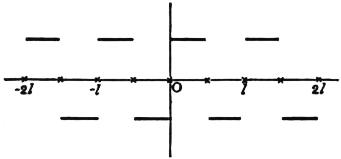
Fig. 1.
We find similarly that the same function is represented by the series
4c ( cos πx − 1 cos 3πx + 1 cos 5πx − + ... )
π l 3 l 5 l
during the interval 0 to l; for general values of x the series represents the ordinate of the broken line in fig. 2, except that it vanishes at the points ½ l, 3⁄2 l ...
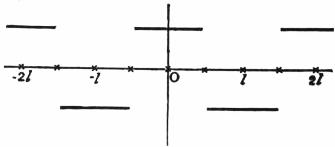
Fig. 2.
(b) Let ƒ(x) = x from 0 to ½ l, and f(x) = l − x, from ½ l to l; then
∫ l 0 ƒ(x) sin nπx dx = ∫ ½ l 0 x sin nπx dx + ∫ l ½ l (l − x) sin nπx dx
l l l
= − l² cos nπ + l² sin nπ + l²n ( cos nπ − cos nπ )
2nπ 2 n²π² 2 nπ 2
+ l² cos nπ − l² cos nπ + l² sin nπ = 2l² sin nπ
nπ 2nπ 2 n²π² 2 n²π² 2
hence the sine series is
4l ( sin nx − 1 sin 3πx + 1 sin 5πx − ... )
π² l 3² l 5²l
For general values of x, the series represents the ordinates of the row of broken lines in fig. 3.
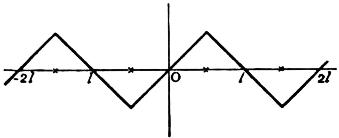
Fig. 3.
The cosine series, which represents the same function for the interval 0 to l, may be found to be
1 l − 2l ( cos 2πx + 1 cos 6πx + 1 cos 10πx + ... )
4 π² l 3² l 5² l
This series represents for general values of x the ordinate of the set of broken lines in fig. 4.
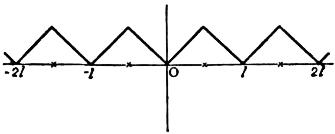
Fig. 4.
Dirichlet’s Integral.—The method indicated by Fourier, but first carried out rigorously by Dirichlet, of proving that, with certain restrictions as to the nature of the function ƒ(x), that function is in general represented by the series (3), consists in finding the sum of n+1 terms of that series, and then investigating the limiting value of the sum, when n is increased indefinitely. It thus appears that the series is convergent, and that the value towards which its sum converges is ½ {ƒ(x + 0) + ƒ(x − 0)}, which is in general equal to ƒ(x). It will be convenient throughout to take −π to π as the given interval; any interval −l to l may be reduced to this by changing x into lx / π, and thus there is no loss of generality.
We find by an elementary process that
½ + cos (x − x′) + cos 2(x − x′) + ... + cos n(x − x′)
= sin ½ (2n + 1) (x′ − x) .
2 sin ½ (x′ − x)
Hence, with the new notation, the sum of the first n+1 terms of (3) is
= ∫ π −π ƒ(x′) sin ½ (2n + 1) (x′ − x) dx′.
2 sin ½ (x′ − x)
If we suppose ƒ(x) to be continued beyond the interval −π to π, in such a way that ƒ(x) = ƒ(x + 2π), we may replace the limits in this integral by x + π, x − π respectively; if we then put x′ − x = 2z, and let ƒ(x′) = F(z), the expression becomes 1/π ∫ π/2 −π/2 F(z) (sin mz) / (sin z) dz, where m = 2n + 1; this expression may be written in the form
1 ∫ π/2 0 F(z) sin mz dz + 1 ∫ π/2 0 F(−z) sin mz dz.
π sin z π sin z
(4)
We require therefore to find the limiting value, when m is indefinitely increased, of ∫ π/2 0 F(z) (sin mz) / (sin z) dz; the form of the second integral being essentially the same. This integral, or rather the slightly more general one ∫ h 0 F(z) (sin mz) / (sin z) dz, when 0 < h ≦ ½π, is known as Dirichlet’s integral. If we write X(z) = F(z) (z / sin z), the integral becomes ∫ h 0 X(z) (sin mz) / z dz, which is the form in which the integral is frequently considered.
The Second Mean-Value Theorem.—The limiting value of Dirichlet’s integral may be conveniently investigated by means of a theorem in the integral calculus known as the second mean-value theorem. Let a, b be two fixed finite numbers such that a < b, and suppose ƒ(x), φ(x) are two functions which have finite and determinate values everywhere in the interval except for a finite number of points; suppose further that the functions ƒ(x), φ(x) are integrable throughout the interval, and that as x increases from a to b the function ƒ(x) is monotone, i.e. either never diminishes or never increases; the theorem is that
∫ b a ƒ(x) φ(x) dx = ƒ(a + 0) ∫ ξ a φ(x) dx + ƒ(b − 0) ∫ b ξ φ(x) dx
when ξ is some point between a and b, and ƒ(a), ƒ(b) may be written for ƒ(a + 0), ƒ(b − 0) unless a or b is a point of discontinuity of the function ƒ(x).
To prove this theorem, we observe that, since the product of two integrable functions is an integrable function, ∫ b a ƒ(x) φ(x) dx exists, and may be regarded as the limit of the sum of a series
ƒ(x0) φ(x0) (x1 − x0) + ƒ(x1) φ(x1) (x2 − x1) + ... + ƒ(xn−1) φ(xn−1) (xn − xn−1)
where x0 = a, xn = b and x1, x2 ... xn−1 are n − 1 intermediate points. We can express φ(xr) (xr+1 − xr) in the form Yr+1 − Yr, by putting
Yr = ΣK=r K=1 φ (xK-1) (xK − xK−1), Y0 = 0.
Writing Xr for ƒ(xr), the series becomes
X0 (Y1 − Y0) + X1 (Y2 − Y1) + ... + Xn−1 (Yn − Yn−1)
or
Y1 (X0 − X1) + Y2 (X1 − X2) + ... + Yn(Xn−1 − Xn) + YnXn.
Now, by supposition, all the numbers Y1, Y2 ... Yn are finite, and all the numbers Xr−1 − Xr are of the same sign, hence by a known algebraical theorem the series is equal to M (X0 − Xn) + YnXn, where M is a number intermediate between the greatest and the least of the numbers Y1, Y2, ... Yn. This remains true however many partial intervals are taken, and therefore, when their number is increased indefinitely, and their breadths are diminished indefinitely according to any law, we have
Y ∫ b a ƒ(x) φ(x) dx = {ƒ(a) − ƒ(b)} M + ƒ(b) ∫ b a φ(x) dx
when M is intermediate between the greatest and least values which ∫ x a φ(x) dx can have, when x is in the given integral. Now this integral is a continuous function of its upper limit x, and therefore there is a value of x in the interval, for which it takes any particular value between the greatest and least values that it has. There is therefore a value ξ between a and b, such that M = ∫ ξ a φ(x) dx, hence
∫ b a ƒ(x) φ(x) dx = {ƒ(a) − ƒ(b)} ∫ ξ a φ(x) dx + ƒ(b) ∫ b a φ(x) dx
= ƒ(a) ∫ ξ a φ(x) dx + ƒ(b) ∫ b ξ φ(x) dx.
If the interval contains any finite numbers of points of discontinuity of ƒ(x) or φ(x), the method of proof still holds good, provided these points are avoided in making the subdivisions; in particular if either of the ends be a point of discontinuity of ƒ(x), we write ƒ(a + 0) or ƒ(b − 0), for ƒ(a) or ƒ(b), it being assumed that these limits exist.
Functions, with Limited Variation.—The condition that ƒ(x), in the mean-value theorem, either never increases or never diminishes as x increases from a to b, places a restriction upon the applications of the theorem. We can, however, show that a function ƒ(x) which is finite and continuous between a and b, except for a finite number of ordinary discontinuities, and which only changes from increasing to diminishing or vice versa, a finite number of times, as x increases from a to b, may be expressed as the difference of two functions ƒ1(x), ƒ2(x), neither of which ever diminishes as x passes from a to b, and that these functions are finite and continuous, except that one or both of them are discontinuous at the points where the given function is discontinuous. Let α, β be two consecutive points at which ƒ(x) is discontinuous, consider any point x1, such that α ≦ x1 ≦ β, and suppose that at the points M1, M2 ... Mr between α and x1, ƒ(x) is a maximum, and at m1, m2 ... mr, it is a minimum; we will suppose, for example, that the ascending order of values is α, M1, m1, M2, m2 ... Mr, mr, x1; it will make no essential difference in the argument if m1 comes before M1, or if Mr immediately precedes x1, Mr−1 being then the last minimum.
Let
ψ(x1) = [ƒ(M1) − ƒ(α + 0)] + [ƒ(M2) − ƒ(m1)] + ... + [ƒ(Mr) − ƒ(mr−1)] + [ƒ(x1) − ƒ(mr)];
now let (x1) increase until it reaches the value (Mr+1) at which ƒ(x) is again a maximum, then let
ψ(x1) = [ƒ(M1) − ƒ(α + 0)] + [ƒ(M2) − ƒ(m1)] + ... + [ƒ(Mr) − ƒ(mr−1)] + [ƒ(Mr+1) − ƒ(mr)];
and suppose as x increases beyond the value Mr+1, ψ(x1) remains constant until the next minimum mr+1 is reached, when it again becomes variable; we see that ψ(x1) is essentially positive and never diminishes as x increases.
Let
χ(x1) = [ƒ(M1) − f(m1)] + [ƒ(M2) − ƒ(m1)] + ... + [ƒ(Mr) − ƒ(mr)],
then let x1 increase until it is beyond the next maximum Mr+1, and then let
χ(x1) = [ƒ(M1) − ƒ(m1)] + [ƒ(M2) − ƒ(m1)] + ... + [ƒ(Mr) − ƒ(mr)] + [ƒ(Mr+1) − ƒ(x1)]
thus χ(x1) never diminishes, and is alternately constant and variable. We see that ψ(x1) − χ(x1) is continuous as x1 increases from α to β, and that ψ(x1) − χ(x1) = ƒ(x1) − ƒ(α + 0), and when x1 reaches β, we have ψ(β) − χ(x1) = ƒ(β − 0) − ƒ(α + 0). Hence it is seen that between α and β, ƒ(x) = [ψ(x) + ƒ(α + 0)] − χ(x), where ψ(x) + ƒ(α + 0), χ(x) are continuous and never diminish as x increases; the same reasoning applies to every continuous portion of ƒ(x), for which the functions ψ(x), χ(x) are formed in the same manner; we now take ƒ1(x) = ψ(x) + ƒ(α + 0) + C, ƒ2(x) = χ(x) + C, where C is constant between consecutive discontinuities, but may have different values in the next interval between discontinuities; the C can be so chosen that neither ƒ1(x) nor ƒ2(x) diminishes as x increases through a value for which ƒ(x) is discontinuous. We thus see that ƒ(x) = ƒ1(x) − ƒ2(x), where ƒ1(x), ƒ2(x) never diminish as x increases from a to b, and are discontinuous only where ƒ(x) is so. The function ƒ(x) is a particular case of a class of functions defined and discussed by Jordan, under the name “functions with limited variation” (fonctions à variation bornée); in general such functions have not necessarily only a finite number of maxima and minima.
Proof of the Convergence of Fourier’s Series.—It will now be assumed that a function ƒ(x) arbitrarily given between the values −π and +π, has the following properties:—
(a) The function is everywhere numerically less than some fixed positive number, and continuous except for a finite number of values of the variable, for which it may be ordinarily discontinuous.
(b) The function only changes from increasing to diminishing or vice versa, a finite number of times within the interval; this is usually expressed by saying that the number of maxima and minima is finite.
These limitations on the nature of the function are known as Dirichlet’s conditions; it follows from them that the function is integrable throughout the interval.
On these assumptions, we can investigate the limiting value of Dirichlet’s integral; it will be necessary to consider only the case of a function F(z) which does not diminish as z increases from 0 to ½ π, since it has been shown that in the general case the difference of two such functions may be taken. The following lemmas will be required:
1. Since
∫ π/2 0 sin mz dz = ∫ π/2 0 {1 + 2cos 2z + 2cos 4z + ... + 2cos 2nz} dz = π ;
sin z 2
this result holds however large the odd integer m may be.
2. If 0 < α < β ≦ π/2,
∫ β α sin mz dz = 1 ∫ γ α sin mz dz + 1 ∫ β γ sin mz dz
sin z sin α sin β
where α < γ < β, hence
| ∫ β α sin mz dz | < 2 ( 1 + 1 ) < 4 ;
sin z m sin α sin β m sin α
a precisely similar proof shows that | ∫ β α (sin mz / z) dz | < 4 / mα, hence the integrals ∫ β α (sin mz / sin z) dz, ∫ β α (sin mz / z) dz, converge to the limit zero, as m is indefinitely increased.
3. If α > 0, | ∫ ∞ α (sin θ / θ) dθ | cannot exceed ½ π. For by the mean-value theorem | ∫ h α (sin θ / θ) dθ | < 2/α + 2/h,
hence | Lh = ∞ ∫ h α (sin θ / θ) dθ | ≦ 2/α
in particular if α ≧ π | ∫ ∞ α (sin θ / θ) dθ | ≦ 2/π < π/2.
Again d/dα ∫ ∞ α (sin θ / θ) dθ = − (sin α) / α, α > 0,
therefore ∫ ∞ α (sin θ / θ) dθ increases as α diminishes, when θ < α < π;
but lim α=0∫ ∞ α (sin θ / θ) dθ = π/2, hence | ∫ ∞ α (sin θ / θ) dθ | < π/2,
where α < π, and < 2/π where α ≧ π. It follows that
| ∫ β α sinθ dθ | ≦ π, provided 0 ≦ α < β.
θ
To find the limit of ∫ π/2 0 F(z) (sin mz / sin z) dz, we observe that it may be written in the form
F(0) ∫ π/2 0 sin mz dz + ∫ μ 0 {F(z) − F(0)} sin mz dz + ∫ π/2 μ {F(z) − F(0)} sin mz dz
sin z sin z sin z
where μ is a fixed number as small as we please; hence if we use lemma (1), and apply the second mean-value theorem,
∫ π/2 0 F(z) sin mz dz − π F(0) = ∫ μ 0 {F(z) − F(0)} z sin mz dz
sin z 2 sin z z
+ {F(μ + 0) − F(0)} ∫ ξ1 μ sin mz dz + [F (½ π − 0) − F(0)] ∫ π/2 ξ1 sin mz dz
sin z sin z
when ξ¹ lies between μ and ½ π. When m is indefinitely increased, the two last integrals have the limit zero in virtue of lemma (2). To evaluate the first integral on the right-hand side, let G(z) = {F(z) − F(0)} (z / sin z), and observe that G(z) increases as z increases from 0 to μ, hence if we apply the mean value theorem
| ∫ μ 0 G(μ) sin mz dz | = | G(μ) ∫ μ ξ sin mz dz | = | G(μ) ∫ mμ mξ sinθ dθ | < πG(μ),
z z θ
where 0 < ξ < μ, since G(z) has the limit zero when z = 0. If ε be an arbitrarily chosen positive number, a fixed value of μ may be so chosen that πG(μ) < ½ ε, and thus that | ∫ μ 0 G(z) (sin mx / z) dz | < ½ ε. When μ has been so fixed, m may now be so chosen that
| ∫ ½ π 0 F(z) sin mz dz − π F(0) | < ε.
sin z 2
It has now been shown that when m is indefinitely increased ∫ π/2 0 F(z) (sin mz / sin z) dz − (π/2) F(0) has the limit zero.
Returning to the form (4), we now see that the limiting value of
1 ∫ π/2 0 F(z) sin mz + 1 ∫ π/2 0 F(−z) sin mz dz is ½ {F(+0) + F(−0)};
π sin z π sin z
hence the sum of n + 1 terms of the series
1 ∫ l −l ƒ(x) dx + 1 Σ ∫ l −l ƒ(x¹) cos nπ(x − x¹) dx
2l l l
converges to the value ½ {ƒ(x + 0) + ƒ(x − 0)}, or to ƒ(x) at a point where ƒ(x) is continuous, provided ƒ(x) satisfies Dirichlet’s conditions for the interval from −l to l.
Proof that Fourier’s Series is in General Uniformly Convergent.—To prove that Fourier’s Series converges uniformly to its sum for all values of x, provided that the immediate neighbourhoods of the points of discontinuity of ƒ(x) are excluded, we have
| ∫ π/2 F(z) sin mz dz − π F(0) | < πG(μ) + 4 {F(μ + 0) − F(0)} + 4 {F(½ π − 0) − F(0)}
sin z 2 m sin μ m sin ξ¹
< πμ {ƒ(x + 2μ) − ƒ(x)} + 4 {ƒ(x + 2μ) − ƒ(x)} + 4 {ƒ(x + π) − ƒ(x)}.
sin μ m sin μ m sin ξ¹
Using this inequality and the corresponding one for F(−z), we have
|S2n+1(x) − ƒ(x)| < μ cosec μ [|ƒ(x + 2μ) − ƒ(x)| + |ƒ(x − 2μ) − ƒ(x)|] + A|m cosec μ,