VOLUME X SLICE VI Foraminifera to Fox, Edward (continued 3)
Reading edition
One conspicuous achievement was the reduction of loss by fires on the national forests. During the unusually dry season of 1905 there were only eight fires of any importance, and the area burned over amounted only to about .16 of 1% of the total area. In 1900 about .12 of 1% was burned. This was accomplished by efficient patrol, co-operation of the public, and by preventive measures, such as piling and burning the brush on cut-over areas.
Since the beginning of 1906 the largest source of income from the national forests was their use for grazing. Stock-raising is one of the most important industries of the West. Formerly cattle and sheep grazed freely on all parts of the public domain. In the early days of the national forests the wisdom of permitting any grazing at all upon them was sharply questioned. Unrestricted grazing had led to friction between individuals, the deterioration of much of the range through overstocking, and serious injury to the forests and stream flow. The forests of the West, however, are largely of open growth and contain many grassy parks, the results of old fires, and many high mountain meadows. Under proper regulations the grass and other forage plants which they produce in great quantity can be used without detriment to the forests themselves, and with great benefit to the stock industry, which often can find summer pasturage nowhere else. Except in southern California grazing is now permitted on all national forests unless the watersheds furnish water for domestic use; but the time of entering and leaving, the number of head to be grazed by each applicant, and the part of the range to be occupied are carefully prescribed. Planted areas and cut-over areas are closed to stock until the young growth is safe from harm, and goats are allowed only in the brushland of the foothills.
The results of regulation, in addition to the protection of forest growth and streams, are the prevention of disputes, improved range, better stock, stable conditions in the stock industry, and the best use of the range in the interest of progress and development. The first right to graze stock on the forests is given to residents, small owners and those who have used the range before. Thus the crowding out of the weaker by the stronger and of the settler by the roving outsider has been stopped. In 1906 the forest service began to impose a moderate charge for the use of the national forest range. The following statement shows the amount of stock grazed on the national forests 1904-09, and the receipts for the grazing charge:—
Year. Number of Cattle and Horses. Number of Sheep and Goats. Receipts.
$
1904 610,091 1,806,722 · ·
1905 692,124 1,709,987 · ·
1906 1,015,148 5,763,100 514,692.87
1907 1,200,158 6,657,083 863,920.32
1909 1,581,404 7,819,594 1,032,185.70
A work of enormous magnitude which has now begun is planting on the national forests. At present, with low stumpage prices and incomplete utilization of forest products, clear cutting with subsequent planting is not practicable. There are, however, many million acres of denuded land within the national forests which require planting. Such planting is still confined chiefly to watersheds which supply cities and towns with water. The first planting was done in 1892, in California. Since then similar work has been done on city watersheds in Colorado, Utah, Idaho and New Mexico. Other plantations are in the Black Hills national forest, where large areas of cut-over and burned-over land are entirely without seed trees, and in the sandhill region of Nebraska. Up to 1908 about 2,000,000 seedlings had been planted, on over 2000 acres—a small beginning, but the work was entirely new and presented many hard problems.
The nursery operations of the forest service are concentrated at seven stations, located in southern California, Nebraska, Colorado, New Mexico (2), Utah and Idaho, where stock is raised for local planting and for shipment elsewhere. These nurseries are small. Their annual productive capacity is between 8,000,000 and 10,000,000 seedlings. Each nursery is practically an experimental forest-planting station, at which a large variety of species are grown and various methods are tried.
The organization of the administrative work of the national forests is by single forests. On the 1st of January 1908 the total number of forests was 165 with a total area of 162,023,190 acres (on April 7, 1909, the numbers were 146 national forests in the U.S. with 167,672,467 acres, besides two in Alaska with 26,761,626 and one in Porto Rico with 65,950 acres). In charge of each forest is a forest supervisor. Under the supervisors are forest rangers and forest guards, whose duties include patrol, marking timber and scaling logs, enforcing the regulations and conducting some of the minor business arising from the use of the forests. Guards are temporary employés; rangers are employed by the year. The supervisors report directly to and receive instructions from the central office at Washington. In this office there are four branches—operation, grazing, silviculture and products—each of which directs that part of the work which belongs to it, dealing directly with the supervisor. For inspection purposes, however, the forests are separated into six districts, in each of which is located a chief inspector with a corps of assistants. The inspectors are without administrative authority, but assist by their counsel the supervisors, and through inspection reports keep the Washington office informed of the condition of all lines of administrative work in progress. Administrative officers alternate frequently between field and office duties.
The number of forest officers in the several grades on the 1st of January 1908 were: 6 chief inspectors, 26 inspectors, 106 forest supervisors, 41 deputy forest supervisors, 820 forest rangers and 283 forest guards. The total number of employés of the forest service on the same date, including the clerical force, was 2034.
Besides the administration of the national forests, the forest service conducts general investigations, carries on an extensive educational work, and co-operates with private owners who contemplate forest management upon their own tracts. This last work is undertaken because of the need of bringing forestry into practice, the lack of trained foresters outside of the employ of the government, and the lack of information as to how to apply forestry and what returns may be obtained. Co-operation takes the form of advice upon the ground and, on occasion, of the making of working plans. The educational work of the service is performed chiefly through publications, the purpose of which is to spread very widely a knowledge of the importance of forestry to the nation and of the principles upon which its practice rests. The investigations which the service conducts extend from studies of the natural distribution and classification of American forests and of their varied silvicultural problems to statistics of lumber production and laboratory researches which bear upon the economical utilization of forest products. As examples of these researches may be mentioned tests of the strength of timber, studies of the preservative treatment of wood for various uses, wood-pulp investigations and studies in wood chemistry.
Forest Instruction.—Most of the men now in the forest service received their training in the United States. There are several professional schools of forestry. The Yale Forest School, which was opened as a department of Yale University in September 1900, offers a two-years’ graduate course with abundant field work, and also conducts a summer school of forestry, especially adapted to the training of forest rangers and special students, at Milford, Pennsylvania. The university of Michigan and Harvard University also offer a two-years’ graduate course in forestry. The Pennsylvania State College has recently established a four-years’ undergraduate course in forestry. The Biltmore Forest School in North Carolina, the oldest of all these schools, offers a one-year course in technical forestry. A large number of the agricultural colleges give instruction in forestry. Among these are Nebraska, Minnesota, Maine, Michigan, Washington and Mississippi agricultural colleges, the university of Georgia and Iowa State College. Berea College, Kentucky, deserves special mention as a college which has done valuable work in teaching forestry without attempting to turn out professional foresters.
Forestry among the States.—Among the states forestry has hardly reached the stage of practical application on the ground. New York holds 1,500,000 acres of forest land. It has a commission to care for its forest preserve, and to protect the forest land throughout the state from fire. The constitution of the state, however, prohibits the cutting of timber on state land, and thus confines the work entirely to protection of the forest and to the planting of waste areas. Pennsylvania is at present showing the most efficient activity in working out a forest policy. It has state forests of 820,000 acres, a good fire law more and more satisfactorily enforced, and eight nurseries for growing planting material. In 1905, 160,000 white pine seedlings were set out. It has also a school for forest rangers, to be employed on the state forests, and it has just established a state professional school of forestry.
Twenty-six of the states have regularly appointed forest officers, six have carried on studies of forest conditions in co-operation with the forest service, and there is scarcely one which is not actively interested in forestry. Laws, generally good, to prevent damage from forest fires, have been enacted by practically all the states, but their enforcement has unfortunately been lax. Public sentiment, however, is making rapid progress. Among the best laws are those of Maine, New Hampshire, Minnesota, New York, Pennsylvania and Wisconsin. The New York law, for example, provides for the appointment of one or more fire-wardens in each town of the counties in which damage by fire is especially to be feared. In other counties supervisors of towns are ex-officio fire-wardens. A chief fire-warden has general supervision of their work. The wardens, half of the cost of whose services is paid by the state, receive compensation only for the time actually employed in fighting fires. They may command the service of any citizen to assist them. Setting fire to woods or waste lands belonging to the state or to another, if such fire results in loss, is punishable by a fine not exceeding $250 or imprisonment not exceeding one year, or both, and damages are provided for the person injured. Since fire is beyond question the most dangerous enemy of forests in the United States, the measures taken against it are of vital importance.
The following table shows the amount of forest land held by the different states, and by the territory of Hawaii:—
Area of State Forest Reservations, 1907.
Connecticut 1,360 acres
Hawaii 117,532 ”
Indiana 2,000 ”
Maryland 3,540 ”
Michigan 39,000 ”
Minnesota 42,800 ”
New Jersey 2,474 ”
New York 1,439,998 ”
Pennsylvania 820,000 ”
Wisconsin 254,072 ”
Forestry on Private Lands.—The practice of forestry among private owners is of old date. One of the earliest instances was that of Jared Eliot, who, in 1730, began the systematic cutting of timber land to supply charcoal for an iron furnace at Old Salisbury, Connecticut. The successful planting of waste lands with timber trees in Massachusetts dates from about ten years later. But such examples were comparatively rare until recent times. At present the intelligent harvesting of timber with a view to successive crops, which is forestry, is much more common than is usually supposed. Among farmers it is especially frequent. It was begun among lumbermen by the late E.S. Coe, of Bangor, Maine, who made a practice of restricting the cut of spruce from his forests to trees 10, 12 or sometimes even 14 in. in diameter, with the result that much of his land yielded, during his life, a second crop as plentiful as the first. Many owners of spruce lands have followed his example, but until very recently without improving upon it. Systematic forestry on a large scale among lumbermen was begun in the Adirondacks during the summer of 1898 on the lands of Dr W.S. Webb and Hon. W.C. Whitney, of a combined area of over 100,000 acres, under the superintendence of the then Division of Forestry. In these forests spruce, maple, beech and birch predominate, but the spruce alone is at present of the first commercial importance. The treatment is a form of the selection system. Under it a second crop of equal yield would be ripe for the axe in thirty-five years. Spruce and pine are the only trees cut. The work had been executed, at least up to the year 1902, with great satisfaction to the owners and the lumbering contractors, as well as to the decided benefit of the forest. The lumbering is regulated by the following rules, and competent inspectors are employed to see that they are rightly carried out: (1) No trees shall be cut which are not marked. (2) All trees marked shall be cut. (3) No trees shall be left lodged in the woods, and none shall be overlooked by the skidders or haulers. (4) All merchantable logs which are as large as 6 in. in diameter at the small end must be utilized. (5) No stumps shall be cut more than 6 in. higher than the stump is wide. (6) No spruce shall be used for bridges, corduroy, skids, slides, or for any purpose except building camps, dams or booms, unless it is absolutely necessary on account of lack of other timber. (7) All merchantable spruce used for skidways must be cut into logs and hauled out. (8) Contractors must not do any unnecessary damage to young growth in lumbering; and if any is done, they must discharge the men who did it.
These two instances of forestry have been most useful and effective among lumbermen and other owners of forest land in the north-east. Among those which have followed their example are the Berlin Mills Paper Company in northern New Hampshire, the Cleveland Cliffs Iron Company in northern Michigan, and the Delaware and Hudson Railroad Company in New York, all of which have employed professional foresters.
The most notable instance of forestry in the south is on the estate of George W. Vanderbilt at Biltmore, N.C. This was the first case of systematic forestry under regular working plans in the United States. It was begun in 1891 on about 4000 acres, and has since been extended until it now covers about 100,000 acres. A professional forester with a corps of trained rangers under him is in charge of the work. The Pennsylvania Railroad has recently employed a trained forester and several assistants and has undertaken systematic forestry on a large scale.
The effect of the work of the forest service in assisting private owners is evidenced by the fact that down to the year 1908 670 wood lots and timber tracts had been examined by agents of the forest service, of which 250 were tracts over 400 acres in extent, and planting plans had been made for 436 owners covering a total area of 80,000 acres. Expert advice is also given to wood lot owners upon application by many of the state foresters.
American Practice.—The conditions under which forestry is practised in Europe and in America differ so widely that rules which are received as axiomatic in the one must often be rejected in the other. Among these conditions in America are the highly developed and specialized methods and machinery of lumbering, the greater facilities for transportation and consequent greater mobility of the lumber trade, the vast number of small holdings of forest land, and the enormous supply of low-grade wood in the timbered regions. High taxes on forest properties, cut-over as well as virgin, notably in the north-western pineries, and the firmly established habits of lumbermen, are factors of great importance. From these and other considerations it follows that such generally accepted essentials of European methods of forestry as a sustained annual yield, a permanent force of forest labourers, a permanent road system and the like, are in most cases utterly inapplicable in the United States at the present day in private forestry. Methods of forest management, to find acceptance, must there conform as closely as possible to existing methods of lumbering. Rules of marked simplicity, the observance of which will yet secure the safety of the forest, must open the way for more refined methods in the future. For the present a periodic or irregular yield, temporary means of transport, constantly changing crews, and an almost total ignorance of the silvics of all but a few of the most important trees—all combine to enforce the simplest silvicultural treatment and the utmost concentration of purpose on the two main objects of forestry, which are the production of a net revenue and the perpetuation of the forest. Such concentration has been followed in practice by complete success.
The forests with which the American forester deals are rich in species, usually endowed with abundant powers of reproduction, and, over a large part of their range, greatly dependent for their composition and general character upon the action of forest fires. Of the commercially valuable trees there may be said to be, in round numbers, a hundred out of a total forest flora of about 500 species, but many trees not yet of importance in the lumber trade will become so hereafter, as has already happened in many cases. The attention of the forester must usually be concentrated upon the growth and reproduction of a single species, and never of more than a very few. Thus the silvicultural problems which must be solved in the practice of forestry in America are fortunately less complicated than the presence of so many kinds of trees in forests of such diverse types would naturally seem to indicate.
The forest fire problem is one of the most difficult with which the American forester has to deal. It is probable that forest fires have had more to do with the character and distribution of forests in America than any other factor except rainfall. With an annual range over thousands of square miles, in many portions of the United States they occur regularly year after year on the same ground. Trees whose thick bark or abundant seeding gives them peculiar powers of resistance, frequently owe their exclusive possessions of vast areas purely to the action of fire. On the economic side fire is equally influential. The probability, or often the practical certainty, of fire after the first cut, commonly determines lumbermen to leave no merchantable tree standing. Forest fires are thus the most effective barriers to the introduction of forestry. Excessive taxation of timber land is another of almost equal effect. Because of it lumbermen hasten to cut, and afterwards often to abandon, lands which they cannot afford to hold. This evil, which only the progress of public sentiment can control, is especially prevalent in certain portions of the white pine belt.
Forest Associations.—Public sentiment in favour of the protection of forests is now widespread and increasingly effective throughout the United States. As the general understanding of the objects and methods of forestry becomes clearer, the tendency, formerly very marked, to confound ornamental tree planting and botanical matters with forestry proper is rapidly growing less. At the same time, the number and activity of associations dealing with forest matters is increasing with notable rapidity. There are now about thirty such associations in the United States. One of these, the Society of American Foresters, is composed exclusively of professional foresters. The American Forestry Association is the oldest and largest. It has been influential in preparing the ground work of popular interest in forestry, and especially in advocating and securing the adoption of the federal forest reservation policy, the most important step yet taken by the national government. It publishes as its organ a monthly magazine called Forestry and Irrigation. The Pennsylvania Forestry Association has been instrumental in placing that state in the forefront of forest progress. Its organ is a bi-monthly publication called Forest Leaves. Other states which have associations or societies of special influence in forest matters are California, Massachusetts, Minnesota, Colorado, New Hampshire, Georgia and Oregon. Arbor Day, instituted in Nebraska in 1872 as a day for shade-tree planting by farmers who had settled on the treeless prairies, has been taken up as a means of interesting school children in the planting of trees, and has spread until it is now observed in every state and territory. It continues to serve an admirable purpose.
Lumbering.—According to the census report for 1905 the capital invested in logging operations in the United States was $90,454,596, the number of employés engaged 146,596, and their wages $66,990,000; sawmills represented an invested capital of $381,621,000, and employed 223,674 persons, whose wages were $100,311,000, while planing mills represented a capital of $222,294,000 and employed 132,030 persons whose wages were $66,434,000.
Product. Output 1906. Equivalent Wood Volume. Estimated Woods Waste.3 Estimated Mill Waste.4 Total Wood Volume Consumed.
Million cub. ft. Million cub. ft. Million cub. ft. Million cub. ft.
Lumber—
Conifers 30,200,000 thousand bd. ft. 2517 1173 2170 5860
Hardwoods 7,300,000 thousand bd. ft. 612 577 461 1650
Shingles 11,900,000 thousand bd. ft. 107 54 109 270
Pulpwood 2,900,000 cords 261 79 · · 340
Wood distillation 1,200,000 cords 108 12 · · 120
Heading 146,000,000 sets 32 33 45 110
Staves—
Tight cooperage 267,000,000 22 36 32 90
Slack cooperage 1,097,000,000 27 22 21 70
Poles 3,500,000 35 15 · · 50
Veneer 300,000 thousand bd. ft. 50 30 · · 80
Round mine timbers 165,000,000 cub. ft. 165 35 · · 200
Hewn cross ties 77,500,000 207 503 · · 710
4143 2569 2838 9550
All the operations of the lumber trade in the United States are controlled, and to no small degree determined, by the peculiar unit of measure which has been adopted. This unit, the board-foot, is generally defined as a board one foot long, one foot wide and one inch thick, but in reality it is equivalent to 144 cub. in. of manufactured lumber in any form. To purchase logs by this measure one must first know about what each log will yield in one-inch boards. For this purpose a scale or table is used, which gives the contents of logs of various diameters and lengths in board feet. Under such a standard the purchaser pays for nothing but the saleable lumber in each log, the inevitable waste in slabs and sawdust costing him nothing.
The table at foot gives the estimated consumption of wood for certain purposes in the United States in 1906.
In addition to this amount, an immense quantity of wood is used each year for fuel, posts and other domestic purposes, and the total annual consumption is not less than 20 billion cub. ft.
The years 1890 to 1906 were marked by rapid changes in the rank of the important timber trees with reference to the amount of timber cut, and a shifting of the important centres of production. Among coniferous trees, white pine has yielded successively to yellow pine and Douglas fir, while the scene of greatest activity has shifted from the Northern forest to the Southern, and from there is rapidly shifting to the Pacific Coast. The total cut of coniferous lumber has increased steadily, but that of the hardwoods is falling off, and in 1906 it was 15% less than in 1899, while inferior hardwoods are gradually assuming more and more importance, and the scene of greatest activity has passed from the middle west to the south and the Appalachian region.
Conifers.—The coniferous supply of the country is derived from four forest regions: (1) The Northern forest; (2) the Southern forest; (3) the Pacific Coast forest; and (4) the Rocky Mountain forest.
1. The Northern forest was long the chief source of the coniferous lumber production in the United States. The principal timber tree of this region is the white pine, usually known in Europe as the Weymouth pine. It has an average height when mature of 110 ft., with a diameter a little less than 3 ft., but the virgin timber is approaching exhaustion. White pine was one of the first trees to be cut extensively in the United States, and Maine, the pine tree state, was at first the centre of production. In 1851 the cut of white pine on the Penobscot river was 144 million ft., that of spruce 14 million and of hemlock 11 million. Thirty years later the pine cut had sunk to 23 million, spruce had risen to 118 million, and hemlock had passed pine by a million feet. Meanwhile, the centre of production had passed from the north woods to the Lake States, and for many years this region was the scene of the most vigorous lumbering activity in the world. The following figures show the cut for the Lake States from 1873 to 1906. It is certain that the remarkable decline in the cut of white pine which these figures show will continue still farther.
1873 3,993,780,000 1890 8,597,659,352
1874 3,751,306,000 1891 7,879,948,349
1875 3,968,553,000 1892 8,594,222,802
1876 3,879,046,000 1893 7,326,263,782
1877 3,595,333,496 1894 6,821,516,412
1878 3,629,472,759 1895 7,050,669,235
1879 4,806,943,000 1896 5,725,763,035
1880 5,651,295,000 1897 6,233,454,000
1881 6,768,856,749 1898 6,155,300,000
1882 7,552,150,744 1899 6,056,508,000
1883 7,624,789,786 1900 5,485,261,000
1884 7,935,033,054 1901 5,336,000,000
1885 7,053,094,555 1902 5,294,000,000
1886 7,425,368,443 1903 4,792,000,000
1887 7,757,916,784 1904 4,220,000,000
1888 8,388,716,460 1905 3,777,000,000
1889 8,183,050,755 1906 3,032,000,000
Second to the white pine among the coniferous lumber trees of the Northern forest is the hemlock (Tsuga canadensis). It is used chiefly for construction purposes and furnishes a comparatively low grade of lumber.
The spruce (Picea rubens) is used chiefly for lumber, but it is in large and increasing demand in the manufacture of paper pulp. For the latter purpose hemlock, poplar (Populus tremuloides and P. grandidentata) and several other woods are also employed, but on a smaller scale. The total consumption of wood for paper in the United States for 1906 was 3,660,000 cords, of which 2,500,000 was spruce. Of this, however, 720,000 cords were imported from Canada.
2. The chief product of the Southern forest is the yellow pine. This is the collective term for the longleaf, shortleaf, loblolly and Cuban pines. Of these the longleaf pine (Pinus palustris Mill.), called pitch-pine in Europe, is the most important. Its timber is probably superior in strength and durability to that of any other member of the genus Pinus, and in addition to its value as a timber tree it is the source of naval stores in the United States. The average size of the mature longleaf pine is 90 ft. in height and 20 in. in diameter. Shortleaf (Pinus echinata) and loblolly (P. taeda) are other important members of this group. Their wood very closely resembles that of the longleaf pine and is often difficult to distinguish from it. The trees are also of about the same size and height. Loblolly is, however, of more rapid growth. The total cut of yellow pine in 1906 was 11,661,000,000 board ft.; it has perhaps not yet reached its maximum, but is certainly near it.
Another important coniferous tree of the Southern forest is the bald cypress (Taxodium distichum), which grows in the swamps. The cut in 1906 was 839,000,000 board ft., a gain of 69% over 1899.
3. But the great supply of coniferous timber is now on the Pacific Coast. The Douglas fir (Pseudotsuga taxifolia), also known as Douglas spruce, red fir and Oregon pine, is the foremost tree in Oregon and Washington, and the redwood in California. When mature the Douglas fir averages 200 ft. in height and 4 ft. in diameter, and the redwood 225 ft. in height and 8 ft. in diameter. Other important trees of the Pacific Coast are sugar pine (Pinus lambertiana), western red cedar (Thuja plicata), western larch (Larix occidentalis), Sitka spruce (Picea sitchensis), western hemlock (Tsuga heterophylla) and western yellow pine (Pinus ponderosa). These trees will all be of increasing importance.
Logging on the Pacific Coast is characterized by the use of powerful machinery and by extreme skill in handling enormous weights. This is especially true in California, where the logs of redwood and of the big tree (Sequoia Washingtoniana) are often more than 10 ft. in diameter. Logging is usually done by wire cables operated by donkey-engines. The journey to the mill is usually by rail. The mills are often of great size, built on piles over tide water and so arranged that their product is delivered directly from the saws and dry kilns to vessels moored alongside. The products of the Pacific Coast forest make their way over land to the markets of the central and eastern states and into foreign markets. Among the lumber-producing states, Washington has in seven years jumped from fifth place to first, and its output has increased from 1,428,000,000 board ft. in 1899 to 4,305,000,000 ft. in 1906. Oregon and California have increased their output from 734,000,000 each in 1899 to 1,605,000,000 and 1,349,000,000 ft. respectively in 1906. Of the total output of these three states (7,259,000,000 ft.) 4,880,000,000 ft. is Douglas fir and 660,000,000 redwood.
4. The important lumber trees of the Rocky Mountain forest are the western yellow pine, the lodgepole pine, the Douglas fir and the Engelmann spruce. The Douglas fir, here extremely variable in size and value, reaches in this region average dimensions of perhaps 80 ft. in height by 2 ft. in diameter, the western yellow pine 90 ft. by 3 ft. and the Engelmann spruce 60 ft. by 2 ft. Mining, railroad and domestic uses chiefly absorb the annual timber product, which is considerable in quantity, and of vast importance to the local population. The lumber output of the Rocky Mountain region is, however, increasing very rapidly both in the north and in the south-west. One of the largest mills in the United States is in Idaho.
The following table summarizes the cut of the important coniferous species during the years 1899-1906:
Kind. 1899. 1904. 1906. Per Cent Increase (+) or Decrease (−) since 1899.
Million ft. Million ft. Million ft.
Yellow Pine 9,659 11,533 11,661 + 20.7
Douglas Fir 1,737 2,928 4,970 + 186.2
White Pine 7,742 5,333 4,584 − 40.8
Hemlock 3,421 3,269 3,537 + 3.4
Spruce 1,448 1,304 1,645 + 13.6
Western Pine 944 1,279 1,387 + 46.9
Cypress 496 750 839 + 69.3
Redwood 360 519 683 + 83.2
Cedar 233 223 358 + 53.7
26,040 27,138 29,664 + 14
Hardwoods.—The hardwood supply of the country is derived almost entirely from the eastern half of the continent, and comes from each of the three great Eastern forest regions.
The following table shows the cut of the important species of hardwoods for 1899 and 1906:
Kind. 1899. 1906. Per Cent Increase (+) or Decrease (−).
Thousand Feet. Thousand Feet.
Oak 4,438,027 2,820,393 − 36.5
Maple 633,466 882,878 + 39.4
Poplar 1,115,242 693,076 − 37.9
Red gum 285,417 453,678 + 59.0
Chestnut 206,688 407,379 + 97.1
Basswood 308,069 376,838 + 22.3
Birch 132,601 370,432 + 179.4
Cottonwood 415,124 263,996 − 36.4
Beech (a) 275,661 · ·
Elm 456,731 224,795 − 50.8
Ash 269,120 214,460 − 20.8
Hickory 96,636 148,212 + 53.4
Tupelo (a) 47,882 · ·
Walnut 38,681 48,174 + 24.5
Sycamore 29,715 (a) · ·
All other 208,504 87,637 − 58.0
Total 8,634,021 7,315,491 − 15.3
a Not separately reported.
Oak, which in 1899 furnished over half the entire output, has fallen off 36.5%. Yellow poplar, which in 1899 was second among the hardwoods, has fallen off 38% and now occupies third place; and elm, the great stand-by in slack cooperage, has fallen 50.8%. On the other hand less valuable species like maple and red gum have advanced 39 and 59% respectively.
The decrease is largely due to the fact that the hardwoods grow naturally on the better classes of soil, and in the eastern United States where the population has always been the densest, and as a consequence of this, a large proportion of the original hardwood land has been cleared up and put under cultivation. The hardwood supply of the future must be obtained chiefly from the Appalachian region, where the conditions are less favourable to agriculture.
In addition to the lumber cut, enormous quantities of hardwoods are used each year for railroad ties, telephone and other poles, piles, fence posts and fuel, and there is a great amount of waste in the course of lumbering and manufacture.
Authorities.—Sargent, Silva of North America (Boston, 1891-1897), Manual of Trees of North America (Boston, 1903); Lemmon, Handbook of West American Cone-Bearers (San Francisco, 1895); Bruncken, North American Forests and Forestry (New York, 1900); Fernow, Economics of Forestry (New York, 1902); Pinchot, The Adirondack Spruce (New York, 1898); Pinchot and Graves, The White Pine (New York, 1896). See also the various publications of the U.S. forest service, including especially the following general works: Forest Influences; Primer of Forestry; the Timber Supply of the United States; the Waning Hardwood Supply; Forest Products of the United States in 1906; Exports and Imports of Forest Products in 1906; Federal and State Forest Laws; Regulations and Instructions for the Use of the National Forests; The Use of the National Forests; also part v. of the Nineteenth and of the Twenty-first Annual Reports of the United States Geological Survey, and vol. ix. of the 10th Census Report on the Forests of North America; and Reports of the State Forestry Commissions of New York, New Hampshire, Maine, Pennsylvania, Michigan, Ohio, &c., and of the State Geological Surveys of New Jersey, Maryland and North Carolina.
(G. P.)
1 The United States fiscal year ends June 30, and receives its designation from the calendar year in which it terminates. Thus, the fiscal year 1898 is the year July 1, 1897-June 30, 1898.
2 Administration transferred to Bureau of Forestry, February 1, 1905.
3 Woods waste includes tops, stumps, cull logs and butts, but does not include defective trees left or trees used for road purposes.
4 Mill waste includes bark, kerf, slabs and edgings.
FOREY, ÉLIE FRÉDÉRIC (1804-1872), marshal of France, was born at Paris on the 5th of January 1804, and entered the army from St Cyr in 1824. He took part in the earlier Algerian campaigns, and became captain in 1835. Four years later he was given command of a battalion of chasseurs à pied and in 1844 he became colonel. At the Revolution of 1848 Cavaignac made him a general of brigade. He took an active part in the coup d’état of the 2nd of December 1851, and Napoleon III. made him a general of division shortly afterwards. He held a superior command in the Crimean War, and in the Italian campaign of 1859 distinguished himself very greatly in the action of Montebello (20th May). In 1862 Forey was placed in command of the French expeditionary corps in Mexico, with the fullest civil and military powers, and he crowned a successful campaign by the capture of Mexico city in May 1863, receiving as his reward the marshal’s bâton. From December 1863 to 1867 he held high commands in France, but in the latter year he was struck with paralysis and had to retire. Marshal Forey died at Paris on the 20th of June 1872.
FORFAR, a royal, municipal and police burgh, and capital of the county of Forfarshire, Scotland. Pop. (1901) 12,117. It lies at the east end of the Loch of Forfar in the valley of Strathmore, and is 13 m. N. by E. of Dundee by road and 21¼ m. by the Caledonian railway. It is also situated on the same company’s main line to Aberdeen and sends off a branch to Brechin. The principal buildings comprise the court house, the county hall (with portraits by Raeburn, Romney, Opie and others), the town hall, the Meffan Institute (including the free library), the infirmary, poorhouse and the Reid hall, founded by Peter Reid, a merchant in the burgh who also gave the public park. The burgh unites with Montrose, Arbroath, Brechin and Inverbervie (the Montrose group of burghs) in returning one member to parliament. The Loch of Forfar, 1¼ m. long by ¼ m. wide, is drained by Dean Burn, and contains pike and perch. On a gravel bank or spit in the north-west of the lake stood a castle which was sometimes used as a residence by Margaret, queen of Malcolm Canmore. The staple industries are linen and jute manufactures, but brewing, tanning, bleaching, rope-making and iron-founding are also carried on.
Forfar is at least as old as the time of Malcolm Canmore, for the first parliament after the defeat of Macbeth met in the old castle, which stood on a mound on the northern side of the town. The parliaments of William the Lion, Alexander II. and Robert II. also assembled within its walls. The town, which was created a royal burgh by David I., was burnt down about the middle of the 13th century. Edward I. captured the castle on one of his incursions, but in 1307 Robert Bruce seized it, put its defenders to the sword and then destroyed it, its site being now marked by the town cross. Previous to the reign of James VI. the weekly market was held on Sunday, but after the union of the crowns parliament enacted that it should be held on Friday. The town sided with Charles I. during the Civil War, and Charles II. presented the Cross to it out of regard for the loyalty shown to his father. Forfar seems to have played a less reputable part in the persecution of witches. In 1661 a crown commission was issued for the trial of certain miserable creatures, some of whom were condemned to be burnt. In the same year one John Ford for his services as a witch-finder was admitted a burgess along with Lord Kinghorne. The witches’ bridle, a gag to prevent them from speaking whilst being led to execution, is still preserved in the county hall. One mile to the E. lie the ruins of Restennet Priory, where a son of Robert Bruce was buried. For twenty five years after the Reformation it was used as the parish church and afterwards by the Episcopalians, until they obtained a chapel of their own in 1822.
FORFARSHIRE, or Angus, an eastern county of Scotland, bounded N. by the shires of Kincardine and Aberdeen, W. by Perthshire, S. by the Firth of Tay and E. by the North Sea. It has an area of 559,171 acres, or 873.7 sq. m. The island of Rossie and the Bell Rock belong to the shire.
Forfarshire is characterized by great variety of surface and may be divided physically into four well-marked sections. In the most northerly of these many of the rugged masses of the Grampians are found; this belt is succeeded by Strathmore, or the Howe of Angus, a fertile valley, from 6 to 8 m. broad, which is a continuation of the Howe of the Mearns, and runs south-westwards till it enters Strathearn, to the south-west of Perth; then come the Sidlaw Hills and a number of isolated heights, which in turn give way to the plain of the coast and the Firth. The mountains are all in the northern division and belong to the Binchinnin group (sometimes rather inexactly called the Braes of Angus) of the Grampian ranges. Among the highest masses, most of which lie on or near the confines of the bordering counties, are Glas Maol(3502 ft.), on the summit of which the shires of Aberdeen, Forfar and Perth meet, Cairn-na-Glasha (3484), Fafernie (3274), Broad Cairn (3268), Creag Leacach (3238), Tolmount (3143), Tom Buidhe (3140), Driesh (3105), Mount Keen (3077) and Mayar (3043), while peaks of upwards of 2000 ft. are numerous. The Sidlaw Hills—the greater part of which, however, belongs to Perthshire—are much less lofty and of less striking appearance. They have a breadth of from 3 to 6 m., the highest points within the county being Craigowl Hill (1493 ft.), Auchterhouse Hill (1399) and Gallow Hill (1242). None of the rivers is navigable, and only three are of any importance. The Isla, rising in Cairn-na-Glasha, flows southwards, then turns S.E. and finally S.W. till it enters the Tay after a course of 45 m. Its chief tributaries on the right are the Alyth, Ericht and Lunan, and on the left the Newton, Melgam and Dean. Near Bridge of Craig is the fall of Reekie Linn (70 ft.), so named from the fact that when the stream is in flood the spray rises in a dense cloud like smoke (reek). Near old Airlie Castle are the cascades called the Slugs of Auchrannie. The North Esk, formed by the confluence of the Lee and Mark at Invermark, after a south-easterly course of 28 m. enters the North Sea 3 m. N. of Montrose. On the right bank it receives the West Water and Cruick and on the left the Tarf and Luther. It gives the title of earl of Northesk to a branch of the Carnegie family. The South Esk rises in the Grampians near Mount Fafernie and not far from its source forms the Falls of Bachnagairn; after flowing towards the south-east, it bends eastwards near Tannadice and reaches the North Sea at Montrose, the length of its course being 48 m. Its principal affluents are the Prosen on the right and the Noran on the left. It supplies the title of earl of Southesk to another branch of the Carnegies. The lakes are small, the two largest being the Loch of Forfar and the mountain-girt Loch Lee (1 m. long by ¼ m. wide). Lintrathen (circular in shape and about ¾ m. across), to the north of Airlie Castle, supplies Dundee with drinking water. The glens of the Forfarshire Grampians are remarkable for their beauty, and several of them for the wealth of their botanical specimens. The largest and finest of them are Glen Isla, in which are the ruins of Forter Castle, destroyed by Argyll in 1640, and the earl of Airlie’s shooting-lodge of the Tulchan; Glen Clova, near the entrance to which stands Cortachy Castle, the seat of the earl of Airlie; Glen Esk and Glen Prosen.
Geology.—A great earth fracture traverses this county from near Edzell on the N.E. to Lintrathen Loch on the S.W. Between Cortachy and the south-western boundary this fault runs in Old Red Sandstone, but north-east of that place it forms the junction line of Silurian and Old Red; and in a general way we may say that on the N.W. side of the fault the metamorphosed Silurian rocks are found, while the remainder of the county is occupied by the Old Red Sandstone. On the margin of the disturbance the Silurian rocks are little-altered grey and green clay slates with bands of pebbly grit; farther towards the N.W. we find the same rocks metamorphosed into mica schists and gneisses with pebbly quartzites. Rising up through the schists between Carn Bannock and Mount Battock is a great mass of granite. The Old Red Sandstone extends from this county into Perthshire and Kincardineshire; here some 20,000 ft. of these deposits are seen; an important part being formed of volcanic tuffs and lavas which are regularly interbedded in the sandstones and conglomerates. North of Dundee some of the lower beds are traversed by intrusive dolerites, and Dundee Law is probably the remains of an old vent through which some of the contemporaneous lavas, &c., were discharged. The Old Red Rocks have been subjected to a good deal of folding, as may be seen along the coast. The principal direction of strike is from N.E. to S.W. A synclinal fold occupies Strathmore, and between Longforgan and Montrose the northern extension of the Sidlaw Hills is an anticlinal fold. Two fish-bearing beds occur in the county; from the lower one many large Eurypterids have been obtained. The well-known paving flags of Arbroath belong to the lower part of the formation. The Upper Old Red Sandstone is found only in one spot about a mile north of Arbroath. During the Glacial period the ice travelled south-eastward across Strathmore and over the Sidlaw Hills; abundant evidence of this transporting agent is to be seen in the form of morainic deposits, the most striking of which is the great transverse barrier of Glenairn in the valley of the S. Esk, half a mile in length and about 200 ft. high. Relics of the same period are found round the coast in the form of raised beaches at 100, 50 and 25 ft. above the present sea-level.
Climate and Agriculture.—On the whole the climate is healthy and favourable to agricultural pursuits. The mean temperature for the year is 47.3° F., for January 38° and for July 59°. The average annual rainfall is 34 in., the coast being considerably drier than the uplands. In the low-lying districts of the south the harvest is nearly as early as it is in the rest of Scotland, but in the north it is often late. The principal wheat districts are Strathmore and the neighbourhood of Dundee and Arbroath; and the yield is well up to the best Scottish average. Barley, an important crop, has increased steadily. Oats, however, though still the leading crop, have somewhat declined. Potatoes are mostly grown near the seaboard in the higher ground; turnips also are largely raised. The northern belt, where it is not waste land, has been turned into sheep walks and deer forests. The black-faced sheep are the most common in the mountainous country; cross-bred sheep in the lowlands. Though it is their native county (where they date from 1808), polled Angus are not reared so generally as in the neighbouring shire of Aberdeen, but shorthorns are a favourite stock and Irish cattle are imported for winter-feeding. Excepting in the vicinity of the towns there are no dairy farms. Horses are raised successfully, Clydesdales being the commonest breed, but the small native garrons are now little used. Pigs also are reared. Save perhaps in the case of the crofts, or very small holdings of less than 10 acres, farm management is fully abreast of the times.
Other Industries.—The staple industries are the jute and flax manufactures. Their headquarters are in Dundee, but they flourish also at other places. Shipbuilding is carried on at Dundee, Arbroath and Montrose. The manufactures of jams, confectionery, leather, machinery, soap and chemicals, are all of great and growing value. Sandstone quarries employ many hands and the deep-sea fisheries, of which Montrose is the centre, are of considerable importance. The netting of salmon at the mouth of the North Esk is also a profitable pursuit.
Two railway companies serve the county. The North British, entering from the south by the Tay Bridge, follows the coast north-eastwards, sending off at Montrose a branch to Bervie. The Caledonian runs up Strathmore to Forfar, whence it diverges due east to Guthrie, where it again resumes its north-easterly course to Dubton and Marykirk; it reaches Dundee from Perth by the shore of the estuary of the Tay, and sends branches from Dundee to Kirriemuir via Monikie and Forfar and to Alyth Junction via Newtyle, while a short line from Dubton gives it touch with Montrose.
Population and Government.—The population was 277,735 in 1891, and 284,083 in 1901, when 1303 spoke Gaelic and English, and 13 Gaelic only. The chief towns are Arbroath (pop. in 1901, 22,398), Brechin (8941), Broughty Ferry (10,484), Carnoustie (5204), Dundee (161,173), Forfar (11,397), Kirriemuir (4096), Monifieth (2134) and Montrose (12,427). Forfarshire returns one member to Parliament. It is a sheriffdom and there is a resident sheriff-substitute at Dundee and another at Forfar, the county town, and courts are held also at Arbroath. In addition to numerous board schools there are secondary schools at Dundee, Montrose, Arbroath, Brechin, Forfar and Kirriemuir, and technical schools at Dundee and Arbroath. Many of the elementary schools earn grants for higher education. The county council and the Dundee and Arbroath town councils expend the “residue” grant in subsidizing science and art and technical schools and classes, including University College, the textile school, the technical institute, the navigation school, and the workshop schools at Dundee, the technical school at Arbroath, besides cookery, dairy, dress-cutting, laundry, plumbing and veterinary science classes at different places.
History.—In the time of the Romans the country now known as Forfarshire was inhabited by Picts, of whose occupation there are evidences in remains of weems, or underground houses. Traces of Roman camps and stone forts are common, and there are vitrified forts at Finhaven, Dumsturdy Muir, the hill of Laws near Monifieth and at other points. Spearheads, battle-axes, sepulchral deposits, Scandinavian bronze pins, and other antiquarian relics testify to periods of storm and stress before the land settled down into order, towards which the Church was a powerful contributor. In the earliest days strife was frequent. The battle in which Agricola defeated Galgacus is supposed to have occurred in the Forfarshire Grampians (A.D. 84); the Northumbrian King Egfrith and the Pictish king Burde fought near Dunnichen in 685, the former being slain; conflicts with the Danes took place at Aberlemno and other spots; Elpin king of the Scots was defeated by Aengus in the parish of Liff in 730; at Restennet, about 835, the Picts and Scots had a bitter encounter. In later times the principal historical events, whether of peace or war, were more immediately connected with burghs than with the county as a whole. There is some doubt whether the county was named Angus, its title for several centuries, after a legendary Scottish prince or from the hill of Angus to the east of the church of Aberlemno. It was early governed by hereditary earls and was made a hereditary sheriffdom by David II. The first earl of Angus (by charter of 1389) was George Douglas, an illegitimate son of the 1st earl of Douglas by Margaret Stuart, who was countess of Angus in her own right. On the death of the 1st and only duke of Douglas, who was also 13th earl of Angus, in 1761, the earldom merged in the dukedom of Hamilton. Precisely when the shire became known by the name of the county town has not been ascertained, but probably the usage dates from the 16th century. Among old castles are the roofless square tower of Red Castle at the mouth of the Lunan; the tower of the castle of Auchinleck; the stronghold of Inverquharity near Kirriemuir; the castle of Finhaven; the two towers of old Edzell Castle; the ruins of Melgund Castle, which are fairly complete; the small castle of Newtyle, and the old square tower and gateway of the castle of Craig.
See A. Jervise, Memorials of Angus and Mearns (Edinburgh, 1895); Land of the Lindsays (Edinburgh, 1882); Epitaphs and Inscriptions (Edinburgh, 1879); Earl of Crawford, Lives of the Lindsays (London, 1835); Sir W. Fraser, History of the Carnegies (Edinburgh, 1867); A.H. Millar, Historical Castles and Mansions (Paisley, 1890); G. Hay, History of Arbroath (Arbroath, 1876); D.D. Black, History of Brechin (Edinburgh, 1867).
FORFEITURE (from “forfeit,” originally an offence, and hence a fine exacted as a penalty for such; derived through the O. Fr. forfait, from the late Lat. foris factum, a trespass, that which is done foris, outside), in English law, the term applied (1) to loss or liability to the loss of property in consequence of an offence or breach of contract; (2) to the property of which the party is deprived.
Under the common law, conviction and attainder on indictment for treason or felony was followed not only by forfeiture of the life of the offender, but also by forfeiture of his lands and goods. In the case of treason all the traitor’s lands of whomsoever holden were forfeited to the king; in the case of felony (including felo-de-se, or suicide), the felon’s lands escheated (exceciderunt) to his immediate lord, subject to the king’s right to waste them for a year and a day. This rule did not apply to lands held in gavelkind in the county of Kent. The goods of traitors and felons were forfeited to the king. The desire of the king and his officers to realize the profits of these forfeitures was one of the chief motives for instituting the circuits of the king’s justices throughout England; and from time to time conflicts arose from attempts by these justices to extend the law of treason—under which the king levied all the forfeitures—at the expense of felony, in which the lord of the felon benefited by the escheats. As regards theft, the king’s rights overrode those of the owner of the stolen property, until, in the reign of Henry VIII., provision was made for restitution of the goods to the owner if he prosecuted the thief to conviction. In Pepys’s Diary, 21st of January 1667-1668, will be found an illustration of the working of the old law. We find that on the suicide of his brother-in-law, Pepys at once applied to the king personally and obtained a grant of the brother-in-law’s estate in favour of his widow and children should the inquest find a verdict of felo-de-se. It was common practice for persons anticipating conviction for treason or felony to assign all their property to others to avoid the forfeiture; and in some instances the accused refused to plead to the indictment and endured the peine forte et dure, until death supervened, to avoid these consequences of conviction. The royal rights to forfeitures arising within particular areas were frequently granted by charter to corporations or individuals. In 1897 the courts had to interpret such charters granted to the town of Nottingham in 1399 and 1448. All forfeitures and escheats with respect to conviction and attainder for treason and felony were abolished as from the 4th of July 1870, except forfeitures consequent upon the now disused process of outlawry, and the forfeitures included in the penalties of praemunire.
The term “forfeit” is also applied to penalties imposed by statute for acts or omissions which are neither treasonable nor felonious. In such statutes the forfeiture enures in favour of the crown unless the statute indicates another destination; and unless a particular method of enforcing the forfeiture is indicated it is enforceable as a debt to the crown and has priority as such. The words “forfeit and pay” are often used in imposing a pecuniary penalty for a petty misdemeanour, and where they are used the court dealing with the case must not only convict the offender but adjudicate as to the forfeiture.
Statutory forfeitures in some cases extend to specific chattels, e.g. of a British merchant-ship when her character as such is fraudulently dissimulated (Merch. Shipp. Act 1894, ss. 70, 76), or of goods smuggled in contravention of the customs acts or books introduced in violation of the copyright acts. Recognisances are said to be forfeited when the conditions are broken and an order of court is made for their enforcement as a crown debt against the persons bound by them.
The term “forfeiture” is now most commonly used with reference to real property, i.e. with reference to the rights of lords of the manor or lessors to determine the estate or interest of a copyholder or lessee for breach of the customary or contractual terms of tenure. It is also applied to express the deprivation of a limited owner of settled property, real or personal, for breach of the conditions by which his rights are limited; e.g. by becoming bankrupt or attempting to charge or alienate his interest. As a general rule, the courts “lean against forfeitures” of this kind; and are astute to defeat the claim of the superior landlord or other person seeking to enforce them. By legislation of 1881 and 1892 there is jurisdiction to grant relief upon terms against the forfeiture of a lease for breach of certain classes of covenant, e.g. to pay rent or to insure.
FORGERY (derived through the French from Latin fabricare, to construct), in English law, “the fraudulent making or alteration of a writing to the prejudice of another man’s right,” or “the false making, or making malo animo, of any written instrument for the purpose of fraud or deceit.” This definition, it will be seen, comprehends all fraudulent tampering with documents. “Not only the fabrication and false making of the whole of a written instrument, but a fraudulent insertion, alteration or erasure, even of a letter, in any material part of a true instrument whereby a new operation is given to it, will amount to forgery,—and this though it be afterwards executed by another person ignorant of the deceit” (Russell on Crimes and Misdemeanours, vol. ii.). Changing the word Dale into Sale in a lease, so that it appears to be a lease of the manor of Sale instead of the manor of Dale, is a forgery. And when a country banker’s note was made payable at the house of a banker in London who failed, it was held to be forgery to alter the name of such London banker to that of another London banker with whom the country banker had subsequently made his notes payable. As to the fraud, “an intent to defraud is presumed to exist if it appears that at the time when the false document was made there was in existence a specific person, ascertained or unascertained, capable of being defrauded thereby; and this presumption is not rebutted by proof that the offender took or intended to take measures to prevent such person from being defrauded in fact, nor by the fact that he had or thought he had a right to the thing to be obtained by the false document” (Stephen’s Digest of the Criminal Law). Thus when a man makes a false acceptance to a bill of exchange, and circulates it, intending to take it up and actually taking it up before it is presented for payment, he is guilty of forgery. Even if it be proved as a matter of fact that no person could be defrauded (as when A forges a cheque in B’s name on a bank from which B had withdrawn his account), the intent to defraud will be presumed. But it would appear that if A knew that B had withdrawn his account, the absence of fraudulent intention would be inferred. A general intention to cheat the public is not the kind of fraud necessary to constitute forgery. Thus if a quack forges a diploma of the college of surgeons, in order to make people believe that he is a member of that body, he is not guilty of forgery.
The crime of forgery in English law has been from time to time dealt with in an enormous number of statutes. It was first made a statutory offence in 1562, and was punishable by fine, by standing in the pillory, having both ears cut off, the nostrils slit up and seared, the forfeiture of land and perpetual imprisonment. It was made capital, without benefit of clergy in 1634. The most notable cases of those who have suffered the extreme penalty of the law are those of the Rev. Dr W. Dodd in 1777, for forging Lord Chesterfield’s name on a bond, and Henry Fauntleroy, a partner in the banking-house of Marsh, Sibbald & Co., for the appropriation by means of forged instruments of money entrusted to the bank, in 1824. “Anthony Hammond, in the title Forgery of his Criminal Code, has enumerated more than 400 statutes which contain provisions against the offence” (Sir J.T. Coleridge’s notes to Blackstone). Blackstone notices the increasing severity of the legislature against forgery, and says that “through the number of these general and special provisions there is now hardly a case possible to be conceived wherein forgery that tends to defraud, whether in the name of a real or fictitious person, is not made a capital crime.” These acts were consolidated in 1830. The later statutes, fixing penalties from penal servitude for life downwards, were consolidated by the Forgery Act 1861. It would take too much space to enumerate all the varieties of the offence with their appropriate punishments. The following condensed summary is based upon chapter xlv. of Sir J. Stephen’s Digest of the Criminal Law:
1. Forgeries punishable with penal servitude for life as a maximum are—
(a) Forgeries of the great seal, privy seal, &c.
(b) Forgeries of transfers of stock, India bonds, exchequer bills, bank-notes, deeds, wills, bills of exchange, &c.
(c) Obliterations or alterations of crossing on a cheque.
(d) Forgeries of registers of birth, &c., or of copies thereof and others.
2. Forgeries punishable with fourteen years’ penal servitude are—
(a) Forgeries of debentures.
(b) Forgeries of documents relating to the registering of deeds, &c.
(c) Forgeries of instruments purporting to be made by the accountant general and other officers of the court of chancery, &c.
(d) Drawing bill of exchange, &c., on account of another, per procuration or otherwise, without authority.
(e) Obtaining property by means of a forged instrument, knowing it to be forged, or by probate obtained on a forged will, false oath, &c.
3. Forgeries punishable with seven years’ penal servitude:—Forgeries of seals of courts, of the process of courts, of certificates, and of documents to be used in evidence, &c.
By the Merchandise Marks Acts 1887 and 1891, forgery of trade marks is an offence punishable on conviction by indictment with imprisonment not exceeding two years or to fine, or both, and on conviction by summary proceedings with imprisonment not exceeding four months or with a fine.
The Forged Transfers Act 1891, made retrospective by the Forged Transfers Act 1892, enables companies and local authorities to make compensation by a cash payment out of their funds for any loss arising from a transfer of their stocks, shares or securities through a forged transfer.
United States.—Forgery is made a crime by statute in most if not all the states, in addition to being a common law cheat. These statutes have much enlarged the common definition of this crime. It is also made a crime by a Federal statute (U.S. Rev. Stat., ch. 5), which includes forgery of national banknotes, letters patent, public bid, record, signature of a judge, land warrants, powers of attorney, ships’ papers or custom-house documents, certificates of naturalization, &c.; the punishment is by fine or by imprisonment from one to fifteen years with or without hard labour.
In Illinois, fraudulently connecting together different parts of several banknotes or other genuine instruments so as to produce one additional note or instrument with intent to pass all as genuine, is a forgery of each of them (Rev. Stats. 1901, ch. 38, § 108). The alleged instrument must be apparently capable of defrauding (Goodman v. People [1907], 228, Ill. 154).
In Massachusetts, forgery of any note, certificate or bill of credit issued by the state treasurer and receiver general, or by any other officer, for a debt of that commonwealth, or a bank bill of any bank, is punishable by imprisonment for life or any term of years (Rev. Laws 1902, ch. 209, §§ 4 and 5).
In New York, forgery includes the false making, counterfeiting, alteration, erasure or obliteration of a genuine instrument (Penal Code, § 520). An officer or agent of a corporation who with intent to defraud sells, pledges or issues a fraudulent scrip, share certificate, is guilty of forgery in third degree. Falsely making any instrument which purports to be issued by a corporation bearing a pretended signature of a person falsely indicated as an officer of the company, is forgery just as if such person were in truth such officer (id. § 519). Counterfeiting railroad tickets is forgery in the third degree. Falsely certifying that the execution of a deed has been acknowledged is forgery (id. § 511). So also is the forging a fictitious name (People v. Browne [1907], 103 N.Y. suppl. 903). Punishment for forgery in the first degree may be twenty years, in the second degree ten years, in the third degree five years.
In Pennsylvania, fraudulently making, signing, altering, uttering or publishing any written instrument other than bank bills, cheques or drafts, was punishable by fine and imprisonment “by separate or solitary confinement at labour for a term not exceeding ten years” (L. 1860, March 31); forging bank bills, &c., for a term not exceeding five years. Defacing, removing, or counterfeiting brands from lumber floating in any river is punishable by imprisonment for a term not exceeding two years or a fine (L. 1887, May 23). Fraudulently using the registered mark of another on lumber is punishable by fine or imprisonment by solitary confinement for a term not exceeding three years (id.).
In Tennessee, forgery may be committed by typewriting the body of and signature to an instrument which may be the subject of forgery (1906; State v. Bradley, 116 Tenn. 711).
In Vermont, the act of 1904, p. 135, no. 115, § 24, authorizes licensees to sell intoxicating liquors only on the written prescription of a legally qualified physician stating that it “is given and necessary for medicinal use.” It was held that a prescription containing no such statement was invalid and the alteration thereof was not forgery (1906; State v. McManus, 78 St. 433).
Authorities.—Pollock and Maitland, History of English Law; Stephen, Digest of Criminal Law; History of Criminal Law; L.O. Pike, History of Crime in England, 1873-1876; Russell, On Crimes; Archbold, Criminal Pleadings.
FORGET-ME-NOT, or Scorpion-Grass (Ger. Vergissmeinnicht, Fr. grémillet, scorpionne), the name popularly applied to the small annual or perennial herbs forming the genus Myosotis of the natural order Boraginaceae, so called from the Greek μῦς, a mouse, and οὖς, an ear, on account of the shape of the leaves. The genus is represented in Europe, north Asia, North America and Australia, and is characterized by oblong or linear stem-leaves, flowers in terminal scorpioid cymes, small blue, pink or white flowers, a five-cleft persistent calyx, a salver- or funnel-shaped corolla, having its mouth closed by five short scales and hard, smooth, shining nutlets. The common or true forget-me-not, M. palustris, is a perennial plant growing to a height of 6 to 18 in., with rootstock creeping, stem clothed with lax spreading hairs, leaves light green, and somewhat shining, buds pink, becoming blue as they expand, and corolla rotate, broad, with retuse lobes and bright blue with a yellow centre. The divisions of the calyx extend only about one-third the length of the corolla, whereas in the other British species of Myosotis it is deeply cleft. The forget-me-not, a favourite with poets, and the symbol of constancy, is a frequent ornament of brooks, rivers and ditches, and, according to an old German tradition, received its name from the last words of a knight who was drowned in the attempt to procure the flower for his lady. It attains its greatest perfection under cultivation, and, as it flowers throughout the summer, is used with good effect for garden borders; a variety, M. strigulosa, is more hairy and erect, and its flowers are smaller. In M. versicolor the flowers are yellow when first open and change generally to a dull blue; sometimes they are permanently yellowish-white. Of the species in cultivation, M. dissitiflora, 6 to 8 in., with large handsome abundant sky-blue flowers, is the best and earliest, flowering from February onwards; it does well in light cool soils, preferring peaty ones, and should be renewed annually from seeds or cuttings. M. rupicola, or M. alpestris, 2 to 3 in., intense blue, is a fine rock plant, preferring shady situations and gritty soil; M. azorica (a native of the Azores) with purple, ultimately blue flowers about half an inch across, has a similar habit but larger flowers; M. sylvatica, 1 ft., blue, pink or white, used for spring bedding, should be sown annually in August.
FORGING, the craft of the smith, or “blacksmith,” exercised on malleable iron and steel, in the production of works of constructive utility and of ornament. It differs from founding (q.v.) in the fact that the metal is never melted. It is essentially a moulding process, the iron or steel being worked at a full red, or white, heat when it is in a plastic and more or less pasty condition. Consequently the tools used are in the main counterparts of the shapes desired, and they mould by impact. All the operations of forging may be reduced to a few very simple ones: (1) Reducing or drawing down from a larger to a smaller section (“fullering” and “swaging”); (2) enlargement of a smaller to a larger portion (“upsetting”); (3) bending, or turning round to any angle of curvature; (4) uniting one piece of metal to another (“welding”); (5) the formation of holes by punching; and (6) severance, or cutting off. These include all the operations that are done at the anvil. In none of these processes, the last excepted, is the use of a sharp cutting tool involved, and therefore there is no violence done to the fibre of the malleable metal. Nor have the tools of the smith any sharp edges, except the cutting-off tools or “setts.” The essential fact of the flow of the metal, which is viscous when at a full red heat, must never be lost sight of; and in forging wrought iron the judgment of the smith must be exercised in arranging the direction of the fibre in a way best calculated to secure maximum strength.
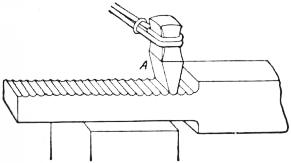
Fig. 1.
Fullering denotes the preliminary roughing-down of the material between tools having convex edges; swaging, the completion or finishing process between swages, or dies of definite shape, nearly hemispherical in form. When a bar has to be reduced Fullering and swaging. from larger to smaller dimensions, it is laid upon a fuller or round-faced stake, set in the anvil, or, in some cases, on a flat face (fig. 1), and blows are dealt upon that portion of the face which lies exactly opposite with a fullering tool A, grasped by a rather loosely-fitting handle and struck on its head by a sledge. The position of the piece of work is quickly changed at brief intervals in order to bring successive portions under the action of the swages until the reduction is completed; the upper face, and if a bottom fuller is used the under face also, is thus left corrugated slightly. These corrugations are then removed either by a flatter, if the surfaces are plane (fig. 2), or by hollow swages, if the cross section is circular (fig. 3). Spring swages (fig. 4) are frequently used instead of separate “top and bottom tools.” Frequently swaging is practised at once, without the preliminary detail of fullering. It is adopted when the amount of reduction is slight, and also when a steam hammer or other type of power hammer is available. This process of drawing down or fullering is, when practicable, adopted in preference to either upsetting or welding, because it is open to no objection, and involves no risk of damage to the material, while it improves the metal by consolidating its fibres. But its limitations in anvil work lie in the tediousness of the operation, when the part to be reduced is very much less in diameter, and very much longer, than the original piece of bar. Then there are other alternatives.
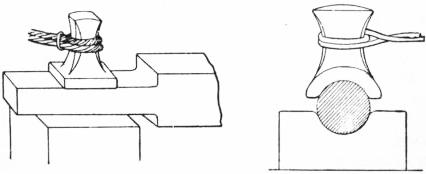
Fig. 2. Fig. 3.

Fig. 4.
If a long bar is required to have an enlargement at any portion of its length, not very much larger in diameter than the bar, nor of great length, upsetting is the method adopted. The part to be enlarged is heated, the parts adjacent remaining Upsetting. cold, and an end is hammered, or else lifted and dropped heavily on the anvil or on an iron plate, with the result that the heated portion becomes both shortened and enlarged (figs. 5 and 6). This process is only suitable for relatively short lengths, and has the disadvantage that the fibres of wrought iron are liable to open, and so cause weakening of the upset portion. But steel, which has no direction of fibre, can be upset without injury; this method is therefore commonly adopted in steel work, in power presses to an equal extent with drawing down. The alternative to upsetting is generally to weld a larger to a smaller bar or section, or to encircle the bar with a ring and weld the two (fig. 7), and then to impart any shape desired to the ring in swages.
Bending is effected either by the hammer or by the simple exercise of leverage, the heated bar being pulled round a fulcrum. It is always, when practicable, preferable to cutting out a curved or angular shape with a hot sett or to welding. The continuity of Bending. the fibre in iron is preserved by bending, and the risk of an imperfect weld is avoided. Hence it is a simple and safe process which is constantly being performed at the anvil. An objection to sharp bends, or those having a small radius, is that the fibres become extended on the outer radius, the cross section being at the same time reduced below that of the bar itself. This is met by imparting a preliminary amount of upsetting to the part to be bent, sufficient to counteract the amount of reduction due to extension of the fibres. A familiar example is seen in the corners of dip cranks.
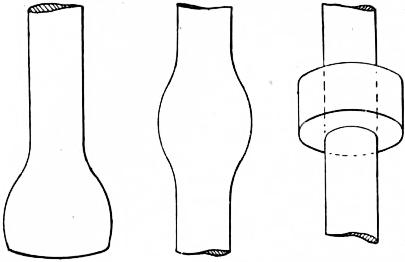
Fig. 5. Fig. 6. Fig. 7.
The property possessed by pieces of iron or steel of uniting autogeneously while in a condition of semi-fusion is very valuable. When portions which differ greatly in dimensions have to be united, welding is the only method practicable at the Welding. anvil. It is also generally the best to adopt when union has to be made between pieces at right angles, or when a piece on which much work has to be done is required at the end of a long plain bar, as in the tension rods of cranes and other structures with eyes. The art of welding depends chiefly on having perfectly clean joint faces, free from scale, so that metal can unite to metal; union would be prevented by the presence of oxide or of dirt. Also it is essential to have a temperature sufficiently high, yet not such as to overheat the metal. A dazzling white, at which small particles of metal begin to drop off, is suitable for iron, but steel must not be made so hot. A very few hammer blows suffice to effect the actual union; if the joint be faulty, no amount of subsequent hammering will weld it. The forms of weld-joints include the scarf (figs. 8 and 9), the butt (fig. 10), the V (fig. 11) and the glut, one form of which is shown in fig. 12; the illustrations are of bars prepared for welding. These forms give the smith a suitable choice for different conditions. A convexity is imparted to the joint faces in order to favour the expulsion of slag and dirt during the closing of the joint; these undesirable matters become entangled between concave faces. The ends are upset or enlarged in order to leave enough metal to be dressed down flush, by swaging or by flattering. The proportional lengths of the joint faces shown are those which conform to good practice. The fluxes used for welding are numerous. Sand alone is generally dusted on wrought iron, but steel requires borax applied on the joint while in the fire, and also dusted on the joint at the anvil and on the face of the latter itself. Electric welding is largely taking the place of the hand process, but machines are required to maintain the parts in contact during the passage of the current. Butt joints are employed, and a large quantity of power is absorbed, but the output is immensely greater than that of hand-made welds.

Fig. 8. Fig. 9.

Fig. 10. Fig. 11.
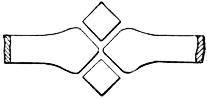
Fig. 12.
When holes are not very large they are formed by punching, but large holes are preferably produced by bending a rod round and welding it, so forming an eye (fig. 13). Small holes are often punched simply as a preliminary stage in the Punching. formation of a larger hole by a process of drifting. A piece of work to be punched is supported either on the anvil or on a ring of metal termed a bolster, laid on the anvil, through which the burr, when severed, falls. But in making small holes through a thick mass, no burr is produced, the metal yielding sideways and forming an enlargement or boss. Examples occur in the wrought iron stanchions that carry light hand railing. In such cases the hole has to be punched from each face, meeting in the centre. Punching under power hammers is done similarly, but occupies less time.
The cutting-off or severance of material is done either on hot or cold metal. In the first case the chisels used, “hot setts,” have Cutting-off. keener cutting angles than those employed for the second, termed “cold setts.” One sett is held in a hole in the anvil face, the “anvil chisel,” the other is handled and struck with a sledge.
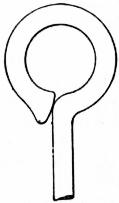
Fig. 13.
The difference between iron and steel at the forge is that iron possesses a very marked fibre whereas steel does not. Many forgings therefore must be made differently according as they are in iron or in steel. In the first the fibre must never be allowed to run transversely to the axis of greatest tensile or bending stress, but must be in line therewith. For this reason many forgings, of which a common eye or loop (fig. 13) is a typical example, that would be stamped from a solid piece if made in steel, must be bent round from bar and welded if in wrought iron. Further, welding which is practically uniformly trustworthy in wrought iron, is distrusted in steel. The difference is due to the very fibrous character of iron, the welding of which gives much less anxiety to the smith than that of steel. Welds in iron are frequently made without any flux, those in steel never. Though mention has only been made of iron and steel, other alloys are forged, as those of aluminium, delta metal, &c. But the essential operations are alike, the differences being in temperature at which the forging is done and nature of the fluxes used for welding. For hardening and tempering, an important section of smith’s work, see Annealing.
Die Forging.—The smith operating by hand uses the above methods only. There is, however, a large and increasing volume of forgings produced in other ways, and comprehended under the general terms, “die forging” or “drop forging.”
Little proof is needed to show that the various operations done at the anvil might be performed in a more expeditious way by the aid of power-operated appliances; for the elementary processes of reducing, and enlarging, bending, punching, &c., are extremely simple, and the most elaborate forged work involves only a repetition of these. The fact that the material used is entirely plastic when raised to a white heat is most favourable to the method of forging in matrices or dies. A white hot mass of metal can be placed in a matrix, and stamped into shape in a few blows under a hammer with as much ease as a medal can be stamped in steel dies under a coining press. But much detail is involved in the translation of the principle into practice. The parallel between coining dies and forging dies does not go far. The blank for the coin is prepared to such exact dimensions that no surplus material is left over by the striking of the coin, which is struck while cold. But the blank used in die forging is generally a shapeless piece, taken without any preliminary preparation, a mere lump, a piece of bar or rod, which may be square or round irrespective of whether the ultimate forging is to be square, or round, or flat or a combination of forms. At the verge of the welding heat to which it is raised, and under the intensity of the impact of hammer blows rained rapidly on the upper die, the metal yields like lead, and flows and fills the dies.
Herein lies a difference between striking a coin and moulding a forging. A large amount of metal is squeezed out beyond the concavity of the forging dies, and this would, if allowed to flow over between the joints, prevent the dies from being closed on the forging. There are two methods adopted for removing this “fin,” or “flash” as it is termed, one being that of suppression, applicable to circular work, the other that of stripping, applied to almost all other cases.
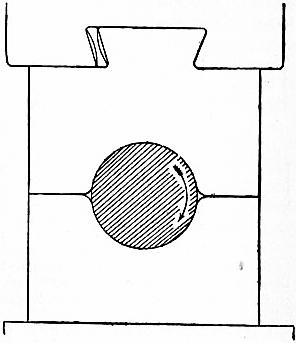
Fig. 14.
The suppression of fin means that the circular bar is rotated in the dies (fig. 14) through a small arc, alternating between every few blows, with the result that the fin is obliterated immediately when formed, this being done at the same time that reduction of section is being effected over a portion or the whole of the bar.
Stripping means that when a considerable amount of fin has been formed, it is removed by laying the forging on a die pierced right through with an opening of the same shape and area as the forging, and then dealing the forging a blow with the hammer. The forging is thus knocked through the die, leaving the severed or stripped fin behind. The forging is then returned to the dies and again treated, and the stripping may be repeated twice, or even oftener, before the forging can be completed.
Figs. 15 and 16 illustrate the bottom dies of a set for forging in a particular form of eye, the top dies being of exactly the same shape. The first operation takes place in fig. 15, in which a bar of metal is reduced to a globular and cylindrical form, being constantly rotated meanwhile. The shank portion is then drawn down in the parallel recess to the left. The shape of the eye is completed in fig. 16, and the shank in the recess to the left of that. Fig. 17 shows how a lever is stamped between top and bottom dies. The hole in the larger boss is formed by punching, the punches nearly meeting in the centre, and the centre for the hole to be drilled subsequently in the smaller boss is located by a conical projection in the top die.
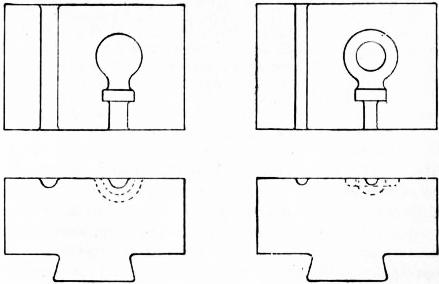
Fig. 15. Fig. 16.
It is evident that the methods of die forging, though only explained here in barest outline, constitute a principle of extensive application.
An intricate or ornamental forging, which might occupy a smith a quarter of a day in making at the anvil, can often be produced in dies within five minutes (fig. 18). On the other hand, there is the cost of the preparation of the dies, which is often heavy, so that the question of method is resolved into the relative one of the cost of dies, distributed over the number of identical forgings required. From this point of view it is clear that given say a thousand forgings, ordered all alike, the cost of even expensive dies distributed over the whole becomes only an infinitesimal amount per forging.
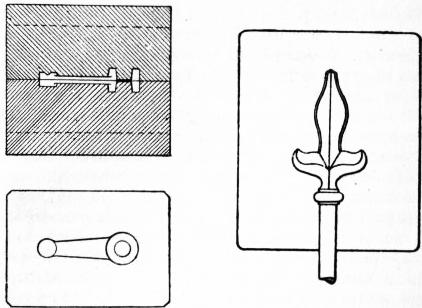
Fig. 17. Fig. 18.
There is, further, the very important fact that forgings which are produced in dies are uniform and generally of more exact dimensions than anvil-made articles. This is seen to be an advantage when forgings have to be turned or otherwise tooled in the engineer’s machine shop, since it lessens the amount of work required there. Besides, for many purposes such forgings do not require tooling at all, or only superficial grinding, while anvil-made ones would, in consequence of their slight inaccuracies.
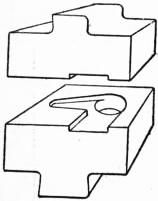
Fig. 19.
Yet again, die forging is a very elastic system, and herein lies much of its value. Though it reaches its highest development when thousands of similar pieces are wanted, it is also adaptable to a hundred, or even to a dozen, similar forgings. In such cases economy is secured by using dies of a very cheap character; or, by employing such dies as supplementary to anvil work for effecting neat finish to more precise dimensions than can be ensured at the anvil. In the first case use is made of dies of cast iron moulded from patterns (fig. 19) instead of having their matrices laboriously cut in steel with drills, chisels and milling tools. In the second, preliminary drawing down is done under the steam hammer, and bending and welding at the anvil, or under the steam hammer, until the forgings are brought approximately to their final shape and dimensions. Then they are reheated and inserted in the dies, when a few blows under the steam or drop hammer suffice to impart a neat and accurate finish.
The limitations of die forging are chiefly those due to large dimensions. The system is most successful for the smallest forgings and dies which can be handled by one man without the assistance of cranes; and massive forgings are not required in such large numbers as are those of small dimensions. But there are many large articles manufactured which do not strictly come under the term forgings, in which the aid of dies actuated by powerful hydraulic presses is utilized. These include work that is bent, drawn and shaped from steel plate, of which the fittings of railway wagons constitute by far the largest proportion. The dies used for some of these are massive, and a single squeeze from the ram of the hydraulic press employed bends the steel plate between the dies to shape at once. Fairly massive forgings are also produced in these presses.
Die forging in its highest developments invades the craft of the skilled smith. In shops where it is adopted entirely, the only craftsmen required are the few who have general charge of the shops. The men who attend to the machines are not smiths, but unskilled helpers.
(J. G. H.)
FORK (Lat. furca), an implement formed of two or more prongs at the end of a shaft or handle, the most familiar type of which is the table-fork for use in eating. In agriculture and horticulture the fork is used for pitching hay, and other green crops, manure, &c.; commonly this has two prongs, “tines”; for digging, breaking up surface soil, preparing for hand weeding and for planting the three-pronged fork is used. The word is also applied to many objects which are characterized by branching ends, as the tuning-fork, with two branching metal prongs, which on being struck vibrates and gives a musical note, used to give a standard of pitch; to the branching into two streams of a river, or the junction where a tributary runs into the main river; and in the human body, to that part where the legs branch off from the trunk.
The furca, two pieces of wood fastened together in the form of the letter Λ, was used by the Romans as an instrument of punishment. It was placed over the shoulders of the criminal, and his hands were fastened to it, condemned slaves were compelled to carry it about with them, and those sentenced to be flogged would be tied to it; crucifixions were sometimes carried out on a similar shaped instrument. From the great defeat of the Romans by the Samnites at the battle of the Caudine Forks (Furculae Caudinae), a narrow gorge, where the vanquished were compelled to pass under the yoke (jugum), as a sign of submission, the expression “to pass through or under the forks” has been loosely used of such a disgraceful surrender. The “forks” in any allusion to this defeat should refer to the topographical name and not to the jugum, which consisted of two upright spears with a third placed transversely as a cross-bar.
FORKEL, JOHANN NIKOLAUS (1749-1818), German musician, was born on the 22nd of February 1749 at Meeder in Coburg. He was the son of a cobbler, and as a practical musician, especially as a pianoforte player, achieved some eminence; but his claims to a more abiding name rest chiefly upon his literary skill and deep research as an historian of musical science and literature. He was an enthusiastic admirer of J.S. Bach, whose music he did much to popularize. His library, which was accumulated with care and discrimination at a time when rare books were cheap, forms a valuable portion of the royal library in Berlin and also of the library of the Königlicher Institut für Kirchenmusik. He was organist to the university church of Göttingen, obtained the degree of doctor of philosophy, and in 1778 became musical director of the university. He died at Göttingen on the 20th of March 1818. The following is a list of his principal works: Über die Theorie der Musik (Göttingen, 1777); Musikalisch kritische Bibliothek (Gotha, 1778); Allgemeine Geschichte der Musik (Leipzig, 1788). The last is his most important work. He also wrote a Dictionary of Musical Literature, which is full of valuable material. To his musical compositions, which are numerous, little interest is to-day to be attached. But it is worth noting that he wrote variations on the English national anthem “God save the king” for the clavichord, and that Abt Vogler wrote a sharp criticism on them, which appeared at Frankfort in 1793 together with a set of variations as he conceived they ought to be written.
FORLÌ (anc. Forum Livii), a town and episcopal see of Emilia, Italy, the capital of the province of Forlì, 40 m. S.E. of Bologna by rail, 108 ft. above sea-level. Pop. (1901) 15,461 (town); 43,321 (commune). Forlì is situated on the railway between Bologna and Rimini. It is connected by steam tramways with Ravenna and Meldola, and by a road through the Apennines with Pontassieve. The church of S. Mercuriale stands in the principal square, and contains, besides paintings, some good carved and inlaid choir stalls by Alessandro dei Bigni. The façade has been considerably altered, but the campanile, erected in 1178-1180, still exists; it is 252 ft. in height, square and built of brickwork, and is one of the finest of Lombard campanili. The pictures in this church are the work of Marco Palmezzano (1456-1537) and others; S. Biagio and the municipal picture gallery also contain works by him. The latter has other interesting pictures, including a fresco representing an apprentice with pestle and mortar (Pestapepe), the only authentic work in Forlì of Melozzo da Forlì (1438-1494), an eminent master whose style was formed under the influence of Piero della Francesca, and who was the master of Palmezzano; the frescoes in the Sforza chapel in SS. Biagio e Girolamo are from the former’s designs, though executed by the latter. The church also contains the fine tomb (1466) of Barbara Manfredi. The cathedral (Santa Croce) has been almost entirely rebuilt since 1844. The Palazzo del Podestà, now a private house, is a brick building of the 15th century. The citadel (Rocca Ravaldina), constructed about 1360-1370, and later rebuilt, is now used as a prison. Flavio Biondo, the first Renaissance writer on the topography of ancient Rome (1388-1463), was a native of Forlì.
Of the ancient Forum Livii, which lay on the Via Aemilia, hardly anything is known. In the 12th century we find Forlì in league with Ravenna, and in the 13th the imperial count of the province of Romagna resided there. In 1275 Forlì defeated Bologna with great loss. Martin IV. sent an army to besiege it in 1282, which was driven out after severe fighting in the streets; but the town soon afterwards surrendered. In the 14th and 15th centuries it was under the government of the Ordelaffi; and in 1500 was taken by Caesar Borgia, despite a determined resistance by Caterina Sforza, widow of Girolamo Riario. Forlì finally became a part of the papal state in 1504.
(T. As.)
FORLIMPOPOLI (anc. Forum Popillii), a village of Emilia, Italy, in the province of Forlì, from which it is 5 m. S.E. by rail, 105 ft. above sea-level. Pop. (1901) 2299 (town); 5795 (commune). The ancient Forum Popillii, a station on the Via Aemilia, was destroyed by Grimuald in 672. Whether its site is occupied by the present town is not certain; the former should perhaps be sought a mile or so farther to the S.E., where were found most of the inscriptions of which the place of discovery is certain. Forlimpopoli was again destroyed by Cardinal Albornoz in 1360, and rebuilt by Sinibaldo Ordelaffi, who constructed the well-preserved medieval castle (1380), rectangular with four circular towers at the corners.
(T. As.)
FORLORN HOPE (through Dutch verloren hoop, from Ger. verlorene Haufe = “lost troop”; Haufe, “heap,” being equivalent in the 17th century to “body of troops”; the French equivalent is enfants perdus), a military term (sometimes shortened to “forlorn”), used in the 16th and 17th centuries for a body of troops thrown out in front of the line of battle to engage the hostile line, somewhat after the fashion of skirmishers, though they were always solid closed bodies. These troops ran great risks, because they were often trapped between the two lines of battle as the latter closed upon one another, and fired upon or ridden down by their friends; further, their mission was to facilitate the attacks of their own main body by striking the first blow against or meeting the first shock of the fresh and unshaken enemy. In the following century (18th), when lines of masses were no longer employed, a thin line of skirmishers alone preceded the three-deep line of battle, but the term “forlorn hope” continued to be used for picked bodies of men entrusted with dangerous tasks, and in particular for the storming party at the assault of a fortress. In this last sense “forlorn hope” is often used at the present time. The misunderstanding of the word “hope” has led to various applications of “forlorn hope,” such as to an enterprise offering little chance of success, or, further still from the original meaning, to the faint or desperate hope of such success.
FORM (Lat. forma), in general, the external shape, appearance, configuration of an object, in contradistinction to the matter of which it is composed; thus a speech may contain excellent arguments,—the matter may be good, while the style, grammar, arrangement,—the form—is bad. The term, with its adjective “formal” and the derived nouns “formality” and “formalism,” is hence contemptuously used for that which is superficial, unessential, hypocritical: chap. xxiii. of Matthew’s gospel is a classical instance of the distinction between the formalism of the Pharisaic code and genuine religion. With this may be compared the popular phrases “good form” and “bad form” applied to behaviour in society: so “format” (from the French) is technically used of the shape and size, e.g. of a book (octavo, quarto, &c.) or of a cigarette. The word “form” is also applied to certain definite objects: in printing a body of type secured in a chase for printing at one impression (“form” or “forme”); a bench without a back, such as is used in schools (perhaps to be compared with O. Fr. s’asseoir en forme, to sit in a row); a mould or shape on or in which an object is manufactured; the lair or nest of a hare. From its use in the sense of regulated order comes the application of the term to a class in a school (“sixth form,” “fifth form,” &c.); this sense has been explained without sufficient ground as due to the idea of all children in the same class sitting on a single form (bench).
The word has been used technically in philosophy with various shades of meaning. Thus it is used to translate the Platonic ἰδέα, εἶδος, the permanent reality which makes a thing what it is, in contrast with the particulars which are finite and subject to change. Whether Plato understood these forms as actually existent apart from all the particular examples, or as being of the nature of immutable physical laws, is matter of discussion. For practical purposes Aristotle was the first to distinguish between matter (ὕλη) and form (εἶδος). To Aristotle matter is the undifferentiated primal element: it is rather that from which things develop (ὑποκείμενον, δύναμις) than a thing in itself (ἐνεργεία). The development of particular things from this germinal matter consists in differentiation, the acquiring of particular forms of which the knowable universe consists (cf. Causation for the Aristotelian “formal cause”). The perfection of the form of a thing is its entelechy (ἐντελέχεια) in virtue of which it attains its fullest realization of function (De anima, ii. 2, ἡ μὲν ὕλη δύναμις τὸ δὲ εἶδος ἐντελέχεια). Thus the entelechy of the body is the soul. The origin of the differentiation process is to be sought in a “prime mover” (πρῶτον κινοῦν), i.e. pure form entirely separate (χωριστόν) from all matter, eternal, unchangeable, operating not by its own activity but by the impulse which its own absolute existence excites in matter (ὡς ἐρώμενον, οὐ κινούμενον). The Aristotelian conception of form was nominally, though perhaps in most cases unintelligently, adopted by the Scholastics, to whom, however, its origin in the observation of the physical universe was an entirely foreign idea. The most remarkable adaptation is probably that of Aquinas, who distinguished the spiritual world with its “subsistent forms” (formae separatae) from the material with its “inherent forms” which exist only in combination with matter. Bacon, returning to the physical standpoint, maintained that all true research must be devoted to the discovery of the real nature or essence of things. His induction searches for the true “form” of light, heat and so forth, analysing the external “form” given in perception into simpler “forms” and their “differences.” Thus he would collect all possible instances of hot things, and discover that which is present in all, excluding all those qualities which belong accidentally to one or more of the examples investigated: the “form” of heat is the residuum common to all. Kant transferred the term from the objective to the subjective sphere. All perception is necessarily conditioned by pure “forms of sensibility,” i.e. space and time: whatever is perceived is perceived as having spacial and temporal relations (see Space and Time; Kant). These forms are not obtained by abstraction from sensible data, nor are they strictly speaking innate: they are obtained “by the very action of the mind from the co-ordination of its sensation.”