VOLUME IX SLICE VI English Language to Epsom Salts (continued 8)
Reading edition
Eötvös occupied as prominent a place in Hungarian literature as in Hungarian politics. His peculiarity, both as a politician and as a statesman, lies in the fact that he was a true philosopher, a philosopher at heart as well as in theory; and in his poems and novels he clothed in artistic forms all the great ideas for which he contended in social and political life. The best of his verses are to be found in his ballads, but his poems are insignificant compared with his romances. It was The Carthusians, written on the occasion of the floods at Pest in 1838, that first took the public by storm. The Magyar novel was then in its infancy, being chiefly represented by the historico-epics of Jósiká. Eötvös first modernized it, giving prominence in his pages to current social problems and political aspirations. The famous Village Notary came still nearer to actual life, while Hungary in 1514, in which the terrible Dozsa Jacquerie (see Dozsa) is so vividly described, is especially interesting because it rightly attributes the great national catastrophe of Mohács to the blind selfishness of the Magyar nobility and the intense sufferings of the people. Yet, as already stated, all these books are written with a moral purpose, and their somewhat involved and difficult style is, nowadays at any rate, a trial to those who are acquainted with the easy, brilliant and lively novels of Jókai.
The best edition of Eötvös’ collected works is that of 1891, in 17 vols. Comparatively few of his writings have been translated, but there are a good English version (London, 1850) and numerous German versions of The Village Notary, while The Emancipation of the Jews has been translated into Italian and German (Pest, 1841-1842), and a German translation of Hungary in 1514, under the title of Der Bauernkrieg in Ungarn was published at Pest in 1850.
See A. Bán, Life and Art of Baron Joseph Eötvös (Hung.) (Budapest, 1902); Zoltan Ferenczi Baron Joseph Eötvös (Hung.) (Budapest, 1903) [this is the best biography]; and M. Berkovics, Baron Joseph Eotvos and the French Literature (Hung.) (Budapest, 1904).
(R. N. B.)
EPAMINONDAS (c. 418-362), Theban general and statesman, born about 418 B.C. of a noble but impoverished family. For his education he was chiefly indebted to Lysis of Tarentum, a Pythagorean exile who had found refuge with his father Polymnis. He first comes into notice in the attack upon Mantineia in 385, when he fought on the Spartan side and saved the life of his future colleague Pelopidas. In his youth Epaminondas took little part in public affairs; he held aloof from the political assassinations which preceded the Theban insurrection of 379. But in the following campaigns against Sparta he rendered good service in organizing the Theban defence. In 371 he represented Thebes at the congress in Sparta, and by his refusal to surrender the Boeotian cities under Theban control prevented the conclusion of a general peace. In the ensuing campaign he commanded the Boeotian army which met the Peloponnesian levy at Leuctra, and by a brilliant victory on this site, due mainly to his daring innovations in the tactics of the heavy infantry, established at once the predominance of Thebes among the land-powers of Greece and his own fame as the greatest and most original of Greek generals. At the instigation of the Peloponnesian states which armed against Sparta in consequence of this battle, Epaminondas in 370 led a large host into Laconia; though unable to capture Sparta he ravaged its territory and dealt a lasting blow at Sparta’s predominance in Peloponnesus by liberating the Messenians and rebuilding their capital at Messene. Accused on his return to Thebes of having exceeded the term of his command, he made good his defence and was re-elected boeotarch. In 369 he forced the Isthmus lines and secured Sicyon for Thebes, but gained no considerable successes. In the following year he served as a common soldier in Thessaly, and upon being reinstated in command contrived the safe retreat of the Theban army from a difficult position. Returning to Thessaly next year at the head of an army he procured the liberation of Pelopidas from the tyrant Alexander of Pherae without striking a blow. In his third expedition (366) to Peloponnesus, Epaminondas again eluded the Isthmus garrison and won over the Achaeans to the Theban alliance. Turning his attention to the growing maritime power of Athens, Epaminondas next equipped a fleet of 100 triremes, and during a cruise to the Propontis detached several states from the Athenian confederacy. When subsequent complications threatened the position of Thebes in Peloponnesus he again mustered a large army in order to crush the newly formed Spartan league (362). After some masterly operations between Sparta and Mantineia, by which he nearly captured both these towns, he engaged in a decisive battle on the latter site, and by his vigorous shock tactics gained a complete victory over his opponents (see Mantineia). Epaminondas himself received a severe wound during the combat, and died soon after the issue was decided.
His title to fame rests mainly on his brilliant qualities both as a strategist and as a tactician; his influence on military art in Greece was of the greatest. For the purity and uprightness of his character he likewise stood in high repute; his culture and eloquence equalled the highest Attic standard. In politics his chief achievement was the final overthrow of Sparta’s predominance in the Peloponnese; as a constructive statesman he displayed no special talent, and the lofty pan-Hellenic ambitions which are imputed to him at any rate never found a practical expression.
Cornelius Nepos, Vita Epaminondae; Diodorus xv. 52-88; Xenophon, Hellenica, vii.; L. Pomtow, Das Leben des Epaminondas (Berlin, 1870); von Stein, Geschichte der spartanischen und thebanischen Hegemonie (Dorpat, 1884), pp. 123 sqq.; H. Swoboda in Pauly-Wissowa, Realencyclopädie, v. pt. 2 (Stuttgart, 1905), pp. 2674-2707; also Army: History, § 6.
(M. O. B. C.)
EPARCH, an official, a governor of a province of Roman Greece, ἐπαρχος, whose title was equivalent to, or represented that of the Roman praefectus. The area of his administration was called an eparchy (ἐπαρχία). The term survives as one of the administrative units of modern Greece, the country being divided into nomarchies, subdivided into eparchies, again subdivided into demarchies (see Greece: Local Administration). “Eparch” and “eparchy” are also used in the Russian Orthodox Church for a bishop and his diocese respectively.
EPAULETTE (a French word, from épaule, a shoulder), properly a shoulder-piece, and so applied to the shoulder-knot of ribbon to which a scapulary was attached, worn by members of a religious order. The military usage was probably derived from the metal plate (épaulière) which protected the shoulder in the defensive armour of the 16th century. It was first used merely as a shoulder knot to fasten the baldric, and the application of it to mark distinctive grades of rank was begun in France at the suggestion, it is said, of Charles Louis Auguste Fouquet, duc de Belle-Isle, in 1759. In modern times it always appears as a shoulder ornament for military and naval uniforms. At first it consisted merely of a fringe hanging from the end of the shoulder-strap or cord over the sleeve, but towards the end of the 18th century it became a solid ornament, consisting of a flat shoulder-piece, extended beyond the point of the shoulder into an oval plate, from the edge of which hangs a thick fringe, in the case of officers of gold or silver. The epaulette is worn in the British navy by officers above the rank of sub-lieutenant; in the army it ceased to be worn about 1855. It is worn by officers in the United States navy above the rank of ensign; since 1872 it is only worn by general officers in the army. In most other countries epaulettes are worn by officers, and in the French army by the men also, with a fringe of worsted, various distinctions of shape and colour being observed between ranks, corps and arms of the service. The “scale” is similar to the epaulette, but has no fringe.
ÉPÉE, CHARLES-MICHEL, Abbé de l’ (1712-1789), celebrated for his labours in behalf of the deaf and dumb, was born at Paris on the 25th of November 1712, being the son of the king’s architect. He studied for the church, but having declined to sign a religious formula opposed to the doctrines of the Jansenists, he was denied ordination by the bishop of his diocese. He then devoted himself to the study of law; but about the time of his admission to the bar of Paris, the bishop of Troyes granted him ordination, and offered him a canonry in his cathedral. This bishop died soon after, and the abbé, coming to Paris, was, on account of his relations with Soanen, the famous Jansenist, deprived of his ecclesiastical functions by the archbishop of Beaumont. About the same time it happened that he heard of two deaf mutes whom a priest lately dead had been endeavouring to instruct, and he offered to take his place. The Spaniard Pereira was then in Paris, exhibiting the results he had obtained in the education of deaf mutes; and it has been affirmed that it was from him that Épée obtained his manual alphabet. The abbé, however, affirmed that he knew nothing of Pereira’s method; and whether he did or not, there can be no doubt that he attained far greater success than Pereira or any of his predecessors, and that the whole system now followed in the instruction of deaf mutes virtually owes its origin to his intelligence and devotion. In 1755 he founded, for this beneficent purpose, a school which he supported at his own expense until his death, and which afterwards was succeeded by the “Institution Nationale des Sourds Muets à Paris,” founded by the National Assembly in 1791. He died on the 23rd of December 1789. In 1838 a bronze monument was erected over his grave in the church of Saint Roch. He published various books on his method of instruction, but that published in 1784 virtually supersedes all others. It is entitled La Véritable Manière d’instruire les sourds et muets, confirmée par une longue expérience. He also began a Dictionnaire général des signes, which was completed by his successor, the abbé Sicard.
ÉPÉE-DE-COMBAT, a weapon still used in France for duelling, and there and elsewhere (blunted, of course) for exercise and amusement in fencing (q.v.). It has a sharp-pointed blade, about 35 in. long, without any cutting edge, and the guard, or shell, is bowl-shaped, having its convexity towards the point. The épée is the modern representative of the small-sword, and both are distinguished from the older rapier, mainly by being several inches shorter and much lighter in weight. The small-sword (called thus in opposition to the heavy cavalry broadsword), was worn by gentlemen in full dress throughout the 18th century, and it still survives in the modern English court costume.
Fencing practice was originally carried on without the protection of any mask for the face. Wire masks were not invented till near 1780 by a famous fencing-master, La Boëssière the elder, and did not come into general use until much later. Consequently, in order to avoid dangerous accidents to the face, and especially the eyes, it was long the rigorous etiquette of the fencing-room that the point should always be kept low.
In the 17th century a Scottish nobleman, who had procured the assassination of a fencing-master in revenge for having had one of his eyes destroyed by the latter at sword-play, pleaded on his trial for murder that it was the custom to “spare the face.”
Rowlandson’s well-known drawing of a fencing bout, dated 1787, shows two accomplished amateurs making a foil assault without masks, while in the background a less practised one is having a wire mask tied on.
For greater safety the convention was very early arrived at that no hits should count in a fencing-bout except those landing on the breast. Thus sword-play soon became so unpractical as to lose much of its value as a training for war or the duel. For, hits with “sharps” take effect wherever they are made, and many an expert fencer of the old school has been seriously wounded, or lost his life in a duel, through forgetting that very simple fact.
Strangely enough, when masks began to be generally worn, and the fleuret (anglice, “foil,” a cheap and light substitute for the real épée) was invented, fencing practice became gradually even more conventional than before. No one seems to have understood that with masks all the conventions could be safely done away with, root and branch, and sword-practice might assume all the semblance of reality. Nevertheless it should be clearly recognized that the basis of modern foil-fencing was laid with the épée or small-sword alone, in and before the days of Angelo, of Danet, and the famous chevalier de St George, who were among the first to adopt the fleuret also. All the illustrious French professors who came after them, such as La Boëssière the younger, Lafaugère, Jean Louis, Cordelois, Grisier, Bertrand and Robert, with amateurs like the baron d’Ezpeléta, were foil-players pure and simple, whose reputations were gained before the modern épée play had any recognized status. It was reserved for Jacob, a Parisian fencing-master, to establish in the last quarter of the 19th century a definite method of the épée, which differed essentially from all its forerunners. He was soon followed by Baudry, Spinnewyn, Laurent and Ayat. The methods of the four first-named, not differing much inter se, are based on the perception that in the real sword fight, where hits are effective on all parts of the person, the “classical” bent-arm guard, with the foil inclining upwards, is hopelessly bad. It offers a tempting mark in the exposed sword-arm itself, while the point requires a movement to bring it in line for the attack, which involves a fatal loss of time. The épée is really in the nature of a short lance held in one hand, and for both rapidity and precision of attack, as well as for the defence of the sword-arm and the body behind it, a position of guard with the arm almost fully extended, and épée in line with the forearm, is far the safest. Against this guard the direct lunge at the body is impossible, except at the risk of a mutual or double hit (le coup des deux veuves). No safe attack at the face or body can be made without first binding or beating, opposing or evading the adverse blade, and such an attack usually involves an initial forward movement. Beats and binds of the blade, with retreats of the body, or counter attacks with opposition, replace the old foil-parries in most instances, except at close quarters. And much of the offensive is reduced to thrusts at the wrist or forearm, intended to disable without seriously wounding the adversary. The direct lunge (coup-droit) at the body often succeeds in tournaments, but usually at the cost of a counter hit, which, though later in time, would be fatal with sharp weapons.
Ayat’s method, as might be expected from a first-class foil-player, is less simple. Indeed for years, too great simplicity marked the most successful épée-play, because it usually gained its most conspicuous victories over those who attempted a foil defence, and whose practice gave them no safe strokes for an attack upon the extended blade. But by degrees the épéists themselves discovered new ways of attacking with comparative safety, and at the present day a complete épée-player is master of a large variety of attractive as well as scientific movements, both of attack and defence.
It was mainly by amateurs that this development was achieved. Perhaps the most conspicuous representative of the new school is J. Joseph-Renaud, a consummate swordsman, who has also been a champion foil-player. Lucien Gaudin, Alibert and Edmond Wallace may be also mentioned as among the most skilful amateurs, Albert Ayat and L. Bouché as professors—all of Paris. Belgium, Italy and England have also produced épéists quite of the first rank.
The épée lends itself to competition far better than the foil, and the revival of the small-sword soon gave rise in France to “pools” and “tournaments” in which there was the keenest rivalry between all comers.
In considering the épée from a British point of view, it may be mentioned that it was first introduced publicly in London by C. Newton-Robinson at an important assault-at-arms held in the Steinway Hall on the 4th May 1900. Professor Spinnewyn was the principal demonstrator, with his pupil, the late Willy Sulzbacher. The next day was held at the Inns of Court R. V. School of Arms, Lincoln’s Inn, the first English open épée tournament for amateurs. It was won by W. Sulzbacher, C. Newton-Robinson being second, and Paul Ettlinger, a French resident in London, third. This was immediately followed by the institution of the Épée Club of London, which, under the successive residencies of a veteran swordsman, Sir Edward Jenkinson, and of Lord Desborough, subsequently held annual open international tournaments. The winners were: in 1901, Willy Sulzbacher; 1902, Robert Montgomerie; 1903, the marquis de Chasseloup-Laubat; 1904, J.J. Renaud; 1905, R. Montgomerie. In 1906 the Amateur Fencing Association for the first time recognized the best-placed Englishman, Edgar Seligman (who was the actual winner), as the English épée champion. In 1907 R. Montgomerie was again the winner, in 1908 C.L. Daniell, in 1909 R. Montgomerie.
Among the most active of the English amateurs who were the earliest to perceive the wonderful possibilities of épée-play, it is right to mention Captain Hutton, Lord Desborough, Sir Cosmo Duff-Gordon, Bart., Sir Charles Dilke, Bart., Lord Howard de Walden, Egerton Castle, A.S. Cope, R.A., W.H.C. Staveley, C.F. Clay, Lord Morpeth, Evan James, Paul King, J.B. Cunliffe, John Norbury, Jr., Theodore A. Cook, John Jenkinson, R. Montgomerie, S. Martineau, E.B. Milnes, H.J. Law, R. Merivale, the Marquis of Dufferin, Hugh Pollock, R.W. Doyne, A.G. Ross, the Hon. Ivor Guest and Henry Balfour.
Among foreign amateurs who did most to promote the use of the épée in England were Messrs P. Ettlinger, Anatole Paroissien, J. Joseph-Renaud, W. Sulzbacher, René Lacroix, H.G. Berger and the Marquis de Chasseloup-Laubat.
Épée practice became popular among Belgian and Dutch fencers about the same time as in England, and this made it possible to set on foot international team-contests for amateurs, which have done much to promote good feeling and acquaintanceship among swordsmen of several countries. In 1903 a series of international matches between teams of six was inaugurated in Paris. Up to 1909 the French team uniformly won the first place, with Belgium or England second.
English fencers who were members of these international teams were Lord Desborough, Theodore A. Cook, Bowden, Cecil Haig, J. Norbury, Jr., R. Montgomerie, John Jenkinson, F. Townsend, W.H.C. Staveley, S. Martineau, C.L. Daniell, W. Godden, Captain Haig, M.D.V. Holt, Edgar Seligman, C. Newton-Robinson, A.V. Buckland, P.M. Davson, E.M. Amphlett and L.V. Fildes. In 1906 a British épée team of four, consisting of Lord Desborough, Sir Cosmo Duff-Gordon, Bart., Edgar Seligman and C. Newton-Robinson, with Lord Howard de Walden and Theodore Cook as reserves (the latter acting as captain of the team), went to Athens to compete in the international match at the Olympic games. After defeating the Germans rather easily, the team opposed and worsted the Belgians. It thus found itself matched against the French in the final, the Greek team having been beaten by the French and the Dutch eliminated by the Belgians. After a very close fight the result was officially declared a tie. This was the first occasion upon which an English fencing team had encountered a French one of the first rank upon even terms. In fighting off the tie, however, the French were awarded the first prize and the Englishmen the second.
In the Olympic games of London, 1908, the Épée International Individual Tournament was won by Alibert (France), but Montgomerie, Haig and Holt (England) took the 4th, 5th, and 8th places in the final pool. The result of the International Team competition was also very creditable to the English representatives, Daniell, Haig, Holt, Montgomerie and Amphlett, who by defeating the Dutch, Germans, Danes and Belgians took second place to the French. Egerton Castle was captain of the English team.
In open International Tournaments on the Continent, English épéists have also been coming to the front. None had won such a competition up to 1909 outright, but the following had reached the final pool: C. Newton-Robinson, Brussels, 1901 (10th), Étretat, 1904 (6th); E. Seligman, Copenhagen, 1907 (2nd), and Paris, 1909 (12th); R. Montgomerie, Paris, 1909 (5th); and E.M. Amphlett, Paris, 1909 (10th).
The method of ascertaining the victor in épée “tournaments” is by dividing the competitors into “pools,” usually of six or eight fencers. Each of these fights an assault for first hit only, with every other member of the same pool, and he who is least often hit, or not at all, is returned the winner. If the competitors are numerous, fresh pools are formed out of the first two, three or four in each pool of the preliminary round, and so on, until a small number are left in for a final pool, the winner of which is the victor of the tournament.
Épée fencing can be, and often is, conducted indoors, but one of its attractions consists in its fitness for open-air practice in pleasant gardens.
In the use of the épée the most essential points are (1) the position of the sword-arm, which, whether fully extended or not, should always be so placed as to ensure the protection of the wrist, forearm and elbow from direct thrusts, by the intervention of the guard or shell; (2) readiness of the legs for instant advance or retreat; and (3) the way in which the weapon is held, the best position (though hard to acquire and maintain) being that adopted by J.J. Renaud with the fingers over the grip, so that a downward beat does not easily disarm.
The play of individuals is determined by their respective temperaments and physical powers. But every fencer should be always ready to deliver a well-aimed, swift, direct thrust at any exposed part of the antagonist’s arm, his mask or thigh. Very tall men, who are usually not particularly quick on their legs, should not as a rule attack, otherwise than by direct thrusts, when matched against shorter men. For if they merely extend their sword-arm in response to a simple attack, their longer reach will ward it off with a stop or counter-thrust. Short men can only attack them safely by beating, binding, grazing, pressing or evading the blade, and the taller fencers must be prepared with all the well-known parries and counters to such offensive movements, as well as with the stop-thrust to be made either with advancing opposition or with a retreat. Fencers of small stature must be exceedingly quick on their feet, unless they possess the art of parrying to perfection, and even then, if slow to shift ground, they will continually be in danger. With plenty of room, the quick mover can always choose the moment when he will be within distance, for an attack which his slower opponent will be always fearing and unable to prevent or anticipate.
It is desirable to put on record the modern form of the weapon. An average épée weighs, complete, about a pound and a half, while a foil weighs approximately one-third less. The épée blade is exactly like that of the old small-sword after the abandonment of the “colichemarde” form, in which the “forte” of the blade was greatly thickened. In length from guard or shell to point it measures about 35 in., and in width at the shell about 13⁄16ths of an inch. From this it gradually and regularly tapers to the point. There is no cutting edge. The side of the épée which is usually held uppermost is slightly concave, the other is strengthened with a midrib, nearly equal in thickness and similar in shape to either half of the true blade. The material is tempered steel. There is a haft or tang about 8 in. long, which is pushed through a circular guard or shell (“coquille”) of convex form, the diameter of which is normally 5 in. and the convexity 1¾ in. The shell is of steel or aluminium, and if of the latter metal, sometimes fortified at the centre with a disk of steel the size of a crown piece. The insertion of the haft or tang through the shell may be either central or excentric to the extent of about 1 in., for the better protection of the outside of the forearm.
After passing through the shell, the haft of the blade is inserted in a grip or handle (“poignet”), averaging 7 in. in length and of quadrangular section, which is made of tough wood covered with leather, india-rubber, wound cord or other strong material with a rough surface. The grip is somewhat wider than its vertical thickness when held in the usual way, and it diminishes gradually from shell to pommel for convenience of holding. It should have a slight lateral curvature, so that in executing circular movements the pommel is kept clear of the wrist. The pommel, usually of steel, is roughly spherical or eight-sided, and serves as a counterbalance. The end of the haft is riveted through it, except in the case of “épées démontables,” which are the most convenient, as a blade may be changed by simply unscrewing or unlocking the pommel.
An épée is well balanced and light in hand when, on poising the blade across the forefinger, about 1 in. in advance of the shell, it is in equilibrium.
For practice, the point is blunted to resemble the flat head of a nail, and is made still more incapable of penetration by winding around it a small ball of waxed thread, such as cobblers use. This is called the “button.” In competitions various forms of “boutons marqueurs,” all of which are unsatisfactory, are occasionally used. The “pointe d’arrêt,” like a small tin-tack placed head downwards on the flattened point of the épée, and fastened on by means of the waxed thread, is, on the contrary, most useful, by fixing in the clothes, to show where and when a good hit has been made. The point need only protrude about 1⁄16th of an inch from the button. There are several kinds of pointes d’arrêt. The best is called, after its inventor, the “Léon Sazie,” and has three blunt points of hardened steel each slightly excentric. The single point is sometimes prevented by the thickness of the button from scoring a good hit.
A mask of wire netting is used to protect the face, and a stout glove on the sword hand. It is necessary to wear strong clothes and to pad the jacket and trousers at the most exposed parts, in case the blade should break unnoticed. A vulnerable spot, which ought to be specially padded, is just under the sword-arm.
Bibliography.—Among the older works on the history and practice of the small-sword, or épée, are the following:—The Scots Fencing-Master, or Compleat Small-swordsman, by W.H. Gent (Sir William Hope, afterwards baronet) (Edinburgh, 1687), and several other works by the same author, of later date, for which see Schools and Masters of Fence, by Egerton Castle; Nouveau traité de la perfection sur le fait des armes, by P.G.F. Girard (Paris, 1736); L’École des armes, by M. Angelo (London, 1763); L’Art des armes, by M. Danet (2 vols., Paris, 1766-1767); Nouveau traité de l’art des armes, by Nicolas Demeuse (Liège, 1778).
More modern are: Traité de l’art des armes, by la Böessière, Jr. (Paris, 1818); Les Armes et le duel, by A. Grisier (2nd ed., Paris, 1847); Les Secrets de l’épée, by the baron de Bazancourt (Paris, 1862); Schools and Masters of Fence, by Egerton Castle (London, 1885); Le Jeu de l’épée, by J. Jacob and Émil André (Paris, 1887); L’Escrime pratique au XIXe siècle, by Ambroise Baudry (Paris); L’Escrime a l’épée, by A. Spinnewyn and Paul Manonry (Paris, 1898); The Sword and the Centuries, by Captain Hutton (London,1901); “The Revival of the Small-sword,” by C. Newton-Robinson, in the Nineteenth Century and After (London, January 1905); Nouveau Traité de l’épée, by Dr Edom, privately published (Paris, 1908); and, most important of all, Méthode d’escrime à l’épée, by J. Joseph-Renaud, privately published (Paris, 1909).
(C. E. N. R.)
EPERJES, a town of Hungary, capital of the county of Sáros, 190 m. N.E. of Budapest by rail. Pop. (1900) 13,098. It is situated on the left bank of the river Tarcza, an affluent of the Theiss, and has been almost completely rebuilt since a great fire in 1887. Eperjes is one of the oldest towns of Hungary, and is still partly surrounded by its old walls. It is the seat of a Greek-Catholic bishop, and possesses a beautiful cathedral built in the 18th century in late Gothic style. It possesses manufactures of cloth, table-linen and earthenware, and has an active trade in wine, linen, cattle and grain. About 2 m. to the south is Sóvár with important salt-works.
In the same county, 28 m. by rail N. of Eperjes, is situated the old town of Bártfa (pop. 6098), which possesses a Gothic church from the 14th century, and an interesting town-hall, dating from the 15th century, and containing very valuable archives. In its neighbourhood, surrounded by pine forests, are the baths of Bártfa, with twelve mineral springs—iodate, ferruginous and alkaline—used for bathing and drinking.
About 6 m. N.W. of Eperjes is situated the village of Vörösvágás, which contains the only opal mine in Europe. The opal was mined here 800 years ago, and the largest piece hitherto found, weighing 2940 carats and estimated to have a value of £175,000, is preserved in the Court Museum at Vienna.
Eperjes was founded about the middle of the 12th century by a German colony, and was elevated to the rank of a royal free town in 1347 by Louis I. (the Great). It was afterwards fortified and received special privileges. The Reformation found many early adherents here, and the town played an important part during the religious wars of the 17th century. It became famous by the so-called “butchery of Eperjes,” a tribunal instituted by the Austrian general Caraffa in 1687, which condemned to death and confiscated the property of a great number of citizens accused of Protestantism. During the 16th and the 17th centuries its German educational establishments enjoyed a wide reputation.
ÉPERNAY, a town of northern France, capital of an arrondissement in the department of Marne, 88 m. E.N.E. of Paris on the main line of the Eastern railway to Châlons-sur-Marne. Pop. (1906) 20,291. The town is situated on the left bank of the Marne at the extremity of the pretty valley of the Cubry, by which it is traversed. In the central and oldest quarter the streets are narrow and irregular; the surrounding suburbs are modern and more spacious, and that of La Folie, on the east, contains many handsome villas belonging to rich wine merchants. The town has also extended to the right bank of the Marne. One of its churches preserves a portal and stained-glass windows of the 16th century, but the other public buildings are modern. Épernay is best known as the principal entrepôt of the Champagne wines, which are bottled and kept in extensive vaults in the chalk rock on which the town is built. The manufacture of the apparatus and material used in the champagne industry occupies many hands, and the Eastern Railway Company has important workshops here. Brewing, and the manufacture of sugar and of hats and caps, are also carried on. Épernay is the seat of a sub-prefect and has tribunals of first instance and of commerce, and communal colleges for girls and boys.
Épernay (Sparnacum) belonged to the archbishops of Reims from the 5th to the 10th century, at which period it came into the possession of the counts of Champagne. It suffered severely during the Hundred Years’ War, and was burned by Francis I. in 1544. It resisted Henry of Navarre in 1592, and Marshal Biron fell in the attack which preceded its capture. In 1642 it was, along with Château-Thierry, erected into a duchy and assigned to the duke of Bouillon.
ÉPERNON, a town of northern France in the department of Eure-et-Loir, at the confluence of the Drouette and the Guesle, 17 m. N.E. of Chartres by rail. Pop. (1906) 2370. It belonged originally to the counts of Montfort, who, in the 11th century, built a castle here of which the ruins are still left, and granted a charter to the town. In the 13th century it became an independent lordship, which remained attached to the crown of Navarre till, in the 16th century, it was sold by King Henry (afterwards King Henry IV. of France) to Jean Louis de Nogaret, for whom it was raised to the rank of a duchy in 1581. The new duke of Épernon was one of the favourites of Henry III., who were called les Mignons; the king showered favours upon him, giving him the posts of colonel-general in the infantry and of admiral of France. Under the reign of Henry IV. he made himself practically independent in his government of Provence. He was instrumental in giving the regency to Marie de’ Medici in 1610, and as a result exercised a considerable influence upon the government. During his governorship of Guienne in 1622 he had some scandalous scenes with the parlement and the archbishop of Bordeaux. He died in 1642. His eldest son, Henri de Nogaret de la Valette, duke of Candale, served under Richelieu, in the armies of Guienne, of Picardy and of Italy. The second son of Jean Louis de Nogaret, Bernard, who was born in 1592, and died in 1661, was, like his father, duke of Épernon, colonel-general in the infantry and governor of Guienne. After his death, the title of duke of Épernon was borne by the families of Goth and of Pardaillan.
EPHEBEUM (from Gr. ἔφηβος, a young man), in architecture, a large hall in the ancient Palaestra furnished with seats (Vitruvius v. 11), the length of which should be a third larger than the width. It served for the exercises of youths of from sixteen to eighteen years of age.
EPHEBI (Gr. ἐπί, and ἣβη, i.e. “those who have reached puberty”), a name specially given, in Athens and other Greek towns, to a class of young men from eighteen to twenty years of age, who formed a sort of college under state control. On the completion of his seventeenth year the Athenian youth attained his civil majority, and, provided he belonged to the first three property classes and passed the scrutiny (δοκιμασία) as to age, civic descent and physical capability, was enrolled on the register of his deme (ληξιαρχικὸν γραμματεῖον). He thereby at once became liable to the military training and duties, which, at least in the earliest times, were the main object of the Ephebia. In the time of Aristotle the names of the enrolled ephebi were engraved on a bronze pillar (formerly on wooden tablets) in front of the council-chamber. After admission to the college, the ephebus took the oath of allegiance, recorded in Pollux and Stobaeus (but not in Aristotle), in the temple of Aglaurus, and was sent to Munychia or Acte to form one of the garrison. At the end of the first year of training, the ephebi were reviewed, and, if their performance was satisfactory, were provided by the state with a spear and a shield, which, together with the chlamys (cloak) and petasus (broad-brimmed hat), made up their equipment. In their second year they were transferred to other garrisons in Attica, patrolled the frontiers, and on occasion took an active part in war. During these two years they were free from taxation, and were not allowed (except in certain cases) to appear in the law courts as plaintiffs or defendants. The ephebi took part in some of the most important Athenian festivals. Thus during the Eleusinia they were told off to fetch the sacred objects from Eleusis and to escort the image of Iacchus on the sacred way. They also performed police duty at the meetings of the ecclesia.
After the end of the 4th century B.C. the institution underwent a radical change. Enrolment ceased to be obligatory, lasted only for a year, and the limit of age was dispensed with. Inscriptions attest a continually decreasing number of ephebi, and with the admission of foreigners the college lost its representative national character. This was mainly due to the weakening of the military spirit and the progress of intellectual culture. The military element was no longer all-important, and the ephebia became a sort of university for well-to-do young men of good family, whose social position has been compared with that of the Athenian “knights” of earlier times. The institution lasted till the end of the 3rd century A.D.
It is probable that the ephebia was in existence in the 5th century B.C., and controlled by the Areopagus and strategus as its moral and military supervisors. In the 4th century their place was taken by ten sophronistae (one for each tribe), who, as the name implies, took special interest in the morals of those under them, their military training being in the hands of experts, of whom the chief were the hoplomachus, the acontistes, the toxotes and the aphetes (instructors respectively in the use of arms, javelin-throwing, archery and the use of artillery engines). Later, the sophronistae were superseded by a single official called cosmetes, elected for a year by the people, who appointed the instructors. When the ephebia instead of a military college became a university, the military instructors were replaced by philosophers, rhetoricians, grammarians and artists. In Roman imperial times several new officials were introduced, one of special importance being the director of the Diogeneion, where youths under age were trained for the ephebia. At this period the college of ephebi was a miniature city; its members called themselves “citizens,” and it possessed an archon, strategus, herald and other officials, after the model of ancient Athens.
There is an extensive class of inscriptions, ranging from the 3rd century B.C. to the 3rd century A.D., containing decrees relating to the ephebi, their officers and instructors, and lists of the same, and a whole chapter (42) of the Aristotelian Constitution of Athens is devoted to the subject. The most important treatises on the subject are: W. Dittenberger, De ephebis Atticis (Göttingen, 1863); A. Dumont, Essai sur l’éphébie attique (1875-1876); L. Grasberger, Erziehung und Unterricht im klassichen Altertum, iii. (Würzburg, 1881); J.P. Mahaffy, Old Greek Education (1881); P. Girard, L’Éducation athénienne au Ve et IVe siècle avant J.-C. (2nd ed., 1891), and article in Daremberg and Saglio’s Dictionnaire des antiquités which contains further bibliographical references; G. Gilbert, The Constitutional Antiquities of Athens (Eng. tr., 1895); G. Busolt, Die griechischen Staats- und Rechtsaltertümer (1892); T. Thalheim and J. Öhler in Pauly-Wissowa, Realencyclopädie der classischen Altertumswissenschaft, v. pt. 2 (1905); W.W. Capes, University Life in Ancient Athens (1877).
EPHEMERIS (Greek for a “diary”), a table giving for stated times the apparent position and other numerical particulars relating to a heavenly body. The Astronomical Ephemeris, familiarly known as the “Nautical Almanac,” is a national annual publication containing ephemerides of the principal or more conspicuous heavenly bodies, elements and other data of eclipses, and other matter useful to the astronomer and navigator. The governments of the United Kingdom, United States, France, Germany and Spain publish such annals.
EPHESIANS, EPISTLE TO THE. This book of the New Testament, the most general and least occasional and polemic of all the Pauline epistles, a large section of which seems almost like the literary elaboration of a theological topic, may best be described as a solemn oration, addressed to absent hearers, and intended not primarily to clarify their minds but to stir their emotions. It is thus a true letter, but in the grand style, verging on the nature not of an essay but a poem. Ephesians has been called “the crown of St Paul’s writings,” and whether it be measured by its theological or its literary interest and importance, it can fairly dispute with Romans the claim to be his greatest epistle. In the public and private use of Christians some parts of Ephesians have been among the most favourite of all New Testament passages. Like its sister Epistle to the Colossians, it represents, whoever wrote it, deep experience and bold use of reflection on the meaning of that experience; if it be from the pen of the Apostle Paul, it reveals to us a distinct and important phase of his thought.
To the nature of the epistle correspond well the facts of its title and address. The title “To the Ephesians” is found in the Muratorian canon, in Irenaeus, Tertullian and Clement of Alexandria, as well as in all the earliest MSS. and versions. Marcion, however (c. A.D. 150), used and recommended copies with the title “To the Laodiceans.” This would be inexplicable if Eph. i. 1 had read in Marcion’s copies, as it does in most ancient authorities, “To the saints which are at Ephesus”; but in fact the words ἐν Ἐφέσῳ of verse 1 were probably absent. They were not contained in the text used by Origen (d. 253); Basil (d. 379) says that “ancient copies” omitted the words; and they are actually omitted by Codices B (Vaticanus, 4th century) and א (Sinaiticus, 4th century), together with Codex 67 (11th century). The words “in Ephesus” were thus probably originally lacking in the address, and were inserted from the suggestion of the title. Either the address was general (“to the saints who are also faithful”) or else a blank was left. In the latter case the name may have been intended to be supplied orally, in communicating the letter, or a different name may have been written in each of the individual copies. Under any of these hypotheses the address would indicate that we have a circular letter, written to a group of churches, doubtless in Asia Minor. This would account for the general character of the epistle, as well as for the entire and striking absence of personal greetings and of concrete allusions to existing circumstances among the readers. It appears to have drawn its title, “To the Ephesians,” from one of the churches for which it was intended, perhaps the one from which a copy was secured when Paul’s epistles were collected, shortly before or after the year 100. That our epistle is the one referred to in Col. iv. 16, which was to be had by the Colossians from Laodicea, is not unlikely. Such an identification doubtless led Marcion to alter the title in his copies.
The structure of Ephesians is epistolary; it opens with the usual salutation (i. 1-2) and closes with a brief personal note and formal farewell (vi. 21-24). In the intervening body of the epistle the writer also follows the regular form of a letter. In an ordinary Greek letter (as the papyri show) we should find the salutation followed by an expression of gratification over the correspondent’s good health and of prayer for its continuance. Paul habitually expanded and deepened this, and, in this case, that paragraph is enormously enlarged, so that it may be regarded as including chapters i.-iii., and as carrying the main thought of the epistle. Chapters iv.-vi. merely make application of the main ideas worked out in chapters i.-iii. Throughout the epistle we have a singular combination of the seemingly desultory method of a letter, turning aside at a word and straying wherever the mood of the moment leads, with the firm, forward march of earnest and mature thought. In this combination resides the doubtless unconscious but nevertheless real literary art of the composition.
The fundamental theme of the epistle is The Unity of Mankind in Christ, and hence the Unity and Divinity of the Church of Christ. God’s purpose from eternity was to unite mankind in Christ, and so to bring human history to its goal, the New Man, the measure of the stature of the fulness of Christ. Those who have believed in Christ are the present representatives and result of this purpose; and a clear knowledge of the purpose itself, the secret of the ages, has now been revealed to men. This theme is not formally discussed, as in a theological treatise, but is rather, as it were, celebrated in lofty eulogy and application. First, in chapters i.-iii., under the mask of a conventional congratulatory paragraph, the writer declares at length the privileges which this great fact confers upon those who by faith receive the gift of God, and he is thus able to touch on the various aspects of his subject. Then, in chapters iv.-vi., he turns, with a characteristic and impressive “therefore,” to set forth the obligations which correspond to the privileges he has just expounded. This author is indeed interested to prosecute vigorous and substantial thinking, but the mainspring of his interest is the conviction that such thought is significant for inner and outer life.
The relationship, both literary and theological, between the epistle to the Ephesians and that to the Colossians (q.v.) is very close. It is to be seen in many of the prominent ideas of the two writings, especially in the developed view of the central position of Christ in the whole universe; in the conception of the Church as Christ’s body, of which He is the head; in the thought of the great Mystery, once secret, now revealed. There is further resemblance in the formal moral code, arranged by classes of persons, and having much the same contents in the two epistles (Eph. v. 22-vi. 9; Col. iii. 18-iv. 1). In both, also, Tychicus carries the letter, and in almost identical language the readers are told that he will by word of mouth give fuller information about the apostle’s affairs (Eph. vi. 21-22; Col. iv. 7-8). Moreover, in a great number of characteristic phrases and even whole verses the two are alike. Compare, for instance, Eph. i. 7, Col. i. 14; Eph. i. 10, Col. i. 20; Eph. i. 21, Col. i. 16; Eph. i. 22, 23, Col. i. 18, 19; Eph. ii. 5, Col. ii. 13; Eph. ii. 11, Col. ii. 11; Eph: ii. 16, Col. i. 20; Eph. iii. 2, 3, Col. i. 25, 26, and many other parallels. Only a comparison in detail will give a true impression of the extraordinary degree of resemblance. Yet the two epistles do not follow the same course of thought, and their contents cannot be successfully exhibited in a common synoptical abstract. Each has its independent occasion, purpose, character and method; but they draw largely on a common store of thought and use common means of expression.
The question of the authorship of Ephesians is less important to the student of the history of Christian thought than in the case of most of the Pauline epistles, because of the generalness of tone and the lack of specific allusion in the work. It purports to be by Paul, and was held to be his by Marcion and in the Muratorian canon, and by Irenaeus, Tertullian and Clement of Alexandria, all writing at the end of the 2nd century. No doubt of the Pauline authorship was expressed in ancient times; nor is there any lack of early use by writers who make no direct quotation, to raise doubts as to the genuineness of the epistle. The influence of its language is probably to be seen in Ignatius, Polycarp and Hermas, less certainly in the epistle of Barnabas. Some resemblances of expression in Clement of Rome and in Second Clement may have significance. There is here abundant proof that the epistle was in existence, and was highly valued and influential with leaders of Christian thought, about the year 100, when persons who had known Paul well were still living.
To the evidence given above may be added the use of Ephesians in the First Epistle of Peter. If the latter epistle could be finally established as genuine, or its date fixed, it would give important evidence with regard to Ephesians; but in the present state of discussion we must confine ourselves to pointing out the fact. Some of the more striking points of contact are the following: Eph. i. 3, 1 Peter i. 3; Eph. i. 20, 21, 1 Peter iii. 22; Eph. ii. 2, 3, iv. 17, 1 Peter iv. 3; Eph. ii. 21, 22, 1 Peter ii. 5; Eph. v. 22, 1 Peter iii. 1, 2; Eph. v. 25, 1 Peter iii. 7, 8; Eph. vi. 5, 1 Peter ii. 18, 19. A similar relation exists between Romans and 1 Peter. In both cases the dependence is clearly on the part of 1 Peter; for ideas and phrases that in Ephesians and Romans have their firm place in closely wrought sequences, are found in 1 Peter with less profound significance and transformed into smooth and pointed maxims and apophthegmatic sentences.
Objections to the genuineness of Ephesians have been urged since the early part of the 19th century. The influence of Schleiermacher, whose pupil Leonhard Usteri in his Entwickelung der paulinischen Lehrbegriffs (1824) expressed strong doubts as to Ephesians, carried weight. He held that Tychicus was the author. De Wette first (1826) doubted, then (1843) denied that the epistle was by Paul. The chief attack came, however, from Baur (1845) and his colleagues of the Tübingen school. Against the genuineness have appeared Ewald, Renan, Hausrath, Hilgenfeld, Ritschl, Pfleiderer, Weizsäcker, Holtzmann, von Soden, Schmiedel, von Dobschütz and many others. On the other hand, the epistle has been defended by Bleek, Neander, Reuss, B. Weiss, Meyer, Sabatier, Lightfoot, Hort, Sanday, Bacon, Jülicher, Harnack, Zahn and many others. In recent years a tendency has been apparent among critics to accept Ephesians as a genuine work of Paul. This has followed the somewhat stronger reaction in favour of Colossians.
Before speaking of the more fundamental grounds urged for the rejection of Ephesians, we may look at various points of detail which are of less significance.
(1) The style has unquestionably a slow and lumbering movement, in marked contrast with the quick effectiveness of Romans and Galatians. The sentences are much longer and less vivacious, as any one can see by a superficial examination. But nevertheless there are parts of the earlier epistles where the same tendency appears (e.g. Rom. iii. 23-26), and on the whole the style shows Paul’s familiar traits. (2) The vocabulary is said to be peculiar. But it can be shown to be no more so than that of Galatians (Zahn, Einleitung, i. pp. 365 ff.). On the other hand, some words characteristic of Paul’s use appear (notably διό, five times), and the most recent and careful investigation of Paul’s vocabulary (Nägeli, Wortschatz der paulinischen Briefe, 1905) concludes that the evidence speaks for Pauline authorship. (3) Certain phrases have aroused suspicion, for instance, “the devil” (vi. 11, instead of Paul’s usual term “Satan”); “his holy apostles and prophets” (iii. 5, as smacking of later fulsomeness); “I Paul” (iii. 1); “unto me, who am less than the least of all the saints” (iii. 8, as exaggerated). But these cases, when properly understood and calmly viewed, do not carry conviction against the epistle. (4) The relation of Ephesians to Colossians would be a serious difficulty only if Colossians were held to be not by Paul. Those who hold to the genuineness of Colossians find it easier to explain the resemblances as the product of the free working of the same mind, than as due to a deliberate imitator. Holtzmann’s elaborate and very ingenious theory (1872) that Colossians has been expanded, on the basis of a shorter letter of Paul, by the same later hand which had previously written the whole of Ephesians, has not met with favour from recent scholars.
But the more serious difficulties which to many minds still stand in the way of the acceptance of the epistle have come from the developed phase of Pauline theology which it shows, and from the general background and atmosphere of the underlying system of thought, in which the absence of the well-known earlier controversies is remarkable, while some things suggest the thought of John and a later age. Among the most important points in which the ideas and implications of Ephesians suggest an authorship and a period other than that of Paul are the following:
(a) The union of Gentiles and Jews in one body is already accomplished. (b) The Christology is more advanced, uses Alexandrian terms, and suggests the ideas of the Gospel of John. (c) The conception of the Church as the body of Christ is new. (d) There is said to be a general softening of Pauline thought in the direction of the Christianity of the 2nd century, while very many characteristic ideas of the earlier epistles are absent.
With regard to the changed state of affairs in the Church, it must be said that this can be a conclusive argument only to one who holds the view of the Tübingen scholars, that the Apostolic Age was all of a piece and was dominated solely by one controversy. The change in the situation is surely not greater than can be imagined within the lifetime of Paul. That the epistle implies as already existent a developed system of Gnostic thought such as only came into being in the 2nd century is not true, and such a date is excluded by the external evidence. As to the other points, the question is, whether the admittedly new phase of Paul’s theological thought is so different from his earlier system as to be incompatible with it. In answering this question different minds will differ. But it must remain possible that contact with new scenes and persons, and especially such controversial necessities as are exemplified in Colossians, stimulated Paul to work out more fully, under the influence of Alexandrian categories, lines of thought of which the germs and origins must be admitted to have been present in earlier epistles. It cannot be maintained that the ideas of Ephesians directly contradict either in formulation or in tendency the thought of the earlier epistles. Moreover, if Colossians be accepted as Pauline (and among other strong reasons the unquestionable genuineness of the epistle to Philemon renders it extremely difficult not to accept it), the chief matters of this more advanced Christian thought are fully legitimated for Paul.
On the other hand, the characteristics of the thought in Ephesians give some strong evidence confirmatory of the epistle’s own claim to be by Paul. (a) The writer of Eph. ii. 11-22 was a Jew, not less proud of his race than was the writer of Rom. ix.-xi. or of Phil. iii. 4 ff. (b) The centre in all the theology of the epistle is the idea of redemption. The use of Alexandrian categories is wholly governed by this interest. (c) The epistle shows the same panoramic, pictorial, dramatic conception of Christian truth which is everywhere characteristic of Paul. (d) The most fundamental elements in the system of thought do not differ from those of the earlier epistles.
The view which denies the Pauline authorship of Ephesians has to suppose the existence of a great literary artist and profound theologian, able to write an epistle worthy of Paul at his best, who, without betraying any recognizable motive, presented to the world in the name of Paul an imitation of Colossians, incredibly laborious and yet superior to the original in literary workmanship and power of thought, and bearing every appearance of earnest sincerity. It must further be supposed that the name and the very existence of this genius were totally forgotten in Christian circles fifty years after he wrote. The balance of evidence seems to lie on the side of the genuineness of the Epistle.
If Ephesians was written by Paul, it was during the period of his imprisonment, either at Caesarea or at Rome (iii. 1, iv. 1, vi. 20). At very nearly the same time he must have written Colossians and Philemon; all three were sent by Tychicus. There is no strong reason for holding that the three were written from Caesarea. For Rome speaks the greater probability of the metropolis as the place in which a fugitive slave would try to hide himself, the impression given in Colossians of possible opportunity for active mission work (Col. iv. 3, 4; cf. Acts xxviii. 30, 31), the fact that Philippians, which in a measure belongs to the same group, was pretty certainly written from Rome. As to the Christians addressed, they are evidently converts from heathenism (ii. 1, 11-13, 17 f., iii. 1, iv. 17); but they are not merely Gentile Christians at large, for Tychicus carries the letter to them, Paul has some knowledge of their special circumstances (i. 15), and they are explicitly distinguished from “all the saints” (iii. 18, vi. 18). We may most naturally think of them as the members of the churches of Asia. The letter is very likely referred to in Col. iv. 16, although this theory is not wholly free from difficulties.
Bibliography.—The best commentaries on Ephesians are by C.J. Ellicott (1855, 4th ed. 1868), H.A.W. Meyer (4th ed., 1867), (Eng. trans. 1880), T.K. Abbott (1897), J.A. Robinson (1903, 2nd ed. 1904); in German by H. von Soden (in Hand-Commentar) (1891, 2nd ed. 1893), E. Haupt (in Meyer’s Kommentar) (8th ed., 1902). J.B. Lightfoot’s commentary on Colossians (1875, 3rd ed. 1879) is important for Ephesians also. On the English text see H.C.G. Moule (in Cambridge Bible for Schools) (1887). R.W. Dale, Epistle to the Ephesians; its Doctrine and Ethics (1882), is a valuable series of expository discourses.
Questions of genuineness, purpose, &c., are discussed in the New Testament Introductions of H. Holtzmann (1885, 3rd ed. 1892); B. Weiss (1886, 3rd ed. 1897, Eng. trans. 1887); G. Salmon (1887, 8th ed. 1897); A. Jülicher (1894, 5th and 6th ed. 1906, Eng. trans. 1904); T. Zahn (1897-1899, 2nd ed. 1900); and in the thorough investigations of H. Holtzmann, Kritik der Epheser- und Kolosserbriefe (1872), and F.J.A. Hort, Prolegomena to St Paul’s Epistles to the Romans and the Ephesians (1895). See also the works on the Apostolic Age of C. Weizsäcker (1886, 2nd ed. 1892, Eng. trans. 1894-1895); O. Pfleiderer (Das Urchristenthum) (1887, 2nd ed. 1902, Eng. trans. 1906); and A.C. McGiffert (1897).
On early attestation see A.H. Charteris, Canonicity (1880) and the New Testament in the Apostolic Fathers (Oxford, 1905).
The theological ideas of Ephesians are also discussed in some of the works on Paul’s theology; see especially F.C. Baur, Paulus (1845, 2nd ed. 1866-1867, Eng. trans. 1873-1874); O. Pfleiderer, Der Paulinismus (1873, 2nd ed. 1890, Eng. trans. 1877); and in the works on New Testament theology by B. Weiss (1868, 7th ed. 1903, Eng. trans. 1882-1883); H. Holtzmann (1897), and G.B. Stevens (1899). See also Somerville, St Paul’s Conception of Christ (1897).
For a guide to other literature see W. Lock, art. “Ephesians, Epistle to,” in Hastings’s Dictionary of the Bible, the various works of Holtzmann above referred to, and T.K. Abbott’s Commentary, pp. 35-40.
(J. H. Rs.)
EPHESUS, an ancient Ionian city on the west coast of Asia Minor. In historic times it was situate on the lower slopes of the hills, Coressus and Prion, which rise out of a fertile plain near the mouth of the river Caÿster, while the temple and precinct of Artemis or Diana, to the fame of which the town owed much of its celebrity, were in the plain itself, E.N.E. at a distance of about a mile. But there is reason to think both town and shrine had different sites in pre-Ionian times, and that both lay farther south among the foot-hills of Mt. Solmissus. The situation of the city was such as at all times to command a great commerce. Of the three great river basins of Ionia and Lydia, those of the Hermus, Caÿster and Maeander, it commanded the second, and had already access by easy passes to the other two.
The earliest inhabitants assigned to Ephesus by Greek writers are the “Amazons,” with whom we hear of Leleges, Carians and Pelasgi. In the 11th century B.C., according to tradition (the date is probably too early), Androclus, son of the Athenian king Codrus, landed on the spot with his Ionians and a mixed body of colonists; and from his conquest dates the history of the Greek Ephesus. The deity of the city was Artemis; but we must guard against misconception when we use that name, remembering that she bore close relation to the primitive Asiatic goddess of nature, whose cult existed before the Ionian migration at the neighbouring Ortygia, and that she always remained the virgin-mother of all life and especially wild life, and an embodiment of the fertility and productive power of the earth. The well-known monstrous representation of her, as a figure with many breasts, swathed below the waist in grave-clothes, was probably of late and alien origin. In early Ionian times she seems to have been represented as a natural matronly figure, sometimes accompanied by a child, and to have been a more typically Hellenic goddess than she became in the Hellenistic and Roman periods.
Twice in the period 700-500 B.C. the city owed its preservation to the interference of the goddess; once when the swarms of the Cimmerians overran Asia Minor in the 7th century and burnt the Artemision itself; and once when Croesus besieged the town in the century succeeding, and only retired after it had solemnly dedicated itself to Artemis, the sign of such dedication being the stretching of a rope from city to sanctuary. Croesus was eager in every way to propitiate the goddess, and since about this time her temple was being restored on an enlarged scale, he presented most of the columns required for the building as well as some cows of gold. That is to say, these gifts were probably paid for out of the proceeds of the sequestration of the property of a rich Lydian merchant, Sadyattes, which Croesus presented to Ephesus (Nic. Damasc. fr. 65). To counteract, perhaps, the growing Lydian influence, Athens, the mother-city of Ephesus, despatched one of her noblest citizens, Aristarchus, to restore law on the basis of the Solonian constitution. The labours of Aristarchus seem to have borne fruit. It was an Ephesian follower of his, Hermodorus, who aided the Decemviri at Rome in their compilation of a system of law. And in the same generation Heraclitus, probably a descendant of Codrus, quitted his hereditary magistracy in order to devote himself to philosophy, in which his name became almost as great as that of any Greek. Poetry had long flourished at Ephesus. From very early times the Homeric poems found a home and admirers there; and to Ephesus belong the earliest elegiac poems of Greece, the war songs of Callinus, who flourished in the 7th century B.C. and was the model of Tyrtaeus. The city seems to have been more than once under tyrannical rule in the early Ionian period; and it fell thereafter first to Croesus of Lydia, and then to Cyrus, the Persian, and when the Ionian revolt against Persia broke out in the year 500 B.C. under the lead of Miletus, the city remained submissive to Persian rule. When Xerxes returned from the march against Greece, he honoured the temple of Artemis, although he sacked other Ionian shrines, and even left his children behind at Ephesus for safety’s sake. We hear again of Persian respect for the temple in the time of Tissaphernes (411 B.C.). After the final Persian defeat at the Eurymedon (466 B.C.), Ephesus for a time paid tribute to Athens, with the other cities of the coast, and Lysander first and Agesilaus afterwards made it their headquarters. To the latter fact we owe a contemporary description of it by Xenophon. In the early part of the 4th century it fell again under Persian influence, and was administered by an oligarchy.
Alexander was received by the Ephesians in 334, and established democratic government. Soon after his death the city fell into the hands of Lysimachus, who introduced fresh Greek colonists from Lebedus and Colophon and, it is said, by means of an artificial inundation compelled those who still dwelt in the plain by the temple to migrate to the city on the hills, which he surrounded by a solid wall. He renamed the city after his wife Arsinoë, but the old name was soon resumed. Ephesus was very prosperous during the Hellenistic period, and is conspicuous both then and later for the abundance of its coinage, which gives us a more complete list of magistrates’ names than we have for any other Ionian city. The Roman coinage is remarkable for the great variety and importance of its types. After the defeat of Antiochus the Great, king of Syria, by the Romans, Ephesus was handed over by the conquerors to Eumenes, king of Pergamum, whose successor, Attalus Philadelphus, unintentionally worked the city irremediable harm. Thinking that the shallowness of the harbour was due to the width of its mouth, he built a mole part-way across the latter; the result, however, was that the silting up of the harbour proceeded more rapidly than before. The third Attalus of Pergamum bequeathed Ephesus with the rest of his possessions to the Roman people, and it became for a while the chief city, and for longer the first port, of the province of Asia, the richest in the empire. Henceforth Ephesus remained subject to the Romans, save for a short period, when, at the instigation of Mithradates Eupator of Pontus, the cities of Asia Minor revolted and massacred their Roman residents. The Ephesians even dragged out and slew those Romans who had fled to the precinct of Artemis for protection, notwithstanding which sacrilege they soon returned from their new to their former masters, and even had the effrontery to state, in an inscription preserved to this day, that their defection to Mithradates was a mere yielding to superior force. Sulla, after his victory over Mithradates, brushed away their pretexts, and inflicting a very heavy fine told them that the punishment fell far short of their deserts. In the civil wars of the 1st century B.C. the Ephesians twice supported the unsuccessful party, giving shelter to, or being made use of by, first, Brutus and Cassius, and afterwards Antony, for which partisanship or weakness they paid very heavily in fines.
All this time the city was gradually growing in wealth and in devotion to the service of Artemis. The story of St Paul’s doings there illustrates this fact, and the sequel is very suggestive,—the burning, namely, of books of sorcery of great value. Addiction to the practice of occult arts had evidently become general in the now semi-orientalized city. The Christian Church which Paul planted there was governed by Timothy and John, and is famous in Christian tradition as a nurse of saints and martyrs. According to local belief, Ephesus was also the last home of the Virgin, who was lodged near the city by St John and there died. But to judge from the Apocalyptic Letter to this Church (as shown by Sir W.M. Ramsay), the latter showed a dangerous tendency to lightness and reaction, and later events show that the pagan tradition of Artemis continued very strong and perhaps never became quite extinct in the Ephesian district. It was, indeed, long before the spread of Christianity threatened the old local cult. The city was proud to be termed neocorus or servant of the goddess. Roman emperors vied with wealthy natives in lavish gifts, one Vibius Salutaris among the latter presenting a quantity of gold and silver images to be carried annually in procession. Ephesus contested stoutly with Smyrna and Pergamum the honour of being called the first city of Asia; each city appealed to Rome, and we still possess rescripts in which the emperors endeavoured to mitigate the bitterness of the rivalry. One privilege Ephesus secured; the Roman governor of Asia always landed and first assumed office there: and it was long the provincial centre of the official cult of the emperor, and seat of the Asiarch. The Goths destroyed both city and temple in the year A.D. 262, and although the city revived and the cult of Artemis continued, neither ever recovered its former splendour. A general council of the Christian Church was held there in 431 in the great double church of St Mary, which is still to be seen. On this occasion Nestorius was condemned, and the honour of the Virgin established as Theotokus, amid great popular rejoicing, due, doubtless, in some measure to the hold which the cult of the virgin Artemis still had on the city. (On this council see below.) Thereafter Ephesus seems to have been gradually deserted owing to its malaria; and life transferred itself to another and higher site near the Artemision, the name of which, Ayassoluk (written by early Arab geographers Ayathulukh), is now known to be a corruption of the title of St John Theológos, given to a great cathedral built on a rocky hill near the present railway station, in the time of Justinian I. This church was visited by Ibn Batuta in A.D. 1333; but few traces are now visible. The ruins of the Artemision, after serving as a quarry to local builders, were finally covered deep with mud by the river Caÿster, or one of its left bank tributaries, the Selinus, and the true site remained unsuspected until 1869.
Excavations.—The first light thrown on the topography of Ephesus was due to the excavations conducted by the architect, J.T. Wood, on behalf of the trustees of the British Museum, during the years 1863-1874. He first explored the Odeum and the Great Theatre situate in the city itself, and in the latter place had the good fortune to find an inscription which indicated to him in what direction to search for the Artemision; for it stated that processions came to the city from the temple by the Magnesian gate and returned by the Coressian. These two gates were next identified, and following up that road which issued from the Magnesian gate, Wood lighted first on a ruin which he believed to be the tomb of Androclus, and afterwards on an angle of the peribolus wall of the time of Augustus. After further tentative explorations, he struck the actual pavement of the Artemision on the last day of 1869.
The Artemision.—Wood removed the whole stratum of superficial deposit, nearly 20 ft. deep, which overlay the huge area of the temple, and exposed to view not only the scanty remains of the latest edifice, built after 350 B.C., but the platform of an earlier temple, now known to be that of the 6th century to which Croesus contributed. Below this he did not find any remains. He discovered and sent to England parts of several sculptured drums (columnae caelatae) of the latest temple, and archaic sculptures from the drums and parapet of the earlier building. He also made accurate measurements and a plan of the Hellenistic temple, found many inscriptions and a few miscellaneous antiquities, and had begun to explore the Precinct, when the great expense and other considerations induced the trustees of the British Museum to suspend his operations in 1874. Wood made two subsequent attempts to resume work, but failed; and the site lay desolate till 1904, when the trustees, wishing to have further information about the earlier strata and the Precinct, sent D.G. Hogarth to re-examine the remains. As a result of six months’ work, Wood’s “earliest temple” was re-cleared and planned, remains of three earlier shrines were found beneath it, a rich deposit of offerings, &c., belonging to the earliest shrine was discovered, and tentative explorations were made in the Precinct. This deep digging, however, which reached the sand of the original marsh, released much ground water and resulted in the permanent flooding of the site.
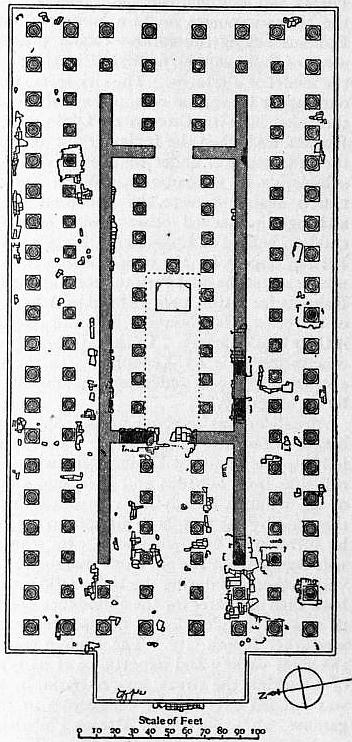
Ground plan of the 6th Century (“Croesus”) Temple at Ephesus, conjecturally restored by A.E. Henderson.
The history of the Artemision, as far as it can be inferred from the remains, is as follows. (1) There was no temple on the plain previous to the Ionian occupation, the primeval seat of the nature-goddess having been in the southern hills, at Ortygia (near mod. Arvalia). Towards the end of the 8th century B.C. a small shrine came into existence on the plain. This was little more than a small platform of green schist with a sacred tree and an altar, and perhaps later a wooden icon (image), the whole enclosed in a temenos: but, as is proved by a great treasure of objects in precious and other metals, ivory, bone, crystal, paste, glass, terra-cotta and other materials, found in 1904-1905, partly within the platform on which the cult-statue stood and partly outside, in the lowest stratum of deposit, this early shrine was presently enriched by Greeks with many and splendid offerings of Hellenic workmanship. A large number of electron coins, found among these offerings, and in style the earliest of their class known, combine with other evidence to date the whole treasure to a period considerably anterior to the reign of Croesus. This treasure is now divided between the museums of Constantinople and London. (2) Within a short time, perhaps after the Cimmerian sack (? 650 B.C.), this shrine was restored, slightly enlarged, and raised in level, but not altered in character. (3) About the close of the century, for some reason not known, but possibly owing to collapse brought about by the marshy nature of the site, this was replaced by a temple of regular Hellenic form. The latter was built in relation to the earlier central statue-base but at a higher level than either of its predecessors, doubtless for dryness’ sake. Very little but its foundations was spared by later builders, and there is now no certain evidence of its architectural character; but it is very probable that it was the early temple in which the Ionic order is said to have been first used, after the colonists had made use of Doric in their earlier constructions (e.g. in the Panionion); and that it was the work of the Cnossian Chersiphron and his son, Metagenes, always regarded afterwards as the first builders of a regular Artemision. Their temple is said by Strabo to have been made bigger by another architect. (4) The latter’s work must have been the much larger temple, exposed by Wood, and usually known as the Archaic or Croesus temple. This overlies the remains of No. 3, at a level higher by about a metre, and the area of its cella alone contains the whole of the earlier shrines. Its central point, however, was still the primitive statue-base, now enlarged and heightened. About half its pavement, parts of the cella walls and of three columns of the peristyle, and the foundations of nearly all the platform, are still in position. The visible work was all of very fine white marble, quarried about 7 m. N.E., near the modern Kos Bunar. Fragments of relief-sculptures belonging to the parapet and columns, and of fluted drums and capitals, cornices and other architectural members have been recovered, showing that the workmanship and Ionic style were of the highest excellence, and that the building presented a variety of ornament, rare among Hellenic temples. The whole ground-plan covered about 80,000 sq. ft. The height of the temple is doubtful, the measurements of columns given us by later authority having reference probably to its successor, the height of which was considered abnormal and marvellous. Judged by the diameter of the drums, the columns of the Croesus temple were not two-thirds of the height of those of the Hellenistic temple. This fourth temple is, beyond question, that to which Croesus contributed, and it was, therefore, in process of building about 540 B.C. Our authorities seem to be referring to it when they tell us that the Artemision was raised by common contribution of the great cities of Asia, and took 120 years to complete. It was dedicated with great ceremony, probably between 430 and 420 B.C., and the famous Timotheus, son of Thersander, carried off the magnificent prize for a lyric ode against all comers. Its original architects were, probably, Paeonius of Ephesus, and Demetrius, a ἱερός of the shrine itself: but it has been suggested that the latter may have been rather the actual contracting builder than the architect. Of this temple Herodotus speaks as existing in his day; and unless weight be given to an isolated statement of Eusebius, that it was burned about 395 B.C., we must assume that it survived until the night when one Herostratus, desirous of acquiring eternal fame if only by a great crime, set it alight. This is said to have happened in 356 B.C. on the October night on which Alexander the Great came into the world, and, as Hegesias said, the goddess herself was absent, assisting at the birth; but the exactness of this portentous synchronism makes the date suspect. (5) It was succeeded by what is called the Hellenistic temple, begun almost immediately after the catastrophe, according to plans drawn by the famous Dinocrates the architect of Alexandria. The platform was once more raised to a higher level, some 7 ft. above that of the Archaic, by means of huge foundation blocks bedded upon the earlier structures; and this increase of elevation necessitated a slight expansion of the area all round, and ten steps in place of three. The new columns were of greater diameter than the old and over 60 ft. high; and from its great height the whole structure was regarded as a marvel, and accounted one of the wonders of the world. Since, however, other Greek temples had colonnades hardly less high, and were of equal or greater area, it has been suggested that the Ephesian temple had some distinct element of grandiosity, no longer known to us—perhaps a lofty sculptured parapet or some imposing form of podium. Bede, in his treatise De sept. mir. mundi, describes a stupendous erection of several storeys; but his other descriptions are so fantastic that no credence can be attached to this. The fifth temple was once more of Ionic order, but the finish and style of its details as attested by existing remains were inferior to those of its predecessor. The great sculptured drums and pedestals, now in the British Museum, belong to the lower part of certain of its columns: but nothing of its frieze or pediments (if it had any) has been recovered. Begun probably before 350 B.C., it was in building when Alexander came to Ephesus in 334 and offered to bear the cost of its completion. It was probably finished by the end of the century; for Pliny the Elder states that its cypress-wood doors had been in existence for 400 years up to his time. It stood intact, except for very partial restorations, till A.D. 262 when it was sacked and burned by the Goths: but it appears to have been to some extent restored afterwards, and its cult no doubt survived till the Edict of Theodosius closed the pagan temples. Its material was then quarried extensively for the construction of the great cathedral of St John Theológos on the neighbouring hill (Ayassoluk), and a large Byzantine building (a church?) came into existence on the central part of its denuded site, but did not last long. Before the Ottoman conquest its remains were already buried under several feet of silt.
The organization of the temple hierarchy, and its customs and privileges, retained throughout an Asiatic character. The priestesses of the goddess were παρθένοι (i.e. unwedded), and her priests were compelled to celibacy. The chief among the latter, who bore the Persian name of Megabyzus and the Greek title Neocorus, was doubtless a power in the state as well as a dignitary of religion. His official dress and spadonic appearance are probably revealed to us by a small ivory statuette found by D.G. Hogarth in 1905. Besides these there was a vast throng of dependents who lived by the temple and its services—theologi, who may have expounded sacred legends, hymnodi, who composed hymns in honour of the deity, and others, together with a great crowd of hieroi who performed more menial offices. The making of shrines and images of the goddess occupied many hands. To support this greedy mob, offerings flowed in in a constant stream from votaries and from visitors, who contributed sometimes money, sometimes statues and works of art. These latter so accumulated that the temple became a rich museum, among the chief treasures of which were the figures of Amazons sculptured in competition by Pheidias, Polyclitus, Cresilas and Phradmon, and the painting by Apelles of Alexander holding a thunderbolt. The temple was also richly endowed with lands, and possessed the fishery of the Selinusian lakes, with other large revenues. But perhaps the most important of all the privileges possessed by the goddess and her priests was that of asylum. Fugitives from justice or vengeance who reached her precincts were perfectly safe from all pursuit and arrest. The boundaries of the space possessing such virtue were from time to time enlarged. Mithradates extended them to a bowshot from the temple in all directions, and Mark Antony imprudently allowed them to take in part of the city, which part thus became free of all law, and a haunt of thieves and villains. Augustus, while leaving the right of asylum untouched, diminished the space to which the privilege belonged, and built round it a wall, which still surrounds the ruins of the temple at the distance of about a quarter of a mile, bearing an inscription in Greek and Latin, which states that it was erected in the proconsulship of Asinius Gallus, out of the revenues of the temple. The right of asylum, however, had once more to be defended by a deputation sent to the emperor Tiberius. Besides being a place of worship, a museum and a sanctuary, the Ephesian temple was a great bank. Nowhere in Asia could money be more safely bestowed, and both kings and private persons placed their treasures under the guardianship of the goddess.
The City.—After Wood’s superficial explorations, the city remained desolate till 1894, when the Austrian Archaeological Institute obtained a concession for excavation and began systematic work. This has continued regularly ever since, but has been carried down no farther than the imperial stratum. The main areas of operation have been: (1) The Great Theatre. The stage buildings, orchestra and lower parts of the cavea have been cleared. In the process considerable additions were made to Wood’s find of sculptures in marble and bronze, and of inscriptions, including missing parts of the Vibius Salutaris texts. This theatre has a peculiar interest as the scene of the tumult aroused by the mission of St Paul; but the existing remains represent a reconstruction carried out after his time. (2) The Hellenistic Agora, a huge square, surrounded by porticoes, lying S.W. of the theatre and having fine public halls on the S. It has yielded to the Austrians fine sculpture in marble and bronze and many inscriptions. (3) The Roman Agora, with its large halls, lying N.W. of the theatre. Here were found many inscriptions of Roman date and some statuary. (4) A street running from the S.E. angle of the Hellenic Agora towards the Magnesian gate. This was found to be lined with pedestals of honorific statues and to have on the west side a remarkable building, stated in an inscription to have been a library. The tomb of the founder, T. Julius Celsus, is hard by, and some fine Roman reliefs, which once decorated it, have been sent to Vienna. (5) A street running direct to the port from the theatre. This is of great breadth, and had a Horologion half-way down and fine porticoes and shops. It was known as the Arcadiane after having been restored at a higher level than formerly by the emperor Arcadius (A.D. 395). It leaves on the right the great Thermae of Constantine, of which the Austrians have cleared out the south-east part. This huge pile used to be taken for the Artemision by early visitors to Ephesus. Part of the quays and buildings round the port were exposed, after measures had been taken to drain the upper part of the marsh. (6) The Double Church of the Virgin “Deipara” in the N.W. of the city, wherein the council of 431 was held. Here interesting inscriptions and Byzantine architectural remains were found. Besides these excavated monuments, the Stadion; the enceinte of fortifications erected by Lysimachus, which runs from the tower called the “Prison of St Paul” and right along the crests of the Bulbul (Prion) and Panajir hills; the round monument miscalled the “Tomb of St Luke”; and the Opistholeprian gymnasium near the Magnesian gate, are worthy of attention.
The work done by the Austrians enables a good idea to be obtained of the appearance presented by a great Graeco-Roman city of Asia in the last days of its prosperity. It may be realized better there than anywhere how much architectural splendour was concentrated in the public quarters. But the restriction of the clearance to the upper stratum of deposit has prevented the acquisition of much further knowledge. Both the Hellenistic and, still more, the original Ionian cities remain for the most part unexplored. It should, however, be added that very valuable topographical exploration has been carried out in the environs of Ephesus by members of the Austrian expedition, and that the Ephesian district is now mapped more satisfactorily than any other district of ancient interest in Asia Minor.
The Turkish village of Ayassoluk (the modern representative of Ephesus), more than a mile N.E. of the ancient city, has revived somewhat of recent years owing to the development of its fig gardens by the Aidin railway, which passes through the upper part of the plain. It is noteworthy for a splendid ruined mosque built by the Seljuk, Isa Bey II., of Aidin, in 1375, which contains magnificent columns: for a castle, near which lie remains of the pendentives from the cupola of the great cathedral of St John, now deeply buried in its own ruins: and for an aqueduct, Turkish baths and mosque-tombs. There is a fair inn managed by the Aidin Railway Company.
Bibliography.—E. Guhl, Ephesiaca (1843); E. Curtius, Ephesos (1874); C. Zimmermann, Ephesos im ersten christlichen Jahrhundert (1874); J.T. Wood, Discoveries at Ephesus (1877); E.L. Hicks, Anc. Greek Inscr. in the Brit. Museum, iii. 2 (1890); B.V. Head, “Coinage of Ephesus” (Numism. Chron., 1880); J. Menadier, Qua condicione Ephesii usi sint, &c. (1880); Sir W.M. Ramsay, Letters to the Seven Churches (1904); O. Benndorf, R. Heberdey, &c., Forschungen in Ephesos, vol. i. (1906) (Austrian Arch. Institute); D.G. Hogarth, Excavations at Ephesus: the Archaic Artemisia (2 vols., 1908), with chapters by C.H. Smith, A. Hamilton Smith, B.V. Head, and A.E. Henderson.
(D. G. H.)
EPHESUS, COUNCIL OF. This Church council was convened in 431 for the purpose of taking authoritative action concerning the doctrine of the person of Christ. The councils of Nicaea and Constantinople had asserted the full divinity and real humanity of Christ, without, however, defining the manner of their union. The attempt to solve the apparent incongruity of a perfect union of two complete and distinct natures in one person produced first Apollinarianism, which substituted the divine Logos for the human νοῦς or πνεῦμα of Jesus, thereby detracting from the completeness of his humanity; and then Nestorianism, which destroyed the unity of Christ’s person by affirming that the divine Logos dwelt in the man Jesus as in a temple, and that the union of the two was in respect of dignity, and furthermore that, inasmuch as the Logos could not have been born, to call Mary θεοτόκος, “Godbearer,” was absurd and blasphemous. The Alexandrians, led by Cyril, stood for the doctrine of the perfect union of two complete natures in one person, and made θεοτόκος the shibboleth of orthodoxy. The theological controversy was intensified by the rivalry of the two patriarchates, Alexandria and Constantinople, for the primacy of the East. As bishop of Constantinople Nestorius naturally looked to the emperor for support, while Cyril turned to Rome. A Roman synod in 430 found Nestorius heretical and decreed his excommunication unless he should recant. Shortly afterwards an Alexandrian synod condemned his doctrines in twelve anathemas, which only provoked counter-anathemas. The emperor now intervened and summoned a council, which met at Ephesus on the 22nd of June 431. Nestorius was present with an armed escort, but refused to attend the council on the ground that the patriarch of Antioch (his friend) had not arrived. The council, nevertheless, proceeded to declare him excommunicate and deposed. When the Roman legates appeared they “examined and approved” the acts of the council, whether as if thereby giving them validity, or as if concurring with the council, is a question not easy to answer from the records. Cyril, the president, apparently regarded the subscription of the legates as the acknowledgment of “canonical agreement” with the synod.
The disturbances that followed the arrival of John, the patriarch of Antioch, are sufficiently described in the article Nestorius.
The emperor finally interposed to terminate that scandalous strife, banished Nestorius and dissolved the council. Ultimately he gave decision in favour of the orthodox. The council was generally received as ecumenical, even by the Antiochenes, and the differences between Cyril and John were adjusted (433) by a “Union Creed,” which, however, did not prevent a recrudescence of theological controversy.
See Mansi iv. pp. 567-1482, v. pp. 1-1023; Hardouin i. pp. 1271-1722; Hefele (2nd ed.) ii. pp. 141-247 (Eng. trans. iii. pp. 1-114); Peltanus, SS. Magni et Ecumen. Conc. Ephesini primi Acta omnia ... (Ingolstadt, 1576); Wilhelm Kraetz, Koptische Akten zum Ephes. Konzil ... (Leipzig, 1904); also the articles Nestorius; Cyril; Theodore of Mopsuestia.
The so-called “Robber Synod” of Ephesus (Latrocinium Ephesinum) of 449, although wholly irregular and promptly repudiated by the church, may, nevertheless, not improperly be treated here. The archimandrite Eutyches (q.v.) having been deposed by his bishop, Flavianus of Constantinople, on account of his heterodox doctrine of the person of Christ, had appealed to Dioscurus, the successor of Cyril in the see of Alexandria, who restored him and moved the emperor Theodosius II. to summon a council, which should “utterly destroy Nestorianism.” Rome recognizing that she had more to fear from Alexandria, departed from her traditional policy and sided with Constantinople. The council of 130 bishops, which convened on the 8th of August 449, was completely dominated by Dioscurus. Eutyches was acquitted of heresy and reinstated, Flavianus and other bishops deposed, the Roman legates insulted, and all opposition was overborne by intimidation or actual violence. The death of Flavianus, which soon followed, was attributed to injuries received in this synod; but the proof of the charge leaves something to be desired.
The emperor confirmed the synod, but the Eastern Church was divided upon the question of accepting it, and Leo I. of Rome excommunicated Dioscurus, refused to recognize the successor of Flavianus and demanded a new and greater council. The death of Theodosius II. removed the main support of Dioscurus, and cleared the way for the council of Chalcedon (q.v.), which deposed the Alexandrian and condemned Eutychianism.
See Mansi vi. pp. 503 sqq., 606 sqq.; Hardouin ii. 71 sqq.; Hefele (2nd ed.) ii. pp. 349 sqq. (Eng. trans. iii. pp. 221 sqq.); S.G.F. Perry, The Second Synod of Ephesus (Dartford, 1881); l’Abbé Martin, Actes du brigandage d’Éphèse (Amiens, 1874) and Le Pseudo-synode connu dans l’histoire sous le nom de brigandage d’Éphèse (Paris, 1875).
(T. F. C.)
EPHOD, a Hebrew word (ēphōd) of uncertain meaning, retained by the translators of the Old Testament. In the post-exilic priestly writings (5th century B.C. and later) the ephod forms part of the gorgeous ceremonial dress of the high-priest (see Ex. xxix. 5 sq. and especially Ecclus. xlv. 7-13). It was a very richly decorated object of coloured threads interwoven with gold, worn outside the luxurious mantle or robe; it was kept in place by a girdle, and by shoulder-pieces (?), to which were attached brooches of onyx (fastened to the robe) and golden rings from which hung the “breastplate” (or rather pouch) containing the sacred lots, Urim and Thummim. The somewhat involved description in Ex. xxviii. 6 sqq., xxxix. 2 sqq. (see V. Ryssel’s ed. of Dillmann’s commentary on Ex.-Lev.) leaves it uncertain whether it covered the back, encircling the body like a kind of waistcoat, or only the front; at all events it was not a garment in the ordinary sense, and its association with the sacred lots indicates that the ephod was used for divination (cf. Num. xxvii. 21), and had become the distinguishing feature of the leading priestly line (cf. 1 Sam. ii. 28).1 But from other passages it seems that the ephod had been a familiar object whose use was by no means so restricted. Like the teraphim (q.v.) it was part of the common stock of Hebrew cult; it is borne (rather than worn) by persons acting in a priestly character (Samuel at Shiloh, priests of Nob, David), it is part of the worship of individuals (Gideon at Ophrah), and is found in a private shrine with a lay attendant (Micah; Judg. xvii. 5; see, however, vv. 10-13).2 Nevertheless, while the prophetical teaching came to regard the ephod as contrary to the true worship of Yahweh, the priestly doctrine of the post-exilic age (when worship was withdrawn from the community at large to the recognized priesthood of Jerusalem) has retained it along with other remains of earlier usage, legalizing it, as it were, by confining it exclusively to the Aaronites.
An intricate historical problem is involved at the outset in the famous ephod, which the priest Abiathar brought in his hand when he fled to David after the massacre of the priests of Nob. It is evidently regarded as the one which had been in Nob (1 Sam. xxi. 9), and the presence of the priests at Nob is no less clearly regarded as the sequel of the fall of Shiloh. The ostensible intention is to narrate the transference of the sacred objects to David (cf. 2 Sam. i. 10), and henceforth he regularly inquires of Yahweh in his movements (1 Sam. xxiii. 9-12, xxx. 7 sq.; cf. xxiii. 2, 4; 2 Sam. ii. 1, v. 19-23). It is possible that the writer (or writers) desired to trace the earlier history of the ephod through the line of Eli and Abiathar to the time when the Zadokite priests gained the supremacy (see Levites); but elsewhere Abiathar is said to have borne the ark (1 Kings ii. 26; cf. 2 Sam. vii. 6), and this fluctuation is noteworthy by reason of the present confusion in the text of 1 Sam. xiv. 3, 18 (see commentaries).
On one view, the ark in Kirjath-jearim was in non-Israelite hands (1 Sam. vii. 1 sq.); on the other, Saul’s position as king necessitates the presumption that his sway extended over Judah and Israel, including those cities which otherwise appear to have been in the hands of aliens (1 Sam. xiv. 47 sq.; cf. xvii. 54, &c.). There are some fundamental divergencies in the representations of the traditions of both David and Saul (qq.v.), and there is indirect and independent evidence which makes 1 Kings ii. 26 not entirely isolated. Here it must suffice to remark that the ark, too, was also an object for ascertaining the divine will (especially Judg. xx. 26-28; cf. 18, 23), and it is far from certain that the later records of the ark (which was too heavy to be borne by one), like those of the ephod, are valid for earlier times.