VOLUME IX SLICE VI English Language to Epsom Salts (continued 10)
Reading edition
In early times, though there is considerable variety in the cases treated and the methods of cure, there are certain characteristics common to the majority of the cases. The patient consulting the god sleeps in the Abaton, sees certain visions, and, as a result, comes forth cured the next morning. Sometimes there seem to be surgical cases, like that of a man who had a spear-head extracted from his jaw, and found it laid in his hands when he awoke in the morning, and there are many examples resembling those known at the present day at Lourdes or Tenos, where hysterical or other similar affections are cured by the influence of imagination or sudden emotion. It is, however, difficult to make any scientific use of the records, owing to the indiscriminate manner in which genuine and apocryphal cases are mingled, and circumstantial details are added. We learn the practice of later times from some dedicated inscriptions. Apparently the old faith-healing had lost its efficacy, and the priests substituted for it elaborate prescriptions as to diet, baths and regimen which must have made Epidaurus and its visitors resemble their counterparts in a modern spa. At this time there were extensive buildings provided for the accommodation of invalids, some of which have been discovered and partially cleared; one was built by Antoninus Pius. They were in the form of great courtyards surrounded by colonnades and chambers.
Between the precinct and the theatre was a large gymnasium, which was in later times converted to other purposes, a small odeum being built in the middle of it. In a valley just to the south-west of the precinct is the stadium, of which the seats and goal are well preserved. There is a gutter round the level space of the stadium, with basins at intervals for the use of spectators or competitors, and a post at every hundred feet of the course, thus dividing it into six portions. The goal, which is well preserved at the upper end, is similar to that at Olympia; it consists of a sill of stone sunk level with the ground, with parallel grooves for the feet of the runners at starting, and sockets to hold the posts that separated the spaces assigned to the various competitors, and served as guides to them in running. For these were substituted later a set of stone columns resembling those in the proscenium of a theatre. There was doubtless a similar sill at the lower end for the start of the stadium, this upper one being intended for the start of the diaulos and longer races.
The theatre still deserves the praise given it by Pausanias as the most beautiful in Greece. The auditorium is in remarkable preservation, almost every seat being still in situ, except a few where the supporting walls have given way on the wings. The whole plan is drawn from three centres, the outer portion of the curves being arcs of a larger circle than the one used for the central portion; the complete circle of the orchestra is marked by a sill of white limestone, and greatly enhances the effect of the whole. There are benches with backs not only in the bottom row, but also above and below the diazoma. The acoustic properties of the theatre are extraordinarily good, a speaker in the orchestra being heard throughout the auditorium without raising his voice. The stage buildings are not preserved much above their foundations, and show signs of later repairs; but their general character can be clearly seen. They consist of a long rectangular building, with a proscenium or column front which almost forms a tangent to the circle of the orchestra; at the middle and at either end of this proscenium are doors leading into the orchestra, those at the end set in projecting wings; the top of the proscenium is approached by a ramp, of which the lower part is still preserved, running parallel to the parodi, but sloping up as they slope down. The proscenium was originally about 14 ft. high and 12 ft. broad; so corresponding approximately to the Greek stage as described by Vitruvius. M. Kavvadias, who excavated the theatre, believes that the proscenium is contemporary with the rest of the theatre, which, like the Tholos, was built by Polyclitus (the younger); but Professor W. Dörpfeld maintains that it is a later addition. In any case, the theatre at Epidaurus ranks as the most typical of Greek theatres, both from the simplicity of its plan and the beauty of its proportions.
See Pausanias i. 29; Expédition de la Morée, ii.; Curtius, Peloponnesus, ii.; Transactions of Roy. Soc. of Lit., 2nd series, vol. ii.; Weclawski, De rebus Epidauriorum (Posen, 1854).
The excavations at the Hieron have been recorded as they went on in the Πρακτικά of the Greek Archaeological Society, especially for 1881-1884 and 1889, and also in the Ἐφημερὶς Ἀρχαιολογική, especially for 1883 and 1885; see also Kavvadias, Les Fouilles d’Épidaure and Τὸ Ἱερὸν τοῦ Ἀσκληπιοῦ ἐν Ἐπιδαύρῳ καὶ ἡ θεράπεια τῶν ἀσθενῶν; Defrasse and Lechat, Épidaure. A museum was completed in 1910.
2. A city of Peloponnesus on the east coast of Laconia, distinguished by the epithet of Limera (either “The Well-havened” or “The Hungry”). It was founded by the people of Epidaurus the Holy, and its principal temples were those of Asclepius and Aphrodite. It was abandoned during the middle ages; its inhabitants took possession of the promontory of Minoa, turned it into an island, and built and fortified thereon the city of Monembasia, which became the most flourishing of all the towns in the Morea, and gave its name to the well-known Malmsey or Malvasia wine. The ruins of Epidaurus are to be seen at the place now called Palaea Monemvasia.
A third Epidaurus was situated in Illyricum, on the site of the present Ragusa Vecchia; but it is not mentioned till the time of the civil wars of Pompey and Caesar, and has no special interest.
(E. Gr.)
EPIDIORITE, in petrology, a typical member of a family of rocks consisting essentially of hornblende and felspar, often with epidote, garnet, sphene, biotite, or quartz, and having usually a foliated structure. The term is to some extent synonymous with “amphibolite” and “hornblende-schist.” These rocks are metamorphic, and though having a mineral constitution somewhat similar to that of diorite, they have been produced really from rocks of more basic character, such as diabase, dolerite and gabbro. They occur principally among the schists, slates and gneisses of such districts as the Scottish Highlands, the north-west of Ireland, Brittany, the Harz, the Alps, and the crystalline ranges of eastern N. America. Their hornblende in microscopic section is usually dark green, rarely brownish; their felspar may be clear and recrystallized, but more frequently is converted into a turbid aggregate of epidote, zoisite, quartz, sericite and albite. In the less complete stages of alteration, ophitic structure may persist, and the original augite of the rock may not have been entirely replaced by hornblende. Pink or brownish garnets are common and may be an inch or two in diameter. The iron oxides, originally ilmenite, are usually altered to sphene. Biotite, if present, is brown; epidote is yellow or colourless; rutile, apatite and quartz all occur with some frequency. The essential minerals, hornblende and felspar, rarely show crystalline outlines, and this is generally true also of the others. The rocks may be fine grained, so that their constituents are hardly visible to the unaided eye; or may show crystals of hornblende an inch in length. Their prevalent colour is dark green and they weather with brown surfaces. In many parts of the world epidiorites and the quartz veins which sometimes occur in them have proved to be auriferous. As they are tough, hard rocks, when fresh, they are well suited for use as road-mending stones.
(J. S. F.)
EPIDOSITE, in petrology, a typical member of a family of metamorphic rocks composed mainly of epidote and quartz. In colour they are pale yellow or greenish yellow, and they are hard and somewhat brittle. They may occur in more than one way and are derived from several kinds of rock. Some have been epidotic grits and sandstones; others are limestones which have undergone contact-alteration; probably the majority, however, are allied to epidiorite and amphibolite, and are local modifications of rocks which were primarily basic intrusions or lavas. The sedimentary epidosites occur with mica-schists, sheared grits and granulitic gneisses; they often show, on minute examination, the remains of clastic structures. The epidosites derived from limestones may contain a great variety of minerals such as calcite, augite, garnet, scapolite, &c., but their source may usually be inferred from their close association with calc-silicate rocks in the field. The third group of epidosites may form bands, veins, or irregular streaks and nodules in masses of epidiorite and hornblende-schist. In microscopic section they are often merely a granular mosaic of quartz and epidote with some iron oxides and chlorite, but in other cases they retain much of the structure of the original rock though there has been a complete replacement of the former minerals by new ones. Epidosites when streaked and variegated have been cut and polished as ornamental stones. They are translucent and hard, and hence serve for brooch stones, and the simpler kinds of jewelry. These rocks occasionally carry gold in visible yellow specks.
(J. S. F.)
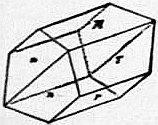
EPIDOTE, a mineral species consisting of basic calcium, aluminium and iron orthosilicate, Ca2(AlOH)(Al, Fe)2(SiO4)3, crystallizing in the monoclinic system. Well-developed crystals are of frequent occurrence: they are commonly prismatic in habit, the direction of elongation being perpendicular to the single plane of symmetry. The faces lettered M, T and r in the figure are often deeply striated in the same direction: M is a direction of perfect cleavage, and T of imperfect cleavage: crystals are often twinned on the face T. Many of the characters of the mineral vary with the amount of iron present (Fe2O3, 5-17%), for instance, the colour, the optical constants, and the specific gravity (3.3-3.5). The hardness is 6½. The colour is green, grey, brown or nearly black, but usually a characteristic shade of yellowish-green or pistachio-green. The pleochroism is strong, the pleochroic colours being usually green, yellow and brown. The names thallite (from θαλλός, “a young shoot”) and pistacite (from πιστάκια, “pistachio nut”) have reference to the colour. The name epidote is one of R.J. Haüy’s crystallographic names, and is derived from ἐπίδοσις, “increase,” because the base of the primitive prism has one side longer than the other. Several other names (achmatite, bucklandite, escherite, puschkinite, &c.) have been applied to this species. Withamite is a carmine-red to straw-yellow, strongly pleochroic variety from Glencoe in Scotland. Fouqueite and clinozoisite are white or pale rose-red varieties containing very little iron, thus having the same chemical composition as the orthorhombic mineral zoisite (q.v.).
Epidote is an abundant rock-forming mineral, but one of secondary origin. It occurs in crystalline limestones and schistose rocks of metamorphic origin; and is also a product of weathering of various minerals (felspars, micas, pyroxenes, amphiboles, garnets, &c.) composing igneous rocks. A rock composed of quartz and epidote is known as epidosite. Well-developed crystals are found at many localities, of which the following may be specially mentioned: Knappenwand, near the Gross-Venediger in the Untersulzbachthal in Salzburg, as magnificent, dark green crystals of long prismatic habit in cavities in epidote-schist, with asbestos, adularia, calcite, and apatite; the Ala valley and Traversella in Piedmont; Arendal in Norway (arendalite); Le Bourg d’Oisans in Dauphiné (oisanite and delphinite); Haddam in Connecticut; Prince of Wales Island in Alaska, here as large, dark green, tabular crystals with copper ores in metamorphosed limestone.
The perfectly transparent, dark green crystals from the Knappenwand and from Brazil have occasionally been cut as gem-stones.
Belonging to the same isomorphous group with epidote are the species piedmontite and allanite, which may be described as manganese and cerium epidotes respectively.
Piedmontite has the composition Ca2(AlOH)(Fe, Mn)2(SiO4)3; it occurs as small, reddish-black, monoclinic crystals in the manganese mines at San Marcel, near Ivrea in Piedmont, and in crystalline schists at several places in Japan. The purple colour of the Egyptian porfido rosso antico is due to the presence of this mineral.
Allanite has the same general formula R2″(R″′OH)R2″′(SiO4)3, where R″ represents calcium and ferrous iron, and R″′ aluminium, ferric iron and metals of the cerium group. In external appearance it differs widely from epidote, being black or dark brown in colour, pitchy in lustre, and opaque in the mass; further, there is little or no cleavage, and well-developed crystals are rarely met with. The crystallographic and optical characters are similar to those of epidote; the pleochroism is strong with reddish-, yellowish-, and greenish-brown colours. Although not a common mineral, allanite is of fairly wide distribution as a primary accessory constituent of many crystalline rocks, e.g. gneiss, granite, syenite, rhyolite, andesite, &c. It was first found in the granite of east Greenland and described by Thomas Allan in 1808, after whom the species was named. Allanite is a mineral readily altered by hydration, becoming optically isotropic and amorphous: for this reason several varieties have been distinguished, and many different names applied. Orthite, from ὀρθός, “straight,” was the name given by J.J. Berzelius in 1818 to a hydrated form found as slender prismatic crystals, sometimes a foot in length, at Finbo, near Falun in Sweden.
(L. J. S.)
EPIGONI (“descendants”), in Greek legend, the sons of the seven heroes who fought against Thebes (see Adrastus). Ten years later, to avenge their fathers, the Epigoni undertook a second expedition, which was completely successful. Thebes was forced to surrender and razed to the ground. In early times the war of the Epigoni was a favourite subject of epic poetry. The term is also applied to the descendants of the Diadochi, the successors of Alexander the Great.
EPIGONION (Gr. ἐπιγόνειον), an ancient stringed instrument mentioned in Athenaeus 183 C, probably a psaltery. The epigonion was invented, or at least introduced into Greece, by Epigonus, a Greek musician of Ambracia in Epirus, who was admitted to citizenship at Sicyon as a recognition of his great musical ability and of his having been the first to pluck the strings with his fingers, instead of using the plectrum.1 The instrument, which Epigonus named after himself, had forty strings.2 It was undoubtedly a kind of harp or psaltery, since in an instrument of so many strings some must have been of different lengths, for tension and thickness only could hardly have produced forty different sounds, or even twenty, supposing that they were arranged in pairs of unisons. Strings of varying lengths require a frame like that of the harp, or of the Egyptian cithara which had one of the arms supporting the cross bar or zugon shorter than the other,3 or else strings stretched over harp-shaped bridges on a sound-board in the case of a psaltery. Juba II., king of Mauretania, who reigned from 30 B.C., said (ap. Athen. l.c.) that Epigonus brought the instrument from Alexandria and played upon it with the fingers of both hands, not only using it as an accompaniment to the voice, but introducing chromatic passages, and a chorus of other stringed instruments, probably citharas, to accompany the voice. Epigonus was also a skilled citharist and played with his bare hands without plectrum.4 Unfortunately we have no record of when Epigonus lived. Vincenzo Galilei5 has given us a description of the epigonion accompanied by an illustration, representing his conception of the ancient instrument, an upright psaltery with the outline of the clavicytherium (but no keyboard).
(K. S.)
1 Michael Praetorius, Syntagma musicum, tom. 1, c. 13, p. 380: Salomon van Til, Sing-Dicht und Spiel-Kunst, p. 95.
2 Pollux, Onomasticon, lib. iv. cap. 9, 59.
3 For an illustration, see Kathleen Schlesinger, Orchestral Instruments, part ii. “Precursors of the Violin Family,” fig. 165, p. 219.
4 Athenaeus, iv. p. 183 d. and xiv. p. 638 a.
5 Dialogo della musica antica e moderna, ed. 1602, p. 40.
EPIGRAM, properly speaking, anything that is inscribed. Nothing could be more hopeless, however, than an attempt to discover or devise a definition wide enough to include the vast multitude of little poems which at one time or other have been honoured with the title of epigram, and precise enough to exclude all others. Without taking account of its evident misapplications, we find that the name has been given—first, in strict accordance with its Greek etymology, to any actual inscription on monument, statue or building; secondly, to verses never intended for such a purpose, but assuming for artistic reasons the epigraphical form; thirdly, to verses expressing with something of the terseness of an inscription a striking or beautiful thought; and fourthly, by unwarrantable restriction, to a little poem ending in a “point,” especially of the satirical kind. The last of these has obtained considerable popularity from the well-known lines—
“The qualities rare in a bee that we meet In an epigram never should fail; The body should always be little and sweet, And a sting should be left in its tail”—
which represent the older Latin of some unknown writer—
“Omne epigramma sit instar apis: sit aculeus illi; Sint sua mella; sit et corporis exigui.”
Attempts not a few of a more elaborate kind have been made to state the essential element of the epigram, and to classify existing specimens; but, as every lover of epigrams must feel, most of them have been attended with very partial success. Scaliger, in the third book of his Poetics, gives a fivefold division, which displays a certain ingenuity in the nomenclature but is very superficial: the first class takes its name from mel, or honey, and consists of adulatory specimens; the second from fel, or gall; the third from acetum, or vinegar; and the fourth from sal, or salt; while the fifth is styled the condensed, or multiplex. This classification is adopted by Nicolaus Mercerius in his De conscribendo epigrammate (Paris, 1653); but he supplemented it by another of much more scientific value, based on the figures of the ancient rhetoricians. Lessing, in the preface to his own epigrams, gives an interesting treatment of the theory, his principal doctrine being practically the same as that of several of his less eminent predecessors, that there ought to be two parts more or less clearly distinguished,—the first awakening the reader’s attention in the same way as an actual monument might do, and the other satisfying his curiosity in some unexpected manner. An attempt was made by Herder to increase the comprehensiveness and precision of the theory; but as he himself confesses, his classification is rather vague—the expository, the paradigmatic, the pictorial, the impassioned, the artfully turned, the illusory, and the swift. After all, if the arrangement according to authorship be rejected, the simplest and most satisfactory is according to subjects. The epigram is one of the most catholic of literary forms, and lends itself to the expression of almost any feeling or thought. It may be an elegy, a satire, or a love-poem in miniature, an embodiment of the wisdom of the ages, a bon-mot set off with a couple of rhymes.
“I cannot tell thee who lies buried here; No man that knew him followed by his bier; The winds and waves conveyed him to this shore, Then ask the winds and waves to tell thee more.” Anonymous. “Wherefore should I vainly try To teach thee what my love will be In after years, when thou and I Have both grown old in company, If words are vain to tell thee how, Mary, I do love thee now?” Anonymous. “O Bruscus, cease our aching ears to vex, With thy loud railing at the softer sex; No accusation worse than this could be, That once a woman did give birth to thee.” Acilius. “Treason doth never prosper. What’s the reason? For if it prospers none dare call it treason.” Harrington. “Ward has no heart they say, but I deny it; He has a heart, and gets his speeches by it.” Rogers.
From its very brevity there is no small danger of the epigram passing into childish triviality: the paltriest pun, a senseless anagram, is considered stuff enough and to spare. For proof of this there is unfortunately no need to look far; but perhaps the reader could not find a better collection ready to his hand than the second twenty-five of the Epigrammatum centuriae of Samuel Erichius; by the time he reaches No. 11 of the 47th century, he will be quite ready to grant the appropriateness of the identity maintained between the German Seele, or soul, and the German Esel, or ass.
Of the epigram as cultivated by the Greeks an account is given in the article Anthology, discussing those wonderful collections which bid fair to remain the richest of their kind. The delicacy and simplicity of so much of what has been preserved is perhaps their most striking feature; and one cannot but be surprised at the number of poets proved capable of such work. In Latin literature, on the other hand, the epigrammatists whose work has been preserved are comparatively few, and though several of them, as Catullus and Martial, are men of high literary genius, too much of what they have left behind is vitiated by brutality and obscenity. On the subsequent history of the epigram, indeed, Martial has exercised an influence as baneful as it is extensive, and he may fairly be counted the far-off progenitor of a host of scurrilous verses. Nearly all the learned Latinists of the 16th and 17th centuries may claim admittance into the list of epigrammatists,—Bembo and Scaliger, Buchanan and More, Stroza and Sannazaro. Melanchthon, who succeeded in combining so much of Pagan culture with his Reformation Christianity, has left us some graceful specimens, but his editor, Joannes Major Joachimus, has so little idea of what an epigram is, that he includes in his collection some translations from the Psalms. The Latin epigrams of Étienne Pasquier were among the most admirable which the Renaissance produced in France. John Owen, or, as he Latinized his name, Johannes Audoenus, a Cambro-Briton, attained quite an unusual celebrity in this department, and is regularly distinguished as Owen the Epigrammatist. The tradition of the Latin epigram has been kept alive in England by such men as Porson, Vincent Bourne and Walter Savage Landor. Happily there is now little danger of any too personal epigrammatist suffering the fate of Niccolo Franco, who paid the forfeit of his life for having launched his venomous Latin against Pius V., though he may still incur the milder penalty of having his name inserted in the Index Expurgatorius, and find, like John Owen, that he consequently has lost an inheritance.
In English literature proper there is no writer like Martial in Latin or Logau in German, whose fame is entirely due to his epigrams; but several even of those whose names can perish never have not disdained this diminutive form. The designation epigram, however, is used by earlier English writers with excessive laxity, and given or withheld without apparent reason. The epigrams of Robert Crowley (1550) and of Henry Parrot (1613) are worthless so far as form goes. John Weever’s collection (1599) is of interest mainly because of its allusion to Shakespeare. Ben Jonson furnishes a number of noble examples in his Underwoods; and one or two of Spenser’s little poems and a great many of Herrick’s are properly classed as epigrams. Cowley, Waller, Dryden, Prior, Parnell, Swift, Addison, Johnson, Goldsmith and Young have all been at times successful in their epigrammatical attempts; but perhaps none of them has proved himself so much “to the manner born” as Pope, whose name indeed is almost identified with the epigrammatical spirit in English literature. Few English modern poets have followed in his footsteps, and though nearly all might plead guilty to an epigram or two, there is no one who has a distinct reputation as an epigrammatist. Such a reputation might certainly have been Landor’s, had he not chosen to write the best of his minor poems in Latin, and thus made his readers nearly as select as his language.
The French are undoubtedly the most successful cultivators of the “salt” and the “vinegar” epigram; and from the 16th century downwards many of their principal authors have earned no small celebrity in this department. The epigram was introduced into French literature by Mellin de St Gelais and Clément Marot. It is enough to mention the names of Boileau, J.B. Rousseau, Lebrun, Voltaire, Marmontel, Piron, Rulhière, and M.J. Chénier. In spite of Rapin’s dictum that a man ought to be content if he succeeded in writing one really good epigram, those of Lebrun alone number upwards of 600, and a very fair proportion of them would doubtless pass muster even with Rapin himself. If Piron was never anything better, “pas même académicien,” he appears at any rate in Grimm’s phrase to have been “une machine à saillies, à épigrammes, et à bons mots.” Perhaps more than anywhere else the epigram has been recognized in France as a regular weapon in literary and political contests, and it might not be altogether a hopeless task to compile an epigrammatical history from the Revolution to the present time.
While any fair collection of German epigrams will furnish examples that for keenness of wit would be quite in place in a French anthology, the Teutonic tendency to the moral and didactic has given rise to a class but sparingly represented in French. The very name of Sinngedichte bears witness to this peculiarity, which is exemplified equally by the rude priameln or proeameln, of the 13th and 14th centuries and the polished lines of Goethe and Schiller. Logau published his Deutsche Sinngetichte Drey Tausend in 1654, and Wernicke no fewer than six volumes of Ueberschriften oder Epigrammata in 1697; Kästner’s Sinngedichte appeared in 1782, and Haug and Weissen’s Epigrammatische Anthologie in 1804. Kleist, Opitz, Gleim, Hagedorn, Klopstock and A.W. Schlegel all possess some reputation as epigrammatists; Lessing is facile princeps in the satirical style; and Herder has the honour of having enriched his language with much of what is best from Oriental and classical sources.
It is often by no means easy to trace the history of even a single epigram, and the investigator soon learns to be cautious of congratulating himself on the attainment of a genuine original. The same point, refurbished and fitted anew to its tiny shaft, has been shot again and again by laughing cupids or fierce-eyed furies in many a frolic and many a fray. During the period when the epigram was the favourite form in Germany, Gervinus tells us how the works, not only of the Greek and Roman writers, but of Neo-Latinists, Spaniards, Dutchmen, Frenchmen, Englishmen and Poles were ransacked and plundered; and the same process of pillage has gone on in a more or less modified degree in other times and countries. Very noticeable often are the modifications of tone and expression occasioned by national and individual characteristics; the simplicity of the prototype may become common-place in the imitation, the sublime be distorted into the grotesque, the pathetic degenerate into the absurdly sentimental; or on the other hand, an unpromising motif may be happily developed into unexpected beauty. A good illustration of the variety with which the same epigram may be translated and travestied is afforded by a little volume published in Edinburgh in 1808, under the title of Lucubrations on the Epigram—
Εἰ μὲν ᾖν μαθεῖν ἆ δεῖ παθεῖν, καὶ μὴ παθεῖν, καλὸν ἦν τὸ μαθεῖν εἰ δὲ δεῖ παθεῖν ἆ δ᾽ ᾖν μαθεῖν, τί δεῖ μαθεῖν; χρὴ γὰρ παθεῖν.
The two collections of epigrams most accessible to the English reader are Booth’s Epigrams, Ancient and Modern (1863) and Dodd’s The Epigrammatists (1870). In the appendix to the latter is a pretty full bibliography, to which the following list may serve as a supplement:—Thomas Corraeus, De toto eo poëmatis genere quod epigramma dicitur (Venice, 1569; Bologna, 1590); Cottunius, De conficiendo epigrammate (Bologna, 1632); Vincentius Gallus, Opusculum de epigrammate (Milan, 1641); Vavassor, De epigrammate liber (Paris, 1669); Gedanke von deutschen Epigrammatibus (Leipzig, 1698); Doctissimorum nostra aetate Italorum epigrammata; Flaminii Moleae Naugerii, Cottae, Lampridii, Sadoleti, et aliorum, cura Jo. Gagnaei (Paris, c. 1550); Brugière de Barante, Recueil des plus belles épigrammes des poètes français (2 vols., Paris, 1698); Chr. Aug. Heumann, Anthologia Latina: hoc est, epigrammata partim a priscis partim junioribus a poëtis (Hanover, 1721); Fayolle, Acontologie ou dictionnaire d’épigrammes (Paris, 1817); Geijsbeck, Epigrammatische Anthologie, Sauvage, Les Guêpes gauloises: petit encyclopédie des meilleurs épigrammes, &c., depuis Clément Marot jusqu’aux poètes de nos jours (1859); La Récréation et passe-temps des tristes: recueil d’épigrammes et de petits contes en vers réimprimé sur l’édition de Rouen 1595, &c. (Paris, 1863). A large number of epigrams and much miscellaneous information in regard to their origin, application and translation is scattered through Notes and Queries.
See also an article in The Quarterly Review, No. 233.
EPIGRAPHY (Gr. ἐπί, on, and γράφειν, to write), a term used to denote (1) the study of inscriptions collectively, and (2) the science connected with the classification and explanation of inscriptions. It is sometimes employed, too, in a more contracted sense, to denote the palaeography, in inscriptions. Generally, it is that part of archaeology which has to do with inscriptions engraved on stone, metal or other permanent material (not, however, coins, which come under the heading Numismatics).
See Inscriptions; Palaeography.
EPILEPSY (Gr. ἐπί, upon, and λαμβάνειν, to seize), or Falling Sickness, a term applied generally to a nervous disorder, characterized by a fit of sudden loss of consciousness, attended with convulsions. There may, however, exist manifestations of epilepsy much less marked than this, yet equally characteristic of the disease; while, on the other hand, it is to be borne in mind that many other attacks of a convulsive nature have the term “epileptic” or “epileptiform” applied to them.
Epilepsy was well known in ancient times, and was regarded as a special infliction of the gods, hence the names morbus sacer, morbus divus. It was also termed morbus Herculeus, from Hercules having been supposed to have been epileptic, and morbus comitialis, from the circumstance that when any member of the forum was seized with an epileptic fit the assembly was broken up. Morbus caducus, morbus lunaticus astralis, morbus demoniacus, morbus major, were all terms employed to designate epilepsy.
There are three well-marked varieties of the epileptic seizure; to these the terms le grand mal, le petit mal and Jacksonian epilepsy are usually applied. Any of these may exist alone, but the two former may be found to exist in the same individual. The first of these, if not the more common, is at least that which attracts the most attention, being what is generally known as an epileptic fit.
Although in most instances such an attack comes on suddenly, it is in many cases preceded by certain premonitory indications or warnings, which may be present for a greater or less time previously. These are of very varied character, and may be in the form of some temporary change in the disposition, such as unusual depression or elevation of spirits, or of some alteration in the look. Besides these general symptoms, there are frequently peculiar sensations which immediately precede the onset of the fit, and to such the name of aura epileptica is applied. In its strict sense this term refers to a feeling of a breath of air blowing upon some part of the body, and passing upwards towards the head. This sensation, however, is not a common one, and the term has now come to be applied to any peculiar feeling which the patient experiences as a precursor of the attack. The so-called aura may be of mental character, in the form of an agonizing feeling of momentary duration; of sensorial character, in the form of pain in a limb or in some internal organ, such as the stomach, or morbid feeling connected with the special senses; or, further, of motorial character, in the form of contractions or trembling in some of the muscles. When such sensations affect a limb, the employment of firm compression by the hand or by a ligature occasionally succeeds in warding off an attack. The aura may be so distinct and of such duration as to enable the patient to lie down, or seek a place of safety before the fit comes on.
The seizure is usually preceded by a loud scream or cry, which is not to be ascribed, as was at one time supposed, to terror or pain, but is due to the convulsive action of the muscles of the larynx, and the expulsion of a column of air through the narrowed glottis. If the patient is standing he immediately falls, and often sustains serious injury. Unconsciousness is complete, and the muscles generally are in a state of stiffness or tonic contraction, which will usually be found to affect those of one side of the body in particular. The head is turned by a series of jerks towards one or other shoulder, the breathing is for the moment arrested, the countenance first pale then livid, the pupils dilated and the pulse rapid. This, the first stage of the fit, generally lasts for about half a minute, and is followed by the state of clonic (i.e. tumultuous) spasm of the muscles, in which the whole body is thrown into violent agitation, occasionally so great that bones may be fractured or dislocated. The eyes roll wildly, the teeth are gnashed together, and the tongue and cheeks are often severely bitten. The breathing is noisy and laborious, and foam (often tinged with blood) issues from the mouth, while the contents of the bowels and bladder are ejected. The aspect of the patient in this condition is shocking to witness, and the sight has been known to induce a similar attack in an onlooker. This stage lasts for a period varying from a few seconds to several minutes, when the convulsive movements gradually subside, and relaxation of the muscles takes place, together with partial return of consciousness, the patient looking confusedly about him and attempting to speak. This, however, is soon followed by drowsiness and stupor, which may continue for several hours, when he awakes either apparently quite recovered or fatigued and depressed, and occasionally in a state of excitement which sometimes assumes the form of mania.
Epileptic fits of this sort succeed each other with varying degrees of frequency, and occasionally, though not frequently, with regular periodicity. In some persons they only occur once in a lifetime, or once in the course of many years, while in others they return every week or two, or even are of daily occurrence, and occasionally there are numerous attacks each day. According to Sir J.R. Reynolds, there are four times as many epileptics who have their attacks more frequently than once a month as there are of those whose attacks recur at longer intervals. When the fit returns it is not uncommon for one seizure to be followed by another within a few hours or days. Occasionally there occurs a constant succession of attacks extending over many hours, and with such rapidity that the patient appears as if he had never come out of the one fit. The term status epilepticus is applied to this condition, which is sometimes followed with fatal results. In many epileptics the fits occur during the night as well as during the day, but in some instances they are entirely nocturnal, and it is well known that in such cases the disease may long exist and yet remain unrecognized either by the patient or the physician.
The second manifestation of epilepsy, to which the names epilepsia mitior or le petit mal are given, differs from that above described in the absence of the convulsive spasms. It is also termed by some authors epileptic vertigo (giddiness), and consists essentially in the sudden arrest of volition and consciousness, which is of but short duration, and may be accompanied with staggering or some alteration in position or motion, or may simply exhibit itself in a look of absence or confusion, and should the patient happen to be engaged in conversation, by an abrupt termination of the act. In general it lasts but a few seconds, and the individual resumes his occupation without perhaps being aware of anything having been the matter. In some instances there is a degree of spasmodic action in certain muscles which may cause the patient to make some unexpected movement, such as turning half round, or walking abruptly aside, or may show itself by some unusual expression of countenance, such as squinting or grinning. There may be some amount of aura preceding such attacks, and also of faintness following them. The petit mal most commonly co-exists with the grand mal, but has no necessary connexion with it, as each may exist alone. According to Armand Trousseau, the petit mal in general precedes the manifestation of the grand mal, but sometimes the reverse is the case.
The third manifestation—Jacksonian epilepsy or partial epilepsy—is distinguished by the fact that consciousness is retained or lost late. The patient is conscious throughout, and is able to watch the march of the spasm. The attacks are usually the result of lesions in the motor area of the brain, such being caused, in many instances, by depression of the vault of the skull, due to trauma.
Epilepsy appears to exert no necessarily injurious effect upon the general health, and even where it exists in an aggravated form is quite consistent with a high degree of bodily vigour. It is very different, however, with regard to its influence upon the mind; and the question of the relation of epilepsy to insanity is one of great and increasing importance. Allusion has already been made to the occasional occurrence of maniacal excitement as one of the results of the epileptic seizure. Such attacks, to which the name of furor epilepticus is applied, are generally accompanied with violent acts on the part of the patient, rendering him dangerous, and demanding prompt measures of restraint. These attacks are by no means limited to the more severe form of epilepsy, but appear to be even more frequently associated with the milder form—the epileptic vertigo—where they either replace altogether or immediately follow the short period of absence characteristic of this form of the disease. Numerous cases are on record of persons known to be epileptic being suddenly seized, either after or without apparent spasmodic attack, with some sudden impulse, in which they have used dangerous violence to those beside them, irrespective altogether of malevolent intention, as appears from their retaining no recollection whatever, after the short period of excitement, of anything that had occurred; and there is reason to believe that crimes of heinous character, for which the perpetrators have suffered punishment, have been committed in a state of mind such as that now described. The subject is obviously one of the greatest medico-legal interest and importance in regard to the question of criminal responsibility.
Apart, however, from such marked and comparatively rare instances of what is termed epileptic insanity, the general mental condition of the epileptic is in a large proportion of cases unfavourably affected by the disease. There are doubtless examples (and their number according to statistics is estimated at less than one-third) where, even among those suffering from frequent and severe attacks, no departure from the normal condition of mental integrity can be recognized. But in general there exists some peculiarity, exhibiting itself either in the form of defective memory, or diminishing intelligence, or what is perhaps as frequent, in irregularities of temper, the patient being irritable or perverse and eccentric. In not a few cases there is a steady mental decline, which ends in dementia or idiocy. It is stated by some high authorities that epileptic women suffer in regard to their mental condition more than men. It also appears to be the case that the later in life the disease shows itself the more likely is the mind to suffer. Neither the frequency nor the severity of the seizures seem to have any necessary influence in the matter; and the general opinion appears to be that the milder form of the disease is that with which mental failure is more apt to be associated. (For a consideration of the conditions of the nervous system which result in epilepsy, see the article Neuropathology.)
The influence of hereditary predisposition in epilepsy is very marked. It is necessary, however, to bear in mind the point so forcibly insisted on by Trousseau in relation to epilepsy, that hereditary transmission may be either direct or indirect, that is to say, that what is epilepsy in one generation may be some other form of neurosis in the next, and conversely, nervous diseases being remarkable for their tendency to transformation in their descent in families. Where epilepsy is hereditary, it generally manifests itself at an unusually early period of life. A singular fact, which also bears to some extent upon the pathology of this disease, was brought to light by Dr Brown Séquard in his experiments, namely, that the young of animals which had been artifically rendered epileptic were liable to similar seizures. In connexion with the hereditary transmission of epilepsy it must be observed that all authorities concur in the opinion that this disease is one among the baneful effects that often follow marriages of consanguinity. Further, there is reason to believe that intemperance, apart altogether from its direct effect in favouring the occurrence of epilepsy, has an evil influence in the hereditary transmission of this as of other nervous diseases. A want of symmetry in the formation of the skull and defective cerebral development are not infrequently observed where epilepsy is hereditarily transmitted.
Age is of importance in reference to the production of epilepsy. The disease may come on at any period of life, but it appears from the statistics of Reynolds and others, that it most frequently first manifests itself between the ages of ten and twenty years, the period of second dentition and puberty, and again at or about the age of forty.
Among other causes which are influential in the development of epilepsy may be mentioned sudden fright, prolonged mental anxiety, over-work and debauchery. Epileptic fits also occur in connexion with a depraved stage of the general health, and with irritations in distant organs, as seen in the fits occurring in dentition, in kidney disease, and as a result of worms in the intestines. The symptoms traceable to these causes are sometimes termed sympathetic or eccentric epilepsy; these are but rarely epileptic in the strictest sense of the word, but rather epileptiform.
Epilepsy is occasionally feigned for the purpose of extortion, but an experienced medical practitioner will rarely be deceived; and when it is stated that although many of the phenomena of an attack, particularly the convulsive movements, can be readily simulated, yet that the condition of the pupils, which are dilated during the fit, cannot be feigned, and that the impostor seldom bites his tongue or injures himself, deception is not likely to succeed even with non-medical persons of intelligence.
The medical treatment of epilepsy can only be briefly alluded to here. During the fit little can be done beyond preventing as far as possible the patient from injuring himself while unconsciousness continues. Tight clothing should be loosened, and a cork or pad inserted between the teeth. When the fit is of long continuance, the dashing of cold water on the face and chest, or the inhalation of chloroform, or of nitrite of amyl, may be useful; in general, however, the fit terminates independently of any such measures. When the fit is over the patient should be allowed to sleep, and have the head and shoulders well raised.
In the intervals of the attack, the general health of the patient is one of the most important points to be attended to. The strictest hygienic and dietetic rules should be observed, and all such causes as have been referred to as favouring the development of the disease should, as far as possible, be avoided. In the case of children, parents must be made to realize that epilepsy is a chronic disease, and that therefore the seizures must not be allowed to interfere unnecessarily with the child’s training. The patient must be treated as such only during the attack; between times, though being carefully watched, must be made to follow a child’s normal pursuits, and no distinction must be made from other children. The same applies to adults: it is far better for them to have some definite occupation, preferably one that keeps them in the open air. If such patients become irritable, then they should be placed under supervision. As regards those who cannot be looked after at home, colonies on a self-supporting basis have been tried, and where the supervision has been intelligent the success has been proved, a fairly high level of health and happiness being attained.
The various bromides are the only medical drugs that have produced any beneficial results. They require to be given in large doses which are carefully regulated for every individual patient, as the quantities required vary enormously. Children take far larger doses in proportion than adults. They are best given in a very diluted form, and after meals, to diminish the chances of gastric disturbance. Belladonna seems also to have some influence on the disease, and forms a useful addition; arsenic should also be prescribed at times, both as a tonic, and for the sake of the improvement it effects in those patients who develop a tendency to acne, which is one of the troublesome results of bromism. The administration of the bromides should be maintained until three years after the cessation of the fits. The occurrence of gastric pain, palpitations and loss of the palate reflex are indications to stop, or to decrease the quantity of the drug. In very severe cases opium may be required.
Surgical treatment for epilepsy is yet in its infancy, and it is too early to judge of its results. This does not apply, however, to cases of Jacksonian epilepsy, where a very large number have been operated on with marked benefit. Here the lesion of the brain is, in a very large percentage of the patients, caused by pressure from outside, from the presence of a tumour or a depressed fracture; the removal of the one, or the elevation of the other is the obvious procedure, and it is usually followed by the complete disappearance of the seizures.
EPILOGUE. The appendix or supplement to a literary work, and in particular to a drama in verse, is called an epilogue, from ἐπίλογος, the name given by the Greeks to the peroration of a speech. As we read in Shakespeare’s Midsummer Night’s Dream, the epilogue was generally treated as the apology for a play; it was a final appeal made to encourage the good-nature of the audiences, and to deprecate attack. The epilogue should form no part of the work to which it is attached, but should be independent of it; it should be treated as a sort of commentary. Sometimes it adds further information with regard to what has been left imperfectly concluded in the work itself. For instance, in the case of a play, the epilogue will occasionally tell us what became of the characters after the action closed; but this is irregular and unusual, and the epilogue is usually no more than a graceful way of dismissing the audience. Among the ancients the form was not cultivated, further than that the leader of the chorus or the last speaker advanced and said “Vos valete, et plaudite, cives”—“Good-bye, citizens, and we hope you are pleased.” Sometimes this formula was reduced to the one word, “Plaudite!” The epilogue as a literary species is almost entirely confined to England, and it does not occur in the earliest English plays. It is rare in Shakespeare, but Ben Jonson made it a particular feature of his drama, and may almost be said to have invented the tradition of its regular use. He employed the epilogue for two purposes, either to assert the merit of the play or to deprecate censure of its defects. In the former case, as in Cynthia’s Revels (1600), the actor went off, and immediately came on again saying:—
“Gentles, be’t known to you, since I went in I am turned rhymer, and do thus begin:— The author (jealous how your sense doth take His travails) hath enjoined me to make Some short and ceremonious epilogue,”—
and then explained to the audience what an extremely interesting play it had been. In the second case, when the author was less confident, his epilogue took a humbler form, as in the comedy of Volpone (1605), where the actor said:—
“The seasoning of a play is the applause. Now, as the Fox be punished by the laws, He yet doth hope, there is no suffering due For any fact which he hath done ’gainst you. If there be, censure him; here he doubtful stands: If not, fare jovially and clap your hands.”
Beaumont and Fletcher used the epilogue sparingly, but after their day it came more and more into vogue, and the form was almost invariably that which Ben Jonson had brought into fashion, namely, the short complete piece in heroic couplets. The hey-day of the epilogue, however, was the Restoration, and from 1660 to the decline of the drama in the reign of Queen Anne scarcely a play, serious or comic, was produced on the London stage without a prologue and an epilogue. These were almost always in verse, even if the play itself was in the roughest prose, and they were intended to impart a certain literary finish to the piece. These Restoration epilogues were often very elaborate essays or satires, and were by no means confined to the subject of the preceding play. They dealt with fashions, or politics, or criticism. The prologues and epilogues of Dryden are often brilliantly finished exercises in literary polemic. It became the custom for playwrights to ask their friends to write these poems for them, and the publishers would even come to a prominent poet and ask him to supply one for a fee. It gives us an idea of the seriousness with which the epilogue was treated that Dryden originally published his valuable “Defence of the Epilogue; or An Essay on the Dramatic Poetry of the Last Age” (1672) as a defence of the epilogue which he had written for The Conquest of Granada. In France the custom of reciting dramatic epilogues has never prevailed. French criticism gives the name to such adieux to the public, at the close of a non-dramatic work, as are reserved by La Fontaine for certain critical points in the “Fables.”
(E. G.)
EPIMENIDES, poet and prophet of Crete, lived in the 6th century B.C. Many fabulous stories are told of him, and even his existence is doubted. While tending his father’s sheep, he is said to have fallen into a deep sleep in the Dictaean cave near Cnossus where he lived, from which he did not awake for fifty-seven years (Diogenes Laërtius i. 109-115). When the Athenians were visited by a pestilence in consequence of the murder of Cylon, he was invited by Solon (596) to purify the city. The only reward he would accept was a branch of the sacred olive, and a promise of perpetual friendship between Athens and Cnossus (Plutarch, Solon, 12; Aristotle, Ath. Pol. 1). He died in Crete at an advanced age; according to his countrymen, who afterwards honoured him as a god, he lived nearly three hundred years. According to another story, he was taken prisoner in a war between the Spartans and Cnossians, and put to death by his captors, because he refused to prophesy favourably for them. A collection of oracles, a theogony, an epic poem on the Argonautic expedition, prose works on purifications and sacrifices, and a cosmogony, were attributed to him. Epimenides must be reckoned with Melampus and Onomacritus as one of the founders of Orphism. He is supposed to be the Cretan prophet alluded to in the epistle to Titus (i. 12).
See C. Schultess, De Epimenide Cretensi (1877); O. Kern, De Orphei, Epimenidis ... Theogoniis (1888); G. Barone di Vincenzo, E. di Creta e le Credenze religiose de’ suoi Tempi (1880); H. Demoulin, Épiménide de Crète (1901); H. Diels, Die Fragmente der Vorsokratiker (1903); O. Kern in Pauly-Wissowa’s Realencyclopädie.
ÉPINAL, a town on the north-eastern frontier of France, capital of the department of Vosges, 46 m. S.S.E. of Nancy on the Eastern railway between that town and Belfort. Pop. (1906), town 21,296, commune (including garrison) 29,058. The town proper—the Grande Ville—is situated on the right bank of the Moselle, which at this point divides into two arms forming an island whereon another quarter—the Petite Ville—is built. The lesser of these two arms, which is canalized, separates the island from the suburb of Hospice on its left bank. The right bank of the Moselle is bordered for some distance by pleasant promenades, and an extensive park surrounds the ruins of an old stronghold which dominated the Grande Ville from an eminence on the east. Apart from the church of St Goëry (or St Maurice) rebuilt in the 13th century but preserving a tower of the 12th century, the public buildings of Épinal offer little of architectural interest. The old hospital on the island-quarter contains a museum with interesting collections of paintings, Gallo-Roman antiquities, sculpture, &c. Close by stands the library, which possesses many valuable MSS.
The fortifications of Épinal are connected to the southward with Belfort, Dijon and Besançon, by the fortified line of the Moselle, and north of it lies the unfortified zone called the Trouée d’Épinal, a gap designedly left open to the invaders between Épinal and Toul, another great fortress which is itself connected by the Meuse forts d’arrêt with Verdun and the places of the north-east. Épinal therefore is a fortress of the greatest possible importance to the defence of France, and its works, all built since 1870, are formidable permanent fortifications. The Moselle runs from S. to N. through the middle of the girdle of forts; the fortifications of the right bank, beginning with Fort de la Mouche, near the river 3 m. above Épinal, form a chain of detached forts and batteries over 6 m. long from S. to N., and the northernmost part of this line is immensely strengthened by numerous advanced works between the villages of Dognéville and Longchamp. On the left bank, a larger area of ground is included in the perimeter of defence for the purposes of encampment, the most westerly of the forts, Girancourt, being 7 m. distant from Épinal; from the lower Moselle to Girancourt the works are grouped principally about Uxegney and Sarchey; from Girancourt to the upper river and Fort de la Mouche a long ridge extends in an arc, and on this south-western section the principal defence is Fort Ticha and its annexes. The circle of forts, which has a perimeter of nearly 30 m., was in 1895 reinforced by the construction of sixteen new works, and the area of ground enclosed and otherwise protected by the defences of Épinal is sufficiently extensive to accommodate a large army.
Épinal is the seat of a prefect and of a court of assizes and has tribunals of first instance and of commerce, a board of trade-arbitrators, a chamber of commerce, training-colleges, a communal college and industrial school, and exchange and a branch of the Bank of France. The town, which is important as the centre of a cotton-spinning region, carries on cotton-spinning, -weaving and -printing, brewing and distilling, and the manufacture of machinery and iron goods, glucose, embroidery, hats, wall-paper and tapioca. An industry peculiar to Épinal is the production of cheap images, lithographs and engravings. There is also trade in wine, grain, live-stock and starch products made in the vicinity. Épinal is an important junction on the Eastern railway.
Épinal originated towards the end of the 10th century with the founding of a monastery by Theodoric (Dietrich) I., bishop of Metz, whose successors ruled the town till 1444, when its inhabitants placed themselves under the protection of King Charles VII. In 1466 it was transferred to the duchy of Lorraine, and in 1766 it was, along with that duchy, incorporated with France. It was occupied by the Germans on the 12th of October 1870 after a short fight, and until the 15th was the headquarters of General von Werder.
EPINAOS (Gr. ἐπί, after, and ναός, a temple), in architecture, the open vestibule behind the nave. The term is not found in any classic author, but is a modern coinage, originating in Germany, to differentiate the feature from “opisthodomus,” which in the Parthenon was an enclosed chamber.
ÉPINAY, LOUISE FLORENCE PÉTRONILLE TARDIEU D’ESCLAVELLES D’ (1726-1783), French writer, was born at Valenciennes on the 11th of March 1726. She is well known on account of her liaisons with Rousseau and Baron von Grimm, and her acquaintanceship with Diderot, D’Alembert, D’Holbach and other French men of letters. Her father, Tardieu d’Esclavelles, a brigadier of infantry, was killed in battle when she was nineteen; and she married her cousin Denis Joseph de La Live d’Épinay, who was made a collector-general of taxes. The marriage was an unhappy one; and Louise d’Épinay believed that the prodigality, dissipation and infidelities of her husband justified her in obtaining a formal separation in 1749. She settled in the château of La Chevrette in the valley of Montmorency, and there received a number of distinguished visitors. Conceiving a strong attachment for J.J. Rousseau, she furnished for him in 1756 in the valley of Montmorency a cottage which she named the “Hermitage,” and in this retreat he found for a time the quiet and natural rural pleasures he praised so highly. Rousseau, in his Confessions, affirmed that the inclination was all on her side; but as, after her visit to Geneva, Rousseau became her bitter enemy, little weight can be given to his statements on this point. Her intimacy with Grimm, which began in 1755, marks a turning-point in her life, for under his influence she escaped from the somewhat compromising conditions of her life at La Chevrette. In 1757-1759 she paid a long visit to Geneva, where she was a constant guest of Voltaire. In Grimm’s absence from France (1775-1776), Madame d’Épinay continued, under the superintendence of Diderot, the correspondence he had begun with various European sovereigns. She spent most of her later life at La Briche, a small house near La Chevrette, in the society of Grimm and of a small circle of men of letters. She died on the 17th of April 1783. Her Conversations d’Émilie (1774), composed for the education of her grand-daughter, Émilie de Belsunce, was crowned by the French Academy in 1783. The Mémoires et Correspondance de Mme d’Épinay, renfermant un grand nombre de lettres inédites de Grimm, de Diderot, et de J.-J. Rousseau, ainsi que des détails, &c, was published at Paris (1818) from a MS. which she had bequeathed to Grimm. The Mémoires are written by herself in the form of a sort of autobiographic romance. Madame d’Épinay figures in it as Madame de Montbrillant, and René is generally recognized as Rousseau, Volx as Grimm, Garnier as Diderot. All the letters and documents published along with the Mémoires are genuine. Many of Madame d’Épinay’s letters are contained in the Correspondance de l’abbé Galiani (1818). Two anonymous works, Lettres à mon fils (Geneva, 1758) and Mes moments heureux (Geneva, 1759), are also by Madame d’Épinay.
See Rousseau’s Confessions; Lucien Perey [Mlle Herpin] and Gaston Maugras, La Jeunesse de Mme d’Épinay, les dernières années de Mme d’Épinay (1882-1883); Sainte-Beuve, Causeries du lundi, vol. ii.; Edmond Scherer, Études sur la littérature contemporaine, vols. iii. and vii. There are editions of the Mémoires by L. Énault (1855) and by P. Boiteau (1865); and an English translation, with introduction and notes (1897), by J.H. Freese.
EPIPHANIUS, SAINT (c. 315-402), a celebrated Church Father, born in the beginning of the 4th century at Bezanduca, a village of Palestine, near Eleutheropolis. He is said to have been of Jewish extraction. In his youth he resided in Egypt, where he began an ascetic course of life, and, freeing himself from Gnostic influences, invoked episcopal assistance against heretical thinkers, eighty of whom were driven from the cities. On his return to Palestine he was ordained presbyter by the bishop of Eleutheropolis, and became the president of a monastery which he founded near his native place. The account of his intimacy with the patriarch Hilarion is not trustworthy. In 367 he was nominated bishop of Constantia, previously known as Salamis, the metropolis of Cyprus—an office which he held till his death in 402. Zealous for the truth, but passionate and bigoted, he devoted himself to two great labours, namely, the spread of the recently established monasticism, and the confutation of heresy, of which he regarded Origen and his followers as the chief representatives. The first of the Origenists that he attacked was John, bishop of Jerusalem, whom he denounced from his own pulpit at Jerusalem (394) in terms so violent that the bishop sent his archdeacon to request him to desist; and afterwards, instigated by Theophilus, bishop of Alexandria, he proceeded so far as to summon a council of Cyprian bishops to condemn the errors of Origen. In his closing years he came into conflict with Chrysostom, the patriarch of Constantinople, who had given temporary shelter to four Nitrian monks whom Theophilus had expelled on the charge of Origenism. The monks gained the support of the empress Eudoxia, and when she summoned Theophilus to Constantinople that prelate forced the aged Epiphanius to go with him. He had some controversy with Chrysostom but did not stay to see the result of Theophilus’s machinations, and died on his way home. The principal work of Epiphanius is the Panarion, or treatise on heresies, of which he also wrote an abridgment. It is a “medicine chest” of remedies for all kinds of heretical belief, of which he names eighty varieties. His accounts of the earlier errors (where he has preserved for us large excerpts from the original Greek of Irenaeus) are more reliable than those of contemporary heresies. In his desire to see the Church safely moored he also wrote the Ancoratus, or discourse on the true faith. His encyclopaedic learning shows itself in a treatise on Jewish weights and measures, and another (incomplete) on ancient gems. These, with two epistles to John of Jerusalem and Jerome, are his only genuine remains. He wrote a large number of works which are lost. In allusion to his knowledge of Hebrew, Syriac, Egyptian, Greek and Latin, Jerome styles Epiphanius Πεντάγλωσσος (Five-tongued); but if his knowledge of languages was really so extensive, it is certain that he was utterly destitute of critical and logical power. His early asceticism seems to have imbued him with a love of the marvellous; and his religious zeal served only to increase his credulity. His erudition is outweighed by his prejudice, and his inability to recognize the responsibilities of authorship makes it necessary to assign most value to those portions of his works which he simply cites from earlier writers.
The primary sources for the life are the church histories of Socrates and Sozomen, Palladius’s De vita Chrysostomi and Jerome’s De vir. illust. 114. Petau (Petavius) published an edition of the works in 2 vols. fol. at Paris in 1622; cf. Migne, Patr. Graec. 41-43. The Panarion and other works were edited by F. Oehler (Berlin, 1859-1861). For more recent work especially on the fragments see K. Bonwetsch’s art. in Herzog-Hauck’s Realencyk. v. 417.
Other theologians of the same name were: (1) Epiphanius Scholasticus, friend and helper of Cassiodorus; (2) Epiphanius, bishop of Ticinum (Pavia), c. 438-496; (3) Epiphanius, bishop of Constantia and Metropolitan of Cyprus (the Younger), c. A.D. 680, to whom some critics have ascribed certain of the works supposed to have been written by the greater Epiphanius; (4) Epiphanius, bishop of Constantia in the 9th century, to whom a similar attribution has been made.
EPIPHANY, FEAST OF. The word epiphany, in Greek, signifies an apparition of a divine being. It was used as a singular or a plural, both in its Greek and Latin forms, according as one epiphany was contemplated or several united in a single commemoration. For in the East from an early time were associated with the feast of the Baptism of Christ commemorations of the physical birth, of the Star of the Magi, of the miracles of Cana, and of the feeding of the five thousand. The commemoration of the Baptism was also called by the Greek fathers of the 4th century the Theophany or Theophanies, and the Day of Lights, i.e. of the Illumination of Jesus or of the Light which shone in the Jordan. In the Teutonic west it has become the Festival of the three kings (i.e. the Magi), or simply Twelfth day. Leo the Great called it the Feast of the Declaration; Fulgentius, of the Manifestation; others, of the Apparition of Christ.
In the following article it is attempted to ascertain the date of institution of the Epiphany feast, its origin, and its significance and development.
Clement of Alexandria first mentions it. Writing c. 194 he states that the Basilidians feasted the day of the Baptism, devoting the whole night which preceded it to lections of the scriptures. They fixed it in the 15th year of Tiberius, on the 15th or 11th of the month Tobi, dates of the Egyptian fixed calendar equivalent to January 10th and 6th. When Clement wrote the great church had not adopted the feast, but toward A.D. 300 it was widely in vogue. Thus the Acts of Philip the Martyr, bishop of Heraclea in Thrace, A.D. 304, mention the “holy day of the Epiphany.” Note the singular. Origen seems not to have heard of it as a feast of the Catholic church, but Hippolytus (died c. 235) recognized it in a homily which may be genuine.
In the age of the Nicene Council, A.D. 325, the primate of Alexandria was charged at every Epiphany Feast to announce to the churches in a “Festal Letter” the date of the forthcoming Easter. Several such letters written by Athanasius and others remain. In the churches so addressed the feast of Jan. 6 must have been already current.
In Jerusalem, according to the Epistle of Macarius1 to the Armenians, c. 330, the feast was kept with zeal and splendour, and was with Easter and Pentecost a favourite season for Baptism.
We have evidence of the 4th century from Spain that a long fast marked the season of Advent, and prepared for the feast of Epiphany on the 6th of January. The council of Saragossa c. 380 enacted that for 21 days, from the 17th of December to the 6th of January, the Epiphany, the faithful should not dance or make merry, but steadily frequent the churches. The synod of Lerida in 524 went further and forbade marriages during Advent. Our earliest Spanish lectionary, the Liber comicus of Toledo, edited by Don Morin (Anecd. Maredsol. vol. i.), provides lections for five Sundays in Advent, and the gospel lections2 chosen regard the Baptism of Christ, not His Birth, of which the feast, like that of the Annunciation, is mentioned, but not yet dated, December 25 being assigned to St Stephen. It is odd that for “the Apparition of the Lord” the lection Matt. ii. 1-15 is assigned, although the lections for Advent belong to a scheme which identified Epiphany with the Baptism. This anomaly we account for below. The old editor of the Mozarabic Liturgy, Fr. Antonio Lorenzano, notes in his preface § 28 that the Spaniards anciently terminated the Advent season with the Epiphany Feast. In Rome also the earliest fixed system of the ecclesiastical year, which may go back to 300, makes Epiphany the caput festorum or chief of feasts. The Sundays of Advent lead up to it, and the first Sundays of the year are “The Sunday within the octave of Epiphany,” “the first Sunday after,” and so forth. December 25 is no critical date at all. In Armenia as early as 450 a month of fasting prepared for the Advent of the Lord at Epiphany, and the fast was interpreted as a reiteration of John the Baptist’s season of Repentance.
In Antioch as late as about 386 Epiphany and Easter were the two great feasts, and the physical Birth of Christ was not yet feasted. On the eve of Epiphany after nightfall the springs and rivers were blessed, and water was drawn from them and stored for the whole year to be used in lustrations and baptisms. Such water, says Chrysostom, to whose orations we owe the information, kept pure and fresh for one, two and three years, and like good wine actually improved the longer it was kept. Note that Chrysostom speaks of the Feast of the Epiphanies, implying two, one of the Baptism, the other of the Second Advent, when Christ will be manifested afresh, and we with him in glory. This Second Epiphany inspired, as we saw, the choice of Pauline lections in the Liber comicus. But the salient event commemorated was the Baptism, and Chrysostom almost insists on this as the exclusive significance of the feast:—“It was not when he was born that he became manifest to all, but when he was baptized.” In his commentary on Ezekiel Jerome employs the same language absconditus est et non apparuit, by way of protest against an interpretation of the Feast as that of the Birth of Jesus in Bethlehem, which was essayed as early as 375 by Epiphanius in Cyprus, and was being enforced in Jerome’s day by John, bishop of Jerusalem. Epiphanius boldly removed the date of the Baptism to the 8th of November. “January 6” (= Tobi 11), he writes, “is the day of Christ’s Birth, that is, of the Epiphanies.” He uses the plural, because he adds on January 6 the commemoration of the water miracle of Cana. Although in 375 he thus protested that January 6 was the day “of the Birth after the Flesh,” he became before the end of the century a convert, according to John of Nice, to the new opinion that December 25 was the real day of this Birth. That as early as about 385, January 6 was kept as the physical birthday in Jerusalem, or rather in Bethlehem, we know from a contemporary witness of it, the lady pilgrim of Gaul, whose peregrinatio, recently discovered by Gamurrini, is confirmed by the old Jerusalem Lectionary preserved in Armenian.3 Ephraem the Syrian father is attested already by Epiphanius (c. 375) to have celebrated the physical birth on January 6. His genuine Syriac hymns confirm this, but prove that the Baptism, the Star of the Magi, and the Marriage at Cana were also commemorated on the same day. That the same union prevailed in Rome up to the year 354 may be inferred from Ambrose. Philastrius (De haer. ch. 140) notes that some abolished the Epiphany feast and substituted a Birth feast. This was between 370 and 390.
In 385 Pope Siricius4 calls January 6 Natalicia, “the Birthday of Christ or of Apparition,” and protests against the Spanish custom (at Tarragona) of baptizing on that day—another proof that in Spain in the 4th century it commemorated the Baptism. In Gaul at Vienna in 360 Julian the Apostate, out of deference to Christian feeling, went to church “on the festival which they keep in January and call Epiphania.” So Ammianus; but Zonaras in his Greek account of the event calls it the day of the Saviour’s Birth.
Why the feast of the Baptism was called the feast or day of the Saviour’s Birth, and why fathers of that age when they call Christmas the birthday constantly qualify and add the words “in the flesh,” we are able to divine from Pope Leo’s (c. 447) 18th Epistle to the bishops of Sicily. For here we learn that in Sicily they held that in His Baptism the Saviour was reborn through the Holy Spirit. “The Lord,” protests Leo, “needed no remission of sins, no remedy of rebirth.” The Sicilians also baptized neophytes on January 6, “because baptism conveyed to Jesus and to them one and the same grace.” Not so, argues Leo, the Lord sanctioned and hallowed the power of regeneration, not when He was baptized, but “when the blood of redemption and the water of baptism flowed forth from his side.” Neophytes should therefore be baptized at Easter and Pentecost alone, never at Epiphany.
Fortune has preserved to us among the Spuria of several Latin fathers, Ambrose, Augustine, Jerome and Maximus of Turin, various homilies for Sundays of the Advent fast and for Epiphany. The Advent lections of these homilists were much the same as those of the Spanish Liber comicus; and they insist on Advent being kept as a strict fast, without marriage celebrations. Their Epiphany lection is however Matt. iii. 1-17, which must therefore have once on a time been assigned in the Liber comicus also in harmony with its general scheme. The psalms used on the day are, cxiii. (cxiv.) “When Israel went forth,” xxviii. (xxix.) “Give unto the Lord,” and xxii. (xxiii.) “the Lord is my Shepherd.” The same lection of Matthew and also Ps. xxix. are noted for Epiphany in the Greek oration for the day ascribed to Hippolytus, which is at least earlier than 300, and also in special old Epiphany rites for the Benediction of the waters found in Latin, Greek, Armenian, Coptic, Syriac, &c. Now by these homilists as by Chrysostom,5 the Baptism is regarded as the occasion on which “the Saviour first appeared after the flesh in the world or on earth.” These words were classical to the homilists, who explain them as best they can. The baptism is also declared to have been “the consecration of Christ,” and “regeneration of Christ and a strengthening of our faith,” to have been “Christ’s second nativity.” “This second birth hath more renown than his first ... for now the God of majesty is inscribed (as his father), but then (at his first birth) Joseph the Carpenter was assumed to be his father ... he hath more honour who cries aloud from Heaven (viz. God the Father), than he who labours upon earth” (viz. Joseph).6
Similarly the old ordo Romanus of the age of Pepin (given by Montfaulcon in his preface to the Mozarabic missal in Migne, Patr. Latina, 85, col. 46), under the rubric of the Vigil of the Theophany, insists that “the second birth of Christ (in Baptism) being distinguished by so many mysteries (e.g. the miracle of Cana) is more honoured than the first” (birth from Mary).
These homilies mostly belong to an age (? 300-400) when the commemoration of the physical Birth had not yet found its own day (Dec. 25), and was therefore added alongside of the Baptism on January 6. Thus the two Births, the physical and the spiritual, of Jesus were celebrated on one and the same day, and one homily contains the words: “Not yet is the feast of his origin fully completed, and already we have to celebrate the solemn commemoration of his Baptism. He has hardly been born humanwise, and already he is being reborn in sacramental wise. For to-day, though after a lapse of many annual cycles, he was hallowed (or consecrated) in Jordan. So the Lord arranged as to link rite with rite; I mean, in such wise as to be brought forth through the Virgin and to be begotten through the mystery (i.e. sacrament) in one and the same season.” Another homily preserved in a MS. of the 7th or 8th century and assigned to Maximus of Turin declares that the Epiphany was known as the Birthday of Jesus, either because He was then born of the Virgin or reborn in baptism. This also was the classical defence made by Armenian fathers of their custom of keeping the feast of the Birth and Baptism together on January 6. They argued from Luke’s gospel that the Annunciation took place on April 6, and therefore the Birth on January 6. The Baptism was on Christ’s thirtieth birthday, and should therefore be also kept on January 6. Cosmas Indicopleustes (c. 550) relates that on the same grounds believers of Jerusalem joined the feasts. All such reasoning was of course après coup. As late as the 9th century the Armenians had at least three discrepant dates for the Annunciation—January 5, January 9, April 6; and of these January 5 and 9 were older than April 6, which they perhaps borrowed from Epiphanius’s commentary on the Gospels. The old Latin homilist, above quoted, hits the mark when he declares that the innate logic of things required the Baptism (which must, he says, be any how called a natal or birth festival) to fall on the same day as Christmas—Ratio enim exigit. Of the argument from the 6th of April as the date of the Annunciation he knows nothing. The 12th century Armenian Patriarch Nerses, like this homilist, merely rests his case against the Greeks, who incessantly reproached the Armenians for ignoring their Christmas on December 25, on the inherent logic of things, as follows:
“Just as he was born after the flesh from the holy virgin, so he was born through baptism and from the Jordan, by way of example unto us. And since there are here two births, albeit differing one from the other in mystic import and in point of time, therefore it was appointed that we should feast them together, as the first, so also the second birth.”
The Epiphany feast had therefore in its own right acquired the name of natalis dies or birthday, as commemorating the spiritual rebirth of Jesus in Jordan, before the natalis in carne, the Birthday in the flesh, as Jerome and others call it, was associated with it. This idea was condemned as Ebionite in the 3rd century, yet it influences Christian writers long before and long afterwards. So Tertullian says: “We little fishes (pisciculi), after the example of our great fish (ἰχθύν) Jesus Christ the Lord, are born (gignimur) in the water, nor except by abiding in the water are we in a state of salvation.” And Hilary, like the Latin homilists cited above, writes of Jesus that “he was born again through baptism, and then became Son of God,” adding that the Father cried, when he had gone up out of the water, “My Son art thou, I have this day begotten thee” (Luke iii. 22). “But this,” he adds, “was with the begetting of a man who is being reborn; on that occasion too he himself was being reborn unto God to be perfect son; as he was son of man, so in baptism, he was constituted son of God as well.” The idea frequently meets us in Hilary; it occurs in the Epiphany hymn of the orthodox Greek church, and in the Epiphany hymns and homilies of the Armenians.
A letter is preserved by John of Nice of a bishop of Jerusalem to the bishop of Rome which attests a temporary union of both feasts on January 6 in the holy places. The faithful, it says, met before dawn at Bethlehem to celebrate the Birth from the Virgin in the cave; but before their hymns and lections were finished they had to hurry off to Jordan, 13 m. the other side of Jerusalem, to celebrate the Baptism, and by consequence neither commemoration could be kept fully and reverently. The writer therefore begs the pope to look in the archives of the Jews brought to Rome after the destruction of Jerusalem, and to ascertain from them the real date of Christ’s birth. The pope looked in the works of Josephus and found it to be December 25. The letter’s genuineness has been called in question; but revealing as it does the Church’s ignorance of the date of the Birth, the inconvenience and precariousness of its association with the Baptism, the recency of its separate institution, it could not have been invented. It is too tell-tale a document. Not the least significant fact about it is that it views the Baptism as an established feast which cannot be altered and set on another date. Not it but the physical birth must be removed from January 6 to another date. It has been shown above that perhaps as early as 380 the difficulty was got over in Jerusalem by making the Epiphany wholly and solely a commemoration of the miraculous birth, and suppressing the commemoration of the Baptism. Therefore this letter must have been written—or, if invented, then invented before that date. Chrysostom seems to have known of it, for in his Epiphany homily preached at Antioch, c. 392 (op. vol. ii. 354, ed. Montf.), he refers to the archives at Rome as the source from which the date December 25 could be confirmed, and declares that he had obtained it from those who dwell there, and who observing it from the beginning and by old tradition, had communicated it to the East. The question arises why the feast of the Baptism was set on January 6 by the sect of Basilides? And why the great church adopted the date? Now we know what sort of considerations influenced this sect in fixing other feasts, so we have a clue. They fixed the Birth of Jesus on Pachon 25 (= May 20), the day of the Niloa, or feast of the descent of the Nile from heaven. We should thus expect January 6 to be equally a Nile festival. And this from various sources we know it was. On Tobi 11, says Epiphanius7 (c. 370), every one draws up water from the river and stores it up, not only in Egypt itself, but in many other countries. In many places, he adds, springs and rivers turn into wine on this day, e.g. at Cibyra in Caria and Gerasa in Arabia. Aristides Rhetor (c. 160) also relates how in the winter, which began with Tobi, the Nile water was at its purest. Its water, he says, if drawn at the right time conquers time, for it does not go bad, whether you keep it on the spot or export it. Galleys were waiting on a certain night to take it on board and transport it to Italy and elsewhere for libations and lustrations in the Temples of Isis. “Such water,” he adds, “remained fresh, long after other water supplies had gone bad. The Egyptians filled their pitchers with this water, as others did with wine; they stored it in their houses for three or four years or more, and recommended it the more, the older it grew, just as the Greeks did their wines.”
Two centuries later Chrysostom, as we have seen, commends in identical terms the water blessed and drawn from the rivers at the Baptismal feast. It is therefore probable that the Basilidian feast was a Christianized form of the blessing of the Nile, called by Chabas in his Coptic calendar Hydreusis. Mas‘ūdī the Arab historian of the 10th century, in his Prairies d’or (French trans. Paris, 1863, ii. 364), enlarges on the splendours of this feast as he saw it still celebrated in Egypt.
Epiphanius also (Haer. 51) relates a curious celebration held at Alexandria of the Birth of the Aeon. On January 5 or 6 the votaries met in the holy compound or Temple of the Maiden (Korē), and sang hymns to the music of the flute till dawn, when they went down with torches into a shrine under ground, and fetched up a wooden idol on a bier representing Korē, seated and naked, with crosses marked on her brow, her hands and her knees. Then with flute-playing, hymns and dances they carried the image seven times round the central shrine, before restoring it again to its dwelling-place below. He adds: “And the votaries say that to-day at this hour Korē, that is, the Virgin, gave birth to the Aeon.”
Epiphanius says this was a heathen rite, but it rather resembles some Basilidian or Gnostic commemoration of the spiritual birth of the Divine life in Jesus of the Christhood, from the older creation the Ecclesia.
The earliest extant Greek text of the Epiphany rite is in a Euchologion of about the year 795, now in the Vatican. The prayers recite that at His baptism Christ hallowed the waters by His presence in Jordan,8 and ask that they may now be blessed by the Holy Spirit visiting them, by its power and inworking, as the streams of Jordan were blessed. So they will be able to purify soul and body of all who draw up and partake of them. The hymn sung contains such clauses as these:
“To-day the grace of the Holy Spirit hallowing the waters appears (ἐπιφαίνεται, cf. Epiphany).... To-day the systems of waters spread out their backs under the Lord’s footsteps. To-day the unseen is seen, that he may reveal himself to us. To-day the Increate is of his own will ordained (lit. hath hands laid on him) by his own creature. To-day the Unbending bends his neck to his own servant, in order to free us from servitude. To-day we were liberated from darkness and are illumined by light of divine knowledge. To-day for us the Lord by means of rebirth (lit. palingenesy) of the Image reshapes the Archetype.”
This last clause is obscure. In the Armenian hymns the ideas of the rebirth not only of believers, but of Jesus, and of the latter’s ordination by John, are very prominent.
The history of the Epiphany feast may be summed up thus:—
From the Jews the Church took over the feasts of Pascha and Pentecost; and Sunday was a weekly commemoration of the Resurrection. It was inevitable, however, that believers should before long desire to commemorate the Baptism, with which the oldest form of evangelical tradition began, and which was widely regarded as the occasion when the divine life began in Jesus; when the Logos or Holy Spirit appeared and rested on Him, conferring upon Him spiritual unction as the promised Messiah; when, according to an old reading of Luke iii. 22, He was begotten of God. Perhaps the Ebionite Christians of Palestine first instituted the feast, and this, if a fact, must underlie the statement of John of Nice, a late but well-informed writer (c. 950), that it was fixed by the disciples of John the Baptist who were present at Jesus’ Baptism. The Egyptian gnostics anyhow had the feast and set it on January 6, a day of the blessing of the Nile. It was a feast of Adoptionist complexion, as one of its names, viz. the Birthday (Greek γενέθλια, Latin Natalicia or Natalis dies), implies. This explains why in east and west the feast of the physical Birth was for a time associated with it; and to justify this association it was suggested that Jesus was baptized just on His thirtieth birthday. In Jerusalem and Syria it was perhaps the Ebionite or Adoptionist, we may add also the Gnostic, associations of the Baptism that caused this aspect of Epiphany to be relegated to the background, so that it became wholly a feast of the miraculous birth. At the same time other epiphanies of Christ were superadded, e.g. of Cana where Christ began His miracles by turning water into wine and manifested forth His glory, and of the Star of the Magi. Hence it is often called the Feast of Epiphanies (in the plural). In the West the day is commonly called the Feast of the three kings, and its early significance as a commemoration of the Baptism and season of blessing the waters has been obscured; the Eastern churches, however, of Greece, Russia, Georgia, Armenia, Egypt, Syria have been more conservative. In the far East it is still the season of seasons for baptisms, and in Armenia children born long before are baptized at it. Long ago it was a baptismal feast in Sicily, Spain, Italy (see Pope Gelasius to the Lucanian Bishops), Africa and Ireland. In the Manx prayer-book of Bishop Phillips of the year 1610 Epiphany is called the “little Nativity” (La nolicky bigge), and the Sunday which comes between December 25 and January 6 is “the Sunday between the two Nativities,” or Jih dúni oedyr ’a Nolick; Epiphany itself is the “feast of the water vessel,” lail ymmyrt uyskey, or “of the well of water,” Chibbyrt uysky.
Authorities.—Gregory Nazianz., Orat. xli.; Suicer, Thesaurus, s.v. ἐπιφάνεια; Cotelerius In constit. Apost. (Antwerp, 1698), lib. v. cap. 13; R. Bingham, Antiquities (London, 1834), bk. xx.; Ad. Jacoby, Bericht über die Taufe Jesu (Strassburg, 1902); H. Blumenbach, Antiquitates Epiphaniorum (Leipzig, 1737); J.L. Schulze, De festo Sanctorum Luminum, ed. J.E. Volbeding (Leipzig, 1841); and K.A.H. Kellner, Heortologie (Freiburg im Breisgau, 1906). (See also the works enumerated under Christmas.)
(F. C. C.)
1 For its text see The Key of Truth, translated by F.C. Conybeare, Oxford, and the article Armenian Church.
2 These are Matt. iii. 1-11, xi. 2-15, xxi. 1-9; Mark i. 1-8; Luke iii. 1-18. The Pauline lections regard the Epiphany of the Second Advent, of the prophetic or Messianic kingdom.
3 Translated in Rituale Armenorum (Oxford, 1905).
4 Epist. ad Himerium, c. 2.
5 Hom. I. in Pentec. op. tom. ii. 458; “With us the Epiphanies is the first festival. What is this festival’s significance? This, that God was seen upon earth and consorted with men.” For this idea there had soon to be substituted that of the manifestation of Christ to the Gentiles.
6 See the Paris edition of Augustine (1838), tom. v., Appendix, Sermons cxvi., cxxv., cxxxv., cxxxvi., cxxxvii.; cf. tom. vi. dial. quaestionum, xlvi.; Maximus of Turin, Homily xxx.
7 Perhaps Epiphanius is here, after his wont, transcribing an earlier source.
8 The same idea is frequent in Epiphany homilies of Chrysostom and other 4th-century fathers.
EPIRUS, or Epeirus, an ancient district of Northern Greece extending along the Ionian Sea from the Acroceraunian promontory on the N. to the Ambracian gulf on the S. It was conterminous on the landward side with Illyria, Macedonia and Thessaly, and thus corresponds to the southern portion of Albania (q.v.). The name Epirus (Ἤπειρος) signified “mainland,” and was originally applied to the whole coast southward to the Corinthian Gulf, in contradistinction to the neighbouring islands, Corcyra, Leucas, &c. The country is all mountainous, especially towards the east, where the great rivers of north-western Greece—Achelous, Arachthus and Aous—rise in Mt Lacmon, the back-bone of the Pindus chain. In ancient times Epirus did not produce corn sufficient for the wants of its inhabitants; but it was celebrated, as it has been almost to the present day, for its cattle and its horses. According to Theopompus (4th cent. B.C.), the Epirots were divided into fourteen independent tribes, of which the principal were the Chaones, the Thesproti and the Molossi. The Chaones (perhaps akin to the Chones who dwelt in the heel of Italy) inhabited the Acroceraunian shore, the Molossians the inland districts round the lake of Pambotis (mod. Jannina), and the Thesprotians the region to the north of the Ambracian gulf. In spite of its distance from the chief centres of Greek thought and action, and the barbarian repute of its inhabitants, Epirus was believed to have exerted at an early period no small influence on Greece, by means more especially of the oracle of Dodona. Aristotle even placed in Epirus the original home of the Hellenes. But in historic times its part in Greek history is mainly passive. The states of Greece proper founded a number of colonies on its coast, which formed stepping-stones towards the Adriatic and the West. Of these one of the earliest and most flourishing was the Corinthian colony of Ambracia, which gives its name to the neighbouring gulf. Elatria, Bucheta and Pandosia, in Thesprotia, originated from Elis. Among the other towns in the country the following were of some importance. In Chaonia: Palaeste and Chimaera, fortified posts to which the dwellers in the open country could retire in time of war; Onchesmus or Anchiasmus, opposite Corcyra (Corfu), now represented by Santi Quarante; Phoenice, still so called, the wealthiest of all the native cities of Epirus, and after the fall of the Molossian kingdom the centre of an Epirotic League; Buthrotum, the modern Butrinto; Phanote, important in the Roman campaigns in Epirus; and Adrianopolis, founded by the emperor whose name it bore. In Thesprotia: Cassope, the chief town of the most powerful of the Thesprotian clans; and Ephyra, afterwards Cichyrus, identified by W.M. Leake with the monastery of St John 3 or 4 m. from Phanari, and by C. Bursian with Kastri at the northern end of the Acherusian Lake. In Molossia: Passaron, where the kings were wont to take the oath of the constitution and receive their people’s allegiance; and Tecmon, Phylace and Horreum, all of doubtful identification. The Byzantine town of Rogus is probably the same as the modern Luro, the Greek Oropus.
History.—The kings, or rather chieftains, of the Molossians, who ultimately extended their power over all Epirus, claimed to be descended from Pyrrhus, son of Achilles, who, according to legend, settled in the country after the sack of Troy, and transmitted his kingdom to Molossus, his son by Andromache. The early history of the dynasty is very obscure; but Admetus, who lived in the 5th century B.C., is remembered for his hospitable reception of the banished Themistocles, in spite of the fact that the great Athenian had persuaded his countrymen to refuse the alliance tardily offered by the Molossians when victory against the Persians was already secured. Admetus was succeeded, about 429 B.C., by his son or grandson, Tharymbas or Arymbas I., who being placed by a decree of the people under the guardianship of Sabylinthus, chief of the Atintanes, was educated at Athens, and at a later date introduced a higher civilization among his subjects. Alcetas, the next king mentioned in history, was restored to his throne by Dionysius of Syracuse about 385 B.C. His son Arymbas II. (who succeeded by the death of his brother Neoptolemus) ruled with prudence and equity, and gave encouragement to literature and the arts. To him Xenocrates of Chalcedon dedicated his four books on the art of governing; and it is specially mentioned that he bestowed great care on the education of his brother’s children. One of them, Troas, he married; Olympias, the other niece, was married to Philip II. of Macedon and became the mother of Alexander the Great. On the death of Arymbas, Alexander the brother of Olympias, was put on the throne by Philip and married his daughter Cleopatra. Alexander assumed the new title of king of Epirus, and raised the reputation of his country abroad. Asked by the Tarentines for aid against the Samnites and Lucanians, he made a descent at Paestum in 332 B.C., and reduced several cities of the Lucani and Bruttii; but in a second attack he was surrounded, defeated and slain near Pandosia in Bruttium.
Aeacides, the son of Arymbas II., succeeded Alexander. He espoused the cause of Olympias against Cassander, but was dethroned by his own soldiers, and had hardly regained his position when he fell in battle (313 B.C.) against Philip, brother of Cassander. He had, by his wife Phthia, a son, the celebrated Pyrrhus, and two daughters, Deidamia and Troas, of whom the former married Demetrius Poliorcetes. His brother Alcetas, who succeeded him, continued unsuccessfully the war with Cassander; he was put to death by his rebellious subjects in 295 B.C., and was succeeded by Pyrrhus (q.v.), who for six years fought against the Romans in south Italy and Sicily, and gave to Epirus a momentary importance which it never again possessed.