VOLUME IX SLICE VI English Language to Epsom Salts (continued 11)
Reading edition
Alexander, his son, who succeeded in 272 B.C., attempted to seize Macedonia, and defeated Antigonus Gonatas, but was himself shortly afterwards driven from his kingdom by Demetrius. He recovered it, however, and spent the rest of his days in peace. Two other insignificant reigns brought the family of Pyrrhus to its close, and Epirus was thenceforward governed by a magistrate, elected annually in a general assembly of the nation held at Passaron. Having imprudently espoused the cause of Perseus (q.v.) in his ill-fated war against the Romans, 168 B.C., it was exposed to the fury of the conquerors, who destroyed, it is said, seventy towns, and carried into slavery 150,000 of the inhabitants. From this blow it never recovered. At the dissolution of the Achaean League (q.v.), 146 B.C., it became part of the province of Macedonia, receiving the name Epirus Vetus, to distinguish it from Epirus Nova, which lay to the east.
On the division of the empire it fell to the East, and so remained until the taking of Constantinople by the Latins in 1204, when Michel Angelus Comnenus seized Aetolia and Epirus. On the death of Michel in 1216, these countries fell into the hands of his brother Theodore. Thomas, the last of the direct line, was murdered in 1318 by his nephew Thomas, lord of Zante and Cephalonia, and his dominions were dismembered. Not long after, Epirus was overrun by the Samians and Albanians, and the confusion which had been growing since the division of the empire was worse confounded still. Charles II. Tocco, lord of Cephalonia and Zante, obtained the recognition of his title of Despot of Epirus from the emperor Manuel Comnenus in the beginning of the 15th century; but his family was deprived of their possession in 1431 by Murad (Amurath) II. In 1443, Scanderbeg, king of Albania, made himself master of a considerable part of Epirus; but on his death it fell into the power of the Venetians. From these it passed again to the Turks, under whose dominion it still remains. For modern history see Albania.
Authorities.—Nauze, “Rech. hist. sur les peuples qui s’établirent en Épire,” in Mém. de l’Acad. des Inscr. (1729); Pouqueville, Voyage en Morée, &c, en Albanie (Paris, 1805); Hobhouse, A Journey through Albania, &c. (2 vols., London, 1813); Wolfe, “Observations on the Gulf of Arta” in Journ. Royal Geog. Soc., 1834; W.M. Leake, Travels in Northern Greece (London, 1835): Merleker, Darstellung des Landes und der Bewohner von Epeiros (Königsberg, 1841); J.H. Skene, “Remarkable Localities on the Coast of Epirus,” in Journ. Roy. Geog. Soc., 1848; Bowen, Mount Athos, Thessaly and Epirus (London, 1852); von Hahn, Albanesische Studien (Jena, 1854); Bursian, Geog. von Griechenland (vol. i., Leipzig, 1862); Schäfli, “Versuch einer Klimatologie des Thales von Jannina,” Neue Denkschr. d. allgem. schweizer. Ges. f. Naturw. xix. (Zürich, 1862); Major R. Stuart, “On Phys. Geogr. and Natural Resources of Epirus,” in Journ. R.G.S., 1869; Guido Cora, in Cosmos; Dumont, “Souvenirs de l’Adriatique, de l’Épire, &c.” in Rev. des deux mondes (Paris, 1872); de Gubernatis, “L’Epiro,” Bull. Soc. Geogr. Ital. viii. (Rome, 1872); Dozon, “Excursion en Albanie,” Bull. Soc. Geogr., 6th series; Karapanos, Dodone et ses ruines (Paris, 1878); von Heldreich, “Ein Beitrag zur Flora von Epirus,” Verh. Bot. Vereins Brandenburg (Berlin, 1880); Kiepert, “Zur Ethnographie von Epirus,” Ges. Erdk. xvii. (Berlin, 1879); Zompolides, “Das Land und die Bewohner von Epirus,” Ausland (Berlin, 1880); A. Philippson, Thessalien und Epirus (Berlin, 1897).
(J. L. M.)
EPISCOPACY (from Late Lat. episcopatus, the office of a bishop, episcopus), the general term technically applied to that system of church organization in which the chief ecclesiastical authority within a defined district, or diocese, is vested in a bishop. As such it is distinguished on the one hand from Presbyterianism, government by elders, and Congregationalism, in which the individual church or community of worshippers is autonomous, and on the other from Papalism. The origin and development of episcopacy in the Christian Church, and the functions and attributes of bishops in the various churches, are dealt with elsewhere (see Church History and Bishop). Under the present heading it is proposed only to discuss briefly the various types of episcopacy actually existing, and the different principles that they represent.
The deepest line of cleavage is naturally between the view that episcopacy is a divinely ordained institution essential to the effective existence of a church as a channel of grace, and the view that it is merely a convenient form of church order, evolved as the result of a variety of historical causes, and not necessary to the proper constitution of a church. The first of these views is closely connected with the doctrine of the Apostolical Succession. According to this, Christ committed to his apostles certain powers of order and jurisdiction in the Church, among others that of transmitting these powers to others through “the laying on of hands”; and this power, whatever obscurity may surround the practice of the primitive Church (see Apostle, ad fin.) was very early confined to the order of bishops, who by virtue of a special consecration became the successors of the apostles in the function of handing on the powers and graces of the ministry.1 A valid episcopate, then, is one derived in an unbroken series of “layings on of hands” by bishops from the time of the apostles (see Order, Holy). This is the Catholic view, common to all the ancient Churches whether of the West or East, and it is one that necessarily excludes from the union of Christendom all those Christian communities which possess no such apostolically derived ministry.
Apart altogether, however, from the question of orders, episcopacy represents a very special conception of the Christian Church. In the fully developed episcopal system the bishop sums up in his own person the collective powers of the Church in his diocese, not by delegation of these powers from below, but by divinely bestowed authority from above. “Ecclesia est in episcopo,” wrote St Cyprian (Cyp. iv. Ep. 9); the bishop, as the successor of the apostles, is the centre of unity in his diocese, the unity of the Church as a whole is maintained by the intercommunion of the bishops, who for this purpose represent their dioceses. The bishops, individually and collectively, are thus the essential ties of Catholic unity; they alone, as the depositories of the apostolic traditions, establish the norm of Catholic orthodoxy in the general councils of the Church. This high theory of episcopacy which, if certain of the Ignatian letters be genuine, has a very early origin, has, of course, fallen upon evil days. The power of the collective episcopate to maintain Catholic unity was disproved long before it was overshadowed by the centralized authority of Rome; before the Reformation, its last efforts to assert its supremacy in the Western Church, at the councils of Basel and Constance, had broken down; and the religious revolution of the 16th century left it largely discredited and exposed to a double attack, by the papal monarchy on the one hand and the democratic Presbyterian model on the other. Within the Roman Catholic Church the high doctrine of episcopacy continued to be maintained by the Gallicans and Febronians (see Gallicanism and Febronianism) as against the claims of the Papacy, and for a while with success; but a system which had failed to preserve the unity of the Church even when the world was united under the Roman empire could not be expected to do so in a world split up into a series of rival states, of which many had already reorganized their churches on a national basis. “Febronius,” indeed, was in favour of a frank recognition of this national basis of ecclesiastical organization, and saw in Episcopacy the best means of reuniting the dissidents to the Catholic Church, which was to consist, as it were, of a free federation of episcopal churches under the presidency of the bishop of Rome. The idea had considerable success; for it happened to march with the views of the secular princes. But religious people could hardly be expected to see in the worldly prince-bishops of the Empire, or the wealthy courtier-prelates of France, the trustees of the apostolical tradition. The Revolution intervened; and when, during the religious reaction that followed, men sought for an ultimate authority, they found it in the papal monarch, exalted now by ultramontane zeal into the sole depositary of the apostolical tradition (see Ultramontanism). At the Vatican Council of 1870 episcopacy made its last stand against papalism, and was vanquished (see Vatican Council). The pope still addresses his fellow-bishops as “venerable brothers”; but from the Roman Catholic Church the fraternal union of coequal authorities, which is of the essence of episcopacy, has vanished; and in its place is set the autocracy of one. The modern Roman Catholic Church is episcopal, for it preserves the bishops, whose potestas ordinis not even the pope can exercise until he has been duly consecrated; but the bishops as such are now but subordinate elements in a system for which “Episcopacy” is certainly no longer an appropriate term.
The word Episcopacy has, in fact, since the Reformation, been more especially associated with those churches which, while ceasing to be in communion with Rome, have preserved the episcopal model. Of these by far the most important is the Church of England, which has preserved its ecclesiastical organization essentially unchanged since its foundation by St Augustine, and its daughter churches (see England, Church of, and Anglican Communion). The Church of England since the Reformation has been the chief champion of the principle of Episcopacy against the papal pretensions on the one hand and Presbyterianism and Congregationalism on the other. As to the divine origin of Episcopacy and, consequently, of its universal obligation in the Christian Church, Anglican opinion has been, and still is, considerably divided.2 The “High Church” view, now predominant, is practically identical with that of the Gallicans and Febronians, and is based on Catholic practice in those ages of the Church to which, as well as to the Bible, the formularies of the Church of England make appeal. So far as this view, however, is the outcome of the general Catholic movement of the 19th century, it can hardly be taken as typical of Anglican tradition in this matter. Certainly, in the 16th and 17th centuries, the Church of England, while rigorously enforcing the episcopal model at home, and even endeavouring to extend it to Presbyterian Scotland, did not regard foreign non-episcopal Churches otherwise than as sister communions. The whole issue had, in fact, become confused with the confusion of functions of the Church and State. In the view of the Church of England the ultimate governance of the Christian community, in things spiritual and temporal, was vested not in the clergy but in the “Christian prince” as the vicegerent of God.3 It was the transference to the territorial sovereigns of modern Europe of the theocratic character of the Christian heads of the Roman world-empire; with the result that for the reformed Churches the unit of church organization was no longer the diocese, or the group of dioceses, but the Christian state. Thus in England the bishops, while retaining their potestas ordinis in virtue of their consecration as successors of the apostles, came to be regarded not as representing their dioceses in the state, but the state in their dioceses. Forced on their dioceses by the royal Congé d’élire (q.v.), and enthusiastic apostles of the High Church doctrine of non-resistance, the bishops were looked upon as no more than lieutenants of the crown;4 and Episcopacy was ultimately resisted by Presbyterians and Independents as an expression and instrument of arbitrary government, “Prelacy” being confounded with “Popery” in a common condemnation. With the constitutional changes of the 18th and 19th centuries, however, a corresponding modification took place in the character of the English episcopate; and a still further change resulted from the multiplication of colonial and missionary sees having no connexion with the state (see Anglican Communion). The consciousness of being in the line of apostolic succession helped the English clergy to revert to the principle Ecclesia est in episcopo, and the great periodical conferences of Anglican bishops from all parts of the world have something of the character, though they do not claim the ecumenical authority, of the general councils of the early Church (see Lambeth Conferences).
Of the reformed Churches of the continent of Europe only the Lutheran Churches of Denmark, Iceland, Norway, Sweden and Finland preserve the episcopal system in anything of its historical sense; and of these only the two last can lay claim to the possession of bishops in the unbroken line of episcopal succession.5 The superintendents (variously entitled also arch-priests, deans, provosts, ephors) of the Evangelical (Lutheran) Church, as established in the several states of Germany and in Austria, are not bishops in any canonical sense, though their jurisdictions are known as dioceses and they exercise many episcopal functions. They have no special powers of order, being presbyters, and their legal status is admittedly merely that of officials of the territorial sovereign in his capacity as head of the territorial church (see Superintendent). The “bishops” of the Lutheran Church in Transylvania are equivalent to the superintendents.
Episcopacy in a stricter sense is the system of the Moravian Brethren (q.v.) and the Methodist Episcopal Church of America (see Methodism). In the case of the former, claim is laid to the unbroken episcopal succession through the Waldenses, and the question of their eventual intercommunion with the Anglican Church was accordingly mooted at the Lambeth Conference of 1908. The bishops of the Methodist Episcopal Church, on the other hand, derive their orders from Thomas Coke, a presbyter of the Church of England, who in 1784 was ordained by John Wesley, assisted by two other presbyters, “superintendent” of the Methodist Society in America. Methodist episcopacy is therefore based on the denial of any special potestas ordinis in the degree of bishop, and is fundamentally distinct from that of the Catholic Church—using this term in its narrow sense as applied to the ancient churches of the East and West.
In all of these ancient churches episcopacy is regarded as of divine origin; and in those of them which reject the papal supremacy the bishops are still regarded as the guardians of the tradition of apostolic orthodoxy and the stewards of the gifts of the Holy Ghost to men (see Orthodox Eastern Church; Armenian Church; Copts: Coptic Church, &c). In the West, Gallican and Febronian Episcopacy are represented by two ecclesiastical bodies: the Jansenist Church under the archbishop of Utrecht (see Jansenism and Utrecht), and the Old Catholics (q.v.). Of these the latter, who separated from the Roman communion after the promulgation of the dogma of papal infallibility, represent a pure revolt of the system of Episcopacy against that of Papalism.
(W. A. P.)
1 See Bishop C. Gore, The Church and the Ministry (1887).
2 Neither the Articles nor the authoritative Homilies of the Church of England speak of episcopacy as essential to the constitution of a church. The latter make “the three notes or marks” by which a true church is known “pure and sound doctrine, the sacraments administered according to Christ’s holy institution, and the right use of ecclesiastical discipline.” These marks are perhaps ambiguous, but they certainly do not depend on the possession of the Apostolic Succession; for it is further stated that “the bishops of Rome and their adherents are not the true Church of Christ” (Homily “concerning the Holy Ghost,” ed. Oxford, 1683, p. 292).
3 “He and his holy apostles likewise, namely Peter and Paul, did forbid unto all Ecclesiastical Ministers, dominion over the Church of Christ” (Homilies appointed to be read in Churches, “The V. part of the Sermon against Wilful Rebellion,” ed. Oxford, 1683, p. 378). Princes are “God’s lieutenants, God’s presidents, God’s officers, God’s commissioners, God’s judges ... God’s vicegerents” (“The II. part of the Sermon of Obedience,” ib. p. 64).
4 Juridically they were, of course, never this in the strict sense in which the term could be used of the Lutheran superintendents (see below). They were never mere royal officials, but peers of parliament, holding their temporalities as baronies under the crown.
5 During the crisis of the Reformation all the Swedish sees became vacant but two, and the bishops of these two soon left the kingdom. The episcopate, however, was preserved by Peter Magnusson, who, when residing as warden of the Swedish hospital of St Bridget in Rome, had been duly elected bishop of the see of Westeraes, and consecrated, c. 1524. No official record of his consecration can be discovered, but there is no sufficient reason to doubt the fact; and it is certain that during his lifetime he was acknowledged as a canonical bishop both by Roman Catholics and by Protestants. In 1528 Magnusson consecrated bishops to fill the vacant sees, and, assisted by one of these, Magnus Sommar, bishop of Strengness, he afterwards consecrated the Reformer, Lawrence Peterson, as archbishop of Upsala, Sept. 22, 1531. Some doubt has been raised as to the validity of the consecration of Peterson’s successor, also named Lawrence Peterson, in 1575, from the insufficiency of the documentary evidence of the consecration of his consecrator, Paul Justin, bishop of Åbo. The integrity of the succession has, however, been accepted after searching investigation by men of such learning as Grabe and Routh, and has been formally recognized by the convention of the American Episcopal Church. The succession to the daughter church of Finland, now independent, stands or falls with that of Sweden.
EPISCOPIUS, SIMON (1583-1643), the Latin form of the name of Simon Bischop, Dutch theologian, was born at Amsterdam on the 1st of January 1583. In 1600 he entered the university of Leiden, where he studied theology under Jacobus Arminius, whose teaching he followed. In 1610, the year in which the Arminians presented the famous Remonstrance to the states of Holland, he became pastor at Bleyswick, a small village near Rotterdam; in the following year he advocated the cause of the Remonstrants (q.v.) at the Hague conference. In 1612 he succeeded Francis Gomarus as professor of theology at Leiden, an appointment which awakened the bitter enmity of the Calvinists, and, on account of the influence lent by it to the spread of Arminian opinions, was doubtless an ultimate cause of the meeting of the synod of Dort in 1618. Episcopius was chosen as the spokesman of the thirteen representatives of the Remonstrants before the synod; but he was refused a hearing, and the Remonstrant doctrines were condemned without any explanation or defence of them being permitted. At the end of the synod’s sittings in 1619, Episcopius and the other twelve Arminian representatives were deprived of their offices and expelled from the country (see Dort, Synod of). Episcopius retired to Antwerp and ultimately to France, where he lived partly at Paris, partly at Rouen. He devoted most of his time to writings in support of the Arminian cause; but the attempt of Luke Wadding (1588-1657) to win him over to the Romish faith involved him also in a controversy with that famous Jesuit. After the death (1625) of Maurice, prince of Orange, the violence of the Arminian controversy began to abate, and Episcopius was permitted in 1626 to return to his own country. He was appointed preacher at the Remonstrant church in Rotterdam and afterwards rector of the Remonstrant college in Amsterdam. Here he died in 1643. Episcopius may be regarded as in great part the theological founder of Arminianism, since he developed and systematized the principles tentatively enunciated by Arminius. Besides opposing at all points the peculiar doctrines of Calvinism, Episcopius protested against the tendency of Calvinists to lay so much stress on abstract dogma, and argued that Christianity was practical rather than theoretical—not so much a system of intellectual belief as a moral power—and that an orthodox faith did not necessarily imply the knowledge of and assent to a system of doctrine which included the whole range of Christian truth, but only the knowledge and acceptance of so much of Christianity as was necessary to effect a real change on the heart and life.
The principal works of Episcopius are his Confessio s. declaratio sententiae pastorum qui in foederato Belgio Remonstrantes vocantur super praecipuis articulis religionis Christianae (1621), his Apologia pro confessione (1629), his Verus theologus remonstrans, and his uncompleted work Institutiones theologicae. A life of Episcopius was written by Philip Limborch, and one was also prefixed by his successor, Étienne de Courcelles (Curcellaeus) (1586-1659), to an edition of his collected works published in 2 vols. (1650-1665). See also article in Herzog-Hauck, Realencyklopädie.
EPISODE, an incident occurring in the history of a nation, an institution or an individual, especially with the significance of being an interruption of an ordered course of events, an irrelevance. The word is derived from a word (ἐπείσοδος) with a technical meaning in the ancient Greek tragedy. It is defined by Aristotle (Poetics, 12) as μέρος ὅλον τραγῳδίας τὸ μεταξὺ ὅλων χορικῶν μελῶν, all the scenes, that is, which fall between the choric songs. εἴσοδος, or entrance, is generally applied to the entrance of the chorus, but the reference may be to that of the actors at the close of the choric songs. In the early Greek tragedy the parts which were spoken by the actors were considered of subsidiary importance to those sung by the chorus, and it is from this aspect that the meaning of the word, as something which breaks off the course of events, is derived (see A.E. Haigh, The Tragic Drama of the Greeks, 1896, at p. 353).
EPISTAXIS (Gr. ἐπί, upon, and στάζειν, to drop), the medical term for bleeding from the nose, whether resulting from local injury or some constitutional condition. In persistent cases of nose-bleeding, various measures are adopted, such as holding the arms over the head, the application of ice, or of such astringents as zinc or alum, or plugging the nostrils.
EPISTEMOLOGY (Gr. ἐπιστήμη, knowledge, and λόγος, theory, account; Germ. Erkenntnistheorie), in philosophy, a term applied, probably first by J.F. Ferrier, to that department of thought whose subject matter is the nature and origin of knowledge. It is thus contrasted with metaphysics, which considers the nature of reality, and with psychology, which deals with the objective part of cognition, and, as Prof. James Ward said, “is essentially genetic in its method” (Mind, April 1883, pp. 166-167). Epistemology is concerned rather with the possibility of knowledge in the abstract (sub specie aeternitatis, Ward, ibid.). In the evolution of thought epistemological inquiry succeeded the speculations of the early thinkers, who concerned themselves primarily with attempts to explain existence. The differences of opinion which arose on this problem naturally led to the inquiry as to whether any universally valid statement was possible. The Sophists and the Sceptics, Plato and Aristotle, the Stoics and the Epicureans took up the question, and from the time of Locke and Kant it has been prominent in modern philosophy. It is extremely difficult, if not impossible, to draw a hard and fast line between epistemology and other branches of philosophy. If, for example, philosophy is divided into the theory of knowing and the theory of being, it is impossible entirely to separate the latter (Ontology) from the analysis of knowledge (Epistemology), so close is the connexion between the two. Again, the relation between logic in its widest sense and the theory of knowledge is extremely close. Some thinkers have identified the two, while others regard Epistemology as a subdivision of logic; others demarcate their relative spheres by confining logic to the science of the laws of thought, i.e. to formal logic. An attempt has been made by some philosophers to substitute “Gnosiology” (Gr. γνῶσις) for “Epistemology” as a special term for that part of Epistemology which is confined to “systematic analysis of the conceptions employed by ordinary and scientific thought in interpreting the world, and including an investigation of the art of knowledge, or the nature of knowledge as such.” “Epistemology” would thus be reserved for the broad questions of “the origin, nature and limits of knowledge” (Baldwin’s Dict. of Philos. i. pp. 333 and 414). The term Gnosiology has not, however, come into general use. (See Philosophy.)
EPISTLE, in its primary sense any letter addressed to an absent person; from the Greek word ἐπιστολή, a thing sent on a particular occasion. Strictly speaking, any such communication is an epistle, but at the present day the term has become archaic, and is used only for letters of an ancient time, or for elaborate literary productions which take an epistolary form, that is to say, are, or affect to be, written to a person at a distance.
1. Epistles and Letters.—The student of literary history soon discovers that a broad distinction exists between the letter and the epistle. The letter is essentially a spontaneous, non-literary production, ephemeral, intimate, personal and private, a substitute for a spoken conversation. The epistle, on the other hand, rather takes the place of a public speech, it is written with an audience in view, it is a literary form, a distinctly artistic effort aiming at permanence; and it bears much the same relation to a letter as a Platonic dialogue does to a private talk between two friends. The posthumous value placed on a great man’s letters would naturally lead to the production of epistles, which might be written to set forth the views of a person or a school, either genuinely or as forgeries under some eminent name. Pseudonymous epistles were especially numerous under the early Roman empire, and mainly attached themselves to the names of Plato, Demosthenes, Aristotle and Cicero.
Both letters and epistles have come down to us in considerable variety and extent from the ancient world. Babylonia and Assyria, Egypt, Greece and Rome alike contribute to our inheritance of letters. Those of Aristotle are of questionable genuineness, but we can rely, at any rate in part, on those of Isocrates and Epicurus. Some of the letters of Cicero are rather epistles, since they were meant ultimately for the general eye. The papyrus discoveries in Egypt have a peculiar interest, for they are mainly the letters of people unknown to fame, and having no thought of publicity. It is less to be wondered at that we have a large collection of ancient epistles, especially in the realm of magic and religion, for epistles were meant to live, were published in several copies, and were not a difficult form of literary effort. The Tell el-Amarna tablets found in Upper Egypt in 1887 are a series of despatches in cuneiform script from Babylonian kings and Phoenician and Palestinian governors to the Pharaohs (c. 1400 B.C.). The epistles of Dionysius of Halicarnassus, Plutarch, Seneca and the Younger Pliny claim mention at this point. In the later Roman period and into the middle ages, formal epistles were almost a distinct branch of literature. The ten books of Symmachus’ Epistolae, so highly esteemed in the cultured circles of the 4th century, may be contrasted with the less elegant but more forceful epistles of Jerome.
The distinction between letters and epistles has particular interest for the student of early Christian literature. G.A. Deissmann (Bible Studies) assigns to the category of letters all the Pauline writings as well as 2 and 3 John. The books bearing the names of James, Peter and Jude, together with the Pastorals (though these may contain fragments of genuine Pauline letters) and the Apocalypse, he regards as epistles. The first epistle of John he calls less a letter or an epistle than a religious tract. It is doubtful, however, whether we can thus reduce all the letters of the New Testament to one or other of these categories; and W.M. Ramsay (Hastings’ Dict. Bib. Extra vol. p. 401) has pointed out with some force that “in the new conditions a new category had been developed—the general letter addressed to a whole class of persons or to the entire Church of Christ.” Such writings have affinities with both the letter and the epistle, and they may further be compared with the “edicts and rescripts by which Roman law grew, documents arising out of special circumstances but treating them on general principles.” Most of the literature of the sub-apostolic age is epistolary, and we have a particularly interesting form of epistle in the communications between churches (as distinct from individuals) known as the First Epistle of Clement (Rome to Corinth), the Martyrdom of Polycarp (Smyrna to Philomelium), and the Letters of the Churches of Vienne and Lyons (to the congregations of Asia Minor and Phrygia) describing the Gallican martyrdoms of A.D. 177. In the following centuries we have the valuable epistles of Cyprian, of Gregory Nazianzen (to Cledonius on the Apollinarian controversy), of Basil (to be classed rather as letters), of Ambrose, Chrysostom, Augustine and Jerome. The encyclical letters of the Roman Catholic Church are epistles, even more so than bulls, which are usually more special in their destination. In the Renaissance one of the most common forms of literary production was that modelled upon Cicero’s letters. From Petrarch to the Epistolae obscurorum virorum there is a whole epistolary literature. The Epistolae obscurorum virorum have to some extent a counterpart in the Epistles of Martin Marprelate. Later satires in an epistolary form are Pascal’s Provincial Letters, Swift’s Drapier Letters, and the Letters of Junius. The “open letter” of modern journalism is really an epistle.
(A. J. G.)
2. Epistles in Poetry.—A branch of poetry bears the name of the Epistle, and is modelled on those pieces of Horace which are almost essays (sermones) on moral or philosophical subjects, and are chiefly distinguished from other poems by being addressed to particular patrons or friends. The epistle of Horace to his agent (or villicus) is of a more familiar order, and is at once a masterpiece and a model of what an epistle should be. Examples of the work in this direction of Ovid, Claudian, Ausonius and other late Latin poets have been preserved, but it is particularly those of Horace which have given this character to the epistles in verse which form so very characteristic a section of French poetry. The graceful precision and dignified familiarity of the epistle are particularly attractive to the temperament of France. Clement Marot, in the 16th century, first made the epistle popular in France, with his brief and spirited specimens. We pass the witty epistles of Scarron and Voiture, to reach those of Boileau, whose epistles, twelve in number, are the classic examples of this form of verse in French literature; they were composed at different dates between 1668 and 1695. In the 18th century Voltaire enjoyed a supremacy in this graceful and sparkling species of writing; the Épître à Uranie is perhaps the most famous of his verse-letters. Gresset, Bernis, Sedaine, Dorat, Gentil-Bernard, all excelled in the epistle. The curious “Épîtres” of J.P.G. Viennet (1777-1868) were not easy and mundane like their predecessors, but violently polemical. Viennet, a hot defender of lost causes, may be considered the latest of the epistolary poets of France.
In England the verse-epistle was first prominently employed by Samuel Daniel in his “Letter from Octavia to Marcus Antonius” (1599), and later on, more legitimately, in his “Certain Epistles” (1601-1603). His letter, in terza rima, to Lucy, Countess of Bristol, is one of the finest examples of this form in English literature. It was Daniel’s deliberate intention to introduce the Epistle into English poetry, “after the manner of Horace.” He was supported by Ben Jonson, who has some fine Horatian epistles in his Forests (1616) and his Underwoods. Letters to Several Persons of Honour form an important section in the poetry of John Donne. Habington’s Epistle to a Friend is one of his most finished pieces. Henry Vaughan (1622-1695) addressed a fine epistle in verse to the French romance-writer Gombauld (1570-1666). Such “letters” were not unfrequent down to the Restoration, but they did not create a department of literature such as Daniel had proposed. At the close of the 17th century Dryden greatly excelled in this class of poetry, and his epistles to Congreve (1694) and to the duchess of Ormond (1700) are among the most graceful and eloquent that we possess. During the age of Anne various Augustan poets in whom the lyrical faculty was slight, from Congreve and Richard Duke down to Ambrose Philips and William Somerville, essayed the epistle with more or less success, and it was employed by Gay for several exercises in his elegant persiflage. Among the epistles of Gay, one rises to an eminence of merit, that called “Mr Pope’s welcome from Greece,” written in 1720. But the great writer of epistles in English is Pope himself, to whom the glory of this kind of verse belongs. His “Eloisa to Abelard” (1717) is carefully modelled on the form of Ovid’s “Heroides,” while in his Moral Essays he adopts the Horatian formula for the epistle. In either case his success was brilliant and complete. The “Epistle to Dr Arbuthnot” has not been surpassed, if it has been equalled, in Latin or French poetry of the same class. But Pope excelled, not only in the voluptuous and in the didactic epistle, but in that of compliment as well, and there is no more graceful example of this in literature than is afforded by the letter about the poems of Parnell addressed, in 1721, to Robert, earl of Oxford. After the day of Pope the epistle again fell into desuetude, or occasional use, in England. It revived in the charming naïveté of Cowper’s lyrical letters in octosyllabics to his friends, such as William Bull and Lady Austin (1782). At the close of the century Samuel Rogers endeavoured to resuscitate the neglected form in his “Epistle to a Friend” (1798). The formality and conventional grace of the epistle were elements with which the leaders of romantic revival were out of sympathy, and it was not cultivated to any important degree in the 19th century. It is, however, to be noted that Shelley’s “Letter to Maria Gisborne” (1820), Keats’s “Epistle to Charles Clarke” (1816), and Landor’s “To Julius Hare” (1836), in spite of their romantic colouring, are genuine Horatian epistles and of the pure Augustan type. This type, in English literature, is commonly, though not at all universally, cast in heroic verse. But Daniel employs rime royal and terza rima, while some modern epistles have been cast in short iambic rhymed measures or in blank verse. It is sometimes not easy to distinguish the epistle from the elegy and from the dedication.
(E. G.)
For St Paul’s Epistles see Paul, for St Peter’s see Peter, for Apocryphal Epistles see Apocryphal Literature, for Plato’s see Plato, &c.
EPISTYLE (Gr. ἐπί, upon, and στῦλος, column), the Greek architectural term for architrave, the lower member of the entablature of the classic orders (q.v.).
EPISTYLIS (C.G. Ehrenberg), in zoology, a genus of peritrichous Infusoria with a short oral disc and collar, and a rigid stalk, often branching to form a colony.
EPITAPH (Gr. ἐπιτάφιος, sc. λόγος, from ἐπί, upon, and τάφος, a tomb), strictly, an inscription upon a tomb, though by a natural extension of usage the name is applied to anything written ostensibly for that purpose whether actually inscribed upon a tomb or not. When the word was introduced into English in the 14th century it took the form epitaphy, as well as epitaphe, which latter word is used both by Gower and Lydgate. Many of the best-known epitaphs, both ancient and modern, are merely literary memorials, and find no place on sepulchral monuments. Sometimes the intention of the writer to have his production placed upon the grave of the person he has commemorated may have been frustrated, sometimes it may never have existed; what he has written is still entitled to be called an epitaph if it be suitable for the purpose, whether the purpose has been carried out or not. The most obvious external condition that suitability for mural inscription imposes is one of rigid limitation as to length. An epitaph cannot in the nature of things extend to the proportions that may be required in an elegy.
The desire to perpetuate the memory of the dead being natural to man, the practice of placing epitaphs upon their graves has been common among all nations and in all ages. And the similarity, amounting sometimes almost to identity, of thought and expression that often exists between epitaphs written more than two thousand years ago and epitaphs written only yesterday is as striking an evidence as literature affords of the close kinship of human nature under the most varying conditions where the same primary elemental feelings are stirred. The grief and hope of the Roman mother as expressed in the touching lines—
“Lagge fili bene quiescas; Mater tua rogat te, Ut me ad te recipias: Vale!”
find their echo in similar inscriptions in many a modern cemetery.
Probably the earliest epitaphial inscriptions that have come down to us are those of the ancient Egyptians, written, as their mode of sepulture necessitated, upon the sarcophagi and coffins. Those that have been deciphered are all very much in the same form, commencing with a prayer to a deity, generally Osiris or Anubis, on behalf of the deceased, whose name, descent and office are usually specified. There is, however, no attempt to delineate individual character, and the feelings of the survivors are not expressed otherwise than in the fact of a prayer being offered. Ancient Greek epitaphs, unlike the Egyptian, are of great literary interest, deep and often tender in feeling, rich and varied in expression, and generally epigrammatic in form. They are written usually in elegiac verse, though many of the later epitaphs are in prose. Among the gems of the Greek anthology familiar to English readers through translations are the epitaphs upon those who had fallen in battle. There are several ascribed to Simonides on the heroes of Thermopylae, of which the most celebrated is the epigram—
“Go tell the Spartans, thou that passest by, That here, obedient to their laws, we lie.”
A hymn of Simonides on the same subject contains some lines of great beauty in praise of those who were buried at Thermopylae, and these may be regarded as forming a literary epitaph. In Sparta epitaphs were inscribed only upon the graves of those who had been especially distinguished in war; in Athens they were applied more indiscriminately. They generally contained the name, the descent, the demise, and some account of the life of the person commemorated. It must be remembered, however, that many of the so-called Greek epitaphs are merely literary memorials not intended for monumental inscription, and that in these freer scope is naturally given to general reflections, while less attention is paid to biographical details. Many of them, even some of the monumental, do not contain any personal name, as in the one ascribed to Plato—
“I am a shipwrecked sailor’s tomb; a peasant’s there doth stand: Thus the same world of Hades lies beneath both sea and land.”
Others again are so entirely of the nature of general reflections upon death that they contain no indication of the particular case that called them forth. It may be questioned, indeed, whether several of this character quoted in ordinary collections are epitaphs at all, in the sense of being intended for a particular occasion.
Roman epitaphs, in contrast to those of the Greeks, contained, as a rule, nothing beyond a record of facts. The inscriptions on the urns, of which numerous specimens are to be found in the British Museum, present but little variation. The letters D.M. or D.M.S. (Diis Manibus or Diis Manibus Sacrum) are followed by the name of the person whose ashes are enclosed, his age at death, and sometimes one or two other particulars. The inscription closes with the name of the person who caused the urn to be made, and his relationship to the deceased. It is a curious illustration of the survival of traces of an old faith after it has been formally discarded to find that the letters D.M. are not uncommon on the Christian inscriptions in the catacombs. It has been suggested that in this case they mean Deo Maximo and not Diis Manibus, but the explanation would be quite untenable, even if there were not many other undeniable instances of the survival of pagan superstitions in the thought and life of the early Christians. In these very catacomb inscriptions there are many illustrations to be found, apart from the use of the letters D.M., of the union of heathen with Christian sentiment, (see Maitland’s Church in the Catacombs). The private burial-places for the ashes of the dead were usually by the side of the various roads leading into Rome, the Via Appia, the Via Flaminia, &c. The traveller to or from the city thus passed for miles an almost uninterrupted succession of tombstones, whose inscriptions usually began with the appropriate words Siste Viator or Aspice Viator, the origin doubtless of the “Stop Passenger,” which still meets the eye in many parish churchyards of Britain. Another phrase of very common occurrence on ancient Roman tombstones, Sit tibi terra levis (“Light lie the earth upon thee”), has continued in frequent use, as conveying an appropriate sentiment, down to modern times. A remarkable feature of many of the Roman epitaphs was the terrible denunciation they often pronounced upon those who violated the sepulchre. Such denunciations were not uncommon in later times. A well-known instance is furnished in the lines on Shakespeare’s tomb at Stratford-on-Avon, said to have been written by the poet himself—
“Good frend, for Jesus’ sake forbeare To digg the dust enclosed heare; Bleste be ye man yt spares thes stones. And curst be he yt moves my bones.”
The earliest existing British epitaphs belonged to the Roman period, and are written in Latin after the Roman form. Specimens are to be seen in various antiquarian museums throughout the country; some of the inscriptions are given in Bruce’s Roman Wall, and the seventh volume of the Corpus Inscriptionum Latinarum edited by Hübner, containing the British inscriptions, is a valuable repertory for the earlier Roman epitaphs in Britain. The earliest, of course, are commemorative of soldiers, belonging to the legions of occupation, but the Roman form was afterwards adopted for native Britons. Long after the Roman form was discarded, the Latin language continued to be used, especially for inscriptions of a more public character, as being from its supposed permanence the most suitable medium of communication to distant ages. It is only, in fact, within recent years that Latin has become unusual, and the more natural practice has been adopted of writing the epitaphs of distinguished men in the language of the country in which they lived. While Latin was the chief if not the sole literary language, it was, as a matter of course, almost exclusively used for epitaphial inscriptions. The comparatively few English epitaphs that remain of the 11th and 12th centuries are all in Latin. They are generally confined to a mere statement of the name and rank of the deceased following the words “Hic jacet.” Two noteworthy exceptions to this general brevity are, however, to be found in most of the collections. One is the epitaph to Gundrada, daughter of the Conqueror (d. 1085), which still exists at Lewes, though in an imperfect state, two of the lines having been lost; another is that to William de Warren, earl of Surrey (d. 1089), believed to have been inscribed in the abbey of St Pancras, near Lewes, founded by him. Both are encomiastic, and describe the character and work of the deceased with considerable fulness and beauty of expression. They are written in leonine verse. In the 13th century French began to be used in writing epitaphs, and most of the inscriptions to celebrated historical personages between 1200 and 1400 are in that language. Mention may be made of those to Robert, the 3rd earl of Oxford (d. 1221), as given in Weever, to Henry III. (d. 1272) at Westminster Abbey, and to Edward the Black Prince (d. 1376) at Canterbury. In most of the inscriptions of this period the deceased addresses the reader in the first person, describes his rank and position while alive, and, as in the case of the Black Prince, contrasts it with his wasted and loathsome state in the grave, and warns the reader to prepare for the same inevitable change. The epitaph almost invariably closes with a request, sometimes very urgently worded, for the prayers of the reader that the soul of the deceased may pass to glory, and an invocation of blessing, general or specific, upon all who comply. Epitaphs preserved much of the same character after English began to be used towards the close of the 14th century. The following, to a member of the Savile family at Thornhill, is probably even earlier, though its precise date cannot be fixed:—
“Bonys emongg stonys lys ful steyl gwylste the sawle wan- deris were that God wylethe”—
that is, Bones among stones lie full still, whilst the soul wanders whither God willeth. It may be noted here that the majority of the inscriptions, Latin and English, from 1300 to the period of the Reformation, that have been preserved, are upon brasses (see Brasses, Monumental). The very curious epitaph on St Bernard, probably written by a monk of Clairvaux, has the peculiarity of being a dialogue in Latin verse.
It was in the reign of Elizabeth that epitaphs in English began to assume a distinct literary character and value, entitling them to rank with those that had hitherto been composed in Latin. We learn from Nash that at the close of the 16th century it had become a trade to supply epitaphs in English verse. There is one on the dowager countess of Pembroke (d. 1621), remarkable for its successful use of a somewhat daring hyperbole. It was written by William Browne, author of Britannia’s Pastorals:—
“Underneath this sable hearse Lies the subject of all verse; Sydney’s sister, Pembroke’s mother; Death, ere thou hast slain another Fair and learn’d and good as she, Time will throw his dart at thee. Marble piles let no man raise To her name for after days; Some kind woman, born as she, Reading this, like Niobe, Shall turn marble, and become Both her mourner and her tomb.”
If there be something of the exaggeration of a conceit in the second stanza, it needs scarcely to be pointed out that epitaphs, like every other form of composition, necessarily reflect the literary characteristics of the age in which they were written. The deprecation of marble as unnecessary suggests one of the finest literary epitaphs in the English language, that by Milton upon Shakespeare.
The epitaphs of Pope are still considered to possess very great literary merit, though they were rated higher by Johnson and critics of his period than they are now.
Dr Johnson, who thought so highly of Pope’s epitaphs, was himself a great authority on both the theory and practice of this species of composition. His essay on epitaphs is one of the few existing monographs on the subject, and his opinion as to the use of Latin had great influence. The manner in which he met the delicately insinuated request of a number of eminent men that English should be employed in the case of Oliver Goldsmith was characteristic, and showed the strength of his conviction on the subject. His arguments in favour of Latin were chiefly drawn from its inherent fitness for epitaphial inscriptions and its classical stability. The first of these has a very considerable force, it being admitted on all hands that few languages are in themselves so suitable for the purpose; the second is outweighed by considerations that had considerable force in Dr Johnson’s time, and have acquired more since. Even to the learned Latin is no longer the language of daily thought and life as it was at the period of the Reformation, and the great body of those who may fairly claim to be called the well-educated classes can only read it with difficulty, if at all. It seems, therefore, little less than absurd, for the sake of a stability which is itself in great part delusive, to write epitaphs in a language unintelligible to the vast majority of those for whose information presumably they are intended. Though a stickler for Latin, Dr Johnson wrote some very beautiful English epitaphs, as, for example, the following on Philips, a musician:—
“Philips, whose touch harmonious could remove The pangs of guilty power or hapless love; Rest here, distressed by poverty no more, Here find that calm thou gav’st so oft before; Sleep undisturbed within this peaceful shrine Till angels wake thee with a note like thine!”
In classifying epitaphs various principles of division may be adopted. Arranged according to nationality they indicate distinctions of race less clearly perhaps than any other form of literature does,—and this obviously because when under the influence of the deepest feeling men think and speak very much in the same way whatever be their country. At the same time the influence of nationality may to some extent be traced in epitaphs. The characteristics of the French style, its grace, clearness, wit and epigrammatic point, are all recognizable in French epitaphs. In the 16th century those of Étienne Pasquier were universally admired. Instances such as “La première au rendez-vous,” inscribed on the grave of a mother, Piron’s epitaph, written for himself after his rejection by the French Academy—
“Ci-gît Piron, qui ne fut rien, Pas même académicien”—
and one by a relieved husband, to be seen at Père la Chaise—
“Ci-gît ma femme. Ah! qu’elle est bien Pour son repos et pour le mien”—
might be multiplied indefinitely. One can hardly look through a collection of English epitaphs without being struck with the fact that these represent a greater variety of intellectual and emotional states than those of any other nation, ranging through every style of thought from the sublime to the commonplace, every mood of feeling from the most delicate and touching to the coarse and even brutal. Few subordinate illustrations of the complex nature of the English nationality are more striking.
Epitaphs are sometimes classified according to their authorship and sometimes according to their subject, but neither division is so interesting as that which arranges them according to their characteristic features. What has just been said of English epitaphs is, of course, more true of epitaphs generally. They exemplify every variety of sentiment and taste, from lofty pathos and dignified eulogy to coarse buffoonery and the vilest scurrility. The extent to which the humorous and even the low comic element prevails among them is a noteworthy circumstance. It is curious that the most solemn of all subjects should have been frequently treated, intentionally or unintentionally, in a style so ludicrous that a collection of epitaphs is generally one of the most amusing books that can be picked up. In this as in other cases, too, it is to be observed that the unintended humour is generally of a much more entertaining kind than that which has been deliberately perpetrated.
See Weever, Ancient Funerall Monuments (1631, 1661, Tooke’s edit., 1767); Philippe Labbe, Thesaurus epitaphiorum (Paris, 1666); Theatrum funebre extructum a Dodone Richea seu Ottone Aicher (1675); Hackett, Select and Remarkable Epitaphs (1757); de Laplace, Épitaphes sérieuses, badines, satiriques et burlesques (3 vols., Paris, 1782); Pulleyn, Churchyard Gleanings (c. 1830); L. Lewysohn, Sechzig Epitaphien von Grabsteinen d. israelit. Friedhofes zu Worms (1855); Pettigrew, Chronicles of the Tombs (1857); S. Tissington, Epitaphs (1857); Robinson, Epitaphs from Cemeteries in London, Edinburgh, &c. (1859); le Blant, Inscriptions chrétiennes de la Gaule antérieures au VIIIe siècle (1856, 1865); Blommaert, Galliard, &c, Inscriptions funéraires et monumentales de la prov. de Flandre Orient (Ghent, 1857, 1860); Inscriptions fun. et mon. de la prov. d’Anvers (Antwerp, 1857-1860); Chwolson, Achtzehn hebräische Grabschriften aus der Krim (1859); J. Brown, Epitaphs, &c, in Greyfriars Churchyard, Edinburgh (1867); H.J. Loaring, Quaint, Curious, and Elegant Epitaphs (1872); J.K. Kippax, Churchyard Literature, a Choice Collection of American Epitaphs (Chicago, 1876); also the poet William Wordsworth’s Essay on Epitaphs.
EPITHALAMIUM (Gr. ἐπί, at or upon, and θάλαμος, a nuptial chamber), originally among the Greeks a song in praise of bride and bridegroom, which was sung by a number of boys and girls at the door of the nuptial chamber. According to the scholiast on Theocritus, one form, the κατακοιμητικόν, was employed at night, and another, the διεγερτικόν, to arouse the bride and bridegroom on the following morning. In either case, as was natural, the main burden of the song consisted of invocations of blessing and predictions of happiness, interrupted from time to time by the ancient chorus of Hymen hymenaee. Among the Romans a similar custom was in vogue, but the song was sung by girls only, after the marriage guests had gone, and it contained much more of what modern morality would condemn as obscene. In the hands of the poets the epithalamium was developed into a special literary form, and received considerable cultivation. Sappho, Anacreon, Stesichorus and Pindar are all regarded as masters of the species, but the finest example preserved in Greek literature is the 18th Idyll of Theocritus, which celebrates the marriage of Menelaus and Helen. In Latin, the epithalamium, imitated from Fescennine Greek models, was a base form of literature, when Catullus redeemed it and gave it dignity by modelling his Marriage of Thetis and Peleus on a lost ode of Sappho. In later times Statius, Ausonius, Sidonius Apollinaris and Claudian are the authors of the best-known epithalamia in classical Latin; and they have been imitated by Buchanan, Scaliger, Sannazaro, and a whole host of modern Latin poets, with whom, indeed, the form was at one time in great favour. The names of Ronsard, Malherbe and Scarron are especially associated with the species in French literature, and Marini and Metastasio in Italian. Perhaps no poem of this class has been more universally admired than the Epithalamium of Spenser (1595), though he has found no unworthy rivals in Ben Jonson, Donne and Quarles. At the close of In Memoriam Tennyson has appended a poem, on the nuptials of his sister, which is strictly an epithalamium.
EPITHELIAL, ENDOTHELIAL and GLANDULAR TISSUES, in anatomy. Every surface of the body which may come into contact with foreign substances is covered with a protecting layer of cells closely bound to one another Epithelium. to form continuous sheets. These are epithelial cells (from θηλή, a nipple). By the formation of outgrowths or ingrowths from these surfaces further structures, consisting largely or entirely of cells directly derived from the surface epithelium, may be formed. In this way originate the central nervous system, the sensitive surfaces of the special sense organs, the glands, and the hairs, nails, &c. The epithelial cells possess typical microscopical characters which enable them to be readily distinguished from all others. Thus the cell outline is clearly marked, the nucleus large and spherical or ellipsoidal. The protoplasm of the cell is usually large in amount and often contains large numbers of granules.
The individual cells forming an epithelial membrane are classified according to their shape. Thus we find flattened, or squamous, cubical, columnar, irregular, ciliated or flagellated cells. Many of the membranes formed by Varieties. these cells are only one cell thick, as for instance is the case for the major part of the alimentary canal. In other instances the epithelial membrane may consist of a number of layers of cells, as in the case of the epidermis of the skin. Considering in the first place those membranes of which the cells are in a single layer we may distinguish the following:—
1. Columnar Epithelium (figs. 1 and 2).—This variety covers the main part of the intestinal tract, i.e. from the end of the oesophagus to the commencement of the rectum. It is also found lining the ducts of many glands. In a highly typical form it is found covering the villi of the small intestine (fig. 1). The external layer of the cell is commonly modified to form a thin membrane showing a number of very fine radially arranged lines, which are probably the expression of very minute tubular perforations through the membrane.
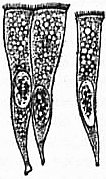
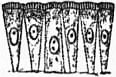
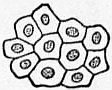
Fig. 1.—Isolated Epithelial Cells from the Small Intestine of the Frog. Fig. 2.—Columnar Epithelial Cells resting upon a Basement Membrane. Fig. 3.—Mosaic appearance of a Columnar Epithelial Surface as seen from above.
The close apposition of these cells to form a closed membrane is well seen when a surface covered by them is examined from above (fig. 3). The surfaces of the cells are then seen to form a mosaic, each cell area having a polyhedral shape.
2. Cubical Epithelium.—This differs from the former in that the cells are less in height. It is found in many glands and ducts (e.g. the kidney), in the middle ear, choroid plexuses of the brain, &c.
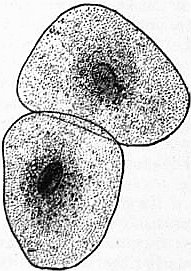
Fig. 4.—Squamous Epithelial Cells from the Mucous Membrane of the Mouth.
3. Squamous or Flattened Epithelium (fig. 4).—In this variety the cell is flattened, very thin and irregular in outline. It occurs as the covering epithelium of the alveoli of the lung, of the kidney glomerules and capsule, &c. The surface epithelial cells of a stratified epithelium are also of this type (fig. 4). Closely resembling these cells are those known as endothelial (see later).
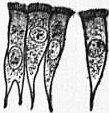
Fig. 5.—Isolated ciliated Epithelial Cells from the Trachea.
4. Ciliated Epithelium (fig. 5).—The surface cells of many epithelial membranes are often provided with a number of very fine protoplasmic processes or cilia. Most commonly the cells are columnar, but other shapes are also found. During life the cilia are always in movement, and set up a current tending to drive fluid or other material on the surface in one direction along the membrane or tube lined by such epithelium. It is found lining the trachea, bronchi, parts of the nasal cavities and the uterus, oviduct, vas deferens, epididymis, a portion of the renal tubule, &c.
In the instance of some cells there may be but a single process from the exposed surface of the cell, and then the process is usually of large size and length. It is then known as a flagellum. Such cells are common among the surface cells of many of the simple animal organisms.
When the cells of an epithelial surface are arranged several layers deep, we can again distinguish various types:—
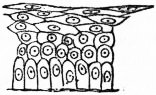
Fig. 6.—A Stratified Epithelium from a Mucous Membrane.
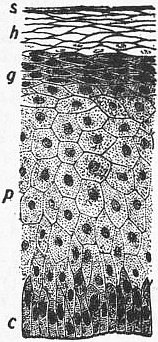
Fig. 7.—Stratified Epithelium from the Skin.
c, Columnar cells resting on the fibrous true skin. p, The so-called prickle cells. g, Stratum granulosum. h, Horny cells. s, Squamous horny cells.
1. Stratified Epithelium (figs. 6 and 7).—This is found in the epithelium of the skin and of many mucous membranes (mouth, oesophagus, rectum, conjunctiva, vagina, &c.). Here the surface cells are very much flattened (squamous epithelium), those of the middle layer are polyhedral and those of the lowest layer are cubical or columnar. This type of epithelium is found covering surfaces commonly exposed to friction. The surface may be dry as in the skin, or moist, e.g. the mouth. The surface cells are constantly being rubbed off, and are then replaced by new cells growing up from below. Hence the deepest layer, that nearest the blood supply, is a formative layer, and in successive stages from this we can trace the gradual transformation of these protoplasmic cells into scaly cells, which no longer show any sign of being alive. In the moist mucous surfaces the number of cells forming the epithelial layer is usually much smaller than in a dry stratified epithelium.
2. Stratified Ciliated Epithelium.—In this variety the superficial cells are ciliated and columnar, between the bases of these are found fusiform cells and the lowest cells are cubical or pyramidal. This epithelium is found lining parts of the respiratory passages, the vas deferens and the epididymis.
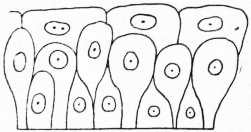
Fig. 8.—Transitional Epithelium from the Urinary Bladder, showing the outlines of the cells only.
3. Transitional Epithelium (fig. 8).—This variety of epithelium is found lining the bladder, and the appearance observed depends upon the contracted or distended state of the bladder from which the preparation was made. If the bladder was contracted the form seen in fig. 8 is obtained. The epithelium is in three or more layers, the superficial one being very characteristic. The cells are cubical and fit over the rounded ends of the cells of the next layer. These are pear-shaped, the points of the pear resting on the basement membrane. Between the bases of these cells lie those of the lowermost layer. These are irregularly columnar. If the bladder is distended before the preparation is made, the cells are then found stretched out transversely. This is especially the case with the surface cells, which may then become very flattened.
Considering epithelium from the point of view of function, it may be classified as protective, absorptive or secretory. It may produce special outgrowths for protective or ornamental purposes, such are hairs, nails, horns, &c., and for such purposes it may manufacture within itself chemical material best suited for that purpose, e.g. keratin; here the whole cell becomes modified. In other instances may be seen in the interior of the cells many chemical substances which indicate the nature of their work, e.g. fat droplets, granules of various kinds, protein, mucin, watery granules, glycogen, &c. In a typical absorbing cell granules of material being absorbed may be seen. A secreting cell of normal type forming specific substances stores these in its interior until wanted, e.g. fat as in sebaceous and mammary glands, ferment precursors (salivary, gastric glands, &c.), and various excretory substances, as in the renal epithelium.
Initially the epithelium cell might have all these functions, but later came specialization and therefore to most cells a specific work. Some of that work does not require the cell to be at the surface, while for other work this is indispensable, and hence when the surface becomes limited those of the former category are removed from the surface to the deeper parts. This is seen typically in secretory and excretory cells, which usually lie below the surface on to which they pour their secretions. If the secretion required at any one point is considerable, then the secreting cells are numerous in proportion and a typical gland is formed. The secretion is then conducted to the surface by a duct, and this duct is also lined with epithelium.
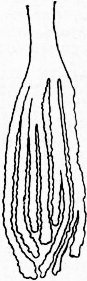
Fig. 9.—A Compound Tubular Gland. One of the pyloric glands of the stomach of the dog.
Glandular Tissues.—Every gland is formed by an ingrowth from an epithelial surface. This ingrowth may from the beginning possess a tubular structure, but in other instances may start as a solid column of cells which subsequently Glands. becomes tubulated. As growth proceeds, the column of cells may divide or give off offshoots, in which case a compound gland is formed. In many glands the number of branches is limited, in others (salivary, pancreas) a very large structure is finally formed by repeated growth and subdivision. As a rule the branches do not unite with one another, but in one instance, the liver, this does occur when a reticulated compound gland is produced. In compound glands the more typical or secretory epithelium is found forming the terminal portion of each branch, and the uniting portions form ducts and are lined with a less modified type of epithelial cell.
Glands are classified according to their shape. If the gland retains its shape as a tube throughout it is termed a tubular gland, simple tubular if there is no division (large intestine), compound tubular (fig. 9) if branching occurs (pyloric glands of stomach). In the simple tubular glands the gland may be coiled without losing its tubular form, e.g. in sweat glands. In the second main variety of gland the secretory portion is enlarged and the lumen variously increased in size. These are termed alveolar or saccular glands. They are again subdivided into simple or compound alveolar glands, as in the case of the tubular glands (fig. 10). A further complication in the case of the alveolar glands may occur in the form of still smaller saccular diverticuli growing out from the main sacculi (fig. 11). These are termed alveoli.
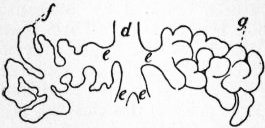
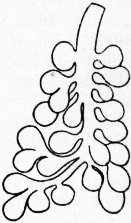
Fig. 10.—A Tubulo-alveolar Gland. One of the mucous salivary glands of the dog. On the left the alveoli are unfolded to show their general arrangement. d, Small duct of gland subdividing into branches; e, f and g, terminal tubular alveoli of gland. Fig. 11.—A Compound Alveolar Gland. One of the terminal lobules of the pancreas, showing the spherical form of the alveoli.
The typical secretory cells of the glands are found lining the terminal portions of the ramifications and extend upwards to varying degrees. Thus in a typical acinous gland the cells are restricted to the final alveoli. The remaining tubes are to be considered mainly as ducts. In tubulo-alveolar glands the secreting epithelium lines the alveus as well as the terminal tubule.
The gland cells are all placed upon a basement membrane. In many instances this membrane is formed of very thin flattened cells, in other instances it is apparently a homogeneous membrane, and according to some observers is simply a modified part of the basal surface of the cell, while according to others it is a definite structure distinct from the epithelium.
In the secretory portion of the gland and in the smaller ducts the epithelial layer is one cell thick only. In the larger ducts there are two layers of cells, but even here the surface cell usually extends by a thinned-out stalk down to the basement membrane.
The detailed characters of the epithelium of the different glands of the body are given in separate articles (see Alimentary Canal, &c.). It will be sufficient here to give the more general characters possessed by these cells. They are cubical or conical cells with distinct oval nuclei and granular protoplasm. Within the protoplasm is accumulated a large number of spherical granules arranged in diverse manners in different cells. The granules vary much in size in different glands, and in chemical composition, but in all cases represent a store of material ready to be discharged from the cell as its secretion. Hence the general appearance of the cell is found to vary according to the previous degree of activity of the cell. If it has been at rest for some time the cell contains very many granules which swell it out and increase its size. The nucleus is then largely hidden by the granules. In the opposite condition, i.e. when the cell has been actively secreting, the protoplasm is much clearer, the nucleus obvious and the cell shrunken in size, all these changes being due to the extrusion of the granules.
Endothelium and Mesothelium.—Lining the blood vessels, lymph vessels and lymph spaces are found flattened cells apposed to one another by their edges to form an extremely thin membrane. These cells are developed from the Endothelium and mesothelium. middle embryonic layer and are termed endothelium. A very similar type of cells is also found, formed into a very thin continuous sheet, lining the body-cavity, i.e. pleural pericardial, and peritoneal cavities. These cells develop from that portion of the mesoderm known as the mesothelium, and are therefore frequently termed mesothelial, though by many they are also included as endothelial cells.
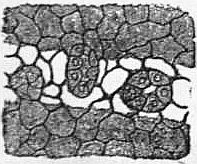
Fig. 12.—Mesothelial Cells forming the Peritoneal Serous Membrane. Three stomata are seen surrounded by cubical cells. One of these is closed. The light band marks the position of a lymphatic. (After Klein.)
A mesothelial cell is very flattened, thus resembling a squamous epithelial cell. It possesses a protoplasm with faint granules and an oval or round nucleus (fig. 12). The outline of the cell is irregularly polyhedral, and the borders may be finely serrated. The cells are united to one another by an intercellular cement substance which, however, is very scanty in amount, but can be made apparent by staining with silver nitrate when the appearance reproduced in the figure is seen. By being thus united together, the cells form a continuous layer. This layer is pierced by a number of small openings, known as stomata, which bring the cavity into direct communication with lymph spaces or vessels lying beneath the membrane. The stomata are surrounded by a special layer of cubical and granular cells. Through these stomata fluids and other materials present in the body-cavity can be removed into the lymph spaces.
Endothelial membranes (fig. 13) are quite similar in structure to mesothelial. They are usually elongated cells of irregular outline and serrated borders.
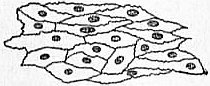
Fig. 13.—Endothelial Cells from the Interior of an Artery.
By means of endothelial or mesothelial membranes the surfaces of the parts covered by them are rendered very smooth, so that movement over the surface is greatly facilitated. Thus the abdominal organs can glide easily over one another within the peritoneal cavity; the blood or lymph experiences the least amount of friction; or again the friction is reduced to a minimum between a tendon and its sheath or in the joint cavities. The cells forming these membranes also possess further physiological properties. Thus it is most probable that they play an active part in the blood capillaries in transmitting substances from the blood into the tissue spaces, or conversely in preventing the passage of materials from blood to tissue space or from tissue space to blood. Hence the fluid of the blood and that of the tissue space need not be of the same chemical composition.
(T. G. Br.)
EPITOME (Gr. ἐπιτομή, from ἐπιτέμνειν, to cut short), an abridgment, abstract or summary giving the salient points of a book, law case, &c., a short and concise account of any particular subject or event. By transference epitome is also used to express the representation of a larger thing, concrete or abstract, reproduced in miniature. Thus St Mark’s was called by Ruskin the “epitome of Venice,” as it embraces examples of all the periods of architecture from the 10th to the 19th centuries.
EPOCH (Gr. ἐποχή, holding in suspense, a pause, from ἐπέχειν, to hold up, to stop), a term for a stated period of time, and so used of a date accepted as the starting-point of an era or of a new period in chronology, such as the birth of Christ. It is hence transferred to a period which marks a great change, whether in the history of a country or a science, such as a great discovery or invention. Thus an event may be spoken of as “epoch-making.” The word is also used, synonymously with “period,” for any space of time marked by a distinctive condition or by a particular series of events.
In astronomy the word is used for a moment from which time is measured, or at which a definite position of a body or a definite relation of two bodies occurs. For example, the position of a body moving in an orbit cannot be determined unless its position at some given time is known. The given time is then the epoch; but the term is often applied to the mean longitude of the body at the given time.
EPODE, in verse, the third part in an ode, which followed the strophe and the antistrophe, and completed the movement; it was called ἐπῳδὸς περίοδος by the Greeks. At a certain moment the choirs, which had chanted to right of the altar or stage and then to left of it, combined and sang in unison, or permitted the coryphaeus to sing for them all, standing in the centre. When, with the appearance of Stesichorus and the evolution of choral lyric, a learned and artificial kind of poetry began to be cultivated in Greece, a new form, the εἶδος ἐπῳδικόν, or epode-song, came into existence. It consisted of a verse of trimeter iambic, followed by a dimeter iambic, and it is reported that, although the epode was carried to its highest perfection by Stesichorus, an earlier poet, Archilochus, was really the inventor of this form. The epode soon took a firm place in choral poetry, which it lost when that branch of literature declined. But it extended beyond the ode, and in the early dramatists we find numerous examples of monologues and dialogues framed on the epodical system. In Latin poetry the epode was cultivated, in conscious archaism, both as a part of the ode and as an independent branch of poetry. Of the former class, the epithalamia of Catullus, founded on an imitation of Pindar, present us with examples of strophe, antistrophe and epode; and it has been observed that the celebrated ode of Horace, beginning Quem virum aut heroa lyra vel acri, possesses this triple character. But the word is now mainly familiar from an experiment of Horace in the second class, for he entitled his fifth book of odes Epodon liber or the Book of Epodes. He says in the course of these poems, that in composing them he was introducing a new form, at least in Latin literature, and that he was imitating the effect of the iambic distichs invented by Archilochus. Accordingly we find the first ten of these epodes composed in alternate verses of iambic trimeter and iambic dimeter, thus:—
“At o Deorum quicquid in coelo regit Terras et humanum genus.”
In the seven remaining epodes Horace has diversified the measures, while retaining the general character of the distich. This group of poems belongs in the main to the early youth of the poet, and displays a truculence and a controversial heat which are absent from his more mature writings. As he was imitating Archilochus in form, he believed himself justified, no doubt, in repeating the sarcastic violence of his fierce model. The curious thing is that these particular poems of Horace, which are really short lyrical satires, have appropriated almost exclusively the name of epodes, although they bear little enough resemblance to the genuine epode of early Greek literature.
EPONA, a goddess of horses, asses and mules, worshipped by the Romans, though of foreign, probably Gallic, origin. The majority of inscriptions and images bearing her name have been found in Gaul, Germany and the Danube countries; of the few that occur in Rome itself most were exhumed on the site of the barracks of the equites singulares, a foreign imperial body-guard mainly recruited from the Batavians. Her name does not appear in Tertullian’s list of the indigetes di, and Juvenal contrasts her worship unfavourably with the old Roman Numa ritual. Her cult does not appear to have been introduced before imperial times, when she is often called Augusta and invoked on behalf of the emperor and the imperial house. Her chief function, however, was to see that the beasts of burden were duly fed, and to protect them against accidents and malicious influence. In the countries in which the worship of Epona was said to have had its origin it was a common belief that certain beings were in the habit of casting a spell over stables during the night. The Romans used to place the image of the goddess, crowned with flowers on festive occasions, in a sort of shrine in the centre of the architrave of the stable. In art she is generally represented seated, with her hand on the head of the accompanying horse or animal.
See Tertullian, Apol. 16; Juvenal viii. 157; Prudentius, Apoth. 197; Apuleius, Metam. iii. 27; articles in Daremberg and Saglio’s Dict, des antiquités and Pauly-Wissowa’s Realencyclopädie.
EPONYMOUS, that which gives a name to anything (Gr. ἐπώνυμος, from ὄνομα, a name), a term especially applied to the mythical or semi-mythical personages, heroes, deities, &c. from whom a country or city took its name. Thus Pelops is the giver of the name to the Peloponnese. At Athens the chief archon of the year was known as the ἄρχων ἐπώνυμος, as the year was known by his name. There was a similar official in ancient Assyria. In ancient times, as in historical and modern cases, a country or a city has been named after a real personage, but in many cases the person has been invented to account for the name.
EPPING, a market town in the Epping parliamentary division of Essex, England, 17 m. N.N.E. from London by a branch of the Great Eastern railway. Pop. of urban district (1901), 3789. The town lies high and picturesquely, at the northern outskirts of Epping Forest. The modern church of St John the Baptist replaces the old parish church of All Saints in the village of Epping Upland 2 m. N.W. This is in part Norman. There is considerable trade in butter, cheese and sausages.
Epping Forest forms part of the ancient Waltham Forest, which covered the greater part of the county. All the “London Basin,” within which the Forest lies, was densely wooded. The Forest became one of the commonable lands of Royal Chases or hunting-grounds. It was threatened with total disafforestation, when under the Epping Forest Act of 1871 a board of commissioners was appointed for the better management of the lands. The corporation of the city of London then acquired the freehold interest of waste land belonging to the lords of the manor, and finally secured 5559½ acres, magnificently timbered, to the use of the public for ever, the tract being declared open by Queen Victoria in 1882. The Ancient Court of Verderers was also revived, consisting of an hereditary lord warden together with four verderers elected by freeholders of the county. The present forest lies between the valleys of the Roding and the Lea, and extends southward from Epping to the vicinity of Woodford and Walthamstow, a distance of about 7 m. It is readily accessible from the villages on its outskirts, such as Woodford, Chingford and Loughton, which are served by branches of the Great Eastern railway. These are centres of residential districts, and, especially on public holidays in the summer, receive large numbers of visitors.
EPPS, the name of an English family, well known in commerce and medicine. In the second half of the 18th century they had been settled near Ashford, Kent, for some generations, claiming descent from an equerry of Charles II., but were reduced in circumstances, when John Epps rose to prosperity as a provision merchant in London, and restored the family fortunes. He had four sons, of whom John Epps (1805-1869), George Napoleon Epps (1815-1874), and James Epps (1821-1907) were notable men of their day, the two former as prominent doctors who were ardent converts to homoeopathy, and James as a homoeopathic chemist and the founder of the great cocoa business associated with his name. Among Dr G.N. Epps’s children were Dr Washington Epps, a well-known homoeopathist, Lady Alma-Tadema, and Mrs Edmund Gosse.
ÉPRÉMESNIL (Ésprémesnil or Épréménil), JEAN JACQUES DUVAL D’ (1745-1794), French magistrate and politician, was born in India on the 5th of December 1745 at Pondicherry, his father being a colleague of Dupleix. Returning to France in 1750 he was educated in Paris for the law, and became in 1775 conseiller in the parlement of Paris, where he soon distinguished himself by his zealous defence of its rights against the royal prerogative. He showed bitter enmity to Marie Antoinette in the matter of the diamond necklace, and on the 19th of November 1787 he was the spokesman of the parlement in demanding the convocation of the states-general. When the court retaliated by an edict depriving the parlement of its functions, Éprémesnil bribed the printers to supply him with a copy before its promulgation, and this he read to the assembled parlement. A royal officer was sent to the palais de justice to arrest Éprémesnil and his chief supporter Goislard de Montsabert, but the parlement (5th of May 1788) declared that they were all Éprémesnils, and the arrest was only effected on the next day on the voluntary surrender of the two members. After four months’ imprisonment on the island of Ste Marguerite, Éprémesnil found himself a popular hero, and was returned to the states-general as deputy of the nobility of the outlying districts of Paris. But with the rapid advance towards revolution his views changed; in his Réflexions impartiales ... (January 1789) he defended the monarchy, and he led the party among the nobility that refused to meet with the third estate until summoned to do so by royal command. In the Constituent Assembly he opposed every step towards the destruction of the monarchy. After a narrow escape from the fury of the Parisian populace in July 1792 he was imprisoned in the Abbaye, but was set at liberty before the September massacres. In September 1793, however, he was arrested at Le Havre, taken to Paris, and denounced to the Convention as an agent of Pitt. He was brought to trial before the revolutionary tribunal on the 21st of April 1794, and was guillotined the next day.
D’Éprémesnil’s speeches were collected in a small volume in 1823. See also H. Carré, Un Précurseur inconscient de la Révolution (Paris, 1897).
EPSOM, a market town in the Epsom parliamentary division of Surrey, England, 14 m. S.W. by S. of London Bridge. Pop. of urban district (1901), 10,915. It is served by the London & South-Western and the London, Brighton & South Coast railways, and on the racecourse on the neighbouring Downs there is a station (Tattenham Corner) of the South-Eastern & Chatham railway. The principal building is the parish church of St Martin, a good example of modern Gothic, the interior of which contains some fine sculptures by Flaxman and Chantrey. Epsom (a contraction of Ebbisham, still the name of the manor) first came into notice when mineral springs were discovered there about 1618. For some time after their discovery the town enjoyed a wonderful degree of prosperity. After the Restoration it was often visited by Charles II., and when Queen Anne came to the throne, her husband, Prince George of Denmark, made it his frequent resort. Epsom gradually lost its celebrity as a spa, but the annual races held on its downs arrested the decay of the town. Races appear to have been established here as early as James I’s residence at Nonsuch, but they did not assume a permanent character until 1730. The principal races—the Derby and Oaks—are named after one of the earls of Derby and his seat, the Oaks, which is in the neighbourhood. The latter race was established in 1779, and the former in the following year. The spring races are held on a Thursday and Friday towards the close of April; and the great Epsom meeting takes place on the Tuesday and three following days immediately before Whitsuntide,—the Derby on the Wednesday, and the Oaks on the Friday (see Horse-Racing). The grand stand was erected in 1829, and subsequently enlarged; and there are numerous training stables in the vicinity. Close to the town are the extensive buildings of the Royal Medical Benevolent College, commonly called Epsom College, founded in 1855. Scholars on the foundation must be the sons of medical men, but in other respects the school is open. In the neighbourhood is the Durdans, a seat of the earl of Rosebery.
EPSOM SALTS, heptohydrated magnesium sulphate, MgSO4·7H2O, the magnesii sulphas of pharmacy (Ger. Bittersalz). It occurs dissolved in sea water and in most mineral waters, especially in those at Epsom (from which place it takes its name), Seidlitz, Saidschutz and Pullna. It also occurs in nature in fibrous excrescences, constituting the mineral epsomite or hair-salt; and as compact masses (reichardite), as in the Stassfurt mines. It is also found associated with limestone, as in the Mammoth Caves, Kentucky, and with gypsum, as at Montmartre. Epsom salts crystallizes in the orthorhombic system, being isomorphous with the corresponding zinc and nickel sulphates, and also with magnesium chromate. Occasionally monoclinic crystals are obtained by crystallizing from a strong solution. It is used in the arts for weighting cotton fabrics, as a top-dressing for clover hay in agriculture, and in dyeing. In medicine it is frequently employed as a hydragogue purgative, specially valuable in febrile diseases, in congestion of the portal system, and in the obstinate constipation of painters’ colic. In the last case it is combined with potassium iodide, the two salts being exceedingly effective in causing the elimination of lead from the system. It is also very useful as a supplement to mercury, which needs a saline aperient to complete its action. The salt should be given a few hours after the mercury, e.g. in the early morning, the mercury having been given at night. It possesses the advantage of exercising but little irritant effect upon the bowels. Its nauseous bitter taste may to some extent be concealed by acidifying the solution with dilute sulphuric acid, and in some cases where full doses have failed the repeated administration of small ones has proved effectual.
For the manufacture of Epsom salts and for other hydrated magnesium sulphates see Magnesium.