VOLUME IX SLICE VI English Language to Epsom Salts (continued 7)
Reading edition
ENTABLATURE (Lat. in, and tabula, a tablet), the architectural term for the superstructure carried by the columns in the classic orders (q.v.). It usually consists of three members, the architrave (the supporting member carried from column to column, pier or wall); the frieze (the decorative member); and the cornice (the projecting and protective member). Sometimes the frieze is omitted, as in the entablature of the portico of the caryatides of the Erechtheum. There is every reason to believe that the frieze did not exist in the archaic temple of Diana at Ephesus; and it is not found in the Lycian tombs, which are reproductions in the rock of timber structures based on early Ionian work.
ENTADA, in botany, a woody climber belonging to the family Leguminosae and common throughout the tropics. The best-known species is Entada scandens, the sword-bean, so called from its large woody pod, 2 to 4 ft. in length and 3 to 4 in. broad, which contains large flat hard polished chestnut-coloured seeds or “beans.” The seeds are often made into snuff-boxes or match-boxes, and a preparation from the kernel is used as a drug by the natives in India. The seeds will float for a long time in water, and are often thrown up on the north-western coasts of Europe, having been carried by the Gulf-stream from the West Indies; they retain their vitality, and under favourable conditions will germinate. Linnaeus records the germination of a seed on the coast of Norway.
ENTAIL (from Fr. tailler, to cut; the old derivation from tales haeredes is now abandoned), in law, a limited form of succession (q.v.). In architecture, the term “entail” denotes an ornamental device sunk in the ground of stone or brass, and subsequently filled in with marble, mosaic or enamel.
ENTASIS (from Gr. ἐντείνειν, to stretch a line or bend a bow), in architecture, the increment given to the column (q.v.), to correct the optical illusion which produces an apparent hollowness in an extended straight line. It was referred to by Vitruvius (iii. 3), and was first noticed in the columns of the Doric orders in Greek temples by Allason in 1814, and afterwards measured and verified by Penrose. It varies in different temples, and is not found in some: it is most pronounced in the temple of Jupiter Olympius, most delicate in the Erechtheum. The entasis is almost invariably introduced in the spires of English churches.
ENTERITIS (Gr. ἔντερον, intestine), a general medical term for inflammation of the bowels. According to the anatomical part specially attacked, it is subdivided into duodenitis, jejunitis, ileitis, typhlitis, appendicitis, colitis, proctitis. The chief symptom is diarrhoea. The term “enteric fever” has recently come into use instead of “typhoid” for the latter disease; but see Typhoid Fever.
ENTHUSIASM, a word originally meaning inspiration by a divine afflatus or by the presence of a god. The Gr. ἐνθουσιασμός, from which the word is adapted, is formed from the verb ἐνθουσιάζειν, to be ἔνθεος, possessed by a god θέος. Applied by the Greeks to manifestations of divine “possession,” by Apollo, as in the case of the Pythia, or by Dionysus, as in the case of the Bacchantes and Maenads, it was also used in a transferred or figurative sense; thus Socrates speaks of the inspiration of poets as a form of enthusiasm (Plato, Apol. Soc. 22 C). Its uses, in a religious sense, are confined to an exaggerated or wrongful belief in religious inspiration, or to intense religious fervour or emotion. Thus a Syrian sect of the 4th century was known as “the Enthusiasts”; they believed that by perpetual prayer, ascetic practices and contemplation, man could become inspired by the Holy Spirit, in spite of the ruling evil spirit, which the fall had given to him. From their belief in the efficacy of prayer εὐχή, they were also known as Euchites. In ordinary usage, “enthusiasm” has lost its peculiar religious significance, and means a whole-hearted devotion to an ideal, cause, study or pursuit; sometimes, in a depreciatory sense, it implies a devotion which is partisan and is blind to difficulties and objections. (See further Inspiration, for a comparison of the religious meanings of “enthusiasm,” “ecstasy” and “fanaticism.”)
ENTHYMEME (Gr. ἐν, θυμός), in formal logic, the technical name of a syllogistic argument which is incompletely stated. Any one of the premises may be omitted, but in general it is that one which is most obvious or most naturally present to the mind. In point of fact the full formal statement of a syllogism is rare, especially in rhetorical language, when the deliberate omission of one of the premises has a dramatic effect. Thus the suppression of the conclusion may have the effect of emphasizing the idea which necessarily follows from the premises. Far commoner is the omission of one of the premises which is either too clear to need statement or of a character which makes its omission desirable. A famous instance quoted in the Port Royal Logic, pt. iii. ch. xiv., is Medea’s remark to Jason in Ovid’s Medea, “Servare potui, perdere an possim rogas?” where the major premise “Qui servare, perdere possunt” is understood. This use of the word enthymeme differs from Aristotle’s original application of it to a syllogism based on probabilities or signs (ἐξ εἰκότων ἤ σημείων), i.e. on propositions which are generally valid (εἰκότα) or on particular facts which may be held to justify a general principle or another particular fact (Anal. prior. β xxvii. 70 a 10).
See beside text-books on logic, Sir W. Hamilton’s Discussions (1547); Mansel’s ed. of Aldrich, Appendix F; H.W.B. Joseph, Introd. to Logic, chap. xvi.
ENTOMOLOGY (Gr. ἔντομα insects, and λόγος, a discourse), the science that treats of insects, i.e. of the animals included in the class Hexapoda of the great phylum (or sub-phylum) Arthropoda. The term, however, is somewhat elastic in its current use, and students of centipedes and spiders are often reckoned among the entomologists. As the number of species of insects is believed to exceed that of all other animals taken together, it is no wonder that their study should form a special division of zoology with a distinctive name.
Beetles (Scarabaei) are the subjects of some of the oldest sculptured works of the Egyptians, and references to locusts, bees and ants are familiar to all readers of the Hebrew scriptures. The interest of insects to the eastern races was, however, economic, religious or moral. The science of insects began with Aristotle, who included in a class “Entoma” the true insects, the arachnids and the myriapods, the Crustacea forming another class (“Malacostraca”) of the “Anaema” or “bloodless animals.” For nearly 2000 years the few writers who dealt with zoological subjects followed Aristotle’s leading.
In the history of the science, various lines of progress have to be traced. While some observers have studied in detail the structure and life-history of a few selected types (insect anatomy and development), others have made a more superficial examination of large series of insects to classify them and determine their relationships (systematic entomology), while others again have investigated the habits and life-relations of insects (insect bionomics). During recent years the study of fossil insects (palaeoëntomology) has attracted much attention.
The foundations of modern entomology were laid by a series of wonderful memoirs on anatomy and development published in the 17th and 18th centuries. Of these the most famous are M. Malpighi’s treatise on the silkworm (1669) and J. Swammerdam’s Biblia naturae, issued in 1737, fifty years after its author’s death, and containing observations on the structure and life-history of a series of insect types. Aristotle and Harvey (De generatione animalium, 1651) had considered the insect larva as a prematurely hatched embryo and the pupa as a second egg. Swammerdam, however, showed the presence under the larval cuticle of the pupal structures. His only unfortunate contribution to entomology—indeed to zoology generally—was his theory of pre-formation, which taught the presence within the egg of a perfectly formed but miniature adult. A year before Malpighi’s great work appeared, another Italian naturalist, F. Redi, had disproved by experiment the spontaneous generation of maggots from putrid flesh, and had shown that they can only develop from the eggs of flies.
Meanwhile the English naturalist, John Ray, was studying the classification of animals; he published, in 1705, his Methodus insectorum, in which the nature of the metamorphosis received due weight. Ray’s “Insects” comprised the Arachnids, Crustacea, Myriapoda and Annelida, in addition to the Hexapods. Ray was the first to formulate that definite conception of the species which was adopted by Linnaeus and emphasized by his binominal nomenclature. In 1735 appeared the first edition of the Systema naturae of Linnaeus, in which the “Insecta” form a group equivalent to the Arthropoda of modern zoologists, and are divided into seven orders, whose names—Coleoptera, Diptera, Lepidoptera, &c., founded on the nature of the wings—have become firmly established. The fascinating subjects of insect bionomics and life-history were dealt with in the classical memoirs (1734-1742) of the Frenchman R.A.F. de Réaumur, and (1752-1778) of the Swede C. de Geer. The freshness, the air of leisure, the enthusiasm of discovery that mark the work of these old writers have lessons for the modern professional zoologist, who at times feels burdened with the accumulated knowledge of a century and a half. From the end of the 18th century until the present day, it is only possible to enumerate the outstanding features in the progress of entomology. In the realm of classification, the work of Linnaeus was continued in Denmark by J.C. Fabricius (Systema entomologica, 1775), and extended in France by G.P.B. Lamarck (Animaux sans vertèbres, 1801) and G. Cuvier (Leçons d’anatomie comparée, 1800-1805), and in England by W.E. Leach (Trans. Linn. Soc. xi., 1815). These three authors definitely separated the Arachnida, Crustacea and Myriapoda as classes distinct from the Insecta (see Hexapoda). The work of J.O. Westwood (Modern Classification of Insects, 1839-1840) connects these older writers with their successors of to-day.
In the anatomical field the work of Malpighi and Swammerdam was at first continued most energetically by French students. P. Lyonnet had published in 1760 his elaborate monograph on the goat-moth caterpillar, and H.E. Strauss-Dürckheim in 1828 issued his great treatise on the cockchafer. But the name of J.C.L. de Savigny, who (Mém. sur les animaux sans vertèbres, 1816) established the homology of the jaws of all insects whether biting or sucking, deserves especial honour. Many anatomical and developmental details were carefully worked out by L. Dufour (in a long series of memoirs from 1811 to 1860) in France, by G. Newport (“Insecta” in Encyc. Anat. and Physiol., 1839) in England, and by H. Burmeister (Handbuch der Entomologie, 1832) in Germany. Through the 19th century, as knowledge increased, the work of investigation became necessarily more and more specialized. Anatomists like F. Leydig, F. Müller, B.T. Lowne and V. Graber turned their attention to the detailed investigation of some one species or to special points in the structure of some particular organs, using for the elucidation of their subject the ever-improving microscopical methods of research.
Societies for the discussion and publication of papers on entomology were naturally established as the number of students increased. The Société Entomologique de France was founded in 1832, the Entomological Society of London in 1834. Few branches of zoology have been more valuable as a meeting-ground for professional and amateur naturalists than entomology, and not seldom has the amateur—as in the case of Westwood—developed into a professor. During the pre-Linnaean period, the beauty of insects—especially the Lepidoptera—had attracted a number of collectors; and these “Aurelians”—regarded as harmless lunatics by most of their friends—were the forerunners of the systematic students of later times. While the insect fauna of European countries was investigated by local naturalists, the spread of geographical exploration brought ever-increasing stores of exotic material to the great museums, and specialization—either in the fauna of a small district or in the world-wide study of an order or a group of families—became constantly more marked in systematic work. As examples may be instanced the studies of A.H. Haliday and H. Loew on the European Diptera, of John Curtis on British insects, of H.T. Stainton and O. Staudinger on the European Lepidoptera, of R. M’Lachlan on the European and of H.A. Hagen on the North American Neuroptera, of D. Sharp on the Dyticidae and other families of Coleoptera of the whole world.
The embryology of insects is entirely a study of the last century. C. Bonnet indeed observed in 1745 the virgin-reproduction of Aphids, but it was not until 1842 that R.A. von Kölliker described the formation of the blastoderm in the egg of the midge Chironomus. Later A. Weismann (1863-1864) traced details of the growth of embryo and of pupa among the Diptera, and A. Kovalevsky in 1871 first described the formation of the germinal layers in insects. Most of the recent work on the embryology of insects has been done in Germany or the United States, and among numerous students V. Graber, K. Heider, W.M. Wheeler and R. Heymons may be especially mentioned.
The work of de Réaumur and de Geer on the bionomics and life-history of insects has been continued by numerous observers, among whom may be especially mentioned in France J.H. Fabre and C. Janet, in England W. Kirby and W. Spence, J. Lubbock (Lord Avebury) and L.C. Miall, and in the United States C.V. Riley. The last-named may be considered the founder of the strong company of entomological workers now labouring in America. Though Riley was especially interested in the bearings of insect life on agriculture and industry—economic entomology (q.v.)—he and his followers have laid the science generally under a deep obligation by their researches.
After the publication of C. Darwin’s Origin of Species (1859) a fresh impetus was given to entomology as to all branches of zoology, and it became generally recognized that insects form a group convenient and hopeful for the elucidation of certain problems of animal evolution. The writings of Darwin himself and of A.R. Wallace (both at one time active entomological collectors) contain much evidence drawn from insects in favour of descent with modification. The phylogeny of insects has since been discussed by F. Brauer, A.S. Packard and many others; mimicry and allied problems by H.W. Bates, F. Müller, E.B. Poulton and M.C. Piepers; the bearing of insect habits on theories of selection and use-inheritance by A. Weismann, G.W. and E. Peckham, G.H.T. Eimer and Herbert Spencer; variation by W. Bateson and M. Standfuss.
Bibliography.—References to the works of the above authors, and to many others, will be found under Hexapoda and the special articles on various insect orders. Valuable summaries of the labours of Malpighi, Swammerdam and other early entomologists are given in L.C. Miall and A. Denny’s Cockroach (London, 1886), and L. Henneguy’s Les Insectes (Paris, 1904).
(G. H. C.)
ENTOMOSTRACA. This zoological term, as now restricted, includes the Branchiopoda, Ostracoda and Copepoda. The Ostracoda have the body enclosed in a bivalve shell-covering, and normally unsegmented. The Branchiopoda have a very variable number of body-segments, with or without a shield, simple or bivalved, and some of the postoral appendages normally branchial. The Copepoda have normally a segmented body, not enclosed in a bivalved shell-covering, the segments not exceeding eleven, the limbs not branchial.
Under the heading Crustacea the Entomostraca have already been distinguished not only from the Thyrostraca or Cirripedes, but also from the Malacostraca, and an intermediate group of which the true position is still disputed. The choice is open to maintain the last as an independent subclass, and to follow Claus in calling it the Leptostraca, or to introduce it among the Malacostraca as the Nebaliacea, or with Packard and Sars to make it an entomostracan subdivision under the title Phyllocarida. At present it comprises the single family Nebaliidae. The bivalved carapace has a jointed rostrum, and covers only the front part of the body, to which it is only attached quite in front, the valve-like sides being under control of an adductor muscle. The eyes are stalked and movable. The first antennae have a lamellar appendage at the end of the peduncle, a decidedly non-entomostracan feature. The second antennae, mandibles and two pairs of maxillae may also be claimed as of malacostracan type. To these succeed eight pairs of foliaceous branchial appendages on the front division of the body, followed on the hind division by four pairs of powerful bifurcate swimming feet and two rudimentary pairs, the number, though not the nature, of these appendages being malacostracan. On the other hand, the two limbless segments that precede the caudal furca are decidedly non-malacostracan. The family was long limited to the single genus Nebalia (Leach), and the single species N. bipes (O. Fabricius). Recently Sars has added a Norwegian species, N. typhlops, not blind but weak-eyed. There are also now two more genera, Paranebalia (Claus, 1880), in which the branchial feet are much longer than in Nebalia, and Nebaliopsis (Sars, 1887), in which they are much shorter. All the species are marine.
Branchiopoda.—In this order, exclusion of the Phyllocarida will leave three suborders of very unequal extent, the Phyllopoda, Cladocera, Branchiura. The constituents of the last have often been classed as Copepoda, and among the Branchiopods must be regarded as aberrant, since the “branchial tail” implied in the name has no feet, and the actual feet are by no means obviously branchial.
Phyllopoda.—This “leaf-footed” suborder has the appendages which follow the second maxillae variable in number, but all foliaceous and branchial. The development begins with a free nauplius stage. In the outward appearance of the adults there is great want of uniformity, one set having their limbs sheltered by no carapace, another having a broad shield over most of them, and a third having a bivalved shell-cover within which the whole body can be enclosed. In accord with these differences the sections may be named Gymnophylla, Notophylla, Conchophylla. The equivalent terms applied by Sars are Anostraca, Notostraca, Conchostraca, involving a termination already appropriated to higher divisions of the Crustacean class, for which it ought to be reserved.
1. Gymnophylla.—These singular crustaceans have long soft flexible bodies, the eyes stalked and movable, the first antennae small and filiform, the second lamellar in the female, in the male prehensile; this last character gives rise to some very fanciful developments. There are three families, two of which form companies rather severely limited. Thus the Polyartemiidae, which compensate themselves for their stumpy little tails by having nineteen instead of the normal eleven pairs of branchial feet, consist exclusively of Polyartemia forcipata (Fischer, 1851). This species from the high north of Europe and Asia carries green eggs, and above them a bright pattern in ultramarine (Sars, 1896, 1897). The Thamnocephalidae have likewise but a single species, Thamnocephalus platyurus (Packard, 1877), which justifies its title “bushy-head of the broad tail” by a singularity at each end. Forward from the head extends a long ramified appendage described as the “frontal shrub,” backward from the fourth abdominal segment of the male spreads a fin-like expansion which is unique. In the ravines of Kansas, pools supplied by torrential rains give birth to these and many other phyllopods, and in turn “millions of them perish by the drying up of the pools in July” (Packard). The remaining family, the Branchipodidae, includes eight genera. In the long familiar Branchipus, Chirocephalus and Streptocephalus the males have frontal appendages, but these are wanting in the “brine-shrimp” Artemia, and the same want helps to distinguish Branchinecta (Verrill, 1869) from the old genus Branchipus. Of Branchiopsyllus (Sars, 1897) the male is not yet known, but in his genera of the same date, the Siberian Artemiopsis and the South African Branchipodopsis (1898), there is no such appendage. Of the last genus the type species B. hodgsoni belongs to Cape Colony, but the specimens described were born and bred and observed in Norway. For the study of fresh-water Entomostraca large possibilities are now opened to the naturalist. A parcel of dried mud, coming for example from Palestine or Queensland, and after an indefinite interval of time put into water in England or elsewhere, may yield him living forms, both new and old, in the most agreeable variety. Some caution should be used against confounding accidentally introduced indigenous species with those reared from the imported eggs. Those, too, who send or bring the foreign soil should exercise a little thought in the choice of it, since dry earth that has never had any Entomostraca near it at home will not become fertile in them by the mere fact of exportation.
2. Notophylla.—In this division the body is partly covered by a broad shield, united in front with the head; the eyes are sessile, the first antennae are small, the second rudimentary or wanting; of the numerous feet, sometimes sixty-three pairs, exceeding the number of segments to which they are attached, the first pair are more or less unlike the rest, and in the female the eleventh have the epipod and exopod (flabellum and sub-apical lobe of Lankester) modified to form an ovisac. Development begins with a nauplius stage. Males are very rare. The single family Apodidae contains only two genera, Apus and its very near neighbour Lepidurus. Apus australiensis (Spencer and Hall, 1896) may rank as the largest of the Entomostraca, reaching in the male, from front of shield to end of telson, a length of 70 mm., in the female of 64 mm. In a few days, or at most a fortnight, after a rainfall numberless specimens of these sizes were found swimming about, “and as not a single one was to be found in the water-pools prior to the rain, these must have been developed from the egg.” Similarly, in Northern India Apus himalayanus was “collected from a stagnant pool in a jungle four days after a shower of rain had fallen,” following a drought of four months (Packard).
3. Conchophylla.—Though concealed within the bivalved shell-cover, the mouth-parts are nearly as in the Gymnophylla, but the flexing of the caudal part is in contrast, and the biramous second antennae correspond with what is only a larval character in the other phyllopods. In the male the first one or two pairs of feet are modified into grasping organs. The small ova are crowded beneath the dorsal part of the valves. The development usually begins with a nauplius stage (Sars, 1896, 1900). There are four families: (a) The Limnadiidae, with feet from 18 to 32 pairs, comprise four (or five) genera. Of these Limnadella (Girard, 1855) has a single eye. It remains rather obscure, though the type species originally “was discovered in great abundance in a roadside puddle subject to desiccation.” Limnadia (Brongniart, 1820) is supposed to consist of species exclusively parthenogenetic. But when asked to believe that males never occur among these amazons, one cannot but remember how hard it is to prove a negative. (b) The Lynceidae, with not more than twelve pairs of feet. This family is limited to the species, widely distributed, of the single genus Lynceus, established by O.F. Müller in 1776 and 1781, and first restricted by Leach in 1816 in the Encyclopaedia Britannica (art. “Annulosa,” of that edition). Leach there assigns to it the single species L. brachyurus (Müller), and as this is included in the genus Limnetis (Lovén, 1846), that genus must be a synonym of Lynceus as restricted. (c) Leptestheriidae. Estheria (Rüppell, 1837) was instituted for the species dahalacensis, which Sars includes in his genus Leptestheria (1898); but Estheria was already appropriated, and of its synonyms Cyzicus (Audouin, 1837) is lost for vagueness, while Isaura (Joly, 1842) is also appropriated, so that Leptestheria becomes the name of the typical genus, and determines the name of the family. (d) Cyclestheriidae. This family consists of the single species Cyclestheria hislopi (Baird), reported from India, Ceylon, Celebes, Australia, East Africa and Brazil. Sars (1887) having had the opportunity of raising it from dried Australian mud, found that, unlike other phyllopods, but like the Cladocera, the parent keeps its brood within the shell until their full development.
Cladocera.—In this suborder the head is more or less distinct, the rest of the body being in general laterally compressed and covered by a bivalved test. The title “branching horns” alludes to the second antennae, which are two-branched except in the females of Holopedium, with each branch setiferous, composed of only two to four joints. The mandibles are without palp. The pairs of feet are four to six. The eye is single, and in addition to the eye there is often an “eye-spot,” Monospilus being unique in having the eye-spot alone and no eye, while Leydigiopsis (Sars, 1901) has an eye with an eye-spot equal to it or larger. The heart has a pair of venous ostia, often blending into one, and an anterior arterial aorta. Respiration is conducted by the general surface, by the branchial lamina (external branch) of the feet, and the vesicular appendage (when present) at the base of this branch. The “abdomen,” behind the limbs, is usually very short, occasionally very long. The “postabdomen,” marked off by the two postabdominal setae, usually has teeth or spines, and ends in two denticulate or ciliate claws, or it may be rudimentary, as in Polyphemus. Many species have a special glandular organ at the back of the head, which Sida crystallina uses for attaching itself to various objects. The Leydigian or nuchal organ is supposed to be auditory and to contain an otolith. The female lays two kinds of eggs—“summer-eggs,” which develop without fertilization, and “winter-eggs” or resting eggs, which require to be fertilized. The latter in the Daphniidae are enclosed in a modified part of the mother’s shell, called the ephippium from its resemblance to a saddle in shape and position. In other families a less elaborate case has been observed, for which Scourfield has proposed the term protoephippium. In Leydigia he has recently found a structure almost as complex as that of the Daphniidae. In some families the resting eggs escape into the water without special covering. Only the embryos of Leptodora are known to hatch out in the nauplius stage. Penilia (Dana, 1849) is perhaps the only exclusively marine genus. The great majority of the Cladocera belong to fresh water, but their adaptability is large, since Moina rectirostris (O.F. Müller) can equally enjoy a pond at Blackheath, and near Odessa live in water twice as salt as that of the ocean. In point of size a Cladoceran of 5 mm. is spoken of as colossal.
Dr Jules Richard in his revision (1895) retains the sections proposed by Sars in 1865, Calyptomera and Gymnomera. The former, with the feet for the most part concealed by the carapace, is subdivided into two tribes, the Ctenopoda, or “comb-feet,” in which the six pairs of similar feet, all branchial and nonprehensile, are furnished with setae arranged like the teeth of a comb, and the Anomopoda, or “variety-feet,” in which the front feet differ from the rest by being more or less prehensile, without branchial laminae.
The Ctenopoda comprise two families: (a) the Holopediidae, with a solitary species, Holopedium gibberum (Zaddach), queerly clothed in a large gelatinous involucre, and found in mountain tarns all over Europe, in large lakes of N. America, and also in shallow ponds and waters at sea-level; (b) the Sididae, with no such involucre, but with seven genera, and rather more than twice as many species. Of Diaphanosoma modiglianii Richard says that at different points of Lake Toba in Sumatra millions of specimens were obtained, among which he had not met with a single male.
The Anomopoda are arranged in four families, all but one very extensive. (a) Daphniidae. Of the seven genera, the cosmopolitan Daphnia contains about 100 species and varieties, of which Thomas Scott (1899) observes that “scarcely any of the several characters that have at one time or another been selected as affording a means for discriminating between the different forms can be relied on as satisfactory.” Though this may dishearten the systematist, Scourfield (1900) reminds us that “It was in a water-flea that Metschnikoff first saw the leucocytes (or phagocytes) trying to get rid of disease germs by swallowing them, and was so led to his epoch-making discovery of the part played by these minute amoeboid corpuscles in the animal body.” For Scapholeberis mucronata (O.F. Müller), Scourfield has shown how it is adapted for movement back downwards in the water along the underside of the surface film, which to many small crustaceans is a dangerously disabling trap. (b) Bosminidae. To Bosmina (Baird, 1845) Richard added Bosminopsis in 1895. (c) Macrotrichidae. In this family Macrothrix (Baird, 1843) is the earliest genus, among the latest being Grimaldina (Richard, 1892) and Jheringula (Sars, 1900). Dried mud and vegetable débris from S. Paulo in Brazil supplied Sars with representatives of all the three in his Norwegian aquaria, in some of which the little Macrothrix elegans “multiplied to such an extraordinary extent as at last to fill up the water with immense shoals of individuals.” “The appearance of male specimens was always contemporary with the first ephippial formation in the females.” For Streblocerus pygmaeus, grown under the same conditions, Sars observes: “This is perhaps the smallest of the Cladocera known, and is hardly more than visible to the naked eye,” the adult female scarcely exceeding 0.25 mm. Yet in the next family Alonella nana (Baird) disputes the palm and claims to be the smallest of all known Arthropoda. (d) Chydoridae. This family, so commonly called Lynceidae, contains a large number of genera, among which one may usually search in vain, and rightly so, for the genus Lynceus. The key to the riddle is to be found in the Encyclopaedia Britannica for 1816. There, as above explained, Leach began the subdivision of Müller’s too comprehensive genus, the result being that Lynceus belongs to the Phyllopoda, and Chydorus (Leach, 1816) properly gives its name to the present family, in which the doubly convoluted intestine is so remarkable. Of its many genera, Leydigia, Leydigiopsis, Monospilus have been already mentioned. Dadaya macrops (Sars, 1901), from South America and Ceylon, has a very large eye and an eye-spot fully as large, but it is a very small creature, odd in its behaviour, moving by jumps at the very surface of the water. “To the naked eye it looked like a little black atom darting about in a most wonderful manner.”
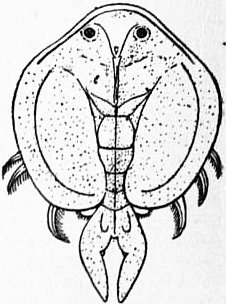
Fig. 1.—Dolops ranarum (Stuhlmann).
The Gymnomera, with a carapace too small to cover the feet, which are all prehensile, are divided also into two tribes, the Onychopoda, in which the four pairs of feet have a toothed maxillary process at the base, and the Haplopoda, in which there are six pairs of feet, without such a process. To the Polyphemidae, the well-known family of the former tribe, Sars in 1897 added two remarkable genera, Cercopagis, meaning “tail with a sling,” and Apagis, “without a sling,” for seven species from the Sea of Azov. The Haplopoda likewise have but a single family, the Leptodoridae, and this has but the single genus Leptodora (Lilljeborg, 1861). Dr Richard (1895, 1896) gives a Cladoceran bibliography of 601 references.
Branchiura.—This term was introduced by Thorell in 1864 for the Argulidae, a family which had been transferred to the Branchiopoda by Zenker in 1854, though sometimes before and since united with the parasitic Copepoda. Though the animals have an oral siphon, they do not carry ovisacs like the siphonostomous copepods, but glue their eggs in rows to extraneous objects. Their lateral, compound, feebly movable eyes agree with those of the Phyllopoda. The family are described by Claus as “intermittent parasites,” because when gorged they leave their hosts, fishes or frogs, and swim about in freedom for a considerable period. The long-known Argulus (O.F. Müller) has the second maxillae transformed into suckers, but in Dolops (Audouin, 1837) (fig. 1), the name of which supersedes the more familiar Gyropeltis (Heller, 1857), these effect attachment by ending in strong hooks (Bouvier, 1897). A third genus, Chonopeltis (Thiele, 1900), has suckers, but has lost its first antennae, at least in the female.
Ostracoda.—The body, seldom in any way segmented, is wholly encased in a bivalved shell, the caudal part strongly inflexed, and almost always ending in a furca. The limbs, including antennae and mouth organs, never exceed seven definite pairs. The first antennae never have more than eight joints. The young usually pass through several stages of development after leaving the egg, and this commonly after, even long after, the egg has left the maternal shell. Parthenogenesis is frequent.
The four tribes instituted by Sars in 1865 were reduced to two by G.W. Müller in 1894, the Myodocopa, which almost always have a heart, and the Podocopa, which have none.
Myodocopa.—These have the furcal branches broad, lamellar, with at least three pairs of strong spines or ungues. Almost always the shell has a rostral sinus. Müller divides the tribe into three families, Cypridinidae, Halocypridae, and the heartless Polycopidae, which constituted the tribe Cladocopa of Sars. From the first of these Brady and Norman distinguish the Asteropidae (fig. 3), remarkable for seven pairs of long branchial leaves which fold over the hinder extremity of the animal, and the Sarsiellidae, still somewhat obscure, besides adding the Rutidermatidae, knowledge of which is based on skilful maceration of minute and long-dried specimens. The Halocypridae are destitute of compound lateral eyes, and have the sexual orifice unsymmetrically placed.
Podocopa.—In these the furcal branches are linear or rudimentary, the shell is without rostral sinus, and, besides distinguishing characters of the second antennae, they have always a branchial plate well developed on the first maxillae, which is inconstant in the other tribe. There are five families: (a) Cyprididae (? including Cypridopsidae of Brady and Norman). In some of the genera parthenogenetic propagation is carried to such an extent that of the familiar Cypris it is said, “until quite lately males in this genus were unknown; and up to the present time no male has been found in the British Islands” (Brady and Norman, 1896). On the other hand, the ejaculatory duct with its verticillate sac in the male of Cypris and other genera is a feature scarcely less remarkable. (b) Bairdiidae, which have the valves smooth, with the hinge untoothed. (c) Cytheridae (? including Paradoxostomatidae of Brady and Norman), in which the valves are usually sculptured, with toothed hinge. Of this family the members are almost exclusively marine, but Limnicythere is found in fresh water, and Xestoleberis bromeliarum (Fritz Müller) lives in the water that collects among the leaves of Bromelias, plants allied to the pine-apples. (d) Darwinulidae, including the single species Darwinula stevensoni, Brady and Robertson, described as “perhaps the most characteristic Entomostracan of the East Anglian Fen District.” (e) Cytherellidae, which, unlike the Ostracoda in general, have the hinder part of the body segmented, at least ten segments being distinguishable in the female. They have the valves broad at both ends, and were placed by Sars in a separate tribe, called Platycopa.
The range in time of the Ostracoda is so extended that, in G.W. Müller’s opinion, their separation into the families now living may have already taken place in the Cambrian period. Their range in space, including carriage by birds, may be coextensive with the distribution of water, but it is not known what height of temperature or how much chemical adulteration of the water they can sustain, how far they can penetrate underground, nor what are the limits of their activity between the floor and the surface of aquatic expanses, fresh or saline. In individual size they have never been important, and of living forms the largest is one of recent discovery, Crossophorus africanus, a Cypridinid about three-fifths of an inch (15.5 mm.) long; but a length of one or two millimetres is more common, and it may descend to the seventy-fifth of an inch. By multitude they have been, and still are, extremely important.
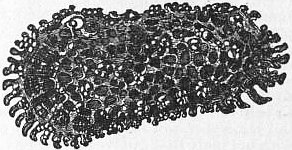
Fig. 2.—Cythereis ornata (G.W. Müller). One eye-space is shown above on the left.
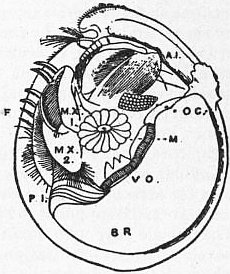
Fig. 3.—Asterope arthuri. Left valve removed.
M, End of adductor muscle. OC, Eye. AI, Second antenna. MX. 1, First maxilla. MX. 2, Second maxilla. P. 1, First foot. V.O, Vermiform organ. BR, Seven branchial leaves. F, Projecting ungues of the furca.
Though the exterior is more uniform than in most groups of Crustacea, the bivalved shell or carapace may be strongly calcified and diversely sculptured (fig. 2), or membranaceous and polished, hairy or smooth, oval or round or bean-shaped, or of some less simple pattern; the valves may fit neatly, or one overlap the other, their hinge may have teeth or be edentulous, and their front part may be excavated for the protrusion of the antennae or have no such “rostral sinus.” By various modifications of their valves and appendages the creatures have become adapted for swimming, creeping, burrowing, or climbing, some of them combining two or more of these activities, for which their structure seems at the first glance little adapted. Considering the imprisonment of the ostracod body within the valves, it is more surprising that the Asteropidae and Cypridinidae should have a pair of compound and sometimes large eyes, in addition to the median organ at the base of the “frontal tentacle,” than that other members of the group should be limited to that median organ of sight, or have no eyes at all. The median eye when present may have or not have a lens, and its three pigment-cups may be close together or wide apart and the middle one rudimentary. As might be expected, in thickened and highly embossed valves thin spaces occur over the visual organ. The frontal organ varies in form and apparently in function, and is sometimes absent. The first antennae, according to the family, may assist in walking, swimming, burrowing, climbing, grasping, and besides they carry sensory setae, and sometimes they have suckers on their setae (see Brady and Norman on Cypridina norvegica). The second antennae are usually the chief motor-organs for swimming, walking and climbing. The mandibles are normally five-jointed, with remnants of an outer branch on the second joint, the biting edge varying from strong development to evanescence, the terminal joints or “palp” giving the organ a leg-like appearance and function, which disappears in suctorial genera such as Paracytherois. The variable first maxillae are seldom pediform, their function being concerned chiefly with nutrition, sensation and respiration. The variability in form and function of the second maxillae is sufficiently shown by the fact that G.W. Müller, our leading authority, adopts the confusing plan of calling them second maxillae in the Cypridinidae (including Asteropidae), maxillipeds in the Halocypridae and Cyprididae, and first legs in the Bairdiidae, Cytheridae, Polycopidae and Cytherellidae, so that in his fine monograph he uses the term first leg in two quite different senses. The first legs, meaning thereby the sixth pair of appendages, are generally pediform and locomotive, but sometimes unjointed, acting as a kind of brushes to cleanse the furca, while in the Polycopidae they are entirely wanting. The second legs are sometimes wanting, sometimes pediform and locomotive, sometimes strangely metamorphosed into the “vermiform organ,” generally long, many-jointed, and distally armed with retroverted spines, its function being that of an extremely mobile cleansing foot, which can insert itself among the eggs in the brood-space, between the branchial leaves of Asterope (fig. 3), and even range over the external surface of the valves. The “brush-formed” organs of the Podocopa are medially placed, and, in spite of their sometimes forward situation, Müller believes among other possibilities that they and the penis in the Cypridinidae may be alike remnants of a third pair of legs, not homologous with the penis of other Ostracoda (Podocopa included). The furca is, as a rule, a powerful motor-organ, and has its laminae edged with strong teeth (ungues) or setae or both. The young, though born with valves, have at first a nauplian body, and pass through various stages to maturity.
Brady and Norman, in their Monograph of the Ostracoda of the North Atlantic and North-Western Europe (1889), give a bibliography of 125 titles, and in the second part (1896) they give 55 more. The lists are not meant to be exhaustive, any more than G.W. Müller’s literature list of 125 titles in 1894. They do not refer to Latreille, 1802, with whom the term Ostracoda originates.
Copepoda.—The body is not encased in a bivalved shell; its articulated segments are at most eleven, those behind the genital segment being without trace of limbs, but the last almost always carrying a furca. Sexes separate, fertilization by spermatophores. Ova in single or double or rarely several packets, attached as ovisacs or egg-strings to the genital openings, or enclosed in a dorsal marsupium, or deposited singly or occasionally in bundles. The youngest larvae are typical nauplii. The next, the copepodid or cyclopid, stage is characterized by a cylindrical segmented body, with fore- and hind-body distinct, and by having at most six cephalic limbs and two pairs of swimming feet.
The order thus defined (see Giesbrecht and Schmeil, Das Tierreich, 1898), with far over a thousand species (Hansen, 1900), embraces forms of extreme diversity, although, when species are known in all their phases and both sexes, they constantly tend to prove that there are no sharply dividing lines between the free-living, the semi-parasitic, and those which in adult life are wholly parasitic and then sometimes grotesquely unlike the normal standard. Giesbrecht and Hansen have shown that the mouth-organs consist of mandibles, first and second maxillae and maxillipeds; and Claus himself relinquished his long-maintained hypothesis that the last two pairs were the separated exopods and endopods of a single pair of appendages. Thorell’s classification (1859) of Gnathostoma, Poecilostoma, Siphonostoma, based on the mouth-organs, was long followed, though almost at the outset shown by Claus to depend on the erroneous supposition that the Poecilostoma were devoid of mandibles. Brady added a new section, Choniostomata, in 1894, and another, Leptostomata, in 1900, each for a single species. Canu in 1892 proposed two groups, Monoporodelphya and Diporodelphya, the copulatory openings of the female being paired in the latter, unpaired in the former. It may be questioned whether this distinction, however important in itself, would lead to a satisfactory grouping of families. In the same year Giesbrecht proposed his division of the order into Gymnoplea and Podoplea.
In appearance an ordinary Copepod is divided into fore- and hind-body, of its eleven segments the composite first being the head, the next five constituting the thorax, and the last five the abdomen. The coalescence of segments, though frequent, does not after a little experience materially confuse the counting. But there is this peculiarity, that the middle segment is sometimes continuous with the broader fore-body, sometimes with the narrower hind-body. In the former case the hind-body, consisting only of the abdomen, forms a pleon or tail-part devoid of feet, and the species so constructed are Gymnoplea, those of the naked or footless pleon. In the latter case the middle segment almost always carries with it to the hind-body a pair of rudimentary limbs, whence the term Podoplea, meaning species that have a pleon with feet. It may be objected that hereby the term pleon is used in two different senses, first applying to the abdomen alone and then to the abdomen plus the last thoracic segment. Even this verbal flaw would be obviated if Giesbrecht could prove his tentative hypothesis, that the Gymnoplea may have lost a pre-genital segment of the abdomen, and the Podoplea may have lost the last segment of the thorax. The classification is worked out as follows:—
1. Gymnoplea.—First segment of hind-body footless, bearing the orifices of the genital organs (in the male unsymmetrically placed); last foot of the fore-body in the male a copulatory organ; neither, or only one, of the first pair of antennae in the male geniculating; cephalic limbs abundantly articulated and provided with many plumose setae; heart generally present. Animals usually free-living, pelagic (Giesbrecht and Schmeil).
This group, with 65 genera and four or five hundred species, is divided by Giesbrecht into tribes: (a) Amphaskandria. In this tribe the males have both antennae of the first pair as sensory organs. There is but one family, the Calanidae, but this is a very large one, with 26 genera and more than 100 species. Among them is the cosmopolitan Calanus finmarchicus, the earliest described (by Bishop Gunner in 1770) of all the marine free-swimming Copepoda. Among them also is the peacock Calanid, Calocalanus pavo (Dana), with its highly ornamented antennae and gorgeous tail, the most beautiful species of the whole order (fig. 4). (b) Heterarthrandria. Here the males have one or the other of the first pair of antennae modified into a grasping organ for holding the female. There are four families, the Diaptomidae with 27 genera, the Pontellidae with 10, the Pseudocyclopidae and Candaciidae each with one genus. The first of these families is often called Centropagidae, but, as Sars has pointed out, Diaptomus (Westwood, 1836) is the oldest genus in it. Of 177 species valid in the family Giesbrecht and Schmeil assign 67 to Diaptomus. In regard to one of its species Dr Brady says: “In one instance, at least (Talkin Tarn, Cumberland) I have seen the net come up from a depth of 6 or 8 ft. below the surface with a dense mass consisting almost entirely of D. gracilis.” The length of this net-filling species is about a twentieth of an inch.
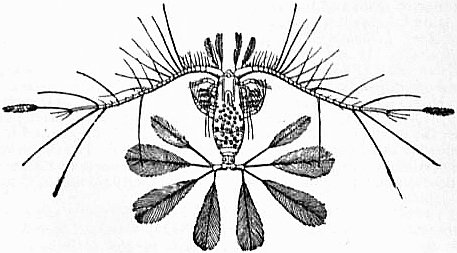
Fig. 4.—Calocalanus pavo (Dana).
2. Podoplea.—The first segment of the hind-body almost always with rudimentary pair of feet; orifices of the genital organs (symmetrically placed in both sexes) in the following segment; neither the last foot of the fore-body nor the rudimentary feet just mentioned acting as a copulatory organ in the male; both or neither of the first pair of antennae in the male geniculating; cephalic limbs less abundantly articulated and with fewer plumose setae or none, but with hooks and clasping setae. Heart almost always wanting. Free-living (rarely pelagic) or parasitic (Giesbrecht and Schmeil).
This group is also divided by Giesbrecht into two tribes, Ampharthrandria and Isokerandria. In 1892 he distinguished the former as those in which the first antennae of the male have both members modified for holding the female, and the genital openings of the female have a ventral position, sometimes in close proximity, sometimes strongly lateral; the latter as those in which the first antennae of the male are similar to those of the female, the function of holding her being transferred to the male maxillipeds, while the genital openings of the female are dorsal, though at times strongly lateral. In 1899, with a view to the many modifications exhibited by parasitic and semi-parasitic species, the definitions, stripped of a too hampering precision, took a different form: (a) Ampharthrandria. “Swimming Podoplea with geniculating first antennae in the male sex, and descendants of such; first antennae in female and male almost always differently articulated.” The families occupy fresh water as well as the sea. Naturally “descendants” which have lost the characteristic feature of the definition cannot be recognized without some further assistance than the definition supplies. Of the families comprised, the Mormonillidae consist only of Mormonilla (Giesbrecht), and are not mentioned by Giesbrecht in 1899 in the grouping of this section. The Thaumatoessidae include Thaumatoessa (Kröyer), established earlier than its synonym Thaumaleus (Kröyer), or than Monstrilla (Dana, 1849). The species are imperfectly known. The defect of mouth-organs probably does not apply to the period of youth, which some of them spend parasitically in the body-cavity of worms (Giard, 1896). To the Cyclopidae six genera are allotted by Giesbrecht in 1900. Cyclops (O.F. Müller, 1776), though greatly restricted since Müller’s time, still has several scores of species abundantly peopling inland waters of every kind and situation, without one that can be relied on as exclusively marine like the species of Oithona (Baird). The Misophriidae are now limited to Misophria (Boeck). The presence of a heart in this genus helps to make it a link between the Podoplea and Gymnoplea, though in various other respects it approaches the next family. The Harpacticidae owe their name to the genus Arpacticus (Milne-Edwards, 1840). Brady in 1880 assigns to this family 33 genera and 81 species. Canu (1892) distinguishes eight sub-families, Longipediinae, Peltidiinae, Tachidiinae, Amymoninae, Harpacticinae, Idyinae, Canthocamptinae (for which Canthocampinae should be read), and Nannopinae, adding Stenheliinae (Brady) without distinctive characters for it. The Ascidicolidae have variable characters, showing a gradual adaptation to parasitic life in Tunicates. Giesbrecht (1900) considers Canu quite right in grouping together in this single family those parasites of ascidians, simple and compound, which had been previously distributed among families with the more or less significant names Notodelphyidae, Doropygidae, Buproridae, Schizoproctidae, Kossmechtridae, Enterocolidae, Enteropsidae. Further, he includes in it his own Enterognathus comatulae, not from an ascidian, but from the intestine of the beautiful starfish Antedon rosaceus. The Asterocheridae, which have a good swimming capacity, except in the case of Cancerilla tubulata (Dalyell), lead a semi-parasitic life on echinoderms, sponges, &c., imbibing their food. Giesbrecht, displacing the older name Ascomyzontidae, assigns to this family 21 genera in five subfamilies, and suggests that the long-known but still puzzling Nicothoë from the gills of the lobster might be placed in an additional subfamily, or be made the representative of a closely related family. The Dichelestiidae, on account of their sometimes many-jointed first antennae, are referred also to this tribe by Giesbrecht. (b) Isokerandria. “Swimming Podoplea without genicullating first antennae in the male sex, and descendants of such. First antennae of male and female almost always articulated alike.” To this tribe Giesbrecht assigns the families Clausidiidae, Corycaeidae, Oncaeidae, Lichomolgidae, Ergasilidae, Bomolochidae, Clausiidae, Nereicolidae. Here also must for the time be placed the Caligidae, Philichthyidae (Philichthydae of Vogt, Carus, Claus), Lernaeidae, Chondracanthidae, Sphaeronellidae (better known as Choniostomatidae, from H.J. Hansen’s remarkable study of the group), Lernaeopodidae, Herpyllobiidae, Entomolepidae. For the distinguishing marks of all these, the number of their genera and species, their habits and transformations and dwellings, the reader must be referred to the writings of specialists. Sars (1901) proposed seven suborders—Calanoida, Harpacticoida, Cyclopoida, Notodelphoida, Monstrilloida, Caligoida, Lernaeoida.
Authorities.—(The earlier memoirs of importance are cited in Giesbrecht’s Monograph of Naples, 1892); Canu, “Hersiliidae,” Bull. Sci. France belgique, ser. 3, vol. i. p. 402 (1888); and Les Copépodes du Boulonnais (1892); Cuenot, Rev. biol. Nord France, vol. v. (1892); Giesbrecht, “Pelag. Copepoden.” F. u. fl. des Golfes von Neapel (Mon. 19, 1892); Hansen, Entomol. Med. vol. iii. pt. 5 (1892); I.C. Thompson, “Copepoda of Liverpool Bay,” Trans. Liv. Biol. Soc. vol. vii. (1893); Schmeil, “Deutschlands Copepoden,” Bibliotheca zoologica (1892-1897); Brady, Journ. R. Micr. Soc. p. 168 (1894); T. Scott, “Entomostraca from the Gulf of Guinea,” Trans. Linn. Soc. London, vol. vi. pt. 1 (1894); Giesbrecht, Mitteil. Zool. Stat. Neapel, vol. xi. p. 631; vol. xii. p. 217 (1895); T. and A. Scott, Trans. Linn. Soc. London, ser. 2, vol. vi. p. 419 (1896); Hansen “Choniostomatidae” (1897); Sars, Proc. Mus. Zool. St Petersburg, “Caspian Entomostraca” (1897); Giesbrecht and Schmeil, “Copepoda gymnoplea,” Das Tierreich (1898); Giesbrecht, “Asterocheriden,” F. u. fl. Neapel (Mon. 25, 1899); Bassett-Smith, “Copepoda on Fishes,” Proc. Zool. Soc. London, p. 438 (1899); Brady, Trans. Zool. Soc. London, vol. xv. pt. 2, p. 31 (1899); Sars, Arch. Naturv. vol. xxi. No. 2 (1899); Giesbrecht, Mitteil. Zool. Stat. Neapel, vol. xiv. p. 39 (1900); Scott, “Fish Parasites,” Scottish Fishery Board, 18th Ann. Rep. p. 144 (1900); Stebbing, Willey’s Zool. Results, pt. 5, p. 664 (1900); Embleton, Journ. Linn. Soc. London, vol. xxviii. p. 211 (1901); Sars, Crustacea of Norway, vol. iv. (1901).
(T. R. R. S.)
ENTRAGUES, CATHERINE HENRIETTE DE BALZAC D’ (1579-1633), marquise de Verneuil, mistress of Henry IV., king of France, was the daughter of Charles Balzac d’Entragues and of Marie Touchet, mistress of Charles IX. Ambitious and intriguing, she succeeded in inducing Henry IV. to promise to marry her after the death of Gabrielle d’Estrées, a promise which led to bitter scenes at court when shortly afterwards Henry married Marie de’ Medici. She carried her spite so far as to be deeply compromised in the conspiracy of Marshal Biron against the king in 1606, but escaped with a slight punishment, and in 1608 Henry actually took her back into favour again. She seems then to have been involved in the Spanish intrigues which preceded the death of the king in 1610.
See H. de la Ferrière, Henri IV. le roi, l’amoureux (Paris, 1890).
ENTRECASTEAUX, JOSEPH-ANTOINE BRUNI D’ (1739-1793), French navigator, was born at Aix in 1739. At the age of fifteen he entered the navy. In the war of 1778 he commanded a frigate of thirty-two guns, and by his clever seamanship was successful in convoying a fleet of merchant vessels from Marseilles to the Levant, although they were attacked by two pirate vessels, each of which was larger than his own ship. In 1785 he was appointed to the command of the French fleet in the East Indies, and two years later he was named governor of the Mauritius and the Isle of Bourbon. While in command of the East India fleet he made a voyage to China, an achievement which, in 1791, led the French government to select him to command an expedition which it was sending out to seek some tidings of the unfortunate La Pérouse, of whom nothing had been heard since February 1788. Rear-admiral d’Entrecasteaux’s expedition comprised the “Recherche” and “L’Esperance,” with Captain Huon de Kermadec as second in command. No tidings were obtained of the missing navigator, but in the course of his search Entrecasteaux made important geographical discoveries. He traced the outlines of the eastern coast of New Caledonia, made extensive surveys round the Tasmanian coast, and touched at several places on the south coast of New Holland. The two ships entered Storm Bay, Tasmania, on the 21st of April 1792, and remained there until the 16th of May, surveying and naming the d’Entrecasteaux Channel, the entrances to the Huon and Derwent rivers, Bruni Island, Recherche Bay, Port Esperance and various other localities. Excepting the name of the river Derwent (originally called Riviere du Nord by its French discoverers), these foregoing appellations have been retained. Leaving Tasmania the expedition sailed northward for the East Indies, and while coasting near the island of Java, Entrecasteaux was attacked by scurvy and died on the 20th of July 1793.
ENTRE MINHO E DOURO (popularly called Minho), a former province of Northern Portugal; bounded on the N. by Galicia in Spain, E. by Traz-os-Montes, S. by Beira and W. by the Atlantic Ocean. Pop. (1900) 1,170,361; area 2790 sq. m. Though no longer officially recognized, the old provincial name remains in common use. The coast-line of Entre Minho e Douro is level and unbroken except by the estuaries of the main rivers; inland, the elevation gradually increases towards the north and east, where several mountain ranges mark the frontier. Of these, the most important are the Serra da Peneda (4728 ft.), between the rivers Minho and Limia; the Serra do Gerez (4357 ft.), on the Galician border; the Serra da Cabreira (4021 ft.), immediately to the south; and the Serra de Marão (4642 ft.), in the extreme south-east. As its name implies, the province is bounded by two great rivers, the Douro (q.v.) on the south, and the Minho (Spanish Miño) on the north; but a small tract of land south of the Douro estuary is included also within the provincial boundary. There are three other large rivers which, like the Minho, flow west-south-west into the Atlantic. The Limia or Antela (Spanish Linia) rises in Galicia, and reaches the sea at Vianna do Castello; the Cavado springs from the southern foot hills of La Raya Seca, on the northern frontier of Traz-os-Montes, and forms, at its mouth, the small harbour of Espozende; and the Ave descends from its sources in the Serra da Cabreira to Villa do Conde, where it enters the Atlantic. A large right-hand tributary of the Douro, the Tamega, rises in Galicia, and skirts the western slopes of the Serra de Marão.
The climate is mild, except among the mountains, and such plants as heliotrope, fuchsias, palms, and aloes thrive in the open throughout the year. Wheat and maize are grown on the plains, and other important products are wine, fruit, olives and chestnuts. Fish abound along the coast and in the main rivers; timber is obtained from the mountain forests, and dairy-farming and the breeding of pigs and cattle are carried on in all parts. As the province is occupied by a hardy and industrious peasantry, and the density of population (419.5 per sq. m.) is more than twice that of any other province on the Portuguese mainland, the soil is very closely cultivated. The methods and implements of the farmers are, however, most primitive, and at the beginning of the 20th century it was not unusual to see a mule, or even a woman, harnessed with the team of oxen to an old-fashioned wooden plough. Small quantities of coal, iron, antimony, lead and gold are mined; granite and slate are quarried; and there are mineral springs at Monção (pop. 2283) on the Minho. The Oporto-Corunna railway traverses the western districts and crosses the Spanish frontier at Tuy; its branch lines give access to Braga, Guimarães and Povoa de Varzim; and the Oporto-Salamanca railway passes up the Douro valley. The greater part of the north and west can only be reached by road, and even the chief highways are ill-kept. In these regions the principal means of transport is the springless wooden cart, drawn by one or more of the tawny and under-sized but powerful oxen, with immense horns and elaborately carved yoke, which are characteristic of northern Portugal. For administrative purposes the province is divided into three districts: Vianna do Castello in the north, Braga in the centre, Oporto in the south. The chief towns are separately described; they include Oporto (167,955), one of the greatest wine-producing cities in the world; Braga (24,202), the seat of an archbishop who is primate of Portugal; the seaports of Povoa de Varzim (12,623) and Vianna do Castello (9990); and Guimarães (9104), a place of considerable historical interest.
ENTREPÔT (a French word, from the Lat. interpositum, that which is placed between), a storehouse or magazine for the temporary storage of goods, provisions, &c.; also a place where goods, which are not allowed to pass into a country duty free, are stored under the superintendence of the custom house authorities till they are re-exported. In a looser sense, any town which has a considerable distributive trade is called an entrepôt. The word is also used attributively to indicate the kind of trade carried on in such towns.
ENTRE RIOS (Span. “between rivers”), a province of the eastern Argentine Republic, forming the southern part of a region sometimes described as the Argentine Mesopotamia, bounded N. by Corrientes, E. by Uruguay with the Uruguay river as the boundary line, S. by Buenos Aires and W. by Santa Fé, the Paraná river forming the boundary line with these two provinces. Pop. (1895) 292,019; (1905, est.) 376,600. The province has an area of 28,784 sq. m., consisting for the most part of an undulating, well-watered and partly-wooded plain, terminating in a low, swampy district of limited extent in the angle between the two great rivers. The great forest of Monteil occupies an extensive region in the N., estimated at nearly one-fifth the area of the province. Its soil is exceptionally fertile and its climate is mild and healthy. The province is sometimes called the “garden of Argentina,” which would probably be sufficiently correct had its population devoted as much energy to agriculture as they have to political conflict and civil war. Its principal industry is that of stock-raising, exporting live cattle, horses, hides, jerked beef, tinned and salted meats, beef extract, mutton and wool. Its agricultural products are also important, including wheat, Indian corn, barley and fruits. Lime, gypsum and firewood are also profitable items in its export trade. The Paraná and Uruguay rivers provide exceptional facilities for the shipment of produce and the Entre Rios railways, consisting of a trunk line running E. and W. across the province from Paraná to Concepción del Uruguay and several tributary branches, afford ample transportation facilities to the ports. Another railway line follows the Uruguay from Concordia northward into Corrientes. Entre Rios has been one of the most turbulent of the Argentine provinces, and has suffered severely from political disorder and civil war. Comparative quiet reigned from 1842 to 1870 under the autocratic rule of Gen. J.J. Urquiza. After his assassination in 1870 these partizan conflicts were renewed for two or three years, and then the province settled down to a life of comparative peace, followed by an extraordinary development in her pastoral and agricultural industries. Among these is the slaughtering and packing of beef, the exportation of which has reached large proportions. The capital is Paraná, though the seat of government was originally located at Concepción del Uruguay, and was again transferred to that town during Urquiza’s domination. Concepción del Uruguay, or Concepción (founded 1778), is a flourishing town and port on the Uruguay, connected by railway with an extensive producing region which gives it an important export trade, and is the seat of a national college and normal school. Its population was estimated at 9000 in 1905. Other large towns are Gualeguay and Gualeguaychú.
ENVOY (Fr. envoyé, “sent”), a diplomatic agent of the second rank. The word envoyé comes first into general use in this connexion in the 17th century, as a translation of the Lat. ablegatus or missus (see Diplomacy). Hence the word envoy is commonly used of any one sent on a mission of any sort.
ENZIO (c. 1220-1272), king of Sardinia, was a natural son of the emperor Frederick II. His mother was probably a German, and his name, Enzio, is a diminutive form of the German Heinrich. His father had a great affection for him, and he was probably present at the battle of Cortenuova in 1237. In 1238 he was married, in defiance of the wishes of Pope Gregory IX., to Adelasia, widow of Ubaldo Visconti and heiress of Torres and Gallura in Sardinia. Enzio took at once the title of king of Torres and Gallura, and in 1243 that of king of Sardinia, but he only spent a few months in the island, and his sovereignty existed in name alone. In July 1239 he was appointed imperial vicegerent in Italy, and sharing in his father’s excommunication in the same year, took a prominent part in the war which broke out between the emperor and the pope. He commenced his campaign by subduing the march of Ancona, and in May 1241 was in command of the forces which defeated the Genoese fleet at Meloria, where he seized a large amount of booty and captured a number of ecclesiastics who were proceeding to a council summoned by Gregory to Rome. Later he fought in Lombardy. In 1248 he assisted Frederick in his vain attempt to take Parma, but was wounded and taken prisoner by the Bolognese at Fossalta on the 26th of May 1249. His captivity was a severe blow to the Hohenstaufen cause in Italy, and was soon followed by the death of the emperor. He seems to have been well treated by the people of Bologna, where he remained a captive until his death on the 14th of March 1272. He was apparently granted a magnificent funeral, and was buried in the church of St Dominic at Bologna. During his imprisonment Enzio is said to have been loved by Lucia da Viadagola, a well-born lady of Bologna, who shared his captivity and attempted to procure his release. Some doubt has, however, been cast upon this story, and the same remark applies to another which tells how two friends had almost succeeded in freeing him from prison concealed in a wine-cask, when he was recognized by a lock of his golden hair. His marriage with Adelasia had been declared void by the pope in 1243, and he left one legitimate, and probably two illegitimate daughters. Enzio forms the subject of a drama by E.B.S. Raupach and of an opera by A.F.B. Dulk.
See F.W. Grossman, König Enzio (Göttingen, 1883); and H. Blasius, König Enzio (Breslau, 1884).
ENZYME (Gr. ἔνζυμος, leavened, from ἐν, in, and ζύμη, leaven), a term, first suggested by Kühne, for an unorganized ferment (see Fermentation), a group of substances, in the constitution of plants and animals, which decompose certain carbon compounds occurring in association with them. See also Plants: Physiology; Nutrition, &c.
EOCENE (Gr. ἠώς, dawn, καινός, recent), in geology, the name suggested by Sir C. Lyell in 1833 for the lower subdivision of the rocks of the Tertiary Era. The term was intended to convey the idea that this was the period which saw the dawn of the recent or existing forms of life, because it was estimated that among the fossils of this period only 3½% of the species are still living. Since Lyell’s time much has been learned about the fauna and flora of the period, and many palaeontologists doubt if any of the Eocene species are still extant, unless it be some of the lowest forms of life. Nevertheless the name is a convenient one and is in general use. The Eocene as originally defined was not long left intact, for E. Beyrich in 1854 proposed the term “Oligocene” for the upper portion, and later, in 1874, K. Schimper suggested “Paleocene” as a separate appellation for the lower portion. The Oligocene division has been generally accepted as a distinct period, but “Paleocene” is not so widely used.
In north-western Europe the close of the Cretaceous period was marked by an extensive emergence of the land, accompanied, in many places, by considerable erosion of the Mesozoic rocks; a prolonged interval elapsed before a relative depression of the land set in and the first Eocene deposits were formed. The early Eocene formations of the London-Paris-Belgian basin were of fresh-water and brackish origin; towards the middle of the period they had become marine, while later they reverted to the original type. In southern and eastern Europe changes of sea-level were less pronounced in character; here the late Cretaceous seas were followed without much modification by those of the Eocene period, so rich in foraminiferal life. In many other regions, the great gap which separates the Tertiary from the Mesozoic rocks in the neighbourhood of London and Paris does not exist, and the boundary line is difficult to draw. Eocene strata succeed Cretaceous rocks without serious unconformity in the Libyan area, parts of Denmark, S.E. Alps, India, New Zealand and central N. America. The unconformity is marked in England, parts of Egypt, on the Atlantic coastal plain and in the eastern gulf region of N. America, as well as in the marine Eocene of western Oregon. The clastic Flysch formation of the Carpathians and northern Alps appears to be of Eocene age in the upper and Cretaceous in the lower part. The Eocene sea covered at various times a strip of the Atlantic coast from New Jersey southward and sent a great tongue or bay up the Mississippi valley; similar epicontinental seas spread over parts of the Pacific border, but the plains of the interior with the mountains on the west were meanwhile being filled with terrestrial and lacustrine deposits which attained an enormous development. This great extension of non-marine formations in the Eocene of different countries has introduced difficulties in the way of exact correlation; it is safer, therefore, in the present state of knowledge, to make no attempt to find in the Eocene strata of America and India, &c., the precise equivalent of subdivisions that have been determined with more or less exactitude in the London-Paris-Belgian area.
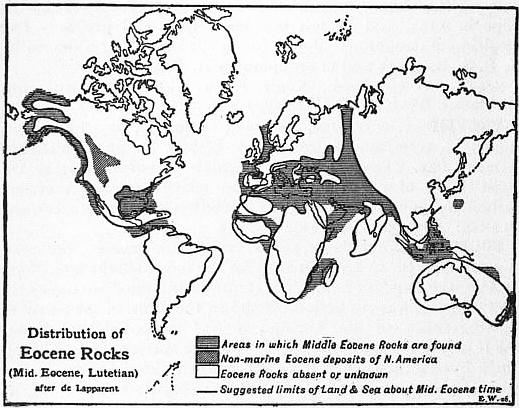
It is possible that in Eocene times there existed a greater continuity of the northern land masses than obtains to-day. Europe at that time was probably united with N. America through Iceland and Greenland; while on the other side, America may have joined Asia by the way of Alaska. On the other hand, the great central, mediterranean sea which stretched across the Eurasian continents sent an arm northward somewhere just east of the Ural mountains, and thus divided the northern land mass in that region. S. America, Australia and perhaps Africa may have been connected more or less directly with the Antarctic continent.
Associated, no doubt, with the crustal movements which closed the Cretaceous and inaugurated the Eocene period, there were local and intermittent manifestations of volcanic activity throughout the period. Diabases, gabbros, serpentines, soda-potash granites, &c., are found in the Eocene of the central and northern Apennines. Tuffs occur in the Veronese and Vicentin Alps—Ronca and Spelecco schists. Tuffs, basalts and other igneous rocks appear also in Montana, Wyoming, California, Oregon, Washington, Idaho, Colorado; also in Central America, the Antillean region and S. America.
It has been very generally assumed by geologists, mainly upon the evidence of plant remains, that the Eocene period opened with a temperate climate in northern latitudes; later, as indicated by the London Clay, Alum Bay and Bournemouth beds, &c., the temperature appears to have been at least subtropical. But it should be observed that the frequent admixture of temperate forms with what are now tropical species makes it difficult to speak with certainty as to the degree of warmth experienced. The occurrence of lignites in the Eocene of the Paris basin, Tirol and N. America is worthy of consideration in this connexion. On the other hand, the coarse boulder beds in the lower Flysch have been regarded as evidence of local glaciation; this would not be inconsistent with a period of widespread geniality of climate, as is indicated by the large size of the nummulites and the dispersion of the marine Mollusca, but the evidence for glaciation is not yet conclusive.
Eocene Stratigraphy.—In Britain, with the exception of the Bovey beds (q.v.) and the leaf-bearing beds of Antrim and Mull, Eocene rocks are confined to the south-eastern portion of England. They lie in the two well-marked synclinal basins of London and Hampshire which are conterminous in the western area (Hampshire, Berkshire), but are separated towards the east by the denuded anticline of the Weald. The strata in these two basins have been grouped in the following manner:—
London Basin. Hampshire Basin.
Upper Upper Bagshot Sands. Headon Hill and Barton Sands.
Middle Middle Bagshot Beds and part of Lower Bagshot Beds. Bracklesham Beds and leaf beds of Bournemouth and Alum Bay.
Lower Part of Lower Bagshot Beds, London Clay, Blackheath and Oldhaven Beds, Woolwich and Reading Beds, Thanet Sands. London Clay and the equivalent Bognor Beds, Woolwich and Reading Beds.
The Thanet sands have not been recognized in the Hampshire basin; they are usually pale yellow and greenish sands with streaks of clay and at the base; resting on an evenly denuded surface of chalk is a very constant layer of green-coated, well-rounded chalk flint pebbles. It is a marine formation, but fossils are scarce except in E. Kent, where it attains its most complete development. The Woolwich and Reading beds (see Reading Beds) contain both marine and estuarine fossils. In western Kent, between the Woolwich beds and the London Clay are the Oldhaven beds or Blackheath pebbles, 20 to 40 ft., made up almost entirely of well-rounded flint pebbles set in sand; the fossils are marine and estuarine. The London Clay, 500 ft. thick, is a marine deposit consisting of blue or brown clay with sandy layers and septarian nodules; its equivalent in the Hampshire area is sometimes called the Bognor Clay, well exposed on the coast of Sussex. The Bagshot, Bracklesham and Barton beds will be found briefly described under those heads.
Crossing the English Channel, we find in northern France and Belgium a series of deposits identified in their general characters with those of England. The anticlinal ridge of the English Weald is prolonged south-eastwards on to the continent, and separates the Belgian from the French Eocene areas much as it separates the areas of London and Hampshire; and it is clear that at the time of deposition all four regions were intimately related and subject to similar variations of marine and estuarine conditions. With a series of strata so variable from point to point it is natural that many purely local phases should have received distinctive names; in the Upper Eocene of the Paris basin the more important formations are the highly fossiliferous marine sands known as the “Sands of Beauchamp” and the local fresh-water limestone, the “Calcaire de St Ouen.” The Middle Eocene is represented by the well-known “Calcaire grossier,” about 90 ft. thick. The beds in this series vary a good deal lithologically, some being sandy, others marly or glauconitic; fossils are abundant. The Upper Calcaire grossier or “Caillasses” is a fresh-water formation; the middle division is marine; while the lower one is partly marine, partly of fresh-water origin. The numerous quarries and mines for building stone in the neighbourhood of Paris have made it possible to acquire a very precise knowledge of this division, and many of the beds have received trade names, such as “Rochette,” “Roche,” “Banc franc,” “Banc vert,” “Cliquart,” “Saint Nom;” the two last named are dolomitic. Below these limestones are the nummulitic sands of Cuise and Soissons. The Lower Eocene contains the lignitic plastic clay (argile plastique) of Soissons and elsewhere; the limestones of Rilly and Sézanne and the greenish glauconitic sands of Bracheux. The relative position of the above formations with respect to those of Belgium and England will be seen from the table of Eocene strata. The Eocene deposits of southern Europe differ in a marked manner from those of the Anglo-Parisian basin. The most important feature is the great development of nummulitic limestone with thin marls and nummulitic sandstones. The sea in which the nummulitic limestones were formed occupied the site of an enlarged Mediterranean communicating with similar waters right round the world, for these rocks are found not only in southern Europe, including all the Alpine tracts, Greece and Turkey and southern Russia, but they are well developed in northern Africa, Asia Minor, Palestine, and they may be followed through Persia, Baluchistan, India, into China, Tibet, Japan, Sumatra, Borneo and the Philippines. The nummulitic limestones are frequently hard and crystalline, especially where they have been subjected to elevation and compression as in the Alpine region, 10,000 ft. above the sea, or from 16,000, to 20,000 ft., in the central Asian plateau. Besides being a widespread formation the nummulitic limestone is locally several thousand feet thick.
While the foraminiferal limestones were being formed over most of southern Europe, a series of clastic beds were in course of formation in the Carpathians and the northern Alpine region, viz. the Flysch and the Vienna sandstone. Some portions of this Alpine Eocene are coarsely conglomeratic, and in places there are boulders of non-local rocks of enormous dimensions included in the argillaceous or sandy matrix. The occurrence of these large boulders together with the scarceness of fossils has suggested a glacial origin for the formation; but the evidence hitherto collected is not conclusive. C.W. von Gümbel has classified the Eocene of the northern Alps (Bavaria, &c.) as follows:—
Upper Eocene Flysch and Vienna sandstone, with younger nummulitic beds and Häring group.
Middle Eocene Kressenberg Beds, with older nummulitic beds.
Lower Eocene Burberg Beds, Greensands with small nummulites.
The Häring group of northern Tirol contains lignite beds of some importance. In the southern and S.E. Alps the following divisions are recognized.
Upper Eocene Macigno or Tassello—Vienna Sandstone, conglomerates, marls and shales.
Middle Eocene Nummulitic limestones, three subdivisions.
Lower Eocene Liburnian stage (or Proteocene), foraminiferal limestones with fresh-water intercalations at the top and bottom, the Cosina beds, fresh-water in the middle of the series.
In the central and northern Apennines the Eocene strata have been subdivided by Prof. F. Sacco into an upper Bartonian, a middle Parisian and a lower Suessonian series. In the middle member are the representatives of the Flysch and the Macigno. These Eocene strata are upwards of 5500 ft. thick. In northern Africa the nummulitic limestones and sandstones are widely spread; the lower portions comprise the Libyan group and the shales of Esneh on the Nile (Flandrien), the Alveolina beds of Sokotra and others; the Mokattam stage of Egypt is a representative of the later Eocene. Much of the N. African Eocene contains phosphatic beds. In India strata of Eocene age are extensively developed; in Sind the marine Ranikot beds, 1500 to 2000 ft., consisting of clays with gypsum and lignite, shales and sandstones; these beds have, side by side with Eocene nummulites, a few fossils of Cretaceous affinities. Above the Ranikot beds are the massive nummulitic limestones and sandstones of the Kirthar group; these are succeeded by the nummulitic limestones and shales at the base of the Nari group. In the southern Himalayan region the nummulitic phase of Eocene deposit is well developed, but there are difficulties in fixing the line of demarcation between this and the younger formations. The lower part of the Sirmur series of the Simla district may belong to this period; it is subdivided into the Kasauli group and the Dagshai group with the Subáthu group at the base. Beneath the thick nummulitic Eocene limestone of the Salt Range are shales and marls with a few coal seams. The marine Eocene rocks of N. America are most extensively developed round the coast of the Gulf of Mexico, whence they spread into the valley of the Mississippi and, as a comparatively narrow strip, along the Atlantic coastal plain to New Jersey.
The series in Alabama, which may be taken as typical of the Gulf coast Eocene, is as follows:—
Upper Jacksonian White limestone of Alabama (and Vicksburg?).
Middle Claibornian Claiborne series, Buhrstone series.
Lower Chickasawan Sands and lignites. Midwayan or Clayton formation, limestones.
The above succession is not fully represented in the Atlantic coast states.
On the Pacific coast marine formations are found in California and Oregon; such are the Tejon series with lignite and oil; the Escondido series of S. California (7000 ft.), part of the Pascadero series of the Santa Cruz Mountains; the Pulaski, Tyee, Arago and Coaledo beds—with coals—in Oregon. In the Puget formation of Washington we have a great series of sediments, largely of brackish water origin, and in parts coal-bearing. The total thickness of this formation has been estimated at 20,000 ft. (it may prove to be less than this), but it is probable that only the lower portion is of Eocene age. The most interesting of the N. American Eocene deposits are those of the Rocky Mountains and the adjacent western plains, in Wyoming, Nevada, Nebraska, Colorado, &c.; they are of terrestrial, lacustrine or aeolian origin, and on this account and because they were not strictly synchronous, there is considerable difficulty in placing them in their true position in the time-scale. The main divisions or groups are generally recognized as follows:—
Mammalian Zonal Forms.
Upper 1 Uinta Group, 800 ft. (? = Jacksonian) Diplacodon. Telmatotherium.
Middle 2 Bridger Group, 2000 ft. (? = Claibornian) Uintatherium.
Lower 3 Wind River Group, 800 ft. Bathyopsis.
4 Wasatch Group, 2000 ft. (? = Chickasawan) Coryphodon.
Basal 5 Torrejon Group, 300 ft. Pantolambda.
6 Puerco Group, 500 to 1000 ft. Polymastodon.
1 South of the Uinta Mts. in Utah. 2 Fort Bridger Basin. 3 Wind river in Wyoming. 4 Wasatch Mts. in Utah. 5 Torrejon in New Mexico. 6 Puerco river, New Mexico.
The Fort Union beds of Canada and parts of Montana and N. Dakota are probably the oldest Eocene strata of the Western Interior; they are some 2000 ft. thick and possibly are equivalent to the Midwayan group. But in these beds, as in those known as Arapahoe, Livingston, Denver, Ohio and Ruby, which are now often classed as belonging to the upper Laramie formation, it is safer to regard them as a transitional series between the Mesozoic and Tertiary systems. There is, however, a marked unconformity between the Eocene Telluride or San Miguel and Poison Canyon formations of Colorado and the underlying Laramie rocks.
Many local aspects of Eocene rocks have received special names, but too little is known about them to enable them to be correctly placed in the Eocene series. Such are the Clarno formation (late Eocene) of the John Day basin, Oregon, the Pinyon conglomerate of Yellowstone Park, the Sphinx conglomerate of Montana, the Whitetail conglomerate of Arizona, the Manti shales of Utah, the Mojave formation of S. California and the Amyzon formation of Nevada.
Of the Eocene of other countries little is known in detail. Strata of this age occur in Central and S. America (Patagonia-Megellanian series—Brazil, Chile, Argentina), in S. Australia (and in the Great Australian Bight), New Zealand, in Seymour Island near Graham Land in the Antarctic Regions, Japan, Java, Borneo, New Guinea, Moluccas, Philippines, New Caledonia, also in Greenland, Bear Island, Spitzbergen and Siberia.
Organic Life of the Eocene Period.—As it has been observed above, the name Eocene was given to this period on the ground that in its fauna only a small percentage of living species were present; this estimation was founded upon the assemblage of invertebrate remains in which, from the commencement of this period until the present day, there has been comparatively little change. The real biological interest of the period centres around the higher vertebrate types. In the marine mollusca the most noteworthy change is the entire absence of ammonoids, the group which throughout the Mesozoic era had taken so prominent a place, but disappeared completely with the close of the Cretaceous. Nautiloids were more abundant than they are at present, but as a whole the Cephalopods took a more subordinate part than they had done in previous periods. On the other hand, Gasteropods and Pelecypods found in the numerous shallow seas a very suitable environment and flourished exceedingly, and their shells are often preserved in a state of great perfection and in enormous numbers. Of the Gasteropod genera Cerithium with its estuarine and lagoonal forms Potamides, Potamidopsis, &c., is very characteristic; Rostellaria, Voluta, Fusus, Pleurotoma, Conus, Typhis, may also be cited. Cardium, Venericardia, Crassatella, Corbulomya, Cytherea, Lucina, Anomia, Ostrea are a few of the many Pelecypod genera. Echinoderms were represented by abundant sea-urchins, Echinolampas, Linthia, Conoclypeus, &c. Corals flourished on the numerous reefs and approximated to modern forms (Trochosmilia, Dendrophyllia). But by far the most abundant marine organisms were the foraminifera which flourished in the warm seas in countless myriads. Foremost among these are the Nummulites, which by their extraordinary numerical development and great size, as well as by their wide distribution, demand special recognition. Many other genera of almost equal importance as rock builders, lived at the same time: Orthophragma, Operculina, Assilina, Orbitolites, Miliola, Alveolina. Crustacea were fairly abundant (Xanthopsis, Portunus), and most of the orders and many families of modern insects were represented.
When we turn to the higher forms of life, the reptiles and mammals, we find a remarkable contrast between the fauna of the Eocene and those periods which preceded and succeeded it. The great group of Saurian reptiles, whose members had held dominion on land and sea during most of the Mesozoic time, had completely disappeared by the beginning of the Eocene; in their place placental mammals made their appearance and rapidly became the dominant group. Among the early Eocene mammals no trace can be found of the numerous and clearly-marked orders with which we are familiar to-day; instead we find obscurely differentiated forms, which cannot be fitted without violence into any of the modern orders. The early placental mammals were generalized types (with certain non-placental characters) with potentialities for rapid divergence and development in the direction of the more specialized modern orders. Thus, the Creodonta foreshadowed the Carnivora, the Condylarthra presaged the herbivorous groups; but before the close of this period, so favourable were the conditions of life to a rapid evolution of types, that most of the great orders had been clearly defined, though none of the Eocene genera are still extant. Among the early carnivores were Arctocyon, Palaeonictis, Amblyctonus, Hyaenodon, Cynodon, Provivera, Patriofelis. The primitive dog-like forms did not appear until late in the period, in Europe; and true cats did not arrive until later, though they were represented by Eusmilus in the Upper Eocene of France. The primitive ungulates (Condylarths) were generalized forms with five effective toes, exemplified in Phenacodus. The gross Amblypoda, with five-toed stumpy feet (Coryphodon), were prominent in the early Eocene; particularly striking forms were the Dinoceratidae, Dinoceras, with three pairs of horns or protuberances on its massive skull and a pair of huge canine teeth projecting downwards; Tinoceras, Uintatherium, Loxophodon, &c.; these elephantine creatures, whose remains are so abundant in the Eocene deposits of western America, died out before the close of the period. The divergence of the hoofed mammals into the two prominent divisions, the odd-toed and even-toed, began in this period, but the former did not get beyond the three-toed stage. The least differentiated of the odd-toed group were the Lophiodonts: tapirs were foreshadowed by Systemodon and similar forms (Palaeotherium, Paloplotherium); the peccary-like Hyracotherium was a forerunner of the horse, Hyrochinus was a primitive rhinoceros. The evolution of the horse through such forms as Hyracotherium, Pachynolophus, Eohippus, &c., appears to have proceeded along parallel lines in Eurasia and America, but the true horse did not arrive until later. Ancestral deer were represented by Dichobune, Amphitragulus and others, while many small hog-like forms existed (Diplopus, Eohyus, Hyopotamus, Homacodon). The primitive stock of the camel group developed in N. America in late Eocene time and sent branches into S. America and Eurasia. The edentates were very generalized forms at this period (Ganodonta); the rodents (Tillodontia) attained a large size for members of this group, e.g. Tillotherium. The Insectivores had Eocene forerunners, and the Lemuroids—probable ancestors of the apes—were forms of great interest, Anaptomorphus, Microsyops, Heterohyus, Microchaerus, Coenopithecus; even the Cetaceans were well represented by Zeuglodon and others.
Stages. Paris Basin. England. Belgian Basin. Mediterranean regions and Great Central sea. Flysch Phase. North America.
Bartonien.1 Limestone of Saint-Ouen. Sands of Mortefontaine. Sands of Beauchamp. Sands of Auvers. Barton beds. Upper Bagshot sands. Sands of Lede. Nummulitic limestones, sandstones and shales. Upper part of the Alpine Flysch and Vienna and Carpathian sandstones. Macigno of the Apennines and Maritime Alps. Unita Group and Jacksonian.
Lutétien. Calcaire grossier. Bracklesham and Bournemouth beds. Lower Bagshot sands. Laekenien. Bruxellien. Panisélien. Bridger Group and Claibornian.
Yprésien. Nummulitic sands of Soissons and Sands of Cuise and Aizy. Alum Bay leaf beds. Sands of Mons en Pévèle. Flanders Clay. Wind River Group. Wasatch Group and
Landé- nien. Sparn- acien. Plastic Clay and lignite beds. London Clay. Oldhaven beds. Woolwich and Reading beds. Upper Landénien sands. Sands of Ostricourt. Chickasawan.
Thane- tien. Limestones of Rilly and Sézanne. Sands of Rilly and Bracheux. Thanet sands. Landénien tuffeau. Marls of Gelinden. Torrejon Group and Midwayan. Puerco Group.
The non-placental mammals although abundant were taking a secondary place; Didelphys, the primitive opossum, is noteworthy on account of its wide geographical range.
Among the birds, the large flightless forms, Eupterornis, Gastornis, were prominent, and many others were present, such as the ancestral forms of our modern gulls, albatrosses, herons, buzzards, eagles, owls, quails, plovers. Reptiles were poorly represented, with the exception of crocodilians, tortoises, turtles and some large snakes.
The flora of the Eocene period, although full of interest, does not convey the impression of newness that is afforded by the fauna of the period. The reason for this difference is this: the newer flora had been introduced and had developed to a considerable extent in the Cretaceous period, and there is no sharp break between the flora of the earlier and that of the later period; in both we find a mixed assemblage—what we should now regard as tropical palms, growing side by side with mild-temperate trees. Early Eocene plants in N. Europe, oaks, willows, chestnuts (Castanea), laurels, indicate a more temperate climate than existed in Middle Eocene when in the Isle of Wight, Hampshire and the adjacent portions of the continent, palms, figs, cinnamon flourished along with the cactus, magnolia, sequoia, cypress and ferns. The late Eocene flora of Europe was very similar to its descendant in modern Australasia.
See A. de Lapparent, Traité de géologie, vol. iii. (5th ed., 1906), which contains a good general account of the period, with numerous references to original papers. Also R.B. Newton, Systematic List of the Frederick E. Edwards Collection of British Oligocene and Eocene Mollusca in the British Museum (Natural History) (1891), pp. 299-325; G.D. Harris, “A Revision of our Lower Eocenes,” Proc. Geologists’ Assoc. x., 1887-1888; W.B. Clark, “Correlation Papers: Eocene” (1891), U.S. Geol. Survey Bull. No. 83. For more recent literature consult Geological Literature added to the Geological Society’s Library, published annually by the society.
(J. A. H.)
1
Bartonien from Barton, England.
Lutétien ” Lutetia = Paris.
Yprésien ” Ypres, Flanders.
Landénien ” Landen, Belgium.
Thanetien ” The Isle of Thanet.
Sparnacien ” Sparnacum = Épernay.
Laekenien ” Laeken, Belgium.
Bruxellien ” Brussels.
Panisélien ” Mont Panisel, near Mons.
Other names that have been applied to subdivisions of the Eocene not included in the table are Parisien and Suessonien (Soissons); Ludien (Ludes in the Paris basin) and Priabonien (Priabona in the Vicentine Alps); Heersien (Heer near Maastricht) and Wemmelien (Wemmel, Belgium); very many more might be mentioned.
EON DE BEAUMONT, Charles Geneviève Louise Auguste André Timothée d’ (1728-1810), commonly known as the Chevalier d’Eon, French political adventurer, famous for the supposed mystery of his sex, was born near Tonnerre in Burgundy, on the 7th of October 1728. He was the son of an advocate of good position, and after a distinguished course of study at the Collège Mazarin he became a doctor of law by special dispensation before the usual age, and adopted his father’s profession. He began literary work as a contributor to Fréron’s Année littéraire, and attracted notice as a political writer by two works on financial and administrative questions, which he published in his twenty-fifth year. His reputation increased so rapidly that in 1755 he was, on the recommendation of Louis François, prince of Conti, entrusted by Louis XV. (who had originally started his “secret” foreign policy—i.e. by undisclosed agents behind the backs of his ministers—in favour of the prince of Conti’s ambition to be king of Poland) with a secret mission to the court of Russia. It was on this occasion that he is said for the first time to have assumed the dress of a woman, with the connivance, it is supposed, of the French court.1 In this disguise he obtained the appointment of reader to the empress Elizabeth, and won her over entirely to the views of his royal master, with whom he maintained a secret correspondence during the whole of his diplomatic career. After a year’s absence he returned to Paris to be immediately charged with a second mission to St Petersburg, in which he figured in his true sex, and as brother of the reader who had been at the Russian court the year before. He played an important part in the negotiations between the courts of Russia, Austria and France during the Seven Years’ War. For these diplomatic services he was rewarded with the decoration of the grand cross of St Louis. In 1759 he served with the French army on the Rhine as aide-de-camp to the marshal de Broglie, and was wounded during the campaign. He had held for some years previously a commission in a regiment of dragoons, and was distinguished for his skill in military exercises, particularly in fencing. In 1762, on the return of the duc de Nivernais, d’Eon, who had been secretary to his embassy, was appointed his successor, first as resident agent and then as minister plenipotentiary at the court of Great Britain. He had not been long in this position when he lost the favour of his sovereign, chiefly, according to his own account, through the adverse influence of Madame de Pompadour, who was jealous of him as a secret correspondent of the king. Superseded by count de Guerchy, d’Eon showed his irritation by denying the genuineness of the letter of appointment, and by raising an action against Guerchy for an attempt to poison him. Guerchy, on the other hand, had previously commenced an action against d’Eon for libel, founded on the publication by the latter of certain state documents of which he had possession in his official capacity. Both parties succeeded in so far as a true bill was found against Guerchy for the attempt to murder, though by pleading his privilege as ambassador he escaped a trial, and d’Eon was found guilty of the libel. Failing to come up for judgment when called on, he was outlawed. For some years afterwards he lived in obscurity, appearing in public chiefly at fencing matches. During this period rumours as to the sex of d’Eon, originating probably in the story of his first residence at St Petersburg as a female, began to excite public interest. In 1774 he published at Amsterdam a book called Les Loisirs du Chevalier d’Eon, which stimulated gossip. Bets were frequently laid on the subject, and an action raised before Lord Mansfield in 1777 for the recovery of one of these bets brought the question to a judicial decision, by which d’Eon was declared a female. A month after the trial he returned to France, having received permission to do so as the result of negotiations in which Beaumarchais was employed as agent. The conditions were that he was to deliver up certain state documents in his possession, and to wear the dress of a female. The reason for the latter of these stipulations has never been clearly explained, but he complied with it to the close of his life. In 1784 he received permission to visit London for the purpose of bringing back his library and other property. He did not, however, return to France, though after the Revolution he sent a letter, using the name of Madame d’Eon, in which he offered to serve in the republican army. He continued to dress as a lady, and took part in fencing matches with success, though at last in 1796 he was badly hurt in one. He died in London on the 22nd of May 1810. During the closing years of his life he is said to have enjoyed a small pension from George III. A post-mortem examination of the body conclusively established the fact that d’Eon was a man.
The best modern accounts are in the duc de Broglie’s Le Secret du roi (1888); Captain J. Buchan Telfer’s Strange Career of the Chevalier d’Eon (1888); Octave Homberg and Fernand Jousselin, Le Chevalier d’Eon (1904); and A. Lang’s Historical Mysteries (1904).
1 But see Lang’s Historical Mysteries, pp. 241-242, where this traditional account is discussed and rejected.
EÖTVÖS, JÓZSEF, Baron (1813-1871), Hungarian writer and statesman, the son of Baron Ignacz Eötvös and the baroness Lilian, was born at Buda on the 13th of September 1813. After an excellent education he entered the civil service as a vice-notary, and was early introduced to political life by his father. He also spent many years in western Europe, assimilating the new ideas both literary and political, and making the acquaintance of the leaders of the Romantic school. On his return to Hungary he wrote his first political work, Prison Reform; and at the diet of 1839-1840 he made a great impression by his eloquence and learning. One of his first speeches (published, with additional matter, in 1841) warmly advocated Jewish emancipation. Subsequently, in the columns of the Pesti Hirlap, Eötvös disseminated his progressive ideas farther afield, his standpoint being that the necessary reforms could only be carried out administratively by a responsible and purely national government. The same sentiments pervade his novel The Village Notary (1844-1846), one of the classics of the Magyar literature, as well as in the less notable romance Hungary in 1514, and the comedy Long live Equality! In 1842 he married Anna Rosty, but his happy domestic life did not interfere with his public career. He was now generally regarded as one of the leading writers and politicians of Hungary, while the charm of his oratory was such that, whenever the archduke palatine Joseph desired to have a full attendance in the House of Magnates, he called upon Eötvös to address it. The February revolution of 1848 was the complete triumph of Eötvös’ ideas, and he held the portfolio of public worship and instruction in the first responsible Hungarian ministry. But his influence extended far beyond his own department. Eötvös, Deák and Szechényi represented the pacific, moderating influence in the council of ministers, but when the premier, Batthyány, resigned, Eötvös, in despair, retired for a time to Munich. Yet, though withdrawn from the tempests of the War of Independence, he continued to serve his country with his pen. His Influence of the Ruling Ideas of the 19th Century on the State (Pest, 1851-1854, German editions at Vienna and Leipzig the same year) profoundly influenced literature and public opinion in Hungary. On his return home, in 1851, he kept resolutely aloof from all political movements. In 1859 he published The Guarantees of the Power and Unity of Austria (Ger. ed. Leipzig, same year), in which he tried to arrive at a compromise between personal union and ministerial responsibility on the one hand and centralization on the other. After the Italian war, however, such a halting-place was regarded as inadequate by the majority of the nation. In the diet of 1861 Eötvös was one of the most loyal followers of Deák, and his speech in favour of the “Address” (see Deák, Francis) made a great impression at Vienna. The enforced calm which prevailed during the next few years enabled him to devote himself once more to literature, and, in 1866, he was elected president of the Hungarian academy. In the diets of 1865 and 1867 he fought zealously by the side of Deák, with whose policy he now completely associated himself. On the formation of the Andrássy cabinet (Feb. 1867) he once more accepted the portfolio of public worship and education, being the only one of the ministers of 1848 who thus returned to office. He had now, at last, the opportunity of realizing the ideals of a lifetime. That very year the diet passed his bill for the emancipation of the Jews; though his further efforts in the direction of religious liberty were less successful, owing to the opposition of the Catholics. But his greatest achievement was the National Schools Act, the most complete system of education provided for Hungary since the days of Maria Theresa. Good Catholic though he was (in matters of religion he had been the friend and was the disciple of Montalembert), Eötvös looked with disfavour on the dogma of papal infallibility, promulgated in 1870, and when the bishop of Fehérvár proclaimed it, Eötvös cited him to appear at the capital ad audiendum verbum regium. He was a constant defender of the composition with Austria (Ausgleich), and during the absence of Andrássy used to preside over the council of ministers; but the labours of the last few years were too much for his failing health, and he died at Pest on the 2nd of February 1871. On the 3rd of May 1879 a statue was erected to him at Pest in the square which bears his name.