VOLUME VIII SLICE IX Dyer to Echidna (continued 7)
Reading edition
a = 1 gFAB ,
6 fw
where
a = the acceleration per sec. per sec.
F = the force of cohesion, or force per unit surface, which when gradually applied produces fracture.
A = area of base fractured.
B = thickness of the column.
f = height of centre of gravity of column above the fractured base.
w = the weight of the portion broken off.
With this formula and its derivatives we are enabled to state the height to which a wall, for example, may be built capable of resisting any assumed acceleration. Experience has shown that yielding first shows itself at the base of a pier, a wall or a building, and it is therefore clear that the lower portion of such structures should be of greater dimensions or stronger than that above. Piers having these increased dimensions below, and tapering upwards in a proper manner, so that every horizontal section is sufficiently strong to resist the effects of the inertia of its superstructure, are employed to carry railways in Japan. In that country cast-iron piers are things of the past, whilst piers of masonry, together with their foundations, no longer follow the rules of ordinary engineering practice.
After flood, fire, earthquake, or when opportunity presents itself, changes are introduced in the construction of ordinary buildings. In a so-called earthquake-proof house, although externally it is similar to other dwellings, we find rafters running from the ridge pole to the floor sills, an exceedingly light roof, iron straps and sockets replacing mortices and tenons, and many other departures from ordinary rules. Masonry arches for bridges or arched openings in walls (unless protected by lintels), heavy gables, ornamental copings, cappings for chimneys, have by their repeated failure shown that they are undesirable features for construction in earthquake countries. As sites for buildings it is well to avoid soft ground, on which the movement is always greater than on hard ground. Excessive movement also takes place along the face of unsupported openings, and for this reason the edges of scarps, bluffs, cuttings and river-banks are localities to be avoided. In short, the rules and precautions which have to be recognized so as to avoid or mitigate the effects of earthquake movement are so numerous that students of engineering and architecture in Japan receive a special course of lectures on this subject. When it is remembered that a large earthquake may entail a loss of life greater than that which takes place in many wars, and that for the reconstruction of ordinary buildings, factories and public works an expenditure of several million pounds sterling is required, the importance of these studies cannot be overrated. Severe earthquakes are fortunately unknown in the British Isles, but we have simply to turn our eyes to earthquake-shaken colonies and lands in close commercial touch with Great Britain to realize the importance of mitigating such disasters as much as possible, and any endeavour to obviate the wholesale destruction of life should appeal to the civilized communities of the world.
An unexpected application of seismometry has been to record the vibration of railway trains, bridges and steamships. An instrument of suitable construction will give records of the more or less violent jolting and vibratory Applications of seismometry. movements of a train, and so localize irregularities due to changes in the character of ballast and sleepers, to variation in gauge, &c. An instrument placed on a locomotive throws considerable light upon the effects due to the methods of balancing the wheels, and by alterations in this respect a saving of fuel of from 1 to 5 ℔ of coal per mile per locomotive has sometimes been effected.
By mapping the centres from which earthquakes originate off the coast of Japan, we have not only determined districts where geological activity is pronounced, but have placed before the cable engineer well-defined localities which it is advisable to avoid; and in the records of unfelt earthquakes which originate far from land similar information is being collected for the deeper parts of the oceans. Occasionally these records have almost immediately made clear the cause of a cable failure. From lack of such information in 1888, when the cables connecting Australia with the outer world were simultaneously broken, the sudden isolation was regarded as a possible operation of war, and the colonists called out their naval and military reserves. Records of earthquakes originating at great distances have also frequently enabled us to anticipate, to correct, to extend, or to disprove telegraphic accounts of the disasters. Whatever information a seismogram may give is certain, whilst the information gathered from telegrams may in the process of transit become exaggerated or minimized. Otherwise unaccountable disturbances in records from magnetographs, barographs and other instruments employed in observatories are frequently explained by reference to the traces yielded by seismometers. Perhaps the greatest triumph in seismological investigation has been the determination of the varying rates at which motion is propagated through the world. These measurements have already thrown new light upon its effective rigidity, and if we assume that the density of the earth increases uniformly from its surface towards its centre, so that its mean density is 5.5, then, according to Knott, the coefficient of elasticity which governs the transmission of preliminary tremors of an earthquake increases at a rate of nearly 1.2% per mile of descent.
(J. Mi.)
Authorities.—J. Milne, Seismology (London, 1898), Earthquakes (London, 1898), Bakerian Lecture, “Recent Advances in Seismology,” Proc. Roy. Soc., 1906, 77, p. 365; J.A. Ewing, Memoir on Earthquake Measurement (Tokyo, 1883); C.E. Dutton, Earthquakes in the Light of the New Seismology (London, 1904); “The Charleston Earthquake of Aug. 31, 1886,” Ninth Annual Report of the United States Geological Survey, 1889; W.H. Hobbs, Earthquakes, an Introduction to Seismic Geology (London, 1908), “The San Francisco Earthquake and Fire, 1906,” Bull. U.S. Geol. Surv. No. 324; “The California Earthquake of Ap. 18, 1906,” Rep. State Earthq. Com. (Washington, D.C., 1908); R.D. Oldham, “Report on the Great Earthquake of 12 June 1897,” Mem. Geol. Surv. India, xxix. 1899, “On the Propagation of Earthquake Motion to great Distances,” Phil. Trans., 1900, A, vol. 194, p. 135, “The Constitution of the Interior of the Earth as revealed by Earthquakes,” Quar. Jour. Geol. Soc., 1906, 62, p. 456; 1907, 63, p. 344; C. Davison, A Study of Recent Earthquakes (London, 1905); The Hereford Earthquake of December 17, 1896 (Birmingham, 1899), “The Investigation of Earthquakes,” Beiträge z. Geophysik, Bd. ix., 1908, p. 201, and papers on British earthquakes in Quart. Jour. Geol. Soc.; T.J.J. See, “The Cause of Earthquakes, Mountain Formation and Kindred Phenomena connected with the Physics of the Earth,” Proc. Amer. Phil. Soc., 1906, 45, p. 273; F. Frech, “Erdbeben und Gebirgsbau,” Petermann’s Mitteilungen, Bd. 53, 1907, p. 245 (with maps); C.G. Knott, The Physics of Earthquake Phenomena (Oxford, 1908); Comte F. de Montessus de Ballore, Les Tremblements de terre: géographie séismologique (Paris, 1906), La Science séismologique (1907); Transactions of the Seismological Society of Japan; Seismological Journal (Yokohama); Bollettino della Società Sismologica Italiana (Rome); Reports of the British Association, containing the annual reports of the Committee for Seismological Investigations; papers in the Beiträge zur Geophysik and the Ergänzungsbände.
1 The publications for 1880-1892 were termed the Transactions of the Seismological Society of Japan, and for 1893-1895 the Seismological Journal of Japan. The observations are now published by the Earthquake Investigation Committee of Japan, and edited by F. Omori, professor of seismology at the university of Tokyo.
2 The chief Italian station is at Rocca di Papa near Rome. It is equipped with delicate instruments designed by its director, Giovanni Agamennone. The records since 1895 are published in the Bollettino della Società Sismologica Italiana, edited by Luigi Palazzo, director of the Central Office for Meteorology and Geodynamics at Rome.
3 The chief Austrian publications are:—Mittheilungen der Erdbebencommission der k. Akad. der Wissen. in Wien (since 1897); Die Erdbebenwarte (1901-1907); and the “Neueste Erdbebennachrichten, Beilage der Monatsschrift Die Erdbebenwarte.”
4 The “International Seismological Association” was founded at Strassburg in 1903, and publishes the Beiträge zur Geophysik, edited by George Gerland, director of the Strassburg station; the papers are printed in several languages.
5 The records of the British Association stations are published (since 1896) in the Reports. Chile has a national earthquake service (founded after the Valparaiso earthquake of August 1906) directed by comte de Montessus de Ballore.
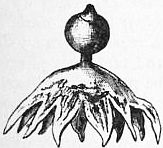
From Strasburger’s Lehrbuch der Botanik, by permission of Gustav Fischer.
Geaster Granulosus, nat. size.
EARTH-STAR (Geaster), in botany, a kind of puff-ball, with a distinct outer coat which, on separating from the inner, splits into several divisions, which become reflexed and spread like a star. The inner coat enveloping the spores is supported, like a ball, either with or without a stalk on the upper face of the star. The spores escape generally by means of a distinct aperture which appears in the top of the ball. There are several species in Britain found on the ground or on decaying leaves. They are rare or local, but more common in the south or south-east of England than in other parts of Britain.
EARTHWORM, the common name of a chaetopod worm found nearly all over the world. Linnaeus recognized only one species of earthworm and named it Lumbricus terrestris. There are now one thousand well-characterized species known from different parts of the world, and the number increases almost daily. The earthworms of England belong entirely to the three genera Lumbricus, Allolobophora and Allurus, which are further subdivided by some systematists; and these genera form the prevalent earthworm fauna of the Palaearctic region and are also very numerous in the Nearctic region. Elsewhere they do not appear to be indigenous, but are replaced by the numerous other genera of the families enumerated in the article Chaetopoda (q.v.). It is a remarkable fact that these genera, comprizing a separate family Lumbricidae, when introduced into tropical and other countries, thrive abundantly and oust the indigenous forms. In gatherings of earthworms from various extra-European countries it is always found that if the collections have been made in cultivated ground and near the coast the worms are of European species; farther inland the native forms are met with. Inasmuch as in every case the Lumbricidae from non-European countries are identical with European species, since it has been shown that these animals are very readily introduced accidentally with plants, &c., and in view of the fact that they are impatient of sea water, it seems clear that the presence of these Lumbricidae in other continents is due to accidental transportation. Most earthworms live in the soil, which they devour as they burrow through it. A few, like their allies the river worms (Limicolae), habitually frequent streams, lakes, &c. One genus, at any rate, viz. Pontodrilus, seeks an unusual environment, and is found in heaps of sea-weed cast up by the sea. The range of this genus is therefore naturally wider than that of other genera which are confined to land masses and cannot cross the sea by their own efforts. It might be inferred, therefore, and the inference is proved by facts, that truly oceanic islands have no indigenous fauna of earthworms, but are inhabited by forms which are identical with those of neighbouring continents, and doubtless, therefore, accidentally introduced.
Like the leeches the earthworms produce cocoons which are a product of the glandular epithelium of the clitellum. In these cocoons are deposited the eggs together with a certain amount of albumen upon which the developing embryos feed. So far as is known, the production of cocoons is universal among earthworms and the remaining Oligochaeta of aquatic habit. The young leave the cocoon as fully formed earthworms in which, however, the genitalia are not fully developed. There is no free living larval stage. Out of a single cocoon emerge a varying number of young worms, the numbers being apparently characteristic of the species. The work of earthworms in aiding in the production of the subsoil and in levelling the surface was first studied by C. Darwin, and has since been investigated by others. This work is partly carried out beneath the surface and partly on the surface, upon which the worms wander at night and eject the swallowed and triturated earth; frequently castings of some height are formed of coiled ropes of agglutinated particles of mould. The indigenous species of Great Britain, about twenty in number, do not grow to a greater length than some 10 in.; but in several tropical countries there are species which grow to a length of from 3 to 6 ft. Thus we have in Natal the gigantic Microchaeta rappi, in Ceylon Megascolex coeruleus, in Australia Megascolides australis, and an equally large form in South America.
(F. E. B.)
EARWIG, an insect belonging to the Forficulidae, a family usually referred to the Orthoptera, but sometimes regarded as typifying a special order, to which the names Dermaptera, Dermatoptera and Euplexoptera have been given, in allusion to certain peculiarities in the structure of the wings in the species that possess them. The front wings are short and horny and when at rest meet without overlapping in the middle line, like the wing-cases of brachelytrous (cocktail) beetles. The hind wings, on the contrary, are for the most part membranous and, when extended, of large size; each consists of two portions, the distal of which, in virtue of the arrangement and jointing of its nervures, is capable of being both doubled up and folded fanwise beneath the proximal, which is partly horny when the wing is tucked away under the front wing-case of the same side. Apart from these characteristics, the most distinctive feature of earwigs is the presence at the end of the abdomen of a pair of pincers which are in reality modified appendages, known as cercopods, and represent the similar limbs of Japyx and the caudal feelers of Campodea and some other insects.
The Forficulidae are almost cosmopolitan; but the various species and genera differ from each other both in structure and size to a comparatively slight extent. The length and armature of the pincers and the presence or absence of wings are perhaps the most important features used by systematists in distinguishing the various kinds. Of particular zoological interest in this connexion is a Ceylonese genus Dyscritina, in which the cercopods are long, many-jointed and filiform during the early stages of growth, and only assume at the last moult the forcipate structure characteristic of the family. The best known earwig is the common European species, Forficula auricularia. This insect is gregarious and nocturnal. It hides by day under stones or the loosened bark of trees or in any crevice or hole sheltered from the light. At night it crawls about in search of food, which consists to a small extent of dead animal or vegetable matter, but principally, as gardeners are aware, of the petals and other parts of flowers of growing shoots and soft ripe fruit. During the winter earwigs lie dormant; but in the early months of the year females with their eggs may be found in the soil, frequently in deserted earthworm burrows. Maternal instincts are well developed, both the eggs, which number about fifty, and the young being carefully brooded and watched over by the parent. Except for the absence of wings, the young are miniature models of the adult. As growth proceeds the integument is periodically cast; and at the final moult the perfect winged insect appears. Males and females are like each other in size, but may be distinguished by the difference in the number of visible abdominal segments, the male having nine and the female seven. In the male, moreover, the pincers are caliper-like and toothed at the base, whereas in the female they are untoothed and only lightly curved at the tip. These differences suggest that the pincers aid in the pairing of the sexes. However that may be, they are known to be used in the folding of the wings; and their importance as weapons of defence is attested by the precision and effect with which they are wielded against assailants like ants.
(R. I. P.)
EASEMENT (Fr. aise; O. Fr. aisement; Anglo-Lat. aisiamentum, a privilege or convenience), in English law, a species of “servitude” or limited right of use over land belonging to another. It is distinguished from profits à prendre—another species of servitude which involves a right to participate in the profits of the soil of another—since an easement confers merely a convenience (aisiamentum) to be exercised over the land of another (without any participation in the profits of it), i.e. a right to use the soil or produce of the soil in a way tending to the more convenient enjoyment of another piece of land. Thus a right of way is an easement, a right of common is a profit. An easement is distinguishable also from a licence, which, unless it is coupled with a grant, is personal to both grantor and grantee and is neither binding on the licensor, nor, in general, assignable by the licensee; while both the benefit and the burden of an easement are annexed to land (Gale on Easements, 8th ed. p. 2). With easements are sometimes classed certain closely allied “natural rights,” such as a landowner’s right to lateral support for his soil in its natural state, and a riparian owner’s right to the natural flow of a stream.
The essential features of an easement, in the strict sense of the term, are therefore these: (i.) It is an incorporeal right; a right to the use and enjoyment of land—not to the land itself; (ii.) it is imposed upon corporeal property; (iii.) it is a right without profit; (iv.) it requires for its constitution two distinct tenements—the “dominant tenement” which enjoys the right, and the “servient tenement” which submits to it. This last characteristic excludes from the category of easements the so-called “easements in gross,” such as a right of way conferred by grant independently of the possession of any tenement by the grantee. The true easement is an “appendant” or “appurtenant” right, not a “right in gross.”
Further classifications of easements must be noted. They are divided into (a) affirmative or positive, those which authorize the commission of an act by the dominant owner, e.g. rights of way, a right to draw water from a spring, rights of aqueduct, and negative, when the easement restricts the rights of the servient owner over his own property, e.g. prevents him from building on land so as to obstruct ancient lights (cf. also the right to the support of neighbouring soil); (b) continuous, of which the enjoyment may be continual without the interference of man, e.g. access to light, and discontinuous, where there must be a fresh act on each occasion of the exercise of the right, e.g. a right of way, or right to draw water; (c) apparent, where there are visible external signs of the exercise of the right, e.g. a right to dam up a watercourse, and non-apparent, where such signs are absent, e.g. a right to lateral support from land, a prohibition to build above a certain height.
Acquisition of Easements.—Easements may be acquired (a) by express grant, either by statute, or by deed inter vivos, or by will; (b) by an implied grant; (c) by express or implied reservation, e.g. by the owner of land in selling the fee (as to implied reservation, see Gale on Easements, 8th ed. pp. 137 et seq.); (d) by prescription, either at common law or under the Prescription Act 1832. An express grant, or express reservation, of an easement cannot be effected except by deed. An easement arises by implied grant where a man makes one part of his tenement dependent on another, or makes the parts mutually interdependent, and grants any such part with the dependence attaching to it to another person (Innes, Law of Easements, 7th ed. p. 10). For example, a man builds two houses, each of which by the plan of construction receives support from the other; this mutual right of support is a quasi-easement, of which on severance of the tenements the grantee of one will have the benefit; where the enjoyment of the severed tenement could not be had at all without such a right, it is said to be an “easement of necessity.”
Easements are acquired by prescription at common law by proof of “immemorial user” by the dominant owner and those through whom he claims. At one time it was thought that such proof must date back to the first year (1189) of Richard I. (see preamble to Prescription Act 1832). The ground, however, on which prescription was admitted as a means of acquiring easements was the fiction of a “lost grant.” Long enjoyment of the right pointed to its having had a legal origin in a grant from the servient owner, and so any period of reasonably long use came to be accepted. A “lost grant” may be presumed to have been made (the question is one of fact) if 20 years’ uninterrupted enjoyment is shown. To avoid the difficulties of proof of prescriptive right at common law, the Prescription Act 1832 established shorter periods of user. In the case of easements, other than light, the periods of prescription are 20 years for a claim that may be defeated, and 40 years for an indefeasible claim (s. 2). The right of access of light is dealt with under s. 3 (see Ancient Lights). The enjoyment to become prescriptive must be open, i.e. of such a character that the owner of the tenement said to be servient has a reasonable opportunity of becoming aware of the adverse claim (Union Lighterage Co. v. London Graving Dock Co., 1902, 2 Ch. 557); and it must be enjoyed as of right (Gardner v. Hodgson’s Kingston Brewery Co., 1903, A.C. 229) as against the owner of the tenement affected (Kilgour v. Gaddes, 1904, 1 K.B. 457). The periods of prescription are to be reckoned backwards from the time when some suit or matter involving the claim of the dominant owner has arisen (s. 4). Nothing is to be deemed an interruption unless the act of interruption has been submitted to, or acquiesced in, for a year (s. 4).
Easements may be extinguished (i.) by express release—here an instrument under seal is necessary; (ii.) by “merger,” i.e. where both tenements become the property of the same owner; (iii.) by abandonment through non-user. In the case of discontinuous easements, the shortest period of non-user may suffice if there is direct evidence of an intention to abandon.
A word may be added here as to the right to air. It is an actionable nuisance to cause pollution of the air entering a dwelling-house. The owner of a dwelling-house may by prescription acquire a right to the passage of air through it by a defined channel; and the enjoyment without interruption of ventilation by means of air flowing in a definite channel, with the knowledge of the owner and occupier of the adjoining premises, creates a presumption of the grant of such an easement (see Gale on Easements, 8th ed. p. 338).
In Scots Law the term “easement” is unknown. Both the name “servitude” and the main species of servitudes existing in Roman law (q.v.) have been adopted. The classification of servitudes into positive and negative, &c., and the modes of their creation and extinction, are similar to those of English law. The statutory period of prescription is 40 years (Scots Acts 1617, c. 12), or 20 years in the case of enjoyment under any ex facie valid irredeemable title duly recorded in the appropriate register of sasines (Conveyancing [Scotland] Act 1874). There are certain servitudes special to Scots law, e.g. “thirlage,” by which lands are “thirled” or bound to a particular mill, and the possessors obliged to grind their grain there, for payment of certain multures (quantities of grain or meal, payable to the mill-owner) and sequels (small quantities given to the mill servants) as the customary price of grinding. Statutory provision has been made for the commutation of these duties (Thirlage Act 1799), and they have now almost disappeared.
The French Code Civil (Arts. 637 et seq.) and the other European codes (e.g. Belgium, arts. 637 et seq.; Holland, arts. 721 et seq.; Italy, arts. 531 et seq.; Spain, arts. 530 et seq.; Germany, arts. 1018 et seq.) closely follow Roman law. French law is in force in Mauritius, and has been followed in Quebec (Civil Code, arts. 499 et seq.) and St Lucia (Civil Code, arts. 449 et seq.). In India the law is regulated, on English lines, by the Easements Act 1882 (Act v. of 1882). The term “easements,” however, in India includes profits à prendre. In the South African colonies the law of easements is based on the Roman Dutch law (see Maasdorp, Institutes of Cape Law, 1904; Bk. ii. p. 166 et seq.). In most of the other colonies the law of easements is similar to English law. In some, however, it has been provided by statute that rights to the access and use of light or water cannot be acquired by prescription: e.g. Victoria (Water Act 1890, No. 1156, s. 3), Ontario (Real Property Limitation Act, Revised Stats. Ontario, 1897; c. 133, s. 36, light).
In the United States the law of easements is founded upon, and substantially identical with, English law. The English doctrine, however, as to acquisition of right of light and air by prescription is not accepted in most of the States.
Authorities.—English Law: Gale, Law of Easements (8th ed., London, 1908); Goddard, Law of Easements (6th ed., London, 1904); Innes, Digest of the Law of Easements (7th ed., London, 1903). Indian Law: Peacock, Easements in British India (Calcutta, 1904); Hudson and Inman, Law of Light and Air (2nd ed., London, 1905). Scots Law: Erskine, Principles of the Law of Scotland (20th ed., Edinburgh, 1903). American Law: Jones, Law of Easements (New York, 1898); Bouvier, Law Dict. (Boston and London, 1897); Ruling Cases, London and Boston, 1894-1901, tit. Easement (American Notes).
(A. W. R.)
EAST, ALFRED (1849- ), English painter and etcher, was born at Kettering on the 15th of December 1849. One of the most prominent among modern English landscape painters, he received his art education first at the Glasgow School of Art and then in Paris at the École des Beaux-Arts, and under Robert-Fleury and Bouguereau. His landscapes are remarkable for the lyrical use of colour and for the pleasing rhythm of line which is the result of careful selection and building up of the elements that constitute the scene. Based on keen observation of the colour of nature and on careful studies of the details, they are arranged with a rare and by no means obvious sense of balance and compositional beauty which summarily discards all disturbing accidents of nature. He also achieved distinction as an etcher, and published an instructive and useful volume on landscape painting (London, 1906). He began to exhibit at the Royal Academy in 1882, and was elected an associate. In 1906 he became president of the Royal Society of British Artists. Many of his works are to be found in the English provincial galleries; Manchester owns “The Silent Somme” and “Autumn”; Liverpool, “Gibraltar from Algeciras”; Leeds, “The Golden Valley”; Birmingham, “Hayle from Lelant”; Preston, “An Idyll of Spring”; and Hull, “Evening on the Cotswolds.” His “Passing Storm” is at the Luxembourg; “The Nene Valley” at the Venice gallery; and “A Haunt of Ancient Peace” at the National gallery in Budapest. In 1903 he received the order of the Crown of Italy in connexion with his services to the Venice international exhibition; and he was made an honorary member of the Japanese Meiji Bijutsu Kai.
EAST ANGLIA, one of the kingdoms into which Anglo-Saxon Britain was divided. Bede gives no information about its origin except that its earliest settlers were Angles. The kingdom of East Anglia comprised the two counties of Norfolk and Suffolk. With regard to the western boundary we have no accurate information, but it was probably formed by the fens of Cambridgeshire.
This kingdom first appears in Bede’s narrative early in the 7th century, when its power was at its height. Towards the end of the reign of Æthelberht, who died about 616, Rædwald of East Anglia, who had apparently spent some time at the court of Kent, began to win for himself the chief position among the Anglo-Saxon kings of his day. His position was assured, at least temporarily, in 617, when he decided to espouse the cause of the Northumbrian prince Edwin, then a fugitive at his court, and defeated Æthelfrith of Northumbria on the banks of the Idle, a tributary of the Trent, in Mercian territory. Rædwald had been converted to Christianity in Kent, but after his return home he relapsed, according to Bede, owing to the influence of his wife, and there were to be seen in the same building a Christian and a pagan altar. Bede states that Rædwald was the son of Tytili, the son of Wuffa, from whom the East Anglian royal family derived their name Wuffingas. According to the Historia Brittonum Guffa (Wuffa) was the son of (Guecha) Wehha, who first ruled the East Angles in Britain. This would put the organization of the kingdom in the first or second quarter of the 6th century. Eorpwald, the son of Rædwald, was converted to Christianity by Edwin, but was soon afterwards slain by Ricberht (627 or 628), whereupon the kingdom again became pagan for three years, when Sigeberht, the brother of Eorpwald, became king and founded a see for Felix at Dunwich. Sigeberht also founded a school in East Anglia, and on the arrival of an Irish missionary named Furšeus he built him a monastery at Cnobheresburg, perhaps to be identified with Burgh Castle. Before 644, however, Sigeberht resigned the crown in favour of his brother Ecgric and retired to a monastery. Shortly afterwards both brothers were slain by Penda of Mercia in his invasion of East Anglia, and Anna became king. This king was an enthusiastic Christian, and converted Cœnwalh, king of Wessex, who had fled to his court. Two of his daughters, Sæthryth and Æthelberg, took the veil; while another, Sexburg, was married to Earconberht, king of Kent; and a fourth, Æthelthryth, after two marriages, with Tondberht of the South Gyrwe and Ecgfrith of Northumbria, became abbess of Ely. In 654 Anna was slain by Penda of Mercia, and was succeeded by his brother Æthelhere, who was killed in 655 at the Winwaed, fighting for the Mercian king against Oswio of Northumbria. In 673 Archbishop Theodore divided the East Anglian diocese into two, Elmham being the seat of the northern, Dunwich that of the southern bishop. A long blank follows in the history of this kingdom, until in 792 we find Offa of Mercia slaying Æthelberht, king of East Anglia, who is said to have been his son-in-law. East Anglia was subject to the supremacy of the Mercian kings until 825, when its people slew Beornwulf of Mercia, and with their king acknowledged Ecgberht (Egbert) of Wessex as their lord. In 870 Edmund, king of East Anglia, was killed by the Danes under I′varr and Ubbi, the sons of Ragnar Loðbrok.
The following is a list of the kings of East Anglia of whom there is record:—Wehha; Wuffa; Rædwald, son of Tytili and grandson of Wuffa (reigning 617); Eorpwald, son of Rædwald (d. 627 or 628); Sigeberht, brother of Eorpwald; Ecgric, brother of Sigeberht (both slain before 644); Anna, son of Ene and grandson of Tytili (d. 654); Æthelhere, brother of Anna (d. 655); Æthelwald, a third brother; Aldwulf (succ. 663, d. 713), son of Æthelric and grandson of Ene; Elfwald, son of Aldwulf (d. 749); Hun Beonna and Alberht; Æthelberht (792); Edmund (870).
After the death of Ragnar Loðbrok’s sons East Anglia was occupied by the Danish king Guthrum, who made a treaty with Alfred settling their respective boundaries, probably about 880. Guthrum died in 890. A later king named Eohric took up the cause of Æthelwald, the son of Æthelred I., and was slain in the fight with the Kentish army at the Holm in 905. A war broke out with King Edward the Elder in 913; in 921 a king whose name is unknown was killed at the fall of Tempsford, and in the same year the Danes of East Anglia submitted to Edward the Elder. From this time, probably, East Anglia was governed by English earls, the most famous of whom were Æthelstan, surnamed Half-King (932-956) and his sons, Æthelwold (956-962), and Æthelwine, surnamed Dei amicus (962-992).
See Bede, Hist. Eccl. (ed. C. Plummer, Oxford. 1896), ii. 5, 15, iii. 7, 8, 18-20, 22, iv. 3, 5, 23; Saxon Chronicle (ed. Earle and Plummer, Oxford, 1899), s. a. 823, 838, 866, 870, 880, 885, 890, 894, 905, 921; Historia Brittonum (San-Marte, 1844), s. 59; H. Sweet, Oldest English Texts, p. 171 (London, 1885).
(F. G. M. B.)
EASTBOURNE, a municipal borough (1883) in the Eastbourne parliamentary division of Sussex, England, 61 m. S.S.E. of London by the London, Brighton & South Coast railway. Pop. (1891) 34,969; (1901) 43,344; (local census, 1909) 49,286. It is situated 3 m. N.E. of Beachy Head, the loftiest headland on the English Channel coast. It once consisted of three parts—the village of East Bourne, a mile inland; South Bourne, lying back from the shore; and Seahouses, facing the beach. The church of St Mary, the ancient parish church of East Bourne, is a fine transitional Norman building; and there are numerous modern churches and chapels. The principal buildings and institutions are the town hall and municipal buildings, the Princess Alice Memorial and other hospitals, a free library and, among many high-class schools, Eastbourne College for boys, founded in 1867. There is a fine pier with pavilion, and a marine parade nearly 3 m. in extent, arranged in terraced promenades. Devonshire Park of 13 acres is pleasantly laid out, and contains a pavilion and a theatre. The duke of Devonshire is the principal landowner. Golf links are laid out on the neighbouring downs. A Roman villa was formerly seen close to the shore, but it is not now visible. The corporation consists of a mayor, 8 aldermen and 24 councillors. In 1910 the corporation promoted a bill in parliament to add the Hampden Park district in the parish of Willingdon to the borough and to make Eastbourne, with this extension, a county borough.
EAST CHICAGO, a city of Lake county, Indiana, U.S.A., on Lake Michigan, about 19 m. S.E. of the business centre of Chicago. Pop. (1890) 1255; (1900) 3411 (1331 foreign-born); (1910) 19,098. It is served by several railways, including the Pennsylvania, the Wabash, the Chicago Terminal Transfer (whose shops are here), the Lake Shore & Michigan Southern, the Chicago, Indiana & Southern, and the Indiana Harbor railways. East Chicago covers an area whose greatest dimensions are 4 by 3½ m. That part of the city along the lake, known as Indiana Harbor, dates from 1901 and has grown very rapidly because of its position at the southernmost part of the Calumet District, and because of the meeting here of railway and lake commerce. A good harbour has been constructed, a new ship canal connecting the harbour with the Calumet river. East Chicago is industrially virtually a part of “Greater” Chicago; among its manufactures are iron and steel, cement, lumber, boilers, hay presses, chains, chemicals and foundry products. East Chicago was chartered as a city in 1893.
EASTER, the annual festival observed throughout Christendom in commemoration of the resurrection of Jesus Christ. The name Easter (Ger. Ostern), like the names of the days of the week, is a survival from the old Teutonic mythology. According to Bede (De Temp. Rat. c. xv.) it is derived from Eostre, or Ostâra, the Anglo-Saxon goddess of spring, to whom the month answering to our April, and called Eostur-monath, was dedicated. This month, Bede says, was the same as the mensis paschalis, “when the old festival was observed with the gladness of a new solemnity.”
The name of the festival in other languages (as Fr. pâques; Ital. pasqua; Span. pascua; Dan. paaske; Dutch paasch; Welsh pasg) is derived from the Lat. pascha and the Gr. πάσχα. These in turn come from the Chaldee or Aramaean form פסהא pascha’, of the Hebrew name of the Passover festival פסח pesach, from פסח “he passed over,” in memory of the great deliverance, when the destroying angel “passed over the houses, of the children of Israel in Egypt when he smote the Egyptians” (Exod. xii. 27).
An erroneous derivation of the word pascha from the Greek πάσχειν, “to suffer,” thus connected with the sufferings or passion of the Lord, is given by some of the Fathers of the Church, as Irenaeus, Tertullian and others, who were ignorant of Hebrew. St Augustine (In Joann. Tract. 55) notices this false etymology, shows how similarity of sound had led to it, and gives the correct derivation.
There is no indication of the observance of the Easter festival in the New Testament, or in the writings of the apostolic Fathers. The sanctity of special times was an idea absent from the minds of the first Christians. “The whole of time is a festival unto Christians because of the excellency of the good things which have been given” is the comment of St Chrysostom on 1 Cor. v. 7, which has been erroneously supposed to refer to an apostolic observance of Easter. The ecclesiastical historian Socrates (Hist. Eccl. v. 22) states, with perfect truth, that neither the Lord nor his apostles enjoined the keeping of this or any other festival. He says: “The apostles had no thought of appointing festival days, but of promoting a life of blamelessness and piety”; and he attributes the observance of Easter by the church to the perpetuation of an old usage, “just as many other customs have been established.”
This is doubtless the true statement of the case. The first Christians continued to observe the Jewish festivals, though in a new spirit, as commemorations of events which those festivals had foreshadowed. Thus the Passover, with a new conception added to it of Christ as the true Paschal Lamb and the first fruits from the dead, continued to be observed, and became the Christian Easter.
Although the observance of Easter was at a very early period the practice of the Christian church, a serious difference as to the day for its observance soon arose between the Christians of Jewish and those of Gentile descent, which led to a long and bitter controversy. The point at issue was when the Paschal fast was to be reckoned as ending. With the Jewish Christians, whose leading thought was the death of Christ as the Paschal Lamb, the fast ended at the same time as that of the Jews, on the fourteenth day of the moon at evening, and the Easter festival immediately followed, without regard to the day of the week. The Gentile Christians, on the other hand, unfettered by Jewish traditions, identified the first day of the week with the Resurrection, and kept the preceding Friday as the commemoration of the crucifixion, irrespective of the day of the month. With the one the observance of the day of the month, with the other the observance of the day of the week, was the guiding principle.
Generally speaking, the Western churches kept Easter on the first day of the week, while the Eastern churches followed the Jewish rule, and kept Easter on the fourteenth day. St Polycarp, the disciple of St John the Evangelist and bishop of Smyrna, visited Rome in 159 to confer with Anicetus, the bishop of that see, on the subject; and urged the tradition, which he had received from the apostle, of observing the fourteenth day. Anicetus, however, declined to admit the Jewish custom in the churches under his jurisdiction, but readily communicated with Polycarp and those who followed it. About forty years later (197) the question was discussed in a very different spirit between Victor, bishop of Rome, and Polycrates, metropolitan of proconsular Asia. That province was the only portion of Christendom which still adhered to the Jewish usage, and Victor demanded that all should adopt the usage prevailing at Rome. This Polycrates firmly refused to agree to, and urged many weighty reasons to the contrary, whereupon Victor proceeded to excommunicate Polycrates and the Christians who continued the Eastern usage. He was, however, restrained from actually proceeding to enforce the decree of excommunication, owing to the remonstrance of Irenaeus and the bishops of Gaul. Peace was thus maintained, and the Asiatic churches retained their usage unmolested (Euseb. H.E. v. 23-25). We find the Jewish usage from time to time reasserting itself after this, but it never prevailed to any large extent.
A final settlement of the dispute was one among the other reasons which led Constantine to summon the council of Nicaea in 325. At that time the Syrians and Antiochenes were the solitary champions of the observance of the fourteenth day. The decision of the council was unanimous that Easter was to be kept on Sunday, and on the same Sunday throughout the world, and “that none should hereafter follow the blindness of the Jews” (Socrates, H.E. i. 9). The correct date of the Easter festival was to be calculated at Alexandria, the home of astronomical science, and the bishop of that see was to announce it yearly to the churches under his jurisdiction, and also to the occupant of the Roman see, by whom it was to be communicated to the Western churches. The few who afterwards separated themselves from the unity of the church, and continued to keep the fourteenth day, were named Quartodecimani, and the dispute itself is known as the Quarto-deciman controversy. Although measures had thus been taken to secure uniformity of observance, and to put an end to a controversy which had endangered Christian unity, a new difficulty had to be encountered owing to the absence of any authoritative rule by which the paschal moon was to be ascertained. The subject is a very difficult and complex one (see also Calendar). Briefly, it may be explained here that Easter day is the first Sunday after the full moon following the vernal equinox. This, of course, varies in different longitudes, while a further difficulty occurred in the attempt to fix the correct time of Easter by means of cycles of years, when the changes of the sun and moon more or less exactly repeat themselves. At first an eight years’ cycle was adopted, but it was found to be faulty, then the Jewish cycle of 84 years was used, and remained in force at Rome till the year 457, when a more accurate calculation of a cycle of 532 years, invented by Victorius of Acquitaine, took its place. Ultimately a cycle of 19 years was accepted, and it is the use of this cycle which makes the Golden Number and Sunday Letter, explained in the preface to the Book of Common Prayer, necessary. Owing to this lack of decision as to the accurate finding of Easter, St Augustine tells us (Epist. 23) that in the year 387 the churches of Gaul kept Easter on the 21st of March, those of Italy on the 18th of April, and those of Egypt on the 25th of April; and it appears from a letter of Leo the Great (Epist. 64, ad Marcian.) that in 455 there was a difference of eight days between the Roman and the Alexandrine Easter. Gregory of Tours relates that in 577 “there was a doubt about Easter. In Gaul we with many other cities kept Easter on the fourteenth calends of May, others, as the Spaniards, on the twelfth calends of April.”
The ancient British and Celtic churches followed the cycle of 84 years which they had originally received from Rome, and their stubborn refusal to abandon it caused much bitter controversy in the 8th century between their representatives and St Augustine of Canterbury and the Latin missionaries. These latter unfairly attempted to fix the stigma of the Quartodeciman observance on the British and Celtic churches, and they are even now sometimes ignorantly spoken of as having followed the Asiatic practice as to Easter. This, however, is quite erroneous. The British and Celtic churches always kept Easter according to the Nicene decree on a Sunday. The difference between them and the Roman Church, at this period, was that they still followed the 84 years’ cycle in computing Easter, which had been abandoned at Rome for the more accurate cycle of 532 years. This difference of calculation led to Easter being observed on different Sundays, in certain years, in England, by the adherents of the two churches. Thus Bede records that in a certain year (which must have been 645, 647, 648 or 651) Queen Eanfleda, who had received her instruction from a Kentish priest of the Roman obedience, was fasting and keeping Palm Sunday, while her husband, Oswy, king of Northumbria, following the rule of the British church, was celebrating the Easter festival. This diversity of usage was ended, so far as the kingdom of Northumbria was concerned, by the council of Streaneshalch, or Whitby, in 654. To Archbishop Theodore is usually ascribed the credit of ending the difference in the rest of England in 669.
The Gregorian correction of the calendar in 1582 has once more led to different days being observed. So far as Western Christendom is concerned the corrected calendar is now universally accepted, and Easter is kept on the same day, but it was not until 1752 that the Gregorian reformation of the calendar was adopted in Great Britain and Ireland. Jealousy of everything emanating from Rome still keeps the Eastern churches from correcting the calendar according to the Gregorian reformation, and thus their Easter usually falls before, or after, that of the Western churches, and only very rarely, as was the case in 1865, do the two coincide.
Easter, as commemorating the central fact of the Christian religion, has always been regarded as the chief festival of the Christian year, and according to a regulation of Constantine it was to be the first day of the year. This reckoning of the year as beginning at Easter lingered in France till 1565, when, by an ordinance of Charles IX., the 1st of January finally took its place.
Four different periods may be mentioned as connected with the observance of Easter, viz. (1) the preparatory fast of the forty days of Lent; (2) the fifteen days, beginning with the Sunday before and ending with the Sunday after Easter, during which the ceremonies of Holy Week and the services of the Octave of Easter were observed; this period, called by the French the Quinzaine de Pâques, was specially observed in that country; (3) the Octave of Easter, during which the newly-baptized wore their white garments, which they laid aside on the Sunday after Easter, known as Dominica in albis depositis from this custom; another name for this Sunday was Pascha clausum, or the close of Easter, and from a clipping of the word “close” the English name of “Low” Sunday is believed to be derived; (4) Eastertide proper, or the paschal season beginning at Easter and lasting till Whit Sunday, during the whole of which time the festival character of the Easter season was maintained in the services of the church.
Many ecclesiastical ceremonies, growing up from early times, clustered round the celebration of the Easter festival. One of the most notable of these was the use of the paschal candle. This was a candle of very large dimensions, set in a candlestick big enough to hold it, which was usually placed on the north side, just below the first ascent to the high altar. It was kept alight during each service till Whitsuntide. The Paschal, as it was called at Durham cathedral, was one of the chief sights of that church before the Reformation. It was an elaborate construction of polished brass, and, contrary to the usual custom, seems to have been placed in the centre of the altar-step, long branches stretching out towards the four cardinal points, bearing smaller candles. The central stem of the candlestick was about 38 ft. high, and bore the paschal candle proper, and together they reached a combined height of about 70 ft., the candle being lighted from an opening above. Other paschal candles seem to have been of scarcely less size. At Lincoln, c. 1300, the candle was to weigh three stones of wax; at Salisbury in 1517 it was to be 36 ft. long; and at Westminster in 1558 it weighed no less than 3 cwt. of wax. After Whitsuntide what remained was made into smaller candles for the funerals of the poor. In the ancient churches at Rome the paschal candlesticks were fixtures, but elsewhere they were usually movable, and were brought into the church and set up on the Thursday before Easter. At Winchester the paschal candlestick was of silver, and was the gift of Canute. Others of more or less importance are recorded as having been at Canterbury, Bury St Edmunds, Hereford and York. The burning of the paschal candle still forms part of the Easter ceremonial of the Roman Catholic Church (see Lights, Ceremonial).
The liturgical colour for Easter was everywhere white, as the sign of joy, light and purity, and the churches and altars were adorned with the best ornaments that each possessed. Flowers and shrubs no doubt in early times were also used for this purpose, but what evidence there is goes against the medieval use of such decorations, which are so popular at the present day.
It is not the purpose of this article to enter on the wide subject of the popular observances, such as the giving and sending of Pasch or Easter eggs as presents. For such the reader may consult Brand’s Popular Antiquities, Hone’s Every-Day Book, and Chambers’s Book of Days.
Authorities.—Bingham, Antiquities of the Christian Church; Bede, Ecclesiastical History of England; Procter and Frere, A New History of the Book of Common Prayer (London, 1901); Surtees Society, Rites of Durham, ed. J.T. Fowler (1903); De Morgan, Companion to the Almanac (1845); De Moleon, Voyages liturgiques (Paris, 1718).
(T. M. F.)
EASTER ISLAND (Rapanui, i.e. Great Rapa), an island in the eastern part of the South Pacific ocean, belonging to Chile (since 1888), in 27° 8′ S. and 109° 28′ W., 1400 m. E. of Pitcairn, and 2000 m. from the South American coast. It is roughly triangular in shape, with its hypotenuse 12 m. long running north-east and south-west, and its three angles marked by three volcanic peaks, of which the north-eastern reaches 1768 ft. of altitude. The area of the island is 45 sq. m. The coast has no good natural harbour, and landing is difficult. There is no lack of fertile soil, and the climate is moist enough to make up for the absence of running water. Formerly the island appears to have been wooded, but it now presents only a few bushes (Edwardsia, Broussonetia, &c.), ferns, grasses, sedges, &c. The natives grow bananas in the shelter of artificial pits, also sugar-canes and sweet potatoes, and keep a few goats and a large stock of domestic fowls, and a Tahitian commercial house breeds cattle and sheep on the island.
It is doubtful whether Rapanui was discovered by Davis in 1686, though it is sometimes marked Davis Island on maps. Admiral Roggeveen reached it on Easter day 1722; in 1774 Captain Cook discovered it anew and called it Teapi or Waihu. It was subsequently visited by La Pérouse (1776), Kotzebue (1816), &c. At the time of Roggeveen’s discovery the island probably contained from 2000 to 3000 inhabitants of Polynesian race, who, according to their own tradition, came from Rapa Iti (Little Rapa) or Oparo, one of the Tubuai or Austral group. In 1863 a large proportion of the inhabitants were kidnapped by the Peruvians and transported to work at the guano diggings on the Chincha Islands. The next year a Jesuit mission from Tahiti reached the island and succeeded in the task of civilization. The natives, who number scarcely one hundred, are all Christians.
Easter Island is famous for its wonderful archaeological remains. Here are found immense platforms built of large cut stones fitted together without cement. They are generally built upon headlands, and on the slope towards the sea. The walls on the seaside are, in some of the platforms, nearly 30 ft. high and from 200 to 300 ft. long, by about 30 ft. wide. Some of the squared stones are as much as 6 ft. long. On the land side of the platforms there is a broad terrace with large stone pedestals upon which once stood colossal stone images carved somewhat into the shape of the human trunk. On some of the platforms there are upwards of a dozen images, now thrown from their pedestals and lying in all directions. Their usual height is from 14 to 16 ft., but the largest are 37 ft., while some are only about 4 ft. They are formed from a grey trachytic lava found at the east end of the island. The top of the heads of the images is cut flat to receive round crowns made of a reddish vesicular tuff found at a crater about 8 m. distant from the quarry where the images were cut. A number of these crowns still lie at the crater apparently ready for removal, some of the largest being over 10 ft. in diameter. In the atlas illustrating the voyage of La Pérouse a plan of the island is given, with the position of several of the platforms. Two of the images are also represented in a plate. One statue, 8 ft. in height and weighing 4 tons, was brought to England, and is now in the British Museum. In one part of the island are the remains of stone houses nearly 100 ft. long by about 20 ft. wide. These are built in courses of large flat stones fitted together without cement, the walls being about 5 ft. thick and over 5 ft. high. They are lined on the inside with upright slabs, on which are painted geometrical figures and representations of animals. The roofs are formed by placing slabs so that each course overlaps the lower one until the opening becomes about 5 ft. wide, when it is covered with flat slabs reaching from one side to the other. The lava rocks near the houses are carved into the resemblance of various animals and human faces, forming, probably, a kind of picture writing. Wooden tablets covered with various signs and figures have also been found. The only ancient implement discovered on the island is a kind of stone chisel, but it seems impossible that such large and numerous works could have been executed with such a tool. The present inhabitants of Easter Island know nothing of the construction of these remarkable works; and the entire subject of their existence in this small and remote island is a mystery.
EASTERN BENGAL AND ASSAM, a province of British India, which was constituted out of Assam and the eastern portion of Bengal on the 16th of October 1905. Area 111,569 sq. m.; pop. (1901) 30,961,459. It is situated between 20° 45′ and 28° 17′ N., and between 87° 48′ and 97° 5′ E. The province, as thus reconstituted, consists of the Bengal districts of Dacca, Mymensingh, Faridpur, Backergunje, Tippera, Noakhali, Chittagong, Chittagong Hill Tracts, Rajshahi, Dinajpur, Jalpaiguri, Rangpur, Bogra, Pabna, Malda, and the native states of Kuch Behar and Hill Tippera; and the whole of the former area of Assam consisting of the districts of Goalpara, Kamrup, Darrang, Nowgong, Sibsagar, Lakhimpur, Sylhet, Cachar, Garo Hills, Khasi and Jaintia Hills, Naga Hills and Lushai Hills. It is bounded on the N. by Bhutan, on the W. by Burma, on the S. by Burma and the Bay of Bengal, and on the E. by Bengal. The line of demarcation between Bengal and the new province begins at the frontier of Bhutan, east of Darjeeling, runs south-west to Sahibganj on the Ganges and thence follows the course of the Ganges down to the deltaic branch, called the Haringhata, which leaves the main stream above Goalanda, and the course of the latter, which runs south into the Bay of Bengal. The capital of the province is Dacca, and its chief port is Chittagong.
The Bengal districts which were transferred to Eastern Bengal and Assam comprised northern and eastern Bengal, the most prosperous and least overcrowded portion of Bengal. The land there is less densely populated, wages are higher and food cheaper, and the rainfall more copious and more regular, while the staple crops of jute, tobacco and rice command a higher price relative to the rent of the land than in Behar or other parts of Bengal. The population are largely Mahommedans and of a more virile stock than the Bengali proper. Northern Bengal corresponds almost exactly with the Rajshahi division and lies within the boundaries of the Ganges and Brahmaputra rivers. It contains much high land of a stiff red clay, with an undulating surface covered for the most part with scrub jungle. The inhabitants are Indo-Chinese, not Indo-Aryans as in Bengal proper, and are Mahommedan by religion instead of Hindu. Eastern Bengal consists of the Dacca and Chittagong divisions which are mainly Bengali in race and Hindu in religion. For the Assamese districts see Assam. The province as a whole contains 18,036,688 Mahommedans and 12,036,538 Hindus. In language 27,272,895 of the inhabitants speak Bengali, 1,349,784 speak Assamese, and the remainder Hindi and various hill dialects, Manipuri, Bodo, Khasi and Garo. The administration is in the hands of a lieutenant-governor, assisted by a legislative council of fifteen members. Under him are five commissioners, and financial matters are regulated by a board of revenue consisting of two members.
The constitution of the new province arose out of the fact that Bengal had grown too unwieldy for the administration of a single lieutenant-governor. In 1868 Sir Stafford Northcote drew attention to the greatly augmented demands that the outlying portions of Bengal made on the time and labour of the government. At that time the population of the province was between 40 and 50 millions, and the question was left in abeyance until 1903, when the population had risen to 78½ millions. In the meantime the importance of rendering Assam a self-contained and independent administration with a service of its own, and of providing for its future commercial expansion, had arisen. These two considerations led Lord Curzon to propose that Bengal should be lopped of territory both on its eastern and western borders, and that all the districts east of the Brahmaputra should be constituted into a separate province. This proposal was bitterly opposed by the Hindus of Bengal on the ground that it would destroy the unity of the Bengali race; and their agitation was associated with the Swadeshi (own country) movement for the boycott of British goods.
After the constitution of the province in October 1905, the agitation in Eastern Bengal increased. Public meetings of protest were held, vernacular broadsheets containing scandalous attacks on the British authorities were circulated, schoolboys and others were organized and drilled as so-called “national volunteers,” and employed as pickets to prevent the sale of British goods. Such was the state of things when Sir J. Bampfylde Fuller entered on his office as first lieutenant-governor of Eastern Bengal in January 1906. His reception was ominous. Representative bodies that were dominated by Hindus refused to vote the usual addresses of welcome, and non-official Hindus abstained from paying the customary calls. There were, however, no further overt signs of objection to the lieutenant-governor personally, and after a month or two—in spite of, or perhaps because of, his efforts to restrain sedition and to keep discipline in the schools—there was a decided change in the attitude of Hindu opinion. At Dacca, in July, for instance, the reception at Government House was attended by large numbers of Bengali gentlemen, who assured the lieutenant-governor that “the trouble was nearly ended.” The agitation was, in fact, largely artificial, the work of Calcutta lawyers, journalists and schoolmasters; the mass of the people, naturally law-abiding, was unmoved by it so long as the government showed a firm hand; while the Mussulmans, who formed a large proportion of the whole, saw in the maintenance of the partition and of the prestige of the British government the guarantees of their own security.
All seemed to be going well when an unfortunate difference of opinion occurred between the lieutenant-governor and the central government, resulting in the resignation of Sir Bampfylde Fuller (August 1906) and in ulterior consequences destined to be of far-reaching import. The facts are briefly as follows. Acting on a report of Dr P. Chatterji, inspector of schools, dated January 2, 1906, the lieutenant-governor, on the 10th of February, addressed a letter to the registrar of Calcutta University recommending that the privilege of affiliation to the university should be withdrawn from the Banwarilal and Victoria high schools at Sirajganj in Pabna, as a punishment for the seditious conduct of both pupils and teachers. Apart from numerous cases of illegal interference with trade and of disorder in the streets reported against the students, two specific outrages of a serious character were instanced as having occurred on the 15th of November: the raiding of a cart laden with English cloth belonging to Marwari traders, and a cowardly assault by some 40 or 50 lads on the English manager of the Bank of Bengal. These outrages “were not the result of thoughtlessness or sudden excitement, but were the outcome of a regularly organized scheme, set on foot and guided by the masters of these schools, for employing the students in enforcing a boycott.” All attempts to discover and punish the offenders had been frustrated by the refusal of the school authorities to take action, and in the opinion of the lieutenant-governor the only course open was to apply the remedy suggested in the circular letter addressed to magistrates and collectors (October 10, 1905) by Mr R.W. Carlyle, the officiating chief secretary to the government of Bengal, directing them, in the event of students taking any part in political agitation, boycotting and the like, to inform the heads of schools or colleges concerned that, unless they prevented such action being taken by the boys attending their institutions, their grant-in-aid and the privilege of competing for scholarships and of receiving scholarship-holders would be withdrawn, and that the university would be asked to disaffiliate their institutions.
The reply, dated July 5th, from the secretary in the home department of the government of India, was—to use Sir Bampfylde’s own later expression—to throw him over. It was likely that a difference of opinion in the syndicate of the university would arise as to the degree of culpability that attached to the proprietors of the schools; in the event of the syndicate taking any “punitive action,” the matter was certain to be raised in the senate, and would lead to an acrimonious public discussion, in which the partition of Bengal and the administration of the new province would be violently attacked; and in the actual state of public opinion in Bengal it seemed to the government of India highly inexpedient that such a debate should take place. “Collective punishment,” too, “would be liable to be misconstrued in England,” and the government preferred to rely on the gradual effect of the new university regulations, which aimed “at discouraging the participation of students in political movements by enforcing the responsibility of masters and the managing committees of schools for maintaining discipline.”
On receipt of this communication Sir Bampfylde Fuller at once tendered his resignation to the viceroy (July 15). He pointed out that to withdraw from the position taken up would be “concession, not in the interests of education, but to those people in Calcutta who have been striving to render my government impossible, in order to discredit the partition”; that previous concessions had had merely provocative effects, and that were he to give way in this matter his authority would be so weakened that he would be unable to maintain order in the country. On the 3rd of August, after some days of deliberation, the viceroy telegraphed saying that he was “unable to reconsider the orders sent,” and accepting Sir Bampfylde’s resignation. By the Anglo-Indian press the news was received with something like consternation, the Times of India describing the resignation as one of the gravest blunders ever committed in the history of British rule in India, and as a direct incentive to the forces of disquiet, disturbance and unrest. Equally emphatic was the verdict of the Mussulman community forming two-thirds of the population of Eastern Bengal. On the 7th of August, the day of Sir Bampfylde Fuller’s departure from Dacca, a mass-meeting of 30,000 Mahommedans was held, which placed on record their disapproval of a system of government “which maintains no continuity of policy,” and expressed its feeling that the lowering of British prestige must “alienate the sympathy of a numerically important and loyal section of His Majesty’s subjects”; and many meetings of Mussulmans subsequently passed resolutions to the same general effect. The Akhbar-i-Islam, the organ of Bombay Mussulman opinion, deplored the “unwise step” taken by the government, and ascribed it to Lord Minto’s fear of the Babu press, a display of weakness of which the Babus would not be slow to take advantage.
This latter prophecy was not slow in fulfilling itself. So early as the 8th of August Calcutta was the scene of several large demonstrations at which the Swadeshi vow was renewed, and at which resolutions were passed declining to accept the partition as a settled fact, and resolving on the continuance of the agitation. The tone of the Babu press was openly exultant: “We have read the familiar story of the Russian traveller and the wolves,” said a leading Indian newspaper in Calcutta. “The British government follows a similar policy. First the little babies were offered up in the shape of the Bande Mataram circular and the Carlyle circular. Now a bigger boy has gone in the person of our own Joseph. Courage, therefore, O wolves! Press on and the horse will soon be yours to devour! Afterwards the traveller himself will alone be left.”1 The task before the new lieutenant-governor of Eastern Bengal, the Hon. L. Hare, was obviously no easy one. The encouragement given to sedition by the weakness of the government in this case was shown by later events in Bengal and elsewhere (see India: History, ad fin.).
For the early history of the various portions of the province see Bengal and Assam.
See Sir James Bourdillon, The Partition of Bengal (Society of Arts, 1905); official blue-books on The Reconstitution of the Provinces of Bengal and Assam (Cd. 2658 and 2746), and Resignation of Sir J. Bampfylde Fuller, lieutenant-governor, &c. (Cd. 3242). A long letter from Sir J.B. Fuller, headed J’accuse, attacking the general policy of the Indian government in regard to the seditious propaganda, appeared in The Times of June 6, 1908.
1 Quoted by Mr F.S.P. Lely in The Times of November 22, 1906.
EASTERN QUESTION, THE, the expression used in diplomacy from about the time of the congress of Verona (1822) to comprehend the international problems involved in the decay of the Turkish empire and its supposed impending dissolution. The essential questions that are involved are so old that historians commonly speak of the “Eastern Question” in reference to events that happened long before the actual phrase was coined. But, wherever used, it is always the Turkish Question, the generic term in which subsidiary issues, e.g. the Greek, Armenian or Macedonian questions, are embraced. That a phrase of so wide and loose a nature should have been stereotyped in so narrow a sense is simply the outcome of the conditions under which it was invented. To the European diplomatists of the first half of the 19th century the Ottoman empire was still the only East with which they were collectively brought into contact. The rivalry of Great Britain and Russia in Persia had not yet raised the question of the Middle East; still less any ambitions of Germany in the Euphrates valley. The immense and incalculable problems involved in the rise of Japan, the awakening of China, and their relations to the European powers and to America—known as the Far Eastern Question—are comparatively but affairs of yesterday.
The Eastern Question, though its roots are set far back in history—in the ancient contest between the political and intellectual ideals of Greece and Asia, and in the perennial rivalry of the powers for the control of the great trade routes to the East—dates in its modern sense from the treaty of Kuchuk Kainarji in 1774, which marked the definitive establishment of Russia as a Black Sea power and formed the basis of her special claims to interfere in the affairs of the Ottoman empire. The compact between Napoleon and the emperor Alexander I. at Tilsit (1807) marked a new phase, which culminated in 1812 in the treaty of Bucharest, in which Russia definitely appeared as the protector of the Christian nationalities subject to the Ottoman sultan.
The attitude of the various powers in the Eastern Question was now defined. Russia, apart from her desire to protect the Orthodox nationalities subject to the Ottoman power, aimed at owning or controlling the straits by which alone she could find an outlet to the Mediterranean and the ocean beyond. Austria, once the champion of Europe against the Turk, saw in the Russian advance on the Danube a greater peril than any to be feared from the moribund Ottoman power, and made the maintenance of the integrity of Turkey a prime object of her policy. She was thus brought into line with Great Britain, whose traditional friendship with Turkey was strengthened by the rise of a new power whose rapid advance threatened the stability of British rule in India. But though Austria, Great Britain and presently France, were all equally interested in maintaining the Ottoman empire, the failure of the congress of Vienna in 1815 to take action in the matter of a guarantee of Turkey, and the exclusion of the Sultan from the Holy Alliance, seemed to endorse the claim of Russia to regard the Eastern Question as “her domestic concern” in which “Europe” had no right to interfere. The revolt of the Greeks (1821) put this claim to the test; by the treaty of Adrianople (1829) Russia stipulated for their autonomy as part of the price of peace, but the powers assembled in conference at London refused to recognize this settlement, and the establishment of Greece as an independent kingdom (1832) was really aimed at the pretensions and the influence of Russia. These reached their high-water mark in the treaty of Unkiar Skelessi (July 8th, 1832). It was no longer a question of the partition of Turkey or of a Russian conquest of Constantinople, but of the deliberate degradation by Russia of the Ottoman empire into a weak state wholly dependent upon herself. The ten years’ crisis (1831-1841) evoked by the revolt of Mehemet Ali, pasha of Egypt, thus resolved itself into a diplomatic struggle between Russia and the other powers to maintain or to recover influence at Constantinople. The Russian experiment of maintaining the integrity of Turkey while practically treating her as a vassal state, ended with the compromise of 1841; and the emperor Nicholas I. reverted to the older idea of expelling the Turks from Europe. The Eastern Question, however, slumbered until, in 1851, the matter of the Holy Places was raised by Napoleon III., involving the whole question of the influence in Ottoman affairs of France under the capitulations of 1740 and of Russia under the treaty of 1774. The Crimean War followed and in 1856 the treaty of Paris, by which the powers hoped to stem the tide of Russian advance and establish the integrity of a reformed Ottoman state. Turkey was now for the first time solemnly admitted to the European concert. The next critical phase was opened in 1871, when Russia took advantage of the collapse of France to denounce the Black Sea clauses of the treaty of 1856. The renewal of an aggressive policy thus announced to the world soon produced a new crisis in the Eastern Question, which had meanwhile become complicated by the growth of Pan-Slav ideals in eastern Europe. In 1875 a rising in Herzegovina gave evidence of a state of feeling in the Balkan peninsula which called for the intervention of Europe, if a disastrous war were to be prevented. But this intervention, embodied in the “Andrassy Note” (December 1875) and the Berlin memorandum (May 1876), met with the stubborn opposition of Turkey, where the “young Turks” were beginning to oppose a Pan-Islamic to the Pan-Slav ideal. The Russo-Turkish War of 1877-78 followed, concluded by the treaty of San Stefano, the terms of which were modified in Turkey’s favour by the congress of Berlin (1878), which marks the beginning of the later phase of the Eastern Question. Between Russia and Turkey it interposed, in effect, a barrier of independent (Rumania, Servia) and quasi-independent (Bulgaria) states, erected with the counsel and consent of collective Europe. It thus, while ostensibly weakening, actually tended to strengthen the Ottoman power of resistance.
The period following the treaty of Berlin is coincident with the reign of Sultan Abd-ul-Hamid II. The international position of the Ottoman empire was strengthened by the able, if Machiavellian, statecraft of the sultan; while the danger of disruption from within was lessened by the more effective central control made possible by railways, telegraphs, and the other mechanical improvements borrowed from western civilization. With the spread of the Pan-Islamic movement, moreover, the undefined authority of the sultan as caliph of Islam received a fresh importance even in countries beyond the borders of the Ottoman empire, while in countries formerly, or nominally still, subject to it, it caused, and promised to cause, incalculable trouble.
The Eastern Question thus developed, in the latter years of the 19th century, from that of the problems raised by the impending break-up of a moribund empire, into the even more complex question of how to deal with an empire which showed vigorous evidence of life, but of a type of life which, though on all sides in close touch with modern European civilization, was incapable of being brought into harmony with it. The belief in the imminent collapse of the Ottoman dominion was weakened almost to extinction; so was the belief, which inspired the treaty of 1856, in the capacity of Turkey to reform and develop itself on European lines. But the Ottoman empire remained, the mistress of vast undeveloped wealth. The remaining phase of the Eastern Question, if we except the concerted efforts to impose good government on Macedonia in the interests of European peace, or the side issues in Egypt and Arabia, was the rivalry of the progressive nations for the right to exploit this wealth. In this rivalry Germany, whose interest in Turkey even so late as the congress of Berlin had been wholly subordinate, took a leading part, unhampered by the traditional policies or the humanitarian considerations by which the interests of the older powers were prejudiced. The motives of German intervention in the Eastern Question were ostensibly commercial; but the Bagdad railway concession, postulating for its ultimate success the control of the trade route by way of the Euphrates valley, involved political issues of the highest moment and opened up a new and perilous phase of the question of the Middle East.
This was the position when in 1908 an entirely new situation was created by the Turkish revolution. As the result of the patient and masterly organization of the “young Turks,” combined with the universal discontent with the rule of the sultan and the palace camarilla, the impossible seemed to be achieved, and the heterogeneous elements composing the Ottoman empire to be united in the desire to establish a unified state on the constitutional model of the West. The result on the international situation was profound. Great Britain hastened to re-knit the bonds of her ancient friendship with Turkey; the powers, without exception, professed their sympathy with the new régime. The establishment of a united Turkey on a constitutional and nationalist basis was, however, not slow in producing a fresh complication in the Eastern Question. Sooner or later the issue was sure to be raised of the status of those countries, still nominally part of the Ottoman empire, but in effect independent, like Bulgaria, or subject to another state, like Bosnia and Herzegovina. The cutting of the Gordian knot by Austria’s annexation of Bosnia and Herzegovina, and by the proclamation of the independence of Bulgaria, and of Prince Ferdinand’s assumption of the old title of tsar (king), threatened to raise the Eastern Question once more in its acutest form. The international concert defined in the treaty of Berlin had been rudely shaken, if not destroyed; the denunciation by Austria, without consulting her co-signatories, of the clauses of the treaty affecting herself seemed to invalidate all the rest; and in the absence of the restraining force of a united concert of the great powers, free play seemed likely once more to be given to the rival ambitions of the Balkan nationalities, the situation being complicated by the necessity for the dominant party in the renovated Turkish state to maintain its prestige. During the anxious months that followed the Austrian coup, the efforts of diplomacy were directed to calming the excitement of Servians, Montenegrins and the Young Turks, and to considering a European conference in which the fait accompli should be regularized in accordance with the accepted canons of international law. The long delay in announcing the assembly of the conference proved the extreme difficulty of arriving at any satisfactory basis of settlement; and though the efforts of the powers succeeded in salving the wounded pride of the Turks, and restraining the impetuosity of the Serbs and Montenegrins, warlike preparations on the part of Austria continued during the winter of 1908-1909, being justified by the agitation in Servia, Montenegro and the annexed provinces. It was not till April 1909 (see Europe: ad fin.) that the crisis was ended, through the effectual backing given by Germany to Austria; and Russia, followed by England and France, gave way and assented to what had been done.
See Turkey: History, where cross-references to the articles on the various phases of the Eastern Question will be found, together with a bibliography. See also E. Driault, La Question d’orient depuis son origine (Paris, 1898), a comprehensive sketch of the whole subject, including the Middle and Far East.
(W. A. P.)
EAST GRINSTEAD, a market town in the East Grinstead parliamentary division of Sussex, England, 30 m. S. by E. from London by the London, Brighton & South Coast railway. Pop. of urban district (1901) 6094. St Swithin’s church contains, among numerous ancient memorials, one of the iron memorial slabs (1507) peculiar to certain churches of Sussex, and recalling the period when iron was extensively worked in the district. There may be noticed Sackville College (an almshouse founded in 1608), and St Margaret’s home and orphanage, founded by the Rev. John Mason Neale (1818-1866), warden of Sackville College. Brewing and brick and tile making are carried on. In the vicinity (near Forest Row station) is the golf course of the Royal Ashdown Forest Golf Club.
The hundred of East Grinstead (Grenestede, Estgrensted) was in the possession of the count of Mortain in 1086, but no mention of a vill or manor of East Grinstead is made in the Domesday Survey. In the reign of Henry III. the hundred was part of the honour of Aquila, then in the king’s hands. The honour was granted by him to Peter of Savoy, through whom it passed to his niece Queen Eleanor. In the next reign the king’s mother held the borough of East Grinstead as parcel of the honour of Aquila. East Grinstead was included in a grant by Edward III. to John of Gaunt, duke of Lancaster, and it remained part of the duchy of Lancaster until James I. granted the borough to Sir George Rivers, through whom it was obtained by the Sackvilles, earls of Dorset. East Grinstead was a borough by prescription. In the 16th century it was governed by an alderman, bailiff and constable. It returned two members to parliament from 1307 until 1832, but was disenfranchised by the Reform Act. In 1285 the king ordered that his market at Grenestede should be held on Saturday instead of Sunday, and in 1516 the inhabitants of the town were granted a market each week on Saturday and a fair every year on the eve of St Andrew and two days following. Charles I. granted the earl of Dorset a market on Thursday instead of the Saturday market, and fairs on the 16th of April and the 26th of September every year. Thursday is still the market-day, and cattle-fairs are now held on the 21st of April and the 11th of December.
EAST HAM, a municipal borough in the southern parliamentary division of Essex, England, contiguous to West Ham, and thus forming geographically part of the eastward extension of London. Pop. (1901) 96,018. Its modern growth has been very rapid, the population being in the main of the artisan class. There are some chemical and other factories. The ancient parish church of St Mary Magdalen retains Norman work in the chancel, which terminates in an eastern apse. There is a monument for Edmund Neville who claimed the earldom of Westmorland in the 17th century, and William Stukeley, the antiquary, was buried in the churchyard. East Ham was incorporated in 1904, and among its municipal undertakings is a technical college (1905). The corporation consists of a mayor, 6 aldermen and 18 councillors. Area, 3320½ acres.
EASTHAMPTON, a township of Hampshire county, Mass., U.S.A., in the Connecticut Valley. Pop. (1900) 5603, of whom 1731 were foreign-born; (1905) 6808; (1910) 8524. It is served by the Boston & Maine, and the New York, New Haven & Hartford railways, and by interurban electric railways. The township is generally level, and is surrounded by high hills. In Easthampton are a free public library and Williston Seminary; the latter, one of the oldest and largest preparatory schools in New England, was founded in 1841 by the gifts of Samuel Williston (1795-1874) and Emily Graves Williston (1797-1885). Mr and Mrs Williston built up the industry of covering buttons with cloth, at first doing the work by hand, then (1827) experimenting with machinery, and in 1848 building a factory for making and covering buttons. As the soil was fertile and well watered, the township had been agricultural up to this time. It is now chiefly devoted to manufacturing. Among its products are cotton goods, especially mercerised goods, for the manufacture of which it has one of the largest plants in the country; rubber, thread, elastic fabrics, suspenders and buttons. Parts of Northampton and Southampton were incorporated as the “district” of Easthampton in 1785; it became a township in 1809, and in 1841 and 1850 annexed parts of Southampton.
EAST HAMPTON, a township of Suffolk county, New York, in the extreme S.E. part of Long Island, occupying the peninsula of Montauk, and bounded on the S. and E. by the Atlantic Ocean, and on the N. by Block Island Sound, Gardiner’s Bay and Peconic Bay. Pop. (1900) 3746; (1905) 4303; (1910) 4722. The township, 25 m. long and 8 m. at its greatest width from north to south, has an irregular north coast-line and a very regular south coast-line. The surface is rougher to the west where there are several large lakes, notably Great Pond, 2 m. long. The scenery is picturesque and the township is much frequented by artists. Montauk Lighthouse, on Turtle Hill, was first built in 1795. At Montauk, after the Spanish-American War, was Camp Wikoff, a large U.S. military camp. The township is served by the southern division of the Long Island railway, the terminus of which is Montauk. Other villages of the township, all summer resorts, are: Promised Land, Amagansett, East Hampton and Sag Harbor; the last named, only partly in the township, was incorporated in 1803 and had a population of 1969 in 1900, and 3084 in 1910. Silverware and watch cases are manufactured here. From Sag Harbor, which is a port of entry, a daily steamer runs to New York city. The village received many gifts in 1906-1908 from Mrs Russell Sage. Most of the present township was bought from the Indians (Montauks, Corchaugs and Shinnecocks) in 1648 for about £30, through the governors of Connecticut and New Haven, by nine Massachusetts freemen, mostly inhabitants of Lynn, Massachusetts. With twenty other families they settled here in 1649, calling the place Maidstone, from the old home of some of the settlers in Kent; but as early as 1650 the name East Hampton was used in reference to the earlier settlement of South Hampton. Until 1664, when all Long Island passed to the duke of York, the government was by town meeting, autonomous and independent except for occasional appeals to Connecticut. In 1683 Gardiner’s Island, settled by Lion Gardiner in 1639 and so one of the first English settlements in what is now New York state, was made a part of Long Island and of East Hampton township. The English settlements in East Hampton were repeatedly threatened by pirates and privateers, and there are many stories of treasure buried by Captain Kidd on Gardiner’s Island and on Montauk Point. The Clinton Academy, opened in East Hampton village in 1785, was long a famous school. Of the church built here in 1653 (first Congregational and after 1747 Presbyterian in government), Lyman Beecher was pastor in 1799-1810; and in East Hampton were born his elder children. Whale fishing was begun in East Hampton in 1675, when four Indians were engaged by whites in off-shore whaling; but Sag Harbor, which was first settled in 1730 and was held by the British after the battle of Long Island as a strategic naval and shipping point, became the centre of the whaling business. The first successful whaling voyage was made from Sag Harbor in 1785, and although the Embargo ruined the fishing for a time, it revived during 1830-1850. Cod and menhaden fishing, the latter for the manufacture of fish-oil and guano, were important for a time, but in the second half of the 19th century Sag Harbor lost its commercial importance.
EAST INDIA COMPANY, an incorporated company for exploiting the trade with India and the Far East. In the 17th and 18th centuries East India companies were established by England, Holland, France, Denmark, Scotland, Spain, Austria and Sweden. By far the most important of these was the English East India Company, which became the dominant power in India, and only handed over its functions to the British Government in 1858 (see also Dutch East India Company, Ostend Company).
The English East India Company was founded at the end of the 16th century in order to compete with the Dutch merchants, who had obtained a practical monopoly of the trade with the Spice Islands, and had raised the price of English East India Co. pepper from 3s. to 8s. per ℔. Queen Elizabeth incorporated it by royal charter, dated December 31, 1600, under the title of “The Governor and Company of Merchants of London, trading into the East Indies.” This charter conferred the sole right of trading with the East Indies, i.e. with all countries lying beyond the Cape of Good Hope or the Straits of Magellan, upon the company for a term of 15 years. Unauthorized interlopers were liable to forfeiture of ships and cargo. There were 125 shareholders in the original East India Company, with a capital of £72,000: the first governor was Sir Thomas Smythe. The early voyages of the company, from 1601 to 1612, are distinguished as the “separate voyages,” because the subscribers individually bore the cost of each voyage and reaped the whole profits, which seldom fell below 100%. After 1612 the voyages were conducted on the joint stock system for the benefit of the company as a whole. These early voyages, whose own narratives may be read in Purchas, pushed as far as Japan, and established friendly relations at the court of the Great Mogul. In 1610-1611 Captain Hippon planted the first English factories on the mainland of India, at Masulipatam and at Pettapoli in the Bay of Bengal. The profitable nature of the company’s trade had induced James I. to grant subsidiary licences to private traders; but in 1609 he renewed the company’s charter “for ever,” though with a proviso that it might be revoked on three years’ notice if the trade should not prove profitable to the realm.
Meanwhile friction was arising between the English and Dutch East India Companies. The Dutch traders considered that they had prior rights in the Far East, and their ascendancy in the Indian Archipelago was indeed English and Dutch disputes. firmly established on the basis of territorial dominion and authority. In 1613 they made advances to the English company with a suggestion for co-operation, but the offer was declined, and the next few years were fertile in disputes between the armed traders of both nations. In 1619 was ratified a “treaty of defence” to prevent disputes between the English and Dutch companies. When it was proclaimed in the East, hostilities solemnly ceased for the space of an hour, while the Dutch and English fleets, dressed out in all their flags and with yards manned, saluted each other; but the treaty ended in the smoke of that stately salutation, and perpetual and fruitless contentions between the Dutch and English companies went on just as before. In 1623 these disputes culminated in the “massacre of Amboyna,” where the Dutch governor tortured and executed the English residents on a charge of conspiring to seize the fort. Great and lasting indignation was aroused in England, but it was not until the time of Cromwell that some pecuniary reparation was exacted for the heirs of the victims. The immediate result was that the English company tacitly admitted the Dutch claims to a monopoly of the trade in the Far East, and confined their operations to the mainland of India and the adjoining countries.
The necessity of good ships for the East Indian trade had led the company in 1609 to construct their dockyard at Deptford, from which, as Monson observes, dates “the increase of great ships in England.” Down to the middle of the The East Indiamen. 19th century, the famous “East Indiamen” held unquestioned pre-eminence among the merchant vessels of the world. Throughout the 17th century they had to be prepared at any moment to fight not merely Malay pirates, but the armed trading vessels of their Dutch, French and Portuguese rivals. Many such battles are recorded in the history of the East India Company, and usually with successful results.
It was not until it had been in existence for more than a century that the English East India Company obtained a practical monopoly of the Indian trade. In 1635, a year after the Great Mogul had granted it the liberty of trading The acquisition of territory. throughout Bengal, Charles I. issued a licence to Courten’s rival association, known as “the Assada Merchants,” on the ground that the company had neglected English interests. The piratical methods of their rivals disgraced the company with the Mogul officials, and a modus vivendi was only reached in 1649. In 1657 Cromwell renewed the charter of 1609, providing that the Indian trade should be in the hands of a single joint stock company. The new company thus formed bought up the factories, forts and privileges of the old one. It was further consolidated by the fostering care of Charles II., who granted it five important charters. From a simple trading company, it grew under his reign into a great chartered company—to use the modern term—with the right to acquire territory, coin money, command fortresses and troops, form alliances, make war and peace, and exercise both civil and criminal jurisdiction. It is accordingly in 1689, when the three presidencies of Bengal, Madras and Bombay had lately been established, that the ruling career of the East India Company begins, with the passing by its directors of the following resolution for the guidance of the local governments in India:—“The increase of our revenue is the subject of our care, as much as our trade; ’tis that must maintain our force when twenty accidents may interrupt our trade; ’tis that must make us a nation in India; without that we are but a great number of interlopers, united by His Majesty’s royal charter, fit only to trade where nobody of power thinks it their interest to prevent us; and upon this account it is that the wise Dutch, in all their general advices that we have seen, write ten paragraphs concerning their government, their civil and military policy, warfare, and the increase of their revenue, for one paragraph they write concerning trade.” From this moment the history of the transactions of the East India Company becomes the history of British India (see India: History). Here we shall only trace the later changes in the constitution and powers of the ruling body itself.
The great prosperity of the company under the Restoration, and the immense profits of the Indian trade, attracted a number of private traders, both outside merchants and dismissed or retired servants of the company, who came The interlopers. to be known as “interlopers.” In 1683 the case of Thomas Sandys, an interloper, raised the whole question of the royal prerogative to create a monopoly of the Indian trade. The case was tried by Judge Jeffreys, who upheld the royal prerogative; but in spite of his decision the custom of interloping continued and laid the foundation of many great fortunes. By 1691 the interlopers had formed themselves into a new society, meeting at Dowgate, and rivalling the old company; the case was carried before the House of Commons, which declared in 1694 that “all the subjects of England have equal right to trade to the East Indies unless prohibited by act of parliament.” This decision led up to the act of 1698, which created a new East India Company in consideration of a loan of two millions to the state. The old company subscribed £315,000 and became the dominant factor in the new body; while at the same time it retained its charter for three years, its factories, forts and assured position in India. The rivalry between the two companies continued both in England and in India, until they were finally amalgamated by a tripartite indenture between the companies and Queen Anne (1702), which was ratified under the Godolphin Award (1708). Under this award the company was to lend the nation £3,200,000, and its exclusive privileges were to cease at three years’ notice after this amount had been repaid. But by this time the need for permanence in the Indian establishment began to be felt, while parliament would not relinquish its privilege of “milking” the company from time to time. In 1712 an act was passed continuing the privileges of the company even after their fund should be redeemed; in 1730 the charter was prolonged until 1766, and in 1742 the term was extended until 1783 in return for the loan of a million. This million was required for the war with France, which extended to India and involved the English and French companies there in long-drawn hostilities, in which the names of Dupleix and Clive became prominent.