VOLUME VIII SLICE IX Dyer to Echidna (continued 4)
Reading edition
(M. Ja.)
EABANI, the name of the friend of Gilgamesh, the hero in the Babylonian epic (see Gilgamesh, Epic of). Eabani, whose name signifies “Ea creates,” pointing to the tradition which made the god Ea (q.v.) the creator of mankind, is represented in the epic as the type of the primeval man. He is a wild man who lives with the animals of the field until lured away from his surroundings by the charms of a woman. Created to become a rival to Gilgamesh, he strikes up a friendship with the hero, and together they proceed to a cedar forest guarded by Khumbaba, whom they kill. The goddess Irnina (a form of Ishtar, q.v.) in revenge kills Eabani, and the balance of the epic is taken up with Gilgamesh’s lament for his friend, his wanderings in quest of a remote ancestor, Ut-Napishtim, from whom he hopes to learn how he may escape the fate of Eabani, and his finally learning from his friend of the sad fate in store for all mortals except the favourites of the god, like Ut-Napishtim, to whom immortal life is vouchsafed as a special boon.
(M. Ja.)
EACHARD, JOHN (1636?-1697), English divine, was born in Suffolk, and was educated at Catharine Hall, Cambridge, of which he became master in 1675 in succession to John Lightfoot. He was created D.D. in 1676 by royal mandate, and was twice (in 1679 and 1695) vice-chancellor of the university. He died on the 7th of July 1697. In 1670 he had published anonymously a humorous satire entitled The Ground and Occasions of the Contempt of the Clergy enquired into in a letter to R. L., which excited much attention and provoked several replies, one of them being from John Owen. These were met by Some Observations, &c., in a second letter to R. L. (1671), written in the same bantering tone as the original work. Eachard attributed the contempt into which the clergy had fallen to their imperfect education, their insufficient incomes, and the want of a true vocation. His descriptions, which were somewhat exaggerated, were largely used by Macaulay in his History of England. He gave amusing illustrations of the absurdity and poverty of the current pulpit oratory of his day, some of them being taken from the sermons of his own father. He attacked the philosophy of Hobbes in his Mr Hobb’s State of Nature considered; in a dialogue between Philautus and Timothy (1672), and in his Some Opinions of Mr Hobbs considered in a second dialogue (1673). These were written in their author’s chosen vein of light satire, and Dryden praised them as highly effective within their own range. Eachard’s own sermons, however, were not superior to those he satirized. Swift (Works, xii. 279) alludes to him as a signal instance of a successful humorist who entirely failed as a serious writer.
A collected edition of his works in three volumes, with a notice of his life, was published in 1774. The Contempt of the Clergy was reprinted in E. Arber’s English Garner. A Free Enquiry into the Causes of the very great Esteem that the Nonconforming Preachers are generally in with their Followers (1673) has been attributed to Eachard on insufficient grounds.
EADBALD (d. 640), king of Kent, succeeded to the throne on the death of his father Æthelberht in 616. He had not been influenced by the teaching of the Christian missionaries, and his first step on his accession was to marry his father’s widow. After his subsequent conversion by Laurentius, archbishop of Canterbury, he recalled the bishops Mellitus and Justus, and built a church dedicated to the Virgin at Canterbury. He arranged a marriage between his sister Æthelberg and Edwin of Northumbria, on whose defeat and death in 633 he received his sister and Paulinus, and offered the latter the bishopric of Rochester. Eadbald married Emma, a Frankish princess, and died on the 20th of January 640.
See Bede, Historia ecclesiastica (ed. C. Plummer, Oxford, 1896); Saxon Chronicle (ed. J. Earle and C. Plummer, Oxford, 1899).
EADIE, JOHN (1810-1876), Scottish theologian and biblical critic, was born at Alva, in Stirlingshire, on the 9th of May 1810. Having taken the arts curriculum at Glasgow University, he studied for the ministry at the Divinity Hall of the Secession Church, a dissenting body which, on its union a few years later with the Relief Church, adopted the title United Presbyterian. In 1835 he became minister of the Cambridge Street Secession church in Glasgow, and for many years he was generally regarded as the leading representative of his denomination in Glasgow. As a preacher, though he was not eloquent, he was distinguished by good sense, earnestness and breadth of sympathy. In 1863 he removed with a portion of his congregation to a new church at Lansdowne Crescent. In 1843 Eadie was appointed professor of biblical literature and hermeneutics in the Divinity Hall of the United Presbyterian body. He held this appointment along with his ministerial charge till the close of his life. Though not a profound scholar, he was surpassed by few biblical commentators of his day in range of learning, and in soundness of judgment. In the professor’s chair, as in the pulpit, his strength lay in the tact with which he selected the soundest results of biblical criticism, whether his own or that of others, and presented them in a clear and connected form, with a constant view to their practical bearing. He received the degree of LL.D. from Glasgow in 1844, and that of D.D. from St Andrews in 1850.
His publications were connected with biblical criticism and interpretation, some of them being for popular use and others more strictly scientific. To the former class belong the Biblical Cyclopaedia, his edition of Cruden’s Concordance, his Early Oriental History, and his discourses on the Divine Love and on Paul the Preacher; to the latter his commentaries on the Greek text of St Paul’s epistles to the Ephesians, Colossians, Philippians and Galatians, published at intervals in four volumes. His last work was the History of the English Bible (2 vols., 1876). He rendered good service as one of the revisers of the authorized version. He died at Glasgow on the 3rd of June 1876. His valuable library was bought and presented to the United Presbyterian College.
EADMER, or Edmer (c. 1060-c. 1124), English historian and ecclesiastic, was probably, as his name suggests, of English, and not of Norman parentage. He became a monk in the Benedictine monastery of Christ Church, Canterbury, where he made the acquaintance of Anselm, at that time visiting England as abbot of Bec. The intimacy was renewed when Anselm became archbishop of Canterbury in 1093; thenceforward Eadmer was not only his disciple and follower, but his friend and director, being formally appointed to this position by Pope Urban II. In 1120 he was nominated to the archbishopric of St Andrews, but as the Scots would not recognize the authority of the see of Canterbury he was never consecrated, and soon afterwards he resigned his claim to the archbishopric. His death is generally assigned to the year 1124.
Eadmer left a large number of writings, the most important of which is his Historiae novorum, a work which deals mainly with the history of England between 1066 and 1122. Although concerned principally with ecclesiastical affairs scholars agree in regarding the Historiae as one of the ablest and most valuable writings of its kind. It was first edited by John Selden in 1623 and, with Eadmer’s Vita Anselmi, has been edited by Martin Rule for the “Rolls Series” (London, 1884). The Vita Anselmi, first printed at Antwerp in 1551, is probably the best life of the saint. Less noteworthy are Eadmer’s lives of St Dunstan, St Bregwin, archbishop of Canterbury, and St Oswald, archbishop of York; these are all printed in Henry Wharton’s Anglia Sacra, part ii. (1691), where a list of Eadmer’s writings will be found. The manuscripts of most of Eadmer’s works are preserved in the library of Corpus Christi College, Cambridge.
See M. Rule, On Eadmer’s Elaboration of the first four Books of “Historiae novorum” (1886); and Père Ragey, Eadmer (Paris, 1892).
EADS, JAMES BUCHANAN (1820-1887), American engineer, was born at Lawrenceburg, Indiana, on the 23rd of May 1820. His first engineering work of any importance was in raising sunken steamers. In 1845 he established glass works in St Louis. During the Civil War he constructed ironclad steamers and mortar boats for the Federal government. His next important engineering achievement was the construction of the great steel arch bridge across the Mississippi at St Louis (see Bridge, fig. 29), upon which he was engaged from 1867 till 1874. The work, however, upon which his reputation principally rests was his deepening and fixing the channel at the mouths of the Mississippi by means of jetties, whereby the narrowed stream was made to scour out its own channel and carry the sediment out to sea. Shortly before his death he projected a scheme for a ship railway across the Isthmus of Tehuantepec, in lieu of an isthmian canal. He died at Nassau, in the Bahamas, on the 8th of March 1887.
EAGLE (Fr. aigle, from the Lat. aquila), the name generally given to the larger diurnal birds of prey which are not vultures; but the limits of the subfamily Aquilinae have been very variously assigned by different writers on systematic ornithology, and there are eagles smaller than certain buzzards. By some authorities the Laemmergeier of the Alps, and other high mountains of Europe, North Africa and Asia, is accounted an eagle, but by others the genus Gypaetus is placed with the Vulturidae as its common English name (bearded vulture) shows. There are also other forms, such as the South American Harpyia and its allies, which though generally called eagles have been ranked as buzzards. In the absence of any truly scientific definition of the family Aquilinae it is best to leave these and many other more or less questionable members of the group—such as the genera Spizaetus, Circaetus, Spilornis, Helotarsus, and so forth—and to treat here of those whose position cannot be gainsaid.
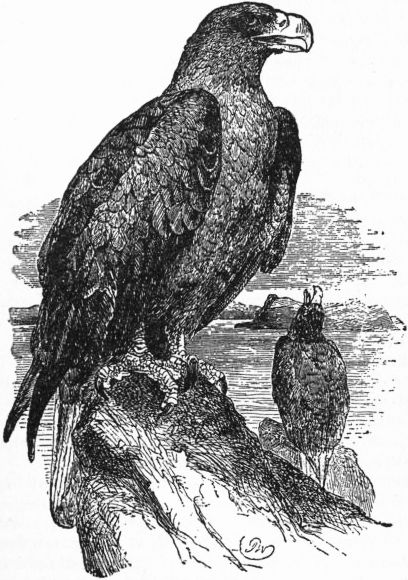
Fig. 1.—Sea-Eagle.
True eagles inhabit all the regions of the world, and some seven or eight species at least are found in Europe, of which two are resident in the British Islands. In England and in the Lowlands of Scotland eagles only exist as stragglers; but in the Hebrides and some parts of the Highlands a good many may yet be found, and their numbers appear to have rather increased of late years than diminished; for the foresters and shepherds, finding that a high price can be got for their eggs, take care to protect the owners of the eyries, which are nearly all well known, and to keep up the stock by allowing them at times to rear their young. There are also now not a few occupiers of Scottish forests who interfere so far as they can to protect the king of birds.1 In Ireland the extirpation of eagles seems to have been carried on almost unaffected by the prudent considerations which in the northern kingdom have operated so favourably for the race, and except in the wildest parts of Donegal, Mayo and Kerry, eagles in the sister island are almost birds of the past.
Of the two British species the erne (Icel. Œrn) or sea-eagle (by some called also the white-tailed and cinereous eagle)—Haliaetus albicilla—affects chiefly the coast and neighbourhood of inland waters, living in great part on the fish and refuse that is thrown up on the shore, though it not unfrequently takes living prey, such as lambs, hares and rabbits. On these last, indeed, young examples mostly feed when they wander southward in autumn, as they yearly do, and appear in England. The adults (fig. 1) are distinguished by their prevalent greyish-brown colour, their pale head, yellow beak and white tail—characters, however, wanting in the immature, which do not assume the perfect plumage for some three or four years. The eyry is commonly placed in a high cliff or on an island in a lake—sometimes on the ground, at others in a tree—and consists of a vast mass of sticks in the midst of which is formed a hollow lined with Luzula sylvatica (as first observed by John Wolley) or some similar grass, and here are laid the two or three white eggs. In former days the sea-eagle seems to have bred in several parts of England—as the Lake district, and possibly even in the Isle of Wight and on Dartmoor. This species inhabits all the northern part of the Old World from Iceland to Kamchatka, and breeds in Europe so far to the southward as Albania. In the New World, however, it is only found in Greenland, being elsewhere replaced by the white-headed or bald eagle, H. leucocephalus, a bird of similar habits, and the chosen emblem of the United States of America. In the far east of Asia occurs a still larger and finer sea-eagle, H. pelagicus, remarkable for its white thighs and upper wing-coverts. South-eastern Europe and India furnish a much smaller species, H. leucoryphus, which has its representative, H. leucogaster, in the Malay Archipelago and Australia, and, as allies in South Africa and Madagascar, H. vocifer and H. vociferoides respectively. All these eagles may be distinguished by their scaly tarsi, while the group next to be treated of have the tarsi feathered to the toes.
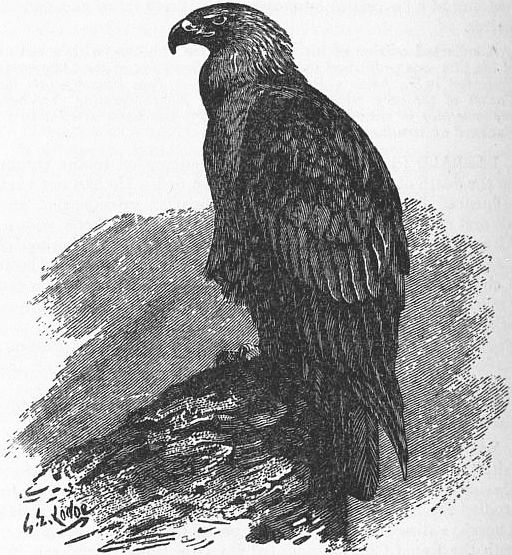
Fig. 2.—Mountain-Eagle.
The golden or mountain eagle, Aquila chrysaetus, is the second British species. This also formerly inhabited England, and a nest, found in 1668 in the Peak of Derbyshire, is well described by Willughby, in whose time it was said to breed also in the Snowdon range. It seldom if ever frequents the coast, and is more active on the wing than the sea-eagle, being able to take some birds as they fly, but a large part of its sustenance is the flesh of animals that die a natural death. Its eyry is generally placed and built like that of the other British species,2 but the neighbourhood of water is not requisite. The eggs, from two to four in number, vary from a pure white to a mottled, and often highly coloured, surface, on which appear different shades of red and purple. The adult bird (fig. 2) is of a rich dark brown, with the elongated feathers of the neck, especially on the nape, light tawny, in which imagination sees a “golden” hue, and the tail marbled with brown and ashy-grey. In the young the tail is white at the base, and the neck has scarcely any tawny tint. The golden eagle does not occur in Iceland, but occupies suitable situations over the rest of the Palaearctic Region and a considerable portion of the Nearctic—though the American bird has been, by some, considered a distinct species. Domesticated, it has many times been trained to take prey for its master in Europe, and to this species is thought to belong an eagle habitually used by the Kirghiz Tatars, who call it Bergut or Bearcoot, for the capture of antelopes, foxes and wolves. It is carried hooded on horseback or on a perch between two men, and released when the quarry is in sight. Such a bird, when well trained, is valued, says P.S. Pallas, at the price of two camels. It is quite possible, however, that more than one kind of eagle is thus used, and the services of A. heliaca (which is the imperial eagle of some writers3) and of A. mogilnik—both of which are found in central Asia, as well as in south-eastern Europe—may also be employed.
A smaller form of eagle, which has usually gone under the name of A. naevia, is now thought by the best authorities to include three local races, or, in the eyes of some, species. They inhabit Europe, North Africa and western Asia to India, and two examples of one of them—A. clanga, the form which is somewhat plentiful in north-eastern Germany—have occurred in Cornwall. The smallest true eagle is A. pennata, which inhabits southern Europe, Africa and India. Differing from other eagles of their genus by its wedge-shaped tail, though otherwise greatly resembling them, is the A. audax of Australia. Lastly may be noticed here a small group of eagles, characterized by their long legs, forming the genus Nisaetus, of which one species, N. fasciatus, is found in Europe.
(A. N.)
1 Lord Breadalbane (d. 1871) was perhaps the first large landowner who set the example that has been since followed by others. On his unrivalled forest of Black Mount, eagles—elsewhere persecuted to the death—were by him ordered to be unmolested so long as they were not numerous enough to cause considerable depredations on the farmers’ flocks. He thought that the spectacle of a soaring eagle was a fitting adjunct to the grandeur of his Argyllshire mountain scenery, and a good equivalent for the occasional loss of a lamb, or the slight deduction from the rent paid by his tenantry in consequence.
2 As already stated, the site chosen varies greatly. Occasionally placed in a niche in what passes for a perpendicular cliff to which access could only be gained by a skilful cragsman with a rope, the writer has known a nest to within 10 or 15 yds. of which he rode on a pony. Two beautiful views of as many golden eagles’ nests, drawn on the spot by Joseph Wolf, are given in the Ootheca Wolleyana, and a fine series of eggs is also figured in the same work.
3 Which species may have been the traditional emblem of Roman power, and the Ales Jovis, is very uncertain.
EAGLEHAWK, a borough of Bendigo county, Victoria, Australia, 105 m. by rail N.N.W. of Melbourne and 4 m. from Bendigo, with which it is connected by steam tramway. Pop. (1901) 8130. It stands on the Bendigo gold-bearing reef, and its mines are important.
EAGRE (a word of obscure origin; the earliest form seems to be higre, Latinized as higra, which William of Malmesbury gives as the name of the bore in the Severn; the New English Dictionary rejects the usual derivations from the O. Eng. eagor or egor, which is seen in compounds meaning “flood,” and also the connexion with the Norse sea-god Aegir), a tide wave of great height rushing up an estuary (see Bore), used locally of the Humber and Trent.
EAKINS, THOMAS (1844- ), American portrait and figure painter, was born at Philadelphia, on the 25th of July 1844. A pupil of J.L. Gérôme, in the École des Beaux-Arts, Paris, and Also of Léon Bonnat, besides working in the studio of the sculptor Dumont, he became a prolific portrait painter. He also painted genre pictures, sending to the Centennial Exhibition at Philadelphia, in 1876, the “Chess Players,” now in the Metropolitan Museum of Art, New York. A large canvas, “The Surgical Clinic of Professor Gross,” owned by Jefferson Medical College, Philadelphia, contains many life-sized figures. Eakins, with his pupil Samuel Murray (b. 1870), modelled the heroic “Prophets” for the Witherspoon Building, Philadelphia, and his work in painting has a decided sculptural quality. He was for some years professor of anatomy at the schools of the Pennsylvania Academy of Fine Arts in Philadelphia. A man of great inventiveness, he experimented in many directions, depicting on canvas modern athletic sports, the negro, and early American life, but he is best known by his portraits. He received awards at the Columbian (1893), Paris (1900), Pan-American (1900), and the St Louis (1904), Expositions; and won the Temple medal in the Pennsylvania Academy of Fine Arts, and the Proctor prize of the National Academy of Design.
EALING, a municipal borough in the Ealing parliamentary division of Middlesex, England, suburban to London, 9 m. W. of St Paul’s cathedral. Pop. (1891) 23,979; (1901) 33,031. The nucleus of the town, the ancient village, lies south of the highroad to Uxbridge, west of the open Ealing Common. The place is wholly residential. At St Mary’s church, almost wholly rebuilt c. 1870, are buried John Oldmixon, the historian (d. 1742), and Horne Tooke (d. 1812). The church of All Saints (1905) commemorates Spencer Perceval, prime minister, who was assassinated in the House of Commons in 1812. It was erected under the will of his daughter Frederica, a resident of Ealing. Gunnersbury Park, south of Ealing Common, is a handsome Italian mansion. Among former owners of the property was Princess Amelia, daughter of George II., who lived here from 1761 till her death in 1786. The name of Gunnersbury is said to be traceable to the residence here of Gunilda, niece of King Canute. The manor of Ealing early belonged to the see of London, but it is not mentioned in Domesday and its history is obscure.
EAR (common Teut.; O.E. éare, Ger. Ohr, Du. oor, akin to Lat. auris, Gr. οὖς), in anatomy, the organ of hearing. The human ear is divided into three parts—external, middle and internal. The external ear consists of the pinna and the external auditory meatus. The pinna is composed of a yellow fibro-cartilaginous framework covered by skin, and has an external and an internal or cranial surface. Round the margin of the external surface in its upper three quarters is a rim called the helix (fig. 1, a), in which is often seen a little prominence known as Darwin’s tubercle, representing the folded-over apex of a prick-eared ancestor. Concentric with the helix and nearer the meatus is the antihelix (c), which, above, divides into two limbs to enclose the triangular fossa of the antihelix. Between the helix and the antihelix is the fossa of the helix. In front of the antihelix is the deep fossa known as the concha (fig. 1, d), and from the anterior part of this the meatus passes inward into the skull. Overlapping the meatus from in front is a flap called the tragus, and below and behind this is another smaller flap, the antitragus. The lower part of the pinna is the lobule (e), which contains no cartilage. On the cranial surface of the pinna elevations correspond to the concha and to the fossae of the helix and antihelix. The pinna can be slightly moved by the anterior, superior and posterior auricular muscles, and in addition to these there are four small intrinsic muscles on the external surface, known as the helicis major and minor, the tragicus and the antitragicus, and two on the internal surface called the obliquus and transversus. The external auditory meatus (fig. 1, n) is a tube running at first forward and upward, then a little backward and then forward and slightly downward; of course all the time it is also running inward until the tympanic membrane is reached. The tube is about an inch long, its outer third being cartilaginous and its inner two-thirds bony. It is lined by skin in its whole length, the sweat glands of which are modified to secrete the wax or cerumen.
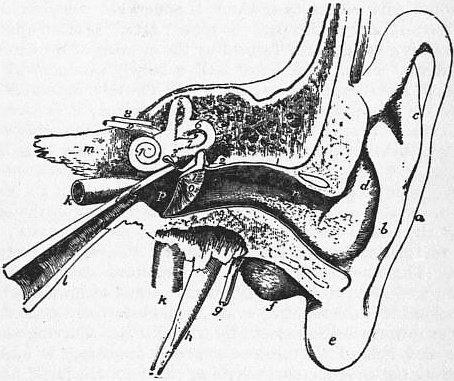
Fig. 1.—The Ear as seen in Section.
a, Helix. b, Antitragus. c, Antihelix. d, Concha. e, Lobule. f, Mastoid process. g, Portio dura. h, Styloid process. k, Internal carotid artery. l, Eustachian tube. m, Tip of petrous process. n, External auditory meatus. o, Membrana tympani. p, Tympanum. 1, points to malleus. 2, to incus. 3, to stapes. 4, to cochlea. 5, 6, 7, the three semicircular canals. 8 and 9, facial and auditory nerves.
The middle ear or tympanum (fig. 1, p) is a small cavity in the temporal bone, the shape of which may perhaps be realized by imagining a hock bottle subjected to lateral pressure in such a way that its circular section becomes triangular, the base of the triangle being above. The neck of the bottle, also laterally compressed, will represent the Eustachian tube (fig. 1, l), which runs forward, inward and downward, to open into the naso-pharynx, and so admits air into the tympanum. The bottom of the bottle will represent the posterior wall of the tympanum, from the upper part of which an opening leads backward into the mastoid antrum and so into the air-cells of the mastoid process. Lower down is a little pyramid which transmits the stapedius muscle, and at the base of this is a small opening known as the iter chordae posterius, for the chorda tympani to come through from the facial nerve. The roof is formed by a very thin plate of bone, called the tegmen tympani, which separates the cavity from the middle fossa of the skull. Below the roof the upper part of the tympanum is somewhat constricted off from the rest, and to this part the term “attic” is often applied. The floor is a mere groove formed by the meeting of the external and internal walls. The outer wall is largely occupied by the tympanic membrane (fig. 1, o), which entirely separates the middle ear from the external auditory meatus; it is circular, and so placed that it slopes from above, downward and inward, and from behind, forward and inward. Externally it is lined by skin, internally by mucous membrane, while between the two is a firm fibrous membrane, convex inward about its centre to form the umbo. Just in front of the membrane on the outer wall is the Glaserian fissure leading to the glenoid cavity, and close to this is the canal of Huguier for the chorda tympani nerve. The inner wall shows a promontory caused by the cochlea and grooved by the tympanic plexus of nerves; above and behind it is the fenestra ovalis, while below and behind the fenestra rotunda is seen, closed by a membrane. Curving round, above and behind the promontory and fenestrae, is a ridge caused by the aqueductus Fallopii or canal for the facial nerve. The whole tympanum is about half an inch from before backward, and half an inch high, and is spanned from side to side by three small bones, of which the malleus (fig. 1, 1) is the most external. This is attached by its handle to the umbo of the tympanic membrane, while its head lies in the attic and articulates posteriorly with the upper part of the next bone or incus (fig. 1, 2). The long process of the incus runs downward and ends in a little knob called the os orbiculare, which is jointed on to the stapes or stirrup bone (fig. 1, 3). The two branches of the stapes are anterior and posterior, while the footplate fits into the fenestra ovalis and is bound to it by a membrane. It will thus be seen that the stapes lies nearly at right angles to the long process of the incus. From the front of the malleus a slender process projects forward into the Glaserian fissure, while from the back of the incus the posterior process is directed backward and is attached to the posterior wall of the tympanum. These two processes form a fulcrum by which the lever action of the malleus and incus is brought about, so that when the handle of the malleus is pushed in by the membrane the head moves out; the top of the incus, attached to it, also moves out, and the os orbiculare moves in, and so the stapes is pressed into the fenestra ovalis. The stapedius and tensor tympanic muscles, the latter of which enters the tympanum in a canal just above the Eustachian tube to be attached to the malleus, modify the movements of the ossicles.
The mucous membrane lining the tympanum is continuous through the Eustachian tube with that of the naso-pharynx, and is reflected on to the ossicles, muscles and chorda tympani nerve. It is ciliated except where it covers the membrana tympani, ossicles and promontory; here it is stratified.
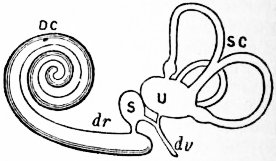
Fig. 2.—Diagram of the Membranous Labyrinth.
DC, Ductus cochlearis. dr, Ductus reuniens. S, Sacculus. U, Utriculus. dv, Ductus endolymphaticus. SC, Semicircular canals. (After Waldeyer.)
The internal ear or labyrinth consists of a bony and a membranous part, the latter of which is contained in the former. The bony labyrinth is composed of the vestibule, the semicircular canals and the cochlea. The vestibule lies just internal to the posterior part of the tympanum, and there would be a communication between the two, through the fenestra ovalis, were it not that the footplate of the stapes blocks the way. The inner wall of the vestibule is separated from the bottom of the internal auditory meatus by a plate of bone pierced by many foramina for branches of the auditory nerve (fig. 1, 9), while at the lower part is the opening of the aqueductus vestibuli, by means of which a communication is established with the posterior cranial fossa. Posteriorly the three semicircular canals open into the vestibule; of these the external (fig. 1, 7) has two independent openings, but the superior and posterior (fig. 1, 5 and 6) join together at one end and so have a common opening, while at their other ends they open separately. The three canals have therefore five openings into the vestibule instead of six. One end of each canal is dilated to form its ampulla. The superior semicircular canal is vertical, and the two pillars of its arch are nearly external and internal; the external canal is horizontal, its two pillars being anterior and posterior, while the convexity of the arch of the posterior canal is backward and its two pillars are superior and inferior. Anteriorly the vestibule leads into the cochlea (fig. 1, 4), which is twisted two and a half times round a central pillar called the modiolus, the whole cochlea forming a rounded cone something like the shell of a snail though it is only about 5 mm. from base to apex. Projecting from the modiolus is a horizontal plate which runs round it from base to apex like a spiral staircase; this is known as the lamina spiralis, and it stretches nearly half-way across the canal of the cochlea. At the summit it ends in a little hook named the hamulus. The modiolus is pierced by canals which transmit branches of the auditory nerve to the lamina spiralis.
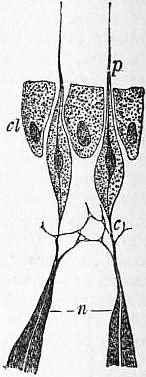
Fig. 3.—cl, Columnar cells covering the crista acustica; p, peripheral, and c, central processes of auditory cells; n, nerve fibres. (After Rüdinger.)
The membranous labyrinth lies in the bony labyrinth, but does not fill it; between the two is the fluid called perilymph, while inside the membranous labyrinth is the endolymph. In the bony vestibule lie two membranous bags, the saccule (fig. 2, S) in front, and the utricle (fig. 2, U) behind; each of these has a special patch or macula to which twigs of the auditory nerve are supplied, and in the mucous membrane of which specialized hair cells are found (fig. 3, p).
Attached to the maculae are crystals of carbonate of lime called otoconia. The membranous semicircular canals are very much smaller in section than the bony; in the ampulla of each is a ridge, the crista acustica, which is covered by a mucous membrane containing sensory hair cells like those in the maculae. All the canals open into the utricle. From the lower part of the saccule a small canal called the ductus endolymphaticus (fig. 2, dv) runs into the aqueductus vestibuli; it is soon joined by a small duct from the utricle, and ends, close to the dura mater of the posterior fossa of the cranium, as the saccus endolymphaticus, which may have minute perforations through which the endolymph can pass. Anteriorly the saccule communicates with the membranous cochlea or scala media by a short ductus reuniens (fig. 2, dr). A section through each turn of the cochlea shows the bony lamina spiralis, already noticed, which is continued right across the canal by the basilar membrane (fig. 4, bm), thus cutting the canal into an upper and lower half and connected with the outer wall by the strong spiral ligament (fig. 4, sl). Near the free end of the lamina spiralis another membrane called the membrane of Reissner (fig. 4, mR) is attached, and runs outward and upward to the outer wall, taking a triangular slice out of the upper half of the section. There are now three canals seen in section, the upper of which is the scala vestibuli (fig. 4, SV), the middle and outer the scala media, ductus cochlearis or true membranous cochlea (fig. 4, DC), while the lower is the scala tympani (fig. 4, ST). The scala vestibuli and scala tympani communicate at the apex of the cochlea by an opening known as the helicotrema, so that the perilymph can here pass from one canal to the other. At the base of the cochlea the perilymph in the scala vestibuli is continuous with that in the vestibule, but that in the scala tympani bathes the inner surface of the membrane stretched across the fenestra rotunda, and also communicates with the subarachnoid space through the aqueductus cochleae, which opens into the posterior cranial fossa. The scala media containing endolymph communicates, as has been shown, with the saccule through the canalis reuniens, while, at the apex of the cochlea, it ends in a blind extremity of considerable morphological interest called the lagena.
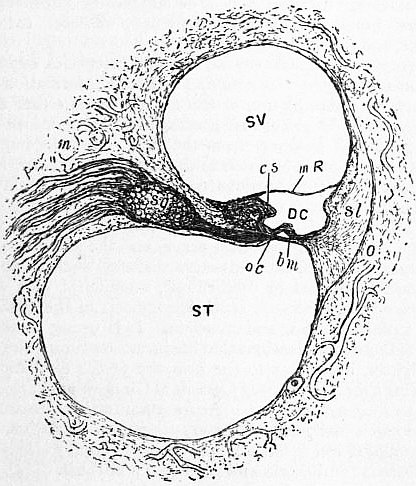
Fig. 4.—Transverse Section through the Tube of the Cochlea.
m, Modiolus. 0, Outer wall of cochlea. SV, Scala vestibuli. ST, Scala tympani. DC, Ductus cochlearis. mR, Membrane of Reissner. bm, Basilar membrane. cs, Crista spiralis. sl, Spiral ligament. sg, Spiral ganglion of auditory nerve. oc, Organ of Corti.
The scala media contains the essential organ of hearing or organ of Corti (fig. 4, oc), which lies upon the inner part of the basilar membrane; it consists of a tunnel bounded on each side of the inner and outer rods of Corti; on each side of these are the inner and outer hair cells, between the latter of which are found the supporting cells of Deiters. Most externally are the large cells of Hensen. A delicate membrane called the lamina reticularis covers the top of all these, and is pierced by the hairs of the hair cells, while above this is the loose membrana tectoria attached to the periosteum of the lamina spiralis, near its tip, internally, and possibly to some of Deiter’s cells externally. The cochlear branch of the auditory nerve enters the lamina spiralis, where a spiral ganglion (fig. 4, sg) is developed on it; after this it is distributed to the inner and outer hair cells.
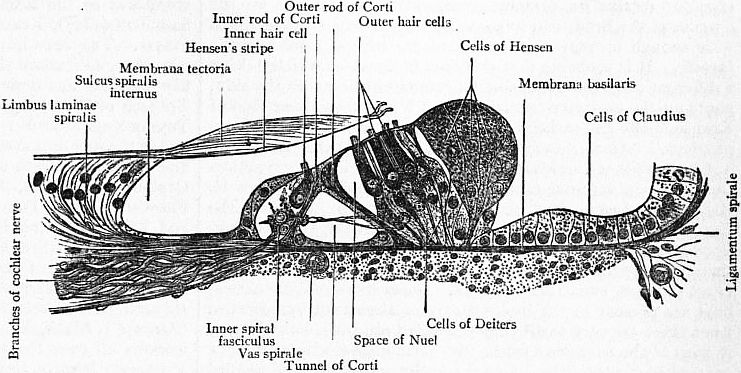
(From R. Howden—Cunningham’s Text-Book of Anatomy.)
Fig. 5.—Transverse Section of Corti’s Organ from the Central Coil of Cochlea (Retzius).
For further details see Text-Book of Anatomy, edited by D.J. Cunningham (Edinburgh, 1906); Quain’s Elements of Anatomy (London, 1893); Gray’s Anatomy (London, 1905); A Treatise on Anatomy, edited by H. Morris (London, 1902); A Text-Book of Human Anatomy, by A. Macalister (London, 1889).
Embryology.—The pinna is formed from six tubercles which appear round the dorsal end of the hyomandibular cleft or, more strictly speaking, pouch. Those for the tragus and anterior part of the helix belong to the first or mandibular arch, while those for the antitragus, antihelix and lobule come from the second or hyoid arch. The tubercle for the helix is dorsal to the end of the cleft where the two arches join. The external auditory meatus, tympanum and Eustachian tube are remains of the hyomandibular cleft, the membrana tympani being a remnant of the cleft membrane and therefore lined by ectoderm outside and entoderm inside. The origin of the ossicles is very doubtful. H. Gadow’s view, which is one of the latest, is that all three are derived from the hyomandibular plate which connects the dorsal ends of the hyoid and mandibular bars (Anatomischer Anzeiger, Bd. xix., 1901, p. 396). Other papers which should be consulted are those of E. Gaupp, Anatom. Hefte, Ergebnisse, Bd. 8, 1898, p. 991, and J.A. Hammar, Archiv f. mikr. Anat. lix., 1902. These papers will give a clue to the immense literature of the subject. The internal ear first appears as a pit from the cephalic ectoderm, the mouth of which in Man and other mammals closes up, so that a pear-shaped cavity is left. The stalk of the pear which is nearest the point of invagination is called the recessus labyrinthi, and this, after losing its connexion with the surface of the embryo, grows backward toward the posterior cranial fossa and becomes the ductus endolymphaticus. The lower part of the vesicle grows forward and becomes the cochlea, while from the upper part three hollow circular plates grow out, the central parts of which disappear, leaving the margin as the semicircular canals. Subsequently constrictions appear in the vesicle marking off the saccule and utricle. From the surrounding mesoderm the petrous bone is formed by a process of chondrification and ossification.
See W. His, Junr., Archiv f. Anat. und Phys., 1889, supplement, p. 1; also Streeter, Am. Journ. of Anat. vi., 1907.
Comparative Anatomy.—The ectodermal inpushing of the internal ear has probably a common origin with the organs of the lateral line of fish. In the lower forms the ductus endolymphaticus retains its communication with the exterior on the dorsum of the head, and in some Elasmobranchs the opening is wide enough to allow the passage of particles of sand into the saccule. It is probable that this duct is the same which, taking a different direction and losing its communication with the skin, abuts on the posterior cranial fossa of higher forms (see Rudolf Krause, “Die Entwickelung des Aq. vestibuli seu d. Endelymphaticus,” Anat. Anzeiger, Bd. xix., 1901, p. 49). In certain Teleostean fishes the swim bladder forms a secondary communication with the internal ear by means of special ossicles (see G. Ridewood, Journ. Anat. & Phys. vol. xxvi.). Among the Cyclostomata the external semicircular canals are wanting; Petromyzon has the superior and posterior only, while in Myxine these two appear to be fused so that only one is seen. In higher types the three canals are constant. Concretions of carbonate of lime are present in the internal ears of almost all vertebrates; when these are very small they are called otoconia, but when, as in most of the teleostean fishes, they form huge concretions, they are spoken of as otoliths. One shark, Squatina, has sand instead of otoconia (C. Stewart, Journ. Linn. Society, xxix. 409). The utricle, saccule, semicircular canals, ductus endolymphaticus and a short lagena are the only parts of the ear present in fish.
The Amphibia have an important sensory area at the base of the lagena known as the macula acustica basilaris, which is probably the first rudiment of a true cochlea. The ductus endolymphaticus has lost its communication with the skin, but it is frequently prolonged into the skull and along the spinal canal, from which it protrudes, through the intervertebral foramina, bulging into the coelom. This is the case in the common frog (A. Coggi, Anat. Anz. 5. Jahrg., 1890, p. 177). In this class the tympanum and Eustachian tube are first developed; the membrana tympani lies flush with the skin of the side of the head, and the sound-waves are transmitted from it to the internal ear by a single bony rod—the columella.
In the Reptilia the internal ear passes through a great range of development. In the Chelonia and Ophidia the cochlea is as rudimentary as in the Amphibia, but in the higher forms (Crocodilia) there is a lengthened and slightly twisted cochlea, at the end of which the lagena forms a minute terminal appendage. At the same time indications of the scalae tympani and vestibuli appear. As in the Amphibia the ductus endolymphaticus sometimes extends into the cranial cavity and on into other parts of the body. Snakes have no tympanic membrane. In the birds the cochlea resembles that of the crocodiles, but the posterior semicircular canal is above the superior where they join one another. In certain lizards and birds (owls) a small fold of skin represents the first appearance of an external ear. In the monotremes the internal ear is reptilian in its arrangement, but above them the mammals always have a spirally twisted cochlea, the number of turns varying from one and a half in the Cetacea to nearly five in the rodent Coelogenys. The lagena is reduced to a mere vestige. The organ of Corti is peculiar to mammals, and the single columella of the middle ear is replaced by the three ossicles already described in Man (see Alban Doran, “Morphology of the Mammalian Ossicula auditus,” Proc. Linn. Soc., 1876-1877, xiii. 185; also Trans. Linn. Soc. 2nd Ser. Zool. i. 371). In some mammals, especially Carnivora, the middle ear is enlarged to form the tympanic bulla, but the mastoid cells are peculiar to Man.
For further details see G. Retzius, Das Gehörorgan der Wirbelthiere (Stockholm, 1881-1884); Catalogue of the Museum of the R. College of Surgeons—Physiological Series, vol. iii. (London, 1906); R. Wiedersheim’s Vergleichende Anatomie der Wirbeltiere (Jena, 1902).
(F. G. P.)
Diseases of the Ear
Modern scientific aural surgery and medicine (commonly known as Otology) dates from the time of Sir William Wilde of Dublin (1843), whose work marked a great advance in the application of anatomical, physiological and therapeutical knowledge to the study of this organ. Less noticeable contributions to the subject had not long before been made by Saunders (1827), Kramer (1833), Pilcher (1841) and Yearsley (1841). The next important event in the history of otology was the publication of J. Toynbee’s book in 1860 containing his valuable anatomical and pathological observations. Von Tröltsch of Würzburg, following on the lines of Wilde and Toynbee, produced two well-known works in 1861 and 1862, laying the foundation of the study in Germany. In that country and in Austria he was followed by Hermann Schwartze, Politzer, Gruber, Weber-Liel, Rüdinger, Moos and numerous others. France produced Itard, de la Charrière, Menière, Loewenberg and Bonnafont; and Belgium, Charles Delstanche, father and son. In Great Britain the work was carried on by James Hinton (1874), Peter Allen (1871), Patterson Cassells and Sir William Dalby. In America we may count among the early otologists Edward H. Clarke (1858), D.B. St John Roosa, H. Knapp, Clarence J. Blake, Albert H. Buck and Charles Burnett. Other workers all over the world are too numerous to mention.
Various Diseases and Injuries.—Diseases of the ear may affect any of the three divisions, the external, middle or internal ear. The commoner affections of the auricle are eczema, various tumours (simple and malignant), and serous and sebaceous cysts. Haematoma auris (othaematoma), or effusion of blood into the auricle, is often due to injury, but may occur spontaneously, especially in insane persons. The chief diseases of the external auditory canal are as follows:—impacted cerumen (or wax), circumscribed (or furuncular) inflammation, diffuse inflammation, strictures due to inflammatory affections, bony growths, fungi (otomycosis), malignant disease, caries and necrosis, and foreign bodies.
Diseases of the middle ear fall into two categories, suppurative and non-suppurative (i.e. with and without the formation of pus). Suppurative inflammation of the middle ear is either acute or chronic, and is in either case accompanied by perforation of the drum head and discharge from the ear. The chief importance of these affections, in addition to the symptoms of pain, deafness, discharge, &c., is the serious complications which may ensue from their neglect, viz. aural polypi, caries and necrosis of the bone, affections of the mastoid process, including the mastoid antrum, paralysis of the facial nerve, and the still more serious intracranial and vascular infective diseases, such as abscess in the brain (cerebrum or cerebellum), meningitis, with subdural and extradural abscesses, septic thrombosis of the sigmoid and other venous sinuses, and pyaemia. It is owing to the possibility of these complications that life insurance companies usually, and rightly, inquire as to the presence of ear discharge before accepting a life. Patterson Cassells of Glasgow urged this special point as long ago as 1877. Acute suppurative disease of the middle ear is often due to the exanthemata, scarlatina, measles and smallpox, and to bathing and diving. It may also be caused by influenza, diphtheria and pulmonary phthisis.
Non-suppurative disease of the middle ear may be acute or chronic. In the acute form the inflammation is less violent than in the acute suppurative inflammation, and is rarely accompanied by perforation. Chronic non-suppurative inflammation may be divided into the moist form, in which the symptoms are improved by inflation of the tympanum through the Eustachian tube, and the dry form (including sclerosis), which is more intractable and in which this procedure has little or no beneficial effect. Diseases of the internal ear may be primary or secondary to an affection of the tympanum or to intracranial disease.
Injuries to any part of the ear may occur, among the commoner being injuries to the auricle, rupture of the drum head (from explosions, blows on the ear or the introduction of sharp bodies into the ear canal), and injuries from fractured skull. Congenital malformations of the ear are most frequently met with in the auricle and external canal.
Methods of Examination.—The methods of examining the ear are roughly threefold:—(1) Testing the hearing with watch, voice and tuning-fork. The latter is especially used to distinguish between disease of the middle ear (conducting apparatus) and that of the internal ear (perceptive apparatus). Our knowledge of the subject has been brought to its present state by the labours of many observers, notably Weber, Rinne, Schwabach, Lucae and Gellé. (2) Examination of the canal and drum-head with speculum and reflector, introduced by Kramer, Wilde and von Tröltsch. (3) Examination of the drum-cavity through the Eustachian tube by the various methods of inflation.
Symptoms.—The chief symptoms of ear diseases are deafness, noises in the ear (tinnitus aurium), giddiness, pain and discharge. Deafness (or other disturbance of hearing) and noises may occur from disease in almost any part of the ear. Purulent discharge usually comes from the middle ear. Giddiness is more commonly associated with affections of the internal ear.
Treatment.—Ear diseases are treated on ordinary surgical and medical lines, due regard being had to the anatomical and physiological peculiarities of this organ of sense, and especially to its close relationship, on the one hand to the nose and naso-pharynx, and on the other hand to the cranium and its contents. The chief advance in aural surgery in recent years has been in the surgery of the mastoid process and antrum. The pioneers of this work were H. Schwartze of Halle, and Stacke of Erfurt, who have been followed by a host of workers in all parts of the world. This development led to increased attention being paid to the intracranial complications of suppurative ear disease, in the treatment of which great strides have been made in the last few years.
Effects of Diseases of the Nose on the Ear.—The influence of diseases of the nose and naso-pharynx on ear diseases was brought out by Loewenberg of Paris, Voltolini of Breslau, and especially by Wilhelm Meyer of Copenhagen, the discoverer of adenoid vegetations of the naso-pharynx (“adenoids”), who recognized the great importance of this disease and gave an inimitable account of it in the Trans. of the Royal Medical and Chirurgical Society of London, 1870, and the Archiv für Ohrenheilkunde, 1873. Adenoid vegetations, which consist of an abnormal enlargement of Luschka’s tonsil in the vault of the pharynx, frequently give rise to ear disease in children, and, if not attended to, lay the foundation of nasal and ear troubles in after life. They are often associated with enlargement of the faucial tonsils.
Journals.—In 1864 the Archiv für Ohrenheilkunde was started by Politzer and Schwartze, and, in 1867, the Monatsschrift für Ohrenheilkunde (a monthly publication) was founded by Voltolini, Gruber, Weber-Liel and Rüdinger. Appearing first as the Archives of Ophthalmology and Otology, simultaneously in English and German, in 1869, the Archives of Otology became a separate publication under the editorship of Knapp, Moos and Roosa in 1879. Amongst other journals now existing are Annales des maladies de l’oreille et du larynx (Paris), Journal of Laryngology (London), Centralblatt für Ohrenheilkunde (Leipzig), &c.
Societies.—The earliest society formed was the American Otological Society (1868), which held annual meetings and published yearly transactions. Flourishing societies for the study of otology (sometimes combined with laryngology) exist in almost all civilized countries, and they usually publish transactions consisting of original papers and cases. The Otological Society of the United Kingdom was founded in 1900.
International Congresses.—International Otological congresses have been held at intervals of about four years at New York, Milan, Basel, Brussels, Florence, London and Bordeaux (1904). The proceedings of the congresses appear as substantial volumes.
Hospitals.—The earliest record of a public institution for the treatment of ear diseases is a Dispensary for Diseases of the Eye and Ear in London, started by Saunders and Cooper, which existed in 1804; the aural part, however, was soon closed, so that the actual oldest institution appears to be the Royal Ear Hospital, London, which was founded by Curtis in 1816. Four years later there was started the New York Eye and Ear Infirmary. At the present time in every large town of Europe and America ear diseases are treated either in separate departments of general hospitals or in institutions especially devoted to the purpose.
For a history of otology from the earliest times refer to A Practical Treatise on the Diseases of the Ear, by D.B. St John Roosa, M.D., LL.D. (6th edition, New York, 1885), and for a general account of the present state of otological science to A Text-Book of the Diseases of the Ear for Students and Practitioners, by Professor Dr Adam Politzer, transl. by Milton J. Ballin, Ph.B., M.D., and Clarence J. Heller, M.D. (4th edition, London, 1902).
(E. C. B.*)
EARL, a title and rank of nobility (corresponding to Lat. comes; Fr. comte), now the third in order of the British peerage, and accordingly intervening between marquess and viscount. Earl, however, is the oldest title and rank of English nobles, and was the highest until the year 1337, when the Black Prince was created duke of Cornwall by Edward III.
The nature of a modern earldom is readily understood, since it is a rank and dignity of nobility which, while it confers no official power or authority, is inalienable, indivisible, and descends in regular succession to all the heirs under the limitation in the grant until, on their failure, it becomes extinct.
The title is of Scandinavian origin, and first appears in England under Canute as jarl, which was englished as eorl. Like the ealdorman, whose place he took, the eorl was a great royal officer, who might be set over several counties, but who presided separately in the county court of each with the bishop of the diocese. Although there were counts in Normandy before the Norman Conquest, they differed in character from the English earls, and the earl’s position appears to have been but slightly modified by the Conquest. He was still generally entitled to the “third penny” of the county, but his office tended, under Norman influence, to become an hereditary dignity and his sphere was restricted by the Conqueror to a single county. The right to the “third penny” is a question of some obscurity, but its possession seems to have been deemed the distinctive mark of an earl, while the girding with “the sword of the county” formed the essential feature in his creation or investiture, as it continued to do for centuries later. The fact that every earl was the earl of a particular county has been much obscured by the loose usage of early times, when the style adopted was sometimes that of the noble’s surname (e.g. the Earls Ferrers), sometimes that of his chief seat (e.g. the Earls of Arundel), and sometimes that of the county. Palatine earldoms, or palatinates, were those which possessed regalia, i.e. special privileges delegated by the crown. The two great examples, which dated from Norman times, were Chester and Durham, where the earl and the bishop respectively had their own courts and jurisdiction, and were almost petty sovereigns.
The earliest known charter creating an earl is that by which Stephen bestowed on Geoffrey de Mandeville, in or about 1140, the earldom of Essex as an hereditary dignity. Several other creations by Stephen and the empress Maud followed in quick succession. From at least the time of the Conquest the earl had a double character; he was one of the “barons,” or tenants in chief, in virtue of the fief he held of the crown, as well as an earl in virtue of his “belting” (with the sword) and his “third penny” of the county. His fief would descend to the heirs of his body; and the earliest charters creating earldoms were granted with the same “limitation.” The dignity might thus descend to a woman, and, in that case, like the territorial fief, it would be held by her husband, who might be summoned to parliament in right of it. The earldom of Warwick thus passed through several families till it was finally obtained, in 1449, by the Kingmaker, who had married the heiress of the former earls. But in the case of “co-heiresses” (more daughters than one), the king determined which, if any, should inherit the dignity.
The 14th century saw some changes introduced. The earldom of March, created in 1328, was the first that was not named from a county or its capital town. Under Edward III. also an idea appears to have arisen that earldoms were connected with the tenure of lands, and in 1337 several fresh ones were created and large grants of lands made for their support. The first earldom granted with limitation to the heirs male of the grantee’s body was that of Nottingham in 1383. Another innovation was the grant of the first earldom for life only in 1377. The girding with the sword was the only observance at a creation till the first year of Edward VI., when the imposition of the cap of dignity and a circlet of gold was added. Under James I. the patent of creation was declared to be sufficient without any ceremony. An earl’s robe of estate has three bars of ermine, but possibly it had originally four.
Something should be said of anomalous earldoms with Norman or Scottish styles. The Norman styles originated either under the Norman kings or at the time of the conquest of Normandy by the house of Lancaster. To the former period belonged that of Aumale, which successive fresh creations, under the Latinized form “Albemarle” have perpetuated to the present day (see Albemarle, Earls and Dukes of). The so-called earls of Eu and of Mortain, in that period, were really holders of Norman comtés. Henry V. and his son created five or six, it is said, but really seven at least, Norman countships or earldoms, of which Harcourt (1418), Perche (1419), Dreux (1427) and Mortain (? 1430) were bestowed on English nobles, Eu (1419), and Tankerville (1419) on English commoners, and Longueville (1419) on a foreigner, Gaston de Foix. Of these the earldom of “Eu” was assumed by the earls of Essex till the death of Robert, the parliament’s general (1646), while the title of Tankerville still survives under a modern creation (1714). An anomalous royal licence of 1661 permitted the earl of Bath to use the title of earl of Corbeil by alleged hereditary right. Of Scottish earldoms recognized in the English parliament the most remarkable case is that of the Lords Umfraville, who were summoned for three generations (1297-1380), as earls of Angus; Henry, Lord Beaumont, also was summoned as earl of Buchan from 1334 to 1339.
The earldom of Chester is granted to the princes of Wales on their creation, and the Scottish earldom of Carrick is held by the eldest son of the sovereign under act of parliament.
The premier earldom is that of Arundel (q.v.), but as this is at present united with the dukedom of Norfolk, the oldest earldom not merged in a higher title is that of Shrewsbury (1442), the next in seniority being Derby (1485), and Huntingdon (1529). These three have been known as “the catskin earls,” a term of uncertain origin. The ancient earldom of Wiltshire (1397) was unsuccessfully claimed in 1869 by Mr Scrope of Danby, and that of Norfolk (1312), in 1906, by Lord Mowbray and Stourton.
The premier earldom of Scotland as recognized by the Union Roll (1707), is that of Crawford, held by the Lindsays since its creation in 1398; but it is not one of the ancient “seven earldoms.” The Decreet of Ranking (1606) appears to have recognized the earldom of Sutherland as the most ancient in virtue of a charter of 1347, but the House of Lords’ decision of 1771 recognized it as having descended from at least the year 1275, and it may be as old as 1228. It is at present united with the dukedom of Sutherland. The original “seven earldoms” (of which it was one) represented seven provinces, each of which was under a “mormaer.” This Celtic title was rendered “jarl” by the Norsemen, and under Alexander I. (c. 1115) began to be replaced by earl (comes), owing to Anglo-Norman influence, which also tended to make these earldoms less official and more feudal.
In Ireland the duke of Leinster is, as earl of Kildare, premier earl as well as premier duke.
An earl is “Right Honourable,” and is styled “My Lord.” His eldest son bears his father’s “second title,” and therefore, that second title being in most cases a viscounty, he generally is styled “Viscount”; where, as with Devon and Huntingdon, there is no second title, one may be assumed for convenience; under all circumstances, however, the eldest son of an earl takes precedence immediately after the viscounts. The younger sons of earls are “Honourable,” but all their daughters are “Ladies.” In formal documents and instruments, the sovereign, when addressing or making mention of any peer of the degree of an earl, usually designates him “trusty and well-beloved cousin,”—a form of appellation first adopted by Henry IV., who either by descent or alliance was actually related to every earl and duke in the realm. The wife of an earl is a countess; she is “Right Honourable,” and is styled “My Lady.” For the earl’s coronet see Crown and Coronet.
See Lord’s Reports on the Dignity of a Peer; Pike’s Constitutional History of the House of Lords; Selden’s Titles of Honour; G.E. C(okayne)’s Complete Peerage; Round’s Geoffrey de Mandeville.
(J. H. R.)
EARLE, JOHN (c. 1601-1665), English divine, was born at York about 1601. He matriculated at Christ Church, Oxford, but migrated to Merton, where he obtained a fellowship. In 1631 he was proctor and also chaplain to Philip, earl of Pembroke, then chancellor of the university, who presented him to the rectory of Bishopston in Wiltshire. His fame spread, and in 1641 he was appointed chaplain and tutor to Prince Charles. In 1643 he was elected one of the Assembly of Divines at Westminster, but his sympathies with the king and with the Anglican Church were so strong that he declined to sit. Early in 1643 he was chosen chancellor of the cathedral of Salisbury, but of this preferment he was soon deprived as a “malignant.” After Cromwell’s great victory at Worcester, Earle went abroad, and was named clerk of the closet and chaplain to Charles II. He spent a year at Antwerp in the house of Isaac Walton’s friend, George Morley, who afterwards became bishop of Winchester. He next joined the duke of York (James II.) at Paris, returning to England at the Restoration. He was at once appointed dean of Westminster, and in 1661 was one of the commissioners for revising the liturgy. He was on friendly terms with Richard Baxter. In November 1662 he was consecrated bishop of Worcester, and was translated, ten months later, to the see of Salisbury, where he conciliated the nonconformists. He was strongly opposed to the Conventicle and Five Mile Acts. During the great plague Earle attended the king and queen at Oxford, and there he died on the 17th of November 1665.
Earle’s chief title to remembrance is his witty and humorous work entitled Microcosmographie, or a Peece of the World discovered, in Essayes and Characters, which throws light on the manners of the time. First published anonymously in 1628, it became very popular, and ran through ten editions in the lifetime of the author. The style is quaint and epigrammatic; and the reader is frequently reminded of Thomas Fuller by such passages as this: “A university dunner is a gentlemen follower cheaply purchased, for his own money has hyr’d him.” Several reprints of the book have been issued since the author’s death; and in 1671 a French translation by J. Dymock appeared with the title of Le Vice ridiculé. Earle was employed by Charles II. to make the Latin translation of the Eikon Basilike, published in 1649. A similar translation of R. Hooker’s Ecclesiastical Polity was accidentally destroyed.
“Dr Earle,” says Lord Clarendon in his Life, “was a man of great piety and devotion, a most eloquent and powerful preacher, and of a conversation so pleasant and delightful, so very innocent, and so very facetious, that no man’s company was more desired and loved. No man was more negligent in his dress and habit and mien, no man more wary and cultivated in his behaviour and discourse. He was very dear to the Lord Falkland, with whom he spent as much time as he could make his own.”
See especially Philip Bliss’s edition of the Microcosmographie (London, 1811), and E. Arber’s Reprint (London, 1868).
EARLE, RALPH (1751-1801), American historical and portrait painter, was born at Leicester, Massachusetts, on the 11th of May 1751. Like so many of the colonial craftsmen, Earle was self-taught, and for many years was an itinerant painter. He went with the Governor’s Guard to Lexington and made battle sketches, from which in 1775 he painted four scenes, engraved by Amos Doolittle, which are probably the first historical paintings by an American. After the War of Independence, Earle went to London, entered the studio of Benjamin West, and painted the king and many notables. After his return to America in 1786 he made portraits of Timothy Dwight, Governor Caleb Strong, Roger Sherman, and other prominent men. He also painted a large picture of Niagara Falls. He died at Bolton, Connecticut, on the 16th of August 1801.
EARL MARSHAL, in England, a functionary who ranks as the eighth of the great officers of state. He is the head of the college of arms, and has the appointment of the kings-of-arms, heralds and pursuivants at his discretion. He attends the sovereign in opening and closing the session of parliament, walking opposite to the lord great chamberlain on his or her right hand. It is his duty to make arrangements for the order of all state processions and ceremonials, especially for coronations and royal marriages and funerals. Like the lord high constable he rode into Westminster Hall with the champion after a coronation, till the coronation banquet was abandoned, taking his place on the left hand, and with the lord great chamberlain he assists at the introduction of all newly-created peers into the House of Lords.
The marshal appears in the feudal armies to have been in command of the cavalry under the constable, and to have in some measure superseded him as master of the horse in the royal palace. He exercised joint and co-ordinate jurisdiction with the constable in the court of chivalry, and afterwards became the sole judge of that tribunal till its obsolescence. The marshalship of England was formerly believed to have been inherited from the Clares by the Marshal family, who had only been marshals of the household. It was held, however, by the latter family, as the office of chief (magister) marshal, as early as the days of Henry I. Through them, under Henry III., it passed to the Bigods, as their eldest co-heirs. In 1306 it fell to the crown on the death of the last Bigod, earl of Norfolk, who had made Edward I. his heir, and in 1316 it was granted by Edward II. to his own younger brother, Thomas “of Brotherton,” earl of Norfolk. As yet the style of the office was only “marshal” although the last Bigod holder, being an earl, was sometimes loosely spoken of as the earl marshal. The office, having reverted to the crown, was granted out anew by Richard II., in 1385, to Thomas Mowbray, earl of Nottingham, the representative of Thomas “of Brotherton.” In 1386 the style of “earl marshal” was formally granted to him in addition. After several attainders and partial restorations in the reigns of the Tudors and the Stuarts, the earl marshalship was granted anew to the Howards by Charles II. in 1672 and entailed on their male line, with many specific remainders and limitations, under which settlement it has regularly descended to the present duke of Norfolk. Its holders, however, could not execute the office until the Roman Catholic emancipation, and had to appoint deputies. The duke is styled earl marshal “and hereditary marshal of England,” but the double style would seem to be an error, though the Mowbrays, with their double creation (1385, 1386) might have claimed it. His Grace appends the letters “E.M.” to his signature, and bears behind his shield two batons crossed in saltire, the marshal’s rod (virga) having been the badge of the office from Norman times. There appear to have been hereditary marshals of Ireland, but their history is not well ascertained. The Keiths were Great Marischals of Scotland from at least the days of Robert Bruce, and were created earls marischal in or about 1458, but lost both earldom and office by the attainder of George, the 10th earl, in 1716. (See also Marshal; State, Great Officers of.)
See “The Marshalship of England,” in J.H. Round, Commune of London and Other Studies (London, 1899); G.E. C(okayne)’s Complete Peerage.
(J. H. R.)
EARLOM, RICHARD (1742-1822), English mezzotint engraver, was born and died in London. His natural faculty for art appears to have been first called into exercise by admiration for the lord mayor’s state coach, just decorated by Cipriani. He tried to copy the paintings, and was sent to study under Cipriani. He displayed great skill as a draughtsman, and at the same time acquired without assistance the art of engraving in mezzotint. In 1765 he was employed by Alderman Boydell, then one of the most liberal promoters of the fine arts, to make a series of drawings from the pictures at Houghton Hall; and these he afterwards engraved in mezzotint. His most perfect works as engraver are perhaps the fruit and flower pieces after the Dutch artists Van Os and Van Huysum. Amongst his historical and figure subjects are—“Agrippina,” after West; “Love in Bondage,” after Guido Reni; the “Royal Academy,” the “Embassy of Hyderbeck to meet Lord Cornwallis,” and a “Tiger Hunt,” the last three after Zoffany; and “Lord Heathfield,” after Sir Joshua Reynolds. Earlom also executed a series of 200 facsimiles of the drawings and sketches of Claude Lorraine, which was published in 3 vols. folio, under the title of Liber veritatis (1777-1819).
EARLSTON (formerly Ercildoune, of which it is a corruption), a parish and market town of Berwickshire, Scotland. Pop. (1901) 1049. It is situated on Leader Water in Lauderdale, 72½ m. S.E. of Edinburgh by the North British railway branch line from Reston Junction to St Boswells, and about 4 m. N.E. of Melrose. When the place was a hamlet of rude huts it was called Arcioldun or “Prospect Fort,” with reference to Black Hill (1003 ft.), on the top of which may yet be traced the concentric rings of the British fort by which it was crowned. It is said to be possible to make out the remains of the cave-dwellings of the Ottadeni, the aborigines of the district. In the 12th and 13th centuries the Lindsays and the earls of March and Dunbar were the chief baronial families. The particular link with the remote past, however, is the ivy-clad ruin of the ancient tower, “The Rhymer’s Castle,” the traditional residence of Thomas Learmont, commonly called Thomas of Ercildoune, or Thomas the Rhymer, poet and prophet, and friend of the Fairies, who was born here about 1225. Rhymer’s Tower was crumbling to pieces, and its stones were being used in the erection of dykes, cottages and houses, when the Edinburgh Border Counties Association acquired the relic and surrounding lands in 1895, and took steps to prevent further spoliation and decay. The leading manufactures are ginghams, tweeds and shirtings, and the town is also an important agricultural centre, stock sales taking place at regular intervals and cattle and horse fairs being held every year. Some 3 m. away is the estate of Bemersyde, said to have been in the possession of the Haigs for nearly 1000 years. The prospect from Bemersyde Hill was Sir Walter Scott’s favourite view. The castle at Bemersyde was erected in 1535 to secure the peace of the Border.
EARLY, JUBAL ANDERSON (1816-1894), American soldier and lawyer, was born in Franklin county, Virginia, on the 3rd of November 1816, and graduated at the U.S. Military Academy in 1837. He served in the Seminole War of 1837-38, after which he resigned in order to practise law in Franklin county, Va. He also engaged in state politics, and served in the Mexican War as a major of Virginia volunteers. He was strongly opposed to secession, but thought it his duty to conform to the action of his state. As a colonel in the Confederate army, he rendered conspicuous service at the first battle of Bull Run (q.v.). Promoted brigadier-general, and subsequently major-general, Early served throughout the Virginian campaigns of 1862-63, and defended the lines of Fredericksburg during the battle of Chancellorsville. At Gettysburg he commanded his division of Ewell’s corps. In the campaign of 1864 Early, who had now reached the rank of lieutenant-general, commanded the Confederate forces in the Shenandoah Valley. The action of Lynchburg left him free to move northwards, his opponent being compelled to march away from the Valley. Early promptly utilized his advantage, crossed the Potomac, and defeated, on the Monocacy, all the troops which could be gathered to meet him. He appeared before the lines of Washington, put part of Maryland and Pennsylvania under contribution, and only retired to the Valley when threatened by heavy forces hurriedly sent up to Washington. He then fought a successful action at Winchester, reappeared on the Potomac, and sent his cavalry on a raid into Pennsylvania. A greatly superior army was now formed under General Sheridan to oppose Early. In spite of his skill and energy the Confederate leader was defeated in the battles of Winchester and Fisher’s Hill. Finally, on the 19th of October, after inflicting at first a severe blow upon the Federal army in its camps on Cedar Creek, he was decisively beaten by Sheridan. (See Shenandoah Valley Campaigns.) Waynesboro (March 1865) was his last fight, after which he was relieved from his command. General Early was regarded by many as the ablest soldier, after Lee and Jackson, in the Army of Northern Virginia, and one of the ablest in the whole Confederate army. That he failed to make headway against an army far superior in numbers, and led by a general of the calibre of Sheridan, cannot be held to prove the falsity of this judgment. After the peace he went to Canada, but in 1867 returned to resume the practice of law. For a time he managed in conjunction with General Beauregard the Louisiana lottery. He died at Lynchburg, Va., on the 2nd of March 1894. General Early was for a time president of the Southern Historical Society, and wrote, besides various essays and historical papers, A Memoir of the Last Year of the War, &c. (1867).
EARLY ENGLISH PERIOD, in architecture, the term given by Rickman to the first pointed or Gothic style in England, nominally 1189-1307, which succeeded the Romanesque or Norman period towards the end of the 12th century, and developed into the Decorated period in the commencement of the 14th century. It is chiefly characterized by the almost universal employment of the pointed arch, not only in arches of wide span such as those of the nave arcade, but for doorways and windows. The actual introduction of the pointed arch took place at a much earlier date, as in the nave arcade of the Cistercian Abbey of Buildwas (1140), though the clerestory window above has semicircular arches. It is customary, therefore, to make allowance for a transitional epoch from the middle of the 12th century. Although the pointed arches used are sometimes equilateral and sometimes drop-arches, the lancet-arch is the most characteristic. The period is best recognized in England by the great depth given to the hollows of the mouldings, alternating with fillets and rolls, by the decoration of the hollows with the dog-tooth ornament, by the circular abacus of the capitals, and the employment of slender detached shafts of Purbeck marble which are attached to piers by circular moulded shaft-rings (Fr. anneau).
The arches are sometimes cusped; circles with trefoils, quatrefoils, &c., are introduced into the tracery, and large rose windows in the transept or nave, as at Lincoln (1220). The conventional foliage decorating the capitals is of great beauty and variety, and extends to spandrils, bosses, &c. In the spandrils of the arches of the nave, transept or choir arcades, diaper work is occasionally found, as in the transept of Westminster Abbey. The latter is one of the chief examples of the period, to which must be added the cathedral of Salisbury (except the tower); the Galilee at Ely; nave and transept of Wells (1225-1240); nave of Lincoln; west front of Peterborough; and the minster at Beverley.
(R. P. S.)
EARN, the name of a loch and river in Perthshire, Scotland. The loch, lying almost due east and west, is 6½ m. long and 4⁄5 m. in maximum breadth, 287 ft. deep, with a mean depth of 138 ft., covers an area of nearly 4 sq. m., has a drainage basin of over 54½ sq. m., and stands 317 ft. above the sea. Its waters are said never to freeze. It discharges by the river Earn. The points of interest on its shores are Lochearnhead (at the southern extremity of Glen Ogle), which has a station on the Callander-Oban railway, and the ruins of St Blane’s chapel; Edinample Castle, an old turreted mansion belonging to the marquess of Breadalbane, situated in well-wooded grounds near the pretty falls of the Ample; Ardvorlich House, the original of Darlinvarach in Scott’s Legend of Montrose, and the village of St Fillans at the foot of the loch, once the terminus of the branch of the Caledonian railway from Perth. The river flows out of Loch Earn, pursues an eastward course with a gentle inclination towards the south, and reaches the Firth of Tay, 6½ m. below Perth, after a total run of 49 m. Its chief tributaries on the right are the Ruchil, Machany, Ruthven, May and Farg, and on the left, the Lednock and Turret. It is navigable by vessels of 50 tons as far up as Bridge of Earn, and is a notable fishing stream, abounding with salmon and trout, perch and pike being also plentiful. On the Lednock are the falls of the Devil’s Cauldron and on the Turret and its feeders several graceful cascades. The principal places of interest on the banks of the Earn are Dunira, the favourite seat of Henry Dundas, 1st Viscount Melville, who took the title of his barony from the estate and to whose memory an obelisk was raised on the adjoining hill of Dunmore; the village of Comrie; the town of Crieff; the ruined castle of Innerpeffray, founded in 1610 by the 1st Lord Maderty, close to which is the library founded in 1691 by the 3rd Lord Maderty, containing some rare black-letter books and the Bible that belonged to the marquess of Montrose; Gascon Hall, now in ruins, but with traditions reaching back to the days of Wallace; Dupplin Castle, a fine Tudor mansion, seat of the earl of Kinnoull, who derives from it the title of his viscounty; Aberdalgie, Forgandenny and Bridge of Earn, a health resort situated amidst picturesque surroundings. Strathearn, as the valley of the Earn is called, extending from the loch to the Firth of Tay, is a beautiful and, on the whole, fertile tract, though liable at times to heavy floods. The earl of Perth is hereditary steward of Strathearn.
EARNEST (probably a corruption of the obsolete arles or erles, adapted from Lat. equivalent arrha, due to a confusion with the adjective “earnest,” serious, O. Eng. eornust, cognate with Ger. ernst), the payment of a sum of money by the buyer of goods to the seller on the conclusion of a bargain as a pledge for its due performance. It is almost similar to the arrha of the Roman law, which may be traced back in the history of legal institutions to a period when the validity of a contract depended not so much upon the real intention of the parties, as upon the due observance of a prescribed ceremony. But earnest was never part payment, which arrha might have been. Apart from its survival as a custom, its chief importance in English law is its recognition by the Statute of Frauds as giving validity to contracts for the sale of goods of a value exceeding £10 (see Sale of Goods). It is in that statute clearly distinguished from part payment, consequently any sum, however small, would be sufficient as earnest, being given as a token that the contract is binding and should be expressly stated so by the giver. The giving of earnest, or hand-money, as it is sometimes called, has now fallen into very general disuse.
EAR-RING, an ornament worn pendent from the ear, and generally suspended (especially among the more civilized races) by means of a ring or hook passing through the pendulous lobe of the ear. Among savage races the impulse to decorate, or at any rate to modify the appearance of the ear, is almost universal. With such peoples the ear appendage is chiefly remarkable for its extravagant dimensions. Many examples may be seen in the ethnographic galleries of the British Museum. The Berawan people of Borneo use plugs through the lobe of the ear 3¾ in. in diameter. More extraordinary still is an example of a stone ear-plug worn by a Masai, 4½ in. in diameter and weighing 2 ℔ 14 oz. (Man, 1905, p. 22). It is stated that according to the Masai standard of fashion, the lobes of the ears should be enlarged so as to be capable of meeting above the head. Among the superior races, though ear ornaments of extravagant size and elaboration are not unknown, moderation in size is commonly observed, and greater attention is paid to workmanship and fineness of material.
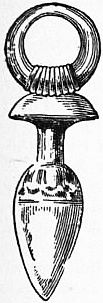
From La Grande Encyclopédie.
Fig. 1.—Ear-ring from an Assyrian bas relief.
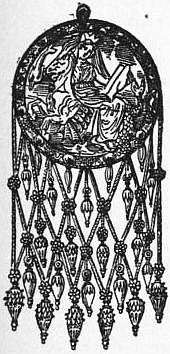
From La Grande Encyclopédie.
Fig. 2.—Thetis crossing the sea, with the armour of Achilles. Ear-ring from the Crimea, Hermitage museum.
The general usage appears to have been to have ear-rings worn in pairs, the two ornaments in all respects resembling each other; in ancient times, or more recently among Oriental races, a single ear-ring has sometimes been worn. The use of this kind of ornament, which constantly was of great value, dates from the remotest historical antiquity, the earliest mention of ear-rings occurring in the book of Genesis. It appears probable that the ear-rings of Jacob’s family, which he buried with his strange idols at Bethel, were regarded as amulets or talismans, such unquestionably being the estimation in which some ornaments of this class have been held from a very early period, as they still are held in the East. Thus in New Zealand ear-rings are decorated with the teeth of enemies, and with talismanic sharks’ teeth. Among all the Oriental races of whom we have any accurate knowledge, the Hebrews and Egyptians excepted, ear-rings always have been in general use by both sexes; while in the West, as well as by the Hebrews and Egyptians, as a general rule they have been considered exclusively female ornaments. By the Greeks and Romans also ear-rings were worn only by women, and the wearing of them by a man is often spoken of as distinctively oriental.
In archaic art, ear-rings are frequently represented or their traces are left in the perforated ear lobes of early statues. After the 4th century such perforations occur seldom. In one instance, a Greek inscription records the weight of the detachable gold ornaments on a statue, among which a pair of ear-rings is included. Ear-rings of characteristic form are frequently discovered by excavation. In Egypt, a system of pendent chains is found hanging from a disk. In Assyria the decoration consists of pendants or knobs attached to a rigid ring. In the early civilization represented by Dr Schliemann’s Trojan investigations, pieces of gold plate are suspended by parallel chains. In the Mycenaean period, ear-rings are infrequent in Greece, but have been found in abundance in the Mycenaean finds of Enkomi (Cyprus) in the form of pendent bulls’-heads, or of decorative forms based on the bull’s head. In the tombs of the Greek settlers in the Crimea (4th century B.C.), ear-rings are found of marvellous complexity and beauty. The lexicographer Pollux, speaking of the names given to ear-rings, derived from their forms, mentions caryatids, hippocamps and centauresses. Jewels of the same class, of exquisite beauty and of workmanship that is truly wonderful, have been rescued from the sepulchres of ancient Etruria. Ear-rings of comparatively simple forms, but set with pearls and other stones, were the mode in Rome. In some instances, the stones were of fabulous value. During the Byzantine period they once more attained an extravagant size. Researches among the burial places of Anglo-Saxon Britain have led to the discovery of jewels in considerable numbers, which among their varieties include ear-rings executed in a style that proves the Anglo-Saxons to have made no inconsiderable advances in the arts of civilization.
These same ornaments, which never have fallen into disuse, enjoy at the present day a considerable degree of favour, and the tide of fashion has set towards their increased use. Like all other modern jewels, however, the ear-rings of our own times as works of art can claim no historical attributes, because they consist as well of reproductions from all past ages and of every race as of fanciful productions that certainly can be assigned to no style of art whatever. As one of the curiosities of the subject it may be mentioned that Antonia, wife of Drusus, is said by Pliny to have attached a pair of ear-rings to her pet lamprey.
EARTH (a word common to Teutonic languages, cf. Ger. Erde, Dutch aarde, Swed. and Dan. jord; outside Teutonic it appears only in the Gr. ἔραζε, on the ground; it has been connected by some etymologists with the Aryan root ar-, to plough, which is seen in the Lat. arare, obsolete Eng. “ear,” and Gr. ἀροῦν, but this is now considered very doubtful; see G. Curtius, Greek Etymology, Eng. trans., i. 426; Max Müller, Lectures, 8th ed. i. 294). From early times the word “earth” has been used in several connexions—from that of soil or ground to that of the planet which we inhabit, but it is difficult to trace the exact historic sequence of the diverse usages. In the cosmogony of the Pythagoreans, Platonists and other philosophers, the term or its equivalent denoted an element or fundamental quality which conferred upon matter the character of earthiness; and in the subsequent development of theories as to the ultimate composition of matter by the alchemists, iatrochemists, and early phlogistonists an element of the same name was retained (see Element). In modern chemistry, the common term “earth” is applied to certain oxides:—the ”alkaline earths” (q.v.) are the oxides of calcium (lime), barium (baryta) and strontium (strontia); the ”rare earths” (q.v.) are the oxides of a certain class of rare metals.
The Earth
The terrestrial globe is a member of the Solar system, the third in distance from the Sun, and the largest within the orbit of Jupiter. In the wider sense it may be regarded as composed of a gaseous atmosphere (see Meteorology), which encircles the crust or lithosphere (see Geography), and surface waters or hydrosphere (see Ocean and Oceanography). The description of the surface features is a branch of Geography, and the discussions as to their origin and permanence belongs to Physiography (in the narrower sense), physiographical geology, or physical geography. The investigation of the crust belongs to geology and of rocks in particular to petrology.
In the present article we shall treat the subject matter of the Earth as a planet under the following headings:—(1) Figure and Size, (2) Mass and Density, (3) Astronomical Relations, (4) Evolution and Age. These subjects will be treated summarily, readers being referred to the article Astronomy and to the cross-references for details.
1. Figure and Size.—To primitive man the Earth was a flat disk with its surface diversified by mountains, rivers and seas. In many cosmogonies this disk was encircled by waters, unmeasurable by man and extending to a junction with the sky; and the disk stood as an island rising up through the waters from the floor of the universe, or was borne as an immovable ship on the surface. Of such a nature was the cosmogony of the Babylonians and Hebrews; Homer states the same idea, naming the encircling waters Ὠκεανός; and Hesiod regarded it as a disk midway between the sky and the infernal regions. The theory that the Earth extended downwards to the limit of the universe was subjected to modification when it was seen that the same sun and stars reappeared in the east after their setting in the west. But man slowly realized that the earth was isolated in space, floating freely as a balloon, and much speculation was associated about that which supported the Earth. Tunnels in the foundations to permit the passage of the sun and stars were suggested; the Greeks considered twelve columns to support the heavens, and in their mythology the god Atlas appears condemned to support the columns; while the Egyptians had the Earth supported by four elephants, which themselves stood on a tortoise swimming on a sea. Earthquakes were regarded as due to a movement of these foundations; in Japan this was considered to be due to the motion of a great spider, an animal subsequently replaced by a cat-fish; in Mongolia it is a hog; in India, a mole; in some parts of South America, a whale; and among some of the North American Indians, a giant tortoise.
The doctrine of the spherical form has been erroneously assigned to Thales; but he accepted the Semitic conception of the disk, and regarded the production of springs after earthquakes as due to the inrushing of the waters under the Earth into fissures in the surface. His pupil, Anaximander (610-547), according to Diogenes Laërtius, believed it to be spherical (see The Observatory, 1894, P. 208); and Anaximenes probably held a similar view. The spherical form is undoubtedly a discovery of Pythagoras, and was taught by the Pythagoreans and by the Eleatic Parmenides. The expositor of greatest moment was Aristotle; his arguments are those which we employ to-day:—the ship gradually disappearing from hull to mast as it recedes from the harbour to the horizon; the circular shadow cast by the Earth on the Moon during an eclipse, and the alteration in the appearance of the heavens as one passes from point to point on the Earth’s surface.1 He records attempts made to determine the circumference; but the first scientific investigation in this direction was made 150 years later by Eratosthenes. The spherical form, however, only became generally accepted after the Earth’s circumnavigation (see Geography).
The historical development of the methods for determining the figure of the Earth (by which we mean a theoretical surface in part indicated by the ocean at rest, and in other parts by the level to which water freely communicating with the oceans by canals traversing the land masses would rise) and the mathematical investigation of this problem are treated in the articles Earth, Figure of the, and Geodesy; here the results are summarized. Sir Isaac Newton deduced from the mechanical consideration of the figure of equilibrium of a mass of rotating fluid, the form of an oblate spheroid, the ellipticity of a meridian section being 1/231, and the axes in the ratio 230 : 231. Geodetic measurements by the Cassinis and other French astronomers pointed to a prolate form, but the Newtonian figure was proved to be correct by the measurement of meridional arcs in Peru and Lapland by the expeditions organized by the French Academy of Sciences. More recent work points to an elliptical equatorial section, thus making the earth pear-shaped. The position of the longer axis is somewhat uncertain; it is certainly in Africa, Clarke placing it in longitude 8° 15′ W., and Schubert in longitude 41° 4′ E.; W.J. Sollas, arguing from terrestrial symmetry, has chosen the position lat. 6° N., long. 28° E., i.e. between Clarke’s and Schubert’s positions. For the lengths of the axes and the ellipticity of the Earth, see Earth, Figure of the.
2. Mass and Density.—The earliest scientific investigation on the density and mass of the Earth (the problem is really single if the volume of the Earth be known) was made by Newton, who, mainly from astronomical considerations, suggested the limiting densities 5 and 6; it is remarkable that this prophetic guess should be realized, the mean value from subsequent researches being about 5½, which gives for the mass the value 6 × 10²¹ tons. The density of the Earth has been determined by several experimenters within recent years by methods described in the article Gravitation; the most probable value is there stated to be 5.527.
3. Astronomical Relations.—The grandest achievements of astronomical science are undoubtedly to be associated with the elucidation of the complex motion of our planet. The notion that the Earth was fixed and immovable at the centre of an immeasurable universe long possessed the minds of men; and we find the illustrious Ptolemy accepting this view in the 2nd century A.D., and rejecting the notion of a rotating Earth—a theory which had been proposed as early as the 5th century B.C. by Philolaus on philosophical grounds, and in the 3rd century B.C. by the astronomer Aristarchus of Samos. He argued that if the Earth rotated then points at the equator had the enormous velocity of about 1000 m. per hour, and as a consequence there should be terrific gales from the east; the fact that there were no such gales invalidated, in his opinion, the theory. The Ptolemaic theory was unchallenged until 1543, in which year the De Revolutionibus orbium Celestium of Copernicus was published. In this work it was shown that the common astronomical phenomena could be more simply explained by regarding the Earth as annually revolving about a fixed Sun, and daily rotating about itself. A clean sweep was made of the geocentric epicyclic motions of the planets which Ptolemy’s theory demanded, and in place there was substituted a procession of planets about the Sun at different distances. The development of the Copernican theory—the corner-stone of modern astronomy—by Johann Kepler and Sir Isaac Newton is treated in the article Astronomy: History; here we shall summarily discuss the motions of our planet and its relation to the solar system.
The Earth has two principal motions—revolution about the Sun, rotation about its axis; there are in addition a number of secular motions.
Revolution.—The Earth revolves about the Sun in an elliptical orbit having the Sun at one focus. The plane of the orbit is termed the ecliptic; it is inclined to the Earth’s equator at an angle termed the obliquity, and the points of intersection of the equator and ecliptic are termed the equinoctial points. The major axis of the ellipse is the line of apsides; when the Earth is nearest the Sun it is said to be in perihelion, when farthest it is in aphelion. The mean distance of the Earth from the Sun is a most important astronomical constant, since it is the unit of linear measurement; its value is about 93,000,000 m., and the difference between the perihelion and aphelion distances is about 3,000,000 m. The eccentricity of the orbit is 0.016751. A tabular comparison of the orbital constants of the Earth and the other planets is given in the article Planet. The period of revolution with regard to the Sun, or, in other words, the time taken by the Sun apparently to pass from one equinox to the same equinox, is the tropical or equinoctial year; its length is 365 d. 5 hrs. 48 m. 46 secs. It is about 20 minutes shorter than the true or sidereal year, which is the time taken for the Sun apparently to travel from one star to it again. The difference in these two years is due to the secular variation termed precession (see below). A third year is named the anomalistic year, which is the time occupied in the passage from perihelion to perihelion; it is a little longer than the sidereal.
Rotation.—The Earth rotates about an axis terminating at the north and south geographical poles, and perpendicular to the equator; the period of rotation is termed the day (q.v.), of which several kinds are distinguished according to the body or point of reference. The rotation is performed from west to east; this daily rotation occasions the diurnal motion of the celestial sphere, the rising of the Sun and stars in the east and their setting in the west, and also the phenomena of day and night. The inclination of the axis to the ecliptic brings about the presentation of places in different latitudes to the more direct rays of the sun; this is revealed in the variation in the length of daylight with the time of the year, and the phenomena of seasons.
Although the rotation of the Earth was an accepted fact soon after its suggestion by Copernicus, an experimental proof was wanting until 1851, when Foucault performed his celebrated pendulum experiment at the Pantheon, Paris. A pendulum about 200 ft. long, composed of a flexible wire carrying a heavy iron bob, was suspended so as to be free to oscillate in any direction. The bob was provided with a style which passed over a table strewn with fine sand, so that the style traced the direction in which the bob was swinging. It was found that the oscillating pendulum never retraced its path, but at each swing it was apparently deviated to the right, and moreover the deviations in equal times were themselves equal. This means that the floor of the Pantheon was moving, and therefore the Earth was rotating. If the pendulum were swung in the southern hemisphere, the deviation would be to the left; if at the equator it would not deviate, while at the poles the plane of oscillation would traverse a complete circle in 24 hours.
The rotation of the Earth appears to be perfectly uniform, comparisons of the times of transits, eclipses, &c., point to a variation of less than 1⁄100th of a second since the time of Ptolemy. Theoretical investigations on the phenomena of tidal friction point, however, to a retardation, which may to some extent be diminished by the accelerations occasioned by the shrinkage of the globe, and some other factors difficult to evaluate (see Tide).