VOLUME VIII SLICE VI Dodwell to Drama
Reading edition
Articles in This Slice
DODWELL, EDWARD DORLÉANS, LOUIS
DODWELL, HENRY DORMER
DOG DORMITORY
DOGE DORMOUSE
DOG-FISH DORNBIRN
DOGGER BANK DORNBURG
DOGGETT THOMAS DORNER, ISAAC AUGUST
DOGMA DORNOCH
DOGMATIC THEOLOGY DOROHOI
DOGRA DOROTHEUS
DOGS, ISLE OF D’ORSAY, ALFRED GUILLAUME GABRIEL
DOG-TOOTH DORSET, EARLS, MARQUESSES AND DUKES OF
DOGWOOD DORSETSHIRE
DOL DORSIVENTRAL
DOLABELLA, PUBLIUS CORNELIUS DORT, SYNOD OF
DOLBEN, JOHN DORTMUND
DOLCE, LUDOVICO DORY
DOLCI, CARLO DOSITHEUS MAGISTER
DOLDRUMS DOSSAL
DÔLE DOSSERET
DOLE DOST MAHOMMED KHAN
DOLERITE DOSTOIEVSKY, FEODOR MIKHAILOVICH
DOLET, ÉTIENNE DOUAI
DOLGELLEY DOUARNENEZ
DOLGORUKI, VASILY LUKICH DOUBLE
DOLHAIN DOUBLE BASS
DOLICHOCEPHALIC DOUBLEDAY, ABNER
DOLL DOUBLEDAY, THOMAS
DOLLAR (town of Scotland) DOUBLET
DOLLAR (money) DOUBS (river of France)
DOLLING, ROBERT WILLIAM RADCLYFFE DOUBS (department of France)
DÖLLINGER, JOHANN JOSEPH IGNAZ VON DOUCE, FRANCIS
DOLLOND, JOHN DOUGLAS
DOLMAN DOUGLAS, SIR CHARLES
DOLNJA TUZLA DOUGLAS, GAVIN
DOLOMIEU, TANCRÈDE GRATET DE DOUGLAS, SIR HOWARD
DOLOMITE DOUGLAS, JOHN
DOLOMITES, THE DOUGLAS, STEPHEN ARNOLD
DOLPHIN DOUGLAS (capital of the Isle of Man)
DOMAT JEAN DOUGLAS (village of Scotland)
DOMBES DOUGLASS, FREDERICK
DOMBROWSKI, JAN HENRYK DOUKHOBORS
DOME DOULLENS
DOMENICHINO ZAMPIERI DOULTON, SIR HENRY
DOMESDAY BOOK DOUMER, PAUL
DOMESTIC RELATIONS DOUMIC, RENÉ
DOMETT, ALFRED DOUNE
DOMFRONT DOURO
DOMICILE DOUROUCOULI
DOMINIC, SAINT DOUSA, JANUS
DOMINICA DOUVILLE, JEAN BAPTISTE
DOMINICANS DOUW GERHARD
DOMINIS, MARCO ANTONIO DE DOVE (river of England)
DOMINOES DOVE (bird)
DOMINUS DOVER, GEORGE JAMES WELBORE AGAR-ELLIS
DOMITIAN DOVER, HENRY JERMYN
DOMRÉMY-LA-PUCELLE DOVER, ROBERT
DON (river of Russia) DOVER (capital of Delaware, U.S.A.)
DON (river of Scotland) DOVER (borough of Kent, England)
DONAGHADEE DOVER (city of New Hampshire, U.S.A.)
DONALDSON, SIR JAMES DOVER (town of New Jersey, U.S.A.)
DONALDSON, JOHN WILLIAM DOVERCOURT
DONATELLO DOW, LORENZO
DONATI, GIOVANNI BATTISTA DOW, NEAL
DONATIO MORTIS CAUSA DOWAGER
DONATION OF CONSTANTINE DOWDEN, EDWARD
DONATISTS DOWDESWELL, WILLIAM
DONATUS, AELIUS DOWER
DONAUWÖRTH DOWIE, JOHN ALEXANDER
DON BENÍTO DOWLAS
DONCASTER DOWN (county of Ireland)
DON COSSACKS, TERRITORY OF THE DOWN (smooth rounded hill)
DONEGAL (county of Ireland) DOWNES ANDREW
DONEGAL (town of Ireland) DOWNING, SIR GEORGE
DONELSON, FORT DOWNMAN, JOHN
DONGA DOWNPATRICK
DONGOLA (province of Sudan) DOWNS
DONGOLA (town of Sudan) DOWNSHIRE, WILLS HILL
DONIZETTI, GAETANO DOWRY
DONJON DOWSER and DOWSING
DON JUAN DOXOLOGY
DONKIN, SIR RUFANE SHAW DOYEN, GABRIEL FRANÇOIS
DONNAY, CHARLES MAURICE DOYLE, SIR ARTHUR CONAN
DONNE, JOHN DOYLE, SIR FRANCIS HASTINGS CHARLES
DONNYBROOK DOYLE, JOHN ANDREW
DONOSO CORTÉS, JUAN DOYLE, RICHARD
DONOVAN, EDWARD DOZSA, GYÖRGY
DOOM DOZY, REINHART PIETER ANNE
DOON DE MAYENCE DRACAENA
DOOR DRACHMANN, HOLGER HENRIK HERBOLDT
DOORWAY DRACO (Athenian statesman)
DOPPLERITE DRACO (constellation)
DORAN, JOHN DRACONTIUS, BLOSSIUS AEMILIUS
DORAT, CLAUDE JOSEPH DRAFTED MASONRY
DORCHESTER, DUDLEY CARLETON DRAG
DORCHESTER, GUY CARLETON DRAGASHANI
DORCHESTER (town of England) DRAGOMAN
DORCHESTER (village of England) DRAGOMIROV, MICHAEL IVANOVICH
DORCHESTER (district of Boston, U.S.A.) DRAGON
DORDOGNE (river of France) DRAGONETTI, DOMENICO
DORDOGNE (department of France) DRAGON-FLY
DORDRECHT DRAGON’S BLOOD
DORÉ, LOUIS AUGUSTE GUSTAVE DRAGOON
DORIA, ANDREA DRAGUIGNAN
DORIANS DRAINAGE OF LAND
DORIA-PAMPHILII-LANDI DRAKE, SIR FRANCIS
DORION, SIR ANTOINE AIMÉ DRAKE, NATHAN
DORIS DRAKENBORCH, ARNOLD
DORISLAUS, ISAAC DRAKENSBERG
DORKING DRAMA (part)
DODWELL, EDWARD (1767-1832), English traveller and writer on archaeology. He belonged to the same family as Henry Dodwell the theologian, and was educated at Trinity College, Cambridge. He travelled from 1801 to 1806 in Greece, and spent the rest of his life for the most part in Italy, at Naples and Rome. He died at Rome on the 13th of May 1832, from the effects of an illness contracted in 1830 during a visit of exploration to the Sabine Mountains. His widow, a daughter of Count Giraud, thirty years his junior, subsequently became famous as the “beautiful” countess of Spaur, and played a considerable rôle in the political life of the papal city. He published A Classical and Topographical Tour through Greece (1819), of which a German translation appeared in 1821; Views in Greece, thirty coloured plates (1821); and Views and Descriptions of Cyclopian or Pelasgic Remains in Italy and Greece (London and Paris, with French text, 1834).
DODWELL, HENRY (1641-1711), scholar, theologian and controversial writer, was born at Dublin in October, 1641. His father, having lost his property in Connaught during the rebellion, settled at York in 1648. Here Henry received his preliminary education at the free school. In 1654 he was sent by his uncle to Trinity College, Dublin, of which he subsequently became scholar and fellow. Having conscientious objections to taking orders he relinquished his fellowship in 1666, but in 1688 he was elected Camden professor of history at Oxford. In 1691 he was deprived of his professorship for refusing to take the oath of allegiance to William and Mary. Retiring to Shottesbrooke in Berkshire, and living on the produce of a small estate in Ireland, he devoted himself to the study of chronology and ecclesiastical polity. Gibbon speaks of his learning as “immense,” and says that his “skill in employing facts is equal to his learning,” although he severely criticizes his method and style. Dodwell’s works on ecclesiastical polity are more numerous and of much less value than those on chronology, his judgment being far inferior to his power of research. In his earlier writings he was regarded as one of the greatest champions of the non-jurors; but the doctrine which he afterwards promulgated, that the soul is naturally mortal, and that immortality could be enjoyed only by those who had received baptism from the hands of one set of regularly ordained clergy, and was therefore a privilege from which dissenters were hopelessly excluded, did not strengthen his reputation. Dodwell died at Shottesbrooke on the 7th of June 1711. His chief works on classical chronology are: A Discourse concerning Sanchoniathon’s Phoenician History (1681); Annales Thucydidei et Xenophontei (1702); Chronologia Graeco-Romana pro hypothesibus Dion. Halicarnassei (1692); Annales Velleiani, Quintilianei, Statiani (1698); and a larger treatise entitled De veteribus Graecorum Romanorumque Cyclis (1701).
His eldest son Henry (d. 1784) is known as the author of a pamphlet entitled Christianity not founded on Argument, to which a reply was published by his brother William (1709-1785), who was besides engaged in a controversy with Dr Conyers Middleton on the subject of miracles.
See The Works of H. D. ... abridg’d with an account of his life, by F. Brokesby (2nd ed., 1723) and Thomas Hearne’s Diaries.
DOG, the English generic term for the quadruped of the domesticated variety of Canis (Fr. chien). The etymology of the word is unknown; “hound” represents the common Teutonic term (Ger. Hund), and it is suggested that the “English dog”—for this was a regular phrase in continental European countries—represented a special breed. Most canine experts believe that the dog is descended from the wolf, although zoologists are less certain (see Carnivora); the osteology of one does not differ materially from that of the other: the dog and the wolf breed with each other, and the progeny thus obtained will again breed with the dog. There is one circumstance, however, which seems to mark a difference between the two animals: the eye of the dog of every country and species has a circular pupil, but the position or form of the pupil is oblique in the wolf. W. Youatt says there is also a marked difference in the temper and habits of the two. The dog is generally easily managed, and although H. C. Brooke of Welling, Kent, succeeded in making a wolf fairly tractable, the experience of others has been the reverse of encouraging. G. Cuvier gives an interesting account of a young wolf which, having been trained to follow his master, showed affection and submission scarcely inferior to the domesticated dog. During the absence from home of his owner the wolf was sent to a menagerie, but pined for his master and would scarcely take any food for a considerable time. At length, however, he became attached to his keepers and appeared to have forgotten his former associate. At the end of eighteen months his master returned, and, the moment his voice was heard, the wolf recognized him and lavished on him the most affectionate caresses. A still longer separation followed, but the wolf again remembered his old associate and showed great affection upon his return. Such an association proves that there is very little difference between the dog and the wolf in recognition of man as an object of affection and veneration. H. C. Brooke succeeded in training his wolf so well that it was no uncommon sight to see the latter following his master like a dog. The wolf did not like strangers, however, and was very shy in their presence.
In the Old and New Testaments the dog is spoken of almost with abhorrence; it ranked amongst the unclean beasts: traffic in it was considered as an abomination, and it was forbidden to be offered in the sanctuary in the discharge of any vow. Part of the Jewish ritual was the preservation of the Israelites from the idolatry which at that time prevailed among every other people. Dogs were held in considerable veneration by the Egyptians, from whose tyranny the Israelites had just escaped; figures of them appeared on the friezes of most of the temples, and they were regarded as emblems of the divine being. Herodotus, speaking of the sanctity in which some animals were held by the Egyptians, says that the people of every family in which a dog died shaved themselves—their expression of mourning—adding that this was a custom of his own time.
The cause of this attachment to and veneration for the dog is, however, explained in a far more probable and pleasing way than by many of the fables of ancient mythology. The prosperity of Lower Egypt, and almost the very subsistence of its inhabitants, depended upon the annual overflowing of the Nile; and they looked for it with the utmost anxiety. Its approach was announced by the appearance of a certain star, Sirius, and as soon as that star was seen above the horizon the people hastened to remove their flocks to the higher ground and abandoned the lower pastures to the fertilizing influence of the stream. They hailed it as their guard and protector; and, associating with its apparent watchfulness the well-known fidelity of the dog, they called it the “dog-star” and worshipped it. It was in far later periods and in other countries that the appearance of the dog-star was regarded as the signal of insufferable heat or prevalent disease. In Ethiopia, not only was great veneration paid to the dog, but the inhabitants used to elect a dog as their king. It was kept in great state, and surrounded by a numerous train of officers and guards: when it fawned upon them it was supposed to be pleased with their proceedings; when it growled, it disapproved of the manner in which their government was conducted. Such indications of will were implicitly obeyed, or were translated by the worshippers as their own caprice or interest indicated.
Even 1000 years after this period, the dog was highly esteemed in Egypt for its sagacity and other excellent qualities; for when Pythagoras, after his return from Egypt, founded a new sect in Greece, and at Croton in southern Italy, he taught, with the Egyptian philosophers, that at the death of the body the soul entered into that of various animals. After the death of any of his favourite disciples he would hold a dog to the mouth of the man in order to receive the departing spirit, saying that there was no animal which could perpetuate his virtues better than that quadruped. It was in order to preserve the Israelites from errors and follies of this kind, and to prevent the possibility of such idolatry being established, that the dog was afterwards regarded with utter abhorrence amongst the Jews, and this feeling prevailed during the continuance of the Israelites in Palestine.
Plate I.
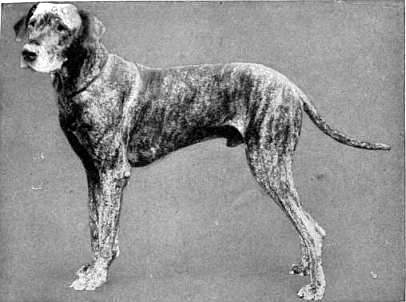
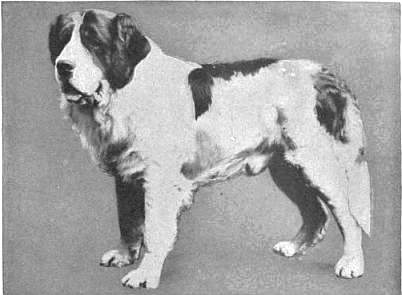
GREAT DANE. SAINT BERNARD.
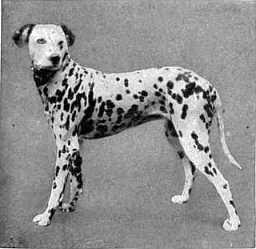
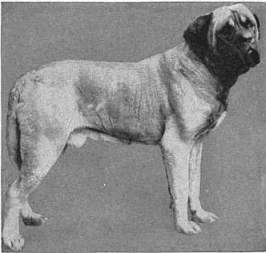
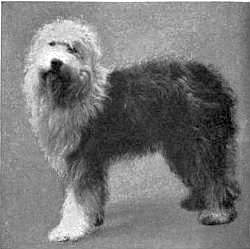
DALMATIAN. MASTIFF. OLD ENGLISH SHEEP DOG.
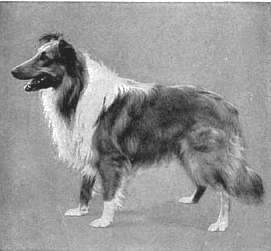
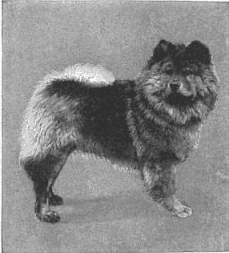
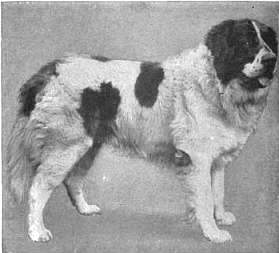
COLLIE. CHOW. NEWFOUNDLAND.
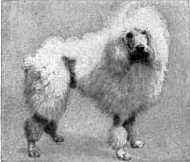
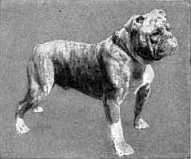
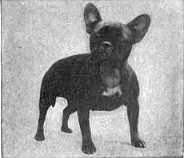
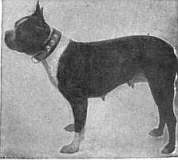
POODLE. BULL DOG. FRENCH BULL DOG. From “Country Life in America.” BOSTON TERRIER.
(From Photos by Bowden Bros.) TYPICAL NON-SPORTING DOGS.
Plate II.
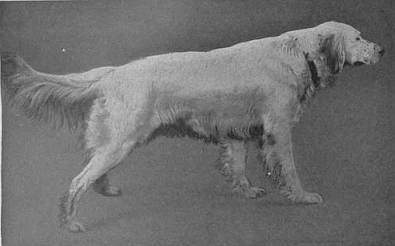
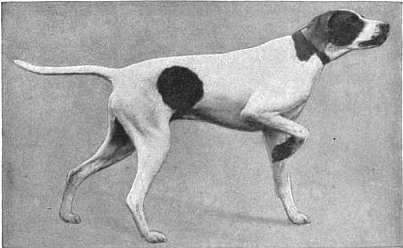
ENGLISH SETTER. POINTER.
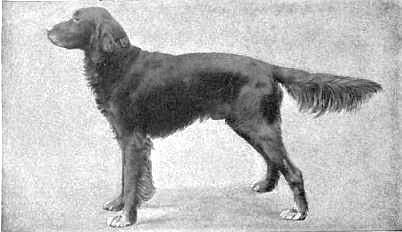
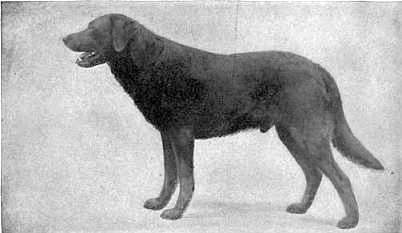
IRISH SETTER. LABRADOR RETRIEVER.
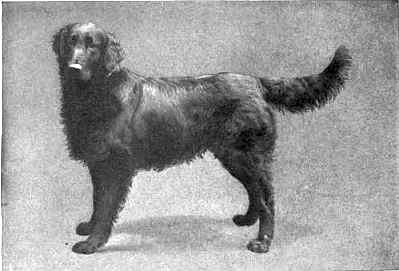
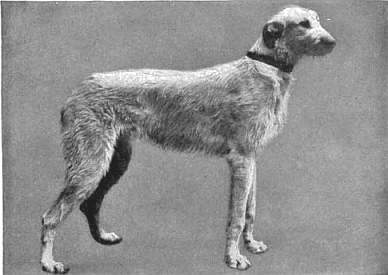
FLAT-COATED RETRIEVER. IRISH WOLF-HOUND.
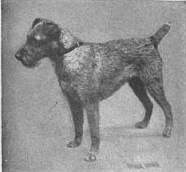
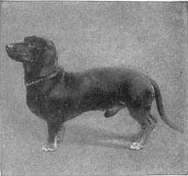
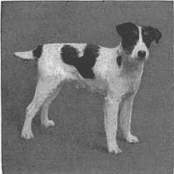
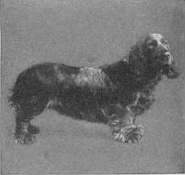
IRISH TERRIER. DACHSHUND. ROUGH-COATED FOX TERRIER. FIELD SPANIEL.
(From Photos by Bowden Bros.) TYPICAL SPORTING DOGS.
The Hindus also regard the dog as unclean, and submit to various purifications if they accidentally come in contact with it, believing that every dog is animated by a wicked and malignant spirit condemned to do penance in that form for crimes committed in a previous state of existence. In every Mahommedan and Hindu country the most scurrilous epithet bestowed on a European or a Christian is “a dog,” and that accounts for the fact that in the whole of the Jewish history there is not a single allusion to hunting with dogs. Mention is made of nets and snares, but the dog does not seem to have been used in the pursuit of game.
In the early periods of the history of other countries this seems to have been the case even where the dog was esteemed and valued, and had become the companion, the friend and the defender of man and his home; and in the 2nd century of the Christian era Arrian wrote that “there is as much difference between a fair trial of speed in a good run, and ensnaring a poor animal without an effort, as between the secret piratical assaults of robbers at sea and the victorious naval engagements of the Athenians at Artemisium and at Salamis.” The first hint of the employment of the dog in the pursuit of other animals is given by Oppian in his Cynegetica, who attributes it to Pollux about 200 years after the promulgation of the Levitical law. The precise species of dog that was cultivated in Greece at that early period cannot be affirmed, although a beautiful piece of sculpture in the possession of Lord Feversham at Duncombe Hall, representing the favourite dog of Alcibiades, differs but little from the Newfoundland dog of the present day. In the British Museum is another piece of early sculpture from the ruins of the villa of Antoninus, near Rome. The greyhound puppies which it represents are identical with a brace of saplings of the present day. In the early periods of their history the Greeks depended too much on their nets to capture game, and it was not until later times that they pursued their prey with dogs, and then not with greyhounds, which run by sight, but with beagles, the dwarf hound which is still very popular. Later, mention is made of large and ferocious dogs which were employed to guard sheep and cattle, or to watch at the door of the house, or even to act as a companion, and G. Cuvier expresses the opinion that the dog exhibits the most complete and the most useful conquest that man has made. Each individual is entirely devoted to his master, adopts his manners, distinguishes and defends his property, and remains attached to him even unto death; and all this springs not from mere necessity nor from constraint, but simply from gratitude and true friendship.
The swiftness, the strength and the highly developed power of scent in the dog, have made it a powerful ally of man against the other animals; and perhaps these qualities in the dog were necessary to the establishment of society. Instances of dogs having saved the lives of their owners by that strange intuition of approaching danger which they appear to possess, or by their protection, are innumerable: their attachment to man has inspired the poet and formed the subject of many notable books, while in Daniel’s Rural Sports is related a story of a dog dying in the fulness of joy caused by the return of his master after a two years’ absence from home.
It is not improbable that all dogs sprang from one common source, but climate, food and cross-breeding caused variations of form which suggested particular uses, and these being either designedly or accidentally perpetuated, the various breeds of dogs arose, and became numerous in proportion to the progress of civilization. Among the ruder or savage tribes they possess but one form; but the ingenuity of man has devised many inventions to increase his comforts; he has varied and multiplied the characters and kinds of domestic animals for the same purpose, and hence the various breeds of horses, cattle and dogs. The parent stock it is now impossible to trace; but the wild dog, wherever found on the continent of Asia, or northern Europe, has nearly the same character, and bears no inconsiderable resemblance to the British dog of the ordinary type; while many of those from the southern hemisphere can scarcely be distinguished from the cross-bred poaching dog, the lurcher.
Dogs were first classified into three groups:—(1) Those having the head more or less elongated, and the parietal bones of the skull widest at the base and gradually approaching towards each other as they ascend, the condyles of the lower jaw being on the same line with the upper molar teeth. The greyhound and all its varieties belong to this class. (2) The head moderately elongated and the parietals diverging from each other for a certain space as they rise upon the side of the head, enlarging the cerebral cavity and the frontal sinus. To this class belong most of the useful dogs, such as the spaniel, the setter, the pointer and the sheepdog. (3) The muzzle more or less shortened, the frontal sinus enlarged, and the cranium elevated and diminished in capacity. To this class belong some of the terriers and most of the toy dogs.
Later, however, “Stonehenge” (J.H. Walsh), in British Rural Sports, classified dogs as follows:—(a) Dogs that find game for man, leaving him to kill it himself—the pointer, setters, spaniels and water spaniels. (b) Dogs which kill game when found for them—the English greyhound. (c) Dogs which find and also kill their game—the bloodhound, the foxhound, the harrier, the beagle, the otterhound, the fox terrier and the truffle dog. (d) Dogs which retrieve game that has been wounded by man—the retriever, the deerhound. (e) Useful companions of man—the mastiff, the Newfoundland, the St Bernard dog, the bulldog, the bull terrier, terriers, sheepdogs, Pomeranian or Spitz, and Dalmatian dogs. (f) Ladies’ toy dogs—King Charles spaniel, the Blenheim spaniel, the Italian greyhound, the pug dog, the Maltese dog, toy terriers, toy poodles, the lion dog, Chinese and Japanese spaniels. In 1894 Modern Dogs (Rawdon B. Lee) was issued, the simple classification of sporting and non-sporting dog—terriers and toy dogs, being adopted; but although there had been an understanding since 1874, when the first volume of the Kennel Club Stud Book (Frank C. S. Pearce) was issued, as to the identity of the two great divisions of dogs, an incident at Altrincham Show in September 1900—an exhibitor entering a Russian wolfhound in both the sporting and non-sporting competitions—made it necessary for authoritative information to be given as to how the breeds should be separated. Following petitions to the Kennel Club from exhibitors at the club’s own show at the Crystal Palace, and also at the show of the Scottish Kennel Club in Edinburgh during the autumn of 1900, the divisions were decided upon as follows:—
Sporting.—Bloodhound, otterhound, foxhound, harrier, beagle, basset hound (smooth and rough), dachshund, greyhound, deerhound, Borzoi, Irish wolfhound, whippet, pointer, setter (English, Irish and black and tan), retriever (flat-coated, curly-coated and Labrador), spaniel (Irish water, water other than Irish, Clumber, Sussex, field, English springer, other than Clumber, Sussex and field: Welsh springer, red and white and Cocker); fox terriers (smooth- and wire-coated); Irish terrier, Scotch terrier, Welsh terrier, Dandie Dinmont terrier, Skye terrier (prick-eared and drop-eared), Airedale terrier and Bedlington terrier.
Non-Sporting.—Bulldog, bulldog (miniature), mastiff, Great Dane, Newfoundland (black, white and black, or other than black), St Bernard (rough and smooth), Old English sheepdog, collie (rough and smooth), Dalmatian, poodle, bull terrier, white English terrier, black and tan terrier, toy spaniel (King Charles or black and tan, Blenheim, ruby or red and tricolour), Japanese, Pekingese, Yorkshire terrier, Maltese, Italian greyhound, chow-chow, black and tan terrier (miniature), Pomeranian, pug (fawn and black), Schipperke, Griffon Bruxellois, foreign dogs (bouledogues français, elk-hounds, Eskimos, Lhasa terriers, Samoyedes and any other varieties not mentioned under this heading).
On the 4th of May 1898 a sub-committee of the Kennel Club decided that the following breeds should be classified as “toy dogs”:—Black and tan terriers (under 7 ℔), bull terriers (under 8 ℔), griffons, Italian greyhounds, Japanese, Maltese, Pekingese, poodles (under 15 in.), pugs, toy spaniels, Yorkshire terriers and Pomeranians.
All these varieties were represented at the annual show of the Kennel Club in the autumn of 1905, and at the representative exhibition of America held under the management of the Westminster Kennel Club in the following spring the classification was substantially the same, additional breeds, however, being Boston terriers—practically unknown in England,—Chesapeake Bay dogs, Chihuahuas, Papillons and Roseneath terriers. The latter were only recently introduced into the United States, though well known in Great Britain as the West Highland or Poltalloch terrier; an application which was made (1900) by some of their admirers for separate classification was refused by the Kennel Club, but afterwards it was granted, the breed being classified as the West Highland white terrier.
The establishment of shows at Newcastle-on-Tyne in June 1859 secured for dogs attention which had been denied them up to that time, although sportsmen had appreciated their value for centuries and there had been public coursing meetings since the reign of Charles I. Lord Orford, however, established the first club at Marham Smeeth near Swaffham, where coursing is still carried on, in 1776. The members were in number confined to that of the letters in the alphabet; and when any vacancy happened it was filled up by ballot. On the decease of the founder of the club, the members agreed to purchase a silver cup to be run for annually, and it was intended to pass from one to the other, like the whip at Newmarket, but before starting for it, in the year 1792, it was decided that the winner of the cup should keep it and that one should be annually purchased to be run for in November. At the formation of the club each member assumed a colour, and also a letter, which he used as the initial of his dog’s name. The Newcastle dog show of 1859 was promoted by Mr Pape—a local sporting gunmaker—and Mr Shorthose, and although only pointers and setters were entered for in two classes immense interest was taken in the show. But neither the promoters nor the sportsmen who supported it could have had the faintest idea as to how popular dog shows would become. The judges at that historic gathering were: Messrs J. Jobling (Morpeth), T. Robson (Newcastle-on-Tyne) and J. H. Walsh (London) for pointers, and E. Foulger (Alnwick), R. Brailsford (Knowsley) and J. H. Walsh for the setters. Sixty dogs were shown, and it was said that such a collection had not been seen together before; while so even was the quality that the judges had great difficulty in making their awards. The prizes were sporting guns made by Mr Pape and presented by him to the promoters of the show. So great a success was scored that other shows were held in the same year at Birmingham and Edinburgh; while the Cleveland Agricultural Society also established a show of foxhounds at Redcar, the latter being the forerunner of that very fine show of hounds which is now held at Peterborough every summer and is looked upon as the out-of-season society gathering of hunting men and women.
Mr Brailsford was the secretary of the show at Birmingham, and he had classes for pointers, English and Irish setters, retrievers and Clumber spaniels. Another big success was scored, and the National Dog Show Society was established for the purpose of holding a show of sporting dogs in Birmingham every winter. Three years later proposals were made in The Field to promote public trials of pointers and setters over game, but it was not until the 18th of April 1865 that a further step was taken in the recognition of the value of the dog by the promotion of working trials. They were held at Southill, near Bedford, on the estate of S. Whitbread, M.P., and they attracted great interest. The order of procedure at the early field trials was similar to what it is to-day, only the awards were given in accordance with a scale of points as follows: nose, 40; pace and range, 30; temperament, 10; staunchness before, 10; behind, 10. Style of working was also taken into consideration. In 1865 a show was held in Paris, and after the National Dog Club—not the Birmingham society—had failed, as the result of a disastrous show at the Crystal Palace, a further exhibition was arranged to be held in June 1870 under the management of G. Nutt and a very strong committee, among whom were many of the most noted owners of sporting dogs of that time. The details of the show were arranged by S. E. Shirley and J. H. Murchison, but the exhibition, although a most interesting one, was a failure, and the guarantors had to face a heavy loss. A second venture proved to be a little more encouraging, although again there was a loss; but in April 1873, the Kennel Club, which is now the governing body of the canine world, was founded by S. E. Shirley, who, after acting as its chairman for many years, was elected the president, and occupied that position until his death in March 1904. His successor was the duke of Connaught and Strathearn; the vice-presidents including the duke of Portland, Lord Algernon Gordon Lennox, J. H. Salter and H. Richards. The progress of the club has been remarkable, and that its formation did much to improve the conditions of the various breeds of dogs, to encourage their use in the field by the promotion of working trials, and to check abuses which were common with regard to the registration of pedigrees, &c., cannot be denied. The abolition of the cropping of the ears of Great Danes, bull terriers, black and tan terriers, white English terriers, Irish terriers and toy terriers, in 1889 gained the approval of all humane lovers of dogs, and although attempts have been made to induce the club to modify the rule which prohibits the exhibition of cropped dogs, the practice has not been revived; it is declared, however, that the toy terriers and white English terriers have lost such smartness by the retention of the ears that they are becoming extinct. The club has control over all the shows held in the United Kingdom, no fewer than 519 being held in 1905, the actual number of dogs which were entered at the leading fixtures being: Kennel Club show 1789, Cruft’s 1768, Ladies’ Kennel Association 1306, Manchester 1190, Edinburgh 896 and Birmingham 892. In 1906, however, no fewer than 1956 dogs were entered at the show of the Westminster Kennel Club, held in Madison Square Garden, New York; a fact proving that the show is as popular in America as it is in the United Kingdom, the home of the movement. The enormous sum of £1500 has been paid for a collie, and 1000 guineas for a bulldog, both show dogs pure and simple; while £500 is no uncommon price for a fox terrier. Excepting for greyhounds, however, high prices are rarely offered for sporting dogs, 300 guineas for the pointer “Coronation” and 200 guineas for the retriever “High Legh Blarney” being the best reported prices for gun dogs during the last few years.
The foreign and colonial clubs which are affiliated to the Kennel Club are: the Guernsey Dog Club, the Italian Kennel Club, the Jersey Dog Club, La Société Centrale (Paris), Moscow Gun Club of the Emperor Alexander II., New South Wales Kennel Club, Nimrod Club (Amsterdam), Northern Indian Kennel Association, Royal St Hubert’s Society (Brussels) and the South African Kennel Club (Cape Town). Its ramifications therefore extend to all parts of the world; while its rules are the basis of those adopted by the American Kennel Club, the governing body of the “fancy” in the United States. A joint conference between representatives of the two bodies, held in London in 1900, did much towards securing the uniformity of ideas which is so essential between associations having interests in common.
Most of the leading breeds have clubs or societies, which have been founded by admirers with a view to furthering the interests of their favourites; and such combinations as the Bulldog Club (incorporated), the London Bulldog Society, the British Bulldog Club, the Fox Terrier Club, the Association of Bloodhound Breeders—under whose management the first man-hunting trials were held,—the Bloodhound Hunt Club, the Collie Club, the Dachshund Club, the Dandie Dinmont Terrier Club, the English Setter Club, the Gamekeepers’ Association of the United Kingdom, the International Gun Dog League, the Irish Terrier Club, the Irish Wolfhound Club, the St Bernard Club, the National Terrier Club, the Pomeranian Club, the Spaniel Club, the Scottish Terrier Club and the Toy Bulldog Club have done good work in keeping the claims of the breeds they represent before the dog-owning public and encouraging the breeding of dogs to type. Each club has a standard of points; some hold their own shows; while others issue club gazettes. All this has been brought about by the establishment of a show for sporting dogs at Newcastle-on-Tyne in the summer of 1859.
America can claim a list of over twenty specialist clubs, and in both countries women exhibitors have their independent associations, Queen Alexandra having become one of the chief supporters of the Ladies’ Kennel Association (England). There is a ladies’ branch of the Kennel Club, and the corresponding clubs in America are the Ladies’ Kennel Association of America and the Ladies’ Kennel Association of Massachusetts.
The Gazette is the official organ of the Kennel Club. The Field, however, retains its position as the leading canine journal, the influence of J. H. Walsh (“Stonehenge”), who did so much towards establishing the first dog shows and field trials, having never forsaken it: the work he began was carried on by its kennel editor, Rawdon B. Lee (d. 1908), whose volumes on Modern Dogs (sporting, non-sporting and terriers) are the standard works on dogs. Our Dogs, The Kennel Magazine, and The Illustrated Kennel News are the remaining canine journals in England. Several weekly papers published on the continent of Europe devote a considerable portion of their space to dogs, and canine journals have been started in America, South Africa and even India: while apart from Lee’s volumes and other carefully compiled works treating on the dog in general, the various breeds have been written about, and the books or monographs have large sales. At the end of 1905 E. W. Jaquet wrote The Kennel Club: a History and Record of its Work, and an edition de luxe of Dogs is edited by Mr Harding Cox; Mr Sidney Turner, the chairman of the Kennel Club committee, edited The Kennel Encyclopaedia, the first number of which was issued in 1907. Dog lovers are now numbered by their tens of thousands, and in addition to shows of their favourites, owners are also liberally catered for in the shape of working trials, for during the season competitions for bloodhounds, pointers, setters, retrievers, spaniels and sheepdogs are held.
Breeds of Dog.
Nothing is known with certainty as to the origin of the vast majority of breeds of dogs, and it is an unfortunate fact that the progressive changes which have been made within comparatively recent times by fanciers have not been accurately recorded by the preservation, in museums or collections, of the actual specimens considered typical at different dates. No scientific classification of the breeds of dogs is at present possible, but whilst the division already given into “sporting” and “non-sporting” is of some practical value, for descriptive purposes it is convenient to make a division into the six groups:—wolfdogs, greyhounds, spaniels, hounds, mastiffs and terriers. It is to be remembered, however, that all these types interbreed freely, and that many intermediate, and forms of wholly doubtful position, occur.
Wolfhounds.—Throughout the northern regions of both hemispheres there are several breeds of semi-domesticated dogs which are wolf-like, with erect ears and long woolly hair. The Eskimo dog has been regarded as nothing more than a reclaimed wolf, and the Eskimo are stated to maintain the size and strength of their dogs by crossing them with wolves. The domestic dogs of some North American Indian tribes closely resemble the coyote; the black wolfdog of Florida resembles the black wolf of the same region; the sheepdogs of Europe and Asia resemble the wolves of those countries, whilst the pariah dog of India is closely similar to the Indian wolf. The Eskimo dog has small, upright ears, a straight bushy tail, moderately sharp muzzle and rough coat. Like a wolf, it howls but does not bark. It occurs throughout the greater part of the Arctic regions, the varieties in the old and new world differing slightly in colour. They are fed on fish, game and meat. They are good hunters and wonderfully cunning and enduring. Their services to their owners and to Arctic explorers are well known, but Eskimo dogs are so rapacious that it is impossible to train them to refrain from attacking sheep, goats or any small domesticated animals. The Hare Indian dog of the Great Bear Lake and the Mackenzie river is more slender, gentle and affectionate than the Eskimo dog, but is impatient of restraint, and preserves many of the characters of its wild ally, the coyote, and is practically unable to bark.
The Pomeranian dog is a close ally of the Eskimo breed and was formerly used as a wolfdog, but has been much modified. The larger variety of the race has a sharp muzzle, upright pointed ears, and a bushy tail generally carried over the back. It varies in colour from black through grey to reddish brown and white. The smaller variety, sometimes known as the Spitz, was formerly in some repute as a fancy dog, a white variety with a black tip to the nose and a pure black variety being specially prized. Pomeranians have been given most attention in Germany and Belgium, while the so-called Spitz has been popular in England and America.
The sheepdogs and collies are still further removed from the wolf type, and have the tip of the ear pendent. The tail is thick and bushy, the feet and legs particularly strong, and there is usually a double dew-claw on each hind limb. The many varieties found in different countries have the same general characters. The bark is completely dog-like, and the primitive hunting instincts have been cultivated into a marvellous aptitude for herding sheep and cattle. The training takes place during the first year, and the work is learned with extreme facility. The Scotch collie is lighter and more elegant, and has a sharper muzzle. Since it became popular as a pet dog, its appearance has been greatly improved, and whilst it has lost its old sullen concentration, it has retained unusual intelligence and has become playful and affectionate. The wolfdogs all hunt chiefly by scent.
Greyhounds.—These are characterized by slight build, small ears falling at the tips, elongated limbs and tails and long narrow muzzles. They hunt entirely by sight, the sense of smell being defective. The English greyhound is the most conspicuous and best-known member of the group, and has been supposed to be the parent of most of the others. The animal is thoroughly adapted for extreme speed, the long, rat-like tail being used in balancing the body in quick turns. The favourite colour is a uniform sandy, or pale grey tone, but characters directly related to capacity for speed have received most attention. The Italian greyhound is a miniature greyhound, still capable of considerable speed but so delicate that it is almost unable to pull down even a rabbit, and is kept simply as a pet. The eyes are large and soft, and a golden fawn is the colour most prized. The Scotch deerhound is a larger and heavier variety of the English greyhound, with rough and shaggy hair. It has been used both for deer stalking and for coursing, and several varieties exist. The Irish wolfhound is now extinct, but appears to have been a powerful race heavier than the deerhound but similar to it in general characters. Greyhounds have been bred from time immemorial in Eastern Europe and Western Asia, while unmistakable representatives are figured on the monuments of ancient Egypt. The existing Oriental varieties are in most cases characterized by silky hair. The hairless dogs of Central Africa are greyhounds employed chiefly in hunting antelopes, and there are somewhat similar varieties in China, Central and South America.
The whippet is a local English dog, used chiefly in rabbit coursing and racing, and is almost certainly a cross between greyhounds and terriers.
The lurcher is a dog with the general shape of a greyhound, but with a heavier body, larger ears and rougher coat. Lurchers are cross-bred dogs, greyhounds and sheepdogs, or deerhounds and collies, being the parents.
Spaniels are heavily built dogs with short and very wide skulls rising suddenly at the eyes. The brain is relatively large and the intelligence high. The muzzle is short, the ears large and pendent, the limbs relatively short and heavy, and the coat thick and frequently long. It is supposed, from their name, that they are of Spanish origin. They may be divided into field spaniels, water spaniels and the smaller breeds kept as pets. Field spaniels are excellent shooting dogs, and are readily trained to give notice of the proximity of game. The Clumber, Sussex, Norfolk and Cocker breeds are the best established. The Clumber is long, low and heavy. It is silent when hunting, and has long ears shaped like vine leaves. The ground colour of the coat is white with yellow spots. The Sussex is a lighter, more noisy animal, with a wavy, golden coat. The Cockers are smaller spaniels, brown, or brown-and-white in the Welsh variety, black in the more common modern English form. The head is short, and the coat silky and wavy. Of the water spaniels the Irish breeds are best known. They are relatively large dogs, with broad splay feet, and silky oily coats.
The poodle is probably derived from spaniels, but is of slighter, more graceful build, and is pre-eminent even among spaniels for intelligence. The best known pet spaniels are the King Charles and the Blenheim, small dogs with fine coats, probably descended from Cockers.
Setters owe their name to their having been trained originally to crouch when marking game, so as to admit of the net with which the quarry was taken being drawn over their heads. Since the general adoption of shooting in place of netting or bagging game, setters have been trained to act as pointers. They are pre-eminently dogs for sporting purposes, and special strains or breeds adapted to the peculiarities of different kinds of sporting have been produced. Great Britain is probably the country where setters were first produced, and as early as the 17th century spaniels were used in England as setting dogs. It is probable that pointer blood was introduced in the course of shaping the various breeds of setter. The English setter should have a silky coat with the hair waved but not curly; the legs and toes should be hairy, and the tail should have a bushy fringe of hairs hanging down from the dorsal border. The colour varies much, ranging according to the strains, from black-and-white through orange-and-white and liver-and-white to pure white, whilst black, white, liver, and red or yellow self-coloured setters are common. The Irish setter is red without trace of black, but occasionally flecked with white. The Gordon setter, the chief Scottish variety, is a heavier animal with coarser hair, black-and-tan in colour. The Russian setter has a woolly and matted coat.
The retriever is a large dog used for retrieving game on land, as a water spaniel is used for the same purpose in water. The breed is almost certainly derived from water-spaniels, with a strong admixture of Newfoundland blood. The colour is black or tan, and the hair of the face, body and tail is close and curly, although wavy-coated strains exist.
The Newfoundland is simply an enormous spaniel, and shows its origin by the facility with which it takes to water and the readiness with which it mates with spaniels and setters. It has developed a definite instinct to save human beings from drowning, this probably being an evolution of the retrieving instinct of the original spaniels. The true Newfoundland is a very large dog and may reach 31 in. in height at the shoulder. The coat is shaggy and oily, and is preferred with as little white as possible, but the general black coloration may have rusty shades. The eyes and ears are relatively small, and the forehead white and dome-shaped, giving the face the well-known appearance of benignity and intelligence. Although these dogs were originally brought to Great Britain from Newfoundland and are still bred in the latter country, greater size, perfection and intelligence have been attained in England, where Newfoundlands for many years have been the most popular large dogs. They are easily taught to retrieve on land or water, and their strength, intelligence and fidelity make them specially suitable as watchdogs or guardians. The Landseer Newfoundland is a black and white variety brought into notice by Sir Edwin Landseer, but the exact ancestry of which is unknown. The Labrador Newfoundland is a smaller black variety with a less massive head. It occurs both in Newfoundland and England, and has been used largely in producing crosses, being almost certainly one parent of the retriever.
The St Bernard is a large breed taking its name from the monastery of Mount St Bernard in the Alps, and remarkable for high intelligence and use in rescuing travellers from the snow. The origin of the breed is unknown, but undoubtedly it is closely related to spaniels. The St Bernard attains as great a size as that of any other breed, a fine specimen being between 60 and 70 in. from the tip of the nose to the root of the tail. The colour varies, but shades of tawny-red and white are more frequent than in Newfoundlands. In the rough-haired breed the coat is long and wavy, but there exists a smooth breed with a nearly smooth coat.
Hounds.—These are large dogs, hunting by smell, with massive structure, large drooping ears, and usually smooth coats, without fringes of hair on the ears, limbs or tail. The bloodhound is probably the stock from which all the English races of hounds have been derived. The chief character is the magnificent head, narrow and dome-like between the huge pendulous ears, and with transverse puckers on the forehead and between the eyes. The prevailing colour is tan with large black spots. Bloodhounds, or, as they are sometimes termed, sleuthhounds, have been employed since the time of the Romans in pursuing and hunting down human beings, and a small variety, known as the Cuban bloodhound, probably of Spanish origin, was used to track fugitive negroes in slaveholding times. Bloodhounds quest slowly and carefully, and when they lose the scent cast backwards until they recover the original trail and make a fresh attempt to follow it.
Staghounds are close derivatives of the bloodhound, and formerly occurred in England in two strains, known respectively as the northern and southern hounds. Both breeds were large and heavy, with pendulous ears and thick throats with dewlaps. These strains seem to be now extinct, having been replaced by foxhounds, a large variety of which is employed in stag-hunting.
The modern English foxhound has been bred from the old northern and southern hounds, and is more lightly built, having been bred for speed and endurance. The favourite and most common colour is black-white-and-tan. The ears are usually artificially clipped so as to present a rounded lower margin. Their dash and vigour in the chase is much greater than that of the bloodhound, foxhounds casting forwards when they have lost the trail.
Harriers are a smaller breed of foxhounds, distinguished by their pointed ears, as it is not the custom to trim these. They are used in the pursuit of hares, and, although they are capable of very fast runs, have less endurance than foxhounds, and follow the trail with more care and deliberation.
Otterhounds are thick, woolly harriers with oily underfur. They are savage and quarrelsome, but are naturally excellent water-dogs.
Beagles are small foxhounds with long bodies and short limbs. They have a full bell-like cry and great cunning and perseverance in the tracking of hares and rabbits. They are relatively slow, and are followed on foot.
Turnspits were a small, hound-like race of dogs with long bodies, pendulous ears, out-turned feet and generally black-and-tan coloration. They were employed as animated roasting jacks, turning round and round the wire cage in which they were confined, but with the employment of mechanical jacks their use ceased and the race appears to be extinct.
Basset hounds are long and crooked-legged dogs, with pendulous ears. They appear to have been produced in Normandy and the Vendée, where they were employed for sporting purposes, and originally were no very definite breed. In comparatively recent times they have been adopted by English fanciers, and a definite strain with special points has been produced.
The dachshund, or badger hound, is of German origin, and like the basset hound was originally an elongated distorted hound with crooked legs, employed in baiting and hunting badgers, but now greatly improved and made more definite by the arts of the breeder. The colour is generally black-and-tan or brownish, the body is extremely long and cylindrical; the ears are large and pendulous, the legs broad, thick and twisted, with everted paws. The coat is short, thick and silky, and the tail is long and tapering.
The pointers, of which there are breeds slightly differing in most European countries, are descendants of the foxhound which have been taught to follow game by general body scent, not by tracking, nose to the ground, the traces left by the feet of the quarry, and, on approaching within sight of the game, to stand rigid, “pointing” in its direction. The general shape is like that of the foxhound, but the build is lighter and better knit, and the coat is soft, whilst white and spotted colorations are preferred. Pointers are employed to mark game for guns, and are especially useful in low cover such as that afforded by turnip fields.
Plate III.
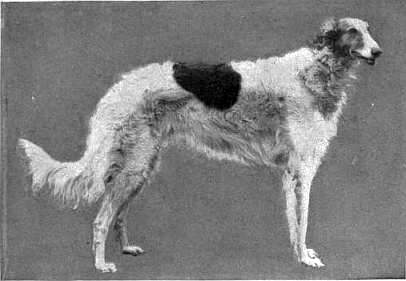
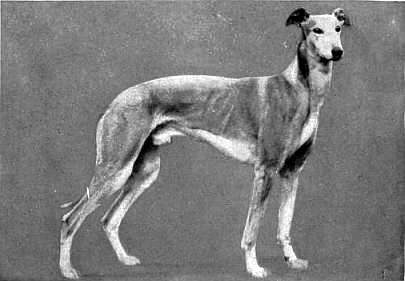
BORZOI. GREYHOUND.
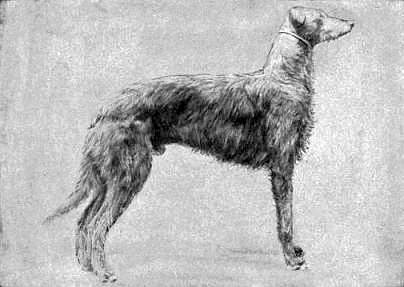
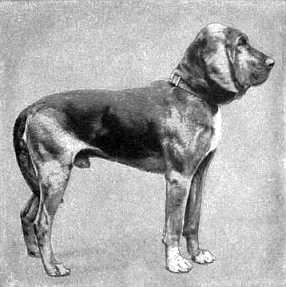
DEERHOUND. BLOODHOUND.
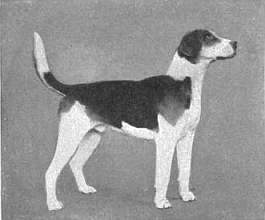
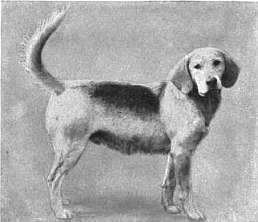
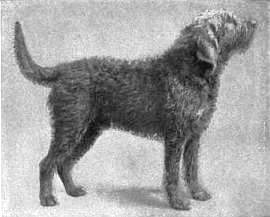
FOX HOUND. HARRIER. OTTER HOUND.
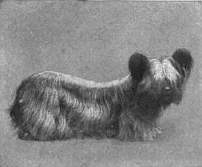
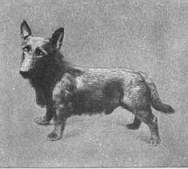
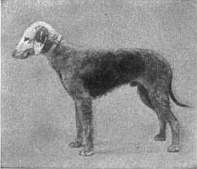
AUSTRALIAN TERRIER. SKYE TERRIER. SCOTCH TERRIER. BEDLINGTON TERRIER.
(From Photos by Bowden Bros.) TYPICAL SPORTING DOGS.
Plate IV.
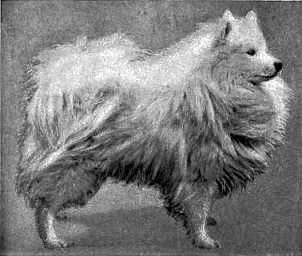
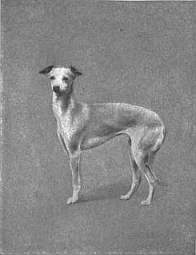
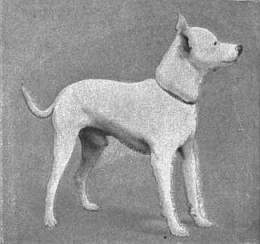
Photo, Bowden Bros. POMERANIAN. Photo, Thos. Fall. ITALIAN GREYHOUND. Photo, Bowden Bros. TOY BULL TERRIER.
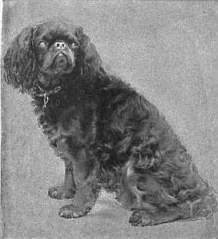
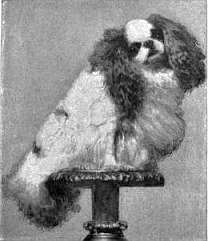
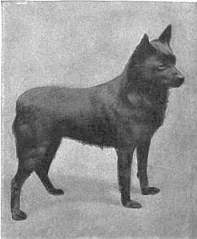
Photo, Bowden Bros. TOY SPANIEL. Photo, Walker. BLENHEIM. Photo, Thos. Fall. PAPILLON. Photo, Bowden Bros. SCHIPPERKE.
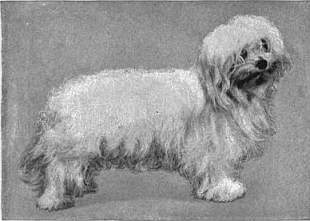
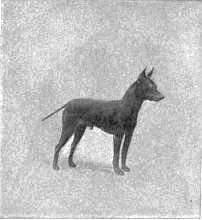
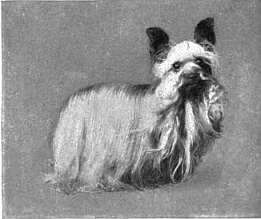
Photo, Bowden Bros. MALTESE. Photo, Thos. Fall. TOY BLACK AND TAN. Photo, Bowden Bros. YORKSHIRE TERRIER.
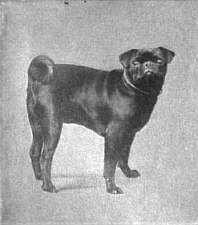
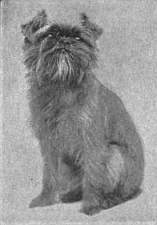
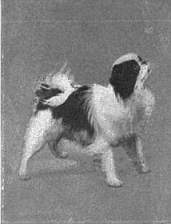
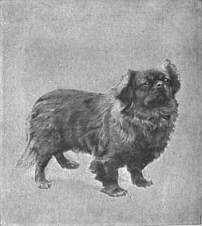
Photo, Bowden Bros. PUG. Photo, Bowden Bros. GRIFFON. Photo, Bowden Bros. JAPANESE. Photo, Bowden Bros. PEKINGESE.
TYPICAL TOY DOGS.
The Dalmatian or coach dog (sometimes called the plum-pudding dog) is a lightly built pointer, distinguished by its spotted coloration, consisting of evenly disposed circular black spots on a white ground. The original breed is said to have been used as a pointer in the country from which it takes its name, but has been much modified by the fancier’s art, and almost certainly the original strain has been crossed with bull-terriers.
Mastiffs are powerful, heavily built dogs, with short muzzles, frequently protruding lower jaws, skulls raised above the eyes, ears erect or pendulous, pendulous upper lips, short coats and thin tails. The English mastiff is a huge and powerful dog with pendent ears but short and silky coat. Fawn and brindle are the colours preferred. The Tibetan mastiff is equally powerful, but has still larger pendent ears, a shaggy coat and a long brush-like tail. Mastiffs are employed for fighting or as watchdogs, and for the most part are of uncertain temper and not high intelligence.
The bulldog is a small, compact but extremely heavily built animal of great strength, vigour and tenacity. The lower jaw should be strongly protruding, the ears should be small and erect, the forehead deeply wrinkled with an indentation between the eyes, known as the “stop.” The coat should be thick, short and very silky, the favourite colours being white and white marked with brindle. Bulldogs were formerly employed in bull-baiting, and the tenacity of their grip is proverbial. Their ferocious appearance, and not infrequently the habits of their owners, have given this breed a reputation for ferocity and low intelligence. As puppies, however, bulldogs are highly intelligent and unusually docile and affectionate, and if well trained retain throughout life an unusual sweetness of disposition, the universal friendliness of which makes them of little use as guardians.
The German boarhound is one of the largest races of dogs, originally used in Germany and Denmark for hunting boars or deer, but now employed chiefly as watchdogs. The build is rather slighter than that of the English mastiff, and the ears are small and carried erect.
The Great Dane is somewhat similar in general character, but is still more gracefully built, with slender limbs and more pointed muzzle. The ears, naturally pendent at the tips, are always cropped. It is probable that the strain contains greyhound blood.
The bull-terrier, as its name implies, is a cross between the bulldog and the smooth terrier. It is a clever, agile and powerful dog, extremely pugnacious in disposition.
The pugdog is a dwarf race, probably of mastiff origin, and kept solely as a pet. The Chinese pug is slender legged, with long hair and a bushy tail.
Terriers are small dogs of agile and light build, short muzzles, and very highly arched skulls. The brains are large, and the intelligence and educability extraordinarily high. The number of breeds is very large, the two extreme types being the smooth fox-terrier with compact shape, relatively long legs, and the long-bodied, short-legged Skye terrier, with long hair and pendent ears.
All the well-known breeds of dogs are highly artificial and their maintenance requires the constant care of the breeder in mating, and in rejecting aberrant progeny. The frequency with which even the most highly cultivated strains produce degenerate offspring is notorious, and is probably the reason for the profound belief in telegonic action asserted by most breeders. When amongst the litter of a properly mated, highly bred fox-terrier, pups are found with long bodies and thick short legs and feet, breeders are disposed to excuse the result by the supposition that the bitch has been contaminated by some earlier mating. There is ample evidence, however, that such departures from type are equally frequent when there was no possibility of earlier mismating (see Telegony).
Glossary of Points of the Dog.
Apple Head. A rounded head, instead of flat on top. Blaze. A white mark up the face. Brisket. The part of body in front of the chest. Brush. The tail, usually applied to sheepdogs. Butterfly Nose. A spotted nose. Button Ear. Where the tip falls over and covers the orifice. Cat Foot. A short round foot, knuckles high and well developed. Cheeky. When the cheek bumps are strongly defined. Chest. Underneath a dog from brisket to belly. Chops. The pendulous lip of the bulldog. Cobby. Well ribbed up, short and compact in proportion. Couplings. Space between tops of shoulder blades and tops of hip joints. Cow Hocks. Hocks that turn in. Dew Claw. Extra claw, found occasionally on all breeds. Dewlap. Pendulous skin under the throat. Dish Faced. When nose is higher than muzzle at the stop. Dudley Nose. A yellow or flesh-coloured nose. Elbow. The joint at the top of the forearm. Feather. The hair at the back of the legs and under the tail. Flag. A term for the tail, applied to a setter. Flews. The pendulous lips of the bloodhound and other breeds. Forearm. Part of foreleg extending from elbow to pastern. Frill. A mass of hair on the chest, especially on collies. Hare Foot. A long narrow foot, carried forward. Haw. Red inside eyelid, shown in bloodhounds and St Bernards. Height. Measured at the shoulder, bending head gently down. Hocks. The hock joints. Hucklebones. Tops of the hip joints. Knee. The joint attaching fore-pastern and forearm. Leather. The skin of the ear. Occiput. The projecting bone or bump at the back of the head. Overshot. The upper teeth projecting beyond the under. Pastern. Lowest section of leg, below the knee or hock. Pig Jaw. Exaggeration of overshot. Pily. A term applied to soft coat. Rose Ear. Where the tip of ear turns back, showing interior. Septum. The division between the nostrils. Smudge Nose. A nose which is not wholly black, but not spotted. Stifles. The top joints of the hind legs. Stop. The indentation below the eyes, most prominent in bulldogs. Tulip Ear. An erect or pricked ear. Undershot. The lower teeth projecting in front of the upper ones.
(W. B.; P. C. M.)
DOGE (a modified form of the Ital. duca, Lat. dux, a leader, or duke), the title of the chief magistrate in the extinct republics of Venice and Genoa.
In Venice the office of doge was first instituted about 700. John the Deacon, referring to this incident in his Chronicon Venetum, written about 1000, says “all the Venetian cities (omnes Venetiae) determined that it would be more honourable henceforth to be under dukes than under tribunes.” The result was that the several tribunes were replaced by a single official who was called a doge and who became the head of the whole state. The first doge was Paolo Lucio Anafesto, and some authorities think that the early doges were subject to the authority of the emperors of Constantinople, but in any case this subordination was of short duration. The doge held office for life and was regarded as the ecclesiastical, the civil and the military chief; his duties and prerogatives were not defined with precision and the limits of his ability and ambition were practically the limits of his power. About 800 his independence was slightly diminished by the appointment of two assistants for judicial work, but these officers soon fell into the background and the doge acquired a greater and more irresponsible authority. Concurrently with this process the position was entrusted to members of one or other of the powerful Venetian families, while several doges associated a son with themselves in the ducal office. Matters reached a climax after the fall of the Orseole family in 1026. In 1033, during the dogeship of Dominico Flabianico, this tendency towards a hereditary despotism was checked by a law which decreed that no doge had the right to associate any member of his family with himself in his office, or to name his successor. It was probably at this time also that two councillors were appointed to advise the doge, who must, moreover, invite the aid of prominent citizens when discussing important matters of state. In 1172 a still more important change was introduced. The ducal councillors were increased in number from two to six; universal suffrage, which theoretically still existed, was replaced by a system which entrusted the election of the doge to a committee of eleven, who were chosen by a great council of 480 members, the great council being nominated annually by twelve persons. When a new doge was chosen he was presented to the people with the formula “this is your doge, if it please you.” Nominally the citizens confirmed the election, thus maintaining as a constitutional fiction the right of the whole people to choose their chief magistrate. Five years later this committee of eleven gave way to a committee of forty who were chosen by four persons selected by the great council. After the abdication of Doge Pietro Ziani in 1229 two commissions were appointed which obtained a permanent place in the constitution and which gave emphatic testimony to the fact that the doge was merely the highest servant of the community. The first of these commissions consisted of five Correttori della promissione ducale, whose duty was to consider if any change ought to be made in the terms of the oath of investiture (promissione) administered to each incoming doge, this oath, which was prepared by three officials, being a potent factor in limiting the powers of the doge. The second commission consisted of three inquisitori sopra il doge defunto, their business being to examine and pass judgment upon the acts of a deceased doge, whose estate was liable to be mulcted in accordance with their decision. In consequence of a tie at the election of 1229 the number of electors was increased from forty to forty-one. The official income of the doge was never large, and from early times many holders of the office were engaged in trading ventures. One of the principal duties of the doge was to celebrate the symbolic marriage of Venice with the sea. This was done by casting a precious ring from the state ship, the “Bucentaur,” into the Adriatic. In its earlier form this ceremony was instituted to commemorate the conquest of Dalmatia by Doge Pietro Orseole II. in 1000, and was celebrated on Ascension day. It took its later and more magnificent form after the visit of Pope Alexander III. and the emperor Frederick I. to Venice in 1177.
New regulations for the elections of the doge were introduced in 1268, and, with some modifications, these remained in force until the end of the republic. Their object was to minimize as far as possible the influence of the individual families, and this was effected by a very complex machinery. Thirty members of the great council, chosen by lot, were reduced, again by lot, to nine; the nine chose forty and the forty were reduced by lot to twelve, who chose twenty-five. The twenty-five were reduced by lot to nine and the nine elected forty-five. Then the forty-five were reduced by lot to eleven, and the eleven chose the forty-one, who actually elected the doge. As the oligarchical element in the constitution developed, the more important functions of the ducal office were assigned to other officials, or to administrative boards, and he who had once been the pilot of the ship became little more than an animated figurehead, properly draped and garnished. On state occasions he was surrounded by an increasing amount of ceremonial, and in international relations he had the status of a sovereign prince of the first rank. But he was under the strictest surveillance. He must wait for the presence of other officials before opening despatches from foreign powers; he was forbidden to leave the city and was not allowed to possess any property in a foreign land. To quote H. F. Brown, “his pomp was splendid, his power limited; he appears as a symbol rather than as a factor in the constitution, the outward and visible sign of the impersonal oligarchy.” The office, however, was maintained until the closing days of the republic, and from time to time it was held by men who were able to make it something more than a sonorous title. The last doge was Lodovico Manin, who abdicated in May 1797, when Venice passed under the power of Napoleon.
In Genoa the institution of the doge dates from 1339. At first he was elected without restriction and by popular suffrage, holding office for life; but after the reform effected by Andrea Doria in 1528 the term of his office was reduced to two years. At the same time plebeians were declared ineligible, and the appointment of the doge was entrusted to the members of the great and the little councils, who employed for this purpose a machinery almost as complex as that of the later Venetians. The Napoleonic Wars put an end to the office of doge at Genoa.
See Cecchetti, Il Doge di Venezia (1864); Musatti, Storia della promissione ducale (Padua, 1888); and H. F. Brown, Venice: a Historical Sketch (1893).
DOG-FISH, a name applied to several species of the smaller sharks, and given in common with such names as hound and beagle, owing to the habit these fishes have of pursuing or hunting their prey in packs. The small-spotted dog-fish or rough hound (Scyllium canicula) and the large-spotted or nurse hound (Scyllium catulus) are also known as ground-sharks. They keep near the sea bottom, feeding chiefly on the smaller fishes and Crustacea, and causing great annoyance to the fishermen by the readiness with which they take bait. They differ from the majority of sharks, and resemble the rays in being oviparous. The eggs are enclosed in semi-transparent horny cases, known on the British coasts as “mermaids’ purses,” and these have tendril-like prolongations from each of the four corners, by means of which they are moored to sea-weed or some other fixed object near the shore, until the young dog-fish is ready to make its exit. The larger of these species attains a length of 4 to 5 ft., the smaller rarely more than 30 in. The picked dog-fish (Acanthias vulgaris, formerly known as Squalus acanthias) is pre-eminently the dog-fish. It is the most abundant of the British sharks, and occurs in the temperate seas of both northern, and southern hemispheres. It attains a length of 4 ft., but the usual length is 2 to 3 ft., the female, as in most sharks, being larger than the male. The body is round and tapering, the snout projects, and the mouth is placed ventrally some distance from the end of the snout. There are two dorsal fins, each of which is armed on its anterior edge with a sharp and slightly curved spine, hence its name “picked.” This species is viviparous, the female producing five to nine young at a birth; the young when born are 9 to 10 in. long and quite similar to the parents in all respects except size. It is gregarious, and is abundant at all seasons everywhere on the British coasts. In 1858 an enormous shoal of dog-fish, many square miles in extent, appeared in the north of Scotland, when, says J. Couch, “they were to be found floating in myriads on the surface of every harbour.” They are the special enemies of the fisherman, injuring his nets, removing the hooks from his lines, and spoiling his fish for the market by biting pieces out of them as they hang on his lines. They are however eaten, both fresh and salted, by fishermen, especially on the west coast of England, and they are sold regularly in the French markets.
DOGGER BANK, an extensive shoal in the North Sea, about 60 m. E. of the coast of Northumberland, England. Over its most elevated parts there is a depth of only about six fathoms, but the depth is generally from ten to twenty fathoms. It is well known as a fishing ground. The origin of the name is obscure; but the middle Dutch dogger signifies a trawling vessel, and was formerly applied generally to the two-masted type of vessel employed in the North Sea fisheries, and also to their crews (doggermen) and the fish taken (dogger-fish). Off the south end of the bank an engagement took place between English and Dutch fleets in 1781. On the night of the 21st of October 1904 during the Russo-Japanese War, some British trawlers of the Hull fishing fleet were fired upon by vessels of the Russian Baltic fleet under Admiral Rozhdestvensky on its voyage to the Far East, one trawler being sunk, other boats injured, two men killed and six wounded. This incident created an acute crisis in the relations between Russia and England for several days, the Russian version being that they had seen Japanese torpedo-boats, but on the 28th Mr Balfour, the English prime minister, announced that the tsar had expressed regret and that an international commission would investigate the facts with a view to the punishment of any responsible parties. The terms were settled on 25th November, the commission being composed of five officers (British, Russian, American and French, and one selected by them), to meet in Paris. On the 22nd of December the four original members, Vice-admiral Sir Lewis Beaumont, Vice-admiral Kaznakov (afterwards replaced by Vice-admiral Dubassov), Rear-admiral Davis and Vice-admiral Fournier, met and chose Admiral Baron von Spaun (Austria-Hungary) as the fifth. Their report was issued on the 25th of February 1905. While recognizing that the information received as to a possible attack led the admiral to mistake the trawlers for the enemy, the majority of the commissioners held Rozhdestvensky responsible for the firing and its results, and “being of opinion that there were no torpedo-boats either among the trawlers nor anywhere near” concluded that “the opening of fire was not justifiable,” though they absolved him and his squadron from discredit either to their “military qualities” or their “humanity.” The affair ended in compensation being paid by the Russian government.
DOGGETT (or Dogget), THOMAS (d. 1721), English actor, was born in Dublin, and made his first appearance in London in 1691 as Nincompoop in D’Urfey’s Love for Money. In this part, and as Solon in the same author’s Marriage-hater matched, he gained the favour of the public. He followed Betterton to Lincoln’s Inn Fields, creating the part of Ben, especially written for him, in Congreve’s Love for Love, with which the theatre opened (1695); and next year played Young Hobb in his own The Country Wake. He was associated with Cibber and others in the management of the Haymarket and Drury Lane, and he continued to play comedy parts at the former until his retirement in 1713. Doggett is highly spoken of by his contemporaries, both as an actor and as a man, and is frequently referred to in The Tatler and Spectator. It was he who in 1715 founded the prize of “Doggett’s Coat and Badge” in honour of the house of Hanover, “in commemoration of his Majesty King George’s happy Accession to the Brittish Throne.” The prize was a red coat with a large silver badge on the arm, bearing the white horse of Hanover, and the race had to be rowed annually on the 1st of August on the Thames, by six young watermen who were not to have exceeded the time of their apprenticeship by twelve months. Although the first contest took place in 1715, the names of the winners have only been preserved since 1791. The race is still rowed each year, but under modified conditions.
See Thomas Doggett, Deceased (London, 1908).
DOGMA (Gr. δόγμα, from δόκεῖν, to seem; literally “that which seems, sc. good or true or useful” to any one), a term which has passed through many senses both general and technical, and is now chiefly used in theology. In Greek constitutional history the decision of—“that which seemed good to”—an assembly was called a δόγμα (i.e. decree), and throughout its history the word has generally implied a decision, or body of decisions or opinions, officially adopted and regarded by those who make it as possessing authority. As a technical term in theology, it has various shades of meaning according to the degree of authority which is postulated and the nature of the evidence on which it is based. Thus it has been used broadly of all theological doctrines, and also in a narrower sense of fundamental beliefs only, confession of which is insisted upon as a term of church communion. By sceptics the word “dogma” is generally used contemptuously, for an opinion grounded not upon evidence but upon assertion; and this attitude is so far justified from the purely empirical standpoint that theological dogmas deal with subjects which, by their very nature, are not susceptible of demonstration by the methods of physical science. Again, popularly, an unproved ex cathedra statement of any kind is called “dogmatic,” with perhaps an insinuation that it is being obstinately adhered to without, or beyond, or in defiance of, obtainable evidence. But again to “dogmatize” may mean simply to assert, instead of hesitating or suspending judgment.
Three pre-Christian or extra-ecclesiastical usages are recorded by a half-heretical churchman, Marcellus of Ancyra (in Eusebius of Caesarea, Contra Marcellum, i. 4);—words which Adolf Harnack has placed on the title-page of his larger History of Dogma. First there is a medical usage—empirical versus dogmatic medicine. On this old-world technical controversy we need not dwell. Secondly, there is a philosophical usage (e.g. Cicero, Seneca and others). First principles—speculative or practical—are δόγματα, Lat. decreta, scita or placita. The strongest statement regarding the inviolability of such dogmas is in Cicero’s Academics, ii. chap. 9. But we have to remember that this is dialogue; that the speaker, Hortensius, represents a more dogmatic type of opinion than Cicero’s own; that it is the maxims of “wisdom,” not of any special school, which are described as unchangeable.1 Marcellus’s third type of dogma is legal or political, the decree (says Marcellus) of the legislative assembly; but it might also be of the emperor (Luke ii. 1; Acts xvii. 7), or of a church gathering (Acts xvi. 4), or of Old Testament law; so especially in Philo the Jew, and in Flavius Josephus (even perhaps at Contra Apionem, i. 8).
While the New Testament knows only the political usage of δόγμα, the Greek Fathers follow one which is more in keeping with philosophical tradition. With few and early exceptions, such as we may note in the Epistle of Greek Fathers. Barnabas, chap, i., they confine the word to doctrine. Either dogma (sing.) or dogmas (plural) may be spoken of. Actually, as J. B. Lightfoot points out, the best Greek commentators among the Fathers are so dominated by this new usage, that they misinterpret Col. ii. 14 (20) and Eph. ii. 15 of Christian doctrines. Along with this goes the fundamental Catholic view of “dogmatic faith”—the expression is as old as Cyril of Jerusalem (died 386), if not older—according to which it consists in obedient assent to the voice of authority. All doctrines are “dogmas” to the Greek Fathers, not simply the central teachings of their system, as with the philosophers. Very noteworthy is Cyril of Jerusalem’s fourth Catechetical Discourse on the “Ten Dogmas” (we might render “Ten Great Doctrines”). The figure ten may be taken from the commandments,2 as in Gregory Nazianzen’s later, and more incidental, decalogue of belief. In any case, Cyril marks out the way for the subsequent division of the creeds into twelve or fourteen “articles” or heads of belief (see below). In saying that all doctrines rank as “dogmas” during the Greek period, we ought to add a qualification. They do so, in so far as they are held to be of authority. Clement of Alexandria or Origen would not call his speculations dogmas. Yet these audacious spirits start from a basis of authority, and insist upon ὀρθοτομία δογμάτων (Stromata, vii. 763). The “dogma” or “dogmas” of heretics are frequently mentioned by orthodox writers. There can be no question of confining even orthodox “dogma” to conciliar decisions in an age when definition is so incomplete; still, we do meet with references to the Nicene “dogma” (e.g. letter in Theodoret, H.E. ii. 15). But dogma is not yet technical for what is Christian or churchly. The word which emerges in Greek for that purpose is “orthodox,” “orthodoxy,” as in John of Damascus (d. 760), or as in the official title still claimed by the Holy Orthodox Church of the East.
Latin Fathers borrow the word “dogma,” though sparingly, and employ it in all the Greek usages. Something novel is added by Jerome’s phrase (in the De viris illustribus, cc. xxxi., cix.) ecclesiastica dogmata,—found again in the Latin Fathers. title of the treatise now generally ascribed to Gennadius, and occurring once more in another writer of southern Gaul.3 The phrase is a serviceable one, contrasting church teachings with heretical “dogmas.” But the main Latin use of dogma in patristic times is found in Vincent of Lerins (d. c. 450) in his brief but influential Commonitorium; again from southern Gaul. Medieval usages. Thereafter the usage gradually drops. In Thomas Aquinas4 it does not once occur. On the other hand Thomas has his own technical name—doctrine (sing.) or rather sacra doctrina; and this expression holds its ground, though the usage of Abelard, Theologia, was destined to an even more important place (see Theology). Another medieval usage of importance is the division of the creed into twelve articles corresponding to the number of the apostles, who, according to a legend already found in Rufinus (d. 410) On the Apostles’ Creed, composed that formula by contributing each a single sentence. The division is found applied also to the “Nicene-Constantinopolitan” creed, both in East and West. Sometimes fourteen articles are detected (in either creed), 7 + 7; the sacred number twice over.5
The Reformation set up a new idea of faith, or recurred to one of the oldest of all. Faith was not belief in authoritative teachings; it was trust in the promises of God and in Jesus Christ as their fulfilment. But the Protestant view The Reformation. was apt to seem intangible, and the influence of the learned tradition was strong—for a time, indeed, doctrine was more cultivated among Protestants than in the Church of Rome. The result was a structure which is well named the Protestant scholasticism. The new view of faith is bracketed with the old, and practically neutralized by it; as was already the case in Melanchthon’s theological definitions in the 1552-1553 edition of Loci Communes, also printed in other works by him. This brings back again the Catholic view of “dogmatic faith.”
The word “article” for a time holds the field. Pope Leo X. in 1520 condemns among other propositions of Martin Luther’s the twenty-seventh—”Certum est in manu Papae, aut ecclesiae, prorsus non esse statuere articulos fidei (imo nec Article. leges morum seu bonorum operum).” The Augsburg Confession (1530) is divided into numerous “articles,” while Luther’s Lesser Catechism gathers Christianity under three “articles”—Creation, Redemption, Sanctification. Where moderns would speak of the “doctrine” of this or that, Lutherans especially, but also churchmen of other communions, wrote upon this or that “article.” Nikolaus Hunnius (διάσκεψις, &c., 1626), A. Quenstedt (c. 1685) and others—in a controversial interest, to blacken the Calvinists still more—distinguished which articles were “fundamental.” Modern Lutheranism (G. Thomasius, Dogmengeschichte, 1874-1876, influenced by T. F. D. Kliefoth 1839) speaks rather of “central dogmas”;6 and the Roman Catholic J. B. Heinrich7 is willing to speak of “fundamental dogmas,” those which must be known for salvation; those for which “implicit” faith does not suffice. When Addis and Arnold’s Catholic Dictionary denounces the conception of central dogmas, what they desire to exclude as uncatholic is the belief that dogmas lying upon the circumference may be questioned or perhaps denied.8 This suggests the great ambiguity both in Roman Catholic and Protestant writers of the 17th century as to the relation between “articles” and “dogmas.” Many writers in each communion felt that an “article” is a higher thing. Others, in each communion, made the identification absolute. Perhaps the Roman theologians of that age were more concerned than the Protestants to draw a line round necessary truths. This attempt was made by Dr Henry Holden (Div. Fidei Analysis, 1652) in connexion with the word “articles.9”
Another term to be considered is decretum, the old Latin equivalent for δόγμα. Another of Luther’s assertions branded by the pope in 1520—the twenty-ninth—claimed liberty judicandi conciliorum decreta. On the other Decreta. hand, the Augsburg Confession protests its loyalty to the decretum of Nice. What Protestantism saw in the distant past, Trent naturally recognized in the present. Every one of its own findings is a decretum—except five, among the sacramental chapters, each of which is headed doctrina. Holden again quotes the (indefinite) decretum of the Council of Basel regarding the Immaculate Conception.
The word “dogma” was however to revive, and, with more or less success, to differentiate itself from “doctrine.” Early writers of the modern period, Protestant or Roman Catholic, use it frequently of heretics; thus the Augsburg Confession protests Dogmata in revived use. that the Protestants have carefully avoided nova dogmata. A Roman Catholic writer, Jan Driedo of Louvain, revives the reference to Ecclesiastica dogmata—De ecclesiasticis scripturis et dogmatibus (1533)—using the word, though not exclusively yet emphatically, of teachings extra canonem scripturae sacrae. Philip Melanchthon’s preface to his Loci communes (ed. 1535) protests that he has not expressed himself de ullo dogmate—on any point of doctrine—without careful consideration of what has been said before him. Richard Hooker (d. 1600) in bk. viii. of Eccl. Polity (pub. 1648 or perhaps 1651) quotes Thomas Stapleton, the Roman Catholic (De principiis doctrinalibus fidei, 1579), on the royal right or duty to enforce “dogmas,” and adds a gloss of his own—“very articles of the faith,”—a surprising and probably isolated usage. Many identified Dogmas and Articles by levelling down or broadening out; but Hooker levels up. The statement of the Council of Trent (1545-1562) may be quoted here. The Council will rely chiefly upon Scriptures10 in reformandis dogmatibus et instaurandis in ecclesia moribus; the Roman reply to the two sets of articuli of Augsburg, and the Roman counterpart to the (later) Protestant assertion that the Bible11 is the “only rule of faith and practice.” At Trent, therefore, once more, dogma means doctrine. It still means “doctrine” when the collected decreta of Trent bear on their title-page (1564) reference to an Index dogmatum et reformationis; but here “dogma” is already verging towards the narrower and more precise sense—truth defined by church authority. In other words, it is already edging away from its identification with (all or any) doctrines. On the Protestant side the identity is still clear in the Lutheran Formula of Concord (1577). This creed formulates its relation to Scripture over and over, as the one regula by which all dogmata are to be tried. That characteristic Protestant assertion had been still earlier pushed to the front in “Reformed” creeds, e.g. the First Helvetic Confession (1536), and more notably in the Second (1566).
Protestant creeds had clearly affirmed that nothing possessed authority which was not in Scripture: in a short time, Protestant theologians—following an impulse common to all Christian communions—define more sharply the Definition in Protestant scholasticism. identity of what is authoritative with the letter of Scripture, and call these entire contents dogmas. Here then, under Protestant scholasticism (Lutheran and Reformed), we have the first perfectly definite conception of dogma, and the most definite ever reached. Dogma is the whole text of the Bible, doctrinal, historical, scientific, or what not. Thus dogma is revealed and is infallibly true. Dogma is doctrine, viz. that body of doctrines and related facts which God Himself has propounded for dogmatic faith. Every true dogma, says Johann Gerhard12—the most representative figure of Lutheran scholasticism—occurs in plain terms somewhere in Scripture.
Over against these sweeping assumptions and deductions, the Roman Catholic Church had to build up its own statement of the basis of belief. Its early controversialists—like Driedo or Cardinal Bellarmine—meet assertions such as Roman Catholic replies. Gerhard’s with a flat denial. The great dogmas are not, literally and verbally, in the Bible. Along with the Bible we must accept unwritten traditions; the Council of Trent makes this perfectly clear. But not any and every tradition; only such as the church stamps with her approval. And that raises the question whether the church has not a further part to play? A. M. Fairbairn holds that D. Petavius’s great work De theologicis dogmatibus (especially the 1st vol., 1644) made the word “dogma” current for doctrines which were authoritative as formulated by the church. We must keep in mind, however, that the question is not simply one as to the meaning of a word. The equation holds, more firmly than ever; dogma=the contents of faith. It has to be established on the Roman Catholic side that faith (or dogma; the two are inseparable) deals with divine truths historically revealed long ago but now administered with authority, according to God’s will, by the church. The Englishman Henry Holden (see above), the Frenchman Veronius (François Veron, S.J., 1575-1649) in his Règle générale de la foy catholique (1652), the German Philipp Neri Chrismann,13 in his Regula fidei catholicae et collectio dogmatum credendorum (1792),14 all work at this task. Dogmas or articles of faith (taken as synonymous) depend upon revelation in Scripture or tradition, as confirmed by the church whether acting in general councils or through the pope (in some undefined way; Holden)—in general councils or by universal consent (Chrismann; of bishops? the definite Gallican theory?). Veronius is willing to waive the difficult point of church infallibility as the Council of Trent did not define it. Holden insists strongly upon infallibility. Church traditions are infallible; and church dogmas reach us (from the original revelation) through an infallible medium, the Catholic Church, which the Protestants sadly lack. In Chrismann the word “dogma” has superseded the word “article”; Holden uses both, though “article” has the preponderance. All three writers seek to draw a sharp line round what is “of faith.” Hence in Chrismann (who is in other respects the most definite of the three) we have a view of dogma almost as clear-cut as that of the Protestant schoolmen. Dogmas are revealed; dogmas are infallible; the church is infallible on dogmas (for this statement he cites Muratori) and on nothing else.
This whole period of theology, Protestant and Roman Catholic, is statical. Men are defining and protecting the positions they have inherited; they do not think of progress. And yet the Roman Catholic Church had upon its hands one great unsettled question—the thesis of the Immaculate Conception of the Virgin. This became the standing type of an assertion which, while favoured by the church and on the very verge of dogma, was yet not a dogma15—till the definition came through Pius IX. in 1854. Here then the frontier of dogma had unquestionably moved forward. Its conception must become dynamic; there was need of some theory of development like J. H. Newman’s (1845). It does not happen, however, that the papal definition of 1854 employs the word “dogma”; that honour was withheld from the word until the Vatican decrees of 1870 affirmed the personal infallibility of the pope as divinitus revelatum dogma. With this, one line of tendency in Roman Catholic doctrine reached its climax; the pope and the council use “dogma” in a distinctive sense for what is definitely formulated by authority. But there is another line of tendency. The same council defines not indeed dogma but faith—inseparable from dogma—as16 (1) revealed, (a) in Scripture or (b) in unwritten tradition, and (2) taught by the church, (a) in formulated decrees, or (b) in her ordinary magisterium. This is a correction of Chrismann. Not only does the correction involve the substitution of papal authority for a universal consent of “pastors” and “the faithful”; it also deliberately ranks the unformulated teachings of the church on points of doctrine as no less de fide than those formulated. This amounts to a serious warning against trying to draw a definite line round dogma. The modern Roman Catholic temper must be eager to believe and eager to submit. New dogmas have been precipitated more than once during the 19th century; there may still be others held in solution in the church’s teaching. If so, these are likely one day to crystallize into full dogmas; and, even while not yet “declared,” they have the same claim upon faith.
Thus there seems to be a measure of uncertainty as to what the Church of Rome now calls “dogma”—only in part relieved by the distinction between “dogmas strictly” and mere “dogmatic truths.” Again, the assertion that the church is infallible upon some questions, not belonging to the area of revelation (properly so-called in Roman Catholic theology), destroys the identification of “dogmas” with “infallible certainties” which we noted both in the Protestant schoolmen and in Chrismann. The identification of dogma with revelation remains, with another distinction in support of it, between “material dogmas” (all scriptural or traditional truth) and “formal” or ecclesiastically formulated dogmas.17 On the other hand, there is absolute certainty on a point long disputed. Questions about church authority are henceforth questions about the pope’s authority. What he calls heresy, under the sanction of excommunication or that more formal excommunication known as anathema, is heresy. What he finds it necessary to condemn even in milder terms as bad doctrine is infallibily condemned; that is certain, Roman Catholic theologians tell us, though not yet de fide.
Finally we have to glance at a new list of definitions which perhaps in some cases seek more or less to formulate modern Protestant ideas, but which in general represent rather the world of disinterested historical scholarship. That world of the learned offers us non-dogmatic definitions, drawn up from the outside; definitions which do not share the root assumptions either of Catholicism or of post-Reformation Protestant orthodoxy. It might have been best to surrender the term “dogma” to the dogmatists; but few scholars have consented to do so.
1. We may brush aside the view18 for which J. C. Döderlein, J. A. A. Tittmann, and more recently C. F. A. Kahnis are quoted. According to this definition, “dogma” means the opinion of some individual theologian of distinction. That might be a conceivable development of usage. It has been said that persons who dislike authority often show great devotion to “authorities”; and the word dogma might make a similar transition. But, in its case, such a usage would constitute a violent break with the past.
2. Though there is no formal definition in the passage, it is worth recording that, towards the end of his Chief End of Revelation (1881), A. B. Bruce sharply contrasts “dogmas of theology” with “doctrines of faith.”19 While he manifests no wholesale dislike to doctrine, such as is seen in the Broad Church school, Bruce inverts the Catholic estimate. Dogma stands lowest, not highest. It seems hardly better than a caput mortuum, out of relation to the original faith or the original facts that are held to have given it birth. There is more than a touch of Matthew Arnold in this; though, while Arnold held nothing in religious experience beyond morality to be objectively genuine, Bruce believed in God’s “gracious” purpose.20
3. Much more like Chrismann’s view is the “generally accepted position” among Protestant scholars, as its leading representative to-day, F. Loofs, has called it;21 the doctrine enforced within any one church community is dogma. This definition is significant. It means that historians recognize the peculiar importance of those beliefs which are constitutive of church agreement; and it finds some support from the philosophical and political associations of ancient “dogma.” Also Roman Catholic writers could accept the definition in so far as their own church’s authoritative teachings are concerned. But can a historian separate the opinions which rose to authority in the church from the other opinions which succumbed? Or the accepted modifications of a theory from those which were rejected? Again, can we substitute church authority for that which is always the background of “dogma” as interpreted from inside—divine authority?22 Or, again, can we say definitely which doctrines are “enforced” in Protestant communions and so are “dogmas”? It has even been asserted by A. Schweizer (Christliche Glaubenslehre nach prot. Grundsätzen, 1863-1872) that Protestantism ought not to speak of dogmas at all, except as things of its imperfect past.23 And historically it seems plain that—since the age of Protestant scholasticism—there has been nothing in Protestant church life to which the name “dogma” can be assigned, without dropping a good deal of its original connotation. Dogma is no longer24 held to be of immediate divine authority. Hence Catholic, and scientific or historical, definitions of dogma are on different planes. They never properly meet.25
4. A. Harnack varies in his usage. He is not prepared to exclude the great medieval pronouncements, or the modern Roman Catholic definitions, from the list of dogmas; but on the whole he prefers to keep in view “one historical species”—Loofs suggests that he ought perhaps rather to say one individual type—that greatest group of Christian dogmas which “was created by the Greek spirit upon the soil of the gospel” (Hist. of Dogma, Eng. tr., vol. i. pp. 17, 21, 22). Thus Harnack agrees with Catholic theologians in holding that, in the fullest sense, there is no dogma except the Catholic. He differs, of course, in holding dogma to be obsolete now. While Protestants, he thinks, have undermined it by a deeper conception of faith,26 Roman Catholics have come to attach more value to obedience and “implicit belief” than to knowledge; and even the Eastern Church lives to-day by the cultus more than by the vision of supernatural truth. Again, Harnack gravely differs from Catholic dogmatists in assigning a historical origin to what in their view is essentially divine—supernatural in origin, supernatural even in its declaration by the church. If they do not deny that Greek philosophy has entered into Christian doctrine, they consider it a colourless medium used in fixing the contents of revelation. In all this, Harnack speaks from a point of view of his own. He is no friend of Catholicism or of dogma. Perhaps his detachment makes for clearness of thought; Loofs’s friendliness towards dogma, but in a much humbler sense than the Catholic, involves the risk of confusion.
Both Loofs and Harnack contrast with “dogma” the work of individual thinkers, calling the latter “theology.” Hence they and other authorities wish to see “History of Dogma” supplemented by “Histories of Theology.” Our usual English phrase “History of Doctrine” ignores that distinction.
5. A place must be made for the definition proposed by a philosopher, J. M. E. McTaggart. In Some Dogmas of Religion (1906), he uses “dogma” of affirmations, whether supported by reasoning or merely asserted, if they claim “metaphysical” value, metaphysics being defined as “the systematic study of the ultimate nature of reality.” Briefly, a dogma is what claims ultimate, not relative, truth. This agrees with one feature in ordinary literary usage—the contrast between “dogmatizing” and suspending judgment, or taking refuge in conjecture. But it ignores another quality marked out in common speech—that in respect of which “dogmatism” is opposed to proof. Also it omits the political or social reference so much insisted on by Loofs and others. There are materials for misunderstanding here.
6. A very different view is implied in the symbolo-fidéisme of Athanase Sabatier and some other French Protestants: religious dogma consists of symbols in contrast to a scientific gnosis of reality. This is a radical version of the early Protestant idea of faith, and yields a theory of what in English we call “doctrine.” More precisely, it is a theory of what doctrine ought to be, or a deeper analysis of its nature; it is not a statement of what doctrine has been held to be in the past. And therefore the definition does not proceed from historical scholarship. Nor yet does it throw light upon “dogma,” if dogma is to be distinguished—somehow—from doctrine.
Literature.—Matthew Arnold’s Literature, and Dogma (1873) is important for literary usage: cf. A. B. Bruce, op. cit. Classical and early Christian usages, E. Hatch, Hibbert Lect. (1888), pp. 119, 120; J. B. Lightfoot on Colossians ii. 14 (20); W. Schmidt, Dogmatik, vol. i. (1895)—many quotations in extenso; C. Stange, Das Dogma und seine Beurteilung in der neueren Dogmengeschichte (1898)—a pamphlet protesting against what Loofs terms the “generally accepted view.” Articles in the (Roman Catholic) Kirchenlexikon of Wetzer and Welte, 2nd ed; (by Hergenröther and Kaulen), 1882-1901, Arts. “Dogmatik” (J. Köstlin), “Dogmengeschichte” (F. Loofs) in Herzog-Hauck’s Encykl. f. prot. Theol. (vol. iv., 1898). Art. “Glaubensartikel” in previous ed. (Herzog-Plitt, vol. v., 1879) by C. F. Kling and L. F. Schoeberlein. For works on the history of dogma see Theology. See also Dogmatic Theology.
(R. Ma.)
1 Sextus Empiricus (c. a.d. 240) denounces all forms of dogmatism, even perhaps the scepticism of definite denial. Blaise Pascal and Immanuel Kant, among others, have Sextus’s grouping in mind when they oppose themselves to “dogmatism” and “scepticism” alike. A new shade of condemnation for dogmas as things merely assumed comes to be noticeable here, especially in Kant.
2 But there is a variant reading—eleven—supported by a different arrangement.
3 Quoted by C. H. Turner in Journal of Theol. Studies (Oct. 1906, and cf. Oct. 1905). G. Elmenhorst’s statement, that Musanus and Didymus in an earlier age wrote treatises with the name De ecclesiasticis dogmatibus, seems a plain blunder, if we compare Jerome’s Latin with Eusebius’s Greek.
4 ”So viel uns bekannt”—J. B. Heinrich, “Dogma,” in Wetzer and Welte’s (Catholic) Kirchenlexikon.
5 See G. Hoffmann, Fides implicita, vol. i. (1903), pp. 82, &c.; and cf. the 17th-century creed of Bishop Mogilas adopted by the whole Greek Church.
6 A. Schweizer’s Protestant Central Dogmas (1854-1856) was an historical study of Reformed, i.e. Calvinist-Zwinglian theology.
7 “Dogma,” &c., in Wetzer and Welte’s Kirchenlexikon.
8 The distinction of pure and mixed articles—those of revelation and those taught in common by revelation and natural theology—reappears in modern Roman Catholic theology as a distinction between pure and mixed dogmas.
9 Luther’s Schmalkalden Articles and the Thirty-Nine Articles of the Church of England should also be mentioned.
10 That seems to be what is meant.
11 Early Protestantism lived too much in the thought of justification to mark out the boundaries of creed with this scholastic precision.
12 Loci communes (1610-1622), on Interpretation of Sacred Scripture, ix. 149.
13 Three writers mentioned in Wetzer’s and Welte’s Kirchenlexikon.
14 Also quoted as having appeared 1745, but that is an error; he quotes F. A. Blau, On the Rule of Faith (Mainz, 1780). See further the sketch of Chrismann in Allgemeine deutsche Biographie, supplement.
15 G. Perrone, e.g. De immaculato B. V. Mariae conceptu; an dogmatico decreto definiri possit? (1847).
16 These divisions and subdivisions are not numbered in the Decrees, as for clearness they have been numbered above.
17 Three zones apparently (1) the church’s formal decrees, (2) the church’s general teaching, (3) points of revelation which the church may not yet have overtaken. Per contra, much that was only “implicit” in the deposit of faith has become “explicit” in dogma. (The reader must note that “implicit” is used here in a different sense from that referred to earlier in this article. Here, church dogma has explicated what was implicit in revelation. There, the unlearned accept by implication, i.e. by a general acceptance of church belief and teaching, dogmas they perhaps have never heard of. Both usages are current in Roman Catholic theology.)
18 Or the view of D. Schenkel, that dogma is what is enforced by civil and criminal law.
19 Cf. also preface to 2nd ed. pp. ix., x.
20 Cf. pp. 279, 280; the undogmatic words of religious emotion are “thrown out,” not at “a cloud mistaken for a mountain,” but at a “majestic” and “veritable mountain range.”
21 See art. “Dogmengeschichte” in Herzog-Hauck’s Realencykl. für prot. Theol. Cf. also Prof. Loofs’s Leitfaden zum Studium der Dogmengeschichte.
22 It should be noted that Loofs does not speak merely as a historian. He places himself in a sense within the dogmatic circle by his declaration that guidance is to be expected from developments—in a “free Protestant evangelical spirit”—out of the old confessions of the Protestant churches. This belief may be called what Loofs has called Harnack’s definition of dogma—individuell berechtigt, and perhaps nur individuell. Others, who hold no less strongly to theological progress by evolution, not revolution, will hesitate to grant that the line of advance passes through the symbolical books.