VOLUME VIII SLICE VI Dodwell to Drama (continued 9)
Reading edition
DOXOLOGY (Gr. δοξολογία, a praising, giving glory), an ascription of praise to the Deity. The early Christians continued the Jewish practice of making such an ascription at the close of public prayer (Origen, Περὶ εὐχῆς, 33) and introduced it after the sermon also. The name is often applied to the Trisagion (tersanctus), or “Holy, Holy, Holy,” the scriptural basis of which is found in Isaiah vi. 3, and which has had a place in the worship of the Christian church since the 2nd century; to the Hallelujah of several of the Psalms and of Rev. xix.; to such passages of glorification as Rom. ix. 5, xvi. 27, Eph. iii. 21; and to the last clause of the Lord’s Prayer as found in Matt. vi. 13 (A.V.), which critics are generally agreed in regarding as an interpolation, and which, while used in the Greek and the Protestant churches, is omitted in the Roman rite. It is used, however, more definitely as the designation of two hymns distinguished by liturgical writers as the Greater and Lesser Doxologies.
The origin and history of these it is impossible to trace fully. The germ of both is to be found in the Gospels; the first words of the Greater Doxology, or Gloria in Excelsis, being taken from Luke ii. 14, and the form of the Lesser Doxology, or Gloria Patri, having been in all probability first suggested by Matt. xxviii. 19. The Greater Doxology, in a form approximating to that of the English prayer-book, is given in the Apostolical Constitutions (vii. 47). At this time (c. 375) it ran thus: “Glory to God on high, and on earth peace to men of (his) goodwill. We praise thee, we bless thee, we worship thee, we glorify thee, we give thanks to thee for thy great glory. O Lord God, heavenly king, God the Father Almighty; O Lord, the only begotten Son, Jesus Christ; O Lord God, Lamb of God, Son of the Father, that takest away the sins of the world, have mercy upon us; Thou that takest away the sins of the world, receive our prayer; Thou that sittest at the right hand of the Father, have mercy upon us; For Thou alone art holy. Thou only, Jesus Christ, with the Holy Ghost, art most high in the glory of God the Father. Amen.” This is the earliest record of it, but it is also found in the Alexandrine Codex. Alcuin attributes the authorship of the Latin form—the Gloria in Excelsis—to St Hilary of Poitiers (died 367). The quotations from the hymn in the pseudo-Athanasian De Virginitate, and in Chrysostom (Hom. 69 in Matth.), include only the opening words (those from St Luke’s gospel), though the passage in Athanasius shows by an et caetera that only the beginning of the hymn is given. These references indicate that the hymn was used in private devotions; as it does not appear in any of the earliest liturgies, whether Eastern or Western, its introduction into the public services of the church was probably of a later date than has often been supposed. Its first introduction into the Roman liturgy is due to Pope Symmachus (498-514), who ordered it to be sung on Sundays and festival days. There was much opposition to the expansion, but it was suppressed by the fourth council of Toledo in 633. Until the end of the 11th century its use was confined to bishops, and to priests at Easter and on their installation. The Mozarabic liturgy provides for its eucharistic use on Sundays and festivals. In these and other early liturgies the Greater Doxology occurs immediately after the beginning of the service; in the English prayer-book it introduced at the close of the communion office, but it does not occur in either the morning or evening service. This doxology is also used in the Protestant Episcopal and Methodist Episcopal churches of America, as indeed in most Protestant churches at the eucharist.
The Lesser Doxology, or Gloria Patri, combines the character of a creed with that of a hymn. In its earliest form it ran simply—“Glory be to the Father, and to the Son, and to the Holy Ghost, world without end, Amen,” or “Glory be to the Father, in (or through) the Son, and in (or through) the Holy Ghost.” Until the rise of the Arian heresy these forms were probably regarded as indifferent, both being equally capable of an orthodox interpretation. When the Arians, however, finding the second form more consistent with their views, adopted it persistently and exclusively, its use was naturally discountenanced by the Catholics, and the other form became the symbol of orthodoxy. To the influence of the Arian heresy is also due the Catholic addition—“as it was in the beginning, is now, and ever shall be,” the use of which was, according to some authorities, expressly enjoined by the council of Nicaea. There is no sufficient evidence of this, but there exists a decree of the second council of Vaison (529), asserting its use as already established in the East propter haereticorum astutiam, and ordering its adoption throughout the churches of the West. In the Western Church the Gloria Patri is repeated at the close of every psalm, in the Eastern Church at the close of the last psalm. This last is the optional rule of the American Episcopal Church.
Metrical doxologies are often sung at the end of hymns, and the term has become especially associated with the stanza beginning “Praise God from whom all blessings flow,” with which Thomas Ken, bishop of Winchester, concluded his morning and evening hymns.
See J. Bingham, Biog. eccles. xiv. 2; Siegel, Christl. Alterthümer, i. 515, &c.; F. Procter, Book of Common Prayer, p. 212; W. Palmer, Orig. Liturg. iv. § 23; art. “Liturgische Formeln” (by Drews) in Hauck-Herzog, Realencyk. für prot. Theol. xi. 547.
DOYEN, GABRIEL FRANÇOIS (1726-1806), French painter, was born at Paris in 1726. His passion for art prevailed over his father’s wish, and he became in his twelfth year a pupil of Vanloo. Making rapid progress, he obtained at twenty the Grand Prix, and in 1748 set out for Rome. He studied the works of Annibale Caracci, Cortona, Giulio Romano and Michelangelo, then visited Naples, Venice, Bologna and other Italian cities, and in 1755 returned to Paris. At first unappreciated and disparaged, he resolved by one grand effort to conquer a reputation, and in 1758 he exhibited his “Death of Virginia.” It was completely successful, and procured him admission to the Academy. Among his greatest works are reckoned the “Miracle des Ardents,” painted for the church of St Geneviève at St Roch (1773); the “Triumph of Thetis,” for the chapel of the Invalides; and the “Death of St Louis,” for the chapel of the Military School. In 1776 he was appointed professor at the Academy of Painting. Soon after the beginning of the Revolution he accepted the invitation of Catherine II. and settled at St Petersburg, where he was loaded with honours and rewards. He died there on the 5th of June 1806.
DOYLE, SIR ARTHUR CONAN (1859- ), English novelist, eldest son of the artist Charles Doyle, was born on the 22nd of May 1859. He was sent to Stonyhurst College, and further pursued his education in Germany, and at Edinburgh University where he graduated M.B. in 1881 and M.D. in 1885. He had begun to practise as a doctor in Southsea when he published A Study in Scarlet in 1887. Micah Clarke (1888), a tale of Monmouth’s rebellion, The Sign of Four (1889), and The White Company (1891), a romance of Du Guesclin’s time, followed. In Rodney Stone (1896) he drew an admirable sketch of the prince regent; and he collected a popular series of stories of the Napoleonic wars in The Exploits of Brigadier Gerard (1896). In 1891 he attained immense popularity by The Adventures of Sherlock Holmes, which first appeared in The Strand Magazine. These ingenious stories of the success of the imperturbable Sherlock Holmes, who had made his first appearance in A Study in Scarlet (1887), in detecting crime and disentangling mystery, found a host of imitators. The novelist himself returned to his hero in The Memoirs of Sherlock Holmes (1893), The Hound of the Baskervilles (1902), and The Return of Sherlock Holmes (1905). His later books include numerous novels; plays, The Story of Waterloo (1894), in which Sir Henry Irving played the leading part, The Fires of Fate (1909), and The House of Temperley (1909); and two books in defence of the British army in South Africa—The Great Boer War (1900) and The War in South Africa; its Causes and Conduct (1902). Dr Conan Doyle served as registrar of the Langman Field Hospital in South Africa, and was knighted in 1902.
DOYLE, SIR FRANCIS HASTINGS CHARLES, Bart. (1810-1888), English man of letters, was born at Nunappleton, Yorkshire, on the 21st of August 1810. He was the son of Major-General Sir Francis Hastings Doyle, 1st baronet (1783-1839), and was educated at Eton and at Christ Church, Oxford, where he took a first-class in classics in 1831. He read for the bar and was called in 1837. He had been elected to a fellowship of All Souls’ in 1835, and his interests were chiefly literary. Among his intimate friends was Mr Gladstone, at whose marriage he assisted as “best man”; but in later life their political opinions widely differed. In 1834 he published Miscellaneous Verses, reissued with additions in 1840. This was followed by Two Destinies (1844), The Duke’s Funeral (1852), Return of the Guards and other Poems (1866); and from 1867 to 1877 he was professor of poetry at Oxford. In 1869 some of the lectures he delivered were published in book form. One of the most interesting was his appreciation of William Barnes, and the essay on Newman’s Dream of Gerontius was translated into French. In 1886 he published his Reminiscences, full of records of the interesting people he had known. Sir Francis Doyle succeeded his father (chairman of the board of excise) as 2nd baronet in 1839, and in 1844 married Sidney, daughter of Charles Watkin Williams Wynn (1775-1850). From 1845 he held various important offices in the customs. He died on the 8th of June 1888. Doyle’s poetry is memorable for certain isolated and spirited pieces in praise of British fortitude. The best-known are his ballads on the “Birkenhead” disaster and on “The Private of the Buffs.”
DOYLE, JOHN ANDREW (1844-1907), English historian, the son of Andrew Doyle, editor of The Morning Chronicle, was born on the 14th of May 1844. He was educated at Eton and at Balliol College, Oxford, winning the Arnold prize in 1868 for his essay, The American Colonies. He was a fellow of All Souls’ from 1870 until his death, which occurred at Crickhowell, South Wales, on the 4th of August 1907. His principal work is The English Colonies in America, in five volumes, as follows: Virginia, Maryland and the Carolinas (1 vol., 1882), The Puritan Colonies (2 vols., 1886), The Middle Colonies (1 vol., 1907), and The Colonies under the House of Hanover (1 vol., 1907), the whole work dealing with the history of the colonies from 1607 to 1759. Doyle also wrote chapters i., ii., v. and vii. of vol. vii. of the Cambridge Modern History, and edited William Bradford’s History of the Plimouth Plantation (1896) and the Correspondence of Susan Ferrier (1898).
DOYLE, RICHARD (1824-1883), English artist, son of John Doyle, the caricaturist known as “H. B.” (1797-1868), was born in London in 1824. His father’s “Political Sketches” took the town by storm in the days of Lord Grey and Lord Melbourne. The son was an extremely precocious artist, and in his “Home for the Holidays,” done when he was twelve, and in his “Comic English Histories,” drawn four years later, he showed extraordinary gifts of humour and fancy. He had no art training outside his father’s studio. In 1843 he joined the staff of Punch, drawing cartoons and a vast number of illustrations, but he retired in 1850, in consequence of the attitude adopted by that paper towards what was known as “the papal aggression,” and especially towards the pope himself. In 1854 he published his “Continental Tour of Brown, Jones and Robinson.” His illustrations to three of the Christmas Books of Charles Dickens, and to The Newcomes by Thackeray, are reckoned among his principal achievements; and his fanciful pictures of elves and fairies have always been general favourites. He died on the 11th of December 1883. His most popular drawing is his cover of Punch.
DOZSA, GYÖRGY (d. 1514), Hungarian revolutionist, was a Szekler squire and soldier of fortune, who won such a reputation for valour in the Turkish wars that the Hungarian chancellor, Tamás Bákocz, on his return from Rome in 1514 with a papal bull preaching a holy war in Hungary against the Moslems, appointed him to organize and direct the movement. In a few weeks he collected thousands of so-called Kuruczok (a corruption of Cruciati), consisting for the most part of small yeomen, peasants, wandering students, friars and parish priests, the humblest and most oppressed portion of the community, to whom alone a crusade against the Turk could have the slightest attraction. They assembled in their counties, and by the time Dozsa had drilled them into some sort of discipline and self-confidence, they began to air the grievances of their class. No measures had been taken to supply these voluntary crusaders with food or clothing; as harvest-time approached, the landlords commanded them to return to reap the fields, and on their refusing to do so, proceeded to maltreat their wives and families and set their armed retainers upon the half-starved multitudes. Instantly the movement was diverted from its original object, and the peasants and their leaders began a war of extermination against the landlords. By this time Dozsa was losing control of the rabble, which had fallen under the influence of the socialist parson of Czegled, Lörincz Mészáros. The rebellion was the more dangerous as the town rabble was on the side of the peasants, and in Buda and other places the cavalry sent against the Kuruczok were unhorsed as they passed through the gates. The rebellion spread like lightning, principally in the central or purely Magyar provinces, where hundreds of manor-houses and castles were burnt and thousands of the gentry done to death by impalement, crucifixion and other unspeakable methods. Dozsa’s camp at Czegled was the centre of the jacquerie, and from thence he sent out his bands in every direction, pillaging and burning. In vain the papal bull was revoked, in vain the king issued a proclamation commanding the peasantry to return to their homes under pain of death. By this time the rising had attained the dimensions of a revolution; all the feudal levies of the kingdom were called out against it; and mercenaries were hired in haste from Venice, Bohemia and the emperor. Meanwhile Dozsa had captured the city and fortress of Csánad, and signalized his victory by impaling the bishop and the castellan. Subsequently, at Arad, the lord treasurer, István Telegdy, was seized and tortured to death with satanic ingenuity. It should, however, in fairness be added that only notorious bloodsuckers, or obstinately resisting noblemen, were destroyed in this way. Those who freely submitted were always released on parole, and Dozsa not only never broke his given word, but frequently assisted the escape of fugitives. But he could not always control his followers when their blood was up, and infinite damage was done before he could stop it. At first, too, it seemed as if the government were incapable of coping with him. In the course of the summer he took the fortresses of Arad, Lippá and Világos; provided himself with guns and trained gunners; and one of his bands advanced to within five leagues of the capital. But his half-naked, ill-armed ploughboys were at last overmatched by the mailclad chivalry of the nobles. Dozsa, too, had become demoralized by success. After Csánad, he issued proclamations which can only be described as nihilistic. His suppression had become a political necessity. He was finally routed at Temesvár by the combined forces of János Zápolya and István Báthory, was captured, and condemned to sit on a red-hot iron throne, with a red-hot iron crown on his head and a red-hot sceptre in his hand. This infernal sentence was actually carried out, and, life still lingering, the half-roasted carcass of the unhappy wretch, who endured everything with invincible heroism, was finally devoured by half-a-dozen of his fellow-rebels, who by way of preparation had been starved for a whole week beforehand.
See Sándor Marki, Dozsa György (Hung.), Budapest, 1884.
(R. N. B.)
DOZY, REINHART PIETER ANNE (1820-1883), Dutch Arabic scholar of French (Huguenot) origin, was born at Leiden in February 1820. The Dozys, like so many other contemporary French families, emigrated to the Low Countries after the revocation of the edict of Nantes, but some of the former appear to have settled in Holland as early as 1647. Dozy studied at the university of Leiden, obtained the degree of doctor in 1844, was appointed an extraordinary professor of history in 1850, and professor in 1857. The first results of his extensive studies in Oriental literature, Arabic language and history, manifested themselves in 1847, when he published Al-Marrakushi’s History of the Almohades (Leiden, 2nd ed., 1881), which, together with his Scriptorum Arabum loci de Abbaditis (Leiden, 1846-1863, 3 vols.), his editions of Ibn-Adhari’s History of Africa and Spain (Leiden, 1848-1852, 3 vols.), of Ibn-Badrun’s Historical Commentary on the Poem of Ibn-Abdun (Leiden, 1848), and his Dictionnaire détaillé des noms des vêtements chez les Arabes (Amsterdam, 1845)—a work crowned by the Dutch Institute—stamped Dozy as one of the most learned and critical Arabic scholars of his day. But his real fame as a historian mainly rests on his great work, Histoire des Mussulmans d’Espagne, jusqu’à la conquête de l’Andalousie par les Almoravides, 711-1110 (Leiden, 1861; 2nd ed., ibid., 1881); a graphically written account of Moorish dominion in Spain, which shed new light on many obscure points, and has remained the standard work on the subject. Dozy’s Recherches sur l’histoire et la littérature de l’Espagne pendant le moyen âge (Leiden, 2 vols., 1849; 2nd and 3rd ed., completely recast, 1860 and 1881) form a needful and wonderfully trenchant supplement to his Histoire des Mussulmans, in which he mercilessly exposes the many tricks and falsehoods of the monks in their chronicles, and effectively demolishes a good part of the Cid legends. As an Arabic scholar Dozy stands well-nigh unsurpassed in his Supplément aux dictionnaires arabes (Leiden, 1877-1881, 2 vols.), a work full of research and learning, a storehouse of Arabic lore. To the same class belongs his Glossaire des mots espagnols et portugais, dérivés de l’Arabe, edited with Dr W. H. Engelmann of Leipzig (Leiden, 1866; 2nd ed., 1868), and a similar list of Dutch words derived from the Arabic. Dozy also edited Al Makkari’s Analectes sur l’histoire et la littérature des Arabes d’Espagne (Leiden, 1855-1861, 2 vols.), and, in conjunction with his friend and worthy successor, Professor De Goeje, at Leiden, Idrisi’s Description de l’Afrique et de l’Espagne (1866), also the Calendrier de Cordoue de l’année 961; texte arabe et ancienne traduction latine (Leiden, 1874). Het Islamisme (Islamism; Haarlem, 1863, 2nd ed., 1880; French translation) is a popular exposition of Mahommedanism, of a more controversial character; and De Israelieten te Mekka (“The Israelites at Mecca,” Haarlem, 1864) became the subject of a rather heated discussion in Jewish circles. Dozy died at Leiden in May 1883.
(H. Ti.)
DRACAENA, in botany, a genus of the natural order Liliaceae, containing about fifty species in the warmer parts of the Old World. They are trees or shrubs with long, generally narrow leaves, panicles of small whitish flowers, and berried fruit. The most remarkable species is Dracaena Draco, the dragon-tree of the Canary Isles, which reaches a great size and age. The famous specimen in Teneriffe, which was blown down by a hurricane in 1868, when measured by Alexander von Humboldt, was 70 ft. high, with a circumference of 45 ft. several feet above the ground. A resin exuding from the trunk is known as dragon’s blood (q.v.).
Many of the cultivated so-called Dracaenas belong to the closely-allied genus Cordyline. They are grown for the beauty of form, colour and variegation of their foliage and are extremely useful as decorative stove plants or summer greenhouse plants, or for room and table decoration. They are easy to grow and may be increased by cuttings planted in sandy soil in a temperature of from 65° to 70° by night, the spring being the best time for propagation. The old stems laid flat in a propagating frame will push young shoots, which may be taken off with a heel when 2 or 3 in. long, and planted in sandy peat in 3-in. pots; the tops can also be taken off and struck. The established plants do best in fibry peat made porous by sand. In summer they should have a day temperature of 75°, and in winter one of 65°. Shift as required, using coarser soil as the pots become larger. By the end of the summer the small cuttings will have made nice plants, and in the spring following they can be kept growing by the use of manure water twice a week. Those intended for the conservatory should be gradually inured to more air by midsummer, but kept out of cold draughts. When the plants get too large they can be headed down and the tops used for cuttings.
A large number of the garden species of Dracaena are varieties of Cordyline terminalis. D. Goldieana is a grandly variegated species from west tropical Africa, and requires more heat.
DRACHMANN, HOLGER HENRIK HERBOLDT (1846-1908), Danish poet and dramatist, son of Dr A. G. Drachmann, a physician of Copenhagen, whose family was of German extraction, was born in Copenhagen on the 9th of October 1846. Owing to the early death of his mother, who was a Dane, the child was left much to his own devices. He soon developed a fondness for semi-poetical performances, and loved to organize among his companions heroic games, in which he himself took such parts as those of Tordenskjold and Niels Juul. His studies were belated, and he did not enter the university until 1865, leaving it in 1866 to become a student in the Academy of Fine Arts. From 1866 to 1870 he was learning, under Professor Sörensen, to become a marine painter, and not without success. But about the latter date he came under the influence of Georg Brandes, and, without abandoning art, he began to give himself more and more to literature. At various periods he travelled very extensively in England, Scotland, France, Spain and Italy, and his literary career began by his sending letters about his journeys to the Danish newspapers. After returning home, he settled for some time in the island of Bornholm, painting seascapes. He now issued his earliest volume of poems, Digte (1872), and joined the group of young Radical writers who gathered under the banner of Brandes. Drachmann was unsettled, and still doubted whether his real strength lay in the pencil or in the pen. By this time he had enjoyed a surprising experience of life, especially among sailors, fishermen, students and artists, and the issues of the Franco-German War and the French Commune had persuaded him that a new and glorious era was at hand. His volume of lyrics, Daempede Melodier (“Muffled Melodies,” 1875), proved that Drachmann was a poet with a real vocation, and he began to produce books in prose and verse with great rapidity. Ungt Blod (“Young Blood,” 1876) contained three realistic stories of contemporary life. But he returned to his true field in his magnificent Sange ved Havet; Venezia (“Songs of the Sea; Venice,” 1877), and won the passionate admiration of his countrymen by his prose work, with interludes in verse, called Derovre fra Graensen (“Over the Frontier there,” 1877), a series of impressions made on Drachmann by a visit to the scenes of the war with Germany. During the succeeding years he was a great traveller, visiting most of the principal countries of the world, but particularly familiarizing himself, by protracted voyages, with the sea and with the life of man in maritime places. In 1879 he published Ranker og Roser (“Tendrils and Roses”), amatory lyrics of a very high order of melody, in which he showed a great advance in technical art. To the same period belongs Paa Sömands Tro og Love (“On the Faith and Honour of a Sailor,” 1878), a volume of short stories in prose. It was about this time that Drachmann broke with Brandes and the Radicals, and set himself at the head of a sort of “nationalist” or popular-Conservative party in Denmark. He continued to celebrate the life of the fishermen and sailors in books, whether in prose or verse, which were the most popular of their day. Paul og Virginie and Lars Kruse (both 1879); Östen for Sol og vesten for Maone (“East of the Sun and Moon,” 1880); Puppe og Sommerfugl (“Chrysalis and Butterfly,” 1882); and Strandby Folk (1883) were among these. In 1882 Drachmann published his fine translation, or paraphrase, of Byron’s Don Juan. In 1885 his romantic play called Der var en Gang (“Once upon a Time”) had a great success on the boards of the Royal theatre, Copenhagen; and his tragedies of Völund Smed (“Wayland the Smith”) and Brav-Karl (1897) made him the most popular playwright of Denmark. He published in 1894 a volume of exquisitely fantastic Melodramas in rhymed verse, a collection which contains some of Drachmann’s most perfect work. His novel Med den brede Pensel (“With a Broad Brush,” 1887) was followed in 1890 by Forskrevet, the history of a young painter, Henrik Gerhard, and his revolt against his bourgeois surroundings. With this novel is closely connected Den hellige Ild (“The Sacred Fire,” 1899), in which Drachmann speaks in his own person. There is practically no story in this autobiographical volume, which abounds in lyrical passages. In 1899 he produced his romantic play called Gurre; in 1900 a brilliant lyrical drama, Hallfred Vandraadeskjald; and in 1903, Det grönne Haab. He died in Copenhagen on the 14th of January 1908.
See an article by K. Gjellerup in Dansk Biografisk Lexikon vol. iv. (Copenhagen, 1890).
(E. G.)
DRACO (7th century b.c.), Athenian statesman, was Archon Eponymus (but see J. E. Sandys, Constitution of Athens, p. 12, note) in 621 b.c. His name has become proverbial as an inexorable lawgiver. Up to his time the laws of Athens were unwritten, and were administered arbitrarily by the Eupatridae. As at Rome by the twelve Tables, so at Athens it was found necessary to allay the discontent of the people by publishing these unwritten laws in a codified form, and Draco, himself a Eupatrid, carried this out. According to Plutarch (Life of Solon): “For nearly all crimes there was the same penalty of death. The man who was convicted of idleness, or who stole a cabbage or an apple, was liable to death no less than the robber of temples or the murderer.” For the institution of the 51 Ephetae and their relation to the Areopagus in criminal jurisdiction see Greek Law, The orator Demades (d. c. 318 b.c.) said that Draco’s laws were written in blood. Whether this implies peculiar severity, or merely reflects the attitude of a more refined age to the barbarous enactments of a primitive people, among whom the penalty of death was almost universal for all crimes, cannot be decided. According to Suidas, however, in his Lexicon, the people were so overjoyed at the change he made, that they accidentally suffocated him in the theatre at Aegina with the rain of caps and cloaks which they flung at him in their enthusiasm.
The appearance in 1891 of Aristotle’s lost treatise on the constitution of Athens gave rise to a most important controversy on the subject of Draco’s work. From the statements contained in chapter iv. of this treatise, and inferences drawn from them, many scholars attributed to Draco the construction of an entirely new constitution for Athens, the main features of which were: (1) extension of franchise to all who could provide themselves with a suit of armour—or, as Gilbert (Constitutional Antiquities, Eng. trans. p. 121) says, to the Zeugite class, from which mainly the hoplites may be supposed to have come; (2) the institution of a property qualification for office (archon 10 minae, strategus 100 minae); (3) a council of 401 members (see Boulē); (4) magistrates and councillors to be chosen by lot; further, the four Solonian classes are said to be already in existence.
For some time, especially in Germany, this constitution was almost universally accepted; now, the majority of scholars reject it. The reasons against it, which are almost overwhelming, may be shortly summarized. (1) It is ignored by every other ancient authority, except an admittedly spurious passage in Plato1; whereas Aristotle says of his laws “they are laws, but he added the laws to an existing constitution” (Pol. ii. 9. 9). (2) It is inconsistent with other passages in the Constitution of Athens. According to c. vii., Solon repealed all laws of Draco except those relating to murder; yet some of the most modern features of Solon’s constitution are found in Draco’s constitution. (3) Its ideas are alien to the 7th century. It has been said that the qualification of the strategus was ten times that of the archon. This, reasonable in the 5th, is preposterous in the 7th century, when the archon was unquestionably the supreme executive official. Again, it is unlikely that Solon, a democratic reformer, would have reverted from a democratic wealth’ qualification such as is attributed to Draco, to an aristocratic birth qualification. Thirdly, if Draco had instituted a hoplite census, Solon would not have substituted citizenship by birth. (4) The terminology of Draco’s constitution is that of the 5th, not the 7th, century, whereas the chief difficulty of Solon’s laws is the obsolete 6th-century phraseology. (5) Lastly, a comparison between the ideals of the oligarchs under Theramenes (end of 5th century) and this alleged constitution shows a suspicious similarity (hoplite census, nobody to hold office a second time until all duly qualified persons had been exhausted, fine of one drachma for non-attendance in Boulē). It is reasonable, therefore, to conclude that the constitution of Draco was invented by the school of Theramenes, who wished to surround their revolutionary views with the halo of antiquity; hence the allusion to “the constitution of our father” (ἡ πάτριος πολιτεία).
This hypothesis is further corroborated by a criticism of the text. Not only is chapter iv. considered to be an interpolation in the text as originally written, but later chapters have been edited to accord with it. Thus chapter iv. breaks the connexion of thought between chapters iii. and v. Moreover, an interpolator has inserted phrases to remove what would otherwise have been obvious contradictions: thus (a) in chapter vii., where we are told that Solon divided the citizens into four classes (τιμήματα), the interpolator had added the words “according to the division formerly existing” (καθάπερ διῄρηται καὶ πρότερον), which were necessary in view of the statement that Draco gave the franchise to the Zeugites; (b) in chapter xli., where successive constitutional changes are recorded, the words “the Draconian” (ἡ ἐπὶ Δράκοντος) are inserted, though the subsequent figures are not accommodated to the change. Solon is also here spoken of as the founder of democracy, whereas the Draconian constitution of chap. iv. contains several democratic innovations. Two further points may be added, namely, that whereas Aristotle’s treatise credits Draco with establishing a money fine, Pollux definitely quotes a law of Draco in which fines are assessed at so many oxen; secondly, if chapter iv. did exist in the original text, it is more than curious that though the treatise was widely read in antiquity there is no other reference to Draco’s constitution except the two quoted above. In any case, whatever were Draco’s laws, we learn from Plutarch’s life of Solon that Solon abolished all of them, except those dealing with homicide.
Authorities.—Beside the works of J. E. Sandys and G. Gilbert quoted above, see those quoted in article Constitution of Athens; Grote, Hist. of Greece (ed. 1907), pp. 9-11, with references; and histories of Greece published after 1894.
(J. M. M.)
1 A passage (long overlooked) in Cicero, De republica, shows that, by the 1st century b.c. the interpolation had already been made; the quotation is evidently taken from the list in c. xli. of the Constitution, which it reproduces.
DRACO (“the Dragon”), in astronomy, a constellation of the northern hemisphere, mentioned by Eudoxus (4th century b.c.) and Aratus (3rd century b.c.); it was catalogued by Ptolemy, 31 stars, Tycho Brahe, 32, Hevelius, 40. The Greeks had many fables concerning this constellation; one is that when Heracles killed the dragon guarding the Hesperian fruit Hera transferred the creature to heaven as a reward for its services. The planetary nebula H. IV. 37 Draconis is of a decided pale blue colour, and one of the most conspicuous objects of its class.
DRACONTIUS, BLOSSIUS AEMILIUS, of Carthage (according to the early tradition, of Spanish origin), Christian poet, flourished in the latter part of the 5th century a.d. He belonged to a family of landed proprietors, and practised as an advocate in his native place. After the conquest of the country by the Vandals, Dracontius was at first allowed to retain possession of his estates, but was subsequently deprived of his property and thrown into prison by the Vandal king, whose triumphs he had omitted to celebrate, while he had written a panegyric on a foreign and hostile ruler. He subsequently addressed an elegiac poem to the king, asking pardon and pleading for release. The result is not known, but it is supposed that Dracontius obtained his liberty and migrated to northern Italy in search of peace and quietness. This is consistent with the discovery at Bobbio of a 15th-century MS., now in the Museo Borbonico at Naples, containing a number of poems by Dracontius (the Carmina minora). The most important of his works is the De laudibus Dei or De Deo in three books, wrongly attributed by MS. tradition to St Augustine. The account of the creation, which occupies the greater part of the first book, was at an early date edited separately under the title of Hexaëmeron, and it was not till 1791 that the three books were edited by Cardinal Arevalo. The apology (Satisfactio) consists of 158 elegiac couplets; it is generally supposed that the king addressed is Gunthamund (484-496). The Carmina minora, nearly all in hexameter verse, consist of school exercises and rhetorical declamations, amongst others the fable of Hylas, with a preface to his tutor, the grammarian Felicianus; the rape of Helen; the story of Medea; two epithalamia. It is also probable that Dracontius was the author of the Orestis tragoedia, a poem of some 1000 hexameters, which in language, metre and general treatment of the subject exhibits a striking resemblance to the other works of Dracontius. Opinions differ as to his poetical merits, but, when due allowance is made for rhetorical exaggeration and consequent want of lucidity, his works show considerable vigour of expression, and a remarkable knowledge of the Bible and of Roman classical literature.
Editions.—De Deo and Satisfactio, ed. Arevalo, reprinted in Migne’s Patrologiae cursus, lx.; Carmina minora, ed. F. de Duhn (1873). On Dracontius generally, see A. Ebert, Allgemeine Geschichte der Lit. des Mittelalters im Abendlande, i. (1874); C. Rossberg, In D. Carmina minora (1878); H. Mailfait, De Dracontii poëtae lingua (1902). On the Orestis tragoedia, see editions by R. Peiper (1875) and C. Giarratino (Milan, 1906); pamphlets by C. Rossberg (1880, on the authorship; 1888, materials for a commentary).
DRAFTED MASONRY, in architecture, the term given to large stones, on the face of which has been dressed round the edge a draft or sunken surface, leaving the centre portion as it came from the quarry. The dressing is worked with an adze of eight teeth to the inch, used in a vertical direction and to a width of 2 to 4 in. The earliest example of drafted masonry is found in the immense platform built by Cyrus 530 b.c. at Pasargadae in Persia. It occurs again in the palace of Hyrcanus, known as the Arak-el-Emir (176 b.c.), but is there inferior in execution. The finest drafted masonry is that dating from the time of Herod, in the tower of David and the walls of the Haram in Jerusalem, and at Hebron. In the castles built by the Crusaders, the adze has been worked in a diagonal direction instead of vertically. In all these examples the size of the stones employed is sometimes enormous, so that the traditional influence of the Phoenician masons seems to have lasted till the 12th century.
DRAG (from the Old Eng. dragan, to draw; the word preserves the g which phonetically developed into w), that which is drawn or pulled along a surface, or is used for drawing or pulling. The term is thus applied to a harrow for breaking up clods of earth, or for an apparatus, such as a grapnel, net or dredge, used for searching water for drowned bodies or other objects. As a name of a vehicle, “drag” is sometimes used as equivalent to “break,” a heavy carriage without a body used for training horses, and also a large kind of wagonette, but is more usually applied to a privately owned four-horse coach for four-in-hand driving. The word is also given to the “shoe” of wood or iron, placed under the wheel to act as a brake, and also to the “drift” or “sea-anchor,” usually made of spars and sails, employed for checking the lee-way of a ship when drifting. In fox-hunting, the “drag” is the line of scent left by the fox, but more particularly the term is given to a substitute for the hunting of a fox by hounds, an artificial line of scent being laid by the dragging of a bag of aniseed or other strong smelling substance which a pack will follow.
DRAGASHANI (Rumanian Dragaşani), a town of Rumania, near the right bank of the river Olt, and on the railway between Caracal and Râmnicu Vâlcea. Pop. (1900) 4398. The town is of little commercial importance, but the vineyards on the neighbouring hills produce some of the best Walachian wines. Dragashani stands on the site of the Roman Rusidava. In 1821 the Turks routed the troops of Ypsilanti near the town.
DRAGOMAN (from the Arabic terjuman, an interpreter or translator; the same root occurs in the Hebrew word targum signifying translation, the title of the Chaldaean translation of the Bible), a comprehensive designation applied to all who act as intermediaries between Europeans and Orientals, from the hotel tout or travellers’ guide, hired at a few shillings a day, to the chief dragoman of a foreign embassy whose functions include the carrying on of the most important political negotiations with the Ottoman government, or the dragoman of the imperial divan (the grand master of the ceremonies).

The original employment of dragomans by the Turkish government arose from its religious scruples to use any language save those of peoples which had adopted Islamism. The political relations between the Porte and the European states, more frequent in proportion as the Ottoman power declined, compelled the sultan’s ministers to make use of interpreters, who rapidly acquired considerable influence. It soon became necessary to create the important post of chief dragoman at the Porte, and there was no choice save to appoint a Greek, as no other race in Turkey combined the requisite knowledge of languages with the tact and adroitness essential for conducting diplomatic negotiations. The first chief dragoman of the Porte was Panayot Nikousia, who held his office from 1665 to 1673. His successor, Alexander Mavrocordato, surnamed Exaporritos, was charged by the Turkish government with the delicate and arduous negotiation of the treaty of Carlowitz, and by his dexterity succeeded, in spite of his questionable fidelity to the interests of his employers, in gaining their entire confidence, and in becoming the factotum of Ottoman policy. From that time until 1821 the Greeks monopolized the management of Turkey’s foreign relations, and soon established the regular system whereby the chief dragoman passed on as a matter of course to the dignity of hospodar of one of the Danubian principalities.
In the same way, the foreign representatives accredited to the Porte found it necessary, in the absence of duly qualified countrymen of their own, to engage the services of natives, Greek, Armenian, or Levantine, more or less thoroughly acquainted with the language, laws and administration of the country. Their duties were by no means confined to those of a mere translator, and they became the confidential and indispensable go-betweens of the foreign missions and the Porte. Though such dragomans enjoyed by treaty the protection of the country employing them, they were by local interests and family ties very intimately connected with the Turks, and the disadvantages of the system soon became apparent. Accordingly as early as 1669 the French government decided on the foundation of a school for French dragomans at Constantinople, for which in later years was substituted the École des langues orientales in Paris; most of the great powers eventually took some similar step, England also adopting in 1877 a system, since modified, for the selection and tuition of a corps of British-born dragomans.
The duties of an embassy dragoman are extensive and not easily defined. They have been described as partaking at once of those of a diplomatist, a magistrate, a legal adviser and an administrator. The functions of the first dragoman are mainly political; he accompanies the ambassador or minister at his audiences of the sultan and usually of the ministers, and it is he who is charged with the bulk of diplomatic negotiations at the palace or the Porte. The subordinate dragomans transact the less important business, comprising routine matters such as requests for the recognition of consuls, the settlement of claims or furthering of other demands of their nationals, and in general all the various matters in which the interests of foreign subjects may be concerned. An important part of the dragoman’s duties is to attend during any legal proceedings to which a subject of his nationality is a party, as failing his attendance and his concurrence in the judgment delivered such proceedings are null and void. Moreover, the dragoman is frequently enabled, through the close relations which he necessarily maintains with different classes of Turkish officials, to furnish valuable and confidential information not otherwise obtainable. The high estimation in which the dragomans are held by most foreign powers is shown by the fact that they are usually and in the regular course promoted to the most important diplomatic posts. This is the case in the Russian and Austrian services (where more than one ambassador began his career as a junior dragoman) and generally in the German service; the French chief dragoman usually attains the rank of minister plenipotentiary. The value of a tactful and efficient intermediary can hardly be over-estimated, and in the East a personal interview of a few minutes often results in the conclusion of some important matter which would otherwise require the exchange of a long and laborious correspondence. The more important consulates in the provinces of Turkey are also provided with one or more dragomans, whose duties, mutatis mutandis, are of a similar though less important nature. In the same way banks, railway companies and financial institutions employ dragomans for facilitating their business relations with Turkish officials.
DRAGOMIROV, MICHAEL IVANOVICH (1830-1905), Russian general and military writer, was born on the 8th of November 1830. He entered the Guard infantry in 1849, becoming 2nd lieutenant in 1852 and lieutenant in 1854. In the latter year he was selected to study at the Nicholas Academy (staff college), and here he distinguished himself so much that he received a gold medal, an honour which, it is stated, was paid to a student of the academy only twice in the 19th century. In 1856 he was promoted staff-captain and in 1858 full captain, being sent in the latter year to study the military methods in vogue in other countries. He visited France, England and Belgium, and wrote voluminous reports on the instructional and manœuvre camps of these countries at Châlons, Aldershot and Beverloo. In 1859 he was attached to the headquarters of the king of Sardinia during the campaign of Magenta and Solferino, and immediately upon his return to Russia he was sent to the Nicholas Academy as professor of tactics. Dragomirov played a leading part in the reorganization of the educational system of the army, and acted also as instructor to several princes of the imperial family. This post he held until 1863, when, as a lieutenant-colonel, he took part in the suppression of the Polish insurrection of 1863-64, returning to St Petersburg in the latter year as colonel and chief of staff to one of the Guard divisions. During the Austro-Prussian War of 1866, Dragomirov was attached to the headquarters of the II. Prussian army. He was present at the battles on the upper Elbe and at Königgrätz, and his comments on the operations which he witnessed are of the greatest value to the student of tactics and of the war of 1866.
In 1868 he was made a major-general, and in the following year became chief of the staff in the Kiev military circumscription. In 1873 he was appointed to command the 14th division, and in this command he distinguished himself very greatly in the Russo-Turkish War of 1877-78. The 14th division led the way at the crossing of the Danube at Zimnitza, Dragomirov being in charge of the delicate and difficult operation of crossing and landing under fire, and fulfilling his mission with complete success. Later, after the reverses before Plevna, he, with the cesarevich and Generals Todleben and Milutine, strenuously opposed the suggestion of the Grand-duke Nicholas that the Russian army should retreat into Rumania, and the demoralization of the greater part of the army was not permitted to spread to Dragomirov’s division, which retained its discipline unimpaired and gave a splendid example to the rest.
He was wounded at the Shipka Pass, and, though promoted lieutenant-general soon after this, was not able to see further active service. He was also made adjutant-general to the tsar and chief of the 53rd Volhynia regiment of his old division. For eleven years thereafter General Dragomirov was chief of the Nicholas Academy, and it was during this period that he collated and introduced into the Russian army all the best military literature of Europe, and in many other ways was active in improving the moral and technical efficiency of the Russian officer-corps, especially of the staff officer. In 1889 Dragomirov became commander-in-chief of the Kiev military district, and governor-general of Kiev, Podolsk and Volhynia, retaining this post until 1903. He was promoted to the rank of general of infantry in 1891. His advanced age and failing health prevented his employment at the front during the Russo-Japanese war of 1904-5, but his advice was continually solicited by the general headquarters at St Petersburg, and while he disagreed with General Kuropatkin in many important questions of strategy and military policy, they both recommended a repetition of the strategy of 1812, even though the total abandonment of Port Arthur was involved therein. General Dragomirov died at Konotop on the 28th of October 1905. In addition to the orders which he already possessed, he received in 1901 the order of St Andrew.
His larger military works were mostly translated into French, and his occasional papers, extending over a period of nearly fifty years, appeared chiefly in the Voienni Svornik and the Razoiedschik; his later articles in the last-named paper were, like the general orders he issued to his own troops, attentively studied throughout the Russian army. His critique of Tolstoy’s War and Peace attracted even wider attention. Dragomirov was, in formal tactics, the head of the “orthodox” school. His conservatism was not, however, the result of habit and early training, but of deliberate reasoning and choice. His model was, as he admitted in the war of 1866, the British infantry of the Peninsular War, but he sought to reach the ideal, not through the methods of repression against which the “advanced” tacticians revolted, but by means of thorough efficiency in the individual soldier and in the smaller units. He inculcated the “offensive at all costs,” and the combination of crushing short-range fire and the bayonet charge. He carried out the ideas of Suvarov to the fullest extent, and many thought that he pressed them to a theoretical extreme unattainable in practice. His critics, however, did not always realize that Dragomirov depended, for the efficiency his unit required, on the capacity of the leader, and that an essential part of the self-sacrificing discipline he exacted from his officers was the power of assuming responsibility. The details of his brilliant achievement of Zimnitza suffice to give a clear idea of Dragomirov’s personality and of the way in which his methods of training conduced to success.
DRAGON (Fr. dragon, through Lat. draco, from the Greek; connected with δέρκομαι, “see,” and interpreted as “sharp-sighted”; O.H. Ger. tracho, dracho, M.H.G. trache, Mod. Ger. Drachen; A.S. draca, hence the equivalent English form “drake,” “fire-drake,” cf. Low Ger. and Swed. drake, Dan. drage), a fabulous monster, usually conceived as a huge winged fire-breathing lizard or snake. In Greece the word δράκων was used originally of any large serpent, and the dragon of mythology, whatever shape it may have assumed, remains essentially a snake. For the part it has played in the myths and cults of various peoples and ages see the article Serpent-Worship. Here it may be said, in general, that in the East, where snakes are large and deadly (Chaldea, Assyria, Phoenicia, to a less degree in Egypt), the serpent or dragon was symbolic of the principle of evil. Thus Apophis, in the Egyptian religion, was the great serpent of the world of darkness vanquished by Ra, while in Chaldaea the goddess Tiāmat, the female principle of primeval Chaos, took the form of a dragon. Thus, too, in the Hebrew sacred books the serpent or dragon is the source of death and sin, a conception which was adopted in the New Testament and so passed into Christian mythology. In Greece and Rome, on the other hand, while the oriental idea of the serpent as an evil power found an entrance and gave birth to a plentiful brood of terrors (the serpents of the Gorgons, Hydra, Chimaera and the like), the dracontes were also at times conceived as beneficent powers, sharp-eyed dwellers in the inner parts of the earth, wise to discover its secrets and utter them in oracles, or powerful to invoke as guardian genii. Such were the sacred snakes in the temples of Aesculapius and the sacri dracontes in that of the Bona Dea at Rome; or, as guardians, the Python at Delphi and the dragon of the Hesperides.
In general, however, the evil reputation of dragons was the stronger, and in Europe it outlived the other. Christianity, of course, confused the benevolent and malevolent serpent-deities of the ancient cults in a common condemnation. The very “wisdom of the serpent” made him suspect; the devil, said St Augustine, “leo et draco est; leo propter impetum, draco propter insidias.” The dragon myths of the pagan East took new shapes in the legends of the victories of St Michael and St George; and the kindly snakes of the “good goddess” lived on in the immanissimus draco whose baneful activity in a cave of the Capitol was cut short by the intervention of the saintly pope Silvester I. (Duchesne, Liber pontificalis, i. 109 seq.). In this respect indeed Christian mythology found itself in harmony with that of the pagan North. The similarity of the Northern and Oriental snake myths seems to point to some common origin in an antiquity too remote to be explored. Whatever be the origin of the Northern dragon, the myths, when they first become articulate for us, show him to be in all essentials the same as that of the South and East. He is a power of evil, guardian of hoards, the greedy withholder of good things from men; and the slaying of a dragon is the crowning achievement of heroes—of Siegmund, of Beowulf, of Sigurd, of Arthur, of Tristram—even of Lancelot, the beau idéal of medieval chivalry. Nor were these dragons anything but very real terrors, even in the imaginations of the learned, until comparatively modern times. As the waste places were cleared, indeed, they withdrew farther from the haunts of men, and in Europe their last lurking-places were the inaccessible heights of the Alps, where they lingered till Jacques Balmain set the fashion which has finally relegated them to the realm of myth. In the works of the older naturalists, even in the great Historia animalium of so critical a spirit as Conrad Gesner (d. 1564), they still figure as part of the fauna known to science.
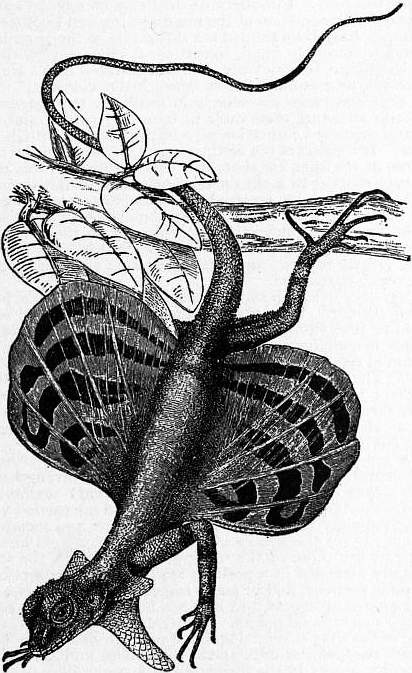
Dragon Lizard (Draco taeniopterus).
As to their form, this varied from the beginning. The Chaldaean dragon Tiāmat had four legs, a scaly body, and wings. The Egyptian Apophis was a monstrous snake, as were also, originally at least, the Greek dracontes. The dragon of the Apocalypse (Rev. xii. 3), “the old serpent,” is many-headed, like the Greek Hydra. The dragon slain by Beowulf is a snake (worm), for it “buckles like a bow “; but that done to death by Sigurd, though its motions are heavy and snake-like, has legs, for he wounds it “behind the shoulder.” On the other hand, the dragon seen by King Arthur in his dreams is, according to Malory, winged and active, for it “swoughs” down from the sky. The belief in dragons and the conceptions of their shape were undoubtedly often determined, in Europe as in China, by the discovery of the remains of the gigantic extinct saurians.
The qualities of dragons being protective and terror-inspiring, and their effigies highly decorative, it is natural that they should have been early used as warlike emblems. Thus, in Homer (Iliad xi. 36 seq.), Agamemnon has on his shield, besides the Gorgon’s head, a blue three-headed snake (δράκων), just as ages afterwards the Norse warriors painted dragons on their shields and carved dragons’ heads on the prows of their ships. From the conquered Dacians, too, the Romans in Trajan’s time borrowed the dragon ensign which became the standard of the cohort as the eagle was that of the legion; whence, by a long descent, the modern dragoon. Under the later East Roman emperors the purple dragon ensign became the ceremonial standard of the emperors, under the name of the δρακόντειον. The imperial fashion spread; or similar causes elsewhere produced similar results. In England before the Conquest the dragon was chief among the royal ensigns in war. Its origin, according to the legend preserved in the Flores historiarum, was as follows. Uther Pendragon, father of King Arthur, had a vision of a flaming dragon in the sky, which his seers interpreted as meaning that he should come to the kingdom. When this happened, after the death of his brother Aurelius, “he ordered two golden dragons to be fashioned, like to those he had seen in the circle of the star, one of which he dedicated in the cathedral of Winchester, the other he kept by him to be carried into battle.” From Uther Dragonhead, as the English called him, the Anglo-Saxon kings borrowed the ensign, their custom being, according to the Flores, to stand in battle inter draconem et standardum. The dragon ensign, which was borne before Richard I. in 1191 when on crusade “to the terror of the heathen beyond the sea,” was that of the dukes of Normandy; but even after the loss of Normandy the dragon was the battle standard of English kings (signum regium quod Draconem vocant), and was displayed, e.g. by Henry III. in 1245 when he went to war against the Welsh. Not till the 20th century, under King Edward VII., was the dragon officially restored as proper only to the British race of Uther Pendragon, by its incorporation in the armorial bearings of the prince of Wales. As a matter of fact, however, the dragon ensign was common to nearly all nations, the reason for its popularity being naïvely stated in the romance of Athis (quoted by Du Cange),
“Ce souloient Romains porter, Ce nous fait moult à redouter:”
“This the Romans used to carry, This makes us very much to be feared.” Thus the dragon and wyvern (i.e. a two-legged snake, M.E. wivere, viper) took their place as heraldic symbols (see Heraldry).
As an ecclesiastical symbol it has remained consistent to the present day. Wherever it is represented it means the principle of evil, the devil and his works. In the middle ages the chief of these works was heresy, and the dragon of the medieval church legends and mystery plays was usually heresy. Thus the knightly order of the vanquished dragon, instituted by the emperor Sigismund in 1418, celebrated the victory of orthodoxy over John Huss. Hell, too, is represented in medieval art as a dragon with gaping jaws belching fire. Of the dragons carried in effigy in religious processions some have become famous, e.g. the Gargouille (gargoyle) at Rouen, the Graülly at Metz, and the Tarasque at Tarascon. Their popularity tended to disguise their evil significance and to restore to them something of the beneficent qualities of the ancient dracontes as local tutelary genii.
In the East, at the present day, the dragon is the national symbol of China and the badge of the imperial family, and as such it plays a large part in Chinese art. Chinese and Japanese dragons, though regarded as powers of the air, are wingless. They are among the deified forces of nature of the Taoist religion, and the shrines of the dragon-kings, who dwell partly in water and partly on land, are set along the banks of rivers.
The constellation Draco (anguis, serpens) was probably so called from its fanciful likeness to a snake. Numerous myths, in various countries, are however connected with it. The general character of these may be illustrated by the Greek story which explains the constellation as being the dragon of the Hesperides slain by Heracles and translated by Hera or Zeus to the heavens.
See C. V. Daremberg and E. Saglio, Dictionnaire des antiquités grecques et romaines (Paris, 1886, &c.), s.v. “Draco”; Pauly-Wissowa, Realencyclopädie, s.v. “Drakon”; Du Cange, Glossarium, s.v. “Draco”; La Grande Encyclopédie s.v. “Dragon”; J. B. Panthot, Histoire des dragons et des escarboucles (Lyons, 1691). See also the articles Egypt: Religion, and Babylonian and Assyrian Religion.
(W. A. P.)
In zoology the name “dragon” is now applied to a highly interesting, but very harmless, group of small flying lizards forming the genus Draco, belonging to the Agamidae, a family of Saurian reptiles. About 20 species of “flying dragons” inhabit the various Indo-Malayan countries; one, D. dussumieri, occurs in Madras. They are small creatures, measuring about 10 in. long, including the tail, which in some cases is more than half of the entire length. The head is small, and the throat is provided with three pouches which are spread out when they lie on the trunks of trees. They are, however, chiefly remarkable for the wing-like cutaneous processes with which their sides are provided, and which are extended and supported by greatly elongated ribs. These form a sort of parachute by which the animals are enabled to glide from branch to branch of the trees on which they live, but, being altogether independent of the fore limbs, they cannot be regarded as true wings, nor do they enable the lizard to fly, but merely to make extensive leaps. But they have the habit of opening and folding these prettily coloured organs, when resting upon a branch, which gives them the appearance of butterflies. When not in use they are folded by the side after the manner of a fan, and the dragon can then walk or run with considerable agility. Its food consists of insects.
DRAGONETTI, DOMENICO (1763-1846), Italian double-bass player, was born in Venice on the 7th of April 1763. Having become famous as a performer on his instrument, he went to London in 1794, where his playing created a furore. He was the friend of Haydn and of Beethoven, and a well-known character in his day. He died in London on the 16th of April 1846.
DRAGON-FLY (Ger. Wasserjungfer; Swed. trollslända; Dan. guldsmed; Dutch, scherpstekendevlieg; Fr. demoiselle), the popular English name applied to the members of a remarkable group of insects which formed the genus Libellula of Linnaeus and the ancient authors. In some parts of the United States they appear to be known as “devil’s darning needles,” and in many parts of England are termed “horse-stingers.” It is almost needless to say that (excepting to other insects upon which they prey) they are perfectly innocuous, though some of the larger species can inflict a momentarily painful bite with their powerful jaws. Their true systematic position is still contested and somewhat uncertain. By most of the older systematists they were placed as forming part of the heterogeneous order Neuroptera. J. C. Fabricius, however, elevated them to the rank of a distinct order, which he termed Odonata; and whatever may be the difference of opinion amongst authors at the present day, that term is almost universally employed for the group. W. F. Erichson transferred all the groups of so-called Neuroptera with incomplete metamorphoses, hence including the dragon-flies, as a division of Orthoptera, which he termed Pseudo-Neuroptera. K. E. A. Gerstäcker more recently also retains them in the Orthoptera, terming those groups in which the earlier states are subaquatic Orthoptera amphibotica. All entomologists are agreed in maintaining the insects as forming a group marked by characters at once extraordinary and isolated in their nature, and in most modern classifications they are treated as a distinct order.
The group Odonata is divided into three families, and each of these again into two subfamilies. The families are the Agrionidae, Aeschnidae and Libellulidae—the first including the subfamilies Calopterygina and Agrionina, the second Gomphina and Aeschnina, and the third Cordulina and Libellulina.
Anatomy.—The structure of a dragon-fly being so very remarkable, it is necessary to enter somewhat extensively into details. The head is comparatively small, and excavated posteriorly, connected very slightly with the prothorax, on which it turns almost as on a pivot. The eyes are, as a rule, enormous, often contiguous, and occupying nearly the whole of the upper surface of the head, but sometimes (Agrionidae and Gomphina) widely distant; occupied by innumerable facets, which are often larger on the upper portion. The antennae, which are smaller in proportion than in almost any other insects, consist only of two short swollen basal joints and a 5 or 6-jointed bristle-like thread. The large labrum conceals the jaws and inner mouth parts. The lower lip, or labium (formed by the conjoined second maxillae), is attached to a very small chin piece (or mentum), and is generally very large, often (Agrionidae) divided almost to its base into two portions, or more frequently entire or nearly so; on each side of it are two usually enormous hypertrophied pieces, which form the “palpi,” and which are often furnished at the tips with an articulated spine (or terminal joint), the whole structure serving to retain the prey. Considerable diversity of opinion exists with respect to the composition of the mouth parts, and by some authors the “palpi” have been termed the side pieces of the lower lip. The prothorax is extremely small, consisting of only a narrow ring. The rest of the thorax is very large, and consolidated into a single piece with oblique sutures on the sides beneath the wings.
The abdomen varies excessively in form, the two extremes being the filiform structure observable in most Agrionidae, and the very broad and depressed formation seen in the familiar British Libellula depressa. It consists of ten distinct segments, whereof the basal two and those at the apex are short, the others elongate, the first being excessively short. In a slit on the under side of the second in the male, accompanied by external protuberances, are concealed the genital organs: on the under side of the eighth in the female is a scale-like formation, indicating the entrance to the oviduct. The tenth is always provided in both sexes with prominent appendages, differing greatly in form, and often furnishing the best specific (and even generic) characters.
The legs vary in length and stoutness, but may, as a rule, be termed long and slender. The anterior pair probably assist in capturing and holding insect prey, but the greatest service all the legs render is possibly in enabling the creature to rest lightly, so that it can quit a position of repose in chase of passing prey in the quickest possible manner. The coxa is short and stout, followed by a still shorter trochanter; the femora and tibiae long and slender, almost invariably furnished on their under surface with two series of strong spines, as also are the tarsi, which consist of three slender joints, the last having two long and slender claws.
The wings are always elongate, and furnished with strong longitudinal neuration and dense transverse nervules strengthening the already strong (although typically transparent) membrane. In the Agrionidae both pairs are nearly equal, and are carried vertically and longitudinally in repose, and the neuration and membrane are less strong; hence the species of this family are not so powerful on the wing as are those of the other groups in which the wings are horizontally extended in a position ready for instant service. The neuration is peculiar, and in many respects without precise analogy in other groups of insects, but it is not necessary here to enter into more than some special points. The arrangement of the nervures at the base of the wing is very singular, and slight differences in it form useful aids to classification. In the Aeschnidae and Libellulidae this arrangement results in the formation of a triangular space (known as the “triangle”), which is either open or traversed by nervules; but in many Agrionidae this space, instead of being triangular, is oblong or elongately quadrate, or with its upper edge partly straight and partly oblique. This fixitude of type in neuration is not one of the least important of the many peculiarities exhibited in these insects.
The internal structure is comparatively simple. The existence of salivary glands, denied by L. Duprix, has been asserted by O. Poletajewa. The rest of the digestive apparatus consists of an elongate canal extending from mouth to anus, comprising the oesophagus, stomach and intestine, with certain dilatations and constrictions; the characteristic Malpighian vessels are stated to number about forty, placed round the posterior extremity of the stomach. Dragon-flies eat their prey completely, and do not content themselves by merely sucking its juices; the harder portions are rejected as elongate, nearly dry, pellets of excrement.
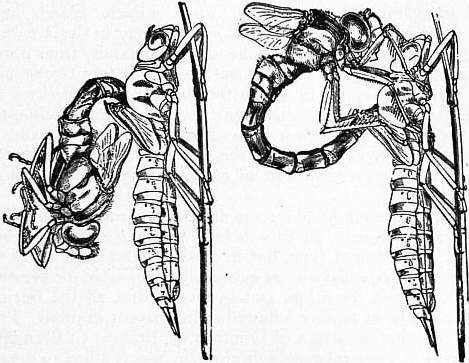
Fig. 1—The anterior portion of the body of Aeschna cynea freed from the nymph-cuticle. Fig. 2.—The tail being extricated.
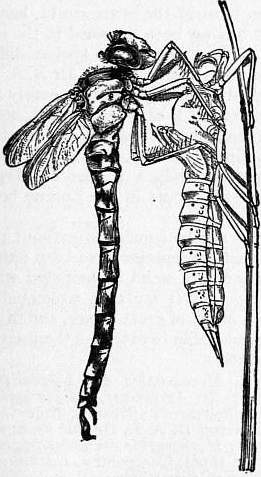
Fig. 3.—The whole body extricated.
Pairing.—But the most extraordinary feature in the economy—one which has attracted the attention of naturalists from remote times—is the position of the genital organs, and the corresponding anomalous manner in which the pairing of the sexes and impregnation is effected. In the male the intromittent organ is situated in a slit on the under surface of the second abdominal segment; it is usually very crooked or sinuous in form, and is accompanied by sheaths, and by external hooks or secondary appendages, and also by seminal vessels. But the ducts of the vessels connected with the testes unite and open on the under surface of the ninth segment; hence, before copulation can take place, it is necessary that the vessels in the second segment be charged from this opening, and in the majority of cases this is done by the male previously to seeking the female. In the latter sex the entrance to the oviduct and genital organs is on the under surface of the eighth abdominal segment. The act of pairing may be briefly stated as follows. The male, when flying, seizes the prothorax of the female with the strong appendages at the extremity of the abdomen, and the abdomen of this latter sex is then curved upward so as to bring the under side of the eighth segment into contact with the organs of the second segment of the male. In the more powerful Libellulidae, &c., the act is of short duration, and it is probable that polygamy and polyandry exist, for it possibly requires more than one almost momentary act to fertilize all the eggs in the ovaries of a female. But in many Agrionidae, and in some others, the male keeps his hold of the prothorax of the female for a lengthened period, retaining himself in flight in an almost perpendicular manner, and it may be that the deposition of eggs and pairing goes on alternately. There is, however, much yet to be learned on these points. The gravid female usually lays her eggs in masses (but perhaps sometimes singly), and the operation may be witnessed by any one in localities frequented by these insects. She hovers for a considerable time over nearly the same spot, rapidly dipping the apex of her abdomen into the water, or at any rate touching it, and often in places where there are no water-weeds, so that in all probability the eggs fall at once to the bottom. But in some of the Agrionidae the female has been often noticed by trustworthy observers to creep down the stems of aquatic plants several inches below the surface, emerging after the act of oviposition has been effected; and in the case of Lestes sponsa, K. T. E. von Siebold saw the male descend with the female. The same exact observer noticed also in this species that the female makes slight incisions in the stems or leaves of water plants with the double serrated apparatus (vulva) forming a prolongation of the ninth segment beneath, depositing an egg in each incision. He has seen two pairs thus occupied beneath the surface on one and the same stem.
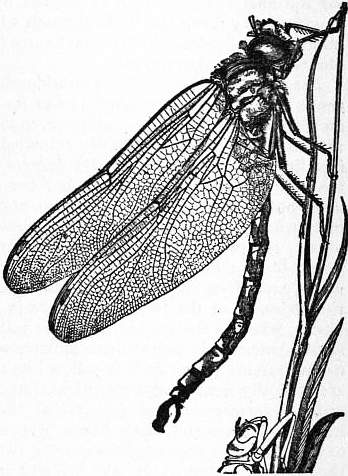
Fig. 4.—The perfect insect (the wings having acquired their full dimensions) resting to dry itself, preparatory to the wings being horizontally extended.
Larva and Nymph.—The duration of the subaquatic life of a dragon-fly is no doubt variable, according to the species. In the smaller forms it is probably less than a year, but precise evidence is wanting as to the occurrence of two broods in one year. On the other hand, it is certain that often a longer period is requisite to enable the creature to attain its full growth, and three years have been stated to be necessary for this in the large and powerful Anax formosus. Like all insects with incomplete metamorphoses, there is no quiescent pupal condition, no sharp line of demarcation between the larval and so-called “nymph” or penultimate stage. The creature goes on eating and increasing in size from the moment it emerges from the egg to the time when it leaves the water to be transformed into the aerial perfect insect. The number of moults is uncertain, but they are without doubt numerous. At probably about the antepenultimate of these operations, the rudimentary wings begin to appear as thoracic buddings, and in the full-grown nymph these wings overlap about one-half of the dorsal surface of the abdomen. In structure there is a certain amount of resemblance to the perfect insect, but the body is always much stouter and shorter, in some cases most disproportionately so, and the eyes are always separated; even in those genera (e.g. Aeschna) in which the eyes of the imago are absolutely contiguous, the most that can be seen in the larva is a prolongation towards each other, and there are no ocelli. The legs are shorter and more fitted for crawling about water plants and on the bottom. In the mouth parts the mandibles and maxillae are similar in form to those of the adult, but there is an extraordinary and unique modification of the lower lip. This is attached to an elongate and slender mentum articulated to the posterior portion of the lower surface of the head, slightly widened at its extremity, to which is again articulated the labium proper, which is very large, flattened, and gradually dilated to its extremity; but its form differs according to group as in the perfect insect. Thus in the Agrionidae it is deeply cleft, and with comparatively slender side-pieces (or palpi), and strongly developed articulated spines; in the Aeschnidae it is at the most notched, with narrow side-pieces and very strong spines; in the Libellulidae it is entire, often triangular at its apex, and with enormously developed palpi without spines, but having the opposing inner edges furnished with interlocking serrations. The whole of this apparatus is commonly termed the mask. In a state of repose it is applied closely against the face, the elongated mentum directed backward and lying between the anterior pair of legs; but when an approaching victim is seen the whole apparatus is suddenly projected, and the prey caught by the raptorial palpi; in some large species it is capable of being projected fully half an inch in front of the head. The prey, once caught and held by this apparatus, is devoured in the usual manner. There are two pairs of thoracic spiracles, through which the nymph breathes during its later life by thrusting the anterior end of the body into the air; but respiration is mostly effected by a peculiar apparatus at the tail end, and there are two different methods. In the Agrionidae there are three elongate flattened plates, or false gills, full of tracheal ramifications, which extract the air from the water, and convey it to the internal tracheae (in Calopteryx these plates are excessively long, nearly equalling the abdomen), the plates also serving as means of locomotion. But in the other groups these external false gills are absent, and in their place are five valves, which by their sudden opening and closing force in the water to the rectum, the walls of which are furnished with branchial lamellae. The alternate opening and closing of these valves enables the creature to make quick jerks or rushes (incorrectly termed “leaps”) through the water,1 and, in conjunction with its mouth parts, to make sudden attacks upon prey from a considerable distance. Well-developed Aeschnid larvae have been observed to take atmospheric air into the rectum. The lateral angles of the terminal abdominal segments are sometimes produced into long curved spines. In colour these larvae are generally muddy, and they frequently have a coating of muddy particles, and hence are less likely to be observed by their victims. If among insects the perfect dragon-fly may be termed the tyrant of the air, so may its larva be styled that of the water. Aquatic insects and larvae form the principal food, but there can be no doubt that worms, the fry of fish, and even younger larvae of their own species, form part of the bill of fare. The “nymph” when arrived at its full growth sallies forth from the water, and often crawls a considerable distance (frequently many feet up the trunks of trees) before it fixes itself for the final change, which is effected by the thorax splitting longitudinally down the back, through which fissure the perfect insect gradually drags itself. The figures indicate this process as observed in Aeschna cyanea.
The Complete Insect.-For a considerable time after its emergence a dragon-fly is without any of its characteristic colours, and is flaccid and weak, the wings (even in those groups in which they are afterwards horizontally extended) being held vertically in a line with the abdomen. By degrees the parts harden, and the insect essays its first flight, but even then the wings have little power and are semi-opaque in appearance, as if dipped in mucilage. In most species of Calopterygina, and in some others, the prevailing colour of the body is a brilliant bronzy green, blue or black, but the colours in the other groups vary much, and often differ in the sexes. Thus in Libellula depressa the abdomen of the fully adult male is covered with a bluish bloom, whereas that of the female is yellow; but several days elapse before this pulverulent appearance is attained, and a comparatively young male is yellow like the female. The wings are typically hyaline and colourless, but in many species (especially Calopterygina and Libellulina) they may be wholly or in part opaque and often black, due apparently to gradual oxydization of a pigment between the two membranes of which the wings are composed; the brilliant iridescence, or metallic lustre, so frequently found is no doubt due to interference—the effect of minute irregularities of the surface—and not produced by a pigment. A beautiful little genus (Chalcopteryx) of Calopterygina from the Amazon is a gem in the world of insects, the posterior wings being of the most brilliant fiery metallic colour, whereas the anterior remain hyaline.
These insects are pre-eminently lovers of the hottest sunshine (a few are somewhat crepuscular), and the most powerful and daring on the wing in fine weather become inert and comparatively lifeless when at rest in dull weather, allowing themselves to be captured by the fingers without making any effort to escape. Many of the larger species (Aeschna, &c.) have a habit of affecting a particular twig or other resting place like a fly-catcher among birds, darting off after prey and making long excursions, but returning to the chosen spot. A. R. Wallace, in his Malay Archipelago, states that the inhabitants of Lombok use the large species for food, and catch them by means of limed twigs.
They are distributed over the whole world excepting the polar regions, but are especially insects of the tropics. At the present day about 2200 species are known, dispersed unequally among the several subfamilies as follows: Agrionina, 700 species; Calopterygina, 280; Gomphina, 320; Aeschnina, 170; Corduliina, 130; Libellulina, 600. In Europe proper only 100 species have been observed, and about 46 of these occur in the British islands. New Zealand is excessively poor, and can only number 8 species, whereas they are very numerous in Australia. Some species are often seen at sea, far from land, in calm weather, in troops which are no doubt migratory; the common Libellula quadrimaculata, which inhabits the cold and temperate regions of the northern hemisphere, has been frequently seen in immense migratory swarms. One species (Pantala flavescens) has about the widest range of any insect, occurring in the Old World from Kamtchatka to Australia, and in the New from the Southern States to Chili, also all over Africa and the Pacific islands, but is not found in Europe. The largest species occur in the Aeschnina and Agrionina; a member of the former subfamily from Borneo expands to nearly 6½ in., and with a moderately strong body and powerful form; in the latter the Central American and Brazilian Megaloprepus caerulatus and species of Mecistogaster are very large, the former expanding to nearly 7 in., and the latter to nearly as much, but the abdomen is not thicker than an ordinary grass-stem and of extreme length (fully 5 in. in Mecistogaster).
Fossils.—Among fossil insects dragon-flies hold a conspicuous position. Not only do they belong to what appears to have been a very ancient type, but in addition, the large wings and strong dense reticulation are extremely favourable for preservation in a fossil condition, and in many cases all the intricate details can be as readily followed as in a recent example. From the Carboniferous strata of Commentry, France, C. Brongniart has described several genera of gigantic insects allied to dragon-flies, but with less specialized thoracic segments and simpler wing-neuration. These form a special group—the Protodonata. True Odonata referable to the existing families are plentiful in Mesozoic formations; in England they have been found more especially in the Purbeck beds of Swanage, and the vales of Wardour and Aylesbury, in the Stonesfield Slate series, and in the Lias and Rhaetic series of the west of England. But the richest strata appear to be those of the Upper Miocene at Oeningen, near Schaffhausen in the Rhine valley; the Middle Miocene at Radaboj, near Krapina in Croatia; the Eocene of Aix, in Provence; and more especially the celebrated Secondary rocks furnishing the lithographic stone of Solenhofen, in Bavaria. This latter deposit would appear to have been of marine origin, and it is significant that, although the remains of gigantic dragon-flies discovered in it are very numerous and perfect, no traces of their subaquatic conditions have been found, although these as a rule are numerous in most of the other strata, hence the insects may be regarded as having been drowned in the sea and washed on shore. Many of these Solenhofen species differ considerably in form from those now existing, so that Dr H. A. L. Hagen, who has especially studied them, says that for nearly all it is necessary to make new genera. It is of great interest, however, to find that a living Malayan genus (Euphaea) and another living genus Uropetala, now confined to New Zealand, are represented in the Solenhofen deposits, while a species of Megapodagrion now entirely Neotropical, occurs in the Eocene beds of Wyoming.
A notice of fossil forms should not be concluded without the remark that indications of at least two species have been found in amber, a number disproportionately small if compared with other insects entombed therein; but it must be remembered that a dragon-fly is, as a rule, an insect of great power, and in all probability those then existing were able to extricate themselves if accidentally entangled in the resin.
See E. de Selys-Longchamps, Monographie des Libellulidées d’Europe (Brussels, 1840); Synopses des Agrionines, Caloptérygines, Gomphines, et Cordulines, with Supplements (Brussels, from 1853 to 1877); E. de Selys-Longchamps and H. A. L. Hagen, Revue des Odonates d’Europe (Brussels, 1850); Monographie des Caloptérygines et des Gomphines (Brussels, 1854 and 1858); Charpentier, Libellulinae europeae (Leipzig, 1840). For modern systematic work see various papers by R. M’Lachlan, P. P. Calvert, J. G. Needham, R. Martin, E. B. Williamson, F. Karsch, &c.; also H. Tumpel, Die Geradflugler Mitteleuropas (Eisenach, 1900); and W. F. Kirby, Catalogue of Neuroptera Odonata (London, 1890). For habits and details of transformation and larval life, see L. C. Miall, Natural History of Aquatic Insects (London, 1895); H. Dewitz, Zool. Anz. xiii. (1891); and J. G. Needham, Bull. New York Museum, lxviii. (1903). For geographical distribution, G. H. Carpenter, Sci. Proc. R. Dublin Soc. viii. (1897). For British species, W. J. Lucas, Handbook of British Dragonflies (London, 1899). For wings and mechanism of flight, R. von Lendenfeld, S.B. Akad. Wien, lxxxiii. (1881), and J. G. Needham, Proc. U.S. Nat. Mus. xxvi. (1903). For general morphology, R. Heymons, Abhandl. k. preuss. Akad. (1896), and Ann. Hofmus. Wein, xix. (1904).
(R. M‘L.; G. H. C.)
1 A similar contrivance was suggested and (if the writer mistakes not) actually tried as a means of propelling steamships.
DRAGON’S BLOOD, a red-coloured resin obtained from several species of plants. Calamus draco (Willd.), one of the rotang or rattan palms, which produces much of the dragon’s blood of commerce, is a native of Further India and the Eastern Archipelago. The fruit is round, pointed, scaly, and the size of a large cherry, and when ripe is coated with the resinous exudation known as dragon’s blood. The finest dragon’s blood, called jernang or djernang in the East Indies, is obtained by beating or shaking the gathered fruits, sifting out impurities, and melting by exposure to the heat of the sun or by placing in boiling water; the resin thus purified is then usually moulded into sticks or quills, and after being wrapped in reeds or palm-leaves, is ready for market. An impurer and inferior kind, sold in lumps of considerable size, is extracted from the fruits by boiling. Dragon’s blood is dark red-brown, nearly opaque and brittle, contains small shell-like flakes, and gives when ground a fine red powder; it is soluble in alcohol, ether, and fixed and volatile oils. If heated it gives off benzoic acid. In Europe it was once valued as a medicine on account of its astringent properties, and is now used for colouring varnishes and lacquers; in China, where it is mostly consumed, it is employed to give a red facing to writing paper. The drop dragon’s blood of commerce, called cinnabar by Pliny (N.H. xxxiii. 39), and sangre de dragon by Barbosa was formerly and is still one of the products of Socotra, and is obtained from Dracaena cinnabari. The dragon’s blood of the Canary Islands is a resin procured from the surface of the leaves and from cracks in the trunk of Dracaena draco. The hardened juice of a euphorbiaceous tree, Croton draco, a resin resembling kino, is the sangre del drago or dragon’s blood of the Mexicans, used by them as a vulnerary and astringent.
DRAGOON (Fr. dragon, Ger. Dragoner), originally a mounted soldier trained to fight on foot only (see Cavalry). This mounted infantryman of the late 16th and 17th centuries, like his comrades of the infantry who were styled “pike” and “shot,” took his name from his weapon, a species of carbine or short musket called the “dragon.” Dragoons were organized not in squadrons but in companies, like the foot, and their officers and non-commissioned officers bore infantry titles. The invariable tendency of the old-fashioned dragoon, who was always at a disadvantage when engaged against true cavalry, was to improve his horsemanship and armament to the cavalry standard. Thus “dragoon” came to mean medium cavalry, and this significance the word has retained since the early wars of Frederick the Great, save for a few local and temporary returns to the original meaning. The phrases “to dragoon” and “dragonnade” bear witness to the mounted infantry period, this arm being the most efficient and economical form of cavalry for police work and guerrilla warfare. The “Dragonnades,” properly so called, were the operations of the troops (chiefly mounted) engaged in enforcing Louis XIV.’s decrees against Protestants after the revocation of the edict of Nantes. In the British service the dragoons (1st Royals, 2nd Scots Greys, 6th Inniskillings) are heavy cavalry, the Dragoon Guards (seven regiments) are medium, as are the dragoons of other countries. The light cavalry of the British army in the 18th and early 19th century was for the most part called light dragoons.
DRAGUIGNAN, the chief town of the department of the Var in S.E. France; 51 m. N.E. of Toulon, and 28½ m. N.W. of Fréjus by rail; situated at a height of 679 ft. above the level of the sea, at the southern foot of the wooded heights of Malmont, and on the left bank of the Nartuby river; pop. (1906) 7766. It possesses no notable buildings, save a modern parish church, a prefecture, also modern, and a building wherein are housed the town library and a picture gallery, with some fair works of art. In modern times the ramparts have been demolished, and new wide streets pierced through the town.
DRAINAGE OF LAND. The verb “to drain,” with its substantives “drain” and “drainage,” represents the O. Eng. dreahnian, from the same root found in “dry,” and signifies generally the act of drawing off moisture or liquid from somewhere, and so drinking dry, and (figuratively) exhausting; the substantive “drain” being thus used not only in the direct sense of a channel for carrying off liquid, but also figuratively for a very small amount such as would be left as dregs. The term “drainage” is applied generally to all operations involving the drawing off of water or other liquid, but more particularly to those connected with the treatment of the soil in agriculture, or with the removal of water and refuse from streets and houses. For the last, see Sewerage; the following article being devoted to the agricultural aspects of this subject. See also the articles Reclamation of Land, Canal, Irrigation, River Engineering, Water Supply and (law) Water Rights.
Agricultural or field drainage consists in the freeing of the soil from stagnant and superfluous water by means of surface or underground channels. It may be distinguished from the draining of land on a large scale which is exemplified in the reclamation of the English Fens (see Fens). Surface drainage is usually effected by ploughing the land into convex ridges off which the water runs into intervening furrows and is conveyed into ditches. For several reasons this method is ineffective, and, where possible, is now superseded by underground drainage by means of pipe-tiles. Land is not in a satisfactory condition with respect to drainage unless the rain that falls upon it can sink down to the minimum depth required for the healthy development of the roots of crops and thence find vent either through a naturally porous subsoil or by artificial channels.
A few of the evils inseparable from the presence of overmuch water in the soil may be enumerated. Wet land, if in grass, produces only the coarser grasses, and many subaquatic plants and mosses, which are of little or no value for pasturage; its herbage is late in spring, and fails early in autumn; the animals grazed upon it are unduly liable to disease, and sheep, especially, to foot-rot and liver-rot. In the case of arable land the crops are poor and moisture-loving weeds flourish. Tillage operations on such land are easily interrupted by rain, and the period always much limited in which they can be prosecuted at all; the compactness and toughness of the soil renders each operation more arduous, and its repetition more necessary than in the case of dry land. The surface must necessarily be thrown into ridges, and the furrows and cross-cuts cleared out after each process of tillage, and upon this surface-drainage as much labour is expended in twenty years as would suffice to make under-drains enough to lay it permanently dry. With all these precautions the best seed time is often missed, and this usually proves the prelude to a scanty crop, or to a late and disastrous harvest. The cultivation of the turnip and other root crops, which require the soil to be wrought to a deep and free tilth, either becomes altogether impracticable and must be abandoned for the safe but costly bare fallow, or is carried out with great labour and hazard; and the crop, when grown, can neither be removed from the ground, nor consumed upon it by sheep without damage by “poaching.”
The roots of plants require both air and warmth. A deep stratum through which water can percolate, but in which it can never stagnate, is therefore necessary. A waterlogged soil is impenetrable by air, and owing to the continuous process of evaporation and radiation, its temperature is much below that of drained soil. The surface of the water in the supersaturated soil is known as the “water-table” and is exemplified in water standing in a well. Water will rise in clay by capillarity to a height of 50 in., in sand to 22 in. Above the “water-table” the water is held by capillarity, and the percentage of water held decreases as we approach the surface where there may be perfect dryness. Draining reduces the “surface tension” of the capillary water by removal of the excess, but the “water-table” may be many feet below. Drains ordinarily remove only excess of capillary water, an excess of percolating water in wet weather.
In setting about the draining of a field, or farm, or estate, the first point is to secure a proper outfall. The lines of the receiving drains must next be determined, and then the direction of the parallel drains. The former must occupy the lowest part of the natural hollows, and the latter must run in the line of the greatest slope of the ground. In the case of flat land, where a fall is obtained chiefly by increasing the depth of the drains at their lower ends, these lines may be disposed in any direction that is found convenient; but in undulating ground a single field may require several distinct sets of drains lying at different angles, so as to suit its several slopes. When a field is ridged in the line of the greatest ascent of the ground, there is an obvious convenience in adopting the furrows as the site of the drains; but wherever this is not the case the drains must be laid off to suit the contour of the ground, irrespective of the furrows altogether. When parts of a field are flat, and other parts have a considerable acclivity, it is expedient to cut a receiving drain near to the bottom of the slopes, and to give the flat ground an independent set of drains. In laying off receiving drains it is essential to give hedgerows and trees a good offing, lest the conduit be obstructed by the roots.
When a main drain is so placed that parallel ones empty into it from both sides, care should be taken that the inlets of the latter are not made exactly opposite to each other. Much of the success of draining depends on the skilful planning of these main drains, and in making them large enough to discharge the greatest flow of water to which they may be exposed. Very long main drains are to be avoided. Numerous outlets are also objectionable, from their liability to obstruction. An outlet to an area of from 10 to 15 acres is a good arrangement. These outlets should be faced with mason work, and guarded with iron gratings.
The distance and depth apart of the parallel drains is determined chiefly by reference to the texture of the soil. In an impervious clay the flow of the water is much impeded and the water-table can be controlled only by frequent lines of pipes. On such land it is customary to lay them about 3 ft. from the surface and from 15 to 21 ft. apart. In lighter soils the depth, and proportionately the distance apart, is increased, but the drains are rarely more than 4 ft. 6 in. below the surface, though they may be 75 or 100 apart. A fall of at least 1 in 200 is desirable.
There are various forms of under-drainage, some of them alluded to in the historical section below, but by far the commonest is by means of cylindrical or oval pipes of burnt clay about 1 ft. in length, sometimes supplemented by collars, though nowadays the use of these is being abandoned. Pipes vary in bore from 2 in. for the parallel to 6 in. for the main drains.
In constructing a drain, it is of importance that the bottom be cut out just wide enough to admit the pipes and no more. Pipes, when accurately fitted in, are much less liable to derangement than when laid in the bottom of a trench several times their width, into which a mass of loose earth must necessarily be returned. This is easily effected in the case of soils tolerably free from stones by the use of draining spades and the tile-hook which are represented in the accompanying cut. The tile-hook is an implement by means of which the pipes may be lowered from the edge of the trench and laid at the bottom. An implement, sometimes propelled by steam, known as the draining plough, can be used for opening the trenches. Draining can be carried on at all seasons, but is usually best done in autumn or summer. A thoroughly trustworthy and experienced workman should be selected to lay the pipes, with instructions to set no pipes until he is satisfied that the depth of the drains and level of the bottoms are correct. The expense of tile-drainage may vary from about £2:10s. per acre on loose soils to £10 an acre on the most tenacious soils, the rate of wages and the cost of the pipes, the depth of the trenches and the ease with which they can be dug, all influencing the cost of the process.