VOLUME VIII SLICE VI Dodwell to Drama (continued 5)
Reading edition
See Jerdan, National Portraits, vol. iii.; Gentleman’s Magazine, xcii. i. 273.
DONNAY, CHARLES MAURICE (1859- ), French dramatist, was born of middle-class parents in Paris in 1859. He made his serious début as a dramatist on the little stage of the Chat Noir with Phryné (1891), a series of Greek scenes. Lysistrata, a four-act comedy, was produced at the Grand Théâtre in 1892 with Mme Réjane in the title part. Later plays were Folle Entreprise (1894); Pension de famille (1894); Complices (1895), in collaboration with M. Groselande; Amants (1895), produced at the Renaissance theatre with Mme Jeanne Granier as Claudine Rozeray; La Douloureuse (1897); L’Affranchie (1898); Georgette Lemeunier (1898); Le Torrent (1899), at the Comédie Française; Éducation de prince (1900); La Clairière (1900), and Oiseaux de passage (1904), in collaboration with L. Descaves; La Bascule (1901); L’Autre danger, at the Comédie Française (1902); Le Retour de Jérusalem (1903); L’Escalade (1904); and Paraître (1906). With Amants he won a great success, and the play was hailed by Jules Lemaître as the Bérénice of contemporary French drama. Very advanced ideas on the relations between the sexes dominate the whole series of plays, and the witty dialogue is written with an apparent carelessness that approximates very closely to the language of every day.
DONNE, JOHN (1573-1631), English poet and divine of the reign of James I., was born in 1573 in the parish of St Nicholas Olave, in the city of London. His father was a wealthy merchant, who next year became warden of the Company of Ironmongers, but died early in 1576. Donne’s parents were Catholics, and his mother, Elizabeth Heywood, was directly descended from the sister of the great Sir Thomas More; she was the daughter of John Heywood the epigrammatist. As a child, Donne’s precocity was such that it was said of him that “this age hath brought forth another Pico della Mirandola.” He entered Hart Hall, Oxford, in October 1584, and left it in 1587, proceeding for a time to Cambridge, where he took his degree. At Oxford he began his friendship with Henry Wotton, and at Cambridge, probably, with Christopher Brooke. Donne was “removed to London” about 1590, and in 1592 he entered Lincoln’s Inn with the intention of studying the law.
When he came of age, he found himself in possession of a considerable fortune, and about the same time rejected the Catholic doctrine in favour of the Anglican communion. He began to produce Satires, which were not printed, but eagerly passed from hand to hand; the first three are known to belong to 1593, the fourth to 1594, while the other three are probably some years later. In 1596 Donne engaged himself for foreign service under the earl of Essex, and “waited upon his lordship” on board the “Repulse,” in the magnificent victory of the 11th of June. We possess several poems written by Donne during this expedition, and during the Islands Voyage of 1597, in which he accompanied Essex to the Azores. According to Walton, Donne spent some time in Italy and Spain, and intended to proceed to Palestine, “but at his being in the farthest parts of Italy, the disappointment of company, or of a safe convoy, or the uncertainty of returns of money into those remote parts, denied him that happiness.” There is some reason to suppose that he was on the continent at intervals between 1595 and the winter of 1597. His lyrical poetry was mainly the product of his exile, if we are to believe Ben Jonson, who told Drummond of Hawthornden that Donne “wrote all his best pieces ere he was 25 years old.” At his return to England he became private secretary in London to Sir Thomas Egerton, the lord keeper (afterwards Lord Brackley), in whose family he remained four years. In 1600 he found himself in love with his master’s niece, Anne More, whom he married secretly in December 1601. As soon as this act was discovered, Donne was dismissed, and then thrown into the Fleet prison (February 1602), from which he was soon released. His circumstances, however, were now very much straitened. His own fortune had all been spent and “troubles did still multiply upon him.” Mrs Donne’s cousin, Sir Francis Wooley, offered the young couple an asylum at his country house of Pyrford, where they resided until the end of 1604.
During the latter part of his residence in Sir Thomas Egerton’s house, Donne had composed the longest of his existing poems, The Progress of the Soul, not published until 1633. In the spring of 1605 we find the Donnes living at Camberwell, and a little later in a small house at Mitcham. He had by this time “acquired such a perfection” in civil and common law that he was able to take up professional work, and he now acted as a helper to Thomas Morton in his controversies with the Catholics. Donne is believed to have had a considerable share in writing the pamphlets against the papists which Morton issued between 1604 and 1607. In the latter year, Morton offered the poet certain preferment in the Church, if he would only consent to take holy orders. Donne, however, although he was at this time become deeply serious on religious matters, did not think himself fitted for the clerical life. In 1607 he started a correspondence with Mrs Magdalen Herbert of Montgomery Castle, the mother of George Herbert. Some of these pious epistles were printed by Izaak Walton. These exercises were not of a nature to add to his income, which was extremely small. His uncomfortable little house he speaks of as his “hospital” and his “prison;” his wife’s health was broken and he was bowed down by the number of his children, who often lacked even clothes and food. In the autumn of 1608, however, his father-in-law, Sir George More, became reconciled with them, and agreed to make them a generous allowance. Donne soon after formed part of the brilliant assemblage which Lucy, countess of Bradford, gathered around her at Twickenham; we possess several of the verse epistles he addressed to this lady. In 1609 Donne was engaged in composing his great controversial prose treatise, the Pseudo-Martyr, printed in 1610; this was an attempt to convince Roman Catholics in England that they might, without any inconsistency, take the oath of allegiance to James I. In 1611 Donne wrote a curious and bitter prose squib against the Jesuits, entitled Ignatius his Conclave. To the same period, but possibly somewhat earlier, belongs the apology for the principle of suicide, which was not published until 1644, long after Donne’s death. This work, the Biathanatos, is an attempt to show that “the scandalous disease of headlong dying,” to which Donne himself in his unhappy moods had “often such a sickly inclination,” was not necessarily and essentially sinful.
In 1610 Donne formed the acquaintance of a wealthy gentleman, Sir Robert Drury of Hawsted, who offered him and his wife an apartment in his large house in Drury Lane. Drury lost his only daughter, and in 1611 Donne published an extravagant elegy on her, entitled An Anatomy of the World, to which he added in 1612 a Progress of the Soul on the same subject; he threatened to celebrate the “blessèd Maid,” Elizabeth Drury, in a fresh elegy on each anniversary of her death, but he happily refrained from the third occasion onwards. At the close of 1611 Sir Robert Drury determined to visit Paris (but not, as Walton supposed, on an embassy of any kind), and he took Donne with him. When he left London, his wife was expecting an eighth child. It seems almost certain that her fear to have him absent led him to compose one of his loveliest poems:
“Sweetest Love, I do not go For weariness of thee.”
He is said to have had a vision, while he was at Amiens, of his wife, with her hair over her shoulders, bearing a dead child in her arms, on the very night that Mrs Donne, in London (or more probably in the Isle of Wight), was delivered of a still-born infant. He suffered, accordingly, a great anxiety, which was not removed until he reached Paris, where he received reassuring accounts of his wife’s health. The Drurys and Donne left Paris for Spa in May 1612, and travelled in the Low Countries and Germany until September, when they returned to London. In 1613 Donne contributed to the Lachrymae lachrymarum an obscure and frigid elegy on the death of the prince of Wales, and wrote his famous Marriage Song for St Valentine’s Day to celebrate the nuptials of the elector palatine with the princess Elizabeth. About this time Donne became intimate with Robert Ker, then Viscount Rochester and afterwards the infamous earl of Somerset, from whom he had hopes of preferment at court. Donne was now in weak health, and in a highly neurotic condition. He suggested to Rochester that if he should enter the church, a place there might be found for him. But he was more useful to the courtier in his legal capacity, and Rochester dissuaded him from the ministry. At the close of 1614, however, the king sent for Donne to Theobald’s, and “descended to a persuasion, almost to a solicitation of him, to enter into sacred orders,” but Donne asked for a few days to consider. Finally, early in 1614, King, bishop of London, “proceeded with all convenient speed to ordain him, first deacon, then priest.” He was, perhaps, a curate first at Paddington, and presently was appointed royal chaplain.
His earliest sermon before the king at Whitehall carried his audience “to heaven, in holy raptures.” In April, not without much bad grace, the university of Cambridge consented to make the new divine a D.D. In the spring of 1616, Donne was presented to the living of Keyston, in Hunts., and a little later he became rector of Sevenoaks; the latter preferment he held until his death. In October he was appointed reader in divinity to the benchers of Lincoln’s Inn. His anxieties about money now ceased, but in August 1617 his wife died, leaving seven young children in his charge. Perhaps in consequence of his bereavement, Donne seems to have passed through a spiritual crisis, which inspired him with a peculiar fervour of devotion. In 1618 he wrote two cycles of religious sonnets, La Corona and the Holy Sonnets, the latter not printed in complete form until by Mr Gosse in 1899. Of the very numerous sermons preached by Donne at Lincoln’s Inn, fourteen have come down to us. His health suffered from the austerity of his life, and it was probably in connexion with this fact that he allowed himself to be persuaded in May 1619 to accompany Lord Doncaster as his chaplain on an embassy to Germany. Having visited Heidelberg, Frankfort and other German cities, the embassy returned to England at the opening of 1620.
In November 1621, James I., knowing that London was “a dish” which Donne “loved well,” “carved” for him the deanery of St Paul’s. He resigned Keyston, and his preachership in Lincoln’s Inn (Feb., 1622). In October 1623 he suffered from a dangerous attack of illness, and during a long convalescence wrote his Devotions, a volume published in 1624. He was now appointed to the vicarage of St Dunstan’s in the West. In April 1625 Donne preached before the new king, Charles I., a sermon which was immediately printed, and he now published his Four Sermons upon Special Occasions, the earliest collection of his discourses. When the plague broke out he retired with his children to the house of Sir John Danvers in Chiswick, and for a time he disappeared so completely that a rumour arose that he was dead. Sir John had married Donne’s old friend, Mrs Magdalen Herbert, for whom Donne wrote two of the most ingenious of his lyrics, “The Primrose” and “The Autumnal.” The popularity of Donne as a preacher rose to its zenith when he returned to his pulpit, and it continued there until his death. Walton, who seems to have known him first in 1624, now became an intimate and adoring friend. In 1630 Donne’s health, always feeble, broke down completely, so that, although in August of that year he was to have been made a bishop, the entire breakdown of his health made it worse than useless to promote him. The greater part of that winter he spent at Abury Hatch, in Epping Forest, with his widowed daughter, Constance Alleyn, and was too ill to preach before the king at Christmas. It is believed that his disease was a malarial form of recurrent quinsy acting upon an extremely neurotic system. He came back to London, and was able to preach at Whitehall on the 12th of February 1631. This, his latest sermon, was published, soon after his demise, as Death’s Duel. He now stood for his statue to the sculptor, Nicholas Stone, standing before a fire in his study at the Deanery, with his winding-sheet wrapped and tied round him, his eyes shut, and his feet resting on a funeral urn. This lugubrious work of art was set up in white marble after his death in St Paul’s cathedral, where it may still be seen. Donne died on the 31st of March 1631, after he had lain “fifteen days earnestly expecting his hourly change.” His aged mother, who had lived in the Deanery, survived him, dying in 1632.
Donne’s poems were first collected in 1633, and afterwards in 1635, 1639, 1649, 1650, 1654 and 1669. Of his prose works, the Juvenilia appeared in 1633; the LXXX Sermons in 1640; Biathanatos in 1644; Fifty Sermons in 1649; Essays in Divinity, 1651; his Letters to Several Persons of Honour, 1651; Paradoxes, Problems and Essays, 1652; and Six and Twenty Sermons, 1661. Izaak Walton’s Life of Donne, an admirably written but not entirely correct biography, preceded the Sermons of 1640. The principal editor of his posthumous writings was his son, John Donne the younger (1604-1662), a man of eccentric and scandalous character, but of considerable talent.
The influence of Donne upon the literature of England was singularly wide and deep, although almost wholly malign. His originality and the fervour of his imaginative passion made him extremely attractive to the younger generation of poets, who saw that he had broken through the old tradition, and were ready to follow him implicitly into new fields. In the 18th century his reputation almost disappeared, to return, with many vicissitudes in the course of the 19th. It is, indeed, singularly difficult to pronounce a judicious opinion on the writings of Donne. They were excessively admired by his own and the next generation, praised by Dryden, paraphrased by Pope, and then entirely neglected for a whole century. The first impression of an unbiassed reader who dips into the poems of Donne is unfavourable. He is repulsed by the intolerably harsh and crabbed versification, by the recondite choice of theme and expression, and by the oddity of the thought. In time, however, he perceives that behind the fantastic garb of language there is an earnest and vigorous mind, an imagination that harbours fire within its cloudy folds, and an insight into the mysteries of spiritual life which is often startling. Donne excels in brief flashes of wit and beauty, and in sudden daring phrases that have the full perfume of poetry in them. Some of his lyrics and one or two of his elegies excepted, the Satires are his most important contribution to literature. They are probably the earliest poems of their kind in the language, and they are full of force and picturesqueness. Their obscure and knotty language only serves to give peculiar brilliancy to the not uncommon passages of noble perspicacity. To the odd terminology of Donne’s poetic philosophy Dryden gave the name of “metaphysics,” and Johnson, borrowing the suggestion, invented the title of the “metaphysical school” to describe, not Donne only, but all the amorous and philosophical poets who succeeded him, and who employed a similarly fantastic language, and who affected odd figurative inversions.
Izaak Walton’s Life, first published in 1640, and entirely recast in 1659, has been constantly reprinted. The best edition of Donne’s Poems was edited by E. K. Chambers in 1896. His prose works have not been collected. In 1899 Edmund Gosse published in two volumes The Life and Letters of John Donne, for the first time revised and collected.
(E. G.)
DONNYBROOK, a part of Dublin, Ireland, in the south-east of the city. The former village of the name was famous for a fair held under licence from King John in 1204. It gained, however, such a scandalous notoriety for disorder that it was discontinued in 1855, the rights being purchased for £3000.
DONOSO CORTÉS, JUAN, Marquis de Valdegamas (1809-1853), Spanish author and diplomatist, was born at Valle de la Serena (Extremadura) on the 6th of May 1809, studied law at Seville, and entered politics as an advanced liberal under the influence of Quintana (q.v.). His views began to modify after the rising at La Granja, and this tendency towards conservatism, which became more marked on his appointment as private secretary to the Queen Regent, finds expression in his Lecciones de derecho politico (1837). Alarmed by the proceedings of the French revolutionary party in 1848-1849, Donoso Cortés issued his Ensayo sobre el catolicismo, el liberalismo, y el socialismo considerados en sus principios fundamentales (1851), denouncing reason as the enemy of truth and liberalism as leading to social ruin. He became ambassador at Paris, and died there on the 3rd of May 1853. The Ensayo has failed to arrest the movement against which it was directed, and is weakened by its extravagant paradoxes; but, with all its rhetorical excesses, it remains the finest specimen of impassioned prose published in Spain during the 19th century.
Donoso Cortés’ works were collected in five volumes at Madrid (1854-1855) under the editorship of Gavino Tejado.
DONOVAN, EDWARD (1768-1837), English naturalist, was the author of many popular works on natural history and botany. In 1792 appeared the first volume of his Natural History of British Insects, which extended to sixteen volumes, and was completed in 1813. He also published Natural Histories of British Birds, in 10 vols. 8vo (1799-1819), of British Fishes, in 5 vols. (1802-1808), of British Shells, in 5 vols. (1800-1804), a series of illustrated works on The Insects of India, China, New Holland, &c., in 3 vols. 4to (1798-1805), and Excursions in South Wales and Monmouthshire (1805). To these works must be added his periodical entitled The Naturalist’s Repository, a monthly publication, of which three volumes were completed (1823-1825), and an Essay on the Minute Parts of Plants in general. Donovan was author of the articles on natural history in Rees’s Cyclopaedia. In 1833 he published a Memorial respecting my Publications in Natural History, in which he complains that he had been nearly ruined by his publishers. He was a fellow of the Linnean Society, and died in London on the 1st of February 1837.
DOOM (Old Eng. dóm, a word common to Teut. languages for that which is set up or ordered, from “do,” in its original meaning of “place”; cf. Gr. θέμις, from stem of τίθημι), originally a law or enactment, the legal decision of a judge, and particularly an adverse sentence on a criminal. The word is thus applicable to the adverse decrees of fate, and particularly to the day of judgment. The verb “deem,” to deliver a judgment, and hence to give or hold an opinion, is a derivative, and appears also in various old Teutonic forms. It is seen in “deemster,” the name of the two judges of the Isle of Man.
DOON DE MAYENCE, a hero of romance, who gives his name to the third cycle of the Charlemagne romances, those dealing with the feudal revolts. There is no real unity in the geste of Doon de Mayence. The rebellious barons are connected by the trouvères with Doon by imaginary genealogical ties, and all are represented as in opposition to Charlemagne, though their adventures, in so far as they possess a historical basis, must generally be referred to earlier or later periods than the reign of the great emperor. The general insolence of their attitude to the sovereign suggests that Charlemagne is here only a name for his weaker successors. The tradition of a traitorous family of Mayence, which was developed in Italy into a series of stories of criminals, was however anterior to the Carolingian cycle, for an interpolator in the chronicle of Fredegarius states (iv. 87) that the army of Sigebert was betrayed from within its own ranks by men of Mayence in a battle fought with Radulf on the banks of the Unstrut in Thuringia. The chief heroes of the poems which make up the geste of Doon de Mayence are Ogier the Dane (q.v.), the four sons of Aymon (see Renaud), and Huon of Bordeaux (q.v.). It is probable that Doon himself was one of the last personages to be clearly defined, and that the chanson de geste relating his exploits was drawn up partly with the view of supplying a suitable ancestor for the other heroes. The latter half of the poem, the story of Doon’s wars in Saxony, is perhaps based on historical events, but the earlier half, which is really a separate romance dealing with his romantic childhood, is obviously pure fiction and dates from the 13th century. Doon had twelve sons: Gaufrey de Dane Marche (Ardennes?), the father of Ogier; Doon de Nanteuil, whose son Garnier married the beautiful Aye d’Avignon; Griffon d’Hauteville, father of the arch-traitor Ganelon; Aymon de Dordone or Dourdan, whose four sons were so relentlessly pursued by Charles; Beuves d’Aigremont, whose son was the enchanter Maugis; Sevin or Seguin, the father of Huon of Bordeaux; Girard de Roussillon, and others less known. The history of these personages is given in Doon de Mayence, Gaufrey, the romances relating to Ogier, Aye d’Avignon, the fragmentary Doon de Nanteuil, Gui de Nanteuil, Tristan de Nanteuil, Parise la Duchesse, Maugis d’Aigremont, Vivien l’amachour de Monbranc, Renaus de Montauban or Les Quatre Fils Aymon, and Huon de Bordeaux. Some of this material, which dates in its existing form from the 12th and 13th centuries, remains unpublished, but the chief poems are available in the series of Anciens Poètes de la France (1859, &c).
See Hist. litt. de la France, vols. xxii. and xxvi. (1852 and 1873), for analyses of these poems by Paulin Paris; also J. Barrois, Éléments carolingiens (Paris, 1846); W. Niederstadt, Alter und Heimat der altfr. Doon (Greifswald, 1889). The prose romance, La Fleur des batailles Doolin de Mayence, was printed by Antoine Vérard (Paris, 1501), by Alain Lotrian and Denis Janot (Paris, c. 1530), by N. Bonfons (Paris; no date), by J. Waesbergue (Rotterdam, 1604), &c.
DOOR (corresponding to the Gr. θύρα, Lat. fores or valvae; the English word, with other forms common in allied languages, comes from the same Indo-European stem as the Gr. θύρα and Lat. fores), in architecture, the slab, flap or leaf forming the enclosure of a doorway (q.v.), either in wood, metal or stone. The earliest records are those represented in the paintings of the Egyptian tombs, in which they are shown as single or double doors, each in a single piece of wood. In Egypt, where the climate is intensely dry, there would be no fear of their warping, but in other countries it would be necessary to frame them, which according to Vitruvius (iv. 6.) was done with stiles (scapi) and rails (impages): the spaces enclosed being filled with panels (tympana) let into grooves made in the stiles and rails. The stiles were the vertical boards, one of which, tenoned or hinged, is known as the hanging stile, the other as the middle or meeting stile. The horizontal cross pieces are the top rail, bottom rail, and middle or intermediate rails. The most ancient doors were in timber, those made for King Solomon’s temple being in olive wood (1 Kings vi. 31-35), which were carved and overlaid with gold. The doors dwelt upon in Homer would appear to have been cased in silver or brass. Besides olive wood, elm, cedar, oak and cyprus were used. All ancient doors were hung by pivots at the top and bottom of the hanging stile which worked in sockets in the lintel and cill, the latter being always in some hard stone such as basalt or granite. Those found at Nippur by Dr Hilprecht, dating from 2000 b.c.. were in dolorite. The tenons of the gates at Balawat (see fig.) (895-825 b.c.) were sheathed with bronze (now in the British Museum). These doors or gates were hung in two leaves, each about 8 ft. 4 in. wide and 27 ft. high; they were encased with bronze bands or strips, 10 in. high, covered with repoussé decoration of figures, &c. The wood doors would seem to have been about 3 in. thick, but the hanging stile was over 14 in. in diameter. Other sheathings of various sizes in bronze have been found, which proves this to have been the universal method adopted to protect the wood pivots. In the Hauran in Syria, where timber is scarce, the doors were made in stone, and one measuring 5 ft. 4 in. by 2 ft. 7 in. is in the British Museum; the band on the meeting stile shows that it was one of the leaves of a double door. At Kuffeir near Bostra in Syria, Burckhardt found stone doors, 9 to 10 ft. high, being the entrance doors of the town. In Etruria many stone doors are referred to by Dennis.
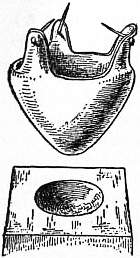
Balawat Gates, sheath and socket. From History of Art in Chaldaea and Assyria, by permission of Chapman & Hall Ltd.
The ancient Greek and Roman doors were either single doors (μονοθύραι, unifores), double doors (διθύραι, bifores or geminae) or folding doors (πτύχες, valvae); in the last case the leaves were hinged and folded back one over the other. At Pompeii, in the portico of Eumachia, is a painting of a door with three leaves, the two outer ones of which were presumably hung, the inner leaf folding on one or the other; hinges connecting the folding leaves of a door have been found in Pompeii. In the tomb of Theron at Agrigentum there is a single four-panel door carved in stone. In the Blundell collection is a bas-relief of a temple with double doors, each leaf with five panels. Among existing examples, the bronze doors in the church of SS. Cosmas and Damiano, in Rome, are important examples of Roman metal work of the best period; they are in two leaves, each with two panels, and are framed in bronze. Those of the Pantheon are similar in design, with narrow horizontal panels in addition, at the top, bottom and middle. Two other bronze doors of the Roman period are in the Lateran Basilica.
The doors of the church of the Nativity at Bethlehem (6th century) are covered with plates of bronze, cut out in patterns: those of Sta Sophia at Constantinople, of the 8th and 9th century, are wrought in bronze, and the west doors of the cathedral of Aix-la-Chapelle (9th century), of similar manufacture, were probably brought from Constantinople, as also some of those in St Mark’s, Venice.
Of the 11th and 12th centuries there are numerous examples of bronze doors, the earliest being one at Hildesheim, Germany (1015). Of others in South Italy and Sicily, the following are the finest: in Sant’ Andrea, Amalfi (1060); Salerno (1099); Canosa (1111); Troja, two doors (1119 and 1124); Ravello (1179), by Barisano of Trani, who also made doors for Trani cathedral; and in Monreale and Pisa cathedrals, by Bonano of Pisa. In all these cases the hanging stile had pivots at the top and bottom. The exact period when the hinge was substituted is not quite known, but the change apparently brought about another method of strengthening and decorating doors, viz. with wrought-iron bands of infinite varieties of design. As a rule three bands from which the ornamental work springs constitute the hinges, which have rings outside the hanging stiles fitting on to vertical tenons run into the masonry or wooden frame. There is an early example of the 12th century in Lincoln; in France the metal work of the doors of Notre Dame at Paris is perhaps the most beautiful in execution, but examples are endless throughout France and England.
Returning to Italy, the most celebrated doors are those of the Baptistery of Florence, which together with the door frames are all in bronze, the borders of the latter being perhaps the most remarkable: the modelling of the figures, birds and foliage of the south doorway, by Andrea Pisano (1330), and of the east doorway by Ghiberti (1425-1452), are of great beauty; in the north door (1402-1424) Ghiberti adopted the same scheme of design for the panelling and figure subjects in them as Andrea Pisano, but in the east door the rectangular panels are all filled with bas-reliefs, in which Scripture subjects are illustrated with innumerable figures, these being probably the gates of Paradise of which Michelangelo speaks.
The doors of the mosques in Cairo were of two kinds; those which, externally, were cased with sheets of bronze or iron, cut out in decorative patterns, and incised or inlaid, with bosses in relief; and those in wood, which were framed with interlaced designs of the square and diamond, this latter description of work being Coptic in its origin. The doors of the palace at Palermo, which were made by Saracenic workmen for the Normans, are fine examples and in good preservation. A somewhat similar decorative class of door to these latter is found in Verona, where the edges of the stiles and rails are bevelled and notched.
In the Renaissance period the Italian doors are quite simple, their architects trusting more to the doorways for effect; but in France and Germany the contrary is the case, the doors being elaborately carved, especially in the Louis XIV. and Louis XV. periods, and sometimes with architectural features such as columns and entablatures with pediment and niches, the doorway being in plain masonry. While in Italy the tendency was to give scale by increasing the number of panels, in France the contrary seems to have been the rule; and one of the great doors at Fontainebleau, which is in two leaves, is entirely carried out as if consisting of one great panel only.
The earliest Renaissance doors in France are those of the cathedral of St Sauveur at Aix (1503); in the lower panels there are figures 3 ft. high in Gothic niches, and in the upper panels a double range of niches with figures about 2 ft. high with canopies over them, all carved in cedar. The south door of Beauvais cathedral is in some respects the finest in France; the upper panels are carved in high relief with figure subjects and canopies over them. The doors of the church at Gisors (1575) are carved with figures in niches subdivided by classic pilasters superimposed. In St Maclou at Rouen are three magnificently carved doors; those by Jean Goujon have figures in niches on each side, and others in a group of great beauty in the centre. The other doors, probably about forty to fifty years later, are enriched with bas-reliefs, landscapes, figures and elaborate interlaced borders.
In England in the 17th century the door panels were raised with “bolection” or projecting mouldings, sometimes richly carved, round them; in the 18th century the mouldings worked on the stiles and rails were carved with the egg and tongue ornament.
(R. P. S.)
DOORWAY (corresponding to the Gr. πύλη, Lat. porta), in architecture, the entrance to a building, apartment or enclosure. The term is more generally applied to the framing of the opening in wood, stone or metal. The representations in painting, and existing examples, show that whilst the jambs of the doorway in Egyptian architecture were vertical, the outer side had almost the same batter as the walls of the temples. In the doorways of enclosures or screen walls there was no lintel, but a small projection inwards at the top, to hold the pivot of the door. In Greece the linings of the earliest doorways at Tiryns were in wood, and in order to lessen the bearing of the lintel the dressings or jambs (antepagmenta) sloped inwards, so that the width of the doorway opening was less at the top than at the bottom. In the entrance doorway of the tomb of Agamemnon at Mycenae, 18 ft. in height, the width is about 6 in. less at the top than at the bottom. The lintel of the Greek doorway projected on either side beyond the dressings, constituting what are known as the shoulders or knees (projecturae), a characteristic feature which has been retained down to our time. The next step was to work a projecting moulding round the dressings and lintel forming the architrave. Examples with shoulders in stone exist in the Beulé doorway of the Acropolis at Athens, in the tomb of Theron, and in a temple at Agrigentum in Sicily; also in the temples of Hercules at Cora, and of Vesta at Trivoli, and with a peculiar pendant in all the Etruscan tombs. The most beautiful example of a Greek doorway is that under the north portico of the Erechtheum (420 b.c.). There is a slight diminution in the width at the top of the opening, and outside the ordinary architrave mouldings (which here and in all classic examples are derived from those of the architrave of an order) is a band with rosettes, which recall the early decorative features in Crete and Mycenae; the band being carried across the top of the lintel and surmounted by a cornice supported on each side by corbels (ancones).
In the Roman doorways, excepting those at Cora and Tivoli, there is, as a rule, no diminishing of the width, which is generally speaking half of the height. The dimensions of some of the Roman doorways are enormous; in the temple of the Sun at Palmyra the doorway is 15 ft. 6 in. wide and 33 ft. high; and in the temple of Jupiter at Baalbec, 20 ft. wide and 45 ft. high, the lintel is composed of three stones forming voussoirs the keystone measuring 7 ft. at the bottom, 8 ft. at the top, 10 ft. high and 7 ft. 6 in. deep.
All the doorways mentioned above have cornices, and in those at Palmyra and Baalbec richly carved friezes with side corbels. In the Pantheon there is a plain convex frieze, but the outer mouldings of the architrave and the bed-mould of the cornice are richly carved. In the Byzantine doorways at Sta Sophia, Constantinople, a bold convex moulding and a hollow take the place of the fasciae of the classic architrave.
So far we have only referred to square-headed doorways, but the side openings of the triumphal arches of Titus and Constantine are virtually doorways, and they have semicircular heads, the mouldings of which are the same as those of the square-headed examples. In Saxon doorways, which had semicircular heads, the outer mouldings projected more boldly than in classic examples, and were sometimes cut in a separate ring of stone like the hood mould of later date.
During the Romanesque period in all countries, the doorway becomes the chief characteristic feature, and consists of two or more orders, the term “order” in this case being applied to the concentric rings of voussoirs forming the door-head. In classic work the faces of these concentric rings were nearly always flush one with the other; in Romanesque work the upper one projected over the ring immediately below, and the employment of a different design in the carving of each ring produced a magnificent and imposing effect: in the Italian churches the decoration of the arch mould is frequently carried down the door jambs, and the same is found, but less often, in the English and French doorways; but as a rule each ring or order is carried by a nook shaft, those in England and France being plain, but in Italy and Sicily elaborately carved with spirals or other ornaments and sometimes inlaid with mosaic.
The deeply recessed Norman doorways in English work required a great thickness of wall, and this was sometimes obtained by an addition outside, as at Iffley, Adel, Kirkstall and other churches.
In France, during the Gothic period, the several orders were carved with figure sculpture, as also the door jambs; and the great recessing of these doorways brought them more into the categories of porches. In England much less importance was given to the Gothic doorways, and although they consisted of many orders, these were emphasized only by deep hollows and converse mouldings and always carried on angle or nook shafts. In the perpendicular period the pointed-arch doorway was often enclosed within a square head-moulding, the spandrel being enriched with foliage or quatrefoil tracery.
In the Mahommedan style the doorway itself is comparatively simple, except that the voussoirs of its lintel are joggled with a series of curves, and being of different coloured stones have a decorative effect. These doorways are placed in a rectangular recess roofed with the stalactite vault.
With the Renaissance architect, the doorway continued as the principal characteristic of the style; the actual door-frame was simply moulded, by enclosing it with pilasters or columns, isolated or semi-detached, raised on pedestals and carrying an entablature with pediment and other kind of super-doorway; and great importance was given to the feature. In the Italian cinquecento period, the panels of the side pilasters were enriched with the most elaborate carving, and this would seem to have been an ancient Roman method, to judge by portions of carved panels now in the museums of Rome. The doorways of Venice are remarkable in this respect. At Como the two side doorways of the cathedral, one of which is said to be by Bramante, are of great beauty, and the same rich decoration is found throughout Spain and France. In Germany and England the pattern book too often suggested designs of an extremely rococo character, and it was under the influence of Palladio, through Inigo Jones, that in England the architect returned to the simpler and purer Italian style.
(R. P. S.)
DOPPLERITE, a naturally occurring organic substance found in amorphous, elastic or jelly-like masses, of brownish-black colour, in peat beds in Styria and in Switzerland. It is tasteless, insoluble in alcohol and ether, and is described by Dana as an acid substance, or mixture of different acids, related to humic acid.
DORAN, JOHN (1807-1878), English author, was born in London of Irish parentage on the 11th of March 1807. He became tutor in several distinguished families, and while travelling on the continent contributed journalistic sketches to The Literary Chronicle, a paper which was afterwards incorporated with The Athenaeum. His play, Justice or the Venetian Jew, was produced at the Surrey theatre in 1824, and in 1830 he began to write translations from French, German, Latin and Italian authors for The Bath Journal. After some years of travel on the continent he became in 1841 literary editor of The Church and State Gazette, and in 1852 under the title of Filia dolorosa produced a memoir of Maria Thérèse Charlotte, duchesse d’Angoulême. Two years later he became a regular contributor to The Athenaeum, succeeding Hepworth Dixon as editor for a short time in 1869, until he became editor of Notes and Queries in 1870. His most elaborate work, Their Majesties’ Servants, a history of the English stage from Betterton to Kean, was published in 1860, and was supplemented by In and About Drury Lane, which was written for Temple Bar and was not published in book form till 1885, after Doran’s death. Among his other works may be mentioned Table Traits and Habits of Men (1854), The Queens of the House of Hanover (1855), Knights and their Days (1856), Monarchs retired from Business (1856), The History of Court Fools (1858), an edition of the Bentley Ballads (1858), The Last Journals of Horace Walpole (2 vols., 1859), The Princess of Wales (1860), and the Memoirs of Queen Adelaide (1861). These were followed by A Lady of the Last Century (1873), an account of Mrs Elizabeth Montagu and the blue-stockings; London in Jacobite Times (1877); and Memories of our Great Towns (1878). Doran died in London, on the 25th of January 1878.
DORAT, CLAUDE JOSEPH (1734-1780), French man of letters, was born in Paris on the 31st of December 1734. He belonged to a family whose members had for generations been lawyers, and he entered the corps of the king’s musketeers. He obtained a great vogue by his Réponse d’Abailard à Héloïse, and followed up this first success with a number of heroic epistles, Les Victimes de l’amour, ou lettres de quelques amants célèbres (1776). Dorat was possessed by an ambition quite out of proportion to his very mediocre ability. Besides light verse he wrote comedies, fables and, among other novels, Les Sacrifices de l’amour, ou lettres de la vicomtesse de Senanges et du chevalier de Versenay (1771). He tried to cover his failures as a dramatist by buying up a great number of seats, and his books were lavishly illustrated by good artists and expensively produced, to secure their success. He was maladroit enough to draw down on himself the hatred both of the philosophe party and of their arch-enemy Charles Palissot, and thus cut himself off from the possibility of academic honours. Le Tartufe littéraire (1777) attacked La Harpe and Palissot, and at the same time D’Alembert and Mlle de Lespinasse. Dorat died on the 29th of April 1780 in Paris.
See G. Desnoireterres, Le Chevalier Dorat et les poètes légers au XVIIIe siècle (1887). For the bibliographical value of his works, see Henry Cohen, Guide de l’amateur de livres à figures et à vignettes du XVIIIe siècle (editions of Ch. Mehl, 1876, and R. Portalis, 1887).
DORCHESTER, DUDLEY CARLETON, Viscount (1573-1632), English diplomatist, son of Antony Carleton of Baldwin Brightwell, Oxfordshire, and of Jocosa, daughter of John Goodwin of Winchington, Buckinghamshire, was born on the 10th of March 1573, and educated at Westminster school and Christ Church, Oxford, where he graduated M.A. in 1600. He travelled abroad, and was returned to the parliament of 1604 as member for St Mawes. Through his connexion as secretary with the earl of Northumberland his name was associated with the Gunpowder Plot, but after a short confinement he succeeded in clearing himself of any share in the conspiracy. In 1610 he was knighted and was sent as ambassador to Venice, where he was the means of concluding the treaty of Asti. He returned in 1615, and next year was appointed ambassador to Holland. The policy of England on the continent depended mainly upon its relations with that state, and Carleton succeeded in improving these, in spite of his firm attitude on the subject of the massacre of Amboyna, the bitter commercial disputes between the two countries, and the fatal tendency of James I. to seek alliance with Spain. It was in his house at the Hague that the unfortunate Elector Frederick and the princess Elizabeth took refuge in 1621. Carleton returned to England in 1625 with the duke of Buckingham, and was made vice-chamberlain of the household and a privy councillor. Shortly afterwards he took part in an abortive mission to France in favour of the French Protestants and to inspire a league against the house of Austria. On his return in 1626 he found the attention of parliament, to which he had been elected for Hastings, completely occupied with the attack upon Buckingham. Carleton endeavoured to defend his patron, and supported the king’s violent exercise of his prerogative. It was perhaps fortunate that his further career in the Commons was cut short by his elevation in May to the peerage as Baron Carleton of Imbercourt. Shortly afterwards he was despatched on another mission to the Hague, on his return from which he was created Viscount Dorchester in July 1628. He was active in forwarding the conferences between Buckingham and Contarini for a peace with France on the eve of the duke’s intended departure for La Rochelle, which was prevented by the latter’s assassination. In December 1628 he was made principal secretary of state, and died on the 15th of February 1632, being buried in Westminster Abbey. He was twice married, and had children, but all died in infancy, and the title became extinct. Carleton was one of the ablest diplomatists of the time, and his talents would have secured greater triumphs had he not been persistently hampered by the mistaken and hesitating foreign policy of the court.
His voluminous correspondence, remarkable for its clear, easy and effective style, and for the writer’s grasp of the main points of policy, covers practically the whole history of foreign affairs during the period 1610-1628, and furnishes valuable material for the study of the Thirty Years’ War. His letters as ambassador at the Hague, January 1616 to December 1620, were first edited by Philip Yorke, afterwards second earl of Hardwicke, with a biographical and historical preface, in 1757; his correspondence from the Hague in 1627 by Sir Thomas Phillipps in 1841; other letters are printed in the Cabala, and in T. Birch’s Court and Times of James I. and Charles I., but by far the greater portion remains in MS. among the state papers.
DORCHESTER, GUY CARLETON, 1st Baron (1724-1808), British general and administrator, was born at Strabane, Co. Tyrone, Ireland, on the 3rd of September 1724. He served with distinction on the continent under the duke of Cumberland, and in 1759 in America as quartermaster-general, under his friend Wolfe. He was wounded at the capture of Quebec, and promoted to the rank of brigadier-general. In 1766 he was appointed governor-general of Canada, which position he held till 1778. His justice and kindliness greatly endeared him to the recently conquered French-Canadians, and did much to hold them neutral during the War of American Independence. He ordered the first codification of the civil law of the province, and was largely responsible for the passing of the Quebec Act. On the American invasion of Canada in 1775 he was compelled to abandon Montreal and narrowly escaped capture, but defended Quebec (q.v.) with skill and success. In October of the same year he destroyed the American flotilla on Lake Champlain. In 1777 he was superseded in his command of the military forces by Major-General John Burgoyne, and asked to be recalled. He returned, however, to America in May 1782 as commander-in-chief, remaining till November 1783. In 1786 he was again sent to Canada as governor-general and commander of the forces, with the title of Baron Dorchester. Many important reforms marked his rule; he administered the country with tact and moderation, and kept it loyal to the British crown amid the ferment caused by the French Revolution, and by the attempts of American emissaries to arouse discontent. In 1791 the province was divided into Upper and Lower Canada by the Constitutional Act. Of this division Carleton disapproved, as he did also of a provision tending to create in the new colony an hereditary aristocracy. In 1796 he insisted on retiring, and returned to England. He died on the 10th of November 1808. He married in 1772 a daughter of the 2nd earl of Effingham, and had nine children, being succeeded in the title by his grandson Arthur. On the death in 1897 of the 4th baron (another grandson) the title became extinct, but was revived in 1899 for his cousin and co-heiress Henrietta Anne as Baroness Dorchester.
J. C. Dent’s Canadian Portrait Gallery (Toronto, 1880) gives a sketch of Lord Dorchester’s Canadian career. His life by A. G. Bradley is included in the Makers of Canada series (Toronto). Most of his letters and state papers, which are indispensable for a knowledge of the period, are in the archives department at Ottawa, and are calendared in Brymner’s Reports on Canadian Archives (Ottawa, 1885, seq.).
(W. L. G.)
DORCHESTER, a market town and municipal borough and the county town of Dorsetshire, England, in the southern parliamentary division, 135 m. S.W. by W. from London by the London & South Western railway; served also by the Great Western railway. Pop. (1901) 9458. It stands on an eminence on the right bank of the river Frome, within a wide open tract of land, containing 3400 acres, held under the duchy of Cornwall, called Fordington Field. Several of the streets are planted with trees, and the town is nearly surrounded by fine avenues. St Peter’s church is a Perpendicular building with a fine tower. All Saints and Holy Trinity churches are modern, but Fordington church retains Norman and Transitional details. Of public buildings the principal are—the town-hall, with market-house, shire-hall, county prison and county hospital; there is also a county museum, containing many local objects of much interest. The grammar school (founded in 1569) is endowed with exhibitions to Oxford and Cambridge. There is a statue to William Barnes the Dorsetshire poet (1801-1886). The town is noted also for its ale. It is a place of considerable agricultural trade, and large sheep and lamb fairs are held annually. The borough is under a mayor, six aldermen and eighteen councillors. Area 1648 acres.
History.—Durnovaria was here, a Romano-British country town of considerable size, probably successor to a British tribal centre of the Durotriges. The walls can be traced in part, and many mosaics, remains of houses, &c., have been found. The remains of an amphitheatre are seen at Maumbury Rings, near the town. Maiden Castle, 2 m. S.W. of the town, is a vast earthwork considered to have been a stronghold of the tribe of the Durotriges. There are other such remains in the vicinity. Little mention of Dorchester (Dornceaster, Dorcestre) occurs in Saxon annals, but a charter from Æthelstan to Milton Abbey in 939 is dated at villa regalis quae dicitur Doracestria, and at this period it possessed a mint. According to the Domesday Survey it was a royal borough, and at the time of Edward the Confessor contained 172 houses, of which 100 had been totally destroyed since the Conquest. Mention is made of a castle at Dorchester in records of the 12th and 13th centuries; and the Franciscan priory, founded some time before 1331, is thought to have been constructed out of its ruins. The latter was suppressed among the lesser monasteries in 1536. Edward II. granted the borough to the bailiffs and burgesses at a fee-farm rent of £20 for five years, and the grant was renewed in perpetuity by Edward III. Richard III. empowered the burgesses to elect a coroner and two constables, to be exempt from tolls, and to try minor pleas in the king’s court within the borough before a steward to be chosen by themselves. The first charter of incorporation, granted by James I. in 1610, established a governing council of two bailiffs and fifteen capital burgesses. Charles I. in 1629 instituted a mayor, six aldermen and six capital burgesses, and also incorporated all the freemen of the borough, for the purposes of trade, under the government of a council consisting of a governor, assistants and twenty-four freemen, the governor and four assistants to be chosen out of the twenty-four by the freemen, and five other assistants to be chosen by the mayor out of the capital burgesses; the Council was empowered to hold four courts yearly and to make laws for the regulation of the markets and trade. Dorchester returned two members to parliament from 1295, until the Representation of the People Act of 1868 reduced the number to one; by the Redistribution Act of 1885 the representation was merged in the county. Edward III. granted to the burgesses the perquisites from three fairs lasting one day at the feasts of Holy Trinity, St John Baptist and St James, and markets on Wednesday, Friday and Saturday. Elizabeth granted an additional three days’ fair at Candlemas. The days of the fairs and markets have remained unchanged. The cloth industry which flourished during the 16th century never recovered from the depression following on the Civil War. The malting and brewing industries came into prominence in the 17th century, when there was also a considerable serge manufacture, which has since declined.
See Victoria County History, Dorsetshire; John Hutchins, The History and Antiquities of the Town and Borough of Dorchester (3rd edition, corrected, augmented and improved by W. Shipp and J. W. Hodson, Blandford, 1865).
DORCHESTER, a large village in the south parliamentary division of Oxfordshire, England, 9 m. S.S.E. of Oxford by road, on the river Thame, 1 m. from its junction with the Thames. This is a site of much historical interest. There was a Roman station near the present village, facing, across the Thames, the double isolated mound known as Wittenham Hills (historically Sinodun), on one summit of which are strong early earthworks. In Dorchester itself the chief point of interest is the abbey church of St Peter and St Paul. This consists of a nave of great length, primarily of the transitional Norman period; a choir with arcades of the finest Decorated work; north choir aisle of the close of the 13th century, south choir aisle (c. 1300) and south nave aisle (c. 1320). The tower (western) is an erection of the late 17th century. The eastern bay of the choir is considered to have been added as a Lady chapel, and the north window is a magnificent example of a “Jesse window,” in which the tracery represents the genealogical tree of Jesse, the complete execution of the design being carried on in the glass. The sedilia and piscina are very fine. The Decorated windows on the south side of the church form a beautiful series, and there are monuments and brasses of great interest.
Dorchester (Dorcinia, Dornacestre, Dorchecestre) was conquered by the West Saxons about 560. It occupied a commanding position at the junction of the Thames and the Thame, and in 635 was made the seat of a bishopric which at its foundation was the largest in England, comprising the whole of Wessex and Mercia. The witenagemot of Wessex was held at Dorchester three times in the 9th century, and in 958 Æthelstan held a council here. In the 11th century, however, the town is described as small and ill-peopled and remarkable only for the majesty of its churches, and in about 1086 William I. and Bishop Remigius removed the bishop’s stool to Lincoln, as a city more worthy of the distinction. According to the Domesday Survey Dorchester was held by the bishop of Lincoln; it was assessed at 100 hides and comprised two mills. In 1140 Alexander bishop of Lincoln founded an abbey of Black Canons at Dorchester, but the town declined in importance after the removal of the cathedral, and is described by 16th-century writers as a mere agricultural village and destitute of trade.
See Victoria County History, Oxfordshire; Henry Addington, Some Account of the Abbey Church of St Peter and St Paul at Dorchester, Oxfordshire, reissue with additional notes (Oxford, 1860).
DORCHESTER, a residential and manufacturing district of Boston, Massachusetts, U.S.A., a separate town until 1870, between the Neponset river on the S. and South Boston and Boston proper on the N. It is served by three lines of the New York, New Haven & Hartford railway. A ridge, with an average height of about 100 ft. above the sea, extends through the district from N. to S. and commands delightful views of Boston Bay to the E. and of the Blue Hills to the S. There are many large private estates, with beautiful lawns, and Franklin Field and Franklin Park, one of the largest parks of the Boston park system, are in Dorchester. The Shawmut school for girls is in the district. Among the landmarks are the Barnard Capen house, built in the fourth decade of the 17th century and now probably the second oldest house in New England; and the James Blake house (1648), now the home of the Dorchester Historical Society, which has a library and a museum. Opposite the Blake house formerly stood the house in which Edward Everett was born. Not far away is the old Dorchester burying ground, which dates from 1634; it has many curious epitaphs, and contains the graves of Barnard Capen, who died in 1638 (probably the oldest marked grave in the United States); of William Stoughton (1631-1701), chief justice of the court which tried the Salem “witches” in 1692, lieutenant-governor of the colony from 1692, acting governor in 1694-1699 and 1700-1701, and founder of the original Stoughton Hall, Harvard; and of Richard Mather, pastor of the First Parish church here from 1636 until his death. In Dorchester Maria Susana Cummins (1827-1866) wrote The Lamplighter (1854), one of the most popular novels of its time, and William T. Adams (“Oliver Optic”) and Charles Follen Adams (“Yawcob Strauss”) did much of their writing; it was long the home of Mrs Lucy Stone (Blackwell). Among the manufactures are cocoa, chocolate, &c. (of the long-established Walter Baker & Co.), paper, crushing and grinding machinery (Sturtevant Mill Co.), chemicals, horseshoe nails, valves, organs and pianos, lumber, automobiles and shoe machinery.
Dorchester was founded by about 140 colonists from Dorsetshire, England, with whom the movement for planting the colony in Massachusetts Bay was begun under the leadership of Rev. John White. They organized as a church while at Plymouth, England, in March 1630, then embarked in the ship “Mary and John,” arrived in Boston Bay two weeks before Governor Winthrop with the rest of the fleet, and in June selected Savin Hill (E. of what is now Dorchester Avenue and between Crescent Avenue and Dorchester Bay) as the site for their settlement. At the time the place was known as Mattapanock, but they named it Dorchester. Town affairs were at first managed by the church, but in October 1633 a town government was organized, and the example was followed by the neighbouring settlements; this seems to have been the beginning of the town-meeting form of government in America. Up to this time Dorchester was the largest town in the colony, but dissatisfaction arose with the location (Boston had a better one chiefly on account of the deeper water in its harbour), and in 1635-1637 many of the original settlers removed to the valley of the Connecticut where they planted Windsor. New settlers, however, arrived at Dorchester and in 1639 that town established a school supported by a public tax; this was the first free school in America supported by direct taxation or assessment on the inhabitants of a town.1 In October 1695, a few of the inhabitants of Dorchester organized a church and in December removed to South Carolina where they planted another Dorchester (on the N. bank of the Ashley river, about 26 m. from Charleston); by 1752 they had become dissatisfied with their location, which was unhealthy, and they gradually removed to Georgia, where they settled at Medway (half way between the Ogeechee and Altamaha rivers), their settlement soon developing into St John’s Parish (see Georgia: History). It was the fortification of Dorchester Heights, under orders from General Washington, on the night of the 4th and 5th of March 1776, that forced the British to evacuate Boston. At one time Dorchester extended from Boston nearly to the Rhode Island line; but its territory was gradually reduced by the creation of new townships and additions to old ones. Dorchester Neck was annexed to Boston in 1804, Thompson’s Island in 1834, and the remaining portions in 1855 and 1870.
See W. D. Orcutt, Good Old Dorchester (Cambridge, 1893).
1 In 1635 the general court of the colony of Massachusetts Bay had granted to Dorchester Thompson’s Island, situated near the coast of the township. By the township of Dorchester this island was apportioned among the freemen of the township. On the 20th of May 1639 it was ordered that the proprietors of land in this island should collectively pay a “rent of twenty pounds a year forever,” this rent “to be paid to such a school-master as shall undertake to teach English, Latin, and other tongues, and also writing,” it being “left to the discretion of the elders and the seven men for the time being whether maids shall be taught with the boys or not.” In 1642 the proprietors of the island conveyed it to the township “for and toward the maintenance of a free school in Dorchester aforesaid for the instructing and teaching of children and youth in good literature and learning.”
DORDOGNE, a river of central and south-western France, rising at a height of 5640 ft. on the Puy-de-Sancy, a mountain of the department of Puy-de-Dôme, and flowing to the Garonne with which it unites at Bec d’Ambès to form the Gironde estuary. It has a length of 295 m. and the area of its basin is 9214 sq. m. Descending rapidly from its source, sometimes over cascades, the river soon enters deep gorges through which it flows as far as Beaulieu (department of Corrèze) where it debouches into a wide and fertile valley and is shortly after joined by the Cère. Entering the department of Lot, it abandons a south-westerly for a westerly course and flowing in a sinuous channel traverses the department of Dordogne, where it receives the waters of the Vézère. Below the town of Bergerac it enters the department of Gironde, where at Libourne it is joined by the Isle and widens out, attaining at its union with the Garonne 45 m. from the sea a width of nearly 3300 yds. A few miles above this point the river is spanned by the magnificent bridges of Cubzac-les-Ponts, which carry a road and railway. Below its confluence with the Vézère, over the last 112 m. of its course, the river carries considerable navigation. The influence of the highest tides is felt at Pessac, a distance of 100 m. from the ocean.
DORDOGNE, an inland department of south-western France, formed in 1790 from nearly the whole of Périgord, a part of Agenais, and small portions of Limousin and of Angoumois. Area 3560 sq. m. Pop. (1906) 447,052. It is bounded N. by Haute-Vienne, W. by Charente, Charente-Inférieure and Gironde, S. by Lot-et-Garonne, and E. by Lot and Corrèze. Situated on the western slopes of the Massif Central, Dordogne consists in the north-east and centre of sterile plateaus sloping towards the west, where they end in a region of pine forests known as the Double. The greatest altitudes are found in the highlands of the north, where many points exceed 1300 ft. in height. The department is intersected by many fertile and beautiful river valleys, which converge from its northern and eastern borders towards the south-west. The Dordogne is the principal river of the department and its chief affluent is the Isle, which crosses the centre of the department and flows into the Dordogne at Libourne, in the neighbouring department of Gironde. The Dronne and the Auvézère, both tributaries of the Isle, are the other main rivers. The climate is generally agreeable and healthy, but rather humid, especially in the north-east. Agriculture flourishes in the south and south-west of the department, especially in the valleys of the Dordogne and Isle, the rest of its surface being covered to a great extent by woods and heath. Pasture and forage amply suffice for the raising of large flocks and herds. The vine, cultivated mainly in the neighbourhood of Bergerac, and tobacco are important sources of profit. Wheat and maize are the chief cereals and potatoes are largely grown. The truffles of Périgord are famous for their abundance and quality. The plum and cider-apple yield good crops. In the forests the prevailing trees are the oak and chestnut. The fruit of the latter is much used both as food by the people and for fattening hogs, which are reared in large numbers. The walnut is extensively grown for its oil. The department has mines of lignite, and produces freestone, lime, cement, mill-stone, peat, potter’s clay and fireclay. The leather industry and the preparation of preserved foods are important, and there are flour-mills, brick and tile works, earthenware manufactories, printing works, chemical works and a few iron foundries. Exports consist of truffles, wine, chestnuts and other fruit, live stock, poultry, and minerals of various kinds. Dordogne is served by the Orléans railway; the Dordogne, the Isle and the Vézère furnish nearly 200 m. of navigable waterway. It is divided into the arrondissements of Périgueux, Bergerac, Nontron, Ribérac and Sarlat, with 47 cantons and 587 communes, and belongs to the ecclesiastical province of Bordeaux, to the académie (educational division) of Bordeaux and to the region of the XII. army corps, which has its headquarters at Limoges. Its court of appeal is at Bordeaux.
Périgueux, the capital, Bergerac, Sarlat and Brantôme are the principal towns (see separate articles). There are several other places of interest. Bourdeilles has two finely preserved châteaux, one of the 14th century, with an imposing keep, the other in the Renaissance style of the 16th century. Both buildings are contained within the same fortified enceinte. The celebrated château of Biron, founded in the 11th century, preserves examples of many subsequent architectural styles, among them a beautiful chapel of late Gothic and early Renaissance workmanship. The château of Jumilhac-le-Grand belongs to the 15th century. Dordogne possesses several medieval bastides, the most perfect of which is Monpazier. At Cadouin there are the remains of a Cistercian abbey. Its church is a fine cruciform building in the Romanesque style, while the cloister is an excellent example of Flamboyant architecture. St Jean-de-Côle has an interesting Romanesque church and a château of the 15th, 16th and 18th centuries. In the rocks of the valley of the lower Vézère there are prehistoric caves of great archaeological importance, in which have been found tools, and carvings on bone, flint and ivory. Troglodytic dwellings are to be found in many other places in Dordogne (see Cave).
DORDRECHT (abbreviated Dordt, or Dort), a town and river-port of Holland, in the province of South Holland, on the south side of the Merwede, and a junction station 12½ m. by rail S.E. of Rotterdam. Steam ferries connect it with Papendrecht and Zwyndrecht on the opposite shore, and it has excellent communication by water in every direction. Pop. (1900) 38,386. Dordrecht presents a picturesque appearance with its busy quays and numerous canals and windmills, its quaint streets and curiously gabled houses. The Groote Kerk, of Our Lady, whose massive tower forms a conspicuous object in the views of the town, dates from the 14th century and contains some finely carved stalls (1540) by Jan Terween Aertsz, a remarkable pulpit (1759), many old monuments and a set of gold communion plate. In the town museum is an interesting collection of paintings, chiefly by modern artists, but including also pictures by some of the older masters, among whom Ferdinand Bol, the two Cuyps, Nicolas Maes, Godefried Schalcken, and in later times Ary Scheffer, were all natives of Dordrecht. The celebrated 17th-century statesman John de Witt was also a native of the town. Close to the museum is one of the old city gates, rebuilt in 1618, and now containing a collection of antiquities belonging to the Oud-Dordrecht Society. The South African Museum (1902) contains memorials of the Boer War of 1899-1902. The harbour of Dordrecht still has a large trade, but much has been diverted to Rotterdam. Large quantities of wood are imported from Germany, Scandinavia and America. There are numerous saw-mills, shipbuilding yards, engineering works, distilleries, sugar refineries, tobacco factories, linen bleacheries and stained glass, salt and white lead works.
Dordrecht was founded by Count Dirk III. of Holland in 1018, becoming a town about 1200. One of the first towns in the Netherlands to embrace the reformed religion and to throw off the yoke of Spain, it was in 1572 the meeting-place of the deputies who asserted the independence of the United Provinces. In 1618 and 1619 it was the seat of the synod of Dort (q.v.).
DORÉ, LOUIS AUGUSTE GUSTAVE (1832-1883), French artist, the son of a civil engineer, was born at Strassburg on the 6th of January 1832. In 1848 he came to Paris and secured a three years’ engagement on the Journal pour rire. His facility as a draughtsman was extraordinary, and among the books he illustrated in rapid succession were Balzac’s Contes drolatiques (1855), Dante’s Inferno (1861), Don Quixote (1863), The Bible (1866), Paradise Lost (1866), and the works of Rabelais (1873). He painted also many large and ambitious compositions of a religious or historical character, and made some success as a sculptor, his statue of Alexandre Dumas in Paris being perhaps his best-known work in this line. He died on the 25th of January 1883.
DORIA, ANDREA (1466-1560), Genoese condottiere and admiral, was born at Oneglia of an ancient Genoese family. Being left an orphan at an early age, he became a soldier of fortune, and served first in the papal guard and then under various Italian princes. In 1503 we find him fighting in Corsica in the service of Genoa, at that time under French vassalage, and he took part in the rising of Genoa against the French, whom he compelled to evacuate the city. From that time forth it was as a naval captain that he became famous. For several years he scoured the Mediterranean in command of the Genoese fleet, waging war on the Turks and the Barbary pirates. In the meanwhile Genoa had been recaptured by the French, and in 1522 by the Imperialists. But Doria now veered round to the French or popular faction and entered the service of King Francis I., who made him captain-general; in 1524 he relieved Marseilles, which was besieged by the Imperialists, and helped to place his native city once more under French domination. But he was dissatisfied with his treatment at the hands of Francis, who was mean about payment, and he resented the king’s behaviour in connexion with Savona, which he delayed to hand back to the Genoese as he had promised; consequently on the expiry of Doria’s contract we find him in the service of the emperor Charles V. (1528). He ordered his nephew Filippino, who was then blockading Naples in concert with a French army, to withdraw, and sailed for Genoa, where, with the help of some leading citizens, he expelled the French once more and re-established the republic under imperial protection. He reformed the constitution in an aristocratic sense, most of the nobility being Imperialists, and put an end to the factions which divided the city. He refused the lordship of Genoa and even the dogeship, but accepted the position of perpetual censor, and exercised predominant influence in the councils of the republic until his death. He was given two palaces, many privileges, and the title of Liberator et Pater Patriae. As imperial admiral he commanded several expeditions against the Turks, capturing Corona and Patras, and co-operating with the emperor himself in the capture of Tunis (1535). Charles found him an invaluable ally in the wars with Francis, and through him extended his domination over the whole of Italy. Doria’s defeat by the Turks at Preveza in 1538 was said to be not involuntary, and designed to spite the Venetians whom he detested. He accompanied Charles on the ill-fated Algerian expedition of 1541, of which he disapproved, and by his ability just saved the whole force from complete disaster. For the next five years he continued to serve the emperor in various wars, in which he was generally successful and always active, although now over seventy years old; there was hardly an important event in Europe in which he had not some share. After the peace of Crépy between Francis and Charles in 1544 he hoped to end his days in quiet. But his great wealth and power, as well as the arrogance of his nephew and heir Giannettino Doria, made him many enemies, and in 1547 the Fiesco conspiracy to upset the power of his house took place. Giannettino was murdered, but the conspirators were defeated, and Andrea showed great vindictiveness in punishing them. Many of their fiefs he seized for himself, and he was implicated in the murder of Pier Luigi Farnese, duke of Parma (see Farnese), who had helped Fiesco. Other conspiracies followed, of which the most important was that of Giulio Cibò (1548), but all failed. Although Doria was ambitious and harsh, he was a good patriot and successfully opposed the emperor Charles’s repeated attempts to have a citadel built in Genoa and garrisoned by Spaniards; neither blandishments nor threats could win him over to the scheme. Nor did age lessen his energy, for in 1550, when eighty-four years old, he again put to sea to punish the raids of his old enemies the Barbary pirates, but with no great success. War between France and the Empire having broken out once more, the French seized Corsica, then administered by the Genoese Bank of St George; Doria was again summoned, and he spent two years (1553-1555) in the island fighting the French with varying fortune. He returned to Genoa for good in 1555, and being very old and infirm he gave over the command of the galleys to his great-nephew Giovanni Andrea Doria, who conducted an expedition against Tripoli, but proved even more unsuccessful than his uncle had been at Algiers, barely escaping with his life. Andrea Doria died on the 25th of November 1560, leaving his estates to Giovanni Andrea. The family of Doria-Pamphilii-Landi (q.v.) is descended from him and bears his title of prince of Melfi. Doria was a man of indomitable energy and a great admiral. If he appears unscrupulous and even treacherous he did but conform to the standards of 16th-century Italy.
Bibliography.—E. Petit’s André Doria (Paris, 1887) is an accurate and documented biography, indicating all the chief works on the subject, but the author is perhaps unduly harsh in his judgment of the admiral; F. D. Guerrazzi’s Vita di Andrea Doria (3rd ed., Milan, 1874); among the earlier works L. Cappelloni’s Vita di Andrea Doria (Italian edition, Genoa, 1863) and V. Sigonius’s Vita Andreae Doriae (1576) may be mentioned; see also “Documenti ispano-genovesi dell’Archivio di Simancas” in the Atti della Società ligure di Storia patria, vol. viii.; the Archivio storico italiano (serie iii. tome iv. parte i., 1866) contains a bibliography, but a great deal has been published since that date.
(L. V.*)
DORIANS, a name applied by the Greeks to one of the principal groups of Hellenic peoples, in contradistinction to Ionians and Aeolians. In Hellenic times a small district known as Doris in north Greece, between Mount Parnassus and Mount Oeta, counted as “Dorian” in a special sense. Practically all Peloponnese, except Achaea and Elis, was “Dorian,” together with Megara, Aegina, Crete, Melos, Thera, the Sporades Islands and the S.W. coast of Asia Minor, where Rhodes, Cos, Cnidus and (formerly) Halicarnassus formed a “Dorian” confederacy. “Dorian” colonies, from Corinth, Megara, and the Dorian islands, occupied the southern coasts of Sicily from Syracuse to Selinus. Dorian states usually had in common the “Doric” dialect, a peculiar calendar and cycle of festivals of which the Hyacinthia and Carneia were the chief, and certain political and social institutions, such as the threefold “Dorian tribes.” The worships of Apollo and Heracles, though not confined to Dorians, were widely regarded as in some sense “Dorian” in character.
But those common characters are not to be pressed too far. The northern Doris, for example, spoke Aeolic, while Elis, Phocis, and many non-Dorian districts of north-west Greece spoke dialects akin to Doric. Many Dorian states had additional “non-Dorian tribes”; Sparta, which claimed to be of pure and typical Dorian origin, maintained institutions and a mode of life which were without parallel in Peloponnese, in the Parnassian and in the Asiatic Doris, and were partially reflected in Crete only.
Most non-Dorian Greeks, in fact, seem to have accepted much as Dorian which was in fact only Spartan: this was particularly the case in the political, ethical and aesthetic controversies of the 5th and 4th centuries b.c. Much, however, which was common (in art, for example) to Olympia, Argolis and Aegina, and might thus have been regarded as Dorian, was conspicuously absent from the culture of Sparta.
Traditional History.—In the diagrammatic family tree of the Greek people, as it appears in the Hesiodic catalogue (6th century) and in Hellanicus (5th century), the “sons of Hellen” are Dorus, Xuthus (father of Ion and Achaeus) and Aeolus. Dorus’ share of the inheritance of Hellen lay in central Greece, north of the Corinthian Gulf, between Xuthus in north Peloponnese and Aeolus in Thessaly. His descendants, either under Dorus or under a later king Aegimius, occupied Histiaeotis, a district of northern Thessaly, and afterwards conquered from the Dryopes the head-waters of the Boeotian Cephissus between Mount Parnassus and Mount Oeta. This became “Doris” par excellence. Services rendered to Aegimius by Heracles led (1) to the adoption of Hyllus, son of Heracles, by Aegimius, side by side with his own sons Dymas and Pamphylus, and to a threefold grouping of the Dorian clans, as Hylleis, Dymanes and Pamphyli; (2) to the association of the people of Aegimius in the repeated attempts of Hyllus and his family to recover their lost inheritance in Peloponnese (see Heraclidae). The last of these attempts resulted in the “Dorian conquest” of the “Achaeans” and “Ionians” of Peloponnese, and in the assignment of Argolis, Laconia and Messenia to the Heracleid leaders, Temenus, Aristodemus and Cresphontes respectively; of Elis to their Aetolian allies; and of the north coast to the remnants of the conquered Achaeans. The conquest of Corinth and Megara was placed a generation later: Arcadia alone claimed to have escaped invasion. This conquest was dated relatively by Thucydides (i. 12) at eighty years after the Trojan War and twenty years after the conquest of Thessaly and Boeotia by the similar “invaders from Arne”; absolutely by Hellanicus and his school (5th century) at 1149 b.c.; by Isocrates and Ephorus (4th century b.c.) at about 1070 b.c.; and by Sosibius, Eratosthenes (3rd century), and later writers generally, at the generations from 1125 to 1100 b.c.
The invasion was commonly believed to have proceeded by way of Aetolia and Elis, and the name Naupactus was interpreted as an allusion to the needful “shipbuilding” on the Corinthian Gulf. One legend made Dorus himself originally an Aetolian prince; the participation of Oxylus, and the Aetolian claim to Elis, appear first in Ephorus (4th century). The conquest of Laconia at least is represented in 5th-century tradition as immediate and complete, though one legend admits the previous death of the Heracleid leader Aristodemus, and another describes a protracted struggle in the case of Corinth. Pausanias, however (following Sosibius), interprets a long series of conflicts in Arcadia as stages in a gradual advance southward, ending with the conquest of Amyclae by King Teleclus (c. 800 b.c.) and of Helos by King Alcamenes (c. 770 b.c.).
Of the invasion of Argolis a quite different version was already current in the 4th century. This represents the Argive Dorians as having come by sea (apparently from the Maliac Gulf, the nearest seashore to Parnassian Doris), accompanied by survivors of the Dryopes (former inhabitants of that Doris), whose traces in south Euboea (Styra and Carystus), in Cythnus, and at Eion (Halieis), Hermione and Asine in Argolis, were held to indicate their probable route.
The Homeric Dorians of Crete were also interpreted by Andron and others (3rd century) as an advance-guard of this sea-borne migration, and as having separated from the other Dorians while still in Histiaeotis. The 5th-century tradition that the Heracleid kings of Macedon were Temenid exiles from Argos may belong to the same cycle.
The fate of the Dorian invaders was represented as differing locally. In Messenia (according to a legend dramatized by Euripides in the 5th century, and renovated for political ends in the 4th century) the descendants of Cresphontes quarrelled among themselves and were exterminated by the natives. In Laconia Aristodemus (or his twin sons) effected a rigid military occupation which eventually embraced the whole district, and permitted (a) the colonization of Melos, Thera and parts of Crete (before 800 b.c.), (b) the reconquest and annexation of Messenia (about 750 b.c.), (c) a settlement of half-breed Spartans at Tarentum in south Italy, 700 b.c. In Argos and other cities of Argolis the descendants of the Achaean chiefs were taken into political partnership, but a tradition of race-feud lasted till historic times. Corinth, Sicyon and Megara, with similar political compromises, mark the limits of Dorian conquest; a Dorian invasion of Attica (c. 1066 b.c.) was checked by the self-sacrifice of King Codrus: “Either Athens must perish or her king.” Aegina was reckoned a colony of Epidaurus. Rhodes, and some Cretan towns, traced descent from Argos; Cnidus from Argos and Sparta; the rest of Asiatic Doris from Epidaurus or Troezen in Argolis. The colonies of Corinth, Sicyon and Megara, and the Sicilian offshoots of the Asiatic Dorians, belong to historic times (8th-6th centuries).
Criticism of the Traditional History.—The following are the problems:—(1) Was there a Dorian invasion as described in the legends; and, if not, how did the tradition arise? (2) Who were the Dorian invaders, and in what relation did they stand to the rest of the population of Greece? (3) How far do the Dorian states, or their characteristics, represent the descendants, or the culture, of the original invaders?
The Homeric poems (12th-10th centuries) know of Dorians only in Crete, with the obscure epithet τριχάϊκες, and no hint of their origin. All those parts of Peloponnese and the islands which in historic times were “Dorian” are ruled by recently established dynasties of “Achaean” chiefs; the home of the Asiatic Dorians is simply “Caria”; and the geographical “catalogue” in Iliad ii. ignores the northern Doris altogether.
The almost total absence from Homer not only of “Dorians” but of “Ionians” and even of “Hellenes” leads to the conclusion that the diagrammatic genealogy of the “sons of Hellen” is of post-Homeric date; and that it originated as an attempt to classify the Doric, Ionic and Aeolic groups of Hellenic settlements on the west coast of Asia Minor, for here alone do the three names correspond to territorial, linguistic and political divisions. The addition of an “Achaean” group, and the inclusion of this and the Ionic group under a single generic name, would naturally follow the recognition of the real kinship of the “Achaean” colonies of Magna Graecia with those of Ionia. But the attempt to interpret, in terms of this Asiatic diagram, the actual distribution of dialects and peoples in European Greece, led to difficulties. Here, in the 8th-6th centuries, all the Dorian states were in the hands of exclusive aristocracies, which presented a marked contrast to the subject populations. Since the kinship of the latter with the members of adjacent non-Dorian states was admitted, two different explanations seem to have been made, (1) on behalf of the non-Dorian populations, either that the Dorians were no true sons of Hellen, but were of some other northerly ancestry; or that they were merely Achaean exiles; and in either case that their historic predominance resulted from an act of violence, ill-disguised by their association with the ancient claims of the Peloponnesian Heraclidae; (2) on behalf of the Dorian aristocracies, that they were in some special sense “sons of Hellen,” if not the only genuine Hellenes; the rest of the European Greeks, and in particular the anti-Dorian Athenians (with their marked likeness to Ionians), being regarded as Hellenized barbarians of “Pelasgian” origin (see Pelasgians). This process of Hellenization, or at least its final stage, was further regarded as intimately connected with a movement of peoples which had brought the “Dorians” from the northern highlands into those parts of Greece which they occupied in historic times.
So long as the Homeric poems were believed to represent Hellenic (and mainly Ionian) beliefs of the 9th century or later, the historical value of the traditions of a Dorian invasion was repeatedly questioned; most recently and thoroughly by J. Beloch (Gr. Geschichte, i., Strassburg, 1893), as being simply an attempt to reconcile the political geography of Homer (i.e. of 8th-century Ionians describing 12th-century events) with that of historic Greece, by explaining discrepancies (due to Homeric ignorance) as the result of “migrations” in the interval. Such legends often arise to connect towns bearing identical or similar names (such as are common in Greece) and to justify political events or ambitions by legendary precedents; and this certainly happened during the successive political rivalries of Dorian Sparta with non-Dorian Athens and Thebes. But in proportion as an earlier date has become more probable for Homer, the hypothesis of Ionic origin has become less tenable, and the belief better founded (1) that the poems represent accurately a well-defined phase of culture in prehistoric Greece, and (2) that this “Homeric” or “Achaean” phase was closed by some such general catastrophe as is presumed by the legends.
The legend of a Dorian invasion appears first in Tyrtaeus, a 7th-century poet, in the service of Sparta, who brings the Spartan Heracleids to Peloponnese from Erineon in the northern Doris; and the lost Epic of Aegimius, of about the same date, seems to have presupposed the same story. In the 5th century Pindar ascribes to Aegimius the institutions of the Peloponnesian Dorians, and describes them as the “Dorian folk of Hyllus and Aegimius,” and as “originating from Pindus” (Pyth. v. 75: cf. Fr. 4). Herodotus, also in the 5th century, describes them as the typical (perhaps in contrast to Athenians as the only genuine) Hellenes, and traces their numerous wanderings from (1) an original home “in Deucalion’s time” in Phthiotis (the Homeric “Hellas”) in south Thessaly, to (2) Histiaeotis “below Ossa and Olympus” in north-east Thessaly (note that the historic Histiaeotis is “below Pindus” in north-west Thessaly): this was “in the days of Dorus,” i.e. it is at this stage that the Dorians are regarded as becoming specifically distinct from the generic “Hellene”: thence (3) to a residence “in Pindus,” where they passed as a “Macedonian people.” Hence (4) they moved south to the Parnassian Doris, which had been held by Dryopes: and hence finally (5) to Peloponnese. Elsewhere he assigns the expulsion of the Dryopes to Heracles in co-operation not with Dorians but with Malians. Here clearly two traditions are combined:—one, in which the Dorians originated from Hellas in south Thessaly, and so are “children of Hellen”; another, in which they were a “Macedonian people” intruded from the north, from Pindus, past Histiaeotis to Doris and beyond. It is a noteworthy coincidence that in Macedonia also the royal family claimed Heracleid descent; and that “Pindus” is the name both of the mountains above Histiaeotis and of a stream in Doris. It is noteworthy also that later writers (e.g. Andron in Strabo 475) derived the Cretan Dorians of Homer from those of Histiaeotis, and that other legends connected Cretan peoples and places with certain districts of Macedon.
Thucydides agrees in regarding the Parnassian Doris as the “mother-state” of the Dorians (i. 107) and dates the invasion (as above) eighty years after the Trojan War; this agrees approximately with the pedigree of the kings of Sparta, as given by Herodotus, and with that of Hecataeus of Miletus (considered as evidence for the foundation date of an Ionian refugee-colony). Thucydides also accepts the story of Heracleid leadership.
The legend of an organized apportionment of Peloponnese amongst the Heracleid leaders appears first in the 5th-century tragedians,—not earlier, that is, than the rise of the Peloponnesian League,—and was amplified in the 4th century; the Aetolians’ aid, and claim to Elis, appear first in Ephorus. The numerous details and variant legends preserved by later writers, particularly Strabo and Pausanias, may go back to early sources (e.g. Herodotus distinguished the “local” from the “poetic” versions of events in early Spartan history); but much seems to be referable to Ephorus and the 4th-century political and rhetorical historians:—e.g. the enlarged version of the Heracleid claims in Isocrates (Archidamus, 120) and the theory that the Dorians were mere disowned Achaeans (Plato, Laws, 3). Moreover, many independent considerations suggest that in its main outlines the Dorian invasion is historical.
The Doric Dialects.—These dialects have strongly marked features in common (future in -σεω -σιω -σῶ; 1st pers. plur. in -μες; κά for ἄν; -αε -αη = ῆ), but differ more among themselves than do the Ionic. Laconia with its colonies (including those in south Italy) form a clear group, in which -ε and -ο lengthen to -η and -ω as in Aeolic. Corinth (with its Sicilian colonies), the Argolid towns, and the Asiatic Doris, form another group, in which -ε and -ο become -ει and -ου as in Ionic. Connected with the latter (e.g. by -ει and -ου) are the “northern” group:—Phocis, including Delphi, with Aetolia, Acarnania, Epirus and Phthiotis in south Thessaly. But these have also some forms in common with the “Aeolic” dialect of Boeotia and Thessaly, which in historic times was spoken also in Doris; Locris and Elis present similar northern “Achaean-Doric” dialects. Arcadia, on the other hand, in the heart of Peloponnese, retained till a late date a quite different dialect, akin to the ancient dialect of Cyprus, and more remotely to Aeolic. This distribution makes it clear (1) that the Doric dialects of Peloponnese represent a superstratum, more recent than the speech of Arcadia; (2) that Laconia and its colonies preserve features alike, -η and -ω which are common to southern Doric and Aeolic; (3) that those parts of “Dorian” Greece in which tradition makes the pre-Dorian population “Ionic,” and in which the political structure shows that the conquered were less completely subjugated, exhibit the Ionic -ει and -ου; (4) that as we go north, similar though more barbaric dialects extend far up the western side of central-northern Greece, and survive also locally in the highlands of south Thessaly; (5) that east of the watershed Aeolic has prevailed over the area which has legends of a Boeotian and Thessalian migration, and replaces Doric in the northern Doris. All this points on the one hand to an intrusion of Doric dialect into an Arcadian-and-Ionic-speaking area; on the other hand to a subsequent expansion of Aeolic over the north-eastern edge of an area which once was Dorian. But this distribution does not by itself prove that Doric speech was the language of the Dorian invaders. Its area coincides also approximately with that of the previous Achaean conquests; and if the Dorians were as backward culturally as traditions and archaeology suggest, it is not improbable that they soon adopted the language of the conquered, as the Norman conquerors did in England. As evidence of an intrusion of northerly folk, however, the distribution of dialects remains important. See Greek Language.
The common calendar and cycle of festivals, observed by all Dorians (of which the Carneia was chief), and the distribution in Greece of the worships of Apollo and Heracles, which attained pre-eminence mainly in or near districts historically “Dorian,” suggest that these cults, or an important element in them, were introduced comparatively late, and represent the beliefs of a fresh ethnic superstratum. The steady dependence of Sparta on the Delphic oracle, for example, is best explained as an observance inherited from Parnassian ancestors.
The social and political structure of the Dorian states of Peloponnese presupposes likewise a conquest of an older highly civilized population by small bands of comparatively barbarous raiders. Sparta in particular remained, even after the reforms of Lycurgus, and on into historic times, simply the isolated camp of a compact army of occupation, of some 5000 families, bearing traces still of the fusion of several bands of invaders, and maintained as an exclusive political aristocracy of professional soldiers by the labour of a whole population of agricultural and industrial serfs. The serfs were rigidly debarred from intermixture or social advancement, and were watched by their masters with a suspicion fully justified by recurrent ineffectual revolts. The other states, such as Argos and Corinth, exhibited just such compromises between conquerors and conquered as the legends described, conceding to the older population, or to sections of it, political incorporation more or less incomplete. The Cretan cities, irrespective of origin, exhibit serfage, militant aristocracy, rigid martial discipline of all citizens, and other marked analogies with Sparta; but the Asiatic Dorians and the other Dorian colonies do not differ appreciably in their social and political history from their Ionian and Aeolic neighbours. Tarentum alone, partly from Spartan origin, partly through stress of local conditions, shows traces of militant asceticism for a while.
Archaeological evidence points clearly now to the conclusion that the splendid but overgrown civilization of the Mycenaean or “late Minoan” period of the Aegean Bronze Age collapsed rather suddenly before a rapid succession of assaults by comparatively barbarous invaders from the European mainland north of the Aegean; that these invaders passed partly by way of Thrace and the Hellespont into Asia Minor, partly by Macedon and Thessaly into peninsular Greece and the Aegean islands; that in east Peloponnese and Crete, at all events, a first shock (somewhat later than 1500 b.c.) led to the establishment of a cultural, social and political situation which in many respects resembles what is depicted in Homer as the “Achaean” age, with principal centres in Rhodes, Crete, Laconia, Argolis, Attica, Orchomenus and south-east Thessaly; and that this régime was itself shattered by a second shock or series of shocks somewhat earlier than 1000 b.c. These latter events correspond in character and date with the traditional irruption of the Dorians and their associates.
The nationality of these invaders is disputed. Survival of fair hair and complexion and light eyes among the upper classes in Thebes and some other localities shows that the blonde type of mankind which is characteristic of north-western Europe had already penetrated into Greek lands before classical times; but the ascription of the same physical traits to the Achaeans of Homer forbids us to regard them as peculiar to that latest wave of pre-classical immigrants to which the Dorians belong; and there is no satisfactory evidence as to the coloration of the Spartans, who alone were reputed to be pure-blooded Dorians in historic times.
Language is no better guide, for it is not clear that the Dorian dialect is that of the most recent conquerors, and not rather that of the conquered Achaean inhabitants of southern Greece; in any case it presents no such affinities with any non-Hellenic speech as would serve to trace its origin. Even in northern and west-central Greece, all vestige of any former prevalence has been obliterated by the spread of “Aeolic” dialects akin to those of Thessaly and Boeotia; even the northern Doris, for example, spoke “Aeolic” in historic times.
The doubt already suggested as to language applies still more to such characteristics as Dorian music and other forms of art, and to Dorian customs generally. It is clear from the traditions about Lycurgus (q.v.), for example, that even the Spartans had been a long while in Laconia before their state was rescued from disorder by his reforms; and if there be truth in the legend that the new institutions were borrowed from Crete, we perhaps have here too a late echo of the legislative fame of the land of Minos. Certainly the Spartans adopted, together with the political traditions of the Heracleids, many old Laconian cults and observances such as those connected with the Tyndaridae.
Bibliography.—K. O. Muller, Die Dorier (ed. F. W. Schneidewin, Breslau, 1844); G. Gilbert, Studien zur altspartanischen Geschichte (Gottingen, 1872); H. Gelzer, “Die Wanderzuge der lakedamonischen Dorier,” in Rhein. Museum, xxxii. (1877), p. 259; G. Busolt, Die Lakedaimonier und ihre Bundesgenossen, i. (Leipzig, 1878); S. Beloch, “Die dorische Wanderung,” in Rhein. Mus. xlv. (1890). 555 ff.; H. Collitz, Sammlung der gr. Dialekt-Inschriften, iii. (Gottingen, 1899-1905); R. Meister, “Dorier und Achaer” in Abh. d. K. Sachs. Ges. Wiss. (Phil.-hist. Kl.), xxiv. 3 (Leipzig, 1904).