VOLUME VIII SLICE VI Dodwell to Drama (continued 8)
Reading edition
DOULTON, SIR HENRY (1820-1897), English inventor and manufacturer of pottery, born in Vauxhall on the 25th of July 1820, was from the age of fifteen actively employed in the pottery works of his father, John Doulton, at Lambeth. One of the first results of his many experiments was the production of good enamel glazes. In 1846 he initiated in Lambeth the pipe works, in which he superintended the manufacture of the drainage and sanitary appliances which have helped to make the firm of Doulton famous. In 1870 the manufacture of “Art pottery” was begun at Lambeth, and in 1877 works were opened at Burslem, where almost every variety of china and porcelain, as well as artistic earthenware, has been produced. Works have since been opened at Rowley Regis, Smethwick, St Helens, Paisley and Paris. After the Paris exhibition of 1878 Henry Doulton was made a chevalier of the Legion of Honour. In 1872 the “Art department” was instituted in the Doulton works, giving employment to both male and female artists, amongst whom such workers as George Tinworth and the Misses Barlow have obtained a reputation outside their immediate sphere. In 1887 Doulton received the honour of knighthood, and a few years later was awarded the Albert medal by the Society of Arts. He married in 1849 the daughter of Mr J. L. Kennaby; she died in 1888. Sir Henry Doulton took an active interest, as almoner, in St Thomas’s hospital. He died in London on the 18th of November 1897.
DOUMER, PAUL (1857- ), French politician, was born at Aurillac. He studied law and made his debut in politics as chef de cabinet to Floquet, when president of the chamber in 1885. In 1888 he was elected Radical deputy for the department of the Aisne. Defeated in the general elections of September 1889, he was elected again in 1890 by the arrondissement of Auxerre. As minister of finance in the Bourgeois cabinet (from the 3rd of November 1895 to the 21st of April 1896) he tried without success to introduce an income-tax. In January 1897 he became governor of Indo-China, where he carried out important public works. In 1902 he returned to France and was elected by Laon to the chamber as a Radical. He refused, however, to support the Combes ministry, and formed a Radical dissident group, which grew in strength and eventually caused the fall of the ministry. Doumer became a prominent personage in Paris and was elected president of the chamber in January 1905, being re-elected in January 1906. At the presidential election of the 17th of January 1906 he was a candidate in opposition to M. Fallières and obtained only 371 votes against 449; and the new chamber passed him over as its new president in favour of Henri Brisson. As an author he is known by his L’Indo-Chine française (1904), and Le Livre de mes fils (1906).
DOUMIC, RENÉ (1860- ), French critic and man of letters, was born in Paris, and after a distinguished career at the École Normale began to teach rhetoric at the Collège Stanislas. He was a contributor to the Moniteur, the Journal des Débats and the Revue bleue, but was best known as the independent and uncompromising literary critic of the Revue des Deux Mondes. His works include: Éléments d’histoire littéraire (1888); Portraits d’écrivains (1892); De Scribe à Ibsen (1893); Écrivains d’aujour-d’hui (1894); Études sur la littérature française (5 vols., 1896-1905); Les Jeunes (1896); Essais sur le théâtre contemporain (1897); Les Hommes et les idées du XIX^e siècle (1903); and an edition of the Lettres d’Elvire à Lamartine (1905).
DOUNE, a police burgh of Perthshire, Scotland, 8¾ m. N.W. of Stirling by the Caledonian railway. Pop. (1901) 930. It is situated on the left bank of the Teith, here crossed by the bridge built in 1535 by Robert Spittal, tailor to James IV. The town was once famous for its pistols and sporrans (as the purses worn with the kilt are called), which were in great request by the clansmen of the Highlands. Doune Castle, now in ruins, occupies a commanding position on the Teith, at the point where it is joined by the Ardoch. It is believed to have been built by Murdoch, 2nd duke of Albany (d. 1425), and was sometimes a residence of the sovereigns, among them James V. and Queen Mary. A nephew of Rob Roy held it for Prince Charlie, and it figures in Scott’s Waverley. It belongs to the earl of Moray (Murray), who derives from it his title of Lord Doune, and was the home of James Stewart, the “bonnie earl” of Moray, murdered at Donibristle in Fife by the earl of Huntly (1592). The braes of Doune lie to the north-west of the town and extend towards Uam Var. Deanston (pop. 652), 1 m. S.W. of Doune, on the right bank of the Teith, was the scene of the labours of James Smith (1789-1850), the agricultural engineer, who was also manager of the cotton mills established there in 1785. On his farm Smith carried out his experiments in deep and thorough draining, and also invented a reaping machine, the subsoil plough and numerous other valuable appliances.
DOURO (Span. Duero, Port. Douro, anc. Durius), a river of the Iberian Peninsula. The Douro rises south of the Sierra de la Demanda, in the Pico de Urbion, an isolated mountain mass 7389 ft. high. It describes a wide curve eastwards past Soria, then flows westward across the Castilian table-land, passing south of Valladolid, with Toro and Zamora on its right bank; then from a point 3 m. E. of Paradella to Barca d’Alva it flows south-west and forms the frontier between Spain and Portugal for 65 m. It crosses Portugal in a westerly direction through a narrow and tortuous bed, and enters the Atlantic 3 m. below Oporto at São Jõao da Foz. The length of the Douro, which is greater than that of any other Iberian river except the Tagus and Guadiana, is probably about 485 m.; but competent authorities differ widely in their estimates, the extremes given being 420 and 507 m. In Spain the Douro receives from the right the rivers Pisuerga, Valderaduey and Esla, and from the left several small streams which drain the Sierra Guadarrama, besides the more important rivers Adaja, Tormes and Yeltes; in Portugal it receives the Agueda, Côa and Paiva from the left, and the Sabor, Túa and Tamega from the right. The area drained by the Douro and its tributaries is upwards of 37,500 sq. m., and includes the greater part of the vast plateau of Old Castile, between the watersheds of the Cantabrian Mountains, on the north, and the Guadarrama, Gredos, Gata and Estrella ranges, on the south. The lower stream is beset with numerous rapids, called pontos, and is subject to swift and violent inundations. On this account navigation is attended with difficulties and risks between its mouth and Barca d’Alva; but a railway, running for the most part along the right bank, skirts the river during the greater part of its course through Portugal. The mouth of the river is partly blocked by a sandy bar; only ships of light draught can enter, while those of greater burden are accommodated at the harbour of Leixões, an artificial basin constructed about 3 m. N. On its way through Portugal the Douro traverses the Paiz do Vinho, one of the richest wine-producing territories in the world; large quantities of wine are conveyed to Oporto in sailing boats. The Douro yields an abundance of fish, especially trout, shad and lampreys.
DOUROUCOULI, apparently the native name (perhaps derived from their cries) of a small group of American monkeys ranging from Nicaragua to Amazonia and eastern Peru, and forming the genus Nyctipithecus. In addition to the absence of prehensile power in their tails, douroucoulis, also known as night-apes, are distinguished by their large eyes, the sockets of which occupy nearly the whole front of the upper part of the skull, the partition between the nostrils being in consequence narrower than usual. The ears are short, and the hair round the eyes forms a disk. Douroucoulis live in parties, and are purely nocturnal, sleeping during the day in hollow trees, and coming out at night to feed on insects and fruits, when they utter piercing cat-like screams.
DOUSA, JANUS [Jan van der Does], lord of Noordwyck (1545-1604), Dutch statesman, historian, poet and philologist, and the heroic defender of Leiden, was born at Noordwyck, in the province of Holland, on the 6th of December 1545. He began his studies at Lier in Brabant, became a pupil of Henry Junius at Delft in 1560, and then passed on in succession to Louvain, Douai and Paris. Here he studied Greek under Pierre Dorat, professor at the Collège Royal, and became acquainted with the chancellor L’Hôpital, Turnebus, Ronsard and other eminent men. On his return in 1565 he married Elizabeth van Zuylen. His name stands in the list of nobles who in that year formed a league against Philip II. of Spain, but he does not appear to have taken any active part in public affairs till 1572, when he was sent as a member of an embassy to England. He was not, however, at first very eager to commit himself to the fortunes of William the Silent, prince of Orange, but having once chosen his side, he threw himself heart and soul into the struggle for freedom from the Spanish yoke. Fortunately for Leiden he was residing in the town at the time of the famous siege. He held no post in the government, but in the hour of need he, though not trained to arms, took the command of a company of troops. His fearlessness and unshaken resolution had no small influence in encouraging the regents and the citizens to prolong the defence. On the foundation of the university of Leiden by William the Silent, Dousa was appointed first curator, and he held this office for nearly thirty years. Through his friendships with foreign scholars he drew to Leiden many illustrious teachers and professors. After the assassination of the prince of Orange in 1584, Dousa undertook a private journey to England to try and persuade Queen Elizabeth to support the cause of the states, and in 1585 he went at the head of a formal embassy for the same purpose. About the same time he was appointed keeper of the archives of Holland (registermeester van Holland), and the opportunities thus afforded him of historical research he turned to good account. He had three sons and five daughters. All his sons acquired a reputation for learning, but two of them died before their father. Dousa was author of several volumes of Latin verse and of philological commentaries on Horace, Plautus, Catullus and other Latin poets. His principal work is the Annals of Holland, which first appeared in a metrical form in 1599, and was published in prose under the title of Bataviae Hollandiaeque annales in 1601. Dousa also took part as editor or contributor in various other publications. He died at Noordwyck on the 8th of October 1604, and was interred at the Hague; but no monument was erected to his memory till 1792, when one of his descendants placed a tomb to his honour in the church of Noordwyck. There are good portraits of the Great Dousa, as he is often called, by Visscher and Houbraken.
DOUVILLE, JEAN BAPTISTE (1794?-1837), French traveller, was born at Hambye, in the department of Manche. Having at an early age inherited a fortune, he decided to gratify his taste for foreign travel. According to his own profession he visited India, Kashmir, Khorasan, Persia, Asia Minor and many parts of Europe. In 1826 he went to South America, and in 1827 left Brazil for the Portuguese possessions on the west coast of Africa, where his presence in March 1828 is proved by the mention made of him in letters of Castillo Branco, the governor-general of Loanda. In May 1831 he reappeared in France, claiming to have pushed his explorations into the very heart of central Africa. His story was readily accepted by the Société de Géographie of Paris, which hastened to recognize his services by assigning him the great gold medal, and appointing him their secretary for the year 1832. On the publication of his narrative, Voyage au Congo et dans l’intérieur de l’Afrique équinoxiale, which occupied three volumes and was accompanied by an elaborate atlas, public enthusiasm ran high. Before the year 1832 was out, however, it was established that Douville’s Voyage was romance and not verity. He had probably been inspired by the appearance of René Caillié’s account of his journey to Timbuktu, and wished to obtain a share of the fame attaching to African explorers. Douville tried vainly to establish the truth of his story in Ma Défense (1832), and Trente mois de ma vie, ou quinze mois avant et quinze mois après mon voyage au Congo (1833). Mlle Audrun, a lady to whom he was about to be married, committed suicide from grief at the disgrace; and the adventurer withdrew in 1833 to Brazil, and proceeded to make explorations in the valley of the Amazon. According to Dr G. Gardner, in his Travels in the Interior of Brazil (1846), he was murdered in 1837 on the banks of the Sao Francisco for charging too high for his medical assistance. Douville may well have explored part of the province of Angola, and Sir Richard Burton maintained that the Frenchman’s descriptions of the country of the Congo were lifelike; that his observations on the anthropology, ceremonies, customs and maladies of the people were remarkably accurate; and that even the native words used in his narrative were “for the most part given with unusual correctness.” It has been shown, however, that the chief source of Douville’s inspiration was a number of unpublished Portuguese manuscripts to which he had access.
DOUW (or Dow), GERHARD (1613-1680), Dutch painter, was born at Leiden on the 7th of April 1613. His first instructor in drawing and design was Bartholomew Dolendo, an engraver; and he afterwards learned the art of glass-painting under Peter Kouwhoorn. At the age of fifteen he became a pupil of Rembrandt, with whom he continued for three years. From the great master of the Flemish school he acquired his skill in colouring, and in the more subtle effects of chiaroscuro; and the style of Rembrandt is reflected in several of his earlier pictures, notably in a portrait of himself at the age of twenty-two, in the Bridgewater House gallery, and in the “Blind Tobit going to meet his Son,” at Wardour Castle. At a comparatively early point in his career, however, he had formed a manner of his own distinct from, and indeed in some respects antagonistic to, that of his master. Gifted with unusual clearness of vision and precision of manipulation, he cultivated a minute and elaborate style of treatment; and probably few painters ever spent more time and pains on all the details of their pictures down to the most trivial. He is said to have spent five days in painting a hand; and his work was so fine that he found it necessary to manufacture his own brushes. Notwithstanding the minuteness of his touch, however, the general effect was harmonious and free from stiffness, and his colour was always admirably fresh and transparent. He was fond of representing subjects in lantern or candle light, the effects of which he reproduced with a fidelity and skill which no other master has equalled. He frequently painted by the aid of a concave mirror, and to obtain exactness looked at his subject through a frame crossed with squares of silk thread. His practice as a portrait painter, which was at first considerable, gradually declined, sitters being unwilling to give him the time that he deemed necessary. His pictures were always small in size, and represented chiefly subjects in still life. Upwards of 200 are attributed to him, and specimens are to be found in most of the great public collections of Europe. His chef-d’œuvre is generally considered to be the “Woman sick of the Dropsy,” in the Louvre. The “Evening School,” in the Amsterdam gallery, is the best example of the candlelight scenes in which he excelled. In the National Gallery, London, favourable specimens are to be seen in the “Poulterer’s Shop,” and a portrait of himself. Douw’s pictures brought high prices, and it is said that President Van Spiring of the Hague paid him 1000 florins a year simply for the right of pre-emption. Douw died in 1680. His most celebrated pupil was Francis Mieris.
DOVE, a river of England, tributary to the Trent, rising in Axe Edge, Derbyshire, and through almost its entire course forming the boundary of that county with Staffordshire. In its upper course it traverses a fine narrow valley, where the limestone hills exhibit many picturesque cliffs, gullies and caves. Dovedale, that part of the valley which lies between Dove Holes and Thorpe Cloud (or with a wider significance between the towns of Hartington and Ashbourne), is especially famous. Below Thorpe Cloud the Dove receives on the west the waters of the Manifold, which, like its tributary the Hamps, and other streams in the limestone district, has part of its course below ground. Near the village of Rocester the Churnet joins the Dove on the west, and then the course of the main stream, hitherto southerly, bends nearly easterly on passing Uttoxeter, and, winding through a widening valley, joins the Trent at Newton Solney, a short distance below Burton-on-Trent. The length of the valley is about 40 m. and the total fall of the river about 1450 ft. The Dove is well known for its trout-fishing, and the portion of the upper valley called Beresford Dale, below Hartington, has a special interest for fishermen through its associations with Izaak Walton and his friend Charles Cotton, whose fishing-house stands near the Pike Pool, a reach of the river with a lofty rock rising from its centre.
DOVE (Dutch duyve, Dan. due, Ice. dufa, Ger. Taube), a name most commonly applied by ornithologists to the smaller members of the group of birds usually called pigeons (Columbae); but no sharp distinction can be drawn between pigeons and doves, and in general literature the two words are used almost indifferently, while no one species can be pointed out to which the word dove, taken alone, seems to be absolutely proper. The largest of the group to which the name is applicable is perhaps the ring-dove, or wood-pigeon, also called in many parts of Britain cushat and queest (Columba palumbus, Linn.), a very common bird throughout the British Islands and most parts of Europe. It associates in winter in large flocks, the numbers of which (owing partly to the destruction of predaceous animals, but still more to the modern system of agriculture, and the growth of plantations in many districts that were before treeless) have increased enormously. In former days, when the breadth of land in Britain under green crops was comparatively small, these birds found little food in the dead season, and this scarcity was a natural check on their superabundance. But since the extended cultivation of turnips and plants of similar use the case is altered, and perhaps at no time of the year has provender become more plentiful than in winter. The ring-dove may be easily distinguished from other European species by its larger size, and especially by the white spot on either side of its neck, forming a nearly continuous “ring,” whence the bird takes its name, and the large white patches in its wings, which are very conspicuous in flight. It breeds several times in the year, making for its nest a slight platform of sticks on the horizontal bough of a tree, and laying therein two eggs—which, as in all the Columbae, are white. It is semi-domestic in the London parks.
Plate I.
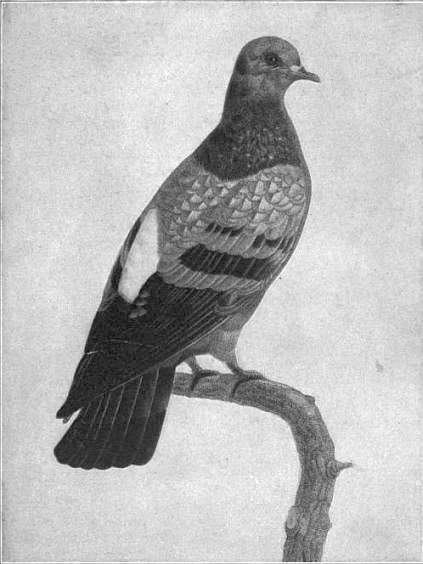
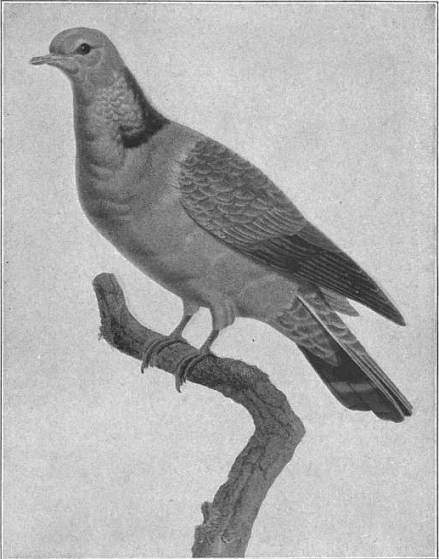
ROCK DOVE OR BLUE ROCK PIGEON, Columba livia. STOCK DOVE, Columba oenas.
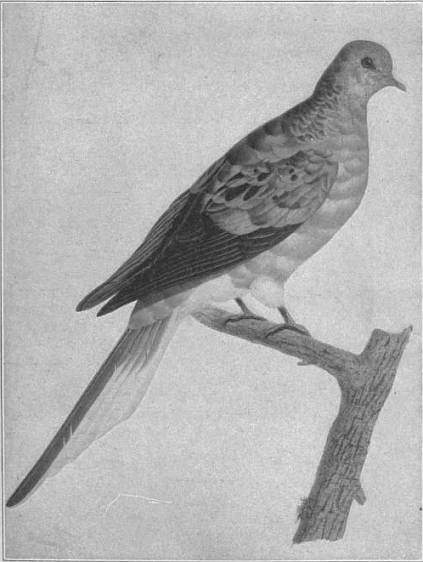
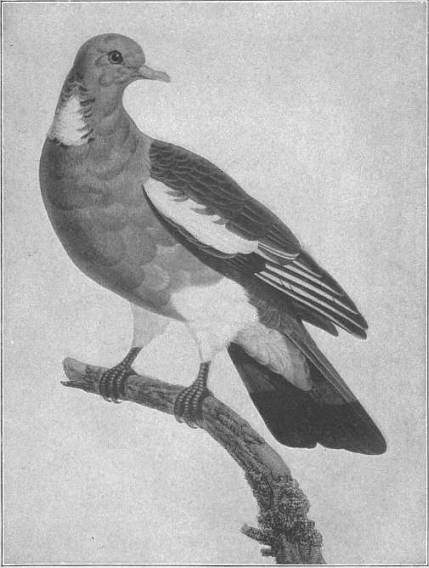
AMERICAN WILD CARRIER PIGEON, Ectopistes migratorius. RING DOVE OR WOOD PIGEON, Columba palumbus.
(After the coloured drawings by Mme. Knip (Pauline de Courcelles), painter to the Empress Marie Louise, in Les Pigeons. Text by C. J. Themminck, Paris, 1811.)
Plate II.
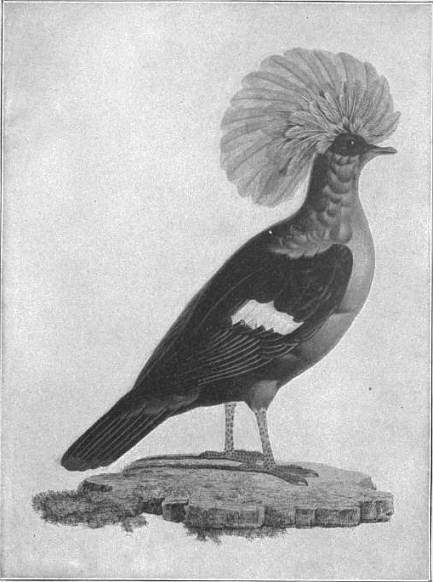
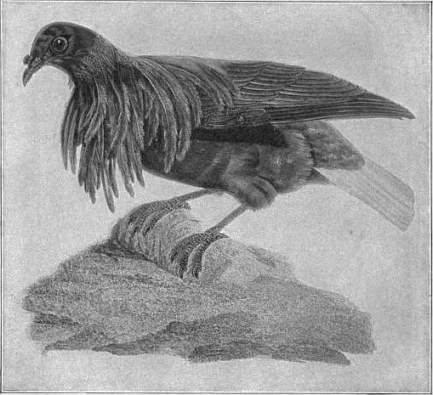
CROWNED PIGEON, Goura coronata (After Mme. Knip, as above.) NICOBAR PIGEON, Caloenas nicobarica. (After Mme. Knip, as above.)
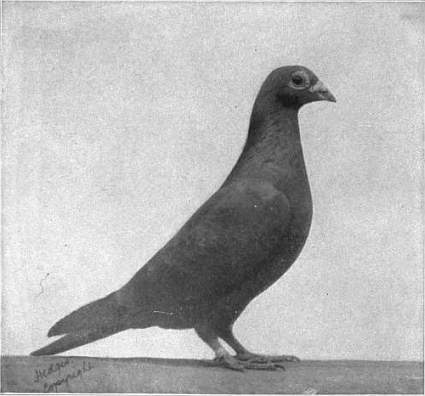
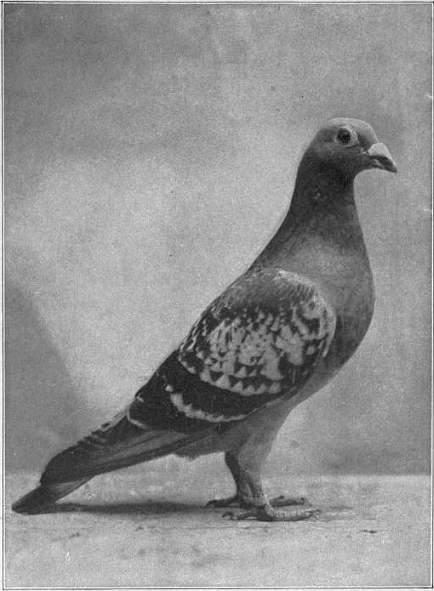
Photographs of two typical pedigree Homing or Racing Pigeons, colours black and blue chequer, bred and shown by Frederick Romer, Esq., prize-winners in races from France to England.
By permission of the proprietors of the Racing Pigeon.
The stock-dove (C. aenas of most authors) is a smaller species, with many of the habits of the former, but breeding by preference in the stocks of hollow trees or in rabbit-holes. It is darker in colour than the ring-dove, without any white on its neck or wings, and is much less common and more locally distributed.
The rock-dove (C. livia, Temm.) much resembles the stock-dove, but is of a lighter colour, with two black bars on its wings, and a white rump. In its wild state it haunts most of the rocky parts of the coast of Europe, from the Faeroes to the Cyclades, and, seldom going inland, is comparatively rare. Yet, as it is without contradiction the parent-stem of all British domestic pigeons, its numbers must far exceed those of both the former put together. In Egypt and various parts of Asia it is represented by what Charles Darwin has called “wild races,” which are commonly accounted good “species” (C. schimperi, C. affinis, C. intermedia, C. leuconota, and so forth), though they differ from one another far less than do nearly all the domestic forms, of which more than 150 kinds that “breed true,” and have been separately named, are known to exist. Very many of these, if found wild, would have unquestionably been ranked by the best ornithologists as distinct “species” and several of them would as undoubtedly have been placed in different genera. These various breeds are classified by Darwin1 in four groups as follows:—
Group I., composed of a single Race, that of the “Pouters,” having the gullet of great size, barely separated from the crop, and often inflated, the body and legs elongated, and a moderate bill. The most strongly marked sub-race, the Improved English Pouter, is considered to be the most distinct of all domesticated pigeons.
Group II. includes three Races:—(1) “Carriers,” with a long pointed bill, the eyes surrounded by much bare skin, and the neck and body much elongated; (2) “Runts,” with a long, massive bill, and the body of great size; and (3) “Barbs,” with a short, broad bill, much bare skin round the eyes, and the skin over the nostrils swollen. Of the first four and of the second five sub-races are distinguished.
Group III. is confessedly artificial, and to it are assigned five Races:—(1) “Fan-tails,” remarkable for the extraordinary development of their tails, which may consist of as many as forty-two rectrices in place of the ordinary twelve; (2) “Turbits” and “Owls,” with the feathers of the throat diverging, and a short thick bill; (3) “Tumblers,” possessing the marvellous habit of tumbling backwards during flight, or, in some breeds, even on the ground, and having a short, conical bill; (4) “Frill-backs,” in which the feathers are reversed; and (5) “Jacobins,” with the feathers of the neck forming a hood, and the wings and tail long.
Group IV. greatly resembles the normal form, and comprises two Races:—(1) “Trumpeters,” with a tuft of feathers at the base of the neck curling forward, the face much feathered, and a very peculiar voice, and (2) Pigeons scarcely differing in structure from the wild stock.
Besides these some three or four other little-known breeds exist, and the whole number of breeds and sub-breeds almost defies computation. The difference between them is in many cases far from being superficial, for Darwin has shown that there is scarcely any part of the skeleton which is constant, and the modifications that have been effected in the proportions of the head and sternal apparatus are very remarkable. Yet the proof that all these different birds have descended from one common stock is nearly certain. Here there is no need to point out its bearing upon the theory of natural selection. The antiquity of some of these breeds is not the least interesting part of the subject, nor is the use to which one at least of them has long been applied. The dove from the earliest period in history has been associated with the idea of a messenger (Genesis viii. 8-12), and the employment of pigeons in that capacity, developed successively by Greeks, Romans, Mussulmans and Christians, has come down to modern times.
The various foreign species, if not truly belonging to the genus Columba, are barely separable therefrom. Of these examples may be found in the Indian, Ethiopian and Neotropical regions. Innumerable other forms entitled to the name of “dove” are to be found in almost every part of the world, and nowhere more abundantly than in the Australian Region. A. R. Wallace (Ibis, 1865, pp. 365-400) considers that they attain their maximum development in the Papuan Subregion, where, though the land area is less than one-sixth that of Europe, more than a quarter of all the species (some 300 in number) known to exist are found—owing, he suggests, to the absence of forest-haunting and fruit-eating mammals, which are in most cases destructive to eggs also.
To a small group of birds the name dove is, however, especially applicable in common parlance. This is the group containing the turtle-doves—the time-honoured emblem of tenderness and conjugal love. The common turtle-dove of Europe (Turtur auritus) is one of those species which are gradually extending their area. In England, in the 18th century, it seems to have been chiefly, if not solely, known in the southern and western counties. Though in the character of a straggler only, it now reaches the extreme north of Scotland, and is perhaps nowhere more abundant than in many of the midland and eastern counties of England. On the continent of Europe the same thing has been observed, though indeed not so definitely; and this species has appeared as a casual visitor within the Arctic Circle. Its graceful form and the delicate harmony of its modest colouring are proverbial. The species is migratory, reaching Europe late in April and retiring in September. Another species, and one perhaps better known from being commonly kept in confinement, is that called by many the collared or Barbary dove (T. risorius)—the second English name probably indicating that it was by way of the Barbary coast that it was brought to England. This is distinguished by its cream-coloured plumage and black necklace.
(A. N.)
1 The Variation of Animals and Plants under Domestication (London, 1868), vol. i. pp. 131-224.
DOVER, GEORGE JAMES WELBORE AGAR-ELLIS, Baron (1797-1833), English man of letters, born on the 14th of January 1797, was the only son of the 2nd Viscount Clifden. He was educated at Westminster school and at Christ Church, Oxford. In 1818 he was returned to parliament as member for Heytesbury. He afterwards represented Seaford (1820), Ludgershall (1826) and Okehampton (1830). He seconded Canning’s motion in 1822 for a bill to relieve the disabilities of Roman Catholic peers, and consistently supported liberal principles. In party politics, however, he took little interest, but he zealously advocated in parliament and elsewhere that state encouragement should be given to the cause of literature and the fine arts. In 1824 he was the leading promoter of the grant of £57,000 for the purchase of John Julius Angerstein’s collection of pictures, which formed the foundation of the National Gallery. On the formation of Lord Grey’s administration, in November 1830, he was appointed chief commissioner of woods and forests, but was compelled by delicate health to resign it after two months’ occupancy. In June 1831, during the lifetime of his father, he was raised to the House of Lords, receiving an English peerage with the title of Baron Dover. He was president (1832) of the Royal Society of Literature, a trustee of the British Museum and of the National Gallery, and a commissioner of public records. He died on the 10th of July 1833. Lord Dover’s works are chiefly historical, and include The True History of the Iron Mask, extracted from Documents in The French Archives (1826), Inquiries respecting the Character of Clarendon (1827), and a Life of Frederick II. (1831). He also edited the Ellis Correspondence (1829) and Walpole’s Letters to Sir Horace Mann (1833).
DOVER, HENRY JERMYN, Earl of (c. 1636-1708), was the second son of Sir Thomas Jermyn, of Rushbroke, Suffolk, elder brother of Henry Jermyn, earl of St Albans (q.v.). Jermyn surpassed his uncle, St Albans, in reputation for profligacy, figuring frequently as “the little Jermyn” in the Grammont Memoirs, as the lover of Lady Castlemaine, Lady Shrewsbury, Miss Jennings and other beauties of the court of Charles II. He was also a noted duellist and a lifelong gambler. While the court was in exile, he obtained a post in the household of the duke of York, to whom he became master of the horse at the Restoration. Being a Roman Catholic he enjoyed a position of influence with James II., who on his accession raised Jermyn to the peerage as Baron Dover in 1685, and appointed him lieutenant-general of the royal guard in 1686. At the Revolution, Dover adhered to James, whom he followed abroad, and in July 1689 the deposed sovereign created him Baron Jermyn of Royston, Baron Ipswich, Viscount Cheveley and earl of Dover; these honours being among the “Jacobite peerages” which were not recognized by the English government, though Jermyn became generally known as the earl of Dover. He commanded a troop at the battle of the Boyne; but shortly afterwards made his submission to William III. He succeeded his brother Thomas as 3rd Baron Jermyn of St Edmundsbury in 1703, and died in 1708. As he left no children by his wife, Judith, daughter of Sir Edmund Poley, of Badley, Suffolk, his titles became extinct at his death.
See Samuel Pepys, Diary, edited by H. B. Wheatley, 9 vols. (London, 1893); Anthony Hamilton, Memoirs of Grammont (Bohn edition, London, 1846); J. S. Clarke, Life of James II., 2 vols. (London, 1816); Narcissus Luttrell, Brief Relation of State Affairs 1678-1714, 6 vols. (Oxford, 1857).
DOVER, ROBERT (1575-1641), English captain and attorney, is known as the founder and director for many years of the “Cotswold Games,” which he originated as a protest against the growing Puritanism of the day. These sports, which were referred to by contemporary writers as “Mr Robert Dover’s Olimpick Games upon the Cotswold Hills,” consisted of cudgel-playing, wrestling, running at the quintain, jumping, casting the bar and hammer, hand-ball, gymnastics, rural dances and games and horse-racing, the winners in which received valuable prizes. They continued from about the year 1604 until three years after the death of Dover, which took place in 1641. They were revived for a brief period in the reign of Charles II.
DOVER, the capital of Delaware, U.S.A., and the county seat of Kent county, on the St Jones River, in the central part of the state, about 48 m. S. of Wilmington and about 9 m. from Delaware Bay. Pop. (1890) 3061; (1900) 3329 (772 negroes); (1910) 3720. Dover is served by the Philadelphia, Baltimore & Washington railway (Pennsylvania system). The state house, built about 1722 for a court house, was remodelled for its present purpose in 1791; it contains the state library, which in 1908 had about 50,000 bound volumes. Dover is the seat of the Wilmington Conference Academy (Methodist Episcopal); and about 2 m. N. is the state college for coloured students (co-educational; opened in 1892), an agricultural and manual training school. The surrounding country is largely devoted to the raising of small fruit. Among the manufactures are canned fruit and meat (especially poultry), timber, machine shop products, baskets and crates, and silk. The town was laid out in 1717; in 1777 it replaced New Castle as the capital of the state, and in 1829 it was incorporated as a town. Dover was the birthplace of the American patriot, Caesar Rodney (1728-1784), whose home near Dover is still standing.
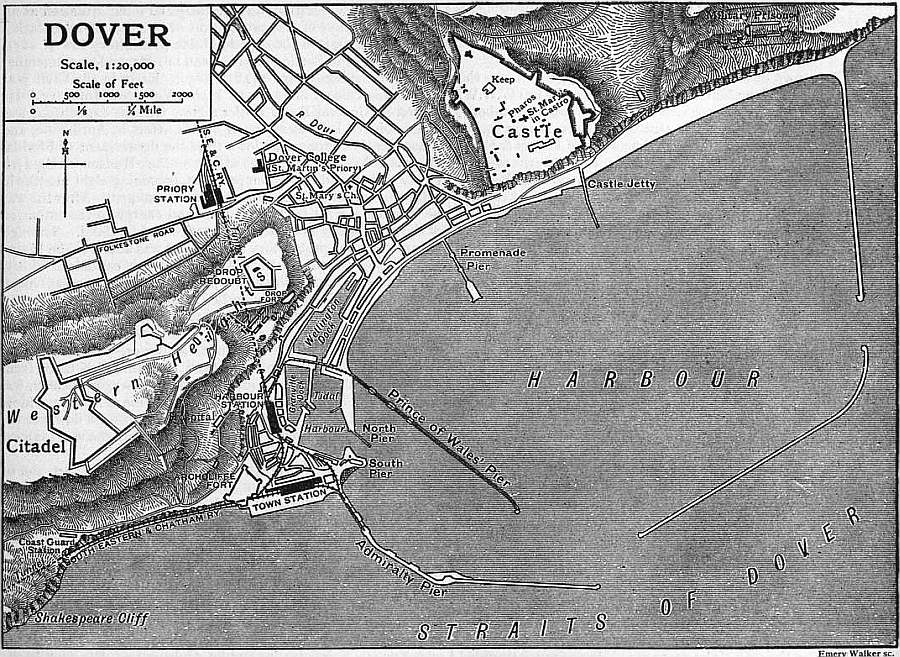
DOVER, a seaport and municipal and parliamentary borough of Kent, England, one of the Cinque Ports, 76 m. E.S.E. of London by the South-Eastern & Chatham railway. Pop. (1891) 33,503; (1901) 41,794. It is situated at the mouth of a small stream, the Dour, whose valley here breaches the high chalk cliffs which fringe the coast on either hand. It is an exceptionally healthy locality, and the steep shore and open downs make it an agreeable summer resort. The better residential quarters lie along the seaboard and on the higher ground, notably on a western spur of the Castle Hill. The dominant object of the place is the castle, on the east height, 375 ft. above sea-level, between which and the batteries on the western heights lies the old town. The castle occupies a space of 35 acres. Within its precincts are a Roman pharos or lighthouse, still exhibiting the Roman masonry; the ancient fortress church (St Mary in Castro); some remains of the Saxon fort; and the massive keep and subsidiary defences (such as the Constable’s, Avranche’s, and other towers) of the Norman building. The church, substantially unaltered, forms an almost unique Christian relic. It has been called Roman, but is later. It is cruciform in shape, and the walls are built mainly of flint, but jambs and arches are formed of Roman bricks. At the end of the 12th century it was remodelled and given an Early English character. In the beginning of the 18th century it was dismantled and turned into a storehouse; and so continued until 1863, when, having been restored by Sir G. G. Scott, it was again opened for divine service, and is now the chapel of the castle garrison.
The view from the castle keep includes on a clear day the line of cliffs from Folkestone to Ramsgate on the one side, and from Boulogne to Gravelines on the other side of the strait. The cliffs are honeycombed in all directions with military works. They are covered by modern works on the north side known as Fort Burgoyne, and additional works extend eastwards towards St Margaret’s Bay. The western heights, where is the foundation of another Roman lighthouse, form a further circuit of fortifications. They are still more elevated than the castle. A military shaft, locally known as the Corkscrew Staircase, affords communication between the barracks and the town. Remains were discovered here in 1854 of a round church of the Templars (Holy Sepulchre), 32 ft. in diameter; the church, doubtless, in which King John made his submission to the Papal Nuncio in 1213. Archcliffe Fort lies to the south-west of old Dover. There may further be mentioned the remnant of the Saxon collegiate church of the canons of St Martin, and the parish church of St Mary the Virgin. This last was rebuilt and enlarged in 1843-1844, but preserves the three bays of the Saxon church, with its western narthex, on which was superimposed the Norman tower, which presents its rich front to the street. The rest of the church is mainly Norman and Early English. A later Norman church stands under the Castle Hill, but its parochial status was transferred to the modern church of St James.
The remains of the splendid foundation of St Martin’s priory, of the 12th century, include the great gate, the house refectory, with campanile, and the spacious strangers’ refectory, now incorporated in Dover College. The college of St Martin for twenty-two secular canons, which had been established in the castle in 696, was removed into the town in the beginning of the 8th century, and in 1139 became a Benedictine priory under the jurisdiction of that at Canterbury, to which see the lands are still attached. The interior of the refectory is very fine. In High Street may be seen the noble hall and truncated fabric of the Maison Dieu founded by Hubert de Burgh in the 13th century for the reception of pilgrims of all nations. From the time of Henry VIII. to 1830 it was used as a crown victualling office, but was subsequently purchased by the corporation and adapted as a town hall. The new town hall adjoining the old hall of the Maison Dieu was opened in 1883. The museum (1849) contains an interesting collection of local antiquities and a natural history collection.
Among various charitable institutions are the National Sailors’ Home and the Gordon Boys’ and Victoria Seaside Orphanages. Besides the church of St James, mentioned above, other modern churches are those of Holy Trinity and Christ church, and further up the valley there are the parish churches of Charlton (originally Norman) and Buckland (Early English). Among educational establishments is Dover College, occupying the site and remaining buildings of St Martin’s priory, with additional modern buildings. It was instituted in 1871, and educates about 220 boys. There is a separate junior school.
Dover is the only one of the Cinque Ports which is still a great port. It is one of the principal ports for passenger communications across the Channel, steamers connecting it with Calais and Ostend. The Admiralty pier was begun in 1847 and practically completed to a length of about 2000 ft. in 1871. In 1888 the gates of Wellington dock were widened to admit a larger type of Channel steamers; new coal stores were erected on the Northampton quay; the slipway was lengthened 40 ft., and widened for the reception of vessels up to 800 tons. In 1891 it was resolved to construct a new commercial harbour at an estimated cost of about £700,000. Begun in 1893, the works included the construction of an east pier (“Prince of Wales’s Pier”), running parallel to the general direction of the Admiralty pier and in conjunction with it enclosing an area of sheltered water amounting to seventy-five acres. This pier was completed in 1902. A railway line connected with the South-Eastern and Chatham system runs to its head, and in July 1903 it was brought into use for the embarcation of passengers by transatlantic liners. In 1896 and subsequent years funds were voted by parliament for the construction of an artificial harbour for naval purposes, having an area of 610 acres, of which 322 acres were to have a depth of not less than 30 ft. at low water. The scheme comprised three enclosing breakwaters—on the west an extension of the Admiralty pier in a south-easterly direction for a length of 2000 ft.; on the south an isolated breakwater, 4200 ft. long, curving round shoreward at its eastern end to accord with the direction of the third breakwater; on the east, which runs out from the shore in a southerly direction for a length of 3320 ft. These three breakwaters, with a united length of rather more than 1¾ m., are each built of massive concrete blocks in the form of a practically vertical wall founded on the solid chalk and rising to a quay level of 10 ft. above high water. Two entrances, one 800 ft. and the other 600 ft. in width, with a depth of about seven fathoms at low water, are situated at either end of the detached breakwater. The plan also included the reclamation of the foreshore at the foot of the cliffs, between the castle jetty and the root of the eastern breakwater, by means of a massive sea-wall. The construction of three powerful forts was undertaken in defence of the harbour, which was opened in 1909.
Besides the mail service and harbour trade, Dover has a trade in shipbuilding, timber, rope and sail making, and ships’ stores. Dover is a suffragan bishopric in the diocese of Canterbury. The parliamentary borough returns one member. The town is governed by a mayor, six aldermen and eighteen councillors. Area, 2026 acres.
History.—Dover (Dubris) was one of the ports for continental traffic in Roman times. In the 4th century it was guarded by a fort lying down near the harbour, and forming part of the defences of the Saxon shore (Litus Saxonicum). As a Cinque Port, Dover (Dofra, Dovorra) had to contribute twenty of the quota of ships furnished by those ports; in return for this service a charter of liberties was granted to the ports by Edward the Confessor, making the townsmen quit of shires and hundreds, with the right to be impleaded only at Shepway, and other privileges, which were confirmed by subsequent kings, with additions, down to James II. During the middle ages Dover Castle was an object of contention both in civil wars and foreign invasions, and was considered the key to England; the constable of the castle, who from the reign of John was appointed by the crown, was also warden of the Cinque Ports. The castle was successfully defended in 1216 against the French under the dauphin Louis by Hubert de Burgh, who was also the founder of the Maison Dieu established for the accommodation of pilgrims. The title of mayor as chief municipal officer first occurs about the middle of the 13th century, when the town was governed by a mayor and twelve jurats. The Cinque Ports were first represented in the parliament of 1265; Dover returned two members until 1885 when the number was reduced to one. In 1685 Charles II. confirmed to the inhabitants of Dover a fair beginning on the 11th of November, which had been held of old in the town, and granted two others on the 23rd and 24th of April and the 25th and 26th of September.
After the decay of Richborough harbour the passage from Dover to Whitsand, and later to Calais, became the accustomed route to France, and by a statute of 1465 no one might ship for Calais except at Dover. The guardians of the harbour were incorporated by James I. in 1607.
See S. P. H. Statham, History of the Castle, Town and Port of Dover (London, 1899); and Dover Charters and other Documents (London, 1902).
Battle of Dover
This famous and important naval victory was won off the town of Dover by the ships of the Cinque Ports on the 21st of August 1217, during the minority of King Henry III. The barons, who were in arms against his father King John, had called Louis, son of Philip Augustus, king of the French, to their aid. Having been recently defeated in Lincoln, they were hard pressed, and reinforcements were sent to them from Calais in a fleet commanded by a pirate and mercenary soldier called Eustace the Monk. His real name is uncertain, but according to the chronicle of Lanercost it was Matthew. He passed the Straits of Dover with a numerous flotilla laden with military machines and stores, and also carrying many knights and soldiers. The Monk’s fleet was seen from Dover, where the regent, Hubert de Burgh, lay with a naval force of the Cinque Ports, said to have been very small. Sixteen vessels of large size for the time, and a number of smaller craft, is said to have been their total strength. But medieval estimates of numbers are never to be trusted, and the strength of the Cinque Port squadron was probably diminished to exalt the national glory. It put to sea, and by hugging the wind gained the weather gage of the French adventurer. Eustace is said to have been under the impression that they meant to attack Calais in his absence, and to have derided them because he had left the town well guarded. When they were to windward of his fleet the Cinque Port ships bore down on the enemy. As they approached they threw unslaked lime in the air and the wind blew it in the faces of the French. This form of attack, and the flights of arrows discharged by the English (which flew with the wind), produced confusion in the crowded benches of the French vessels, which in most cases must have been little more than open boats. It is further said that in some cases at least the English vessels were “bearded,” that is to say, strengthened by iron bands across the bows for ramming, and that they sank many of the French. The Monk was certainly defeated, and his fleet was entirely scattered, sunk or taken. His own vessel was captured. Eustace, who had concealed himself in the bilge, was dragged out. In answer to his appeals for quarter and promises to pay ransom, he was told by Richard, the bastard son of King John, that he was a traitor who would not be allowed to deceive more men. His head was struck off by Richard, and was sent round the ports on a pike. The Cinque Port seamen returned in triumph, towing their prizes, after throwing the common soldiers overboard, and taking the knights to ransom according to the custom of the age.
The political importance of the battle was very great, for it gave the death-blow to the cause of the barons who supported Louis, and it fixed Henry III. on the throne. But the defeat and death of the Monk was widely regarded as in a peculiar sense a victory over the powers of evil. The man became within a few years after his death the hero of many legends of piracy and necromancy. It was said that after leaving the cloister he studied the black art in Toledo, which had a great reputation in the middle ages as a school of witchcraft. A French poem written seemingly within a generation after his death represents him as a wizard. In a prose narrative discovered and printed by M. Francisque Michel, it is said that he made his ship invisible by magic spells. A brother wizard in the English fleet, by name Stephen Crabbe, detected him while he was invisible to others. The bold and patriotic Crabbe contrived to board the bewitched flagship, and was seen apparently laying about him with an axe on the water—which the spectators took to be a proof either that he was mad, or that this was the devil in his shape. At last he struck off the head of Eustace, upon which the spell was broken, and the ship appeared. Crabbe was torn to pieces—presumably by the familiar spirits of the Monk—and the fragments were scattered over the water. Saint Bartholomew, whose feast is on the 21st of August, came to encourage the English by his presence and his voice.
Ascertainable fact concerning Eustace is less picturesque, but enough is known to show that he was an adventurous and unscrupulous scoundrel. In his youth he was a monk, and left the cloister to claim an inheritance from the count of Boulogne. Not having received satisfaction he became a freebooter on land and sea, and mercenary soldier. He is frequently mentioned in the Pipe, Patent and Close Rolls. For a time he served King John, but when the king made friends with the count of Boulogne, he fled abroad, and entered the service of the French prince Louis and his father Philip Augustus. Chroniclers lavish on him the titles of “archipirata,” “vir flagitiosissimus et nequissimus,” and poets made him an associate of the devil.
The evidence concerning Eustace is collected by Herren Wendelin Forster and Johann Trost, in their edition of the French poem “Wistasse le moine” (Halle, 1891). See for the battle Sir N. Harris Nicolas, History of the Royal Navy (London, 1847).
DOVER, a city and the county seat of Strafford county, New Hampshire, U.S.A., on the Cochecho river, at the head of navigation, 10 m. N.W. of Portsmouth. Pop. (1890) 12,790; (1900) 13,207, of whom 3298 were foreign-born; (1910 census) 13,247. Land area, 26.4 sq m. It is at the intersection of two branches of the Boston & Maine railway, and is served by several interurban electric lines. The street plan is irregular. Dover has a fine city hall of red brick and freestone; a public library containing (1907) 34,000 volumes, the Wentworth hospital; the Wentworth home for the aged, a children’s and an orphans’ home. The Strafford Savings Bank is said to be the largest and oldest savings institution in the state. Dover has long had a considerable commerce, both by rail and by water, that by water being chiefly in coal and building materials. The navigation of the Cochecho river has been greatly improved by the Federal government, at a cost between 1829 and 1907 of about $300,000, and in 1909 there was a navigable channel, 60-75 ft. wide and 7 ft. deep at mean low water, from Dover to the mouth of the river; the mean range of tides is 6.8 ft. The Cochecho river falls 31½ ft. within the city limits and furnishes water-power for factories; among the manufactures are textiles, boots and shoes, leather belting, sash, doors and blinds, carriages, machinery and bricks. In 1905 Dover ranked fourth among the manufacturing cities of the state, and first in manufactures of woollens; the value of the city’s total factory product in that year was $6,042,901. Dover is one of the two oldest cities in the state. In May 1623 a settlement was established by Edward Hilton on Dover Point, about 5 m. S.E. of the Cochecho Falls; the present name was adopted in 1639, and with the development of manufacturing and trading interests the population gradually removed nearer the falls; Hilton and his followers were Anglicans, but in 1633 they were joined by several Puritan families under Captain Thomas Wiggin, who settled on Dover Neck (1 m. above Dover Point), which for 100 years was the business centre of the town. As the settlement was outside the jurisdiction of any province, and as trouble arose between the two sects, a plantation covenant was drawn up and signed in 1640 by forty-one of the inhabitants. Dissensions, however, continued, and in 1641, by the will of the majority, Dover passed under the jurisdiction of Massachusetts and so remained for nearly half a century. The town, between 1675 and 1725, suffered greatly from Indian attacks, particularly from that of the 28th of June 1689 at Cochecho Falls. Dover was first chartered as a city in 1855. Within the original territory of the town were included Newington, set off in 1713, Somersworth (1729), Durham (1732), Medbury (1755), Lee, set off from Durham in 1766, and Rollinsford, set off from Somersworth in 1849.
See Jeremy Belknap, History of New Hampshire (Philadelphia, 1784-1792); and Rev. Dr A. H. Quint’s Historical Memoranda of Persons and Places in Old Dover, N.H., edited by John Scales (Dover, 1900).
DOVER, a town of Morris county, New Jersey, U.S.A., on the Rockaway river and the Morris canal, about 40 m. by rail W.N.W. of Hoboken. Pop. (1900) 5938, of whom 947 were foreign-born; (1905) 6353; (1910) 7468. The area of the town is 1.72 sq. m. Dover is at the junction of the main line and the Morris & Essex division of the Delaware, Lackawanna & Western railway (which has large repair shops here), and is also served by the High Bridge branch of the Central of New Jersey, and by an electric line connecting with neighbouring towns. The town is situated about 570 ft. above sea-level. Building stone, used extensively for railway bridges, and iron ore abound in the vicinity. The river furnishes good water-power, and the town has various manufactures, including stoves and ranges, boilers, bar iron, rivets, steel castings, rock drills, air compressors, silk hose and underwear, organzine or thrown silk, and overalls. The waterworks are owned by the town, water being obtained from wells varying in depth from 193 to 213 ft. Dover was settled as early as 1748, and was separated from Randolph township and incorporated as a town in 1869.
DOVERCOURT, a watering-place in the Harwich parliamentary division of Essex, England, immediately S.W. of Harwich, with a station between Parkeston Quay and Harwich town on the Great Eastern railway, 70 m. N.E. by E. from London. Pop. (1901) 3894. The esplanade and sea-wall front the North Sea, and there is a fine expanse of sand affording good bathing. There is also a chalybeate spa. The scenery of the neighbouring Orwell and Stour estuaries is pleasant. The church, which stands inland in the old village distinguished as Upper Dovercourt, is Early English and later; it formerly possessed a miraculous rood which became an object of pilgrimage of wide repute. It is said to have been stolen and burnt in 1532, three of the four thieves being subsequently taken and hanged.
DOW, LORENZO (1777-1834), American preacher, noted for his eccentricities of dress and manner, was born at Coventry, Connecticut, on the 16th of October 1777. He was much troubled in his youth by religious perplexities, but ultimately joined the Methodists, and in 1798 was appointed a preacher “on trial” in a New York circuit. In the following year, however, he crossed the Atlantic and preached as a missionary to the Catholics of Ireland, and thereafter was never connected officially with the ministry of the Methodist Church, though he remained essentially a Methodist in doctrine. Everywhere, in America and Great Britain, he attracted great crowds to hear and see him, and he was often persecuted as well as admired. In 1805 he visited England, introduced the system of camp meetings, and thus led the way to the formation of the Primitive Methodist Society. Dow’s enthusiasm sustained him through the incessant labours of more than thirty years, during which he preached in almost all parts of the United States. His later efforts were directed chiefly against the Jesuits; indeed he was in general a vigorous opponent of Roman Catholicism. He died in Georgetown, District of Columbia, on the 2nd of February 1834. Among his publications are: Polemical Works (1814); The Stranger in Charleston, or the Trial and Confession of Lorenzo Dow (1822); A Short Account of a Long Travel; with Beauties of Wesley (1823); and the History of a Cosmopolite; or the Four Volumes of the Rev. Lorenzo Dow’s Journal, concentrated in One, containing his Experience and Travels from Childhood to 1814 (1814; many later editions); this volume also contains “All the Polemical Works of Lorenzo.” The edition of 1854 was entitled The Dealings of God, Man, and the Devil as exemplified in the Life, Experience and Travels of Lorenzo Dow.
DOW, NEAL (1804-1897), American temperance reformer, was born at Portland, Maine, on the 20th of March 1804. His parents were Quakers and he was educated at the Friends’ School in New Bedford, Massachusetts. He subsequently became a merchant in his native city and rose to a position of importance in its business and political life. His chief interest, however, was in the temperance question, and he early attracted attention as an ardent champion of the prohibition of the sale of intoxicating drinks. He drafted the drastic Maine prohibitory law of 1851. He was mayor of Portland in 1851 and in 1855, and was a member of the Maine legislature in 1858-1859. Early in the Civil War he became colonel of the 13th Maine Volunteer Infantry. He served in General B. F. Butler’s New Orleans expedition, was commissioned brigadier-general of volunteers in April 1862, and subsequently commanded for a time the department of Florida. He was twice wounded in the attack on Port Hudson, on the 27th of May 1863, and was taken prisoner, remaining eight months in Libby and other prisons before he was exchanged. After the war he devoted a great part of his time and energy to the extension of the prohibition movement in America and England. Through his exertions the prohibitory amendment was added to the Maine constitution in 1884. In 1880 he was the candidate of the National Prohibition Party for president, polling 10,305 votes. He died at Portland on the 2nd of October 1897.
His Reminiscences were published at Portland in 1898.
DOWAGER (from the Old Fr. douagiere, mod. douairière), strictly, a widow in the enjoyment of dower. “Dowager” is also applied to widows of high rank to distinguish them from the wives of their sons, as queen-dowager, dowager-duchess, &c. The title was first used in England of Catherine of Aragon, widow of Arthur, prince of Wales, who was styled princess dowager till her marriage with Henry VIII. By transference the word is used of an elderly lady.
DOWDEN, EDWARD (1843- ), Irish critic and poet, son of John Wheeler Dowden, merchant and landowner, was born at Cork on the 3rd of May 1843, being three years junior to his brother John, who became bishop of Edinburgh in 1886. His literary tastes were shown early, in a series of essays written at the age of twelve. His home education was continued at Queen’s College, Cork, and Trinity College, Dublin; at the latter university he had a distinguished career, becoming president of the Philosophical Society, and winning the vice-chancellor’s prize for English verse and prose, and the first senior moderatorship in ethics and logic. In 1867 he was elected professor of oratory and English literature in Dublin University. His first book, Shakespeare, his Mind and Art (1875), was a revision of a course of lectures, and made him widely known as a critic, being translated into German and Russian; and his Poems (1876) went into a second edition. His Shakespeare Primer (1877) was also translated into Italian and German. In 1878 he was awarded the Cunningham gold medal of the Royal Irish Academy “for his literary writings, especially in the field of Shakespearian criticism.” Later works by him in this field were his Shakespeare’s Sonnets (1881), Passionate Pilgrim (1883), Introduction to Shakespeare (1893), Hamlet (1899), Romeo and Juliet (1900), Cymbeline (1903), and his article (National Review, July 1902) on “Shakespeare as a Man of Science,” criticizing T. E. Webb’s Mystery of William Shakespeare. His critical essays “Studies in Literature” (1878), “Transcripts and Studies” (1888), “New Studies in Literature” (1895) showed a profound knowledge of the currents and tendencies of thought in various ages and countries; but it was his Life of Shelley (1886) that made him best known to the public at large. In 1900 he edited an edition of Shelley’s works. Other books by him which indicate his interests in literature are his Southey (in the “English Men of Letters” series, 1880), his edition of Southey’s Correspondence with Caroline Bowles (1881), and Select Poems of Southey (1895), his Correspondence of Sir Henry Taylor (1888), his edition of Wordsworth’s Poetical Works (1892) and of his Lyrical Ballads (1890), his French Revolution and English Literature (1897; lectures given at Princeton University in 1896), History of French Literature (1897), Puritan and Anglican (1900), Robert Browning (1904) and Michel de Montaigne (1905). His devotion to Goethe led to his succeeding Max Müller in 1888 as president of the English Goethe Society. In 1889 he became the first Taylorian lecturer at Oxford, and from 1892 to 1896 was Clark lecturer at Trinity College, Cambridge. To his sagacity in research are due, among other matters of literary interest, the first account of Carlyle’s “Lectures on periods of European culture”; the identification of Shelley as the author of a review (in The Critical Review of December 1814) of a lost romance by Hogg; description of Shelley’s “Philosophical View of Reform”; a MS. diary of Fabre D’Eglantine; and a record by Dr Wilhelm Weissenborn of Goethe’s last days and death. He also discovered a “Narrative of a Prisoner of War under Napoleon” (published in Blackwood’s Magazine), an unknown pamphlet by Bishop Berkeley, some unpublished writings of Hayley relating to Cowper, and a unique copy of the Tales of Terror. His wide sympathies and scholarly methods made his influence on criticism both sound and stimulating, and his own ideals are well described in his essay on “The Interpretation of Literature” in his Transcripts and Studies. As commissioner of education in Ireland (1896-1901), trustee of the National Library of Ireland, secretary of the Irish Liberal Union and vice-president of the Irish Unionist Alliance, he enforced his view that literature should not be divorced from practical life. He married twice, first (1866) Mary Clerke, and secondly (1895) Elizabeth Dickinson West, daughter of the dean of St Patrick’s.
DOWDESWELL, WILLIAM (1721-1775), English politician, was a son of William Dowdeswell of Pull Court, Bushley, Worcestershire, and was educated at Westminster school, at Christ Church, Oxford, and at the university of Leiden. He became member of parliament for the family borough of Tewkesbury in 1747, retaining this seat until 1754, and from 1761 until his death he was one of the representatives of Worcestershire. Becoming prominent among the Whigs, Dowdeswell was made chancellor of the exchequer in 1765 under the marquess of Rockingham, and his short tenure of this position appears to have been a successful one, he being in Lecky’s words “a good financier, but nothing more.” To the general astonishment he refused to abandon his friends and to take office under Lord Chatham, who succeeded Rockingham in August 1766. Dowdeswell then led the Rockingham party in the House of Commons, taking an active part in debate until his death at Nice on the 6th of February 1775. The highly eulogistic epitaph on his monument at Bushley was written by Edmund Burke.
DOWER (through the Old Fr. douaire from late Lat. dotarium, classical Lat. dos, dowry), in law, the life interest of the widow in a third part of her husband’s lands. There were originally five kinds of dower: (1) at common law; (2) by custom; (3) ad ostium ecclesiae, or at the church porch; (4) ex assensu patris; (5) de la plus belle. The last was a conveyance of tenure by knight service, and was abolished in 1660, by the act which did away with old tenures. Dower ad ostium ecclesiae, by which the bride was dowered at the church porch (where all marriages used formerly to take place), and dower ex assensu patris, by the father of the bridegroom, though long obsolete, were formally abolished by the Dower Act 1834. Dower is governed in the United Kingdom, so far as women married after the 1st of January 1834 are concerned, by the Dower Act 1834, and under it only attaches on the husband’s death to the lands which he actually possessed for an estate of inheritance at the time of his death. It must be claimed within twelve years of the time of its accrual, but only six years’ arrears are recoverable. The wife is also entitled to dower out of equitable estates, but joint estates are exempt. By the act the wife’s dower is placed completely under her husband’s control. It does not attach to any land actually disposed of by him in his lifetime or by his will, nor to any land from which he has declared by deed his wife shall not be entitled to dower. He may also defeat her right, either as to any particular land or to all his lands, by a declaration in his will; while it is subject to all the deceased husband’s debts and contracts, and to any partial estates which he may have created during his life or by his will. A widow tenant in dower may make leases for twenty-one years under the Settled Estates Act 1878. Free-bench is an analogous right in regard to copyhold land; it does not fall within the Dower Act 1834, and varies with the custom of each manor. At common law, and prior to the act of 1834, dower was of a very different nature. The wife’s right attached, while the husband was still living, to any land whereof he was solely seised in possession (excluding equitable and joint estates) for an estate of inheritance at any time during the continuance of the marriage, provided that any child the wife might have had could have been heir to the same, even though no child was actually born. When once this right had attached it adhered to the lands, notwithstanding any sale or devise the husband might make; nor was it liable for his debts. In this way dower proved an obstacle to the free alienation of land, for it was necessary for a husband wishing to make a valid conveyance to obtain the consent of his wife releasing her right to dower. This release was only effected by a fine, the wife being separately examined. Often, by reason of the expense involved, the wife’s concurrence was not obtained, and thus the title of the purchaser was defective during the wife’s lifetime. The acceptance of a jointure by the wife before marriage was, however, destructive of dower, if after marriage she was put to her election between it and dower. By the ingenuity of the old conveyancers, devices, known as “uses to bar dower” (the effect of which was that the purchaser never had at any time an estate of inheritance in possession), were found to prevent dower attaching to newly purchased lands, and so to enable the owner to give a clear title, without the need of the wife’s concurrence, in the event of his wishing, in his turn, to convey the land. All this was, however, swept away by the Dower Act 1834, and a purchaser of land no longer need trouble himself to inquire whether the dower of the wife of the vendor has been barred, or to insist on her concurrence in a fine.
(H. S. S.)
DOWIE, JOHN ALEXANDER (1848-1907), founder of “Zionism,” was born in Edinburgh, and went as a boy to South Australia with his parents. He returned in 1868 to study for the Congregationalist ministry at Edinburgh University, and subsequently became pastor of a church near Sydney, Australia. He was a powerful preacher, and later, having become imbued with belief in his powers as a healer of disease by prayer, he obtained sufficient following to move to Melbourne, build a tabernacle, and found “The Divine Healing Association of Australia and New Zealand.” In 1888 he went to America, preaching and “healing,” and in spite of opposition and ridicule attracted a number of adherents. In 1896 he established “The Christian Catholic Apostolic Church in Zion,” with himself as “First Apostle”; and in 1901, with money liberally contributed by his followers, he founded Zion City, on a site covering about 10 sq. m. on the west shore of Lake Michigan, with a central temple for the Zionist church. In 1903 and 1904, in the course of a visit to the branches of the Zionist movement throughout the world, he appeared in London, but was mobbed. In April 1906 a revolt against his domination took place in Zion City. He was charged with peculation and with practising polygamy, and was deposed, with the assent of his own wife and son. A suit brought by him in the United States district court to recover possession of the Zion City property, valued at two millions sterling, was unsuccessful, and his defalcations were fully proved. Dowie was now broken in health and unmistakably insane; he was struck with paralysis and gradually becoming weaker died in Zion City in March 1907.
DOWLAS, the name given to a plain cloth, similar to sheeting, but usually coarser. It is made in several qualities, from line warp and weft to two warp and weft, and is used chiefly for aprons, pocketing, soldiers’ gaiters, linings and overalls. The finer makes are sometimes made into shirts for workmen, and occasionally used for heavy pillow-cases. The word is spelt in many different ways, but the above is the common way of spelling adopted in factories, and it appears in the same form in Shakespeare’s First Part of Henry IV., Act III. scene 3. The modern dowlas is a good, strong and closely woven linen fabric.
DOWN, a maritime county of Ireland, in the province of Ulster, occupying the most easterly part of the island, bounded N. by Co. Antrim and Belfast Lough, E. and S. by the Irish Sea, and W. by Co. Armagh. The area is 607,916 acres, or nearly 950 sq. m. The coast line is indented by several loughs and bays. The largest of these is Strangford Lough, a fine sheet of water studded with 260 islets, 54 of which have names. All are well wooded or rich in pasturage. The lough runs for 10 m. northwards, and the ancient castles and ruined abbeys on some of the islets render the scene one of singular interest and beauty. Farther south Dundrum Bay forms a wider expanse of water. In the south-west Carlingford Lough separates the county from Louth. There are no lakes of importance. Between Strangford and Carlingford loughs the county is occupied by a range of hills known in its south-western portion as the Mourne Mountains, which give rise to the four principal rivers—the Bann, the Lagan, the Annacloy and the Newry. This mass includes, several striking peaks, of which the principal is Slieve Donard, rising finely direct from the sea to a height of 2796 ft., which is exceeded in Ireland only by one peak in the Wicklow range, and by the higher reeks in Killarney. Several other summits exceed 2000 ft.
Holy wells and mineral springs are numerous in Co. Down. These are both chalybeate and sulphurous, and occur at Ardmillan, Granshaw, Dundonnell, Magheralin, Dromore, Newry, Banbridge and Tierkelly. Those of Struell near Downpatrick were accredited with miraculous powers by the natives until recent times, and religious observances of an extravagant nature took place there.
Geology.—The foundation of this county is Silurian rock throughout, the slates and sandstones striking as a whole north-east, but giving rise to a country of abundant small hills. The granite that appears along the same axis in Armagh continues from Newry to Slieve Croob, furnishing an excellent building stone. South of it, the Eocene granite of the Mournes forms a group of rocky summits, set with scarps and tors, and divided by noble valleys, which are not yet choked by the detritus of these comparatively youthful mountains. Basalt dykes abound, being well seen along the coast south of Newcastle. At the head of Strangford Lough, the basalt, possibly as intrusive sheets, has protected Triassic sandstone, which is quarried at Scrabo Hill. A strip of marine Permian occurs on the shore at Holywood. The north-west of the county includes, at Moira, a part of the great basaltic plateaux, with Chalk and Trias protected by them. The haematite of dehomet near Banbridge is well spoken of. Topaz and aquamarine occur in hollows in the granite of the Mournes. The Mourne granite is quarried above Annalong, and an ornamental dolerite is worked at Rosstrevor.
Industries.—The predominating soil is a loam of little depth, in most places intermixed with considerable quantities of stones of various sizes, but differing materially in character according to the nature of the subsoil. Clay is mostly confined to the eastern coast, and to the northern parts of Castlereagh. Of sandy soil the quantity is small; it occurs chiefly near Dundrum. Moor grounds are mostly confined to the skirts of the mountains. Bogs, though frequent, are scarcely sufficient to furnish a supply of fuel to the population. Agriculture is in a fairly satisfactory condition. The bulk of the labouring population is orderly and industrious, and dwell in circumstances contrasting well with those of others of their class in some other parts of Ireland. Tillage land declines somewhat in favour of pasture land. Oats, potatoes and turnips are the principal crops; flax, formerly important, is almost neglected. The breed of horses is an object of much attention, and some of the best racers in Ireland have been bred in this county. The native breed of sheep, a small hardy race, is confined to the mountains. The various other kinds of sheep have been much improved by judicious crosses from the best breeds. Pigs are reared in great numbers, chiefly for the Belfast market, where the large exportation occasions a constant demand for them. Poultry farming is a growing industry. The fisheries, of less value than formerly, are centred at Donaghadee, Newcastle, Strangford and Ardglass, the headquarters of the herring fishery. The chief industries in the county generally are linen manufacture and bleaching, and brewing.
Communications.—The Great Northern railway has an alternative branch route to its main line by Portadown, from Lisburn through Banbridge to Scarva, with a branch from Banbridge to Ballyroney and Newcastle. Newry is on a branch from the Dublin-Belfast line to Warrenpoint on Carlingford Lough. The main line between Lisburn and Portadown touches the north-western extremity of the county. The eastern part of the county is served by the Belfast & County Down railway with its main line from Belfast to Newcastle to Dundrum Bay, and branches from Belfast to Bangor, Comber to Newtownards and Donaghadee, Ballynahinch Junction to Ballynahinch, and Downpatrick to Ardglass and Killough. The Newry Canal skirts the west of the county, and the Lagan Canal intersects the rich lands in the Lagan valley to the north.
Population and Administration.—The population (219,405 in 1891; 205,889 in 1901) decreases slightly. The population in 1891 on the area of the county before the Local Government (Ireland) Act 1898 was 224,008, for in this case the figures for part of the county borough of Belfast were included. This is worth notice from the comparative point of view, since, whereas emigration to foreign ports is considerable, a large portion of the moving population travels no farther than the metropolis of Belfast. About 39% of the population is of the Presbyterian faith, about 31% Roman Catholic, among whom, as usual, education is in the most backward condition; about 23% are Protestant Episcopalians.
The following are the principal towns:—Newry (pop. 12,405), Newtownards (9110), Banbridge (5006), Downpatrick (2993; the county town), Holywood (3840), Gilford (1199), Bangor (5903), Dromore (2307), Donaghadee (2073), Comber (2095) and Warrenpoint (1817). Other small towns are Portaferry, Rathfryland, Killyleagh, Kilkeel, Ballynahinch, Dundrum, a small port, and Hillsborough, near Dromore, where the castle is the seat of the marquesses of Downshire. There are several popular watering-places on the coast, notably Newcastle, Donaghadee, Ardglass and Rosstrevor. On the shore of Belfast Lough are many pleasant residential villages and seats of the wealthy class in Belfast. The county is divided into fourteen baronies, and contains sixty-four parishes. The assizes are held at Downpatrick, and quarter-sessions at the same town and at Banbridge, Newry and Newtownards. The county is in the Protestant diocese of Down, and the Roman Catholic dioceses of Down and Dromore. Down returns four members to parliament—for the north, south, east and west divisions. The borough of Newry returns a member. Previous to the act of Union the county returned fourteen members to the Irish parliament.
History and Antiquities.—The period at which Down was constituted a county is not certain. A district, however, appears to have borne this name before the beginning of the 14th century, but little is known of it even later than this. However, when in 1535 Sir John Perrot undertook the shiring of Ulster, Down and Antrim were excepted as already settled counties. That some such settlement would have been attempted at an early period is likely, as this coast was a place of Anglo-Norman colonization, and to this movement was due the settlement of the baronies of Lecale, the Ards and others.
The county is not wanting in interesting remains. At Slidderyford, near Dundrum, there is a group of ten or twelve pillar stones in a circle, about 10 ft. in height. A very curious cairn on the summit of Slieve Croob is 80 yds. in circumference at the base and 50 at the top, where is a platform on which cairns of various heights are found standing. The village of Anadorn is famed for a cairn covering a cave which contains ashes and human bones. Cromlechs, or altars, are numerous, the most remarkable being the Giant’s Ring, which stands on the summit of a hill near the borders of Antrim. This altar is formed of an unwrought stone 7 ft. long by 6½ broad, resting in an inclined position on rude pillars about 3 ft. high. This solitary landmark is in the centre of an enclosure about a third of a mile in circumference, formed of a rampart about 20 ft. high, and broad enough on the top to permit two persons to ride abreast. Near Downpatrick is a rath, or encampment, three-quarters of a mile in circumference. In its vicinity are the ruins of Saul Abbey, said to have been founded by St Patrick, and Inch Abbey, founded by Sir John de Courcy in 1180. The number of monastic ruins is also considerable. The most ancient and celebrated is the abbey or cathedral of Downpatrick. Dundrum Castle, attributed to the de Courcy family, stands finely above that town, and affords an unusual example (for Ireland) of a donjon keep. The castle of Hillsborough is of Carolean date. There are three round towers in the county, but all are fragmentary.
DOWN, a smooth rounded hill, or more particularly an expanse of high rolling ground bare of trees. The word comes from the Old English dún, hill. This is usually taken to be a Celtic word. The Gaelic and Irish dun and Welsh din are specifically used of a hill-fortress, and thus frequently appear in place-names, e.g. Dumbarton, Dunkeld, and in the Latinized termination—dunum, e.g. Lugdunum, Lyons. The Old Dutch duna, which is the same word, was applied to the drifted sandhills which are a prevailing feature of the south-eastern coast of the North Sea (Denmark and the Low Countries), and the derivatives, Ger. Düne, modern Dutch duin, Fr. dune, have this particular meaning. The English “dune” is directly taken from the French. The low sandy tracts north and south of Yarmouth, Norfolk, are known as the “Dunes,” which may be a corruption of the Dutch or French words. From “down,” hill, comes the adverb “down,” from above, in the earlier form “adown,” i.e. off the hill. The word for the soft under plumage of birds is entirely different, and comes from the Old Norwegian dun, cf. ædar-dun, eider-down. For the system of chalk hills in England known as “The Downs” see Downs.
DOWNES [D(o)unaeus], ANDREW (c. 1549-1628), English classical scholar, was born in the county of Shropshire. He was educated at Shrewsbury and St John’s College, Cambridge, where he did much to revive the study of Greek, at that time at a very low ebb. In 1571 he was elected fellow of his college, and, in 1585, he was appointed to the regius professorship of Greek, which he held for nearly forty years. He died at Coton, near Cambridge, on the 2nd of February 1627/1628. According to Simonds d’Ewes (Autobiography, ed. J. O. Halliwell, i. pp. 139, 141), who attended his lectures on Demosthenes and gives a slight sketch of his personality, Downes was accounted “the ablest Grecian of Christendom.” He published little, but seems to have devoted his chief attention to the Greek orators. He edited Lysias Pro caede Eratosthenis (1593); Praelectiones in Philippicam de pace Demosthenis (1621), dedicated to King James I.; some letters (written in Greek) to Isaac Casaubon, printed in the Epistolae of the latter; and notes to St Chrysostom, in Sir Henry Savile’s edition. Downes was also one of the seven translators of the Apocrypha for the “authorized” version of the Bible, and one of the six learned men appointed to revise the new version after its completion.
DOWNING, SIR GEORGE, Bart. (c. 1624-1684), English soldier and diplomatist, son of Emmanuel Downing, barrister, and of Lucy, sister of Governor John Winthrop, was born in England about 1624.1 His family joined Winthrop in America in 1638, settling in Salem, Massachusetts, and Downing studied at Harvard College. In 1645 he sailed for the West Indies as a preacher and instructor of the seamen, and arrived in England some time afterwards, becoming chaplain to Colonel John Okey’s regiment. Subsequently he seems to have abandoned his religious vocation for a military career, and in 1650 he was scout-master-general of Cromwell’s forces in Scotland, and as such received in 1657 a salary of £365 and £500 as a teller of the exchequer. His marriage in 1654 with Frances, daughter of Sir William Howard of Naworth, and sister of the 1st earl of Carlisle, aided his advancement. In Cromwell’s parliament of 1654 he represented Edinburgh, and Carlisle in those of 1656 and 1659. He was one of the first to urge Cromwell to take the royal title and restore the old constitution. In 1655 he was sent to France to remonstrate on the massacre of the Protestant Vaudois. Later in 1657 he was appointed resident at The Hague, to effect a union of the Protestant European powers, to mediate between Portugal and Holland and between Sweden and Denmark, to defend the interests of the English traders against the Dutch, and to inform the government concerning the movements of the exiled royalists.
He showed himself in these negotiations an able diplomatist. He was maintained in his post during the interregnum subsequent to the fall of Richard Cromwell, and was thus enabled in April 1660 to make his peace with Charles II., to whom he communicated Thurloe’s despatches, and declared his abandonment of “principles sucked in” in New England, of which he now “saw the error.” At the Restoration, therefore, Downing was knighted (May 1660), was continued in his embassy in Holland, was confirmed in his tellership of the exchequer, and was further rewarded with a valuable piece of land adjoining St James’s Park for building purposes, now known as Downing Street.2 Considering his past, he showed a very indecent zeal in arresting in Holland and handing over for execution the regicides Barkstead, Corbet and Okey. Pepys, who characterized his conduct as odious though useful to the king, calls him a “perfidious rogue,” and remarks that “all the world took notice of him for a most ungrateful villain for his pains.”3 On the 1st of July 1663 he was created a baronet. Downing had from the first been hostile to the Dutch as the commercial rivals of England. He had strongly supported the Navigation Act of 1660, and he now deliberately drew on the fatal and disastrous war. During its continuance he took part at home in the management of the treasury, introduced the appropriation of supplies, opposed strongly by Clarendon as an encroachment on the prerogative, and in May 1667 was made secretary to the commissioners, his appointment being much welcomed by Pepys.4 He had been returned for Morpeth in the convention parliament of April 1660, a constituency which he represented in every ensuing parliament till his death, and he spoke with ability on financial and commercial questions. He was appointed a commissioner of the customs in 1671. The same year he was again sent to Holland to replace Sir William Temple, to break up the policy of the Triple alliance and incite another war between Holland and England in furtherance of the French policy. His unpopularity there was extreme, and after three months’ residence Downing fled to England, in fear of the fury of the mob. For this unauthorized step he was sent to the Tower on the 7th of February 1672, but released some few weeks afterwards. He defended the Declaration of Indulgence the same year, and made himself useful in supporting the court policy. He died in July 1684. Downing Street, London, is named after him, while Downing College, Cambridge, derived its name from his grandson, the 3rd baronet. The title became extinct when the 4th baronet, Sir Jacob G. Downing, died in 1764.
Downing was undoubtedly a man of great political and diplomatic ability, but his talents were rarely employed for the advantage of his country and his character was marked by all the mean vices, treachery, avarice, servility and ingratitude. “A George Downing” became a proverbial expression in New England to denote a false man who betrayed his trust.5 He published a large number of declarations and discourses, mostly in Dutch, enumerated in Sibley’s biography, and wrote also “A True Relation of the Progress of the Parliament’s Forces in Scotland” (1651), Thomason Tracts, Brit. Mus., E 640 (5).
1 The date of his birth is variously given as 1623, 1624 and 1625 (Sibley’s Harvard Graduates, 1883).
2 Cal. of St Pap.; Dom. (1661-1662) p. 408; Notes and Queries, ix. ser. vii. 92.
3 Diary, March 12, 17, 1662.
4 Ib. May 27, 1667.
5 Sibley, i. 46.
DOWNMAN, JOHN (1750-1824), English portrait painter, was the son of Francis Downman, attorney, of St Neots, by Charlotte Goodsend, eldest daughter of the private secretary to George I.; his grandfather, Hugh Downman (1672-1729), having been the master of the House of Ordnance at Sheerness. He is believed to have been born near Ruabon, educated first at Chester, then at Liverpool, and finally at the Royal Academy schools, and he was for a while in the studio of Benjamin West. His exquisite pencil portrait drawings, slightly tinted in colour, usually from the reverse, are well known, and many of them are of remarkable beauty. Several volumes of sketches for these drawings are still in existence. Downman is believed to have been “pressed” for the navy as a young man, and on his escape settled down for a while in Cambridge, eventually coming to London, and later (1804) going to reside in Kent in the village of West Malling. He afterwards spent some part of his life in the west of England, especially in Exeter, and then travelled all over the country painting his dainty portraits. In 1818 he settled down at Chester, finally removing to Wrexham, where his only daughter married and where he died and was buried. He was an associate of the Royal Academy. The Downman family is usually known as a Devonshire one, but the exact connexion between the artist and the Devonshire branch has not been traced. Many of his portraits have attached to them remarks of considerable importance respecting the persons represented.
See John Downman, his Life and Works, by G. C. Williamson (London, 1907).
(G. C. W.)
DOWNPATRICK, a market town and the county town of Co. Down, Ireland, in the east parliamentary division, 28 m. S.S.E. of Belfast by the Belfast & County Down railway. Pop. (1901) 2993. It stands picturesquely on a sloping site near the south-west extremity of Strangford Lough. It is the seat of the Protestant and Roman Catholic dioceses of Down. St Patrick founded the see about 440, but the present Protestant cathedral dates from 1790, the old structure, after suffering many vicissitudes, having been in ruins for 250 years. The cathedral is said to contain the remains of its founder, together with those of St Columba and St Bridget. A round tower adjoining it was destroyed in 1790. A small trade is carried on at Strangford Lough by means of vessels up to 100 tons, which discharge at Quoile quay, about 1 m. from the town; but vessels of larger tonnage can discharge at a steamboat quay lower down the Quoile. The imports are principally iron, coal, salt and timber; the exports barley, oats, cattle, pigs and potatoes. Linen manufacture is also carried on, and brewing, tanning and soap-making give considerable employment. The Down corporation race-meeting is important and attracts visitors from far outside the county. The rath or dun from which the town is named remains as one of the finest in Ireland. It was called Rath-Keltair, or the rath of the hero Keltar, and covers an area of 10 acres. In the vicinity of the town are remnants of the monastery of Saul, a foundation ascribed to St Patrick, and of Inch Abbey (1180), founded by Sir John de Courcy. Three miles south is a fine stone circle, and to the south-east are the wells of Struell, famous as miraculous healers among the peasantry until modern times. The town is of extreme antiquity. It was called Dun-leth-glas, the fort of the broken fetters, from the miraculous deliverance from bondage of two sons of Dichu, prince of Lecale, and the first convert of St Patrick. It is the Dunum of Ptolemy, and was a residence of the kings of Ulster. It was already incorporated early in the 15th century. It returned two members to the Irish parliament until the Union in 1800, and thereafter one to the Imperial parliament until 1832.
DOWNS, the name of a system of chalk hills in the south-east of England. For the etymology of the word and its meaning see Down. It is most familiar in its application to the two ranges of the North and South Downs. Of these the North Downs are confined chiefly to the counties of Surrey and Kent, and the South to Sussex. Each forms a well-defined long range springing from the chalk area of Dorsetshire and Hampshire, to which, though broken up into a great number of short ranges and groups of hills, the general name of the Western Downs is given. The Downs enclose the rich district of the Weald (q.v.).
The North Downs, extending from a point near Farnham to the English Channel between Dover and Folkestone, have a length along the crest line, measured directly, of 95 m. The crest, however, is not continuous, as the hills are breached by a succession of valleys, forming gaps through which high-roads and railways converge upon London. The rivers flowing through these gaps run northward, and, except in the extreme east, are members of the Thames basin. These breaching valleys, which are characteristic of the South Downs also, “carry us back to a time when the greensand and chalk were continued across, or almost across, the Weald in a great dome.” The rivers “then ran down the slopes of the dome, and as the chalk and greensand gradually weathered back ... deepened and deepened their valleys, and thus were enabled to keep their original course.”1 The western termination of the North Downs is the Hog’s Back, a narrow ridge, little more than a quarter of a mile broad at the summit, sloping sharply north and south, and reaching 489 ft. in height. At the west end a depression occurs where the rivers Wey and Blackwater closely approach each other; and it is thought that the Wey has beheaded the Blackwater, which formerly flowed through the gap. In this depression lies Farnham, the first of a series of towns which have grown up at these natural gateways through the hills. The Wey, flowing south of the Hog’s Back, breaches the Downs at its eastern extremity, the town of Guildford standing at this point. The next gap is that of the Mole, in which Dorking lies. Between Guildford and Dorking the main line of the Downs reaches a height of 712 ft., but a lateral depression, followed by the railway between these towns, marks off on the south a loftier range of lower greensand, in which Leith Hill, famous as a view-point, is 965 ft. in height. East of the Mole the northward slope of the Downs is deeply cut by narrow valleys, and the depression above Redhill may have been traversed by a stream subsequently beheaded by the Mole. A height of 868 ft. is attained east of Caterham. The next river to break through the main line is the Darent, but here another lateral depression, watered by the headstreams of that river, marks off the Ragstone Ridge, south of Sevenoaks, reaching 800 ft. The lateral depression is continued along the valleys of streams tributary to the Medway, so that nearly as far as Ashford the Downs consist of two parallel ranges; but the Medway itself breaches both, Maidstone lying in the gap. The elevation now begins to decrease, and 682 ft. is the extreme height east of the Medway. The direction, hitherto E. by N., trends E.S.E. The final complete breach is made by the Great Stour, between Ashford and Canterbury, east of which a height of 600 ft. is rarely reached. The valley of the Little Stour, however, offers a well-marked pass followed by the Folkestone-Canterbury railway, and the North Downs finally fall to the sea in the grand white cliffs between Dover and Folkestone.
The South Downs present similar characteristics on a minor scale. Springing from the main mass of the chalk to the south of Petersfield they have their greatest elevation (889 ft. in Butser Hill) at that point, and extend E. by S. for 65 m. to the English Channel at the cliffs of Beachy Head. As in the case of the North Downs a succession of rivers breach the hills, and a succession of towns mark the gaps. These are, from east to west, the Arun, with the town of Arundel, the Adur, with Shoreham, the Ouse, with Lewes and Newhaven, and the Cuckmere, with no considerable town. The steep slope of the South Downs is northward towards the Weald. The southern slopes reach the coast east of Brighton, but west of this town a flat coastal belt intervenes, widening westward. Apart from the complete breaches mentioned, the South Downs, scored on the south with many deep vales, are generally more easily penetrable than the North Downs, and the coast is less continuous.
Smooth convex curves are characteristic of the Downs; their graceful and striking outline gives them an importance in the landscape in excess of their actual height; their flanks are well wooded, their summits covered with close springy turf.
“The Downs” is also the name of a roadstead in the English Channel off Deal between the North and the South Foreland. It forms a favourite anchorage during heavy weather, protected on the east by the Goodwin Sands and on the north and west by the coast. It has depths down to 12 fathoms. Even during southerly gales some shelter is afforded, though under this condition wrecks are not infrequent.
1 Avebury, The Scenery of England, ch. xi.
DOWNSHIRE, WILLS HILL, 1st Marquess of (1718-1793), son of Trevor Hill, 1st Viscount Hillsborough, was born at Fairford in Gloucestershire on the 30th of May 1718. He became an English member of parliament in 1741, and an Irish viscount on his father’s death in the following year, thus sitting in both the English and Irish parliaments. In 1751 he was created earl of Hillsborough in the Irish peerage; in 1754 he was made comptroller of the royal household and an English privy councillor; and in 1756 he became a peer of Great Britain as baron of Harwich. For nearly two years he was president of the board of trade and plantations under George Grenville, and after a brief period of retirement he filled the same position, and then that of joint postmaster-general, under the earl of Chatham. From 1768 to 1772 Hillsborough was secretary of state for the colonies and also president of the board of trade, becoming an English earl on his retirement; in 1779 he was made secretary of state for the northern department, and he was created marquess of Downshire seven years after his final retirement in 1782. Both in and out of office he opposed all concessions to the American colonists, but he favoured the project for a union between England and Ireland. Reversing an earlier opinion Horace Walpole says Downshire was “a pompous composition of ignorance and want of judgment.” He died on the 7th of October 1793 and was succeeded by his son Arthur (1753-1801), from whom the present marquess is descended.
DOWRY (in Anglo-Fr. dowarie, O. Fr. douaire, Med. Lat. dotaria, from Lat. dos, from root of dare, to give; in Fr. dot), the property which a woman brings with her at her marriage, a wife’s marriage portion (see Settlement).
DOWSER and DOWSING (from the Cornish “dowse,” M.E. duschen, to strike or fall), one who uses, or the art of using, the dowsing-rod (called “deusing-rod” by John Locke in 1691), or “striking-rod” or divining-rod, for discovering subterranean minerals or water. (See Divining-Rod.)