VOLUME VIII SLICE VI Dodwell to Drama (continued 7)
Reading edition
After herding for years with the worst criminals, Dostoievsky obtained an exceptional insight into the dark and seamy side of Russian life. He formed new conceptions of human life, of the balance of good and evil in man, and of the Russian character. Psychological studies have seldom, if ever, found a more intense form of expression than that embodied by Dostoievsky in his novel called Crime and Punishment. The hero Raskolnikov is a poor student, who is led on to commit a murder partly by self-conceit, partly by the contemplation of the abject misery around him. Unsurpassed in poignancy in the whole of modern literature is the sensation of compassion evoked by the scene between the self-tormented Raskolnikov and the humble street-walker, Sonia, whom he loves, and from whom, having confessed his crime, he derives the idea of expiation. Raskolnikov finally gives himself up to the police and is exiled to Siberia, whither Sonia follows him. The book gave currency to a number of ideas, not in any sense new, but specially characteristic of Dostoievsky: the theory, for instance, that in every life, however fallen and degraded, there are ecstatic moments of self-devotion; the doctrine of purification by suffering, and by suffering alone; and the ideal of a Russian people forming a social state at some future period bound together by no obligation save mutual love and the magic of kindness. In this visionary prospect, as well as in his objection to the use of physical force, Dostoievsky anticipated in a remarkable manner some of the conspicuous tenets of his great successor Tolstoy. The book electrified the reading public in Russia upon its appearance in 1866, and its fame was confirmed when it appeared in Paris in 1867. To his remarkable faculty of awakening reverberations of melancholy and compassion, as shown in his early work, Dostoievsky had added, by the admission of all, a rare mastery over the emotions of terror and pity. But such mastery was not long to remain unimpaired. Crime and Punishment was written when he was at the zenith of his power. His remaining works exhibit frequently a marvellous tragic and analytic power, but they are unequal, and deficient in measure and in balance. The chief of them are: The Injured and the Insulted, The Demons (1867), The Idiot (1869), The Adult (1875), The Brothers Karamzov (1881).
From 1865, when he settled in St Petersburg, Dostoievsky was absorbed in a succession of journalistic enterprises, in the Slavophil interest, and suffered severe pecuniary losses. He had to leave Russia, in order to escape his creditors, and to seek refuge in Germany and Italy. He was further harassed by troubles with his wife, and his work was interrupted by epileptic fits and other physical ailments. It was under such conditions as these that his most enduring works were created. He managed finally to return to Russia early in the seventies, and was for some time director of The Russian World. From 1876 he published a kind of review, entitled Carnet d’un écrivain, to the pages of which he committed many strange autobiographical facts and reflections. The last eight years of his life were spent in comparative prosperity at St Petersburg, where he died on the 9th of February 1881.
His life had been irremediably seared by his Siberian experiences. He looked prematurely old; his face bore an expression of accumulated sorrow; in disposition he had become distrustful, taciturn, contemptuous—his favourite theme the superiority of the Russian peasant over every other class; as an artist, though uncultured, he had ever been subtle and sympathetic, but latterly he was tortured by tragic visions and morbidly preoccupied by exceptional and perverted types. M. de Vogüé, in his admirable Ecrivains russes, has worked out with some success a parallel between the later years of Dostoievsky and those of Jean Jacques Rousseau. Siberia effectually convinced the novelist of the impotence of Nihilism in such a country as Russia; but though he was assailed by ardent Liberals for the reactionary trend of his later writings, Dostoievsky became, towards the end of his life, an extremely popular figure, and his funeral, on the 12th of February 1881, was the occasion of one of the most remarkable demonstrations of public feeling ever witnessed in the Russian capital. The death of the Russian novelist was not mentioned in the London press; it is only since 1885, when Crime and Punishment first appeared, in English, that his name has become at all familiar in England, mainly through French translations.
A complete edition of his novels was issued at St Petersburg in fourteen volumes (1882-1883). Two critical studies by Tchij and Zelinsky appeared at Moscow in 1885, and a German life by Hoffmann at Vienna in 1899.
(T. Se.)
DOUAI, a town of northern France, capital of an arrondissement in the department of Nord, 20 m. S. of Lille on the Northern railway between that city and Cambrai. Pop. (1906) town, 21,679; commune, 33,247. Douai is situated in a marshy plain on the banks of the Scarpe which intersects the town from south to north, and supplies water to a canal skirting it on the west. The old fortifications, of which the Porte de Valenciennes (15th century) is the chief survival, have been demolished to make room for boulevards and public gardens. The industrial towns of Dorignies, Sin-le-Noble and Aniche are practically suburbs of Douai. Of the churches, that of Notre-Dame (12th and 14th centuries) is remarkable for the possession of a fine altarpiece of the early 16th century, composed of wooden panels painted by Jean Bellegambe, a native of Douai. The principal building of the town is a handsome hôtel de ville, partly of the 15th century, with a lofty belfry. The Palais de Justice (18th century) was formerly the town house (refuge) of the abbey of Marchiennes. Houses of the 16th, 17th and 18th centuries are numerous. There is a statue of Madame Desbordes Valmore, the poet (d. 1859), a native of the town. The municipal museum contains a library of over 85,000 volumes as well as 1800 MSS., and a fine collection of sculpture and paintings. Douai is the seat of a court of appeal, a court of assizes and a subprefect, and has a tribunal of first instance, a board of trade-arbitrators, an exchange, a chamber of commerce and a branch of the Bank of France. Its educational institutions include a lycée, training colleges, a school of mines, an artillery school, schools of music, agriculture, drawing, architecture, &c., and a national school for instruction in brewing and other industries connected with agriculture. In addition to other iron and engineering works, Douai has a large cannon foundry and an arsenal; coal-mining and the manufacture of glass and bottles and chemicals are carried on a large scale in the environs; among the other industries are flax-spinning, rope-making, brewing and the manufacture of farm implements, oil, sugar, soap and leather. Trade, which is largely water-borne, is in grain and agricultural products, coal and building material.
Douai, the site of which was occupied by a castle (Castrum Duacense) as early as the 7th century, belonged in the middle ages to the counts of Flanders, passed in 1384 to the dukes of Burgundy, and so in 1477 with the rest of the Netherlands to Spain. In 1667 it was captured by Louis XIV., and was ultimately ceded to France by the treaty of Utrecht in 1713. Historically Douai is mainly important as the centre of the political and religious propaganda of the exiled English Roman Catholics. In 1562 Philip II. of Spain founded a university here, in which several English scholars were given chairs; and in connexion with this William Allen (q.v.) in 1568 founded the celebrated English college. It was here that the “Douai Bible” was prepared (see Vol. III. p. 901). There were also an Irish and a Scots college and houses of English Benedictines and Franciscans. All these survived till 1793, when the university was suppressed.
See F. Brassart, Hist. du château et de la châtellenie de Douai (Douai, 1877-87); C. Mine, Hist. pop. de Douai (ib. 1861); B. Ward, Dawn of the Catholic Revival (London, 1909); Handecœur, Hist. du Collège anglais, Douai (Reims, 1898); Daucoisne, Établissements britanniques à Douai (Douai, 1881).
DOUARNENEZ, a fishing-port of western France, in the department of Finistère, on the southern shore of the Bay of Douarnenez 15 m. N.W. of Quimper by rail. Pop. (1906) 13,472. Its sardine fishery, which is carried on from the end of June to the beginning of December, gives occupation to about 800 boats, and between 3000 and 4000 men, and the preserving of the fish is an important industry. Mackerel fishing, boat-building and rope and net making also occupy the inhabitants. There is a lighthouse on the small island of Tristan off Douarnenez.
DOUBLE (from the Mid. Eng. duble, the form which gives the present pronunciation, through the Old Fr. duble, from Lat. duplus, twice as much), twice as much, or large, having two parts, having a part repeated, coupled, &c. The word appears as a substantive with the special meaning of the appearance to a person of his own apparition, generally regarded as a warning, or of such an apparition of one living person to another, the German Doppelgänger (see Apparitions). Another word often used with this meaning is “fetch.” According to the New English Dictionary, “fetch” is chiefly of Irish usage, and may possibly be connected with “fetch,” to bring or carry away, but it may be a separate word. The Corpus Glossary of the beginning of the 10th century seems to identify a word fæcce with mære, meaning a goblin which appears in “nightmare.” “Double” is also used of a person whose resemblance to another is peculiarly striking or remarkable, so that confusion between them may easily arise.
DOUBLE BASS (Fr. contrebasse; Ger. Kontrabass, Gross Bass Geige; Ital. contrabasso, violone), the largest member of the modern family of stringed instruments played with a bow, known as the violin family, and the lowest in pitch. The double bass differs slightly in construction from the other members of the family in that it has slanting shoulders (one of the features of the viola da gamba, see Violin); that is to say that where the belly is joined by the neck and finger-board, it has a decided point, whereas in the violin, viola and violoncello, the finger-board is at right-angles to the horizontal part of a wide curve. It is probable that the shoulders of the double bass were made drooping for the sake of additional strength of construction on account of the strain caused by the tension of the strings. The double bass was formerly made with a flat back—another characteristic of the viol family—whereas now the back is as often found arched as flat. The bow is for obvious reasons shorter and stouter than the violin bow.
The technique of the double bass presents certain difficulties inherent in an instrument of such large proportions. The stretches for the fingers are very great, almost double those required for the violoncello, and owing to the thickness of the strings great force is required to press them against the finger-board when they are vibrating. The performer plays standing owing to the great size of the instrument.
The double bass sometimes has three strings tuned in England and Italy in fourths; 1 in France and Germany to fifths. Owing to the scoring of modern composers, however, it was found necessary to adopt an accordance of four strings in order to obtain the additional lower notes required, although this entails the sacrifice of beauty of tone, the three-stringed instrument being more sonorous. Some orchestras make a compromise dividing the double basses into two equal sections of three and four-stringed basses. The four strings are tuned in fourths:—. Mr A. C. White, finding that an additional lower compass was required, first tuned his double bass with three strings to afterwards adding a fourth string, the lower D. By this accordance the third and fourth strings gain additional power and clearness from the fact that the first and second, being their octaves higher, vibrate in sympathy, obviating the necessity of making the ’cello play in octaves with the double basses to increase the tone when the lowest register is used. In order to obtain equal sonority on his double bass with four strings, Mr White2 found it necessary to have a wider bridge measuring about 5 in., so that the distance between the strings should remain the same as on a double bass with three strings, thus allowing plenty of room for vibration. The neck was also widened in proportion. A five-stringed double bass was sometimes used in Germany tuned either to or to but such instruments have been almost superseded by those with four strings. A somewhat larger double bass with five strings by Karl Otho of Leipzig was introduced between 1880 and 1890 with the following accordance:—
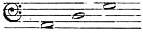
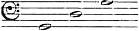
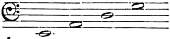
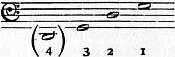
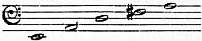

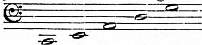
The practical compass of the double bass extends from (real sounds) with all chromatic intervals. In order to avoid using numerous ledger lines the music is written an octave higher. The quality of tone is very powerful but somewhat rough, and varies greatly in its gradations. The notes of the lowest register, when played piano, sound weird and sometimes grotesque, and are sometimes used instead of the kettledrum; when played forte the tone is grand and full. The lowest octave is mainly used as a fundamental octave bass to ’cello, bassoon or trombone. The tone of the pizzicato is full and rich owing to the slowness of the vibrations, and it changes character according to the harmonies which lie above it: with a chord of the diminished seventh above it, for instance, the pizzicato sounds like a menace, but with the common chord calm and majestic. Both natural and artificial harmonics are possible on the double bass, the former being the best; but they are seldom used in orchestral works. As an instance of their use may be cited the scene by the Nile at the beginning of the third act of Verdi’s Aida, where harmonics are indicated for both ’cellos and double basses.
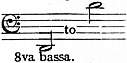
The technical capabilities of the double bass are necessarily somewhat more limited than those of the violoncello. Quick passages, though possible, are seldom written for it; they cannot sound clear owing to the time required for the strings to vibrate. An excellent effect is produced by what is known as the intermittent tremolo: owing to the elasticity of the bow, it rebounds several times on the strings when a single blow is sharply struck, forming a series of short tremolos. The double bass is the foundation of the whole orchestra and therefore of great importance; it plays the lowest part, often, as its name indicates, only doubling the ’cello part an octave lower. It is only since the beginning of the 19th century that an independent voice has occasionally been allotted to it, as in the Scherzo of Beethoven’s Fifth Symphony in C minor:—

These opening bars are played soli by ’cellos and double basses, a daring innovation of Beethoven’s which caused quite a consternation at first in musical circles.
The remote origin of the double bass is the same as that of the violin.3 It was evolved from the bass viol; whether the transformation took place simultaneously with that of the violin from the treble viol or preceded it, has not been definitely proved, but both Gasparo da Salo and Maggini constructed double basses, which were in great request in the churches. De Salo made one with three strings for St Mark’s, Venice, which is still preserved there.4 It was Dragonetti’s favourite concert instrument, presented to him by the monks of St Mark, and, according to the desire expressed in his will, the instrument was restored after his death to St Mark’s, where it is at present preserved. Dragonetti used a straight bow similar to the violoncello bow, held overhand with the hair slanting towards the neck of the instrument; it was introduced into England from Paris, and is a favourite with orchestral players. Praetorius gives an illustration of a sub-bass viol da gamba or gross contra-bass geige5 “recently constructed,” which displaced the other large contra-bass viols; of which he also gives an illustration.6
Giovanni Bottesini (1822-1889) was the greatest virtuoso on the double bass that the world has ever known. It was not only the perfection of his technique and tone which won him artistic fame, but also the delicacy of his style and his exquisite taste in phrasing.
(K. S.)
1 The real sounds are an octave lower.
2 The Double Bass (Novello, Music Primers, No. 32), p. 6.
3 See Kathleen Schlesinger, The Instruments of the Orchestra, Part II. “The Precursors of the Violin Family” (1908-1909).
4 See Laurent Grillet, Les Ancêtres du violon et du violoncelle (Paris, 1901), tome ii. p. 159; Willebald Leo von Lustgendorff, Die Geigen und Lautenmacher vom Mittelalter bis zur Gegenwart (Frankfurt a. M., 1904), p. 50; A. C. White, The Double Bass, p. 8.
5 M. Praetorius, Syntagma music. (Wolfenbüttel, 1618 and 1620), pp. 54-55 and pl. v. (1).
6 Ib. pl. vi. No. 4.
DOUBLEDAY, ABNER (1819-1893), American soldier, was born at Ballston Spa, New York, on the 26th of June 1819, and graduated from West Point in 1842. He served in the U.S. artillery during the Mexican War, being present at the battles of Monterey and Buena Vista. He was second in command at Fort Sumter, Charleston, South Carolina, when it was bombarded and taken by the Confederates in 1861, and later in the campaign of that year he served in the Shenandoah valley as a field officer. In February 1862 he was made a brigadier-general of volunteers and employed in the lines of Washington. He commanded a division in the Army of the Potomac in the second Bull Run campaign and at Antietam, becoming major-general U.S.V. in November 1862. He continued to command his division in the Fredericksburg and Chancellorsville campaigns, and on the first day of the battle of Gettysburg he led the I. corps, and for a time all the Union forces on the field, after the death of General Reynolds. In the latter part of the war he was employed in various administrative and military posts; in July 1863 he was breveted colonel, and in March 1865 brigadier-general and major-general U.S.A. General Doubleday continued in the army after the war, becoming colonel U.S.A. in 1867; he retired in 1873. He published two important works on the Civil War, Reminiscences of Forts Sumter and Moultrie (1876) and Chancellorsville and Gettysburg (1882), the latter being a volume of the series “Campaigns of the Civil War.” He died at Mendham, New Jersey, on the 26th of January 1893.
His younger brother, Ulysses Doubleday (1824-1893), fought through the Civil War as an officer of volunteers, was breveted brigadier-general U.S.V. in March 1865, and commanded a brigade at the battle of Five Forks (1st April).
DOUBLEDAY, THOMAS (1790-1870), English politician and author, was born at Newcastle-on-Tyne in February 1790. In early life he adopted the views of William Cobbett, and was active in promoting the agitation which resulted in the passing of the Reform Bill of 1832. As secretary of the Northern Political Union of Whigs and Radicals he took a prominent part in forwarding the interests of Earl Grey and the reforming party. In 1858-1859 he was a member of the council of the Northern Reform Union; and to the last he was a keen observer of political events. He succeeded his father, George Doubleday, as partner in a firm of soap manufacturers at Newcastle, but devoted his attention rather to literature than to mercantile affairs. On the failure of the firm he obtained the office of registrar of St Andrew’s parish, Newcastle, a post which he held until appointed secretary to the coal trade. He died at Bulman’s Village, Newcastle-on-Tyne, on the 18th of December 1870. In 1832 Doubleday published an Essay on Mundane Moral Government, and in 1842 he attacked some of the principles of Malthus in his True Law of Population. He also wrote A Political Life of Sir Robert Peel (London, 1856); A Financial, Statistical and Monetary History of England from 1688 (London, 1847); Matter for Materialists (London, 1870); The Eve of St Mark, a Romance of Venice; and three dramas, The Statue Wife, Diocletian and Caius Marius, in addition to some fishing songs, and many contributions to various newspapers and periodicals.
DOUBLET (a Fr. word, diminutive of double, folded or of two thicknesses), a close-fitting garment, with or without sleeves, extending from the neck to a little below the waist, worn by men of all ranks and ages from the 14th century to the time of Charles II., when it began to be superseded by coat and waistcoat. The doublet was introduced into England from France, and was originally padded for defence or warmth. “Doublet” is also used of a pair or couple—a thing that is the facsimile of another; as in philology, one of two words differing in form, but represented by an identical root, as “alarm” or “alarum”; in optics, of a pair of lenses, combined, for example, to correct aberration. In the work of the lapidary a doublet is a counterfeit gem, made by cementing two pieces of plain glass or crystal on each side of a layer of glass (coloured to represent the stone counterfeited); a thin portion of a genuine stone may be cemented upon an inferior one, as a layer of diamond upon a topaz, or ruby on a garnet.
DOUBS, a river of eastern France, rising in the Jura at the foot of the Noirmont ridge at a height of 3074 ft. and flowing into the Saône. Its course is 269 m. in length, though the distance from its source to its mouth is only 56 m. in direct line; its basin has an area of 3020 sq. m. Flowing N.E. the river traverses the lake of St Point and passes Pontarlier; thenceforth its course lies chiefly through wooded gorges of great grandeur. After skirting the town of Morteau, below which it expands into the picturesque lake of Chaillexon and descends over the Falls of the Doubs (88 ft. in height), the river for about 28 m. forms the frontier between France and Switzerland. Flowing into the latter country for a short distance, it turns abruptly west, then north, and finally at Voujeaucourt, south-west. Just below that town the river is joined by the canal from the Rhone to the Rhine, to accommodate which its course has been canalized as far as Dole. Till it reaches Besançon which lies on a peninsula formed by the river, the Doubs passes no town of importance except Pontarlier. Some distance below Besançon it enters the department of Jura, passes Dole, and leaving the region of hill and mountain, issues into a wide plain. Traversing this, it receives the waters of the Loue, its chief affluent, and broadening out to a width of 260 ft., at length reaches the Saône at Verdun. Below Dole the river is navigable only for some 8 m. above its mouth.
DOUBS, a frontier department of eastern France, formed in 1790 of the ancient principality of Montbéliard and of part of the province of Franche-Comté. It is bounded E. and S.E. by Switzerland, N. by the territory of Belfort and by Haute Saône, and W. and S.W. by Jura. Pop. (1906) 298,438. Area, 2030 sq. m. The department takes its name from the river Doubs, by which it is traversed. Between the Ognon, which forms the north-western limit of the department, and the Doubs, runs a range of low hills known as “the plain.” The rest of Doubs is mountainous, four parallel chains of the Jura crossing it from N.E. to S.W. The Lomont range, the lowest of these chains, dominates the left bank of the Doubs. The central region is occupied by hilly plateaux covered with pasturage and forests, while the rest of the department is traversed by the remaining three mountain ranges, the highest and most easterly of which contains the Mont d’Or (4800 ft.), the culminating point of Doubs. Besides the Doubs the chief rivers are its tributaries, the Dessoubre, watering the east of the department, and the Loue, which traverses its south-western portion. The climate is in general cold and rainy, and the winters are severe. The soil is stony and loamy, and at the higher levels there are numerous peat-bogs. Approximately a fifth of the total area is planted with cereals; more than a third is occupied by pasture. In its agricultural aspect the department may be divided into three regions. The highest, on which the snow usually lies from six to eight months in the year, is in part barren, but on its less exposed slopes is occupied by forests of fir trees, and affords good pasturage for cattle. In the second or lower region the oak, beech, walnut and sycamore flourish; and the valleys are susceptible of cultivation. The region of the plain is the most fertile, and produces all kinds of cereals as well as hemp, vegetables, vines and fruit. Cattle-rearing and dairy-farming receive much attention; large quantities of cheese, of the nature of Gruyère, are produced, mainly by the co-operative cheese-factories or fruitières. The rivers of the department abound in gorges and falls of great beauty. The most important manufactures are watches, made chiefly at Besançon and Morteau, hardware (Hérimoncourt and Valentigney), and machinery. Large iron foundries are found at Audincourt (pop. 5317) and other towns. The distillation of brandy and absinthe, and the manufacture of cotton and woollen goods, automobiles and paper, are also carried on. Exports include watches, live-stock, wine, vegetables, iron and hardware; cattle, hides, timber, coal, wine and machinery are imported. Large quantities of goods, in transit between France and Switzerland, pass through the department. Among its mineral products are building stone and lime, and there are peat workings. Doubs is served by the Paris-Lyon railway, the line from Dôle to Switzerland passing, via Pontarlier, through the south of the department. The canal from the Rhône to the Rhine traverses it for 84 miles.
The department is divided into the arrondissements of Besançon, Baume-les-Dames, Montbéliard and Pontarlier, with 27 cantons and 637 communes. It belongs to the académie (educational circumscription) and the diocese of Besançon, which is the capital, the seat of an archbishop and of a court of appeal, and headquarters of the VII. army corps. Besides Besançon the chief towns are Montbéliard and Pontarlier (qq.v.). Ornans, a town on the Loue, has a church of the 16th century and ruins of a feudal castle, which are of antiquarian interest. Montbenoît on the Doubs near Pontarlier has the remains of an Augustine abbey (13th to 16th centuries). The cloisters are of the 15th century, and the church contains, among other works of art, some fine stalls executed in the 16th century. Lower down the Doubs is the town of Morteau, with the Maison Pertuisier, a house of the Renaissance period, and a church which still preserves remains of a previous structure of the 13th century. Baume-les-Dames owes the affix of its name to a Benedictine convent founded in 763, to which only noble ladies were admitted. Numerous antiquities have been found at Mandeure (near Montbéliard), which stands on the site of the Roman town of Epomanduodurum.
DOUCE, FRANCIS (1757-1834), English antiquary, was born in London in 1757. His father was a clerk in Chancery. After completing his education he entered his father’s office, but soon quitted it to devote himself to the study of antiquities. He became a prominent member of the Society of Antiquaries, and for a time held the post of keeper of manuscripts in the British Museum, but was compelled to resign it owing to a quarrel with one of the trustees. In 1807 he published his Illustrations of Shakespeare and Ancient Manners (2 vols. 8vo), which contained some curious information, along with a great deal of trifling criticism and mistaken interpretation. An unfavourable notice of the work in The Edinburgh Review greatly irritated the author, and made him unwilling to venture any further publications. He contributed, however, a considerable number of papers to the Archaeologia and The Gentleman’s Magazine. In 1833 he published a Dissertation on the various Designs of the Dance of Death, the substance of which had appeared forty years before. He died on the 30th of March 1834. By his will he left his printed books, illuminated manuscripts, coins, &c., to the Bodleian library; his own manuscript works to the British Museum, with directions that the chest containing them should not be opened until the 1st of January 1900; and his paintings, carvings and miscellaneous antiquities to Sir Samuel Meyrick, who published an account of them, entitled The Doucean Museum.
DOUGLAS, the name of a Scottish noble family, now represented by the dukes of Hamilton (Douglas-Hamilton, heirs-male), the earls of Home (Douglas-Home) who also bear the title of Baron Douglas of Douglas, the dukes of Buccleuch and Queensberry (Montagu-Douglas-Scott), the earls of Morton (Douglas), the earls of Wemyss (Wemyss-Charteris-Douglas), and the baronets Douglas of Carr, of Springwood, of Glenbervie, &c. The marquessate of Douglas and the earldom of Angus, the historic dignities held by the two chief branches of the family, the Black and the Red Douglas, are merged in the Hamilton peerage. The name represented the Gaelic dubh glas, dark water, and Douglasdale, the home of the family in Lanarkshire, is still in the possession of the earls of Home. The first member of the family to emerge with any distinctness was William de Douglas, or Dufglas, whose name frequently appears on charters from 1175 to 1213. He is said to have been brother, or brother-in-law, of Freskin of Murray, the founder of the house of Murray. His second son, Brice (d. 1222), became bishop of Moray, while the estate fell to the eldest, Sir Archibald (d. c. 1240).
Sir William of Douglas (d. 1298), called “le hardi,” Archibald’s grandson, was the first formally to assume the title of lord of Douglas. After the death of his first wife, Elizabeth, daughter of Alexander the Steward, he abducted from the manor of the La Zouches at Tranent an heiress, Eleanor of Lovain, widow of William de Ferrers, lord of Groby in Leicestershire, who in 1291 appeared by proxy in the court of the English king, Edward I., to answer for the offence of marrying without his permission. He gave a grudging allegiance to John de Baliol, and swore fealty to Edward I. in 1291; but when the Scottish barons induced Baliol to break his bond with Edward I. he commanded at Berwick Castle, which he surrendered after the sack of the town by the English in 1296. After a short imprisonment Douglas was restored to his Scottish estates on renewing his homage to Edward I., but his English possessions were forfeited. He joined Wallace’s rising in 1297, and died in 1298, a prisoner in the Tower of London.
His son, Sir James of Douglas (1286-1330), lord of Douglas, called the “Good,” whose exploits are among the most romantic in Scottish history, was educated in Paris. On his return he found an Englishman, Robert de Clifford, in possession of his estates. His offer of allegiance to Edward I. being refused, he cast in his lot with Robert Bruce, whom he joined before his coronation at Scone in 1306. From the battle of Methven he escaped with Bruce and the remnant of his followers, and accompanied him in his wanderings in the Highlands. In the next year they returned to the south of Scotland. He twice outwitted the English garrison of Douglas and destroyed the castle. One of these exploits, carried out on Palm Sunday, the 19th of March 1307, with barbarities excessive even in those days, is known as the “Douglas Larder.” Douglas routed Sir John de Mowbray at Ederford Bridge, near Kilmarnock, and was entrusted with the conduct of the war in the south, while Bruce turned to the Highlands. In 1308 he captured Thomas Randolph (afterwards earl of Moray), soon to become one of Bruce’s firm supporters, and a friendly rival of Douglas, whose exploits he shared. He made many successful raids on the English border, which won for him the dreaded name of the “Black Douglas” in English households. Through the capture of Roxburgh Castle in 1314 by stratagem, the assailants being disguised as black oxen, he secured Teviotdale; and at Bannockburn, where he was knighted on the battlefield, he commanded the left wing with Walter the Steward. During the thirteen years of intermittent warfare that followed he repeatedly raided England. He slew Sir Robert de Nevill, the “Peacock of the North,” in single combat in 1316, and in 1319 he invaded Yorkshire, in company with Randolph, defeating an army assembled by William de Melton, archbishop of York, at Mitton-on-Swale (September 20), in a fight known as “The Chapter of Myton.” In 1322 he captured the pass of Byland in Yorkshire, and forced the English army to retreat. He was rewarded by the “Emerald Charter,” granted by Bruce, which gave him criminal jurisdiction over the family estates, and released the lords of Douglas from various feudal obligations. The emerald ring which Bruce gave Douglas in ratification of the charter is lost, but another of the king’s gifts, a large two-handed sword (bearing, however, a later inscription), exists at Douglas Castle. In a daring night attack on the English camp in Weardale in 1327 Douglas came near capturing Edward III. himself. After laying waste the northern counties he retreated, without giving battle to the English. Before his death in 1329 Bruce desired Douglas to carry his heart to Palestine in redemption of his unfulfilled vow to go on crusade. Accordingly Sir James set out in 1330, bearing with him a silver casket containing the embalmed heart of Bruce. He fell fighting with the Moors in Spain on the 25th of August of that year, and was buried in St Bride’s Church, Douglas. Since his day the Douglases have borne a human heart in their coat of arms. Sir James was said to have fought in seventy battles and to have conquered in fifty-seven. His exploits, as told in Froissart’s Chronicles and in John Barbour’s Bruce, are familiar from Scott’s Tales of a Grandfather and Castle Dangerous. His half-brother, Sir Archibald, defeated Edward Baliol at Annan in 1332, and had just been appointed regent of Scotland for David II. when he risked a pitched battle at Halidon Hill, where he was defeated and killed (1333), with his nephew William, lord of Douglas. The inheritance fell to his brother, a churchman, Hugh the “Dull” (b. 1294), who surrendered his lands to David II.; and a re-grant was made to William Douglas, next referred to.
William Douglas, 1st Earl of Douglas (c. 1327-1384), had been educated in France, and returned to Scotland in 1348. In 1353 he killed in Ettrick Forest his kinsman, William,1 the knight of Liddesdale (c. 1300-1353), known as the “Flower of Chivalry,” who had been warden of the western marches during David II.’s minority, and had taken a heroic share in driving the English from southern Scotland. Liddesdale had in 1342 lost the king’s favour by the murder of Sir Alexander Ramsay of Dalhousie, whom David had made constable of the castle of Roxburgh and sheriff of Teviotdale in his place; he was taken prisoner at Nevill’s Cross in 1346, and only released on becoming liegeman of Edward III. for the lands of Liddesdale and the castle of the Hermitage; Liddesdale2 was also accused of contriving the murder of Sir David Barclay in 1350. Some of his lands fell to his kinsman and murderer, who was created earl of Douglas in 1358. In 1357 his marriage with Margaret, sister and heiress of Thomas, 13th earl of Mar, eventually brought him the estates and the earldom of Mar. During a short truce with the warden of the English marches he had served in France, being wounded at Poitiers in 1356. He was one of the securities for the payment of David II.’s ransom, and in consequence of the royal misappropriation of some moneys raised for this purpose Douglas was for a short time in rebellion in 1363. In 1364 he joined David II. in seeking a treaty with England which should deprive Robert the Steward, formerly an ally of Douglas, of the succession by putting an English prince on the Scottish throne. The independence of Scotland was to be guaranteed, and a special clause provided for the restoration of the English estates of the Douglas family. On the accession of Robert II. he was nevertheless reconciled, becoming justiciar of southern Scotland, and the last years of his life were spent in making and repelling border raids. He died at Douglas in May 1384, and was succeeded by his son James. By his wife’s sister-in-law, Margaret Stewart, countess of Angus in her own right, and widow of the 13th earl of Mar, he had a son George, afterwards 1st earl of Angus.
James, 2nd Earl of Douglas and Mar (c. 1358-1388), married Lady Isabel Stewart, daughter of Robert II. In 1385 he made war on the English with the assistance of a French contingent under John de Vienne. He allowed the English to advance to Edinburgh, wisely refusing battle, and contented himself with a destructive counter-raid on Carlisle. Disputes soon arose between the allies, and the French returned home at the end of the year. In 1388 Douglas captured Hotspur Percy’s pennon in a skirmish near Newcastle. Percy sought revenge in the battle of Otterburn (August 1388), which ended in a victory for the Scots and the capture of Hotspur and his brother, though Douglas fell in the fight. The struggle, narrated by Froissart, is celebrated in the English and Scottish ballads called “Chevy Chase” and “The Battle of Otterburn.” Sir Philip Sidney “never heard the olde song of Percy and Douglas that I found not my heart mooved more than with a trumpet” (Apologie for Poetrie). The 2nd earl left no legitimate male issue. His natural sons William and Archibald became the ancestors of the families of Douglas of Drumlanrig (see Queensberry) and Douglas of Cavers. His sister Isabel became countess of Mar, inheriting the lands of Mar and his unentailed estates.
The earldom and entailed estates of Douglas reverted by the patent of 1358 to Archibald Douglas, 3rd Earl of Douglas, called “The Grim” (c. 1328-c. 1400), a natural son of the “good” Sir James. With his cousin, the 1st earl of Douglas, he had fought at Poitiers, where he was taken prisoner, but was released through ignorance of his real rank. On his return to Scotland he became constable and sheriff of Edinburgh, and, later, warden of the western marches, where his position was strengthened by his becoming lord of Galloway in 1369 and by his purchase of the earldom of Wigtown in 1372. He further increased his estates by his marriage with Joanna Moray, heiress of Bothwell. During the intervals of war with the English he imposed feudal law on the border chieftains, drawing up a special code for the marches. He was twice sent on missions to the French court. The power of the Black Douglas overshadowed the crown under the weak rule of Robert III., and in 1399 he arranged a marriage between David, duke of Rothesay, the king’s son and heir, and his own daughter, Marjory Douglas. Rothesay was already contracted to marry Elizabeth Dunbar, daughter of the earl of March, who had paid a large sum for the honour. March, alienated from his allegiance by this breach of faith on the king’s part, now joined the English forces. A natural son of Archibald, Sir William of Douglas, lord of Nithisdale (d. 1392), married Egidia, daughter of Robert III.
Archibald the Grim was succeeded by his eldest son, Archibald, 4th Earl of Douglas, 1st duke of Touraine, lord of Galloway and Annandale (1372-1424), who married in 1390 Lady Margaret Stewart, eldest daughter of John, earl of Carrick, afterwards King Robert III. In 1400 March and Hotspur Percy had laid waste eastern Scotland as far as Lothian when they were defeated by Douglas (then master of Douglas) near Preston. With the regent, Robert, duke of Albany, he was suspected of complicity in the murder (March 1402) of David, duke of Rothesay, who was in their custody at Falkland Castle, but both were officially declared guiltless by the parliament. In that year Douglas raided England and was taken prisoner at Homildon Hill by the Percys. He fought on the side of his captors at Shrewsbury (1403), and was taken prisoner by the English king Henry IV. He became reconciled during his captivity with the earl of March, whose lands had been conferred on Douglas, but were now, with the exception of Annandale, restored. He returned to Scotland in 1409, but was in constant communication with the English court for the release of the captive king James I. In 1412 he had visited Paris, when he entered into a personal alliance with John the Fearless, duke of Burgundy, and in 1423 he commanded a contingent of 10,000 Scots sent to the help of Charles VII. against the English. He was made lieutenant-general in the French army, and received the peerage-duchy of Touraine with remainder to his heirs-male. The new duke was defeated and slain at Verneuil (1424) with his second son, James; his persistent ill-luck earned him the title of the Tyneman (the loser).
Archibald, 5th Earl of Douglas (c. 1391-1439), succeeded to his father’s English and Scottish honours, though he never touched the revenues of Touraine. He fought at Baugé in 1421, and was made count of Longueville in Normandy.
His two sons, William, 6th Earl (1423?-1440), and David, were little more than boys at the time of their father’s death in 1439. They can hardly have been guilty of any real offence when, on the 24th of November 1440, they were summoned to court by Sir William Crichton, lord chancellor of Scotland, and, after a mock trial in the young king’s presence, were beheaded forthwith in the courtyard of Edinburgh Castle. This murder broke up the dangerous power wielded by the Douglases. The lordships of Annandale and Bothwell fell to the crown; Galloway to the earl’s sister Margaret, the “Fair Maid of Galloway”; while the Douglas lands passed to his great-uncle James Douglas, 7th Earl of Douglas, called the “Gross,” of Balvany (1371-1444), lord of Abercorn and Aberdour, earl of Avondale (cr. 1437), younger son of the 3rd earl.
The latter’s sons, William (c. 1425-1452) and James (1426-1488), became 8th and 9th earls respectively; Archibald became earl of Moray by marriage with Elizabeth Dunbar, daughter and co-heiress of James, earl of Moray; Hugh was created earl of Ormond in 1445; John was lord of Balvany; Henry became bishop of Dunkeld.
The power of the Black Douglases was restored by the 8th earl, who recovered Wigtown, Galloway and Bothwell by marriage (by papal dispensation) with his cousin, the Fair Maid of Galloway. He was soon high in favour with James II., and procured the disgrace of Crichton, his kinsmen’s murderer, by an alliance with his rival, Sir Alexander Livingstone. In 1450 James raided the earl’s lands during his absence on a pilgrimage to Rome; but their relations seemed outwardly friendly until in 1452 the king invited Douglas to Stirling Castle under a safe-conduct, in itself, however, a proof of strained relations. There James demanded the dissolution of a league into which Douglas had entered with Alexander Lindsay, the “Tiger” earl (4th) of Crawford. On Douglas’s refusal the king murdered him (February 22) with his own hands, the courtiers helping to despatch him. The tales of the hanging of Sir Herbert Herries of Terregles and the murder of McLellan of Bombie by Douglas rest on no sure evidence.
James Douglas, 9th Earl (and last), denounced his brother’s murderers and took up arms, but was obliged by the desertion of his allies to submit. He obtained a papal dispensation to marry his brother’s widow, in order to keep the family estates together. He intrigued with the English court, and in 1455 rebelled once more. Meanwhile another branch of the Douglas family, known as the Red Douglas, had risen into importance (see Angus, earls of), and George Douglas, 4th earl of Angus (d. 1463), great-grandson of the 1st earl of Douglas, took sides with the king against his kinsmen. James Douglas, again deserted by his chief allies, fled to England, and his three brothers, Ormond, Moray and Balvany, were defeated by Angus at Arkinholm on the Esk. Moray was killed, Ormond taken prisoner and executed, while Balvany escaped to England. Their last stronghold, the Thrieve in Galloway, fell, and the lands of the Douglases were declared forfeit, and were divided among their rivals, the lordship of Douglas falling to the Red Douglas, 4th earl of Angus. In England the earl of Douglas intrigued against his native land; he was employed by Edward IV. in 1461 to negotiate a league with the western highlanders against the Scottish kingdom. In 1484 he was taken prisoner while raiding southern Scotland, and was relegated to the abbey of Lindores, where he died in 1488.
The title of Douglas was restored in 1633 when William, 11th earl of Angus (1589-1660), was created 1st Marquess of Douglas by Charles I. In 1645 he joined Montrose at Philiphaugh, and was imprisoned in 1646 at Edinburgh Castle, only obtaining his release by signing the Covenant. His eldest son, Archibald, created earl of Ormond, Lord Bothwell and Hartside, in 1651, predeceased his father; Lord James Douglas (c. 1617-1645) and his half-brother, Lord George Douglas (c. 1636-1692), created earl of Dumbarton in 1675, successively commanded a Scots regiment3 in the French service. William (1635-1694), created earl of Selkirk in 1646, became 3rd duke of Hamilton after his marriage (1656) with Anne, duchess of Hamilton in her own right. By the failure of heirs in the elder branches of the family the dukes of Hamilton (q.v.) became heirs-male of the house of Douglas.
James Douglas, 2nd Marquess of Douglas (1646-1700), succeeded his grandfather in 1660. His eldest son, John, by courtesy earl of Angus, raised a regiment of 1200 men, first known as the Angus regiment, later as the Cameronians (26th Foot). He was killed at its head at Steinkirk in 1692. The younger son, Archibald, 3rd Marquess (1694-1761), was created duke of Douglas in 1703, but the dukedom became extinct on his death, without heirs, in 1761. He was a consistent supporter of the Hanoverian cause, and fought at Sheriffmuir. The heir-presumptive to the Douglas estates was his sister, Lady Jane Douglas (1698-1753), who in 1746 secretly married Colonel, afterwards Sir, John Steuart of Grandtully, by whom she had twin sons, born in Paris in 1748. These children were alleged to be spurious, and when Lady Jane and the younger of the two boys died in 1753, the duke refused to acknowledge the survivor as his nephew; but in 1760 he was induced, under the influence of his wife, to revoke a will devising the estates to the Hamiltons in favour of Lady Jane’s son, Archibald James Edward Steuart (1748-1827), 1st baron Douglas of Douglas (cr. 1790) in the British peerage. The inheritance of the estates was disputed by the Hamiltons, representing the male line, but the House of Lords decided in favour of Douglas in 1769. Three of his sons succeeded Archibald Douglas as Baron Douglas, but as they left no male issue the title passed to the earls of Home, Cospatrick Alexander, 11th earl of Home, having married a granddaughter of Archibald, 1st Baron Douglas. Their descendants, the earls of Home, represent the main line of Douglas on the female side.
Authorities.—David Hume of Godscroft (1560?-1630), who was secretary to Archibald Douglas, 8th earl of Angus, wrote a History of the House and Race of Douglas and Angus, printed under his daughter’s superintendence (Edinburgh, 1644). He was a partial historian, and his account can only be accepted with caution. Modern authorities are Sir William Fraser, The Douglas Book (4 vols., Edinburgh, 1885), and Sir H. Maxwell, History of the House of Douglas (2 vols., 1902). See also G. E. C.[okayne]’s Peerage, and Douglas’s Scots Peerage; Calendar of State Papers, Scottish Series, The Hamilton Papers, &c.
1 A descendant of a younger son of the original William de Douglas.
2 On the murder of the knight of Liddesdale, his lands, with the exception of Liddesdale and the Hermitage forfeited to the crown and then secured by his nephew, fell to his nephew, Sir James Douglas of Dalkeith and Aberdour (d. 1420), whose great-grandson James Douglas, 3rd Lord Dalkeith (d. 1504), became earl of Morton in 1458 on his marriage with Lady Joan Stewart, third daughter of James I. His grandson, the 3rd earl, left daughters only, of whom the eldest, Margaret, married James Hamilton, earl of Arran, regent of Scotland, ancestor of the dukes of Hamilton; Elizabeth married in 1543 James Douglas, who became by this marriage 4th earl of Morton.
3 Transferred to the British service in 1669 and eventually known as the Royal Scots regiment.
DOUGLAS, SIR CHARLES, Bart. (d. 1789), British admiral, a descendant of the Scottish earls of Morton, was promoted lieutenant in the navy on the 4th of December 1753. Nothing is known of his early life. He became commander on the 24th of February 1759, and attained to post rank in 1761. When the War of American Independence began, he took an active part in the defence of Canada in 1775, and he afterwards commanded the “Stirling Castle” 64 in the battle of the Ushant, 27th of July 1778. His reputation is based first on the part he played in the battle of Dominica, 12th of April 1782, and then on the improvements in gunnery which he introduced into the British navy. It appears from the testimony of Sir F. Thesiger (d. 1805), who was present on the quarter-deck of the flagship, that Sir Charles Douglas, who was then captain of the fleet, first pointed out to Rodney the possibility and the advantage of passing through the French line. His advice was taken with reluctance. On the other hand, Lord Hood accuses Douglas of living in such abject fear of his admiral that he did not venture to speak with the freedom which his important post entitled him to take. His more certain claim to be ranked high among naval officers is founded on the many improvements he introduced into naval gunnery. Some account of these will be found in the writings of his son. He became rear-admiral on the 24th of September 1787, and died suddenly of apoplexy in February 1789. He was made a baronet for his services in the West Indies.
There is a life of Sir Charles Douglas in Charnock, Biogr. Nav. vi. 427.
DOUGLAS, GAVIN (1474?-1522), Scottish poet and bishop, third son of Archibald, 5th earl of Angus (called the “great earl of Angus” and “Bell-the-Cat”), was born c. 1474, probably at one of his father’s seats. He was a student at St Andrews, 1489-1494, and thereafter, it is supposed, at Paris. In 1496 he obtained the living of Monymusk, Aberdeenshire, and later he became parson of Lynton (mod. Linton) and rector of Hauch (mod. Prestonkirk), in East Lothian; and about 1501 was preferred to the deanery or provostship of the collegiate church of St Giles, Edinburgh, which he held with his parochial charges. From this date till the battle of Flodden, in September 1513, he appears to have been occupied with his ecclesiastical duties and literary work. Indeed all the extant writings by which he has earned his place as a poet and translator belong to this period. After the disaster at Flodden he was completely absorbed in public business. Three weeks after the battle he, still provost of St Giles, was admitted a burgess of Edinburgh, his father, the “Great Earl,” being then civil provost of the capital. The latter dying soon afterwards (January 1514) in Wigtownshire, where he had gone as justiciar, and his son having been killed at Flodden, the succession fell to Gavin’s nephew Archibald (6th earl). The marriage of this youth to James IV.’s widow on the 6th of August 1514 did much to identify the Douglases with the English party in Scotland, as against the French party led by Albany, and incidentally to determine the political career of his uncle Gavin. During the first weeks of the queen’s sorrow after the battle, Gavin, with one or two colleagues of the council, acted as personal adviser, and it may be taken for granted that he supported the pretensions of the young earl. His own hopes of preferment had been strengthened by the death of many of the higher clergy at Flodden. The first outcome of the new connexion was his appointment to the abbacy of Aberbrothock by the queen regent, before her marriage, probably in June 1514. Soon after the marriage she nominated him archbishop of St Andrews, in succession to Elphinstone, archbishop-designate. But Hepburn, prior of St Andrews, having obtained the vote of the chapter, expelled him, and was himself in turn expelled by Forman, bishop of Moray, who had been nominated by the pope. In the interval, Douglas’s rights in Aberbrothock had been transferred to James Beaton, archbishop of Glasgow, and he was now without title or temporality. The breach between the queen’s party and Albany’s had widened, and the queen’s advisers had begun an intrigue with England, to the end that the royal widow and her young son should be removed to Henry’s court. In those deliberations Gavin Douglas took an active part, and for this reason stimulated the opposition which successfully thwarted his preferment.
In January 1515 on the death of George Brown, bishop of Dunkeld, Douglas’s hopes revived. The queen nominated him to the see, which he ultimately obtained, though not without trouble. For the earl of Athole had forced his brother, Andrew Stewart, prebendary of Craig, upon the chapter, and had put him in possession of the bishop’s palace. The queen appealed to the pope and was seconded by her brother of England, with the result that the pope’s sanction was obtained on the 18th of February 1515. Some of the correspondence of Douglas and his friends incident to this transaction was intercepted. When Albany came from France and assumed the regency, these documents and the “purchase” of the bishopric from Rome contrary to statute were made the basis of an attack on Douglas, who was imprisoned in Edinburgh Castle, thereafter in the castle of St Andrews (under the charge of his old opponent, Archbishop Hepburn), and later in the castle of Dunbar, and again in Edinburgh. The pope’s intervention procured his release, after nearly a year’s imprisonment. The queen meanwhile had retired to England. After July 1516 Douglas appears to have been in possession of his see, and to have patched up a diplomatic peace with Albany.
On the 17th of May 1517 the bishop of Dunkeld proceeded with Albany to France to conduct the negotiations which ended in the treaty of Rouen. He was back in Scotland towards the end of June. Albany’s longer absence in France permitted the party-faction of the nobles to come to a head in a plot by the earl of Arran to seize the earl of Angus, the queen’s husband. The issue of this plot was the well-known fight of “Clear-the-Causeway,” in which Gavin Douglas’s part stands out in picturesque relief. The triumph over the Hamiltons had an unsettling effect upon the earl of Angus. He made free of the queen’s rents and abducted Lord Traquair’s daughter. The queen set about to obtain a divorce, and used her influence for the return of Albany as a means of undoing her husband’s power. Albany’s arrival in November 1521, with a large body of French men-at-arms, compelled Angus, with the bishop and others, to flee to the Borders. From this retreat Gavin Douglas was sent by the earl to the English court, to ask for aid against the French party and against the queen, who was reported to be the mistress of the regent. Meanwhile he was deprived of his bishopric, and forced, for safety, to remain in England, where he effected nothing in the interests of his nephew. The declaration of war by England against Scotland, in answer to the recent Franco-Scottish negotiations, prevented his return. His case was further complicated by the libellous animosity of Beaton, archbishop of St Andrews (whose life he had saved in the “Clear-the-Causeway” incident), who was anxious to thwart his election to the archbishopric of St Andrews, now vacant by the death of Forman. In 1522 Douglas was stricken by the plague which raged in London, and died at the house of his friend Lord Dacre. During the closing years of exile he was on intimate terms with the historian Polydore Vergil, and one of his last acts was to arrange to give Polydore a corrected version of Major’s account of Scottish affairs. Douglas was buried in the church of the Savoy, where a monumental brass (removed from its proper site after the fire in 1864) still records his death and interment.
Douglas’s literary work, now his chief claim to be remembered, belongs, as has been stated, to the period 1501-1513, when he was provost of St Giles. He left four poems.
1. The Palice of Honour, his earliest work, is a piece of the later type of dream-allegory, extending to over 2000 lines in nine-lined stanzas. In its descriptions of the various courts on their way to the palace, and of the poet’s adventures—first, when he incautiously slanders the court of Venus, and later when after his pardon he joins in the procession and passes to see the glories of the palace—the poem carries on the literary traditions of the courts of love, as shown especially in the “Romaunt of the Rose” and “The Hous of Fame.” The poem is dedicated to James IV., not without some lesson in commendation of virtue and honour. No MS. of the poem is extant. The earliest known edition (c. 1553) was printed at London by William Copland; an Edinburgh edition, from the press of Henry Charteris, followed in 1579. From certain indications in the latter and the evidence of some odd leaves discovered by David Laing, it has been concluded that there was an earlier Edinburgh edition, which has been ascribed to Thomas Davidson, printer, and dated c. 1540.
2. King Hart is another example of the later allegory, and, as such, of higher literary merit. Its subject is human life told in the allegory of King Heart in his castle, surrounded by his five servitors (the senses), Queen Plesance, Foresight and other courtiers. The poem runs to over 900 lines and is written in eight-lined stanzas. The text is preserved in the Maitland folio MS. in the Pepysian library, Cambridge. It is not known to have been printed before 1786, when it appeared in Pinkerton’s Ancient Scottish Poems.
3. Conscience is in four seven-lined stanzas. Its subject is the “conceit” that men first clipped away the “con” from “conscience” and left “science” and “na mair.” Then they lost “sci,” and had nothing but “ens” (“that schrew, Riches and geir”).
4. Douglas’s longest, last, and in some respects most important work is his translation of the Aeneid, the first version of a great classic poet in any English dialect. The work includes the thirteenth book by Mapheus Vegius; and each of the thirteen books is introduced by a prologue. The subjects and styles of these prologues show great variety: some appear to be literary exercises with little or no connexion with the books which they introduce, and were perhaps written earlier and for other purposes. In the first, or general, prologue, Douglas claims a higher position for Virgil than for his master Chaucer, and attacks Caxton for his inadequate rendering of a French translation of the Aeneid. That Douglas undertook this work and that he makes a plea for more accurate scholarship in the translation have been the basis of a prevalent notion that he is a Humanist in spirit and the first exponent of Renaissance doctrine in Scottish literature. Careful study of the text will not support this view. Douglas is in all important respects even more of a medievalist than his contemporaries; and, like Henryson and Dunbar, strictly a member of the allegorical school and a follower, in the most generous way, of Chaucer’s art. There are several early MSS. of the Aeneid extant: (a) in the library of Trinity College, Cambridge, c. 1525, (b) the Elphynstoun MS. in the library of the university of Edinburgh, c. 1525, (c) the Ruthven MS. in the same collection, c. 1535, (d) in the library of Lambeth Palace, 1545-1546. The first printed edition appeared in London in 1553. An Edinburgh edition was issued from the press of Thomas Ruddiman in 1710.
For Douglas’s career see, in addition to the public records and general histories, Bishop Sage’s Life in Ruddiman’s edition, and that by John Small in the first volume of his edition of the Works of Gavin Douglas (4 vols., 1874, the only collected edition of Douglas’s works). A new edition of the texts is much to be desired. On Douglas’s place in Scottish literature see Scotland: Scottish Literature, also G. Gregory Smith’s Transition Period (1900) and chapters in the Cambridge History of English Literature, vol. ii. (1908). P. Lange’s dissertation Chaucer’s Einfluss auf die Originaldichtungen des Schotten Gavin Douglas (Halle, 1882) draws attention to Douglas’s indebtedness to Chaucer. Further discussion of the question of Douglas’s alleged Humanism will be found in Courthope’s History of English Poetry, i. (1895), T. F. Henderson’s Scottish Vernacular Literature (1898), and J. H. Millar’s Literary History of Scotland (1903). For the language of the poems see G. Gregory Smith’s Specimens of Middle Scots (1902).
(G. G. S.)
DOUGLAS, SIR HOWARD, Bart. (1776-1861), British general, younger son of Admiral Sir Charles Douglas, was born at Gosport in 1776, and entered the Royal Military Academy in 1790. He was commissioned second lieutenant in the Royal Artillery in 1794, becoming first lieutenant a few months later. In 1795 he was shipwrecked while in charge of a draft for Canada, and lived with his men for a whole winter on the Labrador coast. Soon after his return to England in 1799 he was made a captain-lieutenant, and in the same year he married. In his regimental service during the next few years, he was attached to all branches of the artillery in succession, becoming captain in 1804, after which he was placed on half-pay to serve at the Royal Military College. Douglas was at this time (1804) appointed to a majority in the York Rangers, a corps immediately afterwards reduced, and he remained on the roll of its officers until promoted major-general. The senior department of the R.M.C. at High Wycombe, of which he was in charge, was the forerunner of the Staff College. Douglas, since 1806 a brevet lieutenant-colonel, served in 1808-1809 in the Peninsula and was present at Corunna, after which he took part in the Walcheren expedition. In 1809 he succeeded to the baronetcy on the death of his half-brother, Vice-admiral Sir William Henry Douglas. In 1812 he was employed in special missions in the north of Spain, and took part in numerous minor operations in this region, but he was soon recalled, the home government deeming his services indispensable to the Royal Military College. He became brevet colonel in 1814 and C.B. in 1815. In 1816 appeared his Essay on the Principles and Construction of Military Bridges (subsequent editions 1832, 1853); in 1819, Observations on the Motives, Errors and Tendency of M. Carnot’s System of Defence, and in the following year his Treatise on Naval Gunnery (of which numerous editions and translations appeared up to the general introduction of rifled ordnance). In 1821 he was promoted major-general. Douglas’s criticisms of Carnot led to an important experiment being carried out at Woolwich in 1822, and his Naval Gunnery became a standard text-book, and indeed first drew attention to the subject of which it treated. From 1823 to 1831 Sir Howard Douglas was governor of New Brunswick, and, while there, he had to deal with the Maine boundary dispute of 1828. He also founded Fredericton College, of which he was the first chancellor. On his return to Europe he was employed in various missions, and he published about this time Naval Evolutions, a controversial work dealing with the question of “breaking the line” (London, 1832). From 1835 to 1840 Douglas, now a G.C.M.G., was lord high commissioner of the Ionian Islands, where, amongst other reforms, he introduced a new code of laws. In 1837 he became a lieutenant-general, in 1840 a K.C.B., in 1841 a civil G.C.B., and in 1851 a general. From 1842 to 1847 Douglas sat in parliament, where he took a prominent part in debates on military and naval matters and on the corn laws. He was frequently consulted on important military questions. His later works included Observations on the Modern System of Fortification, &c. (London, 1859), and Naval Warfare Under Steam (London, 1858 and 1860). He died on the 9th of November 1861 at Tunbridge Wells. Sir Howard Douglas was a F.R.S., one of the founders of the R.G.S., and an honorary D.C.L. of Oxford University. Shortly before his death he declined the offer of a military G.C.B.
See S. W. Fullom, Life of Sir Howard Douglas (London, 1862), and Gentleman’s Magazine, 3rd series, xii. 90-92.
DOUGLAS, JOHN (1721-1807), Scottish man of letters and Anglican bishop, was the son of a small shopkeeper at Pittenweem, Fife, where he was born on the 14th of July 1721. He was educated at Dunbar and at Balliol College, Oxford, where he took his M.A. degree in 1743, and as chaplain to the 3rd regiment of foot guards he was at the battle of Fontenoy, 1745. He then returned to Balliol as a Snell exhibitioner; became vicar of High Ercall, Shropshire, in 1750; canon of Windsor, 1762; bishop of Carlisle, 1787 (and also dean of Windsor, 1788); bishop of Salisbury, 1791. Other honours were the degree of D.D., 1758, and those of F.R.S. and F.S.A. in 1778. Douglas was not conspicuous as an ecclesiastical administrator, preferring to his livings the delights of London in winter and the fashionable watering-places in summer. Under the patronage of the earl of Bath he entered into a good many literary controversies, vindicating Milton from W. Lauder’s charge of plagiarism (1750), attacking David Hume’s rationalism in his Criterion of Miracles (1752), and the Hutchinsonians in his Apology for the Clergy (1755). He also edited Captain Cook’s Journals, and Clarendon’s Diary and Letters (1763). He died on the 18th of May 1807, and a volume of Miscellaneous Works, prefaced by a short biography, was published in 1820.
DOUGLAS, STEPHEN ARNOLD (1813-1861), American statesman, was born at Brandon, Vermont, on the 23rd of April 1813. His father, a physician, died in July 1813, and the boy was under the care of a bachelor uncle until he was fourteen, when his uncle married and Douglas was thrown upon his own resources. He was apprenticed to a cabinetmaker in Middlebury, Vt., and then to another in Brandon, but soon abandoned this trade. He attended schools at Brandon and Canandaigua (N.Y.), and began the study of law. In 1833 he went West, and finally settled in Jacksonville, Illinois, where he was admitted to the bar in March 1834, and obtained a large practice. From the first he took an active interest in politics, identifying himself with the Jackson Democrats, and his rise was remarkably rapid even for the Middle West of that period. In February 1835 he was elected public prosecutor of the first judicial circuit, the most important at that time in Illinois; in 1835 he was one of several Democrats in Morgan county to favour a state Democratic convention to elect delegates to the national convention of 1836—an important move toward party regularity; in December 1836 he became a member of the state legislature. In 1837 he was appointed by President Van Buren registrar of the land office at Springfield, which had just become the state capital. In 1840 he did much to carry the state for Van Buren; and for a few months he was secretary of state of Illinois. He was a judge of the supreme court of Illinois from 1841 to 1843. In 1843 he was elected to the national House of Representatives.
In Congress, though one of the youngest members, he at once sprang into prominence by his clever defence of Jackson during the consideration by the House of a bill remitting the fine imposed on Jackson for contempt of court in New Orleans. He was soon recognized as one of the ablest and most energetic of the Democratic leaders. An enthusiastic believer in the destiny of his country and more especially of the West, and a thoroughgoing expansionist, he heartily favoured in Congress the measures which resulted in the annexation of Texas and in the Mexican War—in the discussion of the annexation of Texas he suggested as early as 1845 that the states to be admitted should come in slave or free, as their people should vote when they applied to Congress for admission, thus foreshadowing his doctrine of “Popular Sovereignty.” He took an active share in the Oregon controversy, asserting his unalterable determination, in spite of President Polk’s faltering from the declaration of his party’s platform, not to “yield up one inch” of the territory to Great Britain, and advocating its occupation by a military force; indeed he consistently regarded Great Britain as the natural and foremost rival of the United States, the interests of the two nations, he thought, being always opposed, and few senators fought more vigorously the Clayton-Bulwer Treaty or Great Britain’s reassertion of the right of search on the high seas. He ardently supported the policy of making Federal appropriations (of land, but not of money) for internal improvements of a national character, being a prominent advocate of the construction, by government aid, of a trans-continental railway, and the chief promoter (1850) of the Illinois Central; in 1854 he suggested that Congress should impose tonnage duties from which towns and cities might themselves pay for harbour improvement, &c. To him as chairman of the committee on territories, at first in the House, and then in the Senate, of which he became a member in December 1847, it fell to introduce the bills for admitting Texas, Florida, Iowa, Wisconsin, Minnesota, California and Oregon into the Union, and for organizing the territories of Minnesota, Oregon, New Mexico, Utah, Washington, Kansas and Nebraska. In 1848 he introduced a bill proposing that all the territory acquired from Mexico should be admitted into the Union as a single state, and upon the defeat of this bill proposed others providing for the immediate admission of parts of this territory.
In the bitter debates concerning the keenly disputed question of the permission of slavery in the territories, Douglas was particularly prominent. Against slavery itself he seems never to have had any moral antipathy; he married (1847) the daughter1 of a slaveholder, Colonel Robert Martin of North Carolina, and a cousin of Douglas’s colleague in Congress, D. S. Reid; and his wife and children were by inheritance the owners of slaves, though he himself never was. He did more probably than any other one man, except Henry Clay, to secure the adoption of the Compromise Measures of 1850. In 1849 the Illinois legislature demanded that its representatives and senators should vote for the prohibition of slavery in the Mexican cession, but next year this sentiment in Illinois had grown much weaker, and, both there and in Congress, Douglas’s name was soon to become identified with the so-called “popular sovereignty” or “squatter sovereignty” theory, previously enunciated by Lewis Cass, by which each territory was to be left to decide for itself whether it should or should not have slavery. In 1850 his power of specious argument won back to him his Chicago constituents who had violently attacked him for not opposing the Fugitive Slave Law.
The bill for organizing the territories of Kansas and Nebraska, which Douglas reported in January 1854 and which in amended form was signed by the president on the 30th of May, reopened the whole slavery dispute—wantonly, his enemies charged, for the purpose of securing Southern support,—and caused great popular excitement, as it repealed the Missouri Compromise, and declared the people of “any state or territory” “free to form and regulate their domestic institutions in their own way, subject only to the Constitution of the United States.” The passage of this Kansas-Nebraska Bill, one of the most momentous in its consequences ever passed by the Federal Congress, was largely a personal triumph for Douglas, who showed marvellous energy, adroitness and resourcefulness, and a genius for leadership. There was great indignation throughout the free states; and even in Chicago Douglas was unable to win for himself a hearing before a public meeting. In 1852, and again in 1856, he was a candidate for the presidential nomination in the national Democratic convention, and though on both occasions he was unsuccessful, he received strong support. In 1857 he broke with President Buchanan and the “administration” Democrats and lost much of his prestige in the South, but partially restored himself to favour in the North, and especially in Illinois, by his vigorous opposition to the method of voting on the Lecompton constitution, which he maintained to be fraudulent, and (in 1858) to the admission of Kansas into the Union under this constitution. In 1858, when the Supreme Court, after the vote of Kansas against the Lecompton constitution, had decided that Kansas was a “slave” territory, thus quashing Douglas’s theory of “popular sovereignty,” he engaged in Illinois in a close and very exciting contest for the senatorship with Abraham Lincoln, the Republican candidate, whom he met in a series of debates (at Ottawa, Freeport, Jonesboro, Charleston, Galesburg, Quincy and Alton), in one of which, that at Freeport, Douglas was led to declare that any territory, by “unfriendly legislation,” could exclude slavery, no matter what the action of the Supreme Court. This, the famous “Freeport Doctrine,” lost to Douglas the support of a large element of his party in the South, and in Illinois his followers did not poll so large a vote as Lincoln’s. Douglas, however, won the senatorship by a vote in the legislature of 54 to 46. In the Senate he was not reappointed chairman of the committee on territories. In 1860 in the Democratic national convention in Charleston the adoption of Douglas’s platform brought about the withdrawal from the convention of Alabama, Mississippi, Louisiana, South Carolina, Florida, Texas and Arkansas. The convention adjourned to Baltimore, where the Virginia, North Carolina, Tennessee, Kentucky and Maryland delegations left it, and where Douglas was nominated for the presidency by the Northern Democrats; he campaigned vigorously but hopelessly, boldly attacking disunion, and in the election, though he received a popular vote of 1,376,957, he received an electoral vote of only 12—Lincoln receiving 180. Douglas urged the South to acquiesce in Lincoln’s election. On the outbreak of the Civil War, he denounced secession as criminal, and was one of the strongest advocates of maintaining the integrity of the Union at all hazards. At Lincoln’s request he undertook a mission to the border states and the North-west to rouse the spirit of Unionism; he spoke in West Virginia, Ohio and Illinois. He died on the 3rd of June 1861 at Chicago, where he was buried on the shore of Lake Michigan; the site was afterwards bought by the state, and an imposing monument with a statue by Leonard Volk now stands over his grave.
In person Douglas was conspicuously small, being hardly five feet in height, but his large head and massive chest and shoulders gave him the popular sobriquet “The Little Giant.” His voice was strong and carried far, he had little grace of delivery, and his gestures were often violent. As a resourceful political leader, and an adroit, ready, skilful tactician in debate, he has had few equals in American history.
See Allen Johnson’s Stephen A. Douglas: A Study in American Politics (New York, 1908), W. G. Brown’s Stephen Arnold Douglas (Boston, 1902), and an excellent review of his later life in James Ford Rhodes’s History of the United States from the Compromise of 1850 (New York, 1893-1906); also P. O. Ray, Repeal of the Missouri Compromise (Cleveland, Ohio, 1909), and E. C. Carr, Stephen A. Douglas (Chicago, 1909).
1 Her death in 1853 was a great blow to him and embittered him. in November 1856 he married Adèle Cutts, a Maryland belle, a grandniece of Dolly Madison, and a Roman Catholic, who became the leader of Washington society, especially in the winter of 1857-1858, when Douglas was in revolt against Buchanan.
DOUGLAS, the capital of the Isle of Man, a municipal borough and a favourite watering-place. Pop. (1901) 19,223. It stands on a fine semicircular bay on the east coast of the island, at the common mouth of two streams, the Awin-Dhoo and Awin-Glass, 62 m. W.N.W. of Fleetwood and 80 m. N.W. of Liverpool. The older streets are irregular and narrow, but the town has greatly extended in modern times, with numerous terraces of good dwelling-houses. A fine parade sweeps round the bay, which, from Derby Castle on the north to Douglas Head on the south, has a circuit exceeding 2 m. Low hills, penetrated by the valleys of the Dhoo and Glass, encircle the town on the north, west and south, the southern spur projecting seaward in the promontory of Douglas Head. The harbour, in the river mouth, lies immediately north of this; vessels drawing 9 ft. may enter it during neap tides, and those drawing 13 ft. during spring tides. A castellated building, called the Tower of Refuge, erected in 1832, marks the dangerous Conister rocks, north of the harbour entrance. The Battery pier protects the entrance on the south-west, and there is a short pier (the Red pier) within the harbour, while the Victoria pier on the north, at which passengers can land and embark at all heights of the tide, was erected in 1872. There is regular daily communication with Liverpool by the steamers of the Isle of Man Steam Packet Company, and during the season there are connexions with Fleetwood, Barrow, Dublin, Belfast and Glasgow. Douglas is connected by electric tramway northward with Laxey, the summit of the mountain of Snaefell and Ramsey, and southward with Port Soderick, while the Isle of Man railway runs to Peel in the west, and Castletown and Port Erin in the south-west. The town has services of cable and horse trams. The various popular attractions of Douglas include theatres, dancing halls, a race-course and two golf links Howstrake and Quarter Bridge. The shore of the bay is of firm sand (covered at high tide), and the sea-bathing is good. Among buildings and institutions in Douglas may be mentioned the legislative buildings (1893), the town hall (1899), the large free library, the court house and the Isle of Man hospital. Castle Mona, erected in 1804 by John, 4th duke of Arrol and lord of Man, is transformed into an hotel. St George’s church, the oldest remaining in Douglas, dates from 1780. Douglas was incorporated in 1895, and is governed by a mayor, six aldermen and eighteen councillors.
DOUGLAS, a village of Lanarkshire, Scotland. Pop. (1901) 1206. It is situated on Douglas water, 3 m. from Douglas station on the branch line from Carstairs to Ayr, 11 m. by road S.S.W. of Lanark. It is a place of ancient aspect, bearing evident signs of decay, but possesses peculiar interest as the original home of the great Douglas family. Of the old castle, Scott’s Castle Dangerous, only a tower exists. The stronghold repeatedly changed hands during the wars waged against Edward I. for the independence of Scotland. The modern castle is the seat of the earl of Home. Only the choir and spire remain of the 12th-century church of St Bride, the patron saint of the Douglases. The vault beneath the choir was, until 1761, the burial-place of the family, and it contains a silver case said to hold the ashes of the heart of the “good Sir James” (1286-1330). In 1879 the choir was restored and the tombs (including that of Sir James Douglas) repaired. David Hackston of Rathillet, the Covenanter, is stated to have been captured in the village (in a house still standing) after the battle of Aird’s Moss in 1680. On the hill of Auchensaugh (1286 ft.), 2½ m. S.E., the Cameronians assembled in 1712 to renew the Solemn League and Covenant. This gathering, the “Auchensaugh Wark,” as it was called, led up to the secession of the Reformed Presbyterians from the Kirk.
DOUGLASS, FREDERICK (1817-1895), American orator and journalist, was born in Tuckahoe, Talbot county, Maryland, probably in February 1817. His mother was a negro slave of exceptional intelligence, and his father was a white man. Until nearly eight years of age, he was under the care of his grandmother; then he lived for a year on the plantation of Colonel Edward Lloyd, of whose vast estate his master, Captain Aaron Anthony, was manager. After a year he was sent to Baltimore, where he lived in the family of Hugh Auld, whose brother, Thomas, had married the daughter of Captain Anthony; Mrs Auld treated him with marked kindness and without her husband’s knowledge began teaching him to read. With money secretly earned by blacking boots he purchased his first book, the Columbian Orator; he soon learned to write “free passes” for runaway slaves. Upon the death of Captain Anthony in 1833, he was sent back to the plantation to serve Thomas Auld, who hired him out for a year to one Edward Covey, who had a wide reputation for disciplining slaves, but who did not break Frederick’s spirit. Although a new master, William Freeland, who owned a large plantation near St Michael’s, Md., treated him with much kindness, he attempted to escape in 1836, but his plans were suspected, and he was put in jail. From lack of evidence he was soon released, and was then sent to Hugh Auld in Baltimore, where he was apprenticed as a ship caulker. He learned his trade in one year, and in September 1838, masquerading as a sailor, he escaped by railway train from Baltimore to New York city. For the sake of greater safety he soon removed to New Bedford, Massachusetts, where he changed his name from Frederick Augustus Washington Bailey to Frederick Douglass, “Douglass” being adopted at the suggestion of a friend who greatly admired Scott’s Lady of the Lake. For three years he worked as a day labourer in New Bedford. An extempore speech made by him before an anti-slavery meeting at Nantucket, Mass., in August 1841 led to his being appointed one of the agents of the Massachusetts Anti-Slavery Society, and in this capacity he delivered during the next four years numerous addresses against slavery, chiefly in the New England and middle states. To quiet the suspicion that he was an impostor, in 1845 he published the Narrative of the Life of Frederick Douglass, an American Slave. Fearing his recapture, his friends persuaded him to go to England, and from August 1845 to April 1847 he lectured in Ireland, Scotland and England, and did much to enlist the sympathy of the British public with the Abolitionists in America. Before his return a sum of £150 was raised by subscription to secure his legal manumission, thus relieving him from the fear of being returned to slavery in pursuance of the Fugitive Slave Law. From 1847 to 1860 he conducted an anti-slavery weekly journal, known as The North Star, and later as Frederick Douglass’s Paper, at Rochester, New York, and, during this time, also was a frequent speaker at anti-slavery meetings. At first a follower of Garrison and a disunionist, he allied himself after 1851 with the more conservative political abolitionists, who, under the leadership of James G. Birney, adhered to the national Constitution and endeavoured to make slavery a dominant political issue. He disapproved of John Brown’s attack upon Harper’s Ferry in 1859, and declined to take any part in it. During the Civil War he was among the first to suggest the employment of negro troops by the United States government, and two of his sons served in the Union army. After the war he was for several years a popular public lecturer; in September 1866 he was a delegate to the national Loyalist convention at Philadelphia; and in 1869 he became the editor, at Washington, of a short-lived weekly paper, The New National Era, devoted to the interests of the negro race. In 1871 he was assistant secretary of the Santo Domingo commission, appointed by President Grant. He was marshal of the District of Columbia from 1877 to 1881, was recorder of deeds for the district from 1881 to 1886, and from 1889 to 1891 was the American minister resident and consul-general in the Republic of Haiti. He died in Anacostia Heights, District of Columbia, on the 20th of February 1895. He was widely known for his eloquence, and was one of the most effective orators whom the negro race has produced in America.
His autobiography appeared, after two revisions, as The Life and Times of Frederick Douglass (London, 1882). See F. M. Holland, Frederick Douglass, The Colored Orator (New York, 1891); C. W. Chesnutt, Frederick Douglass, (Boston, 1899); and Booker T. Washington, Frederick Douglass (Philadelphia, 1907), in the series of American Crisis Biographies.
DOUKHOBORS, a name given by the Russian Orthodox clergy to a community of nonconformist peasants. The word etymologically signifies “spirit-fighters,” being originally intended by the priesthood to convey that they fight against the Spirit of God; but the Doukhobors themselves accepted the term as signifying that they fight, not against, but for and with the Spirit. Of late, however, they have decided to give up this name and call themselves “Christians of the Universal Brotherhood.” This religious community was first heard of in the middle of the 18th century. By the end of that century or the beginning of the 19th their doctrine had become so clearly defined, and the number of their members had so greatly increased, that the Russian government and Church, considering this sect to be peculiarly obnoxious, started an energetic campaign against it. The foundation of the Doukhobors’ teaching consists in the belief that the Spirit of God is present in the soul of man, and directs him by its word within him. They understand the coming of Christ in the flesh, his works, teaching and sufferings, in a spiritual sense. The object of the sufferings of Christ, in their view, was to give an example of suffering for truth. Christ continues to suffer in us even now when we do not live in accordance with the behests and spirit of his teaching. The whole teaching of the Doukhobors is penetrated with the Gospel spirit of love. Worshipping God in the spirit, they affirm that the outward Church and all that is performed in it and concerns it has no importance for them. The Church is where two or three are gathered together, i.e. united in the name of Christ. They pray inwardly at all times; on fixed days they assemble for prayer-meetings, at which they greet each other fraternally with low bows, thereby acknowledging every man as a bearer of the Divine Spirit. Their teaching is founded on tradition, which is called among them the “Book of Life,” because it lives in their memory and hearts. It consists of sacred songs or chants, partly composed independently, partly formed out of the contents of the Bible, which, however, has evidently been gathered by them orally, as until quite lately they were almost entirely illiterate and did not possess any written book. They found alike their mutual relations and their relations to other people—and not only to people, but to all living creatures—exclusively on love, and therefore they hold all people equal and brethren. They extend this idea of equality also to the government authorities, obedience to whom they do not consider binding upon them in those cases when the demands of these authorities are in conflict with their conscience; while in all that does not infringe what they regard as the will of God they willingly fulfil the desire of the authorities. They consider killing, violence, and in general all relations to living beings not based on love as opposed to their conscience and to the will of God. They are industrious and abstemious in their lives, and when living up to the standard of their faith they present one of the nearest approaches to the realization of the Christian ideal which have ever been attained. In many ways they have thus a close resemblance to the Quakers or Society of Friends. For these beliefs and practices the Doukhobors long endured cruel persecution. Under Nicholas I., in the years 1840 and 1850, the Doukhobors, who on religious grounds refused to participate in military service, were all banished from the government of Tauris—whither they had been previously transported from various parts of Russia by Alexander I.—to Transcaucasia, near the Turkish frontier. But neither the severe climate nor the neighbourhood of wild and warlike hillmen shook their faith, and in the course of half a century, in one of the most unhealthy and unfertile localities in the Caucasus, they transformed this wilderness into flourishing colonies, and continued to live a Christian and laborious life, making friends with, instead of fighting, the hillmen. But the wealth to which they attained in the Caucasus weakened for a time their moral fervour, and little by little they began to depart somewhat from the requirements of their belief. As soon, however, as events happened among them which disturbed their outward tranquillity, the religious spirit which had guided their fathers immediately revived within them. In 1887, in the reign of the tsar Alexander III., universal military service was introduced in the Caucasus; and even those for whom, as in the case of the Doukhobors, it had formerly been replaced with banishment, were called upon to serve. This measure took the Doukhobors unawares, and at first they outwardly submitted to it. About the same time, by the decision of certain government officials, the right to the possession of the public property of the Doukhobors (valued at about £50,000) passed from the community to one of their members, who had formed out of the more demoralized Doukhobors a group of his own personal adherents, which was henceforth called the “Small Party.” Soon afterwards several of the most respected representatives of the community were banished to the government of Archangel. This series of calamities was accepted by the Doukhobors as a punishment from God, and a spiritual awakening of a most energetic character ensued. The majority (about 12,000 in number) resolved to revive in practice the traditions left them by their fathers, which they had departed from during the period of opulence. They again renounced tobacco, wine, meat and every kind of excess, many of them dividing up all their property in order to supply the needs of those who were in want, and they collected a new public fund. They also renounced all participation in acts of violence, and therefore refused military service. In confirmation of their sincerity, in the summer of 1895 the Doukhobors of the “Great Party,” as they were called in distinction from the “Small Party,” burnt all the arms which they, like other inhabitants of the Caucasus, had taken up for their protection from wild animals, and those who were in the army refused to continue service. At the commencement of the reign of the tsar Nicholas II., in 1895, the Doukhobors became the victims of a series of persecutions, Cossack soldiers plundering, insulting, beating and maltreating both men and women in every way. More than 400 families of Doukhobors who were living in the province of Tiflis were ruined and banished to Georgian villages. Of 4000 thus exiled, more than 1000 died in the course of the first two years from exhaustion and disease; and more would have perished had not information reached Count Leo Tolstoy and his friends, and through them the Society of Friends in England. Funds were immediately raised by sympathizers for alleviating the sufferings of the starving victims. At the same time an appeal, written by Tolstoy and some of his friends, requesting the help of public opinion in favour of the oppressed Doukhobors, was circulated in St Petersburg and sent to the emperor and higher government officials. The Doukhobors themselves asked for permission to leave Russia, and the Society of Friends petitioned the emperor to the same effect. In March 1898 the desired permission was granted, and the first party of Doukhobors, 1126 in number, were able in the summer of 1898 to sail from Batum for Cyprus, which was originally chosen for their settlement because at that time funds were not sufficient for transferring them to any other British territory. But as contributions accumulated, it was found possible to send a number of Doukhobor emigrants to Canada, whither they arrived in two parties, numbering above 4000, in January 1899. They were joined in the spring of the same year by the Cyprus party, and another party of about 2000 arrived from the Caucasus. In all about 7500 Doukhobor immigrants arrived in Canada. The Canadian government did their best to facilitate the immigration, and allotted land to the Doukhobors in the provinces of Assiniboia near Yorktown and of Saskatchewan near Thunder Hill and Prince Albert. They were very cordially received by the population of the Canadian port towns. In April 1901, in the Canadian House of Commons, the minister of justice made a statement about them in which he said that “not a single offence had been committed by the Doukhobors; they were law-abiding, and if good conduct was a recommendation, they were good immigrants.... The large tracts of land demanded population, and if they were not given to crime, the conclusion was that they would make good citizens.” About eighteen months after they arrived in Canada the Doukhobors sent the Society of Friends a collective letter in which they sincerely thanked the English and American Friends for all the generous help of every kind they had received at their hands, but begged the Quakers to cease sending them any more pecuniary support, as they were now able to stand on their own feet, and therefore felt it right that any further help should be directed to others who were more in need of it. At Yorktown in the summer of 1907 the Doukhobors established one of the largest and best brick-making plants in Canada, a significant testimony to the way in which the leaders of the community were working in the interests of the whole. Now and again small bodies broke off from the main community and adopted a semi-nomadic life, but these formed a very small percentage of the total number, which in 1908 was over 8000.
See also Christian Martyrdom in Russia, by V. Tchertkoff (The Free Age Press, Christchurch, Hants); Aylmer Maude, A Peculiar People, the Doukhobors.
(V. T.)
DOULLENS, a town of northern France, capital of an arrondissement in the department of Somme, on the Authie, 27 m. N. of Amiens by rail. Pop. (1906) 4495. It has a citadel of the 15th and 16th centuries which has often served as a state prison and is now used as a reformatory for girls. There are also a belfry of the 17th century and two old churches. The town is the seat of a sub-prefect and has a tribunal of first instance; it has trade in phosphates, of which there are workings in the vicinity, and carries on cotton-spinning and the manufacture of leather, paper and sugar. Doullens, the ancient Dulincum, was seat of a viscountship and an important stronghold in the middle ages. In 1475 it was burnt by Louis XI. for openly siding with the house of Burgundy. In 1595 it was besieged and occupied by the Spaniards, but was restored to France by the treaty of Vervins (1598).