VOLUME VII SLICE VII Crocoite to Cuba (continued 7)
Reading edition
(d) William of Tyre is the scientific historian and rationalizer, weaving into a harmonious account, which was followed by historians for centuries, the sober accounts of eye-witnesses and the picturesque details of the saga—with somewhat of a bias towards the latter in regard to the First Crusade. He was a native of Palestine, born about 1130, and educated in the West. On his return he was happy in winning the good opinion of Amalric I.; he was made first canon and then archdeacon of Tyre, and tutor of the future Baldwin IV. (1170); while on Baldwin’s accession he became chancellor of the kingdom and archbishop of Tyre (1174-1175). He was a man often employed on missions and negotiations, and as chancellor he had in his care the archives of the kingdom. His temper was naturally that of a trimmer; and he had thus many qualifications for the writing of well-informed and unbiassed history. He knew Greek and Arabic; and he was well acquainted with the affairs of Constantinople, to which he went at least twice on political business, and with the history of the Mahommedan powers, on which he had written a work (now lost) at the command of Amalric. It was Amalric also who set him to write the history of the Crusades which we still possess (in twenty-two books, with a fragment of a twenty-third)—the Historia rerum in partibus transmarinis gestarum. He wrote the book at different times between 1170 and 1183, when it abruptly ends, and its author as abruptly disappears from sight. The book falls into two parts, the first (books i.-xv.) derivative, the second (books xvi.-xxiii.) original. In the second part he had his own knowledge of events and the information of his contemporaries as his source: in the first he used the same authorities which we still possess—the Gesta, Fulcher, and Albert of Aix—in somewhat of an eclectic spirit, choosing now here, now there, according as he could best weave a pleasant narrative, but not according to any real critical principle. His book thus begins to be a real authority only from the date of the Second Crusade onwards; but the perfection of his form (for he is one of the greatest stylists of the middle ages) and the prestige of his position conspired to make his book the one authority for the whole history of the first century of the Crusades. Nor was he (apart from his reception of legendary elements into his narrative) unworthy of the honour in which he was held; for he is really a great historian, in the form of his matter and in his conception of his subject—diligent, impartial, well-informed and interesting, if somewhat rhetorical in style and vague in chronology.
[During the middle ages his work was current in a French translation, known as the Chronique d’outre-mer, or the Livre or Roman d’Éracles (so called from the reference at the beginning to the emperor Heraclius). This translation also contained a continuation by various hands down to 1277; while besides the continuation embedded in the Livre d’Éracles, there are separate continuations, of the nature of independent works, by Ernoul and Bernard the Treasurer. These latter cover the period from 1183 to 1228; and of the two Ernoul’s account seems primary, while that of Bernard is in large part a mere copy of Ernoul. But the whole subject of the continuators of William of Tyre is dubious.]
To the Western authorities for the First Crusade must be added the Eastern—Byzantine, Arabic and Armenian. Of these the Byzantine authority, the Alexiad of Anna Comnena, is most important, partly from the position of the authoress, partly from the many points of contact between the Byzantine empire and the crusaders. Anna’s narrative both furnishes a useful corrective of the prejudiced Western accounts of Alexius, and serves to bring Bohemund forward into his proper prominence. The Armenian view of the First Crusade and of Baldwin’s principality of Edessa is presented in the Armenian Chronicle of Matthew of Edessa. There is little in Arabic bearing on the First Crusade: the Arabic authorities only begin to be of value with the rise of the atabegs of Mosul (c. 1127). But Kemal-ud-din’s History of Aleppo (composed in the 13th century) contains some details on the history of the First Crusade; and the Vie d’Ousāma (the autobiography of a sheik at Caesarea in northern Syria, edited and paraphrased by Derenbourg in the Publications de l’École des langues orientales vivantes) presents the point of view of an Arab whose life covered the first century of the Crusades (1095-1188).
For the Second Crusade the primary authority in the West is the work of Odo de Deuil, De profectione Ludovici VII regis Francorum in Orientem. Odo was a monk attached by Suger to Louis VII. during the Second Crusade; and he wrote home to Suger during the Crusade seven short letters, afterwards pieced together in a single work. The Gesta Friderici Primi of Otto of Freising (who joined in the Second Crusade) gives some details from the German point of view (i. c. 44 sqq.). The former is supplemented by the letters of Louis VII. to Suger; the latter by the letters of Conrad III. to Wibald, abbot of Stablo and Corvey. The Byzantine point of view is presented in the Ἐπιτομή of Cinnamus, the private secretary of Manuel, who continued the Alexiad of Anna Comnena in a work describing the reigns of John and Manuel. It is from the Second Crusade that William of Tyre, representing the attitude of the Franks of Jerusalem, begins to be a primary authority; while on the Mahommedan side a considerable authority emerges in Ibn Athīr. His history of the Atabegs was written about 1200, and it presents in a light favourable to Zengi and Nureddin, but unfavourable to Saladin (who thrust Nureddin’s descendants aside), the history of the great Mahommedan power which finally crushed the kingdom of Jerusalem.68
Side by side with Beha-ud-dīn’s life of Saladin, Ibn Athīr’s work is the most considerable historical record written by the Arabs. Generally speaking the Arabic writings are late in point of date, and cold and jejune in style; while it must also be remembered that they are set religious works written to defend Islam. On the other hand they are generally written by men of affairs—governors, secretaries or ambassadors; and a fatalistic temper leads their authors to a certain impartial recording of everything, good or evil, which seems of moment.
The Third Crusade was narrated in the West from very different points of view by Anglo-Norman, French and German authorities. The primary Anglo-Norman authority is the Carmen Ambrosii, or, as it is called by M. Gaston Paris, L’Estoire de la guerre sainte. This is an octosyllabic poem in French verse, written by Ambroise, a Norman trouvère who followed Richard I. to the Holy Land. The poem first came to be known by scholars about 1873, and has been edited by M. Gaston Paris (Paris, 1897). The Itinerarium Peregrinorum, a work in ornate Latin prose, is (except for the first book) a translation of the Carmen masquerading under the guise of an independent work. There seems no doubt that it is a piece of plagiary, and that its writer, Richard, “canon of the Holy Trinity” in London, stands to the Carmen as Tudebod to the Gesta, or Albert of Aix to his supposed original. The Third Crusade is also described from the English point of view by all contemporary writers of history in England, e.g. Ralph of Coggeshall, who used information gained from crusaders, and William of Newburgh, who had access to a work by Richard I.’s chaplain Anselm, which is now lost.69 The French side is presented in Rigord’s Gesta Philippi Augusti and in the Gesta (an abridgment and continuation of Rigord) and the Philippeis of William the Breton. The two French writers represent Richard as a faithless vassal: in the German writers—Tagino, dean of Passau, who wrote a Descriptio of Barbarossa’s Crusade (1189-1190); and Ansbert, an Austrian clerk, who wrote De expeditione Friderici Imperatoris (1187-1196)—Richard appears rather as a monster of pride and arrogance. From the Arabic point of view the life of Richard’s rival, Saladin, is described by Beha-ud-din, a high official under Saladin, who writes a panegyric on his master, somewhat confused in chronology and partial in its sympathies, but nevertheless of great value. The various continuations of William of Tyre above mentioned represent the opinion of the native Franks (which is hostile to Richard I.); while in Nicetas, who wrote a history of the Eastern empire from 1118 to 1206, we have a Byzantine authority who, as Professor Bury remarks, “differs from Anna and Cinnamus in his tone towards the crusaders, to whom he is surprisingly fair.”
For the Fourth Crusade the primary authority is Villehardouin’s La Conquête de Constantinople, an official apology for the diversion of the Crusade written by one of its leaders, and concealing the arcana under an appearance of frank naïveté. His work is usefully supplemented by the narrative (La Prise de Constantinople) of Robert de Clary, a knight from Picardy, who presents the non-official view of the Crusade, as it appeared to an ordinary soldier. The χρονικὸν τῶν ἐν Ῥωμανίᾳ (composed in Greek verse some time after 1300, apparently by an author of mixed Frankish and Greek parentage, and translated into French at an early date under the title “The Book of the Conquest of Constantinople and the Empire of Rumania”) narrates in a prologue the events of the Fourth (as indeed also of the First) Crusade. The Chronicle of the Morea (as this work is generally called) is written from the Frankish point of view, in spite of its Greek verse; and the Byzantine point of view must be sought in Nicetas.70
The history of the later Crusades, from the Fifth to the Eighth, enters into the continuations of William of Tyre above mentioned; while the Historia orientalis of Jacques de Vitry, who had taken part in the Fifth Crusade, and died in 1240, embraces the history of events till 1218 (the third book being a later addition). The Secreta fidelium Crucis of Marino Sanudo, a history of the Crusades written by a Venetian noble between 1306 and 1321, is also of value, particularly for the Crusade of Frederick II. The minor authorities for the Fifth Crusade have been collected by Röhricht, in the publications of the Société de l’Orient Latin for 1879 and 1882; the ten valuable letters of Oliver, bishop of Paderborn, and the Historia Damiettina, based on these letters, have also been edited by Röhricht in the Westdeutsche Zeitschrift für Geschichte und Kunst (1891). The Sixth Crusade, that of Frederick II., is described in the chronicle of Richard of San Germano, a notary of the emperor, and in other Western authorities, e.g. Roger of Wendover. For the Crusades of St Louis the chief authorities are Joinville’s life of his master (whom he accompanied to Egypt on the Seventh Crusade), and de Nangis’ Gesta Ludovici regis. Several works were written on the capture of Acre in 1291, especially the Excidium urbis Acconensis, a treatise which emerges to throw light, after many years of darkness, on the last hours of the kingdom. The Oriental point of view for the 13th century appears in Jelaleddin’s history of the Ayyubite sultans of Egypt, written towards the end of the 13th century; in Maqrizi’s history of Egypt, written in the middle of the 15th century; and in the compendium of the history of the human race by Abulfeda (†1332); while the omniscient Abulfaragius (whom Rey calls the Eastern St Thomas) wrote, in the latter half of the 13th century, a chronicle of universal history in Syriac, which he also issued, in an Arabic recension, as a Compendious History of the Dynasties.
II. The documents bearing on the history of the Crusades and the Latin kingdom of Jerusalem are various. Under the head of charters come the Regesta regni Hierosolymitani, published by Röhricht, Innsbruck, 1893 (with an Additamentum in 1904); the Cartulaire générale des Hospitaliers, by Delaville Leroulx (Paris, 1894 onwards); and the Cartulaire de l’église du St Sépulcre, by de Rozière (Paris, 1849). Under the head of laws come the assizes of the Kingdom, edited by Beugnot in the Recueil des historiens des croisades; and the assizes of Antioch, printed at Venice in 1876. G. Schlumberger has written on the coins and seals of the Latin East in various publications; while Rey has written an Étude sur les monuments de l’architecture militaire (Paris, 1871). The genealogy of the Levant is given in Le Livre des lignages d’outre-mer (published along with the assizes).
Bibliographies.—The best modern account of the original authorities for the Crusades is that of A. Molinier, Les Sources de l’histoire de France, vols. ii. and iii. W. Wattenbach’s Deutschlands Geschichtsquellen gives an account of Albert of Aix (vol. ii., ed. 1894, pp. 170-180) and of Ekkehard of Aura (ibid. pp. 189-198). Von Sybel’s Geschichte des ersten Kreuzzüges contains a full study of the authorities for the First Crusade; while the prefaces to Hagenmeyer’s editions of the Gesta and of Ekkehard are also valuable. Gaston Dodu, in the work mentioned below, begins by a brief account of the original authorities, which is chiefly of value so far as it deals with William of Tyre and the history of the assizes; and H. Prutz has also a short account of some of the historians of the Crusades (Kulturgeschichte, pp. 453-469). Finally reference may be made to the works of Kugler and Klimke above mentioned, and to J. F. Michaud’s Bibliographie des croisades (Paris, 1822).
Modern Writers.—The various works of R. Röhricht present the soundest, if not the brightest, account of the Crusades. There is a Geschichte des ersten Kreuzzugs (Innsbruck, 1901), a Geschichte des Königreichs Jerusalem (ibid. 1898) and a Geschichte der Kreuzzüge in Umris (ibid. 1898). For the First Crusade von Sybel’s work and Chalandon’s Alexis Ier Comnène may also be mentioned; for the Fourth A. Luchaire’s volume on Innocent III: La Question d’Orient; while for the whole of the Crusades Norden’s Papstum und Byzanz is of value. B. Kugler’s Geschichte der Kreuzzüge (in Oncken’s series) still remains a suggestive and valuable work; and L. Bréhier’s L’Église et l’orient au moyen âge (Paris, 1907) contains not only an up-to-date account of the Crusades, but also a full and useful bibliography, which should be consulted for fuller information. On points of chronology, and on the relations between the crusaders and their Mahommedan neighbours, W. B. Stevenson’s The Crusaders in the East (Cambridge, 1907) is very valuable. On the constitutional and social history of the Latin kingdom of Jerusalem Dodu’s Histoire des institutions du royaume latin de Jérusalem is very useful; E. G. Rey’s Les Colonies franques en Syrie contains many interesting details; and Prutz’s Kulturgeschichte der Kreuzzüge contains both an account of the Latin East and an attempt to sketch the effects of the Crusades on the progress of civilization. The works of Gmelin and J. Delaville-Leroulx on the Templars and Hospitallers respectively are worth consulting; while for Eastern affairs the English reader may be referred to G. Lestrange’s Palestine under the Moslem, and to Stanley Lane-Poole’s Life of Saladin and his Mahommedan Dynasties (the latter a valuable work of reference).
(E. Br.)
1 Fulcher of Chartres, 1, i. For what follows, with regard to the Church’s conversion of guerra into the Holy War, cf. especially the passage—“Procedant contra infideles ad pugnam jam incipi dignam ... qui abusive privatum certamen contra fideles consuescebant distendere quondam.”
2 Tradition credits a pope still earlier than Gregory VII. with the idea of a crusade. Silvester II. is said to have preached a general expedition for the recovery of Jerusalem; and the same preaching is attributed to Sergius IV. in 1011. But the supposed letter of Silvester is a later forgery; and in 1000 the way of the Christian to Jerusalem was still free and open.
3 The comte de Riant impugned the authenticity of Alexius’ letter to the count of Flanders. It is very probable that the versions of this letter which we possess, and which are to be found only in later writings like Guibert de Nogent, are apocryphal; Alexius can hardly have held out the bait of the beauty of Greek women, or have written that he preferred to fall under the yoke of the Latins rather than that of the Turks. But it is also probable that these apocryphal versions are based on a genuine original.
4 Ekkehard, Chronica, p. 213.
5 The Chanson de Roland, which cannot be posterior to the First Crusade—for the poem never alludes to it—already contains the idea of the Holy War against Islam. The idea of the crusade had thus already ripened in French poetry, before Urban preached his sermon.
6 Book i. c. iii. (in Muratori, S.R.I., v. 550).
7 Ekkehard, Chronica, 214.
8 Later legend ascribed the origin of the First Crusade to the preaching of Peter the Hermit. The legend has been followed by modern historians; but in point of fact Peter is a figure of secondary importance.(See Peter the Hermit.)
9 Godfrey’s army numbered some 30,000 infantry and 10,000 cavalry (Röhricht, Erst. Kreuzz. 61): Urban II. reckons Bohemund’s knights as 7000 in number (ibid. 71, n. 7).
10 The Genoese had been invited by Urban II. in September 1096 “to go with their gallies to Eastern parts in order to set free the path to the Lord’s Sepulchre.”
11 Thus already on the First Crusade the path of negotiation is attempted simultaneously with the Holy War. On the Third Crusade, and above all on the Sixth, this path was still more seriously attempted. It is interesting, too, to notice the part which the laity already plays in directing the course of the Crusade. From the first the Crusade, however clerical in its conception, was largely secular in its conduct; and thus, somewhat paradoxically, a religious enterprise aided the growth of the secular motive, and contributed to the escape of the laity from that tendency towards a papal theocracy, which was evident in the pontificate of Gregory VII.
12 Before he left, Raymund had played in Jerusalem the same part of dog in the manger which he had also played at Antioch, and had given Godfrey considerable trouble. See the articles, Godfrey of Bouillon and Raymund of Toulouse.
13 For an account of the kings of Jerusalem see the articles on the five Baldwins, on the two Amalrics, on Fulk and John of Brienne and on the Lusignan (family).
14 The genuineness of the letter (on which, by the way, depends the story of Godfrey’s agreement with Dagobert) has been impeached by Prutz and Kugler, and doubted by Röhricht. It is accepted by von Sybel and Hagenmeyer.
15 Yet the north always continued to be more populous than the south; and the Latins maintained themselves in Antioch and Tripoli a century after the loss of Jerusalem. The land was richer in the north: it was protected by its connexion with Cyprus and Armenia: it was more remote from Egypt—the basis of Mahommedan power from the reign of Saladin onwards.
16 Pisa naturally connected itself with Antioch, because Antioch was hostile to Constantinople, and Pisa cherished the same hostility, since Alexius I. had in 1080 given preferential treatment to Venice, the enemy of Pisa.
17 This is the year in which the kingdom may be regarded as definitely founded. The period of conquest practically ends at this date, though isolated gains were afterwards made. The year 1110 is additionally important by reason of the accession of Maudud al Mosul, which marks the beginning of a Moslem reaction.
18 Ilghazi died in 1122. His successor was Balak, who ruled from 1122 to 1124, and succeeded in capturing in 1123 Baldwin II. of Jerusalem. The union of Mardin and Aleppo under the sway of these two amirs, connecting as it did Mesopotamia with Syria, marks an important stage in the revival of Mahommedan power (Stevenson, Crusades in the East, p. 109).
19 Maudud (the brother of the sultan Mahommed) may be regarded as the first to begin the jihad, or counter-crusade, and his attack expedition of 1113, which carried him so far into the heart of Palestine, may be considered as the first act of the jihad (Stevenson, op. cit. pp. 87, 96).
20 Aleppo had passed from the rule of Timurtash (son of Ilghazi and successor of Balak) into the possession of Aksunkur, 1125.
21 Stevenson, however, believes that Zengi was not animated by the idea of recovering Jerusalem. He thinks that his principal aim was simply the formation of a compact Mahommedan state, which was, indeed, in the issue destined to be the instrument of the jihad, but was not so intended by Zengi (op. cit. pp. 123-124).
22 There are certain connexions and analogies between the kingdom of Sicily and that of Jerusalem during the twelfth century. In either case there is an importation of Western feudalism into a country originally possessed of Byzantine institutions, but affected by an Arabic occupation. The subject deserves investigation.
23 The holders of fiefs (sodeers) both held fiefs of land and received pay; the paid force of soudoyers only received pay. An instance of the latter is furnished by John of Margat, a vassal of the seignory of Arsuf. He has 200 bezants along with a quantity of wheat, barley, lentils and oil; and in return he must march with four horses (Rey, Les Colonies franques en Syrie, p. 24).
24 For the history of the orders see the articles on the Templars; St John of Jerusalem, Knights of; Knights, and the Teutonic Order. The Templars were founded about the year 1118 by a Burgundian knight, Hugh de Paganis; the Hospitallers sprang from a foundation in Jerusalem erected by merchants of Amalfi before the First Crusade, and were reorganized under Gerard le Puy, master until 1120. The Teutonic knights date from the Third Crusade.
25 As was noticed above, there were apparently separate assizes for the three principalities, in addition to the assizes of the kingdom. The assizes of Antioch have been discovered and published. The assizes of the kingdom itself are twofold—the assizes of the high court and the assizes of the court of burgesses. (1) The assizes of the high court are preserved for us in works by legists—John of Ibelin, Philip of Novara and Geoffrey of Tort—composed in the 13th century. We possess, in other words, law-books (like Bracton’s treatise De legibus), but not laws—and law-books made after the loss of the kingdom to which the laws belonged. There are two vexed questions with regard to these law-books. (a) The first concerns the origin and character of the laws which the law-books profess to expound. According to the story of the legists who wrote these books—e.g. John of Ibelin—the laws of the kingdom were laid down by Godfrey, who is thus regarded as the great νομοθέτης of the kingdom. These laws (progressively modified, it is admitted) were kept in Jerusalem, under the name of “Letters of the Sepulchre,” until 1187. In that year they were lost; and the legists tell us that they are attempting to reconstruct par oir dire the gist of the lost archetype. The story of the legists is now generally rejected. Godfrey never legislated: the customs of the kingdom gradually grew, and were gradually defined, especially under kings like Baldwin III. and Amalric I. If there was thus only a customary and unwritten law (and William of Tyre definitely speaks of a jus consuetudinarium under Baldwin III., quo regnum regebatur), then the “Letters of the Sepulchre” are a myth—or rather, if they ever existed, they existed not as a code of written law, but, perhaps, as a register of fiefs, like the Sicilian Defetarii. Thus the story of the legists shrinks down to the regular myth of the primitive legislator, used to give an air of respectability to law-books, which really record an unwritten custom. The fact is that until the 13th century the Franks lived consuetudinibus antiquis et jure non scripto. They preferred an unwritten law, as Prutz suggests, partly because it suited the barristers (who often belonged to the baronage, for the Frankish nobles were “great pleaders in court and out of court”), and partly because the high court was left unbound so long as there was no written code. In the 13th century it became necessary for the legists to codify, as it were, the unwritten law, because the upheavals of the times necessitated the fixing of some rules in writing, and especially because it was necessary to oppose a definite custom of the kingdom to Frederick II., who sought, as king of Jerusalem, to take advantage of the want of a written law, to substitute his own conceptions of law in the teeth of the high court. (b) The second difficulty concerns the text of the law-books themselves. The text of Ibelin became a textus receptus—but it also became overlaid by glosses, for it was used as authoritative in the kingdom of Cyprus after the loss of the kingdom of Jerusalem, and it needed expounding. Recensions and revisions were twice made, in 1368 and 1531; but how far the true Ibelin was recovered, and what additions or alterations were made at these two dates, we cannot tell. We can only say that we have the text of Ibelin which was used in Cyprus in the later middle ages. At the same time, if our text is thus late, it must be remembered that its content gives us the earliest and purest exposition of French feudalism, and describes for us the organization of a kingdom, where all rights and duties were connected with the fief, and the monarch was only a suzerain of feudatories. (2) The assizes of the court of burgesses became the basis of a treatise at an earlier date than the assizes of the high court. The date of the redaction (which was probably made by some learned burgess) may well have been the reign of Baldwin III., as Kugler suggests: he was the first native king, and a king learned in the law; but Beugnot would refer the assizes to the years immediately preceding Saladin’s capture of Jerusalem. These assizes do not, of course, appear in Ibelin, who was only concerned with the feudal law of the high court. They were used, like the assizes of the high court, in Cyprus; and, like the other assizes, they were made the subject of investigation in 1531, with the object of discovering a good text. The law which is expounded in these assizes is a mixture of Frankish law with the Graeco-Roman law of the Eastern empire which prevailed among the native population of Syria.
In regard to both assizes, it is most important to bear in mind that we possess not laws, but law-books or custumals—records made by lawyers for their fellows of what they conceived to be the law, and supported by legal arguments and citations of cases. But, as Prutz remarks, Philip of Novara lehrt nicht die Wissenschaft des Rechts, sondern die des Unrechts: he does not explain the law so much as the ways of getting round it.
26 For instance, the abbey of Mount Sion had large possessions, not only in the Holy Land (at Ascalon, Jaffa, Acre, Tyre, Caesarea and Tarsus), but also in Sicily, Calabria, Lombardy, Spain and France (at Orleans, Bourges and Poitiers).
27 One must remember that these reinforcements would often consist of desperate characters. It was one of the misfortunes of Palestine that it served as a Botany Bay, to which the criminals of the West were transported for penance. The natives, already prone to the immorality which must infect a mixed population living under a hot sun, the immorality which still infects a place like Aden, were not improved by the addition of convicts.
28 The manorial system in the Latin kingdom of Jerusalem was a continuation of the village system as it had existed under the Arabs. In each village (casale) the rustici were grouped in families (foci): the tenants paid from ¼ to 1⁄3 of the crop, besides a poll-tax and labour-dues. The villages were mostly inhabited by Syrians: it was rarely that Franks settled down as tillers of the soil. Prutz regards the manorial system as oppressive. Absentee landlords, he thinks, rack-rented the soil (p. 167), while the “inhuman severity” of their treatment of villeins led to a progressive decay of agriculture, destroyed the economic basis of the Latin kingdom, and led the natives to welcome the invasion of Saladin (pp. 327-331).
The French writers Rey and Dodu are more kind to the Franks; and the testimony of contemporary Arabic writers, who seem favourably impressed by the treatment of their subjects by the Franks, bears out their view, while the tone of the assizes is admittedly favourable to the Syrians. One must not forget that there was a brisk native manufacture of carpets, pottery, ironwork, gold-work and soap; or that the Syrians of the towns had a definite legal position.
29 After 1143 one may therefore speak of the period of the Epigoni—the native Franks, ready to view the Moslems as joint occupants of Syria, and to imitate the dress and habits of their neighbours.
30 Doubt has been cast on the view that a troubled conscience drove Louis to take the cross; and his action has been ascribed to simple religious zeal (cf. Lavisse, Histoire de France, iii. 12).
31 We speak of First, Second and Third Crusades, but, more exactly, the Crusades were one continuous process. Scarcely a year passed in which new bands did not come to the Holy Land. We have already noticed the great if disastrous Crusade of 1100-1101, and the Venetian Crusade of 1123-1124; and we may also refer to the Crusade of Henry the Lion in 1172, and to that of Edward I. in 1271-1272—all famous Crusades, which are not reckoned in the usual numbering. Crusades appear to have been dignified by numbers when they followed some crushing disaster—the loss of Edessa in 1144, or the fall of Jerusalem in 1187—and were led by kings and emperors; or when, like the Fourth and Fifth Crusades, they achieved some conspicuous success or failure. But it is important to bear in mind the continuity of the Crusades—the constant flow of new forces eastward and back again westward; for this alone explains why the Crusades formed a great epoch in civilization, familiarizing, as they did, the West with the East.
32 This body of crusaders ultimately reached the Holy Land, where it joined Conrad (who had lost his own original forces), and helped in the fruitless siege of Damascus. The services which it rendered to Portugal were repeated by later crusaders. Crusaders from the Low Countries, England and the Scandinavian north took the coast route round western Europe; and it was natural that, landing for provisions and water, they should be asked, and should consent, to lend their aid to the natives against the Moors. Such aid is recorded to have been given on the Third and the Fifth Crusades.
33 Manuel was an ambitious sovereign, apparently aiming at a world-monarchy, such as was afterwards attempted from the other side by Henry VI. As Henry VI. had designs on Constantinople and the Eastern empire, so Manuel cherished the ambition of acquiring Italy and the Western empire, and he negotiated with Alexander III. to that end in 1167 and 1169: cf. the life of Alexander III. in Muratori, S. R. I. iii. 460.
34 The prize was won by Raynald of Chatillon (q.v.).
35 Nureddin, unlike his father, was definitely animated by a religious motive: he fought first and foremost against the Latins (and not, like his father, against Moslem states), and he did so as a matter of religious duty.
36 Henry II., as an Angevin, was the natural heir of the kingdom of Jerusalem on the extinction of the line descended from Fulk of Anjou. This explains the part played by Richard I. in deciding the question of the succession during the Third Crusade.
37 The taxation levied in the West was also attempted in the East, and in 1183 a universal tax was levied in the kingdom of Jerusalem, at the rate of 1% on movables and 2% on rents and revenues. Cf. Dr A. Cartellieri, Philipp II. August, ii. pp. 3-18 and p. 85.
38 Stevenson argues (op. cit. p. 240) that this truce was already practically dissolved before Raynald struck, and that Raynald’s “action may reasonably be viewed as the practical outcome of the feeling of a party.”
39 The “economic” motive for taking the cross was strengthened by the papal regulations in favour of debtors who joined the Crusade. Thousands must have joined the Third Crusade in order to escape paying either their taxes or the interest on their debts; and the atmosphere of the gold-digger’s camp (or of the cave of Adullam) must have begun more than ever to characterize the crusading armies.
40 The Crusades in their course established a number of new states or kingdoms. The First Crusade established the kingdom of Jerusalem (1100); the Third, the kingdom of Cyprus (1195); the Fourth, the Latin empire of Constantinople (1204); while the long Crusade of the Teutonic knights on the coast of the Baltic led to the rise of a new state east of the Vistula. The kingdom of Lesser Armenia, established in 1195, may also be regarded as a result of the Crusades. The history of the kingdom of Jerusalem is part of the history of the Crusades: the history of the other kingdoms or states touches the history of the Crusades less vitally. But the history of Cyprus is particularly important—and for two reasons. In the first place, Cyprus was a natural and excellent basis of operations; it sent provisions to the crusaders in 1191, and again at the siege of Damietta in 1219, while its advantages as a strategic basis were proved by the exploits of Peter of Cyprus in the 14th century. In the second place, as the Latin kingdom of Jerusalem fell, its institutions and assizes were transplanted bodily to Cyprus, where they survived until the island was conquered by the Ottoman Turks. But the monarchy was stronger in Cyprus than in Jerusalem: the fiefs were distributed by the monarch, and were smaller in extent; while the feudatories had neither the collective powers of the haute cour of Jerusalem, nor the individual privileges (such as jurisdiction over the bourgeoisie), which had been enjoyed by the feudatories of the old kingdom. Till 1489 the kingdom of Cyprus survived as an independent monarchy, and its capital, Famagusta, was an important centre of trade after the loss of the coast-towns in the kingdom of Jerusalem. In 1489 it was acquired by Venice, which claimed the island on the death of the last king, having adopted his widow (a Venetian lady named Catarina Cornaro) as a daughter of the republic. On the history of Cyprus, see Stubbs, Lectures on Medieval and Modern History, 156-208. The history of the kingdom of Armenia is closely connected with that of Cyprus. The Armenians in the south-east of Asia Minor borrowed feudal institutions from the Franks and the feudal vocabulary itself. The kingdom was involved in a struggle with Antioch in the early part of the 13th century. Later, it allied itself with the Mongols and fought against the Mamelukes, to whom, however, it finally succumbed in 1375.
41 The kingdom of Jerusalem is thus from 1192 to its final fall a strip of coast, to which it is the object of kings and crusaders to annex Jerusalem and a line of communication connecting it with the coast. This was practically the aim of Richard I.’s negotiations; and this was what Frederick II. for a time secured.
42 M. Luchaire, in the volume of his biography of Innocent III. called La Question d’Orient, shows how, in spite of the pope, the Fourth Crusade was in its very beginnings a lay enterprise. The crusading barons of France chose their own leader, and determined their own route, without consulting Innocent.
43 As a matter of fact, there is some doubt whether Alexius arrived in Germany before the spring of 1202. But there seems to be little doubt of Philip’s complicity in the diversion of the Fourth Crusade to Constantinople (cf. M. Luchaire, La Question d’Orient, pp. 84-86).
44 It is true that in 1208 Venice received commercial concessions from the court of Cairo. But this ex post facto argument is the sole proof of this view; and it is quite insufficient to prove the accusation. Venice is not the primary agent in the deflection of the Fourth Crusade.
45 Already under Innocent III. the benefits of the Crusade were promised to those who went to the assistance of the Latin empire of the East.
46 In 1208 Innocent excommunicated Raymund VI. of Toulouse on account of the murder of a papal legate who was attempting to suppress Manichaeism, and offered all Catholics the right to occupy and guard his territories. Thus was begun the First Crusade against heresy. Raymund at once submitted to the pope, but the Crusade continued none the less, because, as Luchaire says, “the baronage of the north and centre of France had finished their preparations,” and were resolved to annex the rich lands of the south. In this way land-hunger exploited the Albigensian, as political and commercial motives had helped to exploit the Fourth Crusade; and in the former, as in the latter, Innocent had reluctantly to consent to the results of the secular motives which had infected a spiritual enterprise. The Albigensian Crusades, however, belong to French history; and it can only be noted here that their ultimate result was the absorption of the fertile lands, and the extinction of the peculiar civilization, of southern France by the northern monarchy. (See the article Albigenses.)
47 A canon of the third Lateran council (1179) forbade traffic with the Saracens in munitions of war; and this canon had been renewed by Innocent in the beginning of his pontificate.
48 He had promised the pope, at his coronation in 1220, to begin his Crusade in August 1221. But he declared himself exhausted by the expenses of his coronation; and Honorius III. consented to defer his Crusade until March 1222. The letter of the pope informing Pelagius of this delay is dated the 20th of June: it would probably reach his hands after his departure from Damietta; and thus the Cardinal gave the signal for the march, when, as he thought, the emperor’s coming was imminent.
49 Joinville, ch. x.
50 John of Brienne had only ruled in right of his wife Mary. On her death (1212) John might be regarded as only ruling “by the courtesy of the kingdom” until her daughter Isabella was married, when the husband would succeed. That, at any rate, was the view Frederick II. took.
51 Amalric I. of Cyprus had done homage to Henry VI., from whom he had received the title of king (1195).
52 It may be argued that the Crusade against a revolted Christian like Frederick II. was not misplaced, and that the pope had a true sense of religious values when he attacked Frederick. The answer is partly that men like St Louis did think that the Crusade was misplaced, and partly that Frederick was really attacked not as a revolted Christian, but as the would-be unifier of Italy, the enemy of the states of the church.
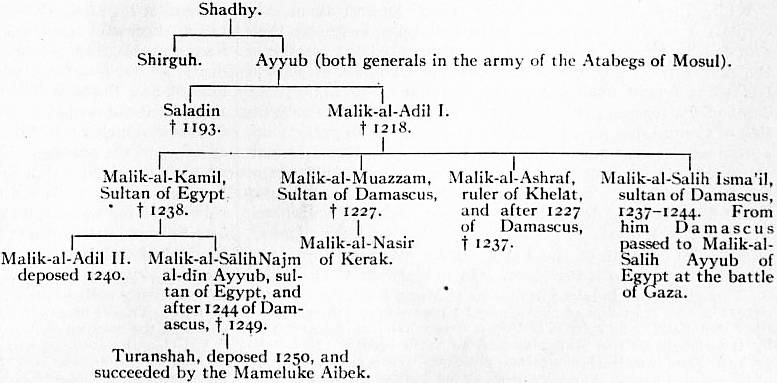
53 The following table of the Ayyubite rulers serves to illustrate the text:—
54 Though Europe indulged in dreams of Mongol aid, the eventual results of the extension of the Mongol Empire were prejudicial to the Latin East. The sultans of Egypt were stirred to fresh activity by the attacks of the Mongols; and as Syria became the battleground of the two, the Latin principalities of Syria were fated to fall as the prize of victory to one or other of the combatants.
55 Of the four Latin principalities of the East, Edessa was the first to fall, being extinguished between 1144 and 1150. Antioch fell in 1268; Tripoli in 1289; and the kingdom itself may be said to end with the capture of Acre, 1291.
56 Michael Palaeologus had actually appealed to Louis IX. against Charles of Anjou, who in 1270 had actively begun preparations for the attack on Constantinople.
57 The dream of a Crusade to Jerusalem survived de Mézières; a society which read “romaunts” of the Crusades, could not but dream the dream. Henry V., whose father had fought with the Teutonic knights on the Baltic, dreamed of a voyage to Jerusalem.
58 The union of 1274, conceded by the Palaeologi at the council of Lyons in order to defeat the plans of Charles of Anjou, had only been temporary.
59 Bréhier, L’Église el l’Orient, p. 347.
60 Cambridge Modern History, i. 11. It is perhaps worth remarking that something of the old crusading spirit seems still to linger in the movement of Russia towards Constantinople.
61 While from this point of view the Crusades appear as a failure, it must not be forgotten that elsewhere than in the East Crusades did attain some success. A Crusade won for Christianity the coast of the eastern Baltic (see Teutonic Order); and the centuries of the Spanish Crusade ended in the conquest of the whole of Spain for Christianity.
62 Authors like Heeren (Versuch einer Entwickelung der Folgen der Kreuzzüge) and Michaud (in the last volume of his Histoire des croisades) fall into the error of assigning all things to the Crusades. Even Prutz, in his Kulturgeschichte der Kreuzzüge, over-estimates the influence of the Crusades as a chapter in the history of civilization. He depreciates unduly the Western civilization of the early middle ages, and exalts the civilization of the Arabs; and starting from these two premises, he concludes that modern civilization is the offspring of the Crusades, which first brought East and West together.
63 It is difficult to decide how far Arabic models influenced ecclesiastical architecture in the West as a result of the Crusades. Greater freedom of moulding and the use of trefoil and cinquefoil may be, but need not be, explained in this way. The pointed arch owes nothing to the Arabs; it is already used in England in early Norman work. Generally, one may say that Western architecture is independent of the East.
64 His somewhat legendary treatise, De liberatione civitatum Orientis, was only composed about 1155.
65 There is also an Inventaire critique of these letters by the comte de Riant (Paris, 1880).
66 Von Sybel’s view must be modified by that of Kugler, to which a scholar like Hagenmeyer has to some extent given his adhesion (cf. his edition of the Gesta, pp. 62-68). Hagenmeyer inclines to believe in an original author, distinct from Albert the copyist; and he thinks that this original author (whether or no he was present during the Crusade) used the Gesta and also Fulcher, though he had probably also “eigene Notizen und Aufzeichnungen.”
67 See Pigonneau, Le Cycle de la croisade, &c. (Paris, 1877); and Hagenmeyer, Peter der Eremite (Leipzig, 1879).
68 On the bibliography of the Second Crusade see Kugler, Studien zur Geschichte des zweiten Kreuzzüges (Stuttgart, 1866).
69 Of these writers see Archer’s Crusade of Richard I., Appendix (in Nutt’s series of Histories from Contemporary Writers).
70 The bibliography of the Fourth Crusade is discussed in Klimke, Die Quellen zur Geschichte des vierten Kreuzzüges (Breslau, 1875).
CRUSENSTOLPE, MAGNUS JAKOB (1795-1865), Swedish historian, early became famous both as a political and a historical writer. His first important work was a History of the Early Years of the Life of King Gustavus IV. Adolphus, which was followed by a series of monographs and by some politico-historical novels, of which The House of Holstein-Gottorp in Sweden is considered the best. He obtained a great influence over King Charles XIV. (Bernadotte), who during the years 1830-1833 gave him his fullest confidence, and sanctioned the official character of Crusenstolpe’s newspaper Fäderneslandet. In the last-mentioned year, however, the historian suddenly became the king’s bitterest enemy, and used his acrid pen on all occasions in attacking him. In 1838 he was condemned, for one of these angry utterances, to be imprisoned three years in the castle of Waxholm. He continued his literary labours until his death in 1865. Few Swedish writers have wielded so pure and so incisive a style as Crusenstolpe, but his historical work is vitiated by political and personal bias.
CRUSIUS, CHRISTIAN AUGUST (1715-1775), German philosopher and theologian, was born on the 10th of January 1715 at Lenau near Merseburg in Saxony. He was educated at Leipzig, and became professor of theology there in 1750, and principal of the university in 1773. He died on the 18th of October 1775. Crusius first came into notice as an opponent of the philosophy of Leibnitz and Wolff from the standpoint of religious orthodoxy. He attacked it mainly on the score of the moral evils that must flow from any system of determinism, and exerted himself in particular to vindicate the freedom of the will. The most important works of this period of his life are Entwurf der nothwendigen Vernunftwahrheiten (1745), and Weg zur Gewissheit und Zuverlässigkeit der menschlichen Erkenntniss (1747). Though diffusely written, and neither brilliant nor profound, Crusius’ philosophical books had a great but short-lived popularity. His criticism of Wolff, which is generally based on sound sense, had much influence upon Kant at the time when his system was forming; and his ethical doctrines are mentioned with respect in the Kritik of Practical Reason. Crusius’s later life was devoted to theology. In this capacity his sincere piety and amiable character gained him great influence, and he led the party in the university which became known as the “Crusianer” as opposed to the “Ernestianer,” the followers of J. A. Ernesti. The two professors adopted opposite methods of exegesis. Ernesti wished to subject the Scripture to the same laws of exposition as are applied to other ancient books; Crusius held firmly to orthodox ecclesiastical tradition. Crusius’s chief theological works are Hypomnemata ad theologiam propheticam (1764-1778), and Kurzer Entwurf der Moraltheologie (1772-1773). He sets his face against innovation in such matters as the accepted authorship of canonical writings, verbal inspiration, and the treatment of persons and events in the Old Testament as types of the New. His views, unscholarly and uncritical as they seem to us now, have had influence on later evangelical students of the Old Testament, such as E. W. Hengstenberg and F. Delitzsch.
There is a full notice of Crusius in Ersch and Gruber’s Allgemeine Encyclopädie. Consult also J. E. Erdmann’s History of Philosophy; A. Marquardt, Kant und Crusius; and art. in Herzog-Hauck, Realencyklopädie (1898).
(H. St.)
CRUSTACEA, a very large division of the animal kingdom, comprising the familiar crabs, lobsters, crayfish, shrimps and prawns, the sandhoppers and woodlice, the strangely modified barnacles and the minute water-fleas. Besides these the group also includes a multitude of related forms which, from their aquatic habits and generally inconspicuous size, and from the fact that they are commonly neither edible nor noxious, are little known except to naturalists and are undistinguished by any popular names. Collectively, they are ranked as one of the classes forming the sub-phylum Arthropoda, and their distinguishing characters are discussed under that heading. It will be sufficient here to define them as Arthropoda for the most part of aquatic habits, having typically two pairs of antenniform appendages in front of the mouth and at least three pairs of post-oral limbs acting as jaws.
As a matter of fact, however, the range of structural variation within the group is so wide, and the modifications due to parasitism and other causes are so profound, that it is almost impossible to frame a definition which shall be applicable to all the members of the class. In certain parasites, for instance, the adults have lost every trace not only of Crustacean but even of Arthropodous structure, and the only clue to their zoological position is that afforded by the study of their development. In point of size also the Crustacea vary within very wide limits. Certain water-fleas (Cladocera) fall short of one-hundredth of an inch in total length; the giant Japanese crab (Macrocheira) can span over 10 ft. between its outstretched claws.
The habits of the Crustacea are no less diversified than their structure. Most of them inhabit the sea, but representatives of all the chief groups are found in fresh water (though the Cirripedia have hardly gained a footing there), and this is the chief home of the primitive Phyllopoda. A terrestrial habitat is less common, but the widely-distributed land Isopoda or woodlice and the land-crabs of tropical regions have solved the problem of adaptation to a subaërial life.
Swimming is perhaps the commonest mode of locomotion, but numerous forms have taken to creeping or walking, and the robber-crab (Birgus latro) of the Indo-Pacific islands even climbs palm-trees. None has the power of flight, though certain pelagic Copepoda are said to leap from the surface of the sea like flying-fish. Apart from the numerous parasitic forms, the only Crustacea which have adopted a strictly sedentary habit of life are the Cirripedia, and here, as elsewhere, profound modifications of structure have resulted, leading ultimately to a partial assumption of the radial type of symmetry which is so often associated with a sedentary life.
Many, perhaps the majority, of the Crustacea are omnivorous or carrion-feeders, but many are actively predatory in their habits, and are provided with more or less complex and efficient instruments for capturing their prey, and there are also many plant-eaters. Besides the sedentary Cirripedia, numbers of the smaller forms, especially among the Entomostraca, subsist on floating particles of organic matter swept within reach of the jaws by the movements of the other limbs.
Symbiotic association with other animals, in varying degrees of interdependence, is frequent. Sometimes the one partner affords the other merely a convenient means of transport, as in the case of the barnacles which grow on, or of the gulf-weed crab which clings to, the carapace of marine turtles. From this we may pass through various grades of “commensalism,” like that of the hermit-crab with its protective anemones, to the cases of actual parasitism. The parasitic habit is most common among the Copepoda and Isopoda, where it leads to complex modifications of structure and life-history. Perhaps the most complete degeneration is found in the Rhizocephala, which are parasitic on other Crustacea. In these the adult consists of a simple saccular body containing the reproductive organs and attached by root-like filaments which ramify throughout the body of the host and serve for the absorption of nourishment (fig. 1).
Many of the larger species of Crustacea are used as food by man, the most valuable being the lobster, which is caught in large quantities on both sides of the North Atlantic. Perhaps the most important of all Crustacea, however, with respect to the part which they play in the economy of nature, are the minute pelagic Copepoda, of which incalculable myriads form an important constituent of the “plankton” in all the seas of the globe. It is on the plankton that a great part of the higher animal life of the sea ultimately depends for food. The Copepoda live upon the diatoms and other important microscopic vegetable life at the surface of the sea, and in their turn serve as food for fishes and other larger forms and thus, indirectly, for man himself.
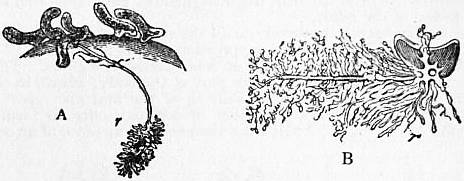
Fig. 1.
A, Group of Peltogaster socialis on the abdomen of a small hermit-crab; in one of them the fasciculately ramified roots, r, in the liver of the crab are shown (Fritz Müller).
B, Young of Sacculina purpurea with its roots. (Fritz Müller.)
Historical Sketch.—In common with most branches of natural history, the science of Carcinology may be traced back to its beginnings in the writings of Aristotle. It received additions of varying importance at the hands of medieval and later naturalists, and first began to assume systematic form under the influence of Linnaeus. The application of the morphological method to the Crustacea may perhaps be dated from the work of J. C. Fabricius towards the end of the 18th century.
In the first quarter of the 19th century important advances in classification were made by P. A. Latreille, W. E. Leach and others, and J. Vaughan Thompson demonstrated the existence of metamorphosis in the development of the higher Crustacea. A new epoch may be said to begin with H. Milne-Edwards’ classical Histoire naturelle des crustacés (1834-1840). It is noteworthy that even at this late date the Cirripedia (Thyrostraca) were still excluded from the Crustacea, though Darwin’s Monograph (1851-1854) was soon to make them known with a wealth of anatomical and systematic detail such as was available, at that time, for few other groups of Crustacea. About the same period three authors call for special mention, W. de Haan, J. D. Dana and H. Kröyer. The new impulse given to biological research by the publication of the Origin of Species bore fruit in Fritz Müller’s Für Darwin, in which an attempt was made to reconstruct the phylogenetic history of the class. The same line of work was followed in the long series of important memoirs from the pen of K. F. W. Claus, and noteworthy contributions were made, among many others, by A. Dohrn, Ray Lankester and Huxley. In more recent years the long and constantly increasing list of writers on Crustacea contains no name more honoured than that of the veteran G. O. Sars of Christiania.
Morphology.
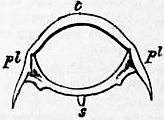
Fig. 2.—Abdominal Somite of a Lobster, separated and viewed from in front. t, tergum; s, sternum; pl, pleuron.
External Structure: Body.—As in all Arthropoda the body consists of a series of segments or somites which may be free or more or less coalesced together. In its simplest form the exoskeleton of a typical somite is a ring of chitin defined from the rings in front and behind by areas of thinner integument forming moveable joints, and having a pair of appendages articulated to its ventral surface on either side of the middle line. Frequently, however, this exoskeletal somite may be differentiated into various regions. A dorsal and a ventral plate are often distinguished, known respectively as the tergum and the sternum, and the tergum may overhang the insertion of the limb on each side as a free plate called the pleuron. The name epimeron is sometimes applied to what is here called the pleuron, but the word has been used in widely different senses and it seems better to abandon it. The typical form of a somite is well seen, for example, in the segments which make up the abdomen or “tail” of a lobster or crayfish (fig. 2). The posterior terminal segment of the body, on which the opening of the anus is situated, never bears appendages. The nature of this segment, which is known as the “anal segment” or telson (fig. 3, T), has been much discussed, some authorities holding that it is a true somite, homologous with those which precede it. Others have regarded it as representing the fusion of a number of somites, and others again as a “median appendage” or as a pair of appendages fused. Its morphological nature, however, is clearly shown by its development. In the larval development of the more primitive Crustacea, the number of somites, at first small, increases by the successive appearance of new somites between the last-formed somite and the terminal region which bears the anus. The “growing point” of the trunk is, in fact, situated in front of this region, and, when the full number of somites has been reached, the unsegmented part remaining forms the telson of the adult.
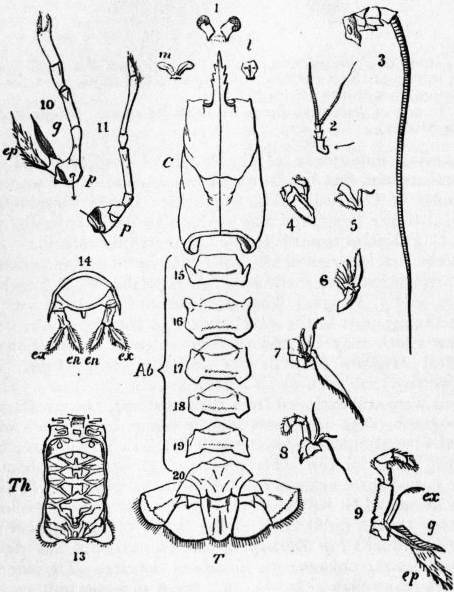
Fig. 3.—The Separated Somites and Appendages of the Common Lobster (Homarus gammarus).
C, carapace covering the cephalothorax. Ab, abdominal somites. T, telson, having the uropods or appendages of the last abdominal somite spread out on either side of it, forming the “tail-fan.” l, labrum, or upper lip. m, metastoma, or lower lip. 1, eyes. 2, antennule (the arrow points to the opening of the so-called auditory organ). 3, antenna. 4, mandible. 5, maxillula (or first maxilla). 6, maxilla (second maxilla). 7-9, first, second and third maxillipeds. ex, exopodite. ep, epipodite. g, gill. 10, sixth thoracic limb (second walking-leg) of female. 11, last thoracic limb of male. In 10 and 11 the arrows indicate the genital apertures. 13, sterna of the thoracic somites, from within. 14, third abdominal somite, with appendages or “swimmerets.”
In no Crustacean, however, do all the somites of the body remain distinct. Coalescence, or suppression of segmentation (“lipomerism”), may involve more or less extensive regions. This is especially the case in the anterior part of the body, where, in correlation with the “adaptational shifting of the oral aperture” (see Arthropoda), a varying number of somites unite to form the “cephalon” or head. Apart from the possible existence of an ocular somite corresponding to the eyes (the morphological nature of which is discussed below), the smallest number of head-somites so united in any Crustacean is five. Even where a large number of the somites have fused, there is generally a marked change in the character of the appendages after the fifth pair, and since the integumental fold which forms the carapace seems to originate from this point, it is usual to take the fifth somite as the morphological limit of the cephalon throughout the class. It is quite probable, however, that in the primitive ancestors of existing Crustacea a still smaller number of somites formed the head. The three pairs of appendages present in the “nauplius” larva show certain peculiarities of structure and development which seem to place them in a different category from the other limbs, and there is some ground for regarding the three corresponding somites as constituting a “primary cephalon.” For practical purposes, however, it is convenient to include the two following somites also as cephalic.
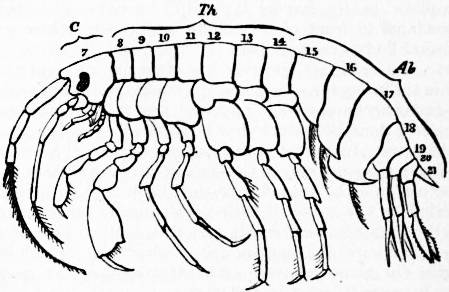
Fig. 4.—Diagram of an Amphipod. (After Spence Bate and Westwood.)
C, cephalon. Th, thorax. (Only seven of the eight thoracic somites are visible, the first being fused with the cephalon.) Ab, abdomen. The numbers appended to the somites do not correspond to the enumeration adopted in the text. 21 is the telson.
A remarkable feature found only in the Stomatopoda is the reappearance of segmentation in the anterior part of the cephalic region. Whether the movably articulated segments which bear the eye-stalks and the antennules in this aberrant group correspond to the primitive head somites or not, their distinctness is certainly a secondarily acquired character, for it is not found in the larvae, nor in any of the more primitive groups of Malacostraca.
The body proper is usually divisible into two regions to which the names thorax and abdomen are applied. Throughout the whole of the Malacostraca the thorax consists of eight and the abdomen of six somites (fig. 4), and the two regions are sharply distinguished by the character of their appendages. In the various groups of the Entomostraca, on the other hand, the terms thorax and abdomen, though conveniently employed for purposes of systematic description, do not imply any homology with the regions so named in the Malacostraca. Sometimes they are applied, as in the Copepoda, to the limb-bearing and limbless regions of the trunk, while in other cases, as in the Phyllopoda, they denote, respectively, the regions in front of and behind the genital apertures.
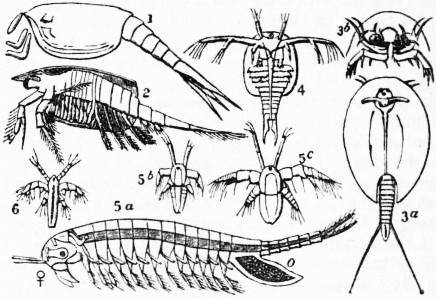
Fig. 5.—Phyllopoda and Phyllocarida.
1, Ceratiocaris papilio, U. Silurian, Lanark. 2, Nebalia bipes(one side of carapace removed). 3, Lepidurus Angassi: a, dorsal aspect; b, ventral aspect of head showing the labrum and mouth-parts. 4, larva of Apus cancriformis. 5, Branchipus stagnalis: a, adult female; b, first larval stage (Nauplius); c, second larval stage. 6, Nauplius of Artemia salina.
A character which recurs in the most diverse groups of the Crustacea, and which is probably to be regarded as a primitive attribute of the class, is the possession of a carapace or shell, arising as a dorsal fold of the integument from the posterior margin of the head-region. In its most primitive form, as seen in the Apodidae (fig. 5, 3) and in Nebalia (fig. 5, 2), this shell-fold remains free from the trunk, which it envelops more or less completely. It may assume the form of a bivalve shell entirely enclosing the body and limbs, as in many Phyllopoda (fig. 6) and in the Ostracoda. In the Cirripedia it forms a fleshy “mantle” strengthened by shelly plates or valves which may assume a very complex structure. In many cases, however, the shell-fold coalesces with some of the succeeding somites. In the Decapoda (fig. 3), this coalescence affects only the dorsal region of the thoracic somites, and the lateral portions of the carapace overhang on each side, enclosing a pair of chambers within which lie the gills. The arrangement is similar in Schizopoda and Stomatopoda (fig. 7), except that the coalescence does not usually involve the posterior thoracic somites, several of which remain free, though they may be overlapped by the carapace.
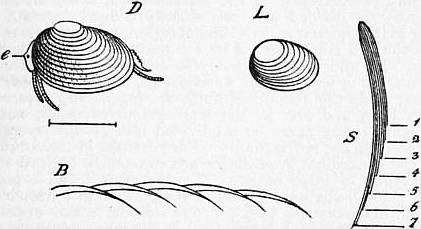
From Morse’s Zoology.
Fig. 6.—Estheria, sp.; D from Dubuque, Iowa; (e) the eye. L from Lynn, Massachusetts (nat. size). S presents a highly magnified section of one of the valves to show the successive moults. B an enlarged portion of the edge of the shell along the back, showing the overlap of each growth.
In the Isopoda and Amphipoda, where, as a rule, all the thoracic somites except the first are distinct (fig. 4), there seems at first sight to be no shell-fold. A comparison with the related Tanaidacea (fig. 8) and Cumacea (or Sympoda), however, leads to the conclusion that the coalescence of the first thoracic somite with the cephalon really involves a vestigial shell-fold, and, indeed, traces of this are said to be observed in the embryonic development of some Isopoda. It seems likely that a similar explanation is to be applied to the coalescence of one or two trunk-somites with the head in the Copepoda, and, if this be so, the only Crustacea remaining in which no trace of a shell-fold is found in the adult are the Anostracous Phyllopoda such as Branchipus (fig. 5, 5).
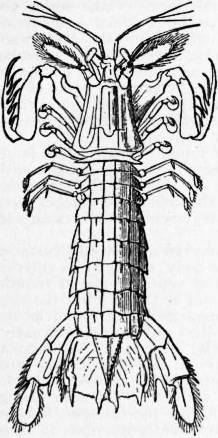
Fig. 7.—Squilla mantis (Stomatopoda), showing the last four thoracic (leg-bearing) somites free from the carapace.
General Morphology of Appendages.—Amid the great variety of forms assumed by the appendages of the Crustacea, it is possible to trace, more or less plainly, the modifications of a fundamental type consisting of a peduncle, the protopodite, bearing two branches, the endopodite and exopodite. This simple biramous form is shown in the swimming-feet of the Copepoda and Branchiura, the “cirri” of the Cirripedia, and the abdominal appendages of the Malacostraca (fig. 3, 14). It is also found in the earliest and most primitive form of larva, known as the Nauplius. As a rule the protopodite is composed of two segments, though one may be reduced or suppressed and occasionally three may be present. In many cases, one of the branches, generally the endopodite, is more strongly developed than the other. Thus, in the thoracic limbs of the Malacostraca, the endopodite generally forms a walking-leg while the exopodite becomes a swimming-branch or may disappear altogether. Very often the basal segment of the protopodite bears, on the outer side, a lamellar appendage (more rarely, two), the epipodite, which may function as a gill. In the appendages near the mouth one or both of the protopodal segments may bear inwardly-turned processes, assisting in mastication and known as gnathobases. The frequent occurrence of epipodites and gnathobases tends to show that the primitive type of appendage was more complex than the simple biramous limb, and some authorities have regarded the leaf-like appendages of the Phyllopoda as nearer the original form from which the various modifications found in other groups have been derived. In a Phyllopod such as Apus the limbs of the trunk consist of a flattened, unsegmented or obscurely segmented axis or corm having a series of lobes or processes known as endites and exites on its inner and outer margins respectively. In all the Phyllopoda the number of endites is six, and the proximal one is more or less distinctly specialized as a gnathobase, working against its fellow of the opposite side in seizing food and transferring it to the mouth. The Phyllopoda are the only Crustacea in which distinct and functional gnathobasic processes are found on appendages far removed from the mouth. The two distal endites are regarded as corresponding to the endopodite and exopodite of the higher Crustacea, the axis or corm of the Phyllopod limb representing the protopodite. The number of exites is less constant, but, in Apus, two are present, the proximal branchial in function and the distal forming a stiffer plate which probably aids in swimming. It is not altogether easy to recognize the homologies of the endites and exites even within the order Phyllopoda, and the identification of the two distal endites as corresponding to the endopodite and exopodite of higher Crustacea is not free from difficulty. It is highly probable, however, that the biramous limb is a simplification of a more complex primitive type, to which the Phyllopod limb is a more or less close approximation.
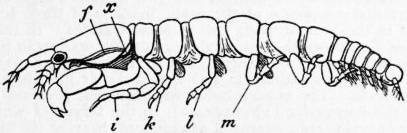
Fig. 8.—Tanais dubius (?) Kr. ♀, showing the orifice of entrance (x) into the cavity overarched by the carapace in which an appendage of the maxilliped (f) plays. On four feet (i, k, l, m) are the rudiments of the lamellae which subsequently form the brood-cavity. (Fritz Müller.)
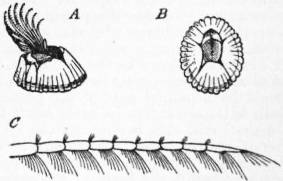
Fig. 9.—A, Balanus (young), side view with cirri protruded. B, Upper surface of same; valves closed. C, Highly magnified view of one of the cirri. (Morse.)
The modifications which this original type undergoes are usually more or less plainly correlated with the functions which the appendages have to discharge. Thus, when acting as swimming organs, the appendages, or their rami, are more or less flattened, or oar-like, and often have the margins fringed with long plumose hairs. When used for walking, one of the rami, usually the inner, is stout and cylindrical, terminating in a claw, and having the segments united by definite hinge-joints. The jaws have the gnathobasic endites developed at the expense of the rest of the limb, the endopodite and exopodite persisting only as sensory “palps” or disappearing altogether. When specialized as bearers of sensory (olfactory or tactile) organs, the rami are generally elongated, many-jointed and flagelliform. This modification is usually only found in the antennules and antennae, but it may exceptionally be found in the appendages of the trunk, as, for instance, in the thoracic legs of some Decapods (e.g. Mastigocheirus). Very often one or other of the appendages may be modified for prehension, the seizing of prey or the holding of a mate. In this case, the claw-like terminal segment may be simply flexed against the preceding in the same way as the blade of a penknife shuts up against the handle. The penultimate segment is often broadened, so that the terminal claw shuts against a transverse edge (fig. 4), or, finally, the penultimate segment may be produced into a thumb-like process opposed to the movable terminal segment or finger, forming a perfect chela or forceps, as, for instance, in the large claws of a crab or lobster. This chelate condition may be assumed by almost any of the appendages, and sometimes it appears in different appendages in closely related forms, so that no very great phylogenetic importance can in most cases be attached to it. A peculiar modification is found in the trunk-limbs of the Cirripedia (fig. 9), in which both rami are multiarticulate and filiform and fringed with long bristles. When protruded from the opening of the shell these “cirri” are spread out to form a casting-net for the capture of minute floating prey.
Gills or branchiae may be developed by parts of an appendage becoming thin-walled and vascular and either expanded into a thin lamella or ramified. Some of the special modifications of branchiae are referred to below.
Special Morphology of Appendages.—In many Crustacea the eyes are borne on stalks which are movably articulated with the head and which may be divided into two or three segments. The view is commonly held that these eye-stalks are really limbs, homologous with the other appendages. In spite of much discussion, however, it cannot be said that this point has been finally settled. The evidence of embryology is decidedly against the view that the eye-stalks are limbs. They are absent in the earliest and most primitive larval forms (nauplius), and appear only late in the course of development, after many of the trunk-limbs are fully formed. In the development of the Phyllopod Branchipus, the eyes are at first sessile, and the lateral lobes of the head on which they are set grow out and become movably articulated, forming the peduncles. The most important evidence in favour of their appendicular nature is afforded by the phenomena of regeneration. When the eye-stalk is removed from a living lobster or prawn, it is found that under certain conditions a many-jointed appendage like the flagellum of an antennule or antenna may grow in its place. It is open to question, however, how far the evidence from such “heteromorphic regeneration” can be regarded as conclusive on the points of homology. The fact that in certain rare cases among insects a leg may apparently be replaced by a wing tends to show that under exceptional conditions similar forms may be assumed by non-homologous parts.
The antennules (or first antennae) are almost universally regarded as true appendages, though they differ from all the other appendages in the fact that they are always innervated from the “brain” (or preoral ganglia), and that they are uniramous in the nauplius larva and in all the Entomostracan orders. As regards their innervation an apparent exception is found in the case of Apus, where the nerves to the antennules arise, behind the brain, from the oesophageal commissures, but this is, no doubt, a secondary condition, and the nerve-fibres have been traced forwards to centres within the brain. In the Malacostraca, the antennules are often biramous, but there is considerable doubt as to whether the two branches represent the endopodite and exopodite of the other limbs, and three branches are found in the Stomatopoda and in some Caridea. In the great majority of Crustacea the antennules are purely sensory in function and carry numerous “olfactory” hairs. They may, however, be natatory as in many Ostracoda and Copepoda, or prehensile, as in some Copepoda. The most peculiar modification, perhaps, is that found in the Cirripedia (Thyrostraca), in the larvae of which the antennules develop into organs of attachment, bearing the openings of the cement-glands, and becoming, in the adult, involved in the attachment of the animal to its support.
The antennae (second antennae) are of special interest on account of the clear evidence that, although preoral in position in all adult Crustacea, they were originally postoral appendages. In the nauplius larva they lie rather at the sides than in front of the mouth, and their basal portion carries a hook-like masticatory process which assists the similar processes of the mandibles in seizing food. In the primitive Phyllopoda, and less distinctly in some other orders, the nerves supplying the antennae arise, not from the brain, but from the circum-oesophageal commissures, and even in those cases where the nerves and the ganglia in which they are rooted have been moved forwards to the brain, the transverse commissure of the ganglia can still be traced, running behind the oesophagus.
The functions of the antennae are more varied than is the case with the antennules. In many Entomostraca (Phyllopoda, Cladocera, Ostracoda, Copepoda) they are important, and sometimes the only, organs of locomotion. In some male Phyllopoda they form complex “claspers” for holding the female. They are frequently organs of attachment in parasitic Copepoda, and they may be completely pediform in the Ostracoda. In the Malacostraca they are chiefly sensory, the endopodite forming a long flagellum, while the exopodite may form a lamellar “scale,” probably useful as a balancer in swimming, or may disappear altogether. A very curious function sometimes discharged by the antennules or antennae of Decapods is that of forming a respiratory siphon in sand-burrowing species.
The mandibles, like the antennae, have, in the nauplius, the form of biramous swimming limbs, with a masticatory process originating from the proximal part of the protopodite. This form is retained, with little alteration in some adult Copepoda, where the biramous “palp” still aids in locomotion. A somewhat similar structure is found also in some Ostracoda. In most cases, however, the palp loses its exopodite and it often disappears altogether, while the coxal segment forms the body of the mandible, with a masticatory edge variously armed with teeth and spines. In a few Ostracoda, by a rare exception, the masticatory process is reduced or suppressed, and the palp alone remains, forming a pediform appendage used in locomotion as well as in the prehension of food. In parasitic blood-sucking forms the mandibles often have the shape of piercing stylets, and are enclosed in a tubular proboscis formed by the union of the upper lip (labrum) with the lower lip (hypostome or paragnatha).
The maxillulae and maxillae (or, as they are often termed, first and second maxillae) are nearly always flattened leaf-like appendages, having gnathobasic lobes or endites borne by the segments of the protopodite. The endopodite, when present, is unsegmented or composed of few segments and forms the “palp,” and outwardly-directed lobes representing the exopodite and epipodites may also be present. These limbs undergo great modification in the different groups. The maxillulae are sometimes closely connected with the “paragnatha” or lobes of the lower lip, when these are present, and it has been suggested that the paragnatha are really the basal endites which have become partly separated from the rest of the appendage.
The limbs of the post-cephalic series show little differentiation among themselves in many Entomostraca. In the Phyllopoda they are for the most part all alike, though one or two of the anterior pairs may be specialized as sensory (Apus) or grasping (Estheriidae) organs. In the Cirripedia (Thyrostraca) the six pairs of biramous cirriform limbs differ only slightly from each other, and in many Copepoda this is also the case. In other Entomostraca considerable differentiation may take place, but the series is never divided into definite “tagmata” or groups of similarly modified appendages. It is highly characteristic of the Malacostraca, however, that the trunk-limbs are divided into two sharply defined tagmata corresponding to the thoracic and abdominal regions respectively, the limit between the two being marked by the position of the male genital openings. The thoracic limbs have the endopodites converted, as a rule, into more or less efficient walking-legs, and the exopodites are often lost, while the abdominal limbs more generally preserve the biramous form and are, in the more primitive types, natatory. These tagmata may again be subdivided into groups preserving a more or less marked individuality. For example, in the Amphipoda (fig. 4) the abdominal appendages are constantly divided into an anterior group of three natatory “swimmerets” and a posterior group of three limbs used chiefly in jumping or in burrowing. In nearly all Malacostraca the last pair of abdominal appendages (uropods) differ from the others, and in the more primitive groups they form, with the telson, a lamellar “tail-fan” (fig. 3, T), used in springing backwards through the water. In the thoracic series it is usual for one or more of the anterior pairs to be pressed into the service of the mouth, forming “foot-jaws” or maxillipeds. In the Decapoda three pairs are thus modified, and in the Tanaidacea, Isopoda and Amphipoda only one. In the Schizopoda and Cumacea the line of division is less sharp, and the varying number of so-called maxillipeds recognized by different authors gives rise to some confusion of terminology in systematic literature.
Gills.—In many of the smaller Entomostraca (Copepoda and most Ostracoda) no special gills are present, and respiration is carried on by the general surface of the body and limbs. When present, the branchiae are generally differentiations of parts of the appendages, most often the epipodites, as in the Phyllopoda. In the Cirripedia, however, they are vascular processes from the inner surface of the mantle or shell-fold, and in some Ostracoda they are outgrowths from the sides of the body. In the primitive Malacostraca the gills were probably, as in the Phyllopoda and in Nebalia, the modified epipodites of the thoracic limbs, and this is the condition found in some Schizopoda. In the Cumacea and Tanaidacea only the first thoracic limb has a branchial epipodite. In the Amphipoda, the gills though arising from the inner side of the bases of the thoracic legs are probably also epipodial in nature. In the Isopoda the respiratory function has been taken over by the abdominal appendages, both rami or only the inner becoming thin or flattened. In the Decapoda the branchial system is more complex. The gills are inserted at the base of the thoracic limbs, and lie within a pair of branchial chambers covered by the carapace. Three series are distinguished, podobranchiae, attached to the proximal segments of the appendages, pleurobranchiae, springing from the body-wall, and an intermediate series, arthrobranchiae, inserted on the articular membrane of the joint between the limb and the body. The podobranchiae are clearly epipodites, or, more correctly, parts of the epipodites, and it is probable that the arthro- and pleurobranchiae are also epipodial in origin and have migrated from the proximal segment of the limbs on to the adjacent body-wall.
Adaptations for aërial respiration are found in some of the land-crabs, where the lining membrane of the gill-chamber is beset with vascular papillae and acts as a lung. In some of the terrestrial Isopoda or woodlice (Oniscoidea) the abdominal appendages have ramified tubular invaginations of the integument, filled with air and resembling the tracheae of insects.
Internal Structure: Alimentary System.—In almost all Crustacea the food-canal runs straight through the body, except at its anterior end, where it curves downwards to the ventrally-placed mouth. In a few cases its course is slightly sinuous or twisted, but the only cases in which it is actually coiled upon itself are found in the Cladocera of the family Lynceidae (Alonidae) and in a single recently-discovered genus of Cumacea (Sympoda). As in all Arthropoda, it is composed of three divisions, a fore-gut or stomodaeum, ectodermal in origin and lined by an inturning of the chitinous cuticle, a mid-gut formed by endoderm and without a cuticular lining, and a hind-gut or proctodaeum, which, like the fore-gut, is ectodermal and is lined by cuticle. The relative proportions of these three divisions vary considerably, and the extreme abbreviation of the mid-gut found in the common crayfish (Astacus) is by no means typical of the class. Even in the closely-related lobster (Homarus) the mid-gut may be 2 or 3 in. long.
In a few Entomostraca (some Phyllopoda and Ostracoda) the chitinous lining of the fore-gut develops spines and hairs which help to triturate and strain the food, and among the Ostracods there is occasionally (Bairdia) a more elaborate armature of toothed plates moved by muscles. It is among the Malacostraca, however, and especially in the Decapoda, that the “gastric mill” reaches its greatest perfection. In most Decapods the “stomach” or dilated portion of the fore-gut is divided into two chambers, a large anterior “cardiac” and a smaller posterior “pyloric.” In the narrow opening between these, three teeth (fig. 10) are set, one dorsally and one on each side. These teeth are connected with a framework of movably articulated ossicles developed as thickened and calcified portions of the lining cuticle of the stomach and moved by special muscles in such a way as to bring the three teeth together in the middle line. The walls of the pyloric chamber bear a series of pads and ridges beset with hairs and so disposed as to form a straining apparatus.
The mid-gut is essentially the digestive and absorptive region of the alimentary canal, and its surface is, in most cases, increased by pouch-like or tubular outgrowths which not only serve as glands for the secretion of the digestive juices, but may also become filled by the more fluid portion of the partially digested food and facilitate its absorption. These outgrowths vary much in their arrangement in the different groups. Most commonly there is a pair of lateral caeca, which may be more or less ramified and may form a massive “hepato-pancreas” or “liver.”
Fig. 10.—Gastric Teeth of Crab and Lobster.
1a, Stomach of common crab, Cancer pagurus, laid open, showing b, b, b, some of the calcareous plates inserted in its muscular coat; g, g, the lateral teeth, which when in use are brought in contact with the sides of the median tooth m; c, c, the muscular coat. 1b′ and 1b″, The gastric teeth enlarged to show their grinding surfaces. 2, Gastric teeth of common lobster, Homarus vulgaris. 3a and 3b, Two crustacean teeth (of Dithyrocaris) from the Carboniferous series of Renfrewshire (these, however, may be the toothed edges of the mandibles).
The whole length of the alimentary canal is provided, as a rule, with muscular fibres, both circular and longitudinal, running in its walls, and, in addition, there may be muscle-bands running between the gut and the body-wall. In the region of the oesophagus these muscles are more strongly developed to perform the movements of deglutition, and, where a gastric mill is present, both intrinsic and extrinsic muscles co-operate in producing the movements of its various parts. The hind-gut is also provided with sphincter and dilator muscles, and these may produce rhythmic expansion and contraction, causing an inflow and outflow of water through the anus, which has been supposed to aid in respiration.
In the parasitic Rhizocephala and in a few Copepoda (Monstrillidae) the alimentary canal is absent or vestigial throughout life.
Circulatory System.—As in the other Arthropoda, the circulatory system in Crustacea is largely lacunar, the blood flowing in spaces or channels without definite walls. These spaces make up the apparent body-cavity, the true body-cavity or coelom having been, for the most part, obliterated by the great expansion of the blood-containing spaces. The heart is of the usual Arthropodous type, lying in a more or less well-defined pericardial blood-sinus, with which it communicates by valvular openings or ostia. In the details of the system, however, great differences exist within the limits of the class. There is every reason to believe that, in the primitive Arthropoda, the heart was tubular in form, extending the whole length of the body, and having a pair of ostia in each somite. This arrangement is retained in some of the Phyllopoda, but even in that group a progressive abbreviation of the heart, with a diminution in the number of the ostia, can be traced, leading to the condition found in the closely related Cladocera, where the heart is a subglobular sac, with only a single pair of ostia. In the Malacostraca, an elongated heart with numerous segmentally arranged ostia is found only in the aberrant group of Stomatopoda and in the transitional Phyllocarida. In the other Malacostraca the heart is generally abbreviated, and even where, as in the Amphipoda, it is elongated and tubular, the ostia are restricted in number, three pairs only being usually present. In many Entomostraca the heart is absent, and it is impossible to speak of a “circulation” in the proper sense of the term, the blood being merely driven hither and thither by the movements of the body and limbs and of the alimentary canal.
A very remarkable condition of the blood-system, unique, as far as is yet known among the Arthropoda, is found in a few genera of parasitic Copepoda (Lernanthropus, Mytilicola). In these there is a closed system of vessels, not communicating with the body-cavity, and containing a coloured fluid. There is no heart. The morphological nature of this system is unknown.
Excretory System.—The most important excretory or renal organs of the Crustacea are two pairs of glands lying at the base of the antennae and of the second maxillae respectively. The two are probably never functional together in the same animal, though one may replace the other in the course of development. Thus, in the Phyllopoda, the antennal gland develops early and is functional during a great part of the larval life, but it ultimately atrophies, and in the adult (as in most Entomostraca) the maxillary gland is the functional excretory organ. In the Decapoda, where the antennal gland alone is well-developed in the adult, the maxillary gland sometimes precedes it in the larva. The structure of both glands is essentially the same. There is a more or less convoluted tube with glandular walls connected internally with a closed “end-sac” and opening to the exterior by means of a thin-walled duct. Development shows that the glandular tube is mesoblastic in origin and is of the nature of a coelomoduct, while the end-sac is to be regarded as a vestigial portion of the coelom. In the Branchiopoda the maxillary gland is lodged in the thickness of the shell-fold (when this is present), and, from this circumstance, it often receives the somewhat misleading name of “shell-gland.” In the Decapoda the antennal gland is largely developed and is known as the “green gland.” The external duct of this gland is often dilated into a bladder, and may sometimes send out diverticula, forming a complex system of sinuses ramifying through the body. The green gland and the structures associated with it in Decapods were at one time regarded as constituting an auditory apparatus.
In addition to these two pairs of glands, which are in all probability the survivors of a series of segmentally arranged coelomoducts present in the primitive Arthropoda, other excretory organs have been described in various Crustacea. Although the excretory function of these has been demonstrated by physiological methods, however, their morphological relations are not clear. In some cases they consist of masses of mesodermal cells, within which the excretory products appear to be stored up instead of being expelled from the body.
Nervous System.—The central nervous system is constructed on the same general plan as in the other Arthropoda, consisting of a supra-oesophageal ganglionic mass or brain, united by circum-oesophageal connectives with a double ventral chain of segmentally arranged ganglia. In the primitive Phyllopoda the ventral chain retains the ladder-like arrangement found in some Annelids and lower worms, the two halves being widely separated and the pairs of ganglia connected together across the middle line by double transverse commissures. In the higher groups the two halves of the chain are more or less closely approximated and coalesced, and, in addition, a concentration of the ganglia in a longitudinal direction takes place, leading ultimately, in many cases, to the formation of an unsegmented ganglionic mass representing the whole of the ventral chain. This is seen, for example, in the Brachyura among the Decapoda. The brain, or supra-oesophageal ganglion, shows various degrees of complexity. In the Phyllopoda it consists mainly of two pairs of ganglionic centres, giving origin respectively to the optic and antennular nerves. The centres for the antennal nerves form ganglionic swellings on the oesophageal connectives. In the higher forms, as already mentioned, the antennal ganglia have become shifted forwards and coalesced with the brain. In the higher Decapoda, numerous additional centres are developed in the brain and its structure becomes extremely complex.
Eyes.—The eyes of Crustacea are of two kinds, the unpaired, median or “nauplius” eye, and the paired compound eyes. The former is generally present in the earliest larval stages (nauplius), and in some Entomostraca (e.g. Copepoda) it forms the sole organ of vision in the adult. In the Malacostraca it is absent in the adult, or persists only in a vestigial condition, as in some Decapoda and Schizopoda. It is typically tripartite, consisting of three cup-shaped masses of pigment, the cavity of each cup being filled with columnar retinal cells. At their inner ends (towards the pigment) these cells contain rod-like structures, while their outer ends are connected with the nerve-fibres. In some cases three separate nerves arise from the front of the brain, one going to each of the three divisions of the eye. In the Copepoda the median eye may undergo considerable elaboration, and refracting lenses and other accessory structures may be developed in connexion with it.
The compound eyes are very similar in the details of their structure (see Arthropoda) to those of insects (Hexapoda). They consist of a varying number of ommatidia or visual elements, covered by a transparent region of the external cuticle forming the cornea. In most cases this cornea is divided into lenticular facets corresponding to the underlying ommatidia.
As has been already stated, the compound eyes are often set on movable peduncles. It is probable that this is the primitive condition from which the sessile eyes of other forms have been derived. In the Malacostraca the sessile eyed groups are certainly less primitive than some of those with stalked eyes, and among the Entomostraca also there is some evidence pointing in the same direction.
Although typically paired, the compound eyes may occasionally coalesce in the middle line into a single organ. This is the case in the Cladocera, the Cumacea and a few Amphipoda.
Mention should also be made of the partial or complete atrophy of the eyes in many Crustacea which live in darkness, either in the deep sea or in subterranean habitats. In these cases the peduncles may persist and may even be modified into spinous organs of defence.
Other Sense-Organs.—As in Arthropoda, the hairs or setae on the surface of the body are important organs of sense and are variously modified for special sensory functions. Many, perhaps all, of them are tactile. They are movably articulated at the base where they are inserted in pits formed by a thinning away of the cuticle, and each is supplied by a nerve-fibril. When feathered or provided with secondary barbs the setae will respond to movements or vibrations in the surrounding water, and have been supposed to have an auditory function. In certain divisions of the Malacostraca more specialized organs are found which have been regarded as auditory. In the majority of the Decapoda there is a saccular invagination of the integument in the basal segment of the antennular peduncle having on its inner surface “auditory” setae of the type just described. The sac is open to the exterior in most of the Macrura, but completely closed in the Brachyura. In the former case it contains numerous grains of sand which are introduced by the animal itself after each moult and which are supposed to act as otoliths. Where the sac is completely closed it generally contains no solid particles, but in a few Macrura a single otolith secreted by the walls of the sac is present. In the Mysidae among the Schizopoda a pair of similar otocysts are found in the endopodites of the last pair of appendages (uropods). These contain each a single concretionary otolith.
Recent observations, however, make it very doubtful whether aquatic Crustacea can hear at all, in the proper sense of the term, and it has been shown that one function, at least, of the so-called otocysts is connected with the equilibration of the body. They are more properly termed statocysts.
Another modification of sensory setae is supposed to be associated with the sense of smell. In nearly all Crustacea the antennules and often also the antennae bear groups of hair-like filaments in which the chitinous cuticle is extremely delicate and which do not taper to a point but end bluntly. These are known as olfactory filaments or aesthetascs. They are very often more strongly developed in the male sex, and are supposed to guide the males in pursuit of the females.
Glands.—In addition to the digestive and excretory glands already mentioned, various glandular structures occur in the different groups of Crustacea. The most important of these belong to the category of dermal glands, and may be scattered over the surface of the body and limbs, or grouped at certain points for the discharge of special functions. Such glands occurring on the upper and lower lips or on the walls of the oesophagus have been regarded as salivary. In some Amphipoda the secretion of glands on the body and limbs is used in the construction of tubular cases in which the animals live. In some freshwater Copepoda the secretion of the dermal glands forms a gelatinous envelope, by means of which the animals are able to survive desiccation. In certain Copepoda and Ostracoda glands of the same type produce a phosphorescent substance, and others, in certain Amphipoda and Branchiura, are believed to have a poisonous function. Possibly related to the same group of structures are the greatly-developed cement-glands of the Cirripedia, which serve to attach the animals to their support.
Phosphorescent Organs.—Many Crustacea belonging to very different groups (Ostracoda, Copepoda, Schizopoda, Decapoda) possess the power of emitting light. In the Ostracoda and Copepoda the phosphorescence, as already mentioned, is due to glands which produce a luminous secretion, and this is the case also in certain members of the Schizopoda and Decapoda. In other cases in the last two groups, however, the light-producing organs found on the body and limbs have a complex and remarkable structure, and were formerly described as accessory eyes. Each consists of a globular capsule pierced at one or two points for the entrance of nerves which end in a central cup-shaped “striated body.” This body appears to be the source of light, and has behind it a reflector formed of concentric lamellae, while, in front, in some cases, there is a refracting lens. The whole organ can be rotated by special muscles. Organs of this type are best known in the Euphausiidae among the Schizopoda, but a modified form is found in some of the lower Decapods.
Reproductive System.—In the great majority of Crustacea the sexes are separate. Apart from certain doubtful and possibly abnormal instances among Phyllopoda and Amphipoda, the only exceptions are the sessile Cirripedia and some parasitic Isopoda (Cymothoidae), where hermaphroditism is the rule. Parthenogenesis is prevalent in the Branchiopoda and Ostracoda, often in more or less definite seasonal alternation with sexual reproduction. Where the sexes are distinct, a more or less marked dimorphism often exists. The male is very often provided with clasping organs for seizing the female. These may be formed by the modification of almost any of the appendages, often the antennules or antennae or some of the thoracic limbs, or even the mandibular palps (some Ostracoda). In addition, some of the appendages in the neighbourhood of the genital apertures may be modified for the purpose of transferring the genital products to the female, as, for instance, the first and second abdominal limbs in the Decapoda. In the higher Decapoda the male is generally larger than the female and has stronger chelae. On the other hand, in other groups the male is often smaller than the female. In the parasitic Copepoda and Isopoda the disparity in size is carried to an extreme degree, and the minute male is attached, like a parasite, to the enormously larger female.
The Cirripedia present some examples of sexual relationships which are only paralleled, in the animal kingdom, among the parasitic Myzostomida. While the great majority are simple hermaphrodites, capable of cross and self fertilization, it was discovered by Darwin that, in certain species, minute degraded males exist, attached within the mantle-cavity of the ordinary individuals. Since these dwarf males pair, not with females, but with hermaphrodites, Darwin termed them “complemental” males. In other species the large individuals have become purely female by atrophy of the male organs, and are entirely dependent on the dwarf males for fertilization. In spite of the opinion of some distinguished zoologists to the contrary, it seems most probable that the separation of the sexes is in this case a secondary condition, derived from hermaphroditism through the intermediate stage represented by the species having complemental males.