VOLUME VII SLICE VII Crocoite to Cuba (continued 3)
Reading edition
In estimating Cromwell’s character it must be remembered that his father was a blackguard, and that he himself spent the formative years of his life in a vile school of morals. A ruffian he doubtless was, as he says, in his youth, and he was the last man to need the tuition of Machiavelli. Nevertheless he civilized himself to a certain extent; he was not a drunkard nor a forger like his father; from personal immorality he seems to have been singularly free; he was a kind master, and a stanch friend; and he possessed all the outward graces of the Renaissance period. He was not vindictive, and his atrocious acts were done in no private quarrel, but in what he conceived to be the interests of his master and the state. Where those interests were concerned he had no heart and no conscience and no religious faith; no man was more completely blighted by the 16th century worship of the state.
The authorities for the early life of Cromwell are the Wimbledon manor rolls, used by Mr John Phillips of Putney in The Antiquary (1880), vol. ii., and the Antiquarian Mag. (1882), vol. ii.; Pole’s Apologia, i. 126; Bandello’s Novella, xxxiv.; Chapuys’ letter to Granvelle, 21 Nov. 1535; and Foxe’s Acts and Mon. From 1522 see Letters and Papers of Henry VIII., vols. iii.-xvi.; Cavendish’s Life of Wolsey; Hall’s Chron.; Wriothesley’s Chron. These and practically all other available sources have been utilized in R. B. Merriman’s Life and Letters of Thomas Cromwell (2 vols., 1902). For Cromwell and Machiavelli see Paul van Dyke’s Renascence Portraits (1906), App.
(A. F. P.)
CRONJE, PIET ARNOLDUS (c. 1840- ), Boer general, was born about 1840 in the Transvaal and in 1881 took part in the first Boer War in the rank of commandant. He commanded in the siege of the British garrison at Potchefstroom, though he was unable to force their surrender until after the conclusion of the general armistice. The Boer leader was at this time accused of withholding knowledge of this armistice from the garrison (see Potchefstroom). He held various official positions in the years 1881-1899, and commanded the Boer force which compelled the surrender of the Jameson raiders at Doornkop (Jan. 2, 1896). In the war of 1899 Cronje was general commanding in the western theatre of war, and began the siege of Kimberley. He opposed the advance of the British division under Lord Methuen, and fought, though without success, three general actions at Belmont, Graspan and Modder River. At Magersfontein, early in December 1899, he completely repulsed a general attack made upon his position, and thereby checked for two months the northward advance of the British column. In the campaign of February 1900, Cronje opposed Lord Roberts’s army on the Magersfontein battleground, but he was unable to prevent the relief of Kimberley; retreating westward, he was surrounded near Paardeberg, and, after a most obstinate resistance, was forced to surrender with the remnant of his army (Feb. 27, 1900). As a prisoner of war Cronje was sent to St Helena, where he remained until released after the conclusion of peace (see Transvaal: History).
CROOKES, SIR WILLIAM (1832- ), English chemist and physicist, was born in London on the 17th of June 1832, and studied chemistry at the Royal College of Chemistry under A. W. von Hofmann, whose assistant he became in 1851. Three years later he was appointed an assistant in the meteorological department of the Radcliffe observatory, Oxford, and in 1855 he obtained a chemical post at Chester. In 1861, while conducting a spectroscopic examination of the residue left in the manufacture of sulphuric acid, he observed a bright green line which had not been noticed previously, and by following up the indication thus given he succeeded in isolating a new element, thallium, a specimen of which was shown in public for the first time at the exhibition of 1862. During the next eight years he carried out a minute investigation of this metal and its properties. While determining its atomic weight, he thought it desirable, for the sake of accuracy, to weigh it in a vacuum, and even in these circumstances he found that the balance behaved in an anomalous manner, the metal appearing to be heavier when cold than when hot. This phenomenon he explained as a “repulsion from radiation,” and he expressed his discovery in the statement that in a vessel exhausted of air a body tends to move away from another body hotter than itself. Utilizing this principle he constructed the radiometer (q.v.), which he was at first disposed to regard as a machine that directly transformed light into motion, but which was afterwards perceived to depend on thermal action. Thence he was led to his famous researches on the phenomena produced by the discharge of electricity through highly exhausted tubes (sometimes known as “Crookes’ tubes” in consequence), and to the development of his theory of “radiant matter” or matter in a “fourth state,” which led up to the modern electronic theory. In 1883 he began an inquiry into the nature and constitution of the rare earths. By repeated fractionations he was able to divide yttrium into distinct portions which gave different spectra when exposed in a high vacuum to the spark from an induction coil. This result he considered to be due, not to any removal of impurities, but to an actual splitting-up of the yttrium molecule into its constituents, and he ventured to draw the provisional conclusion that the so-called simple bodies are in reality compound molecules, at the same time suggesting that all the elements have been produced by a process of evolution from one primordial stuff or “protyle.” A later result of this method of investigation was the discovery of a new member of the rare earths, monium or victorium, the spectrum of which is characterized by an isolated group of lines, only to be detected photographically, high up in the ultra-violet; the existence of this body was announced in his presidential address to the British Association at Bristol in 1898. In the same address he called attention to the conditions of the world’s food supply, urging that with the low yield at present realized per acre the supply of wheat would within a comparatively short time cease to be equal to the demand caused by increasing population, and that since nitrogenous manures are essential for an increase in the yield, the hope of averting starvation, as regards those races for whom wheat is a staple food, depended on the ability of the chemist to find an artificial method for fixing the nitrogen of the air. An authority on precious stones, and especially the diamond, he succeeded in artificially making some minute specimens of the latter gem; and on the discovery of radium he was one of the first to take up the study of its properties, in particular inventing the spinthariscope, an instrument in which the effects of a trace of radium salt are manifested by the phosphorescence produced on a zinc sulphide screen. In addition to many other researches besides those here mentioned, he wrote or edited various books on chemistry and chemical technology, including Select Methods of Chemical Analysis, which went through a number of editions; and he also gave a certain amount of time to the investigation of psychic phenomena, endeavouring to effect some measure of correlation between them and ordinary physical laws. He was knighted in 1897, and received the Royal (1875), Davy (1888), and Copley (1904) medals of the Royal Society, besides filling the offices of president of the Chemical Society and of the Institution of Electrical Engineers. He married Ellen, daughter of W. Humphrey, of Darlington, and their golden wedding was celebrated in 1906.
CROOKSTON, a city and the county-seat of Polk county, Minnesota, U.S.A., on the Red Lake river in the Red River valley, about 300 m. N.W. of Minneapolis, and about 25 m. E. of Grand Forks, North Dakota. Pop. (1890) 3457; (1900) 5359; (1905, state census) 6794, 2049 being foreign-born, including 656 from Norway (2 Norwegian weeklies are published), 613 from Canada, 292 from Sweden; (1910 U.S. census) 7559. Crookston is served by the Great Northern and the Northern Pacific railways. It has a Carnegie library, and the St Vincent and Bethesda hospitals, and is the seat of a Federal Land Office and of a state agricultural high school (with an experimental farm). Dams on the Red Lake river provide a fine water-power, and among the city’s manufactures are lumber, leather, flour, farm implements, wagons and bricks. The city is situated in a fertile farming region, and is a market for grain, potatoes and other agricultural products, and lumber. Crookston was settled about 1872, was incorporated in 1879, received its first city charter in 1883, and adopted a new one in 1906. It was named in honour of William Crooks, an early settler.
CROP (a word common in various forms, such as Germ. Kropf, to many Teutonic languages for a swelling, excrescence, round head or top of anything; it appears also in Romanic languages derived from Teutonic, in Fr. as croupe, whence the English “crupper”; and in Ital. groppo, whence English “group”), the ingluvies, or pouched expansion of a bird’s oesophagus, in which the food remains to undergo a preparatory process of digestion before being passed into the true stomach. From the meaning of “top” or “head,” as applied to a plant, herb or flower, comes the common use of the word for the produce of cereals or other cultivated plants, the wheat-crop, the cotton-crop and the like, and generally, “the crops”; more particular expressions are the “white-crop,” for such grain crops as barley or wheat, which whiten as they grow ripe and “green-crop” for such as roots or potatoes which do not, and also for those which are cut in a green state, like clover (see Agriculture). Other uses, more or less technical, of the word are, in leather-dressing, for the whole untrimmed hide; in mining and geology, for the “outcrop” or appearance at the surface of a vein or stratum and, particularly in tin mining, of the best part of the ore produced after dressing. A “hunting-crop” is a short thick stock for a whip, with a small leather loop at one end, to which a thong may be attached. From the verb “to crop,” i.e. to take off the top of anything, comes “crop” meaning a closely cut head of hair, found in the name “croppy” given to the Roundheads at the time of the Great Rebellion, to the Catholics in Ireland in 1688 by the Orangemen, probably with reference to the priests’ tonsures, and to the Irish rebels of 1798, who cut their hair short in imitation of the French revolutionaries.
CROPSEY, JASPER FRANCIS (1823-1900), American landscape painter, was born at Rossville, Staten Island, New York, on the 18th of February 1823. After practising architecture for several years, he turned his attention to painting, studying in Italy from 1847 to 1850. In 1851 he was elected a member of the National Academy of Design. From 1857 to 1863 he had a studio in London, and after his return to America enjoyed a considerable vogue, particularly as a painter of vivid autumnal effects, along the lines of the Hudson River school. He was one of the original members of the American Water Color Society. He continued actively in this profession until within a few days of his death, at Hastings-on-Hudson, New York, on the 22nd of June 1900. He made the architectural designs for the stations of the elevated railways in New York City.
CROQUET (from Fr. croc, a crook, or crooked stick), a lawn game played with balls, mallets, hoops and two pegs. The game has been evolved, according to some writers, from the paille-maille which was played in Languedoc at least as early as the 13th century. Under the name of le jeu de la crosse, or la crosserie, a similar game was at the same period immensely popular in Normandy, and especially at Avranches, but the object appears to have been to send the ball as far as possible by driving it with the mallet (see Sports et jeux d’adresse, 1904, p. 203). Pall Mall, a fashionable game in England in the time of the Stuarts, was played with a ball and a mallet, and with two hoops or a hoop and a peg, the game being won by the player who ran the hoop or hoops and touched the peg under certain conditions in the fewest strokes. Croquet certainly has some resemblance to paille-maille, played with more hoops and more balls. It is said that the game was brought to Ireland from the south of France, and was first played on Lord Lonsdale’s lawn in 1852, under the auspices of the eldest daughter of Sir Edmund Macnaghten. It came to England in 1856, or perhaps a few years earlier, and soon became popular.
In 1868 the first all-comers’ meeting was held at Moreton-in-the-Marsh. In the same year the All England Croquet Club was formed, the annual contest for the championship taking place on the grounds of this club at Wimbledon.1 But after being for ten years or so the most popular game for the country house and garden party, croquet was in its turn practically ousted by lawn tennis, until, with improved implements and a more scientific form of play, it was revived about 1894-1895. In 1896-1897 was formed the United All England Croquet Association, on the initiative of Mr Walter H. Peel. Under the name of the Croquet Association, with more than 2000 members and nearly a hundred affiliated clubs (1909), this body is the recognized ruling authority on croquet in the British Islands. Its headquarters are at the Roehampton Club, where the championship and champion cup competitions are held each year.
The Game and its Implements.—The requisites for croquet are a level grass lawn, six hoops, two posts or pegs, balls, mallets, and hoop-clips to mark the progress of the players. The usual game is played between two sides, each having two balls, the side consisting of two players in partnership, each playing one ball, or of one player playing both balls. The essential characteristic of croquet is the scientific combination between two balls in partnership against the other two. The balls are distinguished by being coloured blue, red, black and yellow, and are played in that order, blue and black always opposing the other two.
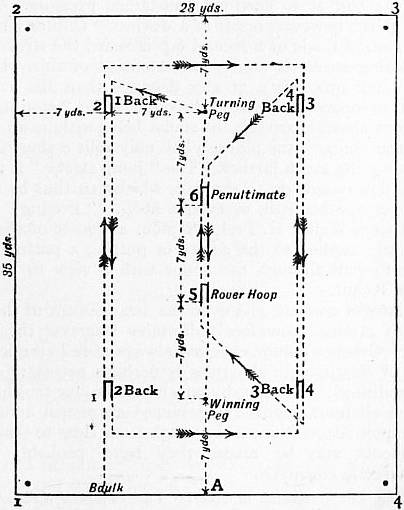
Fig. 1.—Diagram of croquet ground, showing setting of hoops and pegs, and order of play in accordance with the official Laws (1909) of the Croquet Association.
The ground for match play measures 35 yds. by 28 yds., and should be carefully marked out with white lines. In each corner a white spot is marked 1 yd. from each boundary. The hoops are made of round iron, not less than ½ in. and not more than ¾ in. in diameter, and standing 12 in. out of the ground. For match play they are 3¾ or 4 in. across, inside measurement. They are set up as in the accompanying diagram, the numbers and arrows indicating the order and direction in which they must be passed. Each hoop is run twice, and each peg struck once. The pegs may be struck from any direction.
The pegs are 1½ in. in diameter and when fixed stand 18 in. above the ground. The balls were formerly made of boxwood (earlier still of beechwood); composition balls are now in general use for tournaments. They must be 35⁄8 in. in diameter and 15 oz. to 16½ oz. in weight. It will be seen that for match play the hoops are only 1⁄8 or at the most 3⁄8 in. wider than the diameter of the ball. The mallets may be of any size and weight, but the head must be made of wood (metal may be used only for weighting or strengthening purposes), and the ends must be parallel and similar. Only one mallet may be used in the course of a game, except in the case of bona fide damage.
The object of the player is to score the points of the game by striking his ball through each of the hoops and against each of the pegs in a fixed order; and the side wins which first succeeds in scoring all the points with both the balls of the side. A metal clip corresponding in colour with the player’s ball is attached to the hoop or peg which that ball has next to make in the proper order, as a record of its progress in the game. No point is scored by passing through a hoop or hitting a peg except in the proper order. Thus, if a player has in any turn or turns driven his ball successively through hoops 1, 2, and 3, his clip is attached to hoop 4, and the next point to be made by him will be that hoop; and so on till all the points (hoops and pegs) have been scored. Each player starts in turn from any point in a “baulk” or area 3 ft. wide along the left-hand half of the “southern” boundary, marked A on the diagram, of the lawn—till 1906, from a point 1 ft. in front of the middle of hoop 1. If he fails either to make a point or to “roquet”2 (i.e. drive his ball against) another ball in play, his turn is at an end and the next player in order takes his turn in like manner. If he succeeds in scoring a point, he is entitled (as in billiards) to another stroke; he may then either attempt to score another point, or he may roquet a ball. Having roqueted a ball—provided he has not already roqueted the same ball in the same turn without having scored a point in the interval—he is entitled to two further strokes: first he must “take croquet,” i.e. he places his own ball (which from the moment of the roquet is “dead” or “in hand”) in contact with the roqueted ball on any side of it, and then strikes his own ball with his mallet, being bound to move or shake both balls perceptibly. If at the beginning of a turn the striker’s ball is in contact with another ball, a “roquet” is held to have been made and “croquet” must be taken at once. After taking croquet the striker is entitled to another stroke, with which he may score another point, or roquet another ball not previously roqueted in the same turn since a point was scored, or he may play for safety. Thus, by skilful alternation of making points and roqueting balls, a “break” may be made in which point after point, and even all the points in the game (for the ball in play), may be scored in a single turn, in addition to 3 or 4 points for the partner ball. The chief skill in the game perhaps consists in playing the stroke called “taking croquet” (but see below on the “rush”). Expert players can drive both balls together from one end of the ground to the other, or send one to a distance while retaining the other, or place each with accuracy in different directions as desired, the player obtaining position for scoring a point or roqueting another ball according to the strategical requirements of his position. Care has, however, to be taken in playing the croquet-stroke that both balls are absolutely moved or perceptibly shaken, and that neither of them be driven over the boundary line, for in either event the player’s next stroke is forfeited and his turn brought summarily to an end.
There are three distinct methods of holding the mallet among good players. A comparatively small number still adhere to the once universal “side stroke,” in which the player faces more or less at right angles to the line of aim, and strikes the ball very much like a golfer, with his hands close together on the mallet shaft. The majority use “front play,” in which the player faces in the direction in which he proposes to send the ball. The essential characteristic of this stroke is that eye, hand and ball should be in the same vertical plane, and the stroke is rather a swing—the “pendulum stroke”—than a hit. There are two ways of playing it. The majority of right-handed front players swing the mallet outside the right foot, holding it with the left hand as a pivot at the top of the shaft, while the right hand (about 12 in. lower down) applies the necessary force, though it must always be borne in mind that the heavy mallet-head, weighing from 3 to 3½ ℔ or even more, does the work by itself, and the nearer the stroke is to a simple swing, like that of a pendulum, the more likely it is to be accurate. Either the right or the left foot may be in advance, and should be roughly parallel to the line of aim, the player’s weight being mainly on the rear foot. Most of the best Irish and some English players swing the mallet between their feet, using a grip like that of the side player or golfer, with the hands close together, and often interlocking. It is claimed that the loss of power caused by the hampered swing—usually compensated by an extra heavy mallet—is more than counterbalanced by the greater accuracy in aim. The beginner is well advised to try all these methods, and adopt that which comes most natural to him. Skirted players, of course, are unable to use the Irish stroke; and, as one of the most meritorious features of croquet is that it is the only out-of-door game in which men and women can compete on terms of real equality, this has been put forward as a reason for barring it, if it is actually an advantage.
When a croquet ground is thoroughly smooth and level, the game gives scope for considerable skill; a great variety of strokes may be played with the mallet, each having its own well-defined effect on the behaviour of the balls, while a knowledge of angles is essential. Skilful tactics are at least as necessary as skilful execution to enable the player so to dispose the balls on the ground while making a break that they may most effectively assist him in scoring his points. The tactics of croquet are in this respect similar to those of billiards, that the player tries to make what progress he can during his own break, and to leave the balls “safe” at the end of it; he must also keep in mind the needs of the other ball of his side by leaving his own ball, or the last player’s ball, or both, within easy roqueting distance or in useful positions, and that of the next player isolated. Good judgment is really more valuable than mechanical skill. Croquet is a game of combination, partners endeavouring to keep together for mutual help, and to keep their opponents apart. It is important always to leave the next player in such a position that he will be unable to score a point or roquet a ball; a break, however profitable, which does not end by doing this is often fatal. Formerly this might be done by leaving the next player’s ball in such a position that either a hoop or a peg lay between it and all the other balls (“wiring”), or so near to a hoop or peg that there was no room for a proper stroke to be taken in the required direction. Under rule 36 of the Laws of Croquet for 1906, a ball left in such a position, provided it were within a yard of the obstacle (“close-wired”), might at the striker’s option be moved one yard in any direction. This rule left to the striker whose ball was “wired” more than a yard from the hoop or peg (“distance-wired”) the possibility of hitting his ball in such a way as to jump the obstacle. The jump-shot is, however, very bad for the lawn, and in 1907 a further provision was made by which the player whose ball is left “wired” from all the other balls by the stroke of an opponent may lift it and play from the “baulk” area. This practically means that “wiring” is impossible. The most that can be done is to “close-wire” the next player from two balls and leave him with a difficult shot at the third. If, however, the next player’s ball has not been moved by the adversary, the adversary is entitled to wire the balls as best he can.
The following is a specimen of elementary croquet tactics. If a player is going up to hoop 5 (diagram 1) in the course of a break, he should have contrived, if possible, to have a ball waiting for him at that hoop and another at hoop 6. With the aid of the first he runs hoop 5 and sends it on to the turning peg, stopping his ball in taking croquet close to the ball at 6. The corner hoops are the difficult ones, and after running hoop 6 the assisting ball is croqueted to 1 back, the peg being struck with the aid of the ball already there, which is again struck and driven to 2 back. If the player has been able to leave the fourth ball in the centre of the ground (known as a centre ball), he hits this after taking croquet, takes croquet, going off it to the ball at 1 back, and continues the break, leaving the centre ball where it will be useful for 3 back and 4 back. A first-class player should, however, be able to make a break with 3 balls almost as easily as with 4. A useful device, especially in a losing game, is to get rid of the opponent’s advanced ball if a “rover” (i.e. one which has run all the hoops and is for the winning peg) by croqueting it in such a way that it hits the peg and is thus out of the game. This can be done only by a ball which is itself also a rover. The opponent has then only one turn out of every three, and may be rendered practically helpless by leaving him always in a “safe” position. Inasmuch as a skilful player can cause an opponent’s ball to pass through the last two or even three hoops in the course of his turn and then peg it out, it is considered prudent to leave unrun the last three hoops until the partner’s ball is well advanced. There is a perennial agitation in the croquet world for a law prohibiting the player from pegging out his opponent’s ball. Many good players also think it desirable that the four-ball break should be restricted or wholly forbidden, e.g. by barring the dead ball.
To “rush” a ball is to roquet it hard so that it proceeds for a considerable distance in a desired direction. This stroke requires absolute accuracy and often considerable force, which must be applied in such a way as to drive the player’s ball evenly; otherwise it is very liable, especially if the ground be not perfectly smooth, to jump the object ball. The rush stroke is absolutely essential to good play, as it enables croquet to be taken (e.g.) close to the required hoop, whereas to croquet into position from a great distance and also provide a ball for use after running the hoop is extremely difficult, often impossible. To “rush” successfully, the striker’s ball must lie near the object ball, preferably, though not necessarily, in the line of the rush. By means of the rush it is possible to accomplish the complete round with the assistance of one ball only. To “cut” a ball is to hit it on the edge and cause it to move at some desired angle. “Rolling croquet” is made either by hitting near the top of the player’s ball which gives it “follow,” or by making the mallet so hit the ball as to keep up a sustained pressure. The first impact must, however, result in a distinctly audible single tap; if a prolonged rattle or a second tap is heard the stroke is foul. The passing stroke is merely an extension of this. Here the player’s ball proceeds a greater distance than the croqueted ball, but in somewhat the same direction. The “stop stroke” is made by a short, sharp tap, the mallet being withdrawn immediately after contact; the player’s ball only rolls a short distance, the other going much farther. The “jump stroke” is made by striking downwards on to the ball, which can thus be made to jump over another ball, or even a hoop. “Peeling” (a term derived from Walter H. Peel, a famous advocate of the policy) is the term applied to the device of putting a partner’s or an opponent’s ball through the hoops with a view to ultimately pegging it out.
The laws of croquet, and even the arrangement of the hoops, have not attained complete uniformity wherever the game is played. Croquet grounds are not always of full size, and some degree of elasticity in the rules is perhaps necessary to meet local conditions. The laws by which matches for the championship and all tournaments are governed are issued annually by the Croquet Association; and though from time to time trifling amendments may be made, they have probably reached permanence in essentials.
See The Encyclopaedia of Sport; The Complete Croquet Player (London, 1896); the latest Laws of Croquet, published annually by the Croquet Association, and its official organ The Croquet Gazette. For the principles of the game and its history in England, see C. D. Locock, Modern Croquet Tactics (London, 1907); A. Lillie, Croquet up to Date (London, 1900).
Croquet in the United States: Roque.—Croquet was brought to America from England soon after its introduction into that country, and enjoyed a wide popularity as a game for boys and girls before the Civil War (see Miss Alcott’s Little Women, cap. 12). American croquet is quite distinct from the modern English game. It is played on a lawn 60 ft. by 30, and preserves the old-fashioned English arrangement of ten hoops, including a central “cage” of two hoops. The balls, coloured red, white, blue and black, are 3¼ in. in diameter, and the hoops are from 3½ to 4 in. wide, according to the skill of the players. This game, however, is not taken seriously in the United States; the Official Croquet Guide of Mr Charles Jacobus emphasizes “the ease with which the game can be established,” since almost every country home has a grass plot, and “no elaboration is needed.” The scientific game of croquet in the United States is known as “roque.” Under this title a still greater departure from the English game has been elaborated on quite independent lines from those of the English Croquet Association since 1882, in which year the National Roque Association was formed. Roque also suffered from the popularity of lawn tennis, but since 1897 it has developed almost as fast as croquet in England. A great national championship tournament is held in Norwich, Conn., every August, and the game—which is fully as scientific as modern English croquet—has numerous devotees, especially in New England.
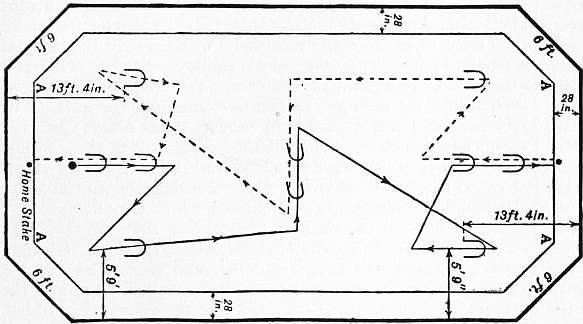
Fig. 2.—Diagram of roque ground, showing setting of arches and stakes and order of play, in accordance with the official laws (1906) of the National Roque Association.
Roque is played, not on grass, but on a prepared surface something like a cinder tennis-court. The standard ground, as adopted by the National Association in 1903, is hexagonal in shape, with ten arches (hoops) and two stakes (pegs) as shown in diagram 2. The length is 60 ft., width 30, and the “corner pieces” are 6 ft. long. An essential feature of the ground is that it is surrounded by a raised wooden border, often lined with india-rubber to facilitate the rebound of the ball, and it is permissible to play a “carom” (or rebounding shot) off this border; a skilful player can often thus hit a ball which is wired to a direct shot. A boundary line is marked 28 in. inside the border, on which a ball coming to rest outside it must be replaced. The hoops are run in the order marked on the diagram, so that the game consists of 36 points. Red and white are always partners against blue and black, and the essential features and tactics of the game are, mutatis mutandis, the same as in modern English croquet—i.e. the skilful player goes always for a break and utilizes one or both of the opponent’s balls in making it. The balls are 3¼ in. in diameter, of hard rubber or composition, and the arches are 33⁄8 or 3½ in. wide for first- and second-class players respectively; they are made of steel ½ in. in diameter and stand about 8 in. out of the ground. The stakes are 1 in. in diameter and only 1½ in. above the ground. The mallets are much shorter than those commonly employed in England, the majority of players using only one hand, though the two-handed “pendulum stroke,” played between the legs, finds an increasingly large number of adherents, on account of the greater accuracy which it gives. The “jump shot” is a necessary part of the player’s equipment, as dead wiring is allowed; it is supplemented by the carom off the border or off a stake or arch, and roque players justly claim that their game is more like billiards than any other out-of-door game.
The game of roque is opened by scoring (stringing) for lead from an imaginary line through the middle wicket (cage), the player whose ball rests nearest the southern boundary line having the choice of lead and balls. The balls are then placed on the four corner spots marked A in diagram, partner balls being diagonally opposite one another, and the starting ball having the choice of either of the upper corners. The leader, say red, usually begins by shooting at white; if he misses, a carom off the border will leave him somewhere near his partner, blue. White then shoots at red or blue, with probably a similar result. Blue is then “in,” with a certain roquet and the choice of laying for red or going for an immediate break himself. The general strategy of the game corresponds to that of croquet, the most important differences being that “pegging out” is not allowed, and that on the small ground with its ten arches and two stakes the three-ball break is usually adopted, the next player or “danger ball” being wired at the earliest opportunity.
See Spalding’s Official Roque Guide, edited by Mr Charles Jacobus (New York, 1906).
1 This was largely the work of W. T. Whitmore-Jones (1831-1872), generally known as W. Jones Whitmore, who subsequently formed the short-lived National Croquet Club, and was largely responsible for the first codification of the laws.
2 The words “roquet” and “croquet” are pronounced as in French, with the t mute.
CRORE (Hindustani karor), an Anglo-Indian term for a hundred lakhs or ten million. It is in common use for statistics of trade and especially coinage. In the days when the rupee was worth its face value of 2s., a crore of rupees was exactly worth a million sterling, but now that the rupee is fixed at 15 to the £1, a crore is only worth £666,666.
CROSBY, HOWARD (1826-1891), American preacher and teacher, great-grandson of Judge Joseph Crosby of Massachusetts and of Gen. William Floyd of New York, a signer of the Declaration of Independence, was born in New York City on the 27th of February 1826. He graduated in 1844 from the University of the City of New York (now New York University); became professor of Greek there in 1851, and in 1859 became professor of Greek in Rutgers College, New Brunswick, New Jersey, where two years later he was ordained pastor of the first Presbyterian church. From 1870 to 1881 he was chancellor of the University of the City of New York; from 1872 to 1881 was one of the American revisers of the English version of the New Testament; and in 1873 was moderator of the general assembly of the Presbyterian Church. He took a prominent part in politics, urged excise reform, opposed “total abstinence,” was one of the founders and was the first president of the New York Society for the Prevention of Crime, and pleaded for better management of Indian affairs and for international copyright. Among his publications are The Lands of the Moslem (1851), Bible Companion (1870), Jesus: His Life and Works (1871), True Temperance Reform (1879), True Humanity of Christ (1880), and commentaries on the book of Joshua (1875), Nehemiah (1877) and the New Testament (1885).
His son, Ernest Howard Crosby (1856-1907), was a social reformer, and was born in New York City on the 4th of November 1856. He graduated at the University of the City of New York in 1876 and at Columbia Law School in 1878; served in the New York Assembly in 1887-1889, securing the passage of a high-licence bill; in 1889-1894 was a judge of the Mixed Tribunal at Alexandria, Egypt, resigning upon coming under the influence of Tolstoy; and died in New York City on the 3rd of January 1907. He was the first president (1894) of the Social Reform Club of New York City, and was president in 1900-1905 of the New York Anti-Imperialist League; was a leader in settlement work and in opposition to child labour, and was a disciple of Tolstoy as to universal peace and non-resistance, and of Henry George in his belief in the “single tax” principle. His writings, many of which are in the manner of Walt Whitman, comprise Plain Talk in Psalm and Parable (1899), Swords and Ploughshares (1902), and Broadcast (1905), all in verse; an anti-military novel, Captain Jinks, Hero (1902); and essays on Tolstoy (1904 and 1905) and on Garrison (1905).
CROSS, and CRUCIFIXION (Lat. crux, crucis1). The meaning ordinarily attached to the word “cross” is that of a figure composed of two or more lines which intersect, or touch each other transversely. Thus, two pieces of wood, or other material, so placed in juxtaposition to one another, are understood to form a cross. It should be noted, however, that Lipsius and other writers speak of the single upright stake to which criminals were bound as a cross, and to such a stake the name of crux simplex has been applied. The usual conception, however, of a cross is that of a compound figure.
Punishment by crucifixion was widely employed in ancient times. It is known to have been used by nations such as those of Assyria, Egypt, Persia, by the Greeks, Carthaginians, Macedonians, and from very early times by the Romans. It has been thought, too, that crucifixion was also used by the Jews themselves, and that there is an allusion to it (Deut. xxi. 22, 23) as a punishment to be inflicted.
Two methods were followed in the infliction of the punishment of crucifixion. In both of these the criminal was first of all usually stripped naked, and bound to an upright stake, where he was so cruelly scourged with an implement, formed of strips of leather having pieces of iron, or some other hard material, at their ends, that not merely was the flesh often stripped from the bones, but even the entrails partly protruded, and the anatomy of the body was disclosed. In this pitiable state he was reclothed, and, if able to do so, was made to drag the stake to the place of execution, where he was either fastened to it, or impaled upon it, and left to die. In this method, where a single stake was employed, we have the crux simplex of Lipsius. The other method is that with which we are more familiar, and which is described in the New Testament account of the crucifixion of Jesus Christ. In such a case, after the scourging at the stake, the criminal was made to carry a gibbet, formed of two transverse bars of wood, to the place of execution, and he was then fastened to it by iron nails driven through the outstretched arms and through the ankles. Sometimes this was done as the cross lay on the ground, and it was then lifted into position. In other cases the criminal was made to ascend by a ladder, and was then fastened to the cross. Probably the feebleness, or state of collapse, from which the criminal must often have suffered, had much to do in deciding this. It is not quite clear which of these two plans was followed in the case of the crucifixion of Christ, but the more general opinion has been that He was nailed to the cross on the ground, and that it was then lifted into position. The contrary opinion, has, however, prevailed to some extent, and there are representations of the crucifixion which depict Him as mounting a ladder placed against the cross. Such representations may, however, have been due to a pious desire, on the part of their authors, to emphasize the voluntary offering of Himself as the Saviour of the World, rather than as being intended for actual pictures of the scene itself. It may be noted, however, that among the “Emblems of the Passion,” as they are called, and which were very favourite devices in the middle ages, the ladder is not infrequently found in conjunction with the crown of thorns, nails, spear, &c.
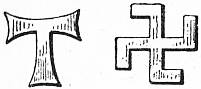
Fig. 1. Fig. 2.
From its simplicity of form, the cross has been used both as a religious symbol and as an ornament, from the dawn of man’s civilization. Various objects, dating from periods long anterior to the Christian era, have been found, marked with crosses of different designs, in almost every part of the old world. India, Syria, Persia and Egypt have all yielded numberless examples, while numerous instances, dating from the later Stone Age to Christian times, have been found in nearly every part of Europe. The use of the cross as a religious symbol in pre-Christian times, and among non-Christian peoples, may probably be regarded as almost universal, and in very many cases it was connected with some form of nature worship. Two of the forms of the pre-Christian cross which are perhaps most frequently met with are the tau cross, so named from its resemblance to the Greek capital letter , and the svastika or fylfot2 , also called “Gammadion” owing to its form being that of four Greek capital letters gamma placed together. The tau cross is a common Egyptian device, and is indeed often called the Egyptian cross. The svastika has a very wide range of distribution, and is found on all kinds of objects. It was used as a religious emblem in India and China at least ten centuries before the Christian era, and is met with on Buddhist coins and inscriptions from various parts of India. A fine sepulchral urn found at Shropham in Norfolk, and now in the British Museum, has three bands of cruciform ornaments round it. The two uppermost of these are plain circles, each of which contains a plain cross; the lowest band is formed of a series of squares, in each of which is a svastika. In the Vatican Museum there is an Etruscan fibula of gold which is marked with the svastika, but it is a device of such common occurrence on objects of pre-Christian origin, that it is hardly necessary to specify individual instances. The cross, as a device in different forms, and often enclosed in a circle, is of frequent occurrence on coins and medals of pre-Christian date in France and elsewhere. Indeed, objects marked with pre-Christian crosses are to be seen in every important museum.


The death of Christ on a cross necessarily conferred a new significance on the figure, which had hitherto been associated with a conception of religion not merely non-Christian, but in its essence often directly opposed to it. The Christians of early times were wont to trace, in things around them, hidden prophetical allusions to the truth of their faith, and such a testimony they seem to have readily recognized in the use of the cross as a religious emblem by those whose employment of it betokened a belief most repugnant to their own. The adoption by them of such forms, for example, as the tau cross and the svastika or fylfot was no doubt influenced by the idea of the occult Christian significance which they thought they recognized in those forms, and which they could use with a special meaning among themselves, without at the same time arousing the ill-feeling or shocking the sentiment of those among whom they lived.
It was not till the time of Constantine that the cross was publicly used as the symbol of the Christian religion. Till then its employment had been restricted, and private among the Christians themselves. Under Constantine it became the acknowledged symbol of Christianity, in the same way in which, long afterwards, the crescent was adopted as the symbol of the Mahommedan religion. Constantine’s action was no doubt influenced by the vision which he believed he saw of the cross in the sky with the accompanying words ἐν τούτῳ νίκα, as well as by the story of the discovery of the true cross by his mother St Helena in the year 326. The legend is that, when visiting the holy places in Palestine, St Helena was guided to the site of the crucifixion by an aged Jew who had inherited traditional knowledge as to its position. After the ground had been dug to a considerable depth, three crosses were found, as well as the superscription placed over the Saviour’s head on the cross, and the nails with which he had been crucified. The cross of the Lord was distinguished from the other two by the working of a miracle on a crippled woman who was stretched upon it. This finding, or “invention,” of the holy cross by St Helena is commemorated by a festival on the 3rd of May, called the “Invention of the Holy Cross.” The legend was widely accepted as true, and is related by writers such as St Ambrose, Rufinus, Sulpicius Severus and others, but it is discounted by the existence of an older legend, according to which the true cross was found in the reign of Tiberius, and while St James the Great was bishop of Jerusalem, by Protonice, the wife of Claudius.
In recent times an attempt has been made to reconcile the two accounts, by attributing to St Helena the rediscovery of the true cross, originally found by Protonice, and which had been buried again on the spot. A change was made in 1895 in the Diario Romano, when the word Ritrovamento was substituted for that of Invenzione, in the name of the festival of the 3rd of May. After St Helena’s discovery a church was built upon the site, and in it she placed the greater portion of the cross. The remaining portion she conveyed to Byzantium, and thence Constantine sent a piece to Rome, where it is said to be still preserved in the church of S. Croce in Gerusalemme, which was built to receive so precious a relic. It is exposed for the veneration of the faithful on Good Friday, 3rd of May, and the third Sunday in Lent, each year.
Another festival of the holy cross is kept on the 14th of September, and is known as the “Exaltation of the Holy Cross.” It seems to have originated with the dedication, in the year 335, of the churches built on the sites of the crucifixion and the holy sepulchre. The observance of this festival passed from Jerusalem to Constantinople, and thence to Rome, where it appears to have been introduced in the 7th century. By some it is thought that the feast of the Exaltation of the Cross had its origin in Constantine’s vision of the cross in the sky in the year 317, but whether it originated then, or, as is more generally supposed, at the dedication of the churches at Jerusalem, there is no doubt that it was afterwards kept with much greater solemnity in consequence of the recovery of the portion of the cross St Helena had left at Jerusalem, which had been taken away in the Persian victory, and was restored to Jerusalem by Heraclitus in 627. Pope Clement VIII. (1592-1604) raised the festival of the Exaltation of the Holy Cross to the dignity, liturgically known as that of a Greater Double.
Before leaving the story of St Helena and the cross, it may be convenient to allude briefly to the superscription placed over the Saviour’s head, and the nails, which it is said that she found with the cross. The earlier tradition as to the superscription is obscure, but it would seem that it ought to be considered part of the relic which Constantine sent to Rome. By some means it was entirely lost sight of until the year 1492, when it is said that it was accidentally found in a vault in the church of S. Croce in Gerusalemme at Rome. Pope Alexander III. published a bull certifying to the truth of this rediscovery of the relic, and authenticated its character.
As regards the nails, a question has arisen whether there were three or four. In the earliest pictures of the Crucifixion the feet are shown as separately nailed to the cross, but at a later period they are crossed, and a single nail fixes them. In the former case there would be four nails, and in the latter only three. Four is the number generally accepted, and it is said that one was cast by St Helena into the sea, during a storm, in order to subdue the waves, another is said (but the legend cannot be traced far back) to have been beaten out into the iron circlet of the crown of Lombardy, while the remaining two are reputed to be preserved among the relics at Milan and Trier respectively.
The employment of the cross as the Christian symbol has been so manifold in its variety and application, and the different forms to which the figure has been adapted and elaborated are so complex, that it is only possible to deal with the outline of the subject.
We learn from Tertullian and other early Christian writers of the constant use which the Christians of those days made of the sign of the cross. Tertullian (De Cor. Mil. cap. iii.) says: “At each journey and progress, at each coming in and going out, at the putting on of shoes, at the bath, at meals, at the kindling of lights, at bedtime, at sitting down, whatsoever occupation engages us, we mark the brow with the sign of the cross.” With so frequent an employment of the sign of the cross in their domestic life, it would be strange if we did not find that it was very frequently used in the public worship of the church. The earliest liturgical forms are comparatively late, and are without rubrics, but the allusions by different writers in early times to the ceremonial use of the sign of the cross in the public services are so numerous, and so much importance was attached to it, that we are left in no manner of doubt on the point. St Augustine, indeed, speaks of the sacraments as not duly ministered if the use of the sign of the cross were absent from their ministration (Hom. cxviii. in S. Joan.). Of the later liturgical use of the sign of the cross there is little need to speak, as a reference to the service books of the Greek and Latin churches will plainly indicate the frequency of, and the importance attached to, its employment. Its occasional use is retained by the Lutherans, and in the Church of England it is authoritatively used at baptism, and at the “sacring” or anointing of the sovereign at the coronation.
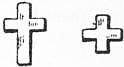
Fig. 3. Fig. 4.
Passing from the sign to the material figures of the cross, a very usual classification distinguishes three main forms: (1) the crux immissa, or capitata (fig. 3) known also as the Latin cross, or if each limb is of the same length, (fig. 4) as the Greek cross; (2) the crux decussata, formed like the letter , and (3) the crux commissa or tau cross, already mentioned. It was on a crux immissa that Christ is believed to have been crucified. The crux decussata is known as St Andrew’s cross, from the tradition that St Andrew was put to death on a cross of that form. The crux commissa is often called St Anthony’s cross, probably only because it resembles the crutch with which the great hermit is generally depicted.


The cross in one form or other appears, appropriately, on the flags and ensigns of many Christian countries. The English cross of St George is a plain red cross on a white ground, the Scottish cross of St Andrew is a plain diagonal white cross on a blue ground, and the Irish cross of St Patrick is a plain diagonal red cross on a white ground. These three crosses are combined in the Union Jack (see Flag).
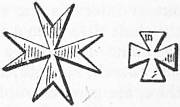
Fig. 5. Fig. 6.
The cross has also been adopted by many orders of knighthood. Perhaps the best known of these is the cross of the knights of Malta. It is a white cross of eight points on a black ground (fig. 5) and is the proper Maltese cross, a name which is often wrongly applied to the cross patée (fig. 6). The knights of the Garter use the cross of St George, as do those of the order of St Michael and St George, the knights of the Thistle use St Andrew’s cross, and those of St Patrick the cross of St Patrick charged with a shamrock leaf. The cross of the Danish order of the Dannebrog (fig. 7) affords a good example of this use of the cross. It is in form a white cross patée, superimposed upon a red one of the same form, and is surmounted by the royal cipher and crown, and has upon its surface the royal cipher repeated, and the legend, or motto, “Gud og Kongen” = “God and the King.” (For crosses of monastic orders see Costume.)
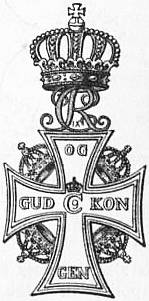
Fig. 7.—Cross of the Dannebrog.
Akin to the crosses of knightly orders are those which figure as charges on coats of arms. The science of heraldry evolved a wonderful variety of cross-forms during the period it held sway in the middle ages. The different forms of cross used in heraldry are, in fact, so numerous that it is only the larger works on that subject which attempt to record them all. For such crosses see Heraldry.
In the middle ages the cross form, in one way or another, was predominant everywhere, and was introduced whenever opportunity offered itself for doing so. The larger churches were planned on its outline, so that the ridge line of their roofs proclaimed it far and wide. This was more particularly followed in the north of Europe, but when it was first introduced is not quite certain. All the ancient cathedral churches of England and Wales are cruciform in plan, except Llandaff.
The artistic skill and ingenuity of the medieval designer has produced cross designs of endless variety, and of singular elegance and beauty. Some of the most beautiful of these designs are the gable crosses of the old churches. Fig. 8 shows the west gable cross of Washburn church, Worcestershire; fig. 9 that of the nave of Castle Acre church, Norfolk; and fig. 10 the east gable cross of Hethersett church in that county. They may be taken as good examples of a type of cross which is often of great beauty, but it is overlooked, owing to its bad position for observation.
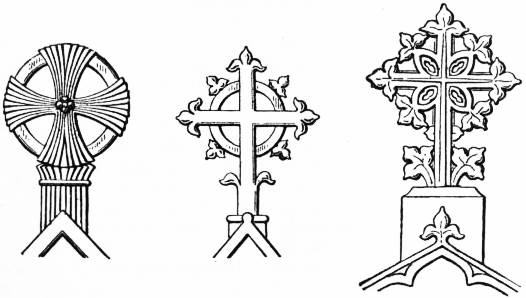
Fig. 8. Fig. 9. Fig. 10.
Other architectural crosses, of great beauty of design, are those which occur on the grave slabs of the middle ages. Instances of a plainer type occur in Saxon times, but it was not till after the 11th century that they were fashioned after the intricate and beautiful designs with which our ancient churches are, as a rule, so plentifully supplied. Sometimes these crosses are incised in the slab, and almost as often they are executed in low relief. The long shaft of the cross is most commonly plain, but there are a very large number of instances in which this is not so, and in which branches, with leaf designs, are thrown out at intervals the entire length of the shaft. In some cases the shaft rises from a series of steps at its base, and in such a case the name of a Calvary cross is applied to it. Fig. 11, from Stradsett church, Norfolk, and fig. 12 from Bosbury church, Herefordshire, are good examples of the designs at the head of sepulchral crosses. Often, by the side of the cross, an emblem or symbol is placed, denoting the calling in life of the person commemorated. Thus a sword is placed to indicate a knight or soldier, a chalice for a priest, and so forth; but it would be travelling beyond the scope of this article to enter into a discussion as to such symbols.
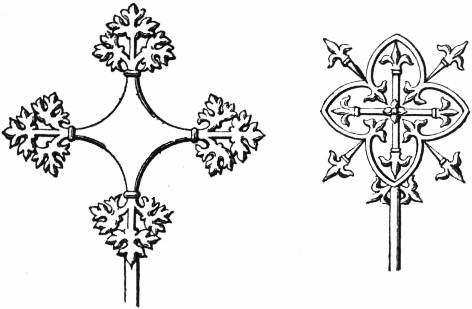
Fig. 11. Fig. 12.
Of upright standing crosses, the Irish and Iona types are well known, and their great artistic beauty and elaboration and excellence of sculpture are universally recognized. These crosses are sometimes spoken of as “Runic Crosses”; and the interlacing knotwork design with which many of them are ornamented is also at times spoken of as “Runic.” This is an erroneous application of the word, and has arisen from the fact that some of these crosses bear inscriptions in Runic characters. Standing crosses, of different kinds, were commonly set up in every suitable place during the middle ages, as the mutilated bases and shafts still remaining readily testify. Such crosses were erected in the centre of the market place, in the churchyard, on the village green, or as boundary stones, or marks to guide the traveller. Some, like the Black Friars cross at Hereford, were preaching stations, others, like the beautiful Eleanor crosses at Northampton, Geddington and Waltham, were commemorative in character. Of these latter crosses, which marked the places where the funeral procession of Queen Eleanor halted, there were originally ten or more, erected between 1241 and 1294. They were placed at Lincoln, Northampton, Stony Stratford, Woburn, Dunstable, St Albans, Waltham and London (Cheapside and Charing Cross). The cross at Geddington differs in outline from those at Northampton and Waltham, and it is not recorded on the roll of accounts for the nine others, all of which are mentioned, but there is no real doubt that it commemorates the resting of the coffin of the queen in Geddington church on its way from Harby. These crosses, like the Black Friars cross at Hereford, are elaborate architectural erections, and very similar to them in this respect are the beautiful market crosses at Winchester, Chichester, Salisbury, Devizes, Shepton Mallet, Leighton Buzzard, &c. Of churchyard crosses, as distinguished from memorial crosses in churchyards, one only is believed to have escaped in a perfect condition the ravages of time, and the fanaticism of the past. It stands in the churchyard of Somerby, in Lincolnshire (Tennyson’s birthplace), and is a tall shaft surmounted by a pedimented tabernacle, on one side of which is the crucifixion, and on the other the figure of the Virgin and Child. Churchyard crosses may have been used as occasional preaching stations, for reading the Gospel in the Palm Sunday procession, and generally for public proclamations, made usually at the conclusion of the chief Sunday morning service, much in the same way that market crosses were used on market days as places for proclamations in the towns.
Of the ecclesiastical use of the sign of the cross mention has already been made, and it is desirable to mention briefly one or two instances of the ecclesiastical use of the cross itself. From a fairly early period it has been the prerogative of an archbishop or metropolitan, to have a cross borne before him within the limits of his province. The question urged between the archbishops of Canterbury and York about the carrying of their crosses before them, in each other’s province, was a fruitful source of controversy in the middle ages. The archiepiscopal cross must not be confused with the crozier or pastoral staff. The latter, which is formed with a crook at the end, is quite distinct, and is used by archbishops and bishops alike, who bear it with the left hand in processions, and when blessing the people. The archiepiscopal cross, on the contrary, is always borne before the archbishop, or during the vacancy of the archiepiscopal see before the guardian of the spiritualities sede vacante. The bishop of Dol in Brittany, of ordinary diocesan bishops, alone possessed the privilege of having a cross borne before him in his diocese. Good illustrations of the archiepiscopal cross occur on the monumental brasses of Archbishop Waldeby, of York (1397), at Westminster Abbey, and of Archbishop Cranley, of Dublin (1417) in New College chapel, Oxford.
The custom of carrying a cross at the head of an ecclesiastical procession can be traced back to the end of the 4th century. The cross was originally taken from the altar, and raised on a pole, and so borne before the procession. Afterwards a separate cross was provided for processions, but in poor churches, where this was not the case, the altar cross continued to be used till quite a late period. A direction to this effect occurs as late as 1829, in the Rituel published for the diocese of La Rochelle in that year. In England altar crosses were not very usual in the middle ages.
As a personal ornament the cross came into common use, and was usually worn suspended by a chain from the neck. A cross of this kind, of very great interest and beauty, was found about 1690, on the breast of Queen Dagmar, the wife of Waldemar II., king of Denmark (d. 1213). It is of Byzantine design and workmanship, and is of enamelled gold (fig. 13 shows both sides of it); on one side is the Crucifixion, and on the other side the half figure of our Lord in the centre, with the Virgin and St John the Evangelist on either side, and St Chrysostom and St Basil above and below. From the way in which such crosses were worn, hanging over the chest, they are called pectoral crosses. At the present day a pectoral cross forms part of the recognized insignia of a Roman Catholic bishop, and is worn by him over his robes, but this official use of the pectoral cross is not ancient, and no instance is known of it in England before the Reformation. The custom appears to have taken rise in the 16th century on the continent. It was not unusual to wear cruciform reliquaries, as objects of personal adornment, and such a reliquary was found on the body of St Cuthbert, when his tomb was opened in 1827, but it was placed under, and not over his episcopal vestments, and formed no part of his bishop’s attire. The custom of wearing a pectoral cross over ecclesiastical robes has, curiously enough, been copied from the comparatively modern Roman Catholic usage by the Lutheran bishops and superintendents in Scandinavia and Prussia; and in Sweden the cross is now delivered to the new bishop, on his installation in office, by the archbishop of Upsala, together with the mitre and crozier. Within the last generation the use of a pectoral cross, worn over their robes as part of the insignia of the episcopal office, has been adopted by some bishops of the Church of England, but it has no ancient sanction or authority.
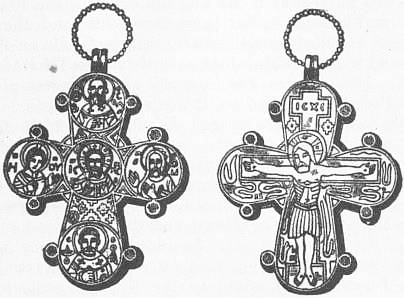
Fig. 13.—Dagmar Cross.
Authorities.—Mortillet, Le Signe de la croix avant le Christianisme (Paris, 1866); Bingham, Antiquities of the Christian Church; Lipsius, De Cruce Christi; Lady Eastlake, History of our Lord, vol. ii.; Cutts, Manual of Sepulchral Slabs and Crosses; (Anon.) Handbook to Christian and Ecclesiastical Rome, part ii. (London, 1897); Veldeuer, History of the Holy Cross (reprint, 1863).
(T. M. F.)
1 Derivatives of the Latin crux appear in many forms in European languages, cf. Ger. Kreuz, Fr. croix, It. croce, &c.; the English form seems Norse in origin (O.N. Krosse, mod. Kors). The O.E. name was rōd, rood (q.v.).
2 The acceptance of this word as the English equivalent for this peculiar form of the cross rests only, according to the New English Dictionary, on a MS. of about 1500 in the Lansdowne collection, which gives details for the erection of a memorial stained-glass window, “... the fylfot in the nedermost pane under ther I knele ...”; in the sketch given with the instructions a cross occupies the space indicated. It is a question, therefore, whether “fylfot” is a name for any device suitable to “fill the foot” of any design, or the name peculiar to this particular form of cross. The word is not, as was formerly accepted, a corruption of the O. Eng. feowerfete, four-footed.
CROSSBILL (Fr. Bec-croisé, Ger. Kreuzschnabel), the name given to a genus of birds, belonging to the family Fringillidae, or finches, from the unique peculiarity they possess among the whole class of having the horny sheaths of the bill crossing one another obliquely,1 whence the appellation Loxia (λοξός, obliquus), conferred by Gesner on the group and continued by Linnaeus. At first sight this singular structure appears so like a deformity that writers have not been wanting to account it such,2 ignorant of its being a piece of mechanism most beautifully adapted to the habits of the bird, enabling it to extract with the greatest ease, from fir-cones or fleshy fruits, the seeds which form its usual and almost invariable food. Its mode of using this unique instrument seems to have been first described by Townson (Tracts on Nat. Hist., p. 116, London, 1799), but only partially, and it was Yarrell who, in 1829 (Zool. Journ., iv. pp. 457-465, pl. xiv. figs. 1-7), explained fully the means whereby the jaws and the muscles which direct their movements become so effective in riving asunder cones or apples, while at the proper moment the scoop-like tongue is instantaneously thrust out and withdrawn, conveying the hitherto protected seed to the bird’s mouth. The articulation of the mandible to the quadrate-bone is such as to allow of a very considerable amount of lateral play, and, by a particular arrangement of the muscles which move the former, it comes to pass that so soon as the bird opens its mouth the point of the mandible is brought immediately opposite to that of the maxilla (which itself is movable vertically), instead of crossing or overlapping it—the usual position when the mouth is closed. The two points thus meeting, the bill is inserted between the scales or into the pome, but on opening the mouth still more widely, the lateral motion of the mandible is once more brought to bear with great force to wrench aside the portion of the fruit attacked, and then the action of the tongue completes the operation, which is so rapidly performed as to defy scrutiny, except on very close inspection. Fortunately the birds soon become tame in confinement, and a little patience will enable an attentive observer to satisfy himself as to the process, the result of which at first seems almost as unaccountable as that of a clever conjuring trick.
The common crossbill of the Palaearctic region (Loxia curvirostra) is about the size of a skylark, but more stoutly built. The young (which on leaving the nest have not the tips of the bill crossed) are of a dull olive colour with indistinct dark stripes on the lower parts, and the quills of the wings and tail dusky. After the first moult the difference between the sexes is shown by the hens inclining to yellowish-green, while the cocks become diversified by orange-yellow and red, their plumage finally deepening into a rich crimson-red, varied in places by a flame-colour. Their glowing hues, are, however, speedily lost by examples which may be kept in confinement, and are replaced by a dull orange, or in some cases by a bright golden-yellow, and specimens have, though rarely, occurred in a wild state exhibiting the same tints. The cause of these changes is at present obscure, if not unknown, and it must be admitted that their sequence has been disputed by some excellent authorities, but the balance of evidence is certainly in favour of the above statement. Depending mainly for food on the seeds of conifers, the movements of crossbills are irregular beyond those of most birds, and they would seem to rove in any direction and at any season in quest of their staple sustenance. But the pips of apples are also a favourite dainty, and it is recorded by the old chronicler Matthew Paris (Hist. Angl. MS. fol. 252), that in 1251 the orchards of England were ravaged by birds, “pomorum grana, & non aliud de eisdem pomis comedentes,” which, from his description, “Habebant autem partes rostri cancellatas, per quas poma quasi forcipi vel cultello dividebant,” could be none other but crossbills. Notice of a like visitation in 1593 is recorded, but of late it has become evident that not a year passes without crossbills being observed in some part or other of England, while in certain localities in Scotland they seem to breed annually. The nest is rather rudely constructed, and the eggs, generally four in number, resemble those of the greenfinch, but are larger in size. This species ranges throughout the continent of Europe,3 and occurs in the islands of the Mediterranean and in the fir-woods of the Atlas. In Asia it would seem to extend to Kamtschatka and Japan, keeping mainly to the forest-tracts.
Three other forms of the genus also inhabit the Old World—two of them so closely resembling the common bird that their specific validity has been often questioned. The first of these, of large stature, the parrot-crossbill (L. pityopsittacus), comes occasionally to Great Britain, presumably from Scandinavia, where it is known to breed. The second (L. himalayana), which is a good deal smaller, is only known from the Himalaya Mountains. The third, the two-barred crossbill (L. taenioptera), is very distinct, and its proper home seems to be the most northern forests of the Russian empire, but it has occasionally occurred in western Europe and even in England.
The New World has two birds of the genus. The first (L. americana), representing the common British species, but with a smaller bill, and the males easily recognizable by their more scarlet plumage, ranges from the northern limit of coniferous trees to the highlands of Mexico, or even farther. The other (L. leucoptera) is the equivalent of the two-barred crossbill, but smaller. It has twice occurred in England.
(A. N.)
1 This peculiarity is found as an accidental malformation in the crows (Corvidae) and other groups; it is comparable to the monstrosities seen in rabbits and other members of the order Glires, in which the incisor teeth grow to an inordinate length.
2 A medieval legend ascribes the conformation of bill and coloration of plumage to a divine recognition of the bird’s pity, bestowed on Christ at the crucifixion.
3 Dr Malmgren found a small flock on Bear Island (lat. 74½° N.), but to this barren spot they must have been driven by stress of weather.
CROSSEN, or Krossen, a town of Germany, in the kingdom of Prussia, on the Oder, here crossed by a bridge, at the influx of the Bober, 31 m. S.E. of Frankfort-on-Oder by rail. Pop. (1900) 7369. Of the churches in the town three are Protestant and one Roman Catholic. Besides the modern school (Realprogymnasium), there are a technical school for viniculture and fruit-growing and a dairy school. There are manufactories of copper and brass ware, cloth, &c., while in the surrounding country the chief industries are fruit and grape growing. There is a brisk shipping trade, mainly in wine, fruit and fish. Crossen was founded in 1005 and was important during the middle ages as a point of passage across the Oder. It attained civic rights in 1232, was for a time the capital of a Silesian duchy, which, on the death of Barbara of Brandenburg, widow of the last duke, passed to Brandenburg (1482). In May 1886 the town was devastated by a whirlwind.
CROSSING, in architecture, the term given to the intersection of the nave and transept, frequently surmounted by a tower or by a dome on pendentives.
CROSSKEY, HENRY WILLIAM (1826-1893), English geologist and Unitarian minister, was born at Lewes in Sussex, on the 7th of December 1826. After being trained for the ministry at Manchester New College (1843-1848), he became pastor of Friargate chapel, Derby, until 1852, when he accepted charge of a Unitarian congregation in Glasgow. In 1869 he removed to Birmingham, where until the close of his life he was pastor of the Church of the Messiah. While in Glasgow his interest was awakened in geology by the perusal of A. C. Ramsay’s Geology of the Isle of Arran, and from 1855 onwards he devoted his leisure to the pursuit of this science. He became an authority on glacial geology, and wrote much, especially in conjunction with David Robertson, on the post-tertiary fossiliferous beds of Scotland (Trans. Geol. Soc. Glasgow). He also prepared for the British Association a valuable series of Reports (1873-1892) on the erratic Blocks of England, Wales and Ireland. In conjunction with David Robertson and G. S. Brady he wrote the Monograph of the Post Tertiary Entomostraca of Scotland, &c. for the Palaeontographical Society (1874); and he edited H. Carvill Lewis’ Papers and Notes on the Glacial Geology of Great Britain and Ireland, issued posthumously (1894). He died at Edgbaston, Birmingham, on the 1st of October 1893.
See H. W. Crosskey: his Life and Work, by R. A. Armstrong (with chapter on his geological work by Prof. C. Lapworth, 1895).
CROSS RIVER, a river of West Africa, over 500 m. long. It rises in 6° N, 10° 30′ E. in the mountains of Cameroon, and flows at first N.W. In 8° 48′ E., 5° 50′ N. are a series of rapids; below this point the river is navigable for shallow-draught boats. At 8° 20′ E., 6° 10′ N., its most northern point, the river turns S.W. and then S., entering the Gulf of Guinea through the Calabar estuary. The Calabar river, which rises about 5° 30′ N., 8° 30′ E., has a course parallel to, and 10 to 20 m. east of, the Cross river. Near its mouth, on its east bank, is the town of Calabar (q.v.). It enters the estuary in 4° 45′ N. The Cross, Calabar, Kwa and other streams farther east, which rise on the flanks of the Cameroon Mountains, form a large delta. The Calabar and Kwa rivers are wholly within the British protectorate of Southern Nigeria, as is the Cross river from its mouth to the rapids mentioned. The upper course of the river is in German territory.
CROSS-ROADS, BURIAL AT, in former times the method of disposing of executed criminals and suicides. At the cross-roads a rude cross usually stood, and this gave rise to the belief that these spots were selected as the next best burying-places to consecrated ground. The real explanation is that the ancient Teutonic peoples often built their altars at the cross-roads, and as human sacrifices, especially of criminals, formed part of the ritual, these spots came to be regarded as execution grounds. Hence after the introduction of Christianity, criminals and suicides were buried at the cross-roads during the night, in order to assimilate as far as possible their funeral to that of the pagans. An example of a cross-road execution-ground was the famous Tyburn in London, which stood on the spot where the Oxford, Edgware and London roads met.
CROSS SPRINGER, in architecture, the block from which the diagonal ribs of a vault spring or start: the top of the springer is known as the skewback (see Arch).
CROTCH, WILLIAM (1775-1847), English musician, was born in Green’s Lane, Norwich, on the 5th of July 1775. His father was a master carpenter. The child was extraordinarily precocious, and when scarcely more than two years of age he played upon an organ of his parent’s construction something like the tune of “God save the King.” At the age of four he came to London and gave daily recitals on the organ in the rooms of a milliner in Piccadilly. The precocity of his musical intuition was almost equalled by a singularly early aptitude for drawing. In 1786 he went to Cambridge as assistant to Dr Randall the organist. His oratorio The Captivity of Judah was played at Trinity Hall, Cambridge, on the 4th of June 1789. He was then only fourteen years of age. His intention of entering the church carried him to Oxford in 1788, but the superior attractions of a musical career acquired an increasing influence over him, and in 1790 he was appointed organist of Christ Church. At the early age of twenty-two he was appointed professor of music in the university of Oxford, and there in 1799 he took his degree of doctor in that art. In 1800 and the four following years he read lectures on music at Oxford. Next he was appointed lecturer on music to the Royal Institution, and subsequently, in 1822, principal of the London Royal Academy of Music. His last years were passed at Taunton in the house of his son, the Rev. W. R. Crotch, where he died suddenly on the 29th of December 1847. He published a number of vocal and instrumental compositions, of which the best is his oratorio Palestine, produced in 1812. In 1831 appeared an 8vo volume containing the substance of his lectures on music, delivered at Oxford and in London. Previously, he had published three volumes of Specimens of Various Styles of Music. Among his didactic works is Elements of Musical Composition and Thorough-Bass (London, 1812). The oratorio bearing the title The Captivity of Judah, and produced on the occasion of the installation of the duke of Wellington as chancellor of the university of Oxford in 1834, is a totally different work from that which he wrote upon the same subject as a boy of fourteen. He arranged for the pianoforte a number of Handel’s oratorios and operas, besides symphonies and quartetts of Haydn, Mozart and Beethoven. The great expectations excited by his infant precocity were not fulfilled; for he manifested no extraordinary genius for musical composition. But he was an industrious student and a sound artist, and his name remains familiar in English musical history.
CROTCHET (from the Fr. croche, a hook; whence also the Anglicized “crochet,” pronounced as in French, for the knitting-work done with a hook instead of on pins), properly a small hook, and so used of the hook-like setae or bristles found in certain worms which burrow in sand. In music, a “crotchet” is a note of half the value of a minim and double that of a quaver; it is marked by a round black head and a line without a tail or hook; the French croche is used of a “quaver” which has a tail, but in ancient music the semiminima, the modern crotchet, is marked by an open note with a hook. Derived either from an old French proverbial phrase, il a des crochues en teste, or from a meaning of twist or turn, as in the similar expression “crank,” comes the sense of a whim, fancy or perverse idea, seen also in the adjective “crotchety” of a fussy unreasonable person.
CROTONA, Croto or Croton (Gr. Κρότων, mod. Cotrone) a Greek town on the E. coast of the territory of the Bruttii (mod. Calabria), on a promontory 7 m. N.W. of the Lacinian promontory. It was founded by a colony of Achaeans led by Myscellus in 710 B.C. Its name was, according to the legend, that of a local prince who afforded hospitality to Heracles, but was accidentally killed by him and buried on the spot. Like Sybaris, it soon became a city of power and wealth. It was especially celebrated for its successes in the Olympic games from 588 B.C. onwards, Milo being the most famous of its athletes. Pythagoras established himself here between 540 and 530 B.C. and formed a society of 300 disciples (among whom was Milo), who acquired considerable influence with the supreme council of 1000 by which the city was ruled. In 510 B.C. Crotona was strong enough to defeat the Sybarites, with whom it had previously been on friendly terms, and raze their city to the ground. Shortly afterwards, however, an insurrection took place, by which the disciples of Pythagoras were driven out, and a democracy established. The victory of the Locrians and Phlegians over Crotona in 480 B.C. marked the beginning of its decline. It suffered after this from the attacks of Dionysius I., who became its master for twelve years, of the Bruttii, and of Agathocles, and even more from the invasion of Pyrrhus, after which in 277 the Romans obtained possession of it. Livy states that the walls had a length of 12 m. and that about half the area within them had at that time ceased to be inhabited. After the battle of Cannae Crotona revolted from Rome, and Hannibal made it his winter quarters for three years. It was made a colony by the Romans at the end of the war (194 B.C.). After that time but little is heard of it, though Petronius mentions the corrupt morals of its inhabitants; but it continues to be mentioned down to the Gothic wars. The importance of the city was mainly due to its harbour, which, though not a good one, was the only port between Tarentum and Rhegium. The original settlement occupied the hill above it (143 ft.) and later became the acropolis. Its healthy situation was famous in antiquity, and to this was ascribed its superiority in athletics; it was the seat also of a medical school which in the days of Herodotus was considered the first in Greece. Of the exact site of the ancient city and its remains practically nothing is known; a few fragments of the productions of its art preserved in private hands at Cotrone are described by F. von Duhn in Notizie degli scavi, 1897, 343 seq.
(T. As.)
CROTONIC ACID (C4H6O2). Three acids of this empirical formula are known, viz. crotonic acid, isocrotonic acid and methacrylic acid; the constitutional formulae are—

The isomerism of crotonic and isocrotonic acids is to be explained on the assumption of a different spatial arrangement of the atoms in the molecule (see Stereochemistry).
Crotonic acid, so named from the fact that it was erroneously supposed to be a saponification product of croton oil, may be prepared by the oxidation of croton-aldehyde, CH3·CH:CH·CHO, obtained by dehydrating aldol, or by treating acetylene successively with sulphuric acid and water; by boiling allyl cyanide with caustic potash; by the distillation of β-oxybutyric acid; by heating paraldehyde with malonic acid and acetic acid to 100° C. (T. Komnenos, Ann., 1883, 218, p. 149).
CH2(COOH)2 + CH3CHO → CH3CH:C(COOH)2 → CH3·CH:CH·COOH;
or by heating pyruvic acid with an excess of acetic anhydride and sodium acetate to 160-180° C. (B. Homolka, Ber., 1885, 18, p. 987). It crystallizes in needles (from hot water) which melt at 72° C. and boil at 180-181° C. It is moderately soluble in cold water. It combines directly with bromine, and, with fuming hydrobromic acid at 100° C., it gives chiefly α-brombutyric acid. With hydriodic acid it gives only β-iodobutyric acid. Potash fusion converts it into acetic acid; nitric acid oxidizes it to acetic and oxalic acids; chromic acid mixture to acetaldehyde and acetic acid, and potassium permanganate to αβ-dioxybutyric acid.
Isocrotonic acid (Quartenylic acid) is obtained from β-chlorisocrotonic acid, formed when acetoacetic ester is treated with phosphorus pentachloride and the product poured into water, by the action of sodium amalgam (A. Geuther). It is an oil, possessing a smell like that of butyric acid. It boils at 171.9° C., with partial conversion into crotonic acid; the transformation is complete when the acid is heated to 170-180° C. in a sealed tube. Potassium permanganate oxidizes it to βγ-dioxybutyric acid.
Methacrylic acid was first obtained in the form of its ethyl ester by E. Frankland and B. F. Duppa (Annalen, 1865, 136, p. 12) by acting with phosphorus pentachloride on oxyisobutyric ester (CH3)2·C(OH)·COOC2H5. It is, however, more readily obtained by boiling citra- or meso-brompyrotartaric acids with alkalis. It crystallizes in prisms, which are soluble in water, melt at 16° C., and boil at 160.5° C. When fused with an alkali, it forms propionic acid; with biomine it yields αβ-dibromisobutyric acid. Sodium amalgam reduces it to isobutyric acid. A polymeric form of methacrylic acid has been described by F. Engelhorn (Ann., 1880, 200, p. 70).
CROTON OIL (Crotonis Oleum), an oil prepared from the seeds of Croton Tiglium, a tree belonging to the natural order Euphorbiaceae, and native or cultivated in India and the Malay Islands. The tree is from 15 to 20 ft. in height, and has few and spreading branches, alternate, oval-oblong leaves, acuminate at the point, and covered when young with stellate hairs, and terminal racemes of small, downy, greenish-yellow, monoecious flowers. The male blossoms have five petals and fifteen stamens; the females have no petals but a large oblong ovary bearing three bifid styles. The fruit or capsule is obtusely three-cornered, and about the size of a hazel-nut; it contains three cells each enclosing a seed. The seeds resemble those of the castor-oil plant; they are about half an inch long, and two-fifths of an inch broad, and have a cinnamon-brown, brittle integument; between the two halves of the kernel lie the large cotyledons and radicle. The ocular distinction between the two kinds of seeds may be of great practical importance. The most obvious distinction is that the castor-oil seeds have a polished and mottled surface. The kernels contain from 50 to 60% of oil, which is obtained by pressing them, when bruised to a pulp, between hot plates. Croton oil is a transparent and viscid liquid of a brownish or pale-yellow tinge, and acrid, peculiar and persistent taste, a disagreeable odour and acid reaction. It is soluble in volatile oils, carbon disulphide, and ether, and to some extent in alcohol. It contains acetic, butyric and valeric acids, with glycerides of acids of the same series, and a volatile body, C5H8O2, tiglic acid, metameric with angelic acid, and identical with methylcrotonic acid, CH3·CH:C(CH3)(CO2H). The odour is due to various volatile acids, which are present to the extent of about 1%. A substance called crotonal appears to be responsible for its external, but not its internal, action. The latter is probably due to crotolinic acid, C9H14O2, which has active purgative properties. The maximum dose of croton oil is two minims, one-fourth of that quantity being usually ample.
Applied to the skin, croton oil acts as a powerful irritant, inducing so much inflammation that definite pustules are formed. The destruction of the true skin gives rise to ugly scars which constitute, together with the pain caused by this application, abundant reason why croton oil should never be employed externally. Despite the pharmacopoeial liniment and the practice of a few, it may be said that this employment of croton oil is now entirely without justification or excuse.
Taken internally, even in the minute doses already detailed, croton oil very soon causes much colic and the occurrence of a fluid diarrhoea which usually recurs several times. It is characteristic of this purgative that it is a hydragogue even in minimal dose, the fluid secretions of the bowel being most markedly increased. The drug appears to act only upon the small intestine. In somewhat larger doses it produces severe gastro-enteritis. The flow of bile is somewhat increased. Such effects may all be produced, even up to the discharge of blood, by the absorption of croton oil from the skin.
The minuteness of the dose, the certainty of the action, and the large amount of fluid drained away constitute this the best drug for administration to an unconscious patient (especially in cases of apoplexy, when it is desirable to remove fluid from the body), or to insane patients who refuse to take any drug. One drop of the oil, placed on the back of the tongue, must inevitably be swallowed by reflex action. A dose should never be repeated. The characters of this drug obviously contra-indicate its use in all cases of organic disease or obstruction of the bowel, in pregnancy, or in cases of constipation in children or the aged.
CROUP, a name formerly given to diseases characterized by distress in breathing accompanied by a metallic cough and some hoarseness of speech. It is now known that these symptoms are often associated with diphtheria (q.v.), spasmodic laryngitis (q.v.), and a third disease, spasmodic croup, to which the term is now alone applied. This occurs most frequently in children above two years of age; the child goes to bed quite well, and a few hours later suddenly awakes with great difficulty in inspiration, the chest wall becomes markedly retracted, and there is a metallic cough. The child becomes cyanosed, and, to the inexperienced nurse, seems in an almost moribund condition. In the course of four or five minutes, normal respiration starts again, and the attack is over for the time being; but it may recur several times a day. The seizure may be accompanied by convulsions, and death has occurred from dyspnoea. The best treatment is to plunge the child into a warm bath, and sponge the back and chest with cold water. Subsequently this can be done two or three times a day. Should the cyanosis become very severe, respiration can be restarted by making the child sick, either with a dose of ipecacuanha wine, or by forcing one’s finger down the throat. Generally the bowels should be attended to; and the throat carefully examined for enlarged tonsils or adenoids, which if present should be treated.
CROUSAZ, JEAN PIERRE DE (1663-1750), Swiss writer, was born at Lausanne. He was a many-sided man, whose numerous works on many subjects had a great vogue in their day, but are now forgotten. He has been described as an initiateur plutôt qu’un créateur, chiefly because he introduced at Lausanne the philosophy of Descartes in opposition to the reigning Aristotelianism, and also as a Calvinist pendant (for he was a pastor) of the French abbés of the 18th century. He studied at Geneva, Leyden and Paris, before becoming (1700) professor of philosophy and mathematics at the academy of Lausanne, of which he was four times rector before 1724, when the theological disputes connected with the Consensus1 led him to accept a chair of philosophy and mathematics at Groningen. In 1726 he was appointed governor to the young prince Frederick of Hesse-Cassel, and in 1735 returned to Lausanne with a good pension. In 1737 he was reinstated in his old chair, which he retained to his death. Gibbon, describing his first stay at Lausanne (1752-1755), writes in his Autobiography, “the logic of de Crousaz had prepared me to engage with his master Locke and his antagonist Bayle.”
The most important of his works are: Nouvel Essai de logique (1712), Géométrie des lignes et des surfaces rectilignes et circulaires (1712), Traité du beau (1714), Examen du traité de la liberté de penser d’Antoine Collins (1718), De l’éducation des enfants (1722, dedicated to the then Princess of Wales), Examen du pyrrhonisme ancien et moderne (1733, an attack chiefly on Bayle), Examen de l’essai de M. Pope sur l’homme (1737, an attack on the Leibnitzian theory of that poem), Logique (6 vols., 1741), De l’esprit humain (1741), and Réflexions sur l’ouvrage intitulé: La Belle Wolfienne (1743).
(W. A. B. C.)
1 The “Consensus ecclesiarum Helveticarum reformatarum” was a document drawn up in 1675 and imposed in 1722—as a test of strict Protestant orthodoxy as to the doctrine of grace—by Bern on its subjects in Lausanne and Vaux.
CROW (Dutch, kraai, Ger. Krähe, Fr. corbeau, Lat. corvus), a name most commonly applied in Britain to the bird properly called a rook (Corvus frugilegus), but perhaps originally peculiar to its congener, nowadays usually distinguished as the black or carrion-crow (C. corone). By ornithologists it is also used in a far wider sense, as under the title crows, or Corvidae, is included a vast number of birds from almost all parts of the world, and this family is probably the most highly developed of the whole class Aves. Leaving out of account the best known of these, as the raven, rook, daw, pie and jay, with their immediate allies, our attention will here be confined to the crows in general; and then the species of the family to which the appellation is more strictly applicable may be briefly considered. All authorities admit that the family is very extensive, and is capable of being parted into several groups, but scarcely any two agree. Especially must reserve be exercised as regards the group Streperinae, or piping crows, belonging to the Australian Region, and referred by some writers to the shrikes (Laniidae): and the jays too have been erected into a distinct family (Garrulidae), though it seems hardly possible to separate them even as a subfamily from the pies (Pica and its neighbours), which lead almost insensibly to the typical crows (Corvinae). Dismissing these subjects for the present, it will perhaps be most convenient to treat of the two groups which are represented by the genera Pyrrhocorax or choughs, and Corvus or true crows in the most limited sense.
Pyrrhocorax comprehends at least two very good species, which have been needlessly divided generically. The best known of them is the Cornish chough (P. graculus), formerly a denizen of the precipitous cliffs of the south coast of England, of Wales, of the west and north coasts of Ireland, and some of the Hebrides, but now greatly reduced in numbers, and only found in such places as are most free from the intrusion of man or of daws (Corvus monedula), which last seem to be gradually dispossessing it of its sea-girt strongholds, and its present scarcity is probably in the main due to its persecution by its kindred. In Britain, indeed, it would appear to be only one of the survivors of a more ancient fauna, for in other countries where it is found it has been driven inland, and inhabits the higher mountains of Europe and North Africa. In the Himalayas a larger form occurs, which has been specifically distinguished (P. himalayanus), but whether justifiably so may be doubted. The general colour is a glossy black, and it has the bill and legs bright red. The remaining species (P. alpinus) is altogether a mountaineer, and does not affect a sea-shore life. Otherwise it frequents much the same kind of localities, but it does not occur in Britain. The alpine chough is somewhat smaller than its congener, and is easily distinguished by its shorter and bright yellow bill. Remains of both have been found in French caverns the deposits in which were formed during the “Reindeer Age.” Commonly placed by systematists next to Pyrrhocorax is the Australian genus Corcorax, represented by a single species (C. melanorhamphus), but this assignment of the bird, which is chiefly a frequenter of woodlands, cannot be admitted without hesitation.