VOLUME VII SLICE VII Crocoite to Cuba (continued 6)
Reading edition
7. The Forty Years’ Crusade for the Recovery of Jerusalem, 1189-1229.—The forty years from 1189 to 1229 form a period of incessant crusading, occupied by Crusades of every kind. There are the Third, Fifth and Sixth Crusades against the “infidel” Mahommedans encamped in the Holy Land; there is the Albigensian Crusade against the heretic Cathars; there is the Fourth Crusade, directed in the issue against the schismatic Greeks; lastly, there are the Crusades waged by the papacy against revolted Christians—John of England and Frederick II. Our concern lies with the first kind of Crusade, and with the other three only so far as they bear on the first, and as they illustrate the immense widening which the term “Crusade” now underwent—a widening accompanied by its inevitable corollary of shallowness of motive and degradation of impulse.
The Third Crusade, 1189-1192.—Conrad of Montferrat was, as much as any one man, responsible for the Third Crusade. Compelled to leave the court of Constantinople, which he had been serving, he had sailed for the Holy Land and reached Tyre about three weeks after the battle of Hattin. He had saved Tyre; and from it he sent his appeals to the West. Not the least effective of these appeals was a great poster which he had circulated in Europe, and which represented the Holy Sepulchre denied by the horses of the Mahommedans. Meanwhile the papacy, as soon as the news reached Rome, despatched encyclicals throughout Europe; and soon a new Crusade was in full swing. But the Third Crusade, unlike the First, does not spring from the papacy, which was passing through one of its epochs of depression; it springs from the lay power, which, represented by the three strong monarchies of Germany, England and France, was at this time dominant in Europe. In Germany it was the solemn national diet of Mainz (Easter 1188) which “swore the expedition” to the Holy Land; in France and England the agreement of the two kings decided upon a joint Crusade. The very means which Philip Augustus and Henry II. took, in order to further the Crusade, show its lay aspect. A scheme of taxation—the Saladin tithe—was imposed on all who did not take the cross; and this taxation, while on the one hand it drove many to take the cross in order to escape its incidence, on the other hand provided a necessary financial basis for military operations.39 The lay basis of the Third Crusade made it, in one sense, the greatest of all Crusades, in which all the three great monarchs of western Europe participated; but it also made it a failure, for the kings of France and England, changing caelum, non animum, carried their political rivalries into the movement, in which it had been agreed that they should be sunk. Spiritually, therefore, the Third Crusade is inferior to the First, however imposing it may be in its material aspects. Yet it must be admitted that the idea of a spiritual regeneration accompanied the crusading movement of 1188. Europe had sinned in the face of God; otherwise Jerusalem would never have fallen; and the idea of a spiritual reform from within, as the necessary corollary and accompaniment of the expedition of Christianity without, breathes in some of the papal letters, just as, during the conciliar movement, the causa reformationis was blended with the causa unionis.
We may conceive of the Third Crusade under the figure of a number of converging lines, all seeking to reach a common centre. That centre is Acre. The siege of Acre, as arduous and heroic in many of its episodes as the siege of Troy, had been begun in the summer of 1189 by Guy de Lusignan, who, captured by Saladin at the battle of Hattin, and released on parole, had at once broken his word and returned to the attack. The army which was besieging Acre was soon joined by various contingents; for Acre, after all, was the vital point, and its capture would open the way to Jerusalem. Two of these contingents alone concern us here—the German and the Anglo-French. Frederick I. of Germany, using a diplomacy which corresponds to the lay character of the Third Crusade, had sought to prepare his way by embassies to the king of Hungary, the Eastern emperor and the sultan of Iconium. Starting from Regensburg in May 1189, the German army marched quietly through Hungary; but difficulties arose, as they had arisen in 1147, as soon as the frontiers of the Eastern empire were reached. The emperor Isaac Angelus had not only the old grudge of all Eastern emperors against the “upstart” emperor of the West; he had also allied himself with Saladin, in order to acquire for his empire the patronage of the Holy Places and religious supremacy in the Levant. The difficulties between Frederick and Isaac Angelus became acute: in November 1189 Frederick wrote to his son Henry, asking him to induce the pope to preach a Crusade against the schismatic Greeks. But terms were at last arranged, and by the end of March 1190 the Germans had all crossed to the shores of Asia Minor. Taking a route midway between the eastern route of the crusaders of 1097 and the western route of Louis VII. in 1148, Frederick marched by Philadelphia and Iconium, not without dust and heat, until he reached the river Salof, in Armenian territory. Here, with the burden of the day now past, the fine old crusader—he had joined before in the Second Crusade, forty years ago—perished by accident in the river; and of all his fine army only a thousand men won their way through, under his son, Frederick of Swabia, to join the ranks before Acre (October 1190). The Anglo-French detachment achieved a far greater immediate success. War had indeed disturbed the original agreement of Gisors between Philip Augustus and Henry II., but a new agreement was made between Henry’s successor, Richard I., and the French king at Nonancourt (December 1189), by which the two monarchs were to meet at Vezelay next year, and then follow the sea route to the Holy Land together. They met, and by different routes they both reached Sicily, where they wintered together (1190-1191). The enforced inactivity of a whole winter was the mother of disputes and bad blood; and when Philip sailed for the Holy Land, at the end of March 1191, the failure of the Crusade was already decided. Richard soon followed; but while Philip sailed straight for Acre, Richard occupied himself by the way in conquering Cyprus—partly out of knight-errantry, and in order to avenge an insult offered to his betrothed wife Berengaria by the despot of the island, partly perhaps out of policy, and in order to provide a basis of supplies and of operations for the armies attempting to recover Palestine. In any case, he is the founder of the Latin kingdom of Cyprus (for he afterwards sold his new acquisition to Guy de Lusignan, who established a dynasty in the island); and thereby he made possible the survival of the institutions and assizes of Jerusalem, which were continued in Cyprus until it was conquered by the Ottoman Turks. From Cyprus Richard sailed to Acre, arriving on the 8th of June, and in little more than a month he was able, in virtue of the large reinforcements he brought, and in spite of dissensions in the Christian camp which he helped to foment, to bring the two years’ siege to a successful issue (July 12th, 1191). It was indeed time; the privations of the besiegers during the previous winter had been terrible; and the position of affairs had only been made worse by the dissensions between Guy de Lusignan and Conrad of Montferrat, who had begun to claim the crown in return for his services, and had, on the death of Sibylla, the wife of Guy, reinforced his claim by a marriage with her younger sister, Isabella. In these dissensions it was inevitable that Philip Augustus and Richard I., already discordant, should take contrary sides; and while Richard naturally sided with Guy de Lusignan, who came from his own county of Poitou, Philip as naturally sided with Conrad. At the end of July it was decided that Guy should remain king for his life, and Conrad should be his successor; but as three days afterwards Philip Augustus began his return to France (pleading ill-health, but in reality eager to gain possession of Flanders), the settlement availed little for the success of the Crusade. Richard stayed in the Holy Land for another year, during which he won a battle at Arsuf and refortified Jaffa. But far more important than any hostilities are the negotiations which, for the whole year, Richard conducted with Saladin. They show the lay aspect of the Third Crusade; they anticipate the Crusade of Frederick II.—for Richard was attempting to secure the same concessions which Frederick secured by the same means which he used. They show again the closer approximation and better understanding with the Mahommedans, which marks this Crusade. Nothing is more striking in these respects than Richard’s proposal that Saladin’s brother should marry his own sister Johanna and receive Jerusalem and the contiguous towns on the coast. In the event, a peace was made for three years (September 2nd, 1192), by which Lydda and Ramlah were to be equally divided, Ascalon was to be destroyed, and small bodies of crusaders were to be allowed to visit the Holy Sepulchre. Meanwhile Conrad of Montferrat, at the very instant when his superior ability had finally forced Richard to recognize him as king, had been assassinated (April 1192): Guy de Lusignan had bought Cyprus from Richard, and had sailed away to establish himself there;40 and Henry of Champagne, Richard’s nephew, had been called to the throne of Jerusalem, and had given himself a title by marrying Conrad’s widow, Isabella. In this condition Richard left the Holy Land, when he began his eventful return, in October 1192. The Crusade had failed—failed because a leaderless army, torn by political dissensions and fighting on a foreign soil, could not succeed against forces united by religious zeal under the banner of a leader like Saladin. Yet it had at any rate saved for the Christians the principality of Antioch, the county of Tripoli, and some of the coast towns of the kingdom;41 and if it had failed to accomplish its object, it had left behind, none the less, many important results. The difficulties which had arisen between Isaac Angelus and Frederick Barbarossa contain the germs of the Fourth Crusade; the negotiations between Richard and Saladin contain the germs of the Sixth. National rivalries had been accentuated and national differences brought into prominence by the meeting of the nations in a common enterprise; while, on the other hand, Mahommedans and Christians had fraternized as they had never done before during the progress of a Crusade. But what the Third Crusade showed most clearly was that the crusading movement was being lost to the papacy, and becoming part of the demesne of the secular state—organized by the state on its own basis of taxation, and conducted by the state according to its own method of negotiation. This after all is the great change; and even the genius of an Innocent III. “could not make undone what had once been done.” On the contrary, the thing once done would go further; and the state would take up the name of Crusade in order to cover, and under such cover to achieve, its own objects and ambitions, as in the future it was destined again and again to do.
The Fourth Crusade, 1202-1204.—The history of the Fourth Crusade is a history of the predominance of the lay motive, of the attempt of the papacy to escape from that predominance, and to establish its old direction of the Crusade, and of the complete failure of its attempt. Until the accession of Innocent III. in 1198 the lay motive was supreme; and its representative was Henry VI.—the greatest politician of his day, and in many ways the greatest emperor since Charlemagne. In 1195 Amalric, the brother of Guy de Lusignan, and his successor in Cyprus, sought the title of king from Henry and did homage; and at the same time Leo of Lesser Armenia, in order to escape from dependence on the Eastern empire, took the same course. Henry thus gained a basis in the Levant; while the death of Saladin in 1193, followed by a civil war between his brother, Malik-al-Adil, and his sons for the possession of his dominions, weakened the position of the Mahommedans. As emperor, Henry was eager to resume the imperial Crusade which had been stopped by his father’s death; while both as Frederick’s successor and as heir to the Norman kings of Sicily, who had again and again waged war against the Eastern empire, he had an account to settle with the rulers of Constantinople. The project of a Crusade and of an attack on Constantinople wove themselves into a single thread, in a way which very definitely anticipates the Fourth Crusade of 1202-1204. In 1195 Henry took the cross; some time before, he had already sent to Isaac Angelus to demand compensation for the injuries done to Frederick I., along with the cession of all territories ever conquered by the Norman kings of Sicily, and a fleet to co-operate with the new Crusade. In the same year, however, Isaac was dethroned by his brother, Alexius III.; but Henry married Isaac’s daughter Irene to his brother, Philip of Swabia, and thus attempted to give the Hohenstaufen a new title and a valid claim against the usurper Alexius. Thus armed he pushed forward the preparations for the Crusade in Germany—a Crusade whose first object would have been an attack on Alexius III.; but in the middle of his preparations he died in Sicily in the autumn of 1197, and the Crusade collapsed. Some results were, however, achieved by a body of German crusaders which had sailed in advance of Henry; by its influence Amalric of Cyprus succeeded Henry of Champagne, who died in 1197, as king of Jerusalem, and a vassal of the emperor thus became ruler in the Holy Land; while the Teutonic order, which had begun as a hospital during the siege of Acre (1190-1191), now received its organization. Some of the coast towns, too, were recovered by the German crusaders, especially Beirut; and in 1198 the new king Amalric II. was able to make a truce with Malik-al-Adil for the next five years.
“The true heir of Henry VI.,” Ranke has said, “is Innocent III.,” and nowhere is this more true than in respect of the crusading movement. Throughout the course of his crowded and magnificent pontificate, Innocent III. made the Crusade his ultimate object, and attempted to bring it back to its old religious basis and under its old papal direction. By the spring of 1200, owing to Innocent’s exertions, a new Crusade was in full progress, especially in France, where Fulk of Neuilly played the part once played by Peter the Hermit. Like the First Crusade, the Fourth Crusade also—in its personnel, but not its direction—was a French enterprise; and its leading members were French feudatories like Theobald of Champagne (who was chosen leader of the Crusade), Baldwin of Flanders (the future emperor of Constantinople), and the count of Blois. The objective, which these three original chiefs of the Fourth Crusade proposed to themselves, was Egypt.42 Since 1163 the importance of acquiring Egypt had, as we have seen, been definitely understood, and in the summer of 1192 Richard I. had been advised by his counsellors that Cairo and not Jerusalem was the true point of attack; while in 1200 there was the additional reason for preferring an attack on Egypt, that the truce in the Holy Land between Amalric II. and Malik-al-Adil had still three years to run. It is Egypt therefore—to which, it must be remembered, the centre of Mahommedan power had now been virtually shifted, and to which motives of trade impelled the Italian towns (since from it they could easily reach the Red Sea, and the commerce of the Indian Ocean)—it is Egypt which is henceforth the normal goal of the Crusades. This is one of the many facts which differentiate the Crusades of the 13th from those of the preceding century. But, with Syria in the hands of the Mahommedans, the attack on Egypt must necessarily be directed by sea; and thus the Crusade henceforth becomes—what the Third Crusade, here as elsewhere the turning-point in crusading history, had already in part been—a maritime enterprise. Accordingly, early in 1201, envoys from each of the three chiefs of the Fourth Crusade (among whom was Villehardouin, the historian of the Crusade) came to Venice to negotiate for a passage to Egypt. An agreement was made between the doge and the envoys, by which transport and active help were to be given by Venice in return for 85,000 marks and the cession of half of the conquests made by the crusaders. But the Fourth Crusade was not to be plain sailing to Egypt. It became involved in a maelstrom of conflicting political motives, by which it was swept to Constantinople. Here we must distinguish between cause and occasion. There were three great causes which made for an attack on Constantinople by the West. There was first of all the old crusading grudge against the Eastern empire, and its fatal policy of regarding the whole of the Levant as its lost provinces, to be restored as soon as conquered, or at any rate held in fee, by the Western crusaders—a policy which led the Eastern emperors either to give niggardly aid or to pursue obstructive tactics, and caused them to be blamed for the failure of the Crusades in 1101, and 1149, and in 1190. It is significant of the final result of these things that already in 1147 Roger of Sicily, engaged in war with Manuel, had proposed the sea-route for the Second Crusade, perhaps with some intention of diverting it against Constantinople; and in the winter of 1189-1190 Barbarossa, as we have seen, had actually thought and spoken of an attack on Constantinople. In the second place, there was the commercial grudge of Venice, which had only been given large privileges by the Eastern empire to desire still larger, and had, moreover, been annoyed not only by alterations or revocations of those privileges, such as the usurper Alexius III. had but recently attempted, but also by the temporary destruction of their colony in Constantinople in 1171. Lastly, and perhaps most of all, there is the old Norman blood-feud with Constantinople, as old as the old Norse seeking for Micklegarth, and keen and deadly ever since the Norman conquest of the Greek themes in South Italy (1041 onwards). The heirs of the Norman kings were the Hohenstaufen; and we have already seen Henry VI. planning a Crusade which would primarily have been directed against Constantinople. It is this Hohenstaufen policy which becomes the primary occasion of the diversion of the Fourth Crusade. Philip of Swabia, engaged in a struggle with the papacy, found Innocent III. planning a Guelph Crusade, which should be under the direction of the church; and to this Guelph project he opposed the Ghibelline plan of Henry VI., with such success that he transmuted the Fourth Crusade into a political expedition against Constantinople. To such a policy of transmutation he was urged by two things. On the one hand, the death of the count of Champagne (May 1201) had induced the crusaders to elect as their leader Boniface of Montferrat, the brother of Conrad; and Boniface was the cousin of Philip, and interested in Constantinople, where not only Conrad, but another brother as well, had served, and suffered for their service at the hands of their masters. On the other hand Alexius, the son of the dethroned Isaac Angelus, was related to Philip through his marriage with Irene; and Alexius had escaped to the German court to urge the restoration of his father. On Christmas day 1201, Philip, Alexius and Boniface all met at Hagenau43 and formulated (one may suppose) a plan for the diversion of the Crusade. Events played into their hands. When the crusaders gathered at Venice in the autumn of 1202, it was found impossible to get together the 85,000 marks promised to Venice. The Venetians—already, perhaps, indoctrinated in the Hohenstaufen plan—indicated to the leaders a way of meeting the difficulty: they had only to lend their services to the republic for certain ends which it desired to compass, and the debt was settled. The conquest of Zara, a port on the Adriatic claimed by the Venetians from the king of Hungary, was the only object overtly mentioned; but the idea of the expedition to Constantinople was in the air, and the crusaders knew what was ultimately expected. It took time and effort to bring them round to the diversion: the pope—naturally enough—set his face sternly against the project, the more as the usurper, Alexius III., was in negotiation with him in order to win his support against the Hohenstaufen, and Innocent hoped to find, as Alexius promised, a support and a reinforcement for the Crusade in an alliance with the Greek empire. But they came round none the less, in spite of Innocent’s renewed prohibitions. In November 1202 Zara was taken; and at Zara the fatal decision was made. The young Alexius joined the army; and in spite of the opposition of stern crusaders like Simon de Montfort, who sailed away ultimately to Palestine, he succeeded by large promises in inducing the army to follow in his train to Constantinople. By the middle of July 1203 Constantinople was reached, the usurper was in flight, and Isaac Angelus was restored to his throne. But when the time came for Alexius to fulfil his promises, the difficulty which had arisen at Venice in the autumn of 1202 repeated itself. Alexius’s resources were insufficient, and he had to beg the crusaders to wait at Constantinople for a year in order that he might have time. They waited; but the closer contact of a prolonged stay only brought into fuller play the essential antipathy of the Greek and the Latin. Continual friction developed at last into the open fire of war; and in March 1204 the crusaders resolved to storm Constantinople, and to divide among themselves the Eastern empire. In April Constantinople was captured; in May Baldwin of Flanders became the first Latin emperor of Constantinople. Venice had her own reward; a Venetian, Thomas Morosini, became patriarch; and the doge of Venice added “a quarter and a half” of the Eastern empire—chiefly the coasts and the islands—to the sphere of his sway. If Venetian cupidity had not originally deflected the Crusade (and it was the view of contemporary writers that Venice had committed her first treason against Christianity by diverting the Crusade from Egypt in order to get commercial concessions from Malik-al-Adil,44) yet it had at any rate profited exceedingly from that deflection; and the Hohenstaufen and their protégé Alexius only reaped dust and ashes. For, however Ghibelline might be the original intention, the result was not commensurate with the subtlety of the design, and the power of the pope was rather increased than diminished by the event of the Crusade. The crusaders appealed to Innocent to ratify the subjugation of a schismatic people, and the union of the Eastern and Western Churches; and Innocent, dazzled by the magic of the fait accompli, not unwillingly acquiesced. He might soothe himself by reflecting that the basis for the Crusade, which he had hoped to find in Alexius III., was still more securely offered by Baldwin; he could not but feel with pride that he had become “as it were pope and apostolicus of a second world.” Yet the result of the Fourth Crusade was on the whole disastrous both for the papacy and for the crusading movement. The pope had been forced to see the helm of the Crusades wrenched from his grasp; and the Albigensian Crusade against the heretics of southern France was soon afterwards to show that the example could be followed, and that the land-hunger of the north French baronage could exploit a Crusade as successfully as ever did Hohenstaufen policy leagued with Venetian cupidity. The Crusade lost its élan when it became a move in a political game. If the Third Crusade had been directed by the lay power towards the true spiritual end of all Crusades, the Fourth was directed by the lay power to its own lay ends; and the political and commercial motives, winch were deeply implicit even in the First Crusade, had now become dominantly explicit. In a simpler and more immediate sense, the capture of Constantinople was detrimental to the movement from which it sprang. The precarious empire which had been founded in 1204 drained away all the vigorous adventurers of the West for its support for many years to come, and the Holy Land was starved to feed a land less holy, but equally greedy of men.45 No basis for the Crusades was ever to be found in the Latin empire of the East; and Innocent, after vainly hoping for the new Crusade which was to emerge from Constantinople, was by 1208 compelled to return to the old idea of a Crusade proceeding simply and immediately from the West to the East.
The Fifth Crusade, 1218-1221.—The glow and the glamour of the Crusades disappear save for the pathetic sunset splendours of St Louis, as Dandolo dies, and gallant Villehardouin drops his pen. But before St Louis sailed for Damietta there intervened the miserable failure of one Crusade, and the secular and diplomatic success of another. The Fifth Crusade is the last which is started in that pontificate of Crusades—the pontificate of Innocent III. It owed its origin to his feverish zeal for the recovery of Jerusalem, rather than to any pressing need in the Holy Land. Here there reigned, during the forty years of the loss of Jerusalem, an almost unbroken peace. Malik-al-Adil, the brother of Saladin, had by 1200 succeeded to his brother’s possessions not only in Egypt but also in Syria, and he granted the Christians a series of truces (1198-1203, 1204-1210, 1211-1217). While the Holy Land was thus at peace, crusaders were also being drawn elsewhere by the needs of the Latin empire of Constantinople, or the attractions of the Albigensian Crusade.46 But Innocent could never consent to forget Jerusalem, as long as his right hand retained its cunning. The pathos of the Children’s Crusade of 1212 only nerved him to fresh efforts. A shepherd boy named Stephen had appeared in France, and had induced thousands to follow his guidance: with his boyish army he rode on a wagon southward to Marseilles, promising to lead his followers dry-shod through the seas. In Germany a child from Cologne, named Nicolas, gathered some 20,000 young crusaders by the like promises, and led them into Italy. Stephen’s army was kidnapped by slave-dealers and sold into Egypt; while Nicolas’s expedition left nothing behind it but an after-echo in the legend of the Pied Piper of Hamelin. But for Innocent these outbursts of the revivalist element, which always accompanied the Crusades, had their moral: “the very children put us to shame,” he wrote; “while we sleep they go forth gladly to conquer the Holy Land.” In the fourth Lateran council of 1215 Innocent found his opportunity to rekindle the flickering fires. Before this great gathering of all Christian Europe he proclaimed a Crusade for the year 1217, and in common deliberation it was resolved that a truce of God should reign for the next four years, while for the same time all trade with the Levant should cease. Here were two things attempted—neither, indeed, for the first time47—which 14th century pamphleteers on the subject of the Crusades unanimously advocate as the necessary conditions of success; there was to be peace in Europe and a commercial war with Egypt. This statesmanlike beginning of a Crusade, preached, as no Crusade had ever been preached before, in a general council of all Europe, presaged well for its success. In Germany (where Frederick II. himself took the cross in this same year) a large body of crusaders gathered together: in 1217 the south-east sent the duke of Austria and the king of Hungary to the Holy Land; while in 1218 an army from the north-west joined at Acre the forces of the previous year. Egypt had already been indicated by Innocent III. in 1215 as the goal of attack, and it was accordingly resolved to begin the Crusade by the siege of Damietta, on the eastern delta of the Nile. The original leader of the Crusade was John of Brienne, king of Jerusalem (who had succeeded Amalric II., marrying Maria, the daughter of Amalric’s wife Isabella by her former husband, Conrad of Montferrat); but after the end of 1218 the cardinal legate Pelagius, fortified by papal letters, claimed the command. In spite of dissensions between the cardinal and the king, and in spite of the offers of Malik-al-Kamil (who succeeded Malik-al-Adil at the end of 1218), the crusaders finally carried the siege to a successful conclusion by the end of 1219. The capture of Damietta was a considerable feat of arms, but nothing was done to clinch the advantage which had been won, and the whole of the year 1220 was spent by the crusaders in Damietta, partly in consolidating their immediate position, and partly in waiting for the arrival of Frederick II., who had promised to appear in 1221. In 1221 Hermann of Salza, the master of the Teutonic order, along with the duke of Bavaria, appeared in the camp before Damietta; and as it seemed useless to wait any longer for Frederick II.,48 the cardinal, in spite of the opposition of King John, gave the signal for the march on Cairo. The army reached a fortress erected by the sultan in 1219 (afterwards, from 1221, the town of Mansura), and encamped there at the end of July. Here the sultan reiterated terms which he had already offered several times before—the cession of most of the kingdom of Jerusalem, the surrender of the cross (captured by Saladin in 1187), and the restoration of all prisoners. King John urged the acceptance of these terms. The legate insisted on a large indemnity in addition: the negotiations failed, and the sultan prepared for war. The crusaders were driven back towards Damietta; and at the end of August 1221 Pelagius had to make a treaty with Malik-al-Kamil, by which he gained a free retreat and the surrender of the Holy Cross at the price of the restoration of Damietta. The treaty was to last for eight years, and could only be broken on the coming of a king or emperor to the East. In pursuance of its terms the crusaders evacuated Egypt, and the Fifth Crusade was at an end. It is difficult to decide whether to blame the legate or the emperor more for its failure. If Frederick had only come in person, a single month of his presence might have meant everything: if Pelagius had only listened to King John, the sultan was ready to concede practically everything which was at issue. Unhappily Frederick preferred to put his Sicilian house in order, and the legate preferred to listen to the Italians, who had their own commercial reasons for wishing to establish a strong position in Egypt, and to the Templars and Hospitallers, who did not feel satisfied by the terms offered by the sultan, because he wished to retain in his hands the two fortresses of Krak and Monreal.
The Sixth Crusade (1228-1229) succeeded as signally as the Fifth Crusade had failed; but the circumstances under which it took place and the means by which it was conducted made its success still more disastrous than the failure of 1221. The last Crusade had, after all, been under papal control: if Richard I. had directed the Third Crusade, and the policy of the Hohenstaufen and the Venetians had directed the Fourth, it was a papal legate who had steered the Fifth to its ultimate fate. The Crusade of Frederick II. in 1228-1229 finds its analogy in the projected Crusade of Henry VI.; it is essentially lay. It is unique in the annals of the Crusades. Alone of all Crusades (though the Fourth Crusade offers some analogy) it was not blessed but cursed by the papacy: alone of all the Crusades it was conducted without a single act of hostility against the Mahommedan. St Louis, the true type of the religious crusader, once said that a layman ought only to argue with a blasphemer against Christian law by running his sword into the bowels of the blasphemer as far as it would go:49 Frederick II. talked amicably with all unbelievers, if one may trust Arabic accounts, and he achieved by mere negotiation the recovery of Jerusalem, for which men had vainly striven with the sword for the forty years since 1187. It was in 1215 that the leader of this strange Crusade had first taken the vow; it was twelve years afterwards when he finally attempted to carry the vow into effective execution. Again and again he had excused himself to the pope, and been excused by the pope, because the exigencies of his policy in Germany or Sicily tied his hands. After the failure of the Fifth Crusade—for which these delays were in part responsible—Honorius III. had attempted to bind him more intimately to the Holy Land by arranging a marriage with Isabella, the daughter of John of Brienne, and the heiress of the kingdom of Jerusalem. In 1225 Frederick married Isabella, and immediately after the marriage he assumed the title of king in right of his wife, and exacted homage from the vassals of the kingdom.50 It was thus as king of Jerusalem that Frederick began his Crusade in the autumn of 1227. Scarcely, however, had he sailed from Brindisi when he fell sick of a fever which had been raging for some time among the ranks of his army, while they waited for the crossing. He sailed back to Otranto in order to recover his health, but the new pope, Gregory IX., launched in hot anger the bolt of excommunication, in the belief that Frederick was malingering once more. None the less the emperor sailed on his Crusade in the summer of 1228, affording to astonished Europe the spectacle of an excommunicated crusader, and leaving his territories to be invaded by papal soldiers, whom Gregory IX. professed to regard as crusaders against a non-Christian king, and for whom he accordingly levied a tithe from the churches of Europe. The paradox of Frederick’s Crusade is indeed astonishing. Here was a crusader against whom a Crusade was proclaimed in his own territories; and when he arrived in the Holy Land he found little obedience and many insults from all but his own immediate followers. Yet by adroit use of his powers of diplomacy, and by playing upon the dissensions which raged between the descendants of Saladin’s brother (Malik-al-Adil), he was able, without striking a blow, to conclude a treaty with the sultan of Egypt which gave him all that Richard I. had vainly attempted to secure by arduous fighting and patient negotiations. By the treaty of the 18th of February 1229, which was to last for ten years, the sultan conceded to Frederick, in addition to the coast towns already in the possession of the Christians, Nazareth, Bethlehem and Jerusalem, with a strip of territory connecting Jerusalem with the port of Acre. As king of Jerusalem Frederick was now able to enter his capital: as one under excommunication, he had to see an interdict immediately fall on the city, and it was with his own hands—for no churchman could perform the office—that he had to take his crown from the altar of the church of the Sepulchre, and crown himself king of his new kingdom. He stayed in the Holy Land little more than a month after his coronation; and leaving in May he soon overcame the papal armies in Italy, and secured absolution from Gregory IX. (August 1229). By his treaty with the sultan he had secured for Christianity the last fifteen years of its possession of Jerusalem (1229-1244): no man since Frederick II. has ever recovered the holy places for the religion which holds them most holy. Yet the church might ask, with some justice, whether the means he had used were excused by the end which he had attained. After all, there was nothing of the holy war about the Sixth Crusade: there was simply huckstering, as in an Eastern bazaar, between a free-thinking, semi-oriental king of Sicily and an Egyptian sultan. It was indeed in the spirit of a king of Sicily, and not in the spirit—though it was in the rôle—of a king of Jerusalem, that Frederick had acted. It was from his Sicilian predecessors, who had made trade treaties with Egypt, that he had learned to make even the Crusade a matter of treaty. The Norman line of Sicilian kings might be extinct; their policy lived after them in their Hohenstaufen successors, and that policy, as it had helped to divert the Fourth Crusade to the old Norman objective of Constantinople, helped still more to give the Sixth Crusade its secular, diplomatic, non-religious aspect.
Forty years of struggle ended in fifteen years’ possession of Jerusalem. During those fifteen years the kingdom of Jerusalem was agitated by a struggle between the native barons, championing the principle that sovereignty resided in the collective baronage, and taking their stand on the assizes, and Frederick II., claiming sovereignty for himself, and opposing to the assizes the feudal law of Sicily. It is a struggle between the king and the haute cour: it is a struggle between the aristocratic feudalism of the Franks and the monarchical feudalism of the Normans. Already in Cyprus, in the summer of 1228, Frederick II. had insisted on the right of wardship which he enjoyed as overlord of the island,51 and he had appointed a commission of five barons to exercise his rights. In 1229 this commission was overthrown by John of Ibelin, lord of Beirut, against whom it had taken proceedings. John of Beirut, like many of the Cypriot barons, was also a baron of the kingdom of Jerusalem; and resistance in the one kingdom could only produce difficulties in the other. Difficulties quickly arose when Frederick, in 1231, sent Marshal Richard to Syria as his legate. This in itself was a serious matter; according to the assizes, the barons maintained, the king must either personally reside in the kingdom, or, in the event of his absence, be replaced by a regency. The position became more difficult, when the legate took steps against John of Beirut without any authorization from the high court. A gild was formed at Acre—the gild of St Adrian—which, if nominally religious in its origin, soon came to represent the political opposition to Frederick, as was significantly proved by its reception of the rebellious John of Beirut as a member (1232). The opposition was successful: by 1233 Frederick had lost all hold on Cyprus, and only retained Tyre in his own kingdom of Jerusalem. In 1236 he had to promise to recognize fully the laws of the kingdom: and when, in 1239, he was again excommunicated by Gregory IX., and a new quarrel of papacy and empire began, he soon lost the last vestiges of his power. Till 1243 the party of Frederick had been successful in retaining Tyre, and the baronial demand for a regency had remained without effect; but in that year the opposition, headed by the great family of Ibelin, succeeded, under cover of asserting the rights of Alice of Cyprus to the regency, in securing possession of Tyre, and the kingdom of Jerusalem thus fell back into the power of the baronage. The very next year (1244) Jerusalem was finally and for ever lost. Its loss was the natural corollary of these dissensions. The treaty of Frederick with Malik-al-Kamil (d. 1238) had now expired, and new succours and new measures were needed for the Holy Land. Theobald of Champagne had taken the cross as early as 1230, and 1239 he sailed to Acre in spite of the express prohibition of the pope, who, having quarrelled with Frederick II., was eager to divert any succour from Jerusalem itself, so long as Jerusalem belonged to his enemy. Theobald was followed (1240-1241) by Richard of Cornwall, the brother of Henry III., who, like his predecessor, had to sail in the teeth of papal prohibitions; but neither of the two achieved any permanent result, except the fortification of Ascalon. It was, however, by their own folly that the Franks lost Jerusalem in 1244. They consented to ally themselves with the ruler of Damascus against the sultan of Egypt; but in the battle of Gaza they were deserted by their allies and heavily defeated by Bibars, the Egyptian general and future Mameluke sultan of Egypt. Jerusalem, which had already been plundered and destroyed earlier in the year by Chorasmians (Khwarizmians), was the prize of victory, and Ascalon also fell in 1247.
8. The Crusades of St Louis.—As the loss of Jerusalem in 1187 produced the Third Crusade, so its loss in 1244 produced the Seventh: as the preaching of the Fifth Crusade had taken place in the Lateran council of 1215, so that of the Seventh Crusade began in the council of Lyons of 1245. But the preaching of the Crusade by Innocent IV. at Lyons was a curious thing. On the one hand he repeated the provisions of the Fourth Lateran council on behalf of the Crusade to the Holy Land; on the other hand he preached a Crusade against Frederick II., and promised to all who would join the full benefits of absolution and remission of sins. While the papacy thus bent its energies to the destruction of the Crusades in their genuine sense, and preferred to use for its own political objects what was meant for Jerusalem, a layman took up the derelict cause with all the religious zeal which any pope had ever displayed. Paradoxically enough, it was now the turn for the papacy to exploit the name of Crusade for political ends, as the laity had done before; and it was left to the laity to champion the spiritual meaning of the Crusade even against the papacy.52 It was at the end of the year in which Jerusalem had fallen that St Louis had taken the cross, and by all the means in his power he attempted to ensure the success of his projected Crusade. He sought to mediate, though with no success, between the pope and the emperor; he descended to a whimsical piety, and took his courtiers by guile in distributing to them, at Christmas, clothing on which a cross had been secretly stitched. He started in 1248 with a gallant company, which contained his three brothers and the sieur de Joinville, his biographer; and after wintering in Cyprus he directed his army in the spring of 1249 against Egypt. The objective was unexpected: it may have been chosen by St Louis, because he knew how seriously the power of the sultan was undermined by the Mamelukes, who were in the very next year to depose the Ayyubite dynasty, which had reigned since 1171, and to substitute one of their number as sultan. Damietta was taken without a blow, and the march for Cairo was begun, as it had been begun by the legate Pelagius in 1221. Again the invading army halted before Mansura (December 1249); again it had to retreat. The retreat became a rout. St Louis was captured, and a treaty was made by which he had to consent to evacuate Damietta and pay a ransom of 800,000 pieces of gold. Eventually St Louis was released on surrendering Damietta and paying one-half of his ransom, and by the middle of May 1230 he reached Acre, having abandoned the Egyptian expedition. For the next four years he stayed in the Holy Land, seeking to do what he could for the establishing of the kingdom of Jerusalem. He was able to do but little. The struggle of papacy and empire paralysed Europe, and even in France itself there were few ready to answer the calls for help which St Louis sent home from Acre. The one answer was the Shepherds’ Crusade, or Crusade of the Pastoureaux—“a religious Jacquerie,” as it has been called by Dean Milman. It had some of the features of the Children’s Crusade of 1212. That, too, had begun with a shepherd boy: the leader of the Pastoureaux, like the leader of the children, promised to lead his followers dry-shod through the seas; and tradition even said that this leader, “the master of Hungary,” as he was called, was the Stephen of the Children’s Crusade. But the anti-clerical feeling and action of the Shepherds was new and ominous; and moved by its enormities the government suppressed the new movement ruthlessly. None came to the aid of St Louis; and in 1254, on the death of his mother Blanche, the regent, he had to return to France.
The final collapse of the kingdom of Jerusalem had been really determined by the battle of Gaza in 1244, and by the deposition of the Ayyubite dynasty by the Mamelukes. The Ayyubites had always been, on the whole, chivalrous and tolerant: Saladin and his successors, Malik-al-Adil and Malik-al-Kamil, had none of them shown an implacable enmity to the Christians. The Mamelukes, who are analogous to the janissaries of the Ottoman Turks, were made of sterner and more fanatical stuff; and Bibars, the greatest of these Mamelukes, who had commanded at Gaza in 1244, had been one of the leaders in 1250, and was destined to become sultan in 1260, was the sternest and most fanatical of them all. The Christians were, however, able to maintain a footing in Syria for forty years after St Louis’ departure, not by reason of their own strength, but owing to two powers which checked the advance of the Mamelukes. The first of these was Damascus. The kingdom of Jerusalem, as we have seen, had profited by the alliance of Damascus as early as 1130, when the fear of the atabegs of Mosul had first drawn the two together; and when Damascus had been acquired by the rule of Mosul, the hostility between the house of Nureddin in Damascus and Saladin in Egypt had still for a time preserved the kingdom (from 1171 onwards). Saladin had united Egypt and Damascus; but after his death dissensions broke out among the members of his family,53 which more than once led to wars between Damascus and Cairo. It has already been noticed that such a war between the sons of Malik-al-Adil accounts in large measure for the success of the Sixth Crusade; and it has been seen that the battle of Gaza was an act in the long drama of strife between Egypt and northern Syria. The revolution in Egypt in 1250 separated Damascus from Cairo more trenchantly than they had ever been separated since 1171: while a Mameluke ruled in Cairo, Malik-al-Nāsir of Aleppo was elected as sultan by the emirs of Damascus. But an entirely new and far more important factor in the affairs of the Levant was the extension of the empire of the Mongols during the 13th century. That empire had been founded by Jenghiz Khan in the first quarter of the century; it stretched from Peking on the east to the Euphrates and the Dnieper on the west. Two things gave the Mongols an influence on the history of the Holy Land and the fate of the Crusades. In the first place, the south-western division of the empire, comprising Persia and Armenia, and governed about 1250 by the Khan Hulaku or Hulagu, was inevitably brought into relations, which were naturally hostile, with the Mahommedan powers of Syria and Egypt. In the second place, the Mongols of the 13th century were not as yet, in any great numbers, Mahommedans; the official religion was “Shamanism,” but in the Mongol army there were many Christians, the results of early Nestorian missions to the far East. This last fact in particular caused western Europe to dream of an alliance with the great khan “Prester John,” who should aid in the reconquest of Jerusalem and the final conversion to Christianity of the whole continent of Asia. The Crusades thus widen out, towards their close, into a general scheme for the christianization of all the known world.54 About 1220 James of Vitry was already hoping that 4000 knights would, with the assistance of the Mongols, recover Jerusalem; but it is in 1245 that the first definite sign of an alliance with the Mongols appears. In that year Innocent IV. sent a Franciscan friar, Joannes de Piano Carpini, to the Mongols of southern Russia, and despatched a Dominican mission to Persia. Nothing came of either of these missions; but through them Europe first began to know the interior of Asia, for Carpini was conducted by the Mongols as far as Karakorum, the capital of the great khan, on the borders of China. Again in 1252 St Louis (who had already begun to negotiate with the Mongols in the winter of 1248-1249) sent the friar William of Rubruquis to the court of the great khan; but again nothing came of the mission save an increase of geographical knowledge. It was in the year 1260 when it first seemed likely that any results definitely affecting the course of the Crusades would flow from the action of the Mongols. In that year Hulagu, the khan of Persia, invaded Syria and captured Damascus. His general, a Christian named Kitboga, marched southwards to attack the Mamelukes of Egypt, but he was beaten by Bibars (who in the same year became sultan of Egypt), and Damascus fell into the hands of the Mamelukes. Once more, in spite of Mongol intervention, Damascus and Cairo were united, as they had been united in the hands of Saladin; once more they were united in the hands of a devout Mahommedan, who was resolved to extirpate the Christians from Syria.
While these things were taking place around them, the Christians of the kingdom of Jerusalem only hastened their own fall by internal dissensions which repeated the history of the period preceding 1187. In part the war of Guelph and Ghibelline fought itself out in the East; and while one party demanded a regency, as in 1243, another argued for the recognition of Conrad, the son of Frederick II., as king. In part, again, a commercial war raged between Venice and Genoa, which attracted into its orbit all the various feuds and animosities of the Levant (1257). Beaten in the war, the Genoese avenged themselves for their defeat by an alliance with the Palaeologi, which led to the loss of Constantinople by the Latins (1261), and to the collapse of the Latin empire after sixty years of infirm and precarious existence. On a kingdom thus divided against itself, and deprived of allies, the arm of Bibars soon fell with crushing weight. The sultan, who had risen from a Mongolian slave to become a second Saladin, and who combined the physique and audacity of a Danton with the tenacity and religiosity of a Philip II., dealt blow after blow to the Franks of the East. In 1265 fell Caesarea and Arsuf; in 1268 Antioch was taken, and the principality of Bohemund and Tancred ceased to exist.55 In the years which followed on the loss of Antioch several attempts were made in the West to meet the progress of the new conqueror. In 1269 James the Conqueror of Aragon, at the bidding of the pope, turned from the long Spanish Crusade to a Crusade in the East in order to atone for his offences against the law matrimonial. An opportune storm, however, gave the king an excuse for returning home, as Frederick II. had done in 1227; and though his followers reached Acre, they hardly dared venture outside its walls, and returned home promptly in the beginning of 1270. More serious were the plans and the attempts of Charles of Anjou and Louis IX., in which the Crusades may be said to have finally ended, save for sundry disjointed epilogues in the 14th and 15th centuries.
Charles of Anjou had succeeded, as a result of the long “crusade” waged by the papacy against the Hohenstaufen from the council of Lyons to the battle of Tagliacozzo (1245-1268), in establishing himself in the kingdom of Sicily. With the kingdom of Frederick II. and Henry VI. he also took over their policy—the “forward” policy in the East which had also been followed by the old Norman kings. On the one hand he aimed at the conquest of Constantinople as Henry VI. had done before; and by the treaty of Viterbo of 1267 he secured from the last Latin emperor of the East, Baldwin II., a right of eventual succession. On the other hand, like Frederick II., he aimed at uniting the kingdom of Jerusalem with that of Sicily; and here, too, he was able to provide himself with a title. On the death of Conradin, Hugh of Cyprus had been recognized in the East as king of Jerusalem (1269); but his pretensions were opposed by Mary of Antioch, a granddaughter of Amalric II., who was prepared to bequeath her claims to Charles of Anjou, and was therefore naturally supported by him. But the policy of Charles, which thus prepared the way for a Crusade similar to those of 1197 and 1202, was crossed by that of his brother Louis IX. Already in 1267 St Louis had taken the cross a second time, moved by the news of Bibars’ conquests; and though the French baronage, including even Joinville himself, refused to follow the lead of their king, Prince Edward of England imitated his example. Louis had been led to think that the bey of Tunis might be converted, and in that hope he resolved to begin this eighth and last of the Crusades by an expedition to Tunis. Charles, as anxious to attack Constantinople as he was reluctant to attack Tunis, with which Sicily had long had commercial relations, was forced to abandon his own plans and to join in those of his brother.56 St Louis had barely landed in Tunis when he sickened and died, murmuring “Jerusalem, Jerusalem” (August 1270); but Charles, who appeared immediately after his brother’s death, was able to conduct the Crusade to a successful conclusion. Negotiating in the spirit of a Frederick II., and acting not as a Crusader but as a king of Sicily, he not only wrested a large indemnity from the bey for himself and the new king of France, but also secured a large annual tribute for his Sicilian exchequer. So ended the Eighth Crusade—much as the Sixth had done—to the profound disgust of many of the crusaders, including Prince Edward of England, who only arrived on the eve of the conclusion of the treaty. Baulked of any opportunity of joining in the main Crusade, Edward, after wintering in Sicily, conducted a Crusade of his own to Acre in the spring of 1271. For over a year he stayed in the Holy Land, making little sallies from Acre, and negotiating with the Mongols, but achieving no permanent results. He returned home at the end of 1272, the last of the western crusaders; and thus all the attempts of St Louis and Charles of Anjou, of James of Aragon and Edward of England left Bibars still in possession of all his conquests.
Two projects of Crusades were started before the final expulsion of the Latins from Syria. In 1274, at the council of Lyons, Gregory X., who had been the companion of Edward in the Holy Land, preached the Crusade to an assembly which contained envoys from the Mongol khan and Michael Palaeologus as well as from many western princes. All the princes of western Europe took the cross; not only so, but Gregory was successful in uniting the Eastern and Western churches for the moment, and in securing for the new Crusade the aid of the Palaeologi, now thoroughly alarmed by the plans of Charles of Anjou. Thus was a papal Crusade begun, backed by an alliance with Constantinople, and thus were the plans of Charles of Anjou temporarily thwarted. But in 1276 Gregory X. died, and all his plans died with him; there was to be no union of the monarchs of the West with the emperor of the East in a common Crusade. Charles was able to resume his plans. In 1277 Mary of Antioch ceded to him her claims, and he was able to establish himself in Acre; in 1278 he took possession of the principality of Achaea. With these bases at his disposal he began to prepare a new Crusade, to be directed primarily (like that of Henry VI. in 1197, and like his own projected Crusade of 1270) against Constantinople. Once more his plans were crossed finally and fatally: the Sicilian Vespers, and the coronation of Peter of Aragon as Sicilian king (1282), gave him troubles at home which occupied him for the rest of his days. This was the last serious attempt at a Crusade on behalf of the dying kingdom of Jerusalem which was made in the West; and its collapse was quickly followed by the final extinction of the kingdom. A precarious peace had reigned in the Holy Land since 1272, when Bibars had granted a truce of ten years; but the fall of the great power of Charles of Anjou set free Kalā‘ūn the successor of Bibars’ son (who reigned little more than two years), to complete the work of the great sultan. In 1289 Kalā‘ūn took Tripoli, and the county of Tripoli was extinguished; in 1290 he died while preparing to besiege Acre, which was captured after a brave defence by his son and successor Khālil in 1291. Thus the kingdom of Jerusalem came to an end. The Franks evacuated Syria altogether, leaving behind them only the ruins of their castles to bear witness, to this very day, of the Crusades they had waged and the kingdom they had founded and lost.
9. The Ghost of the Crusades.—The loss of Acre failed to stimulate the powers of Europe to any new effort. France, always the natural home of the Crusades, was too fully occupied, first by war with England and then by a struggle with the papacy, to turn her energies towards the East. But it is often the case that theory develops as practice fails; and as the theory of the Holy Roman Empire was never more vigorous than in the days of its decrepitude, so it was with the Crusades. Particularly in the first quarter of the 14th century, writers were busy in explaining the causes of the failures of past Crusades, and in laying down the lines along which a new Crusade must proceed. Several causes are recognized by these writers as accounting for the failure of the Crusades. Some of them lay the blame on the papacy; and it is true that the papacy had contributed towards the decay of the Crusades when it had allowed its own particular interests to overbear the general welfare of Christianity, and had dignified with the name and the benefits of a Crusade its own political war against the Hohenstaufen. Others again find in the princes of Europe the authors of the ruin of the Crusades; they too had preferred their own national or dynastic interests to the cause of a common Christianity. They had indeed, as has been already noticed, done even more; they had used the name of Crusade, from the days of Henry VI. onwards, as a cover and an excuse for secular ambitions of their own; and in this way they had certainly helped, in very large measure, to discourage the old religious zeal for the Holy War. Other writers, again, blame the commercial cupidity of the Italian towns; of what avail, they asked with no little justice, was the Crusade, when Venice and Genoa destroyed the naval bases necessary for its success by their internecine quarrels in the Levant (as in 1257), or—still worse—entered into commercial treaties with the common enemy against whom the Crusades were directed? On the very eve of the Fifth Crusade, Venice had concluded a commercial treaty with Malik-al-Kamil of Egypt; just before the fall of Acre the Genoese, the king of Aragon and the king of Sicily had all concluded advantageous treaties with the sultan Kalā’ūn. A fourth cause, on which many writers dwelt, particularly at the time when the suppression of the Templars was in question, was the dissensions between the two orders of Templars and Hospitallers, and the selfish policy of merely pursuing their own interest which was followed by both in common. But one might enumerate ad infinitum the causes of the failure of the Crusades. It is simplest, as it is truest, to say that the Crusades did not fail—they simply ceased; and they ceased because they were no longer in joint with the times. The moral character of Europe in 1300 was no longer the moral character of Europe in 1100; and the Crusades, which had been the active and objective embodiment of the other worldly Europe of 1100, were alien to the secular, legal, scholastic Europe of 1300. While Edward I. was seeking to found a united kingdom in Great Britain; while the Habsburgs were entrenching themselves in Austria; above all, while Philippe le Bel and his legists were consolidating the French monarchy on an absolutist basis, there could be little thought of the holy war. These were hard-headed men of affairs—men who would not lightly embark on joyous ventures, or seek for an ideal San Grail; nor were the popes, doomed to the Babylonian captivity for seventy long years at Avignon, able to call down the spark from on high which should consume all earthly ambitions in one great act of sacrifice.
But it is long before the death of any institution is recognized; and it was inevitable that men should busy themselves in trying to rekindle the dead embers into new life. Pierre Dubois, in a pamphlet “De recuperatione Sanctae Terrae,” addressed to Edward I. in 1307, advocates a general council of Europe to maintain peace and prevent the dissensions which—as, for instance, in 1192—had helped to cause the failure of past Crusades. Along with this advocacy of internationalism goes a plea for the disendowment of the Church, in order to provide an adequate financial basis for the future Crusade. Other proposals, made by men well acquainted with the East, are more definitely practical and less political in their intention. A blockade of Egypt by an international fleet, an alliance with the Mongols, the union of the two great orders—these are the three staple heads of these proposals. Something, indeed, was attempted, if little was actually done, under each of these three heads. The plan of an international fleet to coerce the Mahommedan is even to this day ineffective; but the Hospitallers, who acquired a new basis by the conquest of Rhodes in 1310, used their fleet to enforce a partial and, on the whole, ineffective blockade of the coast of the Levant. The union of the two orders, already suggested at the council of Lyons in 1245, was nominally achieved by the council of Vienne in 1311; but the so-called “union” was in reality the suppression of the Templars, and the confiscation of all their resources by the cupidity of Philippe le Bel. The alliance with the Mongols remained, from the first to the last, something of a chimera; and the last visionary hope vanished when the Mongols finally embraced Mahommedanism, as, by the end of the 14th century, they had almost universally done.
Isolated enterprises somewhat of the character of a Crusade, but hardly serious enough to be dignified by that name, recur during the 14th century. The French kings are all crusaders—in name—until the beginning of the Hundred Years’ War; but the only crusader who ever carried war in Palestine and sought to shake the hold of the Mamelukes on the Holy Land was Peter I., king of Cyprus from 1359 to 1369. Peter founded the order of the Sword for the delivery of Jerusalem; and instigated by his chancellor, P. de Mézières (one of the last of the theorists who speculated and wrote on the Crusades), he attempted to revive the old crusading spirit throughout the west of Europe. The mission which he undertook with his chancellor for this purpose (1362-1365) only produced a crop of promises or excuses from sovereigns like Edward III. or the Emperor Charles IV.; and Peter was forced to begin the Crusade with such volunteers as he could collect for himself. In the autumn of 1365 he sacked Alexandria; in 1367 he ravaged the coast of Syria, and inflicted serious damages on the sultan of Egypt. But in 1369 he was assassinated, and the last romantic figure of the Crusades died, leaving only the legacy of his memory to his chancellor de Mézières, who for nearly forty years longer continued to be the preacher of the Crusades to Europe, advocating—what always continued to be the “dream of the old pilgrim”—a new order of knights of the Passion of Christ for the recovery and defence of Jerusalem. De Mézières was the last to advocate seriously, as Peter I. was the last to attempt, a Crusade after the old fashion—an offensive war against Egypt for the recovery of the Holy Sepulchre.57 From 1350 onwards the Crusade assumes a new aspect; it becomes defensive, and it is directed against the Ottoman Turks, a tribe of Turcomans who had established themselves in the sultanate of Iconium at the end of the 13th century, during the confusion and displacement of peoples which attended the Mongol invasions. As early as 1308 the Ottoman Turks had begun to settle in Europe; by 1350 they had organized their terrible army of janissaries. They threatened at once the débris of the old Latin empire in Greece and the archipelago, and the relics of the Byzantine empire round Constantinople; they menaced the Hospitallers in Rhodes and the Lusignans in Cyprus. It was natural that the popes should endeavour to form a coalition between the various Christian powers which were threatened by the Turks; and Venice, anxious to preserve her possessions in the Aegean, zealously seconded their efforts. In 1344 a Crusade, in which Venice, the Cypriots, and the Hospitallers all joined, ended in the conquest of Smyrna; in 1345 another Crusade, led by Humbert, dauphin of Vienne, ended in failure. The Turks continued their progress; in 1363 they captured Philippopolis, and in 1365 they entered Adrianople; the whole Balkan peninsula was threatened, and even Hungary itself seemed doomed. Already in 1365 Urban VI. sought to unite the king of Hungary and the king of Cyprus in a common Crusade against the Turks; but it was not till 1396 that an attempt was at last made to supplement by a land Crusade the naval Crusades of 1344 and 1345. Master of Servia and of Bulgaria, as well as of Asia Minor, the sultan Bayezid was now threatening Constantinople itself. To arrest his progress, a Crusade, preached by Boniface IX., led by John the Fearless of Burgundy, and joined chiefly by French knights, was directed down the valley of the Danube into the Balkans; but the old faults stigmatized by de Mézières, divisio and propria voluntas, were the ruin of the crusading army, and at the battle of Nicopolis it was signally defeated. Not the Western Crusades but an Eastern rival, Timur (Tamerlane), king of Transoxiana and conqueror of southern Russia and India, was destined to arrest the progress of Bayezid; and from the battle of Angora (1402) till the days of Murad II. (1422) the Ottoman power was paralysed. Under Murad, however, it rose to its old height. To meet the new danger a new union of the churches of the East and the West was attempted. As in 1074 Gregory VII. had dreamed of such a union, to be followed by a joint attack of East and West on the Seljuks, so in 1439, at the council of Florence, a new union of the two churches was again attempted and temporarily secured, in order that a united Christendom might face the new Turkish danger.58 The logical result of the union was the Crusade of 1443. An army of cosmopolitan adventurers, led by the Cardinal Caesarini, joined the forces of Wladislaus of Poland and John Hunyadi of Transylvania, and succeeded in forcing on Murad II. a truce of ten years at Szegedin in 1444. But the crusaders broke the truce, to which Caesarini had never consented; and, attempting to better what was already good enough, they were defeated at Varna. Here the last Crusade ended; and nine years afterwards, in 1453, Mahommed II., the successor of Murad, captured Constantinople. It was in vain that the popes sought to gather a new Crusade for its recovery; Pius II., who had vowed to join the crusade in person, only reached Ancona in 1464 to find the crusaders deserting and to die. Yet the ghost of the Crusades still lingered. It became a convention of diplomacy, designed to cover any particularly sharp piece of policy which needed some excuse; and the treaty of Granada, formed between Louis XII. and Ferdinand of Aragon for the partition of Naples in 1500, was excused as a thing necessary in the interests of the Crusades. In a more noble fashion the Crusade survived in the minds of the navigators; “Vasco da Gama, Christopher Columbus, Albuquerque, and many others dreamed, and not insincerely, that they were labouring for the deliverance of the Holy Land, and they bore the Cross on their breasts.”59 “Don Henrique’s scheme,” it has been said, “represents the final effort of the crusading spirit; and the naval campaigns against the Moslem in the Indian seas, in which it culminated, forty years after Don Henrique’s death, may be described as the last Crusade.”60
10. Results of the Crusades.—In one vital respect the result of the Crusades may be written down as failure. They ended, not in the occupation of the East by the Christian West, but in the conquest of the West by the Mahommedan East. The Crusades began with the Seljukian Turk planted at Nicaea; they ended with the Ottoman Turk entrenched by the Danube. Nothing is more striking in history than the recession of Christianity in the East after the 13th century. In the 13th century the whole of Europe was Christian; part of Asia Minor still belonged to Greek Christianity, and there was a Christian kingdom in Palestine. Nor was this all. A wide missionary activity had begun in the 13th century—an activity which was the product of the Crusades and the contact with the Moslem which they brought, but which yet helped to check the Crusades, substituting as it did peaceful and spiritual conquests of souls for the violence and materialism of even a Holy War. The Eastern mission had been begun by St Francis, who had visited and attempted to convert the sultan of Egypt during the Fifth Crusade (1220); within a hundred years the little seed had grown into a great tree. A great field for missionary enterprise opened itself in the Mongol empire, in which, as has already been mentioned, there were many Christians to be found; and by 1350 this field had been so well worked that Christian missions and Christian bishops were established from Persia to Peking, and from the Dnieper to Tibet itself. But a Mahommedan reaction came, thanks in large measure to the zeal of Timur; and central Asia was lost to Christianity. Everywhere in the 15th century, in Europe and in Asia, the crescent was victorious over the cross; and Crusade and mission, whether one regards them as complementary or inimical, perished together.61
But the history of the Crusades must be viewed rather as a chapter in the history of civilization in the West itself, than as an extension of Western dominion or religion to the East. It is a chapter very difficult to write, for while on the one hand an ingenious and speculative historian may refer to the influence of the Crusades almost everything which was thought or done between 1100 and 1300, a cautious writer who seeks to find documentary evidence for every assertion may be rather inclined to attribute to that influence little or nothing.62 The dissolution of feudalism, the development of towns, the growth of scholasticism, all these and much more have been ascribed to the Crusades, when in truth they were concomitants rather than results, or at any rate, if in part the results of the Crusades, were in far larger part the results of other things. At most, therefore, it may be admitted that the Crusades contributed to the dissolution of feudalism by putting property on the market and disturbing the validity of titles; that they aided the development of towns by vastly increasing the volume of trade; and that they furthered the growth of scholasticism by bringing the West into contact with the mind of the East. If we seek the peculiar and definite results of the Crusades, we must turn to narrower issues. In the first place, the Crusades represent the attempt of a feudal system, bound under the law of primogeniture to dispose of its younger sons. They are attempts at feudal colonization; and as such they resulted in a number of colonies—the kingdom of Jerusalem, the kingdom of Cyprus, the Latin empire of Constantinople. They resulted too in a number of “chartered companies”—that is to say, the three military orders, which, beginning as charitable societies, developed into military clubs, and developed again from military clubs into chartered companies, possessed of banks, navies and considerable territories. In the second place, as has already been noticed, the Crusades represent the attempt of Western commerce to find new and more easy routes to the wealth of the East; and in this respect they led to various results. On the one hand they led to the establishment of emporia in the East—for instance, Acre, and after the fall of Acre Famagusta, both in their day great centres of Levantine trade. On the other hand, the commodities which poured into Venice and Genoa from the East had to find a route for their diffusion through Europe. The great route was that which led from Venice over the Brenner and up the Rhine to Bruges; and this route became the long red line of municipal development, along which—in Lombardy, Germany and Flanders—the great towns of the middle ages sprang to life. Partly as a result of this trade, ever pushing its way farther east, and partly as a result of the Asiatic missions, which were themselves an accompaniment and effect of the Crusades, a third great result of the Crusades came to light in the 13th century—the discovery of the interior of Asia, and an immense accession to the sphere of geography. When one remembers that missionaries like Piano Carpini, and traders like the Venetian Polos, either penetrated by land from Acre to Peking, or circumnavigated southern Asia from Basra to Canton, one realizes that there was, about 1300, a discovery of Asia as new and tremendous as the discovery of America by Columbus two centuries later. At the same time the old knowledge of nearer Asia was immensely deepened. It has already been noticed how military reconnaissances of the routes to Egypt came to be made; but more important were the guide-books, of which a great number were written to guide the pilgrims from one sacred spot of Bible history to another. There were medieval Baedekers in abundance for the use of the annual flow of tourists, who were carried every Easter by the vessels of the Italian towns or of the Orders to visit the Holy Land and to bathe in Jordan, to gather palms, and to see the miracle of fire at the Sepulchre.
Colonization, trade, geography—these then are three things closely connected with the history of the Crusades. The development of the art of war, and the growth of a systematic taxation, are two debts which medieval Europe also owed to the Crusades. Partly by contact with the Byzantines, partly by conflict with the Mahommedans, the Franks learned new methods both of building and of attacking fortifications. The concentric castle, with its rings of walls, began to displace the old keep and bailey with their single wall, as the crusaders brought back news from the East.63 The art of the sapper and miner, the use of siege instruments like the mangonel, and the employment of various “fires” as missiles, were all known among the Mahommedans; and in all these respects the Franks learned from their enemies. The common use of armorial bearings, and the practice of the tournament, may be Oriental in their origin; the latter has its affinities with the equestrian exercises of the Jerid, and the former, though of prehistoric antiquity, may have received a new impulse from contact with the Arabs. The military development which sprang from the Crusades is thus largely a matter of borrowing; the financial development is independent and indigenous in the West. As early as 1147 Louis VII. had imposed a tax in the interests of the Crusades; and that tax had been repeated by Louis, and imitated by Henry II. in 1166, while it had been still further extended in the Saladin tithe of 1188. The taxation of 1166 is important as the first to fall on “moveables”; the whole scheme of taxation may be regarded as the beginning of a modern system of taxation. But it was not only to the lay power that the Crusades gave an excuse for taxation; the papacy also profited. Tithes for the Crusades were first imposed on the clergy by Innocent III. at the Lateran council of 1215; and clerical taxation was thus part of the whole statesmanlike project of the Fifth Crusade as it was sketched by the great pope. Henceforth tithes for the Crusades are regular; under Gregory IX. they become a great part of the papal resources in the Crusade against the Hohenstaufen; and in the 16th century they are still a normal part of the government of the Church.
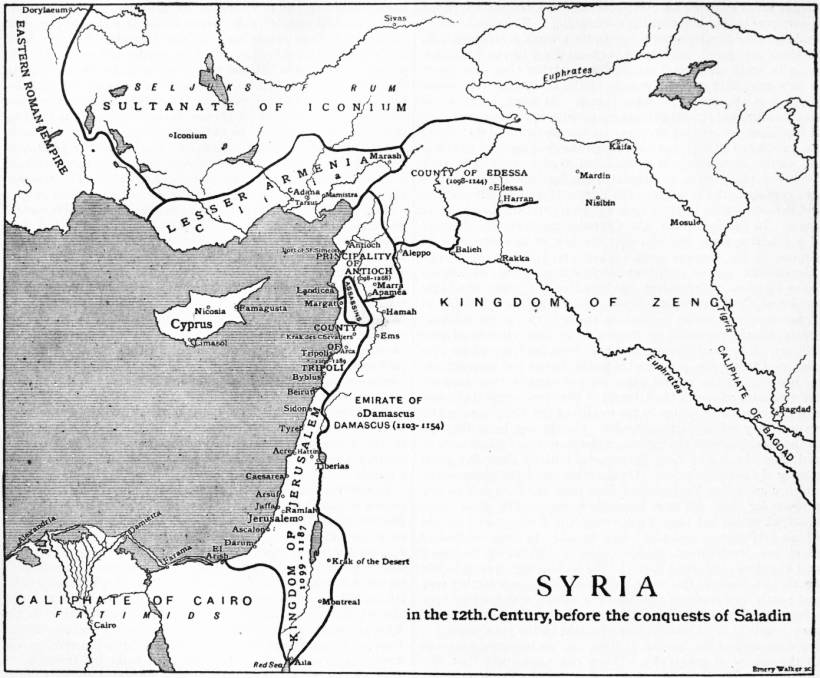
In many other ways the Europe over which the Crusades had passed was different from the Europe of the 11th century. In the first place, many political changes had been wrought, largely under its influence. Always in large part French, the Crusades had on the whole contributed to exalt the prestige of France, until it stood at the end of the 13th century the most considerable power in Europe. It was France which had colonized the Levant; it was the French tongue which was used in the Levant; and the results of the ancient and continuous connexion with the East are still to be traced to-day. Of the other great powers of Europe, England and Germany had been little changed by the Crusades, save that Germany had been extended towards the East by the conquests of the Teutonic Order; but the Eastern empire had been profoundly modified, and the papacy had suffered a great change. The Eastern empire had been for a time annihilated by the movement which in 1095 it had helped to evoke; and if it rose from its ashes in 1261 for two centuries of renewed life, it was never more than the shadow of its old self, with little hold on Asia Minor and less on Greece and the Archipelago, which the Latins still continued to occupy until they were finally conquered by the Ottoman Turks. The papacy, on the other hand, had grown as a result of the Crusades. Popes had preached them; popes had financed them; popes had sent their legates to lead them. Through them the popes had deposed the emperors of the West from their headship of the world, partly because through the Crusades the popes were able to direct the common Christianity of Europe in a foreign policy of their own without consultation with the emperor, partly because in the 13th century they were ultimately able to direct the Crusade itself against the empire. Yet while they had magnified, the Crusades had also corrupted the papacy. They became an instrument in its hands which it used to its own undoing. It cried Crusade when there was no Crusade; and the long Crusade against the Hohenstaufen, if it gave the papacy an apparent victory, only served in the long run to lower its prestige in the eyes of Europe. When we turn from the sphere of politics to the history of civilization and culture, we find the effects of the Crusades as deeply impressed, if not so definitely marked. The Crusades had sprung from the policy of a theocratic government counting on the motive of otherworldliness; they had helped in their course to overthrow that motive, and with it the government which it had made possible. In part they had provided a field in which the layman could prove that he too was a priest; in part they had brought the West into a living and continuous contact with a new faith and a new civilization. They had torn men loose from the ancestral custom of home to walk in new ways and see new things and hear new thoughts; and some broadening of view, some lessening in the intensity of the old one-sidedness, was the inevitable result. It is not so much that the West came into contact with a particular civilization in the East, or borrowed from that civilization; it is simply that the West came into contact with something unlike itself, yet in many ways as high as, if not higher than, itself. The spirit of Nathan der Weise may not have been exactly the spirit engendered by the Crusades; and yet it is not without reason that Lessing stages the fable which teaches toleration in the Latin kingdom of Jerusalem. In any case the accusations made against the Templars at the time of their suppression prove that there was, at any rate in the ranks of those who knew the East, too little of absolute orthodoxy. While a new spirit which compares and tolerates thus sprang from the Crusades, the large sphere of new knowledge and experience which they gave brought new material at once for scientific thought and poetic imagination. Not only was geography more studied; the Crusades gave a great impulse to the writing of history, and produced, besides innumerable other works, the greatest historical work of the middle ages—the Historia transmarina of William of Tyre. Mathematics received an impulse, largely, it is true, from the Arabs of Spain, but also from the East; Leonardo Fibonacci, the first Christian algebraist, had travelled in Syria and Egypt. The study of Oriental languages began in connexion with the Christian missions of the East; Raymond Lull, the indefatigable missionary, induced the council of Vienne to decide on the creation of six schools of Oriental languages in Europe (1311). But the new field of poetic literature afforded by the Crusades is still more striking than this development of science. New poems in abundance dealt with the history of the Crusades, either in a faithful narrative, like that of the Chanson of Ambroise, which narrates the Third Crusade, or in a free and poetical spirit, such as breathes in the Chanson d’Antioche. Nor was this all. The Crusades afforded new details which might be inserted into old matters, and a new spirit which might be infused into old subjects; and a crusading complexion thus came to be put upon old tales like those of Arthur and Charlemagne. By the side of these greater things it may seem little, and yet, just because it is little, it is all the more significant that the Crusades should have familiarized Europe with new plants, new fruits, new manufactures, new colours, and new fashions in dress. Sugar and maize; lemons, apricots and melons; cotton, muslin and damask; lilac and purple (azure and gules are words derived from the Arabic); the use of powder and of glass mirrors, and also of the rosary itself—all these things came to Europe from the East and as a result of the Crusades. To this day there are many Arabic words in the vocabulary of the languages of western Europe which are a standing witness of the Crusades—words relating to trade and seafaring, like tariff and corvette, or words for musical instruments, like lute or the Elizabethan word “naker.”
GENEALOGY OF THE KINGS OF JERUSALEM
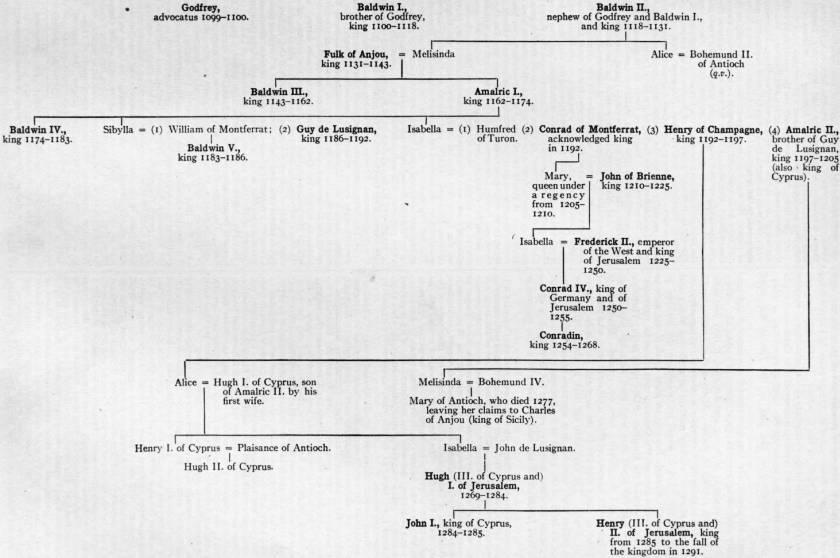
When all is said, the Crusades remain a wonderful and perpetually astonishing act in the great drama of human life. They touched the summits of daring and devotion, if they also sank into the deep abysms of shame. Motives of self-interest may have lurked in them—otherworldly motives of buying salvation for a little price, or worldly motives of achieving riches and acquiring lands. Yet it would be treason to the majesty of man’s incessant struggle towards an ideal good, if one were to deny that in and through the Crusades men strove for righteousness’ sake to extend the kingdom of God upon earth. Therefore the tears and the blood that were shed were not unavailing; the heroism and the chivalry were not wasted. Humanity is the richer for the memory of those millions of men, who followed the pillar of cloud and fire in the sure and certain hope of an eternal reward. The ages were not dark in which Christianity could gather itself together in a common cause, and carry the flag of its faith to the grave of its Redeemer; nor can we but give thanks for their memory, even if for us religion is of the spirit, and Jerusalem in the heart of every man who believes in Christ.
Literature.—In dealing with the literature of the Crusades, it is perhaps better, though ideally less scientific, to begin with chronicles and narratives rather than with documents. One of the results of the Crusades, as has just been suggested above, was a great increase in the writing of history. Crusaders themselves kept diaries or itineraria; while home-keeping ecclesiastics in the West—monks like Robert of Reims, abbots like Guibert of Nogent, archbishops like Balderich of Dol—found a fertile subject for their pens in the history of the Crusades. The history of a series of actions like the Crusades must primarily be based on these accounts, and more particularly on the former: narratives must precede documents where one is dealing, not with the continuous life of an organized kingdom, but with a number of enterprises—especially when those enterprises have been, as in this case, excellently narrated by contemporary writers.
I. Chronicles and Narratives of the Crusades—(1) Collections. The authorities for the Crusades have been collected in Bongars, Gesta Dei per Francos (Hanover, 1611) (incomplete); Michaud, Bibliothèque des croisades (Paris, 1829) (containing translations of select passages in the authorities); the Recueil des historiens des croisades, published by the Académie des Inscriptions (Paris, 1841 onwards) (the best general collection, containing many of the Latin, Greek, Arabic and Armenian authorities, and also the text of the assizes; but sometimes poorly edited and still incomplete); and the publications of the Société de l’Orient Latin (founded in 1875), especially the Archives, of which two volumes were published in 1881 and 1884, and the volumes of the Revue, published yearly from 1893 to 1902, and containing not only new texts, but articles and reviews of books which are of great service. (2) Particular authorities. The Crusades—a movement which engaged all Europe and brought the East into contact with the West—must necessarily be studied not only in the Latin authorities of Europe and of Palestine, but also in Byzantine, Armenian and Arabic writers. There are thus some four or five different points of view to be considered.
The First Crusade, far more than any other, became the theme of a multitude of writings, whose different degrees of value it is all-important to distinguish. Until about 1840 the authority followed for its history was naturally the great work of William of Tyre. For the First Crusade William had followed Albert of Aix; and he had consequently depicted Peter the Hermit as the prime mover in the Crusade. But about 1840 Ranke suggested, and von Sybel in his Geschichte des ersten Kreuzzüges proved, that Albert of Aix was not a good authority, and that consequently William of Tyre must be set aside for the history of the First Crusade, and other and more contemporary authorities used. In writing his account of the First Crusade, von Sybel accordingly based himself on the three contemporary Western authorities—the Gesta Francorum, Raymond of Agiles, and Fulcher. His view of the value of Albert of Aix, and his account of the First Crusade, have been generally followed (Kugler alone having attempted, to some extent, to rehabilitate Albert of Aix); and thus von Sybel’s work may be said to mark a revolution in the history of the First Crusade, when its legendary features were stripped away, and its real progress was first properly discovered.
Taking the Western authorities for the First Crusade separately, one may divide them, in the light of von Sybel’s work, into four kinds—the accounts of eye-witnesses; later compilations based on these accounts; semi-legendary and legendary narratives; and lastly, in a class by itself, the “History” of William of Tyre, who is rather a scientific historian than a chronicler.
(a) The three chief eye-witnesses are the anonymous author of the Gesta Francorum, Raymund of Agiles, and Fulcher. The anonymous author of the Gesta (see Hagenmeyer’s edition, Heidelberg, 1890) was a Norman of South Italy, who followed Bohemund, and accordingly depicts the progress of the First Crusade from a Norman point of view. He was a layman, marching and fighting in the ranks; and thus he is additionally valuable as representing the opinion of the ordinary crusader. Finally he was an eye-witness throughout, and absolutely contemporary, in the sense that he wrote his account of each great event practically at the time of the event. He is the primary authority for the First Crusade. Raymund of Agiles, a Provençal clerk and a follower of Raymund of Toulouse, writes his Historia Francorum qui ceperunt Jerusalem from the Provençal point of view. He gives an ecclesiastic’s account of the First Crusade, and is specially full on the spiritualistic phenomena which accompanied and followed the finding of the Holy Lance. His book might almost be called the “Visions of Peter Bartholomew and others,” and it is written in the plain matter-of-fact manner of Defoe’s narratives. He too was an eye-witness throughout, and thoroughly honest; and his account ranks second to the Gesta. Fulcher of Chartres originally followed Robert of Normandy, but in October 1097 he joined Baldwin of Lorraine in his expedition to Edessa, and afterwards followed his fortunes. His Historia Hierosolymitana, which extends to 1127, and embraces not only the history of the First Crusade, but also that of the foundation of the kingdom of Jerusalem, is written on the whole from a Lotharingian point of view, and is thus a natural complement to the accounts of the Anonymus and Raymund. His account of the First Crusade itself is poor (he was absent at Edessa during its course), but otherwise he is an excellent authority. A kindly old pedant, Fulcher interlards his history with much discourse on geography, zoology and sacred history. Besides these three chief eye-witnesses we may also mention the Annales Genuenses by the Genoese consul Caffarus,64 and the Annales Pisani of Bernardus Marago, useful as giving the mercantile and Italian side of the Crusade; the Hierosolymita of Ekkehard, the German abbot of Aura, who first came to Jerusalem about 1101 (partly based on the Gesta, but also of independent value: see Hagenmeyer’s edition, Tübingen, 1877); and Raoul of Caen’s Gesta Tancredi, composed on the basis of information supplied by Tancred himself. The last two works, if not actually the works of eye-witnesses, are at any rate first-hand, and belong to the category of primary writers rather than to that of later compilations. Finally, to contemporary writers we may add contemporary letters, especially those written by Stephen of Blois and Anselm of Ribemont, and the three letters sent to the West by the crusading princes during the First Crusade (see Hagenmeyer, Epistulae et Chartae, &c., Innsbruck, 1901).65
(b) The later compilations are chiefly based on the Gesta, whose uncouth style many writers set themselves to mend. In the first place, there is the Historia de Hierosolymitano itinere of Tudebod, which according to Besly, writing in 1641, is the original from which the Gesta was a mere plagiarism—an absolute inversion of the truth, as von Sybel first proved two centuries later. Secondly, besides the plagiarist Tudebod, there are the artistic rédacteurs of the Gesta, who confess their indebtedness, but plead the bad style of their original—Guibert of Nogent, Balderich of Dol, Robert of Reims (all c. 1120-1130), and Fulco, the author of a Virgilian poem on the Crusades, continued by Gilo (ob. c. 1142). Of these, the monk Robert was more popular in the middle ages than either the pompous abbot Guibert or the quiet garden-loving archbishop of Dol.
(c) The growth of a legend, or perhaps better, a saga of the First Crusade began, according to von Sybel, even during the Crusade itself. The basis of this growth is partly the story-telling instinct innate in all men, which loves to heighten an effect, sharpen a point or increase a contrast—the instinct which breathes in Icelandic sagas like that of Burnt Njal; partly the instinct of idolization, if it may be so called, which leads to the perversion into impossible greatness of an approved character, and has created, in this instance, the legendary figures of Peter the Hermit and Godfrey of Bouillon (qq.v.); partly the religious impulse, which counted nothing wonderful in a holy war, and imported miraculous elements even into the sober pages of the Gesta. These instincts and impulses would be at work already among the soldiers during the Crusade, producing a saga all the more readily, as there were poets in the camp; for we know that a certain Richard, who joined the First Crusade, sang its exploits in verse, while still more famous is the princely troubadour, William of Aquitaine, who joined the Crusade of 1100. If we are to follow von Sybel rather than Kugler, this saga of the First Crusade found one of its earliest expressions (c. 1120) in the prose work of Albert of Aix (Historia Hierosolymitana)—genuine saga in its inconsistencies, its errors of chronology and topography, its poetical colour, and its living descriptions of battles. Kugler, however, regards Albert as a copyist, somewhat in the manner of Tudebod, of an unknown writer of value, who belonged to the Lotharingian ranks during the Crusade, and settled in the kingdom of Jerusalem afterwards (see Kugler, Albert von Aachen, Stuttgart, 1885).66 In the Chanson des chétifs and the Chanson d’Antioche the legend of the Crusades more certainly finds its expression. The former, composed at Antioch about 1130, contained an idolization of the Hermit: the latter is a poem written about 1180 by Graindor of Douai, who used as his basis the verses of the crusader Richard (see the edition of P. Paris, 1848). It shows the growth of the legend that Graindor regards the vision of the Hermit as responsible for the Crusade, and makes the Crusade led by him precede, and indeed occasion by its failure, the meeting at Clermont (which is dated in May instead of November). Into the legendary overgrowth of the First Crusade we cannot here enter any further67; but it is perhaps worth while to mention that the French legend of the Third Crusade equally perverted the truth, making Richard I. return home in disgrace, while Philip Augustus stays, captures Damascus and mortally wounds Saladin (cf. G. Paris, L’Estoire de la guerre sainte, Paris, 1897; Introduction).