VOLUME VII SLICE VII Crocoite to Cuba (continued 10)
Reading edition
Closely allied to cohesion is the character of “hardness,” which is often defined, and measured by, the resistance which a crystal face offers to scratching. That hardness is a character depending largely on crystalline structure is well illustrated by the two crystalline modifications of carbon: graphite is one of the softest of minerals, whilst diamond is the hardest of all. The hardness of crystals of different substances thus varies widely, and with minerals it is a character of considerable determinative value; for this purpose a scale of hardness is employed (see Mineralogy). Various attempts have been made with the view of obtaining accurate determinations of degrees of hardness, but with varying results; an instrument used for this purpose is called a sclerometer (from σκληρός, hard). It may, however, be readily demonstrated that the degree of hardness on a crystal face varies with the direction, and that a curve expressing these relations possesses the same geometrical symmetry as the face itself. The mineral cyanite is remarkable in having widely different degrees of hardness on different faces of its crystals and in different directions on the same face.
Another result of the differences of cohesion in different directions is that crystals are corroded, or acted upon by chemical solvents, at different rates in different directions. This is strikingly shown when a sphere cut from a crystal, say of calcite or quartz, is immersed in acid; after some time the resulting form is bounded by surfaces approximating to crystal faces, and has the same symmetry as that of the crystal from which the sphere was cut. When a crystal bounded by faces is immersed in a solvent the edges and corners become rounded and “prerosion faces” developed in their place; the faces become marked all over with minute pits or shallow depressions, and as these are extended by further solution they give place to small elevations on the corroded face. The sides of the pits and elevations are bounded by small faces which have the character of vicinal faces. These markings are known as “etched figures” or “corrosion figures,” and they are extremely important aids in determining the symmetry of crystals. Etched figures are sometimes beautifully developed on the faces of natural crystals, e.g. of diamond, and they may be readily produced artificially with suitable solvents.
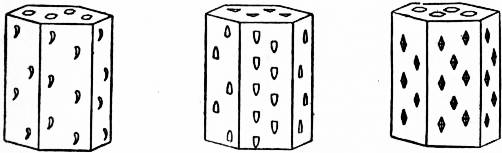
Fig. 92.—Nepheline. Fig. 93.—Calcite. Fig. 94.—Beryl.
Etched Figures on Hexagonal Prisms.
As an example, the etched figures on the faces of a hexagonal prism and the basal plane are illustrated in figs. 92-94 for three of the several symmetry-classes of the hexagonal system. The classes chosen are those in which nepheline, calcite and beryl (emerald) crystallize, and these minerals often have the simple form of crystal represented in the figures. In nepheline (fig. 92) the only element of symmetry is a hexad axis; the etched figures on the prism are therefore unsymmetrical, though similar on all the faces; the hexagonal markings on the basal plane have none of their edges parallel to the edges of the face; further the crystals being hemimorphic, the etched figures on the basal planes at the two ends will be different in character. The facial development of crystals of nepheline give no indication of this type of symmetry, and the mineral has been referred to this class solely on the evidence afforded by the etched figures. In calcite there is a triad axis of symmetry parallel to the prism edges, three dyad axes each perpendicular to a pair of prism edges and three planes of symmetry perpendicular to the prism faces; the etched figures shown in fig. 93 will be seen to conform to all these elements of symmetry. There being in calcite also a centre of symmetry, the equilateral triangles on the basal plane at the lower end of the crystal will be the same in form as those at the top, but they will occupy a reversed position. In beryl, which crystallizes in the holosymmetric class of the hexagonal system, the etched figures (fig. 94) display the fullest possible degree of symmetry; those on the prism faces are all similar and are each symmetrical with respect to two lines, and the hexagonal markings on the basal planes at both ends of the crystal are symmetrically placed with respect to six lines. A detailed account of the etched figures of crystals is given by H. Baumhauer, Die Resultate der Ätzmethode in der krystallographischen Forschung (Leipzig, 1894).
(b) Optical Properties.
The complex optical characters of crystals are not only of considerable interest theoretically, but are of the greatest practical importance. In the absence of external crystalline form, as with a faceted gem-stone, or with the minerals constituting a rock (thin, transparent sections of which are examined in the polarizing microscope), the mineral species may often be readily identified by the determination of some of the optical characters.
According to their action on transmitted plane-polarized light (see Polarization of Light) all crystals may be referred to one or other of the five groups enumerated below. These groups correspond with the six systems of crystallization (in the second group two systems being included together). The several symmetry-classes of each system are optically the same, except in the rare cases of substances which are circularly polarizing.
(1) Optically isotropic crystals—corresponding with the cubic system.
(2) Optically uniaxial crystals—corresponding with the tetragonal and hexagonal systems.
(3) Optically biaxial crystals in which the three principal optical directions coincide with the three crystallographic axes—corresponding with the orthorhombic system.
(4) Optically biaxial crystals in which only one of the three principal optical directions coincides with a crystallographic axis—corresponding with the monoclinic system.
(5) Optically biaxial crystals in which there is no fixed and definite relation between the optical and crystallographic directions—corresponding with the anorthic system.
Optically Isotropic Crystals.—These belong to the cubic system, and like all other optically isotropic (from ἴσος, like, and τρόπος, character) bodies have only one index of refraction for light of each colour. They have no action on polarized light (except in crystals which are circularly polarizing); and when examined in the polariscope or polarizing microscope they remain dark between crossed nicols, and cannot therefore be distinguished optically from amorphous substances, such as glass and opal.
Optically Uniaxial Crystals.—These belong to the tetragonal and hexagonal (including rhombohedral) systems, and between crystals of these systems there is no optical distinction. Such crystals are anisotropic or doubly refracting (see Refraction: Double); but for light travelling through them in a certain, single direction they are singly refracting. This direction, which is called the optic axis, is the same for light of all colours and at all temperatures; it coincides in direction with the principal crystallographic axis, which in tetragonal crystals is a tetrad (or dyad) axis of symmetry, and in the hexagonal system a triad or hexad axis.
For light of each colour there are two indices of refraction; namely, the ordinary index (ω) corresponding with the ordinary ray, which vibrates perpendicular to the optic axis; and the extraordinary index (ε) corresponding with the extraordinary ray, which vibrates parallel to the optic axis. If the ordinary index of refraction be greater than the extraordinary index, the crystal is said to be optically negative, whilst if less the crystal is optically positive. The difference between the two indices is a measure of the strength of the double refraction or birefringence. Thus in calcite, for sodium (D) light, ω = 1.6585 and ε = 1.4863; hence this substance is optically negative with a relatively high double refraction of ω − ε = 0.1722. In quartz ω = 1.5442, ε = 1.5533 and ε − ω = 0.0091; this mineral is therefore optically positive with low double refraction. The indices of refraction vary, not only for light of different colours, but also slightly with the temperature.
The optical characters of uniaxial crystals are symmetrical not only with respect to the full number of planes and axes of symmetry of tetragonal and hexagonal crystals, but also with respect to all vertical planes, i.e. all planes containing the optic axis. A surface expressing the optical relations of such crystals is thus an ellipsoid of revolution about the optic axis. (In cubic crystals the corresponding surface is a sphere.) In the “optical indicatrix” (L. Fletcher, The Optical Indicatrix and the Transmission of Light in Crystals, London, 1892), the length of the principal axis, or axis of rotation, is proportional to the index of refraction, (i.e. inversely proportional to the velocity) of the extraordinary rays, which vibrate along this axis and are transmitted in directions perpendicular thereto; the equatorial diameters are proportional to the index of refraction of the ordinary rays, which vibrate perpendicular to the optic axis. For positive uniaxial crystals the indicatrix is thus a prolate spheroid (egg-shaped), and for negative crystals an oblate spheroid (orange-shaped).
In “Fresnel’s ellipsoid” the axis of rotation is proportional to the velocity of the extraordinary ray, and the equatorial diameters proportional to the velocity of the ordinary ray; it is therefore an oblate spheroid for positive crystals, and a prolate spheroid for negative crystals. The “ray-surface,” or “wave-surface,” which represents the distances traversed by the rays during a given interval of time in various directions from a point of origin within the crystal, consists in uniaxial crystals of two sheets; namely, a sphere, corresponding to the ordinary rays, and an ellipsoid of revolution, corresponding to the extraordinary rays. The difference in form of the ray-surface for positive and negative crystals is shown in figs. 95 and 96.
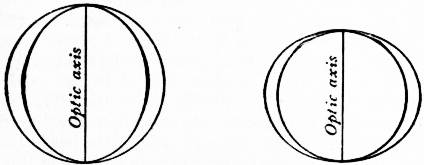
Fig. 95.—Section of the Ray-Surface of a Positive Uniaxial Crystal. Fig. 96.—Section of the Ray-Surface of a Negative Uniaxial Crystal.
When a uniaxial crystal is examined in a polariscope or polarizing microscope between crossed nicols (i.e. with the principal planes of the polarizer or analyser at right angles, and so producing a dark field of view) its behaviour differs according to the direction in which the light travels through the crystal, to the position of the crystal with respect to the principal planes of the nicols, and further, whether convergent or parallel polarized light be employed. A tetragonal or hexagonal crystal viewed, in parallel light, through the basal plane, i.e. along the principal axis, will remain dark as it is rotated between crossed nicols, and will thus not differ in its behaviour from a cubic crystal or other isotropic body. If, however, the crystal be viewed in any other direction, for example, through a prism face, it will, except in certain positions, have an action on the polarized light. A plane-polarized ray entering the crystal will be resolved into two polarized rays with the directions of vibration parallel to the vibration-directions in the crystal. These two rays on leaving the crystal will be combined again in the analyser, and a portion of the light transmitted through the instrument; the crystal will then show up brightly against the dark field. Further, owing to interference of these two rays in the analyser, the light will be brilliantly coloured, especially if the crystal be thin, or if a thin section of a crystal be examined. The particular colour seen will depend on the strength of the double refraction, the orientation of the crystal or section, and upon its thickness. If now, the crystal be rotated with the stage of the microscope, the nicols remaining fixed in position, the light transmitted through the instrument will vary in intensity, and in certain positions will be cut out altogether. The latter happens when the vibration-directions of the crystal are parallel to the vibration-directions of the nicols (these being indicated by cross-wires in the microscope). The crystal, now being dark, is said to be in position of extinction; and as it is turned through a complete rotation of 360° it will extinguish four times. If a prism face be viewed through, it will be seen that, when the crystal is in a position of extinction, the cross-wires of the microscope are parallel to the edges of the prism: the crystal is then said to give “straight extinction.”
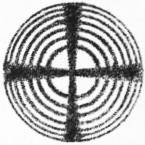
Fig. 97.—Interference Figure of a Uniaxial Crystal.
In convergent light, between crossed nicols, a very different phenomenon is to be observed when a uniaxial crystal, or section of such a crystal, is placed with its optic axis coincident with the axis of the microscope. The rays of light, being convergent, do not travel in the direction of the optic axis and are therefore doubly refracted in the crystal; in the analyser the vibrations will be reduced to the same plane and there will be interference of the two sets of rays. The result is an “interference figure” (fig. 97), which consists of a number of brilliantly coloured concentric rings, each showing the colours of the spectrum of white light; intersecting the rings is a black cross, the arms of which are parallel to the principal planes of the nicols. If monochromatic light be used instead of white light, the rings will be alternately light and dark. The number and distance apart of the rings depend on the strength of the double refraction and on the thickness of the crystal. By observing the effect produced on such a uniaxial interference figure when a “quarter undulation (or wave-length) mica-plate” is superposed on the crystal, it may be at once decided whether the crystal is optically positive or negative. Such a simple test may, for example, be applied for distinguishing certain faceted gem-stones: thus zircon and phenacite are optically positive, whilst corundum (ruby and sapphire) and beryl (emerald) are optically negative.
Optically Biaxial Crystals.—In these crystals there are three principal indices of refraction, denoted by α, β and γ; of these γ is the greatest and α the least (γ > β > α). The three principal vibration-directions, corresponding to these indices, are at right angles to each other, and are the directions of the three rectangular axes of the optical indicatrix. The indicatrix (fig. 98) is an ellipsoid with the lengths of its axes proportional to the refractive indices; OC = γ, OB = β, OA = α, where OC > OB > OA. The figure is symmetrical with respect to the principal planes OAB, OAC, OBC.
In Fresnel’s ellipsoid the three rectangular axes are proportional to 1/α, 1/β, and 1/γ, and are usually denoted by a, b and c respectively, where a > b > c: these have often been called “axes of optical elasticity,” a term now generally discarded.
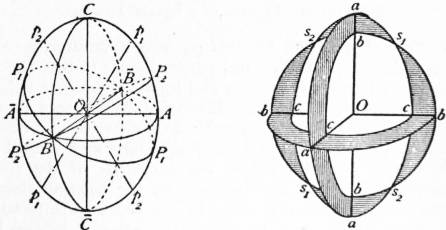
Fig. 98.—Optical Indicatrix of a Biaxial Crystal. Fig. 99.—Ray-Surface of a Biaxial Crystal.
The ray-surface (represented in fig. 99 by its sections in the three principal planes) is derived from the indicatrix in the following manner. A ray of light entering the crystal and travelling in the direction OA is resolved into polarized rays vibrating parallel to OB and OC, and therefore propagated with the velocities 1/β and 1/γ respectively: distances Ob and Oc (fig. 99) proportional to these velocities are marked off in the direction OA. Similarly, rays travelling along OC have the velocities 1/α and 1/β, and those along OB the velocities 1/α and 1/γ. In the two directions Op1 and Op2 (fig. 98), perpendicular to the two circular sections P1P1 and P2P2 of the indicatrix, the two rays will be transmitted with the same velocity 1/β. These two directions are called the optic axes (“primary optic axis”), though they have not all the properties which are associated with the optic axis of a uniaxial crystal. They have very nearly the same direction as the lines Os1 and Os2 in fig. 99, which are distinguished as the “secondary optic axes.” In most crystals the primary and secondary optic axes are inclined to each other at not more than a few minutes, so that for practical purposes there is no distinction between them.
The angle between Op1 and Op2 is called the “optic axial angle”; and the plane OAC in which they lie is called the “optic axial plane.” The angles between the optic axes are bisected by the vibration-directions OA and OC; the one which bisects the acute angle being called the “acute bisectrix” or “first mean line,” and the other the “obtuse bisectrix” or “second mean line.” When the acute bisectrix coincides with the greatest axis OC of the indicatrix, i.e. the vibration-direction corresponding with the refractive index γ (as in figs. 98 and 99), the crystal is described as being optically positive; and when the acute bisectrix coincides with OA, the vibration-direction for the index α, the crystal is negative. The distinction between positive and negative biaxial crystals thus depends on the relative magnitude of the three principal indices of refraction; in positive crystals β is nearer to α than to γ, whilst in negative crystals the reverse is the case. Thus in topaz, which is optically positive, the refractive indices for sodium light are α = 1.6120, β = 1.6150, γ = 1.6224; and for orthoclase which is optically negative, α = 1.5190, β = 1.5237, γ = 1.5260. The difference γ − α represents the strength of the double refraction.
Since the refractive indices vary both with the colour of the light and with the temperature, there will be for each colour and temperature slight differences in the form of both the indicatrix and the ray-surface: consequently there will be variations in the positions of the optic axes and in the size of the optic axial angle. This phenomenon is known as the “dispersion of the optic axes.” When the axial angle is greater for red light than for blue the character of the dispersion is expressed by ρ > υ, and when less by ρ < υ. In some crystals, e.g. brookite, the optic axes for red light and for blue light may be, at certain temperatures, in planes at right angles.
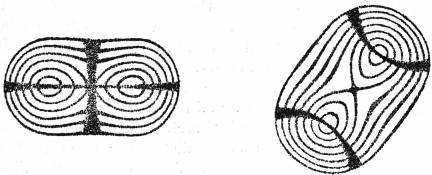
Fig. 100. Fig. 101.
Interference Figures of a Biaxial Crystal.
The type of interference figure exhibited by a biaxial crystal in convergent polarized light between crossed nicols is represented in figs. 100 and 101. The crystal must be viewed along the acute bisectrix, and for this purpose it is often necessary to cut a plate from the crystal perpendicular to this direction: sometimes, however, as in mica and topaz, a cleavage flake will be perpendicular to the acute bisectrix. When seen in white light, there are around each optic axis a series of brilliantly coloured ovals, which at the centre join to form an 8-shaped loop, whilst further from the centre the curvature of the rings is approximately that of lemniscates. In the position shown in fig. 100 the vibration-directions in the crystal are parallel to those of the nicols, and the figure is intersected by two black bands or “brushes” forming a cross. When, however, the crystal is rotated with the stage of the microscope the cross breaks up into the two branches of a hyperbola, and when the vibration-directions of the crystal are inclined at 45° to those of the nicols the figure is that shown in fig. 101. The points of emergence of the optic axes are at the middle of the hyperbolic brushes when the crystal is in the diagonal position: the size of the optic axial angle can therefore be directly measured with considerable accuracy.
In orthorhombic crystals the three principal vibration-directions coincide with the three crystallographic axes, and have therefore fixed positions in the crystal, which are the same for light of all colours and at all temperatures. The optical orientation of an orthorhombic crystal is completely defined by stating to which crystallographic planes the optic axial plane and the acute bisectrix are respectively parallel and perpendicular. Examined in parallel light between crossed nicols, such a crystal extinguishes parallel to the crystallographic axes, which are often parallel to the edges of a face or section; there is thus usually “straight extinction.” The interference figure seen in convergent polarized light is symmetrical about two lines at right angles.
In monoclinic crystals only one vibration-direction has a fixed position within the crystal, being parallel to the ortho-axis (i.e. perpendicular to the plane of symmetry or the plane (010)). The other two vibration-directions lie in the plane (010), but they may vary in position for light of different colours and at different temperatures. In addition to dispersion of the optic axes there may thus, in crystals of this system, be also “dispersion of the bisectrices.” The latter may be of one or other of three kinds, according to which of the three vibration-directions coincides with the ortho-axis of the crystal. When the acute bisectrix is fixed in position, the optic axial planes for different colours may be crossed, and the interference figure will then be symmetrical with respect to a point only (“crossed dispersion”). When the obtuse bisectrix is fixed, the axial planes may be inclined to one another, and the interference figure is symmetrical only about a line which is perpendicular to the axial planes (“horizontal dispersion”). Finally, when the vibration-direction corresponding to the refractive index β, or the “third mean line,” has a fixed position, the optic axial plane lies in the plane (010), but the acute bisectrix may vary in position in this plane; the interference figure will then be symmetrical only about a line joining the optic axes (“inclined dispersion”). Examples of substances exhibiting these three kinds of dispersion are borax, orthoclase and gypsum respectively. In orthoclase and gypsum, however, the optic axial angle gradually diminishes as the crystals are heated, and after passing through a uniaxial position they open out in a plane at right angles to the one they previously occupied; the character of the dispersion thus becomes reversed in the two examples quoted. When examined in parallel light between crossed nicols monoclinic crystals will give straight extinction only in faces and sections which are perpendicular to the plane of symmetry (or the plane (010)); in all other faces and sections the extinction-directions will be inclined to the edges of the crystal. The angles between these directions and edges are readily measured, and, being dependent on the optical orientation of the crystal, they are often characteristic constants of the substance (see, e.g., Plagioclase).
In anorthic crystals there is no relation between the optical and crystallographic directions, and the exact determination of the optical orientation is often a matter of considerable difficulty. The character of the dispersion of the bisectrices and optic axes is still more complex than in monoclinic crystals, and the interference figures are devoid of symmetry.
Absorption of Light in Crystals: Pleochroism.—In crystals other than those of the cubic system, rays of light with different vibration-directions will, as a rule, be differently absorbed; and the polarized rays on emerging from the crystal may be of different intensities and (if the observation be made in white light and the crystal is coloured) differently coloured. Thus, in tourmaline the ordinary ray, which vibrates perpendicular to the principal axis, is almost completely absorbed, whilst the extraordinary ray is allowed to pass through the crystal. A plate of tourmaline cut parallel to the principal axis may therefore be used for producing a beam of polarized light, and two such plates placed in crossed position form the polarizer or analyser of “tourmaline tongs,” with the aid of which the interference figures of crystals may be simply shown. Uniaxial (tetragonal and hexagonal) crystals when showing perceptible differences in colour for the ordinary and extraordinary rays are said to be “dichroic.” In biaxial (orthorhombic, monoclinic and anorthic) crystals, rays vibrating along each of the three principal vibration-directions may be differently absorbed, and, in coloured crystals, differently coloured; such crystals are therefore said to be “trichroic” or in general “pleochroic” (from πλέων, more, and χρόα, colour). The directions of maximum absorption in biaxial crystals have, however, no necessary relation with the axes of the indicatrix, unless these have fixed crystallographic directions, as in the orthorhombic system and the ortho-axis in the monoclinic. In epidote it has been shown that the two directions of maximum absorption which lie in the plane of symmetry are not even at right angles.
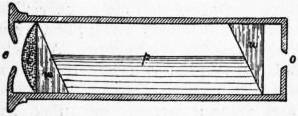
Fig. 102.—Dichroscope.
The pleochroism of some crystals is so strong that when they are viewed through in different directions they exhibit marked differences in colour. Thus a crystal of the mineral iolite (called also dichroite because of its strong pleochroism) will be seen to be dark blue, pale blue or pale yellow according to which of three perpendicular directions it is viewed. The “face colours” seen directly in this way result, however, from the mixture of two “axial colours” belonging to rays vibrating in two directions. In order to see the axial colours separately the crystal must be examined with a dichroscope, or in a polarizing microscope from which the analyser has been removed. The dichroscope, or dichroiscope (fig. 102), consists of a cleavage rhombohedron of calcite (Iceland-spar) p, on the ends of which glass prisms w are cemented: the lens l is focused on a small square aperture o in the tube of the instrument. The eye of the observer placed at e will see two images of the square aperture, and if a pleochroic crystal be placed in front of this aperture the two images will be differently coloured. On rotating this crystal with respect to the instrument the maximum difference in the colours will be obtained when the vibration-directions in the crystal coincide with those in the calcite. Such a simple instrument is especially useful for the examination of faceted gem-stones, even when they are mounted in their settings. A single glance suffices to distinguish between a ruby and a “spinel-ruby,” since the former is dichroic and the latter isotropic and therefore not dichroic.
The characteristic absorption bands in the spectrum of white light which has been transmitted through certain crystals, particularly those of salts of the cerium metals, will, of course, be different according to the direction of vibration of the rays.
Circular Polarization in Crystals.—Like the solutions of certain optically active organic substances, such as sugar and tartaric acid, some optically isotropic and uniaxial crystals possess the property of rotating the plane of polarization of a beam of light. In uniaxial (tetragonal and hexagonal) crystals it is only for light transmitted in the direction of the optic axis that there is rotatory action, but in isotropic (cubic) crystals all directions are the same in this respect. Examples of circularly polarizing cubic crystals are sodium chlorate, sodium bromate, and sodium uranyl acetate; amongst tetragonal crystals are strychnine sulphate and guanidine carbonate; amongst rhombohedral are quartz (q.v.) and cinnabar (q.v.) (these being the only two mineral substances in which the phenomenon has been observed), dithionates of potassium, lead, calcium and strontium, and sodium periodate; and amongst hexagonal crystals is potassium lithium sulphate. Crystals of all these substances belong to one or other of the several symmetry-classes in which there are neither planes nor centre of symmetry, but only axes of symmetry. They crystallize in two complementary hemihedral forms, which are respectively right-handed and left-handed, i.e. enantiomorphous forms. Some other substances which crystallize in enantiomorphous forms are, however, only “optically active” when in solution (e.g. sugar and tartaric acid); and there are many other substances presenting this peculiarity of crystalline form which are not circularly polarizing either when crystallized or when in solution. Further, in the examples quoted above, the rotatory power is lost when the crystals are dissolved (except in the case of strychnine sulphate, which is only feebly active in solution). The rotatory power is thus due to different causes in the two cases, in the one depending on a spiral arrangement of the crystal particles, and in the other on the structure of the molecules themselves.
The circular polarization of crystals may be imitated by a pile of mica plates, each plate being turned through a small angle on the one below, thus giving a spiral arrangement to the pile.
“Optical Anomalies” of Crystals.—When, in 1818, Sir David Brewster established the important relations existing between the optical properties of crystals and their external form, he at the same time noticed many apparent exceptions. For example, he observed that crystals of leucite and boracite, which are cubic in external form, are always doubly refracting and optically biaxial, but with a complex internal structure; and that cubic crystals of garnet and analcite sometimes exhibit the same phenomena. Also some tetragonal and hexagonal crystals, e.g. apophyllite, vesuvianite, beryl, &c., which should normally be optically uniaxial, sometimes consist of several biaxial portions arranged in sectors or in a quite irregular manner. Such exceptions to the general rule have given rise to much discussion. They have often been considered to be due to internal strains in the crystals, set up as a result of cooling or by earth pressures, since similar phenomena are observed in chilled and compressed glasses and in dried gelatine. In many cases, however, as shown by E. Mallard, in 1876, the higher degree of symmetry exhibited by the external form of the crystals is the result of mimetic twinning, as in the pseudo-cubic crystals of leucite (q.v.) and boracite (q.v.). In other instances, substances not usually regarded as cubic, e.g. the monoclinic phillipsite (q.v.), may by repeated twinning give rise to pseudo-cubic forms. In some cases it is probable that the substance originally crystallized in one modification at a higher temperature, and when the temperature fell it became transformed into a dimorphous modification, though still preserving the external form of the original crystal (see Boracite). A summary of the literature is given by R. Brauns, Die optischen Anomalien der Krystalle (Leipzig, 1891).
(c) Thermal Properties.
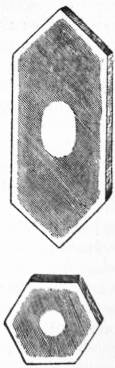
Fig. 103.—Conductivity of Heat in Quartz.
The thermal properties of crystals present certain points in common with the optical properties. Heat rays are transmitted and doubly refracted like light rays; and surfaces expressing the conductivity and dilatation in different directions possess the same degree of symmetry and are related in the same way to the crystallographic axes as the ellipsoids expressing the optical relations. That crystals conduct heat at different rates in different directions is well illustrated by the following experiment. Two plates (fig. 103) cut from a crystal of quartz, one parallel to the principal axis and the other perpendicular to it, are coated with a thin layer of wax, and a hot wire is applied to a point on the surface. On the transverse section the wax will be melted in a circle, and on the longitudinal section (or on the natural prism faces) in an ellipse. The isothermal surface in a uniaxial crystal is therefore a spheroid; in cubic crystals it is a sphere; and in biaxial crystals an ellipsoid, the three axes of which coincide, in orthorhombic crystals, with the crystallographic axes.
With change of temperature cubic crystals expand equally in all directions, and the angles between the faces are the same at all temperatures. In uniaxial crystals there are two principal coefficients of expansion; the one measured in the direction of the principal axis may be either greater or less than that measured in directions perpendicular to this axis. A sphere cut from a uniaxial crystal at one temperature will be a spheroid at another temperature. In biaxial crystals there are different coefficients of expansion along three rectangular axes, and a sphere at one temperature will be an ellipsoid at another. A result of this is that for all crystals, except those belonging to the cubic system, the angles between the faces will vary, though only slightly, with changes of temperature. E. Mitscherlich found that the rhombohedral angle of calcite decreases 8′ 37″ as the crystal is raised in temperature from 0° to 100° C.
As already mentioned, the optical properties of crystals vary considerably with the temperature. Such characters as specific heat and melting-point, which do not vary with the direction, are the same in crystals as in amorphous substances.
(d) Magnetic and Electrical Properties.
Crystals, like other bodies, are either paramagnetic or diamagnetic, i.e. they are either attracted or repelled by the pole of a magnet. In crystals other than those belonging to the cubic system, however, the relative strength of the induced magnetization is different in different directions within the mass. A sphere cut from a tetragonal or hexagonal (uniaxial) crystal will if freely suspended in a magnetic field (between the poles of a strong electro-magnet) take up a position such that the principal axis of the crystal is either parallel or perpendicular to the lines of force, or to a line joining the two poles of the magnet. Which of these two directions is taken by the axis depends on whether the crystal is paramagnetic or diamagnetic, and on whether the principal axis is the direction of maximum or minimum magnetization. The surface expressing the magnetic character in different directions is in uniaxial crystals a spheroid; in cubic crystals it is a sphere. In orthorhombic, monoclinic and anorthic crystals there are three principal axes of magnetic induction, and the surface is an ellipsoid, which is related to the symmetry of the crystal in the same way as the ellipsoids expressing the thermal and optical properties.
Similarly, the dielectric constants of a non-conducting crystal may be expressed by a sphere, spheroid or ellipsoid. A sphere cut from a crystal will when suspended in an electro-magnetic field set itself so that the axis of maximum induction is parallel to the lines of force.
The electrical conductivity of crystals also varies with the direction, and bears the same relation to the symmetry as the thermal conductivity. In a rhombohedral crystal of haematite the electrical conductivity along the principal axis is only half as great as in directions perpendicular to this axis; whilst in a crystal of bismuth, which is also rhombohedral, the conductivities along and perpendicular to the axis are as 1.6 : 1.
Conducting crystals are thermo-electric: when placed against another conducting substance and the contact heated there will be a flow of electricity from one body to the other if the circuit be closed. The thermo-electric force depends not only on the nature of the substance, but also on the direction within the crystal, and may in general be expressed by an ellipsoid. A remarkable case is, however, presented by minerals of the pyrites group: some crystals of pyrites are more strongly thermo-electrically positive than antimony, and others more negative than bismuth, so that the two when placed together give a stronger thermo-electric couple than do antimony and bismuth. In the thermo-electrically positive crystals of pyrites the faces of the pentagonal dodecahedron are striated parallel to the cubic edges, whilst in the rarer negative crystals the faces are striated perpendicular to these edges. Sometimes both sets of striae are present on the same face, and the corresponding areas are then thermo-electrically positive and negative.
The most interesting relation between the symmetry of crystals and their electrical properties is that presented by the pyro-electrical phenomena of certain crystals. This is a phenomenon which may be readily observed, and one which often aids in the determination of the symmetry of crystals. It is exhibited by crystals in which there is no centre of symmetry, and the axes of symmetry are uniterminal or polar in character, being associated with different faces on the crystal at their two ends. When a non-conducting crystal possessing this hemimorphic type of symmetry is subjected to changes of temperature a charge of positive electricity will be developed on the faces in the region of one end of the uniterminal axis, whilst the faces at the opposite end will be negatively charged. With rising temperature the pole which becomes positively charged is called the “analogous pole,” and that negatively charged the “antilogous pole”: with falling temperature the charges are reversed. The phenomenon was first observed in crystals of tourmaline, the principal axis of which is a uniterminal triad axis of symmetry. In crystals of quartz there are three uniterminal dyad axes of symmetry perpendicular to the principal triad axis (which is here similar at its two ends): the dyad axes emerge at the edges of the hexagonal prism, alternate edges of which become positively and negatively charged on change of temperature. In boracite there are four uniterminal triad axes, and the faces of the two tetrahedra perpendicular to them will bear opposite charges. Other examples of pyro-electric crystals are the orthorhombic mineral hemimorphite (called also, for this reason, “electric calamine”) and the monoclinic tartaric acid and cane-sugar, each of which possesses a uniterminal dyad axis of symmetry. In some exceptional cases, e.g. axinite, prehnite, &c., there is no apparent relation between the distribution of the pyro-electric charges and the symmetry of the crystals.
The distribution of the electric charges may be made visible by the following simple method, which may be applied even with minute crystals observed under the microscope. A finely powdered mixture of red-lead and sulphur is dusted through a sieve over the cooling crystal. In passing through the sieve the particles of red-lead and sulphur become electrified by mutual friction, the former positively and the latter negatively. The red-lead is therefore attracted to the negatively charged parts of the crystal and the sulphur to those positively charged, and the distribution of the charges over the whole crystal becomes mapped out in the two colours red and yellow.
Since, when a crystal changes in temperature, it also expands or contracts, a similar distribution of “piezo-electric” (from πιέζειν, to press) charges are developed when a crystal is subjected to changes of pressure in the direction of a uniterminal axis of symmetry. Thus increasing pressure along the principal axis of a tourmaline crystal produces the same electric charges as decreasing temperature.
III. RELATIONS BETWEEN CRYSTALLINE FORM AND CHEMICAL COMPOSITION.
That the general and physical characters of a chemical substance are profoundly modified by crystalline structure is strikingly illustrated by the two crystalline modifications of the element carbon—namely, diamond and graphite. The former crystallizes in the cubic system, possesses four directions of perfect cleavage, is extremely hard and transparent, is a non-conductor of heat and electricity, and has a specific gravity of 3.5; whilst graphite crystallizes in the hexagonal system, cleaves in a single direction, is very soft and opaque, is a good conductor of heat and electricity, and has a specific gravity of 2.2. Such substances, which are identical in chemical composition, but different in crystalline form and consequently in their physical properties, are said to be “dimorphous.” Numerous examples of dimorphous substances are known; for instance, calcium carbonate occurs in nature either as calcite or as aragonite, the former being rhombohedral and the latter orthorhombic; mercuric iodide crystallizes from solution as red tetragonal crystals, and by sublimation as yellow orthorhombic crystals. Some substances crystallize in three different modifications, and these are said to be “trimorphous”; for example, titanium dioxide is met with as the minerals rutile, anatase and brookite (q.v.). In general, or in cases where more than three crystalline modifications are known (e.g. in sulphur no less than six have been described), the term “polymorphism” is applied.
On the other hand, substances which are chemically quite distinct may exhibit similarity of crystalline form. For example, the minerals iodyrite (AgI), greenockite (CdS), and zincite (ZnO) are practically identical in crystalline form; calcite (CaCO3) and sodium nitrate (NaNO3); celestite (SrSO)4 and marcasite (FeS2); epidote and azurite; and many others, some of which are no doubt only accidental coincidences. Such substances are said to be “homoeomorphous” (Gr. ὅμοιος, like, and μορφή, form).
Similarity of crystalline form in substances which are chemically related is frequently met with and is a relation of much importance: such substances are described as being “isomorphous.” Amongst minerals there are many examples of isomorphous groups, e.g. the rhombohedral carbonates, garnet (q.v.), plagioclase (q.v.); and amongst crystals of artificially prepared salts isomorphism is equally common, e.g. the sulphates and selenates of potassium, rubidium and caesium. The rhombohedral carbonates have the general formula R″CO3, where R″ represents calcium, magnesium, iron, manganese, zinc, cobalt or lead, and the different minerals (calcite, ankerite, magnesite, chalybite, rhodochrosite and calamine (q.v.)) of the group are not only similar in crystalline form, cleavage, optical and other characters, but the angles between corresponding faces do not differ by more than 1° or 2°. Further, equivalent amounts of the different chemical elements represented by R” are mutually replaceable, and two or more of these elements may be present together in the same crystal, which is then spoken of as a “mixed crystal” or isomorphous mixture.
In another isomorphous series of carbonates with the same general formula R″CO3, where R″ represents calcium, strontium, barium, lead or zinc, the crystals are orthorhombic in form, and are thus dimorphous with those of the previous group (e.g. calcite and aragonite, the other members being only represented by isomorphous replacements). Such a relation is known as “isodimorphism.” An even better example of this is presented by the arsenic and antimony trioxides, each of which occurs as two distinct minerals:—
As2O3, Arsenolite (cubic); Claudetite (monoclinic). Sb2O3, Senarmontite (cubic); Valentinite (orthorhombic).
Claudetite and valentinite though crystallizing in different systems have the same cleavages and very nearly the same angles, and are strictly isomorphous.
Substances which form isodimorphous groups also frequently crystallize as double salts. For instance, amongst the carbonates quoted above are the minerals dolomite (CaMg(CO3)2) and barytocalcite (CaBa(CO3)2). Crystals of barytocalcite (q.v.) are monoclinic; and those of dolomite (q.v.), though closely related to calcite in angles and cleavage, possess a different degree of symmetry, and the specific gravity is not such as would result by a simple isomorphous mixture of the two carbonates. A similar case is presented by artificial crystals of silver nitrate and potassium nitrate. Somewhat analogous to double salts are the molecular compounds formed by the introduction of “water of crystallization,” “alcohol of crystallization,” &c. Thus sodium sulphate may crystallize alone or with either seven or ten molecules of water, giving rise to three crystallographically distinct substances.
A relation of another kind is the alteration in crystalline form resulting from the replacement in the chemical molecule of one or more atoms by atoms or radicles of a different kind. This is known as a “morphotropic” relation (Gr. μορφή, form, τρόπος, habit). Thus when some of the hydrogen atoms of benzene are replaced by (OH) and (NO2) groups the orthorhombic system of crystallization remains the same as before, and the crystallographic axis a is not much affected, but the axis c varies considerably:—
a : b : c
Benzene, C6H6 0.891 : 1 : 0.799
Resorcin, C6H4(OH)2 0.910 : 1 : 0.540
Picric acid, C6H2(OH)(NO2)3 0.937 : 1 : 0.974
A striking example of morphotropy is shown by the humite (q.v.) group of minerals: successive additions of the group Mg2SiO4 to the molecule produce successive increases in the length of the vertical crystallographic axis.
In some instances the replacement of one atom by another produces little or no influence on the crystalline form; this happens in complex molecules of high molecular weight, the “mass effect” of which has a controlling influence on the isomorphism. An example of this is seen in the replacement of sodium or potassium by lead in the alunite (q.v.) group of minerals, or again in such a complex mineral as tourmaline, which, though varying widely in chemical composition, exhibits no variation in crystalline form.
For the purpose of comparing the crystalline forms of isomorphous and morphotropic substances it is usual to quote the angles or the axial ratios of the crystal, as in the table of benzene derivatives quoted above. A more accurate comparison is, however, given by the “topic axes,” which are calculated from the axial ratios and the molecular volume; they express the relative distances apart of the crystal molecules in the axial directions.
The two isomerides of substances, such as tartaric acid, which in solution rotate the plane of polarized light either to the right or to the left, crystallize in related but enantiomorphous forms.
References.—An introduction to crystallography is given in most text-books of mineralogy, e.g. those of H. A. Miers and of E. S. Dana (see Mineralogy). The standard work treating of the subject generally is that of P. Groth, Physikalische Kristallographie (4th ed., Leipzig, 1905). A condensed summary is given by A. J. Moses, The Characters of Crystals (New York, 1899).
For geometrical crystallography, dealing exclusively with the external form of crystals, reference may be made to N. Story-Maskelyne, Crystallography, a Treatise on the Morphology of Crystals (Oxford, 1895) and W. J. Lewis, A Treatise on Crystallography (Cambridge, 1899). Theories of crystal structure are discussed by L. Sohncke, Entwickelung einer Theorie der Krystallstruktur (Leipzig, 1879); A. Schoenflies, Krystallsysteme und Krystallstructur (Leipzig, 1891); and H. Hilton, Mathematical Crystallography and the Theory of Groups of Movements (Oxford, 1903).
The physical properties of crystals are treated by T. Liebisch, Physikalische Krystallographie (Leipzig, 1891), and in a more elementary form in his Grundriss der physikalischen Krystallographie (Leipzig, 1896); E. Mallard, Traité de cristallographie, Cristallographie physique (Paris, 1884); C. Soret, Éléments de cristallographie physique (Geneva and Paris, 1893).
For an account of the relations between crystalline form and chemical composition, see A. Arzruni, Physikalische Chemie der Krystalle (Braunschweig, 1893); A. Fock, An Introduction to Chemical Crystallography, translated by W. J. Pope (Oxford, 1895); P. Groth, An Introduction to Chemical Crystallography, translated by H. Marshall (London, 1906); A. E. H. Tutton, Crystalline Structure and Chemical Constitution, 1910. Descriptive works giving the crystallographic constants of different substances are C. F. Rammelsberg, Handbuch der krystallographisch-physikalischen Chemie (Leipzig, 1881-1882); P. Groth, Chemische Krystallographie (Leipzig, 1906); and of minerals the treatises of J. D. Dana and C. Hintze.
(L. J. S.)
1 From the Greek letter δ, Δ; in general, a triangular-shaped object; also an alternative name for a trapezoid.
2 Named after pyrites, which crystallizes in a typical form of this class.
3 From πλάγιος, placed sideways, referring to the absence of planes and centre of symmetry.
4 From γῦρος, a ring or spiral, and εἶδος, form.
5 From μόνος, single, and κλίειν, to incline, since one axis is inclined to the plane of the other two axes, which are at right angles.
CRYSTAL PALACE, THE, a well-known English resort, standing high up in grounds just outside the southern boundary of the county of London, in the neighbourhood of Sydenham. The building, chiefly of iron and glass, is flanked by two towers and is visible from far over the metropolis. It measures 1608 ft. in length by 384 ft. across the transepts, and was opened in its present site in 1854. The materials, however, were mainly those of the hall set up in Hyde Park for the Great Exhibition of 1851. The designer was Sir Joseph Paxton. In the palace there are various permanent exhibitions, while special exhibitions are held from time to time, also concerts, winter pantomimes and other entertainments. In the extensive grounds there is accommodation for all kinds of games: the final tie of the Association Football Cup and other important football matches are played here, and there are also displays of fireworks and other attractions.
CSENGERY, ANTON (1822-1880), Hungarian publicist, and a historical writer of great influence on his time, was born at Nagyvárad on the 2nd of June 1822. He took, at an early date, a very active part in the literary and political movements immediately preceding the Hungarian Revolution of 1848. He and Baron Sigismund Kemény may be considered as the two founders of high-class Magyar journalism. After 1867 the greatest of modern Hungarian statesmen, Francis Deák, attached Csengery to his personal service, and many of the momentous state documents inspired or suggested by Deák were drawn up by Csengery. In that manner his influence, as represented by the text of many a statute regulating the relations between Austria and Hungary, is one of an abiding character. As a historical writer he excelled chiefly in brilliant and thoughtful essays on the leading political personalities of his time, such as Paul Nagy, Bertalan, Szemere and others. He also commenced a translation of Macaulay’s History. He died at Budapest on the 13th of July 1880.
CSIKY, GREGOR (1842-1891), Hungarian dramatist, was born on the 8th of December 1842 at Pankota, in the county of Arad. He studied Roman Catholic theology at Pest and Vienna, and was professor in the Priests’ College at Temesvár from 1870 to 1878. In the latter year, however, he joined the Evangelical Church, and took up literature. Beginning with novels and works on ecclesiastical history, which met with some recognition, he ultimately devoted himself to writing for the stage. Here his success was immediate. In his Az ellenállhatatlan (“L’Irrésistible”), which obtained a prize from the Hungarian Academy, he showed the distinctive features of his talent—directness, freshness, realistic vigour, and highly individual style. In rapid succession he enriched Magyar literature with realistic genre-pictures, such as A Proletárok (“Proletariate”), Buborckok (“Bubbles”), Két szerelem (“Two Loves”), A szégyenlös (“The Bashful”), Athalia, &c., in all of which he seized on one or another feature or type of modern life, dramatizing it with unusual intensity, qualified by chaste and well-balanced diction. Of the latter, his classical studies may, no doubt, be taken as the inspiration, and his translation of Sophocles and Plautus will long rank with the most successful of Magyar translations of the ancient classics. Among the best known of his novels are Arnold, Az Atlasz család (“The Atlas Family”). He died at Budapest on the 19th of November 1891.
CSOKONAI, MIHALY VITEZ (1773-1805), Hungarian poet, was born at Debreczen in 1773. Having been educated in his native town, he was appointed while still very young to the professorship of poetry there; but soon after he was deprived of the post on account of the immorality of his conduct. The remaining twelve years of his short life were passed in almost constant wretchedness, and he died in his native town, and in his mother’s house, when only thirty-one years of age. Csokonai was a genial and original poet with something of the lyrical fire of Petöfi, and wrote a mock-heroic poem called Dorottya or the Triumph of the Ladies at the Carnival, two or three comedies or farces, and a number of love-poems. Most of his works have been published, with a life, by Schedel (1844-1847).
CSOMA DE KÖRÖS, ALEXANDER (c. 1790-1842), or, as the name is written in Hungarian, Körösi Csoma Sándor, Hungarian traveller and philologist, born about 1790 at Körös in Transylvania, belonged to a noble family which had sunk into poverty. He was educated at Nagy-Enyed and at Göttingen; and, in order to carry out the dream of his youth and discover the origin of his countrymen, he divided his attention between medicine and the Oriental languages. In 1820, having received from a friend the promise of an annuity of 100 florins (about £10) to support him during his travels, he set out for the East. He visited Egypt, and made his way to Tibet, where he spent four years in a Buddhist monastery studying the language and the Buddhist literature. To his intense disappointment he soon discovered that he could not thus obtain any assistance in his great object; but, having visited Bengal, his knowledge of Tibetan obtained him employment in the library of the Asiatic Society there, which possessed more than 1000 volumes in that language; and he was afterwards supported by the government while he published a Tibetan-English dictionary and grammar (both of which appeared at Calcutta in 1834). He also contributed several articles on the Tibetan language and literature to the Journal of the Asiatic Society of Bengal, and he published an analysis of the Kah-Gyur, the most important of the Buddhist sacred books. Meanwhile his fame had reached his native country, and procured him a pension from the government, which, with characteristic devotion to learning, he devoted to the purchase of books for Indian libraries. He spent some time in Calcutta, studying Sanskrit and several other languages; but, early in 1842, he commenced his second attempt to discover the origin of the Hungarians, but he died at Darjiling on the 11th of April 1842. An oration was delivered in his honour before the Hungarian Academy by Eötvös, the novelist.
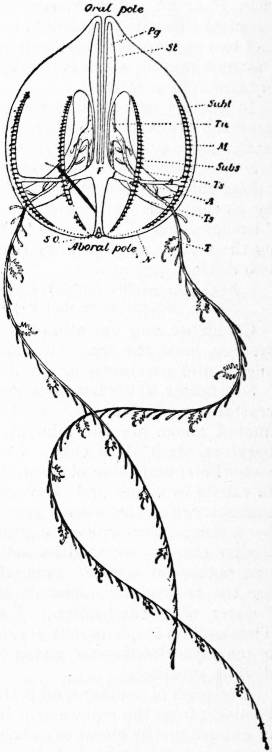
Fig. 1.—Schematic drawing of a Cydippid from the side. (After Chun.)
A, Adradial canals. F, Infundibulum. I, Interradial canal. M, Meridianal canal lying under a costa. N, Ciliated furrow from sense pole to costa. Pg, Paragastric canal. SO, Sense-organ. St, Stomodaeum. Subs, Subsagittal costa. Subt, Subtentacular costa. T, Tentacle. Ts, Boundaries of tentacle-sheath.
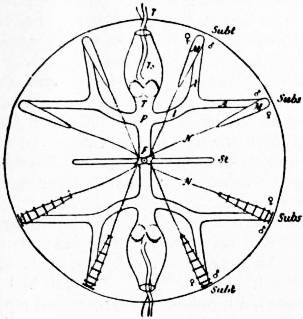
Fig. 2.—Schematic drawing of a Cydippid from the aboral pole. (After Chun.)
T (centrally), Tentacular canal, and (distally) tentacle. ♂, Position of testes. ♀, Position of ovaries; other letters in fig. 1. The stomodaeum lies in the sagittal plane, the funnel and tentacles in the transverse or tentacular plane.
CTENOPHORA, in zoology, a class of jelly-fish which were briefly described by Professor T. H. Huxley in 1875 (see Actinozoa, Ency. Brit. 9th ed. vol. i.) as united with what we now term Anthozoa to form the group Actinozoa; but little was known of the intimate structure of those remarkable and beautiful forms till the appearance in 1880 of C. Chun’s Monograph of the Ctenophora occurring in the Bay of Naples. They may be defined as Coelentera which exhibit both a radial and bilateral symmetry of organs; with a stomodaeum; with a mesenchyma which is partly gelatinous but partly cellular; with eight meridianal rows of vibratile paddles formed of long fused or matted cilia; lacking nematocysts (except in one genus). An example common on the British coasts is furnished by Hormiphora (Cydippe). In outward form this is an egg-shaped ball of clear jelly, having a mouth at the pointed (oral) pole, and a sense-organ at the broader (aboral) pole. It possesses eight meridians (costae) of iridescent paddles in constant vibration, which run from near one pole towards the other; it has also two pendent feathery tentacles of considerable length, which can be retracted into pouches. The mouth leads into an ectodermal stomodaeum (“stomach”), and the latter into an endodermal funnel (infundibulum); these two are compressed in planes at right angles to one another, the sectional long axis of the stomodaeum lying in the so-called sagittal (stomodaeal or gastric) plane, that of the funnel in the transverse (tentacular or funnel) plane. From the funnel, canals are given off in three directions; (a) a pair of paragastric (stomachal, or stomodaeal) canals run orally, parallel to the stomodaeum, and end blindly near the mouth; (b) a pair of perradial canals run in the transverse plane towards the equator of the animal; each of these becomes divided into two short canals at the base of the tentacle sheath which they supply, but has previously given off a pair of short interradial canals, which again bifurcate into two adradial canals; all these branches lie in the equatorial plane of the animal, but the eight adradial canals then open into eight meridianal canals which run orally and aborally under the costae; (c) a pair of aboral vessels which run towards the sense-organ, each of which bifurcates; of the four vessels thus formed, two only open at the sides of the sense-organ, forming the so-called excretory apertures. These three sets of structures, with the funnel from which they rise, make up the endodermal coelenteron, or gastro-vascular system. The generative organs are endodermal by origin, borne at the sides of the meridianal canals as indicated by the signs ♂ ♀. There exists a subepithelial plexus with nerve cells and fibres, similar to that of jelly-fishes. The sense-organ of the aboral pole is complex, and lies under a dome of fused cilia shaped like an inverted bell-jar; it consists of an otolith, formed of numerous calcareous spheroids, which is supported on four plates of fused cilia termed balancers, but is otherwise free. The ciliated ectoderm below the organ is markedly thickened, and perhaps functionally represents a nerve-ganglion: from it eight ciliated furrows radiate outwards, two passing under each balancer as through an archway, and diverge each to the head of a meridianal costa. These ciliated furrows stain deeply with osmic acid, and nervous impulses are certainly transmitted along them. Locomotion is effected by strokes of the paddles in an aboral direction, driving the animal mouth forwards through the water: each paddle or comb (Gr. κτείς; hence Ctenophora) consists of a plate of fused or matted cilia set transversely to the costa. The myoepithelial cells (formerly termed neuro-muscular cells), characteristic of other Coelentera, are not to be found in this group. On the other hand there are well-marked muscle fibres in definite layers, derived from special mesoblastic cells in the embryo, which are embedded in a jelly; these in their origin and arrangement are quite comparable to the mesoderm of Triploblastica, and, although the muscle-cells of some jelly-fish exhibit a somewhat similar condition, nothing so highly specialized as the mesenchyme of Ctenophora occurs in any other Coelenterate. The nematocysts being nearly absent from their group, their chief function is carried out by adhesive lasso-cells.
The Ctenophora are classified as follows:—
Sub-class i. Tentaculata, Order 1. Cydippidea, Hormiphora.
” 2. Lobata, Deiopea.
” 3. Cestoidea, Cestus.
” ii. Nuda, ” Beroë.
The Tentaculata, as the name implies, may be recognized by the presence of tentacles of some sort. The Cydippidea are generally spherical or ovoid, with two long retrusible pinnate tentacles: the meridianal and paragastric canals end blindly. An example of these has already been briefly described. The Lobata are of the same general type as the first Order, except for the presence of four circumoral auricles (processes of the subtransverse costae) and of a pair of sagittal outgrowths or lobes, on to which the subsagittal costae are continued. Small accessory tentacles lie in grooves, but there is no tentacular pouch; the meridianal vessels anastomose in the lobes. In the Cestoidea the body is compressed in the transverse plane, elongated in the sagittal plane, so as to become riband-like: the subtransverse costae are greatly reduced, the subsagittal costae extend along the aboral edge of the riband. The subsagittal canals lie immediately below their costae aborally, but continuations of the subtransverse canals round down the middle of the riband, and at its end unite, not only with the subsagittal but also with the paragastric canals which run along the oral edge of the riband. The tentacular bases and pouches are present, but there is no main tentacle as in Cydippidea; fine accessory tentacles lie in four grooves along the oral edge. The sub-class Nuda have no tentacles of any kind; they are conical or ovoid, with a capacious stomodaeum like the cavity of a thimble. There is a coelenteric network formed by anastomoses of the meridianal and paragastric canals all over the body.
The embryology of Callianira has been worked out by E. Mechnikov. Segmentation is complete and unequal, producing macromeres and micromeres marked by differences in the size and in yolk-contents. The micromeres give rise to the ectoderm; each of the sixteen macromeres, after budding off a small mesoblast cell, passes on as endoderm. A gastrula is established by a mixed process of embole and epibole. The mesoblast cells travel to the aboral pole of the embryo, and there form a cross-shaped mass, the arms of which lie in the sagittal and transverse planes (perradii).
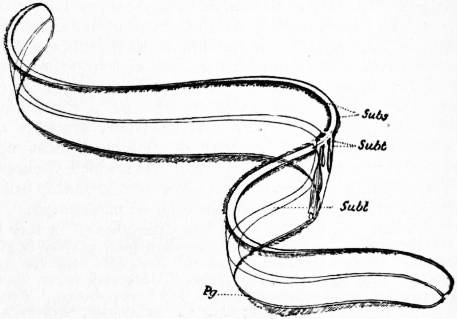
Fig. 3.—Schematic Drawing of Cestus. (After Chun.)
Subs, Subsagittal costae. Subt, Much reduced subtentacular costae. Subt, Branch of the subtentacular canal which runs along the centre of the riband. Pg, Continuation of the paragastric canal at right angles to its original direction along the lower edge of the riband. At the right-hand end the last two are seen to unite with the subsagittal canal.
There can be but little question of the propriety of including Ctenophora among the Coelentera. The undivided coelenteron (gastro-vascular system) which constitutes the sole cavity of the body, the largely radial symmetry, the presence of endodermal generative organs on the coelenteric canals, the subepithelial nerve-plexus, the mesogloea-like matrix of the body—all these features indicate affinity to other Coelentera, but, as has been stated in the article under that title, the relation is by no means close. At what period the Ctenophora branched off from the line of descent, which culminated in the Hydromedusae and Scyphozoa of to-day, is not clear, but it is practically certain that they did so before the point of divergence of these two groups from one another. The peculiar sense-organ, the specialization of the cilia into paddles with the corresponding modifications of the coelenteron, the anatomy and position of the tentacles, and, above all, the character and mode of formation of the mesenchyme, separate them widely from other Coelentera.
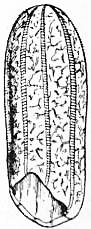
Fig. 4.—Schematic Drawing of Beröe. (After Chun.)
The last-named character, however, combined with the discovery of two remarkable organisms, Coeloplana and Ctenoplana, has suggested affinity to the flat-worms termed Turbellaria. Ctenoplana, the best known of these, has recently been redescribed by A. Willey (Quart. Journ. Micr. Sci. xxxix., 1896). It is flattened along the axis which unites sense-organ and mouth, so as to give it a dorsal (aboral) surface, and a ventral (oral) surface on which it frequently creeps. Its costae are very short, and retrusible; its two tentacles are pinnate and are also retrusible. Two crescentic rows of ciliated papillae lie in the transverse plane on each side of the sense-organ. The coelenteron exhibits six lobes, two of which Willey identifies with the stomodaeum of other Ctenophora; the other four give rise to a system of anastomosing canals such as are found in Beroë and Polyclad Turbellaria. An aboral vessel embraces the sense-organ, but has no external opening. Ctenoplana is obviously a Ctenophoran flattened and of a creeping habit. Coeloplana is of similar form and habit, with two Ctenophoran tentacles: it has no costae, but is uniformly ciliated. These two forms at least indicate a possible stepping-stone from Ctenophora to Turbellaria, that is to say, from diploblastic to triploblastic Metazoa. By themselves they would present no very weighty argument for this line of descent from two-layered to three-layered forms, but the coincidences which occur in the development of Ctenophora and Turbellaria,—the methods of segmentation and gastrulation, of the separation of the mesoblast cells, and of mesenchyme formation,—together with the marked similarity of the adult mesenchyme in the two groups, have led many to accept this pedigree. In his Monograph on the Polyclad Turbellaria of the Bay of Naples, A. Lang regards a Turbellarian, so to say, as a Ctenophora, in which the sensory pole has rotated forwards in the sagittal plane through 90° as regards the original oral-aboral axis, a rotation which actually occurs in the development of Thysanozoon (Müller’s larva); and he sees, in the eight lappets of the preoral ciliated ring of such a larva, the rudiments of the costal plates. According to his view, a simple early Turbellarian larva, such as that of Stylochus, most nearly represents for us to-day that ancestor from which Ctenophora and Turbellaria are alike derived. For details of this brilliant theory, the reader is referred to the original monograph.
Literature.—G. C. Bourne, “The Ctenophora,” in Ray Lankester’s Treatise on Zoology (1900), where a bibliography is given; G. Curreri, “Osservazioni sui ctenofori,” Boll. Soc. Zool. Ital. (2), i. pp. 190-193 et ii. pp. 58-76; A. Garbe, “Untersuchungen über die Entstehung der Geschlechtsorgane bei den Ctenophoren.,” Zeitschr. Wiss. Zool. lxix. pp. 472-491; K. C. Schneider, Lehrbuch der vergleich. Histologie (1902).
(G. H. Fo.)
CTESIAS, of Cnidus in Caria, Greek physician and historian, flourished in the 5th century B.C. In early life he was physician to Artaxerxes Mnemon, whom he accompanied (401) on his expedition against his brother Cyrus the Younger. Ctesias was the author of treatises on rivers, and on the Persian revenues, of an account of India (which is of value as recording the beliefs of the Persians about India), and of a history of Assyria and Persia in 23 books, called Persica, written in opposition to Herodotus in the Ionic dialect, and professedly founded on the Persian royal archives. The first six books treated of the history of Assyria and Babylon to the foundation of the Persian empire; the remaining seventeen went down to the year 398. Of the two histories we possess abridgments by Photius, and fragments are preserved in Athenaeus, Plutarch and especially Diodorus Siculus, whose second book is mainly from Ctesias. As to the worth of the Persica there has been much controversy, both in ancient and modern times. Being based upon Persian authorities, it was naturally looked upon with suspicion by the Greeks and censured as untrustworthy.
For an estimate of Ctesias as a historian see G. Rawlinson’s Herodotus, i. 71-74; also the edition of the fragments of the Persica by J. Giimore (1888, with introduction and notes and list of authorities).
CTESIPHON, a large village on the left bank of the Tigris, opposite to Seleucia, of which it formed a suburb, about 25 m. below Bagdad. It is first mentioned in the year 220 by Polybius v. 45. 4. When the Parthian Arsacids had conquered the lands east of the Euphrates in 129 B.C., they established their winter residence in Ctesiphon. They dared not stay in Seleucia, as this city, the most populous town of western Asia, always maintained her Greek self-government and a strong feeling of independence, which made her incline to the west whenever a Roman army attacked the Parthians. The Arsacids also were afraid of destroying the wealth and commerce of Seleucia, if they entered it with their large retinue of barbarian officials and soldiers (Strabo xvi. 743, Plin. vi. 122, cf. Joseph. Ant. xviii. 9, 2). From this time Ctesiphon increased in size, and many splendid buildings rose; it had the outward appearance of a large town, although it was by its constitution only a village. From A.D. 36-43 Seleucia was in rebellion against the Parthians till at last it was forced by King Vardanes to yield. It is very probable that Vardanes now tried to put Ctesiphon in its place; therefore he is called founder of Ctesiphon by Ammianus Marcellinus (xxiii. 6. 23), where King Pacorus (78-110) is said to have increased its inhabitants and built its walls. Seleucia was destroyed by the Romans in A.D. 164. When Ardashir I. founded the Sassanian empire (226), and fixed his residence at Ctesiphon, he built up Seleucia again under the name of Veh-Ardashir. Later kings added other suburbs; Chosroes I. in 540 established the inhabitants of Antiochia in Syria, whom he had led into captivity, in a new city, “Chosrau-Antioch” (or “the Roman city”) near his residence. Therefore the Arabs designate the whole complex of towns which lay together around Seleucia and Ctesiphon and formed the residence of the Sassanids by the name Madāin, “the cities,”—their number is often given as seven. In the wars between the Roman and Persian empires, Ctesiphon was more than once besieged and plundered, thus by Odaenathus in 261, and by Canis in 283; Julian in 363 advanced to Ctesiphon, but was not able to take it (Ammianus xxiv. 7). After the battle of Kadisiya (Qādisīya) Ctesiphon and the neighbouring towns were taken and plundered by the Arabs in 637, who brought home an immense amount of booty (see Caliphate). From then, these towns decayed before the increasing prosperity of the new Arab capitals Basra and Bagdad. The site is marked only by the ruins of one gigantic building of brick-work, called Takhti Khesra, “throne of Khosrau” (i.e. Chosroes). It is a great vaulted hall ornamented with pilasters, the remainder of the palace and the most splendid example of Sassanian architecture (see Architecture, vol. ii. p. 558, for further details and illustration). (Ed. M.)
CUBA (the aboriginal name), a republic, the largest and most populous of the West India Islands, included between the meridians of 74° 7′ and 84° 57′ W. longitude and (roughly) the parallels of 19° 48′ and 23° 13′ N. latitude. It divides the entrance to the Gulf of Mexico into two passages of nearly equal width,—the Strait of Florida, about 110 m. wide between Capes Hicacos in Cuba and Arenas in Florida (Key West being a little over 100 m. from Havana); and the Yucatan Channel, about 130 m. wide between Capes San Antonio and Catoche. On the N.E., E. and S.E., narrower channels separate it from the Bahamas, Haiti (50 m.) and Jamaica (85 m.). In 1908, by the opening of a railway along the Florida Keys, the time of passage by water between Cuba and the United States was reduced to a few hours.
The island is long and narrow, somewhat in the form of an irregular crescent, convex toward the N. It has a decided pitch to the S. Its length from Cape Maisí to Cape San Antonio along a medial line is about 730 m.; its breadth, which averages about 50 m., ranges from a maximum of 160 m. to a minimum of about 22 m. The total area is estimated at 41,634 sq. m. without the surrounding keys and the Isle of Pines (area about 1180 sq. m.), and including these is approximately 44,164. The geography of the island is still very imperfectly known, and all figures are approximate only. The coast line, including larger bays, but excluding reefs, islets, keys and all minute sinuosities, is about 2500 m. in length. The N. littoral is characterized by bluffs, which grow higher and higher toward the east, rising to 600 ft. at Cape Maisí. They are marked by distinct terraces. The southern coast near Cape Maisí is low and sandy. From Guantánamo to Santiago it rises in high escarpments, and W. of Santiago, where the Sierra Maestra runs close to the sea, there is a very high abrupt shore. To the W. of Manzanillo it sinks again, and throughout most of the remaining distance to Cape San Antonio is low, with a sandy or marshy littoral; at places sand hills fringe the shore; near Trinidad there are hills of considerable height; and the coast becomes high and rugged W. of Point Fisga, in the province of Pinar del Rio. On both the N. and the S. side of the island there are long chains of islets and reefs and coral keys (of which it is estimated there are 1300), which limit access to probably half of the coast, and on the N. render navigation difficult and dangerous. On the S. they are covered with mangroves. A large part of the southern littoral is subject to overflow, and much more of it is permanently marshy. The Zapata Swamp near Cienfuegos is 600 sq. m. in area; other large swamps are the Majaguillar, E. of Cárdenas, and the Ciénaga del Buey, S. of the Cauto river. The Isle of Pines in its northern part is hilly and wooded; in its southern part, very low, level and rather barren; a tidal swamp almost cuts the island in two. A remarkable feature of the Cuban coast is the number of excellent anchorages, roadsteads and harbours. On the N. shore, beginning at the W., Bahía Honda, Havana, Matanzas, Cardenas, Nuevitas and Nipe; and on the S. shore running westward Guantánamo, Santiago and Cienfuegos, are harbours of the first class, several of them among the best of the world. Mariel, Cabañas, Banes, Sagua la Grande and Baracoa on the N., and Manzanillo, Santa Cruz, Batabanó and Trinidad on the S. are also excellent ports or anchorages. The peculiar pouch-shape of almost all the harbours named (Matanzas being a marked exception) greatly increases their security and defensibility. These pouch harbours are probably “drowned” drainage basins. The number of small bays that can be utilized for coast trade traffic is extraordinary.
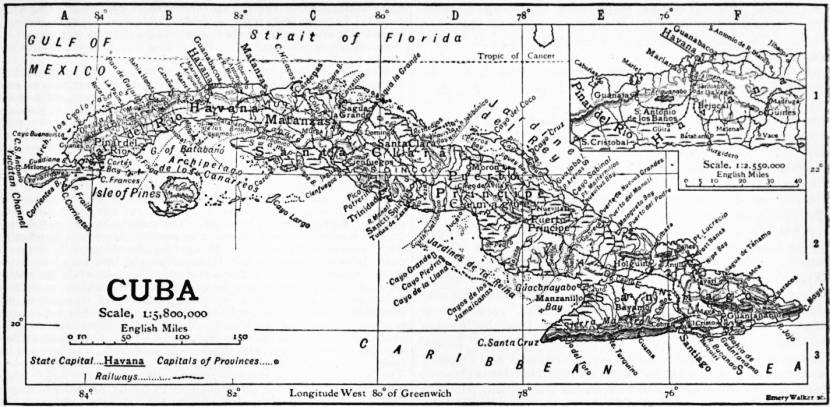
(Click to enlarge.)
In popular language the different portions of the island are distinguished as the Vuelta Abajo (“lower turn”), W. of Havana; the Vuelta Arriba (“upper turn”), E. of Havana to Cienfuegos—Vuelta Abajo and Vuelta Arriba are also used colloquially at any point in the island to mean “east” and “west”—Las Cinco Villas—i.e. Villa Clara, Trinidad, Remedios, Cienfuegos and Sancti Spiritus—between Cienfuegos and Sancti Spiritus; and Tierra Adentro, referring to the region between Cienfuegos and Bayamo. These names are extremely common. The province and city of Puerto Príncipe are officially known as Camagüey, their original Indian name, which has practically supplanted the Spanish name in local usage.
Five topographic divisions of the island are fairly marked. Santiago (now Oriente) province is high and mountainous. Camagüey is characterized by rolling, open plains, slightly broken, especially in the W., by low mountains. The E. part of Santa Clara province is decidedly rough and broken. The W. part, with the provinces of Matanzas and Havana, is flat and rolling, with occasional hills a few hundred feet high. Finally, Pinar del Rio is dominated by a prominent mountain range and by outlying piedmont hills and mesas. There are mountains in Cuba from one end of the island to the other, but they are not derived from any central mass and are not continuous. As just indicated there are three distinctively mountainous districts, various minor groups lying outside these. The three main systems are known in Cuba as the occidental, central and oriental. The first, the Organ mountains, in Pinar del Rio, rises in a sandy, marshy region near Cape San Antonio. The crest runs near the N. shore, leaving various flanking spurs and foothills, and a coastal plain which at its greatest breadth on the S. is some 20 m. wide. The plain on the N. is narrower and higher. The southern slope is smooth, and abounds in creeks and rivers. The portion of the southern plain between the bays of Cortés and Majana is the most famous portion of the Vuelta Abajo tobacco region. The mountain range is capriciously broken at points, especially near Bejucal. The highest part is the Pan de Guajaibón, near Bahía Honda, at the W. end of the chain; its altitude has been variously estimated from 2500 to 1950 ft. The central system has two wings, one approaching the N. coast, the other covering the island between Sancti Spiritus and Santa Clara. It comprehends a number of independent groups. The highest point, the Pico Potrerillo, is about 2900 ft. in altitude. The summits are generally well rounded, while the lower slopes are often steep. Frequent broad intervals of low upland or low level plain extend from sea to sea between and around the mountains. Near the coast runs a continuous belt of plantations, while grazing, tobacco and general farm lands cover the lower slopes of the hills, and virgin forests much of the uplands and mountains.
The oriental mountain region includes the province of Oriente and a portion of Camagüey. In extent, in altitude, in mass, in complexity and in geological interest, it is much the most important of the three systems. Almost all the mountains are very bold. They are imperfectly known. There are two main ranges, the Sierra Maestra, and a line of various groups along the N. shore. The former runs from Cape Santa Cruz eastward along the coast some 125 m. to beyond the river Baconao. The Sierra de Cobre, a part of the system in the vicinity of Santiago, has a general elevation of about 3000 ft. Monte Turquino, 7700-8320 ft. in altitude, is the highest peak of the island. Gran Piedra rises more than 5200 ft., the Ojo del Toro more than 3300, the Anvil de Baracoa is somewhat lower, and Pan de Matanzas is about 1267 ft. The western portions of the range rise abruptly from the ocean, forming a bold and beautiful coast. A multitude of ravines and gullies, filled with torrential streams or dry, according to the season of the year, and characterized by many beautiful cascades, seam the narrow coastal plain and the flanks of the mountains. The spurs of the central range are a highly intricate complex, covered with dense forests of superb woods. Many points are inaccessible, and the scenery is wild in the extreme. The mountains beyond Guantánamo are locally known by a variety of names, though topographically a continuation of the Sierra Maestra. The same is true of the chains that coalesce with these near Cape Maisí and diverge northwesterly along the N. coast of the island. The general character of this northern marginal system is much the same as that of the southern, save that the range is much less continuous. A dozen or more groups from Nipe in the E. to the coast N. of Camagüey in the W. are known only by individual names. The range near Baracoa is extremely wild and broken. The region between the lines of the two coastal systems is a much dissected plateau, imperfectly explored. The Cauto river, the only one flowing E. or W. and the largest of Cuba, flows through it westward to the southern coast near Manzanillo. The scenery in the oriental portion of the island is very beautiful, with wild mountains and tropical forests. In the central part there are extensive prairies. In the west there are swelling hills and gentle valleys, with the royal palm the dominating tree. The valley of the Yumurí, near Matanzas, a small circular basin crossed by a river that issues through a glen to the sea, is perhaps the most beautiful in Cuba.
A very peculiar feature of Cuba is the abundance of caverns in the limestone deposits that underlie much of the island’s surface. The caves of Cotilla near Havana, of Bellamar near Matanzas, of Monte Libano near Guantánamo, and those of San Juan de los Remedios, are the best known, but there are scores of others. Many streams are “disappearing,” part of their course being through underground tunnels. Thus the Rio San Antonio suddenly disappears near San Antonio de los Baños; the cascades of the Jatibónico del Norte disappear and reappear in a surprising manner; the Moa cascade (near Guantánamo) drops 300 ft. into a cavern and its waters later reissue from the earth; the Jojo river disappears in a great “sink” and later issues with violent current at the edge of the sea. The springs of fresh water that bubble up among the keys of the S. coast are also supposedly the outlets of underground streams.
The number of rivers is very great, but almost without exception their courses are normal to the coast, and they are so short as to be of but slight importance. The Cauto river in Oriente province is exceptional; it is 250 m. long, and navigable by small vessels for about 75 m. Inside the bar at its mouth (formed by a storm in 1616) ships of 200 tons can still ascend to Cauto. In Camagüey province the Jatibónico del Sur; in Oriente the Salado, a branch of the Cauto; in Santa Clara the Sagua la Grande (which is navigable for some 20 m. and has an important traffic), and the Damuji; in Matanzas, the Canimar; and in Pinar del Rio the Cuyaguateje, are important streams. The water-parting in the four central provinces is very indefinite. There are few river valleys that are noteworthy—those of the Yumurí, the Trinidad and the Güines. At Guantánamo and Trinidad are other valleys, and between Mariel and Havana is the fine valley of Ariguanabo. Of lakes, there are a few on the coast, and a very few in the mountains. The finest is Lake Ariguanabo, near Havana, 6 sq. m. in area. Of the almost innumerable river cascades, those of the Sierra Maestra Mountains, and in particular the Moa cascade, have already been mentioned. The Guamá cascade in Oriente province and the Hanabanilla Fall near Cienfuegos (each more than 300 ft. high), the Rosario Fall in Pinar del Rio, and the Almendares cascade near Havana, may also be mentioned.
Geology.—The foundation of the island is formed of metamorphic and igneous rocks, which appear in the Sierra Maestra and are exposed in other parts of the island wherever the comparatively thin covering of later beds has been worn away. A more or less continuous band of serpentine belonging to this series forms the principal watershed, although it nowhere rises to any great height. It is in this band that the greater part of the mineral wealth of Cuba is situated. These ancient rocks have hitherto yielded no fossils and their age is therefore uncertain, but they are probably pre-Cretaceous at least. Fossiliferous Cretaceous limestones containing Rudistes have been found in several parts of the island (Santiago de los Baños, Santa Clara province, &c.). At the base there is often an arkose, composed largely of fragments of serpentine and granite derived from the ancient floor. At Esperanza and other places in the Santa Clara province, bituminous plant-bearing beds occur beneath the Tertiary limestones, and at Baracoa a Radiolarian earth occupies a similar position. The latter, like the similar deposits in other West Indian islands, is probably of Oligocene age. It is the Tertiary limestones which form the predominant feature in the geology of Cuba. Although they do not exceed 1000 ft. in thickness, they probably at one time covered the whole island except the summits of the Sierra Maestra, where they have been observed, resting upon the older rocks, up to a height of 2300 ft. They contain corals, but are not coral reefs. The shells which have been found in them indicate that they belong for the most part to the Oligocene period. They are frequently very much disturbed and often strongly folded. Around the coast there is a raised shelf of limestone which was undoubtedly a coral reef. But it is of recent date and does not attain an elevation of more than 40 or 50 ft.
Minerals are fairly abundant in number, but few are present in sufficient quantity to be industrially important. Traditions of gold and silver, dating from the time of the Spanish conquest, still endure, but these metals are in fact extremely rare. Oriente province is distinctively the mineral province of the island. Large copper deposits of peculiar richness occur here in the Sierra de Cobre, near the city of Santiago; and both iron and manganese are abundant. Besides the deposits in Oriente province, iron is known to exist in considerable amount in Camagüey and Santa Clara, and copper in Camagüey and Pinar del Rio provinces. The iron ores mined at Daiquiri near Santiago are mainly rich hematites running above 60% of iron, with very little sulphur or phosphorus admixture. The copper deposits are mainly in well-marked fracture planes in serpentine; the ore is pyrrhotite, with or without chalcopyrite. Manganese occurs especially along the coast between Santiago and Manzanillo; the best ores run above 50%. Chromium and a number of other rare minerals are known to exist, but probably not in commercially available quantities. Bituminous products of every grade, from clear translucent oils resembling petroleum and refined naphtha, to lignite-like substances, occur in all parts of the island. Much of the bituminous deposits is on the dividing line between asphalt and coal. There is an endless amount of stone, very little of which is hard enough to be good for building material, the greatest part being a soft coralline limestone. The best buildings in Havana are constructed of a very rich white limestone, soft and readily worked when fresh, but hardening and slightly darkening with age. There are extensive and valuable deposits of beautiful marbles in the Isle of Pines, and lesser ones near Santiago. The Organ Mountains contain a hard blue limestone; and sandstones occur on the N. coast of Pinar del Rio province. Clays of all qualities and colours abound. Mineral waters, though not yet important in trade, are extremely abundant, and a score of places in Cuba and the Isle of Pines are already known as health resorts. Those near San Diego, Guanabacoa and Santa Maria del Rosario (near Havana) and Madruga (near Güines) are the best known.
The soil of the island is almost wholly of modern formation, mainly alluvial, with superficial limestones as another prominent feature. In the original formation of the island volcanic disturbances and coral growth played some part; but there are only very slight superficial evidences in the island of former volcanic activity. Noteworthy earthquakes are rare. They have been most common in Oriente province. Those of 1776, 1842 and 1852 were particularly destructive, and of earlier ones those of 1551 and 1624 at Bayamo and of 1578 and 1678 at Santiago. Every year there are seismic disturbances, and though Santiago is the point of most frequent visitation, they occur in all parts of the island, in 1880 affecting the entire western end. Notable seismic disturbances in Cuba have coincided with similar activity in Central America so often as to make some connexion apparent.
Flora.—The tropical heat and humidity of Cuba make possible a flora of splendid richness. All the characteristic species of the West Indies, the Central American and Mexican and southern Florida seaboard, and nearly all the large trees of the Mexican tropic belt, are embraced in it. As many as 3350 native flowering species were catalogued in 1876. The total number of species of the island flora was estimated in 1892 by a writer in the Revista Cubana (vol. xv. pp. 5-16) to be between 5000 and 6000, but hardly one-third of this number had then been gathered into a herbarium, and all parts of the island had not then been explored. It was estimated officially in 1904 that the wooded lands of the island comprised 3,628,434 acres, of which one-third were in Oriente province, another third in Camagüey, and hardly any in Havana province. Much of this area is of primeval forest; somewhat more than a third of the total, belonging to the government, was opened to sale (and speculative exspoliation) in 1904. The woods are so dense over large districts as to be impenetrable, except by cutting a path foot by foot through the close network of vines and undergrowth. The jagüey (Ficus sp.), which stifles in its giant coils the greatest trees of the forest, and the copei (Clusia rosea) are remarkable parasitic lianas. Of the palm there are more than thirty species. The royal palm is the most characteristic tree of Cuba. It attains a height of from 50 to 75 ft., and sometimes of more than 100 ft. Alone, or in groups, or in long aisles, towering above the plantations or its fellow trees of the forest, its beautiful crest dominates every landscape. Every portion, from its roots to its leaves, serves some useful purpose. From it the native draws lumber for his hut, utensils for his kitchen, thatch for his roof, medicines, preserved delicacies, and a long list of other articles. The corojo palm (Cocos crispa) rivals the royal palm in beauty and utility; oil, sugar, drink and wood are derived from it. The coco palm (Cocos nucifera) is also put to varied uses. The mango is planted with the royal palm along the avenues of the plantations. The beautiful ceiba (Bombax ceiba L., Ceiba pentandra) or silk cotton tree is the giant of the Cuban forests; it often grows to a height of 100 to 150 ft. with enormous girth. The royal piñon (Erythrina velatina) is remarkable for the magnificent purple flowers that cover it. The tamarind and banyan are also noteworthy. Utilitarian trees and plants are legion. There are at least forty choice cabinet and building woods. Of these, ebonies, mahogany (for the bird’s-eye variety such enormous prices are paid as $1200 to $1800 per thousand board-feet), cullá (or cuyá, Bumelia retusa), cocullo (cocuyo, Bumelia nigra), ocuje (Callophyllum viticifolia, Ornitrophis occidentalis, O. cominia), jigüe (jique, Lysiloma sabicu), mahagua (Hibiscus tiliaceus), granadillo (Brya ebenus), icaquillo (Licania incania) and agua-baría (Cordia gerascanthes) are perhaps the most beautiful. Other woods, beautiful and precious, include guayacan (Guaiacum sanctum), baría (varía, Cordia gerascanthoides)—the fragrant, hard-wood Spanish elm—the quiebra-hacha (Copaifera hymenofolia), which three are of wonderful lasting qualities; the jiquí (Malpighia obovata), acana (Achras disecta, Bassia albescens), caigarán (or caguairan, Hymenaea floribunda), and the dagame (Calicophyllum candidissimum), which four, like the cullá, are all wonderfully resistant to humidity; the caimatillo (Chrysophyllum oliviforme), the yaya (or yayajabico, yayabito: Erythalis fructicosa, Bocagea virgata, Guateria virgata, Asimina Blaini), a magnificent construction wood; the maboa (Cameraria latifolia) and the jocuma (jocum: Sideroxylon mastichodendron, Bumelia saticifolia), all of individual beauties and qualities. Many species are rich in gums and resins; the calambac, mastic, copal, cedar, &c. Many others are oleaginous, among them, peanuts, sun-flowers, the bene seed (sesame), corozo, almond and palmachristi. Others (in addition to some already mentioned) are medicinal; as the palms, calabash, manchineel, pepper, fustic and a long list of cathartics, caustics, emetics, astringents, febrifuges, vermifuges, diuretics and tonics. Then, too, there are various dyewoods; rosewood, logwood (or campeachy wood), indigo, manajú (Garcinia Morella), Brazil-wood and saffron. Textile plants are extremely common. The majagua tree grows as high as 40 ft.; from its bark is made cordage of the finest quality, which is scarcely affected by the atmosphere. Strong, fine, glossy fibres are yielded by the exotic ramie (Boehmeria nivea), whose fibre, like that of the majagua, is almost incorruptible; by the maya or rat-pineapple (Bromelia Pinguin), and by the daquilla (or daiguiya—Lagetta lintearia, L. valenzuelana), which like the maya yields a brilliant, flexible product like silk; stronger cordage by the corojo palms, and various henequén plants, native and exotic (especially Agave americana, A. Cubensis); and various plantains, the exotic Sansevieria guineensis, okra, jute, Laportea, various lianas, and a great variety of reeds, supply varied textile materials of the best quality. The yucca is a source of starch. For building and miscellaneous purposes, in addition to the rare woods above named, there are cedars (used in great quantities for cigar boxes); the pine, found only in the W., where it gives its name to the Isle of Pines and the province of Pinar del Rio; various palms; oaks of varying hardness and colour, &c. The number of alimentary plants is extremely great. Among economic plants should be mentioned the coffee, cacao, citron, cinnamon, cocoanut and rubber tree. Wheat, Indian corn and many vegetables, especially tuberous, are particularly important. Plantain occurs in several varieties; it is in part a cheap and healthful substitute for bread, which is also made from the bitter cassava, after the poison is extracted. The sweet cassava yields tapioca. Bread-trees are fairly common, but are little cared for. White and sweet potatoes, yams, sweet and bitter yuccas, sago and okra, may also be mentioned.
Fruits are varied and delicious. The pineapple is the most favoured by Cubans. Four or five annual crops grow from one plant, but not more than three can be marketed, unless locally, as the product deteriorates. The better (“purple”) varieties are mainly consumed in the island, and the smaller and less juicy “white” varieties exported. The tamarind is everywhere. Bananas are grown particularly in the region about Nipe, Gibara and Baracoa, whence they are exported in large quantities, though there is a tendency to lessen their culture in these parts in favour of sugar. Mangoes, though exotic, are extremely common, and in the E. grow wild in the forests. They are the favourite fruit of the negroes. Oranges are little cultivated, although they offer apparently almost unlimited possibilities; their culture decreased steadily after 1880, but after about 1900 was again greatly extended. Lemons yield continuously through the year, but like oranges, not much has yet been done with them commercially. Pomegranates are as universally used in Cuba as apples in the United. States. Figs and grapes degenerate in Cuba. Dates grow better, but nothing has been done with them. The coco-nut palm is most abundant in the vicinity of Baracoa. Among the common fruits are various anonas—the custard apple (Anona cherimolia), sweet-sop (A. squamosa), sour-sop (A. muricata), mamón (A. reticulata), and others,—the star-apple (Chrysophyllum cainito, C. pomiferum), rose-apple (Eugenia jambos), pawpaw, the sapodilla (Sapota achras), the caniste (Sapota Elongata), jagua (Genipa americana), alligator pear (Persea gratissima), the yellow mammee (Mammea americana) and so-called “red mammee” (Lucuma mammosa) and limes.
Fauna.—The fauna of Cuba, like the flora, is still imperfectly known. Collectively it shows long isolation from the other Antilles. Only two land mammals are known to be indigenous. One is the hutía (agouti) or Cuban rat, of which three species are known (Capromys Fournieri, C. melanurus and C. Poey). It lives in the most solitary woods, especially in the eastern hills. The other is a peculiar insectivore (Solenodon paradoxus), the only other representatives of whose family are found in Madagascar. Various animals, apparently indigenous, that are described by the early historians of the conquest, have disappeared. An Antillean rabbit is very abundant. Bats in prodigious numbers, and some of them of extraordinary size, inhabit the many caves of the island; more than twenty species are known. Rats and mice, especially the guayabita (Mus musculus), an extremely destructive rodent, are very abundant. The manatee, or sea-cow, frequents the mouths of rivers, the sargasso drifts, and the regions of submarine fresh-water springs off the coast. Horses, asses, cows, deer, sheep, goats, swine, cats and dogs were introduced by the early Spaniards. The last three are common in a wild state. Deer are not native, and are very rare; a few live in the swamps.
Of birds there are more than 200 indigenous species, it is said, and migratory species are also numerous. Waders are represented by more than fifty species. Vultures are represented by only one species, the turkey buzzard, which is the universal scavenger of the fields, and until recent years even of the cities, and has always been protected by custom and the Laws of the Indies. Falcons are represented by a score of species, at least, several of them nocturnal. Kestrels are common. The gallinaceous order is rich in Columbidae. Trumpeters are notably represented, and climbers still more so. Among the latter are species of curious habits and remarkable colouring. Woodpeckers (Coloptes auratus), macaws, parrakeets and other small parrots, and trogons, these last of beautifully resplendent plumage, deserve particular mention. The Cuban mocking-bird is a wonderful songster. Of humming-birds there are said to be sixty species, probably only one indigenous. Of the other birds mere mention may be made of the wild pigeon, raven, indigo-bird, English lady-bird and linnet.
Reptiles are numerous. Many tortoises are notable. The crocodile and cayman occur in the swampy littoral of the south. Of lizards the iguana (Cyclura caudata) is noteworthy. Chameleons are common. Snakes are not numerous, and it is said that none is poisonous or vicious. There is one enormous boa, the maja (Epicrates angulifer), which feeds on pigs, goats and the like, but does not molest man.
Fishes are present in even greater variety than birds. Felipa Poey, in his Ictiologia Cubana, listed 782 species of fish and crustaceans, of which 105 were doubtful; but more than one-half of the remainder were first described by Poey. The fish of Cuban waters are remarkable for their metallic colourings. The largest species are found off the northern coast. Food fishes are relatively not abundant, presumably because the deep sea escarpments of the N. are unfavourable to their life. Shell fish are unimportant. Two species of blind fish, of extreme scientific interest, are found in the caves of the island. Of the “percoideos” there are many genera. Among the most important are the robalo (Labrax), an exquisite food fish, the tunny, eel, Spanish sardine and mangua. Of the sharks the genus Squalus is represented by individuals that grow to a length of 26 to 30 ft. The hammer-head attains a weight at times of 600 ℔. The saw-fish is common. Of fresh-water fish the lisa, dogro, guayácón and viajocos (Chromis fuscomaculatus) are possibly the most noteworthy.
Molluscs are extraordinarily numerous; and many, both of water and land, are rarities among their kind for size and richness of colour. Of crustaceans, land-crabs are remarkable for size and number. Arachnids are prodigiously numerous. Insect life is abundant and beautiful. The bite of the scorpion and of the numerous spiders produces no serious effects. The nigua, the Cuban jigger, is a pest of serious consequence, and the mal de nigua (jigger sickness) sometimes causes the death of lower animals and men. Sand-flies and biting gnats are lesser nuisances. Lepidoptera are very brilliant in colouring. The cucujo or Cuban firefly (Pyrophorus noctilucus) gives out so strong a light that a few of them serve effectively as a lantern. The Stegomyia mosquito is the agent of yellow fever inoculation. Sponges grow in great variety.