VOLUME VII SLICE VII Crocoite to Cuba (continued 4)
Reading edition
Coming now to what may be literally considered crows, our attention is mainly directed to the black or carrion-crow (Corvus corone) and the grey, hooded or Royston crow (C. cornix). Both these inhabit Europe, but their range and the time of their appearance are very different. The former is, speaking generally, a summer visitant to the south-western part of Europe, and the latter occupies the north-eastern portion—an irregular line drawn diagonally from about the Firth of Clyde to the head of the Adriatic roughly marking their respective distribution. But both are essentially migrants, and hence it follows that when the black crow, as summer comes to an end, retires southward, the grey crow moves downward, and in many districts replaces it during winter. Further than this, it has been incontestably proved that along or near the boundary where these two birds march they not infrequently interbreed, and it is believed that the hybrids, which sometimes wholly resemble one or other of the parents and at other times assume an intermediate plumage, pair indiscriminately among themselves or with the pure stock. Hence it has seemed to many ornithologists who have studied the subject, that these two birds, so long unhesitatingly regarded as distinct species, are only local races of one and the same dimorphic species. No structural difference—or indeed any difference except that of range (already spoken of) and colour—can be detected, and the problem they offer is one of which the solution is exceedingly interesting if not important to zoologists in general.1 Almost omnivorous in their diet, there is little edible that comes amiss to them, and, except in South America, they are mostly omnipresent. The fish-crow of North America (C. ossifragus) demands a few words, since it betrays a taste for maritime habits beyond that of other species, but the crows of Europe are not averse on occasion to prey cast up by the waters. The house-crow of India (C. splendens) is not very nearly allied to its European namesakes, from which it can be readily distinguished by its smaller size and the lustrous tints of its darkest feathers; while its confidence in the human race has been so long encouraged by its intercourse with an unarmed and inoffensive population that it becomes a plague to the European abiding or travelling where it is abundant. Hardly a station or camp in British India is free from a crowd of feathered followers of this species, ready to dispute with the kites and the cooks the very meat at the fire.
(A. N.)
1 As bearing upon this question may be mentioned the fact that the crow of Australia (C. australis) is divisible into two forms or races, one having the irides white, the other of a dark colour. It is stated that they keep apart and do not intermix.
CROWBERRY, or Crakeberry, the English name for a low-growing heath-like shrub, found on heaths and rocks in Scotland, Ireland and mountainous parts of England. It is known botanically as Empetrum nigrum, and has slender, wiry, spreading branches covered with short, narrow, stiff leaves, the margins of which are recurved so as to form a hollow cylinder concealing the hairy under face of the leaf—a device to avoid excessive loss of water from the leaf under the exposed conditions in which the plant grows. The minute flowers are succeeded by black, edible, berry-like fruits, one-fourth to one-third of an inch in diameter. The plant has a wide distribution, occurring in suitable localities throughout the north temperate zone, and on the Andes of South America.
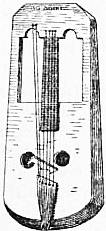
Fig. 1.—Welsh Crwth, 18th century.
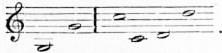
CROWD, Crouth, Crowth (Welsh crwth; Fr. crout; Ger. Chrotta, Hrotta), a medieval stringed instrument derived from the lyre, characterized by a sound-chest having a vaulted back and an open space left at each side of the strings to allow the hand to pass through in order to stop the strings on the finger-board. The Welsh crwth, which survived until the end of the 18th century, is best represented by a specimen of that date preserved in the Victoria and Albert Museum, and described and illustrated by Carl Engel.1 The instrument consists of a rectangular sound-chest 22 in. long, 9½ in. wide and 2 in. deep; the body is scooped out of a single block, the flat belly being glued on. Right through the sound-chest on each side of the finger-board is the characteristic open space left for the hand to pass through. There are two circular sound-holes; the left foot of the flat bridge, which lies obliquely across the belly, passes through the left sound-hole and rests inside on the back of the instrument. Six catgut strings fastened to a tail-piece are wound round pegs at the top of the crwth; four of these strings lie over the sound-board and bridge, and are set in vibration by means of a bow, while the two others, used as drones and stretched across the left-hand aperture, are twanged by the thumb of the left hand. The shape and shallowness of the bridge make it impossible to sound a single string with the bow; the arrangement of the strings suggests that they were intended to be sounded in pairs. The instrument is tuned thus:
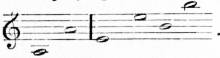
At the beginning of the 19th century, William Bingley2 heard a Welsh peasant playing national airs on a crwth strung as follows:—. Sir John Hawkins3 relates that in his time there was still a Welshman living in Anglesea who understood how to play the crwth according to traditional usage. Edward Jones4 and Daines Barrington5 both give an account of the Welsh crwth of the 18th century which agrees substantially with Engel’s; the illustration communicated by Daines Barrington shows the strings of the crwth drawn through holes at the top, and fastened on the back, as on the Persian rebab and other Oriental stringed instruments. On these somewhat scanty authentic records of the instrument, several historians of music have based an illogical claim that the crwth, or rather chrotta or rotta, mentioned by Venantius Fortunatus as a British instrument, was the Welsh crwth as it was known in the 18th century, and was the earliest bowed instrument, and therefore the ancestor of the violin. The lines of Fortunatus, who was bishop of Poictiers during the second half of the 6th century, ran thus:—6
“Romanusque lyra, plaudat tibi Barbarus harpa, Graecus Achilliaca, chrotta Britanna canat.”
The bow is not mentioned by Fortunatus, and there is no ground whatever for believing that the Welsh crwth was played with a bow in the 6th century, or indeed for several centuries after. The stringing of the Welsh crwth with the two drone strings still twanged, the form of the body without incurvations, the flat bridge which rendered bowing, even in the most highly developed specimens of the 18th century, a difficult task, together with what is known of the early history of the chrotta and rotta derived from the lyre and cithara and like them twanged by fingers or plectrum, all make the claim untenable. Carl Engel was probably the first to expose the fallacy in his work on the violin.7
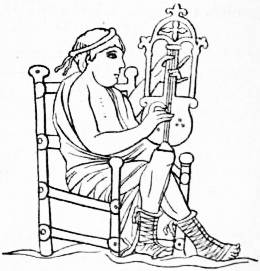
Drawn from a plate in Auguste de Bastard’s Peintures et ornements de la bible de Charles le Chauve.
Fig. 2.—Early Crwth, 9th century.
British lexicographers all agree in deriving the words crwth, crowd and other forms of the name, from some word meaning a bulging protuberant bellying form, while in German the etymology of the word Chrotta is given as Chrota or Chreta, the O.H.G. for Kröte = toad, Schildkröte = tortoise. This word Chrotta was undoubtedly the German equivalent term for the lyre of Hermes, having as back a tortoise-shell, χέλυς in Greek and testudo in Latin. Chrotta was also spelt hrotta, and it is easy to see how this became rotta. A thoughtful and suggestive treatment of the whole subject will be found in Engel’s work, to which reference has been made. Just as the lyre and cithara, which appeared to be similar to the casual observer, and are indeed still confused at the present day, were instruments differing essentially in construction8; so there were, during the early middle ages, while lyre and cithara were still in transition, two types of chrotta or rotta. (1) The rotta or improved cithara had a body either rectangular with the corners rounded, or guitar-shaped with incurvations, back and sound-board being nearly or quite flat, joined as in the cithara by ribs or sides. This rotta must be reckoned among the early ancestors of the violin before the advent of the bow; it was known both as rotta and cithara, and with a neck added it became the guitar-fiddle. (2) The tortoise or lyre chrotta consisted of a protuberant, very convex back cut out of a block of wood, to which was glued a flat sound-board, at first like the lyre, without intermediary ribs. This instrument became the crwth, and there was no further development. The first step in the transition of both lyre and cithara was the incorporation of arms and cross-bar into the body, the same outline being preserved; the second step was the addition of a finger-board against which the strings were stopped, thus increasing the compass while restricting the number of strings to three or four; the third step, observed only in the rotta-cithara, consisted in the addition of a neck,9 as in the guitar. The crwth, crowd, crouth did not undergo this third transition even when the bow was used to set the strings in vibration.
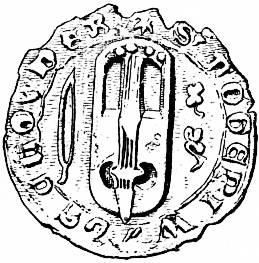
Fig. 3.—Crowd on a 14th-century Seal.
The earliest representation of the crwth yet discovered dates from the Carolingian period. In the miniatures of the Bible of Charles the Bald,10 in the Bibliothèque Nationale, Paris, one of the musicians of King David is seen stopping strings on the finger-board with his left hand and plucking them with the right (fig. 2); this crwth has only three strings, and may be the crwth trîthant of Wales. A second example occurs in the Bible of St Paul,11 another of the magnificent MSS. prepared for Charles the Bald, and preserved during the middle ages in the monastery of St Paul extra muros in Rome (now deposited in that of St Calixtus in Rome). Other representations are in the miniatures of the 11th, 12th and 13th centuries. To Edward Heron-Allen (De fidiculis opuscula, viii., 1895) is due the discovery of a representation of the Welsh crwth, showing the form still retained in the 18th cent. On the seal of Roger Wade (1316) is a crwth differing but little from the specimen in the Victoria and Albert Museum. The 14th-century instrument had four strings instead of six, and the foot of the bridge does not appear to pass through the sound-hole—a detail which may have escaped the notice of the artist who cut the seal. The original seal lies in the muniment room at Berkeley Castle in Gloucestershire attached to a defeasance of a bond between the crowder and his debtor Warren de l’Isle, and a cast (see fig. 3) is preserved at the British Museum. The British Museum also possesses two interesting MSS. which concern the crwth: one of these (Add. MS. 14939 ff. 4 and 27) contains an extract made by Lewis Morris in 1742 from an ancient Welsh MS. of “Instructions supposed to be wrote for the Crowd”; the other (Add. MS. 15036 ff. 65b and 66) consists of tracings from a 16th-century Welsh MS. copied in 1610 of a bagpipe, a harp and a krythe, together with the names of those who played the last at the Eisteddfod. The drawing is crude, and shows an instrument similar to Roger Wade’s crowd, but having three strings instead of four.
The genealogical tree of the violin given below shows the relative positions of both kinds of rotta and chrotta.
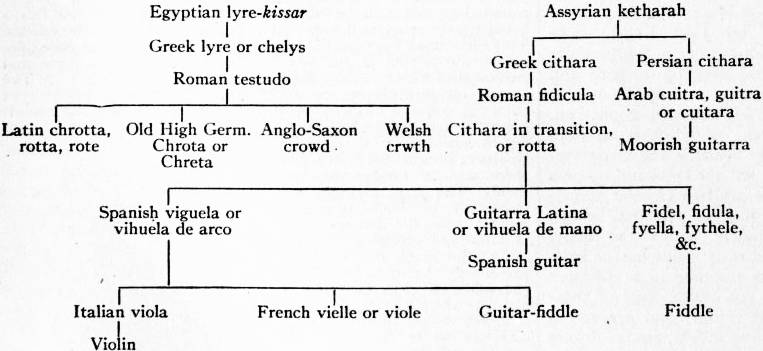
The Welsh crwth was therefore obviously not an exclusively Welsh instrument, but only a late 18th-century survival in Wales of an archaic instrument once generally popular in Europe but long obsolete. An interesting article on the subject in German by J. F. W. Wewertem will be found in Monatshefte für Musik (Berlin, 1881), Nos. 7-12, p. 151, &c.
(K. S.)
1 See Early History of the Violin Family (London, 1883), pp. 24-36.
2 See A Tour round North Wales (London, 1804), vol. ii. p. 332.
3 History of Music (London, 1766), vol. ii. bk. iii. ch. iii., description and illustration.
4 Musical and Poetical Relicks of Welsh Bards (London, 1794), illustration of crwth, also reproduced by Carl Engel; see note above.
5 Archaeologia, vol. iii. (London, 1775).
6 Venantius Fortunatus, Poëmata, lib. vii. cap. 8, p. 245; see Migne’s Patrologia Sacra, vol. 88.
7 Op. cit. chapters “Crwth,” “Chrotta,” “Rotta.”
8 See Kathleen Schlesinger, Orchestral Instruments, part ii., “The Precursors of the Violin Family” (London, 1909), pp. 14 to 23, with illustrations.
9 See also Kathleen Schlesinger, op. cit. ch. vii., “The Cithara in Transition,” pp. 111-135 with illustrations.
10 See Auguste de Bastard, Peintures et ornements des MSS. de France, and Peintures, ornements, &c., de la bible de Charles le Chauve, in facsimile (Paris, 1883).
11 See J. O. Westwood, Photographic Facsimile of the Bible of St Paul (London, 1876).
CROWE, EYRE EVANS (1799-1868), English journalist and historian, was born about the year 1799. He commenced his work as a writer for the London newspaper press in connexion with the Morning Chronicle, and he afterwards became a leading contributor to the Examiner and the Daily News. Of the latter journal he was principal editor for some time previous to his death. The department he specially cultivated was that of continental history and foreign politics. He published Lives of Foreign Statesmen (1830), The Greek and the Turk (1853), and Reigns of Louis XVIII. and Charles X. (1854). These were followed by his most important work, the History of France (5 vols., 1858-1868). It was founded upon original sources, in order to consult which the author resided for a considerable time in Paris. He died in London on the 25th of February 1868.
CROWE, SIR JOSEPH ARCHER (1828-1896), English consular official and art critic, son of Eyre Crowe, was born in London on the 25th of October 1828. At an early age he showed considerable aptitude for painting and entered the studio of Delaroche in Paris, where his father was correspondent of the Morning Chronicle. During the Crimean War he was the correspondent of the Illustrated London News, and during the Austro-Italian War represented The Times in Vienna. He was British consul-general in Leipzig from 1860 to 1872, and in Düsseldorf from 1872 to 1880, when he was appointed commercial attaché in Berlin, being transferred in a like capacity to Paris in 1882. In 1883 he was secretary to the Danube Conference in London; in 1889 plenipotentiary at the Samoa Conference in Berlin; and in 1890 British envoy at the Telegraph Congress in Paris, in which year he was made K.C.M.G. During a sojourn in Italy, 1846-1847, he cemented a lifelong friendship with the Italian critic Giovanni Battista Cavalcaselle (1820-1897), and together they produced several historical works on art of classic importance, notably Early Flemish Painters (London, 1857); A New History of Painting in Italy from the Second to the Sixteenth Century (London, 1864-1871, 5 vols.). In 1895 Crowe published Reminiscences of Thirty-Five Years of My Life. He died at Schloss Gamburg in Bavaria on the 6th of September 1896.
Crowe and Cavalcaselle’s great History of Painting was under revision by Crowe up to the time of his death, and then by S. A. Strong (d. 1904) and Langton Douglas, who in 1903 brought out vols. i. and ii. of Murray’s new six-volume edition, the 3rd vol., edited by Langton Douglas, appearing in 1909. A reprint of the original edition, brought up to date by annotations by Edward Huttons, was published by Dent in 3 vols. in 1909.
CROW INDIANS, or Absarokas (the name for a species of hawk), a tribe of North American Indians of Siouan stock. They are now settled to the number of some 1800 on a reservation in southern Montana to the south of the Yellowstone river. Their original range included this reservation and extended eastward and southward, and no part of the country for hundreds of miles around was safe from their raids. They have ever been known as marauders and horse-stealers, and, though they have generally been cunning enough to avoid open war with the whites, they have robbed them whenever opportunity served. Physically they are tall and athletic, with very dark complexions.
CROWLAND, or Croyland, a market-town in the S. Kesteven or Stamford parliamentary division of Lincolnshire, England; in a low fen district on the river Welland, 8 m. N.E. of Peterborough, and 4 m. from Postland station on the March-Spalding line of the Great Northern and Great Eastern railways, and Peakirk on the Great Northern. Pop. (1901) 2747. A monastery was founded here in 716 by King Æthelbald, in honour of St Guthlac of Mercia (d. 714), a young nobleman who became a hermit and lived here, and, it was said, had foretold Æthelbald’s accession to the throne. The site of St Guthlac’s cell, not far from the abbey, is known as Anchor (anchorite’s) Church Hill. After the abbey had suffered from the Danish incursions in 870, and had been burnt in that year and in 1091, a fine Norman abbey was raised in 1113. Remains of this building appear in the ruined nave and tower arch, but the most splendid fragment is the west front, of Early English date, with Perpendicular restoration. The west tower is principally in this style. The north aisle is restored and used as the parish church. Among the abbots was Ingulphus (1085-1109), to whom was formerly attributed the Historia Monasterii Croylandensis. A curious triangular bridge remains, apparently of the 14th century, but referred originally to the middle of the 9th century, which spanned three streams now covered, and affords three footways which meet at an apex in the middle.
The town of Crowland grew up round the abbey. By a charter dated 716, Æthelbald granted the isle of Crowland, free from all secular services, to the abbey with a gift of money, and leave to build and enclose the town. The privileges thus obtained were confirmed by numerous royal charters extending over a period of nearly 800 years. Under Abbot Ægelric the fens were tilled, the monastery grew rich, and the town increased in size, enormous tracts of land being held by the abbey at the Domesday Survey. The town was nearly destroyed by fire (1469-1476), but the abbey tenants were given money to rebuild it. By virtue of his office the abbot had a seat in parliament, but the town was never a parliamentary borough. Abbot Ralph Mershe in 1257 obtained a grant of a market every Wednesday, confirmed by Henry IV. in 1421, but it was afterwards moved to Thorney. The annual fair of St Bartholomew, which originally lasted twelve days, was first mentioned in Henry III.’s confirmatory charter of 1227. The dissolution of the monastery in 1539 was fatal to the progress of the town, which had prospered under the thrifty rule of the monks, and it rapidly sank into the position of an unimportant village. The abbey lands were granted by Edward VI. to Lord Clinton, from whose family they passed in 1671 to the Orby family. The inhabitants formerly carried on considerable trade in fish and wild fowl.
See R. Gough, History and Antiquities of Croyland (Bibl. Top. Brit. iii. No. 11) (London, 1783); W. G. Searle, Ingulf and the Historia Croylandensis (Camb. Antiq. Soc., No. 27); Dugdale, Monasticon, ii. 91 (London, 1846; Cambridge, 1894).
CROWLEY, ROBERT (1518?-1588), English religious and social reformer, was born in Gloucestershire, and educated at Magdalen College, Oxford, of which he was successively demy and fellow. Coming to London, he set up a printing-office in Ely Rents, Holborn, where he printed many of his own writings. As a typographer, his most notable production was an edition of Pierce Plowman in 1550, and some of the earliest Welsh printed books came from his press. As an author, his first venture seems to have been his “Information and Petition against the Oppressors of the poor Commons of this realm,” which internal evidence shows to have been addressed to the parliament of 1547. It contains a vigorous plea for a further religious reformation, but is more remarkable for its attack on the “more than Turkish tyranny” of the landlords and capitalists of that day. While repudiating communism, Crowley was a Christian Socialist, and warmly approved the efforts of Protector Somerset to stop enclosures. In his Way to Wealth, published in 1550, he laments the failure of the Protector’s policy, and attributes it to the organized resistance of the richer classes. In the same year he published (in verse) The Voice of the last Trumpet blown by the seventh Angel; it is a rebuke in twelve “lessons” to twelve different classes of people; and a similar production was his One-and-Thirty Epigrams (1550). These, with Pleasure and Pain (1551), were edited for the Early English Text Society in 1872 (Extra Ser. xv.). The dozen or more other works which Crowley published are more distinctly theological: indeed, the failure of the temporal policy he advocated seems to have led Crowley to take orders, and he was ordained deacon by Ridley on the 29th of September 1551. During Mary’s reign he was among the exiles at Frankfort. At Elizabeth’s accession he became a popular preacher, was made archdeacon of Hereford in 1559, and prebendary of St Paul’s in 1563, and was incumbent first of St Peter’s the Poor in London, and then of St Giles’ without Cripplegate. He refused to minister in the “conjuring garments of popery,” and in 1566 was deprived and imprisoned for resisting the use of the surplice by his choir. He stated his case in “A brief Discourse against the Outward Apparel and Ministering Garments of the Popish Church,” a tract “memorable,” says Canon Dixon, “as the first distinct utterance of Nonconformity.” He continued to preach occasionally, and in 1576 was presented to the living of St Lawrence Jewry. Nor had he abandoned his connexion with the book trade, and in 1578 he was admitted a freeman of the Stationers’ Company. He died on the 18th of June 1588, and was buried in St Giles’. The most important of his works not hitherto mentioned is his continuation of Languet and Cooper’s Epitome of Chronicles (1559).
See J. M. Cowper’s Pref. to the Select Works of Crowley (1872); Strype’s Works; Gough’s General Index to Parker Soc. Publ.; Machyn’s Diary; Macray’s Reg. Magdalen College; Newcourt’s Rep. Eccles. Lond.; Hennessy’s Nov. Rep. Eccl. (1898); Le Neve’s Fasti Eccl. Angl.; Pocock’s Burnet; Pollard’s England under Somerset; R. W. Dixon’s Church History.
(A. F. P.)
CROWN, an English silver coin of the value of five shillings, hence often used to express the sum of five shillings. It was originally of gold and was first coined in the reign of Henry VIII. Edward VI. introduced silver crowns and half-crowns, and down to the reign of Charles II. crowns and half-crowns and sometimes double crowns were struck both in gold and silver. In the reign of Edward VI. also was introduced the practice of dating coins and marking them with their current value. The “Oxford crown” struck in the reign of Charles I. was designed by Rawlins (see Numismatics: Medieval). Since the reign of Charles II. the crown has been struck in silver only. At one time during the 19th century it was proposed to abandon the issue of the crown, and from 1861 until 1887 none was struck, but since the second issue in 1887 it has been freely in circulation again.
CROWN and CORONET, an official or symbolical ornament worn on or round the head. The crown (Lat. corona) at first had no regal significance. It was a garland, or wreath, of leaves or flowers, conferred on the winners in the athletic games. Afterwards it was often made of gold, and among the Romans was bestowed as a recognition of honourable service performed or distinction won, and on occasion it took such a form as to correspond with, or indicate the character of, the service rendered. The corona obsidionalis was formed of grass and flowers plucked on the spot and given to the general who conquered a city. The corona civica, made of oak leaves with acorns, was bestowed on the soldier who in battle saved the life of a Roman citizen. The mural crown (corona muralis) was the decoration of the soldier who was the first to scale the walls of a besieged city, and was usually a circlet of gold adorned with a series of turrets. The naval crown (corona navalis), decorated in like manner with a series of miniature prows of ships, was the reward of him who gained a notable victory at sea. These latter crowns form charges in English heraldry (see Heraldry).
Many other forms of crown were used by the Romans, as the conqueror’s triumphal crown of laurel, the myrtle crown, and the convivial, bridal, funeral and other crowns. Some of the emperors wore crowns on occasion, as Caligula and Domitian, at the games, and stellate or spike crowns are depicted on the heads of several of the emperors on their coins, but no idea of imperial sovereignty was indicated thereby. The Roman people, who had accepted imperial rule as a fact, were very jealous of the employment of its emblem on the part of their rulers. That emblem was the diadem, and although the diadem and crown are frequently confused with each other they were quite distinct, and it is well to bear this in mind. The diadem, which was of eastern origin, was a fillet or band of linen or silk, richly embroidered, and was worn tied round the forehead. Selden (Titles of Honour, chap. viii. sect. 8) says that the diadem and crown “have been from ancient times confounded, yet the diadem strictly was a very different thing from what a crown now is or was, and it was no other then than only a fillet of silk, linen, or some such thing.” It is desirable to remember the distinction, for, although diadem and crown are now used as synonymous terms, the two were originally quite distinct. The confusion between them has, perhaps, come about from the fact that the modern crown seems to be rather an evolution from the diadem than the lineal descendant of the older crowns. The linen or silk diadem was eventually exchanged for a flexible band of gold, which was worn in its place round the forehead. The further development of the crown from this was readily effected by the addition of an upper row of ornament. Thus the medieval and modern crowns may be considered as radiated diadems, and so the diadem and crown have become, as it were, merged in one another.
Among the historical crowns of Europe, the Iron Crown of Lombardy, now preserved at Monza, claims notice. It is a band of iron, enclosed in a circlet formed of six plates of gold, hinged one to the other, and richly jewelled and enamelled. It is regarded with great reverence, owing to a legend that the inner band of iron has been hammered out of one of the nails of the true cross. The crown is so small, the diameter being only 6 in., and the circlet only 2½ in. in width, that doubts have been felt as to whether it was originally intended to be worn on the head or was merely meant to be a votive crown. The legend as to the iron being that of one of the nails of the cross is rejected by Muratori and others, and cannot be traced far back. How it arose or how any credence came to be reposed in the legend, it is difficult to surmise. Another historical crown is that of Charlemagne, preserved at Vienna. It is composed of a series of four larger and four smaller plaques of gold, rounded at the tops and set together alternately. The larger plaques are richly ornamented with emeralds and sapphires, and the smaller plaques have each an enamelled figure of Our Lord, David, Solomon, and Hezekiah respectively. A jewelled cross rises from the large front plaque, and an arch bearing the name of the emperor Conrad springs across from the back of this cross to the back of the crown.
At Madrid there is preserved the crown of Svintilla, king of the Visigoths, 621-631. It is a circlet of thick gold set with pearls, sapphires and other stones. It has been given as a votive offering at some period to a church, as was often the custom. Attached to its upper rim are the chains whereby to suspend it, and from the lower rim hang letters of red-coloured glass or paste which read +svintilanvs rex offeret. Two other Visigothic crowns are also preserved with it in the Armeria Real.
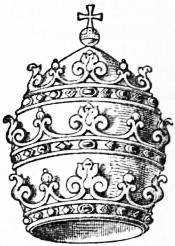
Fig. 1.—The Papal Tiara (without the infulae).
In 1858 a most remarkable discovery was made near Toledo, of eight gold crowns of the 7th century, fashioned lavishly with barbaric splendour. They are now in the Cluny Museum at Paris, having been purchased for £4000, the intrinsic value of the gold, without reckoning that of the jewels and precious stones, being not less than £600. The largest and most magnificent is the crown of Reccesvinto, king of the Visigoths from 653 to 675. It is composed of a circlet of pure gold set with pearls and precious stones in great profusion, which gives it a most sumptuous appearance. It is 9 in. in diameter and more than ½ in. in thickness, the width of the circlet being 4 in. It has also been given as a votive offering to a church, and has the chains to hang it by attached to the upper rim, while from the lower rim depend pearls, sapphires and a series of richly jewelled letters 2 in. each in depth, which read +reccesvinthvs rex offeret. The second of these crowns in size is generally thought to be that of the queen of Reccesvinto. It has no legend, but merely a cross hanging from it. The six others are smaller, and are all most richly ornamented. They are believed to have been the crowns of Reccesvinto’s children. From one of them hangs a legend which relates that they were an offering to a church, which has been identified with much probability as that of Sorbas, a small town in the province of Almeria. It has been surmised that in the disturbances which soon afterwards followed they were buried out of sight for safety, where they were eventually discovered absolutely unharmed centuries afterwards. For a detailed description of these most remarkable crowns the reader must be referred to a paper by the late Mr Albert Way (Archaeological Journal, xvi. 253). Mr Way, in the article alluded to, says of the custom of offering crowns to churches that frequent notices of the usage may be found in the lives of the Roman pontiffs by Anastasius. “They are usually described as having been placed over the altar, and in many instances mention is made of jewelled crosses of gold appended within such crowns as an accessory ornament.... The crowns suspended in churches suggested doubtless the sumptuous pensile luminaries, frequently designated from a very early period as coronae, in which the form of the royal circlet was preserved in much larger proportions, as exemplified by the remarkable corona still to be seen suspended in the cathedral at Aix-la-Chapelle over the crypt in which the body of Charlemagne was deposited.”
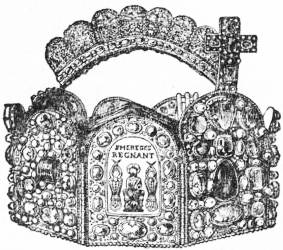
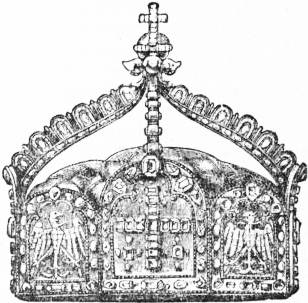
Figs. 2-4 from Meyer’s Konversations Lexikon.
Fig. 2.—Crown of the Holy Roman Empire. Fig. 3.—Crown of the German Empire.
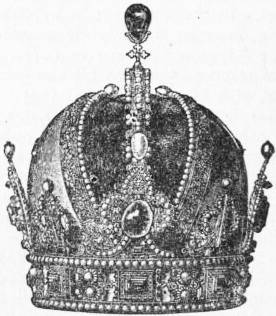
Fig. 4.—Crown of the Austrian Empire.
Of modern continental crowns the imperial crown of Austria (fig. 4) may be mentioned. It is composed of a circlet of gold, adorned with precious stones and pearls, heightened with fleurs-de-lys, and is raised above the circlet in the form of a cap which is opened in the middle, so that the lower part is crescent-shaped; across this opening from front to back rises an arched fillet, enriched with pearls and surmounted by an orb, on which is a cross of pearls.
The papal tiara (a Greek word, of Persian origin, for a form of ancient Persian popular head-dress, standing high erect, and worn encircled by a diadem by the kings), the triple crown worn by the popes, has taken various forms since the 9th century. It is important to remember that the tiaras in old Italian pictures are inventions of the artists and not copied from actual examples. In its present shape, dating substantially from the Renaissance, it is a peaked head-covering not unlike a closed mitre (q.v.), round which are placed one above the other three circlets or open crowns.1 Two bands, or infulae, as they are called, hang from it as in the case of a mitre. The tiara is the crown of the pope as a temporal sovereign (see Tiara).
Pictorial representations in early manuscripts, and the rude effigies on their coins, are not very helpful in deciding as to the form of crown worn by the Anglo-Saxon and Danish kings of England before the Norman Conquest. In some cases it would appear as if the diadem studded with pearls had been worn, and in others something more of the character of a crown. We reach surer ground after the Conquest, for then the great seals, monumental effigies, and coins become more and more serviceable in determining the forms the crown took.

Fig. 5. Fig. 6. Fig. 7.
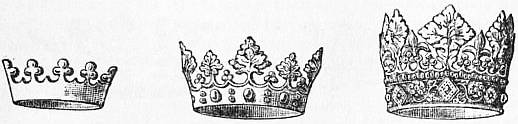
Fig. 8. Fig. 9. Fig. 10.
Royal Crowns. William I. to Henry IV.
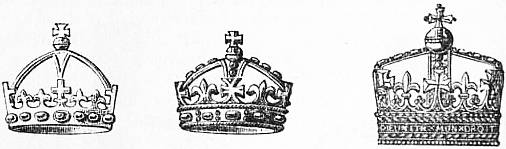
Fig. 11. Fig. 12. Fig. 13.
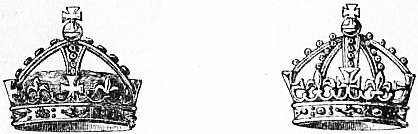
Fig. 14. Fig. 15.
Royal Crowns. Henry V. to Charles I.
The crown of William the Conqueror and his immediate successors seems to have been a plain circlet with four uprights, which terminated in trefoils (fig. 5), but Henry I. enriched the circlet with pearls or gems (fig. 6), and on his great seal the trefoils have something of the character of fleurs-de-lys. The effigy of Richard I. at Fontevrault shows a development of the crown; the trefoil heads are expanded, and are chased and jewelled. The crown of John is shown on his effigy at Worcester, though unfortunately it is rather badly mutilated. It shows, however, that the upper ornament was of fleurons set with jewels. Fig. 7 shows generally this development of the crown in a restored form. The crown on the effigy of Henry III. at Westminster had a beaded row below the circlet, which is narrow and plain, and from it rises a series of plain trefoils with slightly raised points between them. The tomb was opened in 1774, and on the king’s head was found an imitation crown of tin or latten gilt, with trefoils rising from its upper edge. This, although only made of base metal for the king’s burial, may nevertheless be taken as exhibiting the form of the royal crown at the time, and it may be usefully compared with that on the effigy of the king, which was made in Edward I.’s reign (fig. 8). Edward I. used a crown of very similar design. In the crown of Edward II. we have perhaps the most graceful and elegant of all the forms which the English medieval crown assumed (fig. 9), and it seems to have continued without any marked alteration during the reigns of Edward III. and Richard II. The crown on the head of the effigy of Henry IV. at Canterbury evidently represents one of great magnificence, both of design and ornament. What is perhaps lost of the grace of form of the crown of Edward II. is made up for by a profusion of adornment and ornamentation unsurpassed at any later period (fig. 10). The circlet is much wider and is richly chased and jewelled, and from it rise eight large leaves, the intervening spaces being filled with fleurs-de-lys of definite outline. It will be noted that this crown is, like its predecessors, what is known as an open crown, without any arches rising from the circlet, but in the accounts of the coronation of Henry IV. by Froissart and Waurin it is distinctly stated that the crown was arched in the form of a cross. This is the earliest mention of an arched crown, which is not represented on the great seal till that of Edward IV. in 1461. The crown, as shown on Henry IV.’s effigy, very probably represents the celebrated “Harry crown” which was afterwards broken up and employed as surety for the loan required by Henry V. when he was about to embark on his expedition to France. Fig. 11 shows the crown of Henry V. The crown of Henry VI. seems to have had three arches, and there is the same number shown on the crown of Henry VII., which ensigns the hawthorn bush badge of that king. The crown of Edward IV. (fig. 12) shows two arches, and a crown similarly arched appears on the great seal of Richard III. Crowns, both open and arched, are represented in sculpture and paintings until the end of the reign of Edward IV., and the royal arms are occasionally ensigned by an open crown as late as the reign of Henry VIII. The crown of Henry VII. on his effigy in Westminster Abbey shows a circlet surmounted by four crosses and four fleurs-de-lys alternately, and has two arches rising from it. A similar crown appears on the great seal of Henry VIII. The crown of Henry VII. (fig. 13), which ensigns the royal arms above the south door of King’s College chapel, Cambridge, has the motto of the order of the Garter round the circlet. Fig. 14 shows the form of crown used by Edward VI., but a tendency (not shown in the illustration) began of flattening the arches of the crown, and on some of the coins of Elizabeth the arches are not merely flattened, but are depressed in the centre, much after the character of the arches of the crown on many of the silver coins of the 19th century prior to 1887. The crowns of James I. and Charles I. had four arches, springing from the alternate crosses and fleurs-de-lys of the circlet (fig. 15). The crown which strangely enough surmounts the shield with the arms of the Commonwealth on the coins of Oliver Cromwell (as distinguished from those of the Commonwealth itself, which have no crown) is a royal crown with alternate crosses and fleurs-de-lys round the circlet, and is surmounted by three arches, which, though somewhat flattened, are not bent. On them rests the orb and cross. The crown used by Charles II. (fig. 16) shows the arches depressed in the centre, a feature of the royal crown which seems to have been continued henceforward till 1887, when the pointed form of the arches was resumed, in consonance with an idea that such a form indicated an imperial rather than a regal crown, Queen Victoria having been proclaimed empress of India in 1877. In the foregoing account the changes of the form of the crowns of the kings have been briefly noticed. Those crowns were the personal crowns, worn by the different kings on various state occasions, but they were all crowned before the Commonwealth with the ancient crown of St Edward, and the queens consort with that of Queen Edith. There were, in fact, two sets of regalia, the one used for the coronations and kept at Westminster, and the other that used on other occasions by the kings and kept in the Tower. The crowns of this latter set were the personal crowns made to fit the different wearers, and are those which have been briefly described. The crown of St Edward, with which the sovereigns were crowned, had a narrow circlet from which rose alternately four crosses and four fleurs-de-lys, and from the crosses sprang two arches, which at their crossing supported an orb and cross. These arches must have been a later addition, and possibly were first added for the coronation of Henry IV. (vide supra). Queen Edith’s crown had a plain circlet with, so far as can be determined, four crosses of pearls or gems on it, and a large cross patée rising from it in front, and arches of jewels or pearls terminating in a large pearl at the top. A valuation of these ancient crowns was made at the time of the Commonwealth prior to their destruction. From this valuation we learn that St Edward’s crown was of gold filigree or “wirework” as it is called, and was set with stones, and was valued at £248. Queen Edith’s crown was found to be only of silver-gilt, with counterfeit pearls, sapphires and other stones, and was only valued at £16. At the Restoration an endeavour was made to reproduce as well as possible the old crowns and regalia according to their ancient form, and a new crown of St Edward was made on the lines of the old one for the coronation of Charles II. The framework of this crown, bereft of its jewels, is in the possession of Lady Amherst of Hackney. The crowns of James II., William III. and Anne generally resembled it in form (fig. 16). The later crowns of the Georges and William IV. are represented in general form in fig. 17. Although the marginal note in the coronation order of Queen Victoria indicates “K. Edward’s crown” as that with which the late queen was to be crowned, it was actually the state or imperial crown worn by the sovereign when leaving the church after the ceremony that was used. It had been altered for the coronation, and the arches were formed of oak leaves (fig. 18). Fig. 19 shows Queen Victoria’s crown with raised arches and without the inner cap of estate, which since the reign of Henry VII. has been degraded into forming a lining to the crowns of the sovereigns and the coronets of the peers. Fig. 20 shows the coronation crown of King Edward VII. The crown of Scotland, preserved with the Scottish regalia at Edinburgh, is believed to be composed of the original circlet worn by King Robert the Bruce. James V. made additions to it in 1535, and in general characteristics it much resembles an English crown of that date.
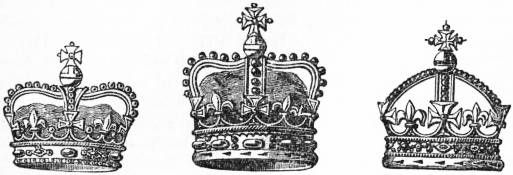
Fig. 16. Fig. 17. Fig. 19.
Recent Forms of the English Crown.
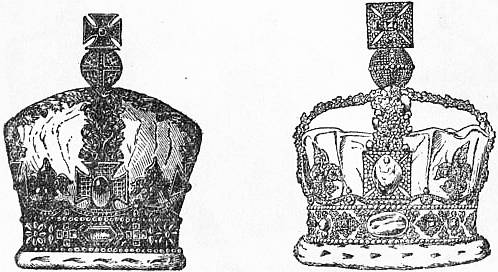
Fig. 18. Fig. 20.
Coronation Crowns of Queen Victoria and King Edward VII.
The kings of arms in England, Scotland and Ireland wear crowns, the ornamentation of which round the upper rim of the circlet is composed of a row of acanthus or oak leaves. Round the circlet is the singularly inappropriate text from Psalm li., “Miserere mei Deus secundum magnam misericordiam tuam.” The form of these crowns seems to have been settled in the reign of Charles II. Before that period they varied at different times, according to representations given of them in grants of arms, &c.
This brings us to the crowns of lesser dignity, known for that reason as coronets, and worn by the five orders of peers.
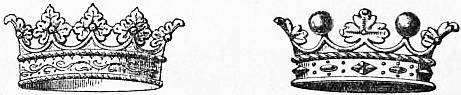
Fig. 21. Fig. 22.
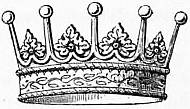
Fig. 23. Coronets of Dukes, Marquesses and Earls.
The use of crowns by dukes originated in 1362, when Edward III. created his sons Lionel and John dukes of Clarence and Lancaster respectively. This was done by investing them with a sword, a cap of maintenance or estate, and with a circlet of gold set with precious stones, which was imposed on the head. Previous to this dukes had been invested at their creation by the girding on of a sword only. In 1387 Richard II. created Richard de Vere marquess of Dublin, and invested him by girding on a sword, and by placing a golden circlet on his head. The golden circlet was confined to dukes and marquesses till 1444, when Henry VI. created Henry Beauchamp, earl of Warwick, premier earl, and the letters patent effecting this concede that the earl and his heirs shall wear a golden circlet on the head on feast days, even in the royal presence. As to the form of these circlets we have no clear knowledge. The dignity of a viscount was first created by Henry VI. in 1439, but nothing is said of any insignia pertaining to that dignity. It is believed that a circlet of gold with an upper rim of pearls was first conferred on a viscount by James I., who conceded it to Robert Cecil, Viscount Cranborne. However, in 1625-1626 it is definitely recorded that the viscounts carried their coronets in their hands in the coronation procession from Westminster Hall to the Abbey church. The use of a coronet by the barons dates from the coronation of Charles II., and by letters patent of the 7th of August 1661 their coronet is described as a circle of gold with six pearls on it.
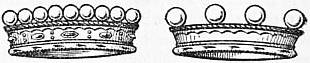
Fig. 24. Fig. 25.
Coronets of Viscounts and Barons.
At the present day the coronet of a duke (fig. 21) is formed of a circlet of gold, from which rise eight strawberry leaves. The coronet of a marquess (fig. 22) differs from that of a duke in having only four strawberry leaves, the intervening spaces being occupied by four low points which are surmounted by pearls. The coronet of an earl (fig. 23) differs again by having eight tall rays on each of which is set a pearl, the intervening spaces being occupied by strawberry leaves one-fourth of the height of the rays. The coronet of a viscount (fig. 24) has sixteen small pearls fixed to the golden circlet, and the coronet of a baron (fig. 25) has six large pearls similarly arranged.
Authorities.—L. G. Wickham Legg, English Coronation Records (London, 1901); The Ancestor, Nos. i. and ii. (London, 1902); Stothard, The Monumental Effigies of Great Britain (London, 1817).
(T. M. F.)
1 A coloured drawing, done in the first half of the 18th century, of the magnificent tiara made by the celebrated goldsmith, Caradosso, for Julius II., is in the Print-Room, British Museum. It was re-fashioned by Pius VI., but went with other treasure as part of the indemnity to Napoleon. The splendid emerald at the summit, which was engraved with the arms of Gregory XIII., was restored by Napoleon and now adorns another papal tiara at Rome. In this drawing the three crowns (a feature introduced at the beginning of the 14th century) are represented by three bands of X-shaped ornament in enamelled gold.
CROWN DEBT, in English law, a debt due to the crown. By various statutes—the first dating from the reign of Henry VIII. (1541)—the crown has priority for its debts before all other creditors. At common law the crown always had a lien on the lands and goods of debtors by record, which could be enforced even when they had passed into the hands of other persons. The difficulty of ascertaining whether lands were subject to a crown lien or not was often very great, and a remedy was provided by the Judgments Act 1839, and the Crown Suits Act 1865. Now by the Land Charges Act 1900, no debt due to the crown operates as a charge on land until a writ of execution for the purpose of enforcing it has been registered under the Land Charges Registration and Searches Act 1888. By the Act of 1541 specialty debts were put practically on the same footing as debts by record. Simple contract debts due to the crown also become specialty debts, and the rights of the crown are enforced by a summary process called an extent (see Writ).
CROWNE, JOHN (d. c. 1703), British dramatist, was a native of Nova Scotia. His father “Colonel” William Crowne, accompanied the earl of Arundel on a diplomatic mission to Vienna in 1637, and wrote an account of his journey. He emigrated to Nova Scotia where he received a grant of land from Cromwell, but the French took possession of his property, and the home government did nothing to uphold his rights. When the son came to England his poverty compelled him to act as gentleman usher to an Independent lady of quality, and his enemies asserted that his father had been an Independent minister. He began his literary career with a romance, Pandion and Amphigenia, or the History of the coy Lady of Thessalia (1665). In 1671 he produced a romantic play, Juliana, or the Princess of Poland, which has, in spite of its title, no pretensions to rank as an historical drama. The earl of Rochester procured for him, apparently with the sole object of annoying Dryden by infringing on his rights as poet-laureate, a commission to supply a masque for performance at court. Calisto gained him the favour of Charles II., but Rochester proved a fickle patron, and his favour was completely alienated by the success of Crowne’s heroic play in two parts, The Destruction of Jerusalem by Titus Vespasian (1677). This piece contained a thinly disguised satire on the Puritan party in the description of the Pharisees, and about 1683 he produced a distinctly political play, The City Politiques, satirizing the Whig party and containing characters which were readily recognized as portraits of Titus Oates and others. This made him many enemies, and he petitioned the king for a small place that would release him from the necessity of writing for the stage. The king exacted one more comedy, which should, he suggested, be based on the No pued esser of Moreto. This had already been unsuccessfully adapted, as Crowne discovered later, by Sir Thomas St Serfe, but in Crowne’s hands it developed into Sir Courtly Nice, It Cannot Be (1685), a comedy which kept its place as a stock piece for nearly a century. Unfortunately Charles II. died before the play was completed, and Crowne was disappointed of his reward. He continued to write plays, and it is stated that he was still living in 1703, but nothing is known of his later life.
Crowne was a fertile writer of plays with an historical setting, in which heroic love was, in the fashion of the French romances, made the leading motive. The prosaic level of his style saved him as a rule from the rant to be found in so many contemporary heroic plays, but these pieces are of no particular interest. He was much more successful in comedy of the kind that depicts “humours.”
The History of Charles the Eighth of France, or The Invasion of Naples by the French (1672) was dedicated to Rochester. In Timon, generally supposed to have been written by the earl, a line from this piece—“whilst sporting waves smil’d on the rising sun”—was held up to ridicule. The Ambitious Statesman, or The Loyal Favourite (1679), one of the most extravagant of his heroic efforts, deals with the history of Bernard d’Armagnac, Constable of France, after the battle of Agincourt; Thyestes, A Tragedy (1681), spares none of the horrors of the Senecan tragedy, although an incongruous love story is interpolated; Darius, King of Persia (1688), Regulus (acted 1692, pr. 1694) and Caligula (1698) complete the list of his tragedies. The Country Wit: A Comedy (acted 1675, pr. 1693), derived in part from Molière’s Le Sicilien, ou l’amour peintre, is remembered for the leading character, Sir Mannerly Shallow; The English Frier; or The Town Sparks (acted 1689, pr. 1690), perhaps suggested by Molière’s Tartuffe, ridicules the court Catholics, and in Father Finical caricatures Father Petre; and The Married Beau; or The Curious Impertinent (1694), is based on the Curioso Impertinente in Don Quixote. He also produced a version of Racine’s Andromaque, an adaptation from Shakespeare’s Henry VI., and an unsuccessful comedy, Justice Busy.
See The Dramatic Works of John Crowne (4 vols., 1873), edited by James Maidment and W. H. Logan for the Dramatists of the Restoration.
CROWN LAND, in the United Kingdom, land belonging to the crown, the hereditary revenues of which were surrendered to parliament in the reign of George III.
In Anglo-Saxon times the property of the king consisted of (a) his private estate, (b) the demesne of the crown, comprising palaces, &c., and (c) rights over the folkland of the kingdom. By the time of the Norman Conquest the three became merged into the estate of the crown, that is, land annexed to the crown, held by the king as king. The king, also, ceased to hold as a private owner,1 but he had full power of disposal by grant of the crown lands, which were increased from time to time by confiscation, escheat, forfeiture, &c. The history of the crown lands to the reign of William III. was one of continuous alienation to favourites. Their wholesale distribution by William III. necessitated the intervention of parliament, and in the reign of Queen Anne an act was passed limiting the right of alienation of crown lands to a period of not more than thirty-one years or three lives. The revenue from the crown lands was also made to constitute part of the civil list. At the beginning of his reign George III. surrendered his interest in the crown lands in return for a fixed “civil list” (q.v.). The control and management of the crown lands is now regulated by the Crown Lands Act 1829 and various amending acts. Under these acts their management is entrusted to the commissioners of Woods, Forests and Land Revenues, who have certain statutory powers as to leasing, selling, exchanging, &c.
In theory, also, state lands in the British colonies are supposed to be vested in the crown, and they are called crown lands; actually, however, the various colonial legislatures have full control over them and power of disposal. The term “crown-lands,” in Austria, is applied to the various provinces into which that country is divided. (See Austria.)
1 The duchy of Lancaster, which was the private property of Henry IV. before he ascended the throne, was assured to him and his heirs by a special act of parliament. In the first year of Henry VII. it was united to the crown, but as a separate property.
CROWN POINT, a village of Essex county, New York, U.S.A., in a township of the same name, about 90 m. N.E. of Albany and about 10 m. N. of Ticonderoga, on the W. shore of Lake Champlain. Pop. of the township (1890) 3135; (1900) 2112; (1905) 1890; (1910) 1690; of the village, about 1000. The village is served by the Delaware & Hudson Railway and by the Champlain Canal. Among the manufactures are lumber and woodenware. Graphite has been found in the western part of the township, and spar is mined. In 1609 Champlain fought near here the engagement with the Iroquois Indians which marked the beginning of the long enmity between the Five (later Six) Nations and the French. Subsequently Dutch and English traders trafficked in the vicinity, the latter maintaining here for many years a regular trading-post. In 1731 the French built here Fort Frédéric, the first military post at Crown Point, and the place was subsequently for many years of considerable strategic importance, owing to its situation on Lake Champlain, which with Lake George furnished a comparatively easy route from Canada to New York. Twice during the French and Indian War, in 1755 and again in 1756, English and colonial expeditions were sent against it in vain; it remained in French hands until 1759, when, after Lord Jeffrey Amherst’s occupation of Ticonderoga, the garrison joined that of the latter place and retreated to Canada. Crown Point was then occupied by Amherst, who during the winter of 1759-1760 began the construction, about a quarter of a mile from the old Fort Frédéric, of a large fort, which was garrisoned but was never completed; the ruins of this fort (not of Fort Frédéric) still remain. At the outbreak of the War of Independence, on the 11th of May 1775, the fort, whose garrison then consisted of only a dozen men, was captured by Colonel Seth Warner and a force of “Green Mountain Boys,” sent from Ticonderoga by Ethan Allen; and it remained in American hands save for a brief period in 1777, when it was occupied by a detachment of Burgoyne’s invading army.
CROWTHER, SAMUEL ADJAI (1809?-1891), African missionary-bishop, was born at Ochugu in the Yoruba country, West Africa, and was sold into slavery in 1821. Next year he was rescued, with many other captives, by H.M. ship “Myrmidon,” and was landed at Sierra Leone. Educated there in a missionary school, he was baptized on the 11th of December 1825. In time he became a teacher at Furah Bay, and afterwards an energetic missionary on the Niger. He came to England in 1842, entered the Church Missionary College at Islington, and in June 1843 was ordained by Bishop Blomfield. Returning to Africa, he laboured with great success amongst his own people and afterwards at Abeokuta. Here he devoted himself to the preparation of school-books, and the translation of the Bible and Prayer-Book into Yoruba and other dialects. He also established a trade in cotton, and improved the native agriculture. In 1857 he commenced the third expedition up the Niger, and after labouring with varied success, returned to England and was consecrated, on St Peter’s Day 1864, first bishop of the Niger territories. Before long a commencement was made of the missions to the delta of the Niger, and between 1866 and 1884 congregations of Christians were formed at Bonny, Brass and New Calabar, but the progress made was slow and subject to many impediments. In 1888 the tide of persecution turned, and several chiefs embraced Christianity, and on Crowther’s return from another visit to England, the large iron church known as “St Stephen’s cathedral” was opened. Crowther died of paralysis on the 31st of December 1891, having displayed as a missionary for many years untiring industry, great practical wisdom, and deep piety.
CROYDON, a municipal, county and parliamentary borough of Surrey, England, suburban to London, 10 m. S. of London Bridge. Pop. (1891) 102,695; (1901) 133,895. The borough embraces a great residential district. Several railway stations give it communication with all parts of the metropolis, the principal railways serving it being the London, Brighton & South Coast and the South-Eastern & Chatham. It stands near the sources of the river Wandle, under Banstead Downs, and is a place of great antiquity. The original site, farther west than the present town, is mentioned in Domesday Book. The derivation indicated is from the O. Fr. croie dune, chalk hill. The supposition that here was the Roman station of Noviomagus is rejected. The site is remarkable for the number of springs which issue from the soil. One of these, called the “Bourne,” bursts forth a short way above the town at irregular intervals of one to ten years or more; and after running a torrent for two or three months, as quickly vanishes. Until its course was diverted it caused destructive floods. This phenomenon seems to arise from rains which, falling on the chalk hills, sink into the porous soil and reappear after a time from crevices at lower levels. The manor of Croydon was presented by William the Conqueror to Archbishop Lanfranc, who is believed to have founded the archiepiscopal palace there, which was the occasional residence of his successors till about 1750, and of which the chapel and hall remain. Addington Park, 3½ m. from Croydon, was purchased for the residence, in 1807, of the archbishop of Canterbury, but was sold in consequence of Archbishop Temple’s decision to reside at the palace, Canterbury. The neighbouring church, which is Norman and Early English, contains several memorials of archbishops. Near the park a group of tumuli and a circular encampment are seen. Croydon is a suffragan bishopric in the diocese of Canterbury. The parish church of St John the Baptist appears to have been built in the 14th and 15th centuries, but to have contained remains of an older building. The church was restored or rebuilt in the 16th century, and again restored by Sir Gilbert Scott in 1857-1859. It was destroyed by fire, with the exception of the tower, on the 5th of January 1867, and was at once rebuilt by Scott on the old lines. In 1596 Archbishop Whitgift founded the hospital or almshouse which bears his name, and remains in its picturesque brick buildings surrounding two quadrangles. His grammar school was housed in new buildings in 1871, and is a flourishing day school. The principal public building of Croydon is that erected by the corporation for municipal business; it included court-rooms and the public library. At Addiscombe in the neighbourhood was formerly a mansion dating from 1702, and acquired by the East India Company in 1809 for a Military College, which on the abolition of the Company became the Royal Military College for the East Indian Army, and was closed in 1862. Croydon was formed into a municipal borough in 1883, a parliamentary borough, returning one member, in 1885, and a county borough in 1888. The corporation consists of a mayor, 12 aldermen and 36 councillors. Area, 9012 acres.
CROZAT, PIERRE (1661-1740), French art collector, was born at Toulouse, one of a family who were prominent French financiers and collectors. He became treasurer to the king in Paris, and gradually acquired a magnificent collection of pictures and objets d’art. Between 1729 and 1742 a finely illustrated work was published in two volumes, known as the Cabinet Crozat, including the finest pictures in French collections. Most of his own treasures descended to his nephews, Louis François (d. 1750), Joseph Antoine (d. 1750), and Louis Antoine (d. 1770), and were augmented by them, being dispersed after their deaths; the collection of Louis Antoine Crozat went to St Petersburg.
CROZET ISLANDS, an uninhabited group in the Indian Ocean, in 46°-47° S. and 51° E. They are mountainous, with summits from 4000 to 5000 ft. high, and are disposed in two divisions—Penguin or Inaccessible, Hog, Possession and East Islands; and the Twelve Apostles. Like Kerguelen, and other clusters in these southern waters, they appear to be of igneous formation; but owing to the bleak climate and their inaccessible character they are seldom visited, and have never been explored since their discovery in 1772 by Marion-Dufresne, after one of whose officers they are named. Possession, the highest, has a snowy peak said to exceed 5000 ft. Hog Island takes its name from the animals which were here let loose by an English captain many years ago, but have since disappeared. Rabbits burrow in the heaps of scoria on the slopes of the mountains.
CROZIER, WILLIAM (1855- ), American artillerist and inventor, born at Carrollton, Carroll county, Ohio, on the 19th of February 1855, was the son of Robert Crozier (1827-1895), chief justice of Kansas in 1863-1866, and a United States senator from that state from December 1873 to February 1874. He graduated at West Point in 1876, was appointed a 2nd lieutenant in the 4th Artillery, and served on the Western frontier for three years against the Sioux and Bannock Indians. From 1879 to 1884 he was instructor in mathematics at West Point, and was superintendent of the Watertown (Massachusetts) Arsenal from 1884 to 1887. In 1888 he was sent by the war department to study recent developments in artillery in Europe, and upon his return he was placed in full charge of the construction of gun carriages for the army, and with General Adelbert R. Buffington (1837- ), the chief of ordnance, he invented the Buffington-Crozier disappearing gun carriage (1896). He also invented a wire-wound gun, and perfected many appliances connected with heavy and field ordnance. In 1890 he attained the rank of captain. During the Spanish-American War he was inspector-general for the Atlantic and Gulf coast defences. In 1899 he was one of the American delegates to the Peace Conference at the Hague. He later served in the Philippine Islands on the staffs of Generals John C. Bates and Theodore Schwan, and in 1900 was chief of ordnance on the staff of General A. R. Chaffee during the Pekin Relief Expedition. In November 1901 he was appointed brigadier-general and succeeded General Buffington as chief of ordnance of the United States army. His Notes on the Construction of Ordnance, published by the war department, are used as text-books in the schools for officers, and he is also the author of other important publications on military subjects.
CROZIER, or pastoral staff, one of the insignia of a bishop, and probably derived from the lituus of the Roman augurs. It is crook-headed, and borne by bishops and archbishops alike (see Pastoral Staff). The word “crozier” or “crosier” represents the O. Fr. crocier, Med. Lat. crociarius, the bearer of the episcopal crook (Med. Lat. crocea, croccia, &c., Fr. croc). The English representative of crocea was crose, later crosse, which, becoming confused with “cross” (q.v.), was replaced by “crozier-staff” or “crozier’s staff,” and then, at the beginning of the 16th century, by “crozier” (see J. T. Taylor, Archaeologia, Iii., “On the Use of the Terms Crosier, Pastoral Staff and Cross”).
CRUCIAL (from Lat. crux, a cross), that which has the form of a cross, as the “crucial ligaments” of the knee-joint, which cross each other, connecting the femur and the tibia. From Francis Bacon’s expression instantia crucis (taken, as he says, from the finger-post or crux at cross-roads) for a phenomenon which decides between two causes which have each similar analogies in its favour, comes the use of “crucial” for that which decides between two alternatives, hence, generally, as a synonym for “critical.” The word is also used, with a reference to the use of a “crucible,” of something which tests and tries.
CRUCIFERAE, or Crucifer family, a natural order of flowering plants, which derives its name from the cruciform arrangement of the four petals of the flower. It is an order of herbaceous plants, many of which, such as wallflower, stock, mustard, cabbage, radish and others, are well-known garden or field-plants. Many of the plants are annuals; among these are some of the commonest weeds of cultivation, shepherd’s purse (Capsella Bursa-pastoris), charlock (Brassica Sinapis), and such common plants as hedge mustard (Sisymbrium officinale), Jack-by-the-hedge (S. Alliaria or Alliaria officinalis). Others are biennials producing a number of leaves on a very short stem in the first year, and in the second sending up a flowering shoot at the expense of the nourishment stored in the thick tap-root during the previous season. Under cultivation this root becomes much enlarged, as in turnip, swede and others. Wallflower (Cheiranthus Cheiri) (fig. 1) is a perennial. The leaves when borne on an elongated stem are arranged alternately and have no stipules. The flowers are arranged in racemes without bracts; during the life of the flower its stalk continues to grow so that the open flowers of an inflorescence stand on a level (that is, are corymbose). The flowers are regular, with four free sepals arranged in two pairs at right angles, four petals arranged crosswise in one series, and two sets of stamens, an outer with two members and an inner with four, in two pairs placed in the middle line of the flower and at right angles to the outer series. The four inner stamens are longer than the two outer; and the stamens are hence collectively described as tetradynamous. The pistil, which is above the rest of the members of the flower, consists of two carpels joined at their edges to form the ovary, which becomes two-celled by subsequent ingrowth of a septum from these united edges; a row of ovules springs from each edge. The fruit is a pod or siliqua splitting by two valves from below upwards and leaving the placentas with the seeds attached to the replum or framework of the septum. The seeds are filled with the large embryo, the two cotyledons of which are variously folded. In germination the cotyledons come above ground and form the first green leaves of the plant.
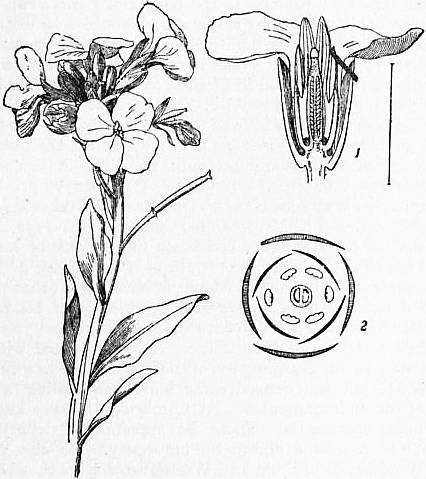
Fig. 1.—Wallflower (Cheiranthus Cheiri), reduced. 1, Flower in vertical section. 2, Horizontal plan of arrangement of flower in Barbarea.
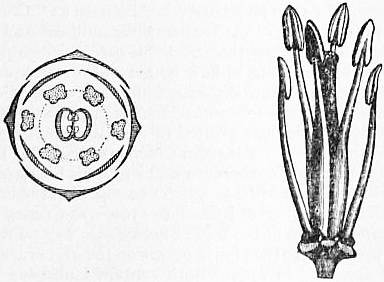
Fig. 2.—Cruciferae. Floral Diagram (Brassica). Fig. 3.—Cardamine pratensis. Flower with Perianth removed. (After Baillon.)
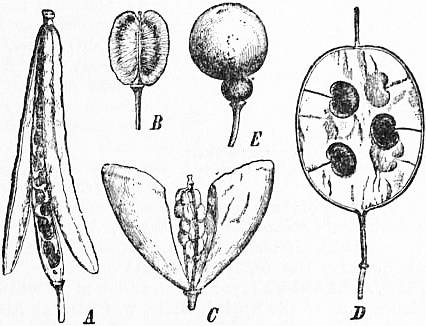
Fig. 4.—Cruciferous Fruits. (After Baillon.)
A, Cheiranthus Cheiri. B, Lepidium sativum. C, Capsella Bursa-pastoris. D, Lunaria biennis, showing the septum after the carpels have fallen away. E, Crambe maritima.
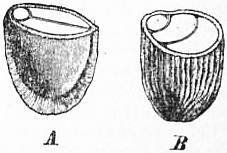
Fig. 5.—Seeds of Cruciferae cut across to show the radicle and cotyledons. (After Baillon.)
A, Cheiranthus Cheiri.
B, Sisymbrium Alliaria.
Figures 2-5 are from Strasburger’s Lehrbuch der Botanik, by permission of Gustav Fischer.
Pollination is effected by aid of insects. The petals are generally white or yellow, more rarely lilac or some other colour, and between the bases of the stamens are honey-glands. Some or all of the anthers become twisted so that insects in probing for honey will touch the anthers with one side of their head and the capitate stigma with the other. Owing, however, to the close proximity of stigma and anthers, very slight irregularity in the movements of the visiting insect will cause self-pollination, which may also occur by the dropping of pollen from the anthers of the larger stamens on to the stigma.
Cruciferae is a large order containing nearly 200 genera and about 1200 species. It has a world-wide distribution, but finds its chief development in the temperate and frigid zones, especially of the northern hemisphere, and as Alpine plants. In the subdivision of the order into tribes use is made of differences in the form of the fruit and the manner of folding of the embryo. When the fruit is several times longer than broad it is known as a siliqua, as in stock or wallflower; when about as long as broad, a silicula, as in shepherd’s purse.
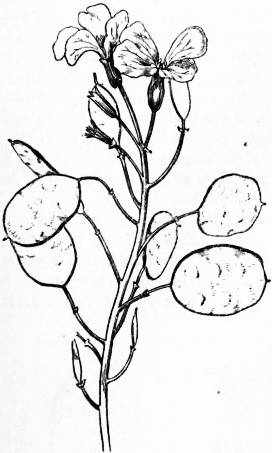
Fig. 6.—Honesty (Lunaria biennis), showing Flower and Fruit. Reduced.
The order is well represented in Britain—among others by Nasturtium (N. officinale, water-cress), Arabis (rock-cress), Cardamine (bitter-cress), Sisymbrium (hedge mustard, &c.; S. Irio is London rocket, so-called because it sprang up after the fire of 1666), Brassica (cabbage and mustard), Diplotaxis (rocket), Cochlearia (scurvy-grass), Capsella (shepherd’s purse), Lepidium (cress), Thlaspi (penny-cress), Cakile (sea rocket), Raphanus (radish), and others. Of economic importance are species of Brassica, including mustard (B. nigra), white mustard, used when young in salads (B. alba), cabbage (q.v.) and its numerous forms derived from B. oleracea, turnip (B. campestris), and swede (B. Napus), Raphanus sativus (radish), Cochlearia Armoracia (horse-radish), Nasturtium officinale (water-cress), Lepidium sativum (garden cress). Isatis affords a blue dye, woad. Many of the genera are known as ornamental garden plants; such are Cheiranthus (wallflower), Matthiola (stock), Iberis (candy-tuft), Alyssum (Alison), Hesperis (dame’s violet), Lunaria (honesty) (fig. 6), Aubrietia and others.
CRUDEN, ALEXANDER (1701-1770), author of the well-known concordance (q.v.) to the English Bible, was born at Aberdeen on the 31st of May 1701. He was educated at the grammar school, Aberdeen, and studied at Marischal College, intending to enter the ministry. He took the degree of master of arts, but soon after began to show signs of insanity owing to a disappointment in love. After a term of confinement he recovered and removed to London. In 1722 he had an engagement as private tutor to the son of a country squire living at Eton Hall, Southgate, and also held a similar post at Ware. Years afterwards, in an application for the title of bookseller to the queen, he stated that he had been for some years corrector for the press in Wild Court. This probably refers to this time. In 1729 he was employed by the 10th earl of Derby as a reader and secretary, but was discharged on the 7th of July for his ignorance of French pronunciation. He then lodged in a house in Soho frequented exclusively by Frenchmen, and took lessons in the language in the hope of getting back his post with the earl, but when he went to Knowsley in Lancashire, the earl would not see him. He returned to London and opened a bookseller’s shop in the Royal Exchange. In April 1735 he obtained the title of bookseller to the queen by recommendation of the lord mayor and most of the Whig aldermen. The post was an unremunerative sinecure. In 1737 he finished his concordance, which, he says, was the work of several years. It was presented to the queen on the 3rd of November 1737, a fortnight before her death.
Although Cruden’s biblical labours have made his name a household word among English-speaking people, he was disappointed in his hopes of immediate profit, and his mind again became unhinged. In spite of his earnest and self-denying piety, and his exceptional intellectual powers, he developed idiosyncrasies, and his life was marred by a harmless but ridiculous egotism, which so nearly bordered on insanity that his friends sometimes thought it necessary to have him confined. He paid unwelcome addresses to a widow, and was confined in a madhouse in Bethnal Green. On his release he published a pamphlet dedicated to Lord H. (probably Harrington, secretary of state) entitled The London Citizen exceedingly injured, or a British Inquisition Displayed. He also published an account of his trial, dedicated to the king. In December 1740 he writes to Sir H. Sloane saying he has been employed since July as Latin usher in a boarding-school at Enfield. He then found work as a proof-reader, and several editions of Greek and Latin classics are said to have owed their accuracy to his care. He superintended the printing of one of Matthew Henry’s commentaries, and in 1750 printed a small Compendium of the Holy Bible (an abstract of the contents of each chapter), and also reprinted a larger edition of the Concordance.
About this time he adopted the title of “Alexander the Corrector,” and assumed the office of correcting the morals of the nation, especially with regard to swearing and Sunday observance. For this office he believed himself divinely commissioned, but he petitioned parliament for a formal appointment in this capacity. In April 1755 he printed a letter to the speaker and other members of the House of Commons, and about the same time an “Address to the King and Parliament.” He was in the habit of carrying a sponge, with which he effaced all inscriptions which he thought contrary to good morals. In September 1753, through being involved in a street brawl, he was confined in an asylum in Chelsea for seventeen days at the instance of his sister, Mrs Wild. He brought an unsuccessful action against his friends, and seriously proposed that they should go into confinement as an atonement. He published an account of this second restraint in “The Adventures of Alexander the Corrector.” He made attempts to present to the king in person an account of his trial, and to obtain the honour of knighthood, one of his predicted honours. In 1754 he was nominated as parliamentary candidate for the city of London, but did not go to the poll. In 1755 he paid unwelcome addresses to the daughter of Sir Thomas Abney, of Newington (1640-1722), and then published his letters and the history of his repulse in the third part of his “Adventures.” In June and July 1755 he visited Oxford and Cambridge. He was treated with the respect due to his learning by officials and residents in both universities, but experienced some boisterous fooling at the hands of the undergraduates. At Cambridge he was knighted with mock ceremonies. There he appointed “deputy correctors” to represent him in the university. He also visited Eton, Windsor, Tonbridge and Westminster schools, where he appointed four boys to be his deputies. (An Admonition to Cambridge is preserved among letters from J. Neville of Emmanuel to Dr Cox Macro, in the British Museum.) The Corrector’s Earnest Address to the Inhabitants of Great Britain, published in 1756, was occasioned by the earthquake at Lisbon. In 1762 he saved an ignorant seaman, Richard Potter, from the gallows, and in 1763 published a pamphlet recording the history of the case. Against John Wilkes, whom he hated, he wrote a small pamphlet, and used to delete with his sponge the number 45 wherever he found it, this being the offensive number of the North Briton. In 1769 he lectured in Aberdeen as “Corrector,” and distributed copies of the fourth commandment and various religious tracts. The wit that made his eccentricities palatable is illustrated by the story of how he gave to a conceited young minister whose appearance displeased him A Mother’s Catechism dedicated to the young and ignorant. The Scripture Dictionary, compiled about this time, was printed in Aberdeen in two volumes shortly after his death. Alexander Chalmers, who in his boyhood heard Cruden lecture in Aberdeen and wrote his biography, says that a verbal index to Milton, which accompanied the edition of Thomas Newton, bishop of Bristol, in 1769, was Cruden’s.
The second edition of the Bible Concordance was published in 1761, and presented to the king in person on the 21st of December. The third appeared in 1769. Both contain a pleasing portrait of the author. He is said to have gained £800 by these two editions. He returned to London from Aberdeen, and died suddenly while praying in his lodgings in Camden Passage, Islington, on the 1st of November 1770. He was buried in the ground of a Protestant dissenting congregation in Dead Man’s Place, Southwark. He bequeathed a portion of his savings for a £5 bursary at Aberdeen, which preserves his name on the list of benefactors of the university.
(D. Mn.)
CRUDEN, a village and parish on the E. coast of Aberdeenshire, Scotland. Pop. of parish (1901) 3444. It is situated at the head of Cruden Bay, 29¾ m. N.N.E. of Aberdeen by the Great North of Scotland railway company’s branch line from Ellon to Boddam. The golf-course of 18 holes is one of the best in Scotland, and there is a sandy beach, with good bathing. There is some good fishing at Port Erroll, also called Ward of Cruden. Prehistoric remains have been found in the parish, and near Ardendraught, not far from the shore, Malcolm II. is said to have defeated Canute in 1014. The Water of Cruden, which rises a few miles to the west, flows through the village into the North Sea. Slains Castle, a seat of the earl of Erroll, lies to the north of Cruden, but must not be confounded with the old castle of Slains, about 5 m. to the south-west, near the point where, according to tradition, the “St Catherine” of the Spanish Armada foundered in 1588. The Bullers of Buchan are within 2 m. walk of Cruden.
CRUELTY (through the O. Fr. crualté, mod. cruauté, from the Lat. crudelitas), the intentional infliction of pain or suffering. It is only necessary to deal here with the legal relations involved. Statutory provision for the prevention of cruelty to those who are unable to protect themselves has been particularly marked in the 19th century. The increase of legislation for the protection of children, lunatics and animals is a proof of the growing humanitarianism of the age. There was at one time a tendency among jurists to question whether, for instance, the prevention of cruelty to animals was not a recognition of a certain quasi-right in animals, or whether it was merely that such exhibitions as bull- and bear-baiting, cock-fights, &c., were demoralizing to the public generally. The true fact seems to be that the first introduction of such legislation was undoubtedly due to the desire for the promotion of humanity, but that the principle, for the recognition of which the time was not yet ripe, had to be excused in the eyes of the public by the plea that cruelty had a demoralizing effect upon spectators (see A. V. Dicey, Law and Opinion in England, p. 188; T. E. Holland, Jurisprudence, 10th ed., p. 372).
Cruelty to Animals.—The English common law has never taken cognizance of the commission of acts of cruelty upon animals, and direct legislation upon the subject, dating from the 19th century, was due in a great measure to public agitation, supported by the Royal Society for the Prevention of Cruelty to Animals (founded in 1824). Various acts were passed in 1822 (known as Martin’s Act), 1835 and 1837, and these were amended and consolidated by the Cruelty to Animals Acts 1849 and 1854, which, with the Wild Animals in Captivity Protection Act 1900, are the main acts upon the subject. There are also, in addition, many other acts that impose certain liabilities in respect of animals and indirectly prevent cruelty. The Cruelty to Animals Acts 1849 and 1854 render liable to prosecution and fine practically any act of cruelty to an animal; such acts as dubbing a cock, cropping the ears of a dog or dishorning cattle, are offences. The latter practice, however, is allowed both in Scotland and Ireland, the courts having held that the advantages to be obtained from dishorning outweigh the pain caused by the operation. The word “animal” is defined as meaning “any domestic animal” of whatever kind or species, and whether a quadruped or not. The act of 1849 also forbids bull- and bear-baiting, or fighting between any kinds of animals; requires the provision of food and water to animals impounded; lays down regulations as to the treatment of animals sent for slaughter, and imposes a penalty for improperly conveying animals. The Wild Animals in Captivity Protection Act 1900 extends to wild animals in captivity that protection which the acts of 1849 and 1854 conferred on domestic animals, making exception of any act done or any omission in the preparation of animals for the food of man or for sport. The word “animal” in the act includes bird, beast, fish or reptile. The Dogs Act 1865 rendered owners of dogs liable for injuries to cattle and sheep; the Dogs Act 1906 extended the owner’s liability for injury done to any cattle by a dog, and further, where a dog is proved to have injured cattle or chased sheep it may be treated as a dangerous dog and must be kept under proper control or be destroyed. The Drugging of Animals Act 1876 imposes a penalty on giving poisonous drugs to any domestic animal unlawfully. The Cruelty to Animals Act 1876 was passed for the purpose of regulating the practice of vivisection (q.v.). The Ground Game Act 1880, prohibits night shooting, or the use of spring traps above ground or poison. The Injured Animals Act 1907 enables police constables to cause any animal when mortally or seriously injured to be slaughtered. The Diseases of Animals Act 1894 and orders under it are for the purpose of securing animals from unnecessary suffering, as well as from disease. Finally, the Wild Birds Protection Acts 1880 to 1904, with various game acts (see Game Laws), extend the protection of the law to wild birds. The acts establish a close time for wild birds and impose penalties for shooting or taking them within that time; prohibit the exposing or offering for sale within certain dates any wild bird recently killed or taken unless bought or received from some person residing out of the United Kingdom; the taking or destroying of wild birds’ eggs, the setting of pole traps, and the taking of a wild bird by means of a hook or other similar instrument.
For the law relating to the prevention of cruelty to children see Children, Law Relating to; for cruelty in the sense of such conduct as entitles a husband or wife to judicial separation see Divorce.
(T. A. I.)
CRUIKSHANK, GEORGE (1792-1878), English artist, caricaturist and illustrator, was born in London on the 27th of September 1792. By natural disposition and collateral circumstances he may be accepted as the type of the born humoristic artist predestined for this special form of art. His grandfather had taken up the arts, and his father, Isaac Cruikshank, followed the painter’s profession. Amidst these surroundings the children were born and brought up, their first playthings the materials of the arts their father practised. George followed the family traditions with amazing facility, easily surpassing his compeers as an etcher. When the father died, about 1811, George, still in his teens, was already a successful and popular artist. All his acquisitions were native gifts, and of home-growth; outside training, or the serious apprenticeship to art, were dispensed with, under the necessity of working for immediate profit. This lack of academic training the artist at times found cause to regret, and at some intervals he made exertions to cultivate the knowledge obtainable by studying from the antique and drawing from life at the schools. From boyhood he was accustomed to turn his artistic talents to ready account, disposing of designs and etchings to the printsellers, and helping his father in forwarding his plates. Before he was twenty his spirited style and talent had secured popular recognition; the contemporary of Gillray, Rowlandson, Alken, Heath, Dighton, and the established caricaturists of that generation, he developed great proficiency as an etcher. Gillray’s matured and trained skill had some influence upon his executive powers, and when the older caricaturist passed away in 1815, George Cruikshank had already taken his place as a satirist. Prolific and dexterous beyond his competitors, for a generation he delineated Tories, Whigs and Radicals with fine impartiality. Satirical capital came to him from every public event,—wars abroad, the enemies of England (for he was always fervidly patriotic), the camp, the court, the senate, the Church; low life, high life; the humours of the people, the follies of the great. In this wonderful gallery the student may grasp the popular side of most questions which for the time being engaged public attention. George Cruikshank’s technical and manipulative skill as an etcher was such that Ruskin and the best judges have placed his productions in the foremost rank; in this respect his works have been compared favourably with the masterpieces of etching. He died at 263 Hampstead Road on the 1st of February 1878. His remains rest in St Paul’s cathedral.
A vast number of Cruikshank’s spirited cartoons were published as separate caricatures, all coloured by hand; others formed series, or were contributed to satirical magazines, the Satirist, Town Talk, The Scourge (1811-1816) and the like ephemeral publications. In conjunction with William Hone’s scathing tracts, G. Cruikshank produced political satires to illustrate the series of facetiae and miscellanies, like The Political House that Jack Built (1819).
Of a more genially humoristic order are his well-known book illustrations, now so deservedly esteemed for their inimitable fun and frolic, among other qualities, such as the weird and terrible, in which he excelled. Early in this series came The Humorist (1819-1821) and Life in Paris (1822). The well-known series of Life in London, conjointly produced by the brothers I. R. and G. Cruikshank, has enjoyed a prolonged reputation, and is still sought after by collectors. Grimm’s Collection of German Popular Stories (1824-1826), in two series, with 22 inimitable etchings, are in themselves sufficient to account for G. Cruikshank’s reputation. To the first fourteen volumes (1837-1843) of Bentley’s Miscellany Cruikshank contributed 126 of his best plates, etched on steel, including the famous illustrations to Oliver Twist, Jack Sheppard, Guy Fawkes and The Ingoldsby Legends. For W. Harrison Ainsworth, Cruikshank illustrated Rookwood (1836) and The Tower of London (1840); the first six volumes of Ainsworth’s Magazine (1842-1844) were illustrated by him with several of his finest suites of etchings. For C. Lever’s Arthur O’Leary he supplied 10 full-page etchings (1844), and 20 spirited graphic etchings for Maxwell’s lurid History of the Irish Rebellion in 1798 (1845). Of his own speculations, mention must be made of George Cruikshank’s Omnibus (1841) and George Cruikshank’s Table Book (1845), as well as his Comic Almanack (1835-1853). The Life of Sir John Falstaff contained 20 full-page etchings (1857-1858). These are a few leading items amongst the thousands of illustrations emanating from that fertile imagination. As an enthusiastic teetotal advocate, G. Cruikshank produced a long series of pictures and illustrations, pictorial pamphlets and tracts; the best known of these are The Bottle, 8 plates (1847), with its sequel, The Drunkard’s Children, 8 plates (1848), with the ambitious work, The Worship of Bacchus, published by subscription after the artist’s oil painting, now in the National Gallery, London, to which it was presented by his numerous admirers.
See Cruikshank’s Water-Colours, with introduction by Joseph Grego (London, 1903).
(J. Go.*)
CRUNDEN, JOHN (d. 1828), English architectural and mobiliary designer. Most of his early inspiration was drawn from Chippendale and his school, but he fell later under the influence of a bastard classicism. He produced a very large number of designs which were published in numerous volumes; among the most ambitious were ornamental centres for ceilings in which he introduced cupids with bows and arrows, Fame sounding her trumpet, and such like motives. Sport and natural history supplied him with many other themes, and one of his ceilings is a hunting scene representing a “kill.” His principal works were Designs for Ceilings; Convenient and Ornamental Architecture; The Carpenter’s Companion for Chinese Railings, Gates, &c. (1770); The Joiner and Cabinet-maker’s Darling, or Sixty Designs for Gothic, Chinese, Mosaic and Ornamental Frets (1765); and The Chimney Piece Maker’s Daily Assistant (1776). Much of his work was either absurd or valueless.
CRUSADES, the name given to the series of wars for delivering the Holy Land from the Mahommedans, so-called from the cross worn as a badge by the crusaders. By analogy the term “crusade” is also given to any campaign undertaken in the same spirit.
1. The Meaning of the Crusades.—The Crusades may be regarded partly as the decumanus fluctus in the surge of religious revival, which had begun in western Europe during the 10th, and had mounted high during the 11th century; partly as a chapter, and a most important chapter, in the history of the interaction of East and West. Contemporaries regarded them in the former of these two aspects, as “holy wars” and “pilgrims’ progresses” towards Christ’s Sepulchre; the reflective eye of history must perhaps regard them more exclusively from the latter point of view. Considered as holy wars the Crusades must be interpreted by the ideas of an age which was dominated by the spirit of otherworldliness, and accordingly ruled by the clerical power which represented the other world. They are a novum salutis genus—a new path to Heaven, to tread which counted “for full and complete satisfaction” pro omni poenitentia and gave “forgiveness of sins” (peccaminum remissio)1; they are, again, the “foreign policy” of the papacy, directing its faithful subjects to the great war of Christianity against the infidel. As such a novum salutis genus, the Crusades connect themselves with the history of the penitentiary system; as the foreign policy of the Church they belong to that clerical purification and direction of feudal society and its instincts, which appears in the institution of “God’s Truce” and in chivalry itself. The penitentiary system, according to which the priest enforced a code of moral law in the confessional by the sanction of penance—penance which must be performed as a condition of admission to the sacrament of the Eucharist—had been from early times a great instrument in the civilization of the raw Germanic races. Penance might consist in fasting; it might consist in flagellation; it might consist in pilgrimage. The penitentiary pilgrimage, which seems to have been practised as early as A.D. 700, was twice blessed; not only was it an act of atonement in itself, like fasting and flagellation; it also gained for the pilgrim the merit of having stood on holy ground. Under the influence of the Cluniac revival, which began in the 10th century, pilgrimages became increasingly frequent; and the goal of pilgrimage was often Jerusalem. Pilgrims who were travelling to Jerusalem joined themselves in companies for security, and marched under arms; the pilgrims of 1064, who were headed by the archbishop of Mainz, numbered some 7000 men. When the First Crusade finally came, what was it but a penitentiary pilgrimage under arms—with the one additional object of conquering the goal of pilgrimage? That the Pilgrims’ Progress should thus have turned into a Holy War is a fact readily explicable, when we turn to consider the attempts made by the Church, during the 11th century, to purify, or at any rate to direct, the feudal instinct for private war (Fehde). Since the close of the 10th century diocesan councils in France had been busily acting as legislatures, and enacting “forms of peace” for the maintenance of God’s Peace or Truce (Pax Dei or Treuga Dei). In each diocese there had arisen a judicature (judices pacis) to decide when the form had been broken; and an executive, or communitas pacis, had been formed to enforce the decisions of the judicature. But it was an easier thing to consecrate the fighting instinct than to curb it; and the institution of chivalry represents such a clerical consecration, for ideal ends and noble purposes, of the martial impulses which the Church had hitherto endeavoured to check. In the same way the Crusades themselves may be regarded as a stage in the clerical reformation of the fighting laymen. As chivalry directed the layman to defend what was right, so the preaching of the Crusades directed him to attack what was wrong—the possession by “infidels” of the Sepulchre of Christ. The Crusades are the offensive side of chivalry: chivalry is their parent—as it is also their child. The knight who joined the Crusades might thus still indulge the bellicose side of his genius—under the aegis and at the bidding of the Church; and in so doing he would also attain what the spiritual side of his nature ardently sought—a perfect salvation and remission of sins. He might butcher all day, till he waded ankle-deep in blood, and then at nightfall kneel, sobbing for very joy, at the altar of the Sepulchre—for was he not red from the winepress of the Lord? One can readily understand the popularity of the Crusades, when one reflects that they permitted men to get to the other world by fighting hard on earth, and allowed them to gain the fruits of asceticism by the ways of hedonism. Nor was the Church merely able, through the Crusades, to direct the martial instincts of a feudal society; it was also able to pursue the object of its own immediate policy, and to attempt the universal diffusion of Christianity, even at the edge of the sword, over the whole of the known world.
Thus was renewed, on a greater scale, that ancient feud of East and West, which has never died. For a thousand years, from the Hegira in 622 to the siege of Vienna in 1683, the peril of a Mahommedan conquest of Europe was almost continually present. From this point of view, the Crusades appear as a reaction of the West against the pressure of the East—a reaction which carried the West into the East, and founded a Latin and Christian kingdom on the shores of Asia. They protected Europe from the new revival of Mahommedanism under the Turks; they gave it a time of rest in which the Western civilization of the middle ages developed. But the relation of East and West during the Crusades was not merely hostile or negative. The Latin kingdom of Jerusalem was the meeting-place of two civilizations: on its soil the East learned from the West, and—perhaps still more—the West learned from the East. The culture developed in the West during the 13th century was not only permitted to develop by the protection of the Crusades, it grew upon materials which the Crusades enabled it to import from the East. Yet the debt of Europe to the Crusades in this last respect has perhaps been unduly emphasized. Sicily was still more the meeting-place of East and West than the kingdom of Jerusalem; and the Arabs of Spain gave more to the culture of Europe than the Arabs of Syria.