VOLUME V SLICE VII Cerargyrite to Charing Cross
Reading edition
Articles in This Slice
CERARGYRITE CHAMBERS
CERBERUS CHAMBERSBURG
CERDIC CHAMBÉRY
CERDONIANS CHAMBORD, HENRI CHARLES FERDINAND MARIE DIEUDONNÉ
CEREALIS, PETILLIUS CHAMBORD
CERES CHAMBRE ARDENTE
CERIGNOLA CHAMELEON
CERIGOTTO CHAMFER
CERINTHUS CHAMFORT, SEBASTIEN ROCH NICOLAS
CERIUM CHAMIER, FREDERICK
CERNUSCHI, HENRI CHAMILLART, MICHEL
CEROGRAPHY CHAMINADE, CÉCILE
CERRO DE PASCO CHAMISSO, ADELBERT VON
CERTALDO CHAMKANNI
CERUSSITE CHAMOIS
CERUTTI, GIUSEPPE ANTONIO GIACHIMO CHAMOMILE
CERVANTES SAAVEDRA, MIGUEL DE CHAMONIX
CERVERA, PASCUAL CERVERA Y TOPETE CHAMPAGNE
CESAREVICH CHAMPAGNY, JEAN BAPTISTE NOMPÈRE DE
CESARI, GIUSEPPE CHAMPAIGN
CESAROTTI, MELCHIORE CHAMPAIGNE, PHILIPPE DE
CESENA CHAMPARAN
CESNOLA, LUIGI PALMA DI CHAMPEAUX, WILLIAM OF
CESPEDES, PABLO DE CHAMPERTY
CÉSPEDES Y MENESES, GONZALO DE CHAMPION
CESS CHAMPIONNET, JEAN ÉTIENNE
CESSIO BONORUM CHAMPLAIN, SAMUEL DE
CESTI, MARC’ ANTONIO CHAMPLAIN
CESTIUS, LUCIUS CHAMPMESLÉ, MARIE
CESTUI, CESTUY CHAMPOLLION, JEAN FRANÇOIS
CETACEA CHAMPOLLION-FIGEAC, JACQUES JOSEPH
CETHEGUS CHANCE
CETINA, GUTIERRE DE CHANCEL
CETTE CHANCELLOR
CETTIGNE CHANCELLORSVILLE
CETUS CHANCE-MEDLEY
CETYWAYO CHANCERY
CEUTA CHANDA
CEVA CHANDAUSI
CÉVENNES CHAND BARDAI
CEYLON CHANDELIER
CHABAZITE CHANDERNAGORE
CHABLIS CHANDLER, HENRY WILLIAM
CHABOT, FRANÇOIS CHANDLER, RICHARD
CHABOT, GEORGES ANTOINE CHANDLER, SAMUEL
CHABOT, PHILIPPE DE CHANDLER, ZACHARIAH
CHABRIAS CHANDOS, BARONS AND DUKES OF
CHABRIER, ALEXIS EMMANUEL CHANDOS, SIR JOHN
CHACMA CHANDRAGUPTA MAURYA
CHACO CHANGARNIER, NICOLAS ANNE THÉODULE
CHACONNE CHANG-CHOW
CHAD, SAINT CHANG CHUN, KIU
CHAD CHANGE
CHADDERTON CHANGELING
CHADERTON, LAURENCE CHANGOS
CHADWICK, SIR EDWIN CHANGRA
CHAEREMON (Athenian dramatist) CHANNEL ISLANDS
CHAEREMON (Stoic philosopher) CHANNING, WILLIAM ELLERY
CHAERONEIA CHANSONS DE GESTE
CHAETOGNATHA CHANT
CHAETOPODA CHANTABUN
CHAETOSOMATIDA CHANTADA
CHAFER CHANTAGE
CHAFF CHANTARELLE
CHAFFARINAS CHANTAVOINE, HENRI
CHAFFEE, ADNA ROMANZA CHANTILLY
CHAFFINCH CHANTREY, SIR FRANCIS LEGATT
CHAFING-DISH CHANT ROYAL
CHAGOS CHANTRY
CHAGRES CHANUTE
CHAIN CHANZY, ANTOINE EUGÈNE ALFRED
CHAIR CHAOS
CHAISE CHAPBOOK
CHAKRATA CHAPE
CHALCEDON CHAPEL
CHALCEDON, COUNCIL OF CHAPELAIN, JEAN
CHALCEDONY CHAPEL-EN-LE-FRITH
CHALCIDICUM CHAPEL HILL
CHALCIS CHAPELLE ARDENTE
CHALCONDYLES CHAPERON
CHALDAEA CHAPLAIN
CHALDEE CHAPLIN, HENRY
CHALICE CHAPMAN, GEORGE
CHALIER, JOSEPH CHAPMAN
CHALK CHAPONE, HESTER
CHALKHILL, JOHN CHAPPE, CLAUDE
CHALKING THE DOOR CHAPPELL, WILLIAM
CHALLAMEL, JEAN BAPTISTE MARIUS AUGUSTIN CHAPRA
CHALLEMEL-LACOUR, PAUL AMAND CHAPTAL, JEAN ANTOINE CLAUDE
CHALLENGE CHAPTER
“CHALLENGER” EXPEDITION CHAPTER-HOUSE
CHALLONER, RICHARD CHAPU
CHALMERS, ALEXANDER CHAR
CHALMERS, GEORGE CHAR-À-BANC
CHALMERS, GEORGE PAUL CHARACTER
CHALMERS, JAMES CHARADE
CHALMERS, THOMAS CHARCOAL
CHALONER, SIR THOMAS CHARCOT, JEAN MARTIN
CHÂLONS-SUR-MARNE CHARD, JOHN ROUSE MERRIOTT
CHALON-SUR-SAÔNE CHARD
CHALUKYA CHARDIN, JEAN SIMÉON
CHALYBÄUS, HEINRICH MORITZ CHARDIN, SIR JOHN
CHALYBITE CHARENTE
CHAMBA CHARENTE-INFÉRIEURE
CHAMBAL CHARENTON-LE-PONT
CHAMBERLAIN, JOSEPH CHARES
CHAMBERLAIN, JOSHUA LAWRENCE CHARES
CHAMBERLAIN, SIR NEVILLE BOWLES CHARES
CHAMBERLAIN CHARGE
CHAMBERLAYNE, WILLIAM CHARGÉ D’AFFAIRES
CHAMBERS, EPHRAIM CHARGING ORDER
CHAMBERS, GEORGE CHARIBERT
CHAMBERS, ROBERT CHARIDEMUS
CHAMBERS, SIR WILLIAM CHARING CROSS
CERARGYRITE, a mineral species consisting of silver chloride; an important ore of silver. The name cerargyrite is a Greek form (from κέρας, horn, and ἄργυρος, silver) of the older name hornsilver, which was used by K. Gesner as far back as 1565. The chloro-bromide and bromide of silver were also included under this term until they were distinguished chemically in 1841 and 1842, and described under the names embolite and bromargyrite (or bromyrite) respectively; the chloride then came to be distinguished as chlorargyrite, though the name cerargyrite is often now applied to this alone. Chloro-bromo-iodide of silver has also been recognized as a mineral and called iodembolite. All these are strikingly alike in appearance and general characters, differing essentially only in chemical composition, and it would seem better to reserve the name cerargyrite for the whole group, using the names chlorargyrite (AgCl), embolite (Ag(Cl, Bl)), bromargyrite (AgBr) and iodembolite (Ag(Cl, Br, I)) for the different isomorphous members of the group. They are cubic in crystallization, with the cube and the octahedron as prominent forms, but crystals are small and usually indistinct; there is no cleavage. They are soft (H = 2½) and sectile to a high degree, being readily cut with a knife like horn. With their resinous to adamantine lustre and their translucency they also present somewhat the appearance of horn; hence the name hornsilver. The colour varies somewhat with the chemical composition, being grey or colourless in chlorargyrite, greenish-grey in embolite and bromargyrite, and greenish-yellow to orange-yellow in iodembolite. On exposure to light the colour quickly darkens. The specific gravity also varies with the composition: for the pure chloride it is 5.55, and the highest recorded for an iodembolite is 6.3.
The hornsilvers all occur under similar conditions and are often associated together; they are found in metalliferous veins with native silver and ores of silver, and are usually confined to the upper oxidized parts of the lodes. They are important ores of silver (the pure chloride contains 75.3% of silver), and have been extensively mined at several places in Chile, also in Mexico, and at Broken Hill in New South Wales. The chloride and chloro-bromide have been found in several Cornish mines, but never in very large amounts.
(L. J. S.)
CERBERUS, in Greek mythology, the dog who guarded the entrance to the lower world. He allowed all to enter, but seized those who attempted to escape. According to Hesiod (Theog. 311), he was a fifty-headed monster with a fearful bark, the offspring of Typhon and Echidna. He was variously represented with one, two or (usually) three heads, often with the tail of a snake or with snakes growing from his head or twined round his body. One of the tasks imposed upon Heracles was to fetch Cerberus from below to the upper world, a favourite subject of ancient vase-paintings.
CERDIC (d. 534), founder of the West Saxon kingdom, is described as an ealdorman who in 495 landed with his son Cynric in Hampshire, where he was attacked at once by the Britons. Nothing more is heard of him until 508, when he defeated the Britons with great slaughter. Strengthened by fresh arrivals of Saxons, he gained another victory in 519 at Certicesford, a spot which has been identified with the modern Charford, and in this year took the title of king. Turning westward, Cerdic appears to have been defeated by the Britons in 520 at Badbury or Mount Badon, in Dorset, and in 527 yet another fight with the Britons is recorded. His last work was the conquest of the Isle of Wight, probably in the interest of some Jutish allies. All the sovereigns of England, except Canute, Hardicanute, the two Harolds and William the Conqueror, are said to be descended from Cerdic.
See Anglo-Saxon Chronicle, edited by C. Plummer (Oxford, 1892-1899); Gildas, De excidio Britanniae, edited by Th. Mommsen (Berlin, 1898); Nennius, Historia, Brittonum, edited by Th. Mommsen (Berlin, 1898); Bede, Historiae ecclesiasticae gentis Anglorum libri v., ed. C. Plummer (Oxford, 1896); E. Guest, Origines Celticae (London, 1883); J.R. Green, The Making of England (London, 1897).
CERDONIANS, a Gnostic sect, founded by Cerdo, a Syrian, who came to Rome about 137, but concerning whose history little is known. They held that there are two first causes—the perfectly good and the perfectly evil. The latter is also the creator of the world, the god of the Jews, and the author of the Old Testament. Jesus Christ is the son of the good deity; he was sent into the world to oppose the evil; but his incarnation, and therefore his sufferings, were a mere appearance. Regarding the body as the work of the evil deity, the Cerdonians formed a moral system of great severity, prohibiting marriage, wine and the eating of flesh, and advocating fasting and other austerities. Most of what the Fathers narrate of Cerdo’s tenets has probably been transferred to him from his famous pupil Marcion, like whom he is said to have rejected the Old Testament and the New, except part of Luke’s Gospel and of Paul’s Epistles. (See Marcion, and Gnosticism.)
CEREALIS (Cerialis), PETILLIUS (1st century A.D.), Roman general, a near relative of the emperor Vespasian. He is first heard of during the reign of Nero in Britain, where he was completely defeated (A.D. 61) by Boadicea. Eight years later he played an important part in the capture of Rome by the supporters of Vespasian. In 70 he put down the revolt of Civilis (q.v.). In 71, as governor of Britain, where he had as a subordinate the famous Agricola, he inflicted severe defeats upon the Brigantes, the most powerful of the tribes of Britain. Tacitus says that he was a bold soldier rather than a careful general, and preferred to stake everything on the issue of a single engagement. He possessed natural eloquence of a kind that readily appealed to his soldiers. His loyalty towards his superiors was unshakable.
Tacitus, Annals, xiv. 32; Histories, iii. 59, 78, iv. 71, 75, 86, v. 21; Agricola, 8, 17.
CERES, an old Italian goddess of agriculture. The name probably means the “creator” or “created,” connected with crescere and creare. But when Greek deities were introduced into Rome on the advice of the Sibylline books (in 495 B.C., on the occasion of a severe drought), Demeter, the Greek goddess of seed and harvest, whose worship was already common in Sicily and Lower Italy, usurped the place of Ceres in Rome, or rather, to Ceres were added the religious rites which the Greeks paid to Demeter, and the mythological incidents which originated with her. At the same time the cult of Dionysus and Persephone (see Liber and Libera) was introduced. The rites of Ceres were Greek in language and form. Her priestesses were Italian Greeks and her temple was Greek in its architecture and built by Greek artists. She was worshipped almost exclusively by plebeians, and her temple near the Circus Maximus was under the care of the plebeian aediles, one of whose duties was the superintendence of the corn-market. Her chief festivals were the ludi Cereris or Cerealia (more correctly, Cerialia), games held annually from April 12-19 (Ovid, Fasti, iv. 392 ff.); a second festival, in August, to celebrate the reunion of Ceres and Proserpine, in which women, dressed in white, after a fast of nine days offered the goddess the first-fruits of the harvest (Livy xxii. 56); and the Jejunium Cereris, a fast also introduced (191 B.C.) by command of the Sibylline books (Livy xxvi. 37), at first held only every four years, then annually on the 4th of October. In later times Ceres was confused with Tellus. (See also Demeter.)
CERIGNOLA, a town of Apulia, Italy, in the province of Foggia, 26 m. S.E. by rail from the town of Foggia. Pop. (1901) 34,195. It was rebuilt after a great earthquake in 1731, and has a considerable agricultural trade. In 1503 the Spaniards under Gonzalo de Cordoba defeated the French under the duc de Nemours below the town—a victory which made the kingdom of Naples into a Spanish province in Italy. Cerignola occupies the site of Furfane, a station on the Via Traiana between Canusium and Herdoniae.
CERIGOTTO, called locally Lius (anc. Aegilia or Ogylos; mod. Gr. officially Antikythera), an island of Greece, belonging to the Ionian group, and situated between Cythera (Cerigo) and Crete, about 20 m. from each. Some raised beaches testify to an upheaval in comparatively recent times. With an area of about 10 sq. m. it supports a population of about 300, who are mainly Cretan refugees, and in favourable seasons exports a quantity of good wheat. It was long a favourite resort of Greek pirates. It is famous for the discovery in 1900, close to its coast, of the wreck of an ancient ship with a cargo of bronze and marble statues.
CERINTHUS (c. A.D. 100), an early Christian heretic, contemporary with the closing years of the apostle John, who, according to the well-known story of Polycarp, reported by Irenaeus (iii. 3) and twice recorded in Eusebius (Hist. Eccl. iii. 28, iv. 14), made a hasty exit from a bath in Ephesus on learning that Cerinthus was within. Other early accounts agree in making the province of Asia the scene of his activity, and Hippolytus (Haer. vii. 33) credits him with an Egyptian training. There can be no truth in the notice given by Epiphanius (Haer. xxviii. 4) that Cerinthus had in earlier days at Jerusalem led the judaizing opposition against Paul.
The difficulty of defining Cerinthus’s theological position is due not only to the paucity of our sources but to the fact that the witness of the two principal authorities, Irenaeus (1. 26, iii. 11) and Hippolytus (Syntagma), does not agree. Further, Irenaeus himself in one passage fails to distinguish between Cerinthian and Valentinian doctrines. It would appear, however, that Cerinthus laid stress on the rite of circumcision and on the observance of the Sabbath. He taught that the world had been made by angels, from one of whom, the god of the Jews, the people of Israel had received their Law, which was not perfect. The only New Testament writing which he accepted was a mutilated Gospel of Matthew. Jesus was the offspring of Joseph and Mary, and on him at the baptism descended the Christ,1 revealing the hitherto unknown Father, and endowing him with miraculous power. This Christ left Jesus again before the Passion, and the resurrection of Jesus was still in the future. Together with these somewhat gnostic ideas, Cerinthus, if we may trust the notices of Gaius the Roman presbyter (c. 290) and Dionysius of Alexandria (c. 340), held a violent and crude form of chiliasm. But the chief significance of the man is his “combination of zeal for legal observances with bold criticism of the Law itself as a whole and of its origin,” which reminds us of the Clementine Recognitions. Cerinthus is a blend of judaizing christian and gnostic.
1 So Irenaeus. According to Hippolytus and Epiphanius it was the Holy Ghost that thus descended.
CERIUM (symbol Ce, atomic weight 140.25), a metallic chemical element which occurs with the rare earths in the minerals cerite, samarskite, euxenite, monazite, parisite and many yttrium minerals. The particular earth containing cerium was discovered by M.H. Klaproth in 1803, whilst J. Berzelius at about the same time also examined it and came to the conclusion that it was the oxide of a new metal, which he termed cerium. The crude oxide of the metal is obtained from cerite, by evaporating the mineral with strong sulphuric acid, removing excess of acid and dissolving the residue in ice-cold water; sulphuretted hydrogen is passed through the solution, which is then filtered, acidified with hydrochloric acid, and precipitated as oxalate by oxalic acid; the oxalate is then converted into oxide by ignition. From the crude oxide so obtained (which contains lanthanum and didymium oxides) the cerium may be separated by conversion into its double sulphate on the addition of potassium sulphate, the sulphates of the cerium group being insoluble in a saturated solution of potassium sulphate. The sulphate is subsequently boiled with water, when a basic sulphate is precipitated. For the preparation of pure cerium compounds see Auer v. Welsbach, Monatshefte, 1884, v. 508.
The metal was first obtained, in an impure state, by C.G. Mosander, by fusing its chloride with sodium. W.F. Hillebrand and T. Norton have prepared it by the electrolysis of the melted chloride (Pogg. Ann., 1875, 156, p. 466); and C. Winkler (Berichte, 1891, xxiv. 884) obtained it by heating the dioxide with magnesium powder. The metal has somewhat the appearance of iron, and has a specific gravity of 6.628, which, after melting, is increased to 6.728. Its specific heat is 0.04479 (W.F. Hillebrand). It is permanent in dry air, but tarnishes in moist air; it can be hammered and rolled; it melts at 623° C. It burns readily on heating, with a brilliant flame; and it also combines with chlorine, bromine, iodine, sulphur, phosphorus and cyanogen. In the case of the two former elements the combination is accompanied by combustion of the metal. With water it is slowly converted into the dioxide. Cold concentrated nitric and sulphuric acids are without action on the metal, but it reacts rapidly with dilute nitric and hydrochloric acids. The dioxide is used in incandescent gas mantles (see Lighting).
Three oxides of cerium are known. The sesquioxide, Ce2O3, is obtained by heating the carbonate in a current of hydrogen. It is a bluish-green powder, which on exposure rapidly combines with the oxygen of the air. By the addition of caustic soda to cerous salts, a white precipitate of cerous hydroxide is formed. Cerium dioxide, CeO2, is produced when cerium carbonate, nitrate, sulphate or oxalate is heated in air. It is a white or pale yellow compound, which becomes reddish on heating. Its specific gravity is 6.739, and its specific heat 0.0877. It is not reduced to the metallic condition on heating with carbon. Concentrated sulphuric acid dissolves this oxide, forming a yellowish solution and ozone. By suspending the precipitated cerous hydroxide in water and passing chlorine through the solution, a hydrated form of the dioxide, 2CeO2·3H2O, is obtained, which is readily soluble in nitric and sulphuric acids, forming ceric salts, and in hydrochloric acid, where it forms cerous chloride, with liberation of chlorine. A higher hydrated oxide, CeO3·xH2O, is formed by the interaction of cerous sulphate with sodium acetate and hydrogen peroxide (Lecoq de Boisbaudran, Comptes rendus, 1885, 100, p. 605).
Cerous chloride, CeCl3, is obtained when the metal is burned in chlorine; when a mixture of cerous oxide and carbon is heated in chlorine; or by rapid heating of the dioxide in a stream of carbon monoxide and chlorine. It is a colourless substance, which is easily fusible. A hydrated chloride of composition 2CeCl3·15H2O is also known, and is obtained when a solution of cerous oxide in hydrochloric acid is evaporated over sulphuric acid. Double salts of cerous chloride with stannic chloride, mercuric chloride, and platinic chloride are also known. Cerous bromide, 2CeBr3·3H2O, and iodide, CeI3·9H2O, are known. Cerous sulphide, Ce2S3, results on heating cerium with sulphur or cerium oxide in carbon bisulphide vapour. It is a red infusible mass of specific gravity 5.1, and is slowly decomposed by warm water. The sulphate, Ce2(SO4)3, is formed on dissolving the carbonate in sulphuric acid, or on dissolving the basic sulphate in sulphuric acid, in the presence of sulphur dioxide, evaporating the solution, and drying the product obtained, at high temperature (B. Brauner, Monatshefte, 1885, vi. 793). It is a white powder of specific gravity 3.912, easily soluble in cold water. Many hydrated forms of the sulphate are known, as are also double salts of the sulphate with potassium, sodium, ammonium, thallium and cadmium sulphates. Ceric fluoride, CeF4·H2O, is obtained when the hydrated dioxide is dissolved in hydrofluoric acid and the solution evaporated on the water bath (B. Brauner). The sulphate, Ce(SO4)2·4H2O, is formed when the basic sulphate is dissolved in sulphuric acid; or when the dioxide is dissolved in dilute sulphuric acid, and evaporated in vacuo over sulphuric acid. It forms yellow crystals soluble in water; the aqueous solution on standing gradually depositing a basic salt. Double sulphates of composition 2Ce(SO4)2·2K2SO4·2H2O, Ce(SO4)2·3(NH4)2SO4·4H2O are known. Nitrates of cerium have been described, as have also phosphates, carbonates and a carbide.
Cerium compounds may be recognized by the red precipitate of ceric hydroxide, which is formed when sodium hypochlorite is added to a colourless cerous salt. For the quantitative determination of the metal, the salts are precipitated by caustic potash, the precipitate washed, dried and heated, and finally weighed as the dioxide.
The atomic weight of cerium has been determined by B. Brauner (Chem. News, 1895, lxxi. 283) from the analysis of the oxalate; the values obtained varying from 140.07 to 140.35.
CERNUSCHI, HENRI (1821-1896), Italian politician and economist, was born of wealthy parents at Milan in 1821, and was destined for the legal profession. During his studies he became involved in the revolutionary movement. He played a conspicuous part in the insurrection at Milan in 1848, and also at Rome in 1849, where he had a seat in the National Assembly. On the collapse of the revolutionary government he was arrested (1850), but managed to escape to France, where he engaged in commerce and banking, became naturalized, and acquired a large fortune. He took a prominent part in opposing the Socialist movement, and in April 1870, having subscribed a large sum to the funds of a committee formed to combat the Napoleonic plebiscite, had to leave the country. In September the formation of the Third Republic enabled him to return, but he soon left Paris to travel in the East, whence he returned with a fine art collection, particularly of Japanese objects. Cernuschi is best known for his publications on financial questions, more especially bimetallism. Of the latter he was an ardent champion, and the word itself is commonly supposed to have originated with him—at least in its English form it is first found in his Silver Vindicated (1876). Among his other works may be mentioned: Mécanique de l’échange (1861); Illusion des sociétés coopératives (1886); Le Bimétallisme en Angleterre (1879); Le Grand Procès de l’Union latine (1884). He died at Mentone on the 12th of May 1896.
CEROGRAPHY (from the Gr. κηρός, wax, and γράφειν, to write), the art of painting in wax. (See Encaustic Painting.)
CERRO DE PASCO, or Pasco, a mining town of Peru, capital of the department of Junin, 107 m. (221 m. by rail, via Oroya) N.E. of Lima. Pop. (1907 est.) 10,000. It is situated on the plateau of Bombon, 14,280 ft. above sea-level, and in the midst of one of the oldest and richest silver-mining districts of Peru. There were 342 silver mines in this district in 1890, and at the end of the 19th century the average annual output since the discovery of the mines in 1630 was estimated at 1,600,000 oz. A decline in the silver production having set in, the American company which had become owners of three-fourths of the mining properties in the district turned its attention to the extensive copper deposits there, built a railway to Oroya 83 m. distant, another, 25 m. long, to the coal-fields of Gollarisquisga, north of Pasco, and then erected large smelting works (in which 2500 men were regularly employed in 1907) 8 m. out of town and 4 m. from limestone beds. The railway to Oroya was completed in 1903, the coal mine branch and smelter later on, and in 1907 the copper output was 20,152,000 ℔ The town of Pasco is badly built and unattractive, and is inhabited chiefly by mining labourers and their families. Its population is increased 50% in times of great mining activity. The name Cerro de Pasco is that of a “knot” of mountains uniting the two great ranges of the Andes at this point.
CERTALDO, a town of Tuscany, Italy, in the province of Florence, 35 m. S.S.W. by rail and 18 m. direct from the town of Florence. Pop. (1901) town, 4552; commune, 9120. It was the home of the family of Giovanni Boccaccio, who died and was buried here in 1375. His house (of red brick, like the other old houses of the town) was restored in 1823 and fitted up with old furniture. A statue of him was erected in the principal square in 1875. The Palazzo Pretorio, or Vicariale, the residence of the Florentine governors, recently restored to its original condition, has a picturesque facade and court adorned with coats of arms, and in the interior are various frescoes dating from the 13th to the 16th century. The town as a whole is picturesque, and lies on a hill 426 ft. above sea-level.
See R. Pantini, S. Gimignano e Certaldo (Bergamo, 1904), p. 101 seq.
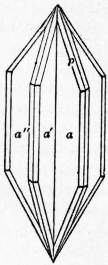
Fig. 1.
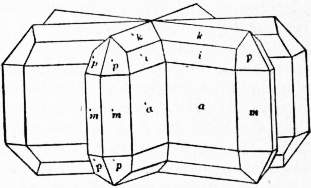
Fig. 2.
CERUSSITE, a mineral consisting of lead carbonate (PbCO3), and an important ore of lead. The name (sometimes erroneously spelt cerusite) is from the Lat. cerussa, “white lead.” “Cerussa nativa” was mentioned by K. Gesner in 1565, and in 1832 F.S. Beudant applied the name céruse to the mineral, whilst the present form, cerussite, is due to W. Haidinger (1845). Popular names in early use were lead-spar and white-lead-ore.
Cerussite crystallizes in the orthorhombic system and is isomorphous with aragonite. Like aragonite it is very frequently twinned, the compound crystals being pseudo-hexagonal in form. Three crystals are usually twinned together on two faces of the prism m{110}, producing six-rayed stellate groups (figs, 1 and 2) with the individual crystals intercrossing at angles of nearly 60°. Twinning on the faces of the prism r{130}, the angles of which are also nearly 60°, produces a similar kind of grouping, but is much less common. Crystals are of frequent occurrence, and they usually have very bright and smooth faces. The mineral also occurs in compact granular masses, and sometimes in fibrous forms. It is usually colourless or white, sometimes grey or greenish in tint; it varies from transparent to translucent, and has an adamantine lustre. It is very brittle, and has a conchoidal fracture. Hardness 3-3½; sp. gr. 6.5. A variety containing 7% of zinc carbonate, replacing lead carbonate, is known as iglesiasite, from Iglesias in Sardinia, where it is found.
The mineral may be readily recognized by its characteristic twinning, in conjunction with the adamantine lustre and high specific gravity. It dissolves with effervescence in dilute nitric acid. Before the blow-pipe it fuses very readily, and gives reactions for lead. Cerussite occurs in metalliferous veins in association with galena, and has been formed by the action of carbonated waters on the galena; it is therefore found in the upper parts of the lodes together with other secondary minerals, such as limonite. Finely crystallized specimens have been obtained from the Friedrichssegen mine near Ems in Nassau, Johanngeorgenstadt in Saxony, Mies in Bohemia, Phenixville in Pennsylvania, Broken Hill in New South Wales, and several other localities. Delicate acicular crystals of considerable length were found long ago in the Pentire Glaze mine near St Minver in Cornwall. It is often found in considerable quantities, and contains as much as 77½% of lead.
(L. J. S.)
CERUTTI, GIUSEPPE ANTONIO GIACHIMO (1738-1792), French author and politician, was born at Turin on the 13th of June 1738. He joined the Society of Jesus and became professor at the Jesuit college at Lyons. In 1762, in reply to the attacks on his order, he published an Apologie générale de l’institut et de la doctrine des Jésuites, which won him much fame and some exalted patronage; notably that of the ex-king Stanislaus of Poland and of his grandson the dauphin. During the agitations that preceded the Revolution Cerutti took the popular side, and in 1788 published a pamphlet, Mémoire pour le peuple français, in which in a clear and trenchant style he advocated the claims of the tiers état. In May 1789 he presided over the electors of Paris, by whom in January 1791 he was chosen member of the administration of the department and afterwards deputy to the Legislative Assembly. He was a friend of Mirabeau, whose policy he supported and whose funeral oration he pronounced. He himself died on the 3rd of February 1792. Of Cerutti’s literary enterprises the most interesting, and probably the most influential, was the popular newspaper founded by him, on the 30th of September 1790, in collaboration with Rabaut Saint-Étienne and Philippe Antoine Grouvelle. Its character and objects are explained by its title: La Feuille villageoise, adressée chaque semaine à tous les villages de France pour les instruire des lois, des événements, des découvertes qui interessent tout ban citoyen, &c. It was continued by Grouvelle after Cerutti’s death, the last number appearing on the 2nd of August 1795.
Cerutti’s works were published in 1793 in 3 volumes. On the Mémoire pour le peuple français, see F.A. Aulard in La Révolution française, tom. xv. (1888).
CERVANTES SAAVEDRA, MIGUEL DE (1547-1616), Spanish novelist, playwright and poet, was born at Alcalá de Henares in 1547. The attempts of biographers to provide him with an illustrious genealogy are unsuccessful. The family history begins with the author’s grandfather, Juan de Cervantes (b. 1490), a lawyer who at one time (1545-6) administered the estates of the duke de Osuna, and resided later at Cordova, where he died about 1555. Cervantes’ father was Rodrigo de Cervantes, an apothecary-surgeon, who married Leonor de Cortinas in 1540 or 1541. The children of this marriage were Andrés (b. 1543), Andrea (b. 1544), Luisa (b. 1546), Miguel, Rodrigo (b. 1550), Magdalena (b. 1554) and Juan (of whom nothing is known beyond the mention of him in his father’s will).
The exact date of Cervantes’ birth is not recorded: he was baptized on the 9th of October 1547, in the church of Santa Maria la Mayor at Alcalá. There are indications that Rodrigo de Cervantes resided at Valladolid in 1554, at Madrid in 1561, at Seville in 1564-1565, and at Madrid from 1566 onwards. It may be assumed that his family accompanied him, and it seems likely that either at Valladolid or at Madrid Cervantes saw the famous actor-manager and dramatist, Lope de Rueda, of whose performances he speaks enthusiastically in the preface to his plays. In 1569 a Madrid schoolmaster, Juan Lopez de Hoyos, issued a work commemorative of Philip II.’s third wife, Isabel de Valois, who had died on the 3rd of October 1568. This volume, entitled Historia y relación verdadera de la enfermedad, felicisimo tránsito y sumptuosas exequias fúnebres de la Serenisima Reyna de Españia Doña Isabel de Valoys, contains six contributions by Cervantes: a sonnet, four redondillas, and an elegy. Lopez de Hoyos introduces Cervantes as “our dear and beloved pupil,” and the elegy is dedicated to Cardinal Espinosa “in the name of the whole school.” It has been inferred that Cervantes was educated by Lopez de Hoyos, but this conclusion is untenable, for Lopez de Hoyos’ school was not opened till 1567. On the 13th of October 1568, Giulio Acquaviva reached Madrid charged with a special mission to Philip II.; he left for Rome on the 2nd of December, and Cervantes is supposed to have accompanied him. This conjecture is based solely on a passage in the dedication of the Galatea, where the writer speaks of having been “camarero to Cardinal Acquaviva at Rome.” There is, however, no reason to think that Cervantes met Acquaviva in Madrid; the probability is that he enlisted as a supernumerary towards the end of 1568, that he served in Italy, and there entered the household of Acquaviva, who had been raised to the cardinalate on the 17th of May 1570. There exists a warrant (dated September 15, 1569) for the arrest of one Miguel de Cervantes, who had wounded Antonio de Sigura, and had been condemned in absence to have his right hand cut off and to be exiled from the capital for ten years; and it has been sought to identify the offender with the future author of Don Quixote. No evidence is available. All that is known with certainty is that Cervantes was in Rome at the end of 1569, for on the 22nd of December of that year the fact was recorded in an official information lodged by Rodrigo de Cervantes with a view to proving his son’s legitimacy and untainted Christian descent.
If it is difficult to say precisely when Cervantes was in Acquaviva’s service, it is no less difficult to say when he left it to join the regular army. There is evidence, more or less satisfactory, that his enlistment took place in 1570; in 1571 he was serving as a private in the company commanded by Captain Diego de Urbina which formed part of Miguel de Moncada’s famous regiment, and on the 16th of September he sailed from Messina on board the “Marquesa,” which formed part of the armada under Don John of Austria. At the battle of Lepanto (October 7, 1571) the “Marquesa” was in the thickest of the conflict. As the fleet came into action Cervantes lay below, ill with fever; but, despite the remonstrances of his comrades, he vehemently insisted on rising to take his share in the fighting, and was posted with twelve men under him in a boat by the galley’s side. He received three gunshot wounds, two in the chest, and one which permanently maimed his right hand—“for the greater glory of the right,” in his own phrase. On the 30th of October the fleet returned to Messina, where Cervantes went into hospital, and during his convalescence received grants-in-aid amounting to eighty-two ducats. On the 29th of April 1572 he was transferred to Captain Manuel Ponce de León’s company in Lope de Figueroa’s regiment; he shared in the indecisive naval engagement off Navarino on the 7th of October 1572, in the capture of Tunis on the 10th of October 1573, and in the unsuccessful expedition to relieve the Goletta in the autumn of 1574. The rest of his military service was spent in garrison at Palermo and Naples, and shortly after the arrival of Don John at Naples on the 18th of June 1575, Cervantes was granted leave to return to Spain; he received a recommendatory letter from Don John to Philip II., and a similar testimonial from the duke de Sessa, viceroy of Sicily. Armed with these credentials, Cervantes embarked on the “Sol” to push his claim for promotion in Spain.
On the 26th of September 1575, near Les Trois Maries off the coast of Marseilles, the “Sol” and its companion ships the “Mendoza” and the “Higuera” encountered a squadron of Barbary corsairs under Arnaut Mami; Cervantes, his brother Rodrigo and other Spaniards were captured, and were taken as prisoners to Algiers. Cervantes became the slave of a Greek renegade named Dali Mami, and, as the letters found on him were taken to prove that he was a man of importance in a position to pay a high ransom, he was put under special surveillance. With undaunted courage and persistence he organized plans of escape. In 1576 he induced a Moor to guide him and other Christian captives to Oran; the Moor deserted them on the road, the baffled fugitives returned to Algiers, and Cervantes was treated with additional severity. In the spring of 1577 two priests of the Order of Mercy arrived in Algiers with a sum of three hundred crowns entrusted to them by Cervantes’ parents; the amount was insufficient to free him, and was spent in ransoming his brother Rodrigo. Cervantes made another attempt to escape in September 1577, but was betrayed by the renegade whose services he had enlisted. On being brought before Hassan Pasha, the viceroy of Algiers, he took the blame on himself, and was threatened with death; struck, however, by the heroic bearing of the prisoner, Hassan remitted the sentence, and bought Cervantes from Dali Mami for five hundred crowns. In 1577 the captive addressed to the Spanish secretary of state, Mateo Vazquez, a versified letter suggesting that an expedition should be fitted out to seize Algiers; the project, though practicable, was not entertained. In 1578 Cervantes was sentenced to two thousand strokes for sending a letter begging help from Martín de Córdoba, governor of Oran; the punishment was not, however, inflicted on him. Meanwhile his family were not idle. In March 1578 his father presented a petition to the king setting forth Cervantes’ services; the duke de Sessa repeated his testimony to the captive’s merits; in the spring of 1579 Cervantes’ mother applied for leave to export two thousand ducats’ worth of goods from Valencia to Algiers, and on the 31st of July 1579 she gave the Trinitarian monks, Juan Gil and Antón de la Bella, a sum of two hundred and fifty ducats to be applied to her son’s ransom. On his side Cervantes was indefatigable, and towards the end of 1579 he arranged to secure a frigate; but the plot was revealed to Hassan by Juan Blanco de Paz, a Dominican monk, who appears to have conceived an unaccountable hatred of Cervantes. Once more the conspirator’s life was spared by Hassan who, it is recorded, declared that “so long as he had the maimed Spaniard in safe keeping, his Christians, ships and city were secure.” On the 29th of May 1580 the two Trinitarians arrived in Algiers: they were barely in time, for Hassan’s term of office was drawing to a close, and the arrangement of any ransom was a slow process, involving much patient bargaining. Hassan refused to accept less than five hundred gold ducats for his slave; the available funds fell short of this amount, and the balance was collected from the Christian traders of Algiers. Cervantes was already embarked for Constantinople when the money was paid on the 19th of September 1580. The first use that he made of his liberty was to cause affidavits of his proceedings at Algiers to be drawn up; he sailed for Spain towards the end of October, landed at Denia in November, and made his way to Madrid. He signed an information before a notary in that city on the 18th of December 1580.
These dates prove that he cannot, as is often alleged, have served under Alva in the Portuguese campaign of 1580: that campaign ended with the battle of Alcántara on the 25th of August 1580. It seems certain, however, that he visited Portugal soon after his return from Algiers, and in May 1581 he was sent from Thomar on a mission to Oran. Construed literally, a formal statement of his services, signed by Cervantes on the 21st of May 1590, makes it appear that he served in the Azores campaigns of 1582-83; but the wording of the document is involved, the claims of Cervantes are confused with those of his brother Rodrigo (who was promoted ensign at the Azores), and on the whole it is doubtful if he took part in either of the expeditions under Santa Cruz. In any case, the stories of his residence in Portugal, and of his love affairs with a noble Portuguese lady who bore him a daughter, are simple inventions. From 1582-3 to 1587 Cervantes seems to have written copiously for the stage, and in the Adjunta al Parnaso he mentions several of his plays as “worthy of praise”; these were Los Tratos de Argel, La Numancia, La Gran Turquesa, La Batalla naval, La Jerusalem, La Amaranta ó la de Mayo, El Bosque amoroso, La Unica y Bizarra Ársinda—“and many others which I do not remember, but that which I most prize and pique myself on was, and is, one called La Confusa which, with all respect to as many sword-and-cloak plays as have been staged up to the present, may take a prominent place as being good among the best.” Of these only Los Tratos de Argel (or El Trato de Argel) and La Numancia have survived, and, though La Numancia contains many fine rhetorical passages, both plays go to prove that the author’s genius was not essentially dramatic. In February 1584 he obtained a licence to print a pastoral novel entitled Primera parte de la Galatea, the copyright of which he sold on the 14th of June to Blas de Robles, a bookseller at Alcalá de Henares, for 1336 reales. On the 12th of December he married Catalina de Palacios Salazar y Vozmediano of Esquivias, eighteen years his junior. The Galatea was published in the spring of 1585, and is frequently said to relate the story of Cervantes’ courtship, and to introduce various distinguished writers under pastoral names. These assertions must be received with great reserve. The birth of an illegitimate daughter, borne to Cervantes by a certain Ana Francisca de Rojas, is referred to 1584, and earlier in that same year the Galatea had passed the censor; with few exceptions, the identifications of the characters in the book with personages in real life are purely conjectural. These circumstances, together with the internal evidence of the work, point to the conclusion that the Galatea was begun and completed before 1583. It was only twice reprinted—once at Lisbon (1590), and once at Paris (1611)—during the author’s lifetime; but it won him a measure of repute, it was his favourite among his books, and during the thirty years that remained to him he repeatedly announced the second part which is promised conditionally in the text. However, it is not greatly to be regretted that the continuation was never published; though the Galatea is interesting as the first deliberate bid for fame on the part of a great genius, it is an exercise in the pseudo-classic literature introduced into Italy by Sannazaro, and transplanted to Spain by the Portuguese Montemõr; and, ingenious or eloquent as the Renaissance prose-pastoral may be, its innate artificiality stifles Cervantes’ rich and glowing realism. He himself recognized its defects; with all his weakness for the Galatea, he ruefully allows that “it proposes something and concludes nothing.” Its comparative failure was a serious matter for Cervantes who had no other resource but his pen; his plays were probably less successful than his account of them would imply, and at any rate play-writing was not at this time a lucrative occupation in Spain. No doubt the death of his father on the 13th of June 1585 increased the burden of Cervantes’ responsibilities; and the dowry of his wife, as appears from a document dated the 9th of August 1586, consisted of nothing more valuable than five vines, an orchard, some household furniture, four beehives, forty-five hens and chickens, one cock and a crucible.
It had become evident that Cervantes could not gain his bread by literature, and in 1587 he went to Seville to seek employment in connexion with the provisioning of the Invincible Armada. He was placed under the orders of Antonio de Guevara, and before the 24th of February was excommunicated for excessive zeal in collecting wheat at Écija. During the next few months he was engaged in gathering stores at Seville and the adjacent district, and after the defeat of the Armada he was retained as commissary to the galleys. Tired of the drudgery, and without any prospect of advancement, on the 21st of May 1590 Cervantes drew up a petition to the king, recording his services and applying for one of four posts then vacant in the American colonies: a place in the department of public accounts in New Granada, the governorship of Soconusco in Guatemala, the position of auditor to the galleys at Cartagena, or that of corregidor in the city of La Paz. The petition was referred to the Council of the Indies, and was annotated with the words:—“Let him look for something nearer home.” Cervantes perforce remained at his post; the work was hard, uncongenial and ill-paid, and the salary was in constant arrears. In November 1590 he was in such straits that he borrowed money to buy himself a suit of clothes, and in August 1592 his sureties were called upon to make good a deficiency of 795 reales in his accounts. His thoughts turned to literature once more, and on the 5th of September 1592, he signed a contract with Rodrigo Osorio undertaking to write six plays at fifty ducats each, no payment to be made unless Osorio considered that each of these pieces was “one of the best ever produced in Spain.” Nothing came of this agreement, and it appears that, between the date of signing it and the 19th of September, Cervantes was imprisoned (for reasons unknown to us) at Castro del Río. He was speedily released, and continued to perquisition as before in Andalusia; but his literary ambitions were not dead, and in May 1595 he won the first prize—three silver spoons—at a poetical tourney held in honour of St Hyacinth at Saragossa. Shortly afterwards Cervantes found himself in difficulties with the exchequer officials. He entrusted a sum of 7400 reales to a merchant named Simón Freire de Lima with instructions to pay the amount into the treasury at Madrid; the agent became bankrupt and absconded, leaving Cervantes responsible for the deficit. By some means the money was raised, and the debt was liquidated on the 21st of January 1597. But Cervantes’ position was shaken, and his unbusinesslike habits lent themselves to misinterpretation. On the 6th of September 1597 he was ordered to find sureties that he would present himself at Madrid within twenty days, and there submit to the exchequer vouchers for all official moneys collected by him in Granada and elsewhere. No such sureties being available, he was committed to Seville jail, but was released on the 1st of December on condition that he complied with the original order of the court within thirty days. He was apparently unable to find bail, was dismissed from the public service, and sank into extreme poverty. During a momentary absence from Seville in February 1590, he was again summoned to Madrid by the treasury, but does not appear to have obeyed: it is only too likely that he had not the money to pay for the journey. There is some reason to think that he was imprisoned at Seville in 1602, but nothing positive is known of his existence between 1600 and the 8th of February 1603: at the latter date he seems to have been at Valladolid, to which city Philip III. had removed the court in 1601.
Since the publication of the Galatea in 1585 Cervantes’ contributions to literature had been limited to occasional poems. In 1591 he published a ballad in Andrés de Villalta’s Flor de varios y nuevos romances; in 1595 he composed a poem, already mentioned, to celebrate the canonization of St Hyacinth; in 1596 he wrote a sonnet ridiculing Medina Sidonia’s tardy entry into Cadiz after the English invaders had retired, and in the same year his sonnet lauding Santa Cruz was printed in Cristóbal. Mosquera de Figueroa’s Comentario en breve compendio de disciplina militar; to 1597 is assigned a sonnet (the authenticity of which is disputed) commemorative of the poet Herrera; in 1598 he wrote two sonnets and a copy of quintillas on the death of Philip II.; and in 1602 a complimentary sonnet from his pen appeared in the second edition of Lope de Vega’s Dragontea. Curiously enough, it is by Lope de Vega that Don Quixote is first mentioned. Writing to an unknown correspondent (apparently a physician) on the 14th of August 1604, Lope de Vega says that “no poet is as bad as Cervantes, nor so foolish as to praise Don Quixote,” and he goes on to speak of his own plays as being odious to Cervantes. It is obvious that the two men had quarrelled since 1602, and that Lope de Vega smarted under the satire of himself and his works in Cervantes’ forthcoming book; Don Quixote may have been circulated in manuscript, or may even have been printed before the official licence was granted on the 26th of September 1604. It was published early in 1605, and was dedicated to the seventh duke de Béjar in phrases largely borrowed from the dedication in Herrera’s edition (1580) of Garcilaso de la Vega, and from Francisco de Medina’s preface to that work.
The mention of Bernardo de la Vega’s Pastor de Iberia shows that the sixth chapter of Don Quixote cannot have been written before 1591. In the prologue Cervantes describes his masterpiece as being “just what might be begotten in a jail”; on the strength of this passage, it has been thought that he conceived the story, and perhaps began writing it, during one of his terms of imprisonment at Seville between 1597 and 1602. Within a few weeks of its publication at Madrid, three pirated editions of Don Quixote were issued at Lisbon; a second authorized edition, imperfectly revised, was hurried out at Madrid; and another reprint appeared at Valencia with an aprobación dated 18th July 1605. With the exception of Alemán’s Guzmán de Alfarache, no Spanish book of the period was more successful. Modern criticism is prone to regard Don Quixote as a symbolic, didactic or controversial work intended to bring about radical reforms in church and state. Such interpretations did not occur to Cervantes’ contemporaries, nor to Cervantes himself. There is no reason for rejecting his plain statement that his main object was to ridicule the romances of chivalry, which in their latest developments had become a tissue of tiresome absurdities. It seems clear that his first intention was merely to parody these extravagances in a short story; but as he proceeded the immense possibilities of the subject became more evident to him, and he ended by expanding his work into a brilliant panorama of Spanish society as it existed during the 16th century. Nobles, knights, poets, courtly gentlemen, priests, traders, farmers, barbers, muleteers, scullions and convicts; accomplished ladies, impassioned damsels, Moorish beauties, simple-hearted country-girls and kindly kitchen-wenches of questionable morals—all these are presented with the genial fidelity which comes of sympathetic insight. The immediate vogue of Don Quixote was due chiefly to its variety of incident, to its wealth of comedy bordering on farce, and perhaps also to its keen thrusts at eminent contemporaries; its reticent pathos, its large humanity, and its penetrating criticism of life were less speedily appreciated.
Meanwhile, on the 12th of April 1605, Cervantes authorized his publisher to proceed against the Lisbon booksellers who threatened to introduce their piratical reprints into Castile. By June the citizens of Valladolid already regarded Don Quixote and Sancho Panza as proverbial types. Less gratifying experiences awaited the popular author. On the 27th of June 1605 Gaspar de Ezpeleta, a Navarrese gentleman of dissolute life, was wounded outside the lodging-house in which Cervantes and his family lived; he was taken indoors, was nursed by Cervantes’ sister Magdalena, and died on the 29th of June. That same day Cervantes, his natural daughter (Isabel de Saavedra), his sister Andrea and her daughter were lodged in jail on suspicion of being indirectly concerned in Ezpeleta’s death; one of the witnesses made damaging charges against Cervantes’ daughter, but no substantial evidence was produced, and the prisoners were released. Little is known of Cervantes’ life between 1605 and 1608. A Relación of the festivities held to celebrate the birth of Philip IV., and a certain Carta á don Diego Astudillo Carrillo have been erroneously ascribed to him; during these three years he apparently wrote nothing beyond three sonnets, and one of these is of doubtful authenticity. The depositions of the Valladolid enquiry show that he was living in poverty five months after the appearance of Don Quixote, and the fact that he borrowed 450 reales from his publisher before November 1607 would convey the idea that his position improved slowly, if at all. But it is difficult to reconcile this view of his circumstances with the details concerning his illegitimate daughter revealed in documents recently discovered. Isabel de Saavedra was stated to be a spinster when arrested at Valladolid in June 1605; the settlement of her marriage with Luis de Molina in 1608 describes her as the widow of Diego Sanz, as the mother of a daughter eight months old, and as owning house-property of some value. These particulars are perplexing, and the situation is further complicated by the publication of a deed in which Cervantes declares that he himself is the real owner of this house-property, and that his daughter has merely a life-interest in it. This claim may be regarded as a legal fiction; it cannot easily be reconciled with Cervantes’ statement towards the end of his life, that he was dependent on the bounty of the count de Lemos and of Bernardo de Sandoval, cardinal-archbishop of Toledo. In 1609 he joined the newly founded confraternity of the Slaves of the Most Blessed Sacrament; in 1610 Lemos was appointed viceroy of Naples, and Cervantes was keenly disappointed at not being chosen to accompany his patron. In 1611 he lost his sister Magdalena, who was buried by the charity of the Tertiaries of Saint Francis; in 1612 he joined the Academia Selvaje, and there appears to have renewed his former friendly relations with Lope de Vega; in 1613 he dedicated his Novelas exemplares to the count de Lemos, and disposed of his rights for 1600 reales and twenty-four copies of the book. The twelve tales in this volume, some of them written very much later than others, are of unequal merit, but they contain some of the writer’s best work, and the two picaresque stories—Rinconete y Cortadillo and the Coloquio de los perros—are superb examples of their kind, and would alone entitle Cervantes to take rank with the greatest masters of Spanish prose. In 1614 he published the Viage del Parnaso, a burlesque poem suggested by the Viaggio in Parnaso (1582) of the Perugian poet Cesare Caporali. It contains some interesting autobiographical passages, much flattery of contemporary poetasters, and a few happy satirical touches; but, though it is Cervantes’ most serious bid for fame as a poet, it has seldom been reprinted, and would probably have been forgotten but for an admirably humorous postscript in prose which is worthy of the author at his best. In the preface to his Ocho comedias y ocho entremeses nuevos (1615) he good-humouredly admits that his dramatic works found no favour with managers, and, when this collection was first reprinted (1749), the editor advanced the fantastic theory that the comedias were deliberate exercises in absurdity, intended to parody the popular dramas of the day. This view cannot be maintained, but a sharp distinction must be drawn between the eight set plays and the eight interludes; with one or two exceptions, the comedias or set plays are unsuccessful experiments in Lope de Vega’s manner, while the entremeses or interludes, particularly those in prose, are models of spontaneous gaiety and ingenious wit.
In the preface to the Novelas exemplares Cervantes had announced the speedy appearance of the sequel to Don Quixote which he had vaguely promised at the end of the first part. He was at work on the fifty-ninth chapter of his continuation when he learned that he had been anticipated by Alonso Fernandez de Avellaneda of Tordesillas, whose Segunde tamo del ingenioso hidalgo don Quixote de la Mancha was published at Tarragona in 1614. On the assumption that Fernandez de Avellaneda is a pseudonym, this spurious sequel has been ascribed to the king’s confessor, Luis de Aliaga, to Cervantes’ old enemy, Blanco de Paz, to his old friend, Bartolomé Leonardo de Argensola, to the three great dramatists, Lope de Vega, Tirso de Molina and Ruiz de Alarcón, to Alonso Fernandez, to Juan José Martí, to Alfonso Lamberto, to Luis de Granada, and probably to others. Some of these attributions are manifestly absurd—for example, Luis de Granada died seventeen years before the first part of Don Quixote was published—and all of them are improbable conjectures; if Avellaneda be not the real name of the author, his identity is still undiscovered. His book is not devoid of literary talent and robust humour, and possibly he began it under the impression that Cervantes was no more likely to finish Don Quixote than to finish the Galatea. He should, however, have abandoned his project on reading the announcement in the preface to the Novelas exemplares; what he actually did was to disgrace himself by writing an insolent preface taunting Cervantes with his physical defects, his moral infirmities, his age, loneliness and experiences in jail. He was too intelligent to imagine that his continuation could hold its own against the authentic sequel, and malignantly avowed his intention of being first in the field and so spoiling Cervantes’ market. It is quite possible that Don Quixote might have been left incomplete but for this insulting intrusion; Cervantes was a leisurely writer and was, as he states, engaged on El Engaño à los ojos, Las Semanas del Jardín and El Famoso Bernardo, none of which have been preserved. Avellaneda forced him to concentrate his attention on his masterpiece, and the authentic second part of Don Quixote appeared towards the end of 1615. No book more signally contradicts the maxim, quoted by the Bachelor Carrasco, that “no second part was ever good.” It is true that the last fourteen chapters are damaged by undignified denunciations of Avellaneda; but, apart from this, the second part of Don Quixote is an improvement on the first. The humour is more subtle and mature; the style is of more even excellence; and the characters of the bachelor and of the physician, Pedro Recio de Agüero, are presented with a more vivid effect than any of the secondary characters in the first part. Cervantes had clearly profited by the criticism of those who objected to “the countless cudgellings inflicted on Señor Don Quixote,” and to the irrelevant interpolation of extraneous stories in the text. Don Quixote moves through the second part with unruffled dignity; Sancho Panza loses something of his rustic cunning, but he gains in wit, sense and manners. The original conception is unchanged in essentials, but it is more logically developed, and there is a notable progress in construction. Cervantes had grown to love his knight and squire, and he understood his own creations better than at the outset; more completely master of his craft, he wrote his sequel with the unfaltering confidence of a renowned artist bent on sustaining his reputation.
The first part of Don Quixote had been reprinted at Madrid in 1608; it had been produced at Brussels in 1607 and 1611, and at Milan in 1610; it had been translated into English in 1612 and into French in 1614. Cervantes was celebrated in and out of Spain, but his celebrity had not brought him wealth. The members of the French special embassy, sent to Madrid in February 1615, under the Commandeur de Sillery, heard with amazement that the author of the Galatea, the Novelas exemplares and Don Quixote was “old, a soldier, a gentleman and poor.” But his trials were almost at an end. Though failing in health, he worked assiduously at Los Trabajos de Persiles y Sigismunda, which, as he had jocosely prophesied in the preface to the second part of Don Quixote, would be “either the worst or the best book ever written in our tongue.” It is the most carefully written of his prose works, and the least animated or attractive of them; signs of fatigue and of waning powers are unmistakably visible. Cervantes was not destined to see it in print. He was attacked by dropsy, and, on the 18th of April 1616, received the sacrament of extreme unction; next day he wrote the dedication of Persiles y Sigismunda to the count de Lemos—the most moving and gallant of farewells. He died at Madrid in the Calle del León on the 23rd of April; he was borne from his house “with his face uncovered,” according to the rule of the Tertiaries of St Francis, and on the 24th of April was buried in the church attached to the convent of the Trinitarian nuns in the Calle de Cantarranas. There he rests—the story of his remains being removed in 1633 to the Calle del Humilladero has no foundation in fact—but the exact position of his grave is unknown. Early in 1617 Persiles y Sigismunda was published, and passed through eight editions within two years; but the interest in it soon died away, and it was not reprinted between 1625 and 1719. Cervantes’ wife died without issue on the 31st of October 1626; his natural daughter, who survived both the child of her first marriage and her second husband, died on the 20th of September 1652. Cervantes is represented solely by his works. The Novelas exemplares alone would give him the foremost place among Spanish novelists; Don Quixote entitles him to rank with the greatest writers of all time: “children turn its leaves, young people read it, grown men understand it, old folk praise it.” It has outlived all changes of literary taste, and is even more popular to-day than it was three centuries ago.
Bibliography.—Leopold Rius, Bibliografía crítica de las obras de Miguel de Cervantes Saavedra (Madrid, 1895-1905, 3 vols.); Obras completas (Madrid, 1863-1864, 12 vols.), edited by Juan Eugenio Hartzenbusch; Complete Works (Glasgow, 1901-1906, 8 vols. in progress), edited by James Fitzmaurice-Kelly; Don Quijote (Madrid, 1833-1839, 6 vols.), edited by Diego Clemencíu; Don Quixote (London, 1899-1900, 2 vols.), edited by James Fitzmaurice-Kelly and John Ormsby; Don Quijote (Madrid, 1905-1906, 2 vols. in progress), edited by Clemente Cortejón; Rinconete y Cortadillo (Sevilla, 1905), edited by Francisco Rodriguez Marín; Epístola á Mateo Vázquez (Madrid, 1905), edited by E[milio] C[otarelo]; Julián Apráiz, Estudio histórico-crítico sobre las Novelas ejemplares de Cervantes (Madrid, 1901); Francisco A. de Icaza, Las Novelas ejemplares de Cervantes (Madrid, 1901); Francisco Rodríguez Marín, El Loaysa de “El Celoso Extremeño” (Sevilla, 1901); Narciso Díaz de Escovar, Apuntes escénicos cervantinos (Madrid, 1905); Manuel José García, Estudio crítico acerca del entremés “El Vizcaino fingido” (Madrid, 1905); Alfred Morel-Fatio, L’Espagne de Don Quichotte in Études sur l’Espagne (Paris, 1895, 2me série); Julio Puyol y Alonso, Estado social que refleja “El Quijote” (Madrid, 1905); James Fitzmaurice-Kelly, Cervantes in England (London, 1905); Raymond Foulché-Delbose, Étude sur “La tia fingida,” in the Revue hispanique (Paris, 1899), vol. vi. pp. 256-306; Benedetto Croce, Due illustrazioni al “Viage del Parnaso,” in the Homenaje á Menéndez y Pelayo (Madrid, 1899), vol. i. pp. 161-193; Paul Groussac, Une Énigme littéraire: le Don Quichotte d’Avellaneda (Paris, 1903); Alonso Fernández de Avellaneda, El ingenioso hidalgo Don Quixote de la Mancha (Barcelona, [1905]), edited by Marcelino Menéndez y Pelayo; Julio Cejador y Franca, La Lengua de Cervantes (Madrid, 1905, &c.); Martin Fernández de Navarrete, Vida de Miguel de Cervantes Saavedra (Madrid, 1819); Cristóbal Perez Pastor, Documentos Cervantinos hasta ahora inéditos (Madrid, 1897-1902, 2 vols.); Emilio Cotardo y Mori, Efemérides Cervantinas (Madrid, 1905); Francisco Rodríguez Marín, Cervantes estudió en Sevilla, 1564-1565 (Seville, 1905).
(J. F.-K.)
CERVERA, PASCUAL CERVERA Y TOPETE (1839-1909), Spanish admiral, was born at Medina Sidonia on the 18th of February 1839. He showed an early inclination for the sea, and his family sent him to the naval cadet school at the age of twelve. As a sub-lieutenant he took part in the naval operations on the coast of Morocco during the campaign of 1859-60. Then he was for some time engaged in operations in the Sulu Islands and the Philippines. Afterwards he was on the West Indian station during the early part of the first Cuban War (1868-78), returning to Spain in 1873 to serve on the Basque coast against the Carlists. He distinguished himself in defending the Carraca arsenal near Cadiz against the Federals in 1873. He won each step in his promotion up to flag-rank through his steadiness and brilliant conduct in action, and was awarded the crosses of the Orders of Military and Naval Merit, Isabella the Catholic, and St Hermengilde, besides several medals. Cervera had a great reputation for decision, unbending temper and honesty, before he was placed at the head of the Bilbao building-yards. This post he resigned after a few months in order to become minister of marine in 1892, in a cabinet presided over by Sagasta. He withdrew from the cabinet when he found that his colleagues, from political motives, declined to support him in making reforms and, on the other hand, unwisely cut down the naval estimates. When in 1898 the Spanish-American War (q.v.) broke out, he was chosen to command a squadron composed of four first-class cruisers, the “Maria Theresa,” his flagship, “Oquendo,” “Vizcaya,” and “Columbus,” and several destroyers. This ill-fated squadron only started upon its reckless cruise across the ocean after its gallant commander had repeatedly warned both the minister of marine and the prime minister, Sagasta, in despatches from Cadiz and from the Canary and Cape Verde Islands, that the ships were insufficiently provided with coal and ammunition. Some of them, indeed, even lacked proper guns. In compliance with the instructions of the government, Admiral Cervera made for the landlocked harbour of Santiago de Cuba, where he co-operated in the defence, landing some guns and a naval brigade. In spite of his energetic representations, Cervera received an order from Madrid, dictated by political considerations, to sally forth. It meant certain destruction. The gallant squadron met forces trebly superior to it, and was totally destroyed. The admiral, three of his captains, and 1800 sailors and marines were taken by the victors to Portsmouth, New Hampshire, U.S.A. After the war, Cervera and his captains were tried before the supreme naval and military court of the realm, which honourably acquitted them all. In 1901 he became vice-admiral, in 1902 was appointed chief of staff of the Spanish navy, and in 1903 was made life senator. He died at Puerto Real on the 3rd of April 1909.
CESAREVICH, or more properly Tsesarevich, the title of the heir-apparent to the Russian throne. The full official title is Nasliednik Tsesarevich, i.e. “heir of Caesar,” and in Russia the heir to the throne is commonly called simply Nasliednik, the word Tsesarevich never being used alone. Tsarevich, a form now much used in England, means simply any “king’s son”; it is an antiquated term now out of use in Russia, and was last borne as heir to the throne by the unfortunate Alexius, son of Peter the Great. The style of the wife of the tsesarevich is Tsesarevna. The Cesarewitch handicap race at Newmarket, founded in 1839, was named after the prince who was afterwards Alexander II. of Russia, who paid a state visit to England that year.
CESARI, GIUSEPPE, called Il Cavaliere d’ Arpino (born in or about 1568 and created a “Cavaliere di Cristo” by Pope Clement VIII.), also named Il Giuseppino, an Italian painter, much encouraged at Rome and munificently rewarded. His father had been a native of Arpino, but Giuseppe himself was born in Rome. Cesari is stigmatized by Lanzi as not less the corrupter of taste in painting than Marino was in poetry; indeed, another of the nicknames of Cesari is “Il Marino de’ Pittori” (the pictorial Marino). There was spirit in Cesari’s heads of men and horses, and his frescoes in the Capitol (story of Romulus and Remus, &c.), which occupied him at intervals during forty years, are well coloured; but he drew the human form ill. His perspective is faulty, his extremities monotonous, and his chiaroscuro defective. He died in 1640, at the age of seventy-two, or perhaps of eighty, at Rome. Cesari ranks as the head of the “Idealists” of his period, as opposed to the “Naturalists,” of whom Michelangelo da Caravaggio was the leading champion,—the so-called “idealism” consisting more in reckless facility, and disregard of the common facts and common-sense of nature, than in anything to which so lofty a name could be properly accorded. He was a man of touchy and irascible character, and rose from penury to the height of opulence. His brother Bernardino assisted in many of his works.
CESAROTTI, MELCHIORE (1730-1808), Italian poet, was born at Padua in 1730, of a noble but impoverished family. At the university of his native place his literary progress procured for him at a very early age the chair of rhetoric, and in 1768 the professorship of Greek and Hebrew. On the invasion of Italy by the French, he gave his pen to their cause, received a pension, and was made knight of the iron crown by Napoleon I., to whom, in consequence, he addressed a bombastic and extravagantly flattering poem called Pronea. Cesarotti is best known as the translator of Homer and Ossian. Much praise cannot be given to his version of the Iliad, for he has not scrupled to add, omit and modernize. Ossian, which he held to be the finest of poems, he has, on the other hand, considerably improved in translation; and the appearance of his version attracted much attention in Italy and France, and raised up many imitators of the Ossianic style. Cesarotti also produced a number of works in prose, including a Course of Greek Literature, and essays On the Origin and Progress of the Poetic Art, On the Sources of the Pleasure derived from Tragedy, On the Philosophy of Language and On the Philosophy of Taste, the last being a defence of his own great eccentricities in criticism. His weakness was a straining after novelty. His style is forcible, but full of Gallicisms.
A complete edition of his works, in 42 vols. 8vo. began to appear at Pisa in 1800, and was completed in 1813, after his death. See Memoirs, by Barbieri (Padua, 1810), and Un Filosofo delle lettere, by Alemanni (Turin, 1894).
CESENA (anc. Caesena), a town and episcopal see of Emilia, Italy, in the province of Forlì, 12 m. S.E. by rail from the town of Forlì, on the line between Bologna and Rimini, 144 ft. above sea-level. Pop. (1905) 12,245 (town); 43,468 (commune). The town is picturesquely situated at the foot of the slopes of the Apennines, and is crowned by a medieval fortress (Rocca), begun by the emperor Frederick I. (Barbarossa) probably, but altered and added to later. The cathedral has two fine marble altars by the Lombardi of Venice (or their school). The library, built for Domenico Malatesta in 1452 by Matteo Nuzio, is a fine early Renaissance building, and its internal arrangements, with the original desks to which the books are still chained, are especially well preserved (see J.W. Clark, The Care of Books, Cambridge, 1901, p. 199). In it are valuable MSS., many of which were used by Aldus Manutius. It also contains a picture gallery with a good “Presentation in the Temple” by Francesco Francia. There are some fine palaces in the town. Three-quarters of a mile south-east on the hill stands the handsome church of S. Maria del Monte, after the style of Bramante, with carved stalls of the 16th century. Wine, hemp and silk are the main articles of trade. About the ancient Caesena little is said in classical authors: it is mentioned as a station on the Via Aemilia and as a fortress in the wars of Theodoric and Narses. During the middle ages it was at first independent. In 1357 it was unsuccessfully defended by the wife of Francesco Ordelaffi, lord of Forlì, against the papal troops under Albornoz. In 1377 it was sacked by Cardinal Robert of Geneva (afterwards Clement VII., antipope). It was then held by the Malatesta of Rimini until 1465, when it came under the dominion of the church. Both Pius VI. (1717) and Pius VII. (1742) were born at Cesena.
(T. As.)
CESNOLA, LUIGI PALMA DI (1832-1904), Italian-American soldier and archaeologist, was born near Turin on the 29th of July 1832. Having served in the Austrian and Crimean Wars, in 1860 he went to New York, where he taught Italian and French and founded a military school for officers. He took part in the American Civil War as colonel of a cavalry regiment, and at Aldie (June 1863) was wounded and taken prisoner. He was released from Libby prison early in 1864, served in the Wilderness and Petersburg campaigns (1864-65) as a brigadier of cavalry, and at the close of the war was breveted brigadier-general. He was then appointed United States consul at Larnaca in Cyprus (1865-1877). During his stay in the island he carried on excavations, which resulted in the discovery of a large number of antiquities. The collection was purchased by the Metropolitan Museum of New York, and Cesnola became director in 1879. Doubt having been thrown by Gaston L. Feuerdant, in an article in the New York Herald (August 1880), upon the genuineness of his restorations, the matter was referred to a special committee, which pronounced in his favour.1 He is the author of Cyprus, its ancient Cities, Tombs and Temples (1877), an interesting book of travel and of considerable service to the practical antiquary; and of a Descriptive Atlas of the Cesnola Collection of Cypriote Antiquities (3 vols., 1884-6). He died in New York on the 21st of November 1904. He was a member of several learned societies in Europe and America, and in 1897 he received a Congressional medal of honour for conspicuous military services.
His brother, Alessandro Palma di Cesnola, born in 1839, conducted excavations at Paphos (where he was U.S. vice-consul) and Salamis on behalf of the British government. The results of these are described in Salaminia (1882).
1 For the Cesnola controversy see C.D. Cobham’s Attempt at a Bibliography of Cyprus (4th ed., 1900). See also article Cyprus.
CESPEDES (in Ital. Cedaspe), PABLO DE (1538-1608), Spanish poet, painter, sculptor and architect, was born at Cordova, and was educated at Alcalá de Henares, where he studied theology and Oriental languages. On leaving the university, he went to Rome, where he became the pupil and friend of Federigo Zuccaro, under whose direction he studied particularly the works of Raphael and of Michelangelo. In 1560, while yet in Rome, proceedings were taken against him by the Inquisition at Valladolid on account of a letter which, found among the papers of the archbishop of Toledo, had been written by Cespedes during the preceding year, and in which he had spoken with great freedom against the holy office and the inquisitor-general, Fernando de Valdés. Cespedes remained in Rome at this critical moment, and he appears rightly to have treated the prosecution with derision. It is not known how he contrived to bring the proceedings to an end; he returned, however, to Spain a little before 1577, and in that year was installed in a prebend of the cathedral at Cordova, where he resided till his death. Pablo de Cespedes has been called the most savant of Spanish artists. According to his friend Francisco Pacheco, to whom posterity is indebted for the preservation of all of Cespedes’s verse that is extant, the school of Seville owes to him its introduction to the practice of chiaroscuro. He was a bold and correct draughtsman, a skilful anatomist, a master of colour and composition; and the influence he exerted to the advantage of early Spanish art was considerable. Cristobal de Vera, Juan de Peñalosa and Zambrano were among his pupils. His best picture is a Last Supper at Cordova, but there are good examples of his work at Seville and at Madrid. Cespedes was author of several opuscules in prose on subjects connected with his profession. Of his poem on The Art of Painting enough was preserved by Pacheco to enable us to form an opinion of the whole. It is esteemed the best didactic verse in Spanish; and it has been compared, not disadvantageously, with the Georgics. It is written in strong and sonorous octaves, in the majestic declamatory vein of Fernando Herrera, and is not altogether so dull and lifeless as is most didactic verse. It contains a glowing eulogy of Michelangelo, and some excellent advice to young painters, insisting particularly on hard work and on the study of nature. The few fragments yet remaining, amounting in all to some six hundred lines, were first printed by Pacheco in his treatise Del arte de la pintura, in 1649.
CÉSPEDES Y MENESES, GONZALO DE (1585?-1638), Spanish novelist, was born at Madrid about 1585. Nothing positive is known of him before the publication of his celebrated romance, the Poema trágico del Español Gerardo, y desengaño del amor lascivo (1615-1617); there is evidence that he had been sentenced to eight years at the galleys previous to the 1st of January 1620, and that the penalty had been remitted; but the nature of his offence is not stated. His treatment of political questions in the Historia apologética en los sucesos del reyno de Aragón, y su ciudad de Zaragoza, años de 91 y 92 (1622), having led to the confiscation of the book, Céspedes took up his residence at Saragossa and Lisbon. While in exile he issued a collection of short stories entitled Historias peregrinas y exemplares (1623), the unfinished romance Varia fortuna del soldado Píndaro (1626), and the first part of his Historia de Felipe IV. (1631), a fulsome eulogy which was rewarded by the author’s appointment as official historiographer to the Spanish king. Céspedes died on the 27th of January 1638. His novels, though written in a ponderous, affected style, display considerable imagination and insight into character. The Poema trágico has been utilized by Fletcher in The Spanish Curate and in The Maid of the Mill.
The Historias peregrinas has been reprinted (1906) with a valuable introduction by Sr. Cotarelo y Mori.
CESS (a shortened form of “assess”; the spelling is due to a mistaken connexion with “census”), a tax; a term formerly more particularly applied to local taxation, in which sense it still is used in Ireland; otherwise it has been superseded by “rate.” In India it is applied, with the qualifying word prefixed, to any taxation, such as “irrigation-cess” and the like, and in Scotland to the land-tax.
CESSIO BONORUM (Latin for a “surrender of goods”), in Roman law, a voluntary surrender of goods by a debtor to his creditors. It did not amount to a discharge unless the property ceded was sufficient for the purpose, but it secured the debtor from personal arrest. The creditors sold the goods in satisfaction, pro tanto, of their claims. The procedure of cessio bonorum avoided infamy, and the debtor, though his after-acquired property might be proceeded against, could not be deprived of the bare necessaries of life. The main features of the Roman law of cessio bonorum were adopted in Scots law, and also in the French legal system. (See further Bankruptcy.)
CESTI, MARC’ ANTONIO (1620?-1669?), Italian musical composer, was born at Florence about 1620. He was a pupil of Carissimi, and after holding a post somewhere in Florence as maestro di cappella entered the papal chapel in 1660. In 1666 he became Vice-Kapellmeister at Vienna, and died at Venice in 1669. Cesti is known principally as a composer of operas, the most celebrated of which were La Dori (Venice, 1663) and Il Pomo d’ oro (Vienna, 1668). He was also a composer of chamber-cantatas, and his operas are notable for the pure and delicate style of their airs, more suited to the chamber than to the stage.
CESTIUS, LUCIUS, surnamed Pius, Latin rhetorician, flourished during the reign of Augustus. He was a native of Smyrna, a Greek by birth. According to Jerome, he was teaching Latin at Rome in the year 13 B.C. He must have been living after A.D. 9, since we are told that he taunted the son of Quintilius Varus with his father’s defeat in the Teutoburgian forest (Seneca, Controv. i. 3, 10). Cestius was a man of great ability, but vain, quarrelsome and sarcastic. Before he left Asia, he was invited to dinner by Cicero’s son, then governor of the province. His host, being uncertain as to his identity, asked a slave who Cestius was; and on receiving the answer, “he is the man who said your father was illiterate,” ordered him to be flogged (Seneca, Suasoriae, vii. 13). As an orator in the schools Cestius enjoyed a great reputation, and was worshipped by his youthful pupils, one of whom imitated him so slavishly that he was nicknamed “my monkey” by his teacher (Seneca, Controv. ix. 3, 12). As a public orator, on the other hand, he was a failure. Although a Greek, he always used Latin in his declamations, and, although he was sometimes at a loss for Latin words, he never suffered from lack of ideas. Numerous specimens of his declamations will be found in the works of Seneca the rhetorician.
See the monograph De Lucio Cestio Pio, by F.G. Lindner (1858); T. Brzoska in Pauly-Wissowa’s Realencyclopadie, iii. 2 (1899); Teuffel-Schwabe, Hist, of Roman Lit. (Eng. tr.), § 268, 6; M. Schanz, Geschichte der romischen Litteratur, ii.
CESTUI, CESTUY, an Anglo-French word, meaning “that person,” which appears in the legal phrases cestui que trust, use, or vie. It is usually pronounced as “cetty.” Cestui que trust means literally “the person for whose benefit the trust” is created. The cestui que trust is the person entitled to the equitable, as opposed to the legal, estate. Thus, if land be granted unto, and to the use of A. in trust for B., B. is cestui que trust, and A. trustee. The term, principally owing to its cumbersomeness, is being gradually superseded in modern law by that of “beneficiary.” Cestui que use (sometimes cestui à que use) means “the person for whose benefit a use” is created (see TRUST). Cestui que vie is “the person for whose life” lands are held by another (see Remainder).
CETACEA (from the Gr. κέτος, a whale), the name of the mammalian order represented by whales, dolphins, porpoises, &c. From their fish-like form, which is manifestly merely an adaptation to their purely aquatic life, these creatures are often regarded as fishes, although they are true mammals, with warm blood, and suckle their young.
The general form is essentially fish-like, the spindle-shaped body passing anteriorly into the head without any distinct neck, and posteriorly tapering gradually towards the extremity of the tail, which is provided with a pair of lateral, pointed expansions of skin supported by fibrous tissue, called “flukes,” forming a horizontal triangular propelling organ, notched behind in the middle line. The head is generally large, in some cases attaining more than one-third the entire length; and the mouth is wide, and bounded by stiff, immobile lips. The fore-limbs are reduced to flattened paddles, encased in a continuous skin, showing no external sign of division, and without trace of nails. There are no signs of hind-limbs visible externally. The surface of the skin is smooth and glistening, and devoid of hair, although in many species there are a few bristles in the neighbourhood of the mouth which may persist through life or be present only in the young state. Immediately beneath the skin is a thick layer of fat, held together by a mesh of tissue, constituting the “blubber,” which retains the heat of the body. In nearly all species a compressed dorsal fin is present. The eye is small, and not provided with a true lacrymal apparatus. The external ear is a minute aperture in the skin situated at a short distance behind the eye. The nostrils open separately or by a single crescentic aperture, near the vertex of the head.
The bones generally are spongy in texture, the cavities being filled with oil. In the vertebral column, the cervical region is short and immobile, and the vertebrae, always seven in number, are in many species more or less fused together into a solid mass. The odontoid process of the second cervical vertebra, when that bone is free, is usually very obtuse, or even obsolete. In a paper on the form and function of the cervical vertebrae published in the Jenaische Zeitschrift for 1905, Dr O. Reche points out that the shortening and soldering is most pronounced in species which, like the right-whales, live entirely on minute organisms, to capture which there is no necessity to turn the head at all. Accordingly we find that in these whales the whole seven cervical vertebrae are fused into an immovable solid mass, of which the compound elements, with the exception of the first and second, are but little thicker than plates. On the other hand, in the finner-whales, several of which live exclusively on fish, and thus require a certain amount of mobility in the head and neck, we find all the cervical vertebrae much thicker and entirely separate from one another. Among the dolphin group the narwhal and the white whale, or beluga, are distinguished from all other cetaceans by the great comparative length of their cervical vertebrae, all of which are completely free. In the case of the narwhal such an abnormal structure is easily accounted for, seeing that to use effectively the long tusk with which the male is armed a considerable amount of mobility in the neck is absolutely essential. The beluga, too, which is believed to feed on large and active fishes, would likewise seem to require mobility in the same region in order to effect their capture. On the other hand, the porpoise preys on herrings, pilchards and mackerel, which in their densely packed shoals must apparently fall an easy prey with but little exertion on the part of their captor, and we accordingly find all the neck-vertebrae very short, and at least six out of the seven coalesced into a solid immovable mass. None of the vertebrae are united to form a sacrum. The lumbar and caudal vertebrae are numerous and large, and, as their arches are not connected by articular processes (zygapophyses), they are capable of free motion in all directions. The caps, or epiphyses, at the end of the vertebral bodies are flattened disks, not uniting until after the animal has attained its full dimensions. There are largely developed chevron-bones on the under side of the tail, the presence of which indicates the distinction between caudal and lumbar vertebrae.
In the skull, the brain-case is short, broad and high, almost spherical, in fact (fig. 1). The supra-occipital bone rises upwards and forwards from the foramen magnum, to meet the frontals at the vertex, completely excluding the parietals from the upper region; and the frontals are expanded laterally to form the roof of the orbits. The nasal aperture opens upwards, and has in front of it a more or less horizontally prolonged beak, formed of the maxillae, premaxillae, vomer, and mesethmoid cartilage, extending forwards to form the upper jaw or roof of the mouth.
There are no clavicles. The humerus is freely movable on the scapula at the shoulder-joint, but beyond this the articulations of the limb are imperfect; the flattened ends of the bones coming in contact, with fibrous tissue interposed, allowing of scarcely any motion. The radius and ulna are distinct, and about equally developed, and much flattened, as are all the bones of the flippers. There are four, or more commonly five, digits, and the number of the phalanges of the second and third always exceeds the normal number in mammals, sometimes considerably; they present the exceptional character of having epiphyses at both ends. The pelvis is represented by a pair of small rod-like bones placed longitudinally, suspended below and at some distance from the vertebral column at the commencement of the tail. In some species, to the outer surface of these are fixed other small bones or cartilages, the rudiments of the hind-limb.
Fig. 1.—A Section of the Skull of a Black-Fish (Globicephalus melas).
PMx, Premaxilla. Mx, Maxilla. ME, Ossified portion of the mesethmoid. an, Nostrils. Na, Nasal. IP, Inter-parietal. Fr, Frontal. Pa, Parietal. SO, Supra-occipital. ExO, Ex-occipital. BO, Basi-occipital. Sq, Squamosal. Per, Periotic. AS, Alisphenoid. PS, Presphenoid. Pt, Pterygoid. pn, Posterior nares. Pl, Palatine. Vo, Vomer. s, Symphysis of lower jaw. id, Inferior dental canal. cp, Coronoid process of lower jaw. cd, Condyle. a, Angle. sh, Stylo-hyal. bh, Basi-hyal. th, Thyro-hyal.
Teeth are generally present, but exceedingly variable in number. In existing species, they are of simple, uniform character, with conical or compressed crowns and single roots, and are never preceded by milk-teeth. In the whalebone whales teeth are absent (except in the foetal condition), and the palate is provided with numerous transversely placed horny plates, forming the “whalebone.” Salivary glands are rudimentary or absent. The stomach is complex, and the intestine simple, and only in some species provided with a small caecum. The liver is little fissured, and there is no gall-bladder. The blood-vascular system is complicated by net-like expansions of both arteries and veins, or retia mirabilia, The larynx is of peculiar shape, the arytenoid cartilages and the epiglottis being elongated, and forming a tubular prolongation, which projects into the posterior nares, and when embraced by the soft palate forms a continuous passage between the nostrils and the trachea, or wind-pipe, in a more perfect manner. The brain is relatively large, round in form, with its surface divided into numerous and complex convolutions. The kidneys are deeply lobulated; the testes are abdominal; and there are no vesiculae seminales nor an os penis. The uterus is bicornuate; the placenta non-deciduate and diffuse. The two teats are placed in depressions on each side of the genital aperture. The ducts of the milk-glands are dilated during suckling into large reservoirs, into which the milk collects, and from which it is injected by the action of a muscle into the mouth of the young animal, so that sucking under water is greatly facilitated.
Whales and porpoises are found in all seas, and some dolphins and porpoises are inhabitants of the larger rivers of South America and Asia. Their organization necessitates their passing their life entirely in the water, as on land they are absolutely helpless. They have, however, to rise very frequently to the surface for the purpose of respiration; and, in relation to the upward and downward movement in the water thus necessitated, the principal instrument of motion, the tail, is expanded horizontally. The position of the nostril on the highest part of the head is important for this mode of life, as it is the only part of the body the exposure of which above the surface is absolutely necessary. Of numerous erroneous ideas connected with natural history, few are so widespread as that whales spout through their blow-holes water taken in at the mouth. But the “spouting,” or “blowing,” of whales is nothing more than the ordinary act of expiration, which, taking place at longer intervals than land-animals, is performed with a greater emphasis. The moment the animal rises to the surface it forcibly expels from its lungs the air taken in at the last inspiration, which is charged with vapour in consequence of the respiratory changes. This rapidly condensing in the cold atmosphere in which the phenomenon is often observed, forms a column of steam or spray, which has been taken for water. It happens, however, especially when the surface of the ocean is agitated into waves, that the animal commences its expiratory puff before the orifice has cleared the top of the water, some of which may thus be driven upwards with the blast, tending to complete the illusion. From photographs of spouting rorquals, it appears that the height and volume of the “spout” of all the species is much less than was supposed to be the case by the older observers; even that of the huge “sulphur-bottom” (Balaenoptera sibbaldi) averaging only about 14 ft. in height, although it may occasionally reach 20 ft.
As regards their powers of hearing, the capacity of cetaceans for receiving (and acting upon) sound-waves is demonstrated by the practice of shouting on the part of the fishermen when engaged in driving a shoal of porpoises or black-fish into shallow water, for the purpose of frightening their intended victims. As regards the possession of a voice by cetaceans, it is stated that one species, the “buckelwal” of the Germans, utters during the breeding-season a prolonged scream, comparable to the scream of a steam-siren, and embracing the whole musical scale, from base to treble. In respect of anatomical considerations, it is true that the external ear is much reduced, the “pinna” being absent, and the tube or “meatus” of very small calibre. On the other hand, the internal auditory organs are developed on the plan of those of ordinary mammals, but display certain peculiar modifications (notably the remarkable shell-like form of the tympanic bone) for intensifying and strengthening the sound-waves as they are received from the water. It seems, therefore, perfectly evident that whales must hear when in the water. This inference is confirmed by the comparatively small development of the other sense-organs. The eye, for instance, is very small, and can be of little use even at the comparatively small depths to which whales are now believed to descend. Again, the sense of smell, judging from the rudimentary condition of the olfactory organs, must be in abeyance; and whales have no sense-organs comparable to the lateral-line-system of fishes. Consequently, it would seem that when below the surface of the water they must depend chiefly upon the sense of hearing. Probably this sense is so highly developed as to enable the animals, in the midst of the vibrations made by the screw-like movements of the tail, or flukes, to distinguish the sound (or the vibrations) made by the impact of water against rocks, even in a dead calm, and, in the case of piscivorous species, to recognize by the pulse in the water the presence of a shoal of fish. Failing this explanation, it is difficult to imagine how whales can find their way about in the semi-darkness, and avoid collisions with rocks and rock-bound coasts.
In the Christiania Nyt Magazin for Naturvidenskaberne, vol. xxxviii., Dr G. Guldberg has published some observations on the body-temperature of the Cetacea, in which he shows how extremely imperfect is our knowledge of this subject. As he remarks, it is a matter of extreme difficulty to obtain the temperature of living cetaceans, although this has been taken in the case of a white-whale and a dolphin, which some years ago were kept in confinement in a pond in the United States. With the larger whales such a mode of procedure is, however, obviously quite impracticable, and we have, accordingly, to rely on post-mortem observations. The layer of blubber by which all cetaceans are protected from cold renders the post-mortem refrigeration of the blood a much slower process than in most mammals, so that such observations have a much higher value than might at first be supposed to be the case. Indeed, the blood-temperature of a specimen of Sibbald’s rorqual three days after death still stood at 34° C. The various observations that have been taken have afforded the following results in individual cases: Sperm-whale, 40° C.; Greenland right-whale, 38.8° C.; porpoise, 35.6° C.; liver of a second individual, 37.8° C.; common rorqual, 35.4° C.; dolphin, 35.6° C. The average blood-temperature of man is 37° C., and that of other mammals 39° C.; while that of birds is 42 C. The record of 40° C. in the case of the sperm-whale seems to indicate that at least some cetaceans have a relatively high temperature.
With the possible exception of one West African dolphin, all the Cetacea are predaceous, subsisting on living animal food of some kind. One kind alone (Orca) eats other warm-blooded animals, as seals, and even members of its own order, both large and small. Many feed on fish, others on small floating crustaceans, pteropods and jelly-fishes, while the principal staple of the food of many is constituted by cuttle-fishes and squids. In size cetaceans vary much, some of the smaller dolphins scarcely exceeding 4 ft. in length, while whales are the most colossal of all animals. It is true that many statements of their bulk are exaggerated, but the actual dimensions of the larger species exceed those of all other animals, not even excluding the extinct dinosaurian reptiles. With some exceptions, cetaceans are generally timid, inoffensive animals, active in their movements and affectionate in their disposition towards one another, especially the mother towards the young, of which there is usually but one, or at most two at a time. They are generally gregarious, swimming in herds or “schools,” sometimes amounting to many thousands in number; though some species are met with either singly or in pairs.
Commercially these animals are of importance on account of the oil yielded by the blubber of all of them; while whalebone, spermaceti and ambergris are still more valuable products yielded by certain species. Within the last few years whalebone has been sold in America for £2900 per ton, while it is also asserted that £3000 per ton has been paid for two and a quarter tons at Aberdeen, although there seems to be some degree of doubt attaching to the statement. Soon after the middle of the last century, the price of this commodity was as low as £150 per ton, but, according to Mr Frank Buckland, it suddenly leapt up to £620 with the introduction of “crinoline” into ladies’ costume, and it has apparently been on the rise ever since. Ambergris, which is very largely used in perfumery, is solely a product of the sperm-whale, and appears to be a kind of biliary calculus. It generally contains a number of the horny beaks of the cuttle-fishes and squids upon which these whales chiefly feed. Its market-price is subject to considerable variation, but from £3 to £4 per oz. is the usual average for samples of good quality. In 1898 a merchant in Mincing Lane was the owner of a lump of ambergris weighing 270 ℔, which was sold in Paris for about 85 s. per oz., or £18,360.