VOLUME V SLICE VII Cerargyrite to Charing Cross (continued 6)
Reading edition
At the general election of 1892 Mr Chamberlain was again returned, with an increased majority, for West Birmingham; but the Unionist party as a whole came back with only 315 members against 355 Home Rulers. In August Lord Salisbury’s ministry was defeated; and on the 13th of February 1893 Mr Gladstone introduced his second Home Rule Bill, which was eventually read a third time on the 1st of September. During the eighty-two days’ discussion in the House of Commons Mr Chamberlain was the life and soul of the opposition, and his criticisms had a vital influence upon the attitude of the country when the House of Lords summarily threw out the bill. His chief contribution to the discussions during the later stages of the Gladstone and Rosebery ministries was in connexion with Mr Asquith’s abortive Employers’ Liability Bill, when he foreshadowed the method of dealing with this question afterwards carried out in the Compensation Act of 1897. Outside parliament he was busy formulating proposals for old age pensions, which had a prominent place in the Unionist programme of 1895. In that year, on the defeat of Lord Rosebery, the union of the Unionists was sealed by the inclusion of the Liberal Unionist leaders in Lord Salisbury’s ministry; and Mr Chamberlain became secretary of state for the colonies. There had been much speculation as to what his post would be, and his nomination to the colonial office, then considered one of secondary rank, excited some surprise; but Mr Chamberlain himself realized how important that department had become. He carried with him into the ministry his close Birmingham municipal associates, Mr Jesse Collings (as under secretary of the home office), and Mr J. Powell-Williams (1840-1904) as financial secretary to the war office. Mr Chamberlain’s influence in the Unionist cabinet was soon visible in the Workmen’s Compensation Act and other measures. This act, though in Sir Matthew White Ridley’s charge as home secretary, was universally and rightly associated with Mr Chamberlain; and its passage, in the face of much interested opposition from highly-placed, old-fashioned conservatives and capitalists on both sides, was principally due to his determined advocacy. Another “social” measure of less importance, which formed part of the Chamberlain programme, was the Small Houses Acquisition Act of 1899; but the problem of old age pensions was less easily solved. This subject had been handed over in 1893 to a royal commission, and further discussed by a select committee in 1899 and a departmental committee in 1900, but both of these threw cold water on the schemes laid before them—a result which, galling enough to one who had made so much play with the question in the country, offered welcome material to his opponents for electioneering recrimination, as year by year went by between 1895 and 1900 and nothing resulted from all the confident talk on the subject in which Mr Chamberlain had indulged when out of office. Eventually it was the Liberal and not the Unionist party that carried an Old Age Pensions scheme through parliament, during the 1908 session, when Mr Chamberlain was hors de combat.
From January 1896 (the date of the Jameson Raid) onwards South Africa demanded the chief attention of the colonial secretary (see South Africa, and for details Transvaal). In his negotiations with President Kruger one masterful temperament was pitted against another. Mr Chamberlain had a very difficult part to play, in a situation dominated by suspicion on both sides, and while he firmly insisted on the rights of Great Britain and of British subjects in the Transvaal, he was the continual object of Radical criticism at home. Never has a statesman’s personality been more bitterly associated by his political opponents with the developments they deplored. Attempts were even made to ascribe financial motives to Mr Chamberlain’s actions, and the political atmosphere was thick with suspicion and scandal. The report of the Commons committee (July 1897) definitely acquitted both Mr Chamberlain and the colonial office of any privity in the Jameson Raid, but Mr Chamberlain’s detractors continued to assert the contrary. Opposition hostility reached such a pitch that in 1899 there was hardly an act of the cabinet during the negotiations with President Kruger which was not attributed to the personal malignity and unscrupulousness of the colonial secretary. The elections of 1900 (when he was again returned, unopposed, for West Birmingham) turned upon the individuality of a single minister more than any since the days of Mr Gladstone’s ascendancy, and Mr Chamberlain, never conspicuous for inclination to turn his other cheek to the smiter, was not slow to return the blows with interest.
Apart from South Africa, his most important work at this time was the successful passing of the Australian Commonwealth Act (1900), in which both tact and firmness were needed to settle certain differences between the imperial government and the colonial delegates.
Mr Chamberlain’s tenure of the office of colonial secretary between 1895 and 1900 must always be regarded as a turning-point in the history of the relations between the British colonies and the mother country. His accession to office was marked by speeches breathing a new spirit of imperial consolidation, embodied either in suggestions for commercial union or in more immediately practicable proposals for improving the “imperial estate”; and at the Diamond Jubilee of 1897 the visits of the colonial premiers to London emphasized and confirmed the new policy, the fruits of which were afterwards seen in the cordial support given by the colonies in the Boer War. Even in what Mr Chamberlain called his “Radical days” he had never supported the “Manchester” view of the value of a colonial empire; and during the Gladstone ministry of 1882-1885 Mr Bright had remarked that the junior member for Birmingham was the only Jingo in the cabinet—meaning, no doubt, that he objected to the policy of laissez-faire and the timidity of what was afterwards known as “Little Englandism.” While he was still under Mr Gladstone’s influence these opinions were kept in subordination; but Mr Chamberlain was always an imperial federationist, and from 1887 onwards he constantly gave expression to his views on the desirability of drawing the different parts of the empire closer together for purposes of defence and commerce. In 1895 the time for the realization of these views had come; and Mr Chamberlain’s speeches, previously remarkable chiefly for debating power and directness of argument, were now dominated by a new note of constructive statesmanship, basing itself on the economic necessities of a world-wide empire. Not the least of the anxieties of the colonial office during this period was the situation in the West Indies, where the cane-sugar industry was being steadily undermined by the European bounties given to exports of continental beet; and though the government restricted themselves to attempts at removing the bounties by negotiation and to measures for palliating the worst effects in the West Indies, Mr Chamberlain made no secret of his repudiation of the Cobden Club view that retaliation would be contrary to the doctrines of free trade, and he did his utmost to educate public opinion at home into understanding that the responsibilities of the mother country are not merely to be construed according to the selfish interests of a nation of consumers. As regards foreign affairs, Mr Chamberlain more than once (and particularly at Leicester on 30th November 1899) indicated his leanings towards a closer understanding between the British empire, the United States and Germany,—a suggestion which did not save him from an extravagant outburst of German hostility during the Boer War. The unusually outspoken and pointed expression, however, of his disinclination to submit to Muscovite duplicity or to “pin-pricks” or “unmannerliness” from France was criticized on the score of discretion by a wider circle than that of his political adversaries.
During the progress of the Boer War from 1899 to 1902, Mr Chamberlain, as the statesman who had represented the cabinet in the negotiations which led to it, remained the object of constant attacks from his Radical opponents—the “little Englanders” and “Pro-Boers,” as he called them—and he was supported by the Imperialist and Unionist party with at least equal ardour. But as colonial secretary, except in so far as his consistent support of Lord Milner and his enthusiastic encouragement of colonial assistance were concerned, he naturally played only a subordinate part during the carrying out of the military operations. Among domestic statesmen he was felt, however, to be the backbone of the party in power. He was the hero of the one side, just as he was the bugbear of the other. On the 13th of February 1902 he was presented with an address in a gold casket by the city corporation, and entertained at luncheon at the Mansion House, an honour not unconnected with the strong feeling recently aroused by his firm reply (at Birmingham, January 11) to some remarks made by Count von Büllow, the German chancellor, in the Reichstag (January 8), reflecting the offensive allegations current in Germany against the conduct of the army in South Africa. Mr Chamberlain’s speech, in answer to what had been intended as a contemptuous rebuke, was universally applauded. His own imperialism was intensified by the way in which England’s difficulties resulted in calling forth colonial assistance and so cementing the bonds of empire. The domestic crisis, and the sharp cleavage between parties at home, had driven the bent of his mind and policy further and further away from the purely municipal and national ideals which he had followed so keenly before he became colonial minister. The problems of empire engrossed him, and a new enthusiasm for imperial projects arose in the Unionist party under his inspiration. No English statesman probably has ever been, at different times in his career, so able an advocate of absolutely contradictory policies, and his opponents were not slow to taunt him with quotations from his earlier speeches. As the war drew to its end, new plans for imperial consolidation were maturing in his brain. Subsidiary points of utility, such as the formation of the London and Liverpool schools of tropical medicine from 1899 onwards, were taken up by him with characteristic vigour. But the next step was to prove a critical one indeed for the loyalty of the party which had so far been unanimous in his favour.
The settlement after the war was full of difficulties, financial and others, in South Africa. When Mr Arthur Balfour succeeded Lord Salisbury as prime minister in July 1902, Mr Chamberlain agreed to serve loyally under him, and the friendship between the two leaders was indeed one of the most marked features of the political situation. In November 1902 it was arranged that Mr Chamberlain should go out to South Africa, and it was hoped, not without reason, that his personality would effect more good than any ordinary official negotiations. At the time the best results appeared to be secured. He went from place to place in South Africa (December 26-February 25); arranged with the leading Transvaal financiers that in return for support from the British government in raising a Transvaal loan they would guarantee a large proportion of a Transvaal debt of £30,000,000, which should repay the British treasury so much of the cost of the war; and when he returned in March 1903, satisfaction was general in the country over the success of his mission. But meantime two things had happened. He had looked at the empire from the colonial point of view, in a way only possible in a colonial atmosphere; and at home some of his colleagues had gone a long way, behind the scenes, to destroy one of the very factors on which the question of a practical scheme for imperial commercial federation seemed to hinge. In the budget of 1902 a duty of a shilling a quarter on imported corn had been reintroduced. This small tax was regarded as only a registration duty. Even by free-trade ministers like Gladstone it had been left up to 1869 untouched, and its removal by Robert Lowe (Lord Sherbrooke) had since then been widely regarded as a piece of economic pedantry. Its reimposition, officially supported for the sake of necessary revenue in war-time, and cordially welcomed by the Unionist party, had justified itself, as they contended, in spite of the criticisms of the Opposition (who raised the cry of the “dear loaf”), by proving during the year to have had no general or direct effect on the price of bread. And the more advanced Imperialists, as well as the more old-fashioned protectionists (like Mr Chaplin) who formed an integral body of the Conservative party, had looked forward to this tax being converted into a differential one between foreign and colonial corn, so as to introduce a scheme of colonial preference and commercial consolidation between the colonies and the mother country. In South Africa—as in any other British colony, since all of them were accustomed to tariffs of a protectionist nature, and the idea of a preference (already started by Canada) was fairly popular—Mr Chamberlain had found this view well established. The agitation in England against the tax had now blown over. The Unionist rank and file were committed to its support,—many even advocating its increase to two shillings at least. But Mr Ritchie, the chancellor of the exchequer, having a surplus in prospect and taxation to take off, carried the cabinet in favour of again remitting this tax on corn. Mr Chamberlain himself had proposed only to take it off as regards colonial, and not foreign corn,—thus inaugurating a preferential system. But a majority of the cabinet supported Mr Ritchie. The remission of this tax, after all the conviction with which its restoration had been supported a year before, was very difficult for the party itself to stomach, and on any ground it was a distasteful act, loyally as the party followed their leaders. But to those who had looked to it as providing a lever for a gradual change in the established fiscal system, the volte-face was a bitter blow, and at once there began, though not at first openly, a split between the more rigid free-traders—advocates of cheap food and free imports—and those who desired to use the opportunities of a tariff, of however moderate a kind, for attaining national and imperial and not merely revenue advantages. This idea, which had for some time been floating in Mr Chamberlain’s mind (see especially his speech at Birmingham of May 16, 1902), now took full possession of it. For the moment he remained in the cabinet, but the seed of dissension was sown. The first public intimation of his views was given in a speech to his constituents at Birmingham (May 15, 1903), when he outlined a plan for raising more money by a rearranged tariff, partly to obtain a preferential system for the empire and partly to produce funds for social reform at home. On May 28th in the House of Commons he spoke on the same subject, and declared “if you are to give a preference to the colonies, you must put a tax on food.” Considered in the light of after events, this putting the necessity of food-taxes in the forefront was decidedly injudicious; but imperialist conviction and enthusiasm were more conspicuous than electioneering tact in the launching of Mr Chamberlain’s new scheme.
The movement grew quickly, its supporters including a number of the cleverest younger politicians and journalists in the Unionist party. The idea of tariff reform—to broaden the basis of taxation, to introduce a preference, and to stimulate home industries and increase employment—took firm root; and the political economists of the party—Prof. W. Cunningham, Prof. W. Ashley and Prof. W.A.S. Hewins, in particular—brought effective criticism to bear on the one-sided “free trade” in vogue. The first demand was for inquiry. The country was still bearing an income-tax of elevenpence in the pound; it appeared that the old sources of revenue were inadequate; and meanwhile the statistics of trade, it was argued, showed that the English free-import system hampered English trade while providing the foreigner with a free market. Mr Chamberlain and his supporters argued that since 1870 certain other countries (Germany and the United States), with protective tariffs, had increased their trade in much larger proportion, while English trade had only been maintained by the increased business done with British colonies. A scientific inquiry into the facts was needed. By the Opposition, who now found themselves the defenders of conservatism in the established fiscal policy of the country, this whole argument was scouted; but for a time the demand merely for inquiry, and the production of figures, gave no sufficient occasion for dissension among Unionists, even when, like Sir M. Hicks Beach, they were convinced free-importers on purely economic grounds; and Mr Balfour (q.v.), as premier, managed to hold his colleagues and party together by taking the line that particular opinions on economic subjects should not be made a test of party loyalty. The Board of Trade was set to work to produce fiscal Blue-books, and hum-drum politicians who had never shown any genius for figures suddenly blossomed out into arithmeticians of the deepest dye. The Tariff Reform League was founded in order to further Mr Chamberlain’s policy, holding its inaugural meeting on July 21st; and it began to take an active part in issuing leaflets and in work at by-elections. Discussion proceeded hotly on the merits of a preferential tariff, and on August 15th a manifesto appeared against it signed by fourteen professors or lecturers on political economy, including Mr Leonard Courtney, Professor Edgeworth, Professor Marshall, Professor Bastable, Professor Smart, Professor J.S. Nicholson, Professor Conner, Mr Bowley, Mr E. Cannan and Mr L.R. Phelps,—men of admitted competence, yet, after all, of no higher authority than the economists supporting Mr Chamberlain, such as Dr Cunningham and Professor Ashley.
Meanwhile, the death of Lord Salisbury (August 22) removed a weighty figure from the councils of the Unionist party. The cabinet met several times at the beginning of September, and the question of their attitude towards the fiscal problem became acute. The public had its first intimation of impending events in the appearance on September 16th of Mr Balfour’s Economic Notes on Insular Free Trade, which had been previously circulated as a cabinet memorandum. The next day appeared the Board of Trade Fiscal Blue-book. And on the 18th the resignations were announced, not only of the more rigid free-traders in the cabinet, Mr Ritchie and Lord George Hamilton, but also of Mr Chamberlain. Letters in cordial terms were published, which had passed between Mr Chamberlain (September 9) and Mr Balfour (September 16). Mr Chamberlain pointed out that he was committed to a preferential scheme involving new duties on food, and could not remain in the government without prejudice while it was excluded from the party programme; remaining loyal to Mr Balfour and his general objects, he could best promote this course from outside, and he suggested that the government might confine its policy to the “assertion of our freedom in the case of all commercial relations with foreign countries.” Mr Balfour, while reluctantly admitting the necessity of Mr Chamberlain’s taking a freer hand, expressed his agreement in the desirability of a closer fiscal union with the colonies, but questioned the immediate practicability of any scheme; he was willing to adopt fiscal reform so far as it covered retaliatory duties, but thought that the exclusion of taxation of food from the party programme was in existing circumstances necessary, so long as public opinion was not ripe. At the same time he welcomed the fact that Mr Chamberlain’s son, Mr Austen Chamberlain, was ready to remain a member of the government. Mr Austen Chamberlain (b. 1863) accordingly became the new chancellor of the exchequer; he was already in the cabinet as postmaster-general, having previously made his mark as civil lord of the admiralty (1895-1900), and financial secretary to the treasury (1900-1902).
From the turning-point of Mr Chamberlain’s resignation, it is not necessary here to follow in detail the discussions and dissensions in the party as a whole in its relations with the prime minister (see Balfour, A.J.). It is sufficient to say that while Mr Balfour’s sympathetic “send off” appeared to indicate his inclination towards Mr Chamberlain’s programme, if only further support could be gained for it, his endeavour to keep the party together, and the violent opposition which gathered against Mr Chamberlain’s scheme, combined to make his real attitude during the next two years decidedly obscure, both sections of the party—free-traders and tariff reformers—being induced from time to time to regard him as on their side. The tariff reform movement itself was now, however, outside the purely official programme, and Mr Chamberlain (backed by a majority of the Unionist members) threw himself with impetuous ardour into a crusade on its behalf, while at the same time supporting Mr Balfour in parliament, and leaving it to him to decide as to the policy of going to the country when the time should be ripe. In his own words, he went in front of the Unionist army as a pioneer, and if his army was attacked he would go back to it; in no conceivable circumstances would he allow himself to be put in any sort of competition, direct or indirect, with Mr Balfour, his friend and leader, whom he meant to follow (October 6).
On October 6th he opened his campaign with a speech at Glasgow. Analysing the trade statistics as between 1872 and 1902, he insisted that British progress involved a relative decline compared with that of protectionist foreign countries like Germany and the United States; Great Britain exported less and less of manufactured goods, and imported more and more; the exports to foreign countries had decreased, and it was only the increased exports to the colonies that maintained the British position. This was the outcome of the working of a one-sided free-trade system. Now was the time, and it might soon be lost, for consolidating British trade relations with the colonies. If the mother country and her daughter states did not draw closer, they would inevitably drift apart. A further increase of £26,000,000 a year in the trade with the colonies might be obtained by a preferential tariff, and this meant additional employment at home for 166,000 workmen, or subsistence for a population of a far larger number. His positive proposals were: (1) no tax on raw materials; (2) a small tax on food other than colonial, e.g. two shillings a quarter on foreign corn but excepting maize, and 5% on meat and dairy produce excluding bacon; (3) a 10% general tariff on imported manufactured goods. To meet any increased cost of living, he proposed to reduce the duties on tea, sugar and other articles of general consumption, and he estimated that his scheme would in no case increase a working-man’s expenditure, and in most cases would reduce it. “The colonies,” he said, “are prepared to meet us; in return for a very moderate preference, they will give us a substantial advantage in their markets.” This speech, delivered with characteristic vigour and Imperialistic enthusiasm, was the type of others which followed in quick succession during the year. At Greenock next day he emphasized the necessity of retaliating against foreign tariffs—“I never like being hit without striking back.” The practice of “dumping” must be fairly met; if foreign goods were brought into England to undersell British manufacturers, either the Fair Wages Clause and the Factory Acts and the Compensation Act would have to be repealed, or the workmen would have to take lower wages, or lose their work. “Agriculture has been practically destroyed, sugar has gone, silk has gone, iron is threatened, wool is threatened, cotton will go! How long are you going to stand it?” On October 20th he spoke at Newcastle, on the 21st at Tynemouth, on the 27th at Liverpool, insisting that free-trade had never been a working-class measure and that it could not be reconciled with trade-unionism; on November 4th at Birmingham, on the 20th at Cardiff, on the 21st at Newport, and on December 16th at Leeds. In all these speeches he managed to point his argument by application to local industries. In the Leeds speech he announced that, with a view to drawing up a scientific model tariff, a non-political commission of representative experts would be appointed under the auspices of the Tariff Reform League to take evidence from every trade; it included many heads of businesses, and Mr Charles Booth, the eminent student of social and industrial London, with Sir Robert Herbert as chairman, and Professor W.A.S. Hewins as secretary. The name of “Tariff Commission,” given to this voluntary and unofficial body, was a good deal criticized, but though flouted by the political free-traders it set to work in earnest, and accumulated a mass of evidence as to the real facts of trade, which promised to be invaluable to economic inquirers. On January 18th, 1904, Mr Chamberlain ended his series of speeches by a great meeting at the Guildhall, in the city of London, the key-note being his exhortation to his audience to “think imperially.”
All this activity on Mr Chamberlain’s part represented a great physical and intellectual feat on the part of a man now sixty-seven years of age; but his bodily vigour and comparatively youthful appearance were essential features of his personality. Nothing like this campaign had been known in the political world since Mr Gladstone’s Midlothian days; and it produced a great public impression, stirring up both supporters and opponents. Free-trade unionists like Lord Goschen and Lord Hugh Cecil, and the Liberal leaders—for whom Mr Asquith became the principal spokesman, though Lord Rosebery’s criticisms also had considerable weight—found new matter in Mr Chamberlain’s speeches for their contention that any radical change in the traditional English fiscal policy, established now for sixty years, would only result in evil. The broad fact remained that while Mr Chamberlain’s activity gathered round him the bulk of the Unionist members and an enthusiastic band of economic sympathizers, the country as a whole remained apathetic and unconvinced. One reason was the intellectual difficulty of the subject and the double-faced character of all arguments from statistics, which were either incomprehensible or disputable; another was the fact that substantially this was a political movement, and that tariff reform was, after all, only one in a complexity of political issues, most of which during this period were being interpreted by the electorate in a sense hostile to the Unionist party. Mr Chamberlain had relied on his personal influence, which from 1895 to 1902 had been supreme; but his own resignation, and the course of events, had since 1903 made his personality less authoritative, and new interests—such as the opposition to the Education Act, to the heavy taxation, and to Chinese labour in the Transvaal, and indignation over the revelations concerned with the war—were monopolizing attention, to the weakening of his hold on the public. The revival in trade, and the production of new statistics which appeared to stultify Mr Chamberlain’s prophecies of progressive decline, enabled the free-trade champions to reassure their audiences as to the very foundation of his case, and to represent the whole tariff reform movement as no less unnecessary than risky. Moreover, the split in the Unionist party brought the united Liberal party in full force into the field, and at last the country began to think that the danger of Irish Home Rule was practically over, and that a Liberal majority might be returned to power in safety, with the prospect of providing an alternative government which would assure commercial repose (Lord Rosebery’s phrase), relief from extravagant expenditure, and—as the working-classes were led to believe—a certain amount of labour legislation which the Tory leaders would never propose. On the other hand the colonies took a great interest in the new movement, though without putting any such pressure on the home public as Mr Chamberlain might have expected. At the opening of 1904 he was officially invited by Mr Deakin, the prime minister of the Commonwealth, to pay a visit to Australia, in order to expound his scheme, being promised an enthusiastic welcome “as the harbinger of commercial reciprocity between the mother country and her colonies.” Mr Chamberlain, however, declined; his work at home was too pressing.
From the end of Mr Chamberlain’s series of expository speeches on his scheme of tariff reform, onwards during the various fiscal debates and discussions of 1904, it is unnecessary to follow events in detail. The scheme was now before the country, and Mr Chamberlain was anxious to take its verdict. Time was not on his side at his age, and if he had to be beaten at one election he was anxious to get rid of the other issues which would encumber the popular vote, and to press on to a second when he would be on the attacking side. But he would make no move which would embarrass Mr Balfour in parliament, and adhered to his promise of loyalty. The result was a long drawn out interval, while the government held on and its supporters became more embittered over their differences. Mr Chamberlain needed a rest, and was away in Italy and Egypt from March to May, and again in November. He made three important speeches at Welbeck (August 4), at Luton (October 5), and at Limehouse (December 15), but he had nothing substantial to add to his case, and the party situation continued in all its embarrassments. Mr Balfour’s introduction of his promise (at Edinburgh on October 3) to convene an imperial conference after the general election if the Unionists came back to power, in order to discuss a scheme for fiscal union, represented an academic rather than a practical advance, since the by-elections showed that the Unionists were certain to be defeated. The one important new development concerned the Liberal-Unionist organization. In January some correspondence was published between Mr Chamberlain and the duke of Devonshire, dating from the previous October, as to difficulties arising from the central Liberal-Unionist organization subsidizing local associations which had adopted the programme of tariff reform. The duke objected to this departure from neutrality, and suggested that it was becoming “impossible with any advantage to maintain under existing circumstances the existence of the Liberal-Unionist organization.” Mr Chamberlain retorted that this was a matter for a general meeting of delegates to decide; if the duke was outvoted he might resign his presidency; for his own part he was prepared to allow the local associations to be subsidized impartially, so long as they supported the government, but he was not prepared for the violent disruption, which the duke apparently contemplated, of an association so necessary to the success of the Unionist cause. The duke was in a difficult position as president of the organization, since most of the local associations supported Mr Chamberlain, and he replied that the differences between them were vital, and he would not be responsible for dividing the association into sections, but would rather resign. Mr Chamberlain then called a general meeting on his own responsibility in February, when a new constitution was proposed; and in May, at the annual meeting of the Liberal-Unionist council, the free-food Unionists, being in a minority, retired, and the association was reorganized under Mr Chamberlain’s auspices, Lord Lansdowne and Lord Selborne (both of them cabinet ministers) becoming vice-presidents. On July 14th the reconstituted Liberal-Unionist organization held a great demonstration in the Albert Hall, and Mr Chamberlain’s success in ousting the duke of Devonshire and the other free-trade members of the old Liberal-Unionist party, and imposing his own fiscal policy upon the Liberal-Unionist caucus, was now complete.
During the spring and summer of 1905 Mr Chamberlain’s more active supporters were in favour of forcing a dissolution by leaving the government in a minority, but he himself preferred to leave matters to take their course, so long as the prime minister was content to be publicly identified with the policy of eventually fighting on tariff reform lines. Speaking at the Albert Hall in July Mr Chamberlain pushed somewhat further than before his “embrace” of Mr Balfour; and in the autumn, when foreign affairs no longer dominated the attention of the government, the crisis rapidly came to a head. In reply to Mr Balfour’s appeal for the sinking of differences (Newcastle, November 14), Mr Chamberlain insisted at Bristol (November 21) on the adoption of his fiscal policy; and Mr Balfour resigned on December 4. on the ground that he no longer retained the confidence of the party. At the crushing Unionist defeat in the general election which followed in January 1906, Mr Chamberlain was triumphantly returned for West Birmingham, and all the divisions of Birmingham returned Chamberlainite members. Amid the wreck of the party—Mr Balfour and several of his colleagues themselves losing their seats—he had the consolation of knowing that the tariff reformers won the only conspicuous successes of the election. But he had no desire to set himself up as leader in Mr Balfour’s place, and after private negotiations with the ex-prime minister, a common platform was arranged between them, on which Mr Balfour, for whom a seat was found in the City of London, should continue to lead the remnant of the party. The formula was given in a letter from Mr Balfour of February 14th (see Balfour, A.J.) which admitted the necessity of making fiscal reform the first plank in the Unionist platform, and accepted a general tariff on manufactured goods and a small duty on foreign corn as “not in principle objectionable.”
It may be left to future historians to attempt a considered judgment on the English tariff reform movement, and on Mr Chamberlain’s responsibility for the Unionist débâcle of 1906. But while his enemies taunted him with having twice wrecked his party—first the Radical party under Mr Gladstone, and secondly the Unionist party under Mr Balfour—no well-informed critic doubted his sincerity, or failed to recognize that in leaving the cabinet and embarking on his fiscal campaign he showed real devotion to an idea. In championing the cause of imperial fiscal union, by means involving the abandonment of a system of taxation which had become part of British orthodoxy, he followed the guidance of a profound conviction that the stability of the empire and the very existence of the hegemony of the United Kingdom depended upon the conversion of public opinion to a revision of the current economic doctrine. There were doubtless miscalculations at the outset as to the resistance to be encountered. But from the purely party point of view he was entitled to say that he followed the path of loyalty to Mr Balfour which he had marked out from the moment of his resignation, and that he persistently, refused to be put in competition with him as leader. Even in the absence of the new issue, defeat was foredoomed for Mr Balfour’s administration by the ordinary course of political events; and it might fairly be claimed that “Chinese slavery,” “passive resistance,” and labour irritation at the Taff Vale judgment (see Trade Unions) were mainly responsible for the Unionist collapse. Time alone would show whether the system of free imports could be permanently reconciled with British imperial policy or commercial prosperity. It remained the fact that Mr Chamberlain staked an already established position on his refusal to compromise with his convictions on a question which appeared to him of vital and immediate importance.
Mr Chamberlain’s own activity in the political field was cut short in the middle of the session of 1906 by a serious attack of gout, which was at first minimized by his friends, but which, it was gradually discovered, had completely crippled him. Though encouragement was given to the idea that he might return to the House of Commons, where he continued to retain his seat for Birmingham, he was quite incapacitated for any public work; and this invalid condition was protracted throughout 1907, 1908 and 1909. But he remained in the background as the inspirer and adviser of the Tariff Reformers. The cause made continuous headway at by-elections, and though the general election of January 1910 gave the Unionists no majority it saw them returned in much increased strength, which was chiefly due to the support obtained for tariff reform principles. Mr Chamberlain himself was returned unopposed for West Birmingham again.
(H. Ch.)
CHAMBERLAIN, JOSHUA LAWRENCE (1828- ), American soldier and educationalist, was born at Brewer, Maine, on the 8th of September 1828. He graduated at Bowdoin College in 1852, and at the Bangor Theological Seminary in 1855, and was successively tutor in logic and natural theology (1855-1856), professor of rhetoric and oratory (1856-1861), and professor of modern languages (1861-1865), at Bowdoin. In 1862 he entered the Federal army as lieutenant-colonel of the 20th Maine Infantry. His military career was marked by great personal bravery and energy and intrepidity as a leader. He was six times wounded, and participated in all the important battles in the East from Antietam onwards, including Fredericksburg, Chancellorsville, Gettysburg, the Wilderness, Cold Harbor, Petersburg and Five Forks. For his conduct at Petersburg, where he was severely wounded, he was promoted to be brigadier-general of volunteers. He was breveted major-general of volunteers on the 29th of March 1865, and led the Federal advance in the final operations against General R.E. Lee. In 1893 he received a Congressional medal of honour “for daring heroism and great tenacity in holding his position on the Little Round Top and carrying the advance position on the Great Round Top at the Battle of Gettysburg.” After the war he was again professor of rhetoric and oratory at Bowdoin in 1865-1866, and in 1867-1870 was governor of Maine, having been elected as a Republican. From 1871 to 1883 he was president of Bowdoin College, and during 1874-1879 was professor of mental and moral philosophy also. Appointed in 1880 by Alonzo Garcelon, the retiring governor, to protect the property and institutions of the state until a new governor should be duly qualified, and acting as major-general of the state militia, Chamberlain did much to avert possible civil war, at a time of great political excitement and bitter partisan feeling. (See Maine: History.) In 1883-1885 he was a lecturer on political science and public law at Bowdoin, and in 1900 became surveyor of customs for the district of Portland, Maine. He published Maine, Her Place in History (1877), and edited Universities and Their Sons (6 vols., 1898).
CHAMBERLAIN, SIR NEVILLE BOWLES (1820-1902), British field marshal, was the third son of Sir Henry Chamberlain, first baronet, consul-general and chargé d’affaires in Brazil, and was born at Rio on the 10th of January 1820. He entered the Indian army in 1837, served as a subaltern in the first Afghan War (1839-42), and was wounded on six occasions. He was attached to the Governor-General’s Bodyguard at the battle of Maharajpur, in the Gwalior campaign of 1843, was appointed military secretary to the governor of Bombay in 1846, and honorary aide-de-camp to the governor-general of India in 1847. He served on the staff throughout the Punjab campaign of 1848-49, and was given a brevet majority. In 1850 he was appointed commandant of the Punjab military police, and in 1852 military secretary to the Punjab government. Promoted lieut.-colonel in 1854, he was given the command of the Punjab Frontier Force with rank of brigadier-general, and commanded in several expeditions against the frontier tribes. In the Indian Mutiny he succeeded Colonel Chester as adjutant-general of the Indian army, and distinguished himself at the siege of Delhi, where he was severely wounded. He was rewarded with a brevet-colonelcy, the appointment of A.D.C. to the queen, and the C.B. He was reappointed to the command of the Punjab Frontier Force in 1858, and commanded in the Umbeyla campaign (1863), in which he was severely wounded. He was now made major-general for distinguished service and a K.C.B. He was made K.C.S.I. in 1866, lieut.-general in 1872, G.C.S.I. in 1873, G.C.B in 1875, and general in 1877. From 1876 to 1881 he was commander-in-chief of the Madras army, and in 1878 was sent on a mission to the amir of Afghanistan, whose refusal to allow him to enter the country precipitated the second Afghan War. He was for some time acting military member of the council of the governor-general of India. He retired in 1886, was made a field marshal in 1900, and died on the 18th of February 1902.
An excellent biography by G.W. Forrest appeared in 1909.
CHAMBERLAIN (O. Fr. chamberlain, chamberlenc, Mod. Fr. chambellan, from O.H. Ger. Chamarling, Chamarlinc, whence also the Med. Lat. cambellanus, camerlingus, camerlengus; Ital. camerlingo; Span, camerlengo, compounded of O.H. Ger. Chamara, Kamara [Lat. camera, “chamber”], and the Ger. suffix -ling), etymologically, and also to a large extent historically, an officer charged with the superintendence of domestic affairs. Such were the chamberlains of monasteries or cathedrals, who had charge of the finances, gave notice of chapter meetings, and provided the materials necessary for the various services. In these cases, as in that of the apostolic chamberlain of the Roman see, the title was borrowed from the usage of the courts of the western secular princes. A royal chamberlain is now a court official whose function is in general to attend on the person of the sovereign and to regulate the etiquette of the palace. He is the representative of the medieval camberlanus, cambellanus, or cubicularius, whose office was modelled on that of the praefectus sacri cubiculi or cubicularius of the Roman emperors. But at the outset there was another class of chamberlains, the camerarii, i.e. high officials charged with the administration of the royal treasury (camera). The camerarius of the Carolingian emperors was the equivalent of the hordere or thesaurarius (treasurer) of the Anglo-Saxon kings; he develops into the Erzkämmerer (archicamerarius) of the Holy Roman Empire, an office held by the margraves of Brandenburg, and the grand chambrier of France, who held his chamberie as a fief. Similarly in England after the Norman conquest the hordere becomes the chamberlain. This office was of great importance. Before the Conquest he had been, with the marshal, the principal officer of the king’s court; and under the Norman sovereigns his functions were manifold. As he had charge of the administration of the royal household, his office was of financial importance, for a portion of the royal revenue was paid, not into the exchequer, but in camera regis. In course of time the office became hereditary and titular, but the complexities of the duties necessitated a division of the work, and the office was split up into three: the hereditary and sinecure office of magister camerarius or lord great chamberlain (see Lord Great Chamberlain), the more important domestic office of camerarius regis, king’s chamberlain or lord chamberlain (see Lord Chamberlain), and the chamberlains (camerarii) of the exchequer, two in number, who were originally representatives of the chamberlain at the exchequer, and afterwards in conjunction with the treasurer presided over that department. In 1826 the last of these officials died, when by an act passed forty-four years earlier they disappeared.
In France the office of grand chambrier was early overshadowed by the chamberlains (cubicularii, cambellani, but sometimes also camerarii), officials in close personal attendance on the king, men at first of low rank, but of great and ever-increasing influence. As the office of grand chambrier, held by great feudal nobles seldom at court, became more and more honorary, the chamberlains grew in power, in numbers and in rank, until, in the 13th century, one of them emerges as a great officer of state, the chambellan de France or grand chambellan (also magister cambellanorum, mestre chamberlenc), who at times shares with the grand chambrier the revenues derived from certain trades in the city of Paris (see Regestum Memoralium Camerae computorum, quoted in du Cange, s. Cameranus). The honorary office of grand chambrier survived till the time of Henry II., who was himself the last to hold it before his accession; that of grand chambellan, which in its turn soon became purely honorary, survived till the Revolution. Among the prerogatives of the grand chambellan which survived to the last not the least valued was the right to hand the king his shirt at the ceremonial levée. The offices of grand chambellan, premier chambellan, and chambellan were revived by Napoleon, continued under the Restoration, abolished by Louis Philippe, and again restored by Napoleon III.
In the papal Curia the apostolic chamberlain (Lat. camerarius, Ital. camerlingo) occupies a very important position. He is at the head of the treasury (camera thesauraria) and, in the days of the temporal power, not only administered the papal finances but possessed an extensive civil and criminal jurisdiction. During a vacancy of the Holy See he is at the head of the administration of the Roman Church. The office dates from the 11th century, when it superseded that of archdeacon of the Roman Church, and the close personal relations of the camerarius with the pope, together with the fact that he is the official guardian of the ceremonial vestments and treasures, point to the fact that he is also the representative of the former vestararius and vice-dominus, whose functions were merged in the new office, of which the idea and title were probably borrowed from the usage of the secular courts of the West (Hinschius, Kirchenrecht, i. 405, &c.). There are also attached to the papal household (famiglia pontificia) a large number of chamberlains whose functions are more or less ornamental. These are divided into several categories: privy chamberlains (camerieri segreti), chamberlains, assistant and honorary chamberlains. These are gentlemen of rank and belong to the highest class of the household (famiglia nobile).
In England the modern representatives of the cubicularii are the gentlemen and grooms of the bed-chamber, in Germany the Kammerherr (Kämmerer, from camerarius, in Bavaria and Austria) and Kammerjunker. The insignia of their office is a gold key attached to their coats behind.
Many corporations appoint a chamberlain. The most important in England is the chamberlain of the corporation of the city of London, who is treasurer of the corporation, admits persons entitled to the freedom of the city, and, in the chamberlain’s court, of which he and the vice-chamberlain are judges, exercises concurrent jurisdiction with the police court in determining disputes between masters and apprentices. Formerly nominated by the crown, since 1688 he has been elected annually by the liverymen. He has a salary of £2000 a year. Similarly in Germany the administration of the finances of a city is called the Kämmerei and the official in charge of it the Kämmerer.
See also State, Great Officers of; Household, Royal; Du Cange, Glossarium, s. “Camerarius” and “Cambellanus”; Père Anselme (Pierre de Guibours), Hist. généalogique et chronologique de la maison royale de France, &c. (9 vols., 3rd ed., 1726-1733); A. Luchaire, Manuel des institutions françaises (Paris, 1892); W.R. Anson, Law and Custom of the Constitution (Oxford, 1896); Hinschius, Kirchenrecht, i. 405 (Berlin, 1869).
CHAMBERLAYNE, WILLIAM (1619-1679), English poet, was born in 1619. Nothing is known of his history except that he practised as a physician at Shaftesbury in Dorsetshire, and fought on the Royalist side at the second battle of Newbury. He died on the 11th of July 1679. His works are: Pharonnida (1659), a verse romance in five books; Love’s Victory (1658), a tragi-comedy, acted under another title in 1678 at the Theatre Royal; England’s Jubilee (1660), a poem in honour of the Restoration. A prose version of Pharonnida, entitled Eromena, or the Noble Stranger, appeared in 1683. Southey speaks of him as “a poet to whom I am indebted for many hours of delight.” Pharonnida was reprinted by S.W. Singer in 1820, and again in 1905 by Prof. G. Saintsbury in Minor Poets of the Caroline Period (vol. i.). The poem is loose in construction, but contains some passages of great beauty.
CHAMBERS, EPHRAIM (d. 1740), English encyclopaedist, was born at Kendal, Westmorland, in the latter part of the 17th century. He was apprenticed to a globe-maker in London, but having conceived the plan of his Cyclopaedia, or Universal Dictionary of Arts and Sciences, he devoted himself entirely to it. The first edition appeared by subscription in 1728, in two vols. fol., and dedicated to the king (see Encyclopaedia). The Encyclopédie of Diderot and d’Alembert owed its inception to a French translation of Chambers’s work. In addition to the Cyclopaedia, Chambers wrote for the Literary Magazine (1735-1736), and translated the History and Memoirs of the Royal Academy of Sciences at Paris (1742), and the Practice of Perspective from the French of Jean Dubreuil. He died on the 15th of May 1740.
CHAMBERS, GEORGE (1803-1840), English marine painter, born at Whitby, Yorkshire, was the son of a seaman, and for several years he pursued his father’s calling. While at sea he was in the habit of sketching the different classes of vessels. His master, observing this, gratified him by cancelling his indentures, and thus set him free to follow his natural bent. Chambers then apprenticed himself to an old woman who kept a painter’s shop in Whitby, and began by house-painting. He also took lessons of a drawing-master, and found a ready sale for small and cheap pictures of shipping. Coming afterwards to London, he was employed by Thomas Horner to assist in painting the great panorama of London for the Colosseum (the exhibition building in Regent’s Park, demolished towards 1860), and he next became scene-painter at the Pavilion theatre. In 1834 he was elected an associate, and in 1836 a full member, of the Water-colour Society. His best works represent naval battles. Two of these—the “Bombardment of Algiers in 1816,” and the “Capture of Porto Bello”—are in Greenwich hospital. Not long before his death he was introduced to William IV., and his professional prospects brightened; but his constitution, always frail, gave way, and he died on the 28th of October 1840.
A Life, by John Watkins, was published in 1841.
CHAMBERS, ROBERT (1802-1871), Scottish author and publisher, was born at Peebles on the 10th of July 1802. He was sent to the local schools, and gave evidence of unusual literary taste and ability. A small circulating library in the town, and a copy of the Encyclopaedia Britannica which his father had purchased, furnished him with stores of reading of which he eagerly availed himself. Long afterwards he wrote of his early years—“Books, not playthings, filled my hands in childhood. At twelve I was deep, not only in poetry and fiction, but in encyclopaedias.” Robert had been destined for the church, but this design had to be abandoned for lack of means. The family removed to Edinburgh in 1813, and in 1818 Robert began business as a bookstall-keeper in Leith Walk. He was then only sixteen, and his whole stock consisted of a few old books belonging to his father. In 1819 his elder brother William had begun a similar business, and the two eventually united as partners in the publishing firm of W. & R. Chambers. Robert Chambers showed an enthusiastic interest in the history and antiquities of Edinburgh, and found a most congenial task in his Traditions of Edinburgh (2 vols., 1824), which secured for him the approval and the personal friendship of Sir Walter Scott. A History of the Rebellions in Scotland from 1638 to 1745 (5 vols., 1828) and numerous other works followed.
In the beginning of 1832 William Chambers started a weekly publication under the title of Chambers’s Edinburgh Journal (known since 1854 as Chambers’s Journal of Literature, Science and Arts), which speedily attained a large circulation. Robert was at first only a contributor. After fourteen numbers had appeared, however, he was associated with his brother as joint-editor, and his collaboration contributed more perhaps than anything else to the success of the Journal.
Among the other numerous works of which Robert was in whole or in part the author, the Biographical Dictionary of Eminent Scotsmen (4 vols., Glasgow, 1832-1835), the Cyclopaedia of English Literature (1844), the Life and Works of Robert Burns (4 vols., 1851), Ancient Sea Margins (1848), the Domestic Annals of Scotland (3 vols., 1859-1861) and the Book of Days (2 vols., 1862-1864) were the most important. Chambers’s Encyclopaedia (1859-1868), with Dr Andrew Findlater as editor, was carried out under the superintendence of the brothers (see Encyclopaedia). The Cyclopaedia of English Literature1 contains a series of admirably selected extracts from the best authors of every period, “set in a biographical and critical history of the literature itself.” For the Life of Burns he made diligent and laborious original investigations, gathering many hitherto unrecorded facts from the poet’s sister, Mrs Begg, to whose benefit the whole profits of the work were generously devoted. Robert Chambers was a scientific geologist, and availed himself of tours in Scandinavia and Canada for the purpose of geological exploration. The results of his travels were embodied in Tracings of the North of Europe (1851) and Tracings in Iceland and the Faroe Islands (1856). His knowledge of geology was one of the principal grounds on which the authorship of the Vestiges of the Natural History of Creation (2 vols., 1843-1846) was eventually assigned to him. The book was published anonymously. Robert Chambers was aware of the storm that would probably be raised at the time by a rational treatment of the subject, and did not wish to involve his firm in the discredit that a charge of heterodoxy would bring with it. The arrangements for publication were made through Alexander Ireland of Manchester, and the secret was so well kept that such different names as those of Prince Albert and Sir Charles Lyell were coupled with the book. Ireland in 1884 issued a 12th edition, with a preface giving an account of its authorship, which there was no longer any reason for concealing. The Book of Days was Chambers’s last publication, and perhaps his most elaborate. It was a miscellany of popular antiquities in connexion with the calendar, and it is supposed that his excessive labour in connexion with this book hastened his death, which took place at St Andrews on the 17th of March 1871. Two years before, the university of St Andrews had conferred upon him the degree of doctor of laws, and he was elected a member of the Athenaeum club in London. It is his highest claim to distinction that he did so much to give a healthy tone to the cheap popular literature which has become so important a factor in modern civilization.
His brother, William Chambers (1800-1883) was born at Peebles, on the 16th of April 1800. He was the financial genius of the publishing firm. He laid the city of Edinburgh under the greatest obligations by his public spirit and munificence. As lord provost he procured the passing in 1867 of the Improvement Act, which led to the reconstruction of a great part of the Old Town, and at a later date he proposed and carried out, largely at his own expense, the restoration of the noble and then neglected church of St Giles, making it in a sense “the Westminster Abbey of Scotland.” This service was fitly acknowledged by the offer of a baronetcy, which he did not live to receive, dying on the 20th of May 1883, three days before the reopening of the church. He was the author of a history of St Giles’s, of a memoir of himself and his brother (1872), and of many other useful publications. On his death in 1883 Robert Chambers (1832-1888), son of Robert Chambers, succeeded as head of the firm, and edited the Journal until his death. His eldest son, Charles Edward Stuart Chambers (b. 1859), became editor of the Journal and chairman of W. & R. Chambers, Limited.
See also Memoir of Robert Chambers, with Autobiographic Reminiscences of William Chambers (1872), the 13th ed. of which (1884) has a supplementary chapter; Alexander Ireland’s preface to the 12th ed. (1884) of the Vestiges of Creation; the Story of a Long and Busy Life (1884), by William Chambers; and some discriminating appreciation in James Payn’s Some Literary Recollections (1884), chapter v. The Select Writings of Robert Chambers were published in 7 vols. in 1847, and a complete list of the works of the brothers is added to A Catalogue of Some of the Rarer Books ... in the Collection of C.E.S. Chambers (Edinburgh, 1891).
1 A new and enlarged edition of this work, edited by David Patrick, LL. D., appeared in 1903.
CHAMBERS, SIR WILLIAM (1726-1796), British architect, was the grandson of a rich merchant who had financed the armies of Charles XII., but was paid in base money, and whose son remained in Sweden many years endeavouring to obtain redress. In 1728 the latter returned to England and settled at Ripon, where William, who was born in Stockholm, was educated. At the age of sixteen he became supercargo to the Swedish East India Company, and voyaging to Canton made drawings of Chinese architecture, furniture and costume which served as basis for his Designs for Chinese Buildings, &c. (1757). Two years later he quitted the sea to study architecture seriously, and spent a long time in Italy, devoting special attention to the buildings of classical and Renaissance architects. He also studied under Clérisseau in Paris, with whom and with the sculptor Wilton he lived at Rome. In 1755 he returned to England with Cipriani and Wilton, and married the beautiful daughter of the latter. His first important commission was a villa for Lord Bessborough at Roehampton, but he made his reputation by the grounds he laid out and the buildings he erected at Kew between 1757 and 1762 for Augusta, princess dowager of Wales. Some of them have since been demolished, but the most important, the pagoda, still survives. The publication in a handsome volume of the designs for these buildings assured his position in the profession. He was employed to teach architectural drawing to the prince of Wales (George III.), and gained further professional distinction in 1759 by the publication of his Treatise of Civil Architecture. He began to exhibit with the Society of Artists in 1761 at Spring Gardens, and was one of the original members and treasurer of the Royal Academy when it was established in 1768. In 1772 he published his Dissertation on Oriental Gardening, which attempted to prove the inferiority of European to Chinese landscape gardening. As a furniture designer and internal decorator he is credited with the creation of that “Chinese Style” which was for a time furiously popular, although Thomas Chippendale (q.v.) had published designs in that manner at a somewhat earlier date. It is not unreasonable to count the honours as divided, since Chippendale unquestionably adapted and altered the Chinese shapes in a manner better to fit them for European use. To the rage for every possible form of chinoiserie, for which he is chiefly responsible, Sir William Chambers owed much of his success in life. He became architect to the king and queen, comptroller of his majesty’s works, and afterwards surveyor-general. In 1775 he was appointed architect of Somerset House, his greatest monument, at a salary of £2000 a year. He also designed town mansions for Earl Gower at Whitehall and Lord Melbourne in Piccadilly, built Charlemont House, Dublin, and Duddingston House near Edinburgh. He designed the market house at Worcester, was employed by the earl of Pembroke at Wilton, by the duke of Marlborough at Blenheim, and by the duke of Bedford in Bloomsbury. The state coach of George III., his constant patron, was his work; it is now in the Victoria and Albert Museum. Although his practice was mainly Classic, he made Gothic additions to Milton Abbey in Dorset. Sir William Chambers achieved considerable distinction as a designer of furniture. In addition to his work in the Chinese style and in the contemporary fashions, he was the author of what is probably the most ambitious and monumental piece of furniture ever produced in England. This was a combined bureau, dressing-case, jewel-cabinet and organ, made for Charles IV., king of Spain, in 1793. These combination pieces were in the taste of the time, and the effort displays astonishing ingenuity and resource. The panels were painted by W. Hamilton, R.A., with representations of the four seasons, night and morning, fire and water, Juno and Ceres, together with representations of the Golden Fleece and the Immaculate Conception. The organ, in the domed top, is in a case decorated with ormolu and Wedgwood. This remarkable achievement, which possesses much sober elegance, formed part of the loan collection of English furniture at the Franco-British Exhibition in London in 1908. Sir William Chambers numbered among his friends Dr Johnson, Goldsmith, Sir Joshua Reynolds, David Garrick and Dr Burney.
CHAMBERS (the Fr. chambre, from Lat. camera, a room), a term used generally of rooms or apartments, but especially in law of the offices of a lawyer or the semi-private rooms in which judges or judicial officers deal with questions of practice and other matters not of sufficient importance to be dealt with in court. It is a matter of doubt at what period the practice of exercising jurisdiction “in chambers” commenced in England; there is no statutory sanction before 1821, though the custom can be traced back to the 17th century. An act of 1821 provided for sittings in chambers between terms, and an act of 1822 empowered the sovereign to call upon the judges by warrant to sit in chambers on as many days in vacation as should seem fit, while the Law Terms Act 1830 defined the jurisdiction to be exercised at chambers. The Judges’ Chambers Act 1867 was the first act, however, to lay down proper regulations for chamber work, and the Judicature Act 1873 preserved that jurisdiction and gave power to increase it as might be directed or authorized by rules of court to be thereafter made. (See Chancery; King’s Bench, Court of.)
CHAMBERSBURG, a borough and the county-seat of Franklin county, Pennsylvania, U.S.A., at the confluence of Conoco-cheague Creek and Falling Spring, 52 m. S.W. of Harrisburg. Pop. (1890) 7863; (1900) 8864, of whom 769 were negroes; (1910) 11,800. It is served by the Cumberland Valley and the Western Maryland railways, and is connected by electric lines with Greencastle, Waynesboro, Caledonia, a beautiful park in the Pennsylvania timber reservation, on South Mountain, 12 m. east of Chambersburg, and Pen Mar, a summer resort, on South Mountain, near the boundary line between Pennsylvania and Maryland. Chambersburg is built on an elevated site in the broad and fertile Cumberland Valley, and commands a fine view of the distant hills and dales. The borough is the seat of Chambersburg Academy, a preparatory school; Penn Hall, a school for girls; and Wilson College, a Presbyterian institution for women, opened in 1870. The Wilson College campus, the former estate of Col. A.K. McClure (1828-1909), a well-known journalist, was laid out by Donald G. Mitchell (“Ik Marvel”), who was an enthusiastic landscape gardener. The shops of the Cumberland Valley railway are at Chambersburg, and among the borough’s manufactures are milling machinery, boilers, engines, hydraulic presses, steam-hammers, engineering and bridge supplies, hosiery, shoes, gloves, furniture, flour, paper, leather, carriages and agricultural implements; the total value of its factory product in 1905 was $1,085,185. The waterworks and the electric-lighting plant are owned and operated by the municipality. A settlement was founded here in 1730 by Benjamin Chambers, in whose honour the borough was named, and who, immediately after General Edward Braddock’s defeat in 1755, built a stone fort and surrounded it with a stockade for the protection of the community from the Indians. Chambersburg was laid out in 1764 and was incorporated as a borough in 1803. On the 30th of July 1864 Chambersburg was occupied by a Confederate cavalry force under General McCausland (acting under General Jubal A. Early’s orders), who, upon the refusal of the citizens to pay $100,000 for immunity, burned a large part of the borough.
CHAMBÉRY, a city of France, capital of the department of Savoie, pleasantly situated in a fertile district, between two hills, on the rivers Leysse and Albane, 79 m. by rail S.S.W. of Geneva. Pop. (1906) town, 16,852; commune, 23,027. The town is irregularly built, and has only two good streets—the Place Saint-Léger and the Rue de Boigne, the latter being named after General Benoît Boigne (1741-1830), who left a fortune of 3,400,000 francs (accumulated in India) to the town. The principal buildings are the cathedral, dating from the 14th and 15th centuries; the Hôtel-Dieu, founded in 1647; the castle, a modern building serving as the prefecture, and preserving only a great square tower belonging to the original structure; the palace of justice, the theatre, the barracks, and the covered market, which dates from 1863. Several of the squares are adorned with fountains; the old ramparts of the city, destroyed during the French Revolution, have been converted into public walks; and various promenades and gardens have been constructed. Chambéry is the seat of an archbishop (raised to that dignity from a bishopric in 1817) and of a superior tribunal. It has also a Jesuit college, a royal academical society, a society of agriculture and commerce, a public library with 60,000 volumes, a museum (antiquities and paintings), a botanic garden, and many charitable institutions. It manufactures silk-gauze, lace, leather and hats, and has a considerable trade in liqueurs, wine, lead, copper and other articles. Overlooking the town on the north is the Rocher de Lémenc, which derives its name from the Lemincum of the Romans; and in the vicinity is Les Charmettes, for some time (1736-1740) the residence of Rousseau.
The origin of Chambéry is unknown, but its lords are mentioned for the first time in 1029. In 1232 it was sold to the count of Savoy, Thomas I., who bestowed several important privileges on the inhabitants. As capital of the duchy of Savoy, it has passed through numerous political vicissitudes. Between 1536 and 1713 it was several times occupied by the French; in 1742 it was captured by a Franco-Spanish army; and in 1792 it was occupied by the Republican forces, and became the capital of the department of Mont Blanc. Restored to the house of Savoy by the treaties of Vienna and Paris, it was again surrendered to France in 1860. Among the famous men whom it has given to France, the most important are Vaugelas (1585-1650), Saint-Réal (1639-1692), and the brothers Joseph (1754-1821) and Xavier (1763-1852) de Maistre.
CHAMBORD, HENRI CHARLES FERDINAND MARIE DIEUDONNÉ Comte de (1820-1883), the “King Henry V.” of the French legitimists, was born in Paris on the 29th of September 1820. His father was the duc de Berry, the elder son of the comte d’Artois (afterwards Charles X.); his mother was the princess Caroline Ferdinande Louise of Naples. Born seven months after the assassination of his father, he was hailed as the “enfant du miracle,” and was made the subject of one of Lamartine’s most famous poems. He was created duc de Bordeaux, and in 1821, as the result of a subscription organized by the government, received the château of Chambord. He was educated by tutors inspired by detestation of the French Revolution and its principles, and from the duc de Damas in particular imbibed those ideas of divine right and of devotion to the Church to which he always remained true. After the revolution of July, Charles X. vainly endeavoured to save the Bourbon cause by abdicating in his favour and proclaiming him king under the title of Henry V. (August 2, 1830). The comte de Chambord accompanied his grandfather into exile, and resided successively at Holyrood, Prague, and Görz. In 1841, during an extensive tour through Europe, he broke his leg—an accident that resulted in permanent lameness. The death of his grandfather, Charles X., in 1836, and of his uncle, the duc d’Angoulême, in 1844, left him the last male representative of the elder branch of the Bourbon family; and his marriage with the archduchess Maria Theresa, eldest daughter of the duke of Modena (November 7, 1846), remained without issue. The title to the throne thus passed to the comte de Paris, as representative of the Orleans branch of the house of Bourbon, and the history of the comte de Chambord’s life is largely an account of the efforts made to unite the Royalist party by effecting a reconciliation between the two princes. Though he continued to hold an informal court, both on his travels and at his castle of Frohsdorf, near Vienna, yet he allowed the revolution of 1848 and the coup d’état of 1851 to pass without any decisive assertion of his claims. It was the Italian war of 1859, with its menace to the pope’s independence, that roused him at last to activity. He declared himself ready “to pay with his blood for the triumph of a cause which was that of France, the Church, and God himself.” Making common cause with the Church, the Royalists now began an active campaign against the Empire. On the 9th of December 1866 he addressed a manifesto to General Saint-Priest, in which he declared the cause of the pope to be that of society and liberty, and held out promises of retrenchment, civil and religious liberty, “and above all honesty.” Again, on the 4th of September 1870, after the fall of the Empire, he invited Frenchmen to accept a government “whose basis was right and whose principle was honesty,” and promised to drive the enemy from French soil. These vague phrases, offered as a panacea to a nation fighting for its life, showed conclusively his want of all political genius; they had as little effect on the French as his protest against the bombardment of Paris had on the Germans. Yet fortune favoured him. The elections placed the Republican party in a minority in the National Assembly; the abrogation of the law of exile against the royal family permitted him to return to his castle of Chambord; and it was thence that on the 5th of July 1871 he issued a proclamation, in which for the first time he publicly posed as king, and declared that he would never abandon the white standard of the Bourbons, “the flag of Henry IV., Francis I., and Joan of Arc,” for the tricolour of the Revolution. He again quitted France, and answered the attempts to make him renounce his claims in favour of the comte de Paris by the declaration (January 25, 1872) that he would never abdicate. In the following month he held a great gathering of his adherents at Antwerp, which was the cause of serious disturbances. A constitutional programme, signed by some 280 members of the National Assembly, was presented for his acceptance, but without result. The fall of Thiers in May 1873, however, offered an opportunity to the Royalists by which they hastened to profit. The comte de Paris and the prince de Joinville journeyed to Frohsdorf, and were formally reconciled with the head of the family (August 5). The Royalists were united, the premier (the duc de Broglie) an open adherent, the president (MacMahon) a benevolent neutral. MM. Lucien Brun and Chesnelong were sent to interview the comte de Chambord at Salzburg, and obtain the definite assurances that alone were wanting. They returned with the news that he accepted the principles of the French Revolution and the tricolour flag. But a letter to Chesnelong, dated Salzburg, 27th of October, declared that he had been misunderstood: he would give no guarantees; he would not inaugurate his reign by an act of weakness, nor become “le roi légitime de la Révolution.” “Je suis le pilote nécessaire,” he added, “le seul capable de conduire le navire au port, parce que j’ai mission et autorité pour cela.” This outspoken adherence to the principle of divine right did credit to his honesty, but it cost him the crown. The duc de Broglie carried the septennate, and the Republic steadily established itself in popular favour. A last effort was made in the National Assembly in June 1874 by the duc de la Rochefoucauld-Bisaccia, who formally moved the restoration of the monarchy. The comte de Chambord on the 2nd of July issued a fresh manifesto, which added nothing to his former declarations. The motion was rejected by 272 to 79, and on the 25th of February 1875 the Assembly definitely adopted the Republic as the national form of government. From this time the comte de Chambord, though continuing to publish letters on political affairs, made no further effort to regain the throne. He died at Frohsdorf on the 24th of August 1883.
See Manifestes et programmes politiques de M. le comte de Chambord, 1848-1873 (1873), and Correspondance de la famille royale et principalement de Mgr. le comte de Chambord avec le comte de Bouillé (1884). Of the enormous literature relating to him, mention may be made of Henri V et la monarchie traditionnelle (1871), Le Comte de Chambord étudié dans ses voyages et sa correspondance (1880), and Henri de France, by H. de Pène (1885).
(H. Sy.)
CHAMBORD, a village of central France, in the department of Loir-et-Cher, on the left bank of the Cosson, 10 m. E. by N. of Blois by road. The village stands in the park of Chambord, which is enclosed by a wall 21 m. in circumference. The celebrated château (see Architecture: Renaissance Architecture in France) forms a parallelogram flanked at the angles by round towers and enclosing a square block of buildings, the façade of which forms the centre of the main front. The profusion of turrets, pinnacles, and dormer windows which decorates the roof of this, the chief portion of the château, constitutes the main feature of the exterior, while in the interior are a well-preserved chapel of the 16th century and a famous double staircase, the construction of which permits two people to ascend and descend respectively without seeing one another. There are 440 apartments, containing pictures of the 17th century and souvenirs of the comte de Chambord. The château was originally a hunting-box of the counts of Blois, the rebuilding of which was begun by Francis I. in 1526, and completed under Henry II. It was the residence of several succeeding monarchs, and under Louis XIV. considerable alterations were made. In the same reign Molière performed Monsieur de Pourceaugnac and Le Bourgeois gentilhomme for the first time in the theatre. Stanislaus, king of Poland, lived at Chambord, which was bestowed by his son-in-law, Louis XV., upon Marshal Saxe. It was given by Napoleon to Marshal Berthier, from whose widow it was purchased by subscription in 1821, and presented to the duc de Bordeaux, the representative of the older branch of the Bourbons, who assumed from it the title of comte de Chambord. On his death in 1883 it came by bequest into the possession of the family of Parma.
CHAMBRE ARDENTE (Fr. “burning chamber”), the term for an extraordinary court of justice in France, mainly held for the trials of heretics. The name is perhaps an allusion to the fact that the proceedings took place in a room from which all daylight was excluded, the only illumination being from torches, or there may be a reference to the severity of the sentences in ardente, suggesting the burning of the prisoners at the stake. These courts were originated by the Cardinal of Lorraine, the first of them meeting in 1535 under Francis I. The Chambre Ardente co-operated with an inquisitorial tribunal also established by Francis I., the duty of which was to discover cases of heresy and hand them over for final judgment to the Chambre Ardente. The reign of Henry II. of France was particularly infamous for the cruelties perpetrated by this court on the Huguenots. The marquise de Brinvilliers (q.v.) and her associates were tried in the Chambre Ardente in 1680. The court was abolished in 1682.
See N. Weiss, La Chambre Ardente (Paris, 1889), and F. Ravaisson, Archives de la Bastille (Paris, 1866-1884, 16 vols.).
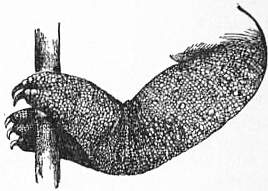
Left Forefoot of Chamaeleon o’shaughenesii, outer view.
CHAMELEON, the common name of one of the three suborders of Lacertilia or lizards. The chief genus is Chamaeleon, containing most of the fifty to sixty species of the whole group, and with the most extensive range, all through Africa and Madagascar into Arabia, southern India and Ceylon. The Indian species is Ch. calcaratus; the dwarf chameleon of South Africa is Ch. pumilus; the giant of the whole tribe, reaching a total length of 2 ft., is Ch. parsoni of Madagascar. The commonest species in the trade is Ch. vulgaris of North Africa, introduced into southern Andalusia. A few queer genera, with much stunted tail, e.g. Rhampholeon, in tropical Africa and Brookesia in Madagascar are the most aberrant. The common chameleon is the most typical. The head is raised into a pyramidal crest far beyond the occiput, there is no outer ear, nor a drum-cavity. The limbs are very long and slender, and the digits form stout grasping bundles; on the hand the first three form an inner bundle, opposed to the remaining two; on the foot the inner bundle is formed by the first and second toe, the outer by the other three toes. The tail is prehensile, by being rolled downwards; it is not brittle and cannot be renewed. The eyeballs are large, but the lids are united into one concentric fold, leaving only the small pupil visible. The right and left eyes are incessantly moved separately from each other and literally in every direction, up and down, forwards and straight backwards, producing the most terrible squinting. Chameleons alone of all reptiles can focus their eyes upon one spot, and conformably they alone possess a retinal macula centralis, or spot of acutest, binocular vision. The tongue has attained an extraordinary development. It is club-shaped, covered with a sticky secretion, and based upon a very narrow root, which is composed of extremely elastic fibres and telescoped over the much elongated, style-shaped, copular piece of the hyoid. The whole apparatus is kept in a contracted state like a spring in a tube. When the spring is released, so to speak, by filling the apparatus with blood and by the play of the hyoid muscles, the heavy thick end shoots out upon the insect prey and is withdrawn by its own elasticity. The whole act is like a flash. An ordinary chameleon can shoot a fly at the distance of fully 6 in., and it can manage even a big sphinx moth.
Another remarkable feature is their changing of colour. This proverbial power is greatly exaggerated. They cannot assume in succession all the colours of the rainbow, nor are the changes quick. The common chameleon may be said to be greenish grey, changing to grass-green or to dull black, with or without maroon red, or brown, lateral series of patches. At night the same specimen assumes as a rule a more or less uniform pale straw-colour. After it has been watched for several months, when all its possibilities seem exhausted, it will probably surprise us by a totally new combination, for instance, a black garb with many small yellow specks, or green with many black specks. Pure red and blue are not in the register of this species, but they are rather the rule upon the dark green ground colour of the South African dwarf chameleon. The changes are partly under control of the will, partly complicated reflex actions, intentionally adaptive to the physical and psychical surroundings. The mechanism is as follows. The cutis contains several kinds of specialized cells in many layers, each filled with minute granules of guanine. The upper cells are the smallest, most densely filled with crystals, and cause the white colour by diffusion of direct light; near the Malpighian layer the cells are charged with yellow oil drops; the deeper cells are the largest, tinged light brown, and acting as a turbid medium they cause a blue colour, which, owing to the superimposed yellow drops, reaches our eye as green; provided always that there is an effective screen at the back, and this is formed by large chromatophores which lie at the bottom and send their black pigment half-way up, or on to the top of the layers of guanine and oil containing cells. When all the pigment is shifted towards the surface, as near the epidermis as possible, the creature looks black; when the black pigment is withdrawn into the basal portions of the chromatophores the skin appears yellow.
The lungs are very capacious, and end in several narrow blind sacs which extend far down into the body cavity, so that not only the chest but the whole body can be blown up. This happens when the animals hiss and fight, as they often do. But when they know themselves discovered, they make themselves as thin as possible by compressing the chest and belly vertically by means of their peculiarly elongated ribs. The whole body is then put into such a position that it presents only its narrow edge to the enemy, and with the branch of the tree or shrub interposed. They are absolutely arboreal, but they hibernate in the ground.
The usual mode of propagation is by eggs, which are oval, numerous, provided with a calcareous shell, and buried in humus, whence they are hatched about four months later. But a few species, e.g. the dwarf chameleon, are viviparous.
Chameleons are insectivorous. They prefer locusts, grass-hoppers and lepidoptera, but are also fond of flies and mealworms. They are notoriously difficult to keep in good health. They want not only warmth, but sunshine, and they must have water, which they lick up in drops from the edges of wet leaves whenever they have a chance. The silliness of the fable that they live on air is shown by the fact that they usually die in an absolutely emaciated and parched condition after three or four months’ starvation.
(H. F. G.)
In astronomy, “Chamaeleon” is a constellation situated near the south pole and surrounded by the constellations of Octans, Mensa, Piscis volans, Carina (Nauta), Musca and Apus. In chemistry, “chameleon mineral” is a name applied to the green mass which is obtained when pyrolusite (manganese dioxide) is fused with nitre, since a solution in water assumes a purple tint on exposure to the air; this change is due to the oxidation of the manganate, which is first formed, to a permanganate.
CHAMFER, Champfer or Chaumfer (Fr. chanfrein; possibly from Lat. cantus, corner, and frangere, to break), an architectural term; when the edge or arris of any work is cut off at an angle of 45° in a small degree, it is said to be “chamfered,” while it would be “canted” if on a large scale. The chamfer is much used in medieval work, and is sometimes plain, sometimes hollowed out and sometimes moulded. Chamfers are sometimes “stopped” by a bead or some moulding, but when cut short by a slope they are generally known as “stop chamfer.”
CHAMFORT, SEBASTIEN ROCH NICOLAS (1741-1794), French man of letters, was born at a little village near Clermont in Auvergne in 1741. He was, according to a baptismal certificate found among his papers, the son of a grocer named Nicolas. A journey to Paris resulted in the boy’s obtaining a bursary at the Collège des Grassins. He worked hard, although he wrote later in one of his most contemptuous epigrams—”Ce que j’ai appris je ne le sais plus; le peu que je sais je l’ai diviné.” His college career ended, Chamfort assumed the dress of a petit abbé. “C’est un costume, et non point un état,” he said; and to the principal of his college who promised him a benefice, he replied that he would never be a priest, inasmuch as he preferred honour to honours—”j’aime l’honneur et non les honneurs.” About this time he assumed the name of Chamfort.
For some time he contrived to exist by teaching and as a booksellers’ hack. His good looks and ready wit, however, soon brought him into notice; but though endowed with immense strength—“Hercule sous la figure d’Adonis,” Madame de Craon called him—he lived so hard that he was glad of the chance of doing a “cure” at Spa when the Belgian minister in Paris, M. van Eyck, took him with him to Germany in 1761. On his return to Paris he produced a comedy, La Jeune Indienne (1764), which was performed with some success, and this was followed by a series of “epistles” in verse, essays and odes. It was not, however, until 1769, when he won the prize of the French Academy for his Éloge on Molière, that his literary reputation was established.
Meanwhile he had lived from hand to mouth, mainly on the hospitality of people who were only too glad to give him board and lodging in exchange for the pleasure of the conversation for which he was famous. Thus Madame Helvétius entertained him at Sèvres for some years. In 1770 another comedy, Le Marchand de Smyrne, brought him still further into notice, and he seemed on the road to fortune, when he was suddenly smitten with a horrible disease. His distress was relieved by the generosity of a friend, who made over to him a pension of 1200 livres charged on the Mercure de France. With this assistance he was able to go to the baths of Contrexéville and to spend some time in the country, where he wrote an Éloge on La Fontaine which won the prize of the Academy of Marseilles (1774). In 1775, while taking the waters at Barèges, he met the duchesse de Grammont, sister of Choiseul, through whose influence he was introduced at court. In 1776 his poor tragedy, Mustapha et Zeangir, was played at Fontainebleau before Louis XVI. and Marie Antoinette; the king gave him a further pension of 1200 livres, and the prince de Condé made him his secretary. But he was a Bohemian naturally and by habit, the restraints of the court irked him, and with increasing years he was growing misanthropical. After a year he resigned his post in the prince’s household and retired into solitude at Auteuil. There, comparing the authors of old with the men of his own time, he uttered the famous mot that proclaims the superiority of the dead over the living as companions; and there too he presently fell in love. The lady, attached to the household of the duchesse du Maine, was forty-eight years old, but clever, amusing, a woman of the world; and Chamfort married her. They left Auteuil, and went to Vaucouleurs, where in six months Madame Chamfort died. Chamfort lived in Holland for a time with M. de Narbonne, and returning to Paris received in 1781 the place at the Academy left vacant by the death of La Curne de Sainte-Palaye, the author of the Dictionnaire des antiquités françaises. In 1784, through the influence of Calonne, he became secretary to the king’s sister, Madame Elizabeth, and in 1786 he received a pension of 2000 livres from the royal treasury. He was thus once more attached to the court, and made himself friends in spite of the reach and tendency of his unalterable irony; but he quitted it for ever after an unfortunate and mysterious love affair, and was received into the house of M. de Vaudreuil. Here in 1783 he had met Mirabeau, with whom he remained to the last on terms of intimate friendship. whom he assisted with money and influence, and one at least of whose speeches—that on the Academies—he wrote.
The outbreak of the Revolution made a profound change in the relations of Chamfort’s life. Theoretically he had long been a republican, and he now threw himself into the new movement with almost fanatical ardour, devoting all his small fortune to the revolutionary propaganda. His old friends of the court he forgot. “Those who pass the river of revolutions,” he said, “have passed the river of oblivion.” Until the 31st of August 1791 he was secretary of the Jacobin club; he became a street orator and entered the Bastille among the first of the storming party. He worked for the Mercure de France, collaborated with Ginguené in the Feuille villageoise, and drew up for Talleyrand his Adresse au peuple français.
With the reign of Marat and Robespierre, however, his uncompromising Jacobinism grew critical, and with the fall of the Girondins his political life came to an end. But he could not restrain the tongue that had made him famous; he no more spared the Convention than he had spared the court. His notorious republicanism failed to excuse the sarcasms he lavished on the new order of things, and denounced by an assistant in the Bibliothèque Nationale, to a share in the direction of which he had been appointed by Roland, he was taken to the Madelonnettes. Released for a moment, he was threatened again with arrest; but he had determined to prefer death to a repetition of the moral and physical restraint to which he had been subjected. He attempted suicide with pistol and with poniard; and, horribly hacked and shattered, dictated to those who came to arrest him the well-known declaration—”Moi, Sebastien-Roch-Nicolas Chamfort, déclare avoir voulu mourir en homme libre plutôt que d’être reconduit en esclave dans une maison d’arrêt”—which he signed in a firm hand and in his own blood. He did not die at once, but lingered on until the 13th of April 1794 in charge of a gendarme, for whose wardship he paid a crown a day. To the Abbé Sieyès Chamfort had given fortune in the title of a pamphlet (“Qu’est-ce que le Tiers-État? Tout. Qu’a-t-il? Rien”), and to Sieyès did Chamfort retail his supreme sarcasm, the famous “Je m’en vais enfin de ce monde où il faut que le cœur se brise ou se bronze.” The maker of constitutions followed the dead wit to the grave.
The writings of Chamfort, which include comedies, political articles, literary criticisms, portraits, letters, and verses, are colourless and uninteresting in the extreme. As a talker, however, he was of extraordinary force. His Maximes et Pensées, highly praised by John Stuart Mill, are, after those of La Rochefoucauld, the most brilliant and suggestive sayings that have been given to the modern world. The aphorisms of Chamfort, less systematic and psychologically less important than those of La Rochefoucauld, are as significant in their violence and iconoclastic spirit of the period of storm and preparation that gave them birth as the Réflexions in their exquisite restraint and elaborate subtlety are characteristic of the tranquil elegance of their epoch; and they have the advantage in richness of colour, in picturesqueness of phrase, in passion, in audacity. Sainte-Beuve compares them to “well-minted coins that retain their value,” and to keen arrows that “arrivent brusquement et sifflent encore.”
An edition of his works—Œuvres complètes de Nicolas Chamfort—Was published at Paris in five volumes in 1824-1825. Selections—Œuvres de Chamfort—in one volume, appeared in 1852, with a biographical and critical preface by Arsène Houssaye, reprinted from the Revue des deux mondes; and Oeuvres choisies (2 vols.), with a preface and notes by M. de Lescure (1879). See also Sainte-Beuve, Causeries du Lundi.
CHAMIER, FREDERICK (1796-1870), English novelist, was the son of an Anglo-Indian official. In 1809 he entered the navy, and was in active service until 1827. He retired in 1833, and was promoted to be captain in 1856. On his retirement he settled near Waltham Abbey, and wrote several nautical novels on the lines popularized by Marryat, that had considerable success. These were The Life of a Sailor (1832), Ben Brace (1836), The Arethusa (1837), Jack Adams (1838), Tom Bowling (1841) and Jack Malcolm’s Log (1846). He wrote a number of other books, and edited and brought down to 1827 James’s Naval History (1837).
CHAMILLART, MICHEL (1652-1721), French statesman, minister of Louis XIV., was born at Paris of a family of the noblesse of recent elevation. Following the usual career of a statesman of his time he became in turn councillor of the parlement of Paris (1676), master of requests (1686), and intendant of the generality of Rouen (January 1689). Affable, of polished manners, modest and honest, Chamillart won the confidence of Madame de Maintenon and pleased the king. In 1690 he was made intendant of finances, and on the 5th of September 1699 the king appointed him controller-general of finances, to which he added on the following 7th of January the ministry of war. From the first Chamillart’s position was a difficult one. The deficit amounted to more than 53 million livres, and the credit of the state was almost exhausted. He lacked the great intelligence and energy necessary for the situation, and was unable to moderate the king’s warlike tastes, or to inaugurate economic reforms. He could only employ the usual expedients of the time—the immoderate sale of offices, the debasement of the coinage (five times in six years), reduction of the rate of interest on state debts, and increased taxation. He attempted to force into circulation a kind of paper money, billets de monnaie, but with disastrous results owing to the state of credit. He studied Vauban’s project for the royal tithe and Boisguillebert’s proposition for the taille, but did not adopt them. In October 1706 he showed the king that the debts immediately due amounted to 288 millions, and that the deficit already foreseen for 1707 was 160 millions. In October 1707 he saw with consternation that the revenue for 1708 was already entirely eaten up by anticipation, so that neither money nor credit remained for 1708. In these conditions Chamillart, who had often complained of the overwhelming burden he was carrying, and who had already wished to retire in 1706, resigned his office of controller-general. Public opinion attributed to him the ruin of the country, though he had tried in 1700 to improve the condition of commerce by the creation of a council of commerce. As secretary of state for war he had to place in the field the army for the War of the Spanish Succession, and to reorganize it three times, after the great defeats of 1704, 1706 and 1708. With an empty treasury he succeeded only in part, and he frankly warned the king that the enemy would soon be able to dictate the terms of peace. He was reproached with having secured the command of the army which besieged Turin (1706) for his son-in-law, the incapable duc de la Feuillade. Madame de Maintenon even became hostile to him, and he abandoned his position on the 10th of June 1709, retiring to his estates. He died on the 14th of April 1721.
Chamillart’s papers have been published by G. Esnault, Michel Chamillart, contrôleur général et secrétaire d’état de la guerre, correspondance et papiers inédits (2 vols., Paris, 1885); and by A. de Boislisle in vol. 2 of his Correspondance des contrôleurs généraux (1883). See D’Auvigny, Vies des hommes illustres (1739), tome vi. pp. 288-402; E. Moret, Quinze années du règne de Louis XIV (Paris, 1851); and the new edition of the Mémoires de St-Simon, by A. de Boislisle.
CHAMINADE, CÉCILE (1861- ), French musical composer, was born at Paris on the 8th of August 1861. She studied in Paris, her musical talent being shown at the age of eight by the writing of some church music which attracted Bizet’s attention; and at eighteen she came out in public as a pianist. Her own compositions, both songs (in large numbers) and instrumental pieces, were soon produced in profusion: melodious and interesting, and often charming, they became very popular, without being entitled to rank with the greater style of music. Both in Paris and in England Mlle Chaminade and her works became well known at the principal concerts. In 1908 she visited America and was warmly welcomed.
CHAMISSO, ADELBERT VON [Louis Charles Adelaide de] (1781-1838), German poet and botanist, was born at the château of Boncourt in Champagne, France, the ancestral seat of his family, on the 30th of January 1781. Driven from France by the Revolution, his parents settled in Berlin, where in 1796 young Chamisso obtained the post of page-in-waiting to the queen, and in 1798 entered a Prussian infantry regiment as ensign. His family were shortly afterwards permitted to return to France; he, however, remained behind and continued his career in the army. He had but little education, but now sought distraction from the soulless routine of the Prussian military service in assiduous study. In collaboration with Varnhagen von Ense, he founded in 1803 the Berliner Musenalmanach, in which his first verses appeared. The enterprise was a failure, and, interrupted by the war, it came to an end in 1806. It brought him, however, to the notice of many of the literary celebrities of the day and established his reputation as a rising poet. He had become lieutenant in 1801, and in 1805 accompanied his regiment to Hameln, where he shared in the humiliations following the treasonable capitulation of that fortress in the ensuing year. Placed on parole he went to France, where he found that both his parents were dead; and, returning to Berlin in the autumn of 1807, he obtained his release from the service early in the following year. Homeless and without a profession, disillusioned and despondent, he lived in Berlin until 1810, when, through the services of an old friend of the family, he was offered a professorship at the lycée at Napoléonville in La Vendée. He set out to take up the post, but drawn into the charmed circle of Madame de Staël, followed her in her exile to Coppet in Switzerland, where, devoting himself to botanical research, he remained nearly two years. In 1812 he returned to Berlin, where he continued his scientific studies. In the summer of the eventful year, 1813, he wrote the prose narrative Peter Schlemihl, the man who sold his shadow. This, the most famous of all his works, has been translated into most European languages (English by W. Howitt). It was written partly to divert his own thoughts and partly to amuse the children of his friend Hitzig. In 1815 Chamisso was appointed botanist to the Russian ship “Rurik,” which Otto von Kotzebue (son of August von Kotzebue) commanded on a scientific voyage round the world. His diary of the expedition (Tagebuch, 1821) affords some interesting glimpses of England and English life. On his return in 1818 he was made custodian of the botanical gardens in Berlin, and was elected a member of the Academy of Sciences, and in 1820 he married. Chamisso’s travels and scientific researches restrained for a while the full development of his poetical talent, and it was not until his forty-eighth year that he turned again to literature. In 1829, in collaboration with Gustav Schwab, and from 1832 in conjunction with Franz von Gaudy, he brought out the Deutsche Musenalmanach, in which his later poems were mainly published. He died on the 21st of August 1838.