VOLUME V SLICE VII Cerargyrite to Charing Cross (continued 3)
Reading edition
Education.—There has been a great advance in public instruction since 1875, through the multiplication of vernacular, Anglo-vernacular and English schools by government, by the different Christian missions and by the Buddhists and Hindus who have come forward to claim the government grant. The government has also started a technical college, and an agricultural school has been reorganized. An agricultural department, recommended by a commission, should profit by the services of the entomologist, mycologist and chemical analyst added by the governor to the staff of the royal botanic gardens at Peradeniya. There are industrial and reformatory schools, which are partially supported by government. In spite of the great advance that has been made, however, at the census of 1901 no fewer than 2,790,235 of the total population were entered as unable to read or write their own tongue. Of this number 1,553,078 were females, showing a very unsatisfactory state of things.
Agriculture.—The natural soils of Ceylon are composed of quartzose gravel, felspathic clay and sand often of a pure white, blended with or overlaid by brown and red loams, resulting; from the decay of vegetable matter, or the disintegration of the Soil. gneiss and hornblende formations. The whole of the great northern extremity of the island consists of a sandy and calcareous admixture, made to yield productive crops of grain, tobacco, cotton and vegetables by the careful industry of the Tamil population, who spare no pains in irrigating and manuring their lands. Between the northern districts and the elevated mountain ranges which overlook the Bintenne and Uva countries are extensive plains of alluvial soil washed down from the table-lands above, where once a teeming population produced large quantities of grain. The remains of ancient works of irrigation bear testimony to the bygone agriculture of these extensive regions now covered by swamps or dense jungle.
The general character of the soil in the maritime provinces to the east, south and west is sandy. Large tracts of quartzose sand spread along the whole line of sea-coast, some of which, of a pure white, and very deficient in vegetable matter, is admirably adapted to the growth of the cinnamon plant. In the light sandy districts where the soil is perfectly free, and contains a portion of vegetable and mineral loam, the coco-nut palm flourishes in great luxuriance. This is the case along the entire coast line from Kalpitiya to Point de Galle, and farther eastward and northward to Matara, stretching to a distance inland varying from 100 yds. to 3 m. From this light sandy belt as far as the mountain-zone of the Kandyan country the land is mainly composed of low hilly undulations of sandstone and ferruginous clay, incapable of almost any cultivation, but intersected in every direction with extensive valleys and wide plains of a more generous soil, not highly fertile, but still capable, with a little industry, of yielding ample crops of rice.
The soil of the central province, although frequently containing great quantities of quartzose sand and ferruginous clay, is in many of the more elevated districts of a fine loamy character. Sand sufficiently vegetable and light for rice culture may be seen at all elevations in the hill districts; but the fine chocolate and brown loams overlying gneiss or limestone formations, so admirably adapted for coffee cultivation, are only to be found on the steep sides or along the base of mountain ranges at an elevation varying from 2000 to 4000 ft. Such land, well-timbered, contains in its elements the decomposed particles of the rocks above, blended with the decayed vegetable matter of forests that have for centuries scattered beneath them the germs of fertility. The quantity of really rich coffee land in these districts is but small as compared with the extent of country—vast tracts of open valleys consisting of an indifferent yellow tenacious soil interspersed with many low ranges of quartz rock, but tea is a much hardier plant than coffee, and grows on poorer soil.
Irrigation.—The native rulers covered the whole face of the country with a network of irrigation reservoirs, by which Ceylon was enabled in ancient times to be the great granary of southern Asia. Wars, and the want of a strong hand to guide the agriculture of the country, led to the decay of these ancient works, and large tracts of land, which were formerly highly productive, became swampy wastes or dense forests. The remains of some of the larger irrigation works are amongst the most interesting of the memorials of Ceylon’s former greatness. Some of the artificial lakes were of great size. Minneri, formed by damming across the valleys between the low hills which surround it with an embankment 60 ft. wide at the top, is at this day 20 m. in circumference. It has recently been restored by government, and is capable of irrigating 15,000 acres; while the Giant’s Tank, which has also been restored, irrigates 20,000 acres. Another lake, with an embankment several miles in length, the Kalawewa, was formed by damming back the waters of the Kalaoya, but they have forced their way through the embankment, and in the ancient bed of the lake, or tank, are now many small villages. In connexion with these large tanks were numerous canals and channels for supplying smaller tanks, or for irrigating large tracts of fields. Throughout the district of Nuwarakalawiya every village has its tank. The embankments have been formed with great skill, and advantage has been taken to the utmost of the slightest fall in the land; but they in common with the larger works had been allowed to fall into decay, and were being brought to destruction by the evil practice of cutting them every year to irrigate the fields. The work of restoring these embankments was undertaken by the government, and 100 village tanks were repaired every year, besides eighteen larger works. In 1900 a sum of five million rupees was set apart for these larger undertakings.
Cultivation and Products.—The area of uncultivated land is little over 3½ million acres, whereas fully four times that amount is capable of cultivation. A great deal is waste, besides lagoons, tanks, backwaters, &c. Thick forest land does not cover more than 5000 sq. m. Scrub, or chena, and patana grass cover a very great area. Tea, cacao, cardamoms, cinchona, coffee and indiarubber are the products cultivated by European and an increasing number of native planters in the hill country and part of the low country of Ceylon. A great change has been effected in the appearance of the country by the introduction of the tea plant in place of the coffee plant, after the total failure of the latter owing to disease. For some time coffee had been the most important crop. In the old days it grew wild like cinnamon, and was exported so far back as the time of the Portuguese, but was lightly esteemed as an article of European commerce, as the berry was gathered unripe, was imperfectly cured and had little flavour. In 1824 the governor, Sir E. Barnes, introduced coffee cultivation on the West Indian plan; in 1834 the falling off of other sources of supply drew general attention to Ceylon, and by 1841 the Ceylon output had become considerable, and grew steadily (with an interval in 1847 due to a commercial crisis) till 1877 when 272,000 acres were under coffee cultivation, the total export amounting to 103,000,000 ℔ Then owing to disease came a crisis, and a rapid decline, and now only a few thousand acres are left. On the failure of the coffee crops planters began extensively to grow the tea plant, which had already been known in the island for several years. By 1882 over 20,000 acres had been planted with tea, but the export that year was under 700,000 ℔ Five years later the area planted was 170,000 acres, while the export had risen to nearly 14,000,000 ℔ By 1892 there were 262,000 acres covered with tea, and 71,000,000 ℔ were that year exported. In 1897, 350,000 acres were planted, and the export was 116,000,000 ℔ By the beginning of the 20th century, the total area cultivated with tea was not under 390,000 acres, while the estimate of shipments was put at 146,000,000 ℔ annually. Nearly every plantation has its factory, with the machinery necessary to prepare the leaf as brought in from the bushes until it becomes the tea of commerce. The total amount of capital now invested in the tea industry in Ceylon cannot be less than £10,000,000. The tea-planting industry more than anything else has raised Ceylon from the depressed state to which it fell in 1882.
Before tea was proved a success, however, cinchona cultivation was found a useful bridge from coffee to the Ceylon planter, who, however, grew it so freely that in one year 15,000,000 ℔ bark was shipped, bringing the price of quinine down from 16s. to 1s. 6d. an ounce.
In a few places, where the rainfall is abundant, rice cultivation is allowed to depend on the natural supply of water, but in most parts the cultivation is not attempted unless there is secured beforehand a certain and sufficient supply, by means of canals or reservoirs. In the hill country every valley and open plain capable of tillage is made to yield its crops of grain, and the steep sides of the hills are cut into terraces, on which are seen waving patches of green rice watered by mountain streams, which are conducted by means of channels ingeniously carried round the spurs of the hills and along the face of acclivities, by earthen water-courses and bamboo aqueducts, so as to fertilize the fields below. These works bear witness to the patience, industry and skill of the Kandyan villagers. In the low country to the north and east and north-west of the hills, irrigation works of a more expensive kind are necessary. In January 1892, the immemorial rent or tax on fields of paddy (rice in the husk) was removed, but not the customs duty on imported rice. But even with the advantage of protection to the extent of 10% in the local markets, there has been no extension of paddy cultivation; on the contrary, the import of grain from India has grown larger year by year. Through the multiplication of irrigation works and the northern railway, rice culture may be sufficiently extended to save some of the large imports (8,000,000 to 9,000,000 bushels annually) now required from India.
Tobacco is extensively cultivated in various parts of the island, and the growth of particular places, such as Dumbara and Uva, is much prized for local consumption. The tobacco of export is grown in the peninsula of Jaffna. The exports of this article in 1850 were 22,176 cwts., valued at £20,698. The cultivation of the plant has not greatly increased of recent years, and is almost entirely in the hands of natives in the northern and parts of the central Province.
Ceylon has been celebrated since the middle of the 14th century for its cinnamon, and during the period of the Dutch occupation this spice was the principal article of commerce; under their rule and up to 1832 its cultivation was a government monopoly. With the abolition of the monopoly the quantity exported increased, but the value declined.
Unlike the coffee plant, the hardy tea plant grows from sea-level to 7000 ft. altitude; but crown forest-lands above 5000 ft. are no longer sold, so that a very large area on the highest mountain ranges and plateaus is still under forest. Moreover, on the tea plantations arboriculture is attended to in a way unknown in 1875; the Australian eucalypts, acacias and grevilleas, Indian and Japanese conifers, and other trees of different lands, are now freely planted for ornament, for protection from wind, for firewood or for timber. A great advance has been made at Hakgalla and Nuwara Eliya, in Upper Uva, and other high districts, in naturalizing English fruits and vegetables. The calamander tree is nearly extinct, and ebony and other fine cabinet woods are getting scarce; but the conservation of forests after the Indian system has been taken in hand under a director and trained officers, and much good has been done. The cinnamon tree (wild in the jungles, cultivated as a shrub in plantations) is almost the only one yielding a trade product which is indigenous to the island. The coco-nut and nearly all other palms have been introduced.
Among other agricultural products mention must be made of cacao, the growth and export of which have steadily extended since coffee failed. Important also is the spice or aromatic product of cardamoms.
The culture of indiarubber was begun on low-country plantations, and Ceylon rubber is of the best quality in the market. The area of cultivation of the coco-nut palm has been greatly extended since 1875 by natives as well as by Europeans. The products of this palm that are exported, apart from those so extensively used in the island itself, exceed in a good year £1,000,000 sterling in value. Viticulture and cotton cultivation, as well as tobacco growing, are being developed along the course of the new northern railway.
Taking the trade in the products mentioned as a whole, no country can compete with the United Kingdom as a customer of Ceylon. But there is a considerable trade in nearly all products with Germany and America; in cardamoms with India; in cinnamon with Spain, Italy, Belgium, Australia, Austria and France; and in one or other of the products of the coco-nut palm (coco-nuts, coco-nut oil, copra, desiccated coco-nut, poonac, coir) with Belgium, Russia, France, Austria, Australia and Holland.
Pearl Fishery.—Pearl oysters are found in the Tambalagam bay, near Trincomalee, but the great banks on which these oysters are usually found lie near Arippu, off the northern part of the west coast of Ceylon, at a distance of from 16 to 20 m. from the shore. They extend for many miles north and south, varying considerably in their size and productiveness. It is generally believed that the oyster arrives at maturity in its seventh year, that the pearl is then of full size and perfect lustre, and that if the oyster be not then secured it will shortly die, and the pearl be lost. It is certain that from some unexplained cause the oysters disappear from their known beds for years together. The Dutch had no fishery from 1732 to 1746, and it failed them again for twenty-seven years from 1768 to 1796. The fishery was again interrupted between 1820 and 1828, also from 1833 to 1854, from 1864 to 1873, and again from 1892 to 1900. The fishery of 1903 was the first since 1891, and produced a revenue of Rs. 829,348, being the third largest on record. In 1797 and 1798 the government sold the privilege of fishing the oyster-beds for £123,982 and £142,780 respectively. From that time the fishery was conducted by the government itself until 1906, when it was leased to the Ceylon Pearl Fisheries Company for twenty years at a rent of £20,000 a year. Professor Herdman, F.R.S., was appointed to inquire and report on the conservation and cultivation of the Ceylon pearl-oyster, and visited Ceylon in January 1902. In consequence of his report, a marine laboratory for the culture of the pearl oysters was established in Galle harbour under the care of Mr Hornell.
Mineral Industries.—Commercially there are two established mineral industries:—(1) that of digging for precious stones; and (2) the much more important industry of digging for plumbago or graphite, the one mineral of commercial importance found. Further developments may result in the shipment of the exceptionally pure iron ore found in different parts of Ceylon, though still no coal has been found to be utilized with it. Several places, too—Ruanwella, Rangalla, Rangbodde, &c.—indicate where gold was found in the time of the Kandyan kings; and geologists might possibly indicate a paying quartz reef, as in Mysore. Owing to the greatly increased demand in Europe and America, plumbago in 1899 more than doubled in price, rising from £40 to £80, and even £100 a ton for the finest. Latterly there has been a considerable fall, but the permanent demand is likely to continue keen in consequence mainly of the Ceylon kind being the best for making crucibles. The trade with Great Britain and the United States has slightly decreased, but there has been a rapid expansion in the exports to Belgium and Holland, Russia, Japan and Victoria; and the industry seems to be established on a sound basis. One consequence of its development has been to bring European and American capitalists and Cornish and Italian miners into a field hitherto almost entirely worked by Sinhalese. Though some of the mines were carried to a depth of 1000 ft., the work was generally very primitive in character, and Western methods of working are sure to lead to greater safety and economy. Besides a royalty or customs duty of 5 rupees (about 6s. 8d.) per ton on all plumbago exported, the government issue licenses at moderate rates for the digging of plumbago on crown lands, a certain share of the resulting mineral also going to government. The plumbago industry, in all its departments of mining, carting, preparing, packing and shipping, gives employment to fully 100,000 men and women, still almost entirely Sinhalese. The wealthiest mine-owners, too, are Sinhalese land-owners or merchants.
As regards gems, there are perhaps 500 gem pits or quarries worked in the island during the dry season from November to June in the Ratnapura, Rakwane and Matara districts. Some of these are on a small scale; but altogether several thousands of Sinhalese find a precarious existence in digging for gems. Rich finds of a valuable ruby, sapphire, cat’s-eye, amethyst, alexandrite or star stone, are comparatively rare; it is only of the commoner gems, such as moonstone, garnet, spinels, that a steady supply is obtained. The cat’s-eye in its finer qualities is peculiar to Ceylon, and is occasionally in great demand, according to the fashion. The obstacle to the investment of European capital in “gemming” has always been the difficulty of preventing the native labourers in the pits—-even if practically naked—from concealing and stealing gems. A Chamber of Mines, with a suitable library, was established in Colombo during 1899.
Manufactures.—Little is done save in the preparation in factories and stores, in Colombo or on the plantations, of the several products exported. The manufacture of jewellery and preparation of precious stones, and, among native women and children, of pillow lace, give employment to several thousands. Iron and engineering works are numerous in Colombo and in the planting districts. The Sinhalese are skilful cabinetmakers and carpenters. The Moormen and Tamils furnish good masons and builders.
Commerce.—There has been rapid development since 1882, and the returns for 1903 showed a total value of 22½ millions sterling. The principal imports were articles of food and drink (chiefly rice from India) manufactured metals (with specie), coal, cotton yarns and piece goods from Manchester, machinery and millwork and apparel. The Ceylon customs tariff for imports is one of 6½% ad valorem, save in the case of intoxicating drinks, arms, ammunition, opium, &c. The chief export is tea.
Roads.—The policy of the Sinhalese rulers of the interior was to exclude strangers from the hill country. Prior to the British occupation of the Kandyan territory in 1815, the only means of access from one district to another was by footpaths through the forests. The Portuguese do not appear to have attempted to open up the country below the hills, and the Dutch confined themselves to the improvement of the inland water-communications. The British government saw from the first the necessity of making roads into the interior for military purposes, and, more recently, for developing the resources of the country. The credit of opening up the country is due mainly to the governor, Sir Edward Barnes, by whose direction the great military road from Colombo to Kandy was made. Gradually all the military stations were connected by broad tracks, which by degrees were bridged and converted into good carriage roads. The governors Sir Henry Ward and Sir Hercules Robinson recognized the importance of giving the coffee planters every assistance in opening up the country, and the result of their policy is that the whole of the hill country is now intersected by a vast number of splendid roads, made at a cost of upwards of £2000 per mile. In 1848 an ordinance was passed to levy from every adult male in the colony (except Buddhist priests and British soldiers) six days’ labour on the roads, or an equivalent in money. The labour and money obtained by this wise measure have enabled the local authorities to connect the government highways by minor roads, which bring every village of importance into communication with the principal towns.
Railways.—After repeated vain attempts by successive governors to connect Colombo with the interior by railways, Sir Charles MacCarthy successfully set on foot a railway of 75 m. in length from Colombo to Kandy. The railway mileage had developed to 563 m. in 1908, including one of the finest mountain lines in the world—over 160 m. long, rising to 6200 ft. above sea-level, and falling at the terminus to 4000 ft. The towns of Kandy, Matale, Gampola, Nawalapitiya, Hatton and Haputale (and practically Nuwara Eliya) in the hills, are thus connected by rail, and in the low country the towns of Kurunegala, Galle, Matara, Kalutara, &c. Most of the debt on the railways (all government lines) is paid off, and the traffic receipts now make up nearly one-third of the general revenue. An Indo-Ceylon railway to connect the Indian and Ceylon systems has been the subject of separate reports and estimates by engineers serving the Ceylon and Indian governments, who have pronounced the work across the coral reef between Manaar and Rameswaram quite feasible. A commission sat in 1903 to consider the gauge of an Indo-Ceylon railway. Such a line promised to serve strategic as well as commercial purposes, and to make Colombo more than ever the port for southern India. The headquarters of the mail steamers have been removed from Galle to Colombo, where the colonial government have constructed a magnificent breakwater, and undertaken other harbour works which have greatly augmented both the external trade and the coasting trade of the island.
Government.—Ceylon is a crown colony, that is, a possession of the British crown acquired by conquest or cession, the affairs of which are administered by a governor, who receives his appointment from the crown, generally for a term of six years. He is assisted by an executive and a legislative council. The executive council acts as the cabinet of the governor, and consists of the attorney-general, the three principal officers of the colony (namely, the colonial secretary, the treasurer and the auditor-general), and the general in command of the forces. The legislative council includes, besides the governor as president and nine official members, eight unofficial members—one for the Kandyan Sinhalese (or Highlanders) and one for the “Moormen” having been added in 1890. The term of office for the unofficial members is limited to five years, though the governor may reappoint if he choose. The king’s advocate, the deputy-advocate, and the surveyor-general are now respectively styled attorney-general, solicitor-general, and director of public works. The civil service has been reconstituted into five classes, not including the colonial secretary as a staff appointment, nor ten cadets; these five classes number seventy officers. The district judges can punish up to two years’ imprisonment, and impose fines up to Rs.1000. The police magistrates can pass sentences up to six months’ imprisonment, and impose fines of Rs.150. The criminal law has since 1890 been codified on the model of the Indian penal code; criminal and civil procedure have also been the subject of codification. There are twenty-three prisons in the island, mostly small; but convict establishments in and near the capital take all long-sentence prisoners.
Banks and Currency.—Ceylon has agencies of the National Bank of India, Bank of Madras, Mercantile Bank of India, Chartered Bank of India, Australia and China, and of the Hong-kong and Shanghai Bank, besides mercantile agencies of other banks, also a government savings bank at Colombo, and post-office savings banks all over the island. In 1884, on the failure of the Oriental Bank, the notes in currency were guaranteed by government, and a government note currency was started in supersession of bank notes. The coin currency of Ceylon is in rupees and decimals of a rupee, the value of the standard following that fixed for the Indian rupee, about 1s. 4d. per rupee.
Finance.—With the disease of the coffee plant the general revenue fell from Rs.1,70,00,000 in 1877 to Rs.1,20,00,000 in 1882, when trade was in a very depressed state, and the general prosperity of the island was seriously affected. Since then, however, the revenue has steadily risen with the growing export of tea, cocoa-nut produce, plumbago, &c., and in 1902 it reached a total of 28 millions of rupees.
(J. F. D.; C. L.)
History.—The island of Ceylon was known to the Greeks and Romans under the name of Taprobane, and in later times Serendib, Sirinduil and Zeylan have been employed to designate it by writers of the Western and Eastern worlds. Serendib is a corruption of the Sanskrit Sinhaladvïpa. Like most oriental countries, Ceylon possesses a great mass of ancient records, in which fact is so confused with fable that they are difficult to distinguish. The labours of George Turnour (1799-1843), however, helped to dissipate much of this obscurity, and his admirable edition (1836) of the Mahavamsa first made it possible to trace the main lines of Sinhalese history.
The Sinhalese inscriptional records, to which George Turnour first called attention, and which, through the activity of Sir William Gregory in 1874, began to be accurately transcribed and translated, extend from the 2nd century B.C. onwards. Among the oldest inscriptions discovered are those on the rock cells of the Vessagiri Vihara of Anuradhapura, cut in the old Brahma-lipi character. The inscriptions show how powerful was the Buddhist hierarchy which dominated the government and national life. The royal decrees of successive rulers are mainly concerned with the safeguarding of the rights of the hierarchy, but a few contain references to executive acts of the kings, as in a slab inscription of Kassapa V. (c. A.D. 929-939). In an edict ascribed to Mahinda IV. (c. A.D. 975-991) reference is made to the Sinhalese palladium, the famous tooth-relic of Buddha, now enshrined at Kandy, and the decree confirms tradition as to the identity of the fine stone temple, east of the Thuparama at Anuradhapura, with the shrine in which the tooth was first deposited when brought from Kalinga in the reign of Kirti Sri Meghavarna (A.D. 304-324).
The earliest inhabitants of Ceylon were probably the ancestors of the modern Veddahs, a small tribe of primitive hunters who inhabit the eastern jungles; and the discovery of palaeolithic stone implements buried in some of their caves points to the fact that they represent a race which has been in the island for untold ages. As to subsequent immigrations, the great Hindu epic, the Ramayana, tells the story of the conquest of part of the island by the hero Rama and his followers, who took the capital of its king Rawana. Whatever element of truth there may be in this fable, it certainly represents no permanent occupation. The authentic history of Ceylon, so far as it can be traced, begins with the landing in 543 B.C. of Vijaya, the founder of the Sinhalese dynasty, with a small band of Aryan-speaking followers from the mainland of India. Vijaya married the daughter of a native chief, with whose aid he proceeded to master the whole island, which he parcelled out among his followers, some of whom formed petty kingdoms. The Sinhalese introduced from the mainland a comparatively high type of civilization, notably agriculture. The earliest of the great irrigation tanks, near Anuradhapura, was opened about 504 B.C. by the successor of Vijaya; and about this time was established that system of village communities which still obtains over a large part of Ceylon.
The island was converted to Buddhism at the beginning of the 3rd century B.C. by the preaching of Mahinda, a son of the great Buddhist emperor Asoka; a conversion that was followed by an immense multiplication of daghobas, curious bell-shaped reliquaries of solid stone, and of Buddhist monasteries. For the rest, the history of ancient Ceylon is largely a monotonous record of Malabar or Tamil invasions, conquests and usurpations. Of these latter the first was in 237 B.C. when two officers in the cavalry and fleet revolted, overthrew the Sinhalese ruler with the aid of his own Tamil mercenaries, and reigned jointly, as Sena I. and Guptika, until 215. The Sinhalese Asela then ruled till 205, when he was overthrown by a Tamil from Tanjore, Elala, who held the reins of power for 44 years. In 161 B.C. Elala was defeated and slain by Dutegemunu, still remembered as one of the great Sinhalese heroes of Ceylon. The ruins of the great monastery, known as the Brazen Palace, at Anuradhapura, remain a memorial of King Dutegemunu’s splendour and religious zeal. He died in 137 B.C., and thenceforth the history of Ceylon is mainly that of further Tamil invasions, of the construction of irrigation tanks, and of the immense development of the Buddhist monastic system. A tragic episode in the royal family in the 5th century A.D. is, however, worthy of notice as connected with one of Ceylon’s most interesting remains, the Sīgiri rock and tank (see Sīgiri). In A.D. 477 King Datu Sen was murdered by his son, who mounted the throne as Kasyapa I., and when he was driven from the capital by the inhabitants, infuriated by his crime, built himself a stronghold on the inaccessible Sīgiri rock, whence he ruled the country until in 495 he was overthrown and slain by his brother Mugallana (495-513), who at the time of his father’s murder had escaped to India.
Towards the close of the 10th century Ceylon was invaded by Rajaraja the Great, the Chola king, and after a series of protracted campaigns was annexed to his empire in 1005. The island, did not, however, remain long under Tamil domination. In 1071 Vijaya Bahu succeeded in re-establishing the Sinhalese dynasty, and for a while Ceylon was freed from foreign intervention. The most notable of the successors of Vijaya Bahu, and indeed of all the long line of Sinhalese rulers, was Parakrama Bahu I. (1155-1180), whose colossal statue still stands near Polonnaruwa. He not only took advantage of the unaccustomed tranquillity of the country to restore the irrigation tanks and the monasteries, but he availed himself of a disputed succession to the Pandya throne of Madura to turn the tables on his Tamil enemies by invading India. According to the Mahavamsa his generals met with immediate and unbroken success; according to the more probable account preserved in a long Chola inscription at Arpakkam near Kanchi, they were, though at first successful, ultimately driven out by a coalition of the southern princes (V.A. Smith, Early History of India, ed. 1908, p. 411). In any case, within thirty years of Parakrama Bahu’s death his work was undone; the Malabar invaders were once more able to effect a settlement in the island, and the Sinhalese capital was moved farther and farther south, till in 1410 it had become established at Kotta, now a suburb of Colombo. In 1408 a new misfortune had befallen the Sinhalese dynasty; in revenge for an insult offered to a Chinese envoy, a Chinese army invaded the island and carried away King Vijaya Bahu IV. into captivity. For thirty years from this date the Sinhalese kings of Ceylon were tributary to China.
When, in 1505, the Portuguese Francisco de Almeida landed in Ceylon, he found the island divided into seven kingdoms. Twelve years later the viceroy of Goa ordered the erection of a fort at Colombo, for which permission was obtained from the king of Kotta; and from this time until the advent of the Dutch in the 17th century the Portuguese endeavoured, amid perpetual wars with the native kings, who were assisted by Arab and other traders jealous of European rivalry, to establish their control over the island. They ultimately succeeded so far as the coast was concerned, though their dominion scarcely penetrated inland. Materially their gain was but small, for the trade of Ceylon was quite insignificant; but they had the spiritual satisfaction of prosecuting a vigorous propaganda of Catholicism, St Francis Xavier being the most notable of the missionaries who at this time laboured in the island.
The fanatical zeal and the masterful attitude of the Portuguese were a constant source of dissension with the native rulers, and when the Dutch, under Admiral Spilberg, landed on the east coast in 1602 and sought the alliance of the king of Kandy in the interior of the island, every inducement was held out to them to aid in expelling the Portuguese. Nothing seems to have come of this until 1638-1639, when a Dutch expedition attacked and razed the Portuguese forts on the east coast. In the following year they landed at Negombo, without however establishing themselves in any strong post. In 1644 Negombo was captured and fortified by the Dutch, while in 1656 they took Colombo, and in 1658 they drove the Portuguese from Jaffna, their last stronghold in Ceylon.
Pursuing a wiser policy than their predecessors, the Dutch lost no opportunity of improving that portion of the country which owned their supremacy, and of opening a trade with the interior. More tolerant and less disposed to stand upon their dignity than the Portuguese, they subordinated political to commercial ends, flattered the native rulers by a show of deference, and so far succeeded in their object as to render their trade between the island and Holland a source of great profit. Many new branches of industry were developed. Public works were undertaken on a large scale, and education, if not universally placed within the reach of the inhabitants of the maritime provinces, was at least well cared for on a broad plan of government supervision. That which they had so much improved by policy, they were, however, unable to defend by force when the British turned their arms against them. A century and a half had wrought great changes in the physical and mental status of the Dutch colonists. The territory which in 1658 they had slowly gained by undaunted and obstinate bravery, they as rapidly lost in 1796 by imbecility and cowardice.
The first intercourse of the English with Ceylon was as far back as 1763, when an embassy was despatched from Madras to the king of Kandy, without, however, leading to any result. On the rupture between Great Britain and Holland in 1795, a force was sent against the Dutch possessions in Ceylon, where the opposition offered was so slight that by the following year the whole of their forts were in the hands of the English commander.
The abiding results of the occupation of Ceylon by the Portuguese and Dutch is described by Sir Emerson Tennent (Ceylon) as follows:
“The dominion of the Netherlands in Ceylon was nearly equal in duration with that of Portugal, about 140 years; but the policies of the two countries have left a very different impress on the character and institutions of the people amongst whom they lived. The most important bequest left by the utilitarian genius of Holland is the code of Roman Dutch law, which still prevails in the supreme courts of justice, whilst the fanatical propagandism of the Portuguese has reared for itself a monument in the abiding and expanding influence of the Roman Catholic faith. This flourishes in every hamlet and province where it was implanted by the Franciscans, whilst the doctrines of the reformed church of Holland, never preached beyond the walls of the fortresses, are already almost forgotten throughout the island, with the exception of an expiring community at Colombo. Already the language of the Dutch, which they sought to extend by penal enactments, has ceased to be spoken even by their direct descendants, whilst a corrupted Portuguese is to the present day the vernacular of the lower classes in every town of importance. As the practical and sordid government of the Netherlands only recognized the interest of the native population in so far as they were essential to uphold their trading monopolies, their memory was recalled by no agreeable associations: whilst the Portuguese, who, in spite of their cruelties, were identified with the people by the bond of a common faith, excited a feeling of admiration by the boldness of their conflicts with the Kandyans, and the chivalrous though ineffectual defence of their beleaguered fortresses. The Dutch and their proceedings have almost ceased to be remembered by the lowland Sinhalese; but the chiefs of the south and west perpetuate with pride the honorific title Don, accorded to them by their first European conquerors, and still prefix to their ancient patronymics the sonorous Christian names of the Portuguese.”
The British forces by which the island had been conquered were those of the East India Company, and Ceylon was therefore at first placed under its jurisdiction and administered from Madras. The introduction of the Madras revenue system, however, together with a host of Malabar collectors, led to much discontent, which culminated in rebellion; and in 1798 the colony was placed directly under the crown. By the treaty of Amiens, in 1803, this situation was regularized, from the international point of view, by the formal cession to Great Britain of the former Dutch possessions in the island. For a while the British dominion was confined to the coast. The central tract of hilly country, hedged in by impenetrable forests and precipitous mountain ranges, remained in possession of Sri Vikrama Raja Sinha, the last of the Sinhalese dynasty, who showed no signs of encouraging communication with his European neighbours.
Minor differences led in 1803 to an invasion of the Kandyan territory; but sickness, desertion and fatigue proved more formidable adversaries to the British forces than the troops of the Sinhalese monarch, and peace was eventually concluded upon terms by no means favourable to the English. The cruelty and oppression of the king now became so intolerable to his subjects that disaffection spread rapidly amongst them. Punishments of the most horrible kinds were inflicted, but failed to repress the popular indignation; and in 1815 the British, at the urgent request of many of the Adigars and other native chiefs, proceeded against the tyrant, who was captured near Kandy, and subsequently ended his days in exile. With him ended a long line of sovereigns, whose pedigree may be traced through upwards of two thousand years.
By a convention entered into with the Kandyan chiefs on the 2nd of March 1815, the entire sovereignty of the island passed into the hands of the British, who in return guaranteed to the inhabitants civil and religious liberty. The religion of Buddha was declared inviolable, and its rights, ministers and places of worship were to be maintained and protected; the laws of the country were to be preserved and administered according to established forms; and the royal dues and revenues were to be levied as before for the support of government.
With the exception of a serious outbreak in some parts of the interior in 1817, which lasted for upwards of a year, and of two minor attempts at rebellion easily put down, in 1843 and 1848, the political atmosphere of Ceylon has remained undisturbed since the deportation of the last king of Kandy.
Authorities.—Major Thomas Skinner, Fifty Years in Ceylon, edited by his son, A. Skinner (London, 1891); Constance F. Gordon Gumming, Two Happy Years in Ceylon (2 vols., Edinburgh, 1892); H.W. Cave, The Ruined Cities of Ceylon (London, 1897), and The Book of Ceylon (London, 1908); Sir Emerson Tennent, Ceylon (2 vols. 4th ed., 1860); J. Ferguson, Ceylon in 1903 (Colombo); J.C. Willis, Ceylon (Colombo, 1907). See also E. Müller, Ancient Inscriptions in Ceylon, published for the government (1883-1884), and the important archaeological survey in Epigraphia Zeylonica, part i., 1904, ii., 1907, iii., 1907, by Don Martino de Silva Wickremasinghe, who in 1899 was appointed epigraphist to the Ceylon government. Among other works on special subjects may be mentioned H. Trimen, F.R.S., director of Ceylon Botanic Gardens, Ceylon Flora, in 5 vols., completed by Sir Joseph Hooker; Captain V. Legge, F.Z.S., History of the Birds of Ceylon (London, 1870); Dr Copleston, bishop of Colombo, Buddhism, Primitive and Present, in Magadha and in Ceylon (London, 1892); review by Sir West Ridgeway, Administration of Ceylon, 1896-1903; Professor W.A. Herdman, Report on the Pearl Oyster Fisheries, 1903-1904.
CHABAZITE, a mineral species belonging to the group of zeolites. It occurs as white to flesh-red crystals which vary from transparent to translucent and have a vitreous lustre. The crystals are rhombohedral, and the predominating form is often a rhombohedron (r) with interfacial angles of 85° 14′; they therefore closely resemble cubes in appearance, and the mineral was in fact early (in 1772) described as a cubic zeolite. A characteristic feature is the twinning, the crystals being frequently interpenetration twins with the principal axis as twin-axis (figs, 1, 2). The appearance shown in fig. 1, with the corners of small crystals in twinned position projecting from the faces r of the main crystal, is especially characteristic of chabazite. Such groups resemble the interpenetrating twinned cubes of fluorspar, but the two minerals are readily distinguished by their cleavage, fluorspar having a perfect octahedral cleavage truncating the corners of the cube, whilst in chabazite there are less distinct cleavages parallel to the rhombohedral (cube-like) faces. Another type of twinned crystal is represented in fig. 2, in which the predominating form is an obtuse hexagonal pyramid (t); the faces of these flatter crystals are often rounded, giving rise to lenticular shapes, hence the name phacolite (from φακός, a lentil) for this variety of chabazite.
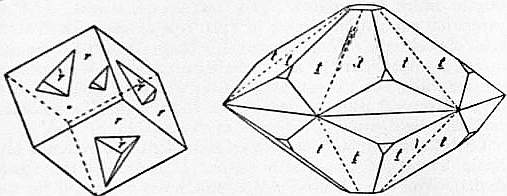
Fig. 1. Fig. 2.
Twinned Crystals of Chabazite.
The hardness of chabazite is 4½, and the specific gravity 2.08-2.16. As first noticed by Sir David Brewster in 1830, the crystals often exhibit anomalous optical characters: instead of being uniaxial, a basal section may be divided into sharply-defined biaxial sectors. Heating of the crystals is attended by a loss of water and a change in their optical characters; it is probable therefore that the anomalous optical characters are dependent on the amount of water present.
Besides phacolite, mentioned above, other varieties of chabazite are distinguished. Herschelite and seebachite are essentially the same as phacolite. Haydenite is the name given to small yellowish crystals, twinned on a rhombohedron plane r, from Jones’s Falls near Baltimore in Maryland. Acadialite is a reddish chabazite from Nova Scotia (the old French name of which is Acadie).
Chemically, chabazite is a complex hydrated calcium and sodium silicate, with a small proportion of the sodium replaced by potassium, and sometimes a small amount of the calcium replaced by barium and strontium. The composition is however variable, and is best expressed as an isomorphous mixture of the molecules (Ca, Na2) Al2(SiO4)2 + 4H2O and (Ca, Na2) Al2(Si3O8)2 + 8H2O, which are analogous to the felspars. Most analyses correspond with a formula midway between these extremes, namely, (Ca, Na2)Al2(SiO3)4 + 6H2O.
Chabazite occurs with other zeolites in the amygdaloidal cavities of basaltic rocks; occasionally it has been found in gneisses and schists. Well-formed crystals are known from many localities; for example, Kilmalcolm in Renfrewshire, the Giant’s Causeway in Co. Antrim, and Oberstein in Germany. Beautiful, clear glassy crystals of the phacolite (“seebachite”) variety occur with phillipsite and radiating bundles of brown calcite in cavities in compact basalt near Richmond, Melbourne, Victoria. Small crystals have been observed lining the cavities of fossil shells from Iceland, and in the recent deposits of the hot springs of Plombières and Bourbonne-les-Bains in France.
Gmelinite and levynite are other species of zeolites which may be mentioned here, since they are closely related to chabazite, and like it are rhombohedral and frequently twinned. Gmelinite forms large flesh-red crystals usually of hexagonal habit, and was early known as soda-chabazite, it having the composition of chabazite but with sodium predominating over calcium (Na2, Ca)Al2(SiO3)46H2O. The formula of levynite is CaAl2Si3O10 + 5H2O.
(L. J. S.)
CHABLIS, a town of north-central France, in the department of Yonne, on the left bank of the Serein, 14 m. E. by N. of Auxerre by road. Pop. (1906) 2227. Its church of St Martin belongs to the end of the 12th century. The town gives its name to a well-known white wine produced in the neighbouring vineyards, of which the most esteemed are Clos, Bouguerots, Moutonne, Grenouille, Montmaires, Lys and Vaux-Désirs. There are manufactures of biscuits.
CHABOT, FRANÇOIS (1757-1794), French revolutionist, had been a Franciscan friar before the Revolution, and after the civil constitution of the clergy continued to act as “constitutional” priest, becoming grand vicar of Henri Grégoire, bishop of Blois. Then he was elected to the Legislative Assembly, sitting at the extreme left, and forming with C. Bazire and Merlin de Thionville the “Cordelier trio.” Re-elected to the Convention he voted for the death of Louis XVI., and opposed the proposal to prosecute the authors of the massacre of September, “because among them there are heroes of Jemmapes.” Some of his sayings are well known, such as that Christ was the first “sans-culotte.” Compromised in the falsification of a decree suppressing the India Company and in a plot to bribe certain members of the Convention, especially Fabre d’Eglantine and C. Bazire, he was arrested, brought before the Revolutionary Tribunal, and was condemned and executed at the same time as the Dantonists, who protested against being associated with such a “fripon.”
CHABOT, GEORGES ANTOINE, known as Chabot de l’Allier (1758-1819), French jurist and statesman, was president of the tribunal of Montluçon when he was elected as a deputy suppléant to the National Convention. A member of the council of the Ancients, then of the Tribunate, he was president of the latter when the peace of Amiens was signed. He had a resolution adopted, tending to give Napoleon Bonaparte the consulship for life; and in 1804 supported the proposal to establish a hereditary monarchy. Napoleon named him inspector-general of the law schools, then judge of the court of cassation. He published various legal works, e.g. Tableau de la législation ancienne sur les successions et de la législation nouvelle établie par le code civil (Paris, 1804), and Questions fransitoires sur le code Napoléon (Paris, 1809).
CHABOT, PHILIPPE DE, Seigneur de Brion, Count of Charny and Buzançais (c. 1492-1543), admiral of France. The Chabot family was one of the oldest and most powerful in Poitou. Philippe was a cadet of the Jarnac branch. He was a companion of Francis I. as a child, and on that king’s accession was loaded with honours and estates. After the battle of Pavia he was made admiral of France and governor of Burgundy (1526), and shared with Anne de Montmorency the direction of affairs. He was at the height of his power in 1535, and commanded the army for the invasion of the states of the duke of Savoy; but in the campaigns of 1536 and 1537 he was eclipsed by Montmorency, and from that moment his influence began to wane. He was accused by his enemies of peculation, and condemned on the 10th of February 1541 to a fine of 1,500,000 livres, to banishment, and to the confiscation of his estates. Through the good offices of Madam d’Étampes, however, he obtained the king’s pardon almost immediately (March 1541), was reinstated in his posts, and regained his estates and even his influence, while Montmorency in his turn was disgraced. But his health was affected by these troubles, and he died soon afterwards on the 1st of June 1543. His tomb in the Louvre, by an unknown sculptor, is a fine example of French Renaissance work. It was his nephew, Guy Chabot, seigneur de Jarnac, who fought the famous duel with François de Vivonne, seigneur de la Châtaigneraie, in 1547, at the beginning of the reign of Henry II.
The main authorities for Chabot’s life are his MS. correspondence in the Bibliothèque Nationale, Paris, and contemporary memoirs. See also E de Barthélemy, “Chabot de Brion,” in the Revue des questions historiques (vol. xx. 1876); Martineau, “L’Amiral Chabot,” in the Positions des thèses de l’École des Chartes (1883).
CHABRIAS (4th century B.C.), a celebrated Athenian general. In 388 B.C. he defeated the Spartans at Aegina and commanded the fleet sent to assist Evagoras, king of Cyprus, against the Persians. In 378, when Athens entered into an alliance with, Thebes against Sparta, he defeated Agesilaus near Thebes. On this occasion he invented a manoeuvre, which consisted in receiving a charge on the left knee, with shields resting on the ground and spears pointed against the enemy. In 376 he gained a decisive victory over the Spartan fleet off Naxos, but, when he might have destroyed the Spartan fleet, remembering the fate of the generals at Arginusae, he delayed to pick up the bodies of his dead. Later, when the Athenians changed sides and joined the Spartans, he repulsed Epaminondas before the walls of Corinth. In 366, together with Callistratus, he was accused of treachery in advising the surrender of Oropus to the Thebans. He was acquitted, and soon after he accepted a command under Tachos, king of Egypt, who had revolted against Persia. But on the outbreak of the Social War (357) he joined Chares in the command of the Athenian fleet. He lost his life in an attack on the island of Chios.
See Cornelius Nepos, Chabrias; Xenophon, Hellenica, v. 1-4; Diod. Sic. xv. 29-34; and C. Rehdantz, Vitae Iphicratis, Chabriae, et Timothei (1845); art. Delian League, section B, and authorities there quoted.
CHABRIER, ALEXIS EMMANUEL (1841-1894), French composer, was born at Ambert, Puy de Dôme, on the 18th of January 1841. At first he only cultivated music as an amateur, and it was not until 1879 that he threw up an administration appointment in order to devote himself entirely to the art. He had two years previously written an opéra bouffe entitled L’Étoile, which was performed at the Bouffes Parisiens. In 1881 he was appointed chorus-master of the concerts then recently established by Lamoureux. In 1883 he composed the brilliant orchestral rhapsody entitled España, the themes of which he had jotted down when travelling in Spain. His opera Gwendoline was brought out with considerable success at Brussels on the 10th of April 1886, and was given later at the Paris Grand Opéra. The following year 1887, Le Roi malgré lui, an opera of a lighter description, was produced in Paris at the Opéra Comique, its run being interrupted by the terrible fire by which this theatre was destroyed. His last opera, Briseis, was left unfinished, and performed in a fragmentary condition at the Paris Opéra, after the composer’s death in Paris on the 13th of September 1894. Chabrier was also the author of a set of piano pieces entitled Pièces pittoresques, Valses romantiques, for two pianos, a fantasia for horn and piano, &c. His great admiration for Wagner asserted itself in Gwendoline, a work which, in spite of inequalities due to want of experience, is animated by a high artistic ideal, is poetically conceived, and shows considerable harmonic originality, besides a thorough mastery over the treatment of the orchestra. The characteristics of Le Roi malgré lui have been well summed up by M. Joncières when he alludes to “cette verve inépuisable, ces rythmes endiablés, cette exubérance de gaieté et de vigueur, à laquelle venait se joindre la note mélancolique et émue.” Chabrier’s premature death prevented him from giving the full measure of his worth.
CHACMA, the Hottentot name of the Cape baboon, Papio porcarius, a species inhabiting the mountains of South Africa as far north as the Zambezi. Of the approximate size of an English mastiff, this powerful baboon is blackish grey in colour with a tinge of green due to the yellow rings on most of the hairs. Unlike most of its tribe, it is a good climber; and where wooded cliffs are not available, will take up its quarters in tall trees. Chacmas frequently strip orchards and fruit-gardens, break and devour ostrich eggs, and kill lambs and kids for the sake of the milk in their stomachs.
CHACO, a territory of northern Argentina, part of a large district known as the Gran Chaco, bounded N. by the territory of Formosa, E. by Paraguay and Corrientes, S. by Santa Fé, and W. by Santiago del Estero and Salta. The Bermejo river forms its northern boundary, and the Paraguay and Paraná rivers its eastern; these rivers are its only means of communication. Pop. (1895) 10,422; (1904, est.) 13,937; area, 52,741 sq. m. The northern part consists of a vast plain filled with numberless lagoons; the southern part is slightly higher and is covered with dense forests, occasionally broken by open grassy spaces. Its forests contain many species of trees of great economic value; among them is the quebracho, which is exported for the tannin which it contains. The capital, Resistencia, with an estimated population of 3500 in 1904, is situated on the Paraná river opposite the city of Corrientes. There is railway communication between Santa Fé and La Sabana, an insignificant timber-cutting village on the southern frontier. In the territory there are still several tribes of uncivilized Indians, who occasionally raid the neighbouring settlements of Santa Fé.
CHACONNE (Span. chacona), a slow dance, introduced into Spain by the Moors, now obsolete. It resembles the Passacaglia. The word is used also of the music composed for this dance—a slow stately movement in ¾ time. Such a movement was often introduced into a sonata, and formed the conventional finale to an opera or ballet until the time of Gluck.
CHAD [Ceadda], SAINT (d. 672), brother of Cedd, whom he succeeded as abbot at Lastingham, was consecrated bishop of the Northumbrians by Wine, the West Saxon bishop, at the request of Oswio in 664. On the return of Wilfrid from France, where he had been sent to be consecrated to the same see, a dispute of course arose, which was settled by Theodore in favour of Wilfrid after three years had passed. Chad thereupon retired to Lastingham, whence with the permission of Oswio he was summoned by Wulfhere of Mercia to succeed his bishop Jaruman, who died 667. Chad built a monastery at Barrow in Lincolnshire and fixed his see at Lichfield. He died after he had held his bishopric in Mercia two and a half years, and was succeeded by Wynfrith. Bede gives a beautiful character of Chad.
See Bede’s Hist. Eccl. edited by C. Plummer, iii. 23, 24, 28; iv. 2, 3 (Oxford, 1896); Eddius, Vita Wilfridi, xiv., xv. edited by J. Raine, Rolls Series (London, 1879).
CHAD, a lake of northern Central Africa lying between 12° 50′ and 14° 10′ N. and 13° and 15° E. The lake is situated about 850 ft. above the sea in the borderland between the fertile and wooded regions of the Sudan on the south and the arid steppes which merge into the Sahara on the north. The area of the lake is shrinking owing to the progressive desiccation of the country, Saharan climate and conditions replacing those of the Sudan. The drying-up process has been comparatively rapid since the middle of the 19th century, a town which in 1850 was on the southern margin of the lake being in 1905 over 20 m. from it. On the west the shore is perfectly flat, so that a slight rise in the water causes the inundation of a considerable area—a fact not without its influence on the estimates made at varying periods as to the size of the lake. Around the north-west and north shores is a continuous chain of gently sloping sand-hills covered with bush. This region abounds in big game and birds are plentiful. In the east, the country of Kanem, the desiccation has been most marked. Along this coast is a continuous chain of islands running from north-west to south-east. But what were islands when viewed by Overweg in 1851, formed in 1903 part of the mainland and new islands had arisen in the lake. They are generally low, being composed of sand and clay, and lie from 5 to 20 m. from the shore, which throughout its eastern side nowhere faces open water. The channels between the islands do not exceed 2 m. in width. Two principal groups are distinguished, the Kuri archipelago in the south, and the Buduma in the north. The inhabitants of the last-named islands were noted pirates until reduced to order by the French. The coast-line is, in general, undefined and marshy, and broken into numerous bays and peninsulas. It is also, especially on the east, lined by lagoons which communicate with the lake by intricate channels. The lake is nowhere of great depth, and about midway numerous mud-banks, marshes, islands and dense growths of aqueous plants stretch across its surface. Another stretch of marsh usually cuts off the northernmost part of the lake from the central sections. The open water varies in depth from 3 ft. in the north-west to over 20 in the south, where desiccation is less apparent. Fed by the Shari (q.v.) and other rivers, the lake has no outlet and its area varies according to the season. The flood water brought down by the Shari in December and January causes the lake to rise to a maximum of 24 ft., the water spreading over low-lying ground, left dry again in May or June. But after several seasons of heavy rainfall the waters have remained for years beyond their low-water level. Nevertheless the secular shrinking goes on, the loss by evaporation and percolation exceeding the amount of water received; whilst, on the average, the rainfall is diminishing. In 1870 the lake rose to an exceptional height, but since then, save in 1897, there has been only the normal seasonal rise. The prevalent north-east wind causes at times a heavy swell on the lake. Fish abound in its waters, which are sweet, save at low-level, when they become brackish. The lagoons are believed to act as purifying pans in which the greater part of the salt in the water is precipitated. In the south-west end of the lake the water is yellow, caused by banks of clay; elsewhere it is clear.
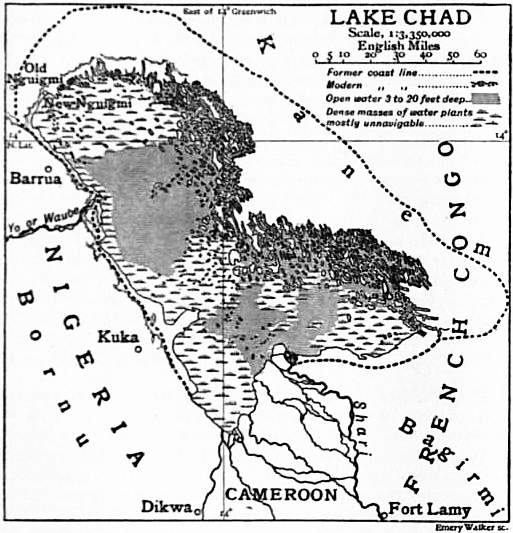
The southern basin of Chad is described under the Shari, which empties its waters into the lake about the middle of the southern shore, forming a delta of considerable extent. Beyond the south-east corner of the lake is a depression known as the Bahr-el-Ghazal (not to be confounded with the Nile affluent of the same name). This depression is the termination of what is in all probability the bed of one of the dried-up Saharan rivers. Coming from the Tibesti highlands the Bahr-el-Ghazal has a south-westerly trend to Lake Chad. Near the lake the valley was formerly swampy, and at high-water the lake overflowed into it. There was also at one time communication between the Shari and the Bahr-el-Ghazal, so that the water of the first-named stream reached Chad by way of the Bahr-el-Ghazal. There is now neither inlet nor outlet to the lake in this direction, the mouth of the Ghazal having become a fertile millet field. There is still, however, a distinct current from the Shari delta to the east end of the lake—known to the natives, like the depression beyond, as the Bahr-el-Ghazal—indicative of the former overflow outlet.
Besides the Shari, the only important stream entering Lake Chad is the Waube or Yo (otherwise the Komadugu Yobe), which rises near Kano, and flowing eastward enters the lake on its western side 40 m. north of Kuka. In the rains the Waube carries down a considerable body of water to the lake.
Lake Chad is supposed to have been known by report to Ptolemy, and is identified by some writers with the Kura lake of the middle ages. It was first seen by white men in 1823 when it was reached by way of Tripoli by the British expedition under Dr Walter Oudney, R.N., the other members being Captain Hugh Clapperton and Major (afterwards Lieut.-Colonel) Dixon Denham. By them the lake was named Waterloo. In 1850 James Richardson, accompanied by Heinrich Barth and Adolf Overweg, reached the lake, also via Tripoli, and Overweg was the first European to navigate its waters (1851). The lake was visited by Eduard Vogel (1855) and by Gustav Nachtigal (1870), the last-named investigating its hydrography in some detail. In 1890-1893 its shores were divided by treaty between Great Britain, France and Germany. The first of these nations to make good its footing in the region was France. A small steamer, brought from the Congo by Emile Gentil, was in 1897 launched on the Shari, and reaching the Chad, navigated the southern part of the lake. Communication between Algeria and Lake Chad by way of the Sahara was opened, after repeated failures, by the French explorer F. Foureau in 1899-1900. At the same time a French officer, Lieut. Joalland, reached the lake from the middle Niger, continuing his journey round the north end to Kanem. A British force under Colonel T.L.N. Morland visited the lake at the beginning of 1902, and in May of the same year the Germans first reached it from Cameroon. In 1902-1903 French officers under Colonel Destenave made detailed surveys of the south-eastern and eastern shores and the adjacent islands. In 1903 Captain E. Lenfant, also a French officer, succeeded in reaching the lake (which he circumnavigated) via the Benue, proving the existence of water communication between the Shari and the Niger. In 1905 Lieut. Boyd Alexander, a British officer, further explored the lake, which then contained few stretches of open water. The lake is bordered W. and S.W. by Bornu, which is partly in the British protectorate of Nigeria and partly in the German protectorate of Cameroon. Bagirmi to the S.E. of the lake and Kanem to the N.E. are both French possessions. The north and north-west shores also belong to France. One of the ancient trade routes across the Sahara—that from Tripoli to Kuka in Bornu—strikes the lake at its north-west corner, but this has lost much of its former importance.
See the works of Denham, Clapperton, Barth and Nachtigal cited in the biographical notices; Geog. Journal, vol. xxiv. (1904); Capt. Tilho in La Géographie (March 1906); Boyd Alexander, From the Niger to the Nile, vol. i. (London, 1907); A. Chevalier, Mission Chari-Lac Tchad 1902-1904 (Paris 1908); E. Lenfant, La Grande Route du Tchad (Paris, 1905); H. Freydenberg, Étude sur le Tchad et le bassin du Chari (Paris, 1908).
CHADDERTON, an urban district of Lancashire, England, within the parliamentary borough of Oldham (q.v.). Pop. (1901) 24,892. Cotton and chemical works, and the coal-mines of the neighbourhood, employ the large industrial population.
CHADERTON, LAURENCE (?1536-1640), Puritan divine, was born at Lees Hall, in the parish of Oldham, Lancashire, probably in September 1536, being the second son of Edmund Chaderton, a gentleman of an ancient and wealthy family, and a zealous Catholic. Under the tuition of Laurence Vaux, a priest, he became an able scholar. In 1564 he entered Christ’s College, Cambridge, where, after a short time, he formally adopted the reformed doctrines and was in consequence disinherited by his father. In 1567 he was elected a fellow of his college, and subsequently was chosen lecturer of St Clement’s church, Cambridge, where he preached to admiring audiences for many years. He was a man of moderate views, though numbering among his friends extremists like Cartwright and Perkins. So great was his reputation that when Sir Walter Mildmay founded Emmanuel College in 1584 he chose Chaderton for the first master, and on his expressing some reluctance, declared that if he would not accept the office the foundation should not go on. In 1604 Chaderton was appointed one of the four divines for managing the cause of the Puritans at the Hampton Court conference; and he was also one of the translators of the Bible. In 1578 he had taken the degree of B.D., and in 1613 he was created D.D. At this period he made provision for twelve fellows and above forty scholars in Emmanuel College. Fearing that he might have a successor who held Arminian doctrines, he resigned the mastership in favour of John Preston, but survived him, and lived also to see the college presided over successively by William Sancroft (or Sandcroft) and Richard Holdsworth. He died on the 13th of November 1640 at the age of about 103, preserving his bodily and mental faculties to the end.
Chaderton published a sermon preached at St Paul’s Cross about 1580, and a treatise of his On Justification was printed by Anthony Thysius, professor of divinity at Leiden. Some other works by him on theological subjects remain in manuscript.
CHADWICK, SIR EDWIN (1800-1890), English sanitary reformer, was born at Longsight, near Manchester, on the 24th of January 1800. Called to the bar without any independent means, he sought to support himself by literary work, and his essays in the Westminster Review (mainly on different methods of applying scientific knowledge to the business of government) introduced him to the notice of Jeremy Bentham, who engaged him as a literary assistant and left him a handsome legacy. In 1832 he was employed by the royal commission appointed to inquire into the operation of the poor laws, and in 1833 he was made a full member of that body. In conjunction with Nassau W. Senior he drafted the celebrated report of 1834 which procured the reform of the old poor law. His special contribution was the institution of the union as the area of administration. He favoured, however, a much more centralized system of administration than was adopted, and he never ceased to complain that the reform of 1834 was fatally marred by the rejection of his views, which contemplated the management of poor-law relief by salaried officers controlled from a central board, the boards of guardians acting merely as inspectors. In 1834 he was appointed secretary to the poor law commissioners. Finding himself unable to administer in accordance with his own views an act of which he was largely the author, his relations with his official chiefs became much strained, and the disagreement led, among other causes, to the dissolution of the poor law commission in 1846. Chadwick’s chief contribution to political controversy was his constant advocacy of entrusting certain departments of local affairs to trained and selected experts, instead of to representatives elected on the principle of local self-government. While still officially connected with the poor law he had taken up the question of sanitation in conjunction with Dr Southwood Smith, and their joint labours produced a most salutary improvement in the public health. His report on “The Sanitary Condition of the Labouring Population” (1842) is a valuable historical document. He was a commissioner of the Board of Health from its establishment in 1848 to its abolition in 1854, when he retired upon a pension, and occupied the remainder of his life in voluntary contributions to sanitary and economical questions. He died at East Sheen, Surrey, on the 6th of July 1890. He had been made K.C.B. in 1889.
See a volume on The Evils of Disunity in Central and Local Administration ... and the New Centralization for the People, by Edwin Chadwick (1885); also The Health of Nations, a Review of the Works of Edwin Chadwick, with a Biographical Introduction, by Sir B.W. Richardson (1887).
CHAEREMON, Athenian dramatist of the first half of the 4th century B.C. He is generally considered a tragic poet. Aristotle (Rhetoric, iii. 12) says his works were intended for reading, not for representation. According to Suidas, he was also a comic poet, and the title of at least one of his plays (Achilles Slayer of Thersites) seems to indicate that it was a satyric drama. His Centaurus is described by Aristotle (Poet. i. 12) as a rhapsody in all kinds of metres. The fragments of Chaeremon are distinguished by correctness of form and facility of rhythm, but marred by a florid and affected style reminiscent of Agathon. He especially excelled in descriptions (irrelevantly introduced) dealing with such subjects as flowers and female beauty. It is not agreed whether he is the author of three epigrams in the Greek Anthology (Palatine vii. 469, 720, 721) which bear his name.
See H. Bartsch, De Chaeremone Poëta tragico (1843); fragments in A. Nauck, Fragmenta Tragicorum Graecorum.
CHAEREMON, of Alexandria (1st century A.D.), Stoic philosopher and grammarian. He was superintendent of the portion of the Alexandrian library that was kept in the temple of Serapis, and as custodian and expounder of the sacred books (ἱερογραμματέύς sacred scribe) belonged to the higher ranks of the priesthood. In A.D. 49 he was summoned to Rome, with Alexander of Aegae, to become tutor to the youthful Nero. He was the author of a History of Egypt; of works on Comets, Egyptian Astrology, and Hieroglyphics; and of a grammatical treatise on Expletive Conjunctions (συνδεσμοὶ παραπληρωματικοί). Chaeremon was the chief of the party which explained the Egyptian religious system as a mere allegory of the worship of nature. His books were not intended to represent the ideas of his Egyptian contemporaries; their chief object was to give a description of the sanctity and symbolical secrets of ancient Egypt. He can hardly be identical with the Chaeremon who accompanied (c. 26 B.C.; Strabo xvii. p. 806) Aelius Gallus, praefect of Egypt, on a journey into the interior of the country.
Fragments in C. Müller, Fragmenta Historicorum Graecorum, iii. 495-499.
CHAERONEIA, or Chaeronea, an ancient town of Boeotia, said by some to be the Homeric Arne, situated about 7 m. W. of Orchomenus. Until the 4th century B.C. it was a dependency of Orchomenus, and at all times it played but a subordinate part in Boeotian politics. Its importance lay in its strategic position near the head of the defile which presents the last serious obstacle to an invader in central Greece. Two great battles were fought on this site in antiquity. In 338 B.C. Philip II. and Alexander of Macedon were confronted by a confederate host from central Greece and Peloponnese under the leadership of Thebes and Athens, which here made the last stand on behalf of Greek liberty. A hard-fought conflict, in which the Greek infantry displayed admirable firmness, was decided in favour of Philip through the superior organization of his army. In 86 B.C. the Roman general L. Cornelius Sulla defeated the army of Mithradates VI., king of Pontus, near Chaeroneia. The latter’s enormous numerical superiority was neutralized by Sulla’s judicious choice of ground and the steadiness of his legionaries; the Asiatics after the failure of their attack were worn down and almost annihilated. Chaeroneia is also notable as the birthplace of Plutarch, who returned to his native town in old age, and was held in honour by its citizens for many successive generations. Pausanias (ix. 40) mentions the divine honours accorded at Chaeroneia to the sceptre of Agamemnon, the work of Hephaestus (cf. Iliad, ii. 101). The site of the town is partly occupied by the village of Kapraena; the ancient citadel was known as the Petrachus, and there is a theatre cut in the rock. A colossal seated lion a little to the S.E. of the site marks the grave of the Boeotians who fell fighting against Philip; this lion was found broken to pieces; the tradition that it was blown up by Odysseus Androutsos is incorrect (see Murray, Handbook for Greece, ed. 5, 1884, p. 409). It has now been restored and re-erected (1905).
Authorities.—Thucydides iv. 76; Diodorus xvi. 85-86; Plutarch, Alexander, ch. 9; Sulla, chs. 16-19; Appian, Mithradatica, chs. 42-45; W.M. Leake, Travels in Northern Greece (London, 1835), ii. 112-117, 192-201; B.V. Head, Historia Numorum (Oxford, 1887), p. 292; J. Kromayer, Antike Schlachtfelder in Griechenland (Berlin, 1903), pp. 127-195; G. Sotiriades in Athen. Mitteil. 1903, pp. 301 ff.; 1905, p. 120; 1906, p. 396; Έφημ. Άρχαιολ., 1908, p. 65.
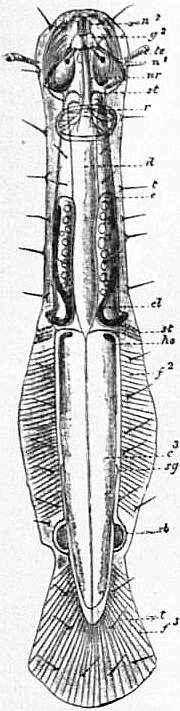
Spadella cephaloptera (Busch).
St, Septa dividing body-cavity transversely. g², Cerebral ganglia. n¹, Commissure uniting this with ventral ganglion (not shown in fig.). n², Nerve uniting cerebral ganglia with small ganglia on head. nr, Olfactory nerve. d, Alimentary canal. r, Olfactory organ. te, Tentacle. t, Tactile hairs springing from surface of body. e, Ovary. el, Oviduct. ho, Testes. sg, Vas deferens. f², f³, Lateral and caudal fins. sb, Seminal pouch.
The eyes are indicated as black dots behind the cerebral ganglia.
CHAETOGNATHA, the name given by R. Leuckhart to a small group of transparent and for the most part pelagic organisms, whose position in the animal kingdom is a very isolated one. Only three genera, Sagitta, Spadella and Krohnia, are recognised, and the number of species is small. Nevertheless these animals exist in extraordinary quantities, so that at certain seasons and under certain conditions the surface of the sea seems almost stiff with the incredible multitude of organisms which pervade it. Rough seas, &c., cause them to seek safety in dropping into deeper water. Deep-sea forms also occur, but in spite of this the group is essentially pelagic.
As a rule the body is some 1 to 2 or 3 cm. in length, though some species are larger, by 4 or 5 mm. in breadth, and it is shaped something like a torpedo with side flanges and a slightly swollen, rounded head. It can be divided into three regions—(i.) head, (ii.) trunk, and (iii.) tail, separated from one another by two transverse septa. The almost spherical head is covered by a hood which can be retracted; it bears upon its side a number of sickle-shaped, chitinous hooks and one or more short rows of low spines—both of these features are used in characterizing the various species. A pair of eyes lie dorsally and behind them is a closed circlet, often pulled out into various shapes, of modified epidermis, to which an olfactory function has been attributed. The interior of the head is filled up with masses of muscle fibres which are mainly occupied with moving the sickle-shaped hooks. The trunk contains a spacious body-cavity filled during the breeding season by the swollen ovaries, and the same is true of the tail if we substitute testes for ovaries.
The skin consists of a transparent cuticle excreted by the underlying ectoderm, the cells of which though usually one-layered may be heaped up into several layers in the head; beneath this is a basement membrane, and then a layer of longitudinal muscle fibres which are limited inside by a layer of peritoneal cells. The muscles are striated and arranged in four quadrants, two dorso-lateral and two ventro-lateral, an arrangement which recalls that of the Nematoda, whilst in their histology they somewhat resemble the muscles of the Oligochaeta. Along each side of the body stretches a horizontal fin and a similar flange surrounds the tail. Into these fins, which are largely cuticular and strengthened by radiating bars, a single layer of ectoderm cells projects.
The mouth, a longitudinal slit, opens on to the ventral surface of the head. It leads into a straight alimentary canal whose walls consist of a layer of ciliated cells ensheathed in a thin layer of peritoneal cells. There is no armature, and no glands, and the whole tract can only be divided into an oesophagus and an intestine. The latter runs with no twists or coils straight to the anus, which is situated at the junction of the trunk with the tail. A median mesentery running dorso-ventrally supports the alimentary canal and is continued behind it into the tail, thus dividing the body cavity into two lateral halves.
There are no specialized circulatory, respiratory or excretory organs.
The nervous system consists of a cerebral ganglion in the head, a conspicuous ventral ganglion in the trunk, and of lateral commissures uniting these ganglia on each side. The whole of this system has retained its primitive connexion with the ectoderm. The cerebral ganglion also gives off a nerve on each side to a pair of small-ganglia, united by a median commissure, which have sunk into and control the muscles of the head. As in other animals there is a minute but extensive nervous plexus, which permeates the whole body and takes its origin from the chief ganglia. In addition to the eyes and the olfactory circle on the head scattered tactile papillae are found on the ectoderm.
Chaetognatha are hermaphrodite. The ovaries are attached to the side walls of the trunk region; between them and the body wall lie the two oviducts whose inner and anterior end is described as closed, their outer ends opening one on each side of the anus, where the trunk joins the tail. According to Miss N.M. Stevens the so-called oviduct acts only as a “sperm-duct” or receptaculum seminis. The spermatozoa enter it and pass through its walls and traverse a minute duct formed of two accessory cells, and finally enter the ripe ovum. Temporary oviducts are formed between the “sperm-duct” and the germinal epithelium at each oviposition. A number of ova ripen simultaneously. The two testes lie in the tail and are formed by lateral proliferations of the living peritoneal cells. These break off and, lying in the coelomic fluid, break up into spermatozoa. They pass out through short vasa deferentia with internal ciliated funnels, sometimes an enlargement on their course—the seminal vesicles—and a minute external pore situated on the side of the tail.
With hardly an exception the transparent eggs are laid into the sea and float on its surface. The development is direct and there is no larval stage. The segmentation is complete; one side of the hollow blastosphere invaginates and forms a gastrula. The blastopore closes, a new mouth and a new anus subsequently arising. The archenteron gives off two lateral pounchs and thus becomes trilobed. The middle lobe forms the alimentary canal; it closes behind and opens to the exterior anteriorly and so makes the mouth. The two lateral lobes contain the coelom; each separates off in front a segment which forms the head and presumably then divides again to form anteriorly the trunk, and posteriorly the tail regions. An interesting feature of the development of Chaetognaths is that, as in some insects, the cells destined to form the reproductive organs are differentiated at a very early period, being apparent even in the gastrula stage.
The great bulk of the group is pelagic, as the transparent nature of all their tissues indicates. They move by flexing their bodies. Spadella cephaloptera is, however, littoral and oviposits on seaweed, and the “Valdivia” brought home a deep-sea species.
The three genera are differentiated as follows:—
Sagitta M. Slabber, with two pairs of lateral fins. This genus was named as long ago as 1775.
Krohnia P. Langerhans, with one lateral fin on each side, extending on to the tail.
Spadella P. Langerhans, with a pair of lateral fins on the tail and a thickened ectodermic ridge running back on each side from the head to the anterior end of the fin.
The group is an isolated one and should probably be regarded as a separate phylum. It has certain histological resemblances with the Nematoda and certain primitive Annelids, but little stress must be laid on these. The most that can be said is that the Chaetognaths begin life with three segments, a feature they share with such widely-differing groups as the Brachiopoda, the Echinoderma and the Enteropneusta, and probably Vertebrata generally.
See O. Hertwig, Die Chaetognathen, eine Monographie (Jena, 1880); B.J. Grassi, Chetognathi: Flora u. Fauna d. Golfes von Neapel (1883); S. Strodtman, Arch. Naturg. lviii., 1892; N.M. Stevens, Zool. Jahrb. Anat. xviii., 1903, and xxi., 1905.
(A. E. S.)
CHAETOPODA (Gr. χαίτη, hair, πούς, foot), a zoological class, including the majority of the Annelida (q.v.), and indeed, save for the Echiuroidea (q.v.), co-extensive with that group as usually accepted. They are divisible into the Haplodrili (q.v.) or Archiannelida, the Polychaeta containing the marine worms, the Oligochaeta or terrestrial and fresh-water annelids (see EARTHWORM), the Hirudinea or leeches (see Leech), and a small group of parasitic worms, the Myzostomida (q.v.).
The distinctive characters of the class Chaetopoda as a whole are partly embodied in the name. They possess (save for certain Archiannelida, most Hirudinea, and other very rare exceptions) setae or chaetae implanted in epidermal pits. The setae are implanted metamerically in accordance with the metamerism of the body, which consists of a prostomium followed by a number of segments. The number of segments in an individual is frequently more or less definite. The anterior end of body always shows some “cephalization.” The internal organs are largely repeated metamerically, in correspondence with the external metamerism. Thus the body cavity is divided into a sequence of chambers by transverse septa; and even among the Hirudinea, where this condition is usually not to be observed, there is embryological evidence that the existing state of affairs is derived from this. Commonly the nephridia are strictly paired a single pair to each segment, while the branches of the blood vascular system are similarly metameric. The alimentary canal is nearly always a straight tube running from the mouth, which is surrounded by the first segment of the body and overhung by the prostomium, to the anus, which is then either surrounded by the last segment of the body or opens dorsally a little way in front of this.
The Class as a Whole.—The Chaetopoda are with but few exceptions (Myzostomida in part, Sternaspis) elongated worms, flattened or, more usually, cylindrical, and bilaterally symmetrical. The body consists of a number of exactly similar or closely similar segments, which are never fused and metamorphosed, as in the Arthropoda, to form specialized regions of the body. It is, however, always possible to recognize a head, which consists at least of the peristomial segment with a forward projection of the same, the prostomium. A thorax also is sometimes to be distinguished from an abdomen. Where locomotive appendages (the parapodia of the Polychaeta) exist, they are never jointed, as always in the Arthropoda; nor are they modified anteriorly to form jaws, as in that group.
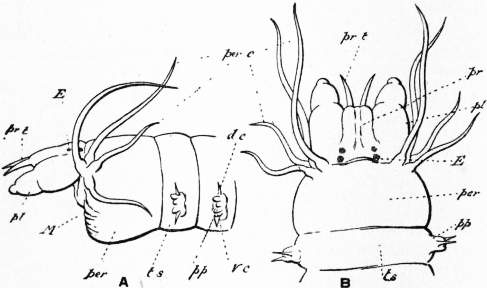
Fig. 1.—A, side view of the head region of Nereis cultrifera; B, dorsal view of the same.
E, Eye. M, Mouth. d.c, Dorcal cirrus. per, Peristomium, probably equal to two segments, per.c, Peristomial cirri. pl, Prostomial palp. pp, Parapodium. pr, Prostomium. pr.t, Prostomial tentacle. t.s, Trunk segment. v.c, Ventral cirrus.
The prostomium overhangs the mouth, and is often of considerable size and, as a rule, quite distinct from the segment following, being separated by an external groove, and containing, at least temporarily, the brain, which always arises there. Its cavity also is at first independent of the coelom though later invaded by the latter. In any case the cavity of the prostomium is single, and not formed, as is the cavity of the segments of the body, by paired coelomic chambers. It has, however, been alleged that this cavity is formed by a pair of mesoblastic somites (N. Kleinenberg), in which case there is more reason for favouring the view that would assign an equality between the prostomium and the (in that case) other segments of the body. The peculiar prostomium of Tomopteris is described below. The body wall of the Chaetopoda consists of a “dermo-muscular” tube which is separated from the gut by the coelom and its peritoneal walls, except in most leeches. A single layer of epidermic cells, some of which are glandular, forms the outer layer. Rarely are these ciliated, and then only in limited tracts. They secrete a cuticle which never approaches in thickness the often calcified cuticle of Arthropods. Below this is a circular, and below that again a longitudinal, layer of muscle fibres. These muscles are not striated, as they are in the Arthropoda.
Setae.—These chitinous, rod-like, rarely squat and then hook-like structures are found in the majority of the Chaetopoda, being absent only in certain Archiannelida, most leeches, and a very few Oligochaeta. They exist in the Brachiopoda (which are probably not unrelated to the Chaetopoda), but otherwise are absolutely distinctive of the Chaetopods. The setae are invariably formed each within an epidermic cell, and they are sheathed in involutions of the epidermis. Their shape and size varies greatly and is often of use in classification. The setae are organs of locomotion, though their large size and occasionally jagged edges in some of the Polychaeta suggest an aggressive function. They are disposed in two groups on either side, corresponding in the Polychaeta to the parapodia; the two bundles are commonly reduced among the earthworms to two pairs of setae or even to a single seta. On the other hand, in certain Polychaeta the bundles of setae are so extensive that they nearly form a complete circle surrounding the body; and in the Oligochaet genus Perichaeta (= Pheretima), and some allies, there is actually a complete circle of setae in each segment broken only by minute gaps, one dorsal, the other ventral.
Coelom.—The Chaetopoda are characterized by a spacious coelom, which is divided into a series of chambers in accordance with the general metamerism of the body. This is the typical arrangement, which is exhibited in the majority of the Polychaeta and Oligochaeta; in these the successive chambers of the coelom are separated by the intersegmental septa, sheets of muscle fibres extending from the body wall to the gut and thus forming partitions across the body. The successive cavities are not, however, completely closed from each other; there is some communication between adjoining segments, and the septa are sometimes deficient here and there. Thus in the Chaetopoda the perivisceral cavity is coelomic; in this respect the group contrasts with the Arthropoda and Molluscs, where the perivisceral cavity is, mainly at least, part of the vascular or haemal system, and agrees with the Vertebrata. The coelom is lined throughout by cells, which upon the intestine become large and loaded with excretory granules, and are known as chloragogen cells. Several forms of cells float freely in the fluid of the coelom. In another sense also the coelom is not a closed cavity, for it communicates in several ways with the external medium. Thus, among the Oligochaeta there are often a series of dorsal pores, or a single head pore, present also among the Polychaeta (in Ammochares). In these and other Chaetopods the coelom is also put into indirect relations with the outside world by the nephridia and by the gonad ducts. In these features, and in the fact that the gonads are local proliferations of the coelomic epithelium, which have undergone no further changes in the simpler forms, the coelom of this group shows in a particularly clear fashion the general characters of the coelom in the higher Metazoa. It has been indeed largely upon the conditions characterizing the Chaetopoda that the conception of the coelom in the Coelomocoela has been based.
Among the simpler Chaetopoda the coelom retains the character of a series of paired chambers, showing the above relations to the exterior and to the gonads. There are, however, further complications in some forms. Especially are these to be seen in the more modified Oligochaeta and in the much more modified Hirudinea. In the Polychaeta, which are to be regarded as structurally simpler forms than the two groups just referred to, there is but little subdivision of the coelom of the segments, indeed a tendency in the reverse direction, owing to the suppression of septa. Among the Oligochaeta the dorsal vessel in Dinodrilus and Megascolides is enclosed in a separate coelomic chamber which may or may not communicate with the main coelomic cavity. To this pericardial coelom is frequently added a gonocoel enclosing the gonads and the funnels of their ducts. This condition is more fully dealt with below in the description of the Oligochaeta. The division and, indeed, partial suppression of the coelom culminates in the leeches, which in this, as in some other respects, are the most modified of Annelids.
Nervous System.—In all Chaetopods this system consists of cerebral ganglia connected by a circumoesophageal commissure with a ventral ganglionated cord. The plan of the central nervous system is therefore that of the Arthropoda. Among the Archiannelida, in Aeolosoma and some Polychaetes, the whole central nervous system remains imbedded in the epidermis. In others, it lies in the coelom, often surrounded by a special and occasionally rather thick sheath. The cerebral ganglia constitute an archicerebrum for the most part, there being no evidence that, as in the Arthropoda, a movement forward of post-oral ganglia has taken place. In the leeches, however, there seems to be the commencement of the formation of a syncerebrum. In the latter, the segmentally arranged ganglia are more sharply marked off from the connectives than in other Chaetopods, where nerve cells exist along the whole ventral chain, though more numerous in segmentally disposed swellings.
Vascular System.—In addition to the coelom, another system of fluid-holding spaces lies between the body wall and the gut in the Chaetopoda. This is the vascular or haemal system (formerly and unnecessarily termed pseudhaemal). With a few exceptions among the Polychaeta the vascular system is always present among the Chaetopoda, and always consists of a system of vessels with definite walls, which rarely communicate with the coelom. It is in fact typically a closed system. The larger trunks open into each other either directly by cross branches, or a capillary system is formed. There are no lacunar blood spaces with ill-defined or absent walls except for a sinus surrounding the intestine, which is at least frequently present. The principal trunks consist of a dorsal vessel lying above the gut, and a ventral vessel below the gut but above the nervous cord. These two vessels in the Oligochaeta are united in the anterior region of the body by a smaller or greater number of branches which surround the oesophagus and are, some of them at least, contractile and in that case wider than the rest. The dorsal vessel also communicates with the ventral vessel indirectly by the intestinal sinus, which gives off branches to both the longitudinal trunks, and by tegementary vessels and capillaries which supply the skin and the nephridia. In the smaller and simpler forms the capillary networks are much reduced, but the dorsal and ventral vessels are usually present. The former, however, is frequently developed only in the anterior region of the body where it emerges from the peri-intestinal blood sinus. On the other hand, additional longitudinal trunks are sometimes developed, the chief one of which is a supra-intestinal vessel lying below the dorsal vessel and closely adherent to the walls of the oesophagus in which region it appears. The capillaries sometimes (in many leeches and Oligochaeta) extend into the epidermis itself. Usually they do not extend outwards of the muscular layers of the body wall. The main trunks of the vascular system often possess valves at the origin of branches which regulate the direction of the blood flow. Among many Oligochaeta the dorsal blood-vessel is partly or entirely a double tube, which is a retention of a character shown by F. Vezhdovský to exist in the embryo of certain forms. The blood in the Chaetopoda consists of a plasma in which float a few corpuscles. The plasma is coloured red by haemoglobin: it is sometimes (in Sabella and a few other Polychaeta) green, which tint is due to another respiratory pigment. The plasma may be pink (Magelona) or yellow (Aphrodite) in which cases the colour is owing to another pigment. In Aeolosoma it is usually colourless. The vascular system is in the majority of Chaetopods a closed system. It has been asserted (and denied) that the cellular rod which is known as the “Heart-body” (Herzkorper), and is to be found in the dorsal vessel of many Oligochaeta and Polychaeta, is formed of cells which are continuous with the chloragogen cells, thus implying the existence of apertures of communication with the coelom. The statement has been often made and denied, but it now seems to have been placed on a firm basis (E.S. Goodrich), that among the Hirudinea the coelom, which is largely broken up into narrow tubes, may be confluent with the tubes of the vascular system. This state of affairs has no antecedent improbability about it, since in the Vertebrata the coelom is unquestionably confluent with the haemal system through the lymphatic vessels. Finally, there are certain Polychaeta, e g. the Capitellidae, in which the vascular system has vanished altogether, leaving a coelom containing haemoglobin-impregnated corpuscles. It has been suggested (E. Ray Lankester) that this condition has been arrived at through some such intermediate stage as that offered by Polychaet Magelona. In this worm the ventral blood-vessel is so swollen as to occupy nearly the whole of the available coelom. Carry the process but a little farther and the coelom disappears and its place is taken by a blood space or haemocoel. It has been held that the condition shown in certain leeches tend to prove that the coelom and haemocoel are primitively one series of spaces which have been gradually differentiated. The facts of development, however, prove their distinctness, though those same facts do not speak clearly as to the true nature of the blood system. One view of the origin of the latter (largely based upon observations upon the development of Polygordius) sees in the blood system a persistent blastocoel. F. Vezhdovský has lately seen reasons for regarding the blood system as originating entirely from the hypoblast by the secretion of fluid, the blood, from particular intestinal cells and the consequent formation of spaces through pressure, which become lined with these cells.
Nephridia and Coelomoducts.—The name “Nephridium” was originally given by Sir E. Ray Lankester to the members of a series of tubes, proved in some cases to be excretory in nature, which exist typically to the number of a single pair in most of the segments of the Chaetopod body, and open each by a ciliated orifice into the coelom on the one hand, and by a pore on to the exterior of the body on the other. In its earlier conception, this view embraced as homologous organs (so far as the present group is concerned) not only the nephridia of Oligochaeta and Hirudinea, which are obviously closely similar, but the wide tubes with an intercellular lumen and large funnels of certain Polychaeta, and (though with less assurance) the gonad ducts in Oligochaeta and Hirudinea. The function of nitrogenous excretion was not therefore a necessary part of the view—though it may be pointed out that there are grounds for believing that the gonad ducts are to some extent also organs of excretion (see below). Later, the investigations of E. Meyer and E.S. Goodrich, endorsed by Lankester, led to the opinion that under the general morphological conception of “nephridium” were included two distinct sets of organs, viz. nephridia and coelomoducts. The former (represented by, e.g. the “segmental organs” of Lumbricus) have been asserted to be “ultimately, though not always, actually traceable to the ectoderm”; the latter (represented by, e.g. the oviduct of Lumbricus) are parts of the coelomic wall itself, which have grown out to the exterior. The nephridia, in fact, on this view, are ectodermic ingrowths, the coelomoducts coelomic outgrowths. The cavity of the former has nothing to do with coelom. The cavity of the latter is coelom.
The embryological facts upon which this view has been based, however, have been differently interpreted. According to C.O. Whitman the entire nephridial system (in the leech Clepsine) is formed by the differentiation of a continuous epiblastic band on each side. The exact opposite is maintained by R.S. Bergh (for Lumbricus and Criodrilus), whose figures show a derivation of the entire nephridium from mesoblast, and an absence of any connexion between successive nephridia by any continuous band, epiblastic or mesoblastic. A midway position is taken up by Wilson, who asserts the mesoblastic formation of the funnel, but also asserts the presence of a continuous band of epiblast from which certainly the terminal vesicle of the nephridium, and doubtfully the glandular part of the tube is derived. Vezhdovský’s figures of Rhynchelmis agree with those of Bergh in showing the backward growth of the nephridium from the funnel cell. There are thus substantial reasons for believing that the nephridium grows backwards from a funnel as does the coelomoduct. It is therefore by no means certain that so profound a difference embryologically can be asserted to exist between the excretory nephridia and the ducts leading from the coelom to the exterior, which are usually associated with the extrusion of the genital products among the Chaetopoda.